EP4161075A1 - Method for reconstructing a current block of an image and corresponding encoding method, corresponding devices as well as storage medium carrying an image encoded in a bit stream - Google Patents
Method for reconstructing a current block of an image and corresponding encoding method, corresponding devices as well as storage medium carrying an image encoded in a bit stream Download PDFInfo
- Publication number
- EP4161075A1 EP4161075A1 EP22195782.2A EP22195782A EP4161075A1 EP 4161075 A1 EP4161075 A1 EP 4161075A1 EP 22195782 A EP22195782 A EP 22195782A EP 4161075 A1 EP4161075 A1 EP 4161075A1
- Authority
- EP
- European Patent Office
- Prior art keywords
- block
- partitions
- motion vectors
- flag
- edge
- Prior art date
- Legal status (The legal status is an assumption and is not a legal conclusion. Google has not performed a legal analysis and makes no representation as to the accuracy of the status listed.)
- Pending
Links
Images

Classifications
-
- H—ELECTRICITY
- H04—ELECTRIC COMMUNICATION TECHNIQUE
- H04N—PICTORIAL COMMUNICATION, e.g. TELEVISION
- H04N19/00—Methods or arrangements for coding, decoding, compressing or decompressing digital video signals
- H04N19/50—Methods or arrangements for coding, decoding, compressing or decompressing digital video signals using predictive coding
- H04N19/503—Methods or arrangements for coding, decoding, compressing or decompressing digital video signals using predictive coding involving temporal prediction
- H04N19/51—Motion estimation or motion compensation
- H04N19/537—Motion estimation other than block-based
- H04N19/543—Motion estimation other than block-based using regions
-
- G—PHYSICS
- G06—COMPUTING OR CALCULATING; COUNTING
- G06T—IMAGE DATA PROCESSING OR GENERATION, IN GENERAL
- G06T9/00—Image coding
- G06T9/004—Predictors, e.g. intraframe, interframe coding
-
- H—ELECTRICITY
- H04—ELECTRIC COMMUNICATION TECHNIQUE
- H04N—PICTORIAL COMMUNICATION, e.g. TELEVISION
- H04N19/00—Methods or arrangements for coding, decoding, compressing or decompressing digital video signals
- H04N19/10—Methods or arrangements for coding, decoding, compressing or decompressing digital video signals using adaptive coding
- H04N19/134—Methods or arrangements for coding, decoding, compressing or decompressing digital video signals using adaptive coding characterised by the element, parameter or criterion affecting or controlling the adaptive coding
- H04N19/157—Assigned coding mode, i.e. the coding mode being predefined or preselected to be further used for selection of another element or parameter
- H04N19/159—Prediction type, e.g. intra-frame, inter-frame or bidirectional frame prediction
-
- H—ELECTRICITY
- H04—ELECTRIC COMMUNICATION TECHNIQUE
- H04N—PICTORIAL COMMUNICATION, e.g. TELEVISION
- H04N19/00—Methods or arrangements for coding, decoding, compressing or decompressing digital video signals
- H04N19/10—Methods or arrangements for coding, decoding, compressing or decompressing digital video signals using adaptive coding
- H04N19/102—Methods or arrangements for coding, decoding, compressing or decompressing digital video signals using adaptive coding characterised by the element, parameter or selection affected or controlled by the adaptive coding
- H04N19/119—Adaptive subdivision aspects, e.g. subdivision of a picture into rectangular or non-rectangular coding blocks
-
- H—ELECTRICITY
- H04—ELECTRIC COMMUNICATION TECHNIQUE
- H04N—PICTORIAL COMMUNICATION, e.g. TELEVISION
- H04N19/00—Methods or arrangements for coding, decoding, compressing or decompressing digital video signals
- H04N19/10—Methods or arrangements for coding, decoding, compressing or decompressing digital video signals using adaptive coding
- H04N19/169—Methods or arrangements for coding, decoding, compressing or decompressing digital video signals using adaptive coding characterised by the coding unit, i.e. the structural portion or semantic portion of the video signal being the object or the subject of the adaptive coding
- H04N19/17—Methods or arrangements for coding, decoding, compressing or decompressing digital video signals using adaptive coding characterised by the coding unit, i.e. the structural portion or semantic portion of the video signal being the object or the subject of the adaptive coding the unit being an image region, e.g. an object
- H04N19/176—Methods or arrangements for coding, decoding, compressing or decompressing digital video signals using adaptive coding characterised by the coding unit, i.e. the structural portion or semantic portion of the video signal being the object or the subject of the adaptive coding the unit being an image region, e.g. an object the region being a block, e.g. a macroblock
Definitions
- the invention is made in the field of predictive image block encoding and reconstruction wherein segments resulting from geometry adaptive block partitioning are predicted.
- quadtree-based partition structures for coding macro-blocks.
- Such a structure allows the coding algorithm to adapt to the complicated and non-stationary nature of natural images.
- quad-tree partitions a recent study by C.Dai, O.Escoda, P.Yin, X.Li, C.Gomila, "Geometry-Adaptive block Partitioning for Intra Prediction in Image & Video Coding," Image Processing, 2007, ICIP 2007, IEEE International Conference on Volume 6, Sept. 16 2007-Oct. 19 2007, pp VI - 85 - VI - 88 , has shown that these are not efficient enough (in terms of rate distortion performance) when images can be locally modelled as 2D piece wise-smooth signals.
- the partitioning line, generated by the zero level line of f(x, y) is determined by angle ⁇ and distance ⁇ .
- ⁇ and ⁇ are encoded and transmitted in the bit-stream for blocks with mode "geo".
- a gain in PSNR up to 12% was achieved, despite supplemental encoding cost of ⁇ and ⁇ in Intra.
- R.D.Forni and D.S.Taubman proposed in "On the Benefits of Leaf Merging in Quad-Tree Motion Models," Image Processing, 2005, ICIP 2005, IEEE International Conference on Image processing, Volume 2, 11-14 Sept. 2005, pp II - 858-61 , proposed to encode an additional binary merge flag indicating whether or not neighboring leaves have to be merged. If the leaf is to be merged, additional 0, 1 or 2 bits are coded to identify the specific merging direction. With its implementation, the authors experienced gains in PSNR between 0.5 dB to 1 dB compared to H.264/AVC.
- the inventors recognized that, according to prior art, all possible geometry contours have to be tested at the encoder side for an appropriate choice of the encoding mode "geo" which causes the relative complexity of the determination of geometry according to prior art.
- the inventor further recognized the relative simplicity of the geometries determinable according to prior art.
- geometry or object boundary information can be signalled implicitly by referencing a block which depicts essentially the same geometry and is determined for being decoded prior to a block for which the geometry information is signalled.
- inventors propose a method for reconstructing a current block of an image according to claim 1 and a corresponding method for predictive encoding according to claim 3.
- Said method for reconstructing a current block of an image, the current block being encoded using predictive encoding of segments resulting from geometry adaptive block partitioning of said current block comprises decoding encoded data comprising at least one flag and motion vectors, wherein blocks referenced by the motion vectors are used for prediction of segments of the current block, using the at least one flag and an encoding order of the motion vectors in the encoded data for determining which of the referenced blocks exhibits a geometry that matches the geometry of the current block and for determining a segment of the determined block, wherein prior to determining the segment, the determined block is geometry adaptive block partitioned into segments from which the segment is determined for predicting one of the segments of the current block.
- the encoded data further comprises a residual and said method further comprises using the motion vectors for retrieving the blocks from a storage device, using the determined segment for selecting at least one segment in at least one further referenced block, the selected at least one segment being complementary in contour to the determined segment, and reconstructing the current block using the determined segment, the selected at least one segment and the residual.
- Said method for predictive encoding of a current block comprises using predictive encoding of segments resulting from geometry adaptive block partitioning of said current block, and encoding data comprising at least one flag and motion vectors in an encoding order, wherein the at least one flag and the encoding order signals which of the motion vectors references a block which exhibits a geometry that matches the geometry of the current block and further signals which segment of the signalled block is used for predicting one of the segments of the current block, wherein at least one further block referenced by the motion vectors is used for prediction of at least one further segment of the current block.
- the inventors propose to improve the principle of the geometry-adaptive block partitioning for image block coding by steps which enable extraction of more complex Geometry contours than straight lines and further provide a reduction of the encoding cost.
- the principle is to exploit the implicit Geometry in the source images, by extracting the Geometry information from the images, rather than to determine the Geometry parameters independently from the source image characteristics.
- said method for predictive encoding further comprises using the one segment of the current block for determining, from reconstructed blocks stored in a storage device, the block which exhibits the geometry that matches the geometry of the current block, using a segment of the determined block for determining the at least one further segment, using the at least one further segment for determining the at least one further block; using the segment of the determined block and at least one further segment comprised in the at least one further block for prediction of the segments of the current block; using the determined block and the determined at least one further block for determining the motion vectors; using the prediction for determining a residual of the current block; and quantizing a residual, wherein the encoded data further comprises the quantized residual.
- the predictive encoding method further comprises reconstructing the current block using the prediction and the quantized residual.
- the reconstructed current block can be stored in the storage device.
- Geometry adaptive block partitioning can comprise using a Sobel operator for determining a gradient block for the respective block.
- the image is comprised in an image sequence and at least one motion vector references a block comprised in at least one different image comprised in the image sequence.
- Said device is for reconstructing a current block of an image, the current block being encoded using predictive encoding of segments resulting from geometry adaptive block partitioning of said current block, said device comprising means for decoding encoded data comprising at least one flag and motion vectors, wherein segments of the current block are predictable using segments of blocks referenced by the motion vectors, means for using the at least one flag and an encoding order of the motion vectors in the encoded data for determining which of the referenced blocks exhibits a geometry that matches the geometry of the current block and for determining a segment of the determined block, and means for geometry adaptive block partitioning of the determined block into segments prior to determining the segment.
- Said device is for predictive encoding of a current block of an image, said device comprising means for predictive encoding of segments resulting from geometry adaptive block partitioning of said current block, and means for encoding data comprising at least one flag and motion vectors, wherein the at least one flag and an encoding order of the motion vectors enable determining which of the motion vectors references a block which exhibits a geometry that matches the geometry of the current block and further enable determining which one of the segments of the current block is predictable using a segment of the determinable block, wherein at least one further segment of the current block is predictable using at least one further block referenced by the motion vectors.
- a storage medium is proposed, said storage medium carrying an image encoded in encoded data wherein at least one block of the image is encoded according to the method of claim 3.
- the invention may be realized on any electronic device comprising a processing device correspondingly adapted.
- the invention may be realized in a television, a set top box, a mobile phone, a personal computer, a digital still camera, a digital video camera, a navigation system or a car video system.
- the Geometry is computed using a traditional edge contour extractor. For instance, (color) gradients of the source and/or the decoded images are used.
- the gradients image can be computed using the well known sobel algorithm.
- a traditional Principal Component Analysis (PCA) or linear regression can be used to determine the parameters of the straight line that best match with the gradient points in each MxN blocks.
- the method using PCA can be extended to non-linear geometry determination by identifying non-linear parameters, for instance polynomial parameters.
- any classical edge detection like Canny operator or Hough transformation, can be used to determine one or more continuous edges separating the block into partitions.
- the detected edges can be used for segmenting the respective blocks, e.g. by generating one or more binary mask.
- the resulting segments are then predicted using reference blocks. More precisely, segments of the reference blocks are used for predicting the segments of a current block to-be-encoded.
- the further information enables the decoder for determining a partitioning scheme by which the reference blocks can be segmented into segments.
- the further information further enables the decoder for selecting a segment of each reference block. Combining the selected segments then results in a prediction of a block to-be-reconstructed. A combination of said prediction with a residual further conveyed to the decoder finally results in a reconstruction of the block to-be-reconstructed.
- the further information is implicitly conveyed, for instance by transmission or broadcast, in that there is a reference block used for segment prediction which serves for prediction of the edges, too. Or, a single reference block used for segment prediction serves for prediction of all edges.
- the first embodiment is related to encoding of a block which exhibits a single edge separating the block to-be-encoded into two segments.
- Each of the two segments is predicted by one reference block, thus there are two blocks determined for prediction which are referenced by two motion vectors.
- the two referenced blocks are chosen such that one of them not only predicts the segment but also the single edge. That is, at decoder side the one reference block can be segmented for determining the edge which is then used for determining the segment predictions using the one and the other block.
- an encoding order of the two motion vectors and a flag is used.
- the block referenced by the motion vector at a predetermined position in the encoding order can be the one dedicated for prediction of the edges.
- the flag is set in case that said block referenced by the motion vector at the predetermined position is used for prediction of a segment which comprises a predetermined pixel, e.g. the upper left corner pixel or the bottom right corner pixel of the block.
- the flag signals whether the first or the second motion vector in encoding order references the block further to be used for prediction of the edge. Then, the encoding order serves for determining the segments to be used for prediction.
- the second embodiment is related to encoding of a block which depicts two edges separating the block to-be-encoded into three segments.
- Each of the three segments is predicted by one reference block, thus there are three blocks determined for prediction which are referenced by three motion vectors.
- the three referenced blocks are chosen such that each of two of them not only predicts one of the segments but also one of the edges. That is, at decoder side these two reference blocks can be segmented for determining the edges which are then used for determining the segment predictions using these two and the one remaining reference block.
- an encoding order of the three motion vectors and two flags are used.
- the first motion vector in encoding order references the block predicting a first edge and a first flag signals which of the segments separated by said edge to predict using the first referenced block.
- the second motion vector in encoding order, references the block predicting a second edge.
- the second edge separates the segment complementary to the segment to-be-predicted by the block referenced by the first motion vector into two further segments.
- a second flag indicates which of the further segments is to be predicted using the second referenced block. The other of the further segments is then predicted using the block referenced by the last motion vector.
- the flags signal which two of the three motion vectors reference the blocks further to be used for prediction of the edges. Then, the encoding order serves for determining the segments to be used for prediction.
- the second embodiment is actually an iteration of the first embodiment with the first segmentation segmenting a block and the second segmentation segmenting a segment resulting from the first segmentation. It can be further iterated such that n edges are determined using n reference blocks which further predict n segments of (n+1) segments separated by the n edges, the remaining segment being predicted by a further reference block. Then, n flags and the encoding order of motion vectors enable correct decoding.
- the third embodiment is also related to encoding of a block which depicts two edges separating the block to-be-encoded into three segments.
- the three referenced blocks are chosen such that one of them not only predicts one of the segments but also both edges. That is, at decoder side this one reference block can be segmented for determining the edges which are then used for determining the segment predictions using these two and the one remaining reference block.
- an encoding order of the three motion vectors and two flags are used.
- the first motion vector in encoding order references the block predicting the two edges and the flags signals which of the resulting three segments separated by said edges to predict using the first referenced block.
- the remaining two segments can be ordered according to a predetermined criterion, e.g. according to the length of the edge common with the segment predicted by the first referenced block.
- a first segment according to this order is then predicted by the block referenced by the second motion vector in encoding order and a second segment according to this order is then predicted by the block referenced by the last motion vector in encoding order.
- the flags signal which one of the three motion vectors reference the block further to be used for prediction of the edges. Then, the encoding order serves for determining the segments to be used for prediction.
- this principle can be generalized towards n edges, (n+1) segments predicted by (n+1) reference blocks and n flags.
- the invention is based on the principle that contour information of an object boundary of an object at least partly depicted in a block can be conveyed in form of reference to a different block which depicts a most similar or even identical object boundary.
- contour information of an object boundary of an object at least partly depicted in a block can be conveyed in form of reference to a different block which depicts a most similar or even identical object boundary.
- an image is comprised in an image sequence an object is likely depicted in several images although maybe at different locations due to movement of the object.
- the different block is one used for prediction of one of the segments resulting from
- block reconstruction comprises the following steps: Parsing the Geo block data: The binary flags for the Geometry indicate the geo-mode and whether the Geometry is computed using a top-left (TL) or the bottom-right (BR) implicit partition as exemplarily depicted in Figure 7 and 8 .
- TL top-left
- BR bottom-right
- the corresponding mask is computed to selectively motion compensate pixels corresponding to the regions BR and TL.
- This mask contains for each pixel the weights [0;1] to be used during the motion compensation process.
- This example of the first embodiment has the advantage of simplified determination of Geometry at encoder side which in addition allows for extracting more complex geometry. Further, encoding cost are reduced as the more complex geometry matches depicted object boundaries better and thus result in better predictions. In addition, independent from the complexity of the geometry, a single bit is sufficient.
Landscapes
- Engineering & Computer Science (AREA)
- Multimedia (AREA)
- Signal Processing (AREA)
- Physics & Mathematics (AREA)
- General Physics & Mathematics (AREA)
- Theoretical Computer Science (AREA)
- Compression Or Coding Systems Of Tv Signals (AREA)
Abstract
Description
- The invention is made in the field of predictive image block encoding and reconstruction wherein segments resulting from geometry adaptive block partitioning are predicted.
- Many modern video coding strategies, such as the H.264/AVC standard, use quadtree-based partition structures for coding macro-blocks. Such a structure allows the coding algorithm to adapt to the complicated and non-stationary nature of natural images. Despite the adaptation flexibility of quad-tree partitions, a recent study by C.Dai, O.Escoda, P.Yin, X.Li, C.Gomila, "Geometry-Adaptive block Partitioning for Intra Prediction in Image & Video Coding," Image Processing, 2007, ICIP 2007, IEEE International Conference on Volume 6, Sept. 16 2007-Oct. 19 2007, pp VI - 85 - VI - 88, has shown that these are not efficient enough (in terms of rate distortion performance) when images can be locally modelled as 2D piece wise-smooth signals.
- Therefore, Dai et al. investigated in said study the use of geometry based block partitioning for modeling 2D piece wise data in the macro-block. They proposed geometric partitions within blocks wherein said partitions are defined by the implicit parametric model of a line: f(x, y) = x cos θ + y sin θ - ρ. The partitioning line, generated by the zero level line of f(x, y) is determined by angle θ and distance ρ. Then, θ and ρ are encoded and transmitted in the bit-stream for blocks with mode "geo". A gain in PSNR up to 12% was achieved, despite supplemental encoding cost of θ and ρ in Intra.
- R.Mathew and D.S.Taubman described in "Joint Scalable Modeling of Motion and Boundary Geometry with Quad-tree node merging," ICIP 2009, that the geometry model for a given sub-block in the geometry tree can be conveyed by signaling the two intercepts of the line segment with the block boundary. These two intercepts are differentially coded with reference to the boundary geometry of the parent block.
- Additionally, to reduce the encoding cost of a traditional but sub-optimal quad-tree, R.D.Forni and D.S.Taubman proposed in "On the Benefits of Leaf Merging in Quad-Tree Motion Models," Image Processing, 2005, ICIP 2005, IEEE International Conference on Image processing, Volume 2, 11-14 Sept. 2005, pp II - 858-61, proposed to encode an additional binary merge flag indicating whether or not neighboring leaves have to be merged. If the leaf is to be merged, additional 0, 1 or 2 bits are coded to identify the specific merging direction. With its implementation, the authors experienced gains in PSNR between 0.5 dB to 1 dB compared to H.264/AVC.
- The inventors recognized that, according to prior art, all possible geometry contours have to be tested at the encoder side for an appropriate choice of the encoding mode "geo" which causes the relative complexity of the determination of geometry according to prior art. The inventor further recognized the relative simplicity of the geometries determinable according to prior art.
- While investigating these aspects, the inventors found that geometry or object boundary information can be signalled implicitly by referencing a block which depicts essentially the same geometry and is determined for being decoded prior to a block for which the geometry information is signalled.
- Therefore, inventors propose a method for reconstructing a current block of an image according to claim 1 and a corresponding method for predictive encoding according to claim 3.
- Said method for reconstructing a current block of an image, the current block being encoded using predictive encoding of segments resulting from geometry adaptive block partitioning of said current block, comprises decoding encoded data comprising at least one flag and motion vectors, wherein blocks referenced by the motion vectors are used for prediction of segments of the current block, using the at least one flag and an encoding order of the motion vectors in the encoded data for determining which of the referenced blocks exhibits a geometry that matches the geometry of the current block and for determining a segment of the determined block, wherein prior to determining the segment, the determined block is geometry adaptive block partitioned into segments from which the segment is determined for predicting one of the segments of the current block.
- In an embodiment of said method for reconstructing, the encoded data further comprises a residual and said method further comprises using the motion vectors for retrieving the blocks from a storage device, using the determined segment for selecting at least one segment in at least one further referenced block, the selected at least one segment being complementary in contour to the determined segment, and reconstructing the current block using the determined segment, the selected at least one segment and the residual.
- Said method for predictive encoding of a current block comprises using predictive encoding of segments resulting from geometry adaptive block partitioning of said current block, and encoding data comprising at least one flag and motion vectors in an encoding order, wherein the at least one flag and the encoding order signals which of the motion vectors references a block which exhibits a geometry that matches the geometry of the current block and further signals which segment of the signalled block is used for predicting one of the segments of the current block, wherein at least one further block referenced by the motion vectors is used for prediction of at least one further segment of the current block.
- Thus, the inventors propose to improve the principle of the geometry-adaptive block partitioning for image block coding by steps which enable extraction of more complex Geometry contours than straight lines and further provide a reduction of the encoding cost. The principle is to exploit the implicit Geometry in the source images, by extracting the Geometry information from the images, rather than to determine the Geometry parameters independently from the source image characteristics.
- In an embodiment, said method for predictive encoding further comprises using the one segment of the current block for determining, from reconstructed blocks stored in a storage device, the block which exhibits the geometry that matches the geometry of the current block, using a segment of the determined block for determining the at least one further segment, using the at least one further segment for determining the at least one further block; using the segment of the determined block and at least one further segment comprised in the at least one further block for prediction of the segments of the current block; using the determined block and the determined at least one further block for determining the motion vectors; using the prediction for determining a residual of the current block; and quantizing a residual, wherein the encoded data further comprises the quantized residual.
- In a further embodiment, the predictive encoding method further comprises reconstructing the current block using the prediction and the quantized residual.
- For reconstructing or encoding of other blocks, the reconstructed current block can be stored in the storage device.
- Geometry adaptive block partitioning can comprise using a Sobel operator for determining a gradient block for the respective block.
- In embodiments of the methods, the image is comprised in an image sequence and at least one motion vector references a block comprised in at least one different image comprised in the image sequence.
- Further, a device according to claim 9 is proposed.
- Said device is for reconstructing a current block of an image, the current block being encoded using predictive encoding of segments resulting from geometry adaptive block partitioning of said current block, said device comprising means for decoding encoded data comprising at least one flag and motion vectors, wherein segments of the current block are predictable using segments of blocks referenced by the motion vectors, means for using the at least one flag and an encoding order of the motion vectors in the encoded data for determining which of the referenced blocks exhibits a geometry that matches the geometry of the current block and for determining a segment of the determined block, and means for geometry adaptive block partitioning of the determined block into segments prior to determining the segment.
- And a further device according to claim 10 is proposed.
- Said device is for predictive encoding of a current block of an image, said device comprising means for predictive encoding of segments resulting from geometry adaptive block partitioning of said current block, and means for encoding data comprising at least one flag and motion vectors, wherein the at least one flag and an encoding order of the motion vectors enable determining which of the motion vectors references a block which exhibits a geometry that matches the geometry of the current block and further enable determining which one of the segments of the current block is predictable using a segment of the determinable block, wherein at least one further segment of the current block is predictable using at least one further block referenced by the motion vectors.
- A storage medium is proposed, said storage medium carrying an image encoded in encoded data wherein at least one block of the image is encoded according to the method of claim 3.
- Exemplary embodiments of the invention are explained in more detail in the following description by help of the drawing. The exemplary embodiments are explained only for elucidating the invention, but not limiting the invention's disclosure which is only limited by the content of the application and not limiting the scope of protection sought which is defined in the claims.
- In the figures:
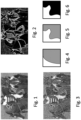
- Fig. 1
- depicts an example source image;
- Fig. 2
- depicts an exemplary gradient image determined for the source image;
- Fig. 3
- depicts exemplary extracted geometry lines in the source image;
- Fig. 4
- depicts an example for polynomial block partition;
- Fig. 5
- depicts an example for any shape block partition;
- Fig. 6
- depicts an example for a binary mask corresponding to the any shape block partition depicted in
Fig. 5 ; - Fig. 7
- depicts an example where a top left segment of a first reference block and a complementary segment of a different second reference block are used for prediction; and
- Fig. 8
- depicts an example where a bottom right segment of a first reference block and a complementary segment of a different second reference block are used for prediction.
- The invention may be realized on any electronic device comprising a processing device correspondingly adapted. For instance, the invention may be realized in a television, a set top box, a mobile phone, a personal computer, a digital still camera, a digital video camera, a navigation system or a car video system.
- In a first embodiment the Geometry is computed using a traditional edge contour extractor. For instance, (color) gradients of the source and/or the decoded images are used. The gradients image can be computed using the well known sobel algorithm. For a given macro-block decomposition of the image using block size MxN, a traditional Principal Component Analysis (PCA) or linear regression can be used to determine the parameters of the straight line that best match with the gradient points in each MxN blocks.
- In a second embodiment, the method using PCA can be extended to non-linear geometry determination by identifying non-linear parameters, for instance polynomial parameters.
- Alternatively to said second embodiment, any classical edge detection, like Canny operator or Hough transformation, can be used to determine one or more continuous edges separating the block into partitions.
- Independent on how edges are detected, the detected edges can be used for segmenting the respective blocks, e.g. by generating one or more binary mask.
- The resulting segments are then predicted using reference blocks. More precisely, segments of the reference blocks are used for predicting the segments of a current block to-be-encoded.
- For correct decoding, it is necessary to provide a decoder with motion vectors referencing the reference blocks used for prediction. Further information has to be provided which allows for determining the segments of the reference blocks which are used for prediction.
- The further information enables the decoder for determining a partitioning scheme by which the reference blocks can be segmented into segments. The further information further enables the decoder for selecting a segment of each reference block. Combining the selected segments then results in a prediction of a block to-be-reconstructed. A combination of said prediction with a residual further conveyed to the decoder finally results in a reconstruction of the block to-be-reconstructed.
- Partly, the further information is implicitly conveyed, for instance by transmission or broadcast, in that there is a reference block used for segment prediction which serves for prediction of the edges, too. Or, a single reference block used for segment prediction serves for prediction of all edges.
- The first embodiment is related to encoding of a block which exhibits a single edge separating the block to-be-encoded into two segments. Each of the two segments is predicted by one reference block, thus there are two blocks determined for prediction which are referenced by two motion vectors. The two referenced blocks are chosen such that one of them not only predicts the segment but also the single edge. That is, at decoder side the one reference block can be segmented for determining the edge which is then used for determining the segment predictions using the one and the other block. For providing the decoder with information required for determining which of the two reference blocks to use for edge prediction and for further determining which of the two segments separated by the edge determined in the edge predicting reference block to-be-used, an encoding order of the two motion vectors and a flag is used.
- Either, the block referenced by the motion vector at a predetermined position in the encoding order, e.g. at first position, can be the one dedicated for prediction of the edges. Then, the flag is set in case that said block referenced by the motion vector at the predetermined position is used for prediction of a segment which comprises a predetermined pixel, e.g. the upper left corner pixel or the bottom right corner pixel of the block.
- Or, the flag signals whether the first or the second motion vector in encoding order references the block further to be used for prediction of the edge. Then, the encoding order serves for determining the segments to be used for prediction.
- The second embodiment is related to encoding of a block which depicts two edges separating the block to-be-encoded into three segments. Each of the three segments is predicted by one reference block, thus there are three blocks determined for prediction which are referenced by three motion vectors. The three referenced blocks are chosen such that each of two of them not only predicts one of the segments but also one of the edges. That is, at decoder side these two reference blocks can be segmented for determining the edges which are then used for determining the segment predictions using these two and the one remaining reference block. For providing the decoder with information required for determining which of the three reference blocks to use for edge prediction and for further determining which of the segments separated by the predicted edges to-be-used, an encoding order of the three motion vectors and two flags are used.
- For instance, the first motion vector in encoding order references the block predicting a first edge and a first flag signals which of the segments separated by said edge to predict using the first referenced block. The second motion vector, in encoding order, references the block predicting a second edge. The second edge separates the segment complementary to the segment to-be-predicted by the block referenced by the first motion vector into two further segments. A second flag indicates which of the further segments is to be predicted using the second referenced block. The other of the further segments is then predicted using the block referenced by the last motion vector.
- Or, the flags signal which two of the three motion vectors reference the blocks further to be used for prediction of the edges. Then, the encoding order serves for determining the segments to be used for prediction.
- The second embodiment is actually an iteration of the first embodiment with the first segmentation segmenting a block and the second segmentation segmenting a segment resulting from the first segmentation. It can be further iterated such that n edges are determined using n reference blocks which further predict n segments of (n+1) segments separated by the n edges, the remaining segment being predicted by a further reference block. Then, n flags and the encoding order of motion vectors enable correct decoding.
- The third embodiment is also related to encoding of a block which depicts two edges separating the block to-be-encoded into three segments. According to the third embodiment, the three referenced blocks are chosen such that one of them not only predicts one of the segments but also both edges. That is, at decoder side this one reference block can be segmented for determining the edges which are then used for determining the segment predictions using these two and the one remaining reference block. For providing the decoder with information required for determining which of the three reference blocks to use for edge prediction and for further determining which of the segments separated by the predicted edges to-be-used, an encoding order of the three motion vectors and two flags are used.
- For instance, the first motion vector in encoding order references the block predicting the two edges and the flags signals which of the resulting three segments separated by said edges to predict using the first referenced block. The remaining two segments can be ordered according to a predetermined criterion, e.g. according to the length of the edge common with the segment predicted by the first referenced block. A first segment according to this order is then predicted by the block referenced by the second motion vector in encoding order and a second segment according to this order is then predicted by the block referenced by the last motion vector in encoding order.
- Or, the flags signal which one of the three motion vectors reference the block further to be used for prediction of the edges. Then, the encoding order serves for determining the segments to be used for prediction.
- Again, this principle can be generalized towards n edges, (n+1) segments predicted by (n+1) reference blocks and n flags.
- The invention is based on the principle that contour information of an object boundary of an object at least partly depicted in a block can be conveyed in form of reference to a different block which depicts a most similar or even identical object boundary. In particular, in an embodiment where an image is comprised in an image sequence an object is likely depicted in several images although maybe at different locations due to movement of the object.
- The different block is one used for prediction of one of the segments resulting from
- In a particular example of the first embodiment, block reconstruction comprises the following steps:
Parsing the Geo block data:
The binary flags for the Geometry indicate the geo-mode and whether the Geometry is computed using a top-left (TL) or the bottom-right (BR) implicit partition as exemplarily depicted inFigure 7 and 8 . - As exemplarily depicted in
Figure 7 , if the binary flags indicate the BR will determine the Geometry, then the block region pointed out by the motion vector V2 in the reference picture will be used to extract the boundary contour, using one of the segmentation methods described. - As exemplarily depicted in
Figure 8 , if the binary flag indicates the TL will determine the Geometry, then the block region pointed out by the motion vector V1 in the reference picture will be used to extract the boundary contour, using one of the segmentation methods described. - Once the boundary contour is extracted, the corresponding mask is computed to selectively motion compensate pixels corresponding to the regions BR and TL. This mask contains for each pixel the weights [0;1] to be used during the motion compensation process.
- This example of the first embodiment has the advantage of simplified determination of Geometry at encoder side which in addition allows for extracting more complex geometry. Further, encoding cost are reduced as the more complex geometry matches depicted object boundaries better and thus result in better predictions. In addition, independent from the complexity of the geometry, a single bit is sufficient.
Claims (13)
- A method comprising reconstructing a block of an image, said block being geometry adaptive block partitioned into at least two partitions separated by at least one edge, the method comprising:- Decoding encoded data comprising at least one flag and at least two motion vectors, the at least two motion vectors respectively referencing at least two reference blocks used for predicting the at least two partitions of the block,- Determining from one of the at least one flag and an encoding order of the at least two motion vectors, which one of said at least two reference blocks predicts said at least one edge, said determined reference block being geometry adaptive block partitioned,- Determining from another one of the at least one flag and the encoding order of the at least two motion vectors, which partitions of the reference blocks predict the at least two partitions of the block.
- The method of claim1, further comprising:- Decoding a residual from the encoded data,- Predicting the block by combining the determined partitions of the reference blocks,- Reconstructing the block by combining the prediction for the block with the residual.
- A method comprising predictive encoding a block of an image, the method comprising:- geometry adaptive block partitioning said block into at least two partitions separated by at least one edge,- predictive encoding of the at least two partitions of the block using for each one of the at least two partitions, a reference block referenced by a motion vector,- encoding data comprising at least one flag and the at least two motion vectors, wherein one of the at least one flag and an encoding order in the encoded data of the at least two motion vectors provides for determining which one of said reference blocks predicts said at least one edge, said determined reference block being geometry adaptive block partitioned, and another one of the at least one flag and the encoding order of the at least two motion vectors provides for determining which partitions of the reference blocks predict the at least two partitions of the block.
- The method of claim 2, further comprising:- Predicting the block by combining the determined partitions of the reference blocks,- Determining a residual for the block using the prediction,- Quantizing the residual, wherein the encoded data further comprises the quantized residual.
- A device for reconstructing a block of an image, said block being geometry adaptive block partitioned into at least two partitions separated by at least one edge, the device comprising:- Means for decoding encoded data comprising at least one flag and at least two motion vectors, the at least two motion vectors respectively referencing at least two reference blocks used for predicting the at least two partitions of the block,- Means for determining from one of the at least one flag and an encoding order of the at least two motion vectors, which one of said at least two reference blocks predicts said at least one edge, said determined reference block being geometry adaptive block partitioned,- Means for determining from another one of the at least one flag and the encoding order of the at least two motion vectors, which partitions of the reference blocks predict the at least two partitions of the block.
- A device for predictive encoding a block of an image, the device comprising:- Means for geometry adaptive block partitioning of said block into at least two partitions separated by at least one edge,- Means for predictive encoding of the at least two partitions of the block using for each one of the at least two partitions, a reference block referenced by a motion vector,- Means for encoding data comprising at least one flag and the at least two motion vectors, wherein one of the at least one flag and an encoding order in the encoded data of the at least two motion vectors provides for determining which one of said reference blocks predicts said at least one edge, said determined reference block being geometry adaptive block partitioned, and another one of the at least one flag and the encoding order of the at least two motion vectors provides for determining which partitions of the reference blocks predict the at least two partitions of the block.
- A storage medium carrying an image encoded in encoded data wherein at least one block of the image is geometry adaptive block partitioned into at least two partitions separated by at least one edge, the at least two partitions of the block being predictive encoded using for each one of the at least two partitions, a reference block referenced by a motion vector, the encoding data comprising at least one flag and the at least two motion vectors, wherein one of the at least one flag and an encoding order in the encoded data of the at least two motion vectors provides for determining which one of said reference blocks predicts said at least one edge, said determined reference block being geometry adaptive block partitioned, and another one of the at least one flag and the encoding order of the at least two motion vectors provides for determining which partitions of the reference blocks predict the at least two partitions of the block.
- The method of any one of claims 1-4 or the device of any one of claims 5 or 6 or the storage medium of claim 7, wherein geometry adaptive block partitioning comprises using a Sobel operator for determining a gradient block for the block.
- The method of any one of claims 1-4 or 8 or the device of any one of claims 5, 6 or 8 or the storage medium of claim 7 or 8, wherein the at least one flag indicates which of the at least two motion vectors in the encoding order references a reference block that predicts the at least one edge and the encoding order of the least two motion vectors provides for determining which partition of the reference block that predicts the at least one edge predicts one of the at least two partitions of the block.
- The method of any one of claims 1-4 or 8 or the device of any one of claims 5, 6 or 8 or the storage medium of claim 7 or 8, wherein a motion vector among the at least two motion vectors that is at a given position in the encoding order references the reference block that predicts the at least one edge and the at least one flag indicates which of the at least two partitions of the block separated by said at least one edge is predicted by the reference block that predicts the at least one edge.
- The method or the device or the storage medium of any one of claims 9 or 10, wherein the at least two partitions comprises n+1 partitions separated by n edges, n being an integer higher than or equal to 1, the n edges being predicted using n reference blocks predicting n partitions of the block, the remaining partition being predicted by a further reference block, the at least one flag comprises n flags and the at least two motion vectors comprises n+1 motion vectors.
- The method or the device or the storage medium of any one of claims 9-11, wherein the block is partitioned into more than two partitions using more than one edge, and a single reference block is used for predicting all the edges of the block.
- The method of any one of claims 1-4 or 8-12 or the device of any one of claims 5, 6 or 8-12 or the storage medium of any one of claims 7-12, wherein the image is comprised in an image sequence and at least one motion vector references a block comprised in at least one different image comprised in the image sequence.
Applications Claiming Priority (3)
| Application Number | Priority Date | Filing Date | Title |
|---|---|---|---|
| EP10305898A EP2421266A1 (en) | 2010-08-19 | 2010-08-19 | Method for reconstructing a current block of an image and corresponding encoding method, corresponding devices as well as storage medium carrying an images encoded in a bit stream |
| PCT/EP2011/063623 WO2012022648A1 (en) | 2010-08-19 | 2011-08-08 | Method for reconstructing a current block of an image and corresponding encoding method, corresponding devices as well as storage medium carrying an images encoded in a bit stream |
| EP11741463.1A EP2606643A1 (en) | 2010-08-19 | 2011-08-08 | Method for reconstructing a current block of an image and corresponding encoding method, corresponding devices as well as storage medium carrying an images encoded in a bit stream |
Related Parent Applications (1)
| Application Number | Title | Priority Date | Filing Date |
|---|---|---|---|
| EP11741463.1A Division EP2606643A1 (en) | 2010-08-19 | 2011-08-08 | Method for reconstructing a current block of an image and corresponding encoding method, corresponding devices as well as storage medium carrying an images encoded in a bit stream |
Publications (1)
| Publication Number | Publication Date |
|---|---|
| EP4161075A1 true EP4161075A1 (en) | 2023-04-05 |
Family
ID=42937169
Family Applications (3)
| Application Number | Title | Priority Date | Filing Date |
|---|---|---|---|
| EP10305898A Withdrawn EP2421266A1 (en) | 2010-08-19 | 2010-08-19 | Method for reconstructing a current block of an image and corresponding encoding method, corresponding devices as well as storage medium carrying an images encoded in a bit stream |
| EP22195782.2A Pending EP4161075A1 (en) | 2010-08-19 | 2011-08-08 | Method for reconstructing a current block of an image and corresponding encoding method, corresponding devices as well as storage medium carrying an image encoded in a bit stream |
| EP11741463.1A Ceased EP2606643A1 (en) | 2010-08-19 | 2011-08-08 | Method for reconstructing a current block of an image and corresponding encoding method, corresponding devices as well as storage medium carrying an images encoded in a bit stream |
Family Applications Before (1)
| Application Number | Title | Priority Date | Filing Date |
|---|---|---|---|
| EP10305898A Withdrawn EP2421266A1 (en) | 2010-08-19 | 2010-08-19 | Method for reconstructing a current block of an image and corresponding encoding method, corresponding devices as well as storage medium carrying an images encoded in a bit stream |
Family Applications After (1)
| Application Number | Title | Priority Date | Filing Date |
|---|---|---|---|
| EP11741463.1A Ceased EP2606643A1 (en) | 2010-08-19 | 2011-08-08 | Method for reconstructing a current block of an image and corresponding encoding method, corresponding devices as well as storage medium carrying an images encoded in a bit stream |
Country Status (6)
| Country | Link |
|---|---|
| US (1) | US9159141B2 (en) |
| EP (3) | EP2421266A1 (en) |
| JP (1) | JP5934210B2 (en) |
| KR (1) | KR101822687B1 (en) |
| CN (1) | CN103069802B (en) |
| WO (1) | WO2012022648A1 (en) |
Families Citing this family (20)
| Publication number | Priority date | Publication date | Assignee | Title |
|---|---|---|---|---|
| JP2780459B2 (en) | 1990-08-08 | 1998-07-30 | トヨタ自動車株式会社 | Connecting rod |
| US20130287109A1 (en) * | 2012-04-29 | 2013-10-31 | Qualcomm Incorporated | Inter-layer prediction through texture segmentation for video coding |
| CN106233334B (en) * | 2014-03-20 | 2020-03-10 | 华为技术有限公司 | An apparatus and method for associating a video block partition mode with a video coding block |
| WO2017086747A1 (en) | 2015-11-20 | 2017-05-26 | 한국전자통신연구원 | Method and device for encoding/decoding image using geometrically modified picture |
| KR102345475B1 (en) * | 2016-01-05 | 2022-01-03 | 한국전자통신연구원 | Method and apparatus for prediction of residual signal |
| WO2018028615A1 (en) * | 2016-08-12 | 2018-02-15 | Mediatek Inc. | Methods and apparatuses of predictor-based partition in video processing system |
| JP2021502771A (en) | 2018-05-03 | 2021-01-28 | エルジー エレクトロニクス インコーポレイティド | Image decoding methods and devices that use block size conversion in image coding systems |
| CN112602324B (en) | 2018-06-22 | 2024-07-23 | Op方案有限责任公司 | Block level geometry partitioning |
| WO2020072494A1 (en) * | 2018-10-01 | 2020-04-09 | Op Solutions, Llc | Methods and systems of exponential partitioning |
| CN111147855B (en) | 2018-11-02 | 2024-10-29 | 北京字节跳动网络技术有限公司 | Coordination between geometric segmentation prediction mode and other tools |
| CN110517218B (en) * | 2019-01-23 | 2020-04-14 | 深圳市天维思信息技术有限公司 | Adaptive data processing platform |
| CN110751695B (en) * | 2019-01-23 | 2021-01-19 | 中国人民解放军空军工程大学 | Adaptive data processing methods |
| JP7678578B2 (en) | 2019-01-28 | 2025-05-16 | オーピー ソリューションズ, エルエルシー | Inter prediction in geometric partitioning with an adaptive number of regions. |
| BR112021014667A2 (en) * | 2019-01-28 | 2021-09-28 | Op Solutions, Llc | INTERPREVATION IN EXPONENTIAL PARTITIONING |
| EP3918784B8 (en) | 2019-01-28 | 2026-07-15 | Dolby International AB | Shape adaptive discrete cosine transform for geometric partitioning with an adaptive number of regions |
| CN113812165B (en) | 2019-05-09 | 2023-05-23 | 北京字节跳动网络技术有限公司 | Improvements to HMVP tables |
| CN112465698B (en) | 2019-09-06 | 2024-12-03 | 华为技术有限公司 | Image processing method and device |
| CN115486069B (en) * | 2020-04-03 | 2025-07-04 | 诺基亚技术有限公司 | Geometric partitioning merge mode with merge mode with motion vector difference |
| US20230319271A1 (en) * | 2020-07-20 | 2023-10-05 | Electronics And Telecommunications Research Institute | Method, apparatus, and recording medium for encoding/decoding image by using geometric partitioning |
| KR20250174382A (en) * | 2024-06-05 | 2025-12-12 | 주식회사 엘지유플러스 | Method and appratus for video encoding and decoding based on non-linear geometric partitioning mode |
Citations (3)
| Publication number | Priority date | Publication date | Assignee | Title |
|---|---|---|---|---|
| EP1351510A1 (en) * | 2001-09-14 | 2003-10-08 | NTT DoCoMo, Inc. | Coding method,decoding method,coding apparatus,decoding apparatus,image processing system,coding program,and decoding program |
| WO2008016605A2 (en) * | 2006-08-02 | 2008-02-07 | Thomson Licensing | Adaptive geometric partitioning for video decoding |
| WO2008054688A1 (en) * | 2006-10-30 | 2008-05-08 | Hewlett-Packard Development Company, L.P. | Method for decomposing a video sequence frame |
Family Cites Families (8)
| Publication number | Priority date | Publication date | Assignee | Title |
|---|---|---|---|---|
| WO1998042134A1 (en) * | 1997-03-17 | 1998-09-24 | Mitsubishi Denki Kabushiki Kaisha | Image encoder, image decoder, image encoding method, image decoding method and image encoding/decoding system |
| JP4313710B2 (en) * | 2004-03-25 | 2009-08-12 | パナソニック株式会社 | Image encoding method and image decoding method |
| US8165205B2 (en) * | 2005-09-16 | 2012-04-24 | Sony Corporation | Natural shaped regions for motion compensation |
| JP4417918B2 (en) * | 2006-03-30 | 2010-02-17 | 株式会社東芝 | Interpolation frame creation device, motion vector detection device, interpolation frame creation method, motion vector detection method, interpolation frame creation program, and motion vector detection program |
| JP2010505343A (en) | 2006-09-29 | 2010-02-18 | トムソン ライセンシング | Geometric intra prediction |
| KR101680951B1 (en) * | 2007-04-12 | 2016-11-29 | 톰슨 라이센싱 | Methods and apparatus for fast geometric mode decision in a video encoder |
| US8437564B2 (en) * | 2007-08-07 | 2013-05-07 | Ntt Docomo, Inc. | Image and video compression using sparse orthonormal transforms |
| CN101303769B (en) | 2008-07-10 | 2010-08-04 | 哈尔滨工业大学 | Segmentation method of 2D sequential medical images based on geodesic geometric flow of prior knowledge |
-
2010
- 2010-08-19 EP EP10305898A patent/EP2421266A1/en not_active Withdrawn
-
2011
- 2011-08-08 KR KR1020137004025A patent/KR101822687B1/en active Active
- 2011-08-08 US US13/817,070 patent/US9159141B2/en active Active
- 2011-08-08 WO PCT/EP2011/063623 patent/WO2012022648A1/en not_active Ceased
- 2011-08-08 EP EP22195782.2A patent/EP4161075A1/en active Pending
- 2011-08-08 EP EP11741463.1A patent/EP2606643A1/en not_active Ceased
- 2011-08-08 JP JP2013524408A patent/JP5934210B2/en active Active
- 2011-08-08 CN CN201180040133.6A patent/CN103069802B/en active Active
Patent Citations (3)
| Publication number | Priority date | Publication date | Assignee | Title |
|---|---|---|---|---|
| EP1351510A1 (en) * | 2001-09-14 | 2003-10-08 | NTT DoCoMo, Inc. | Coding method,decoding method,coding apparatus,decoding apparatus,image processing system,coding program,and decoding program |
| WO2008016605A2 (en) * | 2006-08-02 | 2008-02-07 | Thomson Licensing | Adaptive geometric partitioning for video decoding |
| WO2008054688A1 (en) * | 2006-10-30 | 2008-05-08 | Hewlett-Packard Development Company, L.P. | Method for decomposing a video sequence frame |
Non-Patent Citations (4)
| Title |
|---|
| ABDULLAH A MUHIT ET AL: "Motion compensation using geometry and an elastic motion model", IMAGE PROCESSING (ICIP), 2009 16TH IEEE INTERNATIONAL CONFERENCE ON, IEEE, PISCATAWAY, NJ, USA, 7 November 2009 (2009-11-07), pages 621 - 624, XP031628513, ISBN: 978-1-4244-5653-6 * |
| C.DAIO.ESCODAP.YINX.LIC.GOMILA: "Image Processing", vol. 2, 11 September 2005, IEEE INTERNATIONAL CONFERENCE, article "Geometry-Adaptive block Partitioning for Intra Prediction in Image & Video Coding", pages: 858 - 61 |
| DIVORRA ESCODA O ET AL: "Geometry-Adaptive Block Partitioning for Video Coding", 2007 IEEE INTERNATIONAL CONFERENCE ON ACOUSTICS, SPEECH, AND SIGNAL PROCESSING 15-20 APRIL 2007 HONOLULU, HI, USA, IEEE, PISCATAWAY, NJ, USA, 15 April 2007 (2007-04-15), pages I - 657, XP031462947, ISBN: 978-1-4244-0727-9 * |
| R.MATHEWD.S.TAUBMAN: "Joint Scalable Modeling of Motion and Boundary Geometry with Quad-tree node merging", ICIP, 2009 |
Also Published As
| Publication number | Publication date |
|---|---|
| KR101822687B1 (en) | 2018-01-26 |
| CN103069802A (en) | 2013-04-24 |
| US9159141B2 (en) | 2015-10-13 |
| WO2012022648A1 (en) | 2012-02-23 |
| CN103069802B (en) | 2016-05-18 |
| EP2421266A1 (en) | 2012-02-22 |
| EP2606643A1 (en) | 2013-06-26 |
| JP2013537764A (en) | 2013-10-03 |
| US20130208982A1 (en) | 2013-08-15 |
| JP5934210B2 (en) | 2016-06-15 |
| KR20130095261A (en) | 2013-08-27 |
Similar Documents
| Publication | Publication Date | Title |
|---|---|---|
| US9159141B2 (en) | Method for reconstructing a current block of an image and corresponding encoding method, corresponding devices as well as storage medium carrying an images encoded in a bit stream | |
| US7949053B2 (en) | Method and assembly for video encoding, the video encoding including texture analysis and texture synthesis, and corresponding computer program and corresponding computer-readable storage medium | |
| KR101538710B1 (en) | Temporal block merge mode | |
| CN106210734B (en) | Method and device for encoding a sequence of images into a bitstream and for decoding a bitstream | |
| EP4583510A2 (en) | Local hash-based motion estimation for screen remoting scenarios | |
| KR102114641B1 (en) | Method of video coding by prediction of the partitioning of a current block, method of decoding, coding and decoding devices and computer programs corresponding thereto | |
| CN114009040A (en) | Encoder, decoder and corresponding method | |
| US20160073107A1 (en) | Method and apparatus for video encoding/decoding using intra prediction | |
| WO2019244118A1 (en) | Component-dependent sub-block dividing | |
| CN101573985B (en) | Method and apparatus for video predictive encoding and method and apparatus for video predictive decoding | |
| US8285064B2 (en) | Method for processing images and the corresponding electronic device | |
| WO2011128259A1 (en) | A video decoder and a video encoder using motion-compensated prediction | |
| KR20150024857A (en) | Method for encoding a current block of a first image component relative to a reference block of at least one second image component, encoding device and corresponding computer program | |
| CN111971963A (en) | Image encoding and decoding, image encoder, and image decoder | |
| US9270996B2 (en) | Method and apparatus for generating encoded motion information/recovering motion information using motion information integration, and image encoding/decoding method and apparatus using same | |
| Ma et al. | Surveillance video coding with vehicle library | |
| TW202549342A (en) | Adaptive cost function selection in merge mode in video coding | |
| TW202606310A (en) | Reference picture selection in video coding | |
| TW202545193A (en) | Reference picture derivation in video coding | |
| CN121986494A (en) | Encoding/decoding methods, encoders, decoders, and storage media | |
| TW202541501A (en) | Scaling and reordering of chained motion vector prediction for video coding | |
| CN120500845A (en) | Image encoding/decoding method and apparatus, and recording medium storing bit stream |
Legal Events
| Date | Code | Title | Description |
|---|---|---|---|
| PUAI | Public reference made under article 153(3) epc to a published international application that has entered the european phase |
Free format text: ORIGINAL CODE: 0009012 |
|
| STAA | Information on the status of an ep patent application or granted ep patent |
Free format text: STATUS: THE APPLICATION HAS BEEN PUBLISHED |
|
| AC | Divisional application: reference to earlier application |
Ref document number: 2606643 Country of ref document: EP Kind code of ref document: P |
|
| AK | Designated contracting states |
Kind code of ref document: A1 Designated state(s): AL AT BE BG CH CY CZ DE DK EE ES FI FR GB GR HR HU IE IS IT LI LT LU LV MC MK MT NL NO PL PT RO RS SE SI SK SM TR |
|
| STAA | Information on the status of an ep patent application or granted ep patent |
Free format text: STATUS: REQUEST FOR EXAMINATION WAS MADE |
|
| 17P | Request for examination filed |
Effective date: 20230926 |
|
| RBV | Designated contracting states (corrected) |
Designated state(s): AL AT BE BG CH CY CZ DE DK EE ES FI FR GB GR HR HU IE IS IT LI LT LU LV MC MK MT NL NO PL PT RO RS SE SI SK SM TR |
|
| STAA | Information on the status of an ep patent application or granted ep patent |
Free format text: STATUS: EXAMINATION IS IN PROGRESS |
|
| 17Q | First examination report despatched |
Effective date: 20260526 |