EP4160747A1 - Preparation of silicon composite material, and negative electrode plate containing same - Google Patents
Preparation of silicon composite material, and negative electrode plate containing same Download PDFInfo
- Publication number
- EP4160747A1 EP4160747A1 EP21909093.3A EP21909093A EP4160747A1 EP 4160747 A1 EP4160747 A1 EP 4160747A1 EP 21909093 A EP21909093 A EP 21909093A EP 4160747 A1 EP4160747 A1 EP 4160747A1
- Authority
- EP
- European Patent Office
- Prior art keywords
- silicon
- composite material
- lithium
- negative electrode
- electrode plate
- Prior art date
- Legal status (The legal status is an assumption and is not a legal conclusion. Google has not performed a legal analysis and makes no representation as to the accuracy of the status listed.)
- Pending
Links
Images

Classifications
-
- H—ELECTRICITY
- H01—ELECTRIC ELEMENTS
- H01M—PROCESSES OR MEANS, e.g. BATTERIES, FOR THE DIRECT CONVERSION OF CHEMICAL ENERGY INTO ELECTRICAL ENERGY
- H01M4/00—Electrodes
- H01M4/02—Electrodes composed of, or comprising, active material
- H01M4/36—Selection of substances as active materials, active masses, active liquids
- H01M4/58—Selection of substances as active materials, active masses, active liquids of inorganic compounds other than oxides or hydroxides, e.g. sulfides, selenides, tellurides, halogenides or LiCoFy; of polyanionic structures, e.g. phosphates, silicates or borates
- H01M4/583—Carbonaceous material, e.g. graphite-intercalation compounds or CFx
- H01M4/587—Carbonaceous material, e.g. graphite-intercalation compounds or CFx for inserting or intercalating light metals
-
- H—ELECTRICITY
- H01—ELECTRIC ELEMENTS
- H01M—PROCESSES OR MEANS, e.g. BATTERIES, FOR THE DIRECT CONVERSION OF CHEMICAL ENERGY INTO ELECTRICAL ENERGY
- H01M4/00—Electrodes
- H01M4/02—Electrodes composed of, or comprising, active material
- H01M4/36—Selection of substances as active materials, active masses, active liquids
- H01M4/362—Composites
- H01M4/364—Composites as mixtures
-
- H—ELECTRICITY
- H01—ELECTRIC ELEMENTS
- H01M—PROCESSES OR MEANS, e.g. BATTERIES, FOR THE DIRECT CONVERSION OF CHEMICAL ENERGY INTO ELECTRICAL ENERGY
- H01M4/00—Electrodes
- H01M4/02—Electrodes composed of, or comprising, active material
- H01M4/13—Electrodes for accumulators with non-aqueous electrolyte, e.g. for lithium-accumulators; Processes of manufacture thereof
- H01M4/139—Processes of manufacture
- H01M4/1395—Processes of manufacture of electrodes based on metals, Si or alloys
-
- B—PERFORMING OPERATIONS; TRANSPORTING
- B82—NANOTECHNOLOGY
- B82Y—SPECIFIC USES OR APPLICATIONS OF NANOSTRUCTURES; MEASUREMENT OR ANALYSIS OF NANOSTRUCTURES; MANUFACTURE OR TREATMENT OF NANOSTRUCTURES
- B82Y30/00—Nanotechnology for materials or surface science, e.g. nanocomposites
-
- H—ELECTRICITY
- H01—ELECTRIC ELEMENTS
- H01M—PROCESSES OR MEANS, e.g. BATTERIES, FOR THE DIRECT CONVERSION OF CHEMICAL ENERGY INTO ELECTRICAL ENERGY
- H01M10/00—Secondary cells; Manufacture thereof
- H01M10/05—Accumulators with non-aqueous electrolyte
- H01M10/052—Li-accumulators
- H01M10/0525—Rocking-chair batteries, i.e. batteries with lithium insertion or intercalation in both electrodes; Lithium-ion batteries
-
- H—ELECTRICITY
- H01—ELECTRIC ELEMENTS
- H01M—PROCESSES OR MEANS, e.g. BATTERIES, FOR THE DIRECT CONVERSION OF CHEMICAL ENERGY INTO ELECTRICAL ENERGY
- H01M4/00—Electrodes
- H01M4/02—Electrodes composed of, or comprising, active material
- H01M4/04—Processes of manufacture in general
- H01M4/0402—Methods of deposition of the material
- H01M4/0404—Methods of deposition of the material by coating on electrode collectors
-
- H—ELECTRICITY
- H01—ELECTRIC ELEMENTS
- H01M—PROCESSES OR MEANS, e.g. BATTERIES, FOR THE DIRECT CONVERSION OF CHEMICAL ENERGY INTO ELECTRICAL ENERGY
- H01M4/00—Electrodes
- H01M4/02—Electrodes composed of, or comprising, active material
- H01M4/04—Processes of manufacture in general
- H01M4/0471—Processes of manufacture in general involving thermal treatment, e.g. firing, sintering, backing particulate active material, thermal decomposition, pyrolysis
-
- H—ELECTRICITY
- H01—ELECTRIC ELEMENTS
- H01M—PROCESSES OR MEANS, e.g. BATTERIES, FOR THE DIRECT CONVERSION OF CHEMICAL ENERGY INTO ELECTRICAL ENERGY
- H01M4/00—Electrodes
- H01M4/02—Electrodes composed of, or comprising, active material
- H01M4/13—Electrodes for accumulators with non-aqueous electrolyte, e.g. for lithium-accumulators; Processes of manufacture thereof
- H01M4/133—Electrodes based on carbonaceous material, e.g. graphite-intercalation compounds or CFx
-
- H—ELECTRICITY
- H01—ELECTRIC ELEMENTS
- H01M—PROCESSES OR MEANS, e.g. BATTERIES, FOR THE DIRECT CONVERSION OF CHEMICAL ENERGY INTO ELECTRICAL ENERGY
- H01M4/00—Electrodes
- H01M4/02—Electrodes composed of, or comprising, active material
- H01M4/13—Electrodes for accumulators with non-aqueous electrolyte, e.g. for lithium-accumulators; Processes of manufacture thereof
- H01M4/134—Electrodes based on metals, Si or alloys
-
- H—ELECTRICITY
- H01—ELECTRIC ELEMENTS
- H01M—PROCESSES OR MEANS, e.g. BATTERIES, FOR THE DIRECT CONVERSION OF CHEMICAL ENERGY INTO ELECTRICAL ENERGY
- H01M4/00—Electrodes
- H01M4/02—Electrodes composed of, or comprising, active material
- H01M4/36—Selection of substances as active materials, active masses, active liquids
- H01M4/362—Composites
- H01M4/366—Composites as layered products
-
- H—ELECTRICITY
- H01—ELECTRIC ELEMENTS
- H01M—PROCESSES OR MEANS, e.g. BATTERIES, FOR THE DIRECT CONVERSION OF CHEMICAL ENERGY INTO ELECTRICAL ENERGY
- H01M4/00—Electrodes
- H01M4/02—Electrodes composed of, or comprising, active material
- H01M4/36—Selection of substances as active materials, active masses, active liquids
- H01M4/38—Selection of substances as active materials, active masses, active liquids of elements or alloys
- H01M4/386—Silicon or alloys based on silicon
-
- H—ELECTRICITY
- H01—ELECTRIC ELEMENTS
- H01M—PROCESSES OR MEANS, e.g. BATTERIES, FOR THE DIRECT CONVERSION OF CHEMICAL ENERGY INTO ELECTRICAL ENERGY
- H01M4/00—Electrodes
- H01M4/02—Electrodes composed of, or comprising, active material
- H01M4/36—Selection of substances as active materials, active masses, active liquids
- H01M4/48—Selection of substances as active materials, active masses, active liquids of inorganic oxides or hydroxides
- H01M4/483—Selection of substances as active materials, active masses, active liquids of inorganic oxides or hydroxides for non-aqueous cells
-
- H—ELECTRICITY
- H01—ELECTRIC ELEMENTS
- H01M—PROCESSES OR MEANS, e.g. BATTERIES, FOR THE DIRECT CONVERSION OF CHEMICAL ENERGY INTO ELECTRICAL ENERGY
- H01M4/00—Electrodes
- H01M4/02—Electrodes composed of, or comprising, active material
- H01M4/36—Selection of substances as active materials, active masses, active liquids
- H01M4/58—Selection of substances as active materials, active masses, active liquids of inorganic compounds other than oxides or hydroxides, e.g. sulfides, selenides, tellurides, halogenides or LiCoFy; of polyanionic structures, e.g. phosphates, silicates or borates
- H01M4/583—Carbonaceous material, e.g. graphite-intercalation compounds or CFx
-
- H—ELECTRICITY
- H01—ELECTRIC ELEMENTS
- H01M—PROCESSES OR MEANS, e.g. BATTERIES, FOR THE DIRECT CONVERSION OF CHEMICAL ENERGY INTO ELECTRICAL ENERGY
- H01M4/00—Electrodes
- H01M4/02—Electrodes composed of, or comprising, active material
- H01M4/62—Selection of inactive substances as ingredients for active masses, e.g. binders, fillers
-
- H—ELECTRICITY
- H01—ELECTRIC ELEMENTS
- H01M—PROCESSES OR MEANS, e.g. BATTERIES, FOR THE DIRECT CONVERSION OF CHEMICAL ENERGY INTO ELECTRICAL ENERGY
- H01M4/00—Electrodes
- H01M4/02—Electrodes composed of, or comprising, active material
- H01M4/62—Selection of inactive substances as ingredients for active masses, e.g. binders, fillers
- H01M4/621—Binders
- H01M4/622—Binders being polymers
-
- H—ELECTRICITY
- H01—ELECTRIC ELEMENTS
- H01M—PROCESSES OR MEANS, e.g. BATTERIES, FOR THE DIRECT CONVERSION OF CHEMICAL ENERGY INTO ELECTRICAL ENERGY
- H01M4/00—Electrodes
- H01M4/02—Electrodes composed of, or comprising, active material
- H01M4/62—Selection of inactive substances as ingredients for active masses, e.g. binders, fillers
- H01M4/624—Electric conductive fillers
-
- H—ELECTRICITY
- H01—ELECTRIC ELEMENTS
- H01M—PROCESSES OR MEANS, e.g. BATTERIES, FOR THE DIRECT CONVERSION OF CHEMICAL ENERGY INTO ELECTRICAL ENERGY
- H01M4/00—Electrodes
- H01M4/02—Electrodes composed of, or comprising, active material
- H01M4/62—Selection of inactive substances as ingredients for active masses, e.g. binders, fillers
- H01M4/624—Electric conductive fillers
- H01M4/625—Carbon or graphite
-
- H—ELECTRICITY
- H01—ELECTRIC ELEMENTS
- H01M—PROCESSES OR MEANS, e.g. BATTERIES, FOR THE DIRECT CONVERSION OF CHEMICAL ENERGY INTO ELECTRICAL ENERGY
- H01M4/00—Electrodes
- H01M4/02—Electrodes composed of, or comprising, active material
- H01M4/62—Selection of inactive substances as ingredients for active masses, e.g. binders, fillers
- H01M4/628—Inhibitors, e.g. gassing inhibitors, corrosion inhibitors
-
- H—ELECTRICITY
- H01—ELECTRIC ELEMENTS
- H01M—PROCESSES OR MEANS, e.g. BATTERIES, FOR THE DIRECT CONVERSION OF CHEMICAL ENERGY INTO ELECTRICAL ENERGY
- H01M4/00—Electrodes
- H01M4/02—Electrodes composed of, or comprising, active material
- H01M4/64—Carriers or collectors
- H01M4/66—Selection of materials
- H01M4/661—Metal or alloys, e.g. alloy coatings
-
- H—ELECTRICITY
- H01—ELECTRIC ELEMENTS
- H01M—PROCESSES OR MEANS, e.g. BATTERIES, FOR THE DIRECT CONVERSION OF CHEMICAL ENERGY INTO ELECTRICAL ENERGY
- H01M4/00—Electrodes
- H01M4/02—Electrodes composed of, or comprising, active material
- H01M4/64—Carriers or collectors
- H01M4/66—Selection of materials
- H01M4/661—Metal or alloys, e.g. alloy coatings
- H01M4/662—Alloys
-
- H—ELECTRICITY
- H01—ELECTRIC ELEMENTS
- H01M—PROCESSES OR MEANS, e.g. BATTERIES, FOR THE DIRECT CONVERSION OF CHEMICAL ENERGY INTO ELECTRICAL ENERGY
- H01M4/00—Electrodes
- H01M4/02—Electrodes composed of, or comprising, active material
- H01M2004/021—Physical characteristics, e.g. porosity, surface area
-
- H—ELECTRICITY
- H01—ELECTRIC ELEMENTS
- H01M—PROCESSES OR MEANS, e.g. BATTERIES, FOR THE DIRECT CONVERSION OF CHEMICAL ENERGY INTO ELECTRICAL ENERGY
- H01M4/00—Electrodes
- H01M4/02—Electrodes composed of, or comprising, active material
- H01M2004/026—Electrodes composed of, or comprising, active material characterised by the polarity
- H01M2004/027—Negative electrodes
-
- Y—GENERAL TAGGING OF NEW TECHNOLOGICAL DEVELOPMENTS; GENERAL TAGGING OF CROSS-SECTIONAL TECHNOLOGIES SPANNING OVER SEVERAL SECTIONS OF THE IPC; TECHNICAL SUBJECTS COVERED BY FORMER USPC CROSS-REFERENCE ART COLLECTIONS [XRACs] AND DIGESTS
- Y02—TECHNOLOGIES OR APPLICATIONS FOR MITIGATION OR ADAPTATION AGAINST CLIMATE CHANGE
- Y02E—REDUCTION OF GREENHOUSE GAS [GHG] EMISSIONS, RELATED TO ENERGY GENERATION, TRANSMISSION OR DISTRIBUTION
- Y02E60/00—Enabling technologies; Technologies with a potential or indirect contribution to GHG emissions mitigation
- Y02E60/10—Energy storage using batteries
Definitions
- the invention belongs to the technical field of silicon-based composite materials, and relates to the preparation of a silicon composite material and a negative electrode plate containing the same, in particular to a silicon/carbon nanotube/silicon oxide/lithium oxide/lithium silicate composite material and preparation of negative electrode plate containing the same.
- Silicon has the advantages of high gram capacity (>3,000mAh/g), abundant resources, and low potential to lithium, making it a popular choice to replace graphite.
- severe volume expansion about 300%) occurs after silicon is lithiated, resulting in poor cycle stability.
- coating silicon nanoparticles with silicon oxide to form secondary particles can isolate the direct contact between the electrolyte and silicon, and can inhibit the expansion of silicon particles through silicon oxide.
- there will still be secondary particle breakage in the later stage of cycles resulting in direct contact between silicon and the electrolyte at the new broken interface to produce side reactions and worsen the cycle.
- patent CN107658452 proposes a silicon/carbon nanotube/silicon oxycarbide composite material, which uses carbon nanotubes to strengthen the connection between silicon nanoparticles and maintain the stability of secondary particles.
- the silicon oxide in the composite material will react with lithium ions to form irreversible side products lithium oxide and lithium silicate during the first lithiation of battery. This by-product consumes a large amount of lithium, resulting in a low first battery efficiency. Therefore, improving the first effect while suppressing the volume expansion of silicon materials is an urgent problem to be solved.
- the object of the present invention is to provide a preparation of a silicon composite material and a negative electrode plate containing the same.
- the silicon/carbon nanotube/silicon oxide/lithium oxide/lithium silicate composite material provided by the present invention can not only exert the high gram capacity of silicon, suppress the expansion of lithiated silicon, but also maintain a high first coulombic efficiency, and improve the conductivity performance of silicon at the same time.
- the silicon composite material (silicon/carbon nanotube/silicon oxide/lithium oxide/lithium silicate composite material) is slurried with graphite according to a specific particle size ratio and made into a negative electrode plate.
- the negative electrode plate has high capacity, good electrical conductivity, high coulombic efficiency, small volume expansion and high cycle stability.
- the present invention provides a method for preparing a negative electrode plate containing a silicon composite material, wherein the negative electrode plate also contains graphite; a particle size ratio of the silicon composite material to the graphite is 1: 10 ⁇ 1:5; the method includes the following steps: S1. add silicon nanoparticles, carbon nanotubes, silane coupling agent, and dispersant into an organic solvent, stir evenly, and spray dry to obtain a mixed powder; carbonize the mixed powder at high temperature, and ball mill to obtain a silicon/carbon nanotube/silicon-oxygen complex;
- the silane coupling agent is one of the below substances: bis(alkyleneimino)alkenylmethylsilane, alkyleneiminoalkenyldimethylsilane, aryleneiminoalkenyldimethylsilane, tris(alkyleneimino)alkenylsilane, diarylaminoalkenyldimethylsilane, bis(aryleneimino)alkenylmethylsilane, bis(diarylamino)alkenylmethylsilane and tris(aryleneimino)alkenylsilane.
- the dispersant is polyethylene glycol with a weight average molecular weight ranging from 800 to 5,000.
- the organic solvent is one or a mixture of carbon tetrachloride, N-methylpyrrolidone, acetone, diphenylamine, toluene, and diethanol.
- step S1 the temperature of the high-temperature carbonization is 300-700°C, and the carbonization time at this temperature is 3-7h.
- step S1 a weight ratio of the silicon nanoparticles, carbon nanotubes, silane coupling agent, dispersant, and organic solvent is (1 ⁇ 5):(0.01 ⁇ 0.05):(1 ⁇ 5):(0.1 ⁇ 1):100.
- the specific particle size ratio of the silicon composite material and the graphite in the negative electrode plate is the particle size ratio of the silicon D50 particle size and the graphite D50 particle size, which is 1: 10-1:5.
- the negative electrode is used for lithium batteries.
- the present invention provides a silicon composite material, the composite material comprises silicon nanoparticles, carbon nanotubes, silicon oxide, lithium oxide and lithium silicate; wherein, the carbon nanotubes and the silicon nanoparticles are cross-linked to form a three-dimensional network structure, and the silicon oxide, the lithium oxide and the lithium silicate cover the three-dimensional network structure to form secondary particles.
- the silicon nanoparticles are covered by silicon oxide, lithium oxide and lithium silicate, while maintaining connection with the carbon nanotubes.
- silicon nanoparticles cyclically expand, they are buffered under the coating of silicon oxide, lithium oxide and lithium silicate, and the cyclic expansion is suppressed.
- carbon nanotubes are further constrained to avoid separation between silicon nanoparticles.
- the carbon nanotubes are single-wall carbon nanotubes or multi-wall carbon nanotubes.
- the single-walled carbon nanotubes have an average diameter of 0.5-5nm and a length of 10nm-200 ⁇ m.
- the multi-walled carbon nanotubes have an average diameter of 5-20nm and a length of 10 nm-200 ⁇ m.
- an ion conduction path is provided, which eliminates the step of conventional carbon coating of silicon-oxygen particles to improve conductivity.
- the average particle size of the silicon nanoparticles is 10-100nm.
- the chemical formula of the silicon oxide is SiO x , wherein 1 ⁇ x ⁇ A 2, wherein x is an independent variable of the chemical formula SiO x .
- the lithium silicate is a product formed from the reaction of lithium and silicon oxide, and is a mixture of Li 4 SiO 4 , Li 2 SiO 3 and Li 2 Si 2 O 5 .
- the chemical formula of lithium oxide is Li 2 O, which is a product formed from the reaction of lithium and silicon oxide.
- the silicon/carbon nanotube/silicon oxide/lithium oxide/lithium silicate composite material are secondary particles, and the average particle size of the secondary particles is 2-20 ⁇ m. If a particle size is less than 2 ⁇ m, the specific surface area of the particle is too large, and excessive electrolyte consumption in the cycle leads to accelerated attenuation in the later cycle. If a particle size is larger than 20 ⁇ m, the volume change caused by particle expansion is too large, which will destroy the structure of the negative electrode plate. More preferably, the average particle diameter is 5-10 ⁇ m.
- the silicon composite material is prepared by steps S1 and S2 in the method for preparing the negative electrode plate containing the silicon composite material.
- the present invention provides a method for preparing silicon composite material, the method includes the following steps:
- the present invention has following beneficial effects.
- 1 is silicon nanoparticles
- 2 is carbon nanotubes
- 3 is silicon oxide, lithium oxide and lithium silicate.
- the obtained cooled powder and lithium source (50wt.% lithium sulfate and 50wt.% lithium nitrate mixed solution) are evenly mixed and stirred at room temperature for 5h. Then heat at 3,000 °C under vacuum for 1h, and cool to room temperature under the protection of Ar gas.
- FIG. 1 is a schematic diagram of the secondary particle structure of the silicon composite material provided in this example. Carbon nanotubes and silicon nano-ions are cross-linked to form a three-dimensional structure, and silicon oxide, lithium oxide and lithium silicate cover the three-dimensional network structure to form secondary particles.
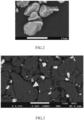
- FIG. 2 is the SEM backscattered image of the surface of the silicon composite material provided in this example; under the back-emission electron imaging, the particles are bright, indicating that they are all silicon particles. The particles are round and the particle size is less than 10 ⁇ m.
- FIG 3 is a SEM backscatter diagram of the negative electrode plate provided in this embodiment after rolling.
- the silicon secondary particles are located in the gaps of the graphite particles.
- the surrounding graphite particles can provide a certain binding force to inhibit its volume expansion.
- the volume expansion of the particles will not lead to rearrangement of the graphite particles, which ensures the structural stability of the pole piece during cycles.
- the activator (a mixture of 0.25M HCl, 0.02M HF and 0.02M sodium nitrate) was uniformly mixed with nano-silicon/carbon nanotubes/silicon-oxygen complex at room temperature for 8h. Then dry at 80°C for 10h, heat-treat at 500°C for 7h, and finally cool to room temperature under the protection of Ar gas.
- the obtained cooled powder and lithium source (50wt.% lithium sulfate and 50wt.% lithium halide mixed solution) are mixed and stirred at room temperature for 6h, then heated at 3,500°C under vacuum for 1.5h, and then cooled to room temperature under the protection of Ar gas.
- the obtained powder is shaped by a jet mill to remove the oxide film on the surface, and then sieved and classified to obtain a silicon/carbon nanotube/silicon oxide/lithium oxide/lithium silicate composite material.
- the silicon composite material is prepared into a negative electrode plate.
- PAA polyacrylic acid emulsion
- the obtained cooled powder and lithium source (50wt.% lithium nitrate and 50wt.% lithium halide mixture) are evenly mixed and stirred at room temperature for 7h, then heated at 2,500 °C under vacuum for 2h, and cooled to room temperature under the protection of Ar gas.
- the obtained powder is shaped by a jet mill to remove the oxide film on the surface, and then sieved and classified to obtain a silicon/carbon nanotube/silicon oxide/lithium oxide/lithium silicate composite material.
- the silicon composite material is prepared into a negative electrode plate.
- PAA polyacrylic acid emulsion
- the obtained cooled powder and lithium source (50wt.% lithium sulfate and 50wt.% lithium nitrate mixed solution) are evenly mixed and stirred at room temperature for 5h, then heated at 3,000 °C under vacuum for 1h, and cooled to room temperature under the protection of Ar gas.
- the obtained powder is mechanically milled and shaped to remove the surface oxide film, and then sieved and classified to obtain a silicon/carbon nanotube/silicon oxide/lithium oxide/lithium silicate composite material, also known as silicon secondary particles.
- PAA polyacrylic acid emulsion
- the obtained cooled powder and lithium source (50wt.% lithium sulfate and 50wt.% lithium nitrate mixed solution) are evenly mixed and stirred at room temperature for 5h, then heated at 3,000 °C under vacuum for 1h, and cooled to room temperature under the protection of Ar gas.
- the obtained powder is mechanically milled and shaped to remove the surface oxide film, and then sieved and classified to obtain a silicon/carbon nanotube/silicon oxide/lithium oxide/lithium silicate composite material, also known as silicon secondary particles.
- PAA polyacrylic acid emulsion
- the silicon composite material is prepared into a negative electrode plate.
- PAA polyacrylic acid emulsion
- the obtained cooled powder and lithium source (50wt.% lithium nitrate and 50wt.% lithium halide mixture) are evenly mixed and stirred at room temperature for 7h, then heated at 2,500 °C under vacuum for 2h, and cooled to room temperature under the protection of Ar gas.
- the obtained powder is shaped by a jet mill to remove the oxide film on the surface, and then sieved and classified to obtain a silicon/carbon nanotube/silicon oxide/lithium oxide/lithium silicate composite material.
- the silicon composite material is prepared into a negative electrode plate.
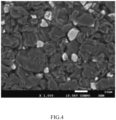
- FIG. 4 is the SEM backscatter diagram of the negative electrode plate provided in this comparative example after rolling.
- silicon secondary particles with a relatively large particle size (about 8 ⁇ m).
- the silicon particles will expand violently (about 200% volume expansion rate), and the surrounding graphite particles cannot effectively restrain their volume expansion.
- the distribution of graphite particles around changes the original pole piece arrangement structure is destroyed, and the conductive network is damaged.
- the obtained cooled powder and lithium source (50wt.% lithium nitrate and 50wt.% lithium halide mixture) are evenly mixed and stirred at room temperature for 7h, then heated at 2,500 °C under vacuum for 2h, and cooled to room temperature under the protection of Ar gas.
- the obtained powder is shaped by a jet mill to remove the oxide film on the surface, and then sieved and classified to obtain a silicon/carbon nanotube/silicon oxide/lithium oxide/lithium silicate composite material.
- the silicon composite material is prepared into a negative electrode plate.
- FIG. 4 is the SEM backscatter diagram of the negative electrode plate provided in this comparative example after rolling.
- silicon secondary particles with a relatively large particle size (about 8 ⁇ m).
- the silicon particles will expand violently (about 200% volume expansion rate), and the surrounding graphite particles cannot effectively restrain their volume expansion.
- the distribution of graphite particles around changes the original pole piece arrangement structure is destroyed, and the conductive network is damaged.
- the obtained cooled powder and lithium source (50wt.% lithium nitrate and 50wt.% lithium halide mixed solution) are mixed and stirred evenly at room temperature for 7h, then heated at 2,000°C under vacuum for 0.5h, and cooled to room temperature under the protection of Ar gas.
- the obtained powder is shaped by a jet mill to remove the oxide film on the surface, and then sieved and classified to obtain a silicon/carbon nanotube/silicon oxide/lithium oxide/lithium silicate composite material.
- the silicon composite material is prepared into a negative electrode plate.
- PAA polyacrylic acid emulsion
- the obtained cooled powder and lithium source (50wt.% lithium nitrate and 50wt.% lithium halide mixed solution) are evenly mixed and stirred at room temperature for 7h, then heated at 3,500 °C under vacuum for 5h, and cooled to room temperature under the protection of Ar gas.
- the obtained powder is shaped by a jet mill to remove the oxide film on the surface, and then sieved and classified to obtain a silicon/carbon nanotube/silicon oxide/lithium oxide/lithium silicate composite material.
- the silicon composite material is prepared into a negative electrode plate.
- PAA polyacrylic acid emulsion
- the negative electrode plates prepared in the above examples and comparative examples are used for battery assembly and testing, and the steps are as follows.
- the electrode is a metal lithium plate with a purity of 99.9%; and the electrolyte is the solution of ethylene carbonate (EC)/ethyl methyl carbonate (EMC)/diethyl carbonate (DEC) (volume ratio 3:5:2) and 1.1mol lithium hexafluorophosphate (LiPF6).
- EC ethylene carbonate
- EMC ethyl methyl carbonate
- DEC diethyl carbonate
- LiPF6 lithium hexafluorophosphate
- the battery is subjected to a charge-discharge cycle test, the charge voltage is cut off to 2.0V, the discharge voltage is cut to 0.005V, and the charge-discharge cycle rate is 0.1C.
- the lithiation and delithiation capacity for the first time, and the delithiation capacity data after 50 cycles are shown in Table 1.
Landscapes
- Chemical & Material Sciences (AREA)
- Chemical Kinetics & Catalysis (AREA)
- Electrochemistry (AREA)
- General Chemical & Material Sciences (AREA)
- Engineering & Computer Science (AREA)
- Materials Engineering (AREA)
- Manufacturing & Machinery (AREA)
- Composite Materials (AREA)
- Inorganic Chemistry (AREA)
- Nanotechnology (AREA)
- Physics & Mathematics (AREA)
- Condensed Matter Physics & Semiconductors (AREA)
- General Physics & Mathematics (AREA)
- Crystallography & Structural Chemistry (AREA)
- Battery Electrode And Active Subsutance (AREA)
- Silicon Compounds (AREA)
- Cell Electrode Carriers And Collectors (AREA)
Abstract
Description
- The invention belongs to the technical field of silicon-based composite materials, and relates to the preparation of a silicon composite material and a negative electrode plate containing the same, in particular to a silicon/carbon nanotube/silicon oxide/lithium oxide/lithium silicate composite material and preparation of negative electrode plate containing the same.
- With the continuous popularization of batteries for new energy vehicles and the continuous demand of consumers for cruising range, further improving the energy density of batteries has become the key. Silicon has the advantages of high gram capacity (>3,000mAh/g), abundant resources, and low potential to lithium, making it a popular choice to replace graphite. However, severe volume expansion (about 300%) occurs after silicon is lithiated, resulting in poor cycle stability. Studies have shown that coating silicon nanoparticles with silicon oxide to form secondary particles can isolate the direct contact between the electrolyte and silicon, and can inhibit the expansion of silicon particles through silicon oxide. However, there will still be secondary particle breakage in the later stage of cycles, resulting in direct contact between silicon and the electrolyte at the new broken interface to produce side reactions and worsen the cycle.
- To solve the above problems, patent
CN107658452 proposes a silicon/carbon nanotube/silicon oxycarbide composite material, which uses carbon nanotubes to strengthen the connection between silicon nanoparticles and maintain the stability of secondary particles. However, the silicon oxide in the composite material will react with lithium ions to form irreversible side products lithium oxide and lithium silicate during the first lithiation of battery. This by-product consumes a large amount of lithium, resulting in a low first battery efficiency. Therefore, improving the first effect while suppressing the volume expansion of silicon materials is an urgent problem to be solved. - In view of the above, the object of the present invention is to provide a preparation of a silicon composite material and a negative electrode plate containing the same. The silicon/carbon nanotube/silicon oxide/lithium oxide/lithium silicate composite material provided by the present invention can not only exert the high gram capacity of silicon, suppress the expansion of lithiated silicon, but also maintain a high first coulombic efficiency, and improve the conductivity performance of silicon at the same time. The silicon composite material (silicon/carbon nanotube/silicon oxide/lithium oxide/lithium silicate composite material) is slurried with graphite according to a specific particle size ratio and made into a negative electrode plate. The negative electrode plate has high capacity, good electrical conductivity, high coulombic efficiency, small volume expansion and high cycle stability.
- The purpose of the present invention is achieved by the following technical solutions. In a first aspect, the present invention provides a method for preparing a negative electrode plate containing a silicon composite material, wherein the negative electrode plate also contains graphite; a particle size ratio of the silicon composite material to the graphite is 1: 10~1:5; the method includes the following steps: S1. add silicon nanoparticles, carbon nanotubes, silane coupling agent, and dispersant into an organic solvent, stir evenly, and spray dry to obtain a mixed powder; carbonize the mixed powder at high temperature, and ball mill to obtain a silicon/carbon nanotube/silicon-oxygen complex;
- S2. perform activation treatment on the silicon/carbon nanotube/silicon-oxygen complex; mix the activated silicon/carbon nanotube/silicon-oxygen complex with a lithium source, and ball mill to obtain a mixture; heat treat the mixture; classify the heat-treated mixture to obtain secondary particles which are the silicon composite material;
- S3. mix the silicon composite material with the graphite, conductive carbon and polyacrylic acid emulsion to prepare a slurry; apply the slurry on a negative electrode current collector; roll and then dry under vacuum and high temperature to form the negative electrode plate.
- As an embodiment of the present invention, in step S1, the silane coupling agent is one of the below substances: bis(alkyleneimino)alkenylmethylsilane, alkyleneiminoalkenyldimethylsilane, aryleneiminoalkenyldimethylsilane, tris(alkyleneimino)alkenylsilane, diarylaminoalkenyldimethylsilane, bis(aryleneimino)alkenylmethylsilane, bis(diarylamino)alkenylmethylsilane and tris(aryleneimino)alkenylsilane.
- As an embodiment of the present invention, in step S1, the dispersant is polyethylene glycol with a weight average molecular weight ranging from 800 to 5,000.
- As an embodiment of the present invention, in step S1, the organic solvent is one or a mixture of carbon tetrachloride, N-methylpyrrolidone, acetone, diphenylamine, toluene, and diethanol.
- As an embodiment of the present invention, in step S1, the temperature of the high-temperature carbonization is 300-700°C, and the carbonization time at this temperature is 3-7h.
- In step S1, a weight ratio of the silicon nanoparticles, carbon nanotubes, silane coupling agent, dispersant, and organic solvent is (1~5):(0.01~0.05):(1~5):(0.1~ 1):100.
- As an embodiment of the present invention, in step S2, the step of activation treatment comprises: uniformly mixing an activator with the silicon/carbon nanotube/silicon-oxygen complex to obtain an mixed product; drying and heat treating the mixed product, and then cooling to room temperature under gas protection;
- As an embodiment of the present invention, the activator includes one or more of below substances: 0.1-3M HF, 0.1~1M HCl, 0.1~1M sodium nitrate, and 0.1~1M potassium permanganate.
- As an embodiment of the present invention, in the drying and heat treatment, the drying temperature is 60-100°C, and the drying time is 6-10h; the heat treatment temperature is 500-800°C, and the heat treatment temperature is 5-10h∘
- As an embodiment of the present invention, in step S2, the lithium source comprises a solid-phase and/or liquid-phase lithium source; the liquid-phase lithium source comprises one or more of below substances: lithium sulfate, lithium nitrate, and lithium halides. ∘
- As an embodiment of the present invention, in step S2, the step of heat treatment is: keeping warm for 1h to 2h under vacuum at a temperature of 2,500-4,500°C. In the system of the present invention, due to the influence of carbon nanotubes, the vacuum temperature is too low, the holding time is too short, the lithium source cannot fully react with the silicon/carbon nanotubes/silicon-oxygen complex, and the resulting composite particles have the problem of high charging capacity, low first coulombic efficiency, short cycle life and large expansion. A certain holding time can promote the stress release of the carbon nanotubes in the composite particles and make them more uniformly dispersed. However, if the holding time is too long, the particle size of silicon element in the complex will increase, resulting in excessive partial expansion after lithiation, resulting in poor particle breakage cycle.
- As an embodiment of the present invention, in step S2, the step of classifying includes: mechanical grinding and shaping or jet milling to remove surface oxide film, and sieving and classifying.
- As an embodiment of the present invention, the silicon composite material and the graphite are classified so that the ratio of the particle size of the silicon secondary particles to the particle size of the graphite particles is 1:10~1:5. In step S3, the particle size ratio of the silicon composite material to the graphite is 1: 10-1:5. If the particle size ratio is lower than 1:5, the particles expand violently after silicon is lithiated during cycles, resulting in the destruction of the arrangement structure of the surrounding graphite particles, and the cycle stability of the pole piece decreases; if the ratio is higher than 1:10, the silicon particles are too small or the graphite particles are too large. Too small silicon particles lead to excessive specific surface area, excessive consumption of electrolyte, resulting in accelerated attenuation in the later stage of the cycles; too large graphite particles lead to a decrease in the conductivity of the pole piece. Preferably, the optimal range of the particle size ratio of the silicon secondary particles to the graphite particles is 1:8~1:6.
- As an embodiment of the present invention, in step S3, the negative electrode current collector comprises a copper foil, a nickel foil or a copper-nickel alloy.
- As an embodiment of the present invention, in step S3, the effective mass ratio of the silicon composite material, the graphite, the conductive carbon and the polyacrylic acid emulsion (PAA) is 10%: 70%: 10%: 10%-2%: 78%: 10%: 10%. That is, in the slurry, the mass ratio of the silicon composite material, the graphite, the conductive carbon and the polyacrylic acid emulsion is 1:7:1:1~0.2:7.8:1:1.
- As an embodiment of the present invention, in step S3, the areal density of the coating on the copper foil is 80g/m2~200g/m2.
- As an embodiment of the present invention, in step S3, the rolling density is 1.45g/cc~1.75g/cc.
- As an embodiment of the present invention, in step S3, the temperature range of the vacuum high temperature is 80°C~150°C.
- As an embodiment of the present invention, in step S3, the drying time is 10h~48h. In a second aspect, the present invention provides negative electrode plate containing a silicon composite material prepared by the above method.
- The specific particle size ratio of the silicon composite material and the graphite in the negative electrode plate is the particle size ratio of the silicon D50 particle size and the graphite D50 particle size, which is 1: 10-1:5.
- The negative electrode is used for lithium batteries.
- In a third aspect, the present invention provides a silicon composite material, the composite material comprises silicon nanoparticles, carbon nanotubes, silicon oxide, lithium oxide and lithium silicate; wherein, the carbon nanotubes and the silicon nanoparticles are cross-linked to form a three-dimensional network structure, and the silicon oxide, the lithium oxide and the lithium silicate cover the three-dimensional network structure to form secondary particles.
- In the secondary particles, the silicon nanoparticles are covered by silicon oxide, lithium oxide and lithium silicate, while maintaining connection with the carbon nanotubes. When silicon nanoparticles cyclically expand, they are buffered under the coating of silicon oxide, lithium oxide and lithium silicate, and the cyclic expansion is suppressed. At the same time, carbon nanotubes are further constrained to avoid separation between silicon nanoparticles.
- As an embodiment of the present invention, the carbon nanotubes are single-wall carbon nanotubes or multi-wall carbon nanotubes. Preferably, the single-walled carbon nanotubes have an average diameter of 0.5-5nm and a length of 10nm-200µm. Preferably, the multi-walled carbon nanotubes have an average diameter of 5-20nm and a length of 10 nm-200µm. In addition to maintaining the structural stability of the secondary particles, an ion conduction path is provided, which eliminates the step of conventional carbon coating of silicon-oxygen particles to improve conductivity. As an embodiment of the present invention, the average particle size of the silicon nanoparticles is 10-100nm.
- As an embodiment of the present invention, the chemical formula of the silicon oxide is SiOx, wherein 1≤x≤
A 2, wherein x is an independent variable of the chemical formula SiOx. - The lithium silicate is a product formed from the reaction of lithium and silicon oxide, and is a mixture of Li4SiO4, Li2SiO3 and Li2Si2O5.
- The chemical formula of lithium oxide is Li2O, which is a product formed from the reaction of lithium and silicon oxide.
- As an embodiment of the present invention, the silicon/carbon nanotube/silicon oxide/lithium oxide/lithium silicate composite material are secondary particles, and the average particle size of the secondary particles is 2-20µm. If a particle size is less than 2µm, the specific surface area of the particle is too large, and excessive electrolyte consumption in the cycle leads to accelerated attenuation in the later cycle. If a particle size is larger than 20µm, the volume change caused by particle expansion is too large, which will destroy the structure of the negative electrode plate. More preferably, the average particle diameter is 5-10µm.
- The silicon composite material is prepared by steps S1 and S2 in the method for preparing the negative electrode plate containing the silicon composite material. Thus, in a fourth aspect, the present invention provides a method for preparing silicon composite material, the method includes the following steps:
- S1. add silicon nanoparticles, carbon nanotubes, silane coupling agent, and dispersant into an organic solvent, stir evenly, and spray dry to obtain a mixed powder; carbonize the mixed powder at high temperature, and ball mill to obtain a silicon/carbon nanotube/silicon-oxygen complex;
- S2. perform activation treatment on the silicon/carbon nanotube/silicon-oxygen complex; mix the activated silicon/carbon nanotube/silicon-oxygen complex with a lithium source, and ball mill to obtain a mixture; heat treat the mixture; classify the heat-treated mixture to obtain secondary particles which are the silicon composite material.
- Compared with the prior art, the present invention has following beneficial effects.
- 1) In the present invention, silicon nanoparticles, carbon nanotubes, and silicon dioxide are dispersed and dried, carbonized at high temperature, and ball milled to obtain a silicon/carbon nanotube/silicon-oxygen complex, which is then mixed with a lithium source, stirred by ball milling, heat treated, and graded and sieved, to obtain nano-silicon/carbon nanotubes/silicon oxide/lithium oxide/lithium silicate composite secondary particles, which are then mixed with graphite according to a specific particle size ratio to make a negative electrode plate, which gives full play to the high gram capacity of silicon and improves the conductivity, and ensures the first coulombic efficiency in the battery through the irreversible side reaction of silicon oxygen and lithium in advance.
- 2) While the volume expansion of the lithiated nano-silicon is suppressed in the silicon secondary particles, the graphite particles also play a role in buffering the expansion of the silicon secondary particles, so that the volume expansion of the negative electrode plate is significantly reduced.
- 3) The battery made of the composite material prepared by the present invention has good cycle stability, small volume expansion and good rate performance, and can be applied to the automotive field.
- 4) The invention has a simple process, omits the CVD coating carbon layer process, and is easy to control and has good repeatability, which provides a new solution for improving the energy density of automobile batteries.
- Features and performances of the present invention are further described by the following examples and accompanying drawings.
-
FIG. 1 is the schematic diagram of the secondary particle structure of silicon composite material of embodiment 1. -
FIG. 2 is the surface SEM backscatter diagram of the silicon composite material of embodiment 1. -
FIG. 3 is the SEM backscatter diagram of the rolled negative pole plate of embodiment 1. -
FIG. 4 is the SEM backscatter diagram of the rolled negative pole plate of comparative example 2. - Among the above, 1 is silicon nanoparticles, 2 is carbon nanotubes, and 3 is silicon oxide, lithium oxide and lithium silicate.
- The present invention will be described in detail below in conjunction with embodiments and examples. The following embodiments and examples will help those skilled in the art to further understand the present invention, but do not limit the present invention in any form. It should be noted that those skilled in the art can make some adjustments and improvements without departing from the concept of the present invention. These all belong to the protection scope of the present invention.
- Add 1g of nano silicon, 0.05g of carbon nanotubes, 1g of alkyleneiminoalkenyldimethylsilane, and 0.1g of polyethylene glycol with a molecular weight of 900 to 100g of organic solvent N-methylpyrrolidone in sequence, stir and mix evenly. Spray dry to obtain a mixed powder, carbonize the mixed powder at a high temperature of 600°C for 5h, and ball mill to obtain a nano-silicon/carbon nanotube/silicon-oxygen complex.
- Mix the activator (a mixture of 0.15M HCl, 0.05M HF and 0.05M sodium nitrate) and nano-silicon/carbon nanotubes/silicon-oxygen complex at room temperature for 10h, then dry at 90°C for 8h, heat-treat at 550°C for 6h, and finally cool to room temperature under the protection of Ar gas. The obtained cooled powder and lithium source (50wt.% lithium sulfate and 50wt.% lithium nitrate mixed solution) are evenly mixed and stirred at room temperature for 5h. Then heat at 3,000 °C under vacuum for 1h, and cool to room temperature under the protection of Ar gas. The obtained powder is mechanically milled and shaped to remove the surface oxide film, and then sieved and classified to obtain a silicon/carbon nanotube/silicon oxide/lithium oxide/lithium silicate composite material, also known as silicon secondary particles.
FIG. 1 is a schematic diagram of the secondary particle structure of the silicon composite material provided in this example. Carbon nanotubes and silicon nano-ions are cross-linked to form a three-dimensional structure, and silicon oxide, lithium oxide and lithium silicate cover the three-dimensional network structure to form secondary particles.FIG. 2 is the SEM backscattered image of the surface of the silicon composite material provided in this example; under the back-emission electron imaging, the particles are bright, indicating that they are all silicon particles. The particles are round and the particle size is less than 10µm. - Classify the silicon composite material and graphite so that the particle size ratio of the silicon secondary particle size to the graphite particle is 1:8 (particle size of 50% volume of the silicon secondary particles is 3.1 µm, and particle size of 50% volume of the graphite particles is 24.2µm). Mix silicon composite material, graphite, conductive carbon and 0.6% polyacrylic acid emulsion (PAA) at an effective mass ratio of 1:7:1:1 to make a slurry, and apply the slurry according to a surface density of 100g/m2 on a copper foil with a thickness of 10µm, which is then rolled with a rolling density of 1.6g/cc, and then dried under vacuum at 120°C for 24h to make a negative electrode plate.
FIG. 3 is a SEM backscatter diagram of the negative electrode plate provided in this embodiment after rolling. The silicon secondary particles are located in the gaps of the graphite particles. When the silicon particles expand after lithiation, the surrounding graphite particles can provide a certain binding force to inhibit its volume expansion. At the same time, the volume expansion of the particles will not lead to rearrangement of the graphite particles, which ensures the structural stability of the pole piece during cycles. - Add 1.5g of nano-silicon, 0.03g of carbon nanotubes, 1.5g of alkyleneiminoalkenyldimethylsilane, and 0.2g of polyethylene glycol with a molecular weight of 900 to 100g of organic solvent acetone in sequence, stir and mix evenly. Spray dry to obtain a mixed powder, which is carbonized at a high temperature of 500°C for 6h, and ball milled to obtain a nano-silicon/carbon nanotube/silicon-oxygen complex.
- The activator (a mixture of 0.25M HCl, 0.02M HF and 0.02M sodium nitrate) was uniformly mixed with nano-silicon/carbon nanotubes/silicon-oxygen complex at room temperature for 8h. Then dry at 80°C for 10h, heat-treat at 500°C for 7h, and finally cool to room temperature under the protection of Ar gas. The obtained cooled powder and lithium source (50wt.% lithium sulfate and 50wt.% lithium halide mixed solution) are mixed and stirred at room temperature for 6h, then heated at 3,500°C under vacuum for 1.5h, and then cooled to room temperature under the protection of Ar gas. The obtained powder is shaped by a jet mill to remove the oxide film on the surface, and then sieved and classified to obtain a silicon/carbon nanotube/silicon oxide/lithium oxide/lithium silicate composite material.
- Classify the silicon composite material and graphite so that the particle size ratio of the silicon secondary particle size to the graphite particle is 1:7 ((particle size of 50% volume of the silicon secondary particles is 3.5µm, and particle size of 50% volume of the graphite particles is 24.2µm). Mix silicon composite material, graphite, conductive carbon and 0.6% polyacrylic acid emulsion (PAA) at an effective mass ratio of 1:7: 1: 1 to make a slurry, and apply the slurry according to the surface density of 100g/m2 on a copper foil with a thickness of 10µm which is then rolled to make the rolling density 1.6g/cc, and then dried under vacuum at 120°C for 24h to make a negative electrode plate.
- Add 2g of nano-silicon, 0.02g of carbon nanotubes, 1.8g of alkyleneiminoalkenyldimethylsilane, and 0.6g of polyethylene glycol with a molecular weight of 900 to 100g of carbon tetrachloride in sequence, stir and mix evenly. Spray dry to obtain a mixed powder, which is carbonized at a high temperature of 550°C for 5.5h, and ball milled to obtain a nano-silicon/carbon nanotube/silicon-oxygen complex.
- Mix the activator (a mixture of 0.2M HCl, 0.03M HF and 0.03M sodium nitrate) and nano-silicon/carbon nanotubes/silicon-oxygen complex at room temperature for 9h. Then dry at 85°C for 9h, heat treat at 600 °C for 6h, and finally cool to room temperature under the protection of Ar gas. The obtained cooled powder and lithium source (50wt.% lithium nitrate and 50wt.% lithium halide mixture) are evenly mixed and stirred at room temperature for 7h, then heated at 2,500 °C under vacuum for 2h, and cooled to room temperature under the protection of Ar gas. The obtained powder is shaped by a jet mill to remove the oxide film on the surface, and then sieved and classified to obtain a silicon/carbon nanotube/silicon oxide/lithium oxide/lithium silicate composite material.
- Classify the silicon composite material and graphite so that the particle size ratio of silicon secondary particles to graphite particles is 1:6 (the particle size of 50% volume of silicon secondary particles is 6.1µm, and the particle size of 50% volume of graphite particles is 24.2µm). Mix silicon composite material, graphite, conductive carbon and 0.6% polyacrylic acid emulsion (PAA) at an effective mass ratio of 1:7:1:1 to make a slurry, and apply the slurry according to the surface density of 100g/m2 on a copper foil with a thickness of 10µm, which is then rolled to make the rolling density 1.6g/cc, and then dried under vacuum at 120°C for 24h to make a negative electrode plate.
- Add 1g of nano silicon, 0.05g of carbon nanotubes, 1g of alkyleneiminoalkenyldimethylsilane, and 0.1g of polyethylene glycol with a molecular weight of 900 to 100g of organic solvent N-methylpyrrolidone in sequence, stir and mix evenly. Spray dry to obtain a mixed powder, which is then carbonized at a high temperature of 600°C for 5h, and ball-milled to obtain a nano-silicon/carbon nanotube/silicon-oxygen complex.
- Mix the activator (a mixture of 0.15M HCl, 0.05M HF and 0.05M sodium nitrate) and nano-silicon/carbon nanotubes/silicon-oxygen complex at room temperature for 10h, then dry at 90°C for 8h, heat treat at 550°C for 6h, and finally cool to room temperature under the protection of Ar gas. The obtained cooled powder and lithium source (50wt.% lithium sulfate and 50wt.% lithium nitrate mixed solution) are evenly mixed and stirred at room temperature for 5h, then heated at 3,000 °C under vacuum for 1h, and cooled to room temperature under the protection of Ar gas. The obtained powder is mechanically milled and shaped to remove the surface oxide film, and then sieved and classified to obtain a silicon/carbon nanotube/silicon oxide/lithium oxide/lithium silicate composite material, also known as silicon secondary particles.
- Classify the silicon composite material and graphite so that the particle size ratio of the silicon secondary particle size to the graphite particle is 1:8 (particle size of 50% volume of the silicon secondary particles is 3.1µm, and particle size of 50% volume of the graphite particles is 24.2µm). Mix silicon composite material, graphite, conductive carbon and 0.6% polyacrylic acid emulsion (PAA) at an effective mass ratio of 6:74: 10: 10 to make a slurry, and apply the slurry according to the surface density of 100g/m2 on a copper foil with a thickness of 10µm, which is rolled to make the rolling density 1.6g/cc, and then dried under vacuum at 120°C for 24h to make a negative electrode plate.
- Add 1g of nano silicon, 0.05g of carbon nanotubes, 1g of alkyleneiminoalkenyldimethylsilane, and 0.1g of polyethylene glycol with a molecular weight of 900 to 100g of organic solvent N-methylpyrrolidone in sequence, stir and mix evenly. Spray dry to obtain a mixed powder, which is carbonized at a high temperature of 600°C for 5h, and ball-milled to obtain a nano-silicon/carbon nanotube/silicon-oxygen complex.
- Mix the activator (a mixture of 0.15M HCl, 0.05M HF and 0.05M sodium nitrate) and nano-silicon/carbon nanotubes/silicon-oxygen complex at room temperature for 10h. Then dry at 90°C for 8h, heat treat at 550°C for 6h, and finally cool to room temperature under the protection of Ar gas. The obtained cooled powder and lithium source (50wt.% lithium sulfate and 50wt.% lithium nitrate mixed solution) are evenly mixed and stirred at room temperature for 5h, then heated at 3,000 °C under vacuum for 1h, and cooled to room temperature under the protection of Ar gas. The obtained powder is mechanically milled and shaped to remove the surface oxide film, and then sieved and classified to obtain a silicon/carbon nanotube/silicon oxide/lithium oxide/lithium silicate composite material, also known as silicon secondary particles.
- Classify the silicon composite material and graphite so that the particle size ratio of the silicon secondary particle size to the graphite particle is 1:8 (particle size of 50% volume of the silicon secondary particles is 3.1µm, and particle size of 50% volume of the graphite particles is 24.2µm). Mix silicon composite material, graphite, conductive carbon and 0.6% polyacrylic acid emulsion (PAA) at an effective mass ratio of 2:78: 10: 10 to make a slurry, and apply the slurry according to the surface density of 100g/m2 on a copper foil with a thickness of 10µm, which is rolled to make the rolling density 1.6g/cc, and then dried under vacuum at 120°C for 24h to make a negative electrode plate.
- Add 1.5g of nano-silicon, 0.03g of carbon nanotubes, 1.5g of alkyleneiminoalkenyldimethylsilane, and 0.2g of polyethylene glycol with a molecular weight of 900 to 100g of organic solvent acetone in sequence, stir and mix evenly. Spray dry to obtain a mixed powder, which is carbonized at a high temperature of 500°C for 6h, and then ball milled to obtain a nano-silicon/carbon nanotube/silicon-oxygen composite.
- Classify the silicon composite material and graphite so that the particle size ratio of nano-silicon/carbon nanotubes/silicon-oxygen composites to graphite particles is 1:7 (particle size of 50% volume of silicon secondary particles is 3.5µm, particle size of 50% volume of graphite particles is 24.2µm). Mix silicon composite material, graphite, conductive carbon and 0.6% polyacrylic acid emulsion (PAA) at an effective mass ratio of 1:7: 1: 1 to make a slurry, and apply the slurry according to the surface density of 100g/m2 on a copper foil with a thickness of 10µm, which is rolled to make the rolling density 1.6g/cc, and then dried under vacuum at 120°C for 24h to form a negative electrode plate.
- Add 2g of nano-silicon, 0.02g of carbon nanotubes, 1.8g of alkyleneiminoalkenyldimethylsilane, and 0.6g of polyethylene glycol with a molecular weight of 900 to 100g of carbon tetrachloride in sequence, stir and mix evenly. Spray dry to obtain a mixed powder, which is carbonized at a high temperature of 550°C for 5.5h, and then ball milled to obtain a nano-silicon/carbon nanotube/silicon-oxygen complex.
- Mix the activator (a mixture of 0.2M HCl, 0.03M HF and 0.03M sodium nitrate) and nano-silicon/carbon nanotubes/silicon-oxygen complex at room temperature for 9h. Then dry at 85°C for 9h, heat treat at 600°C for 6h, and finally cool to room temperature under the protection of Ar gas. The obtained cooled powder and lithium source (50wt.% lithium nitrate and 50wt.% lithium halide mixture) are evenly mixed and stirred at room temperature for 7h, then heated at 2,500 °C under vacuum for 2h, and cooled to room temperature under the protection of Ar gas. The obtained powder is shaped by a jet mill to remove the oxide film on the surface, and then sieved and classified to obtain a silicon/carbon nanotube/silicon oxide/lithium oxide/lithium silicate composite material.
- Classify the silicon composite material and graphite so that the particle size ratio of silicon secondary particles to graphite particles is 1:3 (particle size of 50% volume of silicon secondary particles is 8.1µm, particle size of 50% volume of graphite particles is 24.2µm). Mix silicon composite material, graphite, conductive carbon and 0.6% polyacrylic acid emulsion (PAA) at an effective mass ratio of 1:7:1:1 to make a slurry, and apply the slurry according to the surface density of 100g/m2 on a copper foil with a thickness of 10µm, which is rolled to make the rolling density 1.6g/cc, and then dried under vacuum at 120°C for 24h to make a negative electrode plate.
FIG. 4 is the SEM backscatter diagram of the negative electrode plate provided in this comparative example after rolling. In the figure, there are silicon secondary particles with a relatively large particle size (about 8µm). During the cycles, the silicon particles will expand violently (about 200% volume expansion rate), and the surrounding graphite particles cannot effectively restrain their volume expansion. As a result, the distribution of graphite particles around changes, the original pole piece arrangement structure is destroyed, and the conductive network is damaged. - Add 2g of nano-silicon, 0.02g of carbon nanotubes, 1.8g of alkyleneiminoalkenyldimethylsilane, and 0.6g of polyethylene glycol with a molecular weight of 900 to 100g of carbon tetrachloride in sequence, stir and mix evenly. Spray dry to obtain a mixed powder, which is carbonized at a high temperature of 550°C for 5.5h, and ball milled to obtain a nano-silicon/carbon nanotube/silicon-oxygen complex.
- Mix the activator (a mixture of 0.2M HCl, 0.03M HF and 0.03M sodium nitrate) and nano-silicon/carbon nanotubes/silicon-oxygen complex at room temperature for 9h. Then dry at 85°C for 9h, heat treat at 600°C for 6h, and finally cool to room temperature under the protection of Ar gas. The obtained cooled powder and lithium source (50wt.% lithium nitrate and 50wt.% lithium halide mixture) are evenly mixed and stirred at room temperature for 7h, then heated at 2,500 °C under vacuum for 2h, and cooled to room temperature under the protection of Ar gas. The obtained powder is shaped by a jet mill to remove the oxide film on the surface, and then sieved and classified to obtain a silicon/carbon nanotube/silicon oxide/lithium oxide/lithium silicate composite material.
- Classify the silicon composite material and graphite so that the particle size ratio of silicon secondary particles to graphite particles is 1:11 (particle size of 50% volume of silicon secondary particles is 2.2µm, particle size of 50% volume of graphite particles is 24.2µm). Mix silicon composite material, graphite, conductive carbon and 0.6% polyacrylic acid emulsion (PAA) at an effective mass ratio of 1:7:1:1 to make a slurry, and apply the slurry according to the surface density of 100g/m2 on a copper foil with a thickness of 10µm, which is rolled to make the rolling density 1.6g/cc, and then dried under vacuum at 120°C for 24h to make a negative electrode plate.
FIG. 4 is the SEM backscatter diagram of the negative electrode plate provided in this comparative example after rolling. In the figure, there are silicon secondary particles with a relatively large particle size (about 8µm). During the cycles, the silicon particles will expand violently (about 200% volume expansion rate), and the surrounding graphite particles cannot effectively restrain their volume expansion. As a result, the distribution of graphite particles around changes, the original pole piece arrangement structure is destroyed, and the conductive network is damaged. - Add 2g of nano-silicon, 0.02g of carbon nanotubes, 1.8g of alkyleneiminoalkenyldimethylsilane, and 0.6g of polyethylene glycol with a molecular weight of 900 to 100g of carbon tetrachloride in sequence, stir and mix evenly. Spray dry to obtain a mixed powder, which is carbonized at a high temperature of 550°C for 5.5h, and ball milled to obtain a nano-silicon/carbon nanotube/silicon-oxygen complex.
- Mix the activator (a mixture of 0.2M HCl, 0.03M HF and 0.03M sodium nitrate) and nano-silicon/carbon nanotubes/silicon-oxygen complex at room temperature for 9h, then dry at 85°C for 9h, heat-treated at 600 °C for 6h, and finally cooled to room temperature under the protection of Ar gas. The obtained cooled powder and lithium source (50wt.% lithium nitrate and 50wt.% lithium halide mixed solution) are mixed and stirred evenly at room temperature for 7h, then heated at 2,000°C under vacuum for 0.5h, and cooled to room temperature under the protection of Ar gas. The obtained powder is shaped by a jet mill to remove the oxide film on the surface, and then sieved and classified to obtain a silicon/carbon nanotube/silicon oxide/lithium oxide/lithium silicate composite material.
- Classify the silicon composite material and graphite so that the particle size ratio of silicon secondary particles to graphite particles is 1:6 (the particle size of 50% volume silicon secondary particles is 6.1µm, and the particle size of 50% volume of graphite particles is 24.2µm). Mix silicon composite material, graphite, conductive carbon and 0.6% polyacrylic acid emulsion (PAA) at an effective mass ratio of 1:7:1:1 to make a slurry, and apply the slurry according to the surface density of 100g/m2 on a copper foil with a thickness of 10µm, which is rolled to make the rolling density 1.6g/cc, and then dried under vacuum at 120°C for 24h to make a negative electrode plate.
- Add 2g of nano-silicon, 0.02g of carbon nanotubes, 1.8g of alkyleneiminoalkenyldimethylsilane, and 0.6g of polyethylene glycol with a molecular weight of 900 to 100g of carbon tetrachloride in sequence, stir and mix evenly. Spray dry to obtain a mixed powder, which is carbonized at a high temperature of 550°C for 5.5h, and ball milled to obtain a nano-silicon/carbon nanotube/silicon-oxygen complex.
- Mix the activator (a mixture of 0.2M HCl, 0.03M HF and 0.03M sodium nitrate) and nano-silicon/carbon nanotubes/silicon-oxygen complex at room temperature for 9h. Then dry at 85°C for 9h, heat treat at 600 °C for 6h, and finally cool to room temperature under the protection of Ar gas. The obtained cooled powder and lithium source (50wt.% lithium nitrate and 50wt.% lithium halide mixed solution) are evenly mixed and stirred at room temperature for 7h, then heated at 3,500 °C under vacuum for 5h, and cooled to room temperature under the protection of Ar gas. The obtained powder is shaped by a jet mill to remove the oxide film on the surface, and then sieved and classified to obtain a silicon/carbon nanotube/silicon oxide/lithium oxide/lithium silicate composite material.
- Classify the silicon composite material and graphite so that the particle size ratio of silicon secondary particles to graphite particles is 1:6 (the particle size of 50% volume silicon secondary particles is 6.1µm, and the particle size of 50% volume of graphite particles is 24.2µm). Mix silicon composite material, graphite, conductive carbon and 0.6% polyacrylic acid emulsion (PAA) at an effective mass ratio of 1:7:1:1 to make a slurry, and apply the slurry according to the surface density of 100g/m2 on a copper foil with a thickness of 10µm, which is rolled to make the rolling density 1.6g/cc, and then dried under vacuum at 120°C for 24h to make a negative electrode plate.
- The negative electrode plates prepared in the above examples and comparative examples are used for battery assembly and testing, and the steps are as follows. The electrode is a metal lithium plate with a purity of 99.9%; and the electrolyte is the solution of ethylene carbonate (EC)/ethyl methyl carbonate (EMC)/diethyl carbonate (DEC) (volume ratio 3:5:2) and 1.1mol lithium hexafluorophosphate (LiPF6). After the negative electrode plate, metal lithium plate, battery shell, and diaphragm are dried, the electrolyte is added in an argon-protected glove box to assemble a button-type lithium-ion battery. The battery is subjected to a charge-discharge cycle test, the charge voltage is cut off to 2.0V, the discharge voltage is cut to 0.005V, and the charge-discharge cycle rate is 0.1C. The lithiation and delithiation capacity for the first time, and the delithiation capacity data after 50 cycles are shown in Table 1.
Table 1 The detection data of the lithiation and delithiation capacity for the first time of batteries made of negative electrode materials, the delithiation capacity after 50 cycles and the pole piece thickness Lithiation capacity for the first time mAh/g Delithiation capacity for the first time mAh/g First coulombic efficiency Delithiation capacity after 50 cycles mAh/g Capacity retention rate after 50 cycles Thicknes s of pole piece after 50 cycles /µm Embodiment 1 513 461 89.9% 391 84.8% 78 Embodiment 2501 447 89.2% 375 83.9% 77 Embodiment 3510 452 88.6% 380 84.1% 75 Embodiment 4 456 413 90.6% 361 87.4% 73 Embodiment 5 404 370 91.6% 333 90.0% 69 Comparative example 1 499 389 78.0% 322 82.7% 80 Comparative example 2 508 450 88.5% 366 81.3% 87 Comparative example 3 509 449 88.3% 336 74.8% 76 Comparative example 4 520 452 86.9% 376 83.2% 80 Comparative example 5 509 450 88.4% 367 81.6% 83 - It can be seen from Table 1 that the silicon composite materials prepared in Embodiments 1-3 of the present invention exhibit higher coulombic efficiency, lower volume expansion and better cycle performance.
- Specific embodiments of the present invention have been described above. It should be understood that the present invention is not limited to the specific embodiments described above, and those skilled in the art may make various changes or modifications within the scope of the claims, which do not affect the essence of the present invention.
Claims (10)
- A method for preparing a negative electrode plate containing a silicon composite material, characterized in that the negative electrode plate also contains graphite; a particle size ratio of the silicon composite material to the graphite is 1:10-1:5; the method including the following steps:S1. add silicon nanoparticles, carbon nanotubes, silane coupling agent, and dispersant into an organic solvent, stir evenly, and spray dry to obtain a mixed powder; carbonize the mixed powder at high temperature, and ball mill to obtain a silicon/carbon nanotube/silicon-oxygen complex;S2. perform activation treatment on the silicon/carbon nanotube/silicon-oxygen complex; mix the activated silicon/carbon nanotube/silicon-oxygen complex with a lithium source, and ball mill to obtain a mixture; heat treat the mixture; classify the heat-treated mixture to obtain secondary particles which are the silicon composite material;S3. mix the silicon composite material with the graphite, conductive carbon and polyacrylic acid emulsion to prepare a slurry, apply the slurry on a negative electrode current collector, roll and then dry under vacuum and high temperature to form the negative electrode plate.
- The method for preparing the negative electrode plate according to claim 1, characterized in that, in step S3, the negative electrode current collector comprises a copper foil, a nickel foil or a copper-nickel alloy.
- The method for preparing the negative electrode plate according to claim 1, characterized in that, in step S3, in the slurry, a mass ratio of the silicon composite material, the graphite, the conductive carbon and the polyacrylic acid emulsion is 1:7:1:1~0.2:7.8:1:1.
- The method for preparing the negative electrode plate according to claim 1, characterized in that, in step S1, a weight ratio of the silicon nanoparticles, the carbon nanotubes, the silane coupling agent, the dispersant, and the organic solvent is (1~ 5):(0.01~0.05):(1~5):(0.1~1):100.
- The method for preparing the negative electrode plate according to claim 1, characterized in that, in step S2, the lithium source comprises a solid-phase and/or liquid-phase lithium source; the liquid-phase lithium source comprises one or more of below substances: lithium sulfate, lithium nitrate, and lithium halides.
- The method for preparing the negative electrode plate according to claim 1, characterized in that, in step S2, the step of activation treatment comprises: uniformly mixing an activator with the silicon/carbon nanotube/silicon-oxygen complex to obtain an mixed product; drying and heat treating the mixed product, and then cooling to room temperature under gas protection; the activator includes one or more of below substances: 0.1~3M HF, 0.1~1M HCl, 0.1~1M sodium nitrate, and 0.1~1M potassium permanganate.
- A negative electrode plate containing a silicon composite material prepared by the method according to any one of claims 1-6, characterized in that the negative electrode plate is used for a lithium battery.
- A silicon composite material, characterized in that the composite material comprises silicon nanoparticles, carbon nanotubes, silicon oxide, lithium oxide and lithium silicate; wherein, the carbon nanotubes and the silicon nanoparticles are cross-linked to form a three-dimensional network structure, and the silicon oxide, the lithium oxide and the lithium silicate cover the three-dimensional network structure to form secondary particles.
- The silicon composite material according to claim 8, characterized in that an average particle size of the secondary particles is 2-20µm.
- The silicon composite material according to claim 8, characterized in that the silicon composite material is prepared by a method comprising the following steps:S 1. add silicon nanoparticles, carbon nanotubes, silane coupling agent, and dispersant into an organic solvent, stir evenly, and spray dry to obtain a mixed powder; carbonize the mixed powder at high temperature, and ball mill to obtain a silicon/carbon nanotube/silicon-oxygen complex;S2. perform activation treatment on the silicon/carbon nanotube/silicon-oxygen complex; mix the activated silicon/carbon nanotube/silicon-oxygen complex with a lithium source, and ball mill to obtain a mixture; heat treat the mixture; classify the heat-treated mixture to obtain secondary particles which are the silicon composite material.
Applications Claiming Priority (2)
| Application Number | Priority Date | Filing Date | Title |
|---|---|---|---|
| CN202011547186.4A CN112310402B (en) | 2020-12-24 | 2020-12-24 | Preparation of a silicon composite material and negative electrode sheet containing the same |
| PCT/CN2021/134934 WO2022135096A1 (en) | 2020-12-24 | 2021-12-02 | Preparation of silicon composite material, and negative electrode plate containing same |
Publications (2)
| Publication Number | Publication Date |
|---|---|
| EP4160747A1 true EP4160747A1 (en) | 2023-04-05 |
| EP4160747A4 EP4160747A4 (en) | 2024-07-31 |
Family
ID=74487726
Family Applications (1)
| Application Number | Title | Priority Date | Filing Date |
|---|---|---|---|
| EP21909093.3A Pending EP4160747A4 (en) | 2020-12-24 | 2021-12-02 | PREPARATION OF SILICON COMPOSITE MATERIAL AND NEGATIVE ELECTRODE PLATE CONTAINING THE SAME |
Country Status (7)
| Country | Link |
|---|---|
| US (1) | US20230187611A1 (en) |
| EP (1) | EP4160747A4 (en) |
| JP (1) | JP7614325B2 (en) |
| KR (1) | KR20230145327A (en) |
| CN (1) | CN112310402B (en) |
| AU (1) | AU2021408748B2 (en) |
| WO (1) | WO2022135096A1 (en) |
Families Citing this family (15)
| Publication number | Priority date | Publication date | Assignee | Title |
|---|---|---|---|---|
| CN112310402B (en) * | 2020-12-24 | 2021-03-26 | 上海瑞浦青创新能源有限公司 | Preparation of a silicon composite material and negative electrode sheet containing the same |
| CN113363458B (en) * | 2021-06-03 | 2022-11-15 | 开封平煤新型炭材料科技有限公司 | Preparation method of silicon-carbon negative electrode material |
| CN116885105A (en) * | 2021-09-08 | 2023-10-13 | 珠海冠宇电池股份有限公司 | Lithium-ion battery and electronic device with silicon anode system |
| CN114242962B (en) * | 2021-11-03 | 2024-04-12 | 深圳市本征方程石墨烯技术股份有限公司 | Lithium orthosilicate and carbon coated nano-silicon composite material and preparation method and application thereof |
| CN115224241B (en) * | 2022-05-31 | 2025-09-05 | 上海瑞浦青创新能源有限公司 | A negative electrode sheet for lithium battery and its preparation method and application |
| CN121054663A (en) * | 2022-10-17 | 2025-12-02 | 上海兰钧新能源科技有限公司 | A silicon composite anode material, anode sheet and lithium-ion battery |
| KR102920656B1 (en) * | 2022-12-23 | 2026-01-29 | 주식회사 엘지에너지솔루션 | Negative electrode composition, negative electrode for lithium secondary battery comprising same, lithium secondary battery comprising negative electrode |
| US12126004B2 (en) * | 2022-12-27 | 2024-10-22 | Heidron Energy Research & Consultancy Co Llc | Fabrication of Si-MWCNT nanocomposites (SMC) as anodes for lithium-ion batteries |
| WO2024171952A1 (en) * | 2023-02-15 | 2024-08-22 | 日本ゼオン株式会社 | Negative electrode for nonaqueous secondary batteries, and nonaqueous secondary battery |
| WO2024171953A1 (en) * | 2023-02-15 | 2024-08-22 | 日本ゼオン株式会社 | Negative electrode for nonaqueous secondary batteries, and nonaqueous secondary battery |
| JP7745587B2 (en) * | 2023-04-28 | 2025-09-29 | プライムプラネットエナジー&ソリューションズ株式会社 | Anode material, anode of secondary battery using said anode material, and method of manufacturing the same |
| CN118183749B (en) * | 2024-03-26 | 2025-11-14 | 昆明理工大学 | A nano-silicon@SiOx/MXene composite anode material and its preparation method |
| CN118315544B (en) * | 2024-06-06 | 2024-09-03 | 湖南金阳烯碳新材料股份有限公司 | Dry powder lithium battery pole piece forming method |
| KR102911522B1 (en) | 2024-06-17 | 2026-01-13 | 경상국립대학교산학협력단 | Silicon anode composition for all-solid-state battery and manufacturing method thereof, anode and all-solid-state battery containing the same |
| CN118693272B (en) * | 2024-08-26 | 2024-12-31 | 宁波广科新材料有限公司 | Carbon nano tube reinforced carbon coated porous silicon/alloy composite material and preparation thereof |
Family Cites Families (18)
| Publication number | Priority date | Publication date | Assignee | Title |
|---|---|---|---|---|
| KR102106151B1 (en) | 2010-08-03 | 2020-04-29 | 맥셀 홀딩스 가부시키가이샤 | Negative electrode for non-aqueous secondary battery, and non-aqueous secondary battery |
| JP5933252B2 (en) | 2011-12-26 | 2016-06-08 | 日立マクセル株式会社 | Non-aqueous secondary battery |
| CN103219504A (en) * | 2013-03-28 | 2013-07-24 | 深圳市贝特瑞新能源材料股份有限公司 | Silicon monoxide composite cathode material for lithium ion battery, and preparation method thereof |
| KR101902071B1 (en) * | 2015-10-26 | 2018-11-02 | 주식회사 엘지화학 | Negative electrode active particle and method for manufacturing the same |
| JP7078346B2 (en) * | 2016-02-15 | 2022-05-31 | 信越化学工業株式会社 | Method for manufacturing negative electrode active material and lithium ion secondary battery |
| CN105609743B (en) * | 2016-03-06 | 2018-08-31 | 河北工业大学 | A kind of preparation method of SiOx-C-CNT composite materials for negative electrode of lithium ion battery |
| CN106328913B (en) * | 2016-10-10 | 2018-07-20 | 南京矽力源科技发展有限公司 | A kind of method, silicium cathode slurry and application that lithium ion battery silicon cathode material surface is modified |
| CN107658452B (en) * | 2017-09-19 | 2020-06-12 | 合肥国轩高科动力能源有限公司 | Silicon/carbon nanotube/silicon oxycarbide composite material and preparation method and application thereof |
| CN107887587A (en) * | 2017-11-09 | 2018-04-06 | 中南大学 | Composite cathode material for lithium ion cell and preparation method thereof |
| CN108063232B (en) * | 2017-12-15 | 2020-05-01 | 徐军红 | Silicon-carbon composite negative electrode material, preparation method thereof and lithium ion battery |
| CN110797512B (en) * | 2018-08-02 | 2020-11-06 | 多氟多化工股份有限公司 | Silicon-carbon negative electrode material, lithium ion battery negative electrode and lithium ion battery |
| CN110212183B (en) * | 2019-05-28 | 2022-02-18 | 合肥国轩高科动力能源有限公司 | Powder pre-lithiation silicon-based negative electrode material and preparation method and application thereof |
| CN110993949B (en) | 2019-12-17 | 2022-07-22 | 江苏正力新能电池技术有限公司 | Cathode material with multiple coating structures, preparation method and application thereof |
| CN111082014B (en) * | 2019-12-20 | 2025-07-18 | 格力钛新能源股份有限公司 | Silicon/carbon nano tube composite material, preparation method thereof, lithium battery cathode and lithium battery |
| CN111048764A (en) * | 2019-12-23 | 2020-04-21 | 北京理工大学重庆创新中心 | A kind of silicon carbon composite material and its preparation method and application |
| CN111653738B (en) * | 2020-04-20 | 2022-01-07 | 万向一二三股份公司 | Silicon-carbon negative electrode material of lithium ion battery and preparation method thereof |
| CN111900369A (en) * | 2020-07-24 | 2020-11-06 | 陕西煤业化工技术研究院有限责任公司 | A kind of prelithiated silicon oxide/carbon composite material, preparation method and application |
| CN112310402B (en) * | 2020-12-24 | 2021-03-26 | 上海瑞浦青创新能源有限公司 | Preparation of a silicon composite material and negative electrode sheet containing the same |
-
2020
- 2020-12-24 CN CN202011547186.4A patent/CN112310402B/en active Active
-
2021
- 2021-12-02 AU AU2021408748A patent/AU2021408748B2/en active Active
- 2021-12-02 WO PCT/CN2021/134934 patent/WO2022135096A1/en not_active Ceased
- 2021-12-02 JP JP2023503224A patent/JP7614325B2/en active Active
- 2021-12-02 KR KR1020237025212A patent/KR20230145327A/en active Pending
- 2021-12-02 EP EP21909093.3A patent/EP4160747A4/en active Pending
-
2023
- 2023-02-10 US US18/108,410 patent/US20230187611A1/en active Pending
Also Published As
| Publication number | Publication date |
|---|---|
| CN112310402A (en) | 2021-02-02 |
| WO2022135096A1 (en) | 2022-06-30 |
| AU2021408748B2 (en) | 2026-01-15 |
| KR20230145327A (en) | 2023-10-17 |
| JP7614325B2 (en) | 2025-01-15 |
| JP2023536694A (en) | 2023-08-29 |
| CN112310402B (en) | 2021-03-26 |
| AU2021408748A1 (en) | 2023-08-10 |
| US20230187611A1 (en) | 2023-06-15 |
| EP4160747A4 (en) | 2024-07-31 |
Similar Documents
| Publication | Publication Date | Title |
|---|---|---|
| EP4160747A1 (en) | Preparation of silicon composite material, and negative electrode plate containing same | |
| CN110931764A (en) | Negative electrode material for lithium ion secondary battery, negative electrode sheet, and lithium ion secondary battery | |
| CN110048101B (en) | Silicon-oxygen-carbon microsphere composite negative electrode material and preparation method and application thereof | |
| CN109888246B (en) | A kind of silicon oxide composite negative electrode material with gradient structure and its preparation method and application | |
| JP2022553657A (en) | Cobalt-Free Cathode Materials and Preparation Methods Thereof, and Lithium Ion Battery Cathodes and Lithium Batteries | |
| CN105047888B (en) | A kind of lithium ion battery negative material and preparation method thereof | |
| CN114105133B (en) | Graphite-silicon/silicon oxide-carbon composite material and preparation method and application thereof | |
| CN112652758B (en) | Silicon oxide/carbon microsphere composite negative electrode material for lithium ion battery and preparation method thereof | |
| CN112687853B (en) | Silica particle aggregate, preparation method thereof, negative electrode material and battery | |
| CN109167032A (en) | A kind of nano silicon-based composite material and preparation method and application | |
| CN115224241B (en) | A negative electrode sheet for lithium battery and its preparation method and application | |
| CN105702958B (en) | Preparation method and application of tin dioxide quantum dot solution and composite material thereof | |
| WO2022174598A1 (en) | Silicon-carbon composite negative electrode material and preparation method therefor, and lithium ion battery | |
| CN112736232A (en) | Silicon-carbon composite material, preparation method thereof, negative plate and lithium ion secondary battery | |
| CN107658452A (en) | A kind of silicon/carbon nanotube/silicon oxycarbide composite material and its preparation method and application | |
| CN113193201A (en) | Self-filling coated silicon-based composite material, and preparation method and application thereof | |
| CN107749472A (en) | A kind of high performance graphite composite negative pole material and preparation method thereof | |
| CN116648428A (en) | Preparation method of modified graphite, secondary battery, battery module, battery pack and electrical device | |
| CN109638231B (en) | Silicon monoxide composite negative electrode material, preparation method thereof and lithium ion battery | |
| CN117673287A (en) | Pre-lithiated silicon-based negative electrode material, preparation method thereof, negative electrode and battery | |
| CN111430691A (en) | Silicon-based negative electrode material of lithium ion battery and preparation method thereof | |
| CN117069115B (en) | Preparation method of silicon carbide doped silicon powder and silicon-carbon composite anode material of lithium battery | |
| CN113113606A (en) | Negative electrode material, preparation method thereof, pole piece and lithium ion battery | |
| CN114122373B (en) | Preparation method of natural graphite silicon-carbon negative electrode material and lithium ion battery | |
| WO2024108504A1 (en) | Artificial graphite, preparation method therefor and application thereof |
Legal Events
| Date | Code | Title | Description |
|---|---|---|---|
| STAA | Information on the status of an ep patent application or granted ep patent |
Free format text: STATUS: THE INTERNATIONAL PUBLICATION HAS BEEN MADE |
|
| PUAI | Public reference made under article 153(3) epc to a published international application that has entered the european phase |
Free format text: ORIGINAL CODE: 0009012 |
|
| STAA | Information on the status of an ep patent application or granted ep patent |
Free format text: STATUS: REQUEST FOR EXAMINATION WAS MADE |
|
| 17P | Request for examination filed |
Effective date: 20221228 |
|
| AK | Designated contracting states |
Kind code of ref document: A1 Designated state(s): AL AT BE BG CH CY CZ DE DK EE ES FI FR GB GR HR HU IE IS IT LI LT LU LV MC MK MT NL NO PL PT RO RS SE SI SK SM TR |
|
| DAV | Request for validation of the european patent (deleted) | ||
| DAX | Request for extension of the european patent (deleted) | ||
| REG | Reference to a national code |
Ref country code: DE Ref legal event code: R079 Free format text: PREVIOUS MAIN CLASS: H01M0004620000 Ipc: H01M0004040000 |
|
| A4 | Supplementary search report drawn up and despatched |
Effective date: 20240627 |
|
| RIC1 | Information provided on ipc code assigned before grant |
Ipc: B82Y 30/00 20110101ALI20240621BHEP Ipc: H01M 4/66 20060101ALI20240621BHEP Ipc: H01M 4/62 20060101ALI20240621BHEP Ipc: H01M 4/587 20100101ALI20240621BHEP Ipc: H01M 4/48 20100101ALI20240621BHEP Ipc: H01M 4/38 20060101ALI20240621BHEP Ipc: H01M 4/36 20060101ALI20240621BHEP Ipc: H01M 4/134 20100101ALI20240621BHEP Ipc: H01M 4/133 20100101ALI20240621BHEP Ipc: H01M 4/04 20060101AFI20240621BHEP |
|
| RAP3 | Party data changed (applicant data changed or rights of an application transferred) |
Owner name: REPT BATTERO ENERGY CO., LTD. Owner name: SHANGHAI RUIPU ENERGY CO., LTD. |