EP4160571B1 - Utility vehicle - Google Patents
Utility vehicle Download PDFInfo
- Publication number
- EP4160571B1 EP4160571B1 EP20938047.6A EP20938047A EP4160571B1 EP 4160571 B1 EP4160571 B1 EP 4160571B1 EP 20938047 A EP20938047 A EP 20938047A EP 4160571 B1 EP4160571 B1 EP 4160571B1
- Authority
- EP
- European Patent Office
- Prior art keywords
- travel
- vehicle
- route
- travel route
- monitoring target
- Prior art date
- Legal status (The legal status is an assumption and is not a legal conclusion. Google has not performed a legal analysis and makes no representation as to the accuracy of the status listed.)
- Active
Links
Images




Classifications
-
- G—PHYSICS
- G05—CONTROLLING; REGULATING
- G05D—SYSTEMS FOR CONTROLLING OR REGULATING NON-ELECTRIC VARIABLES
- G05D1/00—Control of position, course, altitude or attitude of land, water, air or space vehicles, e.g. using automatic pilots
- G05D1/0088—Control of position, course, altitude or attitude of land, water, air or space vehicles, e.g. using automatic pilots characterized by the autonomous decision making process, e.g. artificial intelligence, predefined behaviours
-
- G—PHYSICS
- G05—CONTROLLING; REGULATING
- G05D—SYSTEMS FOR CONTROLLING OR REGULATING NON-ELECTRIC VARIABLES
- G05D1/00—Control of position, course, altitude or attitude of land, water, air or space vehicles, e.g. using automatic pilots
- G05D1/02—Control of position or course in two dimensions
- G05D1/021—Control of position or course in two dimensions specially adapted to land vehicles
- G05D1/0276—Control of position or course in two dimensions specially adapted to land vehicles using signals provided by a source external to the vehicle
- G05D1/028—Control of position or course in two dimensions specially adapted to land vehicles using signals provided by a source external to the vehicle using a RF signal
- G05D1/0282—Control of position or course in two dimensions specially adapted to land vehicles using signals provided by a source external to the vehicle using a RF signal generated in a local control room
-
- B—PERFORMING OPERATIONS; TRANSPORTING
- B64—AIRCRAFT; AVIATION; COSMONAUTICS
- B64U—UNMANNED AERIAL VEHICLES [UAV]; EQUIPMENT THEREFOR
- B64U70/00—Launching, take-off or landing arrangements
- B64U70/90—Launching from or landing on platforms
- B64U70/92—Portable platforms
- B64U70/93—Portable platforms for use on a land or nautical vehicle
-
- B—PERFORMING OPERATIONS; TRANSPORTING
- B64—AIRCRAFT; AVIATION; COSMONAUTICS
- B64U—UNMANNED AERIAL VEHICLES [UAV]; EQUIPMENT THEREFOR
- B64U80/00—Transport or storage specially adapted for UAVs
- B64U80/80—Transport or storage specially adapted for UAVs by vehicles
- B64U80/86—Land vehicles
-
- G—PHYSICS
- G01—MEASURING; TESTING
- G01C—MEASURING DISTANCES, LEVELS OR BEARINGS; SURVEYING; NAVIGATION; GYROSCOPIC INSTRUMENTS; PHOTOGRAMMETRY OR VIDEOGRAMMETRY
- G01C21/00—Navigation; Navigational instruments not provided for in groups G01C1/00 - G01C19/00
- G01C21/26—Navigation; Navigational instruments not provided for in groups G01C1/00 - G01C19/00 specially adapted for navigation in a road network
- G01C21/34—Route searching; Route guidance
- G01C21/3407—Route searching; Route guidance specially adapted for specific applications
-
- G—PHYSICS
- G05—CONTROLLING; REGULATING
- G05D—SYSTEMS FOR CONTROLLING OR REGULATING NON-ELECTRIC VARIABLES
- G05D1/00—Control of position, course, altitude or attitude of land, water, air or space vehicles, e.g. using automatic pilots
- G05D1/0094—Control of position, course, altitude or attitude of land, water, air or space vehicles, e.g. using automatic pilots involving pointing a payload, e.g. camera, weapon, sensor, towards a fixed or moving target
-
- G—PHYSICS
- G05—CONTROLLING; REGULATING
- G05D—SYSTEMS FOR CONTROLLING OR REGULATING NON-ELECTRIC VARIABLES
- G05D1/00—Control of position, course, altitude or attitude of land, water, air or space vehicles, e.g. using automatic pilots
- G05D1/02—Control of position or course in two dimensions
- G05D1/021—Control of position or course in two dimensions specially adapted to land vehicles
- G05D1/0276—Control of position or course in two dimensions specially adapted to land vehicles using signals provided by a source external to the vehicle
-
- G—PHYSICS
- G05—CONTROLLING; REGULATING
- G05D—SYSTEMS FOR CONTROLLING OR REGULATING NON-ELECTRIC VARIABLES
- G05D1/00—Control of position, course, altitude or attitude of land, water, air or space vehicles, e.g. using automatic pilots
- G05D1/10—Simultaneous control of position or course in three dimensions
- G05D1/101—Simultaneous control of position or course in three dimensions specially adapted for aircraft
- G05D1/102—Simultaneous control of position or course in three dimensions specially adapted for aircraft specially adapted for vertical take-off of aircraft
-
- G—PHYSICS
- G05—CONTROLLING; REGULATING
- G05D—SYSTEMS FOR CONTROLLING OR REGULATING NON-ELECTRIC VARIABLES
- G05D1/00—Control of position, course, altitude or attitude of land, water, air or space vehicles, e.g. using automatic pilots
- G05D1/20—Control system inputs
- G05D1/22—Command input arrangements
- G05D1/221—Remote-control arrangements
- G05D1/227—Handing over between remote control and on-board control; Handing over between remote control arrangements
-
- G—PHYSICS
- G05—CONTROLLING; REGULATING
- G05D—SYSTEMS FOR CONTROLLING OR REGULATING NON-ELECTRIC VARIABLES
- G05D1/00—Control of position, course, altitude or attitude of land, water, air or space vehicles, e.g. using automatic pilots
- G05D1/20—Control system inputs
- G05D1/24—Arrangements for determining position or orientation
- G05D1/247—Arrangements for determining position or orientation using signals provided by artificial sources external to the vehicle, e.g. navigation beacons
-
- B—PERFORMING OPERATIONS; TRANSPORTING
- B64—AIRCRAFT; AVIATION; COSMONAUTICS
- B64U—UNMANNED AERIAL VEHICLES [UAV]; EQUIPMENT THEREFOR
- B64U2101/00—UAVs specially adapted for particular uses or applications
- B64U2101/30—UAVs specially adapted for particular uses or applications for imaging, photography or videography
-
- B—PERFORMING OPERATIONS; TRANSPORTING
- B64—AIRCRAFT; AVIATION; COSMONAUTICS
- B64U—UNMANNED AERIAL VEHICLES [UAV]; EQUIPMENT THEREFOR
- B64U2201/00—UAVs characterised by their flight controls
- B64U2201/10—UAVs characterised by their flight controls autonomous, i.e. by navigating independently from ground or air stations, e.g. by using inertial navigation systems [INS]
-
- G—PHYSICS
- G08—SIGNALLING
- G08B—SIGNALLING SYSTEMS, e.g. PERSONAL CALLING SYSTEMS; ORDER TELEGRAPHS; ALARM SYSTEMS
- G08B13/00—Burglar, theft or intruder alarms
- G08B13/16—Actuation by interference with mechanical vibrations in air or other fluid
- G08B13/1609—Actuation by interference with mechanical vibrations in air or other fluid using active vibration detection systems
-
- G—PHYSICS
- G08—SIGNALLING
- G08B—SIGNALLING SYSTEMS, e.g. PERSONAL CALLING SYSTEMS; ORDER TELEGRAPHS; ALARM SYSTEMS
- G08B13/00—Burglar, theft or intruder alarms
- G08B13/18—Actuation by interference with heat, light, or radiation of shorter wavelength; Actuation by intruding sources of heat, light, or radiation of shorter wavelength
- G08B13/181—Actuation by interference with heat, light, or radiation of shorter wavelength; Actuation by intruding sources of heat, light, or radiation of shorter wavelength using active radiation detection systems
-
- G—PHYSICS
- G08—SIGNALLING
- G08B—SIGNALLING SYSTEMS, e.g. PERSONAL CALLING SYSTEMS; ORDER TELEGRAPHS; ALARM SYSTEMS
- G08B13/00—Burglar, theft or intruder alarms
- G08B13/18—Actuation by interference with heat, light, or radiation of shorter wavelength; Actuation by intruding sources of heat, light, or radiation of shorter wavelength
- G08B13/189—Actuation by interference with heat, light, or radiation of shorter wavelength; Actuation by intruding sources of heat, light, or radiation of shorter wavelength using passive radiation detection systems
- G08B13/194—Actuation by interference with heat, light, or radiation of shorter wavelength; Actuation by intruding sources of heat, light, or radiation of shorter wavelength using passive radiation detection systems using image scanning and comparing systems
- G08B13/196—Actuation by interference with heat, light, or radiation of shorter wavelength; Actuation by intruding sources of heat, light, or radiation of shorter wavelength using passive radiation detection systems using image scanning and comparing systems using television cameras
-
- G—PHYSICS
- G08—SIGNALLING
- G08B—SIGNALLING SYSTEMS, e.g. PERSONAL CALLING SYSTEMS; ORDER TELEGRAPHS; ALARM SYSTEMS
- G08B15/00—Identifying, scaring or incapacitating burglars, thieves or intruders, e.g. by explosives
Definitions
- the present invention relates to a utility vehicle.
- a utility vehicle able to travel on rough terrain and the like is used for works such as conveyance of crops etc. and monitoring in premises. It is envisaged that such a work requires the vehicle to travel on a predetermined travel route and is routinely repeated.
- PTL 1 discloses a system in which an autonomous driving vehicle travels on a predetermined travel route. This system eliminates the need for manned operation in travel on the predetermined travel route.
- PTL 2 which forms the basis for the preamble of claim 1, discloses a cleaning device with a receiving device for receiving soiling objects, a drive device for moving the cleaning device, a control device for controlling the drive device for directing a movement of the cleaning device depending on sensor signals provided by a sensor system, with a detection unit for detecting soiling objects arranged in a predeterminable area, an evaluation unit for classifying the soiling objects detected by the detection unit into different soiling classes, and a path planning unit for determining an optimized path for the cleaning device in the predetermined area depending on a respective position of the detected contamination objects and the respective contamination class of the contamination objects, wherein the control device is designed to control the drive device to carry out a cleaning run along the determined optimized path.
- Such a conventional autonomous driving vehicle as mentioned above leaves room for improvement in terms of use as a security vehicle for patrolling a given travel area.
- the travel route is predetermined as stated above. In this case where the vehicle is allowed to travel on the predetermined travel route, the entire travel area can be monitored evenly. However, the efficiency of monitoring is reduced in a situation where the travel area is dotted with spots that should be guarded carefully.
- a utility vehicle includes: a travel structure including a front wheel, a rear wheel, a steering structure mounted to the front wheel, and a drive source that drives the front wheel and/or the rear wheel; circuitry that controls the travel structure to effect autonomous travel without manned operation in a given travel area; a route setter that sets a travel route for the autonomous travel; a vehicle location detector that detects a location of the utility vehicle; and a target detector that detects a monitoring target in the travel area, wherein in case that the monitoring target is detected at a location during the autonomous travel, the circuitry stores the location of the monitoring target as history information, and wherein the route setter sets a reference point at the location where the monitoring target was detected and sets the travel route based on the reference point.
- the reference point is one of a plurality of reference points.
- the route setter assigns an importance level for setting of the travel route to each of the reference points such that the newer the reference point is, the higher the importance level is.
- the route setter sets the travel route around each of the reference points in a different pattern depending on the importance level.
- the travel route of the utility vehicle is set based on the history information of the location where the monitoring target was detected during autonomous travel of the utility vehicle. This makes it possible to set the travel route such that the location where the monitoring target was detected will be monitored carefully during autonomous travel. Thus, the given travel area can be monitored efficiently.
- FIG. 1 is a schematic left side view showing a utility vehicle of an exemplary embodiment.
- the utility vehicle 1 (simply referred to as “vehicle 1" hereinafter) of FIG. 1 includes a pair of left and right front wheels 2 and a pair of left and right rear wheels 3.
- the front and rear wheels 2 and 3 support a vehicle body frame 4.
- the vehicle body frame 4 is a pipe frame constituted by pipes connected together.
- the vehicle body frame 4 supports a front seat structure 5A and a rear seat structure 5B.
- the front seat structure 5A includes a driver seat.
- the seats are not limited to being arranged in two rows, and may be arranged in a single row.
- the vehicle body frame 4 encloses a cabin C including the front and rear seat structures 5A and 5B. That is, the cabin C is defined by the vehicle body frame 4.
- a hood 6 is located ahead of the cabin C (front seat structure 5A).
- the hood 6 is supported by the front of the vehicle body frame 4 and covers from above the space between the left and right front wheels 2.
- the hood 6 is openable.
- Front side doors 7A are located to the left and right of the front seat structure 5A, and rear side doors 7B are located to the left and right of the rear seat structure 5B.
- the side doors 7A and 7B are supported by the vehicle body frame 4.
- Each of the side doors 7A and 7B opens and closes by pivoting relative to the vehicle body frame 4 about a pivot shaft located at the front end of the side door 7A or 7B. This allows occupants to get in or out of the vehicle 1.
- the side doors 7A and 7B are depicted as being see-through to show the space (cabin C) inside the side doors 7A and 7B.
- a cargo bed 8 is located behind the cabin C (rear seat structure 5B).
- the rear of the vehicle body frame 4 supports the cargo bed 8.
- a drive source 9 supported by the vehicle body frame 4 is located beneath the cargo bed 8.
- the drive source 9 is, for example, an engine.
- the drive source 9 may be an electric motor or a combination of an engine and an electric motor.
- the drive source 9 drives the drive wheels (front wheels 2 and/or rear wheels 3).
- a first operator 10 including an accelerator pedal and a brake pedal is located ahead of and below the driver seat (in the area around the feet of the driver). Operating the accelerator pedal produces a change in the drive power of the drive source 9. Unshown brakes are mounted to the front and rear wheels 2 and 3, and operating the brake pedal induces deceleration of the vehicle 1. Thus, the first operator 10 is configured as an operator for acceleration and deceleration of the vehicle 1.
- a steering structure 11 is mounted to the front wheels 2.
- a steering wheel 12 as a second operator is located in front of the driver seat of the front seat structure 5A.
- the steering wheel 12 is connected to the steering structure 11.
- the steering structure 11 moves to steer the front wheels 2.
- the second operator is configured as an operator for turning of the vehicle 1.
- the vehicle 1 further includes a transmission (not shown) located between and connected to the drive source 9 and the drive wheels.
- the transmission changes the gear ratio or the travel direction (forward or rearward) based on an operation on a third operator such as an unshown gear shift lever.
- a travel structure 14 for travel of the vehicle 1 includes the front wheels 2, the rear wheels 3, the steering structure 11, the drive source 9, the brakes, and the transmission.
- the operators used to operate the travel structure 14 include the first, second, and third operators.
- the vehicle 1 further includes circuitry 13 that controls the travel structure 14. To the circuitry 13 are connected various sensors described below. The circuitry 13 acquires detection values of the sensors.
- the circuitry 13 is configured as electronic circuitry that includes a processor, a volatile memory, a non-volatile memory (storage), and an I/O interface and in which the processor performs computation procedures based on programs stored in the non-volatile memory and by means of the volatile memory to accomplish various kinds of control.
- FIG. 2 is a block diagram showing a schematic configuration of the control system of the utility vehicle of FIG. 1 . As shown in FIG. 2 , various sensors are connected to the circuitry 13. The sensors detect vehicle state parameters related to the travel system including the operators and the travel structure 14.
- the sensors include, for example, an accelerator position sensor 15, a braking intensity sensor 16, a steering angle sensor 17, a drive source rotational speed sensor 18, and a vehicle velocity sensor 19.
- the vehicle 1 may include all or some of these sensors and may include other sensors.
- the accelerator position sensor 15 detects the amount of operation of the accelerator pedal.
- the braking intensity sensor 16 detects the amount of operation of the brake pedal.
- the steering angle sensor 17 detects the direction and amount of operation of the steering wheel 12.
- the drive source rotational speed sensor 18 detects the rotational speed of the output shaft of the drive source 9.
- the vehicle velocity sensor 19 detects the velocity of the vehicle 1.
- the circuitry 13 controls the travel structure 14 to effect autonomous travel without manned operation in a given travel area.
- a mode switcher 50 is connected to the circuitry 13. The mode switcher 50 switches the vehicle 1 between a manned operation mode in which the vehicle 1 travels in response to operations on the operators and an autonomous travel mode in which the circuitry 13 allows the vehicle 1 to autonomously travel on a given travel route without any operations on the operators.
- the mode switcher 50 sends a mode switching signal to the circuitry 13 based on switching by means of a switch or a certain authentication operation.
- the circuitry 13 switches the control mode between the manned operation mode and the autonomous travel mode.
- the circuitry 13 controls the travel structure 14 in response to inputs provided to the operators by the driver.
- the circuitry 13 performs output adjustment of the drive source 9 (e.g., throttle position control in the case where the drive source 9 is an engine) based on the accelerator position that the accelerator position sensor 15 detects in response to an operation performed on the accelerator pedal by the driver.
- the circuitry 13 performs steering angle adjustment of the steering structure 11 based on the steering angle and steering direction that the steering angle sensor 17 detects in response to an operation performed on the steering wheel 12 by the driver.
- the circuitry 13 allows the vehicle 1 to autonomously travel on a given travel route without any operations on the operators.
- the vehicle 1 includes a forward environment detector 29 that detects the state of an environment ahead of the vehicle 1 in the travel direction and a vehicle location detector 30 that detects the location of the vehicle 1.
- the forward environment detector 29 includes, for example, at least one of a camera, radars, or a laser sensor.
- the circuitry 13 analyzes the forward environment based on image data of the forward environment as acquired by the camera and/or distance data as acquired by the radars or the laser sensor.
- the circuitry 13 controls the travel structure 14 based on the result of the analysis of the forward environment. For example, in the event that there is an obstacle ahead of the vehicle 1, the circuitry 13 controls the drive source 9 and/or brakes (not shown) to decelerate or stop the vehicle 1 or controls the steering structure 11 to change the travel direction of the vehicle 1.
- the vehicle location detector 30 includes, for example, a GPS antenna. Data of a predetermined travel route is stored in the storage of the circuitry 13. In the autonomous travel mode, the circuitry 13 retrieves the data of the travel route and controls the travel structure 14 based on vehicle location information received from the vehicle location detector 30, thus allowing the vehicle 1 to travel on the travel route. Additionally, the circuitry 13 makes a minor adjustment to the travel route based on the result of the above-described analysis of the forward environment. For example, in the event that there is an obstacle ahead of the vehicle 1, the circuitry 13 performs rerouting of the travel route.
- the vehicle 1 includes a route setter 41 that sets a travel route for autonomous travel.
- the route setter 41 may be configured as a control block of the circuitry 13 or may be embodied by a computer separate from the circuitry 13.
- the route setter 41 may be mounted in the vehicle 1 or may be embodied by a computer of a mobile terminal (such as a tablet terminal) capable of communication with the vehicle 1 via a communication network.
- a data receiver 42 that communicates with an external entity via a communication network and receives given data from the external entity.
- the data of the travel route may be set and input, for example, as follows: the user sets and inputs the travel route to a mobile terminal (such as a tablet terminal) capable of communication with the vehicle 1 via a communication network, and the information set and input by the user is sent to the circuitry 13 of the vehicle 1 via a given server.
- a mobile terminal such as a tablet terminal
- an operation terminal connectable to the circuitry 13 to allow the user to set and input the travel route may be mounted on the vehicle 1.
- the mode switcher 50 switches the vehicle 1 between the manned operation mode in which the vehicle 1 travels in response to operations on the operators and the autonomous travel mode in which the vehicle 1 autonomously travels on a given travel route without any operations on the operators.
- carrying out the autonomous travel mode can eliminate the need for manned operation and reduce the workload.
- the manned operation mode can be carried out as necessary to use the utility vehicle 1 as a human-operated vehicle.
- the utility vehicle 1 capable of autonomous travel on a given travel route can be utilized in a flexible way.
- the vehicle 1 permits the presence of an occupant in the cabin C when the vehicle 1 is in the autonomous travel mode That is, the vehicle 1 can travel in the autonomous travel mode regardless of whether any person is on board the vehicle 1.
- the vehicle 1 is started up once the user performs a given start-up operation.
- the mode switcher 50 sends to the circuitry 13 a mode switching signal for switching to the autonomous travel mode.
- the circuitry 13 allows the route setter 41 to execute a process for travel route setting (travel route setting program).
- the travel route setting may be accomplished by retrieving the prestored travel route.
- the travel route setting may be performed anew.
- the route setting may be performed using a mobile terminal communicatively connectable to the vehicle 1 by wire or wirelessly.
- a map is displayed on the mobile terminal, and pass points, a destination, etc. are set and input on the map.
- the route setter 41 executes the travel route setting program and sets a travel route based on pieces of information such as information of the input pass points, destination, etc., information of the vehicle location, and terrain information prestored in association with the map.
- the patrol area may be set and input on the map, and the route setter 41 may set a travel route such that the vehicle 1 travels all over the patrol area.
- the circuitry 13 starts autonomous travel.
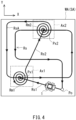
- FIG. 3 is a plan view showing an example of route setting in a travel area of the utility vehicle of the present embodiment.
- the vehicle 1 is used for monitoring (patrolling) a patrol area WA (e.g., premises of owned property).
- the patrol area WA is predetermined as a travel area SA of the vehicle 1.
- a patrol route that starts from a given point Po in the patrol area WA and on which the vehicle 1 travels to monitor the patrol area WA is set as a predetermined travel route for autonomous travel (initial travel route Ri).
- the initial travel route Ri includes, for example, a meandering section M where the vehicle 1 repeats back-and-forth movements in a first direction X in the patrol area WA with interposition of a movement in a second direction Y between the movements in the first direction X.
- the vehicle 1 performs a given alert action against the monitoring target.
- the forward environment detector 29 functions as a target detector that detects the monitoring target in the travel area SA.
- the monitoring target is an intruder into the patrol area WA, such as a person, a vehicle, or an animal.
- the forward environment detector 29 determines the presence or absence of the given monitoring target by analyzing an image of the environment ahead of the vehicle 1. Upon detecting the presence of the monitoring target, the forward environment detector 29 sends a detection signal to the circuitry 13. Upon receiving the detection signal from the forward environment detector 29, the circuitry 13 controls the vehicle 1 to perform the given alert action.
- the alert action includes a notifying action, a data collecting action, and a threatening action.
- the notifying action is to notify a computer device external to the vehicle 1 and capable of communication with the vehicle 1 via a communication network that the monitoring target has been detected.
- the computer device external to the vehicle 1 may be a mobile terminal carried by a user or a management device operated by an administrator.
- the data collecting action is to collect various kinds of data at the time of detection of the monitoring target.
- the data may include, for example, the location of detection (the vehicle location at the time of detection), the day and time of detection, the characteristics (such as type, size, and moving speed) of the monitoring target, the surroundings (such as atmospheric temperature and weather) at the time of detection, and a captured image of the monitoring target.
- the circuitry 13 may send the collected data to the computer device external to the vehicle 1.
- the threatening action is to threaten the monitoring target by emitting light or sound from the vehicle 1.
- the circuitry 13 may cause the headlamp to light up or blink to threaten the monitoring target.
- the circuitry 13 may cause the horn to beep to threaten the monitoring target.
- the vehicle 1 may include a light-emitting source or loudspeaker for the threatening action.
- the circuitry 13 stores the location of the monitoring target (location of finding). Every time the monitoring target is found, the location Px of the monitoring target is stored as history information in a storage mounted in the vehicle 1 or a storage device (such as a server or mobile terminal) external to the vehicle 1 and capable of communication with the vehicle 1 via a communication network.
- the route setter 41 sets reference points Px (Px1, Px2, ...) at the locations where the monitoring target was detected and sets a travel route Rs based on the reference points Px.
- the route setter 41 sets the travel route Rs by modifying the predetermined initial travel route Ri such that the vehicle 1 performs given alert travel in partial regions Ax (Ax1, Ax2, ...) that are set based on the reference points Px.
- the route setter 41 sets each alert travel region Ax with respect to a corresponding one of the reference points Px.
- the alert travel region Ax is set as a region having a given shape (rectangular shape in the example of FIG. 3 ) centered at the reference point Px.
- the alert travel region Ax may be set as a region having a given shape with the reference point Px on its boundary (e.g., at the center of a side or a vertex) and extending ahead of the reference point Px in the travel direction of the vehicle 1.
- the route setter 41 sets alert travel routes Rm (Rm1, Rm2, ...) on which patrol is performed more carefully than on the initial travel route Ri.
- Each of the alert travel routes Rm is set such that the travel distance or travel time in a corresponding one of the alert travel regions Ax is longer on the alert travel route Rm than on the initial travel route Ri. Additionally or alternatively, the alert travel route Rm may occupy a larger travel area (alert zone) in the alert travel region Ax than the initial travel route Ri.
- the alert travel route Rm1 in the alert travel region Ax1 is set as a travel route on which the vehicle 1 travels (makes circles) in a helical pattern (or spiral pattern) starting from the reference point Px1.
- the alert travel route Rm2 in the alert travel region Ax2 is set as a travel route meandering laterally with respect to the initial travel route Ri.
- the alert travel route Rm2 is set so as to pass through the reference point Px2.
- the alert travel route Rm may be set as a travel route that does not pass through the reference point Px.
- the alert travel route Rm1 and the alert travel route Rm2 are set in different patterns. However, all of the alert travel routes Rm may be set in the same pattern.
- the setting pattern of the alert travel routes Rm may be varied depending on given factors such as the type of the monitoring target, the time of day of finding of the monitoring target, and the newness of the history information of the location of finding.
- the route setter 41 assigns an importance level for travel route setting to each of the reference points Px such that the newer the reference point Px is (namely, the newer the history information about finding of the monitoring target at the reference point Px is), the higher the importance level is.
- the route setter 41 sets the travel route (alert travel route Rm) around each of the reference points Px in a different pattern depending on the assigned importance level.
- each of the alert travel routes Rm may be set in the alert travel region Ax such that the later the monitoring target was found at the location (reference point Px) corresponding to the alert travel region Ax, the greater is the extent to which the patrol on the alert travel route Rm is performed more carefully (over a longer distance, longer time, or wider range) than that on the initial travel route Ri.
- the route setter 41 may assign an importance level for travel route setting to a partial region (alert travel region Ax) such that the greater the number of the reference points Px in the partial region is, the higher the importance level is.
- the route setter 41 may set the travel route (alert travel route Rm) around each of the reference points Px in a different pattern depending on the importance level.
- each of the alert travel routes Rm may be set in the alert travel region Ax such that the more often the monitoring target has been found at the location (reference point Px) corresponding to the alert travel region Ax, the greater is the extent to which the patrol on the alert travel route Rm is performed more carefully (over a longer distance, longer time, or wider range) than that on the initial travel route Ri.
- the route setter 41 sets the travel route Rs by connecting the segments of the initial travel route Ri that are outside the alert travel regions Ax to the alert travel routes Rm set in the alert travel regions Ax.
- the travel route Rs currently set is stored in a storage mounted in the vehicle 1 or a storage device (such as a server or mobile terminal) external to the vehicle 1 and capable of communication with the vehicle 1 via a communication network.
- the data of the currently set travel route Rs may be stored by overwriting data of a past travel route Rs or may be stored separately from the data of the past travel route Rs. That is, history data of past travel routes Rs may be stored in the storage or the like.
- the travel route Rs of the utility vehicle 1 is set based on history information of the locations where the monitoring target was detected during autonomous travel of the utility vehicle 1. This makes it possible to set the travel route Rs such that the locations where the monitoring target was detected will be monitored carefully during autonomous travel. Thus, the given travel area SA can be monitored efficiently.
- the initial travel route Ri is predetermined, and the initial travel route Ri is modified to carefully patrol a partial region that is set based on the location where the monitoring target was detected. This makes it easier to set the travel route Rs that allows for both alert travel all over the travel area SA and careful patrol around the location where the monitoring target was detected.
- the travel route Rs can be set as a route on which the monitoring target can be found efficiently.
- an importance level may be assigned to each of the locations as described above, and the travel route Rs may be set such that the vehicle 1 performs alert travel in a pattern appropriate for the importance level.
- the travel route Rs can be set as a route with enhanced efficiency in finding the monitoring target.
- the pattern of the alert travel route Rm set in the alert travel region Ax is not limited to a helical (spiral) pattern or meandering pattern as shown in the example of FIG. 3 , and the alert travel route Rm can be set in various other patterns.
- the route setter 41 may set an alert travel route Rm so as to increase the number of times that the alert travel route Rm passes through the reference point Px. That is, an alert travel route Rm that includes a repeatedly passed location (intersection) may be set.
- the route setter 41 may set an alert travel route Rm that circles around the reference point Px.
- the route setter 41 may set an alert travel route Rm that includes these different characteristics.
- the overlapping alert travel regions Ax may be collectively set as one alert travel region (overlap region) based on the different reference points Px.
- the overlap region may be set as a region that includes at least all of the different alert travel regions. For example, in the case where two alert travel regions Axa and Axb based on two reference points Pxa and Pxb overlap each other, the overlap region may be set as a region that includes at least the alert travel regions Axa and Axb.
- the overlap region may be set as another alert travel region based on the different reference points Px.
- a midpoint of a line segment between the two reference points Pxa and Pxb may be set as a new reference point, and the overlap region may be set as a given region based on the new reference point.
- Machine learning can be used to set alert travel regions Ax and alert travel routes Rm.
- the route setter 41 acquires the area of an alert travel region Ax or the travel time in the alert travel region Ax by using a learning model to which the distance between two neighboring reference points Px is input and from which the area or travel time is output.
- the learning model is created using a known machine learning algorithm such as a neural network.
- the teacher data to be input to the machine learning algorithm may be created, for example, as follows: alert travel is performed based on a reference point Px; data indicating a location where the monitoring target was detected again during the alert travel is used to determine the distance between the reference point Px and the location of detection; and the distance is associated with a desired value of the area of the alert travel region Ax or a desired travel time in the alert travel region Ax.
- the alert travel region Ax may be set such that the shorter the distance between the two neighboring reference points Px is, the smaller the area of the alert travel region Ax is.
- the alert travel route Rm may be set such that the shorter the distance between the two neighboring reference points Px is, the longer the travel time per unit area is.
- the circuitry 13 may control the travel structure 14 in a different way than on a travel route outside the alert travel region Ax.
- the circuitry 13 may control the travel structure 14 such that the upper velocity limit of the vehicle 1 is lower on the alert travel route Rm than in a region other than the alert travel region Ax.
- the circuitry 13 may control the travel structure 14 to stop the vehicle 1 once per given travel distance on the alert travel route Rm.
- the route setter 41 may set a travel route Rs without any initial travel route Ri.
- FIG. 4 is a plan view showing another example of route setting in a travel area of the utility vehicle of the present embodiment.
- the vehicle 1 is used for monitoring (patrolling) a patrol area WA (e.g., premises of owned property).
- the patrol area WA is predetermined as the travel area SA of the vehicle 1 also in the example of FIG. 4 .
- the elements identical to those in the example of FIG. 3 are denoted by the same reference signs and will not be described repeatedly.
- the route setter 41 sets the travel route Rs such that the vehicle 1 passes through the reference point Px and travels according to a given logic in the travel area SA. In the example of FIG. 4 , the route setter 41 sets the travel route Rs according to a predetermined rule.
- the route setter 41 sets a travel route segment Rs1 on which the vehicle 1 travels straight from a starting point Po toward the nearest reference point Px1.
- the route setter 41 sets an alert travel region Ax1 based on the reference point Px1 and sets an alert travel route Rm1 in the alert travel region Ax1.
- the alert travel route Rm1 is set in the same pattern as in the example of FIG. 3 .
- the route setter 41 sets a travel route segment Rs2 on which the vehicle 1 travels straight from the first reference point Px1 toward the nearest reference point Px2.
- the route setter 41 sets an alert travel region Ax2 based on the reference point Px2 and sets an alert travel route Rm2 in the alert travel region Ax2.
- travel route setting is performed for the third and subsequent reference points Px in the same manner as for the second reference point Px2.
- the route setter 41 After having set alert travel routes Rm for all of the reference points Px, the route setter 41 sets a travel route segment RsA on which the vehicle 1 makes a circuit of the entire travel area SA and finally returns to the starting point Po.
- the travel route segment RsA may be set such that the vehicle 1 passes through all of the reference points Px again.
- the pattern of the circuit travel may be a helical (spiral) pattern as in the example of FIG. 4 , may be another regular pattern such as a meandering or zigzag pattern, or may be a random pattern that is set using given random numbers (or pseudorandom numbers).
- the travel route segment RsA for circuit travel is set such that the vehicle 1 does not reach the boundary (outer edges) of the travel area SA or a no-entry region predefined in the travel area SA.
- the route setter 41 connects the travel route segments Rs1, Rm1, Rs2, Rm2, and RsA in series to set the travel route Rs in the travel area SA.
- the route setter 41 sets the travel route Rs in the same manner as the route setter 41 sets the travel route segment RsA.
- a predetermined initial travel route Ri may be set as the travel route Rs until any reference point Px is set.
- the rule for setting the travel route Rs is not limited to the above example, and various rules may be employed.
- a travel route segment may be set such that the vehicle 1 travels through a plurality of reference points Px in ascending order of distance from the starting point Po.
- a travel route segment may be set such that the vehicle 1 travels through a plurality of reference points Px in descending order of the date and time of detection.
- the travel route segment RsA for circuit travel may be set such that given characteristics of the travel route segment RsA (such as the number of curves and the length of a straight segment between curved segments) vary depending on the number of the reference points Px (or the number of the alert travel regions Ax).
- the number of curves on the travel route segment RsA may be set smaller, and/or the length of a straight segment on the travel route segment RsA may be set longer, than in the case where the number of the reference points Px is equal to or smaller than the first threshold.
- the travel route segment RsA may be set such that the vehicle 1 returns straight to the starting point Po (may be set in the same manner as a travel route segment RsB described later with reference to FIG. 6 ).
- the travel area SA may be divided into separate regions, and a travel route segment may be set such that the vehicle 1 travels through each of the regions in descending order of the number of the reference points Px contained in the region. There need not be any alert travel route Rm.
- a travel route segment between neighboring (consecutive) reference points Px on a travel route may be set not as a straight segment but as a segment with a given regular pattern (such as a meandering or zigzag pattern) or a random pattern.
- travel routes Rs set in the past may be used as a reference.
- the new travel route Rs may be set close to one of the past travel routes Rs in which the number of times of detection of the monitoring target is greater than in the other past travel routes Rs.
- the new travel route Rs may be set so as not to overlap the immediately previous travel route Rs.
- the route setter 41 may randomly set a travel route Rs that passes through a reference point Px. That is, setting a travel route Rs based on a given logic includes setting the travel route Rs randomly. For example, the route setter 41 acquires a random number per unit distance and determines a travel pattern (such as straight movement, right turn, or left turn) according to the acquired random number.
- the route setter 41 may use terrain data or map data as a reference when setting a travel route Rs.
- the terrain data or map data is prestored in a storage mounted in the vehicle 1 or a storage device (such as a server or mobile terminal) external to the vehicle 1 and capable of communication with the vehicle 1 via a communication network.
- a region that is determined from the terrain data or map data to be non-travelable by the vehicle 1 may be excluded beforehand from the area where the travel route Rs is to be set (excluded from the travel area SA).
- the route setter 41 may set the travel route Rs such that the vehicle 1 preferentially travels in a region that is determined from the terrain data or map data to be shadowed by a rocky place or a building (a region with poor visibility).
- the route setter 41 may, based on the terrain data or map data, set the travel route Rs such that the vehicle 1 preferentially travels around a spot such as an entrance of a building that the user wants to monitor carefully.
- the spot that the user wants to monitor carefully may be input by the user.
- a map based on the map data may be displayed on the user's mobile terminal capable of communication with the vehicle 1, the user may touch a spot on the displayed map, and the touched spot may be set as the spot to be monitored carefully.
- the route setter 41 may set the travel route Rs based on road condition data indicating the road condition in the travel area SA.
- the travel area SA is divided into regions with different predetermined road condition levels.
- the road condition data is stored in a storage mounted in the vehicle 1 or stored in a storage device (such as a server or mobile terminal) external to the vehicle 1 and capable of communication with the vehicle 1 via a communication network.
- the route setter 41 permits choosing a route where the road condition level is equal to or higher than a somewhat high level. For example, in the case where priority is given to the required time in setting the travel route Rs for movement of the vehicle 1 to a reference point Px, the route setter 41 chooses a travel route that requires the shortest time while taking into account velocity limits associated with the road condition levels.
- the route setter 41 chooses a travel route with the smallest value of the distance over which the road condition level is equal to or higher than a given level for which travel is permitted.
- the travel route set by the route setter 41 may be one with the lowest occurrence of a state where the road condition level differs between the road with which the left wheels 2 and 3 are in contact and the road with which the right wheels 2 and 3 are in contact.
- the circuitry 13 may control the travel structure 14 according to the road condition of a region ahead of the vehicle location in the travel direction.
- the route setter 41 may use given data related to the surroundings of the vehicle 1 as a reference.
- the data related to the surroundings of the vehicle 1 may include, for example, weather, atmospheric temperature, atmospheric pressure, season, date and time, geographical zone (climate zone), and ground type (such as muddy area, marshy area, sand beach, or desert).
- the data related to the surroundings (such as weather, season, date and time, and geographical zone) is accumulated, for example, in a server communicatively connected to the data receiver 42 of the vehicle 1 via a communication network, and is sent to the data receiver 42 from the server.
- the data related to the surroundings may be, for example, values detected by sensors mounted on the vehicle 1.
- the route setter 41 may set the alert travel route Rm as a simplified or complicated route according to the weather or atmospheric pressure.
- the route setter 41 may modify the current travel route Rs (rerouting) in response to a change in the surroundings. For example, upon determination that the weather has changed (or that the atmospheric pressure has fallen within a given range), the route setter 41 may modify an alert travel route Rm in an alert travel region Ax into a simplified or complicated route. For example, upon determination that the weather has changed (or that the atmospheric pressure has fallen within a given range), the route setter 41 may modify the travel route Rs such that the vehicle 1 returns from the current location to the starting point Po.
- the route setter 41 may set the travel route Rs based on a result of a travel simulation of a virtual vehicle modeled on the vehicle 1.
- the travel simulation may be performed by the route setter 41 or by a computer external to the vehicle 1 and capable of communication with the vehicle 1 via a communication network.
- An independent computer that does not communicate with the vehicle 1 may perform the travel simulation, and travel route group data obtained as a result of the simulation may be transferred to a storage such as that of the vehicle 1 through means such as a recoding medium.
- terrain data of the travel area SA is prepared.
- the terrain data is created, for example, from a satellite image.
- the computer that performs the travel simulation creates a virtual travel space based on road geometry data of the travel area SA.
- the computer further creates a virtual vehicle modeled on the vehicle 1 and places the virtual vehicle in the virtual travel space.
- the computer performs the travel simulation in which the virtual vehicle is allowed to travel in the created virtual travel space, thereby extracting a group of routes.
- machine learning can be used.
- the route setter 41 may select the best route from the extracted group of routes or combine different routes included in the group of routes and set the resulting combination as the travel route Rs.
- the above-described setting of the travel route Rs of the vehicle 1 for patrol can be performed using a result of patrol flight of an unmanned air vehicle (UAV, also referred to as "drone").
- UAV unmanned air vehicle
- FIG. 5 is a schematic left side view showing a utility vehicle of a variant of the above embodiment.
- FIG. 6 is a plan view showing an example of route setting in a travel area of the utility vehicle of this variant.
- the components of the utility vehicle 1B (simply referred to as “vehicle 1B" hereinafter) of FIG. 5 that are identical to those of the vehicle 1 of FIG. 1 are denoted by the same reference signs and will not be described repeatedly.
- the vehicle 1B of FIG. 5 differs from the vehicle 1 of FIG. 1 in that the vehicle 1B includes an air vehicle takeoff/landing platform 70 from which an unmanned air vehicle 60 takes off and on which the unmanned air vehicle 60 lands.
- the air vehicle takeoff/landing platform 70 is located behind the cabin C (above the cargo bed 8) and connected to the vehicle body frame 4.
- the unmanned air vehicle 60 includes an environment detector 61 that detects the state of an environment located in a given direction (obliquely below) with respect to the unmanned air vehicle 60.
- the environment detector 61 includes, for example, at least one of a camera, radars, or a laser sensor.
- the unmanned air vehicle 60 analyzes the environment located in the given direction with respect to the unmanned air vehicle 60 based on image data of the environment as acquired by the camera and/or distance data as acquired by the radars or the laser sensor.
- the unmanned air vehicle 60 further includes a location detector 62 that detects the current location of the unmanned air vehicle 60, and is capable of autonomous flight.
- the location detector 62 includes, for example, a GPS antenna.
- the unmanned air vehicle 60 performs flight control based on the environment data obtained from the environment detector 61 and the unmanned air vehicle 60's current location obtained from the location detector 62.
- the unmanned air vehicle 60 autonomously flies over and patrols the travel area SA of the vehicle 1 to monitor the travel area SA by the environment detector 61. Upon detecting a monitoring target during the autonomous flight, the unmanned air vehicle 60 sends detection data to the vehicle 1.
- the data receiver 42 of the vehicle 1 receives the detection data from the unmanned air vehicle 60.
- the detection data includes the location of the monitoring target, the time of day of detection, and the type of the detected target.
- the route setter 41 takes locations where the monitoring target was detected by the unmanned air vehicle 60 into account as reference points Px and sets a travel route Rs such that the vehicle 1 preferentially travels around the locations (reference points Px1a and Px2a) where the monitoring target was detected by the unmanned air vehicle 60.
- the vehicle 1 Before the start of patrol, the vehicle 1 is at rest at the starting point Po.
- the unmanned air vehicle 60 rests on the air vehicle takeoff/landing platform 70.
- the air vehicle takeoff/landing platform 70 may be capable of charging the unmanned air vehicle 60 while the unmanned air vehicle 60 rests on the air vehicle takeoff/landing platform 70.
- the unmanned air vehicle 60 is allowed to autonomously fly on a predetermined flight route Ra over the travel area SA of the vehicle 1 and monitor the travel area SA.
- the flight route Ra is set as a route on which the unmanned air vehicle 60 flies over the travel area SA in a spiral pattern and then returns to the starting point Po.
- the flight route Ra may be set based on reference points Px just as does the travel route Rs of the vehicle 1.
- the unmanned air vehicle 60 sends detection data to the vehicle 1 upon detecting a monitoring target during the autonomous flight.
- the accuracy of detection of the monitoring target by the environment detector 61 of the unmanned air vehicle 60 may be lower than the accuracy of detection by the forward environment detector 29 of the vehicle 1.
- the route setter 41 acquires the detection data from the unmanned air vehicle 60 via the data receiver 42, and records the locations where the monitoring target was detected by the unmanned air vehicle 60 as reference points Px.
- the point in time when the data receiver 42 of the vehicle 1 receives the detection data from the unmanned air vehicle 60 may be during flight of the unmanned air vehicle 60 or after the unmanned air vehicle 60 completes autonomous flight and arrives at the air vehicle takeoff/landing platform 70 of the vehicle 1 located at the starting point Po.
- the unmanned air vehicle 60 may send the detection data every time the unmanned air vehicle 60 detects the monitoring target.
- the unmanned air vehicle 60 may send the detection data at given time intervals after the start of autonomous flight of the unmanned air vehicle 60, and in this case the sent data may be a collection of data obtained during each interval.
- the route setter 41 sets the travel route Rs of the vehicle 1 based on the detection data. For example, the route setter 41 sets travel route segments Rs1a and Rs2a starting from the starting point Po and connecting in series all of the reference points Px (two reference points Px1a and Px2a in the example of FIG. 6 ) defined based the locations where the monitoring target was detected by the unmanned air vehicle 60, and sets a travel route segment RsB on which the vehicle 1 having passed through all of the reference points Px returns to the starting point Po.
- the route setter 41 sets alert travel regions Ax1a and Ax2a that are based on the reference points Px1a and Px2a, respectively, and sets alert travel routes Rm1a and Rm2a in the alert travel regions Ax1a and Ax2a, respectively.
- the alert travel routes Rm1a and Rm2a are set in the same patterns as the alert travel routes Rm1 and Rm2 in the example of FIG. 3 or FIG. 4 .
- the route setter 41 connects the travel route segments Rs1a, Rm1a, Rs2a, Rm2a, and RsB in series to set the travel route Rs in the travel area SA.
- the travel route segment RsA for circuit travel is not set unlike in the example of FIG. 4 .
- the total length of the route segments other than the alert travel routes Rm in the travel route Rs of the vehicle 1 can be shorter in the example of FIG. 6 (Rs1a + Rs2a + RsB) than in the example of FIG. 4 (Rs1 + Rs2 + RsA).
- Allowing the unmanned air vehicle 60 to fly beforehand over the travel area SA as described above makes it possible for the vehicle 1 to preferentially travel in regions of the travel area SA where the monitoring target is highly likely to be detected. Consequently, the monitoring target can be found effectively within a short travel time.
- the route setter 41 may set the travel route Rs of the vehicle 1 in a manner as described in the example of FIG. 3 or FIG. 4 .
- the route setter 41 may set the travel route Rs by combining the example of FIG. 6 with the example of FIG. 3 and/or the example of FIG. 4 .
- a travel route Rs for a first round of patrol may be set based on detection data obtained by the unmanned air vehicle 60 as in the example of FIG. 6
- travel routes Rs for second and subsequent rounds of patrol may be set based on history information of past detection results as in the example of FIG. 3 or FIG. 4 .
- the travel routes may be set such that the vehicle 1 passes through the starting point Po between the first and second rounds, or a route segment for return to the starting point Po in the first round (the travel route segment RsB in FIG. 6 ) and a travel route segment in the second round (e.g., the travel route segment Rs1 in FIG. 4 ) may be combined into a single route not including the starting point Po.
- the end point of the alert travel route Rm based on the last reference point Px in the first round may be connected straight to the start point of the alert travel route Rm based on the first reference point Px in the second round.
- the reference points Px (Px1a and Px2a) that were set through detection of the monitoring target by the unmanned air vehicle 60 can, in the next and subsequent setting of the travel route Rs, be handled in the same manner as reference points Px set through detection of the monitoring target by the vehicle 1.
- the unmanned air vehicle 60 may be allowed to fly by manned operation.
- the detection of the monitoring target may be performed by the environment detector 61 as in the above example.
- the user may make a given operation input at a desired time based on information such as an image captured by the environment detector 61, and the location of the unmanned air vehicle 60 at the time when the operation input was made may be acquired as the location of detection of the monitoring target (detection data).
- the vehicle 1 does not start autonomous travel until the unmanned air vehicle 60 returns to the vehicle 1, the present invention is not limited to this operation of the vehicle 1.
- the vehicle 1 may be moved toward the unmanned air vehicle 60 once the unmanned air vehicle 60 finds the monitoring target.
- the unmanned air vehicle 60 may circle around the location of detection of the monitoring target, move to follow the monitoring target, or move toward the vehicle 1.
- the route setter 41 may set a travel route Rs starting from the point at which the unmanned air vehicle 60 has returned.
- the route setter 41 may predict or predetermine the location of return of the unmanned air vehicle 60 (location where the vehicle 1 and the unmanned air vehicle 60 will meet) and may set a travel route Rs starting from the predicted or predetermined location.
- the unmanned air vehicle 60 may have functions other than flight for monitoring purpose.
- the unmanned air vehicle 60 may include a working unit for sowing of seeds or spraying of agrochemicals.
- the unmanned air vehicle 60 may be able to detect the monitoring target during working flight using the working unit.
- the vehicle 1 may include a replenishment unit for replenishing the unmanned air vehicle 60 with the seeds or agrochemicals.
- the unmanned air vehicle 60 may perform a given alert action (such as a notifying action, data collecting action, or threatening action).
- the vehicle 1 may include first circuitry (first ECU) that controls the vehicle 1 in the manned operation mode and second circuitry (second ECU) that controls the vehicle 1 in the autonomous travel mode.
- first ECU first ECU
- second ECU second ECU
- the control in the autonomous travel mode of the above embodiment may be applied to a vehicle 1 specialized for autonomous travel.
- a vehicle 1 that autonomously travels on a travel route Rs set as described in the above embodiment may be used for purposes such as monitoring or rescue activity in a place (a dangerous zone or disaster-affected site) that any person cannot enter.
- the data of the reference points Px or the data of the set travel routes Rs in the above embodiment may be shared among different vehicles 1.
- the data of the travel routes Rs may include label data associated with the type of vehicle.
- a given identifier is provided to the object to be exempted.
- the identifier include an armband, a near-field wireless communication tag, and an identification code.
- the forward environment detector 29 may determine that the monitoring target has not been detected. This can prevent erroneous detection of the monitoring target.
- the monitoring target is an intruder (a moving object such as a person or an animal)
- the monitoring target is not limited to such an intruder.
- the monitoring target may be a plant, a fruit, a mushroom, an insect, a small animal, or an obstacle (such as a rock, a fallen rock, or a fallen tree).
- the vehicle 1 may perform a given alert action such as a picking action, an exterminating action, or a removing action in addition to or instead of the previously described alert actions such as the notifying action and data collecting action.
- the vehicle 1 may include a picking unit (such as a picking arm) that performs a picking action for picking a plant, a fruit, a mushroom, or an insect.
- the circuitry 13 may control the picking unit to pick the monitoring target.
- the vehicle 1 may include an exterminating unit (such as a chemical spraying unit) that performs an exterminating action for exterminating a harmful insect.
- the circuitry 13 may control the exterminating unit to exterminate the monitoring target.
- the vehicle 1 may include a removing unit (such as a removing blade) for removing an obstacle such as a rock or fallen tree. In this case, upon detection of the monitoring target, the circuitry 13 may control the removing unit to remove the monitoring target.
- the initial travel route Ri and travel route Rs illustrated in the above embodiment are set such that the vehicle 1 starts from the starting point Po, patrols the travel area SA (patrol area WA), and finally returns to the starting point Po
- the initial travel route Ri and travel route Rs are not limited to those in the above embodiment.
- a goal point may be set at a location different from the starting point Po, and the initial travel route Ri and travel route Rs may be set such that the vehicle 1 performs alert travel during movement from the starting point Po to the goal point.
Landscapes
- Engineering & Computer Science (AREA)
- Remote Sensing (AREA)
- Radar, Positioning & Navigation (AREA)
- Aviation & Aerospace Engineering (AREA)
- Physics & Mathematics (AREA)
- General Physics & Mathematics (AREA)
- Automation & Control Theory (AREA)
- Health & Medical Sciences (AREA)
- Business, Economics & Management (AREA)
- Artificial Intelligence (AREA)
- Evolutionary Computation (AREA)
- Game Theory and Decision Science (AREA)
- Medical Informatics (AREA)
- Mechanical Engineering (AREA)
- Transportation (AREA)
- Traffic Control Systems (AREA)
- Control Of Position, Course, Altitude, Or Attitude Of Moving Bodies (AREA)
Description
- The present invention relates to a utility vehicle.
- A utility vehicle able to travel on rough terrain and the like is used for works such as conveyance of crops etc. and monitoring in premises. It is envisaged that such a work requires the vehicle to travel on a predetermined travel route and is routinely repeated.
- In recent years, various kinds of technology for autonomous driving of automobiles have been proposed. For example, PTL 1 discloses a system in which an autonomous driving vehicle travels on a predetermined travel route. This system eliminates the need for manned operation in travel on the predetermined travel route.
-
PTL 2, which forms the basis for the preamble ofclaim 1, discloses a cleaning device with a receiving device for receiving soiling objects, a drive device for moving the cleaning device, a control device for controlling the drive device for directing a movement of the cleaning device depending on sensor signals provided by a sensor system, with a detection unit for detecting soiling objects arranged in a predeterminable area, an evaluation unit for classifying the soiling objects detected by the detection unit into different soiling classes, and a path planning unit for determining an optimized path for the cleaning device in the predetermined area depending on a respective position of the detected contamination objects and the respective contamination class of the contamination objects, wherein the control device is designed to control the drive device to carry out a cleaning run along the determined optimized path. - Further exemplary vehicles are disclosed in PTL 3-7.
-
- PTL 1:
Japanese Laid-Open Patent Application Publication No. 2020-13379 - PTL 2:
DE 10 2017 130954 A1 - PTL 3:
US 2005/166355 A1 - PTL 4:
EP 3 647 493 A1 - PTL 5:
US 9 211 959 B2 - PTL 6:
US 6 712 312 B1 - PTL 7:
US 9 659 502 B1 - Such a conventional autonomous driving vehicle as mentioned above leaves room for improvement in terms of use as a security vehicle for patrolling a given travel area. For example, in the autonomous driving vehicle of
Patent Literature 1, the travel route is predetermined as stated above. In this case where the vehicle is allowed to travel on the predetermined travel route, the entire travel area can be monitored evenly. However, the efficiency of monitoring is reduced in a situation where the travel area is dotted with spots that should be guarded carefully. - It is therefore an object of the present invention to provide a utility vehicle capable of monitoring a given travel area efficiently.
- A utility vehicle according to
claim 1 includes: a travel structure including a front wheel, a rear wheel, a steering structure mounted to the front wheel, and a drive source that drives the front wheel and/or the rear wheel; circuitry that controls the travel structure to effect autonomous travel without manned operation in a given travel area; a route setter that sets a travel route for the autonomous travel; a vehicle location detector that detects a location of the utility vehicle; and a target detector that detects a monitoring target in the travel area, wherein in case that the monitoring target is detected at a location during the autonomous travel, the circuitry stores the location of the monitoring target as history information, and wherein the route setter sets a reference point at the location where the monitoring target was detected and sets the travel route based on the reference point. The reference point is one of a plurality of reference points. The route setter assigns an importance level for setting of the travel route to each of the reference points such that the newer the reference point is, the higher the importance level is. The route setter sets the travel route around each of the reference points in a different pattern depending on the importance level. - In accordance with the present invention, the travel route of the utility vehicle is set based on the history information of the location where the monitoring target was detected during autonomous travel of the utility vehicle. This makes it possible to set the travel route such that the location where the monitoring target was detected will be monitored carefully during autonomous travel. Thus, the given travel area can be monitored efficiently.
-
-
FIG. 1 is a schematic left side view showing a utility vehicle of an exemplary embodiment. -
FIG. 2 is a block diagram showing a schematic configuration of a control system of the utility vehicle ofFIG. 1 . -
FIG. 3 is a plan view showing an example of route setting in a travel area of the utility vehicle of the exemplary embodiment. -
FIG. 4 is a plan view showing another example of route setting in a travel area of the utility vehicle of the exemplary embodiment. -
FIG. 5 is a schematic left side view showing a utility vehicle of a variant of the exemplary embodiment. -
FIG. 6 is a plan view showing an example of route setting in a travel area of the utility vehicle of the variant. - Hereinafter, exemplary embodiments will be described with reference to the drawings. The same or like elements are denoted by the same reference signs throughout the drawings and will not be described repeatedly.
-
FIG. 1 is a schematic left side view showing a utility vehicle of an exemplary embodiment. The utility vehicle 1 (simply referred to as "vehicle 1" hereinafter) ofFIG. 1 includes a pair of left and rightfront wheels 2 and a pair of left and rightrear wheels 3. The front andrear wheels vehicle body frame 4. Thevehicle body frame 4 is a pipe frame constituted by pipes connected together. - The
vehicle body frame 4 supports afront seat structure 5A and arear seat structure 5B. Thefront seat structure 5A includes a driver seat. The seats are not limited to being arranged in two rows, and may be arranged in a single row. Thevehicle body frame 4 encloses a cabin C including the front andrear seat structures vehicle body frame 4. Ahood 6 is located ahead of the cabin C (front seat structure 5A). Thehood 6 is supported by the front of thevehicle body frame 4 and covers from above the space between the left and rightfront wheels 2. Thehood 6 is openable. -
Front side doors 7A are located to the left and right of thefront seat structure 5A, andrear side doors 7B are located to the left and right of therear seat structure 5B. Theside doors vehicle body frame 4. Each of theside doors vehicle body frame 4 about a pivot shaft located at the front end of theside door vehicle 1. InFIG. 1 , theside doors side doors - A
cargo bed 8 is located behind the cabin C (rear seat structure 5B). The rear of thevehicle body frame 4 supports thecargo bed 8. Adrive source 9 supported by thevehicle body frame 4 is located beneath thecargo bed 8. Thedrive source 9 is, for example, an engine. Alternatively, thedrive source 9 may be an electric motor or a combination of an engine and an electric motor. Thedrive source 9 drives the drive wheels (front wheels 2 and/or rear wheels 3). - A
first operator 10 including an accelerator pedal and a brake pedal is located ahead of and below the driver seat (in the area around the feet of the driver). Operating the accelerator pedal produces a change in the drive power of thedrive source 9. Unshown brakes are mounted to the front andrear wheels vehicle 1. Thus, thefirst operator 10 is configured as an operator for acceleration and deceleration of thevehicle 1. - A
steering structure 11 is mounted to thefront wheels 2. Asteering wheel 12 as a second operator is located in front of the driver seat of thefront seat structure 5A. Thesteering wheel 12 is connected to thesteering structure 11. In response to an operation on thesteering wheel 12, thesteering structure 11 moves to steer thefront wheels 2. Thus, the second operator is configured as an operator for turning of thevehicle 1. - The
vehicle 1 further includes a transmission (not shown) located between and connected to thedrive source 9 and the drive wheels. The transmission changes the gear ratio or the travel direction (forward or rearward) based on an operation on a third operator such as an unshown gear shift lever. - As described above, a
travel structure 14 for travel of thevehicle 1 includes thefront wheels 2, therear wheels 3, thesteering structure 11, thedrive source 9, the brakes, and the transmission. The operators used to operate thetravel structure 14 include the first, second, and third operators. - The
vehicle 1 further includescircuitry 13 that controls thetravel structure 14. To thecircuitry 13 are connected various sensors described below. Thecircuitry 13 acquires detection values of the sensors. Thecircuitry 13 is configured as electronic circuitry that includes a processor, a volatile memory, a non-volatile memory (storage), and an I/O interface and in which the processor performs computation procedures based on programs stored in the non-volatile memory and by means of the volatile memory to accomplish various kinds of control. -
FIG. 2 is a block diagram showing a schematic configuration of the control system of the utility vehicle ofFIG. 1 . As shown inFIG. 2 , various sensors are connected to thecircuitry 13. The sensors detect vehicle state parameters related to the travel system including the operators and thetravel structure 14. - The sensors include, for example, an
accelerator position sensor 15, abraking intensity sensor 16, asteering angle sensor 17, a drive sourcerotational speed sensor 18, and avehicle velocity sensor 19. Thevehicle 1 may include all or some of these sensors and may include other sensors. - The
accelerator position sensor 15 detects the amount of operation of the accelerator pedal. Thebraking intensity sensor 16 detects the amount of operation of the brake pedal. Thesteering angle sensor 17 detects the direction and amount of operation of thesteering wheel 12. The drive sourcerotational speed sensor 18 detects the rotational speed of the output shaft of thedrive source 9. Thevehicle velocity sensor 19 detects the velocity of thevehicle 1. - The
circuitry 13 controls thetravel structure 14 to effect autonomous travel without manned operation in a given travel area. Amode switcher 50 is connected to thecircuitry 13. Themode switcher 50 switches thevehicle 1 between a manned operation mode in which thevehicle 1 travels in response to operations on the operators and an autonomous travel mode in which thecircuitry 13 allows thevehicle 1 to autonomously travel on a given travel route without any operations on the operators. - The
mode switcher 50 sends a mode switching signal to thecircuitry 13 based on switching by means of a switch or a certain authentication operation. In response to the received mode switching signal, thecircuitry 13 switches the control mode between the manned operation mode and the autonomous travel mode. - In the manned operation mode, the
circuitry 13 controls thetravel structure 14 in response to inputs provided to the operators by the driver. For example, thecircuitry 13 performs output adjustment of the drive source 9 (e.g., throttle position control in the case where thedrive source 9 is an engine) based on the accelerator position that theaccelerator position sensor 15 detects in response to an operation performed on the accelerator pedal by the driver. For example, thecircuitry 13 performs steering angle adjustment of thesteering structure 11 based on the steering angle and steering direction that thesteering angle sensor 17 detects in response to an operation performed on thesteering wheel 12 by the driver. - In the autonomous travel mode, the
circuitry 13 allows thevehicle 1 to autonomously travel on a given travel route without any operations on the operators. For example, thevehicle 1 includes aforward environment detector 29 that detects the state of an environment ahead of thevehicle 1 in the travel direction and avehicle location detector 30 that detects the location of thevehicle 1. - The
forward environment detector 29 includes, for example, at least one of a camera, radars, or a laser sensor. Thecircuitry 13 analyzes the forward environment based on image data of the forward environment as acquired by the camera and/or distance data as acquired by the radars or the laser sensor. Thecircuitry 13 controls thetravel structure 14 based on the result of the analysis of the forward environment. For example, in the event that there is an obstacle ahead of thevehicle 1, thecircuitry 13 controls thedrive source 9 and/or brakes (not shown) to decelerate or stop thevehicle 1 or controls thesteering structure 11 to change the travel direction of thevehicle 1. - The
vehicle location detector 30 includes, for example, a GPS antenna. Data of a predetermined travel route is stored in the storage of thecircuitry 13. In the autonomous travel mode, thecircuitry 13 retrieves the data of the travel route and controls thetravel structure 14 based on vehicle location information received from thevehicle location detector 30, thus allowing thevehicle 1 to travel on the travel route. Additionally, thecircuitry 13 makes a minor adjustment to the travel route based on the result of the above-described analysis of the forward environment. For example, in the event that there is an obstacle ahead of thevehicle 1, thecircuitry 13 performs rerouting of the travel route. - The
vehicle 1 includes aroute setter 41 that sets a travel route for autonomous travel. Theroute setter 41 may be configured as a control block of thecircuitry 13 or may be embodied by a computer separate from thecircuitry 13. In the case where theroute setter 41 is embodied by a computer separate from thecircuitry 13, theroute setter 41 may be mounted in thevehicle 1 or may be embodied by a computer of a mobile terminal (such as a tablet terminal) capable of communication with thevehicle 1 via a communication network. - To the
route setter 41 is connected adata receiver 42 that communicates with an external entity via a communication network and receives given data from the external entity. The data of the travel route may be set and input, for example, as follows: the user sets and inputs the travel route to a mobile terminal (such as a tablet terminal) capable of communication with thevehicle 1 via a communication network, and the information set and input by the user is sent to thecircuitry 13 of thevehicle 1 via a given server. Alternatively, an operation terminal connectable to thecircuitry 13 to allow the user to set and input the travel route may be mounted on thevehicle 1. - In the configuration described above, the
mode switcher 50 switches thevehicle 1 between the manned operation mode in which thevehicle 1 travels in response to operations on the operators and the autonomous travel mode in which thevehicle 1 autonomously travels on a given travel route without any operations on the operators. Thus, in the case of a routine work, carrying out the autonomous travel mode can eliminate the need for manned operation and reduce the workload. In the case of a temporary work, the manned operation mode can be carried out as necessary to use theutility vehicle 1 as a human-operated vehicle. As such, with the configuration described above, theutility vehicle 1 capable of autonomous travel on a given travel route can be utilized in a flexible way. - In the present embodiment, the
vehicle 1 permits the presence of an occupant in the cabin C when thevehicle 1 is in the autonomous travel mode That is, thevehicle 1 can travel in the autonomous travel mode regardless of whether any person is on board thevehicle 1. - Hereinafter, the autonomous travel mode will be described in more detail. For example, the
vehicle 1 is started up once the user performs a given start-up operation. Once the user performs an operation for switching to the autonomous travel mode, themode switcher 50 sends to the circuitry 13 a mode switching signal for switching to the autonomous travel mode. After that, thecircuitry 13 allows theroute setter 41 to execute a process for travel route setting (travel route setting program). - In the case where a travel route is prestored in the storage, the travel route setting may be accomplished by retrieving the prestored travel route. In the case where any travel route is not prestored in the storage or where the
vehicle 1 should travel on a travel route different from that used in the previous travel, the travel route setting may be performed anew. In this case, for example, the route setting may be performed using a mobile terminal communicatively connectable to thevehicle 1 by wire or wirelessly. - For example, a map is displayed on the mobile terminal, and pass points, a destination, etc. are set and input on the map. The
route setter 41 executes the travel route setting program and sets a travel route based on pieces of information such as information of the input pass points, destination, etc., information of the vehicle location, and terrain information prestored in association with the map. For example, in the case where thevehicle 1 is used for patrolling a given area as described below, the patrol area may be set and input on the map, and theroute setter 41 may set a travel route such that thevehicle 1 travels all over the patrol area. After the travel route setting, thecircuitry 13 starts autonomous travel. - The following describes an example where the
vehicle 1 is allowed to travel in the autonomous travel mode to patrol a given area.FIG. 3 is a plan view showing an example of route setting in a travel area of the utility vehicle of the present embodiment. In the example ofFIG. 3 , thevehicle 1 is used for monitoring (patrolling) a patrol area WA (e.g., premises of owned property). In the example ofFIG. 3 , the patrol area WA is predetermined as a travel area SA of thevehicle 1. - In the example of
FIG. 3 , a patrol route that starts from a given point Po in the patrol area WA and on which thevehicle 1 travels to monitor the patrol area WA is set as a predetermined travel route for autonomous travel (initial travel route Ri). The initial travel route Ri includes, for example, a meandering section M where thevehicle 1 repeats back-and-forth movements in a first direction X in the patrol area WA with interposition of a movement in a second direction Y between the movements in the first direction X. - In case that a given monitoring target is detected in the travel area SA during autonomous travel in the autonomous travel mode, the
vehicle 1 performs a given alert action against the monitoring target. To this end, theforward environment detector 29 functions as a target detector that detects the monitoring target in the travel area SA. - In this example, the monitoring target is an intruder into the patrol area WA, such as a person, a vehicle, or an animal. The
forward environment detector 29 determines the presence or absence of the given monitoring target by analyzing an image of the environment ahead of thevehicle 1. Upon detecting the presence of the monitoring target, theforward environment detector 29 sends a detection signal to thecircuitry 13. Upon receiving the detection signal from theforward environment detector 29, thecircuitry 13 controls thevehicle 1 to perform the given alert action. The alert action includes a notifying action, a data collecting action, and a threatening action. - The notifying action is to notify a computer device external to the
vehicle 1 and capable of communication with thevehicle 1 via a communication network that the monitoring target has been detected. The computer device external to thevehicle 1 may be a mobile terminal carried by a user or a management device operated by an administrator. The data collecting action is to collect various kinds of data at the time of detection of the monitoring target. The data may include, for example, the location of detection (the vehicle location at the time of detection), the day and time of detection, the characteristics (such as type, size, and moving speed) of the monitoring target, the surroundings (such as atmospheric temperature and weather) at the time of detection, and a captured image of the monitoring target. Thecircuitry 13 may send the collected data to the computer device external to thevehicle 1. - The threatening action is to threaten the monitoring target by emitting light or sound from the
vehicle 1. In the case where thevehicle 1 includes a headlamp, thecircuitry 13 may cause the headlamp to light up or blink to threaten the monitoring target. In the case where thevehicle 1 includes a horn (warning alarm), thecircuitry 13 may cause the horn to beep to threaten the monitoring target. Thevehicle 1 may include a light-emitting source or loudspeaker for the threatening action. - Additionally, in case that the given monitoring target is detected in the travel area SA during autonomous travel in the autonomous travel mode, the
circuitry 13 stores the location of the monitoring target (location of finding). Every time the monitoring target is found, the location Px of the monitoring target is stored as history information in a storage mounted in thevehicle 1 or a storage device (such as a server or mobile terminal) external to thevehicle 1 and capable of communication with thevehicle 1 via a communication network. - In travel route setting, the
route setter 41 sets reference points Px (Px1, Px2, ...) at the locations where the monitoring target was detected and sets a travel route Rs based on the reference points Px. In the example ofFIG. 3 , theroute setter 41 sets the travel route Rs by modifying the predetermined initial travel route Ri such that thevehicle 1 performs given alert travel in partial regions Ax (Ax1, Ax2, ...) that are set based on the reference points Px. - More specifically, the
route setter 41 sets each alert travel region Ax with respect to a corresponding one of the reference points Px. For example, the alert travel region Ax is set as a region having a given shape (rectangular shape in the example ofFIG. 3 ) centered at the reference point Px. Alternatively, the alert travel region Ax may be set as a region having a given shape with the reference point Px on its boundary (e.g., at the center of a side or a vertex) and extending ahead of the reference point Px in the travel direction of thevehicle 1. - In the alert travel regions Ax, the
route setter 41 sets alert travel routes Rm (Rm1, Rm2, ...) on which patrol is performed more carefully than on the initial travel route Ri. Each of the alert travel routes Rm is set such that the travel distance or travel time in a corresponding one of the alert travel regions Ax is longer on the alert travel route Rm than on the initial travel route Ri. Additionally or alternatively, the alert travel route Rm may occupy a larger travel area (alert zone) in the alert travel region Ax than the initial travel route Ri. - For example, the alert travel route Rm1 in the alert travel region Ax1 is set as a travel route on which the
vehicle 1 travels (makes circles) in a helical pattern (or spiral pattern) starting from the reference point Px1. For example, the alert travel route Rm2 in the alert travel region Ax2 is set as a travel route meandering laterally with respect to the initial travel route Ri. Furthermore, the alert travel route Rm2 is set so as to pass through the reference point Px2. - The alert travel route Rm may be set as a travel route that does not pass through the reference point Px. In the example of
FIG. 3 , the alert travel route Rm1 and the alert travel route Rm2 are set in different patterns. However, all of the alert travel routes Rm may be set in the same pattern. The setting pattern of the alert travel routes Rm may be varied depending on given factors such as the type of the monitoring target, the time of day of finding of the monitoring target, and the newness of the history information of the location of finding. - According to the invention, there are a plurality of reference points Px. The
route setter 41 assigns an importance level for travel route setting to each of the reference points Px such that the newer the reference point Px is (namely, the newer the history information about finding of the monitoring target at the reference point Px is), the higher the importance level is. Theroute setter 41 sets the travel route (alert travel route Rm) around each of the reference points Px in a different pattern depending on the assigned importance level. That is, each of the alert travel routes Rm (Rm1, Rm2, ...) may be set in the alert travel region Ax such that the later the monitoring target was found at the location (reference point Px) corresponding to the alert travel region Ax, the greater is the extent to which the patrol on the alert travel route Rm is performed more carefully (over a longer distance, longer time, or wider range) than that on the initial travel route Ri. - Additionally, the
route setter 41 may assign an importance level for travel route setting to a partial region (alert travel region Ax) such that the greater the number of the reference points Px in the partial region is, the higher the importance level is. In this case, theroute setter 41 may set the travel route (alert travel route Rm) around each of the reference points Px in a different pattern depending on the importance level. That is, each of the alert travel routes Rm (Rm1, Rm2, ...) may be set in the alert travel region Ax such that the more often the monitoring target has been found at the location (reference point Px) corresponding to the alert travel region Ax, the greater is the extent to which the patrol on the alert travel route Rm is performed more carefully (over a longer distance, longer time, or wider range) than that on the initial travel route Ri. - The
route setter 41 sets the travel route Rs by connecting the segments of the initial travel route Ri that are outside the alert travel regions Ax to the alert travel routes Rm set in the alert travel regions Ax. The travel route Rs currently set is stored in a storage mounted in thevehicle 1 or a storage device (such as a server or mobile terminal) external to thevehicle 1 and capable of communication with thevehicle 1 via a communication network. The data of the currently set travel route Rs may be stored by overwriting data of a past travel route Rs or may be stored separately from the data of the past travel route Rs. That is, history data of past travel routes Rs may be stored in the storage or the like. - In the configuration described above, the travel route Rs of the
utility vehicle 1 is set based on history information of the locations where the monitoring target was detected during autonomous travel of theutility vehicle 1. This makes it possible to set the travel route Rs such that the locations where the monitoring target was detected will be monitored carefully during autonomous travel. Thus, the given travel area SA can be monitored efficiently. - Furthermore, in the above configuration, the initial travel route Ri is predetermined, and the initial travel route Ri is modified to carefully patrol a partial region that is set based on the location where the monitoring target was detected. This makes it easier to set the travel route Rs that allows for both alert travel all over the travel area SA and careful patrol around the location where the monitoring target was detected. Thus, in the case where the
vehicle 1 is allowed to travel to patrol (monitor) a travel area SA such as an extensive farming land or forest in which there are no or few landmarks, the travel route Rs can be set as a route on which the monitoring target can be found efficiently. - In the case where the monitoring target has been detected at different locations, an importance level may be assigned to each of the locations as described above, and the travel route Rs may be set such that the
vehicle 1 performs alert travel in a pattern appropriate for the importance level. By thus changing the carefulness of alert travel according to the details of detection of the monitoring target, the travel route Rs can be set as a route with enhanced efficiency in finding the monitoring target. - The pattern of the alert travel route Rm set in the alert travel region Ax is not limited to a helical (spiral) pattern or meandering pattern as shown in the example of
FIG. 3 , and the alert travel route Rm can be set in various other patterns. For example, theroute setter 41 may set an alert travel route Rm so as to increase the number of times that the alert travel route Rm passes through the reference point Px. That is, an alert travel route Rm that includes a repeatedly passed location (intersection) may be set. Alternatively, for example, theroute setter 41 may set an alert travel route Rm that circles around the reference point Px. Theroute setter 41 may set an alert travel route Rm that includes these different characteristics. - In the case where different alert travel regions Ax based on different reference points Px overlap each other, the overlapping alert travel regions Ax may be collectively set as one alert travel region (overlap region) based on the different reference points Px.
- The overlap region may be set as a region that includes at least all of the different alert travel regions. For example, in the case where two alert travel regions Axa and Axb based on two reference points Pxa and Pxb overlap each other, the overlap region may be set as a region that includes at least the alert travel regions Axa and Axb.
- Alternatively, the overlap region may be set as another alert travel region based on the different reference points Px. For example, in the case where two alert travel regions Axa and Axb based on two reference points Pxa and Pxb overlap each other, a midpoint of a line segment between the two reference points Pxa and Pxb may be set as a new reference point, and the overlap region may be set as a given region based on the new reference point.
- Machine learning can be used to set alert travel regions Ax and alert travel routes Rm. For example, the
route setter 41 acquires the area of an alert travel region Ax or the travel time in the alert travel region Ax by using a learning model to which the distance between two neighboring reference points Px is input and from which the area or travel time is output. The learning model is created using a known machine learning algorithm such as a neural network. - The teacher data to be input to the machine learning algorithm may be created, for example, as follows: alert travel is performed based on a reference point Px; data indicating a location where the monitoring target was detected again during the alert travel is used to determine the distance between the reference point Px and the location of detection; and the distance is associated with a desired value of the area of the alert travel region Ax or a desired travel time in the alert travel region Ax. For example, the alert travel region Ax may be set such that the shorter the distance between the two neighboring reference points Px is, the smaller the area of the alert travel region Ax is. The alert travel route Rm may be set such that the shorter the distance between the two neighboring reference points Px is, the longer the travel time per unit area is.
- During autonomous travel on an alert travel route Rm in an alert travel region Ax, the
circuitry 13 may control thetravel structure 14 in a different way than on a travel route outside the alert travel region Ax. For example, thecircuitry 13 may control thetravel structure 14 such that the upper velocity limit of thevehicle 1 is lower on the alert travel route Rm than in a region other than the alert travel region Ax. Thecircuitry 13 may control thetravel structure 14 to stop thevehicle 1 once per given travel distance on the alert travel route Rm. These kinds of travel control can lead to a longer travel time in the alert travel region Ax. - The
route setter 41 may set a travel route Rs without any initial travel route Ri.FIG. 4 is a plan view showing another example of route setting in a travel area of the utility vehicle of the present embodiment. In the example ofFIG. 4 , as in the example ofFIG. 3 , thevehicle 1 is used for monitoring (patrolling) a patrol area WA (e.g., premises of owned property). The patrol area WA is predetermined as the travel area SA of thevehicle 1 also in the example ofFIG. 4 . In the following description, the elements identical to those in the example ofFIG. 3 are denoted by the same reference signs and will not be described repeatedly. - The
route setter 41 sets the travel route Rs such that thevehicle 1 passes through the reference point Px and travels according to a given logic in the travel area SA. In the example ofFIG. 4 , theroute setter 41 sets the travel route Rs according to a predetermined rule. - The following describes an example of the rule for setting the travel route Rs. First, the
route setter 41 sets a travel route segment Rs1 on which thevehicle 1 travels straight from a starting point Po toward the nearest reference point Px1. Theroute setter 41 sets an alert travel region Ax1 based on the reference point Px1 and sets an alert travel route Rm1 in the alert travel region Ax1. The alert travel route Rm1 is set in the same pattern as in the example ofFIG. 3 . - In the case where there are a plurality of reference points Px, the
route setter 41 sets a travel route segment Rs2 on which thevehicle 1 travels straight from the first reference point Px1 toward the nearest reference point Px2. Theroute setter 41 sets an alert travel region Ax2 based on the reference point Px2 and sets an alert travel route Rm2 in the alert travel region Ax2. In the case where there are third and subsequent reference points Px, travel route setting is performed for the third and subsequent reference points Px in the same manner as for the second reference point Px2. - After having set alert travel routes Rm for all of the reference points Px, the
route setter 41 sets a travel route segment RsA on which thevehicle 1 makes a circuit of the entire travel area SA and finally returns to the starting point Po. The travel route segment RsA may be set such that thevehicle 1 passes through all of the reference points Px again. The pattern of the circuit travel may be a helical (spiral) pattern as in the example ofFIG. 4 , may be another regular pattern such as a meandering or zigzag pattern, or may be a random pattern that is set using given random numbers (or pseudorandom numbers). The travel route segment RsA for circuit travel is set such that thevehicle 1 does not reach the boundary (outer edges) of the travel area SA or a no-entry region predefined in the travel area SA. - The
route setter 41 connects the travel route segments Rs1, Rm1, Rs2, Rm2, and RsA in series to set the travel route Rs in the travel area SA. In the case where there is no reference point Px (when the travel route Rs is set in the travel area SA for the first time), theroute setter 41 sets the travel route Rs in the same manner as theroute setter 41 sets the travel route segment RsA. Alternatively, a predetermined initial travel route Ri (FIG. 3 ) may be set as the travel route Rs until any reference point Px is set. - The rule for setting the travel route Rs is not limited to the above example, and various rules may be employed. For example, a travel route segment may be set such that the
vehicle 1 travels through a plurality of reference points Px in ascending order of distance from the starting point Po. Alternatively, a travel route segment may be set such that thevehicle 1 travels through a plurality of reference points Px in descending order of the date and time of detection. The travel route segment RsA for circuit travel may be set such that given characteristics of the travel route segment RsA (such as the number of curves and the length of a straight segment between curved segments) vary depending on the number of the reference points Px (or the number of the alert travel regions Ax). - For example, in the case where the number of the reference points Px is greater than a first threshold, the number of curves on the travel route segment RsA may be set smaller, and/or the length of a straight segment on the travel route segment RsA may be set longer, than in the case where the number of the reference points Px is equal to or smaller than the first threshold. Additionally or alternatively, in the case where the number of the reference points Px is greater than a second threshold that is greater than the first threshold, the travel route segment RsA may be set such that the
vehicle 1 returns straight to the starting point Po (may be set in the same manner as a travel route segment RsB described later with reference toFIG. 6 ). - The travel area SA may be divided into separate regions, and a travel route segment may be set such that the
vehicle 1 travels through each of the regions in descending order of the number of the reference points Px contained in the region. There need not be any alert travel route Rm. A travel route segment between neighboring (consecutive) reference points Px on a travel route may be set not as a straight segment but as a segment with a given regular pattern (such as a meandering or zigzag pattern) or a random pattern. - In setting of a new travel route Rs, travel routes Rs set in the past may be used as a reference. For example, the new travel route Rs may be set close to one of the past travel routes Rs in which the number of times of detection of the monitoring target is greater than in the other past travel routes Rs. Alternatively, the new travel route Rs may be set so as not to overlap the immediately previous travel route Rs.
- The
route setter 41 may randomly set a travel route Rs that passes through a reference point Px. That is, setting a travel route Rs based on a given logic includes setting the travel route Rs randomly. For example, theroute setter 41 acquires a random number per unit distance and determines a travel pattern (such as straight movement, right turn, or left turn) according to the acquired random number. - Setting a travel route Rs without any initial travel route Ri as described above can eliminate the need to set any initial travel route Ri and reduce the burden on the user.
- The
route setter 41 may use terrain data or map data as a reference when setting a travel route Rs. The terrain data or map data is prestored in a storage mounted in thevehicle 1 or a storage device (such as a server or mobile terminal) external to thevehicle 1 and capable of communication with thevehicle 1 via a communication network. - For example, a region that is determined from the terrain data or map data to be non-travelable by the vehicle 1 (e.g., a rocky place that the
vehicle 1 cannot enter, a building, or a wall) may be excluded beforehand from the area where the travel route Rs is to be set (excluded from the travel area SA). For example, theroute setter 41 may set the travel route Rs such that thevehicle 1 preferentially travels in a region that is determined from the terrain data or map data to be shadowed by a rocky place or a building (a region with poor visibility). - For example, the
route setter 41 may, based on the terrain data or map data, set the travel route Rs such that thevehicle 1 preferentially travels around a spot such as an entrance of a building that the user wants to monitor carefully. The spot that the user wants to monitor carefully may be input by the user. For example, a map based on the map data may be displayed on the user's mobile terminal capable of communication with thevehicle 1, the user may touch a spot on the displayed map, and the touched spot may be set as the spot to be monitored carefully. - The
route setter 41 may set the travel route Rs based on road condition data indicating the road condition in the travel area SA. In the road condition data, the travel area SA is divided into regions with different predetermined road condition levels. The road condition data is stored in a storage mounted in thevehicle 1 or stored in a storage device (such as a server or mobile terminal) external to thevehicle 1 and capable of communication with thevehicle 1 via a communication network. - For example, in the case where priority is given to the travel distance in setting the travel route Rs for movement of the
vehicle 1 to a reference point Px, theroute setter 41 permits choosing a route where the road condition level is equal to or higher than a somewhat high level. For example, in the case where priority is given to the required time in setting the travel route Rs for movement of thevehicle 1 to a reference point Px, theroute setter 41 chooses a travel route that requires the shortest time while taking into account velocity limits associated with the road condition levels. - For example, in the case where priority is given to reduced variations in the orientation of the
vehicle 1 in setting the travel route Rs for movement of thevehicle 1 to a reference point Px, theroute setter 41 chooses a travel route with the smallest value of the distance over which the road condition level is equal to or higher than a given level for which travel is permitted. In this case, the travel route set by theroute setter 41 may be one with the lowest occurrence of a state where the road condition level differs between the road with which theleft wheels right wheels - During autonomous travel in the autonomous travel mode, the
circuitry 13 may control thetravel structure 14 according to the road condition of a region ahead of the vehicle location in the travel direction. - In setting the travel route Rs, the
route setter 41 may use given data related to the surroundings of thevehicle 1 as a reference. The data related to the surroundings of thevehicle 1 may include, for example, weather, atmospheric temperature, atmospheric pressure, season, date and time, geographical zone (climate zone), and ground type (such as muddy area, marshy area, sand beach, or desert). One of these kinds of data may be used, or two or more thereof may be used in combination. The data related to the surroundings (such as weather, season, date and time, and geographical zone) is accumulated, for example, in a server communicatively connected to thedata receiver 42 of thevehicle 1 via a communication network, and is sent to thedata receiver 42 from the server. Alternatively, the data related to the surroundings (such as atmospheric temperature, atmospheric pressure, and road state) may be, for example, values detected by sensors mounted on thevehicle 1. - For example, when setting an alert travel route Rm in an alert travel region Ax, the
route setter 41 may set the alert travel route Rm as a simplified or complicated route according to the weather or atmospheric pressure. - During autonomous travel of the
vehicle 1, theroute setter 41 may modify the current travel route Rs (rerouting) in response to a change in the surroundings. For example, upon determination that the weather has changed (or that the atmospheric pressure has fallen within a given range), theroute setter 41 may modify an alert travel route Rm in an alert travel region Ax into a simplified or complicated route. For example, upon determination that the weather has changed (or that the atmospheric pressure has fallen within a given range), theroute setter 41 may modify the travel route Rs such that thevehicle 1 returns from the current location to the starting point Po. - The
route setter 41 may set the travel route Rs based on a result of a travel simulation of a virtual vehicle modeled on thevehicle 1. The travel simulation may be performed by theroute setter 41 or by a computer external to thevehicle 1 and capable of communication with thevehicle 1 via a communication network. An independent computer that does not communicate with thevehicle 1 may perform the travel simulation, and travel route group data obtained as a result of the simulation may be transferred to a storage such as that of thevehicle 1 through means such as a recoding medium. - For the travel simulation, terrain data of the travel area SA is prepared. The terrain data is created, for example, from a satellite image. The computer that performs the travel simulation creates a virtual travel space based on road geometry data of the travel area SA. The computer further creates a virtual vehicle modeled on the
vehicle 1 and places the virtual vehicle in the virtual travel space. - The computer performs the travel simulation in which the virtual vehicle is allowed to travel in the created virtual travel space, thereby extracting a group of routes. In such a travel simulation, machine learning can be used. The
route setter 41 may select the best route from the extracted group of routes or combine different routes included in the group of routes and set the resulting combination as the travel route Rs. - The above-described setting of the travel route Rs of the
vehicle 1 for patrol can be performed using a result of patrol flight of an unmanned air vehicle (UAV, also referred to as "drone"). -
FIG. 5 is a schematic left side view showing a utility vehicle of a variant of the above embodiment.FIG. 6 is a plan view showing an example of route setting in a travel area of the utility vehicle of this variant. The components of theutility vehicle 1B (simply referred to as "vehicle 1B" hereinafter) ofFIG. 5 that are identical to those of thevehicle 1 ofFIG. 1 are denoted by the same reference signs and will not be described repeatedly. - The
vehicle 1B ofFIG. 5 differs from thevehicle 1 ofFIG. 1 in that thevehicle 1B includes an air vehicle takeoff/landing platform 70 from which anunmanned air vehicle 60 takes off and on which theunmanned air vehicle 60 lands. In the example ofFIG. 5 , the air vehicle takeoff/landing platform 70 is located behind the cabin C (above the cargo bed 8) and connected to thevehicle body frame 4. - The
unmanned air vehicle 60 includes an environment detector 61 that detects the state of an environment located in a given direction (obliquely below) with respect to theunmanned air vehicle 60. The environment detector 61 includes, for example, at least one of a camera, radars, or a laser sensor. Theunmanned air vehicle 60 analyzes the environment located in the given direction with respect to theunmanned air vehicle 60 based on image data of the environment as acquired by the camera and/or distance data as acquired by the radars or the laser sensor. - The
unmanned air vehicle 60 further includes alocation detector 62 that detects the current location of theunmanned air vehicle 60, and is capable of autonomous flight. Like thevehicle location detector 30, thelocation detector 62 includes, for example, a GPS antenna. Theunmanned air vehicle 60 performs flight control based on the environment data obtained from the environment detector 61 and theunmanned air vehicle 60's current location obtained from thelocation detector 62. - The
unmanned air vehicle 60 autonomously flies over and patrols the travel area SA of thevehicle 1 to monitor the travel area SA by the environment detector 61. Upon detecting a monitoring target during the autonomous flight, theunmanned air vehicle 60 sends detection data to thevehicle 1. Thedata receiver 42 of thevehicle 1 receives the detection data from theunmanned air vehicle 60. The detection data includes the location of the monitoring target, the time of day of detection, and the type of the detected target. - The
route setter 41 takes locations where the monitoring target was detected by theunmanned air vehicle 60 into account as reference points Px and sets a travel route Rs such that thevehicle 1 preferentially travels around the locations (reference points Px1a and Px2a) where the monitoring target was detected by theunmanned air vehicle 60. - A specific example will be described hereinafter. Before the start of patrol, the
vehicle 1 is at rest at the starting point Po. Theunmanned air vehicle 60 rests on the air vehicle takeoff/landing platform 70. The air vehicle takeoff/landing platform 70 may be capable of charging theunmanned air vehicle 60 while theunmanned air vehicle 60 rests on the air vehicle takeoff/landing platform 70. - At the start of patrol, first, the
unmanned air vehicle 60 is allowed to autonomously fly on a predetermined flight route Ra over the travel area SA of thevehicle 1 and monitor the travel area SA. For example, the flight route Ra is set as a route on which theunmanned air vehicle 60 flies over the travel area SA in a spiral pattern and then returns to the starting point Po. The flight route Ra may be set based on reference points Px just as does the travel route Rs of thevehicle 1. As previously stated, theunmanned air vehicle 60 sends detection data to thevehicle 1 upon detecting a monitoring target during the autonomous flight. The accuracy of detection of the monitoring target by the environment detector 61 of theunmanned air vehicle 60 may be lower than the accuracy of detection by theforward environment detector 29 of thevehicle 1. - The
route setter 41 acquires the detection data from theunmanned air vehicle 60 via thedata receiver 42, and records the locations where the monitoring target was detected by theunmanned air vehicle 60 as reference points Px. The point in time when thedata receiver 42 of thevehicle 1 receives the detection data from theunmanned air vehicle 60 may be during flight of theunmanned air vehicle 60 or after theunmanned air vehicle 60 completes autonomous flight and arrives at the air vehicle takeoff/landing platform 70 of thevehicle 1 located at the starting point Po. In the case of sending the detection data during flight, theunmanned air vehicle 60 may send the detection data every time theunmanned air vehicle 60 detects the monitoring target. Alternatively, theunmanned air vehicle 60 may send the detection data at given time intervals after the start of autonomous flight of theunmanned air vehicle 60, and in this case the sent data may be a collection of data obtained during each interval. - After return of the
unmanned air vehicle 60 to thevehicle 1, theroute setter 41 sets the travel route Rs of thevehicle 1 based on the detection data. For example, theroute setter 41 sets travel route segments Rs1a and Rs2a starting from the starting point Po and connecting in series all of the reference points Px (two reference points Px1a and Px2a in the example ofFIG. 6 ) defined based the locations where the monitoring target was detected by theunmanned air vehicle 60, and sets a travel route segment RsB on which thevehicle 1 having passed through all of the reference points Px returns to the starting point Po. - Furthermore, the
route setter 41 sets alert travel regions Ax1a and Ax2a that are based on the reference points Px1a and Px2a, respectively, and sets alert travel routes Rm1a and Rm2a in the alert travel regions Ax1a and Ax2a, respectively. The alert travel routes Rm1a and Rm2a are set in the same patterns as the alert travel routes Rm1 and Rm2 in the example ofFIG. 3 orFIG. 4 . Theroute setter 41 connects the travel route segments Rs1a, Rm1a, Rs2a, Rm2a, and RsB in series to set the travel route Rs in the travel area SA. - In the example of
FIG. 6 , the travel route segment RsA for circuit travel is not set unlike in the example ofFIG. 4 . Thus, the total length of the route segments other than the alert travel routes Rm in the travel route Rs of thevehicle 1 can be shorter in the example ofFIG. 6 (Rs1a + Rs2a + RsB) than in the example ofFIG. 4 (Rs1 + Rs2 + RsA). - Allowing the
unmanned air vehicle 60 to fly beforehand over the travel area SA as described above makes it possible for thevehicle 1 to preferentially travel in regions of the travel area SA where the monitoring target is highly likely to be detected. Consequently, the monitoring target can be found effectively within a short travel time. - In case that the
unmanned air vehicle 60 does not detect the monitoring target during flight, theroute setter 41 may set the travel route Rs of thevehicle 1 in a manner as described in the example ofFIG. 3 orFIG. 4 . - The
route setter 41 may set the travel route Rs by combining the example ofFIG. 6 with the example ofFIG. 3 and/or the example ofFIG. 4 . For example, first, a travel route Rs for a first round of patrol may be set based on detection data obtained by theunmanned air vehicle 60 as in the example ofFIG. 6 , and then travel routes Rs for second and subsequent rounds of patrol may be set based on history information of past detection results as in the example ofFIG. 3 orFIG. 4 . - In this case, the travel routes may be set such that the
vehicle 1 passes through the starting point Po between the first and second rounds, or a route segment for return to the starting point Po in the first round (the travel route segment RsB inFIG. 6 ) and a travel route segment in the second round (e.g., the travel route segment Rs1 inFIG. 4 ) may be combined into a single route not including the starting point Po. For example, the end point of the alert travel route Rm based on the last reference point Px in the first round may be connected straight to the start point of the alert travel route Rm based on the first reference point Px in the second round. - The reference points Px (Px1a and Px2a) that were set through detection of the monitoring target by the
unmanned air vehicle 60 can, in the next and subsequent setting of the travel route Rs, be handled in the same manner as reference points Px set through detection of the monitoring target by thevehicle 1. - Although in the above example the
unmanned air vehicle 60 is allowed to autonomously fly, theunmanned air vehicle 60 may be allowed to fly by manned operation. The detection of the monitoring target may be performed by the environment detector 61 as in the above example. Alternatively, the user may make a given operation input at a desired time based on information such as an image captured by the environment detector 61, and the location of theunmanned air vehicle 60 at the time when the operation input was made may be acquired as the location of detection of the monitoring target (detection data). - Although in the above example the
vehicle 1 does not start autonomous travel until theunmanned air vehicle 60 returns to thevehicle 1, the present invention is not limited to this operation of thevehicle 1. For example, thevehicle 1 may be moved toward theunmanned air vehicle 60 once theunmanned air vehicle 60 finds the monitoring target. Theunmanned air vehicle 60 may circle around the location of detection of the monitoring target, move to follow the monitoring target, or move toward thevehicle 1. After return of theunmanned air vehicle 60 to thevehicle 1, theroute setter 41 may set a travel route Rs starting from the point at which theunmanned air vehicle 60 has returned. Theroute setter 41 may predict or predetermine the location of return of the unmanned air vehicle 60 (location where thevehicle 1 and theunmanned air vehicle 60 will meet) and may set a travel route Rs starting from the predicted or predetermined location. - The
unmanned air vehicle 60 may have functions other than flight for monitoring purpose. For example, theunmanned air vehicle 60 may include a working unit for sowing of seeds or spraying of agrochemicals. Theunmanned air vehicle 60 may be able to detect the monitoring target during working flight using the working unit. In the case where theunmanned air vehicle 60 includes the working unit, thevehicle 1 may include a replenishment unit for replenishing theunmanned air vehicle 60 with the seeds or agrochemicals. Like thevehicle 1, theunmanned air vehicle 60 may perform a given alert action (such as a notifying action, data collecting action, or threatening action). - Although the foregoing has described an exemplary embodiment of the present invention, the present invention is not limited to the above embodiment, and various modifications, changes, and adaptations can be made without departing from the scope of the present invention.
- For example, although in the above embodiment the
same circuitry 13 performs both control in the manned operation mode and control in the autonomous travel mode, the present invention is not limited to this configuration. For example, thevehicle 1 may include first circuitry (first ECU) that controls thevehicle 1 in the manned operation mode and second circuitry (second ECU) that controls thevehicle 1 in the autonomous travel mode. - Although in the above embodiment the
vehicle 1 is capable of travel by manned operation, the control in the autonomous travel mode of the above embodiment may be applied to avehicle 1 specialized for autonomous travel. For example, avehicle 1 that autonomously travels on a travel route Rs set as described in the above embodiment may be used for purposes such as monitoring or rescue activity in a place (a dangerous zone or disaster-affected site) that any person cannot enter. - The data of the reference points Px or the data of the set travel routes Rs in the above embodiment may be shared among
different vehicles 1. In the case where the travel ability differs according to the type of vehicle, the data of the travel routes Rs may include label data associated with the type of vehicle. - In the case where there is an object which should be exempted from being detected as the monitoring target (examples of the object include a worker or domestic animal located in the travel area SA), a given identifier is provided to the object to be exempted. Examples of the identifier include an armband, a near-field wireless communication tag, and an identification code. In case that the
forward environment detector 29 recognizes, based on information such as a captured image, the presence of an object to be detected as the monitoring target, but further detects the identifier, theforward environment detector 29 may determine that the monitoring target has not been detected. This can prevent erroneous detection of the monitoring target. - Although in the above embodiment the monitoring target is an intruder (a moving object such as a person or an animal), the monitoring target is not limited to such an intruder. For example, the monitoring target may be a plant, a fruit, a mushroom, an insect, a small animal, or an obstacle (such as a rock, a fallen rock, or a fallen tree). Upon detecting such a monitoring target, the
vehicle 1 may perform a given alert action such as a picking action, an exterminating action, or a removing action in addition to or instead of the previously described alert actions such as the notifying action and data collecting action. - For example, the
vehicle 1 may include a picking unit (such as a picking arm) that performs a picking action for picking a plant, a fruit, a mushroom, or an insect. In this case, upon detection of the monitoring target, thecircuitry 13 may control the picking unit to pick the monitoring target. For example, thevehicle 1 may include an exterminating unit (such as a chemical spraying unit) that performs an exterminating action for exterminating a harmful insect. In this case, upon detection of the monitoring target, thecircuitry 13 may control the exterminating unit to exterminate the monitoring target. For example, thevehicle 1 may include a removing unit (such as a removing blade) for removing an obstacle such as a rock or fallen tree. In this case, upon detection of the monitoring target, thecircuitry 13 may control the removing unit to remove the monitoring target. - Although the initial travel route Ri and travel route Rs illustrated in the above embodiment are set such that the
vehicle 1 starts from the starting point Po, patrols the travel area SA (patrol area WA), and finally returns to the starting point Po, the initial travel route Ri and travel route Rs are not limited to those in the above embodiment. A goal point may be set at a location different from the starting point Po, and the initial travel route Ri and travel route Rs may be set such that thevehicle 1 performs alert travel during movement from the starting point Po to the goal point. -
- 1
- utility vehicle (vehicle)
- 2
- front wheel
- 3
- rear wheel
- 9
- drive source
- 11
- steering structure
- 13
- circuitry
- 14
- travel structure
- 29
- forward environment detector (target detector)
- 30
- vehicle location detector
- 41
- route setter
- 42
- data receiver
- 60
- unmanned air vehicle
- 70
- air vehicle takeoff/landing platform
Claims (6)
- A utility vehicle (1) comprising:a travel structure (14) including a front wheel (2), a rear wheel (3), a steering structure (11) mounted to the front wheel (2), and a drive source (9) that drives the front wheel (2) and/or the rear wheel (3);circuitry (13) that controls the travel structure (14) to effect autonomous travel without manned operation in a given travel area;a route setter (41) that sets a travel route for the autonomous travel;a vehicle location detector (30) that detects a location of the utility vehicle (1); anda target detector (29) that detects a monitoring target in the travel area,wherein in case that the monitoring target is detected at a location during the autonomous travel, the circuitry (13) stores the location of the monitoring target as history information, andwherein the route setter (41) sets a reference point at the location where the monitoring target was detected and sets the travel route based on the reference point,the utility vehicle (1) being characterized in that:the reference point is one of a plurality of reference points;the route setter (41) assigns an importance level for setting of the travel route to each of the reference points such that the newer the reference point is, the higher the importance level is; andthe route setter (41) sets the travel route around each of the reference points in a different pattern depending on the importance level.
- The utility vehicle (1) according to claim 1,
wherein the route setter (41) sets the travel route by modifying a predetermined initial travel route such that the utility vehicle (1) performs given alert travel in a partial region that is set based on the reference point. - The utility vehicle (1) according to claim 1,
wherein the route setter (41) sets the travel route such that the utility vehicle (1) passes through the reference point and travels according to a given logic in the travel area. - The utility vehicle (1) according to any one of claims 1 to 3,
wherein the route setter (41) assigns an importance level for setting of the travel route to a partial region such that the greater the number of the reference points in the partial region is, the higher the importance level is. - The utility vehicle (1) according to any one of claims 1 to 4, further comprising a data receiver (42) that receives detection data from an unmanned air vehicle (60) that detects the monitoring target in the travel area,
wherein the route setter (41) takes a location where the monitoring target was detected by the unmanned air vehicle (60) into account as the reference point, and sets the travel route such that the utility vehicle (1) preferentially travels around the location where the monitoring target was detected by the unmanned air vehicle (60). - The utility vehicle (1) according to claim 5, further comprising an air vehicle takeoff/landing platform (70) from which the unmanned air vehicle (60) takes off and on which the unmanned air vehicle (60) lands.
Applications Claiming Priority (1)
| Application Number | Priority Date | Filing Date | Title |
|---|---|---|---|
| PCT/JP2020/021166 WO2021240743A1 (en) | 2020-05-28 | 2020-05-28 | Utility vehicle |
Publications (3)
| Publication Number | Publication Date |
|---|---|
| EP4160571A1 EP4160571A1 (en) | 2023-04-05 |
| EP4160571A4 EP4160571A4 (en) | 2024-03-27 |
| EP4160571B1 true EP4160571B1 (en) | 2025-02-26 |
Family
ID=78723183
Family Applications (1)
| Application Number | Title | Priority Date | Filing Date |
|---|---|---|---|
| EP20938047.6A Active EP4160571B1 (en) | 2020-05-28 | 2020-05-28 | Utility vehicle |
Country Status (5)
| Country | Link |
|---|---|
| US (1) | US12085936B2 (en) |
| EP (1) | EP4160571B1 (en) |
| JP (1) | JP7549659B2 (en) |
| CN (1) | CN115552499B (en) |
| WO (1) | WO2021240743A1 (en) |
Families Citing this family (1)
| Publication number | Priority date | Publication date | Assignee | Title |
|---|---|---|---|---|
| CN115552499B (en) * | 2020-05-28 | 2025-04-29 | 川崎摩托株式会社 | Utility Vehicles |
Family Cites Families (30)
| Publication number | Priority date | Publication date | Assignee | Title |
|---|---|---|---|---|
| JPH05108930A (en) | 1991-10-16 | 1993-04-30 | Kubota Corp | Sales control method for card-system automatic vending machine |
| JP2001320538A (en) | 2000-05-10 | 2001-11-16 | Sharp Corp | Apparatus and method for supporting copying quality evaluation of copying machine |
| US7123126B2 (en) | 2002-03-26 | 2006-10-17 | Kabushiki Kaisha Toshiba | Method of and computer program product for monitoring person's movements |
| JP2008090861A (en) | 2002-03-26 | 2008-04-17 | Toshiba Corp | Monitoring system, apparatus and method |
| US6712312B1 (en) | 2003-01-31 | 2004-03-30 | The United States Of America As Represented By The Secretary Of The Navy | Reconnaissance using unmanned surface vehicles and unmanned micro-aerial vehicles |
| JP2005211365A (en) | 2004-01-30 | 2005-08-11 | Funai Electric Co Ltd | Autonomous traveling robot cleaner |
| JP2006011596A (en) | 2004-06-23 | 2006-01-12 | Matsushita Electric Ind Co Ltd | Autonomous driving monitoring device and program |
| JP2008065439A (en) | 2006-09-05 | 2008-03-21 | Fuji Denki Kogyo Kk | Anti-theft device |
| JP5114924B2 (en) | 2006-11-02 | 2013-01-09 | 富士通株式会社 | Warning method by security robot system and security robot system |
| JP5674406B2 (en) | 2010-09-30 | 2015-02-25 | 綜合警備保障株式会社 | Surveillance system, monitoring device, autonomous mobile body, monitoring method, and monitoring program using autonomous mobile body |
| JP2012215959A (en) * | 2011-03-31 | 2012-11-08 | Fuji Security Systems Co Ltd | Security robot |
| IL225152A0 (en) | 2013-03-11 | 2013-06-27 | Igor Teller | Uav launching from moving platform |
| US9704409B2 (en) * | 2014-08-05 | 2017-07-11 | Qualcomm Incorporated | Piggybacking unmanned aerial vehicle |
| US9659502B1 (en) | 2015-12-18 | 2017-05-23 | International Business Machines Corporation | Drone range extension via host vehicles |
| WO2017165854A2 (en) * | 2016-03-24 | 2017-09-28 | CyPhy Works, Inc. | Persistent aerial reconnaissance and communication system |
| US10514690B1 (en) * | 2016-11-15 | 2019-12-24 | Amazon Technologies, Inc. | Cooperative autonomous aerial and ground vehicles for item delivery |
| DE102016125224A1 (en) | 2016-12-21 | 2018-06-21 | Vorwerk & Co. Interholding Gmbh | Method for navigation and self-localization of an autonomously moving processing device |
| JP6846698B2 (en) | 2017-01-06 | 2021-03-24 | 株式会社Zmp | Monitoring device |
| JP6872189B2 (en) * | 2017-02-27 | 2021-05-19 | 国立大学法人豊橋技術科学大学 | Autonomous driving work equipment |
| US20200148348A1 (en) * | 2017-06-13 | 2020-05-14 | PearTrack Security Systems, Inc. | Tethered Drone System |
| JP2019016076A (en) | 2017-07-05 | 2019-01-31 | シャープ株式会社 | ROUTE SETTING DEVICE, TRAVEL CONTROL DEVICE, MOBILE BODY, ROUTE SETTING METHOD, AND TRAVEL CONTROL SYSTEM |
| JP6988210B2 (en) * | 2017-07-11 | 2022-01-05 | 日産自動車株式会社 | Driving route generation method and driving route generation device for driving support vehicles |
| DE102017130954A1 (en) | 2017-12-21 | 2019-06-27 | Enway Gmbh | Cleaning device and method for operating a cleaning device |
| JP2019184247A (en) * | 2018-04-02 | 2019-10-24 | シャープ株式会社 | Travel route setting device |
| JP2020013379A (en) | 2018-07-19 | 2020-01-23 | 株式会社日立製作所 | Vehicle operation system |
| US11585933B2 (en) * | 2018-10-29 | 2023-02-21 | Lawrence Livermore National Security, Llc | System and method for adaptive object-oriented sensor fusion for environmental mapping |
| EP3647493A1 (en) * | 2018-11-02 | 2020-05-06 | Melos GmbH | Drone guided turf maintenance |
| CN109334670B (en) * | 2018-12-04 | 2019-06-28 | 吉林大学 | A vehicle driver monitoring and early warning method, system, equipment and storage medium |
| US11454972B2 (en) * | 2019-04-26 | 2022-09-27 | Honda Motor Co., Ltd. | Method and system for providing an equipped autonomous vehicle to a destination |
| CN115552499B (en) * | 2020-05-28 | 2025-04-29 | 川崎摩托株式会社 | Utility Vehicles |
-
2020
- 2020-05-28 CN CN202080101438.2A patent/CN115552499B/en active Active
- 2020-05-28 US US17/927,356 patent/US12085936B2/en active Active
- 2020-05-28 EP EP20938047.6A patent/EP4160571B1/en active Active
- 2020-05-28 JP JP2022527411A patent/JP7549659B2/en active Active
- 2020-05-28 WO PCT/JP2020/021166 patent/WO2021240743A1/en not_active Ceased
Also Published As
| Publication number | Publication date |
|---|---|
| CN115552499A (en) | 2022-12-30 |
| JP7549659B2 (en) | 2024-09-11 |
| WO2021240743A1 (en) | 2021-12-02 |
| CN115552499B (en) | 2025-04-29 |
| JPWO2021240743A1 (en) | 2021-12-02 |
| US12085936B2 (en) | 2024-09-10 |
| US20230213937A1 (en) | 2023-07-06 |
| EP4160571A1 (en) | 2023-04-05 |
| EP4160571A4 (en) | 2024-03-27 |
Similar Documents
| Publication | Publication Date | Title |
|---|---|---|
| US10912253B2 (en) | Robotic gardening device and method for controlling the same | |
| US12593747B2 (en) | Autonomous working machine with computer vision-based monitoring and security system | |
| US8364366B2 (en) | System and method for providing a safety zone associated with a vehicle | |
| JP7369077B2 (en) | Vehicle control device, vehicle control method, and program | |
| CN116745187B (en) | Method and system for predicting trajectories of uncertain road users through semantic segmentation of drivable area boundaries | |
| EP3717973B1 (en) | Failure detection in an autonomous vehicle | |
| CN111343853B (en) | Agricultural work vehicle, work vehicle collision warning system and work vehicle | |
| Armbrust et al. | RAVON: The robust autonomous vehicle for off-road navigation | |
| US12567331B2 (en) | Systems and methods to manage tracking of objects through occluded regions | |
| CN115421477B (en) | Logistics systems and control methods for logistics robots | |
| EP4160571B1 (en) | Utility vehicle | |
| JP7458143B2 (en) | Obstacle detection system | |
| US20240034325A1 (en) | Information processing system and information processing method | |
| EP4318164B1 (en) | Avoiding collisions with autonomous off-road vehicles | |
| US20230386326A1 (en) | Systems and methods for detecting pedestrians with crosswalking or jaywalking intent | |
| US20240300486A1 (en) | Systems and Methods for Managing Tracks Within an Occluded Region | |
| KR20180054186A (en) | System and method for eradicating birds using by drone in aerodrome | |
| CN113382905A (en) | Autonomous operation of a vehicle in a safe working area | |
| US20250093886A1 (en) | Maintenance-of-way system and method | |
| CN113470404A (en) | autonomous driving system | |
| US12464970B2 (en) | Work vehicle guidance and/or automation with respect to identified regions of interest in a work area | |
| US12589742B2 (en) | Systems and methods for adjusting a driving path using occluded regions | |
| AU2024232545A1 (en) | Systems and methods for adjusting a driving path using occluded regions | |
| CN116868143A (en) | Methods and apparatus or systems for determining the direction of movement of at least partially autonomous or autonomous movable equipment | |
| US20260076299A1 (en) | System and method for predicting and acting upon airborne obscurant conditions related to activity in a work area |
Legal Events
| Date | Code | Title | Description |
|---|---|---|---|
| STAA | Information on the status of an ep patent application or granted ep patent |
Free format text: STATUS: THE INTERNATIONAL PUBLICATION HAS BEEN MADE |
|
| PUAI | Public reference made under article 153(3) epc to a published international application that has entered the european phase |
Free format text: ORIGINAL CODE: 0009012 |
|
| STAA | Information on the status of an ep patent application or granted ep patent |
Free format text: STATUS: REQUEST FOR EXAMINATION WAS MADE |
|
| 17P | Request for examination filed |
Effective date: 20221214 |
|
| AK | Designated contracting states |
Kind code of ref document: A1 Designated state(s): AL AT BE BG CH CY CZ DE DK EE ES FI FR GB GR HR HU IE IS IT LI LT LU LV MC MK MT NL NO PL PT RO RS SE SI SK SM TR |
|
| DAV | Request for validation of the european patent (deleted) | ||
| DAX | Request for extension of the european patent (deleted) | ||
| REG | Reference to a national code |
Ref country code: DE Ref legal event code: R079 Free format text: PREVIOUS MAIN CLASS: G08G0005000000 Ipc: G05D0001000000 Ref country code: DE Ref legal event code: R079 Ref document number: 602020047036 Country of ref document: DE Free format text: PREVIOUS MAIN CLASS: G08G0005000000 Ipc: G05D0001000000 |
|
| A4 | Supplementary search report drawn up and despatched |
Effective date: 20240226 |
|
| RIC1 | Information provided on ipc code assigned before grant |
Ipc: G08G 1/16 20060101ALI20240220BHEP Ipc: G08G 1/00 20060101ALI20240220BHEP Ipc: G08G 5/00 20060101ALI20240220BHEP Ipc: G05D 1/00 20060101AFI20240220BHEP |
|
| GRAP | Despatch of communication of intention to grant a patent |
Free format text: ORIGINAL CODE: EPIDOSNIGR1 |
|
| STAA | Information on the status of an ep patent application or granted ep patent |
Free format text: STATUS: GRANT OF PATENT IS INTENDED |
|
| INTG | Intention to grant announced |
Effective date: 20240916 |
|
| GRAS | Grant fee paid |
Free format text: ORIGINAL CODE: EPIDOSNIGR3 |
|
| GRAA | (expected) grant |
Free format text: ORIGINAL CODE: 0009210 |
|
| STAA | Information on the status of an ep patent application or granted ep patent |
Free format text: STATUS: THE PATENT HAS BEEN GRANTED |
|
| AK | Designated contracting states |
Kind code of ref document: B1 Designated state(s): AL AT BE BG CH CY CZ DE DK EE ES FI FR GB GR HR HU IE IS IT LI LT LU LV MC MK MT NL NO PL PT RO RS SE SI SK SM TR |
|
| RAP3 | Party data changed (applicant data changed or rights of an application transferred) |
Owner name: KAWASAKI MOTORS, LTD. |
|
| REG | Reference to a national code |
Ref country code: GB Ref legal event code: FG4D |
|
| RIN1 | Information on inventor provided before grant (corrected) |
Inventor name: ICHIKAWA, KAZUHIRO Inventor name: SANO, ATSUSHI Inventor name: NAGASAKA, KAZUYA Inventor name: NAKAJIMA, TAKESHI Inventor name: IWAMOTO, TARO Inventor name: ISHII, HIROSHI |
|
| REG | Reference to a national code |
Ref country code: CH Ref legal event code: EP |
|
| REG | Reference to a national code |
Ref country code: DE Ref legal event code: R096 Ref document number: 602020047036 Country of ref document: DE |
|
| REG | Reference to a national code |
Ref country code: IE Ref legal event code: FG4D |
|
| REG | Reference to a national code |
Ref country code: NL Ref legal event code: MP Effective date: 20250226 |
|
| PG25 | Lapsed in a contracting state [announced via postgrant information from national office to epo] |
Ref country code: RS Free format text: LAPSE BECAUSE OF FAILURE TO SUBMIT A TRANSLATION OF THE DESCRIPTION OR TO PAY THE FEE WITHIN THE PRESCRIBED TIME-LIMIT Effective date: 20250526 |
|
| PG25 | Lapsed in a contracting state [announced via postgrant information from national office to epo] |
Ref country code: FI Free format text: LAPSE BECAUSE OF FAILURE TO SUBMIT A TRANSLATION OF THE DESCRIPTION OR TO PAY THE FEE WITHIN THE PRESCRIBED TIME-LIMIT Effective date: 20250226 |
|
| PG25 | Lapsed in a contracting state [announced via postgrant information from national office to epo] |
Ref country code: PL Free format text: LAPSE BECAUSE OF FAILURE TO SUBMIT A TRANSLATION OF THE DESCRIPTION OR TO PAY THE FEE WITHIN THE PRESCRIBED TIME-LIMIT Effective date: 20250226 |
|
| PG25 | Lapsed in a contracting state [announced via postgrant information from national office to epo] |
Ref country code: ES Free format text: LAPSE BECAUSE OF FAILURE TO SUBMIT A TRANSLATION OF THE DESCRIPTION OR TO PAY THE FEE WITHIN THE PRESCRIBED TIME-LIMIT Effective date: 20250226 |
|
| REG | Reference to a national code |
Ref country code: LT Ref legal event code: MG9D |
|
| PG25 | Lapsed in a contracting state [announced via postgrant information from national office to epo] |
Ref country code: NO Free format text: LAPSE BECAUSE OF FAILURE TO SUBMIT A TRANSLATION OF THE DESCRIPTION OR TO PAY THE FEE WITHIN THE PRESCRIBED TIME-LIMIT Effective date: 20250526 Ref country code: IS Free format text: LAPSE BECAUSE OF FAILURE TO SUBMIT A TRANSLATION OF THE DESCRIPTION OR TO PAY THE FEE WITHIN THE PRESCRIBED TIME-LIMIT Effective date: 20250626 |
|
| PG25 | Lapsed in a contracting state [announced via postgrant information from national office to epo] |
Ref country code: NL Free format text: LAPSE BECAUSE OF FAILURE TO SUBMIT A TRANSLATION OF THE DESCRIPTION OR TO PAY THE FEE WITHIN THE PRESCRIBED TIME-LIMIT Effective date: 20250226 |
|
| PG25 | Lapsed in a contracting state [announced via postgrant information from national office to epo] |
Ref country code: HR Free format text: LAPSE BECAUSE OF FAILURE TO SUBMIT A TRANSLATION OF THE DESCRIPTION OR TO PAY THE FEE WITHIN THE PRESCRIBED TIME-LIMIT Effective date: 20250226 |
|
| PG25 | Lapsed in a contracting state [announced via postgrant information from national office to epo] |
Ref country code: PT Free format text: LAPSE BECAUSE OF FAILURE TO SUBMIT A TRANSLATION OF THE DESCRIPTION OR TO PAY THE FEE WITHIN THE PRESCRIBED TIME-LIMIT Effective date: 20250626 Ref country code: LV Free format text: LAPSE BECAUSE OF FAILURE TO SUBMIT A TRANSLATION OF THE DESCRIPTION OR TO PAY THE FEE WITHIN THE PRESCRIBED TIME-LIMIT Effective date: 20250226 |
|
| PGFP | Annual fee paid to national office [announced via postgrant information from national office to epo] |
Ref country code: FR Payment date: 20250528 Year of fee payment: 6 |
|
| PG25 | Lapsed in a contracting state [announced via postgrant information from national office to epo] |
Ref country code: BG Free format text: LAPSE BECAUSE OF FAILURE TO SUBMIT A TRANSLATION OF THE DESCRIPTION OR TO PAY THE FEE WITHIN THE PRESCRIBED TIME-LIMIT Effective date: 20250226 Ref country code: GR Free format text: LAPSE BECAUSE OF FAILURE TO SUBMIT A TRANSLATION OF THE DESCRIPTION OR TO PAY THE FEE WITHIN THE PRESCRIBED TIME-LIMIT Effective date: 20250527 |
|
| REG | Reference to a national code |
Ref country code: AT Ref legal event code: MK05 Ref document number: 1771236 Country of ref document: AT Kind code of ref document: T Effective date: 20250226 |
|
| PG25 | Lapsed in a contracting state [announced via postgrant information from national office to epo] |
Ref country code: SE Free format text: LAPSE BECAUSE OF FAILURE TO SUBMIT A TRANSLATION OF THE DESCRIPTION OR TO PAY THE FEE WITHIN THE PRESCRIBED TIME-LIMIT Effective date: 20250226 |
|
| PG25 | Lapsed in a contracting state [announced via postgrant information from national office to epo] |
Ref country code: SM Free format text: LAPSE BECAUSE OF FAILURE TO SUBMIT A TRANSLATION OF THE DESCRIPTION OR TO PAY THE FEE WITHIN THE PRESCRIBED TIME-LIMIT Effective date: 20250226 |
|
| PG25 | Lapsed in a contracting state [announced via postgrant information from national office to epo] |
Ref country code: DK Free format text: LAPSE BECAUSE OF FAILURE TO SUBMIT A TRANSLATION OF THE DESCRIPTION OR TO PAY THE FEE WITHIN THE PRESCRIBED TIME-LIMIT Effective date: 20250226 |
|
| PGFP | Annual fee paid to national office [announced via postgrant information from national office to epo] |
Ref country code: DE Payment date: 20250627 Year of fee payment: 6 |
|
| PG25 | Lapsed in a contracting state [announced via postgrant information from national office to epo] |
Ref country code: IT Free format text: LAPSE BECAUSE OF FAILURE TO SUBMIT A TRANSLATION OF THE DESCRIPTION OR TO PAY THE FEE WITHIN THE PRESCRIBED TIME-LIMIT Effective date: 20250226 |
|
| PG25 | Lapsed in a contracting state [announced via postgrant information from national office to epo] |
Ref country code: AT Free format text: LAPSE BECAUSE OF FAILURE TO SUBMIT A TRANSLATION OF THE DESCRIPTION OR TO PAY THE FEE WITHIN THE PRESCRIBED TIME-LIMIT Effective date: 20250226 |
|
| PG25 | Lapsed in a contracting state [announced via postgrant information from national office to epo] |
Ref country code: EE Free format text: LAPSE BECAUSE OF FAILURE TO SUBMIT A TRANSLATION OF THE DESCRIPTION OR TO PAY THE FEE WITHIN THE PRESCRIBED TIME-LIMIT Effective date: 20250226 Ref country code: CZ Free format text: LAPSE BECAUSE OF FAILURE TO SUBMIT A TRANSLATION OF THE DESCRIPTION OR TO PAY THE FEE WITHIN THE PRESCRIBED TIME-LIMIT Effective date: 20250226 |
|
| PG25 | Lapsed in a contracting state [announced via postgrant information from national office to epo] |
Ref country code: RO Free format text: LAPSE BECAUSE OF FAILURE TO SUBMIT A TRANSLATION OF THE DESCRIPTION OR TO PAY THE FEE WITHIN THE PRESCRIBED TIME-LIMIT Effective date: 20250226 |
|
| PG25 | Lapsed in a contracting state [announced via postgrant information from national office to epo] |
Ref country code: SK Free format text: LAPSE BECAUSE OF FAILURE TO SUBMIT A TRANSLATION OF THE DESCRIPTION OR TO PAY THE FEE WITHIN THE PRESCRIBED TIME-LIMIT Effective date: 20250226 |
|
| REG | Reference to a national code |
Ref country code: DE Ref legal event code: R097 Ref document number: 602020047036 Country of ref document: DE |
|
| REG | Reference to a national code |
Ref country code: CH Ref legal event code: H13 Free format text: ST27 STATUS EVENT CODE: U-0-0-H10-H13 (AS PROVIDED BY THE NATIONAL OFFICE) Effective date: 20251223 |
|
| PLBE | No opposition filed within time limit |
Free format text: ORIGINAL CODE: 0009261 |
|
| STAA | Information on the status of an ep patent application or granted ep patent |
Free format text: STATUS: NO OPPOSITION FILED WITHIN TIME LIMIT |
|
| PG25 | Lapsed in a contracting state [announced via postgrant information from national office to epo] |
Ref country code: LU Free format text: LAPSE BECAUSE OF NON-PAYMENT OF DUE FEES Effective date: 20250528 |
|
| PG25 | Lapsed in a contracting state [announced via postgrant information from national office to epo] |
Ref country code: CH Free format text: LAPSE BECAUSE OF NON-PAYMENT OF DUE FEES Effective date: 20250531 |
|
| GBPC | Gb: european patent ceased through non-payment of renewal fee |
Effective date: 20250528 |
|
| REG | Reference to a national code |
Ref country code: BE Ref legal event code: MM Effective date: 20250531 |
|
| PG25 | Lapsed in a contracting state [announced via postgrant information from national office to epo] |
Ref country code: MC Free format text: LAPSE BECAUSE OF FAILURE TO SUBMIT A TRANSLATION OF THE DESCRIPTION OR TO PAY THE FEE WITHIN THE PRESCRIBED TIME-LIMIT Effective date: 20250226 |
|
| 26N | No opposition filed |
Effective date: 20251127 |
|
| PG25 | Lapsed in a contracting state [announced via postgrant information from national office to epo] |
Ref country code: GB Free format text: LAPSE BECAUSE OF NON-PAYMENT OF DUE FEES Effective date: 20250528 |
|
| PG25 | Lapsed in a contracting state [announced via postgrant information from national office to epo] |
Ref country code: IE Free format text: LAPSE BECAUSE OF NON-PAYMENT OF DUE FEES Effective date: 20250528 |
|
| PG25 | Lapsed in a contracting state [announced via postgrant information from national office to epo] |
Ref country code: BE Free format text: LAPSE BECAUSE OF NON-PAYMENT OF DUE FEES Effective date: 20250531 |