EP4159711B1 - Cross-linked polyethylene insulating material containing a maleic anhydride modified voltage stabilizer - Google Patents
Cross-linked polyethylene insulating material containing a maleic anhydride modified voltage stabilizer Download PDFInfo
- Publication number
- EP4159711B1 EP4159711B1 EP21944454.4A EP21944454A EP4159711B1 EP 4159711 B1 EP4159711 B1 EP 4159711B1 EP 21944454 A EP21944454 A EP 21944454A EP 4159711 B1 EP4159711 B1 EP 4159711B1
- Authority
- EP
- European Patent Office
- Prior art keywords
- cross
- insulating material
- maleic anhydride
- voltage stabilizer
- linked polyethylene
- Prior art date
- Legal status (The legal status is an assumption and is not a legal conclusion. Google has not performed a legal analysis and makes no representation as to the accuracy of the status listed.)
- Active
Links
Images




Classifications
-
- C—CHEMISTRY; METALLURGY
- C09—DYES; PAINTS; POLISHES; NATURAL RESINS; ADHESIVES; COMPOSITIONS NOT OTHERWISE PROVIDED FOR; APPLICATIONS OF MATERIALS NOT OTHERWISE PROVIDED FOR
- C09D—COATING COMPOSITIONS, e.g. PAINTS, VARNISHES OR LACQUERS; FILLING PASTES; CHEMICAL PAINT OR INK REMOVERS; INKS; CORRECTING FLUIDS; WOODSTAINS; PASTES OR SOLIDS FOR COLOURING OR PRINTING; USE OF MATERIALS THEREFOR
- C09D7/00—Features of coating compositions, not provided for in group C09D5/00; Processes for incorporating ingredients in coating compositions
- C09D7/40—Additives
- C09D7/60—Additives non-macromolecular
- C09D7/63—Additives non-macromolecular organic
-
- C—CHEMISTRY; METALLURGY
- C07—ORGANIC CHEMISTRY
- C07C—ACYCLIC OR CARBOCYCLIC COMPOUNDS
- C07C67/00—Preparation of carboxylic acid esters
- C07C67/08—Preparation of carboxylic acid esters by reacting carboxylic acids or symmetrical anhydrides with the hydroxy or O-metal group of organic compounds
-
- C—CHEMISTRY; METALLURGY
- C07—ORGANIC CHEMISTRY
- C07C—ACYCLIC OR CARBOCYCLIC COMPOUNDS
- C07C69/00—Esters of carboxylic acids; Esters of carbonic or haloformic acids
- C07C69/52—Esters of acyclic unsaturated carboxylic acids having the esterified carboxyl group bound to an acyclic carbon atom
- C07C69/593—Dicarboxylic acid esters having only one carbon-to-carbon double bond
- C07C69/60—Maleic acid esters; Fumaric acid esters
-
- C—CHEMISTRY; METALLURGY
- C08—ORGANIC MACROMOLECULAR COMPOUNDS; THEIR PREPARATION OR CHEMICAL WORKING-UP; COMPOSITIONS BASED THEREON
- C08K—Use of inorganic or non-macromolecular organic substances as compounding ingredients
- C08K5/00—Use of organic ingredients
- C08K5/04—Oxygen-containing compounds
- C08K5/13—Phenols; Phenolates
- C08K5/134—Phenols containing ester groups
-
- C—CHEMISTRY; METALLURGY
- C09—DYES; PAINTS; POLISHES; NATURAL RESINS; ADHESIVES; COMPOSITIONS NOT OTHERWISE PROVIDED FOR; APPLICATIONS OF MATERIALS NOT OTHERWISE PROVIDED FOR
- C09D—COATING COMPOSITIONS, e.g. PAINTS, VARNISHES OR LACQUERS; FILLING PASTES; CHEMICAL PAINT OR INK REMOVERS; INKS; CORRECTING FLUIDS; WOODSTAINS; PASTES OR SOLIDS FOR COLOURING OR PRINTING; USE OF MATERIALS THEREFOR
- C09D123/00—Coating compositions based on homopolymers or copolymers of unsaturated aliphatic hydrocarbons having only one carbon-to-carbon double bond; Coating compositions based on derivatives of such polymers
- C09D123/02—Coating compositions based on homopolymers or copolymers of unsaturated aliphatic hydrocarbons having only one carbon-to-carbon double bond; Coating compositions based on derivatives of such polymers not modified by chemical after-treatment
- C09D123/04—Homopolymers or copolymers of ethene
- C09D123/06—Polyethylene
-
- H—ELECTRICITY
- H01—ELECTRIC ELEMENTS
- H01B—CABLES; CONDUCTORS; INSULATORS; SELECTION OF MATERIALS FOR THEIR CONDUCTIVE, INSULATING OR DIELECTRIC PROPERTIES
- H01B3/00—Insulators or insulating bodies characterised by the insulating materials; Selection of materials for their insulating or dielectric properties
- H01B3/18—Insulators or insulating bodies characterised by the insulating materials; Selection of materials for their insulating or dielectric properties mainly consisting of organic substances
-
- C—CHEMISTRY; METALLURGY
- C08—ORGANIC MACROMOLECULAR COMPOUNDS; THEIR PREPARATION OR CHEMICAL WORKING-UP; COMPOSITIONS BASED THEREON
- C08L—COMPOSITIONS OF MACROMOLECULAR COMPOUNDS
- C08L2203/00—Applications
- C08L2203/20—Applications use in electrical or conductive gadgets
- C08L2203/202—Applications use in electrical or conductive gadgets use in electrical wires or wirecoating
-
- C—CHEMISTRY; METALLURGY
- C08—ORGANIC MACROMOLECULAR COMPOUNDS; THEIR PREPARATION OR CHEMICAL WORKING-UP; COMPOSITIONS BASED THEREON
- C08L—COMPOSITIONS OF MACROMOLECULAR COMPOUNDS
- C08L2207/00—Properties characterising the ingredient of the composition
- C08L2207/06—Properties of polyethylene
- C08L2207/066—LDPE (radical process)
-
- Y—GENERAL TAGGING OF NEW TECHNOLOGICAL DEVELOPMENTS; GENERAL TAGGING OF CROSS-SECTIONAL TECHNOLOGIES SPANNING OVER SEVERAL SECTIONS OF THE IPC; TECHNICAL SUBJECTS COVERED BY FORMER USPC CROSS-REFERENCE ART COLLECTIONS [XRACs] AND DIGESTS
- Y02—TECHNOLOGIES OR APPLICATIONS FOR MITIGATION OR ADAPTATION AGAINST CLIMATE CHANGE
- Y02P—CLIMATE CHANGE MITIGATION TECHNOLOGIES IN THE PRODUCTION OR PROCESSING OF GOODS
- Y02P20/00—Technologies relating to chemical industry
- Y02P20/50—Improvements relating to the production of bulk chemicals
- Y02P20/52—Improvements relating to the production of bulk chemicals using catalysts, e.g. selective catalysts
Definitions
- the present invention relates to a cross-linked polyethylene AC cable insulating material comprising a maleic anhydride modified voltage stabilizer, a preparation method thereof, and use thereof, which belong to the technical field of high voltage and insulation.
- Cross-linked polyethylene insulating material has many advantages and is currently the most important insulating material for power cables. At present, there is a tendency for cross-linked polyethylene insulated power cables to replace the other cables at various voltage levels.
- the manufacturing process of the cross-linked polyethylene insulating material inevitably introduces impurities, whose amount and size significantly affect working life and operating stability of the cables made of the insulating material. Electrical treeing would easily occur due to the impurities when the cross-linked polyethylene insulating material is used under a strong alternating electric field, causing quickly and early breakdown of the insulating layers of the cables. In most situations, the breakdown of the insulating layers due to electrical tree makes the working life of the cables far less than expected.
- CN109776910A discloses a cross-linked polyethylene insulating material for a high voltage direct current cable, whose preparation involves treating low-density polyethylene with dicumyl peroxide and 4,4'-dihydroxybenzophenone.
- the use of the voltage stabilizer can significantly improve the resistance to electrical treeing in the cross-linked polyethylene insulator, increasing the inception voltage of electrical tree and prolonging the time from the electrical treeing inception to the breakdown of the material.
- the voltage stabilizers in prior art are usually small molecule additives containing benzene rings and having a certain polarity. Within the range of their effective addition amount, the voltage stabilizers in prior art would lead to increase in dielectric loss tangent and decrease in electrical resistivity of the insulating material.
- the value of the dielectric loss tangent at 50 Hz has to be limited to a standard range, and the smaller the value is, the better the transmission capacity and performance of the AC cables are improved.
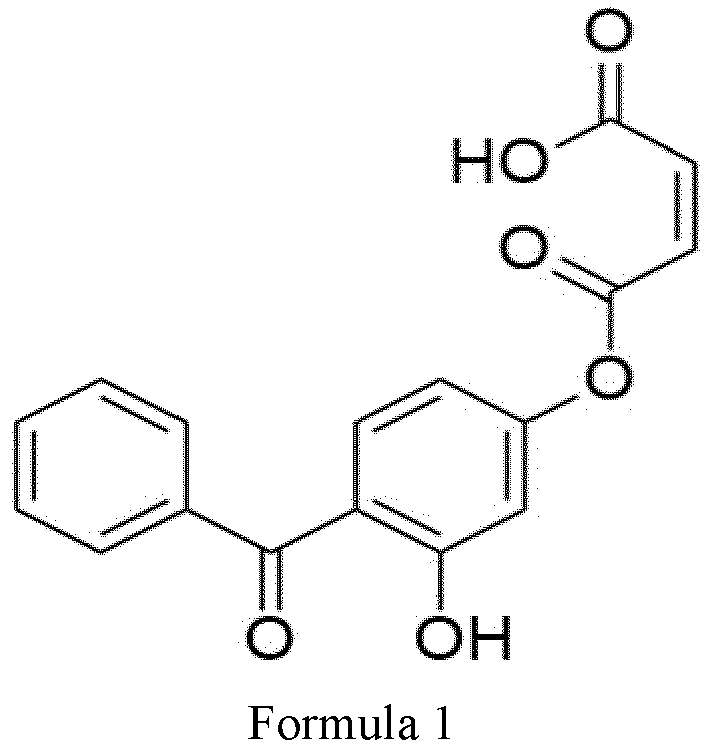
- An object of the present invention is to overcome the deficiencies in prior art by using a maleic anhydride modified voltage stabilizer whose structural formula is represented by Formula 1: Also described nerein, but not part or the claimed invention, is
- the catalyst in step (2) is concentrated sulfuric acid or p-toluenesulfonic acid.
- stirring time is 6-12 hours(h), and stirring temperature is 65-70°C.
- the reaction scheme of the preparation method is as follows:
- the present invention provides a cross-linked polyethylene AC cable insulating material as defined in the appended claims, which comprises the maleic anhydride modified voltage stabilizer of formula I.
- the cross-linked polyethylene AC cable insulating material of the present invention comprises the following components by mass: 100phr of low-density polyethylene, 0.2-1.2phr of a maleic anhydride modified voltage stabilizer, 0.2-0.5phr of an antioxidant, and 1.5-2.2phr of an initiator.
- the low-density polyethylene has a melt index of 1.9-2.1g/10min at 190°C and 2.16kg load and a density of 0.902-0.942g/cm 3 .
- the maleic anhydride modified voltage stabilizer in the present application is used as a voltage stabilizer in the cross-linked polyethylene AC cable insulating material.
- the voltage stabilizer has graftable chemical activity and can be grafted onto the cross-linked polyethylene through free radical reaction caused by a cross-linking agent, preventing migration and precipitation of the voltage stabilizer, which can increase the inception voltage of the AC electrical treeing in the cross-linked polyethylene for a long term.
- 2,4-dihydroxybenzophenone can increase the inception voltage of the electrical treeing to a certain degree.
- 2,4-dihydroxybenzophenone as the voltage stabilizer can only be simply physically mixed with the cross-linked polyethylene.
- 2,4-dihydroxybenzophenone is easy to precipitate, so that its long-term effect is difficult to guarantee.
- 2,4-dihydroxybenzophenone has a negative impact on both the insulation resistivity and the dielectric loss tangent of the cross-linked polyethylene AC cable insulating material, resulting in a decrease in resistivity and an increase in dielectric loss tangent.
- maleic anhydride has a chemical bond with a high polarity, which can introduce a deep charge trap into the polymer, thereby restricting migration and conduction of charge carriers under the electric field, and resulting in significant increase in the electrical resistivity of the cross-linked polyethylene AC cable insulating material.
- the antioxidant is antioxidant 300.
- the initiator is dicumyl peroxide.
- the present invention provides a method for preparing the cross-linked polyethylene AC cable insulating material, including following steps:
- the present invention provides the maleic anhydride modified voltage stabilizer, which is used as a voltage stabilizer in the cross-linked polyethylene AC cable insulating material.
- the maleic anhydride modified voltage stabilizer can improve the resistance to electrical treeing, prolong the working life, and improve the insulation resistivity of the insulating material, and can further limit the value of the dielectric loss tangent of the cross-linked polyethylene AC cable insulating material to a standard range.
- the present example provides a maleic anhydride modified voltage stabilizer whose structural formula is represented by Formula 1:
- the present example provides a method for preparing the maleic anhydride modified voltage stabilizer, including the following steps of:
- the integrated intensity ratio of the peaks is 1:1:1:1:1:1:1:1:1:2:1:2:1:1:1, which is completely consistent with the theoretical value predicted according to structure calculation, confirming that the maleic anhydride modified voltage stabilizer has been successfully synthesized.
- the present example provides a maleic anhydride modified voltage stabilizer whose structural formula is represented by Formula 1:
- the present example provides a method for preparing the maleic anhydride modified voltage stabilizer, including the following steps of:
- the present example provides a maleic anhydride modified voltage stabilizer whose structural formula is represented by Formula 1:
- the present example provides a method for preparing the maleic anhydride modified voltage stabilizer, including the following steps of:
- the present example provides a cross-linked polyethylene AC cable insulating material, including the following components by mass: 100phr of low-density polyethylene, 0.2phr of a voltage stabilizer, 0.2phr of antioxidant 300, and 1.5phr of dicumyl peroxide.
- the low-density polyethylene has a melt index of 1.9g/10min at 190°C and 2.16kg load and a density of 0.902g/cm 3 .
- the voltage stabilizer is the maleic anhydride modified voltage stabilizer in Example 1.
- the present example also provides a method for preparing the cross-linked polyethylene AC cable insulating material, including the following steps of:
- the present example provides a cross-linked polyethylene AC cable insulating material, including the following components by mass: 100phr of low-density polyethylene, 1.2phr of a voltage stabilizer, 0.5phr of antioxidant 300, and 2.2phr of dicumyl peroxide.
- the low-density polyethylene has a melt index of 2.1g/10min at 190°C and 2.16kg load and a density of 0.942g/cm 3 .
- the voltage stabilizer is the maleic anhydride modified voltage stabilizer in Example 1.
- the present example also provides a method for preparing the cross-linked polyethylene AC cable insulating material, including the following steps of:
- the present example provides a cross-linked polyethylene AC cable insulating material, including the following components by mass: 100phr of low-density polyethylene, 1.2phr of a voltage stabilizer, 0.4phr of antioxidant 300, and 2phr of dicumyl peroxide.
- the low-density polyethylene has a melt index of 2g/10min at 190°C and 2.16kg load and a density of 0.922g/cm 3 .
- the voltage stabilizer is the maleic anhydride modified voltage stabilizer in Example 1.
- the present example also provides a method for preparing the cross-linked polyethylene AC cable insulating material, including the following steps of:
- the present comparative example provides a cross-linked polyethylene AC cable insulating material, including the following components by mass: 100 phr of low-density polyethylene, 2phr of a voltage stabilizer, 0.4phr of antioxidant 300, and 2phr of dicumyl peroxide.
- the low-density polyethylene has a melt index of 2g/10min at 190°C and 2.16kg load and a density of 0.922g/cm 3 .
- the voltage stabilizer is the maleic anhydride modified voltage stabilizer in Example 1.
- the present comparative example also provides a method for preparing the cross-linked polyethylene AC cable insulating material, including the following steps of:
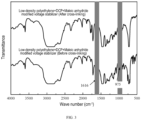
- FIG. 3 shows infrared absorption spectra of the cross-linked polyethylene AC cable insulating materials of Example 6 and Comparative Example 1, which is used to illustrate the cross-linking reaction between the maleic anhydride modified voltage stabilizer and the polyethylene.
- FIG. 3 there are absorption peaks at 1616cm -1 and 975cm -1 in the infrared spectrum of the cross-linked polyethylene AC cable insulating material of Comparative Example 1, which are produced by unsaturated vinyl of the maleic anhydride modified voltage stabilizer.
- the present example provides a cross-linked polyethylene AC cable insulating material, including the following components by mass: 100phr of low-density polyethylene, 0.8phr of a voltage stabilizer, 0.4phr of antioxidant 300, and 2phr of dicumyl peroxide.
- the low-density polyethylene has a melt index of 2g/10min at 190°C and 2.16kg load and a density of 0.922g/cm 3 .
- the voltage stabilizer is the maleic anhydride modified voltage stabilizer in Example 1.
- the present example also provides a method for preparing the cross-linked polyethylene AC cable insulating material, including the following steps of:
- the present example provides a cross-linked polyethylene AC cable insulating material, including the following components by mass: 100phr of low-density polyethylene, 0.4phr of a voltage stabilizer, 0.4phr of antioxidant 300, and 2phr of dicumyl peroxide.
- the low-density polyethylene has a melt index of 2g/10min at 190°C and 2.16kg load and a density of 0.922g/cm 3 .
- the voltage stabilizer is the maleic anhydride modified voltage stabilizer in Example 1.
- the present example also provides a method for preparing the cross-linked polyethylene AC cable insulating material, including the following steps of:
- the present example provides a cross-linked polyethylene AC cable insulating material, including the following components by mass: 100phr of low-density polyethylene, 0.8phr of 2,4-dihydroxybenzophenone, 0.4phr of antioxidant 300, and 2phr of dicumyl peroxide.
- the low-density polyethylene has a melt index of 2g/10min at 190°C and 2.16kg load and a density of 0.922g/cm 3 .
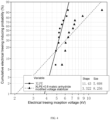
- Example 7 The inception voltages of electrical treeing of the cross-linked polyethylene AC cable insulating materials of Example 7 and Comparative Example 2 were tested, and the test results are shown in FIG. 4 .
- Test method The cross-linked polyethylene AC cable insulating materials of Example 7 and Comparative Example 2 were cut into 3mm*10mm*10mm samples. Each sample was placed in a vacuum oven at 80°C for degassing, accelerating precipitation and volatilization of the small molecular components from the sample. After degassing for 135h, the same tungsten needle electrode was inserted into the sample to form a need-plate electrode structure, by using which the inception voltage of electrical treeing of each sample was measured at a 500V/s boosted alternating voltage with a mains frequency. 10 samples were tested for each material, and the Weibull distribution statistical analysis was performed on the test results.
- FIG. 4 shows the Weibull distribution plots of the inception voltages of electrical treeing of the cross-linked polyethylene AC cable insulating materials of Example 7 and Comparative Example 2.
- the cross-linked polyethylene AC cable insulating material of Example 7 has a significantly higher electrical treeing inception voltage at the same cumulative failure probability, and has a significantly lower electrical treeing inducing probability under the same voltage.
- the characteristic electrical treeing inception voltage scale: 8.256kV
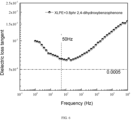
- FIG. 5 shows the values of dielectric loss tangent of the cross-linked polyethylene AC cable insulating materials of Examples 7 to 9 and Comparative Example 2.
- FIG. 6 shows the values of dielectric loss tangent of the cross-linked polyethylene AC cable insulating material of Comparative Example 3. It can be seen from FIG. 5 and FIG.
- the maleic anhydride modified voltage stabilizer of the present invention has a high polarity carbonyl group in its structure. After the cross-linking reaction between the maleic anhydride modified voltage stabilizer and the polyethylene material, a deep, evenly distributed charge trap is formed. Under the action of the charge trap, the resistivity of the cross-linked polyethylene AC cable insulating material increases, and the leakage current decreases. The dielectric loss of the cross-linked polyethylene AC cable insulating material under an alternating voltage is caused by current leakage on the one hand and by relaxation polarization on the other hand.
- Test method The cross-linked polyethylene AC cable insulating materials of Example 7-9 and Comparative Example 2 were cut into 3mm*10mm*10mm samples, and the electrical conductivities of the samples at different strengths of electric field were measured.
- FIG. 7 shows the electrical conductivities of the cross-linked polyethylene AC cable insulating materials of Examples 7-9 and Comparative Example 2 at different strengths of electric field. It can be seen from FIG. 7 that the electrical conductivities of the cross-linked polyethylene AC cable insulating material of Examples 7-9 are significantly lower than that of the cross-linked polyethylene AC cable insulating material of Comparative Example 2; that is, the cross-linked polyethylene AC cable insulating material of the present invention has a higher electrical resistivity, which also reveals that the dielectric loss of the cross-linked polyethylene AC cable insulating material is decreased by the high polarity carbonyl group in the structure of the maleic anhydride modified voltage stabilizer via the mechanism of reducing the leakage current.
Landscapes
- Chemical & Material Sciences (AREA)
- Organic Chemistry (AREA)
- Life Sciences & Earth Sciences (AREA)
- Engineering & Computer Science (AREA)
- Materials Engineering (AREA)
- Wood Science & Technology (AREA)
- Chemical Kinetics & Catalysis (AREA)
- Health & Medical Sciences (AREA)
- Medicinal Chemistry (AREA)
- Polymers & Plastics (AREA)
- Spectroscopy & Molecular Physics (AREA)
- Physics & Mathematics (AREA)
- Organic Insulating Materials (AREA)
- Compositions Of Macromolecular Compounds (AREA)
Description
- The present invention relates to a cross-linked polyethylene AC cable insulating material comprising a maleic anhydride modified voltage stabilizer, a preparation method thereof, and use thereof, which belong to the technical field of high voltage and insulation.
- Cross-linked polyethylene insulating material has many advantages and is currently the most important insulating material for power cables. At present, there is a tendency for cross-linked polyethylene insulated power cables to replace the other cables at various voltage levels. However, the manufacturing process of the cross-linked polyethylene insulating material inevitably introduces impurities, whose amount and size significantly affect working life and operating stability of the cables made of the insulating material. Electrical treeing would easily occur due to the impurities when the cross-linked polyethylene insulating material is used under a strong alternating electric field, causing quickly and early breakdown of the insulating layers of the cables. In most situations, the breakdown of the insulating layers due to electrical tree makes the working life of the cables far less than expected.
- In order to improve the working stability and lifetime of the cross-linked polyethylene insulated cables, the most commonly used method in the field is to modify the insulating material. The modification of the cross-linked polyethylene using a voltage stabilizer has a long history. Until now a variety of voltage stabilizers have emerged.
-
CN109776910A discloses a cross-linked polyethylene insulating material for a high voltage direct current cable, whose preparation involves treating low-density polyethylene with dicumyl peroxide and 4,4'-dihydroxybenzophenone. - Generally, the use of the voltage stabilizer can significantly improve the resistance to electrical treeing in the cross-linked polyethylene insulator, increasing the inception voltage of electrical tree and prolonging the time from the electrical treeing inception to the breakdown of the material.
- However, the voltage stabilizers in prior art are usually small molecule additives containing benzene rings and having a certain polarity. Within the range of their effective addition amount, the voltage stabilizers in prior art would lead to increase in dielectric loss tangent and decrease in electrical resistivity of the insulating material. As an insulating material for alternating current (AC) cables, the value of the dielectric loss tangent at 50 Hz has to be limited to a standard range, and the smaller the value is, the better the transmission capacity and performance of the AC cables are improved.
- At present, relying on the existing technology, it is difficult to improve the resistance to electrical treeing by adding a voltage stabilizer without increasing the dielectric loss of the insulating material, which means that it is difficult to solve the contradiction between the electrical resistance performance and the dielectric loss performance. It is important and significant to design and synthesize a new voltage stabilizer, which, in its effective addition amount, can improve the resistance to electrical treeing, prolong the working life, and improve the insulation resistivity of the insulating material, and can further limit the value of the dielectric loss tangent of the insulating material to a standard range.
- An object of the present invention is to overcome the deficiencies in prior art by using a maleic anhydride modified voltage stabilizer whose structural formula is represented by Formula 1:

- a method for preparing the maleic anhydride modified voltage stabilizer, including following steps:
- (1) dissolving maleic anhydride and 2,4-dihydroxybenzophenone in tetrahydrofuran to obtain a mixture;
- (2) in a protective gas atmosphere, adding a catalyst to the mixture obtained in step (1), stirring, adding water and centrifuging, and then drying an obtained precipitate, thereby achieving the maleic anhydride modified voltage stabilizer;
- Preferably, the catalyst in step (2) is concentrated sulfuric acid or p-toluenesulfonic acid.
- Preferably, in step (2), stirring time is 6-12 hours(h), and stirring temperature is 65-70°C.
- The reaction scheme of the preparation method is as follows:

- The present invention provides the use of the maleic anhydride modified voltage stabilizer in a cross-linked polyethylene AC cable insulating material.
- In particular, the present invention provides a cross-linked polyethylene AC cable insulating material as defined in the appended claims, which comprises the maleic anhydride modified voltage stabilizer of formula I.
- The cross-linked polyethylene AC cable insulating material of the present invention comprises the following components by mass: 100phr of low-density polyethylene, 0.2-1.2phr of a maleic anhydride modified voltage stabilizer, 0.2-0.5phr of an antioxidant, and 1.5-2.2phr of an initiator. The low-density polyethylene has a melt index of 1.9-2.1g/10min at 190°C and 2.16kg load and a density of 0.902-0.942g/cm3.
- The maleic anhydride modified voltage stabilizer in the present application is used as a voltage stabilizer in the cross-linked polyethylene AC cable insulating material. The voltage stabilizer has graftable chemical activity and can be grafted onto the cross-linked polyethylene through free radical reaction caused by a cross-linking agent, preventing migration and precipitation of the voltage stabilizer, which can increase the inception voltage of the AC electrical treeing in the cross-linked polyethylene for a long term. As a traditional voltage stabilizer, 2,4-dihydroxybenzophenone can increase the inception voltage of the electrical treeing to a certain degree. However, 2,4-dihydroxybenzophenone as the voltage stabilizer can only be simply physically mixed with the cross-linked polyethylene. Moreover, 2,4-dihydroxybenzophenone is easy to precipitate, so that its long-term effect is difficult to guarantee. In addition, 2,4-dihydroxybenzophenone has a negative impact on both the insulation resistivity and the dielectric loss tangent of the cross-linked polyethylene AC cable insulating material, resulting in a decrease in resistivity and an increase in dielectric loss tangent. After long-term experimental exploration of various voltage stabilizers, the inventors found that grafting the voltage stabilizer to the polymer macromolecule via a chemical bond can significantly improve the migration resistance of the voltage stabilizer. In addition, the inventors also found that maleic anhydride has a chemical bond with a high polarity, which can introduce a deep charge trap into the polymer, thereby restricting migration and conduction of charge carriers under the electric field, and resulting in significant increase in the electrical resistivity of the cross-linked polyethylene AC cable insulating material.
- As a preferred embodiment of the cross-linked polyethylene AC cable insulating material, the antioxidant is antioxidant 300.
- As a preferred embodiment of the cross-linked polyethylene AC cable insulating material, the initiator is dicumyl peroxide.
- Further, the present invention provides a method for preparing the cross-linked polyethylene AC cable insulating material, including following steps:
- (1) melting and blending low-density polyethylene, the maleic anhydride modified voltage stabilizer, and an antioxidant together in an extruder, and then extruding and granulating resulting blend, thereby obtaining granules;
- (2) adding an initiator melted at 70-80°C to the granules obtained in step (1) to infiltrate the granules, thereby obtaining a polyethylene material;
- (3) cross-linking the polyethylene material obtained in step (2) at 150-280°C, 10-20MPa, thereby obtaining the cross-linked polyethylene AC cable insulating material.
- Compared with prior art, the present invention has following beneficial effects. The present invention provides the maleic anhydride modified voltage stabilizer, which is used as a voltage stabilizer in the cross-linked polyethylene AC cable insulating material. In the range of effective addition amount, the maleic anhydride modified voltage stabilizer can improve the resistance to electrical treeing, prolong the working life, and improve the insulation resistivity of the insulating material, and can further limit the value of the dielectric loss tangent of the cross-linked polyethylene AC cable insulating material to a standard range.
-
-
FIG. 1 shows an infrared absorption spectrum of a maleic anhydride modified voltage stabilizer. -
FIG. 2 shows a proton nuclear magnetic resonance spectrum of the maleic anhydride modified voltage stabilizer. -
FIG. 3 shows infrared absorption spectra of cross-linked polyethylene AC cable insulating materials of Example 6 and Comparative Example 1. -
FIG. 4 shows Weibull distribution plots of inception voltages of electrical treeing in cross-linked polyethylene AC cable insulating materials of Example 7 and Comparative Example 2. -
FIG. 5 shows values of dielectric loss tangent of cross-linked polyethylene AC cable insulating materials of Examples 7 to 9 and Comparative Example 2. -
FIG. 6 shows values of dielectric loss tangent of a cross-linked polyethylene AC cable insulating material of Comparative Example 3. -
FIG. 7 shows electrical conductivities of cross-linked polyethylene AC cable insulating materials of Examples 7-9 and Comparative Example 2 at different strengths of electric field. -
FIG. 8 shows a structural formula of the maleic anhydride modified voltage stabilizer. - In order to better illustrate the objects, technical solutions and advantages of the present invention, the present invention will be further described below with reference to specific embodiments and drawings.
- In a first aspect, the present example provides a maleic anhydride modified voltage stabilizer whose structural formula is represented by Formula 1:

- In a second aspect, the present example provides a method for preparing the maleic anhydride modified voltage stabilizer, including the following steps of:
- (1) dissolving maleic anhydride and 2,4-dihydroxybenzophenone in tetrahydrofuran to obtain a mixture;
- (2) in a nitrogen gas atmosphere, adding concentrated sulfuric acid to the mixture obtained in step (1), stirring at 70°C for 10h, adding water and centrifuging, and then drying an obtained precipitate at 80°C, thereby achieving the maleic anhydride modified voltage stabilizer;
-
FIG. 1 shows an infrared absorption spectrum of the maleic anhydride modified voltage stabilizer. It can be seen fromFIG. 1 that the absorption peaks at 1851 cm-1 and 1769 cm-1, respectively, correspond to asymmetric and symmetric stretching vibration absorption of C=O in maleic anhydride. Many similar characteristic peaks can be observed in the spectra of 2,4-dihydroxybenzophenone and the maleic anhydride modified voltage stabilizer. Except the range of 1600-1450 cm-1 corresponding to benzene ring skeleton vibration absorption bonds, the peaks at 3171 cm-1 and 1628 cm-1 in the spectrum of 2,4-dihydroxybenzophenone and at 3196 cm-1 and 1630 cm-1 in the spectrum of the maleic anhydride modified voltage stabilizer are attributed to -OH and C=O which are connected with benzene ring. In addition, the spectrum of the maleic anhydride modified voltage stabilizer has a new peak (1724 cm-1) corresponding to the ester group C=O, indicating that maleic anhydride was successfully esterified with 2,4-dihydroxybenzophenone. -
FIG. 2 shows a proton nuclear magnetic resonance spectrum of the maleic anhydride modified voltage stabilizer. It can be known fromFIG. 2 that the peaks between 6.38 ppm and 6.40 ppm are attributed to the chemical shifts of the acid anhydride protons (-CH=CH-). The aromatic protons of the benzene rings resonate around 7.38, 7.50, 7.53, 7.59, 7.61 and 7.63 ppm, and the peaks around 10.75 and 12.35 ppm belong to O-H. The integrated intensity ratio of the peaks is 1:1:1:1:1:1:1:1:2:1:2:1:1:1, which is completely consistent with the theoretical value predicted according to structure calculation, confirming that the maleic anhydride modified voltage stabilizer has been successfully synthesized. - In a first aspect, the present example provides a maleic anhydride modified voltage stabilizer whose structural formula is represented by Formula 1:

- In a second aspect, the present example provides a method for preparing the maleic anhydride modified voltage stabilizer, including the following steps of:
- (1) dissolving maleic anhydride and 2,4-dihydroxybenzophenone in tetrahydrofuran to obtain a mixture;
- (2) in a nitrogen gas atmosphere, adding concentrated sulfuric acid to the mixture obtained in step (1), stirring at 68°C for 6h, adding water and centrifuging, and then drying an obtained precipitate at 80°C, thereby achieving the maleic anhydride modified voltage stabilizer;
- In a first aspect, the present example provides a maleic anhydride modified voltage stabilizer whose structural formula is represented by Formula 1:
- In a second aspect, the present example provides a method for preparing the maleic anhydride modified voltage stabilizer, including the following steps of:
- (1) dissolving maleic anhydride and 2,4-dihydroxybenzophenone in tetrahydrofuran to obtain a mixture;
- (2) in a nitrogen gas atmosphere, adding p-toluenesulfonic acid to the mixture obtained in step (1), stirring at 65°C for 12h, adding water and centrifuging, and then drying an obtained precipitate at 80°C, thereby achieving the maleic anhydride modified voltage stabilizer;
- The present example provides a cross-linked polyethylene AC cable insulating material, including the following components by mass: 100phr of low-density polyethylene, 0.2phr of a voltage stabilizer, 0.2phr of antioxidant 300, and 1.5phr of dicumyl peroxide. The low-density polyethylene has a melt index of 1.9g/10min at 190°C and 2.16kg load and a density of 0.902g/cm3. The voltage stabilizer is the maleic anhydride modified voltage stabilizer in Example 1.
- The present example also provides a method for preparing the cross-linked polyethylene AC cable insulating material, including the following steps of:
- (1) melting and blending 100phr of low-density polyethylene, 0.2phr of the maleic anhydride modified voltage stabilizer, and 0.2phr of antioxidant 300 together in an extruder at 110°C, and then extruding and granulating resulting blend;
- (2) adding 1.5phr of dicumyl peroxide melted at 70°C to granules obtained in step (1) to infiltrate the granules, thereby obtaining a polyethylene material;
- (3) cross-linking the polyethylene material obtained in step (2) at 150°C, 20MPa, thereby obtaining the cross-linked polyethylene AC cable insulating material.
- The present example provides a cross-linked polyethylene AC cable insulating material, including the following components by mass: 100phr of low-density polyethylene, 1.2phr of a voltage stabilizer, 0.5phr of antioxidant 300, and 2.2phr of dicumyl peroxide. The low-density polyethylene has a melt index of 2.1g/10min at 190°C and 2.16kg load and a density of 0.942g/cm3. The voltage stabilizer is the maleic anhydride modified voltage stabilizer in Example 1.
- The present example also provides a method for preparing the cross-linked polyethylene AC cable insulating material, including the following steps of:
- (1) melting and blending 100phr of low-density polyethylene, 1.2phr of the maleic anhydride modified voltage stabilizer, and 0.5phr of antioxidant 300 together in an extruder at 135°C, and then extruding and granulating the resulting blend;
- (2) adding 2.2phr of dicumyl peroxide melted at 80°C to granules obtained in step (1) to infiltrate the granules, thereby obtaining a polyethylene material;
- (3) cross-linking the polyethylene material obtained in step (2) at 280°C, 10MPa, thereby obtaining the cross-linked polyethylene AC cable insulating material.
- The present example provides a cross-linked polyethylene AC cable insulating material, including the following components by mass: 100phr of low-density polyethylene, 1.2phr of a voltage stabilizer, 0.4phr of antioxidant 300, and 2phr of dicumyl peroxide. The low-density polyethylene has a melt index of 2g/10min at 190°C and 2.16kg load and a density of 0.922g/cm3. The voltage stabilizer is the maleic anhydride modified voltage stabilizer in Example 1.
- The present example also provides a method for preparing the cross-linked polyethylene AC cable insulating material, including the following steps of:
- (1) melting and blending 100phr of low-density polyethylene, 2phr of the maleic anhydride modified voltage stabilizer, and 0.4phr of antioxidant 300 together in an extruder at 120°C, and then extruding and granulating the resulting blend;
- (2) adding 2phr of dicumyl peroxide melted at 75°C to granules obtained in step (1) to infiltrate the granules, thereby obtaining a polyethylene material;
- (3) cross-linking the polyethylene material obtained in step (2) at 175°C, 15MPa, thereby obtaining the cross-linked polyethylene AC cable insulating material, referred as Low-density polyethylene+DCP+Maleic anhydride modified voltage stabilizer (After cross-linking).
- The present comparative example provides a cross-linked polyethylene AC cable insulating material, including the following components by mass: 100 phr of low-density polyethylene, 2phr of a voltage stabilizer, 0.4phr of antioxidant 300, and 2phr of dicumyl peroxide. The low-density polyethylene has a melt index of 2g/10min at 190°C and 2.16kg load and a density of 0.922g/cm3. The voltage stabilizer is the maleic anhydride modified voltage stabilizer in Example 1.
- The present comparative example also provides a method for preparing the cross-linked polyethylene AC cable insulating material, including the following steps of:
- (1) melting and blending 100phr of low-density polyethylene, 2phr of the maleic anhydride modified voltage stabilizer, and 0.4phr of antioxidant 300 together in an extruder at 120°C, and then extruding and granulating the resulting blend;
- (2) adding 2phr of dicumyl peroxide melted at 75°C to granules obtained in step (1) to infiltrate the granules, thereby obtaining a polyethylene material, referred as Low-density polyethylene+DCP+Maleic anhydride modified voltage stabilizer (Before cross-linking).
-
FIG. 3 shows infrared absorption spectra of the cross-linked polyethylene AC cable insulating materials of Example 6 and Comparative Example 1, which is used to illustrate the cross-linking reaction between the maleic anhydride modified voltage stabilizer and the polyethylene. As can be seen fromFIG. 3 , there are absorption peaks at 1616cm-1 and 975cm-1 in the infrared spectrum of the cross-linked polyethylene AC cable insulating material of Comparative Example 1, which are produced by unsaturated vinyl of the maleic anhydride modified voltage stabilizer. In the infrared spectrum of the cross-linked polyethylene AC cable insulating material of Example 6, the absorption peaks at 1616cm-1 and 975cm-1 have disappeared, indicating that during the cross-linking process, the free radicals in the unsaturated vinyl of the maleic anhydride modified voltage stabilizer are bonded to the macromolecular chain of the cross-linked polyethylene via addition reaction. Therefore, the maleic anhydride modified voltage stabilizer used as the voltage stabilizer of the cross-linked polyethylene AC cable insulating material is not easy to migrate or precipitate, and the voltage stabilization effect of the maleic anhydride modified voltage stabilizer can be maintained for a long time. - The present example provides a cross-linked polyethylene AC cable insulating material, including the following components by mass: 100phr of low-density polyethylene, 0.8phr of a voltage stabilizer, 0.4phr of antioxidant 300, and 2phr of dicumyl peroxide. The low-density polyethylene has a melt index of 2g/10min at 190°C and 2.16kg load and a density of 0.922g/cm3. The voltage stabilizer is the maleic anhydride modified voltage stabilizer in Example 1.
- The present example also provides a method for preparing the cross-linked polyethylene AC cable insulating material, including the following steps of:
- (1) melting and blending 100phr of low-density polyethylene, 0.8phr of the maleic anhydride modified voltage stabilizer, and 0.4phr of antioxidant 300 together in an extruder at 120°C, and then extruding and granulating the resulting blend;
- (2) adding 2phr of dicumyl peroxide melted at 75°C to granules obtained in step (1) to infiltrate the granules, thereby obtaining a polyethylene material;
- (3) cross-linking the polyethylene material obtained in step (2) at 170°C, 15MPa, thereby obtaining the cross-linked polyethylene AC cable insulating material, referred as XLPE+0.8phr maleic anhydride modified voltage stabilizer.
- The present example provides a cross-linked polyethylene AC cable insulating material, including the following components by mass: 100phr of low-density polyethylene, 0.4phr of a voltage stabilizer, 0.4phr of antioxidant 300, and 2phr of dicumyl peroxide. The low-density polyethylene has a melt index of 2g/10min at 190°C and 2.16kg load and a density of 0.922g/cm3. The voltage stabilizer is the maleic anhydride modified voltage stabilizer in Example 1.
- The present example also provides a method for preparing the cross-linked polyethylene AC cable insulating material, including the following steps of:
- (1) melting and blending 100phr of low-density polyethylene, 0.4phr of the maleic anhydride modified voltage stabilizer, and 0.4phr of antioxidant 300 together in an extruder at 120°C, and then extruding and granulating the blend;
- (2) adding 2phr of dicumyl peroxide melted at 75°C to granules obtained in step (1) to infiltrate the granules, thereby obtaining a polyethylene material;
- (3) cross-linking the polyethylene material obtained in step (2) at 175°C, 15MPa, thereby obtaining the cross-linked polyethylene AC cable insulating material, referred as XLPE+0.4phr maleic anhydride modified voltage stabilizer.
- The present example provides a cross-linked polyethylene AC cable insulating material, including the following components by mass: 100phr of low-density polyethylene, 1.2phr of a voltage stabilizer, 0.4phr of antioxidant 300, and 2phr of dicumyl peroxide. The low-density polyethylene has a melt index of 2g/10min at 190°C and 2.16kg load and a density of 0.922g/cm3. The voltage stabilizer is the maleic anhydride modified voltage stabilizer in Example 1.
- The present example also provides a method for preparing the cross-linked polyethylene AC cable insulating material, including the following steps of:
- (1) melting and blending 100phr of low-density polyethylene, 1.2phr of the maleic anhydride modified voltage stabilizer, and 0.4phr of antioxidant 300 together in an extruder at 120°C, and then extruding and granulating resulting blend;
- (2) adding 2phr of dicumyl peroxide melted at 75°C to granules obtained in step (1) to infiltrate the granules, thereby obtaining a polyethylene material;
- (3) cross-linking the polyethylene material obtained in step (2) at 175°C, 15MPa, thereby obtaining the cross-linked polyethylene AC cable insulating material, referred as XLPE+1.2phr maleic anhydride modified voltage stabilizer.
- The present example provides a cross-linked polyethylene AC cable insulating material, including the following components by mass: 100phr of low-density polyethylene, 0.4phr of antioxidant 300, and 2phr of dicumyl peroxide. The low-density polyethylene has a melt index of 2g/10min at 190°C and 2.16kg load and a density of 0.922g/cm3.
- The present example also provides a method for preparing the cross-linked polyethylene AC cable insulating material, including the following steps of:
- (1) melting and blending 100phr of low-density polyethylene and 0.4phr of antioxidant 300 together in an extruder at 120°C, and then extruding and granulating the blend;
- (2) adding 2phr of dicumyl peroxide melted at 75°C to granules obtained in step (1) to infiltrate the granules, thereby obtaining a polyethylene material;
- (3) cross-linking the polyethylene material obtained in step (2) at 175°C, 15MPa, thereby obtaining the cross-linked polyethylene AC cable insulating material, referred as XLPE.
- The present example provides a cross-linked polyethylene AC cable insulating material, including the following components by mass: 100phr of low-density polyethylene, 0.8phr of 2,4-dihydroxybenzophenone, 0.4phr of antioxidant 300, and 2phr of dicumyl peroxide. The low-density polyethylene has a melt index of 2g/10min at 190°C and 2.16kg load and a density of 0.922g/cm3.
- The present example also provides a method for preparing the cross-linked polyethylene AC cable insulating material, including the following steps of:
- (1) melting and blending 100phr of low-density polyethylene, 0.8phr of 2,4-dihydroxybenzophenone, and 0.4phr of antioxidant 300 together in an extruder at 120°C, and then extruding and granulating the blend;
- (2) adding 2phr of dicumyl peroxide melted at 75°C to granules obtained in step (1) to infiltrate the granules, thereby obtaining a polyethylene material;
- (3) cross-linking the polyethylene material obtained in step (2) at 175°C, 15MPa, thereby obtaining the cross-linked polyethylene AC cable insulating material, referred as XLPE+0.8
phr 2,4-dihydroxybenzophenone. - The inception voltages of electrical treeing of the cross-linked polyethylene AC cable insulating materials of Example 7 and Comparative Example 2 were tested, and the test results are shown in
FIG. 4 . - Test method: The cross-linked polyethylene AC cable insulating materials of Example 7 and Comparative Example 2 were cut into 3mm*10mm*10mm samples. Each sample was placed in a vacuum oven at 80°C for degassing, accelerating precipitation and volatilization of the small molecular components from the sample. After degassing for 135h, the same tungsten needle electrode was inserted into the sample to form a need-plate electrode structure, by using which the inception voltage of electrical treeing of each sample was measured at a 500V/s boosted alternating voltage with a mains frequency. 10 samples were tested for each material, and the Weibull distribution statistical analysis was performed on the test results.
-
FIG. 4 shows the Weibull distribution plots of the inception voltages of electrical treeing of the cross-linked polyethylene AC cable insulating materials of Example 7 and Comparative Example 2. As can be seen fromFIG. 4 , the cross-linked polyethylene AC cable insulating material of Example 7 has a significantly higher electrical treeing inception voltage at the same cumulative failure probability, and has a significantly lower electrical treeing inducing probability under the same voltage. The characteristic electrical treeing inception voltage (scale: 8.256kV) is about 44.9% higher than that of the unmodified comparative material (5.698kV). It is thus proved that the maleic anhydride modified voltage stabilizer of the present invention can significantly improve the resistance to electrical treeing. Even through a long-term degassing at a high temperature, the excellent performance of the maleic anhydride modified voltage stabilizer would not be affected. The increase in the electrical treeing inception voltage guarantees the long-term working stability and longer working life of the cross-linked polyethylene AC cable insulating material. - The values of dielectric loss tangent of the cross-linked polyethylene AC cable insulating materials of Examples 7-9 and Comparative Examples 2-3 were tested, and the test results are shown in
FIG. 5 andFIG. 6 . - Test method: The cross-linked polyethylene AC cable insulating materials of Example 7-9 and Comparative Examples 2-3 were cut into 3mm*10mm*10mm samples, and the values of dielectric loss tangent of the samples at different frequencies were measured.
-
FIG. 5 shows the values of dielectric loss tangent of the cross-linked polyethylene AC cable insulating materials of Examples 7 to 9 and Comparative Example 2.FIG. 6 shows the values of dielectric loss tangent of the cross-linked polyethylene AC cable insulating material of Comparative Example 3. It can be seen fromFIG. 5 andFIG. 6 that the value of dielectric loss tangent of the cross-linked polyethylene AC cable insulating material of Comparative Example 2 at 50 Hz is 0.0002; the value of dielectric loss tangent of the cross-linked polyethylene AC cable insulating material of Comparative Example 3 at 50 Hz is 0.0006; the values of dielectric loss tangent of the cross-linked polyethylene AC cable insulating materials of Example 7, Example 8, and Example 9 at 50 Hz are respectively 0.00042, 0.00043, and 0.00047. The above test results show that the addition of 0.8phr of thetraditional voltage stabilizer 2,4-dihydroxybenzophenone significantly increases the value of dielectric loss tangent of the cross-linked polyethylene AC cable insulating material from 0.0002 to 0.0006, exceeding a basic requirement of less than 0.0005 stipulated by a national standard. By using the maleic anhydride modified voltage stabilizer synthesized by the present invention as the voltage stabilizer in the effective addition range (0.4-1.2phr) to increase the inception voltage of the electrical treeing in the cross-linked polyethylene AC cable insulating materials, the values of dielectric loss tangent of the prepared cross-linked polyethylene AC cable insulating materials are all less than the requirement of ≤0.0005 stipulated by the national standard with sufficient margin. Thus, the new voltage stabilizer synthesized by the present invention and the graft-modified cross-linked polyethylene insulating material prepared therefrom have relatively low dielectric loss. - The maleic anhydride modified voltage stabilizer of the present invention has a high polarity carbonyl group in its structure. After the cross-linking reaction between the maleic anhydride modified voltage stabilizer and the polyethylene material, a deep, evenly distributed charge trap is formed. Under the action of the charge trap, the resistivity of the cross-linked polyethylene AC cable insulating material increases, and the leakage current decreases. The dielectric loss of the cross-linked polyethylene AC cable insulating material under an alternating voltage is caused by current leakage on the one hand and by relaxation polarization on the other hand. Although the structure of the maleic anhydride modified voltage stabilizer has the high polarity carbonyl group, which may increase relaxation polarization, the molecular structure of the maleic anhydride modified voltage stabilizer of the present invention has a relatively small contribution to the relaxation polarization behavior at 50Hz but a more obvious inhibitory effect on current leakage, thus decreasing the dielectric loss tangent value of the material at 50Hz, which still meets the requirement of less than 0.0005 at 50Hz stipulated by the standard.
- The electrical conductivities of the cross-linked polyethylene AC cable insulating materials of Examples 7-9 and Comparative Example 2 were tested, and the test results are shown in
FIG. 7 . - Test method: The cross-linked polyethylene AC cable insulating materials of Example 7-9 and Comparative Example 2 were cut into 3mm*10mm*10mm samples, and the electrical conductivities of the samples at different strengths of electric field were measured.
-
FIG. 7 shows the electrical conductivities of the cross-linked polyethylene AC cable insulating materials of Examples 7-9 and Comparative Example 2 at different strengths of electric field. It can be seen fromFIG. 7 that the electrical conductivities of the cross-linked polyethylene AC cable insulating material of Examples 7-9 are significantly lower than that of the cross-linked polyethylene AC cable insulating material of Comparative Example 2; that is, the cross-linked polyethylene AC cable insulating material of the present invention has a higher electrical resistivity, which also reveals that the dielectric loss of the cross-linked polyethylene AC cable insulating material is decreased by the high polarity carbonyl group in the structure of the maleic anhydride modified voltage stabilizer via the mechanism of reducing the leakage current. - Finally, it should be noted that the above embodiments are used to illustrate the technical solutions of the present invention rather than to limit the protection scope of the present invention, which is defined by the appended claims.
Claims (7)
- A cross-linked polyethylene AC cable insulating material, comprising following components by mass:100phr of low-density polyethylene,0.2-1.2phr of a maleic anhydride modified voltage stabilizer,0.2-0.5phr of an antioxidant, and1.5-2.2phr of an initiator;wherein the low-density polyethylene has a melt index of 1.9-2.1g/10min at 190°C and2.16kg load and a density of 0.902-0.942g/cm3;the maleic anhydride modified voltage stabilizer has a structural formula represented by Formula 1:

- The cross-linked polyethylene AC cable insulating material of claim 1, wherein a method for preparing the maleic anhydride modified voltage stabilizer, comprises following steps:(1) dissolving maleic anhydride and 2,4-dihydroxybenzophenone in tetrahydrofuran to obtain a mixture;(2) in a protective gas atmosphere, adding a catalyst to the mixture obtained in step (1), stirring, adding water and centrifuging, and then drying an obtained precipitate, thereby achieving the maleic anhydride modified voltage stabilizer;wherein a molar ratio of 2,4-dihydroxybenzophenone, maleic anhydride, tetrahydrofuran, and catalyst is 2:(1.4-2):(24-125):(0.1-1.2).
- The cross-linked polyethylene AC cable insulating material of claim 2, wherein the catalyst is concentrated sulfuric acid or p-toluenesulfonic acid.
- The cross-linked polyethylene AC cable insulating material of claim 2, wherein in step (2), stirring time is 6-12h, and stirring temperature is 65-70°C.
- The cross-linked polyethylene AC cable insulating material of claim 1, wherein the antioxidant is antioxidant 300.
- The cross-linked polyethylene AC cable insulating material of claim 1, wherein the initiator is dicumyl peroxide.
- A method for preparing the cross-linked polyethylene AC cable insulating material of any one of claims 1 to 6, comprising following steps:(1) melting and blending low-density polyethylene, the maleic anhydride modified voltage stabilizer, and an antioxidant together in an extruder, and then extruding and granulating resulting blend, thereby obtaining granules;(2) adding an initiator melted at 70-80°C to the granules obtained in step (1) to infiltrate the granules, thereby obtaining a polyethylene material;(3) cross-linking the polyethylene material obtained in step (2) at 150-280°C, 10-20MPa, thereby obtaining the cross-linked polyethylene AC cable insulating material.
Applications Claiming Priority (2)
| Application Number | Priority Date | Filing Date | Title |
|---|---|---|---|
| CN202110957274.XA CN113831247B (en) | 2021-08-19 | 2021-08-19 | Maleic anhydride modified voltage stabilizer and preparation method and application thereof |
| PCT/CN2021/115234 WO2023019632A1 (en) | 2021-08-19 | 2021-08-30 | Maleic anhydride modified voltage stabilizer, and preparation method therefor and application thereof |
Publications (4)
| Publication Number | Publication Date |
|---|---|
| EP4159711A1 EP4159711A1 (en) | 2023-04-05 |
| EP4159711A4 EP4159711A4 (en) | 2024-08-28 |
| EP4159711C0 EP4159711C0 (en) | 2025-06-25 |
| EP4159711B1 true EP4159711B1 (en) | 2025-06-25 |
Family
ID=78960941
Family Applications (1)
| Application Number | Title | Priority Date | Filing Date |
|---|---|---|---|
| EP21944454.4A Active EP4159711B1 (en) | 2021-08-19 | 2021-08-30 | Cross-linked polyethylene insulating material containing a maleic anhydride modified voltage stabilizer |
Country Status (4)
| Country | Link |
|---|---|
| US (1) | US20250084261A1 (en) |
| EP (1) | EP4159711B1 (en) |
| CN (1) | CN113831247B (en) |
| WO (1) | WO2023019632A1 (en) |
Families Citing this family (6)
| Publication number | Priority date | Publication date | Assignee | Title |
|---|---|---|---|---|
| CN115594587A (en) * | 2022-09-23 | 2023-01-13 | 哈尔滨理工大学(Cn) | P-oleoyl acetophenone grafted voltage stabilizer and preparation method and application thereof |
| CN115594978B (en) * | 2022-10-29 | 2024-03-05 | 江苏加富新材料科技有限公司 | High voltage resistant insulating rubber sheet and preparation method thereof |
| CN115772080B (en) * | 2022-12-08 | 2023-07-14 | 哈尔滨理工大学 | A kind of preparation method and application of acrylic acid modified sorbitol water tree inhibitor |
| CN119613262B (en) * | 2024-12-09 | 2025-12-26 | 中国石油化工股份有限公司 | A voltage stabilizer, cross-linked polyethylene cable insulation material and its preparation method |
| CN119931307A (en) * | 2025-04-08 | 2025-05-06 | 佛山易事达电容材料有限公司 | High temperature resistant capacitor film and capacitor |
| CN120413136B (en) * | 2025-04-28 | 2025-10-10 | 广州澳兴光电传输科技股份有限公司 | A lightweight airtight cable and its processing method |
Family Cites Families (7)
| Publication number | Priority date | Publication date | Assignee | Title |
|---|---|---|---|---|
| DE1806136A1 (en) * | 1968-10-30 | 1971-03-25 | Herberts & Co Gmbh Dr Kurt | Impregnation of windings of insulated electrical conductors |
| GB8704185D0 (en) * | 1987-02-23 | 1987-04-01 | Du Pont Canada | Grafting monomers onto molton hydrocarbon polymer |
| DK1148518T3 (en) * | 2000-04-17 | 2004-02-23 | Nexans | Process for the preparation of cross-linked polyethylene coated wires |
| CN106633088A (en) * | 2016-12-31 | 2017-05-10 | 广州鹿山新材料股份有限公司 | Anti-fog polyolefin graft copolymer and preparation method thereof |
| CN108484975B (en) * | 2018-02-27 | 2020-07-17 | 天津大学 | Method for inhibiting space charge of high voltage direct current cable by benzophenone derivatives |
| CN109776910A (en) * | 2018-12-25 | 2019-05-21 | 天津大学 | A kind of preparation method of cross-linked polyethylene insulating material suppressing space charge |
| CN111825798B (en) * | 2020-07-27 | 2022-06-28 | 东来涂料技术(上海)股份有限公司 | Preparation method of high-molecular ultraviolet light absorber |
-
2021
- 2021-08-19 CN CN202110957274.XA patent/CN113831247B/en active Active
- 2021-08-30 US US18/294,362 patent/US20250084261A1/en active Pending
- 2021-08-30 EP EP21944454.4A patent/EP4159711B1/en active Active
- 2021-08-30 WO PCT/CN2021/115234 patent/WO2023019632A1/en not_active Ceased
Also Published As
| Publication number | Publication date |
|---|---|
| CN113831247A (en) | 2021-12-24 |
| EP4159711A1 (en) | 2023-04-05 |
| WO2023019632A1 (en) | 2023-02-23 |
| EP4159711C0 (en) | 2025-06-25 |
| EP4159711A4 (en) | 2024-08-28 |
| US20250084261A1 (en) | 2025-03-13 |
| CN113831247B (en) | 2022-08-26 |
Similar Documents
| Publication | Publication Date | Title |
|---|---|---|
| EP4159711A1 (en) | Maleic anhydride modified voltage stabilizer, and preparation method therefor and application thereof | |
| CN102782031B (en) | Polyolefin composition for medium/high/extra high voltage cables comprising benzil-type voltage stabiliser | |
| CN115594587A (en) | P-oleoyl acetophenone grafted voltage stabilizer and preparation method and application thereof | |
| RU2690182C1 (en) | Novel polymer composition, insulation of power cable and power cable | |
| CN115028775B (en) | Grafting modified crosslinked polyethylene insulating layer and preparation method and application thereof | |
| EP2072569B1 (en) | Polyolefin composition for medium/high/extra high voltage cables with improved electrical breakdown strength | |
| CN102666602B (en) | There is crosslinkable polymer composition and the cable of favourable electrical property | |
| KR100889212B1 (en) | Semiconductive polymer composition | |
| WO2018090940A1 (en) | Composition with balance of dissipation factor and additive acceptance | |
| CN117362693A (en) | Preparation and application of epoxy crosslinked LLDPE/EAA composite insulating material | |
| Zhang et al. | Temperature-dependent space charge and breakdown strength of aromatic amine antioxidant grafted crosslinked polyethylene | |
| CN118315105A (en) | High-voltage-resistant cable and production process thereof | |
| CN117683289A (en) | Cross-linked polyethylene composition for making medium and high voltage wire and cable insulators and its application | |
| Deng et al. | Improved DC insulation performance of XLPE with graftable voltage stabilizer | |
| Zhang et al. | Ameliorated DC insulation performance of EPDM through chemical grafting with a voltage stabilizer | |
| Hong et al. | Simultaneous effect of thermal aging and phase separation on insulation properties of 500-kV DC XLPE blends with voltage stabilizers | |
| CN109438807B (en) | An insulating material and its preparation method and application | |
| KR102743783B1 (en) | Genetically enhanced polyethylene formulation | |
| CN107353473B (en) | Small molecular compound filled high-pressure crosslinked polyethylene cable material and preparation method thereof | |
| Si et al. | Effect of antioxidants on pre-crosslinking and DC breakdown characteristics of XLPE cable insulation | |
| Liu et al. | Effect of LDPE molecular structure on the cross-linking and scorching characteristics of XLPE Material for high-voltage cable | |
| EP0255050A2 (en) | Rubber or plastic insulated power cable | |
| Wu et al. | Effect of different crosslinking agents on the dc electrical performance of crosslinked polyethylene insulating materials for HVDC cables | |
| CN119708551B (en) | Preparation method of glycidol ether and DCP double-crosslinked EAA and LDPE cable material containing acetophenone | |
| CN119613262B (en) | A voltage stabilizer, cross-linked polyethylene cable insulation material and its preparation method |
Legal Events
| Date | Code | Title | Description |
|---|---|---|---|
| STAA | Information on the status of an ep patent application or granted ep patent |
Free format text: STATUS: UNKNOWN |
|
| STAA | Information on the status of an ep patent application or granted ep patent |
Free format text: STATUS: THE INTERNATIONAL PUBLICATION HAS BEEN MADE |
|
| PUAI | Public reference made under article 153(3) epc to a published international application that has entered the european phase |
Free format text: ORIGINAL CODE: 0009012 |
|
| STAA | Information on the status of an ep patent application or granted ep patent |
Free format text: STATUS: REQUEST FOR EXAMINATION WAS MADE |
|
| 17P | Request for examination filed |
Effective date: 20221216 |
|
| AK | Designated contracting states |
Kind code of ref document: A1 Designated state(s): AL AT BE BG CH CY CZ DE DK EE ES FI FR GB GR HR HU IE IS IT LI LT LU LV MC MK MT NL NO PL PT RO RS SE SI SK SM TR |
|
| A4 | Supplementary search report drawn up and despatched |
Effective date: 20240729 |
|
| RIC1 | Information provided on ipc code assigned before grant |
Ipc: C08K 5/134 20060101ALI20240723BHEP Ipc: C07C 67/08 20060101ALI20240723BHEP Ipc: C07C 69/60 20060101AFI20240723BHEP |
|
| DAV | Request for validation of the european patent (deleted) | ||
| DAX | Request for extension of the european patent (deleted) | ||
| REG | Reference to a national code |
Ref country code: DE Ref legal event code: R079 Free format text: PREVIOUS MAIN CLASS: C07C0069600000 Ipc: H01B0003180000 Ref country code: DE Ref legal event code: R079 Ref document number: 602021033122 Country of ref document: DE Free format text: PREVIOUS MAIN CLASS: C07C0069600000 Ipc: H01B0003180000 |
|
| RIC1 | Information provided on ipc code assigned before grant |
Ipc: C08K 5/134 20060101ALI20250107BHEP Ipc: C07C 67/08 20060101ALI20250107BHEP Ipc: C07C 69/60 20060101ALI20250107BHEP Ipc: H01B 3/18 20060101AFI20250107BHEP |
|
| GRAP | Despatch of communication of intention to grant a patent |
Free format text: ORIGINAL CODE: EPIDOSNIGR1 |
|
| STAA | Information on the status of an ep patent application or granted ep patent |
Free format text: STATUS: GRANT OF PATENT IS INTENDED |
|
| INTG | Intention to grant announced |
Effective date: 20250227 |
|
| GRAS | Grant fee paid |
Free format text: ORIGINAL CODE: EPIDOSNIGR3 |
|
| GRAA | (expected) grant |
Free format text: ORIGINAL CODE: 0009210 |
|
| STAA | Information on the status of an ep patent application or granted ep patent |
Free format text: STATUS: THE PATENT HAS BEEN GRANTED |
|
| AK | Designated contracting states |
Kind code of ref document: B1 Designated state(s): AL AT BE BG CH CY CZ DE DK EE ES FI FR GB GR HR HU IE IS IT LI LT LU LV MC MK MT NL NO PL PT RO RS SE SI SK SM TR |
|
| REG | Reference to a national code |
Ref country code: GB Ref legal event code: FG4D |
|
| REG | Reference to a national code |
Ref country code: CH Ref legal event code: EP |
|
| REG | Reference to a national code |
Ref country code: CH Ref legal event code: EP |
|
| REG | Reference to a national code |
Ref country code: IE Ref legal event code: FG4D |
|
| REG | Reference to a national code |
Ref country code: DE Ref legal event code: R096 Ref document number: 602021033122 Country of ref document: DE |
|
| U01 | Request for unitary effect filed |
Effective date: 20250715 |
|
| U07 | Unitary effect registered |
Designated state(s): AT BE BG DE DK EE FI FR IT LT LU LV MT NL PT RO SE SI Effective date: 20250721 |
|
| U20 | Renewal fee for the european patent with unitary effect paid |
Year of fee payment: 5 Effective date: 20250827 |
|
| PG25 | Lapsed in a contracting state [announced via postgrant information from national office to epo] |
Ref country code: NO Free format text: LAPSE BECAUSE OF FAILURE TO SUBMIT A TRANSLATION OF THE DESCRIPTION OR TO PAY THE FEE WITHIN THE PRESCRIBED TIME-LIMIT Effective date: 20250925 Ref country code: GR Free format text: LAPSE BECAUSE OF FAILURE TO SUBMIT A TRANSLATION OF THE DESCRIPTION OR TO PAY THE FEE WITHIN THE PRESCRIBED TIME-LIMIT Effective date: 20250926 |
|
| PGFP | Annual fee paid to national office [announced via postgrant information from national office to epo] |
Ref country code: GB Payment date: 20250820 Year of fee payment: 5 |
|
| PG25 | Lapsed in a contracting state [announced via postgrant information from national office to epo] |
Ref country code: HR Free format text: LAPSE BECAUSE OF FAILURE TO SUBMIT A TRANSLATION OF THE DESCRIPTION OR TO PAY THE FEE WITHIN THE PRESCRIBED TIME-LIMIT Effective date: 20250625 |
|
| PG25 | Lapsed in a contracting state [announced via postgrant information from national office to epo] |
Ref country code: RS Free format text: LAPSE BECAUSE OF FAILURE TO SUBMIT A TRANSLATION OF THE DESCRIPTION OR TO PAY THE FEE WITHIN THE PRESCRIBED TIME-LIMIT Effective date: 20250925 |
|
| PG25 | Lapsed in a contracting state [announced via postgrant information from national office to epo] |
Ref country code: IS Free format text: LAPSE BECAUSE OF FAILURE TO SUBMIT A TRANSLATION OF THE DESCRIPTION OR TO PAY THE FEE WITHIN THE PRESCRIBED TIME-LIMIT Effective date: 20251025 |
|
| PG25 | Lapsed in a contracting state [announced via postgrant information from national office to epo] |
Ref country code: SM Free format text: LAPSE BECAUSE OF FAILURE TO SUBMIT A TRANSLATION OF THE DESCRIPTION OR TO PAY THE FEE WITHIN THE PRESCRIBED TIME-LIMIT Effective date: 20250625 |
|
| PG25 | Lapsed in a contracting state [announced via postgrant information from national office to epo] |
Ref country code: CZ Free format text: LAPSE BECAUSE OF FAILURE TO SUBMIT A TRANSLATION OF THE DESCRIPTION OR TO PAY THE FEE WITHIN THE PRESCRIBED TIME-LIMIT Effective date: 20250625 |
|
| PG25 | Lapsed in a contracting state [announced via postgrant information from national office to epo] |
Ref country code: PL Free format text: LAPSE BECAUSE OF FAILURE TO SUBMIT A TRANSLATION OF THE DESCRIPTION OR TO PAY THE FEE WITHIN THE PRESCRIBED TIME-LIMIT Effective date: 20250625 |
|
| PG25 | Lapsed in a contracting state [announced via postgrant information from national office to epo] |
Ref country code: SK Free format text: LAPSE BECAUSE OF FAILURE TO SUBMIT A TRANSLATION OF THE DESCRIPTION OR TO PAY THE FEE WITHIN THE PRESCRIBED TIME-LIMIT Effective date: 20250625 |
|
| PG25 | Lapsed in a contracting state [announced via postgrant information from national office to epo] |
Ref country code: ES Free format text: LAPSE BECAUSE OF FAILURE TO SUBMIT A TRANSLATION OF THE DESCRIPTION OR TO PAY THE FEE WITHIN THE PRESCRIBED TIME-LIMIT Effective date: 20250625 |
|
| REG | Reference to a national code |
Ref country code: CH Ref legal event code: H13 Free format text: ST27 STATUS EVENT CODE: U-0-0-H10-H13 (AS PROVIDED BY THE NATIONAL OFFICE) Effective date: 20260324 |
|
| PG25 | Lapsed in a contracting state [announced via postgrant information from national office to epo] |
Ref country code: MC Free format text: LAPSE BECAUSE OF FAILURE TO SUBMIT A TRANSLATION OF THE DESCRIPTION OR TO PAY THE FEE WITHIN THE PRESCRIBED TIME-LIMIT Effective date: 20250625 |
|
| PG25 | Lapsed in a contracting state [announced via postgrant information from national office to epo] |
Ref country code: CH Free format text: LAPSE BECAUSE OF NON-PAYMENT OF DUE FEES Effective date: 20250831 |
|
| PLBE | No opposition filed within time limit |
Free format text: ORIGINAL CODE: 0009261 |
|
| STAA | Information on the status of an ep patent application or granted ep patent |
Free format text: STATUS: NO OPPOSITION FILED WITHIN TIME LIMIT |
|
| REG | Reference to a national code |
Ref country code: CH Ref legal event code: L10 Free format text: ST27 STATUS EVENT CODE: U-0-0-L10-L00 (AS PROVIDED BY THE NATIONAL OFFICE) Effective date: 20260507 |
|
| 26N | No opposition filed |
Effective date: 20260326 |
|
| PG25 | Lapsed in a contracting state [announced via postgrant information from national office to epo] |
Ref country code: IE Free format text: LAPSE BECAUSE OF NON-PAYMENT OF DUE FEES Effective date: 20250830 |