EP4159173B1 - Disposable wearable article - Google Patents
Disposable wearable article Download PDFInfo
- Publication number
- EP4159173B1 EP4159173B1 EP21811902.2A EP21811902A EP4159173B1 EP 4159173 B1 EP4159173 B1 EP 4159173B1 EP 21811902 A EP21811902 A EP 21811902A EP 4159173 B1 EP4159173 B1 EP 4159173B1
- Authority
- EP
- European Patent Office
- Prior art keywords
- glycerin
- sheet
- top sheet
- nonwoven fabric
- skin
- Prior art date
- Legal status (The legal status is an assumption and is not a legal conclusion. Google has not performed a legal analysis and makes no representation as to the accuracy of the status listed.)
- Active
Links
Images








Classifications
-
- A—HUMAN NECESSITIES
- A61—MEDICAL OR VETERINARY SCIENCE; HYGIENE
- A61F—FILTERS IMPLANTABLE INTO BLOOD VESSELS; PROSTHESES; DEVICES PROVIDING PATENCY TO, OR PREVENTING COLLAPSING OF, TUBULAR STRUCTURES OF THE BODY, e.g. STENTS; ORTHOPAEDIC, NURSING OR CONTRACEPTIVE DEVICES; FOMENTATION; TREATMENT OR PROTECTION OF EYES OR EARS; BANDAGES, DRESSINGS OR ABSORBENT PADS; FIRST-AID KITS
- A61F13/00—Bandages or dressings; Absorbent pads
- A61F13/15—Absorbent pads, e.g. sanitary towels, swabs or tampons for external or internal application to the body; Supporting or fastening means therefor; Tampon applicators
- A61F13/51—Absorbent pads, e.g. sanitary towels, swabs or tampons for external or internal application to the body; Supporting or fastening means therefor; Tampon applicators characterised by the outer layers of the pads
- A61F13/511—Topsheet, i.e. the permeable cover or layer facing the skin
- A61F13/51113—Topsheet, i.e. the permeable cover or layer facing the skin comprising an additive, e.g. lotion or odour control
-
- A—HUMAN NECESSITIES
- A61—MEDICAL OR VETERINARY SCIENCE; HYGIENE
- A61F—FILTERS IMPLANTABLE INTO BLOOD VESSELS; PROSTHESES; DEVICES PROVIDING PATENCY TO, OR PREVENTING COLLAPSING OF, TUBULAR STRUCTURES OF THE BODY, e.g. STENTS; ORTHOPAEDIC, NURSING OR CONTRACEPTIVE DEVICES; FOMENTATION; TREATMENT OR PROTECTION OF EYES OR EARS; BANDAGES, DRESSINGS OR ABSORBENT PADS; FIRST-AID KITS
- A61F13/00—Bandages or dressings; Absorbent pads
- A61F13/15—Absorbent pads, e.g. sanitary towels, swabs or tampons for external or internal application to the body; Supporting or fastening means therefor; Tampon applicators
- A61F13/51—Absorbent pads, e.g. sanitary towels, swabs or tampons for external or internal application to the body; Supporting or fastening means therefor; Tampon applicators characterised by the outer layers of the pads
- A61F13/511—Topsheet, i.e. the permeable cover or layer facing the skin
- A61F13/51121—Topsheet, i.e. the permeable cover or layer facing the skin characterised by the material
-
- A—HUMAN NECESSITIES
- A61—MEDICAL OR VETERINARY SCIENCE; HYGIENE
- A61F—FILTERS IMPLANTABLE INTO BLOOD VESSELS; PROSTHESES; DEVICES PROVIDING PATENCY TO, OR PREVENTING COLLAPSING OF, TUBULAR STRUCTURES OF THE BODY, e.g. STENTS; ORTHOPAEDIC, NURSING OR CONTRACEPTIVE DEVICES; FOMENTATION; TREATMENT OR PROTECTION OF EYES OR EARS; BANDAGES, DRESSINGS OR ABSORBENT PADS; FIRST-AID KITS
- A61F13/00—Bandages or dressings; Absorbent pads
- A61F13/15—Absorbent pads, e.g. sanitary towels, swabs or tampons for external or internal application to the body; Supporting or fastening means therefor; Tampon applicators
- A61F13/15203—Properties of the article, e.g. stiffness or absorbency
- A61F2013/15284—Properties of the article, e.g. stiffness or absorbency characterized by quantifiable properties
- A61F2013/15447—Fibre dimension, e.g. denier or tex
-
- A—HUMAN NECESSITIES
- A61—MEDICAL OR VETERINARY SCIENCE; HYGIENE
- A61F—FILTERS IMPLANTABLE INTO BLOOD VESSELS; PROSTHESES; DEVICES PROVIDING PATENCY TO, OR PREVENTING COLLAPSING OF, TUBULAR STRUCTURES OF THE BODY, e.g. STENTS; ORTHOPAEDIC, NURSING OR CONTRACEPTIVE DEVICES; FOMENTATION; TREATMENT OR PROTECTION OF EYES OR EARS; BANDAGES, DRESSINGS OR ABSORBENT PADS; FIRST-AID KITS
- A61F13/00—Bandages or dressings; Absorbent pads
- A61F13/15—Absorbent pads, e.g. sanitary towels, swabs or tampons for external or internal application to the body; Supporting or fastening means therefor; Tampon applicators
- A61F13/51—Absorbent pads, e.g. sanitary towels, swabs or tampons for external or internal application to the body; Supporting or fastening means therefor; Tampon applicators characterised by the outer layers of the pads
- A61F13/511—Topsheet, i.e. the permeable cover or layer facing the skin
- A61F13/51113—Topsheet, i.e. the permeable cover or layer facing the skin comprising an additive, e.g. lotion or odour control
- A61F2013/51117—Topsheet, i.e. the permeable cover or layer facing the skin comprising an additive, e.g. lotion or odour control the lotion having skin care properties
Definitions
- Disposable wearable articles in particular, disposable diapers, often pose skin problems, particularly, skin rash of wearers. Such problems may result from physical irritation (friction or coarseness) to the skin or decrease in a barrier function of cutis caused by skin dryness of wearers.
- Patent Literature 1 There is proposed to cause a wax-like substance having a higher softening point than the human body temperature to be contained in a nonwoven top sheet for reducing friction between the skin of a wearer and the top sheet.
- Patent Literature 2 For the purpose of reducing friction and the like, there is also known to apply a hydrophilic lotion to a nonwoven top sheet (Patent Literature 2).
- This hydrophilic lotion is preferred for its capability of avoiding hardness of the wax-like substance or lowering of liquid-permeability.
- a water-containing hydrophilic lotion is preferred for keeping the skin from drying.
- a disposable wearable article that has solved the above problem is as follows.
- an amount of IL-1 ⁇ secretion measured by bringing the glycerin-bearing zone (32) of the top sheet (30) into contact with a three-dimensional cultured skin model is one-half or less of that measured in a case of another sheet being different from the top sheet (30)only in that the other sheet does not bear glycerin.
- hot melt adhesive examples include, but not limited to, EVA-based, pressure-sensitive rubber-based (elastomer-based), polyolefin-based, and polyester/polyamide-based adhesives.
- the joining means for joining various components may alternatively be material melt-bonding, such as heat sealing or ultrasonic sealing.
- the plan shape of the absorber body 56 may suitably be decided, and may be in a rectangular shape or a shape having a middle portion in the front-back direction LD narrowed so as to fit around each leg.
- the absorber body 56 may be caused partially or entirely to contain superabsorbent polymer particles.
- the superabsorbent polymer particles include not only “particles”, but also "powders”.
- Superabsorbent polymer particles used in this type of absorbent articles may be used as they are as the superabsorbent polymer particles here.
- the particle size of the superabsorbent polymer particles is not particularly limited and, for example, the particles may preferably have such a particle size that, when the particles are subjected to sieving (five-minute shaking) through a 500 ⁇ m standard sieve (JIS Z8801-1: 2006), followed by further sieving (five-minute shaking) through a 180 ⁇ m standard sieve (JIS Z8801-1: 2006) of the particles sieved through the previous sieve, the percentage of the particles remaining on the 500 ⁇ m standard sieve is 30 wt% or less and the percentage of the particles remaining on the 180 ⁇ m standard sieve is 60 wt% or more.
- the superabsorbent polymer particles having a water absorption rate of 70 seconds or less, particularly 40 seconds or less, may preferably be used. With too slow a water absorption rate, the absorber body 56 is likely to undergo so-called returning, wherein liquid supplied into the absorber body 56 returns out of the absorber body 56.
- the superabsorbent polymer particles may preferably be those having a gel strength of 1000 Pa or higher. With such property, when the superabsorbent polymer particles are formed into a bulky absorber body 56, stickiness after liquid absorption may effectively be limited.
- the basis weight of the superabsorbent polymer particles may suitably be decided depending on the absorption amount required in a use of the absorber body 56. Thus, it depends, but the basis weight may usually be 50 to 350 g/m 2 .
- the absorber body 56 may be wrapped with a wrapping sheet 58 to produce an absorbent element 50, which is to be disposed inside.
- the wrapping sheet 58 may be tissues, in particular, crepe paper, nonwoven fabric, polyethylene-laminated nonwoven fabric, perforated sheet, or the like, provided that sheets through which the superabsorbent polymer particles will not escape are preferred.
- nonwoven fabric is used in place of crepe paper, hydrophilic SMMS (spunbonded/melt-blown/melt-blown/spunbonded) nonwoven fabric is particularly preferred, which may be made of polypropylene, polyethylene/polypropylene, or the like.
- the basis weight is preferably 5 to 40 g/m 2 , particularly 10 to 30 g/m 2 .
- One such wrapping sheet 58 may be used, as shown in Fig. 3 , to wrap the entire absorber body 56, or a plurality of sheets, such as an upper sheet and a lower sheet, may be used to wrap the entire absorber body 56. Alternatively, the wrapping sheet 58 may be omitted.
- the top sheet 30 extends in the front-back direction from the front end to the back end of the product, and in the width direction WD laterally beyond the absorber body 56, but its shape may suitably be modified, for example, so that the width of the top sheet 30 is shorter than the entire width of the absorber body 56, in case, for example, the starting points of standup gather parts 60 to be discussed later are located on the center side of the side edges of the absorber body 56 in the width direction WD, or otherwise required.
- the top sheet 30 has a skin-touching region 30E that is brought into contact with skin of a wearer, and is preferably made from nonwoven fabric in light of liquid permeability and texture.
- Various nonwoven fabric may be used as the top sheet 30 but, in view of cushioning property, flexibility, permeability of loose stool (watery or muddy stool), or the like factors, discontinuous fiber nonwoven fabric, such as air-through nonwoven fabric, is preferred rather than continuous fiber (long fiber) nonwoven fabric and, usually, discontinuous fiber nonwoven fabric generally having a fineness of 1 to 10 dtex, a basis weight of 10 to 30 g/m 2 , and a thickness of 0.4 to 1.4 mm, is preferred.
- the fiber length of the discontinuous fiber nonwoven fabric is not particularly limited, and is preferably about 0.5 to 1.0 mm.
- the top sheet 30 is particularly preferably is perforated nonwoven fabric having an aperture arrayed region wherein apertures 14 each penetrating two sides of the fabric are arrayed in a particular pattern.
- the shape and size of each aperture 14, the pattern of the array, or the like, may suitably be decided. Note that, in Fig. 1 , for ready conception of the figure, the apertures 14 are illustrated only in a part D of the top sheet 30, which, however, does not represent the aperture arrayed region.
- the aperture arrayed region may be positioned only in the middle of the top sheet 30 in the front-back direction LD or only in the middle of the top sheet 30 in the width direction WD (the top sheet 30 may partially have a zone without any aperture 14).
- the aperture arrayed region may be provided all over the top sheet 30. That is, the aperture arrayed region may extend, as long as it is provided over the skin-touching region 30E, to the other region (for example, the regions where the gathered sheets 62 are bonded on opposed sides in the width direction WD).
- each aperture 14 may suitably be decided.
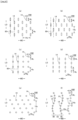
- Each aperture 14 may be in a slot shape as shown in Figs. 6(a) and 6(b) , perfect circular as shown in Figs. 6(c), 6(e), and 6(f) as well as in Figs. 7 and 8 , elliptical as shown in Fig. 6(d) , polygonal, such as triangular, rectangular, or rhombic, start shaped, cloud shaped, or any arbitrary shape. Though not shown, apertures 14 of different shapes may be present.
- each aperture 14 is not particularly limited, and the dimension 14L in the front-back direction (the maximum dimension) is preferably 0.5 to 2.0 mm, particularly 0.5 to 1.0 mm, and the dimension 14W in the width direction (the maximum dimension) is preferably 0.5 to 2.0 mm, particularly 0.5 to 1.0 mm.
- the shape of each aperture 14 is longer in the front-back direction (the maximum dimension in one direction is longer than the overall dimension in the direction orthogonal thereto), such as a slot, elliptical, rectangular, or rhombic shape
- the front-back dimension is preferably 1.2 to 2.5 times the dimension in the width direction orthogonal thereto.
- the longitudinal direction of the apertures 14 is preferably aligned to the machine direction (MD) of the nonwoven fabric, but may be aligned to the cross direction (CD) or oblique thereto.
- MD machine direction
- CD cross direction
- the MD of the perforated nonwoven fabric constituting the top sheet 30 is, in most cases, aligned to the front-back direction LD.
- each aperture 14 and the area ratio of the apertures in the aperture arrayed region may suitably be decided, and the area may preferably be about 0.25 to 4.00 mm 2 and the area ratio may preferably be about 0.1 to 10%.
- the pattern of the array of the apertures 14 may suitably be decided.
- the pattern of the array of the apertures 14 is a matrix wherein lines of apertures 14 aligned linearly in the front-back direction LD at predetermined intervals are repeated in the width direction WD at predetermined intervals.
- the apertures 14 may be arranged with the intervals 14y of the apertures 14 in the front-back direction LD being smaller than the intervals 14x of the apertures 14 in the width direction WD as shown in Figs.
- the intervals 14y of the apertures 14 in the front-back direction LD being generally equal to the intervals 14x of the apertures 14 in the width direction WD as shown in Fig. 6(c) , or with the intervals 14y of the apertures 14 in the front-back direction LD being larger than the intervals 14x of the apertures 14 in the width direction WD as shown in Figs. 6(b) and 6(e) .
- the lines 95 of apertures aligned linearly in the front-back direction LD at predetermined intervals may be arranged in the width direction WD at intervals and shifted with each other in the front-back direction LD.
- Figs. 6(a) and 6(b) show examples of the arrangement wherein the apertures 14 in the adjacent lines 95 are staggered, i.e., so-called staggered pattern (hexagonal lattice pattern).
- the intervals 14y of the apertures 14 in the front-back direction and the intervals 14x of the apertures 14 in the width direction may respectively be constant or varied, which may suitably be decided.
- the intervals 14y of the apertures 14 in the front-back direction may be 0.9 to 8.0 mm, particularly 1.0 to 3.0 mm
- the intervals 14x of the apertures 14 in the width direction may be 2.0 to 10 mm, particularly 3.0 to 5.0 mm.
- the pattern of the array of apertures 14 may also be such that groups 90 of apertures 14 aligned in the front-back direction LD with each group forming a single wavy line 91, 92 are arranged in the width direction WD at intervals in the same or different phases as shown in Figs. 6(f) and 7 .
- the wave phases of the groups 90 of apertures 14 adjacent to each other in the width direction WD are opposite, so that the imaginary lines connecting the apertures 14 form aixie pattern (ogee pattern).
- reference sign 94 refers to a unit arrayed area whereas reference sign 94W refers to the dimension in the width direction WD of the unit arrangement portion.
- the pattern of the array of apertures 14 may also be such that groups 90 of apertures 14 aligned in the front-back direction LD at intervals with each group forming a chain-like pattern are arranged in the width direction WD at intervals.
- groups 90 of apertures 14 are arranged in the width direction WD at intervals" means that an imperforated zone 93 extending linearly unintermittently along the front-back direction LD is present between the groups 90 of apertures 14 adjacent to each other in the width direction WD.
- each aperture 14 may be a punched aperture of which periphery is formed with cut ends of fibers, or a non-punched aperture which hardly has cut ends of fibers on its periphery and is formed by inserting a pin into the space among fibers to expand (fiber density at the periphery is higher).
- the punched aperture may have a diameter tapered toward the middle of the thickness as shown in Fig. 9(d) , or a diameter tapered toward one end in the thickness direction, not shown.
- the exterior nonwoven sheet 12 covers the entire underside of the liquid-impervious sheet 11 to impart a fabric-like appearance to the product exterior.
- the exterior nonwoven sheet 12 preferably has a fiber basis weight of 10 to 50 g/m 2 , in particular 15 to 30 g/m 2 , which, however, is not limiting.
- the exterior nonwoven sheet 12 may be omitted, in which case the liquid-impervious sheet 11 may extend to the side edges of the product.
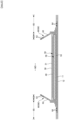
- the inner face of the gathered sheet 62 has a joining start edge positioned on a lateral side portion of the top sheet 30 in the width direction WD, and the portion 65 outward in the width direction of this joining start edge is bonded to the inner face of the corresponding side flap SF, i.e., in the illustrate embodiment, a lateral side portion of the liquid-impervious sheet 11 and a lateral side portion of the exterior nonwoven sheet 12 located laterally outward thereof in the width direction, with a hot melt adhesive or the like.
- planar gathers are formed where the contracting force of the side elastic members 64 acts (in the illustrated embodiment, where the side elastic members 64 are shown).
- the side elastic members 64 are present only in the area of the planar gathers, or wherein the side elastic members 64 are present on the front side, back side, or both of the planar gathers, but the contacting force of the side elastic members 64 acts only in the area of the planar gathers, while the contracting force is made not to act in the area other than the area of the planar gathers (substantially equivalent to absence of the elastic members) by finely cutting the side elastic members at one or a plurality of locations other than the area of the planar gathers, by not fixing the side elastic members 64 to the sheets between which the side elastic members 64 are interposed, or by both.
- the present tape-type disposable diaper has front wings 80 extending on opposed sides of the product in the right-left direction at a position spaced forward of the middle of the product in the front-back direction.
- the front wings may be omitted (i.e., the product may be configured such that the width of the product is not varied from its narrowest portion to the front end).
- each front wing 80 in the width direction WD may suitably be decided and, for example, may be 5 to 20% (in particular 7 to 15%) the overall product length Y.
- the dimension of each front wing 80 in the width direction WD may be generally the same as the dimension of each back wing 81 to be discussed later in the width direction WD.
- the present tape-type disposable diaper has back wings 81 extending on opposed sides of the product in the right-left direction at a position spaced backward of the middle of the product in the front-back direction.
- each back wing 81 in the width direction WD may suitably be decided and, for example, may be the same as the dimension of each front wing in the width direction WD, or smaller or larger than the dimension of the front wing in the width direction.
- Each lateral edge of the product between the front wing 80 and the back wing 81 may have, for example, a generally linear portion passing the area of ⁇ 5 mm in the width direction on both sides of and in the direction orthogonal to a line at an acute angle of ⁇ 2 degrees or less with respect to the front-back direction LD.
- Each lateral edge of the product between the front wing 80 and the back wing 81 may extend in a wavy or arcuate manner (not shown), or in a linear manner as in the illustrated embodiment.
- the overall concaved edge may be formed which extends from the lower edge of the front wing 80, via the lateral edge of the product between the front wing 80 and the back wing 81, to the lower edge of the back wing 81.
- the layered structure of the side flaps SF decides the layered structure of the front wings 80 and the back wings 81 and, in the illustrated embodiment, the front wings 80 and the back wings 81 are formed with the gathered sheet 62 and the exterior nonwoven sheet 12.
- a front extension sheet may be provided extending laterally from each side flap SF to form all or edge-side part of each front wing 80 with the front extension sheet.
- a back extension sheet may be provided extending laterally from each side flap SF to form all or edge-side part of each back wing 81 with the back extension sheet.
- the front extension sheet and the back extension sheet may be of various nonwoven fabric.
- Each back wing 81 is provided with a connecting part 13A to be detachably connected to the ventral section F when the product is worn. That is, in fitting the product, the opposed lateral side portions of the back wings 81 are brought onto the ventral side of the wearer, and the connecting parts 13A of the back wings 81 are connected to the exterior face of the ventral section F.
- the connecting part 13A may be a hook member (male part) of a mechanical fastener (hook and loop fastener), or a pressure-sensitive adhesive layer.
- the connecting part 13A may directly be attached to the back wing 81, or a connecting tape 13 having the connecting part 13A may be attached to the back wing 81, as in the illustrated embodiment.
- the structure of the connecting tape 13 is not particularly limited and, in the illustrated embodiment, may have a tape attachment portion 13C fixed to the side flap SF, a tape body 13B protruding from the tape attachment portion 13C, and the connecting part 13A disposed in the middle of the tape body 13B in the width direction WD, and the portion beyond this connecting part 13A is a grip portion.
- the sheet material forming from the tape attachment portion 13C to the tape body 13B may be nonwoven fabric, plastic film, polyethylene-laminated nonwoven fabric, paper, or composites thereof.
- a connecting site on the exterior face of the ventral section F to which the connecting parts 13A are to be connected may suitably be decided, and only the body section located between the right and left front wings 80 may provide the connecting site, or the areas each extending from a lateral side portion of the body section toward the proximal side of the front wing 80 may provide the connecting site.
- the connecting parts 13A may be easily connected.
- the connecting parts 13A are hook members (male parts) of mechanical fasteners (hook and loop fasteners)
- the connecting site on the exterior face of the ventral section F may be made with a loop member (female part) 24 of mechanical fasteners, or nonwoven fabric.
- a loop member 24 may be adhered only to the connecting site on the exterior face of the ventral section F.
- a plastic film having a smooth surface to be strongly adhered to the pressure-sensitive adhesive layers may be attached to the connecting site on the exterior face of the ventral section F.
- the top sheet 30 is preferably bonded, via a hydrophobic hot melt adhesive 31, to an underside member arranged on the underside of the top sheet 30.
- the top sheet 30 may be joined to an underside member arranged on the underside of the top sheet 30 by melt-bonding of at least one of the top sheet 30 and the underside member arranged on the underside of the top sheet 30.
- the area in which the top sheet 30 is fixed may, as long as the area extends at least over the entire aperture arrayed region, only be over the aperture arrayed region or extend beyond the aperture arrayed region to other areas (e.g., all over the top sheet 30).
- the underside member includes the intermediate sheet 40, the wrapping sheet 58, and the liquid-impervious sheet 11 in the illustrated embodiment, but is not limited thereto.
- the hydrophobic hot melt adhesive 31 may be EVA-based, polyolefin-based, or polyester/polyamide-based adhesive or the like, and a pressure-sensitive rubber-based (elastomer-based) adhesive is particularly preferred.
- the amount of the hydrophobic hot melt adhesive 31 to be applied may suitably be decided, and may usually be about 0.1 to 10 g/m 2 .
- the hot melt adhesive 31 may preferably be kept from sticking out through the apertures 14, but interference with glycerin in bonding as will be discussed later is likely to occur, so that it is preferred to combine the application amount with designing of the application pattern of the glycerin, or the like.
- the application pattern of the hydrophobic hot melt adhesive 31 may suitably be decided, and may preferably be a dense pattern with minute non-applied portions scattered all over (by spray application in spiral, Z, or wave shapes, or the like), or may be a continuous surface such as by slot application.
- the skin-touching region 30E of the top sheet 30 has glycerin-bearing zones 32 each of which bears 0.7 to 2.7 g/m 2 of glycerin.
- a glycerin-bearing zone 32 may be provided in one site with a relatively large area, or the glycerin-bearing zones 32 may be provided in a plurality of sites.
- the glycerin-bearing zone 32 may be provided or may not be provided, as long as it is provided at least in the skin-touching region 30E of the top sheet 30, in the other regions beyond the skin-touching region 30E.
- each glycerin-bearing zone 32 may suitably be decided, but it is not preferred that the size of the glycerin-bearing zone 32 is too small.
- Each glycerin-bearing zone 32 is preferred to have a MD (the front-back direction LD in the illustrated embodiment) dimension 32L of 5 mm or more and a CD (the width direction WD in the illustrated embodiment) dimension 32W of 5 mm or more.
- the MD dimension 32L of the glycerin-bearing zone 32 is more preferably 30 mm or more, further more preferably 50 mm or more, and particularly preferably 100 mm or more.
- the upper limit of the MD dimension 32L of the glycerin-bearing zone 32 is the overall product length Y, but may be shorter than this.
- the CD dimension 32W of the glycerin-bearing zone 32 is more preferably 10 mm or more.
- the upper limit of the CD dimension 32W of the glycerin-bearing zone 32 is the dimension in the width direction WD of the top sheet 30, but may be shorter than this.
- an area ratio of the glycerin-bearing zone 32 to the skin-touching region 30E is preferably 3% or more, particularly preferably 5% or more.
- the skin-touching region 30E refers to a region exposed on the top face of the article in its spread state as discussed above, if another member serves to partly hide the top sheet 30 (in the illustrated example, the standup gather parts 60 serve to hide the opposed lateral side portions of the top sheet 30) in its spread state, the skin-touching region 30E refers to a region exposed on the top face exclusive of hidden portions of the article. On the other hand, when a whole top face of the top sheet 30 is exposed on the top face of the article, the skin-touching region 30E refers to the whole top face itself of the top sheet 30.
- the glycerin-bearing zones 32 may preferably be provided in a vertical-striped pattern as in the illustrated embodiment. Alternatively, they may be provided in a horizontal-striped pattern, dotted pattern, lattice pattern. In such cases, the intervals 32X of the adjacent glycerin-bearing zones 32 may suitably be decided, and may preferably be, for example, about 1.5 to 10 mm.
- the nonwoven fabric for the top sheet 30 may preferably be nonwoven fabric having a fineness of 1 to 3 dtex (more preferably 1.5 to 2.5 dtex), a basis weight of 10 to 30 g/m 2 (more preferably 15 to 25 g/m 2 ), and a thickness of 0.4 to 1.4 mm (more preferably 0.5 to 1.0 mm). That is, in such a nonwoven fabric, the fine fibers contribute to reducing of friction on a front face of the nonwoven fabric, which, in cooperation with the friction-reducing effect of glycerin, improves the overall friction-reducing effect. In addition, retainability of glycerin is improved by the fine fibers, to thereby further improve the friction-reducing effect.
- glycerin-containing hydrophilic lotion is applied to the top sheet 30 in a desired pattern.
- the hydrophilic lotion contains 70 to 90 wt% glycerin and 10 to 30 wt% water.
- Such a hydrophilic lotion mainly composed of glycerin with a moderate amount of water is preferred not only as a moisturizer when transferred to the skin, but also for its hardness to decay as the water is held in the glycerin as bound water (glycerin has an extremely high water retainability).
- the content of glycerin is measured by the following measurement method.
- the nonwoven fabric for the top sheet 30 is preferably formed of hydrophobic resin fibers for their low cost, which as they are have poor retainability of glycerin for using the water-containing hydrophilic lotion.
- the hydrophilic lotion preferably has a viscosity at 20°C of 150 to 400 mPa ⁇ s. In this way, the glycerin-retainability of the nonwoven fabric is improved advantageously.
- the nonwoven fabric for the top sheet 30 is preferably formed of hydrophilized fibers wherein hydrophobic resin fibers have been coated with a hydrophilizer. In this way, the glycerin-retainability of the nonwoven fabric is improved advantageously.
Landscapes
- Health & Medical Sciences (AREA)
- Epidemiology (AREA)
- Engineering & Computer Science (AREA)
- Biomedical Technology (AREA)
- Heart & Thoracic Surgery (AREA)
- Vascular Medicine (AREA)
- Life Sciences & Earth Sciences (AREA)
- Animal Behavior & Ethology (AREA)
- General Health & Medical Sciences (AREA)
- Public Health (AREA)
- Veterinary Medicine (AREA)
- Absorbent Articles And Supports Therefor (AREA)
Applications Claiming Priority (2)
| Application Number | Priority Date | Filing Date | Title |
|---|---|---|---|
| JP2020094371 | 2020-05-29 | ||
| PCT/JP2021/019189 WO2021241396A1 (ja) | 2020-05-29 | 2021-05-20 | 使い捨て着用物品 |
Publications (3)
| Publication Number | Publication Date |
|---|---|
| EP4159173A1 EP4159173A1 (en) | 2023-04-05 |
| EP4159173A4 EP4159173A4 (en) | 2024-06-05 |
| EP4159173B1 true EP4159173B1 (en) | 2025-07-02 |
Family
ID=78744492
Family Applications (1)
| Application Number | Title | Priority Date | Filing Date |
|---|---|---|---|
| EP21811902.2A Active EP4159173B1 (en) | 2020-05-29 | 2021-05-20 | Disposable wearable article |
Country Status (7)
| Country | Link |
|---|---|
| US (1) | US12539238B2 (https=) |
| EP (1) | EP4159173B1 (https=) |
| JP (1) | JP7829286B2 (https=) |
| KR (1) | KR102832556B1 (https=) |
| CN (1) | CN115461021A (https=) |
| TW (1) | TWI900566B (https=) |
| WO (1) | WO2021241396A1 (https=) |
Families Citing this family (6)
| Publication number | Priority date | Publication date | Assignee | Title |
|---|---|---|---|---|
| JP6488040B1 (ja) * | 2018-03-20 | 2019-03-20 | 大王製紙株式会社 | テープタイプ使い捨ておむつ |
| KR102597383B1 (ko) * | 2018-03-20 | 2023-11-01 | 다이오 페이퍼 코퍼레이션 | 테이프 타입 일회용 기저귀 |
| CN115052571B (zh) * | 2020-03-25 | 2023-11-03 | 大王制纸株式会社 | 一次性穿着物品 |
| JP2022147053A (ja) * | 2021-03-23 | 2022-10-06 | 大王製紙株式会社 | 使い捨て着用物品及びその製造方法 |
| JP2022147055A (ja) | 2021-03-23 | 2022-10-06 | 大王製紙株式会社 | 使い捨て着用物品及びその製造方法 |
| JP7803752B2 (ja) * | 2022-03-11 | 2026-01-21 | 大王製紙株式会社 | 衛生用品 |
Family Cites Families (38)
| Publication number | Priority date | Publication date | Assignee | Title |
|---|---|---|---|---|
| KR950012183B1 (ko) * | 1992-11-17 | 1995-10-14 | 주식회사 엘지화학 | 산화아연을 첨가한 일회용 흡수제품 |
| AU2172795A (en) | 1994-06-24 | 1996-01-11 | Mcneil-Ppc, Inc. | Method of reducing the coefficient of friction of absorbent products and wax coated products produced thereby |
| JPH08252175A (ja) | 1995-01-19 | 1996-10-01 | Osaka Gas Co Ltd | 焼物調理器 |
| BR9713681A (pt) | 1996-12-03 | 2000-03-28 | Procter & Gamble | Artigo absorvente para ser utilizado por um usuário adjacente à pele |
| US6498284B1 (en) * | 1997-11-14 | 2002-12-24 | The Procter & Gamble Company | Disposable absorbent article with a skin care composition on an apertured top sheet |
| US6533765B1 (en) | 1998-05-01 | 2003-03-18 | The Procter & Gamble Company | Absorbent articles having a lotion resistant adhesive |
| US6217890B1 (en) * | 1998-08-25 | 2001-04-17 | Susan Carol Paul | Absorbent article which maintains or improves skin health |
| AR027842A1 (es) * | 1999-08-23 | 2003-04-16 | Kimberly Clark Co | Un articulo absorbente el cual mantiene o mejora la salud de la piel |
| US6743965B2 (en) * | 2000-12-21 | 2004-06-01 | Mcneil-Ppc, Inc. | Apertured polymeric film web with diol/surfactant additive |
| US20020120241A1 (en) * | 2000-12-22 | 2002-08-29 | Tyrrell David John | Absorbent articles with hydrophilic compositions containing anionic polymers |
| US20020128615A1 (en) * | 2000-12-22 | 2002-09-12 | Tyrrell David John | Absorbent articles with non-aqueous compositions containing anionic polymers |
| US7771735B2 (en) * | 2000-12-22 | 2010-08-10 | Kimberly-Clark Worldwide, Inc. | Absorbent articles with compositions for reducing irritation response |
| US20020120242A1 (en) * | 2000-12-22 | 2002-08-29 | Tyrrell David John | Absorbent articles with hydrophilic compositions containing botanicals |
| US6749860B2 (en) * | 2000-12-22 | 2004-06-15 | Kimberly-Clark Worldwide, Inc. | Absorbent articles with non-aqueous compositions containing botanicals |
| US20030130635A1 (en) * | 2001-12-22 | 2003-07-10 | Tate Martha Lillian | Absorbent articles with compositions having even distribution |
| US20030130636A1 (en) * | 2001-12-22 | 2003-07-10 | Brock Earl David | System for improving skin health of absorbent article wearers |
| US7745687B2 (en) * | 2002-01-15 | 2010-06-29 | Kimberly-Clark Worldwide, Inc. | Absorbent article with reinforced absorbent structure |
| JP4084279B2 (ja) | 2003-02-05 | 2008-04-30 | 花王株式会社 | 吸収性物品 |
| JP4471624B2 (ja) | 2003-02-06 | 2010-06-02 | 花王株式会社 | 吸収性物品 |
| US20050148910A1 (en) * | 2003-12-24 | 2005-07-07 | Gregory Skover | Apparatus having a skin-contactable element containing an agent |
| US20080287896A1 (en) | 2007-05-15 | 2008-11-20 | The Procter & Gamble Company | Absorbent Article With Hydrophilic Lotion And High Barrier Cuffs |
| EP1992366B1 (en) | 2007-05-15 | 2011-07-06 | The Procter & Gamble Company | Use of a lotion composition on an absorbent article for reducing adherence of feces or menses to the skin |
| JP5913881B2 (ja) * | 2011-09-22 | 2016-04-27 | 大王製紙株式会社 | 吸収性物品の製造方法 |
| WO2013038965A1 (ja) | 2011-09-14 | 2013-03-21 | 大王製紙株式会社 | 吸収性物品の製造方法、及び吸収性物品 |
| JP6086385B2 (ja) | 2013-03-29 | 2017-03-01 | 大王製紙株式会社 | 使い捨ておむつ |
| CA2919258C (en) * | 2013-07-25 | 2022-06-21 | Cheryl Lee EBERTING | Formulations for epidermal repair |
| US20150209468A1 (en) * | 2014-01-24 | 2015-07-30 | The Procter & Gamble Company | Hygiene article containing microorganism |
| EP3307390A4 (en) * | 2015-04-09 | 2019-05-08 | Neostem Oncology, LLC | STEM CELL COMPOSITIONS FOR COSMETIC AND DERMATOLOGICAL USE |
| JP6001207B1 (ja) * | 2016-06-30 | 2016-10-05 | ユニ・チャーム株式会社 | 吸収性物品 |
| US11642248B2 (en) * | 2016-08-12 | 2023-05-09 | The Procter & Gamble Company | Absorbent article with an ear portion |
| JP6247728B1 (ja) | 2016-09-30 | 2017-12-13 | 大王製紙株式会社 | 使い捨て着用物品、及び有孔不織布の貼り付け方法 |
| US10496949B2 (en) * | 2017-01-04 | 2019-12-03 | Christopher Zoumalan | Compositions and methods for treating cutaneous conditions |
| US11701322B2 (en) * | 2018-03-23 | 2023-07-18 | Mary Kay Inc. | Topical compositions and methods |
| JP2019170534A (ja) | 2018-03-27 | 2019-10-10 | 花王株式会社 | 吸収性物品及び吸収性物品用の表面シートの製造方法 |
| FR3079749B1 (fr) * | 2018-04-05 | 2022-10-28 | Sederma Sa | Utilisation d'un peptide pour un traitement de l'epiderme |
| JP2021523900A (ja) * | 2018-05-11 | 2021-09-09 | フォルテ サブシディアリー,インク. | 皮膚疾病の処置のための組成物 |
| JP7169818B2 (ja) * | 2018-08-30 | 2022-11-11 | 大王製紙株式会社 | 吸収性物品 |
| CN113747875A (zh) * | 2019-04-05 | 2021-12-03 | 株式会社资生堂 | 含有紫外线波长转换物质的组合物 |
-
2021
- 2021-04-16 JP JP2021069597A patent/JP7829286B2/ja active Active
- 2021-05-13 TW TW110117240A patent/TWI900566B/zh active
- 2021-05-20 CN CN202180030465.XA patent/CN115461021A/zh active Pending
- 2021-05-20 EP EP21811902.2A patent/EP4159173B1/en active Active
- 2021-05-20 KR KR1020227036243A patent/KR102832556B1/ko active Active
- 2021-05-20 US US17/997,452 patent/US12539238B2/en active Active
- 2021-05-20 WO PCT/JP2021/019189 patent/WO2021241396A1/ja not_active Ceased
Also Published As
| Publication number | Publication date |
|---|---|
| KR102832556B1 (ko) | 2025-07-09 |
| JP7829286B2 (ja) | 2026-03-13 |
| JP2021186662A (ja) | 2021-12-13 |
| EP4159173A1 (en) | 2023-04-05 |
| CN115461021A (zh) | 2022-12-09 |
| US12539238B2 (en) | 2026-02-03 |
| TW202143930A (zh) | 2021-12-01 |
| TWI900566B (zh) | 2025-10-11 |
| WO2021241396A1 (ja) | 2021-12-02 |
| KR20230019073A (ko) | 2023-02-07 |
| US20230301845A1 (en) | 2023-09-28 |
| EP4159173A4 (en) | 2024-06-05 |
Similar Documents
| Publication | Publication Date | Title |
|---|---|---|
| EP4159173B1 (en) | Disposable wearable article | |
| JP2021186662A5 (https=) | ||
| EP4190290A1 (en) | Disposable wearable article | |
| US12390375B2 (en) | Disposable wearable article | |
| US12303368B2 (en) | Disposable wearable article | |
| JP2022054087A5 (https=) | ||
| EP4316437A1 (en) | Disposable wearable article and method for producing same | |
| RU2820143C1 (ru) | Одноразовое изделие для ношения | |
| EP4316436A1 (en) | Disposable wearable article and method for producing same | |
| RU2831002C1 (ru) | Одноразовое изделие для ношения | |
| JP2022054088A (ja) | 使い捨て着用物品 | |
| JP2022147055A5 (https=) | ||
| JP7604290B2 (ja) | 使い捨て着用物品及びその製造方法 | |
| JP2022147053A5 (https=) | ||
| JP2022147054A5 (https=) |
Legal Events
| Date | Code | Title | Description |
|---|---|---|---|
| STAA | Information on the status of an ep patent application or granted ep patent |
Free format text: STATUS: THE INTERNATIONAL PUBLICATION HAS BEEN MADE |
|
| PUAI | Public reference made under article 153(3) epc to a published international application that has entered the european phase |
Free format text: ORIGINAL CODE: 0009012 |
|
| STAA | Information on the status of an ep patent application or granted ep patent |
Free format text: STATUS: REQUEST FOR EXAMINATION WAS MADE |
|
| 17P | Request for examination filed |
Effective date: 20221115 |
|
| AK | Designated contracting states |
Kind code of ref document: A1 Designated state(s): AL AT BE BG CH CY CZ DE DK EE ES FI FR GB GR HR HU IE IS IT LI LT LU LV MC MK MT NL NO PL PT RO RS SE SI SK SM TR |
|
| DAV | Request for validation of the european patent (deleted) | ||
| DAX | Request for extension of the european patent (deleted) | ||
| A4 | Supplementary search report drawn up and despatched |
Effective date: 20240508 |
|
| RIC1 | Information provided on ipc code assigned before grant |
Ipc: A61F 13/511 20060101ALI20240502BHEP Ipc: A61F 13/15 20060101AFI20240502BHEP |
|
| GRAP | Despatch of communication of intention to grant a patent |
Free format text: ORIGINAL CODE: EPIDOSNIGR1 |
|
| STAA | Information on the status of an ep patent application or granted ep patent |
Free format text: STATUS: GRANT OF PATENT IS INTENDED |
|
| INTG | Intention to grant announced |
Effective date: 20250102 |
|
| P01 | Opt-out of the competence of the unified patent court (upc) registered |
Free format text: CASE NUMBER: APP_5678/2025 Effective date: 20250203 |
|
| GRAS | Grant fee paid |
Free format text: ORIGINAL CODE: EPIDOSNIGR3 |
|
| GRAA | (expected) grant |
Free format text: ORIGINAL CODE: 0009210 |
|
| STAA | Information on the status of an ep patent application or granted ep patent |
Free format text: STATUS: THE PATENT HAS BEEN GRANTED |
|
| AK | Designated contracting states |
Kind code of ref document: B1 Designated state(s): AL AT BE BG CH CY CZ DE DK EE ES FI FR GB GR HR HU IE IS IT LI LT LU LV MC MK MT NL NO PL PT RO RS SE SI SK SM TR |
|
| REG | Reference to a national code |
Ref country code: GB Ref legal event code: FG4D |
|
| REG | Reference to a national code |
Ref country code: CH Ref legal event code: EP |
|
| REG | Reference to a national code |
Ref country code: DE Ref legal event code: R096 Ref document number: 602021033490 Country of ref document: DE |
|
| REG | Reference to a national code |
Ref country code: IE Ref legal event code: FG4D |
|
| REG | Reference to a national code |
Ref country code: NL Ref legal event code: MP Effective date: 20250702 |
|
| PG25 | Lapsed in a contracting state [announced via postgrant information from national office to epo] |
Ref country code: PT Free format text: LAPSE BECAUSE OF FAILURE TO SUBMIT A TRANSLATION OF THE DESCRIPTION OR TO PAY THE FEE WITHIN THE PRESCRIBED TIME-LIMIT Effective date: 20251103 |
|
| PG25 | Lapsed in a contracting state [announced via postgrant information from national office to epo] |
Ref country code: NL Free format text: LAPSE BECAUSE OF FAILURE TO SUBMIT A TRANSLATION OF THE DESCRIPTION OR TO PAY THE FEE WITHIN THE PRESCRIBED TIME-LIMIT Effective date: 20250702 |
|
| REG | Reference to a national code |
Ref country code: AT Ref legal event code: MK05 Ref document number: 1808438 Country of ref document: AT Kind code of ref document: T Effective date: 20250702 |
|
| PG25 | Lapsed in a contracting state [announced via postgrant information from national office to epo] |
Ref country code: IS Free format text: LAPSE BECAUSE OF FAILURE TO SUBMIT A TRANSLATION OF THE DESCRIPTION OR TO PAY THE FEE WITHIN THE PRESCRIBED TIME-LIMIT Effective date: 20251102 |
|
| PG25 | Lapsed in a contracting state [announced via postgrant information from national office to epo] |
Ref country code: NO Free format text: LAPSE BECAUSE OF FAILURE TO SUBMIT A TRANSLATION OF THE DESCRIPTION OR TO PAY THE FEE WITHIN THE PRESCRIBED TIME-LIMIT Effective date: 20251002 |
|
| REG | Reference to a national code |
Ref country code: LT Ref legal event code: MG9D |
|
| PG25 | Lapsed in a contracting state [announced via postgrant information from national office to epo] |
Ref country code: AT Free format text: LAPSE BECAUSE OF FAILURE TO SUBMIT A TRANSLATION OF THE DESCRIPTION OR TO PAY THE FEE WITHIN THE PRESCRIBED TIME-LIMIT Effective date: 20250702 |
|
| PG25 | Lapsed in a contracting state [announced via postgrant information from national office to epo] |
Ref country code: FI Free format text: LAPSE BECAUSE OF FAILURE TO SUBMIT A TRANSLATION OF THE DESCRIPTION OR TO PAY THE FEE WITHIN THE PRESCRIBED TIME-LIMIT Effective date: 20250702 |
|
| PG25 | Lapsed in a contracting state [announced via postgrant information from national office to epo] |
Ref country code: HR Free format text: LAPSE BECAUSE OF FAILURE TO SUBMIT A TRANSLATION OF THE DESCRIPTION OR TO PAY THE FEE WITHIN THE PRESCRIBED TIME-LIMIT Effective date: 20250702 |
|
| PG25 | Lapsed in a contracting state [announced via postgrant information from national office to epo] |
Ref country code: GR Free format text: LAPSE BECAUSE OF FAILURE TO SUBMIT A TRANSLATION OF THE DESCRIPTION OR TO PAY THE FEE WITHIN THE PRESCRIBED TIME-LIMIT Effective date: 20251003 |
|
| PG25 | Lapsed in a contracting state [announced via postgrant information from national office to epo] |
Ref country code: CZ Free format text: LAPSE BECAUSE OF FAILURE TO SUBMIT A TRANSLATION OF THE DESCRIPTION OR TO PAY THE FEE WITHIN THE PRESCRIBED TIME-LIMIT Effective date: 20250702 Ref country code: SE Free format text: LAPSE BECAUSE OF FAILURE TO SUBMIT A TRANSLATION OF THE DESCRIPTION OR TO PAY THE FEE WITHIN THE PRESCRIBED TIME-LIMIT Effective date: 20250702 |
|
| PG25 | Lapsed in a contracting state [announced via postgrant information from national office to epo] |
Ref country code: LV Free format text: LAPSE BECAUSE OF FAILURE TO SUBMIT A TRANSLATION OF THE DESCRIPTION OR TO PAY THE FEE WITHIN THE PRESCRIBED TIME-LIMIT Effective date: 20250702 |
|
| PG25 | Lapsed in a contracting state [announced via postgrant information from national office to epo] |
Ref country code: BG Free format text: LAPSE BECAUSE OF FAILURE TO SUBMIT A TRANSLATION OF THE DESCRIPTION OR TO PAY THE FEE WITHIN THE PRESCRIBED TIME-LIMIT Effective date: 20250702 Ref country code: PL Free format text: LAPSE BECAUSE OF FAILURE TO SUBMIT A TRANSLATION OF THE DESCRIPTION OR TO PAY THE FEE WITHIN THE PRESCRIBED TIME-LIMIT Effective date: 20250702 |
|
| PG25 | Lapsed in a contracting state [announced via postgrant information from national office to epo] |
Ref country code: RS Free format text: LAPSE BECAUSE OF FAILURE TO SUBMIT A TRANSLATION OF THE DESCRIPTION OR TO PAY THE FEE WITHIN THE PRESCRIBED TIME-LIMIT Effective date: 20251002 |
|
| PG25 | Lapsed in a contracting state [announced via postgrant information from national office to epo] |
Ref country code: ES Free format text: LAPSE BECAUSE OF FAILURE TO SUBMIT A TRANSLATION OF THE DESCRIPTION OR TO PAY THE FEE WITHIN THE PRESCRIBED TIME-LIMIT Effective date: 20250702 |
|
| PG25 | Lapsed in a contracting state [announced via postgrant information from national office to epo] |
Ref country code: SM Free format text: LAPSE BECAUSE OF FAILURE TO SUBMIT A TRANSLATION OF THE DESCRIPTION OR TO PAY THE FEE WITHIN THE PRESCRIBED TIME-LIMIT Effective date: 20250702 |
|
| PGFP | Annual fee paid to national office [announced via postgrant information from national office to epo] |
Ref country code: GB Payment date: 20260304 Year of fee payment: 6 |
|
| PG25 | Lapsed in a contracting state [announced via postgrant information from national office to epo] |
Ref country code: DK Free format text: LAPSE BECAUSE OF FAILURE TO SUBMIT A TRANSLATION OF THE DESCRIPTION OR TO PAY THE FEE WITHIN THE PRESCRIBED TIME-LIMIT Effective date: 20250702 |
|
| PG25 | Lapsed in a contracting state [announced via postgrant information from national office to epo] |
Ref country code: IT Free format text: LAPSE BECAUSE OF FAILURE TO SUBMIT A TRANSLATION OF THE DESCRIPTION OR TO PAY THE FEE WITHIN THE PRESCRIBED TIME-LIMIT Effective date: 20250702 |