EP4157966B1 - System and process for producing mesophase coke from isotropic pitch - Google Patents
System and process for producing mesophase coke from isotropic pitch Download PDFInfo
- Publication number
- EP4157966B1 EP4157966B1 EP20937460.2A EP20937460A EP4157966B1 EP 4157966 B1 EP4157966 B1 EP 4157966B1 EP 20937460 A EP20937460 A EP 20937460A EP 4157966 B1 EP4157966 B1 EP 4157966B1
- Authority
- EP
- European Patent Office
- Prior art keywords
- mesophase
- pitch
- coke
- zone
- heating zone
- Prior art date
- Legal status (The legal status is an assumption and is not a legal conclusion. Google has not performed a legal analysis and makes no representation as to the accuracy of the status listed.)
- Active
Links
Images



Classifications
-
- C—CHEMISTRY; METALLURGY
- C10—PETROLEUM, GAS OR COKE INDUSTRIES; TECHNICAL GASES CONTAINING CARBON MONOXIDE; FUELS; LUBRICANTS; PEAT
- C10B—DESTRUCTIVE DISTILLATION OF CARBONACEOUS MATERIALS FOR PRODUCTION OF GAS, COKE, TAR, OR SIMILAR MATERIALS
- C10B47/00—Destructive distillation of solid carbonaceous materials with indirect heating, e.g. by external combustion
- C10B47/28—Other processes
- C10B47/32—Other processes in ovens with mechanical conveying means
- C10B47/46—Other processes in ovens with mechanical conveying means with trucks, containers, or trays
-
- C—CHEMISTRY; METALLURGY
- C10—PETROLEUM, GAS OR COKE INDUSTRIES; TECHNICAL GASES CONTAINING CARBON MONOXIDE; FUELS; LUBRICANTS; PEAT
- C10B—DESTRUCTIVE DISTILLATION OF CARBONACEOUS MATERIALS FOR PRODUCTION OF GAS, COKE, TAR, OR SIMILAR MATERIALS
- C10B57/00—Other carbonising or coking processes; Features of destructive distillation processes in general
- C10B57/02—Multi-step carbonising or coking processes
-
- C—CHEMISTRY; METALLURGY
- C10—PETROLEUM, GAS OR COKE INDUSTRIES; TECHNICAL GASES CONTAINING CARBON MONOXIDE; FUELS; LUBRICANTS; PEAT
- C10B—DESTRUCTIVE DISTILLATION OF CARBONACEOUS MATERIALS FOR PRODUCTION OF GAS, COKE, TAR, OR SIMILAR MATERIALS
- C10B57/00—Other carbonising or coking processes; Features of destructive distillation processes in general
- C10B57/04—Other carbonising or coking processes; Features of destructive distillation processes in general using charges of special composition
- C10B57/045—Other carbonising or coking processes; Features of destructive distillation processes in general using charges of special composition containing mineral oils, bitumen, tar or the like or mixtures thereof
-
- C—CHEMISTRY; METALLURGY
- C10—PETROLEUM, GAS OR COKE INDUSTRIES; TECHNICAL GASES CONTAINING CARBON MONOXIDE; FUELS; LUBRICANTS; PEAT
- C10B—DESTRUCTIVE DISTILLATION OF CARBONACEOUS MATERIALS FOR PRODUCTION OF GAS, COKE, TAR, OR SIMILAR MATERIALS
- C10B7/00—Coke ovens with mechanical conveying means for the raw material inside the oven
- C10B7/14—Coke ovens with mechanical conveying means for the raw material inside the oven with trucks, containers, or trays
-
- C—CHEMISTRY; METALLURGY
- C10—PETROLEUM, GAS OR COKE INDUSTRIES; TECHNICAL GASES CONTAINING CARBON MONOXIDE; FUELS; LUBRICANTS; PEAT
- C10C—WORKING-UP PITCH, ASPHALT, BITUMEN, TAR; PYROLIGNEOUS ACID
- C10C3/00—Working-up pitch, asphalt, bitumen
- C10C3/002—Working-up pitch, asphalt, bitumen by thermal means
-
- H—ELECTRICITY
- H01—ELECTRIC ELEMENTS
- H01M—PROCESSES OR MEANS, e.g. BATTERIES, FOR THE DIRECT CONVERSION OF CHEMICAL ENERGY INTO ELECTRICAL ENERGY
- H01M4/00—Electrodes
- H01M4/02—Electrodes composed of, or comprising, active material
- H01M4/36—Selection of substances as active materials, active masses, active liquids
- H01M4/58—Selection of substances as active materials, active masses, active liquids of inorganic compounds other than oxides or hydroxides, e.g. sulfides, selenides, tellurides, halogenides or LiCoFy; of polyanionic structures, e.g. phosphates, silicates or borates
- H01M4/583—Carbonaceous material, e.g. graphite-intercalation compounds or CFx
- H01M4/587—Carbonaceous material, e.g. graphite-intercalation compounds or CFx for inserting or intercalating light metals
-
- Y—GENERAL TAGGING OF NEW TECHNOLOGICAL DEVELOPMENTS; GENERAL TAGGING OF CROSS-SECTIONAL TECHNOLOGIES SPANNING OVER SEVERAL SECTIONS OF THE IPC; TECHNICAL SUBJECTS COVERED BY FORMER USPC CROSS-REFERENCE ART COLLECTIONS [XRACs] AND DIGESTS
- Y02—TECHNOLOGIES OR APPLICATIONS FOR MITIGATION OR ADAPTATION AGAINST CLIMATE CHANGE
- Y02E—REDUCTION OF GREENHOUSE GAS [GHG] EMISSIONS, RELATED TO ENERGY GENERATION, TRANSMISSION OR DISTRIBUTION
- Y02E60/00—Enabling technologies; Technologies with a potential or indirect contribution to GHG emissions mitigation
- Y02E60/10—Energy storage using batteries
Definitions
- the present invention relates to a system and a process for producing coke, and more specifically, the present invention discloses a system and a continuous process for producing mesophase pitch and mesophase coke from coal/petroleum tar pitch to be used as feed material to make carbon/graphite electrode for secondary battery.
- Carbon materials have found an important niche in the field of new materials because of having a number of properties (mechanical strength and high modulus, low density, high thermal and electrical conductivity, ion intercalation/absorption properties etc.), which makes them irreplaceable in some applications.
- One such application is Li ion battery where the pitch or coke is used as carbon precursor to make a carbon/graphite anode.
- the said patent discloses an improved process and simple process for producing a carbonaceous pitch product having a controlled mesophase content ranging from about 50 to 100%.
- the said process includes heating a carbonaceous feedstock substantially free of mesophase pitch at a temperature above 350°C for about 6 hours in atmospheric pressure.
- the said process further includes subjecting the carbonaceous feed to heat soaking in the absence of a sparging gas for up to 10 additional hours in the temperature range of 250°C to 350°C. Further, the process is followed by again heating the pretreated carbonaceous feed in the presence of a non-oxidative sparging gas for up to 10 hours in the temperature range of 350°C to 500°C and thereby forming mesophase pitch.
- the said method further includes heating the transferred heat-treated pitch in the mesophase growing and coalescing step to cause only the mesophase to grow and coalesce by aging at a temperature higher than 280° C and lower than 350° C.
- the said method involves removing a mesophase composed of Q.I. component and Q.S. component from the lower layer in the growing and coalescing step.
- the above method required two vessels, one for forming the mesophase,and other for mesophase-growing and coalescing. Further, the isotropic material returns to first vessel after separation. Therefore, it becomes difficult to transport very viscous material from one vessel to another vessel.
- the US patent no. 2775549 discloses a process for producing needle-like coke.
- the said process includes removing components from a high boiling petroleum residuum upon heating at 350°C - 550° C and subsequently coking the remaining residuum in a quiescent pool.
- the US patent no.9777221 also discloses a semi-continuous method of producing needle coke for low coefficient of thermal expansion (CTE) graphite electrodes.
- the said method includes heating a needle coke precursor under pressure, thereby converting 60% - 90% of the coal tar distillate into raw coke.
- the method is followed by calcination of the raw coke to create low coefficient of thermal expansion needle coke.
- US patent no. 4219405 discloses the continuous production of coke.
- the said process includes heating of the hydrocarbon and recycled condensate in a preheated at a rate to increase the mesophase content of the mixture up to 30% to 60%.
- the process further includes heating the preheated mixture in a coking zone at a rate to form a raw coke having a mesophase content of 70% to 100%.
- the process is then followed by continuously removing the raw coke from the coking zone and heating the removed coke in a calciner.
- system and process for producing mesophase coke is required, which may eliminate use of organic solvents, additives or catalyst.
- system and process are required, which may reduce treatment time for producing mesophase coke.
- aspects of the invention are thus directed to system and process for producing mesophase coke from an isotropic pitch.
- the said system and process are both cost effective and overcome the existing problems by providing high quality mesophase coke.
- a system for producing mesophase coke from an isotropic pitch includes a reactor, the said reactor includes an entry zone having a container, wherein the said container is being adapted to receive the said isotropic pitch.
- the reactor further includes a first heating zone adapted to carry out pretreating of the said isotropic pitch by operating the said first heating zone at a temperature of 250° C - 350° C under atmospheric pressure. Further, the reactor includes a second heating zone adapted to carry out heating of the said pretreated isotropic pitch by maintaining the temperature of 350° C - 500° C under the atmospheric pressure to convert the said isotropic pitch to obtain mesophase pitch.
- the said reactor further includes a third heating zone adapted to carry out heating of the said mesophase pitch by maintaining the temperature of 500° C - 800° C under the atmospheric pressure to obtain mesophase coke. Furthermore, the said reactor includes a cooling zone to cool the product form high temperature to low temperature. In addition, the said reactor includes an exit zone adapted to discharge the said mesophase coke from the reactor.
- the said isotropic pitch is selected from at least one of coal tar or petroleum tar.
- the said isotropic pitch is having a softening point (SP) temperature in the range of 80°C to 120°C, and is having quinoline insoluble (QI) content of less than or equal to 2 %.
- SP softening point
- QI quinoline insoluble
- system further includes a reservoir being adapted to contain the said isotropic pitch, and feed the said isotropic pitch into the container.
- the reactor further includes a cooling zone adapted to cool the said mesophase coke obtained from the third heating zone.
- the system further includes a crushing unit being adapted to crush the said mesophase coke into coke granules.
- a process for producing mesophase coke from an isotropic pitch includes feeding an isotropic pitch into a container placed in an entry zone of a reactor. The said process is followed by physically moving the said container to a first heating zone via a pusher unit, wherein the said container is moving in a linear motion inside the said reactor.
- the said process includes physically moving the said container from the second heating zone via the said pusher unit to a third heating zone via the pusher unit.
- the said process is followed by heating the said mesophase pitch inside the said third heating zone of the said reactor by maintaining the temperature of 500° C - 800° C under the atmospheric pressure to obtain mesophase coke.
- the process further includes feeding the said isotropic pitch into the container from a reservoir.
- the process includes cooling the said mesophase coke in the said cooling zone.
- the process further includes physically moving the said container from the said cooling zone via the pusher unit to an exit zone.
- the process further includes comprises recovering and storing the unused pitch.
- the said recovering step includes evaporating the unused pitch from the said reactor condensing of the said evaporated pitch in a condensing unit to obtain condensate oil and the same is stored in the storage tank.
- the formation of the said mesophase depends on the residence time of the isotropic pitch in the reactor (100)and temperature condition for producing said mesophase coke.
- the said plurality of zones (101), (102), (103), (104), (105), (106) includes an exit zone (106) inside the said reactor (100).
- the said exit zone (106) is adapted to store the said mesophase coke that is obtained from the said cooling zone (106) (refer Fig.1 ).
- the system (1000) includes a pusher unit (300) (refer Fig.1 & Fig.2 ).
- the said pusher unit (300) is adapted to physically move the said container form the said from the said entry zone (101) to the said first heating zone (102), the said second heating zone (103), and the said third heating zone (104) through the exit zone (106) to obtain the mesophase coke at the said exit zone (106).
- the said hydraulic pusher system further includes a hydraulic cylinder (304) to convert the said hydraulic energy into a mechanical energy to push the said container (50) through the said the said plurality of zones(101), (102), (103), (104), (105), (106) (refer Fig.2 ).
- the system (1000) further includes a crusher unit (600).
- the said crusher unit (600) is adapted to crush the said mesophase coke discharged from the said exit zone (106) into coke granules (refer Fig.1 ). Very small sizes must be screened from the crushed coke, leaving an acceptable size of about less than 20mm.
- the system (1000) further includes a pneumatic conveying system (700).
- the said pneumatic conveying system (700) is adapted to transport the said coke granules extracted from the said mesophase coke (refer Fig.1 ) to a hopper (800), where the said granules stored.
- the pressure and flow of the air is required to convey the said coke granules form the said crusher unit (600) to the said hopper (800).
- the said reactor (100) is further adapted to evaporate some portion of the said pitch.
- the system (1000) includes a condensing unit (400).
- the said condensing unit (400) is adapted to condense the said evaporated unused pitch into condensate oil.
- the said system (1000) may further include an oil tank (500).
- the said oil tank (500) is adapted to store the condensate oil with the said light cracking products.
- the said process (900) involves feeding of an isotropic pitch into a container (50) from a reservoir (200). This container (50) is then loaded into a reactor (100).
- the said container (50) is placed in an entry zone (101) of the reactor (100) in a predetermined quantity.
- the said process (900) includes physically moving the said container (50) filled with said isotropic pitch to a first heating zone (102). Wherein, the said container (50) is moved with a fixed speed in a linear motion.
- the physically moving of the container (50) from entry zone to first heating zone (101) is done via a pusher unit (300).
- the said process (900) involves pretreating of the said isotropic pitch inside the said first heating zone (102) of the said reactor (100).
- the said heating zone operates at a temperature of 250° C to 350°C under atmospheric pressure for a predetermined time (refer Fig.3 ).
- the said pretreating or pre-conditioning of the said isotropic pitch is required to reduce or eliminate many of the volatile emissions of the said isotropic pitch.
- the said process involves physically moving the said container (50) from the said first heating zone (102) via the said pusher unit (300) to a second heating zone (103). Again, it should be appreciated that the material is not moved but the container (50) is moved inside the reactor (100).
- the said container (50) filled with a pretreated pitch move to the next section i.e. second heating zone (103).
- the said process (900) involves heating the pretreated isotropic pitch inside the said second heating zone (103) of the said reactor (100) by maintaining the temperature of 350° C - 500°C under the atmospheric pressure.
- the change in the physical appearance and chemical composition takes place. More specifically, in the said embodiment the formation of the mesophase occurs in the said pretreated isotropic pitch. Subsequently, this may lead to the conversion of the said isotropic pitch into anisotropic phase.
- the mesophase pitch appears as spheres, and the formation rate of the said mesophase depends on the chemical composition of a precursor i.e. said isotropic pitch.
- the said process (900) involves physically moving the said container (50) from the second heating zone (103) to a third heating zone (104) via the said pusher unit (300).
- the process (900) is continued with heating of the said mesophase pitch inside the said third heating zone (104) of the said reactor (100) by maintaining the temperature of 450° C - 800° C. More preferably, at the temperature of 480° C - 600° C under the atmospheric pressure to obtain mesophase coke (refer Fig.3 ). Again, it should be appreciated that the material is not moved but the container (50) is moved inside the reactor (100).
- the process (900) includes physically moving the said container (50) from the said third heating zone (104) via the said pusher unit (300) to a cooling zone (105).
- the process (900) includes physically moving the said container (50) from the said cooling zone (105) via the pusher unit (300) to an exit zone (106).
- the process (900) is followed by crushing the said mesophase coke inside a crushing unit (600). Wherein, the said crushing is required to convert the said mesophase coke to coke granules.
- the said process (900) includes transporting the said coke granules from the said crushing unit (600) into a hopper (800) via a pneumatic conveying system (700).
- recovering of unused pitch occurs. More preferably, some portion of isotropic pitch evaporates during the production of the mesophase coke inside the said reactor (100) (refer Fig.3 ).
- the said process (900) includes evaporating the said unused pitch from the said reactor (100) to a condensing unit (400) (refer Fig.3 ).
- the said process (900) further involves condensing of the said evaporated pitch in a condensing unit (400) to obtain condensate oil (refer Fig.3 ).
- the said process (900) includes pumping the said condensate oil in an oil tank (500) (refer Fig.3 ).
- the system and process disclosed herein is feasible, sustainable, effective and efficient as compared to existing system and process. Further, the present invention ensures the homogeneity of the mesophase coke prepared.
- the mesophase coke is generally made from mesophase pitch with mesophase content of more than 50% with softening point of more than 200° C.
- mesophase pitch with mesophase content of more than 50% with softening point of more than 200° C.
- very few of them have been taken to industrial scale, due to high cost of mesophase pitch.
- the present invention provides a system and process to produce mesophase coke from pitch having a softening point of less than 200° C.
- the precursor is pyrolyzed at high pressure until a certain amount of mesophase is prepared.
- the mesophase pitch is then subjected to a separation process by mechanical or chemical process, which needs complicated equipment and solvents.
- the process of producing mesophase coke is carried out in a multiple heating zone of a single reactor, so the present invention does not require high temperature pumps and high pressure to transfer the pitch.
- the high temperature pumps and high pressure are required to transfer the mesophase pitch from one reactor to another to complete the production of mesophase coke. So far it is been done manufacturing mesophase pitch in a separate reactor/plant, and meso coke in another reactor/plant. In the declared system it is dome in a single reactor.
- a residence time in the present invention is very well controlled by a speed of the pusher unit. Accordingly, it controls the formation of a mesophase spheres during the pyrolytic process to prepare the mesophase coke of reproducible quality. Further, the property of the said prepared mesophase coke is having a particular interest in applications such as in a production of graphite anode for Lithium ion battery.
- the first example illustrates the operation of the present invention with a coal tar pitch with softening point (SP) of 100 and QI of 2%.
- the temperature of first heating zone (102) was 250°C-350°C and the experiment was performed at atmospheric pressure.
- the temperature of the second heating zone (103) and third heating zone (104) were set to 350°C-500°C and 500°C- 800°C, respectively, with the residence time of 10hours.
- the bulk mesophase coke obtained from the reactor (100) is containing more than 75% anisotropy.
- the appearance optical micrograph of the said coke (refer Fig. 4 ).
- This example illustrates the operation of the present invention with a coal tar pitch with SP of 100 with QI of ⁇ 0.2%.
- the temperature of zone 1 was 250°C -350°C and the experiment was performed at atmospheric pressure.
- the temperature of the second heating zone (103) and third heating zone (104) were set to 350°C -430°C and 450°C - 800°C, respectively, with the residence time of 20hours.
- the bulk mesophase coke obtained from the reactor (100) is containing more than 90% anisotropy.
Landscapes
- Chemical & Material Sciences (AREA)
- Engineering & Computer Science (AREA)
- Materials Engineering (AREA)
- Organic Chemistry (AREA)
- Oil, Petroleum & Natural Gas (AREA)
- Chemical Kinetics & Catalysis (AREA)
- General Chemical & Material Sciences (AREA)
- Structural Engineering (AREA)
- Civil Engineering (AREA)
- Physics & Mathematics (AREA)
- Thermal Sciences (AREA)
- Inorganic Chemistry (AREA)
- Electrochemistry (AREA)
- Combustion & Propulsion (AREA)
- Working-Up Tar And Pitch (AREA)
- Coke Industry (AREA)
Description
- The present invention relates to a system and a process for producing coke, and more specifically, the present invention discloses a system and a continuous process for producing mesophase pitch and mesophase coke from coal/petroleum tar pitch to be used as feed material to make carbon/graphite electrode for secondary battery.
- The need for new materials is a constant search, where materials with very specific properties require specific manufacturing equipment and easy process control. Carbon materials have found an important niche in the field of new materials because of having a number of properties (mechanical strength and high modulus, low density, high thermal and electrical conductivity, ion intercalation/absorption properties etc.), which makes them irreplaceable in some applications. One such application is Li ion battery where the pitch or coke is used as carbon precursor to make a carbon/graphite anode.
- However, the pitch and coke should be anisotropic in nature and should contain high mesophase content. Accordingly, to overcome this problem, the processes for producing mesophase pitch have come into existence. One such process is disclosed in
US patent no. 4904371 . - The said patent discloses an improved process and simple process for producing a carbonaceous pitch product having a controlled mesophase content ranging from about 50 to 100%. The said process includes heating a carbonaceous feedstock substantially free of mesophase pitch at a temperature above 350°C for about 6 hours in atmospheric pressure.
- The said process further includes subjecting the carbonaceous feed to heat soaking in the absence of a sparging gas for up to 10 additional hours in the temperature range of 250°C to 350°C. Further, the process is followed by again heating the pretreated carbonaceous feed in the presence of a non-oxidative sparging gas for up to 10 hours in the temperature range of 350°C to 500°C and thereby forming mesophase pitch.
- However, it has been observed that the heat treatment time in above process is up to 20 hours to 30 hours. Further, the inert gas is used in the above disclosed process for blanketing. Since inert gas is used only for blanketing, the said process would consume less amount of gas around 0.25 Cubic Feet Per Hour (SCFH)/lb, resulting in low energy consumption.
- Further, a similar process is disclosed in
US patent no. 4551225 . The said patent discloses an improved process for preparing an optically anisotropic pitch which includes heating a pitch feed material at a temperature within the range of about 350° C to 450° C while passing an inert gas there through at a rate of at least 2.5 Standard Cubic Feet Per Hour (SCFH)/lb of pitch feed material, and then agitating said pitch feed material at a stirrer rate of from about 500 to 600 rpm to obtain an essentially 100% mesophase pitch product suitable for carbon production. - However, it has been found that the treatment time of producing anisotropic pitch and inert gas flow rates are high in the above said process. Moreover, this process requires high RPM stirrer facility and this process yields only mesophase pitch.
- Furthermore, another similar process of producing mesophase pitch is disclosed in
US patent no. 4631181 . The said process includes producing of mesophase pitch by adding at least one of an alcohol and a phenol to heavy bitumens. Further, the process involves pretreating the mixture in temperature of at least 250° C, and then subjecting the pretreated mixture to heat treatment. - However, it is noted that the above process requires additive and high pressure for producing the mesophase pitch and further does not results in complete anisotropic pitch.
- Another process of producing mesophase pitch is disclosed in
US patent no. 4704333 . The said process includes converting a pitch into mesophase pitch in the presence of catalytically effective amounts of oxides, diketones, carboxylates and carbonyls of metals selected from vanadium, chromium, molybdenum, iron, nickel, and cobalt. - Another process of producing mesophase pitch is disclosed in
US patent no. 5182010 . The said process includes polymerizing a naphthalene derivative having at least one methyl group for about 5-300 minutes at a temperature of about 180° C - 400° C under a pressure of about 5-100 atmosphere in the presence of about 0.1-20 moles of hydrogen fluoride (HF) and about 0.05-1.0 mole of Boron trifluoride (BF3) per mole of the naphthalene derivative. - However, it is noted that a catalyst is used in the above processes, due to which some percentage of a metal catalyst may remain in the produced mesophase pitch, thereby compromising the purity. Moreover, the process requires high pressure vessels, which would increase capital expenditure and also processing cost.
- Another method for producing mesophase is disclosed in
US patent no. 4512874 . The said method includes subjecting a petroleum pitch to heat treatment at temperature of 360° C to 450° C. The said method is followed by transferring the heat-treated pitch to a mesophase growing and coalescing step. - The said method further includes heating the transferred heat-treated pitch in the mesophase growing and coalescing step to cause only the mesophase to grow and coalesce by aging at a temperature higher than 280° C and lower than 350° C. At last, the said method involves removing a mesophase composed of Q.I. component and Q.S. component from the lower layer in the growing and coalescing step.
- However, the above method required two vessels, one for forming the mesophase,and other for mesophase-growing and coalescing. Further, the isotropic material returns to first vessel after separation. Therefore, it becomes difficult to transport very viscous material from one vessel to another vessel.
-
US patent no. 5491000 discloses a process for the production of a carbon/carbon composite material using mesophase powder, which includes dispersing infusible mesophase microspheres in a solution containing a binder and a solvent. - Furthermore, the
US patent no. 2775549 discloses a process for producing needle-like coke. The said process includes removing components from a high boiling petroleum residuum upon heating at 350°C - 550° C and subsequently coking the remaining residuum in a quiescent pool. - The
US patent no.9777221 - However, the above processes require high pressure from about 2kg/cm2 to 7kg/cm2. Due to this, a system would require expensive coking drums. Moreover, the needle cokes formed in the drums are decoked using high pressure water jets and subsequent processing is required to remove the water from the produced coke.
- One more such process is disclosed in
US patent no. 4219405 . The said patent discloses the continuous production of coke. The said process includes heating of the hydrocarbon and recycled condensate in a preheated at a rate to increase the mesophase content of the mixture up to 30% to 60%. The process further includes heating the preheated mixture in a coking zone at a rate to form a raw coke having a mesophase content of 70% to 100%. The process is then followed by continuously removing the raw coke from the coking zone and heating the removed coke in a calciner. - However, it is noted that a feed pitch needs to have a mesophase content of 30-60% before entering into the coking zone, which requires additional facility to make feed pitch.
- Therefore, a system and simple process for producing controlled mesophase coke is required, which may eliminate the high temperature pumps to transfer viscous pitch, and eliminate high pressure process to reduce the cost of equipment and for ease of operation.
- Further, the system and process for producing mesophase coke is required, which may eliminate use of organic solvents, additives or catalyst.
- Furthermore, the system and process are required, which may reduce treatment time for producing mesophase coke.
- In nutshell, the system and process for producing mesophase coke is required which may overcome above discussed drawbacks and provide easy to operate and a cost-effective method.
- Aspects of the invention are thus directed to system and process for producing mesophase coke from an isotropic pitch. The said system and process are both cost effective and overcome the existing problems by providing high quality mesophase coke.
- In an aspect of the present invention, a system for producing mesophase coke from an isotropic pitch. The system includes a reactor, the said reactor includes an entry zone having a container, wherein the said container is being adapted to receive the said isotropic pitch.
- The reactor further includes a first heating zone adapted to carry out pretreating of the said isotropic pitch by operating the said first heating zone at a temperature of 250° C - 350° C under atmospheric pressure. Further, the reactor includes a second heating zone adapted to carry out heating of the said pretreated isotropic pitch by maintaining the temperature of 350° C - 500° C under the atmospheric pressure to convert the said isotropic pitch to obtain mesophase pitch.
- The said reactor further includes a third heating zone adapted to carry out heating of the said mesophase pitch by maintaining the temperature of 500° C - 800° C under the atmospheric pressure to obtain mesophase coke. Furthermore, the said reactor includes a cooling zone to cool the product form high temperature to low temperature. In addition, the said reactor includes an exit zone adapted to discharge the said mesophase coke from the reactor.
- The said system further includes a controlled speed pusher unit adapted to physically move the said container in controlled speed from the said entry zone to the said first heating zone, the said second heating zone, the said third heating zone through the exit zone to obtain the mesophase coke at the said exit zone. This precludes the need of installing expensive pumping system to pump high viscous pitch at high temperature from one reactor to another reactor.
- In one embodiment of the present invention, the said isotropic pitch is selected from at least one of coal tar or petroleum tar. The said isotropic pitch is having a softening point (SP) temperature in the range of 80°C to 120°C, and is having quinoline insoluble (QI) content of less than or equal to 2 %.
- In another embodiment of the present invention, the system further includes a reservoir being adapted to contain the said isotropic pitch, and feed the said isotropic pitch into the container.
- In an embodiment of the present invention, the reactor further includes a cooling zone adapted to cool the said mesophase coke obtained from the third heating zone.
- In another embodiment of the present invention, the system further includes a crushing unit being adapted to crush the said mesophase coke into coke granules.
- In an embodiment of the present invention, the system further includes a hopper being adapted to store the said coke granules.
- Furthermore, the system includes a pneumatic conveying system to transport the said coke granules from the said crushing unit into the said hopper.
- The system further includes a vapor condensing unit and oil storage unit being adapted to condense pitch evaporated from the system to obtain condensate oil.
- In aspect of the present invention, a process for producing mesophase coke from an isotropic pitch is disclosed. The process includes feeding an isotropic pitch into a container placed in an entry zone of a reactor. The said process is followed by physically moving the said container to a first heating zone via a pusher unit, wherein the said container is moving in a linear motion inside the said reactor.
- The said process further includes physically moving the said container from the said first heating zone via the pusher unit to a second heating zone. The said process is continued with heating pretreated isotropic pitch inside the said second heating zone of the said reactor by maintaining the temperature of 350° C - 500°Cunder the atmospheric pressure to obtain a mesophase pitch.
- Furthermore, the said process includes physically moving the said container from the second heating zone via the said pusher unit to a third heating zone via the pusher unit. The said process is followed by heating the said mesophase pitch inside the said third heating zone of the said reactor by maintaining the temperature of 500° C - 800° C under the atmospheric pressure to obtain mesophase coke.
- Furthermore, the said process includes physically moving the said container from the said third heating zone via the said pusher unit to a cooling zone, and discharging the said mesophase coke from an exit zone of the said reactor.
- In an embodiment of the present invention, the process further includes feeding the said isotropic pitch into the container from a reservoir.
- In another embodiment of the present invention, the process includes cooling the said mesophase coke in the said cooling zone.
- In an embodiment of the present invention, the process further includes physically moving the said container from the said cooling zone via the pusher unit to an exit zone.
- In another embodiment of the present invention, the process includes crushing the said mesophase coke to coke granules inside a crushing unit.
- Further, in another embodiment of the present invention, the process includes transporting the said coke granules from the said crushing unit into a hopper using a pneumatic conveying system.
- In another embodiment of the present invention, the process further includes comprises recovering and storing the unused pitch. The said recovering step includes evaporating the unused pitch from the said reactor condensing of the said evaporated pitch in a condensing unit to obtain condensate oil and the same is stored in the storage tank.
- This together with the other aspects of the present invention along with the various features of novelty that characterized the present disclosure is pointed out with particularity in claims annexed hereto and forms a part of the present invention. For better understanding of the present disclosure, its operating advantages, and the specified objective attained by its uses, reference should be made to the accompanying descriptive matter in which there are illustrated exemplary embodiments of the present invention.
- The advantages and features of the present invention will become better understood with reference to the following detailed description taken in conjunction with the accompanying drawings, in which:
-
Fig.1 illustrates an exemplary block diagram representing system for producing mesophase coke from an isotropic pitch, according to various embodiments of the present invention; -
Fig.2 illustrates an exemplary block diagram of the pusher unit, according to various embodiments of the present invention; -
Fig.3 illustrates a flow chart depicting an exemplary process for producing mesophase coke from an isotropic pitch, according to various embodiments of the present invention; -
Fig.4 illustrates an appearance optical micrograph of the mesophase coke, according to various embodiments of the present invention; -
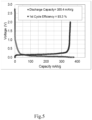
Fig.5 illustrates a graph representing charging capacity, discharge capacity and first cycle efficiency of a graphite by executing the process parameters according to various embodiment of the present invention; -
Fig.6 illustrates a round edged graphite particles, according to various embodiments of the present invention; and -
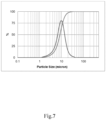
Fig.7 illustrates a graph representing size of the graphite particles, according to various embodiments of the present invention. - Like numerals denote like elements throughout the figures.
- The exemplary embodiments described herein detail for illustrative purposes are subjected to many variations. It should be emphasized, however, that the present invention is defined by the scope of the appended claims.
- Unless otherwise specified, the terms, which are used in the specification and claims, have the meanings commonly used in the field of system for producing coke and process involved therein. Specifically, the following terms have the meanings indicated below.
- The terms "a" and "an" herein do not denote a limitation of quantity, but rather denote the presence of at least one of the referenced items.
- The terms "having", "comprising", "including", and variations thereof signify the presence of a component.
- The term "mesophase" herein refers nematic liquid crystal structure, which can be easily graphitizable and can be used as a promising feed material to prepare anisotropic graphite materials with high performance and multifunction.
-
Fig.1 illustrates an exemplary block diagram of a system (1000) for producing a mesophase coke from an isotropic pitch. The said system (1000) includes a reservoir (200) containing the said isotropic pitch.In one embodiment of the present invention, the said isotropic pitch is selected from at least one of coal tar or petroleum tar. - Further, it will be appreciated by those skilled in the art that the said isotropic pitch usually has high amount of aromatic content and less than or equal to 2% of quinoline insoluble (QI) content. Furthermore, the isotropic pitch selected has a softening point (SP) temperature in the range of 80°C to 120°C. The said isotropic pitch used may be in liquid or solid state.
- In the said embodiment of the present invention, the said isotropic pitch with above parameters may influence the type of the final product, which is mesophase coke obtained, and the electrochemical properties thereof.
- Further, as shown in
Fig.1 , the said system (1000) includes a reactor (100) to carry out production of the said mesophase coke from the said isotropic pitch. - The reactor (100) includes a plurality of zones (101), (102), (103), (104), (105), (106). In an embodiment of the present invention, the said plurality of zones includes an entry zone (101) having a container (50).
- The said container (50) is adapted to receive the said isotropic pitch from the said reservoir (200).
- In the said embodiment, the said isotropic pitch is pumped to the said container (50) in a predetermined quantity.
- As shown in
Fig.1 , the said plurality of zones (101), (102), (103), (104), (105), (106) further includes a first heating zone (102) inside the said reactor (100). The said first heating zone (102) is adapted to carry out pretreating of the said isotropic pitch. - More specifically, in the said embodiment of the present invention, a pre-conditioning of the said isotropic pitch takes place at a temperature of 250° C to 350° C under atmospheric pressure to reduce or eliminate many of the volatile emissions of the said isotropic pitch.
- Further, the said plurality of zones (101), (102), (103), (104), (105), (106) includes a second heating zone (103) inside the said reactor (100). The said second heating zone (103) is adapted to carry out heating of a pretreated isotropic pitch.
- More specifically, a pyrolysis of the said pretreated isotropic pitch takes places inside the said second heating zone (103) at a temperature of 350° C to 500°C under atmospheric pressure to convert the said isotropic pitch into a mesophase pitch.
- In the said embodiment of the present invention, at the said temperature range, the change in the physical appearance and chemical composition of the said isotropic pitch takes place. More specifically, the formation of the mesophase occurs in the said isotropic pitch. Subsequently, this may lead to the conversion of the said isotropic pitch into anisotropic phase.
- Further, in the said embodiment, the mesophase pitch appears as spheres, and formation rate of the said mesophase depends on the chemical composition of a precursor i.e. said isotropic pitch.
- More preferably, the formation of the said mesophase depends on the residence time of the isotropic pitch in the reactor (100)and temperature condition for producing said mesophase coke.
- Further, more specifically, stacked flat molecules of the said pitch, form the mesophase spheres. Accordingly, the said mesophase spheres enlarge and merge together to form a bulk mesophase pitch at the end of the second heating zone (103).
- Further, the said plurality of heating zones (101), (102), (103), (104), (105), (106) further includes a third heating zone (104) inside the said reactor (100). The said third heating zone (104) is adapted to carry out heating of the said mesophase pitch obtained at the end of the said second heating zone (103).
- More specifically, pyrolysis of the said mesophase pitch is carried out inside the said third heating zone (104) at a temperature of 500° C to 800° C under the atmospheric pressure for a predetermined time. More preferably, the said mesophase pitch is converted into a mesophase coke in the temperature range of 500° C to 600° C in the third heating zone (104).
- The said mesophase coke obtained after the third heating zone (104) is anisotropic in nature and has a mesophase content of 80% to 100% percent.
- In another embodiment of the present invention, the said first heating zone (102), the said second heating zone (103) and the said third heating zone (104) further includes multiple heating zones there within for having a fine control on the temperature inside the heating zones (102), (103), (104). More preferably, the said multiple heating zones operate at the temperature in which the said mesophase coke would be of high quality.
- In one embodiment of the present invention, the plurality of zones (101), (102), (103), (104), (105), (106) further includes a cooling zone (105). The said cooling zone (105) is adapted to cool the said mesophase coke obtained at the end of the said third heating zone (104) (refer
Fig.1 ). - Furthermore, the said plurality of zones (101), (102), (103), (104), (105), (106) includes an exit zone (106) inside the said reactor (100). The said exit zone (106) is adapted to store the said mesophase coke that is obtained from the said cooling zone (106) (refer
Fig.1 ). - In one embodiment of the present invention, the system (1000) includes a pusher unit (300) (refer
Fig.1 &Fig.2 ). The said pusher unit (300) is adapted to physically move the said container form the said from the said entry zone (101) to the said first heating zone (102), the said second heating zone (103), and the said third heating zone (104) through the exit zone (106) to obtain the mesophase coke at the said exit zone (106). - The said pusher unit (300) includes hydraulic pusher system. The said hydraulic pusher system includes a hydraulic pump (302) to allow flow of the said hydraulic fluid from a base (301) through the said fluid hydraulic pusher system to generate hydraulic power. Further, the said hydraulic pusher system includes a hydraulic valve (303) to regulate the flow of the said hydraulic fluid to achieve variable pushing speed. This gives operational flexibility to change the residence time in the said plurality of zones(101), (102), (103), (104), (105), (106) to produce the controlled mesophase material (refer
Fig.2 ). - The said hydraulic pusher system further includes a hydraulic cylinder (304) to convert the said hydraulic energy into a mechanical energy to push the said container (50) through the said the said plurality of zones(101), (102), (103), (104), (105), (106) (refer
Fig.2 ). - In another embodiment of the present invention, the system (1000) further includes a crusher unit (600). The said crusher unit (600) is adapted to crush the said mesophase coke discharged from the said exit zone (106) into coke granules (refer
Fig.1 ). Very small sizes must be screened from the crushed coke, leaving an acceptable size of about less than 20mm. - In another embodiment of the present invention, the system (1000) further includes a pneumatic conveying system (700). The said pneumatic conveying system (700) is adapted to transport the said coke granules extracted from the said mesophase coke (refer
Fig.1 ) to a hopper (800), where the said granules stored. - More preferably, the said coke granules are transferred though an enclosed pipeline by using collective force pressure and air into the said hopper (800).
- In the said embodiment, the pressure and flow of the air is required to convey the said coke granules form the said crusher unit (600) to the said hopper (800).
- In another embodiment of the present invention, the said reactor (100) is further adapted to evaporate some portion of the said pitch.
- In this embodiment of the present invention, the system (1000) includes a condensing unit (400).The said condensing unit (400) is adapted to condense the said evaporated unused pitch into condensate oil.
- In another embodiment of the present invention, the said system (1000) may further include an oil tank (500). The said oil tank (500) is adapted to store the condensate oil with the said light cracking products.
- The underlying process for preparation of mesophase coke as explained in relation to the system (1000) will now be explained with reference to a flow chart, (refer
Fig. 3 ). - At step (10), the said process (900) involves feeding of an isotropic pitch into a container (50) from a reservoir (200). This container (50) is then loaded into a reactor (100).
- In an embodiment, the said container (50) is placed in an entry zone (101) of the reactor (100) in a predetermined quantity.
- At step (12), the said process (900) includes physically moving the said container (50) filled with said isotropic pitch to a first heating zone (102).Wherein, the said container (50) is moved with a fixed speed in a linear motion.
- In the embodiment of the present invention, the physically moving of the container (50) from entry zone to first heating zone (101) is done via a pusher unit (300).
- At step (14), the said process (900) involves pretreating of the said isotropic pitch inside the said first heating zone (102) of the said reactor (100). Wherein, the said heating zone operates at a temperature of 250° C to 350°C under atmospheric pressure for a predetermined time (refer
Fig.3 ). - In the embodiment of the present invention, as explained above, the said pretreating or pre-conditioning of the said isotropic pitch is required to reduce or eliminate many of the volatile emissions of the said isotropic pitch.
- Further, at step (16), the said process involves physically moving the said container (50) from the said first heating zone (102) via the said pusher unit (300) to a second heating zone (103). Again, it should be appreciated that the material is not moved but the container (50) is moved inside the reactor (100).
- In the embodiment of the present invention, after pretreating of the said isotropic pitch, the said container (50) filled with a pretreated pitch move to the next section i.e. second heating zone (103).
- At step (18), the said process (900) involves heating the pretreated isotropic pitch inside the said second heating zone (103) of the said reactor (100) by maintaining the temperature of 350° C - 500°C under the atmospheric pressure.
- In the embodiment, at the said temperature range the change in the physical appearance and chemical composition takes place. More specifically, in the said embodiment the formation of the mesophase occurs in the said pretreated isotropic pitch. Subsequently, this may lead to the conversion of the said isotropic pitch into anisotropic phase.
- Further in the said embodiment, the mesophase pitch appears as spheres, and the formation rate of the said mesophase depends on the chemical composition of a precursor i.e. said isotropic pitch.
- Further at step (20), the said process (900) involves physically moving the said container (50) from the second heating zone (103) to a third heating zone (104) via the said pusher unit (300).
- At step (22), the process (900) is continued with heating of the said mesophase pitch inside the said third heating zone (104) of the said reactor (100) by maintaining the temperature of 450° C - 800° C. More preferably, at the temperature of 480° C - 600° C under the atmospheric pressure to obtain mesophase coke (refer
Fig.3 ). Again, it should be appreciated that the material is not moved but the container (50) is moved inside the reactor (100). - At step (24), the process (900) includes physically moving the said container (50) from the said third heating zone (104) via the said pusher unit (300) to a cooling zone (105).
- At step (26), the process (900) further includes cooling of the said mesophase coke.
- Further, at step (28), the process (900) includes physically moving the said container (50) from the said cooling zone (105) via the pusher unit (300) to an exit zone (106).
- Further, at step (30), the process (900) includes discharging the said mesophase coke from the said exit zone (106) (refer
Fig.3 ). - At step (32), the process (900) is followed by crushing the said mesophase coke inside a crushing unit (600). Wherein, the said crushing is required to convert the said mesophase coke to coke granules.
- Further at step (34), the said process (900) includes transporting the said coke granules from the said crushing unit (600) into a hopper (800) via a pneumatic conveying system (700).
- In another embodiment of the present invention, recovering of unused pitch occurs. More preferably, some portion of isotropic pitch evaporates during the production of the mesophase coke inside the said reactor (100) (refer
Fig.3 ). - In the said embodiment of the present invention, at step (36), the said process (900) includes evaporating the said unused pitch from the said reactor (100) to a condensing unit (400) (refer
Fig.3 ). - At step (38), the said process (900) further involves condensing of the said evaporated pitch in a condensing unit (400) to obtain condensate oil (refer
Fig.3 ). - Furthermore, at step (40), the said process (900) includes pumping the said condensate oil in an oil tank (500) (refer
Fig.3 ). - The system and process disclosed herein is feasible, sustainable, effective and efficient as compared to existing system and process. Further, the present invention ensures the homogeneity of the mesophase coke prepared.
- Further, conventionally the mesophase coke is generally made from mesophase pitch with mesophase content of more than 50% with softening point of more than 200° C. However, very few of them have been taken to industrial scale, due to high cost of mesophase pitch.
- Therefore, the present invention provides a system and process to produce mesophase coke from pitch having a softening point of less than 200° C.
- In the existing batch process, the precursor is pyrolyzed at high pressure until a certain amount of mesophase is prepared. The mesophase pitch is then subjected to a separation process by mechanical or chemical process, which needs complicated equipment and solvents.
- Further, the process of producing mesophase coke is carried out in a multiple heating zone of a single reactor, so the present invention does not require high temperature pumps and high pressure to transfer the pitch. As in the existing system and process, the high temperature pumps and high pressure are required to transfer the mesophase pitch from one reactor to another to complete the production of mesophase coke. So far it is been done manufacturing mesophase pitch in a separate reactor/plant, and meso coke in another reactor/plant. In the declared system it is dome in a single reactor.
- In addition, a residence time in the present invention is very well controlled by a speed of the pusher unit. Accordingly, it controls the formation of a mesophase spheres during the pyrolytic process to prepare the mesophase coke of reproducible quality. Further, the property of the said prepared mesophase coke is having a particular interest in applications such as in a production of graphite anode for Lithium ion battery.
- Further, for a better understanding of the said present invention and to show how the said system and process may be carried into effect, various references will now be made. Using the said system and process four experiments were carried out using different parameters.
- The first example illustrates the operation of the present invention with a coal tar pitch with softening point (SP) of 100 and QI of 2%. The temperature of first heating zone (102) was 250°C-350°C and the experiment was performed at atmospheric pressure. The temperature of the second heating zone (103) and third heating zone (104) were set to 350°C-500°C and 500°C- 800°C, respectively, with the residence time of 10hours. The bulk mesophase coke obtained from the reactor (100) is containing more than 75% anisotropy. The appearance optical micrograph of the said coke (refer
Fig. 4 ). - The graphite anode prepared from the said coke gives 335mAh/g with first cycle efficiency of 92%. The said graphite anode charge at 2C to 48% of it is capacity, and discharges 99% at 3C rate.
- This example no. 2 illustrates the operation of the present invention with a coal tar pitch with SP of 100 with QI of <0.2%. The temperature of first heating zone (102) was 250°C-350°C and the experiment was performed at atmospheric pressure. The temperature of the second heating zone (103) and third heating zone (104) were set to 350°C-450°C and 450°C-800°C, respectively, with the residence time of 10 hours. The bulk mesophase coke obtained from the reactor (100) is containing more than 90% anisotropy.
- The graphite anode prepared from the said coke gives 355mAh/g with first cycle efficiency of 93%. The said graphite anode charge at 2C to 30% of it is capacity, and discharges 92% at 3C rate. The charging and discharging curves of this graphite is shown in
Fig.5 . - This example illustrates the operation of the present invention with a coal tar pitch with SP of 100 with QI of < 0.2%. The temperature of
zone 1 was 250°C -350°C and the experiment was performed at atmospheric pressure. The temperature of the second heating zone (103) and third heating zone (104) were set to 350°C -430°C and 450°C - 800°C, respectively, with the residence time of 20hours. The bulk mesophase coke obtained from the reactor (100) is containing more than 90% anisotropy. - The graphite anode prepared from the said coke gives 362mAh/g with first cycle efficiency of 93%. The said graphite anode charge at 2C to 30% of it is capacity, and discharges 91% at 3C rate.
- This example illustrates the operation of the present invention with a coal tar pitch with SP of 100 with QI of <0.2%. The temperature of first heating zone (102) was 250°C - 350°C and the experiment was performed at atmospheric pressure. The temperature of the second heating zone (103) and the third heating zone (104) were set to 350°C - 450°C and 450°C - 550°C, respectively, with the residence time of 10hours. The bulk mesophase coke obtained from the reactor (100) is containing more than 90% anisotropy.
- The graphite anode prepared from this coke gives 356mAh/g with first cycle efficiency of 94%. It charges at 2C to 32% of it is capacity. It discharges 93% at 3C rate. This electrode may reach density of up to 1.8g/cc.
- Further, the graphite particles which are produced by the said process are having round edge (refer.
Fig.6 ). The round edged graphite particles ensure easy electrode coating process. Accordingly, the resultant high density electrode may have good porosity and particle orientation. - Furthermore, the electrode produced by the said process may have better wettability and high rate of charging and discharging.
- As from the graph shown in
Fig.7 , the size of the graphite particles may be controlled according to the requirement. Further, the graph is plotted between percentile and size of the graphite particles. - Additionally, the size of graphite particles are shown in table-1 below:
Table-1 %tile Size in Micron (µm) 10 % 4.2 20 % 5.7 30 % 6.7 40 % 7.7 50 % 8.6 60 % 9.6 70 % 10.7 80 % 12.2 90 % 14.7 95 % 17.5 100 % 40.0 - The feed material and process parameters of the above examples are shown in the table-2 below:
Table-2 Parameters Unit Example-1 Example-2 Example-3 Example-4 Quinoline insoluble (QI) % 1.9 0.2 0.2 0.2 First Heating Zone % 250-350 250-350 250-350 250-350 Second Heating Zone °C 350-500 350-500 350-500 350-450 Third Heating Zone °C 500-800 500-800 500-800 450-600 Time Hrs 10 10 20 10 - The properties of the battery, in which graphite anode is made from the mesophase coke with respect to the above examples are shown in table-3 below:
Table-3 Parameters Unit Example-1 Example-2 Example-3 Example-4 Capacity mAh/g 335 355 362 355 Efficiency % 92 93 93 94 Electrode Density g/cc 1.6 1.6 1.6 1.8 Rate of Charging 2C/0.2C 335 48 30 28 32 Rate of Discharging 3C/0.2C % 99 92 91 93 - The comparison data of performance of the electrode formed using the mesophase coke composition prepared by the said process vis-a-vi state of the art is shown in table-4 below
Table-4 Parameters Unit State of the art Present invention Capacity mAh/g 350 355 Efficiency % 92 94 Electrode Density g/cc 1.7 1.8 Rate of Charging 2C/0.2 C % 25 32 Rate of Discharging 3C/0.2C % 88 93 - Therefore, the present invention describes the process by which electrode of high density may achieved. Accordingly, this would help to make high energy density battery. Furthermore, the electrode produced has better rate of charging and discharging, which enables to make high power battery.
- Therefore, the present invention is a system and a process for producing coke, which is feasible, sustainable, effective, and efficient as compared to existing processes.
- The foregoing descriptions of specific embodiments of the present invention have been presented for purposes of description. They are not intended to be exhaustive or to limit the present invention to the precise forms disclosed, and obviously many modifications and variations are possible in light of the above teaching.
- Further, the embodiments were chosen and described in order to best explain the principles of the present invention and its practical application, and thereby enable others skilled in the art to best utilize the present invention and various embodiments with various modifications as are suited to the particular use contemplated. It is understood that various omissions and substitutions of equivalents are contemplated as circumstances may suggest or render expedient, but such omissions and substitutions are intended to cover the application or implementation without departing from the scope of the present inventior as defined in the appended claims
50 Container 100 Reactor 101 Entry chamber 102 First heating zone 103 Second heating zone 104 Third heating zone 105 Cooling zone 106 Exit chamber 200 Reservoir 300 Pusher system 301 Base 302 Hydraulic pump 303 Hydraulic valve 304 Hydraulic cylinder 400 Condensing unit 500 Oil tank 600 Crushing unit 700 Pneumatic Conveying System 800 Hopper 900 Process
Claims (12)
- A system (1000) for producing mesophase coke from an isotropic pitch, the system comprising:a reactor (100) comprising:an entry zone (101) having a container (50), wherein the said container (50) is being adapted to receive the said isotropic pitch,a first heating zone (102) adapted to carry out pretreating of the said isotropic pitch by operating the said first heating zone (102) at a temperature of 250° C - 350° C under atmospheric pressure,a second heating zone (103) adapted to carry out heating of the said pretreated isotropic pitch by maintaining the temperature of 350° C - 500°C under atmospheric pressure to convert the said isotropic pitch to obtain mesophase pitch,a third heating zone (104) adapted to carry out heating of the said mesophase pitch by maintaining the temperature of 500°C - 800° C under the atmospheric pressure to obtain mesophase coke, andan exit zone (106) adapted to discharge the said mesophase coke from the reactor (100); anda pusher unit (300) adapted to:physically move the said container (50) from the said entry zone (101) to the said first heating zone (102), the said second heating zone (103), the said third heating zone (104) through the exit zone (106) to obtain the mesophase coke at the said exit zone (106);wherein: the said pusher unit (300) comprising a hydraulic pusher system having a hydraulic valve (303) to regulate the flow of the said hydraulic fluid to achieve variable pushing speed.
- The system (1000) as claimed in claim 1 further comprising a reservoir (200) being adapted to:store the said isotropic pitch, andfeed the said isotropic pitch into the container (50).
- The system (1000) as claimed in claim 1, wherein the said reactor (100) further comprises a cooling zone (105) adapted to cool the said mesophase coke obtained from the third heating zone (104).
- The system (1000) as claimed in claim 1 further comprising:a crushing unit (600) being adapted to crush the said mesophase coke into coke granules; anda hopper (800) being adapted to receive and store the said coke granules.
- The system (1000) as claimed in claim 4 further comprising a pneumatic conveying system to transport the said coke granules from the said crushing unit into the said hopper (800).
- The system (1000) as claimed in claim 1 further comprising:a condensing unit (400) being adapted to condense pitch evaporated from the system to obtain condensate oil; andan oil tank (500) being adapted to store the said condensate oil.
- A process (900) for producing mesophase coke from an isotropic pitch, the process comprising:feeding an isotropic pitch into a container (50) placed in an entry zone (101) of a reactor (100);physically moving the said container (50) to a first heating zone (102) via a pusher unit (300), wherein the said container (50) is moved in a linear motion inside the said reactor (100);pretreating the said isotropic pitch inside the said first heating zone ( 102) of the said reactor (100), wherein the said first heating zone (102) operates at a temperature of 250°C - 350°C under atmospheric pressure;physically moving the said container (50) from the said first heating zone (102) via the pusher unit (300) to a second heating zone (103);heating pretreated isotropic pitch inside the said second heating zone (103) of the said reactor (100) by maintaining the temperature of 350° c - 500°Cunder the atmospheric pressure to obtain a mesophase pitch;physically moving the said container (50) from the second heating zone (103) via the said pusher unit (300) to a third heating zone (103) through the pusher unit (300);heating the said mesophase pitch inside the said third heating zone ( 104) of the said reactor (100) by maintaining the temperature of500°C - 800° C under the atmospheric pressure to obtain mesophase coke; andphysically moving the said container (50) from the said third heating zone (104) via the said pusher unit (300) to a cooling zone (105); and discharging the said mesophase coke from an exit zone (106) of the said reactor (100).
- The process (900) as claimed in claim 7, wherein the said isotropic pitch is selected from at least one of coal tar or petroleum tar, wherein the said isotropic pitch is having a softening point (SP) temperature of less than or equal to 100°C, and quinoline insoluble (QI) content of less than or equal to 2%.
- The process (900) as claimed in claimed 7 comprising feeding the said isotropic pitch from a reservoir (200).
- The process (900) as claimed in claim 7 comprising:cooling the said mesophase coke in the said cooling zone (105); andphysically moving the said container (50) from the said cooling zone (105) via the pusher unit (300) to an exit zone (106).
- The process (900) as claimed in claim 7 comprising:crushing the said mesophase coke to coke granules inside a crushing unit (600); andtransporting the said coke granules from the said crushing unit (600) into a hopper (800) via a pneumatic conveying system (700).
- The process (900) as claimed in claim 7 comprising:recovering unused pitch, the said recovering step comprising:evaporating unused pitch from the said reactor (100), andcondensing the said evaporated pitch in a condensing unit (400) to obtain condensate oil; andpumping the said condensate oil into an oil tank (500).
Applications Claiming Priority (2)
| Application Number | Priority Date | Filing Date | Title |
|---|---|---|---|
| IN202021022401 | 2020-05-28 | ||
| PCT/IB2020/056779 WO2021240223A1 (en) | 2020-05-28 | 2020-07-18 | System and process for producing mesophase coke from isotropic pitch |
Publications (4)
| Publication Number | Publication Date |
|---|---|
| EP4157966A1 EP4157966A1 (en) | 2023-04-05 |
| EP4157966A4 EP4157966A4 (en) | 2024-06-19 |
| EP4157966B1 true EP4157966B1 (en) | 2025-07-02 |
| EP4157966C0 EP4157966C0 (en) | 2025-07-02 |
Family
ID=78744150
Family Applications (1)
| Application Number | Title | Priority Date | Filing Date |
|---|---|---|---|
| EP20937460.2A Active EP4157966B1 (en) | 2020-05-28 | 2020-07-18 | System and process for producing mesophase coke from isotropic pitch |
Country Status (8)
| Country | Link |
|---|---|
| US (1) | US12421454B2 (en) |
| EP (1) | EP4157966B1 (en) |
| JP (1) | JP7617952B2 (en) |
| KR (1) | KR20230026356A (en) |
| CN (1) | CN115698228B (en) |
| CA (1) | CA3179604A1 (en) |
| ES (1) | ES3044909T3 (en) |
| WO (1) | WO2021240223A1 (en) |
Family Cites Families (20)
| Publication number | Priority date | Publication date | Assignee | Title |
|---|---|---|---|---|
| DE2747495C2 (en) * | 1977-10-22 | 1979-10-04 | Bergwerksverband Gmbh, 4300 Essen | Process for continuously producing a coke |
| JPS54119501A (en) * | 1978-03-10 | 1979-09-17 | Kawatetsu Kagaku Kk | Production of high quality needleetype coke |
| JPS60208393A (en) * | 1984-03-31 | 1985-10-19 | Nippon Steel Corp | Preparation of pitch for carbon product |
| US4631181A (en) * | 1984-03-31 | 1986-12-23 | Nippon Steel Corporation | Process for producing mesophase pitch |
| IT1178520B (en) * | 1984-09-28 | 1987-09-09 | Alusuisse Italia Spa | PROCEDURE AND TUNNEL OVEN FOR THE CALCINATION OF CARBON BODIES, IN PARTICULAR OF ELECTRODES |
| JPS61215692A (en) * | 1985-03-22 | 1986-09-25 | Sumitomo Metal Ind Ltd | Mesophase pitch suitable for high-performance carbon fiber and its production |
| US4924785A (en) * | 1988-12-05 | 1990-05-15 | Surface Combustion, Inc. | Thermal cleaning system |
| US5085738A (en) * | 1989-04-24 | 1992-02-04 | Harris Windel L | Method and apparatus for thermal conversion of organic matter |
| JPH02284989A (en) * | 1989-04-26 | 1990-11-22 | Nippon Steel Corp | Production of needle coke |
| FR2687998A1 (en) * | 1992-02-28 | 1993-09-03 | Aerospatiale | PROCESS FOR MANUFACTURING CARBON / CARBON COMPOSITE MATERIALS USING MESOPHASE POWDER |
| GB2303859A (en) * | 1995-07-31 | 1997-03-05 | Combined Recycling & Power Ltd | Tyre pyrolysis method and apparatus |
| US7150627B2 (en) * | 2005-04-30 | 2006-12-19 | Siddhartha Gaur | Transported material heating with controlled atmosphere |
| US20090114519A1 (en) * | 2006-04-03 | 2009-05-07 | Recuperacion Materiales Diversos, S.A. | Process and Equipment for the Treatment of Waste Materials |
| BRPI0711329A2 (en) * | 2006-05-05 | 2011-08-30 | Plascoenergy Ip Holdings S L Bilbao Schaffhausen Branch | HORIZONTALLY ORIENTED GAS SYSTEM WITH SIDE TRANSFER SYSTEM |
| AR064763A1 (en) * | 2007-01-08 | 2009-04-22 | Alcan Int Ltd | PROCESS OF SEPARATION OF COQUE IN A PASTA PLANT |
| US9376626B1 (en) * | 2011-04-28 | 2016-06-28 | Advanced Carbon Products, LLC | Turbulent mesophase pitch process and products |
| CN105623694B (en) * | 2015-12-23 | 2018-09-11 | 济宁碳素集团有限公司 | A kind of production method of mesophase pitch coke |
| CN109328215B (en) * | 2016-06-14 | 2021-06-25 | 理查德·斯通 | Turbulent Mesophase Pitch Process and Products |
| CN207793163U (en) * | 2017-12-06 | 2018-08-31 | 福建山脉竹循环科技有限公司 | A kind of self-loopa tunnel type carbonizing kiln |
| KR102136723B1 (en) * | 2018-08-24 | 2020-07-24 | (주)오니커스 | Multi-manufacturing system of white coal |
-
2020
- 2020-07-18 EP EP20937460.2A patent/EP4157966B1/en active Active
- 2020-07-18 WO PCT/IB2020/056779 patent/WO2021240223A1/en not_active Ceased
- 2020-07-18 CN CN202080101446.7A patent/CN115698228B/en active Active
- 2020-07-18 JP JP2022573641A patent/JP7617952B2/en active Active
- 2020-07-18 CA CA3179604A patent/CA3179604A1/en active Pending
- 2020-07-18 KR KR1020227045618A patent/KR20230026356A/en active Pending
- 2020-07-18 US US17/999,991 patent/US12421454B2/en active Active
- 2020-07-18 ES ES20937460T patent/ES3044909T3/en active Active
Also Published As
| Publication number | Publication date |
|---|---|
| CA3179604A1 (en) | 2021-12-02 |
| JP7617952B2 (en) | 2025-01-20 |
| US12421454B2 (en) | 2025-09-23 |
| US20230212462A1 (en) | 2023-07-06 |
| JP2023527243A (en) | 2023-06-27 |
| CN115698228B (en) | 2026-01-27 |
| EP4157966C0 (en) | 2025-07-02 |
| KR20230026356A (en) | 2023-02-24 |
| EP4157966A4 (en) | 2024-06-19 |
| ES3044909T3 (en) | 2025-11-27 |
| CN115698228A (en) | 2023-02-03 |
| WO2021240223A1 (en) | 2021-12-02 |
| EP4157966A1 (en) | 2023-04-05 |
Similar Documents
| Publication | Publication Date | Title |
|---|---|---|
| US8920680B2 (en) | Methods of preparing carbonaceous material | |
| US11394019B2 (en) | Method for producing carbonaceous material for negative electrode of non-aqueous electrolyte secondary battery and production apparatus thereof | |
| CN112300821B (en) | Preparation method of petroleum-based high-softening-point asphalt | |
| EP1977998B1 (en) | Original coal and stock oil composition for needle coke and for electricity storing carbon material | |
| EP4157966B1 (en) | System and process for producing mesophase coke from isotropic pitch | |
| CN112574770B (en) | Preparation method of high-quality coal-based needle coke | |
| JPS6229367B2 (en) | ||
| CN115521801B (en) | Method for preparing needle coke by composite modification of medium-low temperature coal tar pitch | |
| WO2005027242A1 (en) | Nonaqueous electrolyte secondary cell, carbon material for use therein and precursor of said carbon material | |
| US4624807A (en) | Process for producing microspherical, oil-containing carbonaceous particles | |
| HK40084456A (en) | System and process for producing mesophase coke from isotropic pitch | |
| CN112723887A (en) | Preparation method of high-density ultrafine particle graphite for ionization chamber | |
| CN117247005B (en) | Carbon material for lithium ion battery negative electrode and preparation method, lithium ion battery negative electrode and lithium ion battery | |
| JP2023117818A (en) | Method for manufacturing graphite electrode and method for manufacturing binder pitch for manufacturing graphite electrode | |
| CN114744175A (en) | Composition, graphite powder, anode powder and production method thereof | |
| KR102474281B1 (en) | Method of preparing heavy oil-derived anisotropic pitch suitable for carbon fiber based on mesogen separation | |
| WO2026035772A1 (en) | Modified hydrocarbon fluids for producing enhanced cokes and pitches | |
| CN120025842A (en) | Isotropic coke and isotropic graphite material and preparation method thereof | |
| WO2023139286A1 (en) | Improved particle coating method | |
| JP2002241763A (en) | Method for producing aggregate coke for artificial graphite | |
| JPH0260991A (en) | Production of raw material for carbonaceous material | |
| JPWO2007074939A1 (en) | Coking coal for power storage carbon materials | |
| JPH11214006A (en) | Carbon material for negative electrode of non-aqueous solvent secondary battery and method for producing the same |
Legal Events
| Date | Code | Title | Description |
|---|---|---|---|
| STAA | Information on the status of an ep patent application or granted ep patent |
Free format text: STATUS: THE INTERNATIONAL PUBLICATION HAS BEEN MADE |
|
| PUAI | Public reference made under article 153(3) epc to a published international application that has entered the european phase |
Free format text: ORIGINAL CODE: 0009012 |
|
| STAA | Information on the status of an ep patent application or granted ep patent |
Free format text: STATUS: REQUEST FOR EXAMINATION WAS MADE |
|
| 17P | Request for examination filed |
Effective date: 20221124 |
|
| AK | Designated contracting states |
Kind code of ref document: A1 Designated state(s): AL AT BE BG CH CY CZ DE DK EE ES FI FR GB GR HR HU IE IS IT LI LT LU LV MC MK MT NL NO PL PT RO RS SE SI SK SM TR |
|
| DAV | Request for validation of the european patent (deleted) | ||
| DAX | Request for extension of the european patent (deleted) | ||
| A4 | Supplementary search report drawn up and despatched |
Effective date: 20240522 |
|
| RIC1 | Information provided on ipc code assigned before grant |
Ipc: H01M 4/587 20100101ALI20240515BHEP Ipc: C10B 57/02 20060101ALI20240515BHEP Ipc: C10B 47/46 20060101ALI20240515BHEP Ipc: C10B 7/14 20060101ALI20240515BHEP Ipc: C10B 47/36 20060101ALI20240515BHEP Ipc: C10C 3/04 20060101ALI20240515BHEP Ipc: C10C 3/02 20060101ALI20240515BHEP Ipc: C10C 3/00 20060101AFI20240515BHEP |
|
| GRAP | Despatch of communication of intention to grant a patent |
Free format text: ORIGINAL CODE: EPIDOSNIGR1 |
|
| STAA | Information on the status of an ep patent application or granted ep patent |
Free format text: STATUS: GRANT OF PATENT IS INTENDED |
|
| INTG | Intention to grant announced |
Effective date: 20250306 |
|
| GRAS | Grant fee paid |
Free format text: ORIGINAL CODE: EPIDOSNIGR3 |
|
| GRAA | (expected) grant |
Free format text: ORIGINAL CODE: 0009210 |
|
| STAA | Information on the status of an ep patent application or granted ep patent |
Free format text: STATUS: THE PATENT HAS BEEN GRANTED |
|
| AK | Designated contracting states |
Kind code of ref document: B1 Designated state(s): AL AT BE BG CH CY CZ DE DK EE ES FI FR GB GR HR HU IE IS IT LI LT LU LV MC MK MT NL NO PL PT RO RS SE SI SK SM TR |
|
| REG | Reference to a national code |
Ref country code: GB Ref legal event code: FG4D |
|
| REG | Reference to a national code |
Ref country code: CH Ref legal event code: EP |
|
| REG | Reference to a national code |
Ref country code: DE Ref legal event code: R096 Ref document number: 602020054041 Country of ref document: DE |
|
| REG | Reference to a national code |
Ref country code: IE Ref legal event code: FG4D |
|
| U01 | Request for unitary effect filed |
Effective date: 20250801 |
|
| U07 | Unitary effect registered |
Designated state(s): AT BE BG DE DK EE FI FR IT LT LU LV MT NL PT RO SE SI Effective date: 20250828 |
|
| REG | Reference to a national code |
Ref country code: ES Ref legal event code: FG2A Ref document number: 3044909 Country of ref document: ES Kind code of ref document: T3 Effective date: 20251127 |
|
| PG25 | Lapsed in a contracting state [announced via postgrant information from national office to epo] |
Ref country code: IS Free format text: LAPSE BECAUSE OF FAILURE TO SUBMIT A TRANSLATION OF THE DESCRIPTION OR TO PAY THE FEE WITHIN THE PRESCRIBED TIME-LIMIT Effective date: 20251102 |
|
| PG25 | Lapsed in a contracting state [announced via postgrant information from national office to epo] |
Ref country code: NO Free format text: LAPSE BECAUSE OF FAILURE TO SUBMIT A TRANSLATION OF THE DESCRIPTION OR TO PAY THE FEE WITHIN THE PRESCRIBED TIME-LIMIT Effective date: 20251002 |
|
| PG25 | Lapsed in a contracting state [announced via postgrant information from national office to epo] |
Ref country code: HR Free format text: LAPSE BECAUSE OF FAILURE TO SUBMIT A TRANSLATION OF THE DESCRIPTION OR TO PAY THE FEE WITHIN THE PRESCRIBED TIME-LIMIT Effective date: 20250702 |
|
| PG25 | Lapsed in a contracting state [announced via postgrant information from national office to epo] |
Ref country code: GR Free format text: LAPSE BECAUSE OF FAILURE TO SUBMIT A TRANSLATION OF THE DESCRIPTION OR TO PAY THE FEE WITHIN THE PRESCRIBED TIME-LIMIT Effective date: 20251003 |
|
| PG25 | Lapsed in a contracting state [announced via postgrant information from national office to epo] |
Ref country code: CZ Free format text: LAPSE BECAUSE OF FAILURE TO SUBMIT A TRANSLATION OF THE DESCRIPTION OR TO PAY THE FEE WITHIN THE PRESCRIBED TIME-LIMIT Effective date: 20250702 |
|
| PG25 | Lapsed in a contracting state [announced via postgrant information from national office to epo] |
Ref country code: PL Free format text: LAPSE BECAUSE OF FAILURE TO SUBMIT A TRANSLATION OF THE DESCRIPTION OR TO PAY THE FEE WITHIN THE PRESCRIBED TIME-LIMIT Effective date: 20250702 |
|
| PG25 | Lapsed in a contracting state [announced via postgrant information from national office to epo] |
Ref country code: RS Free format text: LAPSE BECAUSE OF FAILURE TO SUBMIT A TRANSLATION OF THE DESCRIPTION OR TO PAY THE FEE WITHIN THE PRESCRIBED TIME-LIMIT Effective date: 20251002 |
|
| REG | Reference to a national code |
Ref country code: CH Ref legal event code: H13 Free format text: ST27 STATUS EVENT CODE: U-0-0-H10-H13 (AS PROVIDED BY THE NATIONAL OFFICE) Effective date: 20260224 |
|
| PG25 | Lapsed in a contracting state [announced via postgrant information from national office to epo] |
Ref country code: HU Free format text: LAPSE BECAUSE OF NON-PAYMENT OF DUE FEES Effective date: 20250719 |
|
| PG25 | Lapsed in a contracting state [announced via postgrant information from national office to epo] |
Ref country code: SM Free format text: LAPSE BECAUSE OF FAILURE TO SUBMIT A TRANSLATION OF THE DESCRIPTION OR TO PAY THE FEE WITHIN THE PRESCRIBED TIME-LIMIT Effective date: 20250702 |
|
| U90 | Renewal fees not paid: noting of loss of rights |
Free format text: RENEWAL FEE NOT PAID FOR YEAR 06 Effective date: 20260323 |
|
| PG25 | Lapsed in a contracting state [announced via postgrant information from national office to epo] |
Ref country code: CH Free format text: LAPSE BECAUSE OF NON-PAYMENT OF DUE FEES Effective date: 20250731 |
|
| PG25 | Lapsed in a contracting state [announced via postgrant information from national office to epo] |
Ref country code: SK Free format text: LAPSE BECAUSE OF FAILURE TO SUBMIT A TRANSLATION OF THE DESCRIPTION OR TO PAY THE FEE WITHIN THE PRESCRIBED TIME-LIMIT Effective date: 20250702 |