EP4156341A1 - Fast-charging graphite and battery - Google Patents
Fast-charging graphite and battery Download PDFInfo
- Publication number
- EP4156341A1 EP4156341A1 EP21868116.1A EP21868116A EP4156341A1 EP 4156341 A1 EP4156341 A1 EP 4156341A1 EP 21868116 A EP21868116 A EP 21868116A EP 4156341 A1 EP4156341 A1 EP 4156341A1
- Authority
- EP
- European Patent Office
- Prior art keywords
- graphite
- fast
- anode
- charging
- cathode
- Prior art date
- Legal status (The legal status is an assumption and is not a legal conclusion. Google has not performed a legal analysis and makes no representation as to the accuracy of the status listed.)
- Withdrawn
Links
Classifications
-
- H—ELECTRICITY
- H01—ELECTRIC ELEMENTS
- H01M—PROCESSES OR MEANS, e.g. BATTERIES, FOR THE DIRECT CONVERSION OF CHEMICAL ENERGY INTO ELECTRICAL ENERGY
- H01M4/00—Electrodes
- H01M4/02—Electrodes composed of, or comprising, active material
- H01M4/36—Selection of substances as active materials, active masses, active liquids
- H01M4/58—Selection of substances as active materials, active masses, active liquids of inorganic compounds other than oxides or hydroxides, e.g. sulfides, selenides, tellurides, halogenides or LiCoFy; of polyanionic structures, e.g. phosphates, silicates or borates
- H01M4/583—Carbonaceous material, e.g. graphite-intercalation compounds or CFx
- H01M4/587—Carbonaceous material, e.g. graphite-intercalation compounds or CFx for inserting or intercalating light metals
-
- H—ELECTRICITY
- H01—ELECTRIC ELEMENTS
- H01M—PROCESSES OR MEANS, e.g. BATTERIES, FOR THE DIRECT CONVERSION OF CHEMICAL ENERGY INTO ELECTRICAL ENERGY
- H01M4/00—Electrodes
- H01M4/02—Electrodes composed of, or comprising, active material
- H01M4/36—Selection of substances as active materials, active masses, active liquids
- H01M4/58—Selection of substances as active materials, active masses, active liquids of inorganic compounds other than oxides or hydroxides, e.g. sulfides, selenides, tellurides, halogenides or LiCoFy; of polyanionic structures, e.g. phosphates, silicates or borates
- H01M4/583—Carbonaceous material, e.g. graphite-intercalation compounds or CFx
-
- C—CHEMISTRY; METALLURGY
- C01—INORGANIC CHEMISTRY
- C01B—NON-METALLIC ELEMENTS; COMPOUNDS THEREOF; METALLOIDS OR COMPOUNDS THEREOF NOT COVERED BY SUBCLASS C01C
- C01B32/00—Carbon; Compounds thereof
- C01B32/20—Graphite
-
- H—ELECTRICITY
- H01—ELECTRIC ELEMENTS
- H01M—PROCESSES OR MEANS, e.g. BATTERIES, FOR THE DIRECT CONVERSION OF CHEMICAL ENERGY INTO ELECTRICAL ENERGY
- H01M10/00—Secondary cells; Manufacture thereof
- H01M10/05—Accumulators with non-aqueous electrolyte
- H01M10/052—Li-accumulators
-
- H—ELECTRICITY
- H01—ELECTRIC ELEMENTS
- H01M—PROCESSES OR MEANS, e.g. BATTERIES, FOR THE DIRECT CONVERSION OF CHEMICAL ENERGY INTO ELECTRICAL ENERGY
- H01M10/00—Secondary cells; Manufacture thereof
- H01M10/05—Accumulators with non-aqueous electrolyte
- H01M10/052—Li-accumulators
- H01M10/0525—Rocking-chair batteries, i.e. batteries with lithium insertion or intercalation in both electrodes; Lithium-ion batteries
-
- H—ELECTRICITY
- H01—ELECTRIC ELEMENTS
- H01M—PROCESSES OR MEANS, e.g. BATTERIES, FOR THE DIRECT CONVERSION OF CHEMICAL ENERGY INTO ELECTRICAL ENERGY
- H01M4/00—Electrodes
- H01M4/02—Electrodes composed of, or comprising, active material
- H01M4/04—Processes of manufacture in general
- H01M4/0402—Methods of deposition of the material
- H01M4/0404—Methods of deposition of the material by coating on electrode collectors
-
- H—ELECTRICITY
- H01—ELECTRIC ELEMENTS
- H01M—PROCESSES OR MEANS, e.g. BATTERIES, FOR THE DIRECT CONVERSION OF CHEMICAL ENERGY INTO ELECTRICAL ENERGY
- H01M4/00—Electrodes
- H01M4/02—Electrodes composed of, or comprising, active material
- H01M4/13—Electrodes for accumulators with non-aqueous electrolyte, e.g. for lithium-accumulators; Processes of manufacture thereof
- H01M4/131—Electrodes based on mixed oxides or hydroxides, or on mixtures of oxides or hydroxides, e.g. LiCoOx
-
- H—ELECTRICITY
- H01—ELECTRIC ELEMENTS
- H01M—PROCESSES OR MEANS, e.g. BATTERIES, FOR THE DIRECT CONVERSION OF CHEMICAL ENERGY INTO ELECTRICAL ENERGY
- H01M4/00—Electrodes
- H01M4/02—Electrodes composed of, or comprising, active material
- H01M4/13—Electrodes for accumulators with non-aqueous electrolyte, e.g. for lithium-accumulators; Processes of manufacture thereof
- H01M4/133—Electrodes based on carbonaceous material, e.g. graphite-intercalation compounds or CFx
-
- H—ELECTRICITY
- H01—ELECTRIC ELEMENTS
- H01M—PROCESSES OR MEANS, e.g. BATTERIES, FOR THE DIRECT CONVERSION OF CHEMICAL ENERGY INTO ELECTRICAL ENERGY
- H01M4/00—Electrodes
- H01M4/02—Electrodes composed of, or comprising, active material
- H01M4/13—Electrodes for accumulators with non-aqueous electrolyte, e.g. for lithium-accumulators; Processes of manufacture thereof
- H01M4/134—Electrodes based on metals, Si or alloys
-
- H—ELECTRICITY
- H01—ELECTRIC ELEMENTS
- H01M—PROCESSES OR MEANS, e.g. BATTERIES, FOR THE DIRECT CONVERSION OF CHEMICAL ENERGY INTO ELECTRICAL ENERGY
- H01M4/00—Electrodes
- H01M4/02—Electrodes composed of, or comprising, active material
- H01M4/13—Electrodes for accumulators with non-aqueous electrolyte, e.g. for lithium-accumulators; Processes of manufacture thereof
- H01M4/136—Electrodes based on inorganic compounds other than oxides or hydroxides, e.g. sulfides, selenides, tellurides, halogenides or LiCoFy
-
- H—ELECTRICITY
- H01—ELECTRIC ELEMENTS
- H01M—PROCESSES OR MEANS, e.g. BATTERIES, FOR THE DIRECT CONVERSION OF CHEMICAL ENERGY INTO ELECTRICAL ENERGY
- H01M4/00—Electrodes
- H01M4/02—Electrodes composed of, or comprising, active material
- H01M4/36—Selection of substances as active materials, active masses, active liquids
-
- H—ELECTRICITY
- H01—ELECTRIC ELEMENTS
- H01M—PROCESSES OR MEANS, e.g. BATTERIES, FOR THE DIRECT CONVERSION OF CHEMICAL ENERGY INTO ELECTRICAL ENERGY
- H01M4/00—Electrodes
- H01M4/02—Electrodes composed of, or comprising, active material
- H01M4/36—Selection of substances as active materials, active masses, active liquids
- H01M4/362—Composites
- H01M4/364—Composites as mixtures
-
- H—ELECTRICITY
- H01—ELECTRIC ELEMENTS
- H01M—PROCESSES OR MEANS, e.g. BATTERIES, FOR THE DIRECT CONVERSION OF CHEMICAL ENERGY INTO ELECTRICAL ENERGY
- H01M4/00—Electrodes
- H01M4/02—Electrodes composed of, or comprising, active material
- H01M4/36—Selection of substances as active materials, active masses, active liquids
- H01M4/362—Composites
- H01M4/366—Composites as layered products
-
- H—ELECTRICITY
- H01—ELECTRIC ELEMENTS
- H01M—PROCESSES OR MEANS, e.g. BATTERIES, FOR THE DIRECT CONVERSION OF CHEMICAL ENERGY INTO ELECTRICAL ENERGY
- H01M4/00—Electrodes
- H01M4/02—Electrodes composed of, or comprising, active material
- H01M4/36—Selection of substances as active materials, active masses, active liquids
- H01M4/38—Selection of substances as active materials, active masses, active liquids of elements or alloys
- H01M4/386—Silicon or alloys based on silicon
-
- H—ELECTRICITY
- H01—ELECTRIC ELEMENTS
- H01M—PROCESSES OR MEANS, e.g. BATTERIES, FOR THE DIRECT CONVERSION OF CHEMICAL ENERGY INTO ELECTRICAL ENERGY
- H01M4/00—Electrodes
- H01M4/02—Electrodes composed of, or comprising, active material
- H01M4/36—Selection of substances as active materials, active masses, active liquids
- H01M4/48—Selection of substances as active materials, active masses, active liquids of inorganic oxides or hydroxides
- H01M4/485—Selection of substances as active materials, active masses, active liquids of inorganic oxides or hydroxides of mixed oxides or hydroxides for inserting or intercalating light metals, e.g. LiTi2O4 or LiTi2OxFy
-
- H—ELECTRICITY
- H01—ELECTRIC ELEMENTS
- H01M—PROCESSES OR MEANS, e.g. BATTERIES, FOR THE DIRECT CONVERSION OF CHEMICAL ENERGY INTO ELECTRICAL ENERGY
- H01M4/00—Electrodes
- H01M4/02—Electrodes composed of, or comprising, active material
- H01M4/36—Selection of substances as active materials, active masses, active liquids
- H01M4/48—Selection of substances as active materials, active masses, active liquids of inorganic oxides or hydroxides
- H01M4/50—Selection of substances as active materials, active masses, active liquids of inorganic oxides or hydroxides of manganese
- H01M4/505—Selection of substances as active materials, active masses, active liquids of inorganic oxides or hydroxides of manganese of mixed oxides or hydroxides containing manganese for inserting or intercalating light metals, e.g. LiMn2O4 or LiMn2OxFy
-
- H—ELECTRICITY
- H01—ELECTRIC ELEMENTS
- H01M—PROCESSES OR MEANS, e.g. BATTERIES, FOR THE DIRECT CONVERSION OF CHEMICAL ENERGY INTO ELECTRICAL ENERGY
- H01M4/00—Electrodes
- H01M4/02—Electrodes composed of, or comprising, active material
- H01M4/36—Selection of substances as active materials, active masses, active liquids
- H01M4/48—Selection of substances as active materials, active masses, active liquids of inorganic oxides or hydroxides
- H01M4/52—Selection of substances as active materials, active masses, active liquids of inorganic oxides or hydroxides of nickel, cobalt or iron
- H01M4/525—Selection of substances as active materials, active masses, active liquids of inorganic oxides or hydroxides of nickel, cobalt or iron of mixed oxides or hydroxides containing iron, cobalt or nickel for inserting or intercalating light metals, e.g. LiNiO2, LiCoO2 or LiCoOxFy
-
- H—ELECTRICITY
- H01—ELECTRIC ELEMENTS
- H01M—PROCESSES OR MEANS, e.g. BATTERIES, FOR THE DIRECT CONVERSION OF CHEMICAL ENERGY INTO ELECTRICAL ENERGY
- H01M4/00—Electrodes
- H01M4/02—Electrodes composed of, or comprising, active material
- H01M4/36—Selection of substances as active materials, active masses, active liquids
- H01M4/58—Selection of substances as active materials, active masses, active liquids of inorganic compounds other than oxides or hydroxides, e.g. sulfides, selenides, tellurides, halogenides or LiCoFy; of polyanionic structures, e.g. phosphates, silicates or borates
- H01M4/5825—Oxygenated metallic salts or polyanionic structures, e.g. borates, phosphates, silicates, olivines
-
- H—ELECTRICITY
- H01—ELECTRIC ELEMENTS
- H01M—PROCESSES OR MEANS, e.g. BATTERIES, FOR THE DIRECT CONVERSION OF CHEMICAL ENERGY INTO ELECTRICAL ENERGY
- H01M4/00—Electrodes
- H01M4/02—Electrodes composed of, or comprising, active material
- H01M4/62—Selection of inactive substances as ingredients for active masses, e.g. binders, fillers
- H01M4/624—Electric conductive fillers
- H01M4/625—Carbon or graphite
-
- H—ELECTRICITY
- H01—ELECTRIC ELEMENTS
- H01M—PROCESSES OR MEANS, e.g. BATTERIES, FOR THE DIRECT CONVERSION OF CHEMICAL ENERGY INTO ELECTRICAL ENERGY
- H01M4/00—Electrodes
- H01M4/02—Electrodes composed of, or comprising, active material
- H01M4/64—Carriers or collectors
- H01M4/66—Selection of materials
- H01M4/661—Metal or alloys, e.g. alloy coatings
-
- H—ELECTRICITY
- H01—ELECTRIC ELEMENTS
- H01M—PROCESSES OR MEANS, e.g. BATTERIES, FOR THE DIRECT CONVERSION OF CHEMICAL ENERGY INTO ELECTRICAL ENERGY
- H01M4/00—Electrodes
- H01M4/02—Electrodes composed of, or comprising, active material
- H01M4/64—Carriers or collectors
- H01M4/66—Selection of materials
- H01M4/665—Composites
- H01M4/667—Composites in the form of layers, e.g. coatings
-
- H—ELECTRICITY
- H01—ELECTRIC ELEMENTS
- H01M—PROCESSES OR MEANS, e.g. BATTERIES, FOR THE DIRECT CONVERSION OF CHEMICAL ENERGY INTO ELECTRICAL ENERGY
- H01M4/00—Electrodes
- H01M4/02—Electrodes composed of, or comprising, active material
- H01M2004/021—Physical characteristics, e.g. porosity, surface area
-
- H—ELECTRICITY
- H01—ELECTRIC ELEMENTS
- H01M—PROCESSES OR MEANS, e.g. BATTERIES, FOR THE DIRECT CONVERSION OF CHEMICAL ENERGY INTO ELECTRICAL ENERGY
- H01M4/00—Electrodes
- H01M4/02—Electrodes composed of, or comprising, active material
- H01M2004/026—Electrodes composed of, or comprising, active material characterised by the polarity
- H01M2004/027—Negative electrodes
-
- Y—GENERAL TAGGING OF NEW TECHNOLOGICAL DEVELOPMENTS; GENERAL TAGGING OF CROSS-SECTIONAL TECHNOLOGIES SPANNING OVER SEVERAL SECTIONS OF THE IPC; TECHNICAL SUBJECTS COVERED BY FORMER USPC CROSS-REFERENCE ART COLLECTIONS [XRACs] AND DIGESTS
- Y02—TECHNOLOGIES OR APPLICATIONS FOR MITIGATION OR ADAPTATION AGAINST CLIMATE CHANGE
- Y02E—REDUCTION OF GREENHOUSE GAS [GHG] EMISSIONS, RELATED TO ENERGY GENERATION, TRANSMISSION OR DISTRIBUTION
- Y02E60/00—Enabling technologies; Technologies with a potential or indirect contribution to GHG emissions mitigation
- Y02E60/10—Energy storage using batteries
Definitions
- This application relates to lithium-ion batteries, and more particularly to a fast-charging graphite and a battery.
- lithium ions need to be embedded in the layered graphite anode quickly. If the graphite has poor kinetics, the lithium ions cannot be fully embedded in the graphite bulk phase to form Li x C compound, and will precipitate on the surface of the pole piece to form lithium dendrites, thus affecting the cycle stability and safety of the cell. Therefore, the solid phase diffusion of lithium ions in graphite materials is considered the determining step in the overall electrode reaction, and directly affects the charging rate of the battery. Consequently, in order to accelerate the charging of electric vehicles, it is required to develop high-performance fast-charging graphite materials to improve the diffusion kinetics of the graphite cathodes.
- Chinese Patent Publication No. 106981632A discloses a method for improving the charging capacity of anode materials, in which petroleum coke or asphalt coke with smaller particle size is crushed to shorten the lithium-ion migration path; high-temperature graphitization treatment is conducted to improve the discharge capacity and efficiency of the anode material; and carbon coating and granulation are performed to overcome graphite anisotropy caused by the high-temperature graphitization treatment.
- Chinese Patent Publication No. 108832075A selects a graphite anode with fast charging capability by studying the OI values of the cathode and anode pieces.
- the graphitization degree refers to the proportion of the carbonaceous material that reaches the complete graphite crystal structure, and the higher the graphitization degree, the closer the carbonaceous material is to the complete graphite crystal, which is not conductive to the rapid intercalation and de-intercalation of lithium ions.
- the diffusion of lithium ions in the active electrode material is a limiting factor for the electrochemical reactions in the lithium-ion battery. Therefore, the lithium-ion diffusion coefficient is considered important for the optimization of the charge rate of the lithium-ion battery.
- a first objective of this application is to provide a graphite material having a great fast-charging performance.
- a second objective of this application is to provide a battery with the graphite as an anode active material, which exhibits excellent kinetic performance, charging capability and cycle performance.
- the disclosure provides a fast-charging graphite, wherein a graphitization degree of the fast-charging graphite is 90-97%; and a lithium-ion diffusion coefficient of the fast-charging graphite at 25°C and a state of charge (SOC) of 10% is 2.3 ⁇ 10 -14 - 8.7 ⁇ 10 -12 cm 2 /s.
- the graphitization degree of the fast-charging graphite is 92%-94%.
- the lithium-ion diffusion coefficient of the fast-charging graphite at 25°C and a SOC of 10% is 7.6 ⁇ 10 -13 - 6 ⁇ 10 -12 cm 2 /s.
- a particle size D 50 of the fast-charging graphite is 1-20 ⁇ m.
- the fast-charging graphite is selected from the group consisting of an artificial graphite, a natural graphite, a modified graphite, and a combination thereof.
- the present disclosure battery comprising:
- the anode active material further comprises at least one of a hard carbon, a soft carbon, a silicon-carbon composite, and a silicon-oxygen composite.
- the cathode plate comprises a cathode current collector and a cathode coating coated on at least one side of the cathode current collector; the cathode coating comprises a cathode active material; and the cathode active material comprises at least one of LiFePO 4 and Li a Ni x Co y M 1-x-y O 2 , wherein 0.95 ⁇ a ⁇ 1.2; 0 ⁇ x ⁇ 1; 0 ⁇ y ⁇ 1; 0 ⁇ x+y ⁇ 1; and M is aluminum and/or manganese.
- the anode current collector is selected from the group consisting of a copper foil, carbon paper, a copper-coated polymer film and a combination thereof.
- the cathode current collector is selected from the group consisting of an aluminum foil, a nickel foil, an aluminum-coated polymer film and a combination thereof an aluminum foil, a nickel foil, and an aluminum-coated polymer film.
- This application provides a graphite, with a graphitization degree g of 90-97% and a lithium-ion diffusion coefficient D of 2.3 ⁇ 10 -14 - 8.7 ⁇ 10 -12 cm 2 /s at 25°C and a state of charge (SOC) of 10%.
- XRD X-Ray Diffraction
- the lithium-ion diffusion coefficient D can be obtained by the galvanostatic intermittent titration technique (GITT). Specifically, graphite is made into a pole plate to be subjected to the GITT test in a button cell. The button cell is allowed to stand for 10 h, titrated at a constant current of 0.1 C for 10 min, and subjected to another standing for 10 h to allow the current to be stable.
- GITT galvanostatic intermittent titration technique
- the graphitization degree g of the fast-charging graphite provided herein is preferably 92-94%. If the graphitization degree is too low, the interlayer spacing of the fast-charging graphite is large, resulting in a loose structure, a low capacity, and a poor cycling stability. If the graphitization degree is too high, the interlayer spacing of the fast-charging graphite is small, which is not conducive to the rapid intercalation and de-intercalation of lithium ions.
- the fast-charging graphite provided herein has a particle size D 50 of 1-20 ⁇ m.
- the fast-charging graphite provided herein is selected from the group consisting of an artificial graphite, a natural graphite, a modified graphite, and a combination thereof.
- This application also provides a battery, which includes a cathode plate, an anode plate, a separator arranged between the cathode plate and the anode plate, and an electrolyte.
- the anode plate includes an anode current collector and an anode coating coated on at least one side of the anode current collector.
- the anode coating layer includes an anode active material.
- the anode active material includes the aforementioned fast-charging graphite.
- the anode active material further includes at least one of hard carbon, soft carbon, a silicon-carbon composite, and a silicon-oxygen composite.
- the cathode plate includes a cathode current collector and a cathode coating layer coated on at least one side of the cathode current collector.
- the cathode coating layer includes a cathode active material.
- the cathode active material includes at least one of LiFePO 4 and Li a Ni x Co y M 1-x-y O 2 , where 0.95 ⁇ a ⁇ 1.2; 0 ⁇ x ⁇ 1; 0 ⁇ y ⁇ 1; 0 ⁇ x+y ⁇ 1; and M is aluminum and/or manganese.
- the anode current collector is selecting from the group consisting of a copper foil, carbon paper, a copper-coated polymer film, and a combination thereof, preferably, copper foil.
- the cathode current collector is selecting from the group consisting of an aluminum foil, a nickel foil, and an aluminum-coated polymer, preferably, aluminum foil.
- both anode coating and cathode coating further includes a binder and a conductive agent, the type and proportion of which are determined according to actual requirements.
- the specific type and composition of the electrolyte and the separator are not specifically limited and can be selected according to the actual requirements.
- a fast-charging graphite, an aqueous dispersion of acrylonitrile multi-copolymer binder (LA133), sodium carboxymethyl cellulose (CMC) and Super P conductive carbon black (SP) were mixed in a weight ratio of 96.2:1.5:1.5:0.8, and dispersed in water to produce an anode slurry.
- the anode slurry was then coated on a copper foil, dried and cold pressed to a compacted density of 1.65 g/cc.
- the graphite had a graphitization degree g of 92.3% and a lithium-ion diffusion coefficient D of 6 ⁇ 10 -12 cm 2 /s at 25°C and 10% SOC.
- Nickel cobalt manganese oxide (NCM523, as the cathode active material), a polyvinylidene fluoride (PVDF) binder, Super P conductive carbon black (SP), and carbon nanotubes (CNT) were mixed in a weight ratio of 97.8:0.9:0.8:0.5, and dispersed in N-methylpyrrolidone (NMP) to prepare a cathode slurry.
- NMP N-methylpyrrolidone
- the cathode slurry was then coated on an aluminum foil, dried and cold pressed to a compacted density of 3.4 g/cc.
- the anode plate, the cathode plate and a polyethylene separator arranged therebetween were assembled into a cell, which was injected with an electrolyte, and subjected to formation and capacity grading to obtain a battery.
- Example 2 This example was different from Example 1 merely in the fast-charging graphite.
- the fast-charging graphite had a graphitization degree g of 93.1% and a lithium-ion diffusion coefficient D of 4.6 ⁇ 10 -12 cm 2 /s at 25°C and 10% SOC.
- Example 2 This example was different from Example 1 merely in the fast-charging graphite.
- the fast-charging graphite had a graphitization degree g of 94.2% and a lithium-ion diffusion coefficient D of 8.6 ⁇ 10 -13 cm 2 /s at 25°C and 10% SOC.
- Example 2 This example was different from Example 1 merely in the fast-charging graphite.
- the fast-charging graphite had a graphitization degree g of 90.5% and a lithium-ion diffusion coefficient D of 8.3 ⁇ 10 -13 cm 2 /s at 25°C and 10% SOC.
- Example 2 This example was different from Example 1 merely in the fast-charging graphite.
- the fast-charging graphite had a graphitization degree g of 96% and a lithium-ion diffusion coefficient D of 6.1 ⁇ 10 -14 cm 2 /s at 25°C and 10% SOC.
- Example 2 This example was different from Example 1 merely in the composition of the anode slurry.
- the anode slurry further included hard carbon.
- Example 2 This example was different from Example 1 merely in the composition of the anode slurry.
- the anode slurry further included a silicon-carbon composite.
- Example 2 This example was different from Example 1 merely in the composition of the anode slurry.
- the anode slurry further included a silicon-oxygen composite.
- Example 2 This example was different from Example 1 merely in the fast-charging graphite.
- the fast-charging graphite had a graphitization degree g of 98.7% and a lithium-ion diffusion coefficient D of 6.1 ⁇ 10 -14 cm 2 /s at 25°C and 10% SOC.
- Example 2 This example was different from Example 1 merely in the fast-charging graphite.
- the fast-charging graphite had a graphitization degree g of 96.6% and a lithium-ion diffusion coefficient D of 9.6 ⁇ 10 -12 cm 2 /s at 25°C and 10% SOC.
- Example 2 This example was different from Example 1 merely in the fast-charging graphite.
- the fast-charging graphite had a graphitization degree g of 88% and a lithium-ion diffusion coefficient D of 1.2 ⁇ 10 -14 cm 2 /s at 25°C and 10% SOC.
- Example 2 This example was different from Example 1 merely in the graphitization degree of the fast-charging graphite, which was 88% in this example.
- Example 2 This example was different from Example 1 merely in the graphitization degree of the fast-charging graphite, which was 98% in this example.
- This example was different from Example 1 merely in the lithium-ion diffusion coefficient D of the fast-charging graphite at 25°C and 10% SOC, which was 2.2 ⁇ 10 -14 cm 2 /s in this example.
- This example was different from Example 1 merely in the lithium-ion diffusion coefficient D of the fast-charging graphite at 25°C and 10% SOC, which was 8.8 ⁇ 10 -12 cm 2 /s in this example.
- a battery sample was charged to 100% SOC at 5C current and then discharged to 0% SOC at 1C current. After ten charge-discharge cycles, the battery sample was then charged to 100% SOC at 5C current, and disassembled to observe the state of the anode plate, so as to determine the kinetic performance of the battery based on the lithium precipitation area.
- a larger lithium precipitation area indicated poor kinetics characteristic and charging capability, and a smaller lithium precipitation area indicated better kinetics characteristic and charging capability.
- the battery sample was charged to 100% SOC at 3C current and discharged to 0% SOC at 1C current, and cycled until its capacity decayed to 80% of the initial capacity. The number of cycles was recorded, and the larger the number of cycles, the better the cycle stability.
- the fast-charging graphite had a graphitization degree of 92.3% and a diffusion coefficient of 6 ⁇ 10 -12 cm 2 /s
- the fabricated battery had the smallest lithium-precipitation area and the largest cycle number, namely, the best kinetic performance, charging capacity, and cycling stability.
- the reasons were described below. (1)
- the graphitization degree was too low, the layer spacing of the graphite was large, resulting in a loose structure, a low capacity, and a poor cycling stability.
- the graphitization degree was too high, the layer spacing of the graphite was small, which was not conducive to the rapid intercalation and de-intercalation of lithium ions.
Landscapes
- Chemical & Material Sciences (AREA)
- General Chemical & Material Sciences (AREA)
- Chemical Kinetics & Catalysis (AREA)
- Electrochemistry (AREA)
- Engineering & Computer Science (AREA)
- Inorganic Chemistry (AREA)
- Materials Engineering (AREA)
- Composite Materials (AREA)
- Manufacturing & Machinery (AREA)
- Organic Chemistry (AREA)
- Life Sciences & Earth Sciences (AREA)
- General Life Sciences & Earth Sciences (AREA)
- Geology (AREA)
- Crystallography & Structural Chemistry (AREA)
- Battery Electrode And Active Subsutance (AREA)
Abstract
Description
- This application claims the benefit of priority from
Chinese Patent Application No. 202010992949.X, filed on September 21, 2020 - This application relates to lithium-ion batteries, and more particularly to a fast-charging graphite and a battery.
- With the continuous upgrading of material development and cell manufacturing, the energy density of power batteries has increased significantly, with the range increasing from 150 km to 400 km for mainstream mass-produced passenger cars, which can meet the range requirements of consumers. However, the charging rate of the power battery still remains to be enhanced.
- During the fast-charging process, lithium ions need to be embedded in the layered graphite anode quickly. If the graphite has poor kinetics, the lithium ions cannot be fully embedded in the graphite bulk phase to form LixC compound, and will precipitate on the surface of the pole piece to form lithium dendrites, thus affecting the cycle stability and safety of the cell. Therefore, the solid phase diffusion of lithium ions in graphite materials is considered the determining step in the overall electrode reaction, and directly affects the charging rate of the battery. Consequently, in order to accelerate the charging of electric vehicles, it is required to develop high-performance fast-charging graphite materials to improve the diffusion kinetics of the graphite cathodes.
- At present, the researches on fast-charging graphite mainly focus on surface coating and orientation index (OI). For example,
Chinese Patent Publication No. 106981632A discloses a method for improving the charging capacity of anode materials, in which petroleum coke or asphalt coke with smaller particle size is crushed to shorten the lithium-ion migration path; high-temperature graphitization treatment is conducted to improve the discharge capacity and efficiency of the anode material; and carbon coating and granulation are performed to overcome graphite anisotropy caused by the high-temperature graphitization treatment.Chinese Patent Publication No. 108832075A selects a graphite anode with fast charging capability by studying the OI values of the cathode and anode pieces. - However, it has been rarely investigated about properties associated with graphite diffusion kinetics, such as graphitization degree (g) and lithium-ion diffusion coefficient (D). The graphitization degree refers to the proportion of the carbonaceous material that reaches the complete graphite crystal structure, and the higher the graphitization degree, the closer the carbonaceous material is to the complete graphite crystal, which is not conductive to the rapid intercalation and de-intercalation of lithium ions. Moreover, the diffusion of lithium ions in the active electrode material is a limiting factor for the electrochemical reactions in the lithium-ion battery. Therefore, the lithium-ion diffusion coefficient is considered important for the optimization of the charge rate of the lithium-ion battery.
- Given this, it is necessary to develop a fast-charging graphite based on researches about physical properties of materials to meet the performance requirements of advanced lithium-ion batteries.
- A first objective of this application is to provide a graphite material having a great fast-charging performance.
- A second objective of this application is to provide a battery with the graphite as an anode active material, which exhibits excellent kinetic performance, charging capability and cycle performance.
- The technical solutions of the disclosure are described below.
- In a first aspect, the disclosure provides a fast-charging graphite, wherein a graphitization degree of the fast-charging graphite is 90-97%; and a lithium-ion diffusion coefficient of the fast-charging graphite at 25°C and a state of charge (SOC) of 10% is 2.3×10⁻¹⁴ - 8.7×10⁻¹² cm2/s.
- In an embodiment, the graphitization degree of the fast-charging graphite is 92%-94%.
- In an embodiment, the lithium-ion diffusion coefficient of the fast-charging graphite at 25°C and a SOC of 10% is 7.6×10⁻¹³ - 6×10-12 cm2/s.
- In an embodiment, a particle size D50 of the fast-charging graphite is 1-20 µm.
- In an embodiment, the fast-charging graphite is selected from the group consisting of an artificial graphite, a natural graphite, a modified graphite, and a combination thereof.
- In a second aspect, the present disclosure battery, comprising:
- a cathode plate;
- an anode plate;
- a separator arranged between the cathode plate and the anode plate; and
- an electrolyte;
- wherein the anode plate comprises an anode current collector and an anode coating coated on at least one side of the anode current collector; the anode coating comprises an anode active material; and the anode active material comprises the aforementioned graphite.
- In an embodiment, the anode active material further comprises at least one of a hard carbon, a soft carbon, a silicon-carbon composite, and a silicon-oxygen composite.
- In an embodiment, the cathode plate comprises a cathode current collector and a cathode coating coated on at least one side of the cathode current collector; the cathode coating comprises a cathode active material; and the cathode active material comprises at least one of LiFePO4 and LiaNixCoyM1-x-yO2, wherein 0.95 ≤ a ≤ 1.2; 0 < x < 1; 0 < y < 1; 0 < x+y < 1; and M is aluminum and/or manganese.
- In an embodiment, the anode current collector is selected from the group consisting of a copper foil, carbon paper, a copper-coated polymer film and a combination thereof.
- In an embodiment, the cathode current collector is selected from the group consisting of an aluminum foil, a nickel foil, an aluminum-coated polymer film and a combination thereof an aluminum foil, a nickel foil, and an aluminum-coated polymer film.
- This application at least has the following beneficial effects compared with the prior art.
- (1) By reasonably designing the graphitization degree and the lithium-ion diffusion coefficient, the graphite provided herein has a desired interlayer spacing, which can facilitate the rapid intercalation and de-intercalation of lithium ions, allowing for excellent fast-charging capability and high capacity and stability.
- (2) This application also provides a battery with the fast-charging graphite provided herein as an anode active material, which exhibits excellent kinetic performance, charging performance and cycle stability.
- The present application will be described in detail below.
- This application provides a graphite, with a graphitization degree g of 90-97% and a lithium-ion diffusion coefficient D of 2.3×10⁻¹⁴ - 8.7×10⁻¹² cm2/s at 25°C and a state of charge (SOC) of 10%.
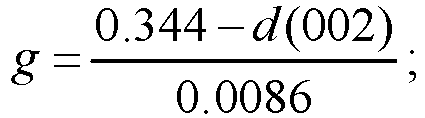
- The graphitization degree can be measured by X-Ray Diffraction (XRD). Specifically, the interplanar spacing in the XRD pattern of the crystal plane of the graphite (002) is obtained through calibration based on the position of the diffraction peak of the crystal plane of the Si standard sample (111), and plugged into the following formula to calculate the graphitization degree:

- The lithium-ion diffusion coefficient D can be obtained by the galvanostatic intermittent titration technique (GITT). Specifically, graphite is made into a pole plate to be subjected to the GITT test in a button cell. The button cell is allowed to stand for 10 h, titrated at a constant current of 0.1 C for 10 min, and subjected to another standing for 10 h to allow the current to be stable. The lithium-ion diffusion coefficient D, at 25 °C and SOC of 10%, is calculated by the following formula:

- The graphitization degree g of the fast-charging graphite provided herein is preferably 92-94%. If the graphitization degree is too low, the interlayer spacing of the fast-charging graphite is large, resulting in a loose structure, a low capacity, and a poor cycling stability. If the graphitization degree is too high, the interlayer spacing of the fast-charging graphite is small, which is not conducive to the rapid intercalation and de-intercalation of lithium ions.
- The fast-charging graphite provided herein has a particle size D50 of 1-20 µm.
- The fast-charging graphite provided herein is selected from the group consisting of an artificial graphite, a natural graphite, a modified graphite, and a combination thereof.
- This application also provides a battery, which includes a cathode plate, an anode plate, a separator arranged between the cathode plate and the anode plate, and an electrolyte. The anode plate includes an anode current collector and an anode coating coated on at least one side of the anode current collector. The anode coating layer includes an anode active material. The anode active material includes the aforementioned fast-charging graphite.
- In an embodiment, the anode active material further includes at least one of hard carbon, soft carbon, a silicon-carbon composite, and a silicon-oxygen composite.
- In an embodiment, the cathode plate includes a cathode current collector and a cathode coating layer coated on at least one side of the cathode current collector. The cathode coating layer includes a cathode active material. The cathode active material includes at least one of LiFePO4 and LiaNixCoyM1-x-yO2, where 0.95 ≤ a ≤ 1.2; 0 < x < 1; 0 < y < 1; 0 < x+y < 1; and M is aluminum and/or manganese.
- In an embodiment, the anode current collector is selecting from the group consisting of a copper foil, carbon paper, a copper-coated polymer film, and a combination thereof, preferably, copper foil.
- In an embodiment, the cathode current collector is selecting from the group consisting of an aluminum foil, a nickel foil, and an aluminum-coated polymer, preferably, aluminum foil.
- In an embodiment, both anode coating and cathode coating further includes a binder and a conductive agent, the type and proportion of which are determined according to actual requirements.
- In an embodiment, the specific type and composition of the electrolyte and the separator are not specifically limited and can be selected according to the actual requirements.
- The present disclosure will be further described below with reference to the following embodiments. It should be understood that these embodiments are only illustrative of the present disclosure and not intended to limit the scope of the present disclosure.
- A fast-charging graphite, an aqueous dispersion of acrylonitrile multi-copolymer binder (LA133), sodium carboxymethyl cellulose (CMC) and Super P conductive carbon black (SP) were mixed in a weight ratio of 96.2:1.5:1.5:0.8, and dispersed in water to produce an anode slurry. The anode slurry was then coated on a copper foil, dried and cold pressed to a compacted density of 1.65 g/cc. The graphite had a graphitization degree g of 92.3% and a lithium-ion diffusion coefficient D of 6×10-12 cm2/s at 25°C and 10% SOC.
- Nickel cobalt manganese oxide (NCM523, as the cathode active material), a polyvinylidene fluoride (PVDF) binder, Super P conductive carbon black (SP), and carbon nanotubes (CNT) were mixed in a weight ratio of 97.8:0.9:0.8:0.5, and dispersed in N-methylpyrrolidone (NMP) to prepare a cathode slurry. The cathode slurry was then coated on an aluminum foil, dried and cold pressed to a compacted density of 3.4 g/cc.
- The anode plate, the cathode plate and a polyethylene separator arranged therebetween were assembled into a cell, which was injected with an electrolyte, and subjected to formation and capacity grading to obtain a battery.
- This example was different from Example 1 merely in the fast-charging graphite. In this example, the fast-charging graphite had a graphitization degree g of 93.1% and a lithium-ion diffusion coefficient D of 4.6×10⁻¹² cm2/s at 25°C and 10% SOC.
- This example was different from Example 1 merely in the fast-charging graphite. In this example, the fast-charging graphite had a graphitization degree g of 94.2% and a lithium-ion diffusion coefficient D of 8.6×10⁻¹³ cm2/s at 25°C and 10% SOC.
- This example was different from Example 1 merely in the fast-charging graphite. In this example, the fast-charging graphite had a graphitization degree g of 90.5% and a lithium-ion diffusion coefficient D of 8.3×10⁻¹³ cm2/s at 25°C and 10% SOC.
- This example was different from Example 1 merely in the fast-charging graphite. In this example, the fast-charging graphite had a graphitization degree g of 96% and a lithium-ion diffusion coefficient D of 6.1×10⁻¹⁴ cm2/s at 25°C and 10% SOC.
- This example was different from Example 1 merely in the composition of the anode slurry. In this example, the anode slurry further included hard carbon.
- This example was different from Example 1 merely in the composition of the anode slurry. In this example, the anode slurry further included a silicon-carbon composite.
- This example was different from Example 1 merely in the composition of the anode slurry. In this example, the anode slurry further included a silicon-oxygen composite.
- This example was different from Example 1 merely in the fast-charging graphite. In this example, the fast-charging graphite had a graphitization degree g of 98.7% and a lithium-ion diffusion coefficient D of 6.1×10⁻¹⁴ cm2/s at 25°C and 10% SOC.
- This example was different from Example 1 merely in the fast-charging graphite. In this example, the fast-charging graphite had a graphitization degree g of 96.6% and a lithium-ion diffusion coefficient D of 9.6×10⁻¹² cm2/s at 25°C and 10% SOC.
- This example was different from Example 1 merely in the fast-charging graphite. In this example, the fast-charging graphite had a graphitization degree g of 88% and a lithium-ion diffusion coefficient D of 1.2×10⁻¹⁴ cm2/s at 25°C and 10% SOC.
- This example was different from Example 1 merely in the graphitization degree of the fast-charging graphite, which was 88% in this example.
- This example was different from Example 1 merely in the graphitization degree of the fast-charging graphite, which was 98% in this example.
- This example was different from Example 1 merely in the lithium-ion diffusion coefficient D of the fast-charging graphite at 25°C and 10% SOC, which was 2.2×10⁻¹⁴ cm2/s in this example.
- This example was different from Example 1 merely in the lithium-ion diffusion coefficient D of the fast-charging graphite at 25°C and 10% SOC, which was 8.8×10⁻¹² cm2/s in this example.
- Electrochemical tests were performed on lithium-ion batteries obtained in Examples 1-8 and the Comparative Examples 1-7.
- At 25°C, a battery sample was charged to 100% SOC at 5C current and then discharged to 0% SOC at 1C current. After ten charge-discharge cycles, the battery sample was then charged to 100% SOC at 5C current, and disassembled to observe the state of the anode plate, so as to determine the kinetic performance of the battery based on the lithium precipitation area. A larger lithium precipitation area indicated poor kinetics characteristic and charging capability, and a smaller lithium precipitation area indicated better kinetics characteristic and charging capability.
- The battery sample was charged to 100% SOC at 3C current and discharged to 0% SOC at 1C current, and cycled until its capacity decayed to 80% of the initial capacity. The number of cycles was recorded, and the larger the number of cycles, the better the cycle stability.
Table 1 Test results of lithium-ion batteries obtained in Examples 1-8 and the Comparative Examples 1-7 Batteries Anode active material Graphitization degree (%) Diffusion coefficient (cm2/s) Lithium precipitation area (%) The number of cycles Example 1 Fast-charging graphite 1 92.3 6×10-12 2 1880 Example 2 Fast-charging graphite 2 93.1 4.6×10⁻¹² 2.8 1670 Example 3 Fast-charging graphite 3 94.2 8.6×10⁻¹³ 3 1550 Example 4 Fast-charging graphite 4 90.5 8.3×10⁻¹³ 4 1490 Example 5 Fast-charging graphite 5 96 6.1×10⁻¹⁴ 6 1430 Example 6 Fast-charging graphite 1/hard carbon 92.3 6×10-12 2.2 1810 Example 7 Fast-charging graphite 1/silicon-carbon composite 92.3 6×10-12 2.1 1830 Example 8 Fast-charging graphite 1/silicon-oxygen composite 92.3 6×10-12 2.3 1790 Comparative Example 1 Comparative graphite 1 98.7 6.1×10⁻¹⁴ 8 1250 Comparative Example 2 Comparative graphite 2 96.6 9.6×10⁻¹² 8 1200 Comparative Example 3 Comparative graphite 3 88 1.2×10⁻¹⁴ 11 830 Comparative Example 4 Comparative graphite 4 88 6×10-12 6.8 910 Comparative Example 5 Comparative graphite 5 98 6×10-12 8.5 1380 Comparative Example 6 Comparative graphite 6 92.3 2.2×10⁻¹⁴ 9.2 1350 Comparative Example 7 Comparative graphite 7 92.3 8.8×10⁻¹² 7.1 1140 - It could be seen from Table 1 that the battery with the fast-charging graphite provided herein as the anode active material had a small lithium-precipitation area and slow capacity decay, indicating that the battery made with the fast-charging graphite provided herein had better kinetics, good charging capacity, and better cycling stability. Either the graphitization degree or the diffusion coefficient was too high or too low, the graphite had poor performance. In other words, only when both the graphitization degree and the diffusion coefficient of the fast-charging graphite were controlled within the limitations of this application, the battery could show good kinetics, charging capacity, and cycling stability. In particular, when the fast-charging graphite had a graphitization degree of 92.3% and a diffusion coefficient of 6×10-12 cm2/s, the fabricated battery had the smallest lithium-precipitation area and the largest cycle number, namely, the best kinetic performance, charging capacity, and cycling stability. The reasons were described below. (1) When the graphitization degree was too low, the layer spacing of the graphite was large, resulting in a loose structure, a low capacity, and a poor cycling stability. When the graphitization degree was too high, the layer spacing of the graphite was small, which was not conducive to the rapid intercalation and de-intercalation of lithium ions. (2) When the diffusion coefficient was too low, the lithium-ion diffusion rate of the graphite was affected, while when the diffusion coefficient was too high, the layer spacing of the graphite was large, resulting in a lower capacity. Therefore, this application controlled both the graphitization degree and diffusion coefficient of the fast-charging graphite within a reasonable range to ensure that the graphite had good fast-charging performance, while the lithium-ion battery made with this graphite had both excellent cycle life and kinetic performance.
- Though the embodiments have been described in detail above, changes and modifications can still be made thereto by those skilled in the art. The above-mentioned embodiments are merely illustrative and not intended to limit the disclosure. It should be understood that those modifications, replacements, and variations made by those skilled in the art based on the content disclosed herein without paying creative effort shall fall within the scope of the present disclosure defined by the appended claims. Furthermore, specific terms used herein are merely for the convenience of description and are not intended to limit the present disclosure.
Claims (10)
- A fast-charging graphite, characterized in that a graphitization degree of the fast-charging graphite is 90-97%; and a lithium-ion diffusion coefficient of the fast-charging graphite at 25°C and a state of charge (SOC) of 10% is 2.3×10⁻¹⁴ - 8.7×10⁻¹² cm2/s.
- The fast-charging graphite according to claim 1, characterized in that the graphitization degree of the fast-charging graphite is 92%-94%.
- The fast-charging graphite according to claim 1, characterized in that the lithium-ion diffusion coefficient of the fast-charging graphite at 25°C and a SOC of 10% is 7.6×10⁻¹³ - 6×10-12 cm2/s.
- The fast-charging graphite according to claim 1, characterized in that a particle size D50 of the fast-charging graphite is 1-20 µm.
- The fast-charging graphite according to claim 1, characterized in that the fast-charging graphite is selected from the group consisting of an artificial graphite, a natural graphite, a modified graphite, and a combination thereof.
- A battery, comprising:a cathode plate;an anode plate;a separator arranged between the cathode plate and the anode plate; andan electrolyte;characterized in that the anode plate comprises an anode current collector and an anode coating coated on at least one side of the anode current collector; the anode coating comprises an anode active material; and the anode active material comprises the fast-charging graphite according to any one of claims 1-5.
- The battery according to claim 6, characterized in that the anode active material further comprises at least one of hard carbon, soft carbon, a silicon-carbon composite, and a silicon-oxygen composite.
- The battery according to claim 6, characterized in that the cathode plate comprises a cathode current collector and a cathode coating coated on at least one side of the cathode current collector; the cathode coating comprises a cathode active material; and the cathode active material comprises at least one of LiFePO4 and LiaNixCoyM1-x-yO2, wherein 0.95 ≤ a ≤ 1.2; 0 < x < 1; 0 < y < 1; 0 < x+y < 1; and M is aluminum and/or manganese.
- The battery according to claim 6, characterized in that the anode current collector is selected from the group consisting of a copper foil, carbon paper, a copper-coated polymer film and a combination thereof.
- The battery according to claim 8, characterized in that the cathode current collector is selected from the group consisting of an aluminum foil, a nickel foil, an aluminum-coated polymer film and a combination thereof.
Applications Claiming Priority (2)
| Application Number | Priority Date | Filing Date | Title |
|---|---|---|---|
| CN202010992949.XA CN112151796A (en) | 2020-09-21 | 2020-09-21 | Quick-charging graphite and battery |
| PCT/CN2021/092566 WO2022057278A1 (en) | 2020-09-21 | 2021-05-10 | Fast-charging graphite and battery |
Publications (2)
| Publication Number | Publication Date |
|---|---|
| EP4156341A1 true EP4156341A1 (en) | 2023-03-29 |
| EP4156341A4 EP4156341A4 (en) | 2025-05-21 |
Family
ID=73893387
Family Applications (1)
| Application Number | Title | Priority Date | Filing Date |
|---|---|---|---|
| EP21868116.1A Withdrawn EP4156341A4 (en) | 2020-09-21 | 2021-05-10 | FAST CHARGE GRAPHITE AND BATTERY |
Country Status (4)
| Country | Link |
|---|---|
| US (1) | US20230112637A1 (en) |
| EP (1) | EP4156341A4 (en) |
| CN (1) | CN112151796A (en) |
| WO (1) | WO2022057278A1 (en) |
Families Citing this family (3)
| Publication number | Priority date | Publication date | Assignee | Title |
|---|---|---|---|---|
| CN112151796A (en) * | 2020-09-21 | 2020-12-29 | 江苏塔菲尔新能源科技股份有限公司 | Quick-charging graphite and battery |
| CN114242932B (en) * | 2021-12-13 | 2024-01-30 | 蜂巢能源科技股份有限公司 | Lithium ion battery |
| CN116014074B (en) * | 2022-12-26 | 2026-02-13 | 浙江锂威能源科技有限公司 | A lithium battery negative electrode, a battery cell, and a lithium battery |
Family Cites Families (8)
| Publication number | Priority date | Publication date | Assignee | Title |
|---|---|---|---|---|
| CN101841019A (en) * | 2010-04-30 | 2010-09-22 | 湖南大学 | Carbon cladding layer expansion graphite composite material used for lithium ion batteries and preparation method thereof |
| CN106981632A (en) | 2017-03-24 | 2017-07-25 | 上海杉杉科技有限公司 | High magnification fills the preparation method of graphite soon |
| CN109254036A (en) * | 2017-07-14 | 2019-01-22 | 上海杉杉科技有限公司 | A kind of electrochemical evaluation method of electrode material rapid charging performance |
| KR102165885B1 (en) * | 2017-11-28 | 2020-10-14 | 주식회사 엘지화학 | Negative electrode active material, negative electrode and lithium secondary battery comprising the same |
| CN109962236B (en) * | 2018-04-28 | 2020-07-17 | 宁德时代新能源科技股份有限公司 | Secondary battery |
| CN109950474B (en) | 2018-06-29 | 2020-04-24 | 宁德时代新能源科技股份有限公司 | Lithium ion battery |
| EP3935680A4 (en) * | 2019-03-06 | 2024-09-18 | University of Maryland, College Park | RECHARGEABLE LI-ION BATTERY WITH HALOGEN INSERTION GRAPHITE ELECTRODE |
| CN112151796A (en) * | 2020-09-21 | 2020-12-29 | 江苏塔菲尔新能源科技股份有限公司 | Quick-charging graphite and battery |
-
2020
- 2020-09-21 CN CN202010992949.XA patent/CN112151796A/en active Pending
-
2021
- 2021-05-10 EP EP21868116.1A patent/EP4156341A4/en not_active Withdrawn
- 2021-05-10 WO PCT/CN2021/092566 patent/WO2022057278A1/en not_active Ceased
-
2022
- 2022-12-12 US US18/064,670 patent/US20230112637A1/en active Pending
Also Published As
| Publication number | Publication date |
|---|---|
| WO2022057278A1 (en) | 2022-03-24 |
| CN112151796A (en) | 2020-12-29 |
| EP4156341A4 (en) | 2025-05-21 |
| US20230112637A1 (en) | 2023-04-13 |
Similar Documents
| Publication | Publication Date | Title |
|---|---|---|
| US20230108289A1 (en) | Positive-electrode material, positive electrode plate, lithium secondary battery, battery module, battery pack, and apparatus | |
| EP3955348B1 (en) | Negative electrode active material and method for preparation thereof, secondary battery, and apparatus including secondary battery | |
| Xu et al. | Synthesis of Co3O4 nano-octahedra enclosed by {111} facets and their excellent lithium storage properties as anode material of lithium ion batteries | |
| KR101887952B1 (en) | Negative-electrode material for lithium-ion secondary battery | |
| EP2400586B1 (en) | Carbon material for lithium ion secondary batteries | |
| WO2021108983A1 (en) | Secondary battery, device, artificial graphite, and preparation method therefor | |
| WO2021108981A1 (en) | Secondary battery, device, artificial graphite, and preparation method | |
| WO2021108982A1 (en) | Artificial graphite, secondary battery, preparation method, and device | |
| EP3614462A1 (en) | Negative electrode plate and secondary battery | |
| CN115472819A (en) | Positive active material, positive pole piece and sodium ion battery | |
| CN104966818A (en) | Core-shell type anode active material for a lithium secondary battery, method for preparing the same and lithium secondary battery comprising the same | |
| EP3955349A1 (en) | Negative electrode active material, manufacturing method therefor, secondary battery, and device comprising secondary battery | |
| WO2022021273A1 (en) | Secondary battery, preparation method therefor, and battery module, battery package and device containing same | |
| US12548773B2 (en) | Positive active material, positive electrode plate, lithium-ion battery, and electrical device | |
| CN115020678A (en) | Positive electrode active material, electrochemical device, and electronic device | |
| US20230112637A1 (en) | Fast-charging graphite and battery | |
| JP7144536B2 (en) | Negative electrode active material for secondary battery, electrode containing the same, and method for manufacturing the same | |
| EP3793004A1 (en) | Anode for lithium secondary battery and lithium secondary battery comprising same | |
| JP7807137B2 (en) | Negative electrode and secondary battery including the same | |
| US20200227746A1 (en) | Negative electrode active material for secondary battery, and secondary battery | |
| Wang et al. | Effects of V2O5 and Fe2O3 on the structures and electrochemical performances of Li2O-V2O5-B2O3 glass materials in lithium-ion batteries | |
| JP2001143698A (en) | Negative electrode material for non-aqueous lithium secondary battery and non-aqueous lithium secondary battery using the same | |
| CN115020638A (en) | Lithium ion battery | |
| Ng et al. | Si–O network encapsulated graphite–silicon mixtures as negative electrodes for lithium-ion batteries | |
| Siriroj et al. | Glass-sulfur composite cathodes: A new strategy for improving the performance of lithium-sulfur batteries |
Legal Events
| Date | Code | Title | Description |
|---|---|---|---|
| STAA | Information on the status of an ep patent application or granted ep patent |
Free format text: STATUS: THE INTERNATIONAL PUBLICATION HAS BEEN MADE |
|
| PUAI | Public reference made under article 153(3) epc to a published international application that has entered the european phase |
Free format text: ORIGINAL CODE: 0009012 |
|
| STAA | Information on the status of an ep patent application or granted ep patent |
Free format text: STATUS: REQUEST FOR EXAMINATION WAS MADE |
|
| 17P | Request for examination filed |
Effective date: 20221219 |
|
| AK | Designated contracting states |
Kind code of ref document: A1 Designated state(s): AL AT BE BG CH CY CZ DE DK EE ES FI FR GB GR HR HU IE IS IT LI LT LU LV MC MK MT NL NO PL PT RO RS SE SI SK SM TR |
|
| DAV | Request for validation of the european patent (deleted) | ||
| DAX | Request for extension of the european patent (deleted) | ||
| A4 | Supplementary search report drawn up and despatched |
Effective date: 20250423 |
|
| RIC1 | Information provided on ipc code assigned before grant |
Ipc: C01B 32/20 20170101ALI20250415BHEP Ipc: H01M 4/583 20100101AFI20250415BHEP |
|
| STAA | Information on the status of an ep patent application or granted ep patent |
Free format text: STATUS: THE APPLICATION IS DEEMED TO BE WITHDRAWN |
|
| 18D | Application deemed to be withdrawn |
Effective date: 20251114 |