EP4156322A1 - Liquid composition, functional material, and energy storage device - Google Patents
Liquid composition, functional material, and energy storage device Download PDFInfo
- Publication number
- EP4156322A1 EP4156322A1 EP22184506.8A EP22184506A EP4156322A1 EP 4156322 A1 EP4156322 A1 EP 4156322A1 EP 22184506 A EP22184506 A EP 22184506A EP 4156322 A1 EP4156322 A1 EP 4156322A1
- Authority
- EP
- European Patent Office
- Prior art keywords
- liquid composition
- inorganic particles
- alumina
- solvent
- same manner
- Prior art date
- Legal status (The legal status is an assumption and is not a legal conclusion. Google has not performed a legal analysis and makes no representation as to the accuracy of the status listed.)
- Pending
Links
Images




Classifications
-
- H—ELECTRICITY
- H01—ELECTRIC ELEMENTS
- H01M—PROCESSES OR MEANS, e.g. BATTERIES, FOR THE DIRECT CONVERSION OF CHEMICAL ENERGY INTO ELECTRICAL ENERGY
- H01M10/00—Secondary cells; Manufacture thereof
- H01M10/05—Accumulators with non-aqueous electrolyte
- H01M10/052—Li-accumulators
-
- H—ELECTRICITY
- H01—ELECTRIC ELEMENTS
- H01G—CAPACITORS; CAPACITORS, RECTIFIERS, DETECTORS, SWITCHING DEVICES, LIGHT-SENSITIVE OR TEMPERATURE-SENSITIVE DEVICES OF THE ELECTROLYTIC TYPE
- H01G11/00—Hybrid capacitors, i.e. capacitors having different positive and negative electrodes; Electric double-layer [EDL] capacitors; Processes for the manufacture thereof or of parts thereof
- H01G11/22—Electrodes
- H01G11/26—Electrodes characterised by their structure, e.g. multi-layered, porosity or surface features
-
- H—ELECTRICITY
- H01—ELECTRIC ELEMENTS
- H01G—CAPACITORS; CAPACITORS, RECTIFIERS, DETECTORS, SWITCHING DEVICES, LIGHT-SENSITIVE OR TEMPERATURE-SENSITIVE DEVICES OF THE ELECTROLYTIC TYPE
- H01G11/00—Hybrid capacitors, i.e. capacitors having different positive and negative electrodes; Electric double-layer [EDL] capacitors; Processes for the manufacture thereof or of parts thereof
- H01G11/52—Separators
-
- H—ELECTRICITY
- H01—ELECTRIC ELEMENTS
- H01G—CAPACITORS; CAPACITORS, RECTIFIERS, DETECTORS, SWITCHING DEVICES, LIGHT-SENSITIVE OR TEMPERATURE-SENSITIVE DEVICES OF THE ELECTROLYTIC TYPE
- H01G11/00—Hybrid capacitors, i.e. capacitors having different positive and negative electrodes; Electric double-layer [EDL] capacitors; Processes for the manufacture thereof or of parts thereof
- H01G11/84—Processes for the manufacture of hybrid or EDL capacitors, or components thereof
-
- H—ELECTRICITY
- H01—ELECTRIC ELEMENTS
- H01M—PROCESSES OR MEANS, e.g. BATTERIES, FOR THE DIRECT CONVERSION OF CHEMICAL ENERGY INTO ELECTRICAL ENERGY
- H01M10/00—Secondary cells; Manufacture thereof
- H01M10/05—Accumulators with non-aqueous electrolyte
- H01M10/054—Accumulators with insertion or intercalation of metals other than lithium, e.g. with magnesium or aluminium
-
- H—ELECTRICITY
- H01—ELECTRIC ELEMENTS
- H01M—PROCESSES OR MEANS, e.g. BATTERIES, FOR THE DIRECT CONVERSION OF CHEMICAL ENERGY INTO ELECTRICAL ENERGY
- H01M4/00—Electrodes
- H01M4/02—Electrodes composed of, or comprising, active material
- H01M4/13—Electrodes for accumulators with non-aqueous electrolyte, e.g. for lithium-accumulators; Processes of manufacture thereof
-
- H—ELECTRICITY
- H01—ELECTRIC ELEMENTS
- H01M—PROCESSES OR MEANS, e.g. BATTERIES, FOR THE DIRECT CONVERSION OF CHEMICAL ENERGY INTO ELECTRICAL ENERGY
- H01M50/00—Constructional details or processes of manufacture of the non-active parts of electrochemical cells other than fuel cells, e.g. hybrid cells
- H01M50/40—Separators; Membranes; Diaphragms; Spacing elements inside cells
- H01M50/409—Separators, membranes or diaphragms characterised by the material
- H01M50/431—Inorganic material
- H01M50/434—Ceramics
-
- H—ELECTRICITY
- H01—ELECTRIC ELEMENTS
- H01M—PROCESSES OR MEANS, e.g. BATTERIES, FOR THE DIRECT CONVERSION OF CHEMICAL ENERGY INTO ELECTRICAL ENERGY
- H01M50/00—Constructional details or processes of manufacture of the non-active parts of electrochemical cells other than fuel cells, e.g. hybrid cells
- H01M50/40—Separators; Membranes; Diaphragms; Spacing elements inside cells
- H01M50/409—Separators, membranes or diaphragms characterised by the material
- H01M50/443—Particulate material
-
- H—ELECTRICITY
- H01—ELECTRIC ELEMENTS
- H01M—PROCESSES OR MEANS, e.g. BATTERIES, FOR THE DIRECT CONVERSION OF CHEMICAL ENERGY INTO ELECTRICAL ENERGY
- H01M50/00—Constructional details or processes of manufacture of the non-active parts of electrochemical cells other than fuel cells, e.g. hybrid cells
- H01M50/40—Separators; Membranes; Diaphragms; Spacing elements inside cells
- H01M50/46—Separators, membranes or diaphragms characterised by their combination with electrodes
-
- H—ELECTRICITY
- H01—ELECTRIC ELEMENTS
- H01M—PROCESSES OR MEANS, e.g. BATTERIES, FOR THE DIRECT CONVERSION OF CHEMICAL ENERGY INTO ELECTRICAL ENERGY
- H01M50/00—Constructional details or processes of manufacture of the non-active parts of electrochemical cells other than fuel cells, e.g. hybrid cells
- H01M50/40—Separators; Membranes; Diaphragms; Spacing elements inside cells
- H01M50/409—Separators, membranes or diaphragms characterised by the material
- H01M50/446—Composite material consisting of a mixture of organic and inorganic materials
-
- Y—GENERAL TAGGING OF NEW TECHNOLOGICAL DEVELOPMENTS; GENERAL TAGGING OF CROSS-SECTIONAL TECHNOLOGIES SPANNING OVER SEVERAL SECTIONS OF THE IPC; TECHNICAL SUBJECTS COVERED BY FORMER USPC CROSS-REFERENCE ART COLLECTIONS [XRACs] AND DIGESTS
- Y02—TECHNOLOGIES OR APPLICATIONS FOR MITIGATION OR ADAPTATION AGAINST CLIMATE CHANGE
- Y02E—REDUCTION OF GREENHOUSE GAS [GHG] EMISSIONS, RELATED TO ENERGY GENERATION, TRANSMISSION OR DISTRIBUTION
- Y02E60/00—Enabling technologies; Technologies with a potential or indirect contribution to GHG emissions mitigation
- Y02E60/10—Energy storage using batteries
Definitions
- the present invention relates to a liquid composition, a functional material, and an energy storage device.
- Conventional energy storage devices such as lithium ion secondary batteries, electric double layer capacitors, lithium ion capacitors, redox capacitors, and the like use paper, non-woven fabric, and porous film as separators in order to prevent short circuits between the positive and negative electrodes.
- separator-integrated electrode in which an electrode composite material layer and a particle layer are sequentially formed on an electrode substrate has been used (for example, Japanese Patent Application Laid-Open No. 2000-277386 ).
- Separator-integrated electrodes are typically manufactured by applying a liquid composition containing particles onto an electrode composite material layer with a thickness of 10 ⁇ m or less. By discharging the liquid composition from a liquid discharge head, a uniform particle layer can be easily applied (for example, Japanese Patent Application Laid-Open 2006-173001 ).
- Liquid compositions are generally prepared by dispersing inorganic particles and dispersants uniformly in a solvent as solid components.
- a dispersant such as a surfactant
- a dispersion device such as a bead mill
- the specific gravity of the inorganic particles is higher than that of the solvent, which is the dispersing medium, so that even if dispersion is achieved, the inorganic particles precipitate due to the particles own weight in the liquid composition after static storage (hereinafter referred to as "self-weight precipitation").
- self-weight precipitation due to the particles own weight in the liquid composition after static storage.
- the physical properties of the liquid composition may be changed, for example, agglomeration may occur in the liquid composition resulting in a change in particle size distribution, and/or the viscosity and thixotropy of the liquid composition may be changed.
- agglomeration may occur in the liquid composition resulting in a change in particle size distribution
- the viscosity and thixotropy of the liquid composition may be changed.
- An object of the present invention is to provide a liquid composition that is capable of readily re-dispersing even when inorganic particles in the liquid composition are self-weight precipitated.
- One aspect of the invention is to provide a liquid composition including first inorganic particles having a median size in a range from 200 nm to less than 1,000 nm, second inorganic particles having an average particle size of less than 30 nm, a dispersant, and a solvent.
- a liquid composition that is capable of readily re-dispersing even when inorganic particles in the liquid composition are self-weight precipitated is provided.
- the liquid composition of the present embodiment contains first inorganic particles, second inorganic particles, a dispersant, and a solvent.
- the inorganic particles refer to particles of an inorganic compound such as a metal or a metal oxide.
- the liquid composition of the present embodiment may optionally contain an auxiliary solvent, binder, or other additives.
- the first inorganic particles are inorganic particles with a median size in the range from 200 nm to less than 1000 nm.
- median size refers to a particle size (hereinafter referred to as D50) with a cumulative frequency of 50% on a number basis.
- D50 particle size
- a median size of 1,000 nm or more tends to cause unevenness in the coating process when a film thickness in micrometers is obtained.
- a median size of less than 200 nm makes it difficult to maintain a uniform dispersion state.
- Examples of the material (inorganic particles A) constituting the first inorganic particles include, but are not limited to, aluminum oxide, silica, calcium carbonate, titanium oxide, calcium phosphate, titanium oxide, silicon oxide, zirconium oxide, and the like.
- One type of these first inorganic particles may be used alone or two or more types of these inorganic particles may be used in combination.
- inorganic oxides such as aluminum oxide (alumina) are preferred for use in the manufacture of separator-integrated electrodes, as described below, because of their high insulation property and heat resistance property.
- the type of alumina used as the first inorganic particles is not particularly limited.
- aluminas include ⁇ -alumina, ⁇ -alumina, ⁇ -alumina, fused alumina, and the like.
- ⁇ -alumina is preferable from the viewpoint of insulation property and abrasion resistance property.
- aluminas may be used alone or two or more types of these aluminas may be used in combination.
- a main component of the alumina is preferably ⁇ -alumina from the viewpoint of insulation property and abrasion resistance property.
- the content of ⁇ -alumina in the total alumina is 50% by mass or more.
- the content is preferably 60% by mass or more, and more preferably 70% by mass or more. In the above-described range, a particle layer with excellent insulation property and abrasion resistance property can be formed.
- the alumina contained in the liquid composition of the present embodiment may be equivalent to a solid content in the liquid composition.
- the percentage of the solid content in the liquid composition is in the range from 20% by mass to 50% by mass, and preferably in the range from 35% by mass to 45% by mass.
- Such content of alumina indicates higher solid content than liquid compositions, such as inks.
- the second inorganic particles (hereinafter may be referred to as inorganic fine particles or inorganic fine particles B) are inorganic particles with an average size of less than 30 nm.
- the average size is, for example, the average of the longitudinal diameter of the particles as measured by Transmission Electron Microscope (TEM) observation. If the average size is 30 nm or more, the energy barrier may not be sufficiently small in the interaction potential energy between particles as described below.
- TEM Transmission Electron Microscope
- the inorganic fine particles B with an average size of less than 30 nm can be separated from other particles and collected, for example, by extracting the supernatant liquid obtained by centrifugation.
- alumina with a particle density of 3.95 g/cm 3 has a liquid viscosity of 10 kg/m ⁇ s and a liquid density of 1.03 g/cm 3 in a solvent.
- the liquid is centrifuged at 3,000 rpm for 20 minutes at a rotation radius of 10 cm. If the particle size is greater than or equal to 30 nm, it is determined that the particles are precipitated for 1.8 cm. Therefore, it is possible to collect inorganic fine particles less than 30 nm by collecting the supernatant liquid.
- d p 18 ⁇ ⁇ p ⁇ ⁇ f g h t
- dp is the particle size
- p is the viscosity of the liquid
- pp is the density of the particle
- pf is the density of the liquid
- g is gravity
- h is the distance travelled downward
- t is the time required to precipitate the distance h.
- Examples of the materials constituting the second inorganic particles include, but are not limited to, aluminum oxide, silica, calcium carbonate, titanium oxide, calcium phosphate, titanium oxide, silicon oxide, zirconium oxide, and the like.
- One type of these second inorganic particles may be used alone or two or more types of these inorganic particles may be used in combination.
- inorganic oxides such as aluminum oxide (alumina) are preferably used for use in manufacturing the separator-integrated electrode described below because of its high insulation property and heat resistance property.
- the type of alumina used as the second inorganic particles is not particularly limited.
- the aluminas include ⁇ -alumina, ⁇ -alumina, ⁇ -alumina, fused alumina, and the like. Among these, ⁇ -alumina is preferable from the viewpoint of insulation property and abrasion resistance property.
- the material constituting the inorganic fine particles B may be the same as or different from the material constituting the above-described inorganic particles A.
- the content of the second inorganic particles (inorganic fine particles B) is not particularly limited, the content of the second inorganic particles (inorganic fine particles B) is preferably in the range from 1% by mass to 5% by mass relative to the total mass of the first inorganic particles (inorganic particles A) .
- FIG. 1 is a schematic diagram of inorganic particles contained in the liquid composition of the present embodiment.
- a first inorganic particle 1 and a second inorganic particle are mixed in the liquid composition.
- a dispersant is a compound that adsorbs or binds to the surface of a particle and functions to inhibit agglomeration of the particles by electrostatic repulsion due to coulombic forces or steric hindrance due to molecular chains.
- the number average molecular weight of the dispersant is not particularly limited but is usually from 1,000 to 100,000. From the viewpoint of suppressing the increase in viscosity of the liquid composition, the number average molecular weight of the dispersant is more preferably from 1,000 to 10,000, and even more preferably from 1,000 to 5,000.
- the dispersant preferably has a dispersible group.
- the dispersible group is preferably a nonionic group from the viewpoint of ionic conductivity, for example, when the liquid composition is used as a functional material in a lithium ion battery.
- nonionic does not indicate ionicity and nonionic group does not include ionic substituents.
- a dispersant having a nonionic group as a dispersible group corresponds to a nonionic surfactant.
- the dispersible group may have a structure that is soluble for a solvent and auxiliary solvent describe later.
- an oligoether group is preferably used from the viewpoint of ionic conductivity.
- the oligoether group is a group from which the hydroxyl group is removed from the end of a polymer of ethylene glycol or propylene glycol.
- the molecular weight of the polymer of ethylene glycol or propylene glycol is preferably 100 or more and 10,000 or less, and further preferably 100 or more and 5,000 or less.
- the molecular weight of the polymer of ethylene glycol or propylene glycol is 100 or more, the dispersibility of the inorganic particles (for example, the alumina particles) is improved.
- the molecular weight is 10,000 or less, the increase in the viscosity of the liquid composition can be suppressed.
- the end of the unbound side of the oligoether group may be a hydroxyl group, a methoxy group, an ethoxy group, a propoxy group, or the like. If a dispersant having an oligoether group is used, the dispersibility of the inorganic particles can be improved even when a highly polar solvent is used as a solvent.
- the dispersant is preferably a polymer dispersant having an ionic group having the polarity opposite to that of which the alumina particles are charged as an adsorptive group from the viewpoint of adsorption strength with the alumina particles.
- Examples of commercially available polymeric dispersants include DISPERBYK-103, DISPERBYK-118, DISPERBYK-2155 (manufactured by BYK-Chemie), NOPCOSPERSE-092, SN-SPERSE-2190, SN-DISPERSANT-9228 (manufactured by SAN NOPCO Limited), ESLEAM (Registered Trademark), AD-3172M, ESLEAM 2093, MALIALIM (Registered Trademarks), AKM-0513, MALIALIM HKM-50A, MALIALIM HKM-150A, MALIALIM SC-0505K, MALIALIM SC-1015F, MALIALIM SC-0708A (manufactured by NOF Corporation), and the like.
- the content of the polymeric dispersant to the inorganic particles is not particularly limited, and usually in the range from 0.01% by mass to 10% by mass. When the dispersibility of the inorganic particles is considered, the content of the polymeric dispersant to the inorganic particles is preferably in the range from 0.1% by mass to 10% by mass.
- a binder may be added to the liquid composition of the present embodiment. Applying the liquid composition containing the binder on a substrate as described below can improve the strength of the functional membrane formed using the liquid composition.
- binders examples include, but are not limited to, polyvinylidene fluoride, styrene butadiene rubber, acrylic resin, and the like. One type of these binders may be used alone or two or more types of these binders may be used in combination.
- the binder may also be dissolved or dispersed in a liquid composition.
- a precursor of the binder may be used instead of the binder.
- the precursors of the binder include monomers and the like.
- the liquid composition containing monomers and optionally further containing a polymerization initiator is applied onto an absorbent medium (hereinafter, may be referred to as a substrate), and subsequently heated or illuminated to polymerize the monomers to form a binder.
- a solvent (hereinafter, may be referred to as a solvent A) can disperse inorganic particles in the liquid composition.
- the content of solvent A is suitably adjusted.
- the components of solvent A are not particularly limited, but an aqueous solvent or a non-aqueous solvent.
- the aqueous solvent is not particularly limited and includes, for example, water, mixtures of water and polar solvents, and the like.
- polar solvents examples include methanol, ethanol, propanol, butanol, pentanol, hexanol, ethylene glycol, hexylene glycol, N-methyl-2-pyrrolidone (NMP), dimethyl sulfoxide (DMSO), N,N-dimethylformamide (DMF), acetone, tetrahydrofuran (THF), and the like.
- NMP N-methyl-2-pyrrolidone
- DMSO dimethyl sulfoxide
- DMF N,N-dimethylformamide
- THF tetrahydrofuran
- the polar solvents may be used alone or in a combination of two or more polar solvents.
- the non-aqueous dispersion medium is not particularly limited and includes, for example, lactams, alcohols, sulfoxides, esters, ketones, and the like.
- lactams examples include 1-methyl-2-pyrrolidone, 2-pyrrolidone, and the like.
- alcohols examples include isopropyl alcohol, butanol, diacetone alcohol, and the like.
- sulfoxides examples include dimethyl sulfoxide and the like.
- esters examples include ethyl acetate, butyl acetate, ethyl lactate, ethylene glycol diacetate, and the like.
- ketones examples include diisobutyl ketone, 2-butanone, 2-pentanone, diacetone alcohol, and the like.
- One type of these non-aqueous solvents may be used alone or two or more types of these non-aqueous solvents may be used in combination.
- the solvent A is preferably a solvent having an affinity with the inorganic particles (for example, alumina particles), and the solvent A is more preferably a non-aqueous solvent.
- solvent B An auxiliary solvent (hereinafter referred to as "solvent B") is a solvent different from that of solvent A.
- the solvent B can optionally be formulated to compensate for the lack of function with solvent A.
- Examples of the solvent B include a solvent having a function of dispersing inorganic particles (for example, alumina particles), a solvent having a high boiling point for preventing the drying of the nozzle of the liquid discharge head, a solvent having a suitable viscosity and surface tension when discharging from the liquid discharge head, and a solvent capable of preventing the absorption of alumina particles into the electrode composite material layer.
- a solvent having a function of dispersing inorganic particles for example, alumina particles
- a solvent having a high boiling point for preventing the drying of the nozzle of the liquid discharge head a solvent having a suitable viscosity and surface tension when discharging from the liquid discharge head
- a solvent capable of preventing the absorption of alumina particles into the electrode composite material layer examples include a solvent having a function of dispersing inorganic particles (for example, alumina particles), a solvent having a high boiling point for preventing the drying of the nozzle of the liquid discharge head, a solvent having a suitable vis
- solvent B are not particularly limited, but are aqueous solvents or non-aqueous solvents.
- the aqueous solvent is not particularly limited.
- the aqueous solvents include water, mixtures of water and polar solvents, and the like.
- the polar solvents include methanol, ethanol, propanol, butanol, pentanol, hexanol, ethylene glycol, hexylene glycol, NMP, DMSO, DMF, acetone, THF, and the like.
- the polar solvent may be used alone or in a combination of two or more aqueous solvents.
- the non-aqueous dispersion medium is not particularly limited and includes, for example, ethers, glycols, esters, alcohols, or lactams.
- ethers examples include propylene glycol monopropyl ether and the like.
- glycols examples include propylene glycol, ethylene glycol, triethylene glycol, hexylene glycol, and the like.
- esters examples include ethyl lactate, ethylene carbonate, ethylene glycol diacetate, and the like.
- alcohols include cyclohexanol, propylene glycol monopropyl ether, and the like.
- lactams include 2-pyrrolidone and the like.
- One type of these non-aqueous solvents may be used alone or two or more types of these non-aqueous solvents may be used in combination.
- the solvent B is preferably a solvent having affinity with inorganic particles such as alumina, and the solvent B is more preferably a non-aqueous solvent.
- the liquid composition of the present embodiment may further contain other components according to purposes of adjusting viscosity, adjusting surface tension, controlling evaporation of the solvent, improving the solubility of additives, improving a dispersibility of alumina particles, sterilization, and the like.
- other additives include, for example, surfactants, pH adjusters, corrosion inhibitors, antiseptics, mold inhibitors, antioxidants, anti-reduction agents, evaporation accelerators, chelating agents, and the like.
- the method of preparing the liquid composition of the present embodiment can be formed by mixing and dispersing a first inorganic particles (inorganic particles A), a second inorganic particles (inorganic fine particles B), a dispersant, and a solvent A.
- a binder and a solvent B may be added to the mixture as needed.
- the method of dispersing the liquid composition is not particularly limited, but for example, a known dispersion device can be used.
- dispersion devices include a stirrer, a ball mill, a beads mill, a ring-type mill, a high-pressure disperser, a rotary highspeed shear device, an ultrasonic disperser, and the like.
- the effect obtained by the liquid composition of the present embodiment can be explained by the DLVO theory representing the dispersed/agglomerated state acting between the particles.
- the DLVO theory explains that the dispersion/agglomeration phenomenon of particles can be predicted by the balance between the osmotic repulsive force derived from the electric double layer between particles and the attractive force between particles, which is the sum of the London-van der Waals forces.
- FIG. 2 is a potential energy curve of interaction between particles based on the DLVO theory.
- H on the horizontal axis indicates the interparticle distance
- V on the vertical axis indicates the potential energy
- A indicates the London-van der Waals attraction
- B indicates the electric double layer repulsive force (repulsive force)
- C indicates the potential energy due to the total interaction of attraction and repulsion
- C1 indicates the minimum point of primary agglomeration
- C2 indicates the maximum point of energy barrier
- C3 indicates the minimum point of secondary agglomeration.
- the effect of the liquid composition of the present invention is thought to be achieved by this mechanism, the re-dispersibility of the liquid composition containing inorganic particles can be increased.
- the liquid composition of the present embodiment includes first inorganic particles having a median size in a range from 200 nm to less than 1000 nm, second inorganic particles having an average size of less than 30 nm, a dispersant, and a solvent, as described above.
- first inorganic particles having a median size in a range from 200 nm to less than 1000 nm second inorganic particles having an average size of less than 30 nm
- a dispersant and a solvent
- the smaller energy barrier of potential energy acting between the inorganic particles in the liquid composition allows the inorganic particles with large specific gravity relative to the solvent to easily re-disperse in the liquid composition even if the inorganic particles are precipitated by self-weight precipitation in the liquid composition. Therefore, according to the present embodiment, the liquid composition with excellent storage stability such as storage and transport can be provided.
- the inorganic particles in the liquid composition can easily be re-dispersed even when the inorganic particles are self-weight precipitated, when the liquid composition is used after the liquid composition has been stored, a large-scale stirring operation is no longer necessary, which improves re-dispersion efficiency and reduces product cost.
- the functional film is formed on the substrate using the liquid composition, it is possible to suppress coating unevenness when the liquid composition is discharged using, for example, an ink jet.
- adjusting the content of the second inorganic particles with respect to the total amount of the first inorganic particles being in the range from 1% by mass to 5% by mass further reduces the energy barrier of potential energy acting between inorganic particles in the liquid composition. Therefore, the re-dispersibility of the inorganic particles can be improved even after the inorganic particles having a large specific gravity with respect to the solvent have precipitated by self-weight precipitation in the liquid composition.
- the use of ⁇ -alumina as the first inorganic particles further reduces the energy barrier of potential energy acting between inorganic particles in the liquid composition.
- the re-dispersibility of the inorganic particles can be improved even after the inorganic particles having a large specific gravity with respect to the solvent have precipitated by self-weight precipitation in the liquid composition.
- the percentage of solid content is in the range from 20% by mass to 50% by mass, so that unevenness in coating when the liquid composition is applied to form a coating film can be suppressed.
- the affinity of the solvent can be increased between inorganic particles, such as alumina. This can improve both the dispersibility during preparation and the re-dispersibility after self-weight precipitating in the liquid composition, containing the inorganic particles.
- the boiling point of the non-aqueous solvent is higher than that of the aqueous solvent, drying when a coating film is formed by applying the liquid composition is facilitated.
- liquid composition according to the present embodiment as described above, by using a nonionic surfactant as a dispersant, ionic conductivity can be increased when used as a functional material of a lithium ion battery. Therefore, according to the present embodiment, when the liquid composition is used for a lithium ion secondary battery, the battery characteristics of the lithium ion battery can be improved.
- the ionic conductivity can be further increased by using a dispersant having an oligoether group. Therefore, according to the present embodiment, when the liquid composition is used for a lithium ion secondary battery, the battery characteristics of the lithium ion battery can be further improved.
- the functional material of the present embodiment includes the liquid composition described above. That is, the liquid composition described above can be used for the functional material of the present embodiment. Specifically, the liquid composition described above as the functional material can be applied to the substrate described below to form a functional film on the substrate.
- a method of discharging liquid such as an ink jet ejection method is preferably used because the ejection position can be controlled.
- Examples of the method of discharging the liquid composition in the liquid discharge method include a method of applying mechanical energy to the liquid composition, a method of applying thermal energy to the liquid composition, and the like. Among them, a method of applying mechanical energy to the liquid composition is preferably used in terms of dispersion stability.
- liquid discharge method When the liquid discharge method is used, a technique using the principle of liquid discharge of a known liquid discharge device may be applied.
- a solvent having a flow passage installed in the liquid discharge device and a nozzle-resistant solvent of the liquid discharge head are preferably used as the solvents A and B contained in the liquid composition.
- the liquid composition of the present embodiment can be used in the manufacture of electrodes having a functional film.
- Such a method of manufacturing electrodes having a functional film includes a step of discharging the liquid composition of the present embodiment onto an electrode substrate.
- Materials of constituting the electrode substrate are not particularly limited as long as the materials have conductivity and are stable to a potential to be applied.
- the method of manufacturing electrodes using the liquid composition of the present embodiment further preferably includes a step of pressurizing the electrode substrate from which the liquid composition is discharged. This prevents the electrode components from peeling off and improves the reliability of the device.
- the electrode used in the liquid composition of the present embodiment has a negative electrode and a positive electrode.
- the negative electrode 10 is formed on one surface of the negative electrode substrate 11 with a negative electrode composite material layer 12 including a negative electrode active material and a polymer.
- the negative electrode composite material layer 12 may be formed on both surfaces of the negative electrode substrate 11.
- the shape of the negative electrode 10 is not particularly limited and may include, for example, a flat plate and the like.
- Examples of the materials constituting the negative electrode substrate 11 include stainless steel, nickel, aluminum, copper, and the like.
- FIG. 4 indicates an example of a method of manufacturing the negative electrode.
- the method of manufacturing the negative electrode 10 includes a step of discharging a liquid composition 12A onto the negative electrode substrate 11 using a liquid discharge device 300.
- the liquid composition 12A includes a negative electrode active material, a dispersion medium (a solvent), and a polymer.
- the liquid composition 12A is stored in a tank 307 and fed from the tank 307 through a tube 308 to a liquid discharge head 306.
- the liquid discharge device 300 may also be provided with a mechanism to cap a nozzle (not illustrated) of the discharge head 306 to prevent the liquid composition 12A from drying when the liquid composition 12A is not discharged from the liquid discharge head 306.
- the negative electrode substrate 11 is placed on a stage 400 capable of being heated, droplets of the liquid composition 12A are discharged to the negative electrode substrate 11, and then heated.
- the stage 400 may then move, and the liquid discharge head 306 may move.
- the liquid composition 12A discharged to the negative electrode substrate 11 When the liquid composition 12A discharged to the negative electrode substrate 11 is heated, it may be heated by the stage 400 or by a heating mechanism other than the stage 400.
- the heating mechanisms are not particularly limited as long as the heating mechanisms do not directly contact with the liquid composition 12A.
- Examples of the heating mechanisms include resistive heating heaters, infrared heaters, fan heaters, and the like. A plurality of heating mechanisms may be provided.
- the heating temperature is not particularly limited as long as the temperature is capable of volatilizing the dispersion medium.
- the heating temperature is preferably in the range of 70°C to 150°C in terms of power consumption.
- UV light may also be irradiated when the liquid composition 12A discharged to the negative electrode substrate 11 is heated.
- FIG. 6 illustrates another example of a method of manufacturing negative electrodes.
- the parts common to FIG. 4 may be designated by the same reference numerals as those in FIG. 4 and the description thereof may be omitted.
- the method of manufacturing the negative electrode 10 includes a step of discharging the liquid composition 12A onto the negative electrode substrate 11 using the liquid discharge device 300.
- an elongate negative electrode substrate 11 is prepared. Then, the negative electrode substrate 11 is wound around a cylindrical core and set to a feed roller 304 and a take-up roller 305 so that the side where the negative electrode composite material layer 12 is formed is on the upper side in FIG. 6 .
- the feed roller 304 and the take-up roller 305 rotate counterclockwise (the direction of arrow in FIG. 6 ), and the negative electrode substrate 11 is conveyed from the right direction to the left direction in FIG. 6 .
- the droplets of the liquid composition 12A are discharged from the liquid discharge head 306 disposed above the negative electrode substrate 11 between the feed roller 304 and the take-up roller 305 onto the negative electrode substrate 11 to be conveyed.
- the droplets of the liquid composition 12A are discharged to cover at least a portion of the negative electrode substrate 11.
- a plurality of liquid discharge heads 306 may be disposed in a direction substantially parallel to or substantially perpendicular to the conveying direction of the negative electrode substrate 11.
- the negative electrode substrate 11 on which the liquid composition 12A is discharged is conveyed to a heating mechanism 309 by the feed roller 304 and the take-up roller 305.
- the dispersion medium contained in the liquid composition 12A on the negative electrode substrate 11 is volatilized to form the negative electrode composite material layer 12 to obtain the negative electrode 10.
- the negative electrode 10 is then cut to a desired size by a punching process or the like.
- the heating mechanism 309 is not particularly limited as long as the heating mechanism does not directly contact with the liquid composition 12A.
- Examples of the heating mechanisms include resistive heating heaters, infrared heaters, fan heaters, and the like.
- the heating mechanism 309 may be disposed on either above or below of the negative electrode substrate 11, or a plurality of the heating mechanisms may be disposed.
- the heating temperature is not particularly limited as long as the temperature is capable of volatilizing the dispersion medium.
- the heating temperature is preferably in the range of 70°C to 150°C in terms of power consumption.
- UV light may also be irradiated when the liquid composition 12A discharged to the negative electrode substrate 11 is heated.
- FIG. 6 indicates a modification of the liquid discharge device 300 in FIGS 4 and 5 .
- the parts common to FIG. 5 may be designated by the same reference numerals as those in FIG. 5 and the description thereof may be omitted.
- a liquid discharge device 300' illustrated in FIG. 6 controls a pump 310 and valves 311, 312 to allow the liquid composition 12A to circulate through the liquid discharge head 306, the tank 307, and the tube 308.
- the liquid discharge device 300' is also provided with an external tank 314, and it is possible to supply the liquid composition 12A from the external tank 314 to the tank 307 by controlling the pump 310 and the valves 311, 312, and 313 when the liquid composition 12A in the tank 307 is reduced.
- the liquid composition 12A can be discharged to the desired portion of the negative electrode substrate 11. Further, if the liquid discharge device 300 or 300' is used, the surfaces of the negative electrode substrate 11 and the negative electrode composite material layer 12 that contact each other can be bonded. Furthermore, if the liquid discharge device 300 or 300' is used, the thickness of the negative electrode composite material layer 12 can be uniform.
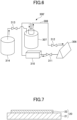
- FIG. 7 An example of a positive electrode is indicated in FIG. 7 .
- a positive electrode composite material layer 22 including a positive electrode active material and a polymer is formed on one surface of a positive electrode substrate 21.
- the positive electrode composite material layer 22 may be formed on both surfaces of the positive electrode substrate 21.
- the shape of the positive electrode 20 is not particularly limited and may include, for example, a flat plate and the like.
- Examples of the materials constituting the positive electrode substrate 21 include stainless steel, aluminum, titanium, tantalum, and the like.
- the method of manufacturing the positive electrode 20 is similar to the method of manufacturing the negative electrode 10 except that the liquid composition is discharged onto the positive electrode substrate 21.
- the liquid composition includes a positive electrode active material, a dispersion medium (a solvent), and a polymer.
- An energy storage device can be formed using the functional material described above. That is, the functional material including the above-described liquid composition is used to form the energy storage device of the present embodiment. Specifically, the functional material including the above-described liquid composition can be used to form electrochemical devices such as secondary batteries.
- a method of manufacturing the electrochemical device includes a step of manufacturing the electrodes using the method of manufacturing the electrodes described above.
- FIG. 8 indicates an example of an electrode device constituting an energy storage device (an electrochemical device) of the present embodiment.
- an electrode device 40 a negative electrode 15 and a positive electrode 25 are laminated through a separator 30.
- the positive electrode 25 is laminated to both sides of the negative electrode 15.
- a drawline 41 is connected to the negative electrode substrate 11, and a drawline 42 is connected to the positive electrode substrate 21.
- the negative electrode 15 is similar to the negative electrode 10 except that the negative electrode composite material layer 12 is formed on both sides of the negative electrode substrate 11.
- the positive electrode 25 is similar to the positive electrode 20 except that the positive electrode composite material layer 22 is formed on both sides of the positive electrode substrate 21.
- the number of layers of the negative electrode 15 and the positive electrode 25 of the electrode device 40 is not particularly limited.
- the number of the negative electrodes 15 and the number of the positive electrodes 25 of the electrode device 40 may be the same or may be different.
- the separator 30 is provided between the negative electrode 15 and the positive electrode 25 to prevent short circuit between the negative electrode 15 and the positive electrode 25.
- the separator 30 is not particularly limited and may be appropriately selected depending on a purpose.
- Examples of the separator 30 include paper such as kraft paper, vinylon mixed paper, synthetic pulp mixed paper, polyolefin non-woven fabric such as cellophane, polyethylene graft film, polypropylene meltblown non-woven fabric, polyamide non-woven fabric, glass fiber non-woven fabric, micropore membrane, and the like.
- the size of the separator 30 is not particularly limited if the size of the separator 30 can be used in the electrochemical device.
- the separator 30 may be a single layer structure or a laminated structure.
- the separator 30 may be omitted.
- FIG. 9 illustrates a secondary battery as an example of the energy storage device (electrochemical element) of the present embodiment.
- the parts common to FIG. 8 may be designated by the same reference numerals as those in FIG. 8 and the description thereof may be omitted.
- an electrolyte layer 81 is formed by injecting an electrolyte aqueous solution or a non-aqueous electrolyte into the electrode device 40 as illustrated in FIG. 8 and is sealed by an outer sheath 82.
- the drawlines 41 and 42 are drawn out of the outer sheath 82.
- the secondary battery 100 may have other members as desired.
- As the secondary battery 100 there is no particular limitation.
- a lithium ion secondary battery and the like may be used.
- the shape of the secondary battery 100 is not particularly limited.
- Examples of the shape of the secondary battery 100 include a laminate type, a cylinder type in which the sheet electrode and the separator are spiraled, a cylinder type in an in-side out structure in which the pellet electrode and the separator are combined, and a coin type in which the pellet electrode and the separator are laminated.
- Examples of the electrolyte salt constituting the electrolyte aqueous solution include sodium hydroxide, potassium hydroxide, sodium chloride, potassium chloride, ammonium chloride, zinc chloride, zinc acetate, zinc bromide, zinc iodide, zinc tartrate, zinc perchlorate, and the like.
- non-aqueous electrolyte a solid electrolyte or a non-aqueous electrolyte solution may be used.
- the non-aqueous electrolyte solution is an electrolyte solution in which the electrolyte salt is dissolved in the non-aqueous solvent.
- the non-aqueous solvent is not particularly limited, and for example, an aprotic organic solvent is preferably used.
- aprotic organic solvent carbonate-based organic solvents such as a chain carbonate, a cyclic carbonate, and the like may be used.
- the chain carbonate is preferably used because of the high solubility of the electrolyte salt.
- the aprotic organic solvent preferably has a low viscosity.
- chain carbonates examples include dimethyl carbonate (DMC), diethyl carbonate (DEC), methyl ethyl carbonate (EMC), and the like.
- the content of the chain carbonate in the non-aqueous solvent is not particularly limited, but is preferably 50% by mass or more.
- the content of the chain carbonate in the non-aqueous solvent is 50% by mass or more, a content of cyclic material is reduced even when the non-aqueous solvent other than the chain carbonate is a cyclic material with a high dielectric constant (for example, cyclic carbonate or cyclic ester). Therefore, even when a non-aqueous electrolyte solution having a high concentration of 2 M or more is prepared, the viscosity of the non-aqueous electrolyte solution decreases, and impregnation and ion diffusion into the electrode of the non-aqueous electrolyte solution become favorable.
- cyclic carbonates examples include propylene carbonate (PC), ethylene carbonate (EC), butylene carbonate (BC), vinylene carbonate (VC), and the like.
- the non-aqueous solvent other than the carbonate organic solvent includes, for example, ester-based organic solvents such as a cyclic ester, a chain ester, and the like, ether-based organic solvents such as a cyclic ether, a chain ether, and the like.
- cyclic esters examples include ⁇ -butyrolactone ( ⁇ BL), 2-methyl- ⁇ -butyrolactone, acetyl- ⁇ -butyrolactone, ⁇ -valerolactone, and the like.
- chain esters examples include alkyl propionate ester, dialkyl malonate ester, alkyl acetate ester (for example, methyl acetate (MA), ethyl acetate), alkyl formate ester (for example, methyl formate (MF), ethyl forate), and the like.
- alkyl propionate ester dialkyl malonate ester
- alkyl acetate ester for example, methyl acetate (MA), ethyl acetate
- alkyl formate ester for example, methyl formate (MF), ethyl forate
- cyclic ethers examples include tetrahydrofuran, alkyltetrahydrofuran, alkoxytetrahydrofuran, dialkoxytetrahydrofuran, 1,3-dioxolane, alkyl-1,3-dioxolane, 1,4-dioxolane, and the like.
- linear ethers examples include 1,2-dimethoxyethane (DME), diethyl ether, ethylene glycol dialkyl ether, diethylene glycol dialkyl ether, triethylene glycol dialkyl ether, tetraethylene glycol dialkyl ether, and the like.
- DME 1,2-dimethoxyethane
- diethyl ether ethylene glycol dialkyl ether
- diethylene glycol dialkyl ether diethylene glycol dialkyl ether
- triethylene glycol dialkyl ether tetraethylene glycol dialkyl ether
- electrolyte salts there is no particular limitation if the ionic conductivity is high and the salt can be dissolved in the non-aqueous solvent.
- the electrolyte salt preferably includes halogen atoms.
- the electrolyte salt can be constituted from cations or anions.
- Examples of the cations constituting the electrolyte salt include lithium ions (lithium salts) and the like.
- Examples of the anions constituting the electrolyte salt include BF 4 - , PF 6 - , AsF 6 - , CF 3 SO 3 - , (CF 3 SO 2 ) 2 N - , (C 2 F 5 SO 2 ) 2 N - , and the like.
- the lithium salts are not particularly limited and can be appropriately selected depending on a purpose.
- lithium salts examples include lithium hexafluorophosphate (LiPF 6 ), lithium borofluoride (LiBF 4 ), lithium arsenide (LiAsF 6 ), lithium trifluorometasulfonate (LiCF 3 SO 3 ), lithium bis (trifluoromethylsulfonyl) imide (LiN(CF 3 SO 2 ) 2 ), lithium bis (pentafluoroethylsulfonyl) imide (LiN(C 2 F 5 SO 2 ) 2 ), and the like.
- LiPF 6 lithium hexafluorophosphate
- LiBF 4 lithium borofluoride
- LiAsF 6 lithium arsenide
- LiCF 3 SO 3 lithium trifluorometasulfonate
- LiN(CF 3 SO 2 ) 2 lithium bis (trifluoromethylsulfonyl) imide
- LiN(C 2 F 5 SO 2 ) 2 lithium bis (pentafluoroeth
- LiPF 6 is preferably used from the viewpoint of ionic conductivity
- LiBF 4 is preferably used from the viewpoint of stability.
- the electrolyte salt may be used alone or two or more electrolyte salts may be used in combination.
- the concentration of the electrolyte salt in the non-aqueous electrolyte solution can be appropriately selected depending on the purpose.
- the concentration of the electrolyte salt in the non-aqueous electrolyte solution is preferably 1 mol/L to 2 mol/L.
- the concentration of the electrolyte salt in the non-aqueous electrolyte solution is preferably 2 mol/L to 4 mol/L.
- FIG. 10 indicates an example of an ink jet printing device as a liquid discharge device.
- the ink jet printing device 50 includes a body housing 51, a carriage 52, guide shafts 53 and 54, a timing belt 55, a platen 56, a main scan motor 57, a sub-scan motor 58, and a gear mechanism 59.
- the ink jet printing device 50 includes a cartridge 60.
- the cartridge 60 contains the liquid composition of the present embodiment.
- the cartridge 60 is housed in the carriage 52 within the body housing 51. In this manner, the liquid composition is supplied from the cartridge 60 to a recording head 52A mounted on the carriage 52.
- the recording head 52A can discharge the liquid composition.
- the recording head 52A mounted on the carriage 52 is guided to and moves through the guide shafts 53 and 54 by the timing belt 55 which is driven by the main scan motor 57. Additionally, an absorbing medium is disposed at a position facing the recording head 52A by the platen 56.
- a method of using the liquid composition is to apply the liquid composition onto a substrate.
- the ink jet printing device 50 described above may be used.
- the substrate is preferably an absorbent medium which can absorb the liquid composition.
- An example of the substrate capable of absorbing the liquid composition is, for example, a porous membrane.
- the porous membrane is not particularly limited and may be selected according to a purpose.
- a separator-integrated electrode When the electrode substrate having the electrode composite material layer (the negative composite material layer and the positive composite material layer) containing, for example, a particulate electrode active material (the negative electrode active material and the positive electrode active material) is used as the porous membranes, a separator-integrated electrode can be manufactured.
- Examples of the negative electrode active materials include carbon materials capable of intercalating or de-intercalating lithium ions, such as metallic lithium, lithium alloy, carbon, graphite, and the like, a conductive polymer doped with lithium ions, and the like.
- Examples of the positive electrode active materials include graphite fluoride represented by the general formula (CFx)n, metal oxides such as CoLiO 2 , MnO 2 , V 2 O 5 , CuO, Ag 2 CrO 4 , TiO 2 , and the like; and metal sulfides such as CuS and the like.
- CFx graphite fluoride represented by the general formula (CFx)n
- metal oxides such as CoLiO 2 , MnO 2 , V 2 O 5 , CuO, Ag 2 CrO 4 , TiO 2 , and the like
- metal sulfides such as CuS and the like.
- the electrode substrate is not particularly limited and may be appropriately selected depending on a purpose.
- Examples of electrode substrates include copper foil, aluminum foil, and the like.
- a substrate used in a reflective display device for example, a substrate used in a reflective display device, an electrode layer used in printed electronics, and the like can be used.
- the liquid composition according to the present embodiment is used for forming a separator-integrated electrode. That is, the separator-integrated electrode can be formed by using the functional material containing the above-mentioned liquid composition.
- FIG. 11 is a schematic configuration diagram illustrating an example of the separator-integrated electrode.
- FIG. 12 is a cross-sectional view taken along line A-A in FIG. 11 .
- the separator-integrated electrode represents the electrode having sequentially formed electrode composite material layer and particle layer as the functional layer on the electrode substrate.
- the separator-integrated electrode can be formed by applying the liquid composition of the present embodiment.
- the electrode composite material layer 72 and the particle layer 73 are formed sequentially on the electrode substrate 71.
- the particle layer 73 is formed, the liquid composition of the present embodiment is used.
- the use of the separator-integrated electrode 70 eliminates the need to wind and laminate the electrodes and separators separately when manufacturing the electrochemical device, and thus greatly improves the manufacturing efficiency of the electrochemical device. In addition, it is expected that the occurrence of misalignment between the electrode and the separator in the winding and laminating processes can be suppressed, and the reliability of the electrochemical element can be improved.
- the energy storage device (electrochemical element) using the separator-integrated electrode is not particularly limited, and can be appropriately selected depending on a purpose.
- Examples of the energy storage device (electrochemical device) using the separator-integrated electrode include a lithium ion secondary battery, a magnesium ion secondary battery, a sodium ion secondary battery, a sodium secondary battery, and the like.
- Examples of such energy storage devices include, but are not limited to, vehicles with in-vehicle batteries, smartphones, notebook PCs, pen input PCs, mobile PCs, electronic book players, cellular phones, portable faxes, portable copies, portable printers, headphone stereos, video movies, liquid crystal televisions, hand held cleaners, portable CDs, mini disks, transceivers, electronic pocketbooks, electronic calculators, memory cards, portable tape recorders, radio, backup power supplies, motors, lights, toys, game machines, watches, strobes, cameras, and the like.
- An example of the functional film prepared by applying the liquid composition to the substrate is a particle layer for providing an insulating function to a separator-integrated electrode in order to prevent short circuiting of the positive and negative electrodes to the electrochemical device.
- the thickness of the particle layer is preferably in the range from 1 ⁇ m to 10 ⁇ m. If the film thickness is less than 1 ⁇ m, it is difficult to obtain the necessary insulating function. If the film thickness is greater than 10 ⁇ m, there is a concern that the property of the electrochemical device may be deteriorated.
- the functional material of the present embodiment including the liquid composition described above can exert effects of the liquid composition described above. Specifically, it is easy to re-disperse the inorganic particles in the liquid composition even when the inorganic particles are self-weight precipitated after the liquid composition is stored for use in the formation of functional materials. Therefore, it is possible to suppress the unevenness in coating when the liquid composition is applied to the substrate. Accordingly, it is possible to improve the performance of the device obtained by using the functional material of the present embodiment.
- the functional material of the present embodiment is used to form the separator-integrated electrode as described above, and the separator-integrated electrode can exert effects of the functional materials.
- the separator-integrated electrode is formed with use of the functional material containing the liquid composition as described above, and the liquid composition, which can be easily re-dispersed after storage, can be applied on the substrate. Thereby, it prevents uneven coating. Therefore, it is possible to improve the performance of the separator-integrated electrode obtained by using the functional material according to the present embodiment.
- the energy storage device of the present embodiment is formed using the functional material described above, and the energy storage device can exert effects of the functional material described above.
- the energy storage device is formed with use of the functional material containing the liquid composition as described above, and the liquid composition, which can be easily re-dispersed after storage, can be applied on the substrate. Thereby, it prevents uneven coating. Therefore, according to the present embodiment, the performance of the energy storage device fabricated by using the above-described functional material can be increased.
- ethyl lactate 46.7 parts of ethyl lactate and 11.28 parts of hexylene glycol were added to prepare a mixed solvent, and 2 parts of a surfactant (Maria Rim (TM) AKM-0513, manufactured by NOF Corporation) and 40 parts of an ⁇ -alumina (a D50 after dispersion was 202 nm and the percentage of the second inorganic particles in the total amount of the first inorganic particles was adjusted to 2.5%) were added to the mixed solvent, and the mixture was stirred.
- the first inorganic particles and the second inorganic particles are both ⁇ -alumina.
- the solid content of the residual liquid (1) was measured using a heat-drying type Moisture Analyzer (ML50, manufactured by A&D Company, Limited.). The residual liquid (1) was gently stirred, and approximately 1.5 g of the residual liquid (1) was collected using a dropper to measure the solid content of the residual liquid (1). In addition, since 2% of the surfactant is included in the solid content in addition to the inorganic particles in the solid content, the solid content (concentration of the solid content) of the inorganic particles was determined by subtracting 2 from the measured value. The solids concentration was 42%.
- the solid content of the re-dispersion liquid (1) was measured using a heat-drying type Moisture Analyzer (ML50, manufactured by A&D Company, Limited.).
- the supernatant (1) was gently stirred, and approximately 1.0 g of the supernatant (1) was collected using a dropper to measure the solid content of the re-dispersion liquid (1).
- Stirring time until the solid content of the supernatant of the stirred liquid composition returned within ⁇ 3% of the solid content of the liquid composition prior to stationary storage was set as evaluation criteria as follows, and the solid content was evaluated. Evaluation criteria A, B, and C are feasible levels.
- the re-dispersion liquid (1) was diluted so that the solid content was to be 10% by mass or less. Subsequently, the median size D50 of the liquid composition was measured using Fiber-Optics Particle Analyzer (FPAR-1000, manufactured by Otsuka Electronics Co., Ltd.). The change rate (particle size) from the particle size of the liquid composition prior to storage was evaluated.
- the evaluation criteria A, B, and C are feasible levels.
- a discharge property of the re-dispersion liquid (1) was evaluated with use of an ink jet head (MH2420, manufactured by Ricoh Co., Ltd.).
- Example 2 was performed to prepare a mixed ink (2) in the same manner as in Example 1, except that the ⁇ -alumina was changed to another ⁇ -alumina (a D50 after dispersion was 397 nm and the percentage of the second inorganic particles in the total amount of the first inorganic particles was adjusted to 2.2%).
- the mixed ink (2) was evaluated in the same manner as in Example 1.
- Example 3 was performed to prepare a mixed ink (3) in the same manner as in Example 1, except that the ⁇ -alumina was changed to another ⁇ -alumina (a D50 after dispersion was 500 nm and the percentage of the second inorganic particles in the total amount of the first inorganic particles was adjusted to 1.9%) and the surfactant was changed to another surfactant (DISPERBYK (Registered Trademark)-2155, manufactured by BYK).
- DISPERBYK Registered Trademark
- Example 4 was performed to prepare a mixed ink (4) in the same manner as in Example 3, except that the ⁇ -alumina was changed to another ⁇ -alumina (a D50 after dispersion was 613 nm and the percentage of the second inorganic particles in the total amount of the first inorganic particles was adjusted to 1.8%).
- the mixed ink (4) was evaluated in the same manner as in Example 1.
- Example 5 was performed to prepare a mixed ink (5) in the same manner as in Example 1, except that the ⁇ -alumina was changed to another ⁇ -alumina (a D50 after dispersion was 997 nm and the percentage of the second inorganic particles in the total amount of the first inorganic particles was adjusted to 1.8%) and the surfactant was changed to another surfactant (MALIALIM (Registered Trademark) SC-0708A, manufactured by NOF Corporation).
- MALIALIM Registered Trademark
- Example 6 was performed to prepare a mixed ink (6) in the same manner as in Example 1, except that the solvent was changed to 58 parts of ethyl lactate and the ⁇ -alumina was changed to another ⁇ -alumina (a D50 after dispersion was 202 nm and the percentage of the second inorganic particles in the total amount of the first inorganic particles was adjusted to 2.5%).
- the mixed ink (6) was evaluated in the same manner as in Example 1.
- Example 7 was performed to prepare a mixed ink (7) in the same manner as in Example 6, except that the ⁇ -alumina was changed to another ⁇ -alumina (a D50 after dispersion was 397 nm and the percentage of the second inorganic particles in the total amount of the first inorganic particles was adjusted to 2.2%).
- the mixed ink (7) was evaluated in the same manner as in Example 1.
- Example 8 was performed to prepare a mixed ink (8) in the same manner as in Example 1, except that ethyl lactate was changed to 46.72 parts of dimethyl sulfoxide (DMSO); the ⁇ -alumina was changed to another ⁇ -alumina (a D50 after dispersion was 202 nm and the percentage of the second inorganic particles in the total amount of the first inorganic particles was adjusted to 3.0%); and the surfactant was changed to another surfactant (MALIALIM (Registered Trademark) HKM-150A, manufactured by NOF Corporation).
- DMSO dimethyl sulfoxide
- HKM-150A surfactant
- Example 9 was performed to prepare a mixed ink (9) in the same manner as in Example 8, except that dimethyl sulfoxide (DMSO) was changed to methyl ethyl ketone (MEK) and the ⁇ -alumina was changed to another ⁇ -alumina (a D50 after dispersion was 202 nm and the percentage of the second inorganic particles in the total amount of the first inorganic particles was adjusted to 3.2%).
- DMSO dimethyl sulfoxide
- MEK methyl ethyl ketone
- MEK methyl ethyl ketone
- the mixed ink (9) was evaluated in the same manner as in Example 1.
- Example 10 was performed to prepare a mixed ink (10) in the same manner as in Example 9, except that methyl ethyl ketone (MEK) was changed to isopropyl alcohol (IPA).
- MEK methyl ethyl ketone
- IPA isopropyl alcohol
- Example 11 was performed to prepare a mixed ink (11) in the same manner as in Example 8, except that dimethyl sulfoxide (DMSO) was changed to ethanol.
- the mixed ink (11) was evaluated in the same manner as in Example 1.
- Example 12 was performed to prepare a mixed ink (12) in the same manner as in Example 8, except that dimethyl sulfoxide (DMSO) was changed to diisobutyl ketone (DIBK) and the ⁇ -alumina was changed to another ⁇ -alumina (a D50 after dispersion was 202 nm and the percentage of the second inorganic particles in the total amount of the first inorganic particles was adjusted to 2.8%).
- DMSO dimethyl sulfoxide
- DIBK diisobutyl ketone
- the mixed ink (12) was evaluated in the same manner as in Example 1.
- Example 13 was performed to prepare a mixed ink (13) in the same manner as in Example 3, except that hexylene glycol was changed to ethylene glycol and the ⁇ -alumina was changed to another ⁇ -alumina (a D50 after dispersion was 613 nm and the percentage of the second inorganic particles in the total amount of the first inorganic particles was adjusted to 4.0%).
- the mixed ink (13) was evaluated in the same manner as in Example 1.
- Example 14 was performed to prepare a mixed ink (14) in the same manner as in Example 13, except that ethylene glycol was changed to propylene glycol.
- the mixed ink (14) was evaluated in the same manner as in Example 1.
- Example 15 was performed to prepare a mixed ink (15) in the same manner as in Example 1, except that the solvent was changed to 58 parts of pure water; the ⁇ -alumina was changed to another ⁇ -alumina (a D50 after dispersion was 500 nm and the percentage of the second inorganic particles in the total amount of the first inorganic particles was adjusted to 3.2%); and the surfactant was changed to another surfactant (Dispersant 5023, manufactured by San Nopco Limited).
- the mixed ink (15) was evaluated in the same manner as in Example 1.
- Example 16 was performed to prepare a mixed ink (16) in the same manner as in Example 15, except that the pure water was changed to acetone; the ⁇ -alumina was changed to another ⁇ -alumina (a D50 after dispersion was 500 nm and the percentage of the second inorganic particles in the total amount of the first inorganic particles was adjusted to 3.6%); and the surfactant was changed to another surfactant (NOPCOSPERSE (Registered Trademark) 092, manufactured by San Nopco Limited).
- NOPCOSPERSE Registered Trademark
- Example 17 was performed to prepare a mixed ink (17) in the same manner as in Example 16, except that the surfactant was changed to another surfactant (SN Sparse, manufactured by San Nopco Limited).
- the mixed ink (17) was evaluated in the same manner as in Example 1.
- Example 18 was performed to prepare a mixed ink (18) in the same manner as in Example 5, except that the ⁇ -alumina was changed to a ⁇ -alumina (a D50 after dispersion was 803 nm and the percentage of the second inorganic particles in the total amount of the first inorganic particles was adjusted to 3.2%).
- the mixed ink (18) was evaluated in the same manner as in Example 1.
- Example 19 was performed to prepare a mixed ink (19) in the same manner as in Example 5, except that the ⁇ -alumina was changed to silica (a D50 after dispersion was 486 nm and the percentage of the second inorganic particles in the total amount of the first inorganic particles was adjusted to 2.8%).
- the mixed ink (19) was evaluated in the same manner as in Example 1.
- Example 20 was performed to prepare a mixed ink (20) in the same manner as in Example 5, except that the ⁇ -alumina was changed to an aluminum hydroxide (a D50 after dispersion was 912 nm and the percentage of the second inorganic particles in the total amount of the first inorganic particles was adjusted to 2.0%).
- the mixed ink (20) was evaluated in the same manner as in Example 1.
- Example 21 was performed to prepare a mixed ink (21) in the same manner as in Example 5, except that the ⁇ -alumina was changed to titanium oxide (a D50 after dispersion was 294 nm and the percentage of the second inorganic particles in the total amount of the first inorganic particles was adjusted to 2.8%).
- the mixed ink (21) was evaluated in the same manner as in Example 1.
- 100 g of the residual solution (21) was prepared by centrifuging the mixed ink (21) in the same manner as in Example 1, and concentrated using a rotary evaporator (ARE-V1200, manufactured by AS ONE Corporation) until the solid content was reduced to 50% to prepare inorganic fine particle solution (22).
- ARE-V1200 rotary evaporator
- a mixed solvent was prepared by adding 11.28 parts of propylene glycol to 46.72 parts of ethyl lactate. 2 parts of surfactant (DISPERBYK-2155, manufactured by BYK), 40 parts of ⁇ -alumina (a-alumina was prepared so that the D50 after dispersion was 500 nm), and 0.6 parts of fine particle solution (22) were added to the mixed solvent and stirred.
- the first inorganic particles correspond to ⁇ -alumina
- the second inorganic particles correspond to ⁇ -alumina in the fine particle liquid (22) (the percentage of the second inorganic particles in the total amount of the first inorganic particles was 0.8%).
- Example 23 was performed to prepare a mixed ink (23) in the same manner as in Example 22, except that the second inorganic particles were changed to another second inorganic particles (the percentage of the second inorganic particles in the total amount of the first inorganic particles was 1.0%).
- the mixed ink (23) was evaluated in the same manner as in Example 1.
- Example 24 was performed to prepare a mixed ink (24) in the same manner as in Example 22, except that the second inorganic particles were changed to another second inorganic particles (percentage of the second inorganic particles in the total amount of the first inorganic particles was 3.0%).
- the mixed ink (24) was evaluated in the same manner as in Example 1.
- Example 25 was performed to prepare a mixed ink (25) in the same manner as in Example 22, except that the second inorganic particles were changed to another second inorganic particles (percentage of the second inorganic particles in the total amount of the first inorganic particles was 5.0%).
- the mixed ink (25) was evaluated in the same manner as in Example 1.
- Example 26 was performed to prepare a mixed ink (26) in the same manner as in Example 22, except that the second inorganic particles were changed to another second inorganic particles (percentage of the second inorganic particles in the total amount of the first inorganic particles was 5.5%).
- the mixed ink (26) was evaluated in the same manner as in Example 1.
- Example 27 was performed to prepare a mixed ink (27) in the same manner as in Example 14, except that the ⁇ -alumina was changed to 13 parts of another ⁇ -alumina (a D50 after dispersion was 397 nm and the percentage of the second inorganic particles in the total amount of the first inorganic particles was adjusted to 3.0%) and the surfactant was changed to another surfactant (ESLEAM (Registered Trademark) AD-3172M, manufactured by NOF Corporation).
- ESLEAM Registered Trademark
- the mixed ink (27) was evaluated in the same manner as in Example 1. The concentration of solid content was 15%.
- Example 28 was performed to prepare a mixed ink (28) in the same manner as in Example 27, except that the amount of ⁇ -alumina was changed to 18 parts.
- the mixed ink (28) was evaluated in the same manner as in Example 1. The concentration of solid content was 20%.
- Example 29 was performed to prepare a mixed ink (29) in the same manner as in Example 27, except that the amount of ⁇ -alumina was changed to 28 parts.
- the mixed ink (29) was evaluated in the same manner as in Example 1. The concentration of solid content was 30%.
- Example 30 was performed to prepare a mixed ink (30) in the same manner as in Example 27, except that the amount of ⁇ -alumina was changed to 48 parts.
- the mixed ink (30) was evaluated in the same manner as in Example 1.
- the concentration of solid content was 50%.
- Example 31 was performed to prepare a mixed ink (31) in the same manner as in Example 27, except that the amount of ⁇ -alumina was changed to 53 parts.
- the mixed ink (31) was evaluated in the same manner as in Example 1.
- the concentration of solid content was 55%.
- Comparative Example 1 was performed to prepare a mixed ink (32) in the same manner as in Example 1, except that the ⁇ -alumina was changed to another ⁇ -alumina (a D50 after dispersion was 397 nm and the percentage of the second inorganic particles in the total amount of the first inorganic particles was adjusted to 0.0%).
- the mixed ink (32) was evaluated in the same manner as in Example 1. The concentration of solid content was 42%.
- Comparative Example 2 was performed to prepare a mixed ink (33) in the same manner as in Comparative Example 1, except that the amount of ⁇ -alumina was changed to 13 parts.
- the mixed ink (33) was evaluated in the same manner as in Example 1. The concentration of solid content was 15%.
- Comparative Example 3 was performed to prepare a mixed ink (34) in the same manner as in Comparative Example 1, except that the amount of ⁇ -alumina was changed to 18 parts.
- the mixed ink (34) was evaluated in the same manner as in Example 1. The concentration of solid content was 20%.
- Comparative Example 4 was performed to prepare a mixed ink (35) in the same manner as in Comparative Example 1, except that the amount of ⁇ -alumina was changed to 28 parts.
- the mixed ink (35) was evaluated in the same manner as in Example 1. The concentration of solid content was 30%.
- Comparative Example 5 was performed to prepare a mixed ink (36) in the same manner as in Comparative Example 1, except that the amount of ⁇ -alumina was changed to 48 parts.
- the mixed ink (36) was evaluated in the same manner as in Example 1. The concentration of solid content was 50%.
- Comparative Example 6 was performed to prepare a mixed ink (37) in the same manner as in Comparative Example 1, except that the amount of ⁇ -alumina was changed to 53 parts.
- the mixed ink (37) was evaluated in the same manner as in Example 1.
- the concentration of solid content was 55%.
- Comparative Example 7 was performed to prepare a mixed ink (38) in the same manner as in Comparative Example 1, except that the ⁇ -alumina was changed to another ⁇ -alumina (a D50 after dispersion was 202 nm and the percentage of the second inorganic particles in the total amount of the first inorganic particles was adjusted to 0.0%).
- the mixed ink (38) was evaluated in the same manner as in Example 1. The concentration of solid content was 42%.
- Comparative Example 8 was performed to prepare a mixed ink (39) in the same manner as in Comparative Example 1, except that the ⁇ -alumina was changed to another ⁇ -alumina (a D50 after dispersion was 1,000 nm and the percentage of the second inorganic particles in the total amount of the first inorganic particles was adjusted to 0.0%).
- the mixed ink (39) was evaluated in the same manner as in Example 1. The concentration of solid content was 42%.
- Comparative Example 9 was performed to prepare a mixed ink (40) in the same manner as in Comparative Example 1, except that the ⁇ -alumina was changed to titanium oxide (a D50 after dispersion was 408 nm and the percentage of the second inorganic particles in the total amount of the first inorganic particles was adjusted to 0.0%).
- the mixed ink (40) was evaluated in the same manner as in Example 1. The concentration of solid content was 42%.
- a mixed solvent was prepared by adding 11.28 parts of hexylene glycol to 46.72 parts of ethyl lactate. 2 parts of surfactant (ESLEAM (Registered Trademark) AD-3172M, manufactured by NOF Corporation) and 40 parts of ⁇ -alumina (the D50 after dispersion was 397 nm and the percentage of the second inorganic particles in the total amount of the first inorganic particles was adjusted to 0.0%) were added to the mixed solvent and stirred. The concentration of solid content was 42%.
- ESLEAM Registered Trademark
- AD-3172M manufactured by NOF Corporation
- Example 1 Median size after dispersbn (nm ) So lid content of residual liquid (% ) Percentage of the second inorganic particles in the total amount of the first inorganic particles (% ) Eva liation of solid content after re-dispersion Median size after redispersion (nm ) Evaskybn of particle size after re-dispersion Discharge property
- Example 1 202 1.00 2.5 A 208 A Favorable Example 2 397 0.88 2.2 A 400 A Favorable Example 3 500 0.76 1.9 A 512 A Favorable Example 4 613 0.72 1.8 A 625 A Favorable Example 5 997 0.72 1.8 A 1023 A Favorable Example 6 202 1.00 2.5 A 210 A Favorable Example 7 397 0.88 2.2 A 400 A Favorable Example 8 202 1.20 3.0 A 209 A Favorable Example 9 202 1.28 3.2 A 208 A Favorable Example10 202 1.28 3.2 A 212 A Favorable Example 11 202
- Comparative Examples 1 to 10 the solid content and the discharge property after re-dispersing the inorganic particles in the liquid compositions were all poor. Comparative Examples 1, 2, and 6 to 9 were also poor in the particle size after re-dispersing the inorganic particles in the liquid composition.
Landscapes
- Engineering & Computer Science (AREA)
- Chemical & Material Sciences (AREA)
- General Chemical & Material Sciences (AREA)
- Chemical Kinetics & Catalysis (AREA)
- Electrochemistry (AREA)
- Power Engineering (AREA)
- Microelectronics & Electronic Packaging (AREA)
- Manufacturing & Machinery (AREA)
- Materials Engineering (AREA)
- Ceramic Engineering (AREA)
- Inorganic Chemistry (AREA)
- Battery Electrode And Active Subsutance (AREA)
- Electric Double-Layer Capacitors Or The Like (AREA)
- Cell Separators (AREA)
Abstract
The present invention is to provide a liquid composition that can be readily re-disperse even when inorganic particles in the liquid composition are selfweight precipitated.A liquid composition includes first inorganic particles having a median size in a range from 200 nm to less than 1,000 nm, second inorganic particles having an average particle size of less than 30 nm, a dispersant, and a solvent.
Description
- The present invention relates to a liquid composition, a functional material, and an energy storage device.
- Conventional energy storage devices such as lithium ion secondary batteries, electric double layer capacitors, lithium ion capacitors, redox capacitors, and the like use paper, non-woven fabric, and porous film as separators in order to prevent short circuits between the positive and negative electrodes.
- In recent years, a separator-integrated electrode in which an electrode composite material layer and a particle layer are sequentially formed on an electrode substrate has been used (for example,
Japanese Patent Application Laid-Open No. 2000-277386 Japanese Patent Application Laid-Open 2006-173001 - Liquid compositions are generally prepared by dispersing inorganic particles and dispersants uniformly in a solvent as solid components. In order to form such a uniform particle layer, attempts have been made to disperse primary particles by adding a dispersant, such as a surfactant, in the liquid composition and using a dispersion device, such as a bead mill, so as to dissociate the assembly of the inorganic particles as much as possible, and to disperse the independent primary particles evenly in the solvent.
- However, in such liquid compositions, the specific gravity of the inorganic particles is higher than that of the solvent, which is the dispersing medium, so that even if dispersion is achieved, the inorganic particles precipitate due to the particles own weight in the liquid composition after static storage (hereinafter referred to as "self-weight precipitation"). For example, even when particles with large specific gravity, such as alumina, are dispersed in an organic solvent using a dispersant, it is difficult for conventional liquid compositions to re-disperse the particles once the particles are self-weight precipitated.
- Also, if the re-dispersion of the inorganic particles in the liquid composition is insufficient, the physical properties of the liquid composition may be changed, for example, agglomeration may occur in the liquid composition resulting in a change in particle size distribution, and/or the viscosity and thixotropy of the liquid composition may be changed. As a result, when, for example, a functional film is formed on a substrate using the liquid composition, there is a concern that discharge failure occurs when the liquid composition is discharged using an ink jet, resulting in unevenness in coating.
- An object of the present invention is to provide a liquid composition that is capable of readily re-dispersing even when inorganic particles in the liquid composition are self-weight precipitated.
- One aspect of the invention is to provide a liquid composition including first inorganic particles having a median size in a range from 200 nm to less than 1,000 nm, second inorganic particles having an average particle size of less than 30 nm, a dispersant, and a solvent.
- According to an aspect of the invention, a liquid composition that is capable of readily re-dispersing even when inorganic particles in the liquid composition are self-weight precipitated is provided.
-
-
FIG. 1 is a schematic diagram of an inorganic particle; -
FIG. 2 is an interaction potential energy curve between particles; -
FIG. 3 is a cross-sectional view illustrating an example of a negative electrode; -
FIG. 4 is a schematic diagram illustrating an example of a method of manufacturing a negative electrode; -
FIG. 5 is a schematic diagram illustrating another example of a method of manufacturing a negative electrode; -
FIG. 6 is a schematic diagram illustrating a modification of a liquid discharge device ofFIG. 4 andFIG. 5 ; -
FIG. 7 is a cross-sectional view illustrating an example of a positive electrode; -
FIG. 8 is a cross-sectional view illustrating an example of an electrode device constituting a charging device; -
FIG. 9 is a cross-sectional view illustrating an example of an energy storage device; -
FIG. 10 is a schematic perspective diagram illustrating an example of an ink jet printing device; -
FIG. 11 is a schematic configuration diagram illustrating an example of a separator-integrated electrode; and -
FIG. 12 is a cross-sectional view of a line A-A ofFIG. 11 . - Hereinafter, embodiments of the present invention will be described.
- The liquid composition of the present embodiment contains first inorganic particles, second inorganic particles, a dispersant, and a solvent. Here, the inorganic particles refer to particles of an inorganic compound such as a metal or a metal oxide. The liquid composition of the present embodiment may optionally contain an auxiliary solvent, binder, or other additives.
- The first inorganic particles (hereinafter referred to as inorganic particles A) are inorganic particles with a median size in the range from 200 nm to less than 1000 nm.
- As used herein, median size refers to a particle size (hereinafter referred to as D50) with a cumulative frequency of 50% on a number basis. A median size of 1,000 nm or more tends to cause unevenness in the coating process when a film thickness in micrometers is obtained. A median size of less than 200 nm makes it difficult to maintain a uniform dispersion state.
- Examples of the material (inorganic particles A) constituting the first inorganic particles include, but are not limited to, aluminum oxide, silica, calcium carbonate, titanium oxide, calcium phosphate, titanium oxide, silicon oxide, zirconium oxide, and the like. One type of these first inorganic particles may be used alone or two or more types of these inorganic particles may be used in combination.
- Among these first inorganic particles, inorganic oxides such as aluminum oxide (alumina) are preferred for use in the manufacture of separator-integrated electrodes, as described below, because of their high insulation property and heat resistance property.
- The type of alumina used as the first inorganic particles is not particularly limited. Examples of aluminas include α-alumina, γ-alumina, β-alumina, fused alumina, and the like. Among these, α-alumina is preferable from the viewpoint of insulation property and abrasion resistance property.
- One type of these aluminas may be used alone or two or more types of these aluminas may be used in combination. When two or more kinds of alumina are used, a main component of the alumina is preferably α-alumina from the viewpoint of insulation property and abrasion resistance property.
- Here, when the main component is α-alumina, the content of α-alumina in the total alumina is 50% by mass or more. The content is preferably 60% by mass or more, and more preferably 70% by mass or more. In the above-described range, a particle layer with excellent insulation property and abrasion resistance property can be formed.
- The alumina contained in the liquid composition of the present embodiment may be equivalent to a solid content in the liquid composition. The percentage of the solid content in the liquid composition is in the range from 20% by mass to 50% by mass, and preferably in the range from 35% by mass to 45% by mass.
- Such content of alumina indicates higher solid content than liquid compositions, such as inks. By adjusting the alumina content to such a range, unevenness in coating thickness after the liquid composition is applied and dried can be suppressed.
- The second inorganic particles (hereinafter may be referred to as inorganic fine particles or inorganic fine particles B) are inorganic particles with an average size of less than 30 nm.
- As used herein, the average size is, for example, the average of the longitudinal diameter of the particles as measured by Transmission Electron Microscope (TEM) observation. If the average size is 30 nm or more, the energy barrier may not be sufficiently small in the interaction potential energy between particles as described below.
- Here, the inorganic fine particles B with an average size of less than 30 nm can be separated from other particles and collected, for example, by extracting the supernatant liquid obtained by centrifugation.
- For example, according to Stokes' law, alumina with a particle density of 3.95 g/cm3 has a liquid viscosity of 10 kg/m·s and a liquid density of 1.03 g/cm3 in a solvent. The liquid is centrifuged at 3,000 rpm for 20 minutes at a rotation radius of 10 cm. If the particle size is greater than or equal to 30 nm, it is determined that the particles are precipitated for 1.8 cm. Therefore, it is possible to collect inorganic fine particles less than 30 nm by collecting the supernatant liquid.

- In the above formula, dp is the particle size, p is the viscosity of the liquid, pp is the density of the particle, pf is the density of the liquid, g is gravity, h is the distance travelled downward, and t is the time required to precipitate the distance h.
- Examples of the materials constituting the second inorganic particles (inorganic fine particles B) include, but are not limited to, aluminum oxide, silica, calcium carbonate, titanium oxide, calcium phosphate, titanium oxide, silicon oxide, zirconium oxide, and the like. One type of these second inorganic particles may be used alone or two or more types of these inorganic particles may be used in combination.
- Among these second inorganic particles, inorganic oxides, such as aluminum oxide (alumina), are preferably used for use in manufacturing the separator-integrated electrode described below because of its high insulation property and heat resistance property.
- The type of alumina used as the second inorganic particles is not particularly limited. Examples of the aluminas include α-alumina, γ-alumina, β-alumina, fused alumina, and the like. Among these, α-alumina is preferable from the viewpoint of insulation property and abrasion resistance property.
- The material constituting the inorganic fine particles B may be the same as or different from the material constituting the above-described inorganic particles A.
- In addition, although the content of the second inorganic particles (inorganic fine particles B) is not particularly limited, the content of the second inorganic particles (inorganic fine particles B) is preferably in the range from 1% by mass to 5% by mass relative to the total mass of the first inorganic particles (inorganic particles A) .
- Embodiments in which the liquid composition contains the first and second inorganic particles are not particularly limited.
FIG. 1 is a schematic diagram of inorganic particles contained in the liquid composition of the present embodiment. In the present embodiment, a first inorganic particle 1 and a second inorganic particle (not shown) are mixed in the liquid composition. - A dispersant is a compound that adsorbs or binds to the surface of a particle and functions to inhibit agglomeration of the particles by electrostatic repulsion due to coulombic forces or steric hindrance due to molecular chains.
- The number average molecular weight of the dispersant is not particularly limited but is usually from 1,000 to 100,000. From the viewpoint of suppressing the increase in viscosity of the liquid composition, the number average molecular weight of the dispersant is more preferably from 1,000 to 10,000, and even more preferably from 1,000 to 5,000.
- The dispersant preferably has a dispersible group. The dispersible group is preferably a nonionic group from the viewpoint of ionic conductivity, for example, when the liquid composition is used as a functional material in a lithium ion battery. Here, nonionic does not indicate ionicity and nonionic group does not include ionic substituents. It should be noted that a dispersant having a nonionic group as a dispersible group corresponds to a nonionic surfactant.
- The dispersible group may have a structure that is soluble for a solvent and auxiliary solvent describe later. However, when used as a lithium-ion secondary battery, an oligoether group is preferably used from the viewpoint of ionic conductivity. The oligoether group is a group from which the hydroxyl group is removed from the end of a polymer of ethylene glycol or propylene glycol.
- The molecular weight of the polymer of ethylene glycol or propylene glycol is preferably 100 or more and 10,000 or less, and further preferably 100 or more and 5,000 or less. When the molecular weight of the polymer of ethylene glycol or propylene glycol is 100 or more, the dispersibility of the inorganic particles (for example, the alumina particles) is improved. When the molecular weight is 10,000 or less, the increase in the viscosity of the liquid composition can be suppressed.
- The end of the unbound side of the oligoether group may be a hydroxyl group, a methoxy group, an ethoxy group, a propoxy group, or the like. If a dispersant having an oligoether group is used, the dispersibility of the inorganic particles can be improved even when a highly polar solvent is used as a solvent.
- When the first inorganic particles are alumina particles, the dispersant is preferably a polymer dispersant having an ionic group having the polarity opposite to that of which the alumina particles are charged as an adsorptive group from the viewpoint of adsorption strength with the alumina particles.
- Examples of commercially available polymeric dispersants include DISPERBYK-103, DISPERBYK-118, DISPERBYK-2155 (manufactured by BYK-Chemie), NOPCOSPERSE-092, SN-SPERSE-2190, SN-DISPERSANT-9228 (manufactured by SAN NOPCO Limited), ESLEAM (Registered Trademark), AD-3172M, ESLEAM 2093, MALIALIM (Registered Trademarks), AKM-0513, MALIALIM HKM-50A, MALIALIM HKM-150A, MALIALIM SC-0505K, MALIALIM SC-1015F, MALIALIM SC-0708A (manufactured by NOF Corporation), and the like.
- One type of these polymeric dispersants may be used alone or two or more types of these polymeric dispersants may be used in combination. The content of the polymeric dispersant to the inorganic particles is not particularly limited, and usually in the range from 0.01% by mass to 10% by mass. When the dispersibility of the inorganic particles is considered, the content of the polymeric dispersant to the inorganic particles is preferably in the range from 0.1% by mass to 10% by mass.
- A binder may be added to the liquid composition of the present embodiment. Applying the liquid composition containing the binder on a substrate as described below can improve the strength of the functional membrane formed using the liquid composition.
- Examples of the binders include, but are not limited to, polyvinylidene fluoride, styrene butadiene rubber, acrylic resin, and the like. One type of these binders may be used alone or two or more types of these binders may be used in combination. The binder may also be dissolved or dispersed in a liquid composition.
- A precursor of the binder may be used instead of the binder. Examples of the precursors of the binder include monomers and the like. For example, the liquid composition containing monomers and optionally further containing a polymerization initiator is applied onto an absorbent medium (hereinafter, may be referred to as a substrate), and subsequently heated or illuminated to polymerize the monomers to form a binder.
- A solvent (hereinafter, may be referred to as a solvent A) can disperse inorganic particles in the liquid composition. The content of solvent A is suitably adjusted. The components of solvent A are not particularly limited, but an aqueous solvent or a non-aqueous solvent.
- The aqueous solvent is not particularly limited and includes, for example, water, mixtures of water and polar solvents, and the like.
- Examples of polar solvents include methanol, ethanol, propanol, butanol, pentanol, hexanol, ethylene glycol, hexylene glycol, N-methyl-2-pyrrolidone (NMP), dimethyl sulfoxide (DMSO), N,N-dimethylformamide (DMF), acetone, tetrahydrofuran (THF), and the like. The polar solvents may be used alone or in a combination of two or more polar solvents.
- The non-aqueous dispersion medium is not particularly limited and includes, for example, lactams, alcohols, sulfoxides, esters, ketones, and the like.
- Examples of lactams include 1-methyl-2-pyrrolidone, 2-pyrrolidone, and the like.
- Examples of alcohols include isopropyl alcohol, butanol, diacetone alcohol, and the like.
- Examples of sulfoxides include dimethyl sulfoxide and the like.
- Examples of esters include ethyl acetate, butyl acetate, ethyl lactate, ethylene glycol diacetate, and the like.
- Examples of ketones include diisobutyl ketone, 2-butanone, 2-pentanone, diacetone alcohol, and the like.
- One type of these non-aqueous solvents may be used alone or two or more types of these non-aqueous solvents may be used in combination.
- The solvent A is preferably a solvent having an affinity with the inorganic particles (for example, alumina particles), and the solvent A is more preferably a non-aqueous solvent.
- An auxiliary solvent (hereinafter referred to as "solvent B") is a solvent different from that of solvent A. The solvent B can optionally be formulated to compensate for the lack of function with solvent A.
- Examples of the solvent B include a solvent having a function of dispersing inorganic particles (for example, alumina particles), a solvent having a high boiling point for preventing the drying of the nozzle of the liquid discharge head, a solvent having a suitable viscosity and surface tension when discharging from the liquid discharge head, and a solvent capable of preventing the absorption of alumina particles into the electrode composite material layer.
- The components of solvent B are not particularly limited, but are aqueous solvents or non-aqueous solvents.
- The aqueous solvent is not particularly limited. Examples of the aqueous solvents include water, mixtures of water and polar solvents, and the like. Examples of the polar solvents include methanol, ethanol, propanol, butanol, pentanol, hexanol, ethylene glycol, hexylene glycol, NMP, DMSO, DMF, acetone, THF, and the like. The polar solvent may be used alone or in a combination of two or more aqueous solvents.
- The non-aqueous dispersion medium is not particularly limited and includes, for example, ethers, glycols, esters, alcohols, or lactams.
- Examples of ethers include propylene glycol monopropyl ether and the like.
- Examples of glycols include propylene glycol, ethylene glycol, triethylene glycol, hexylene glycol, and the like.
- Examples of esters include ethyl lactate, ethylene carbonate, ethylene glycol diacetate, and the like.
- Examples of alcohols include cyclohexanol, propylene glycol monopropyl ether, and the like. Examples of lactams include 2-pyrrolidone and the like.
- One type of these non-aqueous solvents may be used alone or two or more types of these non-aqueous solvents may be used in combination.
- The solvent B is preferably a solvent having affinity with inorganic particles such as alumina, and the solvent B is more preferably a non-aqueous solvent.
- The liquid composition of the present embodiment may further contain other components according to purposes of adjusting viscosity, adjusting surface tension, controlling evaporation of the solvent, improving the solubility of additives, improving a dispersibility of alumina particles, sterilization, and the like. Examples of other additives include, for example, surfactants, pH adjusters, corrosion inhibitors, antiseptics, mold inhibitors, antioxidants, anti-reduction agents, evaporation accelerators, chelating agents, and the like.
- The method of preparing the liquid composition of the present embodiment can be formed by mixing and dispersing a first inorganic particles (inorganic particles A), a second inorganic particles (inorganic fine particles B), a dispersant, and a solvent A. A binder and a solvent B may be added to the mixture as needed.
- The method of dispersing the liquid composition is not particularly limited, but for example, a known dispersion device can be used. Examples of dispersion devices include a stirrer, a ball mill, a beads mill, a ring-type mill, a high-pressure disperser, a rotary highspeed shear device, an ultrasonic disperser, and the like.
- The effect obtained by the liquid composition of the present embodiment can be explained by the DLVO theory representing the dispersed/agglomerated state acting between the particles. The DLVO theory explains that the dispersion/agglomeration phenomenon of particles can be predicted by the balance between the osmotic repulsive force derived from the electric double layer between particles and the attractive force between particles, which is the sum of the London-van der Waals forces.
-
FIG. 2 is a potential energy curve of interaction between particles based on the DLVO theory. In the graph ofFIG. 2 , H on the horizontal axis indicates the interparticle distance, V on the vertical axis indicates the potential energy, A indicates the London-van der Waals attraction, B indicates the electric double layer repulsive force (repulsive force), C indicates the potential energy due to the total interaction of attraction and repulsion, C1 indicates the minimum point of primary agglomeration, C2 indicates the maximum point of energy barrier, and C3 indicates the minimum point of secondary agglomeration. - According to the DLVO theory, in order to restore the primary agglomerated particles to the dispersed state again, it is necessary to exceed the energy barrier (C2) of the potential energy due to the total interaction (C) between the attractive force (A) and the repulsive force (B). Therefore, in order to improve the re-dispersibility of the liquid composition, it is necessary to reduce the energy barrier (C2) of the potential energy acting between such particles.
- The inventors found that adding a certain amount of inorganic fine particles, defined by the average size, with respect to inorganic particles defined by the median size, increases the London-van der Waals force (A) and decreases the energy barrier (C2) of potential energy. The effect of the liquid composition of the present invention is thought to be achieved by this mechanism, the re-dispersibility of the liquid composition containing inorganic particles can be increased.
- That is, the liquid composition of the present embodiment includes first inorganic particles having a median size in a range from 200 nm to less than 1000 nm, second inorganic particles having an average size of less than 30 nm, a dispersant, and a solvent, as described above. This can reduce the energy barrier of potential energy between the inorganic particles in the liquid composition. Therefore, the dispersibility of the liquid composition can be improved even when the liquid composition contains inorganic particles having a high specific gravity relative to the solvent.
- Also, in the present embodiment, as described above, the smaller energy barrier of potential energy acting between the inorganic particles in the liquid composition allows the inorganic particles with large specific gravity relative to the solvent to easily re-disperse in the liquid composition even if the inorganic particles are precipitated by self-weight precipitation in the liquid composition. Therefore, according to the present embodiment, the liquid composition with excellent storage stability such as storage and transport can be provided.
- Further, in this embodiment, the inorganic particles in the liquid composition can easily be re-dispersed even when the inorganic particles are self-weight precipitated, when the liquid composition is used after the liquid composition has been stored, a large-scale stirring operation is no longer necessary, which improves re-dispersion efficiency and reduces product cost. In addition, when the functional film is formed on the substrate using the liquid composition, it is possible to suppress coating unevenness when the liquid composition is discharged using, for example, an ink jet.
- In the liquid composition of the present embodiment as described above, adjusting the content of the second inorganic particles with respect to the total amount of the first inorganic particles being in the range from 1% by mass to 5% by mass further reduces the energy barrier of potential energy acting between inorganic particles in the liquid composition. Therefore, the re-dispersibility of the inorganic particles can be improved even after the inorganic particles having a large specific gravity with respect to the solvent have precipitated by self-weight precipitation in the liquid composition.
- In the liquid composition of the present embodiment, as described above, the use of α-alumina as the first inorganic particles further reduces the energy barrier of potential energy acting between inorganic particles in the liquid composition.
- Therefore, the re-dispersibility of the inorganic particles can be improved even after the inorganic particles having a large specific gravity with respect to the solvent have precipitated by self-weight precipitation in the liquid composition.
- In the liquid composition of the present embodiment, as described above, the percentage of solid content is in the range from 20% by mass to 50% by mass, so that unevenness in coating when the liquid composition is applied to form a coating film can be suppressed.
- In the liquid composition of the present embodiment, as described above, by using a non-aqueous solvent as the solvent, the affinity of the solvent can be increased between inorganic particles, such as alumina. This can improve both the dispersibility during preparation and the re-dispersibility after self-weight precipitating in the liquid composition, containing the inorganic particles. In addition, since the boiling point of the non-aqueous solvent is higher than that of the aqueous solvent, drying when a coating film is formed by applying the liquid composition is facilitated.
- In the liquid composition according to the present embodiment, as described above, by using a nonionic surfactant as a dispersant, ionic conductivity can be increased when used as a functional material of a lithium ion battery. Therefore, according to the present embodiment, when the liquid composition is used for a lithium ion secondary battery, the battery characteristics of the lithium ion battery can be improved.
- In the liquid composition of the present embodiment, as described above, when the liquid composition is used as a functional material in a lithium ion battery, the ionic conductivity can be further increased by using a dispersant having an oligoether group. Therefore, according to the present embodiment, when the liquid composition is used for a lithium ion secondary battery, the battery characteristics of the lithium ion battery can be further improved.
- The functional material of the present embodiment includes the liquid composition described above. That is, the liquid composition described above can be used for the functional material of the present embodiment. Specifically, the liquid composition described above as the functional material can be applied to the substrate described below to form a functional film on the substrate.
- As the method of applying the liquid composition of the present embodiment, a method of discharging liquid such as an ink jet ejection method is preferably used because the ejection position can be controlled.
- Examples of the method of discharging the liquid composition in the liquid discharge method include a method of applying mechanical energy to the liquid composition, a method of applying thermal energy to the liquid composition, and the like. Among them, a method of applying mechanical energy to the liquid composition is preferably used in terms of dispersion stability.
- When the liquid discharge method is used, a technique using the principle of liquid discharge of a known liquid discharge device may be applied. However, a solvent having a flow passage installed in the liquid discharge device and a nozzle-resistant solvent of the liquid discharge head are preferably used as the solvents A and B contained in the liquid composition.
- The liquid composition of the present embodiment can be used in the manufacture of electrodes having a functional film. Such a method of manufacturing electrodes having a functional film includes a step of discharging the liquid composition of the present embodiment onto an electrode substrate.
- Materials of constituting the electrode substrate (for example, current collectors, electrodes having current collectors and active material layers, and the like) are not particularly limited as long as the materials have conductivity and are stable to a potential to be applied.
- The method of manufacturing electrodes using the liquid composition of the present embodiment further preferably includes a step of pressurizing the electrode substrate from which the liquid composition is discharged. This prevents the electrode components from peeling off and improves the reliability of the device.
- The electrode used in the liquid composition of the present embodiment has a negative electrode and a positive electrode.
- An example of the negative electrode is indicated in
FIG. 3 . Thenegative electrode 10 is formed on one surface of thenegative electrode substrate 11 with a negative electrodecomposite material layer 12 including a negative electrode active material and a polymer. The negative electrodecomposite material layer 12 may be formed on both surfaces of thenegative electrode substrate 11. - The shape of the
negative electrode 10 is not particularly limited and may include, for example, a flat plate and the like. Examples of the materials constituting thenegative electrode substrate 11 include stainless steel, nickel, aluminum, copper, and the like. -
FIG. 4 indicates an example of a method of manufacturing the negative electrode. The method of manufacturing thenegative electrode 10 includes a step of discharging aliquid composition 12A onto thenegative electrode substrate 11 using aliquid discharge device 300. - Here, the
liquid composition 12A includes a negative electrode active material, a dispersion medium (a solvent), and a polymer. Theliquid composition 12A is stored in atank 307 and fed from thetank 307 through atube 308 to aliquid discharge head 306. - The
liquid discharge device 300 may also be provided with a mechanism to cap a nozzle (not illustrated) of thedischarge head 306 to prevent theliquid composition 12A from drying when theliquid composition 12A is not discharged from theliquid discharge head 306. - In manufacturing the
negative electrode 10, thenegative electrode substrate 11 is placed on astage 400 capable of being heated, droplets of theliquid composition 12A are discharged to thenegative electrode substrate 11, and then heated. Thestage 400 may then move, and theliquid discharge head 306 may move. - When the
liquid composition 12A discharged to thenegative electrode substrate 11 is heated, it may be heated by thestage 400 or by a heating mechanism other than thestage 400. - The heating mechanisms are not particularly limited as long as the heating mechanisms do not directly contact with the
liquid composition 12A. Examples of the heating mechanisms include resistive heating heaters, infrared heaters, fan heaters, and the like. A plurality of heating mechanisms may be provided. - The heating temperature is not particularly limited as long as the temperature is capable of volatilizing the dispersion medium. The heating temperature is preferably in the range of 70°C to 150°C in terms of power consumption.
- UV light may also be irradiated when the
liquid composition 12A discharged to thenegative electrode substrate 11 is heated. -
FIG. 6 illustrates another example of a method of manufacturing negative electrodes. InFIG. 6 , the parts common toFIG. 4 may be designated by the same reference numerals as those inFIG. 4 and the description thereof may be omitted. - The method of manufacturing the
negative electrode 10 includes a step of discharging theliquid composition 12A onto thenegative electrode substrate 11 using theliquid discharge device 300. - First, an elongate
negative electrode substrate 11 is prepared. Then, thenegative electrode substrate 11 is wound around a cylindrical core and set to afeed roller 304 and a take-uproller 305 so that the side where the negative electrodecomposite material layer 12 is formed is on the upper side inFIG. 6 . Here, thefeed roller 304 and the take-uproller 305 rotate counterclockwise (the direction of arrow inFIG. 6 ), and thenegative electrode substrate 11 is conveyed from the right direction to the left direction inFIG. 6 . - The droplets of the
liquid composition 12A are discharged from theliquid discharge head 306 disposed above thenegative electrode substrate 11 between thefeed roller 304 and the take-uproller 305 onto thenegative electrode substrate 11 to be conveyed. The droplets of theliquid composition 12A are discharged to cover at least a portion of thenegative electrode substrate 11. - A plurality of liquid discharge heads 306 may be disposed in a direction substantially parallel to or substantially perpendicular to the conveying direction of the
negative electrode substrate 11. - Next, the
negative electrode substrate 11 on which theliquid composition 12A is discharged is conveyed to aheating mechanism 309 by thefeed roller 304 and the take-uproller 305. As a result, the dispersion medium contained in theliquid composition 12A on thenegative electrode substrate 11 is volatilized to form the negative electrodecomposite material layer 12 to obtain thenegative electrode 10. Thenegative electrode 10 is then cut to a desired size by a punching process or the like. - The
heating mechanism 309 is not particularly limited as long as the heating mechanism does not directly contact with theliquid composition 12A. Examples of the heating mechanisms include resistive heating heaters, infrared heaters, fan heaters, and the like. Theheating mechanism 309 may be disposed on either above or below of thenegative electrode substrate 11, or a plurality of the heating mechanisms may be disposed. - The heating temperature is not particularly limited as long as the temperature is capable of volatilizing the dispersion medium. The heating temperature is preferably in the range of 70°C to 150°C in terms of power consumption.
- UV light may also be irradiated when the
liquid composition 12A discharged to thenegative electrode substrate 11 is heated. -
FIG. 6 indicates a modification of theliquid discharge device 300 inFIGS 4 and5 . InFIG. 6 , the parts common toFIG. 5 may be designated by the same reference numerals as those inFIG. 5 and the description thereof may be omitted. - A liquid discharge device 300' illustrated in
FIG. 6 controls apump 310 andvalves liquid composition 12A to circulate through theliquid discharge head 306, thetank 307, and thetube 308. - The liquid discharge device 300' is also provided with an
external tank 314, and it is possible to supply theliquid composition 12A from theexternal tank 314 to thetank 307 by controlling thepump 310 and thevalves liquid composition 12A in thetank 307 is reduced. - If the
liquid discharge device 300 or 300' is used, theliquid composition 12A can be discharged to the desired portion of thenegative electrode substrate 11. Further, if theliquid discharge device 300 or 300' is used, the surfaces of thenegative electrode substrate 11 and the negative electrodecomposite material layer 12 that contact each other can be bonded. Furthermore, if theliquid discharge device 300 or 300' is used, the thickness of the negative electrodecomposite material layer 12 can be uniform. - An example of a positive electrode is indicated in
FIG. 7 . In apositive electrode 20, a positive electrodecomposite material layer 22 including a positive electrode active material and a polymer is formed on one surface of apositive electrode substrate 21. The positive electrodecomposite material layer 22 may be formed on both surfaces of thepositive electrode substrate 21. - The shape of the
positive electrode 20 is not particularly limited and may include, for example, a flat plate and the like. Examples of the materials constituting thepositive electrode substrate 21 include stainless steel, aluminum, titanium, tantalum, and the like. - The method of manufacturing the
positive electrode 20 is similar to the method of manufacturing thenegative electrode 10 except that the liquid composition is discharged onto thepositive electrode substrate 21. Here, the liquid composition includes a positive electrode active material, a dispersion medium (a solvent), and a polymer. - An energy storage device according to the present embodiment can be formed using the functional material described above. That is, the functional material including the above-described liquid composition is used to form the energy storage device of the present embodiment. Specifically, the functional material including the above-described liquid composition can be used to form electrochemical devices such as secondary batteries.
- A method of manufacturing the electrochemical device (the energy storage device) includes a step of manufacturing the electrodes using the method of manufacturing the electrodes described above.
-
FIG. 8 indicates an example of an electrode device constituting an energy storage device (an electrochemical device) of the present embodiment. In anelectrode device 40, a negative electrode 15 and apositive electrode 25 are laminated through aseparator 30. Here, thepositive electrode 25 is laminated to both sides of the negative electrode 15. Adrawline 41 is connected to thenegative electrode substrate 11, and adrawline 42 is connected to thepositive electrode substrate 21. - The negative electrode 15 is similar to the
negative electrode 10 except that the negative electrodecomposite material layer 12 is formed on both sides of thenegative electrode substrate 11. - The
positive electrode 25 is similar to thepositive electrode 20 except that the positive electrodecomposite material layer 22 is formed on both sides of thepositive electrode substrate 21. - The number of layers of the negative electrode 15 and the
positive electrode 25 of theelectrode device 40 is not particularly limited. The number of the negative electrodes 15 and the number of thepositive electrodes 25 of theelectrode device 40 may be the same or may be different. - The
separator 30 is provided between the negative electrode 15 and thepositive electrode 25 to prevent short circuit between the negative electrode 15 and thepositive electrode 25. - The
separator 30 is not particularly limited and may be appropriately selected depending on a purpose. Examples of theseparator 30 include paper such as kraft paper, vinylon mixed paper, synthetic pulp mixed paper, polyolefin non-woven fabric such as cellophane, polyethylene graft film, polypropylene meltblown non-woven fabric, polyamide non-woven fabric, glass fiber non-woven fabric, micropore membrane, and the like. - The size of the
separator 30 is not particularly limited if the size of theseparator 30 can be used in the electrochemical device. - The
separator 30 may be a single layer structure or a laminated structure. - When a solid electrolyte is used, the
separator 30 may be omitted. -
FIG. 9 illustrates a secondary battery as an example of the energy storage device (electrochemical element) of the present embodiment. InFIG. 9 , the parts common toFIG. 8 may be designated by the same reference numerals as those inFIG. 8 and the description thereof may be omitted. - In a
secondary battery 100, anelectrolyte layer 81 is formed by injecting an electrolyte aqueous solution or a non-aqueous electrolyte into theelectrode device 40 as illustrated inFIG. 8 and is sealed by anouter sheath 82. In thesecondary battery 100, thedrawlines outer sheath 82. - The
secondary battery 100 may have other members as desired. As thesecondary battery 100, there is no particular limitation. For example, a lithium ion secondary battery and the like may be used. - The shape of the
secondary battery 100 is not particularly limited. Examples of the shape of thesecondary battery 100 include a laminate type, a cylinder type in which the sheet electrode and the separator are spiraled, a cylinder type in an in-side out structure in which the pellet electrode and the separator are combined, and a coin type in which the pellet electrode and the separator are laminated. - Examples of the electrolyte salt constituting the electrolyte aqueous solution include sodium hydroxide, potassium hydroxide, sodium chloride, potassium chloride, ammonium chloride, zinc chloride, zinc acetate, zinc bromide, zinc iodide, zinc tartrate, zinc perchlorate, and the like.
- As the non-aqueous electrolyte, a solid electrolyte or a non-aqueous electrolyte solution may be used. Here, the non-aqueous electrolyte solution is an electrolyte solution in which the electrolyte salt is dissolved in the non-aqueous solvent.
- The non-aqueous solvent is not particularly limited, and for example, an aprotic organic solvent is preferably used.
- As the aprotic organic solvent, carbonate-based organic solvents such as a chain carbonate, a cyclic carbonate, and the like may be used. Of these, the chain carbonate is preferably used because of the high solubility of the electrolyte salt. In addition, the aprotic organic solvent preferably has a low viscosity.
- Examples of the chain carbonates include dimethyl carbonate (DMC), diethyl carbonate (DEC), methyl ethyl carbonate (EMC), and the like.
- The content of the chain carbonate in the non-aqueous solvent is not particularly limited, but is preferably 50% by mass or more.
- When the content of the chain carbonate in the non-aqueous solvent is 50% by mass or more, a content of cyclic material is reduced even when the non-aqueous solvent other than the chain carbonate is a cyclic material with a high dielectric constant (for example, cyclic carbonate or cyclic ester). Therefore, even when a non-aqueous electrolyte solution having a high concentration of 2 M or more is prepared, the viscosity of the non-aqueous electrolyte solution decreases, and impregnation and ion diffusion into the electrode of the non-aqueous electrolyte solution become favorable.
- Examples of the cyclic carbonates include propylene carbonate (PC), ethylene carbonate (EC), butylene carbonate (BC), vinylene carbonate (VC), and the like.
- The non-aqueous solvent other than the carbonate organic solvent includes, for example, ester-based organic solvents such as a cyclic ester, a chain ester, and the like, ether-based organic solvents such as a cyclic ether, a chain ether, and the like.
- Examples of the cyclic esters include γ-butyrolactone (γBL), 2-methyl-γ-butyrolactone, acetyl-γ-butyrolactone, γ-valerolactone, and the like.
- Examples of the chain esters include alkyl propionate ester, dialkyl malonate ester, alkyl acetate ester (for example, methyl acetate (MA), ethyl acetate), alkyl formate ester (for example, methyl formate (MF), ethyl forate), and the like.
- Examples of the cyclic ethers include tetrahydrofuran, alkyltetrahydrofuran, alkoxytetrahydrofuran, dialkoxytetrahydrofuran, 1,3-dioxolane, alkyl-1,3-dioxolane, 1,4-dioxolane, and the like.
- Examples of the linear ethers include 1,2-dimethoxyethane (DME), diethyl ether, ethylene glycol dialkyl ether, diethylene glycol dialkyl ether, triethylene glycol dialkyl ether, tetraethylene glycol dialkyl ether, and the like.
- As electrolyte salts, there is no particular limitation if the ionic conductivity is high and the salt can be dissolved in the non-aqueous solvent.
- The electrolyte salt preferably includes halogen atoms.
- The electrolyte salt can be constituted from cations or anions.
- Examples of the cations constituting the electrolyte salt include lithium ions (lithium salts) and the like.
- Examples of the anions constituting the electrolyte salt include BF4 -, PF6 -, AsF6 -, CF3SO3 -, (CF3SO2)2N-, (C2F5SO2)2N-, and the like.
- The lithium salts are not particularly limited and can be appropriately selected depending on a purpose.
- Examples of the lithium salts include lithium hexafluorophosphate (LiPF6), lithium borofluoride (LiBF4), lithium arsenide (LiAsF6), lithium trifluorometasulfonate (LiCF3SO3), lithium bis (trifluoromethylsulfonyl) imide (LiN(CF3SO2)2), lithium bis (pentafluoroethylsulfonyl) imide (LiN(C2F5SO2)2), and the like.
- Among these, LiPF6 is preferably used from the viewpoint of ionic conductivity, and LiBF4 is preferably used from the viewpoint of stability.
- The electrolyte salt may be used alone or two or more electrolyte salts may be used in combination.
- The concentration of the electrolyte salt in the non-aqueous electrolyte solution can be appropriately selected depending on the purpose. When the non-aqueous electrical storage element is a swing type, the concentration of the electrolyte salt in the non-aqueous electrolyte solution is preferably 1 mol/L to 2 mol/L. When the non-aqueous electrical storage element is a reservoir type, the concentration of the electrolyte salt in the non-aqueous electrolyte solution is preferably 2 mol/L to 4 mol/L.
-
FIG. 10 indicates an example of an ink jet printing device as a liquid discharge device. The inkjet printing device 50 includes abody housing 51, acarriage 52,guide shafts timing belt 55, aplaten 56, amain scan motor 57, asub-scan motor 58, and agear mechanism 59. - The ink
jet printing device 50 includes acartridge 60. Thecartridge 60 contains the liquid composition of the present embodiment. Thecartridge 60 is housed in thecarriage 52 within thebody housing 51. In this manner, the liquid composition is supplied from thecartridge 60 to arecording head 52A mounted on thecarriage 52. Therecording head 52A can discharge the liquid composition. - The
recording head 52A mounted on thecarriage 52 is guided to and moves through theguide shafts timing belt 55 which is driven by themain scan motor 57. Additionally, an absorbing medium is disposed at a position facing therecording head 52A by theplaten 56. - A method of using the liquid composition, for example, is to apply the liquid composition onto a substrate. When the liquid composition is applied on the substrate, the ink
jet printing device 50 described above may be used. - The substrate is preferably an absorbent medium which can absorb the liquid composition. An example of the substrate capable of absorbing the liquid composition is, for example, a porous membrane.
- The porous membrane is not particularly limited and may be selected according to a purpose.
- When the electrode substrate having the electrode composite material layer (the negative composite material layer and the positive composite material layer) containing, for example, a particulate electrode active material (the negative electrode active material and the positive electrode active material) is used as the porous membranes, a separator-integrated electrode can be manufactured.
- Examples of the negative electrode active materials include carbon materials capable of intercalating or de-intercalating lithium ions, such as metallic lithium, lithium alloy, carbon, graphite, and the like, a conductive polymer doped with lithium ions, and the like.
- Examples of the positive electrode active materials include graphite fluoride represented by the general formula (CFx)n, metal oxides such as CoLiO2, MnO2, V2O5, CuO, Ag2CrO4, TiO2, and the like; and metal sulfides such as CuS and the like.
- The electrode substrate is not particularly limited and may be appropriately selected depending on a purpose. Examples of electrode substrates include copper foil, aluminum foil, and the like.
- In addition to the substrate of the above, for example, a substrate used in a reflective display device, an electrode layer used in printed electronics, and the like can be used.
- The liquid composition according to the present embodiment is used for forming a separator-integrated electrode. That is, the separator-integrated electrode can be formed by using the functional material containing the above-mentioned liquid composition.
-
FIG. 11 is a schematic configuration diagram illustrating an example of the separator-integrated electrode.FIG. 12 is a cross-sectional view taken along line A-A inFIG. 11 . The separator-integrated electrode represents the electrode having sequentially formed electrode composite material layer and particle layer as the functional layer on the electrode substrate. The separator-integrated electrode can be formed by applying the liquid composition of the present embodiment. - In the separator-integrated
electrode 70, the electrodecomposite material layer 72 and theparticle layer 73 are formed sequentially on theelectrode substrate 71. When theparticle layer 73 is formed, the liquid composition of the present embodiment is used. - The use of the separator-integrated
electrode 70 eliminates the need to wind and laminate the electrodes and separators separately when manufacturing the electrochemical device, and thus greatly improves the manufacturing efficiency of the electrochemical device. In addition, it is expected that the occurrence of misalignment between the electrode and the separator in the winding and laminating processes can be suppressed, and the reliability of the electrochemical element can be improved. - The energy storage device (electrochemical element) using the separator-integrated electrode is not particularly limited, and can be appropriately selected depending on a purpose. Examples of the energy storage device (electrochemical device) using the separator-integrated electrode include a lithium ion secondary battery, a magnesium ion secondary battery, a sodium ion secondary battery, a sodium secondary battery, and the like.
- Examples of such energy storage devices include, but are not limited to, vehicles with in-vehicle batteries, smartphones, notebook PCs, pen input PCs, mobile PCs, electronic book players, cellular phones, portable faxes, portable copies, portable printers, headphone stereos, video movies, liquid crystal televisions, hand held cleaners, portable CDs, mini disks, transceivers, electronic pocketbooks, electronic calculators, memory cards, portable tape recorders, radio, backup power supplies, motors, lights, toys, game machines, watches, strobes, cameras, and the like.
- An example of the functional film prepared by applying the liquid composition to the substrate is a particle layer for providing an insulating function to a separator-integrated electrode in order to prevent short circuiting of the positive and negative electrodes to the electrochemical device. In this case, the thickness of the particle layer is preferably in the range from 1 µm to 10 µm. If the film thickness is less than 1 µm, it is difficult to obtain the necessary insulating function. If the film thickness is greater than 10 µm, there is a concern that the property of the electrochemical device may be deteriorated.
- The functional material of the present embodiment including the liquid composition described above can exert effects of the liquid composition described above. Specifically, it is easy to re-disperse the inorganic particles in the liquid composition even when the inorganic particles are self-weight precipitated after the liquid composition is stored for use in the formation of functional materials. Therefore, it is possible to suppress the unevenness in coating when the liquid composition is applied to the substrate. Accordingly, it is possible to improve the performance of the device obtained by using the functional material of the present embodiment.
- The functional material of the present embodiment is used to form the separator-integrated electrode as described above, and the separator-integrated electrode can exert effects of the functional materials. Specifically, the separator-integrated electrode is formed with use of the functional material containing the liquid composition as described above, and the liquid composition, which can be easily re-dispersed after storage, can be applied on the substrate. Thereby, it prevents uneven coating. Therefore, it is possible to improve the performance of the separator-integrated electrode obtained by using the functional material according to the present embodiment.
- The energy storage device of the present embodiment is formed using the functional material described above, and the energy storage device can exert effects of the functional material described above. Specifically, the energy storage device is formed with use of the functional material containing the liquid composition as described above, and the liquid composition, which can be easily re-dispersed after storage, can be applied on the substrate. Thereby, it prevents uneven coating. Therefore, according to the present embodiment, the performance of the energy storage device fabricated by using the above-described functional material can be increased.
- Hereinafter, the present embodiment will be further described with reference to examples. In addition, various tests and evaluations shall be conducted in accordance with the following methods. "Parts" and "%" are by mass unless otherwise noted.
- 46.7 parts of ethyl lactate and 11.28 parts of hexylene glycol were added to prepare a mixed solvent, and 2 parts of a surfactant (Maria Rim (TM) AKM-0513, manufactured by NOF Corporation) and 40 parts of an α-alumina (a D50 after dispersion was 202 nm and the percentage of the second inorganic particles in the total amount of the first inorganic particles was adjusted to 2.5%) were added to the mixed solvent, and the mixture was stirred. The first inorganic particles and the second inorganic particles are both α-alumina.
- Then, 12 parts of zirconia beads in 0.2 mm diameter were added to the mixture and stirred for 1 minute at a rotational speed of 1,500 rpm at -20°C using a pulverizer (Nano Pulverizer NP-100, manufactured by Thinky Corporation). After that, the pulverized mixture was passed through a 25 µm filter (Nylon Mesh #419, manufactured by Clever), and the zirconia beads were removed to prepare a mixed ink (1).
- 12-mL of the prepared mixed ink (1) was placed in a 15-mL centrifuge tube and centrifuged at 3,000 rpm for 20 minutes using a centrifuge (H-103N, manufactured by Kokusan Co., Ltd.) to collect 5 g of the supernatant. The above operation was repeated twice to obtain 10 g of a residual liquid (1).
- The solid content of the residual liquid (1) was measured using a heat-drying type Moisture Analyzer (ML50, manufactured by A&D Company, Limited.). The residual liquid (1) was gently stirred, and approximately 1.5 g of the residual liquid (1) was collected using a dropper to measure the solid content of the residual liquid (1). In addition, since 2% of the surfactant is included in the solid content in addition to the inorganic particles in the solid content, the solid content (concentration of the solid content) of the inorganic particles was determined by subtracting 2 from the measured value. The solids concentration was 42%.
- 400 mL of the prepared mixed ink (1) was placed in a bottle, and the bottle was closed with a lid and allowed to stand for 30 days at room temperature. Subsequently, stirring was performed for a predetermined time using a stirring device (SKH-40SA manufactured by Misugi Ltd.), and 10 mL of the supernatant of the mixed ink (1) was collected to obtain the re-dispersion liquid (1). The solid content and particle size of the re-dispersion liquid (1) were evaluated according to the following criteria to evaluate the re-dispersibility.
- The solid content of the re-dispersion liquid (1) was measured using a heat-drying type Moisture Analyzer (ML50, manufactured by A&D Company, Limited.). The supernatant (1) was gently stirred, and approximately 1.0 g of the supernatant (1) was collected using a dropper to measure the solid content of the re-dispersion liquid (1). Stirring time until the solid content of the supernatant of the stirred liquid composition returned within ±3% of the solid content of the liquid composition prior to stationary storage was set as evaluation criteria as follows, and the solid content was evaluated. Evaluation criteria A, B, and C are feasible levels.
-
- A: Stirring time is less than 60 minutes.
- B: Stirring time is in the range from 60 minutes to less than 90 minutes.
- C: Stirring time is in the range from 90 minutes to less than 120 minutes.
- D: Stirring time is equal to or more than 120 minutes.
- The re-dispersion liquid (1) was diluted so that the solid content was to be 10% by mass or less. Subsequently, the median size D50 of the liquid composition was measured using Fiber-Optics Particle Analyzer (FPAR-1000, manufactured by Otsuka Electronics Co., Ltd.). The change rate (particle size) from the particle size of the liquid composition prior to storage was evaluated. The evaluation criteria A, B, and C are feasible levels.
-
- A: Change in the particle size is less than ±5%.
- B: Change in the particle size is in the range from ±5 to less than ±10%.
- C: Change in the particle size is in the range from ±10% to less than ±15%.
- D: Change in the particle size is ±15% or more.
- A discharge property of the re-dispersion liquid (1) was evaluated with use of an ink jet head (MH2420, manufactured by Ricoh Co., Ltd.).
- Favorable: Total of 384 nozzles discharge continuously for 10 minutes.
- Poor: Discharging failure occurs in some nozzles.
- Example 2 was performed to prepare a mixed ink (2) in the same manner as in Example 1, except that the α-alumina was changed to another α-alumina (a D50 after dispersion was 397 nm and the percentage of the second inorganic particles in the total amount of the first inorganic particles was adjusted to 2.2%). The mixed ink (2) was evaluated in the same manner as in Example 1.
- Example 3 was performed to prepare a mixed ink (3) in the same manner as in Example 1, except that the α-alumina was changed to another α-alumina (a D50 after dispersion was 500 nm and the percentage of the second inorganic particles in the total amount of the first inorganic particles was adjusted to 1.9%) and the surfactant was changed to another surfactant (DISPERBYK (Registered Trademark)-2155, manufactured by BYK). The mixed ink (3) was evaluated in the same manner as in Example 1.
- Example 4 was performed to prepare a mixed ink (4) in the same manner as in Example 3, except that the α-alumina was changed to another α-alumina (a D50 after dispersion was 613 nm and the percentage of the second inorganic particles in the total amount of the first inorganic particles was adjusted to 1.8%). The mixed ink (4) was evaluated in the same manner as in Example 1.
- Example 5 was performed to prepare a mixed ink (5) in the same manner as in Example 1, except that the α-alumina was changed to another α-alumina (a D50 after dispersion was 997 nm and the percentage of the second inorganic particles in the total amount of the first inorganic particles was adjusted to 1.8%) and the surfactant was changed to another surfactant (MALIALIM (Registered Trademark) SC-0708A, manufactured by NOF Corporation). The mixed ink (5) was evaluated in the same manner as in Example 1.
- Example 6 was performed to prepare a mixed ink (6) in the same manner as in Example 1, except that the solvent was changed to 58 parts of ethyl lactate and the α-alumina was changed to another α-alumina (a D50 after dispersion was 202 nm and the percentage of the second inorganic particles in the total amount of the first inorganic particles was adjusted to 2.5%). The mixed ink (6) was evaluated in the same manner as in Example 1.
- Example 7 was performed to prepare a mixed ink (7) in the same manner as in Example 6, except that the α-alumina was changed to another α-alumina (a D50 after dispersion was 397 nm and the percentage of the second inorganic particles in the total amount of the first inorganic particles was adjusted to 2.2%). The mixed ink (7) was evaluated in the same manner as in Example 1.
- Example 8 was performed to prepare a mixed ink (8) in the same manner as in Example 1, except that ethyl lactate was changed to 46.72 parts of dimethyl sulfoxide (DMSO); the α-alumina was changed to another α-alumina (a D50 after dispersion was 202 nm and the percentage of the second inorganic particles in the total amount of the first inorganic particles was adjusted to 3.0%); and the surfactant was changed to another surfactant (MALIALIM (Registered Trademark) HKM-150A, manufactured by NOF Corporation). The mixed ink (8) was evaluated in the same manner as in Example 1.
- Example 9 was performed to prepare a mixed ink (9) in the same manner as in Example 8, except that dimethyl sulfoxide (DMSO) was changed to methyl ethyl ketone (MEK) and the α-alumina was changed to another α-alumina (a D50 after dispersion was 202 nm and the percentage of the second inorganic particles in the total amount of the first inorganic particles was adjusted to 3.2%). The mixed ink (9) was evaluated in the same manner as in Example 1.
- Example 10 was performed to prepare a mixed ink (10) in the same manner as in Example 9, except that methyl ethyl ketone (MEK) was changed to isopropyl alcohol (IPA). The mixed ink (10) was evaluated in the same manner as in Example 1.
- Example 11 was performed to prepare a mixed ink (11) in the same manner as in Example 8, except that dimethyl sulfoxide (DMSO) was changed to ethanol. The mixed ink (11) was evaluated in the same manner as in Example 1.
- Example 12 was performed to prepare a mixed ink (12) in the same manner as in Example 8, except that dimethyl sulfoxide (DMSO) was changed to diisobutyl ketone (DIBK) and the α-alumina was changed to another α-alumina (a D50 after dispersion was 202 nm and the percentage of the second inorganic particles in the total amount of the first inorganic particles was adjusted to 2.8%). The mixed ink (12) was evaluated in the same manner as in Example 1.
- Example 13 was performed to prepare a mixed ink (13) in the same manner as in Example 3, except that hexylene glycol was changed to ethylene glycol and the α-alumina was changed to another α-alumina (a D50 after dispersion was 613 nm and the percentage of the second inorganic particles in the total amount of the first inorganic particles was adjusted to 4.0%). The mixed ink (13) was evaluated in the same manner as in Example 1.
- Example 14 was performed to prepare a mixed ink (14) in the same manner as in Example 13, except that ethylene glycol was changed to propylene glycol. The mixed ink (14) was evaluated in the same manner as in Example 1.
- Example 15 was performed to prepare a mixed ink (15) in the same manner as in Example 1, except that the solvent was changed to 58 parts of pure water; the α-alumina was changed to another α-alumina (a D50 after dispersion was 500 nm and the percentage of the second inorganic particles in the total amount of the first inorganic particles was adjusted to 3.2%); and the surfactant was changed to another surfactant (Dispersant 5023, manufactured by San Nopco Limited). The mixed ink (15) was evaluated in the same manner as in Example 1.
- Example 16 was performed to prepare a mixed ink (16) in the same manner as in Example 15, except that the pure water was changed to acetone; the α-alumina was changed to another α-alumina (a D50 after dispersion was 500 nm and the percentage of the second inorganic particles in the total amount of the first inorganic particles was adjusted to 3.6%); and the surfactant was changed to another surfactant (NOPCOSPERSE (Registered Trademark) 092, manufactured by San Nopco Limited). The mixed ink (16) was evaluated in the same manner as in Example 1.
- Example 17 was performed to prepare a mixed ink (17) in the same manner as in Example 16, except that the surfactant was changed to another surfactant (SN Sparse, manufactured by San Nopco Limited). The mixed ink (17) was evaluated in the same manner as in Example 1.
- Example 18 was performed to prepare a mixed ink (18) in the same manner as in Example 5, except that the α-alumina was changed to a γ-alumina (a D50 after dispersion was 803 nm and the percentage of the second inorganic particles in the total amount of the first inorganic particles was adjusted to 3.2%). The mixed ink (18) was evaluated in the same manner as in Example 1.
- Example 19 was performed to prepare a mixed ink (19) in the same manner as in Example 5, except that the α-alumina was changed to silica (a D50 after dispersion was 486 nm and the percentage of the second inorganic particles in the total amount of the first inorganic particles was adjusted to 2.8%). The mixed ink (19) was evaluated in the same manner as in Example 1.
- Example 20 was performed to prepare a mixed ink (20) in the same manner as in Example 5, except that the α-alumina was changed to an aluminum hydroxide (a D50 after dispersion was 912 nm and the percentage of the second inorganic particles in the total amount of the first inorganic particles was adjusted to 2.0%). The mixed ink (20) was evaluated in the same manner as in Example 1.
- Example 21 was performed to prepare a mixed ink (21) in the same manner as in Example 5, except that the α-alumina was changed to titanium oxide (a D50 after dispersion was 294 nm and the percentage of the second inorganic particles in the total amount of the first inorganic particles was adjusted to 2.8%). The mixed ink (21) was evaluated in the same manner as in Example 1.
- 100 g of the residual solution (21) was prepared by centrifuging the mixed ink (21) in the same manner as in Example 1, and concentrated using a rotary evaporator (ARE-V1200, manufactured by AS ONE Corporation) until the solid content was reduced to 50% to prepare inorganic fine particle solution (22).
- A mixed solvent was prepared by adding 11.28 parts of propylene glycol to 46.72 parts of ethyl lactate. 2 parts of surfactant (DISPERBYK-2155, manufactured by BYK), 40 parts of α-alumina (a-alumina was prepared so that the D50 after dispersion was 500 nm), and 0.6 parts of fine particle solution (22) were added to the mixed solvent and stirred. The first inorganic particles correspond to α-alumina, and the second inorganic particles correspond to α-alumina in the fine particle liquid (22) (the percentage of the second inorganic particles in the total amount of the first inorganic particles was 0.8%).
- Then, 12 parts of zirconia beads in 0.2 mm diameter were added to the mixture and stirred for 1 minute at a rotational speed of 1,500 rpm at -20°C using a pulverizer (Nano Pulverizer NP-100, manufactured by Thinky Corporation). After that, the pulverized mixture was passed through a 25 µm filter (Nylon Mesh #419, manufactured by Clever), and the zirconia beads were removed to prepare a mixed ink (22). The mixed ink (22) was evaluated in the same manner as in Example 1.
- Example 23 was performed to prepare a mixed ink (23) in the same manner as in Example 22, except that the second inorganic particles were changed to another second inorganic particles (the percentage of the second inorganic particles in the total amount of the first inorganic particles was 1.0%). The mixed ink (23) was evaluated in the same manner as in Example 1.
- Example 24 was performed to prepare a mixed ink (24) in the same manner as in Example 22, except that the second inorganic particles were changed to another second inorganic particles (percentage of the second inorganic particles in the total amount of the first inorganic particles was 3.0%). The mixed ink (24) was evaluated in the same manner as in Example 1.
- Example 25 was performed to prepare a mixed ink (25) in the same manner as in Example 22, except that the second inorganic particles were changed to another second inorganic particles (percentage of the second inorganic particles in the total amount of the first inorganic particles was 5.0%). The mixed ink (25) was evaluated in the same manner as in Example 1.
- Example 26 was performed to prepare a mixed ink (26) in the same manner as in Example 22, except that the second inorganic particles were changed to another second inorganic particles (percentage of the second inorganic particles in the total amount of the first inorganic particles was 5.5%). The mixed ink (26) was evaluated in the same manner as in Example 1.
- Example 27 was performed to prepare a mixed ink (27) in the same manner as in Example 14, except that the α-alumina was changed to 13 parts of another α-alumina (a D50 after dispersion was 397 nm and the percentage of the second inorganic particles in the total amount of the first inorganic particles was adjusted to 3.0%) and the surfactant was changed to another surfactant (ESLEAM (Registered Trademark) AD-3172M, manufactured by NOF Corporation). The mixed ink (27) was evaluated in the same manner as in Example 1. The concentration of solid content was 15%.
- Example 28 was performed to prepare a mixed ink (28) in the same manner as in Example 27, except that the amount of α-alumina was changed to 18 parts. The mixed ink (28) was evaluated in the same manner as in Example 1. The concentration of solid content was 20%.
- Example 29 was performed to prepare a mixed ink (29) in the same manner as in Example 27, except that the amount of α-alumina was changed to 28 parts. The mixed ink (29) was evaluated in the same manner as in Example 1. The concentration of solid content was 30%.
- Example 30 was performed to prepare a mixed ink (30) in the same manner as in Example 27, except that the amount of α-alumina was changed to 48 parts. The mixed ink (30) was evaluated in the same manner as in Example 1. The concentration of solid content was 50%.
- Example 31 was performed to prepare a mixed ink (31) in the same manner as in Example 27, except that the amount of α-alumina was changed to 53 parts. The mixed ink (31) was evaluated in the same manner as in Example 1. The concentration of solid content was 55%.
- Comparative Example 1 was performed to prepare a mixed ink (32) in the same manner as in Example 1, except that the α-alumina was changed to another α-alumina (a D50 after dispersion was 397 nm and the percentage of the second inorganic particles in the total amount of the first inorganic particles was adjusted to 0.0%). The mixed ink (32) was evaluated in the same manner as in Example 1. The concentration of solid content was 42%.
- Comparative Example 2 was performed to prepare a mixed ink (33) in the same manner as in Comparative Example 1, except that the amount of α-alumina was changed to 13 parts. The mixed ink (33) was evaluated in the same manner as in Example 1. The concentration of solid content was 15%.
- Comparative Example 3 was performed to prepare a mixed ink (34) in the same manner as in Comparative Example 1, except that the amount of α-alumina was changed to 18 parts. The mixed ink (34) was evaluated in the same manner as in Example 1. The concentration of solid content was 20%.
- Comparative Example 4 was performed to prepare a mixed ink (35) in the same manner as in Comparative Example 1, except that the amount of α-alumina was changed to 28 parts. The mixed ink (35) was evaluated in the same manner as in Example 1. The concentration of solid content was 30%.
- Comparative Example 5 was performed to prepare a mixed ink (36) in the same manner as in Comparative Example 1, except that the amount of α-alumina was changed to 48 parts. The mixed ink (36) was evaluated in the same manner as in Example 1. The concentration of solid content was 50%.
- Comparative Example 6 was performed to prepare a mixed ink (37) in the same manner as in Comparative Example 1, except that the amount of α-alumina was changed to 53 parts. The mixed ink (37) was evaluated in the same manner as in Example 1. The concentration of solid content was 55%.
- Comparative Example 7 was performed to prepare a mixed ink (38) in the same manner as in Comparative Example 1, except that the α-alumina was changed to another α-alumina (a D50 after dispersion was 202 nm and the percentage of the second inorganic particles in the total amount of the first inorganic particles was adjusted to 0.0%). The mixed ink (38) was evaluated in the same manner as in Example 1. The concentration of solid content was 42%.
- Comparative Example 8 was performed to prepare a mixed ink (39) in the same manner as in Comparative Example 1, except that the α-alumina was changed to another α-alumina (a D50 after dispersion was 1,000 nm and the percentage of the second inorganic particles in the total amount of the first inorganic particles was adjusted to 0.0%). The mixed ink (39) was evaluated in the same manner as in Example 1. The concentration of solid content was 42%.
- Comparative Example 9 was performed to prepare a mixed ink (40) in the same manner as in Comparative Example 1, except that the α-alumina was changed to titanium oxide (a D50 after dispersion was 408 nm and the percentage of the second inorganic particles in the total amount of the first inorganic particles was adjusted to 0.0%). The mixed ink (40) was evaluated in the same manner as in Example 1. The concentration of solid content was 42%.
- A mixed solvent was prepared by adding 11.28 parts of hexylene glycol to 46.72 parts of ethyl lactate. 2 parts of surfactant (ESLEAM (Registered Trademark) AD-3172M, manufactured by NOF Corporation) and 40 parts of α-alumina (the D50 after dispersion was 397 nm and the percentage of the second inorganic particles in the total amount of the first inorganic particles was adjusted to 0.0%) were added to the mixed solvent and stirred. The concentration of solid content was 42%.
- Then, 12 parts of zirconia beads in 0.2 mm diameter were added to the mixture and stirred for 1 minute at a rotational speed of 1,500 rpm at -20°C using a pulverizer (Nano Pulverizer NP-100, manufactured by Thinky Corporation). After that, the pulverized mixture was passed through a 25 µm filter (Nylon Mesh #419, manufactured by Clever), and the zirconia beads were removed to prepare a mixed ink (41). The mixed ink (41) was evaluated in the same manner as in Example 1.
- 12-mL of the prepared mixed ink (41) was placed in a 15-mL centrifuge tube and centrifuged at 3,000 rpm for 7.5 minutes using a centrifuge (H-103N, manufactured by Kokusan Co., Ltd.) to collect 5 g of the supernatant. The above operation was repeated three times to obtain 15 g of a residual liquid (41).
- Further, 12-mL of the residual liquid (41) was placed in a 15-mL centrifuge tube and centrifuged at 3,000 rpm for 7.5 minutes and at 3,000 rpm for 30 minutes each using a centrifuge (H-103N, manufactured by Kokusan Co., Ltd.) to remove 5 g of the supernatant, thereby being prepared 10 g of the residual liquid (41). The mixed ink (41) in which the residual liquid (41) was obtained was evaluated in the same manner in the Example 1.
- The results of Examples 1 to 31 and Comparative Examples 1 to 10 are indicated in Table 1.
[Table 1] Median size after dispersbn (nm ) So lid content of residual liquid (% ) Percentage of the second inorganic particles in the total amount of the first inorganic particles (% ) Eva liation of solid content after re-dispersion Median size after redispersion (nm ) Eva luatbn of particle size after re-dispersion Discharge property Example 1 202 1.00 2.5 A 208 A Favorable Example 2 397 0.88 2.2 A 400 A Favorable Example 3 500 0.76 1.9 A 512 A Favorable Example 4 613 0.72 1.8 A 625 A Favorable Example 5 997 0.72 1.8 A 1023 A Favorable Example 6 202 1.00 2.5 A 210 A Favorable Example 7 397 0.88 2.2 A 400 A Favorable Example 8 202 1.20 3.0 A 209 A Favorable Example 9 202 1.28 3.2 A 208 A Favorable Example10 202 1.28 3.2 A 212 A Favorable Example 11 202 1.20 3.0 A 212 A Favorable Example 12 202 1.12 2.8 A 208 A Favorable Example 13 613 1.60 4.0 A 640 A Favorable Example 14 613 1.60 4.0 A 636 A Favorable Example 15 500 1.28 3.2 C 560 C Favorable Example 16 500 1.44 3.6 B 558 C Favorable Example 17 500 1.44 3.6 B 570 C Favorable Example 18 803 1.28 3.2 C 852 B Favorable Example 19 486 1.12 2.8 C 518 B Favorable Example 20 912 0.80 2.0 C 950 B Favorable Example 21 294 1.12 2.8 B 314 B Favorable Example 22 500 0.32 0.8 C 579 C Favorable Example 23 500 0.40 1.0 B 542 B Favorable Example 24 500 1.20 3.0 A 516 A Favorable Example 25 500 2.00 5.0 B 538 B Favorable Example 26 500 2.20 5.5 C 582 C Favorable Example 27 397 0.39 3.0 C 448 C Favorable Example 28 397 0.51 3.0 B 423 B Favorable Example 29 397 0.84 3.0 A 402 A Favorable Example 30 397 1.44 3.0 B 421 B Favorable Example 31 397 1.59 3.0 C 450 C Favorable Comparative Example 1 397 0.00 0.0 D 581 D Poor Comparative Example 2 397 0.00 0.0 D 520 D Poor Comparative Example 3 397 0.00 0.0 D 450 D Poor Comparative Example 4 397 0.00 0.0 D 448 D Poor Comparative Example 5 397 0.00 0.0 D 452 D Poor Comparative Example 6 397 0.00 0.0 D 620 D Poor Comparative Example 7 202 0.00 0.0 D 266 D Poor Comparative Example 8 1000 0.00 0.0 D 1204 D Poor Comparative Example 9 408 0.00 0.0 D 1601 D Poor Comparative Example 10 397 0.00 0.0 D 440 D Poor - From Table 1, in Examples 1 to 31, the solid content, particle size, and discharge property after re-dispersing the inorganic particles in the liquid compositions were all favorable.
- On the other hand, in Comparative Examples 1 to 10, the solid content and the discharge property after re-dispersing the inorganic particles in the liquid compositions were all poor. Comparative Examples 1, 2, and 6 to 9 were also poor in the particle size after re-dispersing the inorganic particles in the liquid composition.
- While embodiments of the invention have been described, the invention is not limited to specific embodiments, and various modifications and variations are possible within the scope of the invention as claimed.
- The present application is based on and claims priority under
Japanese Patent Application No. 2021-122270, filed on July 27, 2021
Claims (10)
- A liquid composition comprising:first inorganic particles having a median size in a range from 200 nm to less than 1,000 nm;second inorganic particles having an average particle size of less than 30 nm;a dispersant; anda solvent.
- The liquid composition according to claim 1, wherein a content of the second inorganic particles is in a range from 1% by mass to 5% by mass with respect to the total amount of the first inorganic particles.
- The liquid composition according to claim 1, wherein the first inorganic particles are α-alumina.
- The liquid composition according to claim 1, wherein a percentage of a solid content of the α-alumina is in a range from 20% by mass to 50% by mass.
- The liquid composition according to claim 1, wherein the solvent is a non-aqueous solvent.
- The liquid composition according to claim 1, wherein the dispersant is a nonionic surfactant.
- The liquid composition according to claim 1,
wherein the dispersant has an oligoether group. - A functional material comprising, the liquid composition of claim 1.
- The functional material according to claim 8, wherein the functional material is used for forming a separator-integrated electrode.
- An energy storage device, wherein the energy storage device is formed using the functional material of claim 8.
Applications Claiming Priority (1)
| Application Number | Priority Date | Filing Date | Title |
|---|---|---|---|
| JP2021122270A JP7746716B2 (en) | 2021-07-27 | 2021-07-27 | Liquid composition, functional material, electricity storage device, method for manufacturing electrode, and method for manufacturing electricity storage device |
Publications (1)
| Publication Number | Publication Date |
|---|---|
| EP4156322A1 true EP4156322A1 (en) | 2023-03-29 |
Family
ID=82558149
Family Applications (1)
| Application Number | Title | Priority Date | Filing Date |
|---|---|---|---|
| EP22184506.8A Pending EP4156322A1 (en) | 2021-07-27 | 2022-07-12 | Liquid composition, functional material, and energy storage device |
Country Status (2)
| Country | Link |
|---|---|
| EP (1) | EP4156322A1 (en) |
| JP (1) | JP7746716B2 (en) |
Citations (5)
| Publication number | Priority date | Publication date | Assignee | Title |
|---|---|---|---|---|
| JP2000277386A (en) | 1999-03-23 | 2000-10-06 | Toyota Motor Corp | Electric double layer capacitor separator and method of manufacturing the same |
| JP2006173001A (en) | 2004-12-17 | 2006-06-29 | Nissan Motor Co Ltd | Lithium ion battery and manufacturing method thereof |
| JP2020055926A (en) * | 2018-09-28 | 2020-04-09 | 株式会社リコー | Ink set |
| US20210119195A1 (en) * | 2019-10-16 | 2021-04-22 | Samsung Sdi Co., Ltd. | Separator for rechargeable lithium battery and rechargeable lithium battery including the same |
| JP2021122270A (en) | 2020-01-31 | 2021-08-30 | ナーク カンパニー リミテッド | Bait log |
Family Cites Families (4)
| Publication number | Priority date | Publication date | Assignee | Title |
|---|---|---|---|---|
| JP2013181055A (en) * | 2012-02-29 | 2013-09-12 | Seiko Epson Corp | Inkjet recording ink composition and recorded matter |
| JP2014185236A (en) * | 2013-03-22 | 2014-10-02 | Fujifilm Corp | Ink composition for inkjet |
| JP2016216600A (en) * | 2015-05-20 | 2016-12-22 | 株式会社リコー | Ink, ink container, and ink manufacturing method |
| JP7543642B2 (en) * | 2019-11-25 | 2024-09-03 | 株式会社リコー | Liquid composition, liquid ejection method, electrode manufacturing method, and electrochemical device manufacturing method |
-
2021
- 2021-07-27 JP JP2021122270A patent/JP7746716B2/en active Active
-
2022
- 2022-07-12 EP EP22184506.8A patent/EP4156322A1/en active Pending
Patent Citations (5)
| Publication number | Priority date | Publication date | Assignee | Title |
|---|---|---|---|---|
| JP2000277386A (en) | 1999-03-23 | 2000-10-06 | Toyota Motor Corp | Electric double layer capacitor separator and method of manufacturing the same |
| JP2006173001A (en) | 2004-12-17 | 2006-06-29 | Nissan Motor Co Ltd | Lithium ion battery and manufacturing method thereof |
| JP2020055926A (en) * | 2018-09-28 | 2020-04-09 | 株式会社リコー | Ink set |
| US20210119195A1 (en) * | 2019-10-16 | 2021-04-22 | Samsung Sdi Co., Ltd. | Separator for rechargeable lithium battery and rechargeable lithium battery including the same |
| JP2021122270A (en) | 2020-01-31 | 2021-08-30 | ナーク カンパニー リミテッド | Bait log |
Also Published As
| Publication number | Publication date |
|---|---|
| JP2023018271A (en) | 2023-02-08 |
| JP7746716B2 (en) | 2025-10-01 |
Similar Documents
| Publication | Publication Date | Title |
|---|---|---|
| CN110277536B (en) | Electrode, coating liquid for insulating layer, and method for producing electrode | |
| EP3950860B1 (en) | Slurry including carbon black, electrode paste, method for producing electrode, and method for producing secondary battery | |
| CN113348588B (en) | liquid composition | |
| EP3636593A1 (en) | Carbon material-containing dispersion liquid, slurry for electrode formation, and method for producing electrode for nonaqueous electrolyte secondary batteries | |
| CN113258065A (en) | Liquid composition for forming electrochemical device, method for manufacturing electrode, method for manufacturing electrochemical device, and electrode | |
| EP3709407A1 (en) | Composite material, electrode, electrode device, power storage device and method of manufacturing composite material | |
| CN112824460B (en) | Liquid composition and method for manufacturing electrochemical device | |
| EP4243183A2 (en) | Electrode, electrochemical element, liquid composition, and method for producing electrode | |
| EP4207335A2 (en) | Electrode, electrochemical device, electrode treatment method, electrode manufacturing method, electrode manufacturing apparatus, insulating layer, and insulating layer manufacturing method | |
| EP4053868A1 (en) | Liquid composition | |
| EP4156322A1 (en) | Liquid composition, functional material, and energy storage device | |
| JP7800598B2 (en) | Liquid composition for forming insulating layer, storage container, electrode, electrode manufacturing apparatus, electrode manufacturing method, and electricity storage device | |
| WO2020158545A1 (en) | Liquid composition | |
| EP4064382A1 (en) | Liquid composition, method for producing electrode, and method for producing electrochemical element | |
| JP2024125167A (en) | Binder, liquid composition, storage container, electrode manufacturing apparatus, electrode manufacturing method, electrode, electrochemical element, device, and mobile body | |
| US20240021825A1 (en) | Liquid composition for electrode, storage container, electrode manufacturing device, method of manufacturing electrode, electrode, and electrochemical device | |
| JP2023094687A (en) | LIQUID COMPOSITION, ELECTRODE, ELECTROCHEMICAL DEVICE, MULTILAYER SEPARATOR, CONTAINER, ELECTRODE MANUFACTURING METHOD, AND ELECTRODE MANUFACTURING APPARATUS | |
| JP2022146892A (en) | Liquid composition, method for manufacturing electrode and method for manufacturing electrochemical element | |
| US20210159494A1 (en) | Liquid composition, method of discharging liquid, method of manufacturing electrode, and method of manufacturing electrochemical device | |
| EP4362128A1 (en) | Liquid composition, method for producing liquid composition, electrode, electrode production apparatus, and method for producing electrode | |
| JP2023018270A (en) | Liquid composition, liquid composition storage container, functional material, battery device, liquid dispensing method, and method for manufacturing electrode | |
| CN117446780B (en) | Surface-modified carbon material, method for producing same, electrode, and device and method for producing same | |
| EP4235833A1 (en) | Liquid composition, liquid composition for inkjet discharging, device for manufacturing layer containing inorganic oxide, method of manufacturing layer containing inorganic oxide, and electrochemical device | |
| JP2025141119A (en) | Liquid composition for insulation layer formation, electrode and method for manufacturing the same, electrochemical element, and separator and method for manufacturing the same | |
| JP2023133717A (en) | Electrode manufacturing method and liquid composition set |
Legal Events
| Date | Code | Title | Description |
|---|---|---|---|
| PUAI | Public reference made under article 153(3) epc to a published international application that has entered the european phase |
Free format text: ORIGINAL CODE: 0009012 |
|
| STAA | Information on the status of an ep patent application or granted ep patent |
Free format text: STATUS: REQUEST FOR EXAMINATION WAS MADE |
|
| 17P | Request for examination filed |
Effective date: 20220712 |
|
| AK | Designated contracting states |
Kind code of ref document: A1 Designated state(s): AL AT BE BG CH CY CZ DE DK EE ES FI FR GB GR HR HU IE IS IT LI LT LU LV MC MK MT NL NO PL PT RO RS SE SI SK SM TR |