EP4156193A1 - Apparatus, method and program for generating an initial conformation - Google Patents
Apparatus, method and program for generating an initial conformation Download PDFInfo
- Publication number
- EP4156193A1 EP4156193A1 EP22174824.7A EP22174824A EP4156193A1 EP 4156193 A1 EP4156193 A1 EP 4156193A1 EP 22174824 A EP22174824 A EP 22174824A EP 4156193 A1 EP4156193 A1 EP 4156193A1
- Authority
- EP
- European Patent Office
- Prior art keywords
- conformation
- cyclic peptide
- peptide molecule
- atoms
- search
- Prior art date
- Legal status (The legal status is an assumption and is not a legal conclusion. Google has not performed a legal analysis and makes no representation as to the accuracy of the status listed.)
- Granted
Links
Images



Classifications
-
- G—PHYSICS
- G16—INFORMATION AND COMMUNICATION TECHNOLOGY [ICT] SPECIALLY ADAPTED FOR SPECIFIC APPLICATION FIELDS
- G16B—BIOINFORMATICS, i.e. INFORMATION AND COMMUNICATION TECHNOLOGY [ICT] SPECIALLY ADAPTED FOR GENETIC OR PROTEIN-RELATED DATA PROCESSING IN COMPUTATIONAL MOLECULAR BIOLOGY
- G16B15/00—ICT specially adapted for analysing two-dimensional [2D] or three-dimensional [3D] molecular structures, e.g. structural or functional relations or structure alignment
- G16B15/20—Protein or domain folding
-
- G—PHYSICS
- G16—INFORMATION AND COMMUNICATION TECHNOLOGY [ICT] SPECIALLY ADAPTED FOR SPECIFIC APPLICATION FIELDS
- G16B—BIOINFORMATICS, i.e. INFORMATION AND COMMUNICATION TECHNOLOGY [ICT] SPECIALLY ADAPTED FOR GENETIC OR PROTEIN-RELATED DATA PROCESSING IN COMPUTATIONAL MOLECULAR BIOLOGY
- G16B15/00—ICT specially adapted for analysing two-dimensional [2D] or three-dimensional [3D] molecular structures, e.g. structural or functional relations or structure alignment
-
- G—PHYSICS
- G16—INFORMATION AND COMMUNICATION TECHNOLOGY [ICT] SPECIALLY ADAPTED FOR SPECIFIC APPLICATION FIELDS
- G16B—BIOINFORMATICS, i.e. INFORMATION AND COMMUNICATION TECHNOLOGY [ICT] SPECIALLY ADAPTED FOR GENETIC OR PROTEIN-RELATED DATA PROCESSING IN COMPUTATIONAL MOLECULAR BIOLOGY
- G16B15/00—ICT specially adapted for analysing two-dimensional [2D] or three-dimensional [3D] molecular structures, e.g. structural or functional relations or structure alignment
- G16B15/30—Drug targeting using structural data; Docking or binding prediction
-
- G—PHYSICS
- G16—INFORMATION AND COMMUNICATION TECHNOLOGY [ICT] SPECIALLY ADAPTED FOR SPECIFIC APPLICATION FIELDS
- G16B—BIOINFORMATICS, i.e. INFORMATION AND COMMUNICATION TECHNOLOGY [ICT] SPECIALLY ADAPTED FOR GENETIC OR PROTEIN-RELATED DATA PROCESSING IN COMPUTATIONAL MOLECULAR BIOLOGY
- G16B30/00—ICT specially adapted for sequence analysis involving nucleotides or amino acids
-
- G—PHYSICS
- G16—INFORMATION AND COMMUNICATION TECHNOLOGY [ICT] SPECIALLY ADAPTED FOR SPECIFIC APPLICATION FIELDS
- G16C—COMPUTATIONAL CHEMISTRY; CHEMOINFORMATICS; COMPUTATIONAL MATERIALS SCIENCE
- G16C20/00—Chemoinformatics, i.e. ICT specially adapted for the handling of physicochemical or structural data of chemical particles, elements, compounds or mixtures
- G16C20/50—Molecular design, e.g. of drugs
Definitions
- the present disclosure relates to an initial conformation generation apparatus, an initial conformation generation method, and an initial conformation generation program.
- middle molecules molecular weight of 500 to 3000
- development of a search method for searching for a stable conformation of a middle molecule has been in progress.
- a cyclic peptide molecule has been drawing great attention because cyclization greatly reduces the entropy, which makes it possible to generate a compound having great binding activity.
- each of amino acid residue sequences constituting the cyclic peptide molecule has such low degrees of freedom that an appropriate search range may not be searched in searching for a stable conformation.
- an object is to optimize a search range in searching for a stable conformation of a cyclic peptide molecule.
- a search range in searching for a stable conformation of a cyclic peptide molecule may be optimized.
- an initial conformation generation apparatus includes a generation unit that generates a model representing a cyclic peptide molecule by identifying C ⁇ atoms of each of a plurality of amino acid residues, by arranging the identified C ⁇ atoms on a circumference, and by adding main chains and side chains of the plurality of amino acid residues; and a search instruction unit that causes a search unit to search for a stable conformation of the cyclic peptide molecule by using the generated model as an initial conformation of the cyclic peptide molecule.
- FIG. 1 is a diagram illustrating an example of the system configuration of the stable conformation search system and the functional configurations of the terminal apparatus and the server apparatus.
- a stable conformation search system 100 is a system for searching for a stable conformation of a middle molecule and, for example, a system for searching for a stable conformation of a cyclic peptide molecule having multiple amino acid residue sequences.
- the stable conformation search system 100 includes a terminal apparatus 110, which is an example of an initial conformation generation apparatus, and a server apparatus 120.
- a search program is installed in the terminal apparatus 110. Executing the program, the terminal apparatus 110 functions as an amino acid residue sequence acquisition unit 111, a cyclic peptide molecule generation unit 112, a dihedral angle distribution calculation unit 113, and a stable conformation output unit 114.
- the amino acid residue sequence acquisition unit 111 is an example of an acquisition unit, and acquires multiple amino acid residue sequences constituting a cyclic peptide molecule of a search target when a user of the stable conformation search system 100 inputs these amino acid residue sequences.
- the amino acid residue sequence acquisition unit 111 acquires the parameter.
- the cyclic peptide molecule generation unit 112 is an example of a generation unit, and generates, as the initial conformation of the cyclic peptide molecule, a model representing the cyclic peptide molecule under the acquired parameter based on the multiple amino acid residue sequences acquired by the amino acid residue sequence acquisition unit 111.
- the cyclic peptide molecule generation unit 112 is also an example of a search instruction unit, and transmits information indicating the generated initial conformation of the cyclic peptide molecule to the server apparatus 120, thereby instructing the server apparatus 120 to search for a stable conformation based on the initial conformation. Details of a method for generating the initial conformation of the cyclic peptide molecule by the cyclic peptide molecule generation unit 112 will be described later.
- the dihedral angle distribution calculation unit 113 is an example of a calculation unit.
- the dihedral angle distribution calculation unit 113 acquires information indicating backbone dihedral angles calculated in the process of searching for the stable conformation from the server apparatus 120.
- the dihedral angle distribution calculation unit 113 calculates a dihedral angle distribution based on the acquired information indicating the backbone dihedral angles, and outputs a dihedral angle distribution diagram.
- the stable conformation output unit 114 acquires information indicating the searched-out stable conformation of the cyclic peptide molecule from the server apparatus 120.
- the stable conformation output unit 114 outputs the acquired information indicating the stable conformation of the cyclic peptide molecule.
- the server apparatus 120 functions as a stable conformation search unit 121.
- the stable conformation search unit 121 is an example of a search unit.
- the stable conformation search unit 121 searches for a stable conformation of the cyclic peptide molecule based on the received information.
- the stable conformation search unit 121 transmits information indicating the backbone dihedral angles calculated in the process of searching for the stable conformation, to the terminal apparatus 110.
- the stable conformation search unit 121 transmits the information indicating the searched-out stable conformation of the cyclic peptide molecule to the terminal apparatus 110.
- the stable conformation search unit 121 searches for the stable conformation by, for example, a generalized-ensemble method.
- a generalized-ensemble method examples include a multi-canonical method, a simulated tempering method, a replica exchange method (for example, replica exchange with solute tempering (REST) 2), and so on.
- FIG. 2A and FIG. 2B are diagrams illustrating an example of the hardware configurations of the terminal apparatus and the server apparatus.
- the terminal apparatus 110 includes a processor 201, a memory 202, an auxiliary storage device 203, an interface (I/F) device 204, a communication device 205, and a driving device 206. These hardware devices in the terminal apparatus 110 are coupled to each other via a bus 207.
- the processor 201 includes various computing devices such as a central processing unit (CPU) and a graphics processing unit (GPU).
- the processor 201 loads various programs (such, for example, as a search program) onto the memory 202 and executes the programs.
- the memory 202 includes main storage devices such as a read-only memory (ROM) and a random-access memory (RAM).
- the processor 201 and the memory 202 form a so-called computer.
- the computer implements the above various functions by the processor 201 executing the various programs loaded onto the memory 202.
- the auxiliary storage device 203 stores the various programs and various kinds of information to be used in execution of the various programs by the processor 201.
- the I/F device 204 is a coupling device that couples the terminal apparatus 110 to an operation device 211 and an output device 212, which are examples of external devices.
- the communication device 205 is a communication device for communicating with the server apparatus 120 via a network.
- the driving device 206 is a device in which a recording medium 213 is to be placed.
- the recording medium 213 mentioned herein include a medium on which information is recorded optically, electrically, or magnetically, such as a compact disc read-only memory (CD-ROM), a flexible disk, and a magneto-optical disk.
- the examples of the recording medium 213 may also include a semiconductor memory and the like on which information is recorded electrically, such as a ROM and a flash memory.
- the various programs to be installed onto the auxiliary storage device 203 are installed, for example, in such a way that the distributed recording medium 213 is placed in the driving device 206 and the driving device 206 reads out the various programs recorded on the recording medium 213.
- the various programs to be installed onto the auxiliary storage device 203 may be installed by being downloaded from the network via the communication device 205.
- each server apparatus 120 includes a processor 221, a memory 222, an auxiliary storage device 223, an interface (I/F) device 224, a communication device 225, and a driving device 226.
- the hardware devices included in the server apparatuses are the same as or similar to the hardware devices included in the terminal apparatus 110, and thus description thereof is omitted herein.
- the terminal apparatus 110 implements the various functions of the terminal apparatus 110.
- the cyclic peptide molecule generation unit 112 is implemented by executing, for example, an initial conformation generation program which is a part of the search program.
- FIG. 3 is a diagram illustrating an example of the functional configuration of the cyclic peptide molecule generation unit.
- the cyclic peptide molecule generation unit 112 includes a C ⁇ atom arrangement unit 301, an addition unit 302, and a conformational relaxation unit 303.
- the C ⁇ atom arrangement unit 301 identifies a C ⁇ atom that is an atom representing an amino acid in each of the acquired multiple amino acid residue sequences, and arranges the identified multiple C ⁇ atoms at equal intervals on a circumference in the same plane.
- FIG. 3 illustrates the example in which 8 amino acid residue sequences (Phe1, Val2, Gly3, Thr5, Ser6, Phe7, and Asp8) are acquired and input to the C ⁇ atom arrangement unit 301.
- the C ⁇ atoms are arranged at equal intervals on the circumference in the same plane in order to constitute a conformation in which the multiple amino acid residue sequences (here, the 8 amino acid residue sequences) have higher degrees of freedom from each other.
- the C ⁇ atom arrangement unit 301 calculates a radius of a circumference where to arrange the C ⁇ atoms based on the number "n" of the C ⁇ atoms identified and the input distance "a” between the C ⁇ atoms.
- the C ⁇ atom arrangement unit 301 arranges the C ⁇ atoms at equal intervals along the circumference defined by the calculated radius such that the distance between the adjacent C ⁇ atoms is "a".
- the equal intervals mentioned herein do not have to be exactly at the same distance, but are synonymous with approximately equal intervals.
- the addition unit 302 adds the main chain and side chains of each of the amino acid residue sequences to the corresponding one of the C ⁇ atoms arranged on the circumference in the same plane.
- the conformational relaxation unit 303 sequentially performs conformational relaxation of each of the amino acid residue sequences generated by adding the main chain and the side chains of each of the amino acid residue sequence to the corresponding one of the C ⁇ atoms, thereby generating a model representing the cyclic peptide molecule having the multiple amino acid residue sequences as an initial conformation of the cyclic peptide molecule.
- FIG. 4 is a diagram illustrating the specific example of the processing by the C ⁇ atom arrangement unit.
- r denotes the radius of the circumference 400 calculated by the formula (1)
- FIG. 5 is a diagram illustrating the specific example of the processing by the addition unit and the conformational relaxation unit.
- reference sign 510 illustrates an addition result in which the addition unit 302 adds the main chain and the side chains of each of the amino acid residue sequences to the corresponding one of the C ⁇ atoms 401 to 408 arranged at the equal intervals on the circumference in the same plane by the C ⁇ atom arrangement unit 301.
- the conformational relaxation unit 303 relaxes the post-addition conformation so as to reduce the entropy, and thereby generates a model representing the cyclic peptide molecule as an initial conformation of the cyclic peptide molecule.
- Reference sign 520 illustrates a case where the initial conformation of the cyclic peptide molecule is generated in accordance with the method in the related art.
- the method in the related art is a method in which a linear peptide molecule is generated by linking 8 amino acid residue sequences in a linear chain form, and then cyclized by linking the head and the tail of the generated linear peptide molecule.
- the initial conformation illustrated with reference sign 510 is a conformation in which the 8 amino acid residue sequences are farther from each other and therefore have higher degrees of freedom than in the initial conformation illustrated with reference sign 520.
- the dihedral angle distribution calculation unit 113 acquires the information indicating the backbone dihedral angles calculated in the process of searching for the stable conformation from the server apparatus 120, calculates the dihedral angle distribution based on the acquired information indicating the dihedral angles, and outputs the dihedral angle distribution diagram.
- FIG. 6 is a diagram for explaining the backbones dihedral angle.
- the dihedral angle distribution calculation unit 113 acquires ( ⁇ , ⁇ ) as the information indicating the dihedral angles from the server apparatus 120.
- reference signs 601 and 602 respectively point to ⁇ i and ⁇ i which are information indicating an i-th dihedral angle in the information indicating the dihedral angles acquired by the dihedral angle distribution calculation unit 113.
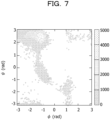
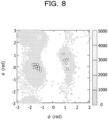
- FIGs. 7 and 8 are first and second diagrams illustrating examples of dihedral angle distribution diagrams.
- the horizontal axis indicates ⁇ [rad] in the information indicating the dihedral angles
- the vertical axis indicates ⁇ [rad] in the information indicating the dihedral angles.
- Each plot (Ramachandran plot) in the figures indicates that information indicating a dihedral angle corresponding to each position is calculated in the process of searching for a stable conformation, and a difference in color in the plot represents a difference in the number of searches performed on the information.
- a white region indicates that the region is not searched even once.
- FIG. 7 is a dihedral angle distribution diagram of Ser6 in a case where an initial conformation for 8 amino acid residue sequences (Phe1, Val2, Gly3, Thr5, Ser6, Phe7, and Asp8) is generated by the method in the related art and then a stable conformation is searched for.
- the method in the related art is the method in which a linear peptide molecule is generated by linking 8 amino acid residue sequences in a linear chain form, and is cyclized by linking the head and the tail of the generated linear peptide molecule.
- FIG. 8 is a dihedral angle distribution diagram of Ser6 in a case where an initial conformation for 8 amino acid residue sequences (Phe1, Val2, Gly3, Thr5, Ser6, Phe7, and Asp8) is generated by the cyclic peptide molecule generation unit 112 and then a stable conformation is searched for.
- ⁇ acquiring 20 kinds of stable conformations obtained by a nuclear magnetic resonance experiment for Ser6 among the above 8 amino acid residue sequences (Phe1, Val2, Gly3, Thr5, Ser6, Phe7, and Asp8); ⁇ plotting, as correct answer data, the information indicating the dihedral angles in each of the 20 kinds of stable conformations acquired for Ser6 over a dihedral angle distribution diagram; and ⁇ examining whether the correct answer data is included in the search range indicated by the plot of each color in the dihedral angle distribution diagram by checking a degree of overlap between the search range and the white circles plotted as the correct answer data.
- 20 white circles represent the information indicating the dihedral angles in the 20 kinds of stable conformations acquired for Ser6. As illustrated in FIG. 8 , all the white circles are located on the plot of blue to light blue, and are searched at least once by the stable conformation search unit 121 in the search for the stable conformation.
- the server apparatus 120 is enabled to search a more appropriate search range than in the case where the initial conformation is generated by the method in the related art.
- FIG. 9 is a flowchart illustrating the sequence of the stable conformation search processing.
- the terminal apparatus 110 acquires multiple amino acid residue sequences.
- the terminal apparatus 110 acquires a distance a between adjacent C ⁇ atoms.
- the terminal apparatus 110 identifies the C ⁇ atom of each of the acquired multiple amino acid residue sequences, and arranges the C ⁇ atoms at equal intervals on the circumference in the same plane calculated based on the distance a.
- the terminal apparatus 110 adds the main chain and side chains of each of the amino acid residue sequence to the corresponding one of the arranged C ⁇ atoms, and relaxes the post-addition conformation, thereby generating the initial conformation of the cyclic peptide molecule.
- the terminal apparatus 110 transmits information indicating the generated initial conformation of the cyclic peptide molecule to the server apparatus 120, thereby giving an instruction to search for a stable conformation of the cyclic peptide molecule.
- the terminal apparatus 110 acquires the information indicating the backbone dihedral angles calculated in the process of searching for the stable conformation from the server apparatus 120, calculates the dihedral angle distribution based on the acquired information indicating the dihedral angles, and outputs the dihedral angle distribution diagram to the user.
- the terminal apparatus 110 acquires the information indicating the searched-out stable conformation of the cyclic peptide molecule from the server apparatus 120, and outputs the information to the user.
- the terminal apparatus 110 identifies the C ⁇ atom of each of the multiple amino acid residue sequences, arranges the C ⁇ atoms at the equal intervals on the circumference, and adds the main chain and the side chains of each of the multiple amino acid residue sequences to the corresponding one of the C ⁇ atoms arranged on the circumference.
- the terminal apparatus 110 according to the first embodiment is capable of generating the initial conformation of the cyclic peptide molecule in which each of the multiple amino acid residue sequences has higher conformational degrees of freedom.
- the terminal apparatus 110 transmits the information indicating the generated initial conformation of the cyclic peptide molecule to the server apparatus 120, thereby giving the instruction to search for the stable conformation of the cyclic peptide molecule.
- the stable conformation search system 100 is constituted by the terminal apparatus 110 and the server apparatuses 120.
- the stable conformation search system 100 may be constituted by the terminal apparatus 110, the server apparatus 120, and another apparatus (for example, three or more apparatuses).
- the stable conformation search system 100 may be constituted by an apparatus in which the terminal apparatus 110 and the server apparatus 120 are integrated (for example, a single apparatus).
- the first embodiment is described above for the case where the terminal apparatus 110 includes the amino acid residue sequence acquisition unit 111 to the stable conformation output unit 114, and the server apparatus 120 includes the stable conformation search unit 121.
- some functions of the terminal apparatus 110 may be implemented in the server apparatus 120.
- some functions of the server apparatus 120 may be implemented in the terminal apparatus 110.
- the number of amino acid residue sequences for generating the initial conformation of the cyclic peptide molecule may be any number.
- the first embodiment is described above for the case where the dihedral angle distribution diagram for Ser6 among the 8 amino acid residue sequences is output, the dihedral angle distribution diagrams for the remaining 7 amino acid residue sequences may be output together.
- the conformational relaxation unit 303 may relax the conformation while keeping each C ⁇ atom fixed, for example.
- the conformational relaxation unit 303 may relax the conformation including each C ⁇ atom.
- the search for the stable conformation may be started without the conformational relaxation by the conformational relaxation unit 303 being executed.
- the present disclosure is not limited to the configurations illustrated herein but may include configurations such as a combination of any of the configurations exemplified in the aforementioned embodiments with other elements. These aspects may be changed without departing from the gist of the present disclosure and appropriately set in accordance with application modes thereof.
Landscapes
- Physics & Mathematics (AREA)
- Life Sciences & Earth Sciences (AREA)
- Spectroscopy & Molecular Physics (AREA)
- Chemical & Material Sciences (AREA)
- Engineering & Computer Science (AREA)
- Bioinformatics & Cheminformatics (AREA)
- Health & Medical Sciences (AREA)
- General Health & Medical Sciences (AREA)
- Bioinformatics & Computational Biology (AREA)
- Theoretical Computer Science (AREA)
- Biotechnology (AREA)
- Crystallography & Structural Chemistry (AREA)
- Biophysics (AREA)
- Evolutionary Biology (AREA)
- Medical Informatics (AREA)
- Medicinal Chemistry (AREA)
- Pharmacology & Pharmacy (AREA)
- Computing Systems (AREA)
- Analytical Chemistry (AREA)
- Proteomics, Peptides & Aminoacids (AREA)
- Peptides Or Proteins (AREA)
- Management, Administration, Business Operations System, And Electronic Commerce (AREA)
Abstract
Description
- The present disclosure relates to an initial conformation generation apparatus, an initial conformation generation method, and an initial conformation generation program.
- In recent years, in the field of drug discovery, drug discovery based on middle molecules (molecular weight of 500 to 3000) supposed to cause less side effects has been expected, and development of a search method for searching for a stable conformation of a middle molecule has been in progress.
- For example, a cyclic peptide molecule has been drawing great attention because cyclization greatly reduces the entropy, which makes it possible to generate a compound having great binding activity.
-
Japanese Laid-open Patent Publication Nos. 2010-159218 2020-091518 U.S. Patent Application Publication No. 2018/0260517 are disclosed as related art. - Also, F. Jiang and H. Geng, "Computational Methods for Studying Conformational Behaviors of Cyclic Peptides", 2019 is disclosed as the related art.
- In searching for a stable conformation, it is important to search an appropriate search range, and whether the search range is optimized or not largely depends on an initial conformation.
- Meanwhile, in the case of a cyclic peptide molecule, the initial conformation has been generated by a method of cyclizing a linear peptide molecule by linking a head and a tail thereof. For this reason, in the generated initial conformation, each of amino acid residue sequences constituting the cyclic peptide molecule has such low degrees of freedom that an appropriate search range may not be searched in searching for a stable conformation.
- According to one aspect, an object is to optimize a search range in searching for a stable conformation of a cyclic peptide molecule.
- A search range in searching for a stable conformation of a cyclic peptide molecule may be optimized.
- According to an aspect of the embodiments, an initial conformation generation apparatus includes a generation unit that generates a model representing a cyclic peptide molecule by identifying Cα atoms of each of a plurality of amino acid residues, by arranging the identified Cα atoms on a circumference, and by adding main chains and side chains of the plurality of amino acid residues; and a search instruction unit that causes a search unit to search for a stable conformation of the cyclic peptide molecule by using the generated model as an initial conformation of the cyclic peptide molecule.
-
-
FIG. 1 is a diagram illustrating an example of a system configuration of a stable conformation search system and functional configurations of a terminal apparatus and a server apparatus; -
FIG. 2A and FIG. 2B are diagrams illustrating an example of hardware configurations of the terminal apparatus and the server apparatus; -
FIG. 3 is a diagram illustrating an example of a functional configuration of a cyclic peptide molecule generation unit; -
FIG. 4 is a diagram illustrating a specific example of processing by a Cα atom arrangement unit; -
FIG. 5 is a diagram illustrating a specific example of processing by an addition unit and a conformational relaxation unit; -
FIG. 6 is a diagram for explaining backbone dihedral angles; -
FIG. 7 is a first diagram illustrating an example of a dihedral angle distribution diagram; -
FIG. 8 is a second diagram illustrating an example of a dihedral angle distribution diagram; and -
FIG. 9 is a flowchart illustrating a sequence of stable conformation search processing. - Hereinafter, the embodiments will be described with reference to the accompanying drawings. In the present specification and drawings, constituent elements having substantially the same functional configuration will be denoted with the same reference sign, whereby repetitive description thereof will be omitted.
- First, description will be given of a system configuration of a stable conformation search system according to a first embodiment and functional configurations of a terminal apparatus and a server apparatus constituting the stable conformation search system.
FIG. 1 is a diagram illustrating an example of the system configuration of the stable conformation search system and the functional configurations of the terminal apparatus and the server apparatus. - A stable
conformation search system 100 is a system for searching for a stable conformation of a middle molecule and, for example, a system for searching for a stable conformation of a cyclic peptide molecule having multiple amino acid residue sequences. - As illustrated in
FIG. 1 , the stableconformation search system 100 includes aterminal apparatus 110, which is an example of an initial conformation generation apparatus, and aserver apparatus 120. - A search program is installed in the
terminal apparatus 110. Executing the program, theterminal apparatus 110 functions as an amino acid residuesequence acquisition unit 111, a cyclic peptidemolecule generation unit 112, a dihedral angledistribution calculation unit 113, and a stableconformation output unit 114. - The amino acid residue
sequence acquisition unit 111 is an example of an acquisition unit, and acquires multiple amino acid residue sequences constituting a cyclic peptide molecule of a search target when a user of the stableconformation search system 100 inputs these amino acid residue sequences. - When the user of the stable
conformation search system 100 inputs a parameter (a distance "a" to be described later) for use to generate an initial conformation of the cyclic peptide molecule of the search target, the amino acid residuesequence acquisition unit 111 acquires the parameter. - The cyclic peptide
molecule generation unit 112 is an example of a generation unit, and generates, as the initial conformation of the cyclic peptide molecule, a model representing the cyclic peptide molecule under the acquired parameter based on the multiple amino acid residue sequences acquired by the amino acid residuesequence acquisition unit 111. The cyclic peptidemolecule generation unit 112 is also an example of a search instruction unit, and transmits information indicating the generated initial conformation of the cyclic peptide molecule to theserver apparatus 120, thereby instructing theserver apparatus 120 to search for a stable conformation based on the initial conformation. Details of a method for generating the initial conformation of the cyclic peptide molecule by the cyclic peptidemolecule generation unit 112 will be described later. - The dihedral angle
distribution calculation unit 113 is an example of a calculation unit. In response to transmission of the information indicating the initial conformation of the cyclic peptide molecule by the cyclic peptidemolecule generation unit 112, the dihedral angledistribution calculation unit 113 acquires information indicating backbone dihedral angles calculated in the process of searching for the stable conformation from theserver apparatus 120. The dihedral angledistribution calculation unit 113 calculates a dihedral angle distribution based on the acquired information indicating the backbone dihedral angles, and outputs a dihedral angle distribution diagram. - In response to the transmission of the information indicating the initial conformation of the cyclic peptide molecule by the cyclic peptide
molecule generation unit 112, the stableconformation output unit 114 acquires information indicating the searched-out stable conformation of the cyclic peptide molecule from theserver apparatus 120. The stableconformation output unit 114 outputs the acquired information indicating the stable conformation of the cyclic peptide molecule. - The
server apparatus 120 functions as a stableconformation search unit 121. The stableconformation search unit 121 is an example of a search unit. When receiving the information indicating the initial conformation of the cyclic peptide molecule from theterminal apparatus 110, the stableconformation search unit 121 searches for a stable conformation of the cyclic peptide molecule based on the received information. The stableconformation search unit 121 transmits information indicating the backbone dihedral angles calculated in the process of searching for the stable conformation, to theterminal apparatus 110. The stableconformation search unit 121 transmits the information indicating the searched-out stable conformation of the cyclic peptide molecule to theterminal apparatus 110. - Based on the information indicating the initial conformation of the cyclic peptide molecule transmitted from the
terminal apparatus 110, the stableconformation search unit 121 searches for the stable conformation by, for example, a generalized-ensemble method. Examples of the generalized-ensemble method mentioned herein include a multi-canonical method, a simulated tempering method, a replica exchange method (for example, replica exchange with solute tempering (REST) 2), and so on. - <Hardware Configurations of Terminal Apparatus and Server Apparatus>
- Next, hardware configurations of the
terminal apparatus 110 and theserver apparatus 120 will be described next.FIG. 2A and FIG. 2B are diagrams illustrating an example of the hardware configurations of the terminal apparatus and the server apparatus. - As illustrated in
FIG. 2A , theterminal apparatus 110 includes aprocessor 201, amemory 202, anauxiliary storage device 203, an interface (I/F)device 204, acommunication device 205, and adriving device 206. These hardware devices in theterminal apparatus 110 are coupled to each other via abus 207. - The
processor 201 includes various computing devices such as a central processing unit (CPU) and a graphics processing unit (GPU). Theprocessor 201 loads various programs (such, for example, as a search program) onto thememory 202 and executes the programs. - The
memory 202 includes main storage devices such as a read-only memory (ROM) and a random-access memory (RAM). Theprocessor 201 and thememory 202 form a so-called computer. The computer implements the above various functions by theprocessor 201 executing the various programs loaded onto thememory 202. - The
auxiliary storage device 203 stores the various programs and various kinds of information to be used in execution of the various programs by theprocessor 201. - The I/
F device 204 is a coupling device that couples theterminal apparatus 110 to anoperation device 211 and anoutput device 212, which are examples of external devices. - The
communication device 205 is a communication device for communicating with theserver apparatus 120 via a network. - The
driving device 206 is a device in which arecording medium 213 is to be placed. Examples of therecording medium 213 mentioned herein include a medium on which information is recorded optically, electrically, or magnetically, such as a compact disc read-only memory (CD-ROM), a flexible disk, and a magneto-optical disk. The examples of therecording medium 213 may also include a semiconductor memory and the like on which information is recorded electrically, such as a ROM and a flash memory. - The various programs to be installed onto the
auxiliary storage device 203 are installed, for example, in such a way that the distributedrecording medium 213 is placed in thedriving device 206 and thedriving device 206 reads out the various programs recorded on therecording medium 213. Alternatively, the various programs to be installed onto theauxiliary storage device 203 may be installed by being downloaded from the network via thecommunication device 205. - As illustrated in
FIG. 2B ,multiple server apparatuses 120 constitute a cluster, and each server apparatus includes aprocessor 221, amemory 222, anauxiliary storage device 223, an interface (I/F)device 224, acommunication device 225, and adriving device 226. - The hardware devices included in the server apparatuses are the same as or similar to the hardware devices included in the
terminal apparatus 110, and thus description thereof is omitted herein. - Next, a functional configuration of the cyclic peptide
molecule generation unit 112 will be described in detail. As described above, executing the search program, theterminal apparatus 110 implements the various functions of theterminal apparatus 110. Among them, the cyclic peptidemolecule generation unit 112 is implemented by executing, for example, an initial conformation generation program which is a part of the search program. -
FIG. 3 is a diagram illustrating an example of the functional configuration of the cyclic peptide molecule generation unit. As illustrated inFIG. 3 , the cyclic peptidemolecule generation unit 112 includes a Cαatom arrangement unit 301, anaddition unit 302, and aconformational relaxation unit 303. - The Cα
atom arrangement unit 301 identifies a Cα atom that is an atom representing an amino acid in each of the acquired multiple amino acid residue sequences, and arranges the identified multiple Cα atoms at equal intervals on a circumference in the same plane.FIG. 3 illustrates the example in which 8 amino acid residue sequences (Phe1, Val2, Gly3, Thr5, Ser6, Phe7, and Asp8) are acquired and input to the Cαatom arrangement unit 301. The Cα atoms are arranged at equal intervals on the circumference in the same plane in order to constitute a conformation in which the multiple amino acid residue sequences (here, the 8 amino acid residue sequences) have higher degrees of freedom from each other. - When receiving a distance "a" (for example, 3.84 angstrom) between adjacent Cα atoms input by the user, the Cα
atom arrangement unit 301 calculates a radius of a circumference where to arrange the Cα atoms based on the number "n" of the Cα atoms identified and the input distance "a" between the Cα atoms. - The Cα
atom arrangement unit 301 arranges the Cα atoms at equal intervals along the circumference defined by the calculated radius such that the distance between the adjacent Cα atoms is "a". The equal intervals mentioned herein do not have to be exactly at the same distance, but are synonymous with approximately equal intervals. - The
addition unit 302 adds the main chain and side chains of each of the amino acid residue sequences to the corresponding one of the Cα atoms arranged on the circumference in the same plane. - The
conformational relaxation unit 303 sequentially performs conformational relaxation of each of the amino acid residue sequences generated by adding the main chain and the side chains of each of the amino acid residue sequence to the corresponding one of the Cα atoms, thereby generating a model representing the cyclic peptide molecule having the multiple amino acid residue sequences as an initial conformation of the cyclic peptide molecule. - Next, a specific example of processing by the Cα
atom arrangement unit 301 will be described.FIG. 4 is a diagram illustrating the specific example of the processing by the Cα atom arrangement unit.FIG. 4 illustrates the example in whichCα atoms 401 to 408 are identified respectively in n = 8 amino acid residue sequences and arranged at equal intervals on acircumference 400 in the same plane. - As illustrated in
FIG. 4 , in the case of the 8 Cα atoms, among straight lines extending from the center coordinates (0, 0) of thecircumference 400 to the respective Cα atoms, the straight lines extending to adjacent Cα atoms form an angle θ of 2n/n (= π/4). - As illustrated in
FIG. 4 , letting "a" be the distance between adjacent Cα atoms, a radius r of thecircumference 400 may be calculated in accordance with the following formula (1):
- The coordinates of each of the
Cα atoms 401 to 408 may be calculated in accordance with the following formula (2):
- In the above formula (2), r denotes the radius of the
circumference 400 calculated by the formula (1), and θx may be calculated in accordance with the following formula (3):
- Next, a specific example of processing by the
addition unit 302 and theconformational relaxation unit 303 will be described.FIG. 5 is a diagram illustrating the specific example of the processing by the addition unit and the conformational relaxation unit. - In
FIG. 5 ,reference sign 510 illustrates an addition result in which theaddition unit 302 adds the main chain and the side chains of each of the amino acid residue sequences to the corresponding one of theCα atoms 401 to 408 arranged at the equal intervals on the circumference in the same plane by the Cαatom arrangement unit 301. When acquiring the addition result illustrated withreference sign 510 from theaddition unit 302, theconformational relaxation unit 303 relaxes the post-addition conformation so as to reduce the entropy, and thereby generates a model representing the cyclic peptide molecule as an initial conformation of the cyclic peptide molecule. -
Reference sign 520 illustrates a case where the initial conformation of the cyclic peptide molecule is generated in accordance with the method in the related art. The method in the related art is a method in which a linear peptide molecule is generated by linking 8 amino acid residue sequences in a linear chain form, and then cyclized by linking the head and the tail of the generated linear peptide molecule. - As is apparent from the comparison between
reference signs reference sign 510 is a conformation in which the 8 amino acid residue sequences are farther from each other and therefore have higher degrees of freedom than in the initial conformation illustrated withreference sign 520. - Next, a specific example of processing by the dihedral angle
distribution calculation unit 113 will be described. As described above, the dihedral angledistribution calculation unit 113 acquires the information indicating the backbone dihedral angles calculated in the process of searching for the stable conformation from theserver apparatus 120, calculates the dihedral angle distribution based on the acquired information indicating the dihedral angles, and outputs the dihedral angle distribution diagram. - The backbone dihedral angles will be briefly described herein.
FIG. 6 is a diagram for explaining the backbones dihedral angle. In the present embodiment, the dihedral angledistribution calculation unit 113 acquires (ϕ, ψ) as the information indicating the dihedral angles from theserver apparatus 120. InFIG. 6 ,reference signs distribution calculation unit 113. - Subsequently, a dihedral angle distribution diagram will be described.
FIGs. 7 and8 are first and second diagrams illustrating examples of dihedral angle distribution diagrams. InFIGs. 7 and8 , the horizontal axis indicates ϕ [rad] in the information indicating the dihedral angles, and the vertical axis indicates ψ [rad] in the information indicating the dihedral angles. Each plot (Ramachandran plot) in the figures indicates that information indicating a dihedral angle corresponding to each position is calculated in the process of searching for a stable conformation, and a difference in color in the plot represents a difference in the number of searches performed on the information. - For example, the closer to red, the larger the number of searches is, and the closer to blue, the smaller the number of searches is. A white region indicates that the region is not searched even once.
-
FIG. 7 is a dihedral angle distribution diagram of Ser6 in a case where an initial conformation for 8 amino acid residue sequences (Phe1, Val2, Gly3, Thr5, Ser6, Phe7, and Asp8) is generated by the method in the related art and then a stable conformation is searched for. As described above, the method in the related art is the method in which a linear peptide molecule is generated by linking 8 amino acid residue sequences in a linear chain form, and is cyclized by linking the head and the tail of the generated linear peptide molecule. -
FIG. 8 is a dihedral angle distribution diagram of Ser6 in a case where an initial conformation for 8 amino acid residue sequences (Phe1, Val2, Gly3, Thr5, Ser6, Phe7, and Asp8) is generated by the cyclic peptidemolecule generation unit 112 and then a stable conformation is searched for. - As seen from the comparison between
FIGs. 7 and8 , a difference between the initial conformations results in a large difference between the dihedral angle distribution diagrams. For example, in the search for a stable conformation by theserver apparatus 120, the search range significantly differs between the different initial conformations. - In the present embodiment, which of the search ranges is more appropriate is examined by the following procedure: · acquiring 20 kinds of stable conformations obtained by a nuclear magnetic resonance experiment for Ser6 among the above 8 amino acid residue sequences (Phe1, Val2, Gly3, Thr5, Ser6, Phe7, and Asp8); ▪ plotting, as correct answer data, the information indicating the dihedral angles in each of the 20 kinds of stable conformations acquired for Ser6 over a dihedral angle distribution diagram; and · examining whether the correct answer data is included in the search range indicated by the plot of each color in the dihedral angle distribution diagram by checking a degree of overlap between the search range and the white circles plotted as the correct answer data.
- In
FIG. 8 , 20 white circles represent the information indicating the dihedral angles in the 20 kinds of stable conformations acquired for Ser6. As illustrated inFIG. 8 , all the white circles are located on the plot of blue to light blue, and are searched at least once by the stableconformation search unit 121 in the search for the stable conformation. - When the 20 white circles illustrated in
FIG. 8 are plotted in the same positions over the dihedral angle distribution diagram illustrated inFIG. 7 , some of the 20 white circles are plotted in the white region. For example, when the initial conformation of the cyclic peptide molecule is generated by the method in the related art, some of the 20 kinds of stable conformations are not searched even once in the search for the stable conformation. - For example, in a case where the initial conformation of the cyclic peptide molecule is generated by operating the cyclic peptide
molecule generation unit 112, it is possible to search stable conformations that are not searched in a case where the initial conformation is generated by the method in the related art. For example, in the case where the initial conformation of the cyclic peptide molecule is generated by operating the cyclic peptidemolecule generation unit 112, theserver apparatus 120 is enabled to search a more appropriate search range than in the case where the initial conformation is generated by the method in the related art. - Next, a sequence of entire stable conformation search processing will be described.
FIG. 9 is a flowchart illustrating the sequence of the stable conformation search processing. - At step S901, the
terminal apparatus 110 acquires multiple amino acid residue sequences. Theterminal apparatus 110 acquires a distance a between adjacent Cα atoms. - At step S902, the
terminal apparatus 110 identifies the Cα atom of each of the acquired multiple amino acid residue sequences, and arranges the Cα atoms at equal intervals on the circumference in the same plane calculated based on the distance a. Theterminal apparatus 110 adds the main chain and side chains of each of the amino acid residue sequence to the corresponding one of the arranged Cα atoms, and relaxes the post-addition conformation, thereby generating the initial conformation of the cyclic peptide molecule. - At step S903, the
terminal apparatus 110 transmits information indicating the generated initial conformation of the cyclic peptide molecule to theserver apparatus 120, thereby giving an instruction to search for a stable conformation of the cyclic peptide molecule. - At step S904, the
terminal apparatus 110 acquires the information indicating the backbone dihedral angles calculated in the process of searching for the stable conformation from theserver apparatus 120, calculates the dihedral angle distribution based on the acquired information indicating the dihedral angles, and outputs the dihedral angle distribution diagram to the user. - At step S905, the
terminal apparatus 110 acquires the information indicating the searched-out stable conformation of the cyclic peptide molecule from theserver apparatus 120, and outputs the information to the user. - As is clear from the above description, the
terminal apparatus 110 according to the first embodiment identifies the Cα atom of each of the multiple amino acid residue sequences, arranges the Cα atoms at the equal intervals on the circumference, and adds the main chain and the side chains of each of the multiple amino acid residue sequences to the corresponding one of the Cα atoms arranged on the circumference. In this way, theterminal apparatus 110 according to the first embodiment is capable of generating the initial conformation of the cyclic peptide molecule in which each of the multiple amino acid residue sequences has higher conformational degrees of freedom. - The
terminal apparatus 110 according to the first embodiment transmits the information indicating the generated initial conformation of the cyclic peptide molecule to theserver apparatus 120, thereby giving the instruction to search for the stable conformation of the cyclic peptide molecule. - According to the first embodiment, it is thus possible to optimize a search range in a search for a stable conformation of a cyclic peptide molecule.
- The first embodiment is described above for the case where the stable
conformation search system 100 is constituted by theterminal apparatus 110 and theserver apparatuses 120. However, the stableconformation search system 100 may be constituted by theterminal apparatus 110, theserver apparatus 120, and another apparatus (for example, three or more apparatuses). Alternatively, the stableconformation search system 100 may be constituted by an apparatus in which theterminal apparatus 110 and theserver apparatus 120 are integrated (for example, a single apparatus). - The first embodiment is described above for the case where the
terminal apparatus 110 includes the amino acid residuesequence acquisition unit 111 to the stableconformation output unit 114, and theserver apparatus 120 includes the stableconformation search unit 121. However, some functions of theterminal apparatus 110 may be implemented in theserver apparatus 120. Alternatively, some functions of theserver apparatus 120 may be implemented in theterminal apparatus 110. - Although the first embodiment is described above for the example in which the 8 amino acid residue sequences are used to generate the initial conformation of the cyclic peptide molecule, the number of amino acid residue sequences for generating the initial conformation of the cyclic peptide molecule may be any number. Although the first embodiment is described above for the case where the dihedral angle distribution diagram for Ser6 among the 8 amino acid residue sequences is output, the dihedral angle distribution diagrams for the remaining 7 amino acid residue sequences may be output together.
- Although details of the conformational relaxation are not described in the first embodiment, the
conformational relaxation unit 303 may relax the conformation while keeping each Cα atom fixed, for example. Alternatively, theconformational relaxation unit 303 may relax the conformation including each Cα atom. Instead, the search for the stable conformation may be started without the conformational relaxation by theconformational relaxation unit 303 being executed. - The present disclosure is not limited to the configurations illustrated herein but may include configurations such as a combination of any of the configurations exemplified in the aforementioned embodiments with other elements. These aspects may be changed without departing from the gist of the present disclosure and appropriately set in accordance with application modes thereof.
Claims (10)
- An initial conformation generation apparatus comprising:a generation unit that generates a model representing a cyclic peptide molecule by identifying Cα atoms of each of a plurality of amino acid residues, by arranging the identified Cα atoms on a circumference, and by adding main chains and side chains of the plurality of amino acid residues; anda search instruction unit that causes a search unit to search for a stable conformation of the cyclic peptide molecule by using the generated model as an initial conformation of the cyclic peptide molecule.
- The initial conformation generation apparatus according to claim 1, wherein
the generation unit arranges the Cα atoms at equal intervals on the circumference. - The initial conformation generation apparatus according to claim 1, wherein
the generation unit arranges each of n Cα atoms at a position of coordinates = [rsin (n-1) θx, rcos (n-1) θx], a distance between adjacent Cα atoms being a, r being (a/2) × [sin (π/n)]-1, θx being x × 2π/n, and x being an integer of 1 to n. - The initial conformation generation apparatus according to claim 1, wherein
the generation unit generates the model representing the cyclic peptide molecule by rearranging a conformation after the adding. - The initial conformation generation apparatus according to claim 4, wherein
the generation unit rearranges the conformation after the adding with keeping arrangement of the Cα atoms fixed. - The initial conformation generation apparatus according to claim 1, further comprising:
a calculation unit that calculates a dihedral angle distribution based on backbone dihedral angles calculated in the causing. - The initial conformation generation apparatus according to claim 6, wherein
the calculation unit outputs the dihedral angle distribution in colors each corresponding to the number of searches for the stable conformation performed. - The initial conformation generation apparatus according to claim 1, wherein
the search unit searches for the stable conformation by a generalized-ensemble method using the generated model as the initial conformation of the cyclic peptide molecule. - An initial conformation generation method for a computer to execute a process comprising:generating a model representing a cyclic peptide molecule by identifying Cα atoms of each of a plurality of amino acid residues, by arranging the identified Cα atoms on a circumference, and by adding main chains and side chains of the plurality of amino acid residues; andcausing a search unit to search for a stable conformation of the cyclic peptide molecule by using the generated model as an initial conformation of the cyclic peptide molecule.
- An initial conformation generation program that causes at least one computer to execute a process, the process comprising:generating a model representing a cyclic peptide molecule by identifying Cα atoms of each of a plurality of amino acid residues, by arranging the identified Cα atoms on a circumference, and by adding main chains and side chains of the plurality of amino acid residues; andcausing a search unit to search for a stable conformation of the cyclic peptide molecule by using the generated model as an initial conformation of the cyclic peptide molecule.
Applications Claiming Priority (1)
| Application Number | Priority Date | Filing Date | Title |
|---|---|---|---|
| JP2021156817A JP7855840B2 (en) | 2021-09-27 | 2021-09-27 | Initial structure generation apparatus, initial structure generation method, and initial structure generation program |
Publications (2)
| Publication Number | Publication Date |
|---|---|
| EP4156193A1 true EP4156193A1 (en) | 2023-03-29 |
| EP4156193B1 EP4156193B1 (en) | 2025-11-12 |
Family
ID=82320083
Family Applications (1)
| Application Number | Title | Priority Date | Filing Date |
|---|---|---|---|
| EP22174824.7A Active EP4156193B1 (en) | 2021-09-27 | 2022-05-23 | Apparatus, method and program for generating an initial conformation |
Country Status (4)
| Country | Link |
|---|---|
| US (1) | US20230101982A1 (en) |
| EP (1) | EP4156193B1 (en) |
| JP (1) | JP7855840B2 (en) |
| CN (1) | CN115862728A (en) |
Families Citing this family (1)
| Publication number | Priority date | Publication date | Assignee | Title |
|---|---|---|---|---|
| CN117219189B (en) * | 2023-04-07 | 2024-12-17 | 深圳太力生物技术有限责任公司 | Cyclic peptide drug de novo design method, electronic equipment and storage medium |
Citations (5)
| Publication number | Priority date | Publication date | Assignee | Title |
|---|---|---|---|---|
| US5241470A (en) * | 1992-01-21 | 1993-08-31 | The Board Of Trustees Of The Leland Stanford University | Prediction of protein side-chain conformation by packing optimization |
| US20030135331A1 (en) * | 1999-01-25 | 2003-07-17 | Mount Sinai Hospital | Method to construct protein structures |
| JP2010159218A (en) | 2009-01-07 | 2010-07-22 | Sekisui Chem Co Ltd | Fused protein, protein complex, and method for analyzing structure of objective protein |
| US20180260517A1 (en) | 2015-07-16 | 2018-09-13 | Dnastar, Inc. | Protein structure prediction system |
| US20200176074A1 (en) * | 2018-12-03 | 2020-06-04 | Fujitsu Limited | Method and device for searching structure of cyclic molecule, and non-transitory recording medium |
Family Cites Families (14)
| Publication number | Priority date | Publication date | Assignee | Title |
|---|---|---|---|---|
| US5619421A (en) * | 1994-06-17 | 1997-04-08 | Massachusetts Institute Of Technology | Computer-implemented process and computer system for estimating the three-dimensional shape of a ring-shaped molecule and of a portion of a molecule containing a ring-shaped structure |
| US5724252A (en) * | 1994-12-09 | 1998-03-03 | Kirin Brewery | System for prediction of protein side-chain conformation and method using same |
| JPH11259537A (en) * | 1998-03-11 | 1999-09-24 | Kureha Chem Ind Co Ltd | Display control method and system for molecular structure drawing, and record medium stored with program for displaying modular structure drawing |
| EP1266337A2 (en) * | 1999-11-22 | 2002-12-18 | Yissum Research Development Company of the Hebrew University of Jerusalem | System and method for searching a combinatorial space |
| US20030032065A1 (en) * | 2001-03-12 | 2003-02-13 | Vince Hilser | Ensemble-based strategy for the design of protein pharmaceuticals |
| JP4525221B2 (en) * | 2004-07-16 | 2010-08-18 | アステラス製薬株式会社 | Receptor ligand identification method |
| CN104882056B (en) * | 2015-05-20 | 2018-06-05 | 台州学院 | A kind of protein structure model of modularization assembling |
| CN107203702B (en) * | 2017-01-13 | 2020-04-21 | 北京理工大学 | A method for analyzing the time-dependent dynamic evolution of protein side chain conformation |
| EP3571215A4 (en) * | 2017-01-18 | 2020-12-30 | Fred Hutchinson Cancer Research Center | PEPTIDE COMPOSITIONS AND METHOD OF USE THEREOF TO INTERRUPT TEAD INTERACTIONS |
| JP7214972B2 (en) * | 2018-03-30 | 2023-01-31 | 富士通株式会社 | Method for calculating stable three-dimensional structure, calculation device, and program |
| JP7186656B2 (en) * | 2019-03-29 | 2022-12-09 | 株式会社カネカ | Search method for cell membrane permeable natural peptides |
| EP3970801A4 (en) * | 2019-05-14 | 2022-11-02 | Ichimaru Pharcos Co., Ltd. | Ras inhibitory peptide |
| WO2021075575A1 (en) * | 2019-10-17 | 2021-04-22 | 国立大学法人高知大学 | Method for predicting nuclear magnetic resonance chemical shift values, prediction apparatus, and prediction program |
| JP7347113B2 (en) * | 2019-10-21 | 2023-09-20 | 富士通株式会社 | Method for searching for modified sites in peptide molecules, searching device, and program |
-
2021
- 2021-09-27 JP JP2021156817A patent/JP7855840B2/en active Active
-
2022
- 2022-05-23 EP EP22174824.7A patent/EP4156193B1/en active Active
- 2022-05-26 US US17/825,151 patent/US20230101982A1/en active Pending
- 2022-06-20 CN CN202210695734.0A patent/CN115862728A/en active Pending
Patent Citations (6)
| Publication number | Priority date | Publication date | Assignee | Title |
|---|---|---|---|---|
| US5241470A (en) * | 1992-01-21 | 1993-08-31 | The Board Of Trustees Of The Leland Stanford University | Prediction of protein side-chain conformation by packing optimization |
| US20030135331A1 (en) * | 1999-01-25 | 2003-07-17 | Mount Sinai Hospital | Method to construct protein structures |
| JP2010159218A (en) | 2009-01-07 | 2010-07-22 | Sekisui Chem Co Ltd | Fused protein, protein complex, and method for analyzing structure of objective protein |
| US20180260517A1 (en) | 2015-07-16 | 2018-09-13 | Dnastar, Inc. | Protein structure prediction system |
| US20200176074A1 (en) * | 2018-12-03 | 2020-06-04 | Fujitsu Limited | Method and device for searching structure of cyclic molecule, and non-transitory recording medium |
| JP2020091518A (en) | 2018-12-03 | 2020-06-11 | 富士通株式会社 | Method for searching structure of cyclic molecule, apparatus for searching structure, and program |
Non-Patent Citations (3)
| Title |
|---|
| KATAOKA T ET AL: "The utility of side-chain cyclization in determining the receptor-bound conformation of peptides: cyclic tripeptides and angiotensin II.", BIOPOLYMERS, JOHN WILEY, HOBOKEN, USA, vol. 32, no. 11, 1 November 1992 (1992-11-01), pages 1519 - 1533, XP001062669, ISSN: 0006-3525, DOI: 10.1002/BIP.360321110 * |
| MCHUGH SEAN M ET AL: "Computational methods to design cyclic peptides", CURRENT OPINION IN CHEMICAL BIOLOGY, CURRENT BIOLOGY LTD, LONDON, GB, vol. 34, 1 September 2016 (2016-09-01), pages 95 - 102, XP029806927, ISSN: 1367-5931, DOI: 10.1016/J.CBPA.2016.08.004 * |
| OLENDOR R ET AL: "A fast algorithm for searching for molecules containing a pharmacophore in very large virtual combinatorial libraries", JOURNAL OF CHEMICAL INFORMATION AND COMPUTER SCIENCES, AMERICAN CHEMICAL SOCIETY, COLOMBUS,OHIO, US, vol. 41, no. 3, 29 May 2001 (2001-05-29), pages 731 - 738, XP001058995, ISSN: 0095-2338, DOI: 10.1021/CI000463O * |
Also Published As
| Publication number | Publication date |
|---|---|
| US20230101982A1 (en) | 2023-03-30 |
| JP7855840B2 (en) | 2026-05-11 |
| JP2023047726A (en) | 2023-04-06 |
| EP4156193B1 (en) | 2025-11-12 |
| CN115862728A (en) | 2023-03-28 |
Similar Documents
| Publication | Publication Date | Title |
|---|---|---|
| Ahmed et al. | GASAL2: a GPU accelerated sequence alignment library for high-throughput NGS data | |
| Cordes et al. | Portable and platform‐independent MR pulse sequence programs | |
| US10324729B2 (en) | Machine intelligence and learning for graphic chip accessibility and execution | |
| Liu et al. | CUDA–MEME: accelerating motif discovery in biological sequences using CUDA-enabled graphics processing units | |
| Saltzberg et al. | Using Integrative Modeling Platform to compute, validate, and archive a model of a protein complex structure | |
| US20140309945A1 (en) | Genome sequence alignment apparatus and method | |
| Jean et al. | RNA‐Seq read alignments with PALMapper | |
| Whitley et al. | Frameworks for understanding long-range intra-protein communication | |
| CN110532185A (en) | Test method, device, electronic equipment and computer readable storage medium | |
| US11372673B2 (en) | Artificial intelligence chip and instruction execution method for artificial intelligence chip | |
| EP4156193B1 (en) | Apparatus, method and program for generating an initial conformation | |
| Ferretti et al. | Original synteny | |
| US20070233765A1 (en) | System and Method for Test Generation for System Level Verification Using Parallel Algorithms | |
| Marcelino et al. | Evolutionary coupling of structural and functional sequence information in the intracellular lipid‐binding protein family | |
| Millán et al. | ALIXE: a phase-combination tool for fragment-based molecular replacement | |
| Cheung See Kit et al. | Application of multiple length cross-linkers to the characterization of gaseous protein structure | |
| Shao et al. | Bsalign: a library for nucleotide sequence alignment | |
| Rozman et al. | Enhanced molecular docking: Novel algorithm for identifying highest weight k-cliques in weighted general and protein-ligand graphs | |
| Lee et al. | Fast automated protein NMR data collection and assignment by ADAPT-NMR on Bruker spectrometers | |
| CN113051149B (en) | Use case parameter generation method and device | |
| CN109753536A (en) | A kind of data docking facilities and method | |
| CN114339470A (en) | Data testing method and device based on satellite instruction, electronic equipment and medium | |
| US20080234944A1 (en) | Method and Apparatus for Subset Selection with Preference Maximization | |
| CN113391813A (en) | Program compiling method and device, storage medium and electronic equipment | |
| Szachniuk et al. | An assignment walk through 3D NMR spectrum |
Legal Events
| Date | Code | Title | Description |
|---|---|---|---|
| PUAI | Public reference made under article 153(3) epc to a published international application that has entered the european phase |
Free format text: ORIGINAL CODE: 0009012 |
|
| STAA | Information on the status of an ep patent application or granted ep patent |
Free format text: STATUS: THE APPLICATION HAS BEEN PUBLISHED |
|
| AK | Designated contracting states |
Kind code of ref document: A1 Designated state(s): AL AT BE BG CH CY CZ DE DK EE ES FI FR GB GR HR HU IE IS IT LI LT LU LV MC MK MT NL NO PL PT RO RS SE SI SK SM TR |
|
| STAA | Information on the status of an ep patent application or granted ep patent |
Free format text: STATUS: REQUEST FOR EXAMINATION WAS MADE |
|
| 17P | Request for examination filed |
Effective date: 20230411 |
|
| RBV | Designated contracting states (corrected) |
Designated state(s): AL AT BE BG CH CY CZ DE DK EE ES FI FR GB GR HR HU IE IS IT LI LT LU LV MC MK MT NL NO PL PT RO RS SE SI SK SM TR |
|
| GRAP | Despatch of communication of intention to grant a patent |
Free format text: ORIGINAL CODE: EPIDOSNIGR1 |
|
| STAA | Information on the status of an ep patent application or granted ep patent |
Free format text: STATUS: GRANT OF PATENT IS INTENDED |
|
| INTG | Intention to grant announced |
Effective date: 20250604 |
|
| GRAS | Grant fee paid |
Free format text: ORIGINAL CODE: EPIDOSNIGR3 |
|
| GRAA | (expected) grant |
Free format text: ORIGINAL CODE: 0009210 |
|
| STAA | Information on the status of an ep patent application or granted ep patent |
Free format text: STATUS: THE PATENT HAS BEEN GRANTED |
|
| AK | Designated contracting states |
Kind code of ref document: B1 Designated state(s): AL AT BE BG CH CY CZ DE DK EE ES FI FR GB GR HR HU IE IS IT LI LT LU LV MC MK MT NL NO PL PT RO RS SE SI SK SM TR |
|
| REG | Reference to a national code |
Ref country code: CH Ref legal event code: F10 Free format text: ST27 STATUS EVENT CODE: U-0-0-F10-F00 (AS PROVIDED BY THE NATIONAL OFFICE) Effective date: 20251112 Ref country code: GB Ref legal event code: FG4D |
|
| REG | Reference to a national code |
Ref country code: IE Ref legal event code: FG4D |
|
| REG | Reference to a national code |
Ref country code: DE Ref legal event code: R096 Ref document number: 602022024753 Country of ref document: DE |
|
| REG | Reference to a national code |
Ref country code: NL Ref legal event code: MP Effective date: 20251112 |
|
| PGFP | Annual fee paid to national office [announced via postgrant information from national office to epo] |
Ref country code: GB Payment date: 20260330 Year of fee payment: 5 |
|
| PG25 | Lapsed in a contracting state [announced via postgrant information from national office to epo] |
Ref country code: ES Free format text: LAPSE BECAUSE OF FAILURE TO SUBMIT A TRANSLATION OF THE DESCRIPTION OR TO PAY THE FEE WITHIN THE PRESCRIBED TIME-LIMIT Effective date: 20251112 |
|
| REG | Reference to a national code |
Ref country code: LT Ref legal event code: MG9D |
|
| PG25 | Lapsed in a contracting state [announced via postgrant information from national office to epo] |
Ref country code: NO Free format text: LAPSE BECAUSE OF FAILURE TO SUBMIT A TRANSLATION OF THE DESCRIPTION OR TO PAY THE FEE WITHIN THE PRESCRIBED TIME-LIMIT Effective date: 20260212 |
|
| PG25 | Lapsed in a contracting state [announced via postgrant information from national office to epo] |
Ref country code: HR Free format text: LAPSE BECAUSE OF FAILURE TO SUBMIT A TRANSLATION OF THE DESCRIPTION OR TO PAY THE FEE WITHIN THE PRESCRIBED TIME-LIMIT Effective date: 20251112 Ref country code: FI Free format text: LAPSE BECAUSE OF FAILURE TO SUBMIT A TRANSLATION OF THE DESCRIPTION OR TO PAY THE FEE WITHIN THE PRESCRIBED TIME-LIMIT Effective date: 20251112 Ref country code: AT Free format text: LAPSE BECAUSE OF FAILURE TO SUBMIT A TRANSLATION OF THE DESCRIPTION OR TO PAY THE FEE WITHIN THE PRESCRIBED TIME-LIMIT Effective date: 20251112 |
|
| REG | Reference to a national code |
Ref country code: AT Ref legal event code: MK05 Ref document number: 1857514 Country of ref document: AT Kind code of ref document: T Effective date: 20251112 |
|
| PG25 | Lapsed in a contracting state [announced via postgrant information from national office to epo] |
Ref country code: NL Free format text: LAPSE BECAUSE OF FAILURE TO SUBMIT A TRANSLATION OF THE DESCRIPTION OR TO PAY THE FEE WITHIN THE PRESCRIBED TIME-LIMIT Effective date: 20251112 |
|
| PG25 | Lapsed in a contracting state [announced via postgrant information from national office to epo] |
Ref country code: RS Free format text: LAPSE BECAUSE OF FAILURE TO SUBMIT A TRANSLATION OF THE DESCRIPTION OR TO PAY THE FEE WITHIN THE PRESCRIBED TIME-LIMIT Effective date: 20260212 |
|
| PG25 | Lapsed in a contracting state [announced via postgrant information from national office to epo] |
Ref country code: IS Free format text: LAPSE BECAUSE OF FAILURE TO SUBMIT A TRANSLATION OF THE DESCRIPTION OR TO PAY THE FEE WITHIN THE PRESCRIBED TIME-LIMIT Effective date: 20260312 |
|
| PG25 | Lapsed in a contracting state [announced via postgrant information from national office to epo] |
Ref country code: PT Free format text: LAPSE BECAUSE OF FAILURE TO SUBMIT A TRANSLATION OF THE DESCRIPTION OR TO PAY THE FEE WITHIN THE PRESCRIBED TIME-LIMIT Effective date: 20260312 |
|
| PG25 | Lapsed in a contracting state [announced via postgrant information from national office to epo] |
Ref country code: PL Free format text: LAPSE BECAUSE OF FAILURE TO SUBMIT A TRANSLATION OF THE DESCRIPTION OR TO PAY THE FEE WITHIN THE PRESCRIBED TIME-LIMIT Effective date: 20251112 |
|
| PG25 | Lapsed in a contracting state [announced via postgrant information from national office to epo] |
Ref country code: LV Free format text: LAPSE BECAUSE OF FAILURE TO SUBMIT A TRANSLATION OF THE DESCRIPTION OR TO PAY THE FEE WITHIN THE PRESCRIBED TIME-LIMIT Effective date: 20251112 |
|
| PG25 | Lapsed in a contracting state [announced via postgrant information from national office to epo] |
Ref country code: BG Free format text: LAPSE BECAUSE OF FAILURE TO SUBMIT A TRANSLATION OF THE DESCRIPTION OR TO PAY THE FEE WITHIN THE PRESCRIBED TIME-LIMIT Effective date: 20251112 |