EP4155267A1 - Silicon-based active material particles, silicon-based active material precursor particles and method for producing same - Google Patents
Silicon-based active material particles, silicon-based active material precursor particles and method for producing same Download PDFInfo
- Publication number
- EP4155267A1 EP4155267A1 EP21808816.9A EP21808816A EP4155267A1 EP 4155267 A1 EP4155267 A1 EP 4155267A1 EP 21808816 A EP21808816 A EP 21808816A EP 4155267 A1 EP4155267 A1 EP 4155267A1
- Authority
- EP
- European Patent Office
- Prior art keywords
- silicon
- active material
- based active
- powder
- working example
- Prior art date
- Legal status (The legal status is an assumption and is not a legal conclusion. Google has not performed a legal analysis and makes no representation as to the accuracy of the status listed.)
- Pending
Links
Images


Classifications
-
- H—ELECTRICITY
- H01—ELECTRIC ELEMENTS
- H01M—PROCESSES OR MEANS, e.g. BATTERIES, FOR THE DIRECT CONVERSION OF CHEMICAL ENERGY INTO ELECTRICAL ENERGY
- H01M4/00—Electrodes
- H01M4/02—Electrodes composed of, or comprising, active material
- H01M4/36—Selection of substances as active materials, active masses, active liquids
- H01M4/38—Selection of substances as active materials, active masses, active liquids of elements or alloys
- H01M4/386—Silicon or alloys based on silicon
-
- C—CHEMISTRY; METALLURGY
- C23—COATING METALLIC MATERIAL; COATING MATERIAL WITH METALLIC MATERIAL; CHEMICAL SURFACE TREATMENT; DIFFUSION TREATMENT OF METALLIC MATERIAL; COATING BY VACUUM EVAPORATION, BY SPUTTERING, BY ION IMPLANTATION OR BY CHEMICAL VAPOUR DEPOSITION, IN GENERAL; INHIBITING CORROSION OF METALLIC MATERIAL OR INCRUSTATION IN GENERAL
- C23C—COATING METALLIC MATERIAL; COATING MATERIAL WITH METALLIC MATERIAL; SURFACE TREATMENT OF METALLIC MATERIAL BY DIFFUSION INTO THE SURFACE, BY CHEMICAL CONVERSION OR SUBSTITUTION; COATING BY VACUUM EVAPORATION, BY SPUTTERING, BY ION IMPLANTATION OR BY CHEMICAL VAPOUR DEPOSITION, IN GENERAL
- C23C14/00—Coating by vacuum evaporation, by sputtering or by ion implantation of the coating forming material
- C23C14/06—Coating by vacuum evaporation, by sputtering or by ion implantation of the coating forming material characterised by the coating material
- C23C14/10—Glass or silica
-
- C—CHEMISTRY; METALLURGY
- C23—COATING METALLIC MATERIAL; COATING MATERIAL WITH METALLIC MATERIAL; CHEMICAL SURFACE TREATMENT; DIFFUSION TREATMENT OF METALLIC MATERIAL; COATING BY VACUUM EVAPORATION, BY SPUTTERING, BY ION IMPLANTATION OR BY CHEMICAL VAPOUR DEPOSITION, IN GENERAL; INHIBITING CORROSION OF METALLIC MATERIAL OR INCRUSTATION IN GENERAL
- C23C—COATING METALLIC MATERIAL; COATING MATERIAL WITH METALLIC MATERIAL; SURFACE TREATMENT OF METALLIC MATERIAL BY DIFFUSION INTO THE SURFACE, BY CHEMICAL CONVERSION OR SUBSTITUTION; COATING BY VACUUM EVAPORATION, BY SPUTTERING, BY ION IMPLANTATION OR BY CHEMICAL VAPOUR DEPOSITION, IN GENERAL
- C23C14/00—Coating by vacuum evaporation, by sputtering or by ion implantation of the coating forming material
- C23C14/22—Coating by vacuum evaporation, by sputtering or by ion implantation of the coating forming material characterised by the process of coating
- C23C14/24—Vacuum evaporation
- C23C14/243—Crucibles for source material
-
- C—CHEMISTRY; METALLURGY
- C23—COATING METALLIC MATERIAL; COATING MATERIAL WITH METALLIC MATERIAL; CHEMICAL SURFACE TREATMENT; DIFFUSION TREATMENT OF METALLIC MATERIAL; COATING BY VACUUM EVAPORATION, BY SPUTTERING, BY ION IMPLANTATION OR BY CHEMICAL VAPOUR DEPOSITION, IN GENERAL; INHIBITING CORROSION OF METALLIC MATERIAL OR INCRUSTATION IN GENERAL
- C23C—COATING METALLIC MATERIAL; COATING MATERIAL WITH METALLIC MATERIAL; SURFACE TREATMENT OF METALLIC MATERIAL BY DIFFUSION INTO THE SURFACE, BY CHEMICAL CONVERSION OR SUBSTITUTION; COATING BY VACUUM EVAPORATION, BY SPUTTERING, BY ION IMPLANTATION OR BY CHEMICAL VAPOUR DEPOSITION, IN GENERAL
- C23C14/00—Coating by vacuum evaporation, by sputtering or by ion implantation of the coating forming material
- C23C14/22—Coating by vacuum evaporation, by sputtering or by ion implantation of the coating forming material characterised by the process of coating
- C23C14/24—Vacuum evaporation
- C23C14/246—Replenishment of source material
-
- C—CHEMISTRY; METALLURGY
- C23—COATING METALLIC MATERIAL; COATING MATERIAL WITH METALLIC MATERIAL; CHEMICAL SURFACE TREATMENT; DIFFUSION TREATMENT OF METALLIC MATERIAL; COATING BY VACUUM EVAPORATION, BY SPUTTERING, BY ION IMPLANTATION OR BY CHEMICAL VAPOUR DEPOSITION, IN GENERAL; INHIBITING CORROSION OF METALLIC MATERIAL OR INCRUSTATION IN GENERAL
- C23C—COATING METALLIC MATERIAL; COATING MATERIAL WITH METALLIC MATERIAL; SURFACE TREATMENT OF METALLIC MATERIAL BY DIFFUSION INTO THE SURFACE, BY CHEMICAL CONVERSION OR SUBSTITUTION; COATING BY VACUUM EVAPORATION, BY SPUTTERING, BY ION IMPLANTATION OR BY CHEMICAL VAPOUR DEPOSITION, IN GENERAL
- C23C14/00—Coating by vacuum evaporation, by sputtering or by ion implantation of the coating forming material
- C23C14/22—Coating by vacuum evaporation, by sputtering or by ion implantation of the coating forming material characterised by the process of coating
- C23C14/56—Apparatus specially adapted for continuous coating; Arrangements for maintaining the vacuum, e.g. vacuum locks
-
- C—CHEMISTRY; METALLURGY
- C23—COATING METALLIC MATERIAL; COATING MATERIAL WITH METALLIC MATERIAL; CHEMICAL SURFACE TREATMENT; DIFFUSION TREATMENT OF METALLIC MATERIAL; COATING BY VACUUM EVAPORATION, BY SPUTTERING, BY ION IMPLANTATION OR BY CHEMICAL VAPOUR DEPOSITION, IN GENERAL; INHIBITING CORROSION OF METALLIC MATERIAL OR INCRUSTATION IN GENERAL
- C23C—COATING METALLIC MATERIAL; COATING MATERIAL WITH METALLIC MATERIAL; SURFACE TREATMENT OF METALLIC MATERIAL BY DIFFUSION INTO THE SURFACE, BY CHEMICAL CONVERSION OR SUBSTITUTION; COATING BY VACUUM EVAPORATION, BY SPUTTERING, BY ION IMPLANTATION OR BY CHEMICAL VAPOUR DEPOSITION, IN GENERAL
- C23C14/00—Coating by vacuum evaporation, by sputtering or by ion implantation of the coating forming material
- C23C14/58—After-treatment
- C23C14/5873—Removal of material
- C23C14/588—Removal of material by mechanical treatment
-
- H—ELECTRICITY
- H01—ELECTRIC ELEMENTS
- H01M—PROCESSES OR MEANS, e.g. BATTERIES, FOR THE DIRECT CONVERSION OF CHEMICAL ENERGY INTO ELECTRICAL ENERGY
- H01M10/00—Secondary cells; Manufacture thereof
- H01M10/05—Accumulators with non-aqueous electrolyte
- H01M10/052—Li-accumulators
-
- H—ELECTRICITY
- H01—ELECTRIC ELEMENTS
- H01M—PROCESSES OR MEANS, e.g. BATTERIES, FOR THE DIRECT CONVERSION OF CHEMICAL ENERGY INTO ELECTRICAL ENERGY
- H01M4/00—Electrodes
- H01M4/02—Electrodes composed of, or comprising, active material
- H01M4/13—Electrodes for accumulators with non-aqueous electrolyte, e.g. for lithium-accumulators; Processes of manufacture thereof
- H01M4/134—Electrodes based on metals, Si or alloys
-
- H—ELECTRICITY
- H01—ELECTRIC ELEMENTS
- H01M—PROCESSES OR MEANS, e.g. BATTERIES, FOR THE DIRECT CONVERSION OF CHEMICAL ENERGY INTO ELECTRICAL ENERGY
- H01M4/00—Electrodes
- H01M4/02—Electrodes composed of, or comprising, active material
- H01M4/13—Electrodes for accumulators with non-aqueous electrolyte, e.g. for lithium-accumulators; Processes of manufacture thereof
- H01M4/139—Processes of manufacture
- H01M4/1395—Processes of manufacture of electrodes based on metals, Si or alloys
-
- H—ELECTRICITY
- H01—ELECTRIC ELEMENTS
- H01M—PROCESSES OR MEANS, e.g. BATTERIES, FOR THE DIRECT CONVERSION OF CHEMICAL ENERGY INTO ELECTRICAL ENERGY
- H01M4/00—Electrodes
- H01M4/02—Electrodes composed of, or comprising, active material
- H01M4/36—Selection of substances as active materials, active masses, active liquids
-
- H—ELECTRICITY
- H01—ELECTRIC ELEMENTS
- H01M—PROCESSES OR MEANS, e.g. BATTERIES, FOR THE DIRECT CONVERSION OF CHEMICAL ENERGY INTO ELECTRICAL ENERGY
- H01M4/00—Electrodes
- H01M4/02—Electrodes composed of, or comprising, active material
- H01M4/36—Selection of substances as active materials, active masses, active liquids
- H01M4/362—Composites
- H01M4/366—Composites as layered products
-
- H—ELECTRICITY
- H01—ELECTRIC ELEMENTS
- H01M—PROCESSES OR MEANS, e.g. BATTERIES, FOR THE DIRECT CONVERSION OF CHEMICAL ENERGY INTO ELECTRICAL ENERGY
- H01M4/00—Electrodes
- H01M4/02—Electrodes composed of, or comprising, active material
- H01M4/36—Selection of substances as active materials, active masses, active liquids
- H01M4/38—Selection of substances as active materials, active masses, active liquids of elements or alloys
-
- C—CHEMISTRY; METALLURGY
- C01—INORGANIC CHEMISTRY
- C01B—NON-METALLIC ELEMENTS; COMPOUNDS THEREOF; METALLOIDS OR COMPOUNDS THEREOF NOT COVERED BY SUBCLASS C01C
- C01B33/00—Silicon; Compounds thereof
- C01B33/113—Silicon oxides; Hydrates thereof
-
- H—ELECTRICITY
- H01—ELECTRIC ELEMENTS
- H01M—PROCESSES OR MEANS, e.g. BATTERIES, FOR THE DIRECT CONVERSION OF CHEMICAL ENERGY INTO ELECTRICAL ENERGY
- H01M4/00—Electrodes
- H01M4/02—Electrodes composed of, or comprising, active material
- H01M2004/021—Physical characteristics, e.g. porosity, surface area
-
- H—ELECTRICITY
- H01—ELECTRIC ELEMENTS
- H01M—PROCESSES OR MEANS, e.g. BATTERIES, FOR THE DIRECT CONVERSION OF CHEMICAL ENERGY INTO ELECTRICAL ENERGY
- H01M4/00—Electrodes
- H01M4/02—Electrodes composed of, or comprising, active material
- H01M2004/026—Electrodes composed of, or comprising, active material characterised by the polarity
- H01M2004/027—Negative electrodes
-
- Y—GENERAL TAGGING OF NEW TECHNOLOGICAL DEVELOPMENTS; GENERAL TAGGING OF CROSS-SECTIONAL TECHNOLOGIES SPANNING OVER SEVERAL SECTIONS OF THE IPC; TECHNICAL SUBJECTS COVERED BY FORMER USPC CROSS-REFERENCE ART COLLECTIONS [XRACs] AND DIGESTS
- Y02—TECHNOLOGIES OR APPLICATIONS FOR MITIGATION OR ADAPTATION AGAINST CLIMATE CHANGE
- Y02E—REDUCTION OF GREENHOUSE GAS [GHG] EMISSIONS, RELATED TO ENERGY GENERATION, TRANSMISSION OR DISTRIBUTION
- Y02E60/00—Enabling technologies; Technologies with a potential or indirect contribution to GHG emissions mitigation
- Y02E60/10—Energy storage using batteries
Definitions
- the present invention relates to a silicon-based active material particle.
- the present invention also relates to a silicon-based active material precursor particle and a method for producing the same.
- An object of the present invention is to provide active material particles excellent in ion uptake ability.
- the silicon-based active material particles according to the first aspect of the present invention comprise a layer structure.
- the "silicon-based active material particles” are, for example, active material particles for forming a negative electrode of a lithium ion secondary battery.
- the active material particles for forming the negative electrode of the lithium ion secondary battery include so-called Si-based active materials such as silicon (Si), silicon oxide (SiO x ), metal element-containing silicon oxide containing alkaline metal elements such as lithium (Li) and alkaline earth metal elements such as magnesium (Mg), silicon alloys.
- the thickness of the layer in the silicon-based active material particles is preferably 1 ⁇ m or less.
- the thickness of the layer is preferably 0.01 ⁇ m or more from the viewpoint of preventing the initial efficiency and the capacity from being undersized.
- the silicon-based active material particles comprise a layer structure.
- oxygen is concentrated in a layered form.
- the oxygen element (O) of the silicon oxide (SiO x ) reacts with the lithium (Li) by charging to produce lithium silicate, and the lithium silicate is highly lithium conductive. Therefore, in the silicon-based active material particles, a region having high lithium conductivity is present in a layered form, and lithium can move smoothly therein.
- the silicon-based active material particles are used as the negative electrode active material, the silicon-based active material particles are superior in ion uptake ability as compared with conventional silicon-based active material particles having no layer structure, and thus the output characteristics of batteries such as lithium secondary batteries and the like can be improved.
- the silicon-based active material precursor particles according to the second aspect of the present invention comprise a layer structure.
- the "silicon-based active material precursor particles" referred to herein are those that are pulverized to form silicon-based active material particles, and are, for example, silicon-based active material precursor particles for forming a negative electrode of a lithium ion secondary battery.
- the active material particles for forming the negative electrode of the lithium ion secondary battery include so-called Si-based active materials such as silicon (Si), silicon oxide (SiO x ), metal element-containing silicon oxide containing alkaline metal elements such as lithium (Li) and alkaline earth metal elements such as magnesium (Mg), silicon alloys.
- the thickness of the layer in the silicon-based active material precursor particles is preferably 1 ⁇ m or less. Here, the thickness of the layer is preferably 0.01 ⁇ m or more.
- the silicon-based active material precursor particles comprise a layer structure. Therefore, when the silicon-based active material precursor particles are pulverized, fracture is likely to occur starting from the surface of the layer. Therefore, the silicon-based active material precursor particles can produce silicon-based active material particles with less energy than silicon-based active material precursor particles having no layer structure. In the case where the silicon-based active material particles obtained as described above have a layer structure, the silicon-based active material particles can exhibit the same effects as those of the silicon-based active material particles according to the first aspect.
- a method for producing a silicon-based active material precursor particle having a layer structure according to a second aspect of the present invention comprises a laminated coating forming step and a scraping step.
- a deposition step in which a silicon-based active material forming material is deposited on a substrate is repeatedly performed to form a laminated coating of a silicon-based active material on the substrate.
- the base body is preferably a rotating body having an axis along the horizontal direction or a plate body capable of moving relative to a supply path of the silicon-based active material forming material.
- the scraping step the laminated coating of the silicon-based active material is scraped off.
- the bonding force between the layers of the laminated coating of the silicon-based active material can be adjusted by adjusting the temperature and the like of the substrate. Therefore, in this method, the pulverization property of the obtained silicon-based active material precursor particles can be adjusted, and in the case where the silicon-based active material particles having a layer structure are obtained from the silicon-based active material precursor particles, the ion uptake ability of the silicon-based active material particles can be adjusted.
- the silicon-based active material precursor particles according to the embodiment of the present invention are pulverized to form silicon-based active material particles, and have a layer structure (multilayer structure).
- Such silicon-based active material precursor particles are, for example, precursor particles of silicon (Si), silicon oxide (SiO x ), metal element-containing silicon oxide containing an alkaline metal element such as or lithium (Li) or an alkaline earth metal element such as magnesium (Mg), a silicon alloy used as an active material of a negative electrode of a lithium-ion secondary battery.
- the silicon-based active material precursor particles according to the present embodiment are pulverized to a predetermined particle size to form silicon-based active material particles for forming an electrode (particularly, a negative electrode).
- the thickness of the layer is 1 ⁇ m or less, that it is 0.5 ⁇ m or less is preferable, that it is 0.2 ⁇ m or less is even more preferable, that it is 0.1 ⁇ m or less is even more preferable, and that it is 0.05 ⁇ m or less is even more preferable, and that it is 0.02 ⁇ m or less is particularly preferable in the silicic active material particles.
- the thickness of the layer is preferably 0.01 ⁇ m or more from the viewpoint of preventing the initial efficiency and the capacity of the battery from being undersized.
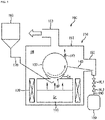
- such silicon-based active material precursor particles can be obtained, for example, by forming a laminated coating on a substrate and then scraping the laminated coating from the substrate. It is preferable to manufacture the silicon-based active material precursor particles by using the vapor deposition apparatus 100 as shown in FIG. 1 from the viewpoint of suppressing manufacturing costs and the like.
- the vapor deposition apparatus 100 shown in FIG. 1 will be described in detail.
- the vapor deposition apparatus 100 mainly includes a crucible 110, a heater 120, a vapor deposition drum 130, a scraper 141, a particle guide 143, a chamber 150, a raw material supply hopper 160, a raw material introduction pipe 170, a collection container 180, a first valve VL1, and a second valve VL2.
- the crucible 110 is a heat-resistant container in which a central portion of a top wall is opened, and is installed in the chamber 150. Further, a through hole (not shown) is formed in one portion of the peripheral portion of the top wall of the crucible 110, the raw material introduction pipe 170 is inserted into the through hole. That is, the raw material in the raw material supply hopper 160 is supplied to the crucible 110 through the raw material introduction pipe 170.
- a gas guide Gg is disposed above the top wall of the crucible 110. The gas guide Gg is a member that guides the source gas generated in the crucible 110 to the vapor deposition drum 130, and is installed on the upper surface of the top wall so as to surround the central portion of the top wall as shown in FIG. 1 .
- the heater 120 is for heating the crucible 110 at a high temperature, and is arranged to take in the outer periphery of the crucible 110.
- the vapor deposition drum 130 is, for example, a cylindrical horizontal drum, and as shown in FIG. 1 , is disposed above the opening OP of the top wall of the crucible 110, and a lower portion thereof is surrounded by the gas guide Gg.
- the vapor deposition drum 130 is driven to rotate in one direction by a driving mechanism (not shown).
- the vapor deposition drum 130 is provided with a temperature controller (not shown) for keeping the outer peripheral surface at a constant temperature.
- the temperature controller cools the outer peripheral surface temperature of the vapor deposition drum 130 to a temperature suitable for vapor deposition of the vapor deposition source gas by a cooling medium supplied from the outside.
- the outer peripheral surface temperature of the vapor deposition drum 130 may affect the crystallinity of the deposit s deposited on the deposit s remaining on the deposition drum. If the temperature is too low, the structure of the deposit may become too sparse, and if the temperature is too high, crystal growth due to the disproportionation reaction may proceed.
- the source gas is SiO gas
- the temperature is preferably 900 °C or lower, more preferably 150 °C or higher and 800 °C or lower, and particularly preferably 150 °C or higher and 700 °C or lower.
- the thickness of the layer constituting the silicon-based active material precursor particles can be controlled by adjusting the rotation speed and the temperature of the outer peripheral surface of the vapor deposition drum 130.
- the scraper 141 is a member that serves to scrape the laminated coating formed on the vapor deposition drum from the vapor deposition drum 130, and is disposed in the vicinity of the vapor deposition drum 130 so as to be movable up and down as shown in FIG. 1 .
- This scraper 141 is placed in a standby state in the upper side during the formation of the laminated coating, and is moved downward to scrape off the laminated coating when the formation of the laminated coating is completed. Note that the scraped-off laminated coating pieces (silicon-based active material precursor particles) fall to the particle guide 143. Further, the material of the scraper 141 affects impurity contamination of the silicon-based active material particles.
- the material of the scraper 141 is preferably stainless steel or ceramics, and particularly preferably ceramics.
- the scraper 141 is preferably not in contact with the outer peripheral surface of the vapor deposition drum 130. This is because it is possible to prevent impurity contamination that may be caused by direct contact between the vapor deposition drum 130 and the scraper 141 from being mixed into the collected silicon-based active material precursor particles.
- the particle guide 143 is, for example, a vibration-type transport member, and as shown in FIG. 1 , is disposed so as to incline downward from the vicinity of the vapor deposition drum toward the collection portion 152 of the chamber 150, and receives the laminated coating pieces scraped off by the scraper 141 disposed above the particle guide, and delivers the laminated coating pieces to the collection portion 152 of the chamber 150.
- the chamber 150 is mainly formed of a chamber body portion 151, a collection portion 152, and an exhaust pipe 153.
- the chamber body portion 151 is a box-shaped portion having a deposition chamber RM therein, and accommodates a crucible 110, a heater 120, a vapor deposition drum 130, a scraper 141, and a particle guide 143.
- the collection portion 152 is the portion that protrudes outward from the side wall of the chamber body portion 151 and has a space that communicates with the deposition chamber RM of the chamber body portion 151.
- the tip portion of the particle guide 143 is positioned in the collection portion 152.
- the raw material supply hopper 160 is a raw material supply source and has an outlet connected to the raw material introduction pipe 170 as shown in FIG. 1 . That is, the raw material supplied to the raw material supply hopper 160 is supplied to the crucible 110 through the raw material introduction pipe 170 at an appropriate timing. Note that the raw material supplied to the crucible 110 is vaporized to become the raw material gas after becoming the molten metal Sr.
- the raw material introduction pipe 170 is a round hole-shaped nozzle for supplying the solid raw material supplied to the raw material supply hopper 160 to the crucible 110, and is arranged so as to orient opening upward in a central portion of a top plate portion of the crucible 110.
- the collection container 180 is a container for collecting the laminated coating pieces that have passed through the first valve VL1 and the second valve VL2.
- the first valve VL1 and the second valve VL2 are provided in a collection pipe 190 that connects the collection portion 152 of the chamber 150 and the collection container 180 to adjust the collection quantity of the laminated coating pieces to the collection container 180 by opening and closing.
- the raw material is fed from the raw material supply hopper 160 to the crucible 110 via the raw material introduction pipe 170.
- a mixed powder of Si and SiO 2 is used as a raw material.
- the mixed particles are heated to a predetermined temperature to generate SiO gas as a raw material gas.
- a mixed particle of Si and a silicate such as Li 2 Si 2 O 5 , a carbonate such as lithium carbonate (Li 2 CO 3 ), a mixed powder of silicon dioxide (SiO 2 ) and silicon (Si), or the like is used as a raw material.
- the mixed particles are heated to a predetermined temperature to generate SiO gas containing a metal element such as Li as a raw material gas.
- the metal element may be an element capable of reducing SiO and stabilizing oxygen, such as an alkali metal such as Na, an alkaline earth metal such as Mg or Ca, in addition to Li.
- the crucible 110 When the raw material is charged into the crucible 110, the crucible 110 is heated by the heater 120 while the pressure in the deposition chamber RM is reduced. If the pressure in the deposition chamber RM is too high, a reaction in which SiO gas is generated from the raw material is unlikely to occur. Therefore, the pressure in the deposition chamber RM is preferably 100Pa or less, more preferably 750Pa or less, and particularly preferably 20Pa or less. Further, the temperature in the deposition chamber RM affects the reaction rate of SiO, the reaction rate becomes slow when the same temperature is too low, the side reaction progress due to melting of the raw material if the same temperature is too high, there is a concern such as energy efficiency decrease.
- the temperature in the deposition chamber RM is preferably in the range of 1000 °C or higher and 1600 °C. or lower, more preferably in the range of 1100 °C. or higher and 1500 °C or lower, particularly preferably in the range of 1100 °C. or higher and 1400 °C. or lower.
- the raw material gas is generated from the raw material in the crucible 110, and the raw material gas is supplied to the vapor deposition drum 130 through the gas guide Gg.
- the vapor deposition drum 130 is rotationally driven by a driving source.
- the temperature of the outer peripheral surface of the vapor deposition drum 130 is set to be lower than the temperature in the deposition chamber RM. More specifically, the same temperature is set lower than the condensation temperature of the raw material gas.
- the raw material gas generated from the crucible 110 is deposited on the outer peripheral surface of the rotating vapor deposition drum 130.
- the vapor deposition drum 130 is rotated a plurality of times to form a laminated coating on the vapor deposition drum 130 while the scraper 141 is placed in a standby state on the upper side. After that, when the number of revolutions of the vapor deposition drum 130 reaches a predetermined number, the scraper 141 is moved downward, and the laminated coating is scraped off from the vapor deposition drum 130 by the scraper 141. Note that the scraped-off laminated coating pieces fall along the outer peripheral surface of the vapor deposition drum 130 to the particle guide 143.
- high-quality silicon-based active material precursor particles are produced as described above.
- Si silicon
- SiO 2 silicon monoxide
- the vapor deposition drum 130 was rotated while controlling the temperature so that the outer peripheral surface temperature of the vapor deposition drum 130 was 150° C., and the silicon monoxide gas was condensed and deposited on the outer peripheral surface of the vapor deposition drum 130.
- the rotation speed of the vapor deposition drum 130 was adjusted so that silicon monoxide was deposited on the outer peripheral surface of the vapor deposition drum 130 with a thickness of 0.18 ⁇ m while the vapor deposition drum 130 was rotated once.
- the scraper 141 was brought close to the vapor deposition drum 130, and the silicon monoxide thin coating deposited (laminated) on the outer peripheral surface of the vapor deposition drum 130 was scraped off to obtain a silicon monoxide powder.
- the silicon monoxide powder was heat-treated at 700° C. in an argon atmosphere to obtain a silicon-based active material precursor powder.
- the silicon-based active material precursor powder was subjected to a pulverizer to refine, and then the silicon-based active material precursor powder was sieved through a sieve having an opening of 20 ⁇ m and passed through a sieve to obtain a silicon-based active material powder.
- the silicon-based active material precursor powder was sifted with a double sieve formed by superposing a sieve having an opening of 45 ⁇ m on a sieve having an opening of 20 ⁇ m, and the powder that passed through the sieve having an opening of 45 ⁇ m but did not pass through the sieve having an opening of 20 ⁇ m (i.e., that left on the sieve having an opening of 20 ⁇ m) was used as a pulverized sample for measuring pulverization characteristics. Then, the pulverized sample having a bulk of 1L was filled into a dry attritor MA1D (dry attritor) manufactured by Nippon Coke Co., Ltd., and the attritor was operated for 5 minutes.
- MA1D dry attritor
- the rotational speed of the attritor was set to 300rpm.
- the particle size distribution of the pulverized sample pulverized for 5 minutes in an attritor was measured using a Mastersizer2000 manufactured by Malvern (laser diffractive particle size distribution measuring device), to determine the volume-based median diameter D50 (hereinafter referred to as "mean particle diameter").
- the measurement results are shown in Table 1. In the particle size distribution measurement, isopropyl alcohol was used as a solvent.
- the silicon-based active material powder (SiO powder), Ketjen black, and a polyimide precursor that is a non-aqueous binder were mixed at a weight ratio of 85:5:10, and after adding N-methylpyrrolidone to the mixture, the mixture was kneaded to prepare a slurry. Then, the slurry was coated on a copper foil having a thickness of 40 ⁇ m, the coating was preliminarily dried at 80° C for 15 minutes, and then the copper foil with a dry coating was punched out to a diameter of 11mm, and then heated at 350 °C under reduced pressure to prepare a negative electrode. By heating the copper foil with a dry coating at 350° C., the polyimide precursor in the dry coating is imidized.
- the negative electrode was imaged by a scanning electron microscope (SEM) to obtain the images shown in FIGS.2 to 5 . From these images, it was confirmed that the silicon-based active material particles in the silicon-based active material powder had a layer structure, and that the thickness of each layer was 0.2 ⁇ m or less.
- SEM scanning electron microscope
- the thickness of the layer was determined as follows. First, a line segment vertically straddling the layers was drawn with respect to any 10 layers among a plurality of layers appearing as a stripe pattern (striped grains in an SEM image) in an SEM image at 50,000 magnifications the cross section of the silicon-based active material particles of one particle, and the length of the line segment divided by 10 was defined as the thickness of the layer of the silicon-based active material particles. Then, the operation was performed on the SEM image of 50,000 magnifications the cross-section of the ten silicon-based active material particles, and the average thickness of the layers in the ten silicon-based active material particles was defined as the thickness of the final silicon-based active material particles.
- a coin cell was produced using a lithium foil as a counter electrode and using "a solution in which phosphorus lithium hexafluoride was dissolved in a solution in which ethylene carbonate and diethyl carbonate were mixed in a volume ratio of 1:1 so that phosphorus lithium hexafluoride (LiPF 6 ) became a concentration of 1 mol/L" as an electrolyte, and using a polyethylene porous film having a thickness of 20 ⁇ m as a separator.
- the coin cell was charged and discharged using a secondary battery charge and discharge test apparatus manufactured by Electrofield Corporation.
- the test conditions in the charge-discharge test were as shown in Table 2.
- the initial charge capacity, the initial discharge capacity, the ratio of the initial discharge capacity to the initial charge capacity (initial Coulomb efficiency), and the ratio of the third discharge capacity to the initial discharge capacity (output characteristics) were determined.
- the measurement results were as shown in Table 1.
- the "output characteristics" refers to a ratio of the "discharge capacity at the time of charging and discharging in the third cycle 0.5C" to the "discharge capacity at the time of charging and discharging in the first 0.1C".
- the silicon-based active material powder was prepared in the same manner as in the working example 1 except that the rotation speed of the vapor deposition drum 130 was adjusted so that the deposition thickness of silicon monoxide became 0.98 ⁇ m, and the pulverization characteristics of the silicon-based active material precursor powder and the electrode characteristics of the silicon-based active material powder were measured. The measurement results were as shown in Table 1. Also in this working example, a negative electrode was prepared in the same manner as in the working example 1, and the negative electrode was imaged by a scanning electron microscope (SEM), and it was confirmed from the image that the silicon-based active material particles in the silicon-based active material powder had a layer structure, and that the thickness of each layer was 1 ⁇ m or less.
- SEM scanning electron microscope
- the silicon-based active material powder was prepared in the same manner as in the working example 1 except that the rotation speed of the vapor deposition drum 130 was adjusted so that the deposition thickness of silicon monoxide became 0.48 ⁇ m, and the pulverization characteristics of the silicon-based active material precursor powder and the electrode characteristics of the silicon-based active material powder were measured. The measurement results were as shown in Table 1. Also in this working example, a negative electrode was prepared in the same manner as in the working example 1, and the negative electrode was imaged by a scanning electron microscope (SEM), and it was confirmed from the image that the silicon-based active material particles in the silicon-based active material powder had a layer structure, and that the thickness of each layer was 0.5 ⁇ m or less.
- SEM scanning electron microscope
- the silicon-based active material powder was prepared in the same manner as in the working example 1 except that the rotation speed of the vapor deposition drum 130 was adjusted so that the deposition thickness of silicon monoxide became 0.08 ⁇ m, and the pulverization characteristics of the silicon-based active material precursor powder and the electrode characteristics of the silicon-based active material powder were measured. The measurement results were as shown in Table 1. Also in this working example, a negative electrode was prepared in the same manner as in the working example 1, and the negative electrode was imaged by a scanning electron microscope (SEM), and it was confirmed from the image that the silicon-based active material particles in the silicon-based active material powder had a layer structure, and that the thickness of each layer was 0.1 ⁇ m or less.
- SEM scanning electron microscope
- the silicon-based active material powder was prepared in the same manner as in the working example 1 except that the rotation speed of the vapor deposition drum 130 was adjusted so that the deposition thickness of silicon monoxide became about 0.05 ⁇ m, and the pulverization characteristics of the silicon-based active material precursor powder and the electrode characteristics of the silicon-based active material powder were measured. The measurement results were as shown in Table 1. Also in this working example, a negative electrode was prepared in the same manner as in the working example 1, and the negative electrode was imaged by a scanning electron microscope (SEM), and it was confirmed from the image that the silicon-based active material particles in the silicon-based active material powder had a layer structure, and that the thickness of each layer was about 0.05 ⁇ m.
- SEM scanning electron microscope
- the silicon-based active material powder was prepared in the same manner as in the working example 1 except that the rotation speed of the vapor deposition drum 130 was adjusted so that the deposition thickness of silicon monoxide became about 0.02 ⁇ m, and the pulverization characteristics of the silicon-based active material precursor powder and the electrode characteristics of the silicon-based active material powder were measured. The measurement results were as shown in Table 1. Also in this working example, a negative electrode was prepared in the same manner as in the working example 1, and the negative electrode was imaged by a scanning electron microscope (SEM), and it was confirmed from the image that the silicon-based active material particles in the silicon-based active material powder had a layer structure, and that the thickness of each layer was about 0.02 ⁇ m.
- SEM scanning electron microscope
- the silicon-based active material powder was prepared in the same manner as in the working example 1 except that the rotation speed of the vapor deposition drum 130 was adjusted so that the deposition thickness of silicon monoxide became about 0.01 ⁇ m, and the pulverization characteristics of the silicon-based active material precursor powder and the electrode characteristics of the silicon-based active material powder were measured. The measurement results were as shown in Table 1. Also in this working example, a negative electrode was prepared in the same manner as in the working example 1, and the negative electrode was imaged by a scanning electron microscope (SEM), and it was confirmed from the image that the silicon-based active material particles in the silicon-based active material powder had a layer structure, and the thickness of each layer was about 0.01 ⁇ m.
- SEM scanning electron microscope
- the silicon monoxide thin coating obtained in this example contains lithium.
- a negative electrode was prepared in the same manner as in the working example 1, and the negative electrode was imaged by a scanning electron microscope (SEM), and it was confirmed from the image that the silicon-based active material particles in the silicon-based active material powder had a layer structure, and that the thickness of each layer was 0.2 ⁇ m or less.
- SEM scanning electron microscope
- a silicon-based active material powder was prepared in the same manner as in the working example 8 except that the rotation speed of the vapor deposition drum 130 was adjusted so that the deposition thickness of silicon monoxide became 0.98 ⁇ m, and the pulverization characteristics of the silicon-based active material precursor powder and the electrode characteristics of the silicon-based active material powder were measured in the same manner as in the working example 1. The measurement results were as shown in Table 1. Also in this working example, a negative electrode was prepared in the same manner as in the working example 1, and the negative electrode was imaged by a scanning electron microscope (SEM), and it was confirmed from the image that the silicon-based active material particles in the silicon-based active material powder had a layer structure, and that the thickness of each layer was 1 ⁇ m or less.
- SEM scanning electron microscope
- a silicon-based active material powder was prepared in the same manner as in the working example 8 except that the rotation speed of the vapor deposition drum 130 was adjusted so that the deposition thickness of silicon monoxide became 0.48 ⁇ m, and the pulverization characteristics of the silicon-based active material precursor powder and the electrode characteristics of the silicon-based active material powder were measured in the same manner as in the working example 1. The measurement results were as shown in Table 1. Also in this working example, a negative electrode was prepared in the same manner as in the working example 1, and the negative electrode was imaged by a scanning electron microscope (SEM), and it was confirmed from the image that the silicon-based active material particles in the silicon-based active material powder had a layer structure, and that the thickness of each layer was 0.5 ⁇ m or less.
- SEM scanning electron microscope
- a silicon-based active material powder was prepared in the same manner as in the working example 8 except that the rotation speed of the vapor deposition drum 130 was adjusted so that the deposition thickness of silicon monoxide became 0.08 ⁇ m, and the pulverization characteristics of the silicon-based active material precursor powder and the electrode characteristics of the silicon-based active material powder were measured in the same manner as in the working example 1. The measurement results were as shown in Table 1. Also in this working example, a negative electrode was prepared in the same manner as in the working example 1, and the negative electrode was imaged by a scanning electron microscope (SEM), and it was confirmed from the image that the silicon-based active material particles in the silicon-based active material powder had a layer structure, and that the thickness of each layer was 0.1 ⁇ m or less.
- SEM scanning electron microscope
- a silicon-based active material powder was prepared in the same manner as in the working example 8 except that the rotation speed of the vapor deposition drum 130 was adjusted so that the deposition thickness of silicon monoxide became about 0.05 ⁇ m, and the pulverization characteristics of the silicon-based active material precursor powder and the electrode characteristics of the silicon-based active material powder were measured in the same manner as in the working example 1. The measurement results were as shown in Table 1. Also in this working example, a negative electrode was prepared in the same manner as in the working example 1, and the negative electrode was imaged by a scanning electron microscope (SEM), and it was confirmed from the image that the silicon-based active material particles in the silicon-based active material powder had a layer structure, and the thickness of each layer was about 0.05 ⁇ m.
- SEM scanning electron microscope
- a silicon-based active material powder was prepared in the same manner as in the working example 8 except that the rotation speed of the vapor deposition drum 130 was adjusted so that the deposition thickness of silicon monoxide became about 0.02 ⁇ m, and the pulverization characteristics of the silicon-based active material precursor powder and the electrode characteristics of the silicon-based active material powder were measured in the same manner as in the working example 1. The measurement results were as shown in Table 1. Also in this working example, a negative electrode was prepared in the same manner as in the working example 1, and the negative electrode was imaged by a scanning electron microscope (SEM), and it was confirmed from the image that the silicon-based active material particles in the silicon-based active material powder had a layer structure, and the thickness of each layer was about 0.02 ⁇ m.
- SEM scanning electron microscope
- a silicon-based active material powder was prepared in the same manner as in the working example 8 except that the rotation speed of the vapor deposition drum 130 was adjusted so that the deposition thickness of silicon monoxide bacame about 0.01 ⁇ m, and the pulverization characteristics of the silicon-based active material precursor powder and the electrode characteristics of the silicon-based active material powder were measured in the same manner as in the working example 1. The measurement results were as shown in Table 1. Also in this working example, a negative electrode was prepared in the same manner as in the working example 1, and the negative electrode was imaged by a scanning electron microscope (SEM), and it was confirmed from the image that the silicon-based active material particles in the silicon-based active material powder had a layer structure, and the thickness of each layer was about 0.01 ⁇ m.
- SEM scanning electron microscope
- a silicon-based active material powder was prepared in the same manner as in the working example 1 except that a silicon monoxide thin coating obtained by condensing and depositing the silicon monoxide gas without rotating the vapor deposition drum 130 was scraped off by a scraper 141 to obtain a silicon monoxide powder, and the silicon monoxide powder was pulverized by a dry attritor until the mean particle diameter D50 became 5 ⁇ m to obtain silicon-based active material particles, and the pulverization characteristics of the silicon-based active material precursor powder and the electrode characteristics of the silicon-based active material powder were measured. The measurement results were as shown in Table 1.
- a negative electrode was prepared in the same manner as in the working example 1, and the negative electrode was imaged by a scanning electron microscope (SEM).
- SEM scanning electron microscope
- a silicon-based active material powder was prepared in the same manner as in the working example 8 except that a silicon monoxide thin coating obtained by condensing and depositing the silicon monoxide gas without rotating the vapor deposition drum 130 was scraped off by a scraper 141 to obtain a silicon monoxide powder, and the silicon monoxide powder was pulverized by a dry attritor until the mean particle diameter D50 became 5 ⁇ m to obtain silicon-based active material particles, the pulverization characteristics of the silicon-based active material precursor powder and the electrode characteristics of the silicon-based active material powder were measured. The measurement results were as shown in Table 1.
- the silicon monoxide thin coating obtained in this comparative example contains lithium.
- a negative electrode was prepared in the same manner as in the working example 1, and the negative electrode was imaged by a scanning electron microscope (SEM), but it was confirmed from the image that the silicon-based active material particles in the silicon-based active material powder did not have a layer structure.
- SEM scanning electron microscope
Landscapes
- Chemical & Material Sciences (AREA)
- Chemical Kinetics & Catalysis (AREA)
- Engineering & Computer Science (AREA)
- Electrochemistry (AREA)
- General Chemical & Material Sciences (AREA)
- Materials Engineering (AREA)
- Organic Chemistry (AREA)
- Mechanical Engineering (AREA)
- Metallurgy (AREA)
- Manufacturing & Machinery (AREA)
- Composite Materials (AREA)
- Inorganic Chemistry (AREA)
- Silicon Compounds (AREA)
- Battery Electrode And Active Subsutance (AREA)
- Physical Vapour Deposition (AREA)
Abstract
Description
- The present invention relates to a silicon-based active material particle. The present invention also relates to a silicon-based active material precursor particle and a method for producing the same.
- Various silicon oxide-based active material particles used for forming negative electrodes of lithium secondary batteries have been proposed in the past (see, for example,
Japanese Unexamined Patent Application Publication No. 2019-67644 - [PATENT DOCUMENT 1]
Japanese Unexamined Patent Application Publication No. 2019-67644 - Incidentally, in recent years, there has been a demand for an improvement in the ability of the active material particles to take in ions such as lithium ions.
- An object of the present invention is to provide active material particles excellent in ion uptake ability.
- The silicon-based active material particles according to the first aspect of the present invention comprise a layer structure. Here, the "silicon-based active material particles" are, for example, active material particles for forming a negative electrode of a lithium ion secondary battery. Examples of the active material particles for forming the negative electrode of the lithium ion secondary battery include so-called Si-based active materials such as silicon (Si), silicon oxide (SiOx), metal element-containing silicon oxide containing alkaline metal elements such as lithium (Li) and alkaline earth metal elements such as magnesium (Mg), silicon alloys. The thickness of the layer in the silicon-based active material particles is preferably 1µm or less. The thickness of the layer is preferably 0.01µm or more from the viewpoint of preventing the initial efficiency and the capacity from being undersized.
- As described above, the silicon-based active material particles comprise a layer structure. In the silicon-based active material particles, oxygen is concentrated in a layered form. The oxygen element (O) of the silicon oxide (SiOx) reacts with the lithium (Li) by charging to produce lithium silicate, and the lithium silicate is highly lithium conductive. Therefore, in the silicon-based active material particles, a region having high lithium conductivity is present in a layered form, and lithium can move smoothly therein. As a result, when the silicon-based active material particles are used as the negative electrode active material, the silicon-based active material particles are superior in ion uptake ability as compared with conventional silicon-based active material particles having no layer structure, and thus the output characteristics of batteries such as lithium secondary batteries and the like can be improved.
- The silicon-based active material precursor particles according to the second aspect of the present invention comprise a layer structure. The "silicon-based active material precursor particles" referred to herein are those that are pulverized to form silicon-based active material particles, and are, for example, silicon-based active material precursor particles for forming a negative electrode of a lithium ion secondary battery. Examples of the active material particles for forming the negative electrode of the lithium ion secondary battery include so-called Si-based active materials such as silicon (Si), silicon oxide (SiOx), metal element-containing silicon oxide containing alkaline metal elements such as lithium (Li) and alkaline earth metal elements such as magnesium (Mg), silicon alloys. The thickness of the layer in the silicon-based active material precursor particles is preferably 1µm or less. Here, the thickness of the layer is preferably 0.01µm or more.
- As described above, the silicon-based active material precursor particles comprise a layer structure. Therefore, when the silicon-based active material precursor particles are pulverized, fracture is likely to occur starting from the surface of the layer. Therefore, the silicon-based active material precursor particles can produce silicon-based active material particles with less energy than silicon-based active material precursor particles having no layer structure. In the case where the silicon-based active material particles obtained as described above have a layer structure, the silicon-based active material particles can exhibit the same effects as those of the silicon-based active material particles according to the first aspect.
- A method for producing a silicon-based active material precursor particle having a layer structure according to a second aspect of the present invention comprises a laminated coating forming step and a scraping step. In the laminated coating forming step, a deposition step in which a silicon-based active material forming material is deposited on a substrate is repeatedly performed to form a laminated coating of a silicon-based active material on the substrate. The base body is preferably a rotating body having an axis along the horizontal direction or a plate body capable of moving relative to a supply path of the silicon-based active material forming material. In the scraping step, the laminated coating of the silicon-based active material is scraped off.
- Therefore, in the method for producing the silicon-based active material precursor particles, the bonding force between the layers of the laminated coating of the silicon-based active material can be adjusted by adjusting the temperature and the like of the substrate. Therefore, in this method, the pulverization property of the obtained silicon-based active material precursor particles can be adjusted, and in the case where the silicon-based active material particles having a layer structure are obtained from the silicon-based active material precursor particles, the ion uptake ability of the silicon-based active material particles can be adjusted.
-
- [
Fig. 1 ] It is a schematic diagram of a manufacturing apparatus of the silicon-based active material precursor particles according to the embodiment of the present invention. - [
Fig. 2 ] It is an SEM image at 2,000 magnification of a negative electrode according to working example 1. - [
Fig. 3 ] It is an SEM image at 5,000 magnification of a negative electrode according to working example 1. - [
Fig. 4 ] It is an SEM image at 20,000 magnification of a negative electrode according to working example 1. - [
Fig. 5 ] It is an SEM image at 50,000 magnification of a negative electrode according to working example 1. - [
Fig. 6 ] It is an SEM image at 2,000 magnification of a negative electrode according to comparative Example 1. - [
Fig. 7 ] It is an SEM image at 5,000 magnification of a negative electrode according to comparative Example 1. - [
Fig. 8 ] It is an SEM image at 20,000 magnification of a negative electrode according to comparative Example 1. - [
Fig. 9 ] It is an SEM image at 50,000 magnification of a negative electrode according to comparative Example 1. -
- 100
- Vapor deposition apparatus
- 110
- Crucible
- 120
- Heater
- 130
- Deposition drum
- 141
- Scraper
- 143
- Particle guide
- 150
- Chamber
- 151
- Chamber body portion
- 152
- Collection portion
- 153
- Exhaust pipe
- 160
- Raw material supply hopper
- 170
- Raw material introduction pipe
- 180
- Collection container
- 190
- Collection pipe
- Gg
- Gas Guide
- OP
- opening
- RM
- deposition chamber
- Sr
- molten metal
- VL1
- first bulb
- VL2
- second bulb
- The silicon-based active material precursor particles according to the embodiment of the present invention are pulverized to form silicon-based active material particles, and have a layer structure (multilayer structure). Such silicon-based active material precursor particles are, for example, precursor particles of silicon (Si), silicon oxide (SiOx), metal element-containing silicon oxide containing an alkaline metal element such as or lithium (Li) or an alkaline earth metal element such as magnesium (Mg), a silicon alloy used as an active material of a negative electrode of a lithium-ion secondary battery. In addition, the silicon-based active material precursor particles according to the present embodiment are pulverized to a predetermined particle size to form silicon-based active material particles for forming an electrode (particularly, a negative electrode). In addition, it is preferable that the thickness of the layer is 1µm or less, that it is 0.5µm or less is preferable, that it is 0.2µm or less is even more preferable, that it is 0.1µm or less is even more preferable, and that it is 0.05µm or less is even more preferable, and that it is 0.02µm or less is particularly preferable in the silicic active material particles. The thickness of the layer is preferably 0.01µm or more from the viewpoint of preventing the initial efficiency and the capacity of the battery from being undersized.
- Incidentally, such silicon-based active material precursor particles can be obtained, for example, by forming a laminated coating on a substrate and then scraping the laminated coating from the substrate. it is preferable to manufacture the silicon-based active material precursor particles by using the
vapor deposition apparatus 100 as shown inFIG. 1 from the viewpoint of suppressing manufacturing costs and the like. Hereinafter, thevapor deposition apparatus 100 shown inFIG. 1 will be described in detail. - As shown in
FIG. 1 , thevapor deposition apparatus 100 mainly includes acrucible 110, aheater 120, avapor deposition drum 130, ascraper 141, aparticle guide 143, achamber 150, a rawmaterial supply hopper 160, a rawmaterial introduction pipe 170, acollection container 180, a first valve VL1, and a second valve VL2. - As shown in
FIG. 1 , thecrucible 110 is a heat-resistant container in which a central portion of a top wall is opened, and is installed in thechamber 150. Further, a through hole (not shown) is formed in one portion of the peripheral portion of the top wall of thecrucible 110, the rawmaterial introduction pipe 170 is inserted into the through hole. That is, the raw material in the rawmaterial supply hopper 160 is supplied to thecrucible 110 through the rawmaterial introduction pipe 170. A gas guide Gg is disposed above the top wall of thecrucible 110. The gas guide Gg is a member that guides the source gas generated in thecrucible 110 to thevapor deposition drum 130, and is installed on the upper surface of the top wall so as to surround the central portion of the top wall as shown inFIG. 1 . - The
heater 120 is for heating thecrucible 110 at a high temperature, and is arranged to take in the outer periphery of thecrucible 110. - The
vapor deposition drum 130 is, for example, a cylindrical horizontal drum, and as shown inFIG. 1 , is disposed above the opening OP of the top wall of thecrucible 110, and a lower portion thereof is surrounded by the gas guide Gg. Thevapor deposition drum 130 is driven to rotate in one direction by a driving mechanism (not shown). Thevapor deposition drum 130 is provided with a temperature controller (not shown) for keeping the outer peripheral surface at a constant temperature. The temperature controller cools the outer peripheral surface temperature of thevapor deposition drum 130 to a temperature suitable for vapor deposition of the vapor deposition source gas by a cooling medium supplied from the outside. Also, the outer peripheral surface temperature of thevapor deposition drum 130 may affect the crystallinity of the deposit s deposited on the deposit s remaining on the deposition drum. If the temperature is too low, the structure of the deposit may become too sparse, and if the temperature is too high, crystal growth due to the disproportionation reaction may proceed. When the source gas is SiO gas, the temperature is preferably 900 °C or lower, more preferably 150 °C or higher and 800 °C or lower, and particularly preferably 150 °C or higher and 700 °C or lower. In addition, the thickness of the layer constituting the silicon-based active material precursor particles can be controlled by adjusting the rotation speed and the temperature of the outer peripheral surface of thevapor deposition drum 130. - The
scraper 141 is a member that serves to scrape the laminated coating formed on the vapor deposition drum from thevapor deposition drum 130, and is disposed in the vicinity of thevapor deposition drum 130 so as to be movable up and down as shown inFIG. 1 . Thisscraper 141 is placed in a standby state in the upper side during the formation of the laminated coating, and is moved downward to scrape off the laminated coating when the formation of the laminated coating is completed. Note that the scraped-off laminated coating pieces (silicon-based active material precursor particles) fall to theparticle guide 143. Further, the material of thescraper 141 affects impurity contamination of the silicon-based active material particles. From the viewpoint of suppressing the influence thereof, the material of thescraper 141 is preferably stainless steel or ceramics, and particularly preferably ceramics. In addition, thescraper 141 is preferably not in contact with the outer peripheral surface of thevapor deposition drum 130. This is because it is possible to prevent impurity contamination that may be caused by direct contact between thevapor deposition drum 130 and thescraper 141 from being mixed into the collected silicon-based active material precursor particles. - The
particle guide 143 is, for example, a vibration-type transport member, and as shown inFIG. 1 , is disposed so as to incline downward from the vicinity of the vapor deposition drum toward thecollection portion 152 of thechamber 150, and receives the laminated coating pieces scraped off by thescraper 141 disposed above the particle guide, and delivers the laminated coating pieces to thecollection portion 152 of thechamber 150. - As shown in
FIG. 1 , thechamber 150 is mainly formed of achamber body portion 151, acollection portion 152, and anexhaust pipe 153. As shown inFIG. 1 , thechamber body portion 151 is a box-shaped portion having a deposition chamber RM therein, and accommodates acrucible 110, aheater 120, avapor deposition drum 130, ascraper 141, and aparticle guide 143. As shown inFIG. 1 , thecollection portion 152 is the portion that protrudes outward from the side wall of thechamber body portion 151 and has a space that communicates with the deposition chamber RM of thechamber body portion 151. As described above, the tip portion of theparticle guide 143 is positioned in thecollection portion 152. - The raw
material supply hopper 160 is a raw material supply source and has an outlet connected to the rawmaterial introduction pipe 170 as shown inFIG. 1 . That is, the raw material supplied to the rawmaterial supply hopper 160 is supplied to thecrucible 110 through the rawmaterial introduction pipe 170 at an appropriate timing. Note that the raw material supplied to thecrucible 110 is vaporized to become the raw material gas after becoming the molten metal Sr. - The raw
material introduction pipe 170 is a round hole-shaped nozzle for supplying the solid raw material supplied to the rawmaterial supply hopper 160 to thecrucible 110, and is arranged so as to orient opening upward in a central portion of a top plate portion of thecrucible 110. - The
collection container 180 is a container for collecting the laminated coating pieces that have passed through the first valve VL1 and the second valve VL2. - The first valve VL1 and the second valve VL2 are provided in a
collection pipe 190 that connects thecollection portion 152 of thechamber 150 and thecollection container 180 to adjust the collection quantity of the laminated coating pieces to thecollection container 180 by opening and closing. - Hereinafter, a case where a silicon oxide powder or a metal element-containing silicon oxide powder used for a negative electrode material for a lithium ion secondary battery is manufactured using the above-described
vapor deposition apparatus 100 will be described. - The raw material is fed from the raw
material supply hopper 160 to thecrucible 110 via the rawmaterial introduction pipe 170. Here, when the silicon oxide particles are produced, a mixed powder of Si and SiO2 is used as a raw material. The mixed particles are heated to a predetermined temperature to generate SiO gas as a raw material gas. When the metal element-containing silicon oxide powder is produced, a mixed particle of Si and a silicate such as Li2Si2O5, a carbonate such as lithium carbonate (Li2CO3), a mixed powder of silicon dioxide (SiO2) and silicon (Si), or the like is used as a raw material. In such a case, the mixed particles are heated to a predetermined temperature to generate SiO gas containing a metal element such as Li as a raw material gas. The metal element may be an element capable of reducing SiO and stabilizing oxygen, such as an alkali metal such as Na, an alkaline earth metal such as Mg or Ca, in addition to Li. - When the raw material is charged into the
crucible 110, thecrucible 110 is heated by theheater 120 while the pressure in the deposition chamber RM is reduced. If the pressure in the deposition chamber RM is too high, a reaction in which SiO gas is generated from the raw material is unlikely to occur. Therefore, the pressure in the deposition chamber RM is preferably 100Pa or less, more preferably 750Pa or less, and particularly preferably 20Pa or less. Further, the temperature in the deposition chamber RM affects the reaction rate of SiO, the reaction rate becomes slow when the same temperature is too low, the side reaction progress due to melting of the raw material if the same temperature is too high, there is a concern such as energy efficiency decrease. Also, there is a concern that thecrucible 110 may be damaged at the same temperature. From this viewpoint, the temperature in the deposition chamber RM is preferably in the range of 1000 °C or higher and 1600 °C. or lower, more preferably in the range of 1100 °C. or higher and 1500 °C or lower, particularly preferably in the range of 1100 °C. or higher and 1400 °C. or lower. - By heating the raw material under reduced pressure as described in the above paragraph, the raw material gas is generated from the raw material in the
crucible 110, and the raw material gas is supplied to thevapor deposition drum 130 through the gas guide Gg. At this time, thevapor deposition drum 130 is rotationally driven by a driving source. The temperature of the outer peripheral surface of thevapor deposition drum 130 is set to be lower than the temperature in the deposition chamber RM. More specifically, the same temperature is set lower than the condensation temperature of the raw material gas. By this setting, the raw material gas generated from thecrucible 110 is deposited on the outer peripheral surface of the rotatingvapor deposition drum 130. Then, thevapor deposition drum 130 is rotated a plurality of times to form a laminated coating on thevapor deposition drum 130 while thescraper 141 is placed in a standby state on the upper side. After that, when the number of revolutions of thevapor deposition drum 130 reaches a predetermined number, thescraper 141 is moved downward, and the laminated coating is scraped off from thevapor deposition drum 130 by thescraper 141. Note that the scraped-off laminated coating pieces fall along the outer peripheral surface of thevapor deposition drum 130 to theparticle guide 143. - In the
vapor deposition apparatus 100 of the present embodiment, high-quality silicon-based active material precursor particles are produced as described above. - Hereinafter, working examples and comparative examples are shown in order to explain the present invention in more detail, but the present invention is not limited to these examples.
- A
crucible 110 of thevapor deposition apparatus 100 shown inFIG. 1 is charged with a mixed powder of a powder of silicon (Si) and a powder of silicon dioxide (SiO2) as a silicon monoxide (SiO) gas generation raw material (It is a powder produced by mixing the powder of silicon and a powder of silicon dioxide so as to be Si:O=1:1), the deposition chamber RM is reduced in pressure to 1Pa and thecrucible 110 is heated to 1300 °C to generate silicon monoxide gas. On the other hand, thevapor deposition drum 130 was rotated while controlling the temperature so that the outer peripheral surface temperature of thevapor deposition drum 130 was 150° C., and the silicon monoxide gas was condensed and deposited on the outer peripheral surface of thevapor deposition drum 130. At this time, the rotation speed of thevapor deposition drum 130 was adjusted so that silicon monoxide was deposited on the outer peripheral surface of thevapor deposition drum 130 with a thickness of 0.18µm while thevapor deposition drum 130 was rotated once. Then, after thevapor deposition drum 130 was rotated 50 times, thescraper 141 was brought close to thevapor deposition drum 130, and the silicon monoxide thin coating deposited (laminated) on the outer peripheral surface of thevapor deposition drum 130 was scraped off to obtain a silicon monoxide powder. Thereafter, the silicon monoxide powder was heat-treated at 700° C. in an argon atmosphere to obtain a silicon-based active material precursor powder. Then, the silicon-based active material precursor powder was subjected to a pulverizer to refine, and then the silicon-based active material precursor powder was sieved through a sieve having an opening of 20µm and passed through a sieve to obtain a silicon-based active material powder. - The silicon-based active material precursor powder was sifted with a double sieve formed by superposing a sieve having an opening of 45µm on a sieve having an opening of 20µm, and the powder that passed through the sieve having an opening of 45µm but did not pass through the sieve having an opening of 20µm (i.e., that left on the sieve having an opening of 20µm) was used as a pulverized sample for measuring pulverization characteristics. Then, the pulverized sample having a bulk of 1L was filled into a dry attritor MA1D (dry attritor) manufactured by Nippon Coke Co., Ltd., and the attritor was operated for 5 minutes. At this time, using a zirconia sphere having a diameter of 5mm as a ball for grinding, the rotational speed of the attritor was set to 300rpm. Then, the particle size distribution of the pulverized sample pulverized for 5 minutes in an attritor was measured using a Mastersizer2000 manufactured by Malvern (laser diffractive particle size distribution measuring device), to determine the volume-based median diameter D50 (hereinafter referred to as "mean particle diameter"). The measurement results are shown in Table 1. In the particle size distribution measurement, isopropyl alcohol was used as a solvent.
- The silicon-based active material powder (SiO powder), Ketjen black, and a polyimide precursor that is a non-aqueous binder were mixed at a weight ratio of 85:5:10, and after adding N-methylpyrrolidone to the mixture, the mixture was kneaded to prepare a slurry. Then, the slurry was coated on a copper foil having a thickness of 40µm, the coating was preliminarily dried at 80° C for 15 minutes, and then the copper foil with a dry coating was punched out to a diameter of 11mm, and then heated at 350 °C under reduced pressure to prepare a negative electrode. By heating the copper foil with a dry coating at 350° C., the polyimide precursor in the dry coating is imidized. The negative electrode was imaged by a scanning electron microscope (SEM) to obtain the images shown in
FIGS.2 to 5 . From these images, it was confirmed that the silicon-based active material particles in the silicon-based active material powder had a layer structure, and that the thickness of each layer was 0.2µm or less. - The thickness of the layer was determined as follows. First, a line segment vertically straddling the layers was drawn with respect to any 10 layers among a plurality of layers appearing as a stripe pattern (striped grains in an SEM image) in an SEM image at 50,000 magnifications the cross section of the silicon-based active material particles of one particle, and the length of the line segment divided by 10 was defined as the thickness of the layer of the silicon-based active material particles. Then, the operation was performed on the SEM image of 50,000 magnifications the cross-section of the ten silicon-based active material particles, and the average thickness of the layers in the ten silicon-based active material particles was defined as the thickness of the final silicon-based active material particles.
- A coin cell was produced using a lithium foil as a counter electrode and using "a solution in which phosphorus lithium hexafluoride was dissolved in a solution in which ethylene carbonate and diethyl carbonate were mixed in a volume ratio of 1:1 so that phosphorus lithium hexafluoride (LiPF6) became a concentration of 1 mol/L" as an electrolyte, and using a polyethylene porous film having a thickness of 20µm as a separator.
- The coin cell was charged and discharged using a secondary battery charge and discharge test apparatus manufactured by Electrofield Corporation. The test conditions in the charge-discharge test were as shown in Table 2. By this charge-discharge test, the initial charge capacity, the initial discharge capacity, the ratio of the initial discharge capacity to the initial charge capacity (initial Coulomb efficiency), and the ratio of the third discharge capacity to the initial discharge capacity (output characteristics) were determined. The measurement results were as shown in Table 1. Here, the "output characteristics" refers to a ratio of the "discharge capacity at the time of charging and discharging in the third cycle 0.5C" to the "discharge capacity at the time of charging and discharging in the first 0.1C".
- The silicon-based active material powder was prepared in the same manner as in the working example 1 except that the rotation speed of the
vapor deposition drum 130 was adjusted so that the deposition thickness of silicon monoxide became 0.98µm, and the pulverization characteristics of the silicon-based active material precursor powder and the electrode characteristics of the silicon-based active material powder were measured. The measurement results were as shown in Table 1. Also in this working example, a negative electrode was prepared in the same manner as in the working example 1, and the negative electrode was imaged by a scanning electron microscope (SEM), and it was confirmed from the image that the silicon-based active material particles in the silicon-based active material powder had a layer structure, and that the thickness of each layer was 1µm or less. - The silicon-based active material powder was prepared in the same manner as in the working example 1 except that the rotation speed of the
vapor deposition drum 130 was adjusted so that the deposition thickness of silicon monoxide became 0.48µm, and the pulverization characteristics of the silicon-based active material precursor powder and the electrode characteristics of the silicon-based active material powder were measured. The measurement results were as shown in Table 1. Also in this working example, a negative electrode was prepared in the same manner as in the working example 1, and the negative electrode was imaged by a scanning electron microscope (SEM), and it was confirmed from the image that the silicon-based active material particles in the silicon-based active material powder had a layer structure, and that the thickness of each layer was 0.5µm or less. - The silicon-based active material powder was prepared in the same manner as in the working example 1 except that the rotation speed of the
vapor deposition drum 130 was adjusted so that the deposition thickness of silicon monoxide became 0.08µm, and the pulverization characteristics of the silicon-based active material precursor powder and the electrode characteristics of the silicon-based active material powder were measured. The measurement results were as shown in Table 1. Also in this working example, a negative electrode was prepared in the same manner as in the working example 1, and the negative electrode was imaged by a scanning electron microscope (SEM), and it was confirmed from the image that the silicon-based active material particles in the silicon-based active material powder had a layer structure, and that the thickness of each layer was 0.1µm or less. - The silicon-based active material powder was prepared in the same manner as in the working example 1 except that the rotation speed of the
vapor deposition drum 130 was adjusted so that the deposition thickness of silicon monoxide became about 0.05µm, and the pulverization characteristics of the silicon-based active material precursor powder and the electrode characteristics of the silicon-based active material powder were measured. The measurement results were as shown in Table 1. Also in this working example, a negative electrode was prepared in the same manner as in the working example 1, and the negative electrode was imaged by a scanning electron microscope (SEM), and it was confirmed from the image that the silicon-based active material particles in the silicon-based active material powder had a layer structure, and that the thickness of each layer was about 0.05µm. - The silicon-based active material powder was prepared in the same manner as in the working example 1 except that the rotation speed of the
vapor deposition drum 130 was adjusted so that the deposition thickness of silicon monoxide became about 0.02µm, and the pulverization characteristics of the silicon-based active material precursor powder and the electrode characteristics of the silicon-based active material powder were measured. The measurement results were as shown in Table 1. Also in this working example, a negative electrode was prepared in the same manner as in the working example 1, and the negative electrode was imaged by a scanning electron microscope (SEM), and it was confirmed from the image that the silicon-based active material particles in the silicon-based active material powder had a layer structure, and that the thickness of each layer was about 0.02µm. - The silicon-based active material powder was prepared in the same manner as in the working example 1 except that the rotation speed of the
vapor deposition drum 130 was adjusted so that the deposition thickness of silicon monoxide became about 0.01µm, and the pulverization characteristics of the silicon-based active material precursor powder and the electrode characteristics of the silicon-based active material powder were measured. The measurement results were as shown in Table 1. Also in this working example, a negative electrode was prepared in the same manner as in the working example 1, and the negative electrode was imaged by a scanning electron microscope (SEM), and it was confirmed from the image that the silicon-based active material particles in the silicon-based active material powder had a layer structure, and the thickness of each layer was about 0.01µm. - A silicon-based active material powder was prepared in the same manner as in the working example 1 except that a powder of silicon (Si) and lithium silicate (SiO2/Li2O=2) were used instead of a mixed powder of a powder of silicon (Si) and a powder of silicon dioxide (SiO2) as a raw material for generating silicon monoxide (SiO) gas, and the pulverization characteristics of the silicon-based active material precursor powder and the electrode characteristics of the silicon-based active material powder were measured. The measurement results were as shown in Table 1. The silicon monoxide thin coating obtained in this example contains lithium. Also in this working example, a negative electrode was prepared in the same manner as in the working example 1, and the negative electrode was imaged by a scanning electron microscope (SEM), and it was confirmed from the image that the silicon-based active material particles in the silicon-based active material powder had a layer structure, and that the thickness of each layer was 0.2µm or less.
- A silicon-based active material powder was prepared in the same manner as in the working example 8 except that the rotation speed of the
vapor deposition drum 130 was adjusted so that the deposition thickness of silicon monoxide became 0.98µm, and the pulverization characteristics of the silicon-based active material precursor powder and the electrode characteristics of the silicon-based active material powder were measured in the same manner as in the working example 1. The measurement results were as shown in Table 1. Also in this working example, a negative electrode was prepared in the same manner as in the working example 1, and the negative electrode was imaged by a scanning electron microscope (SEM), and it was confirmed from the image that the silicon-based active material particles in the silicon-based active material powder had a layer structure, and that the thickness of each layer was 1µm or less. - A silicon-based active material powder was prepared in the same manner as in the working example 8 except that the rotation speed of the
vapor deposition drum 130 was adjusted so that the deposition thickness of silicon monoxide became 0.48µm, and the pulverization characteristics of the silicon-based active material precursor powder and the electrode characteristics of the silicon-based active material powder were measured in the same manner as in the working example 1. The measurement results were as shown in Table 1. Also in this working example, a negative electrode was prepared in the same manner as in the working example 1, and the negative electrode was imaged by a scanning electron microscope (SEM), and it was confirmed from the image that the silicon-based active material particles in the silicon-based active material powder had a layer structure, and that the thickness of each layer was 0.5µm or less. - A silicon-based active material powder was prepared in the same manner as in the working example 8 except that the rotation speed of the
vapor deposition drum 130 was adjusted so that the deposition thickness of silicon monoxide became 0.08µm, and the pulverization characteristics of the silicon-based active material precursor powder and the electrode characteristics of the silicon-based active material powder were measured in the same manner as in the working example 1. The measurement results were as shown in Table 1. Also in this working example, a negative electrode was prepared in the same manner as in the working example 1, and the negative electrode was imaged by a scanning electron microscope (SEM), and it was confirmed from the image that the silicon-based active material particles in the silicon-based active material powder had a layer structure, and that the thickness of each layer was 0.1µm or less. - A silicon-based active material powder was prepared in the same manner as in the working example 8 except that the rotation speed of the
vapor deposition drum 130 was adjusted so that the deposition thickness of silicon monoxide became about 0.05µm, and the pulverization characteristics of the silicon-based active material precursor powder and the electrode characteristics of the silicon-based active material powder were measured in the same manner as in the working example 1. The measurement results were as shown in Table 1. Also in this working example, a negative electrode was prepared in the same manner as in the working example 1, and the negative electrode was imaged by a scanning electron microscope (SEM), and it was confirmed from the image that the silicon-based active material particles in the silicon-based active material powder had a layer structure, and the thickness of each layer was about 0.05µm. - A silicon-based active material powder was prepared in the same manner as in the working example 8 except that the rotation speed of the
vapor deposition drum 130 was adjusted so that the deposition thickness of silicon monoxide became about 0.02µm, and the pulverization characteristics of the silicon-based active material precursor powder and the electrode characteristics of the silicon-based active material powder were measured in the same manner as in the working example 1. The measurement results were as shown in Table 1. Also in this working example, a negative electrode was prepared in the same manner as in the working example 1, and the negative electrode was imaged by a scanning electron microscope (SEM), and it was confirmed from the image that the silicon-based active material particles in the silicon-based active material powder had a layer structure, and the thickness of each layer was about 0.02µm. - A silicon-based active material powder was prepared in the same manner as in the working example 8 except that the rotation speed of the
vapor deposition drum 130 was adjusted so that the deposition thickness of silicon monoxide bacame about 0.01 µm, and the pulverization characteristics of the silicon-based active material precursor powder and the electrode characteristics of the silicon-based active material powder were measured in the same manner as in the working example 1. The measurement results were as shown in Table 1. Also in this working example, a negative electrode was prepared in the same manner as in the working example 1, and the negative electrode was imaged by a scanning electron microscope (SEM), and it was confirmed from the image that the silicon-based active material particles in the silicon-based active material powder had a layer structure, and the thickness of each layer was about 0.01µm. - A silicon-based active material powder was prepared in the same manner as in the working example 1 except that a silicon monoxide thin coating obtained by condensing and depositing the silicon monoxide gas without rotating the
vapor deposition drum 130 was scraped off by ascraper 141 to obtain a silicon monoxide powder, and the silicon monoxide powder was pulverized by a dry attritor until the mean particle diameter D50 became 5µm to obtain silicon-based active material particles, and the pulverization characteristics of the silicon-based active material precursor powder and the electrode characteristics of the silicon-based active material powder were measured. The measurement results were as shown in Table 1. Also in this comparative example, a negative electrode was prepared in the same manner as in the working example 1, and the negative electrode was imaged by a scanning electron microscope (SEM). The imaging results are shown inFIG. 6 to FIG. 9 . In particular, it was confirmed from the images shown inFIGS. 8 and9 that the silicon-based active material particles in the silicon-based active material powder did not have a layer structure. - A silicon-based active material powder was prepared in the same manner as in the working example 8 except that a silicon monoxide thin coating obtained by condensing and depositing the silicon monoxide gas without rotating the
vapor deposition drum 130 was scraped off by ascraper 141 to obtain a silicon monoxide powder, and the silicon monoxide powder was pulverized by a dry attritor until the mean particle diameter D50 became 5µm to obtain silicon-based active material particles, the pulverization characteristics of the silicon-based active material precursor powder and the electrode characteristics of the silicon-based active material powder were measured. The measurement results were as shown in Table 1. The silicon monoxide thin coating obtained in this comparative example contains lithium. Also in this comparative example, a negative electrode was prepared in the same manner as in the working example 1, and the negative electrode was imaged by a scanning electron microscope (SEM), but it was confirmed from the image that the silicon-based active material particles in the silicon-based active material powder did not have a layer structure.[Table 1] Particle characteristics Battery characteristics Presence or absence of Lithium Pulverization diameter after 5 minutes (mm) Thickness of layer (mm) Initial charge capacity (mAh/g) Initial discharge capacity (mAh/g) Initial efficiency (%) output characteristics (%) Working example 1 Absence 7.5 0.2 2601 1839 70.7 95.1 Working example 2 Absence 10.0 1 2465 1550 62.9 94.5 Working example 3 Absence 10.0 0.5 2543 1701 66.9 94.6 Working example 4 Absence 6.2 0.1 2580 1820 70.5 96.5 Working example 5 Absence 5.7 0.05 2574 1812 70.4 97.4 Working example 6 Absence 5.5 0.02 2562 1799 70.2 98.3 Working example 7 absence 5.3 0.01 2551 1789 70.1 99.1 Working example 8 Presence 7.7 0.2 1831 1470 80.3 97.1 Working example 9 Presence 9.2 1 1795 1320 73.5 96.3 Working example 10 Presence 8.6 0.5 1857 1401 75.4 96.3 Working example 11 Presence 6.8 0.1 1811 1452 80.2 97.9 Working example 12 presence 5.8 0.05 1803 1444 80.1 98.3 Working example 13 Presence 5.6 0.02 1796 1438 80.1 99.2 Working example 14 Presence 5.5 0.01 1790 1433 80.1 99.5 Comparative example 1 Absence 10.1 - 2650 1874 70.7 94.3 Comparative example 2 presence 10.5 - 1902 1466 77.1 96.2 [Table 2] In charging In discharging Initial time CC - CV 0.1C 5mV - 0.01C CC 0.1C 1.5 V cut-off Second time CC - CV 0.3C 5mV - 0.01C CC 0.3C 1.5 V cut-off Third time CC - CV 0.5C 5mV - 0.01C CC 0.5C 1.5 V cut-off - As is apparent from Table 1, all of the silicon-based active material precursor powders according to the working examples 1 to 7 were found to have a smaller average particle size of the pulverized sample after pulverization for 5 minutes and excellent pulverization properties than the silicon-based active material precursor powder according to the comparative example 1. In addition, in the silicon-based active material precursor powders according to the working examples 1 to 7, it was clarified that the pulverization property of the silicon-based active material precursor powders was higher as the thickness of the layer was thinner. Furthermore, it was found that the coin cells according to the working examples 1 to 7 were superior in output characteristics to the coil cells according to the comparative example 1. Further, in the coin cells according to the working examples 1 to 7, it was clarified that as the thickness of the layer in the silicon-based active material particles constituting the negative electrode active material is thinner, the output characteristics thereof are improved.
- Further, as is apparent from Table 1, all of the silicon-based active material precursor powders according to the working examples 8 to 14 were found to have a smaller average particle size of the pulverized sample after pulverization for 5 minutes and excellent pulverization properties than the silicon-based active material precursor powder according to the comparative example 2. In addition, in the silicon-based active material precursor powders according to the working examples 8 to 14, it was clarified that the pulverization property of the silicon-based active material precursor powder was higher as the thickness of the layer was thinner. Furthermore, it was found that the coin cells according to the working examples 8 to 14 were superior in output characteristics to the coil cells according to the comparative example 2. Further, in the coin cells according to the working examples 8 to 14, it was clarified that as the thickness of the layer in the silicon-based active material particles constituting the negative electrode active material is thinner, the output characteristics thereof are improved.
Claims (4)
- Silicon-based active material particles comprising a layer structure.
- The silicon-based active material particles according to claim 1, wherein the thickness of the layer is 1µm or less.
- Silicon-based active material precursor particles comprising a layer structure.
- A method for producing a silicon-based active material precursor particle having a layer structure, comprising:A laminated coating forming step for forming a laminated coating of a silicon-based active material on a substrate by repeating the vapor deposition step for depositing a silicon-based active material forming material on the substrate,A scraping step for scraping off the laminated coating of the silicon-based active material.
Applications Claiming Priority (2)
| Application Number | Priority Date | Filing Date | Title |
|---|---|---|---|
| JP2020088789 | 2020-05-21 | ||
| PCT/JP2021/010112 WO2021235057A1 (en) | 2020-05-21 | 2021-03-12 | Silicon-based active material particles, silicon-based active material precursor particles and method for producing same |
Publications (2)
| Publication Number | Publication Date |
|---|---|
| EP4155267A1 true EP4155267A1 (en) | 2023-03-29 |
| EP4155267A4 EP4155267A4 (en) | 2023-12-06 |
Family
ID=78708448
Family Applications (1)
| Application Number | Title | Priority Date | Filing Date |
|---|---|---|---|
| EP21808816.9A Pending EP4155267A4 (en) | 2020-05-21 | 2021-03-12 | SILICON-BASED ACTIVE MATERIAL PARTICLES, SILICON-BASED ACTIVE MATERIAL PRECURSOR PARTICLES AND METHOD FOR PRODUCING THEREOF |
Country Status (5)
| Country | Link |
|---|---|
| US (1) | US20230080920A1 (en) |
| EP (1) | EP4155267A4 (en) |
| JP (1) | JP7513711B2 (en) |
| CN (1) | CN115298855B (en) |
| WO (1) | WO2021235057A1 (en) |
Families Citing this family (1)
| Publication number | Priority date | Publication date | Assignee | Title |
|---|---|---|---|---|
| US20250361609A1 (en) * | 2024-05-24 | 2025-11-27 | Silanna UV Technologies Pte Ltd | Binary-oxide vapor source and method and system for using same |
Family Cites Families (17)
| Publication number | Priority date | Publication date | Assignee | Title |
|---|---|---|---|---|
| JPS6227318A (en) * | 1985-07-29 | 1987-02-05 | Kawasaki Steel Corp | Method and apparatus for producing pulverous sio powder |
| JP3191394B2 (en) * | 1992-04-10 | 2001-07-23 | 松下電器産業株式会社 | Manufacturing method of non-aqueous secondary battery and its negative electrode plate |
| JP3865033B2 (en) * | 2000-02-04 | 2007-01-10 | 信越化学工業株式会社 | Continuous production method and continuous production apparatus for silicon oxide powder |
| CN1317420C (en) * | 2000-08-31 | 2007-05-23 | 住友钛株式会社 | Silicon monoxide vapor deposition material, method for producing the same, raw material for production, and production device |
| WO2006025194A1 (en) * | 2004-09-01 | 2006-03-09 | Sumitomo Titanium Corporation | SiO DEPOSITION MATERIAL, Si POWDER FOR SiO RAW MATERIAL, AND METHOD FOR PRODUCING SiO |
| JP4501963B2 (en) * | 2007-05-28 | 2010-07-14 | ソニー株式会社 | Negative electrode for lithium ion secondary battery and lithium ion secondary battery |
| JP2009110798A (en) * | 2007-10-30 | 2009-05-21 | Sony Corp | battery |
| JP4816981B2 (en) * | 2008-12-22 | 2011-11-16 | ソニー株式会社 | Negative electrode and secondary battery |
| JP5832729B2 (en) * | 2010-07-28 | 2015-12-16 | 株式会社デンソー | Secondary battery electrode and non-aqueous electrolyte battery |
| CN104360273A (en) * | 2014-11-05 | 2015-02-18 | 北京工业大学 | Fuel cell internal temperature-humidity-heat flux synchronous measurement sensor |
| US10199643B2 (en) * | 2014-12-16 | 2019-02-05 | GM Global Technology Operations LLC | Negative electrode for lithium-based batteries |
| EP3343678B1 (en) * | 2015-08-28 | 2020-05-13 | OSAKA Titanium technologies Co., Ltd. | Li containing silicon oxide power and method for producing same |
| KR102062550B1 (en) | 2017-02-28 | 2020-01-06 | 한국과학기술원 | A pliable carbon pocket composite structure, a method of preparing the same, an electrode including the same, and an energy storage device including the electrode |
| JP7251915B2 (en) | 2017-10-02 | 2023-04-04 | 株式会社大阪チタニウムテクノロジーズ | Powder for negative electrode material and method for producing negative electrode material |
| JP6988738B2 (en) * | 2018-08-21 | 2022-01-05 | トヨタ自動車株式会社 | Negative electrode for sulfide all-solid-state battery and sulfide all-solid-state battery |
| JP7058333B2 (en) * | 2018-08-27 | 2022-04-21 | 株式会社大阪チタニウムテクノロジーズ | SiO powder manufacturing method and spherical particulate SiO powder |
| CN109524650A (en) * | 2018-11-13 | 2019-03-26 | 东莞市凯金新能源科技股份有限公司 | Silicon monoxide composite negative electrode material of lithium ion battery and preparation method |
-
2021
- 2021-03-12 US US17/907,998 patent/US20230080920A1/en active Pending
- 2021-03-12 EP EP21808816.9A patent/EP4155267A4/en active Pending
- 2021-03-12 WO PCT/JP2021/010112 patent/WO2021235057A1/en not_active Ceased
- 2021-03-12 JP JP2022524898A patent/JP7513711B2/en active Active
- 2021-03-12 CN CN202180021088.3A patent/CN115298855B/en active Active
Also Published As
| Publication number | Publication date |
|---|---|
| CN115298855A (en) | 2022-11-04 |
| US20230080920A1 (en) | 2023-03-16 |
| JPWO2021235057A1 (en) | 2021-11-25 |
| CN115298855B (en) | 2026-04-10 |
| EP4155267A4 (en) | 2023-12-06 |
| WO2021235057A1 (en) | 2021-11-25 |
| JP7513711B2 (en) | 2024-07-09 |
Similar Documents
| Publication | Publication Date | Title |
|---|---|---|
| JP6966704B2 (en) | Manufacturing method of positive electrode active material for non-aqueous electrolyte secondary battery | |
| US11817581B2 (en) | Method for producing silicon oxide powder and negative electrode material | |
| US7037581B2 (en) | Conductive silicon composite, preparation thereof, and negative electrode material for non-aqueous electrolyte secondary cell | |
| JP3952180B2 (en) | Conductive silicon composite, method for producing the same, and negative electrode material for nonaqueous electrolyte secondary battery | |
| EP3154909B1 (en) | Improved lithium metal oxide cathode materials and method to make them | |
| US20160164135A1 (en) | Nanocomposite particles of conversion chemistry and mixed electronic ionic conductor materials | |
| EP4318665A1 (en) | Positive electrode active material for lithium secondary battery and lithium secondary battery comprising same | |
| US20180083275A1 (en) | Composite Powder for Use in an Anode of a Lithium Ion Battery, Method for Manufacturing a Composite Powder and Lithium Ion Battery | |
| CN107925064A (en) | Cathode active material for lithium secondary battery, method for preparing same, and lithium secondary battery comprising same | |
| JP7058333B2 (en) | SiO powder manufacturing method and spherical particulate SiO powder | |
| EP3076469A2 (en) | Battery and positive eletrode material | |
| EP4030503A1 (en) | Electrode mixture and electrode layer and solid-state battery employing same | |
| EP4155267A1 (en) | Silicon-based active material particles, silicon-based active material precursor particles and method for producing same | |
| JP2021183550A (en) | Lithium disilicate-containing lithium-containing silicon oxide and method for producing the same | |
| US20220416234A1 (en) | Method for producing silicon-based active material particles and silicon-based active material precursor particles | |
| US20250187930A1 (en) | Silicon nanoparticles for secondary battery anode active material and manufacturing method therefor | |
| JP2021131991A (en) | Negative electrode material for power storage device | |
| Xu et al. | Structural and electrochemical performance of F-doped SnO2 coated LiCoO2 as cathode materials | |
| EP3926714A1 (en) | Active material | |
| JP7821601B2 (en) | Sulfide-based inorganic solid electrolyte material and method for producing sulfide-based inorganic solid electrolyte material | |
| KR20210073557A (en) | Method for preparing lithiated transition metal oxides | |
| TWI823005B (en) | Composite material for electrode, method of fabricating the same, and electrode of rechargeable battery including the same | |
| CN119069781A (en) | Solid electrolyte and preparation method thereof, positive electrode material, battery and electrical device | |
| TW202520527A (en) | Metal element-containing silicon-based composite |
Legal Events
| Date | Code | Title | Description |
|---|---|---|---|
| STAA | Information on the status of an ep patent application or granted ep patent |
Free format text: STATUS: THE INTERNATIONAL PUBLICATION HAS BEEN MADE |
|
| PUAI | Public reference made under article 153(3) epc to a published international application that has entered the european phase |
Free format text: ORIGINAL CODE: 0009012 |
|
| STAA | Information on the status of an ep patent application or granted ep patent |
Free format text: STATUS: REQUEST FOR EXAMINATION WAS MADE |
|
| 17P | Request for examination filed |
Effective date: 20220920 |
|
| AK | Designated contracting states |
Kind code of ref document: A1 Designated state(s): AL AT BE BG CH CY CZ DE DK EE ES FI FR GB GR HR HU IE IS IT LI LT LU LV MC MK MT NL NO PL PT RO RS SE SI SK SM TR |
|
| P01 | Opt-out of the competence of the unified patent court (upc) registered |
Effective date: 20230419 |
|
| DAV | Request for validation of the european patent (deleted) | ||
| DAX | Request for extension of the european patent (deleted) | ||
| A4 | Supplementary search report drawn up and despatched |
Effective date: 20231107 |
|
| RIC1 | Information provided on ipc code assigned before grant |
Ipc: H01M 10/052 20100101ALI20231031BHEP Ipc: H01M 4/02 20060101ALI20231031BHEP Ipc: H01M 4/1395 20100101ALI20231031BHEP Ipc: H01M 4/36 20060101ALI20231031BHEP Ipc: H01M 4/134 20100101ALI20231031BHEP Ipc: C23C 14/58 20060101ALI20231031BHEP Ipc: C23C 14/56 20060101ALI20231031BHEP Ipc: C23C 14/24 20060101ALI20231031BHEP Ipc: C23C 14/10 20060101ALI20231031BHEP Ipc: C23C 14/08 20060101ALI20231031BHEP Ipc: C23C 14/00 20060101ALI20231031BHEP Ipc: H01M 4/38 20060101ALI20231031BHEP Ipc: C01B 33/113 20060101AFI20231031BHEP |