EP4155122B1 - Child seat - Google Patents
Child seat Download PDFInfo
- Publication number
- EP4155122B1 EP4155122B1 EP22205101.3A EP22205101A EP4155122B1 EP 4155122 B1 EP4155122 B1 EP 4155122B1 EP 22205101 A EP22205101 A EP 22205101A EP 4155122 B1 EP4155122 B1 EP 4155122B1
- Authority
- EP
- European Patent Office
- Prior art keywords
- seat
- end part
- child
- sidewalls
- shell
- Prior art date
- Legal status (The legal status is an assumption and is not a legal conclusion. Google has not performed a legal analysis and makes no representation as to the accuracy of the status listed.)
- Active
Links
Images




Classifications
-
- B—PERFORMING OPERATIONS; TRANSPORTING
- B60—VEHICLES IN GENERAL
- B60N—SEATS SPECIALLY ADAPTED FOR VEHICLES; VEHICLE PASSENGER ACCOMMODATION NOT OTHERWISE PROVIDED FOR
- B60N2/00—Seats specially adapted for vehicles; Arrangement or mounting of seats in vehicles
- B60N2/24—Seats specially adapted for vehicles; Arrangement or mounting of seats in vehicles for particular purposes or particular vehicles
- B60N2/26—Seats specially adapted for vehicles; Arrangement or mounting of seats in vehicles for particular purposes or particular vehicles for children
- B60N2/28—Seats readily mountable on, and dismountable from, existing seats or other parts of the vehicle
- B60N2/2821—Seats readily mountable on, and dismountable from, existing seats or other parts of the vehicle having a seat and a base part
- B60N2/2827—Seats readily mountable on, and dismountable from, existing seats or other parts of the vehicle having a seat and a base part part of the base being supported by the seat sub-frame
-
- B—PERFORMING OPERATIONS; TRANSPORTING
- B60—VEHICLES IN GENERAL
- B60N—SEATS SPECIALLY ADAPTED FOR VEHICLES; VEHICLE PASSENGER ACCOMMODATION NOT OTHERWISE PROVIDED FOR
- B60N2/00—Seats specially adapted for vehicles; Arrangement or mounting of seats in vehicles
- B60N2/24—Seats specially adapted for vehicles; Arrangement or mounting of seats in vehicles for particular purposes or particular vehicles
- B60N2/26—Seats specially adapted for vehicles; Arrangement or mounting of seats in vehicles for particular purposes or particular vehicles for children
- B60N2/28—Seats readily mountable on, and dismountable from, existing seats or other parts of the vehicle
- B60N2/2821—Seats readily mountable on, and dismountable from, existing seats or other parts of the vehicle having a seat and a base part
-
- B—PERFORMING OPERATIONS; TRANSPORTING
- B60—VEHICLES IN GENERAL
- B60N—SEATS SPECIALLY ADAPTED FOR VEHICLES; VEHICLE PASSENGER ACCOMMODATION NOT OTHERWISE PROVIDED FOR
- B60N2/00—Seats specially adapted for vehicles; Arrangement or mounting of seats in vehicles
- B60N2/24—Seats specially adapted for vehicles; Arrangement or mounting of seats in vehicles for particular purposes or particular vehicles
- B60N2/26—Seats specially adapted for vehicles; Arrangement or mounting of seats in vehicles for particular purposes or particular vehicles for children
- B60N2/28—Seats readily mountable on, and dismountable from, existing seats or other parts of the vehicle
- B60N2/2821—Seats readily mountable on, and dismountable from, existing seats or other parts of the vehicle having a seat and a base part
- B60N2/2824—Seats readily mountable on, and dismountable from, existing seats or other parts of the vehicle having a seat and a base part part of the base being supported by the vehicle frame
-
- B—PERFORMING OPERATIONS; TRANSPORTING
- B60—VEHICLES IN GENERAL
- B60N—SEATS SPECIALLY ADAPTED FOR VEHICLES; VEHICLE PASSENGER ACCOMMODATION NOT OTHERWISE PROVIDED FOR
- B60N2/00—Seats specially adapted for vehicles; Arrangement or mounting of seats in vehicles
- B60N2/24—Seats specially adapted for vehicles; Arrangement or mounting of seats in vehicles for particular purposes or particular vehicles
- B60N2/26—Seats specially adapted for vehicles; Arrangement or mounting of seats in vehicles for particular purposes or particular vehicles for children
- B60N2/28—Seats readily mountable on, and dismountable from, existing seats or other parts of the vehicle
- B60N2/2839—Seats readily mountable on, and dismountable from, existing seats or other parts of the vehicle having a front guard or barrier
-
- B—PERFORMING OPERATIONS; TRANSPORTING
- B60—VEHICLES IN GENERAL
- B60N—SEATS SPECIALLY ADAPTED FOR VEHICLES; VEHICLE PASSENGER ACCOMMODATION NOT OTHERWISE PROVIDED FOR
- B60N2/00—Seats specially adapted for vehicles; Arrangement or mounting of seats in vehicles
- B60N2/24—Seats specially adapted for vehicles; Arrangement or mounting of seats in vehicles for particular purposes or particular vehicles
- B60N2/26—Seats specially adapted for vehicles; Arrangement or mounting of seats in vehicles for particular purposes or particular vehicles for children
- B60N2/28—Seats readily mountable on, and dismountable from, existing seats or other parts of the vehicle
- B60N2/2851—Seats readily mountable on, and dismountable from, existing seats or other parts of the vehicle provided with head-rests
-
- B—PERFORMING OPERATIONS; TRANSPORTING
- B60—VEHICLES IN GENERAL
- B60N—SEATS SPECIALLY ADAPTED FOR VEHICLES; VEHICLE PASSENGER ACCOMMODATION NOT OTHERWISE PROVIDED FOR
- B60N2/00—Seats specially adapted for vehicles; Arrangement or mounting of seats in vehicles
- B60N2/24—Seats specially adapted for vehicles; Arrangement or mounting of seats in vehicles for particular purposes or particular vehicles
- B60N2/26—Seats specially adapted for vehicles; Arrangement or mounting of seats in vehicles for particular purposes or particular vehicles for children
- B60N2/28—Seats readily mountable on, and dismountable from, existing seats or other parts of the vehicle
- B60N2/2869—Seats readily mountable on, and dismountable from, existing seats or other parts of the vehicle rotatable about a vertical axis
-
- B—PERFORMING OPERATIONS; TRANSPORTING
- B60—VEHICLES IN GENERAL
- B60N—SEATS SPECIALLY ADAPTED FOR VEHICLES; VEHICLE PASSENGER ACCOMMODATION NOT OTHERWISE PROVIDED FOR
- B60N2/00—Seats specially adapted for vehicles; Arrangement or mounting of seats in vehicles
- B60N2/24—Seats specially adapted for vehicles; Arrangement or mounting of seats in vehicles for particular purposes or particular vehicles
- B60N2/26—Seats specially adapted for vehicles; Arrangement or mounting of seats in vehicles for particular purposes or particular vehicles for children
- B60N2/28—Seats readily mountable on, and dismountable from, existing seats or other parts of the vehicle
- B60N2/2872—Seats readily mountable on, and dismountable from, existing seats or other parts of the vehicle provided with side rests
-
- B—PERFORMING OPERATIONS; TRANSPORTING
- B60—VEHICLES IN GENERAL
- B60N—SEATS SPECIALLY ADAPTED FOR VEHICLES; VEHICLE PASSENGER ACCOMMODATION NOT OTHERWISE PROVIDED FOR
- B60N2/00—Seats specially adapted for vehicles; Arrangement or mounting of seats in vehicles
- B60N2/24—Seats specially adapted for vehicles; Arrangement or mounting of seats in vehicles for particular purposes or particular vehicles
- B60N2/26—Seats specially adapted for vehicles; Arrangement or mounting of seats in vehicles for particular purposes or particular vehicles for children
- B60N2/28—Seats readily mountable on, and dismountable from, existing seats or other parts of the vehicle
- B60N2/2887—Fixation to a transversal anchorage bar, e.g. isofix
-
- B—PERFORMING OPERATIONS; TRANSPORTING
- B60—VEHICLES IN GENERAL
- B60N—SEATS SPECIALLY ADAPTED FOR VEHICLES; VEHICLE PASSENGER ACCOMMODATION NOT OTHERWISE PROVIDED FOR
- B60N2/00—Seats specially adapted for vehicles; Arrangement or mounting of seats in vehicles
- B60N2/90—Details or parts not otherwise provided for
- B60N2/995—Lower-leg-rests, e.g. calf-rests
Definitions
- the present invention relates to child safety seats.
- the document US6068335 A discloses an example of a child safety seat according to the prior art.
- a child safety seat is typically used in an automobile vehicle to properly restrain a child in the event of accidental collision.
- the installation of a child safety seat in a rearward facing position can offer better protection because it allows the collision energy to be dispersed across a larger area of the child's body (i.e., the child's torso and head).
- safety experts and car seat manufacturers usually recommend to seat a child in the rearward facing position till the age of 2 years. As the child grows older, the child safety seat may be installed in the forward facing position.
- Some existing child safety seats allow to rotationally adjust a child seat between the rearward facing position and the forward facing position, and can further set the child seat in a sideways facing position for facilitating retrieval or placement of a child.
- the support base of the child safety seat is attached on a vehicle seat at a location that is usually not distant from the vehicle door, the child seat may adversely collide against the vehicle door when it rotates toward the sideways facing position.
- the present invention describes a child seat that is more flexibly adjustable and can offer a more convenient use.
- the invention is set forth by a child seat comprising the technical features of claim 1.
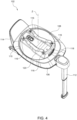
- FIG. 4 is a perspective view illustrating the support base 102.
- the support base 102 can include a shell body 106, a rotary platform 108, two latch devices 110 and a support leg 112.
- the shell body 106 can have an end forming a support panel 114 protruding upward.
- the two latch devices 110 can be assembled with the shell body 106, and can be disposed at a left and a right side of the shell body 106 adjacent to the support panel 114.
- the support base 102 can be installed on a vehicle seat with the support panel 114 adjacent to a seatback of the vehicle seat to provide support, and the two latch devices 110 can releasably engage with an anchor structure (e.g., ISOFIX anchor) provided in the vehicle to lock the support base 102 in place on the vehicle seat.
- the support leg 112 can be connected with the shell body 106 at an end thereof opposite to the end where are provided the latch devices 110, and can extend downward from a bottom of the shell body 106. In use, the support leg 112 extending from the bottom of the shell body 106 can contact against a floor of a vehicle in front of the vehicle seat on which the support base 102 is installed, which can prevent adverse rotation of the child safety seat 100 toward the front of the vehicle.
- the rotary platform 108 is pivotally connected with the shell body 106 about a pivot axis Z, and is adapted to receive the installation of the child seat 104.
- the pivot axis Z can vertically pass through the rotary platform 108, and can extend vertically or slightly tilted an angle (e.g., about 10 degrees to about 15 degrees) relative to a vertical axis.
- the rotary platform 108 can be provided with a plurality of latches 116 that are operatively connected with a release actuator 118. When the child seat 104 is installed on the rotary platform 108, the latches 116 can engage with the child seat 104 so that the child seat 104 and the rotary platform 108 are locked to each other.
- the release actuator 118 is operable to cause the latches 116 to move and disengage from the child seat 104 for removing the child seat 104 from the rotary platform 108.
- the rotary platform 108 can have a protruding portion 120, and four latches 116 can be provided on the protruding portion 120.
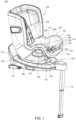
- FIG. 1 illustrates the child seat 104 and the rotary platform 108 in a forward facing position
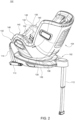
- FIG. 2 illustrates the child seat 104 and the rotary platform 108 in a rearward facing position
- FIG. 3 illustrates the child seat 104 and the rotary platform 108 in a sideways facing position.
- a child When the child safety seat 100 is installed in the rearward facing position on a vehicle seat, a child can sit on the child seat 104 facing the seatback of the vehicle seat. When the child safety seat 100 is set in the sideways facing position, a child can sit on the child seat 104 facing a door of the vehicle.
- An angular displacement between the forward facing position and the sideways facing position can be about 90 degrees, and an angular displacement between the rearward facing position and the sideways facing position can also be about 90 degrees.
- the support base 102 may include a plurality of latching parts (not shown) for locking the child seat 104 and the rotary platform 108 in any of the forward facing position, the rearward facing position and the sideways facing position.
- the shell body 106 can be assembled with a plurality of latching parts operable to move upward for locking engagement with the rotary platform 108 and downward for disengaging from the rotary platform 108.
- FIG. 5 is a perspective view illustrating the child seat 104
- FIG. 6 is a partially exploded view illustrating some construction details of the child seat 104.
- the child seat 104 includes a seat shell 130, and a retractable front end part 132.
- the seat shell 130 can be installed on the support base 102, e.g., by engaging a bottom structure of the seat shell 130 with the rotary platform 108 of the support base 102. Once they are locked to each other, the seat shell 130 and the rotary platform 108 can rotate in unison relative to the shell body 106 so that the seat shell 130 can be positioned in different orientations, such as the forward facing position of FIG. 1 , the rearward facing position of FIG. 2 , and the sideways facing position of FIG. 3 .
- the seat shell 130 can have a front end 134, a seat portion 136, a backrest portion 138 and two sidewalls 140.
- the seat portion 136 can extend between the front end 134 and the backrest portion 138, and the two sidewalls 140 can respectively protrude upward from the seat portion 136 at a left and a right side thereof.
- An interior space of the seat shell 130 suitable for receiving a child can be defined at least partially between the two sidewalls 140.
- Each sidewall 140 can have a hollow structure, which can include two opposite sidewall surfaces 142 and 144, a sidewall edge 146, and an inner cavity 148 (better shown in FIGS. 6-8 ) between the two sidewall surfaces 142 and 144. More specifically, the sidewall surface 142 can face the interior space of the seat shell 130, and the sidewall surface 144 can face an outer side of the seat shell 130.
- the sidewall edge 146 can be located above the seat portion 136, can be respectively connected with the two sidewall surfaces 142 and 144, and can extend to the front end 134 of the seat shell 130 with an inclination so that a front portion of the sidewall edge 146 can face forward.
- the inner cavity 148 of the sidewall 140 can be delimited at least partially by the two sidewall surfaces 142 and 144 and the sidewall edge 146.
- the front end 134 of the seat shell 130 can have an opening 150, which can extend transversally relative to the seat shell 130 and can be respectively connected with the inner cavities 148 of the two sidewalls 140.
- the front end part 132 can be pivotally connected with the seat shell 130, whereby the front end part 132 can rotate relative to the seat shell 130 between a deployed position and a retracted position. In the deployed position, the front end part 132 can extend outside the opening 150, and can project forward and downward. In the retracted position, the front end part 132 can be stowed and received at least partially inside the opening 150.
- the front end part 132 can have a transversal portion 152 and two side portions 154, the transversal portion 152 extending along a width direction of the seat shell 130.
- the transversal portion 152 can have a curved shape.
- the two side portions 154 can be respectively connected with the transversal portion 152, and can bend from the transversal portion 152 symmetrical to each other.
- the front end part 132 including the transversal portion 152 and the two side portions 154 can be formed integrally as a single part.
- each side portion 154 of the front end part 132 is respectively connected pivotally with the two sidewalls 140 of the seat shell 130, whereby the front end part 132 can rotate relative to the seat shell 130 between the deployed position and the retracted position.
- each side portion 154 may have a coupling end 156, wherein the coupling end 156 can be fixedly connected with and protrude outward from the side portion 154.
- the coupling ends 156 of the two side portions 154 can be respectively disposed inside the inner cavities 148 of the two sidewalls 140, and can be respectively connected pivotally with the two sidewalls 140 via two pivot shafts 158.
- the front end part 132 is thereby pivotally connected with the two sidewalls 140 about a pivot axis Y defined by the pivot shafts 158, which can be located above the seat portion 136.
- Each side portion 154 can have a width that is smaller than a width of the inner cavity 148 at a location adjacent to the sidewall 140, whereby the side portion 154 can be retracted at least partially into the inner cavity 148 of the sidewall 140 when the front end part 132 is in the retracted position.
- FIG. 5 illustrates the front end part 132 of the child seat 104 in the deployed position.
- the transversal portion 152 of the front end part 132 can extend outside the opening 150 of the seat shell 130 and can be positioned in front of the seat portion 136.
- each side portion 154 of the front end part 132 can form a smooth profile extension relative to the sidewall 140 adjacent thereto that projects forward and downward from the opening 150.
- each side portion 154 can have a front surface 160 that inclines forward and downward and forms a generally smooth profile extension from the sidewall edge 146 of the sidewall 140 adjacent thereto.
- the front end part 132 can provide support for the feet or legs of a child in the deployed position.
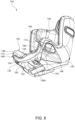
- FIG. 8 illustrates the front end part 132 of the child seat 104 in the retracted position.
- the transversal portion 152 of the front end part 132 can be stowed and received at least partially inside the opening 150 of the seat shell 130, and more particularly can be positioned in a hollow interior of the seat portion 136 below an upper surface 136A of the seat portion 136.
- the two side portions 154 of the front end part 132 can be respectively received at least partially inside the inner cavities 148 of the two sidewalls 140, whereby the front surface 160 of each side portion 154 can form an angle with respect to the sidewall edge 146 of the sidewall 140 adjacent thereto.
- FIG. 7 is a perspective view illustrating some inner construction details of the seat shell 130. For the sake of clarity, FIG. 7 omits the representation of the front end part 132.
- the child seat 104 can further include a latching mechanism 162 for locking the front end part 132 in the deployed position.
- the latching mechanism 162 can include two latches 164, two springs 166, a release actuator 168 and two cables 170.
- the two latches 164 can be respectively connected with the coupling ends 156 of the two side portions 154, and can move relative to the front end part 132 to engage with or disengage from the seat shell 130.
- each latch 134 can engage with a locking opening 172 provided in the seat shell 130 for locking the front end part 132 in the deployed position, wherein the locking opening 172 can be exemplarily placed inside the inner cavity 148 of the sidewall 140.
- each latch 164 can be slidably connected with the coupling end 156 of the side portion 154 associated therewith, and can slide relative to the front end part 132 to engage with or disengage from the seat shell 130.
- the two springs 166 can be respectively connected with the two latches 164, and can respectively bias the two latches 164 to move for engaging with the seat shell 130.
- the release actuator 168 can be assembled with the front end part 132, and can be respectively connected with the two latches 164 via the two cables 170. According to an example of construction, the release actuator 168 can be provided on the transversal portion 152 of the front end part 132. The release actuator 168 is operable by a caregiver to urge the two latches 164 to move and disengage from the seat shell 130, whereby the front end part 132 can be unlocked for adjustment between the deployed position and the retracted position.
- the latching mechanism 162 can further be configured to lock the front end part 132 in the retracted position.
- each latch 164 can engage with another locking opening 174 provided in the seat shell 130 for locking the front end part 132 in the retracted position.
- the locking opening 174 can be exemplarily provided on the sidewall edge 146.
- the front end part 132 when the seat shell 130 is in the sideways facing position on the support base 102 and the front end part 132 in the retracted position, the front end part 132 can sideways protrude a distance L2 from the support base 102, wherein the distance L2 can be substantially smaller than the distance L1 because the transversal portion 152 of the front end part 132 can be generally positioned in the hollow interior of the seat portion 136. According to an example of construction, the distance L2 can be equal to or smaller than about half the distance L1.
- an image projection of the front end part 132 on the bottom plane P of the support base 102 can be within the boundary of the image projection B of the support base 102 on the bottom plane P when the seat shell 130 is in the sideways facing position on the support base 102 and the front end part 132 in the retracted position. Accordingly, when the child safety seat 100 is used inside a vehicle, a caregiver can first adjust the front end part 132 to the retracted position, and then rotate the child seat 104 from the forward or rearward facing position to the sideways facing position for retrieving a child from the child seat 104 or placing a child on the child seat 104. With the front end part 132 in the retracted position, collision between the child seat 104 (in particular the front end part 132 thereof) and a door of the vehicle can be prevented as the child seat 104 rotates to the sideways facing position.
- Advantages of the structures described herein include the ability to provide a child safety seat that is adjustable to different orientations as needed and has a front end part retractable to prevent undesirable interference with a vehicle environment during the adjustment of the child safety seat. Accordingly, the child safety seat can be more flexible and convenient in use.
Landscapes
- Engineering & Computer Science (AREA)
- Aviation & Aerospace Engineering (AREA)
- Transportation (AREA)
- Mechanical Engineering (AREA)
- Health & Medical Sciences (AREA)
- Child & Adolescent Psychology (AREA)
- General Health & Medical Sciences (AREA)
- Seats For Vehicles (AREA)
Description
- The present invention relates to child safety seats. The document
US6068335 A discloses an example of a child safety seat according to the prior art. - A child safety seat is typically used in an automobile vehicle to properly restrain a child in the event of accidental collision. In particular, it is well known that the installation of a child safety seat in a rearward facing position can offer better protection because it allows the collision energy to be dispersed across a larger area of the child's body (i.e., the child's torso and head). Accordingly, safety experts and car seat manufacturers usually recommend to seat a child in the rearward facing position till the age of 2 years. As the child grows older, the child safety seat may be installed in the forward facing position.
- Some existing child safety seats allow to rotationally adjust a child seat between the rearward facing position and the forward facing position, and can further set the child seat in a sideways facing position for facilitating retrieval or placement of a child. However, because the support base of the child safety seat is attached on a vehicle seat at a location that is usually not distant from the vehicle door, the child seat may adversely collide against the vehicle door when it rotates toward the sideways facing position.
- Therefore, there is a need for an improved child safety seat that allows flexible adjustment and address at least the foregoing issues.
- The present invention describes a child seat that is more flexibly adjustable and can offer a more convenient use.
- The invention is set forth by a child seat comprising the technical features of claim 1.
-
-
FIG. 1 is a perspective view illustrating an embodiment of a child safety seat in a forward facing position; -
FIG. 2 is a perspective view illustrating the child safety seat in a rearward facing position; -
FIG. 3 is a perspective view illustrating the child safety seat in a sideways facing position; -
FIG. 4 is a perspective view illustrating a support base of the child safety seat; -
FIG. 5 is a perspective view illustrating a child seat of the child safety seat; -
FIG. 6 is a partially exploded view illustrating some construction details of the child seat; -
FIG. 7 is a perspective view illustrating some inner construction details of a seat shell of the child seat; -
FIG. 8 is a perspective view illustrating the child seat with a front end part thereof in a retracted position; -
FIG. 9 is a schematic view illustrating a configuration of the child safety seat where the seat shell is in the sideways facing position and the front end part in a deployed position; and -
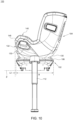
FIG. 10 is a schematic view illustrating a configuration of the child safety seat where the seat shell is in the sideways facing position and the front end part in the retracted position. -
FIGS. 1-3 are perspective views illustrating an embodiment of achild safety seat 100 in different positions. Referring toFIGS. 1-3 , thechild safety seat 100 includes asupport base 102, and achild seat 104 disposed on thesupport base 102. Thesupport base 102 is adapted to be installed on a vehicle seat, and can provide stable support for thechild safety seat 100. Thesupport base 102 can have a suitable structure for positioning thechild seat 104 on thesupport base 102 in different orientations, such as a forward facing position shown inFIG. 1 , a rearward facing position shown inFIG. 2 , and a sideways facing position shown inFIG. 3 . - In conjunction with
FIGS. 1-3 ,FIG. 4 is a perspective view illustrating thesupport base 102. Referring toFIGS. 1-4 , according to an example of construction, thesupport base 102 can include ashell body 106, arotary platform 108, twolatch devices 110 and asupport leg 112. Theshell body 106 can have an end forming asupport panel 114 protruding upward. The twolatch devices 110 can be assembled with theshell body 106, and can be disposed at a left and a right side of theshell body 106 adjacent to thesupport panel 114. Thesupport base 102 can be installed on a vehicle seat with thesupport panel 114 adjacent to a seatback of the vehicle seat to provide support, and the twolatch devices 110 can releasably engage with an anchor structure (e.g., ISOFIX anchor) provided in the vehicle to lock thesupport base 102 in place on the vehicle seat. Thesupport leg 112 can be connected with theshell body 106 at an end thereof opposite to the end where are provided thelatch devices 110, and can extend downward from a bottom of theshell body 106. In use, thesupport leg 112 extending from the bottom of theshell body 106 can contact against a floor of a vehicle in front of the vehicle seat on which thesupport base 102 is installed, which can prevent adverse rotation of thechild safety seat 100 toward the front of the vehicle. - The
rotary platform 108 is pivotally connected with theshell body 106 about a pivot axis Z, and is adapted to receive the installation of thechild seat 104. The pivot axis Z can vertically pass through therotary platform 108, and can extend vertically or slightly tilted an angle (e.g., about 10 degrees to about 15 degrees) relative to a vertical axis. Therotary platform 108 can be provided with a plurality oflatches 116 that are operatively connected with arelease actuator 118. When thechild seat 104 is installed on therotary platform 108, thelatches 116 can engage with thechild seat 104 so that thechild seat 104 and therotary platform 108 are locked to each other. Therelease actuator 118 is operable to cause thelatches 116 to move and disengage from thechild seat 104 for removing thechild seat 104 from therotary platform 108. According to an example of construction, therotary platform 108 can have a protrudingportion 120, and fourlatches 116 can be provided on the protrudingportion 120. - After they are locked to each other, the
child seat 104 and therotary platform 108 can rotate in unison about the pivot axis Z relative to theshell body 106, whereby thechild seat 104 can be positioned in different orientations. For example,FIG. 1 illustrates thechild seat 104 and therotary platform 108 in a forward facing position,FIG. 2 illustrates thechild seat 104 and therotary platform 108 in a rearward facing position, andFIG. 3 illustrates thechild seat 104 and therotary platform 108 in a sideways facing position. When thechild safety seat 100 is installed in the forward facing position on a vehicle seat, a child can sit on thechild seat 104 facing a forward direction of the vehicle. When thechild safety seat 100 is installed in the rearward facing position on a vehicle seat, a child can sit on thechild seat 104 facing the seatback of the vehicle seat. When thechild safety seat 100 is set in the sideways facing position, a child can sit on thechild seat 104 facing a door of the vehicle. An angular displacement between the forward facing position and the sideways facing position can be about 90 degrees, and an angular displacement between the rearward facing position and the sideways facing position can also be about 90 degrees. - The
support base 102 may include a plurality of latching parts (not shown) for locking thechild seat 104 and therotary platform 108 in any of the forward facing position, the rearward facing position and the sideways facing position. For example, theshell body 106 can be assembled with a plurality of latching parts operable to move upward for locking engagement with therotary platform 108 and downward for disengaging from therotary platform 108. - In conjunction with
FIGS. 1-4 ,FIG. 5 is a perspective view illustrating thechild seat 104, andFIG. 6 is a partially exploded view illustrating some construction details of thechild seat 104. Referring toFIGS. 1-6 , thechild seat 104 includes aseat shell 130, and a retractablefront end part 132. Theseat shell 130 can be installed on thesupport base 102, e.g., by engaging a bottom structure of theseat shell 130 with therotary platform 108 of thesupport base 102. Once they are locked to each other, theseat shell 130 and therotary platform 108 can rotate in unison relative to theshell body 106 so that theseat shell 130 can be positioned in different orientations, such as the forward facing position ofFIG. 1 , the rearward facing position ofFIG. 2 , and the sideways facing position ofFIG. 3 . - The
seat shell 130 can have afront end 134, aseat portion 136, abackrest portion 138 and twosidewalls 140. Theseat portion 136 can extend between thefront end 134 and thebackrest portion 138, and the twosidewalls 140 can respectively protrude upward from theseat portion 136 at a left and a right side thereof. An interior space of theseat shell 130 suitable for receiving a child can be defined at least partially between the twosidewalls 140. - Each
sidewall 140 can have a hollow structure, which can include twoopposite sidewall surfaces sidewall edge 146, and an inner cavity 148 (better shown inFIGS. 6-8 ) between the twosidewall surfaces sidewall surface 142 can face the interior space of theseat shell 130, and thesidewall surface 144 can face an outer side of theseat shell 130. Thesidewall edge 146 can be located above theseat portion 136, can be respectively connected with the twosidewall surfaces front end 134 of theseat shell 130 with an inclination so that a front portion of thesidewall edge 146 can face forward. Theinner cavity 148 of thesidewall 140 can be delimited at least partially by the twosidewall surfaces sidewall edge 146. - Referring to
FIGS. 5 and6 , thefront end 134 of theseat shell 130 can have anopening 150, which can extend transversally relative to theseat shell 130 and can be respectively connected with theinner cavities 148 of the twosidewalls 140. Thefront end part 132 can be pivotally connected with theseat shell 130, whereby thefront end part 132 can rotate relative to theseat shell 130 between a deployed position and a retracted position. In the deployed position, thefront end part 132 can extend outside theopening 150, and can project forward and downward. In the retracted position, thefront end part 132 can be stowed and received at least partially inside theopening 150. More specifically, thefront end part 132 can have atransversal portion 152 and twoside portions 154, thetransversal portion 152 extending along a width direction of theseat shell 130. According to an example of construction, thetransversal portion 152 can have a curved shape. The twoside portions 154 can be respectively connected with thetransversal portion 152, and can bend from thetransversal portion 152 symmetrical to each other. According to an example of construction, thefront end part 132 including thetransversal portion 152 and the twoside portions 154 can be formed integrally as a single part. - The two
side portions 154 of thefront end part 132 are respectively connected pivotally with the twosidewalls 140 of theseat shell 130, whereby thefront end part 132 can rotate relative to theseat shell 130 between the deployed position and the retracted position. According to an example of construction, eachside portion 154 may have acoupling end 156, wherein thecoupling end 156 can be fixedly connected with and protrude outward from theside portion 154. The coupling ends 156 of the twoside portions 154 can be respectively disposed inside theinner cavities 148 of the twosidewalls 140, and can be respectively connected pivotally with the twosidewalls 140 via twopivot shafts 158. Thefront end part 132 is thereby pivotally connected with the twosidewalls 140 about a pivot axis Y defined by thepivot shafts 158, which can be located above theseat portion 136. Eachside portion 154 can have a width that is smaller than a width of theinner cavity 148 at a location adjacent to thesidewall 140, whereby theside portion 154 can be retracted at least partially into theinner cavity 148 of thesidewall 140 when thefront end part 132 is in the retracted position. -
FIG. 5 illustrates thefront end part 132 of thechild seat 104 in the deployed position. In the deployed position, thetransversal portion 152 of thefront end part 132 can extend outside theopening 150 of theseat shell 130 and can be positioned in front of theseat portion 136. Moreover, eachside portion 154 of thefront end part 132 can form a smooth profile extension relative to thesidewall 140 adjacent thereto that projects forward and downward from theopening 150. For example, eachside portion 154 can have afront surface 160 that inclines forward and downward and forms a generally smooth profile extension from thesidewall edge 146 of thesidewall 140 adjacent thereto. Thefront end part 132 can provide support for the feet or legs of a child in the deployed position. -
FIG. 8 illustrates thefront end part 132 of thechild seat 104 in the retracted position. In the retracted position, thetransversal portion 152 of thefront end part 132 can be stowed and received at least partially inside theopening 150 of theseat shell 130, and more particularly can be positioned in a hollow interior of theseat portion 136 below anupper surface 136A of theseat portion 136. Moreover, the twoside portions 154 of thefront end part 132 can be respectively received at least partially inside theinner cavities 148 of the twosidewalls 140, whereby thefront surface 160 of eachside portion 154 can form an angle with respect to thesidewall edge 146 of thesidewall 140 adjacent thereto. - In conjunction with
FIGS. 5 and6 ,FIG. 7 is a perspective view illustrating some inner construction details of theseat shell 130. For the sake of clarity,FIG. 7 omits the representation of thefront end part 132. Referring toFIGS. 5-7 , thechild seat 104 can further include alatching mechanism 162 for locking thefront end part 132 in the deployed position. Thelatching mechanism 162 can include twolatches 164, twosprings 166, arelease actuator 168 and twocables 170. The two latches 164 can be respectively connected with the coupling ends 156 of the twoside portions 154, and can move relative to thefront end part 132 to engage with or disengage from theseat shell 130. For example, eachlatch 134 can engage with alocking opening 172 provided in theseat shell 130 for locking thefront end part 132 in the deployed position, wherein thelocking opening 172 can be exemplarily placed inside theinner cavity 148 of thesidewall 140. According to an example of construction, eachlatch 164 can be slidably connected with thecoupling end 156 of theside portion 154 associated therewith, and can slide relative to thefront end part 132 to engage with or disengage from theseat shell 130. The twosprings 166 can be respectively connected with the twolatches 164, and can respectively bias the twolatches 164 to move for engaging with theseat shell 130. Therelease actuator 168 can be assembled with thefront end part 132, and can be respectively connected with the twolatches 164 via the twocables 170. According to an example of construction, therelease actuator 168 can be provided on thetransversal portion 152 of thefront end part 132. Therelease actuator 168 is operable by a caregiver to urge the twolatches 164 to move and disengage from theseat shell 130, whereby thefront end part 132 can be unlocked for adjustment between the deployed position and the retracted position. - According to an embodiment, the
latching mechanism 162 can further be configured to lock thefront end part 132 in the retracted position. For example, eachlatch 164 can engage with another locking opening 174 provided in theseat shell 130 for locking thefront end part 132 in the retracted position. Referring toFIGS. 1 ,3 ,5 ,6 and8 , thelocking opening 174 can be exemplarily provided on thesidewall edge 146. - In conjunction with
FIGS. 1-8 ,FIG. 9 is a schematic view illustrating thechild safety seat 100 with theseat shell 130 in the sideways facing position and thefront end part 132 in the deployed position, andFIG. 10 is a schematic view illustrating thechild safety seat 100 with theseat shell 130 in the sideways facing position and thefront end part 132 in the retracted position. Referring toFIG. 9 , when theseat shell 130 is in the sideways facing position on thesupport base 102 and thefront end part 132 in the deployed position, thefront end part 132 can sideways protrude a distance L1 from thesupport base 102. More specifically, an image projection of thefront end part 132 on a bottom plane P of thesupport base 102 can protrude the distance L1 from an image projection B of thesupport base 102 on the bottom plane P. - Referring to
FIG. 10 , when theseat shell 130 is in the sideways facing position on thesupport base 102 and thefront end part 132 in the retracted position, thefront end part 132 can sideways protrude a distance L2 from thesupport base 102, wherein the distance L2 can be substantially smaller than the distance L1 because thetransversal portion 152 of thefront end part 132 can be generally positioned in the hollow interior of theseat portion 136. According to an example of construction, the distance L2 can be equal to or smaller than about half the distance L1. According to another example of construction, an image projection of thefront end part 132 on the bottom plane P of thesupport base 102 can be within the boundary of the image projection B of thesupport base 102 on the bottom plane P when theseat shell 130 is in the sideways facing position on thesupport base 102 and thefront end part 132 in the retracted position. Accordingly, when thechild safety seat 100 is used inside a vehicle, a caregiver can first adjust thefront end part 132 to the retracted position, and then rotate thechild seat 104 from the forward or rearward facing position to the sideways facing position for retrieving a child from thechild seat 104 or placing a child on thechild seat 104. With thefront end part 132 in the retracted position, collision between the child seat 104 (in particular thefront end part 132 thereof) and a door of the vehicle can be prevented as thechild seat 104 rotates to the sideways facing position. - Advantages of the structures described herein include the ability to provide a child safety seat that is adjustable to different orientations as needed and has a front end part retractable to prevent undesirable interference with a vehicle environment during the adjustment of the child safety seat. Accordingly, the child safety seat can be more flexible and convenient in use.
- Realization of the child seat has been described in the context of particular embodiments. These embodiments are meant to be illustrative and not limiting. Many variations, modifications, additions, and improvements are possible. These and other variations, modifications, additions, and improvements may fall within the scope of the inventions as defined in the claims that follow.
Claims (15)
- A child seat (104) configured to be disposed on a support base (102), the child seat (104) comprising:a seat shell (130) positionable on the support base (102) and having a front end (134), a seat portion (136) and two sidewalls (140), the front end (134) having an opening (150), the two sidewalls (140) respectively protruding at a left and a right side of the seat portion (136), an interior space for receiving a child being defined at least partially between the two sidewalls (140);a retractable front end part (132), having a transversal portion (152) and two side portions (154) connected with the transversal portion (152), the transversal portion (152) extending along a width direction of the seat shell (130), and the two side portions (154) being respectively connected pivotally with the two sidewalls (140) of the seat shell (130) via two pivot shafts (158) spaced apart from each other along the width direction, whereby the front end part (132) is rotatable relative to the seat shell (130) between a retracted position and a deployed position, the transversal portion (152) of the front end part (132) being stowed and received at least partially inside the opening (150) of the seat shell (130) in the retracted position, and the transversal portion (152) of the front end part (132) extending outside the opening (150) of the seat shell (130) in the deployed position; anda latching mechanism (162) for locking the front end part (132) in the deployed position.
- The child seat (104) according to claim 1, wherein the front end part (132) including the transversal portion (152) and the two side portions (154) is formed integrally as a single part.
- The child seat (104) according to claim 1 or 2, wherein the two side portions (154) bend from the transversal portion (152) symmetrical to each other.
- The child seat according to claim 1, 2 or 3, wherein the two side portions (154) of the front end part (132) respectively project forward and downward from the two sidewalls (140) in the deployed position.
- The child seat (104) according to any of claims 1 to 4, wherein the front end part (132) is pivotally connected with the two sidewalls (140) about a pivot axis (Y) that is located above the seat portion (136).
- The child seat (104) according to any of claims 1 to 5, wherein each of the two sidewalls (140) has an inner cavity (148), the two side portions (154) of the front end part (132) being respectively received at least partially inside the inner cavities (148) of the two sidewalls (140).
- The child seat (104) according to claim 6, wherein each of the two sidewalls (140) has two opposite sidewall surfaces (142, 144) and a sidewall edge (146), one of the two sidewall surfaces (142, 144) facing the interior space of the seat shell (130) and the other one of the two sidewall surfaces (142, 144) facing an outer side of the seat shell (130), the sidewall edge (146) being respectively connected with the two sidewall surfaces (142, 144), the inner cavity (148) of each of the two sidewalls (140) being delimited at least partially by the two sidewall surfaces (142, 144) and the sidewall edge (146) thereof.
- The child seat (104) according to claim 7, wherein each of the two side portions (154) has a front surface (160) that inclines forward and downward and forms a profile extension from the sidewall edge (146) of the sidewall (140) adjacent thereto in the deployed position, the front surface (160) forming an angle with respect to the sidewall edge (146) of the sidewall (140) adjacent thereto in the retracted position.
- The child seat (104) according to claim 6, 7 or 8, wherein each of the two side portions (154) has a coupling end (156), the coupling ends (156) of the two side portions (154) being respectively disposed inside the inner cavities (148) of the two sidewalls (140) and respectively connected pivotally with the two sidewalls (140) via the two pivot shafts (158).
- The child seat (104) according to claim 9, wherein the latching mechanism (162) includes two latches (164) respectively connected with the coupling ends (156) of the two side portions (154), the two latches (164) being movable relative to the front end part (132) for engaging with or disengaging from the seat shell (130).
- The child seat (104) according to claim 10, wherein the two latches (164) are respectively connected slidably with the coupling ends (156) of the two side portions (154), whereby the two latches (164) are slidable relative to the front end part (132) for engaging with or disengaging from the seat shell (130).
- The child seat (104) according to claim 10 or 11, wherein the latching mechanism (162) further includes two springs (166) respectively connected with the two latches (164), the two springs (166) respectively biasing the two latches (164) to move for engaging with the seat shell (130).
- The child seat (104) according to claim 10, 11 or 12, wherein the latching mechanism (162) further includes a release actuator (168) and two cables (170), the release actuator (168) being assembled with the front end part (132), in particular on the transversal portion (152) of the front end part (132), and respectively connected with the two latches (164) via the two cables (170), the release actuator (168) being operable to urge the two latches (164) to move and disengage from the seat shell (130).
- A child safety seat (100), comprising:the support base (102) adapted to be installed on a vehicle seat; andthe child seat (104) according to any of claims 1 to 13, the seat shell (130) of the child seat (104) being positioned on the support base (102).
- The child safety seat (100) according to claim 14, wherein the seat shell (130) is rotatable relative to a shell body (106) of the support base (102) so that the seat shell (130) is positionable in different orientations including a forward facing position, a rearward facing position and a sideways facing position, wherein the front end part (132) sideways protrudes a first distance (L1) from the support base (102) when the seat shell (130) is in the sideways facing position on the support base (102) and the front end part (132) is in the deployed position, and the front end part (132) sideways protrudes a second distance (L2) from the support base (102) when the seat shell (130) is in the sideways facing position on the support base (102) and the front end part (132) is in the retracted position, the second distance (L2) being smaller than the first distance (L1).
Priority Applications (1)
| Application Number | Priority Date | Filing Date | Title |
|---|---|---|---|
| EP25164479.5A EP4545355A3 (en) | 2019-12-30 | 2020-12-21 | Child seat |
Applications Claiming Priority (2)
| Application Number | Priority Date | Filing Date | Title |
|---|---|---|---|
| CN201911396862.XA CN113119820B (en) | 2019-12-30 | 2019-12-30 | Child safety seat |
| EP20216156.8A EP3845412B1 (en) | 2019-12-30 | 2020-12-21 | Child safety seat |
Related Parent Applications (2)
| Application Number | Title | Priority Date | Filing Date |
|---|---|---|---|
| EP20216156.8A Division EP3845412B1 (en) | 2019-12-30 | 2020-12-21 | Child safety seat |
| EP20216156.8A Division-Into EP3845412B1 (en) | 2019-12-30 | 2020-12-21 | Child safety seat |
Related Child Applications (2)
| Application Number | Title | Priority Date | Filing Date |
|---|---|---|---|
| EP25164479.5A Division EP4545355A3 (en) | 2019-12-30 | 2020-12-21 | Child seat |
| EP25164479.5A Division-Into EP4545355A3 (en) | 2019-12-30 | 2020-12-21 | Child seat |
Publications (2)
| Publication Number | Publication Date |
|---|---|
| EP4155122A1 EP4155122A1 (en) | 2023-03-29 |
| EP4155122B1 true EP4155122B1 (en) | 2025-04-23 |
Family
ID=73856452
Family Applications (3)
| Application Number | Title | Priority Date | Filing Date |
|---|---|---|---|
| EP20216156.8A Active EP3845412B1 (en) | 2019-12-30 | 2020-12-21 | Child safety seat |
| EP22205101.3A Active EP4155122B1 (en) | 2019-12-30 | 2020-12-21 | Child seat |
| EP25164479.5A Pending EP4545355A3 (en) | 2019-12-30 | 2020-12-21 | Child seat |
Family Applications Before (1)
| Application Number | Title | Priority Date | Filing Date |
|---|---|---|---|
| EP20216156.8A Active EP3845412B1 (en) | 2019-12-30 | 2020-12-21 | Child safety seat |
Family Applications After (1)
| Application Number | Title | Priority Date | Filing Date |
|---|---|---|---|
| EP25164479.5A Pending EP4545355A3 (en) | 2019-12-30 | 2020-12-21 | Child seat |
Country Status (8)
| Country | Link |
|---|---|
| US (3) | US11485258B2 (en) |
| EP (3) | EP3845412B1 (en) |
| JP (3) | JP7234197B2 (en) |
| KR (2) | KR102505487B1 (en) |
| CN (2) | CN113119820B (en) |
| ES (2) | ES2937974T3 (en) |
| TW (2) | TWI797522B (en) |
| WO (1) | WO2021136714A1 (en) |
Families Citing this family (5)
| Publication number | Priority date | Publication date | Assignee | Title |
|---|---|---|---|---|
| CN113119820B (en) * | 2019-12-30 | 2023-09-08 | 宝钜瑞士股份有限公司 | Child safety seat |
| CN118596959A (en) * | 2021-01-29 | 2024-09-06 | 宝钜瑞士股份有限公司 | Baby Carrier |
| CN115123033B (en) * | 2022-05-05 | 2024-04-05 | 好孩子儿童用品有限公司 | A safety seat |
| WO2023242056A2 (en) * | 2022-06-13 | 2023-12-21 | Wonderland Switzerland Ag | Seat angle adjustment mechanism, support plate, and child safety seat |
| US11701985B1 (en) * | 2022-09-10 | 2023-07-18 | Ken Cabral | Pivoting car seat mount |
Family Cites Families (29)
| Publication number | Priority date | Publication date | Assignee | Title |
|---|---|---|---|---|
| US707859A (en) * | 1900-11-15 | 1902-08-26 | Roland A Mills | Hand tenoning-machine. |
| DE3900906A1 (en) * | 1988-01-14 | 1990-07-26 | Richard Ambros | Universal car seat for small and large vehicle occupants, in particular passengers |
| JPH01111394A (en) | 1987-10-23 | 1989-04-28 | Nec Corp | Semiconductor laser |
| JPH0433144Y2 (en) * | 1989-09-21 | 1992-08-10 | ||
| US5505519A (en) * | 1994-09-29 | 1996-04-09 | Natt; Theresa A. | Leg rest attachments for child car seats |
| US6068335A (en) * | 1997-09-11 | 2000-05-30 | Cosco, Inc. | Retainer |
| GB9824728D0 (en) * | 1998-11-11 | 1999-01-06 | Britax Roemer Kindersicherheit Gmbh | Child safety seat |
| JP2000301970A (en) * | 1999-04-20 | 2000-10-31 | Riiman Kk | Child seat |
| US7066536B2 (en) * | 2002-02-11 | 2006-06-27 | Graco Children's Products Inc. | Child seat |
| US7073859B1 (en) * | 2004-08-19 | 2006-07-11 | Pamela S. Wilson | Pivotable child seat for use in a vehicle |
| EP1683443B1 (en) * | 2005-01-19 | 2012-02-22 | Aisin Seiki Kabushiki Kaisha | Ottoman device |
| US7673934B2 (en) * | 2007-06-26 | 2010-03-09 | Wonderland Nurserygoods Co., Ltd. | Dual purpose high chair |
| US20090224584A1 (en) * | 2008-03-04 | 2009-09-10 | Gm Global Technology Operations, Inc. | Active material actuated seat base extender |
| US8348337B2 (en) | 2010-03-17 | 2013-01-08 | Britax Child Safety, Inc. | Child safety seat with energy absorbing apparatus |
| DE102011013373B4 (en) * | 2011-03-09 | 2017-07-13 | Robby Sacher | Infant storage system for pivotal storage in a motor vehicle and outside thereof |
| CN203126572U (en) * | 2013-02-22 | 2013-08-14 | 宝钜(中国)儿童用品有限公司 | Automobile safety seat |
| PL2865562T3 (en) * | 2013-10-23 | 2019-01-31 | Wonderland Switzerland Ag | Child safety seat |
| JP6542633B2 (en) * | 2015-10-05 | 2019-07-10 | アップリカ・チルドレンズプロダクツ合同会社 | child seat |
| CN106671836B (en) | 2015-11-06 | 2020-04-03 | 宝钜儿童用品香港股份有限公司 | Adjustment mechanism and child safety seat having the same |
| US10322651B2 (en) * | 2016-06-14 | 2019-06-18 | Wonderland Switzerland Ag | Child safety seat |
| US10464450B1 (en) * | 2016-09-12 | 2019-11-05 | Steven B. Peterson | Appendage support for child seat |
| KR101850832B1 (en) * | 2016-09-13 | 2018-04-20 | 주식회사 쁘레베베 | Rotating device for car seat |
| US10227022B2 (en) * | 2016-09-20 | 2019-03-12 | Toyota Boshoku Kabushiki Kaisha | Tilt arm for seat and vehicle seat |
| CN112622714B (en) * | 2016-11-08 | 2023-09-01 | 明门瑞士股份有限公司 | child safety seat |
| DE102018010420B3 (en) * | 2017-03-17 | 2022-11-03 | Wonderland Switzerland Ag | child safety seat |
| US10479306B2 (en) * | 2017-08-25 | 2019-11-19 | Ford Global Technologies, Llc | Restraint bar for vehicle seating assembly |
| CA3023122C (en) * | 2017-11-08 | 2020-10-27 | Britax Child Safety, Inc. | Multi-position anti-rebound bar |
| CN110497826B (en) * | 2019-09-27 | 2022-05-24 | 创是实业(香港)有限公司 | Safety seat base control assembly, safety seat base, kit and control method |
| CN113119820B (en) | 2019-12-30 | 2023-09-08 | 宝钜瑞士股份有限公司 | Child safety seat |
-
2019
- 2019-12-30 CN CN201911396862.XA patent/CN113119820B/en active Active
- 2019-12-30 CN CN202311034612.8A patent/CN117068012A/en active Pending
-
2020
- 2020-12-18 TW TW109145057A patent/TWI797522B/en active
- 2020-12-18 TW TW112106337A patent/TWI831621B/en active
- 2020-12-21 ES ES20216156T patent/ES2937974T3/en active Active
- 2020-12-21 US US17/128,462 patent/US11485258B2/en active Active
- 2020-12-21 EP EP20216156.8A patent/EP3845412B1/en active Active
- 2020-12-21 EP EP22205101.3A patent/EP4155122B1/en active Active
- 2020-12-21 ES ES22205101T patent/ES3034383T3/en active Active
- 2020-12-21 WO PCT/EP2020/087509 patent/WO2021136714A1/en not_active Ceased
- 2020-12-21 EP EP25164479.5A patent/EP4545355A3/en active Pending
- 2020-12-28 JP JP2020218284A patent/JP7234197B2/en active Active
- 2020-12-29 KR KR1020200186322A patent/KR102505487B1/en active Active
-
2022
- 2022-09-28 US US17/955,349 patent/US12059983B2/en active Active
-
2023
- 2023-02-22 JP JP2023026455A patent/JP7622117B2/en active Active
- 2023-02-24 KR KR1020230024694A patent/KR102616345B1/en active Active
-
2024
- 2024-07-12 US US18/771,166 patent/US20240359602A1/en active Pending
-
2025
- 2025-01-15 JP JP2025005544A patent/JP2025066759A/en active Pending
Also Published As
| Publication number | Publication date |
|---|---|
| EP4155122A1 (en) | 2023-03-29 |
| EP4545355A2 (en) | 2025-04-30 |
| CN113119820A (en) | 2021-07-16 |
| US20230019074A1 (en) | 2023-01-19 |
| ES2937974T3 (en) | 2023-04-03 |
| EP4545355A3 (en) | 2025-08-13 |
| JP7622117B2 (en) | 2025-01-27 |
| TWI831621B (en) | 2024-02-01 |
| KR20230031874A (en) | 2023-03-07 |
| US12059983B2 (en) | 2024-08-13 |
| JP2025066759A (en) | 2025-04-23 |
| JP2023065509A (en) | 2023-05-12 |
| US20210197695A1 (en) | 2021-07-01 |
| US11485258B2 (en) | 2022-11-01 |
| EP3845412A1 (en) | 2021-07-07 |
| WO2021136714A1 (en) | 2021-07-08 |
| TW202130528A (en) | 2021-08-16 |
| CN113119820B (en) | 2023-09-08 |
| ES3034383T3 (en) | 2025-08-18 |
| US20240359602A1 (en) | 2024-10-31 |
| KR20210086985A (en) | 2021-07-09 |
| JP2021109651A (en) | 2021-08-02 |
| KR102505487B1 (en) | 2023-03-02 |
| CN117068012A (en) | 2023-11-17 |
| KR102616345B1 (en) | 2023-12-20 |
| EP3845412B1 (en) | 2022-12-14 |
| TW202323084A (en) | 2023-06-16 |
| TWI797522B (en) | 2023-04-01 |
| JP7234197B2 (en) | 2023-03-07 |
Similar Documents
| Publication | Publication Date | Title |
|---|---|---|
| EP4155122B1 (en) | Child seat | |
| US12275337B2 (en) | Child safety seat | |
| EP3680128B1 (en) | Child safety seat | |
| GB2553622B (en) | Child saftey seat | |
| US11472318B2 (en) | Child conveyance apparatus | |
| TW202440368A (en) | Child vehicle seat system | |
| HK40105682A (en) | Juvenile vehicle seat system |
Legal Events
| Date | Code | Title | Description |
|---|---|---|---|
| PUAI | Public reference made under article 153(3) epc to a published international application that has entered the european phase |
Free format text: ORIGINAL CODE: 0009012 |
|
| STAA | Information on the status of an ep patent application or granted ep patent |
Free format text: STATUS: REQUEST FOR EXAMINATION WAS MADE |
|
| 17P | Request for examination filed |
Effective date: 20221102 |
|
| AC | Divisional application: reference to earlier application |
Ref document number: 3845412 Country of ref document: EP Kind code of ref document: P |
|
| AK | Designated contracting states |
Kind code of ref document: A1 Designated state(s): AL AT BE BG CH CY CZ DE DK EE ES FI FR GB GR HR HU IE IS IT LI LT LU LV MC MK MT NL NO PL PT RO RS SE SI SK SM TR |
|
| RBV | Designated contracting states (corrected) |
Designated state(s): AL AT BE BG CH CY CZ DE DK EE ES FI FR GB GR HR HU IE IS IT LI LT LU LV MC MK MT NL NO PL PT RO RS SE SI SK SM TR |
|
| GRAP | Despatch of communication of intention to grant a patent |
Free format text: ORIGINAL CODE: EPIDOSNIGR1 |
|
| STAA | Information on the status of an ep patent application or granted ep patent |
Free format text: STATUS: GRANT OF PATENT IS INTENDED |
|
| INTG | Intention to grant announced |
Effective date: 20241119 |
|
| GRAS | Grant fee paid |
Free format text: ORIGINAL CODE: EPIDOSNIGR3 |
|
| GRAA | (expected) grant |
Free format text: ORIGINAL CODE: 0009210 |
|
| STAA | Information on the status of an ep patent application or granted ep patent |
Free format text: STATUS: THE PATENT HAS BEEN GRANTED |
|
| AC | Divisional application: reference to earlier application |
Ref document number: 3845412 Country of ref document: EP Kind code of ref document: P |
|
| AK | Designated contracting states |
Kind code of ref document: B1 Designated state(s): AL AT BE BG CH CY CZ DE DK EE ES FI FR GB GR HR HU IE IS IT LI LT LU LV MC MK MT NL NO PL PT RO RS SE SI SK SM TR |
|
| P01 | Opt-out of the competence of the unified patent court (upc) registered |
Free format text: CASE NUMBER: APP_13439/2025 Effective date: 20250319 |
|
| REG | Reference to a national code |
Ref country code: GB Ref legal event code: FG4D |
|
| REG | Reference to a national code |
Ref country code: CH Ref legal event code: EP |
|
| REG | Reference to a national code |
Ref country code: DE Ref legal event code: R096 Ref document number: 602020050237 Country of ref document: DE |
|
| REG | Reference to a national code |
Ref country code: IE Ref legal event code: FG4D |
|
| REG | Reference to a national code |
Ref country code: NL Ref legal event code: FP |
|
| REG | Reference to a national code |
Ref country code: ES Ref legal event code: FG2A Ref document number: 3034383 Country of ref document: ES Kind code of ref document: T3 Effective date: 20250818 |
|
| REG | Reference to a national code |
Ref country code: AT Ref legal event code: MK05 Ref document number: 1787478 Country of ref document: AT Kind code of ref document: T Effective date: 20250423 |
|
| PG25 | Lapsed in a contracting state [announced via postgrant information from national office to epo] |
Ref country code: FI Free format text: LAPSE BECAUSE OF FAILURE TO SUBMIT A TRANSLATION OF THE DESCRIPTION OR TO PAY THE FEE WITHIN THE PRESCRIBED TIME-LIMIT Effective date: 20250423 Ref country code: PT Free format text: LAPSE BECAUSE OF FAILURE TO SUBMIT A TRANSLATION OF THE DESCRIPTION OR TO PAY THE FEE WITHIN THE PRESCRIBED TIME-LIMIT Effective date: 20250825 |
|
| REG | Reference to a national code |
Ref country code: LT Ref legal event code: MG9D |
|
| PG25 | Lapsed in a contracting state [announced via postgrant information from national office to epo] |
Ref country code: NO Free format text: LAPSE BECAUSE OF FAILURE TO SUBMIT A TRANSLATION OF THE DESCRIPTION OR TO PAY THE FEE WITHIN THE PRESCRIBED TIME-LIMIT Effective date: 20250723 Ref country code: GR Free format text: LAPSE BECAUSE OF FAILURE TO SUBMIT A TRANSLATION OF THE DESCRIPTION OR TO PAY THE FEE WITHIN THE PRESCRIBED TIME-LIMIT Effective date: 20250724 |
|
| PG25 | Lapsed in a contracting state [announced via postgrant information from national office to epo] |
Ref country code: PL Free format text: LAPSE BECAUSE OF FAILURE TO SUBMIT A TRANSLATION OF THE DESCRIPTION OR TO PAY THE FEE WITHIN THE PRESCRIBED TIME-LIMIT Effective date: 20250423 |
|
| PG25 | Lapsed in a contracting state [announced via postgrant information from national office to epo] |
Ref country code: BG Free format text: LAPSE BECAUSE OF FAILURE TO SUBMIT A TRANSLATION OF THE DESCRIPTION OR TO PAY THE FEE WITHIN THE PRESCRIBED TIME-LIMIT Effective date: 20250423 |
|
| PG25 | Lapsed in a contracting state [announced via postgrant information from national office to epo] |
Ref country code: HR Free format text: LAPSE BECAUSE OF FAILURE TO SUBMIT A TRANSLATION OF THE DESCRIPTION OR TO PAY THE FEE WITHIN THE PRESCRIBED TIME-LIMIT Effective date: 20250423 |
|
| PG25 | Lapsed in a contracting state [announced via postgrant information from national office to epo] |
Ref country code: AT Free format text: LAPSE BECAUSE OF FAILURE TO SUBMIT A TRANSLATION OF THE DESCRIPTION OR TO PAY THE FEE WITHIN THE PRESCRIBED TIME-LIMIT Effective date: 20250423 |
|
| PG25 | Lapsed in a contracting state [announced via postgrant information from national office to epo] |
Ref country code: RS Free format text: LAPSE BECAUSE OF FAILURE TO SUBMIT A TRANSLATION OF THE DESCRIPTION OR TO PAY THE FEE WITHIN THE PRESCRIBED TIME-LIMIT Effective date: 20250723 |
|
| PG25 | Lapsed in a contracting state [announced via postgrant information from national office to epo] |
Ref country code: IS Free format text: LAPSE BECAUSE OF FAILURE TO SUBMIT A TRANSLATION OF THE DESCRIPTION OR TO PAY THE FEE WITHIN THE PRESCRIBED TIME-LIMIT Effective date: 20250823 |
|
| PG25 | Lapsed in a contracting state [announced via postgrant information from national office to epo] |
Ref country code: LV Free format text: LAPSE BECAUSE OF FAILURE TO SUBMIT A TRANSLATION OF THE DESCRIPTION OR TO PAY THE FEE WITHIN THE PRESCRIBED TIME-LIMIT Effective date: 20250423 |
|
| REG | Reference to a national code |
Ref country code: CH Ref legal event code: U11 Free format text: ST27 STATUS EVENT CODE: U-0-0-U10-U11 (AS PROVIDED BY THE NATIONAL OFFICE) Effective date: 20260101 |
|
| PGFP | Annual fee paid to national office [announced via postgrant information from national office to epo] |
Ref country code: DE Payment date: 20251030 Year of fee payment: 6 |
|
| PGFP | Annual fee paid to national office [announced via postgrant information from national office to epo] |
Ref country code: GB Payment date: 20251030 Year of fee payment: 6 |
|
| PG25 | Lapsed in a contracting state [announced via postgrant information from national office to epo] |
Ref country code: DK Free format text: LAPSE BECAUSE OF FAILURE TO SUBMIT A TRANSLATION OF THE DESCRIPTION OR TO PAY THE FEE WITHIN THE PRESCRIBED TIME-LIMIT Effective date: 20250423 Ref country code: SM Free format text: LAPSE BECAUSE OF FAILURE TO SUBMIT A TRANSLATION OF THE DESCRIPTION OR TO PAY THE FEE WITHIN THE PRESCRIBED TIME-LIMIT Effective date: 20250423 |
|
| PGFP | Annual fee paid to national office [announced via postgrant information from national office to epo] |
Ref country code: FR Payment date: 20251030 Year of fee payment: 6 Ref country code: NL Payment date: 20251222 Year of fee payment: 6 |
|
| PG25 | Lapsed in a contracting state [announced via postgrant information from national office to epo] |
Ref country code: CZ Free format text: LAPSE BECAUSE OF FAILURE TO SUBMIT A TRANSLATION OF THE DESCRIPTION OR TO PAY THE FEE WITHIN THE PRESCRIBED TIME-LIMIT Effective date: 20250423 |
|
| PG25 | Lapsed in a contracting state [announced via postgrant information from national office to epo] |
Ref country code: EE Free format text: LAPSE BECAUSE OF FAILURE TO SUBMIT A TRANSLATION OF THE DESCRIPTION OR TO PAY THE FEE WITHIN THE PRESCRIBED TIME-LIMIT Effective date: 20250423 |
|
| REG | Reference to a national code |
Ref country code: DE Ref legal event code: R097 Ref document number: 602020050237 Country of ref document: DE |
|
| PG25 | Lapsed in a contracting state [announced via postgrant information from national office to epo] |
Ref country code: SK Free format text: LAPSE BECAUSE OF FAILURE TO SUBMIT A TRANSLATION OF THE DESCRIPTION OR TO PAY THE FEE WITHIN THE PRESCRIBED TIME-LIMIT Effective date: 20250423 |
|
| PG25 | Lapsed in a contracting state [announced via postgrant information from national office to epo] |
Ref country code: IT Free format text: LAPSE BECAUSE OF FAILURE TO SUBMIT A TRANSLATION OF THE DESCRIPTION OR TO PAY THE FEE WITHIN THE PRESCRIBED TIME-LIMIT Effective date: 20250423 |
|
| PG25 | Lapsed in a contracting state [announced via postgrant information from national office to epo] |
Ref country code: RO Free format text: LAPSE BECAUSE OF FAILURE TO SUBMIT A TRANSLATION OF THE DESCRIPTION OR TO PAY THE FEE WITHIN THE PRESCRIBED TIME-LIMIT Effective date: 20250423 |
|
| PLBE | No opposition filed within time limit |
Free format text: ORIGINAL CODE: 0009261 |
|
| STAA | Information on the status of an ep patent application or granted ep patent |
Free format text: STATUS: NO OPPOSITION FILED WITHIN TIME LIMIT |
|
| REG | Reference to a national code |
Ref country code: CH Ref legal event code: L10 Free format text: ST27 STATUS EVENT CODE: U-0-0-L10-L00 (AS PROVIDED BY THE NATIONAL OFFICE) Effective date: 20260304 |
|
| 26N | No opposition filed |
Effective date: 20260126 |
|
| PGFP | Annual fee paid to national office [announced via postgrant information from national office to epo] |
Ref country code: ES Payment date: 20260112 Year of fee payment: 6 |
|
| PGFP | Annual fee paid to national office [announced via postgrant information from national office to epo] |
Ref country code: CH Payment date: 20260101 Year of fee payment: 6 |