EP4154086B1 - Power saving techniques for layer-to-layer interface - Google Patents
Power saving techniques for layer-to-layer interface Download PDFInfo
- Publication number
- EP4154086B1 EP4154086B1 EP21821873.3A EP21821873A EP4154086B1 EP 4154086 B1 EP4154086 B1 EP 4154086B1 EP 21821873 A EP21821873 A EP 21821873A EP 4154086 B1 EP4154086 B1 EP 4154086B1
- Authority
- EP
- European Patent Office
- Prior art keywords
- layer
- code blocks
- cbs
- memory
- error rate
- Prior art date
- Legal status (The legal status is an assumption and is not a legal conclusion. Google has not performed a legal analysis and makes no representation as to the accuracy of the status listed.)
- Active
Links
Images


Classifications
-
- H—ELECTRICITY
- H04—ELECTRIC COMMUNICATION TECHNIQUE
- H04L—TRANSMISSION OF DIGITAL INFORMATION, e.g. TELEGRAPHIC COMMUNICATION
- H04L12/00—Data switching networks
- H04L12/02—Details
- H04L12/12—Arrangements for remote connection or disconnection of substations or of equipment thereof
-
- H—ELECTRICITY
- H04—ELECTRIC COMMUNICATION TECHNIQUE
- H04W—WIRELESS COMMUNICATION NETWORKS
- H04W52/00—Power management, e.g. Transmission Power Control [TPC] or power classes
- H04W52/02—Power saving arrangements
- H04W52/0209—Power saving arrangements in terminal devices
- H04W52/0225—Power saving arrangements in terminal devices using monitoring of external events, e.g. the presence of a signal
- H04W52/0238—Power saving arrangements in terminal devices using monitoring of external events, e.g. the presence of a signal where the received signal is an unwanted signal, e.g. interference or idle signal
-
- H—ELECTRICITY
- H04—ELECTRIC COMMUNICATION TECHNIQUE
- H04L—TRANSMISSION OF DIGITAL INFORMATION, e.g. TELEGRAPHIC COMMUNICATION
- H04L1/00—Arrangements for detecting or preventing errors in the information received
- H04L1/004—Arrangements for detecting or preventing errors in the information received by using forward error control
- H04L1/0045—Arrangements at the receiver end
-
- H—ELECTRICITY
- H04—ELECTRIC COMMUNICATION TECHNIQUE
- H04L—TRANSMISSION OF DIGITAL INFORMATION, e.g. TELEGRAPHIC COMMUNICATION
- H04L1/00—Arrangements for detecting or preventing errors in the information received
- H04L1/20—Arrangements for detecting or preventing errors in the information received using signal quality detector
-
- H—ELECTRICITY
- H04—ELECTRIC COMMUNICATION TECHNIQUE
- H04L—TRANSMISSION OF DIGITAL INFORMATION, e.g. TELEGRAPHIC COMMUNICATION
- H04L1/00—Arrangements for detecting or preventing errors in the information received
- H04L1/20—Arrangements for detecting or preventing errors in the information received using signal quality detector
- H04L1/203—Details of error rate determination, e.g. BER, FER or WER
-
- H—ELECTRICITY
- H04—ELECTRIC COMMUNICATION TECHNIQUE
- H04L—TRANSMISSION OF DIGITAL INFORMATION, e.g. TELEGRAPHIC COMMUNICATION
- H04L69/00—Network arrangements, protocols or services independent of the application payload and not provided for in the other groups of this subclass
- H04L69/24—Negotiation of communication capabilities
-
- H—ELECTRICITY
- H04—ELECTRIC COMMUNICATION TECHNIQUE
- H04L—TRANSMISSION OF DIGITAL INFORMATION, e.g. TELEGRAPHIC COMMUNICATION
- H04L69/00—Network arrangements, protocols or services independent of the application payload and not provided for in the other groups of this subclass
- H04L69/30—Definitions, standards or architectural aspects of layered protocol stacks
- H04L69/32—Architecture of open systems interconnection [OSI] 7-layer type protocol stacks, e.g. the interfaces between the data link level and the physical level
- H04L69/321—Interlayer communication protocols or service data unit [SDU] definitions; Interfaces between layers
-
- H—ELECTRICITY
- H04—ELECTRIC COMMUNICATION TECHNIQUE
- H04L—TRANSMISSION OF DIGITAL INFORMATION, e.g. TELEGRAPHIC COMMUNICATION
- H04L69/00—Network arrangements, protocols or services independent of the application payload and not provided for in the other groups of this subclass
- H04L69/30—Definitions, standards or architectural aspects of layered protocol stacks
- H04L69/32—Architecture of open systems interconnection [OSI] 7-layer type protocol stacks, e.g. the interfaces between the data link level and the physical level
- H04L69/322—Intralayer communication protocols among peer entities or protocol data unit [PDU] definitions
- H04L69/323—Intralayer communication protocols among peer entities or protocol data unit [PDU] definitions in the physical layer [OSI layer 1]
-
- H—ELECTRICITY
- H04—ELECTRIC COMMUNICATION TECHNIQUE
- H04W—WIRELESS COMMUNICATION NETWORKS
- H04W52/00—Power management, e.g. Transmission Power Control [TPC] or power classes
- H04W52/02—Power saving arrangements
- H04W52/0209—Power saving arrangements in terminal devices
- H04W52/0251—Power saving arrangements in terminal devices using monitoring of local events, e.g. events related to user activity
- H04W52/0254—Power saving arrangements in terminal devices using monitoring of local events, e.g. events related to user activity detecting a user operation or a tactile contact or a motion of the device
-
- Y—GENERAL TAGGING OF NEW TECHNOLOGICAL DEVELOPMENTS; GENERAL TAGGING OF CROSS-SECTIONAL TECHNOLOGIES SPANNING OVER SEVERAL SECTIONS OF THE IPC; TECHNICAL SUBJECTS COVERED BY FORMER USPC CROSS-REFERENCE ART COLLECTIONS [XRACs] AND DIGESTS
- Y02—TECHNOLOGIES OR APPLICATIONS FOR MITIGATION OR ADAPTATION AGAINST CLIMATE CHANGE
- Y02D—CLIMATE CHANGE MITIGATION TECHNOLOGIES IN INFORMATION AND COMMUNICATION TECHNOLOGIES [ICT], I.E. INFORMATION AND COMMUNICATION TECHNOLOGIES AIMING AT THE REDUCTION OF THEIR OWN ENERGY USE
- Y02D30/00—Reducing energy consumption in communication networks
- Y02D30/70—Reducing energy consumption in communication networks in wireless communication networks
Definitions
- the disclosed techniques relate to power saving techniques, and more particularly, to power saving techniques, and a method and system for a layer-to-layer-interface in a telecommunication device.
- Wireless communications systems are being continually improved due to the ever-increasing demands placed on wireless communications systems.
- 5G 5th generation
- spectrum efficiency is improved when compared to previous generations.
- One technique that helps improve spectrum efficiency is code block group (CBG) based hybrid automatic repeat request (HARQ) retransmission.
- CBG code block group
- HARQ hybrid automatic repeat request
- This technique includes the breaking up of transport blocks (TBs) into CBGs, which allows for processing of the CBGs by layers of the protocol stack.
- the improved techniques of 5G can be utilized to increase the efficiency at a network device.
- the network device may reduce power consumption due to the more granular approach of processing CBGs through the protocol stack.
- additional improvements will help further take advantage of the developments in 5G.
- the document EP 3 627 740 A1 provides a method by a transmitter for transmitting data, which includes: a data packet is transmitted to a receiver; HARQ feedback information is received based on a decoding result of the data packet; a data packet to be retransmitted is generated based on the HARQ feedback information; and the data packet to be retransmitted is transmitted to the receiver.
- the embodiments of the disclosure provide a method according to claim 1 and further detailed in the dependent claims referring back to this claim.
- the embodiments of the disclosure provide a system according to claim 12.
- Efficiency in a wireless communication device, is an encompassing term that can include factors such as the rate of power consumption, the usage of memory, the usage of space, and other factors. Given these multiple factors, there are also multiple ways that efficiency can be improved in a wireless communication system.
- 5th Generation allows for hybrid automatic repeat request (HARQ) retransmission.
- HARQ retransmission permits breaking up of transport blocks (TBs) into code block groups (CBGs), and the CBGs can be further broken down into multiple code blocks (CBs).
- CBGs code block groups
- CBs code blocks
- a terminal device e.g., an iPhone
- the base station transmits multiple CBs to the terminal device.
- the terminal device upon receipt of the CBs, can store the CBs in external memory until all the CBs in the corresponding TB are received.
- the physical (PHY) layer will store the CBs in external memory.
- the PHY layer will process the CBs and transmit them to the medium access (MAC) layer.
- MAC medium access
- the MAC layer will store CBs in memory until the MAC layer receives all the CBs in the corresponding TB from the PHY layer.
- the entire TB does not need to be retransmitted if one or more CBGs of the TB is, for example, lost during transmission.
- the one or more CBGs can be retransmitted to address the issue.
- the PHY layer can indicate to the base station that a particular CBG was lost during transmission. The base station can then retransmit the particular CBG, rather than the entire corresponding TB. In this manner, HARQ retransmission increases the efficiency of a wireless communications system.
- the HARQ retransmission technique is not used to its potential in the process described above.
- the retransmission and storage of CBs in memory, at each layer causes at least two issues: power consumption and memory usage.
- power consumption is a key factor in the operation of a terminal device.
- a terminal device is generally a standalone device, the onboard power must be used efficiently.
- power is lost during the repetitive back-and-forth between a protocol layer and memory, and between the layers themselves.
- a PHY layer can repetitively transmit and receive CBs from memory, while also communicating with the base station. As such, the power is being consumed at an inefficient rate.
- the memory at a terminal device is limited. Thus, the memory should be efficiently used.
- the memory is used to store the CBs until all the CBs of a corresponding TB are received. To do so, for example, the PHY layer will store received CBs in memory. Once all the CBs are received, the PHY layer will again remove the CBs from memory and transmit them to the MAC layer. At the MAC layer, the CBs are again stored in memory until the MAC layer receives all the CBs from the PHY layer. Thus, the memory is being utilized heavily for intermediate storage.
- the technique includes transmitting CBs from the PHY layer to the MAC layer irrespective of whether all the CBs of a corresponding TB are received or not.
- the CBs can be transmitted over a direct hardware interface or a standard bus.
- the decoder at the PHY layer can be interconnected with a PHY-to-MAC interface.
- the PHY decoder can transmit the CBs through various interface signals.
- a MAC buffer can be connected to the other side of the PHY-to-MAC interface.
- the PHY layer can transmit the CBs to the MAC layer via a bus such as an Advanced Microcontroller Bus Architecture High Performance Bus (AHB).
- a bus such as an Advanced Microcontroller Bus Architecture High Performance Bus (AHB).
- the data signals and the control data signals can be transmitted over the same bus or different busses.
- the PHY layer does not need to store the CBs in the memory until it receives all the CBs of a corresponding TB from a base station.
- the PHY layer can, instead, transmit the CBs to the MAC layer as the CBs are received from the base station.
- the MAC layer determines whether to process the CBs or store them in memory. The MAC layer make this determination based on the error rate associated with the CBs. If the error rate is above a threshold value, the MAC layer stores the CBs in memory and, for example, request transmission. If the error rate is below a threshold value, the MAC layer continues to process the CBs. In this manner, the above mentioned issues are addressed.
- a terminal device e.g., mobile device
- a cellular phone can apply a technique for transmitting CBs from the PHY layer to the MAC layer.
- the techniques disclosed here are not limited to applicability to terminal devices, or to any other particular kind of devices.
- Other devices for example, electronic devices or systems (e.g., wireless communication devices) may adapt the techniques in a similar manner.
- CBs and CBGs are a grouping of multiple CBs.
- a PHY layer can transmit CBs to the MAC layer.
- the CBs can also be described as a CBG(s) because the CBs can be grouped as one or more CBGs.
- layers of a protocol stack such as the PHY and MAC layers, as performing actions. For example, as transmitting the CBs to the memory.
- the hardware implementing layers are the components that perform these actions.
- the terms PHY and MAC layers are used merely for convenience of description.
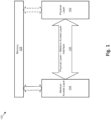
- Fig. 1 illustrates a high level block diagram 100 of the physical (PHY) layer and medium access (MAC) layer system with memory.
- Diagram 100 includes PHY layer 102, MAC layer 104, PHY layer-MAC layer interface 106, and memory 108.
- the PHY layer 102 is interconnected to the MAC layer 104 through the PHY layer-MAC layer interface 106. Further, the MAC layer 104 is connected to the memory 108.
- the PHY layer 102 conversely, is optionally connected to the memory 108.
- the PHY layer 102 is optionally connected to the memory 108 because the PHY layer 102 does not need to communicate with memory 108.
- the PHY layer 102 does not need to store CBs in the memory 108 until all the Cbs of the corresponding TB are received. Instead, the PHY layer 102 can transmit the CBs to the MAC layer 104 as thee CBs are received from the base station.
- other wireless communications operations may require communication with memory 108.
- the connection with the memory 108 is optional in the context of the techniques described here.
- the PHY layer 102 can receive CBs from a base station (e.g., 5G NR) (not pictured).
- the CBs are a portion of a TB.
- the CBs are a portion of a CBG.
- PHY layer 102 can receive a given number of CBs from a base station.
- the given number of CBs can make up one CBG and a portion of a corresponding TB.
- the given number of CBs can make a portion of a CBG, which also makes up a portion of a corresponding TB.
- the number of CBs can make up multiple CBGs, which make up the entirety of a corresponding TB.
- the PHY layer 102 can transmit the CBs to the MAC layer 104 through the PHY layer - MAC layer interface 106.
- the MAC layer 104 can determine whether to process the received CBs or to store them in the memory 108. The determination can be based on the error rate. The error rate of a transmission is based on the CBs needing to be processes in an order. Generally, CBs should be received in an order.
- the MAC layer 104 can determine, based on the order in which the CBs are received, whether any CBs are missing and whether the CBs have been received in the correct order. If CBs are missing and/or the CBs are out of order, the MAC layer 104 can store the CBs in the memory 108. Once the error is resolved, the MAC layer 104 can retrieve the CBs from the memory 108 for further processing.
- An error caused by missing CBs can be corrected in multiple ways.
- the PHY layer 102 can transmit, in a subsequent transmission, the missing CBs.
- the MAC layer 104 can retrieve the associated CBs from the memory 108 for further processing.
- the MAC layer 104 can initially receive ten CBs. In the set of ten CBs, two CBs can be missing in the sequence. The MAC layer 104 can determine that there are two missing CBs because out of the ten received CBs, two intermediate CBs are missing in the order. In other words, the set should include twelve CBs, but only ten CBs were received. As such, the MAC layer 104 can determine to store the ten CBs in the memory 108. Subsequently, the PHY layer 102 can transmit the missing two CBs. Upon receipt, the MAC layer 104 can retrieve the ten CBs from the memory 108, and further process the twelve CBs.
- the MAC layer 104 can receive CBs out of order.
- the MAC layer 104 can determine whether a CB is out of order based on, for example, information in a header of the CB and/or control information received along with the CB. If the MAC layer 104 determines that the CBs are out of order, the CBs can be stored in the memory 108. While in the memory 108, the MAC layer can arrange the CBs in the correct order prior to further processing them (e.g., for transmission to an upper layer).
- the memory 108 can be any external memory device that is communicatively connected to the MAC layer 104.
- the memory 108 can be a double data rate (DDR) memory.
- DDR double data rate
- external can mean that the memory is external to the MAC layer 104 hardware and within the terminal device in which the elements of the diagram 100 are implemented in.
- elements of diagram 100 can be implemented in a cellular phone (e.g., an iPhone).
- the memory 108 can be the memory servicing other components and functions of the device and thus, can be used for multiple purposes.
- the MAC layer 104 can be one of the multiple components of the device that can communicate with the memory 108.
- the PHY layer 102 and MAC layer 104 can interact to optimize the HARQ retransmission technique.
- the PHY layer - MAC layer interface 106 there are multiple ways to implement the PHY layer - MAC layer interface 106. One being a hardware-logic based interface design and the other being a programmable interface design based on a central processing unit (CPU) configuration.
- CPU central processing unit
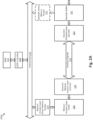
- Fig. 2A illustrates a high level block diagram of a hardware logic based implementation 200A of the PHY layer-to-MAC layer interface.
- Implementation 200A includes decoder buffer 202, downlink (DL) PHY layer decoder 204, DL MAC layer interface 206, MAC layer buffer 208, interface signals 210, decoder direct memory access (DMA) 212, MAC layer DMA 214, interconnect 216, DDR controller 218, and DDR 220.
- the decoder buffer 202 and DL PHY layer decoder 204 can be a part of the PHY layer (e.g., PHY layer 102 in Fig. 1 ).
- the DL MAC layer interface 206 and MAC layer buffer 208 can be a part of the MAC layer (e.g., MAC layer 104 in Fig. 1 ).
- the decoder buffer 202 can receive CBs from the base station (not pictured) and communicate with the DDR 220. As mentioned above, the connections and components between the decoder buffer 202 and the DDR 220 can be optional. In particular, in the context of the techniques described here, the decoder buffer 202 (of the PHY layer) does not need to communicate with the memory device, DDR 220. The decoder buffer 202 can also transmit CBs to the DL PHY layer decoder 204, which in turn, can transmit the CBs to the DL MAC layer interface 206.
- the CBs can be transmitted through various interface signals 210.
- the interface signals 210 are described in more detail in conjunction with Fig. 2B .
- the DL PHY layer decoder 204 and the DL MAC layer interface 206 can establish a handshake signal.
- a handshake signal generally, establishes and defines the protocols of a communication link between two participants in the communication.
- the MAC layer determines whether to process or store the CBs in the DDR 220. If, due to an error rate that is above a threshold value, the CBs need to be stored in the DDR 220, the MAC layer buffer 208 can do so via the MAC layer DMA 214, interconnect 216, and DDR controller 218.
- the threshold value for the error rate can be dependent on the type of error. For example, if the error is missing CBs, the threshold error rate can be a ratio of missing CBs to received CBs. For instance, the ratio can be 1:5, which means one CB can be missing for every five received CBs. If the ratio is higher than 1:5, the received CBs can be stored in the DDR 220 until the error rate is resolved. Alternatively, if the error is caused by receiving CBs out of order, the CBs can, by default, be stored in the DDR 220 until the CBs are put into order.
- Fig. 2B illustrates an example of the PHY layer to MAC layer interface signals 200B.
- Fig. 2B is best understood in view of the components in Fig. 2A .
- the signals 200B illustrated in Fig. 2B are transmitted between the DL PHY layer decoder 204 and DL MAC layer interface 206, described in Fig. 2A .
- the initial signal, clk is the clock signal.
- a clock signal oscillates between high and low, in cycles, and is used to coordinate actions between the components.
- TB_end is a single cycle pulse which indicates the end of the current TB data exchange.
- CB_start is a single cycle pulse that indicates that the first data cycle of a new CB specified by TB_ID and CB_index is going to be transmitted.
- CB_length indicates the length of each CB in bytes of the CB validated by the CB_start signal.
- CB_data_valid indicates that a valid data cycle is occurring when the signal is high.
- CB_data is teh CB data value associated with the CB identified by TB_ID and CB_index.
- the CB_data value is valid when the Cb_data_valid is high.
- MAC_ready indicates whether the MAC layer (e.g., MAC layer 104 in Fig 1 ) is ready to receive data.
- CB_index is the index of the CB currently being transmitted.
- the bit width of the CB_index signal indicates the number of CBs in the TB identified by the TB_ID signal.
- CB_in_DDR provides the option for the DL PHY layer decoder 204 to indicate to the DL MAC layer interface 206 that the CB was already delivered to the intermediate memory (e.g., DDR 220 in Fig 2A ). If CB_in_DDR is high, the MAC layer will have to retrieve the CBs from the intermediate memory. However, as mentioned above, this signal will not be high unless other operations of the device cause the signal to be high. Lastly, PHY_error indicates that the PHY layer has an error condition.
- the DL PHY layer decoder 204 can initiate a data transfer by asserting CB_start. Simultaneously, the DL PHY layer decoder 204 can transmit identification information of the CB, which can include CB_index, Tb_ID, CB_length, and CB_data. Further, CB_data_valid signal can be asserted to indicate that the transfer is valid. Otherwise, the data will not be transferred. The DL PHY layer decoder 204 will then transfer the exact amount indicated by CB_length. After which, a new CB transfer can be initiated by asserting CB_start again. Once all the CBs in the TB are transferred, TB_end can be asserted.
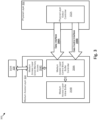
- Fig. 3 illustrates a high level block diagram of a software-based implementation 300 of the PHY layer-to-MAC Layer interface.
- Implementation 300 includes components within the PHY layer 302 and MAC layer 304, interface(s) 306A-B, and DDR 308.
- the interface(s) 306A-B can be, for example, an AHB Lite, Open Core Control (OCP) lite, or any other type of bus.
- Control information e.g., TB_ID, CB_index, CB_ID
- the data and the control information can be transmitted on one bus (e.g., data interface 306A).
- the registers of the bus, interfaces 306A-B can include data similar to that indicated by the interface signals described in Fig. 2B .
- a first register can include CB information such as CB_ID, TB_ID, CB_Index, and CB_length.
- a second register can include CB memory address and control register. This register, as described above, may not be utilized because the PHY layer need not store CBs in memory (e.g., DDR 308).
- a third register can indicate when the session is complete and can include TB_end.
- the MAC layer 304 may store the CB in the DDR 308 through the MAC layer DMA 304C.
- the process to order the out of order CBs can include coding the first and second registers, described above, once the CBs are received. After which, the MAC layer 304 can transmit the CBs to the DDR 308. Once the CBs are stored in the DDR 308, the third register can be coded. In this manner, the MAC layer 304 transfers the out of order CBs to the DDR 308.
- the MAC layer 304 can use a circular buffer (not pictured). Each CB can be represented in the circular buffer at the location indicated by CB_index.
- the entry can also include a pointer to the memory location where the CB data is stored, an offset value from which the data starts in the memory (e.g., DDR 308), and a length which indicates the remaining length of data in the memory.
- each CB can be associated with a header and a footer.
- the footer can contain a link information, which poins to the next memory location such that a link between the memory locations is formed.
- the MAC layer 304 can check each memory location to sequence the CBs.
- Fig. 4 is a flowchart illustrating a method 400 for processing code blocks through the PHY layer-to-MAC layer interface.
- the method 400 can be implemented by any wireless communication device having a memory and a processor.
- a terminal device such as a cellular phone (e.g., iPhone) can implement the method 400.
- the terminal device can be operating on New Radio (NR) technology or Long Term Evolution (LTE) technology.
- the terminal device can include a receiver to receive CBs from a network node such as base station.
- the terminal device can also include a processor to perform at least some of the techniques described here in. Further, at least some of the techniques described herein can be applied upon receipt of CBs in the downlink plane of a telecommunications system.
- a layer of the protocol stack receives a plurality of CBs from, for example, a base station.
- the plurality of CBs makes up a portion of a TB and be associated with an error rate.
- the plurality of CBs are transmitted to a receiving layer (e.g., MAC layer).
- Block 404 can also include establishing a handshake signal between the two layers and receiving the CBs over a plurality of hardware interface signals.
- the plurality of CB can be received over a programmable interface such as a data interface bus.
- the receiving layer determines whether the error rate is below a threshold value.
- the error rate is indicative of the number of missing CBs within the TB. If the error rate is not below the threshold value, the receiving layer, upon receipt of the CBs, determines that the error rate is higher than a threshold value. For instance, the ratio between the number of missing CBs to the number of received CBs can be higher than the threshold value.
- the MAC layer stores the plurality of CBs in memory. The MAC layer determines that the error rate is below a threshold value, in this case, at block 410, the MAC layer further processes the CBs for, for example, transmission to an upper layer. The MAC layer determines that the error rate is below a threshold value, once the missing CBs are received.
- the CBs can be received out of order.
- the receiving layer may order the CBs prior to further processing the CBs.
- the receiving layer can use a circular buffer.
- the receiving layer can represent each CB in the circular buffer with an entry indicative of the identification information (e.g., CB_ID).
- the layers of a protocol stack e.g., PHY layer and MAC layer
- PHY layer and MAC layer can interact to process CBs irrespective of whether all the CBs of a corresponding TB have been received.
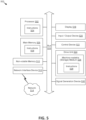
- Fig. 5 is a block diagram illustrating a diagrammatic representation of a machine in the example form of a computer system operable to perform aspects of the disclosed technology.
- Processing system 500 is an implementation of a network node or terminal device that implements the techniques introduced above. At least a portion of the processing system 500 may be included in an electronic device (e.g., a computer server) that supports one or more CPNs and/or one or more UPNs.
- an electronic device e.g., a computer server
- the processing system 500 includes one or more processors 502, main memory 506, non-volatile memory 510, network adapter 512 (e.g., network interfaces), display 518, input/output devices 520, control device 522 (e.g., keyboard and pointing devices), drive unit 524 including a storage medium 526, and signal generation device 530 that are communicatively connected to a bus 516.
- the bus 516 represents any one or more separate physical buses, point to point connections, or any combination thereof, connected by appropriate bridges, adapters, or controllers.
- the bus 516 can include, for example, a system bus, a Peripheral Component Interconnect (PCI) bus or PCI-Express bus, a HyperTransport or industry standard architecture (ISA) bus, a small computer system interface (SCSI) bus, any version of a universal serial bus (USB), IIC (I2C) bus, or an Institute of Electrical and Electronics Engineers (IEEE) standard 1394 bus, also called "Firewire.”
- a bus may also be responsible for relaying data packets (e.g., via full or half duplex wires) between components of a network appliance, such as a switching engine, network port(s), tool port(s), etc.
- the processing system 500 operates as a standalone device, although the processing system 500 may be connected (e.g., wired or wirelessly) to other devices.
- the processing system 500 may include a terminal that is coupled directly to a network appliance.
- the processing system 500 may be wirelessly coupled to the network appliance.
- the processing system 500 may be a server computer, a client computer, a personal computer (PC), a user device, a tablet PC, a laptop computer, a personal digital assistant (PDA), a cellular telephone, an iPhone, an iPad, a Blackberry, a processor, a telephone, a web appliance, a network router, switch or bridge, a console, a hand-held console, a (hand-held) gaming device, a music player, any portable, mobile, hand-held device, or any machine capable of executing a set of instructions (sequential or otherwise) that specify actions to be taken by the processing system 500.
- PC personal computer
- PDA personal digital assistant
- main memory 506, non-volatile memory 510, and storage medium 526 are shown to be a single medium, the term “machine-readable medium” and “storage medium” should be taken to include a single medium or multiple media (e.g., a centralized or distributed database, and/or associated caches and servers) that store one or more sets of instructions 528.
- the term “machine-readable medium” and “storage medium” shall also be taken to include any medium that is capable of storing, encoding, or carrying a set of instructions for execution by the processing system 500 and that cause the processing system 500 to perform any one or more of the methodologies of the presently disclosed embodiments.
- routines that are executed to implement the technology disclosed above may be implemented as part of an operating system or an application, component, program, object, module, or sequence of instructions (collectively referred to as "computer programs").
- the computer programs typically comprise one or more instructions (e.g., instructions 504, 508, 528) set at various times in various memory and storage devices in a computer, and that, when read and executed by one or more processing units or processors 502, cause the processing system 500 to perform operations to execute elements involving the various aspects of the above disclosure.
- machine-readable storage media such as volatile and non-volatile memory devices 510, floppy and other removable disks, hard disk drives, optical disks (e.g., Compact Disk Read-Only Memory (CD ROMS), Digital Versatile Disks (DVDs)), and transmission type media such as digital and analog communication links.
- recordable type media such as volatile and non-volatile memory devices 510, floppy and other removable disks, hard disk drives, optical disks (e.g., Compact Disk Read-Only Memory (CD ROMS), Digital Versatile Disks (DVDs)
- CD ROMS Compact Disk Read-Only Memory
- DVDs Digital Versatile Disks
- the network adapter 512 enables the processing system 500 to mediate data in a network 514 with an entity that is external to the processing system 500, such as a network appliance, through any known and/or convenient communications protocol supported by the processing system 500 and the external entity.
- the network adapter 512 can include one or more of a network adaptor card, a wireless network interface card, a router, an access point, a wireless router, a switch, a multilayer switch, a protocol converter, a gateway, a bridge, bridge router, a hub, a digital media receiver, and/or a repeater.
- the network adapter 512 can include a firewall which can, in some embodiments, govern and/or manage permission to access/proxy data in a computer network, and track varying levels of trust between different machines and/or applications.
- the firewall can be any number of modules having any combination of hardware and/or software components able to enforce a predetermined set of access rights between a particular set of machines and applications, machines and machines, and/or applications and applications, for example, to regulate the flow of traffic and resource sharing between these varying entities.
- the firewall may additionally manage and/or have access to an access control list which details permissions including for example, the access and operation rights of an object by an individual, a machine, and/or an application, and the circumstances under which the permission rights stand.
- firewalls Other network security functions can be performed or included in the functions of the firewall, including intrusion prevention, intrusion detection, nextgeneration firewall, personal firewall, etc.
- programmable circuitry e.g., one or more microprocessors
- software and/or firmware entirely in special-purpose hardwired (i.e., non-programmable) circuitry, or in a combination of such forms.
- Special-purpose circuitry can be in the form of, for example, one or more application-specific integrated circuits (ASICs), programmable logic devices (PLDs), field-programmable gate arrays (FPGAs), etc.
- ASICs application-specific integrated circuits
- PLDs programmable logic devices
- FPGAs field-programmable gate arrays
- processing refers to actions and processes of a computer or similar electronic computing device that manipulates and transforms data represented as physical (electronic) quantities within the computer's memory or registers into other data similarly represented as physical quantities within the computer's memory, registers, or other such storage medium, transmission, or display devices.
- references herein to "one embodiment” or “a case” means that a particular feature, structure, or characteristic described in connection with the embodiment and/or case is included in at least one embodiment and/or case of the disclosure.
- the appearances of the phrase “in one embodiment” and/or “in this case” in various places in the specification are not necessarily all referring to the same embodiment and/or case, nor are separate or alternative embodiments and/or cases mutually exclusive of other embodiments and/or cases.
- various features are described which may be exhibited by some embodiments and/or cases, and not by others.
- various requirements are described which may be requirements for some embodiments and/or cases but not for other embodiments and/or cases.
Landscapes
- Engineering & Computer Science (AREA)
- Computer Networks & Wireless Communication (AREA)
- Signal Processing (AREA)
- Computer Security & Cryptography (AREA)
- Quality & Reliability (AREA)
- Mobile Radio Communication Systems (AREA)
Description
- The application claims priority to
U.S. Provisional Application No. 63/038,665, titled "4G/5G Downlink MAC/PHY Interface Code Block Based Direct Data Interface" and filed on June 12, 2020 - The disclosed techniques relate to power saving techniques, and more particularly, to power saving techniques, and a method and system for a layer-to-layer-interface in a telecommunication device.
- Wireless communications systems are being continually improved due to the ever-increasing demands placed on wireless communications systems. In 5th generation (5G) technology, for example, spectrum efficiency is improved when compared to previous generations. One technique that helps improve spectrum efficiency is code block group (CBG) based hybrid automatic repeat request (HARQ) retransmission. This technique includes the breaking up of transport blocks (TBs) into CBGs, which allows for processing of the CBGs by layers of the protocol stack.
- In the downlink direction, in particular, the improved techniques of 5G can be utilized to increase the efficiency at a network device. For example, the network device may reduce power consumption due to the more granular approach of processing CBGs through the protocol stack. However, additional improvements will help further take advantage of the developments in 5G.
- The document
EP 3 627 740 A1 provides a method by a transmitter for transmitting data, which includes: a data packet is transmitted to a receiver; HARQ feedback information is received based on a decoding result of the data packet; a data packet to be retransmitted is generated based on the HARQ feedback information; and the data packet to be retransmitted is transmitted to the receiver. - The present invention is set out in the appended set of claims. Any embodiment in the description that does not fall within the scope of the claims shall be regarded as an example for understanding the present invention.
- The technical solutions of the embodiments of the disclosure are implemented as follows.
- According to a first aspect, the embodiments of the disclosure provide a method according to claim 1 and further detailed in the dependent claims referring back to this claim.
- According to a second aspect, the embodiments of the disclosure provide a system according to claim 12.
- The present embodiments are illustrated by way of example and are not intended to be limited by the figures in the accompanying drawings.
-
Fig. 1 illustrates a high level block diagram of the physical (PHY) layer and medium access (MAC) layer system with memory. -
Fig. 2A illustrates a high level block diagram of a hardware-based implementation of the PHY layer-to-MAC layer interface. -
Fig. 2B illustrates the PHY layer to MAC layer interface signals. -
Fig. 3 illustrates a high level block diagram of a software-based implementation of the PHY layer-to-MAC Layer interface. -
Fig. 4 is a flowchart illustrating a method for processing code blocks through the PHY layer-to-MAC layer interface. -
Fig. 5 is a block diagram illustrating a diagrammatic representation of a machine in the example form of a computer system operable to perform aspects of the disclosed technology. - Wireless communication systems are constantly being improved to keep up with the increasing demands for efficiency. Efficiency, in a wireless communication device, is an encompassing term that can include factors such as the rate of power consumption, the usage of memory, the usage of space, and other factors. Given these multiple factors, there are also multiple ways that efficiency can be improved in a wireless communication system.
- 5th Generation (5G), for instance, allows for hybrid automatic repeat request (HARQ) retransmission. HARQ retransmission permits breaking up of transport blocks (TBs) into code block groups (CBGs), and the CBGs can be further broken down into multiple code blocks (CBs). As such, rather than transmitting, accepting, and/or processing an entire TB, a wireless communications system can handle one or more CBs or CBGs at a time.
- For example, in the downlink direction, a terminal device (e.g., an iPhone) is connected to a base station. The base station transmits multiple CBs to the terminal device. The terminal device, upon receipt of the CBs, can store the CBs in external memory until all the CBs in the corresponding TB are received. In particular, at the protocol stack level, the physical (PHY) layer will store the CBs in external memory. Once all the CBs that make up the corresponding TB are received, the PHY layer will process the CBs and transmit them to the medium access (MAC) layer. At the MAC layer, a similar process takes place. The MAC layer will store CBs in memory until the MAC layer receives all the CBs in the corresponding TB from the PHY layer.
- However, due to the granular approach developed for HARQ retransmission, the entire TB does not need to be retransmitted if one or more CBGs of the TB is, for example, lost during transmission. The one or more CBGs can be retransmitted to address the issue. For example, the PHY layer can indicate to the base station that a particular CBG was lost during transmission. The base station can then retransmit the particular CBG, rather than the entire corresponding TB. In this manner, HARQ retransmission increases the efficiency of a wireless communications system.
- Yet, the HARQ retransmission technique is not used to its potential in the process described above. Namely, the retransmission and storage of CBs in memory, at each layer, causes at least two issues: power consumption and memory usage. In particular, power consumption is a key factor in the operation of a terminal device. Given that a terminal device is generally a standalone device, the onboard power must be used efficiently. In the method described, power is lost during the repetitive back-and-forth between a protocol layer and memory, and between the layers themselves. For instance, a PHY layer can repetitively transmit and receive CBs from memory, while also communicating with the base station. As such, the power is being consumed at an inefficient rate.
- Further, the memory at a terminal device is limited. Thus, the memory should be efficiently used. In the current HARQ retransmission techniques, the memory is used to store the CBs until all the CBs of a corresponding TB are received. To do so, for example, the PHY layer will store received CBs in memory. Once all the CBs are received, the PHY layer will again remove the CBs from memory and transmit them to the MAC layer. At the MAC layer, the CBs are again stored in memory until the MAC layer receives all the CBs from the PHY layer. Thus, the memory is being utilized heavily for intermediate storage.
- Other issues also arise with the use of the current HARQ retransmission techniques. For instance, there can be additional delays in the processing of CBs due to the wait time from receiving a CB to receiving all the CBs in the TB. This issue is compounded by the delay caused by communicating with the memory. Another issue is the stand-by time of layers of the protocol stack. For instance, if the MAC layer processes the previous set of CBs, the MAC layer still has to wait until the PHY layer receives all the CBs in the next transmission to begin processing the next transmission. Thus, there are several opportunities for improving the efficiency involved in implementing the HARQ retransmission techniques.
- Introduced here, therefore, is at least one technique for improving the efficiency of CB transmission between the PHY layer and the MAC layer. In particular, the technique includes transmitting CBs from the PHY layer to the MAC layer irrespective of whether all the CBs of a corresponding TB are received or not. The CBs can be transmitted over a direct hardware interface or a standard bus. In the former option, the decoder at the PHY layer can be interconnected with a PHY-to-MAC interface. The PHY decoder can transmit the CBs through various interface signals. A MAC buffer can be connected to the other side of the PHY-to-MAC interface. In the latter option, the PHY layer can transmit the CBs to the MAC layer via a bus such as an Advanced Microcontroller Bus Architecture High Performance Bus (AHB). In this case, the data signals and the control data signals can be transmitted over the same bus or different busses.
- In both options, the PHY layer does not need to store the CBs in the memory until it receives all the CBs of a corresponding TB from a base station. The PHY layer can, instead, transmit the CBs to the MAC layer as the CBs are received from the base station. The MAC layer, then, determines whether to process the CBs or store them in memory. The MAC layer make this determination based on the error rate associated with the CBs. If the error rate is above a threshold value, the MAC layer stores the CBs in memory and, for example, request transmission. If the error rate is below a threshold value, the MAC layer continues to process the CBs. In this manner, the above mentioned issues are addressed.
- In the following description, the examples of a terminal device (e.g., mobile device) are used, for illustrative purposes only, to explain various aspects of the techniques. For example, a cellular phone can apply a technique for transmitting CBs from the PHY layer to the MAC layer. Note, however, the techniques disclosed here are not limited to applicability to terminal devices, or to any other particular kind of devices. Other devices, for example, electronic devices or systems (e.g., wireless communication devices) may adapt the techniques in a similar manner.
- Further, references are made to CBs and CBGs. A CBG is a grouping of multiple CBs. Thus, in some cases, the terms can be used interchangeably. For example, a PHY layer can transmit CBs to the MAC layer. The CBs can also be described as a CBG(s) because the CBs can be grouped as one or more CBGs. Also, references are made to layers of a protocol stack, such as the PHY and MAC layers, as performing actions. For example, as transmitting the CBs to the memory. However, note, that the hardware implementing layers are the components that perform these actions. The terms PHY and MAC layers are used merely for convenience of description.
- Note, further, that while the techniques introduced here are described in the context of 5G technology, these techniques are not necessarily limited in applicability to 5G technology, nor even to wireless telecommunications. Hence, the techniques introduced here are potentially applicable in technology areas beyond those described herein.
-
Fig. 1 illustrates a high level block diagram 100 of the physical (PHY) layer and medium access (MAC) layer system with memory. Diagram 100 includesPHY layer 102,MAC layer 104, PHY layer-MAC layer interface 106, andmemory 108. ThePHY layer 102 is interconnected to theMAC layer 104 through the PHY layer-MAC layer interface 106. Further, theMAC layer 104 is connected to thememory 108. ThePHY layer 102, conversely, is optionally connected to thememory 108. - The
PHY layer 102 is optionally connected to thememory 108 because thePHY layer 102 does not need to communicate withmemory 108. In particular, thePHY layer 102 does not need to store CBs in thememory 108 until all the Cbs of the corresponding TB are received. Instead, thePHY layer 102 can transmit the CBs to theMAC layer 104 as thee CBs are received from the base station. However, other wireless communications operations may require communication withmemory 108. Thus, the connection with thememory 108 is optional in the context of the techniques described here. - In some embodiments, the
PHY layer 102 can receive CBs from a base station (e.g., 5G NR) (not pictured). The CBs are a portion of a TB. Further, the CBs are a portion of a CBG. For instance,PHY layer 102 can receive a given number of CBs from a base station. The given number of CBs can make up one CBG and a portion of a corresponding TB. In another example, the given number of CBs can make a portion of a CBG, which also makes up a portion of a corresponding TB. In yet another example, the number of CBs can make up multiple CBGs, which make up the entirety of a corresponding TB. - Regardless of the number of CBs, the
PHY layer 102 can transmit the CBs to theMAC layer 104 through the PHY layer -MAC layer interface 106. Upon receipt, theMAC layer 104 can determine whether to process the received CBs or to store them in thememory 108. The determination can be based on the error rate. The error rate of a transmission is based on the CBs needing to be processes in an order. Generally, CBs should be received in an order. Thus, theMAC layer 104 can determine, based on the order in which the CBs are received, whether any CBs are missing and whether the CBs have been received in the correct order. If CBs are missing and/or the CBs are out of order, theMAC layer 104 can store the CBs in thememory 108. Once the error is resolved, theMAC layer 104 can retrieve the CBs from thememory 108 for further processing. - An error caused by missing CBs can be corrected in multiple ways. For instance, the
PHY layer 102 can transmit, in a subsequent transmission, the missing CBs. In which case, theMAC layer 104 can retrieve the associated CBs from thememory 108 for further processing. For example, theMAC layer 104 can initially receive ten CBs. In the set of ten CBs, two CBs can be missing in the sequence. TheMAC layer 104 can determine that there are two missing CBs because out of the ten received CBs, two intermediate CBs are missing in the order. In other words, the set should include twelve CBs, but only ten CBs were received. As such, theMAC layer 104 can determine to store the ten CBs in thememory 108. Subsequently, thePHY layer 102 can transmit the missing two CBs. Upon receipt, theMAC layer 104 can retrieve the ten CBs from thememory 108, and further process the twelve CBs. - Similarly, the
MAC layer 104 can receive CBs out of order. TheMAC layer 104 can determine whether a CB is out of order based on, for example, information in a header of the CB and/or control information received along with the CB. If theMAC layer 104 determines that the CBs are out of order, the CBs can be stored in thememory 108. While in thememory 108, the MAC layer can arrange the CBs in the correct order prior to further processing them (e.g., for transmission to an upper layer). - In some embodiments, the
memory 108 can be any external memory device that is communicatively connected to theMAC layer 104. For instance, thememory 108 can be a double data rate (DDR) memory. In this context, external can mean that the memory is external to theMAC layer 104 hardware and within the terminal device in which the elements of the diagram 100 are implemented in. For instance, elements of diagram 100 can be implemented in a cellular phone (e.g., an iPhone). Thememory 108 can be the memory servicing other components and functions of the device and thus, can be used for multiple purposes. However, theMAC layer 104 can be one of the multiple components of the device that can communicate with thememory 108. - In this manner and by using the components in diagram 100, the
PHY layer 102 andMAC layer 104 can interact to optimize the HARQ retransmission technique. In addition, there are multiple ways to implement the PHY layer -MAC layer interface 106. One being a hardware-logic based interface design and the other being a programmable interface design based on a central processing unit (CPU) configuration. -
Fig. 2A illustrates a high level block diagram of a hardware logic basedimplementation 200A of the PHY layer-to-MAC layer interface.Implementation 200A includesdecoder buffer 202, downlink (DL)PHY layer decoder 204, DLMAC layer interface 206,MAC layer buffer 208, interface signals 210, decoder direct memory access (DMA) 212,MAC layer DMA 214,interconnect 216,DDR controller 218, andDDR 220. In some embodiments, thedecoder buffer 202 and DLPHY layer decoder 204 can be a part of the PHY layer (e.g.,PHY layer 102 inFig. 1 ). Further, the DLMAC layer interface 206 andMAC layer buffer 208 can be a part of the MAC layer (e.g.,MAC layer 104 inFig. 1 ). - The
decoder buffer 202 can receive CBs from the base station (not pictured) and communicate with theDDR 220. As mentioned above, the connections and components between thedecoder buffer 202 and theDDR 220 can be optional. In particular, in the context of the techniques described here, the decoder buffer 202 (of the PHY layer) does not need to communicate with the memory device,DDR 220. Thedecoder buffer 202 can also transmit CBs to the DLPHY layer decoder 204, which in turn, can transmit the CBs to the DLMAC layer interface 206. - In the hardware logic based design, the CBs can be transmitted through various interface signals 210. The interface signals 210 are described in more detail in conjunction with
Fig. 2B . To begin communications, the DLPHY layer decoder 204 and the DLMAC layer interface 206 can establish a handshake signal. A handshake signal, generally, establishes and defines the protocols of a communication link between two participants in the communication. Once communications begins and the CBs are received by the MAC layer at the DLMAC layer interface 206 and transmitted to theMAC layer buffer 208, the MAC layer, as described above, determines whether to process or store the CBs in theDDR 220. If, due to an error rate that is above a threshold value, the CBs need to be stored in theDDR 220, theMAC layer buffer 208 can do so via theMAC layer DMA 214,interconnect 216, andDDR controller 218. - In some embodiments, the threshold value for the error rate can be dependent on the type of error. For example, if the error is missing CBs, the threshold error rate can be a ratio of missing CBs to received CBs. For instance, the ratio can be 1:5, which means one CB can be missing for every five received CBs. If the ratio is higher than 1:5, the received CBs can be stored in the
DDR 220 until the error rate is resolved. Alternatively, if the error is caused by receiving CBs out of order, the CBs can, by default, be stored in theDDR 220 until the CBs are put into order. -
Fig. 2B illustrates an example of the PHY layer to MAC layer interface signals 200B.Fig. 2B is best understood in view of the components inFig. 2A . Namely, thesignals 200B illustrated inFig. 2B are transmitted between the DLPHY layer decoder 204 and DLMAC layer interface 206, described inFig. 2A . The initial signal, clk, is the clock signal. Generally, a clock signal oscillates between high and low, in cycles, and is used to coordinate actions between the components. Next, TB_end is a single cycle pulse which indicates the end of the current TB data exchange. CB_start is a single cycle pulse that indicates that the first data cycle of a new CB specified by TB_ID and CB_index is going to be transmitted. CB_length indicates the length of each CB in bytes of the CB validated by the CB_start signal. - TB_ID or TB index identifies which TB the current data cycle belongs to. CB_data_valid indicates that a valid data cycle is occurring when the signal is high. CB_data is teh CB data value associated with the CB identified by TB_ID and CB_index. The CB_data value is valid when the Cb_data_valid is high. MAC_ready indicates whether the MAC layer (e.g.,
MAC layer 104 inFig 1 ) is ready to receive data. CB_index is the index of the CB currently being transmitted. Moreover, the bit width of the CB_index signal indicates the number of CBs in the TB identified by the TB_ID signal. - CB_in_DDR provides the option for the DL
PHY layer decoder 204 to indicate to the DLMAC layer interface 206 that the CB was already delivered to the intermediate memory (e.g.,DDR 220 inFig 2A ). If CB_in_DDR is high, the MAC layer will have to retrieve the CBs from the intermediate memory. However, as mentioned above, this signal will not be high unless other operations of the device cause the signal to be high. Lastly, PHY_error indicates that the PHY layer has an error condition. - For example, the DL
PHY layer decoder 204 can initiate a data transfer by asserting CB_start. Simultaneously, the DLPHY layer decoder 204 can transmit identification information of the CB, which can include CB_index, Tb_ID, CB_length, and CB_data. Further, CB_data_valid signal can be asserted to indicate that the transfer is valid. Otherwise, the data will not be transferred. The DLPHY layer decoder 204 will then transfer the exact amount indicated by CB_length. After which, a new CB transfer can be initiated by asserting CB_start again. Once all the CBs in the TB are transferred, TB_end can be asserted. -
Fig. 3 illustrates a high level block diagram of a software-basedimplementation 300 of the PHY layer-to-MAC Layer interface.Implementation 300 includes components within thePHY layer 302 andMAC layer 304, interface(s) 306A-B, and DDR 308. The interface(s) 306A-B can be, for example, an AHB Lite, Open Core Control (OCP) lite, or any other type of bus. Control information (e.g., TB_ID, CB_index, CB_ID) can be transmitted through another bus,data control interface 306B. Alternatively, the data and the control information can be transmitted on one bus (e.g.,data interface 306A). - Similar to the signals described in conjunction with
Fig. 2B , the registers of the bus, interfaces 306A-B, can include data similar to that indicated by the interface signals described inFig. 2B . For instance, a first register can include CB information such as CB_ID, TB_ID, CB_Index, and CB_length. A second register can include CB memory address and control register. This register, as described above, may not be utilized because the PHY layer need not store CBs in memory (e.g., DDR 308). A third register can indicate when the session is complete and can include TB_end. - Further, when the CBs are received out of order, due to transmission errors, the
MAC layer 304 will have to order them prior to further processing. To do so, theMAC layer 304 may store the CB in the DDR 308 through the MAC layer DMA 304C. The process to order the out of order CBs can include coding the first and second registers, described above, once the CBs are received. After which, theMAC layer 304 can transmit the CBs to the DDR 308. Once the CBs are stored in the DDR 308, the third register can be coded. In this manner, theMAC layer 304 transfers the out of order CBs to the DDR 308. - Next, to put the CBs in order, the
MAC layer 304 can use a circular buffer (not pictured). Each CB can be represented in the circular buffer at the location indicated by CB_index. The entry can also include a pointer to the memory location where the CB data is stored, an offset value from which the data starts in the memory (e.g., DDR 308), and a length which indicates the remaining length of data in the memory. In the memory, each CB can be associated with a header and a footer. The footer can contain a link information, which poins to the next memory location such that a link between the memory locations is formed. Thus, theMAC layer 304 can check each memory location to sequence the CBs. -
Fig. 4 is a flowchart illustrating amethod 400 for processing code blocks through the PHY layer-to-MAC layer interface. Themethod 400 can be implemented by any wireless communication device having a memory and a processor. For example, a terminal device such as a cellular phone (e.g., iPhone) can implement themethod 400. Further, the terminal device can be operating on New Radio (NR) technology or Long Term Evolution (LTE) technology. The terminal device can include a receiver to receive CBs from a network node such as base station. The terminal device can also include a processor to perform at least some of the techniques described here in. Further, at least some of the techniques described herein can be applied upon receipt of CBs in the downlink plane of a telecommunications system. - At
block 402, a layer of the protocol stack (e.g., PHY layer) receives a plurality of CBs from, for example, a base station. The plurality of CBs makes up a portion of a TB and be associated with an error rate. Atblock 404, the plurality of CBs are transmitted to a receiving layer (e.g., MAC layer). Block 404 can also include establishing a handshake signal between the two layers and receiving the CBs over a plurality of hardware interface signals. Alternatively, the plurality of CB can be received over a programmable interface such as a data interface bus. In some cases, there can be two interface busses: one bus for the control information and a second bus for the data. - At
block 406, the receiving layer (e.g., the MAC layer), determines whether the error rate is below a threshold value. The error rate is indicative of the number of missing CBs within the TB. If the error rate is not below the threshold value, the receiving layer, upon receipt of the CBs, determines that the error rate is higher than a threshold value. For instance, the ratio between the number of missing CBs to the number of received CBs can be higher than the threshold value. As such, atblock 408, the MAC layer stores the plurality of CBs in memory. The MAC layer determines that the error rate is below a threshold value, in this case, atblock 410, the MAC layer further processes the CBs for, for example, transmission to an upper layer. The MAC layer determines that the error rate is below a threshold value, once the missing CBs are received. - In some cases, the CBs can be received out of order. When this occurs, the receiving layer may order the CBs prior to further processing the CBs. To do so, the receiving layer can use a circular buffer. Further, the receiving layer can represent each CB in the circular buffer with an entry indicative of the identification information (e.g., CB_ID). In this manner, the layers of a protocol stack (e.g., PHY layer and MAC layer) can interact to process CBs irrespective of whether all the CBs of a corresponding TB have been received.
-
Fig. 5 is a block diagram illustrating a diagrammatic representation of a machine in the example form of a computer system operable to perform aspects of the disclosed technology.Processing system 500 is an implementation of a network node or terminal device that implements the techniques introduced above. At least a portion of theprocessing system 500 may be included in an electronic device (e.g., a computer server) that supports one or more CPNs and/or one or more UPNs. Theprocessing system 500 includes one ormore processors 502,main memory 506,non-volatile memory 510, network adapter 512 (e.g., network interfaces),display 518, input/output devices 520, control device 522 (e.g., keyboard and pointing devices),drive unit 524 including a storage medium 526, and signalgeneration device 530 that are communicatively connected to a bus 516. The bus 516 represents any one or more separate physical buses, point to point connections, or any combination thereof, connected by appropriate bridges, adapters, or controllers. The bus 516, therefore, can include, for example, a system bus, a Peripheral Component Interconnect (PCI) bus or PCI-Express bus, a HyperTransport or industry standard architecture (ISA) bus, a small computer system interface (SCSI) bus, any version of a universal serial bus (USB), IIC (I2C) bus, or an Institute of Electrical and Electronics Engineers (IEEE) standard 1394 bus, also called "Firewire." A bus may also be responsible for relaying data packets (e.g., via full or half duplex wires) between components of a network appliance, such as a switching engine, network port(s), tool port(s), etc. - In various embodiments, the
processing system 500 operates as a standalone device, although theprocessing system 500 may be connected (e.g., wired or wirelessly) to other devices. For example, theprocessing system 500 may include a terminal that is coupled directly to a network appliance. As another example, theprocessing system 500 may be wirelessly coupled to the network appliance. - In various embodiments, the
processing system 500 may be a server computer, a client computer, a personal computer (PC), a user device, a tablet PC, a laptop computer, a personal digital assistant (PDA), a cellular telephone, an iPhone, an iPad, a Blackberry, a processor, a telephone, a web appliance, a network router, switch or bridge, a console, a hand-held console, a (hand-held) gaming device, a music player, any portable, mobile, hand-held device, or any machine capable of executing a set of instructions (sequential or otherwise) that specify actions to be taken by theprocessing system 500. - While the
main memory 506,non-volatile memory 510, and storage medium 526 (also called a "machine-readable medium) are shown to be a single medium, the term "machine-readable medium" and "storage medium" should be taken to include a single medium or multiple media (e.g., a centralized or distributed database, and/or associated caches and servers) that store one or more sets ofinstructions 528. The term "machine-readable medium" and "storage medium" shall also be taken to include any medium that is capable of storing, encoding, or carrying a set of instructions for execution by theprocessing system 500 and that cause theprocessing system 500 to perform any one or more of the methodologies of the presently disclosed embodiments. - In general, the routines that are executed to implement the technology disclosed above may be implemented as part of an operating system or an application, component, program, object, module, or sequence of instructions (collectively referred to as "computer programs"). The computer programs typically comprise one or more instructions (e.g.,
instructions processors 502, cause theprocessing system 500 to perform operations to execute elements involving the various aspects of the above disclosure. - Moreover, while embodiments have been described in the context of fully functioning computers, computer systems and/or other devices, those skilled in the art will appreciate that the various embodiments are capable of being distributed as a program product in a variety of forms, and that the disclosure applies equally regardless of the particular type of machine or computer-readable media used to actually effect the distribution.
- Further examples of machine-readable storage media, machine-readable media, or computer-readable (storage) media include recordable type media such as volatile and
non-volatile memory devices 510, floppy and other removable disks, hard disk drives, optical disks (e.g., Compact Disk Read-Only Memory (CD ROMS), Digital Versatile Disks (DVDs)), and transmission type media such as digital and analog communication links. - The
network adapter 512 enables theprocessing system 500 to mediate data in anetwork 514 with an entity that is external to theprocessing system 500, such as a network appliance, through any known and/or convenient communications protocol supported by theprocessing system 500 and the external entity. Thenetwork adapter 512 can include one or more of a network adaptor card, a wireless network interface card, a router, an access point, a wireless router, a switch, a multilayer switch, a protocol converter, a gateway, a bridge, bridge router, a hub, a digital media receiver, and/or a repeater. - The
network adapter 512 can include a firewall which can, in some embodiments, govern and/or manage permission to access/proxy data in a computer network, and track varying levels of trust between different machines and/or applications. The firewall can be any number of modules having any combination of hardware and/or software components able to enforce a predetermined set of access rights between a particular set of machines and applications, machines and machines, and/or applications and applications, for example, to regulate the flow of traffic and resource sharing between these varying entities. The firewall may additionally manage and/or have access to an access control list which details permissions including for example, the access and operation rights of an object by an individual, a machine, and/or an application, and the circumstances under which the permission rights stand. - Other network security functions can be performed or included in the functions of the firewall, including intrusion prevention, intrusion detection, nextgeneration firewall, personal firewall, etc.
- As indicated above, the techniques introduced here implemented by, for example, programmable circuitry (e.g., one or more microprocessors), programmed with software and/or firmware, entirely in special-purpose hardwired (i.e., non-programmable) circuitry, or in a combination of such forms. Special-purpose circuitry can be in the form of, for example, one or more application-specific integrated circuits (ASICs), programmable logic devices (PLDs), field-programmable gate arrays (FPGAs), etc.
- Note that any of the embodiments described above can be combined with another embodiment, except to the extent that it may be stated otherwise above or to the extent that any such embodiments might be mutually exclusive in function and/or structure.
- The embodiments set forth herein represent the necessary information to enable those skilled in the art to practice the embodiments and illustrate the best mode of practicing the embodiments. Upon reading the description in light of the accompanying figures, those skilled in the art will understand the concepts of the disclosure and will recognize applications of these concepts that are not particularly addressed herein. These concepts and applications fall within the scope of the disclosure and the accompanying claims.
- The above description and drawings are illustrative and are not to be construed as limiting. Numerous specific details are described to provide a thorough understanding of the disclosure. However, in certain instances, well-known details are not described in order to avoid obscuring the description. Further, various modifications may be made without deviating from the scope of the embodiments.
- As used herein, unless specifically stated otherwise, terms such as "processing," "determining," "generating," or the like, refer to actions and processes of a computer or similar electronic computing device that manipulates and transforms data represented as physical (electronic) quantities within the computer's memory or registers into other data similarly represented as physical quantities within the computer's memory, registers, or other such storage medium, transmission, or display devices.
- Reference herein to "one embodiment" or "a case" means that a particular feature, structure, or characteristic described in connection with the embodiment and/or case is included in at least one embodiment and/or case of the disclosure. The appearances of the phrase "in one embodiment" and/or "in this case" in various places in the specification are not necessarily all referring to the same embodiment and/or case, nor are separate or alternative embodiments and/or cases mutually exclusive of other embodiments and/or cases. Moreover, various features are described which may be exhibited by some embodiments and/or cases, and not by others. Similarly, various requirements are described which may be requirements for some embodiments and/or cases but not for other embodiments and/or cases.
- The terms used in this specification generally have their ordinary meanings in the art, within the context of the disclosure, and in the specific context where each term is used. Certain terms that are used to describe the disclosure are discussed above, or elsewhere in the specification, to provide additional guidance to the practitioner regarding the description of the disclosure. It will be appreciated that the same thing can be said in more than one way.
- Consequently, alternative language and synonyms may be used for any one or more of the terms discussed herein, nor is any special significance to be placed upon whether or not a term is elaborated or discussed herein. Synonyms for certain terms are provided. A recital of one or more synonyms does not exclude the use of other synonyms. The use of examples anywhere in this specification including examples of any term discussed herein is illustrative only and is not intended to further limit the scope and meaning of the disclosure or of any exemplified term. Likewise, the disclosure is not limited to various embodiments given in this specification.
- Without intent to further limit the scope of the disclosure, examples of components and methods and their related results according to the present disclosure are given above. Note that titles or subtitles may be used in the examples for convenience of a reader, which in no way should limit the scope of the disclosure. Unless otherwise defined, all technical and scientific terms used herein have the same meaning as commonly understood by one of ordinary skill in the art to which this disclosure pertains. In the case of conflict, the present document, including definitions will control.
- From the foregoing, it will be appreciated that specific embodiments of the invention have been described herein for purposes of illustration, but that various modifications may be made without deviating from the scope of the invention. Accordingly, the invention is not limited except as by the appended claims.
Claims (12)
- A method (400), comprising:receiving (402), at a first layer of a protocol stack, a plurality of code blocks from a base station, wherein the plurality of code blocks is a portion of a transport block and is associated with an error rate;transmitting (404), to a second layer of the protocol stack, the plurality of code blocks; anddetermining, at the second layer and based on the error rate, whether to (1) store (408) the plurality of code blocks in memory (108) or (2) process the plurality of code blocks, in response to the error rate being above a threshold value,storing, at the second layer, the plurality of code blocks in memory,wherein the error rate is indicative of a number of missing code blocks within the transport block, characterized in:receiving, at the second layer, the missing code blocks; andin response to receiving the missing code blocks, determining, at the second layer, that the error rate is below the threshold value; and based on the determining that the error rate is below the threshold value,processing, at the second layer, the plurality of code blocks.
- The method (400) of claim 1, wherein the plurality of code blocks is out of order, the method further comprising:storing, at the second layer, the plurality of code blocks in memory; andordering, at the second layer, the plurality of code blocks.
- The method (400) of claim 1, wherein the plurality of code blocks is out of order, the method further comprising:
representing, at the second layer, each code block of the plurality of code blocks with an entry in a circular buffer. - The method (400) of claim 3, wherein the entry includes a pointer to where the code block is stored, an offset value, and a length.
- The method (400) of claim 1, further comprising:determining, at the second layer, that the error rate is below the threshold value; andtransmitting, at the second layer, the plurality of code blocks to an upper layer.
- The method (400) of claim 1, wherein transmitting the plurality of code blocks further comprises:
establishing a handshake signal between the first layer and the second layer, wherein the handshake signal defines protocols for communication between the first layer and the second layer. - The method (400) of claim 1, wherein the plurality of code blocks is transmitted over a plurality of hardware interface signals.
- The method (400) of claim 1, wherein the plurality of code blocks is transmitted through a data interface bus.
- The method (400) of claim 8, wherein the data interface bus is a first data interface bus, the method further comprising:
receiving control information through a second data interface bus, wherein the second data interface bus is different from the first data interface bus. - The method (400) of claim 1, wherein the first layer is a physical layer (102) and the second layer is a medium access control layer (104).
- The method (400) of claim 1, wherein the memory is double data rate, DDR, memory (220).
- A system (500), comprising:a processor (502); anda memory (506) having instructions stored thereon that, when executed by the processor (502), cause the system to:receive a plurality of code blocks, wherein the plurality of code blocks is a portion of a transport block, and wherein plurality of code blocks is associated with an error rate; anddetermine whether to (1) store the plurality of code blocks in the memory or (2) process the plurality of code blocks for transmission to an upper layer based on the error rate, in response to the error rate being above a threshold value, the instructions cause the system (500) to store the plurality of code blocks in memory at the second layer,wherein the error rate is indicative of a number of missing code blocks within the transport block, characterized in that the instructions cause the system (500) to receive the missing code blocks at the second layer; andin response to receiving the missing code blocks, determine, at the second layer, that the error rate is below the threshold value; and based on the determining that the error rate is below the threshold value,process the plurality of code blocks at the second layer.
Applications Claiming Priority (2)
| Application Number | Priority Date | Filing Date | Title |
|---|---|---|---|
| US202063038665P | 2020-06-12 | 2020-06-12 | |
| PCT/US2021/025729 WO2021252053A1 (en) | 2020-06-12 | 2021-04-05 | Power saving techniques for layer-to-layer interface |
Publications (4)
| Publication Number | Publication Date |
|---|---|
| EP4154086A1 EP4154086A1 (en) | 2023-03-29 |
| EP4154086A4 EP4154086A4 (en) | 2023-12-06 |
| EP4154086B1 true EP4154086B1 (en) | 2024-09-04 |
| EP4154086B8 EP4154086B8 (en) | 2024-11-06 |
Family
ID=78845821
Family Applications (1)
| Application Number | Title | Priority Date | Filing Date |
|---|---|---|---|
| EP21821873.3A Active EP4154086B8 (en) | 2020-06-12 | 2021-04-05 | Power saving techniques for layer-to-layer interface |
Country Status (4)
| Country | Link |
|---|---|
| US (1) | US12225468B2 (en) |
| EP (1) | EP4154086B8 (en) |
| CN (1) | CN115702408B (en) |
| WO (1) | WO2021252053A1 (en) |
Families Citing this family (1)
| Publication number | Priority date | Publication date | Assignee | Title |
|---|---|---|---|---|
| CN115412969A (en) * | 2021-05-26 | 2022-11-29 | 华为技术有限公司 | Method for transmitting and receiving data and communication device |
Family Cites Families (11)
| Publication number | Priority date | Publication date | Assignee | Title |
|---|---|---|---|---|
| US7782850B2 (en) * | 2006-11-20 | 2010-08-24 | Broadcom Corporation | MAC to PHY interface apparatus and methods for transmission of packets through a communications network |
| US8127164B2 (en) * | 2008-02-12 | 2012-02-28 | Broadcom Corporation | System and method for energy savings on a PHY/MAC interface for energy efficient ethernet |
| GB2503933B (en) * | 2012-07-13 | 2015-07-15 | Canon Kk | Time sensitive transaction over an asynchronous serial link |
| US8839079B2 (en) * | 2012-08-20 | 2014-09-16 | Qualcomm Incorporated | Methods and apparatuses for saving power during transport block decoding in UMTS systems |
| US10541780B2 (en) * | 2015-03-15 | 2020-01-21 | Qualcomm Incorporated | Code block level error correction and media access control (MAC) level hybrid automatic repeat requests to mitigate bursty puncturing and interference in a multi-layer protocol wireless system |
| US11038630B2 (en) * | 2017-04-01 | 2021-06-15 | Telefonaktiebolaget Lm Ericsson (Publ) | Method performed by a wireless device for handling transport block for error correction |
| KR102362943B1 (en) | 2017-06-26 | 2022-02-15 | 삼성전자 주식회사 | Apparatus and method for operating harq process effectively |
| CN111133700B (en) * | 2017-09-22 | 2021-06-29 | 华为技术有限公司 | High-speed receiver circuit |
| US10791057B2 (en) * | 2018-10-30 | 2020-09-29 | Intel Corporation | Techniques for packet transmit scheduling |
| KR102115794B1 (en) * | 2018-12-14 | 2020-05-27 | 국방과학연구소 | System and method for efficiently transmitting error-tolerant traffic in Low power and Lossy Networks |
| US11317413B2 (en) * | 2019-06-11 | 2022-04-26 | Qualcomm Incorporated | Data packet grouping for traffic awareness in new radio |
-
2021
- 2021-04-05 EP EP21821873.3A patent/EP4154086B8/en active Active
- 2021-04-05 WO PCT/US2021/025729 patent/WO2021252053A1/en not_active Ceased
- 2021-04-05 CN CN202180042294.2A patent/CN115702408B/en active Active
-
2022
- 2022-12-09 US US18/064,231 patent/US12225468B2/en active Active
Also Published As
| Publication number | Publication date |
|---|---|
| US20230105094A1 (en) | 2023-04-06 |
| EP4154086B8 (en) | 2024-11-06 |
| EP4154086A4 (en) | 2023-12-06 |
| WO2021252053A1 (en) | 2021-12-16 |
| EP4154086A1 (en) | 2023-03-29 |
| US12225468B2 (en) | 2025-02-11 |
| CN115702408B (en) | 2026-03-24 |
| CN115702408A (en) | 2023-02-14 |
Similar Documents
| Publication | Publication Date | Title |
|---|---|---|
| CN106951388B (en) | PCIe-based DMA data transmission method and system | |
| CN102681957B (en) | Enhanced wireless USB protocol and hub | |
| US9047418B2 (en) | Methods and devices for extending USB 3.0-compliant communication | |
| US20080270630A1 (en) | Hardware control interface for IEEE standard 802.11 including transmission control interface component | |
| CN101409675A (en) | Network packet payload compression | |
| CN107622207B (en) | Encrypted system-level data structure | |
| TW201217964A (en) | Method and system of adapting communication links to link conditions on a platform | |
| US8346974B2 (en) | Hardware control interface for IEEE standard 802.11 | |
| CN115499505B (en) | USB network card and communication method | |
| US8335867B1 (en) | Method and apparatus for reducing host processor activity during interaction with peripheral devices | |
| US12225468B2 (en) | Power saving techniques for layer-to-layer interface | |
| CN102202132A (en) | Method, system and equipment for initializing networking equipment | |
| US9232441B2 (en) | Power based rate selection | |
| CN115033172B (en) | A storage module management method, device, equipment and storage medium | |
| CN116243853A (en) | Data transmission method, device, electronic device and nonvolatile storage medium | |
| EP2929444B1 (en) | Apparatus and circuit for processing data | |
| US11169947B2 (en) | Data transmission system capable of transmitting a great amount of data | |
| US8514731B2 (en) | Variable-frequency network device and variable-frequency network connection establishing method | |
| US20160299869A1 (en) | Transition-minimized low speed data transfer | |
| KR20140125311A (en) | Apparatus and method for processing traffic using network interface card with multi-core | |
| US20070214277A1 (en) | Peer-to-peer network communications using SATA/SAS technology | |
| US12124709B2 (en) | Computing system and associated method | |
| WO2001009734A1 (en) | System and method for effectively performing physical direct memory access operations | |
| US20100131679A1 (en) | Apparatus for performing a downlink or uplink processing in a wireless communication system to maintain the efficiency of system bandwidth, and associated methods | |
| US20070022226A1 (en) | Direct memory access system for iSCSI |
Legal Events
| Date | Code | Title | Description |
|---|---|---|---|
| STAA | Information on the status of an ep patent application or granted ep patent |
Free format text: STATUS: THE INTERNATIONAL PUBLICATION HAS BEEN MADE |
|
| PUAI | Public reference made under article 153(3) epc to a published international application that has entered the european phase |
Free format text: ORIGINAL CODE: 0009012 |
|
| STAA | Information on the status of an ep patent application or granted ep patent |
Free format text: STATUS: REQUEST FOR EXAMINATION WAS MADE |
|
| 17P | Request for examination filed |
Effective date: 20221223 |
|
| AK | Designated contracting states |
Kind code of ref document: A1 Designated state(s): AL AT BE BG CH CY CZ DE DK EE ES FI FR GB GR HR HU IE IS IT LI LT LU LV MC MK MT NL NO PL PT RO RS SE SI SK SM TR |
|
| DAV | Request for validation of the european patent (deleted) | ||
| DAX | Request for extension of the european patent (deleted) | ||
| RAP1 | Party data changed (applicant data changed or rights of an application transferred) |
Owner name: ZEKU TECHNOLOGY (SHANGHAI) CORP., LTD. |
|
| RAP3 | Party data changed (applicant data changed or rights of an application transferred) |
Owner name: ZEKU TECHNOLOGY (SHANGHAI) CORP., LTD. |
|
| A4 | Supplementary search report drawn up and despatched |
Effective date: 20231107 |
|
| RIC1 | Information provided on ipc code assigned before grant |
Ipc: H04L 1/20 20060101ALI20231031BHEP Ipc: H04W 52/02 20090101ALI20231031BHEP Ipc: H04L 12/12 20060101ALI20231031BHEP Ipc: H04L 1/00 20060101ALI20231031BHEP Ipc: H04L 69/321 20220101ALI20231031BHEP Ipc: H04W 28/06 20090101ALI20231031BHEP Ipc: H04J 3/16 20060101ALI20231031BHEP Ipc: G06F 1/32 20190101AFI20231031BHEP |
|
| GRAP | Despatch of communication of intention to grant a patent |
Free format text: ORIGINAL CODE: EPIDOSNIGR1 |
|
| STAA | Information on the status of an ep patent application or granted ep patent |
Free format text: STATUS: GRANT OF PATENT IS INTENDED |
|
| RIC1 | Information provided on ipc code assigned before grant |
Ipc: H04L 69/323 20220101ALI20240530BHEP Ipc: H04L 1/20 20060101ALI20240530BHEP Ipc: H04W 52/02 20090101ALI20240530BHEP Ipc: H04L 12/12 20060101ALI20240530BHEP Ipc: H04L 1/00 20060101ALI20240530BHEP Ipc: H04L 69/321 20220101ALI20240530BHEP Ipc: H04W 28/06 20090101ALI20240530BHEP Ipc: H04J 3/16 20060101ALI20240530BHEP Ipc: G06F 1/32 20190101AFI20240530BHEP |
|
| INTG | Intention to grant announced |
Effective date: 20240618 |
|
| GRAS | Grant fee paid |
Free format text: ORIGINAL CODE: EPIDOSNIGR3 |
|
| GRAA | (expected) grant |
Free format text: ORIGINAL CODE: 0009210 |
|
| STAA | Information on the status of an ep patent application or granted ep patent |
Free format text: STATUS: THE PATENT HAS BEEN GRANTED |
|
| AK | Designated contracting states |
Kind code of ref document: B1 Designated state(s): AL AT BE BG CH CY CZ DE DK EE ES FI FR GB GR HR HU IE IS IT LI LT LU LV MC MK MT NL NO PL PT RO RS SE SI SK SM TR |
|
| REG | Reference to a national code |
Ref country code: GB Ref legal event code: FG4D |
|
| REG | Reference to a national code |
Ref country code: CH Ref legal event code: EP |
|
| REG | Reference to a national code |
Ref country code: IE Ref legal event code: FG4D |
|
| REG | Reference to a national code |
Ref country code: DE Ref legal event code: R096 Ref document number: 602021018460 Country of ref document: DE |
|
| P01 | Opt-out of the competence of the unified patent court (upc) registered |
Free format text: CASE NUMBER: APP_49617/2024 Effective date: 20240902 |
|
| REG | Reference to a national code |
Ref country code: CH Ref legal event code: PK Free format text: BERICHTIGUNG B8 |
|
| RAP2 | Party data changed (patent owner data changed or rights of a patent transferred) |
Owner name: GREATER SHINE LIMITED |
|
| REG | Reference to a national code |
Ref country code: LT Ref legal event code: MG9D |
|
| PG25 | Lapsed in a contracting state [announced via postgrant information from national office to epo] |
Ref country code: NO Free format text: LAPSE BECAUSE OF FAILURE TO SUBMIT A TRANSLATION OF THE DESCRIPTION OR TO PAY THE FEE WITHIN THE PRESCRIBED TIME-LIMIT Effective date: 20241204 |
|
| PG25 | Lapsed in a contracting state [announced via postgrant information from national office to epo] |
Ref country code: PL Free format text: LAPSE BECAUSE OF FAILURE TO SUBMIT A TRANSLATION OF THE DESCRIPTION OR TO PAY THE FEE WITHIN THE PRESCRIBED TIME-LIMIT Effective date: 20240904 Ref country code: GR Free format text: LAPSE BECAUSE OF FAILURE TO SUBMIT A TRANSLATION OF THE DESCRIPTION OR TO PAY THE FEE WITHIN THE PRESCRIBED TIME-LIMIT Effective date: 20241205 Ref country code: FI Free format text: LAPSE BECAUSE OF FAILURE TO SUBMIT A TRANSLATION OF THE DESCRIPTION OR TO PAY THE FEE WITHIN THE PRESCRIBED TIME-LIMIT Effective date: 20240904 |
|
| PG25 | Lapsed in a contracting state [announced via postgrant information from national office to epo] |
Ref country code: BG Free format text: LAPSE BECAUSE OF FAILURE TO SUBMIT A TRANSLATION OF THE DESCRIPTION OR TO PAY THE FEE WITHIN THE PRESCRIBED TIME-LIMIT Effective date: 20240904 |
|
| PG25 | Lapsed in a contracting state [announced via postgrant information from national office to epo] |
Ref country code: LV Free format text: LAPSE BECAUSE OF FAILURE TO SUBMIT A TRANSLATION OF THE DESCRIPTION OR TO PAY THE FEE WITHIN THE PRESCRIBED TIME-LIMIT Effective date: 20240904 |
|
| PG25 | Lapsed in a contracting state [announced via postgrant information from national office to epo] |
Ref country code: HR Free format text: LAPSE BECAUSE OF FAILURE TO SUBMIT A TRANSLATION OF THE DESCRIPTION OR TO PAY THE FEE WITHIN THE PRESCRIBED TIME-LIMIT Effective date: 20240904 |
|
| PG25 | Lapsed in a contracting state [announced via postgrant information from national office to epo] |
Ref country code: ES Free format text: LAPSE BECAUSE OF FAILURE TO SUBMIT A TRANSLATION OF THE DESCRIPTION OR TO PAY THE FEE WITHIN THE PRESCRIBED TIME-LIMIT Effective date: 20240904 Ref country code: RS Free format text: LAPSE BECAUSE OF FAILURE TO SUBMIT A TRANSLATION OF THE DESCRIPTION OR TO PAY THE FEE WITHIN THE PRESCRIBED TIME-LIMIT Effective date: 20241204 |
|
| PG25 | Lapsed in a contracting state [announced via postgrant information from national office to epo] |
Ref country code: RS Free format text: LAPSE BECAUSE OF FAILURE TO SUBMIT A TRANSLATION OF THE DESCRIPTION OR TO PAY THE FEE WITHIN THE PRESCRIBED TIME-LIMIT Effective date: 20241204 Ref country code: PL Free format text: LAPSE BECAUSE OF FAILURE TO SUBMIT A TRANSLATION OF THE DESCRIPTION OR TO PAY THE FEE WITHIN THE PRESCRIBED TIME-LIMIT Effective date: 20240904 Ref country code: NO Free format text: LAPSE BECAUSE OF FAILURE TO SUBMIT A TRANSLATION OF THE DESCRIPTION OR TO PAY THE FEE WITHIN THE PRESCRIBED TIME-LIMIT Effective date: 20241204 Ref country code: LV Free format text: LAPSE BECAUSE OF FAILURE TO SUBMIT A TRANSLATION OF THE DESCRIPTION OR TO PAY THE FEE WITHIN THE PRESCRIBED TIME-LIMIT Effective date: 20240904 Ref country code: HR Free format text: LAPSE BECAUSE OF FAILURE TO SUBMIT A TRANSLATION OF THE DESCRIPTION OR TO PAY THE FEE WITHIN THE PRESCRIBED TIME-LIMIT Effective date: 20240904 Ref country code: GR Free format text: LAPSE BECAUSE OF FAILURE TO SUBMIT A TRANSLATION OF THE DESCRIPTION OR TO PAY THE FEE WITHIN THE PRESCRIBED TIME-LIMIT Effective date: 20241205 Ref country code: FI Free format text: LAPSE BECAUSE OF FAILURE TO SUBMIT A TRANSLATION OF THE DESCRIPTION OR TO PAY THE FEE WITHIN THE PRESCRIBED TIME-LIMIT Effective date: 20240904 Ref country code: ES Free format text: LAPSE BECAUSE OF FAILURE TO SUBMIT A TRANSLATION OF THE DESCRIPTION OR TO PAY THE FEE WITHIN THE PRESCRIBED TIME-LIMIT Effective date: 20240904 Ref country code: BG Free format text: LAPSE BECAUSE OF FAILURE TO SUBMIT A TRANSLATION OF THE DESCRIPTION OR TO PAY THE FEE WITHIN THE PRESCRIBED TIME-LIMIT Effective date: 20240904 |
|
| REG | Reference to a national code |
Ref country code: DE Ref legal event code: R081 Ref document number: 602021018460 Country of ref document: DE Owner name: GREATER SHINE LTD., TW Free format text: FORMER OWNER: ZEKU TECHNOLOGY (SHANGHAI) CORP., LTD., SHANGHAI, CN |
|
| REG | Reference to a national code |
Ref country code: AT Ref legal event code: MK05 Ref document number: 1721049 Country of ref document: AT Kind code of ref document: T Effective date: 20240904 |
|
| PG25 | Lapsed in a contracting state [announced via postgrant information from national office to epo] |
Ref country code: NL Free format text: LAPSE BECAUSE OF FAILURE TO SUBMIT A TRANSLATION OF THE DESCRIPTION OR TO PAY THE FEE WITHIN THE PRESCRIBED TIME-LIMIT Effective date: 20240904 |
|
| PG25 | Lapsed in a contracting state [announced via postgrant information from national office to epo] |
Ref country code: PT Free format text: LAPSE BECAUSE OF FAILURE TO SUBMIT A TRANSLATION OF THE DESCRIPTION OR TO PAY THE FEE WITHIN THE PRESCRIBED TIME-LIMIT Effective date: 20250106 Ref country code: IS Free format text: LAPSE BECAUSE OF FAILURE TO SUBMIT A TRANSLATION OF THE DESCRIPTION OR TO PAY THE FEE WITHIN THE PRESCRIBED TIME-LIMIT Effective date: 20250104 |
|
| PG25 | Lapsed in a contracting state [announced via postgrant information from national office to epo] |
Ref country code: SM Free format text: LAPSE BECAUSE OF FAILURE TO SUBMIT A TRANSLATION OF THE DESCRIPTION OR TO PAY THE FEE WITHIN THE PRESCRIBED TIME-LIMIT Effective date: 20240904 Ref country code: RO Free format text: LAPSE BECAUSE OF FAILURE TO SUBMIT A TRANSLATION OF THE DESCRIPTION OR TO PAY THE FEE WITHIN THE PRESCRIBED TIME-LIMIT Effective date: 20240904 |
|
| PG25 | Lapsed in a contracting state [announced via postgrant information from national office to epo] |
Ref country code: AT Free format text: LAPSE BECAUSE OF FAILURE TO SUBMIT A TRANSLATION OF THE DESCRIPTION OR TO PAY THE FEE WITHIN THE PRESCRIBED TIME-LIMIT Effective date: 20240904 |
|
| PG25 | Lapsed in a contracting state [announced via postgrant information from national office to epo] |
Ref country code: CZ Free format text: LAPSE BECAUSE OF FAILURE TO SUBMIT A TRANSLATION OF THE DESCRIPTION OR TO PAY THE FEE WITHIN THE PRESCRIBED TIME-LIMIT Effective date: 20240904 |
|
| PG25 | Lapsed in a contracting state [announced via postgrant information from national office to epo] |
Ref country code: SK Free format text: LAPSE BECAUSE OF FAILURE TO SUBMIT A TRANSLATION OF THE DESCRIPTION OR TO PAY THE FEE WITHIN THE PRESCRIBED TIME-LIMIT Effective date: 20240904 Ref country code: IT Free format text: LAPSE BECAUSE OF FAILURE TO SUBMIT A TRANSLATION OF THE DESCRIPTION OR TO PAY THE FEE WITHIN THE PRESCRIBED TIME-LIMIT Effective date: 20240904 |
|
| REG | Reference to a national code |
Ref country code: DE Ref legal event code: R097 Ref document number: 602021018460 Country of ref document: DE |
|
| PGFP | Annual fee paid to national office [announced via postgrant information from national office to epo] |
Ref country code: DE Payment date: 20250417 Year of fee payment: 5 |
|
| PG25 | Lapsed in a contracting state [announced via postgrant information from national office to epo] |
Ref country code: DK Free format text: LAPSE BECAUSE OF FAILURE TO SUBMIT A TRANSLATION OF THE DESCRIPTION OR TO PAY THE FEE WITHIN THE PRESCRIBED TIME-LIMIT Effective date: 20240904 |
|
| PLBE | No opposition filed within time limit |
Free format text: ORIGINAL CODE: 0009261 |
|
| STAA | Information on the status of an ep patent application or granted ep patent |
Free format text: STATUS: NO OPPOSITION FILED WITHIN TIME LIMIT |
|
| PGFP | Annual fee paid to national office [announced via postgrant information from national office to epo] |
Ref country code: FR Payment date: 20250430 Year of fee payment: 5 |
|
| 26N | No opposition filed |
Effective date: 20250605 |
|
| PG25 | Lapsed in a contracting state [announced via postgrant information from national office to epo] |
Ref country code: SE Free format text: LAPSE BECAUSE OF FAILURE TO SUBMIT A TRANSLATION OF THE DESCRIPTION OR TO PAY THE FEE WITHIN THE PRESCRIBED TIME-LIMIT Effective date: 20240904 |
|
| REG | Reference to a national code |
Ref country code: CH Ref legal event code: H13 Free format text: ST27 STATUS EVENT CODE: U-0-0-H10-H13 (AS PROVIDED BY THE NATIONAL OFFICE) Effective date: 20251125 |
|
| PG25 | Lapsed in a contracting state [announced via postgrant information from national office to epo] |
Ref country code: LU Free format text: LAPSE BECAUSE OF NON-PAYMENT OF DUE FEES Effective date: 20250405 |
|
| PG25 | Lapsed in a contracting state [announced via postgrant information from national office to epo] |
Ref country code: MC Free format text: LAPSE BECAUSE OF FAILURE TO SUBMIT A TRANSLATION OF THE DESCRIPTION OR TO PAY THE FEE WITHIN THE PRESCRIBED TIME-LIMIT Effective date: 20240904 |
|
| REG | Reference to a national code |
Ref country code: BE Ref legal event code: MM Effective date: 20250430 |
|
| PG25 | Lapsed in a contracting state [announced via postgrant information from national office to epo] |
Ref country code: BE Free format text: LAPSE BECAUSE OF NON-PAYMENT OF DUE FEES Effective date: 20250430 |
|
| PG25 | Lapsed in a contracting state [announced via postgrant information from national office to epo] |
Ref country code: CH Free format text: LAPSE BECAUSE OF NON-PAYMENT OF DUE FEES Effective date: 20250430 |
|
| PGFP | Annual fee paid to national office [announced via postgrant information from national office to epo] |
Ref country code: GB Payment date: 20260327 Year of fee payment: 6 |
|
| PG25 | Lapsed in a contracting state [announced via postgrant information from national office to epo] |
Ref country code: IE Free format text: LAPSE BECAUSE OF NON-PAYMENT OF DUE FEES Effective date: 20250405 |