EP4153600B1 - Continuous process for manufacturing alkyl 7-amino-5-methyl-[1,2,5]oxadiazolo[3,4-b]pyridine-carboxylate - Google Patents
Continuous process for manufacturing alkyl 7-amino-5-methyl-[1,2,5]oxadiazolo[3,4-b]pyridine-carboxylate Download PDFInfo
- Publication number
- EP4153600B1 EP4153600B1 EP21726390.4A EP21726390A EP4153600B1 EP 4153600 B1 EP4153600 B1 EP 4153600B1 EP 21726390 A EP21726390 A EP 21726390A EP 4153600 B1 EP4153600 B1 EP 4153600B1
- Authority
- EP
- European Patent Office
- Prior art keywords
- process according
- solvent
- water
- temperature
- compound
- Prior art date
- Legal status (The legal status is an assumption and is not a legal conclusion. Google has not performed a legal analysis and makes no representation as to the accuracy of the status listed.)
- Active
Links
Images

Classifications
-
- C—CHEMISTRY; METALLURGY
- C07—ORGANIC CHEMISTRY
- C07D—HETEROCYCLIC COMPOUNDS
- C07D498/00—Heterocyclic compounds containing in the condensed system at least one hetero ring having nitrogen and oxygen atoms as the only ring hetero atoms
- C07D498/02—Heterocyclic compounds containing in the condensed system at least one hetero ring having nitrogen and oxygen atoms as the only ring hetero atoms in which the condensed system contains two hetero rings
- C07D498/04—Ortho-condensed systems
-
- B—PERFORMING OPERATIONS; TRANSPORTING
- B01—PHYSICAL OR CHEMICAL PROCESSES OR APPARATUS IN GENERAL
- B01J—CHEMICAL OR PHYSICAL PROCESSES, e.g. CATALYSIS OR COLLOID CHEMISTRY; THEIR RELEVANT APPARATUS
- B01J19/00—Chemical, physical or physico-chemical processes in general; Their relevant apparatus
- B01J19/0006—Controlling or regulating processes
- B01J19/002—Avoiding undesirable reactions or side-effects, e.g. avoiding explosions, or improving the yield by suppressing side-reactions
-
- B—PERFORMING OPERATIONS; TRANSPORTING
- B01—PHYSICAL OR CHEMICAL PROCESSES OR APPARATUS IN GENERAL
- B01J—CHEMICAL OR PHYSICAL PROCESSES, e.g. CATALYSIS OR COLLOID CHEMISTRY; THEIR RELEVANT APPARATUS
- B01J2219/00—Chemical, physical or physico-chemical processes in general; Their relevant apparatus
- B01J2219/00002—Chemical plants
- B01J2219/00027—Process aspects
- B01J2219/00029—Batch processes
-
- B—PERFORMING OPERATIONS; TRANSPORTING
- B01—PHYSICAL OR CHEMICAL PROCESSES OR APPARATUS IN GENERAL
- B01J—CHEMICAL OR PHYSICAL PROCESSES, e.g. CATALYSIS OR COLLOID CHEMISTRY; THEIR RELEVANT APPARATUS
- B01J2219/00—Chemical, physical or physico-chemical processes in general; Their relevant apparatus
- B01J2219/00002—Chemical plants
- B01J2219/00027—Process aspects
- B01J2219/00033—Continuous processes
-
- B—PERFORMING OPERATIONS; TRANSPORTING
- B01—PHYSICAL OR CHEMICAL PROCESSES OR APPARATUS IN GENERAL
- B01J—CHEMICAL OR PHYSICAL PROCESSES, e.g. CATALYSIS OR COLLOID CHEMISTRY; THEIR RELEVANT APPARATUS
- B01J2219/00—Chemical, physical or physico-chemical processes in general; Their relevant apparatus
- B01J2219/00049—Controlling or regulating processes
- B01J2219/00051—Controlling the temperature
-
- B—PERFORMING OPERATIONS; TRANSPORTING
- B01—PHYSICAL OR CHEMICAL PROCESSES OR APPARATUS IN GENERAL
- B01J—CHEMICAL OR PHYSICAL PROCESSES, e.g. CATALYSIS OR COLLOID CHEMISTRY; THEIR RELEVANT APPARATUS
- B01J2219/00—Chemical, physical or physico-chemical processes in general; Their relevant apparatus
- B01J2219/00049—Controlling or regulating processes
- B01J2219/00162—Controlling or regulating processes controlling the pressure
Definitions
- This invention relates to a novel technical scale process for making alkyl 7-amino-5-methyl-[1 ,2,5]-oxadiazolo[3,4-b]pyridine-carboxylate 5 using continuous flow reaction conditions.
- Alkyl 7-amino-5-methyl-[1 ,2,5]oxadiazolo[3,4-b]pyridine-carboxylate 5 is a key intermediate for preparing compounds described in WO 2018/024653 , WO 2019/149657 , WO 2019/149658 and WO 2019/149659 .
- WO 2018/44663 describes the use of manganese(IV) oxide as a mild oxidation agent.
- the crude product was purified by column chromatography. This is a severe drawback for technical scale, as in large scale, column chromatography is very time-consuming and costly. Moreover, the risk of the highly energetic intermediates will not be overcome by this approach.
- the present invention provides a process for manufacturing alkyl 7-amino-5-methyl-[1,2,5]-oxadiazolo[3,4-b]pyridine-carboxylate 5
- the beta-keto ester is a C 1-3 -alkyl beta-keto ester.
- the ethyl beta-keto ester is used.
- R is C 1-3 -alkyl.
- R is ethyl.
- the process according to the invention is suitable for use on industrial scale.
- Suitable acids for step (a) include hydrohalic acids like hydrochloric acid and hydrobromic acid, or organic acids like acetic acid.
- acetic acid is used.
- a suitable solvent for step (a) is water.
- Step (a) is preferably carried out at a temperature of 20 to 40 °C for 15 s to 5 min, preferably at a temperature of about 30 °C.
- the whole continuous flow process is preferably carried out in a system with overpressure of at least 2 bar.
- the overpressure is caused by gas evolution due to the chemical reaction in step (a) and by superheating solvents in step (d) and is maintained by a backpressure regulator near the end of the reactor.
- the overpressure is between 2 and 15 bar, more preferably between 6 and 10 bar.
- Suitable solvents for step (b) include ethereal solvents like 2-methyl-tetrahydrofuran (2-MeTHF) and 1,4-dioxane as well as water, and the mixtures thereof.
- ethereal solvents like 2-methyl-tetrahydrofuran (2-MeTHF) and 1,4-dioxane as well as water, and the mixtures thereof.
- Step (b) is preferably carried out at a temperature of 20 to 40 °C for 15 s to 5 min, more preferably at a temperature of about 30 °C.
- Suitable solvents for step (c) include ethers like 2-methyl-tetrahydrofuran (2-MeTHF) and 1,4-dioxane and water, and mixtures thereof.
- Step (c) is preferably carried out at a temperature of 20 to 40 °C for 15 s to 5 min, more preferably at a temperature of about 30 °C.
- Suitable hydroxylamine salts include hydroxyl ammonium chloride and hydroxyl ammonium sulfate. Hydroxyl ammonium chloride is preferred.
- Suitable bases for step (c) include organic bases like triethylamine or inorganic bases like alkali acetates, alkali carbonates and alkali hydrogencarbonates. Examples for suitable acetates are lithium acetate, sodium acetate, and potassium acetate. Examples for suitable carbonates are sodium carbonate and potassium carbonate. Examples for suitable hydrogencarbonates are sodium hydrogencarbonate and potassium hydrogencarbonate. Preferably, potassium acetate is used.
- Suitable bases for step (d) include organic bases like triethylamine or inorganic bases like alkali acetates, alkali carbonates and alkali hydrogencarbonates.
- suitable acetates are lithium acetate, sodium acetate, and potassium acetate.
- suitable carbonates are sodium carbonate and potassium carbonate.
- suitable hydrogencarbonates are sodium hydrogencarbonate and potassium hydrogencarbonate.
- potassium acetate is used.
- Suitable solvents for step (d) include ethers like 1,4-dioxane and 2-methyl-tetrahydrofuran (2-MeTHF) as well as water, and the mixtures thereof.
- Step (d) is preferably carried out at a temperature of 110 to 130 °C, more preferably at a temperature of about 120 °C for 15 s to 5 min and under a pressure of at least 2 bar.
- Step (e) may be conducted in a continuous or batch manner, preferably at about 20 to 45 °C by the use of a centrifugal extractor or batch reactor and with non-polar solvents as an extraction solvent.
- Heptane, isopropylacetate, methyl tert-butyl ether and toluene are suitable non-polar extraction solvents.
- the use of toluene or methyl tert-butyl ether as the solvent is preferred for continuous extraction.
- Most preferred for continuous extraction is the use of methyl tert-butyl ether as the solvent at a temperature of about 30 °C.
- Methyl tert-butyl ether is preferred for batch extraction.
- the appropriate beta-keto ester for step (f) is selected from the group consisting of a C 1-3 -alkyl beta-keto ester.
- the ethyl beta-keto ester is used.
- Suitable Lewis acids for step (f) includes zinc salts like zinc acetate. Both zinc acetate dihydrate as well as anhydrous zinc acetate may be used. Preferably, zinc acetate dihydrate is used as Lewis acid.
- Suitable solvents for step (f) include ethers like 1,4-dioxane, 2-methyl-tetrahydrofuran (2-MeTHF) and methyl tert-butyl ether, alcohols like ethanol, non-polar solvents like toluene, and any mixtures thereof.
- the preferred ether is 1,4-dioxane and the preferred alcohol is ethanol.
- Step (f) is preferably carried out at a temperature of 60 to 100 °C, more preferably at a temperature of about 70 °C for 2 - 24h.
- step (g) compound 5 is preferably isolated by distillation to remove toluene and 2-methyl-tetrahydrofuran (2-MeTHF) and precipitated via addition of an antisolvent like water and isolated via filtration.
- reacting the MTBE extract of 4 in ethanol to yield 5 allows either to crystallize and isolate 5 by simple addition of antisolvent water or by additional solvent distill off during the reaction time towards 5 , increasing the space-time-yield of the overall yield.
- FIG 1 shows the overall reactor scheme of the claimed process.
- a given chemical formula or name shall encompass tautomers, rotamers and all stereo, optical and geometrical isomers (e.g. enantiomers, diastereomers, including E/Z isomers etc%) and racemates thereof as well as mixtures in different proportions of the separate enantiomers, mixtures of diastereomers, or mixtures of any of the foregoing forms where such isomers and enantiomers exist, as well solvates thereof such as for instance hydrates.
Landscapes
- Chemical & Material Sciences (AREA)
- Organic Chemistry (AREA)
- Chemical Kinetics & Catalysis (AREA)
- Low-Molecular Organic Synthesis Reactions Using Catalysts (AREA)
- Nitrogen And Oxygen Or Sulfur-Condensed Heterocyclic Ring Systems (AREA)
- Heterocyclic Carbon Compounds Containing A Hetero Ring Having Nitrogen And Oxygen As The Only Ring Hetero Atoms (AREA)
- Nitrogen Condensed Heterocyclic Rings (AREA)
- Pharmaceuticals Containing Other Organic And Inorganic Compounds (AREA)
Description
- This invention relates to a novel technical scale process for making alkyl 7-amino-5-methyl-[1 ,2,5]-oxadiazolo[3,4-b]pyridine-carboxylate 5 using continuous flow reaction conditions. Alkyl 7-amino-5-methyl-[1 ,2,5]oxadiazolo[3,4-b]pyridine-carboxylate 5 is a key intermediate for preparing compounds described in
WO 2018/024653 ,WO 2019/149657 ,WO 2019/149658 andWO 2019/149659 . - The synthesis of the 4-amino-1,2,5-oxadiazole-3-
carbonitrile 4 via the intermediates 6 and 7 was described by T. Ichikawa et al. (J. Heterocycl. Chem. 1965, 253).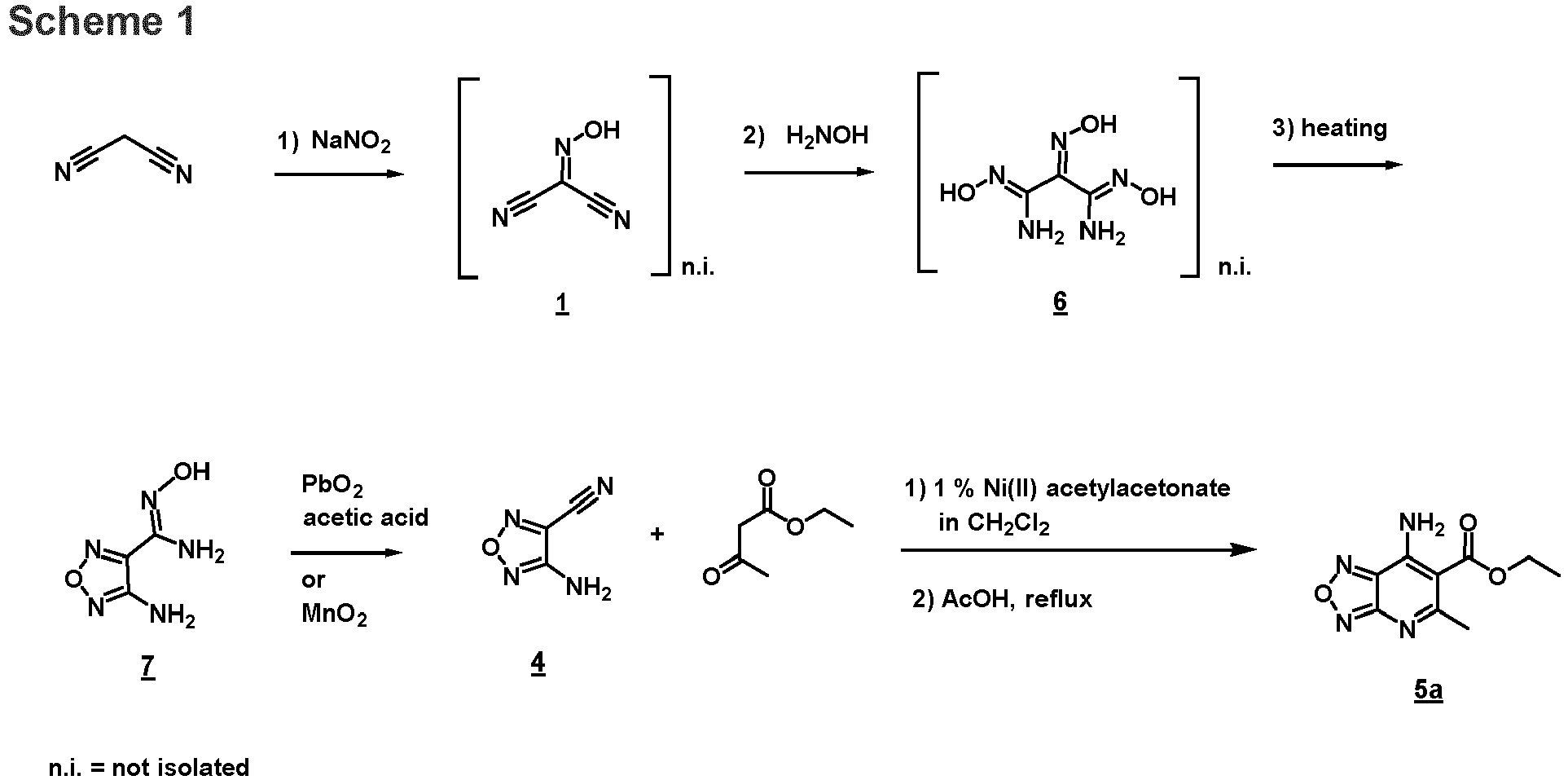
- In 2017, P.F. Pagoria et al. published a modification of Ichikawa's route with improved yield and purity (Chem. Heterocycl. Compounds 2017, 53, 760).
- The main drawback of the literature synthesis of 4-amino-1,2,5-oxadiazole-3-
carbonitrile 4 is that the intermediate compounds 6 and 7 (as well as compound 4) are highly energetic substances. D.S. Bohle et al. describe that compound 6 "explodes at about 130 °C during DSC experiments, shattering the sample cup" (J. Org. Chem 2000, 65, 1139). Moreover, to induce the cyclization of compound 6 to the oxadiazole 7, the aqueous reaction mixture has to be heated under reflux. This may cause safety issues, particularly in the upscale of this transformation. - Another important drawback of the literature synthesis is the use of lead compounds for the deoximation of oxadiazole 7 to the
oxadiazole 4. The use of toxic lead during the preparation of pharmaceuticals is questionable, anyway. However, in the majority of the literature descriptions, the lead is even used in stoichiometric amounts or higher. Thus, the weight load of lead compound in relation to substrate is high. As a result, a lot of toxic lead waste is generated. - As an alternative to the lead containing reagents,
WO 2018/44663 - A.B. Sheremetev and V.A. Dorokhov et al. showed that ethyl acetoacetate adds to the nitrile group of 4-amino-1,2,5-oxadiazole-3-
carbonitrile 4 in the presence of catalytic amounts of nickel(II) acetylacetonate in methylene chloride. By adding acetic acid and heating, ethyl 7-amino-5-methyl-[1,2,5]oxadiazolo[3,4-b]pyridine-carboxylate 5a is obtained via intramolecular cyclisation (Mendeleev Communication 1994, 4, 57; Russian Chemical Bulletin, Int. Ed., 2001, 50, 1280). - The present invention provides a process for manufacturing alkyl 7-amino-5-methyl-[1,2,5]-oxadiazolo[3,4-b]pyridine-carboxylate 5

- wherein R is C1-3-alkyl,
- by combining an integrated continuous flow system under overpressure, with a batch reactor, said process comprising the following steps:
- (a) reacting malononitrile with sodium nitrite in the presence of a suitable acid, preferably in the presence of acetic acid, in a suitable solvent;
- (b) reacting the reaction mixture obtained by step (a) with a suitable toluenesulfonic acid derivative, preferably with p-toluenesulfonyl chloride, to obtain
compound 2 ;
- (c) reacting
compound 2 in a suitable solvent with hydroxylamine or a suitable hydroxylamine salt to obtain compound 3;
- (d) cyclisation of compound 3 in the presence of a base under heating to about 120°C in a suitable solvent to obtain the
oxadiazole 4 ;
- (e) removal of water from the reaction mixture by phase separation;
- (f) in situ-condensation of
compound 4 in the reaction mixture obtained after step (e) with the appropriate beta-keto ester of formula
- wherein R is C1-3-alkyl,
- in a batch reactor in the presence of a Lewis acid such as zinc acetate in a suitable solvent; and
- (g) isolating compound 5 from a batch reactor.
- In the above process, the beta-keto ester is a C1-3-alkyl beta-keto ester. Preferably, the ethyl beta-keto ester is used. Correspondingly, in
scheme 2 below, R is C1-3-alkyl. Preferably, R is ethyl. - The process according to the invention is suitable for use on industrial scale.

- The flow process according to the present invention overcomes the disadvantages of processes of the prior art by having the distinction of
- 1) avoiding the highly energetic intermediates 6 and 7 ,
- 2) making use of inexpensive and readily accessible starting material and reagents,
- 3) avoiding the isolation of any intermediates, so that only the final product needs to be isolated,
- 4) eliminating the accumulation of all intermediates except 4 ,
- 5) avoiding the distillation of the solutions containing highly
energetic intermediate 4 , - 6) yielding alkyl 7-amino-5-methyl-[1,2,5]-oxadiazolo[3,4-b]pyridine-carboxylate 5 in high purity with high average yield for each step,
- 7) reducing the overall solvent need for all five steps by approx. 60 % as compared to the analogous batch processes.
- Suitable acids for step (a) include hydrohalic acids like hydrochloric acid and hydrobromic acid, or organic acids like acetic acid. Preferably, acetic acid is used.
- A suitable solvent for step (a) is water.
- Step (a) is preferably carried out at a temperature of 20 to 40 °C for 15 s to 5 min, preferably at a temperature of about 30 °C.
- The whole continuous flow process is preferably carried out in a system with overpressure of at least 2 bar. The overpressure is caused by gas evolution due to the chemical reaction in step (a) and by superheating solvents in step (d) and is maintained by a backpressure regulator near the end of the reactor. Preferably, the overpressure is between 2 and 15 bar, more preferably between 6 and 10 bar.
- Suitable toluenesulfonic acid derivatives useful as reagents for step (b) include p-toluenesulfonic acid anhydride and p-toluenesulfonic acid chloride. Preferably, p-toluenesulfonic acid chloride is used.
- Suitable solvents for step (b) include ethereal solvents like 2-methyl-tetrahydrofuran (2-MeTHF) and 1,4-dioxane as well as water, and the mixtures thereof.
- Step (b) is preferably carried out at a temperature of 20 to 40 °C for 15 s to 5 min, more preferably at a temperature of about 30 °C.
- Suitable solvents for step (c) include ethers like 2-methyl-tetrahydrofuran (2-MeTHF) and 1,4-dioxane and water, and mixtures thereof.
- Step (c) is preferably carried out at a temperature of 20 to 40 °C for 15 s to 5 min, more preferably at a temperature of about 30 °C.
- Suitable hydroxylamine salts include hydroxyl ammonium chloride and hydroxyl ammonium sulfate. Hydroxyl ammonium chloride is preferred. Suitable bases for step (c) include organic bases like triethylamine or inorganic bases like alkali acetates, alkali carbonates and alkali hydrogencarbonates. Examples for suitable acetates are lithium acetate, sodium acetate, and potassium acetate. Examples for suitable carbonates are sodium carbonate and potassium carbonate. Examples for suitable hydrogencarbonates are sodium hydrogencarbonate and potassium hydrogencarbonate. Preferably, potassium acetate is used.
- Suitable bases for step (d) include organic bases like triethylamine or inorganic bases like alkali acetates, alkali carbonates and alkali hydrogencarbonates. Examples for suitable acetates are lithium acetate, sodium acetate, and potassium acetate. Examples for suitable carbonates are sodium carbonate and potassium carbonate. Examples for suitable hydrogencarbonates are sodium hydrogencarbonate and potassium hydrogencarbonate. Preferably, potassium acetate is used.
- Suitable solvents for step (d) include ethers like 1,4-dioxane and 2-methyl-tetrahydrofuran (2-MeTHF) as well as water, and the mixtures thereof.
- Step (d) is preferably carried out at a temperature of 110 to 130 °C, more preferably at a temperature of about 120 °C for 15 s to 5 min and under a pressure of at least 2 bar.
- Step (e) may be conducted in a continuous or batch manner, preferably at about 20 to 45 °C by the use of a centrifugal extractor or batch reactor and with non-polar solvents as an extraction solvent. Heptane, isopropylacetate, methyl tert-butyl ether and toluene are suitable non-polar extraction solvents. The use of toluene or methyl tert-butyl ether as the solvent is preferred for continuous extraction. Most preferred for continuous extraction is the use of methyl tert-butyl ether as the solvent at a temperature of about 30 °C. Methyl tert-butyl ether is preferred for batch extraction.
- The appropriate beta-keto ester for step (f) is selected from the group consisting of a C1-3-alkyl beta-keto ester. Preferably, the ethyl beta-keto ester is used.
- Suitable Lewis acids for step (f) includes zinc salts like zinc acetate. Both zinc acetate dihydrate as well as anhydrous zinc acetate may be used. Preferably, zinc acetate dihydrate is used as Lewis acid.
- Suitable solvents for step (f) include ethers like 1,4-dioxane, 2-methyl-tetrahydrofuran (2-MeTHF) and methyl tert-butyl ether, alcohols like ethanol, non-polar solvents like toluene, and any mixtures thereof. The preferred ether is 1,4-dioxane and the preferred alcohol is ethanol.
- Step (f) is preferably carried out at a temperature of 60 to 100 °C, more preferably at a temperature of about 70 °C for 2 - 24h.
- In step (g), compound 5 is preferably isolated by distillation to remove toluene and 2-methyl-tetrahydrofuran (2-MeTHF) and precipitated via addition of an antisolvent like water and isolated via filtration.
- Alternatively, reacting the MTBE extract of 4 in ethanol to yield 5 allows either to crystallize and isolate 5 by simple addition of antisolvent water or by additional solvent distill off during the reaction time towards 5 , increasing the space-time-yield of the overall yield.
- A suitable flow reactor for steps (a) - (d) contains design features to promote mixing (such as impingement points or static mixers), especially for steps (b) and (c), is resistant to corrosion (e.g. such as glass or Hastelloy), is capable of safely withstanding operating pressures of up to 15 bar, has a backpressure regulator to minimize or prevent boiling of solvents, is capable of rapidly heating and cooling (about 50 W per kg/h = 180 kJ/g to keep selectivity), and has residence volumes long enough for the reactions to occur to completion. Additional safety features (such as relief valves, check valves) are optional. Pumps should be chosen based on their ability to pump at the necessary flow rates and pressures, preferably pulsation-free, at least with low pulsation.
-
Figure 1 shows the overall reactor scheme of the claimed process. - Terms not specifically defined herein should be given the meanings that would be given to them by one of skill in the art in light of the disclosure and context.
- In case a compound of the present invention is depicted in form of a chemical name and as a formula, in case of any discrepancy, the formula shall prevail.
- Unless specifically indicated, throughout the specification and the appended claims, a given chemical formula or name shall encompass tautomers, rotamers and all stereo, optical and geometrical isomers (e.g. enantiomers, diastereomers, including E/Z isomers etc...) and racemates thereof as well as mixtures in different proportions of the separate enantiomers, mixtures of diastereomers, or mixtures of any of the foregoing forms where such isomers and enantiomers exist, as well solvates thereof such as for instance hydrates.
-
- s
- seconds
- min
- minutes
- A%
- area percentage
- Note: all intermediates are highly energetic compounds and toxic gases are generated as byproducts. Special care has to be taken on safety measures.
- Synthesis of ethyl 7-amino-5-methyl-[1,2,5]-oxadiazolo[3,4-b]pyridine-carboxylate 5 with continuous extraction.
-

- 1. A solution of malononitrile (1.00 kg) in water (7.22 kg) and acetic acid (0.955 kg) was prepared in a stainless steel mix tank. The suspension was agitated until all solids dissolved. The resulting solution was passed through a charcoal cartridge and collected into a glass bottle to provide a clear, colorless solution. (Stream 1)
- 2. Sodium nitrite (1.097 kg) and water (4.005 kg) were added to a glass bottle and stirred until the solids dissolved. (Stream 2)
- 3. Toluenesulfonyl chloride (3.088 kg) was added to a carboy and blanketed with nitrogen gas. 1,4-Dioxane (18.22 kg) and 2-methyltetrahydrofuran (6.290 kg) were added and the suspension was stirred to dissolve the solids. (Stream 3)
- 4. Potassium acetate (5.067 kg), water (25.75 kg), hydroxylammonium chloride (1.073 kg), and 1,4-dioxane (12.93 kg) were added to a glass carboy. The suspension was stirred until all solids dissolved. (Stream 4)
- 5. Each feed stream was connected to a pump appropriate for pumping it.
- 6. The pumps for streams 1 (18.8 mL/min), 2 (9.59 mL/min), 3 (57 mL/min) 4 (47 mL/min), and toluene (20 mL/min), as well as the motors for the first and second centrifuges were started. The average residence times are 1.75 min, 1.75 min, 0.38 min, and 1.89 min for steps a, b, c, and d, respectively. Heat exchange functions were powered on.
- 7. The reaction mixture was discarded until equilibration of flows and completion of all chemical conversions was observed, as determined by HPLC, at which point the receiving vessel was changed and the reaction mixture was collected. The typical conversion under these exact conditions is >97 HPLC A% at 210 nm (A% 4 vs A% 2+ A% 3).
- 8. The aqueous and organic layers were collected until any of the starting material solutions was exhausted or until the desired run time was achieved. Each collection container was assayed by HPLC to ensure the process operated normally (typical aqueous concentration = 0.1 - 0.2
wt% oxadiazole 4 , typical organic concentration = 2.2 - 2.4 wt%). - 9. Zinc diacetate dihydrate (3.230 kg) was charged to an inerted batch reactor. The organic layers were charged and the suspension was agitated.
- 10. Ethyl acetoacetate (4.788 kg) was added to the batch reactor.
- 11. The batch was heated to 70 °C for 24h.
- 12. Once the target conversion was met, the suspension was distilled and 1,4-dioxane was added until the 2-MeTHF and toluene had been removed.
- 13. Water was added to maintain the internal batch temperature between 65 and 70 °C.
- 14. The batch was aged at 65 - 70 °C for 20 minutes after crystallization occurred.
- 15. The batch was cooled to room temperature over ~ 1 h.
- 16. The batch was filtered.
- 17. The cake was washed with water (4.000 kg).
- 18. The cake was transferred to a tray and dried at 40 °C for 16 h under a purge of nitrogen gas to afford a solid (35% overall yield, 1.170 kg)
- 1H NMR (400 MHz, DMSO-d6) δ (ppm) = 8.61 (bs, 2H), 4.35 (q, 2H), 2.62 (s, 3H), 1.34 (t, 3H).
- HPLC Area % >98 % at 210 nm.
Claims (20)
- Process for manufacturing alkyl 7-amino-5-methyl-[1,2,5]-oxadiazolo[3,4-b]pyridine-carboxylate 5
 wherein R is C1-3-alkyl,by combining an integrated continuous flow system under overpressure, with a batch reactor, said process comprising the following steps:(a) reacting malononitrile with sodium nitrite in the presence of a suitable acid in a suitable solvent;(b) reacting the reaction mixture obtained by step (a) with a suitable toluenesulfonic acid derivative to obtain compound 2 ;
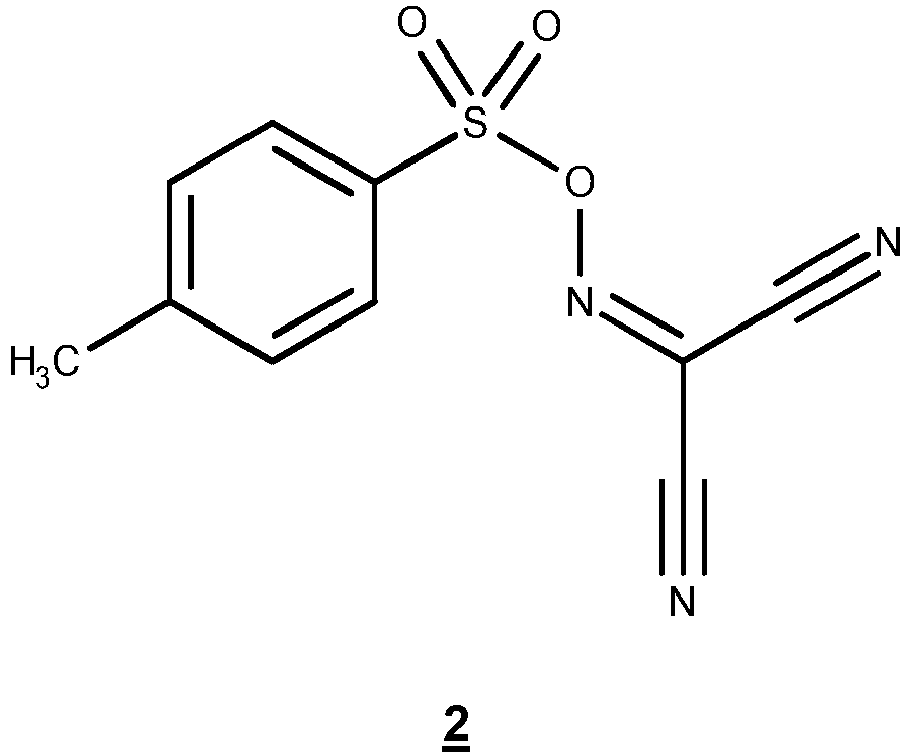 (c) reacting compound 2 in a suitable solvent with hydroxylamine or a suitable hydroxylamine salt to obtain compound 3 ;
 (d) cyclisation of compound 3 in the presence of a base under heating to about 120°C in a suitable solvent to obtain the oxadiazole 4 ;
 (e) removal of water from the reaction mixture by phase separation;(f) in situ-condensation of compound 4 in the reaction mixture obtained after step (e) with the appropriate beta-keto ester of formula
 (g) isolating compound 5 from the batch reactor.
 - The process according to claim 1 characterized in that in step (a), hydrochloric acid, hydrobromic acid or acetic acid are used as the suitable acid, and water is used as the solvent.
- The process according to any one of the preceding claims characterized in that step (a) is carried out under an overpressure of at least 2 bar at a temperature of 20 to 40 °C for 15 sec to 5 min.
- The process according to any one of the preceding claims characterized in that in step (a), acetic acid is used as the suitable acid, and water is used as the solvent at a temperature about 30 °C for 15 sec to 5 min.
- The process according to any one of the preceding claims characterized in that in step (b), the toluenesulfonic acid derivative is toluenesulfonic acid anhydride or toluenesulfonic acid chloride, and the reaction is carried out at a temperature of 20 to 40 °C for 15 sec to 5 min.
- The process according to any one of the preceding claims characterized in that in step (b), the toluenesulfonic acid derivative is toluenesulfonic acid chloride, and the reaction is carried out at a temperature of about 30 °C for 15 sec to 5 min.
- The process according to any one of the preceding claims characterized in that in step (c), the reaction is carried out at a temperature of 20 to 40 °C for 15 sec to 5 min, using ethers, water, or mixtures thereof as solvent.
- The process according to any one of the preceding claims characterized in that in step (c), the reaction is carried out at a temperature of about 30 °C for 15 sec to 5 min, using 2-methyl-tetrahydrofuran, 1,4-dioxane, water, or mixtures thereof as the suitable solvent and hydroxylammonium chloride as the suitable hydroxylamine salt.
- The process according to any one of the preceding claims characterized in that in step (d), the cyclisation is carried out in the presence of triethylamine, an alkali acetate, an alkali carbonate or an alkali hydrogencarbonate using ethers, water, or mixtures thereof as the solvent, at a temperature of 110 to 130 °C for 15 sec to 5 min under a pressure of at least 2 bar.
- The process according to any one of the preceding claims characterized in that in step (d), the alkali acetate is selected from the group consisting of lithium acetate, sodium acetate, and potassium acetate; the alkali carbonate is selected from the group consisting of sodium carbonate and potassium carbonate; the alkali hydrogencarbonate is selected from the group consisting of sodium hydrogencarbonate and potassium hydrogencarbonate; and the ether is 1,4-dioxane or 2-methyl-tetrahydrofuran.
- The process according to any one of the preceding claims characterized in that in step (e), water is removed by extraction at about 20 to 45 °C, using non-polar extraction solvents like toluene, methyl tert-butyl ether, heptane, or isopropyl acetate.
- The process according to any one of the preceding claims characterized in that in step (e), water is continuously removed by extraction at about 20 to 45 °C using toluene or methyl tert-butyl ether as extraction solvent.
- The process according to any one of the preceding claims characterized in that in step (e), water is continuously removed by extraction at about 30 °C using methyl tert-butyl ether as extraction solvent.
- The process according to any one of the preceding claims characterized in that in step (e), water is removed in a batch-process at about 20 °C using methyl tert-butyl ether as extraction solvent.
- The process according to any one of the preceding claims characterized in that in step (f), the in situ-condensation is carried out in the presence of a zinc salt as Lewis acid at a temperature of 60 to 100 °C for 2 to 24 hours, in a solvent selected from the group consisting of an ether, alcohol, non-polar solvents, and mixtures thereof.
- The process according to any one of the preceding claims characterized in that in step (f), the in situ-condensation is carried out in the presence of zinc acetate as the Lewis acid at a temperature of 60 to 100 °C for 2 to 24 hours, in a solvent selected from the group consisting of 1,4-dioxane, 2-methyl-tetrahydrofuran, methyl tert-butyl ether, and ethanol, and the mixtures thereof.
- The process according to any one of the preceding claims characterized in that in step (g), compound 5 is precipitated via addition of an antisolvent and then isolated via filtration.
- The process according to any one of the preceding claims characterized in that in step (g), compound 5 is precipitated via addition of water and then isolated via filtration.
- The process according to any one of the preceding claims characterized in that in step (g), prior compound 5 is precipitated as in claim 17 or 18, the reaction solvent is distilled off, preferably during the reaction process itself.
- The process according to any one of the preceding claims, wherein R is ethyl.
Applications Claiming Priority (2)
| Application Number | Priority Date | Filing Date | Title |
|---|---|---|---|
| EP20176117 | 2020-05-22 | ||
| PCT/EP2021/063090 WO2021233884A1 (en) | 2020-05-22 | 2021-05-18 | Continuous process for manufacturing alkyl 7-amino-5-methyl-[1,2,5]oxadiazolo[3,4-b]pyridine-carboxylate |
Publications (2)
| Publication Number | Publication Date |
|---|---|
| EP4153600A1 EP4153600A1 (en) | 2023-03-29 |
| EP4153600B1 true EP4153600B1 (en) | 2024-08-07 |
Family
ID=70802781
Family Applications (1)
| Application Number | Title | Priority Date | Filing Date |
|---|---|---|---|
| EP21726390.4A Active EP4153600B1 (en) | 2020-05-22 | 2021-05-18 | Continuous process for manufacturing alkyl 7-amino-5-methyl-[1,2,5]oxadiazolo[3,4-b]pyridine-carboxylate |
Country Status (10)
| Country | Link |
|---|---|
| US (1) | US11976082B2 (en) |
| EP (1) | EP4153600B1 (en) |
| JP (1) | JP7702969B2 (en) |
| CN (1) | CN115916789B (en) |
| DK (1) | DK4153600T3 (en) |
| ES (1) | ES2991340T3 (en) |
| HU (1) | HUE069479T2 (en) |
| PL (1) | PL4153600T3 (en) |
| TW (1) | TW202208378A (en) |
| WO (1) | WO2021233884A1 (en) |
Family Cites Families (38)
| Publication number | Priority date | Publication date | Assignee | Title |
|---|---|---|---|---|
| JP2002249492A (en) | 2000-12-22 | 2002-09-06 | Nippon Bayer Agrochem Co Ltd | Triazopyrimidines |
| WO2004082383A1 (en) | 2003-03-17 | 2004-09-30 | Basf Aktiengesellschaft | Use of triazolopyrimidines for combating nematode diseases of plants |
| CA2536253A1 (en) * | 2003-08-20 | 2005-03-03 | Vertex Pharmaceuticals Incorporated | Aminofurazan compounds useful as protein kinase inhibitors |
| JP2008538759A (en) | 2005-04-25 | 2008-11-06 | ビーエーエスエフ ソシエタス・ヨーロピア | Use of 5-alkyl-6-phenylalkyl-7-aminoazolopyrimidines, novel azolopyrimidines, processes for their preparation, and compositions containing them |
| MX2009008241A (en) | 2007-02-15 | 2009-10-08 | Univ Indiana Res & Tech Corp | Glucagon/glp-1 receptor co-agonists. |
| MX2009011025A (en) | 2007-04-11 | 2010-01-25 | Canbas Co Ltd | Compounds with anti-cancer activity. |
| CA2685524A1 (en) | 2007-04-30 | 2008-11-06 | Abbott Laboratories | Inhibitors of diacylglycerol o-acyltransferase type 1 enzyme |
| WO2008141843A1 (en) | 2007-05-24 | 2008-11-27 | Bayer Schering Pharma Aktiengesellschaft | Novel sulphoximine-substituted quinazoline and quinazoline derivatives as kinase inhibitors |
| JP5385266B2 (en) | 2007-06-15 | 2014-01-08 | ジーランド ファーマ アクティーゼルスカブ | Glucagon analog |
| FR2934058B1 (en) | 2008-07-15 | 2010-09-24 | Centre Nat Rech Scient | THREE-OPEN INTERFEROMETRIC PROJECTION DEVICE FOR PRODUCING A TASK CONSISTING OF FINE STRUCTURES |
| FR2933989B1 (en) | 2008-07-16 | 2013-03-08 | Commissariat Energie Atomique | PROCESS FOR PURIFYING MICROORGANISMS IN LIQUID SAMPLES |
| FR2933975B1 (en) | 2008-07-17 | 2011-02-18 | Servier Lab | NOVEL PROCESS FOR THE PREPARATION OF FUNCTIONALIZED BENZOCYCLOBUTENES, AND APPLICATION TO THE SYNTHESIS OF IVABRADINE AND ITS SALTS OF ADDITION TO A PHARMACEUTICALLY ACCEPTABLE ACID |
| MX2011006314A (en) | 2008-12-15 | 2011-09-22 | Zealand Pharma As | Glucagon analogues. |
| AP3329A (en) | 2009-07-13 | 2015-06-30 | Zealand Pharma As | Acylated glucagon analogues |
| WO2011114148A1 (en) | 2010-03-17 | 2011-09-22 | Astrazeneca Ab | 4h- [1, 2, 4] triazolo [5, 1 -b] pyrimidin-7 -one derivatives as ccr2b receptor antagonists |
| UY33462A (en) | 2010-06-23 | 2012-01-31 | Zealand Pharma As | GLUCAGON ANALOGS |
| KR20130086343A (en) | 2010-06-24 | 2013-08-01 | 질랜드 파마 에이/에스 | Glucagon analogues |
| US9802954B2 (en) * | 2011-08-24 | 2017-10-31 | Boehringer Ingelheim International Gmbh | Piperidino-dihydrothienopyrimidine sulfoxides and their use for treating COPD and asthma |
| CN103102348B (en) * | 2011-11-14 | 2016-06-08 | 上海交通大学 | Diazoles compound and preparation method thereof, medical composition and its use |
| KR20140114845A (en) | 2011-12-23 | 2014-09-29 | 질랜드 파마 에이/에스 | Glucagon analogues |
| US9238639B2 (en) | 2012-02-24 | 2016-01-19 | Takeda Pharmaceutical Company Limited | Aromatic ring compound |
| WO2013192388A1 (en) | 2012-06-20 | 2013-12-27 | University Of Virginia Patent Foundation | Compositions and methods for regulating glucose homeostasis and insulin action |
| TWI608013B (en) | 2012-09-17 | 2017-12-11 | 西蘭製藥公司 | Glucagon analog |
| UA118034C2 (en) | 2013-11-14 | 2018-11-12 | Елі Ліллі Енд Компані | Substituted piperidyl-ethyl-pyrimidine as ghrelin o-acyl transferase inhibitor |
| EP3193939A4 (en) | 2014-09-17 | 2018-10-24 | The Regents of The University of California | Small lipopeptidomimetic inhibitors of ghrelin o-acyl transferase |
| WO2016091746A1 (en) | 2014-12-11 | 2016-06-16 | Dsm Sinochem Pharmaceuticals Netherlands B.V. | Method for acylating a cyclic peptide |
| WO2016123275A1 (en) | 2015-01-30 | 2016-08-04 | Boehringer Ingelheim International Gmbh | Aldosterone synthase inhibitors |
| AR104672A1 (en) | 2015-04-15 | 2017-08-09 | Lilly Co Eli | GRELINA INHIBITORS O-ACILTRANSFERASA |
| AR104673A1 (en) | 2015-04-15 | 2017-08-09 | Lilly Co Eli | GRELINA INHIBITORS O-ACILTRANSFERASA |
| ES2936400T3 (en) | 2015-10-22 | 2023-03-16 | Cavion Inc | Methods to treat Angelman syndrome |
| RS61937B1 (en) | 2016-08-05 | 2021-07-30 | Boehringer Ingelheim Int | Oxadiazolopyridine derivatives for use as ghrelin o-acyl transferase (goat) inhibitors |
| EP3504185B1 (en) | 2016-08-29 | 2021-11-24 | Merck Sharp & Dohme Corp. | Novel substituted n'-hydroxycarbamimidoyl-1,2,5-oxadiazole compounds as indoleamine 2,3-dioxygenase (ido) inhibitors |
| CN110139867A (en) * | 2016-12-27 | 2019-08-16 | 国立大学法人大阪大学 | The double chalcogen oxadiazole derivatives of naphtho- and its manufacturing method |
| CN111630055B (en) | 2018-02-02 | 2023-07-14 | 勃林格殷格翰国际有限公司 | Pyrazole-substituted and indazole-substituted oxadiazolopyridine derivatives useful as ghrelin O-acyltransferase (GOAT) inhibitors |
| CN111655700B (en) | 2018-02-02 | 2023-07-18 | 勃林格殷格翰国际有限公司 | Oxadiazolopyridine derivatives as ghrelin O-acyltransferase (GOAT) inhibitors |
| JOP20200187A1 (en) | 2018-02-02 | 2020-07-29 | Boehringer Ingelheim Int | Triazolopyrimidine derivatives for use as ghrelin o-acyl transferase (goat) inhibitors |
| MX2020008116A (en) | 2018-02-02 | 2020-09-25 | Boehringer Ingelheim Int | Heterocyclyl-substituted oxadiazolopyridine derivatives for use as ghrelin o-acyl transferase (goat) inhibitors. |
| EP4153599B1 (en) * | 2020-05-22 | 2024-03-13 | Boehringer Ingelheim International GmbH | Process for manufacturing alkyl 7-amino-5-methyl-[1,2,5]oxadiazolo[3,4-b]pyridine-carboxylate |
-
2021
- 2021-05-18 PL PL21726390.4T patent/PL4153600T3/en unknown
- 2021-05-18 EP EP21726390.4A patent/EP4153600B1/en active Active
- 2021-05-18 CN CN202180036761.0A patent/CN115916789B/en active Active
- 2021-05-18 DK DK21726390.4T patent/DK4153600T3/en active
- 2021-05-18 WO PCT/EP2021/063090 patent/WO2021233884A1/en not_active Ceased
- 2021-05-18 HU HUE21726390A patent/HUE069479T2/en unknown
- 2021-05-18 ES ES21726390T patent/ES2991340T3/en active Active
- 2021-05-18 JP JP2022570159A patent/JP7702969B2/en active Active
- 2021-05-21 US US17/326,383 patent/US11976082B2/en active Active
- 2021-05-21 TW TW110118394A patent/TW202208378A/en unknown
Also Published As
| Publication number | Publication date |
|---|---|
| CN115916789A (en) | 2023-04-04 |
| PL4153600T3 (en) | 2024-12-16 |
| HUE069479T2 (en) | 2025-04-28 |
| CN115916789B (en) | 2025-06-27 |
| WO2021233884A1 (en) | 2021-11-25 |
| TW202208378A (en) | 2022-03-01 |
| DK4153600T3 (en) | 2024-10-21 |
| JP2023526353A (en) | 2023-06-21 |
| US11976082B2 (en) | 2024-05-07 |
| ES2991340T3 (en) | 2024-12-03 |
| JP7702969B2 (en) | 2025-07-04 |
| US20210363157A1 (en) | 2021-11-25 |
| EP4153600A1 (en) | 2023-03-29 |
Similar Documents
| Publication | Publication Date | Title |
|---|---|---|
| AU2006281449A1 (en) | Method for producing betamimetics | |
| EP2938609B1 (en) | Process for the preparation of 1-([1,3]dioxolan-4-ylmethyl)-1h-pyrazol-3-ylamine | |
| AU2023206696A1 (en) | Method for preparing pyrrole compound and intermediate thereof | |
| EP4153599B1 (en) | Process for manufacturing alkyl 7-amino-5-methyl-[1,2,5]oxadiazolo[3,4-b]pyridine-carboxylate | |
| US7456322B2 (en) | Process for preparing 1,3-dibromoacetone, 1-3-dichloroacetone and epichlorohydrin | |
| US11976082B2 (en) | Continuous process for manufacturing alkyl 7-amino-5-methyl-[1,2,5]oxadiazolo[3,4-b]pyridine-carboxylate | |
| EP4013416B1 (en) | Process for preparing 1,4-dihydro-4-oxoquinoline-2-carboxylates and 4-aminoquinoline compounds therefrom | |
| CN115417816A (en) | Preparation method of 3,6-dibromo-1-chloro-isoquinoline | |
| US20230033450A1 (en) | Method for preparing diazoxide | |
| US5478947A (en) | Effective process for the production of 1,2,3-triazoles | |
| US5516934A (en) | Process for producing mono-P-nitrobenzyl malonate | |
| EP4227297A1 (en) | Process for preparing diphenylureido-dihalokynurenic acids and tosylate addition salts thereof | |
| JP4541143B2 (en) | Method for producing quinoline derivative | |
| EP3245190B1 (en) | Method for preparing 4-cyanopiperidine hydrochloride | |
| WO2026101917A1 (en) | Processes related to preparation of fungicidal aryl amidines | |
| HK40078770A (en) | Process for preparing 1,4-dihydro-4-oxoquinoline-2-carboxylates and 4-aminoquinoline compounds therefrom | |
| HK40078770B (en) | Process for preparing 1,4-dihydro-4-oxoquinoline-2-carboxylates and 4-aminoquinoline compounds therefrom | |
| JPS6317853A (en) | Production of 2-methoxymethylene-3,3-dimethoxypropanenitrile | |
| EP1666470A1 (en) | Process for production of n,n';n''-trisubstituted isocyanuric acids | |
| JPH07196643A (en) | Method for purifying 4- (3,4-dihydro-2-methoxy-2,4,4-trimethyl-2H-1-benzopyranyl-7-oxy) nitrobenzene |
Legal Events
| Date | Code | Title | Description |
|---|---|---|---|
| STAA | Information on the status of an ep patent application or granted ep patent |
Free format text: STATUS: UNKNOWN |
|
| STAA | Information on the status of an ep patent application or granted ep patent |
Free format text: STATUS: THE INTERNATIONAL PUBLICATION HAS BEEN MADE |
|
| PUAI | Public reference made under article 153(3) epc to a published international application that has entered the european phase |
Free format text: ORIGINAL CODE: 0009012 |
|
| STAA | Information on the status of an ep patent application or granted ep patent |
Free format text: STATUS: REQUEST FOR EXAMINATION WAS MADE |
|
| 17P | Request for examination filed |
Effective date: 20221222 |
|
| AK | Designated contracting states |
Kind code of ref document: A1 Designated state(s): AL AT BE BG CH CY CZ DE DK EE ES FI FR GB GR HR HU IE IS IT LI LT LU LV MC MK MT NL NO PL PT RO RS SE SI SK SM TR |
|
| DAV | Request for validation of the european patent (deleted) | ||
| DAX | Request for extension of the european patent (deleted) | ||
| GRAP | Despatch of communication of intention to grant a patent |
Free format text: ORIGINAL CODE: EPIDOSNIGR1 |
|
| STAA | Information on the status of an ep patent application or granted ep patent |
Free format text: STATUS: GRANT OF PATENT IS INTENDED |
|
| INTG | Intention to grant announced |
Effective date: 20231018 |
|
| GRAJ | Information related to disapproval of communication of intention to grant by the applicant or resumption of examination proceedings by the epo deleted |
Free format text: ORIGINAL CODE: EPIDOSDIGR1 |
|
| STAA | Information on the status of an ep patent application or granted ep patent |
Free format text: STATUS: REQUEST FOR EXAMINATION WAS MADE |
|
| INTC | Intention to grant announced (deleted) | ||
| P01 | Opt-out of the competence of the unified patent court (upc) registered |
Effective date: 20240202 |
|
| GRAP | Despatch of communication of intention to grant a patent |
Free format text: ORIGINAL CODE: EPIDOSNIGR1 |
|
| STAA | Information on the status of an ep patent application or granted ep patent |
Free format text: STATUS: GRANT OF PATENT IS INTENDED |
|
| INTG | Intention to grant announced |
Effective date: 20240318 |
|
| GRAS | Grant fee paid |
Free format text: ORIGINAL CODE: EPIDOSNIGR3 |
|
| GRAA | (expected) grant |
Free format text: ORIGINAL CODE: 0009210 |
|
| STAA | Information on the status of an ep patent application or granted ep patent |
Free format text: STATUS: THE PATENT HAS BEEN GRANTED |
|
| AK | Designated contracting states |
Kind code of ref document: B1 Designated state(s): AL AT BE BG CH CY CZ DE DK EE ES FI FR GB GR HR HU IE IS IT LI LT LU LV MC MK MT NL NO PL PT RO RS SE SI SK SM TR |
|
| REG | Reference to a national code |
Ref country code: GB Ref legal event code: FG4D |
|
| REG | Reference to a national code |
Ref country code: CH Ref legal event code: EP |
|
| REG | Reference to a national code |
Ref country code: IE Ref legal event code: FG4D |
|
| REG | Reference to a national code |
Ref country code: DE Ref legal event code: R096 Ref document number: 602021016844 Country of ref document: DE |
|
| REG | Reference to a national code |
Ref country code: DK Ref legal event code: T3 Effective date: 20241014 |
|
| REG | Reference to a national code |
Ref country code: NL Ref legal event code: FP |
|
| REG | Reference to a national code |
Ref country code: SE Ref legal event code: TRGR |
|
| REG | Reference to a national code |
Ref country code: LT Ref legal event code: MG9D |
|
| REG | Reference to a national code |
Ref country code: ES Ref legal event code: FG2A Ref document number: 2991340 Country of ref document: ES Kind code of ref document: T3 Effective date: 20241203 |
|
| REG | Reference to a national code |
Ref country code: SK Ref legal event code: T3 Ref document number: E 45142 Country of ref document: SK |
|
| PG25 | Lapsed in a contracting state [announced via postgrant information from national office to epo] |
Ref country code: NO Free format text: LAPSE BECAUSE OF FAILURE TO SUBMIT A TRANSLATION OF THE DESCRIPTION OR TO PAY THE FEE WITHIN THE PRESCRIBED TIME-LIMIT Effective date: 20241107 |
|
| REG | Reference to a national code |
Ref country code: AT Ref legal event code: UEP Ref document number: 1710829 Country of ref document: AT Kind code of ref document: T Effective date: 20240807 |
|
| PG25 | Lapsed in a contracting state [announced via postgrant information from national office to epo] |
Ref country code: GR Free format text: LAPSE BECAUSE OF FAILURE TO SUBMIT A TRANSLATION OF THE DESCRIPTION OR TO PAY THE FEE WITHIN THE PRESCRIBED TIME-LIMIT Effective date: 20241108 Ref country code: FI Free format text: LAPSE BECAUSE OF FAILURE TO SUBMIT A TRANSLATION OF THE DESCRIPTION OR TO PAY THE FEE WITHIN THE PRESCRIBED TIME-LIMIT Effective date: 20240807 Ref country code: PT Free format text: LAPSE BECAUSE OF FAILURE TO SUBMIT A TRANSLATION OF THE DESCRIPTION OR TO PAY THE FEE WITHIN THE PRESCRIBED TIME-LIMIT Effective date: 20241209 |
|
| PG25 | Lapsed in a contracting state [announced via postgrant information from national office to epo] |
Ref country code: BG Free format text: LAPSE BECAUSE OF FAILURE TO SUBMIT A TRANSLATION OF THE DESCRIPTION OR TO PAY THE FEE WITHIN THE PRESCRIBED TIME-LIMIT Effective date: 20240807 |
|
| PG25 | Lapsed in a contracting state [announced via postgrant information from national office to epo] |
Ref country code: LV Free format text: LAPSE BECAUSE OF FAILURE TO SUBMIT A TRANSLATION OF THE DESCRIPTION OR TO PAY THE FEE WITHIN THE PRESCRIBED TIME-LIMIT Effective date: 20240807 |
|
| PG25 | Lapsed in a contracting state [announced via postgrant information from national office to epo] |
Ref country code: IS Free format text: LAPSE BECAUSE OF FAILURE TO SUBMIT A TRANSLATION OF THE DESCRIPTION OR TO PAY THE FEE WITHIN THE PRESCRIBED TIME-LIMIT Effective date: 20241207 |
|
| PG25 | Lapsed in a contracting state [announced via postgrant information from national office to epo] |
Ref country code: HR Free format text: LAPSE BECAUSE OF FAILURE TO SUBMIT A TRANSLATION OF THE DESCRIPTION OR TO PAY THE FEE WITHIN THE PRESCRIBED TIME-LIMIT Effective date: 20240807 |
|
| PG25 | Lapsed in a contracting state [announced via postgrant information from national office to epo] |
Ref country code: RS Free format text: LAPSE BECAUSE OF FAILURE TO SUBMIT A TRANSLATION OF THE DESCRIPTION OR TO PAY THE FEE WITHIN THE PRESCRIBED TIME-LIMIT Effective date: 20241107 |
|
| PG25 | Lapsed in a contracting state [announced via postgrant information from national office to epo] |
Ref country code: RS Free format text: LAPSE BECAUSE OF FAILURE TO SUBMIT A TRANSLATION OF THE DESCRIPTION OR TO PAY THE FEE WITHIN THE PRESCRIBED TIME-LIMIT Effective date: 20241107 Ref country code: PT Free format text: LAPSE BECAUSE OF FAILURE TO SUBMIT A TRANSLATION OF THE DESCRIPTION OR TO PAY THE FEE WITHIN THE PRESCRIBED TIME-LIMIT Effective date: 20241209 Ref country code: NO Free format text: LAPSE BECAUSE OF FAILURE TO SUBMIT A TRANSLATION OF THE DESCRIPTION OR TO PAY THE FEE WITHIN THE PRESCRIBED TIME-LIMIT Effective date: 20241107 Ref country code: LV Free format text: LAPSE BECAUSE OF FAILURE TO SUBMIT A TRANSLATION OF THE DESCRIPTION OR TO PAY THE FEE WITHIN THE PRESCRIBED TIME-LIMIT Effective date: 20240807 Ref country code: IS Free format text: LAPSE BECAUSE OF FAILURE TO SUBMIT A TRANSLATION OF THE DESCRIPTION OR TO PAY THE FEE WITHIN THE PRESCRIBED TIME-LIMIT Effective date: 20241207 Ref country code: HR Free format text: LAPSE BECAUSE OF FAILURE TO SUBMIT A TRANSLATION OF THE DESCRIPTION OR TO PAY THE FEE WITHIN THE PRESCRIBED TIME-LIMIT Effective date: 20240807 Ref country code: GR Free format text: LAPSE BECAUSE OF FAILURE TO SUBMIT A TRANSLATION OF THE DESCRIPTION OR TO PAY THE FEE WITHIN THE PRESCRIBED TIME-LIMIT Effective date: 20241108 Ref country code: FI Free format text: LAPSE BECAUSE OF FAILURE TO SUBMIT A TRANSLATION OF THE DESCRIPTION OR TO PAY THE FEE WITHIN THE PRESCRIBED TIME-LIMIT Effective date: 20240807 Ref country code: BG Free format text: LAPSE BECAUSE OF FAILURE TO SUBMIT A TRANSLATION OF THE DESCRIPTION OR TO PAY THE FEE WITHIN THE PRESCRIBED TIME-LIMIT Effective date: 20240807 |
|
| PG25 | Lapsed in a contracting state [announced via postgrant information from national office to epo] |
Ref country code: SM Free format text: LAPSE BECAUSE OF FAILURE TO SUBMIT A TRANSLATION OF THE DESCRIPTION OR TO PAY THE FEE WITHIN THE PRESCRIBED TIME-LIMIT Effective date: 20240807 |
|
| PG25 | Lapsed in a contracting state [announced via postgrant information from national office to epo] |
Ref country code: EE Free format text: LAPSE BECAUSE OF FAILURE TO SUBMIT A TRANSLATION OF THE DESCRIPTION OR TO PAY THE FEE WITHIN THE PRESCRIBED TIME-LIMIT Effective date: 20240807 |
|
| REG | Reference to a national code |
Ref country code: HU Ref legal event code: AG4A Ref document number: E069479 Country of ref document: HU |
|
| REG | Reference to a national code |
Ref country code: DE Ref legal event code: R097 Ref document number: 602021016844 Country of ref document: DE |
|
| PLBE | No opposition filed within time limit |
Free format text: ORIGINAL CODE: 0009261 |
|
| STAA | Information on the status of an ep patent application or granted ep patent |
Free format text: STATUS: NO OPPOSITION FILED WITHIN TIME LIMIT |
|
| PGFP | Annual fee paid to national office [announced via postgrant information from national office to epo] |
Ref country code: NL Payment date: 20250521 Year of fee payment: 5 |
|
| PGFP | Annual fee paid to national office [announced via postgrant information from national office to epo] |
Ref country code: PL Payment date: 20250425 Year of fee payment: 5 Ref country code: DE Payment date: 20250521 Year of fee payment: 5 |
|
| PGFP | Annual fee paid to national office [announced via postgrant information from national office to epo] |
Ref country code: DK Payment date: 20250526 Year of fee payment: 5 |
|
| PGFP | Annual fee paid to national office [announced via postgrant information from national office to epo] |
Ref country code: HU Payment date: 20250523 Year of fee payment: 5 |
|
| PGFP | Annual fee paid to national office [announced via postgrant information from national office to epo] |
Ref country code: BE Payment date: 20250521 Year of fee payment: 5 |
|
| 26N | No opposition filed |
Effective date: 20250508 |
|
| PGFP | Annual fee paid to national office [announced via postgrant information from national office to epo] |
Ref country code: FR Payment date: 20250528 Year of fee payment: 5 |
|
| PGFP | Annual fee paid to national office [announced via postgrant information from national office to epo] |
Ref country code: CH Payment date: 20250601 Year of fee payment: 5 |
|
| PGFP | Annual fee paid to national office [announced via postgrant information from national office to epo] |
Ref country code: AT Payment date: 20250721 Year of fee payment: 5 |
|
| PGFP | Annual fee paid to national office [announced via postgrant information from national office to epo] |
Ref country code: TR Payment date: 20250512 Year of fee payment: 5 Ref country code: SK Payment date: 20250512 Year of fee payment: 5 |
|
| PGFP | Annual fee paid to national office [announced via postgrant information from national office to epo] |
Ref country code: CZ Payment date: 20250514 Year of fee payment: 5 |
|
| PGFP | Annual fee paid to national office [announced via postgrant information from national office to epo] |
Ref country code: SE Payment date: 20250521 Year of fee payment: 5 |
|
| PGFP | Annual fee paid to national office [announced via postgrant information from national office to epo] |
Ref country code: ES Payment date: 20250630 Year of fee payment: 5 |
|
| PG25 | Lapsed in a contracting state [announced via postgrant information from national office to epo] |
Ref country code: LU Free format text: LAPSE BECAUSE OF NON-PAYMENT OF DUE FEES Effective date: 20250518 |
|
| PG25 | Lapsed in a contracting state [announced via postgrant information from national office to epo] |
Ref country code: MC Free format text: LAPSE BECAUSE OF FAILURE TO SUBMIT A TRANSLATION OF THE DESCRIPTION OR TO PAY THE FEE WITHIN THE PRESCRIBED TIME-LIMIT Effective date: 20240807 |
|
| PGFP | Annual fee paid to national office [announced via postgrant information from national office to epo] |
Ref country code: GB Payment date: 20260306 Year of fee payment: 6 |
|
| PG25 | Lapsed in a contracting state [announced via postgrant information from national office to epo] |
Ref country code: IE Free format text: LAPSE BECAUSE OF NON-PAYMENT OF DUE FEES Effective date: 20250518 |
|
| PG25 | Lapsed in a contracting state [announced via postgrant information from national office to epo] |
Ref country code: RO Free format text: LAPSE BECAUSE OF FAILURE TO SUBMIT A TRANSLATION OF THE DESCRIPTION OR TO PAY THE FEE WITHIN THE PRESCRIBED TIME-LIMIT Effective date: 20240807 Ref country code: IT Free format text: LAPSE BECAUSE OF NON-PAYMENT OF DUE FEES Effective date: 20250518 |