EP4152620A1 - Carrier phase tracking method and device for orthogonal frequency division multiplexing multi-carrier system - Google Patents
Carrier phase tracking method and device for orthogonal frequency division multiplexing multi-carrier system Download PDFInfo
- Publication number
- EP4152620A1 EP4152620A1 EP21805049.0A EP21805049A EP4152620A1 EP 4152620 A1 EP4152620 A1 EP 4152620A1 EP 21805049 A EP21805049 A EP 21805049A EP 4152620 A1 EP4152620 A1 EP 4152620A1
- Authority
- EP
- European Patent Office
- Prior art keywords
- phase
- estimated value
- ofdm symbol
- carrier
- pll
- Prior art date
- Legal status (The legal status is an assumption and is not a legal conclusion. Google has not performed a legal analysis and makes no representation as to the accuracy of the status listed.)
- Pending
Links
Images


Classifications
-
- H—ELECTRICITY
- H04—ELECTRIC COMMUNICATION TECHNIQUE
- H04B—TRANSMISSION
- H04B1/00—Details of transmission systems, not covered by a single one of groups H04B3/00 - H04B13/00; Details of transmission systems not characterised by the medium used for transmission
- H04B1/06—Receivers
-
- H—ELECTRICITY
- H04—ELECTRIC COMMUNICATION TECHNIQUE
- H04L—TRANSMISSION OF DIGITAL INFORMATION, e.g. TELEGRAPHIC COMMUNICATION
- H04L27/00—Modulated-carrier systems
- H04L27/26—Systems using multi-frequency codes
- H04L27/2601—Multicarrier modulation systems
- H04L27/2647—Arrangements specific to the receiver only
- H04L27/2655—Synchronisation arrangements
- H04L27/2668—Details of algorithms
- H04L27/2669—Details of algorithms characterised by the domain of operation
- H04L27/2671—Time domain
-
- G—PHYSICS
- G01—MEASURING; TESTING
- G01S—RADIO DIRECTION-FINDING; RADIO NAVIGATION; DETERMINING DISTANCE OR VELOCITY BY USE OF RADIO WAVES; LOCATING OR PRESENCE-DETECTING BY USE OF THE REFLECTION OR RERADIATION OF RADIO WAVES; ANALOGOUS ARRANGEMENTS USING OTHER WAVES
- G01S5/00—Position-fixing by co-ordinating two or more direction or position line determinations; Position-fixing by co-ordinating two or more distance determinations
- G01S5/02—Position-fixing by co-ordinating two or more direction or position line determinations; Position-fixing by co-ordinating two or more distance determinations using radio waves
- G01S5/0205—Details
- G01S5/0221—Receivers
-
- H—ELECTRICITY
- H04—ELECTRIC COMMUNICATION TECHNIQUE
- H04L—TRANSMISSION OF DIGITAL INFORMATION, e.g. TELEGRAPHIC COMMUNICATION
- H04L27/00—Modulated-carrier systems
- H04L27/0008—Modulated-carrier systems arrangements for allowing a transmitter or receiver to use more than one type of modulation
-
- H—ELECTRICITY
- H04—ELECTRIC COMMUNICATION TECHNIQUE
- H04L—TRANSMISSION OF DIGITAL INFORMATION, e.g. TELEGRAPHIC COMMUNICATION
- H04L27/00—Modulated-carrier systems
- H04L27/0014—Carrier regulation
-
- H—ELECTRICITY
- H04—ELECTRIC COMMUNICATION TECHNIQUE
- H04L—TRANSMISSION OF DIGITAL INFORMATION, e.g. TELEGRAPHIC COMMUNICATION
- H04L27/00—Modulated-carrier systems
- H04L27/26—Systems using multi-frequency codes
- H04L27/2601—Multicarrier modulation systems
- H04L27/2647—Arrangements specific to the receiver only
- H04L27/2655—Synchronisation arrangements
- H04L27/2657—Carrier synchronisation
-
- H—ELECTRICITY
- H04—ELECTRIC COMMUNICATION TECHNIQUE
- H04L—TRANSMISSION OF DIGITAL INFORMATION, e.g. TELEGRAPHIC COMMUNICATION
- H04L27/00—Modulated-carrier systems
- H04L27/26—Systems using multi-frequency codes
- H04L27/2601—Multicarrier modulation systems
- H04L27/2647—Arrangements specific to the receiver only
- H04L27/2655—Synchronisation arrangements
- H04L27/2657—Carrier synchronisation
- H04L27/266—Fine or fractional frequency offset determination and synchronisation
-
- H—ELECTRICITY
- H04—ELECTRIC COMMUNICATION TECHNIQUE
- H04L—TRANSMISSION OF DIGITAL INFORMATION, e.g. TELEGRAPHIC COMMUNICATION
- H04L27/00—Modulated-carrier systems
- H04L27/26—Systems using multi-frequency codes
- H04L27/2601—Multicarrier modulation systems
- H04L27/2647—Arrangements specific to the receiver only
- H04L27/2655—Synchronisation arrangements
- H04L27/2668—Details of algorithms
- H04L27/2669—Details of algorithms characterised by the domain of operation
- H04L27/2672—Frequency domain
-
- H—ELECTRICITY
- H04—ELECTRIC COMMUNICATION TECHNIQUE
- H04L—TRANSMISSION OF DIGITAL INFORMATION, e.g. TELEGRAPHIC COMMUNICATION
- H04L27/00—Modulated-carrier systems
- H04L27/32—Carrier systems characterised by combinations of two or more of the types covered by groups H04L27/02, H04L27/10, H04L27/18 or H04L27/26
- H04L27/34—Amplitude- and phase-modulated carrier systems, e.g. quadrature-amplitude modulated carrier systems
- H04L27/3405—Modifications of the signal space to increase the efficiency of transmission, e.g. reduction of the bit error rate, bandwidth, or average power
- H04L27/3411—Modifications of the signal space to increase the efficiency of transmission, e.g. reduction of the bit error rate, bandwidth, or average power reducing the peak to average power ratio or the mean power of the constellation; Arrangements for increasing the shape gain of a signal set
-
- H—ELECTRICITY
- H04—ELECTRIC COMMUNICATION TECHNIQUE
- H04L—TRANSMISSION OF DIGITAL INFORMATION, e.g. TELEGRAPHIC COMMUNICATION
- H04L7/00—Arrangements for synchronising receiver with transmitter
- H04L7/02—Speed or phase control by the received code signals, the signals containing no special synchronisation information
- H04L7/033—Speed or phase control by the received code signals, the signals containing no special synchronisation information using the transitions of the received signal to control the phase of the synchronising-signal-generating means, e.g. using a phase-locked loop
-
- G—PHYSICS
- G01—MEASURING; TESTING
- G01S—RADIO DIRECTION-FINDING; RADIO NAVIGATION; DETERMINING DISTANCE OR VELOCITY BY USE OF RADIO WAVES; LOCATING OR PRESENCE-DETECTING BY USE OF THE REFLECTION OR RERADIATION OF RADIO WAVES; ANALOGOUS ARRANGEMENTS USING OTHER WAVES
- G01S5/00—Position-fixing by co-ordinating two or more direction or position line determinations; Position-fixing by co-ordinating two or more distance determinations
- G01S5/02—Position-fixing by co-ordinating two or more direction or position line determinations; Position-fixing by co-ordinating two or more distance determinations using radio waves
-
- H—ELECTRICITY
- H04—ELECTRIC COMMUNICATION TECHNIQUE
- H04L—TRANSMISSION OF DIGITAL INFORMATION, e.g. TELEGRAPHIC COMMUNICATION
- H04L27/00—Modulated-carrier systems
- H04L27/0014—Carrier regulation
- H04L2027/0024—Carrier regulation at the receiver end
- H04L2027/0026—Correction of carrier offset
- H04L2027/0032—Correction of carrier offset at baseband and passband
-
- H—ELECTRICITY
- H04—ELECTRIC COMMUNICATION TECHNIQUE
- H04L—TRANSMISSION OF DIGITAL INFORMATION, e.g. TELEGRAPHIC COMMUNICATION
- H04L27/00—Modulated-carrier systems
- H04L27/0014—Carrier regulation
- H04L2027/0044—Control loops for carrier regulation
- H04L2027/0053—Closed loops
-
- H—ELECTRICITY
- H04—ELECTRIC COMMUNICATION TECHNIQUE
- H04L—TRANSMISSION OF DIGITAL INFORMATION, e.g. TELEGRAPHIC COMMUNICATION
- H04L27/00—Modulated-carrier systems
- H04L27/0014—Carrier regulation
- H04L2027/0044—Control loops for carrier regulation
- H04L2027/0063—Elements of loops
- H04L2027/0067—Phase error detectors
-
- H—ELECTRICITY
- H04—ELECTRIC COMMUNICATION TECHNIQUE
- H04L—TRANSMISSION OF DIGITAL INFORMATION, e.g. TELEGRAPHIC COMMUNICATION
- H04L27/00—Modulated-carrier systems
- H04L27/0014—Carrier regulation
- H04L2027/0044—Control loops for carrier regulation
- H04L2027/0071—Control of loops
Definitions
- the present disclosure relates to the field of communication, and in particular, to a carrier phase tracking method and apparatus for an orthogonal frequency division multiplexing (OFDM) multi-carrier system.
- OFDM orthogonal frequency division multiplexing
- a carrier phase positioning method is widely used in positioning technology and has a high positioning accuracy.
- the carrier phase positioning method mainly includes two processes: carrier phase tracking and positioning resolution.
- the carrier phase positioning method is mainly applied to global navigation satellite system (GNSS).
- GNSS global navigation satellite system
- the traditional carrier phase tracking and positioning method is a mature method in the GNSS single carrier system.
- the premise of realizing this positioning method is that a receiver can effectively and continuously track the carrier phase of a transmitted signal.
- Embodiments of the present disclosure provide a carrier phase tracking method and apparatus for an OFDM multi-carrier system, to solve the above problems in the related art.
- An embodiment of the present disclosure provides a carrier phase tracking method for an OFDM multi-carrier system, including:
- the determining the inter-symbol phase average offset based on the phase curve of all subcarriers includes:
- the method further includes: adaptively adjusting a parameter value of a loop filter in a frequency domain phase locked loop (PLL) according to the estimated value of delay occurring in the current OFDM symbol.
- PLL frequency domain phase locked loop
- the method further includes: compensating the estimated value of the carrier phase of the current OFDM symbol according to a first fixed phase gap and a second fixed phase gap, where the first fixed phase gap is a phase gap generated by a frequency domain PLL, and the frequency domain PLL is used to perform frequency domain tracking on a received OFDM symbol; and the second fixed phase gap is a phase gap generated by a time domain PLL, and the time domain PLL is used to perform time domain tracking on an input phase.
- the method before compensating the estimated value of the carrier phase of the current OFDM symbol according to the first fixed phase gap and the second fixed phase gap, the method further includes:
- the method when the method is applied to an OFDM multi-carrier system in a time division duplex (TDD) mode, after determining the estimated value of the carrier phase of the current OFDM symbol, the method further includes: compensating the estimated value of the carrier phase of the current OFDM symbol according to an integer ambiguity change, where the integer ambiguity change is a difference obtained by subtracting an integer ambiguity of a previous segment downlink received signal from an integer ambiguity of a current segment downlink received signal, and the current segment downlink received signal is a segment of downlink received signal including the current OFDM symbol.
- TDD time division duplex
- the method before the compensating the estimated value of the carrier phase of the current OFDM symbol according to the integer ambiguity change, the method further includes:
- the method when the method is applied to the OFDM multi-carrier system in the TDD mode, after determining the estimated value of the carrier phase of the current OFDM symbol, the method further includes: compensating the estimated value of the carrier phase of the current OFDM symbol according to the first fixed phase gap, the second fixed phase gap and the integer ambiguity change, where the first fixed phase gap is a phase gap generated by the frequency domain PLL, and the frequency domain PLL is used to perform frequency domain tracking on the received OFDM symbol; the second fixed phase gap is a phase gap generated by the time domain PLL, and the time domain PLL is used to perform time domain tracking on the input phase; and the integer ambiguity change is the difference obtained by subtracting the integer ambiguity of the previous segment downlink received signal from the integer ambiguity of the current segment downlink received signal, and the current segment downlink received signal is a segment of downlink received signal including the current OFDM symbol.
- An embodiment of the present disclosure further provides an carrier phase tracking apparatus for an OFDM multi-carrier system, including:
- the inner-loop analysis module includes a segment analysis sub-module, a cluster sub-module, a delay estimation sub-module and a phase offset determination sub-module, where
- the apparatus further includes a parameter adjustment module used to adaptively adjust a parameter value of a loop filter in a frequency domain PLL according to the estimated value of delay occurring in the current OFDM symbol.
- the apparatus further includes a first compensation module, where the first compensation module is used to compensate the estimated value of the carrier phase of the current OFDM symbol according to a first fixed phase gap and a second fixed phase gap, where the first fixed phase gap is a phase gap generated by a frequency domain PLL, and the frequency domain PLL is used to perform frequency domain tracking on a received OFDM symbol; and the second fixed phase gap is a phase gap generated by a time domain PLL, and the time domain PLL is used to perform time domain tracking on an input phase.
- the first compensation module is used to compensate the estimated value of the carrier phase of the current OFDM symbol according to a first fixed phase gap and a second fixed phase gap
- the first fixed phase gap is a phase gap generated by a frequency domain PLL, and the frequency domain PLL is used to perform frequency domain tracking on a received OFDM symbol
- the second fixed phase gap is a phase gap generated by a time domain PLL, and the time domain PLL is used to perform time domain tracking on an input phase.
- the apparatus further includes a first fixed phase gap determination module and a second fixed phase gap determination module, where,
- the apparatus when the apparatus applied to an OFDM multi-carrier system under TDD mode, the apparatus further includes a second compensation module, where, the second compensation module is used to compensate the estimated value of the carrier phase of the current OFDM symbol according to an integer ambiguity change, where the integer ambiguity change is a difference obtained by subtracting an integer ambiguity of a previous segment downlink received signal from an integer ambiguity of a current segment downlink received signal, and the current segment downlink received signal is a segment of downlink received signal including the current OFDM symbol.
- the second compensation module is used to compensate the estimated value of the carrier phase of the current OFDM symbol according to an integer ambiguity change, where the integer ambiguity change is a difference obtained by subtracting an integer ambiguity of a previous segment downlink received signal from an integer ambiguity of a current segment downlink received signal, and the current segment downlink received signal is a segment of downlink received signal including the current OFDM symbol.
- the apparatus further includes an uplink frequency offset estimation module and an integer ambiguity change determination module, where,
- the apparatus when the apparatus is applied to the OFDM multi-carrier system in TDD mode, the apparatus further includes a third compensation module, where, the third compensation module is used to compensate the estimated value of the carrier phase of the current OFDM symbol according to the first fixed phase gap, the second fixed phase gap and the integer ambiguity change, where the first fixed phase gap is a phase gap generated by the frequency domain PLL, and the frequency domain PLL is used to perform frequency domain tracking on the received OFDM symbol; the second fixed phase gap is a phase gap generated by the time domain PLL, and the time domain PLL is used to perform time domain tracking on the input phase; and the integer ambiguity change is the difference obtained by subtracting an integer ambiguity of a previous segment downlink received signal from an integer ambiguity of a current segment downlink received signal, and the current segment downlink received signal is a segment of downlink received signal including the current OFDM symbol.
- the third compensation module is used to compensate the estimated value of the carrier phase of the current OFDM symbol according to the first fixed phase gap, the second fixed phase gap
- An embodiment of the present disclosure further provides an electronic equipment, including: a processor and a memory storing a computer program that is executable on the processor, the computer program, when executed by the processor, causes the processor to perform steps of the above-mentioned method.
- An embodiment of the present disclosure further provides a non-transitory computer-readable storage medium having a computer program stored thereon, and the computer program, when executed by a processor, causes the processor to perform the steps of the above-mentioned method.
- the carrier phase tracking method and apparatus for an OFDM multi-carrier system provided by embodiments of the present disclosure, by using a double-loop structure with two nested PLLs, analyzing and adjusting the output result of the frequency domain PLL and inputting the analyzed and adjusted results into the time domain PLL, the phase change of the time domain and the frequency domain can be tracked respectively and the accuracy of carrier phase tracking for OFDM symbols is improved.
- Embodiments of the present disclosure are directed to a general OFDM signal model including K subcarriers.
- N s N + N CP .
- the frequency offset is represented by ⁇ f and the sampling time offset is represented by ⁇ t .
- a signal carrier phase contains the information of normalized frequency offset ⁇ f and delay ⁇ t .
- the phase offset caused by ⁇ t changes linearly with the increase of the number of subcarriers and this phase change is only reflected in frequency domain phase.
- phase change is caused by the combined action of ⁇ f and ⁇ t and this phase change is reflected in time domain phase.
- Phase-locked loop PLL
- the linearly changed phase offset corresponds to the inter-subcarrier phase change rate of the phase curve output by the PLL, and then an estimated value of ⁇ t can be calculated according to that.
- the Doppler frequency offset and transmission delay change caused by user's movement will affect the time domain phase of the signal, which can be tracked by using PLL.
- FIG. 1 is a schematic diagram of a carrier phase tracking method for an OFDM multi-carrier system provided by an embodiment of the present disclosure. As shown in FIG. 1 , an embodiment of the present disclosure provides a carrier phase tracking method for the OFDM multi-carrier system, which is performed by a carrier phase tracking apparatus for OFDM multi-carrier system. The method includes the following steps.
- S101 performing frequency domain tracking on a received current OFDM symbol and determining a phase of each subcarrier.
- the carrier phase tracking apparatus for an OFDM multi-carrier system in the embodiments of the present disclosure is used in a receiver for processing a signal to obtain information of a carrier phase.
- a OFDM symbol arrives at the receiver after passing through a channel, is subjected to down-conversion and time-domain discrete sampling and enters the carrier phase tracking apparatus for OFDM multi-carrier system for performing carrier phase tracking.
- FIG. 2 is a schematic diagram of a carrier phase tracking apparatus for an OFDM multi-carrier system provided by an embodiment of the present disclosure.
- the carrier phase tracking apparatus for the OFDM multi-carrier system provided by the embodiment of the present disclosure has a double-loop PLL structure, including a frequency domain PLL module, an inner-loop analysis module and a time domain PLL module.
- the frequency domain PLL module is also referred to as an inner-loop PLL, or inner-loop for short, which is used to perform frequency domain tracking on the received l th OFDM symbol and determine the phase of each subcarrier.
- the frequency domain PLL module includes an inner-loop multiplier, a phase error discriminator (PED), an inner-loop filter and an inner-loop numerical control oscillator (NCO).
- the corrected input sample data is converted into frequency domain data c k l by the FFT operator, and enters the inner-loop PLL.
- the corrected frequency domain data After the frequency domain data c k l is corrected by the output value of the inner-loop NCO, the corrected frequency domain data enter the PED.
- the corrected frequency domain data is processing by PED to output the phase gap ⁇ k,f , where ⁇ k,f represents the phase gap between the kth subcarrier and the ( k - 1)th output of the inner-loop NCO, ⁇ k,f is obtained by conjugate multiplication of the corrected frequency domain data and a known PRS sequence, and ⁇ k,f remains unchanged when the phase of the inner-loop PLL is locked.
- the phase gap ⁇ k,f enters the inner-loop NCO after passing through the inner-loop filter.
- the inner-loop NCO outputs subcarrier phase ⁇ k,l , where ⁇ k,l is obtained by accumulating the outputs of the inner-loop filter corresponding to the previous k subcarriers, and is used to correct the phase of the ( k + 1)th subcarrier.
- ⁇ k,l changes linearly with the increase of the number of subcarriers.
- the parameter ⁇ f of the inner-loop filter can be adaptively adjusted during the phase tracking process.
- S102 analyzing a phase curve of all subcarriers and determining an inter-symbol phase average offset, where the inter-symbol phase average offset is used to characterize an estimated value of a difference obtained by subtracting a second value from a first value; where the first value is a carrier phase value of the current OFDM symbol and the second value is an estimated value of a carrier phase of a previous OFDM symbol.
- the inner-loop analysis module is used to analyze the phase curves of all subcarriers and determine the inter-symbol phase average offset.
- the analyzing the phase curve of all subcarriers and determining the phase average offset can include performing fitting on the phase curve of all subcarriers and determining an intercept value of curve fitting, where the intercept value can be understood as the above-mentioned phase average offset.
- FIG. 3 is a schematic diagram of an analysis principle for a phase curve of subcarriers provided by an embodiment of the present disclosure.
- the abscissa is the subcarrier serial number, and the ordinate is the phase value.
- the solid line in FIG. 3 is the phase curve of subcarriers.
- the dotted line in FIG. 3 is a straight line obtained by linear analysis. After obtaining this straight line, the inter-symbol phase average offset can be determined, which is equivalent to determining the intercept value of the curve fitting.
- the inter-symbol phase average offset is represented by ⁇ ⁇ in l , and ⁇ ⁇ in l is used to characterize the estimated value of the difference obtained by subtracting the second value from the first value.
- the first value refers to the carrier phase value of the current OFDM symbol and the second value refers to the estimated value of the carrier phase of the previous OFDM symbol.
- S103 performing time domain tracking by using the inter-symbol phase average offset as an input phase, and determining an estimated value of the carrier phase of the current OFDM symbol.
- the time domain tracking is performed by using the inter-symbol phase average offset as the input phase, and the estimated value ⁇ l of the carrier phase of the current OFDM symbol is determined.
- the inter-symbol phase average offset is used as the input of the time domain PLL, the time domain tracking is performed through the time domain PLL, and the estimated value ⁇ l of the carrier phase of the current OFDM symbol is determined.
- the time domain PLL module is also referred to as outer-loop PLL, or outer-loop for short.
- the time domain PLL module includes an outer-loop multiplier, an outer-loop filter and an outer-loop NCO.
- the processed input data enters the outer-loop NCO to output the estimated value ⁇ l of the carrier phase of the current OFDM symbol, where ⁇ l is obtained by accumulating the outputs of the outer-loop filter corresponding to the previous l OFDM symbols as the tracking phase of the outer-loop PLL output, and is used to correct the phase of the ( l + 1)th OFDM symbol.
- the parameter ⁇ t of the outer-loop filter can be configured as a fixed value.
- the carrier phase outputted by the outer-loop PLL is also different.
- the carrier phase outputted by the outer-loop PLL refers to the phase corresponding to the first subcarrier inputted to the inner-loop. Therefore, the overall structure of the double-loop PLL can be appropriately expanded as required.
- the entire PLL can be expanded into a structure having multiple parallel PLLs, which can output phase tracking results corresponding to multiple required subcarrier frequency points respectively.
- the carrier phase tracking method for the OFDM multi-carrier system provided by embodiments of the present disclosure, by using a double-loop structure with two nested PLLs, and inputting the output result of the frequency domain PLL after being analyzed and adjusted into the time domain PLL, phase changes in both the time domain and the frequency domain can be tracked and the accuracy of carrier phase tracking for OFDM symbols is improved.
- the analyzing phase curve of all subcarriers and determining an inter-symbol phase average offset includes:
- the analyzing the phase curve of all subcarriers in segments and determining a set of estimated value of inter-subcarrier phase change rate can include performing fitting on the phase curve of all subcarriers in segments and determining a set of estimated values of the curve slope.
- the curve slope here can be understood as the above-mentioned inter-subcarrier phase change rate.
- the phase curve of ⁇ l is analyzed to obtain the estimated value ⁇ t ⁇ of the delay and the phase ⁇ ⁇ in l inputted to the outer loop from the inner-loop. For example, the analyzing process is shown as follow.
- phase curve in the inner-loop is analyzed in segments (the segments can be overlapped) and a set of estimated values of inter-subcarrier phase change rate is obtained.
- cluster analysis is performed on the set of estimated values of inter-subcarrier phase change rate, and a radius e_dt for category is set according to the accuracy requirements, where e_dt is used to classify the set of estimated values of inter-subcarrier phase change rate to determine the category containing the largest number of elements.
- the elements in the category containing the largest number of elements are averaged and the inter-subcarrier phase change rate is determined, where the inter-subcarrier phase change rate is used to characterize an estimated value ⁇ t ⁇ l of delay occurring in the current OFDM symbol.
- the inter-symbol phase average offset is determined according to the inter-subcarrier phase change rate. As shown in FIG. 3 , the result obtained by analyzing the phase curve of all subcarriers in segments is a straight line, and the inter-symbol phase average offset can be determined after obtaining this straight line.
- the carrier phase tracking method for the OFDM multi-carrier system provided by embodiments of the present disclosure, by analyzing in segments and performing cluster analysis, the accuracy of estimating the inter-symbol phase average offset can be improved and the accuracy of carrier phase tracking of OFDM symbols can be further improved.
- the method further includes: adaptively adjusting a parameter value of a loop filter in a frequency domain PLL according to the estimated value of delay occurred in the current OFDM symbol.
- the parameter ⁇ f of the inner-loop filter can be adaptively adjusted during the phase tracking process.
- the parameter value of the loop filter in the frequency domain phase locked loop (PLL) is adaptively adjusted according to the estimated value ⁇ t ⁇ l of delay occurred in the current OFDM symbol.
- the parameter of the inner-loop filter may be adjusted for each OFDM symbol, or the parameter of the inner-loop filter may be adjusted once every time a plurality of OFDM symbols are processed.
- the parameter ⁇ f of the inner-loop filter can be adaptively adjusted according to a preset corresponding relationship.
- the corresponding relationship between the estimated value ⁇ t ⁇ of delay and the parameter ⁇ f of the inner-loop filter can be as shown in table 1.
- Table 1 Corresponding relationship between ⁇ t ⁇ and ⁇ f Estimated value ⁇ t ⁇ of delay Value of ⁇ f ⁇ 15 ns 0.1 15-30 ns 0.2 30-70 ns 0.3 70-900 ns 0.5 0.9-7 us 0.85 7-9.6 us 0.9 >9.6 us 0.98
- the delay change caused by the propagation environment or user movement can be avoided and the accuracy of tracking carrier phase of OFDM symbols can be further improved.
- the method further includes: compensating the estimated value of the carrier phase of the current OFDM symbol according to a first fixed phase gap and a second fixed phase gap, where the first fixed phase gap is a phase gap generated by the frequency domain PLL which is used to perform frequency domain tracking on a received OFDM symbol, and the second fixed phase gap is a phase gap generated by the time domain PLL which is used to perform time domain tracking on an input phase.
- both the inner-loop PLL and the outer-loop PLL are first-order PLL. Since there is a fixed phase gap when the linearly changing phase is estimated by first-order PLL, the value of the gap needs to be calculated and compensated on the output phase.
- the fixed phase gap generated by the inner-loop PLL is represented by gap 1
- the fixed phase gap generated by the outer-loop PLL is represented by gap 2
- the output phase of the outer-loop PLL is used as the input of the inner-loop PLL. Therefore, the value of gap 2 is associated with gap 1 .
- the estimated value of the carrier phase of the current OFDM symbol can be compensated.
- the carrier phase tracking method for the OFDM multi-carrier system provided by embodiments of the present disclosure, by compensating the estimated value of the carrier phase, the effect of the phase gap generated by the frequency domain PLL and the phase gap generated by the time domain PLL on the results can be avoided, and further the accuracy of tracking carrier phase of OFDM symbols can be improved.
- the method before the compensating the estimated value of the carrier phase of the current OFDM symbol according to the first fixed phase gap and the second fixed phase gap, the method further includes:
- the first fixed phase gap is determined based on the parameter value of the loop filter in the frequency domain PLL, the subcarrier spacing, and the estimated value of delay occurring in the current OFDM symbol.
- the second fixed phase gap is determined based on the first fixed phase gap, the inter-symbol phase average offset, and the parameter value of the loop filter in the time domain PLL.
- the steps of determining the first fixed phase gap or the second fixed phase gap are as follows.
- the inner-loop PLL estimates the linear change of the frequency domain phase.
- ⁇ k,f ⁇ k,l - ⁇ k -1
- l is the difference between the phase of the k th subcarrier outputted by the PED and the ( k - 1)th phase output from the inner-loop PLL.
- the outer loop estimates the phase change in the time domain, that is, ⁇ t ⁇ ⁇ in l .
- the determined phase gap generated by the frequency domain PLL is more accurate; by determining the phase gap generated by the time domain PLL according to the correlation between the frequency domain PLL and the time domain PLL, the determined phase gap generated by the time domain PLL is more accurate, and further the accuracy of tracking carrier phase of OFDM symbols is improved.
- the method when applied to an OFDM multi-carrier system under a time division duplex (TDD) mode, after determining the estimated value of the carrier phase of the current OFDM symbol, the method further includes: compensating the estimated value of the carrier phase of the current OFDM symbol according to an integer ambiguity change, where the integer ambiguity change is a difference obtained by subtracting an integer ambiguity of a downlink received signal of previous segment from an integer ambiguity of the downlink received signal of current segment, the downlink received signal of the current segment is a segment of downlink received signal including the current OFDM symbol.
- TDD time division duplex
- the phase estimation needs to be performed again every preset time duration.
- the integer ambiguity change needs to be determined, and the estimated value of the carrier phase of the current OFDM symbol is compensated according to the integer ambiguity change.
- the integer ambiguity change is the difference obtained by subtracting the integer ambiguity of the downlink received signal of previous segment from the integer ambiguity of the downlink received signal of the current segment, the downlink received signal of the current segment is a segment of downlink received signal including the current OFDM symbol.
- ⁇ l ′ ⁇ ⁇ l + ⁇ N ⁇ 2 ⁇
- ⁇ ⁇ l ′ the compensated carrier phase
- ⁇ l the estimated value of the carrier phase outputted by the outer-loop PLL
- ⁇ N the integer ambiguity change
- the carrier phase tracking method for OFDM multi-carrier system provided by embodiments of the present disclosure, by compensating the estimated value of the carrier phase of the current OFDM symbol using the integer ambiguity change for the case where the received signal is discontinuous in the TDD system, the accuracy of carrier phase tracking of OFDM symbols is improved.
- the method before the compensating the estimated value of the carrier phase of the current OFDM symbol according to the integer ambiguity change, the method further includes:
- an estimated integer ambiguity of downlink signals can be obtained.
- the steps of determining the integer ambiguity change ⁇ N are as follows.
- Linear estimation is firstly performed on the frequency offset of the target uplink transmitted signal based on the frequency offset estimated value of the current segment downlink received signal and the frequency offset estimated value of the previous segment downlink received signal, and then an estimated value of the frequency offset of the target uplink transmitted signal is determined, where the target uplink transmitted signal is an uplink transmitted signal at the interval between the current segment downlink received signal and the previous segment downlink received signal.
- FIG. 4 is a schematic diagram of a principle for determining an integer ambiguity change provided by an embodiment of the present disclosure.
- the two segments of received adjacent downlink signals are represented by s1 and s3, respectively.
- the estimated value of the carrier phase of the s1 segment is represented as a solid line segment in the FIG. 4
- the estimated value of the carrier phase of the s3 segment is represented as a solid line segment in the FIG. 4 .
- the frequency offset estimated value of the s1 segment is ⁇ f ⁇ 1 and the frequency offset estimated value of the s3 segment is ⁇ f ⁇ 3 , and the uplink signal within the time (the time length is determined by the system configuration, for example, 5 ms) between s1 and s3 segments is represented by s2.
- the upper and lower bounds of the possible frequency offset are respectively set as ⁇ 0.05, and the range of phase hopping that may occur within 5 ms (70 OFDM symbols) is ⁇ 28 rad ( ⁇ 0.05 ⁇ 70 ⁇ 2 ⁇ ⁇ (N+N CP )/N), which is about 4.5 integer cycles. Therefore, the cycle slip variable that occurs in the s3 segment is limited to [-4, 4].
- the integer ambiguity change is determined according to the frequency offset estimated value of the target uplink transmitted signal.
- the s2 segment carrier phase estimated value curve is the solid line in FIG. 4 among 9 possible carrier phase estimated value curves (in FIG. 4 , only 7 lines are drawn in the s2 segment as an example).
- the double solid line in the s3 segment in FIG. 4 represents the carrier phase value of the s3 segment after compensating the integer ambiguity.
- the phase deviation of the s3 segment double solid line relative to the s3 segment solid line is divided by 2 ⁇ , and then the offset ⁇ N of integer ambiguity of the s3 segment relative to the s1 segment is obtained.
- the carrier phase tracking method for OFDM multi-carrier system provided by the embodiments of the present disclosure, by performing linear estimation on the frequency offset of the uplink signal at the interval using the frequency offset estimated values of the two segment adjacent downlink signals, and determining the integer ambiguity change according to the frequency offset estimated value of the uplink transmitted signal, the obtained integer ambiguity change is more accurate and the accuracy of tacking carrier phase of OFDM symbols is further improved.
- the method when the method is applied to the OFDM multi-carrier system in TDD mode, after determining the estimated value of the carrier phase of the current OFDM symbol, the method further includes: compensating the estimated value of the carrier phase of the current OFDM symbol according to the first fixed phase gap, the second fixed phase gap and the integer ambiguity change, where the first fixed phase gap is a phase gap generated by a frequency domain PLL, and the frequency domain PLL is used to perform frequency domain tracking on a received OFDM symbol; the second fixed phase gap is a phase gap generated by a time domain PLL, and the time domain PLL is used to perform time domain tracking on an input phase; and the integer ambiguity change is the difference obtained by subtracting an integer ambiguity of a previous segment downlink received signal from an integer ambiguity of a current segment downlink received signal, and the current segment downlink received signal is one segment downlink received signal including the current OFDM symbol.
- the phase estimation needs to be performed again every preset time duration and because there is a phase gap in the inner-loop PLL and the outer-loop PLL, the fixed phase gaps of the inner-loop PLL and the outer-loop PLL and the integer ambiguity change need to be determined, and then the estimated value of the carrier phase of the current OFDM symbol is compensated according to the fixed phase gaps of the inner-loop PLL and the outer-loop PLL and the integer ambiguity change.
- TDD time division duplex
- the integer ambiguity change is the difference obtained by subtracting the integer ambiguity of the previous segment downlink received signal from the integer ambiguity of the current segment downlink received signal, and the current segment downlink received signal is one segment downlink received signal including the current OFDM symbol.
- the carrier phase tracking method for the OFDM multi-carrier system provided by the embodiments of the present disclosure, by compensating the estimated value of the carrier phase of the current OFDM symbol according to the fixed phase gap of the frequency domain PLL, the fixed phase gap of the time domain PLL and the integer ambiguity change, the compensating effect is improved and the accuracy of carrier phase tracking for OFDM symbols is further improved.
- FIG. 2 is a schematic diagram of a carrier phase tracking apparatus for OFDM multi-carrier system provided by an embodiment of the present disclosure.
- the carrier phase tracking apparatus for OFDM multi-carrier system provided by the embodiment of the present disclosure includes a frequency domain PLL module, an inner-loop analysis module and a time domain PLL module.
- the frequency domain PLL module is used to perform frequency domain tracking on a received current OFDM symbol and determine a phase of each subcarrier.
- the inner-loop analysis module is used to analyze a phase curve of all subcarriers and determine an inter-symbol phase average offset, where the inter-symbol phase average offset is used to characterize an estimated value of a difference obtained by subtracting a second value from a first value, the first value is a carrier phase value of the current OFDM symbol, and the second value is an estimated value of a carrier phase of a previous OFDM symbol.
- the time domain PLL module is used to perform time domain tracking by using the inter-symbol phase average offset as an input phase and determine an estimated value of a carrier phase of the current OFDM symbol.
- the frequency domain PLL module includes an inner-loop multiplier, a phase error discriminator (PED), an inner-loop filter and an inner-loop numerical control oscillator (NCO).
- PED phase error discriminator
- NCO inner-loop numerical control oscillator
- the corrected input sample data is converted into frequency domain data c k l by the FFT operator, and enters the inner-loop PLL.
- the corrected frequency domain data After the frequency domain data c k l is corrected by the output value of the inner-loop NCO, the corrected frequency domain data enter the PED.
- the corrected frequency domain data is processing by PED to output the phase gap ⁇ k,f , where ⁇ k,f represents the phase gap between the k th subcarrier and the ( k - 1)th output of the inner-loop NCO, ⁇ k,f is obtained by conjugate multiplication of the corrected frequency domain data and a known PRS sequence, and ⁇ k,f remains unchanged when the phase of the inner-loop PLL is locked.
- the phase gap ⁇ k,f enters the inner-loop NCO after passing through the inner-loop filter.
- the inner-loop NCO outputs subcarrier phase ⁇ k,l , where ⁇ k,l is obtained by accumulating the outputs of the inner-loop filter corresponding to the previous k subcarriers, and is used to correct the phase of the ( k + 1)th subcarrier.
- ⁇ k,l changes linearly with the increase of the number of subcarriers.
- the inner-loop analysis module is used to analyze the phase curve of all subcarriers and determine the inter-symbol phase average offset.
- the inter-symbol phase average offset is represented by ⁇ ⁇ in l
- ⁇ ⁇ in l is used to characterize the estimated value of the difference obtained by subtracting the second value from the first value.
- the first value refers to the carrier phase value of the current OFDM symbol
- the second value refers to the estimated value of the carrier phase of the previous OFDM symbol.
- the time domain tracking is performed by using the inter-symbol phase average offset as the input phase, and the estimated value ⁇ l of the carrier phase of the current OFDM symbol is determined.
- the inter-symbol phase average offset is used as the input of the time domain PLL, the time domain tracking is performed through the time domain PLL, and the estimated value ⁇ l of the carrier phase of the current OFDM symbol is determined.
- the time domain PLL module includes an outer-loop multiplier, an outer-loop filter, and an outer-loop NCO.
- the processed input data enters the outer-loop NCO to output the estimated value ⁇ l of the carrier phase of the current OFDM symbol, where ⁇ l is obtained by accumulating the outputs of the outer-loop filter corresponding to the previous l OFDM symbols as the tracking phase of the outer-loop PLL output, and is used to correct the phase of the ( l + 1)th OFDM symbol.
- the carrier phase tracking apparatus for the OFDM multi-carrier system provided by embodiments of the present disclosure is used to perform the method in the above corresponding embodiment.
- the steps of executing the method described in the above corresponding embodiment by the apparatus provided in the embodiments are the same as those in the above corresponding embodiment, and will not be repeated here.
- the carrier phase tracking apparatus for the OFDM multi-carrier system provided by embodiments of the present disclosure, by using a double-loop structure with two nested PLLs, and inputting the output result of the frequency domain PLL after being analyzed and adjusted into the time domain PLL, the phase changes in both the time domain and the frequency domain can be tracked respectively and the accuracy of carrier phase tracking for OFDM symbols is improved.
- the inner-loop analysis module includes a segment analysis sub-module, a cluster sub-module, a delay estimation sub-module and a phase offset determination sub-module, where:
- the carrier phase tracking apparatus for the OFDM multi-carrier system provided by embodiments of the present disclosure is used to perform the method in the above corresponding embodiment.
- the steps of executing the method described in the above corresponding embodiment by the apparatus provided in the embodiments are the same as those in the above corresponding embodiment, and will not be repeated here.
- the carrier phase tracking apparatus for the OFDM multi-carrier system provided by the embodiments of the present disclosure, by analyzing in sections and then performing cluster analysis, the estimation accuracy of the inter-symbol phase average offset is improved and the accuracy of carrier phase tracking for OFDM symbols is further improved.
- the apparatus further includes a parameter adjustment module.
- the parameter adjustment module is used to adaptively adjust a parameter value of a loop filter in a frequency domain PLL according to the estimated value of delay occurring in the current OFDM symbol.
- the carrier phase tracking apparatus for the OFDM multi-carrier system provided by embodiments of the present disclosure is used to perform the method in the above corresponding embodiment.
- the steps of executing the method described in the above corresponding embodiment by the apparatus provided in the embodiments are the same as those in the above corresponding embodiment, and will not be repeated here.
- the carrier phase tracking apparatus for the OFDM multi-carrier system provided by the embodiments of the present disclosure, by adaptively adjusting the parameter of the inner-loop filter, the delay change caused by the propagation environment or user movement is avoided and the accuracy of carrier phase tracking of OFDM symbols is further improved.
- the apparatus further includes a first compensation module.
- the first compensation module is used to compensate the estimated value of the carrier phase of the current OFDM symbol according to a first fixed phase gap and a second fixed phase gap, where the first fixed phase gap is a phase gap generated by a frequency domain PLL, and the frequency domain PLL is used to perform frequency domain tracking on a received OFDM symbol; and the second fixed phase gap is a phase gap generated by a time domain PLL, and the time domain PLL is used to perform time domain tracking on an input phase.
- the carrier phase tracking apparatus for the OFDM multi-carrier system provided by embodiments of the present disclosure is used to perform the method in the above corresponding embodiment.
- the steps of executing the method described in the above corresponding embodiment by the apparatus provided in the embodiments are the same as those in the above corresponding embodiment, and will not be repeated here.
- the carrier phase tracking apparatus for OFDM multi-carrier system provided by the embodiments of the present disclosure, by compensating the estimated value of the carrier phase, the effects of the phase gap generated by the frequency domain PLL and the phase gap generated by the time domain PLL on the results are avoided and the accuracy of carrier phase tracking for OFDM symbols is further improved.
- the apparatus further includes a first fixed phase gap determination module and a second fixed phase gap determination module.
- the first fixed phase gap determination module is used to determine the first fixed phase gap based on a parameter value of a loop filter in the frequency domain PLL, a subcarrier spacing, and the estimated value of delay occurring in the current OFDM symbol; and the second fixed phase gap determination module is used to determine the second fixed phase gap based on the first fixed phase gap, the inter-symbol phase average offset, and a parameter value of a loop filter in the time domain PLL.
- the carrier phase tracking apparatus for the OFDM multi-carrier system provided by embodiments of the present disclosure is used to perform the method in the above corresponding embodiment.
- the steps of executing the method described in the above corresponding embodiment by the apparatus provided in the embodiments are the same as those in the above corresponding embodiment, and will not be repeated here.
- the carrier phase tracking apparatus for OFDM multi-carrier system provided by the embodiments of the present disclosure, by determining the phase gap generated by the frequency domain PLL according to the parameter value of the loop filter in the frequency domain PLL, the subcarrier spacing, and the estimated value of delay occurring in the current OFDM symbol, the determined phase gap generated by the frequency domain PLL is more accurate; and by determining the phase gap generated by the time domain PLL according to the correlation between the frequency domain PLL and the time domain PLL, the determined phase gap generated by the time domain PLL is more accurate, and the accuracy of tracking carrier phase of OFDM symbols is further improved.
- the apparatus when the apparatus is applied to an OFDM multi-carrier system in the TDD mode, the apparatus further includes a second compensation module.
- the second compensation module is used to compensate the estimated value of the carrier phase of the current OFDM symbol according to an integer ambiguity change, where the integer ambiguity change is a difference obtained by subtracting an integer ambiguity of a previous segment downlink received signal from an integer ambiguity of a current segment downlink received signal, the current segment downlink received signal is a segment of downlink received signal including the current OFDM symbol.
- the carrier phase tracking apparatus for the OFDM multi-carrier system provided by embodiments of the present disclosure is used to perform the method in the above corresponding embodiment.
- the steps of executing the method described in the above corresponding embodiment by the apparatus provided in the embodiments are the same as those in the above corresponding embodiment, and will not be repeated here.
- the carrier phase tracking apparatus for the OFDM multi-carrier system provided by the embodiments of the present disclosure, by compensating the estimated value of the carrier phase of the current OFDM symbol using the integer ambiguity change for the case where the received signal is discontinuous in the TDD system, the accuracy of carrier phase tracking for OFDM symbols is improved.
- the apparatus further includes an uplink frequency offset estimation module and an integer ambiguity change determination module.
- the uplink frequency offset estimation module is used to perform linear estimation on a frequency offset of a target uplink transmitted signal based on a frequency offset estimated value of the current segment downlink received signal and a frequency offset estimated value of the previous downlink received signal, and determine a frequency offset estimated value of the target uplink transmitted signal, where the target uplink transmitted signal is an uplink transmitted signal at the interval between the current segment downlink received signal and the previous segment downlink received signal; and the integer ambiguity change determination module is used to determine the integer ambiguity change according to the frequency offset estimated value of the target uplink transmitted signal.
- the carrier phase tracking apparatus for the OFDM multi-carrier system provided by embodiments of the present disclosure is used to perform the method in the above corresponding embodiment.
- the steps of executing the method described in the above corresponding embodiment by the apparatus provided in the embodiments are the same as those in the above corresponding embodiment, and will not be repeated here.
- the carrier phase tracking apparatus for the OFDM multi-carrier system provided by the embodiments of the present disclosure, by performing linear estimation on the frequency offset of the uplink signal at the interval using the frequency offset estimated values of the two segments of adjacent downlink signals, and determining the integer ambiguity change according to the frequency offset estimated value of the uplink transmitted signal, the obtained integer ambiguity change is more accurate and the accuracy of carrier phase tacking for OFDM symbols is further improved.
- the apparatus when the apparatus is applied to the OFDM multi-carrier system in the TDD mode, the apparatus further includes a third compensation module.
- the third compensation module is used to compensate the estimated value of the carrier phase of the current OFDM symbol according to the first fixed phase gap, the second fixed phase gap and the integer ambiguity change, where the first fixed phase gap is a phase gap generated by a frequency domain PLL, and the frequency domain PLL is used to perform frequency domain tracking on a received OFDM symbol; the second fixed phase gap is a phase gap generated by a time domain PLL, and the time domain PLL is used to perform time domain tracking on an input phase; and the integer ambiguity change is the difference obtained by subtracting an integer ambiguity of a previous segment downlink received signal from an integer ambiguity of a current segment downlink received signal, and the current segment downlink received signal is a segment of downlink received signal including the current OFDM symbol.
- the carrier phase tracking apparatus for the OFDM multi-carrier system provided by embodiments of the present disclosure is used to perform the method in the above corresponding embodiment.
- the steps of executing the method described in the above corresponding embodiment by the apparatus provided in the embodiments are the same as those in the above corresponding embodiment, and will not be repeated here.
- the carrier phase tracking apparatus for the OFDM multi-carrier system provided by the embodiments of the present disclosure, by compensating the estimated value of the carrier phase of the current OFDM symbol according to the fixed phase gap of the frequency domain PLL, the fixed phase gap of the time domain PLL and the integer ambiguity change, the compensating effect is improved and the accuracy of carrier phase tracking for OFDM symbols is further improved.
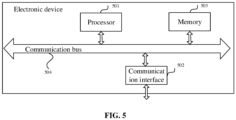
- FIG. 5 is a schematic structural diagram of an electronic equipment provided by an embodiment of the present disclosure.
- the electronic equipment includes: a processor 501, a communications interface 502, a memory 503, and a communication bus 504.
- the communications between the processor 501, the communication interface 502, and the memory 503 are realized through the communication bus 504.
- the processor 501 can call a computer program stored on the memory 503 and executable on the processor 501 to perform the following steps:
- the above-mentioned logic instructions in the memory 503 can be implemented in the form of a software functional unit and sold or used as an independent product, it may be stored in a computer-readable storage medium.
- the solutions of the present disclosure in essence or the part of the solutions that contributes to the related art or part of the solutions can be embodied in the form of a software product, and the computer software product is stored in a storage medium, and includes several instructions to cause a computer device (which can be a personal computer, a server, or a network device or the like) to execute all or part of the steps of the methods described in the various embodiments of the present disclosure.
- the foregoing storage medium includes: USB flash memory, removable hard disk, read-only memory (ROM), random access memory (RAM), magnetic disk or optical disk and other mediums that can store program codes.
- Embodiments of the present disclosure further provide a computer program product, where the computer program product includes a computer program stored on a non-transitory computer-readable storage medium, the computer program includes program instructions, and when the program instructions are executed by a computer, the computer can perform the steps in the above-mentioned method embodiments, including:
- Embodiments of the present disclosure provide a non-transitory computer-readable storage medium having a computer program stored thereon, and the computer program, when executed by a processor, causes the processor to perform the steps in the above-mentioned method embodiments, including:
- each embodiment can be implemented by means of software plus a necessary general hardware platform, and certainly can also be implemented by hardware.
- the solutions of the present disclosure in essence or the part of the solutions that contributes to the related art can be embodied in the form of a software product, and the computer software products can be stored in computer-readable storage media, such as ROM/RAM, magnetic disk, optical disk or the like, including several instructions for causing a computer device (which can be a personal computer, a server, or a network device or the like) to perform the methods described in various embodiments or some parts of the embodiments.
Landscapes
- Engineering & Computer Science (AREA)
- Signal Processing (AREA)
- Computer Networks & Wireless Communication (AREA)
- Physics & Mathematics (AREA)
- General Physics & Mathematics (AREA)
- Radar, Positioning & Navigation (AREA)
- Remote Sensing (AREA)
- Synchronisation In Digital Transmission Systems (AREA)
- Mobile Radio Communication Systems (AREA)
- Stabilization Of Oscillater, Synchronisation, Frequency Synthesizers (AREA)
- Digital Transmission Methods That Use Modulated Carrier Waves (AREA)
Abstract
Description
- The present disclosure claims priority to
Chinese Application No. 202010394490.3, filed on May 11, 2020 - The present disclosure relates to the field of communication, and in particular, to a carrier phase tracking method and apparatus for an orthogonal frequency division multiplexing (OFDM) multi-carrier system.
- A carrier phase positioning method is widely used in positioning technology and has a high positioning accuracy. The carrier phase positioning method mainly includes two processes: carrier phase tracking and positioning resolution.
- In the related art, the carrier phase positioning method is mainly applied to global navigation satellite system (GNSS). The traditional carrier phase tracking and positioning method is a mature method in the GNSS single carrier system. The premise of realizing this positioning method is that a receiver can effectively and continuously track the carrier phase of a transmitted signal.
- When the traditional positioning method is applied to the OFDM multi-carrier system, a frequency error occurs between OFDM received signal and transmitted signal due to the reasons such as deviation of crystal oscillator frequency, Doppler offset and inter-subcarrier interference. A phase offset caused by the frequency error will continue to be accumulated with the increase of the number of subcarriers, which seriously affects the tracking accuracy of the carrier phase and reduces the positioning accuracy.
- Embodiments of the present disclosure provide a carrier phase tracking method and apparatus for an OFDM multi-carrier system, to solve the above problems in the related art.
- An embodiment of the present disclosure provides a carrier phase tracking method for an OFDM multi-carrier system, including:
- performing frequency domain tracking on a received current OFDM symbol and determining a phase of each subcarrier;
- analyzing a phase curve of all subcarriers and determining .an inter-symbol phase average offset, where the inter-symbol phase average offset is used to characterize an estimated value of a difference obtained by subtracting a second value from a first value, the first value is a carrier phase value of the current OFDM symbol and the second value is an estimated value of a carrier phase of a previous OFDM symbol; and
- performing time domain tracking by using the inter-symbol phase average offset as an input phase and determining an estimated value of a carrier phase of the current OFDM symbol.
- In an embodiment, the determining the inter-symbol phase average offset based on the phase curve of all subcarriers, includes:
- analyzing the phase curve of all subcarriers in segments and determining a set of estimated values of inter-subcarrier phase change rate;
- performing cluster analysis on the set of estimated values of inter-subcarrier phase change rate and determining a category containing the largest number of elements;
- averaging elements in the category containing the largest number of elements and determining an inter-subcarrier phase change rate, where the inter-subcarrier phase change rate is used to characterize an estimated value of delay occurring in the current OFDM symbol; and
- determining the inter-symbol phase average offset according to the inter-subcarrier phase change rate.
- In an embodiment, after determining the estimated value of the carrier phase of the current OFDM symbol, the method further includes:
adaptively adjusting a parameter value of a loop filter in a frequency domain phase locked loop (PLL) according to the estimated value of delay occurring in the current OFDM symbol. - In an embodiment, after determining the estimated value of the carrier phase of the current OFDM symbol, the method further includes:
compensating the estimated value of the carrier phase of the current OFDM symbol according to a first fixed phase gap and a second fixed phase gap, where the first fixed phase gap is a phase gap generated by a frequency domain PLL, and the frequency domain PLL is used to perform frequency domain tracking on a received OFDM symbol; and the second fixed phase gap is a phase gap generated by a time domain PLL, and the time domain PLL is used to perform time domain tracking on an input phase. - In an embodiment, before compensating the estimated value of the carrier phase of the current OFDM symbol according to the first fixed phase gap and the second fixed phase gap, the method further includes:
- determining the first fixed phase gap based on a parameter value of the loop filter in the frequency domain PLL, a subcarrier spacing, and the estimated value of delay occurring in the current OFDM symbol; and
- determining the second fixed phase gap based on the first fixed phase gap, the inter-symbol phase average offset, and a parameter value of a loop filter in the time domain PLL.
- In an embodiment, when the method is applied to an OFDM multi-carrier system in a time division duplex (TDD) mode, after determining the estimated value of the carrier phase of the current OFDM symbol, the method further includes:
compensating the estimated value of the carrier phase of the current OFDM symbol according to an integer ambiguity change, where the integer ambiguity change is a difference obtained by subtracting an integer ambiguity of a previous segment downlink received signal from an integer ambiguity of a current segment downlink received signal, and the current segment downlink received signal is a segment of downlink received signal including the current OFDM symbol. - In an embodiment, before the compensating the estimated value of the carrier phase of the current OFDM symbol according to the integer ambiguity change, the method further includes:
- performing linear estimation on a frequency offset of a target uplink transmitted signal based on a frequency offset estimated value of the current segment downlink received signal and a frequency offset estimated value of the previous segment downlink received signal, and determining a frequency offset estimated value of the target uplink transmitted signal, where the target uplink transmitted signal is an uplink transmitted signal at the interval between the current segment downlink received signal and the previous segment downlink received signal; and
- determining the integer ambiguity change according to the frequency offset estimated value of the target uplink transmitted signal.
- In an embodiment, when the method is applied to the OFDM multi-carrier system in the TDD mode, after determining the estimated value of the carrier phase of the current OFDM symbol, the method further includes:
compensating the estimated value of the carrier phase of the current OFDM symbol according to the first fixed phase gap, the second fixed phase gap and the integer ambiguity change, where the first fixed phase gap is a phase gap generated by the frequency domain PLL, and the frequency domain PLL is used to perform frequency domain tracking on the received OFDM symbol; the second fixed phase gap is a phase gap generated by the time domain PLL, and the time domain PLL is used to perform time domain tracking on the input phase; and the integer ambiguity change is the difference obtained by subtracting the integer ambiguity of the previous segment downlink received signal from the integer ambiguity of the current segment downlink received signal, and the current segment downlink received signal is a segment of downlink received signal including the current OFDM symbol. - An embodiment of the present disclosure further provides an carrier phase tracking apparatus for an OFDM multi-carrier system, including:
- a frequency domain phase locked loop (PLL) module, used to perform frequency domain tracking on a received current OFDM symbol and determine a phase of each subcarrier;
- an inner-loop analysis module, used to analyze a phase curve of all subcarriers and determine an inter-symbol phase average offset, where the inter-symbol phase average offset is used to characterize an estimated value of a difference obtained by subtracting a second value from a first value, the first value is a carrier phase value of the current OFDM symbol and the second value is an estimated value of a carrier phase of a previous OFDM symbol; and
- a time domain PLL module, used to perform time domain tracking by using the inter-symbol phase average offset as an input phase and determine an estimated value of a carrier phase of the current OFDM symbol.
- In an embodiment, the inner-loop analysis module includes a segment analysis sub-module, a cluster sub-module, a delay estimation sub-module and a phase offset determination sub-module, where
- the segment analysis sub-module is used to analyze the phase curve of all subcarriers in segments and determine a set of estimated values of inter-subcarrier phase change rate;
- the cluster sub-module is used to perform cluster analysis on the set of estimated values of inter-subcarrier phase change rate and determine a category containing the largest number of elements;
- the delay estimation sub-module is used to average elements in the category containing the largest number of elements and determine an inter-subcarrier phase change rate, where the inter-subcarrier phase change rate is used to characterize an estimated value of delay occurring in the current OFDM symbol; and
- the phase offset determination sub-module is used to determine the inter-symbol phase average offset according to the inter-subcarrier phase change rate.
- In an embodiment, the apparatus further includes a parameter adjustment module used to adaptively adjust a parameter value of a loop filter in a frequency domain PLL according to the estimated value of delay occurring in the current OFDM symbol.
- In an embodiment, the apparatus further includes a first compensation module, where the first compensation module is used to compensate the estimated value of the carrier phase of the current OFDM symbol according to a first fixed phase gap and a second fixed phase gap, where the first fixed phase gap is a phase gap generated by a frequency domain PLL, and the frequency domain PLL is used to perform frequency domain tracking on a received OFDM symbol; and the second fixed phase gap is a phase gap generated by a time domain PLL, and the time domain PLL is used to perform time domain tracking on an input phase.
- In an embodiment, the apparatus further includes a first fixed phase gap determination module and a second fixed phase gap determination module, where,
- the first fixed phase gap determination module is used to determine the first fixed phase gap based on a parameter value of a loop filter in the frequency domain PLL, a subcarrier spacing and an estimated value of delay occurring in the current OFDM symbol; and
- the second fixed phase gap determination module is used to determine the second fixed phase gap based on the first fixed phase gap, the inter-symbol phase average offset and a parameter value of a loop filter in the time domain PLL.
- In an embodiment, when the apparatus applied to an OFDM multi-carrier system under TDD mode, the apparatus further includes a second compensation module, where, the second compensation module is used to compensate the estimated value of the carrier phase of the current OFDM symbol according to an integer ambiguity change, where the integer ambiguity change is a difference obtained by subtracting an integer ambiguity of a previous segment downlink received signal from an integer ambiguity of a current segment downlink received signal, and the current segment downlink received signal is a segment of downlink received signal including the current OFDM symbol.
- In an embodiment, the apparatus further includes an uplink frequency offset estimation module and an integer ambiguity change determination module, where,
- the uplink frequency offset estimation module is used to perform linear estimation on a frequency offset of a target uplink transmitted signal based on a frequency offset estimated value of the current segment downlink received signal and a frequency offset estimated value of the previous segment downlink received signal, and determine a frequency offset estimated value of the target uplink transmitted signal, where the target uplink transmitted signal is an uplink transmitted signal at the interval between the current segment downlink received signal and the previous segment downlink received signal; and
- the integer ambiguity change determination module is used to determine the integer ambiguity change according to the frequency offset estimated value of the target uplink transmitted signal.
- In an embodiment, when the apparatus is applied to the OFDM multi-carrier system in TDD mode, the apparatus further includes a third compensation module, where,
the third compensation module is used to compensate the estimated value of the carrier phase of the current OFDM symbol according to the first fixed phase gap, the second fixed phase gap and the integer ambiguity change, where the first fixed phase gap is a phase gap generated by the frequency domain PLL, and the frequency domain PLL is used to perform frequency domain tracking on the received OFDM symbol; the second fixed phase gap is a phase gap generated by the time domain PLL, and the time domain PLL is used to perform time domain tracking on the input phase; and the integer ambiguity change is the difference obtained by subtracting an integer ambiguity of a previous segment downlink received signal from an integer ambiguity of a current segment downlink received signal, and the current segment downlink received signal is a segment of downlink received signal including the current OFDM symbol. - An embodiment of the present disclosure further provides an electronic equipment, including: a processor and a memory storing a computer program that is executable on the processor, the computer program, when executed by the processor, causes the processor to perform steps of the above-mentioned method.
- An embodiment of the present disclosure further provides a non-transitory computer-readable storage medium having a computer program stored thereon, and the computer program, when executed by a processor, causes the processor to perform the steps of the above-mentioned method.
- In the carrier phase tracking method and apparatus for an OFDM multi-carrier system provided by embodiments of the present disclosure, by using a double-loop structure with two nested PLLs, analyzing and adjusting the output result of the frequency domain PLL and inputting the analyzed and adjusted results into the time domain PLL, the phase change of the time domain and the frequency domain can be tracked respectively and the accuracy of carrier phase tracking for OFDM symbols is improved.
-
-
FIG. 1 is a schematic diagram of a carrier phase tracking method for an OFDM multi-carrier system provided by an embodiment of the present disclosure. -
FIG. 2 is a schematic diagram of a carrier phase tracking apparatus for the OFDM multi-carrier system provided by an embodiment of the present disclosure. -
FIG. 3 is a schematic diagram of an analysis principle for a phase curve of subcarriers provided by an embodiment of the present disclosure. -
FIG. 4 is a schematic diagram of a principle for determining an integer ambiguity change provided by an embodiment of the present disclosure. -
FIG. 5 is a schematic structural diagram of an electronic equipment provided by an embodiment of the present disclosure. - In order to make the objectives, solutions and advantages of the embodiments of the present disclosure clearer, the solutions according to the embodiments of the present disclosure will be described clearly and completely below with reference to the drawings in the embodiments of the present disclosure. The described embodiments are a part of the embodiments of the present disclosure, rather than all of the embodiments. All other embodiments obtained by a person skilled in the art based on the embodiments in the present disclosure without creative effort are within the protection scope of the present disclosure.
- Embodiments of the present disclosure are directed to a general OFDM signal model including K subcarriers. The subcarrier spacing is represented as fscs, the number of sampling points in one OFDM symbol is N, the length of a cyclic prefix is NCP, the length of one OFDM symbol is Ns, where Ns = N + NCP. Due to the delay caused by propagation path and the sampling clock offset and the frequency offset between a receiver and a transmitter, the signal arriving at the receiver has a frequency offset and a sampling time offset with respect to the transmitted signal. The frequency offset is represented by Δf and the sampling time offset is represented by Δt. A frequency domain data obtained by performing fast Fourier transform (FFT) on the received signal including the above sampling clock offset, frequency offset, and sampling time offset is represented by


- It can be seen from the expression of

- For different symbols, the Doppler frequency offset and transmission delay change caused by user's movement will affect the time domain phase of the signal, which can be tracked by using PLL.
-
FIG. 1 is a schematic diagram of a carrier phase tracking method for an OFDM multi-carrier system provided by an embodiment of the present disclosure. As shown inFIG. 1 , an embodiment of the present disclosure provides a carrier phase tracking method for the OFDM multi-carrier system, which is performed by a carrier phase tracking apparatus for OFDM multi-carrier system. The method includes the following steps. - S101: performing frequency domain tracking on a received current OFDM symbol and determining a phase of each subcarrier.
- In an embodiment, the carrier phase tracking apparatus for an OFDM multi-carrier system in the embodiments of the present disclosure is used in a receiver for processing a signal to obtain information of a carrier phase. A OFDM symbol arrives at the receiver after passing through a channel, is subjected to down-conversion and time-domain discrete sampling and enters the carrier phase tracking apparatus for OFDM multi-carrier system for performing carrier phase tracking.
-
FIG. 2 is a schematic diagram of a carrier phase tracking apparatus for an OFDM multi-carrier system provided by an embodiment of the present disclosure. As shown inFIG. 2 , the carrier phase tracking apparatus for the OFDM multi-carrier system provided by the embodiment of the present disclosure has a double-loop PLL structure, including a frequency domain PLL module, an inner-loop analysis module and a time domain PLL module. - The frequency domain PLL module is also referred to as an inner-loop PLL, or inner-loop for short, which is used to perform frequency domain tracking on the received lth OFDM symbol and determine the phase of each subcarrier. The frequency domain PLL module includes an inner-loop multiplier, a phase error discriminator (PED), an inner-loop filter and an inner-loop numerical control oscillator (NCO).
- After the input sample data


- After the frequency domain data

- The phase gap εk,f enters the inner-loop NCO after passing through the inner-loop filter. The inner-loop NCO outputs subcarrier phase Ψ̂k,l , where Ψ̂k,l is obtained by accumulating the outputs of the inner-loop filter corresponding to the previous k subcarriers, and is used to correct the phase of the (k + 1)th subcarrier. After the phase of the inner-loop PLL is locked, Ψ̂k,l changes linearly with the increase of the number of subcarriers.
- Considering the delay change caused by the propagation environment and user movement, the parameter αf of the inner-loop filter can be adaptively adjusted during the phase tracking process.
- S102: analyzing a phase curve of all subcarriers and determining an inter-symbol phase average offset, where the inter-symbol phase average offset is used to characterize an estimated value of a difference obtained by subtracting a second value from a first value; where the first value is a carrier phase value of the current OFDM symbol and the second value is an estimated value of a carrier phase of a previous OFDM symbol.
- In an embodiment, after K frequency domain data of one OFDM symbol are all processed by the frequency domain PLL, the phase output Ψ̂ l corresponding to each subcarrier can be obtained, where Ψ̂ l = {Ψ̂0,l , ..., Ψ̂ K-1,l }. The inner-loop analysis module is used to analyze the phase curves of all subcarriers and determine the inter-symbol phase average offset.
- In an embodiment, the analyzing the phase curve of all subcarriers and determining the phase average offset can include performing fitting on the phase curve of all subcarriers and determining an intercept value of curve fitting, where the intercept value can be understood as the above-mentioned phase average offset.
-
FIG. 3 is a schematic diagram of an analysis principle for a phase curve of subcarriers provided by an embodiment of the present disclosure. As shown inFIG. 3 , the abscissa is the subcarrier serial number, and the ordinate is the phase value. The solid line inFIG. 3 is the phase curve of subcarriers. The dotted line inFIG. 3 is a straight line obtained by linear analysis. After obtaining this straight line, the inter-symbol phase average offset can be determined, which is equivalent to determining the intercept value of the curve fitting. - The inter-symbol phase average offset is represented by


- S103: performing time domain tracking by using the inter-symbol phase average offset as an input phase, and determining an estimated value of the carrier phase of the current OFDM symbol.
- In an embodiment, after obtaining the inter-symbol phase average offset

- For example, the inter-symbol phase average offset is used as the input of the time domain PLL, the time domain tracking is performed through the time domain PLL, and the estimated value ϕ̂l of the carrier phase of the current OFDM symbol is determined.
- The time domain PLL module is also referred to as outer-loop PLL, or outer-loop for short. The time domain PLL module includes an outer-loop multiplier, an outer-loop filter and an outer-loop NCO.
- After the input data

- The parameter αt of the outer-loop filter can be configured as a fixed value.
- It should be noted that for the same OFDM symbol, depending on the difference of the range and order of the data

- In the carrier phase tracking method for the OFDM multi-carrier system provided by embodiments of the present disclosure, by using a double-loop structure with two nested PLLs, and inputting the output result of the frequency domain PLL after being analyzed and adjusted into the time domain PLL, phase changes in both the time domain and the frequency domain can be tracked and the accuracy of carrier phase tracking for OFDM symbols is improved.
- Based on any of the above-mentioned embodiments, in an embodiment, the analyzing phase curve of all subcarriers and determining an inter-symbol phase average offset includes:
- analyzing the phase curve of all subcarriers in segments and determining a set of estimated values of inter-subcarrier phase change rate;
- performing cluster analysis on the set of estimated values of inter-subcarrier phase change rate and determining a category containing the largest number of elements;
- averaging elements in the category containing the largest number of elements and determining an inter-subcarrier phase change rate used for characterizing an estimated value of delay occurring in the current OFDM symbol; and
- determining the inter-symbol phase average offset according to the inter-subcarrier phase change rate.
- In an embodiment, the analyzing the phase curve of all subcarriers in segments and determining a set of estimated value of inter-subcarrier phase change rate can include performing fitting on the phase curve of all subcarriers in segments and determining a set of estimated values of the curve slope. The curve slope here can be understood as the above-mentioned inter-subcarrier phase change rate.
- In the embodiments of the present disclosure, after K frequency domain data are processed in the inner-loop, the phase output Ψ̂ l corresponding to each subcarrier can be obtained, where Ψ̂ l = {Ψ̂0,l , ..., Ψ̂ K-1,l }, and the phase output contains the delay information. The phase curve of Ψ̂ l is analyzed to obtain the estimated value Δt̂ of the delay and the phase

- Firstly, the phase curve in the inner-loop is analyzed in segments (the segments can be overlapped) and a set of estimated values of inter-subcarrier phase change rate is obtained.
- Secondly, cluster analysis is performed on the set of estimated values of inter-subcarrier phase change rate, and a radius e_dt for category is set according to the accuracy requirements, where e_dt is used to classify the set of estimated values of inter-subcarrier phase change rate to determine the category containing the largest number of elements.
- Thirdly, the elements in the category containing the largest number of elements are averaged and the inter-subcarrier phase change rate is determined, where the inter-subcarrier phase change rate is used to characterize an estimated value Δt̂l of delay occurring in the current OFDM symbol.
- Finally, the inter-symbol phase average offset is determined according to the inter-subcarrier phase change rate. As shown in
FIG. 3 , the result obtained by analyzing the phase curve of all subcarriers in segments is a straight line, and the inter-symbol phase average offset can be determined after obtaining this straight line. - In the carrier phase tracking method for the OFDM multi-carrier system provided by embodiments of the present disclosure, by analyzing in segments and performing cluster analysis, the accuracy of estimating the inter-symbol phase average offset can be improved and the accuracy of carrier phase tracking of OFDM symbols can be further improved.
- Based on any of the above-mentioned embodiments, in an embodiment, after the determining the estimated value of the carrier phase of the current OFDM symbol, the method further includes:
adaptively adjusting a parameter value of a loop filter in a frequency domain PLL according to the estimated value of delay occurred in the current OFDM symbol. - In the embodiment of the present disclosure, considering the delay change caused by the propagation environment and user movement, the parameter αf of the inner-loop filter can be adaptively adjusted during the phase tracking process.
- The parameter value of the loop filter in the frequency domain phase locked loop (PLL) is adaptively adjusted according to the estimated value Δt̂l of delay occurred in the current OFDM symbol.
- Since the parameter αf of the inner-loop filter changes slowly, the parameter of the inner-loop filter may be adjusted for each OFDM symbol, or the parameter of the inner-loop filter may be adjusted once every time a plurality of OFDM symbols are processed.
- The parameter αf of the inner-loop filter can be adaptively adjusted according to a preset corresponding relationship. The corresponding relationship between the estimated value Δt̂ of delay and the parameter αf of the inner-loop filter can be as shown in table 1.
Table 1 Corresponding relationship between Δt̂ and αf Estimated value Δt̂ of delay Value of αf < 15 ns 0.1 15-30 ns 0.2 30-70 ns 0.3 70-900 ns 0.5 0.9-7 us 0.85 7-9.6 us 0.9 >9.6 us 0.98 - In the carrier phase tracking method for the OFDM multi-carrier system provided by embodiments of the present disclosure, by adaptively adjusting the parameter of the inner-loop filter, the delay change caused by the propagation environment or user movement can be avoided and the accuracy of tracking carrier phase of OFDM symbols can be further improved.
- Based on any of the above-mentioned embodiments, in an embodiment, after the determining the estimated value of the carrier phase of the current OFDM symbol, the method further includes:
compensating the estimated value of the carrier phase of the current OFDM symbol according to a first fixed phase gap and a second fixed phase gap, where the first fixed phase gap is a phase gap generated by the frequency domain PLL which is used to perform frequency domain tracking on a received OFDM symbol, and the second fixed phase gap is a phase gap generated by the time domain PLL which is used to perform time domain tracking on an input phase. - In an embodiment of the present disclosure, both the inner-loop PLL and the outer-loop PLL are first-order PLL. Since there is a fixed phase gap when the linearly changing phase is estimated by first-order PLL, the value of the gap needs to be calculated and compensated on the output phase.
- The fixed phase gap generated by the inner-loop PLL is represented by gap 1 , the fixed phase gap generated by the outer-loop PLL is represented by gap 2, and the output phase of the outer-loop PLL is used as the input of the inner-loop PLL. Therefore, the value of gap 2 is associated with gap 1.
- After both gap 1 and gap 2 are determined, the estimated value of the carrier phase of the current OFDM symbol can be compensated. The formula is expressed as follows:


- In the carrier phase tracking method for the OFDM multi-carrier system provided by embodiments of the present disclosure, by compensating the estimated value of the carrier phase, the effect of the phase gap generated by the frequency domain PLL and the phase gap generated by the time domain PLL on the results can be avoided, and further the accuracy of tracking carrier phase of OFDM symbols can be improved.
- Based on any of the above-mentioned embodiments, in an embodiment, before the compensating the estimated value of the carrier phase of the current OFDM symbol according to the first fixed phase gap and the second fixed phase gap, the method further includes:
- determining the first fixed phase gap based on the parameter value of the loop filter in the frequency domain PLL, a subcarrier spacing, and the estimated value of delay occurred in the current OFDM symbol; and
- determining the second fixed phase gap based on the first fixed phase gap, the inter-symbol phase average offset, and the parameter value of the loop filter in the time domain PLL.
- In an embodiment of the present disclosure, the first fixed phase gap is determined based on the parameter value of the loop filter in the frequency domain PLL, the subcarrier spacing, and the estimated value of delay occurring in the current OFDM symbol.
- The second fixed phase gap is determined based on the first fixed phase gap, the inter-symbol phase average offset, and the parameter value of the loop filter in the time domain PLL.
- In an embodiment, the steps of determining the first fixed phase gap or the second fixed phase gap are as follows.
- The inner-loop PLL estimates the linear change of the frequency domain phase. In an ideal situation, after the inner-loop PLL is locked, the step amount of the output phase is the same as the phase change between adjacent subcarriers in the frequency domain, which is expressed by the formula as follows:


- Combining the above two formulas, the expression of the fixed phase gap generated by the inner-loop PLL can be obtained by the formula as follows:

- The outer loop estimates the phase change in the time domain, that is,


- The fixed phase gap generated by the outer-loop PLL is the difference between the phase of the lth OFDM symbol and the corresponding lth phase output of the outer loop, which is expressed by the formula as follows:

- From this, the fixed phase gap of the outer-loop PLL can be obtained and is expressed by the formula as follows:

- In the carrier phase tracking method for OFDM multi-carrier system provided by embodiments of the present disclosure, by determining the phase gap generated by the frequency domain PLL according to the parameter value of the loop filter in the frequency domain PLL, the subcarrier spacing, and the estimated value of delay occurred in the current OFDM symbol, the determined phase gap generated by the frequency domain PLL is more accurate; by determining the phase gap generated by the time domain PLL according to the correlation between the frequency domain PLL and the time domain PLL, the determined phase gap generated by the time domain PLL is more accurate, and further the accuracy of tracking carrier phase of OFDM symbols is improved.
- Based on any of the above-mentioned embodiments, in an embodiment, when applied to an OFDM multi-carrier system under a time division duplex (TDD) mode, after determining the estimated value of the carrier phase of the current OFDM symbol, the method further includes:
compensating the estimated value of the carrier phase of the current OFDM symbol according to an integer ambiguity change, where the integer ambiguity change is a difference obtained by subtracting an integer ambiguity of a downlink received signal of previous segment from an integer ambiguity of the downlink received signal of current segment, the downlink received signal of the current segment is a segment of downlink received signal including the current OFDM symbol. - In an embodiment of the present disclosure, since the received signal in time division duplex (TDD) mode is discontinuous, the phase estimation needs to be performed again every preset time duration. In an embodiment, the integer ambiguity change needs to be determined, and the estimated value of the carrier phase of the current OFDM symbol is compensated according to the integer ambiguity change. The integer ambiguity change is the difference obtained by subtracting the integer ambiguity of the downlink received signal of previous segment from the integer ambiguity of the downlink received signal of the current segment, the downlink received signal of the current segment is a segment of downlink received signal including the current OFDM symbol. The formula for compensating is expressed as follows:


- In the carrier phase tracking method for OFDM multi-carrier system provided by embodiments of the present disclosure, by compensating the estimated value of the carrier phase of the current OFDM symbol using the integer ambiguity change for the case where the received signal is discontinuous in the TDD system, the accuracy of carrier phase tracking of OFDM symbols is improved.
- Based on any of the above-mentioned embodiments, in an embodiment, before the compensating the estimated value of the carrier phase of the current OFDM symbol according to the integer ambiguity change, the method further includes:
- performing linear estimation on a frequency offset of a target uplink transmitted signal based on a frequency offset estimated value of the current segment downlink received signal and a frequency offset estimated value of the previous segment downlink received signal, and determining a frequency offset estimated value of the target uplink transmitted signal, where the target uplink transmitted signal is an uplink transmitted signal at the interval between the current segment downlink received signal and the previous segment downlink received signal; and
- determining the integer ambiguity change according to the frequency offset estimated value of the target uplink transmitted signal.
- In an embodiment, after a plurality of continuous OFDM symbols enter the double-loop PLL structure, a plurality of outer loop output phases {ϕ̂l |l = 0, ...} are obtained correspondingly, and the outer loop output phases include frequency offset information. The estimated value δf̂ of the frequency offset can be obtained by calculating an average value Δϕ of differences between the outer loop output phases of adjacent OFDM symbols, which can be expressed by the formula as follows:

Δϕ is the average value of differences between the outer loop output phases, N is the number of sampling points in one OFDM symbol, NCP is the length of cyclic prefix, and fscs is the subcarrier spacing. - In the embodiments of the present disclosure, by performing linear estimation on the frequency offset of the uplink signal at an interval between two segment adjacent downlink signals using the frequency offset estimated values of the two segment adjacent downlink signals, and calculating the variation amount of carrier phase within the interval uplink time (for example, 5 ms), an estimated integer ambiguity of downlink signals can be obtained.
- In an embodiment, the steps of determining the integer ambiguity change ΔN are as follows.
- Linear estimation is firstly performed on the frequency offset of the target uplink transmitted signal based on the frequency offset estimated value of the current segment downlink received signal and the frequency offset estimated value of the previous segment downlink received signal, and then an estimated value of the frequency offset of the target uplink transmitted signal is determined, where the target uplink transmitted signal is an uplink transmitted signal at the interval between the current segment downlink received signal and the previous segment downlink received signal.
-
FIG. 4 is a schematic diagram of a principle for determining an integer ambiguity change provided by an embodiment of the present disclosure. As shown inFIG. 4 , the two segments of received adjacent downlink signals are represented by s1 and s3, respectively. According to the output results of the outer-loop PLL, the estimated value of the carrier phase of the s1 segment is represented as a solid line segment in theFIG. 4 , and the estimated value of the carrier phase of the s3 segment is represented as a solid line segment in theFIG. 4 . The frequency offset estimated value of the s1 segment is δf̂ 1 and the frequency offset estimated value of the s3 segment is δf̂ 3, and the uplink signal within the time (the time length is determined by the system configuration, for example, 5 ms) between s1 and s3 segments is represented by s2. According to the empirical value in practical application, the upper and lower bounds of the possible frequency offset are respectively set as ± 0.05, and the range of phase hopping that may occur within 5 ms (70 OFDM symbols) is ± 28 rad (± 0.05∗70∗2π∗(N+NCP)/N), which is about 4.5 integer cycles. Therefore, the cycle slip variable that occurs in the s3 segment is limited to [-4, 4]. By shifting the estimated value of the carrier phase of the s3 segment (the solid line of the s3 segment inFIG. 4 ) upwards and downwards in units of 2π, 9 parallel curves can be obtained, which are approximately straight line segments. InFIG. 4 , only 7 lines are drawn in the s3 segment as an example. Assuming that the frequency offset of the uplink signal s2 segment remains unchanged, 9 estimated values of δf 2 can be obtained, and the one of the 9 estimated values that makes the variance of δf̂ 1 , δf 2 and δf̂ 3 be smallest is selected as the estimated value of δf 2, and the mathematical expression is as follows:
- Then, the integer ambiguity change is determined according to the frequency offset estimated value of the target uplink transmitted signal.
- As shown in
FIG. 4 , after the estimated value of δf 2 is determined, it can be determined that the s2 segment carrier phase estimated value curve is the solid line inFIG. 4 among 9 possible carrier phase estimated value curves (inFIG. 4 , only 7 lines are drawn in the s2 segment as an example). Then, the double solid line in the s3 segment inFIG. 4 represents the carrier phase value of the s3 segment after compensating the integer ambiguity. The phase deviation of the s3 segment double solid line relative to the s3 segment solid line is divided by 2π, and then the offset ΔN of integer ambiguity of the s3 segment relative to the s1 segment is obtained. - In the carrier phase tracking method for OFDM multi-carrier system provided by the embodiments of the present disclosure, by performing linear estimation on the frequency offset of the uplink signal at the interval using the frequency offset estimated values of the two segment adjacent downlink signals, and determining the integer ambiguity change according to the frequency offset estimated value of the uplink transmitted signal, the obtained integer ambiguity change is more accurate and the accuracy of tacking carrier phase of OFDM symbols is further improved.
- Based on any of the above-mentioned embodiments, in an embodiment, when the method is applied to the OFDM multi-carrier system in TDD mode, after determining the estimated value of the carrier phase of the current OFDM symbol, the method further includes:
compensating the estimated value of the carrier phase of the current OFDM symbol according to the first fixed phase gap, the second fixed phase gap and the integer ambiguity change, where the first fixed phase gap is a phase gap generated by a frequency domain PLL, and the frequency domain PLL is used to perform frequency domain tracking on a received OFDM symbol; the second fixed phase gap is a phase gap generated by a time domain PLL, and the time domain PLL is used to perform time domain tracking on an input phase; and the integer ambiguity change is the difference obtained by subtracting an integer ambiguity of a previous segment downlink received signal from an integer ambiguity of a current segment downlink received signal, and the current segment downlink received signal is one segment downlink received signal including the current OFDM symbol. - In an embodiment of the present disclosure, since the received signal in time division duplex (TDD) mode is discontinuous, the phase estimation needs to be performed again every preset time duration and because there is a phase gap in the inner-loop PLL and the outer-loop PLL, the fixed phase gaps of the inner-loop PLL and the outer-loop PLL and the integer ambiguity change need to be determined, and then the estimated value of the carrier phase of the current OFDM symbol is compensated according to the fixed phase gaps of the inner-loop PLL and the outer-loop PLL and the integer ambiguity change. The integer ambiguity change is the difference obtained by subtracting the integer ambiguity of the previous segment downlink received signal from the integer ambiguity of the current segment downlink received signal, and the current segment downlink received signal is one segment downlink received signal including the current OFDM symbol. The formula for performing compensation is expressed as follows:


- In the carrier phase tracking method for the OFDM multi-carrier system provided by the embodiments of the present disclosure, by compensating the estimated value of the carrier phase of the current OFDM symbol according to the fixed phase gap of the frequency domain PLL, the fixed phase gap of the time domain PLL and the integer ambiguity change, the compensating effect is improved and the accuracy of carrier phase tracking for OFDM symbols is further improved.
-
FIG. 2 is a schematic diagram of a carrier phase tracking apparatus for OFDM multi-carrier system provided by an embodiment of the present disclosure. As shown inFIG. 2 , the carrier phase tracking apparatus for OFDM multi-carrier system provided by the embodiment of the present disclosure includes a frequency domain PLL module, an inner-loop analysis module and a time domain PLL module. - The frequency domain PLL module is used to perform frequency domain tracking on a received current OFDM symbol and determine a phase of each subcarrier. The inner-loop analysis module is used to analyze a phase curve of all subcarriers and determine an inter-symbol phase average offset, where the inter-symbol phase average offset is used to characterize an estimated value of a difference obtained by subtracting a second value from a first value, the first value is a carrier phase value of the current OFDM symbol, and the second value is an estimated value of a carrier phase of a previous OFDM symbol. The time domain PLL module is used to perform time domain tracking by using the inter-symbol phase average offset as an input phase and determine an estimated value of a carrier phase of the current OFDM symbol.
- In an embodiment, the frequency domain PLL module includes an inner-loop multiplier, a phase error discriminator (PED), an inner-loop filter and an inner-loop numerical control oscillator (NCO).
- After the input sample data


- After the frequency domain data

- The phase gap εk,f enters the inner-loop NCO after passing through the inner-loop filter. The inner-loop NCO outputs subcarrier phase Ψ̂k,l , where Ψ̂k,l is obtained by accumulating the outputs of the inner-loop filter corresponding to the previous k subcarriers, and is used to correct the phase of the (k + 1)th subcarrier. After the phase of the inner-loop PLL is locked, Ψ̂k,l changes linearly with the increase of the number of subcarriers.
- After K frequency domain data of one OFDM symbol are all processed by the frequency domain PLL, the phase output Ψ̂ l corresponding to each subcarrier can be obtained, where Ψ̂ l = {Ψ̂0,l , ..., Ψ̂ K-1,l }. The inner-loop analysis module is used to analyze the phase curve of all subcarriers and determine the inter-symbol phase average offset. The inter-symbol phase average offset is represented by


- After determining the inter-symbol phase average offset

- For example, the inter-symbol phase average offset is used as the input of the time domain PLL, the time domain tracking is performed through the time domain PLL, and the estimated value ϕ̂l of the carrier phase of the current OFDM symbol is determined.
- The time domain PLL module includes an outer-loop multiplier, an outer-loop filter, and an outer-loop NCO.
- After the input data

- The carrier phase tracking apparatus for the OFDM multi-carrier system provided by embodiments of the present disclosure is used to perform the method in the above corresponding embodiment. The steps of executing the method described in the above corresponding embodiment by the apparatus provided in the embodiments are the same as those in the above corresponding embodiment, and will not be repeated here.
- In the carrier phase tracking apparatus for the OFDM multi-carrier system provided by embodiments of the present disclosure, by using a double-loop structure with two nested PLLs, and inputting the output result of the frequency domain PLL after being analyzed and adjusted into the time domain PLL, the phase changes in both the time domain and the frequency domain can be tracked respectively and the accuracy of carrier phase tracking for OFDM symbols is improved.
- Based on any of the above-mentioned embodiments, in an embodiment, the inner-loop analysis module includes a segment analysis sub-module, a cluster sub-module, a delay estimation sub-module and a phase offset determination sub-module, where:
- the segment analysis sub-module is used to analyze the phase curve of all subcarriers in segments and determine a set of estimated value of inter-subcarrier phase change rate;
- the cluster sub-module is used to perform cluster analysis on the set of estimated value of inter-subcarrier phase change rate and determine a category containing the largest number of elements;
- the delay estimation sub-module is used to average elements in the category containing the largest number of elements and determine an inter-subcarrier phase change rate, where the inter-subcarrier phase change rate is used to characterize an estimated value of delay occurring in the current OFDM symbol; and
- the phase offset determination sub-module is used to determine the inter-symbol phase average offset according to the inter-subcarrier phase change rate.
- In an embodiment, the carrier phase tracking apparatus for the OFDM multi-carrier system provided by embodiments of the present disclosure is used to perform the method in the above corresponding embodiment. The steps of executing the method described in the above corresponding embodiment by the apparatus provided in the embodiments are the same as those in the above corresponding embodiment, and will not be repeated here.
- In the carrier phase tracking apparatus for the OFDM multi-carrier system provided by the embodiments of the present disclosure, by analyzing in sections and then performing cluster analysis, the estimation accuracy of the inter-symbol phase average offset is improved and the accuracy of carrier phase tracking for OFDM symbols is further improved.
- Based on any of the above-mentioned embodiments, in an embodiment, the apparatus further includes a parameter adjustment module.
- In an embodiment, the parameter adjustment module is used to adaptively adjust a parameter value of a loop filter in a frequency domain PLL according to the estimated value of delay occurring in the current OFDM symbol.
- In an embodiment, the carrier phase tracking apparatus for the OFDM multi-carrier system provided by embodiments of the present disclosure is used to perform the method in the above corresponding embodiment. The steps of executing the method described in the above corresponding embodiment by the apparatus provided in the embodiments are the same as those in the above corresponding embodiment, and will not be repeated here.
- In the carrier phase tracking apparatus for the OFDM multi-carrier system provided by the embodiments of the present disclosure, by adaptively adjusting the parameter of the inner-loop filter, the delay change caused by the propagation environment or user movement is avoided and the accuracy of carrier phase tracking of OFDM symbols is further improved.
- Based on any of the above-mentioned embodiments, in an embodiment, the apparatus further includes a first compensation module.
- In an embodiment, the first compensation module is used to compensate the estimated value of the carrier phase of the current OFDM symbol according to a first fixed phase gap and a second fixed phase gap, where the first fixed phase gap is a phase gap generated by a frequency domain PLL, and the frequency domain PLL is used to perform frequency domain tracking on a received OFDM symbol; and the second fixed phase gap is a phase gap generated by a time domain PLL, and the time domain PLL is used to perform time domain tracking on an input phase.
- In an embodiment, the carrier phase tracking apparatus for the OFDM multi-carrier system provided by embodiments of the present disclosure is used to perform the method in the above corresponding embodiment. The steps of executing the method described in the above corresponding embodiment by the apparatus provided in the embodiments are the same as those in the above corresponding embodiment, and will not be repeated here.
- In the carrier phase tracking apparatus for OFDM multi-carrier system provided by the embodiments of the present disclosure, by compensating the estimated value of the carrier phase, the effects of the phase gap generated by the frequency domain PLL and the phase gap generated by the time domain PLL on the results are avoided and the accuracy of carrier phase tracking for OFDM symbols is further improved.
- Based on any of the above-mentioned embodiments, in an embodiment, the apparatus further includes a first fixed phase gap determination module and a second fixed phase gap determination module.
- In an embodiment, the first fixed phase gap determination module is used to determine the first fixed phase gap based on a parameter value of a loop filter in the frequency domain PLL, a subcarrier spacing, and the estimated value of delay occurring in the current OFDM symbol; and the second fixed phase gap determination module is used to determine the second fixed phase gap based on the first fixed phase gap, the inter-symbol phase average offset, and a parameter value of a loop filter in the time domain PLL.
- In an embodiment, the carrier phase tracking apparatus for the OFDM multi-carrier system provided by embodiments of the present disclosure is used to perform the method in the above corresponding embodiment. The steps of executing the method described in the above corresponding embodiment by the apparatus provided in the embodiments are the same as those in the above corresponding embodiment, and will not be repeated here.
- In the carrier phase tracking apparatus for OFDM multi-carrier system provided by the embodiments of the present disclosure, by determining the phase gap generated by the frequency domain PLL according to the parameter value of the loop filter in the frequency domain PLL, the subcarrier spacing, and the estimated value of delay occurring in the current OFDM symbol, the determined phase gap generated by the frequency domain PLL is more accurate; and by determining the phase gap generated by the time domain PLL according to the correlation between the frequency domain PLL and the time domain PLL, the determined phase gap generated by the time domain PLL is more accurate, and the accuracy of tracking carrier phase of OFDM symbols is further improved.
- Based on any of the above-mentioned embodiments, in an embodiment, when the apparatus is applied to an OFDM multi-carrier system in the TDD mode, the apparatus further includes a second compensation module.
- In an embodiment, the second compensation module is used to compensate the estimated value of the carrier phase of the current OFDM symbol according to an integer ambiguity change, where the integer ambiguity change is a difference obtained by subtracting an integer ambiguity of a previous segment downlink received signal from an integer ambiguity of a current segment downlink received signal, the current segment downlink received signal is a segment of downlink received signal including the current OFDM symbol.
- In an embodiment, the carrier phase tracking apparatus for the OFDM multi-carrier system provided by embodiments of the present disclosure is used to perform the method in the above corresponding embodiment. The steps of executing the method described in the above corresponding embodiment by the apparatus provided in the embodiments are the same as those in the above corresponding embodiment, and will not be repeated here.
- In the carrier phase tracking apparatus for the OFDM multi-carrier system provided by the embodiments of the present disclosure, by compensating the estimated value of the carrier phase of the current OFDM symbol using the integer ambiguity change for the case where the received signal is discontinuous in the TDD system, the accuracy of carrier phase tracking for OFDM symbols is improved.
- Based on any of the above-mentioned embodiments, in an embodiment, the apparatus further includes an uplink frequency offset estimation module and an integer ambiguity change determination module.
- In an embodiment, the uplink frequency offset estimation module is used to perform linear estimation on a frequency offset of a target uplink transmitted signal based on a frequency offset estimated value of the current segment downlink received signal and a frequency offset estimated value of the previous downlink received signal, and determine a frequency offset estimated value of the target uplink transmitted signal, where the target uplink transmitted signal is an uplink transmitted signal at the interval between the current segment downlink received signal and the previous segment downlink received signal; and the integer ambiguity change determination module is used to determine the integer ambiguity change according to the frequency offset estimated value of the target uplink transmitted signal.
- In an embodiment, the carrier phase tracking apparatus for the OFDM multi-carrier system provided by embodiments of the present disclosure is used to perform the method in the above corresponding embodiment. The steps of executing the method described in the above corresponding embodiment by the apparatus provided in the embodiments are the same as those in the above corresponding embodiment, and will not be repeated here.
- In the carrier phase tracking apparatus for the OFDM multi-carrier system provided by the embodiments of the present disclosure, by performing linear estimation on the frequency offset of the uplink signal at the interval using the frequency offset estimated values of the two segments of adjacent downlink signals, and determining the integer ambiguity change according to the frequency offset estimated value of the uplink transmitted signal, the obtained integer ambiguity change is more accurate and the accuracy of carrier phase tacking for OFDM symbols is further improved.
- Based on any of the above-mentioned embodiments, in an embodiment, when the apparatus is applied to the OFDM multi-carrier system in the TDD mode, the apparatus further includes a third compensation module.
- In an embodiment, the third compensation module is used to compensate the estimated value of the carrier phase of the current OFDM symbol according to the first fixed phase gap, the second fixed phase gap and the integer ambiguity change, where the first fixed phase gap is a phase gap generated by a frequency domain PLL, and the frequency domain PLL is used to perform frequency domain tracking on a received OFDM symbol; the second fixed phase gap is a phase gap generated by a time domain PLL, and the time domain PLL is used to perform time domain tracking on an input phase; and the integer ambiguity change is the difference obtained by subtracting an integer ambiguity of a previous segment downlink received signal from an integer ambiguity of a current segment downlink received signal, and the current segment downlink received signal is a segment of downlink received signal including the current OFDM symbol.
- In an embodiment, the carrier phase tracking apparatus for the OFDM multi-carrier system provided by embodiments of the present disclosure is used to perform the method in the above corresponding embodiment. The steps of executing the method described in the above corresponding embodiment by the apparatus provided in the embodiments are the same as those in the above corresponding embodiment, and will not be repeated here.
- In the carrier phase tracking apparatus for the OFDM multi-carrier system provided by the embodiments of the present disclosure, by compensating the estimated value of the carrier phase of the current OFDM symbol according to the fixed phase gap of the frequency domain PLL, the fixed phase gap of the time domain PLL and the integer ambiguity change, the compensating effect is improved and the accuracy of carrier phase tracking for OFDM symbols is further improved.
-
FIG. 5 is a schematic structural diagram of an electronic equipment provided by an embodiment of the present disclosure. As shown inFIG. 5 , the electronic equipment includes: aprocessor 501, acommunications interface 502, amemory 503, and acommunication bus 504. The communications between theprocessor 501, thecommunication interface 502, and thememory 503 are realized through thecommunication bus 504. Theprocessor 501 can call a computer program stored on thememory 503 and executable on theprocessor 501 to perform the following steps: - performing frequency domain tracking on a received current OFDM symbol and determining a phase of each subcarrier;
- analyzing phase curve of all subcarriers and determining an inter-symbol phase average offset, where the inter-symbol phase average offset is used to characterize an estimated value of a difference obtained by subtracting a second value from a first value, the first value is a carrier phase value of the current OFDM symbol, and the second value is an estimated value of a carrier phase of a previous OFDM symbol; and
- performing time domain tracking by using the inter-symbol phase average offset as an input phase and determining an estimated value of a carrier phase of the current OFDM symbol.
- In addition, when the above-mentioned logic instructions in the
memory 503 can be implemented in the form of a software functional unit and sold or used as an independent product, it may be stored in a computer-readable storage medium. Based on this understanding, the solutions of the present disclosure in essence or the part of the solutions that contributes to the related art or part of the solutions can be embodied in the form of a software product, and the computer software product is stored in a storage medium, and includes several instructions to cause a computer device (which can be a personal computer, a server, or a network device or the like) to execute all or part of the steps of the methods described in the various embodiments of the present disclosure. The foregoing storage medium includes: USB flash memory, removable hard disk, read-only memory (ROM), random access memory (RAM), magnetic disk or optical disk and other mediums that can store program codes. - Embodiments of the present disclosure further provide a computer program product, where the computer program product includes a computer program stored on a non-transitory computer-readable storage medium, the computer program includes program instructions, and when the program instructions are executed by a computer, the computer can perform the steps in the above-mentioned method embodiments, including:
- performing frequency domain tracking on a received current OFDM symbol and determining a phase of each subcarrier;
- analyzing a phase curve of all subcarriers and determining an inter-symbol phase average offset, where the inter-symbol phase average offset is used to characterize an estimated value of a difference obtained by subtracting a second value from a first value, the first value is a carrier phase value of the current OFDM symbol, and the second value is an estimated value of a carrier phase of a previous OFDM symbol; and
- performing time domain tracking by using the inter-symbol phase average offset as an input phase and determining an estimated value of a carrier phase of the current OFDM symbol.
- Embodiments of the present disclosure provide a non-transitory computer-readable storage medium having a computer program stored thereon, and the computer program, when executed by a processor, causes the processor to perform the steps in the above-mentioned method embodiments, including:
- performing frequency domain tracking on a received current OFDM symbol and determining a phase of each subcarrier;
- analyzing a phase curve of all subcarriers and determining an inter-symbol phase average offset, where the inter-symbol phase average offset is used to characterize an estimated value of a difference obtained by subtracting a second value from a first value, the first value is a carrier phase value of the current OFDM the symbol, and the second value is an estimated value of the carrier phase of a previous OFDM symbol; and
- performing time domain tracking by using the inter-symbol phase average offset as an input phase and determining an estimated value of a carrier phase of the current OFDM symbol.
- The apparatus embodiments described above are only illustrative, where the units described as separate components may or may not be physically separated, and components displayed as units may or may not be physical units, that is, may be located in one place, or may be distributed to multiple network units. Part or all of the units may be selected according to actual needs to achieve the purpose of the solution in these embodiments. Those of ordinary skill in the art can understand and implement it without creative effort.
- From the description of the above embodiments, those skilled in the art can clearly understand that each embodiment can be implemented by means of software plus a necessary general hardware platform, and certainly can also be implemented by hardware. Based on this understanding, the solutions of the present disclosure in essence or the part of the solutions that contributes to the related art can be embodied in the form of a software product, and the computer software products can be stored in computer-readable storage media, such as ROM/RAM, magnetic disk, optical disk or the like, including several instructions for causing a computer device (which can be a personal computer, a server, or a network device or the like) to perform the methods described in various embodiments or some parts of the embodiments.
- Finally, it should be noted that the above embodiments are only used to illustrate the solutions of the present disclosure, but not to limit them; although the present disclosure has been described in detail with reference to the foregoing embodiments, those of ordinary skill in the art should understand that: they can still modify the solutions described in the foregoing embodiments, or equivalently replace some features thereof; while these modifications or replacements do not make the essence of the corresponding solutions deviate from the scope of the solutions in the embodiments of the present disclosure.
Claims (18)
- A carrier phase tracking method for an orthogonal frequency division multiplexing, OFDM, multi-carrier system, comprising:performing frequency domain tracking on a received current OFDM symbol and determining a phase of each subcarrier;analyzing a phase curve of all subcarriers and determining an inter-symbol phase average offset, wherein the inter-symbol phase average offset is used to characterize an estimated value of a difference obtained by subtracting a second value from a first value, the first value is a carrier phase value of the current OFDM symbol, and the second value is an estimated value of a carrier phase of a previous OFDM symbol; andperforming time domain tracking by using the inter-symbol phase average offset as an input phase and determining an estimated value of a carrier phase of the current OFDM symbol.
- The method of claim 1, wherein the analyzing the phase curve of all subcarriers and determining the inter-symbol phase average offset, comprises:analyzing the phase curve of all subcarriers in segments and determining a set of estimated value of inter-subcarrier phase change rate;performing cluster analysis on the set of estimated value of inter-subcarrier phase change rate and determining a category containing the largest number of elements;averaging elements in the category containing the largest number of elements and determining an inter-subcarrier phase change rate, wherein the inter-subcarrier phase change rate is used to characterize an estimated value of delay occurring in the current OFDM symbol; anddetermining the inter-symbol phase average offset according to the inter-subcarrier phase change rate.
- The method of claim 1 or 2, wherein after determining the estimated value of the carrier phase of the current OFDM symbol, the method further comprises:
adaptively adjusting a parameter value of a loop filter in a frequency domain phase locked loop, PLL, according to the estimated value of delay occurring in the current OFDM symbol. - The method of claim 1, wherein after determining the estimated value of the carrier phase of the current OFDM symbol, the method further comprises:
compensating the estimated value of the carrier phase of the current OFDM symbol according to a first fixed phase gap and a second fixed phase gap, wherein the first fixed phase gap is a phase gap generated by a frequency domain phase locked loop, PLL, and the frequency domain PLL is used to perform frequency domain tracking on a received OFDM symbol; and the second fixed phase gap is a phase gap generated by a time domain PLL, and the time domain PLL is used to perform time domain tracking on an input phase. - The method of claim 4, wherein before the compensating the estimated value of the carrier phase of the current OFDM symbol according to the first fixed phase gap and the second fixed phase gap, the method further comprises:determining the first fixed phase gap based on a parameter value of a loop filter in the frequency domain PLL, a subcarrier spacing, and the estimated value of delay occurring in the current OFDM symbol; anddetermining the second fixed phase gap based on the first fixed phase gap, the inter-symbol phase average offset, and a parameter value of a loop filter in the time domain PLL.
- The method of claim 1, wherein when the method is applied to an OFDM multi-carrier system in a time division duplex, TDD, mode, after determining the estimated value of the carrier phase of the current OFDM symbol, the method further comprises:
compensating the estimated value of the carrier phase of the current OFDM symbol according to an integer ambiguity change, wherein the integer ambiguity change is a difference obtained by subtracting an integer ambiguity of a previous segment downlink received signal from an integer ambiguity of a current segment downlink received signal, and the current segment downlink received signal is a segment of downlink received signal comprising the current OFDM symbol. - The method of claim 6, wherein before the compensating the estimated value of the carrier phase of the current OFDM symbol according to the integer ambiguity change, the method further comprises:performing linear estimation on a frequency offset of a target uplink transmitted signal based on a frequency offset estimated value of the current segment downlink received signal and a frequency offset estimated value of the previous segment downlink received signal, and determining a frequency offset estimated value of the target uplink transmitted signal, wherein the target uplink transmitted signal is an uplink transmitted signal at the interval between the current segment downlink received signal and the previous segment downlink received signal; anddetermining the integer ambiguity change according to the frequency offset estimated value of the target uplink transmitted signal.
- The method of claim 1, wherein when the method is applied to an OFDM multi-carrier system in the TDD mode, after the determining the estimated value of the carrier phase of the current OFDM symbol, the method further comprises:
compensating the estimated value of the carrier phase of the current OFDM symbol according to a first fixed phase gap, a second fixed phase gap and an integer ambiguity change, wherein the first fixed phase gap is a phase gap generated by a frequency domain PLL, and the frequency domain PLL is used to perform frequency domain tracking on a received OFDM symbol; the second fixed phase gap is a phase gap generated by a time domain PLL, and the time domain PLL is used to perform time domain tracking on an input phase; and the integer ambiguity change is a difference obtained by subtracting an integer ambiguity of a previous segment downlink received signal from an integer ambiguity of a current segment downlink received signal, and the current segment downlink received signal is a segment of downlink received signal comprising the current OFDM symbol. - A carrier phase tracking apparatus for an orthogonal frequency division multiplexing, OFDM, multi-carrier system, comprising:a frequency domain phase locked loop, PLL, module, used to perform frequency domain tracking on a received current OFDM symbol and determine a phase of each subcarrier;an inner-loop analysis module, used to analyze a phase curve of all subcarriers and determine an inter-symbol phase average offset, wherein the inter-symbol phase average offset is used to characterize an estimated value of a difference obtained by subtracting a second value from a first value, the first value is a carrier phase value of the current OFDM symbol and the second value is an estimated value of a carrier phase of a previous OFDM symbol; anda time domain PLL module, used to perform time domain tracking by using the inter-symbol phase average offset as an input phase and determine an estimated value of a carrier phase of the current OFDM symbol.
- The apparatus of claim 9, wherein the inner-loop analysis module comprises a segment analysis sub-module, a cluster sub-module, a delay estimation sub-module and a phase offset determination sub-module, wherein:the segment analysis sub-module is used to analyze the phase curve of all subcarriers in segments and determine a set of estimated value of inter-subcarrier phase change rate;the cluster sub-module is used to perform cluster analysis on the set of estimated value of inter-subcarrier phase change rate and determine a category containing the largest number of elements;the delay estimation sub-module is used to average elements in the category containing the largest number of elements and determine an inter-subcarrier phase change rate, wherein the inter-subcarrier phase change rate is used to characterize an estimated value of delay occurring in the current OFDM symbol; andthe phase offset determination sub-module is used to determine the inter-symbol phase average offset according to the inter-subcarrier phase change rate.
- The apparatus of claim 9 or 10, further comprising a parameter adjustment module,
wherein the parameter adjustment module is used to adaptively adjust a parameter value of a loop filter in a frequency domain PLL according to the estimated value of delay occurred in the current OFDM symbol. - The apparatus of claim 9, further comprising a first compensation module;
wherein the first compensation module is used to compensate the estimated value of the carrier phase of the current OFDM symbol according to a first fixed phase gap and a second fixed phase gap, wherein the first fixed phase gap is a phase gap generated by a frequency domain PLL, and the frequency domain PLL is used to perform frequency domain tracking on a received OFDM symbol; and the second fixed phase gap is a phase gap generated by a time domain PLL, and the time domain PLL is used to perform time domain tracking on an input phase. - The apparatus of claim 12, further comprising a first fixed phase gap determination module and a second fixed phase gap determination module, wherein:the first fixed phase gap determination module is used to determine the first fixed phase gap based on a parameter value of a loop filter in the frequency domain PLL, a subcarrier spacing, and an estimated value of delay occurring in the current OFDM symbol; andthe second fixed phase gap determination module is used to determine the second fixed phase gap based on the first fixed phase gap, the inter-symbol phase average offset, and a parameter value of a loop filter in the time domain PLL.
- The apparatus of claim 9, wherein when the apparatus is applied to an OFDM multi-carrier system in a time division duplex, TDD, mode, the apparatus further comprises a second compensation module,
wherein the second compensation module is used to compensate the estimated value of the carrier phase of the current OFDM symbol according to an integer ambiguity change, wherein the integer ambiguity change is a difference obtained by subtracting an integer ambiguity of a previous segment downlink received signal from an integer ambiguity of a current segment downlink received signal, and the current segment downlink received signal is a segment of downlink received signal comprising the current OFDM symbol. - The apparatus of claim 14, further comprising an uplink frequency offset estimation module and an integer ambiguity change determination module, wherein:the uplink frequency offset estimation module is used to perform linear estimation on a frequency offset of a target uplink transmitted signal based on a frequency offset estimated value of the current segment downlink received signal and a frequency offset estimated value of the previous downlink received signal, and determine a frequency offset estimated value of the target uplink transmitted signal, wherein the target uplink transmitted signal is an uplink transmitted signal at the interval between the current segment downlink received signal and the previous segment downlink received signal; andthe integer ambiguity change determination module is used to determine the integer ambiguity change according to the frequency offset estimated value of the target uplink transmitted signal.
- The apparatus of claim 9, wherein when the apparatus is applied to an OFDM multi-carrier system in the TDD mode, the apparatus further comprises a third compensation module,
wherein the third compensation module is used to perform compensation on the estimated value of the carrier phase of the current OFDM symbol according to a first fixed phase gap, a second fixed phase gap and an integer ambiguity change, wherein the first fixed phase gap is a phase gap generated by a frequency domain PLL, and the frequency domain PLL is used to perform frequency domain tracking on a received OFDM symbol; the second fixed phase gap is a phase gap generated by a time domain PLL, and the time domain PLL is used to perform time domain tracking on an input phase; and the integer ambiguity change is a difference obtained by subtracting an integer ambiguity of a previous segment downlink received signal from an integer ambiguity of a current segment downlink received signal, and the current segment downlink received signal is one segment downlink received signal comprising the current OFDM symbol. - An electronic device, comprising a processor and a memory storing a computer program that is executable on the processor, the computer program, when executed by the processor, causes the processor to perform steps of the carrier phase tracking method for the orthogonal frequency division multiplexing, OFDM, multi-carrier system according to any one of claims 1 to 8.
- A non-transitory computer-readable storage medium having a computer program
stored thereon, and the computer program, when executed by a processor, causes the processor to perform steps of the carrier phase tracking method for an orthogonal frequency division multiplexing, OFDM, multi-carrier system according to any one of claims 1 to 8.
Applications Claiming Priority (2)
| Application Number | Priority Date | Filing Date | Title |
|---|---|---|---|
| CN202010394490.3A CN113645169B (en) | 2020-05-11 | 2020-05-11 | Carrier phase tracking method and device for orthogonal frequency division multiplexing multi-carrier system |
| PCT/CN2021/087694 WO2021227771A1 (en) | 2020-05-11 | 2021-04-16 | Carrier phase tracking method and device for orthogonal frequency division multiplexing multi-carrier system |
Publications (2)
| Publication Number | Publication Date |
|---|---|
| EP4152620A1 true EP4152620A1 (en) | 2023-03-22 |
| EP4152620A4 EP4152620A4 (en) | 2024-06-05 |
Family
ID=78415561
Family Applications (1)
| Application Number | Title | Priority Date | Filing Date |
|---|---|---|---|
| EP21805049.0A Pending EP4152620A4 (en) | 2020-05-11 | 2021-04-16 | METHOD AND DEVICE FOR CARRIER PHASE TRACKING FOR MULTI-CARRIER SYSTEM WITH ORTHOGONAL FREQUENCY DIVISION MULTIPLEXING |
Country Status (5)
| Country | Link |
|---|---|
| US (1) | US12432106B2 (en) |
| EP (1) | EP4152620A4 (en) |
| CN (1) | CN113645169B (en) |
| TW (1) | TWI774341B (en) |
| WO (1) | WO2021227771A1 (en) |
Families Citing this family (5)
| Publication number | Priority date | Publication date | Assignee | Title |
|---|---|---|---|---|
| KR20240159897A (en) * | 2022-03-04 | 2024-11-07 | 퀄컴 인코포레이티드 | New Radio (NR) Round Trip Time (RTT) Using Carrier Phase |
| CN115941406B (en) * | 2022-10-28 | 2023-10-13 | 上海星思半导体有限责任公司 | Frequency offset estimation method and device, electronic equipment and readable storage medium |
| CN115932718B (en) * | 2022-11-15 | 2025-12-19 | 清华大学 | LoRa signal-based positioning tracking method and device, electronic equipment and storage medium |
| CN115987740B (en) * | 2023-03-17 | 2023-05-26 | 南京创芯慧联技术有限公司 | Frequency offset estimation method, device, computer equipment and storage medium |
| CN116633749B (en) * | 2023-07-24 | 2023-12-29 | 北京智芯微电子科技有限公司 | Frequency offset estimation method, frequency offset compensation method and system, storage medium and chip |
Family Cites Families (27)
| Publication number | Priority date | Publication date | Assignee | Title |
|---|---|---|---|---|
| ZA965340B (en) * | 1995-06-30 | 1997-01-27 | Interdigital Tech Corp | Code division multiple access (cdma) communication system |
| DE60142082D1 (en) * | 2001-06-22 | 2010-06-17 | Thomson Licensing | METHOD AND SYSTEM FOR COMPENSATING A CARRIER FREQUENCY TRANSLATION IN AN OFDM RECEIVER |
| CN101771656B (en) * | 2001-06-22 | 2014-07-23 | 汤姆森许可公司 | Method and system for compensating carrier frequency offset in OFDM receiver |
| JP3538187B2 (en) * | 2002-03-26 | 2004-06-14 | 株式会社東芝 | OFDM receiver and data demodulation method in OFDM receiver |
| AU2003269740A1 (en) * | 2003-03-28 | 2004-10-18 | Intel Corporation | System and method for adaptive phase compensation of ofdm signals |
| US7203261B2 (en) * | 2003-04-07 | 2007-04-10 | Qualcomm Incorporated | Phase locked loop for an OFDM system |
| US7251283B2 (en) * | 2003-10-20 | 2007-07-31 | Mediatek, Inc. | Timing offset compensation in orthogonal frequency division multiplexing systems |
| GB2422073B (en) * | 2005-01-07 | 2007-03-28 | Toshiba Res Europ Ltd | Improved frequency offset tracking |
| CN1881970B (en) * | 2005-06-13 | 2011-01-12 | 北京中电华大电子设计有限责任公司 | Method and apparatus for compensating sampling frequency offset and carrier frequency offset in OFDM system |
| US7177374B2 (en) * | 2005-06-17 | 2007-02-13 | Broadcom Corporation | Apparatus and method for sampling frequency offset estimation and correction in a wireless communication system |
| US7782752B2 (en) | 2006-06-07 | 2010-08-24 | Ittiam Systems (P) Ltd. | Pilot based sampling frequency offset estimation and correction for an OFDM system |
| US7817736B2 (en) | 2007-06-29 | 2010-10-19 | Texas Instruments Incorporated | Correcting for carrier frequency offset in multi-carrier communication systems |
| CN101132191B (en) * | 2007-10-15 | 2010-06-02 | 北京航空航天大学 | A kind of GNSS receiver baseband signal processing method |
| EP2333976A4 (en) * | 2008-09-30 | 2015-01-28 | Fujitsu Ltd | APPARATUS AND METHOD FOR ESTIMATING PROPAGATION PATH AND RECEIVER |
| US8295713B2 (en) * | 2009-03-10 | 2012-10-23 | Tyco Electronics Subsea Communications Llc | Dual stage carrier phase estimation in a coherent optical signal receiver |
| WO2011089714A1 (en) * | 2010-01-22 | 2011-07-28 | 株式会社 東芝 | Wireless transmission-reception system |
| CN101776752B (en) * | 2010-01-29 | 2011-09-21 | 中国科学院空间科学与应用研究中心 | Precise Tracking and Measurement Method for Cluster Link High Dynamic Signal |
| CN102685064B (en) * | 2012-05-18 | 2015-02-18 | 天津工业大学 | Method for tracking carrier frequency of multiband orthogonal frequency division multiplexing (OFDM) ultra wideband system |
| EP3231236B1 (en) * | 2014-12-09 | 2020-08-05 | Myriota Pty Ltd | Multicarrier communications system |
| CN104570016A (en) * | 2014-12-30 | 2015-04-29 | 北京航天科工世纪卫星科技有限公司 | Method for capturing, tracking and receiving Beidou signal of high-dynamic movement carrier |
| CN104931995A (en) * | 2015-06-12 | 2015-09-23 | 南京理工大学 | Vector tracking-based GNSS/SINS deep integrated navigation method |
| CN106453187B (en) * | 2016-09-26 | 2019-06-11 | 珠海全志科技股份有限公司 | A kind of ofdm system method for synchronized and device |
| KR102772581B1 (en) * | 2016-11-08 | 2025-02-25 | 삼성전자 주식회사 | Apparatus and method for compensating phase noise in a wireless communication system |
| CN108632005B (en) * | 2017-03-24 | 2023-12-15 | 华为技术有限公司 | Reference signal transmission method, device and system |
| WO2019028849A1 (en) | 2017-08-11 | 2019-02-14 | Mediatek Singapore Pte. Ltd. | Methods and apparatus of timing/frequency tracking for receiving paging |
| CN109257080B (en) * | 2018-09-07 | 2021-03-16 | 电子科技大学 | Multiuser Phase Noise Compensation Suppression Method in Downlink of Massive MIMO System |
| CN116455717B (en) * | 2022-01-05 | 2026-04-24 | 中国移动通信有限公司研究院 | Signal transmission methods, signal reception methods, devices and related equipment |
-
2020
- 2020-05-11 CN CN202010394490.3A patent/CN113645169B/en active Active
-
2021
- 2021-04-16 US US17/924,686 patent/US12432106B2/en active Active
- 2021-04-16 WO PCT/CN2021/087694 patent/WO2021227771A1/en not_active Ceased
- 2021-04-16 EP EP21805049.0A patent/EP4152620A4/en active Pending
- 2021-04-26 TW TW110115009A patent/TWI774341B/en active
Also Published As
| Publication number | Publication date |
|---|---|
| CN113645169A (en) | 2021-11-12 |
| TWI774341B (en) | 2022-08-11 |
| US12432106B2 (en) | 2025-09-30 |
| CN113645169B (en) | 2022-07-05 |
| WO2021227771A1 (en) | 2021-11-18 |
| EP4152620A4 (en) | 2024-06-05 |
| TW202143683A (en) | 2021-11-16 |
| US20230188401A1 (en) | 2023-06-15 |
Similar Documents
| Publication | Publication Date | Title |
|---|---|---|
| US12432106B2 (en) | Carrier phase tracking method and device for orthogonal frequency division multiplexing multi-carrier system | |
| US11108612B2 (en) | Anti-interference signal detection and synchronization method for wireless broadband communication system | |
| US7251283B2 (en) | Timing offset compensation in orthogonal frequency division multiplexing systems | |
| WO2018054236A1 (en) | Method and device for ofdm system synchronous tracking | |
| TWI740543B (en) | Method, device and receiver for eliminating and obtaining deviation of carrier phase measurement value | |
| JPH06276240A (en) | Carrier detector | |
| CN102546514B (en) | Frequency synchronization method and equipment for OFDM system | |
| US7333548B2 (en) | Phase and frequency drift compensation in Orthogonal Frequency Division Multiplexing systems | |
| US8428198B2 (en) | Frequency tracking which adapts to timing synchronization | |
| US20140146859A1 (en) | Efficient frequency estimation | |
| US8761326B2 (en) | Compensating devices and methods for detecting and compensating for sampling clock offset | |
| US9258166B2 (en) | Timing synchronization apparatus and method for multi-carrier modulation signals | |
| US8135096B2 (en) | Method and system for the extension of frequency offset estimation range based on correlation of complex sequences | |
| Yang et al. | An improved combined symbol and sampling clock synchronization method for OFDM systems | |
| WO2021143644A1 (en) | Carrier phase tracking method and apparatus | |
| EP3849147A1 (en) | Frequency offset estimation and compensation method and apparatus, communication device, and computer readable storage medium | |
| US20110007854A1 (en) | Integer carrier frequency offset estimation scheme for orthogonal frequency division multiplexing | |
| CN113141197B (en) | HPLC communication system sampling error detection method and system | |
| KR102574425B1 (en) | Apparatus for receiving Orthogonal Frequency Division Multiplexing signal based on baseband and Method for estimating error of sample clock | |
| CN113141324A (en) | Channel estimation method and device | |
| KR100746553B1 (en) | Apparatus and method for CFO aided timing offset tracking for OFDM system | |
| KR100514297B1 (en) | Apparatus and method for compensating residual frequency offset of wireless local area network system | |
| CN116846718A (en) | Time-frequency synchronization method and device suitable for DRM | |
| CN111245753B (en) | Frequency offset estimation method and device based on wifi system | |
| US9137053B2 (en) | Apparatus and method of estimating channel in consideration of residual synchronization offset |
Legal Events
| Date | Code | Title | Description |
|---|---|---|---|
| STAA | Information on the status of an ep patent application or granted ep patent |
Free format text: STATUS: THE INTERNATIONAL PUBLICATION HAS BEEN MADE |
|
| PUAI | Public reference made under article 153(3) epc to a published international application that has entered the european phase |
Free format text: ORIGINAL CODE: 0009012 |
|
| STAA | Information on the status of an ep patent application or granted ep patent |
Free format text: STATUS: REQUEST FOR EXAMINATION WAS MADE |
|
| 17P | Request for examination filed |
Effective date: 20221209 |
|
| AK | Designated contracting states |
Kind code of ref document: A1 Designated state(s): AL AT BE BG CH CY CZ DE DK EE ES FI FR GB GR HR HU IE IS IT LI LT LU LV MC MK MT NL NO PL PT RO RS SE SI SK SM TR |
|
| DAV | Request for validation of the european patent (deleted) | ||
| DAX | Request for extension of the european patent (deleted) | ||
| A4 | Supplementary search report drawn up and despatched |
Effective date: 20240503 |
|
| RIC1 | Information provided on ipc code assigned before grant |
Ipc: H04L 27/00 20060101ALI20240427BHEP Ipc: G01S 19/24 20100101ALI20240427BHEP Ipc: H04L 27/26 20060101ALI20240427BHEP Ipc: H04B 1/06 20060101AFI20240427BHEP |