EP4152342A1 - Computer implemented method and system for providing medical decision support and training method - Google Patents
Computer implemented method and system for providing medical decision support and training method Download PDFInfo
- Publication number
- EP4152342A1 EP4152342A1 EP21197594.1A EP21197594A EP4152342A1 EP 4152342 A1 EP4152342 A1 EP 4152342A1 EP 21197594 A EP21197594 A EP 21197594A EP 4152342 A1 EP4152342 A1 EP 4152342A1
- Authority
- EP
- European Patent Office
- Prior art keywords
- data
- algorithm
- machine learning
- medical
- implemented method
- Prior art date
- Legal status (The legal status is an assumption and is not a legal conclusion. Google has not performed a legal analysis and makes no representation as to the accuracy of the status listed.)
- Withdrawn
Links
- 238000000034 method Methods 0.000 title claims abstract description 48
- 238000012549 training Methods 0.000 title claims abstract description 16
- 238000004422 calculation algorithm Methods 0.000 claims abstract description 154
- 238000010801 machine learning Methods 0.000 claims abstract description 60
- 230000036541 health Effects 0.000 claims abstract description 17
- 238000013528 artificial neural network Methods 0.000 claims abstract description 13
- 230000006870 function Effects 0.000 claims description 13
- 230000000241 respiratory effect Effects 0.000 claims description 9
- 230000004913 activation Effects 0.000 claims description 4
- 238000013500 data storage Methods 0.000 claims description 4
- 230000017531 blood circulation Effects 0.000 claims description 3
- 210000002569 neuron Anatomy 0.000 claims description 3
- 238000005457 optimization Methods 0.000 claims description 3
- 230000033764 rhythmic process Effects 0.000 claims description 3
- 239000013598 vector Substances 0.000 claims description 3
- 238000004590 computer program Methods 0.000 claims 2
- 230000008569 process Effects 0.000 description 6
- 230000008901 benefit Effects 0.000 description 3
- 238000004458 analytical method Methods 0.000 description 2
- 238000013475 authorization Methods 0.000 description 2
- 238000007405 data analysis Methods 0.000 description 2
- 238000012545 processing Methods 0.000 description 2
- 238000007635 classification algorithm Methods 0.000 description 1
- 230000001419 dependent effect Effects 0.000 description 1
- 238000011161 development Methods 0.000 description 1
- 230000018109 developmental process Effects 0.000 description 1
- 238000010586 diagram Methods 0.000 description 1
- 238000012407 engineering method Methods 0.000 description 1
- 238000013178 mathematical model Methods 0.000 description 1
- 238000000638 solvent extraction Methods 0.000 description 1
Images

Classifications
-
- G—PHYSICS
- G16—INFORMATION AND COMMUNICATION TECHNOLOGY [ICT] SPECIALLY ADAPTED FOR SPECIFIC APPLICATION FIELDS
- G16H—HEALTHCARE INFORMATICS, i.e. INFORMATION AND COMMUNICATION TECHNOLOGY [ICT] SPECIALLY ADAPTED FOR THE HANDLING OR PROCESSING OF MEDICAL OR HEALTHCARE DATA
- G16H50/00—ICT specially adapted for medical diagnosis, medical simulation or medical data mining; ICT specially adapted for detecting, monitoring or modelling epidemics or pandemics
- G16H50/20—ICT specially adapted for medical diagnosis, medical simulation or medical data mining; ICT specially adapted for detecting, monitoring or modelling epidemics or pandemics for computer-aided diagnosis, e.g. based on medical expert systems
Definitions
- the invention relates to a computer implemented method for providing medical decision support and a computer implemented method for providing a trained machine learning algorithm configured to provide medical decision support.
- the invention relates to a system for providing medical decision support.
- IT-service providers offering data analysis solutions do not always have access to patient medical data in order to process said patient medical data in their systems in all regions of the world depending on local rules and regulations. In some regions patient data is not allowed to be processed outside of a healthcare providers IT environment such as a hospital information system.
- the IT-service provider in these cases must hand over the data analysis solution to the healthcare provider in order for it to be operated at the healthcare provider's site.
- This poses a danger for the IT-service provider in that algorithms could be subject to theft or reverse engineering at the healthcare provider's site or possibly be developed further without consent of the IT-service provider.
- a known solution to protect machine learning algorithms from theft is to run said algorithms only in the cloud of the IT-service provider and to send to the healthcare provider only the results of an analysis performed by the machine learning algorithm.
- the object is solved by a computer implemented method for providing medical decision support having the features of claim 1.
- the object is solved by a computer implemented method for providing a trained machine learning algorithm configured to provide medical decision support having the features of claim 12.
- the present invention provides a computer implemented method for providing medical decision support.
- the method comprises providing a first data set comprising pre-acquired medical data captured by at least one sensor of a medical device.
- the method comprises applying a machine learning algorithm, in particular an artificial neural network, to the pre-acquired medical data, wherein the machine learning algorithm comprises a first algorithm component hosted in an IT-environment of a health care provider and a second algorithm component hosted in an IT-environment of an IT-service provider, said first algorithm component and said second algorithm component being linked via a data interface.
- a machine learning algorithm in particular an artificial neural network
- the method comprises outputting a second data set representing medical decision support data by the machine learning algorithm.
- the present invention provides a computer implemented method for providing a trained machine learning algorithm configured to provide medical decision support.
- the method comprises receiving a first training data set comprising pre-acquired medical data captured by at least one sensor of a medical device.
- the method comprises receiving a second training data set representing medical decision support data, and training the machine learning algorithm by an optimization algorithm which calculates an extreme value of a loss function for determining medical decision support data from the pre-acquired medical data.
- the present invention provides a system for providing medical decision support.
- the system comprises at least one sensor of a medical device providing a first data set comprising pre-acquired medical data.
- the system comprises means for applying a machine learning algorithm, in particular an artificial neural network, to the pre-acquired medical data, wherein the machine learning algorithm comprises a first algorithm component hosted in an IT-environment of a health care provider and a second algorithm component hosted in an IT-environment of an IT-service provider, said first algorithm component and said second algorithm component being linked via a data interface, and means for outputting a second data set representing medical decision support data.
- a machine learning algorithm in particular an artificial neural network
- An idea of the present invention is to prevent intellectual property theft in an AI analysis that must be performed at a health care providers IT infrastructure in order to process sensitive patient data.
- the machine learning algorithm is hence split up in such a way that one part of the algorithms runs at a health care providers IT infrastructure, namely the part that processes patientspecific data and pre-processes the patient data localized at the health care providers' site.
- This pre-processed data is then transmitted to the second part of the AI system, which runs on a server system of the IT service provider.
- computing resources at the health care providers IT infrastructure are not excessively used, but only the necessary part of the IT infrastructure is engaged.
- Machine learning algorithms are based on using statistical techniques to train a data processing system to perform a specific task without being explicitly programmed to do so.
- the goal of machine learning is to construct algorithms that can learn from data and make predictions. These algorithms create mathematical models that can be used, for example, to classify data or to solve regression type problems.
- the first data set comprising pre-acquired medical data is stored in a data storage medium in the IT-environment of the health care provider, wherein the first data set is provided as input data to the first algorithm component hosted in the IT-environment of the health care provider.
- the first algorithm component comprises at least an input layer and an output layer of the machine learning algorithm. In this fashion, only the IT environment of the healthcare provider processes protected patient data and outputs the determined medical decision support data.
- the first algorithm component comprises at least an input layer, a subsequent layer connected to the input layer and an output layer of the machine learning algorithm. Therefore, based on the data transmitted to the second algorithm component, no conclusions can be drawn about the patient medical data at the IT service provider's site.
- the first algorithm component comprises an input layer or an input layer and a subsequent layer connected to the input layer
- the second algorithm component comprises all subsequent layers, in particular all subsequent hidden layers, and an output layer of the machine learning algorithm
- the IT environment of the IT service provider thus provides a main medical data processing system even though the IT service provider is not authorized to process protected patient data.
- the first algorithm component transmits the outputs of its input layer or the outputs of the subsequent layer connected to its input layer to the second algorithm component via the data interface.
- the partitioning of the algorithm components is such that the IT service provider does not have direct access to the protected patient data.
- the second algorithm component receives the outputs transmitted from the first algorithm component, wherein the second algorithm component comprises all layers of the machine learning algorithm between the input layer or the subsequent layer connected to the input layer and the output layer of the machine learning algorithm.
- the division of the algorithm components is hence designed in such a way that the healthcare provider is not able to reconstruct the entire AI algorithm using reverse engineering methods or use it without authorization.
- the second algorithm component transmits the outputs of its final layer to the output layer of the machine learning algorithm comprised by the first algorithm component via the data interface.
- the AI algorithm is thus basically divided in such a way that at least the input and output layers of the AI algorithm are operated at the healthcare provider and are hence not accessible to the IT service provider.
- the pre-acquired medical data is at least one of an ECG and/or IEGM signal curve, a respiratory signal curves, in particular a respiratory rhythm and/or a respiratory depth, a pressure waveform signal curve, a temperature waveform signal curve, a tissue and body inductance signal curve and a blood flow signal curve.
- the medical decision support data is a medical parameter and/or a designation of a medical condition.
- the machine learning algorithm could e.g. identify patterns in ECG or other signals on the basis of which medical support data can be generated.
- the machine learning algorithm is an artificial neural network, in particular a regression or classification algorithm.
- the machine learning algorithm can thus be applied to a broad range of problems.
- training data in particular data vectors for weights of propagation functions and threshold values of activation functions of individual neurons, for the first algorithm component and the second algorithm component is exchanged bidirectionally via the data interface.
- the partitioned structure of the machine learning algorithm thus enables the exchange of training data between the respective algorithm components.
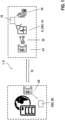
- the system 1 shown in Fig. 1 comprises at least one sensor of a medical device 10 providing a first data set DS1 comprising pre-acquired medical data D.
- the system 1 comprises means for applying a machine learning algorithm A, in particular an artificial neural network, to the pre-acquired medical data, wherein the machine learning algorithm A comprises a first algorithm component A1 hosted in an IT-environment of a health care provider and a second algorithm component A2 hosted in an IT-environment of an IT-service provider, said first algorithm component A1 and said second algorithm component A2 being linked via a data interface 12.
- a machine learning algorithm A in particular an artificial neural network
- system 1 comprises means for outputting a second data set DS2 representing medical decision support data SD.
- the machine learning algorithm A was initially developed and trained as an overall algorithm.
- a trained neural network is used here as an overall algorithm.
- the algorithm is divided into two parts for operation, with the first algorithm component A1 needing access to patient data implemented in the protected IT system of the healthcare provider.
- the first algorithm component A1 uses its input interface to access the pre-acquired medical data D and the patient medical record 24 via a secure connection 22.
- the results of the first algorithm component A1 are continuously made available to the second algorithm component A2 via the data interface 12.
- the second algorithm component A2 is executed on the IT service provider's servers and is not directly available to the healthcare provider. With a suitable choice of splitting the neural network into two subcomponents, it is thus possible that neither the protected patient data need to be available to the AI service provider, nor can unauthorized healthcare providers use the AI algorithm without authorization from the AI service provider or spy on it by means of reverse engineering. Further training of the neural network, even during operation, also remains possible with this system division.
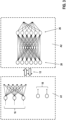
- Fig. 2 shows a flowchart of a computer implemented method for providing medical decision support according to a preferred embodiment of the invention.
- the machine learning algorithm A consists of a trained neural network that is given a medical input. This is then received and processed by means of an input layer 16 of suitable dimension.
- the weighted propagation functions pass information to a first hidden layer with appropriate activation functions and trained thresholds.
- the information is passed to another hidden layer, again via weighted propagation functions.
- This further hidden layer is linked via further propagation functions to an output layer 18, which provides a classification result.
- the representation of the neural network is only schematic and can have many more dimensions and layers in an actual implementation.
- the first data set DS1 comprising pre-acquired medical data D is stored in a data storage medium 14 in the IT-environment of the health care provider.
- the first data set DS1 is provided as input data to the first algorithm component A1 hosted in the IT-environment of the health care provider.
- the first algorithm component A1 transmits the outputs of its input layer 16 or the outputs of the subsequent layer 20 connected to its input layer 16 to the second algorithm component A2 via the data interface 12.
- the second algorithm component A2 receives the outputs transmitted from the first algorithm component A1, wherein the second algorithm component A2 comprises all layers of the machine learning algorithm A between the input layer 16 or the subsequent layer 20 connected to the input layer 16 and the output layer 18 of the machine learning algorithm A.
- the pre-acquired medical data D is at least one of an ECG and/or IEGM signal curve, a respiratory signal curves, in particular a respiratory rhythm and/or a respiratory depth, a pressure waveform signal curve, a temperature waveform signal curve, a tissue and body inductance signal curve and a blood flow signal curve.
- the medical decision support data SD is preferably a medical parameter and/or a designation of a medical condition.
- the machine learning algorithm A is an artificial neural network, in particular a regression or classification-type algorithm.
- Fig. 3 shows a flowchart of a computer implemented method for providing medical decision support according to a further preferred embodiment of the invention.
- the first algorithm component A1 according to this alternative embodiment comprises an input layer 16 and the output layer 18 or alternatively an input layer 16, a subsequent layer 20 connected to the input layer 16 and the output layer 18.
- the second algorithm component A2 comprises all subsequent and hidden layers 20, 26 of the machine learning algorithm A.
- the second algorithm component A2 furthermore transmits the outputs of its final hidden layer 26 of the machine learning algorithm A to the output layer 18 of the machine learning algorithm A comprised by the first algorithm component A1 via the data interface 12.
- both the input layer 16 and the output layer 18 are operated in the IT system of the healthcare provider. All other hidden layers are operated in the IT system of the IT service provider.
- the advantage of this division is that both access to patient data and reporting takes place exclusively in the protected IT environment of the healthcare provider.
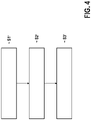
- Fig. 4 shows a flowchart of a computer implemented method for providing a trained machine learning algorithm A configured to provide medical decision support according to the preferred embodiment of the invention.
- the computer implemented method for providing a trained machine learning algorithm A is configured to provide medical decision support.
- the method comprises receiving S1' a first training data set comprising pre-acquired medical data D captured by at least one sensor of a medical device 10.
- the method further comprises receiving S2' a second training data set representing medical decision support data SD and training S3' the machine learning algorithm A by an optimization algorithm which calculates an extreme value of a loss function for determining medical decision support data SD from the pre-acquired medical data D.
- training data in particular data vectors for weights of propagation functions and threshold values of activation functions of individual neurons, for the first algorithm component A1 and the second algorithm component A2 is exchanged bidirectionally via the data interface 12.
Landscapes
- Health & Medical Sciences (AREA)
- Engineering & Computer Science (AREA)
- Biomedical Technology (AREA)
- Medical Informatics (AREA)
- Public Health (AREA)
- Data Mining & Analysis (AREA)
- Databases & Information Systems (AREA)
- Pathology (AREA)
- Epidemiology (AREA)
- General Health & Medical Sciences (AREA)
- Primary Health Care (AREA)
- Measuring And Recording Apparatus For Diagnosis (AREA)
Abstract
The invention relates to a computer implemented method for providing medical decision support, comprising the steps of providing (S1) a first data set (DS1) comprising pre-acquired medical data (D) captured by at least one sensor of a medical device (10), applying (S2) a machine learning algorithm (A), in particular an artificial neural network, to the pre-acquired medical data (D), wherein the machine learning algorithm (A) comprises a first algorithm component (A1) hosted in an IT-environment of a health care provider and a second algorithm component (A2) hosted in an IT-environment of an IT-service provider, said first algorithm component (A1) and said second algorithm component (A2) being linked via a data interface (12), and outputting (S3) a second data set (DS2) representing medical decision support data (SD) by the machine learning algorithm (A). The invention further relates to a corresponding system (1) and training method.
Description
- The invention relates to a computer implemented method for providing medical decision support and a computer implemented method for providing a trained machine learning algorithm configured to provide medical decision support.
- Furthermore, the invention relates to a system for providing medical decision support.
- A variety of medical decision support systems exist at present, some of which employ machine learning algorithms. One of the issues of such systems is data protection of patient medical data.
- IT-service providers offering data analysis solutions do not always have access to patient medical data in order to process said patient medical data in their systems in all regions of the world depending on local rules and regulations. In some regions patient data is not allowed to be processed outside of a healthcare providers IT environment such as a hospital information system.
- Hence, the IT-service provider in these cases must hand over the data analysis solution to the healthcare provider in order for it to be operated at the healthcare provider's site. This however poses a danger for the IT-service provider in that algorithms could be subject to theft or reverse engineering at the healthcare provider's site or possibly be developed further without consent of the IT-service provider.
- A known solution to protect machine learning algorithms from theft is to run said algorithms only in the cloud of the IT-service provider and to send to the healthcare provider only the results of an analysis performed by the machine learning algorithm.
- The disadvantage of said known solution is that the execution of the machine learning algorithm in the cloud requires uploading of sensitive patient data, which in many cases is not possible for privacy reasons. This severely limits the application of the machine learning algorithms.
- It is therefore an object of the present invention to provide an improved method capable of securing machine learning algorithms for providing medical decision support while at the same time meeting local rules and regulations for data protection of patient medical data.
- The object is solved by a computer implemented method for providing medical decision support having the features of
claim 1. - Moreover, the object is solved by a computer implemented method for providing a trained machine learning algorithm configured to provide medical decision support having the features of
claim 12. - Furthermore, the object is solved by a system for providing medical decision support having the features of claim 14.
- Further developments and advantageous embodiments are defined in the dependent claims.
- The present invention provides a computer implemented method for providing medical decision support. The method comprises providing a first data set comprising pre-acquired medical data captured by at least one sensor of a medical device.
- Furthermore, the method comprises applying a machine learning algorithm, in particular an artificial neural network, to the pre-acquired medical data, wherein the machine learning algorithm comprises a first algorithm component hosted in an IT-environment of a health care provider and a second algorithm component hosted in an IT-environment of an IT-service provider, said first algorithm component and said second algorithm component being linked via a data interface.
- In addition, the method comprises outputting a second data set representing medical decision support data by the machine learning algorithm.
- Moreover, the present invention provides a computer implemented method for providing a trained machine learning algorithm configured to provide medical decision support. The method comprises receiving a first training data set comprising pre-acquired medical data captured by at least one sensor of a medical device.
- Furthermore, the method comprises receiving a second training data set representing medical decision support data, and training the machine learning algorithm by an optimization algorithm which calculates an extreme value of a loss function for determining medical decision support data from the pre-acquired medical data.
- In addition, the present invention provides a system for providing medical decision support. The system comprises at least one sensor of a medical device providing a first data set comprising pre-acquired medical data.
- Furthermore, the system comprises means for applying a machine learning algorithm, in particular an artificial neural network, to the pre-acquired medical data, wherein the machine learning algorithm comprises a first algorithm component hosted in an IT-environment of a health care provider and a second algorithm component hosted in an IT-environment of an IT-service provider, said first algorithm component and said second algorithm component being linked via a data interface, and means for outputting a second data set representing medical decision support data.
- An idea of the present invention is to prevent intellectual property theft in an AI analysis that must be performed at a health care providers IT infrastructure in order to process sensitive patient data.
- The machine learning algorithm is hence split up in such a way that one part of the algorithms runs at a health care providers IT infrastructure, namely the part that processes patientspecific data and pre-processes the patient data localized at the health care providers' site.
- This pre-processed data is then transmitted to the second part of the AI system, which runs on a server system of the IT service provider. This provides the advantage that with part of the algorithm located at the health care providers site, misuse can no longer take place, since the other part of the algorithm is not localized there.
- In addition, computing resources at the health care providers IT infrastructure are not excessively used, but only the necessary part of the IT infrastructure is engaged.
- Machine learning algorithms are based on using statistical techniques to train a data processing system to perform a specific task without being explicitly programmed to do so. The goal of machine learning is to construct algorithms that can learn from data and make predictions. These algorithms create mathematical models that can be used, for example, to classify data or to solve regression type problems.
- According to an aspect of the invention, the first data set comprising pre-acquired medical data is stored in a data storage medium in the IT-environment of the health care provider, wherein the first data set is provided as input data to the first algorithm component hosted in the IT-environment of the health care provider. Thus, respective rules and regulations of various jurisdictions for patient data protection can be observed.
- According to a further aspect of the invention, the first algorithm component comprises at least an input layer and an output layer of the machine learning algorithm. In this fashion, only the IT environment of the healthcare provider processes protected patient data and outputs the determined medical decision support data.
- According to a further aspect of the invention, the first algorithm component comprises at least an input layer, a subsequent layer connected to the input layer and an output layer of the machine learning algorithm. Therefore, based on the data transmitted to the second algorithm component, no conclusions can be drawn about the patient medical data at the IT service provider's site.
- According to a further aspect of the invention, the first algorithm component comprises an input layer or an input layer and a subsequent layer connected to the input layer, and wherein the second algorithm component comprises all subsequent layers, in particular all subsequent hidden layers, and an output layer of the machine learning algorithm.
- The IT environment of the IT service provider thus provides a main medical data processing system even though the IT service provider is not authorized to process protected patient data.
- According to a further aspect of the invention, the first algorithm component transmits the outputs of its input layer or the outputs of the subsequent layer connected to its input layer to the second algorithm component via the data interface. The partitioning of the algorithm components is such that the IT service provider does not have direct access to the protected patient data.
- According to a further aspect of the invention, the second algorithm component receives the outputs transmitted from the first algorithm component, wherein the second algorithm component comprises all layers of the machine learning algorithm between the input layer or the subsequent layer connected to the input layer and the output layer of the machine learning algorithm.
- The division of the algorithm components is hence designed in such a way that the healthcare provider is not able to reconstruct the entire AI algorithm using reverse engineering methods or use it without authorization.
- According to a further aspect of the invention, the second algorithm component transmits the outputs of its final layer to the output layer of the machine learning algorithm comprised by the first algorithm component via the data interface.
- The AI algorithm is thus basically divided in such a way that at least the input and output layers of the AI algorithm are operated at the healthcare provider and are hence not accessible to the IT service provider.
- According to a further aspect of the invention, the pre-acquired medical data is at least one of an ECG and/or IEGM signal curve, a respiratory signal curves, in particular a respiratory rhythm and/or a respiratory depth, a pressure waveform signal curve, a temperature waveform signal curve, a tissue and body inductance signal curve and a blood flow signal curve. The present invention is thus advantageously usable with a wide variety of data sources.
- According to a further aspect of the invention, the medical decision support data is a medical parameter and/or a designation of a medical condition. The machine learning algorithm could e.g. identify patterns in ECG or other signals on the basis of which medical support data can be generated.
- According to a further aspect of the invention, the machine learning algorithm is an artificial neural network, in particular a regression or classification algorithm. The machine learning algorithm can thus be applied to a broad range of problems.
- According to a further aspect of the invention, training data, in particular data vectors for weights of propagation functions and threshold values of activation functions of individual neurons, for the first algorithm component and the second algorithm component is exchanged bidirectionally via the data interface. The partitioned structure of the machine learning algorithm thus enables the exchange of training data between the respective algorithm components.
- The herein described features of the system for providing medical decision support are also disclosed for the computer-implemented method for providing medical decision support and vice versa.
- For a more complete understanding of the present invention and advantages thereof, reference is now made to the following description taken in conjunction with the accompanying drawings. The invention is explained in more detail below using exemplary embodiments, which are specified in the schematic figures of the drawings, in which:
- Fig. 1
- shows a diagram of a system for providing medical decision support according to a preferred embodiment of the invention;
- Fig. 2
- shows a flowchart of a computer implemented method for providing medical decision support according to the preferred embodiment of the invention;
- Fig.3
- shows a flowchart of a computer implemented method for providing medical decision support according to a further preferred embodiment of the invention; and
- Fig.4
- shows a flowchart of a computer implemented method for providing a trained machine learning algorithm configured to provide medical decision support according to the preferred embodiment of the invention.
- The
system 1 shown inFig. 1 comprises at least one sensor of amedical device 10 providing a first data set DS1 comprising pre-acquired medical data D. - Furthermore, the
system 1 comprises means for applying a machine learning algorithm A, in particular an artificial neural network, to the pre-acquired medical data, wherein the machine learning algorithm A comprises a first algorithm component A1 hosted in an IT-environment of a health care provider and a second algorithm component A2 hosted in an IT-environment of an IT-service provider, said first algorithm component A1 and said second algorithm component A2 being linked via adata interface 12. - In addition, the
system 1 comprises means for outputting a second data set DS2 representing medical decision support data SD. The machine learning algorithm A was initially developed and trained as an overall algorithm. A trained neural network is used here as an overall algorithm. - Since this algorithm needs to access protected patient data for operation, according to the invention, the algorithm is divided into two parts for operation, with the first algorithm component A1 needing access to patient data implemented in the protected IT system of the healthcare provider.
- Furthermore, the first algorithm component A1 uses its input interface to access the pre-acquired medical data D and the patient
medical record 24 via asecure connection 22. The results of the first algorithm component A1 are continuously made available to the second algorithm component A2 via thedata interface 12. - The second algorithm component A2 is executed on the IT service provider's servers and is not directly available to the healthcare provider. With a suitable choice of splitting the neural network into two subcomponents, it is thus possible that neither the protected patient data need to be available to the AI service provider, nor can unauthorized healthcare providers use the AI algorithm without authorization from the AI service provider or spy on it by means of reverse engineering. Further training of the neural network, even during operation, also remains possible with this system division.
-
Fig. 2 shows a flowchart of a computer implemented method for providing medical decision support according to a preferred embodiment of the invention. - The machine learning algorithm A consists of a trained neural network that is given a medical input. This is then received and processed by means of an
input layer 16 of suitable dimension. The weighted propagation functions pass information to a first hidden layer with appropriate activation functions and trained thresholds. - Subsequently, the information is passed to another hidden layer, again via weighted propagation functions. This further hidden layer is linked via further propagation functions to an
output layer 18, which provides a classification result. The representation of the neural network is only schematic and can have many more dimensions and layers in an actual implementation. - The first data set DS1 comprising pre-acquired medical data D is stored in a data storage medium 14 in the IT-environment of the health care provider. The first data set DS1 is provided as input data to the first algorithm component A1 hosted in the IT-environment of the health care provider.
- The first algorithm component A1 transmits the outputs of its
input layer 16 or the outputs of thesubsequent layer 20 connected to itsinput layer 16 to the second algorithm component A2 via thedata interface 12. - The second algorithm component A2 receives the outputs transmitted from the first algorithm component A1, wherein the second algorithm component A2 comprises all layers of the machine learning algorithm A between the
input layer 16 or thesubsequent layer 20 connected to theinput layer 16 and theoutput layer 18 of the machine learning algorithm A. - The pre-acquired medical data D is at least one of an ECG and/or IEGM signal curve, a respiratory signal curves, in particular a respiratory rhythm and/or a respiratory depth, a pressure waveform signal curve, a temperature waveform signal curve, a tissue and body inductance signal curve and a blood flow signal curve. The medical decision support data SD is preferably a medical parameter and/or a designation of a medical condition.
- The machine learning algorithm A is an artificial neural network, in particular a regression or classification-type algorithm.
-
Fig. 3 shows a flowchart of a computer implemented method for providing medical decision support according to a further preferred embodiment of the invention. - The first algorithm component A1 according to this alternative embodiment comprises an
input layer 16 and theoutput layer 18 or alternatively aninput layer 16, asubsequent layer 20 connected to theinput layer 16 and theoutput layer 18. The second algorithm component A2 comprises all subsequent andhidden layers - The second algorithm component A2 furthermore transmits the outputs of its final hidden
layer 26 of the machine learning algorithm A to theoutput layer 18 of the machine learning algorithm A comprised by the first algorithm component A1 via thedata interface 12. - Hence, both the
input layer 16 and theoutput layer 18 are operated in the IT system of the healthcare provider. All other hidden layers are operated in the IT system of the IT service provider. The advantage of this division is that both access to patient data and reporting takes place exclusively in the protected IT environment of the healthcare provider. -
Fig. 4 shows a flowchart of a computer implemented method for providing a trained machine learning algorithm A configured to provide medical decision support according to the preferred embodiment of the invention. - The computer implemented method for providing a trained machine learning algorithm A is configured to provide medical decision support.
- The method comprises receiving S1' a first training data set comprising pre-acquired medical data D captured by at least one sensor of a
medical device 10. - The method further comprises receiving S2' a second training data set representing medical decision support data SD and training S3' the machine learning algorithm A by an optimization algorithm which calculates an extreme value of a loss function for determining medical decision support data SD from the pre-acquired medical data D.
- Furthermore, training data, in particular data vectors for weights of propagation functions and threshold values of activation functions of individual neurons, for the first algorithm component A1 and the second algorithm component A2 is exchanged bidirectionally via the
data interface 12. -
- 1
- system
- 10
- medical device
- 12
- data interface
- 14
- data storage medium
- 16
- input layer
- 18
- output layer
- 20
- subsequent layer
- 22
- secure connection
- 24
- patient medical record
- 26
- final hidden layer
- A
- machine learning algorithm
- A1
- first algorithm component
- A2
- second algorithm component
- D
- medical data
- DS1
- first data set
- DS2
- second data set
- SD
- medical decision support data
- S1'-S3'
- method steps
Claims (15)
- Computer-implemented method for providing medical decision support, comprising the steps of:providing (S1) a first data set (DS1) comprising pre-acquired medical data (D) captured by at least one sensor of a medical device (10);applying (S2) a machine learning algorithm (A) to the pre-acquired medical data (D), wherein the machine learning algorithm (A) comprises a first algorithm component (A1) hosted in an IT-environment of a health care provider and a second algorithm component (A2) hosted in an IT-environment of an IT-service provider, said first algorithm component (A1) and said second algorithm component (A2) being linked via a data interface (12); andoutputting (S3) a second data set (DS2) representing medical decision support data (SD) by the machine learning algorithm (A).
- Computer-implemented method of claim 1, wherein the first data set (DS1) comprising pre-acquired medical data (D) is stored in a data storage medium (14) in the IT-environment of the health care provider, wherein the first data set (DS1) is provided as input data to the first algorithm component (A1) hosted in the IT-environment of the health care provider.
- Computer-implemented method of claim 1 or 2, wherein the first algorithm component (A1) comprises at least an input layer (16) and an output layer (18) of the machine learning algorithm (A).
- Computer-implemented method of claim 1 or 2, wherein the first algorithm component (A1) comprises at least an input layer (16), a subsequent layer (20) connected to the input layer (16) and an output layer (18) of the machine learning algorithm (A).
- Computer-implemented method of claim 1 or 2, wherein the first algorithm component (A1) comprises an input layer (16) or an input layer (16) and a subsequent layer (20) connected to the input layer (16), and wherein the second algorithm component (A2) comprises all subsequent layers, in particular all subsequent hidden layers, and an output layer (18) of the machine learning algorithm (A).
- Computer-implemented method of any one of claims 3 to 5, wherein the first algorithm component (A1) transmits the outputs of its input layer (16) or the outputs of the subsequent layer (20) connected to its input layer (16) to the second algorithm component (A2) via the data interface (12).
- Computer-implemented method of claim 3 or 4, wherein the second algorithm component (A2) receives the outputs transmitted from the first algorithm component (A1), wherein the second algorithm component (A2) comprises all layers of the machine learning algorithm (A) between the input layer (16) or the subsequent layer (20) connected to the input layer (16) and the output layer (18) of the machine learning algorithm (A).
- Computer-implemented method of claim 7, wherein the second algorithm component (A2) transmits the outputs of its final layer to the output layer (18) of the machine learning algorithm (A) comprised by the first algorithm component (A1) via the data interface (12).
- Computer-implemented method of any one of the preceding claims, wherein the pre-acquired medical data (D) is at least one of an ECG and/or IEGM signal curve, a respiratory signal curves, in particular a respiratory rhythm and/or a respiratory depth, a pressure waveform signal curve, a temperature waveform signal curve, a tissue and body inductance signal curve and a blood flow signal curve.
- Computer-implemented method of any one of the preceding claims, wherein the medical decision support data (SD) is a medical parameter and/or a designation of a medical condition.
- Computer-implemented method of any one of the preceding claims, wherein the machine learning algorithm (A) is an artificial neural network, in particular a regression or classification-type algorithm.
- Computer implemented method for providing a trained machine learning algorithm (A) configured to provide medical decision support, comprising the steps of:receiving (S1') a first training data set comprising pre-acquired medical data (D) captured by at least one sensor of a medical device (10);receiving (S2') a second training data set representing medical decision support data (SD); andtraining (S3') the machine learning algorithm (A) by an optimization algorithm which calculates an extreme value of a loss function for determining medical decision support data (SD) from the pre-acquired medical data (D).
- Computer-implemented method of claim 12, wherein training data, in particular data vectors for weights of propagation functions and threshold values of activation functions of individual neurons, for the first algorithm component (A1) and the second algorithm component (A2) is exchanged bidirectionally via the data interface (12).
- System (1) for providing medical decision support, comprising:at least one sensor of a medical device (10) providing (S1) a first data set (DS1) comprising pre-acquired medical data (D);means for applying (S2) a machine learning algorithm (A), in particular an artificial neural network, to the pre-acquired medical data (D), wherein the machine learning algorithm (A) comprises a first algorithm component (A1) hosted in an IT-environment of a health care provider and a second algorithm component (A2) hosted in an IT-environment of an IT-service provider, said first algorithm component (A1) and said second algorithm component (A2) being linked via a data interface (12); andmeans for outputting (S3) a second data set (DS2) representing medical decision support data (SD).
- Computer program with program code to perform the method of any one of claims 1 to 13 when the computer program is executed on a computer.
Priority Applications (1)
| Application Number | Priority Date | Filing Date | Title |
|---|---|---|---|
| EP21197594.1A EP4152342A1 (en) | 2021-09-20 | 2021-09-20 | Computer implemented method and system for providing medical decision support and training method |
Applications Claiming Priority (1)
| Application Number | Priority Date | Filing Date | Title |
|---|---|---|---|
| EP21197594.1A EP4152342A1 (en) | 2021-09-20 | 2021-09-20 | Computer implemented method and system for providing medical decision support and training method |
Publications (1)
| Publication Number | Publication Date |
|---|---|
| EP4152342A1 true EP4152342A1 (en) | 2023-03-22 |
Family
ID=77838754
Family Applications (1)
| Application Number | Title | Priority Date | Filing Date |
|---|---|---|---|
| EP21197594.1A Withdrawn EP4152342A1 (en) | 2021-09-20 | 2021-09-20 | Computer implemented method and system for providing medical decision support and training method |
Country Status (1)
| Country | Link |
|---|---|
| EP (1) | EP4152342A1 (en) |
-
2021
- 2021-09-20 EP EP21197594.1A patent/EP4152342A1/en not_active Withdrawn
Non-Patent Citations (5)
| Title |
|---|
| AKMANDOR AYTEN OZGE ET AL: "Smart Health Care: An Edge-Side Computing Perspective", IEEE CONSUMER ELECTRONICS MAGAZINE, IEEE, PISCATAWAY, NJ, USA, vol. 7, no. 1, 1 January 2018 (2018-01-01), pages 29 - 37, XP011674499, ISSN: 2162-2248, [retrieved on 20171213], DOI: 10.1109/MCE.2017.2746096 * |
| MATTHIAS EBERLEIN ET AL: "Convolutional Neural Networks for Epileptic Seizure Prediction", ARXIV.ORG, CORNELL UNIVERSITY LIBRARY, 201 OLIN LIBRARY CORNELL UNIVERSITY ITHACA, NY 14853, 2 November 2018 (2018-11-02), XP081144087, DOI: 10.1109/BIBM.2018.8621225 * |
| TEERAPITTAYANON SURAT ET AL: "Distributed Deep Neural Networks Over the Cloud, the Edge and End Devices", PROCEEDINGS OF THE INTERNATIONAL CONFERENCE ON DISTRIBUTED COMPUTING SYSTEMS, IEEE COMPUTER SOCIETY, US, 5 June 2017 (2017-06-05), pages 328 - 339, XP033122945, ISSN: 1063-6927, [retrieved on 20170713], DOI: 10.1109/ICDCS.2017.226 * |
| TULI SHRESHTH ET AL: "HealthFog: An ensemble deep learning based Smart Healthcare System for Automatic Diagnosis of Heart Diseases in integrated IoT and fog computing environments", FUTURE GENERATION COMPUTER SYSTEMS, ELSEVIER SCIENCE PUBLISHERS. AMSTERDAM, NL, vol. 104, 6 November 2019 (2019-11-06), pages 187 - 200, XP085936906, ISSN: 0167-739X, [retrieved on 20191106], DOI: 10.1016/J.FUTURE.2019.10.043 * |
| YU JIAN ET AL: "EdgeCNN: A Hybrid Architecture for Agile Learning of Healthcare Data from IoT Devices", 2018 IEEE 24TH INTERNATIONAL CONFERENCE ON PARALLEL AND DISTRIBUTED SYSTEMS (ICPADS), IEEE, 11 December 2018 (2018-12-11), pages 852 - 859, XP033520343, DOI: 10.1109/PADSW.2018.8644604 * |
Similar Documents
| Publication | Publication Date | Title |
|---|---|---|
| Shinde et al. | Securing AI‐based healthcare systems using blockchain technology: A state‐of‐the‐art systematic literature review and future research directions | |
| Alshehri | Blockchain-assisted cyber security in medical things using artificial intelligence | |
| Din et al. | Optimizing HIV/AIDS dynamics: stochastic control strategies with education and treatment | |
| Kuru et al. | Blockchain-enabled privacy-preserving machine learning authentication with immersive devices for urban metaverse cyberspaces | |
| Chaudjary et al. | Blockchain and federated learning-based security solutions for telesurgery system: a comprehensive review | |
| Algarni et al. | Digital Health: The Cybersecurity for AI-based healthcare communication | |
| AU2018224163A1 (en) | A layered medical data computer architecture | |
| Kabir et al. | DT-IoMT: A digital twin reference model for secure internet of medical things | |
| Shankhdhar et al. | Blockchain-enabled secure data transmission for personalized e-healthcare and digital twin well-being | |
| Günday et al. | Artificial intelligence in mental health practices: legal liability analysis under Turkish, European, and common law frameworks | |
| Alalawi et al. | Privacy preservation for the IoMT using federated learning and blockchain technologies | |
| Kohno et al. | Medical healthcare network platform and big data analysis based on integrated ICT and data science with regulatory science | |
| Rathore et al. | Deep learning-based security schemes for implantable medical devices | |
| Makedon et al. | An event driven framework for assistive CPS environments | |
| Chiurco et al. | The Marriage of Neurotechnologies and Artificial Intelligence: Ethical, regulatory, and technological aspects | |
| CN113707336A (en) | Infectious disease prevention and treatment early warning method, device, equipment and medium based on data analysis | |
| Rathee et al. | A secure emotion aware intelligent system for Internet of healthcare | |
| CN119137607A (en) | Systems and methods for creating and executing secure neural networks | |
| Deepti et al. | Behavioral Biometric Privacy Threats in Immersive Systems | |
| US20230395228A1 (en) | Physical therapy imaging and prediction | |
| Ivanovic et al. | Influence of artificial intelligence on personalized medical predictions, interventions and quality of life issues | |
| CN116525144A (en) | 24H doctor inquiry system based on online diagnosis and treatment warehouse | |
| Awais et al. | Deep Learning Based Attack Classification on IoMT Devices | |
| Puder | Anomaly detection for interoperable and modular operating room tables | |
| Mekki et al. | A Secure Emergency Framework in an IoT Based Patient Monitoring System. |
Legal Events
| Date | Code | Title | Description |
|---|---|---|---|
| PUAI | Public reference made under article 153(3) epc to a published international application that has entered the european phase |
Free format text: ORIGINAL CODE: 0009012 |
|
| STAA | Information on the status of an ep patent application or granted ep patent |
Free format text: STATUS: THE APPLICATION HAS BEEN PUBLISHED |
|
| AK | Designated contracting states |
Kind code of ref document: A1 Designated state(s): AL AT BE BG CH CY CZ DE DK EE ES FI FR GB GR HR HU IE IS IT LI LT LU LV MC MK MT NL NO PL PT RO RS SE SI SK SM TR |
|
| STAA | Information on the status of an ep patent application or granted ep patent |
Free format text: STATUS: THE APPLICATION IS DEEMED TO BE WITHDRAWN |
|
| 18D | Application deemed to be withdrawn |
Effective date: 20230923 |