EP4152279A1 - Image processing device, image processing method, and non-temporary recording medium - Google Patents
Image processing device, image processing method, and non-temporary recording medium Download PDFInfo
- Publication number
- EP4152279A1 EP4152279A1 EP22184748.6A EP22184748A EP4152279A1 EP 4152279 A1 EP4152279 A1 EP 4152279A1 EP 22184748 A EP22184748 A EP 22184748A EP 4152279 A1 EP4152279 A1 EP 4152279A1
- Authority
- EP
- European Patent Office
- Prior art keywords
- code
- recognition process
- character
- area image
- image
- Prior art date
- Legal status (The legal status is an assumption and is not a legal conclusion. Google has not performed a legal analysis and makes no representation as to the accuracy of the status listed.)
- Withdrawn
Links
Images



Classifications
-
- G—PHYSICS
- G06—COMPUTING OR CALCULATING; COUNTING
- G06V—IMAGE OR VIDEO RECOGNITION OR UNDERSTANDING
- G06V30/00—Character recognition; Recognising digital ink; Document-oriented image-based pattern recognition
- G06V30/10—Character recognition
-
- G—PHYSICS
- G06—COMPUTING OR CALCULATING; COUNTING
- G06V—IMAGE OR VIDEO RECOGNITION OR UNDERSTANDING
- G06V30/00—Character recognition; Recognising digital ink; Document-oriented image-based pattern recognition
- G06V30/40—Document-oriented image-based pattern recognition
- G06V30/41—Analysis of document content
-
- G—PHYSICS
- G06—COMPUTING OR CALCULATING; COUNTING
- G06K—GRAPHICAL DATA READING; PRESENTATION OF DATA; RECORD CARRIERS; HANDLING RECORD CARRIERS
- G06K7/00—Methods or arrangements for sensing record carriers, e.g. for reading patterns
- G06K7/10—Methods or arrangements for sensing record carriers, e.g. for reading patterns by electromagnetic radiation, e.g. optical sensing; by corpuscular radiation
- G06K7/14—Methods or arrangements for sensing record carriers, e.g. for reading patterns by electromagnetic radiation, e.g. optical sensing; by corpuscular radiation using light without selection of wavelength, e.g. sensing reflected white light
- G06K7/1404—Methods for optical code recognition
- G06K7/1408—Methods for optical code recognition the method being specifically adapted for the type of code
- G06K7/1413—1D bar codes
-
- G—PHYSICS
- G06—COMPUTING OR CALCULATING; COUNTING
- G06K—GRAPHICAL DATA READING; PRESENTATION OF DATA; RECORD CARRIERS; HANDLING RECORD CARRIERS
- G06K7/00—Methods or arrangements for sensing record carriers, e.g. for reading patterns
- G06K7/10—Methods or arrangements for sensing record carriers, e.g. for reading patterns by electromagnetic radiation, e.g. optical sensing; by corpuscular radiation
- G06K7/14—Methods or arrangements for sensing record carriers, e.g. for reading patterns by electromagnetic radiation, e.g. optical sensing; by corpuscular radiation using light without selection of wavelength, e.g. sensing reflected white light
- G06K7/1404—Methods for optical code recognition
- G06K7/1408—Methods for optical code recognition the method being specifically adapted for the type of code
- G06K7/1417—2D bar codes
-
- G—PHYSICS
- G06—COMPUTING OR CALCULATING; COUNTING
- G06V—IMAGE OR VIDEO RECOGNITION OR UNDERSTANDING
- G06V30/00—Character recognition; Recognising digital ink; Document-oriented image-based pattern recognition
- G06V30/10—Character recognition
- G06V30/14—Image acquisition
- G06V30/1444—Selective acquisition, locating or processing of specific regions, e.g. highlighted text, fiducial marks or predetermined fields
- G06V30/1456—Selective acquisition, locating or processing of specific regions, e.g. highlighted text, fiducial marks or predetermined fields based on user interactions
-
- H—ELECTRICITY
- H04—ELECTRIC COMMUNICATION TECHNIQUE
- H04N—PICTORIAL COMMUNICATION, e.g. TELEVISION
- H04N1/00—Scanning, transmission or reproduction of documents or the like, e.g. facsimile transmission; Details thereof
- H04N1/00127—Connection or combination of a still picture apparatus with another apparatus, e.g. for storage, processing or transmission of still picture signals or of information associated with a still picture
- H04N1/00326—Connection or combination of a still picture apparatus with another apparatus, e.g. for storage, processing or transmission of still picture signals or of information associated with a still picture with a data reading, recognizing or recording apparatus, e.g. with a bar-code apparatus
- H04N1/00328—Connection or combination of a still picture apparatus with another apparatus, e.g. for storage, processing or transmission of still picture signals or of information associated with a still picture with a data reading, recognizing or recording apparatus, e.g. with a bar-code apparatus with an apparatus processing optically-read information
- H04N1/00331—Connection or combination of a still picture apparatus with another apparatus, e.g. for storage, processing or transmission of still picture signals or of information associated with a still picture with a data reading, recognizing or recording apparatus, e.g. with a bar-code apparatus with an apparatus processing optically-read information with an apparatus performing optical character recognition
-
- H—ELECTRICITY
- H04—ELECTRIC COMMUNICATION TECHNIQUE
- H04N—PICTORIAL COMMUNICATION, e.g. TELEVISION
- H04N1/00—Scanning, transmission or reproduction of documents or the like, e.g. facsimile transmission; Details thereof
- H04N1/00127—Connection or combination of a still picture apparatus with another apparatus, e.g. for storage, processing or transmission of still picture signals or of information associated with a still picture
- H04N1/00326—Connection or combination of a still picture apparatus with another apparatus, e.g. for storage, processing or transmission of still picture signals or of information associated with a still picture with a data reading, recognizing or recording apparatus, e.g. with a bar-code apparatus
- H04N1/00328—Connection or combination of a still picture apparatus with another apparatus, e.g. for storage, processing or transmission of still picture signals or of information associated with a still picture with a data reading, recognizing or recording apparatus, e.g. with a bar-code apparatus with an apparatus processing optically-read information
- H04N1/00334—Connection or combination of a still picture apparatus with another apparatus, e.g. for storage, processing or transmission of still picture signals or of information associated with a still picture with a data reading, recognizing or recording apparatus, e.g. with a bar-code apparatus with an apparatus processing optically-read information with an apparatus processing barcodes or the like
-
- H—ELECTRICITY
- H04—ELECTRIC COMMUNICATION TECHNIQUE
- H04N—PICTORIAL COMMUNICATION, e.g. TELEVISION
- H04N2201/00—Indexing scheme relating to scanning, transmission or reproduction of documents or the like, and to details thereof
- H04N2201/0077—Types of the still picture apparatus
- H04N2201/0094—Multifunctional device, i.e. a device capable of all of reading, reproducing, copying, facsimile transception, file transception
Definitions
- Embodiments described herein relate generally to an image processing device, an image processing method, and a non-temporary recording medium.
- An image processing device can recognize a character or a code written in a designated area designated by a user for a document image.
- a user has to designate whether information written in a designated area is a character or a code.
- an image processing device comprising: a reader configured to acquire a document image formed on a sheet; and a controller configured to: acquire an area image in an area designated in the document image acquired by the reader, perform a character recognition process and a code recognition process on the area image, and in response to the character recognition process not recognizing a character, employ a code recognition result by the code recognition process performed on the area image as a recognition result of the area image.
- the controller is configured to, in response to the code recognition process not recognizing a code, employ a character recognition result by the character recognition process performed on the area image as the recognition result of the area image.
- the controller is configured to, in response to the code recognition process recognizing a code and the character recognition process recognizing a character, employ the code recognition result by the code recognition process performed on the area image and the character recognition result by the character recognition process performed on the area image as the recognition result of the area image.
- a code recognized by the code recognition process is a barcode or a two-dimensional code.
- a code recognized by the code recognition process is a stack-type two-dimensional code.
- the present invention further relates to an image processing method comprising: acquiring a document image formed on a sheet; acquiring an area image in a designated area designated in the document image; performing a character recognition process and a code recognition process on the area image; and in response to the character recognition process not recognizing a character, employing a code recognition result by a code recognition process performed on the area image as a recognition result of the area image.
- the method may further comprise, in response to the code recognition process not recognizing a code, employing a character recognition result by the character recognition process performed on the area image as the recognition result of the area image.
- the method may further comprise, in response to the code recognition process recognizing a code and the character recognition process recognizing a character, employing the code recognition result by the code recognition process performed on the area image and the character recognition result by the character recognition process performed on the area image as the recognition result of the area image.
- the present invention further relates to a non-transitory computer-readable medium storing computer-executable instructions that, when executed by one or more processors, perform operations comprising: acquiring a document image formed on a sheet; acquiring an area image in a designated area designated in the document image; performing a character recognition process and a code recognition process on the area image; and in response to the character recognition process not recognizing a character, employing a code recognition result by a code recognition process performed on the area image as a recognition result of the area image.
- the operations further comprise, in response to the code recognition process not recognizing a code, employing a character recognition result by the character recognition process performed on the area image as the recognition result of the area image.
- the operations further comprise, in response to the code recognition process recognizing a code and the character recognition process recognizing a character, employing the code recognition result by the code recognition process performed on the area image and the character recognition result by the character recognition process performed on the area image as the recognition result of the area image.
- an image processing device includes an acquisition unit (e.g., an acquisition device, a reader) and a control unit (e.g., a controller).
- the acquisition unit acquires a document image formed on a sheet.
- the control unit acquires an area image in a designated area designated in the document image acquired by the acquisition unit, performs a character recognition process and a code recognition process on the area image, and employs a recognition result by a code recognition process performed on the area image as a recognition result of the area image, if a character is not recognized by the character recognition process.
- FIG. 1 is an external view illustrating an overall configuration example of an image processing device 100 according to at least one embodiment.
- the image processing device 100 is, for example, a multifunction device.
- the image processing device 100 includes a control panel 120, a printer unit 130 (e.g., a printing device, a printer), a sheet container 140, and an image reading unit 200 (e.g., an image reading device, an image reader).
- a printer unit 130 e.g., a printing device, a printer
- a sheet container 140 e.g., a sheet container 140
- an image reading unit 200 e.g., an image reading device, an image reader.
- the image processing device 100 forms an image on a sheet by using a developer such as a toner.
- the sheet is, for example, paper or label paper.
- the sheet may be any material as long as the image processing device 100 can form an image on the surface thereof.
- the control panel 120 has a plurality of buttons.
- the control panel 120 receives user operations.
- the control panel 120 outputs a signal according to an operation performed by a user to a control unit (e.g., a controller) of the image processing device 100.
- the control panel 120 includes a display such as a liquid crystal display and an organic Electro Luminescence (EL) display.
- the display displays various kinds of information relating to the image processing device 100.
- the printer unit 130 forms an image on a sheet based on image information generated by the image reading unit 200 or image information received via a communication path.
- the printer unit 130 forms an image by, for example, the following process.
- the image forming unit of the printer unit 130 forms an electrostatic latent image on a photoconductor drum based on the image information.
- the image forming unit of the printer unit 130 forms a visible image by adhering a developer to the electrostatic latent image. Specific examples of a developer include a toner.
- a transfer unit e.g., a transfer device
- a fixing unit e.g., a fixing device of the printer unit 130 fixes the visible image on the sheet by heating and pressurizing the sheet.
- the sheet on which the image is formed may be a sheet contained in the sheet container 140 or may be a manually fed sheet.
- the sheet container 140 contains a sheet used for image formation in the printer unit 130.
- the image reading unit 200 reads the image information to be read based on brightness and darkness of light.
- the image reading unit 200 records the read image information.
- the recorded image information may be transmitted to another information processing device via a network.
- the recorded image information may be formed as an image on the sheet by the printer unit 130.
- the image reading unit 200 is provided with a platen glass 202 and a platen cover 204.
- the platen cover 204 is attached to the upper surface of the platen glass 202 in an openable and closable manner.
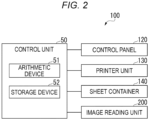
- FIG. 2 is a diagram illustrating a configuration of a control system of the image processing device 100.
- a control unit 50 (e.g., a controller) includes an arithmetic device 51 and a storage device 52.
- the arithmetic device 51 controls the control panel 120, the printer unit 130, the sheet container 140, and the image reading unit 200 according to various programs stored in the storage device 52.
- the arithmetic device 51 controls the entire image processing device 100.
- the arithmetic unit 51 is, for example, a Central Processing Unit (CPU) (e.g., a central processor), or an Application Specific Integrated Circuit (ASIC).
- the storage device 52 stores programs, various data, and the like.
- the storage device 52 is a Read Only Memory (ROM), a Random Access Memory (RAM), or the like.
- the user designates an area to be subjected to the recognition process by using a highlighter or the like on a sheet such as a business form. For example, a user uses a highlighter to draw a curve (for example, a closed curve) that surrounds a barcode or character.
- the image processing device 100 reads the sheet on which the designated area is indicated with the image reading unit 200. As a result, the image processing device 100 acquires the document image formed on the sheet (e.g., via the acquisition device, the reader).
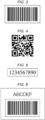
- FIG. 3 is a diagram illustrating an example of a barcode that can be recognized in the code recognition process.
- FIG. 4 is a diagram illustrating an example of a two-dimensional code that can be recognized in the code recognition process.
- the two-dimensional code may be a stack-type two-dimensional code in addition to a matrix-type two-dimensional code illustrated in FIG. 4 .
- FIG. 5 is a diagram illustrating an example of a character string (e.g., number) that can be recognized in a character recognition process.
- the character recognition process can recognize not only numbers but also alphabets and Chinese characters.
- the image processing device 100 can recognize the character and the code even if both the character and the code are included in the designated area.
- FIG. 6 is a diagram illustrating an example of a designated area including both characters and codes.
- the character recognition process recognizes the character string "ABCDEF" and the barcode.
- FIGS. 7 and 8 are flowcharts illustrating the flows of the recognition processes. The difference between of FIGS. 7 and 8 is whether to first determine a code recognition result or a character recognition result.
- the control unit 50 acquires a document image read by the image reading unit 200 from a sheet on which a designated area is designated by the user (ACT 101).
- the control unit 50 detects the designated area from the document image (ACT 102).
- the control unit 50 performs a character recognition process and a code recognition process on the detected designated area (ACT 103).
- the control unit 50 acquires a recognition result by the character recognition process and the code recognition process (ACT 104).
- a recognition result is output to a file (for example, an eXtensible Markup Language (XML) format).
- XML eXtensible Markup Language
- the recognition result may be output to, for example, an area starting from a designated address of a memory.
- the recognized character is output as a character recognition result.
- the character recognition process if a character is not recognized, nothing is output, or a code indicating that a character is not recognized is output.
- a code recognition process if a code is recognized, a recognized code is output as a code recognition result.
- the code recognition process if a code is not recognized, nothing is output, or a code indicating that a character is not recognized is output. For example, if the result is output to a file in an XML format, the result is output in a form in which data is not present between tags indicating output results.
- the control unit 50 determines whether the code is recognized by the code recognition process (ACT 105). If the code is not recognized by the code recognition process (ACT 105: NO), the control unit 50 performs the following process. That is, the control unit 50 employs a character recognition result by the character recognition process performed on the area image as a recognition result of the area image (ACT 108), and the process ends.
- the control unit 50 determines whether the character is recognized by the character recognition process (ACT 106). If a character is not recognized by the character recognition process (ACT 106: NO), the control unit 50 performs the following process. That is, the control unit 50 employs the code recognition result by the code recognition process performed on the area image as the recognition result of the area image (ACT 109), and the process ends.
- control unit 50 performs the following process. That is, in the following process, the control unit 50 employs the code recognition result by the code recognition process performed on the area image and the character recognition result by the character recognition process performed on the area image as the recognition result of the area image (ACT 107), the process ends.
- the user does not have to designate whether the information written in the designated area is a character or a code.
- the image processing device 100 it is possible to provide an image processing device in which the usability for the user is improved.
- the control unit 50 acquires the document image read by the image reading unit 200 from the sheet on which the designated area designated by the user is drawn (ACT 201).
- the control unit 50 detects the designated area from the document image (ACT 202).
- the control unit 50 performs the character recognition process and the code recognition process on the detected designated area (ACT 203).
- the control unit 50 acquires the recognition result by the character recognition process and the code recognition process (ACT 204).
- the acquisition method is as described in ACT 104.
- the control unit 50 determines whether the character is recognized by the character recognition process (ACT 205). If the character is not recognized by the character recognition process (ACT 205: NO), the control unit 50 performs the following process. That is, the control unit 50 employs the code recognition result by the code recognition process performed on the area image as the recognition result of the area image (ACT 208), and the process ends.
- the control unit 50 determines whether the code is recognized by the code recognition process (ACT 206). If the character is not recognized by the code recognition process (ACT 206: NO), the control unit 50 performs the following process. That is, the control unit 50 employs the character recognition result by the character recognition process performed on the area image as the recognition result of the area image (ACT 209), the process ends.
- control unit 50 If the code is recognized by the code recognition process (ACT 206: YES), the control unit 50 performs the following process. That is, the control unit 50 employs the character recognition result by the character recognition process performed on the area image and code recognition result by the code recognition process performed on the area image as the recognition results of the area image (ACT 207), the process ends.
- the user does not have to designate whether the information written in the designated area is a character or a code. Therefore, with the image processing device 100 according to at least one embodiment, it is possible to provide an image processing device in which the usability for the user is improved.
- the image processing device 100 is used as an example of the image processing device, but the embodiments are not limited thereto.
- Examples of the image processing device also include a scanner.
- the scanner can read a sheet and perform an image process on a document image, and thus the present embodiment can be applied.
Landscapes
- Engineering & Computer Science (AREA)
- Physics & Mathematics (AREA)
- Computer Vision & Pattern Recognition (AREA)
- Theoretical Computer Science (AREA)
- General Physics & Mathematics (AREA)
- Multimedia (AREA)
- Artificial Intelligence (AREA)
- Signal Processing (AREA)
- Health & Medical Sciences (AREA)
- Electromagnetism (AREA)
- General Health & Medical Sciences (AREA)
- Toxicology (AREA)
- Human Computer Interaction (AREA)
- Character Discrimination (AREA)
- Character Input (AREA)
Abstract
Description
- Embodiments described herein relate generally to an image processing device, an image processing method, and a non-temporary recording medium.
- An image processing device can recognize a character or a code written in a designated area designated by a user for a document image.
- In an image processing device in the related art, a user has to designate whether information written in a designated area is a character or a code.
- To this end, there is provided an image processing device comprising: a reader configured to acquire a document image formed on a sheet; and a controller configured to: acquire an area image in an area designated in the document image acquired by the reader, perform a character recognition process and a code recognition process on the area image, and in response to the character recognition process not recognizing a character, employ a code recognition result by the code recognition process performed on the area image as a recognition result of the area image.
- Preferably, the controller is configured to, in response to the code recognition process not recognizing a code, employ a character recognition result by the character recognition process performed on the area image as the recognition result of the area image.
- Preferably, the controller is configured to, in response to the code recognition process recognizing a code and the character recognition process recognizing a character, employ the code recognition result by the code recognition process performed on the area image and the character recognition result by the character recognition process performed on the area image as the recognition result of the area image.
- Preferably, a code recognized by the code recognition process is a barcode or a two-dimensional code.
- Preferably, a code recognized by the code recognition process is a stack-type two-dimensional code.
- The present invention further relates to an image processing method comprising: acquiring a document image formed on a sheet; acquiring an area image in a designated area designated in the document image; performing a character recognition process and a code recognition process on the area image; and
in response to the character recognition process not recognizing a character, employing a code recognition result by a code recognition process performed on the area image as a recognition result of the area image. - The method may further comprise, in response to the code recognition process not recognizing a code, employing a character recognition result by the character recognition process performed on the area image as the recognition result of the area image.
- The method may further comprise, in response to the code recognition process recognizing a code and the character recognition process recognizing a character, employing the code recognition result by the code recognition process performed on the area image and the character recognition result by the character recognition process performed on the area image as the recognition result of the area image.
- The present invention further relates to a non-transitory computer-readable medium storing computer-executable instructions that, when executed by one or more processors, perform operations comprising: acquiring a document image formed on a sheet; acquiring an area image in a designated area designated in the document image; performing a character recognition process and a code recognition process on the area image; and in response to the character recognition process not recognizing a character, employing a code recognition result by a code recognition process performed on the area image as a recognition result of the area image.
- Preferably, the operations further comprise, in response to the code recognition process not recognizing a code, employing a character recognition result by the character recognition process performed on the area image as the recognition result of the area image.
- Preferably, the operations further comprise, in response to the code recognition process recognizing a code and the character recognition process recognizing a character, employing the code recognition result by the code recognition process performed on the area image and the character recognition result by the character recognition process performed on the area image as the recognition result of the area image.
-
-
FIG. 1 is an external view illustrating an overall configuration example of an image processing device according to an embodiment; -
FIG. 2 is a diagram illustrating a configuration of a control system of the image processing device; -
FIG. 3 is a diagram illustrating a barcode; -
FIG. 4 is a diagram illustrating a two-dimensional code; -
FIG. 5 is a diagram illustrating a character; -
FIG. 6 is a diagram illustrating a barcode and a character; -
FIG. 7 is a flowchart illustrating a flow of a recognition process; and -
FIG. 8 is a flowchart illustrating a flow of the recognition process. - In general, according to at least one embodiment, an image processing device includes an acquisition unit (e.g., an acquisition device, a reader) and a control unit (e.g., a controller). The acquisition unit acquires a document image formed on a sheet. The control unit acquires an area image in a designated area designated in the document image acquired by the acquisition unit, performs a character recognition process and a code recognition process on the area image, and employs a recognition result by a code recognition process performed on the area image as a recognition result of the area image, if a character is not recognized by the character recognition process.
- Hereinafter, an image processing device according to at least one embodiment is described with reference to the drawings.
-
FIG. 1 is an external view illustrating an overall configuration example of animage processing device 100 according to at least one embodiment. Theimage processing device 100 is, for example, a multifunction device. Theimage processing device 100 includes acontrol panel 120, a printer unit 130 (e.g., a printing device, a printer), asheet container 140, and an image reading unit 200 (e.g., an image reading device, an image reader). - The
image processing device 100 forms an image on a sheet by using a developer such as a toner. The sheet is, for example, paper or label paper. The sheet may be any material as long as theimage processing device 100 can form an image on the surface thereof. - The
control panel 120 has a plurality of buttons. Thecontrol panel 120 receives user operations. Thecontrol panel 120 outputs a signal according to an operation performed by a user to a control unit (e.g., a controller) of theimage processing device 100. Thecontrol panel 120 includes a display such as a liquid crystal display and an organic Electro Luminescence (EL) display. The display displays various kinds of information relating to theimage processing device 100. - The
printer unit 130 forms an image on a sheet based on image information generated by theimage reading unit 200 or image information received via a communication path. Theprinter unit 130 forms an image by, for example, the following process. The image forming unit of theprinter unit 130 forms an electrostatic latent image on a photoconductor drum based on the image information. The image forming unit of theprinter unit 130 forms a visible image by adhering a developer to the electrostatic latent image. Specific examples of a developer include a toner. A transfer unit (e.g., a transfer device) of theprinter unit 130 transfers the visible image onto the sheet. A fixing unit (e.g., a fixing device) of theprinter unit 130 fixes the visible image on the sheet by heating and pressurizing the sheet. The sheet on which the image is formed may be a sheet contained in thesheet container 140 or may be a manually fed sheet. - The
sheet container 140 contains a sheet used for image formation in theprinter unit 130. - The
image reading unit 200 reads the image information to be read based on brightness and darkness of light. Theimage reading unit 200 records the read image information. The recorded image information may be transmitted to another information processing device via a network. The recorded image information may be formed as an image on the sheet by theprinter unit 130. - The
image reading unit 200 is provided with aplaten glass 202 and aplaten cover 204. Theplaten cover 204 is attached to the upper surface of theplaten glass 202 in an openable and closable manner. -
FIG. 2 is a diagram illustrating a configuration of a control system of theimage processing device 100. - In
FIG. 2 , a control unit 50 (e.g., a controller) includes anarithmetic device 51 and astorage device 52. Thearithmetic device 51 controls thecontrol panel 120, theprinter unit 130, thesheet container 140, and theimage reading unit 200 according to various programs stored in thestorage device 52. - The
arithmetic device 51 controls the entireimage processing device 100. Thearithmetic unit 51 is, for example, a Central Processing Unit (CPU) (e.g., a central processor), or an Application Specific Integrated Circuit (ASIC). Thestorage device 52 stores programs, various data, and the like. Thestorage device 52 is a Read Only Memory (ROM), a Random Access Memory (RAM), or the like. - Subsequently, a recognition process of the area image in the designated area designated by the user is described. The user designates an area to be subjected to the recognition process by using a highlighter or the like on a sheet such as a business form. For example, a user uses a highlighter to draw a curve (for example, a closed curve) that surrounds a barcode or character. The
image processing device 100 reads the sheet on which the designated area is indicated with theimage reading unit 200. As a result, theimage processing device 100 acquires the document image formed on the sheet (e.g., via the acquisition device, the reader). - An example of a code that can be recognized by the
image processing device 100 in a code recognition process is provided.FIG. 3 is a diagram illustrating an example of a barcode that can be recognized in the code recognition process.FIG. 4 is a diagram illustrating an example of a two-dimensional code that can be recognized in the code recognition process. The two-dimensional code may be a stack-type two-dimensional code in addition to a matrix-type two-dimensional code illustrated inFIG. 4 . - An example of a character that can be recognized by the
image processing device 100 in the character recognition process is provided.FIG. 5 is a diagram illustrating an example of a character string (e.g., number) that can be recognized in a character recognition process. The character recognition process can recognize not only numbers but also alphabets and Chinese characters. - The
image processing device 100 can recognize the character and the code even if both the character and the code are included in the designated area.FIG. 6 is a diagram illustrating an example of a designated area including both characters and codes. The character recognition process recognizes the character string "ABCDEF" and the barcode. - Subsequently, the flow of the recognition process of the
image processing device 100 is described.FIGS. 7 and8 are flowcharts illustrating the flows of the recognition processes. The difference between ofFIGS. 7 and8 is whether to first determine a code recognition result or a character recognition result. - The flowchart of
FIG. 7 is described. Thecontrol unit 50 acquires a document image read by theimage reading unit 200 from a sheet on which a designated area is designated by the user (ACT 101). Thecontrol unit 50 detects the designated area from the document image (ACT 102). Thecontrol unit 50 performs a character recognition process and a code recognition process on the detected designated area (ACT 103). - The
control unit 50 acquires a recognition result by the character recognition process and the code recognition process (ACT 104). In the character recognition process and the code recognition process, a recognition result is output to a file (for example, an eXtensible Markup Language (XML) format). In the character recognition process and the code recognition process, the recognition result may be output to, for example, an area starting from a designated address of a memory. - In the character recognition process, if the character is recognized, the recognized character is output as a character recognition result. In the character recognition process, if a character is not recognized, nothing is output, or a code indicating that a character is not recognized is output. In the code recognition process, if a code is recognized, a recognized code is output as a code recognition result. In the code recognition process, if a code is not recognized, nothing is output, or a code indicating that a character is not recognized is output. For example, if the result is output to a file in an XML format, the result is output in a form in which data is not present between tags indicating output results.
- The
control unit 50 determines whether the code is recognized by the code recognition process (ACT 105). If the code is not recognized by the code recognition process (ACT 105: NO), thecontrol unit 50 performs the following process. That is, thecontrol unit 50 employs a character recognition result by the character recognition process performed on the area image as a recognition result of the area image (ACT 108), and the process ends. - If the code is recognized by the code recognition process (ACT 105: YES), the
control unit 50 determines whether the character is recognized by the character recognition process (ACT 106). If a character is not recognized by the character recognition process (ACT 106: NO), thecontrol unit 50 performs the following process. That is, thecontrol unit 50 employs the code recognition result by the code recognition process performed on the area image as the recognition result of the area image (ACT 109), and the process ends. - If the character is recognized by the character recognition process (ACT 106: YES), the
control unit 50 performs the following process. That is, in the following process, thecontrol unit 50 employs the code recognition result by the code recognition process performed on the area image and the character recognition result by the character recognition process performed on the area image as the recognition result of the area image (ACT 107), the process ends. - According to the above, the user does not have to designate whether the information written in the designated area is a character or a code. With the
image processing device 100 according to at least one embodiment, it is possible to provide an image processing device in which the usability for the user is improved. - A flowchart of
FIG. 7 is described. Thecontrol unit 50 acquires the document image read by theimage reading unit 200 from the sheet on which the designated area designated by the user is drawn (ACT 201). Thecontrol unit 50 detects the designated area from the document image (ACT 202). Thecontrol unit 50 performs the character recognition process and the code recognition process on the detected designated area (ACT 203). - The
control unit 50 acquires the recognition result by the character recognition process and the code recognition process (ACT 204). The acquisition method is as described in ACT 104. - The
control unit 50 determines whether the character is recognized by the character recognition process (ACT 205). If the character is not recognized by the character recognition process (ACT 205: NO), thecontrol unit 50 performs the following process. That is, thecontrol unit 50 employs the code recognition result by the code recognition process performed on the area image as the recognition result of the area image (ACT 208), and the process ends. - If the character is recognized by the character recognition process (ACT 205: YES), the
control unit 50 determines whether the code is recognized by the code recognition process (ACT 206). If the character is not recognized by the code recognition process (ACT 206: NO), thecontrol unit 50 performs the following process. That is, thecontrol unit 50 employs the character recognition result by the character recognition process performed on the area image as the recognition result of the area image (ACT 209), the process ends. - If the code is recognized by the code recognition process (ACT 206: YES), the
control unit 50 performs the following process. That is, thecontrol unit 50 employs the character recognition result by the character recognition process performed on the area image and code recognition result by the code recognition process performed on the area image as the recognition results of the area image (ACT 207), the process ends. - In this manner, the user does not have to designate whether the information written in the designated area is a character or a code. Therefore, with the
image processing device 100 according to at least one embodiment, it is possible to provide an image processing device in which the usability for the user is improved. - In the embodiments described above, the
image processing device 100 is used as an example of the image processing device, but the embodiments are not limited thereto. Examples of the image processing device also include a scanner. The scanner can read a sheet and perform an image process on a document image, and thus the present embodiment can be applied. - While certain embodiments have been described these embodiments have been presented by way of example only, and are not intended to limit the scope of the inventions. Indeed, the novel embodiments described herein may be embodied in a variety of other forms. Furthermore various omissions, substitutions and changes in the form of the embodiments described herein may be made without departing from the of the inventions. The accompanying claims and their equivalents are intended to cover such forms or modifications as would fall within the scope and of the inventions.
Claims (11)
- An image processing device (100) comprising:a reader (200) configured to acquire a document image formed on a sheet; anda controller configured to:acquire an area image in an area designated in the document image acquired by the reader,perform a character recognition process and a code recognition process on the area image, andin response to the character recognition process not recognizing a character, employ a code recognition result by the code recognition process performed on the area image as a recognition result of the area image.
- The device of claim 1,
wherein, the controller is configured to, in response to the code recognition process not recognizing a code, employ a character recognition result by the character recognition process performed on the area image as the recognition result of the area image. - The device of claim 1 or 2,
wherein, the controller is configured to, in response to the code recognition process recognizing a code and the character recognition process recognizing a character, employ the code recognition result by the code recognition process performed on the area image and the character recognition result by the character recognition process performed on the area image as the recognition result of the area image. - The device of any one of claims 1 to 3,
wherein a code recognized by the code recognition process is a barcode or a two-dimensional code. - The device of any one of claims 1 to 4,
wherein a code recognized by the code recognition process is a stack-type two-dimensional code. - An image processing method comprising:acquiring a document image formed on a sheet;acquiring an area image in a designated area designated in the document image (ACT101);performing a character recognition process and a code recognition process on the area image (ACT 103); andin response to the character recognition process not recognizing a character, employing a code recognition result by a code recognition process performed on the area image as a recognition result of the area image (ACT 109).
- The method of claim 6,
further comprising, in response to the code recognition process not recognizing a code, employing a character recognition result by the character recognition process performed on the area image as the recognition result of the area image. - The method of claim 6 or 7,
further comprising, in response to the code recognition process recognizing a code and the character recognition process recognizing a character, employing the code recognition result by the code recognition process performed on the area image and the character recognition result by the character recognition process performed on the area image as the recognition result of the area image. - A non-transitory computer-readable medium storing computer-executable instructions that, when executed by one or more processors, perform operations comprising:acquiring a document image formed on a sheet;acquiring an area image in a designated area designated in the document image;performing a character recognition process and a code recognition process on the area image; andin response to the character recognition process not recognizing a character, employing a code recognition result by a code recognition process performed on the area image as a recognition result of the area image.
- The non-transitory computer-readable medium of claim 9, wherein the operations further comprise, in response to the code recognition process not recognizing a code, employing a character recognition result by the character recognition process performed on the area image as the recognition result of the area image.
- The non-transitory computer-readable medium of claim 9 or 10, wherein the operations further comprise, in response to the code recognition process recognizing a code and the character recognition process recognizing a character, employing the code recognition result by the code recognition process performed on the area image and the character recognition result by the character recognition process performed on the area image as the recognition result of the area image.
Applications Claiming Priority (1)
| Application Number | Priority Date | Filing Date | Title |
|---|---|---|---|
| US17/480,302 US20230088639A1 (en) | 2021-09-21 | 2021-09-21 | Image processing device, image processing method, and non-temporary recording medium |
Publications (1)
| Publication Number | Publication Date |
|---|---|
| EP4152279A1 true EP4152279A1 (en) | 2023-03-22 |
Family
ID=82594707
Family Applications (1)
| Application Number | Title | Priority Date | Filing Date |
|---|---|---|---|
| EP22184748.6A Withdrawn EP4152279A1 (en) | 2021-09-21 | 2022-07-13 | Image processing device, image processing method, and non-temporary recording medium |
Country Status (3)
| Country | Link |
|---|---|
| US (1) | US20230088639A1 (en) |
| EP (1) | EP4152279A1 (en) |
| CN (1) | CN115842889A (en) |
Citations (1)
| Publication number | Priority date | Publication date | Assignee | Title |
|---|---|---|---|---|
| EP2568412B1 (en) * | 2011-09-08 | 2015-05-13 | Samsung Electronics Co., Ltd. | Apparatus for recognizing character and barcode simultaneously and method for controlling the same |
Family Cites Families (5)
| Publication number | Priority date | Publication date | Assignee | Title |
|---|---|---|---|---|
| US7311256B2 (en) * | 2000-12-19 | 2007-12-25 | Zih Corp. | Barcode optical character recognition |
| US8363129B2 (en) * | 2008-06-27 | 2013-01-29 | Kyocera Corporation | Imaging device with aberration control and method therefor |
| JP4588098B2 (en) * | 2009-04-24 | 2010-11-24 | 善郎 水野 | Image / sound monitoring system |
| US11372536B2 (en) * | 2012-11-20 | 2022-06-28 | Samsung Electronics Company, Ltd. | Transition and interaction model for wearable electronic device |
| JP2021141396A (en) * | 2020-03-04 | 2021-09-16 | 富士フイルムビジネスイノベーション株式会社 | Information processing equipment and information processing programs |
-
2021
- 2021-09-21 US US17/480,302 patent/US20230088639A1/en not_active Abandoned
-
2022
- 2022-06-17 CN CN202210690023.4A patent/CN115842889A/en active Pending
- 2022-07-13 EP EP22184748.6A patent/EP4152279A1/en not_active Withdrawn
Patent Citations (1)
| Publication number | Priority date | Publication date | Assignee | Title |
|---|---|---|---|---|
| EP2568412B1 (en) * | 2011-09-08 | 2015-05-13 | Samsung Electronics Co., Ltd. | Apparatus for recognizing character and barcode simultaneously and method for controlling the same |
Also Published As
| Publication number | Publication date |
|---|---|
| CN115842889A (en) | 2023-03-24 |
| US20230088639A1 (en) | 2023-03-23 |
Similar Documents
| Publication | Publication Date | Title |
|---|---|---|
| US8610929B2 (en) | Image processing apparatus, control method therefor, and program | |
| US8614833B2 (en) | Printer, printer driver, printing system, and print controlling method | |
| US20080144131A1 (en) | Image forming apparatus and method of controlling the same | |
| US20120038941A1 (en) | Image forming apparatus, information processing apparatus, image forming system, and image forming method | |
| US10880450B2 (en) | Image processing apparatus | |
| US20260075148A1 (en) | Information processing apparatus and information processing system including a display that displays pluralty of control screens | |
| US20190260905A1 (en) | Image forming apparatus and image forming method | |
| JP2006067066A (en) | Image processing device | |
| US20170003743A1 (en) | Manipulation system operable by eyewear type terminal device | |
| US20230088639A1 (en) | Image processing device, image processing method, and non-temporary recording medium | |
| US8004716B2 (en) | Image forming apparatus that restricts printing of specific information | |
| US20240265716A1 (en) | Image processing apparatus and label printing system | |
| US9832328B2 (en) | Character recognition apparatus and character recognition method | |
| US20210211548A1 (en) | Image forming apparatus | |
| US11704520B2 (en) | Image forming apparatus, image forming system and control method of image forming apparatus | |
| US8213043B2 (en) | Printing apparatus, printing apparatus control method, printing apparatus control program, and printing system | |
| EP3404908A1 (en) | Method for displaying print setting screen by terminal | |
| JP7147544B2 (en) | Information processing device and information processing method | |
| US10313553B2 (en) | Image forming apparatus for printing a banner page using decolorable or non-decolorable toner | |
| EP4576025A1 (en) | Reading device, label dispensing device, and information processing method | |
| JP2013070167A (en) | Processing system, image forming device, server, and program | |
| JP6565872B2 (en) | Image processing device | |
| US11244215B2 (en) | Methods and systems for printing a document having pages with different margins | |
| US10484557B2 (en) | Image processing apparatus and non-transitory computer readable medium for addition of different image data to acquired image data | |
| US10171696B2 (en) | Image processing apparatus and image processing method for recognizing characters in character string regions and table regions on a medium |
Legal Events
| Date | Code | Title | Description |
|---|---|---|---|
| PUAI | Public reference made under article 153(3) epc to a published international application that has entered the european phase |
Free format text: ORIGINAL CODE: 0009012 |
|
| STAA | Information on the status of an ep patent application or granted ep patent |
Free format text: STATUS: THE APPLICATION HAS BEEN PUBLISHED |
|
| AK | Designated contracting states |
Kind code of ref document: A1 Designated state(s): AL AT BE BG CH CY CZ DE DK EE ES FI FR GB GR HR HU IE IS IT LI LT LU LV MC MK MT NL NO PL PT RO RS SE SI SK SM TR |
|
| STAA | Information on the status of an ep patent application or granted ep patent |
Free format text: STATUS: REQUEST FOR EXAMINATION WAS MADE |
|
| 17P | Request for examination filed |
Effective date: 20230922 |
|
| RBV | Designated contracting states (corrected) |
Designated state(s): AL AT BE BG CH CY CZ DE DK EE ES FI FR GB GR HR HU IE IS IT LI LT LU LV MC MK MT NL NO PL PT RO RS SE SI SK SM TR |
|
| STAA | Information on the status of an ep patent application or granted ep patent |
Free format text: STATUS: EXAMINATION IS IN PROGRESS |
|
| 17Q | First examination report despatched |
Effective date: 20250326 |
|
| STAA | Information on the status of an ep patent application or granted ep patent |
Free format text: STATUS: THE APPLICATION HAS BEEN WITHDRAWN |
|
| 18W | Application withdrawn |
Effective date: 20250711 |