EP4152244A1 - Image super-resolution processing method, apparatus and device, and storage medium - Google Patents
Image super-resolution processing method, apparatus and device, and storage medium Download PDFInfo
- Publication number
- EP4152244A1 EP4152244A1 EP21804003.8A EP21804003A EP4152244A1 EP 4152244 A1 EP4152244 A1 EP 4152244A1 EP 21804003 A EP21804003 A EP 21804003A EP 4152244 A1 EP4152244 A1 EP 4152244A1
- Authority
- EP
- European Patent Office
- Prior art keywords
- image
- target
- sample
- information content
- neural network
- Prior art date
- Legal status (The legal status is an assumption and is not a legal conclusion. Google has not performed a legal analysis and makes no representation as to the accuracy of the status listed.)
- Granted
Links
Images


Classifications
-
- G—PHYSICS
- G06—COMPUTING OR CALCULATING; COUNTING
- G06T—IMAGE DATA PROCESSING OR GENERATION, IN GENERAL
- G06T3/00—Geometric image transformations in the plane of the image
- G06T3/40—Scaling of whole images or parts thereof, e.g. expanding or contracting
- G06T3/4053—Scaling of whole images or parts thereof, e.g. expanding or contracting based on super-resolution, i.e. the output image resolution being higher than the sensor resolution
-
- G—PHYSICS
- G06—COMPUTING OR CALCULATING; COUNTING
- G06N—COMPUTING ARRANGEMENTS BASED ON SPECIFIC COMPUTATIONAL MODELS
- G06N3/00—Computing arrangements based on biological models
- G06N3/02—Neural networks
- G06N3/04—Architecture, e.g. interconnection topology
- G06N3/0464—Convolutional networks [CNN, ConvNet]
-
- G—PHYSICS
- G06—COMPUTING OR CALCULATING; COUNTING
- G06N—COMPUTING ARRANGEMENTS BASED ON SPECIFIC COMPUTATIONAL MODELS
- G06N3/00—Computing arrangements based on biological models
- G06N3/02—Neural networks
- G06N3/04—Architecture, e.g. interconnection topology
- G06N3/0475—Generative networks
-
- G—PHYSICS
- G06—COMPUTING OR CALCULATING; COUNTING
- G06N—COMPUTING ARRANGEMENTS BASED ON SPECIFIC COMPUTATIONAL MODELS
- G06N3/00—Computing arrangements based on biological models
- G06N3/02—Neural networks
- G06N3/08—Learning methods
-
- G—PHYSICS
- G06—COMPUTING OR CALCULATING; COUNTING
- G06N—COMPUTING ARRANGEMENTS BASED ON SPECIFIC COMPUTATIONAL MODELS
- G06N3/00—Computing arrangements based on biological models
- G06N3/02—Neural networks
- G06N3/08—Learning methods
- G06N3/09—Supervised learning
-
- G—PHYSICS
- G06—COMPUTING OR CALCULATING; COUNTING
- G06N—COMPUTING ARRANGEMENTS BASED ON SPECIFIC COMPUTATIONAL MODELS
- G06N3/00—Computing arrangements based on biological models
- G06N3/02—Neural networks
- G06N3/08—Learning methods
- G06N3/094—Adversarial learning
-
- G—PHYSICS
- G06—COMPUTING OR CALCULATING; COUNTING
- G06T—IMAGE DATA PROCESSING OR GENERATION, IN GENERAL
- G06T3/00—Geometric image transformations in the plane of the image
- G06T3/40—Scaling of whole images or parts thereof, e.g. expanding or contracting
- G06T3/4046—Scaling of whole images or parts thereof, e.g. expanding or contracting using neural networks
Definitions
- the present disclosure relates to, and is not limited to, the technical field of computers.
- the super-resolution reconstruction technology based on deep learning shows apparent advantages over traditional methods in the comparison of reconstruction effects.
- the mainstream of super-resolution reconstruction methods is beginning to move closer to deep learning.
- an embodiment of the present disclosure provides an image super-resolution processing method.
- the method includes: acquiring an image to be processed; and performing super-resolution processing on the to-be-processed image by a target neural network model.
- the target neural network model is obtained by iteratively training a pyramidal neural network model by using a target image sample set.
- Target image samples are obtained by filtering original image samples according to a plurality of intervals of a sample information content. The number of image samples in each interval of the sample information content is the same.
- an embodiment of the present disclosure provides an image super-resolution processing apparatus.
- the apparatus includes an acquisition module and a processing module.
- the acquisition module is configured to acquire an image to be processed.
- the processing module is configured to perform super-resolution processing on the to-be-processed image by a target neural network model.
- the target neural network model is obtained by iteratively training a pyramidal neural network model by using a target image sample set.
- Target image samples are obtained by filtering original image samples according to a plurality of intervals of a sample information content. The number of image samples in each interval of the sample information content is the same.
- an embodiment of the present disclosure provides a device.
- the device includes one or more processor and a storage apparatus.
- the storage apparatus is configured to store one or more programs. When executed by the one or more processors, the one or more programs make the one or more processors implement the image super-resolution processing method according to any embodiment of the present disclosure.
- an embodiment of the present disclosure provides a storage medium for storing computer programs which, when executed by a processor, implement the image super-resolution processing method according to any embodiment of the present disclosure.
- super-resolution methods based on deep neural networks are divided into two categories, one is based on a generative adversarial network, GAN, and another is based on a supervised full convolutional neural network.
- GAN generative adversarial network
- the former by using the perception machine cost function under the GAN network framework, makes output results located in a high-level space where the ground truth, GT, is located.
- the supervised method In order to identify a low-resolution and high-resolution pair, LHP, the supervised method generates the LHP, through a determined degradation model and responsible network structure modeling.
- the two types of methods generally randomly cut each data set into fixed-size blocks and then combine multiple blocks into a sample set.
- the sample set is used as input to perform forward and back propagation in the network to update network parameters.
- These methods have a significant imbalance problem in natural images, mainly due to the fact that smooth regions occupy a relatively high proportion in statistics compared with various textures. That is, interference-free random sampling may bring more smooth regions of the network, resulting in the network being more prone to adopting LHPs of the smooth regions.
- the present disclosure specifically provides an image super-resolution processing method and apparatus, a device, and a storage medium which substantively avoid one or more problems due to limitations and disadvantages of the existing art. According to an embodiment of the present disclosure, the problem of the proportion imbalance of output sampled samples in the existing art can be solved.
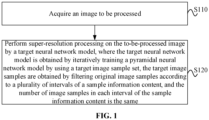
- FIG. 1 is flowchart of an image super-resolution processing method according to the present disclosure.
- the method can be applied to the case of performing super-resolution processing on low-resolution images to be processed.
- the method may be executed by an image super-resolution processing apparatus provided by the present disclosure.
- the image super-resolution processing apparatus may be implemented by software and/or hardware and integrated on a device.
- an image super-resolution processing method provided by the present disclosure includes step S110 and step S120.
- step S110 an image to be processed is acquired.
- the image to be processed is a low-resolution image.
- the manner to acquire the image to be processed may be to collect the image to be processed through a camera, or to acquire the image to be processed through screenshot. This embodiment of the present disclosure does not limit the manner to acquire the image to be processed.
- step S120 super-resolution processing is performed on the to-be-processed image by a target neural network model.
- the target neural network model is obtained by iteratively training a pyramidal neural network model by using a target image sample set.
- Target image samples are obtained by filtering original image samples according to a plurality of intervals of a sample information content. The number of image samples in each interval of the sample information content is the same.
- the pyramidal neural network model implements the acquisition from shallow-layer features to high-layer features through multi-level cascading. It is to be noted that, by using the pyramidal network structure, on the one hand, bottom-layer features, middle-layer features, and high-layer features are reserved and can be participated in the preceding sampling process, and on the other hand, the stability of the network can be improved due to the multi-level hop connection.
- the basic feature extraction module ⁇ the acquisition from shallow-layer features to high-layer features is implemented through multi-level cascading.
- the basic feature extraction module may choose a residual network or a U-Net structure model. Features extracted by each module are used as the input of the next-level feature extraction. Finally, features of each layer are used as the input of an up-sampling module, as shown in the following formula: Input : [ ⁇ 0 , ⁇ 1 ,..., ⁇ n ].
- ⁇ denotes the basic feature extraction module.
- FIG. 1A is an architecture diagram of a deep neural network in this embodiment of the present disclosure.
- a low-resolution image is input into a neural network model to obtain a high-resolution image.
- shallow-layer feature extraction is performed first.
- the basic feature extraction module includes a basic feature extraction module ⁇ 0 , a basic feature extraction module ⁇ 1 ... and a basic feature extraction module ⁇ n .
- the feature extracted by each module is used as the input of the next-level feature extraction.
- the feature of each layer is used as the input of the up-sampling module.
- the output of super-resolution reconstruction is not limited to the limited number of classification targets.
- the super-resolution reconstruction is different from a deep neural network for classification and identification. From the input/output dimension, super-resolution belongs to a many-to-many mapping process, as shown in the following formulas: ⁇ : X ⁇ q and K : X ⁇ Y .
- ⁇ denotes a classification and identification network.
- X denotes an input image containing two-dimensional information (grayscale image), three-dimensional information (for example, containing color information), or even four-dimensional information (for example, video containing color information).
- q denotes a scalar for target identification.
- q may denote a Boolean variable, and for multi-classification problems, q may denote a scalar of limited size.
- K denotes a super-resolution mapping relationship.
- Y denotes an output high-resolution result. In most cases, Y should maintain the same dimension as X, and the magnitude of Y in each dimension is not less than X, which can be regarded as an information expansion process. In terms of information dimension and effect improvement, K needs to pay more attention to all input information.
- the traditional extraction of super-resolution input samples is to randomly select a batch of samples ⁇ a 0 , a 1 , ⁇ , a n ⁇ from a sample set A, then randomly cut each sample a i , and finally perform data augmentation as needed and input the sample subjected to the data augmentation into the network for training.
- This manner simply migrates according to the classification and identification network and does not consider the similarity of X in the bottom-layer information. That is, most images contain large smooth regions (this phenomenon is more apparent in high-resolution images). Smooth regions have higher similarity.
- this similarity is manifested that an input end contains a higher proportion than other texture regions in statistics. This imbalance causes the super-resolution neural network to be more prone to outputting smooth results. This result violates the image information of the ground truth, resulting in the loss of some originally clear region details.
- the target image samples are obtained by filtering original image samples according to intervals of a sample information content. That is, a filtering method is used to implement the balanced control of samples.
- An exemplary implementation may be using gradient information to represent the texture richness of samples, calculating Sobel gradient information for each image sample, summing the gradient information of the image samples, and using the summed result as the sample information content.
- an exemplary implementation may be using variance, because the variance can represent the degree of variation of samples, calculating the variance in each sample acquired randomly, and then filling the variance in the corresponding interval according to the value of the variance until the samples in each interval meet requirements. Since each sample is acquired in a random manner, the shuffle operation is used between each round of training. This can ensure the randomness of samples at the same time.
- the entire sample information content space corresponding to the target image sample set is divided to obtain at least one interval of the sample information content.
- Each interval has a start point and an end point of the sample information content.
- the number of samples in an interval is set for each interval.
- the sample information content of the original image samples is acquired.
- the intervals corresponding to the sample information content is determined according to the sample information content. After the corresponding interval is found, the number of samples in the space is acquired. If the number of samples does not reach the set number of samples, some samples in the corresponding interval are selected to the space. If the set number of samples is reached, no samples in the corresponding interval are selected.
- the target image samples are obtained after filtering the original image samples.
- the target neural network model is obtained by iteratively training a pyramidal neural network model by using a target image sample set.
- the target neural network model completed by training performs super-resolution processing on the image to be processed.
- FIG. 1B is a training flowchart of a neural network model. Initial samples are first acquired from a training set. Next, samples are selected. A network model is trained according to the selected samples. Loss is calculated. Then, the neural network model is updated. The preceding steps are iteratively performed until a final model is obtained.
- the image super-resolution processing method includes acquiring an image to be processed and performing super-resolution processing on the to-be-processed image through a target neural network model.
- the target neural network model is obtained by iteratively training a pyramidal neural network model by using a target image sample set.
- Target image samples are obtained by filtering original image samples according to intervals of a sample information content. The number of image samples in each interval of the sample information content is the same. The problem of the proportion imbalance of output sampled samples in the existing art is solved, effectively alleviating the bias of the network.
- iteratively training the pyramidal neural network model by using the target image sample set includes establishing the pyramidal neural network model; inputting low-resolution images in a target sample set into the pyramidal neural network to obtain predicted images; training parameters of the pyramidal neural network according to a target function formed by the predicted images and high-resolution images corresponding to the low-resolution images; and returning to perform the operation of inputting the low-resolution images in the target sample set into the pyramidal neural network to obtain the predicted images until a target neural network model is obtained.
- the target function includes one or more of a function L2 + ⁇ L1, a function L1 + ⁇ LP, and a function L2 + ⁇ L1 + ⁇ LP.
- L2 is L2 norm.
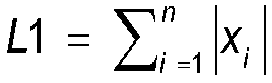
- L1 is L1 norm.
- LP is LP norm.
- ⁇ , ⁇ , ⁇ , and ⁇ are weights of a regularization factor.
- x i is the difference between the predicted images and the high-resolution images corresponding to the low-resolution images.
- X i has a greater response under the LP norm. Therefore, using the LP norm as a target function can enable a smaller difference to output a larger loss, thereby improving the sensitivity of the network to small differences.
- the target function is the function L2 + ⁇ L1 initially. After the target function does not decrease significantly, the target function is the function L1 + ⁇ LP.
- LP is the LP norm.
- ⁇ and ⁇ are weights of a regularization factor.
- x i is the difference between the predicted images and the high-resolution images corresponding to the low-resolution images.
- the target function is the function L2 + ⁇ L1 + ⁇ LP.
- ⁇ and ⁇ are weights of a regularization factor. The approximation to the global optimization is implemented by adjusting the weights.
- training the parameters of the pyramidal neural network according to the target function formed by the predicted images and the high-resolution images corresponding to the low-resolution images includes training the parameters of the pyramidal neural network based on the target function L2 + ⁇ L1 and a learning rate set as a first value and, after the decrease of an output value of the target function is less than a predetermined value (that is, a predefined value), continuing training the parameters of the pyramidal neural network based on the target function L1 + ⁇ LP and a learning rate set as a second value.
- the second value is less than the first value.
- ⁇ and ⁇ increase as the learning rate decreases.
- the decrease of the output value of the target function refers to the difference between the current output value of the target function and the previous output value of the target function.
- the first value may be set to a larger learning rate.
- the second value may be set to a relatively small learning rate.
- the function L2 + ⁇ L1 is used as the target function in the initial stage of training, and a larger learning rate is used for training at the same time.
- L1 + ⁇ LP is used as the target function, and training is performed at a relatively small learning rate.
- training the parameters of the pyramidal neural network according to the target function formed by the predicted images and the high-resolution images corresponding to the low-resolution images includes training the parameters of the pyramidal neural network according to the target function L2 + ⁇ L1 + ⁇ LP formed by the predicted images and the high-resolution images corresponding to the low-resolution images and, in each round of training or between two rounds of training, adjusting ⁇ and ⁇ to implement the approximation to the global optimization.
- the L2 + ⁇ L1 + ⁇ LP norm constraint is selected globally as the target function.
- the approximation to the global optimization is implemented by dynamically adjusting weights of a regularization factor in each round of training or between two rounds of training.
- This embodiment of the present disclosure relates to the setting of the target function and parameter adjustment during the training process.
- a multi-norm regularization method is used during the training process to improve the contribution to the non-significant texture portion.
- the weights of a regularization factor are adjusted according to the convergence of the network during the training process.
- dynamical adjustment improves the convergence efficiency of the network on the one hand, and avoids the network falling into a minimum on the other hand, more effectively updating network hyperparameters using multi-norm regularization.
- the resolution method is low in stability and occasionally appears components or textures that are not contained in original images.
- Objective indexes for example, peak signal-to-noise ratio, PSNR, and structural similarity, SSIM
- PSNR peak signal-to-noise ratio
- SSIM structural similarity
- this embodiment of the present disclosure uses the manner in which the LP norm is jointed simultaneously and dynamical adjustment during the training process is used to improve training convergence efficiency and attention to fine targets.
- the sample information content includes gradient information of image samples or variance in image samples.
- the gradient information represents the texture richness of the image samples.
- the Sobel operator gradient information of each sample is calculated.
- the gradient information of the samples is summed.
- the summed result is used as the representation of the sample information content.
- the variance in the image samples represents the degree of variation of the image samples.
- the variance in each sample acquired randomly is calculated as the representation of the sample information content.
- PIC denotes the sample information content.
- x and y denote the abscissa of the start point of a selected image sample and the ordinate of the start point of the selected image sample, respectively.
- w and h denote the width of the selected image sample and the height of the selected image sample, respectively.
- a i denotes the image sample.
- Sobel denotes the Sobel operator.
- max denotes the maximum value.
- abs denotes an absolute value.
- the abscissa and the ordinate may be coordinates in a Cartesian coordinate system.
- PIC denotes the sample information content.
- x and y denote the abscissa of the start point of a selected image sample and the ordinate of the start point of the selected image sample, respectively.
- w and h denote the width of the selected image sample and the height of the selected image sample, respectively.
- a i denotes the image sample.
- Var denotes variance.
- max denotes the maximum value.
- abs denotes an absolute value.
- the abscissa and the ordinate may be coordinates in a Cartesian coordinate system.
- the target image samples are obtained by filtering the original image samples according to the intervals of the sample information content, and the number of image samples in each interval of the sample information content is the same, including dividing the sample information content space corresponding to the target image sample set to obtain at least two intervals of the sample information content; acquiring information content of the image samples; determining corresponding intervals of the sample information content according to the information content of the image samples; and if the number of samples in the intervals of the sample information content is less than the target number, determining the image samples as the target image samples.
- the information content range corresponding to each interval of the sample information content is different. Each interval of the sample information content contains the target number of image samples.
- PI C 0 , pi c 0 pi c 0 , pi c 1 pi c 1 , pi c 2 pi c 2 , ⁇ .
- [0, pic 0 ] denotes the start point and the end point of pic in a first interval.
- [ pic 0 , pic 1 ] denotes the start point and the end point of pic in a second interval.
- [ pic 1 , pic 2 ] denotes the start point and the end point of pic in a third interval.
- pic 2 , ⁇ ] denotes the start point and
- the number of samples corresponding to the target image sample set is set to N.
- the number of samples corresponding to the target image sample set is averaged to four intervals.
- N denotes the number of samples corresponding to the target image sample set.
- Interval denotes the number of samples allocated in each interval after the overall PIC space is divided.
- the sample information content space corresponding to the target image sample set is divided into four effective intervals.
- the number of samples corresponding to the target image sample set is N.
- the number of samples in each interval is selected as N/4.
- the allocation number in the first interval is N/4.
- FIG. 2 is a structural diagram of an image super-resolution processing apparatus according to the present disclosure.
- the image super-resolution processing apparatus in this embodiment of the present disclosure may be integrated on a device.
- the apparatus includes an acquisition module 21 and a processing module 22.
- the acquisition module 21 is configured to acquire an image to be processed.
- the processing module 22 is configured to perform super-resolution processing on the to-be-processed image by a target neural network model.
- the target neural network model is obtained by iteratively training a pyramidal neural network model by using a target image sample set.
- Target image samples are obtained by filtering original image samples according to a plurality of intervals of the sample information content. The number of image samples in each interval of the sample information content is the same.
- the apparatus provided in this embodiment is configured to implement the method in the embodiments shown in FIG. 1 .
- the apparatus provided in this embodiment has similar implementation principles and technical effects to the method in the embodiments shown in FIG. 1 , and details are not described here again.
- the processing module 22 can be configured to establish a pyramidal neural network model; input low-resolution images in target samples into the pyramidal neural network to obtain predicted images; train parameters of the pyramidal neural network according to the target function formed by the predicted images and high-resolution images corresponding to the low-resolution images; and return to perform the operation of inputting the low-resolution images in a target sample set into the pyramidal neural network to obtain the predicted images until a target neural network model is obtained.
- the target function includes one or more of a function L2 + ⁇ L1, a function L1 + ⁇ LP, and a function L2 + ⁇ L1 + ⁇ LP.
- L2 is L2 norm.
- L1 is L1 norm.
- LP is LP norm.
- ⁇ , ⁇ , ⁇ , and ⁇ are weights of a regularization factor.
- the processing module 22 can be configured to train the parameters of the pyramidal neural network based on the target function L2 + ⁇ L1 and a learning rate set as a first value and, after the decrease of an output value of the target function is less than a predetermined value, continue training the parameters of the pyramidal neural network based on the target function L1 + ⁇ LP and a learning rate set as a second value.
- the second value is less than the first value.
- ⁇ and ⁇ increase as the learning rate decreases.
- the decrease of the output value of the target function refers to the difference between the current output value of the target function and the previous output value of the target function.
- the processing module 22 can be configured to train the parameters of the pyramidal neural network according to the target function L2 + ⁇ L1 + ⁇ LP formed by the predicted images and the high-resolution images corresponding to the low-resolution images and, in each round of training or between two rounds of training, adjust ⁇ and ⁇ to implement the approximation to the global optimization.
- the sample information content includes gradient information of image samples or variance in image samples.
- PIC denotes the sample information content.
- x and y denote the abscissa of the start point of a selected image sample and the ordinate of the start point of the selected image sample, respectively.
- w and h denote the width of the selected image sample and the height of the selected image sample, respectively.
- a i denotes the image sample.
- Sobel denotes the Sobel operator.
- max denotes the maximum value.
- abs denotes an absolute value.
- the abscissa and the ordinate may be coordinates in a Cartesian coordinate system.
- PIC denotes the sample information content.
- x and y denote the abscissa of the start point of a selected image sample and the ordinate of the start point of the selected image sample, respectively.
- w and h denote the width of the selected image sample and the height of the selected image sample, respectively.
- a i denotes the image sample.
- Var denotes variance.
- max denotes the maximum value.
- abs denotes an absolute value.
- the abscissa and the ordinate may be coordinates in a Cartesian coordinate system.
- the processing module 22 can be configured to divide a sample information content space corresponding to a target image sample set to obtain at least two intervals of a sample information content; acquire information content of image samples; determine corresponding intervals of the sample information content according to the information content of the image samples; and if the number of samples in the intervals of the sample information content is less than a target number, determine the image samples as target image samples.
- the information content range corresponding to each interval of the sample information content is different. Each interval of the sample information content contains the target number of image samples.
- the image super-resolution processing apparatus configured to acquire an image to be processed and perform super-resolution processing on the to-be-processed image through a target neural network model.
- the target neural network model is obtained by iteratively training a pyramidal neural network model by using a target image sample set.
- Target image samples are obtained by filtering original image samples according to intervals of the sample information content. The number of image samples in each interval of the sample information content is the same. The problem of the proportion imbalance of output sampled samples in the existing art is solved, effectively alleviating the bias of the network.
- samples are filtered by adding the sample information content to the samples in this embodiment of the present disclosure to improve the balance of the statistical significance when the samples enter the network training.
- a statistical index for evaluating the quantities of information of samples is established.
- the quantities of information of samples obtained by randomly cutting a data set are calibrated under the index.
- the number of samples required for each segment is determined by segmenting the statistical index.
- the samples cut randomly are selected for a second time to control the number of samples corresponding to the finally selected target image sample set to be balanced throughout the training process.
- the pyramidal structure is used as the main structure of the network in this embodiment of the present disclosure.
- the bottom-layer, middle-layer, and high-layer semantic information are introduced into an upsampling module simultaneously.
- the semantic information is biased toward the high-layer, and the discarding of the bottom-layer information and the middle-layer information reduces the attention to the "weak" details of images in the reconstruction result. Therefore, on the one hand, the pyramidal structure is used to concentrate the extracted information, reducing calculation cost, and on the other hand, various kinds of information are fused, improving the reconstruction effect.
- a multi-norm regularization method is used during the training process to improve the contribution to the non-significant texture portion.
- the weights of the regularization factor are adjusted according to the convergence of the network during the training process. Dynamical adjustment improves the convergence efficiency of the network on the one hand, and avoids the network falling into a minimum on the other hand, more effectively updating network hyperparameters.
- the proportion of the smooth regions is significantly higher than the proportion of texture portions of other segmented data in statistics.
- the deepening of the network structure leads to the lack of shallow-layer information, causing the imbalance of shallow-layer, middle-layer, and high-layer information during the reconstruction process.
- Solutions of the present disclosure can effectively alleviate the bias of the network, improve the problem of the lack of details during the super-resolution reconstruction process, and reconstruct the defect that the directions of the texture portions are disordered.
- various feature information in samples is fully used.
- the supervised deep learning effect largely depends on the richness of samples.
- the sample data provided by a target has been greatly improved in absolute quantity, the relative numbers among the data are not balanced, especially for high-resolution samples where large pieces of sky, glass, or other slowly changing regions often exist.
- the data imbalance is reduced, and the neural network model is provided with better information input.
- multi-level information is input into an up-sampling module through a pyramidal method. Subsequent features to be biased towards high-layer features and the reduction in the proportion of shallow-layer features and middle-layer features are decreased along with increasing depth.
- multi-layer outputs of a pyramid are imported into an up-sampling module to improve the data richness of the up-sampling module.
- multi-norm regularization compared with the current supervised method in which the L2 norm or the L1 norm is commonly used as a target function, the present disclosure suggests to use the manner in which the LP norm is jointed simultaneously and dynamical adjustment during the training process is used to improve training convergence efficiency and attention to fine targets.
- FIG. 3 is a structural diagram of a device according to the present disclosure.
- the device provided in the present disclosure includes one or more processors 31 and a storage apparatus 32.
- One or more processors 31 may be provided in the device.
- one processor 31 is used as an example.
- the storage apparatus 32 is used for storing one or more programs. When executed by the one or more processors 31, the one or more programs cause the one or more processors 31 to implement the method described in FIG. 1 in embodiments of the present disclosure.
- the device further includes a communication apparatus 33, an input apparatus 34, and an output apparatus 35.
- the processor 31, the storage apparatus 32, the communication apparatus 33, the input apparatus 34, and the output apparatus 35 that are in the device may be connected through a bus or in other manners.
- the connection through the bus is used as an example.
- the input apparatus 34 may be used for receiving inputted digital or character information and for generating key signal input related to user settings and function control of the device.
- the output apparatus 35 may include display devices such as a display screen.
- the communication apparatus 33 may include a receiver and a transmitter.
- the communication apparatus 33 is configured to perform information transceiving communication under the control of the processor 31.
- the information includes, but is not limited to, uplink authorization information.
- the storage apparatus 32 may be configured to store software programs, computer-executable programs and modules such as program instructions/modules (for example, the acquisition module 21 and the processing module 22 in the image super-resolution processing apparatus) corresponding to the image super-resolution processing method described in FIG. 1 in the embodiments of the present disclosure.
- the storage apparatus 32 may include a program storage region and a data storage region.
- the program storage region may store an operating system and an application program required by at least one function.
- the data storage region may store data created depending on the use of a device.
- the storage apparatus 32 may include a high-speed random-access memory and may further include a nonvolatile memory, such as at least one magnetic dick memory, a flash memory, or another nonvolatile solid-state memory.
- the storage apparatus 32 may further include memories which are remotely disposed respect to the processor 31, and these remote memories may be connected to the device via a network. Examples of the preceding network include, but are not limited to, the Internet, an intranet, a local area network, a mobile communication network and a combination thereof.
- An embodiment of the present disclosure further provides a storage medium for storing computer programs which, when executed by a processor, implements the image super-resolution processing method described in embodiments of the present disclosure.
- the method includes: acquiring an image to be processed; and performing super-resolution processing on the to-be-processed image by a target neural network model.
- the target neural network model is obtained by iteratively training a pyramidal neural network model by using a target image sample set.
- Target image samples are obtained by filtering original image samples according to intervals of a sample information content. The number of image samples in each interval of the sample information content is the same.
- the computer storage medium in this embodiment of the present disclosure may employ any combination of one or more computer readable medium.
- a computer-readable medium may be a computer-readable signal medium or a computer-readable storage medium.
- the computer readable storage medium may be, for example, but not limited to, an electrical, magnetic, optical, electromagnetic, infrared or semiconductor system, apparatus or component, or any combination thereof.
- the computer-readable storage medium include (non-exhaustive list): an electrical connection having one or more wires, a portable computer magnetic disk, a hard disk, a random-access memory (RAM), a read-only memory (ROM), an erasable programmable read-only memory (EPROM), a flash memory, an optical fiber, a portable CD-ROM, an optical storage component, a magnetic storage component, or any suitable combination thereof.
- the computer-readable storage medium may be any tangible medium including or storing a program. The program may be used by or used in conjunction with an instruction execution system, apparatus, or component.
- the computer-readable signal medium may include a data signal propagated in a baseband or as part of a carrier.
- the data signal carries computer-readable program codes.
- the data signal propagated in this manner may be in multiple forms and includes, and is not limited to, an electromagnetic signal, an optical signal, or any suitable combination thereof.
- the computer-readable signal medium may further be any computer-readable medium other than a computer-readable storage medium.
- the computer-readable medium may send, propagate, or transmit the program used by or used in conjunction with the instruction execution system, apparatus, or component.
- the program codes included on the computer-readable medium may be transmitted on any suitable medium including, but not limited to, a wireless medium, a wire, an optical cable, a radio frequency (RF) and the like or transmitted on any suitable combination thereof.
- a wireless medium including, but not limited to, a wireless medium, a wire, an optical cable, a radio frequency (RF) and the like or transmitted on any suitable combination thereof.
- RF radio frequency
- Computer program code for performing the operations of the present disclosure may be written in one or more programming languages or combination thereof, including object-oriented programming languages such as Java, Smalltalk, C + +, as well as conventional procedural programming languages such as "C" or similar programming languages.
- the program codes may be executed entirely on a user computer, partly on the user computer, as a stand-alone software package, partly on the user computer and partly on a remote computer, or entirely on the remote computer or a server.
- the remote computer may be connected to a user computer via any kind of network including a local area network (LAN) or a wide area network (WAN), or may be connected to an external computer (for example, via the Internet through an Internet service provider).
- LAN local area network
- WAN wide area network
- Internet service provider for example, via the Internet through an Internet service provider
- radio UE any suitable type of radio UE, for example, a mobile phone, a portable data processing apparatus, a portable web browser, or a vehicle-mounted mobile station.
- multiple embodiments of the present disclosure may be implemented in hardware, dedicated circuits, software, logics or any combination thereof.
- some aspects may be implemented in hardware while other aspects may be implemented in firmware or software that may be executed by a controller, a microprocessor or another computing apparatus, though the present disclosure is not limited thereto.
- the embodiments of the present disclosure may be implemented by computer program instructions executed by a data processor of a mobile apparatus, for example, implemented in a processor entity, by hardware or by a combination of software and hardware.
- the computer program instructions may be assembly instructions, instruction set architecture (ISA) instructions, machine instructions, machine-related instructions, microcodes, firmware instructions, status setting data or source or object codes written in any combination of one or more programming languages.
- a block diagram of any logic flow among the drawings of the present disclosure may represent program steps, may represent interconnected logic circuits, modules and functions, or may represent a combination of program steps with logic circuits, modules and functions.
- Computer programs may be stored in the memory.
- the memory may be of any type suitable for a local technical environment and may be implemented using any suitable data storage technology, such as, but not limited to, a read-only memory (ROM), a random-access memory (RAM) and an optical memory apparatus and system (digital video disc (DVD) or compact disc (CD)).
- the computer-readable medium may include a non-transitory storage medium.
- the data processor may be in any type suitable for the local technical environment, for example, but not limited to, a general-purpose computer, a special- purpose computer, a microprocessor, a digital signal processor (DSP), an application-specific integrated circuit (ASIC), a field-programmable gate array (FGPA), and a processor based on a multi-core processor architecture.
- DSP digital signal processor
- ASIC application-specific integrated circuit
- FGPA field-programmable gate array
- processor based on a multi-core processor architecture for example, but not limited to, a general-purpose computer, a special- purpose computer, a microprocessor, a digital signal processor (DSP), an application-specific integrated circuit (ASIC), a field-programmable gate array (FGPA), and a processor based on a multi-core processor architecture.
- DSP digital signal processor
- ASIC application-specific integrated circuit
- FGPA field-programmable gate array
Landscapes
- Engineering & Computer Science (AREA)
- Theoretical Computer Science (AREA)
- Physics & Mathematics (AREA)
- General Physics & Mathematics (AREA)
- Evolutionary Computation (AREA)
- Artificial Intelligence (AREA)
- General Health & Medical Sciences (AREA)
- General Engineering & Computer Science (AREA)
- Data Mining & Analysis (AREA)
- Biophysics (AREA)
- Biomedical Technology (AREA)
- Molecular Biology (AREA)
- Computing Systems (AREA)
- Computational Linguistics (AREA)
- Life Sciences & Earth Sciences (AREA)
- Mathematical Physics (AREA)
- Software Systems (AREA)
- Health & Medical Sciences (AREA)
- Image Processing (AREA)
- Image Analysis (AREA)
Abstract
Description
- The present disclosure relates to, and is not limited to, the technical field of computers.
- The super-resolution reconstruction technology based on deep learning shows apparent advantages over traditional methods in the comparison of reconstruction effects. Currently, the mainstream of super-resolution reconstruction methods is beginning to move closer to deep learning.
- Currently, super-resolution methods based on deep neural networks are divided into two categories, one is based on a generative adversarial network (GAN) and the other one is based on a supervised full convolutional neural network. In order to make the discriminator unable to discriminate between a generated image and a real image, the former, by using the perception machine cost function under the GAN network framework, makes output results located in a high-level space where the ground truth (GT) is located. In order to identify a low-resolution and high-resolution pair (LHP) the supervised method generates the LHP, through a determined degradation model and responsible network structure modeling.
- In a first aspect, an embodiment of the present disclosure provides an image super-resolution processing method. The method includes: acquiring an image to be processed; and performing super-resolution processing on the to-be-processed image by a target neural network model. The target neural network model is obtained by iteratively training a pyramidal neural network model by using a target image sample set. Target image samples are obtained by filtering original image samples according to a plurality of intervals of a sample information content. The number of image samples in each interval of the sample information content is the same.
- In a second aspect, an embodiment of the present disclosure provides an image super-resolution processing apparatus. The apparatus includes an acquisition module and a processing module. The acquisition module is configured to acquire an image to be processed. The processing module is configured to perform super-resolution processing on the to-be-processed image by a target neural network model. The target neural network model is obtained by iteratively training a pyramidal neural network model by using a target image sample set. Target image samples are obtained by filtering original image samples according to a plurality of intervals of a sample information content. The number of image samples in each interval of the sample information content is the same.
- In a third aspect, an embodiment of the present disclosure provides a device. The device includes one or more processor and a storage apparatus. The storage apparatus is configured to store one or more programs. When executed by the one or more processors, the one or more programs make the one or more processors implement the image super-resolution processing method according to any embodiment of the present disclosure.
- In a fourth aspect, an embodiment of the present disclosure provides a storage medium for storing computer programs which, when executed by a processor, implement the image super-resolution processing method according to any embodiment of the present disclosure.
- The preceding embodiments and other aspects of the present disclosure and implementations thereof are described in more detail in the brief description of drawings, detailed description, and claims.
-
-
FIG. 1 is flowchart of an image super-resolution processing method according to the present disclosure. -
FIG. 1A is an architecture diagram of a deep neural network according to the present disclosure. -
FIG. 1B is a training flowchart of a neural network model according to the present disclosure. -
FIG. 2 is a structural diagram of an image super-resolution processing apparatus according to the present disclosure. -
FIG. 3 is a structural diagram of a device according to the present disclosure. - Objects, solutions and advantages of the present disclosure will be more apparent from a detailed description of embodiments of the present disclosure in conjunction with the drawings. It is to be noted that if not in collision, the embodiments and features therein in the present disclosure may be combined with each other.
- The steps illustrated in the flowcharts among the drawings may be performed by, for example, a computer system capable of executing a set of computer-executable instructions. Moreover, although logical sequences are illustrated in the flowcharts, the steps illustrated or described may be performed in sequences different from those described here in some cases.
- As described above, currently, super-resolution methods based on deep neural networks are divided into two categories, one is based on a generative adversarial network, GAN, and another is based on a supervised full convolutional neural network. In order to make the discriminator unable to discriminate between a generated image and a real image, the former, by using the perception machine cost function under the GAN network framework, makes output results located in a high-level space where the ground truth, GT, is located. In order to identify a low-resolution and high-resolution pair, LHP, the supervised method generates the LHP, through a determined degradation model and responsible network structure modeling.
- The two types of methods generally randomly cut each data set into fixed-size blocks and then combine multiple blocks into a sample set. The sample set is used as input to perform forward and back propagation in the network to update network parameters. These methods have a significant imbalance problem in natural images, mainly due to the fact that smooth regions occupy a relatively high proportion in statistics compared with various textures. That is, interference-free random sampling may bring more smooth regions of the network, resulting in the network being more prone to adopting LHPs of the smooth regions.
- Accordingly, the present disclosure specifically provides an image super-resolution processing method and apparatus, a device, and a storage medium which substantively avoid one or more problems due to limitations and disadvantages of the existing art. According to an embodiment of the present disclosure, the problem of the proportion imbalance of output sampled samples in the existing art can be solved.
- In an exemplary embodiment,
FIG. 1 is flowchart of an image super-resolution processing method according to the present disclosure. The method can be applied to the case of performing super-resolution processing on low-resolution images to be processed. The method may be executed by an image super-resolution processing apparatus provided by the present disclosure. The image super-resolution processing apparatus may be implemented by software and/or hardware and integrated on a device. - As shown in
FIG. 1 , an image super-resolution processing method provided by the present disclosure includes step S110 and step S120. - In step S110, an image to be processed is acquired.
- The image to be processed is a low-resolution image.
- Exemplarily, the manner to acquire the image to be processed may be to collect the image to be processed through a camera, or to acquire the image to be processed through screenshot. This embodiment of the present disclosure does not limit the manner to acquire the image to be processed.
- In step S120, super-resolution processing is performed on the to-be-processed image by a target neural network model. The target neural network model is obtained by iteratively training a pyramidal neural network model by using a target image sample set. Target image samples are obtained by filtering original image samples according to a plurality of intervals of a sample information content. The number of image samples in each interval of the sample information content is the same.
- For a basic feature extraction module, the pyramidal neural network model implements the acquisition from shallow-layer features to high-layer features through multi-level cascading. It is to be noted that, by using the pyramidal network structure, on the one hand, bottom-layer features, middle-layer features, and high-layer features are reserved and can be participated in the preceding sampling process, and on the other hand, the stability of the network can be improved due to the multi-level hop connection. For the basic feature extraction module φ, the acquisition from shallow-layer features to high-layer features is implemented through multi-level cascading. The basic feature extraction module may choose a residual network or a U-Net structure model. Features extracted by each module are used as the input of the next-level feature extraction. Finally, features of each layer are used as the input of an up-sampling module, as shown in the following formula: Input : [φ 0,φ 1,...,φn ].
- φ denotes the basic feature extraction module.
- Exemplarily,
FIG. 1A is an architecture diagram of a deep neural network in this embodiment of the present disclosure. A low-resolution image is input into a neural network model to obtain a high-resolution image. In the neural network model, shallow-layer feature extraction is performed first. The basic feature extraction module includes a basic feature extraction module φ 0, a basic feature extraction module φ 1... and a basic feature extraction module φn . The feature extracted by each module is used as the input of the next-level feature extraction. Finally, the feature of each layer is used as the input of the up-sampling module. - In this embodiment of the present disclosure, the output of super-resolution reconstruction is not limited to the limited number of classification targets. The super-resolution reconstruction is different from a deep neural network for classification and identification. From the input/output dimension, super-resolution belongs to a many-to-many mapping process, as shown in the following formulas: Γ : X → q and K : X → Y.
- Γ denotes a classification and identification network. X denotes an input image containing two-dimensional information (grayscale image), three-dimensional information (for example, containing color information), or even four-dimensional information (for example, video containing color information). q denotes a scalar for target identification. q may denote a Boolean variable, and for multi-classification problems, q may denote a scalar of limited size. K denotes a super-resolution mapping relationship. Y denotes an output high-resolution result. In most cases, Y should maintain the same dimension as X, and the magnitude of Y in each dimension is not less than X, which can be regarded as an information expansion process. In terms of information dimension and effect improvement, K needs to pay more attention to all input information.
- The traditional extraction of super-resolution input samples is to randomly select a batch of samples {a 0,a 1,···,an } from a sample set A, then randomly cut each sample ai , and finally perform data augmentation as needed and input the sample subjected to the data augmentation into the network for training. This manner simply migrates according to the classification and identification network and does not consider the similarity of X in the bottom-layer information. That is, most images contain large smooth regions (this phenomenon is more apparent in high-resolution images). Smooth regions have higher similarity. During the network training process, this similarity is manifested that an input end contains a higher proportion than other texture regions in statistics. This imbalance causes the super-resolution neural network to be more prone to outputting smooth results. This result violates the image information of the ground truth, resulting in the loss of some originally clear region details.
- In this embodiment of the present disclosure, the target image samples are obtained by filtering original image samples according to intervals of a sample information content. That is, a filtering method is used to implement the balanced control of samples. An exemplary implementation may be using gradient information to represent the texture richness of samples, calculating Sobel gradient information for each image sample, summing the gradient information of the image samples, and using the summed result as the sample information content. Alternatively, an exemplary implementation may be using variance, because the variance can represent the degree of variation of samples, calculating the variance in each sample acquired randomly, and then filling the variance in the corresponding interval according to the value of the variance until the samples in each interval meet requirements. Since each sample is acquired in a random manner, the shuffle operation is used between each round of training. This can ensure the randomness of samples at the same time.
- Exemplarily, the entire sample information content space corresponding to the target image sample set is divided to obtain at least one interval of the sample information content. Each interval has a start point and an end point of the sample information content. The number of samples in an interval is set for each interval. The sample information content of the original image samples is acquired. The intervals corresponding to the sample information content is determined according to the sample information content. After the corresponding interval is found, the number of samples in the space is acquired. If the number of samples does not reach the set number of samples, some samples in the corresponding interval are selected to the space. If the set number of samples is reached, no samples in the corresponding interval are selected.
- Exemplarily, the target image samples are obtained after filtering the original image samples. The target neural network model is obtained by iteratively training a pyramidal neural network model by using a target image sample set. The target neural network model completed by training performs super-resolution processing on the image to be processed.
-
FIG. 1B is a training flowchart of a neural network model. Initial samples are first acquired from a training set. Next, samples are selected. A network model is trained according to the selected samples. Loss is calculated. Then, the neural network model is updated. The preceding steps are iteratively performed until a final model is obtained. - In the present disclosure, the image super-resolution processing method provided includes acquiring an image to be processed and performing super-resolution processing on the to-be-processed image through a target neural network model. The target neural network model is obtained by iteratively training a pyramidal neural network model by using a target image sample set. Target image samples are obtained by filtering original image samples according to intervals of a sample information content. The number of image samples in each interval of the sample information content is the same. The problem of the proportion imbalance of output sampled samples in the existing art is solved, effectively alleviating the bias of the network.
- On the basis of the preceding embodiments, variant embodiments of the preceding embodiments are proposed. It is to be noted here that for ease of description, only differences from the preceding embodiments are described in the variant embodiments.
- In one embodiment, iteratively training the pyramidal neural network model by using the target image sample set includes establishing the pyramidal neural network model; inputting low-resolution images in a target sample set into the pyramidal neural network to obtain predicted images; training parameters of the pyramidal neural network according to a target function formed by the predicted images and high-resolution images corresponding to the low-resolution images; and returning to perform the operation of inputting the low-resolution images in the target sample set into the pyramidal neural network to obtain the predicted images until a target neural network model is obtained. The target function includes one or more of a function L2 + αL1, a function L1 + θLP, and a function L2 + µL1 + βLP. L2 is L2 norm. L1 is L1 norm. LP is LP norm. α, θ, µ, and β are weights of a regularization factor.
- The L1 norm is


- Specifically, when p is greater than 0 and less than 1, Xi has a greater response under the LP norm. Therefore, using the LP norm as a target function can enable a smaller difference to output a larger loss, thereby improving the sensitivity of the network to small differences.
- Specifically, training the parameters of the pyramidal neural network according to the target function formed by the predicted images and high-resolution images corresponding to the low-resolution images may be that the target function is the function L2 + αL1, L2 is the L2 norm, and L1 is the L1 norm; and L 1 norm is


- In one embodiment, training the parameters of the pyramidal neural network according to the target function formed by the predicted images and the high-resolution images corresponding to the low-resolution images includes training the parameters of the pyramidal neural network based on the target function L2 + αL1 and a learning rate set as a first value and, after the decrease of an output value of the target function is less than a predetermined value (that is, a predefined value), continuing training the parameters of the pyramidal neural network based on the target function L1 + θLP and a learning rate set as a second value. The second value is less than the first value. α and θ increase as the learning rate decreases. the decrease of the output value of the target function refers to the difference between the current output value of the target function and the previous output value of the target function.
- The first value may be set to a larger learning rate. The second value may be set to a relatively small learning rate.
- Specifically, the function L2 + αL1 is used as the target function in the initial stage of training, and a larger learning rate is used for training at the same time. After the target function does not decrease significantly, L1 + θLP is used as the target function, and training is performed at a relatively small learning rate.
- In one embodiment, training the parameters of the pyramidal neural network according to the target function formed by the predicted images and the high-resolution images corresponding to the low-resolution images includes training the parameters of the pyramidal neural network according to the target function L2 + µL1 + βLP formed by the predicted images and the high-resolution images corresponding to the low-resolution images and, in each round of training or between two rounds of training, adjusting µ and β to implement the approximation to the global optimization.
- Specifically, the L2 + µL1 + βLP norm constraint is selected globally as the target function. The approximation to the global optimization is implemented by dynamically adjusting weights of a regularization factor in each round of training or between two rounds of training.
- This embodiment of the present disclosure relates to the setting of the target function and parameter adjustment during the training process. A multi-norm regularization method is used during the training process to improve the contribution to the non-significant texture portion. At the same time, the weights of a regularization factor are adjusted according to the convergence of the network during the training process. As a result, dynamical adjustment improves the convergence efficiency of the network on the one hand, and avoids the network falling into a minimum on the other hand, more effectively updating network hyperparameters using multi-norm regularization. In the existing art, the resolution method is low in stability and occasionally appears components or textures that are not contained in original images. Objective indexes (for example, peak signal-to-noise ratio, PSNR, and structural similarity, SSIM) of the method are relatively low. Generally, L2 norm or L1 norm is taken as the target function. Network training results under the function constraint generally have higher objective quality. In the case of pursuing quantization indexes, generally, the network complexity is greatly increased, and increased hashrate requirements bring limited effect improvement, not facilitating to the implementation at a deployment side. Moreover, the influence of the network structure and data is ignored due to the preference to promote depth. Compared with the current manner in which the L2 norm or the L1 norm is commonly used as a target function, this embodiment of the present disclosure uses the manner in which the LP norm is jointed simultaneously and dynamical adjustment during the training process is used to improve training convergence efficiency and attention to fine targets.
- In one embodiment, the sample information content includes gradient information of image samples or variance in image samples.
- The gradient information represents the texture richness of the image samples.
- Specifically, the Sobel operator gradient information of each sample is calculated. The gradient information of the samples is summed. The summed result is used as the representation of the sample information content.
- The variance in the image samples represents the degree of variation of the image samples.
- Specifically, the variance in each sample acquired randomly is calculated as the representation of the sample information content.
- In one embodiment, the sample information content is PIC = ∥max(abs(Sobel (ai [x, y, w, h])))∥1. PIC denotes the sample information content. x and y denote the abscissa of the start point of a selected image sample and the ordinate of the start point of the selected image sample, respectively. w and h denote the width of the selected image sample and the height of the selected image sample, respectively. ai denotes the image sample. Sobel denotes the Sobel operator. max denotes the maximum value. abs denotes an absolute value. The abscissa and the ordinate may be coordinates in a Cartesian coordinate system.
- In one embodiment, the sample information content is PIC = ∥max(abs(Var (ai [x, y, w, h])))∥1. PIC denotes the sample information content. x and y denote the abscissa of the start point of a selected image sample and the ordinate of the start point of the selected image sample, respectively. w and h denote the width of the selected image sample and the height of the selected image sample, respectively. ai denotes the image sample. Var denotes variance. max denotes the maximum value. abs denotes an absolute value. The abscissa and the ordinate may be coordinates in a Cartesian coordinate system.
- In one embodiment, the target image samples are obtained by filtering the original image samples according to the intervals of the sample information content, and the number of image samples in each interval of the sample information content is the same, including dividing the sample information content space corresponding to the target image sample set to obtain at least two intervals of the sample information content; acquiring information content of the image samples; determining corresponding intervals of the sample information content according to the information content of the image samples; and if the number of samples in the intervals of the sample information content is less than the target number, determining the image samples as the target image samples. The information content range corresponding to each interval of the sample information content is different. Each interval of the sample information content contains the target number of image samples.
- Dividing the sample information content space corresponding to the target image sample set to obtain at least two intervals of the sample information content, for example, may be dividing the sample information content space corresponding to the target image sample set to obtain four intervals of the sample information content as shown in the following formula:

- The number of samples corresponding to the target image sample set is set to N. The number of samples corresponding to the target image sample set is averaged to four intervals. The number of image samples in each interval is N/4, as shown in the following formula:

- N denotes the number of samples corresponding to the target image sample set. Interval denotes the number of samples allocated in each interval after the overall PIC space is divided.
- Specifically, the sample information content space corresponding to the target image sample set is divided into four effective intervals. The number of samples corresponding to the target image sample set is N. The number of samples in each interval is selected as N/4. For example, the allocation number in the first interval is N/4. When the PIC (sample information content) of the sampled sample is in the [0, pic0] interval and the number of samples in the interval does not reach N/4, the sample is selected to enter the sample to be processed. However, when the number of samples in the interval exceeds N/4, samples in this region reach a filled state. The sampled sample whose PIC is in the interval is no longer selected. At this time, if there is still a shortage in other intervals, a random sampling is performed again. Quantities of information are measured for each sampled sample until data in all intervals reaches a satisfied state.
- The present disclosure provides an image super-resolution processing apparatus.
FIG. 2 is a structural diagram of an image super-resolution processing apparatus according to the present disclosure. As shown inFIG. 2 , the image super-resolution processing apparatus in this embodiment of the present disclosure may be integrated on a device. The apparatus includes anacquisition module 21 and aprocessing module 22. Theacquisition module 21 is configured to acquire an image to be processed. Theprocessing module 22 is configured to perform super-resolution processing on the to-be-processed image by a target neural network model. The target neural network model is obtained by iteratively training a pyramidal neural network model by using a target image sample set. Target image samples are obtained by filtering original image samples according to a plurality of intervals of the sample information content. The number of image samples in each interval of the sample information content is the same. - The apparatus provided in this embodiment is configured to implement the method in the embodiments shown in
FIG. 1 . The apparatus provided in this embodiment has similar implementation principles and technical effects to the method in the embodiments shown inFIG. 1 , and details are not described here again. - On the basis of the preceding embodiments, variant embodiments of the preceding embodiments are proposed. It is to be noted here that for ease of description, only differences from the preceding embodiments are described in the variant embodiments.
- In one embodiment, the
processing module 22 can be configured to establish a pyramidal neural network model; input low-resolution images in target samples into the pyramidal neural network to obtain predicted images; train parameters of the pyramidal neural network according to the target function formed by the predicted images and high-resolution images corresponding to the low-resolution images; and return to perform the operation of inputting the low-resolution images in a target sample set into the pyramidal neural network to obtain the predicted images until a target neural network model is obtained. The target function includes one or more of a function L2 + αL1, a function L1 + θLP, and a function L2 + µL1 + βLP. L2 is L2 norm. L1 is L1 norm. LP is LP norm. α, θ, µ, and β are weights of a regularization factor. - In one embodiment, the
processing module 22 can be configured to train the parameters of the pyramidal neural network based on the target function L2 + αL1 and a learning rate set as a first value and, after the decrease of an output value of the target function is less than a predetermined value, continue training the parameters of the pyramidal neural network based on the target function L1 + θLP and a learning rate set as a second value. The second value is less than the first value. α and θ increase as the learning rate decreases. Here, the decrease of the output value of the target function refers to the difference between the current output value of the target function and the previous output value of the target function. - In one embodiment, the
processing module 22 can be configured to train the parameters of the pyramidal neural network according to the target function L2 + µL1 + βLP formed by the predicted images and the high-resolution images corresponding to the low-resolution images and, in each round of training or between two rounds of training, adjust µ and β to implement the approximation to the global optimization. - In one embodiment, the sample information content includes gradient information of image samples or variance in image samples.
- In one embodiment, the sample information content is: PIC = ∥max(abs (Sobel (ai [x, y, w, h])))∥1. PIC denotes the sample information content. x and y denote the abscissa of the start point of a selected image sample and the ordinate of the start point of the selected image sample, respectively. w and h denote the width of the selected image sample and the height of the selected image sample, respectively. ai denotes the image sample. Sobel denotes the Sobel operator. max denotes the maximum value. abs denotes an absolute value. The abscissa and the ordinate may be coordinates in a Cartesian coordinate system.
- In one embodiment, the sample information content is: PIC = ∥max(abs (Var (ai [x, y, w, h])))∥1. PIC denotes the sample information content. x and y denote the abscissa of the start point of a selected image sample and the ordinate of the start point of the selected image sample, respectively. w and h denote the width of the selected image sample and the height of the selected image sample, respectively. ai denotes the image sample. Var denotes variance. max denotes the maximum value. abs denotes an absolute value. The abscissa and the ordinate may be coordinates in a Cartesian coordinate system.
- In one embodiment, the
processing module 22 can be configured to divide a sample information content space corresponding to a target image sample set to obtain at least two intervals of a sample information content; acquire information content of image samples; determine corresponding intervals of the sample information content according to the information content of the image samples; and if the number of samples in the intervals of the sample information content is less than a target number, determine the image samples as target image samples. The information content range corresponding to each interval of the sample information content is different. Each interval of the sample information content contains the target number of image samples. - In the present disclosure, the image super-resolution processing apparatus provided is configured to acquire an image to be processed and perform super-resolution processing on the to-be-processed image through a target neural network model. The target neural network model is obtained by iteratively training a pyramidal neural network model by using a target image sample set. Target image samples are obtained by filtering original image samples according to intervals of the sample information content. The number of image samples in each interval of the sample information content is the same. The problem of the proportion imbalance of output sampled samples in the existing art is solved, effectively alleviating the bias of the network.
- Specifically, during the collection process of training samples, samples are filtered by adding the sample information content to the samples in this embodiment of the present disclosure to improve the balance of the statistical significance when the samples enter the network training. First, a statistical index for evaluating the quantities of information of samples is established. The quantities of information of samples obtained by randomly cutting a data set are calibrated under the index. The number of samples required for each segment is determined by segmenting the statistical index. Then, the samples cut randomly are selected for a second time to control the number of samples corresponding to the finally selected target image sample set to be balanced throughout the training process. In the network architecture design, the pyramidal structure is used as the main structure of the network in this embodiment of the present disclosure. At the same time, the bottom-layer, middle-layer, and high-layer semantic information are introduced into an upsampling module simultaneously. Considering that with the deepening of the convolution, the semantic information is biased toward the high-layer, and the discarding of the bottom-layer information and the middle-layer information reduces the attention to the "weak" details of images in the reconstruction result. Therefore, on the one hand, the pyramidal structure is used to concentrate the extracted information, reducing calculation cost, and on the other hand, various kinds of information are fused, improving the reconstruction effect. For the setting of the target function and hyperparameter adjustment during the training process, a multi-norm regularization method is used during the training process to improve the contribution to the non-significant texture portion. At the same time, the weights of the regularization factor are adjusted according to the convergence of the network during the training process. Dynamical adjustment improves the convergence efficiency of the network on the one hand, and avoids the network falling into a minimum on the other hand, more effectively updating network hyperparameters.
- In this embodiment of the present disclosure, in view of the problem of the proportion imbalance of output sampled samples in the existing super-resolution method and the similarity of smooth regions, the proportion of the smooth regions is significantly higher than the proportion of texture portions of other segmented data in statistics. The deepening of the network structure leads to the lack of shallow-layer information, causing the imbalance of shallow-layer, middle-layer, and high-layer information during the reconstruction process. Solutions of the present disclosure can effectively alleviate the bias of the network, improve the problem of the lack of details during the super-resolution reconstruction process, and reconstruct the defect that the directions of the texture portions are disordered.
- In this embodiment of the present disclosure, various feature information in samples is fully used. The supervised deep learning effect largely depends on the richness of samples. Although the sample data provided by a target has been greatly improved in absolute quantity, the relative numbers among the data are not balanced, especially for high-resolution samples where large pieces of sky, glass, or other slowly changing regions often exist. In this embodiment of the present disclosure, by analyzing the information entropy of samples, the data imbalance is reduced, and the neural network model is provided with better information input. For a multi-scale network architecture, multi-level information is input into an up-sampling module through a pyramidal method. Subsequent features to be biased towards high-layer features and the reduction in the proportion of shallow-layer features and middle-layer features are decreased along with increasing depth. In the present disclosure, multi-layer outputs of a pyramid are imported into an up-sampling module to improve the data richness of the up-sampling module. For using multi-norm regularization, compared with the current supervised method in which the L2 norm or the L1 norm is commonly used as a target function, the present disclosure suggests to use the manner in which the LP norm is jointed simultaneously and dynamical adjustment during the training process is used to improve training convergence efficiency and attention to fine targets.
- The present disclosure provides a device.
FIG. 3 is a structural diagram of a device according to the present disclosure. As shown inFIG. 3 , the device provided in the present disclosure includes one ormore processors 31 and astorage apparatus 32. One ormore processors 31 may be provided in the device. InFIG. 3 , oneprocessor 31 is used as an example. Thestorage apparatus 32 is used for storing one or more programs. When executed by the one ormore processors 31, the one or more programs cause the one ormore processors 31 to implement the method described inFIG. 1 in embodiments of the present disclosure. - The device further includes a
communication apparatus 33, aninput apparatus 34, and an output apparatus 35. - The
processor 31, thestorage apparatus 32, thecommunication apparatus 33, theinput apparatus 34, and the output apparatus 35 that are in the device may be connected through a bus or in other manners. InFIG. 3 , the connection through the bus is used as an example. - The
input apparatus 34 may be used for receiving inputted digital or character information and for generating key signal input related to user settings and function control of the device. The output apparatus 35 may include display devices such as a display screen. - The
communication apparatus 33 may include a receiver and a transmitter. Thecommunication apparatus 33 is configured to perform information transceiving communication under the control of theprocessor 31. The information includes, but is not limited to, uplink authorization information. - As a computer-readable storage medium, the
storage apparatus 32 may be configured to store software programs, computer-executable programs and modules such as program instructions/modules (for example, theacquisition module 21 and theprocessing module 22 in the image super-resolution processing apparatus) corresponding to the image super-resolution processing method described inFIG. 1 in the embodiments of the present disclosure. Thestorage apparatus 32 may include a program storage region and a data storage region. The program storage region may store an operating system and an application program required by at least one function. The data storage region may store data created depending on the use of a device. Additionally, thestorage apparatus 32 may include a high-speed random-access memory and may further include a nonvolatile memory, such as at least one magnetic dick memory, a flash memory, or another nonvolatile solid-state memory. In some examples, thestorage apparatus 32 may further include memories which are remotely disposed respect to theprocessor 31, and these remote memories may be connected to the device via a network. Examples of the preceding network include, but are not limited to, the Internet, an intranet, a local area network, a mobile communication network and a combination thereof. - An embodiment of the present disclosure further provides a storage medium for storing computer programs which, when executed by a processor, implements the image super-resolution processing method described in embodiments of the present disclosure. The method includes: acquiring an image to be processed; and performing super-resolution processing on the to-be-processed image by a target neural network model. The target neural network model is obtained by iteratively training a pyramidal neural network model by using a target image sample set. Target image samples are obtained by filtering original image samples according to intervals of a sample information content. The number of image samples in each interval of the sample information content is the same.
- The computer storage medium in this embodiment of the present disclosure may employ any combination of one or more computer readable medium. A computer-readable medium may be a computer-readable signal medium or a computer-readable storage medium. The computer readable storage medium may be, for example, but not limited to, an electrical, magnetic, optical, electromagnetic, infrared or semiconductor system, apparatus or component, or any combination thereof. More specific examples of the computer-readable storage medium include (non-exhaustive list): an electrical connection having one or more wires, a portable computer magnetic disk, a hard disk, a random-access memory (RAM), a read-only memory (ROM), an erasable programmable read-only memory (EPROM), a flash memory, an optical fiber, a portable CD-ROM, an optical storage component, a magnetic storage component, or any suitable combination thereof. The computer-readable storage medium may be any tangible medium including or storing a program. The program may be used by or used in conjunction with an instruction execution system, apparatus, or component.
- The computer-readable signal medium may include a data signal propagated in a baseband or as part of a carrier. The data signal carries computer-readable program codes. The data signal propagated in this manner may be in multiple forms and includes, and is not limited to, an electromagnetic signal, an optical signal, or any suitable combination thereof. The computer-readable signal medium may further be any computer-readable medium other than a computer-readable storage medium. The computer-readable medium may send, propagate, or transmit the program used by or used in conjunction with the instruction execution system, apparatus, or component.
- The program codes included on the computer-readable medium may be transmitted on any suitable medium including, but not limited to, a wireless medium, a wire, an optical cable, a radio frequency (RF) and the like or transmitted on any suitable combination thereof.
- Computer program code for performing the operations of the present disclosure may be written in one or more programming languages or combination thereof, including object-oriented programming languages such as Java, Smalltalk, C + +, as well as conventional procedural programming languages such as "C" or similar programming languages. The program codes may be executed entirely on a user computer, partly on the user computer, as a stand-alone software package, partly on the user computer and partly on a remote computer, or entirely on the remote computer or a server. In the case relating to a remote computer, the remote computer may be connected to a user computer via any kind of network including a local area network (LAN) or a wide area network (WAN), or may be connected to an external computer (for example, via the Internet through an Internet service provider).
- The preceding are only exemplary embodiments of the present disclosure and are not intended to limit the scope of the present disclosure.
- It is to be understood by those skilled in the art that the term "user equipment" covers any suitable type of radio UE, for example, a mobile phone, a portable data processing apparatus, a portable web browser, or a vehicle-mounted mobile station.
- In general, multiple embodiments of the present disclosure may be implemented in hardware, dedicated circuits, software, logics or any combination thereof. For example, some aspects may be implemented in hardware while other aspects may be implemented in firmware or software that may be executed by a controller, a microprocessor or another computing apparatus, though the present disclosure is not limited thereto.
- The embodiments of the present disclosure may be implemented by computer program instructions executed by a data processor of a mobile apparatus, for example, implemented in a processor entity, by hardware or by a combination of software and hardware. The computer program instructions may be assembly instructions, instruction set architecture (ISA) instructions, machine instructions, machine-related instructions, microcodes, firmware instructions, status setting data or source or object codes written in any combination of one or more programming languages.
- A block diagram of any logic flow among the drawings of the present disclosure may represent program steps, may represent interconnected logic circuits, modules and functions, or may represent a combination of program steps with logic circuits, modules and functions. Computer programs may be stored in the memory. The memory may be of any type suitable for a local technical environment and may be implemented using any suitable data storage technology, such as, but not limited to, a read-only memory (ROM), a random-access memory (RAM) and an optical memory apparatus and system (digital video disc (DVD) or compact disc (CD)). The computer-readable medium may include a non-transitory storage medium. The data processor may be in any type suitable for the local technical environment, for example, but not limited to, a general-purpose computer, a special- purpose computer, a microprocessor, a digital signal processor (DSP), an application-specific integrated circuit (ASIC), a field-programmable gate array (FGPA), and a processor based on a multi-core processor architecture.
- A detailed description of exemplary embodiments of the present disclosure has been provided in the preceding through exemplary and non-restrictive examples. However, considering the drawings and the claims, various modifications and adjustments to the preceding embodiments are apparent to those skilled in the art but do not deviate from the scope of the present disclosure. Accordingly, the proper scope of the present disclosure is determined according to the claims.
Claims (11)
- An image super-resolution processing method, comprising:acquiring an image to be processed; andperforming super-resolution processing on the to-be-processed image by a target neural network model, wherein the target neural network model is obtained by iteratively training a pyramidal neural network model by using a target image sample set, target image samples in the target image sample set are obtained by filtering original image samples according to a plurality of intervals of a sample information content, and a number of image samples in each of the intervals of the sample information content is the same.
- The method according to claim 1, wherein iteratively training the pyramidal neural network model by using the target image sample set comprises:establishing the pyramidal neural network model;inputting low-resolution images in the target sample set into the pyramidal neural network to obtain predicted images;training parameters of the pyramidal neural network according to a target function formed by the predicted images and high-resolution images corresponding to the low-resolution images, wherein the target function comprises at least one of a function L2 + αL1, a function L1 + θLP, and a function L2 + µL1 + βLP, wherein L2 is L2 norm, L1 is L1 norm, LP is LP norm, and α, θ, µ, and β are weights of a regularization factor; andreturning to perform an operation of inputting the low-resolution images in the target sample set into the pyramidal neural network to obtain the predicted images until the target neural network model is obtained.
- The method according to claim 2, wherein training the parameters of the pyramidal neural network according to the target function formed by the predicted images and the high-resolution images corresponding to the low-resolution images comprises:training the parameters of the pyramidal neural network based on the target function L2 + αL1 and a learning rate set as a first value; andafter a decrease of an output value of the target function is less than a predetermined value, continuing training the parameters of the pyramidal neural network based on the target function L1 + θLP and a learning rate set as a second value, wherein the second value is less than the first value, and α and θ increase as the learning rate decreases.
- The method according to claim 2, wherein training the parameters of the pyramidal neural network according to the target function formed by the predicted images and the high-resolution images corresponding to the low-resolution images comprises:training the parameters of the pyramidal neural network according to the target function L2 + µL1 + βLP formed by the predicted images and the high-resolution images corresponding to the low-resolution images; andin each round of training or between two rounds of training, adjusting µ and β to implement approximation to a global optimization.
- The method according to claim 1, wherein the sample information content comprises gradient information of image samples or variance in image samples.
- The method according to claim 1, wherein the sample information content is PIC = ∥max(abs (Sobel (ai [x, y, w, h])))∥1, wherein PIC denotes the sample information content; x and y denote an abscissa of a start point of a selected image sample and an ordinate of the start point of the selected image sample, respectively; w and h denote a width of the selected image sample and a height of the selected image sample, respectively; and ai denotes the image sample.
- The method according to claim 1, wherein the sample information content is PIC = ∥max(abs (Var (ai [x, y, w, h])))∥1, wherein PIC denotes the sample information content; x and y denote an abscissa of a start point of a selected image sample and an ordinate of the start point of the selected image sample, respectively; w and h denote a width of the selected image sample and a height of the selected image sample, respectively; and ai denotes the image sample.
- The method according to claim 1, wherein the target image samples are obtained by filtering the original image samples according to the intervals of the sample information content, and the number of image samples in the each of the intervals of the sample information content is the same, comprising:dividing a sample information content space corresponding to the target image sample set to obtain at least two intervals of the sample information content, wherein the intervals of the sample information content correspond to different information content ranges, and the each of the intervals of the sample information content contains a target number of image samples;acquiring information content of the image samples;determining corresponding intervals of the sample information content according to the information content of the image samples; andif a number of image samples in the each of the intervals of the sample information content is less than the target number, determining the image samples as the target image samples.
- An image super-resolution processing apparatus, comprising:an acquisition module configured to acquire an image to be processed; anda processing module configured to perform super-resolution processing on the to-be-processed image by a target neural network model, wherein the target neural network model is obtained by iteratively training a pyramidal neural network model by using a target image sample set, the target image samples are obtained by filtering original image samples according to a plurality of intervals of a sample information content, and a number of image samples in each of the intervals of the sample information content is the same.
- A device, comprising:one or more processors; anda storage apparatus configured to store one or more programs, whereinwhen executed by the one or more processors, the one or more programs make the one or more processors implement the image super-resolution processing method according to any one of claims 1 to 8.
- A storage medium for storing computer programs which, when executed by a processor, implement the image super-resolution processing method according to any one of claims 1 to 8.
Applications Claiming Priority (2)
| Application Number | Priority Date | Filing Date | Title |
|---|---|---|---|
| CN202010403330.0A CN113674143B (en) | 2020-05-13 | 2020-05-13 | Image super-resolution processing method, device, equipment and storage medium |
| PCT/CN2021/090646 WO2021227877A1 (en) | 2020-05-13 | 2021-04-28 | Image super-resolution processing method, apparatus and device, and storage medium |
Publications (3)
| Publication Number | Publication Date |
|---|---|
| EP4152244A1 true EP4152244A1 (en) | 2023-03-22 |
| EP4152244A4 EP4152244A4 (en) | 2024-07-03 |
| EP4152244B1 EP4152244B1 (en) | 2026-02-25 |
Family
ID=78526408
Family Applications (1)
| Application Number | Title | Priority Date | Filing Date |
|---|---|---|---|
| EP21804003.8A Active EP4152244B1 (en) | 2020-05-13 | 2021-04-28 | Image super-resolution processing method, apparatus and device, and storage medium |
Country Status (3)
| Country | Link |
|---|---|
| EP (1) | EP4152244B1 (en) |
| CN (1) | CN113674143B (en) |
| WO (1) | WO2021227877A1 (en) |
Families Citing this family (10)
| Publication number | Priority date | Publication date | Assignee | Title |
|---|---|---|---|---|
| CN114332556B (en) * | 2021-11-19 | 2025-01-14 | 腾讯科技(深圳)有限公司 | Training sample screening method, device, computer equipment and storage medium |
| CN114170084A (en) * | 2021-12-07 | 2022-03-11 | 清华大学 | Image super-resolution processing method, device and equipment |
| CN114742738B (en) * | 2022-04-11 | 2025-05-02 | 北京字节跳动网络技术有限公司 | Image processing method, device, storage medium and electronic device |
| CN114845138A (en) * | 2022-04-26 | 2022-08-02 | 三星电子(中国)研发中心 | Super-resolution reconstruction method and device for adaptive streaming media and server |
| CN114882207B (en) * | 2022-06-21 | 2025-08-22 | 上海商汤临港智能科技有限公司 | Image generation method, model training method, detection method, device and system |
| CN115293983B (en) * | 2022-08-05 | 2026-05-29 | 太原理工大学 | Self-adaptive image super-resolution restoration method integrating multi-level complementary features |
| CN115439320B (en) * | 2022-08-10 | 2026-03-31 | 三峡大学 | Local super-resolution reconstruction algorithm based on infrared images of transmission line insulators |
| CN115471398B (en) * | 2022-08-31 | 2023-08-15 | 北京科技大学 | Image super-resolution method, system, terminal device and storage medium |
| CN115578553B (en) * | 2022-11-22 | 2023-04-07 | 河南知微生物工程有限公司 | Formaldehyde rapid detection method based on time sequence image sequence |
| CN115880157B (en) * | 2023-01-06 | 2023-05-26 | 中国海洋大学 | K-space pyramid feature fusion stereo image super-resolution reconstruction method |
Family Cites Families (4)
| Publication number | Priority date | Publication date | Assignee | Title |
|---|---|---|---|---|
| JP4190565B2 (en) * | 2007-04-12 | 2008-12-03 | 株式会社東芝 | X-ray CT system |
| CN102208103A (en) * | 2011-04-08 | 2011-10-05 | 东南大学 | Method of image rapid fusion and evaluation |
| CN108376386A (en) * | 2018-03-23 | 2018-08-07 | 深圳天琴医疗科技有限公司 | A kind of construction method and device of the super-resolution model of image |
| CN109544448B (en) * | 2018-11-09 | 2023-06-30 | 浙江工业大学 | A Laplacian Pyramid Structure Clique Network Super-resolution Image Reconstruction Method |
-
2020
- 2020-05-13 CN CN202010403330.0A patent/CN113674143B/en active Active
-
2021
- 2021-04-28 WO PCT/CN2021/090646 patent/WO2021227877A1/en not_active Ceased
- 2021-04-28 EP EP21804003.8A patent/EP4152244B1/en active Active
Also Published As
| Publication number | Publication date |
|---|---|
| WO2021227877A1 (en) | 2021-11-18 |
| CN113674143B (en) | 2025-10-03 |
| EP4152244A4 (en) | 2024-07-03 |
| CN113674143A (en) | 2021-11-19 |
| EP4152244B1 (en) | 2026-02-25 |
Similar Documents
| Publication | Publication Date | Title |
|---|---|---|
| EP4152244B1 (en) | Image super-resolution processing method, apparatus and device, and storage medium | |
| DE102025103251A1 (en) | Three-dimensional Gaussian splatting initialization based on trained neural radiation field representations | |
| US11100612B2 (en) | Acquisition strategy for neural network based image restoration | |
| CN108335306B (en) | Image processing method and device, electronic equipment and storage medium | |
| CN108986050A (en) | A kind of image and video enhancement method based on multiple-limb convolutional neural networks | |
| CN110689478B (en) | Image stylization processing method, device, electronic equipment and readable medium | |
| CN115526801B (en) | Method and device for automatic color uniformity of remote sensing images based on conditional adversarial neural network | |
| Babu et al. | Contrast enhancement using real coded genetic algorithm based modified histogram equalization for gray scale images | |
| US20250245392A1 (en) | Estimating obstacle materials from floor plans | |
| DE102025104499A1 (en) | OCCUPANCY GRIDS FOR NEURAL RADIATION FIELDS | |
| CN118378780A (en) | Environment comprehensive evaluation method and system based on remote sensing image | |
| CN121074725A (en) | Method and system for detecting small target of aerial image based on deep learning | |
| CN119722465A (en) | A standardized conversion method for point cloud data formats for multiple terminals | |
| CN115412401B (en) | Method and device for training virtual network embedding model and virtual network embedding | |
| EP4619930A1 (en) | Generation of field productivity maps | |
| Horák et al. | Influence of the number and pattern of geometrical entities in the image upon PNG format image size | |
| CN116740134A (en) | Image target tracking method, device and equipment based on hierarchical attention strategy | |
| CN116580372A (en) | A target recognition method, device, recognition and storage medium | |
| CN120410858B (en) | Method and system for super-resolution reconstruction of arbitrary scale image based on dual-attention mechanism | |
| CN117333626B (en) | Image sampling data acquisition method, device, computer equipment and storage medium | |
| CN119942306B (en) | Unet-based cloud and cloud shadow improved semantic segmentation method | |
| US12511769B2 (en) | Disparity estimation method and apparatus, and image processing device and storage medium | |
| US20250200727A1 (en) | Depth-of-field image rendering | |
| US20230230205A1 (en) | Image enhancement method and apparatus, electronic device, and storage medium | |
| CN119051786A (en) | Wireless channel path loss prediction method and device based on multi-view visual perception |
Legal Events
| Date | Code | Title | Description |
|---|---|---|---|
| STAA | Information on the status of an ep patent application or granted ep patent |
Free format text: STATUS: THE INTERNATIONAL PUBLICATION HAS BEEN MADE |
|
| PUAI | Public reference made under article 153(3) epc to a published international application that has entered the european phase |
Free format text: ORIGINAL CODE: 0009012 |
|
| STAA | Information on the status of an ep patent application or granted ep patent |
Free format text: STATUS: REQUEST FOR EXAMINATION WAS MADE |
|
| 17P | Request for examination filed |
Effective date: 20221201 |
|
| AK | Designated contracting states |
Kind code of ref document: A1 Designated state(s): AL AT BE BG CH CY CZ DE DK EE ES FI FR GB GR HR HU IE IS IT LI LT LU LV MC MK MT NL NO PL PT RO RS SE SI SK SM TR |
|
| DAV | Request for validation of the european patent (deleted) | ||
| DAX | Request for extension of the european patent (deleted) | ||
| REG | Reference to a national code |
Ref country code: DE Ref legal event code: R079 Free format text: PREVIOUS MAIN CLASS: G06T0003400000 Ipc: G06T0003405300 Ref country code: DE Ref legal event code: R079 Ref document number: 602021048780 Country of ref document: DE Free format text: PREVIOUS MAIN CLASS: G06T0003400000 Ipc: G06T0003405300 |
|
| A4 | Supplementary search report drawn up and despatched |
Effective date: 20240531 |
|
| RIC1 | Information provided on ipc code assigned before grant |
Ipc: G06T 3/4046 20240101ALI20240524BHEP Ipc: G06T 3/4053 20240101AFI20240524BHEP |
|
| GRAP | Despatch of communication of intention to grant a patent |
Free format text: ORIGINAL CODE: EPIDOSNIGR1 |
|
| STAA | Information on the status of an ep patent application or granted ep patent |
Free format text: STATUS: GRANT OF PATENT IS INTENDED |
|
| INTG | Intention to grant announced |
Effective date: 20251204 |
|
| GRAS | Grant fee paid |
Free format text: ORIGINAL CODE: EPIDOSNIGR3 |
|
| GRAA | (expected) grant |
Free format text: ORIGINAL CODE: 0009210 |
|
| STAA | Information on the status of an ep patent application or granted ep patent |
Free format text: STATUS: THE PATENT HAS BEEN GRANTED |
|
| RAP3 | Party data changed (applicant data changed or rights of an application transferred) |
Owner name: SANECHIPS TECHNOLOGY CO., LTD. |
|
| AK | Designated contracting states |
Kind code of ref document: B1 Designated state(s): AL AT BE BG CH CY CZ DE DK EE ES FI FR GB GR HR HU IE IS IT LI LT LU LV MC MK MT NL NO PL PT RO RS SE SI SK SM TR |
|
| REG | Reference to a national code |
Ref country code: CH Ref legal event code: F10 Free format text: ST27 STATUS EVENT CODE: U-0-0-F10-F00 (AS PROVIDED BY THE NATIONAL OFFICE) Effective date: 20260225 Ref country code: GB Ref legal event code: FG4D |
|
| REG | Reference to a national code |
Ref country code: DE Ref legal event code: R096 Ref document number: 602021048780 Country of ref document: DE |
|
| REG | Reference to a national code |
Ref country code: IE Ref legal event code: FG4D |
|
| PGFP | Annual fee paid to national office [announced via postgrant information from national office to epo] |
Ref country code: GB Payment date: 20260325 Year of fee payment: 6 |
|
| PGFP | Annual fee paid to national office [announced via postgrant information from national office to epo] |
Ref country code: FR Payment date: 20260323 Year of fee payment: 6 |
|
| REG | Reference to a national code |
Ref country code: NL Ref legal event code: MP Effective date: 20260225 |
|
| PG25 | Lapsed in a contracting state [announced via postgrant information from national office to epo] |
Ref country code: RS Free format text: LAPSE BECAUSE OF FAILURE TO SUBMIT A TRANSLATION OF THE DESCRIPTION OR TO PAY THE FEE WITHIN THE PRESCRIBED TIME-LIMIT Effective date: 20260525 |
|
| PG25 | Lapsed in a contracting state [announced via postgrant information from national office to epo] |
Ref country code: ES Free format text: LAPSE BECAUSE OF FAILURE TO SUBMIT A TRANSLATION OF THE DESCRIPTION OR TO PAY THE FEE WITHIN THE PRESCRIBED TIME-LIMIT Effective date: 20260225 |
|
| PG25 | Lapsed in a contracting state [announced via postgrant information from national office to epo] |
Ref country code: PL Free format text: LAPSE BECAUSE OF FAILURE TO SUBMIT A TRANSLATION OF THE DESCRIPTION OR TO PAY THE FEE WITHIN THE PRESCRIBED TIME-LIMIT Effective date: 20260225 |
|
| PG25 | Lapsed in a contracting state [announced via postgrant information from national office to epo] |
Ref country code: GR Free format text: LAPSE BECAUSE OF FAILURE TO SUBMIT A TRANSLATION OF THE DESCRIPTION OR TO PAY THE FEE WITHIN THE PRESCRIBED TIME-LIMIT Effective date: 20260526 |
|
| REG | Reference to a national code |
Ref country code: LT Ref legal event code: MG9D |
|
| PG25 | Lapsed in a contracting state [announced via postgrant information from national office to epo] |
Ref country code: LT Free format text: LAPSE BECAUSE OF FAILURE TO SUBMIT A TRANSLATION OF THE DESCRIPTION OR TO PAY THE FEE WITHIN THE PRESCRIBED TIME-LIMIT Effective date: 20260225 |
|
| PGFP | Annual fee paid to national office [announced via postgrant information from national office to epo] |
Ref country code: DE Payment date: 20260317 Year of fee payment: 6 |
|
| PG25 | Lapsed in a contracting state [announced via postgrant information from national office to epo] |
Ref country code: NO Free format text: LAPSE BECAUSE OF FAILURE TO SUBMIT A TRANSLATION OF THE DESCRIPTION OR TO PAY THE FEE WITHIN THE PRESCRIBED TIME-LIMIT Effective date: 20260525 |
|
| PG25 | Lapsed in a contracting state [announced via postgrant information from national office to epo] |
Ref country code: FI Free format text: LAPSE BECAUSE OF FAILURE TO SUBMIT A TRANSLATION OF THE DESCRIPTION OR TO PAY THE FEE WITHIN THE PRESCRIBED TIME-LIMIT Effective date: 20260225 Ref country code: AT Free format text: LAPSE BECAUSE OF FAILURE TO SUBMIT A TRANSLATION OF THE DESCRIPTION OR TO PAY THE FEE WITHIN THE PRESCRIBED TIME-LIMIT Effective date: 20260225 Ref country code: SE Free format text: LAPSE BECAUSE OF FAILURE TO SUBMIT A TRANSLATION OF THE DESCRIPTION OR TO PAY THE FEE WITHIN THE PRESCRIBED TIME-LIMIT Effective date: 20260225 |
|
| REG | Reference to a national code |
Ref country code: AT Ref legal event code: MK05 Ref document number: 1891756 Country of ref document: AT Kind code of ref document: T Effective date: 20260225 |
|
| PG25 | Lapsed in a contracting state [announced via postgrant information from national office to epo] |
Ref country code: HR Free format text: LAPSE BECAUSE OF FAILURE TO SUBMIT A TRANSLATION OF THE DESCRIPTION OR TO PAY THE FEE WITHIN THE PRESCRIBED TIME-LIMIT Effective date: 20260225 |
|
| PG25 | Lapsed in a contracting state [announced via postgrant information from national office to epo] |
Ref country code: IS Free format text: LAPSE BECAUSE OF FAILURE TO SUBMIT A TRANSLATION OF THE DESCRIPTION OR TO PAY THE FEE WITHIN THE PRESCRIBED TIME-LIMIT Effective date: 20260625 Ref country code: PT Free format text: LAPSE BECAUSE OF FAILURE TO SUBMIT A TRANSLATION OF THE DESCRIPTION OR TO PAY THE FEE WITHIN THE PRESCRIBED TIME-LIMIT Effective date: 20260625 |
|
| PG25 | Lapsed in a contracting state [announced via postgrant information from national office to epo] |
Ref country code: NL Free format text: LAPSE BECAUSE OF FAILURE TO SUBMIT A TRANSLATION OF THE DESCRIPTION OR TO PAY THE FEE WITHIN THE PRESCRIBED TIME-LIMIT Effective date: 20260225 |
|
| PG25 | Lapsed in a contracting state [announced via postgrant information from national office to epo] |
Ref country code: LV Free format text: LAPSE BECAUSE OF FAILURE TO SUBMIT A TRANSLATION OF THE DESCRIPTION OR TO PAY THE FEE WITHIN THE PRESCRIBED TIME-LIMIT Effective date: 20260225 |
|
| PG25 | Lapsed in a contracting state [announced via postgrant information from national office to epo] |
Ref country code: BG Free format text: LAPSE BECAUSE OF FAILURE TO SUBMIT A TRANSLATION OF THE DESCRIPTION OR TO PAY THE FEE WITHIN THE PRESCRIBED TIME-LIMIT Effective date: 20260225 |