EP4152221A1 - Method of building a hybrid quantum-classical computing network - Google Patents
Method of building a hybrid quantum-classical computing network Download PDFInfo
- Publication number
- EP4152221A1 EP4152221A1 EP21306280.5A EP21306280A EP4152221A1 EP 4152221 A1 EP4152221 A1 EP 4152221A1 EP 21306280 A EP21306280 A EP 21306280A EP 4152221 A1 EP4152221 A1 EP 4152221A1
- Authority
- EP
- European Patent Office
- Prior art keywords
- unit
- quantum
- petri
- building block
- computing network
- Prior art date
- Legal status (The legal status is an assumption and is not a legal conclusion. Google has not performed a legal analysis and makes no representation as to the accuracy of the status listed.)
- Granted
Links
Images


Classifications
-
- H—ELECTRICITY
- H04—ELECTRIC COMMUNICATION TECHNIQUE
- H04L—TRANSMISSION OF DIGITAL INFORMATION, e.g. TELEGRAPHIC COMMUNICATION
- H04L41/00—Arrangements for maintenance, administration or management of data switching networks, e.g. of packet switching networks
- H04L41/08—Configuration management of networks or network elements
- H04L41/0803—Configuration setting
- H04L41/0806—Configuration setting for initial configuration or provisioning, e.g. plug-and-play
- H04L41/0809—Plug-and-play configuration
-
- G—PHYSICS
- G06—COMPUTING OR CALCULATING; COUNTING
- G06N—COMPUTING ARRANGEMENTS BASED ON SPECIFIC COMPUTATIONAL MODELS
- G06N10/00—Quantum computing, i.e. information processing based on quantum-mechanical phenomena
- G06N10/20—Models of quantum computing, e.g. quantum circuits or universal quantum computers
-
- G—PHYSICS
- G06—COMPUTING OR CALCULATING; COUNTING
- G06N—COMPUTING ARRANGEMENTS BASED ON SPECIFIC COMPUTATIONAL MODELS
- G06N10/00—Quantum computing, i.e. information processing based on quantum-mechanical phenomena
- G06N10/60—Quantum algorithms, e.g. based on quantum optimisation, quantum Fourier or Hadamard transforms
-
- G—PHYSICS
- G06—COMPUTING OR CALCULATING; COUNTING
- G06N—COMPUTING ARRANGEMENTS BASED ON SPECIFIC COMPUTATIONAL MODELS
- G06N10/00—Quantum computing, i.e. information processing based on quantum-mechanical phenomena
- G06N10/80—Quantum programming, e.g. interfaces, languages or software-development kits for creating or handling programs capable of running on quantum computers; Platforms for simulating or accessing quantum computers, e.g. cloud-based quantum computing
Definitions
- the invention relates to the technical field of methods of building a hybrid quantum-classical computing network.
- the object of the present invention is to alleviate at least partly the above-mentioned drawbacks.
- the invention aims to provide for a rather simple and powerful network building method, with rather high reusability rate, especially in case of small changes within architecture or workflow, even if the network to build or to change is of a rather:
- the invention proposes a network building method which includes an intermediate and supplementary specific building step, along the transformation of an application composed of services into a hybrid quantum-classical computing network, which amounts to an intermediate step of transformation into a specific Petri net comprising two specific types Petri places and one specific type of Petri transition.
- intermediate step of transformation into a specific Petri net comprises only two specific types Petri places and only one specific type of Petri transition.
- a method of building a hybrid quantum-classical computing network said network including network architecture and network workflow, comprising: a first step of transformation of an application composed of services into a Petri net including both Petri places and Petri transitions between said Petri places, any said Petri place corresponding to: either a first type building block corresponding to any quantum processing unit, said quantum processing unit including quantum processing hardware and quantum processing software, either digital or analog quantum processing unit, which processes a job received on an input port of said unit into a result sent on an output port of said unit, or a second type building block corresponding to any plugin unit, said plugin unit including plugin architecture and plugin workflow, which converts a job received on an input port of said unit into another job sent on an output port of said unit and/or a result received on another input port of said unit into another result sent on another output port of said unit, any Petri transition corresponding to any connection from an output port of any of said building blocks toward an input port of any other of said building blocks, all said output port(s) and said input port(
- the network workflow is the enabling software framework related to the network architecture.
- the cooperation between network architecture (hardware) and network workflow (software) makes the network work properly.
- a connection between a given output of a first building block and a given input of a second building block is typed, that means has a single and same type.
- Embodiments of this invention enable to build a programmable heterogeneous hybrid quantum-classical computing system, with any number of quantum processors and with any type of classical computing solution, for example a single PC or an HPC cluster.
- the outcome is a programmable system that can execute any arbitrary computation workflow involving the underlying quantum and classical processors.
- Embodiments of this invention provide for a kind of "universal scope" in the sense that it can integrate any kind of known quantum processor, namely analog gate based annealer, and can use them together with classical resources in a hybrid, heterogeneous computation workflow.
- Embodiments of this invention may include a programming API (Application Programming Interface) too.
- an API for the analog quantum computation may include an API and software layer of the interconnect between the different components.
- Embodiments of this invention aim at building a hybrid quantum-classical computing network for applications composed of several services. Moreover, they enable to separate the deployment of these applications from their description, in the meaning that an application can be statically described, say on a laptop, and remotely deployed it on a distant machine, or on cluster of machines. To do so, an application composed of services will undergo a transformation through a specific intermediate Petri transformation step which allows for making the network building method according to embodiments of the invention, this specific intermediate Petri transformation step will encompass not only the application composed of services, but also the corresponding orchestration and deployment mechanisms.
- Preferred embodiments comprise one or more of the following features, which can be taken separately or together, either in partial combination or in full combination.
- said second type building block corresponds to any plugin unit which converts a job received on an input port of said unit into another job sent on an output port of said unit and a result received on another input port of said unit into another result sent on another output port of said unit.
- this second building block is more complete and offers more working capability.
- said Petri net comprises: at least 10 Petri places and at least 10 Petri transitions, or, at least 100 Petri places and at least 100 Petri transitions, or, at least 1000 Petri places and at least 1000 Petri transitions.
- said built hybrid quantum-classical computing network comprises an orchestrator which is adapted and specifically dedicated to managing the built hybrid quantum-classical computing network workflow.
- said built hybrid quantum-classical computing network workflow is asynchronous
- said orchestrator is specifically dedicated to managing said asynchronous workflow.
- said built hybrid quantum-classical computing network workflow is synchronous, said orchestrator is specifically dedicated to managing said synchronous workflow.
- connection simply transmitting without processing nor converting, transmits with delay either by putting jobs into their job queue or by putting results into their result queue, all job queues and all result queues of all connections being managed by a same orchestrator within the network.
- said orchestrator manages: at least 10 job queues and/or at least 10 result queues, or, at least 100 job queues and/or at least 100 result queues, or, at least 1000 job queues and/or at least 1000 result queues.
- said Petri net comprises at least one or several bricks each comprising: a first type building block, a second type building block, said first type building block and said second type building block being interconnected together by an interface formatted so as to make any interconnected building block interchangeable with any replacing building block of different structure provided that said replacing building block has same format(s), as the interconnected building block it replaces, at each of its input(s) and output(s) belonging to said interface.
- said Petri net comprises at least one or several bricks each comprising: a first type building block, corresponding to an analog quantum processing unit which processes a job received on an input port of said unit into a result sent on an output port of said unit, a second type building block, corresponding to a plugin unit which converts a digital job received on an input port of said unit, under the format of a quantum circuit made of quantum gates, into another analog job sent on an output port of said unit, under the format of a schedule made of Hamiltonians.
- said Petri net comprises at least one or several bricks each comprising: a first type building block, corresponding to a digital quantum processing unit which processes a job received on an input port of said unit into a result sent on an output port of said unit, said digital quantum processing units belonging to one or more technologies of qubits, a second type building block, corresponding to a plugin unit which is a classical central processing unit (CPU).
- a first type building block corresponding to a digital quantum processing unit which processes a job received on an input port of said unit into a result sent on an output port of said unit
- said digital quantum processing units belonging to one or more technologies of qubits
- a second type building block corresponding to a plugin unit which is a classical central processing unit (CPU).
- said Petri net comprises: at least 10 of said bricks, or, at least 100 of said bricks, or, at least 1000 of said bricks.
- said hybrid quantum-classical computing network includes at least one or more interactions of the type client server interactions, with said server being located in a cloud.
- said hybrid quantum-classical computing network corresponds to a high performance cluster (HPC) which includes at least 100 calculation nodes, or at least 1000 calculation nodes, or at least 5000 calculation nodes.
- HPC high performance cluster
- An application is composed of services, and a service may be composed of one or more methods, each input of each method being uniquely, at the service level, labeled by a port. Additionally, each method will label its outputs using output ports, with the constraint that to each output port corresponds a unique type.
- Service FOO For instance, for a service with the following signature:
- each possible input will be associated to a unique port and each output to another port. This gives, for instance:
- the method of service A is called, and then its output is redirected to the input of the method of service B. Because of the use of the ports, this behavior can be easily described as connecting the output port 1 of the first method to input port 1 of the second method. Since these two ports correspond to the same data type, this will be a valid composition and the resulting application is well defined.
- Such an application can be represented by a graph whose vertices are services and edges are connections between ports.
- connection of service A and B can be represented by the graph represented on figure 1 .
- Figure 1 shows an example of a Petri net transformation step for a connection between two different services.
- Inputs, outputs, and connections between two services, service 1 and service 2 are represented.
- service 1 and service 2 each have one input and one output.
- the output of service 1 is connected to the input of service 2.
- Figure 2 shows an example of a Petri net transformation step for three different services interconnected together.
- Inputs, outputs, and connections between two services, service 1 and service 2 and service 3, are represented.
- service 2 and service 3 each have one input and one output.
- service 1 has one input and two outputs.
- One of the outputs of service 1 is connected to the input of service 2.
- the other one of the outputs of service 1 is connected to the input of service 3.
- This graph shows that service 1 has a method of type 1
- Each individual service composing the application comprises either simple memory-less methods, proper daemon services, or objects with a public interface. Deploying such services will require different types of work:
- This main process will be in charge of keeping track of the presence of data travelling between the different services.
- Figure 3 shows an example of a Petri net transformation step for a connection between two different services, implementing queues managed by a common orchestrator, showing a first step of queues management by orchestrator.
- Inputs, outputs, and connections between two services, service 1 and service 2 are represented.
- service 2 has one input and one output.
- service 1 has one input and two outputs, a first output on output port 1 and a second output on output port 2.
- First output of service 1 is connected to the input of service 2, and indeed to the inputs queue 5 of service 2.
- Second output of service 1 is here not yet connected to the input of another service and is sent on its outputs queue 6.
- An input a is submitted to the application on input of service 1 (on input port 1 of service 1).
- Figure 4 shows an example of a Petri net transformation step for a connection between two different services, implementing queues managed by a common orchestrator, showing a second step of queues management by orchestrator.
- the input a is pushed by the main process onto the inputs queue 4 attached to input port 1 of service 1.
- Figure 5 shows an example of a Petri net transformation step for a connection between two different services, implementing queues managed by a common orchestrator, showing a third step of queues management by orchestrator.
- Service 1 is called and produces two outputs, first output and second output, one on each of the two existing output ports of service 1, respectively on port 1 of service 1 and on port 2 of service 1.
- Figure 6 shows an example of a Petri net transformation step for a connection between two different services, implementing queues managed by a common orchestrator, showing a fourth step of queues management by orchestrator.
- the main process pushes the value c which is sent on first output (output port 1 of service 1) onto inputs queue 5 of service 2, whereas value b which is sent on second output (output port 2 of service 1) is pushed directly onto outputs queue 6 of service 1 since output port 2 is not or not yet connected to any other service.
- the second alternative has a larger overhead, it allows for different methods to be called concurrently and thus it fully makes use of the underlying platform.
- the services will take some time to process data.
- this entails that the time spent routing information will be negligible when compared to the time spent calling the services methods.
- a threaded alternative can be still considered as being a reasonable alternative.
- the following piece of code declares a service with the same signature as the service 'foo' described previously.
- Figure 7 shows another example of a Petri net transformation step for a connection between two different services.
- the third output of service 71 is connected to the second input of service 72.
- the specification of the quantum evolution can take form of a gate-based quantum program (or quantum circuit) in the case of a digital computation, or a time-dependent Hamiltonian (dubbed “schedule”) in the case of an analog computation.
- the architecture allows to define two basic building blocks that can be used to construct a quantum software stack:
- Figure 8 shows an example of a first type of building block used during the Petri net transformation step, within the building method according to embodiments of the invention.
- a first type of Petri place corresponds to a first type building block corresponding to any quantum processing unit 8, said quantum processing unit 8 including quantum processing hardware and quantum processing software, either digital or analog quantum processing unit 8, which processes a job received on an input port 81 of this unit 8 into a result sent on an output port 82 of this unit 8.
- Figure 9 shows an example of a second type of building block used during the Petri net transformation step, within the building method according to embodiments of the invention.
- a second type of Petri place corresponds to a second type building block corresponding to any plugin unit 9, said plugin unit 9 including plugin hardware and plugin software, which converts a job received on an input port 91 of this unit 9 into another job sent on an output port 92 of this unit 9 and/or a result received on another input port 93 of this unit 9 into another result sent on another output port 95 of this unit 9.
- plugin unit 9 can be composed with one another if several pre-processing steps or post-processing steps are required.
- the composition of a QPU 8 with a Plugin unit 9 behaves as a QPU and is therefore considered as a QPU (albeit enhanced by the functionalities brought by the plugin unit 9 of course). Indeed, such a combination is a process that takes a job as an input and returns a result as an output.
- An example can be circuit compilation.
- Circuit compilation consists in modifying the form of quantum programs to take into account some specific constraints, while keeping the task at hand equivalent to the initial one.
- Compilation may consist in rewriting a quantum circuit into another circuit that complies with the available set of gates (using a limited number of gate types) of a given processor. For instance, trapped-ion platforms typically do not accept standard CNOT gates. These gates need to be replaced by native trapped-ion gates.
- Compilation may consist in rewriting a quantum circuit to fulfill the connectivity constraints of a given hardware. For instance, qubits in superconducting processors can only be addressed by two-qubit gates if they are neighbors in the two-dimensional grid layout of the qubits. This means that quantum circuits that contain two-qubit gates that involve non-neighboring qubits need to be rewritten.
- Figure 10 shows an example of a second type of building block, corresponding to a first given service of an application, used during the Petri net transformation step, within the building method according to embodiments of the invention.
- the Plugin unit 10 receives a job on its job input 101 and sends a job on its job output 102.
- the Plugin unit 10 receives a result on its result input 103 and sends a result on its result output 104.
- the input result, , received on its result input 103 may need to be postprocessed into a modified result, sent on its result output 104.
- the qubit indices of the circuit may be permuted when transforming to , and have thus be permuted back in going from to so that the compilation is transparent to the user.
- Another example can generic observable measurement.
- QPUs Quantum Processing Units
- ⁇ ⁇ Part of actual Quantum Processing Units (QPUs) are designed to perform only very simple measurements on the final quantum state which will be denoted by its ket notation,
- ⁇ ⁇ . These measurements are most of the time so-called " Z -axis measurements", namely they aim at measuring the average value: ⁇ Z q ⁇ ⁇ ⁇ Z ⁇ q ⁇ ⁇ , where q denotes the qubit index and Z the z-Pauli observable. The physical way to obtain ⁇ Z q ⁇ is dependent of the architecture used therefore.
- ⁇ ⁇ is equivalent to measuring ⁇ on state U X
- the raw QPU can thus be used to measure ⁇ X ⁇ ⁇ by being fed a job with the original circuit appended with a U X gate.
- Figure 11 shows an example of a second type of building block, corresponding to a second given service of an application, used during the Petri net transformation step, within the building method according to embodiments of the invention.
- the Plugin unit 11 receives a job on its job input 111 and sends a job on its job output 112.
- the Plugin unit 11 receives a result on its result input 113 and sends a result on its result output 114.
- On result input 113 represented by an incoming solid line, is received a list of M results containing the values ⁇ ⁇ q 1 ⁇ q 2 ⁇ ⁇ q m ⁇ .
- this plugin unit 11 is itself a QPU with enhanced properties, namely a QPU that can handle the measurement of any observable.
- this architecture allows to improve this basic behavior with more sophisticated algorithms (Crawford et al. 2021; Gokhale et al. 2019; Yen, Verteletskyi, and Izmaylov 2019) that aim at reducing the number of measurement jobs sent to the raw QPU, or at minimizing the overall number of shots needed for this estimation.
- the first improvement can be realized by finding partitions of the P ⁇ k operators in commuting terms, so that all the operators of the group can be measured in one go (i.e without repreparing the quantum state).
- the second improvement can be performed by choosing the number of shots (and hence the statistical error, to be proportional to the ⁇ k coefficient. What this architecture proposes is a clean separation between these improvements, which can be done at the level of the plugin unit 11, optional other improvements, such as the compilation step mentioned previously, or other optimizations, and what happens at the QPU level.
- Another example can be basic quantum eigensolver.
- VQE Variational Quantum Eigensolver
- NISQ Noise-Scale Quantum
- Figure 12 shows an example of a first type of brick, including both examples of a first type of building block and of a second type of building block, used during the Petri net transformation step, within the building method according to embodiments of the invention.
- a brick comprising a plugin unit 12 associated with a quantum processing unit 120.
- the Plugin unit 12 receives a job on its job input 121 and sends a job on its job output 122.
- the quantum processing unit 120 which processes a job received on its input port 122 which is directly connected to job output 122 of plugin unit 12, and therefore represented with the same reference, into a result sent on its output port 123 which is directly connected to result output 123 of plugin unit 12, and therefore represented with the same reference.
- the right-hand process is a QPU 120 with the capacity to measure any observable ⁇ for a given circuit (this is not the case of every QPU, but any raw QPU not endowed with this property can be enhanced by using the plugin previously described.
- the left-hand process is a plugin unit 12 that accepts on its job input 121, represented by an incoming dashed line, parametric Jobs ( ( ⁇ ), ⁇ ) , i.e where ⁇ is not set, and returns, on its result output 124, represented by an outgoing solid line, upon achieving a completion criterion defined below, the minimum value O ( ⁇ ⁇ ).
- the resulting global brick VQE QPU (by virtue of the composition property of the architecture, the assembly of both processes 12 and 120 is itself a QPU) can henceforth handle any parametric job and will minimize the value of the observable over the parametric circuit it is fed. It can be composed with other plugin units that can handle parametric circuits, such as, for instance, compilation plugin units handling parametric circuit.
- Another example can be variational quantum eigensolver.
- O ( ⁇ ) ⁇ ⁇ ( ⁇ )
- this optimization algorithm required only an access to O ( ⁇ ) for any value of ⁇ .
- some optimization routines benefit from having access to the gradient of the function O ( ⁇ ) to be minimized. This usually yields better convergence towards the minimum, at the cost of extra function evaluations.
- using such gradient-based minimizers requires the computation of ⁇ O ( ⁇ ) .
- gradient-based methods merely require the execution of additional quantum jobs C p ⁇ ⁇ , O ⁇ p .
- Figure 13 shows an example of a second type of brick, including both examples of a first type of building block and of a second type of building block, used during the Petri net transformation step, within the building method according to embodiments of the invention.
- the Plugin unit 13 receives a job on its job input 131 and sends a job on its job output 132.
- the quantum processing unit 130 which processes a job received on its input port 132 which is directly connected to job output 132 of plugin unit 13, and therefore represented with the same reference, into a result sent on its output port 133 which is directly connected to result output 133 of plugin unit 13, and therefore represented with the same reference.
- a key ingredient is the choice of parametric circuit C ⁇ ⁇ .
- the minimization procedure may reach a good approximation to the true lowest eigenvalue of the observable ⁇ at hand, or not.
- This success is primarily determined by two contradictory constraints: the ansatz circuit needs to be as complex (and thus generically as deep) as possible to ensure that the variational search space is large enough to reach a good approximate ground state; at the same time, coherence constraints of NISQ processors dictate that this ansatz should be as short as possible so as not to suffer from decoherence (whether through gate errors or during idling periods).
- ⁇ k ⁇ ⁇ O ⁇ ⁇ i , ⁇ k ⁇ ⁇ ⁇ k
- Another example can be error mitigation.
- the average value O of an observable ⁇ is to be computed after execution of a quantum circuit C characterized by the unitary operator U C .
- Figure 14 shows an example of a third type of brick, including both examples of a first type of building block and of a second type of building block, used during the Petri net transformation step, within the building method according to embodiments of the invention.
- the Plugin unit 14 receives a job on its job input 141 and sends a job on its job output 142.
- the quantum processing unit 140 which processes a job received on its input port 142 which is directly connected to job output 142 of plugin unit 14, and therefore represented with the same reference, into a result sent on its output port 143 which is directly connected to result output 143 of plugin unit 14, and therefore represented with the same reference.
- NISQ QPUs are particularly prone to assignment errors during readout, namely there is a nonzero probability that a "0" bit is confused with a "1" (and conversely).
- This error mitigation technique can easily be implemented with the architecture proposed by embodiments of the invention.
- a first series of jobs will serve the purpose of computing an estimate for A. This is done by sending circuits with X gates only and measuring the output probability, from which p (0
- quantum processors do not support the digital operation mode, i.e. they cannot operate discrete gates on their qubits. Instead, they can be driven by continuous controls. This mode of operation is called analog quantum computing. Importantly, even digital machines are driven, internally, in an analog fashion.
- the architecture proposed by embodiments of the invention allows to steer analog QPUs.
- its Job and Plugins processes are compatible with an analog operation mode.
- the architecture allows to seamlessly connect an analog operation mode to a digital one.
- the flow of information between processes is either of type Job or of type Result. Both types Job and Result are compatible with an analog operation mode too.
Landscapes
- Engineering & Computer Science (AREA)
- Theoretical Computer Science (AREA)
- Physics & Mathematics (AREA)
- General Physics & Mathematics (AREA)
- Software Systems (AREA)
- Evolutionary Computation (AREA)
- Pure & Applied Mathematics (AREA)
- Data Mining & Analysis (AREA)
- Computational Mathematics (AREA)
- Artificial Intelligence (AREA)
- Mathematical Analysis (AREA)
- Mathematical Optimization (AREA)
- Condensed Matter Physics & Semiconductors (AREA)
- Computing Systems (AREA)
- General Engineering & Computer Science (AREA)
- Mathematical Physics (AREA)
- Signal Processing (AREA)
- Computer Networks & Wireless Communication (AREA)
- Management, Administration, Business Operations System, And Electronic Commerce (AREA)
Abstract
Description
- The invention relates to the technical field of methods of building a hybrid quantum-classical computing network.
- According to a prior art, for example in patent application
EP 3602354 , it is disclosed a simple hybrid architecture implementing the cooperation between a classical computing unit and a quantum computing unit. This simple hybrid architecture, cleverly structured, works very well. However, this is a very simple hybrid architecture. The specific interface linking the classical computing unit and the quantum computing unit would not be scalable to a complex network while keeping its whole efficiency. - Indeed, when a network becomes complex, because it comprises:
- ➢ hybrid technology, quantum and classical, widespread within the network,
- ➢ and/or heterogeneous technology, for example different technologies of quantum computing units and/or different technologies of classical computing units,
- ➢ and/or many calculation nodes, leading to a large sized network, even possibly to a high performance cluster (HPC),
- Besides, since this complex, although performant, network is often rather intricate, whatever part of such network later needs to be improved, amended, or changed, usually it will be necessary to start all over again, from scratch, the whole network building process, thereby again losing time and money.
- Not only is this complex network hard to build, but also hard to change, even if only a small part of it, whether hardware or software, so whether the change to be implemented deals with architecture or workflow. This low reusability of a built network is even more damageable than hardness to build the network from scratch for the first time.
- The object of the present invention is to alleviate at least partly the above-mentioned drawbacks.
- More particularly, the invention aims to provide for a rather simple and powerful network building method, with rather high reusability rate, especially in case of small changes within architecture or workflow, even if the network to build or to change is of a rather:
- ➢ hybrid nature, and even if of a hybrid nature widespread within the network,
- ➢ heterogeneous, and even if of a highly heterogeneous nature, with different quantum technologies and also possibly with different classical technologies,
- ➢ large scale, and even if with a very high number of calculation nodes, as can be for example a high performance cluster (HPC).
- Therefore, in order to meet one or more of these goals, the best way possible according to Applicant's knowledge or at least notably better than existing prior art, the invention proposes a network building method which includes an intermediate and supplementary specific building step, along the transformation of an application composed of services into a hybrid quantum-classical computing network, which amounts to an intermediate step of transformation into a specific Petri net comprising two specific types Petri places and one specific type of Petri transition. Preferably, intermediate step of transformation into a specific Petri net comprises only two specific types Petri places and only one specific type of Petri transition.
- It is especially and mainly this specific intermediate Petri transformation step which allows for making the network building method according to the invention, rather:
- ➢ simple and ergonomic (easier to run with similar efficiency level as other methods),
- ➢ powerful and efficient,
- ➢ reusable, or even highly reusable, in case of limited changes within the network,
- ➢ easily implementable within a large scale network, or even within a very large scale network.
- This good compromise between global efficiency and global simplicity, comes especially from:
- ➢ the specific building blocks chosen as Petri places, and all the more only two different types of them, improving universality of the building method,
- ➢ the specific Petri transition with the specific format making differently structured building blocks interchangeable, and all the more only one type of it, which besides leads to a very simple second transformation step within the building method.
- This object is achieved with a method of building a hybrid quantum-classical computing network, said network including network architecture and network workflow, comprising: a first step of transformation of an application composed of services into a Petri net including both Petri places and Petri transitions between said Petri places, any said Petri place corresponding to: either a first type building block corresponding to any quantum processing unit, said quantum processing unit including quantum processing hardware and quantum processing software, either digital or analog quantum processing unit, which processes a job received on an input port of said unit into a result sent on an output port of said unit, or a second type building block corresponding to any plugin unit, said plugin unit including plugin architecture and plugin workflow, which converts a job received on an input port of said unit into another job sent on an output port of said unit and/or a result received on another input port of said unit into another result sent on another output port of said unit, any Petri transition corresponding to any connection from an output port of any of said building blocks toward an input port of any other of said building blocks, all said output port(s) and said input port(s) being formatted so as to make any building block interchangeable with any replacing building block of different structure provided that said replacing building block has same format(s) at each of its input(s) and output(s) as the building block it replaces, a second step of transformation of said Petri net into a hybrid quantum-classical computing network, replacing any building block by its corresponding unit, interconnecting all said corresponding units together according to a topography of all said Petri transitions, by replacing any Petri transition by a connection simply transmitting without processing nor converting, from an output port of any of said units toward an input port of any other of said units, thereby getting said hybrid quantum-classical computing network.
- The network workflow is the enabling software framework related to the network architecture. The cooperation between network architecture (hardware) and network workflow (software) makes the network work properly.
- A connection between a given output of a first building block and a given input of a second building block is typed, that means has a single and same type.
- Embodiments of this invention enable to build a programmable heterogeneous hybrid quantum-classical computing system, with any number of quantum processors and with any type of classical computing solution, for example a single PC or an HPC cluster. The outcome is a programmable system that can execute any arbitrary computation workflow involving the underlying quantum and classical processors.
- Embodiments of this invention provide for a kind of "universal scope" in the sense that it can integrate any kind of known quantum processor, namely analog gate based annealer, and can use them together with classical resources in a hybrid, heterogeneous computation workflow. Embodiments of this invention may include a programming API (Application Programming Interface) too. In particular, an API for the analog quantum computation. Embodiments of this invention may include an API and software layer of the interconnect between the different components.
- Embodiments of this invention aim at building a hybrid quantum-classical computing network for applications composed of several services. Moreover, they enable to separate the deployment of these applications from their description, in the meaning that an application can be statically described, say on a laptop, and remotely deployed it on a distant machine, or on cluster of machines. To do so, an application composed of services will undergo a transformation through a specific intermediate Petri transformation step which allows for making the network building method according to embodiments of the invention, this specific intermediate Petri transformation step will encompass not only the application composed of services, but also the corresponding orchestration and deployment mechanisms.
- Preferred embodiments comprise one or more of the following features, which can be taken separately or together, either in partial combination or in full combination.
- Preferably, said second type building block corresponds to any plugin unit which converts a job received on an input port of said unit into another job sent on an output port of said unit and a result received on another input port of said unit into another result sent on another output port of said unit.
- Hence, this second building block is more complete and offers more working capability.
- Preferably, said Petri net comprises: at least 10 Petri places and at least 10 Petri transitions, or, at least 100 Petri places and at least 100 Petri transitions, or, at least 1000 Petri places and at least 1000 Petri transitions.
- Hence, the large scalability of the building method is improved.
- Preferably, said built hybrid quantum-classical computing network comprises an orchestrator which is adapted and specifically dedicated to managing the built hybrid quantum-classical computing network workflow.
- Hence, with an orchestrator optimally adapted to the network workflow, the network works even better.
- In a first option, said built hybrid quantum-classical computing network workflow is asynchronous, said orchestrator is specifically dedicated to managing said asynchronous workflow.
- In a second option, said built hybrid quantum-classical computing network workflow is synchronous, said orchestrator is specifically dedicated to managing said synchronous workflow.
- Preferably, said connection simply transmitting without processing nor converting, transmits with delay either by putting jobs into their job queue or by putting results into their result queue, all job queues and all result queues of all connections being managed by a same orchestrator within the network.
- Hence, the global efficiency of the working network is improved. Besides, implementing such a global orchestrator is made easier because of the specific intermediate supplementary Petri transformation step of the building method according to embodiments of the invention.
- Preferably, said orchestrator manages: at least 10 job queues and/or at least 10 result queues, or, at least 100 job queues and/or at least 100 result queues, or, at least 1000 job queues and/or at least 1000 result queues.
- Hence, the large scalability of the building method is improved.
- Preferably, said Petri net comprises at least one or several bricks each comprising: a first type building block, a second type building block, said first type building block and said second type building block being interconnected together by an interface formatted so as to make any interconnected building block interchangeable with any replacing building block of different structure provided that said replacing building block has same format(s), as the interconnected building block it replaces, at each of its input(s) and output(s) belonging to said interface.
- Hence, such very useful brick, which would otherwise be difficult to implement with prior art building methods, here becomes easier to implement with the building method according to embodiments of the invention, because of the specific intermediate supplementary Petri transformation step it includes.
- Preferably, said Petri net comprises at least one or several bricks each comprising: a first type building block, corresponding to an analog quantum processing unit which processes a job received on an input port of said unit into a result sent on an output port of said unit, a second type building block, corresponding to a plugin unit which converts a digital job received on an input port of said unit, under the format of a quantum circuit made of quantum gates, into another analog job sent on an output port of said unit, under the format of a schedule made of Hamiltonians.
- Hence, such very useful brick, which would otherwise be difficult to implement with prior art building methods, here becomes easier to implement with the building method according to embodiments of the invention, because of the specific intermediate supplementary Petri transformation step it includes.
- Preferably, said Petri net comprises at least one or several bricks each comprising: a first type building block, corresponding to a digital quantum processing unit which processes a job received on an input port of said unit into a result sent on an output port of said unit, said digital quantum processing units belonging to one or more technologies of qubits, a second type building block, corresponding to a plugin unit which is a classical central processing unit (CPU).
- Hence, such very useful brick, which would otherwise be difficult to implement with prior art building methods, here becomes easier to implement with the building method according to embodiments of the invention, because of the specific intermediate supplementary Petri transformation step it includes.
- Preferably, said Petri net comprises: at least 10 of said bricks, or, at least 100 of said bricks, or, at least 1000 of said bricks.
- Hence, the large scalability of the building method is improved.
- Preferably, said hybrid quantum-classical computing network includes at least one or more interactions of the type client server interactions, with said server being located in a cloud.
- Hence, the flexibility of the network obtained by running the network building method according to embodiments of the invention is improved.
- Preferably, said hybrid quantum-classical computing network corresponds to a high performance cluster (HPC) which includes at least 100 calculation nodes, or at least 1000 calculation nodes, or at least 5000 calculation nodes.
- Hence, the large scalability of the building method is improved.
- Further features and advantages of the invention will appear from the following description of embodiments of the invention, given as non-limiting examples, with reference to the accompanying drawings listed hereunder.
-
-
Fig. 1 shows an example of a Petri net transformation step for a connection between two different services. -
Fig. 2 shows an example of a Petri net transformation step for three different services interconnected together. -
Fig. 3 shows an example of a Petri net transformation step for a connection between two different services, implementing queues managed by a common orchestrator, showing a first step of queues management by orchestrator. -
Fig. 4 shows an example of a Petri net transformation step for a connection between two different services, implementing queues managed by a common orchestrator, showing a second step of queues management by orchestrator. -
Fig. 5 shows an example of a Petri net transformation step for a connection between two different services, implementing queues managed by a common orchestrator, showing a third step of queues management by orchestrator. -
Fig. 6 shows an example of a Petri net transformation step for a connection between two different services, implementing queues managed by a common orchestrator, showing a fourth step of queues management by orchestrator. -
Fig. 7 shows another example of a Petri net transformation step for a connection between two different services. -
Fig. 8 shows an example of a first type of building block used during the Petri net transformation step, within the building method according to embodiments of the invention. -
Fig. 9 shows an example of a second type of building block used during the Petri net transformation step, within the building method according to embodiments of the invention. -
Fig. 10 shows an example of a second type of building block, corresponding to a first given service of an application, used during the Petri net transformation step, within the building method according to embodiments of the invention. -
Fig. 11 shows an example of a second type of building block, corresponding to a second given service of an application, used during the Petri net transformation step, within the building method according to embodiments of the invention. -
Fig. 12 shows an example of a first type of brick, including both examples of a first type of building block and of a second type of building block, used during the Petri net transformation step, within the building method according to embodiments of the invention. -
Fig. 13 shows an example of a second type of brick, including both examples of a first type of building block and of a second type of building block, used during the Petri net transformation step, within the building method according to embodiments of the invention. -
Fig. 14 shows an example of a third type of brick, including both examples of a first type of building block and of a second type of building block, used during the Petri net transformation step, within the building method according to embodiments of the invention. - An application is composed of services, and a service may be composed of one or more methods, each input of each method being uniquely, at the service level, labeled by a port. Additionally, each method will label its outputs using output ports, with the constraint that to each output port corresponds a unique type.
- For instance, for a service with the following signature:
Service FOO: - foo (a : A, b : B) → (c : C, d : D)
- bar (e : E) → (c : C, f : F)
- For this service to fit in the framework, each possible input will be associated to a unique port and each output to another port. This gives, for instance:
- foo (1/a : A, 2/b : B) → (1/c : C, 2/d : D)
- bar (3/e : E) → (1/c : C, 3/f : F)
- it can be seen that:
- ➢ each possible input receives a different port,
- ➢ output ports are not necessarily unique: the output c of type C or both methods have the same port: there is no problem with that since they both correspond to outputs with the same type.
- Once each service composing the application have been associated to its port, by using this port system, description can be made about how they relate to one another by creating relations between output ports and input ports of two services.
- Considering the two following services:
- Service A:
f (1/u : U) → (1/v : V) - Service B:
g (1/v : V) → (1/w : W) - The method of service A is called, and then its output is redirected to the input of the method of service B. Because of the use of the ports, this behavior can be easily described as connecting the
output port 1 of the first method to inputport 1 of the second method. Since these two ports correspond to the same data type, this will be a valid composition and the resulting application is well defined. - Hence, an application will consist of:
- ➢ a collection of services associated to ports,
- ➢ a collection of connections linking output ports to input ports with the same type.
- Such an application can be represented by a graph whose vertices are services and edges are connections between ports.
- For instance the previous connection of service A and B can be represented by the graph represented on
figure 1 . -
Figure 1 shows an example of a Petri net transformation step for a connection between two different services. - Inputs, outputs, and connections between two services,
service 1 andservice 2, are represented. Here,service 1 andservice 2 each have one input and one output. The output ofservice 1 is connected to the input ofservice 2. - Conversely, such a graph captures exactly the information flow of an application. Considering for instance the graph represented on
figure 2 . -
Figure 2 shows an example of a Petri net transformation step for three different services interconnected together. - Inputs, outputs, and connections between two services,
service 1 andservice 2 andservice 3, are represented. Here,service 2 andservice 3 each have one input and one output. Here,service 1 has one input and two outputs. One of the outputs ofservice 1 is connected to the input ofservice 2. The other one of the outputs ofservice 1 is connected to the input ofservice 3. - This graph shows that
service 1 has a method oftype 1|U → (1|V, 2|X),service 2 has amethod 1|V → 1|W, andservice 3 has amethod 3|X → 1|V. - Now, the mechanisms by which these applications are run will be described.
- Each individual service composing the application comprises either simple memory-less methods, proper daemon services, or objects with a public interface. Deploying such services will require different types of work:
- ➢ memory-less methods and objects will have to be dynamically loaded in memory,
- ➢ daemon services may be started, and a client connection will be established; here, no specific technical assumption is made about the starting process or the protocol used to communicate with the services.
- Once this deployment is finished, a main process is started. This main process will be in charge of keeping track of the presence of data travelling between the different services.
-
Figure 3 shows an example of a Petri net transformation step for a connection between two different services, implementing queues managed by a common orchestrator, showing a first step of queues management by orchestrator. - Inputs, outputs, and connections between two services,
service 1 andservice 2, are represented. Here,service 2 has one input and one output. At the input ofservice 2, there is aninputs queue 5. Here,service 1 has one input and two outputs, a first output onoutput port 1 and a second output onoutput port 2. At the input ofservice 1, there is aninputs queue 4. First output ofservice 1 is connected to the input ofservice 2, and indeed to theinputs queue 5 ofservice 2. Second output ofservice 1 is here not yet connected to the input of another service and is sent on itsoutputs queue 6. An input a is submitted to the application on input of service 1 (oninput port 1 of service 1). -
Figure 4 shows an example of a Petri net transformation step for a connection between two different services, implementing queues managed by a common orchestrator, showing a second step of queues management by orchestrator. - The input a is pushed by the main process onto the
inputs queue 4 attached to inputport 1 ofservice 1. -
Figure 5 shows an example of a Petri net transformation step for a connection between two different services, implementing queues managed by a common orchestrator, showing a third step of queues management by orchestrator. -
Service 1 is called and produces two outputs, first output and second output, one on each of the two existing output ports ofservice 1, respectively onport 1 ofservice 1 and onport 2 ofservice 1. -
Figure 6 shows an example of a Petri net transformation step for a connection between two different services, implementing queues managed by a common orchestrator, showing a fourth step of queues management by orchestrator. - The main process pushes the value c which is sent on first output (
output port 1 of service 1) ontoinputs queue 5 ofservice 2, whereas value b which is sent on second output (output port 2 of service 1) is pushed directly ontooutputs queue 6 ofservice 1 sinceoutput port 2 is not or not yet connected to any other service. - All along
figures 3 to 6 , the behavior of main process may be summarized as follows: - ➢ originally, the main process will attach to each input port of each service an inputs queue,
- ➢ when a data is sent to a service on some input port, the main process will push the data onto the corresponding inputs queue,
- ➢ if upon pushing this data, all the inputs queues corresponding to a method of a service are non-empty, the main process will pull a value from each of the inputs queues and call the corresponding method of the service,
- ➢ upon receiving the output values of the method, it will use the application description to route the output values to corresponding input ports of other services. If an output port of a service is not connected to any input of any other service, it will push it to a particular outputs queue.
- In practice, this flow management can be implemented using several alternatives.
- The two main alternatives are to consider:
- ➢ either a synchronous flow where each call to a service method is blocking,
- ➢ or an asynchronous model where services are threaded and are individually responsible for pulling values out of their input queues.
- While the second alternative has a larger overhead, it allows for different methods to be called concurrently and thus it fully makes use of the underlying platform. Of course, it is expected that the services will take some time to process data. However, this entails that the time spent routing information will be negligible when compared to the time spent calling the services methods. Thus, in this setting, a threaded alternative can be still considered as being a reasonable alternative.
- Regarding communication between the main thread (and the inputs/outputs queues) and the services, it is possible:
- ➢ either to use inter-thread channels such as MPSC channels,
- ➢ or to use system sockets with an appropriate protocol to send data to the service daemon.
- The later solution will be more suitable to large scale applications where services are managed at the system level and where application simply create connections to these services.
- Description is now made of some provided examples showing what a service declaration can look like in python software language.
- The following piece of code declares a service with the same signature as the service 'foo' described previously.

- Once all services have been declared, it can be composed inside a new object called an application that more or less stores the connection graph between the ports:

- Here the application has been declared with two services. The services are specified by their class, by a key, and by a collection of constructor arguments. Connections between ports are then added via a "connect" method. Hence, the end result of this piece of code is an application that can be described, when omitting stray input and output connections, by the graph represented on
figure 7 . -
Figure 7 shows another example of a Petri net transformation step for a connection between two different services. - The third output of
service 71 is connected to the second input ofservice 72. - Once the application is described, its static description can be sent to the target machine and the services are instantiated, together with the inputs and outputs queues for each port. A "main thread" will be in charge of moving values in between queues.
- Some use cases will be given as illustrating examples below.
- In the framework developed in the present description, the following assumption is made about any call to a quantum resource/co-processor, that each call takes the form of a collection of atomic pieces of quantum computations called "jobs".
- These computations are described using:
- ➢ a specification of a quantum evolution that the quantum memory should undergo,
- ➢ a specification of a final measurement that will consume the quantum memory to produce a classical result.
- The specification of the quantum evolution can take form of a gate-based quantum program (or quantum circuit) in the case of a digital computation, or a time-dependent Hamiltonian (dubbed "schedule") in the case of an analog computation.
- However, this list is not exhaustive, and there can be other processes such as hybrid ones, when these processes allow to prepare the desired quantum state. The specification of the final measurement can take form of a number of shots, dictating how many times the experiment should be reproduced, or a more complicated task, such as the sampling of a collection of observables. Such a job can be evaluated by a quantum coprocessor and can result in a collection of samples and statistics. In this framework, these collections will be called "results". In a nutshell, a result is simply the output of the evaluation of a job.
- The architecture allows to define two basic building blocks that can be used to construct a quantum software stack:
- ➢ Quantum Processing Units (QPUs) which are processes that accept jobs and return results. They basically correspond to quantum hardware platforms (or dressed versions thereof),
- ➢ Plugin Units which are processes that convert job(s) into job(s), and/or result(s) into result(s). They encompass for instance: compilers, error mitigators, variational optimizers.
- These two processes are illustrated respectively on
figure 8 and onfigure 9 . -
Figure 8 shows an example of a first type of building block used during the Petri net transformation step, within the building method according to embodiments of the invention. - A first type of Petri place corresponds to a first type building block corresponding to any
quantum processing unit 8, saidquantum processing unit 8 including quantum processing hardware and quantum processing software, either digital or analogquantum processing unit 8, which processes a job received on aninput port 81 of thisunit 8 into a result sent on anoutput port 82 of thisunit 8. -
Figure 9 shows an example of a second type of building block used during the Petri net transformation step, within the building method according to embodiments of the invention. - A second type of Petri place corresponds to a second type building block corresponding to any plugin unit 9, said plugin unit 9 including plugin hardware and plugin software, which converts a job received on an
input port 91 of this unit 9 into another job sent on anoutput port 92 of this unit 9 and/or a result received on anotherinput port 93 of this unit 9 into another result sent on another output port 95 of this unit 9. - Typically, plugin unit 9 can be composed with one another if several pre-processing steps or post-processing steps are required. The composition of a
QPU 8 with a Plugin unit 9 behaves as a QPU and is therefore considered as a QPU (albeit enhanced by the functionalities brought by the plugin unit 9 of course). Indeed, such a combination is a process that takes a job as an input and returns a result as an output. - Some digital use cases will be given as illustrating examples below, that are enabled by the architecture described above.
- An example can be circuit compilation.
- Circuit compilation consists in modifying the form of quantum programs to take into account some specific constraints, while keeping the task at hand equivalent to the initial one. Compilation may consist in rewriting a quantum circuitinto another circuit
 that complies with the available set of gates (using a limited number of gate types) of a given processor. For instance, trapped-ion platforms typically do not accept standard CNOT gates. These gates need to be replaced by native trapped-ion gates. Compilation may consist in rewriting a quantum circuit to fulfill the connectivity constraints of a given hardware. For instance, qubits in superconducting processors can only be addressed by two-qubit gates if they are neighbors in the two-dimensional grid layout of the qubits. This means that quantum circuits that contain two-qubit gates that involve non-neighboring qubits need to be rewritten.
- All these use cases are covered by a Plugin type of process as represented on
figure 10 . -
Figure 10 shows an example of a second type of building block, corresponding to a first given service of an application, used during the Petri net transformation step, within the building method according to embodiments of the invention. - The
Plugin unit 10 receives a job on itsjob input 101 and sends a job on itsjob output 102. ThePlugin unit 10 receives a result on itsresult input 103 and sends a result on itsresult output 104.is the input circuit received on its
job input 101,is the output (optimized) circuit sent on its
job output 102. The input result,, received on its
result input 103, may need to be postprocessed into a modified result,sent on its
result output 104. For instance, the qubit indices of the circuit may be permuted when transformingto , and have thus be permuted back in going from
 to
to so that the compilation is transparent to the user.
- Another example can generic observable measurement.
- Part of actual Quantum Processing Units (QPUs) are designed to perform only very simple measurements on the final quantum state which will be denoted by its ket notation, |Ψ〉. These measurements are most of the time so-called "Z-axis measurements", namely they aim at measuring the average value:


- This description can be extended to a multi-qubit version Ẑ q
1 Ẑ q2 ··· Ẑqm by replacing Z̅q by:
- Available QPUs thus only yield expectations values of observables of the form Ẑ q
1 Ẑ q2 ··· Ẑqm . Yet, many applications like quantum chemistry or condensed-matter physics require the computation of expectation values of any Hermitian operator Ô. Such observables will be decomposed as: and P̂k is a product of mk Pauli operators,

- QPUs should thus be able to compute any expectation value of the form


- Hence, measuring X̂ on state |Ψ〉 is equivalent to measuring Ẑ on state UX |Ψ〉. The raw QPU can thus be used to measure 〈X̂〉 by being fed a job with the original circuit appended with a UX gate.
- One ends up with the following algorithm: for each term P̂k of the decomposition of the observable Ô to be measured, one has to:
- ➢ append relevant gates to the original circuit (depending on the Pauli terms contained in P̂ k),
- ➢ send a job to measure

- ➢ recover the resulting average value 〈Ẑ q
1 Ẑ q2 ··· Ẑqm 〉, - ➢ and then compute the final average value of the observable as:

- This algorithmic task is very easily implementable via the architecture proposed by embodiments of the invention. This is handled by a process of the Plugin type as shown on
figure 11 . -
Figure 11 shows an example of a second type of building block, corresponding to a second given service of an application, used during the Petri net transformation step, within the building method according to embodiments of the invention. - The
Plugin unit 11 receives a job on itsjob input 111 and sends a job on itsjob output 112. ThePlugin unit 11 receives a result on itsresult input 113 and sends a result on itsresult output 114. Onjob input 111, represented by an incoming dashed line, is received the original Job ( , Ô), which asks for a measurement of Ô on the final state

job output 112, represented by an outcoming dashed line, is sent a list of Jobs

result input 113, represented by an incoming solid line, is received a list of M results containing the values 〈Ẑ q1 Ẑ q2 ··· Ẑqm 〉. Theplugin unit 11 sums them up to 〈Ô〉 as in the following equation: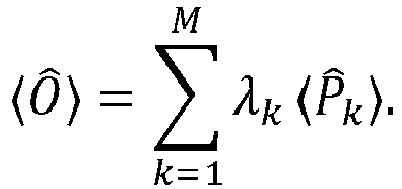
- It returns this value on
result output 114, represented by an outcoming solid line. - Because of the composition property of the architecture proposed by embodiments of the invention, the combination of this
plugin unit 11 with a raw QPU is itself a QPU with enhanced properties, namely a QPU that can handle the measurement of any observable. - Besides, this architecture allows to improve this basic behavior with more sophisticated algorithms (Crawford et al. 2021; Gokhale et al. 2019; Yen, Verteletskyi, and Izmaylov 2019) that aim at reducing the number of measurement jobs sent to the raw QPU, or at minimizing the overall number of shots needed for this estimation. For instance, the first improvement can be realized by finding partitions of the P̂k operators in commuting terms, so that all the operators of the group can be measured in one go (i.e without repreparing the quantum state). The second improvement can be performed by choosing the number of shots (and hence the statistical error, to be proportional to the λ k coefficient. What this architecture proposes is a clean separation between these improvements, which can be done at the level of the
plugin unit 11, optional other improvements, such as the compilation step mentioned previously, or other optimizations, and what happens at the QPU level. - Another example can be basic quantum eigensolver.
- The Variational Quantum Eigensolver (VQE, (Peruzzo et al. 2014)) is the main algorithm suited for so-called Noisy Intermediate-Scale Quantum (NISQ) computers. Given a circuit

θ (usually the angles of rotation gates) and an observable Ô, VQE seeks to minimize the expectation value O(θ ) = 〈Ψ(θ )|Ô|Ψ(θ )〉 using a classical minimization algorithm. The QPU is used to compute O(θ ) for a given assignment of the parameters. This hybrid quantum classical algorithm can be described seamlessly in the architecture proposed by embodiments of the invention, by using the following two processes represented onfigure 12 . -
Figure 12 shows an example of a first type of brick, including both examples of a first type of building block and of a second type of building block, used during the Petri net transformation step, within the building method according to embodiments of the invention. - There is a brick comprising a
plugin unit 12 associated with aquantum processing unit 120. - The
Plugin unit 12 receives a job on itsjob input 121 and sends a job on itsjob output 122. ThePlugin unit 12 receives a result on itsresult input 123 and sends a result on itsresult output 124. - The
quantum processing unit 120, which processes a job received on itsinput port 122 which is directly connected tojob output 122 ofplugin unit 12, and therefore represented with the same reference, into a result sent on itsoutput port 123 which is directly connected to resultoutput 123 ofplugin unit 12, and therefore represented with the same reference. - The right-hand process is a
QPU 120 with the capacity to measure any observable Ô for a given circuit (this is not the case of every QPU, but any raw QPU not endowed with this property can be enhanced by using the plugin previously described. The left-hand process is a
plugin unit 12 that accepts on itsjob input 121, represented by an incoming dashed line, parametric Jobs ((
θ ), Ô), i.e whereθ is not set, and returns, on itsresult output 124, represented by an outgoing solid line, upon achieving a completion criterion defined below, the minimum value O(θ ∗). Using a classical optimization algorithm, theplugin unit 12 iteratively chooses new values of parameters,θ k to prepare jobs ( (
(
θ k ), Ô) sent on itsjob output 122, represented by an outgoing dashed line, whose return value O(θ k) received on itsresult input 123, represented by an ingoing solid line, is classically processed to make a decision, namely either to send out a new job
θ ∗ ) withθ ∗ =θ k. on its result output 124 (if the criterion is met). - The resulting global brick VQE QPU (by virtue of the composition property of the architecture, the assembly of both
processes - Another example can be variational quantum eigensolver.
- The power of the architecture proposed by embodiments of the invention completely unfolds when the VQE method described previously is made even more sophisticated. Now, are presented two advanced improvements that can readily be implemented using this architecture: the gradient-based optimizer and the adaptative ansatz construction.
- First, is now described the gradient-based optimizer.
- The VQE method relies on a classical optimization algorithm that aims at minimizing the value O(
θ ) = 〈Ψ(θ )|Ô|Ψ(θ )〉. Previously, assumption was made that this optimization algorithm required only an access to O(θ ) for any value ofθ . However, some optimization routines benefit from having access to the gradient of the function O(θ ) to be minimized. This usually yields better convergence towards the minimum, at the cost of extra function evaluations. In the VQE context, using such gradient-based minimizers requires the computation of ∇O(θ ). It turns out that the P values corresponding to this gradient (assumingθ is a P-component vector) can be expressed as a function of expectation values over a modified quantum circuit (with a possibly modified observable):


- The output Results

θ k) and its gradient ∇pO(θ k ) to the classical minimizer to decide on the next parameter assignmentθ k+1. -
Figure 13 shows an example of a second type of brick, including both examples of a first type of building block and of a second type of building block, used during the Petri net transformation step, within the building method according to embodiments of the invention. - There is a similar brick as the brick shown in
figure 12 . Indeed, there is a brick comprising aplugin unit 13 associated with aquantum processing unit 130. - The
Plugin unit 13 receives a job on itsjob input 131 and sends a job on itsjob output 132. ThePlugin unit 13 receives a result on itsresult input 133 and sends a result on itsresult output 134. - The
quantum processing unit 130, which processes a job received on itsinput port 132 which is directly connected tojob output 132 ofplugin unit 13, and therefore represented with the same reference, into a result sent on itsoutput port 133 which is directly connected to resultoutput 133 ofplugin unit 13, and therefore represented with the same reference. - Even more sophisticated machine-learning inspired methods, that require the modification of the gradient to take into account the differential geometry of the variational subspace, merely result in the construction of additional jobs by the VQE plugin. The results of these jobs are then processed to compute the required correction to the gradient. For instance, for the so-called "natural-gradient" method (Stokes et al. 2020; Koczor and Benjamin 2019; Yamamoto 2019), additional jobs are used to construct the metric tensor of the variational subspace and then modify the gradient. By using this architecture proposed by embodiments of the invention, this very advanced method can be implemented in a limited number of lines of code.
- Second, is now described the adaptative ansatz construction.
- In the VQE method, a key ingredient is the choice of parametric circuit
 } to add gates of the form Uk (ϑ) = exp(-iθτ k) to the circuit. At each step i, one chooses the τk operator which maximizes the value of the gradient:

- of the expectation value of the circuit where the associated Uk (ϑ k ) gate has been added. This seemingly complicated procedure would have a quite basic implementation by using the architecture proposed by embodiments of the invention:
- ➢ the plugin unit receives a Job with an observable Ô to be minimized. The operator pool can be specified either in the job itself, or elsewhere.
- ➢ at each step i,
- ∘ a first series of (non-parametric) jobs

θ ∗ from the previous step, - ∘ its results are combined to compute the gradients as above (see
figure 13 ), which are in turned used to select the optimal operator k ∗ and grow the ansatz to
- ∘ a second parametric job

- ∘ a first series of (non-parametric) jobs
- Another example can be error mitigation.
- State-of-the-art NISQ processors have error levels above the thresholds required by Quantum Error Correction theory. Nevertheless, methods (called error mitigation methods) have been proposed to mitigate the effect of errors of NISQ QPUs. These error mitigation techniques are all the most important as NISQ processors have high error rates. In this subsection, we show that our architecture enables a seamless integration of error mitigation methods within a hybrid quantum-classical stack.
- We will focus on two concrete examples which are respectively zero-noise extrapolation and assignment probability error mitigation.
- First, is now described the zero-noise extrapolation.
- For a given NISQ QPU, r = 1 is called its current noise level (r is any metric on the noise, normalized to 1 for the noise on the machine). The average value O of an observable Ô is to be computed after execution of a quantum circuit C characterized by the unitary operator UC. In the case of a perfect execution (i.e r = 0), there is:

- with


- where ρ̂(r = 1) is the (mixed) final state of the system after a noisy evolution (the observable Ô is also affected by noise in general, but this dependence can be neglected for sake of simplicity). The zero-noise extrapolation technique proposes a way to extrapolate from 〈O(r = 1)) to 〈O(r = 0)〉 by artificially increasing the noise level to values ri such that r < r 1 < r 2 ..., measuring the corresponding observables 〈O(ri )〉 and then performing an extrapolation to the r = 0 limit. In practice, this artificial increase in the noise can be done in several ways. The most straightforward one would consist in adding identity operations with a variable duration in the original circuit so that the additional computational time required by the circuit leads to an increased sensitivity to decoherence. This insertion of identity operations can be easily implemented by adding pairs of involutive gates (U 2 = I) like pairs of Hadamard gates or CNOT gates. This method would thus be easy to implement with a plugin unit that takes a regular


- where circuit
 with i pairs of involutive gates added at well-chosen places in the circuit (for instance after each two-qubit gate since they are the most error-prone gates). The corresponding observables {〈O(ri )〉, i = 0 ... N} are then used to extrapolate to the zero-noise limit to 〈O(r = 0)〉, which is returned by the plugin unit.
-
Figure 14 shows an example of a third type of brick, including both examples of a first type of building block and of a second type of building block, used during the Petri net transformation step, within the building method according to embodiments of the invention. - There is a similar brick as the bricks respectively shown in
figure 12 and infigure 13 . Indeed, there is a brick comprising aplugin unit 14 associated with aquantum processing unit 140. - The
Plugin unit 14 receives a job on itsjob input 141 and sends a job on itsjob output 142. ThePlugin unit 14 receives a result on itsresult input 143 and sends a result on itsresult output 144. - The
quantum processing unit 140, which processes a job received on itsinput port 142 which is directly connected tojob output 142 ofplugin unit 14, and therefore represented with the same reference, into a result sent on itsoutput port 143 which is directly connected to resultoutput 143 ofplugin unit 14, and therefore represented with the same reference. - Second is now described the assignment probability error mitigation.
- NISQ QPUs are particularly prone to assignment errors during readout, namely there is a nonzero probability that a "0" bit is confused with a "1" (and conversely). Thus, for the single-qubit case, starting from a distribution (p 0, p 1) for the probabilities of getting 0 or 1, assignment errors alter this distribution to (p̃ 0, p̃ 1), with:

- Thus, a noisy QPU with assignment errors will return (p̃ 0, p̃ 1) instead of (p 0, p 1). These errors can be mitigated if the so-called assignment error matrix:


- This error mitigation technique, as the one used for instance in (Kandala et al. 2017), can easily be implemented with the architecture proposed by embodiments of the invention. A first series of jobs will serve the purpose of computing an estimate for A. This is done by sending circuits with X gates only and measuring the output probability, from which p(0|1) and p(1|1) can be inferred. With empty circuits, similarly, p(1|0) and p(0|0) can be estimated (this can be replicated for each qubit of the QPU). Then, the actual circuit that is input to the plugin, C, can be executed as a job, and the final distribution returned as a result. Using the assignment probability matrix A computed previously and the above formula, the distribution corrected for assignment errors can be computed and returned.
- Besides, some quantum processors do not support the digital operation mode, i.e. they cannot operate discrete gates on their qubits. Instead, they can be driven by continuous controls. This mode of operation is called analog quantum computing. Importantly, even digital machines are driven, internally, in an analog fashion.
- The architecture proposed by embodiments of the invention allows to steer analog QPUs. In particular, its Job and Plugins processes (see above) are compatible with an analog operation mode. Even more, the architecture allows to seamlessly connect an analog operation mode to a digital one.
- In the architecture proposed by embodiments of the invention, the flow of information between processes is either of type Job or of type Result. Both types Job and Result are compatible with an analog operation mode too.
- The invention has been described with reference to preferred embodiments. However, many variations are possible within the scope of the invention.
Claims (14)
- Method of building a hybrid quantum-classical computing network, said network including network architecture and network workflow, comprising:➢ a first step of transformation of an application composed of services into a Petri net including both Petri places (8, 9) and Petri transitions (81, 82, 91-94) between said Petri places (8, 9),∘ any said Petri place (8, 9) corresponding to:▪ either a first type building block corresponding to any quantum processing unit (8), said quantum processing unit including quantum processing hardware and quantum processing software, either digital or analog quantum processing unit (8), which processes a job received on an input port (81) of said unit (8) into a result sent on an output port (82) of said unit (8),▪ or a second type building block corresponding to any plugin unit (9), said plugin unit (9) including plugin hardware and plugin software, which converts a job received on an input port (91) of said unit (9) into another job sent on an output port (92) of said unit (9) and/or a result received on another input port (93) of said unit into another result sent on another output port (94) of said unit (9),∘ any Petri transition (81, 82, 91-94) corresponding to any connection from an output port (82, 92, 94) of any of said building blocks (8, 9) toward an input port (81, 91, 93) of any other of said building blocks (8, 9), all said output port(s) (82, 92, 94) and said input port(s) (81, 91, 93) being formatted so as to make any building block (8, 9) interchangeable with any replacing building block of different structure provided that said replacing building block has same format(s) at each of its input(s) and output(s) as the building block (8, 9) it replaces,➢ a second step of transformation of said Petri net into a hybrid quantum-classical computing network,∘ replacing any building block by its corresponding unit (8, 9),∘ interconnecting all said corresponding units (8, 9) together according to a topography of all said Petri transitions (81, 82, 91-94), by replacing any Petri transition (81, 82, 91-94) by a connection simply transmitting without processing nor converting, from an output port (82, 92, 94) of any of said units (8, 9) toward an input port (81, 91, 93) of any other of said units (8, 9), thereby getting said hybrid quantum-classical computing network.
- Method of building a hybrid quantum-classical computing network, according to claim 1, wherein said second type building block corresponds to any plugin unit (9) which converts a job received on an input port (91) of said unit (9) into another job sent on an output port (92) of said unit (9) and a result received on another input port (93) of said unit (9) into another result sent on another output port (94) of said unit (9).
- Method of building a hybrid quantum-classical computing network, according to any of preceding claims, wherein:
➢ said Petri net comprises:∘ at least 10 Petri places (8, 9) and at least 10 Petri transitions (81, 82, 91-94),∘ or, at least 100 Petri places (8, 9) and at least 100 Petri transitions (81, 82, 91-94),∘ or, at least 1000 Petri places (8, 9) and at least 1000 Petri transitions (81, 82, 91-94). - Method of building a hybrid quantum-classical computing network, according to any of preceding claims, wherein said built hybrid quantum-classical computing network comprises an orchestrator which is adapted and specifically dedicated to managing the built hybrid quantum-classical computing network workflow.
- Method of building a hybrid quantum-classical computing network, according to claim 4, wherein:➢ said built hybrid quantum-classical computing network workflow is asynchronous,➢ said orchestrator is specifically dedicated to managing said asynchronous workflow.
- Method of building a hybrid quantum-classical computing network, according to claim 4, wherein:➢ said built hybrid quantum-classical computing network workflow is synchronous,➢ said orchestrator is specifically dedicated to managing said synchronous workflow.
- Method of building a hybrid quantum-classical computing network, according to any of preceding claims, wherein:➢ said connection simply transmitting without processing nor converting, transmits with delay either by putting jobs into their job queue (4, 5) or by putting results into their result queue (6),➢ all job queues (4, 5) and all result queues (6) of all connections being managed by a same orchestrator within the network.
- Method of building a hybrid quantum-classical computing network, according to claim 7, wherein:
➢ said orchestrator manages:∘ at least 10 job queues (4, 5) and/or at least 10 result queues (6),∘ or, at least 100 job queues (4, 5) and/or at least 100 result queues (6),∘ or, at least 1000 job queues (4, 5) and/or at least 1000 result queues (6). - Method of building a hybrid quantum-classical computing network, according to any of preceding claims, wherein said Petri net comprises at least one or several bricks each comprising:➢ a first type building block (8),➢ a second type building block (9),➢ said first type building block (8) and said second type building block (9) being interconnected together by an interface formatted so as to make any interconnected building block (8, 9) interchangeable with any replacing building block of different structure provided that said replacing building block has same format(s), as the interconnected building block (8, 9) it replaces, at each of its input(s) and output(s) belonging to said interface.
- Method of building a hybrid quantum-classical computing network, according to claim 9, wherein said Petri net comprises at least one or several bricks each comprising:➢ a first type building block, corresponding to an analog quantum processing unit (8) which processes a job received on an input port (81) of said unit into a result sent on an output port (82) of said unit,➢ a second type building block, corresponding to a plugin unit -9) which converts a digital job received on an input port -91) of said unit (9), under the format of a quantum circuit made of quantum gates, into another analog job sent on an output port (92) of said unit (9), under the format of a schedule made of Hamiltonians.
- Method of building a hybrid quantum-classical computing network, according to claim 9 or 10, wherein said Petri net comprises at least one or several bricks each comprising:➢ a first type building block, corresponding to a digital quantum processing unit (8) which processes a job received on an input port (81) of said unit (8) into a result sent on an output port (82) of said unit (8),
∘ said digital quantum processing units (8) belonging to one or more technologies of qubits,➢ a second type building block, corresponding to a plugin unit (9) which is a classical central processing unit (CPU). - Method of building a hybrid quantum-classical computing network, according to any of claims 9 to 11, wherein:
➢ said Petri net comprises:∘ at least 10 of said bricks,∘ or, at least 100 of said bricks,∘ or, at least 1000 of said bricks. - Method of building a hybrid quantum-classical computing network, according to any of claims 1 to 12, wherein said hybrid quantum-classical computing network includes at least one or more interactions of the type client server interactions, with said server being located in a cloud.
- Method of building a hybrid quantum-classical computing network, according to any of claims 1 to 12, wherein said hybrid quantum-classical computing network corresponds to a high performance cluster (HPC) which includes at least 100 calculation nodes, or at least 1000 calculation nodes, or at least 5000 calculation nodes.
Priority Applications (2)
| Application Number | Priority Date | Filing Date | Title |
|---|---|---|---|
| EP21306280.5A EP4152221B1 (en) | 2021-09-16 | 2021-09-16 | Method of building a hybrid quantum-classical computing network |
| US17/941,603 US11770297B2 (en) | 2021-09-16 | 2022-09-09 | Method of building a hybrid quantum-classical computing network |
Applications Claiming Priority (1)
| Application Number | Priority Date | Filing Date | Title |
|---|---|---|---|
| EP21306280.5A EP4152221B1 (en) | 2021-09-16 | 2021-09-16 | Method of building a hybrid quantum-classical computing network |
Publications (2)
| Publication Number | Publication Date |
|---|---|
| EP4152221A1 true EP4152221A1 (en) | 2023-03-22 |
| EP4152221B1 EP4152221B1 (en) | 2026-01-28 |
Family
ID=78212045
Family Applications (1)
| Application Number | Title | Priority Date | Filing Date |
|---|---|---|---|
| EP21306280.5A Active EP4152221B1 (en) | 2021-09-16 | 2021-09-16 | Method of building a hybrid quantum-classical computing network |
Country Status (2)
| Country | Link |
|---|---|
| US (1) | US11770297B2 (en) |
| EP (1) | EP4152221B1 (en) |
Families Citing this family (1)
| Publication number | Priority date | Publication date | Assignee | Title |
|---|---|---|---|---|
| US20240296314A1 (en) * | 2023-03-03 | 2024-09-05 | Microsoft Technology Licensing, Llc | Generative artificial intelligence (ai) system |
Citations (1)
| Publication number | Priority date | Publication date | Assignee | Title |
|---|---|---|---|---|
| EP3602354A1 (en) | 2017-03-24 | 2020-02-05 | Bull SAS | Method for simulating, on a conventional computer, a quantum circuit |
Family Cites Families (13)
| Publication number | Priority date | Publication date | Assignee | Title |
|---|---|---|---|---|
| DE19651334A1 (en) * | 1996-12-10 | 1998-06-25 | Ericsson Telefon Ab L M | Operational test device and method for executing an operational test for a system under test |
| US7627459B2 (en) * | 2004-01-08 | 2009-12-01 | Georgia Tech Research Corporation | Systems and methods for reliability and performability assessment |
| US7394472B2 (en) * | 2004-10-08 | 2008-07-01 | Battelle Memorial Institute | Combinatorial evaluation of systems including decomposition of a system representation into fundamental cycles |
| US7369932B2 (en) * | 2006-05-04 | 2008-05-06 | Honeywell International, Inc. | System and method for turbine engine fault detection using discrete event system modeling |
| US8577665B2 (en) * | 2008-03-14 | 2013-11-05 | Fujitsu Limited | Synthesis of message sequence charts from communicating finite-state machines |
| US8751284B2 (en) * | 2009-04-30 | 2014-06-10 | United Parcel Service Of America, Inc. | Systems and methods for a real-time workflow platform using Petri net model mappings |
| US20120041794A1 (en) * | 2010-08-10 | 2012-02-16 | Sap Ag | Method and system to validate component-based implementations of business processes |
| US9774401B1 (en) * | 2013-07-15 | 2017-09-26 | Paul Borrill | Entangled links, transactions and trees for distributed computing systems |
| US9654334B2 (en) * | 2013-09-06 | 2017-05-16 | Futurewei Technologies, Inc. | System and method for fast compatibility verification of REST API based on REST Chart |
| DE102014116865B4 (en) * | 2014-11-18 | 2020-08-13 | Phoenix Contact Gmbh & Co. Kg | Analysis device for analyzing and manipulating a communication sequence |
| US20210365019A1 (en) * | 2018-09-05 | 2021-11-25 | Commonwealth Scientific And Industrial Research Organisation | A monitor for a multi-parameter manufacturing process |
| US11403372B2 (en) * | 2019-01-29 | 2022-08-02 | Irdeto Canada Corporation | Systems, methods, and storage media for obfuscating a computer program by representing the control flow of the computer program as data |
| US20220374002A1 (en) * | 2019-09-19 | 2022-11-24 | Siemens Aktiengesellschaft | Self-learning manufacturing scheduling for a flexible manufacturing system and device |
-
2021
- 2021-09-16 EP EP21306280.5A patent/EP4152221B1/en active Active
-
2022
- 2022-09-09 US US17/941,603 patent/US11770297B2/en active Active
Patent Citations (1)
| Publication number | Priority date | Publication date | Assignee | Title |
|---|---|---|---|---|
| EP3602354A1 (en) | 2017-03-24 | 2020-02-05 | Bull SAS | Method for simulating, on a conventional computer, a quantum circuit |
Non-Patent Citations (1)
| Title |
|---|
| HEINZ W SCHMIDT: "How to Bake Quantum into Your Pet Petri Nets and Have Your Net Theory Too", ARXIV.ORG, CORNELL UNIVERSITY LIBRARY, 201 OLIN LIBRARY CORNELL UNIVERSITY ITHACA, NY 14853, 4 June 2021 (2021-06-04), XP081985504 * |
Also Published As
| Publication number | Publication date |
|---|---|
| EP4152221B1 (en) | 2026-01-28 |
| US11770297B2 (en) | 2023-09-26 |
| US20230083913A1 (en) | 2023-03-16 |
Similar Documents
| Publication | Publication Date | Title |
|---|---|---|
| Brandao et al. | Finite correlation length implies efficient preparation of quantum thermal states | |
| Davis et al. | From low probability to high confidence in stochastic convex optimization | |
| US20240160971A1 (en) | Methods and apparatuses for resource-optimized fermionic local simulation on quantum computer for quantum chemistry | |
| CN111417965A (en) | Software-Defined Quantum Computer | |
| US11580438B1 (en) | Driver Hamiltonians for use with the quantum approximate optimization algorithm in solving combinatorial optimization problems with circuit-model quantum computing facilities | |
| EP2313841A2 (en) | Graphical models for the analysis of genome-wide associations | |
| Köfinger et al. | Empirical optimization of molecular simulation force fields by Bayesian inference | |
| Ustimenko et al. | SGLB: Stochastic gradient langevin boosting | |
| US20080172215A1 (en) | T-cell epiotope prediction | |
| US20170372412A1 (en) | Quantum-Annealing Computer Method for Selecting the Optimum Bids in a Combinatorial Auction | |
| US20230047145A1 (en) | Quantum simulation | |
| Petrulionyte et al. | Functional bilevel optimization for machine learning | |
| Li et al. | LLM-assisted automatic memetic algorithm for lot-streaming hybrid job shop scheduling with variable sublots | |
| Tomesh et al. | Quantum-classical tradeoffs and multi-controlled quantum gate decompositions in variational algorithms | |
| Takai et al. | Finite-temperature variational Monte Carlo method for strongly correlated electron systems | |
| Shirakawa et al. | Closed-loop calculations of electronic structure on a quantum processor and a classical supercomputer at full scale | |
| US11770297B2 (en) | Method of building a hybrid quantum-classical computing network | |
| US12197834B2 (en) | Reducing resources in quantum circuits | |
| Illésová et al. | Numerical optimization strategies for the variational hamiltonian ansatz in noisy quantum environments | |
| Li et al. | Efficient quantum gradient and higher-order derivative estimation via generalized Hadamard test | |
| Mehendale et al. | Estimating trotter approximation errors to optimize hamiltonian partitioning for lower eigenvalue errors | |
| Li et al. | Multi-objective infeasibility diagnosis for routing problems using large language models | |
| Ikhtiarudin et al. | BenchRL-QAS: Benchmarking reinforcement learning algorithms for quantum architecture search | |
| Rodrigo et al. | Exploring a double full-stack communications-enabled architecture for multi-core quantum computers | |
| Ying et al. | Online pairwise learning algorithms with kernels |
Legal Events
| Date | Code | Title | Description |
|---|---|---|---|
| PUAI | Public reference made under article 153(3) epc to a published international application that has entered the european phase |
Free format text: ORIGINAL CODE: 0009012 |
|
| STAA | Information on the status of an ep patent application or granted ep patent |
Free format text: STATUS: THE APPLICATION HAS BEEN PUBLISHED |
|
| AK | Designated contracting states |
Kind code of ref document: A1 Designated state(s): AL AT BE BG CH CY CZ DE DK EE ES FI FR GB GR HR HU IE IS IT LI LT LU LV MC MK MT NL NO PL PT RO RS SE SI SK SM TR |
|
| STAA | Information on the status of an ep patent application or granted ep patent |
Free format text: STATUS: REQUEST FOR EXAMINATION WAS MADE |
|
| 17P | Request for examination filed |
Effective date: 20230824 |
|
| RBV | Designated contracting states (corrected) |
Designated state(s): AL AT BE BG CH CY CZ DE DK EE ES FI FR GB GR HR HU IE IS IT LI LT LU LV MC MK MT NL NO PL PT RO RS SE SI SK SM TR |
|
| P01 | Opt-out of the competence of the unified patent court (upc) registered |
Effective date: 20240301 |
|
| RIC1 | Information provided on ipc code assigned before grant |
Ipc: G06N 10/80 20220101AFI20250728BHEP Ipc: G06N 10/60 20220101ALI20250728BHEP Ipc: G06N 10/20 20220101ALN20250728BHEP |
|
| GRAP | Despatch of communication of intention to grant a patent |
Free format text: ORIGINAL CODE: EPIDOSNIGR1 |
|
| STAA | Information on the status of an ep patent application or granted ep patent |
Free format text: STATUS: GRANT OF PATENT IS INTENDED |
|
| RIC1 | Information provided on ipc code assigned before grant |
Ipc: G06N 10/80 20220101AFI20250820BHEP Ipc: G06N 10/60 20220101ALI20250820BHEP Ipc: G06N 10/20 20220101ALN20250820BHEP |
|
| RIC1 | Information provided on ipc code assigned before grant |
Ipc: G06N 10/80 20220101AFI20250910BHEP Ipc: G06N 10/60 20220101ALI20250910BHEP Ipc: G06N 10/20 20220101ALN20250910BHEP |
|
| INTG | Intention to grant announced |
Effective date: 20250918 |
|
| GRAS | Grant fee paid |
Free format text: ORIGINAL CODE: EPIDOSNIGR3 |
|
| GRAA | (expected) grant |
Free format text: ORIGINAL CODE: 0009210 |
|
| STAA | Information on the status of an ep patent application or granted ep patent |
Free format text: STATUS: THE PATENT HAS BEEN GRANTED |
|
| AK | Designated contracting states |
Kind code of ref document: B1 Designated state(s): AL AT BE BG CH CY CZ DE DK EE ES FI FR GB GR HR HU IE IS IT LI LT LU LV MC MK MT NL NO PL PT RO RS SE SI SK SM TR |
|
| REG | Reference to a national code |
Ref country code: CH Ref legal event code: F10 Free format text: ST27 STATUS EVENT CODE: U-0-0-F10-F00 (AS PROVIDED BY THE NATIONAL OFFICE) Effective date: 20260128 Ref country code: GB Ref legal event code: FG4D |
|
| REG | Reference to a national code |
Ref country code: IE Ref legal event code: FG4D |
|
| REG | Reference to a national code |
Ref country code: DE Ref legal event code: R096 Ref document number: 602021046761 Country of ref document: DE |