EP4152048B1 - Mobile apparatus obstacle detection system, mobile apparatus, and ground-sweeping robot - Google Patents
Mobile apparatus obstacle detection system, mobile apparatus, and ground-sweeping robot Download PDFInfo
- Publication number
- EP4152048B1 EP4152048B1 EP21804444.4A EP21804444A EP4152048B1 EP 4152048 B1 EP4152048 B1 EP 4152048B1 EP 21804444 A EP21804444 A EP 21804444A EP 4152048 B1 EP4152048 B1 EP 4152048B1
- Authority
- EP
- European Patent Office
- Prior art keywords
- detection line
- structured light
- obstacle
- longitudinal
- lateral
- Prior art date
- Legal status (The legal status is an assumption and is not a legal conclusion. Google has not performed a legal analysis and makes no representation as to the accuracy of the status listed.)
- Active
Links
Images




Classifications
-
- G—PHYSICS
- G01—MEASURING; TESTING
- G01S—RADIO DIRECTION-FINDING; RADIO NAVIGATION; DETERMINING DISTANCE OR VELOCITY BY USE OF RADIO WAVES; LOCATING OR PRESENCE-DETECTING BY USE OF THE REFLECTION OR RERADIATION OF RADIO WAVES; ANALOGOUS ARRANGEMENTS USING OTHER WAVES
- G01S11/00—Systems for determining distance or velocity not using reflection or reradiation
- G01S11/12—Systems for determining distance or velocity not using reflection or reradiation using electromagnetic waves other than radio waves
-
- G—PHYSICS
- G01—MEASURING; TESTING
- G01S—RADIO DIRECTION-FINDING; RADIO NAVIGATION; DETERMINING DISTANCE OR VELOCITY BY USE OF RADIO WAVES; LOCATING OR PRESENCE-DETECTING BY USE OF THE REFLECTION OR RERADIATION OF RADIO WAVES; ANALOGOUS ARRANGEMENTS USING OTHER WAVES
- G01S17/00—Systems using the reflection or reradiation of electromagnetic waves other than radio waves, e.g. lidar systems
- G01S17/88—Lidar systems specially adapted for specific applications
- G01S17/93—Lidar systems specially adapted for specific applications for anti-collision purposes
- G01S17/931—Lidar systems specially adapted for specific applications for anti-collision purposes of land vehicles
-
- G—PHYSICS
- G06—COMPUTING OR CALCULATING; COUNTING
- G06T—IMAGE DATA PROCESSING OR GENERATION, IN GENERAL
- G06T7/00—Image analysis
- G06T7/70—Determining position or orientation of objects or cameras
-
- A—HUMAN NECESSITIES
- A47—FURNITURE; DOMESTIC ARTICLES OR APPLIANCES; COFFEE MILLS; SPICE MILLS; SUCTION CLEANERS IN GENERAL
- A47L—DOMESTIC WASHING OR CLEANING; SUCTION CLEANERS IN GENERAL
- A47L11/00—Machines for cleaning floors, carpets, furniture, walls, or wall coverings
- A47L11/40—Parts or details of machines not provided for in groups A47L11/02 - A47L11/38, or not restricted to one of these groups, e.g. handles, arrangements of switches, skirts, buffers, levers
- A47L11/4061—Steering means; Means for avoiding obstacles; Details related to the place where the driver is accommodated
-
- G—PHYSICS
- G01—MEASURING; TESTING
- G01C—MEASURING DISTANCES, LEVELS OR BEARINGS; SURVEYING; NAVIGATION; GYROSCOPIC INSTRUMENTS; PHOTOGRAMMETRY OR VIDEOGRAMMETRY
- G01C11/00—Photogrammetry or videogrammetry, e.g. stereogrammetry; Photographic surveying
- G01C11/02—Picture taking arrangements specially adapted for photogrammetry or photographic surveying, e.g. controlling overlapping of pictures
-
- G—PHYSICS
- G01—MEASURING; TESTING
- G01S—RADIO DIRECTION-FINDING; RADIO NAVIGATION; DETERMINING DISTANCE OR VELOCITY BY USE OF RADIO WAVES; LOCATING OR PRESENCE-DETECTING BY USE OF THE REFLECTION OR RERADIATION OF RADIO WAVES; ANALOGOUS ARRANGEMENTS USING OTHER WAVES
- G01S17/00—Systems using the reflection or reradiation of electromagnetic waves other than radio waves, e.g. lidar systems
- G01S17/02—Systems using the reflection of electromagnetic waves other than radio waves
- G01S17/06—Systems determining position data of a target
- G01S17/46—Indirect determination of position data
-
- G—PHYSICS
- G01—MEASURING; TESTING
- G01S—RADIO DIRECTION-FINDING; RADIO NAVIGATION; DETERMINING DISTANCE OR VELOCITY BY USE OF RADIO WAVES; LOCATING OR PRESENCE-DETECTING BY USE OF THE REFLECTION OR RERADIATION OF RADIO WAVES; ANALOGOUS ARRANGEMENTS USING OTHER WAVES
- G01S17/00—Systems using the reflection or reradiation of electromagnetic waves other than radio waves, e.g. lidar systems
- G01S17/02—Systems using the reflection of electromagnetic waves other than radio waves
- G01S17/06—Systems determining position data of a target
- G01S17/46—Indirect determination of position data
- G01S17/48—Active triangulation systems, i.e. using the transmission and reflection of electromagnetic waves other than radio waves
-
- G—PHYSICS
- G01—MEASURING; TESTING
- G01S—RADIO DIRECTION-FINDING; RADIO NAVIGATION; DETERMINING DISTANCE OR VELOCITY BY USE OF RADIO WAVES; LOCATING OR PRESENCE-DETECTING BY USE OF THE REFLECTION OR RERADIATION OF RADIO WAVES; ANALOGOUS ARRANGEMENTS USING OTHER WAVES
- G01S17/00—Systems using the reflection or reradiation of electromagnetic waves other than radio waves, e.g. lidar systems
- G01S17/88—Lidar systems specially adapted for specific applications
- G01S17/93—Lidar systems specially adapted for specific applications for anti-collision purposes
-
- G—PHYSICS
- G01—MEASURING; TESTING
- G01S—RADIO DIRECTION-FINDING; RADIO NAVIGATION; DETERMINING DISTANCE OR VELOCITY BY USE OF RADIO WAVES; LOCATING OR PRESENCE-DETECTING BY USE OF THE REFLECTION OR RERADIATION OF RADIO WAVES; ANALOGOUS ARRANGEMENTS USING OTHER WAVES
- G01S7/00—Details of systems according to groups G01S13/00, G01S15/00, G01S17/00
- G01S7/48—Details of systems according to groups G01S13/00, G01S15/00, G01S17/00 of systems according to group G01S17/00
- G01S7/481—Constructional features, e.g. arrangements of optical elements
- G01S7/4811—Constructional features, e.g. arrangements of optical elements common to transmitter and receiver
-
- G—PHYSICS
- G01—MEASURING; TESTING
- G01S—RADIO DIRECTION-FINDING; RADIO NAVIGATION; DETERMINING DISTANCE OR VELOCITY BY USE OF RADIO WAVES; LOCATING OR PRESENCE-DETECTING BY USE OF THE REFLECTION OR RERADIATION OF RADIO WAVES; ANALOGOUS ARRANGEMENTS USING OTHER WAVES
- G01S7/00—Details of systems according to groups G01S13/00, G01S15/00, G01S17/00
- G01S7/48—Details of systems according to groups G01S13/00, G01S15/00, G01S17/00 of systems according to group G01S17/00
- G01S7/481—Constructional features, e.g. arrangements of optical elements
- G01S7/4814—Constructional features, e.g. arrangements of optical elements of transmitters alone
-
- G—PHYSICS
- G06—COMPUTING OR CALCULATING; COUNTING
- G06T—IMAGE DATA PROCESSING OR GENERATION, IN GENERAL
- G06T7/00—Image analysis
- G06T7/50—Depth or shape recovery
- G06T7/521—Depth or shape recovery from laser ranging, e.g. using interferometry; from the projection of structured light
-
- G—PHYSICS
- G01—MEASURING; TESTING
- G01C—MEASURING DISTANCES, LEVELS OR BEARINGS; SURVEYING; NAVIGATION; GYROSCOPIC INSTRUMENTS; PHOTOGRAMMETRY OR VIDEOGRAMMETRY
- G01C11/00—Photogrammetry or videogrammetry, e.g. stereogrammetry; Photographic surveying
- G01C11/04—Interpretation of pictures
Definitions
- the disclosure generally relates to the technical field of obstacle detection, and in particular, to an obstacle detection system based on structured light, a mobile apparatus including the obstacle detection system, and a ground-sweeping robot.
- ground-sweeping robots As an important constituent part of a smart home, ground-sweeping robots have appeared in the lives of thousands of households.
- a ground-sweeping robot needs a 3D vision function, including instant positioning, distance measurement, map construction, obstacle avoidance, and recognition of an obstacle in the direction of travel, such as a table, a chair, a sofa, a cabinet, or a home appliance.
- the ground-sweeping robot usually carries a plurality of sensors to implement the 3D vision function, and may also project structured light through a diffractive optical element (DOE), and then implement obstacle recognition and obstacle avoidance by using a camera and a recognition algorithm.
- DOE diffractive optical element
- Structured light is a system structure composed of a projection apparatus and a camera. Specific optical information is projected by the projection apparatus onto the surface and background of an object, and then is collected by the camera. Information such as the position and depth of the object is calculated according to the change of an optical signal caused by the object, and then the entire three-dimensional space is restored.
- An existing solution for obstacle avoidance with structured light in a ground-sweeping robot usually cannot recognize a suspension space below furniture such as a sofa or a cabinet, causing the ground-sweeping robot to be stuck at the suspension space; or cannot recognize a shorter obstacle on the forward path of the ground-sweeping robot; or possibly cannot accurately recognize an elongated obstacle in the vertical direction, such as a chair leg.
- EP patent application EP2869156A1 discloses a mobile robot including a main body and a pattern irradiation unit emitting a cross-shaped optical pattern including a horizontal line optical pattern and a vertical line optical pattern intersecting the horizontal line optical pattern.
- the pattern irradiation unit includes a light source and a lens converting light emitted from the light source into the cross-shaped optical pattern, the lens includes convex cells on an incidence surface upon which the emitted light is incident, the incidence surface is divided into a first area converting the light emitted from the light source into the horizontal line optical pattern and a second area converting the light emitted from the light source into the vertical line optical pattern, vertical convex cells extended in parallel in the vertical direction are formed in the first area, and horizontal convex cells extended in parallel in the horizontal direction are formed in the second area.
- EP patent application EP3459689A2 discloses a mobile includes a first pattern emission unit for emitting first pattern light toward a floor in a cleaning area in front of a body and a second pattern emission unit for emitting second pattern light upward in front of the body, acquires an image obtained by emitting light of each of the patterns emitted from the first pattern emission unit and the second pattern unit through an image acquirer, detects a pattern from the acquired image to determine an obstacle, detects a cliff depending on a shape or position of the pattern, and is driven along a path along which the mobile robot does not fall off the cliff to avoid the cliff, and thus, preferentially determines whether a cliff is present, differentiates between a threshold and a cliff such as a stair to be driven or avoid the obstacle, is effectively driven due to the rapid determination and operation of the mobile obstacle, and prevents the mobile robot from falling off the cliff such as a stair.
- the disclosure provides an obstacle detection system for a mobile apparatus as defined in the appended claims.
- Preferred embodiments of the disclosure provide an obstacle detection system based on structured light, a mobile apparatus carrying the obstacle detection system, and a ground-sweeping robot.
- the obstacle detection system detects a higher obstacle within a large field of view on a path of travel by projecting a first lateral detection line in a horizontal direction; detects a suspension space below furniture such as a sofa or a cabinet by projecting a first longitudinal detection line in a vertical direction, thereby preventing the mobile apparatus from being stuck; and detects a low obstacle by projecting a second longitudinal detection line in the vertical direction, eliminating a blind zone caused when there is only a detection line in the horizontal direction; meanwhile, an elongated obstacle in the vertical direction can also be effectively detected with a plurality of longitudinal detection lines.
- FIG. 1 schematically illustrates a mobile apparatus 10, on which an obstacle detection system 100 is mounted.
- the obstacle detection system 100 includes a structured light projection module 102, a camera module 103, and an image processing module 104.
- the structured light projection module 102 projects a structured light 105 on a forward path of the mobile apparatus 10, the structured light 105 including at least one lateral detection line in a horizontal direction and at least one longitudinal detection line in a vertical direction.
- the structured light 105 is irradiated onto obstacles 106, 107 and 108 to form lateral or longitudinal bright lines.
- the camera module 103 captures the lateral or longitudinal bright lines, that is, an image of the structured light.
- the image processing module 104 communicates with the camera module 103 to receive the image of the structured light, and can calculate, according to the image of the structured light, the distances and positions of the obstacles 106, 107 and 108 on the forward path.
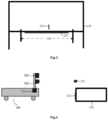
- FIG. 2 illustrates one form of a pattern of the structured light 105 projected by the structured light projection module 102, that is, the pattern of the structured light 105 includes a first lateral detection line 201, a first longitudinal detection line 202 and a second longitudinal detection line 203.
- the structured light projection module 102 projects the first lateral detection line 201 according to a first preset angle range, and the zero degree in the horizontal direction is set directly in front of the structured light projection module 102.
- the structured light projection module 102 projects the first lateral detection line 201 according to an angle range of -55° to +55° in the horizontal direction.
- the first lateral detection line 201 can be used to detect the higher obstacle 107 located within a large field of view on the path of travel of the mobile apparatus 10 (see FIG. 1 ).
- the structured light projection module 102 projects the first longitudinal detection line 202 according to a second preset angle range, and the zero degree in the vertical direction is set directly in front of the structured light projection module 102.
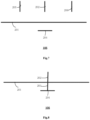
- the structured light projection module 102 projects the first longitudinal detection line 202 according to an angle range of 8° to 16° in the vertical direction, and the first longitudinal detection line 202 is located above the first lateral detection line 201. As shown in FIG. 2 , the structured light projection module 102 projects the first longitudinal detection line 202 according to a second preset angle range, and the zero degree in the vertical direction is set directly in front of the structured light projection module 102.
- the structured light projection module 102 projects the first longitudinal detection line 202 according to an angle range of 8° to 16° in the vertical direction, and the first longitudinal detection line 202 is located above the first lateral detection line 201.
- the suspension space 300 is narrow, and the mobile apparatus 10 tends to be stuck after entering the suspension space 300; alternatively, in the case where a height of the suspension space 300 is lower than that of the mobile apparatus 10, the mobile apparatus 10, when travelling to the position of the suspension space 300, may be obstructed by the obstacle 108 above the suspension space 300 (e.g., an upper part of furniture such as a sofa or a cabinet).
- the first lateral detection line 201 is cast onto the suspension space 300 and cannot form an image, that is, the detection result is that there is no obstacle ahead, while the first longitudinal detection line 202 is cast onto the obstacle 108 above the suspension space 300 to form a longitudinal bright line.
- the image processing module 104 can determine, according to the longitudinal bright line, that there is the narrow suspension space 300 ahead, as well as the distance and position of the suspension space 300 relative to the mobile apparatus 10. Therefore, the first longitudinal detection line 202 is used for detecting the suspension space 300 below furniture such as a sofa or a cabinet, so as to avoid the mobile apparatus 10 from being stuck.
- the structured light projection module 102 projects the second longitudinal detection line 203 according to a third preset angle range.
- the structured light projection module 102 projects the second longitudinal detection line 203 according to an angle range of -8° to 0° in the vertical direction, and the second longitudinal detection line 203 is located below the first lateral detection line 201 and on an extension line of the first longitudinal detection line 202.
- the first lateral detection line 201 is used for detecting the higher obstacle 107 located within a large field of view on the path of travel of the mobile apparatus 10, but there is a blind zone with regard to the shorter obstacle 106. As shown in FIG.
- the first lateral detection line 201 (a point perpendicular to the principal plane in FIG. 4 ) cannot be cast onto the obstacle 106 for imaging, that is, the detection result is that there is no obstacle ahead.
- the second longitudinal detection line 203 is cast onto the obstacle 106 to form a longitudinal bright line, and the image processing module 104 can determine, according to the longitudinal bright line, that there is the shorter obstacle 106 ahead, as well as the distance and position of the obstacle 106 relative to the mobile apparatus 10. Therefore, the second longitudinal detection line 203 is used for detecting the obstacle 106 having a height lower than the vertical distance between the structured light projection module 102 and the ground, eliminating the blind zone caused when there is only a detection line in the horizontal direction.
- the first lateral detection line 201 is used for detecting the higher obstacle 107 located within a large field of view on the path of travel of the mobile apparatus 10;
- the second longitudinal detection line 203 is located below the first lateral detection line 201 and on an extension line of the first longitudinal detection line 202, and is used for detecting the obstacle 106 having a height lower than the vertical distance between the structured light projection module 102 and the ground, eliminating the blind zone caused when there is only a detection line in the horizontal direction. Therefore, preferably, one end point of the second longitudinal detection line 203 intersects with the first lateral detection line 201.
- the first longitudinal detection line 202 is located above the first lateral detection line 201, and is used for detecting the suspension space 300 below furniture such as a sofa or a cabinet, avoiding the mobile apparatus from being stuck. Since the intensity of the light source of the obstacle detection system 100 is constant, and the limited intensity of the light source, in the case of a shorter total length of all the detection lines of the structured light, will be evenly distributed on the shorter detection line so as to enhance the brightness of the detection line and extend the detection distance, the first longitudinal detection line 202 is thus preferably spaced from the second longitudinal detection line 203, and there is no need to extend all the way upward from the first lateral detection line as long as an object above the suspension space can be detected. Obviously, a form of the connection between the first longitudinal detection line 202 and the second longitudinal detection line 203 also falls into the scope of protection of the disclosure.
- the first lateral detection line 201 is cast onto an elongated obstacle to form an image approximate to a bright point, which is not easily recognized, while the first longitudinal detection line 202 and the second longitudinal detection line 203 are cast onto the elongated obstacle to form an image as a longitudinal bright line.
- the image processing module 104 may calculate, according to the image, the distance and position of the elongated obstacle on the forward path.
- FIG. 5 illustrates another form of the pattern of the structured light 105 projected by the structured light projection module 102, that is, the pattern of the structured light 105 includes the first lateral detection line 201, the first longitudinal detection line 202 and a second lateral detection line 204.
- the structured light projection module 102 projects the first lateral detection line 201 according to the first preset angle range.
- the structured light projection module 102 projects the first lateral detection line 201 according to an angle range of -55° to +55° in the horizontal direction.
- the structured light projection module 102 projects the first longitudinal detection line 202 according to the second preset angle range.
- the structured light projection module 102 projects the first longitudinal detection line 202 according to an angle range of 8° to 16° in the vertical direction, and the first longitudinal detection line 202 is located above the first lateral detection line 201.
- the structured light projection module 102 projects the second lateral detection line 204 according to a fourth preset angle range.
- the structured light projection module 102 projects the second lateral detection line 204 according to an angle range of -20° to +20° in the horizontal direction.
- the second lateral detection line 204 is located below and parallel to the first lateral detection line 201.
- the second horizontal detection line 204 can also be used for detecting the obstacle 106 having a height lower than the vertical distance between the structured light projection module 102 and the ground, eliminating the blind zone caused when there is only one detection line within a large field of view in the horizontal direction.
- FIG. 6 illustrates another form of the structured light 105 projected by the structured light projection module 102, that is, the structured light 105 includes the first lateral detection line 201, the first longitudinal detection line 202, the second longitudinal detection line 203, a third longitudinal detection line 205 and a fourth longitudinal detection line 206.
- the structured light projection module 102 projects the first lateral detection line 201 according to the first preset angle range, and projects the first longitudinal detection line 202 according to the second preset angle range, the first longitudinal detection line 202 being located above the first lateral detection line 201 and at a lateral center of the first lateral detection line 201.
- the structured light projection module 102 projects the second longitudinal detection line 203 according to the third preset angle range, the second longitudinal detection line 203 being located below the first lateral detection line 201 and on an extension line of the first longitudinal detection line 202.
- the structured light projection module 102 also projects the third longitudinal detection line 205 and the fourth longitudinal detection line 206, the third longitudinal detection line 205 and the fourth longitudinal detection line 206 being parallel to the first longitudinal detection line 202 and located in symmetrical positions with the first longitudinal detection line 202 as an axis of symmetry.
- the third longitudinal detection line 205 and the fourth longitudinal detection line 206 are used for improving the detection probability of detecting an elongated obstacle (e.g., a chair leg or the like), and the suspension space below furniture such as a sofa or a cabinet.
- FIG. 7 illustrates another form of the pattern of the structured light 105 projected by the structured light projection module 102, that is, the pattern of the structured light 105 includes the first horizontal detection line 201, the first longitudinal detection line 202, the second lateral detection line 204, the third longitudinal detection line 205 and the fourth longitudinal detection line 206.
- the detection function of each detection line is the same as that in the aforesaid preferred embodiments, and will not be repeated here.
- FIG. 8 illustrates a pattern of the structured light 105 according to a preferred embodiment of the disclosure.
- the pattern of the structured light 105 includes the first lateral detection line 201, the first longitudinal detection line 202, the second longitudinal detection line 203, and the second lateral detection line 204.
- the structured light projection module 102 projects the first lateral detection line 201 according to the first preset angle range, projects the first longitudinal detection line 202 according to the second preset angle range, projects the second longitudinal detection line 203 according to the third preset angle range, and projects the second lateral detection line 204 according to the fourth preset angle range, wherein the first longitudinal detection line 202 and the second longitudinal detection line 203 are aligned to each other and connected together, the second lateral detection line 204 intersects with a lower end point of the second longitudinal detection line 203 and is parallel to the first lateral detection line 201.
- the structured light projection module 102 projects the first longitudinal detection line 202 according to an angle range of 0° to 16° in the vertical direction, and projects the second longitudinal detection line 203 according to an angle range of 0° to -8° in the vertical direction.
- the structured light projection module 102 includes a laser light source configured to emit a laser beam, and a diffractive optical element (DOE) disposed downstream of an optical path of the laser light source to receive the laser beam and project the structured light 105 having a preset pattern.
- DOE diffractive optical element
- the camera module 103 and the structured light projection module 102 are disposed to be located in the same plane, and there is a displacement of a certain distance therebetween in each of the horizontal and vertical directions.
- the displacement between the camera module 103 and the structured light projection module 102 in the horizontal direction is ⁇ X
- the displacement therebetween in the vertical direction is ⁇ Y (as shown in FIG. 10 ).
- the camera module 103 has a lens group, the displacement between an equivalent optical center O" of the lens group and a central light outlet O of the structured light projection module 102 in the horizontal direction being ⁇ X, and the displacement therebetween in the vertical direction being ⁇ Y.
- the structured light 105 emitted by the structured light projection module 102 is cast onto an obstacle to form a horizontal or vertical bright line.
- the position of any point of the bright line in the spatial coordinate system (X, Y, Z) is P (x, y, z).
- An image of the structured light 105 captured by the camera module 103 is imaged on the focal plane.
- P (x, y, z) is used to represent the coordinates of any point on a lateral or longitudinal bright line in the spatial coordinate system, the bright line being formed by casting the structured light 105 onto the obstacle, while P' (u, v) is used to represent the coordinates of the imaging position of P (x, y, z) on the focal plane of the camera module 103.
- O is an equivalent optical center of the camera module 103
- an object distance is the distance of an obstacle along the travel direction of the mobile apparatus 10, i.e., z
- an image distance is approximately a focal length f of the lens group of the camera module 103.
- the disclosure also provides a mobile apparatus 10 including the obstacle detection system 100 as described above.
- the mobile apparatus is a ground-sweeping robot.
- a ground-sweeping robot carrying the obstacle detection system 100 is provided, the structured light projection module 102 projecting the first lateral detection line 201 according to the angle range of -55° to +55° in the horizontal direction, projecting the first longitudinal detection line 202 according to the angle range of 8° to 16° in the vertical direction, and projecting the second longitudinal detection line 203 according to the angle range of -8° to 0° in the vertical direction.
- the height of the structured light projection module 102 from the ground is 3 cm
- the displacement between the camera module 103 and the structured light projection module 102 in the horizontal direction is 1 cm
- the displacement therebetween in the vertical direction is 3 cm.
- Preferred embodiments of the disclosure provide an obstacle detection system based on structured light, a mobile apparatus carrying the obstacle detection system, and a ground-sweeping robot.
- the obstacle detection system detects a higher obstacle within a larger field of view on a path of travel by projecting a first lateral detection line in a horizontal direction; detects a suspension space below furniture such as a sofa or a cabinet by projecting a first longitudinal detection line in a vertical direction, thereby preventing the mobile apparatus from being stuck; and detects a lower obstacle by projecting a second longitudinal detection line in the vertical direction, eliminating a blind zone caused when there is only a detection line in the horizontal direction; meanwhile, an elongated obstacle in the vertical direction can also be effectively detected with a plurality of longitudinal detection lines.
Landscapes
- Engineering & Computer Science (AREA)
- Physics & Mathematics (AREA)
- General Physics & Mathematics (AREA)
- Electromagnetism (AREA)
- Radar, Positioning & Navigation (AREA)
- Remote Sensing (AREA)
- Computer Networks & Wireless Communication (AREA)
- Computer Vision & Pattern Recognition (AREA)
- Theoretical Computer Science (AREA)
- Optics & Photonics (AREA)
- Multimedia (AREA)
- Length Measuring Devices By Optical Means (AREA)
Description
- The disclosure generally relates to the technical field of obstacle detection, and in particular, to an obstacle detection system based on structured light, a mobile apparatus including the obstacle detection system, and a ground-sweeping robot.
- As an important constituent part of a smart home, ground-sweeping robots have appeared in the lives of thousands of households. A ground-sweeping robot needs a 3D vision function, including instant positioning, distance measurement, map construction, obstacle avoidance, and recognition of an obstacle in the direction of travel, such as a table, a chair, a sofa, a cabinet, or a home appliance. In the existing technology, the ground-sweeping robot usually carries a plurality of sensors to implement the 3D vision function, and may also project structured light through a diffractive optical element (DOE), and then implement obstacle recognition and obstacle avoidance by using a camera and a recognition algorithm.
- Structured light is a system structure composed of a projection apparatus and a camera. Specific optical information is projected by the projection apparatus onto the surface and background of an object, and then is collected by the camera. Information such as the position and depth of the object is calculated according to the change of an optical signal caused by the object, and then the entire three-dimensional space is restored.
- An existing solution for obstacle avoidance with structured light in a ground-sweeping robot usually cannot recognize a suspension space below furniture such as a sofa or a cabinet, causing the ground-sweeping robot to be stuck at the suspension space; or cannot recognize a shorter obstacle on the forward path of the ground-sweeping robot; or possibly cannot accurately recognize an elongated obstacle in the vertical direction, such as a chair leg.
- EP patent application
EP2869156A1 discloses a mobile robot including a main body and a pattern irradiation unit emitting a cross-shaped optical pattern including a horizontal line optical pattern and a vertical line optical pattern intersecting the horizontal line optical pattern. The pattern irradiation unit includes a light source and a lens converting light emitted from the light source into the cross-shaped optical pattern, the lens includes convex cells on an incidence surface upon which the emitted light is incident, the incidence surface is divided into a first area converting the light emitted from the light source into the horizontal line optical pattern and a second area converting the light emitted from the light source into the vertical line optical pattern, vertical convex cells extended in parallel in the vertical direction are formed in the first area, and horizontal convex cells extended in parallel in the horizontal direction are formed in the second area. - EP patent application
EP3459689A2 discloses a mobile includes a first pattern emission unit for emitting first pattern light toward a floor in a cleaning area in front of a body and a second pattern emission unit for emitting second pattern light upward in front of the body, acquires an image obtained by emitting light of each of the patterns emitted from the first pattern emission unit and the second pattern unit through an image acquirer, detects a pattern from the acquired image to determine an obstacle, detects a cliff depending on a shape or position of the pattern, and is driven along a path along which the mobile robot does not fall off the cliff to avoid the cliff, and thus, preferentially determines whether a cliff is present, differentiates between a threshold and a cliff such as a stair to be driven or avoid the obstacle, is effectively driven due to the rapid determination and operation of the mobile obstacle, and prevents the mobile robot from falling off the cliff such as a stair. - The contents in the Background are only technologies known by the disclosers, and do not necessarily represent the existing technology in the field.
- In view of at least one of the defects in the existing technology, the disclosure provides an obstacle detection system for a mobile apparatus as defined in the appended claims.
- Preferred embodiments of the disclosure provide an obstacle detection system based on structured light, a mobile apparatus carrying the obstacle detection system, and a ground-sweeping robot. The obstacle detection system detects a higher obstacle within a large field of view on a path of travel by projecting a first lateral detection line in a horizontal direction; detects a suspension space below furniture such as a sofa or a cabinet by projecting a first longitudinal detection line in a vertical direction, thereby preventing the mobile apparatus from being stuck; and detects a low obstacle by projecting a second longitudinal detection line in the vertical direction, eliminating a blind zone caused when there is only a detection line in the horizontal direction; meanwhile, an elongated obstacle in the vertical direction can also be effectively detected with a plurality of longitudinal detection lines.
- The drawings are used to provide a further understanding of the present disclosure and constitute a part of the specification, and are used to explain the present disclosure along with the embodiments of the present disclosure, but do not constitute any limitation to the disclosure. In the drawings:
-
FIG. 1 schematically illustrates a working process of an obstacle detection system for a mobile apparatus according to a preferred embodiment of the disclosure; -
FIG. 2 illustrates a structured light projected by a structured light projection module according to a preferred embodiment of the disclosure; -
FIG. 3 schematically illustrates a detection of a suspension space below furniture by a structured light according to a preferred embodiment of the disclosure; -
FIG. 4 schematically illustrates a detection of a low obstacle by a structured light according to a preferred embodiment of the disclosure; -
FIG. 5 illustrates a structured light projected by a structured light projection module according to a preferred embodiment of the disclosure; -
FIG. 6 illustrates a structured light projected by a structured light projection module according to a preferred embodiment of the disclosure; -
FIG. 7 illustrates a structured light projected by a structured light projection module according to a preferred embodiment of the disclosure; -
FIG. 8 illustrates a structured light projected by a structured light projection module according to a preferred embodiment of the disclosure; -
FIG. 9 illustrates establishments of a spatial coordinate system and a plane coordinate system of an obstacle detection system according to a preferred embodiment of the disclosure; -
FIG. 10 illustrates a positional relationship between a structured light projection module and a camera module according to a preferred embodiment of the disclosure; -
FIG. 11 illustrates a method for calculating spatial coordinates of an obstacle by an image processing module according to a preferred embodiment of the disclosure; and -
FIG. 12 illustrates detection ranges for a low obstacle and a suspension space according to a preferred embodiment of the disclosure. - The disclosure below provides many different embodiments or examples so as to realize different structures described herein. In order to simplify the disclosure herein, the following will give the description of the parts and arrangements embodied in specific examples. Of course, they are only for the exemplary purpose, not intended to limit the present disclosure. Besides, the present disclosure may repeat a reference number and/or reference letter in different examples, and such repeat is for the purpose of simplification and clarity, which does not represent any relation among various embodiments and/or arrangements as discussed. In addition, the present disclosure provides examples of various specific processes and materials, but those skilled in the art can also be aware of application of other processes and/or use of other materials.
- The preferred embodiments of the present disclosure will be described below with reference to the drawings. It should be appreciated that the preferred embodiments described herein are only used to illustrate and explain the present disclosure, but not to limit the present disclosure.
- According to a preferred embodiment of the disclosure,
FIG. 1 schematically illustrates amobile apparatus 10, on which anobstacle detection system 100 is mounted. As shown inFIG. 1 , theobstacle detection system 100 includes a structuredlight projection module 102, acamera module 103, and animage processing module 104. In the travelling process of themobile apparatus 10, the structuredlight projection module 102 projects a structuredlight 105 on a forward path of themobile apparatus 10, the structuredlight 105 including at least one lateral detection line in a horizontal direction and at least one longitudinal detection line in a vertical direction. The structuredlight 105 is irradiated ontoobstacles camera module 103 captures the lateral or longitudinal bright lines, that is, an image of the structured light. Theimage processing module 104 communicates with thecamera module 103 to receive the image of the structured light, and can calculate, according to the image of the structured light, the distances and positions of theobstacles - According to a preferred embodiment of the disclosure,
FIG. 2 illustrates one form of a pattern of thestructured light 105 projected by the structuredlight projection module 102, that is, the pattern of thestructured light 105 includes a firstlateral detection line 201, a firstlongitudinal detection line 202 and a secondlongitudinal detection line 203. The structuredlight projection module 102 projects the firstlateral detection line 201 according to a first preset angle range, and the zero degree in the horizontal direction is set directly in front of the structuredlight projection module 102. Preferably, the structuredlight projection module 102 projects the firstlateral detection line 201 according to an angle range of -55° to +55° in the horizontal direction. The firstlateral detection line 201 can be used to detect thehigher obstacle 107 located within a large field of view on the path of travel of the mobile apparatus 10 (seeFIG. 1 ). - As shown in
FIG. 2 , the structuredlight projection module 102 projects the firstlongitudinal detection line 202 according to a second preset angle range, and the zero degree in the vertical direction is set directly in front of the structuredlight projection module 102. Preferably, the structuredlight projection module 102 projects the firstlongitudinal detection line 202 according to an angle range of 8° to 16° in the vertical direction, and the firstlongitudinal detection line 202 is located above the firstlateral detection line 201. As shown inFIG. 3 , with regard to asuspension space 300 below furniture such as sofa or a cabinet, thesuspension space 300 is narrow, and themobile apparatus 10 tends to be stuck after entering thesuspension space 300; alternatively, in the case where a height of thesuspension space 300 is lower than that of themobile apparatus 10, themobile apparatus 10, when travelling to the position of thesuspension space 300, may be obstructed by theobstacle 108 above the suspension space 300 (e.g., an upper part of furniture such as a sofa or a cabinet). The firstlateral detection line 201 is cast onto thesuspension space 300 and cannot form an image, that is, the detection result is that there is no obstacle ahead, while the firstlongitudinal detection line 202 is cast onto theobstacle 108 above thesuspension space 300 to form a longitudinal bright line. Then theimage processing module 104 can determine, according to the longitudinal bright line, that there is thenarrow suspension space 300 ahead, as well as the distance and position of thesuspension space 300 relative to themobile apparatus 10. Therefore, the firstlongitudinal detection line 202 is used for detecting thesuspension space 300 below furniture such as a sofa or a cabinet, so as to avoid themobile apparatus 10 from being stuck. - Returning to
FIG. 2 , the structuredlight projection module 102 projects the secondlongitudinal detection line 203 according to a third preset angle range. Preferably, the structuredlight projection module 102 projects the secondlongitudinal detection line 203 according to an angle range of -8° to 0° in the vertical direction, and the secondlongitudinal detection line 203 is located below the firstlateral detection line 201 and on an extension line of the firstlongitudinal detection line 202. The firstlateral detection line 201 is used for detecting thehigher obstacle 107 located within a large field of view on the path of travel of themobile apparatus 10, but there is a blind zone with regard to theshorter obstacle 106. As shown inFIG. 4 , with regard to theobstacle 106 having a height lower than a vertical distance between the structuredlight projection module 102 and the ground, the first lateral detection line 201 (a point perpendicular to the principal plane inFIG. 4 ) cannot be cast onto theobstacle 106 for imaging, that is, the detection result is that there is no obstacle ahead. The secondlongitudinal detection line 203 is cast onto theobstacle 106 to form a longitudinal bright line, and theimage processing module 104 can determine, according to the longitudinal bright line, that there is theshorter obstacle 106 ahead, as well as the distance and position of theobstacle 106 relative to themobile apparatus 10. Therefore, the secondlongitudinal detection line 203 is used for detecting theobstacle 106 having a height lower than the vertical distance between the structuredlight projection module 102 and the ground, eliminating the blind zone caused when there is only a detection line in the horizontal direction. - Returning to
FIG. 2 , the firstlateral detection line 201 is used for detecting thehigher obstacle 107 located within a large field of view on the path of travel of themobile apparatus 10; the secondlongitudinal detection line 203 is located below the firstlateral detection line 201 and on an extension line of the firstlongitudinal detection line 202, and is used for detecting theobstacle 106 having a height lower than the vertical distance between the structuredlight projection module 102 and the ground, eliminating the blind zone caused when there is only a detection line in the horizontal direction. Therefore, preferably, one end point of the secondlongitudinal detection line 203 intersects with the firstlateral detection line 201. The firstlongitudinal detection line 202 is located above the firstlateral detection line 201, and is used for detecting thesuspension space 300 below furniture such as a sofa or a cabinet, avoiding the mobile apparatus from being stuck. Since the intensity of the light source of theobstacle detection system 100 is constant, and the limited intensity of the light source, in the case of a shorter total length of all the detection lines of the structured light, will be evenly distributed on the shorter detection line so as to enhance the brightness of the detection line and extend the detection distance, the firstlongitudinal detection line 202 is thus preferably spaced from the secondlongitudinal detection line 203, and there is no need to extend all the way upward from the first lateral detection line as long as an object above the suspension space can be detected. Obviously, a form of the connection between the firstlongitudinal detection line 202 and the secondlongitudinal detection line 203 also falls into the scope of protection of the disclosure. - According to a preferred embodiment of the disclosure, with regard to some vertical elongated obstacles located in the direction of travel, such as chair legs, the first
lateral detection line 201 is cast onto an elongated obstacle to form an image approximate to a bright point, which is not easily recognized, while the firstlongitudinal detection line 202 and the secondlongitudinal detection line 203 are cast onto the elongated obstacle to form an image as a longitudinal bright line. After thecamera module 103 captures the longitudinal bright line, theimage processing module 104 may calculate, according to the image, the distance and position of the elongated obstacle on the forward path. - According to a preferred embodiment of the disclosure,
FIG. 5 illustrates another form of the pattern of the structured light 105 projected by the structuredlight projection module 102, that is, the pattern of the structuredlight 105 includes the firstlateral detection line 201, the firstlongitudinal detection line 202 and a secondlateral detection line 204. The structuredlight projection module 102 projects the firstlateral detection line 201 according to the first preset angle range. Preferably, the structuredlight projection module 102 projects the firstlateral detection line 201 according to an angle range of -55° to +55° in the horizontal direction. The structuredlight projection module 102 projects the firstlongitudinal detection line 202 according to the second preset angle range. Preferably, the structuredlight projection module 102 projects the firstlongitudinal detection line 202 according to an angle range of 8° to 16° in the vertical direction, and the firstlongitudinal detection line 202 is located above the firstlateral detection line 201. The structuredlight projection module 102 projects the secondlateral detection line 204 according to a fourth preset angle range. Preferably, the structuredlight projection module 102 projects the secondlateral detection line 204 according to an angle range of -20° to +20° in the horizontal direction. The secondlateral detection line 204 is located below and parallel to the firstlateral detection line 201. The secondhorizontal detection line 204 can also be used for detecting theobstacle 106 having a height lower than the vertical distance between the structuredlight projection module 102 and the ground, eliminating the blind zone caused when there is only one detection line within a large field of view in the horizontal direction. - According to a preferred embodiment of the disclosure,
FIG. 6 illustrates another form of the structured light 105 projected by the structuredlight projection module 102, that is, thestructured light 105 includes the firstlateral detection line 201, the firstlongitudinal detection line 202, the secondlongitudinal detection line 203, a thirdlongitudinal detection line 205 and a fourthlongitudinal detection line 206. The structuredlight projection module 102 projects the firstlateral detection line 201 according to the first preset angle range, and projects the firstlongitudinal detection line 202 according to the second preset angle range, the firstlongitudinal detection line 202 being located above the firstlateral detection line 201 and at a lateral center of the firstlateral detection line 201. The structuredlight projection module 102 projects the secondlongitudinal detection line 203 according to the third preset angle range, the secondlongitudinal detection line 203 being located below the firstlateral detection line 201 and on an extension line of the firstlongitudinal detection line 202. The structuredlight projection module 102 also projects the thirdlongitudinal detection line 205 and the fourthlongitudinal detection line 206, the thirdlongitudinal detection line 205 and the fourthlongitudinal detection line 206 being parallel to the firstlongitudinal detection line 202 and located in symmetrical positions with the firstlongitudinal detection line 202 as an axis of symmetry. The thirdlongitudinal detection line 205 and the fourthlongitudinal detection line 206 are used for improving the detection probability of detecting an elongated obstacle (e.g., a chair leg or the like), and the suspension space below furniture such as a sofa or a cabinet. - According to one preferred embodiment of the disclosure,
FIG. 7 illustrates another form of the pattern of the structured light 105 projected by the structuredlight projection module 102, that is, the pattern of the structuredlight 105 includes the firsthorizontal detection line 201, the firstlongitudinal detection line 202, the secondlateral detection line 204, the thirdlongitudinal detection line 205 and the fourthlongitudinal detection line 206. The detection function of each detection line is the same as that in the aforesaid preferred embodiments, and will not be repeated here. -
FIG. 8 illustrates a pattern of the structured light 105 according to a preferred embodiment of the disclosure. As shown inFIG. 8 , the pattern of the structuredlight 105 includes the firstlateral detection line 201, the firstlongitudinal detection line 202, the secondlongitudinal detection line 203, and the secondlateral detection line 204. The structuredlight projection module 102 projects the firstlateral detection line 201 according to the first preset angle range, projects the firstlongitudinal detection line 202 according to the second preset angle range, projects the secondlongitudinal detection line 203 according to the third preset angle range, and projects the secondlateral detection line 204 according to the fourth preset angle range, wherein the firstlongitudinal detection line 202 and the secondlongitudinal detection line 203 are aligned to each other and connected together, the secondlateral detection line 204 intersects with a lower end point of the secondlongitudinal detection line 203 and is parallel to the firstlateral detection line 201. Preferably, the structuredlight projection module 102 projects the firstlongitudinal detection line 202 according to an angle range of 0° to 16° in the vertical direction, and projects the secondlongitudinal detection line 203 according to an angle range of 0° to -8° in the vertical direction. - In the aforesaid preferred embodiments, various forms of the structured light 105 projected by the structured
light projection module 102, i.e., any combination of multiple detection lines, all fall into the scope of protection of the disclosure. - According to a preferred embodiment of the disclosure, the structured
light projection module 102 includes a laser light source configured to emit a laser beam, and a diffractive optical element (DOE) disposed downstream of an optical path of the laser light source to receive the laser beam and project the structured light 105 having a preset pattern. - As shown in
FIG. 9 , thecamera module 103 and the structuredlight projection module 102 are disposed to be located in the same plane, and there is a displacement of a certain distance therebetween in each of the horizontal and vertical directions. The displacement between thecamera module 103 and the structuredlight projection module 102 in the horizontal direction is ΔX, and the displacement therebetween in the vertical direction is ΔY (as shown inFIG. 10 ). Thecamera module 103 has a lens group, the displacement between an equivalent optical center O" of the lens group and a central light outlet O of the structuredlight projection module 102 in the horizontal direction being ΔX, and the displacement therebetween in the vertical direction being ΔY. - Taking the light outlet O of the structured
light projection module 102 as the coordinate origin of a spatial coordinate system (X, Y, Z), where the Z axis is the travel direction of themobile apparatus 10, the X axis is the horizontal direction, and the Y axis is the vertical direction. The structured light 105 emitted by the structuredlight projection module 102 is cast onto an obstacle to form a horizontal or vertical bright line. The position of any point of the bright line in the spatial coordinate system (X, Y, Z) is P (x, y, z). An image of the structured light 105 captured by thecamera module 103 is imaged on the focal plane. Supposing an intersection point O' between an optical axis of the lens group of thecamera module 103 and the focal plane as the coordinate origin of a plane coordinate system (U, V), the imaging position of any point P (x, y, z) of the bright line in the plane coordinate system is P' (u, v). - Now P (x, y, z) is used to represent the coordinates of any point on a lateral or longitudinal bright line in the spatial coordinate system, the bright line being formed by casting the structured light 105 onto the obstacle, while P' (u, v) is used to represent the coordinates of the imaging position of P (x, y, z) on the focal plane of the
camera module 103. As shown inFIG. 11 , O" is an equivalent optical center of thecamera module 103, an object distance is the distance of an obstacle along the travel direction of themobile apparatus 10, i.e., z, and an image distance is approximately a focal length f of the lens group of thecamera module 103. - Considering that the displacement between the equivalent optical center O" of the lens group of the
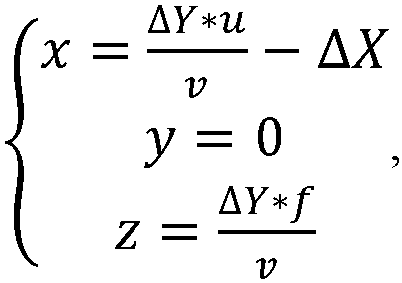
camera module 103 and the light outlet O of the structuredlight projection module 102 in the horizontal direction is ΔX, and the displacement therebetween in the vertical direction is ΔY, then in theobstacle detection system 100, with regard to a structured light bright point on a longitudinal detection line (e.g., thelongitudinal detection line image processing module 104 determines a spatial position of an obstacle corresponding to the structured light bright point in the following manner:


- y and z can be inversely solved by a simple and calculating-power-saving method:

- With regard to a structured light bright point on a lateral detection line (e.g., the
lateral detection line 201 or 204), theimage processing module 104 determines a spatial position of an obstacle corresponding to the structured light bright point in the following manner:


- x and z are inversely solved:

- The disclosure also provides a
mobile apparatus 10 including theobstacle detection system 100 as described above. Preferably, the mobile apparatus is a ground-sweeping robot. - As shown in
FIG. 12 , according to a preferred embodiment of the disclosure, a ground-sweeping robot carrying theobstacle detection system 100 is provided, the structuredlight projection module 102 projecting the firstlateral detection line 201 according to the angle range of -55° to +55° in the horizontal direction, projecting the firstlongitudinal detection line 202 according to the angle range of 8° to 16° in the vertical direction, and projecting the secondlongitudinal detection line 203 according to the angle range of -8° to 0° in the vertical direction. The height of the structuredlight projection module 102 from the ground is 3 cm, the displacement between thecamera module 103 and the structuredlight projection module 102 in the horizontal direction is 1 cm, and the displacement therebetween in the vertical direction is 3 cm. According to the calculation: - 1. The robot can achieve real-time positioning and map construction within a horizontal field of view of 110°, a distance of 6 meters, and a height of 3 cm, which may be done in coordination with the rotation of the robot to replace the laser radar function.
- 2. The robot can continuously recognize higher obstacles in the full field of view, e.g., elongated sofa legs, obstacles higher than 3 cm, and the like.
- 3. The robot can generally recognize a small and short object right ahead, for example, a short object with a height of 2 cm can be detected beyond 21.3 cm; the upper part of the small and short object can be detected within a range of 7.1 to 21.3 cm; and it cannot be detected within a distance of 7.1 cm, because it exceeds the lower detection limit of -8°.
- 4. With regard to a suspended obstacle right ahead, such as a sofa top with a height of 9 cm, it can be completely detected within a distance range of 20.9 cm to 42.7 cm; it cannot be detected in a distance range of less than 20.9 cm, because it is greater than the upper detection limit of 16°; and it cannot be completely detected in a distance range of greater than 42.7 cm, because it is less than the lower detection limit of 8°.
- Preferred embodiments of the disclosure provide an obstacle detection system based on structured light, a mobile apparatus carrying the obstacle detection system, and a ground-sweeping robot. The obstacle detection system detects a higher obstacle within a larger field of view on a path of travel by projecting a first lateral detection line in a horizontal direction; detects a suspension space below furniture such as a sofa or a cabinet by projecting a first longitudinal detection line in a vertical direction, thereby preventing the mobile apparatus from being stuck; and detects a lower obstacle by projecting a second longitudinal detection line in the vertical direction, eliminating a blind zone caused when there is only a detection line in the horizontal direction; meanwhile, an elongated obstacle in the vertical direction can also be effectively detected with a plurality of longitudinal detection lines.
Claims (10)
- An obstacle detection system (100) for a mobile apparatus (10), comprising:a structured light projection module (102) configured to project structured light (105) on a forward path of the mobile apparatus (10), the structured light (105) comprising at least one lateral detection line in a horizontal direction and at least one longitudinal detection line in a vertical direction, wherein the structured light projection module (102) projects a first lateral detection line (201) according to a first preset angle range, projects a first longitudinal detection line (202) according to a second preset angle range, the first longitudinal detection line (202) being located above the first lateral detection line (201);a camera module (103) configured to capture an image of the structured light (105); andan image processing module (104) configured to calculate a distance and a position of an obstacle (106, 107, 108) on the forward path according to the image of the structured light (105),wherein the structured light projection module (102) comprises a laser light source configured to emit a laser beam, and a diffractive optical element disposed downstream of an optical path of the laser light source to receive the laser beam and project the structured light,characterized in that the structured light projection module (102) further projects a second lateral detection line (204) according to a fourth preset angle range, the second lateral detection line (204) being located below and parallel to the first lateral detection line (201),the structured light projection module (102) further projects a second longitudinal detection line (203) according to a third preset angle range, the second longitudinal detection line (203) being located below the first lateral detection line (201) and on an extension line of the first longitudinal detection line (202), and the first longitudinal detection line (202) is spaced from the second longitudinal detection line (203).
- The obstacle detection system (100) according to claim 1, wherein one end point of the second longitudinal detection line (203) intersects with the first lateral detection line (201).
- The obstacle detection system (100) according to claim 1, wherein the second lateral detection line (204) intersects with a lower end point of the second longitudinal detection line (203) and is parallel to the first lateral detection line (201).
- The obstacle detection system (100) according to any one of claims 1 to 3, wherein the first longitudinal detection line (202) is located at a lateral center of the first lateral detection line (201), and the structured light projection module (102) further projects a third longitudinal detection line (205) and a fourth longitudinal detection line (206), the third longitudinal detection line (205) and the fourth longitudinal detection line (206) being parallel to and disposed symmetrically relative to the first longitudinal detection line (202).
- The obstacle detection system (100) according to any one of claims 1 to 3, wherein the structured light projection module (102) and the camera module (103) are disposed to be located in a same plane, with a first displacement ΔX in the horizontal direction, and a second displacement ΔY in the vertical direction.
- The obstacle detection system (100) according to claim 5, wherein for a structured light bright point on the longitudinal detection line (202, 203, 205 or 206), the image processing module (104) determines a spatial position of an obstacle corresponding to the structured light bright point by:

- The obstacle detection system (100) according to claim 5, wherein for a structured light bright point on the lateral detection line (201 or 204), the image processing module (104) determines a spatial position of an obstacle corresponding to the structured light bright point by:
- The obstacle detection system (100) according to any one of claims 1 to 3, wherein the first preset angle range is from -55° to +55° in the horizontal direction, the second preset angle range is from 8° to 16° or from 0° to 16° in the vertical direction, the third preset angle range is from -8° to 0° in the vertical direction, and the fourth preset angle range is from -20° to +20° in the horizontal direction.
- A mobile apparatus (10), characterized in comprising the obstacle detection system (100) according to any one of claims 1 to 8.
- The mobile apparatus (10) according to claim 9, wherein the mobile apparatus is a ground-sweeping robot.
Applications Claiming Priority (2)
| Application Number | Priority Date | Filing Date | Title |
|---|---|---|---|
| CN202010391496.5A CN111562567B (en) | 2020-05-11 | 2020-05-11 | Obstacle detection system of mobile device, mobile device and sweeping robot |
| PCT/CN2021/092819 WO2021228048A1 (en) | 2020-05-11 | 2021-05-10 | Mobile apparatus obstacle detection system, mobile apparatus, and ground-sweeping robot |
Publications (4)
| Publication Number | Publication Date |
|---|---|
| EP4152048A1 EP4152048A1 (en) | 2023-03-22 |
| EP4152048A4 EP4152048A4 (en) | 2023-11-01 |
| EP4152048B1 true EP4152048B1 (en) | 2025-02-19 |
| EP4152048C0 EP4152048C0 (en) | 2025-02-19 |
Family
ID=72072036
Family Applications (1)
| Application Number | Title | Priority Date | Filing Date |
|---|---|---|---|
| EP21804444.4A Active EP4152048B1 (en) | 2020-05-11 | 2021-05-10 | Mobile apparatus obstacle detection system, mobile apparatus, and ground-sweeping robot |
Country Status (4)
| Country | Link |
|---|---|
| US (1) | US11776152B2 (en) |
| EP (1) | EP4152048B1 (en) |
| CN (1) | CN111562567B (en) |
| WO (1) | WO2021228048A1 (en) |
Families Citing this family (5)
| Publication number | Priority date | Publication date | Assignee | Title |
|---|---|---|---|---|
| CN111562567B (en) | 2020-05-11 | 2021-04-30 | 北京驭光科技发展有限公司 | Obstacle detection system of mobile device, mobile device and sweeping robot |
| CN113221910A (en) * | 2021-03-29 | 2021-08-06 | 追创科技(苏州)有限公司 | Structured light image processing method, obstacle detection method, module and equipment |
| CN113189993B (en) | 2021-04-27 | 2023-08-29 | 北京石头创新科技有限公司 | Obstacle avoidance method, device, medium and electronic equipment for self-propelled equipment |
| US20230359217A1 (en) * | 2022-05-05 | 2023-11-09 | Pixart Imaging Inc. | Optical navigation device which can detect and record abnormal region |
| CN116593282B (en) * | 2023-07-14 | 2023-11-28 | 四川名人居门窗有限公司 | Glass impact resistance reaction test system and method based on structured light |
Family Cites Families (22)
| Publication number | Priority date | Publication date | Assignee | Title |
|---|---|---|---|---|
| US9002511B1 (en) * | 2005-10-21 | 2015-04-07 | Irobot Corporation | Methods and systems for obstacle detection using structured light |
| KR100801087B1 (en) * | 2006-07-05 | 2008-02-11 | 삼성전자주식회사 | Moving object detection system and method using structured light, Mobile robot including the system |
| KR100791389B1 (en) * | 2006-12-26 | 2008-01-07 | 삼성전자주식회사 | Distance measuring device and method using structured light |
| CN202582535U (en) | 2012-04-19 | 2012-12-05 | 刘瑜 | Active visual ranging system of movable platform |
| CN103884272B (en) * | 2012-12-20 | 2016-10-05 | 联想(北京)有限公司 | A kind of object space determines method, device and mobile electronic device |
| US9524059B2 (en) * | 2013-03-15 | 2016-12-20 | Texas Instruments Incorporated | Interaction detection using structured light images |
| KR102152641B1 (en) * | 2013-10-31 | 2020-09-08 | 엘지전자 주식회사 | Mobile robot |
| WO2016005012A1 (en) * | 2014-07-10 | 2016-01-14 | Aktiebolaget Electrolux | Method for detecting a measurement error in a robotic cleaning device |
| JP6532530B2 (en) * | 2014-12-16 | 2019-06-19 | アクチエボラゲット エレクトロルックス | How to clean a robot vacuum cleaner |
| KR102339531B1 (en) * | 2014-12-16 | 2021-12-16 | 에이비 엘렉트로룩스 | Experience-based roadmap for a robotic cleaning device |
| CN106289065B (en) * | 2015-05-15 | 2020-10-27 | 高准精密工业股份有限公司 | Detection method and optical device applying same |
| US9840003B2 (en) * | 2015-06-24 | 2017-12-12 | Brain Corporation | Apparatus and methods for safe navigation of robotic devices |
| TWI653964B (en) * | 2016-05-17 | 2019-03-21 | Lg Electronics Inc. | Mobile robot and its control method |
| CN105974427B (en) * | 2016-06-24 | 2021-05-04 | 上海图漾信息科技有限公司 | Structured light ranging device and method |
| US10346797B2 (en) * | 2016-09-26 | 2019-07-09 | Cybernet Systems, Inc. | Path and load localization and operations supporting automated warehousing using robotic forklifts or other material handling vehicles |
| US10962647B2 (en) * | 2016-11-30 | 2021-03-30 | Yujin Robot Co., Ltd. | Lidar apparatus based on time of flight and moving object |
| CN108226939B (en) * | 2016-12-22 | 2022-03-08 | 异奇科技股份有限公司 | Path detection system and method for generating laser pattern by diffractive optical element |
| EP3508936B1 (en) * | 2017-11-02 | 2020-03-18 | Autel Robotics Co., Ltd. | Obstacle avoidance method and apparatus, movable object, and computer-readable storage medium |
| CN109839628A (en) * | 2017-11-29 | 2019-06-04 | 杭州萤石软件有限公司 | An obstacle determination method and mobile robot |
| CN112155487A (en) * | 2019-08-21 | 2021-01-01 | 追创科技(苏州)有限公司 | Sweeping robot, control method of sweeping robot and storage medium |
| CN210464466U (en) * | 2019-10-29 | 2020-05-05 | 珠海市一微半导体有限公司 | Auxiliary light vision detection device based on indoor environment and mobile robot |
| CN111562567B (en) | 2020-05-11 | 2021-04-30 | 北京驭光科技发展有限公司 | Obstacle detection system of mobile device, mobile device and sweeping robot |
-
2020
- 2020-05-11 CN CN202010391496.5A patent/CN111562567B/en active Active
-
2021
- 2021-05-10 US US17/998,396 patent/US11776152B2/en active Active
- 2021-05-10 WO PCT/CN2021/092819 patent/WO2021228048A1/en not_active Ceased
- 2021-05-10 EP EP21804444.4A patent/EP4152048B1/en active Active
Also Published As
| Publication number | Publication date |
|---|---|
| US20230186507A1 (en) | 2023-06-15 |
| EP4152048A1 (en) | 2023-03-22 |
| US11776152B2 (en) | 2023-10-03 |
| CN111562567A (en) | 2020-08-21 |
| CN111562567B (en) | 2021-04-30 |
| EP4152048A4 (en) | 2023-11-01 |
| WO2021228048A1 (en) | 2021-11-18 |
| EP4152048C0 (en) | 2025-02-19 |
Similar Documents
| Publication | Publication Date | Title |
|---|---|---|
| EP4152048B1 (en) | Mobile apparatus obstacle detection system, mobile apparatus, and ground-sweeping robot | |
| US10346995B1 (en) | Remote distance estimation system and method | |
| US9939529B2 (en) | Robot positioning system | |
| KR101555589B1 (en) | Method of controlling a cleaner | |
| US11009882B2 (en) | Method, system for obstacle detection and a sensor subsystem | |
| CN103453836A (en) | System and method for measuring vehicle outline dimensions based on machine vision and laser light curtain | |
| CN104964672A (en) | Long-distance obstacle perception sensor based on line structured light | |
| CN105014675B (en) | A kind of narrow space intelligent mobile robot vision navigation system and method | |
| CN210464466U (en) | Auxiliary light vision detection device based on indoor environment and mobile robot | |
| CN211559963U (en) | autonomous robot | |
| CN109839628A (en) | An obstacle determination method and mobile robot | |
| JP6607121B2 (en) | Image recognition apparatus, image recognition method, and image recognition unit | |
| US20240197130A1 (en) | Structured light module and self-moving device | |
| EP4071578B1 (en) | Light source control method for vision machine, and vision machine | |
| JP2013057541A (en) | Method and device for measuring relative position to object | |
| Adorni et al. | Omnidirectional stereo systems for robot navigation | |
| EP4451083A1 (en) | Autonomous mobile device and control method and apparatus therefor and storage medium | |
| EP4351124A1 (en) | Line laser module and self-moving device | |
| CN112747723A (en) | Auxiliary light vision detection device based on indoor environment and mobile robot | |
| EP4145084B1 (en) | Laser tracker based measurement system with inertial measurement unit | |
| CN109940612A (en) | Intelligent obstacle avoidance robot based on one-line laser and its obstacle avoidance method | |
| CN114355938A (en) | Obstacle measuring method of sweeping robot and sweeping robot | |
| CN118161087A (en) | TOF optical system for sweeping robot and sweeping robot | |
| CN108226939A (en) | Path detecting system and method for generating laser pattern by diffraction optical element | |
| WO2014179839A1 (en) | People and object counter method and system |
Legal Events
| Date | Code | Title | Description |
|---|---|---|---|
| STAA | Information on the status of an ep patent application or granted ep patent |
Free format text: STATUS: THE INTERNATIONAL PUBLICATION HAS BEEN MADE |
|
| PUAI | Public reference made under article 153(3) epc to a published international application that has entered the european phase |
Free format text: ORIGINAL CODE: 0009012 |
|
| STAA | Information on the status of an ep patent application or granted ep patent |
Free format text: STATUS: REQUEST FOR EXAMINATION WAS MADE |
|
| 17P | Request for examination filed |
Effective date: 20221110 |
|
| AK | Designated contracting states |
Kind code of ref document: A1 Designated state(s): AL AT BE BG CH CY CZ DE DK EE ES FI FR GB GR HR HU IE IS IT LI LT LU LV MC MK MT NL NO PL PT RO RS SE SI SK SM TR |
|
| RAP1 | Party data changed (applicant data changed or rights of an application transferred) |
Owner name: JIAXING UPHOTON OPTOELECTRONICS TECHNOLOGY CO., LTD. |
|
| DAV | Request for validation of the european patent (deleted) | ||
| DAX | Request for extension of the european patent (deleted) | ||
| REG | Reference to a national code |
Ref country code: DE Ref legal event code: R079 Ipc: G01S0007481000 Ref country code: DE Ref legal event code: R079 Ref document number: 602021026462 Country of ref document: DE Free format text: PREVIOUS MAIN CLASS: G01S0011120000 Ipc: G01S0007481000 |
|
| STAA | Information on the status of an ep patent application or granted ep patent |
Free format text: STATUS: EXAMINATION IS IN PROGRESS |
|
| A4 | Supplementary search report drawn up and despatched |
Effective date: 20231005 |
|
| RIC1 | Information provided on ipc code assigned before grant |
Ipc: G01C 11/04 20060101ALN20230928BHEP Ipc: G05D 1/02 20200101ALI20230928BHEP Ipc: G01S 17/48 20060101ALI20230928BHEP Ipc: G01S 17/931 20200101ALI20230928BHEP Ipc: G01S 7/481 20060101AFI20230928BHEP |
|
| 17Q | First examination report despatched |
Effective date: 20231018 |
|
| GRAP | Despatch of communication of intention to grant a patent |
Free format text: ORIGINAL CODE: EPIDOSNIGR1 |
|
| STAA | Information on the status of an ep patent application or granted ep patent |
Free format text: STATUS: GRANT OF PATENT IS INTENDED |
|
| RIC1 | Information provided on ipc code assigned before grant |
Ipc: G01C 11/04 20060101ALN20241024BHEP Ipc: G01S 17/48 20060101ALI20241024BHEP Ipc: G01S 17/931 20200101ALI20241024BHEP Ipc: G01S 7/481 20060101AFI20241024BHEP |
|
| INTG | Intention to grant announced |
Effective date: 20241126 |
|
| GRAS | Grant fee paid |
Free format text: ORIGINAL CODE: EPIDOSNIGR3 |
|
| GRAA | (expected) grant |
Free format text: ORIGINAL CODE: 0009210 |
|
| STAA | Information on the status of an ep patent application or granted ep patent |
Free format text: STATUS: THE PATENT HAS BEEN GRANTED |
|
| AK | Designated contracting states |
Kind code of ref document: B1 Designated state(s): AL AT BE BG CH CY CZ DE DK EE ES FI FR GB GR HR HU IE IS IT LI LT LU LV MC MK MT NL NO PL PT RO RS SE SI SK SM TR |
|
| REG | Reference to a national code |
Ref country code: GB Ref legal event code: FG4D |
|
| REG | Reference to a national code |
Ref country code: CH Ref legal event code: EP |
|
| REG | Reference to a national code |
Ref country code: DE Ref legal event code: R096 Ref document number: 602021026462 Country of ref document: DE |
|
| REG | Reference to a national code |
Ref country code: IE Ref legal event code: FG4D |
|
| U01 | Request for unitary effect filed |
Effective date: 20250317 |
|
| U07 | Unitary effect registered |
Designated state(s): AT BE BG DE DK EE FI FR IT LT LU LV MT NL PT RO SE SI Effective date: 20250324 |
|
| U20 | Renewal fee for the european patent with unitary effect paid |
Year of fee payment: 5 Effective date: 20250508 |
|
| PG25 | Lapsed in a contracting state [announced via postgrant information from national office to epo] |
Ref country code: RS Free format text: LAPSE BECAUSE OF FAILURE TO SUBMIT A TRANSLATION OF THE DESCRIPTION OR TO PAY THE FEE WITHIN THE PRESCRIBED TIME-LIMIT Effective date: 20250519 |
|
| PG25 | Lapsed in a contracting state [announced via postgrant information from national office to epo] |
Ref country code: PL Free format text: LAPSE BECAUSE OF FAILURE TO SUBMIT A TRANSLATION OF THE DESCRIPTION OR TO PAY THE FEE WITHIN THE PRESCRIBED TIME-LIMIT Effective date: 20250219 |
|
| PG25 | Lapsed in a contracting state [announced via postgrant information from national office to epo] |
Ref country code: ES Free format text: LAPSE BECAUSE OF FAILURE TO SUBMIT A TRANSLATION OF THE DESCRIPTION OR TO PAY THE FEE WITHIN THE PRESCRIBED TIME-LIMIT Effective date: 20250219 |
|
| PG25 | Lapsed in a contracting state [announced via postgrant information from national office to epo] |
Ref country code: NO Free format text: LAPSE BECAUSE OF FAILURE TO SUBMIT A TRANSLATION OF THE DESCRIPTION OR TO PAY THE FEE WITHIN THE PRESCRIBED TIME-LIMIT Effective date: 20250519 Ref country code: IS Free format text: LAPSE BECAUSE OF FAILURE TO SUBMIT A TRANSLATION OF THE DESCRIPTION OR TO PAY THE FEE WITHIN THE PRESCRIBED TIME-LIMIT Effective date: 20250619 |
|
| PG25 | Lapsed in a contracting state [announced via postgrant information from national office to epo] |
Ref country code: HR Free format text: LAPSE BECAUSE OF FAILURE TO SUBMIT A TRANSLATION OF THE DESCRIPTION OR TO PAY THE FEE WITHIN THE PRESCRIBED TIME-LIMIT Effective date: 20250219 |
|
| PG25 | Lapsed in a contracting state [announced via postgrant information from national office to epo] |
Ref country code: GR Free format text: LAPSE BECAUSE OF FAILURE TO SUBMIT A TRANSLATION OF THE DESCRIPTION OR TO PAY THE FEE WITHIN THE PRESCRIBED TIME-LIMIT Effective date: 20250520 |
|
| PG25 | Lapsed in a contracting state [announced via postgrant information from national office to epo] |
Ref country code: SM Free format text: LAPSE BECAUSE OF FAILURE TO SUBMIT A TRANSLATION OF THE DESCRIPTION OR TO PAY THE FEE WITHIN THE PRESCRIBED TIME-LIMIT Effective date: 20250219 |
|
| PG25 | Lapsed in a contracting state [announced via postgrant information from national office to epo] |
Ref country code: CZ Free format text: LAPSE BECAUSE OF FAILURE TO SUBMIT A TRANSLATION OF THE DESCRIPTION OR TO PAY THE FEE WITHIN THE PRESCRIBED TIME-LIMIT Effective date: 20250219 |
|
| PG25 | Lapsed in a contracting state [announced via postgrant information from national office to epo] |
Ref country code: SK Free format text: LAPSE BECAUSE OF FAILURE TO SUBMIT A TRANSLATION OF THE DESCRIPTION OR TO PAY THE FEE WITHIN THE PRESCRIBED TIME-LIMIT Effective date: 20250219 |
|
| REG | Reference to a national code |
Ref country code: CH Ref legal event code: H13 Free format text: ST27 STATUS EVENT CODE: U-0-0-H10-H13 (AS PROVIDED BY THE NATIONAL OFFICE) Effective date: 20251223 |
|
| PLBE | No opposition filed within time limit |
Free format text: ORIGINAL CODE: 0009261 |
|
| STAA | Information on the status of an ep patent application or granted ep patent |
Free format text: STATUS: NO OPPOSITION FILED WITHIN TIME LIMIT |
|
| PG25 | Lapsed in a contracting state [announced via postgrant information from national office to epo] |
Ref country code: CH Free format text: LAPSE BECAUSE OF NON-PAYMENT OF DUE FEES Effective date: 20250531 |
|
| 26N | No opposition filed |
Effective date: 20251120 |
|
| GBPC | Gb: european patent ceased through non-payment of renewal fee |
Effective date: 20250519 |
|
| PG25 | Lapsed in a contracting state [announced via postgrant information from national office to epo] |
Ref country code: MC Free format text: LAPSE BECAUSE OF FAILURE TO SUBMIT A TRANSLATION OF THE DESCRIPTION OR TO PAY THE FEE WITHIN THE PRESCRIBED TIME-LIMIT Effective date: 20250219 |
|
| PG25 | Lapsed in a contracting state [announced via postgrant information from national office to epo] |
Ref country code: GB Free format text: LAPSE BECAUSE OF NON-PAYMENT OF DUE FEES Effective date: 20250519 |
|
| PG25 | Lapsed in a contracting state [announced via postgrant information from national office to epo] |
Ref country code: IE Free format text: LAPSE BECAUSE OF NON-PAYMENT OF DUE FEES Effective date: 20250510 |