EP4151968A1 - Method and apparatus for measuring temperature, electronic device, and computer-readable storage medium - Google Patents
Method and apparatus for measuring temperature, electronic device, and computer-readable storage medium Download PDFInfo
- Publication number
- EP4151968A1 EP4151968A1 EP20935969.4A EP20935969A EP4151968A1 EP 4151968 A1 EP4151968 A1 EP 4151968A1 EP 20935969 A EP20935969 A EP 20935969A EP 4151968 A1 EP4151968 A1 EP 4151968A1
- Authority
- EP
- European Patent Office
- Prior art keywords
- temperature
- target position
- key point
- information
- weight information
- Prior art date
- Legal status (The legal status is an assumption and is not a legal conclusion. Google has not performed a legal analysis and makes no representation as to the accuracy of the status listed.)
- Withdrawn
Links
Images


Classifications
-
- G—PHYSICS
- G01—MEASURING; TESTING
- G01J—MEASUREMENT OF INTENSITY, VELOCITY, SPECTRAL CONTENT, POLARISATION, PHASE OR PULSE CHARACTERISTICS OF INFRARED, VISIBLE OR ULTRAVIOLET LIGHT; COLORIMETRY; RADIATION PYROMETRY
- G01J5/00—Radiation pyrometry, e.g. infrared or optical thermometry
- G01J5/0022—Radiation pyrometry, e.g. infrared or optical thermometry for sensing the radiation of moving bodies
- G01J5/0025—Living bodies
-
- G—PHYSICS
- G06—COMPUTING OR CALCULATING; COUNTING
- G06N—COMPUTING ARRANGEMENTS BASED ON SPECIFIC COMPUTATIONAL MODELS
- G06N3/00—Computing arrangements based on biological models
- G06N3/02—Neural networks
- G06N3/04—Architecture, e.g. interconnection topology
- G06N3/0464—Convolutional networks [CNN, ConvNet]
-
- G—PHYSICS
- G01—MEASURING; TESTING
- G01K—MEASURING TEMPERATURE; MEASURING QUANTITY OF HEAT; THERMALLY-SENSITIVE ELEMENTS NOT OTHERWISE PROVIDED FOR
- G01K13/00—Thermometers specially adapted for specific purposes
- G01K13/20—Clinical contact thermometers for use with humans or animals
- G01K13/223—Infrared clinical thermometers, e.g. tympanic
-
- G—PHYSICS
- G01—MEASURING; TESTING
- G01K—MEASURING TEMPERATURE; MEASURING QUANTITY OF HEAT; THERMALLY-SENSITIVE ELEMENTS NOT OTHERWISE PROVIDED FOR
- G01K7/00—Measuring temperature based on the use of electric or magnetic elements directly sensitive to heat ; Power supply therefor, e.g. using thermoelectric elements
- G01K7/42—Circuits effecting compensation of thermal inertia; Circuits for predicting the stationary value of a temperature
-
- G—PHYSICS
- G06—COMPUTING OR CALCULATING; COUNTING
- G06N—COMPUTING ARRANGEMENTS BASED ON SPECIFIC COMPUTATIONAL MODELS
- G06N3/00—Computing arrangements based on biological models
- G06N3/02—Neural networks
- G06N3/04—Architecture, e.g. interconnection topology
- G06N3/045—Combinations of networks
-
- G—PHYSICS
- G06—COMPUTING OR CALCULATING; COUNTING
- G06N—COMPUTING ARRANGEMENTS BASED ON SPECIFIC COMPUTATIONAL MODELS
- G06N3/00—Computing arrangements based on biological models
- G06N3/02—Neural networks
- G06N3/08—Learning methods
-
- G—PHYSICS
- G06—COMPUTING OR CALCULATING; COUNTING
- G06N—COMPUTING ARRANGEMENTS BASED ON SPECIFIC COMPUTATIONAL MODELS
- G06N3/00—Computing arrangements based on biological models
- G06N3/02—Neural networks
- G06N3/08—Learning methods
- G06N3/09—Supervised learning
-
- G—PHYSICS
- G06—COMPUTING OR CALCULATING; COUNTING
- G06V—IMAGE OR VIDEO RECOGNITION OR UNDERSTANDING
- G06V10/00—Arrangements for image or video recognition or understanding
- G06V10/10—Image acquisition
- G06V10/12—Details of acquisition arrangements; Constructional details thereof
- G06V10/14—Optical characteristics of the device performing the acquisition or on the illumination arrangements
- G06V10/143—Sensing or illuminating at different wavelengths
-
- G—PHYSICS
- G06—COMPUTING OR CALCULATING; COUNTING
- G06V—IMAGE OR VIDEO RECOGNITION OR UNDERSTANDING
- G06V10/00—Arrangements for image or video recognition or understanding
- G06V10/40—Extraction of image or video features
- G06V10/44—Local feature extraction by analysis of parts of the pattern, e.g. by detecting edges, contours, loops, corners, strokes or intersections; Connectivity analysis, e.g. of connected components
- G06V10/443—Local feature extraction by analysis of parts of the pattern, e.g. by detecting edges, contours, loops, corners, strokes or intersections; Connectivity analysis, e.g. of connected components by matching or filtering
- G06V10/449—Biologically inspired filters, e.g. difference of Gaussians [DoG] or Gabor filters
- G06V10/451—Biologically inspired filters, e.g. difference of Gaussians [DoG] or Gabor filters with interaction between the filter responses, e.g. cortical complex cells
- G06V10/454—Integrating the filters into a hierarchical structure, e.g. convolutional neural networks [CNN]
-
- G—PHYSICS
- G06—COMPUTING OR CALCULATING; COUNTING
- G06V—IMAGE OR VIDEO RECOGNITION OR UNDERSTANDING
- G06V10/00—Arrangements for image or video recognition or understanding
- G06V10/70—Arrangements for image or video recognition or understanding using pattern recognition or machine learning
- G06V10/82—Arrangements for image or video recognition or understanding using pattern recognition or machine learning using neural networks
-
- G—PHYSICS
- G06—COMPUTING OR CALCULATING; COUNTING
- G06V—IMAGE OR VIDEO RECOGNITION OR UNDERSTANDING
- G06V40/00—Recognition of biometric, human-related or animal-related patterns in image or video data
- G06V40/10—Human or animal bodies, e.g. vehicle occupants or pedestrians; Body parts, e.g. hands
- G06V40/16—Human faces, e.g. facial parts, sketches or expressions
- G06V40/161—Detection; Localisation; Normalisation
-
- G—PHYSICS
- G06—COMPUTING OR CALCULATING; COUNTING
- G06V—IMAGE OR VIDEO RECOGNITION OR UNDERSTANDING
- G06V40/00—Recognition of biometric, human-related or animal-related patterns in image or video data
- G06V40/10—Human or animal bodies, e.g. vehicle occupants or pedestrians; Body parts, e.g. hands
- G06V40/16—Human faces, e.g. facial parts, sketches or expressions
- G06V40/161—Detection; Localisation; Normalisation
- G06V40/166—Detection; Localisation; Normalisation using acquisition arrangements
-
- G—PHYSICS
- G06—COMPUTING OR CALCULATING; COUNTING
- G06V—IMAGE OR VIDEO RECOGNITION OR UNDERSTANDING
- G06V40/00—Recognition of biometric, human-related or animal-related patterns in image or video data
- G06V40/10—Human or animal bodies, e.g. vehicle occupants or pedestrians; Body parts, e.g. hands
- G06V40/16—Human faces, e.g. facial parts, sketches or expressions
- G06V40/168—Feature extraction; Face representation
-
- G—PHYSICS
- G06—COMPUTING OR CALCULATING; COUNTING
- G06V—IMAGE OR VIDEO RECOGNITION OR UNDERSTANDING
- G06V40/00—Recognition of biometric, human-related or animal-related patterns in image or video data
- G06V40/10—Human or animal bodies, e.g. vehicle occupants or pedestrians; Body parts, e.g. hands
- G06V40/16—Human faces, e.g. facial parts, sketches or expressions
- G06V40/168—Feature extraction; Face representation
- G06V40/171—Local features and components; Facial parts ; Occluding parts, e.g. glasses; Geometrical relationships
-
- G—PHYSICS
- G01—MEASURING; TESTING
- G01J—MEASUREMENT OF INTENSITY, VELOCITY, SPECTRAL CONTENT, POLARISATION, PHASE OR PULSE CHARACTERISTICS OF INFRARED, VISIBLE OR ULTRAVIOLET LIGHT; COLORIMETRY; RADIATION PYROMETRY
- G01J5/00—Radiation pyrometry, e.g. infrared or optical thermometry
- G01J2005/0077—Imaging
-
- G—PHYSICS
- G01—MEASURING; TESTING
- G01J—MEASUREMENT OF INTENSITY, VELOCITY, SPECTRAL CONTENT, POLARISATION, PHASE OR PULSE CHARACTERISTICS OF INFRARED, VISIBLE OR ULTRAVIOLET LIGHT; COLORIMETRY; RADIATION PYROMETRY
- G01J5/00—Radiation pyrometry, e.g. infrared or optical thermometry
- G01J5/02—Constructional details
- G01J5/025—Interfacing a pyrometer to an external device or network; User interface
Definitions
- Embodiments of the present disclosure relates to the field of artificial intelligence, especially to computer vision, and in particular to a method and an apparatus for measuring temperature, an electronic device and a computer-readable storage medium.
- High-density flow of people generally appears at an entrance of public transport or an entrance of a scenic spot or a venue with the development of economy and transportation construction in China. Due to the possible and long-term epidemic situation of infectious diseases, temperature measurement and recognition of identity information for the high-density flow of people are important links in epidemic prevention and control.
- the existing non-contact temperature measurement method is usually that security and epidemic prevention personnel detect a temperature of pedestrians one by one through thermometers, and recognize an identity of the pedestrians one by one through scanning ID cards and other ways. The method is obviously inefficient.
- gathering of the high-density flow of people is generally inevitable, thus causing more people to be infected. How to effectively and accurately measure the temperature is an urgent problem for the epidemic prevention and control.
- a solution for measuring temperature is provided.
- a method for measuring temperature includes detecting a target position of an object in an input image.
- the method further includes determining key points of the target position and weight information of each key point based on a detection result of the target position, in which the weight information is configured to indicate a probability of each key point being covered.
- the method may further include acquiring temperature information of each key point.
- the method may further include determining a temperature of the target position at least based on the temperature information and the weight information of each key point.
- an apparatus for measuring temperature includes a target position detection module, configured to detect a target position of an object in an input image; a key point information determination module, configured to determine key points of the target position and weight information of each key point based on a detection result of the target position, in which the weight information is configured to indicate a probability of each key point being covered; a temperature information acquisition module, configured to acquire temperature information of each key point; and a temperature determination module, configured to determine a temperature of the target position at least based on the temperature information and the weight information of each key point.
- an electronic device in a third aspect of the present disclosure, includes one or more processors; and a memory configured to store one or more programs. When the one or more programs are executed by the one or more processors, the one or more processors are enabled to implement the method according to the first aspect of the present disclosure.
- a computer-readable storage medium having a computer program stored thereon is provided.
- the program is caused to implement the method according to the first aspect of the present disclosure when executed by a processor.
- a system for measuring temperature includes an image acquisition module, configured to provide an input image associated with a target position of an object; a computing module communicatively coupled with the image acquisition module, configured to implement the method according to the first aspect of the present disclosure; and an output display module, configured to display a processing result of the computing module.
- the term “includes” and its equivalents should be understood as an open “include” (a non-exclusive “include”), that is, “include but not limited to”.
- the term “based on” should be understood as “based at least in part (at least partially based on)”.
- the term “an embodiment” or “the embodiment” should be understood as “at least one embodiment”.
- the terms “first”, “second”, and the like may refer to different or the same objects. Other explicit and implicit definitions may also be included below.
- an infrared thermal imaging image of a face of a pedestrian may be acquired through an infrared thermal imaging device.
- a detection device may determine that the pedestrian is in a fever state and send an alarm message.
- temperature measurement accuracy of this type of temperature measurement technology is easily influenced by surrounding environments.
- the surrounding of the face of the pedestrian may be covered by a high-temperature object (such as a mobile phone, or a hot drink, etc.).
- the surrounding of the face of the pedestrian may be covered by a low-temperature object (such as cold food, a cold drink, etc.).
- a face of one fever free pedestrian may be covered by a fever pedestrian.
- a solution for measuring temperature is proposed.
- key points of a target position of an object may be determined based on an input image acquired by a camera, and weight information of each key point may be further determined.
- the weight information is configured to indicate a probability of each key point being covered.
- temperature information at each key point may be acquired by a temperature sensing device, such as an infrared thermal imaging device, and a temperature of the target position may be determined based on the temperature information and the weight information of each key point.
- a temperature of a pedestrian may be determined more based on temperatures of positions that are not covered or are not affected by other abnormal temperatures.
- FIG. 1 is a schematic diagram illustrating an example environment 100 in which a plurality of embodiments of the present disclosure can be implemented.
- the example environment 100 may include an input image 110, a computing device 120, a temperature sensing image 130 and a temperature 150 for output.
- the computing device 110 further includes a convolutional neural network (CNN) 140.
- CNN 140 in FIG. 1 is illustrative and may be replaced by other artificial intelligence networks with learning functions.
- the input image 110 may be a real-time monitoring image acquired by an image acquisition device connected to the computing device 120.
- the image acquisition device may be arranged in a public place with a high flow of people to acquire image information of each person in the crowd passing through the place. It may be understood that acquiring the object from the image information may not be limited to persons, but also include animals that require to measure their temperature in batches (for example, animals in a zoo or a feeding station).
- the input image 110 may also be multiple frames of images of a monitored object, namely, a video.
- the computing device 120 may receive the input image 110, and determine a detection region for the target position, such as a face, of the monitored object through the CNN 140 in the computing device 110, and further determine the key points and the weight information of each key point.
- the computing device 120 also receives a temperature sensing image 130.
- the temperature sensing image 130 may be acquired by a temperature sensing device, such as an infrared thermal imaging device.
- the temperature sensing device such as the infrared thermal imaging device may register with the image acquisition device described above, to achieve pixel-level alignment of imaging of the two devices.
- the computing device 120 may determine the temperature information of each key point, and determine a temperature 150 of the monitored object based on the temperature information of each key point with more reference significance by means such as weighted average.
- the key to generating the temperature 150 based on the input image 110 and the temperature sensing image 130 is that the CNN 140 in the computing device 110 is constructed through pre-training. Construction and usage of the CNN 140 will be described below through FIG. 2 .
- FIG. 2 is a schematic diagram illustrating a detailed example environment in which a plurality of embodiments of the present disclosure can be implemented.
- an example environment 200 may include a computing device 220, an input image 210, and an output result 250.
- the example environment 200 may generally include a model training system 270 and a model application system 280.
- the model training system 270 and/or the model application system 280 may be implemented in a computing device 120 illustrated in FIG. 1 or the computing device 220 illustrated in FIG. 2 .
- the structure and functions of the example environment 200 is described for illustrative purposes only, but is not intended to limit the scope of the subject described in the disclosure.
- the subject described in the disclosure may be implemented in different structures and/or functions.
- a process of determining a detection region for a target position such as a face, of a monitored object, and a process of determining key points and weight information of each key point each may be divided into two phases including a model training stage and a model application stage.
- the model training system 270 may train a CNN 240 for determining the detection region through a training dataset 260.
- the model application system 280 may receive a trained CNN 240, such that the CNN 240 may determine the detection region based on the input image 210.
- the training dataset 260 may be a mass of labeled monitoring images.
- the model training system 270 may train a CNN 240 for determining the key points and the weight information of each key point through the training dataset 260.
- the model application system 280 may receive a trained CNN 240, such that the CNN 240 may determine the key points and the weight information of each key point based on the determined detection region. It may be understood that the CNN 240 may also be trained to determine the key points and the weight information of each key point directly based on the input image 110.
- the CNN 240 may be constructed as a learning network for determining the key points and the weight information of each key point. Such a learning network may also be called a learning model, or simply a network or a model.
- the learning network for determining the key points and the weight information of each key point may include a plurality of networks. Each network may be a multi-layer neural network, which may be composed of a large number of neurons. Through the training process, corresponding parameters of the neurons in each network may be determined. The parameters of the neurons in these networks are collectively referred to as parameters of the CNN 240.
- a training process of the CNN 240 may be performed in an iterative manner.
- the model training system 270 may acquire a reference image from the training dataset 260, and perform one iteration of the training process using the reference image to update the corresponding parameters of the CNN 240.
- the model training system 270 may repeat the above process based on a plurality of reference images in the training dataset 260 until at least some of the parameters of the CNN 240 converge, thus acquiring final parameters of the model.
- FIG. 3 is a flowchart illustrating a process 300 for measuring temperature according to an embodiment of the present disclosure.
- a method 300 may be implemented in a computing device 120 of FIG. 1 , a computing device 220 of FIG. 2 , and a device illustrated in FIG. 6 .
- a process 300 for measuring temperature according to an embodiment of the present disclosure is described with reference to FIG. 1 .
- the specific examples mentioned in the following description are illustrative and not intended to limit the scope of protection of the disclosure.
- a computing device 120 may detect a target position of an object in an input image 110.
- the computing device 120 may determine a detection region for the target position in the input image 110 through a CNN 140 (such as a detection region generation model).
- the CNN 140 may perform face region detection on the input image 110.
- basic face features may be extracted from the input image 110 through a six-layer convolution network, and each layer of the convolution network may realize once sampling for the image.
- the last three layers of convolution network may be respectively preset a fixed number of different sizes of face anchor regions to perform regression of a detection region for a face, and finally the detection region for the face is determined.
- the above example is illustrative, and may use other layers of convolutional networks, and are not limited to determining the detection region for the face.
- the detection area of the target position in the input image 110 may be quickly recognized based on the detection area generation model, which may prepare for the subsequent temperature measurement and even face recognition.
- the computing device 120 may determine key points of the target position and weight information of each key point based on a detection result of the target position.
- the weight information is configured to indicate a probability of each key point being covered.
- the computing device 120 may apply the detection result of the target position to the CNN 140 (such as a key point determination model) to determine the key points and the weight information of each key point.
- the CNN 140 is obtained by training based on a reference target position in a reference image, and reference key points of the reference target position and reference weight information.
- the CNN 140 may determine the key points of the face and the weight information of each key point based on the detection result of the face. In this way, the temperature measurement may focus on positions that are not covered or affected by objects with abnormal temperature, thus improving accuracy of the temperature measurement.
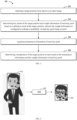
- FIG. 4 is a schematic diagram illustrating a process of determining key points 420 and weight information thereof based on a detection result 410 according to an embodiment of the present disclosure.
- a detected object is a pedestrian
- a target potion is a facial position of the pedestrian, that is, a face.
- the CNN 140 may determine a plurality of key points in the face detection region 410, such as a key point 420.
- the CNN 140 may further determine weight information of each key point.
- the weight information may be set to be a value between 0 and 1. The greater a probability of a key point predicted by the CNN140 being covered, the smaller a value of the weight information, which means that a temperature at the key point has no reference value.
- the computing device 120 may acquire temperature information of each key point.
- the computing device 120 may acquire a temperature sensing image 130 for a target position.
- the temperature sensing image 130 may be acquired by a temperature sensing device, such as an infrared thermal imaging device.
- the temperature sensing device such as the infrared thermal imaging device may register with the image acquisition device described above, pixel-level alignment of imaging of the two devices is achieved.
- the computing device 120 may determine temperature information corresponding to a location of each key point from the temperature sensing image. In this way, temperature measurement of the recognized key point is realized, thereby preparing for the subsequent temperature calculation.
- the temperature information acquired at this time may be configured as the basis for calculating the temperature 150, there may still be errors due to influence of an environmental factor and other factors. Therefore, a functional relationship between a measurement temperature and an actual temperature at a location where the temperature sensing device and the image acquisition device are arranged may be created. For example, this functional relationship may be fitted by a least square method based on prior knowledge.
- the computing device 120 may acquire a measurement temperature of each key point, and determine an actual temperature of each key point based on the measurement temperature. Therefore, accuracy of the actual temperature determined by the computing device 120 is significantly improved.
- the computing device 120 may determine a temperature of the target position at least based on the temperature information and the weight information of each key point.
- the target position described herein may be at least one of a face, eyes and hands (including fingerprints) of the object, and the object is not limited to a person.
- the computing device 120 may compare the temperature with a temperature threshold, and alarm when the temperature is higher than the temperature threshold. Since temperatures of respective positions of a human body are different, when the face of the person is detected, a temperature threshold corresponding the face may be preset to be different from a temperature threshold corresponding to the hands of the person.
- different temperature thresholds may also be determined for different species of animals, thus realizing the temperature measurement and alarm of different animals.
- the present disclosure may improve the accuracy of the temperature measurement by recognizing the plurality of key points and explicitly determining the temperature at each key point and the weight information of each key point.
- the disclosure may be applied to a scene of multi-pedestrian, or multi-animal, etc., without intervention of staff, time and labor cost of the temperature measurement may be reduced, and a risk of staff being infected during epidemic may be reduced.
- the computing device 120 may also recognize the target position at least based on the key points and the weight information, and determine the object based on a recognition result. In some embodiments, the computing device 120 may recognize a face based on the key points and the weight information, and then determine identity information of the monitored pedestrian. In other embodiments, the computing device 120 may also determine species of monitored animals based on the key points and the weight information. Since the mechanism of weight is set, the position covered will not or rarely be used by the computing device 120 for recognition, thus reducing the possibility of false recognition of the CNN 140 in the computing device 120.
- the present disclosure also provides a system 500 for measuring temperature.
- the system may include an image acquisition module 510, which may include an image sensing device such as an RGB camera and a temperature sensing device such as an infrared thermal imaging device.
- the system 500 may further include a computing module 520 communicatively coupled with the image acquisition module 510.
- the computing module 520 is configured to implement each of the methods and processings described above, such as the process 300.
- the system 500 may include an output display module 530 configured to display a processing result of the computing module 520 to a user.
- the output display module 530 may display a temperature of a monitored object to the user.
- the output display module 530 may also be configured to issue an alarm signal when the temperature of the monitored object is higher than a predetermined threshold.
- non-contact temperature measurement at system-level may be realized, and the accuracy of the temperature measurement may be significantly improved under a premise of constant computing capability demand.
- the system 500 may be applied to a temperature measurement scene of multi-pedestrian.
- the image acquisition module 510 in the system 500 may be applied to a subway or an entrance of a venue, to achieve real-time acquisition of images such as RGB images and infrared images of pedestrians.
- the computing module 520 may perform image processing such as of the process 300 on the RGB images and the infrared images to obtain the temperature information of the pedestrians.
- the output display module 530 may lock the pedestrian through a variety of alarm methods,
- the system may monitor the temperature information of a plurality of pedestrians passing through the entrance in real time. In this way, direct contact between security inspection and epidemic prevention personnel and suspected patients may be avoided or reduced, and the process of the temperature measurement is simple and efficient, without causing congestion artificially.
- the system 500 may be applied to a farm or a zoo.
- the image acquisition module 510 in the system 500 may be applied to a best viewing angle of the farm or zoo to achieve real-time monitoring of temperature information of animals.
- the computing module 520 may recognize species of animals, to determine the species of animals that have measured temperature, and thus acquire a temperature threshold of such a species of animals. Once it is found that a temperature of an animal is higher than a threshold value, the output display module 530 may lock the animal through a variety of alarm methods for the convenience of staff to treat or handle the animal. In this way, direct contact between the staff and the animals that may carry germs may be avoided or reduced.
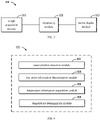
- FIG. 6 is a block diagram illustrating an apparatus 600 for measuring temperature according to an embodiment of the present disclosure.
- the apparatus 600 may include a target position detection module 602, configured to detect a target position of an object in an input image; a key point information determination module 604, configured to determine key points of the target position and weight information of each key point based on a detection result of the target position, wherein the weight information is configured to indicate a probability of each key point being covered; a temperature information acquisition module 606, configured to acquire temperature information of each key point; and a temperature determination module 608, configured to determine a temperature of the target position at least based on the temperature information and the weight information of each key point.
- a target position detection module 602 configured to detect a target position of an object in an input image
- a key point information determination module 604 configured to determine key points of the target position and weight information of each key point based on a detection result of the target position, wherein the weight information is configured to indicate a probability of each key point being covered
- the key point information determination module 604 may include: a detection result applying module, configured to determine the key points and the weight information by applying the detection result to a key point determination model, wherein the key point determination model is obtained by training based on a reference target position in a reference image and reference key points of the reference target position and reference weight information.
- the temperature information acquisition module 606 may include: a temperature sensing image acquisition module, configured to acquire a temperature sensing image for the target position; and a temperature information determination module, configured to determine temperature information corresponding to a location of each key point from the temperature sensing image.
- the temperature information acquisition module 606 may include: a measurement temperature acquisition module, configured to acquire a measurement temperature of each key point; and an actual temperature acquisition module, configured to determine an actual temperature of each key point based on the measurement temperature.
- the apparatus 600 may further include: a target position recognition module, configured to recognize the target position at least based on the key points and the weight information; and an object determination module, configured to determine the object based on a recognition result.
- a target position recognition module configured to recognize the target position at least based on the key points and the weight information
- an object determination module configured to determine the object based on a recognition result.
- the target position is at least one of a face, eyes and fingerprints of the object.
- the target position detection module 602 may include: a detection region determination module, configured to determine a detection region for the target position in the input image through a detection region generation model.
- FIG. 7 is a block diagram illustrating a computing device 700 capable of implementing a plurality of embodiments of the present disclosure.
- the device 700 may be configured to implement a computing device 120 in FIG. 1 or a computing device 220 in FIG. 2 .
- the device 700 includes a central processing unit (CPU) 701, which may execute various appropriate acts and processing based on computer program instructions stored in a read-only memory (ROM) 702 or computer program instructions loaded from a storage unit 708 to a random-access memory (RAM) 703.
- ROM read-only memory
- RAM random-access memory
- various programs and data needed for the operation of the device 700 may be stored.
- the CPU 701, the ROM 702, and the RAM 703 are connected to each other through a bus 704.
- An input/output (I/O) interface 705 is also connected to the bus 704.
- the I/O interface 705 includes: an input unit 706, such as a keyboard, a mouse, etc.; an output unit 707, such as various types of displays, speakers, etc.; the storage unit 708, such as a disk, a CD, etc.; and a communication unit 709, such as a network card, a modem, a wireless communication transceiver, etc..
- the communication unit 709 allows the device 700 to exchange information/data with other devices via computer networks such as the Internet and/or various telecommunications networks.
- the processing unit 701 executes the various methods and procedures described above, such as the method 200.
- the method 200 may be implemented as computer software programs, which are physically contained in a machine-readable medium, such as the storage unit 708.
- some or all of the computer programs may be loaded and/or installed on the device 700 via the ROM 702 and/or the communication unit 709.
- the computer programs may execute one or more acts or steps of the method 200 described above when loaded to the RAM 703 and executed by the CPU 701.
- the CPU 701 may be configured to execute the method 200 by any other appropriate ways (such as, by means of a firmware).
- exemplary types of hardware logic components including a field-programmable gate array (FPGA), an application-specific integrated circuit (ASIC), an application specific standard product (ASSP), a system on chip (SOC), a load programmable logic device (CPLD) and so on, may be used.
- FPGA field-programmable gate array
- ASIC application-specific integrated circuit
- ASSP application specific standard product
- SOC system on chip
- CPLD load programmable logic device
- the program codes for implementing the method of embodiments of the present disclosure may be written in any combination of one or more program languages. These program codes may be provided for a processor or a controller of a general-purpose computer, a special-purpose computer, or other programmable data-processing devices, such that the functions/operations regulated in the flow charts and/or block charts are implemented when the program codes are executed by the processor or the controller.
- the program codes may be completely executed on the machine, partly executed on the machine, partly executed on the machine as a standalone package and partly executed on a remote machine or completely executed on a remote machine or a server.
- the machine readable medium may be a tangible medium, which may include or store the programs for use of an instruction execution system, apparatus or device or for use in conjunction with the instruction execution system, apparatus or device.
- the machine readable medium may be a machine readable signal medium or a machine readable storage medium.
- the machine readable medium may include but not limited to electronic, magnetic, optical, electromagnetic, infrared, or semiconductor systems, apparatuses or devices, or any appropriate combination of the foregoing contents.
- a more detailed example of the machine readable storage medium includes electrical connections based on one or more lines, a portable computer disk, a hard disk, a random access memory (RAM), a read-only memory (ROM), an erasable programmable read only memory (an EPROM or a flash memory), an optical fiber, a compact disc read-only memory (CD-ROM), an optical storage device, a magnetic storage device, or any appropriate combination of the above contents.
Landscapes
- Engineering & Computer Science (AREA)
- Physics & Mathematics (AREA)
- Theoretical Computer Science (AREA)
- General Physics & Mathematics (AREA)
- Health & Medical Sciences (AREA)
- General Health & Medical Sciences (AREA)
- Oral & Maxillofacial Surgery (AREA)
- Multimedia (AREA)
- Evolutionary Computation (AREA)
- Artificial Intelligence (AREA)
- Biomedical Technology (AREA)
- Molecular Biology (AREA)
- Computing Systems (AREA)
- Software Systems (AREA)
- Life Sciences & Earth Sciences (AREA)
- Human Computer Interaction (AREA)
- General Engineering & Computer Science (AREA)
- Biophysics (AREA)
- Mathematical Physics (AREA)
- Data Mining & Analysis (AREA)
- Computational Linguistics (AREA)
- Computer Vision & Pattern Recognition (AREA)
- Spectroscopy & Molecular Physics (AREA)
- Biodiversity & Conservation Biology (AREA)
- Databases & Information Systems (AREA)
- Medical Informatics (AREA)
- Radiation Pyrometers (AREA)
- Image Analysis (AREA)
- Measuring And Recording Apparatus For Diagnosis (AREA)
Abstract
Description
- This application claims a priority to
Chinese patent application No. 202010415405.7, filed on May 05, 2020 - Embodiments of the present disclosure relates to the field of artificial intelligence, especially to computer vision, and in particular to a method and an apparatus for measuring temperature, an electronic device and a computer-readable storage medium.
- High-density flow of people generally appears at an entrance of public transport or an entrance of a scenic spot or a venue with the development of economy and transportation construction in China. Due to the possible and long-term epidemic situation of infectious diseases, temperature measurement and recognition of identity information for the high-density flow of people are important links in epidemic prevention and control. However, the existing non-contact temperature measurement method is usually that security and epidemic prevention personnel detect a temperature of pedestrians one by one through thermometers, and recognize an identity of the pedestrians one by one through scanning ID cards and other ways. The method is obviously inefficient. Moreover, due to the possible congestion of the flow of people, gathering of the high-density flow of people is generally inevitable, thus causing more people to be infected. How to effectively and accurately measure the temperature is an urgent problem for the epidemic prevention and control.
- According to embodiments of the present disclosure, a solution for measuring temperature is provided.
- In a first aspect of the present disclosure, a method for measuring temperature is provided. The method includes detecting a target position of an object in an input image. The method further includes determining key points of the target position and weight information of each key point based on a detection result of the target position, in which the weight information is configured to indicate a probability of each key point being covered. The method may further include acquiring temperature information of each key point. In addition, the method may further include determining a temperature of the target position at least based on the temperature information and the weight information of each key point.
- In a second aspect of the present disclosure, an apparatus for measuring temperature is provided. The apparatus includes a target position detection module, configured to detect a target position of an object in an input image; a key point information determination module, configured to determine key points of the target position and weight information of each key point based on a detection result of the target position, in which the weight information is configured to indicate a probability of each key point being covered; a temperature information acquisition module, configured to acquire temperature information of each key point; and a temperature determination module, configured to determine a temperature of the target position at least based on the temperature information and the weight information of each key point.
- In a third aspect of the present disclosure, an electronic device is provided. The electronic device includes one or more processors; and a memory configured to store one or more programs. When the one or more programs are executed by the one or more processors, the one or more processors are enabled to implement the method according to the first aspect of the present disclosure.
- In a fourth aspect of the present disclosure, a computer-readable storage medium having a computer program stored thereon is provided. The program is caused to implement the method according to the first aspect of the present disclosure when executed by a processor.
- In a fifth aspect of the present disclosure, a system for measuring temperature is provided. The system includes an image acquisition module, configured to provide an input image associated with a target position of an object; a computing module communicatively coupled with the image acquisition module, configured to implement the method according to the first aspect of the present disclosure; and an output display module, configured to display a processing result of the computing module.
- It should be understood that, the contents described in the Summary are not intended to identify key or important features of embodiments of the disclosure, nor is it intended to limit the scope of the disclosure. Other features of the disclosure will become apparent from the following description.
- The above and other features, advantages and aspects of respective embodiments of the disclosure will become more apparent with reference to accompanying drawings and following detailed illustrations. In the accompanying drawings, the same or similar numeral references represent the same or similar elements, in which:
-
FIG. 1 is a schematic diagram illustrating an example environment in which a plurality of embodiments of the present disclosure can be implemented. -
FIG. 2 is a schematic diagram illustrating a detailed example environment in which a plurality of embodiments of the present disclosure can be implemented. -
FIG. 3 is a flowchart illustrating a process for measuring temperature according to an embodiment of the present disclosure. -
FIG. 4 is a schematic diagram illustrating a process of determining key points and weight information thereof based on a detection result according to an embodiment of the present disclosure. -
FIG. 5 is a block diagram illustrating a system for measuring temperature according to an embodiment of the present disclosure. -
FIG. 6 is a block diagram illustrating an apparatus for measuring temperature according to an embodiment of the present disclosure. -
FIG. 7 is a block diagram illustrating a computing device capable of implementing a plurality of embodiments of the present disclosure. - Embodiments of the disclosure will be described in more detail below with reference to the accompanying drawings. Although certain embodiments of the disclosure are illustrated in the accompanying drawings, it should be understood that the disclosure may be implemented in various manners without being limited by the embodiments elaborated herein. On the contrary, embodiments are provided to make the disclosure more thorough and complete. It should be understood that, the accompanying drawings and embodiments of the disclosure are merely used for exemplary purposes, and are not used to limit the protection scope of the disclosure.
- In the description of embodiments of the disclosure, the term "includes" and its equivalents should be understood as an open "include" (a non-exclusive "include"), that is, "include but not limited to". The term "based on" should be understood as "based at least in part (at least partially based on)". The term "an embodiment" or "the embodiment" should be understood as "at least one embodiment". The terms "first", "second", and the like may refer to different or the same objects. Other explicit and implicit definitions may also be included below.
- In order to deal with epidemic prevention and control, it may generally measure temperatures of a plurality of pedestrians simultaneously using a non-contact and automated temperature measurement method based on a thermal imaging technology. For example, an infrared thermal imaging image of a face of a pedestrian may be acquired through an infrared thermal imaging device. When the infrared thermal imaging image shows that the face of the pedestrian is in a high temperature state (for example, a forehead is displayed in red), a detection device may determine that the pedestrian is in a fever state and send an alarm message.
- However, temperature measurement accuracy of this type of temperature measurement technology is easily influenced by surrounding environments. For example, the surrounding of the face of the pedestrian may be covered by a high-temperature object (such as a mobile phone, or a hot drink, etc.). For another example, the surrounding of the face of the pedestrian may be covered by a low-temperature object (such as cold food, a cold drink, etc.). For yet another example, a face of one fever free pedestrian may be covered by a fever pedestrian. These cover conditions generally lead to false temperature alarm, thus affecting performance of the detection device. In addition, when the face is covered, traditional face recognition mechanisms may output an inaccurate recognition result, also.
- As mentioned above, there is an urgent need for a method of measuring temperature to acquire temperature information of the pedestrians quickly, effectively and at low-costly, thus reducing time and labor costs of temperature measurement.
- According to an embodiment of the present disclosure, a solution for measuring temperature is proposed. In this solution, key points of a target position of an object may be determined based on an input image acquired by a camera, and weight information of each key point may be further determined. Herein, the weight information is configured to indicate a probability of each key point being covered. On the other hand, temperature information at each key point may be acquired by a temperature sensing device, such as an infrared thermal imaging device, and a temperature of the target position may be determined based on the temperature information and the weight information of each key point. In this way, even if there is a situation such as the target position of a face of a person is covered by a high-temperature object (such as a mobile phone, a hot drink, etc.), the weight information of each key point of the covered position may be determined to be very small or may be ignored. Therefore, a temperature of a pedestrian may be determined more based on temperatures of positions that are not covered or are not affected by other abnormal temperatures.
- Description will be made in detail below to embodiments of the disclosure with reference to accompanying drawings.
FIG. 1 is a schematic diagram illustrating anexample environment 100 in which a plurality of embodiments of the present disclosure can be implemented. As illustrated inFIG. 1 , theexample environment 100 may include aninput image 110, acomputing device 120, atemperature sensing image 130 and atemperature 150 for output. In addition, thecomputing device 110 further includes a convolutional neural network (CNN) 140. It is understood thatCNN 140 inFIG. 1 is illustrative and may be replaced by other artificial intelligence networks with learning functions. - The
input image 110 may be a real-time monitoring image acquired by an image acquisition device connected to thecomputing device 120. As an example, the image acquisition device may be arranged in a public place with a high flow of people to acquire image information of each person in the crowd passing through the place. It may be understood that acquiring the object from the image information may not be limited to persons, but also include animals that require to measure their temperature in batches (for example, animals in a zoo or a feeding station). In addition, theinput image 110 may also be multiple frames of images of a monitored object, namely, a video. Thecomputing device 120 may receive theinput image 110, and determine a detection region for the target position, such as a face, of the monitored object through theCNN 140 in thecomputing device 110, and further determine the key points and the weight information of each key point. - On the other hand, the
computing device 120 also receives atemperature sensing image 130. Thetemperature sensing image 130 may be acquired by a temperature sensing device, such as an infrared thermal imaging device. The temperature sensing device such as the infrared thermal imaging device may register with the image acquisition device described above, to achieve pixel-level alignment of imaging of the two devices. Thus, thecomputing device 120 may determine the temperature information of each key point, and determine atemperature 150 of the monitored object based on the temperature information of each key point with more reference significance by means such as weighted average. - In
FIG. 1 , the key to generating thetemperature 150 based on theinput image 110 and thetemperature sensing image 130 is that theCNN 140 in thecomputing device 110 is constructed through pre-training. Construction and usage of theCNN 140 will be described below throughFIG. 2 . -
FIG. 2 is a schematic diagram illustrating a detailed example environment in which a plurality of embodiments of the present disclosure can be implemented. Similar toFIG. 1 , anexample environment 200 may include acomputing device 220, aninput image 210, and anoutput result 250. The difference fromFIG. 1 is that theexample environment 200 may generally include amodel training system 270 and amodel application system 280. As an example, themodel training system 270 and/or themodel application system 280 may be implemented in acomputing device 120 illustrated inFIG. 1 or thecomputing device 220 illustrated inFIG. 2 . It may be understood that the structure and functions of theexample environment 200 is described for illustrative purposes only, but is not intended to limit the scope of the subject described in the disclosure. The subject described in the disclosure may be implemented in different structures and/or functions. - As mentioned above, a process of determining a detection region for a target position, such as a face, of a monitored object, and a process of determining key points and weight information of each key point each may be divided into two phases including a model training stage and a model application stage. As an example, for the process of determining the detection region for the target position, in the model training phase, the
model training system 270 may train aCNN 240 for determining the detection region through atraining dataset 260. In the model application phase, themodel application system 280 may receive a trainedCNN 240, such that theCNN 240 may determine the detection region based on theinput image 210. It may be understood that thetraining dataset 260 may be a mass of labeled monitoring images. - As another example, for the process of determining the key points and the weight information of each key point, in the model training phase, the
model training system 270 may train aCNN 240 for determining the key points and the weight information of each key point through thetraining dataset 260. In the model application phase, themodel application system 280 may receive a trainedCNN 240, such that theCNN 240 may determine the key points and the weight information of each key point based on the determined detection region. It may be understood that theCNN 240 may also be trained to determine the key points and the weight information of each key point directly based on theinput image 110. - In other embodiments, the
CNN 240 may be constructed as a learning network for determining the key points and the weight information of each key point. Such a learning network may also be called a learning model, or simply a network or a model. In some embodiments, the learning network for determining the key points and the weight information of each key point may include a plurality of networks. Each network may be a multi-layer neural network, which may be composed of a large number of neurons. Through the training process, corresponding parameters of the neurons in each network may be determined. The parameters of the neurons in these networks are collectively referred to as parameters of theCNN 240. - A training process of the
CNN 240 may be performed in an iterative manner. Specifically, themodel training system 270 may acquire a reference image from thetraining dataset 260, and perform one iteration of the training process using the reference image to update the corresponding parameters of theCNN 240. Themodel training system 270 may repeat the above process based on a plurality of reference images in thetraining dataset 260 until at least some of the parameters of theCNN 240 converge, thus acquiring final parameters of the model. - The technical solution described above is only for illustrative purposes only not to limit the present disclosure. It may be understood that each network may also be arranged in other ways and connection relationships. In order to explain the principle of the above solution more clearly, the process of measuring temperature will be described in detail below with reference to
FIG. 3 . -
FIG. 3 is a flowchart illustrating aprocess 300 for measuring temperature according to an embodiment of the present disclosure. In some embodiments, amethod 300 may be implemented in acomputing device 120 ofFIG. 1 , acomputing device 220 ofFIG. 2 , and a device illustrated inFIG. 6 . Aprocess 300 for measuring temperature according to an embodiment of the present disclosure is described with reference toFIG. 1 . To convenient for understanding, the specific examples mentioned in the following description are illustrative and not intended to limit the scope of protection of the disclosure. - At 302, a
computing device 120 may detect a target position of an object in aninput image 110. As an example, thecomputing device 120 may determine a detection region for the target position in theinput image 110 through a CNN 140 (such as a detection region generation model). In some embodiments, theCNN 140 may perform face region detection on theinput image 110. For example, basic face features may be extracted from theinput image 110 through a six-layer convolution network, and each layer of the convolution network may realize once sampling for the image. The last three layers of convolution network may be respectively preset a fixed number of different sizes of face anchor regions to perform regression of a detection region for a face, and finally the detection region for the face is determined. It may be understood that the above example is illustrative, and may use other layers of convolutional networks, and are not limited to determining the detection region for the face. In this way, the detection area of the target position in theinput image 110 may be quickly recognized based on the detection area generation model, which may prepare for the subsequent temperature measurement and even face recognition. - At 304, the
computing device 120 may determine key points of the target position and weight information of each key point based on a detection result of the target position. The weight information is configured to indicate a probability of each key point being covered. As an example, thecomputing device 120 may apply the detection result of the target position to the CNN 140 (such as a key point determination model) to determine the key points and the weight information of each key point. TheCNN 140 is obtained by training based on a reference target position in a reference image, and reference key points of the reference target position and reference weight information. In some embodiments, theCNN 140 may determine the key points of the face and the weight information of each key point based on the detection result of the face. In this way, the temperature measurement may focus on positions that are not covered or affected by objects with abnormal temperature, thus improving accuracy of the temperature measurement. -
FIG. 4 is a schematic diagram illustrating a process of determiningkey points 420 and weight information thereof based on adetection result 410 according to an embodiment of the present disclosure. As illustrated inFIG. 4 , a detected object is a pedestrian, and a target potion is a facial position of the pedestrian, that is, a face. When aCNN 140, such as a key point determination model, acquires an image in which aface detection region 410 has been confirmed, theCNN 140 may determine a plurality of key points in theface detection region 410, such as akey point 420. TheCNN 140 may further determine weight information of each key point. For example, since thekey point 420 is covered by both a hand and a cell phone, it is determined that weight information of thekey point 420 is very small. As an example, the weight information may be set to be a value between 0 and 1. The greater a probability of a key point predicted by the CNN140 being covered, the smaller a value of the weight information, which means that a temperature at the key point has no reference value. - After that, return to
FIG. 3 . At 306, thecomputing device 120 may acquire temperature information of each key point. As an example, thecomputing device 120 may acquire atemperature sensing image 130 for a target position. Thetemperature sensing image 130 may be acquired by a temperature sensing device, such as an infrared thermal imaging device. The temperature sensing device such as the infrared thermal imaging device may register with the image acquisition device described above, pixel-level alignment of imaging of the two devices is achieved. Thus, thecomputing device 120 may determine temperature information corresponding to a location of each key point from the temperature sensing image. In this way, temperature measurement of the recognized key point is realized, thereby preparing for the subsequent temperature calculation. - It should be understood that although the temperature information acquired at this time may be configured as the basis for calculating the
temperature 150, there may still be errors due to influence of an environmental factor and other factors. Therefore, a functional relationship between a measurement temperature and an actual temperature at a location where the temperature sensing device and the image acquisition device are arranged may be created. For example, this functional relationship may be fitted by a least square method based on prior knowledge. Thus, thecomputing device 120 may acquire a measurement temperature of each key point, and determine an actual temperature of each key point based on the measurement temperature. Therefore, accuracy of the actual temperature determined by thecomputing device 120 is significantly improved. - At 308, the
computing device 120 may determine a temperature of the target position at least based on the temperature information and the weight information of each key point. It may be understood that the target position described herein may be at least one of a face, eyes and hands (including fingerprints) of the object, and the object is not limited to a person. For example, after determining the temperature of the target position, thecomputing device 120 may compare the temperature with a temperature threshold, and alarm when the temperature is higher than the temperature threshold. Since temperatures of respective positions of a human body are different, when the face of the person is detected, a temperature threshold corresponding the face may be preset to be different from a temperature threshold corresponding to the hands of the person. In addition, when performing temperature detection on animals in a zoo or a feeding station, because temperatures of respective animals are different, different temperature thresholds may also be determined for different species of animals, thus realizing the temperature measurement and alarm of different animals. - In the above way, the present disclosure may improve the accuracy of the temperature measurement by recognizing the plurality of key points and explicitly determining the temperature at each key point and the weight information of each key point. In addition, since the disclosure may be applied to a scene of multi-pedestrian, or multi-animal, etc., without intervention of staff, time and labor cost of the temperature measurement may be reduced, and a risk of staff being infected during epidemic may be reduced.
- In addition, the
computing device 120 may also recognize the target position at least based on the key points and the weight information, and determine the object based on a recognition result. In some embodiments, thecomputing device 120 may recognize a face based on the key points and the weight information, and then determine identity information of the monitored pedestrian. In other embodiments, thecomputing device 120 may also determine species of monitored animals based on the key points and the weight information. Since the mechanism of weight is set, the position covered will not or rarely be used by thecomputing device 120 for recognition, thus reducing the possibility of false recognition of theCNN 140 in thecomputing device 120. - In addition, the present disclosure also provides a
system 500 for measuring temperature. As illustrated inFIG. 5 , the system may include animage acquisition module 510, which may include an image sensing device such as an RGB camera and a temperature sensing device such as an infrared thermal imaging device. Thesystem 500 may further include acomputing module 520 communicatively coupled with theimage acquisition module 510. Thecomputing module 520 is configured to implement each of the methods and processings described above, such as theprocess 300. In addition, thesystem 500 may include anoutput display module 530 configured to display a processing result of thecomputing module 520 to a user. For example, theoutput display module 530 may display a temperature of a monitored object to the user. Theoutput display module 530 may also be configured to issue an alarm signal when the temperature of the monitored object is higher than a predetermined threshold. - In this way, non-contact temperature measurement at system-level may be realized, and the accuracy of the temperature measurement may be significantly improved under a premise of constant computing capability demand.
- In some embodiments, the
system 500 may be applied to a temperature measurement scene of multi-pedestrian. For example, theimage acquisition module 510 in thesystem 500 may be applied to a subway or an entrance of a venue, to achieve real-time acquisition of images such as RGB images and infrared images of pedestrians. Thecomputing module 520 may perform image processing such as of theprocess 300 on the RGB images and the infrared images to obtain the temperature information of the pedestrians. Once it is found that a temperature of a pedestrian is higher than a predetermined threshold, theoutput display module 530 may lock the pedestrian through a variety of alarm methods, The system may monitor the temperature information of a plurality of pedestrians passing through the entrance in real time. In this way, direct contact between security inspection and epidemic prevention personnel and suspected patients may be avoided or reduced, and the process of the temperature measurement is simple and efficient, without causing congestion artificially. - In some embodiments, the
system 500 may be applied to a farm or a zoo. For example, theimage acquisition module 510 in thesystem 500 may be applied to a best viewing angle of the farm or zoo to achieve real-time monitoring of temperature information of animals. In addition, thecomputing module 520 may recognize species of animals, to determine the species of animals that have measured temperature, and thus acquire a temperature threshold of such a species of animals. Once it is found that a temperature of an animal is higher than a threshold value, theoutput display module 530 may lock the animal through a variety of alarm methods for the convenience of staff to treat or handle the animal. In this way, direct contact between the staff and the animals that may carry germs may be avoided or reduced. -
FIG. 6 is a block diagram illustrating anapparatus 600 for measuring temperature according to an embodiment of the present disclosure. As illustrated inFIG. 6 , theapparatus 600 may include a targetposition detection module 602, configured to detect a target position of an object in an input image; a key pointinformation determination module 604, configured to determine key points of the target position and weight information of each key point based on a detection result of the target position, wherein the weight information is configured to indicate a probability of each key point being covered; a temperatureinformation acquisition module 606, configured to acquire temperature information of each key point; and atemperature determination module 608, configured to determine a temperature of the target position at least based on the temperature information and the weight information of each key point. - In some embodiments, the key point
information determination module 604 may include: a detection result applying module, configured to determine the key points and the weight information by applying the detection result to a key point determination model, wherein the key point determination model is obtained by training based on a reference target position in a reference image and reference key points of the reference target position and reference weight information. - In some embodiments, the temperature
information acquisition module 606 may include: a temperature sensing image acquisition module, configured to acquire a temperature sensing image for the target position; and a temperature information determination module, configured to determine temperature information corresponding to a location of each key point from the temperature sensing image. - In some embodiments, the temperature
information acquisition module 606 may include: a measurement temperature acquisition module, configured to acquire a measurement temperature of each key point; and an actual temperature acquisition module, configured to determine an actual temperature of each key point based on the measurement temperature. - In some embodiments, the
apparatus 600 may further include: a target position recognition module, configured to recognize the target position at least based on the key points and the weight information; and an object determination module, configured to determine the object based on a recognition result. - In some embodiments, the target position is at least one of a face, eyes and fingerprints of the object.
- In some embodiments, the target
position detection module 602 may include: a detection region determination module, configured to determine a detection region for the target position in the input image through a detection region generation model. -
FIG. 7 is a block diagram illustrating acomputing device 700 capable of implementing a plurality of embodiments of the present disclosure. Thedevice 700 may be configured to implement acomputing device 120 inFIG. 1 or acomputing device 220 inFIG. 2 . As illustrated inFIG. 7 , thedevice 700 includes a central processing unit (CPU) 701, which may execute various appropriate acts and processing based on computer program instructions stored in a read-only memory (ROM) 702 or computer program instructions loaded from astorage unit 708 to a random-access memory (RAM) 703. In theRAM 703, various programs and data needed for the operation of thedevice 700 may be stored. TheCPU 701, theROM 702, and theRAM 703 are connected to each other through abus 704. An input/output (I/O)interface 705 is also connected to thebus 704. - Multiple components in the
device 700 are connected to the I/O interface 705, including: aninput unit 706, such as a keyboard, a mouse, etc.; anoutput unit 707, such as various types of displays, speakers, etc.; thestorage unit 708, such as a disk, a CD, etc.; and acommunication unit 709, such as a network card, a modem, a wireless communication transceiver, etc.. Thecommunication unit 709 allows thedevice 700 to exchange information/data with other devices via computer networks such as the Internet and/or various telecommunications networks. - The
processing unit 701 executes the various methods and procedures described above, such as themethod 200. For example, in some embodiments, themethod 200 may be implemented as computer software programs, which are physically contained in a machine-readable medium, such as thestorage unit 708. In some embodiments, some or all of the computer programs may be loaded and/or installed on thedevice 700 via theROM 702 and/or thecommunication unit 709. The computer programs may execute one or more acts or steps of themethod 200 described above when loaded to theRAM 703 and executed by theCPU 701. Alternatively, in other embodiments, theCPU 701 may be configured to execute themethod 200 by any other appropriate ways (such as, by means of a firmware). - The above functions described herein may be executed at least partially by one or more hardware logic components. For example, without limitation, exemplary types of hardware logic components, including a field-programmable gate array (FPGA), an application-specific integrated circuit (ASIC), an application specific standard product (ASSP), a system on chip (SOC), a load programmable logic device (CPLD) and so on, may be used.
- The program codes for implementing the method of embodiments of the present disclosure may be written in any combination of one or more program languages. These program codes may be provided for a processor or a controller of a general-purpose computer, a special-purpose computer, or other programmable data-processing devices, such that the functions/operations regulated in the flow charts and/or block charts are implemented when the program codes are executed by the processor or the controller. The program codes may be completely executed on the machine, partly executed on the machine, partly executed on the machine as a standalone package and partly executed on a remote machine or completely executed on a remote machine or a server.
- In the context of the present disclosure, the machine readable medium may be a tangible medium, which may include or store the programs for use of an instruction execution system, apparatus or device or for use in conjunction with the instruction execution system, apparatus or device. The machine readable medium may be a machine readable signal medium or a machine readable storage medium. The machine readable medium may include but not limited to electronic, magnetic, optical, electromagnetic, infrared, or semiconductor systems, apparatuses or devices, or any appropriate combination of the foregoing contents. A more detailed example of the machine readable storage medium includes electrical connections based on one or more lines, a portable computer disk, a hard disk, a random access memory (RAM), a read-only memory (ROM), an erasable programmable read only memory (an EPROM or a flash memory), an optical fiber, a compact disc read-only memory (CD-ROM), an optical storage device, a magnetic storage device, or any appropriate combination of the above contents.
- In addition, although respective act or step is described in a particular sequence, it should be understood that such act or step are required to be executed in the specified or sequential order as illustrated, or all illustrated acts or steps are required to be executed to achieve a desired result. Under certain environment, multitasking and parallel processing may be beneficial. In the same way, although several specific implementation details are included in the above discussion, these should not be interpreted as limitations of the scope of the present disclosure. Certain features described in the context of a single embodiment may also be in a combination manner to be implemented in a single implementation. On the contrary, the various features described in the context of a single implementation may also be implemented in multiple implementations individually or in any appropriate sub-combination.
- Although language specific to structural features and/or method logic actions has been employed to describe the embodiments of the present disclosure, it should be understood that the subject matter defined in the appended claims is not necessarily limited to the specific features or acts described above. On the contrary, the specific features or acts described above are merely an exemplary form for implementing the claims.
Claims (17)
- A method for measuring temperature, comprising:detecting a target position of an object in an input image;determining key points of the target position and weight information of each key point based on a detection result of the target position, wherein the weight information is configured to indicate a probability of each key point being covered;acquiring temperature information of each key point; anddetermining a temperature of the target position at least based on the temperature information and the weight information of each key point.
- The method according to claim 1, wherein determining the key points and the weight information comprises:
determining the key points and the weight information by applying the detection result to a key point determination model, wherein the key point determination model is obtained by training based on a reference target position in a reference image, and reference key points of the reference target position and reference weight information. - The method according to claim 1, wherein acquiring the temperature information of each key point comprises:acquiring a temperature sensing image for the target position; anddetermining temperature information corresponding to a location of each key point from the temperature sensing image.
- The method according to claim 1, wherein acquiring the temperature information of each key point comprises:acquiring a measurement temperature of each key point; anddetermining an actual temperature of each key point based on the measurement temperature.
- The method according to claim 1, further comprising:recognizing the target position at least based on the key points and the weight information; anddetermining the object based on a recognition result.
- The method according to claim 1, wherein the target position is at least one of a face, eyes and fingerprints of the object.
- The method according to claim 1, wherein detecting the target position comprises:
determining a detection region for the target position in the input image through a detection region generation model. - An apparatus for measuring temperature, comprising:a target position detection module, configured to detect a target position of an object in an input image;a key point information determination module, configured to determine key points of the target position and weight information of each key point based on a detection result of the target position, wherein the weight information is configured to indicate a probability of each key point being covered;a temperature information acquisition module, configured to acquire temperature information of each key point; anda temperature determination module, configured to determine a temperature of the target position at least based on the temperature information and the weight information of each key point.
- The apparatus according to claim 8, wherein the key point information determination module comprises:
a detection result applying module, configured to determine the key points and the weight information by applying the detection result to a key point determination model, wherein the key point determination model is obtained by training based on a reference target position in a reference image and reference key points of the reference target position and reference weight information. - The apparatus according to claim 8, wherein the temperature information acquisition module comprises:a temperature sensing image acquisition module, configured to acquire a temperature sensing image for the target position; anda temperature information determination module, configured to determine temperature information corresponding to a location of each key point from the temperature sensing image.
- The apparatus according to claim 8, wherein the temperature information acquisition module comprises:a measurement temperature acquisition module, configured to acquire a measurement temperature of each key point; andan actual temperature acquisition module, configured to determine an actual temperature of each key point based on the measurement temperature.
- The apparatus according to claim 8, further comprising:a target position recognition module, configured to recognize the target position at least based on the key points and the weight information; andan object determination module, configured to determine the object based on a recognition result.
- The apparatus according to claim 8, wherein the target position is at least one of a face, eyes and fingerprints of the object.
- The apparatus according to claim 8, wherein the target position detection module comprises:
a detection region determination module, configured to determine a detection region for the target position in the input image through a detection region generation model. - An electronic device, comprising:one or more processors; anda memory, configured to store one or more programs, wherein when the one or more programs are executed by the one or more processors, the one or more processors are enabled to implement the method of any one of claims 1-7.
- A computer-readable storage medium having a computer program stored thereon, wherein the program is caused to implement the method of any one of claims 1-7 when executed by a processor.
- A system for measuring temperature, comprising:an image acquisition module, configured to provide an input image associated with a target position of an object;a computing module communicatively coupled with the image acquisition module, configured to implement the method of any one of claims 1-8; andan output display module, configured to display a processing result of the computing module.
Applications Claiming Priority (2)
| Application Number | Priority Date | Filing Date | Title |
|---|---|---|---|
| CN202010415405.7A CN111595450B (en) | 2020-05-15 | 2020-05-15 | Method, apparatus, electronic device and computer-readable storage medium for measuring temperature |
| PCT/CN2020/120964 WO2021227350A1 (en) | 2020-05-15 | 2020-10-14 | Method and apparatus for measuring temperature, electronic device, and computer-readable storage medium |
Publications (2)
| Publication Number | Publication Date |
|---|---|
| EP4151968A1 true EP4151968A1 (en) | 2023-03-22 |
| EP4151968A4 EP4151968A4 (en) | 2024-03-27 |
Family
ID=72182846
Family Applications (1)
| Application Number | Title | Priority Date | Filing Date |
|---|---|---|---|
| EP20935969.4A Withdrawn EP4151968A4 (en) | 2020-05-15 | 2020-10-14 | Method and apparatus for measuring temperature, electronic device, and computer-readable storage medium |
Country Status (6)
| Country | Link |
|---|---|
| US (1) | US20230213388A1 (en) |
| EP (1) | EP4151968A4 (en) |
| JP (1) | JP2023525378A (en) |
| KR (1) | KR20220166368A (en) |
| CN (1) | CN111595450B (en) |
| WO (1) | WO2021227350A1 (en) |
Families Citing this family (11)
| Publication number | Priority date | Publication date | Assignee | Title |
|---|---|---|---|---|
| CN111595450B (en) * | 2020-05-15 | 2022-03-25 | 北京百度网讯科技有限公司 | Method, apparatus, electronic device and computer-readable storage medium for measuring temperature |
| CN112418513A (en) * | 2020-11-19 | 2021-02-26 | 青岛海尔科技有限公司 | Temperature prediction method and device, storage medium, and electronic device |
| US11766180B1 (en) * | 2020-12-07 | 2023-09-26 | Mark Newton | Identification of a true febrile state in humans through comparison of simultaneously measured core and peripheral temperatures |
| CN114764935B (en) * | 2021-01-04 | 2025-09-26 | 中国移动通信有限公司研究院 | Temperature detection method, device and equipment |
| WO2023004546A1 (en) * | 2021-07-26 | 2023-02-02 | 京东方科技集团股份有限公司 | Traditional chinese medicine constitution recognition method and apparatus, and electronic device, storage medium and program |
| CN114152349B (en) * | 2021-11-30 | 2023-11-14 | 深圳Tcl新技术有限公司 | Temperature measurement method and device, storage medium and electronic equipment |
| CN114022907B (en) * | 2021-12-27 | 2022-07-19 | 东北农业大学 | Pig body surface temperature measuring device and method based on deep learning |
| CN114550269A (en) * | 2022-03-02 | 2022-05-27 | 北京百度网讯科技有限公司 | Mask wearing detection method, device and medium |
| CN117611378A (en) * | 2022-05-25 | 2024-02-27 | 连云港银丰食用菌科技有限公司 | Edible fungus storage and maintenance method and system |
| CN119104882B (en) * | 2024-11-08 | 2025-02-18 | 杭州芯海半导体技术有限公司 | Method and device for adjusting ambient temperature, electronic equipment and storage medium |
| CN119805612A (en) * | 2025-03-13 | 2025-04-11 | 深圳华付技术股份有限公司 | A method, system, storage medium and computer device for detecting a person-trapping accident |
Family Cites Families (26)
| Publication number | Priority date | Publication date | Assignee | Title |
|---|---|---|---|---|
| US20080142713A1 (en) * | 1992-05-05 | 2008-06-19 | Automotive Technologies International, Inc. | Vehicular Occupant Sensing Using Infrared |
| US5333784A (en) * | 1993-03-02 | 1994-08-02 | Exergen Corporation | Radiation detector with thermocouple calibration and remote temperature reference |
| JP4333364B2 (en) * | 2001-08-23 | 2009-09-16 | ソニー株式会社 | Robot device, face recognition method, and face recognition device |
| CN100587422C (en) * | 2006-09-27 | 2010-02-03 | 费安路 | Method and device for detecting body temperature of large flow crowd |
| WO2012067282A1 (en) * | 2010-11-17 | 2012-05-24 | (주)이지템 | Mobile device and method for measuring temperature of thermal picture including body temperature |
| CN102147835A (en) * | 2010-11-26 | 2011-08-10 | 中华人民共和国深圳出入境检验检疫局 | Driver body temperature automatic measurement system applied to port lanes and implementation method thereof |
| US20140012544A1 (en) * | 2012-07-03 | 2014-01-09 | Tokitae Llc | Determining portions of multiple signals according to respective algorithms |
| CN105095905B (en) * | 2014-04-18 | 2018-06-22 | 株式会社理光 | Target identification method and Target Identification Unit |
| US9521335B2 (en) * | 2014-06-17 | 2016-12-13 | Xerox Corporation | Detecting febrile seizure with a thermal video camera |
| JP6630999B2 (en) * | 2014-10-15 | 2020-01-15 | 日本電気株式会社 | Image recognition device, image recognition method, and image recognition program |
| JP6356925B2 (en) * | 2015-10-27 | 2018-07-11 | 富士フイルム株式会社 | IMAGING SYSTEM, OBJECT DETECTING DEVICE, AND ITS OPERATION METHOD |
| WO2017212967A1 (en) * | 2016-06-08 | 2017-12-14 | パナソニックIpマネジメント株式会社 | Comparison device and comparison method |
| CN108932456B (en) * | 2017-05-23 | 2022-01-28 | 北京旷视科技有限公司 | Face recognition method, device and system and storage medium |
| CN107403141B (en) * | 2017-07-05 | 2020-01-10 | 中国科学院自动化研究所 | Face detection method and device, computer readable storage medium and equipment |
| CN107361748B (en) * | 2017-07-20 | 2023-11-28 | 歌尔股份有限公司 | Body temperature testing method and device |
| CN109960974A (en) * | 2017-12-22 | 2019-07-02 | 北京市商汤科技开发有限公司 | Face critical point detection method, apparatus, electronic equipment and storage medium |
| JP6981277B2 (en) * | 2018-01-26 | 2021-12-15 | 富士フイルムビジネスイノベーション株式会社 | Detection device and detection program |
| CN108344525B (en) * | 2018-02-09 | 2020-06-23 | 英华达(上海)科技有限公司 | Self-adaptive body temperature monitoring method and system |
| US11210537B2 (en) * | 2018-02-18 | 2021-12-28 | Nvidia Corporation | Object detection and detection confidence suitable for autonomous driving |
| CN208420179U (en) * | 2018-05-29 | 2019-01-22 | 浙江双视红外科技股份有限公司 | A gate unit and gate system |
| CN110974186B (en) * | 2018-10-02 | 2022-08-30 | 希尔-罗姆服务公司 | Temperature monitoring system and method for determining temperature change of target area |
| JP7061551B2 (en) * | 2018-10-17 | 2022-04-28 | 鹿島建設株式会社 | Status judgment system |
| CN110595622A (en) * | 2019-08-01 | 2019-12-20 | 广东美的白色家电技术创新中心有限公司 | Infrared temperature measurement method and heating equipment |
| CN110987189B (en) * | 2019-11-21 | 2021-11-02 | 北京都是科技有限公司 | Method, system and device for temperature detection of target object |
| CN111666826A (en) * | 2020-05-15 | 2020-09-15 | 北京百度网讯科技有限公司 | Method, apparatus, electronic device, and computer-readable storage medium for processing images |
| CN111595450B (en) * | 2020-05-15 | 2022-03-25 | 北京百度网讯科技有限公司 | Method, apparatus, electronic device and computer-readable storage medium for measuring temperature |
-
2020
- 2020-05-15 CN CN202010415405.7A patent/CN111595450B/en active Active
- 2020-10-14 US US17/998,881 patent/US20230213388A1/en active Pending
- 2020-10-14 KR KR1020227041892A patent/KR20220166368A/en not_active Withdrawn
- 2020-10-14 JP JP2022569508A patent/JP2023525378A/en active Pending
- 2020-10-14 EP EP20935969.4A patent/EP4151968A4/en not_active Withdrawn
- 2020-10-14 WO PCT/CN2020/120964 patent/WO2021227350A1/en not_active Ceased
Also Published As
| Publication number | Publication date |
|---|---|
| US20230213388A1 (en) | 2023-07-06 |
| CN111595450B (en) | 2022-03-25 |
| JP2023525378A (en) | 2023-06-15 |
| CN111595450A (en) | 2020-08-28 |
| KR20220166368A (en) | 2022-12-16 |
| WO2021227350A1 (en) | 2021-11-18 |
| EP4151968A4 (en) | 2024-03-27 |
Similar Documents
| Publication | Publication Date | Title |
|---|---|---|
| US20230213388A1 (en) | Method and apparatus for measuring temperature, and computer-readable storage medium | |
| US20220180534A1 (en) | Pedestrian tracking method, computing device, pedestrian tracking system and storage medium | |
| US10691940B2 (en) | Method and apparatus for detecting blink | |
| CN110598736A (en) | Power equipment infrared image fault positioning, identifying and predicting method | |
| US11074709B2 (en) | Image-based position detection method, image based position detection apparatus, device and storage medium | |
| CN112432709B (en) | Method and system for measuring human body temperature | |
| CN111626125A (en) | Face temperature detection method, system and device and computer equipment | |
| CN111666826A (en) | Method, apparatus, electronic device, and computer-readable storage medium for processing images | |
| CN111553266A (en) | Identification verification method, device and electronic equipment | |
| US20140247993A1 (en) | Landmark localization via visual search | |
| CN113569671A (en) | Abnormal behavior alarm method and device | |
| Al Maashri et al. | A novel drone-based system for accurate human temperature measurement and disease symptoms detection using thermography and AI | |
| Caliwag et al. | Distance estimation in thermal cameras using multi-task cascaded convolutional neural network | |
| CN113314230A (en) | Intelligent epidemic prevention method, device, equipment and storage medium based on big data | |
| CN111854963A (en) | Temperature detection method, device, equipment and computer equipment | |
| WO2021093744A1 (en) | Method and apparatus for measuring diameter of pupil, and computer-readable storage medium | |
| US11727568B2 (en) | Rapid illness screening of a population using computer vision and multispectral data | |
| CN114764948B (en) | Liveness detection method, device, equipment and storage medium | |
| CN114595758A (en) | A flame detection method, device, equipment and storage medium | |
| CN112906600B (en) | Object information monitoring method, device and electronic equipment | |
| US20250148830A1 (en) | Action evaluation system, action evaluation method, and non-transitory computer-readable medium | |
| WO2022113148A1 (en) | Server device, system, control method of server device, and storage medium | |
| US20250127407A1 (en) | Multi-object biometric information measurement device, system for detecting abnormal signs of disease including the same, and method thereof | |
| Alinra et al. | Detector face mask using UAV-based CNN transfer learning of YOLOv5 | |
| CN112232208A (en) | Infrared face temperature measurement system and method |
Legal Events
| Date | Code | Title | Description |
|---|---|---|---|
| STAA | Information on the status of an ep patent application or granted ep patent |
Free format text: STATUS: THE INTERNATIONAL PUBLICATION HAS BEEN MADE |
|
| PUAI | Public reference made under article 153(3) epc to a published international application that has entered the european phase |
Free format text: ORIGINAL CODE: 0009012 |
|
| STAA | Information on the status of an ep patent application or granted ep patent |
Free format text: STATUS: REQUEST FOR EXAMINATION WAS MADE |
|
| 17P | Request for examination filed |
Effective date: 20221215 |
|
| AK | Designated contracting states |
Kind code of ref document: A1 Designated state(s): AL AT BE BG CH CY CZ DE DK EE ES FI FR GB GR HR HU IE IS IT LI LT LU LV MC MK MT NL NO PL PT RO RS SE SI SK SM TR |
|
| DAV | Request for validation of the european patent (deleted) | ||
| DAX | Request for extension of the european patent (deleted) | ||
| REG | Reference to a national code |
Ref country code: DE Ref legal event code: R079 Free format text: PREVIOUS MAIN CLASS: G01J0005000000 Ipc: G06V0010440000 |
|
| STAA | Information on the status of an ep patent application or granted ep patent |
Free format text: STATUS: THE APPLICATION HAS BEEN WITHDRAWN |
|
| A4 | Supplementary search report drawn up and despatched |
Effective date: 20240222 |
|
| RIC1 | Information provided on ipc code assigned before grant |
Ipc: G01J 5/02 20220101ALN20240216BHEP Ipc: G01J 5/00 20220101ALN20240216BHEP Ipc: G06V 10/143 20220101ALI20240216BHEP Ipc: G06V 10/82 20220101ALI20240216BHEP Ipc: G06N 3/09 20230101ALI20240216BHEP Ipc: G06N 3/0464 20230101ALI20240216BHEP Ipc: G06V 40/16 20220101ALI20240216BHEP Ipc: G06V 10/44 20220101AFI20240216BHEP |
|
| 18W | Application withdrawn |
Effective date: 20240312 |