EP4151666A1 - Degradable curing agents, compositions and curable compositions thereof - Google Patents
Degradable curing agents, compositions and curable compositions thereof Download PDFInfo
- Publication number
- EP4151666A1 EP4151666A1 EP21197981.0A EP21197981A EP4151666A1 EP 4151666 A1 EP4151666 A1 EP 4151666A1 EP 21197981 A EP21197981 A EP 21197981A EP 4151666 A1 EP4151666 A1 EP 4151666A1
- Authority
- EP
- European Patent Office
- Prior art keywords
- compound
- moieties
- acid
- alkyl
- curable composition
- Prior art date
- Legal status (The legal status is an assumption and is not a legal conclusion. Google has not performed a legal analysis and makes no representation as to the accuracy of the status listed.)
- Withdrawn
Links
- 239000000203 mixture Substances 0.000 title claims abstract description 57
- 229920000642 polymer Polymers 0.000 claims abstract description 30
- 238000000034 method Methods 0.000 claims abstract description 20
- CXMXRPHRNRROMY-UHFFFAOYSA-N sebacic acid Chemical compound OC(=O)CCCCCCCCC(O)=O CXMXRPHRNRROMY-UHFFFAOYSA-N 0.000 claims description 105
- QYKIQEUNHZKYBP-UHFFFAOYSA-N Vinyl ether Chemical compound C=COC=C QYKIQEUNHZKYBP-UHFFFAOYSA-N 0.000 claims description 40
- 125000000391 vinyl group Chemical group [H]C([*])=C([H])[H] 0.000 claims description 38
- 150000001875 compounds Chemical class 0.000 claims description 33
- JFCQEDHGNNZCLN-UHFFFAOYSA-N anhydrous glutaric acid Natural products OC(=O)CCCC(O)=O JFCQEDHGNNZCLN-UHFFFAOYSA-N 0.000 claims description 30
- 125000003178 carboxy group Chemical group [H]OC(*)=O 0.000 claims description 30
- WNLRTRBMVRJNCN-UHFFFAOYSA-N adipic acid Chemical compound OC(=O)CCCCC(O)=O WNLRTRBMVRJNCN-UHFFFAOYSA-N 0.000 claims description 28
- BDJRBEYXGGNYIS-UHFFFAOYSA-N nonanedioic acid Chemical compound OC(=O)CCCCCCCC(O)=O BDJRBEYXGGNYIS-UHFFFAOYSA-N 0.000 claims description 28
- 125000003118 aryl group Chemical group 0.000 claims description 26
- LVTJOONKWUXEFR-FZRMHRINSA-N protoneodioscin Natural products O(C[C@@H](CC[C@]1(O)[C@H](C)[C@@H]2[C@]3(C)[C@H]([C@H]4[C@@H]([C@]5(C)C(=CC4)C[C@@H](O[C@@H]4[C@H](O[C@H]6[C@@H](O)[C@@H](O)[C@@H](O)[C@H](C)O6)[C@@H](O)[C@H](O[C@H]6[C@@H](O)[C@@H](O)[C@@H](O)[C@H](C)O6)[C@H](CO)O4)CC5)CC3)C[C@@H]2O1)C)[C@H]1[C@H](O)[C@H](O)[C@H](O)[C@@H](CO)O1 LVTJOONKWUXEFR-FZRMHRINSA-N 0.000 claims description 26
- 229920006395 saturated elastomer Polymers 0.000 claims description 26
- 229960000834 vinyl ether Drugs 0.000 claims description 26
- 229910052757 nitrogen Inorganic materials 0.000 claims description 24
- 125000005842 heteroatom Chemical group 0.000 claims description 23
- 229910052760 oxygen Inorganic materials 0.000 claims description 23
- -1 poly(ethyleneglycol) Polymers 0.000 claims description 23
- 229940126062 Compound A Drugs 0.000 claims description 21
- NLDMNSXOCDLTTB-UHFFFAOYSA-N Heterophylliin A Natural products O1C2COC(=O)C3=CC(O)=C(O)C(O)=C3C3=C(O)C(O)=C(O)C=C3C(=O)OC2C(OC(=O)C=2C=C(O)C(O)=C(O)C=2)C(O)C1OC(=O)C1=CC(O)=C(O)C(O)=C1 NLDMNSXOCDLTTB-UHFFFAOYSA-N 0.000 claims description 21
- MWZJGRDWJVHRDV-UHFFFAOYSA-N 1,4-bis(ethenoxy)butane Chemical compound C=COCCCCOC=C MWZJGRDWJVHRDV-UHFFFAOYSA-N 0.000 claims description 20
- RTBFRGCFXZNCOE-UHFFFAOYSA-N 1-methylsulfonylpiperidin-4-one Chemical compound CS(=O)(=O)N1CCC(=O)CC1 RTBFRGCFXZNCOE-UHFFFAOYSA-N 0.000 claims description 20
- 239000007795 chemical reaction product Substances 0.000 claims description 19
- 239000000047 product Substances 0.000 claims description 19
- 125000000217 alkyl group Chemical group 0.000 claims description 17
- 239000004593 Epoxy Substances 0.000 claims description 16
- 235000011037 adipic acid Nutrition 0.000 claims description 15
- 150000001735 carboxylic acids Chemical group 0.000 claims description 15
- 239000001361 adipic acid Substances 0.000 claims description 12
- 229920005989 resin Polymers 0.000 claims description 10
- 239000011347 resin Substances 0.000 claims description 10
- TYFQFVWCELRYAO-UHFFFAOYSA-N suberic acid Chemical compound OC(=O)CCCCCCC(O)=O TYFQFVWCELRYAO-UHFFFAOYSA-N 0.000 claims description 10
- SAMJGBVVQUEMGC-UHFFFAOYSA-N 1-ethenoxy-2-(2-ethenoxyethoxy)ethane Chemical compound C=COCCOCCOC=C SAMJGBVVQUEMGC-UHFFFAOYSA-N 0.000 claims description 9
- 239000002184 metal Substances 0.000 claims description 8
- UFHFLCQGNIYNRP-UHFFFAOYSA-N Hydrogen Chemical compound [H][H] UFHFLCQGNIYNRP-UHFFFAOYSA-N 0.000 claims description 6
- 125000002915 carbonyl group Chemical group [*:2]C([*:1])=O 0.000 claims description 6
- 239000001257 hydrogen Substances 0.000 claims description 6
- 229910052739 hydrogen Inorganic materials 0.000 claims description 6
- IGZBSJAMZHNHKE-UHFFFAOYSA-N 2-[[4-[bis[4-(oxiran-2-ylmethoxy)phenyl]methyl]phenoxy]methyl]oxirane Chemical compound C1OC1COC(C=C1)=CC=C1C(C=1C=CC(OCC2OC2)=CC=1)C(C=C1)=CC=C1OCC1CO1 IGZBSJAMZHNHKE-UHFFFAOYSA-N 0.000 claims description 4
- LCFVJGUPQDGYKZ-UHFFFAOYSA-N Bisphenol A diglycidyl ether Chemical compound C=1C=C(OCC2OC2)C=CC=1C(C)(C)C(C=C1)=CC=C1OCC1CO1 LCFVJGUPQDGYKZ-UHFFFAOYSA-N 0.000 claims description 4
- 150000003839 salts Chemical group 0.000 claims description 4
- CYIGRWUIQAVBFG-UHFFFAOYSA-N 1,2-bis(2-ethenoxyethoxy)ethane Chemical compound C=COCCOCCOCCOC=C CYIGRWUIQAVBFG-UHFFFAOYSA-N 0.000 claims description 3
- 125000004430 oxygen atom Chemical group O* 0.000 claims description 3
- 229920001223 polyethylene glycol Polymers 0.000 claims description 3
- 125000000008 (C1-C10) alkyl group Chemical group 0.000 claims description 2
- 125000005913 (C3-C6) cycloalkyl group Chemical group 0.000 claims description 2
- LFKLPJRVSHJZPL-UHFFFAOYSA-N 1,2:7,8-diepoxyoctane Chemical compound C1OC1CCCCC1CO1 LFKLPJRVSHJZPL-UHFFFAOYSA-N 0.000 claims description 2
- OUPZKGBUJRBPGC-UHFFFAOYSA-N 1,3,5-tris(oxiran-2-ylmethyl)-1,3,5-triazinane-2,4,6-trione Chemical compound O=C1N(CC2OC2)C(=O)N(CC2OC2)C(=O)N1CC1CO1 OUPZKGBUJRBPGC-UHFFFAOYSA-N 0.000 claims description 2
- SHKUUQIDMUMQQK-UHFFFAOYSA-N 2-[4-(oxiran-2-ylmethoxy)butoxymethyl]oxirane Chemical compound C1OC1COCCCCOCC1CO1 SHKUUQIDMUMQQK-UHFFFAOYSA-N 0.000 claims description 2
- 125000001142 dicarboxylic acid group Chemical group 0.000 claims description 2
- 239000003822 epoxy resin Substances 0.000 abstract description 19
- 229920000647 polyepoxide Polymers 0.000 abstract description 19
- LNEPOXFFQSENCJ-UHFFFAOYSA-N haloperidol Chemical compound C1CC(O)(C=2C=CC(Cl)=CC=2)CCN1CCCC(=O)C1=CC=C(F)C=C1 LNEPOXFFQSENCJ-UHFFFAOYSA-N 0.000 abstract description 16
- 239000003795 chemical substances by application Substances 0.000 abstract description 3
- 229920006237 degradable polymer Polymers 0.000 abstract description 2
- 238000004519 manufacturing process Methods 0.000 abstract description 2
- 239000000463 material Substances 0.000 description 31
- WYURNTSHIVDZCO-UHFFFAOYSA-N Tetrahydrofuran Chemical compound C1CCOC1 WYURNTSHIVDZCO-UHFFFAOYSA-N 0.000 description 24
- 238000001723 curing Methods 0.000 description 23
- 230000008901 benefit Effects 0.000 description 16
- ATUOYWHBWRKTHZ-UHFFFAOYSA-N Propane Chemical group CCC ATUOYWHBWRKTHZ-UHFFFAOYSA-N 0.000 description 12
- YLQBMQCUIZJEEH-UHFFFAOYSA-N tetrahydrofuran Natural products C=1C=COC=1 YLQBMQCUIZJEEH-UHFFFAOYSA-N 0.000 description 12
- 239000000126 substance Substances 0.000 description 10
- 238000011084 recovery Methods 0.000 description 9
- 229960000250 adipic acid Drugs 0.000 description 8
- KRKNYBCHXYNGOX-UHFFFAOYSA-N citric acid Chemical compound OC(=O)CC(O)(C(O)=O)CC(O)=O KRKNYBCHXYNGOX-UHFFFAOYSA-N 0.000 description 8
- 125000000753 cycloalkyl group Chemical group 0.000 description 8
- 239000000178 monomer Substances 0.000 description 8
- 230000004044 response Effects 0.000 description 8
- 125000001424 substituent group Chemical group 0.000 description 8
- 239000002253 acid Substances 0.000 description 7
- 229960002255 azelaic acid Drugs 0.000 description 7
- 125000004432 carbon atom Chemical group C* 0.000 description 7
- 125000001997 phenyl group Chemical group [H]C1=C([H])C([H])=C(*)C([H])=C1[H] 0.000 description 7
- 229920002554 vinyl polymer Polymers 0.000 description 7
- IAZDPXIOMUYVGZ-UHFFFAOYSA-N Dimethylsulphoxide Chemical compound CS(C)=O IAZDPXIOMUYVGZ-UHFFFAOYSA-N 0.000 description 6
- LYCAIKOWRPUZTN-UHFFFAOYSA-N Ethylene glycol Chemical compound OCCO LYCAIKOWRPUZTN-UHFFFAOYSA-N 0.000 description 6
- 238000004458 analytical method Methods 0.000 description 6
- 238000004132 cross linking Methods 0.000 description 6
- 239000001294 propane Substances 0.000 description 6
- 238000003797 solvolysis reaction Methods 0.000 description 6
- 238000002474 experimental method Methods 0.000 description 5
- 238000010438 heat treatment Methods 0.000 description 5
- 238000005259 measurement Methods 0.000 description 5
- 238000012360 testing method Methods 0.000 description 5
- 238000005033 Fourier transform infrared spectroscopy Methods 0.000 description 4
- 125000004122 cyclic group Chemical group 0.000 description 4
- 150000002148 esters Chemical class 0.000 description 4
- 239000012634 fragment Substances 0.000 description 4
- 125000002887 hydroxy group Chemical group [H]O* 0.000 description 4
- 239000000243 solution Substances 0.000 description 4
- 239000002904 solvent Substances 0.000 description 4
- 238000003756 stirring Methods 0.000 description 4
- OFOBLEOULBTSOW-UHFFFAOYSA-N Malonic acid Chemical compound OC(=O)CC(O)=O OFOBLEOULBTSOW-UHFFFAOYSA-N 0.000 description 3
- 238000005481 NMR spectroscopy Methods 0.000 description 3
- 229910052799 carbon Inorganic materials 0.000 description 3
- 239000003054 catalyst Substances 0.000 description 3
- 125000003636 chemical group Chemical group 0.000 description 3
- 238000011161 development Methods 0.000 description 3
- 230000018109 developmental process Effects 0.000 description 3
- 150000001991 dicarboxylic acids Chemical class 0.000 description 3
- 230000009477 glass transition Effects 0.000 description 3
- 125000001183 hydrocarbyl group Chemical group 0.000 description 3
- 238000004895 liquid chromatography mass spectrometry Methods 0.000 description 3
- 125000002496 methyl group Chemical group [H]C([H])([H])* 0.000 description 3
- VLKZOEOYAKHREP-UHFFFAOYSA-N n-Hexane Chemical group CCCCCC VLKZOEOYAKHREP-UHFFFAOYSA-N 0.000 description 3
- 230000008569 process Effects 0.000 description 3
- 239000011550 stock solution Substances 0.000 description 3
- 238000001644 13C nuclear magnetic resonance spectroscopy Methods 0.000 description 2
- 238000005160 1H NMR spectroscopy Methods 0.000 description 2
- IJGRMHOSHXDMSA-UHFFFAOYSA-N Atomic nitrogen Chemical compound N#N IJGRMHOSHXDMSA-UHFFFAOYSA-N 0.000 description 2
- UFWIBTONFRDIAS-UHFFFAOYSA-N Naphthalene Chemical compound C1=CC=CC2=CC=CC=C21 UFWIBTONFRDIAS-UHFFFAOYSA-N 0.000 description 2
- 229920000305 Nylon 6,10 Polymers 0.000 description 2
- 239000004809 Teflon Substances 0.000 description 2
- 229920006362 Teflon® Polymers 0.000 description 2
- 125000001931 aliphatic group Chemical group 0.000 description 2
- MWPLVEDNUUSJAV-UHFFFAOYSA-N anthracene Chemical compound C1=CC=CC2=CC3=CC=CC=C3C=C21 MWPLVEDNUUSJAV-UHFFFAOYSA-N 0.000 description 2
- 125000004429 atom Chemical group 0.000 description 2
- UJMDYLWCYJJYMO-UHFFFAOYSA-N benzene-1,2,3-tricarboxylic acid Chemical compound OC(=O)C1=CC=CC(C(O)=O)=C1C(O)=O UJMDYLWCYJJYMO-UHFFFAOYSA-N 0.000 description 2
- 125000000484 butyl group Chemical group [H]C([*])([H])C([H])([H])C([H])([H])C([H])([H])[H] 0.000 description 2
- 230000015556 catabolic process Effects 0.000 description 2
- 238000000748 compression moulding Methods 0.000 description 2
- 238000001816 cooling Methods 0.000 description 2
- 239000011243 crosslinked material Substances 0.000 description 2
- 125000006165 cyclic alkyl group Chemical group 0.000 description 2
- 125000000113 cyclohexyl group Chemical group [H]C1([H])C([H])([H])C([H])([H])C([H])(*)C([H])([H])C1([H])[H] 0.000 description 2
- 125000001559 cyclopropyl group Chemical group [H]C1([H])C([H])([H])C1([H])* 0.000 description 2
- 230000007423 decrease Effects 0.000 description 2
- 238000006731 degradation reaction Methods 0.000 description 2
- 230000003111 delayed effect Effects 0.000 description 2
- 238000010494 dissociation reaction Methods 0.000 description 2
- 230000005593 dissociations Effects 0.000 description 2
- DGXRZJSPDXZJFG-UHFFFAOYSA-N docosanedioic acid Chemical compound OC(=O)CCCCCCCCCCCCCCCCCCCCC(O)=O DGXRZJSPDXZJFG-UHFFFAOYSA-N 0.000 description 2
- 125000001495 ethyl group Chemical group [H]C([H])([H])C([H])([H])* 0.000 description 2
- 229940093476 ethylene glycol Drugs 0.000 description 2
- 238000005227 gel permeation chromatography Methods 0.000 description 2
- 125000001072 heteroaryl group Chemical group 0.000 description 2
- QQHJDPROMQRDLA-UHFFFAOYSA-N hexadecanedioic acid Chemical compound OC(=O)CCCCCCCCCCCCCCC(O)=O QQHJDPROMQRDLA-UHFFFAOYSA-N 0.000 description 2
- 125000004051 hexyl group Chemical group [H]C([H])([H])C([H])([H])C([H])([H])C([H])([H])C([H])([H])C([H])([H])* 0.000 description 2
- 230000003301 hydrolyzing effect Effects 0.000 description 2
- 125000000959 isobutyl group Chemical group [H]C([H])([H])C([H])(C([H])([H])[H])C([H])([H])* 0.000 description 2
- 125000001449 isopropyl group Chemical group [H]C([H])([H])C([H])(*)C([H])([H])[H] 0.000 description 2
- 231100000053 low toxicity Toxicity 0.000 description 2
- 238000002156 mixing Methods 0.000 description 2
- 125000004108 n-butyl group Chemical group [H]C([H])([H])C([H])([H])C([H])([H])C([H])([H])* 0.000 description 2
- 125000004123 n-propyl group Chemical group [H]C([H])([H])C([H])([H])C([H])([H])* 0.000 description 2
- 239000012299 nitrogen atmosphere Substances 0.000 description 2
- BKIMMITUMNQMOS-UHFFFAOYSA-N nonane Chemical group CCCCCCCCC BKIMMITUMNQMOS-UHFFFAOYSA-N 0.000 description 2
- KJIFKLIQANRMOU-UHFFFAOYSA-N oxidanium;4-methylbenzenesulfonate Chemical compound O.CC1=CC=C(S(O)(=O)=O)C=C1 KJIFKLIQANRMOU-UHFFFAOYSA-N 0.000 description 2
- 125000001147 pentyl group Chemical group C(CCCC)* 0.000 description 2
- WLJVNTCWHIRURA-UHFFFAOYSA-N pimelic acid Chemical compound OC(=O)CCCCCC(O)=O WLJVNTCWHIRURA-UHFFFAOYSA-N 0.000 description 2
- 238000012545 processing Methods 0.000 description 2
- 238000000425 proton nuclear magnetic resonance spectrum Methods 0.000 description 2
- 239000011541 reaction mixture Substances 0.000 description 2
- 230000035484 reaction time Effects 0.000 description 2
- 238000004064 recycling Methods 0.000 description 2
- 238000000518 rheometry Methods 0.000 description 2
- 238000000926 separation method Methods 0.000 description 2
- 238000001228 spectrum Methods 0.000 description 2
- 238000003860 storage Methods 0.000 description 2
- KDYFGRWQOYBRFD-UHFFFAOYSA-N succinic acid Chemical compound OC(=O)CCC(O)=O KDYFGRWQOYBRFD-UHFFFAOYSA-N 0.000 description 2
- 125000000999 tert-butyl group Chemical group [H]C([H])([H])C(*)(C([H])([H])[H])C([H])([H])[H] 0.000 description 2
- 238000002411 thermogravimetry Methods 0.000 description 2
- LWBHHRRTOZQPDM-UHFFFAOYSA-N undecanedioic acid Chemical compound OC(=O)CCCCCCCCCC(O)=O LWBHHRRTOZQPDM-UHFFFAOYSA-N 0.000 description 2
- 125000004178 (C1-C4) alkyl group Chemical group 0.000 description 1
- 125000004169 (C1-C6) alkyl group Chemical group 0.000 description 1
- MNCMBBIFTVWHIP-UHFFFAOYSA-N 1-anthracen-9-yl-2,2,2-trifluoroethanone Chemical group C1=CC=C2C(C(=O)C(F)(F)F)=C(C=CC=C3)C3=CC2=C1 MNCMBBIFTVWHIP-UHFFFAOYSA-N 0.000 description 1
- 125000001637 1-naphthyl group Chemical group [H]C1=C([H])C([H])=C2C(*)=C([H])C([H])=C([H])C2=C1[H] 0.000 description 1
- QFGCFKJIPBRJGM-UHFFFAOYSA-N 12-[(2-methylpropan-2-yl)oxy]-12-oxododecanoic acid Chemical compound CC(C)(C)OC(=O)CCCCCCCCCCC(O)=O QFGCFKJIPBRJGM-UHFFFAOYSA-N 0.000 description 1
- 125000001622 2-naphthyl group Chemical group [H]C1=C([H])C([H])=C2C([H])=C(*)C([H])=C([H])C2=C1[H] 0.000 description 1
- KBIWNQVZKHSHTI-UHFFFAOYSA-N 4-n,4-n-dimethylbenzene-1,4-diamine;oxalic acid Chemical compound OC(=O)C(O)=O.CN(C)C1=CC=C(N)C=C1 KBIWNQVZKHSHTI-UHFFFAOYSA-N 0.000 description 1
- 238000004483 ATR-FTIR spectroscopy Methods 0.000 description 1
- KXDHJXZQYSOELW-UHFFFAOYSA-M Carbamate Chemical compound NC([O-])=O KXDHJXZQYSOELW-UHFFFAOYSA-M 0.000 description 1
- 239000004971 Cross linker Substances 0.000 description 1
- IAZDPXIOMUYVGZ-WFGJKAKNSA-N Dimethyl sulfoxide Chemical class [2H]C([2H])([2H])S(=O)C([2H])([2H])[2H] IAZDPXIOMUYVGZ-WFGJKAKNSA-N 0.000 description 1
- MUBZPKHOEPUJKR-UHFFFAOYSA-N Oxalic acid Natural products OC(=O)C(O)=O MUBZPKHOEPUJKR-UHFFFAOYSA-N 0.000 description 1
- 239000004793 Polystyrene Substances 0.000 description 1
- 238000000944 Soxhlet extraction Methods 0.000 description 1
- AWMVMTVKBNGEAK-UHFFFAOYSA-N Styrene oxide Chemical compound C1OC1C1=CC=CC=C1 AWMVMTVKBNGEAK-UHFFFAOYSA-N 0.000 description 1
- XSQUKJJJFZCRTK-UHFFFAOYSA-N Urea Chemical compound NC(N)=O XSQUKJJJFZCRTK-UHFFFAOYSA-N 0.000 description 1
- 125000004036 acetal group Chemical group 0.000 description 1
- 239000003377 acid catalyst Substances 0.000 description 1
- 125000002252 acyl group Chemical group 0.000 description 1
- 125000004442 acylamino group Chemical group 0.000 description 1
- 150000001299 aldehydes Chemical class 0.000 description 1
- 125000003545 alkoxy group Chemical group 0.000 description 1
- 125000003282 alkyl amino group Chemical group 0.000 description 1
- 125000005907 alkyl ester group Chemical group 0.000 description 1
- 125000004414 alkyl thio group Chemical group 0.000 description 1
- 150000001408 amides Chemical class 0.000 description 1
- 150000001412 amines Chemical class 0.000 description 1
- 150000008064 anhydrides Chemical class 0.000 description 1
- 238000005102 attenuated total reflection Methods 0.000 description 1
- 125000002619 bicyclic group Chemical group 0.000 description 1
- 230000015572 biosynthetic process Effects 0.000 description 1
- 125000002529 biphenylenyl group Chemical group C1(=CC=CC=2C3=CC=CC=C3C12)* 0.000 description 1
- 239000001273 butane Substances 0.000 description 1
- 238000011088 calibration curve Methods 0.000 description 1
- 238000007707 calorimetry Methods 0.000 description 1
- 239000004202 carbamide Substances 0.000 description 1
- 125000002837 carbocyclic group Chemical group 0.000 description 1
- 230000008859 change Effects 0.000 description 1
- 238000012512 characterization method Methods 0.000 description 1
- 238000006243 chemical reaction Methods 0.000 description 1
- 239000007806 chemical reaction intermediate Substances 0.000 description 1
- 238000000576 coating method Methods 0.000 description 1
- 239000002131 composite material Substances 0.000 description 1
- 230000001143 conditioned effect Effects 0.000 description 1
- 239000013078 crystal Substances 0.000 description 1
- 125000004093 cyano group Chemical group *C#N 0.000 description 1
- 125000001995 cyclobutyl group Chemical group [H]C1([H])C([H])([H])C([H])(*)C1([H])[H] 0.000 description 1
- 125000000582 cycloheptyl group Chemical group [H]C1([H])C([H])([H])C([H])([H])C([H])([H])C([H])(*)C([H])([H])C1([H])[H] 0.000 description 1
- 125000006547 cyclononyl group Chemical group [H]C1([H])C([H])([H])C([H])([H])C([H])([H])C([H])([H])C([H])(*)C([H])([H])C([H])([H])C1([H])[H] 0.000 description 1
- 125000000640 cyclooctyl group Chemical group [H]C1([H])C([H])([H])C([H])([H])C([H])([H])C([H])(*)C([H])([H])C([H])([H])C1([H])[H] 0.000 description 1
- 125000001511 cyclopentyl group Chemical group [H]C1([H])C([H])([H])C([H])([H])C([H])(*)C1([H])[H] 0.000 description 1
- DIOQZVSQGTUSAI-NJFSPNSNSA-N decane Chemical group CCCCCCCCC[14CH3] DIOQZVSQGTUSAI-NJFSPNSNSA-N 0.000 description 1
- 125000002704 decyl group Chemical group [H]C([H])([H])C([H])([H])C([H])([H])C([H])([H])C([H])([H])C([H])([H])C([H])([H])C([H])([H])C([H])([H])C([H])([H])* 0.000 description 1
- 238000013461 design Methods 0.000 description 1
- 229910003460 diamond Inorganic materials 0.000 description 1
- 239000010432 diamond Substances 0.000 description 1
- 238000000113 differential scanning calorimetry Methods 0.000 description 1
- 238000001938 differential scanning calorimetry curve Methods 0.000 description 1
- 230000009977 dual effect Effects 0.000 description 1
- HCPOCMMGKBZWSJ-UHFFFAOYSA-N ethyl 3-hydrazinyl-3-oxopropanoate Chemical compound CCOC(=O)CC(=O)NN HCPOCMMGKBZWSJ-UHFFFAOYSA-N 0.000 description 1
- 125000000524 functional group Chemical group 0.000 description 1
- 238000001879 gelation Methods 0.000 description 1
- 125000001475 halogen functional group Chemical group 0.000 description 1
- 125000003187 heptyl group Chemical group [H]C([*])([H])C([H])([H])C([H])([H])C([H])([H])C([H])([H])C([H])([H])C([H])([H])[H] 0.000 description 1
- 125000000623 heterocyclic group Chemical group 0.000 description 1
- 238000000990 heteronuclear single quantum coherence spectrum Methods 0.000 description 1
- 230000007062 hydrolysis Effects 0.000 description 1
- 238000006460 hydrolysis reaction Methods 0.000 description 1
- 230000002209 hydrophobic effect Effects 0.000 description 1
- 150000003949 imides Chemical class 0.000 description 1
- 125000001841 imino group Chemical group [H]N=* 0.000 description 1
- 238000011065 in-situ storage Methods 0.000 description 1
- 150000002576 ketones Chemical class 0.000 description 1
- 239000007788 liquid Substances 0.000 description 1
- 239000004850 liquid epoxy resins (LERs) Substances 0.000 description 1
- 229920002521 macromolecule Polymers 0.000 description 1
- 238000002844 melting Methods 0.000 description 1
- 230000008018 melting Effects 0.000 description 1
- 239000003607 modifier Substances 0.000 description 1
- 125000002950 monocyclic group Chemical group 0.000 description 1
- IJDNQMDRQITEOD-UHFFFAOYSA-N n-butane Chemical group CCCC IJDNQMDRQITEOD-UHFFFAOYSA-N 0.000 description 1
- DIOQZVSQGTUSAI-UHFFFAOYSA-N n-butylhexane Natural products CCCCCCCCCC DIOQZVSQGTUSAI-UHFFFAOYSA-N 0.000 description 1
- OFBQJSOFQDEBGM-UHFFFAOYSA-N n-pentane Natural products CCCCC OFBQJSOFQDEBGM-UHFFFAOYSA-N 0.000 description 1
- 125000001400 nonyl group Chemical group [H]C([*])([H])C([H])([H])C([H])([H])C([H])([H])C([H])([H])C([H])([H])C([H])([H])C([H])([H])C([H])([H])[H] 0.000 description 1
- 238000000655 nuclear magnetic resonance spectrum Methods 0.000 description 1
- TVMXDCGIABBOFY-UHFFFAOYSA-N octane Chemical group CCCCCCCC TVMXDCGIABBOFY-UHFFFAOYSA-N 0.000 description 1
- 125000002347 octyl group Chemical group [H]C([*])([H])C([H])([H])C([H])([H])C([H])([H])C([H])([H])C([H])([H])C([H])([H])C([H])([H])[H] 0.000 description 1
- 150000002894 organic compounds Chemical class 0.000 description 1
- 239000003960 organic solvent Substances 0.000 description 1
- 150000002923 oximes Chemical class 0.000 description 1
- 125000003367 polycyclic group Chemical group 0.000 description 1
- 239000004848 polyfunctional curative Substances 0.000 description 1
- 229920002223 polystyrene Polymers 0.000 description 1
- 238000002360 preparation method Methods 0.000 description 1
- 239000000376 reactant Substances 0.000 description 1
- 229930195734 saturated hydrocarbon Natural products 0.000 description 1
- 239000011359 shock absorbing material Substances 0.000 description 1
- 241000894007 species Species 0.000 description 1
- 230000003595 spectral effect Effects 0.000 description 1
- 229960005137 succinic acid Drugs 0.000 description 1
- 238000010189 synthetic method Methods 0.000 description 1
- 230000002123 temporal effect Effects 0.000 description 1
- 238000009864 tensile test Methods 0.000 description 1
- 150000000000 tetracarboxylic acids Chemical class 0.000 description 1
- 238000002076 thermal analysis method Methods 0.000 description 1
- 238000001757 thermogravimetry curve Methods 0.000 description 1
- 229920001187 thermosetting polymer Polymers 0.000 description 1
- 150000003573 thiols Chemical class 0.000 description 1
- 230000009466 transformation Effects 0.000 description 1
- 230000007704 transition Effects 0.000 description 1
- 150000003628 tricarboxylic acids Chemical class 0.000 description 1
- DXNCZXXFRKPEPY-UHFFFAOYSA-N tridecanedioic acid Chemical compound OC(=O)CCCCCCCCCCCC(O)=O DXNCZXXFRKPEPY-UHFFFAOYSA-N 0.000 description 1
Images




Classifications
-
- C—CHEMISTRY; METALLURGY
- C08—ORGANIC MACROMOLECULAR COMPOUNDS; THEIR PREPARATION OR CHEMICAL WORKING-UP; COMPOSITIONS BASED THEREON
- C08G—MACROMOLECULAR COMPOUNDS OBTAINED OTHERWISE THAN BY REACTIONS ONLY INVOLVING UNSATURATED CARBON-TO-CARBON BONDS
- C08G59/00—Polycondensates containing more than one epoxy group per molecule; Macromolecules obtained by polymerising compounds containing more than one epoxy group per molecule using curing agents or catalysts which react with the epoxy groups
- C08G59/18—Macromolecules obtained by polymerising compounds containing more than one epoxy group per molecule using curing agents or catalysts which react with the epoxy groups ; e.g. general methods of curing
- C08G59/40—Macromolecules obtained by polymerising compounds containing more than one epoxy group per molecule using curing agents or catalysts which react with the epoxy groups ; e.g. general methods of curing characterised by the curing agents used
- C08G59/42—Polycarboxylic acids; Anhydrides, halides or low molecular weight esters thereof
-
- C—CHEMISTRY; METALLURGY
- C08—ORGANIC MACROMOLECULAR COMPOUNDS; THEIR PREPARATION OR CHEMICAL WORKING-UP; COMPOSITIONS BASED THEREON
- C08G—MACROMOLECULAR COMPOUNDS OBTAINED OTHERWISE THAN BY REACTIONS ONLY INVOLVING UNSATURATED CARBON-TO-CARBON BONDS
- C08G65/00—Macromolecular compounds obtained by reactions forming an ether link in the main chain of the macromolecule
- C08G65/02—Macromolecular compounds obtained by reactions forming an ether link in the main chain of the macromolecule from cyclic ethers by opening of the heterocyclic ring
- C08G65/26—Macromolecular compounds obtained by reactions forming an ether link in the main chain of the macromolecule from cyclic ethers by opening of the heterocyclic ring from cyclic ethers and other compounds
- C08G65/2603—Macromolecular compounds obtained by reactions forming an ether link in the main chain of the macromolecule from cyclic ethers by opening of the heterocyclic ring from cyclic ethers and other compounds the other compounds containing oxygen
- C08G65/2615—Macromolecular compounds obtained by reactions forming an ether link in the main chain of the macromolecule from cyclic ethers by opening of the heterocyclic ring from cyclic ethers and other compounds the other compounds containing oxygen the other compounds containing carboxylic acid, ester or anhydride groups
Definitions
- the present invention relates to the field of polymers.
- the present invention pertains to degradable polymers, curable compositions and methods of manufacturing thereof.
- the present invention pertains to curing agents for epoxy resins.
- Epoxy resins have an irreplaceable position in the polymer industry because of high mechanical performance, and chemical and thermal resistance, and they are widely used in wind power and aerospace structures.
- uncured epoxy resins have only poor mechanical, chemical and heat resistance properties.
- good properties are obtained by reacting the linear epoxy resin with suitable curatives to form three-dimensional cross-linked thermoset structures. This process is commonly referred to as curing or gelation process.
- This curing is what produces the qualities of the substance such as resistance, durability, versatility, and adhesion.
- their high resistance hampers recycling of epoxy resins which limits their sustainable utilization and further developments.
- the main challenges for epoxy resins and their composites include the design of high processability (low-viscosity) epoxy resins and cured epoxy resins with high strength and toughness that can be recycled and reused.
- Morancho et al., 2020 discloses epoxy resins cured with dicarboxylic acids.
- a disadvantage of the cured resins thereby described is that they are difficult to implement due to crystallinity and high melting points of most dicarboxylic acids.
- the traditional epoxy resin cured with amine hardener fulfil requirement regarding the application (low viscosity liquids) but are not easily recyclable or /and reusable.
- the present invention pertains to a curable composition
- a curable composition comprising:
- Curable compositions according to the present invention provide for several advantages, in particular, compositions according to the present invention provide epoxy resins with controlled degradability and processability. Further, curable compositions according to the present invention provide for high tunability of properties of the obtainable cured reaction products, which properties (e.g. curing window, degradability, processability) can be easily tuned by modifying e.g. the type and quantity of compounds A, B and C or a catalyst. Further, the compound comprising vinyl moieties can be released during the thermal dissociation can crosslink the resin via dynamic and degradable bonds and improve thermal properties by protecting the hydroxyl group. Further, the viscosity of the composition can also be easily tuned, thereby allowing ease of use.
- properties e.g. curing window, degradability, processability
- compound A is a divinylether of formula (I): wherein, R 8 , R 9 , R 10 , R 11 , R 12 , R 13 , R 14 are groups each independently selected from the list comprising: H, linear, aromatic or cyclic alkyl, with or without heteroatoms, such as O, N, saturated or unsaturated, substituted or unsubstituted.
- R 8 , R 9 , R 10 , R 11 , R 12 , R 13 , R 14 are groups each independently selected from the list comprising: H, linear, aromatic or cyclic alkyl, with or without heteroatoms, such as O, N, saturated or unsaturated, substituted or unsubstituted.
- carboxylic acid enabling its application in liquid epoxy resins, - can react with formed hydroxyl groups, but also act as dynamic cross-linkers, and, by doing so, provides a method to introduce re-processable moieties into epoxy resins and improves chemical resistance.
- compound A is a divinylether of formula (I) wherein; R 8 is a C 3-6 cycloalkyl, an C 1-6 alkyl-oxy-C 1-6 alkyl or R 8 together with one of the oxygen atoms to which it is being attached represent - ⁇ C 1-6 alkyl-O ⁇ n - wherein n is at least 2; and R 9 to R 14 are hydrogen.
- compound A is a divinylether, preferably selected from the list comprising: 1,4-cyclohexanemethanol divinyl ether (R 8 is cyclohexane; R 9 to R 14 are hydrogen), 1,4-butanediol divinyl ether (R 8 is butane; R 9 to R 14 are hydrogen), di(ethylene glycol) divinyl ether (R 8 is C 2 alkyl-oxy-C 2 alkyl; R 9 to R 14 are hydrogen), poly(ethyleneglycol) divinyl ether, Tri(ethylene glycol) divinyl ether (R 8 is C 2 alkyl-oxy-C 2 alkyl-oxy-C 2 alkyl; R 9 to R 14 are hydrogen).
- compound B is of formula (II): wherein,
- compound B is of formula (IIa): wherein,
- An advantage of the present embodiment is that di(poly)carboxylic acids are widely available, very often renewable and yield esters that can be easily degraded, for example as part of recycling by solvolysis.
- compound B is a dicarboxylic acid (including salts) of formula (II) wherein R 2 is a C 1-15 alkyl; in particular a C 1-10 alkyl.
- compound B is selected from the list comprising: glutaric acid (R 2 is propane), adipic acid (R 2 is hexane), suberic acid (R 2 is octane), azelaic acid (R 2 is nonane), sebacic acid (R 2 is decane).
- glutaric acid R 2 is propane
- adipic acid R 2 is hexane
- suberic acid R 2 is octane
- azelaic acid R 2 is nonane
- sebacic acid R 2 is decane
- compound C comprises an epoxy moiety of formula (III): wherein R 4 , R 5 , R 6 are groups each independently selected from the list comprising: H, linear, aromatic or cyclic alkyl, with or without heteroatoms, such as O, N, saturated or unsaturated, substituted or unsubstituted.
- compound C is of formula (IIIa): and wherein
- An advantage of the present embodiment is that epoxy components are widely available and result in materials with good mechanical properties, such as high toughness, and high cross linking density.
- the present invention pertains to a cured reaction product of the composition according to the present invention.
- Cured reaction products according to the present invention provide for several advantages, in particular, cured reaction products of the present invention provide the advantage of being both processable and degradable and yet have good mechanical properties as a consequence of being highly cross-linked.
- the cured reaction product is of a polymer of any one of formulae: (VIa), (Vlb), (VIc), (Vld) and (VIe) wherein
- the cured product is comprising at least an equimolar amount of vinyl moieties with respect to the carboxyl moieties. It has been found that from such equimolar amount onwards, even with the slightest excess of vinyl moiety, shelf life, hydrophobicity, and chemical resistance including hydrolytic stability are improved.
- the slight excess of vinyl moieties with respect to carboxyl moieties is in a molar ratio of vinyl moiety to carboxyl moiety from 1.01:1 to 1.5:1, preferably from 1.05:1 to 1.1:1. It has been found that this embodiment is advantageous, whilst it provides a mean to avoid unreacted monomers which can crystallize (carboxylic acid component).
- the cured product is comprising an excess of carboxyl moieties respect to vinyl moieties. It has been found that an excess of carboxyl moieties provides faster curing kinetics, and improves hydrophilicity.
- the excess of carboxyl moieties respect to vinyl moieties is according to a molar ratio vinyl moiety:carboxyl moiety from 1:1.01 to 1:1.5, preferably from about 1:1.05 to 1:1.1. It has been found that this embodiment is advantageous because it provides a mean to reach higher cross-linking density.
- the present invention pertains to a method for obtaining a cured product, comprising the steps of:
- the curable composition is a one-component resin, i.e. meaningthat the curable resin is ready to use, without needing mixing of reactive components.
- curable polymer in the context of the present invention, by means of the term "curable polymer”, reference is made to a polymer comprising chemical groups which are suitable to be crosslinked i.e. can undergo one or more chemical reaction providing a polymer network.
- dynamic polymer or “dynamically cured polymer”
- Dynamic covalent polymer networks combine intrinsic reversibility with the robustness of covalent bonds, creating chemically stable materials that are responsive to external stimuli.
- the dynamic covalent polymer network is provided by acetal groups, which are equilibrium polymer species.
- the present invention pertains to a curable composition
- a curable composition comprising:
- Curable compositions according to the present invention provide for several advantages, in particular, compositions according to the present invention provide epoxy resins with controlled degradability and processability. Further, curable compositions according to the present invention provide for high tunability of properties of the obtainable cured reaction products, which properties (e.g. curing window, degradability, processability) can be easily tuned by modifying e.g. the type and quantity of compounds A, B and C. Further, the compound comprising vinyl moieties can be released during the thermal dissociation can crosslink the resin via dynamic and degradable bonds and improve thermal properties by protecting the hydroxyl group. Further, the viscosity of the composition can also be easily tuned, thereby allowing ease of use.
- properties e.g. curing window, degradability, processability
- alkyl by itself or as part of another substituent refers to a fully saturated hydrocarbon of Formula C x H 2x+1 wherein x is a number greater than or equal to 1.
- alkyl groups of this invention comprise from 1 to 20 carbon atoms.
- linear alkyl includes linear or branched alkyl and may be substituted as indicated herein.
- the subscript refers to the number of carbon atoms that the named group may contain.
- C 1-4 alkyl means an alkyl of one to four carbon atoms.
- alkyl groups are methyl, ethyl, n-propyl, i-propyl, butyl, and its isomers (e.g. n-butyl, i-butyl and t-butyl); pentyl and its isomers, hexyl and its isomers, heptyl and its isomers, octyl and its isomers, nonyl and its isomers; decyl and its isomers.
- C 1 -C 6 alkyl includes all linear, or branched alkyl groups with between 1 and 6 carbon atoms, and thus includes methyl, ethyl, n-propyl, i-propyl, butyl and its isomers (e.g. n-butyl, i-butyl and t-butyl); pentyl and its isomers, and hexyl and its isomers.
- cycloalkyl or "cyclic alkyl” by itself or as part of another substituent is a cyclic alkyl group, that is to say, a monovalent, saturated, or unsaturated hydrocarbyl group having 1, 2, or 3 cyclic structure.
- Cycloalkyl includes all saturated or partially saturated (containing 1 or 2 double bonds) hydrocarbon groups containing 1 to 3 rings, including monocyclic, bicyclic, or polycyclic alkyl groups. Cycloalkyl groups may comprise 3 or more carbon atoms in the ring and generally, according to this invention comprise from 3 to 15 atoms.
- the further rings of multi-ring cycloalkyls may be either fused, bridged and/or joined through one or more spiro atoms.
- Cycloalkyl groups may also be considered to be a subset of homocyclic rings discussed hereinafter.
- Examples of cycloalkyl groups include but are not limited to cyclopropyl, cyclobutyl, cyclopentyl, cyclohexyl, cycloheptyl, cyclooctyl, cyclononyl, adamantanyl and cyclodecyl with cyclopropyl being particularly preferred.
- aromatic alkyl or "aryl” as used herein refers to a polyunsaturated, aromatic hydrocarbyl group having a single ring (i.e. phenyl) or multiple aromatic rings fused together (e.g. naphthalene or anthracene) or linked covalently, typically containing 6 to 10 atoms; wherein at least one ring is aromatic.
- the aromatic ring may optionally include one to three additional rings (either cycloalkyl, heterocyclyl, or heteroaryl) fused thereto.
- Aryl is also intended to include the partially hydrogenated derivatives of the carbocyclic systems enumerated herein.
- Non-limiting examples of aryl comprise phenyl, biphenylyl, biphenylenyl, 5- or 6-tetralinyl, 1-, 2-, 3-, 4-, 5-, 6-, 7-, or 8-azulenyl, 1- or 2-naphthyl, 1-, 2-, or 3-indenyl, 1-, 2-, or 9-anthryl, 1- 2-, 3-, 4-, or 5-acenaphtylenyl, 3-, 4-, or 5-acenaphtenyl, 1-, 2-, 3-, 4-, or 10-phenanthryl, 1- or 2-pentalenyl, 1, 2-, 3-, or 4-fluorenyl, 4- or 5-indanyl, 5-, 6-, 7-, or 8-tetrahydronaphthyl, 1,2,3,4-tetrahydronaphthyl, 1,4-dihydronaphthyl, dibenzo[a,d]cylcoheptenyl, and 1-, 2-, 3-
- substituted refers to a linear, aromatic or cyclic alkyl group optionally substituted with one or more substituents (for example 1 to 4 substituents, for example 1, 2, 3, or 4 substituents or 1 to 2 substituents) at any available point of attachment.
- Non-limiting examples of such substituents include halo, hydroxyl, carbonyl, nitro, amino, oxime, imino, azido, hydrazino, cyano, aryl, heteroaryl, cycloalkyl, acyl, alkylamino, alkoxy, thiol, alkylthio, carboxylic acid, acylamino, alkyl esters, carbamate, thioamido, urea, sullfonamido and the like.
- R 4 , R 5 , R 6 are groups each independently selected from the list comprising: H, linear or cyclic alkyl, with or without heteroatoms, such as O, N, saturated or unsaturated, substituted or unsubstituted.
- compound A is of formula (I): wherein, R 8 , R 9 , R 10 , R 11 , R 12 , R 13 , R 14 are groups each independently selected from the list comprising: H, linear, aromatic or cyclic alkyl, with or without heteroatoms, such as O, N, saturated or unsaturated, substituted or unsubstituted.
- compound A is divinylether, preferably selected from the list comprising: 1,4-cyclohexanemethanol divinyl ether, 1,4-butanediol divinyl ether, Di(ethylene glycol) divinyl ether, poly(ethyleneglycol) divinyl ether, Tri(ethylene glycol) divinyl ether.
- compound B has at least 2 carboxyl moieties, preferably 2 carboxylic acid moieties.
- Compound B of the present invention therefore can be for example a dicarboxylic acid, tricarboxylic acid, tetracarboxylic acid, aliphatic or aromatic, and salts thereof.
- an ester of a carboxylic acid is used, conditions should be provided for its hydrolysis and hence transformation into a carboxylic acid.
- dicarboxylates can also be used, provided that their ester moieties are hydrolised, e.g. in situ, thereby providing access to carboxyl moieties.
- compound B is of formula (II): wherein,
- compound B is of formula (IIa): wherein,
- compound B can for example be selected from the group comprising ethanedioic acid, propanedioic acid, butanedioic acid, pentanedioic acid, pentanedioic acid, hexanedioic acid, heptanedioic acid, octanedioic acid, nonanedioic acid, decanedioic acid, undecanedioic acid, dodecanedioic acid, tridecanedioic acid, hexadecanedioic acid, heneicosadioic acid, docosanedioic acid, tricontanedioic acid, hemimellitic acid and citric acid.
- compound B is an aliphatic dicarboxylic acid.
- compound B is a compound according to formula (II) wherein R 2 is a C 1 -C 15 linear alkyl chain, preferably selected from the list comprising: glutaric acid (a.k.a. pentanedioic acid), adipic acid (a.k.a. hexanedioic acid), suberic acid (a.k.a. octanedioic acid), azelaic acid (a.k.a. nonanedioic acid), sebacic acid (a.k.a. decanedioic acid).
- R 2 is a C 1 -C 15 linear alkyl chain, preferably selected from the list comprising: glutaric acid (a.k.a. pentanedioic acid), adipic acid (a.k.a. hexanedioic acid), suberic acid (a.k.a. octanedioic acid), azelaic acid (a
- compound C has at least 1 epoxy moiety and preferably 2 or more epoxy moieties. Therefore, in accordance with the present invention compound C is a monoepoxide, diepoxide, triepoxide, tetraepoxide etc.
- compound C comprises an epoxy moiety of formula (III): wherein R 4 , R 5 , R 6 are groups each independently selected from the list comprising: H, linear or cyclic alkyl, with or without heteroatoms, such as O, N, saturated or unsaturated, substituted or unsubstituted.
- compound C is of formula (IIIa): and wherein
- compound C is of formula (IIIb): and wherein
- compound C is either a monoepoxide or a diepoxide.
- compound C can for example be selected from the list comprising, and not limited to: bisphenol A diglycidyl ether, 1,4-Butanediol diglycidyl ether, Tris(4-hydroxyphenyl)methane triglycidyl ether, 1,2,7,8-Diepoxyoctane, Tris(2,3-epoxypropyl) isocyanurate.
- the present invention pertains to a cured reaction product of the composition according to the present invention.
- Cured reaction products according to the present invention provide for several advantages, in particular, cured reaction products of the present invention provide the advantage of being both processable and degradable and still maintain good mechanical properties of cross-linked epoxy resins.
- the cured reaction product is of a polymer of any one of formulae: (VIa), (Vlb), (VIc), (Vld) and (VIe) wherein
- cured reaction products according to the present invention can comprise one or more of polymers of formula (VIa), (Vlb), (VIc), (Vld), (VIe).
- the cured reaction products above can be obtained according to various synthetic methods.
- Fig. 1 schematically illustrates a method to obtain cure reaction products according to the present invention, wherein compound A and B are firstly admixed together and at a later stage compound C is added.
- Compound C is in this example either a monoepoxide or a diepoxide.
- the mixture obtained is then heated, leading to the cured products e.g. (VIa) and (VIe).
- the cured product is comprising an excess of vinyl moieties respect to carboxyl moieties. It has been found that that an excess of vinyl moiety improve shelf life, hydrophobicity, and chemical resistance including hydrolytic stability.
- the excess of vinyl moieties respect to carboxyl moieties is in a molar ratio vinyl moiety:carboxyl moiety from 1.01:1 to 1.5:1, preferably from 1.05:1 to 1.1:1. It has been found that this embodiment is advantageous, in that the ratios herein allow to be advantageous whilst provides a mean to avoid unreacted monomers which can crystallize or evaporate during curing.
- the cured product is comprising an excess of carboxyl moieties respect to vinyl moieties. It has been surprisingly found that an excess of carboxyl moieties provide faster curing kinetics, improves hydrophilicity.
- the excess of carboxyl moieties respect to vinyl moieties is according to a molar ratio vinyl moiety:carboxyl moiety from 1:1.01 to 1:1.5, preferably from about 1:1.05 to 1:1.1. It has been found that this embodiment is advantageous, in that the ratios herein allow to be advantageous whilst provides a mean to avoid unreacted monomers which can crystallize or evaporate during curing.
- the present invention pertains to a method for obtaining a cured product, comprising the steps of:
- the curable composition is a one-component resin.
- Cured reaction products according to the present invention can be obtained starting from the curable composition according to the present invention, but also other composition comprising reaction intermediates of the compounds A, B and C.
- cured reaction products according to the present invention can be obtained from a curable composition comprising a curable polymer of formula (IV) and a compound C, as defined according to the present invention, wherein wherein:
- Compound of formula (IV) can be obtained for example by reacting a compound A with a compound B, nevertheless, other synthetic methodologies might be used.
- a method for obtaining a curable polymer of formula (IV) can comprise the steps of:
- cured reaction products according to the present invention can be obtained from a curable composition comprising a curable polymer of formula (Va) or (Vb) with a compound A. wherein:
- the curable polymer of formula (IV) and compound C are heated at temperature from about 100 to 180 °C, preferably from about 130 to 150 °C.
- the compound A and the compound B are firstly admixed together, and secondly compound C is added.
- the compound A and the compound B are firstly admixed together for from about 0 to about 24h preferably from about 2 to about 6h, and secondly compound C is added.
- NMR Nuclear magnetic resonance
- FTIR Fourier transform infrared spectroscopy
- TGA Thermal gravimetric analysis
- DSC Differential scanning calorimelry
- Curing process The DSC pan was heated with 10 °C min -1 until the oven reached the test temperature and kept in isothermal conditions for 48 hours. The glass transition temperature (midpoint) was measured at equal intervals by heating and cooling rate of 10 °C min -1 .
- Rheology Stress relaxation, creep recovery experiments were performed on a Discovery HR-2 hybrid rheometer of TA Instruments. The instrument was equipped with an oven surrounding the 8 mm plate-plate configuration. Stress relaxation was measured in linear viscoelastic region (LVE), a strain of 1 % was applied with an axial force of 2N or 5N. Creep-recovery experiments were performed with an alternating stress of 0 Pa (1000 s) and 3000 Pa (600 s) with an axial force of 5N.
- LVE linear viscoelastic region
- Tensile test Tensile analysis was conducted on an Instron 6800 Single column tensile tester using pneumatic clamps. 3-5 replicates were measured for each sample with dimensions of 22 x 5 x 0.6-0.7 mm. The tests were performed at room temperature and ambient conditions. The samples were dried prior to the test in the vacuum oven at 80 °C overnight. The crosshead speed was 5 mm/min.
- Contact Angle was measured on a goniometer via dynamic sessile drop method in 5 places on the polymer surface.
- LC-MS Liquid chromatography-mass spectrometry
- GPC Gel permeation chromatography
- 1,3-propylenedicarboxylic acid 99% (glutaric acid, GA), 1,4-butanedicarboxylic acid 99% (adipic acid, AA), 1,7-heptanedicarboxylic acid 98% (azelaic acid, AzA), 1,8-octanedicarboxylic acid 99% (sebacic acid, SA), 1,4-cyclohexanemethanol divinyl ether 98% (14CHD), 1,4-butanediol divinyl ether 98% (14BD), Bis[2-(vinyloxy)ethyl] ether 99% (di(ethylene glycol) divinyl ether, DEG), ethylene glycol 99% (EG) styrene oxide 97% (SO), citric acid 99% (CA), Tris(4-hydroxyphenyl)methane triglycidyl ether (TGE) and 2,2-Bis[4-(glycidyloxy)phenyl]propane (bisphenol
- Tetrahydrofuran (THF), deuterated DMSO-d6 and p-toluenesulfonic acid monohydrate 99% (pTSA) were supplied by VWR.
- pTSA pTSA.H 2 O (1g, 5.2 mmol) was dissolved in 10 mL THF. The final concentration was 0.52mmol/1mL or 0.1g/mL.
- SA Sebacic Acid
- CHD divinyl ether
- BADGE 2,2-Bis[4-(glycidyloxy)phenyl]propane
- SA Sebacic Acid
- BD 1,4-butanediol divinyl ether
- BADGE 2.2-Bis[4-(glycidyloxy)phenyl]propane
- SA Sebacic Acid
- BD 1,4-butanediol divinyl ether
- BADGE 2,2-Bis[4-(glycidyloxy)phenyl]propane
- Example 3 Azelaic Acid (AzA) - 1,4-butanediol divinyl ether (BD) - 2,2-Bis[4-(glycidyloxy)phenyl]propane (BADGE)
- Azelaic Acid (AzA) - 1,4-butanediol divinyl ether (BD) - 2,2-Bis[4-(glycidyloxy)phenyl]propane (BADGE) was prepared according to the Example 1. 5.000 g (26.6 mmol) of AzA, 3.777 g (26.6 mmol) of BD, 9.043 g (26.6 mmol) of BADGE and 0.253 g (1.3 mmol) of pTSA was used.
- Adipic Acid (AA) - 1,4-butanediol divinyl ether (BD) - 2,2-Bis[4-(glycidyloxy)phenyl]propane (BADGE) was prepared according to the Example 1. 5.000 g (34.2 mmol) of AA, 3.777 g (34.2 mmol) of BD, 11.647 g (34.2 mmol) of BADGE and 0.325 g (1.7 mmol) of pTSA was used.
- Glutaric Acid (GA) - 1,4-butanediol divinyl ether (BD) - 2,2-Bis[4-(glycidyloxy)phenyl]propane (BADGE) was prepared according to the Example 1. 5.000 g (37.8 mmol) of GA, 5.381 g (37.8 mmol) of BD, 12.883 g (37.8 mmol) of BADGE and 0.360 g (1.9 mmol) of pTSA was used.
- SA Sebacic Acid
- DEG di(ethylene glycol) divinyl ether
- BADGE 2.2-Bis[4-(glycidyloxy)phenyl]propane
- SA Sebacic Acid
- DEG di(ethylene glycol) divinyl ether
- BADGE 2,2-Bis[4-(glycidyloxy)phenyl]propane
- SA Sebacic Acid
- CHD 1,4-cyclohexanemethanol divinyl ether
- Cardolite NC514 was prepared according to the Example 1. 3.000 g (29.7 mmol) of SA, 2.911 g (29.7 mmol) of CHD, 13.172 g (29.7 mmol) of Cardolite NC514 and 0.141 g (0.7 mmol) of pTSA was used.
- SA Sebacic Acid
- BD 1,4-butanediol divinyl ether
- TGE Tris(4-hydroxyphenyl)methane trialycidylether
- SA Sebacic Acid
- BD 1,4-butanediol divinyl ether
- TGE Tris(4-hydroxyphenyl)methane triglycidyl ether
- SA Sebacic Acid
- CHD divinyl ether
- BADGE 2.2-Bis[4-(glycidyloxy)phenyl]propane
- SA Sebacic Acid
- CHD 1,4-cyclohexanemethanol divinyl ether
- BADGE 2,2-Bis[4-(glycidyloxy)phenyl]propane
- SA Sebacic Acid
- CHD 1,4-cyclohexanemethanol divinyl ether
- BADGE 2,2-Bis[4-(glycidyloxy)phenyl]propane
- Glutaric Acid (GA) - 1,4-cyclohexanemethanol divinyl ether (CHD) - Styrene oxide (SO) was prepared according to the Example 13 with different curing procedure. The sample was cured at 150°C in an oven on air. The obtained material swelled in organic solvent but was not soluble.
- Example 1 Material from Example 1 was placed in the vial with ethylene glycol (EG) and pTSA (1wt%) and heated to 90°C. The polymer dissolved after couple of minutes and the aliquots were taken after 2h and 48h.
- EG ethylene glycol
- pTSA pTSA
- TGE Tris(4-hydroxyphenyl)methane triglycidyl ether
- Example 8 results in higher cross-linking density and the use of monomer with functionality 1 or with higher epoxy value (Example 7) leads to less cross-linked (Example 13) or even linear materials (Example 12) depending on the curing.
- the thermal properties show that variation in monomers allow to obtain materials with broad range of glass transition temperatures ( T g,DMTA ) from -12.6 °C in Example 7 to 90.3 °C in Example 8 but not limited to this range.
- Table 1 Properties of materials obtained in Examples 1-13. More specifically: E 0 DMTA, T g , DMTA , E', ⁇ .
- Example 1 SA,CHD, BADGE 25.0 304 430 84.0
- Example 2 SA,BD ,BADGE 34.0 277 429 95.3
- Example 3 AzA,BD ,BADGE 41.0 311 -* 99.6
- Example 4 AA,BD, BADGE 52.0 279 417 98.6
- Example 5 GA,BD ,BADGE 60.0 299 439 99.5
- Example 6 SA,EG ,BADGE 28.0 275 426 94.4
- Example 8 SA , BD , TGE 94.0 291 430 99.2
- Example 9 CA, BD ,SO - Example 10 SA,CHD,BADGE 33.0 306 430 -
- Example 11 SA,CHD,BADGE 18.0 305 428 -
- Example 11 SA,CHD,BADGE 18.0 305 428 -
- Example 11 SA,CHD,BADGE 18.0
- Curable compositions according to the present invention are stable and can be stored at ambient conditions for at least 28 days, and have low viscosity, allowing ease of use in various applications, e.g. coatings.
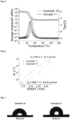
- Fig. 2 illustrates the rotational flow sweep viscosity measurement at various temperatures of curable compositions from Example 10 and Example 11. Further, it has been found from measured 1 H NMR and FT-IR data (not shown) that curable composition from Example 1 in day 1 and after storage at ambient conditions for 7 and 28 days are stable. The application of other dynamic chemistries in epoxy resins very often result in high viscosity, heterogenous solutions or fast curable mixtures that do not leave a processing window for an application of a product.
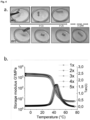
- Fig. 3 illustrates the stress relaxation (a) by rheology and recyclability under load via compression molding (b). More specifically: Fig. 3a shows that sample even though is fully cross-linked shows relaxation (Example 1).
- the stress relaxation test is a standard test which can quantitatively evaluate the potential of material to be reprocessed.
- the traditional cross-linked materials do not show a drop in the relaxation modulus (G(t)/G(0)) whereas dynamic networks do.
- the epoxy resins can be reshaped and possess flow properties when heated under load ( Fig.3b ).
- Fig.4a demonstrates the elastic response of the materials to the applied load at different temperatures (Example 2), DMTA curves after repeated deformations and shape recovery ( Fig. 4b ), creep experiment at investigated temperatures ( Fig. 4c ) and elastic response of selected materials to deformation ( Fig.4d ).
- the material with T g,DSC 34°C which is just above RT is able to recover the original shape in 24h after deformation. If the same material is conditioned at temperatures above its T g the recovery time decreases and the full recovery is observed within seconds ( Fig. 4a ).
- the cyclic deformation-recovery experiment was conducted on a DMTA specimen ( Fig. 4b ). the sample was twisted and reformed at 105°C for 5 minutes.
- a DMTA analyses was performed revealing little to no influence of the repeated deformation on the mechanical performance of the material.
- a cyclic creep recovery measurement ( Fig. 4c ) revealed that the material show predominant delayed elastic response at 25°C and instantaneous elastic response at 80 °C.
- the recovery ability of materials can be tuned by thermal properties ( Fig. 4d ). More specifically, materials with T g below RT will show instantaneous elastic response at RT and materials with T g higher than RT will show predominant delayed elastic response. All materials can be returned to the original shape by short heating stage. The property can be interesting for shock absorbing materials.
- Cured reaction products according to the present invention can be chemically recycled, for example by means of solvolysis at 90°C, in accordance with Example 14.
- Table 3 here below illustrates an LC-MS chromatogram of the solvolysis product obtained. In Table 4, a list of the fragments obtained after solvolysis is shown. Table 3: An LC-MS chromatogram of a solvolysis product with an indication of which m/z regime was detected and screened and also its intensity for the two investigated reaction times, the various fragments A to H were identified.
- Fig. 5 illustrates the DMTA of Example 10 and Example 11 which demonstrates the tunability of T g of material by a change of ratio of acid to vinyl component.
- the ratio of monomers influences the stress relaxation curves ( Fig.6 ). In general, shorter relaxation times are obtained when an excess of vinyl is used (Example 11).
- Fig. 7 illustrates the contact angle of Example 10 and Example 11. From the figure, it is apparent that the materials with an excess of vinyl groups (product of Example 11) are more hydrophobic.
- Fig. 8 illustrates the development of a T g of Example 10 and 11 during curing at 150°C.
Landscapes
- Chemical & Material Sciences (AREA)
- Health & Medical Sciences (AREA)
- Chemical Kinetics & Catalysis (AREA)
- Medicinal Chemistry (AREA)
- Polymers & Plastics (AREA)
- Organic Chemistry (AREA)
- Epoxy Resins (AREA)
Abstract
The present invention relates to the field of polymers. In particular, the present invention pertains to degradable polymers, curable compositions and methods of manufacturing thereof. In particular, the present invention pertains to curing agents for epoxy resins.
Description
- The present invention relates to the field of polymers. In particular, the present invention pertains to degradable polymers, curable compositions and methods of manufacturing thereof. In particular, the present invention pertains to curing agents for epoxy resins.
- Epoxy resins have an irreplaceable position in the polymer industry because of high mechanical performance, and chemical and thermal resistance, and they are widely used in wind power and aerospace structures. In general, uncured epoxy resins have only poor mechanical, chemical and heat resistance properties. However, good properties are obtained by reacting the linear epoxy resin with suitable curatives to form three-dimensional cross-linked thermoset structures. This process is commonly referred to as curing or gelation process. This curing is what produces the qualities of the substance such as resistance, durability, versatility, and adhesion. However, their high resistance hampers recycling of epoxy resins which limits their sustainable utilization and further developments. The main challenges for epoxy resins and their composites include the design of high processability (low-viscosity) epoxy resins and cured epoxy resins with high strength and toughness that can be recycled and reused.
- Morancho et al., 2020, discloses epoxy resins cured with dicarboxylic acids. A disadvantage of the cured resins thereby described is that they are difficult to implement due to crystallinity and high melting points of most dicarboxylic acids. On the other hand, the traditional epoxy resin cured with amine hardener fulfil requirement regarding the application (low viscosity liquids) but are not easily recyclable or /and reusable.
- There is therefore the need for epoxy resins that are not faced with foregoing problems and that can be recycled and reused. It is an objective of the present invention is to overcome the drawbacks of the prior art.
- In a first aspect, the present invention pertains to a curable composition comprising:
- a compound A having at least 2 vinyl moieties, preferably a divinylether;
- a compound B having at least 2 carboxyl moieties, preferably 2 carboxylic acid moieties;
- a compound C having at least 1 epoxy moiety and preferably 2 or more.
- Curable compositions according to the present invention provide for several advantages, in particular, compositions according to the present invention provide epoxy resins with controlled degradability and processability. Further, curable compositions according to the present invention provide for high tunability of properties of the obtainable cured reaction products, which properties (e.g. curing window, degradability, processability) can be easily tuned by modifying e.g. the type and quantity of compounds A, B and C or a catalyst. Further, the compound comprising vinyl moieties can be released during the thermal dissociation can crosslink the resin via dynamic and degradable bonds and improve thermal properties by protecting the hydroxyl group. Further, the viscosity of the composition can also be easily tuned, thereby allowing ease of use.
- According to an embodiment of the present invention, compound A is a divinylether of formula (I):
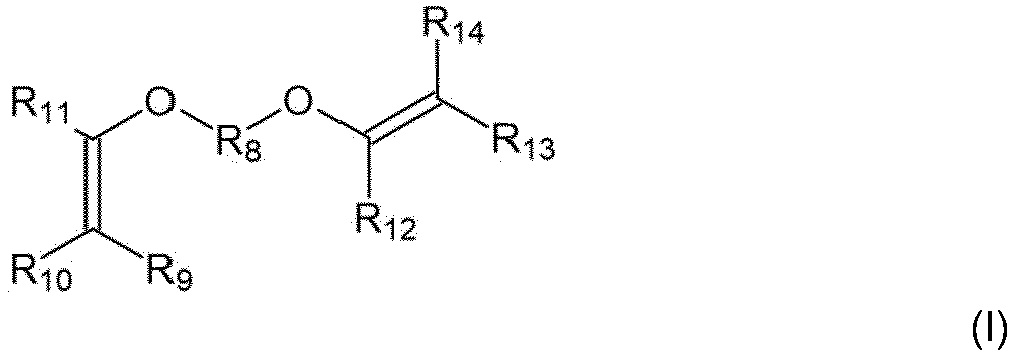
- In accordance with an embodiment of the present invention, compound A is a divinylether of formula (I) wherein; R8 is a C3-6cycloalkyl, an C1-6alkyl-oxy-C1-6alkyl or R8 together with one of the oxygen atoms to which it is being attached represent -{C1-6alkyl-O}n- wherein n is at least 2; and R9 to R14 are hydrogen.
- In accordance with a further embodiment of the present invention, compound A is a divinylether, preferably selected from the list comprising: 1,4-cyclohexanemethanol divinyl ether (R8 is cyclohexane; R9 to R14 are hydrogen), 1,4-butanediol divinyl ether (R8 is butane; R9 to R14 are hydrogen), di(ethylene glycol) divinyl ether (R8 is C2alkyl-oxy-C2alkyl; R9 to R14 are hydrogen), poly(ethyleneglycol) divinyl ether, Tri(ethylene glycol) divinyl ether (R8 is C2alkyl-oxy-C2alkyl-oxy-C2alkyl; R9 to R14 are hydrogen).
- In accordance with a further embodiment of the present invention, compound B is of formula (II):

- R1 is independently selected from any one of: H, metal, alkyl, carbonyl; in particular R1 is independently selected from any one of: H, metal, and alkyl: more in particular R1 is H;
- R2 is a group selected from: linear, aromatic or cyclic alkyl, with or without heteroatoms, such as O, N, saturated or unsaturated, substituted or unsubstituted, or R2 represents a direct bond; in particular R2 is a group selected from: linear or cyclic alkyl, with or without heteroatoms, such as O, N, saturated or unsaturated, substituted or unsubstituted, or R2 represents a direct bond;
- and n ≥ 2.
- In accordance with a further embodiment of the present invention, compound B is of formula (IIa):

- R1, and R3 are groups each independently selected from any one of: H, metal, alkyl, carbonyl; in particular R1, and R3 are groups each independently selected from any one of: H, metal, and alkyl; more in particular R1, and R3 are H;
- R2 is a group selected from: linear, aromatic or cyclic alkyl, with or without heteroatoms, such as O, N, saturated or unsaturated, substituted or unsubstituted, or R2 represents a direct bond; in particular R2 is a group selected from: linear or cyclic alkyl, with or without heteroatoms, such as O, N, saturated or unsaturated, substituted or unsubstituted, or R2 represents a direct bond;
- An advantage of the present embodiment is that di(poly)carboxylic acids are widely available, very often renewable and yield esters that can be easily degraded, for example as part of recycling by solvolysis.
- In accordance with an embodiment of the present invention, compound B is a dicarboxylic acid (including salts) of formula (II) wherein R2 is a C1-15alkyl; in particular a C1-10alkyl.
- In accordance with a further embodiment of the present invention, compound B is selected from the list comprising: glutaric acid (R2 is propane), adipic acid (R2 is hexane), suberic acid (R2 is octane), azelaic acid (R2 is nonane), sebacic acid (R2 is decane). An advantage is their cost of goods, low toxicity and renewable character.
- In accordance with a further embodiment of the present invention, compound C comprises an epoxy moiety of formula (III):

- In accordance with a further embodiment of the present invention, compound C is of formula (IIIa):

- R4, R5, R6, R7 are groups each independently selected from the list comprising: H, linear, aromatic or cyclic alkyl, with or without heteroatoms, such as O, N, saturated or unsaturated, substituted or unsubstituted.
- An advantage of the present embodiment is that epoxy components are widely available and result in materials with good mechanical properties, such as high toughness, and high cross linking density.
- In a further aspect, the present invention pertains to a cured reaction product of the composition according to the present invention. Cured reaction products according to the present invention provide for several advantages, in particular, cured reaction products of the present invention provide the advantage of being both processable and degradable and yet have good mechanical properties as a consequence of being highly cross-linked.
- In an embodiment of the present invention, the cured reaction product is of a polymer of any one of formulae: (VIa), (Vlb), (VIc), (Vld) and (VIe)


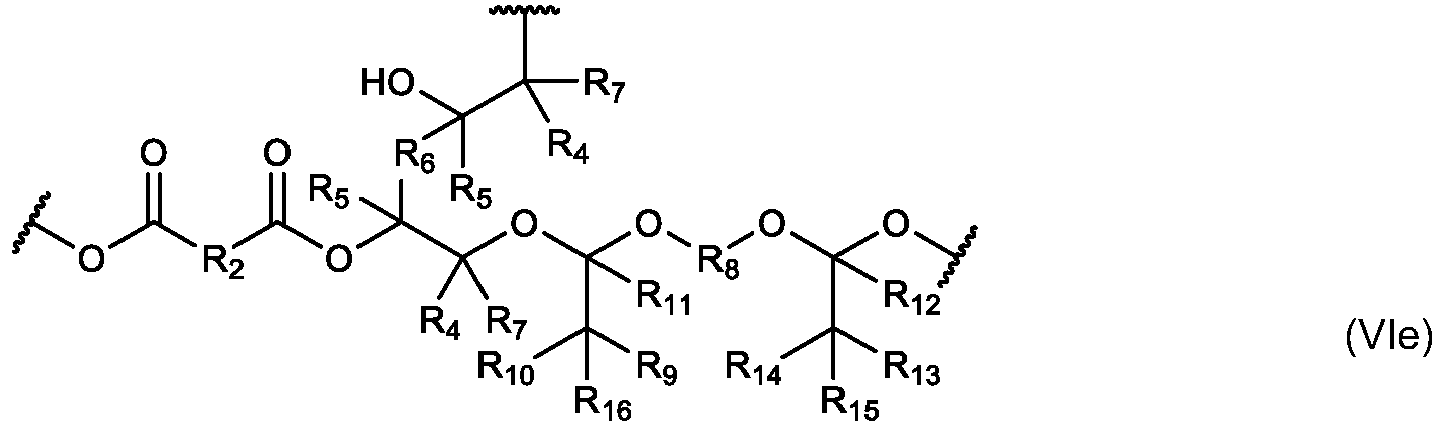
- R2, R4, R5, R6, R7, R8, R9, R10, R11, R12, R13, R14 are groups defined according to any one of the embodiments herein disclosed; and R15, R16 are groups each independently selected from the list comprising: H, linear, aromatic or cyclic alkyl, with or without heteroatoms, such as O, N, saturated or unsaturated, substituted or unsubstituted; in particular R15, R16 are groups each independently selected from the list comprising: H, linear or cyclic alkyl, with or without heteroatoms, such as O, N, saturated or unsaturated, substituted or unsubstituted.
- In accordance with an embodiment of the present invention, the cured product is comprising at least an equimolar amount of vinyl moieties with respect to the carboxyl moieties. It has been found that from such equimolar amount onwards, even with the slightest excess of vinyl moiety, shelf life, hydrophobicity, and chemical resistance including hydrolytic stability are improved.
- In accordance with a further embodiment of the present invention, the slight excess of vinyl moieties with respect to carboxyl moieties is in a molar ratio of vinyl moiety to carboxyl moiety from 1.01:1 to 1.5:1, preferably from 1.05:1 to 1.1:1. It has been found that this embodiment is advantageous, whilst it provides a mean to avoid unreacted monomers which can crystallize (carboxylic acid component).
- In accordance with a further embodiment of the present invention, the cured product is comprising an excess of carboxyl moieties respect to vinyl moieties. It has been found that an excess of carboxyl moieties provides faster curing kinetics, and improves hydrophilicity.
- In accordance with yet further embodiment of the present invention, the excess of carboxyl moieties respect to vinyl moieties is according to a molar ratio vinyl moiety:carboxyl moiety from 1:1.01 to 1:1.5, preferably from about 1:1.05 to 1:1.1. It has been found that this embodiment is advantageous because it provides a mean to reach higher cross-linking density.
- In a further aspect, the present invention pertains to a method for obtaining a cured product, comprising the steps of:
- a) providing a curable composition comprising a compound A having at least 2 vinyl moieties, a compound B having at least 2 carboxyl moieties, preferably at least 2 carboxylic acid moieties, and a compound C having at least 1 epoxy moiety;
- b) curing the curable composition provided at step a), thereby obtaining a cured product. An advantage of the present aspect is straightforward preparation of recyclable materials, without the formation of a condensate, and with a curable composition that has a considerable long shelf life.
- According to an embodiment of the method of the present invention, at step b) the curable composition is a one-component resin, i.e. meaningthat the curable resin is ready to use, without needing mixing of reactive components.
- With specific reference now to the figures, it is stressed that the particulars shown are by way of example and for purposes of illustrative discussion of the different embodiments of the present invention only. They are presented in the cause of providing what is believed to be the most useful and readily description of the principles and conceptual aspects of the invention. In this regard no attempt is made to show structural details of the invention in more detail than is necessary for a fundamental understanding of the invention. The description taken with the drawings is provided to make apparent to those skilled in the art how the several forms of the invention may be embodied in practice.
-
Figure 1 , also referred to asFig. 1 , illustrates a possible synthetic route to cured resins in accordance with the present invention. -
Figure 2 , also referred to asFig. 2 , illustrates the rotational flow sweep viscosity measurement at various temperatures of curable compositions from Example 10 and Example 11. -
Figure 3 , also referred to asFig. 3 , illustrates the stress relaxation (a) and relaxation time vs. temperature plot and (b) compression molding at 180°C for 30 minutes at 50 Ba. -
Figure 4 , also referred to asFig. 4 , illustrates the response of samples to a deformation at 25 °C and 80 °C (a), DMTA of samples after repeated deformations (x5) (b), cyclic creep recovery at 25° and 80°C (c) and response of the material to a deformation (Example 1-Example6) (d). -
Figure 5 , also referred to asFig. 5 , illustrates the DMTA of Example 10 and Example 11. -
Figure 6 , also referred to asFig. 6 , illustrates the relaxation times of Example 10 and Example 11. -
Figure 7 , also referred to asFig. 7 , illustrates the contact angle of Example 10 and Example 11. -
Figure 8 , also referred to asFig. 8 , illustrates the development of a Tg of example 10 and 11 during curing at 150°C. - The present invention will now be further described. In the following passages, different aspects of the invention are defined in more detail. Each aspect so defined may be combined with any other aspect or aspects unless clearly indicated to the contrary. In particular, any feature indicated as being preferred or advantageous may be combined with any other feature or features indicated as being preferred or advantageous. When describing the compounds of the invention, the terms used are to be construed in accordance with the following definitions, unless a context dictates otherwise.
- The term "about" or "approximately" as used herein when referring to a measurable value such as a parameter, an amount, a temporal duration, and the like, is meant to encompass variations of +/- 10 % or less, preferably +/- 5 % or less, more preferably +/- 1 % or less, and still more preferably +/- 0.1 % or less of and from the specified value, insofar such variations are appropriate to perform in the disclosed invention. It is to be understood that the value to which the modifier "about" or "approximately" refers is itself also specifically, and preferably, disclosed.
- In the context of the present invention, by means of the term "curable polymer", reference is made to a polymer comprising chemical groups which are suitable to be crosslinked i.e. can undergo one or more chemical reaction providing a polymer network.
- In the context of the present invention, by means of the term "dynamic polymer" or "dynamically cured polymer", reference is made to a polymer comprising covalent bonds which are adapted to exchange, thereby providing for a dynamic covalent polymer network. Dynamic covalent polymer networks combine intrinsic reversibility with the robustness of covalent bonds, creating chemically stable materials that are responsive to external stimuli. In the context of the present invention, the dynamic covalent polymer network is provided by acetal groups, which are equilibrium polymer species.
- In a first aspect, the present invention pertains to a curable composition comprising:
- a compound A having at least 2 vinyl moieties, preferably a divinylether;
- a compound B having at least 2 carboxyl moieties, preferably 2 carboxylic acid moieties;
- a compound C having at least 1 epoxy moiety and preferably 2 or more.
- Curable compositions according to the present invention provide for several advantages, in particular, compositions according to the present invention provide epoxy resins with controlled degradability and processability. Further, curable compositions according to the present invention provide for high tunability of properties of the obtainable cured reaction products, which properties (e.g. curing window, degradability, processability) can be easily tuned by modifying e.g. the type and quantity of compounds A, B and C. Further, the compound comprising vinyl moieties can be released during the thermal dissociation can crosslink the resin via dynamic and degradable bonds and improve thermal properties by protecting the hydroxyl group. Further, the viscosity of the composition can also be easily tuned, thereby allowing ease of use.
- The term "alkyl" by itself or as part of another substituent refers to a fully saturated hydrocarbon of Formula CxH2x+1 wherein x is a number greater than or equal to 1. Generally, alkyl groups of this invention comprise from 1 to 20 carbon atoms. In the context of the present invention the term "linear alkyl" includes linear or branched alkyl and may be substituted as indicated herein. When a subscript is used herein following a carbon atom, the subscript refers to the number of carbon atoms that the named group may contain. Thus, for example, C1-4alkyl means an alkyl of one to four carbon atoms. Examples of alkyl groups are methyl, ethyl, n-propyl, i-propyl, butyl, and its isomers (e.g. n-butyl, i-butyl and t-butyl); pentyl and its isomers, hexyl and its isomers, heptyl and its isomers, octyl and its isomers, nonyl and its isomers; decyl and its isomers. C1-C6 alkyl includes all linear, or branched alkyl groups with between 1 and 6 carbon atoms, and thus includes methyl, ethyl, n-propyl, i-propyl, butyl and its isomers (e.g. n-butyl, i-butyl and t-butyl); pentyl and its isomers, and hexyl and its isomers.
- The term "cycloalkyl" or "cyclic alkyl" by itself or as part of another substituent is a cyclic alkyl group, that is to say, a monovalent, saturated, or unsaturated hydrocarbyl group having 1, 2, or 3 cyclic structure. Cycloalkyl includes all saturated or partially saturated (containing 1 or 2 double bonds) hydrocarbon groups containing 1 to 3 rings, including monocyclic, bicyclic, or polycyclic alkyl groups. Cycloalkyl groups may comprise 3 or more carbon atoms in the ring and generally, according to this invention comprise from 3 to 15 atoms. The further rings of multi-ring cycloalkyls may be either fused, bridged and/or joined through one or more spiro atoms. Cycloalkyl groups may also be considered to be a subset of homocyclic rings discussed hereinafter. Examples of cycloalkyl groups include but are not limited to cyclopropyl, cyclobutyl, cyclopentyl, cyclohexyl, cycloheptyl, cyclooctyl, cyclononyl, adamantanyl and cyclodecyl with cyclopropyl being particularly preferred.
- The term "aromatic alkyl" or "aryl" as used herein refers to a polyunsaturated, aromatic hydrocarbyl group having a single ring (i.e. phenyl) or multiple aromatic rings fused together (e.g. naphthalene or anthracene) or linked covalently, typically containing 6 to 10 atoms; wherein at least one ring is aromatic. The aromatic ring may optionally include one to three additional rings (either cycloalkyl, heterocyclyl, or heteroaryl) fused thereto. Aryl is also intended to include the partially hydrogenated derivatives of the carbocyclic systems enumerated herein. Non-limiting examples of aryl comprise phenyl, biphenylyl, biphenylenyl, 5- or 6-tetralinyl, 1-, 2-, 3-, 4-, 5-, 6-, 7-, or 8-azulenyl, 1- or 2-naphthyl, 1-, 2-, or 3-indenyl, 1-, 2-, or 9-anthryl, 1- 2-, 3-, 4-, or 5-acenaphtylenyl, 3-, 4-, or 5-acenaphtenyl, 1-, 2-, 3-, 4-, or 10-phenanthryl, 1- or 2-pentalenyl, 1, 2-, 3-, or 4-fluorenyl, 4- or 5-indanyl, 5-, 6-, 7-, or 8-tetrahydronaphthyl, 1,2,3,4-tetrahydronaphthyl, 1,4-dihydronaphthyl, dibenzo[a,d]cylcoheptenyl, and 1-, 2-, 3-, 4-, or 5-pyrenyl
- In the context of the present invention the term " substituted " refers to a linear, aromatic or cyclic alkyl group optionally substituted with one or more substituents (for example 1 to 4 substituents, for example 1, 2, 3, or 4 substituents or 1 to 2 substituents) at any available point of attachment. Non-limiting examples of such substituents include halo, hydroxyl, carbonyl, nitro, amino, oxime, imino, azido, hydrazino, cyano, aryl, heteroaryl, cycloalkyl, acyl, alkylamino, alkoxy, thiol, alkylthio, carboxylic acid, acylamino, alkyl esters, carbamate, thioamido, urea, sullfonamido and the like.
- In the context of the present invention, by means of the term "vinyl moiety", reference is made to a chemical group of formula -(CR=CR'R"), where R, R' and R" are each independently selected from the list comprising: H, linear, aromatic or cyclic alkyl, with or without heteroatoms, such as O, N, saturated or unsaturated, substituted or unsubstituted; in particular R, R' and R" represent H.
- In the context of the present invention, by means of the term "carbonyl moiety", reference is made to a group which is composed of a carbon atom double-bonded to an oxygen atom: -(C=O)-. It is common to several classes of organic compounds, as part of many larger functional groups, including aldehydes, ketones, carboxylic groups, amides, and imides.
- In the context of the present invention, by means of the term "carboxyl moiety", reference is made to a group which is either a carboxylic group (-(C=O)-O-H), an ester (-(C=O)-O-R2), an anhydride (C=O)-O-(C=O)-R2 or a salt (-(C=O)-O+ M-) thereof. Wherein in a particular embodiment R2 is in accordance with the definitions of said substituent as herein provided.
- In the context of the present invention, by means of the term "carboxylic acid moiety", reference is made to a carboxylic group (-(C=O)-O-H).
- In the context of the present invention, by means of the term "epoxy moiety", reference is made to a chemical group of formula (III):

- In the context of the present invention, by means of the term "monoepoxide", reference is made to a compound comprising a single epoxy moiety.
- According to an embodiment of the present invention, compound A is of formula (I):

- In accordance with a further embodiment of the present invention, compound A is divinylether, preferably selected from the list comprising: 1,4-cyclohexanemethanol divinyl ether, 1,4-butanediol divinyl ether, Di(ethylene glycol) divinyl ether, poly(ethyleneglycol) divinyl ether, Tri(ethylene glycol) divinyl ether.
- In accordance with the present invention, compound B has at least 2 carboxyl moieties, preferably 2 carboxylic acid moieties. Compound B of the present invention therefore can be for example a dicarboxylic acid, tricarboxylic acid, tetracarboxylic acid, aliphatic or aromatic, and salts thereof. In case an ester of a carboxylic acid is used, conditions should be provided for its hydrolysis and hence transformation into a carboxylic acid. For example, in accordance with the present invention, dicarboxylates can also be used, provided that their ester moieties are hydrolised, e.g. in situ, thereby providing access to carboxyl moieties.
- In accordance with a further embodiment of the present invention, compound B is of formula (II):

- R1 is independently selected from any one of: H, metal, alkyl;
- R2 is a group selected from: linear or cyclic alkyl, with or without heteroatoms, such as O, N, saturated or unsaturated, substituted or unsubstituted, direct bond,
- and n ≥ 2.
- In accordance with a further embodiment of the present invention, compound B is of formula (IIa):

- R1, and R3 are groups each independently selected from any one of: H, metal, alkyl;
- R2 is a group selected from: linear or cyclic alkyl, with or without heteroatoms, such as O, N, saturated or unsaturated, substituted or unsubstituted, direct bond.
- In accordance with the present invention, compound B can for example be selected from the group comprising ethanedioic acid, propanedioic acid, butanedioic acid, pentanedioic acid, pentanedioic acid, hexanedioic acid, heptanedioic acid, octanedioic acid, nonanedioic acid, decanedioic acid, undecanedioic acid, dodecanedioic acid, tridecanedioic acid, hexadecanedioic acid, heneicosadioic acid, docosanedioic acid, tricontanedioic acid, hemimellitic acid and citric acid.
- In accordance with a further embodiment of the present invention, compound B is an aliphatic dicarboxylic acid.
- In accordance with a further embodiment of the present invention, compound B is a compound according to formula (II) wherein R2 is a C1-C15 linear alkyl chain, preferably selected from the list comprising: glutaric acid (a.k.a. pentanedioic acid), adipic acid (a.k.a. hexanedioic acid), suberic acid (a.k.a. octanedioic acid), azelaic acid (a.k.a. nonanedioic acid), sebacic acid (a.k.a. decanedioic acid). An advantage of this embodiment is that their availability, low toxicity and renewable character.
- In accordance with the present invention, compound C has at least 1 epoxy moiety and preferably 2 or more epoxy moieties. Therefore, in accordance with the present invention compound C is a monoepoxide, diepoxide, triepoxide, tetraepoxide etc.
- In accordance with a further embodiment of the present invention, compound C comprises an epoxy moiety of formula (III):

- In accordance with a further embodiment of the present invention, compound C is of formula (IIIa):

- R4, R5, R6, R7 are groups each independently selected from the list comprising: H, linear, aromatic or cyclic alkyl, with or without heteroatoms, such as O, N, saturated or unsaturated, substituted or unsubstituted.
- In accordance with a further embodiment of the present invention, compound C is of formula (IIIb):

- R4, R5, R6, R7 are groups each independently selected from the list comprising: H, linear, aromatic or cyclic alkyl, with or without heteroatoms, such as O, N, saturated or unsaturated, substituted or unsubstituted.
- In accordance with an embodiment of the present invention, compound C is either a monoepoxide or a diepoxide.
- In accordance with the present invention, compound C can for example be selected from the list comprising, and not limited to: bisphenol A diglycidyl ether, 1,4-Butanediol diglycidyl ether, Tris(4-hydroxyphenyl)methane triglycidyl ether, 1,2,7,8-Diepoxyoctane, Tris(2,3-epoxypropyl) isocyanurate.
- In a further aspect, the present invention pertains to a cured reaction product of the composition according to the present invention. Cured reaction products according to the present invention provide for several advantages, in particular, cured reaction products of the present invention provide the advantage of being both processable and degradable and still maintain good mechanical properties of cross-linked epoxy resins.
- In an embodiment of the present invention, the cured reaction product is of a polymer of any one of formulae: (VIa), (Vlb), (VIc), (Vld) and (VIe)


- R2, R4, R5, R6, R7, R8, R9, R10, R11, R12, R13, R14 are groups defined according to other embodiments of the present invention; R15, R16 are also groups defined according to other embodiments of the present invention.
- Depending on the level of crosslinking and the reactants, cured reaction products according to the present invention can comprise one or more of polymers of formula (VIa), (Vlb), (VIc), (Vld), (VIe). The cured reaction products above can be obtained according to various synthetic methods.
Fig. 1 schematically illustrates a method to obtain cure reaction products according to the present invention, wherein compound A and B are firstly admixed together and at a later stage compound C is added. Compound C is in this example either a monoepoxide or a diepoxide. The mixture obtained is then heated, leading to the cured products e.g. (VIa) and (VIe). - In accordance with an embodiment of the present invention, the cured product is comprising an excess of vinyl moieties respect to carboxyl moieties. It has been found that that an excess of vinyl moiety improve shelf life, hydrophobicity, and chemical resistance including hydrolytic stability.
- In accordance with a further embodiment of the present invention, the excess of vinyl moieties respect to carboxyl moieties is in a molar ratio vinyl moiety:carboxyl moiety from 1.01:1 to 1.5:1, preferably from 1.05:1 to 1.1:1. It has been found that this embodiment is advantageous, in that the ratios herein allow to be advantageous whilst provides a mean to avoid unreacted monomers which can crystallize or evaporate during curing.
- In accordance with a further embodiment of the present invention, the cured product is comprising an excess of carboxyl moieties respect to vinyl moieties. It has been surprisingly found that an excess of carboxyl moieties provide faster curing kinetics, improves hydrophilicity.
- In accordance with a yet further embodiment of the present invention, the excess of carboxyl moieties respect to vinyl moieties is according to a molar ratio vinyl moiety:carboxyl moiety from 1:1.01 to 1:1.5, preferably from about 1:1.05 to 1:1.1. It has been found that this embodiment is advantageous, in that the ratios herein allow to be advantageous whilst provides a mean to avoid unreacted monomers which can crystallize or evaporate during curing.
- In a further aspect, the present invention pertains to a method for obtaining a cured product, comprising the steps of:
- a) providing a curable composition comprising a compound A having at least 2 vinyl moieties, a compound B having at least 2 carboxyl moieties, preferably at least 2 carboxylic acid moieties, and a compound C having at least 1 epoxy moiety;
- b) curing the curable composition provided at step a), thereby obtaining a cured product.
- According to an embodiment of the method of the present invention, at step b) the curable composition is a one-component resin. An advantage of the present embodiment is that the curable resin is ready to use, without needing mixing of reactive components.
- Cured reaction products according to the present invention can be obtained starting from the curable composition according to the present invention, but also other composition comprising reaction intermediates of the compounds A, B and C.
- For example, cured reaction products according to the present invention can be obtained from a curable composition comprising a curable polymer of formula (IV) and a compound C, as defined according to the present invention, wherein

- R2, R8, R9, R10, R11, R12, R13, R14 are groups defined according to any one of the embodiments of the present invention, and
- R15, R16 are groups selected from the list comprising: H, linear, aromatic or cyclic alkyl, with or without heteroatoms, such as O, N, saturated or unsaturated, substituted or unsubstituted.
- Compound of formula (IV) can be obtained for example by reacting a compound A with a compound B, nevertheless, other synthetic methodologies might be used. For example, a method for obtaining a curable polymer of formula (IV), can comprise the steps of:
- a1) providing a compound A having at least 2 vinyl moieties, and a compound B having at least 2 carboxyl moieties, preferably at least 2 carboxylic acid moieties;
- b1) reacting, preferably in the presence of a catalyst, preferably an acid catalyst, the compound A and B provided at step a1), thereby forming the curable polymer of formula (IV).
- Alternatively, cured reaction products according to the present invention can be obtained from a curable composition comprising a curable polymer of formula (Va) or (Vb) with a compound A.


- R2, R4, R5, R6, R7 are groups defined according to any one of the embodiments of the present invention .
- In accordance with a further embodiment of the present invention, the curable polymer of formula (IV) and compound C are heated at temperature from about 100 to 180 °C, preferably from about 130 to 150 °C. An advantage is that the composition cures with relatively fast curing rate with limited degradation phenomena.
- In accordance with an embodiment of the present invention, the compound A and the compound B are firstly admixed together, and secondly compound C is added. An advantage is that first the curing polymer is formed and it is stabilized by the addition of compound C.
- In accordance with an embodiment of the present invention, the compound A and the compound B are firstly admixed together for from about 0 to about 24h preferably from about 2 to about 6h, and secondly compound C is added. An advantage is that first the curing polymer is formed and it is stabilized by the addition of compound C.
- Nuclear magnetic resonance (NMR): Routine 1H NMR spectra were collected on the benchtop NMR
Magritek Spinsolve Ultra 80 at 80 mhz in DMSO with 64 scans and 6.4 s acquisition time. The NMR spectra which were used for an elucidation of structure were recorder on a Bruker Avance 300 at 300 mhz for 1H NMR and 100 mhz for 13C NMR in DMSO. 1H NMR spectra were recorded with 16 scans and 4s relaxation delay. 13C NMR was recorded with 1024 scans and a relaxation delay of 2s. Corresponding 2D-HSQC spectra were recorded following standard Bruker pulse program hsqcetgpsisp2.3 with 4 scans and a relaxation delay of 4.9816s. - Fourier transform infrared spectroscopy (FT-IR): FTIR was measured in attenuated total reflectance mode (ATR-FTIR) on a Nicolet is10 spectrometer of Thermo Fisher. The spectra of samples and background were measured under atmospheric conditions on a diamond crystal with a spectral range of 4000 to 400 cm-1. The scans were performed with a scan resolution of 4 cm-1 and 32 scans per sample. Background spectra were subtracted from the sample scans prior to their analysis.
- Thermal gravimetric analysis (TGA): TGA thermograms were measured on a TA Instruments Q500IR. The measurements were performed under a nitrogen flow rate of 25 ml min-1 during a heating rate of 20 °C min-1 from 50 °C to 600 °C.
- Differential scanning calorimelry (DSC): DSC was performed on a TA Instruments Discovery DSC 250 equipped with a refrigerated cooling system (RCS). The samples were measured in Tzero pans with perforated Tzero hermetic lids to allow a nitrogen atmosphere around the sample.
- Thermal characterization: DSC thermograms were recorded with a heating rate of 10 °C min-1. Only experimental data obtained from the second heating step are reported.
- Curing process: The DSC pan was heated with 10 °C min-1 until the oven reached the test temperature and kept in isothermal conditions for 48 hours. The glass transition temperature (midpoint) was measured at equal intervals by heating and cooling rate of 10 °C min-1. Rheology : Stress relaxation, creep recovery experiments were performed on a Discovery HR-2 hybrid rheometer of TA Instruments. The instrument was equipped with an oven surrounding the 8 mm plate-plate configuration. Stress relaxation was measured in linear viscoelastic region (LVE), a strain of 1 % was applied with an axial force of 2N or 5N. Creep-recovery experiments were performed with an alternating stress of 0 Pa (1000 s) and 3000 Pa (600 s) with an axial force of 5N.
- Tensile test: Tensile analysis was conducted on an Instron 6800 Single column tensile tester using pneumatic clamps. 3-5 replicates were measured for each sample with dimensions of 22 x 5 x 0.6-0.7 mm. The tests were performed at room temperature and ambient conditions. The samples were dried prior to the test in the vacuum oven at 80 °C overnight. The crosshead speed was 5 mm/min.
- Contact Angle : Contact angle was measured on a goniometer via dynamic sessile drop method in 5 places on the polymer surface.
- Liquid chromatography-mass spectrometry (LC-MS) was performed on Thermo QExative equipped with Acquity BEH C18 column (100x2.1 mm/1.7um) using gradient solvent composition comprising 98% of 0.1%CHCOOH in H2O and 2% od CH3/IPA 70/30 in the initial stage of separation and reversed ratio in the terminal separation stage. Sample of concentration 1mg/ml in THF was injected to the column and separated at 60°C with a flow of 0.4 ml/min.
- Gel permeation chromatography (GPC) was performed on PSS equipped with styragel HRE4 columns using THF as a solvent with polystyrene standard used for calibration curve. The samples 1mg/ml were separated at 40°C with flow of 0.8 ml/min and detected by RID and UV detector.
- 1,3-propylenedicarboxylic acid 99% (glutaric acid, GA), 1,4-butanedicarboxylic acid 99% (adipic acid, AA), 1,7-heptanedicarboxylic acid 98% (azelaic acid, AzA), 1,8-octanedicarboxylic acid 99% (sebacic acid, SA), 1,4-cyclohexanemethanol divinyl ether 98% (14CHD), 1,4-butanediol divinyl ether 98% (14BD), Bis[2-(vinyloxy)ethyl] ether 99% (di(ethylene glycol) divinyl ether, DEG), ethylene glycol 99% (EG) styrene oxide 97% (SO), citric acid 99% (CA), Tris(4-hydroxyphenyl)methane triglycidyl ether (TGE) and 2,2-Bis[4-(glycidyloxy)phenyl]propane (bisphenol A diglycidyl ether, BADGE) were bought from Sigma Aldrich. Tetrahydrofuran (THF), deuterated DMSO-d6 and p-toluenesulfonic acid monohydrate 99% (pTSA) were supplied by VWR. Cardolite NC514 (EEW=444 g/mol) was supplied by Cardolite.
- Stock solution pTSA: pTSA.H2O (1g, 5.2 mmol) was dissolved in 10 mL THF. The final concentration was 0.52mmol/1mL or 0.1g/mL.
- SA (2.061 g, 10.2 mmol) and CHD (2.000 g, 10.2 mmol) were dissolved in 8mL THF. Stock solution of pTSA was added (0.96 mL, 0.50 mmol). The mixture was stirred at room temperature for 6 hours. In the course of stirring the color of the solution changed to yellow/orange. Subsequently BADGE (3.472 g, 10.2 mmol) was dissolved in 8 mL THF and added to the reaction mixture. The mixture was stirred for another hour and solvent was evaporated on the rotary evaporator at 30 °C under reduced pressure yielding 100% yellow oil which was dried in the vacuum oven at 30 °C overnight. The resulting product was then casted into a teflon mold and the rest was designated for analytical tests. The resin was cured at 150 °C for 36h at atmospheric pressure in air.
- Sebacic Acid (SA) - 1,4-butanediol divinyl ether (BD) - 2,2-Bis[4-(glycidyloxy)phenyl]propane (BADGE) was prepared according to the Example 1. 5.000 g (24.7 mmol) of SA, 3.515 g (24.7 mmol) of BD, 8.416 g (24.7 mmol) of BADGE and 0.235 g (1.2 mmol) of pTSA was used.
- Azelaic Acid (AzA) - 1,4-butanediol divinyl ether (BD) - 2,2-Bis[4-(glycidyloxy)phenyl]propane (BADGE) was prepared according to the Example 1. 5.000 g (26.6 mmol) of AzA, 3.777 g (26.6 mmol) of BD, 9.043 g (26.6 mmol) of BADGE and 0.253 g (1.3 mmol) of pTSA was used.
- Adipic Acid (AA) - 1,4-butanediol divinyl ether (BD) - 2,2-Bis[4-(glycidyloxy)phenyl]propane (BADGE) was prepared according to the Example 1. 5.000 g (34.2 mmol) of AA, 3.777 g (34.2 mmol) of BD, 11.647 g (34.2 mmol) of BADGE and 0.325 g (1.7 mmol) of pTSA was used.
- Glutaric Acid (GA) - 1,4-butanediol divinyl ether (BD) - 2,2-Bis[4-(glycidyloxy)phenyl]propane (BADGE) was prepared according to the Example 1. 5.000 g (37.8 mmol) of GA, 5.381 g (37.8 mmol) of BD, 12.883 g (37.8 mmol) of BADGE and 0.360 g (1.9 mmol) of pTSA was used.
- Sebacic Acid (SA) - di(ethylene glycol) divinyl ether (DEG) - 2,2-Bis[4-(glycidyloxy)phenyl]propane (BADGE) was prepared according to the Example 1. 5.000 g (24.7 mmol) of SA, 3.910 g (24.7 mmol) of DEG, 8.416 g (24.7 mmol) of BADGE and 0.235 g (1.2 mmol) of pTSA was used..
- Sebacic Acid (SA) - 1,4-cyclohexanemethanol divinyl ether (CHD) - Cardolite NC514 was prepared according to the Example 1. 3.000 g (29.7 mmol) of SA, 2.911 g (29.7 mmol) of CHD, 13.172 g (29.7 mmol) of Cardolite NC514 and 0.141 g (0.7 mmol) of pTSA was used.
- Sebacic Acid (SA) - 1,4-butanediol divinyl ether (BD) - Tris(4-hydroxyphenyl)methane triglycidyl ether (TGE) was prepared according to the Example 1. 5.000 g (24.7 mmol) of SA, 3.515 g (24.7 mmol) of BD, 7.590 g (24.7 mmol) of TGE and 0.235 g (1.2 mmol) of pTSA was used.
- CA (5.000 g, 26.1 mmol) and BD (5.551 g, 39.0 mmol) were dissolved in 20mL THF. Stock solution of pTSA was added (0.3 mL, 0.60 mmol). The mixture was stirred at room temperature for 1 hours. In the course of stirring the color of the solution changed to yellow/orange and the solution solidified. Subsequently SO (4.690 g, 39.0 mmol) was dissolved in 8 mL THF and added to the reaction mixture. The mixture was heated above 100°C and homogenized by vigorous stirring. The homogenized mixture was poured into Teflon mold and cured for 2h at 110°C followed by 48h at 130°C.
- Sebacic Acid (SA) - 1,4-cyclohexanemethanol divinyl ether (CHD) - 2,2-Bis[4-(glycidyloxy)phenyl]propane (BADGE) with 10% excess of acid was prepared according to Example 1. 5.000 g (24.7 mmol) of SA, 4.367 g (22.2 mmol) of CHD, 8.416 g (24.7 mmol) of BADGE and 0.235 g (1.2 mmol) of pTSA was used.
- Sebacic Acid(SA) - 1,4-cyclohexanemethanol divinyl ether(CHD) - 2,2-Bis[4-(glycidyloxy)phenyl]propane(BADGE) with 10% excess of vinyl were prepared according to Example 1. 5.000 g (24.7 mmol) of SA, 5.337 g (27.1 mmol) of CHD, 8.416 g (24.7 mmol) of BADGE and 0.235 g (1.2 mmol) of pTSA was used.
- 5.000 g (37.8 mmol) of GA, 7,428 g (37.8 mmol) of CHD, was loaded in a flask and dissolved in a THF (8mL) in a presence of a catalyst 0.1 g (0.5 mmol) pTSA. Subsequently, a 4,547 g (37.8 mmol) SO was added, the content was stirred for another hour and the solvent was evaporated. The obtained mixture was cured at 150° overnight while stirring and under nitrogen atmosphere. The obtained material contained high molar mass polymer with oligomeric fraction with combined molecular weight Mw=18300 g/mol and dispersity Ð=11.4 and was soluble in THF.
- Glutaric Acid (GA) - 1,4-cyclohexanemethanol divinyl ether (CHD) - Styrene oxide (SO) was prepared according to the Example 13 with different curing procedure. The sample was cured at 150°C in an oven on air. The obtained material swelled in organic solvent but was not soluble.
- Material from Example 1 was placed in the vial with ethylene glycol (EG) and pTSA (1wt%) and heated to 90°C. The polymer dissolved after couple of minutes and the aliquots were taken after 2h and 48h.
-
Viscosity mPa @ 50°C and shear rate 10 1/sT g,DSC (°C) E0 DMTA (MPa) Contact Angle (°) 10%vinyl 458 18.0 8.00 95.6 1:1 684 25.0 2.00 - 10% acid 316 33.0 1.00 89.1 - Tables 1 and 2 here below illustrates properties of materials in Examples 1-13. A dynamic mechanical thermal analyses demonstrated that polymer from Example 1-11 and Example 13 are cross-linked and cross-linking density which is proportional to storage modulus at plateau (E0 DMTA (MPa)) depends on the functionality of components and their chemical structure. For example, the use of longer monomers such as 1,4-cyclohexanemethanol divinyl ether (CHD) results in polymers with lower modulus (Example 1, E0 DMTA =2.04 MPa) than the use of shorter 1,4-butanediol divinyl ether (BD) (Example 2, E0 DMTA =6.13 MPa). The use of trifunctional monomer Tris(4-hydroxyphenyl)methane triglycidyl ether (TGE) (Example 8) results in higher cross-linking density and the use of monomer with
functionality 1 or with higher epoxy value (Example 7) leads to less cross-linked (Example 13) or even linear materials (Example 12) depending on the curing. The thermal properties show that variation in monomers allow to obtain materials with broad range of glass transition temperatures (Tg,DMTA ) from -12.6 °C in Example 7 to 90.3 °C in Example 8 but not limited to this range. Predictably, the materials which soften at lower temperatures possess lower Young modulus and higher elongation in ambient conditions (Example 7, E'=1.74 MPa, ε=80% ) than materials with transitions occurring at higher temperatures (Example 5, E'=1800 MPa, ε=6.4%).Table 1: Properties of materials obtained in Examples 1-13. More specifically: E0 DMTA, T g,DMTA , E', ε. Entry Composition E0 DMTA (MPa) T g,DMTA (°C) E' (MPa) ε (%) Example 1 SA,CHD,BADGE 2.04 16.7 1340±72 6.6±1.0 Example 2 SA,BD,BADGE 6.13 28.7 1370±170 18±5.7 Example 3 AzA,BD,BADGE 9.11 32.5 1630±50 5.6±0.3 Example 4 AA,BD,BADGE 8.00 43.8 1860±40 6.3±0.3 Example 5 GA,BD,BADGE 8.10 55.4 1800±80 6.4±0.3 Example 6 SA,EG,BADGE 3.70 20.3 1180±120 81±10 Example 7 SA,CHD,Ca 0.80 -12.6 1.74±0.75 80±12 Example 8 SA,BD,TGE 48.0 90.3 - - Example 9 CA,BD,SO - - - - Example 10 SA,CHD,BADGE 8.5 30.1 - - Example 11 SA,CHD,BADGE 1.0 16.7 - - Example 12 GA,CHD,SO - - - - Example 13 GA,CHD,SO 2.83 28.3 - - - The differential scanning calorimetry (DSC) confirmed that the materials are amorphous with glass transitions (Tg,DSC in Table 2) corresponding to these observed by DMTA (Tg,DMTA in table 1). The degradation of materials starts at temperatures above 277°C (T5%). The gel content determined by Soxhlet extraction of the soluble fraction by THF confirmed the high cross-linking degree which was shown by DMTA analyses.
Table 2: Properties of materials obtained in Examples 1-14. More specifically: T g,DSC, T5%, Tmax, Gel content Entry Composition T g,DSC (°C) T5% (°C) Tmax (°C) Gel content (%) Example 1 SA,CHD,BADGE 25.0 304 430 84.0 Example 2 SA,BD,BADGE 34.0 277 429 95.3 Example 3 AzA,BD,BADGE 41.0 311 -* 99.6 Example 4 AA,BD,BADGE 52.0 279 417 98.6 Example 5 GA,BD,BADGE 60.0 299 439 99.5 Example 6 SA,EG,BADGE 28.0 275 426 94.4 Example 7 SA,CHD,Ca -10.0 293 427 78.9 Example 8 SA,BD,TGE 94.0 291 430 99.2 Example 9 CA,BD,SO - Example 10 SA,CHD,BADGE 33.0 306 430 - Example 11 SA,CHD,BADGE 18.0 305 428 - Example 12 SA,CHD,BADGE 23.0 - - - Example 13 GA,CHD,SO -9.4 - - - Example 14 GA,CHD,SO -10.0 - - - - Curable compositions according to the present invention are stable and can be stored at ambient conditions for at least 28 days, and have low viscosity, allowing ease of use in various applications, e.g. coatings. In particular,
Fig. 2 illustrates the rotational flow sweep viscosity measurement at various temperatures of curable compositions from Example 10 and Example 11. Further, it has been found from measured 1H NMR and FT-IR data (not shown) that curable composition from Example 1 inday 1 and after storage at ambient conditions for 7 and 28 days are stable. The application of other dynamic chemistries in epoxy resins very often result in high viscosity, heterogenous solutions or fast curable mixtures that do not leave a processing window for an application of a product. -
Fig. 3 illustrates the stress relaxation (a) by rheology and recyclability under load via compression molding (b). More specifically:Fig. 3a shows that sample even though is fully cross-linked shows relaxation (Example 1). The stress relaxation test is a standard test which can quantitatively evaluate the potential of material to be reprocessed. The traditional cross-linked materials do not show a drop in the relaxation modulus (G(t)/G(0)) whereas dynamic networks do. As a result the epoxy resins can be reshaped and possess flow properties when heated under load (Fig.3b ). -
Fig.4a demonstrates the elastic response of the materials to the applied load at different temperatures (Example 2), DMTA curves after repeated deformations and shape recovery (Fig. 4b ), creep experiment at investigated temperatures (Fig. 4c ) and elastic response of selected materials to deformation (Fig.4d ). The material with Tg,DSC= 34°C which is just above RT is able to recover the original shape in 24h after deformation. If the same material is conditioned at temperatures above its Tg the recovery time decreases and the full recovery is observed within seconds (Fig. 4a ). The cyclic deformation-recovery experiment was conducted on a DMTA specimen (Fig. 4b ). the sample was twisted and reformed at 105°C for 5 minutes. After each cycle a DMTA analyses was performed revealing little to no influence of the repeated deformation on the mechanical performance of the material. A cyclic creep recovery measurement (Fig. 4c ) revealed that the material show predominant delayed elastic response at 25°C and instantaneous elastic response at 80 °C. The recovery ability of materials can be tuned by thermal properties (Fig. 4d ). More specifically, materials with Tg below RT will show instantaneous elastic response at RT and materials with Tg higher than RT will show predominant delayed elastic response. All materials can be returned to the original shape by short heating stage. The property can be interesting for shock absorbing materials. - Cured reaction products according to the present invention can be chemically recycled, for example by means of solvolysis at 90°C, in accordance with Example 14. Table 3 here below illustrates an LC-MS chromatogram of the solvolysis product obtained. In Table 4, a list of the fragments obtained after solvolysis is shown.
Table 3: An LC-MS chromatogram of a solvolysis product with an indication of which m/z regime was detected and screened and also its intensity for the two investigated reaction times, the various fragments A to H were identified. Fragment m/Z min m/z max I2h I48h I48h/I2h A 291,1779 291,1809 2,00E+08 1,50E+07 0,08 B 335,2045 335,2079 1,00E+07 8,00E+08 80,00 C 379,2306 379,2344 2,00E+05 1,00E+09 5000,00 D 423,2610 423,2610 4,00E+06 2,00E+08 50,00 E 547,3240 547,3294 2,50E+07 4,51E+08 18,04 F 373,2565 373,2603 1,70E+08 5,40E+08 3,18 G 580,3665 580,3723 5,50E+06 1,20E+09 218,18 H 394,2205 394,2245 2,00E+08 1,30E+09 6,50 - With respect to the ratio I48h/I2h, the ratio of intensity of a signal in the regime m/zmin-m/zmax at 2h (I2h) and intensity of signal at 48h (I48h). If I48h/I2h<1 means that signal decreases with a reaction time, if I48h/I2h>1 means that it increases.
Table 4: The chemical structures of identified fragments (Frag.) and their molecular masses. Frag. Chemical structure Adduct A 
H+ B 
H+ C 
H+ D 
H+ E 
H+ F 
H+ G 
NH4 + H 
NH4 + - It has been found that the ratio of functional determines properties from linear to crosslinked materials, hydrophilicity/hydrophobicity, exchange rate and curing kinetics. In particular,
Fig. 5 illustrates the DMTA of Example 10 and Example 11 which demonstrates the tunability of Tg of material by a change of ratio of acid to vinyl component. The ratio of monomers influences the stress relaxation curves (Fig.6 ). In general, shorter relaxation times are obtained when an excess of vinyl is used (Example 11).Fig. 7 illustrates the contact angle of Example 10 and Example 11. From the figure, it is apparent that the materials with an excess of vinyl groups (product of Example 11) are more hydrophobic.Fig. 8 illustrates the development of a Tg of Example 10 and 11 during curing at 150°C. -
- 1. Morancho, J. M., Ramis, X., Fernandez-Francos, X., Konuray, O., Salla, J. M., & Serra, A. (2020). Dual curing of an epoxy resin with dicarboxylic acids. Journal of Thermal Analysis and Calorimetry. doi:10.1007/s10973-020-09523-z
- 2. Spiesschaert, Y., Guerre, M., De Baere, I., van Paepegem, W., Winne, J.M., Du Prez, F.E., (2020). Dynamic Curing Agents for Amine-Hardened Epoxy Vitrimers with Short (Re)processing Times, Macromolecules. Doi: 10.1021/acs.macromol.9b02526
Claims (15)
- A curable composition comprising:- a compound A having at least 2 vinyl moieties, preferably a divinylether;- a compound B having at least 2 carboxyl moieties, preferably 2 carboxylic acid moieties;- a compound C having at least 1 epoxy moiety and preferably 2 or more.
- The curable composition according to claim 1, wherein:- compound A is of formula (I):

R8, R9, R10, R11, R12, R13, R14 are groups each independently selected from the list comprising: H, linear, aromatic or cyclic alkyl, with or without heteroatoms, such as O, N, saturated or unsaturated, substituted or unsubstituted. - The curable composition according to any one of claims 1 to 2, wherein compound A is a divinylether of formula (I) wherein; R8 is a C3-6cycloalkyl, an C1-6alkyl-oxy-C1-6alkyl or R8 together with one of the oxygen atoms to which it is being attached represent -{C1-6alkyl-O}n-wherein n is at least 2; and R9 to R14 are hydrogen; preferably selected from the list comprising: 1,4-cyclohexanemethanol divinyl ether, 1,4-butanediol divinyl ether, Di(ethylene glycol) divinyl ether, poly(ethyleneglycol) divinyl ether, Tri(ethylene glycol) divinyl ether.
- The curable composition according to any one of claims 1 to 3, wherein: compound B is of formula (II):
 - R1 is independently selected from any one of: H, metal, alkyl, carbonyl;- R2 is a group selected from: linear, aromatic or cyclic alkyl, with or without heteroatoms, such as O, N, saturated or unsaturated, substituted or unsubstituted, direct bond,- and n ≥ 2.
 - The curable composition according to claim 4, wherein:- compound B is of formula (IIa):
 - R1 and R3 are groups each independently selected from any one of: H, metal, alkyl, carbonyl;- R2 is a group selected from: linear, aromatic or cyclic alkyl, with or without heteroatoms, such as O, N, saturated or unsaturated, substituted or unsubstituted, direct bond.
 - The curable composition according to claim 5, wherein compound B is a dicarboxylic acid or salt thereof of formula (IIa) wherein R2 is a C1-15alkyl; in particular a C1-10alkyl, and preferably selected from the list comprising: glutaric acid, adipic acid, suberic acid, azelaic acid, sebacic acid.
- The curable composition according to any one of claims 1 to 6, wherein compound C comprises one or more of an epoxy moiety of formula (III):

- The curable composition according to claim 7, wherein compound C Is selected from the list comprising: Bisphenol A diglycidyl ether, 1,4-Butanediol diglycidyl ether, Tris(4-hydroxyphenyl)methane triglycidyl ether, 1,2,7,8-Diepoxyoctane, Tris(2,3-epoxypropyl) isocyanurate.
- A cured reaction product of the composition according to any one of claims 1 to 8.
- The cured product according to claim 9, comprising at least an equimolar amount of vinyl moieties with respect to the carboxyl moieties; in particular wherein the vinyl moieties and the carboxyl moieties are in a molar ratio vinyl moiety:carboxyl moiety from 1.01:1 to 1.5:1, preferably from 1.05:1 to 1.1:1.
- The cured product according to claim 9, comprising an excess of carboxyl moieties with respect to the vinyl moieties; in particular wherein the vinyl moieties and the carboxyl moieties are in a molar ratio vinyl moiety:carboxyl moiety from 1:1.01 to 1:1.5, preferably from about 1:1.05 to 1:1.1.
- The cured reaction product according to any one of claims 9 to 11, comprising a polymer of any one of formulae: (VIa), (Vlb), (VIc), (Vld) and (VIe)


 - R2, R4, R5, R6, R7, R8, R9, R10, R11, R12, R13, R14 are groups defined according to any one of claims 1 to 6; and R15, R16 are groups each independently selected from the list comprising: H, linear, aromatic or cyclic alkyl, with or without heteroatoms, such as O, N, saturated or unsaturated, substituted or unsubstituted.
 - A method for obtaining a cured product according to any one of claims 9 to 12, comprising the steps of:a) providing a curable composition comprising a compound A having at least 2 vinyl moieties, a compound B having at least 2 carboxyl moieties, preferably at least 2 carboxylic acid moieties, and a compound C having at least 1 epoxy moiety;b) curing the curable composition provided at step a), thereby obtaining a cured product.
- The method according to claim 13, wherein at step b) the curable composition is a one-component resin.
- The method according to any one of claims 13 to 14, wherein at step a) the curable composition is provided by firstly admixing compound A and the compound B together, and secondly adding compound C.
Priority Applications (5)
| Application Number | Priority Date | Filing Date | Title |
|---|---|---|---|
| EP21197981.0A EP4151666A1 (en) | 2021-09-21 | 2021-09-21 | Degradable curing agents, compositions and curable compositions thereof |
| EP22789552.1A EP4399236B1 (en) | 2021-09-21 | 2022-09-20 | Degradable curing agents, compositions and curable compositions thereof |
| PCT/EP2022/076049 WO2023046662A1 (en) | 2021-09-21 | 2022-09-20 | Degradable curing agents, compositions and curable compositions thereof |
| CN202280063803.4A CN117999303A (en) | 2021-09-21 | 2022-09-20 | Degradable curing agent, composition and curable composition thereof |
| US18/692,608 US20240384029A1 (en) | 2021-09-21 | 2022-09-20 | Degradable curing agents, compositions and curable compositions thereof |
Applications Claiming Priority (1)
| Application Number | Priority Date | Filing Date | Title |
|---|---|---|---|
| EP21197981.0A EP4151666A1 (en) | 2021-09-21 | 2021-09-21 | Degradable curing agents, compositions and curable compositions thereof |
Publications (1)
| Publication Number | Publication Date |
|---|---|
| EP4151666A1 true EP4151666A1 (en) | 2023-03-22 |
Family
ID=77864507
Family Applications (2)
| Application Number | Title | Priority Date | Filing Date |
|---|---|---|---|
| EP21197981.0A Withdrawn EP4151666A1 (en) | 2021-09-21 | 2021-09-21 | Degradable curing agents, compositions and curable compositions thereof |
| EP22789552.1A Active EP4399236B1 (en) | 2021-09-21 | 2022-09-20 | Degradable curing agents, compositions and curable compositions thereof |
Family Applications After (1)
| Application Number | Title | Priority Date | Filing Date |
|---|---|---|---|
| EP22789552.1A Active EP4399236B1 (en) | 2021-09-21 | 2022-09-20 | Degradable curing agents, compositions and curable compositions thereof |
Country Status (4)
| Country | Link |
|---|---|
| US (1) | US20240384029A1 (en) |
| EP (2) | EP4151666A1 (en) |
| CN (1) | CN117999303A (en) |
| WO (1) | WO2023046662A1 (en) |
Citations (2)
| Publication number | Priority date | Publication date | Assignee | Title |
|---|---|---|---|---|
| US6777027B2 (en) * | 2002-10-08 | 2004-08-17 | Rohm And Haas Company | Coating powders for smooth, low gloss finishes, and powder coatings formed therefrom |
| US6916890B1 (en) * | 2001-10-09 | 2005-07-12 | Henkel Corporation | Thermally reworkable epoxy resins and compositions based thereon |
-
2021
- 2021-09-21 EP EP21197981.0A patent/EP4151666A1/en not_active Withdrawn
-
2022
- 2022-09-20 US US18/692,608 patent/US20240384029A1/en active Pending
- 2022-09-20 WO PCT/EP2022/076049 patent/WO2023046662A1/en not_active Ceased
- 2022-09-20 CN CN202280063803.4A patent/CN117999303A/en active Pending
- 2022-09-20 EP EP22789552.1A patent/EP4399236B1/en active Active
Patent Citations (2)
| Publication number | Priority date | Publication date | Assignee | Title |
|---|---|---|---|---|
| US6916890B1 (en) * | 2001-10-09 | 2005-07-12 | Henkel Corporation | Thermally reworkable epoxy resins and compositions based thereon |
| US6777027B2 (en) * | 2002-10-08 | 2004-08-17 | Rohm And Haas Company | Coating powders for smooth, low gloss finishes, and powder coatings formed therefrom |
Non-Patent Citations (2)
| Title |
|---|
| MORANCHO, J. M.RAMIS, X.FERNANDEZ-FRANCOS, X.KONURAY, O.SALLA, J. M.SERRA, A: "Dual curing of an epoxy resin with dicarboxylic acids", JOURNAL OF THERMAL ANALYSIS AND CALORIMETRY. DOI:10.1007/S10973-020-09523-Z, 2020 |
| SPIESSCHAERT, Y.GUERRE, M.DE BAERE, I.VAN PAEPEGEM, W.WINNE, J.M.DU PREZ, F.E.: "Dynamic Curing Agents for Amine-Hardened Epoxy Vitrimers with Short (Re)processing Times", MACROMOLECULES. DOI: 10.1021/ACS.MACROMOL.9B02526, 2020 |
Also Published As
| Publication number | Publication date |
|---|---|
| CN117999303A (en) | 2024-05-07 |
| EP4399236B1 (en) | 2025-02-26 |
| EP4399236A1 (en) | 2024-07-17 |
| US20240384029A1 (en) | 2024-11-21 |
| WO2023046662A1 (en) | 2023-03-30 |
| EP4399236C0 (en) | 2025-02-26 |
Similar Documents
| Publication | Publication Date | Title |
|---|---|---|
| Sini et al. | Renewable benzoxazine monomer from Vanillin: Synthesis, characterization, and studies on curing behavior | |
| Manarin et al. | Bio-based vitrimers from 2, 5-furandicarboxylic acid as repairable, reusable, and recyclable epoxy systems | |
| Yang et al. | Study on the synthesis of bio-based epoxy curing agent derived from myrcene and castor oil and the properties of the cured products | |
| Chen et al. | Thermal and mechanical properties of epoxy resin toughened with epoxidized soybean oil | |
| Jamdar et al. | Depolymerization study of PET waste using aminoethylethanolamine and recycled product application as polyesteramide synthesis | |
| Fu et al. | Green preparation of robust hydrophobic bio-based epoxy resin with low dielectric constant | |
| Nameer et al. | Biobased cationically polymerizable epoxy thermosets from furan and fatty acid derivatives | |
| Bal et al. | Epoxy-based paints from glycolysis products of postconsumer PET bottles: synthesis, wet paint properties and film properties | |
| Xiao et al. | A hyperbranched polymer from tung oil for the modification of epoxy thermoset with simultaneous improvement in toughness and strength | |
| Rashid et al. | A vanillin-derived hardener for recyclable, degradable and self-healable high-performance epoxy vitrimers based on transimination | |
| Wang et al. | Synthesis of epoxy‐ended hyperbranched polyesters with reinforcing and toughening function for diglycidyl ether of bisphenol‐A | |
| Bakare et al. | Synthesis and characterization of bio‐based thermosetting resins from lactic acid and glycerol | |
| Kalita et al. | Bio-based poly (vinyl ether) s and their application as alkyd-type surface coatings | |
| EP3672947A1 (en) | Renewable furan based amine curing agents for epoxy thermoset | |
| Zhang et al. | A dieugenol-based epoxy monomer with high bio-based content, low viscosity and low flammability | |
| Babahan-Bircan et al. | Comparison of new bio-based epoxide-amine coatings with their nanocomposite coating derivatives (graphene, CNT, and fullerene) as replacements for BPA | |
| Sha et al. | Large free volume biobased benzoxazine resin: Synthesis and characterization, dielectric properties, thermal and mechanical properties | |
| Jahandideh et al. | Synthesis and characterization of novel star-shaped itaconic acid based thermosetting resins | |
| Liu et al. | Room temperature-curable, easily degradable, and highly malleable and recyclable vanillin-based vitrimers with catalyst-free bond exchange | |
| Lu et al. | Facile and eco-friendly synthesis of hydrogen bonding-rich bio-based bisbenzoxazine resins with low surface free energy, strong adhesion strength and high thermal stability | |
| Hosseini et al. | Synthesis and characterization of novel epoxy‐urethane coating and its graphene nanocomposites | |
| Zhou et al. | High-performance fully bio-based dynamic covalent supramolecular epoxy resin: synthesis and properties | |
| Jia et al. | Mechanical and thermal properties of elastic epoxy thermoset cured by cardanol-based diglycidyl epoxy modified polyetheramine | |
| TWI555771B (en) | Latent curing agent composition and curing epoxy resin composition | |
| Hu et al. | Epoxy resin with excellent ultraviolet resistance and mechanical properties derived from renewable camphoric acid |
Legal Events
| Date | Code | Title | Description |
|---|---|---|---|
| PUAI | Public reference made under article 153(3) epc to a published international application that has entered the european phase |
Free format text: ORIGINAL CODE: 0009012 |
|
| STAA | Information on the status of an ep patent application or granted ep patent |
Free format text: STATUS: THE APPLICATION HAS BEEN PUBLISHED |
|
| AK | Designated contracting states |
Kind code of ref document: A1 Designated state(s): AL AT BE BG CH CY CZ DE DK EE ES FI FR GB GR HR HU IE IS IT LI LT LU LV MC MK MT NL NO PL PT RO RS SE SI SK SM TR |
|
| STAA | Information on the status of an ep patent application or granted ep patent |
Free format text: STATUS: THE APPLICATION IS DEEMED TO BE WITHDRAWN |
|
| 18D | Application deemed to be withdrawn |
Effective date: 20230923 |