EP4151626B1 - Aniline compound used as rory regulator - Google Patents
Aniline compound used as rory regulator Download PDFInfo
- Publication number
- EP4151626B1 EP4151626B1 EP21805144.9A EP21805144A EP4151626B1 EP 4151626 B1 EP4151626 B1 EP 4151626B1 EP 21805144 A EP21805144 A EP 21805144A EP 4151626 B1 EP4151626 B1 EP 4151626B1
- Authority
- EP
- European Patent Office
- Prior art keywords
- alkyl
- mmol
- pharmaceutically acceptable
- compound
- reaction solution
- Prior art date
- Legal status (The legal status is an assumption and is not a legal conclusion. Google has not performed a legal analysis and makes no representation as to the accuracy of the status listed.)
- Active
Links
Classifications
-
- A—HUMAN NECESSITIES
- A61—MEDICAL OR VETERINARY SCIENCE; HYGIENE
- A61K—PREPARATIONS FOR MEDICAL, DENTAL OR TOILETRY PURPOSES
- A61K31/00—Medicinal preparations containing organic active ingredients
- A61K31/33—Heterocyclic compounds
- A61K31/395—Heterocyclic compounds having nitrogen as a ring hetero atom, e.g. guanethidine or rifamycins
- A61K31/435—Heterocyclic compounds having nitrogen as a ring hetero atom, e.g. guanethidine or rifamycins having six-membered rings with one nitrogen as the only ring hetero atom
- A61K31/47—Quinolines; Isoquinolines
- A61K31/472—Non-condensed isoquinolines, e.g. papaverine
-
- A—HUMAN NECESSITIES
- A61—MEDICAL OR VETERINARY SCIENCE; HYGIENE
- A61P—SPECIFIC THERAPEUTIC ACTIVITY OF CHEMICAL COMPOUNDS OR MEDICINAL PREPARATIONS
- A61P1/00—Drugs for disorders of the alimentary tract or the digestive system
-
- A—HUMAN NECESSITIES
- A61—MEDICAL OR VETERINARY SCIENCE; HYGIENE
- A61P—SPECIFIC THERAPEUTIC ACTIVITY OF CHEMICAL COMPOUNDS OR MEDICINAL PREPARATIONS
- A61P1/00—Drugs for disorders of the alimentary tract or the digestive system
- A61P1/04—Drugs for disorders of the alimentary tract or the digestive system for ulcers, gastritis or reflux esophagitis, e.g. antacids, inhibitors of acid secretion, mucosal protectants
-
- A—HUMAN NECESSITIES
- A61—MEDICAL OR VETERINARY SCIENCE; HYGIENE
- A61P—SPECIFIC THERAPEUTIC ACTIVITY OF CHEMICAL COMPOUNDS OR MEDICINAL PREPARATIONS
- A61P1/00—Drugs for disorders of the alimentary tract or the digestive system
- A61P1/16—Drugs for disorders of the alimentary tract or the digestive system for liver or gallbladder disorders, e.g. hepatoprotective agents, cholagogues, litholytics
-
- A—HUMAN NECESSITIES
- A61—MEDICAL OR VETERINARY SCIENCE; HYGIENE
- A61P—SPECIFIC THERAPEUTIC ACTIVITY OF CHEMICAL COMPOUNDS OR MEDICINAL PREPARATIONS
- A61P11/00—Drugs for disorders of the respiratory system
-
- A—HUMAN NECESSITIES
- A61—MEDICAL OR VETERINARY SCIENCE; HYGIENE
- A61P—SPECIFIC THERAPEUTIC ACTIVITY OF CHEMICAL COMPOUNDS OR MEDICINAL PREPARATIONS
- A61P11/00—Drugs for disorders of the respiratory system
- A61P11/02—Nasal agents, e.g. decongestants
-
- A—HUMAN NECESSITIES
- A61—MEDICAL OR VETERINARY SCIENCE; HYGIENE
- A61P—SPECIFIC THERAPEUTIC ACTIVITY OF CHEMICAL COMPOUNDS OR MEDICINAL PREPARATIONS
- A61P11/00—Drugs for disorders of the respiratory system
- A61P11/06—Antiasthmatics
-
- A—HUMAN NECESSITIES
- A61—MEDICAL OR VETERINARY SCIENCE; HYGIENE
- A61P—SPECIFIC THERAPEUTIC ACTIVITY OF CHEMICAL COMPOUNDS OR MEDICINAL PREPARATIONS
- A61P13/00—Drugs for disorders of the urinary system
- A61P13/12—Drugs for disorders of the urinary system of the kidneys
-
- A—HUMAN NECESSITIES
- A61—MEDICAL OR VETERINARY SCIENCE; HYGIENE
- A61P—SPECIFIC THERAPEUTIC ACTIVITY OF CHEMICAL COMPOUNDS OR MEDICINAL PREPARATIONS
- A61P17/00—Drugs for dermatological disorders
- A61P17/06—Antipsoriatics
-
- A—HUMAN NECESSITIES
- A61—MEDICAL OR VETERINARY SCIENCE; HYGIENE
- A61P—SPECIFIC THERAPEUTIC ACTIVITY OF CHEMICAL COMPOUNDS OR MEDICINAL PREPARATIONS
- A61P17/00—Drugs for dermatological disorders
- A61P17/10—Anti-acne agents
-
- A—HUMAN NECESSITIES
- A61—MEDICAL OR VETERINARY SCIENCE; HYGIENE
- A61P—SPECIFIC THERAPEUTIC ACTIVITY OF CHEMICAL COMPOUNDS OR MEDICINAL PREPARATIONS
- A61P19/00—Drugs for skeletal disorders
- A61P19/02—Drugs for skeletal disorders for joint disorders, e.g. arthritis, arthrosis
-
- A—HUMAN NECESSITIES
- A61—MEDICAL OR VETERINARY SCIENCE; HYGIENE
- A61P—SPECIFIC THERAPEUTIC ACTIVITY OF CHEMICAL COMPOUNDS OR MEDICINAL PREPARATIONS
- A61P19/00—Drugs for skeletal disorders
- A61P19/08—Drugs for skeletal disorders for bone diseases, e.g. rachitism, Paget's disease
-
- A—HUMAN NECESSITIES
- A61—MEDICAL OR VETERINARY SCIENCE; HYGIENE
- A61P—SPECIFIC THERAPEUTIC ACTIVITY OF CHEMICAL COMPOUNDS OR MEDICINAL PREPARATIONS
- A61P25/00—Drugs for disorders of the nervous system
- A61P25/28—Drugs for disorders of the nervous system for treating neurodegenerative disorders of the central nervous system, e.g. nootropic agents, cognition enhancers, drugs for treating Alzheimer's disease or other forms of dementia
-
- A—HUMAN NECESSITIES
- A61—MEDICAL OR VETERINARY SCIENCE; HYGIENE
- A61P—SPECIFIC THERAPEUTIC ACTIVITY OF CHEMICAL COMPOUNDS OR MEDICINAL PREPARATIONS
- A61P27/00—Drugs for disorders of the senses
- A61P27/02—Ophthalmic agents
-
- A—HUMAN NECESSITIES
- A61—MEDICAL OR VETERINARY SCIENCE; HYGIENE
- A61P—SPECIFIC THERAPEUTIC ACTIVITY OF CHEMICAL COMPOUNDS OR MEDICINAL PREPARATIONS
- A61P29/00—Non-central analgesic, antipyretic or antiinflammatory agents, e.g. antirheumatic agents; Non-steroidal antiinflammatory drugs [NSAID]
-
- A—HUMAN NECESSITIES
- A61—MEDICAL OR VETERINARY SCIENCE; HYGIENE
- A61P—SPECIFIC THERAPEUTIC ACTIVITY OF CHEMICAL COMPOUNDS OR MEDICINAL PREPARATIONS
- A61P3/00—Drugs for disorders of the metabolism
- A61P3/08—Drugs for disorders of the metabolism for glucose homeostasis
- A61P3/10—Drugs for disorders of the metabolism for glucose homeostasis for hyperglycaemia, e.g. antidiabetics
-
- A—HUMAN NECESSITIES
- A61—MEDICAL OR VETERINARY SCIENCE; HYGIENE
- A61P—SPECIFIC THERAPEUTIC ACTIVITY OF CHEMICAL COMPOUNDS OR MEDICINAL PREPARATIONS
- A61P31/00—Antiinfectives, i.e. antibiotics, antiseptics, chemotherapeutics
- A61P31/12—Antivirals
- A61P31/14—Antivirals for RNA viruses
-
- A—HUMAN NECESSITIES
- A61—MEDICAL OR VETERINARY SCIENCE; HYGIENE
- A61P—SPECIFIC THERAPEUTIC ACTIVITY OF CHEMICAL COMPOUNDS OR MEDICINAL PREPARATIONS
- A61P35/00—Antineoplastic agents
-
- A—HUMAN NECESSITIES
- A61—MEDICAL OR VETERINARY SCIENCE; HYGIENE
- A61P—SPECIFIC THERAPEUTIC ACTIVITY OF CHEMICAL COMPOUNDS OR MEDICINAL PREPARATIONS
- A61P37/00—Drugs for immunological or allergic disorders
-
- A—HUMAN NECESSITIES
- A61—MEDICAL OR VETERINARY SCIENCE; HYGIENE
- A61P—SPECIFIC THERAPEUTIC ACTIVITY OF CHEMICAL COMPOUNDS OR MEDICINAL PREPARATIONS
- A61P37/00—Drugs for immunological or allergic disorders
- A61P37/08—Antiallergic agents
-
- A—HUMAN NECESSITIES
- A61—MEDICAL OR VETERINARY SCIENCE; HYGIENE
- A61P—SPECIFIC THERAPEUTIC ACTIVITY OF CHEMICAL COMPOUNDS OR MEDICINAL PREPARATIONS
- A61P9/00—Drugs for disorders of the cardiovascular system
-
- C—CHEMISTRY; METALLURGY
- C07—ORGANIC CHEMISTRY
- C07D—HETEROCYCLIC COMPOUNDS
- C07D217/00—Heterocyclic compounds containing isoquinoline or hydrogenated isoquinoline ring systems
- C07D217/22—Heterocyclic compounds containing isoquinoline or hydrogenated isoquinoline ring systems with hetero atoms or with carbon atoms having three bonds to hetero atoms with at the most one bond to halogen, e.g. ester or nitrile radicals, directly attached to carbon atoms of the nitrogen-containing ring
- C07D217/26—Carbon atoms having three bonds to hetero atoms with at the most one bond to halogen
-
- C—CHEMISTRY; METALLURGY
- C07—ORGANIC CHEMISTRY
- C07D—HETEROCYCLIC COMPOUNDS
- C07D405/00—Heterocyclic compounds containing both one or more hetero rings having oxygen atoms as the only ring hetero atoms, and one or more rings having nitrogen as the only ring hetero atom
- C07D405/02—Heterocyclic compounds containing both one or more hetero rings having oxygen atoms as the only ring hetero atoms, and one or more rings having nitrogen as the only ring hetero atom containing two hetero rings
- C07D405/12—Heterocyclic compounds containing both one or more hetero rings having oxygen atoms as the only ring hetero atoms, and one or more rings having nitrogen as the only ring hetero atom containing two hetero rings linked by a chain containing hetero atoms as chain links
-
- C—CHEMISTRY; METALLURGY
- C07—ORGANIC CHEMISTRY
- C07D—HETEROCYCLIC COMPOUNDS
- C07D471/00—Heterocyclic compounds containing nitrogen atoms as the only ring hetero atoms in the condensed system, at least one ring being a six-membered ring with one nitrogen atom, not provided for by groups C07D451/00 - C07D463/00
- C07D471/02—Heterocyclic compounds containing nitrogen atoms as the only ring hetero atoms in the condensed system, at least one ring being a six-membered ring with one nitrogen atom, not provided for by groups C07D451/00 - C07D463/00 in which the condensed system contains two hetero rings
- C07D471/04—Ortho-condensed systems
-
- C—CHEMISTRY; METALLURGY
- C07—ORGANIC CHEMISTRY
- C07D—HETEROCYCLIC COMPOUNDS
- C07D495/00—Heterocyclic compounds containing in the condensed system at least one hetero ring having sulfur atoms as the only ring hetero atoms
- C07D495/02—Heterocyclic compounds containing in the condensed system at least one hetero ring having sulfur atoms as the only ring hetero atoms in which the condensed system contains two hetero rings
- C07D495/04—Ortho-condensed systems
Definitions
- the disclosure belongs to the technical field of chemical medicines, in particular to aniline compound defined in the claims with RORyt inhibitory activities, and a pharmaceutical composition containing the compound, for use as a medicament, in particular for use as a RORyt inhibitor, or for the treatment, especially for the treatment or prevention of RORyt-associated diseases.
- Cosentyx (Secukinumab/AIN457), a monoclonal antibody developed by Novartis for the treatment of psoriasis by specifically blocking IL-17, has been approved for marketing by FDA, which is the first drug that acts on IL-17 in the market for the treatment of psoriasis.
- the monoclonal antibody ixekizumab targeting pro-inflammatory cytokine IL-17A was approved for the indications of psoriasis and psoriatic arthritis.
- the clinical success of these monoclonal antibodies demonstrates the importance of the IL-17 signaling pathway in inflammatory and autoimmune diseases, and demonstrates the potential for the treatment of inflammatory and autoimmune diseases by affecting the IL-17 signaling pathway with RORyt inhibitors.
- the present disclosure relates to a group of compounds useful for prevention or treatment of deseases related to RORyt.
- the compounds of the present disclosure not only exhibit satisfactory RORyt inhibitory activity, have the capability to inhibit Th17 cell differentiation so as to inhibit IL-17 secretion, but also exhibit good absorption performance in in vivo pharmacokinetic experiments, indicating improved druggability and improved bioavailability.
- the compounds of the present disclosure can achieve the purpose of preventing or treating diseases related to RORyt, and the pharmaceutical compositions comprising the compounds are expected to have improved absorption, improved therapeutic effect at the same dose, or provide the same therapeutic effect at a lower dose, and/or reduce possible side effects. Therefore, the present disclosure also provides the compounds and the composition of the present disclosure for use in the prevention or treatment of diseases associated with RORyt.
- a compound of formula (Ia'), a stereoisomer, a tautomer, a stable isotopic variant, a pharmaceutically acceptable salt or a solvate thereof having RORyt inhibitory activity for use as a medicament, especially for use as a RORyt inhibitor.
- a pharmaceutical composition comprising a compound of the present disclosure as described above and a pharmaceutically acceptable excipient.
- the pharmaceutical composition of the present disclosure for use in the prevention or treatment of diseases associated with RORyt.
- such pharmaceutical composition can further comprise other therapeutically active ingredient(s) suitable for use in combination with the compounds of the present disclosure.
- provided herein is use of a compound or a pharmaceutical composition of the present disclosure as described above for preventing or treating diseases associated with RORyt.
- alkyl refers to a straight or branched chain aliphatic hydrocarbon group having specified number of carbon atom. Specifically, an alkyl contains from 1 to 6, 1 to 5, 1 to 4, 1 to 3 or 1 to 2 carbon atoms.
- suitable C 1-6 alkyl include, but are not limited to, methyl, ethyl, n-propyl, isopropyl, n-butyl, isobutyl, sec-butyl, tert-butyl, n-pentyl, isopentyl, neopentyl, n-hexyl and isohexyl.
- an alkyl has 1 to 3 carbon atoms.
- alkoxy refers to a -O-alkyl group, wherein the alkyl has the meaning as defined herein. Specifically, this term refers to -O-C 1-6 alkyl group.
- suitable alkoxy include, but are not limited to, methoxy, ethoxy, n-propoxy, isopropoxy, n-butoxy, isobutoxy, tert-butoxy, n-pentyloxy, n-hexyloxy and 1,2-dimethylbutoxy.
- an alkoxy has 1 to 3 carbon atoms.
- halogen-substituted C 1 -C 6 alkyl refers to the C 1 -C 6 alkyl described above wherein one or more (e.g., 1, 2, 3, 4 or 5) hydrogen atoms are replaced by halogens. It will be understood by those skilled in the art that when there are more than one halogen substituent, the halogens are the same or different, and are located on the same or different C atoms.
- halogen substituted C 1 -C 6 alkyl are e.g., -CH 2 F, -CHF 2 , -CF 3 , -CCl 3 , -C 2 F 5 , -C 2 Cl 5 , -CH 2 CF 3 , -CH 2 Cl, -CH 2 CH 2 CF 3 or -CF(CF 3 ) 2 , etc.
- halogen-substituted C 1 -C 6 alkylthio refers to the C 1 -C 6 alkylthio described above wherein one or more (e.g., 1, 2, 3, 4 or 5) hydrogen atoms are replaced by halogens. It will be understood by those skilled in the art that when there are more than one halogen substituent, the halogens are the same or different, and are located on the same or different C atoms.
- halogen substituted C 1 -C 6 alkylthio are e.g., -SCH 2 F, -SCHF 2 , -SCF 3 , -SCCl 3 , -SC 2 F 5 , -SC 2 Cl 5 , -SCH 2 CF 3 , -SCH 2 Cl or -SCH 2 CH 2 CF 3 , etc.
- cycloalkyl refers to a monocyclic, fused polycyclic, bridged polycyclic, or spirocyclic non-aromatic saturated cyclic hydrocarbon ring structure having specified number of ring atoms.
- the cycloalkyl group may have 3 to 12 carbon atoms, specifically 3 to 10 carbon atoms, more specifically 3 to 7 carbon atoms, i.e. C 3 -C 7 cycloalkyl.
- Suitable examples of cycloalkyl include monocyclic group, e.g., cyclopropyl, cyclobutyl, cyclopentyl, cyclohexyl and cycloheptyl.
- cycloalkenyl refers to a monocyclic, fused polycyclic, bridged polycyclic or spirocyclic non-aromatic unsaturated hydrocarbon ring structure having specified number of ring atoms and comprising at least one carbon-carbon double bond.
- a cycloalkenyl group has 3 to 12 carbon atoms, specifically 3 to 10, and more specifically 5 to 7 carbon atoms, i.e. a C 5 -C 7 cycloalkenyl group.
- heterocycloalkyl refers to a monocyclic, fused polycyclic, spirocyclic or bridged polycyclic non-aromatic saturated ring structure comprising one or more heteroatoms independently selected from O, N and S and having specified number of ring atoms, or N-oxide thereof, or S-oxide thereof, or S-dioxide thereof.
- the heterocycloalkyl group has 4 to 12 ring members, specifically 4 to 10 ring members, more specifically 4 to 7 ring members.
- heterocycloalkyl examples include, azetidinyl, oxetanyl, thietanyl, pyrrolidinyl (e.g., 1-pyrrolidinyl, 2-pyrrolidinyl and 3-pyrrolidinyl), tetrahydrofuranyl (e.g., 1-tetrahydrofuranyl, 2-tetrahydrofuranyl and 3-tetrahydrofuranyl), tetrahydrothiophenyl (e.g., 1-tetrahydrothiophenyl, 2-tetrahydrothiophenyl and 3-tetrahydrothiophenyl), piperidinyl (e.g., 1-piperidinyl, 2-piperidinyl, 3-piperidinyl, 4-piperidinyl), tetrahydropranyl (e.g., 4-tetrahydropranyl), tetrahydrothiopyranyl (e.g., 4-
- aryl refers to a monovalent aromatic hydrocarbon group derived by removing one hydrogen atom from a single carbon atom in an aromatic ring system. Specifically, an aryl refers to a monocyclic or fused polycyclic aromatic ring structure having specified number of ring atoms. Specifically, the term includes groups containing 6 to 10 ring members. Particular aryl groups include phenyl and naphthyl, most particularly phenyl.
- the heteroaryl ring comprises at least one ring nitrogen atom, at least one ring sulfur atom, or at least one ring oxygen atom.
- the heteroaryl group can be a 5-6 membered heteroaryl group comprising 1 or 2 heteroatoms independently selected from N, O, or S.
- Examples of suitable 5-membered monocyclic heteroaryl groups include pyrrolyl, furanyl, thiophenyl, imidazolyl, furazanyl, oxazolyl, oxadiazolyl, oxatriazolyl, isoxazolyl, thiazolyl, isothiazolyl, pyrazolyl, triazolyl, and tetrazolyl;
- Examples of suitable 6-membered monocyclic heteroaryl groups include pyridinyl, pyrazinyl, pyridazinyl, pyrimidinyl, and triazinyl.
- Examples of suitable bicyclic heteroaryl groups comprising a 5-membered ring fused to another 5-membered ring include, but are not limited to, imidazothiazolyl and imidazoimidazolyl.
- halo or halogen as used herein refers to fluorine (F), chlorine (Cl), bromine (Br) and iodine (I). Particular halogens are fluorine or chlorine.
- halogen substituted groups as used herein is intended to include mono- or polyhalogenated groups in which one or more of the same or different halogens replace one or more hydrogens in the group.
- cyano refers to a group -CN.
- nitro refers to a group -NO 2 .
- amino refers to a group -NH 2 .
- an optionally substituted group has 1 substituent.
- an optionally substituted group has 2 substituents.
- an optionally substituted group has 3 substituents.
- an optionally substituted group has 4 substituents.
- pharmaceutically acceptable refers to such molecular entities and compositions that have been approved by regulatory agencies in various countries or could be approved by the same, or listed in a generally recognized pharmacopeia for use in animals, and more particularly in humans, or when administered to animals in particular to humans in appropriate amounts do not produce disadvangeous, allergic or other adverse reactions.
- the compound of the invention may contain one or more asymmetric centers and thus may be prepared as (R)- or (S)-stereoisomers, respectively, or as mixtures thereof.
- " " or " " used herein in the structures or structure moieties indicates the relative configuration of the asymmetric center, i.e., the chiral center.
- R and S are used to indicate the relative configurations of the chiral center.
- solvate refers to solvent addition forms comprising stoichiometric or non-stoichiometric amounts of solvent, including, for example, solvates with water, such as hydrates, or solvates with organic solvents, such as methanol, ethanol or acetonitrile, i.e. as methanolate, ethanolate or acetonitrile, respectively; or in the form of any polymorph. It should be understood that such solvates of the compounds of the present invention also include solvates of pharmaceutically acceptable salts of the compounds of the present invention.
- RORyt-associated disease or "RORyt-related disease” as used herein refers to a disease in which RORyt contributes to the occurrence and progression of the disease, or a disease in which inhibition of RORyt will reduce the incidence, alleviate or eliminate disease symptoms.
- RORyt-associated disease is selected from inflammatory or autoimmune diseases, cancer, etc., including but not limited to psoriasis, rheumatoid arthritis, psoriatic arthritis, ankylosing spine inflammation, multiple sclerosis, systemic lupus erythematosus, graft-versus-host disease, inflammatory bowel disease, Crohn's disease, ulcerative colitis, chronic obstructive pulmonary disease, asthma, glomerulonephritis, lupus nephritis, myocarditis, thyroiditis, xerophthalmia, uveitis, Behcet's disease, allergic dermatitis, acne, scleroderma, bronchitis, dermatomyositis, allergic rhinitis, necrotizing enterocolitis (NEC), liver fibrosis, Non-alcoholic steatohepatitis (NASH), novel coronavirus pneumonia (Cor
- Preferred indications of the present disclosure are selected from psoriasis, rheumatoid arthritis, psoriatic arthritis, ankylosing spondylitis, multiple sclerosis, inflammatory bowel disease, xerophthalmia, allergic dermatitis, chronic obstructive pulmonary disease (COPD), asthma, necrotizing enterocolitis, liver fibrosis, nonalcoholic steatohepatitis, COVID-19, triple-negative breast cancer and prostate cancer.
- COPD chronic obstructive pulmonary disease
- terapéuticaally effective amount refers to an amount that, when administered to a subject to treat a disease, is sufficient to reduce or completely alleviate the symptoms or other deleterious effects of the disorder; reverse, completely stop or slow the progression of the disorder; or reduce risk of the exacerbation of the disorder.
- the “effective amount” will vary depending on the compound, the disease and its severity, and the age, weight, etc., of the subject to be treated.
- pharmaceutically acceptable excipient or carrier refers to one or more compatible solid or liquid filler or gelling substances, which are pharmacologically inactive, compatible with the other ingredients in the composition and should be acceptable for administration to warm-blooded animals, such as humans, for use as a carrier or vehicle for the compounds of the present invention in administration forms, examples of which include, but are not limited to, cellulose and its derivatives (e.g., carboxymethyl cellulose sodium, cellulose acetate, etc.), gelatin, talc, solid lubricants (e.g., magnesium stearate), calcium sulfate, vegetable oils, polyols (e.g., propylene glycol, glycerol, mannitol, sorbitol, etc.), emulsifiers (e.g., Tweens), wetting agents (e.g., sodium lauryl sulfate), colorants, flavors, stabilizers, antioxidants, preservatives, etc.
- cellulose and its derivatives
- C n-n+m or C n -C n+m in the definitions of the compound of the present invention includes each case of n to n+m carbon atoms, e.g., C 1-6 includes C 1 , C 2 , C 3 , C 4 , C 5 and C 6 , also includes any range of n to n+m, e.g., C 1-6 includes C 1-2 , C 1-3 , C 1-4 , C 2-6 , C 3-6 and so on.
- n membered to n+m membered in the definitions of the compound of the present invention means that the number of ring atoms is from n to n+m, for example, a 3-12 membered ring includes a 3 membered ring, a 4 membered ring, a 5 membered ring, a 6 membered ring, and a 12-membered ring, etc., also includes any range of n to n+m membered, for example, a 3-12 membered ring includes a 3-6 membered ring, a 3-9 membered ring, a 5-6 membered ring, a 5-7 membered ring, a 6-7 membered ring, a 6-8 membered ring and a 6-10 membered ring, etc.
- the present disclosure is a compound of formula (Ia'), a stereoisomer, a tautomer, a stable isotopic variant, a pharmaceutically acceptable salt or a solvate thereof, wherein R 1 , R 2 , R 3 , R 4 and n each has the definitions as defined herein for the general or specific embodiments of compounds of formula (I).
- the compound of formula (I) of the present disclosure is a compound of formula (Ia'), a stereoisomer, a tautomer, a stable isotopic variant, a pharmaceutically acceptable salt or a solvate thereof, wherein
- R 1 is C 1 -C 3 alkyl, which is substituted with two C 1 -C 3 alkyl subsitituted with at least 3 halogens (preferably F) and one group independently selected from halogen (preferably F) or -OH, for example, R 1 is methyl, ethyl or propyl, the substituents are two trifluoromethyl or trifluoroethyl groups and one halogen, or the substituents are two trifluoromethyl or trifluoroethyl groups and one -OH.
- halogens preferably F
- R 1 is methyl, ethyl or propyl
- the substituents are two trifluoromethyl or trifluoroethyl groups and one halogen
- the substituents are two trifluoromethyl or trifluoroethyl groups and one -OH.
- R 1 is C 1 -C 6 alkoxy substituted with one or more halogens.
- R 1 is C 1 -C 3 alkoxy, substituted with one or more halogens, preferably three halogens (preferably F), such as trifluoromethoxy, trifluoroethoxy, trifluoropropoxy, pentafluoroethoxy.
- R 3 is C 1 -C 6 alkyl, preferably C 1 -C 3 alkyl, such as methyl, ethyl, propyl or isopropyl.
- R 3 is -C 1 -C 6 alkyl, preferably C 1 -C 3 alkyl, optionally substituted with -NR a R b , wherein R a and R b are each independently selected from H or C 1 -C 3 alkyl optionally substituted with one or more halogens (preferably F).
- R a and R b are each independently selected from H or C 1 -C 3 alkyl optionally substituted with one or more halogens (preferably F).
- halogens preferably F
- Specific examples include methyl, ethyl, propyl, isopropyl, aminomethyl, aminoethyl, aminopropyl, methylaminomethyl, dimethylaminomethyl, methylethylamino methyl, etc.
- R 3 is C 1 -C 6 alkyl, preferably C 1 -C 3 alkyl, substituted with C 3 -C 7 cycloalkyl optionally substituted with halogen (preferably F).
- halogen preferably F
- Specific examples include, but are not limited to, cyclopropylmethyl, cyclopropylethyl, cyclobutylmethyl, cyclobutylethyl, cyclopentylmethyl, cyclopentylethyl, etc.
- R 3 is C 3 -C 7 cycloalkyl optionally substituted with groups independently selected from: halogen, R a , -C(O)OR a or -NR a R b , wherein R a and R b are each independently selected from H or C 1 -C 3 alkyl optionally substituted with one or more halogens (preferably F).
- R 3 is C 3 -C 5 cycloalkyl, such as cyclopropyl, cyclobutyl, cyclopentyl.
- R 3 is -NR a R b , wherein R a and R b are each independently selected from H or C 1 -C 3 alkyl optionally substituted with one or more halogens (preferably F), such as -NH 2 , -NHCH 3 ,-NCH 3 CH 3 , -N(CH 2 CH 3 )CH 3 , -N(CH 2 CH 3 )(CH 2 CH 3 )-, -NHCF 3 , -N(CH 3 )CF 3 , -N(CF 3 )CF 3 ,-N(CH 2 CF 3 )CF 3 or -N(CH 2 CF 3 )(CH 2 CF 3 )-.
- halogens preferably F
- R 4 is C 1 -C 6 alkyl, preferably C 1 -C 3 alkyl, optionally substituted with one or more halogens (preferably F), such as methyl, ethyl, propyl, isopropyl, trifluoromethyl, trifluoroethyl, tetrafluoroethyl, pentafluoropropyl, etc.
- R 4 is selected from C 1 -C 3 alkyl, such as methyl, ethyl, propyl or isopropyl.
- R 4 is C 1 -C 6 alkyl, preferably C 1 -C 3 alkyl, optionally substituted with C 1 -C 3 alkyl optionally substituted with one or more halogens (preferably F) or C 3 -C 7 cycloalkyl optionally substituted with one or more halogens (preferably F), such as methyl, ethyl, propyl, isopropyl, -CH 2 -CF 3 ,-CH 2 -cyclopropyl, -CH 2 -cyclobutyl, -CH 2 -cyclopentyl, -CH 2 -CH 2 -cyclopropyl, -CH 2 -CH 2 -cyclobutyl, -CH 2 -CH 2 -cyclopentyl, etc.
- R 4 is selected from -NR a R b , wherein R a and R b are each independently selected from H or C 1 -C 6 alkyl optionally substituted with one or more halogens (preferably F).
- R 4 is selected from e.g., -NH 2 , -NHCH 3 , -N(CH 3 ) 2 , -N(CH 2 CH 3 )CH 3 ,-N(CH 2 CH 3 )(CH 2 CH 3 )-, -NHCF 3 , -N(CH 3 )CF 3 , -N(CF 3 )CF 3 , -N(CH 2 CF 3 )CF 3 or-N(CH 2 CF 3 )(CH 2 CF 3 )-.
- n 0.
- n 1
- n is 2.
- the compound of the present disclosure is a compound of formula (Ia''), a stereoisomer, a tautomer, a stable isotopic variant, a pharmaceutically acceptable salt or a solvate thereof, wherein:
- any two of R 1a , R 1b , R 1c are C 1 -C 3 alkyl substituted with at least 3 halogens (preferably F) and the remaining is independently selected from halogen (preferably F), -OH or C 1 -C 3 alkoxy substituted by one or more halogens (preferably F), such as
- R 2 at each occurrence is independently selected from hydrogen or halogen.
- R 2 is H.
- n 2 and R 2 at each occurrence is independently selected from halogen, preferably F or Cl.
- R 3 is H.
- R 3 is C 1 -C 6 alkyl, preferably C 1 -C 3 alkyl, such as methyl, ethyl, propyl or isopropyl.
- R 3 is C 1 -C 6 alkyl, preferably C 1 -C 3 alkyl, optionally substituted with groups independently selected from: -C(O)OR a or -NR a R b , wherein R a and R b are each independently selected from H or C 1 -C 3 alkyl optionally substituted with one or more halogens (preferably F), such as methyl, ethyl, propyl, isopropyl, aminomethyl, aminoethyl, aminopropyl, methylaminomethyl, dimethylaminomethyl, methylethylaminomethyl, -CH 2 COOH, -CH 2 CH 2 COOH,-CH 2 CH 2 CH 2 COOH, -CH 2 -COOCH 3 , -CH 2 -CH 2 -COOCH 3 , -CH 2 -COOCF 3 , -CH 2 -CH 2 -COOCF 3 , -CH 2 -CH 2 -COOCF 3 ,
- R 3 is C 3 -C 7 cycloalkyl optionally substituted with groups independently selected from:-C(O)OR a or -NR a R b , wherein R a and R b are each independently selected from H or C 1 -C 3 alkyl optionally substituted with one or more halogens (preferably F).
- R 3 is C 3 -C 5 cycloalkyl, such as cyclopropyl, cyclobutyl or cyclopentyl.
- R 3 is -NR a R b , wherein R a and R b are each independently selected from H or C 1 -C 3 alkyl optionally substituted with one or more halogens (preferably F), such as -NH 2 , -NHCH 3 ,-NCH 3 CH 3 , -N(CH 2 CH 3 )CH 3 , -N(CH 2 CH 3 )(CH 2 CH 3 ), -NHCF 3 , -N(CH 3 )CF 3 , -N(CF 3 )CF 3 ,-N(CH 2 CF 3 )CF 3 or -N(CH 2 CF 3 )(CH 2 CF 3 ).
- halogens preferably F
- R 4 is C 1 -C 6 alkyl, preferably C 1 -C 3 alkyl, such as methyl, ethyl, propyl, isopropyl, butyl, isobutyl or tert-butyl.
- n 0.
- n 1
- n is 2.
- Specific embodiments of the compound of the present disclosure include, but are not limited to, the following compounds, stereoisomers, tautomers, stable isotopic variants, pharmaceutically acceptable salts or solvates thereof,
- Preferred specific embodiments of the compound of the present disclosure include, but are not limited to, the following compounds, stereoisomers, tautomers, stable isotopic variants, pharmaceutically acceptable salts or solvates thereof,
- the present disclosure provides a class of aniline compounds with the structure of general formula (I). It has been found through research that such compounds can effectively inhibit the RORyt protein receptor, thereby regulating the differentiation of Th17 cells and inhibiting the production of IL-17, and can be used as a medicine for the treatment of inflammatory and autoimmune-related diseases.
- the compounds of the present disclosure have the following beneficial effects:
- the present disclosure provides compounds of the present disclosure for use as medicaments, particularly as RORyt inhibitors.
- the present disclosure provides compounds of the present disclosure for use in the treatment, especially in the treatment and/or prevention of diseases associated with ROR ⁇ t.
- the present disclosure provides compounds of the present disclosure for use in the treatment and/or prevention of diseases in which RORyt contributes to the occurrence and progression of the disease or in which inhibition of RORyt will reduce the incidence, reduce or eliminate disease symptoms.
- the diseases are e.g., inflammatory or autoimmune diseases, cancer, including but not limited to psoriasis, rheumatoid arthritis, psoriatic arthritis, ankylosing spondylitis, multiple sclerosis, systemic lupus erythematosus , graft-versus-host disease, inflammatory bowel disease, Crohn's disease, ulcerative colitis, chronic obstructive pulmonary disease, asthma, glomerulonephritis, lupus nephritis, myocarditis, thyroiditis, xerophthalmia, uveitis, Behcet's disease, allergic dermatitis, acne, scleroderma, bronchitis, dermatom
- compositions of the present disclsoure may additionally comprise additional therapeutically active ingredients suitable for use in combination with the compounds of the present disclosure.
- additional therapeutic agent is as defined herein for the pharmaceutical combination.
- compositions of the present disclosure can be formulated by techniques known to those skilled in the art, such as those disclosed in Remington's Pharmaceutical Sciences 20th Editi on.
- the pharmaceutical compositions of the present disclosure described above can be prepared by admixing a compound of the present disclosure with one or more pharmaceutically acceptable excipients.
- the preparation may further include the step of admixing one or more other active ingredients with a compound of the present disclosure and one or more pharmaceutically acceptable excipients.
- excipients for inclusion in a particular composition will depend on factors such as the mode of administration and the form of the composition provided. Suitable pharmaceutically acceptable excipients are well known to those skilled in the art and are described, for example, in Ansel, Howard C., et al., Ansel's Pharmaceutical Dosage Forms and Drug Delivery Systems.
- diluents e.g., glucose, lactose or mannitol
- carriers pH adjusters, buffers, sweeteners, fillers, stabilizers, surfactants, wetting agents, lubricants, emulsifiers, suspending agents, preservatives, antioxidants, opacifiers, glidants, processing aids, colorants, perfuming agents, flavoring agents, and other known additives.
- compositions of the present disclosure can be administered in a standard manner.
- suitable modes of administration include oral, intravenous, rectal, parenteral, topical, transdermal, ocular, nasal, buccal or pulmonary (inhalation) administration, wherein parenteral infusion includes intramuscular, intravenous, intraarterial, intraperitoneal or subcutaneous administration.
- the compounds of the present disclosure may be formulated by methods known in the art into forms, such as tablets, capsules, syrups, powders, granules, aqueous or oily solutions or suspensions, (lipid) emulsions, dispersible powders, suppositories, ointments, creams, drops, aerosols, dry powder formulations and sterile injectable aqueous or oily solutions or suspensions.
- forms such as tablets, capsules, syrups, powders, granules, aqueous or oily solutions or suspensions, (lipid) emulsions, dispersible powders, suppositories, ointments, creams, drops, aerosols, dry powder formulations and sterile injectable aqueous or oily solutions or suspensions.
- a prophylactic or therapeutic dose of a compound of the disclosure will vary depending on a range of factors, including the individual being treated, the severity of disorder or condition, the rate of administration, the disposition of the compound, and the judgment of the prescribing physician.
- effective dose ranges from about 0.0001 to about 5000 mg /kg body weight/day, e.g., about 0.01 to about 1000 mg/kg/day (single or divided administration). For a human of 70 kg, this would add up to about 0.007mg/day to about 7000mg/day, e.g., about 0.7mg/day to about 1500mg/day.
- the content or amount of the compound of the present disclosure in a pharmaceutical composition may be about 0.01 mg to about 1000 mg, suitably 0.1-500 mg, preferably 0.5-300 mg, more preferably 1-150 mg, particularly preferably 1-50 mg, e.g., 1.5 mg, 2 mg, 4 mg, 10 mg, 25 mg, etc.; accordingly, the pharmaceutical composition of the present disclosure will comprise 0.05 to 99% w/w (weight percent), e.g., 0.05 to 80% w/w, e.g., 0.10 to 70% w/w, e.g., 0.10 to 50% w/w of a compound of the invention, all weight percentages are based on the total composition. It is to be understood that it may be necessary in certain circumstances to use doses beyonding these limits.
- the present disclsoure provides a pharmaceutical composition comprising a compound of the present disclosure and one or more pharmaceutically acceptable excipients, and the composition is formulated for oral administration.
- the composition may be provided in unit dosage forms, e.g., in the form of a tablet, capsule, or oral liquid.
- Such unit dosage forms may contain 0.1 mg to 1 g, e.g., 5 mg to 250 mg, of a compound of the present disclosure as the active ingredient.
- the present disclosure provides a pharmaceutical composition
- a pharmaceutical composition comprising a compound of the present disclsoure and one or more pharmaceutically acceptable excipients, and the composition is formulated for topical administration.
- Topical administration can be in the forms of, e.g., creams, lotions, ointments or transdermal patches.
- the present disclosure provides a pharmaceutical composition
- a pharmaceutical composition comprising a compound of the present disclosure and one or more pharmaceutically acceptable excipients, and the composition is formulated for administration by inhalation.
- Administration by inhalation can be by oral inhalation or intranasal administration.
- the compounds of the present disclosure can be effectively used in the present invention in daily dose, e.g., up to 500 ⁇ g, such as 0.1-50 ⁇ g, 0.1-40 ⁇ g, 0.1-30 ⁇ g, 0.1-20 ⁇ g or 0.1-10 ⁇ g of the present compounds.
- compositions of the present disclosure for oral inhalation may be formulated as dry powders, suspensions (in liquid or gas) or solutions (in liquid), and may be in any suitable form and using any suitable inhaler device known in the art, includeing, e.g., metered dose inhaler (MDI), dry powder inhaler (DPI), nebulizer, and soft mist inhaler.
- MDI metered dose inhaler
- DPI dry powder inhaler
- nebulizer nebulizer
- soft mist inhaler soft mist inhaler.
- Multi-chamber devices can be used to deliver the compounds of the present specification and one or more other active ingredients (when present).
- the compounds of the present disclsoure can be used in methods of treating various disorders in animals, especially mammals such as humans. Said methods are not part of the invention.
- the present disclsoure provides a method of modulating, especially inhibiting the activity of RORyt, comprising contacting a cell with a compound of the present disclsoure as described above to modulate, especially inhibit the activity of RORyt in the cell.
- the present disclosure provides a method of preventing or treating a disease associated with RORyt (e.g., a disease treatable or preventable by RORyt inhibition), comprising administering to an individual in need thereof an effective amount of a compound of the present disclosure or a pharmaceutical composition comprising the same as described above.
- a disease associated with RORyt e.g., a disease treatable or preventable by RORyt inhibition
- the present disclosure provides a use of the compound of the present disclosure or the pharmaceutical composition comprising the same as described above, for inhibiting RORyt activity, or for treating and/or preventing a disease associated with RORyt, e.g., a disease treatable or preventable by RORyt inhibition.
- the present disclosure also provides a use of the compound of the present disclosure or the pharmaceutical composition comprising the same as described above in the manufacture of a medicament, especially medicaments with RORyt receptor inhibitory activity.
- the present disclosure provides a use of the compound of the present disclosure or the pharmaceutical composition comprising the same as described above, in the manufacture of a medicament for the treatment or prevention of a disease associated with RORyt, such as a disease treatable or preventable by RORyt inhibition, wherein the compound or pharmaceutical composition is optionally combined with one or more chemotherapy or immunotherapy.
- the compounds of the present disclosure can be administered as the sole active ingredient or in combination with additional drugs or therapies.
- the additional drugs or therapies may have or produce the same or different pharmacological efficacy, provided that they do not result in an undesired reduction in activity, adverse interactions or side effects when used in combination with the compounds of the present disclosure.
- the present disclosure provides a pharmaceutical combination comprising a compound of the present disclosure and one or more other drugs or therapies acting through the same or different action mechanisms, as described above, consisting of the same.
- the pharmaceutical combination is used to inhibit RORyt activity, or to treat and/or prevent a disease associated with RORyt.
- the compounds of the present disclosure and the other active agents used in combination in the pharmaceutical combination of the present disclosure may be administered simultaneously, separately or sequentially by the same or different routes of administration.
- the other active agents may be co-administered with the compounds of the present disclosure in a single pharmaceutical composition, or administered separately from the compounds of the present disclosure in separate discrete units, such as a combination product, preferably in the form of a kit. When administered separately, it may be carried out simultaneously, or sequentially either close or spaced in time.
- the compounds of the present disclosure and the additional drugs may be incorporated into the combination therapy (i) prior to delivering the combination product to a physician (e.g., in the case of a kit comprising the compound of the present disclosure and the additional drugs); (ii) immediately prior to administration by the physician himself (or under the direction of the physician); (iii) by the patient himself, e.g., during sequential administration of the compound of the disclosure and the additional drugs.
- the present disclosure also provides a kit comprising two or more separate pharmaceutical compositions, at least one of which comprises a compound of the present disclosure and the remainder comprise other active agents used in combination, and means for containing said compositions, respectively.
- the kit of the present disclosue is particularly suitable for administering different dosage forms, such as oral and parenteral dosage forms, or for administering different compositions at different dosage intervals.
- suitable amounts of the compounds of the present disclosure and other active agents in combination can generally be determined by those skilled in the art, for example, from the dosage ranges of the compounds described in this specification and the approved or published dosage ranges of the other active compounds.
- the doses of other drugs co-administered will, of course, vary depending on factors such as the type of co-drug used, the specific drug used, the condition being treated, the general health of patients, the judgment of physician or veterinarian involved.
- the other active agents may be one or more second or additional (e.g., the third) compounds that do not adversely affect each other with the compounds of the present disclosure, and have enhanced or complementary activities.
- these active agents may be compounds known to modulate other biologically active pathways, or may be compounds that modulate different components of the biologically active pathways involving the compounds of the disclosure, or even compounds having biological targets overlapping with those of the compounds of the present disclosure.
- the present disclosure provides a pharmaceutical combination, for example, for use as a medicament for the treatment of one of the diseases listed herein, such as psoriasis, COPD, asthma, psoriatic arthritis or ankylosing spondylitis, comprising a compound of the present disclosure, and at least one active ingredient selected from:
- the compounds of the present disclosure may also be combined with other therapies including, but are not limited to, surgeries, radiation therapies, transplantations (e.g., stem cell transplantation, bone marrow transplantation), tumor immunotherapies, etc.
- other therapies including, but are not limited to, surgeries, radiation therapies, transplantations (e.g., stem cell transplantation, bone marrow transplantation), tumor immunotherapies, etc.
- the present disclosure provides a method for inhibiting RORyt activity or for treating and/or preventing a disease associated with RORyt, comprising administering to a subject in need thereof a pharmaceutical combination of the present disclosure.
- the present disclosure also provides a use of the pharmaceutical combination of the present disclosure in the manufacture of a medicament for inhibiting RORyt activity or for treating and/or preventing a RORyt-related disease.
- diseases associated with RORyt include inflammatory or autoimmune diseases, cancers, etc., including but not limited to psoriasis, rheumatoid arthritis, psoriatic arthritis, ankylosing spondylitis, multiple sclerosis, systemic lupus erythematosus, graft-versus-host disease, inflammatory bowel disease, Crohn's disease, ulcerative colitis, chronic obstructive pulmonary disease, asthma, glomerulonephritis, lupus nephritis, myocarditis, thyroiditis, xerophthalmia, uveitis, Behcet's disease, allergic dermatitis, acne, scleroderma, bronchitis, dermatomyositis, allergic rhinitis, necrotizing enteroco
- Preferred RORyt- associated diseases are selected from the group consisting of psoriasis, rheumatoid arthritis, psoriatic arthritis, ankylosing spondylitis, multiple sclerosis, inflammatory bowel disease, xerophthalmia, allergic dermatitis, chronic obstructive pulmonary disease (COPD), asthma, necrotizing enterocolitis, liver fibrosis, nonalcoholic steatohepatitis (NASH), novel coronavirus pneumonia, triple-negative breast cancer and prostate cancer.
- the compounds of formula (Ia), especially formula (Ia'), stereoisomers, tautomers, stable isotopic variants, pharmaceutically acceptable salts or solvates thereof as described above are preferred; the compounds of formula (Ia"), stereoisomers, tautomers, stable isotopic variants, pharmaceutically acceptable salts or solvates thereof as described above and the specific compounds listed above are more prefered; the compounds of formula (Ia") and the specific compounds listed above, e.g., compounds 1-18, or pharmaceutically acceptable salts or solvates thereof, are most prefered.
- the process includes the following steps: wherein R 1 , R 2 , R 3 , R 4 are as defined above for general formula (I); Prot is an amino protecting group including but not limited to Boc, Cbz, Fmoc or PMB, preferably Boc;
- the above synthetic scheme only exemplifies the preparation of some compounds of the present disclosure.
- the compounds of the present disclosure, or stereoisomers, tautomers, stable isotopic derivatives, pharmaceutically acceptable salts or solvates thereof can be prepared by a variety of methods, including the methods given above, the methods given in the Examples or a method analogous to them, by those of ordinary skill in the art on the basis of the above-mentioned synthetic scheme in combination with conventional techniques in the art.
- experimental materials and reagents used in the following examples can be obtained from commercial sources, prepared according to methods in the prior art, or prepared according to methods analogous to those disclosed in this application.
- Example 1 2-Acetyl-6-(ethylsulfonyl)-N-(4-(1,1,1,3,3,3-hexafluoro-2-hydroxypropan-2-yl)phenyl)-1,2,3,4-tetrahydroisoquinoline-1-carboxamide
- Step 2 Synthesis of ethyl 6-hydroxy-1,2,3,4-tetrahydroisoquinoline-1-carboxylate hydrobromide
- Step 3 Synthesis of 2-( tert -butyl) 1-ethyl 6-hydroxy-3,4-dihydroisoquinoline-1,2(1H)-dicarboxylate
- Ethyl 6-hydroxy-1,2,3,4-tetrahydroisoquinoline-1-carboxylate hydrobromide (20.0 g, 66.2 mmol) was dissolved in a mixture of tetrahydrofuran (200 mL) and water (40 mL), triethylamine (11.0 mL, 79.4 mmol) and di-tert-butyl dicarbonate (16.7 mL, 72.8 mmol) were sequentially added to the reaction solution, at room temperature. After the addition was completed, the reaction solution was further stirred at room temperature for 1 hour, and LC-MS monitored the completion of the reaction.
- Step 5 Synthesis of 2-( tert -butyl) 1-ethyl 6-(ethylthio)-3,4-dihydroisoquinoline-1,2(1 H )-dicarboxylate
- Step 6 Synthesis of 2-( tert -butyl) 1-ethyl 6-(ethylsulfonyl)-3,4-dihydroisoquinoline-1,2(1 H )-dicarboxylate
- Step 7 Synthesis of 2-(tert-butoxycarbonyl)-6-(ethylsulfonyl)-1,2,3,4-tetrahydroisoquinoline-1-carboxylic acid
- Step 8 Synthesis of tert -butyl 6-(ethylsulfonyl)-1-((4-(1,1,1,3,3,3-hexafluoro-2-hydroxypropan-2-yl)phenyl)carbamoyl)-3,4-dihydroisoquinoline-2(1 H )-carboxylate
- Step 9 Synthesis of 6-(ethylsulfonyl)- N -(4-(1,1,1,3,3,3-hexafluoro-2-hydroxypropan-2-yl)phenyl)-1,2,3,4-tetrahydroisoquinoline-1-carboxamide hydrochloride
- Step 10 Synthesis of 2-acetyl-6-(ethylsulfonyl)- N -(4-(1,1,1,3,3,3-hexafluoro-2-hydroxypropan-2-yl)phenyl)-1,2,3,4-tetrahydroisoquinoline-1-carboxamide
- reaction solution was directly concentrated and dissolved in methanol (3 mL), and 1 mol/L aqueous sodium hydroxide solution (2 mL) was added dropwise to the reaction solution at room temperature. After the addition was completed, the reaction was further stirred at room temperature for 30 minutes, and LC-MS monitored the completion of the reaction.
- Racemate 2-acetyl-6-(ethylsulfonyl)-N-(4-(1,1,1,3,3,3-hexafluoro-2-hydroxypropan-2-yl)phenyl)-1,2,3,4-tetrahydroisoquinoline-1-carboxamide (500 mg dissolved in ⁇ 120 mL methanol, 6.0 mL injection volume) was resolved by Waters SFC 150 (room temperature, 100 bar, 214 nm) and 250*25mm 10 ⁇ m Dr.maish Reprosil Chiral-OM (similar to DAICELCHIRALCEL ® OD) (supercritical carbon dioxide: methanol, 70:30, 3.0min, 70mL/min) to give ( R )-2-acetyl-6-(ethylsulfonyl)- N -(4-(1,1,1,3,3,3-hexafluoro-2-hydroxypropan-2-yl)phenyl)-1,2,3,4-tetrahydroiso
- Example 4 4-(6-(Ethylsulfonyl)-1-((4-(1,1,1,3,3,3-hexafluoro-2-hydroxypropan-2-yl)phenyl)carbamoyl)-3,4-dihydroisoquinolin-2(1 H )-yl)-4-oxobutanoic acid
- Step 1 Synthesis of methyl 4-(6-(ethylsulfonyl)-1-((4-(1,1,1,3,3,3-hexafluoro-2-hydroxypropan-2-yl)phenyl)carbamoyl)-3,4-dihydroisoquinolin-2(1 H )-yl)-4-oxobutanoate
- Step 2 Synthesis of 4-(6-(Ethylsulfonyl)-1-((4-(1,1,1,3,3,3-hexafluoro-2-hydroxypropan-2-yl)phenyl)carbamoyl)-3,4-dihydroisoquinolin-2(1 H )-yl)-4-oxobutanoic acid
- Step 1 Synthesis of 2-( tert -butyl) 1-ethyl 6-(methylthio)-3,4-dihydroisoquinoline-1,2(1 H )-dicarboxylate
- Step 2 Synthesis of 2-( tert -butyl) 1-ethyl 6-(methylsulfonyl)-3,4-dihydroisoquinoline-1,2(1 H )-dicarboxylate
- Step 4 Synthesis of tert -butyl 1-((4-(1,1,1,3,3,3-hexafluoro-2-hydroxypropan-2-yl)phenyl)carbamoyl)-6-(methylsulfonyl)-3,4-dihydroisoquinoline-2(1 H )-carboxylate
- Step 5 Synthesis of N -(4-(1,1,1,3,3,3-hexafluoro-2-hydroxypropan-2-yl)phenyl)-6-(methylsulfonyl)-1,2,3,4-tetrahydroisoquinoline-1-carboxamide hydrochloride
- Step 6 Synthesis of 2-acetyl- N -(4-(1,1,1,3,3,3-hexafluoro-2-hydroxypropan-2-yl)phenyl)-6-(methylsulfonyl)-1,2,3,4-tetrahydroisoquinoline-1-carboxamide
- N -(4-(1,1,1,3,3,3-hexafluoro-2-hydroxypropan-2-yl)phenyl)-6-(methylsulfonyl)-1,2,3,4-tetrahydroisoquinoline-1-carboxamide hydrochloride (550 mg, 1.11 mmol) was dissolved in dry DCM (6 mL). At room temperature, DIEA (0.549 mL, 3.32 mmol) and acetyl chloride (0.198 mL, 2.77 mmol) were sequentially added dropwise to the reaction solution. After the addition was completed, the reaction solution was further stirred at room temperature for 30 minutes, and LC-MS monitored the completion of the reaction.
- reaction solution was directly concentrated and dissolved in methanol (6 mL), and 1 mol/L aqueous sodium hydroxide solution (3 mL) was added dropwise to the reaction solution at room temperature. After the addition was completed, the reaction was further stirred at room temperature for 30 minutes, and LC-MS monitored the completion of the reaction.
- Example 6 6-Acetyl-2-(ethylsulfonyl)- N -(4-(1,1,1,3,3,3-hexafluoro-2-hydroxypropan-2-yl)phenyl)-4,5,6,7-tetrahydrothieno[2,3-c]pyridine-7-carboxamide
- Step 2 Synthesis of ethyl 4,5,6,7-tetrahydrothieno[2,3-c]pyridine-7-carboxylate
- Step 3 Synthesis of ethyl 6-acetyl-4,5,6,7-tetrahydrothieno[2,3-c]pyridine-7-carboxylate
- Ethyl 4,5,6,7-tetrahydrothieno[2,3-c]pyridine-7-carboxylate (1.00 g, 4.73 mmol) was dissolved in dry DCM (20 mL). At room temperature, DIEA (1.96 mL, 11.8 mmol) and acetyl chloride (0.507 mL, 7.10 mmol) were sequentially added dropwise to the reaction solution. After the addition was completed, the reaction solution was further stirred at room temperature for 1 hour, and LC-MS monitored the completion of the reaction.
- Step 4 Synthesis of ethyl 6-acetyl-2-bromo-4,5,6,7-tetrahydrothieno[2,3-c]pyridine-7-carboxylate
- Step 5 Synthesis of ethyl 6-acetyl-2-(ethylthio)-4,5,6,7-tetrahydrothieno[2,3-c]pyridine-7-carboxylate
- Ethyl 6-acetyl-2-bromo-4,5,6,7-tetrahydrothieno[2,3-c]pyridine-7-carboxylate (631 mg, 1.90 mmol), Pd 2 (dba) 3 (174 mg, 0.190 mmol), 4,5-bis(diphenylphosphino)-9,9-dimethylxanthene (220 mg, 0.380 mmol), DIEA (0.628 mL, 3.80 mmol), ethanethiol (0.284 mL, 3.80 mmol) and 1,4-dioxane (8 mL) were sequentially added to the sealed tube. Nitrogen was blown into the sealed tube, and the tube was quickly sealed.
- Step 6 Synthesis of ethyl 6-acetyl-2-(ethylsulfonyl)-4,5,6,7-tetrahydrothieno[2,3-c]pyridine-7-carboxylate
- Step 7 Synthesis of 6-acetyl-2-(ethylsulfonyl)-4,5,6,7-tetrahydrothieno[2,3-c]pyridine-7-carboxylic acid
- Ethyl 6-acetyl-2-(ethylsulfonyl)-4,5,6,7-tetrahydrothieno[2,3-c]pyridine-7-carboxylate (89.0 mg, 0.258 mmol) was dissolved in methanol (3 mL), 1 mol/L aqueous sodium hydroxide solution (0.773 mL) was added dropwise to the reaction solution at room temperature. After the addition was completed, the reaction solution was further stirred at room temperature for 2 hours, and LC-MS monitored the competion of the reaction.
- Step 8 Synthesis of 6-acetyl-2-(ethylsulfonyl)-N-(4-(1,1,1,3,3,3-hexafluoro-2-hydroxypropan-2-yl)phenyl)-4,5,6,7-tetrahydrothieno[2,3-c]pyridine-7-carboxamide
- N- (2-fluoro-4-(1,1,1,3,3,3-hexafluoro-2-hydroxypropan-2-yl)phenyl)-6-(methylsulfonyl)-1,2,3,4-tetrahydroisoquinoline-1-carboxamide hydrochloride 120 mg, 0.233 mmol was dissolved in dry DCM (3 mL). At room temperature, DIEA (0.116 mL, 0.670 mmol) and acetyl chloride (0.042 mL, 0.583 mmol) were sequentially added dropwise to the reaction solution. After the addition was completed, the reaction solution was further stirred at room temperature for 30 minutes, and LCMS monitored the completion of the reaction.
- Example 12 2-Acetyl-6-(ethylsulfonyl)-N-(4-(trifluoromethoxy)phenyl)-1,2,3,4-tetrahydroisoquinoline-1-carboxamide
- Step 3 Synthesis of 2-acetyl-6-(ethylsulfonyl)- N -(4-(trifluoromethoxy)phenyl)-1,2,3,4-tetrahydroisoquinoline-1-carboxamide
- 6-(Ethylsulfonyl)- N -(4-(trifluoromethoxy)phenyl)-1,2,3,4-tetrahydroisoquinoline-1-carboxamide hydrochloride (100 mg , 0.233 mmol) was dissolved in dry DCM (3 mL). At room temperature, DIEA (0.077 mL, 0.467 mmol) and acetyl chloride (0.025 mL, 0.350 mmol) were sequentially added dropwise to the reaction solution. After the addition was completed, the reaction solution was further stirred at room temperature for 30 minutes. LC-MS monitored the completion of the reaction.
- Example 13 6-(Ethylsulfonyl)-N-(4-(1,1,1,3,3,3-hexafluoro-2-hydroxypropan-2-yl)phenyl)-2-propionyl-1,2,3,4-tetrahydroisoquinoline-1-carboxamide
- Example 14 2-(Cyclopropanecarbonyl)-6-(ethylsulfonyl)- N -(4-(1,1,1,3,3,3-hexafluoro-2-hydroxypropan-2-yl)phenyl)-1,2,3,4-tetrahydroisoquinoline-1-carboxamide
- reaction solution was directly concentrated and dissolved in methanol (3 mL), and 1 mol/L aqueous sodium hydroxide solution (2 mL) was added dropwise to the reaction solution at room temperature. After the addition was completed, the reaction was further stirred at room temperature for 30 minutes, and LC-MS monitored the completion of the reaction.
- Step 1 Synthesis of methyl 5-(1-((4-(1,1,1,3,3,3-hexafluoro-2-hydroxypropan-2-yl)phenyl)carbamoyl)-6-(methylsulfonyl)-3,4-dihydroisoquinolin-2(1H)-yl)-5-oxopentanoate
- Step 2 Synthesis of 5-(1-((4-(1,1,1,3,3,3-hexafluoro-2-hydroxypropan-2-yl)phenyl)carbamoyl)-6-(methylsulfonyl)-3,4-dihydroisoquinolin-2(1 H )-yl)-5-oxopentanoic acid
- Step 2 Synthesis of tert- butyl 1-((3,5-dichloro-4-(3,6-dihydro-2 H -pyran-4-yl)phenyl)carbamoyl)-6-(methylsulfonyl)-3,4-dihydroisoquinoline-2(1 H )-carboxylate
- Step 3 Synthesis of N -(3,5-dichloro-4-(3,6-dihydro-2 H -pyran-4-yl)phenyl)-6-(methylsulfonyl)-1,2,3,4-tetrahydroisoquinoline-1-carboxamide hydrochloride
- Step 4 Synthesis of 2-acetyl-N-(3,5-dichloro-4-(3,6-dihydro-2 H -pyran-4-yl)phenyl)-6-(methylsulfonyl)-1,2,3,4-tetrahydroisoquinoline-1-carboxamide
- N -(3,5-dichloro-4-(3,6-dihydro-2 H -pyran-4-yl)phenyl)-6-(methylsulfonyl)-1,2,3,4-tetrahydroisoquinoline-1-carboxamide hydrochloride (90.0 mg, 0.187 mmol) was dissolved in dry DCM (3 mL). At room temperature, DIEA (0.093 mL, 0.561 mmol) and acetyl chloride (0.027 mL, 0.374 mmol) were sequentially added dropwise to the reaction solution. After the addition was completed, the reaction solution was further stirred at room temperature for 30 minutes, and LC-MS monitored the completion of the reaction.
- Example 18 2-Acetyl-N-(3,5-dichloro-4-(3,6-dihydro-2 H -pyran-4-yl)phenyl)-6-(ethylsulfonyl)-1,2,3,4-tetrahydroisoquinoline-1-carboxamide
- Step 1 Synthesis of tert -butyl 1-((3,5-dichloro-4-(3,6-dihydro-2 H -pyran-4-yl)phenyl)carbamoyl)-6-(ethylsulfonyl)-3,4-dihydroisoquinoline-2(1 H )-carboxylate
- Step 2 Synthesis of N -(3,5-dichloro-4-(3,6-dihydro-2 H -pyran-4-yl)phenyl)-6-(ethylsulfonyl)-1,2,3,4-tetrahydroisoquinoline-1-carboxamide hydrochloride
- Step 3 Synthesis of 2-acetyl-N-(3,5-dichloro-4-(3,6-dihydro-2 H -pyran-4-yl)phenyl)-6-(ethylsulfonyl)-1,2,3,4-tetrahydroisoquinoline-1-carboxamide
- N -(3,5-dichloro-4-(3,6-dihydro-2 H -pyran-4-yl)phenyl)-6-(ethylsulfonyl)-1,2,3,4-tetrahydroisoquinoline-1-carboxamide hydrochloride (100 mg, 0.202 mmol) was dissolved in dry DCM (3 mL). At room temperature, DIEA (0.100 mL, 0.605 mmol) and acetyl chloride (0.029 mL, 0.404 mmol) were sequentially added dropwise to the reaction solution. After the addition was completed, the reaction solution was further stirred at room temperature for 30 minutes, and LC-MS monitored the completion of the reaction.
- Example 19 6-(Ethylsulfonyl)-2-formyl- N -(4-(1,1,1,3,3,3-hexafluoro-2-hydroxypropan-2-yl)phenyl)-1,2,3,4-tetrahydroisoquinoline-1-carboxamide
- Example 20 2-Acetyl- N -(4-(1,1,1,3,3,3-hexafluoro-2-hydroxypropan-2-yl)phenyl)-6-sulfamoyl-1,2,3,4-tetrahydroisoquinoline-1-carboxamide
- Step 1 Synthesis of 2-(tert-butyl) 1-ethyl 6-(benzylthio)-3,4-dihydroisoquinoline-1,2(1 H )-dicarboxylate
- reaction mixture was stirred at 100°C overnight, the LC-MS monitored the completion of the reaction.
- Step 2 Synthesis of 6-(benzylthio)-2-(tert-butoxycarbonyl)-1,2,3,4-tetrahydroisoquinoline-1-carboxylic acid
- Step 3 Synthesis of tert-butyl 6-(benzylthio)-1-((4-(1,1,1,3,3,3-hexafluoro-2-hydroxypropan-2-yl)phenyl)carbamoyl)-3,4-dihydroisoquinoline-2(1 H )-carboxylate
- Step 4 Synthesis of 6-(benzylthio)- N -(4-(1,1,1,3,3,3-hexafluoro-2-hydroxypropan-2-yl)phenyl)-1,2,3,4-tetrahydroisoquinoline-1-carboxamide
- Step 5 Synthesis of 2-(4-(2-acetyl-6-(benzylthio)-1,2,3,4-tetrahydroisoquinoline-1-carboxamido)phenyl)-1,1,1,3,3,3-hexafluoropropan-2-yl acetate
- Step 6 Synthesis of 2-acetyl-1-(((4-(1,1,1,3,3,3-hexafluoro-2-hydroxypropan-2-yl)phenyl)carbamoyl)-1,2,3,4- tetrahydroisoquinoline-6- sulfonyl chloride
- Step 7 Synthesis of 2-acetyl-N-(4-(1,1,1,3,3,3-hexafluoro-2-hydroxypropan-2-yl)phenyl)-6-sulfamoyl-1,2,3,4-tetrahydroisoquinoline-1-carboxamide
- Example 21 2-Acetyl-6-((cyclopropylmethyl)sulfonyl)- N -(4-(1,1,1,3,3,3-hexafluoro-2-hydroxypropan-2-yl)phenyl)-1,2,3,4-tetrahydroisoquinoline-1-carboxamide
- the reaction solution was poured into ice water (20 mL), extracted with EA (10 mL ⁇ 2), the organic phases were combined, washed with saturated brine (10 mL), dried over anhydrous sodium sulfate and filtered, and the filtrate was concentrated under reduced pressure to obtain the target product (1.10 g, crude, white solid).
- Step 2 Synthesis of sodium 2-( tert -butoxycarbonyl)-1-(ethoxycarbonyl)-1,2,3,4-tetrahydroisoquinoline-6-sulfinate
- Step 3 Synthesis of ethyl 2-( tert -butoxycarbonyl)-6-((cyclopropylmethyl)sulfonyl)-1,2,3,4-tetrahydroisoquinoline-1-carboxylate
- Step 4 Synthesis of 2-( tert- butoxycarbonyl)-6-((cyclopropylmethyl)sulfonyl)-1,2,3,4-tetrahydroisoquinoline-1-carboxylic acid
- Step 6 Synthesis of 6-((cyclopropylmethyl)sulfonyl)-N-(4-(1,1,1,3,3,3-hexafluoro-2-hydroxypropan-2-yl)phenyl)-1,2,3,4-tetrahydroisoquinoline-1-carboxamide
- Step 7 Synthesis of 2-(4-(2-acetyl-6-((cyclopropylmethyl)sulfonyl)-1,2,3,4-tetrahydroisoquinoline-1-carboxamido)phenyl)-1,1,1,3,3,3-hexafluoropropan-2-yl acetate
- Step 8 Synthesis of 2-acetyl-6-((cyclopropylmethyl)sulfonyl)-N-(4-(1,1,1,3,3,3-hexafluoro-2-hydroxypropan-2-yl)phenyl)-1,2,3,4-tetrahydroisoquinoline-1-carboxamide
- Example 22 2-Acetyl-N-(4-(1,1,1,3,3,3-hexafluoro-2-hydroxypropan-2-yl)phenyl)-6-(N-methylsulfamoyl)-1,2,3,4-tetrahydroisoquinoline-1-carboxamide
- This assay was basically carried out according to the method described in the literature ( Current Chemical Genomics, 2010, 4, 43-49 ).
- the ROR ⁇ -LBD coding sequence was inserted into pBIND plasmid (Promega, E1581).
- the expression vector and a reporter vector (pGL4.35 carrying a stably integrated luciferase reporter gene driven by GAL4 promoter) were co-expressed in HEK293T host cells.
- the inhibitor binds to the corresponding chimeric receptor
- the chimeric receptor binds to the GAL4 binding site on the reporter gene carrier and inhibits reporter gene expression.
- the inhibition activity of the compounds on ROR ⁇ was determined according to the intensity of the chemiluminescence signal.
- IC50s of the compounds were calculated by fitting the %Inhibition and the logarithm values of the compound concentration using Graphad 8.0.
- the assay results show that the compounds of the present disclosure have good inhibitory activity on the RORyt luciferase reporter gene (as shown in Table 1). Table 1.
- Luciferase reporter gene assay of RORyt inhibition activity of Example compounds Example IC 50 (nM) Emax% 1 19.14 101.6 2 8.001 100.1 3 681.3 111.3 4 3050 73.85 5 128.5 102.3 6 113.1 99.94 7 12.43 99.59 8 3.783 99.25 9 616 107.1 10 40.49 102 11 91.31 104.4 12 289.8 95.71 13 154.2 101.2 14 83.42 98.81 17 67.08 95.92 18 106.9 95.75 19 14.67 100.7 21 12.52 101.5 22 17.81 101.7 AZD-0284 34.81 99.79 Note: Emax% is the relative maximum inhibition rate relative to AZD-0284 at 10 ⁇ M.
- Test procedure the PBMC cells were first thawed and plated, and then stimulated with the stimulating factors (anti-hCD28: 5 ⁇ g/mL; rhTGF- ⁇ 1: 5 ng/mL; rhIL-6: 20 ng/mL; rhIL-23: 10 ng/mL) to differentiate to Th17, while different concentrations of compounds were added, with the maximum concentration starting from 3 ⁇ M. After 48 hours, the supernatant was collected for IL-17 ELISA detection. The inhibition rates of the compounds to inhibit the secretion of IL-17 by Th17 cells were determined, as compared with the vehicle group, and the IC50 values were fitted with Graphad8.0.
- the stimulating factors anti-hCD28: 5 ⁇ g/mL
- rhTGF- ⁇ 1 5 ng/mL
- rhIL-6 20 ng/mL
- rhIL-23 10 ng/mL
- the test results show that the compounds of the present disclosure have good ability to inhibit the differentiation of Th17 cells to secrete IL-17 in human PBMC (as shown in Table 2).
- Table 2 The results of inhibition of the compounds for Th17 cells differentiation and secretion of IL-17
- Emax% 1 51.36 79.01 2 22.66 78.28 7 21.14 72.02 AZD-0284 28.41 78.54 Note: Emax% is the maximum inhibition rate.
- the PK of each compound was determined as follows: 6 C57BL/6 mice (obtained from Shanghai Lingchang Biotechnology Co., Ltd.) were divided into two groups with 3 in each group. One group was administered intravenously at a dose of 1 mg/kg in the vehicle of 5%DMSO/95% (20% Captisol); the other group was administered by oral gavage at a dose of 5 mg/kg in the vehicle of 0.5% CMC-Na/0.5% Tween 80. Blood samples were collected from saphenous vein of lower leg in each group at 0, 0.083, 0.25, 0.5, 1, 2, 4, 6, 8 and 24h after administration. Approximately 40 ⁇ L of the blood samples were collected into anticoagulant tubes containing EDTA-K2.
- the tubes were inverted at least 5 times to ensure uniform mixing, and then placed on ice.
- the blood samples collected at each time point were centrifuged at 4°C, 8000 rpm for 5 minutes to obtain plasma.
- Another 1.5 mL centrifuge tube was marked with the compound name, animal number, and time point, and the plasma was transferred to this tube.
- the plasma was stored at -80°C until analysis.
- the incubation system comprising 0.5 mg protein/mL microsomes, cofactors, and PBS, was pre-incubated at 37°C for 3 min, and then added the substrate (i.e., the test compounds) to initiate the reaction. Samples were taken at 0, 1, 5, 10, 15, 20, 30 and 60 min from the start of the reaction, and an appropriate terminator was added to terminate the reaction.
- substrate i.e., the test compounds
- Samples were taken at 0, 1, 5, 10, 15, 20, 30 and 60 min from the start of the reaction, and an appropriate terminator was added to terminate the reaction.
- Species Product information Supplier Abbreviation Human Cat No. 452117 Corning HLM Lot No. 38292 CD-1 mice Cat No. BQM1000 Biopredic MLM Lot No. MIC255036
Landscapes
- Health & Medical Sciences (AREA)
- Chemical & Material Sciences (AREA)
- Organic Chemistry (AREA)
- Life Sciences & Earth Sciences (AREA)
- Veterinary Medicine (AREA)
- Public Health (AREA)
- General Health & Medical Sciences (AREA)
- Medicinal Chemistry (AREA)
- Animal Behavior & Ethology (AREA)
- Pharmacology & Pharmacy (AREA)
- General Chemical & Material Sciences (AREA)
- Chemical Kinetics & Catalysis (AREA)
- Nuclear Medicine, Radiotherapy & Molecular Imaging (AREA)
- Bioinformatics & Cheminformatics (AREA)
- Engineering & Computer Science (AREA)
- Pulmonology (AREA)
- Diabetes (AREA)
- Rheumatology (AREA)
- Physical Education & Sports Medicine (AREA)
- Immunology (AREA)
- Dermatology (AREA)
- Neurology (AREA)
- Biomedical Technology (AREA)
- Virology (AREA)
- Orthopedic Medicine & Surgery (AREA)
- Neurosurgery (AREA)
- Obesity (AREA)
- Gastroenterology & Hepatology (AREA)
- Oncology (AREA)
- Ophthalmology & Optometry (AREA)
- Molecular Biology (AREA)
- Hematology (AREA)
- Endocrinology (AREA)
- Emergency Medicine (AREA)
- Otolaryngology (AREA)
- Cardiology (AREA)
- Heart & Thoracic Surgery (AREA)
- Communicable Diseases (AREA)
- Hospice & Palliative Care (AREA)
- Urology & Nephrology (AREA)
Description
- This application claims priority to and the benefit of
Chinese Patent Application No. 202010411990.3, filed on May 15, 2020 Chinese Patent Application No. 202110404796.7, filed on April 15, 2021 - The disclosure belongs to the technical field of chemical medicines, in particular to aniline compound defined in the claims with RORyt inhibitory activities, and a pharmaceutical composition containing the compound, for use as a medicament, in particular for use as a RORyt inhibitor, or for the treatment, especially for the treatment or prevention of RORyt-associated diseases.
- Retinoid acid receptor-related orphan receptors (RORs), also known as NF1R, is a member of the ligand-dependent transcription factor nuclear receptor (NR) superfamily. The RORs subfamily mainly includes three subtypes: RORα, RORβ and RORγ. RORγincludes two members, RORγ1 (also known as RORγ) and RORγ2 (also known as RORyt), wherein RORγ is distributed in skeletal muscle, thymus, testis, pancreas, prostate, heart and liver, etc., while RORyt is only expressed in some immune cells.
- Littman et al. first reported that RORyt is required for the differentiation of naive CD4+T cells into Th17 cells (Cell, 2006 126, 1121-1133). During the differentiation of antigen-stimulated Thp cells into Th17 cells, the expression of RORyt is induced under the action of cytokines such as IL-6, IL-21 and TGF-β. Thp cells isolated from RORyt-deficient mice have significantly reduced ability to differentiate into Th17 cell lines. These all indicate that RORyt is a key regulator in promoting of Th17 cell differentiation.
- Th17 cells are a type of helper T cells that produce IL-17 and other pro-inflammatory cytokines. Th17 cells play a key role in many autoimmune disease mouse models, such as animal models of experimental allergic encephalomyelitis (EAE) and collagen-induced arthritis (CIA). In addition, elevated IL-17 levels can be detected in some human autoimmune diseases including rheumatoid arthritis (RA), multiple sclerosis (MS), psoriasis and inflammatory bowel disease (IBD). In creased numbers of Th17 cells were found in both tissues and peripheral blood samples from patients with autoimmune diseases. Therefore, Th17 cells or IL-17 cytokine produced by Th17 cells are closely related to the pathogenesis of inflammation and autoimmune diseases.
- In January 2015, Cosentyx (Secukinumab/AIN457), a monoclonal antibody developed by Novartis for the treatment of psoriasis by specifically blocking IL-17, has been approved for marketing by FDA, which is the first drug that acts on IL-17 in the market for the treatment of psoriasis. Subsequently, the monoclonal antibody ixekizumab targeting pro-inflammatory cytokine IL-17A was approved for the indications of psoriasis and psoriatic arthritis. The clinical success of these monoclonal antibodies demonstrates the importance of the IL-17 signaling pathway in inflammatory and autoimmune diseases, and demonstrates the potential for the treatment of inflammatory and autoimmune diseases by affecting the IL-17 signaling pathway with RORyt inhibitors.
- Therefore, RORyt can be a new drug target for the treatment of autoimmune diseases, and it will be of great significance to search for small-molecule inhibitors of RORyt and use them in the treatment of RORyt-mediated inflammation and autoimmune diseases.
- Up to now, there are total of 4 small molecule compounds of RORyt inhibitors in clinical phase 2, 7 small molecules of RORyt inhibitors are in clinical phase 1, and no compound has entered clinical phase 3. Therefore, there remains a great need for the discovery and development of new RORyt inhibitor compounds for the prevention and/or treatment of RORyt-related diseases. In addition to having satisfactory RORyt inhibitory activity, such compounds are also expected to have high selectivity for ROR subtypes and good or even improved druggability based on structure optimization, so as to provide more drug choices for patients with related diseases meanwhile to provide a better therapeutic effect.
- In particular, the present disclosure relates to a group of compounds useful for prevention or treatment of deseases related to RORyt. In particular, it has been identified that, the compounds of the present disclosure not only exhibit satisfactory RORyt inhibitory activity, have the capability to inhibit Th17 cell differentiation so as to inhibit IL-17 secretion, but also exhibit good absorption performance in in vivo pharmacokinetic experiments, indicating improved druggability and improved bioavailability. Thus, the compounds of the present disclosure can achieve the purpose of preventing or treating diseases related to RORyt, and the pharmaceutical compositions comprising the compounds are expected to have improved absorption, improved therapeutic effect at the same dose, or provide the same therapeutic effect at a lower dose, and/or reduce possible side effects. Therefore, the present disclosure also provides the compounds and the composition of the present disclosure for use in the prevention or treatment of diseases associated with RORyt.
- Accordingly, in one aspect of the present disclosure, provided herein is a compound of formula (Ia'), a stereoisomer, a tautomer, a stable isotopic variant, a pharmaceutically acceptable salt or a solvate thereof, as defined in the appended set of claims.
- In another aspect of the present disclosure, provided herein is a compound of formula (Ia'), a stereoisomer, a tautomer, a stable isotopic variant, a pharmaceutically acceptable salt or a solvate thereof having RORyt inhibitory activity, for use as a medicament, especially for use as a RORyt inhibitor.
- In another aspect of the present disclosure, provided herein is a compound of formula (Ia'), a stereoisomer, a tautomer, a stable isotopic variant, a pharmaceutically acceptable salt or a solvate thereof for use in the treatment, especially in the treatment or prevention of diseases associated with RORyt.
- In another aspect of the present disclosure, provided herein is a pharmaceutical composition comprising a compound of the present disclosure as described above and a pharmaceutically acceptable excipient. In a specific aspect, provided herein is the pharmaceutical composition of the present disclosure for use in the prevention or treatment of diseases associated with RORyt. In a specific aspect, such pharmaceutical composition can further comprise other therapeutically active ingredient(s) suitable for use in combination with the compounds of the present disclosure.
- In another aspect of the present disclosure, provided herein is a pharmaceutical combination comprising a compound of the present disclosure as described above and additional therapeutic active ingredient(s).
- In another aspect of the present disclosure, provided herein is use of a compound or a pharmaceutical composition of the present disclosure as described above for preventing or treating diseases associated with RORyt.
- In additional aspects, provided herein is a method for synthesizing the compound of the present disclosure, wherein representative synthetic schemes and routes are described hereinafter, said method is not part of the invention and is present for illustration purposes only.
- Unless specified otherwise, the terms used in the description and claims herein have the following meanings. Specific terms or phrases without specified definitions, should not be recognised as indefinite or unclear, but should be understood in accordance with the ordinary meaning in the art. Many groups defined herein are optionally substituted.
- The term "alkyl" as used herein refers to a straight or branched chain aliphatic hydrocarbon group having specified number of carbon atom. Specifically, an alkyl contains from 1 to 6, 1 to 5, 1 to 4, 1 to 3 or 1 to 2 carbon atoms. Examples of suitable C1-6 alkyl include, but are not limited to, methyl, ethyl, n-propyl, isopropyl, n-butyl, isobutyl, sec-butyl, tert-butyl, n-pentyl, isopentyl, neopentyl, n-hexyl and isohexyl. In particular, an alkyl has 1 to 3 carbon atoms.
- The term "alkoxy" as used herein refers to a -O-alkyl group, wherein the alkyl has the meaning as defined herein. Specifically, this term refers to -O-C1-6 alkyl group. Examples of suitable alkoxy include, but are not limited to, methoxy, ethoxy, n-propoxy, isopropoxy, n-butoxy, isobutoxy, tert-butoxy, n-pentyloxy, n-hexyloxy and 1,2-dimethylbutoxy. In particular, an alkoxy has 1 to 3 carbon atoms.
- The term "alkylthio" as used herein refers to a -S-alkyl group, wherein the alkyl has the meaning as defined herein. Specifically, this term refers to -O-C1-6 alkyl group. Examples of suitable alkylthio include methylthio, ethylthio, n-propylthio, isopropylthio, n-butylthio, tert-butylthio, sec-butylthio, n-pentylthio, n-hexylthio and 1,2-dimethylbutylthio. In particular, analkylthio has 1 to 3 carbon atoms.
- The term "halogen-substituted C1-C6 alkyl" as used herein refers to the C1-C6 alkyl described above wherein one or more (e.g., 1, 2, 3, 4 or 5) hydrogen atoms are replaced by halogens. It will be understood by those skilled in the art that when there are more than one halogen substituent, the halogens are the same or different, and are located on the same or different C atoms. Examples of "halogen substituted C1-C6 alkyl" are e.g., -CH2F, -CHF2, -CF3, -CCl3, -C2F5, -C2Cl5, -CH2CF3, -CH2Cl, -CH2CH2CF3 or -CF(CF3)2, etc.
- The term "halogen-substituted C1-C6 alkoxy" as used herein refers to the C1-C6 alkoxy described above wherein one or more (e.g., 1, 2, 3, 4 or 5) hydrogen atoms are replaced by halogens. It will be understood by those skilled in the art that when there are more than one halogen substituent, the halogens are the same or different, and are located on the same or different C atoms. Examples of "halogen substituted C1-C6 alkoxy" are e.g., -OCH2F, -OCHF2,-OCF3, -OCCl3, -OC2F5, -OC2Cl5, -OCH2CF3, -OCH2Cl or -OCH2CH2CF3, etc.
- The term "halogen-substituted C1-C6 alkylthio" as used herein refers to the C1-C6 alkylthio described above wherein one or more (e.g., 1, 2, 3, 4 or 5) hydrogen atoms are replaced by halogens. It will be understood by those skilled in the art that when there are more than one halogen substituent, the halogens are the same or different, and are located on the same or different C atoms. Examples of "halogen substituted C1-C6 alkylthio" are e.g., -SCH2F, -SCHF2, -SCF3, -SCCl3, -SC2F5, -SC2Cl5, -SCH2CF3, -SCH2Cl or -SCH2CH2CF3, etc.
- The term "cycloalkyl" as used herein refers to a monocyclic, fused polycyclic, bridged polycyclic, or spirocyclic non-aromatic saturated cyclic hydrocarbon ring structure having specified number of ring atoms. The cycloalkyl group may have 3 to 12 carbon atoms, specifically 3 to 10 carbon atoms, more specifically 3 to 7 carbon atoms, i.e. C3-C7 cycloalkyl. Suitable examples of cycloalkyl include monocyclic group, e.g., cyclopropyl, cyclobutyl, cyclopentyl, cyclohexyl and cycloheptyl.
- The term "halogen-substituted C3-C7cycloalkyl" as used herein refers to the C3-C7cycloalkyl described above wherein one or more (e.g., 1, 2, 3, 4 or 5) hydrogen atoms are replaced by halogens. It will be understood by those skilled in the art that when there are more than one halogen substituent, the halogens are the same or different, and are located on the same or different C atoms. Examples include 2-fluorocyclopropyl, 2,3-difluorocyclopropyl, 2,2,3,3-tetrafluorocyclopropyl, 2,3-difluorocyclobutyl, 2,4-difluorocyclobutyl, etc.
- The term "cycloalkenyl"as used herein refers to a monocyclic, fused polycyclic, bridged polycyclic or spirocyclic non-aromatic unsaturated hydrocarbon ring structure having specified number of ring atoms and comprising at least one carbon-carbon double bond. A cycloalkenyl group has 3 to 12 carbon atoms, specifically 3 to 10, and more specifically 5 to 7 carbon atoms, i.e. a C5-C7 cycloalkenyl group. Examples of suitable cycloalkenyl groups includemonocyclic structures, such as cyclopentenyl, cyclopentadienyl, cyclohexenyl, cyclohexadienyl, cycloheptenyl, cycloheptadienyl, cycloheptatrienyl.
- The term "heterocycloalkyl" as used herein refers to a monocyclic, fused polycyclic, spirocyclic or bridged polycyclic non-aromatic saturated ring structure comprising one or more heteroatoms independently selected from O, N and S and having specified number of ring atoms, or N-oxide thereof, or S-oxide thereof, or S-dioxide thereof. The heterocycloalkyl group has 4 to 12 ring members, specifically 4 to 10 ring members, more specifically 4 to 7 ring members. The heterocycloalkyl group typically comprises up to 4 heteroatoms, more typically up to 3 heteroatoms, more typically up to 2 heteroatoms, for example single heteroatom, e.g., a 4-7 membered monocyclic heterocycloalkyl comprising one heteroatom such as N, i.e. a 4-7 membered heterocycloalkyl comprising nitrogen. Suitable examples of heterocycloalkyl include, azetidinyl, oxetanyl, thietanyl, pyrrolidinyl (e.g., 1-pyrrolidinyl, 2-pyrrolidinyl and 3-pyrrolidinyl), tetrahydrofuranyl (e.g., 1-tetrahydrofuranyl, 2-tetrahydrofuranyl and 3-tetrahydrofuranyl), tetrahydrothiophenyl (e.g., 1-tetrahydrothiophenyl, 2-tetrahydrothiophenyl and 3-tetrahydrothiophenyl), piperidinyl (e.g., 1-piperidinyl, 2-piperidinyl, 3-piperidinyl, 4-piperidinyl), tetrahydropranyl (e.g., 4-tetrahydropranyl), tetrahydrothiopyranyl (e.g., 4-tetrahydrothiopyranyl), morpholinyl, thiomorpholinyl, dioxanyl, piperazinyl or azepanyl.
- The term "heterocycloalkenyl" as used herein refers to a "heterocycloalkyl" as defined herein comprising at least one double bond. Examples of suitable heterocycloalkenyl groups include:


- The term "aryl" as used herein refers to a monovalent aromatic hydrocarbon group derived by removing one hydrogen atom from a single carbon atom in an aromatic ring system. Specifically, an aryl refers to a monocyclic or fused polycyclic aromatic ring structure having specified number of ring atoms. Specifically, the term includes groups containing 6 to 10 ring members. Particular aryl groups include phenyl and naphthyl, most particularly phenyl.
- The term "heteroaryl" as used herein refers to a monocyclic or fused polycyclic aromatic ring structure comprising one or more heteroatoms independently selected from O, N and S and specified number of ring atoms, or N-oxide, or S-oxide or S-dioxide thereof. In particular, the aromatic ring structure may have 5 to 9 ring members. The heteroaryl group is, for example, a 5-6 membered monocyclic ring, or a fused bicyclic structure formed from two fused 5-membered rings, or fused 5-membered and 4-membered rings. Typically, the heteroaryl ring comprises up to 4 heteroatoms, more typically up to 3 heteroatoms, more typically up to 2, for example a single heteroatom independently selected from O, N and S, wherein N and S may be in an oxidized state such as N oxide, S=O or S(O)2. In one embodiment, the heteroaryl ring comprises at least one ring nitrogen atom, at least one ring sulfur atom, or at least one ring oxygen atom. For example, the heteroaryl group can be a 5-6 membered heteroaryl group comprising 1 or 2 heteroatoms independently selected from N, O, or S. Examples of suitable 5-membered monocyclic heteroaryl groups include pyrrolyl, furanyl, thiophenyl, imidazolyl, furazanyl, oxazolyl, oxadiazolyl, oxatriazolyl, isoxazolyl, thiazolyl, isothiazolyl, pyrazolyl, triazolyl, and tetrazolyl; examples of suitable 6-membered monocyclic heteroaryl groups include pyridinyl, pyrazinyl, pyridazinyl, pyrimidinyl, and triazinyl. Examples of suitable bicyclic heteroaryl groups comprising a 5-membered ring fused to another 5-membered ring include, but are not limited to, imidazothiazolyl and imidazoimidazolyl.
- The term halo" or "halogen" as used herein refers to fluorine (F), chlorine (Cl), bromine (Br) and iodine (I). Particular halogens are fluorine or chlorine. The term "halogen substituted" groups as used herein is intended to include mono- or polyhalogenated groups in which one or more of the same or different halogens replace one or more hydrogens in the group.
- The term "cyano" as used herein refers to a group -CN.
- The term "nitro" as used herein refers to a group -NO2.
- The term "amino" as used herein refers to a group -NH2.
- The term "optionally substituted with one or more......" as used herein refers to that the group may be unsubstituted or may be substituted by one or more (e.g., 0, 1, 2, 3, 4, or 5 or more, or any range derivable therein) substituents listed for that group, wherein the substituents may be the same or different. In one embodiment, an optionally substituted group has 1 substituent. In another embodiment, an optionally substituted group has 2 substituents. In another embodiment, an optionally substituted group has 3 substituents. In another embodiment, an optionally substituted group has 4 substituents.
- Unless otherwise defined, the C1-C6 alkyl, C3-C7 cycloalkyl or 4-7 membered heterocycloalkyl used in the definitions of the compounds herein optionally carries one or more substituents, which are selected from H, F, Cl, Br, I, cyano, nitro, C1-C6 alkyl (e.g., methyl, ethyl, propyl, isopropyl, butyl, isobutyl, sec-butyl, tert-butyl, pentyl, neopentyl, hexyl, 1,2-dimethylbutyl, etc.), C3-C7 cycloalkyl (cyclopropyl, cyclobutyl, cyclopentyl, cyclohexyl, cycloheptyl), -OH, -O-C1-C6 alkyl (such as methoxy, ethoxy, n-propoxy, isopropoxy, n-butoxy, tert-butoxy, sec-butoxy, n-pentoxy, n-hexyloxy and 1,2-dimethylbutoxy, etc.), -SH, -S-C1-C6 alkyl (e.g., methylthio, ethylthio, n-propylthio, isopropylthio, n-butylthio, tert-butylthio, sec-butylthio, n-pentylthio, n-hexylthio and 1,2-dimethylbutylthio, etc.) or -NH2, -NH-C1-C6 alkyl (e.g., methylamino, ethylamino, propylamino, isopropylamino, n-butylamino, tert-butylamino, sec-butylamino, n-pentylamino, n-hexylamino and 1,2-dimethylbutylamino, etc.), -N(C1-C6 alkyl)2 (e.g., dimethylamino, methylethylamino, diethylamino, etc.), wherein the C1-C6 alkyl or C3-C7 cycloalkyl is optionally substituted by one or more halogen (preferably F).
- It is understood by those of ordinary skill in the art of organic synthesis that, for stable chemically feasible heterocycles, whether aromatic or non-aromatic, the maximum number of heteroatoms or the type of heteroatoms therein is determined by ring size, degree of unsaturation, and valence of the heteroatoms. In general, a heterocycle can have 1 to 4 heteroatoms, so long as the heterocycle or heteroaromatic ring is chemically feasible and stable.
- The term "compound(s) of the invention" or "compound(s) of the disclosure" as used herein is intended to encompass compounds of general formulas (Ia') and (Ia''), their stereoisomers, tautomers, stable isotopic variants, pharmaceutically acceptable salts or solvates, and prodrugs. Similarly, references herein to an "intermediate", whether or not they themselves are claimed, is intended to encompass their free forms as well as each of the aforementioned derivative forms, where the context so permits.
- The term "pharmaceutically acceptable" as used herein refers to such molecular entities and compositions that have been approved by regulatory agencies in various countries or could be approved by the same, or listed in a generally recognized pharmacopeia for use in animals, and more particularly in humans, or when administered to animals in particular to humans in appropriate amounts do not produce disadvangeous, allergic or other adverse reactions.
- The term "pharmaceutically acceptable salt" as used herein refers to salts of the compounds described herein which are pharmaceutically acceptable and which possess the desired pharmacological activities of the parent compounds. Specifically, such salts are non-toxic and can be addition salts with inorganic acids, organic acids or bases. Specifically, the salts include: (1) acid addition salts formed with inorganic acids such as hydrochloric acid, hydrobromic acid, sulfuric acid, nitric acid, phosphoric acid, etc.; or acid addition salts formed with organic acids, such as acetic acid, propionic acid, caproic acid, glycolic acid, pyruvic acid, lactic acid, malonic acid, succinic acid, malic acid, maleic acid, fumaric acid, tartaric acid, citric acid, benzoic acid, cinnamic acid, mandel acid, methanesulfonic acid, ethanesulfonic acid, benzenesulfonic acid, 2-naphthalenesulfonic acid, 4-toluenesulfonic acid, camphorsulfonic acid, glucoheptanoic acid, 3-phenylpropionic acid, trimethylacetic acid, tert-butylacetic acid, lauryl sulfuric acid, gluconic acid, glutamic acid, hydroxynaphthoic acid, salicylic acid, stearic acid, muconic acid, etc.; or (2) salts formed when the acidic proton present in the parent compound is either replaced by a metal ion such as an alkali metal ion, an alkaline earth metal ions or an aluminum ion, or coordinates with an organic base such as ethanolamine, diethanolamine, triethanolamine, N-methylglucamine, etc. Those skilled in the art understand the general principles and techniques for preparing pharmaceutically acceptable salts, for example those described in Berge et al., Pharm ScL, 66, 1-19. (1977).
- The term "prodrug" as used herein refers to compounds that have cleavable groups and are convereted by solvolysis or under physiological conditions to the compounds described herein which are pharmaceutically active in vivo, including derivatives of the compounds described herein. Prodrugs include acid derivatives well known in the art, such as esters prepared by reacting the parent acid compound with a suitable alcohol, or amides prepared by reacting the parent acid compound with a substituted or unsubstituted amine, or anhydrides or mixed anhydrides. Simple aliphatic or aromatic esters, amides, and anhydrides derived from the pendant acid groups of the compounds of the invention are particularly suitable prodrugs. Particular such prodrugs are C1-8 alkyl, C2-8 alkenyl, optionally substituted C6-10 aryl and (C6-10 aryl)-(C1-4 alkyl) esters of the compounds described herein.
- The term "stereoisomer" as used herein refers to isomers formed due to at least one asymmetric center. In compounds having one or more (e.g., 1, 2, 3 or 4) asymmetric centers, it can give rise to racemic mixtures, single enantiomers, diastereomeric mixtures and individual diastereomers. Certain individual molecules may also exist as geometric isomers (cis/trans). Similarly, the compounds of the disclosure may exist as mixtures of two or more different structural forms in rapid equilibrium (often referred to as tautomers). Representative examples of tautomers include keto-enol tautomers, phenol-ketone tautomers, nitroso-oxime tautomers, imine-enamine tautomers etc. For example, a nitroso-oxime can exist in solution in equilibrium in the following tautomeric forms:

- It is to be understood that the scope of this disclosure covers all such isomers or mixtures thereof in any ratio (e.g., 60%, 65%, 70%, 75%, 80%, 85%, 90%, 95%, 96%, 97%, 98%, 99%).
- The compound of the invention may contain one or more asymmetric centers and thus may be prepared as (R)- or (S)-stereoisomers, respectively, or as mixtures thereof. "" or "
 " used herein in the structures or structure moieties indicates the relative configuration of the asymmetric center, i.e., the chiral center. Correspondingly, in the names of the compounds or intermediates provided herein, R and S are used to indicate the relative configurations of the chiral center.
- The term "solvate" as used herein refers to solvent addition forms comprising stoichiometric or non-stoichiometric amounts of solvent, including, for example, solvates with water, such as hydrates, or solvates with organic solvents, such as methanol, ethanol or acetonitrile, i.e. as methanolate, ethanolate or acetonitrile, respectively; or in the form of any polymorph. It should be understood that such solvates of the compounds of the present invention also include solvates of pharmaceutically acceptable salts of the compounds of the present invention.
- As used herein, the term "isotopic variant" refers to a compound wherein one or more atoms constituting the compound being replaced by an atom having an atomic mass or mass number different from the atomic mass or mass number normally found in nature. Examples of isotopes that can be incorporated into the compounds of the invention include, for example, 2H, 3H, 13C, 14C, 15N, 17O, 18O, 31P, 32P, 35S, 18F, and 36Cl. In some embodiments, the incorporated isotope is 2H (deuterium); in other embodiments, the incorporated isotope is 3H (tritium). In some embodiments, the incorporated isotope is 14C. The compounds of the present disclosure may contain unnatural proportions of atomic isotopes at one or more atoms constituting the compounds, thereby forming isotopic variations of the compounds of the present invention or pharmaceutically acceptable salts thereof, which whether radioactive or not are intended to be encompassed within the scope of the present invention.
- The term "RORyt-associated disease" or "RORyt-related disease" as used herein refers to a disease in which RORyt contributes to the occurrence and progression of the disease, or a disease in which inhibition of RORyt will reduce the incidence, alleviate or eliminate disease symptoms. In respect to the present disclosure, "RORyt-associated disease" is selected from inflammatory or autoimmune diseases, cancer, etc., including but not limited to psoriasis, rheumatoid arthritis, psoriatic arthritis, ankylosing spine inflammation, multiple sclerosis, systemic lupus erythematosus, graft-versus-host disease, inflammatory bowel disease, Crohn's disease, ulcerative colitis, chronic obstructive pulmonary disease, asthma, glomerulonephritis, lupus nephritis, myocarditis, thyroiditis, xerophthalmia, uveitis, Behcet's disease, allergic dermatitis, acne, scleroderma, bronchitis, dermatomyositis, allergic rhinitis, necrotizing enterocolitis (NEC), liver fibrosis, Non-alcoholic steatohepatitis (NASH), novel coronavirus pneumonia (Corona Virus Disease 2019, COVID-19), insulin-dependent type I diabetes, triple-negative breast cancer and prostate cancer, etc. Preferred indications of the present disclosure are selected from psoriasis, rheumatoid arthritis, psoriatic arthritis, ankylosing spondylitis, multiple sclerosis, inflammatory bowel disease, xerophthalmia, allergic dermatitis, chronic obstructive pulmonary disease (COPD), asthma, necrotizing enterocolitis, liver fibrosis, nonalcoholic steatohepatitis, COVID-19, triple-negative breast cancer and prostate cancer.
- The term "subject" or "individual" as used herein includes human or non-human animals. Exemplary human individuals include human individuals with a disease (e.g., a disease described herein) (referred to as patients) or normal individuals. "Non-human animals" in the present disclosure include all vertebrates such as non-mammals (e.g., birds, amphibians, reptiles) and mammals such as non-human primates, livestock and/or domesticated animals (e.g., sheep, dogs, cats, cows, pigs, etc.).
- The term "therapeutically effective amount" as used herein refers to an amount that, when administered to a subject to treat a disease, is sufficient to reduce or completely alleviate the symptoms or other deleterious effects of the disorder; reverse, completely stop or slow the progression of the disorder; or reduce risk of the exacerbation of the disorder. The "effective amount" will vary depending on the compound, the disease and its severity, and the age, weight, etc., of the subject to be treated.
- The term "prevention" or "preventing" as used herein refers to administering one or more compounds of the present invention to a subject, e.g, a mammal, e.g, a human, which is suspected of having been afflicted or susceptible to RORyt-associated diseases as definded herein, especially inflammatory or autoimmune diseases, so as to reduce the risk of the defined diseases. The term "prevention" or "preventing" comprises the use of the compounds of the present invention before any clinical and/or pathological symptoms are diagnosed or determined.
- The term "treatment" or "treating" as used herein refers to administering one or more compounds as described herein to a subject, e.g, a mammal, e.g, a human, suffering the disease, or having a symptom of the disease, for the purpose of curing, relieving, alleviating or affecting the disease or symptoms of the disease. In specific embodiments of the disclosure, the disease is a disease associated with RORyt as defined herein, especially an inflammatory or autoimmune disease.
- The term "pharmaceutical combination" as used herein refers to that a compound of the present invention may be used in combination with other active agents for purposes of the present invention. The other active agent may be one or more additional compounds of the present invention, or may be a second or additional (e.g, the third) compound which is compatible with the compound of the present invention, i.e., does not adversely affect each other, or has complementary activities to the compound of the present invention. Such active agents are suitably present in combination in amounts that are effective for the purpose intended. The other active agents may be administered together with the compounds of the present invention in a unitary pharmaceutical composition, or administered separately in separate discrete units, and, when administered separately this may occur simultaneously or sequentially. Such sequential administration may be close or remote in time.
- The term "pharmaceutically acceptable excipient or carrier" as used herein refers to one or more compatible solid or liquid filler or gelling substances, which are pharmacologically inactive, compatible with the other ingredients in the composition and should be acceptable for administration to warm-blooded animals, such as humans, for use as a carrier or vehicle for the compounds of the present invention in administration forms, examples of which include, but are not limited to, cellulose and its derivatives (e.g., carboxymethyl cellulose sodium, cellulose acetate, etc.), gelatin, talc, solid lubricants (e.g., magnesium stearate), calcium sulfate, vegetable oils, polyols (e.g., propylene glycol, glycerol, mannitol, sorbitol, etc.), emulsifiers (e.g., Tweens), wetting agents (e.g., sodium lauryl sulfate), colorants, flavors, stabilizers, antioxidants, preservatives, etc.
- Unless otherwise specified, Cn-n+m or Cn-Cn+m in the definitions of the compound of the present invention includes each case of n to n+m carbon atoms, e.g., C1-6 includes C1, C2, C3, C4, C5 and C6, also includes any range of n to n+m, e.g., C1-6 includes C1-2, C1-3, C1-4, C2-6, C3-6 and so on. Similarly, "n membered to n+m membered" in the definitions of the compound of the present invention means that the number of ring atoms is from n to n+m, for example, a 3-12 membered ring includes a 3 membered ring, a 4 membered ring, a 5 membered ring, a 6 membered ring, and a 12-membered ring, etc., also includes any range of n to n+m membered, for example, a 3-12 membered ring includes a 3-6 membered ring, a 3-9 membered ring, a 5-6 membered ring, a 5-7 membered ring, a 6-7 membered ring, a 6-8 membered ring and a 6-10 membered ring, etc.
- It is to be understood that the dosages referred to when the compounds of the invention, pharmaceutical compositions comprising them, pharmaceutical combinations, and related uses and methods are described herein, are by weight in free form but not on any salt, hydrate or solvate thereof etc., unless otherwise defined in the description.
- The terms "compound(s) of the invention/disclosure" and "compound(s) of the present invention/disclosure" as used throughout the present description, unless otherwise indicated, emcompass compounds as defined in the claims and stereoisomers, tautomers, stable isotopic variants, pharmaceutically acceptable salts or solvates and prodrugs thereof as definded in each embodiment and specific or preferable embodiments thereof as descibed herein. The stereoisomers, tautomers, stable isotopic variants, pharmaceutically acceptable salts or solvates and prodrugs are as described in the definitions section above. Preferably, a compound of the present invention is a compound of formula (Ia') in free form or a pharmaceutically acceptable salt or solvate thereof; most preferably is a compound of formula (Ia') in free form or a pharmaceutically acceptable salt thereof.
- Certain compounds of the present disclosure may exist in polymorphic or amorphous forms, which also fall within the scope of the present invention. When in solid crystalline form, the compound of the invention may be in the form of a co-crystal with another chemical entity, and this description includes all such co-crystals.
- When a chiral center is present, the compound of the present disclosure may exist as an individual enantiomer or as a mixture of enantiomers. According to one embodiment, there is provided a compound of formula (Ia'), or a pharmaceutically acceptable salt thereof, which is a single enantiomer with an enantiomeric excess (%ee) of >95, >98%, or >99%. Preferably, a single enantiomer is present with >99% enantiomeric excess (%ee).
- The present disclosure is a compound of formula (Ia'), a stereoisomer, a tautomer, a stable isotopic variant, a pharmaceutically acceptable salt or a solvate thereof,

- The compound of formula (I) of the present disclosure is a compound of formula (Ia'), a stereoisomer, a tautomer, a stable isotopic variant, a pharmaceutically acceptable salt or a solvate thereof, wherein
- R1 is selected from C1-C6 alkyl, C1-C6 alkoxy or 5-7 membered heterocycloalkenyl, wherein each of which is optionally substituted with one or more groups independently selected from: halogen, Ra or -ORa;
- R2 at each occurrence is independently selected from hydrogen, halogen or C1-C6 alkyl optionally substituted with halogen;
- R3 is selected from hydrogen, C1-C6 alkyl, C3-C7 cycloalkyl or -NRaRb, wherein the C1-C6 alkyl or the C3-C7 cycloalkyl is optionally substituted with a group independently selected from: halogen, Ra, -C(O)ORa, -C(O)NRaRb, -S(O)2NRaRb, -ORa or -NRaRb;
- R4 is selected from C1-C6 alkyl or -NRaRb, the C1-C6 alkyl is optionally substituted with a group independently selected from: Ra, halogen, -ORa or -NRaRb;
- Ra and Rb are each independently selected from H, or C1-C6 alkyl optionally substituted with one or more halogens, or C3-C7 cycloalkyl optionally substituted with one or more halogens; and
- n is 0, 1 or 2.
- In one specific embodiment of the abovementioned compound of formula (Ia'), R1 is C1-C6 alkyl, preferably C1-C3 alkyl, which is substituted with at least 3 groups independently selected from: halogen, Ra or -ORa, wherein Ra is H or C1-C3 alkyl substituted with one or more halogens. In a more specific embodiment, R1 is C1-C3 alkyl, which is substituted with two C1-C3 alkyl subsitituted with at least 3 halogens (preferably F) and one group independently selected from halogen (preferably F) or -OH, for example, R1 is methyl, ethyl or propyl, the substituents are two trifluoromethyl or trifluoroethyl groups and one halogen, or the substituents are two trifluoromethyl or trifluoroethyl groups and one -OH.
- In one specific embodiment, R1 is methyl, which is substituted with two C1-C3 alkyl groups substituted with at least three F and one group selected from F, Cl, Br, I or -OH. In a specific embodiment, R1 is

- In one specific embodiment of the abovementioned more preferred compound of formula (Ia'), R1 is C1-C6 alkoxy substituted with one or more halogens. In a more specific embodiment, R1 is C1-C3 alkoxy, substituted with one or more halogens, preferably three halogens (preferably F), such as trifluoromethoxy, trifluoroethoxy, trifluoropropoxy, pentafluoroethoxy.
- In one specific embodiment of the above-mentioned more preferred compound of formula (Ia'), R1 is 5-7 membered heterocycloalkenyl optionally substituted with one or more groups independently selected from: halogen, Ra or -ORa, wherein Ra is H or C1-C3 alkyl substituted with one or more halogens. In a more specific embodiment, R1 is cyclopentenyl or cyclohexenyl group containing 1 heteroatom selected from N, O or S, such as

- In one specific embodiment of the above-mentioned more preferred compound formula (Ia'), R2 at each occurrence is independently selected from hydrogen or halogen. In a more specific embodiment, R2 is H. In a more specific embodiment, n = 1 and R2 at each occurrence is independently selected from halogen preferably F or Cl. In a more specific embodiment, n = 2 and R2 at each occurrence is independently selected from halogen, preferably F or Cl.
- In one specific embodiment of the above-mentioned more preferred compound of formula (Ia'), R3 is H.
- In one specific embodiment of the above-mentioned more preferred compound of formula (Ia'), R3 is C1-C6 alkyl, preferably C1-C3 alkyl, such as methyl, ethyl, propyl or isopropyl.
- In one specific embodiment of the above-mentioned more preferred compound of formula (Ia'), R3 is C1-C6 alkyl, preferably C1-C3 alkyl, optionally substituted with -C(O)ORa or - C(O)NRaRb, wherein Ra and Rb are each independently selected from H or C1-C3 alkyl optionally substituted with one or more halogens (preferably F). In a more specific embodiment, R3 is, e.g., methyl, ethyl, propyl, isopropyl, -CH2COOH, -CH2CH2COOH, -CH2CH2CH2COOH, -CH2-COOCH3, -CH2-CH2-COOCH3, -CH2-COOCF3, -CH2-CH2-COOCF3, -CH2C(O)NH2,-CH2C(O)NHCH3, -CH2C(O)N(CH3)2, etc.
- In one specific embodiment of the above-mentioned more preferred compound of formula (Ia'), R3 is -C1-C6 alkyl, preferably C1-C3 alkyl, optionally substituted with -NRaRb, wherein Ra and Rb are each independently selected from H or C1-C3 alkyl optionally substituted with one or more halogens (preferably F). Specific examples include methyl, ethyl, propyl, isopropyl, aminomethyl, aminoethyl, aminopropyl, methylaminomethyl, dimethylaminomethyl, methylethylamino methyl, etc.
- In one specific embodiment of the above-mentioned more preferred compound formula (Ia'), R3 is C1-C6 alkyl, preferably C1-C3 alkyl, substituted with C3-C7 cycloalkyl optionally substituted with halogen (preferably F). Specific examples include, but are not limited to, cyclopropylmethyl, cyclopropylethyl, cyclobutylmethyl, cyclobutylethyl, cyclopentylmethyl, cyclopentylethyl, etc.
- In one specific embodiment of the above-mentioned more preferred compound of formula (Ia'), R3 is C3-C7 cycloalkyl optionally substituted with groups independently selected from: halogen, Ra, -C(O)ORa or -NRaRb, wherein Ra and Rb are each independently selected from H or C1-C3 alkyl optionally substituted with one or more halogens (preferably F). In a more specific embodiment, R3 is C3-C5 cycloalkyl, such as cyclopropyl, cyclobutyl, cyclopentyl.
- In one specific embodiment of the above-mentioned more preferred compound of formula (Ia'), R3 is -NRaRb, wherein Ra and Rb are each independently selected from H or C1-C3 alkyl optionally substituted with one or more halogens (preferably F), such as -NH2, -NHCH3,-NCH3CH3, -N(CH2CH3)CH3, -N(CH2CH3)(CH2CH3)-, -NHCF3, -N(CH3)CF3, -N(CF3)CF3,-N(CH2CF3)CF3 or -N(CH2CF3)(CH2CF3)-.
- In one specific embodiment of the above-mentioned more preferred compound of formula (Ia'), R4 is C1-C6 alkyl, preferably C1-C3 alkyl, optionally substituted with one or more halogens (preferably F), such as methyl, ethyl, propyl, isopropyl, trifluoromethyl, trifluoroethyl, tetrafluoroethyl, pentafluoropropyl, etc. In a more specific embodiment, R4 is selected from C1-C3 alkyl, such as methyl, ethyl, propyl or isopropyl.
- In one specific embodiment of the above-mentioned more preferred compound formula (Ia'), R4 is C1-C6 alkyl, preferably C1-C3 alkyl, optionally substituted with C1-C3 alkyl optionally substituted with one or more halogens (preferably F) or C3-C7 cycloalkyl optionally substituted with one or more halogens (preferably F), such as methyl, ethyl, propyl, isopropyl, -CH2-CF3,-CH2-cyclopropyl, -CH2-cyclobutyl, -CH2-cyclopentyl, -CH2-CH2-cyclopropyl, -CH2-CH2-cyclobutyl, -CH2-CH2-cyclopentyl, etc.
- In one specific embodiment of the above-mentioned more preferred compound of formula (Ia'), R4 is C1-C6 alkyl, preferably C1-C3 alkyl, optionally substituted with -NRaRb, wherein Ra and Rb are each independently selected from H or C1-C3 alkyl optionally substituted with one or more halogens (preferably F), such as -CH2NH2, -CH2CH2NH2, -CH2NHCH3, -CH2N(CH3)2,-CH2N(CH2CH3)CH3, -CH2N(CH2CH3)(CH2CH3)-, -CH2NHCF3, -CH2N(CH3)CF3,-CH2N(CF3)CF3, -CH2N(CH2CF3)CF3-CH2N(CH2CF3)(CH2CF3), etc.

- In one specific embodiment of the above-mentioned more preferred compound of formula (Ia'), R4 is selected from -NRaRb, wherein Ra and Rb are each independently selected from H or C1-C6 alkyl optionally substituted with one or more halogens (preferably F). In a specific embodiment, R4 is selected from e.g., -NH2, -NHCH3, -N(CH3)2, -N(CH2CH3)CH3,-N(CH2CH3)(CH2CH3)-, -NHCF3, -N(CH3)CF3, -N(CF3)CF3, -N(CH2CF3)CF3 or-N(CH2CF3)(CH2CF3)-.
- In one specific embodiment of the above-mentioned more preferred compound of formula (Ia'), n is 0.
- In one specific embodiment of the above-mentioned more preferred compound of formula (Ia'), n is 1.
- In one specific embodiment of the above-mentioned more preferred compound of formula (Ia'), n is 2.
- It should be noted that, the above-mentioned more preferred compound of formula (Ia') covers each independent embodiment or each specific embodiment as mentioned above, and also covers the embodiments formed by any combination or sub-combination of each independent embodiment or each specific embodiment as mentioned above.
- Most preferably, the compound of the present disclosure is a compound of formula (Ia''), a stereoisomer, a tautomer, a stable isotopic variant, a pharmaceutically acceptable salt or a solvate thereof,

- any two of R1a, R1b, R1c are selected from C1-C6 alkyl substituted with one or more halogens, and the remaining of R1a, R1b, R1c is independently selected from halogen or -ORa;
- R2 at each occurrence is independently selected from hydrogen, halogen or C1-C6 alkyl optionally substituted with halogen;
- R3 is selected from hydrogen, C1-C6 alkyl, C3-C7 cycloalkyl or -NRaRb, wherein the C1-C6 alkyl or the C3-C7 cycloalkyl is optionally substituted with a group independently selected from: -C(O)ORa, -C(O)NRaRb, -S(O)2NRaRb, -ORa or -NRaRb;
- R4 is selected from C1-C6 alkyl;
- Ra and Rb are each independently selected from H or C1-C6 alkyl optionally substituted with one or more halogens, and
- n is 0, 1 or 2.
- In one specific embodiment of the above-mentioned most preferred compound of formula (Ia''), any two of R1a, R1b, R1c are C1-C3 alkyl substituted with at least 3 halogens (preferably F) and the remaining is independently selected from halogen (preferably F), -OH or C1-C3 alkoxy substituted by one or more halogens (preferably F), such as

- In one specific embodiment of the above-mentioned most preferred compound of formula (Ia''), R2 at each occurrence is independently selected from hydrogen or halogen. In a more specific embodiment, R2 is H. In a more specific embodiment, n=1 and R2 at each occurrence is independently selected from halogen, preferably F or Cl. In a more specific embodiment, n = 2 and R2 at each occurrence is independently selected from halogen, preferably F or Cl.
- In one specific embodiment of the above-mentioned most preferred compound of formula (Ia''), R3 is H.
- In one specific embodiment of the above-mentioned most preferred compound of formula (Ia"), R3 is C1-C6 alkyl, preferably C1-C3 alkyl, such as methyl, ethyl, propyl or isopropyl.
- In one specific embodiment of the above-mentioned most preferred compound of formula (Ia"), R3 is C1-C6 alkyl, preferably C1-C3 alkyl, optionally substituted with groups independently selected from: -C(O)ORa or -NRaRb, wherein Ra and Rb are each independently selected from H or C1-C3 alkyl optionally substituted with one or more halogens (preferably F), such as methyl, ethyl, propyl, isopropyl, aminomethyl, aminoethyl, aminopropyl, methylaminomethyl, dimethylaminomethyl, methylethylaminomethyl, -CH2COOH, -CH2CH2COOH,-CH2CH2CH2COOH, -CH2-COOCH3, -CH2-CH2-COOCH3, -CH2-COOCF3, -CH2-CH2-COOCF3, etc.
- In one specific embodiment of the above-mentioned most preferred compound of formula (Ia''), R3 is C3-C7 cycloalkyl optionally substituted with groups independently selected from:-C(O)ORa or -NRaRb, wherein Ra and Rb are each independently selected from H or C1-C3 alkyl optionally substituted with one or more halogens (preferably F). In a more specific embodiment, R3 is C3-C5 cycloalkyl, such as cyclopropyl, cyclobutyl or cyclopentyl.
- In one specific embodiment of the above-mentioned most preferred compound of formula (Ia"), R3 is -NRaRb, wherein Ra and Rb are each independently selected from H or C1-C3 alkyl optionally substituted with one or more halogens (preferably F), such as -NH2, -NHCH3,-NCH3CH3, -N(CH2CH3)CH3, -N(CH2CH3)(CH2CH3), -NHCF3, -N(CH3)CF3, -N(CF3)CF3,-N(CH2CF3)CF3 or -N(CH2CF3)(CH2CF3).
- In one specific embodiment of the above-mentioned most preferred compound of formula (Ia"), R4 is C1-C6 alkyl, preferably C1-C3 alkyl, such as methyl, ethyl, propyl, isopropyl, butyl, isobutyl or tert-butyl.
- In one specific embodiment of the above-mentioned most preferred compound of formula (Ia''), n is 0.
- In one specific embodiment of the above-mentioned most preferred compound of formula (Ia"), n is 1.
- In one specific embodiment of the above-mentioned most preferred compound of formula (Ia"), n is 2.
- It should be noted that, the above-mentioned most preferred compound of formula (Ia''), covers each independent embodiment or each specific embodiment as mentioned above, and also covers the embodiments formed by any combination or sub-combination of each independent embodiment or each specific embodiment as mentioned above.
- Specific embodiments of the compound of the present disclosure include, but are not limited to, the following compounds, stereoisomers, tautomers, stable isotopic variants, pharmaceutically acceptable salts or solvates thereof,





- Preferred specific embodiments of the compound of the present disclosure include, but are not limited to, the following compounds, stereoisomers, tautomers, stable isotopic variants, pharmaceutically acceptable salts or solvates thereof,


- The present disclosure provides a class of aniline compounds with the structure of general formula (I). It has been found through research that such compounds can effectively inhibit the RORyt protein receptor, thereby regulating the differentiation of Th17 cells and inhibiting the production of IL-17, and can be used as a medicine for the treatment of inflammatory and autoimmune-related diseases.
- Specifically, the compounds of the present disclosure have the following beneficial effects:
- ➢ High inhibitory activity on RORyt receptor: RORyt luciferase reporter gene assay shows that IC50s are in the range of 0.1 nM~10 µM, preferably in the range of 0.1 nM~0.5 µM;
- ➢ Regulating the differentiation of Th17 cells, and inhibiting the production of IL-17; and/or
- ➢ Good pharmacokinetic properties, such as longer t1/2, allowing for example greater dosing intervals, longer half-life, and better patient compliance;
- ➢ Improved AUC0-last data, allowing better druggability and higher bioavailability; and/or
- ➢ Goof safety profile, e.g., excellent properties such as membrane permeability, P450 (reduced risk of drug interactions), solubility.
Based on the above-mentioned beneficial effects of the compounds of the present disclosure, technical solutions are also provided in each aspect as decribed hereinafter. - In one aspect, the present disclosure provides compounds of the present disclosure for use as medicaments, particularly as RORyt inhibitors.
- In another aspect, the present disclosure provides compounds of the present disclosure for use in the treatment, especially in the treatment and/or prevention of diseases associated with RORγt.
- In specific embodiments, the present disclosure provides compounds of the present disclosure for use in the treatment and/or prevention of diseases in which RORyt contributes to the occurrence and progression of the disease or in which inhibition of RORyt will reduce the incidence, reduce or eliminate disease symptoms. The diseases are e.g., inflammatory or autoimmune diseases, cancer, including but not limited to psoriasis, rheumatoid arthritis, psoriatic arthritis, ankylosing spondylitis, multiple sclerosis, systemic lupus erythematosus , graft-versus-host disease, inflammatory bowel disease, Crohn's disease, ulcerative colitis, chronic obstructive pulmonary disease, asthma, glomerulonephritis, lupus nephritis, myocarditis, thyroiditis, xerophthalmia, uveitis, Behcet's disease, allergic dermatitis, acne, scleroderma, bronchitis, dermatomyositis, allergic rhinitis, necrotizing enterocolitis, liver fibrosis, Non-alcoholic steatohepatitis (NASH), novel coronavirus pneumonia, insulin dependence type I diabetes, triple-negative breast cancer and prostate cancer, etc.
- In another aspect, in order to use the compounds of the present specification for therapeutic or prophylactic purposes, the compounds of the present disclosure can be formulated into pharmaceutical compositions according to standard pharmaceutical practice. Meanwhile, based on the good pharmacokinetic properties, improved AUC0-last and good druggability of the compounds of the present disclosure, medicines with better pharmacokinetic properties and higher bioavailability can be prepared from the compounds of the present disclosure.
- Accordingly, the present disclosure provides a pharmaceutical composition comprising the above-described compound of the present disclosure and a pharmaceutically acceptable excipient.
- In a specific embodiment, the pharmaceutical composition of the present disclosure is provided for the prevention or treatment of diseases associated with RORyt in a mammal such as a human subject.
- In a specific embodiment, the pharmaceutical compositions of the present disclsoure may additionally comprise additional therapeutically active ingredients suitable for use in combination with the compounds of the present disclosure. In another specific embodiment, the additional therapeutic agent is as defined herein for the pharmaceutical combination.
- The pharmaceutical compositions of the present disclosure can be formulated by techniques known to those skilled in the art, such as those disclosed in Remington's Pharmaceutical Sciences 20th Edition. For example, the pharmaceutical compositions of the present disclosure described above can be prepared by admixing a compound of the present disclosure with one or more pharmaceutically acceptable excipients. The preparation may further include the step of admixing one or more other active ingredients with a compound of the present disclosure and one or more pharmaceutically acceptable excipients.
- The choice of excipients for inclusion in a particular composition will depend on factors such as the mode of administration and the form of the composition provided. Suitable pharmaceutically acceptable excipients are well known to those skilled in the art and are described, for example, in Ansel, Howard C., et al., Ansel's Pharmaceutical Dosage Forms and Drug Delivery Systems. Philadelphia: Lippincott, Williams & Wilkins, 2004, including e.g., adjuvants, diluents (e.g., glucose, lactose or mannitol), carriers, pH adjusters, buffers, sweeteners, fillers, stabilizers, surfactants, wetting agents, lubricants, emulsifiers, suspending agents, preservatives, antioxidants, opacifiers, glidants, processing aids, colorants, perfuming agents, flavoring agents, and other known additives.
- The pharmaceutical compositions of the present disclosure can be administered in a standard manner. For example, suitable modes of administration include oral, intravenous, rectal, parenteral, topical, transdermal, ocular, nasal, buccal or pulmonary (inhalation) administration, wherein parenteral infusion includes intramuscular, intravenous, intraarterial, intraperitoneal or subcutaneous administration. For these purposes, the compounds of the present disclosure may be formulated by methods known in the art into forms, such as tablets, capsules, syrups, powders, granules, aqueous or oily solutions or suspensions, (lipid) emulsions, dispersible powders, suppositories, ointments, creams, drops, aerosols, dry powder formulations and sterile injectable aqueous or oily solutions or suspensions.
- The magnitude of a prophylactic or therapeutic dose of a compound of the disclosure will vary depending on a range of factors, including the individual being treated, the severity of disorder or condition, the rate of administration, the disposition of the compound, and the judgment of the prescribing physician. In general, effective dose ranges from about 0.0001 to about 5000 mg /kg body weight/day, e.g., about 0.01 to about 1000 mg/kg/day (single or divided administration). For a human of 70 kg, this would add up to about 0.007mg/day to about 7000mg/day, e.g., about 0.7mg/day to about 1500mg/day. Depending on the mode of administration, the content or amount of the compound of the present disclosure in a pharmaceutical composition may be about 0.01 mg to about 1000 mg, suitably 0.1-500 mg, preferably 0.5-300 mg, more preferably 1-150 mg, particularly preferably 1-50 mg, e.g., 1.5 mg, 2 mg, 4 mg, 10 mg, 25 mg, etc.; accordingly, the pharmaceutical composition of the present disclosure will comprise 0.05 to 99% w/w (weight percent), e.g., 0.05 to 80% w/w, e.g., 0.10 to 70% w/w, e.g., 0.10 to 50% w/w of a compound of the invention, all weight percentages are based on the total composition. It is to be understood that it may be necessary in certain circumstances to use doses beyonding these limits.
- In a specific embodiment, the present disclsoure provides a pharmaceutical composition comprising a compound of the present disclosure and one or more pharmaceutically acceptable excipients, and the composition is formulated for oral administration. The composition may be provided in unit dosage forms, e.g., in the form of a tablet, capsule, or oral liquid. Such unit dosage forms may contain 0.1 mg to 1 g, e.g., 5 mg to 250 mg, of a compound of the present disclosure as the active ingredient.
- In a specific embodiment, the present disclosure provides a pharmaceutical composition comprising a compound of the present disclsoure and one or more pharmaceutically acceptable excipients, and the composition is formulated for topical administration. Topical administration can be in the forms of, e.g., creams, lotions, ointments or transdermal patches.
- In a specific embodiment, the present disclosure provides a pharmaceutical composition comprising a compound of the present disclosure and one or more pharmaceutically acceptable excipients, and the composition is formulated for administration by inhalation. Administration by inhalation can be by oral inhalation or intranasal administration. When administered by oral inhalation, the compounds of the present disclosure can be effectively used in the present invention in daily dose, e.g., up to 500 µg, such as 0.1-50 µg, 0.1-40 µg, 0.1-30 µg, 0.1-20 µg or 0.1-10 µg of the present compounds. Pharmaceutical compositions of the present disclosure for oral inhalation may be formulated as dry powders, suspensions (in liquid or gas) or solutions (in liquid), and may be in any suitable form and using any suitable inhaler device known in the art, includeing, e.g., metered dose inhaler (MDI), dry powder inhaler (DPI), nebulizer, and soft mist inhaler. Multi-chamber devices can be used to deliver the compounds of the present specification and one or more other active ingredients (when present).
- Based on the beneficial effects of the compounds of the present disclosure as described above, the compounds of the present disclsoure can be used in methods of treating various disorders in animals, especially mammals such as humans. Said methods are not part of the invention.
- Therefore, in another aspect, the present disclsoure provides a method of modulating, especially inhibiting the activity of RORyt, comprising contacting a cell with a compound of the present disclsoure as described above to modulate, especially inhibit the activity of RORyt in the cell.
- In another aspect, the present disclosure provides a method of preventing or treating a disease associated with RORyt (e.g., a disease treatable or preventable by RORyt inhibition), comprising administering to an individual in need thereof an effective amount of a compound of the present disclosure or a pharmaceutical composition comprising the same as described above.
- In another aspect, the present disclosure provides a use of the compound of the present disclosure or the pharmaceutical composition comprising the same as described above, for inhibiting RORyt activity, or for treating and/or preventing a disease associated with RORyt, e.g., a disease treatable or preventable by RORyt inhibition. In another aspect, the present disclosure also provides a use of the compound of the present disclosure or the pharmaceutical composition comprising the same as described above in the manufacture of a medicament, especially medicaments with RORyt receptor inhibitory activity.
- In another aspect, the present disclosure provides a use of the compound of the present disclosure or the pharmaceutical composition comprising the same as described above, in the manufacture of a medicament for the treatment or prevention of a disease associated with RORyt, such as a disease treatable or preventable by RORyt inhibition, wherein the compound or pharmaceutical composition is optionally combined with one or more chemotherapy or immunotherapy.
- The compounds of the present disclosure can be administered as the sole active ingredient or in combination with additional drugs or therapies. The additional drugs or therapies may have or produce the same or different pharmacological efficacy, provided that they do not result in an undesired reduction in activity, adverse interactions or side effects when used in combination with the compounds of the present disclosure.
- Therefore, in another aspect, the present disclosure provides a pharmaceutical combination comprising a compound of the present disclosure and one or more other drugs or therapies acting through the same or different action mechanisms, as described above, consisting of the same. In a specific embodiment, the pharmaceutical combination is used to inhibit RORyt activity, or to treat and/or prevent a disease associated with RORyt.
- The compounds of the present disclosure and the other active agents used in combination in the pharmaceutical combination of the present disclosure may be administered simultaneously, separately or sequentially by the same or different routes of administration. The other active agents may be co-administered with the compounds of the present disclosure in a single pharmaceutical composition, or administered separately from the compounds of the present disclosure in separate discrete units, such as a combination product, preferably in the form of a kit. When administered separately, it may be carried out simultaneously, or sequentially either close or spaced in time. Furthermore, the compounds of the present disclosure and the additional drugs may be incorporated into the combination therapy (i) prior to delivering the combination product to a physician (e.g., in the case of a kit comprising the compound of the present disclosure and the additional drugs); (ii) immediately prior to administration by the physician himself (or under the direction of the physician); (iii) by the patient himself, e.g., during sequential administration of the compound of the disclosure and the additional drugs.
- Therefore, in a specific embodiment, the present disclosure also provides a kit comprising two or more separate pharmaceutical compositions, at least one of which comprises a compound of the present disclosure and the remainder comprise other active agents used in combination, and means for containing said compositions, respectively. The kit of the present disclosue is particularly suitable for administering different dosage forms, such as oral and parenteral dosage forms, or for administering different compositions at different dosage intervals.
- In the pharmaceutical combinations of the present invention, suitable amounts of the compounds of the present disclosure and other active agents in combination can generally be determined by those skilled in the art, for example, from the dosage ranges of the compounds described in this specification and the approved or published dosage ranges of the other active compounds. The doses of other drugs co-administered will, of course, vary depending on factors such as the type of co-drug used, the specific drug used, the condition being treated, the general health of patients, the judgment of physician or veterinarian involved.
- With respect to the pharmaceutical compositions and combinations of the present disclosure, the other active agents may be one or more second or additional (e.g., the third) compounds that do not adversely affect each other with the compounds of the present disclosure, and have enhanced or complementary activities. For example, these active agents may be compounds known to modulate other biologically active pathways, or may be compounds that modulate different components of the biologically active pathways involving the compounds of the disclosure, or even compounds having biological targets overlapping with those of the compounds of the present disclosure.
- In a specific embodiment, the present disclosure provides a pharmaceutical combination, for example, for use as a medicament for the treatment of one of the diseases listed herein, such as psoriasis, COPD, asthma, psoriatic arthritis or ankylosing spondylitis, comprising a compound of the present disclosure, and at least one active ingredient selected from:
- a) β-adrenergic receptor agonists;
- b) Muscarinic receptor antagonists;
- c) Joint muscarinic receptor antagonists and beta-adrenergic receptor agonists; and
- d) Glucocorticoid receptor agonists (steroidal or non-steroidal);
- e) Phosphodiesterase-4 (PDE4) inhibitor.
- The compounds of the present disclosure may also be combined with other therapies including, but are not limited to, surgeries, radiation therapies, transplantations (e.g., stem cell transplantation, bone marrow transplantation), tumor immunotherapies, etc.
- Accordingly, the present disclosure provides a method for inhibiting RORyt activity or for treating and/or preventing a disease associated with RORyt, comprising administering to a subject in need thereof a pharmaceutical combination of the present disclosure. The present disclosure also provides a use of the pharmaceutical combination of the present disclosure in the manufacture of a medicament for inhibiting RORyt activity or for treating and/or preventing a RORyt-related disease.
- For the various aspects described above involving pharmaceutical compositions, methods of treatment and uses, and pharmaceutical combinations, diseases associated with RORyt (e.g., diseases treatable or preventable by RORyt inhibition) include inflammatory or autoimmune diseases, cancers, etc., including but not limited to psoriasis, rheumatoid arthritis, psoriatic arthritis, ankylosing spondylitis, multiple sclerosis, systemic lupus erythematosus, graft-versus-host disease, inflammatory bowel disease, Crohn's disease, ulcerative colitis, chronic obstructive pulmonary disease, asthma, glomerulonephritis, lupus nephritis, myocarditis, thyroiditis, xerophthalmia, uveitis, Behcet's disease, allergic dermatitis, acne, scleroderma, bronchitis, dermatomyositis, allergic rhinitis, necrotizing enterocolitis, liver fibrosis, non-alcoholic steatohepatitis (NASH), novel coronavirus pneumonia, insulin-dependent type I diabetes, triple-negative breast cancer and prostate cancer, etc. Preferred RORyt- associated diseases are selected from the group consisting of psoriasis, rheumatoid arthritis, psoriatic arthritis, ankylosing spondylitis, multiple sclerosis, inflammatory bowel disease, xerophthalmia, allergic dermatitis, chronic obstructive pulmonary disease (COPD), asthma, necrotizing enterocolitis, liver fibrosis, nonalcoholic steatohepatitis (NASH), novel coronavirus pneumonia, triple-negative breast cancer and prostate cancer.
- For the above-mentioned compounds, pharmaceutical compositions, methods, uses, pharmaceutical combinations of the present disclosure, the compounds of formula (Ia), especially formula (Ia'), stereoisomers, tautomers, stable isotopic variants, pharmaceutically acceptable salts or solvates thereof as described above are preferred; the compounds of formula (Ia"), stereoisomers, tautomers, stable isotopic variants, pharmaceutically acceptable salts or solvates thereof as described above and the specific compounds listed above are more prefered; the compounds of formula (Ia") and the specific compounds listed above, e.g., compounds 1-18, or pharmaceutically acceptable salts or solvates thereof, are most prefered.
- When administration dosages of a compound or drug are described herein, it should be understood that such dosages are based on the weight of the free base, excluding any derived ingredients thereof, unless the specification indicates otherwise.
- General synthetic schemes for synthesizing the compounds of the present disclosure are exemplified below. For each reaction step, appropriate reaction conditions are known to those skilled in the art or can be routinely determined. The starting materials and reagents used in the preparation of these compounds are generally commercially available, or can be prepared by the methods below, the methods analogous to those given below, or the methods known in the art, unless otherwise specified. If necessary, the starting materials and intermediates in the synthetic schemes can be separated and purified by conventional techniques, including but not limited to filtration, distillation, crystallization, chromatography and the like. The materials can be characterized using conventional methods including physical constants and spectral data.
- In one embodiment, the process includes the following steps:

- Step 1: A compound of formula (I-2) in free or a salt form is produced from a compound of formula (I-1); the reaction is preferably carried out in the presence of hydrobromic acid (e.g., an 40% aqueous hydrobromic acid solution), preferably at a suitable temperature, such as 50 to 200°C, 80 to 150°C, preferably 90 to 120°C; the salt form is for example, a hydrobromide salt;
- Step 2: The compound of formula (I-2) in free or a salt form is cyclized with a compound of formula (I-3) to give a compound of formula (I-4) in free or salt form; the reaction is preferably carried out in a suitable organic solvent and at a suitable temperature; the solvent can be selected from, e.g., a protonic solvent, such as methanol, ethanol, propanol, and the temperature is selected from e.g., 50 to 200°C, 80 to 150°C, preferably 90 to 120°C; the salt form is for example, a hydrobromide salt;
- Step 3: The compound of formula (I-4) in free or salt form is reacted with an amino protecting reagent to give a compound of formula (I-5); wherein the amino protecting reagent is one well known in the art, including but not limited to di-tert-butyl dicarbonate ((Boc)2O), CbzCl, FmocCl or PMB-Cl; the reaction is preferably carried out in a suitable organic solvent which can be selected from tetrahydrofuran, ethers (e.g., diethyl ether, ethylene glycol monomethyl ether, etc.), N-methylpyrrolidone, N,N-dimethylformamide, N,N-dimethylacetamide, dichloromethane, 1,4-dioxane, dimethyl sulfoxide and any combinations thereof, preferably tetrahydrofuran; the reaction is preferably carried out in the presence of a suitable base which can be selected from sodium carbonate, potassium carbonate, cesium carbonate, N,N-diisopropyl ethylamine, triethylamine, HOBt or pyridine, preferably, the base is triethylamine; the reaction is preferably carried out at a suitable temperature, e.g., 0 to 200°C, 5 to 100°C or 10 to 50°C, preferably room temperature.
- Step 4: The compound of formula (I-5) is reacted with a Tf reagent to give a compound of formula (I-6); the Tf reagent is a reagent capable of reacting with a hydroxy group to give an OTf group, including but not limited to trifluoromethanesulfonic anhydride, trifluoromethylsulfonyl chloride or N-phenyl-bis(trifluoromethanesulfonimide); the reaction is preferably carried out in the presence of a base selected from sodium carbonate, potassium carbonate, cesium carbonate, N,N-diisopropyl ethylamine, triethylamine, HOBt or pyridine; the reaction is preferably carried out in an organic solvent which can be selected from dichloromethane, tetrahydrofuran, ethers (e.g., diethyl ether, ethylene glycol monomethyl ether, etc.), N-methylpyrrolidone, N,N-dimethylformamide, N,N-dimethylacetamide, 1,4-dioxane, dimethyl sulfoxide and any combinations thereof, preferably dichloromethane; the reaction is preferably carried out at a suitable temperature, e.g., -50°C to 200°C, -20°C to 100°C, such as -10°C to 50°C, such as -10°C to 10°C, preferably in an ice bath; the reaction is preferably carried out under an atmosphere of inert gas, including but not limited to nitrogen, argon or helium, etc;
- Step 5: The compound of formula (I-6) is coupled with the compound of formula (I-7) under the action of a catalyst, such as a palladium catalyst, to obtain the compound of formula (I-8); Wherein the palladium catalyst is a palladium catalyst for coupling well-known in the art, including but not limited to Pd2(dba)3, etc.; the reaction is preferably carried out in a suitable organic solvent, and the organic solvent can be selected from tetrahydrofuran, ethers (e.g., diethyl ether, ethylene glycol monomethyl ether, etc.), N-methylpyrrolidone, N,N-dimethylformamide, N,N-dimethylacetamide, dichloromethane, 1,4-dioxane, dimethyl sulfoxide and any combinations thereof, preferably 1,4-dioxane; the reaction is preferably carried out in the presence of a phosphine ligand including but not limited to 4,5-bisdiphenylphosphine-9,9-dimethylxanthene; the reaction is preferably carried out in the presence of a suitable base which can be selected from sodium carbonate, potassium carbonate, cesium carbonate, N,N-diisopropylethylamine, triethylamine, HOBt or pyridine, preferably, the base is N,N-diisopropylethylamine; the reaction is preferably carried out at a suitable temperature, e.g., 50 to 200°C, 80 to 150°C, preferably 90 to 120°C;
- Step 6: The compound of formula (I-8) is converted to the compound of formula (I-9) under the action of an oxidant; the oxidant is selected from, e.g., H2O2, mCPBA and peracetic acid; the reaction is preferably carried out in an organic solvent, and the organic solvent can be selected from dichloromethane, tetrahydrofuran, ethers (e.g., diethyl ether, ethylene glycol monomethyl ether, etc.), N-methylpyrrolidone, N,N-dimethylformamide, N,N-dimethylacetamide, 1,4-dioxane, dimethyl sulfoxide and any combinations thereof, preferably dichloromethane; the reaction is preferably carried out at a suitable temperature, e.g., -50°C to 200°C, -20°C to 100°C, e.g., -10°C to 50°C, e.g., -10°C to 10°C, preferably in an ice bath;
- Step 7: The compound of formula (I-9) is hydrolyzed to generate the compound of formula (I-10); the reaction is preferably carried out in the presence of a base, and the base can be selected from sodium hydroxide, potassium hydroxide, sodium carbonate, potassium carbonate or cesium carbonate, and the base is preferably applied in the form of an aqueous solution; the reaction is preferably carried out in an organic solvent, which can be selected from alcoholic solvents (e.g., methanol, ethanol or propanol), tetrahydrofuran, ethers (e.g., diethyl ether, ethylene glycol monomethyl ether, etc.), N-methylpyrrolidone, N,N-dimethylformamide, N,N-dimethylacetamide, 1,4-dioxane, dimethyl sulfoxide and any combinations thereof, preferably methanol; the reaction is preferably carried out at a suitable temperature, e.g., -20°C to -200°C, 5 to 100°C, 10 to 50°C, preferably room temperature;
- Step 8: The compound of formula (I-10) is reacted with the compound of formula (I-11) under the action of a condensing agent to give the compound of formula (I-12); wherein the condensing agent is a condensing agent well known in the art for coupling carboxylic acids and amines, including but not limited to 1-propylphosphonic anhydride (T3P), EDC, DCC, HATU, etc.; the reaction is preferably performed in a suitable organic solvent, the organic solvent can be selected from dichloromethane, tetrahydrofuran, ethers (e.g., diethyl ether, ethylene glycol monomethyl ether, etc.), N-methylpyrrolidone, N,N-dimethylformamide, N,N-dimethylacetamide, 1,4-dioxane, dimethyl sulfoxide and any combinations thereof, preferably dichloromethane; the reaction is preferably carried out in the presence of a suitable base, and the base includes but is not limited to sodium carbonate, potassium carbonate, cesium carbonate, N,N-diisopropylethylamine, triethylamine, HOBt or pyridine, preferably, the base is N,N-diisopropylethylamine; the reaction is preferably carried out at a suitable temperature, e.g., 0 to 200°C, 10 to 100°C or 20 to 50°C, preferably room temperature (20-25°C).
- Step 9: The compound of formula (I-12) is removed of the amino protecting group to give the compound of formula (I-13); the reaction is carried out, e.g., under the action of an acid (e.g., TFA or HCl), and the reaction is preferably carried out in a suitable organic, the organic solvent can be selected from dichloromethane, tetrahydrofuran, ethers (e.g., diethyl ether, ethylene glycol monomethyl ether, etc.), N-methylpyrrolidone, N,N-dimethylformamide, N,N-dimethylacetamide, 1,4-dioxane, dimethyl sulfoxide and any combinations thereof, preferably dichloromethane; the reaction is preferably carried out at a suitable temperature, e.g., -50°C to 200°C, -20°C to 100°C, such as -10°C to 50°C, such as -10°C to 20°C;
- Step 10: The compound of formula (I-13) is reacted with the compound of formula (I-14) or its activated form (e.g., the corresponding acyl chloride (formula (I-15) or anhydride) to give the target compound I; the reaction is preferably carried out in the presence of a base, the base can be selected from sodium carbonate, potassium carbonate, cesium carbonate, N,N-diisopropylethylamine, triethylamine, HOBt or pyridine; the reaction is preferably carried out in an organic solvent, and the organic solvent can be selected from dichloromethane, tetrahydrofuran, ethers (e.g., diethyl ether, ethylene glycol monomethyl ether, etc.), N-methylpyrrolidone, N,N-dimethylformamide, N,N-dimethylacetamide, 1,4-dioxane, dimethyl sulfoxide, and any combinations thereof, preferably dichloromethane; the reaction may be carried out in the presence of a condensing agent which is well known in the art for coupling carboxylic acids and amines, including but not limited to 1-propyl phosphonic anhydride (T3P), EDC, DCC, HATU; the reaction is preferably carried out at a suitable temperature, e.g., 0 to 200°C, 10 to 100°C or 20 to 50°C, preferably room temperature (20-25°C).
- The above synthetic scheme only exemplifies the preparation of some compounds of the present disclosure. The compounds of the present disclosure, or stereoisomers, tautomers, stable isotopic derivatives, pharmaceutically acceptable salts or solvates thereof can be prepared by a variety of methods, including the methods given above, the methods given in the Examples or a method analogous to them, by those of ordinary skill in the art on the basis of the above-mentioned synthetic scheme in combination with conventional techniques in the art.
- The compounds described in the present specification are further illustrated in the following examples. These examples are provided only to illustrate, but not to limit.
- The technical solutions of the present disclosure are further illustrated below with reference to specific examples, but the protection scope of the present disclosure is not limited to them. All modifications or equivalent substitutions that do not depart from the concept of the present invention are included in the protection scope of the present disclosure.
- The experimental methods without specified conditions in the following examples, are generally in accordance with the conventional conditions for this type of reaction, or in accordance with the conditions suggested by manufacturers. Percentages and parts are by weight unless otherwise specified. Unless otherwise stated, ratios of liquids are by volume.
- Unless otherwise specified, the experimental materials and reagents used in the following examples can be obtained from commercial sources, prepared according to methods in the prior art, or prepared according to methods analogous to those disclosed in this application.
- Compound names used herein are IUPAC names. Abbreviations used herein have the meanings commonly understood in the art unless clearly defined otherwise in the specification. The meanings of the abbreviations used in the specification are listed below:
- Pd2(dba)3:
- Tri(dibenzylideneacetone) dipalladium
- HATU:
- 2-(7-Azobenzotriazole)-N,N,N',N',-tetramethylurea hexafluorophosphate
- DIEA:
- N,N-diisopropylethylamine
- DCM:
- Dichloromethane
- EA:
- Ethyl acetate
- PE:
- Petroleum ether
- LC-MS:
- Liquid Chromatography Mass Spectrometry
- ESI:
- Electrospray ionization
- m/z:
- Mass-to-charge ratio
- TLC:
- Thin Layer Chromatography
- Ret.time:
- Retention time
- In the preparation of the target compounds provided by the present disclosure, column chromatography was carried out with silica gel (300-400mesh) produced by Rushan Sun Desiccant Co., Ltd.; thin-layer chromatography was carried out with GF254 (0.25mm); nuclear magnetic resonance spectroscopy (NMR) was carried out with Varian-400 nuclear magnetic resonance spectrometer; liquid chromatography/mass spectrometry (LC/MS) was carried out with Agilent TechnologiESI 6120 liquid chromatography/mass spectrometer.
- In addition, all operations involving easily oxidizable or easily hydrolyzed raw materials are carried out under nitrogen protection. Unless otherwise specified, the raw materials used in the present disclosure are all commercially available which can be used directly without further purification, and the temperatures used in the present disclosure are all in degrees Celsius °C.
- Where the structure of the compound of the present disclosure is inconsistent with the name thereof, the structural formula generally controls, unless it can be determined from the context that the name of the compound is correct.
-

-

- 2-(3-Methoxyphenyl)ethanamine (9.00 g, 59.5 mmol) was dissolved in 40% aqueous hydrobromic acid (120 g, 595 mmol). The reaction solution was stirred at 110°C for 6 hours, and LC-MS monitored the completion of the reaction. The reaction solution was concentrated under reduced pressure to obtain the target compound (9.00 g, crude, light brown solid). LC-MS (ESI) m/z: 179.1 [M+ACN+H]+.
-

- 3-(2-Aminoethyl)phenol hydrobromide (9.00 g, 65.6 mmol) was dissolved in ethanol (90 mL). At room temperature, a solution of 50% ethyl glyoxylate in toluene (14.7 g, 72.2 mmol) was added dropwise to the reaction solution. After the addition was completed, the reaction mixture was stirred for reaction at 100°C overnight, and LC-MS monitored the completion of the reaction. The reaction solution was concentrated under reduced pressure to obtain the target compound (20.0 g, crude, brown oil). LC-MS (ESI) m/z: 222.0 [M+H]+.
-

- Ethyl 6-hydroxy-1,2,3,4-tetrahydroisoquinoline-1-carboxylate hydrobromide (20.0 g, 66.2 mmol) was dissolved in a mixture of tetrahydrofuran (200 mL) and water (40 mL), triethylamine (11.0 mL, 79.4 mmol) and di-tert-butyl dicarbonate (16.7 mL, 72.8 mmol) were sequentially added to the reaction solution, at room temperature. After the addition was completed, the reaction solution was further stirred at room temperature for 1 hour, and LC-MS monitored the completion of the reaction. The reaction solution was poured into water (150 mL), extracted with EA (50 mL×2), the organic phases were combined, washed with saturated aqueous ammonium chloride solution (100 mL), dried over anhydrous sodium sulfate, filtered, and the filtrate was concentrated under reduced pressure to obtain the crude product, which was separated and purified by silica gel column (PE:EA=4:1-2:1) to obtain the target compound (12.3 g, 64.4% yield in three steps, yellow oil). LC-MS (ESI) m/z: 320.1 [M-H]-.
-

- 2-(tert-Butyl) 1-ethyl 6-hydroxy-3,4-dihydroisoquinoline-1,2(1H)-dicarboxylate (1.10 g, 3.42 mmol) was dissolved in dry DCM (20 mL), N-phenylbis(trifluoromethanesulfonimide) (1.47 g, 4.11 mmol) and DIEA (1.13 mL, 6.85 mmol) were sequentially added to the reaction solution, under an ice bath and nitrogen protection. After the addition was completed, the ice bath was removed, the reaction mixture was stirred at room temperature for 3 hours, and LC-MS monitored the completion of the reaction. The reaction solution was concentrated under reduced pressure to obtain the target compound (3.70 g, crude, brown oil). LC-MS (ESI) m/z: 353.9 [M-BOC+H]+.
-

- 2-(tert-Butyl) 1-ethyl 6-(((trifluoromethyl)sulfonyl)oxy)-3,4-dihydroisoquinoline-1,2(1H)-dicarboxylate (3.70 g, 8.16 mmol), Pd2(dba)3 (747 mg, 0.816 mmol), 4,5-bisdiphenylphosphine-9,9-dimethylxanthene (944 mg, 1.63 mmol), DIEA (2.70 mL, 16.3 mmol), ethanethiol (1.22 mL, 16.3 mmol) and 1,4-dioxane (20 mL) were sequentially added to a sealed tube. Nitrogen was blown into the sealed tube, then the tube was quickly sealed, the reaction mixture was stirred at 100°C overnight, and LC-MS monitored the completion of the reaction. The reaction solution was cooled to room temperature, filtered, and the filtrate was concentrated under reduced pressure to obtain the crude product, which was separated and purified by silica gel column (PE:EA=20:1-15:1) to obtain the target compound (1.80 g, crude, yellow oil). LC-MS (ESI) m/z: 266.0 [M-BOC+H]+.
-

- 2-(tert-Butyl) 1-ethyl 6-(ethylthio)-3,4-dihydroisoquinoline-1,2(1H)-dicarboxylate (1.80 g, 4.92 mmol) was dissolved in DCM (30 mL). Under an ice bath, m-chloroperoxybenzoic acid (2.50 g, 12.3 mmol, 85%) was slowly added to the reaction solution. After the addition was complated, the ice bath was removed, the reaction mixture was stirred at room temperature for 2 hours, and LC-MS monitored the completion of the reaction. The reaction solution was filtered, and the filtrate was sequentially washed with saturated sodium bicarbonate (20 mL) and saturated brine (20 mL), dried over anhydrous sodium sulfate, filtered, and the filtrate was concentrated under reduced pressure to obtain the crude product, which was separated and purified by silica gel column (PE:EA=15:1-5:1) to obtain the target compound (1.10 g, 81.0% yield in three steps, yellow oil). LC-MS (ESI) m/z: 396.1 [M-H]-.
-

- 2-(tert-Butyl) 1-ethyl 6-(ethylsulfonyl)-3,4-dihydroisoquinoline-1,2(1H)-dicarboxylate (460 mg, 1.16 mmol) was dissolved in in methanol (5 mL), 1 mol/L aqueous sodium hydroxide solution (3.47 mL, 3.47 mmol) was added dropwise to the reaction solution at room temperature. After the addition was complated, the reaction solution was further stirred at room temperature for 2 hours, and LC-MS monitored the completion of the reaction. The reaction solution was poured into ice water (20 mL), adjusted to around pH 3 with 1 mol/L hydrochloric acid, extracted with EA (10 mL×2), the organic phases were combined, dried over anhydrous sodium sulfate, filtered, and the filtrate was concentrated under reduced pressure to obtain the target compound (362 mg, 84.7% yield, yellow solid). LC-MS (ESI) m/z: 737.1 [2M-H]-.
-

- 2-(tert-Butoxycarbonyl)-6-(ethylsulfonyl)-1,2,3,4-tetrahydroisoquinoline-1-carboxylic acid (360 mg, 0.975 mmol) and 2-(4-aminophenyl)-1,1,1,3,3,3-hexafluoropropan-2-ol (253 mg, 0.975 mmol) were dissolved in dry DCM (5 mL). At room temperature, a 50% solution of 1-propylphosphonic anhydride in ethyl acetate (1.24 g, 1.95 mmol) and DIEA (0.483 mL, 2.92 mmol) were sequentially added dropwise to the reaction solution. After the addition was completed, the reaction mixture was stirred at room temperature overnight. The reaction solution was poured into saturated sodium bicarbonate (20 mL), extracted with DCM (15 mL×2), the organic phases were combined, washed with saturated brine (30 mL), dried over anhydrous sodium sulfate, filtered, and the filtrate was concentrated under reduced pressure to obtain crude product, which was separated and purified by silica gel column (PE:EA=2:1-0:1) to obtain the target compound (170 mg, 28.6% yield, pale yellow solid). LC-MS (ESI) m/z: 609.1 [M-H]-.
-

- tert-Butyl 6-(ethylsulfonyl)-1-((4-(1,1,1,3,3,3-hexafluoro-2-hydroxypropan-2-yl)phenyl)carbamoyl)-3,4-dihydroisoquinoline-2(1H)-carboxylate (170 mg, 0.278 mmol) was dissolved in DCM (2 mL). Under ice bath, a solution of 6 mol/L hydrochloric acid in dioxane (1 mL) was added dropwise to the reaction solution. After the addition was completed, the ice bath was removed, the reaction mixture was further stirred at room temperature for 2 hours, and LC-MS monitored the completion of the reaction. The reaction solution was concentrated under reduced pressure to obtain the target compound (120 g, 84.4% yield, yellow solid). LC-MS (ESI) m/z: 509.1 [M-H]-.
-

- 6-(Ethylsulfonyl)-N-(4-(1,1,1,3,3,3-hexafluoro-2-hydroxypropan-2-yl)phenyl)-1,2,3,4-tetrahydroisoquinoline-1-carboxamide hydrochloride (42.0 mg, 0.0823 mmol) was dissolved in dry DCM (3 mL). At room temperature, DIEA (0.054 mL, 0.329 mmol) and acetyl chloride (0.018 mL, 0.247 mmol) were sequentially added dropwise to the reaction solution. After the addition was completed, the reaction solution was further stirred at room temperature for 30 minutes, and LC-MS monitored the completion of the reaction. The reaction solution was directly concentrated and dissolved in methanol (3 mL), and 1 mol/L aqueous sodium hydroxide solution (2 mL) was added dropwise to the reaction solution at room temperature. After the addition was completed, the reaction was further stirred at room temperature for 30 minutes, and LC-MS monitored the completion of the reaction. The reaction solution was poured into water (20 mL), extracted with EA (15 mL×2), the organic phases were combined, washed with saturated ammonium chloride (20 mL), dried over anhydrous sodium sulfate and filtered, and the filtrate was concentrated under reduced pressure to obtain the crude product, which was separated and purified by silica gel column (PE:EA=1:1-0:1) to obtain the target compound (10.0 mg, 22.6% yield, white solid). LC-MS (ESI) m/z: 553.0 [M+H]+. 1H NMR (400 MHz, DMSO-d 6) δ 11.04, 10.77 (s, 1H), 8.42 (s, 1H), 7.81 (d, J = 8.2 Hz, 1H), 7.79 - 7.76 (m, 1H), 7.75 - 7.71 (m, 1H), 7.70 - 7.64 (m, 2H), 7.58 (d, J = 8.8 Hz, 2H), 5.91, 5.87 (s, 1H), 4.09 - 4.00 (m, 1H), 3.70 - 3.63 (m, 1H), 3.27 - 3.21 (m, 2H), 3.20 - 3.16 (m, 1H), 3.06 - 2.98 (m, 1H), 2.14, 2.11 (s, 3H), 1.07 (t, J = 7.4 Hz, 3H).
-

- Racemate 2-acetyl-6-(ethylsulfonyl)-N-(4-(1,1,1,3,3,3-hexafluoro-2-hydroxypropan-2-yl)phenyl)-1,2,3,4-tetrahydroisoquinoline-1-carboxamide (500 mg dissolved in ~120 mL methanol, 6.0 mL injection volume) was resolved by Waters SFC 150 (room temperature, 100 bar, 214 nm) and 250*25mm 10µm Dr.maish Reprosil Chiral-OM (similar to DAICELCHIRALCEL® OD) (supercritical carbon dioxide: methanol, 70:30, 3.0min, 70mL/min) to give (R)-2-acetyl-6-(ethylsulfonyl)-N-(4-(1,1,1,3,3,3-hexafluoro-2-hydroxypropan-2-yl)phenyl)-1,2,3,4-tetrahydroisoquinoline-1-carboxamide or (S)-2-acetyl-6-(ethylsulfonyl)-N-(4-(1,1,1,3,3,3-hexafluoro-2-hydroxypropan-2-yl)phenyl)-1,2,3,4-tetrahydroisoquinoline-1-carboxamide (175 mg, white solid, Ret.time = 3.762 min, e.e. 99%). LC-MS (ESI) m/z 553.2 [M+H]+. 1H NMR (400 MHz, CDCl3) δ 9.76 (s, 1H), 7.83 - 7.74 (m, 2H), 7.64 (d, J = 8.6 Hz, 1H), 7.52 - 7.39 (m, 4H), 6.19 (s, 1H), 4.39 (s, 1H), 4.03 - 3.93 (m, 1H), 3.82 - 3.72 (m, 1H), 3.35 - 3.25 (m, 1H), 3.11 (q, J = 7.4 Hz, 2H), 3.06 - 2.97 (m, 1H), 2.35 (s, 3H), 1.29 (t, J = 7.4 Hz, 3H).
(S)-2-acetyl-6-(ethylsulfonyl)-N-(4-(1,1,1,3,3,3-hexafluoro-2-hydroxypropan-2-yl)phenyl)-1,2,3,4-tetrahydroisoquinoline-1-carboxamide or (R)-2-acetyl-6-(ethylsulfonyl)-N-(4-(1,1,1,3,3,3-hexafluoro-2-hydroxypropan-2-yl)phenyl)-1,2,3,4-tetrahydroisoquinoline-1-carboxamide (186 mg, white solid, Ret.time = 4.162 min, e.e. 98%). LC-MS (ESI) m/z 553.1 [M+H]+. 1H NMR (400 MHz, CDCl3) δ 9.75 (s, 1H), 7.81 - 7.76 (m, 2H), 7.64 (d, J = 8.6 Hz, 1H), 7.52 - 7.42 (m, 4H), 6.20 (s, 1H), 4.39 (s, 1H), 4.03 - 3.91 (m, 1H), 3.82 - 3.69 (m, 1H), 3.36 - 3.25 (m, 1H), 3.11 (q, J = 7.4 Hz, 2H), 3.06 - 2.97 (m, 1H), 2.34 (s, 3H), 1.29 (t, J = 7.4 Hz, 3H). -

-

- 6-(Ethylsulfonyl)-N-(4-(1,1,1,3,3,3-hexafluoro-2-hydroxypropan-2-yl)phenyl)-1,2,3,4-tetrahydroisoquinoline-1-carboxamide hydrochloride (45.0 mg, 0.088 mmol) was dissolved in dry DCM (3 mL). At room temperature, DIEA (0.044 mL, 0.265 mmol) and methyl 4-chloro-4-oxobutyrate (33.2 mg, 0.221 mmol) were sequentially added dropwise to the reaction solution. After the addition was completed, the reaction solution was further stirred at room temperature for 30 minutes, and LC-MS monitored the completion of the reaction. The reaction solution was directly concentrated to obtain the target compound (70.0 mg, crude, brown oil). LC-MS (ESI) m/z: 625.0 [M+H]+.
-

- Methyl 4-(6-(ethylsulfonyl)-1-((4-(1,1,1,3,3,3-hexafluoro-2-hydroxypropan-2-yl)phenyl)carbamoyl)-3,4-dihydroisoquinolin-2(1H)-yl)-4-oxobutanoate (70.0 mg) was dissolved in methanol (3 mL), 1 mol/L aqueous sodium hydroxide solution (2 mL) was added dropwise to the reaction solution at room temperature. After the addition was completed, the reaction solution was further stirred at room temperature for 2 hours, and LC-MS monitored the completion of the reaction. The reaction solution was poured into ice water (20 mL), adjusted to aound pH 3 with 1 mol/L hydrochloric acid, extracted with ethyl acetate (15 mL×2), the organic phases were combined, dried over anhydrous sodium sulfate, filtered, and the filtrate was concentrated under reduced pressure to obtain the crude product, which was separated and purified by reversed-phase silica gel column (water:acetonitrile=2:3) to obtain the target compound (14.0 mg, 26.0% yield in two steps, white solid). LC-MS (ESI) m/z: 611.0 [M+H]+. 1H NMR (400 MHz, DMSO-d 6) δ11,25, 10.76 (s, 1H), 8.37 (s, 1H), 7.83-7.79 (m, 1H), 7.79-7.66 (m, 4H), 7.60-7.54 (m, 2H), 6.07, 5.91 (s, 1H), 4.15 - 3.99 (m, 1H), 3.75 - 3.60 (m, 1H), 3.25 (q, J = 14.7, 7.3 Hz, 2H), 3.19 - 3.12 (m, 1H), 3.05 - 2.97 (m, 1H), 2.74 - 2.67 (m, 1H), 2.64 - 2.57 (m, 1H), 2.42 - 2.34 (m, 2H), 1.07 (t, J = 7.3 Hz, 3H).
-

-

- 2-(tert-Butyl) 1-ethyl 6-(((trifluoromethyl)sulfonyl)oxy) -3,4-dihydroisoquinoline-1,2(1H)-dicarboxylate (10.2 g, 12.4 mmol), Pd2(dba)3 (1.13 g, 1.24 mmol), 4,5-Bis(diphenylphosphino)-9,9-dimethylxanthene (1.43 g, 2.47 mmol), DIEA (4.09 mL, 24.7 mmol), methyl mercaptan (11.9 g, 24.7 mmol) and 1,4-dioxane (50 mL) were added to an autoclave. The autoclave was blown with nitrogen, andthen quickly sealed. The reaction mixture was stirred at 100°C for reaction overnight, and monitored by LC-MS. The reaction solution was cooled to room temperature, filtered, and the filtrate was concentrated under reduced pressure to obtain the crude product, which was separated and purified by silica gel column (PE:EA=20:1-15:1) to obtain the target compound (6.20 g, crude, yellow oil). LC-MS (ESI) m/z: 252.0 [M-Boc+H]+.
-

- 2-(tert-Butyl) 1-ethyl 6-(methylthio)-3,4-dihydroisoquinoline-1,2(1H)-dicarboxylate (6.20 g, 17.6 mmol) was dissolved in DCM (100mL). Under an ice bath, m-chloroperoxybenzoic acid (8.95 g, 44.1 mmol, 85%) was slowly added to the reaction solution. After the addition was completed, the ice bath was removed, the reaction mixture was stirred at room temperature for 2 hours, and LC-MS monitored the completion of the reaction. The reaction solution was filtered, and the filtrate was sequentially washed with saturated sodium bicarbonate (100 mL) and saturated brine (100 mL), dried with anhydrous sodium sulfate and filtered, and the filtrate was concentrated under reduced pressure to obtain the crude product, which was separated and purified by silica gel column (PE:EA=10:1-2:1) to obtain the target compound (1.38 g, 29.0% yield in two steps, yellow oil). LC-MS (ESI) m/z: 382.1 [M-H]-.
-
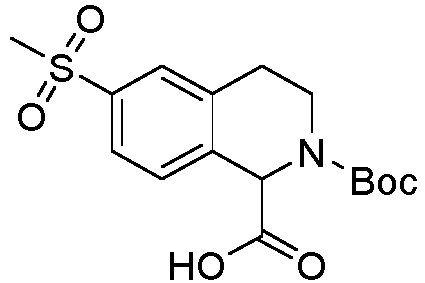
- 2-(tert-Butyl) 1-ethyl 6-(methylsulfonyl)-3,4-dihydroisoquinoline-1,2(1H)-dicarboxylate (1.38 g, 3.60 mmol) was dissolved in methanol (20 mL), 1 mol/L aqueous sodium hydroxide solution (10.8 mL, 10.8 mmol) was added dropwise to the reaction solution at room temperature. After the addition was completed, the reaction solution was further stirred at room temperature for 2 hours, and LC-MS monitored the completion of the reaction. The reaction solution was poured into ice water (30 mL) and adjusted to around pH 3 with 1 mol/L dilute hydrochloric acid, extracted with EA (20 mL×2), the organic phases were combined, dried with anhydrous sodium sulfate, filtered, and the filtrate was concentrated under reduced pressure to obtain the target compound (1.12 g, 87.6% yield, yellow solid). LC-MS (ESI) m/z: 709.1 [2M-H]-.
-

- 2-(tert-Butoxycarbonyl)-6-(methylsulfonyl)-1,2,3,4-tetrahydroisoquinoline-1-carboxylic acid (300 mg, 0.844 mmol) and 2-(4-aminophenyl)-1,1,1,3,3,3-hexafluoropropan-2-ol (219 mg, 0.844 mmol) were dissolved in dry DCM (5 mL). At room temperature, a solution of 50% 1-propylphosphonic anhydride in ethyl acetate (1.07 g, 1.69 mmol) and DIEA (0.419 mL, 2.53 mmol) were added dropwise to the reaction solution. After the addition was completed, the reaction mixture was stirred at room temperature overnight. The reaction solution was poured into saturated sodium bicarbonate (20 mL), extracted with DCM (15 mL×2), the organic phases were combined, washed with saturated brine (30 mL), dried over anhydrous sodium sulfate and filtered, and the filtrate was concentrated under reduced pressure to obtain the target compound (550 mg, crude, light brown solid). LC-MS (ESI) m/z: 595.1 [M-H]-.
-

- tert-Butyl 1-((4-(1,1,1,3,3,3-hexafluoro-2-hydroxypropan-2-yl)phenyl)carbamoyl)-6-(methylsulfonyl)-3,4-dihydroisoquinoline-2(1H)-carboxylate (550 mg, 0.922 mmol) was dissolved in DCM (6 mL). Under an ice bath, a solution of hydrochloric acid in dioxane (3 mL, 6 mol/L) was added dropwise to the reaction solution. After the addition was completed, the ice bath was removed, the reaction mixture was further stirred at room temperature for 2 hours, and LC-MS monitored the completion of the reaction. The reaction solution was concentrated under reduced pressure to obtain the target compound (550 mg, crude, brown solid). LC-MS (ESI) m/z: 497.0 [M+H]+.
-

- N-(4-(1,1,1,3,3,3-hexafluoro-2-hydroxypropan-2-yl)phenyl)-6-(methylsulfonyl)-1,2,3,4-tetrahydroisoquinoline-1-carboxamide hydrochloride (550 mg, 1.11 mmol) was dissolved in dry DCM (6 mL). At room temperature, DIEA (0.549 mL, 3.32 mmol) and acetyl chloride (0.198 mL, 2.77 mmol) were sequentially added dropwise to the reaction solution. After the addition was completed, the reaction solution was further stirred at room temperature for 30 minutes, and LC-MS monitored the completion of the reaction. The reaction solution was directly concentrated and dissolved in methanol (6 mL), and 1 mol/L aqueous sodium hydroxide solution (3 mL) was added dropwise to the reaction solution at room temperature. After the addition was completed, the reaction was further stirred at room temperature for 30 minutes, and LC-MS monitored the completion of the reaction. The reaction solution was poured into water (20 mL), extracted with EA (15 mL×2), the organic phases were combined, washed with saturated ammonium chloride (20 mL), dried over anhydrous sodium sulfate and filtered, and the filtrate was concentrated under reduced pressure to obtain the crude product, which was separated and purified by silica gel column (PE:EA=1:1-0:1) to obtain the target compound (120 mg, 26.4% yield in three steps, white solid). LC-MS (ESI) m/z: 539.0 [M+H]+. 1H NMR (400 MHz, CDCl3) δ 9.36 (s, 1H), 7.98 - 7.75 (m, 2H), 7.62-7.56 (m, 4H), 7.46 (d, J = 8.3 Hz, 1H), 6.19 (s, 1H), 3.86 (s, 1H), 3.83-3.77 (m, 2H), 3.24 - 3.11 (m, 1H), 3.06 (s, 3H), 3.04 - 2.98 (m, 1H), 2.29 (s, 3H).
-

-

- 2-(Thiophen-3-yl)acetonitrile (4.63 mL, 40.6 mmol) was dissolved in dry tetrahydrofuran (60 mL). At room temperature, the borane in tetrahydrofuran (30.4 mL, 60.9 mmol, 2 mol/L) was added dropwise to the reaction solution. After the addition was completed, the reaction mixture was stirred at 60°C overnight. The reaction solution was poured into 1 mol/L ice dilute hydrochloric acid (100 mL), extracted with EA (30 mL×3), the organic phases were combined, washed with saturated brine (60 mL), dried over anhydrous sodium sulfate, filtered, the filtrate was concentrated under reduced pressure to obtain crude product. The crude product was dissolved in methyl tert-butyl ether (20 mL), and added dropwise with 6 mol/L hydrochloric acid in dioxane until a white solid precipitated, filtered, and the filter cake was dried with an oil pump to obtain the target compound (4.80 g, 72.2% yield, white solid). LC-MS (ESI) m/z: 128.1 [M+H]+.
-

- 2-(Thiophen-3-yl)ethan-1-amine hydrochloride (2.80 g, 22.0 mmol) was dissolved in ethanol (30 mL). At room temperature, a solution of ethyl glyoxylate (4.94 g, 24.2 mmol, 50% in toluene) was added dropwise to the reaction solution. After the addition was completed, the reaction mixture was stirred at 100°C overnight, and LC-MS monitored the completion of the reaction. The reaction solution was concentrated under reduced pressure to obtain the target compound (3.2 g, crude, brown oil). LC-MS (ESI) m/z: 212.0 [M+H]+.
-

- Ethyl 4,5,6,7-tetrahydrothieno[2,3-c]pyridine-7-carboxylate (1.00 g, 4.73 mmol) was dissolved in dry DCM (20 mL). At room temperature, DIEA (1.96 mL, 11.8 mmol) and acetyl chloride (0.507 mL, 7.10 mmol) were sequentially added dropwise to the reaction solution. After the addition was completed, the reaction solution was further stirred at room temperature for 1 hour, and LC-MS monitored the completion of the reaction. The reaction solution was directly concentrated to obtain the crude product, which was separated and purified by silica gel column (PE:EA=10:1-5:1) to obtain the target compound (571 mg, 32.8% yield in two steps, light brown oil). LC-MS (ESI) m/z: 254.0 [M+H]+.
-

- Ethyl 6-acetyl-4,5,6,7-tetrahydrothieno[2,3-c]pyridine-7-carboxylate (571 mg, 2.25 mmol) was dissolved in DCM (10 mL). Under an ice bath, N-bromosuccinimide (602 mg, 3.381 mmol) was slowly added to the reaction solution. After the addition was completed, the ice bath was removed, the reaction mixture was further stirred at room temperature for 2 hours, and LC-MS monitored the completion of the reaction. The reaction solution was concentrated under reduced pressure to obtain the crude product, which was separated and purified by silica gel column (PE: EA=10:1-5:1) to obtain the target compound (631 mg, 84.3% yield, yellow oil). LC-MS (ESI) m/z: 331.9 [M+H]+.
-

- Ethyl 6-acetyl-2-bromo-4,5,6,7-tetrahydrothieno[2,3-c]pyridine-7-carboxylate (631 mg, 1.90 mmol), Pd2(dba)3 (174 mg, 0.190 mmol), 4,5-bis(diphenylphosphino)-9,9-dimethylxanthene (220 mg, 0.380 mmol), DIEA (0.628 mL, 3.80 mmol), ethanethiol (0.284 mL, 3.80 mmol) and 1,4-dioxane (8 mL) were sequentially added to the sealed tube. Nitrogen was blown into the sealed tube, and the tube was quickly sealed. The reaction mixture was stirred at 100°C overnight, and LC-MS monitored the completion of the reaction. The reaction solution was cooled to room temperature, filtered, and the filtrate was concentrated under reduced pressure to obtain the crude product, which was separated and purified by silica gel column (PE:EA=4:1-2:1) to obtain the target compound (570 mg, 95.7% yield, brown oil). LC-MS (ESI) m/z: 314.0 [M+H]+.
-

- Ethyl 6-acetyl-2-(ethylthio)-4,5,6,7-tetrahydrothieno[2,3-c]pyridine-7-carboxylate (210 mg, 0.670 mmol) was dissolved in DCM (5 mL). Under an ice bath, m-chloroperoxybenzoic acid (272 mg, 1.34 mmol, 85%) was slowly added to the reaction solution. After the addition was completed, the ice bath was removed, the reaction mixture was stirred at room temperature for 2 hours, and LC-MS monitored the completion of the reaction. The reaction solution was filtered, and the filtrate was washed with saturated sodium bicarbonate (20 mL) and saturated brine (20 mL), dried over anhydrous sodium sulfate, filtered, and the filtrate was concentrated under reduced pressure to obtain the crude product, which was separated and purified by silica gel column (PE: EA=5:1-1:1) to obtain the target compound (89.0 mg, 38.5% yield, yellow oil). LC-MS (ESI) m/z: 346.0 [M+H]+.
-

- Ethyl 6-acetyl-2-(ethylsulfonyl)-4,5,6,7-tetrahydrothieno[2,3-c]pyridine-7-carboxylate (89.0 mg, 0.258 mmol) was dissolved in methanol (3 mL), 1 mol/L aqueous sodium hydroxide solution (0.773 mL) was added dropwise to the reaction solution at room temperature. After the addition was completed, the reaction solution was further stirred at room temperature for 2 hours, and LC-MS monitored the competion of the reaction. The reaction solution was poured into ice water (20 mL), adjusted to around pH 3 with 1 mol/L dilute hydrochloric acid, extracted with EA (10 mL×2), the organic phases were combined, dried over anhydrous sodium sulfate, filtered, and the filtrate was concentrated under reduced pressure to obtain the target compound (80.0 mg, 97.8% yield, yellow solid). LC-MS (ESI) m/z: 318.0 [M+H]+.
-

- 6-Acetyl-2-(ethylsulfonyl)-4,5,6,7-tetrahydrothieno[2,3-c]pyridine-7-carboxylic acid (40.0 mg, 0.126 mmol) and 2-( 4-aminophenyl)-1,1,1,3,3,3-hexafluoropropan-2-ol (32.7 mg, 0.126 mmol) were dissolved in dry DCM (3 mL). At room temperature, a solution of 1-propylphosphonic anhydride in ethyl acetate (160 mg, 0.252 mmol, 50%) and DIEA (0.063 mL, 0.378 mmol) were sequentially added dropwise to the reaction solution. After the addition was completed, the reaction mixture was stirred at room temperature overnight. The reaction solution was poured into water (20 mL), extracted with DCM (15 mL×2), the organic phases were combined, washed sequentially with saturated ammonium chloride (20 mL), saturated sodium bicarbonate (20 mL) and saturated brine (20 mL), dried over anhydrous sodium sulfate, filtered, and the filtrate was concentrated under reduced pressure to obtain the crude product, which was separated and purified by silica gel column (PE:EA=2:1-0:1) to obtain the target compound (10.0 mg, 14.2% yield, white solid). 1H NMR (400 MHz, CDCl3) δ 9.05 (s, 1H), 7.63 (d, J = 8.5 Hz, 2H), 7.57 (d, J = 8.6 Hz, 2H), 7.43 (s, 1H), 6.26 (s, 1H), 4.09 - 4.00 (m, 2H), 3.71 - 3.59 (m, 1H), 3.21 (q, J = 7.4 Hz, 2H), 2.91 - 2.83 (m, 2H), 2.31 (s, 3H), 1.36 (t, J = 7.4 Hz, 3H). LC-MS (ESI) m/z: 559.0 [M+H]+.
-

-

- Aniline (1.00 g, 10.7 mmol), heptafluoro-2-iodopropane (1.82 mL, 12.9 mmol), sodium hydrosulfite (2.24 g, 12.9 mmol), tetrabutylammonium hydrogen sulfate (4.38 g, 12.9 mmol) and sodium bicarbonate (1.08 g, 12.9 mmol) were sequentially added to a mixed solvent of water (20 mL) and methyl tert-butyl ether (20 mL). After the addition was completed, the reaction mixture was stirred at room temperature overnight, TLC monitored the completion of the reaction. The reaction solution was poured into water (20 mL), extracted with methyl tert-butyl ether (20 mL×2), the organic phases were combined, washed with saturated brine (30 mL), dried over anhydrous sodium sulfate, filtered, and the filtrate was concentrated under reduced pressure to obtain the target compound (1.40 g, 49.9% yield, brown oil). 1H NMR (400 MHz, DMSO-d 6 ) δ 7.20 (d, J = 8.3 Hz, 2H), 6.66 (d, J = 8.5 Hz, 2H), 5.71 (s, 2H).
-

- 2-(tert-Butoxycarbonyl)-6-(ethylsulfonyl)-1,2,3,4-tetrahydroisoquinoline-1-carboxylic acid (100 mg, 0.271 mmol) and 4-(perfluoropropan-2-yl)aniline (70.7 mg, 0.271 mmol) were dissolved in dry DCM (5 mL). At room temperature, a solution of 1-propylphosphonic anhydride in ethyl acetate (345 mg, 0.541 mmol, 50%) and DIEA (0.134 mL, 0.812 mmol) were sequentially added to the reaction. After the addition was completed, the reaction mixture was stirred at room temperature overnight, and LC-MS monitored the completion of the reaction. The reaction solution was poured into water (20 mL), extracted with DCM (15 mL×2), and the organic phases were combined, sequentially washed with saturated ammonium chloride (20 mL), saturated sodium bicarbonate (20 mL) and saturated brine (20 mL), dried over anhydrous sodium sulfate and filtered, and the filtrate was concentrated under reduced pressure to obtain the target compound (200 mg, crude, brown oil). LC-MS (ESI) m/z: 611.2 [M-H]-.
-

- tert-Butyl 6-(ethylsulfonyl)-1-((4-(perfluoropropan-2-yl)phenyl)carbamoyl)-3,4-dihydroisoquinoline-2(1H)-carboxylate (200 mg) was dissolved in DCM (2 mL). Under an ice bath, a solution of hydrochloric acid in dioxane (1 mL, 6 mol/L) was added dropwise to the reaction solution. After the addition was completed, the ice bath was removed and the reaction mixture was further stirred at room temperature for 2 hours. The reaction solution was concentrated under reduced pressure to obtain the target compound (200 mg, crude, brown oil). LC-MS (ESI) m/z: 513.0 [M+H]+.
-

- 6-(Ethylsulfonyl)-N-(4-(perfluoropropan-2-yl)phenyl)-1,2,3,4-tetrahydroisoquinoline-1-carboxamide hydrochloride ( 200 mg, 0.390 mmol) was dissolved in dry DCM (3 mL). At room temperature, DIEA (0.129 mL, 0.781 mmol) and acetyl chloride (0.042 mL, 0.586 mmol) were sequentially added dropwise to the reaction solution. After the addition was completed, the reaction solution was further stirred at room temperature for 30 minutes. LC-MS monitored the completion of the reaction. The reaction solution was poured into saturated sodium bicarbonate (20 mL), extracted with DCM (10 mL×2), the organic phases were combined, washed with saturated ammonium chloride (20 mL), dried over anhydrous sodium sulfate and filtered, and the filtrate was concentrated under reduced pressure to obtain the crude product, which was separated and purified by silica gel column (PE:EA=2:1-0:1), and then separated and purified by reversed-phase column (acetonitrile:water=7:3) to obtain the target compound (15.0 mg, 10.0% yield in three steps, white solid). LC-MS (ESI) m/z: 555.0 [M+H]+. 1H NMR (400 MHz, CDCl3) δ 9.55 (s, 1H), 7.82 - 7.78 (m, 2H), 7.62 (d, J = 8.8 Hz, 2H), 7.52 - 7.46 (m, 3H), 6.20 (s, 1H), 3.86-3.80 (m, 2H), 3.25 - 3.00 (m, 4H), 2.31 (s, 3H), 1.31 (t, J = 7.4 Hz, 3H).
-

- Racemate 2-acetyl-6-(ethylsulfonyl)-N-(4-(perfluoropropan-2-yl)phenyl)-1,2,3,4-tetrahydroisoquinoline-1-carboxamide (50.0 mg dissolved in approximately 25.0 mL methanol, 6.0 mL injection volume) was resolved by a Waters SFC 150 (room temperature, 100 bar, 214 nm) and 250*25mm 10µm Dr.maish Reprosil Chiral-OM (Similar to DAICELCHIRALCEL®OD) (supercritical carbon dioxide: methanol, 70:30, 3.5 min, 70 mL/min) to give (R)-2-acetyl-6-(ethylsulfonyl)-N-(4-(perfluoropropan-2-yl)phenyl)-1,2,3,4-tetrahydroisoquinoline-1-carboxamide or (S)-2-acetyl-6-(ethylsulfonyl)-N-(4-(perfluoropropan-2-yl)phenyl)-1,2,3,4-tetrahydroisoquinoline-1-carboxamide (15.46 mg, white solid, Ret.time = 3.091 min, e.e. 100.00% ). LC-MS (ESI) m/z: 555.3 [M+H]+. 1H NMR (400 MHz, DMSO-d6 ) δ 10.93 (s, 1H), 7.86 - 7.74 (m, 5H), 7.61 (d, J = 8.5 Hz, 2H), 5.93 (s, 1H), 4.11 - 4.04 (m, 1H), 3.73 - 3.65 (m, 1H), 3.30 - 3.19 (m, 3H), 3.08 - 3.01 (m, 1H), 2.20 - 2.12 (m, 3H), 1.09 (t, J = 7.3 Hz, 3H).
(S)-2-acetyl-6-(ethylsulfonyl)-N-(4-(perfluoropropan-2-yl)phenyl)-1,2,3,4-tetrahydroisoquinoline-1-carboxamide or (R)-2-acetyl-6-(ethylsulfonyl)-N-(4-(perfluoropropan-2-yl)phenyl)-1,2,3,4-tetrahydroisoquinoline-1-carboxamide (17.39 mg, white solid, Ret.time = 3.682 min, e.e. 98.90%). LC-MS (ESI) m/z: 555.3 [M+H]+. 1H NMR (400 MHz, DMSO-d6 ) δ 10.93 (s, 1H), 7.87 - 7.74 (m, 5H), 7.61 (d, J = 8.3 Hz, 2H), 5.93 (s, 1H), 4.11 - 4.03 (m, 1H), 3.73 - 3.65 (m, 1H), 3.30 - 3.19 (m, 3H), 3.09 - 3.00 (m, 1H), 2.20 - 2.12 (m, 3H), 1.09 (t, J = 7.3 Hz, 3H). -

-

- 2-Fluoroaniline (3.00 g, 27.0 mmol), hexafluoroacetone trihydrate (6.54 g, 29.7 mmol) and p-toluenesulfonic acid (465 mg, 2.70 mmol) were added to a sealed tube. After the addition was completed, the reaction mixture was stirred at 90°C for 5 days. After the reaction solution was cooled to room temperature, it was poured into water (50 mL), extracted with EA (30 mL), washed with saturated sodium bicarbonate (30 mL) and saturated brine (30 mL), and dried over anhydrous sodium sulfate and filtered, and the filtrate was concentrated under reduced pressure to obtain the crude product, which was separated and purified by silica gel column (PE:EA=10:1-2:1) to obtain the target compound (2.32 g, 31.0% yield, colorless oil). LC-MS (ESI) m/z: 276.1 [M-H]-.
-

- 2-(tert-Butoxycarbonyl)-6-(ethylsulfonyl)-1,2,3,4-tetrahydroisoquinoline-1-carboxylic acid (80.0 mg, 0.217 mmol) and 2-(4-amino-3-fluorophenyl)-1,1,1,3,3,3-hexafluoropropan-2-ol (60.0 mg, 0.217 mmol) were dissolved in dry DCM (3 mL). HATU (123 mg, 0.325 mmol) and DIEA (0.107 mL, 0.650 mmol) were sequentially added to the reaction solution at room temperature. After the addition was completed, the reaction mixture was stirred at room temperature overnight. The reaction solution was poured into water (20 mL), extracted with DCM (15 mL×2), the organic phases were combined, washed with saturated sodium bicarbonate (20 mL) and saturated brine (20 mL), dried over anhydrous sodium sulfate and filtered, and the filtrate was concentrated under reduced pressure to gave the target compound (130 mg, crude, brown oil). LC-MS (ESI) m/z: 627.2 [M-H]-.
-

- tert-Butyl 6-(ethylsulfonyl)-1-((2-fluoro-4-(1,1,1,3,3,3-hexafluoro-2-hydroxypropan-2-yl)phenyl)carbamoyl)-3,4-dihydroisoquinoline-2(1H)-carboxylate (130 mg) was dissolved in DCM (2 mL). Under an ice bath, a solution of hydrochloric acid in dioxane (1 mL, 6 mol/L) was added dropwise to the reaction solution. After the addition was completed, the ice bath was removed, the reaction mixture was further stirred at room temperature for 2 hours, and LC-MS monitored the completion of the reaction. The reaction solution was concentrated under reduced pressure to obtain the target compound (120 mg, crude, brown liquid).
-

- 6-(Ethylsulfonyl)-N-(2-fluoro-4-(1,1,1,3,3,3-hexafluoro-2-hydroxypropan-2-yl)phenyl)-1,2,3,4-tetrahydroisoquinoline-1-carboxamide hydrochloride (120 mg, 0.227 mmol) was dissolved in dry DCM (5 mL). At room temperature, DIEA (0.113 mL, 0.681 mmol) and acetyl chloride (0.041 mL, 0.568 mmol) were sequentially added dropwise to the reaction solution. After the addition was completed, the reaction solution was further stirred at room temperature for 30 minutes, and LC-MS monitored the completion of the reaction. The reaction solution was directly concentrated and dissolved in methanol (6 mL), and 1 mol/L aqueous sodium hydroxide solution (3 mL) was added dropwise to the reaction solution at room temperature. After the addition was completed, the reaction was further stirred at room temperature for 30 minutes, and LC-MS monitored the completion of the reaction. The reaction solution was poured into water (20 mL), extracted with EA (15 mL×2), the organic phases were combined, washed with saturated ammonium chloride (20 mL), dried over anhydrous sodium sulfate, filtered, and the filtrate was concentrated under reduced pressure to obtain the crude product, which was separated and purified by silica gel column (PE:EA=1:1-0:1) to obtain the target compound (12.6 mg, 10.2% yield in three steps, white solid). LC-MS (ESI) m/z: 571.0 [M+H]+.1H NMR (400 MHz, CDCl3) δ 9.35 (s, 1H), 8.32 (t, J = 8.4 Hz, 1H), 7.85 - 7.77 (m, 2H), 7.51 (d, J = 12.7 Hz, 1H), 7.47 - 7.39 (m, 2H), 6.24 (s, 1H), 4.08 - 3.97 (m, 1H), 3.89 - 3.71 (m, 2H), 3.20 - 3.01 (m, 4H), 2.29 (s, 3H), 1.32 (t, J = 7.5 Hz, 3H).
-

-

- 2-(tert-Butoxycarbonyl)-6-(methylsulfonyl)-1,2,3,4-tetrahydroisoquinoline-1-carboxylic acid (80.0 mg, 0.225 mmol) and 2-(4-amino-3-fluorophenyl)-1,1,1,3,3,3-hexafluoropropan-2-ol (62.4 mg, 0.225 mmol) was dissolved in dry DCM (3 mL). HATU (128 mg, 0.338 mmol) and DIEA (0.112 mL, 0.675 mmol) were sequentially added to the reaction solution at room temperature. After the addition was completed, the reaction mixture was stirred at room temperature overnight. The reaction solution was poured into water (20 mL), extracted with DCM (15 mL×2), the organic phases were combined, washed with saturated sodium bicarbonate (20 mL) and saturated brine (20 mL), dried over anhydrous sodium sulfate and filtered, the filtrate was concentrated under reduced pressure to obtain the target compound (130 mg, crude, brown oil). LC-MS (ESI) m/z: 613.2 [M-H]-.
-

- tert-Butyl 1-((2-fluoro-4-(1,1,1,3,3,3-hexafluoro-2-hydroxypropan-2-yl)phenyl)carbamoyl)-6-(methylsulfonyl)-3,4-dihydroisoquinoline-2(1H)-carboxylate (130 mg) was dissolved in DCM (2 mL). Under an ice bath, a solution of hydrochloric acid in dioxane (1 mL, 6 mol/L) was added dropwise to the reaction solution. After the addition was completed, the ice bath was removed, the reaction mixture was further stirred at room temperature for 2 hours, and LC-MS monitored the completion of the reaction. The reaction solution was concentrated under reduced pressure to obtain the target compound (120 mg, crude, yellow solid). LC-MS (ESI) m/z: 515.0 [M+H]+.
-

- N-(2-fluoro-4-(1,1,1,3,3,3-hexafluoro-2-hydroxypropan-2-yl)phenyl)-6-(methylsulfonyl)-1,2,3,4-tetrahydroisoquinoline-1-carboxamide hydrochloride (120 mg, 0.233 mmol) was dissolved in dry DCM (3 mL). At room temperature, DIEA (0.116 mL, 0.670 mmol) and acetyl chloride (0.042 mL, 0.583 mmol) were sequentially added dropwise to the reaction solution. After the addition was completed, the reaction solution was further stirred at room temperature for 30 minutes, and LCMS monitored the completion of the reaction. The reaction solution was directly concentrated and dissolved in methanol (6 mL), and 1 mol/L aqueous sodium hydroxide solution (3 mL) was added dropwise to the reaction solution at room temperature. After the addition was completed, the reaction was further stirred at room temperature for 30 minutes, and LC-MS monitored the completion of the reaction. The reaction solution was poured into water (20 mL), extracted with EA (15 mL×2), the organic phases were combined, washed with saturated ammonium chloride (20 mL), dried over anhydrous sodium sulfate and filtered, and the filtrate was concentrated under reduced pressure to obtain crude product, which was separated and purificated by silica gel column (PE:EA=1:1-0:1) to obtain the target compound (16.1 mg, 12.9% yield in three steps, white solid). LC-MS (ESI) m/z: 557.0 [M+H]+. 1H NMR (400 MHz, CDCl3) δ 9.38 (s, 1H), 8.33 (t, J = 8.4 Hz, 1H), 7.88 - 7.83 (m, 2H), 7.51 (d, J = 11.8 Hz, 1H), 7.46 - 7.41 (m, 2H), 6.25 (s, 1H), 3.89 - 3.80 (m, 2H), 3.80 - 3.71 (m, 1H), 3.20 - 3.00 (m, 5H), 2.30 (s, 3H).
-

-

- 2-(tert-Butoxycarbonyl)-6-(ethylsulfonyl)-1,2,3,4-tetrahydroisoquinoline-1-carboxylic acid (70.0 mg, 0.190 mmol) and 4-(trifluoromethoxy)aniline (33.6 mg, 0.190 mmol) were dissolved in dry DCM (3 mL). HATU (108 mg, 0.284 mmol) and DIEA (0.094 mL, 0.569 mmol) were sequentially added to the reaction at room temperature. After the addition was completed, the reaction mixture was stirred at room temperature overnight, and LC-MS monitored the completion of the reaction. The reaction solution was poured into water (20 mL), extracted with DCM (15 mL×2), and the organic phases were combined, washed sequentially with saturated ammonium chloride (20 mL), saturated sodium bicarbonate (20 mL) and saturated brine (20 mL), dried over anhydrous sodium sulfate and filtered, and the filtrate was concentrated under reduced pressure to obtain the target compound (110 mg, crude, brown oil). LC-MS (ESI) m/z: 527.2 [M-H]-.
-

- tert-Butyl 6-(ethylsulfonyl)-1-((4-(trifluoromethoxy)phenyl)carbamoyl)-3,4-dihydroisoquinoline-2(1H)-carboxylate (110 mg) was dissolved in DCM (2 mL). Under an ice bath, a solution of hydrochloric acid in dioxane (1 mL, 6 mol/L) was added dropwise to the reaction solution. After the addition was completed, the ice bath was removed and the reaction mixture was further stirred at room temperature for 2 hours. The reaction solution was concentrated under reduced pressure to obtain the target compound (100 mg, crude, brown oil). LC-MS (ESI) m/z: 429.0 [M+H]+.
-

- 6-(Ethylsulfonyl)-N-(4-(trifluoromethoxy)phenyl)-1,2,3,4-tetrahydroisoquinoline-1-carboxamide hydrochloride (100 mg , 0.233 mmol) was dissolved in dry DCM (3 mL). At room temperature, DIEA (0.077 mL, 0.467 mmol) and acetyl chloride (0.025 mL, 0.350 mmol) were sequentially added dropwise to the reaction solution. After the addition was completed, the reaction solution was further stirred at room temperature for 30 minutes. LC-MS monitored the completion of the reaction. The reaction solution was poured into saturated sodium bicarbonate (20 mL), extracted with DCM (10 mL×2), the organic phases were combined, washed with saturated ammonium chloride (20 mL), dried over anhydrous sodium sulfate and filtered, and the filtrate was concentrated under reduce pressure to obtain crude product, which was separated and purified by silica gel column (PE:EA=2:1-0:1) to obtain the target compound (26.0 mg, 29.1% yield in three steps, white solid). LC-MS (ESI) m/z: 471.0 [M+H]+. 1H NMR (400 MHz, CDCl3) δ 9.42 (s, 1H), 7.82 - 7.77 (m, 2H), 7.53 - 7.47 (m, 3H), 7.10 (d, J = 8.8 Hz, 2H), 6.18 (s, 1H), 3.87 - 3.78 (m, 2H), 3.26 - 3.16 (m, 1H), 3.13 (q, J = 7.5 Hz, 2H), 3.08 - 3.00 (m, 1H), 2.31 (s, 3H), 1.31 (t, J = 7.4 Hz, 3H).
-

- 6-(Ethylsulfonyl)-N-(4-(1,1,1,3,3,3-hexafluoro-2-hydroxypropan-2-yl)phenyl)-1,2,3,4-tetrahydroisoquinoline-1-carboxamide hydrochloride (200 mg, 0.392 mmol) was dissolved in dry DCM (3 mL). At room temperature, triethylamine (0.163 mL, 1.18 mmol) and propionyl chloride (0.086 mL, 0.980 mmol) were sequentially added dropwise to the reaction solution. After the addition was completed, the reaction solution was further stirred at room temperature for 30 minutes, and LC-MS monitored the completion of the reaction. The reaction solution was directly concentrated and dissolved in methanol (3 mL), and 1 mol/L aqueous sodium hydroxide solution (2 mL) was added dropwise to the reaction solution at room temperature. After the addition was completed, the reaction was further stirred at room temperature for 30 minutes, and LC-MS monitored the completion of the reaction. The reaction solution was poured into water (20 mL), extracted with EA (15 mL×2), the organic phases were combined, washed with saturated ammonium chloride (20 mL), dried over anhydrous sodium sulfate and filtered, and the filtrate was concentrated under reduced pressure to obtain the crude product, which was separated and purified by silica gel column (PE:EA=1:1-0:1) and then by reversed-phase column (acetonitrile:water=7:3) to obtain the target compound (15.0mg, 14.7% yield in three steps, white solid). LC-MS (ESI) m/z: 567.1 [M+H]+. 1H NMR (600 MHz, CDCl3) δ 9.40 (s, 1H), 7.83 - 7.76 (m, 2H), 7.64 - 7.57 (m, 4H), 7.48 (d, 1H), 6.21 (s, 1H), 3.87 - 3.81 (m, 1H), 3.80 - 3.74 (m, 1H), 3.19 - 3.10 (m, 3H), 3.07 - 3.00 (m, 1H), 2.61 - 2.48 (m, 2H), 1.32 (t, J = 7.4 Hz, 3H), 1.26 (t, 3H).
-

- 6-(Ethylsulfonyl)-N-(4-(1,1,1,3,3,3-hexafluoro-2-hydroxypropan-2-yl)phenyl)-1,2,3,4-tetrahydroisoquinoline-1-carboxamide hydrochloride (200 mg, 0.392 mmol) was dissolved in dry DCM (3 mL). At room temperature, triethylamine (0.163 mL, 1.18 mmol) and cyclopropylcarbonyl chloride (0.089 mL, 0.980 mmol) were sequentially added dropwise to the reaction solution. After the addition was completed, the reaction solution was further stirred at room temperature for 30 minutes, and LC-MS monitored the completion of the reaction. The reaction solution was directly concentrated and dissolved in methanol (3 mL), and 1 mol/L aqueous sodium hydroxide solution (2 mL) was added dropwise to the reaction solution at room temperature. After the addition was completed, the reaction was further stirred at room temperature for 30 minutes, and LC-MS monitored the completion of the reaction. The reaction solution was poured into water (20 mL), extracted with EA (15 mL×2), the organic phases were combined, washed with saturated ammonium chloride (20 mL), dried over anhydrous sodium sulfate and filtered, and the filtrate was concentrated under reduced pressure to obtain the crude product, which was separated and purified by silica gel column (PE:EA=1:1-0:1) and then by reversed-phase column (acetonitrile:water=7:3) to obtain the target compound (40.0 mg, 38.4% yield in three steps, white solid). LC-MS (ESI) m/z: 579.1 [M+H]+. 1H NMR (400 MHz, CDCl3) δ 9.65 (s, 1H), 7.85 - 7.80 (m, 2H), 7.63 - 7.57 (m, 2H), 7.56 - 7.50 (m, 3H), 6.20 (s, 1H), 4.17 - 3.96 (m, 3H), 3.31 - 3.22 (m, 1H), 3.20 - 3.06 (m, 3H), 1.97 - 1.88 (m, 1H), 1.34 (t, J= 7.4 Hz, 3H), 1.12 - 0.93 (m, 4H).
-

- 6-(Ethylsulfonyl)-N-(4-(1,1,1,3,3,3-hexafluoro-2-hydroxypropan-2-yl)phenyl)-1,2,3,4-tetrahydroisoquinoline-1-carboxamide hydrochloride (200 mg, 0.392 mmol) was dissolved in dry DCM (3 mL). At room temperature, triethylamine (0.163 mL, 1.18 mmol) and methylcarbamoyl chloride (91.6 mg, 0.980 mmol) were sequentially added dropwise to the reaction solution. After the addition was completed, the reaction solution was further stirred at room temperature for 30 minutes, and LC-MS monitored the completion of the reaction. The reaction solution was poured into water (20 mL), extracted with DCM (15 mL×2), the organic phases were combined, washed successively with saturated sodium bicarbonate (20 mL) and saturated ammonium chloride (20 mL), dried over anhydrous sodium sulfate and filtered, and the filtrate was concentrated under reduced pressure to obtain crude product, which was separated and purified by silica gel column (PE:EA=1:1-0:1) and by reversed-phase column (acetonitrile:water=7:3) to obtain the target compound (30.0 mg, 29.3% yield in three steps, white solid). LC-MS (ESI) m/z: 568.0 [M+H]+. 1H NMR (400 MHz, DMSO-d 6) δ 10.64 (s, 1H), 8.64 (s, 1H), 7.84 - 7.65 (m, 5H), 7.58 (d, J = 8.5 Hz, 2H), 6.71 - 6.63 (m, 1H), 5.81 (s, 1H), 3.88 - 3.78 (m, 1H), 3.57 - 3.47 (m, 1H), 3.29 - 3.21 (m, 2H), 3.20 - 3.11 (m, 1H), 3.03 - 2.91 (m, 1H), 2.61 (d, J = 4.0 Hz, 3H), 1.07 (t, J = 7.3 Hz, 3H).
-

-

- N-(4-(1,1,1,3,3,3-hexafluoro-2-hydroxypropan-2-yl)phenyl)-6-(methylsulfonyl)-1,2,3,4-tetrahydroisoquinoline-1-carboxamide hydrochloride (50.0 mg, 0.101 mmol) was dissolved in dry DCM (3 mL). At room temperature, DIEA (0.050 mL, 0.302 mmol) and methyl 5-chloro-5-oxopentanoate (41.4 mg, 0.252 mmol) were sequentially added dropwise to the reaction solution. After the addition was completed, the reaction solution was further stirred at room temperature for 1 hour, and LC-MS monitored the completion of the reaction. The reaction solution was directly concentrated to obtain the target compound (100 mg, crude, brown oil). LC-MS (ESI) m/z: 625.0 [M+H]+.
-

- Methyl 5-(1-((4-(1,1,1,3,3,3-hexafluoro-2-hydroxypropan-2-yl)phenyl)carbamoyl)-6-(methylsulfonyl)-3,4-dihydroisoquinolin-2(1H)-yl)-5-oxopentanoate (100 mg) was dissolved in methanol (3 mL), and 1 mol/L aqueous sodium hydroxide solution (2 mL) was added dropwise to the reaction solution at room temperature. After the addition was completed, the reaction solution was further stirred at room temperature for 2 hours, and LC-MS monitored the completion of the reaction. The reaction solution was poured into ice water (20 mL), adjusted to around pH 3 with 1 mol/L dilute hydrochloric acid, extracted with EA (15 mL×2), the organic phases were combined, dried over anhydrous sodium sulfate and filtered, and the filtrate was concentrated under reduced pressure to obtain crude product, which was separated and purified by reversed-phase silica gel column (water:acetonitrile=2:3) to obtain the target compound (20.0 mg, 32.5% yield in two steps, white solid). LC-MS (ESI) m/z: 611.0 [M+H]+. 1H NMR (400 MHz, DMSO-d 6) δ 11.42,10.79 (s, 1H), 8.38 (s, 1H), 7.86 - 7.71 (m, 4H), 7.67 (d, J = 8.7 Hz, 2H), 7.57 (d, J = 8.3 Hz, 2H), 6.08,5.89 (s, 1H), 4.10 - 4.01 (m, 1H), 3.69 - 3.59 (m, 2H), 3.16 (s, 3H), 3.04 - 2.93 (m, 2H), 2.59 - 2.50 (m, 2H), 2.25 - 2.16 (m, 2H), 1.76 - 1.68 (m, 2H).
-

-

- 4-Bromo-3,5-dichloroaniline (700 mg, 2.91 mmol), 3,6-dihydro-2H-pyran-4-boronic acid pinacol ester (671 mg, 3.20 mmol), potassium carbonate (803 mg, 5.81 mmol) and dichloro[1,1'-bis(di-tert-butylphosphino)ferrocene palladium(II)] (94.7 mg, 0.145 mmol) were added to a mixed solvent of 1,4-dioxane (10 mL) and water (1 mL). Under nitrogen protection, the reaction mixture was stirred at 110°C for 1.5 hours, and LC-MS monitored the completion of the reaction. The reaction mixture was cooled to room temperature and filtered, and the filtrate was concentrated under reduced pressure to obtain crude product, which was separated and purified by silica gel column (PE:EA=20:1-5:1) to obtain the target compound (350 mg, 49.3% yield). LC-MS (ESI) m/z: 285.0[M+H+MeCN]+. 1H NMR (400 MHz, CDCl3) δ 6.62 (s, 2H), 5.61 (s, 1H), 4.30 (q, J = 5.3, 2.6 Hz, 2H), 3.91 (t, J = 5.4 Hz, 2H), 3.75 (s, 2H), 2.31 - 2.24 (m, 2H).
-

- 2-(tert-Butoxycarbonyl)-6-(methylsulfonyl)-1,2,3,4-tetrahydroisoquinoline-1-carboxylic acid (50.0 mg, 0.141 mmol) and 3,5-dichloro-4-(3,6-dihydro-2H-pyran-4-yl)aniline (34.3 mg, 0.141 mmol) was dissolved in dry DCM (3 mL). HATU (80.3 mg, 0.211 mmol) and DIEA (0.070 mL, 0.422 mmol) were sequentially added to the reaction at room temperature. After the addition was completed, the reaction mixture was stirred at room temperature overnight. LC-MS monitored the completion of the reaction. The reaction solution was poured into water (20 mL), extracted with DCM (15 mL×2), the organic phases were combined, washed with saturated ammonium chloride (20 mL), saturated sodium bicarbonate (20 mL) and saturated brine (30 mL), dried over anhydrous sodium sulfate and filtered, and the filtrate was concentrated under reduced pressure to obtain the target compound (100 mg, crude, brown oil). LC-MS (ESI) m/z: 579.1 [M-H]-.
-

- tert-Butyl 1-((3,5-dichloro-4-(3,6-dihydro-2H-pyran-4-yl)phenyl)carbamoyl)-6-(methylsulfonyl)-3,4-dihydroisoquinoline-2(1H)-carboxylate (100 mg) was dissolved in DCM (2 mL). Under an ice bath, a solution of 6 mol/L hydrochloric acid in dioxane (1 mL) was added dropwise to the reaction solution. After the addition was completed, the ice bath was removed and the reaction mixture was further stirred at room temperature for 2 hours. The reaction solution was concentrated under reduced pressure to obtain the target compound (90.0 mg, crude, brown oil). LC-MS (ESI) m/z: 480.9 [M+H]+.
-

- N-(3,5-dichloro-4-(3,6-dihydro-2H-pyran-4-yl)phenyl)-6-(methylsulfonyl)-1,2,3,4-tetrahydroisoquinoline-1-carboxamide hydrochloride (90.0 mg, 0.187 mmol) was dissolved in dry DCM (3 mL). At room temperature, DIEA (0.093 mL, 0.561 mmol) and acetyl chloride (0.027 mL, 0.374 mmol) were sequentially added dropwise to the reaction solution. After the addition was completed, the reaction solution was further stirred at room temperature for 30 minutes, and LC-MS monitored the completion of the reaction. The reaction solution was poured into water (20 mL), extracted with DCM (10 mL×2), the organic phases were combined, and then washed with saturated sodium bicarbonate (20 mL), saturated ammonium chloride (20 mL) and saturated brine (20 mL) successively, dried with anhydrous sodium sulfate and filtered, and the filtrate was concentrated under reduced pressure to obtain crude product, which was separated and purified by silica gel column (PE:EA=2:1-0:1) to obtain the target compound (20.0 mg, 27.2% yield in three steps, white solid). LC-MS (ESI) m/z: 523.0 [M+H]+. 1H NMR (400 MHz, CDCl3) δ 9.38 (s, 1H), 7.90 - 7.79 (m, 2H), 7.53 (s, 2H), 7.45 (d, J = 8.4 Hz, 1H), 6.14 (s, 1H), 5.61 (s, 1H), 4.33 - 4.26 (m, 2H), 3.91 (t, J = 5.0 Hz, 2H), 3.80 (t, J = 5.6 Hz, 2H), 3.23 - 3.10 (m, 1H), 3.06 (s, 3H), 3.05 - 2.99 (m, 1H), 2.30 (s, 3H), 2.28 - 2.24 (m, 2H).
-

-

- 2-(tert-Butoxycarbonyl)-6-(ethylsulfonyl)-1,2,3,4-tetrahydroisoquinoline-1-carboxylic acid (50.0 mg, 0.135 mmol) and 3,5-dichloro-4-(3,6-dihydro-2H-pyran-4-yl)aniline (33.0 mg, 0.135 mmol) were dissolved in dry DCM (3 mL). HATU (77.2 mg, 0.203 mmol) and DIEA (0.067 mL, 0.406 mmol) were sequentially added to the reaction solution at room temperature. After the addition was completed, the reaction mixture was stirred at room temperature overnight. LC-MS monitored the completion of the reaction. The reaction solution was poured into water (20 mL), extracted with DCM (15 mL×2), and the organic phases were combined, washed sequentially with saturated ammonium chloride (20 mL), saturated sodium bicarbonate (20 mL) and saturated brine (30 mL), dried over anhydrous sodium sulfate and filtered, and the filtrate was concentrated under reduced pressure to obtain the target compound (100 mg, crude, brown oil). LC-MS (ESI) m/z: 593.1 [M-H]-.
-
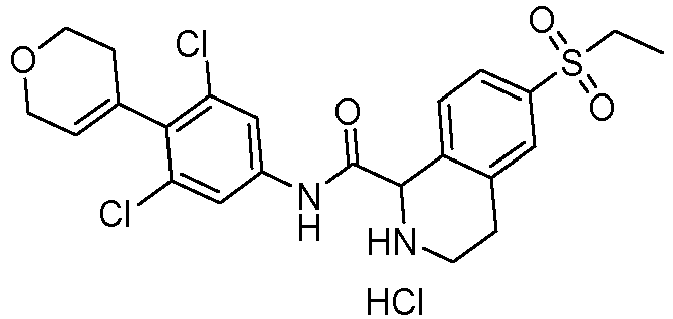
- tert-Butyl 1-((3,5-dichloro-4-(3,6-dihydro-2H-pyran-4-yl)phenyl)carbamoyl)-6-(ethylsulfonyl)-3,4-dihydroisoquinoline-2(1H)-carboxylate (100 mg, 0.168 mmol) was dissolved in DCM (2 mL). Under an ice bath, a solution of 6 mol/L hydrochloric acid in dioxane (1 mL) was added dropwise to the reaction solution. After the addition was completed, the ice bath was removed and the reaction mixture was further stirred at room temperature for 2 hours. The reaction solution was concentrated under reduced pressure to obtain the target compound (100 mg, crude, brown oil). LC-MS (ESI) m/z: 493.1 [M-H]-.
-

- N-(3,5-dichloro-4-(3,6-dihydro-2H-pyran-4-yl)phenyl)-6-(ethylsulfonyl)-1,2,3,4-tetrahydroisoquinoline-1-carboxamide hydrochloride (100 mg, 0.202 mmol) was dissolved in dry DCM (3 mL). At room temperature, DIEA (0.100 mL, 0.605 mmol) and acetyl chloride (0.029 mL, 0.404 mmol) were sequentially added dropwise to the reaction solution. After the addition was completed, the reaction solution was further stirred at room temperature for 30 minutes, and LC-MS monitored the completion of the reaction. The reaction solution was poured into water (20 mL), extracted with DCM (10 mL×2), the organic phases were combined, and then washed with saturated sodium bicarbonate (20 mL), saturated ammonium chloride (20 mL) and saturated brine (20 mL) sequentially, dried over anhydrous sodium sulfate and filtered, and the filtrate was concentrated under reduced pressure to obtain crude product, which was separated and purified by silica gel column (PE:EA=2:1-0:1) to obtain the target compound (30.0 mg, 41.5% yield in three-steps, white solid). LC-MS (ESI) m/z: 537.0 [M+H]+. 1H NMR (400 MHz, CDCl3) δ 9.51 (s, 1H), 7.84 - 7.74 (m, 2H), 7.54 - 7.43 (m, 3H), 6.14 (s, 1H), 5.60 (s, 1H), 4.36 - 4.22 (m, 2H), 3.90 (t, J = 5.0 Hz, 2H), 3.87 - 3.73 (m, 2H), 3.29 - 3.18 (m, 1H), 3.12 (q, J = 7.3 Hz, 2H), 3.07 - 2.97 (m, 1H), 2.32 (s, 3H), 2.27 - 2.21 (m, 2H), 1.30 (t, J = 7.4 Hz, 3H).
-

- 6-(Ethylsulfonyl)-N-(4-(1,1,1,3,3,3-hexafluoro-2-hydroxypropan-2-yl)phenyl)-1,2,3,4-tetrahydroisoquinoline-1-carboxamide (100 mg, 0.196 mmol) and formic acid (37.7 mg, 0.196 mmol) were dissolved in dry DCM (2 mL). At room temperature, 1-propylphosphonic anhydride (50% in EA) (93.5 mg, 0.294 mmol) and DIEA (50.6 mg, 0.392 mmol) were sequentially added dropwise to the reaction solution. After the addition was completed, the reaction mixture was stirred at room temperature overnight. The reaction solution was poured into saturated sodium bicarbonate (3 mL), extracted with DCM (4 mL×2), the organic phases were combined, washed with saturated brine, dried over anhydrous sodium sulfate and filtered, and the filtrate was concentrated under reduced pressure to obtain crude product, which was separated and purified by silica gel column (PE: EA=3:1-0:1) to obtain the target compound (21 mg, 19.9% yield, pale yellow solid). LC-MS(ESI)m/z: 537.1 [M-H]-. 1H NMR (400 MHz, DMSO-d 6) δ 10.95, 10.75 (s, 1H), 8.64 (s, 1H), 8.35, 8.30 (s, 1H), 7.82 - 7.68 (m, 5H), 7.62 (d, J = 8.2 Hz, 2H), 5.87, 5.74 (s, 1H), 4.07 - 3.96 (m, 1H), 3.87 - 3.77 (m, 1H), 3.28 - 3.22 (m, 2H), 3.19 - 3.08 (m, 1H), 3.06 - 2.95 (m, 1H), 1.08 (t, J = 7.0 Hz, 3H).
-

-

- 2-(tert-Butyl) 1-ethyl 6-(((trifluoromethyl)sulfonyl)oxy)-3,4-dihydroisoquinoline-1,2(1H)-dicarboxylate (5.00 g, 11.0 mmol), pd2(dba)3 (995 mg, 1.09 mmol), 4,5-Bis(diphenylphosphino)-9,9-dimethylxanthene (1.26 g, 2.17 mmol), DIEA (3.60 mL, 21.7 mmol) and benzylthiol (1.26 g, 2.17 mmol) were added to 1,4-dioxane (50 mL). Under nitrogen protection, the reaction mixture was stirred at 100°C overnight, the LC-MS monitored the completion of the reaction. The reaction solution was cooled to room temperature, filtered, and the filtrate was concentrated under reduced pressure to obtain crude product, which was separated and purified by TLC (PE:EA=20:1-15:1) to obtain the target compound (3.50 g, 74.2% yield, yellow oil).
-

- 2-(tert-Butyl) 1-ethyl 6-(benzylthio)-3,4-dihydroisoquinoline-1,2(1H)-dicarboxylate (1.20 g, 2.81 mmol) was dissolved in methanol (12 mL), 2 mol/L aqueous sodium hydroxide solution (4.21 mL, 8.42 mmol) was added dropwise to the reaction solution at room temperature. After the addition was completed, the reaction solution was further stirred at room temperature for 30 minutes, and TLC monitored the comppletion of the reaction. The reaction solution was poured into water (20 mL), adjusted to around pH=3 with 1M dilute hydrochloric acid, extracted with EA (10 mL×2), the organic phases were combined, dried over anhydrous sodium sulfate and filtered, and the filtrate was concentrated under reduced pressure to obtain the target compound (1.20 g, crude, yellow solid).
-

- 6-(Benzylthio)-2-(tert-butoxycarbonyl)-1,2,3,4-tetrahydroisoquinoline-1-carboxylic acid (1.20 g, 3.00 mmol) and 2-(4-aminophenyl)-1,1,1,3,3,3-hexafluoropropan-2-ol (778 mg, 3.00 mmol) were dissolved in dry DCM (12 mL). HATU (1.37 g, 3.60 mmol) and DIEA (1.48 mL, 9.01 mmol) were sequentially added to the reaction solution at room temperature. After the addition was completed, the reaction mixture was stirred at room temperature overnight, and LC-MS monitored the completion of the reaction. The reaction solution was poured into saturated sodium bicarbonate solution (20 mL), extracted with DCM (15 mL×2), the organic phases were combined, washed with saturated brine (10 mL), dried over anhydrous sodium sulfate and filtered, and the filtrate was concentrated under reduced pressure to obtain the target compound (2.00 g, crude, yellow oil). LC-MS (ESI) m/z: 641.0 [M+H]+.
-

- tert-Butyl 6-(benzylthio)-1-((4-(1,1,1,3,3,3-hexafluoro-2-hydroxypropan-2-yl)phenyl)carbamoyl)-3,4-dihydroisoquinoline-2(1H)-carboxylate (2.00 g, 3.12 mmol) was dissolved in DCM (20 mL). Under an ice bath, a 6 M solution of hydrochloric acid in dioxane (10 mL) was added dropwise to the reaction solution. After the addition was completed, the ice bath was removed, and the reaction solution was further stirred for 2 hours at room temperature, and TLC monitored the comppletion of the reaction. The reaction solution was concentrated under reduced pressure to obtain the target compound (1.60 g, crude, yellow solid).
-

- 6-(Benzylthio)-N-(4-(1,1,1,3,3,3-hexafluoro-2-hydroxypropan-2-yl)phenyl)-1,2,3,4-tetrahydroisoquinoline-1-carboxamide (1.60 g, 2.96 mmol) was dissolved in dry DCM (20 mL). Under an ice bath, DIEA (1.96 mL, 11.8 mmol) and acetyl chloride (0.634 mL, 8.88 mmol) were sequentially added dropwise to the reaction solution. After the addition was completed, the reaction solution was further stirred at room temperature for 30 minutes, and TLC monitored the completion of the reaction (PE:EA=1:1). The reaction solution was directly concentrated to obtain crude product, which was separated and purified by column chromatography (PE:EA=1:1-0:1) to obtain the target compound (230 mg, 5.88% yield in four steps, white solid).
-
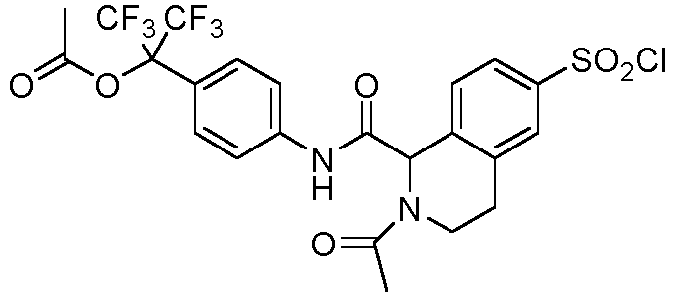
- 2-(4-(2-Acetyl-6-(benzylthio)-1,2,3,4-tetrahydroisoquinoline-1-carboxamido)phenyl)-1,1,1,3,3,3-hexafluoropropan-2-yl acetate (230 mg, 0.368 mmol) was dissolved in a mixed solution of acetic acid (2 mL) and water (0.5 mL). Under an ice bath, N-chlorosuccinimide (101 mg, 0.756 mmol) was slowly added to the reaction solution. After the addition was completed, the ice bath was removed, and the reaction mixture was further stirred at room temperature for 1 hour, and TLC monitored the completion of the reaction. The reaction solution was poured into ice water (20 mL), extracted with EA (10 mL×2), the organic phases were combined, washed with saturated brine (10 mL), dried over anhydrous sodium sulfate and filtered, and the filtrate was concentrated under reduced pressure to obtain the target product (230 mg, crude, white solid).
-

- 2-Acetyl-1-(((4-(1,1,1,3,3,3-hexafluoro-2-hydroxypropan-2-yl)phenyl)carbamoyl)-1,2,3,4-tetrahydroisoquinoline-6-sulfonyl chloride (118 mg, 0.211 mmol) was dissolved in tetrahydrofuran (2 mL). Under an ice bath, ammonia in water (2 mL) was slowly added dropwise to the reaction solution. After the addition was completed, the ice bath was removed, and the reaction solution was further stirred for 1 hour at room temperature, and the LC-MS monitored the completion of the reaction. The reaction solution was concentrated under reduced pressure to obtain a crude product, which was separated and purified by column chromatography (EA:PE=1:10- 1:2) to obtain the target product (6.00 mg, 3.02% yield in two steps, white solid). LC-MS(ESI)m/z: 540.1 [M+H]+. 1H NMR (400 MHz, DMSO-d 6) δ 10.70 (s, 1H), 10.15 (s, 1H), 8.79 - 8.64 (m, 2H), 7.73 - 7.62 (m, 4H), 7.59 - 7.54 (m, 2H), 7.31 (s, 1H), 5.84 (s, 1H), 4.07 - 4.02 (m, 1H), 3.67 - 3.61 (m, 1H), 3.20 - 3.14 (m, 1H), 3.00 - 2.94 (m, 1H), 2.12, 2.10 (s, 3H).
-

-

- 2-(tert-Butyl)1-ethyl 6-(benzylthio)-3,4-dihydroisoquinoline-1,2(1H)-dicarboxylate (3.50 g, 8.19 mmol) was dissolved in a mixed solution of acetic acid (28 mL) and water (7 mL). Under an ice bath, N-chlorosuccinimide (2.19 g, 16.4 mmol) was slowly added to the reaction solution. After the addition was completed, the ice bath was removed, and the reaction mixture was further stirred at room temperature for 1 hour, and TLC monitored the completion of the reaction. The reaction solution was poured into ice water (20 mL), extracted with EA (10 mL×2), the organic phases were combined, washed with saturated brine (10 mL), dried over anhydrous sodium sulfate and filtered, and the filtrate was concentrated under reduced pressure to obtain the target product (1.10 g, crude, white solid).
-

- 2-(tert-Butyl) 1-ethyl 6-(chlorosulfonyl)-3,4-dihydroisoquinoline-1,2(1H)-dicarboxylate (1.10 g, 2.72 mmol) was dissolved in a mixed solution of tetrahydrofuran (16.5 mL) and water (11 mL). Sodium bicarbonate (457 mg, 5.45 mmol) and sodium sulfite (412 mg, 3.27 mmol) were added to the reaction solution. After the addition was completed, the reaction mixture was further stirred at 70°C for 3 hours, and LC-MS monitored the completion of the reaction. The reaction solution was concentrated under reduced pressure to obtain the target product (1.01 g, crude, white solid). LC-MS(ESI) m/z: 368.1 [M-Na]-.
-

- Sodium 2-(tert-butoxycarbonyl)-1-(ethoxycarbonyl)-1,2,3,4-tetrahydroisoquinoline-6-sulfinate (1.01 g, 2.58 mmol) was dissolved in dimethyl sulfoxide (10 mL), and the (bromomethyl)cyclopropane (1.04 g, 7.74 mmol) was added. The reaction solution was heated to 100°C and stirred for 3 hours. After TLC monitored the completion of the reaction, the reaction solution was added to water (20 mL), extracted with EA (30 mL×3), and the organic phases were combined, dried over sodium sulfate, rotary evaporated to dry, and purified by column chromatography (EA:PE=1:9-1:4) to obtain the target product (200 mg, 5.77% yield in three steps, yellow solid).
-

- Ethyl 2-(tert-butoxycarbonyl)-6-((cyclopropylmethyl)sulfonyl)-1,2,3,4-tetrahydroisoquinoline-1-carboxylate (200 mg, 0.472 mmol) was dissolved in methanol (3 mL), and a solution of 2 M aqueous sodium hydroxide solution (2 mL) was added dropwise to the reaction solution at room temperature. After the addition was completed, the reaction solution was further stirred at room temperature for 2 hours, and LC-MS monitored the completion of the reaction. The reaction solution was poured into water (20 mL), adjusted to around pH=3 with 1M aqueous hydrochloric acid solution, extracted with EA (10 mL×2), the organic phases were combined, dried over anhydrous sodium sulfate, filtered, and the filtrate was concentrated under reduced pressure to obtain the target compound (160 mg, crude, white solid). LC-MS(ESI)m/z: 337.1 [M-Boc+ACN+H]+.
-

- 2-(tert-Butoxycarbonyl)-6-((cyclopropylmethyl)sulfonyl)-1,2,3,4-tetrahydroisoquinoline-1-carboxylic acid (160 mg, 0.405 mmol) and 2-(4-aminophenyl)-1,1,1,3,3,3-hexafluoropropan-2-ol (105 mg, 0.405 mmol) were dissolved in dry DCM (3 mL). At room temperature, HATU (231 mg, 0.607 mmol) and DIEA (105 mg, 0.809 mmol) were sequentially added to the reaction solution. After the addition was completed, the reaction mixture was stirred at room temperature overnight, and LC-MS monitored the completion of the reaction. The reaction solution was washed with saturated brine (10 mL), the organic phase was dried over anhydrous sodium sulfate, filtered, and the filtrate was concentrated under reduced pressure to obtain the target compound (271 mg, 90.1% yield in two steps, yellow oil). LC-MS(ESI)m/z: 537.1 [M-Boc+H]+. 1H NMR (400 MHz, CDCl3) δ 9.33 (s, 1H), 7.87 - 7.75 (m, 2H), 7.60 (q, J = 8.7 Hz, 4H), 7.44 (d, J = 8.2 Hz, 1H), 6.19 (s, 1H), 3.91 (s, 1H), 3.81 (t, J = 6.2 Hz, 2H), 3.22 - 3.10 (m, 1H), 3.09 - 2.97 (m, 3H), 2.30 (s, 3H), 1.02 (s, 1H), 0.61 (d, J = 7.8 Hz, 2H), 0.22 (d, J = 5.1 Hz, 2H).
-

- tert-Butyl 6-((cyclopropylmethyl)sulfonyl)-1-((4-(1,1,1,3,3,3-hexafluoro-2-hydroxypropan-2-yl)phenyl)carbamoyl)-3,4-dihydroisoquinoline-2(1H)-carboxylate (271 mg, 0.426 mmol) was dissolved in DCM (5 mL). Under an ice bath, a 6 M solution of hydrochloric acid in dioxane (5 mL) was added dropwise to the reaction solution. After the addition was completed, the ice bath was removed, and the reaction solution was further stirred at room temperature for 2 hours, and LC-MS monitored the completion of the reaction. The reaction solution was concentrated in reduced pressure to obtain the target compound (160 mg, crude, yellow solid). LC-MS(ESI)m/z: 537.1 [M+H]+.
-

- 6-((Cyclopropylmethyl)sulfonyl)-N-(4-(1,1,1,3,3,3-hexafluoro-2-hydroxypropan-2-yl)phenyl)-1,2,3,4-tetrahydroisoquinoline-1-carboxamide (160 mg, 0.298 mmol) was dissolved in dry DCM (3 mL). Under an ice bath, DIEA (116 mg, 0.895 mmol) and acetyl chloride (58.5 mg, 0.746 mmol) were sequentially added dropwise to the reaction solution. After the addition was completed, the reaction solution was further stirred at room temperature for 30 minutes, and LC-MS monitored the completion of the reaction. The reaction solution was directly concentrated to obtain a crude product, which was separated and purified by column chromatography (PE: EA=4: 1) to obtain the target compound (180 mg, 68.1% yield in two steps, yellow oil).
-

- 2-(4-(2- Acetyl-6-((cyclopropylmethyl)sulfonyl)-1,2,3,4-tetrahydroisoquinoline-1-carboxamido)phenyl)-1,1,1,3,3,3-hexafluoropropan-2-yl acetate (180 mg, 0.29 mmol) was dissolved in methanol (2 mL), 2 mol/L aqueous sodium hydroxide solution (2 mL, 0.87 mmol) was added dropwise to the reaction solution at room temperature. After the addition was completed, the reaction solution was further stirred for 30 minutes at room temperature, and TLC monitored the completion of the reaction. The reaction solution was poured into water (20 mL), adjusted to around pH=3 with 1mol /L dilute hydrochloric acid, extracted with EA (10 mL×2), the organic phases were combined, dried over anhydrous sodium sulfate, filtered, and the filtrate was concentrated under reduced pressure to obtain the target compound (20 mg, yellow oil). LC-MS(ESI)m/z: 579.1 [M+H]+. 1H NMR (400 MHz, CDCl3) δ 9.33 (s, 1H), 7.87 - 7.80 (m, 2H), 7.66 - 7.54 (m, 4H), 7.48 - 7.41 (d, J=8 Hz, 1H), 6.19 (s, 1H), 3.91 (s, 1H), 3.85 - 3.76(m, 2H), 3.24 - 3.11 (m, 1H), 3.10 - 2.99 (m, 3H), 2.30 (s, 3H), 1.08 - 0.97 (m, 1H), 0.67 - 0.56 (m, 2H), 0.26 - 0.18 (m, 2H).
-

- 2-Acetyl-1-(((4-(1,1,1,3,3,3-hexafluoro-2-hydroxypropan-2-yl)phenyl)carbamoyl)-1,2,3,4-tetrahydroisoquinoline-6-sulfonyl chloride (112 mg, 0.200 mmol) was dissolved in tetrahydrofuran (2 mL). Under an ice bath, an aqueous methyl ammonia solution (2 mL) was slowly added dropwise to the reaction solution. After the addition was completed, the ice bath was removed, the reaction solution was further stirred for 1 hour at room temperature, and the LC-MS monitored the completion of the reaction. The reaction solution was concentrated under reduced pressure to obtain a crude product, which was separated and purified by column chromatography (PE: EA=10:1-2:1) to obtain the target product (14.0 mg, 14.1% yield in two steps, white solid). LC-MS(ESI)m/z: 554.0[M+H]+. 1H NMR (400 MHz, DMSO-d 6) δ 10.80, 10.74(s, 1H), 8.66, 8.62 (s, 1H), 7.76 (d, J = 8.2 Hz, 1H), 7.71 - 7.57 (m, 6H), 7.45 - 7.37 (m, 1H), 5.90, 5.79 (s, 1H), 4.11 - 4.01 (m, 1H), 3.72 - 3.64 (m, 1H), 3.27 - 3.14 (m, 1H), 3.05 - 2.94 (m, 1H), 2.40 (d, J = 4.9 Hz, 3H), 2.15, 2.12 (s, 3H).
- This assay was basically carried out according to the method described in the literature (Current Chemical Genomics, 2010, 4, 43-49).
- The RORγ-LBD coding sequence was inserted into pBIND plasmid (Promega, E1581). The expression vector and a reporter vector (pGL4.35 carrying a stably integrated luciferase reporter gene driven by GAL4 promoter) were co-expressed in HEK293T host cells. When the inhibitor binds to the corresponding chimeric receptor, the chimeric receptor binds to the GAL4 binding site on the reporter gene carrier and inhibits reporter gene expression. The inhibition activity of the compounds on RORγ was determined according to the intensity of the chemiluminescence signal.
-
Materials and Reagents Supplier Batch number# HEK293T ATCC CRL-3216 pGL4.35 Promega E1370 pBIND-RORγ Vector Pharmaron PBS (pH 7.4, 1×, sterile) Gibico 10010 Opti-MEM® I Reduced Serum Medium Gibico 11058-021 Steady-Glo™ Promega E2520 AZD-0284 MCE HY-120384 -
- 1. Preparation of Test Compounds
- 1.1 All test compounds were serially diluted at 3-fold with DMSO, with 10 serial dilutions starting from 10 mM.
- 1.2 The positive control AZD-0284 was serially diluted at 3-fold with DMSO, with 10 serial dilutions starting from 10 mM.
- 1.3 1000× positive control (10mM AZD-0284) and 1000× negative control (100% DMSO) were prepared.
- 1.4 The compound plate was sealed and shaken for 5 minutes.
- 2. Test procedure
- 2.1 Cell Suspension Preparation and Plate Seeding
- a) All cells were cultured according to the ATCC standard operation, and HEK293T was tested in the exponential growth phase.;
- b) Discarding the medium;
- c) Washing the cells twice with PBS;
- d) Adding a trypsinization solution to digest the cells and terminating the digestion with a complete medium;
- e) Collecting and counting the cells, and only when the cell viability was greater than 90% could the experimentbe carried out;
- f) Seeding 6*106 HEK293T cells into a 100 mm cell culture dish;
- g) Placing the cultured dishes with seeded cells into an incubator at 37°C and 5% CO2 overnight.
- 2.2 Cell Transfection
- a) Balancing the Trans-IT transfection reagent at room temperature;
- b) Adding 20 µl of the transfection reagent and 600 µl of Opti-MEM™ medium without contacting the tube wall, mixing uniformly through blowing and pipetting by a pipette gun, and allowing to stand at room temperature for 5 minutes;
- c) Adding 10 µg of the plasmid to the transfection reagent (see Step 2.2.b), and allowing to stand at room temperature for 20 minutes;
Plasmids: 5 µg of pBIND-RORγ and 5 µg of pGL4.35 plasmids were respectively added therein; - d) Adding the mixed DNA transfection reagent to a 100mm cell culture dish (see Step 2.1);
- e) Placing the dish in an incubator at 37°C and 5% CO2 for 5h.
- 2.3 Compound Treatment
- a) Transferring 25 nl of the diluted compound to a cell culture plate (6007680-50, PE) with Echo550;
- b) Inoculating the cells (see Step 2.2) into a 384-cell culture plate (6007680-50, PE), with 15,000 cells and 25 µl of the medium 5% charcoal-adsorbed FBS per well;
- c) Culturing the cellsovernight in an incubator at 37°C and 5% CO2.
- 2.4 Compound Detection:
- a) Placing the Steady-Glo™ Detection Reagent at room temperature;
- b) Placing the 384-cell plate (see Step 2.3) at room temperature;
- c) Adding 25 µL of the Steady-Glo™ Detection Reagent per well into the cell culture plate (see Step 2.4b);
- d) Placing the plate on a shaker and shaking for 5 minutes in dark;
- e) Detecting the chemiluminescence values with the Envision 2104.
- 2.1 Cell Suspension Preparation and Plate Seeding
-

- RLUcmpd: fluorescence value of test compounds
-
R L U positive: average value of positive control -
R L U vehicle: average value of negative control - IC50s of the compounds were calculated by fitting the %Inhibition and the logarithm values of the compound concentration using Graphad 8.0. The assay results show that the compounds of the present disclosure have good inhibitory activity on the RORyt luciferase reporter gene (as shown in Table 1).
Table 1. Luciferase reporter gene assay of RORyt inhibition activity of Example compounds Example IC50(nM) Emax% 1 19.14 101.6 2 8.001 100.1 3 681.3 111.3 4 3050 73.85 5 128.5 102.3 6 113.1 99.94 7 12.43 99.59 8 3.783 99.25 9 616 107.1 10 40.49 102 11 91.31 104.4 12 289.8 95.71 13 154.2 101.2 14 83.42 98.81 17 67.08 95.92 18 106.9 95.75 19 14.67 100.7 21 12.52 101.5 22 17.81 101.7 AZD-0284 34.81 99.79 Note: Emax% is the relative maximum inhibition rate relative to AZD-0284 at 10 µM. - The results in the above table show that the compounds of the present disclosure have good inhibitory activity on the RORyt inhibitor luciferase reporter gene.
-
Materials and Reagents supplier Item# batch number# hPBMC _ TPCS PB100C A19Z018001 RPMI1640 Gibco A10491-01 2037571 Penicillin-Streptomycin Gibco 15140-122 1953104 Fetal Bovine Serum Gibco 10099-141C 2045686CP Phosphate Buffered Saline (PBS) Gibco 10010-031 2003918 DMSO Sigma D8418-1L SHBG3288V Purified NA/LE mouse anti-human CD3 BD 555336 8152611 Purified NA/LE mouse anti-human CD28 BD 555725 8152601 Recombinant human TGF-beta 1 R&D 240-B AV7117011 Recombinant human IL-6 R&D 7270-IL-025/CF DAOM0318061 Recombinant human IL-23 R&D 1290-IL-010/CF GBI6218031 Ursolic acid (UA) Sigma U6753 BCBQ8542V Quantikine ® ELISA R&D S1700 P192117 Human IL-17 Immunoassay - Test procedure: the PBMC cells were first thawed and plated, and then stimulated with the stimulating factors (anti-hCD28: 5 µg/mL; rhTGF-β1: 5 ng/mL; rhIL-6: 20 ng/mL; rhIL-23: 10 ng/mL) to differentiate to Th17, while different concentrations of compounds were added, with the maximum concentration starting from 3 µM. After 48 hours, the supernatant was collected for IL-17 ELISA detection. The inhibition rates of the compounds to inhibit the secretion of IL-17 by Th17 cells were determined, as compared with the vehicle group, and the IC50 values were fitted with Graphad8.0.
- The test results show that the compounds of the present disclosure have good ability to inhibit the differentiation of Th17 cells to secrete IL-17 in human PBMC (as shown in Table 2).
Table 2. The results of inhibition of the compounds for Th17 cells differentiation and secretion of IL-17 Example IC50(nM) Emax% 1 51.36 79.01 2 22.66 78.28 7 21.14 72.02 AZD-0284 28.41 78.54 Note: Emax% is the maximum inhibition rate. - The PK of each compound was determined as follows: 6 C57BL/6 mice (obtained from Shanghai Lingchang Biotechnology Co., Ltd.) were divided into two groups with 3 in each group. One group was administered intravenously at a dose of 1 mg/kg in the vehicle of 5%DMSO/95% (20% Captisol); the other group was administered by oral gavage at a dose of 5 mg/kg in the vehicle of 0.5% CMC-Na/0.5% Tween 80. Blood samples were collected from saphenous vein of lower leg in each group at 0, 0.083, 0.25, 0.5, 1, 2, 4, 6, 8 and 24h after administration. Approximately 40 µL of the blood samples were collected into anticoagulant tubes containing EDTA-K2. Immediately after collection, the tubes were inverted at least 5 times to ensure uniform mixing, and then placed on ice. The blood samples collected at each time point were centrifuged at 4°C, 8000 rpm for 5 minutes to obtain plasma. Another 1.5 mL centrifuge tube was marked with the compound name, animal number, and time point, and the plasma was transferred to this tube. The plasma was stored at -80°C until analysis.
- Compound concentrations in the plasma were determined by UPLC-MS/MS method, and the pharmacokinetic parameters were calculated from the obtained data by Phoenix WinNolin 6.4 pharmacokinetic software.
- The specific test results are as follows, showing that the compounds have good pharmacokinetic absorption and have the PK advantages, especially for oral administration. Both AUCO-last (ng/mL*hr) and bioavailability of the compounds of the present disclosure were significantly improved, indicating a better druggability.
Table 3. In vivo PK of Example compounds Example 1 2 5 7 AZD-0284 IV Dose 1mg/kg AUC0-last (ng/mL*hr) 1854 1297 1190 4873 1176 Cmax (ng/mL) 1390 2313 1888 703 2484 T1/2 (hr) 5.09 1.78 4.89 39.9 7.75 Vss (L/kg) 2.71 1.06 3.34 4.02 6.29 CL_obs (mL/min/kg) 7.12 12.8 13.8 1.23 12.6 Po Dose 5mg/kg AUC0-last (ng/mL*hr) 9640 5328 12629 20341 2781 Cmax (ng/mL) 816 553 1367 1075 264 T1/2 (hr) 3.91 3.31 4.33 37.57 3.35 F% 84 82.1 213 83.5 38 - According to standard methods for investigating in vitro metabolic stability in the art, e.g., the methods described in Kerns, Edward H. and Di Li (2008). Drug-like Properties: Concepts, Structure Design and Methods: from ADME to Toxicity Optimization. San Diego: Academic Press; Di, Li et al., Optimization of a Higher Throughput Microsomal Stability Screening Assay for Profiling Drug Discovery Candidates, J. Biomol. Screen. 2003, 8(4), 453, the liver microsomal metabolic stability test of the compounds of the present disclosure was carried out analogously as follows.
- The incubation system comprising 0.5 mg protein/mL microsomes, cofactors, and PBS, was pre-incubated at 37°C for 3 min, and then added the substrate (i.e., the test compounds) to initiate the reaction. Samples were taken at 0, 1, 5, 10, 15, 20, 30 and 60 min from the start of the reaction, and an appropriate terminator was added to terminate the reaction.
Species Product information Supplier Abbreviation Human Cat No. 452117 Corning HLM Lot No. 38292 CD-1 mice Cat No. BQM1000 Biopredic MLM Lot No. MIC255036 - Sample treatment (n=3): appropriate samples were added respectively, vortexed and centrifuged at high speed. The supernatants were collected and detected for the substrate by HPLC-MS/MS. The peak area at the 0 min was taken as 100%. The peak areas at other time points were converted to percentages of remaining. The natural logarithms of the percentages of remaining at each time point was plotted against the incubation time, and the slope (-k) was calculated by linear regression. Then, Clint (µL/min/mg) and half-life (T1/2, min.) of the compounds were calculated following the equation:
Inherent clearance rate (Clint) = (k* Volume of incubation solution)/Mass of liver microsomes. - The results are shown in Table 4.
Table 4. Test results of metabolic stability of human and mouse liver microsomes Human liver microsomes Mouse liver microsomes Example cLogP T1/2(min) Remaining% (T=60min) CLint(mic) (µL/min/mg) T1/2(min) Remaining% (T=60min) CLint(mic) (µL/min/mg) 1 1.6 > 145 94.2% < 9.6 > 145 94.5% < 9.6 2 1.6 > 145 82.2% < 9.6 > 145 102.3% < 9.6 5 1.06 > 145 85.0% < 9.6 > 145 86.6% < 9.6 6 1.43 > 145 70.2% < 9.6 92.7 59.4% 14.9 7 2.66 75.5 61.0% 18.4 > 145 79.7% < 9.6 - The above experimental results show that the compounds of the present disclosure have good metabolic stability.
- The structure of the control compound used in the above experiments is as follows:

- It will be appreciated by those skilled in the art that the foregoing descriptions are exemplary and explanatory in nature, and intended to illustrate the invention and its preferred embodiments.
Claims (15)
- A compound of formula (Ia'), a stereoisomer, a tautomer, a stable isotopic variant, a pharmaceutically acceptable salt or a solvate thereof,
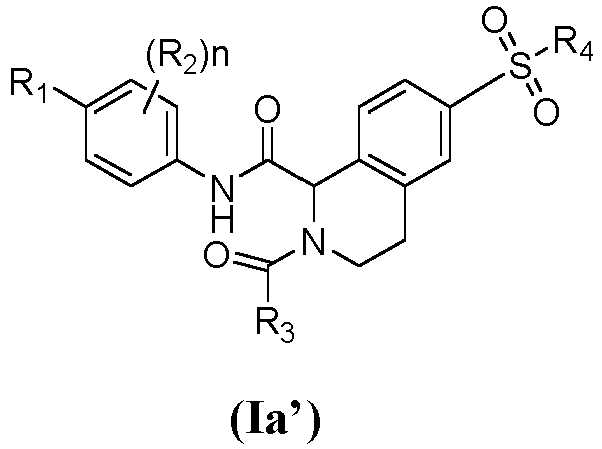 R1 is selected from C1-C6 alkyl, C1-C6 alkoxy or 5-7 membered heterocycloalkenyl comprising up to 2 heteroatoms independently selected from N, O or S, wherein each is optionally substituted with one or more groups independently selected from: halogen, Ra or - ORa;R2 at each occurrence is independently selected from hydrogen, halogen or C1-C6 alkyl optionally substituted with halogen;R3 is selected from hydrogen, C1-C6 alkyl, C3-C7 cycloalkyl or -NRaRb, wherein the C1-C6 alkyl or the C3-C7 cycloalkyl is optionally substituted with a group independently selected from: halogen, Ra, -C(O)ORa, -C(O)NRaRb, -S(O)2NRaRb, -ORa or -NRaRb;R4 is selected from C1-C6 alkyl or -NRaRb, the C1-C6 alkyl is optionally substituted with a group independently selected from: Ra, halogen, -ORa or -NRaRb;Ra and Rb are each independently selected from H, or C1-C6 alkyl optionally substituted with one or more halogens, or C3-C7 cycloalkyl optionally substituted with one or more halogens; andn is 0, 1 or 2; and a compound
- A compound according to claim 1, a stereoisomer, a tautomer, a stable isotopic variant, a pharmaceutically acceptable salt or a solvate thereof, wherein R1 is C1-C3 alkyl, which is substituted with two C1-C3alkyl substituted with at least 3 halogens, and one group independently selected from halogen or -OH, preferably R1 is

- A compound according to claim 1, a stereoisomer, a tautomer, a stable isotopic variant, a pharmaceutically acceptable salt or a solvate thereof, wherein R1 is cyclopentenyl or cyclohexenyl group containing 1 heteroatom selected from N, O or S, preferably

- A compound according to any one of claims 1 to 2, a stereoisomer, a tautomer, a stable isotopic variant, a pharmaceutically acceptable salt or a solvate thereof, wherein R3 is hydrogen, C1-C3 alkyl, C3-C7 cycloalkyl or -NRaRb, wherein the C1-C3 alkyl or the C3-C7 cycloalkyl is optionally substituted with -C(O)ORa, wherein Ra and Rb are each independently selected from H or C1-C3 alkyl optionally substituted with one or more halogens, preferably R3 is methyl, ethyl, propyl, isopropyl, -CH2CH2COOH, -CH2CH2CH2COOH, cyclopropyl, cyclopropyl, cyclopentyl, -NH2, -NHCH3, -NCH3CH3, -N(CH2CH3)CH3 or -N(CH2CH3)(CH2CH3).
- A compound according to any one of claims 1 to 2, a stereoisomer, a tautomer, a stable isotopic variant, a pharmaceutically acceptable salt or a solvate thereof, wherein R4 is C1-C3 alkyl, preferably methyl, ethylpropyl or isopropyl; or R4 is C1-C3 alkyl substituted with C3-C7 cycloalkyl, preferably R4 is selected from -CH2-cyclopropyl, -CH2-cyclobutyl, -CH2-cyclopentyl, -CH2-CH2-cyclopropyl, -CH2-CH2-cyclobutyl, -CH2-CH2-cyclopentyl; or R4 is -NRaRb, wherein Ra and Rb are each independently selected from H or C1-C6 alkyl, preferably R4 is selected from - NH2, -NHCH3, -NCH3CH3, -N(CH2CH3)CH3, -N(CH2CH3)(CH2CH3).
- A compound according to claim 1, a stereoisomer, a tautomer, a stable isotopic variant, a pharmaceutically acceptable salt or a solvate thereof, wherein R2 is selected from H or halogen.
- A compound according to claim 1, a stereoisomer, a tautomer, a stable isotopic variant, a pharmaceutically acceptable salt or a solvate thereof, wherein the compound is of formula (Ia"),

 any two of R1a, R1b, R1c are selected from C1-C6 alkyl substituted with one or more halogens, and the remaining of R1a, R1b, R1c is independently selected from halogen or -ORa;R2 at each occurrence is independently selected from hydrogen, halogen or C1-C6 alkyl optionally substituted by halogen;R3 is selected from C1-C6 alkyl, C3-C7 cycloalkyl or -NRaRb, wherein the C1-C6 alkyl or the C3-C7 cycloalkyl is optionally substituted with a group independently selected from: -C(O)ORa, -C(O)NRaRb, -S(O)2NRaRb, -ORa or -NRaRb;R4 is selected from C1-C6 alkyl;Ra and Rb are each independently selected from H or C1-C6 alkyl optionally substituted with one or more halogens; andn is 0, 1 or 2.
 - A compound according to claim 7, a stereoisomer, a tautomer, a stable isotopic variant, a pharmaceutically acceptable salt or a solvate thereof, wherein any two of R1a, R1b, R1c are C1-C3alkyl substituted with at least three F, and the remaining is independently selected from F, Cl, Br, I or -OH, preferably

- A compound according to claim 7, a stereoisomer, a tautomer, a stable isotopic variant, a pharmaceutically acceptable salt or a solvate thereof, wherein R2 is selected from H, F or Cl.
- A compound according to claim 7, a stereoisomer, a tautomer, a stable isotopic variant, a pharmaceutically acceptable salt or a solvate thereof, wherein R3 is hydrogen, C1-C3 alkyl, C3-C7 cycloalkyl or -NRaRb, wherein the C1-C3 alkyl or the C3-C7 cycloalkyl is optionally substituted with -C(O)OH, wherein Ra and Rb are each independently selected from H or C1-C3 alkyl, preferably R3 is methyl, ethyl, propyl, isopropyl, -CH2CH2COOH, -CH2CH2CH2COOH, cyclopropyl, cyclopropyl, cyclopentyl, -NH2, -NHCH3, -NCH3CH3, -N(CH2CH3)CH3 or - N(CH2CH3)(CH2CH3).
- A compound according to claim 7, a stereoisomer, a tautomer, a stable isotopic variant, a pharmaceutically acceptable salt or a solvate thereof, wherein R4 is C1-C3 alkyl, preferably methyl, ethylpropyl or isopropyl.
- A compound according to claim 1, selected from


- A compound according to any one of claims 1 to 12, a stereoisomer, a tautomer, a stable isotopic variant, a pharmaceutically acceptable salt or a solvate thereof, for use as a medicament, in particular for use as a RORyt inhibitor, or for the treatment, especially for the treatment or prevention of RORyt-associated diseases.
- A pharmaceutical composition comprising a compound according to any one of claims 1 to 12, a stereoisomer, a tautomer, a stable isotopic variant, a pharmaceutically acceptable salt or a solvate thereof and a pharmaceutically acceptable excipient.
- A compound according to any one of claims 1 to 12, a stereoisomer, a tautomer, a stable isotopic variant, a pharmaceutically acceptable salt or a solvate thereof, or a pharmaceutical composition according to claim 14, for use in the prevention or treatment of psoriasis, rheumatoid arthritis, psoriatic arthritis, ankylosing spondylitis, multiple sclerosis, systemic lupus erythematosus, graft-versus-host disease, inflammatory bowel disease, Crohn's disease, ulcerative colitis, chronic obstructive pulmonary disease, asthma, glomerulonephritis, lupus nephritis, myocarditis, thyroiditis, xerophthalmia, uveitis, Behcet's disease, allergic dermatitis, acne, scleroderma, bronchitis, dermatomyositis, allergic rhinitis, necrotizing enterocolitis, liver fibrosis, Non-alcoholic steatohepatitis (NASH), novel coronavirus pneumonia, insulin-dependent type 1 diabetes, triple-negative breast and prostate cancer in mammals, especially humans.
Applications Claiming Priority (3)
| Application Number | Priority Date | Filing Date | Title |
|---|---|---|---|
| CN202010411990 | 2020-05-15 | ||
| CN202110404796 | 2021-04-15 | ||
| PCT/CN2021/093789 WO2021228217A1 (en) | 2020-05-15 | 2021-05-14 | ANILINE COMPOUND USED AS RORγ REGULATOR |
Publications (3)
| Publication Number | Publication Date |
|---|---|
| EP4151626A1 EP4151626A1 (en) | 2023-03-22 |
| EP4151626A4 EP4151626A4 (en) | 2023-11-15 |
| EP4151626B1 true EP4151626B1 (en) | 2025-04-09 |
Family
ID=78526021
Family Applications (1)
| Application Number | Title | Priority Date | Filing Date |
|---|---|---|---|
| EP21805144.9A Active EP4151626B1 (en) | 2020-05-15 | 2021-05-14 | Aniline compound used as rory regulator |
Country Status (9)
| Country | Link |
|---|---|
| US (1) | US12540117B2 (en) |
| EP (1) | EP4151626B1 (en) |
| JP (1) | JP2023533123A (en) |
| CN (2) | CN113773251B (en) |
| AU (1) | AU2021269613A1 (en) |
| CA (1) | CA3178650A1 (en) |
| IL (1) | IL298238A (en) |
| TW (1) | TW202208338A (en) |
| WO (1) | WO2021228217A1 (en) |
Families Citing this family (1)
| Publication number | Priority date | Publication date | Assignee | Title |
|---|---|---|---|---|
| WO2023232870A1 (en) | 2022-05-31 | 2023-12-07 | Immunic Ag | Rorg/rorgt modulators for the treatment of virus infections like covid-19 |
Family Cites Families (6)
| Publication number | Priority date | Publication date | Assignee | Title |
|---|---|---|---|---|
| WO2015002231A1 (en) * | 2013-07-03 | 2015-01-08 | 武田薬品工業株式会社 | Heterocyclic compound |
| TN2016000567A1 (en) * | 2014-07-01 | 2018-04-04 | Takeda Pharmaceuticals Co | Heterocyclic compounds and their use as retinoid-related orphan receptor (ror) gamma-t inhibitors |
| TWI728017B (en) * | 2015-12-15 | 2021-05-21 | 瑞典商阿斯特捷利康公司 | Isoindole compounds, pharmaceutical composition comprising the same, and uses thereof |
| CN107540659A (en) * | 2016-06-29 | 2018-01-05 | 四川科伦博泰生物医药股份有限公司 | Tetrahydroisoquinolicompounds compounds, its preparation method, medical composition and its use |
| EP3638661A1 (en) * | 2017-06-14 | 2020-04-22 | Astrazeneca AB | 2,3-dihydroisoindole-1-carboxamides useful as ror-gamma modulators |
| WO2020047487A1 (en) * | 2018-08-31 | 2020-03-05 | The Regents Of The University Of California | Methods for treating cancer with rorgamma inhibitors and statins |
-
2021
- 2021-05-14 CA CA3178650A patent/CA3178650A1/en active Pending
- 2021-05-14 JP JP2022569512A patent/JP2023533123A/en active Pending
- 2021-05-14 WO PCT/CN2021/093789 patent/WO2021228217A1/en not_active Ceased
- 2021-05-14 TW TW110117476A patent/TW202208338A/en unknown
- 2021-05-14 US US17/925,358 patent/US12540117B2/en active Active
- 2021-05-14 IL IL298238A patent/IL298238A/en unknown
- 2021-05-14 CN CN202110526062.6A patent/CN113773251B/en active Active
- 2021-05-14 AU AU2021269613A patent/AU2021269613A1/en active Pending
- 2021-05-14 EP EP21805144.9A patent/EP4151626B1/en active Active
- 2021-05-14 CN CN202410619327.0A patent/CN118580188A/en active Pending
Also Published As
| Publication number | Publication date |
|---|---|
| US20230192620A1 (en) | 2023-06-22 |
| JP2023533123A (en) | 2023-08-02 |
| TW202208338A (en) | 2022-03-01 |
| CN113773251B (en) | 2024-06-11 |
| AU2021269613A1 (en) | 2023-02-02 |
| WO2021228217A1 (en) | 2021-11-18 |
| EP4151626A1 (en) | 2023-03-22 |
| US12540117B2 (en) | 2026-02-03 |
| CA3178650A1 (en) | 2021-11-18 |
| IL298238A (en) | 2023-01-01 |
| CN118580188A (en) | 2024-09-03 |
| EP4151626A4 (en) | 2023-11-15 |
| CN113773251A (en) | 2021-12-10 |
Similar Documents
| Publication | Publication Date | Title |
|---|---|---|
| AU2020343671B2 (en) | RIP1 inhibitory compounds and methods for making and using the same | |
| EP4165032B1 (en) | Heteroalkyl dihydroquinoline sulfonamide compounds | |
| JP2021195367A (en) | Cyclopropyl dihydroquinoline sulfonamide compounds | |
| US20250092057A1 (en) | Heterocyclic rip1 inhibitory compounds | |
| US12540138B2 (en) | Substituted oxaspiro[4.5]decanes as MOR receptor agonists | |
| EP3390396B1 (en) | Isoindole compounds | |
| EP4041770A1 (en) | Muscarinic acetylcholine m1 receptor antagonists | |
| US20220402867A1 (en) | Sulfo-substituted biaryl compound or salt thereof, preparation method therefor, and use thereof | |
| CN102372701A (en) | Azabicyclo hexane derivative, preparation method, and application of azabicyclo hexane derivative in medicine | |
| US12540117B2 (en) | Aniline compound used as RORγ regulator | |
| CN113666853B (en) | Biaryl compounds useful as ROR gamma modulators | |
| CN113666863B (en) | Biaryl compounds useful as rory modulators | |
| HK40059280A (en) | ANILINE COMPOUNDS USEFUL AS RORγMODULATORS | |
| HK40062607A (en) | BIARYL COMPOUNDS USEFUL AS RORγ MODULATORS | |
| HK40059280B (en) | ANILINE COMPOUNDS USEFUL AS RORγMODULATORS | |
| RU2800295C1 (en) | Optically pure oxaspiro-substituted pyrrolopyrazole derivative, a method of its production and its pharmaceutical use | |
| HK40059281A (en) | BIARYL COMPOUNDS USEFUL AS RORγMODULATORS |
Legal Events
| Date | Code | Title | Description |
|---|---|---|---|
| STAA | Information on the status of an ep patent application or granted ep patent |
Free format text: STATUS: THE INTERNATIONAL PUBLICATION HAS BEEN MADE |
|
| PUAI | Public reference made under article 153(3) epc to a published international application that has entered the european phase |
Free format text: ORIGINAL CODE: 0009012 |
|
| STAA | Information on the status of an ep patent application or granted ep patent |
Free format text: STATUS: REQUEST FOR EXAMINATION WAS MADE |
|
| 17P | Request for examination filed |
Effective date: 20221213 |
|
| AK | Designated contracting states |
Kind code of ref document: A1 Designated state(s): AL AT BE BG CH CY CZ DE DK EE ES FI FR GB GR HR HU IE IS IT LI LT LU LV MC MK MT NL NO PL PT RO RS SE SI SK SM TR |
|
| DAV | Request for validation of the european patent (deleted) | ||
| DAX | Request for extension of the european patent (deleted) | ||
| A4 | Supplementary search report drawn up and despatched |
Effective date: 20231018 |
|
| RIC1 | Information provided on ipc code assigned before grant |
Ipc: C07D 495/04 20060101ALI20231012BHEP Ipc: C07D 405/12 20060101ALI20231012BHEP Ipc: A61P 35/00 20060101ALI20231012BHEP Ipc: A61P 37/00 20060101ALI20231012BHEP Ipc: A61P 11/06 20060101ALI20231012BHEP Ipc: A61P 17/06 20060101ALI20231012BHEP Ipc: A61P 1/04 20060101ALI20231012BHEP Ipc: A61K 31/472 20060101ALI20231012BHEP Ipc: C07D 471/04 20060101ALI20231012BHEP Ipc: C07D 217/26 20060101AFI20231012BHEP |
|
| STAA | Information on the status of an ep patent application or granted ep patent |
Free format text: STATUS: EXAMINATION IS IN PROGRESS |
|
| 17Q | First examination report despatched |
Effective date: 20240603 |
|
| GRAP | Despatch of communication of intention to grant a patent |
Free format text: ORIGINAL CODE: EPIDOSNIGR1 |
|
| STAA | Information on the status of an ep patent application or granted ep patent |
Free format text: STATUS: GRANT OF PATENT IS INTENDED |
|
| INTG | Intention to grant announced |
Effective date: 20241111 |
|
| GRAS | Grant fee paid |
Free format text: ORIGINAL CODE: EPIDOSNIGR3 |
|
| GRAA | (expected) grant |
Free format text: ORIGINAL CODE: 0009210 |
|
| STAA | Information on the status of an ep patent application or granted ep patent |
Free format text: STATUS: THE PATENT HAS BEEN GRANTED |
|
| RAP3 | Party data changed (applicant data changed or rights of an application transferred) |
Owner name: LITTDD MEDICINES LTD |
|
| AK | Designated contracting states |
Kind code of ref document: B1 Designated state(s): AL AT BE BG CH CY CZ DE DK EE ES FI FR GB GR HR HU IE IS IT LI LT LU LV MC MK MT NL NO PL PT RO RS SE SI SK SM TR |
|
| REG | Reference to a national code |
Ref country code: GB Ref legal event code: FG4D |
|
| REG | Reference to a national code |
Ref country code: CH Ref legal event code: EP |
|
| REG | Reference to a national code |
Ref country code: DE Ref legal event code: R096 Ref document number: 602021029003 Country of ref document: DE |
|
| REG | Reference to a national code |
Ref country code: IE Ref legal event code: FG4D |
|
| PGFP | Annual fee paid to national office [announced via postgrant information from national office to epo] |
Ref country code: FR Payment date: 20250626 Year of fee payment: 5 |
|
| PGFP | Annual fee paid to national office [announced via postgrant information from national office to epo] |
Ref country code: AT Payment date: 20250721 Year of fee payment: 5 |
|
| REG | Reference to a national code |
Ref country code: NL Ref legal event code: MP Effective date: 20250409 |
|
| PG25 | Lapsed in a contracting state [announced via postgrant information from national office to epo] |
Ref country code: NL Free format text: LAPSE BECAUSE OF FAILURE TO SUBMIT A TRANSLATION OF THE DESCRIPTION OR TO PAY THE FEE WITHIN THE PRESCRIBED TIME-LIMIT Effective date: 20250409 |
|
| REG | Reference to a national code |
Ref country code: AT Ref legal event code: MK05 Ref document number: 1783454 Country of ref document: AT Kind code of ref document: T Effective date: 20250409 |
|
| PG25 | Lapsed in a contracting state [announced via postgrant information from national office to epo] |
Ref country code: FI Free format text: LAPSE BECAUSE OF FAILURE TO SUBMIT A TRANSLATION OF THE DESCRIPTION OR TO PAY THE FEE WITHIN THE PRESCRIBED TIME-LIMIT Effective date: 20250409 Ref country code: ES Free format text: LAPSE BECAUSE OF FAILURE TO SUBMIT A TRANSLATION OF THE DESCRIPTION OR TO PAY THE FEE WITHIN THE PRESCRIBED TIME-LIMIT Effective date: 20250409 Ref country code: PT Free format text: LAPSE BECAUSE OF FAILURE TO SUBMIT A TRANSLATION OF THE DESCRIPTION OR TO PAY THE FEE WITHIN THE PRESCRIBED TIME-LIMIT Effective date: 20250811 |
|
| PGFP | Annual fee paid to national office [announced via postgrant information from national office to epo] |
Ref country code: DE Payment date: 20250626 Year of fee payment: 5 |
|
| REG | Reference to a national code |
Ref country code: LT Ref legal event code: MG9D |
|
| PG25 | Lapsed in a contracting state [announced via postgrant information from national office to epo] |
Ref country code: GR Free format text: LAPSE BECAUSE OF FAILURE TO SUBMIT A TRANSLATION OF THE DESCRIPTION OR TO PAY THE FEE WITHIN THE PRESCRIBED TIME-LIMIT Effective date: 20250710 Ref country code: NO Free format text: LAPSE BECAUSE OF FAILURE TO SUBMIT A TRANSLATION OF THE DESCRIPTION OR TO PAY THE FEE WITHIN THE PRESCRIBED TIME-LIMIT Effective date: 20250709 |
|
| PG25 | Lapsed in a contracting state [announced via postgrant information from national office to epo] |
Ref country code: PL Free format text: LAPSE BECAUSE OF FAILURE TO SUBMIT A TRANSLATION OF THE DESCRIPTION OR TO PAY THE FEE WITHIN THE PRESCRIBED TIME-LIMIT Effective date: 20250409 |
|
| PG25 | Lapsed in a contracting state [announced via postgrant information from national office to epo] |
Ref country code: BG Free format text: LAPSE BECAUSE OF FAILURE TO SUBMIT A TRANSLATION OF THE DESCRIPTION OR TO PAY THE FEE WITHIN THE PRESCRIBED TIME-LIMIT Effective date: 20250409 |
|
| PGFP | Annual fee paid to national office [announced via postgrant information from national office to epo] |
Ref country code: GB Payment date: 20250728 Year of fee payment: 5 |
|
| PG25 | Lapsed in a contracting state [announced via postgrant information from national office to epo] |
Ref country code: HR Free format text: LAPSE BECAUSE OF FAILURE TO SUBMIT A TRANSLATION OF THE DESCRIPTION OR TO PAY THE FEE WITHIN THE PRESCRIBED TIME-LIMIT Effective date: 20250409 |
|
| PG25 | Lapsed in a contracting state [announced via postgrant information from national office to epo] |
Ref country code: AT Free format text: LAPSE BECAUSE OF FAILURE TO SUBMIT A TRANSLATION OF THE DESCRIPTION OR TO PAY THE FEE WITHIN THE PRESCRIBED TIME-LIMIT Effective date: 20250409 |
|
| PG25 | Lapsed in a contracting state [announced via postgrant information from national office to epo] |
Ref country code: RS Free format text: LAPSE BECAUSE OF FAILURE TO SUBMIT A TRANSLATION OF THE DESCRIPTION OR TO PAY THE FEE WITHIN THE PRESCRIBED TIME-LIMIT Effective date: 20250709 |
|
| PG25 | Lapsed in a contracting state [announced via postgrant information from national office to epo] |
Ref country code: IS Free format text: LAPSE BECAUSE OF FAILURE TO SUBMIT A TRANSLATION OF THE DESCRIPTION OR TO PAY THE FEE WITHIN THE PRESCRIBED TIME-LIMIT Effective date: 20250809 |
|
| PG25 | Lapsed in a contracting state [announced via postgrant information from national office to epo] |
Ref country code: LV Free format text: LAPSE BECAUSE OF FAILURE TO SUBMIT A TRANSLATION OF THE DESCRIPTION OR TO PAY THE FEE WITHIN THE PRESCRIBED TIME-LIMIT Effective date: 20250409 |
|
| REG | Reference to a national code |
Ref country code: CH Ref legal event code: H13 Free format text: ST27 STATUS EVENT CODE: U-0-0-H10-H13 (AS PROVIDED BY THE NATIONAL OFFICE) Effective date: 20251223 |
|
| REG | Reference to a national code |
Ref country code: DE Ref legal event code: R097 Ref document number: 602021029003 Country of ref document: DE |
|
| PG25 | Lapsed in a contracting state [announced via postgrant information from national office to epo] |
Ref country code: SM Free format text: LAPSE BECAUSE OF FAILURE TO SUBMIT A TRANSLATION OF THE DESCRIPTION OR TO PAY THE FEE WITHIN THE PRESCRIBED TIME-LIMIT Effective date: 20250409 Ref country code: DK Free format text: LAPSE BECAUSE OF FAILURE TO SUBMIT A TRANSLATION OF THE DESCRIPTION OR TO PAY THE FEE WITHIN THE PRESCRIBED TIME-LIMIT Effective date: 20250409 |
|
| PG25 | Lapsed in a contracting state [announced via postgrant information from national office to epo] |
Ref country code: LU Free format text: LAPSE BECAUSE OF NON-PAYMENT OF DUE FEES Effective date: 20250514 |
|
| PG25 | Lapsed in a contracting state [announced via postgrant information from national office to epo] |
Ref country code: CH Free format text: LAPSE BECAUSE OF NON-PAYMENT OF DUE FEES Effective date: 20250531 |
|
| PG25 | Lapsed in a contracting state [announced via postgrant information from national office to epo] |
Ref country code: CZ Free format text: LAPSE BECAUSE OF FAILURE TO SUBMIT A TRANSLATION OF THE DESCRIPTION OR TO PAY THE FEE WITHIN THE PRESCRIBED TIME-LIMIT Effective date: 20250409 |
|
| PG25 | Lapsed in a contracting state [announced via postgrant information from national office to epo] |
Ref country code: EE Free format text: LAPSE BECAUSE OF FAILURE TO SUBMIT A TRANSLATION OF THE DESCRIPTION OR TO PAY THE FEE WITHIN THE PRESCRIBED TIME-LIMIT Effective date: 20250409 |
|
| PG25 | Lapsed in a contracting state [announced via postgrant information from national office to epo] |
Ref country code: SK Free format text: LAPSE BECAUSE OF FAILURE TO SUBMIT A TRANSLATION OF THE DESCRIPTION OR TO PAY THE FEE WITHIN THE PRESCRIBED TIME-LIMIT Effective date: 20250409 |
|
| PG25 | Lapsed in a contracting state [announced via postgrant information from national office to epo] |
Ref country code: IT Free format text: LAPSE BECAUSE OF FAILURE TO SUBMIT A TRANSLATION OF THE DESCRIPTION OR TO PAY THE FEE WITHIN THE PRESCRIBED TIME-LIMIT Effective date: 20250409 |
|
| REG | Reference to a national code |
Ref country code: BE Ref legal event code: MM Effective date: 20250531 |
|
| PG25 | Lapsed in a contracting state [announced via postgrant information from national office to epo] |
Ref country code: MC Free format text: LAPSE BECAUSE OF FAILURE TO SUBMIT A TRANSLATION OF THE DESCRIPTION OR TO PAY THE FEE WITHIN THE PRESCRIBED TIME-LIMIT Effective date: 20250409 |
|
| PG25 | Lapsed in a contracting state [announced via postgrant information from national office to epo] |
Ref country code: RO Free format text: LAPSE BECAUSE OF FAILURE TO SUBMIT A TRANSLATION OF THE DESCRIPTION OR TO PAY THE FEE WITHIN THE PRESCRIBED TIME-LIMIT Effective date: 20250409 |
|
| PLBE | No opposition filed within time limit |
Free format text: ORIGINAL CODE: 0009261 |
|
| STAA | Information on the status of an ep patent application or granted ep patent |
Free format text: STATUS: NO OPPOSITION FILED WITHIN TIME LIMIT |
|
| REG | Reference to a national code |
Ref country code: CH Ref legal event code: L10 Free format text: ST27 STATUS EVENT CODE: U-0-0-L10-L00 (AS PROVIDED BY THE NATIONAL OFFICE) Effective date: 20260218 |
|
| 26N | No opposition filed |
Effective date: 20260112 |
|
| PG25 | Lapsed in a contracting state [announced via postgrant information from national office to epo] |
Ref country code: IE Free format text: LAPSE BECAUSE OF NON-PAYMENT OF DUE FEES Effective date: 20250514 |
|
| PG25 | Lapsed in a contracting state [announced via postgrant information from national office to epo] |
Ref country code: BE Free format text: LAPSE BECAUSE OF NON-PAYMENT OF DUE FEES Effective date: 20250531 |