EP4151293A1 - Virtual object skill releasing method and apparatus, device, medium, and program product - Google Patents
Virtual object skill releasing method and apparatus, device, medium, and program product Download PDFInfo
- Publication number
- EP4151293A1 EP4151293A1 EP21935453.7A EP21935453A EP4151293A1 EP 4151293 A1 EP4151293 A1 EP 4151293A1 EP 21935453 A EP21935453 A EP 21935453A EP 4151293 A1 EP4151293 A1 EP 4151293A1
- Authority
- EP
- European Patent Office
- Prior art keywords
- skill
- ranged
- drag
- control
- boundary point
- Prior art date
- Legal status (The legal status is an assumption and is not a legal conclusion. Google has not performed a legal analysis and makes no representation as to the accuracy of the status listed.)
- Pending
Links
Images







Classifications
-
- G—PHYSICS
- G06—COMPUTING OR CALCULATING; COUNTING
- G06F—ELECTRIC DIGITAL DATA PROCESSING
- G06F3/00—Input arrangements for transferring data to be processed into a form capable of being handled by the computer; Output arrangements for transferring data from processing unit to output unit, e.g. interface arrangements
- G06F3/01—Input arrangements or combined input and output arrangements for interaction between user and computer
- G06F3/048—Interaction techniques based on graphical user interfaces [GUI]
- G06F3/0484—Interaction techniques based on graphical user interfaces [GUI] for the control of specific functions or operations, e.g. selecting or manipulating an object, an image or a displayed text element, setting a parameter value or selecting a range
- G06F3/04847—Interaction techniques to control parameter settings, e.g. interaction with sliders or dials
-
- A—HUMAN NECESSITIES
- A63—SPORTS; GAMES; AMUSEMENTS
- A63F—CARD, BOARD, OR ROULETTE GAMES; INDOOR GAMES USING SMALL MOVING PLAYING BODIES; VIDEO GAMES; GAMES NOT OTHERWISE PROVIDED FOR
- A63F13/00—Video games, i.e. games using an electronically generated display having two or more dimensions
- A63F13/20—Input arrangements for video game devices
- A63F13/21—Input arrangements for video game devices characterised by their sensors, purposes or types
- A63F13/214—Input arrangements for video game devices characterised by their sensors, purposes or types for locating contacts on a surface, e.g. floor mats or touch pads
- A63F13/2145—Input arrangements for video game devices characterised by their sensors, purposes or types for locating contacts on a surface, e.g. floor mats or touch pads the surface being also a display device, e.g. touch screens
-
- A—HUMAN NECESSITIES
- A63—SPORTS; GAMES; AMUSEMENTS
- A63F—CARD, BOARD, OR ROULETTE GAMES; INDOOR GAMES USING SMALL MOVING PLAYING BODIES; VIDEO GAMES; GAMES NOT OTHERWISE PROVIDED FOR
- A63F13/00—Video games, i.e. games using an electronically generated display having two or more dimensions
- A63F13/40—Processing input control signals of video game devices, e.g. signals generated by the player or derived from the environment
- A63F13/42—Processing input control signals of video game devices, e.g. signals generated by the player or derived from the environment by mapping the input signals into game commands, e.g. mapping the displacement of a stylus on a touch screen to the steering angle of a virtual vehicle
- A63F13/426—Processing input control signals of video game devices, e.g. signals generated by the player or derived from the environment by mapping the input signals into game commands, e.g. mapping the displacement of a stylus on a touch screen to the steering angle of a virtual vehicle involving on-screen location information, e.g. screen coordinates of an area at which the player is aiming with a light gun
-
- A—HUMAN NECESSITIES
- A63—SPORTS; GAMES; AMUSEMENTS
- A63F—CARD, BOARD, OR ROULETTE GAMES; INDOOR GAMES USING SMALL MOVING PLAYING BODIES; VIDEO GAMES; GAMES NOT OTHERWISE PROVIDED FOR
- A63F13/00—Video games, i.e. games using an electronically generated display having two or more dimensions
- A63F13/45—Controlling the progress of the video game
-
- A—HUMAN NECESSITIES
- A63—SPORTS; GAMES; AMUSEMENTS
- A63F—CARD, BOARD, OR ROULETTE GAMES; INDOOR GAMES USING SMALL MOVING PLAYING BODIES; VIDEO GAMES; GAMES NOT OTHERWISE PROVIDED FOR
- A63F13/00—Video games, i.e. games using an electronically generated display having two or more dimensions
- A63F13/50—Controlling the output signals based on the game progress
- A63F13/52—Controlling the output signals based on the game progress involving aspects of the displayed game scene
-
- A—HUMAN NECESSITIES
- A63—SPORTS; GAMES; AMUSEMENTS
- A63F—CARD, BOARD, OR ROULETTE GAMES; INDOOR GAMES USING SMALL MOVING PLAYING BODIES; VIDEO GAMES; GAMES NOT OTHERWISE PROVIDED FOR
- A63F13/00—Video games, i.e. games using an electronically generated display having two or more dimensions
- A63F13/50—Controlling the output signals based on the game progress
- A63F13/53—Controlling the output signals based on the game progress involving additional visual information provided to the game scene, e.g. by overlay to simulate a head-up display [HUD] or displaying a laser sight in a shooting game
-
- A—HUMAN NECESSITIES
- A63—SPORTS; GAMES; AMUSEMENTS
- A63F—CARD, BOARD, OR ROULETTE GAMES; INDOOR GAMES USING SMALL MOVING PLAYING BODIES; VIDEO GAMES; GAMES NOT OTHERWISE PROVIDED FOR
- A63F13/00—Video games, i.e. games using an electronically generated display having two or more dimensions
- A63F13/50—Controlling the output signals based on the game progress
- A63F13/53—Controlling the output signals based on the game progress involving additional visual information provided to the game scene, e.g. by overlay to simulate a head-up display [HUD] or displaying a laser sight in a shooting game
- A63F13/537—Controlling the output signals based on the game progress involving additional visual information provided to the game scene, e.g. by overlay to simulate a head-up display [HUD] or displaying a laser sight in a shooting game using indicators, e.g. showing the condition of a game character on screen
-
- A—HUMAN NECESSITIES
- A63—SPORTS; GAMES; AMUSEMENTS
- A63F—CARD, BOARD, OR ROULETTE GAMES; INDOOR GAMES USING SMALL MOVING PLAYING BODIES; VIDEO GAMES; GAMES NOT OTHERWISE PROVIDED FOR
- A63F13/00—Video games, i.e. games using an electronically generated display having two or more dimensions
- A63F13/55—Controlling game characters or game objects based on the game progress
-
- A—HUMAN NECESSITIES
- A63—SPORTS; GAMES; AMUSEMENTS
- A63F—CARD, BOARD, OR ROULETTE GAMES; INDOOR GAMES USING SMALL MOVING PLAYING BODIES; VIDEO GAMES; GAMES NOT OTHERWISE PROVIDED FOR
- A63F13/00—Video games, i.e. games using an electronically generated display having two or more dimensions
- A63F13/55—Controlling game characters or game objects based on the game progress
- A63F13/58—Controlling game characters or game objects based on the game progress by computing conditions of game characters, e.g. stamina, strength, motivation or energy level
-
- A—HUMAN NECESSITIES
- A63—SPORTS; GAMES; AMUSEMENTS
- A63F—CARD, BOARD, OR ROULETTE GAMES; INDOOR GAMES USING SMALL MOVING PLAYING BODIES; VIDEO GAMES; GAMES NOT OTHERWISE PROVIDED FOR
- A63F13/00—Video games, i.e. games using an electronically generated display having two or more dimensions
- A63F13/80—Special adaptations for executing a specific game genre or game mode
-
- A—HUMAN NECESSITIES
- A63—SPORTS; GAMES; AMUSEMENTS
- A63F—CARD, BOARD, OR ROULETTE GAMES; INDOOR GAMES USING SMALL MOVING PLAYING BODIES; VIDEO GAMES; GAMES NOT OTHERWISE PROVIDED FOR
- A63F13/00—Video games, i.e. games using an electronically generated display having two or more dimensions
- A63F13/80—Special adaptations for executing a specific game genre or game mode
- A63F13/822—Strategy games; Role-playing games
-
- A—HUMAN NECESSITIES
- A63—SPORTS; GAMES; AMUSEMENTS
- A63F—CARD, BOARD, OR ROULETTE GAMES; INDOOR GAMES USING SMALL MOVING PLAYING BODIES; VIDEO GAMES; GAMES NOT OTHERWISE PROVIDED FOR
- A63F13/00—Video games, i.e. games using an electronically generated display having two or more dimensions
- A63F13/80—Special adaptations for executing a specific game genre or game mode
- A63F13/837—Shooting of targets
-
- A—HUMAN NECESSITIES
- A63—SPORTS; GAMES; AMUSEMENTS
- A63F—CARD, BOARD, OR ROULETTE GAMES; INDOOR GAMES USING SMALL MOVING PLAYING BODIES; VIDEO GAMES; GAMES NOT OTHERWISE PROVIDED FOR
- A63F13/00—Video games, i.e. games using an electronically generated display having two or more dimensions
- A63F13/90—Constructional details or arrangements of video game devices not provided for in groups A63F13/20 or A63F13/25, e.g. housing, wiring, connections or cabinets
- A63F13/92—Video game devices specially adapted to be hand-held while playing
-
- G—PHYSICS
- G06—COMPUTING OR CALCULATING; COUNTING
- G06F—ELECTRIC DIGITAL DATA PROCESSING
- G06F3/00—Input arrangements for transferring data to be processed into a form capable of being handled by the computer; Output arrangements for transferring data from processing unit to output unit, e.g. interface arrangements
- G06F3/01—Input arrangements or combined input and output arrangements for interaction between user and computer
- G06F3/048—Interaction techniques based on graphical user interfaces [GUI]
- G06F3/0481—Interaction techniques based on graphical user interfaces [GUI] based on specific properties of the displayed interaction object or a metaphor-based environment, e.g. interaction with desktop elements like windows or icons, or assisted by a cursor's changing behaviour or appearance
- G06F3/0482—Interaction with lists of selectable items, e.g. menus
-
- G—PHYSICS
- G06—COMPUTING OR CALCULATING; COUNTING
- G06F—ELECTRIC DIGITAL DATA PROCESSING
- G06F3/00—Input arrangements for transferring data to be processed into a form capable of being handled by the computer; Output arrangements for transferring data from processing unit to output unit, e.g. interface arrangements
- G06F3/01—Input arrangements or combined input and output arrangements for interaction between user and computer
- G06F3/048—Interaction techniques based on graphical user interfaces [GUI]
- G06F3/0484—Interaction techniques based on graphical user interfaces [GUI] for the control of specific functions or operations, e.g. selecting or manipulating an object, an image or a displayed text element, setting a parameter value or selecting a range
-
- A—HUMAN NECESSITIES
- A63—SPORTS; GAMES; AMUSEMENTS
- A63F—CARD, BOARD, OR ROULETTE GAMES; INDOOR GAMES USING SMALL MOVING PLAYING BODIES; VIDEO GAMES; GAMES NOT OTHERWISE PROVIDED FOR
- A63F2300/00—Features of games using an electronically generated display having two or more dimensions, e.g. on a television screen, showing representations related to the game
- A63F2300/10—Features of games using an electronically generated display having two or more dimensions, e.g. on a television screen, showing representations related to the game characterized by input arrangements for converting player-generated signals into game device control signals
- A63F2300/1068—Features of games using an electronically generated display having two or more dimensions, e.g. on a television screen, showing representations related to the game characterized by input arrangements for converting player-generated signals into game device control signals being specially adapted to detect the point of contact of the player on a surface, e.g. floor mat, touch pad
- A63F2300/1075—Features of games using an electronically generated display having two or more dimensions, e.g. on a television screen, showing representations related to the game characterized by input arrangements for converting player-generated signals into game device control signals being specially adapted to detect the point of contact of the player on a surface, e.g. floor mat, touch pad using a touch screen
-
- A—HUMAN NECESSITIES
- A63—SPORTS; GAMES; AMUSEMENTS
- A63F—CARD, BOARD, OR ROULETTE GAMES; INDOOR GAMES USING SMALL MOVING PLAYING BODIES; VIDEO GAMES; GAMES NOT OTHERWISE PROVIDED FOR
- A63F2300/00—Features of games using an electronically generated display having two or more dimensions, e.g. on a television screen, showing representations related to the game
- A63F2300/30—Features of games using an electronically generated display having two or more dimensions, e.g. on a television screen, showing representations related to the game characterized by output arrangements for receiving control signals generated by the game device
- A63F2300/303—Features of games using an electronically generated display having two or more dimensions, e.g. on a television screen, showing representations related to the game characterized by output arrangements for receiving control signals generated by the game device for displaying additional data, e.g. simulating a Head Up Display
-
- A—HUMAN NECESSITIES
- A63—SPORTS; GAMES; AMUSEMENTS
- A63F—CARD, BOARD, OR ROULETTE GAMES; INDOOR GAMES USING SMALL MOVING PLAYING BODIES; VIDEO GAMES; GAMES NOT OTHERWISE PROVIDED FOR
- A63F2300/00—Features of games using an electronically generated display having two or more dimensions, e.g. on a television screen, showing representations related to the game
- A63F2300/80—Features of games using an electronically generated display having two or more dimensions, e.g. on a television screen, showing representations related to the game specially adapted for executing a specific type of game
Definitions
- the present disclosure relates to the field of supporting human-machine interaction, and in particular, to a method and an apparatus for controlling a virtual object to cast a skill, a device, a medium, and a program product.
- a battle game is a game in which multiple user accounts compete in the same scene.
- the battle game may be a multiplayer online battle arena (MOBA) game.
- MOBA multiplayer online battle arena
- a player may control a virtual character to cast a ranged skill to attack at least one enemy virtual character in a specified range.
- a client displays a virtual character in a virtual environment and a skill button. After a user clicks/taps the skill button, the client displays a ranged skill indicator on the ground in the virtual environment.
- the ranged skill indicator is used to indicate a casting range of a ranged skill. The user may control a direction, a location, and a distance of the casting range by dragging the skill button.
- a terminal In a case of unfixed quantity of scattered enemy virtual characters, because a casting range of a skill is fixed, a terminal needs to receive multiple operations for selecting multiple casting ranges, to cast the skill to the multiple scattered enemy virtual characters, resulting in low processing efficiency of the terminal in attacking the enemy virtual characters.
- the present disclosure provides a method and an apparatus for controlling a virtual object to cast a skill, a device, a medium, and a program product, to efficiently attack enemy virtual characters in a case that locations of the enemy virtual characters are scattered, thereby improving the processing efficiency of a terminal.
- the technical solutions are follows.
- a method for controlling a virtual character to cast a skill performed by a computer device, the method including:
- an apparatus for controlling a virtual character to cast a skill including:
- a computer device including a processor and a memory, the memory storing at least one instruction, at least one program, a code set, or an instruction set, the at least one instruction, the at least one program, the code set, or the instruction set being used to be loaded and executed by the processor to implement the method for controlling a virtual character to cast a skill according to the foregoing aspect.
- a computer-readable storage medium storing at least one instruction, at least one program, a code set, or an instruction set, the at least one instruction, the at least one program, the code set, or the instruction set being used to be loaded and executed by a processor to implement the method for controlling a virtual character to cast a skill according to the foregoing aspect.
- a computer program product or a computer program is provided, the computer program product or the computer program including computer instructions, the computer instructions being stored in a computer-readable storage medium.
- a processor of a computer device reads the computer instructions from the computer-readable storage medium, and executes the computer instructions, the computer device implements the method for controlling a virtual character to cast a skill provided in the foregoing optional implementations.
- a drag operation on a drag control is received, two boundary points of a casting range are determined respectively based on a location of a first virtual character and a location of the drag control, and further, a shape and/or an area of the casting range are/is changed in response to the drag operation.
- the area and/or the shape of the casting range indicated by a ranged skill indicator can be changed by receiving only one operation. Therefore, a method of casting a ranged skill with a customized casting range is provided, to simplify processing steps of a terminal in attacking a plurality of enemy virtual characters at scattered locations, thereby improving the processing efficiency of the terminal.
- a virtual environment is a virtual environment displayed (or provided) by an application program when run on a terminal.
- the virtual environment may be a simulated world of a real world, or may be a semi-simulated semi-fictional three-dimensional world, or may be an entirely fictional three-dimensional world.
- the virtual environment may be any one of a two-dimensional virtual environment, a 2.5-dimensional virtual environment, or a three-dimensional virtual environment.
- the virtual environment is further used for a virtual environment battle between at least two virtual characters, and there are virtual resources available to the at least two virtual characters in the virtual environment.
- the virtual environment includes a lower left corner region and an upper right corner region that are symmetrical. Virtual characters belonging to two opposing camps occupy the regions respectively, and the objective of each side is to destroy a target building/fort/base/crystal deep in the opponent's region to win victory.
- Virtual object is a movable object in a virtual environment.
- the movable object may be at least one of a virtual character, a virtual animal, or an animation or cartoon figure.
- the virtual character when the virtual environment is a three-dimensional virtual environment, the virtual character may be a three-dimensional model.
- Each virtual character has a shape and a volume in the three-dimensional virtual environment, and occupies some space in the three-dimensional virtual environment.
- the virtual character is a three-dimensional character constructed based on three-dimensional human skeleton technology.
- the virtual character wears different skins to have different appearances.
- the virtual character may be alternatively implemented by using a 2.5-dimensional model or a two-dimensional model. This is not limited in the embodiments in the present disclosure.
- MOBA is an arena in which different virtual teams on at least two opposing camps occupy respective map regions in a virtual environment, and compete against each other to achieve a goal of meeting a specific victory condition.
- the victory condition includes, but is not limited to, at least one of occupying a fort or destroying a fort of the opposing side, killing virtual characters on the opposing side, ensuring own survival in a specified scene and time, seizing a specific resource, or outscoring the opponent within a specified time.
- the battle arena game may take place in rounds. The same map or different maps may be used in different rounds of the battle arena game.
- Each virtual team includes one or more virtual characters, for example, 1 virtual character, 2 virtual characters, 3 virtual characters, or 5 virtual characters.
- MOBA game is a game in which several forts are provided in a virtual environment, and users on different camps control virtual characters to battle in the virtual environment to occupy forts or destroy forts of the opposing camp.
- the users may be divided into two opposing camps.
- the virtual characters controlled by the users are scattered in the virtual environment to compete against each other, and the victory condition is to destroy or occupy all opponent forts.
- the MOBA game takes place in rounds.
- a duration of one round of the MOBA game is from a moment at which the game starts to a movement at which the victory condition is met.
- a user interface control is any visual control or element that can be seen on a user interface of an application program, such as a picture, an input box, a text box, a button, or a label. Some user interface controls respond to an operation of a user. For example, a skill control controls a master virtual character to cast a skill. The user triggers the skill control to control the master virtual character to cast the skill.
- UI controls involved in the embodiments in the present disclosure include, but are not limited to: skill controls and movement controls.
- FIG. 1 is a structural block diagram of a computer system according to an exemplary embodiment in the present disclosure.
- the computer system 100 includes a first terminal 110, a server 120, and a second terminal 130.
- a client 111 supporting a virtual environment is installed and run on the first terminal 110, and the client 111 may be a multiplayer online battle program.
- a UI of the client 111 is displayed on a screen of the first terminal 110.
- the client 111 may be any one of a military simulation program, an escape shooting game, a virtual reality (VR) application program, an augmented reality (AR) program, a three-dimensional map program, a VR game, an AR game, a first-person shooting (FPS) game, a third-person shooting (TPS) game, a MOBA game, or a simulation game (SLG).
- a MOBA game is used for description.
- the first terminal 110 is a terminal used by a first user 112.
- the first user 112 uses the first terminal 110 to control a first virtual character located in the virtual environment to perform activities, and the first virtual character may be referred to as a master virtual character of the first user 112.
- the activities of the first virtual character include, but are not limited to: at least one of moving, jumping, teleporting, casting a skill, adjusting body postures, crawling, walking, running, riding, flying, driving, picking, shooting, attacking, or throwing.
- the first virtual character is a first virtual person character, for example, a simulated person character or a cartoon person character.
- a client 131 supporting a virtual environment is installed and run on the second terminal 130, and the client 131 may be a multiplayer online battle program.
- a UI of the client 131 is displayed on a screen of the second terminal 130.
- the client may be any one of a military simulation program, an escape shooting game, a VR application program, an AR program, a three-dimensional map program, a VR game, an AR game, an FPS game, a TPS game, a MOBA game, or an SLG.
- a client is a MOBA game
- the second terminal 130 is a terminal used by a second user 113.
- the second user 113 uses the second terminal 130 to control a second virtual character located in the virtual environment to perform activities, and the second virtual character may be referred to as a master virtual character of the second user 113.
- the second virtual character is a second virtual person character, for example, a simulated person character or a cartoon person character.
- the first virtual character and the second virtual character are located in a same virtual environment.
- the first virtual character and the second virtual character may belong to the same camp, the same team, or the same organization, have a friend relationship, or have a temporary communication permission.
- the first virtual character and the second virtual character may belong to different camps, different teams, or different organizations, or have an adversarial relationship with each other.
- the client installed on the first terminal 110 is the same as the client installed on the second terminal 130, or the clients installed on the two terminals are the same type of clients of different operating system platforms (Android system or iOS system).
- the first terminal 110 may generally refer to one of a plurality of terminals
- the second terminal 130 may generally refer to another one of a plurality of terminals.
- only the first terminal 110 and the second terminal 130 are used as an example for description.
- the first terminal 110 and the second terminal 130 are of the same or different device types.
- the device type includes at least one of a smartphone, a tablet computer, an e-book reader, a Moving Picture Experts Group Audio Layer III (MP3) player, a Moving Picture Experts Group Audio Layer IV (MP4) player, a laptop computer, or a desktop computer.
- MP3 Moving Picture Experts Group Audio Layer III
- MP4 Moving Picture Experts Group Audio Layer IV
- FIG. 1 shows only two terminals. However, a plurality of other terminals 140 may be connected to the server 120 in different embodiments.
- one or more terminals 140 are terminals corresponding to a developer.
- a developing and editing platform for the client supporting a virtual environment is installed on the terminal 140.
- the developer may edit and update the client on the terminal 140 and transmit an updated client installation package to the server 120 by using a wired or wireless network.
- the first terminal 110 and the second terminal 130 may download the client installation package from the server 120 to update the client.
- the first terminal 110, the second terminal 130, and the terminal 140 are connected to the server 120 through a wireless network or a wired network.
- the server 120 may be one server, a plurality of servers, a cloud computing platform, or a virtualization center.
- the server 120 is configured to provide a background service for a client supporting a virtual environment.
- the server 120 is responsible for primary computing work, and the terminal is responsible for secondary computing work.
- the server 120 is responsible for secondary computing work, and the terminal is responsible for primary computing work.
- the server 120 and the terminal perform collaborative computing by using a distributed computing architecture therebetween.
- the server 120 includes a processor 122, a user account database 123, a battle service module 124, and a user-oriented input/output (I/O) interface 125.
- the processor 122 is configured to load instructions stored in the server 121, and process data in the user account database 123 and the battle service module 124.
- the user account database 123 is configured to store data of user accounts used by the first terminal 110, the second terminal 130, and the another terminal 140, for example, avatars of the user accounts, nicknames of the user accounts, battle effectiveness indexes of the user accounts, and service zones of the user accounts.
- the battle service module 124 is configured to provide a plurality of battle rooms for the users to battle, for example, a 1V1 battle room, a 3V3 battle room, a 5V5 battle room, and the like.
- the user-oriented I/O interface 125 is configured to establish communication between the first terminal 110 and/or the second terminal 130 by using a wireless network or a wired network for data exchange.
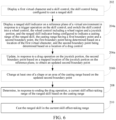
- FIG. 2 is a flowchart of a method for controlling a virtual character to cast a skill according to an exemplary embodiment in the present disclosure.
- the method may be performed by a computer device, and for example, may be performed by a terminal or a client on a terminal in a system as shown in FIG. 1 .
- the method includes steps 202 to 206.
- Step 202 Display a first virtual character and a skill control, the skill control being used to cast a ranged skill.
- the first virtual character is a virtual character controlled by a user.
- the client controls, according to a received human-machine interaction operation from a first user, the first virtual character to move in a virtual environment.
- the virtual environment is a three-dimensional virtual environment.
- a skill is an ability that is used or cast by a first virtual character, that attacks the first virtual character (including another virtual character and the first virtual character), and that increases or decreases values.
- the skills include an active skill and a passive skill.
- the active skill is a skill used or cast by a virtual character actively.
- the passive skill is a skill that is automatically triggered when a passive condition is satisfied.
- the skill mentioned in this embodiment is an active skill actively used or cast by the first virtual character controlled by the user.
- the skills may be classified into targeted skills and ranged skills.
- the targeted skill is a skill that requires specifying a casting direction or a casting target when casting the skill.
- the ranged skill is a skill that requires specifying a casting range when casting the skill.
- the skill mentioned in this embodiment generally refers to a ranged skill. That is, the ranged skill is a skill that is cast by the first virtual character and that has a specific region range as a skill effective range.
- a process of using a skill by a first virtual character includes: a casting process and an effect-taking process.
- the terminal receives an operation with which the user casts a skill.
- the effect-taking process the terminal controls, based on an operation of the user, the virtual character to use a skill.
- the ranged skill is a skill of which a casting range is determined through a user operation (trigger operation) in a skill casting process.
- the terminal controls, based on a selected casting range, the virtual character to use the skill.
- the ranged skill is a skill that is cast in an effective range, where effective range is determined based on a casting range, and the casting range is selected based on a user operation.
- the ranged skill is a skill that is cast to a hit object, where the hit object is determined based on a casting range and the casting range is selected based on a user operation.
- the targeted skill may be a skill that is cast toward an effect direction, where the effect direction is determined based on a casting direction and the casting direction is selected based on a user operation.
- the targeted skill may be a skill that is cast to a hit object, where the hit object is determined based on a casting direction and the casting direction is selected based on a user operation.
- a casting range currently selected by the user is displayed in the virtual environment in real time based on a user operation.
- the casting range has attributes such as a location, a size, and a shape.
- a location of a casting range can be changed through a user operation, and a size and a shape of the casting range are fixed.
- at least one of the location, the size, or the shape of the casting range can be changed through a user operation.
- ranged skill may also be referred to as “regional skill”, “region skill”, “range skill”, or “non-targeted skill”
- ranged skill indicator may also be referred to as “regional skill indicator”, “region skill indicator”, “range skill indicator”, or “non-targeted skill indicator”
- the skill control is a control used to control a virtual character to cast a skill.
- a control form of the skill control includes at least one of a button control or a wheel control.
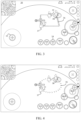
- the client displays a user interface 30.
- the user interface 30 includes a virtual environment screen and at least one control.
- the virtual environment screen is a screen obtained by observing the three-dimensional virtual environment from a perspective of a first virtual character 31.
- a camera model is set in the three-dimensional virtual environment with the perspective of the first virtual character 31, and the three-dimensional virtual environment is photographed using the camera model, to obtain a virtual environment screen.
- the virtual environment screen includes the first virtual character 31 and a second virtual character 32 located in the virtual environment.
- the second virtual character 32 is an enemy virtual character.
- At least one control is suspended on the virtual environment screen in the form of a head-up display (HUD) layer. That is, even if screen content of the virtual environment screen changes, the display location of the at least one control is not affected by the screen content.
- the at least one control includes a mobile wheel 33 on the left and a plurality of skill controls 34 on the right.
- the mobile wheel 33 is used to control the movement of the first virtual character 31 in the virtual environment, and the plurality of skill controls 34 are used to control the first virtual character 31 to cast various skills.
- the plurality of skill controls 34 include six skill buttons of skills 1 to 6, and three normal attack buttons in the lower right corner.
- the skill 3 is a skill button of a ranged skill.
- the skill controls 34 may be implemented as physical keys or a physical joystick.
- Step 204 Display a ranged skill indicator and a drag control in response to a trigger operation on the skill control, the ranged skill indicator being used to indicate a casting range of the ranged skill, the casting range having a first boundary point and a second boundary point, the first boundary point being determined based on a location of the first virtual character, and the second boundary point being determined based on a location of the drag control.
- the trigger operation is a user operation received by the client and acting on a skill button, and the client generates a trigger instruction according to the received user operation.
- the user operation may be at least one of an operation on a UI control, a voice operation, an action operation, a text operation, a mouse operation, a keyboard operation, or a game joystick operation.
- the ranged skill indicator is used to indicate a casting range of the ranged skill.
- the ranged skill indicator is used to indicate a casting range of the ranged skill before the ranged skill is cast and takes effect.
- the ranged skill indicator is displayed on a reference plane of the virtual environment.
- the reference plane is a plane used for casting a ranged skill.
- the ranged skill indicator is a graphic indicator displayed on the ground of the virtual environment.
- the graphic indicator occupies a region on the ground of the virtual environment. The region is used for indicating a casting range of the ranged skill.
- the casting range is an enclosed region having a first boundary point and a second boundary point.
- the first boundary point and the second boundary point are two most distant points of the enclosed region.
- the closed region is in a shape of any one of a square, a rectangle, a diamond, a circle, an ellipse, a hexagon, or a dodecagon.
- the first boundary point is determined based on a location of the first virtual character
- the second boundary point is determined based on a location of the drag control.
- the first boundary point is determined based on a location of a foothold of the first virtual character on the ground.
- the drag control is a control used to change a location of the second boundary point by a drag operation.
- the drag control may be displayed on the HUD layer or the reference plane.
- the second boundary point is determined based on a mapped location of the drag control mapped on the reference plane.
- the mapped location is obtained by mapping the display location of the drag control on the HUD layer to the reference plane.
- the second boundary point is determined based on a real-time location of the drag control on the reference plane.
- the drag control 35 and the ranged skill indicator 36 may be additionally displayed on the user interface 30.
- the ranged skill indicator 36 determines a rectangular region based on the first boundary point 37 and the second boundary point 38.
- the first boundary point 37 is a foothold of the first virtual character 31, and the second boundary point 38 is determined based on the mapped location of the drag control 35 mapped on the virtual ground.
- Step 206 Change at least one of a shape or an area of the casting range indicated by the ranged skill indicator in response to a drag operation on the drag control.
- the drag operation is an operation of dragging the drag control to move or slide.
- the drag operation is an operation of dragging the drag control to move on the HUD layer.
- the drag operation is an operation of dragging the drag control to move on the reference plane.
- a location of the second boundary point on the reference plane is changed in response to a drag operation on the drag control, to change the shape and/or the area of the casting range indicated by the ranged skill indicator based on constraints of the first boundary point and the second boundary point.
- changing the casting range is changing at least one of a shape and an area of the rectangular shape according to the movement of the second boundary point.
- a drag operation on a drag control is received, two boundary points of a casting range are determined respectively based on a location of a first virtual character and a location of the drag control, and further, a shape and/or an area of the casting range are/is changed in response to the drag operation.
- the area and/or the shape of the casting range indicated by a ranged skill indicator can be changed by receiving only one operation. Therefore, a method of casting a ranged skill with a customized casting range is provided, to simplify processing of a terminal in attacking a plurality of enemy virtual characters at scattered locations, thereby improving the efficiency of the terminal processing a ranged skill.
- the shape of the ranged skill indicator is not limited, provided that the shape can be determined using the first reference point and the second reference point.
- the shape of the ranged skill indicator is any one of a square, a rectangle, a diamond, a circle, an ellipse, a hexagon, or a dodecagon.
- the first boundary point is determined based on a location of the first virtual character, and the second boundary point is determined based on a location of the drag control.
- the ranged skill indicator 36 is a rectangular region, as shown in FIG. 3 .
- the first boundary point 37 is positioned to a foothold of the first virtual character 31, and the second boundary point 38 is positioned to the mapped location of the drag control 35 mapped on the ground.
- a rectangular ranged skill indicator is a rectangle made by using the first boundary point 37 and the second boundary point 38 as two vertices on the diagonal of the rectangular region.
- the ranged skill indicator 36 is circular, as shown in FIG. 4 .
- the first boundary point 37 is positioned to a foothold of the first virtual character 31, and the second boundary point 38 is positioned to the mapped location of the drag control 35 mapped on the ground.
- a circular ranged skill indicator is a circle made by using a distance between the first boundary point 37 and the second boundary point 38 as a diameter and using a position that is equidistant to the two points as a center.
- the ranged skill indicator 36 is in a hexagonal shape, as shown in FIG. 5 .
- the first boundary point 37 is positioned to a foothold of the first virtual character 31, and the second boundary point 38 is positioned to the mapped location of the drag control 35 mapped on the ground.
- a hexagonal ranged skill indicator is a hexagon made by using the first boundary point 37 and the second boundary point 38 as two vertices on the diagonal of the hexagonal region.
- the drag control 35 may be implemented in at least the following two manners:
- FIG. 6 is a flowchart of a method for controlling a virtual character to cast a skill according to an exemplary embodiment in the present disclosure.
- the method may be performed by a computer device.
- the method may be performed by a terminal or a client on a terminal as shown in FIG. 1 .
- the method includes the following steps 202 to 210.
- Step 202 Display a first virtual character and a skill control, the skill control being used to cast a ranged skill.
- step 202 shown in FIG. 2 Reference may be made to step 202 shown in FIG. 2 , and details are not described again.
- Step 204a Display a ranged skill indicator on a reference plane of a virtual environment in response to a trigger operation on the skill control; and switch the skill control into a wheel control, the wheel control including a wheel region and a joystick portion, and the ranged skill indicator being used to indicate a casting range of the ranged skill, the casting range having a first boundary point and a second boundary point, the first boundary point being determined based on a location of the first virtual character, and the second boundary point being determined based on a location of the drag control.
- the trigger operation is an operation of clicking/tapping the skill control.
- the skill control is displayed in the button form.
- the ranged skill indicator is displayed on the reference plane of the virtual environment.
- descriptions are provided by using the ranged skill indicator being a rectangular region skill indicator as an example.
- the skill control is further switched from being displayed as a button to being displayed as a wheel control. While displaying the wheel control, the original skill button is not displayed or is still retained at the original location.
- the wheel control includes a wheel region 35a and a joystick portion 35b. Both the wheel region 35a and the joystick portion 35b are circular, and a display area of the joystick portion 35b is less than a display area of the wheel region 35a.
- the joystick portion 35b can be dragged to move within a circular range indicated by the wheel region 35a.
- a center of circle of the wheel region 35a corresponds to the foothold 37 of the first virtual character 31 on the ground of the virtual environment, that is, corresponds to the first boundary point 37.
- the wheel region 35a corresponds to a circular range 35c on the ground of the virtual environment, and a ratio between a radius of the wheel region 35a and a radius of the circular range 35c is a mapping ratio k.
- the second boundary point 38 is mapped on the ground of the virtual environment according to the mapping ratio k and according to a directional angle and a distance of the joystick portion 35b relative to the circle of the wheel region 35a.
- the skill control 35 is displayed as a skill button.
- the wheel control 35 and the ranged skill indicator 36 are displayed on the reference plane of the virtual environment.
- the wheel control 35 includes a wheel region 35a and a joystick portion 35b.
- descriptions are provided by using the ranged skill indicator 36 being a rectangular region skill indicator as an example.
- the ranged skill indicator 36 is determined based on the first boundary point 37 and the second boundary point 38. While displaying the wheel control 35, the original skill button "skill 3" is still retained at the original location.
- Step 206a Update, in response to a drag operation on the joystick portion, the second boundary point based on a mapped location of the joystick portion mapped on the virtual ground, to obtain an updated second boundary point.
- the second boundary point 38 is determined based on the mapped location of the joystick portion 35b mapped on the virtual ground.
- the terminal in response to that the terminal detects a leftward sliding operation on the joystick portion 35b, the terminal moves the mapped location of the joystick portion 35b mapped on the virtual ground leftward with the leftward sliding operation, to determine the second boundary point 38, and updates the display location of the second boundary point 38.
- the ranged skill has a plurality of candidate boundary points, and the second boundary point can only be selected from the plurality of candidate boundary points.
- the updated second boundary point is determined from the plurality of candidate boundary points based on the mapped location of the joystick portion mapped on the reference plane.
- a manner of determining the second boundary point based on the mapped location may be: determining a candidate boundary point nearest to the mapped location as an updated second boundary point; or determining a candidate boundary point at the upper right of the mapped location and nearest to the mapped location as an updated second boundary point; or determining a candidate boundary point at the lower left of the mapped location and the nearest to the mapped location as an updated second boundary point.
- each candidate boundary point corresponds to a candidate skill effective range. If the drag operation is ended when a corresponding candidate boundary point is selected as the second boundary point, the selected casting range is a skill effective range corresponding to the candidate boundary point. That is, in response to ending the drag operation, the ranged skill is cast in a current skill effective range, the current skill effective range being equal to a casting range.
- Step 206b Change at least one of a shape or an area of the casting range based on the updated second boundary point.
- the casting range is determined based on the first boundary point and the second boundary point, in a case that the second boundary point is updated, the shape and/or the area of the casting range are/is changed based on the updated second boundary point.
- this step includes the following two steps:
- the client determines the updated ranged skill indicator in a rectangular shape according to the first diagonal point and the updated second diagonal point, which are two diagonal points of the rectangular shape.
- the terminal changes a range of the ranged skill indicator according to the updated rectangle, to indicate a casting range of the ranged skill.
- the first boundary point is determined based on a location of the first virtual character. Therefore, if the user changes the location of the first virtual character using a movement control in a process of casting the ranged skill, an updated first boundary point is determined based on the location of the first virtual character, and a shape and/or an area of the casting range is changed based on the updated first boundary point.
- the locations of the first virtual character and the first boundary point are changed simultaneously.
- the foothold of the first virtual character and the location of the first boundary point are always the same.
- the foothold of the first virtual character is kept unchanged while changing the location of the first boundary point. In this case, the foothold of the first virtual character and the location of the first boundary point are no longer the same.
- the location of the first boundary point is kept unchanged while changing the foothold of the first virtual character. In this case, the foothold of the first virtual character and the location of the first boundary point are no longer the same.
- Step 208 Determine, in response to ending the drag operation, a current skill effective range of the ranged skill based on the casting range.
- the skill effective range is a skill range of the ranged skill after the ranged skill is cast. According to the casting range, the client may automatically adjust the current skill effective range of the ranged skill.
- the casting range is the same as the skill effective range.
- the terminal directly determines the casting range as the skill effective range.
- the casting range and the skill effective range are not exactly the same and are slightly different from each other.
- the terminal determines the skill effective range by using the casting range as a reference.
- the ranged skill includes a plurality of candidate skill effective ranges.
- a world coordinate system is established by using the ground in the virtual environment as a reference plane and the location of the first virtual character as a center, and a maximum skill effective range of the ranged skill is divided into a plurality of square regions in unit of 3 meters, which is merely an example.
- the ranged skill includes 5 candidate square skill effective ranges and a plurality of candidate rectangular skill effective ranges:
- First skill effective range Coordinates of the first boundary point are (0, 0), coordinates of the second boundary point are (3, 3), and the first skill effective range includes blocks A, B, F, and G.
- Second skill effective range Coordinates of the first boundary point are (0, 0), coordinates of the second boundary point are (6, 6), the second skill effective range includes blocks A, B, C, F, G, H, K, L, and M.
- Third skill effective range Coordinates of the first boundary point are (0, 0), coordinates of the second boundary point are (9, 9), the third skill effective range includes blocks A, B, C, F, G, H, K, L, M, and N.
- Coordinates of the first boundary point are (0, 0), and coordinates of the second boundary point are (12, 12).
- the fifth skill effective range Coordinates of the first boundary point are (0, 0), and coordinates of the second boundary point are (15, 15).
- the fifth skill effective range is the maximum skill effective range of the ranged skill.
- Each rectangular skill effective range includes a plurality of adjacent blocks.
- a smallest circumscribed skill effective range of the casting range is selected from the plurality of candidate skill effective ranges, and is determined as the current skill effective range of the ranged skill.
- a "smallest circumscribed" skill effective range is the smallest one of the plurality of candidate skill effective ranges including or covering the casting range.
- the coordinates of the second boundary point corresponding to the casting range are (4, 4). Therefore, the coordinates of the second boundary point are rounded up to (6, 6), and the second skill effective range is determined as the current skill effective range of the ranged skill.
- the coordinates of the second boundary point corresponding to the casting range are (2, 4). Therefore, the coordinates of the second boundary point are rounded up to (3, 6), and the range of the block A and block F are determined as the current skill effective range of the ranged skill.
- the skill effective range having the highest overlapping area ratio with the casting range is selected from the plurality of candidate skill effective ranges, and is determined as the current skill effective range of the ranged skill.
- the first skill effective range is determined as the current skill effective range of the ranged skill.
- Step 210 Cast the ranged skill in the current skill effective range.
- the ranged skill may generate a skill effect value for the second virtual character 32 within the current skill effective range.
- the skill effect value may be a hit point damage value, a hit point recovery value, a mana damage value, a mana recovery value, or the like.
- an effect value of the ranged skill within the current skill effective range is determined according to an effective area ratio.
- the effective area ratio is a ratio between an area of the current skill effective range and a maximum skill effective area of the ranged skill.
- the maximum skill effective area of the ranged skill refers an area of a largest range in which the ranged skill can effectively produce an effect, which is the casting range generated by a drag operation of the user at a boundary of the wheel region, for example, the fifth skill effective range in FIG. 9 .
- an effect value per unit area of the ranged skill is determined according to the effective area ratio.
- the effect value per unit area refers to a skill effect value in a unit area.
- a total effect value of the ranged skill remains unchanged. Therefore, when the effective area ratio is small, the effect value per unit area is large; and when the effective area ratio is large, the effect value per unit area is small. In this way, in a case that there are fewer enemy virtual characters, more damage can be caused.
- a total effect value of the ranged skill is determined according to the effective area ratio.
- the total effect value refers to an effect value generated on a total area of the current skill effective range.
- the effect value per unit area of the ranged skill remains unchanged. Therefore, when the effective area ratio is small, the total effect value is small; and when the effective area ratio is large, the total effect value is large. In this way, in a case that the total effect value is small, the mana cost of the first virtual character can be saved.
- the ranged skill being a skill with a site blocking effect as an example
- a blocking effect is produced in the current skill effective range, so that the enemy virtual character located in the current skill effective range cannot leave the current skill effective range and can only move within the current skill effective range, thereby continuously producing an effect on the enemy virtual character.
- the current skill effective range 39 is displayed on the user interface 30, and an animation effect will be displayed on the current skill effective range 39.
- engineers may create the animation effect according to the maximum skill effective range.
- a mask layer is used to block an animation effect beyond the current skill effective range 39, and only the animation effect within the current skill effective range 39 is retained and displayed.
- Such a display manner does not require stretching or scaling down the animation effect. Therefore, the animation effect can be displayed consistently in different skill effective ranges.
- a drag operation on a drag control is received, two boundary points of a casting range are determined respectively based on a location of a first virtual character and a location of the drag control, and further, a shape and/or an area of the casting range are/is changed in response to the drag operation.
- the area and/or the shape of the casting range indicated by a ranged skill indicator can be changed by receiving only one operation. Therefore, a method of casting a ranged skill with a customized casting range is provided, to simplify processing steps of a terminal in attacking a plurality of enemy virtual characters at scattered locations, thereby improving the efficiency of the terminal processing a ranged skill.
- a location selected by the joystick portion is further mapped to the reference plane of the virtual environment by receiving a drag operation on the joystick portion of the wheel control, thereby changing the area and/or the shape of the casting range indicated by the ranged skill indicator, and using the joystick portion of the wheel control to control the casting range can simplify the processing steps of the terminal, so that the terminal can efficiently handle the process of aiming at the enemy virtual character.
- an effect value of the ranged skill within the current skill effective range can be further determined using an effective area ratio, to determine a casting range of the ranged skill according to a quantity of enemy virtual characters and the region in which the enemy virtual characters are distributed, thereby saving the mana cost of the first virtual character while causing more damage to the enemy virtual characters.
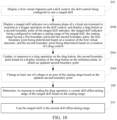
- FIG. 10 is a flowchart of a method for controlling a virtual character to cast a skill according to an exemplary embodiment in the present disclosure.
- the method may be performed by a computer device.
- the method may be performed by a terminal or a client on a terminal as shown in FIG. 1 .
- the method includes the following steps 202 to 210.
- Step 202 Display a first virtual character and a skill control, the skill control being used to cast a ranged skill.
- step 202 shown in FIG. 2 Reference may be made to step 202 shown in FIG. 2 , and details are not described again.
- Step 204b Display a ranged skill indicator on a reference plane of a virtual environment in response to a trigger operation on the skill control; and display a drag button at a second boundary point of the ranged skill indicator, the ranged skill indicator being used to indicate a casting range of the ranged skill, the casting range having a first boundary point and the second boundary point, the first boundary point being determined based on a location of the first virtual character, and the second boundary point being determined based on a location of a drag control.
- the drag control includes a drag button.
- the user triggers the skill control to evoke the drag button in the virtual environment screen, and may determine a location of the second boundary point by moving the drag button in the virtual environment screen.
- the drag button 35 may be evoked in the virtual environment screen, and the ranged skill indicator 36 and the drag button 35 are displayed on the virtual environment screen of the user interface.
- the user can press and move the drag button 35 in the displayed screen of the virtual environment, and the client determines a final location of the drag button 35 on the reference plane of the virtual environment as the second boundary point.
- the ranged skill indicator 36 is in a shape of a rectangle displayed on the reference plane with a location of the first virtual character 31 as the first boundary point and a final determined location of the drag button 35 on the reference plane as the second boundary point.
- pressing and moving the drag button can change the location of the second boundary point on the reference plane, thereby changing the region range indicated by the ranged skill indicator.
- Step 206c Update, in response to a drag operation on the drag button, the second boundary point based on a location of the drag button on the reference plane, to obtain an updated second boundary point.
- the terminal detects a drag operation of the drag button on the virtual environment screen, and the client determines the second boundary point according to a location of the drag button on the virtual ground.
- the terminal in response to that the terminal detects a leftward sliding operation on the joystick portion 35b, the terminal moves the mapped location of the joystick portion 35b mapped on the virtual ground leftward with the leftward sliding operation, to determine the second boundary point 38, and updates the display location of the second boundary point 38.
- the ranged skill has a plurality of candidate boundary points, and the second boundary point can only be selected from the plurality of candidate boundary points.
- the updated second boundary point is determined from the plurality of candidate boundary points based on the location of the drag button on the reference plane.
- a manner of determining the second boundary point based on the location of the drag button on the reference plane may be: determining a candidate boundary point nearest to the location as an updated second boundary point; or determining a candidate boundary point at the upper right of the mapped location and nearest to the location as an updated second boundary point; or determining a candidate boundary point at the lower left of the mapped location and the nearest to the location as an updated second boundary point.
- each candidate boundary point corresponds to a candidate skill effective range. If the drag operation is ended when a corresponding candidate boundary point is selected as the second boundary point, the selected casting range is a skill effective range corresponding to the candidate boundary point. That is, in response to ending the drag operation, the ranged skill is cast in a current skill effective range, the current skill effective range being equal to a casting range.
- Step 206d Change at least one of a shape or an area of the casting range based on the updated second boundary point.
- the casting range is determined based on the first boundary point and the second boundary point, in a case that the second boundary point is updated, the shape and/or the area of the casting range are/is changed based on the updated second boundary point.
- the first boundary point is determined based on a location of the first virtual character. Therefore, if the user changes the location of the first virtual character using a movement control in a process of casting the ranged skill, an updated first boundary point is determined based on the location of the first virtual character, and a shape and/or an area of the casting range is changed based on the updated first boundary point.
- this step includes the following two steps:
- the client determines the updated ranged skill indicator in a rectangular shape according to the first diagonal point and the updated second diagonal point, which are two diagonal points of the rectangular shape.
- the terminal changes a range of the ranged skill indicator according to the updated rectangle, to indicate a casting range of the ranged skill.
- Step 208 Determine, in response to ending the drag operation, a current skill effective range of the ranged skill based on the casting range.
- the skill effective range is a skill range of the ranged skill after the ranged skill is cast. According to the casting range, the client may automatically adjust the current skill effective range of the ranged skill.
- the casting range is the same as the skill effective range.
- the terminal directly determines the casting range as the skill effective range.
- the casting range and the skill effective range are not exactly the same and are slightly different from each other.
- the terminal determines the skill effective range by using the casting range as a reference.
- the ranged skill includes a plurality of candidate skill effective ranges.
- a world coordinate system is established by using the ground in the virtual environment as a reference plane and the location of the first virtual character as a center, and the reference plane is divided into a plurality of small-area regions in unit of 3 meter.
- the ranged skill includes 5 candidate skill effective ranges:
- Coordinates of the first boundary point are (0, 0), and coordinates of the second boundary point are (3, 3).
- Coordinates of the first boundary point are (0, 0), and coordinates of the second boundary point are (12, 12).
- the fifth skill effective range Coordinates of the first boundary point are (0, 0), and coordinates of the second boundary point are (15, 15).
- the fifth skill effective range is the maximum skill effective range of the ranged skill.
- a smallest circumscribed skill effective range of the casting range is selected from the plurality of candidate skill effective ranges, and is determined as the current skill effective range of the ranged skill.
- a "smallest circumscribed" skill effective range is the smallest one of the plurality of candidate skill effective ranges including or covering the casting range.
- the skill effective range having the highest overlapping area ratio with the casting range is selected from the plurality of candidate skill effective ranges, and is determined as the current skill effective range of the ranged skill.
- Step 210 Cast the ranged skill in the current skill effective range.
- the ranged skill may generate a skill effect value for the second virtual character 32 within the current skill effective range.
- the skill effect value may be a hit point damage value, a hit point recovery value, a mana damage value, a mana recovery value, or the like.
- an effect value of the ranged skill within the current skill effective range is determined according to an effective area ratio.
- the effective area ratio is a ratio between an area of the current skill effective range and a maximum skill effect area of the ranged skill.
- the maximum skill effective area of the ranged skill refers an area of a largest range in which the ranged skill can effectively produce an effect, which is the casting range generated by a drag operation of the user at a boundary of the wheel region, for example, the fifth skill effective range in FIG. 9 .
- the effect value per unit area of the ranged skill is determined according to the effective area ratio.
- the effect value per unit area refers to a skill effect value in a unit area.
- a total effect value of the ranged skill remains unchanged. Therefore, when the effective area ratio is small, the effect value per unit area is large; and when the effective area ratio is large, the effect value per unit area is small. In this way, in a case that there are fewer enemy virtual characters, more damage can be caused.
- a total effect value of the ranged skill is determined according to the effective area ratio.
- the total effect value refers to an effect value generated on a total area of the current skill effective range.
- the effect value per unit area of the ranged skill remains unchanged. Therefore, when the effective area ratio is small, the total effect value is small; and when the effective area ratio is large, the total effect value is large. In this way, in a case that the total effect value is small, the mana cost of the first virtual character can be saved.
- the ranged skill being a skill with a site blocking effect as an example
- a blocking effect is produced in the current skill effective range, so that the enemy virtual character located in the current skill effective range cannot leave the current skill effective range and can only move within the current skill effective range, thereby continuously producing an effect on the enemy virtual character.
- a drag operation on a drag control is received, two boundary points of a casting range are determined respectively based on a location of a first virtual character and a location of the drag control, and further, a shape and/or an area of the casting range are/is changed in response to the drag operation.
- the area and/or the shape of the casting range indicated by a ranged skill indicator can be changed by receiving only one operation. Therefore, a method of casting a ranged skill with a customized casting range is provided, to simplify processing steps of a terminal in attacking a plurality of enemy virtual characters at scattered locations, thereby improving the efficiency of the terminal processing the ranged skill.
- the drag button located in the virtual environment screen is displayed by receiving a trigger operation on the skill control, a drag operation is received using the drag button in the virtual environment screen, and a location of the second boundary point is determined based on the drag operation, thereby changing an area and/or a shape of a casting range indicated by the ranged skill indicator.
- an effect value of the ranged skill within the current skill effective range can be further determined using an effective area ratio, to determine a casting range of the ranged skill according to a quantity of enemy virtual characters and the region in which the enemy virtual characters are distributed, thereby saving the mana cost of the first virtual character while causing more damage to the enemy virtual characters.
- the ranged skill can be used again only after a cooldown time period.
- the present disclosure also provides optional steps for determining a cooldown time period based on a current skill effective range.
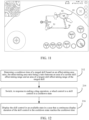
- FIG. 12 is a flowchart of a method for controlling a virtual character to cast a skill according to an exemplary embodiment in the present disclosure.
- the method may be performed by a computer device.
- the method may be performed by a terminal or a client on a terminal as shown in FIG. 1 .
- the method may further include the following steps 212 to 216.
- Step 212 Determine a cooldown time period of the ranged skill based on an effective area ratio, the effective area ratio being a ratio between an area of the current skill effective range and an area of a maximum skill effective range of the ranged skill.
- a cooldown time period refers to a time period during which the ranged skill cannot be used and is determined according to an effective area ratio.
- the effective area ratio is a ratio between an area of the current skill effective range and an area of a maximum skill effective range of the ranged skill.
- the maximum effective area of the ranged skill refers an area of a maximum range in which the ranged skill can effectively produce an effect, which is the casting range generated by the drag operation of the user at a boundary of the wheel region, for example, the fifth skill effective range in FIG. 9 .
- the effective area ratio has a positive proportional relationship with the cooldown time period.
- a product of the effective area ratio and a cooldown coefficient is determined as the cooldown time period of the ranged skill.
- a compensation coefficient may be selected according to linear compensation or according to various other compensation manners such as nonlinear compensation and parabolic compensation, which is not limited in this embodiment.
- the client may determines 50% of the maximum cooldown time period for the ranged skill as a cooldown buffer.
- selecting a smaller skill effective range may result in a less cooldown time period of the ranged skill.
- Step 214 Switch, in response to ending the drag operation, to displaying the skill control in a cooldown state.
- ending the end drag operation includes at least one of ending the dragging of the wheel control by the user or ending the pressing of the drag button by the user.
- the client may switch from the wheel control to the skill control in a cooldown state.
- the wheel control cannot be operated, that is, the ranged skill cannot be cast.
- Step 216 Display the skill control in an available state in a case that a time period of continuously displaying the skill control in the cooldown state reaches the cooldown time period.
- the skill control after the time period of continuously displaying the skill control in the cooldown state reaches the cooldown time period, the skill control will be restored to an available state. In this case, the ranged skill can be cast again by dragging the skill control.
- This embodiment can be combined with any one of the three optional embodiments shown in FIG. 2 , FIG. 6 and FIG. 9 .
- the terminal cools down the skill control for a specific time period, and restores the skill control to the available state when the time of cooldown reaches the cooldown time period, thereby increasing a quantity of effective uses of the ranged skill by compensating for the cooldown time period.
- the cooldown time period of the ranged skill is further determined based on the effective area ratio, so that the cooldown time period of the ranged skill can be reduced by selecting a smaller skill effective range among the plurality of candidate skill effective ranges.
- FIG. 13 is a schematic structural diagram of an apparatus 1300 for controlling a virtual character to cast a skill according to an exemplary embodiment in the present disclosure.
- the apparatus 1300 may be implemented as an entire computer device or a part of the computer device by using software, hardware, or a combination thereof.
- the apparatus 1300 includes:
- the drag control includes a wheel control.
- the interaction module 1340 is configured to display the ranged skill indicator on a reference plane of a virtual environment in response to the trigger operation on the skill control; and display the skill control as the wheel control, the wheel control including a wheel region and a joystick portion.
- the changing module 1360 is configured to change at least one of the shape or the area of the casting range in response to a drag operation on the joystick portion.
- the changing module 1360 is configured to update, in response to the drag operation on the joystick portion, the second boundary point based on a mapped location of the joystick portion mapped on the reference plane, to obtain an updated second boundary point; and change at least one of the shape or the area of the casting range based on the updated second boundary point.
- the drag control includes a drag button.
- the interaction module 1340 is configured to display the ranged skill indicator on a reference plane of a virtual environment in response to the trigger operation on the skill control; and display the drag button at the second boundary point of the ranged skill indicator.
- the changing module 1360 is configured to change at least one of the shape or the area of the casting range in response to a drag operation on the drag button.
- the changing module 1360 is configured to update, in response to the drag operation on the drag button, the second boundary point based on a location of the drag button on the reference plane, to obtain an updated second boundary point; and change at least one of the shape or the area of the casting range based on the updated second boundary point.
- the ranged skill indicator is a skill indicator in a rectangular shape
- the first boundary point is a first diagonal point of the rectangular shape
- the second boundary point is a second diagonal point of the rectangular shape.
- the changing module 1360 is configured to determine an updated rectangular shape by using the first diagonal point and the updated second diagonal point as two diagonal points of the rectangular shape; change the casting range indicated by the ranged skill indicator into the updated rectangular shape.
- the apparatus further includes: a casting module 1380, configured to determine, in response to ending the drag operation, a current skill effective range of the ranged skill based on the casting range; and cast the ranged skill in the current skill effective range.
- a casting module 1380 configured to determine, in response to ending the drag operation, a current skill effective range of the ranged skill based on the casting range; and cast the ranged skill in the current skill effective range.
- the ranged skill includes a plurality of candidate skill effective ranges.
- the casting module 1380 is configured to select, in response to ending the drag operation, a skill effective range having the highest overlapping area ratio with the casting range from the plurality of candidate skill effective ranges, as the current skill effective range of the ranged skill.
- the casting module 1380 is configured to selecting, in response to ending the drag operation, a smallest circumscribed skill effective range of the casting range from the plurality of candidate skill effective ranges, as the current skill effective range of the ranged skill.
- the casting module 1380 is configured to determine an effect value per unit area of the ranged skill based on an effective area ratio, the effective area ratio being a ratio between an area of the current skill effective range and an area of a maximum skill effective range of the ranged skill; and cast the ranged skill based on the effect value per unit area in the current skill effective range.
- the casting module 1380 is configured to determine a total effect value of the ranged skill based on an effective area ratio, the effective area ratio being a ratio between an area of the current skill effective range and an area of a maximum skill effective range of the ranged skill; and cast the ranged skill based on the total effect value in the current skill effective range.
- the ranged skill includes a plurality of candidate boundary points.
- the changing module 1360 is configured to determine, in response to the drag operation on the joystick portion, the updated second boundary point from the plurality of candidate boundary points based on the mapped location of the joystick portion mapped on the reference plane.
- the ranged skill includes a plurality of candidate boundary points.
- the changing module 1360 is configured to determine, in response to the drag operation on the drag button, the updated second boundary point from the plurality of candidate boundary points based on the location of the drag button on the reference plane.
- the casting module 1380 is configured to cast the ranged skill in the current skill effective range in response to ending the drag operation, the current skill effective range being equal to the casting range.
- the apparatus further includes: a cooldown module 1390, configured to determine a cooldown time period of the ranged skill based on an effective area ratio, the effective area ratio being a ratio between an area of the current skill effective range and an area of a maximum skill effective range of the ranged skill.
- a cooldown module 1390 configured to determine a cooldown time period of the ranged skill based on an effective area ratio, the effective area ratio being a ratio between an area of the current skill effective range and an area of a maximum skill effective range of the ranged skill.
- the display module 1320 is further configured to switch, in response to ending the drag operation, to displaying the wheel control as the skill control in a cooldown state; and display the skill control in an available state in a case that a time period of continuously displaying the skill control in the cooldown state reaches the cooldown time period.
- FIG. 14 is a structural block diagram of a computer device 1400 according to an exemplary embodiment in the present disclosure.
- the computer device 1400 may be a portable mobile terminal, such as a smartphone, a tablet computer, an MP3 (Moving Picture Experts Group Audio Layer III) player, or an MP4(Moving Picture Experts Group Audio Layer IV) player.
- the computer device 1400 may be further referred to as user equipment, a portable terminal or the like.
- the computer device 1400 includes a processor 1401 and a memory 1402.
- the processor 1401 may include one or more processing cores, for example, a 4-core processor or an 8-core processor.
- the processor 1401 may be implemented by using at least one hardware form of a digital signal processor (DSP), a field programmable gate array (FPGA), and a programmable logic array (PLA).
- the processor 1401 may also include a main processor and a coprocessor.
- the main processor is a processor configured to process data in an awake state, and is also referred to as a central processing unit (CPU).
- the coprocessor is a low power consumption processor configured to process the data in a standby state.
- the processor 1401 may be integrated with a graphics processing unit (GPU).
- the GPU is configured to render and draw content that needs to be displayed on a display screen.
- the processor 1401 may further include an artificial intelligence (AI) processor.
- the AI processor is configured to process computing operations related to machine learning.
- the memory 1402 may include one or more computer-readable storage media.
- the computer-readable storage medium may be tangible and non-transient.
- the memory 1402 may further include a high-speed random access memory and a nonvolatile memory, for example, one or more disk storage devices or flash storage devices.
- a non-transitory computer-readable storage medium in the memory 1402 is configured to store at least one instruction, the at least one instruction being executed by the processor 1401 to implement the method for displaying a virtual environment screen provided in the method embodiments in the present disclosure.
- the computer device 1400 further optionally includes a peripheral device interface 1403 and at least one peripheral.
- the peripheral includes at least one of a radio frequency circuit 1404 or a display screen 1405.
- the peripheral interface 1403 may be configured to connect the at least one peripheral related to input/output (I/O) to the processor 1401 and the memory 1402.
- the processor 1401, the memory 1402 and the peripheral device interface 1403 are integrated on a same chip or circuit board.
- any one or two of the processor 1401, the memory 1402, and the peripheral device interface 1403 may be implemented on a single chip or circuit board. This is not limited in this embodiment.
- the RF circuit 1404 is configured to receive and transmit an RF signal, also referred to as an electromagnetic signal.
- the RF circuit 1404 communicates with a communication network and other communication devices through the electromagnetic signal.
- the RF circuit 1404 converts an electric signal into an electromagnetic signal for transmission, or converts a received electromagnetic signal into an electric signal.
- the RF circuit 1404 includes: an antenna system, an RF transceiver, one or more amplifiers, a tuner, an oscillator, a digital signal processor, a codec chip set, a subscriber identity module card, and the like.
- the RF circuit 1404 may communicate with another terminal by using at least one wireless communication protocol.
- the wireless communication protocol includes, but is not limited to, a world wide web, a metropolitan area network, an intranet, generations of mobile communication networks (2G, 3G, 4G, and 5G), a wireless local area network and/or a wireless fidelity (Wi-Fi) network.
- the RF 1404 may further include a circuit related to NFC (Near Field Communication), which is not limited in the present disclosure.
- the display screen 1405 is configured to display a user interface (UI).
- the UI may include a graph, text, an icon, a video, and any combination thereof.
- the display screen 1405 also has a capability of acquiring a touch signal on or above a surface of the display screen 1405.
- the touch signal may be inputted to the processor 1401 as a control signal for processing.
- the display screen 1405 is configured to provide a virtual button and/or a virtual keyboard, which is also referred to as a soft button and/or a soft keyboard.
- the display screen 1405 may be a flexible display screen, disposed on a curved surface or a folded surface of the computer device 1400. Even, the display screen 1405 may be further set in a non-rectangular irregular pattern, namely, a special-shaped screen.
- the touch display screen 1405 may be made of a material such as a liquid crystal display (LCD) or an organic light-emitting diode (OLED).
- FIG. 14 does not constitute any limitation on the computer device 1400, and the computer device may include more components or fewer components than those shown in the figure, or some components may be combined, or a different component deployment may be used.
- the embodiments in the present disclosure further provide a computer device including a processor and a memory, the memory storing at least one instruction, at least one segment of program, a code set, or an instruction set, the at least one instruction, the at least one segment of program, the code set, or the instruction set being used to be loaded and executed by the processor to implement the method for displaying a virtual environment screen provided in the foregoing method embodiments.
- the embodiments in the present disclosure further provide a computer-readable storage medium, storing at least one instruction, at least one program, a code set, or an instruction set, the at least one instruction, the at least one program, the code set, or the instruction set being used to be loaded and executed by a processor to implement the method for displaying a virtual environment screen provided in the foregoing method embodiments.
- the program may be stored in a computer-readable storage medium.
- the storage medium may be a read-only memory, a magnetic disk, an optical disc, or the like.
Landscapes
- Engineering & Computer Science (AREA)
- Multimedia (AREA)
- Human Computer Interaction (AREA)
- Physics & Mathematics (AREA)
- Theoretical Computer Science (AREA)
- General Engineering & Computer Science (AREA)
- Optics & Photonics (AREA)
- General Physics & Mathematics (AREA)
- User Interface Of Digital Computer (AREA)
Abstract
Description
- This application claims priority to
Chinese Patent Application No. 202110888291.2, entitled "METHOD AND APPARATUS FOR CONTROLLING VIRTUAL CHARACTER TO CAST SKILL, DEVICE, MEDIUM, AND PROGRAM PRODUCT" filed on August 3, 2021 - The present disclosure relates to the field of supporting human-machine interaction, and in particular, to a method and an apparatus for controlling a virtual object to cast a skill, a device, a medium, and a program product.
- A battle game is a game in which multiple user accounts compete in the same scene. Optionally, the battle game may be a multiplayer online battle arena (MOBA) game.
- In a typical MOBA game, a player may control a virtual character to cast a ranged skill to attack at least one enemy virtual character in a specified range. A client displays a virtual character in a virtual environment and a skill button. After a user clicks/taps the skill button, the client displays a ranged skill indicator on the ground in the virtual environment. The ranged skill indicator is used to indicate a casting range of a ranged skill. The user may control a direction, a location, and a distance of the casting range by dragging the skill button.
- In a case of unfixed quantity of scattered enemy virtual characters, because a casting range of a skill is fixed, a terminal needs to receive multiple operations for selecting multiple casting ranges, to cast the skill to the multiple scattered enemy virtual characters, resulting in low processing efficiency of the terminal in attacking the enemy virtual characters.
- The present disclosure provides a method and an apparatus for controlling a virtual object to cast a skill, a device, a medium, and a program product, to efficiently attack enemy virtual characters in a case that locations of the enemy virtual characters are scattered, thereby improving the processing efficiency of a terminal. The technical solutions are follows.
- According to an aspect in the present disclosure, a method for controlling a virtual character to cast a skill is provided, performed by a computer device, the method including:
- displaying a first virtual character and a skill control, the skill control being used to cast a ranged skill;
- displaying a ranged skill indicator and a drag control in response to a trigger operation on the skill control, the ranged skill indicator being used to indicate a casting range of the ranged skill, the casting range having a first boundary point and a second boundary point, the first boundary point being determined based on a location of the first virtual character, and the second boundary point being determined based on a location of the drag control; and
- changing at least one of a shape or an area of the casting range in response to a drag operation on the drag control.
- According to another aspect in the present disclosure, an apparatus for controlling a virtual character to cast a skill, including:
- a display module, configured to display a first virtual character and a skill control, the skill control being used to cast a ranged skill;
- the display module being configured to display a ranged skill indicator and a drag control in response to a trigger operation on the skill control, the ranged skill indicator being used to indicate a casting range of the ranged skill, the casting range having a first boundary point and a second boundary point, the first boundary point being determined based on a location of the first virtual character, and the second boundary point being determined based on a location of the drag control; and
- a changing module, configured to change at least one of a shape or an area of the casting range in response to a drag operation on the drag control.
- According to another aspect in the present disclosure, a computer device is provided, including a processor and a memory, the memory storing at least one instruction, at least one program, a code set, or an instruction set, the at least one instruction, the at least one program, the code set, or the instruction set being used to be loaded and executed by the processor to implement the method for controlling a virtual character to cast a skill according to the foregoing aspect.
- According to another aspect in the present disclosure, a computer-readable storage medium is provided, storing at least one instruction, at least one program, a code set, or an instruction set, the at least one instruction, the at least one program, the code set, or the instruction set being used to be loaded and executed by a processor to implement the method for controlling a virtual character to cast a skill according to the foregoing aspect.
- According to an aspect of the embodiments of the present disclosure, a computer program product or a computer program is provided, the computer program product or the computer program including computer instructions, the computer instructions being stored in a computer-readable storage medium. When a processor of a computer device reads the computer instructions from the computer-readable storage medium, and executes the computer instructions, the computer device implements the method for controlling a virtual character to cast a skill provided in the foregoing optional implementations.
- The technical solutions provided in the embodiments in the present disclosure include at least the following beneficial effects.
- A drag operation on a drag control is received, two boundary points of a casting range are determined respectively based on a location of a first virtual character and a location of the drag control, and further, a shape and/or an area of the casting range are/is changed in response to the drag operation. The area and/or the shape of the casting range indicated by a ranged skill indicator can be changed by receiving only one operation. Therefore, a method of casting a ranged skill with a customized casting range is provided, to simplify processing steps of a terminal in attacking a plurality of enemy virtual characters at scattered locations, thereby improving the processing efficiency of the terminal.
-
-
FIG. 1 is a block diagram of a computer system according to an exemplary embodiment in the present disclosure. -
FIG. 2 is a flowchart of a method for controlling a virtual character to cast a skill according to an exemplary embodiment in the present disclosure. -
FIG. 3 is a schematic diagram of an interface with a ranged skill indicator being rectangular according to an exemplary embodiment in the present disclosure. -
FIG. 4 is a schematic diagram of an interface with a ranged skill indicator being circular according to an exemplary embodiment in the present disclosure. -
FIG. 5 is a schematic diagram of an interface with a ranged skill indicator being hexagonal according to an exemplary embodiment in the present disclosure. -
FIG. 6 is a flowchart of a method for controlling a virtual character to cast a skill according to an exemplary embodiment in the present disclosure. -
FIG. 7 is a schematic diagram of a wheel control according to an exemplary embodiment in the present disclosure. -
FIG. 8 is a schematic diagram of an interface of a skill effective range according to an exemplary embodiment in the present disclosure. -
FIG. 9 is a schematic diagram of determining a current skill effective range according to an exemplary embodiment in the present disclosure. -
FIG. 10 is a flowchart of a method for controlling a virtual character to cast a skill according to an exemplary embodiment in the present disclosure. -
FIG. 11 is a schematic diagram of an interface for controlling a casting range of a virtual character using a drag button according to an exemplary embodiment in the present disclosure. -
FIG. 12 is a flowchart of a method for controlling a virtual character to cast a skill according to an exemplary embodiment in the present disclosure. -
FIG. 13 is a block diagram of an apparatus for controlling a virtual character to cast a skill according to an exemplary embodiment in the present disclosure. -
FIG. 14 is a schematic diagram of an apparatus structure of a computer device according to an exemplary embodiment in the present disclosure. - To make the objectives, technical solutions, and advantages in the present disclosure clearer, the following further describes implementations in the present disclosure in detail with reference to the accompanying drawings.
- First, terms involved in the embodiments in the present disclosure are introduced.
- Virtual environment: A virtual environment is a virtual environment displayed (or provided) by an application program when run on a terminal. The virtual environment may be a simulated world of a real world, or may be a semi-simulated semi-fictional three-dimensional world, or may be an entirely fictional three-dimensional world. The virtual environment may be any one of a two-dimensional virtual environment, a 2.5-dimensional virtual environment, or a three-dimensional virtual environment. Optionally, the virtual environment is further used for a virtual environment battle between at least two virtual characters, and there are virtual resources available to the at least two virtual characters in the virtual environment. Optionally, the virtual environment includes a lower left corner region and an upper right corner region that are symmetrical. Virtual characters belonging to two opposing camps occupy the regions respectively, and the objective of each side is to destroy a target building/fort/base/crystal deep in the opponent's region to win victory.
- Virtual object: A virtual object is a movable object in a virtual environment. The movable object may be at least one of a virtual character, a virtual animal, or an animation or cartoon figure. Optionally, when the virtual environment is a three-dimensional virtual environment, the virtual character may be a three-dimensional model. Each virtual character has a shape and a volume in the three-dimensional virtual environment, and occupies some space in the three-dimensional virtual environment. Optionally, the virtual character is a three-dimensional character constructed based on three-dimensional human skeleton technology. The virtual character wears different skins to have different appearances. In some implementations, the virtual character may be alternatively implemented by using a 2.5-dimensional model or a two-dimensional model. This is not limited in the embodiments in the present disclosure.
- MOBA: MOBA is an arena in which different virtual teams on at least two opposing camps occupy respective map regions in a virtual environment, and compete against each other to achieve a goal of meeting a specific victory condition. The victory condition includes, but is not limited to, at least one of occupying a fort or destroying a fort of the opposing side, killing virtual characters on the opposing side, ensuring own survival in a specified scene and time, seizing a specific resource, or outscoring the opponent within a specified time. The battle arena game may take place in rounds. The same map or different maps may be used in different rounds of the battle arena game. Each virtual team includes one or more virtual characters, for example, 1 virtual character, 2 virtual characters, 3 virtual characters, or 5 virtual characters.
- MOBA game: A MOBA game is a game in which several forts are provided in a virtual environment, and users on different camps control virtual characters to battle in the virtual environment to occupy forts or destroy forts of the opposing camp. For example, in the MOBA game, the users may be divided into two opposing camps. The virtual characters controlled by the users are scattered in the virtual environment to compete against each other, and the victory condition is to destroy or occupy all opponent forts. The MOBA game takes place in rounds. A duration of one round of the MOBA game is from a moment at which the game starts to a movement at which the victory condition is met.
- User interface (UI) control: A user interface control is any visual control or element that can be seen on a user interface of an application program, such as a picture, an input box, a text box, a button, or a label. Some user interface controls respond to an operation of a user. For example, a skill control controls a master virtual character to cast a skill. The user triggers the skill control to control the master virtual character to cast the skill. UI controls involved in the embodiments in the present disclosure include, but are not limited to: skill controls and movement controls.
-
FIG. 1 is a structural block diagram of a computer system according to an exemplary embodiment in the present disclosure. Thecomputer system 100 includes afirst terminal 110, aserver 120, and asecond terminal 130. - A
client 111 supporting a virtual environment is installed and run on thefirst terminal 110, and theclient 111 may be a multiplayer online battle program. When the first terminal runs theclient 111, a UI of theclient 111 is displayed on a screen of thefirst terminal 110. Theclient 111 may be any one of a military simulation program, an escape shooting game, a virtual reality (VR) application program, an augmented reality (AR) program, a three-dimensional map program, a VR game, an AR game, a first-person shooting (FPS) game, a third-person shooting (TPS) game, a MOBA game, or a simulation game (SLG). In this embodiment, an example in which theclient 111 is a MOBA game is used for description. Thefirst terminal 110 is a terminal used by afirst user 112. Thefirst user 112 uses thefirst terminal 110 to control a first virtual character located in the virtual environment to perform activities, and the first virtual character may be referred to as a master virtual character of thefirst user 112. The activities of the first virtual character include, but are not limited to: at least one of moving, jumping, teleporting, casting a skill, adjusting body postures, crawling, walking, running, riding, flying, driving, picking, shooting, attacking, or throwing. For example, the first virtual character is a first virtual person character, for example, a simulated person character or a cartoon person character. - A
client 131 supporting a virtual environment is installed and run on thesecond terminal 130, and theclient 131 may be a multiplayer online battle program. When the second terminal 130 runs theclient 131, a UI of theclient 131 is displayed on a screen of thesecond terminal 130. The client may be any one of a military simulation program, an escape shooting game, a VR application program, an AR program, a three-dimensional map program, a VR game, an AR game, an FPS game, a TPS game, a MOBA game, or an SLG. In this embodiment, an example in which a client is a MOBA game is used for description. Thesecond terminal 130 is a terminal used by asecond user 113. Thesecond user 113 uses thesecond terminal 130 to control a second virtual character located in the virtual environment to perform activities, and the second virtual character may be referred to as a master virtual character of thesecond user 113. For example, the second virtual character is a second virtual person character, for example, a simulated person character or a cartoon person character. - Optionally, the first virtual character and the second virtual character are located in a same virtual environment. Optionally, the first virtual character and the second virtual character may belong to the same camp, the same team, or the same organization, have a friend relationship, or have a temporary communication permission. Optionally, the first virtual character and the second virtual character may belong to different camps, different teams, or different organizations, or have an adversarial relationship with each other.
- Optionally, the client installed on the
first terminal 110 is the same as the client installed on thesecond terminal 130, or the clients installed on the two terminals are the same type of clients of different operating system platforms (Android system or iOS system). Thefirst terminal 110 may generally refer to one of a plurality of terminals, and thesecond terminal 130 may generally refer to another one of a plurality of terminals. In this embodiment, only thefirst terminal 110 and thesecond terminal 130 are used as an example for description. Thefirst terminal 110 and thesecond terminal 130 are of the same or different device types. The device type includes at least one of a smartphone, a tablet computer, an e-book reader, a Moving Picture Experts Group Audio Layer III (MP3) player, a Moving Picture Experts Group Audio Layer IV (MP4) player, a laptop computer, or a desktop computer. -
FIG. 1 shows only two terminals. However, a plurality ofother terminals 140 may be connected to theserver 120 in different embodiments. Optionally, one ormore terminals 140 are terminals corresponding to a developer. A developing and editing platform for the client supporting a virtual environment is installed on theterminal 140. The developer may edit and update the client on the terminal 140 and transmit an updated client installation package to theserver 120 by using a wired or wireless network. Thefirst terminal 110 and thesecond terminal 130 may download the client installation package from theserver 120 to update the client. - The
first terminal 110, thesecond terminal 130, and the terminal 140 are connected to theserver 120 through a wireless network or a wired network. - The
server 120 may be one server, a plurality of servers, a cloud computing platform, or a virtualization center. Theserver 120 is configured to provide a background service for a client supporting a virtual environment. Optionally, theserver 120 is responsible for primary computing work, and the terminal is responsible for secondary computing work. Alternatively, theserver 120 is responsible for secondary computing work, and the terminal is responsible for primary computing work. Alternatively, theserver 120 and the terminal perform collaborative computing by using a distributed computing architecture therebetween. - In a schematic example, the
server 120 includes aprocessor 122, auser account database 123, abattle service module 124, and a user-oriented input/output (I/O)interface 125. Theprocessor 122 is configured to load instructions stored in the server 121, and process data in theuser account database 123 and thebattle service module 124. Theuser account database 123 is configured to store data of user accounts used by thefirst terminal 110, thesecond terminal 130, and the another terminal 140, for example, avatars of the user accounts, nicknames of the user accounts, battle effectiveness indexes of the user accounts, and service zones of the user accounts. Thebattle service module 124 is configured to provide a plurality of battle rooms for the users to battle, for example, a 1V1 battle room, a 3V3 battle room, a 5V5 battle room, and the like. The user-oriented I/O interface 125 is configured to establish communication between thefirst terminal 110 and/or thesecond terminal 130 by using a wireless network or a wired network for data exchange. -
FIG. 2 is a flowchart of a method for controlling a virtual character to cast a skill according to an exemplary embodiment in the present disclosure. The method may be performed by a computer device, and for example, may be performed by a terminal or a client on a terminal in a system as shown inFIG. 1 . As shown inFIG. 2 , the method includessteps 202 to 206. - Step 202: Display a first virtual character and a skill control, the skill control being used to cast a ranged skill.
- The first virtual character is a virtual character controlled by a user. The client controls, according to a received human-machine interaction operation from a first user, the first virtual character to move in a virtual environment. Exemplarily, the virtual environment is a three-dimensional virtual environment.
- A skill is an ability that is used or cast by a first virtual character, that attacks the first virtual character (including another virtual character and the first virtual character), and that increases or decreases values. The skills include an active skill and a passive skill. The active skill is a skill used or cast by a virtual character actively. The passive skill is a skill that is automatically triggered when a passive condition is satisfied. Exemplarily, the skill mentioned in this embodiment is an active skill actively used or cast by the first virtual character controlled by the user.
- Exemplarily, the skills may be classified into targeted skills and ranged skills. The targeted skill is a skill that requires specifying a casting direction or a casting target when casting the skill. The ranged skill is a skill that requires specifying a casting range when casting the skill. The skill mentioned in this embodiment generally refers to a ranged skill. That is, the ranged skill is a skill that is cast by the first virtual character and that has a specific region range as a skill effective range.
- Exemplarily, the ranged skill is named based on classification of the skill in terms of a manner in which the skill is cast. A process of using a skill by a first virtual character includes: a casting process and an effect-taking process. In the casting process, the terminal receives an operation with which the user casts a skill. In the effect-taking process, the terminal controls, based on an operation of the user, the virtual character to use a skill.
- The ranged skill is a skill of which a casting range is determined through a user operation (trigger operation) in a skill casting process. In the effect-taking process of the ranged skill, the terminal controls, based on a selected casting range, the virtual character to use the skill.
- In an optional implementation, the ranged skill is a skill that is cast in an effective range, where effective range is determined based on a casting range, and the casting range is selected based on a user operation. In an optional implementation, the ranged skill is a skill that is cast to a hit object, where the hit object is determined based on a casting range and the casting range is selected based on a user operation.
- However, the targeted skill may be a skill that is cast toward an effect direction, where the effect direction is determined based on a casting direction and the casting direction is selected based on a user operation. In an optional implementation, the targeted skill may be a skill that is cast to a hit object, where the hit object is determined based on a casting direction and the casting direction is selected based on a user operation.
- Exemplarily, when the ranged skill is cast, a casting range currently selected by the user is displayed in the virtual environment in real time based on a user operation. The casting range has attributes such as a location, a size, and a shape. In the methods in related art, only a location of a casting range can be changed through a user operation, and a size and a shape of the casting range are fixed. However, in the method provided by this embodiment in the present disclosure, at least one of the location, the size, or the shape of the casting range can be changed through a user operation.
- Exemplarily, the "ranged skill" may also be referred to as "regional skill", "region skill", "range skill", or "non-targeted skill", and the "ranged skill indicator" may also be referred to as "regional skill indicator", "region skill indicator", "range skill indicator", or "non-targeted skill indicator ".
- The skill control is a control used to control a virtual character to cast a skill. A control form of the skill control includes at least one of a button control or a wheel control.
- Exemplarily, as shown in
FIG. 3 , the client displays auser interface 30. Theuser interface 30 includes a virtual environment screen and at least one control. - The virtual environment screen is a screen obtained by observing the three-dimensional virtual environment from a perspective of a first
virtual character 31. For example, a camera model is set in the three-dimensional virtual environment with the perspective of the firstvirtual character 31, and the three-dimensional virtual environment is photographed using the camera model, to obtain a virtual environment screen. The virtual environment screen includes the firstvirtual character 31 and a secondvirtual character 32 located in the virtual environment. Optionally, the secondvirtual character 32 is an enemy virtual character. - At least one control is suspended on the virtual environment screen in the form of a head-up display (HUD) layer. That is, even if screen content of the virtual environment screen changes, the display location of the at least one control is not affected by the screen content. The at least one control includes a
mobile wheel 33 on the left and a plurality of skill controls 34 on the right. Themobile wheel 33 is used to control the movement of the firstvirtual character 31 in the virtual environment, and the plurality of skill controls 34 are used to control the firstvirtual character 31 to cast various skills. - Schematically, the plurality of skill controls 34 include six skill buttons of
skills 1 to 6, and three normal attack buttons in the lower right corner. In this embodiment, it is assumed that theskill 3 is a skill button of a ranged skill. In a host game scene, the skill controls 34 may be implemented as physical keys or a physical joystick. - Step 204: Display a ranged skill indicator and a drag control in response to a trigger operation on the skill control, the ranged skill indicator being used to indicate a casting range of the ranged skill, the casting range having a first boundary point and a second boundary point, the first boundary point being determined based on a location of the first virtual character, and the second boundary point being determined based on a location of the drag control.
- The trigger operation is a user operation received by the client and acting on a skill button, and the client generates a trigger instruction according to the received user operation. Exemplarily, the user operation may be at least one of an operation on a UI control, a voice operation, an action operation, a text operation, a mouse operation, a keyboard operation, or a game joystick operation.
- The ranged skill indicator is used to indicate a casting range of the ranged skill. Optionally, the ranged skill indicator is used to indicate a casting range of the ranged skill before the ranged skill is cast and takes effect. The ranged skill indicator is displayed on a reference plane of the virtual environment. The reference plane is a plane used for casting a ranged skill. Using the reference plane being the ground in the virtual environment as an example, the ranged skill indicator is a graphic indicator displayed on the ground of the virtual environment. The graphic indicator occupies a region on the ground of the virtual environment. The region is used for indicating a casting range of the ranged skill.
- In this embodiment, the casting range is an enclosed region having a first boundary point and a second boundary point. Generally, the first boundary point and the second boundary point are two most distant points of the enclosed region. Schematically, the closed region is in a shape of any one of a square, a rectangle, a diamond, a circle, an ellipse, a hexagon, or a dodecagon. The first boundary point is determined based on a location of the first virtual character, and the second boundary point is determined based on a location of the drag control.
- Using the reference plane being the ground as an example, the first boundary point is determined based on a location of a foothold of the first virtual character on the ground. The drag control is a control used to change a location of the second boundary point by a drag operation. The drag control may be displayed on the HUD layer or the reference plane. In a case that the drag control is displayed on the HUD layer, the second boundary point is determined based on a mapped location of the drag control mapped on the reference plane. The mapped location is obtained by mapping the display location of the drag control on the HUD layer to the reference plane. In a case that the drag control is displayed on the reference plane in the virtual environment, the second boundary point is determined based on a real-time location of the drag control on the reference plane.
- Schematically, referring to
FIG. 3 , after the user clicks/taps the skill button of theskill 3, thedrag control 35 and the rangedskill indicator 36 may be additionally displayed on theuser interface 30. The rangedskill indicator 36 determines a rectangular region based on thefirst boundary point 37 and thesecond boundary point 38. Thefirst boundary point 37 is a foothold of the firstvirtual character 31, and thesecond boundary point 38 is determined based on the mapped location of thedrag control 35 mapped on the virtual ground. - Step 206: Change at least one of a shape or an area of the casting range indicated by the ranged skill indicator in response to a drag operation on the drag control.
- The drag operation is an operation of dragging the drag control to move or slide. In a case that the drag control is displayed on the HUD layer, the drag operation is an operation of dragging the drag control to move on the HUD layer. In a case that the drag control is displayed on the reference plane, the drag operation is an operation of dragging the drag control to move on the reference plane.
- A location of the second boundary point on the reference plane is changed in response to a drag operation on the drag control, to change the shape and/or the area of the casting range indicated by the ranged skill indicator based on constraints of the first boundary point and the second boundary point.
- Using the casting range being in a rectangular shape as an example, changing the casting range is changing at least one of a shape and an area of the rectangular shape according to the movement of the second boundary point.
- In conclusion, in the method provided in this embodiment, a drag operation on a drag control is received, two boundary points of a casting range are determined respectively based on a location of a first virtual character and a location of the drag control, and further, a shape and/or an area of the casting range are/is changed in response to the drag operation. The area and/or the shape of the casting range indicated by a ranged skill indicator can be changed by receiving only one operation. Therefore, a method of casting a ranged skill with a customized casting range is provided, to simplify processing of a terminal in attacking a plurality of enemy virtual characters at scattered locations, thereby improving the efficiency of the terminal processing a ranged skill.
- In the embodiments in the present disclosure, the shape of the ranged skill indicator is not limited, provided that the shape can be determined using the first reference point and the second reference point. Schematically, the shape of the ranged skill indicator is any one of a square, a rectangle, a diamond, a circle, an ellipse, a hexagon, or a dodecagon. The first boundary point is determined based on a location of the first virtual character, and the second boundary point is determined based on a location of the drag control.
- In some embodiments, the ranged
skill indicator 36 is a rectangular region, as shown inFIG. 3 . Schematically, thefirst boundary point 37 is positioned to a foothold of the firstvirtual character 31, and thesecond boundary point 38 is positioned to the mapped location of thedrag control 35 mapped on the ground. A rectangular ranged skill indicator is a rectangle made by using thefirst boundary point 37 and thesecond boundary point 38 as two vertices on the diagonal of the rectangular region. - In some embodiments, the ranged
skill indicator 36 is circular, as shown inFIG. 4 . Schematically, thefirst boundary point 37 is positioned to a foothold of the firstvirtual character 31, and thesecond boundary point 38 is positioned to the mapped location of thedrag control 35 mapped on the ground. A circular ranged skill indicator is a circle made by using a distance between thefirst boundary point 37 and thesecond boundary point 38 as a diameter and using a position that is equidistant to the two points as a center. - In some embodiments, the ranged
skill indicator 36 is in a hexagonal shape, as shown inFIG. 5 . Schematically, thefirst boundary point 37 is positioned to a foothold of the firstvirtual character 31, and thesecond boundary point 38 is positioned to the mapped location of thedrag control 35 mapped on the ground. A hexagonal ranged skill indicator is a hexagon made by using thefirst boundary point 37 and thesecond boundary point 38 as two vertices on the diagonal of the hexagonal region. - According to the display location, the
drag control 35 may be implemented in at least the following two manners: - 1. The
drag control 35 is displayed on the HUD layer, which is described in the embodiment as shown inFIG. 6 . - 2. The
drag control 35 is displayed on the reference plane of the virtual environment, which is described in the embodiment as shown inFIG. 10 . -
FIG. 6 is a flowchart of a method for controlling a virtual character to cast a skill according to an exemplary embodiment in the present disclosure. The method may be performed by a computer device. For example, the method may be performed by a terminal or a client on a terminal as shown inFIG. 1 . As shown inFIG. 6 , the method includes the followingsteps 202 to 210. - Step 202: Display a first virtual character and a skill control, the skill control being used to cast a ranged skill.
- Reference may be made to step 202 shown in
FIG. 2 , and details are not described again. -
Step 204a: Display a ranged skill indicator on a reference plane of a virtual environment in response to a trigger operation on the skill control; and switch the skill control into a wheel control, the wheel control including a wheel region and a joystick portion, and the ranged skill indicator being used to indicate a casting range of the ranged skill, the casting range having a first boundary point and a second boundary point, the first boundary point being determined based on a location of the first virtual character, and the second boundary point being determined based on a location of the drag control. - Schematically, the trigger operation is an operation of clicking/tapping the skill control. In an initial state, the skill control is displayed in the button form.
- After the user clicks/taps the skill control, the ranged skill indicator is displayed on the reference plane of the virtual environment. In this embodiment, descriptions are provided by using the ranged skill indicator being a rectangular region skill indicator as an example. In addition, after the user clicks/taps the skill control, the skill control is further switched from being displayed as a button to being displayed as a wheel control. While displaying the wheel control, the original skill button is not displayed or is still retained at the original location.
- Schematically, referring to
FIG. 7 , the wheel control includes awheel region 35a and ajoystick portion 35b. Both thewheel region 35a and thejoystick portion 35b are circular, and a display area of thejoystick portion 35b is less than a display area of thewheel region 35a. Thejoystick portion 35b can be dragged to move within a circular range indicated by thewheel region 35a. A center of circle of thewheel region 35a corresponds to thefoothold 37 of the firstvirtual character 31 on the ground of the virtual environment, that is, corresponds to thefirst boundary point 37. Thewheel region 35a corresponds to acircular range 35c on the ground of the virtual environment, and a ratio between a radius of thewheel region 35a and a radius of thecircular range 35c is a mapping ratio k. When thejoystick portion 35b moves in thewheel region 35a, thesecond boundary point 38 is mapped on the ground of the virtual environment according to the mapping ratio k and according to a directional angle and a distance of thejoystick portion 35b relative to the circle of thewheel region 35a. - Schematically, referring to
FIG. 8 , in the initial state, theskill control 35 is displayed as a skill button. After the user clicks/taps theskill control 35, thewheel control 35 and the rangedskill indicator 36 are displayed on the reference plane of the virtual environment. Thewheel control 35 includes awheel region 35a and ajoystick portion 35b. In this embodiment, descriptions are provided by using the rangedskill indicator 36 being a rectangular region skill indicator as an example. The rangedskill indicator 36 is determined based on thefirst boundary point 37 and thesecond boundary point 38. While displaying thewheel control 35, the original skill button "skill 3" is still retained at the original location. -
Step 206a: Update, in response to a drag operation on the joystick portion, the second boundary point based on a mapped location of the joystick portion mapped on the virtual ground, to obtain an updated second boundary point. - After the terminal displays the ranged
skill indicator 36, in response to detecting a drag operation on thejoystick portion 35b, thesecond boundary point 38 is determined based on the mapped location of thejoystick portion 35b mapped on the virtual ground. - For example, in response to that the terminal detects a leftward sliding operation on the
joystick portion 35b, the terminal moves the mapped location of thejoystick portion 35b mapped on the virtual ground leftward with the leftward sliding operation, to determine thesecond boundary point 38, and updates the display location of thesecond boundary point 38. - In an optional embodiment, the ranged skill has a plurality of candidate boundary points, and the second boundary point can only be selected from the plurality of candidate boundary points. In response to the drag operation on the joystick portion, the updated second boundary point is determined from the plurality of candidate boundary points based on the mapped location of the joystick portion mapped on the reference plane.
- Exemplarily, a manner of determining the second boundary point based on the mapped location may be: determining a candidate boundary point nearest to the mapped location as an updated second boundary point; or determining a candidate boundary point at the upper right of the mapped location and nearest to the mapped location as an updated second boundary point; or determining a candidate boundary point at the lower left of the mapped location and the nearest to the mapped location as an updated second boundary point.
- Exemplarily, each candidate boundary point corresponds to a candidate skill effective range. If the drag operation is ended when a corresponding candidate boundary point is selected as the second boundary point, the selected casting range is a skill effective range corresponding to the candidate boundary point. That is, in response to ending the drag operation, the ranged skill is cast in a current skill effective range, the current skill effective range being equal to a casting range.
-
Step 206b: Change at least one of a shape or an area of the casting range based on the updated second boundary point. - Because the casting range is determined based on the first boundary point and the second boundary point, in a case that the second boundary point is updated, the shape and/or the area of the casting range are/is changed based on the updated second boundary point.
- Using the casting range being a rectangular shape as an example, this step includes the following two steps:
- S 1: Determine an updated rectangular shape by using the first diagonal point and the updated second diagonal point as two diagonal points of the rectangular shape.
- S2: Change the casting range indicated by the ranged skill indicator into the updated rectangular shape.
- Exemplarily, after the second boundary point mapped on the virtual ground is determined according to a drag/slide operation on the joystick portion of the wheel control, the client determines the updated ranged skill indicator in a rectangular shape according to the first diagonal point and the updated second diagonal point, which are two diagonal points of the rectangular shape. The terminal changes a range of the ranged skill indicator according to the updated rectangle, to indicate a casting range of the ranged skill.
- The first boundary point is determined based on a location of the first virtual character. Therefore, if the user changes the location of the first virtual character using a movement control in a process of casting the ranged skill, an updated first boundary point is determined based on the location of the first virtual character, and a shape and/or an area of the casting range is changed based on the updated first boundary point.
- In a possible design, in the process of casting the ranged skill, in response to a movement operation on the movement control, the locations of the first virtual character and the first boundary point are changed simultaneously. The foothold of the first virtual character and the location of the first boundary point are always the same. In another possible design, in the process of casting the ranged skill, in response to a movement operation on the movement control, the foothold of the first virtual character is kept unchanged while changing the location of the first boundary point. In this case, the foothold of the first virtual character and the location of the first boundary point are no longer the same. In another possible design, in the process of casting the ranged skill, in response to a movement operation on the movement control, the location of the first boundary point is kept unchanged while changing the foothold of the first virtual character. In this case, the foothold of the first virtual character and the location of the first boundary point are no longer the same.
- Step 208: Determine, in response to ending the drag operation, a current skill effective range of the ranged skill based on the casting range.
- The skill effective range is a skill range of the ranged skill after the ranged skill is cast. According to the casting range, the client may automatically adjust the current skill effective range of the ranged skill.
- In some embodiments, the casting range is the same as the skill effective range. The terminal directly determines the casting range as the skill effective range.
- In some embodiments, the casting range and the skill effective range are not exactly the same and are slightly different from each other. The terminal determines the skill effective range by using the casting range as a reference.
- Schematically, the ranged skill includes a plurality of candidate skill effective ranges. Schematically, referring to
FIG. 9 , a world coordinate system is established by using the ground in the virtual environment as a reference plane and the location of the first virtual character as a center, and a maximum skill effective range of the ranged skill is divided into a plurality of square regions in unit of 3 meters, which is merely an example. In this case, the ranged skill includes 5 candidate square skill effective ranges and a plurality of candidate rectangular skill effective ranges: - First skill effective range: Coordinates of the first boundary point are (0, 0), coordinates of the second boundary point are (3, 3), and the first skill effective range includes blocks A, B, F, and G.
- Second skill effective range: Coordinates of the first boundary point are (0, 0), coordinates of the second boundary point are (6, 6), the second skill effective range includes blocks A, B, C, F, G, H, K, L, and M.
- Third skill effective range: Coordinates of the first boundary point are (0, 0), coordinates of the second boundary point are (9, 9), the third skill effective range includes blocks A, B, C, F, G, H, K, L, M, and N.
- Fourth skill effective range: Coordinates of the first boundary point are (0, 0), and coordinates of the second boundary point are (12, 12).
- Fifth skill effective range: Coordinates of the first boundary point are (0, 0), and coordinates of the second boundary point are (15, 15). The fifth skill effective range is the maximum skill effective range of the ranged skill.
- The plurality of candidate rectangular skill effective ranges include:
- a sixth skill effective range, including blocks A and B;
- a seventh skill effective range, including blocks A, B, and C;
- an eighth skill effective range, including blocks A, B, C, and D;
- a ninth skill effective range, including blocks A, B, C, D, and E; and
- a tenth skill effective range, including blocks A, B, C, D, F, G, and H.
- More candidate rectangular skill effective ranges can be obtained in the similar manner, details are not described. Each rectangular skill effective range includes a plurality of adjacent blocks.
- In a possible design, a smallest circumscribed skill effective range of the casting range is selected from the plurality of candidate skill effective ranges, and is determined as the current skill effective range of the ranged skill. A "smallest circumscribed" skill effective range is the smallest one of the plurality of candidate skill effective ranges including or covering the casting range.
- Referring to
FIG. 9 , it is assumed that the coordinates of the second boundary point corresponding to the casting range are (4, 4). Therefore, the coordinates of the second boundary point are rounded up to (6, 6), and the second skill effective range is determined as the current skill effective range of the ranged skill. In another example, it is assumed that the coordinates of the second boundary point corresponding to the casting range are (2, 4). Therefore, the coordinates of the second boundary point are rounded up to (3, 6), and the range of the block A and block F are determined as the current skill effective range of the ranged skill. - In another possible design, the skill effective range having the highest overlapping area ratio with the casting range is selected from the plurality of candidate skill effective ranges, and is determined as the current skill effective range of the ranged skill.
- Referring to
FIG. 9 , it is assumed that the coordinates of the second boundary point corresponding to the casting range are (4, 4), the overlapping area ratio between the first skill effective range and the casting range is 9/16=56%, and the overlapping area ratio between the second skill effective range and the casting range is 16/36=44%. Therefore, the first skill effective range is determined as the current skill effective range of the ranged skill. - Step 210: Cast the ranged skill in the current skill effective range.
- After the ranged skill is cast, the ranged skill may generate a skill effect value for the second
virtual character 32 within the current skill effective range. The skill effect value may be a hit point damage value, a hit point recovery value, a mana damage value, a mana recovery value, or the like. - Exemplarily, an effect value of the ranged skill within the current skill effective range is determined according to an effective area ratio. The effective area ratio is a ratio between an area of the current skill effective range and a maximum skill effective area of the ranged skill. The maximum skill effective area of the ranged skill refers an area of a largest range in which the ranged skill can effectively produce an effect, which is the casting range generated by a drag operation of the user at a boundary of the wheel region, for example, the fifth skill effective range in
FIG. 9 . - In a possible design, an effect value per unit area of the ranged skill is determined according to the effective area ratio. The effect value per unit area refers to a skill effect value in a unit area.
- Exemplarily, a total effect value of the ranged skill remains unchanged. Therefore, when the effective area ratio is small, the effect value per unit area is large; and when the effective area ratio is large, the effect value per unit area is small. In this way, in a case that there are fewer enemy virtual characters, more damage can be caused.
- In a possible design, a total effect value of the ranged skill is determined according to the effective area ratio. The total effect value refers to an effect value generated on a total area of the current skill effective range.
- Exemplarily, the effect value per unit area of the ranged skill remains unchanged. Therefore, when the effective area ratio is small, the total effect value is small; and when the effective area ratio is large, the total effect value is large. In this way, in a case that the total effect value is small, the mana cost of the first virtual character can be saved.
- Using the ranged skill being a skill with a site blocking effect as an example, after the ranged skill is cast according to an operation of a user, a blocking effect is produced in the current skill effective range, so that the enemy virtual character located in the current skill effective range cannot leave the current skill effective range and can only move within the current skill effective range, thereby continuously producing an effect on the enemy virtual character.
- Referring to
FIG. 8 , after the ranged skill is cast, the current skilleffective range 39 is displayed on theuser interface 30, and an animation effect will be displayed on the current skilleffective range 39. To ensure displaying consistent animation effect each time when the ranged skill is cast, engineers may create the animation effect according to the maximum skill effective range. In a case that the current skilleffective range 39 is smaller than the maximum skill effective range, a mask layer is used to block an animation effect beyond the current skilleffective range 39, and only the animation effect within the current skilleffective range 39 is retained and displayed. Such a display manner does not require stretching or scaling down the animation effect. Therefore, the animation effect can be displayed consistently in different skill effective ranges. - In conclusion, in the method provided in this embodiment, a drag operation on a drag control is received, two boundary points of a casting range are determined respectively based on a location of a first virtual character and a location of the drag control, and further, a shape and/or an area of the casting range are/is changed in response to the drag operation. The area and/or the shape of the casting range indicated by a ranged skill indicator can be changed by receiving only one operation. Therefore, a method of casting a ranged skill with a customized casting range is provided, to simplify processing steps of a terminal in attacking a plurality of enemy virtual characters at scattered locations, thereby improving the efficiency of the terminal processing a ranged skill.
- In the method provided in this embodiment, a location selected by the joystick portion is further mapped to the reference plane of the virtual environment by receiving a drag operation on the joystick portion of the wheel control, thereby changing the area and/or the shape of the casting range indicated by the ranged skill indicator, and using the joystick portion of the wheel control to control the casting range can simplify the processing steps of the terminal, so that the terminal can efficiently handle the process of aiming at the enemy virtual character.
- In the method provided in this embodiment, an effect value of the ranged skill within the current skill effective range can be further determined using an effective area ratio, to determine a casting range of the ranged skill according to a quantity of enemy virtual characters and the region in which the enemy virtual characters are distributed, thereby saving the mana cost of the first virtual character while causing more damage to the enemy virtual characters.
-
FIG. 10 is a flowchart of a method for controlling a virtual character to cast a skill according to an exemplary embodiment in the present disclosure. The method may be performed by a computer device. For example, the method may be performed by a terminal or a client on a terminal as shown inFIG. 1 . As shown inFIG. 6 , the method includes the followingsteps 202 to 210. - Step 202: Display a first virtual character and a skill control, the skill control being used to cast a ranged skill.
- Reference may be made to step 202 shown in
FIG. 2 , and details are not described again. -
Step 204b: Display a ranged skill indicator on a reference plane of a virtual environment in response to a trigger operation on the skill control; and display a drag button at a second boundary point of the ranged skill indicator, the ranged skill indicator being used to indicate a casting range of the ranged skill, the casting range having a first boundary point and the second boundary point, the first boundary point being determined based on a location of the first virtual character, and the second boundary point being determined based on a location of a drag control. - Exemplarily, the drag control includes a drag button. The user triggers the skill control to evoke the drag button in the virtual environment screen, and may determine a location of the second boundary point by moving the drag button in the virtual environment screen.
- Exemplarily, as shown in
FIG. 11 , when the user clicks/taps the skill control "skill 3", thedrag button 35 may be evoked in the virtual environment screen, and the rangedskill indicator 36 and thedrag button 35 are displayed on the virtual environment screen of the user interface. The user can press and move thedrag button 35 in the displayed screen of the virtual environment, and the client determines a final location of thedrag button 35 on the reference plane of the virtual environment as the second boundary point. The rangedskill indicator 36 is in a shape of a rectangle displayed on the reference plane with a location of the firstvirtual character 31 as the first boundary point and a final determined location of thedrag button 35 on the reference plane as the second boundary point. Exemplarily, in a case that the drag button is evoked, pressing and moving the drag button can change the location of the second boundary point on the reference plane, thereby changing the region range indicated by the ranged skill indicator. -
Step 206c: Update, in response to a drag operation on the drag button, the second boundary point based on a location of the drag button on the reference plane, to obtain an updated second boundary point. - Exemplarily, after the terminal displays the ranged skill indicator, the terminal detects a drag operation of the drag button on the virtual environment screen, and the client determines the second boundary point according to a location of the drag button on the virtual ground.
- For example, in response to that the terminal detects a leftward sliding operation on the
joystick portion 35b, the terminal moves the mapped location of thejoystick portion 35b mapped on the virtual ground leftward with the leftward sliding operation, to determine thesecond boundary point 38, and updates the display location of thesecond boundary point 38. - In an optional embodiment, the ranged skill has a plurality of candidate boundary points, and the second boundary point can only be selected from the plurality of candidate boundary points. In response to the drag operation on the drag button, the updated second boundary point is determined from the plurality of candidate boundary points based on the location of the drag button on the reference plane.
- Exemplarily, a manner of determining the second boundary point based on the location of the drag button on the reference plane may be: determining a candidate boundary point nearest to the location as an updated second boundary point; or determining a candidate boundary point at the upper right of the mapped location and nearest to the location as an updated second boundary point; or determining a candidate boundary point at the lower left of the mapped location and the nearest to the location as an updated second boundary point.
- Exemplarily, each candidate boundary point corresponds to a candidate skill effective range. If the drag operation is ended when a corresponding candidate boundary point is selected as the second boundary point, the selected casting range is a skill effective range corresponding to the candidate boundary point. That is, in response to ending the drag operation, the ranged skill is cast in a current skill effective range, the current skill effective range being equal to a casting range.
-
Step 206d: Change at least one of a shape or an area of the casting range based on the updated second boundary point. - Because the casting range is determined based on the first boundary point and the second boundary point, in a case that the second boundary point is updated, the shape and/or the area of the casting range are/is changed based on the updated second boundary point.
- The first boundary point is determined based on a location of the first virtual character. Therefore, if the user changes the location of the first virtual character using a movement control in a process of casting the ranged skill, an updated first boundary point is determined based on the location of the first virtual character, and a shape and/or an area of the casting range is changed based on the updated first boundary point.
- Using the casting range being a rectangular shape as an example, this step includes the following two steps:
- S 1: Determine an updated rectangular shape by using the first diagonal point and the updated second diagonal point as two diagonal points of the rectangular shape.
- S2: Change the casting range indicated by the ranged skill indicator into the updated rectangular shape.
- Exemplarily, after the second boundary point mapped on the virtual ground is determined according to a drag/slide operation on the joystick portion of the wheel control, the client determines the updated ranged skill indicator in a rectangular shape according to the first diagonal point and the updated second diagonal point, which are two diagonal points of the rectangular shape. The terminal changes a range of the ranged skill indicator according to the updated rectangle, to indicate a casting range of the ranged skill.
- Step 208: Determine, in response to ending the drag operation, a current skill effective range of the ranged skill based on the casting range.
- The skill effective range is a skill range of the ranged skill after the ranged skill is cast. According to the casting range, the client may automatically adjust the current skill effective range of the ranged skill.
- In some embodiments, the casting range is the same as the skill effective range. The terminal directly determines the casting range as the skill effective range.
- In some embodiments, the casting range and the skill effective range are not exactly the same and are slightly different from each other. The terminal determines the skill effective range by using the casting range as a reference.
- Schematically, the ranged skill includes a plurality of candidate skill effective ranges. Schematically, referring to
FIG. 9 , a world coordinate system is established by using the ground in the virtual environment as a reference plane and the location of the first virtual character as a center, and the reference plane is divided into a plurality of small-area regions in unit of 3 meter. In this case, the ranged skill includes 5 candidate skill effective ranges: - First skill effective range: Coordinates of the first boundary point are (0, 0), and coordinates of the second boundary point are (3, 3).
- Second skill effective range: Coordinates of the first boundary point are (0, 0), and coordinates of the second boundary point are (6, 6).
- Third skill effective range: Coordinates of the first boundary point are (0, 0), and coordinates of the second boundary point are (9, 9).
- Fourth skill effective range: Coordinates of the first boundary point are (0, 0), and coordinates of the second boundary point are (12, 12).
- Fifth skill effective range: Coordinates of the first boundary point are (0, 0), and coordinates of the second boundary point are (15, 15). The fifth skill effective range is the maximum skill effective range of the ranged skill.
- In a possible design, a smallest circumscribed skill effective range of the casting range is selected from the plurality of candidate skill effective ranges, and is determined as the current skill effective range of the ranged skill. A "smallest circumscribed" skill effective range is the smallest one of the plurality of candidate skill effective ranges including or covering the casting range.
- In another possible design, the skill effective range having the highest overlapping area ratio with the casting range is selected from the plurality of candidate skill effective ranges, and is determined as the current skill effective range of the ranged skill.
- Step 210: Cast the ranged skill in the current skill effective range.
- After the ranged skill is cast, the ranged skill may generate a skill effect value for the second
virtual character 32 within the current skill effective range. The skill effect value may be a hit point damage value, a hit point recovery value, a mana damage value, a mana recovery value, or the like. - Exemplarily, an effect value of the ranged skill within the current skill effective range is determined according to an effective area ratio. The effective area ratio is a ratio between an area of the current skill effective range and a maximum skill effect area of the ranged skill. The maximum skill effective area of the ranged skill refers an area of a largest range in which the ranged skill can effectively produce an effect, which is the casting range generated by a drag operation of the user at a boundary of the wheel region, for example, the fifth skill effective range in
FIG. 9 . - In a possible design, the effect value per unit area of the ranged skill is determined according to the effective area ratio. The effect value per unit area refers to a skill effect value in a unit area.
- Exemplarily, a total effect value of the ranged skill remains unchanged. Therefore, when the effective area ratio is small, the effect value per unit area is large; and when the effective area ratio is large, the effect value per unit area is small. In this way, in a case that there are fewer enemy virtual characters, more damage can be caused.
- In a possible design, a total effect value of the ranged skill is determined according to the effective area ratio. The total effect value refers to an effect value generated on a total area of the current skill effective range.
- Exemplarily, the effect value per unit area of the ranged skill remains unchanged. Therefore, when the effective area ratio is small, the total effect value is small; and when the effective area ratio is large, the total effect value is large. In this way, in a case that the total effect value is small, the mana cost of the first virtual character can be saved.
- Using the ranged skill being a skill with a site blocking effect as an example, after the ranged skill is cast according to an operation of a user, a blocking effect is produced in the current skill effective range, so that the enemy virtual character located in the current skill effective range cannot leave the current skill effective range and can only move within the current skill effective range, thereby continuously producing an effect on the enemy virtual character.
- In conclusion, in the method provided in this embodiment, a drag operation on a drag control is received, two boundary points of a casting range are determined respectively based on a location of a first virtual character and a location of the drag control, and further, a shape and/or an area of the casting range are/is changed in response to the drag operation. The area and/or the shape of the casting range indicated by a ranged skill indicator can be changed by receiving only one operation. Therefore, a method of casting a ranged skill with a customized casting range is provided, to simplify processing steps of a terminal in attacking a plurality of enemy virtual characters at scattered locations, thereby improving the efficiency of the terminal processing the ranged skill.
- In the method provided in this embodiment, the drag button located in the virtual environment screen is displayed by receiving a trigger operation on the skill control, a drag operation is received using the drag button in the virtual environment screen, and a location of the second boundary point is determined based on the drag operation, thereby changing an area and/or a shape of a casting range indicated by the ranged skill indicator. By displaying the drag button in the virtual environment screen, the accuracy of the drag operation received by the terminal can be improved, so that the terminal can accurately display the casting range selected by the operation in the virtual environment screen according to the drag operation.
- In the method provided in this embodiment, an effect value of the ranged skill within the current skill effective range can be further determined using an effective area ratio, to determine a casting range of the ranged skill according to a quantity of enemy virtual characters and the region in which the enemy virtual characters are distributed, thereby saving the mana cost of the first virtual character while causing more damage to the enemy virtual characters.
- After a ranged skill is used, the ranged skill can be used again only after a cooldown time period. The present disclosure also provides optional steps for determining a cooldown time period based on a current skill effective range.
-
FIG. 12 is a flowchart of a method for controlling a virtual character to cast a skill according to an exemplary embodiment in the present disclosure. The method may be performed by a computer device. For example, the method may be performed by a terminal or a client on a terminal as shown inFIG. 1 . Based on the foregoing method embodiment, the method may further include the followingsteps 212 to 216. - Step 212: Determine a cooldown time period of the ranged skill based on an effective area ratio, the effective area ratio being a ratio between an area of the current skill effective range and an area of a maximum skill effective range of the ranged skill.
- After a ranged skill is cast, the ranged skill is cooled down. A cooldown time period refers to a time period during which the ranged skill cannot be used and is determined according to an effective area ratio. The effective area ratio is a ratio between an area of the current skill effective range and an area of a maximum skill effective range of the ranged skill. The maximum effective area of the ranged skill refers an area of a maximum range in which the ranged skill can effectively produce an effect, which is the casting range generated by the drag operation of the user at a boundary of the wheel region, for example, the fifth skill effective range in
FIG. 9 . - Exemplarily, the effective area ratio has a positive proportional relationship with the cooldown time period. The larger the effective area ratio, the larger the cooldown time period; and the smaller the effective area ratio, the smaller the cooldown time period.
- Exemplarily, a product of the effective area ratio and a cooldown coefficient is determined as the cooldown time period of the ranged skill. Optionally, a compensation coefficient may be selected according to linear compensation or according to various other compensation manners such as nonlinear compensation and parabolic compensation, which is not limited in this embodiment. Exemplarily, if an area of the current skill effective range of the ranged skill is 50% of an area of the maximum skill effective range, the client may determines 50% of the maximum cooldown time period for the ranged skill as a cooldown buffer.
- Exemplarily, among a plurality of candidate skill effective ranges, selecting a smaller skill effective range may result in a less cooldown time period of the ranged skill.
- Step 214: Switch, in response to ending the drag operation, to displaying the skill control in a cooldown state.
- Exemplarily, ending the end drag operation includes at least one of ending the dragging of the wheel control by the user or ending the pressing of the drag button by the user.
- After the user ends the drag operation, the client may switch from the wheel control to the skill control in a cooldown state. In the cooldown stage, the wheel control cannot be operated, that is, the ranged skill cannot be cast.
- Step 216: Display the skill control in an available state in a case that a time period of continuously displaying the skill control in the cooldown state reaches the cooldown time period.
- Exemplarily, after the time period of continuously displaying the skill control in the cooldown state reaches the cooldown time period, the skill control will be restored to an available state. In this case, the ranged skill can be cast again by dragging the skill control.
- This embodiment can be combined with any one of the three optional embodiments shown in
FIG. 2 ,FIG. 6 andFIG. 9 . - In conclusion, in the method provided in this embodiment, after receiving an action of ending the dragging, the terminal cools down the skill control for a specific time period, and restores the skill control to the available state when the time of cooldown reaches the cooldown time period, thereby increasing a quantity of effective uses of the ranged skill by compensating for the cooldown time period.
- In the method provided in this embodiment, the cooldown time period of the ranged skill is further determined based on the effective area ratio, so that the cooldown time period of the ranged skill can be reduced by selecting a smaller skill effective range among the plurality of candidate skill effective ranges.
-
FIG. 13 is a schematic structural diagram of anapparatus 1300 for controlling a virtual character to cast a skill according to an exemplary embodiment in the present disclosure. Theapparatus 1300 may be implemented as an entire computer device or a part of the computer device by using software, hardware, or a combination thereof. Theapparatus 1300 includes: - a
display module 1320, configured to display a first virtual character and a skill control, the skill control being used to cast a ranged skill; - an
interaction module 1340, configured to display a ranged skill indicator and a drag control in response to a trigger operation on the skill control, the ranged skill indicator being used to indicate a casting range of the ranged skill, the casting range having a first boundary point and a second boundary point, the first boundary point being determined based on a location of the first virtual character, and the second boundary point being determined based on a location of the drag control; and - a changing
module 1360, configured to change at least one of a shape or an area of the casting range in response to a drag operation on the drag control. - In a first implementation, the drag control includes a wheel control.
- The
interaction module 1340 is configured to display the ranged skill indicator on a reference plane of a virtual environment in response to the trigger operation on the skill control; and display the skill control as the wheel control, the wheel control including a wheel region and a joystick portion. - The changing
module 1360 is configured to change at least one of the shape or the area of the casting range in response to a drag operation on the joystick portion. - In an optional design of this embodiment, the changing
module 1360 is configured to update, in response to the drag operation on the joystick portion, the second boundary point based on a mapped location of the joystick portion mapped on the reference plane, to obtain an updated second boundary point; and change at least one of the shape or the area of the casting range based on the updated second boundary point. - In a second implementation, the drag control includes a drag button.
- The
interaction module 1340 is configured to display the ranged skill indicator on a reference plane of a virtual environment in response to the trigger operation on the skill control; and display the drag button at the second boundary point of the ranged skill indicator. - The changing
module 1360 is configured to change at least one of the shape or the area of the casting range in response to a drag operation on the drag button. - In an optional design of this embodiment, the changing
module 1360 is configured to update, in response to the drag operation on the drag button, the second boundary point based on a location of the drag button on the reference plane, to obtain an updated second boundary point; and change at least one of the shape or the area of the casting range based on the updated second boundary point. - In an optional design of this embodiment, the ranged skill indicator is a skill indicator in a rectangular shape, the first boundary point is a first diagonal point of the rectangular shape, and the second boundary point is a second diagonal point of the rectangular shape.
- The changing
module 1360 is configured to determine an updated rectangular shape by using the first diagonal point and the updated second diagonal point as two diagonal points of the rectangular shape; change the casting range indicated by the ranged skill indicator into the updated rectangular shape. - In an optional design of this embodiment, the apparatus further includes:
acasting module 1380, configured to determine, in response to ending the drag operation, a current skill effective range of the ranged skill based on the casting range; and cast the ranged skill in the current skill effective range. - In an optional design of this embodiment, the ranged skill includes a plurality of candidate skill effective ranges.
- The
casting module 1380 is configured to select, in response to ending the drag operation, a skill effective range having the highest overlapping area ratio with the casting range from the plurality of candidate skill effective ranges, as the current skill effective range of the ranged skill. - Alternatively, the
casting module 1380 is configured to selecting, in response to ending the drag operation, a smallest circumscribed skill effective range of the casting range from the plurality of candidate skill effective ranges, as the current skill effective range of the ranged skill. - In an optional design of this embodiment, the
casting module 1380 is configured to determine an effect value per unit area of the ranged skill based on an effective area ratio, the effective area ratio being a ratio between an area of the current skill effective range and an area of a maximum skill effective range of the ranged skill; and cast the ranged skill based on the effect value per unit area in the current skill effective range. - Alternatively, the
casting module 1380 is configured to determine a total effect value of the ranged skill based on an effective area ratio, the effective area ratio being a ratio between an area of the current skill effective range and an area of a maximum skill effective range of the ranged skill; and cast the ranged skill based on the total effect value in the current skill effective range. - In an optional design of this embodiment, the ranged skill includes a plurality of candidate boundary points.
- The changing
module 1360 is configured to determine, in response to the drag operation on the joystick portion, the updated second boundary point from the plurality of candidate boundary points based on the mapped location of the joystick portion mapped on the reference plane. - In an optional design of this embodiment, the ranged skill includes a plurality of candidate boundary points.
- The changing
module 1360 is configured to determine, in response to the drag operation on the drag button, the updated second boundary point from the plurality of candidate boundary points based on the location of the drag button on the reference plane. - In an optional design of this embodiment, the
casting module 1380 is configured to cast the ranged skill in the current skill effective range in response to ending the drag operation, the current skill effective range being equal to the casting range. - In an optional design of this embodiment, the apparatus further includes:
acooldown module 1390, configured to determine a cooldown time period of the ranged skill based on an effective area ratio, the effective area ratio being a ratio between an area of the current skill effective range and an area of a maximum skill effective range of the ranged skill. - The
display module 1320 is further configured to switch, in response to ending the drag operation, to displaying the wheel control as the skill control in a cooldown state; and display the skill control in an available state in a case that a time period of continuously displaying the skill control in the cooldown state reaches the cooldown time period. -
FIG. 14 is a structural block diagram of acomputer device 1400 according to an exemplary embodiment in the present disclosure. Thecomputer device 1400 may be a portable mobile terminal, such as a smartphone, a tablet computer, an MP3 (Moving Picture Experts Group Audio Layer III) player, or an MP4(Moving Picture Experts Group Audio Layer IV) player. Thecomputer device 1400 may be further referred to as user equipment, a portable terminal or the like. - Generally, the
computer device 1400 includes aprocessor 1401 and amemory 1402. - The
processor 1401 may include one or more processing cores, for example, a 4-core processor or an 8-core processor. Theprocessor 1401 may be implemented by using at least one hardware form of a digital signal processor (DSP), a field programmable gate array (FPGA), and a programmable logic array (PLA). Theprocessor 1401 may also include a main processor and a coprocessor. The main processor is a processor configured to process data in an awake state, and is also referred to as a central processing unit (CPU). The coprocessor is a low power consumption processor configured to process the data in a standby state. In some embodiments, theprocessor 1401 may be integrated with a graphics processing unit (GPU). The GPU is configured to render and draw content that needs to be displayed on a display screen. In some embodiments, theprocessor 1401 may further include an artificial intelligence (AI) processor. The AI processor is configured to process computing operations related to machine learning. - The
memory 1402 may include one or more computer-readable storage media. The computer-readable storage medium may be tangible and non-transient. Thememory 1402 may further include a high-speed random access memory and a nonvolatile memory, for example, one or more disk storage devices or flash storage devices. In some embodiments, a non-transitory computer-readable storage medium in thememory 1402 is configured to store at least one instruction, the at least one instruction being executed by theprocessor 1401 to implement the method for displaying a virtual environment screen provided in the method embodiments in the present disclosure. - In some embodiments, the
computer device 1400 further optionally includes aperipheral device interface 1403 and at least one peripheral. Specifically, the peripheral includes at least one of aradio frequency circuit 1404 or adisplay screen 1405. - The
peripheral interface 1403 may be configured to connect the at least one peripheral related to input/output (I/O) to theprocessor 1401 and thememory 1402. In some embodiments, theprocessor 1401, thememory 1402 and theperipheral device interface 1403 are integrated on a same chip or circuit board. In some other embodiments, any one or two of theprocessor 1401, thememory 1402, and theperipheral device interface 1403 may be implemented on a single chip or circuit board. This is not limited in this embodiment. - The
RF circuit 1404 is configured to receive and transmit an RF signal, also referred to as an electromagnetic signal. TheRF circuit 1404 communicates with a communication network and other communication devices through the electromagnetic signal. TheRF circuit 1404 converts an electric signal into an electromagnetic signal for transmission, or converts a received electromagnetic signal into an electric signal. Optionally, theRF circuit 1404 includes: an antenna system, an RF transceiver, one or more amplifiers, a tuner, an oscillator, a digital signal processor, a codec chip set, a subscriber identity module card, and the like. TheRF circuit 1404 may communicate with another terminal by using at least one wireless communication protocol. The wireless communication protocol includes, but is not limited to, a world wide web, a metropolitan area network, an intranet, generations of mobile communication networks (2G, 3G, 4G, and 5G), a wireless local area network and/or a wireless fidelity (Wi-Fi) network. In some embodiments, theRF 1404 may further include a circuit related to NFC (Near Field Communication), which is not limited in the present disclosure. - The
display screen 1405 is configured to display a user interface (UI). The UI may include a graph, text, an icon, a video, and any combination thereof. Thedisplay screen 1405 also has a capability of acquiring a touch signal on or above a surface of thedisplay screen 1405. The touch signal may be inputted to theprocessor 1401 as a control signal for processing. Thedisplay screen 1405 is configured to provide a virtual button and/or a virtual keyboard, which is also referred to as a soft button and/or a soft keyboard. In some embodiments, there may be onedisplay screen 1405, disposed on a front panel of thecomputer device 1400. In some other embodiments, there may be at least twodisplay screens 1405, disposed on different surfaces of thecomputer device 1400 respectively or in a folded design. In still other embodiments, thedisplay screen 1405 may be a flexible display screen, disposed on a curved surface or a folded surface of thecomputer device 1400. Even, thedisplay screen 1405 may be further set in a non-rectangular irregular pattern, namely, a special-shaped screen. Thetouch display screen 1405 may be made of a material such as a liquid crystal display (LCD) or an organic light-emitting diode (OLED). - A person skilled in the art may understand that the structure shown in
FIG. 14 does not constitute any limitation on thecomputer device 1400, and the computer device may include more components or fewer components than those shown in the figure, or some components may be combined, or a different component deployment may be used. - The embodiments in the present disclosure further provide a computer device including a processor and a memory, the memory storing at least one instruction, at least one segment of program, a code set, or an instruction set, the at least one instruction, the at least one segment of program, the code set, or the instruction set being used to be loaded and executed by the processor to implement the method for displaying a virtual environment screen provided in the foregoing method embodiments.
- The embodiments in the present disclosure further provide a computer-readable storage medium, storing at least one instruction, at least one program, a code set, or an instruction set, the at least one instruction, the at least one program, the code set, or the instruction set being used to be loaded and executed by a processor to implement the method for displaying a virtual environment screen provided in the foregoing method embodiments.
- "Plurality of' mentioned in the specification means two or more. "And/or" describes an association relationship between associated objects and represents that three relationships may exist. For example, A and/or B may represent the following three cases: Only A exists, both A and B exist, and only B exists. The character "/" in this specification generally indicates an "or" relationship between the associated objects.
- A person of ordinary skill in the art may understand that all or some of the steps of the foregoing embodiments may be implemented by hardware, or may be implemented by a program instructing relevant hardware. The program may be stored in a computer-readable storage medium. The storage medium may be a read-only memory, a magnetic disk, an optical disc, or the like.
- The foregoing descriptions are merely optional embodiments in the present disclosure, but are not intended to limit the technical solution. Any modification, equivalent replacement, or improvement made within the spirit and principle in the present disclosure shall fall within the protection scope.
Claims (20)
- A method for controlling a virtual character to cast a skill, performed by a computer device, the method comprising:displaying a first virtual character and a skill control, the skill control being used to cast a ranged skill;displaying a ranged skill indicator and a drag control in response to a trigger operation on the skill control, the ranged skill indicator being used to indicate a casting range of the ranged skill, the casting range having a first boundary point and a second boundary point, the first boundary point being determined based on a location of the first virtual character, and the second boundary point being determined based on a location of the drag control; andchanging at least one of a shape or an area of the casting range in response to a drag operation on the drag control.
- The method according to claim 1, wherein the drag control comprises a wheel control;
the displaying a ranged skill indicator and a drag control in response to a trigger operation on the skill control comprises:displaying the ranged skill indicator on a reference plane of a virtual environment in response to the trigger operation on the skill control; and displaying the skill control as the wheel control, the wheel control comprising a wheel region and a joystick portion; andthe changing at least one of a shape or an area of the casting range in response to a drag operation on the drag control comprises:
changing at least one of the shape or the area of the casting range in response to a drag operation on the joystick portion. - The method according to claim 2, wherein the changing at least one of a shape or an area of the casting range in response to a drag operation on the joystick portion comprises:updating, in response to the drag operation on the joystick portion, the second boundary point based on a mapped location of the joystick portion mapped on the reference plane, to obtain an updated second boundary point; andchanging at least one of the shape or the area of the casting range based on the updated second boundary point.
- The method according to claim 1, wherein the drag control comprises a drag button;
the displaying a ranged skill indicator and a drag control in response to a trigger operation on the skill control comprises:displaying the ranged skill indicator on a reference plane of a virtual environment in response to the trigger operation on the skill control; and displaying the drag button at the second boundary point of the ranged skill indicator; andthe changing at least one of a shape or an area of the casting range in response to a drag operation on the drag control comprises:
changing at least one of the shape or the area of the casting range in response to a drag operation on the drag button. - The method according to claim 4, wherein the changing at least one of the shape or the area of the casting range in response to a drag operation on the drag button comprises:updating, in response to the drag operation on the drag button, the second boundary point based on a location of the drag button on the reference plane, to obtain an updated second boundary point; andchanging at least one of the shape or the area of the casting range based on the updated second boundary point.
- The method according to claim 3 or 5, wherein the ranged skill indicator is a skill indicator in a rectangular shape, the first boundary point is a first diagonal point of the rectangular shape, and the second boundary point is a second diagonal point of the rectangular shape; and
the changing at least one of the shape or the area of the casting range based on the updated second boundary point comprises:determining an updated rectangular shape by using the first diagonal point and the updated second diagonal point as two diagonal points of the rectangular shape;changing the casting range indicated by the ranged skill indicator into the updated rectangular shape. - The method according to any one of claims 1 to 5, wherein the method further comprises:determining, in response to ending the drag operation, a current skill effective range of the ranged skill based on the casting range; andcasting the ranged skill in the current skill effective range.
- The method according to claim 7, wherein the ranged skill comprises a plurality of candidate skill effective ranges; and
the determining, in response to ending the drag operation, a current skill effective range of the ranged skill based on the casting range comprises:selecting, in response to ending the drag operation, a skill effective range having the highest overlapping area ratio with the casting range from the plurality of candidate skill effective ranges, as the current skill effective range of the ranged skill; orselecting, in response to ending the drag operation, a smallest circumscribed skill effective range of the casting range from the plurality of candidate skill effective ranges, as the current skill effective range of the ranged skill. - The method according to claim 8, wherein the casting the ranged skill in the current skill effective range comprises:determining an effect value per unit area of the ranged skill based on an effective area ratio, the effective area ratio being a ratio between an area of the current skill effective range and an area of a maximum skill effective range of the ranged skill; and casting the ranged skill based on the effect value per unit area in the current skill effective range; ordetermining a total effect value of the ranged skill based on an effective area ratio, the effective area ratio being a ratio between an area of the current skill effective range and an area of a maximum skill effective range of the ranged skill; and casting the ranged skill based on the total effect value in the current skill effective range.
- The method according to claim 3, wherein the ranged skill comprises a plurality of candidate boundary points; and
the updating, in response to the drag operation on the joystick portion, the second boundary point based on a mapped location of the joystick portion mapped on the reference plane, to obtain an updated second boundary point comprises:
determining, in response to the drag operation on the j oystick portion, the updated second boundary point from the plurality of candidate boundary points based on the mapped location of the joystick portion mapped on the reference plane. - The method according to claim 5, wherein the ranged skill comprises a plurality of candidate boundary points; and
the updating, in response to the drag operation on the drag button, the second boundary point based on a location of the drag button on the reference plane, to obtain an updated second boundary point comprises:
determining, in response to the drag operation on the drag button, the updated second boundary point from the plurality of candidate boundary points based on the location of the drag button on the reference plane. - The method according to claim 10 or 11, wherein the method further comprises:
casting the ranged skill in the current skill effective range in response to ending the drag operation, the current skill effective range being equal to the casting range. - The method according to any one of claims 1 to 5, wherein the method further comprises:determining a cooldown time period of the ranged skill based on an effective area ratio, the effective area ratio being a ratio between an area of a current skill effective range and an area of a maximum skill effective range of the ranged skill; andswitching, in response to ending the drag operation, to displaying the wheel control as the skill control in a cooldown state; anddisplaying the skill control in an available state in a case that a time period of continuously displaying the skill control in the cooldown state reaches the cooldown time period.
- An apparatus for controlling a virtual character to cast a skill, comprising:a display module, configured to display a first virtual character and a skill control, the skill control being used to cast a ranged skill;an interaction module, configured to display a ranged skill indicator and a drag control in response to a trigger operation on the skill control, the ranged skill indicator being used to indicate a casting range of the ranged skill, the casting range having a first boundary point and a second boundary point, the first boundary point being determined based on a location of the first virtual character, and the second boundary point being determined based on a location of the drag control; anda changing module, configured to change at least one of a shape or an area of the casting range in response to a drag operation on the drag control.
- The apparatus according to claim 14, wherein the drag control comprises a wheel control;the interaction module is configured to display the ranged skill indicator on a reference plane of a virtual environment in response to the trigger operation on the skill control; and display the skill control as the wheel control, the wheel control comprising a wheel region and a joystick portion; andthe changing module is configured to change at least one of the shape or the area of the casting range in response to a drag operation on the joystick portion.
- The apparatus according to claim 15, wherein the changing module is configured to update, in response to the drag operation on the joystick portion, the second boundary point based on a mapped location of the joystick portion mapped on the reference plane, to obtain an updated second boundary point; and change at least one of the shape or the area of the casting range based on the updated second boundary point.
- The apparatus according to claim 14, wherein the drag control comprises a drag button;the interaction module is configured to display the ranged skill indicator on a reference plane of a virtual environment in response to the trigger operation on the skill control; and display the drag button at the second boundary point of the ranged skill indicator; andthe changing module is configured to change at least one of the shape or the area of the casting range in response to a drag operation on the drag button.
- A computer device, comprising a processor and a memory, the memory storing at least one program, the at least one program being used to be loaded and executed by the processor to implement the method for controlling a virtual character to cast a skill according to any one of claims 1 to 13.
- A computer-readable storage medium, storing at least one program, the at least one program being used to be loaded and executed by a processor to implement the method for controlling a virtual character to cast a skill according to any one of claims 1 to 13.
- A computer program product or a computer program, comprising computer instructions, the computer instructions being stored in a computer-readable storage medium, when a processor of a computer device reading the computer instructions from the computer-readable storage medium, and executes the computer instructions, the processor implements the method for controlling a virtual character to cast a skill according to any one of claims 1 to 13.
Applications Claiming Priority (2)
| Application Number | Priority Date | Filing Date | Title |
|---|---|---|---|
| CN202110888291.2A CN113559495B (en) | 2021-08-03 | 2021-08-03 | Method, device, equipment and storage medium for releasing skill of virtual object |
| PCT/CN2021/125019 WO2023010690A1 (en) | 2021-08-03 | 2021-10-20 | Virtual object skill releasing method and apparatus, device, medium, and program product |
Publications (2)
| Publication Number | Publication Date |
|---|---|
| EP4151293A1 true EP4151293A1 (en) | 2023-03-22 |
| EP4151293A4 EP4151293A4 (en) | 2023-10-25 |
Family
ID=85152643
Family Applications (1)
| Application Number | Title | Priority Date | Filing Date |
|---|---|---|---|
| EP21935453.7A Pending EP4151293A4 (en) | 2021-08-03 | 2021-10-20 | VIRTUAL OBJECT SKILL RELEASE METHOD AND APPARATUS, DEVICE, MEDIUM AND PROGRAM PRODUCT |
Country Status (4)
| Country | Link |
|---|---|
| US (1) | US12569758B2 (en) |
| EP (1) | EP4151293A4 (en) |
| JP (1) | JP7553131B2 (en) |
| KR (1) | KR102909143B1 (en) |
Families Citing this family (2)
| Publication number | Priority date | Publication date | Assignee | Title |
|---|---|---|---|---|
| JP7553131B2 (en) * | 2021-08-03 | 2024-09-18 | テンセント・テクノロジー・(シェンジェン)・カンパニー・リミテッド | Method and device for controlling skill activation by virtual object, computer device, and computer program |
| CN115837160B (en) * | 2022-09-08 | 2026-03-13 | 北京字跳网络技术有限公司 | An interactive control method, apparatus, computer device, and storage medium |
Family Cites Families (43)
| Publication number | Priority date | Publication date | Assignee | Title |
|---|---|---|---|---|
| JP2001009156A (en) * | 1999-06-30 | 2001-01-16 | Square Co Ltd | Recording medium readable by computer, display control method of game, and game device |
| AU2010314794A1 (en) * | 2009-11-06 | 2012-05-17 | David Webster | A portable electronic device |
| KR101659424B1 (en) | 2011-04-13 | 2016-09-23 | 레이저 (아시아-퍼시픽) 피티이 엘티디 | Computer peripheral display and communication device providing an adjunct 3d user interface |
| TW201334843A (en) * | 2012-02-20 | 2013-09-01 | Fu Li Ye Internat Corp | Game control method with touch panel media and game play media |
| JP5480347B2 (en) * | 2012-08-31 | 2014-04-23 | 株式会社スクウェア・エニックス | Video game processing apparatus and video game processing program |
| CN105378785A (en) | 2013-06-11 | 2016-03-02 | 娱美德Io有限公司 | Method and apparatus for automatically targeting target objects in a computer game |
| US9937416B2 (en) * | 2013-06-11 | 2018-04-10 | Microsoft Technology Licensing, Llc | Adaptive touch input controls |
| US20150231491A1 (en) * | 2014-02-19 | 2015-08-20 | Microsoft Corporation | Advanced Game Mechanics On Hover-Sensitive Devices |
| WO2015134810A1 (en) * | 2014-03-05 | 2015-09-11 | Glu Mobile, Inc. | Systems and methods for dynamic base development in a three dimensional action game |
| US9675889B2 (en) | 2014-09-10 | 2017-06-13 | Zynga Inc. | Systems and methods for determining game level attributes based on player skill level prior to game play in the level |
| CN104898953B (en) * | 2015-06-16 | 2016-10-26 | 深圳市腾讯计算机系统有限公司 | Control method based on touch screen and device |
| CN105148517B (en) | 2015-09-29 | 2017-08-15 | 腾讯科技(深圳)有限公司 | A kind of information processing method, terminal and computer-readable storage medium |
| CN105335065A (en) | 2015-10-10 | 2016-02-17 | 腾讯科技(深圳)有限公司 | Information processing method and terminal, and computer storage medium |
| US10183222B2 (en) * | 2016-04-01 | 2019-01-22 | Glu Mobile Inc. | Systems and methods for triggering action character cover in a video game |
| JP2017099845A (en) | 2016-05-12 | 2017-06-08 | 株式会社コロプラ | Game program |
| CN107193479B (en) * | 2017-05-26 | 2018-07-10 | 网易(杭州)网络有限公司 | Information processing method, device, electronic equipment and storage medium |
| CN107450812A (en) * | 2017-06-26 | 2017-12-08 | 网易(杭州)网络有限公司 | Virtual object control method and device, storage medium, electronic equipment |
| CN107741819B (en) * | 2017-09-01 | 2018-11-23 | 网易(杭州)网络有限公司 | Information processing method, device, electronic equipment and storage medium |
| CN107741818A (en) * | 2017-09-01 | 2018-02-27 | 网易(杭州)网络有限公司 | Information processing method, device, electronic equipment and storage medium |
| CN107596688B (en) | 2017-09-25 | 2020-11-10 | 网易(杭州)网络有限公司 | Skill release control method and device, storage medium, processor and terminal |
| CN107754308A (en) * | 2017-09-28 | 2018-03-06 | 网易(杭州)网络有限公司 | Information processing method, device, electronic equipment and storage medium |
| CN109107153B (en) * | 2018-07-27 | 2022-06-14 | 网易(杭州)网络有限公司 | Method and device for releasing game skill, electronic equipment and storage medium |
| CN109117050A (en) * | 2018-08-27 | 2019-01-01 | 广州要玩娱乐网络技术股份有限公司 | The more skill operation methods of the more arm of the services, computer storage medium and terminal |
| CN109675308A (en) * | 2019-01-10 | 2019-04-26 | 网易(杭州)网络有限公司 | Display control method, device, storage medium, processor and terminal in game |
| JP6703155B1 (en) | 2019-02-14 | 2020-06-03 | 株式会社スクウェア・エニックス | Game program and game system |
| CN110141869A (en) * | 2019-04-11 | 2019-08-20 | 腾讯科技(深圳)有限公司 | Method of controlling operation thereof, device, electronic equipment and storage medium |
| US12179091B2 (en) * | 2019-08-22 | 2024-12-31 | NantG Mobile, LLC | Virtual and real-world content creation, apparatus, systems, and methods |
| CN110694261B (en) | 2019-10-21 | 2022-06-21 | 腾讯科技(深圳)有限公司 | Method, terminal and storage medium for controlling virtual object to attack |
| CN111282266B (en) * | 2020-02-14 | 2021-08-03 | 腾讯科技(深圳)有限公司 | Skill aiming method, device, terminal and storage medium in three-dimensional virtual environment |
| CN111589140B (en) * | 2020-05-14 | 2023-03-14 | 腾讯科技(深圳)有限公司 | Virtual object control method, device, terminal and storage medium |
| CN115779433A (en) * | 2020-06-05 | 2023-03-14 | 腾讯科技(深圳)有限公司 | Method, device, terminal and storage medium for controlling virtual object release technology |
| CN111672119B (en) * | 2020-06-05 | 2023-03-10 | 腾讯科技(深圳)有限公司 | Method, apparatus, device and medium for aiming virtual object |
| CN111672103B (en) | 2020-06-05 | 2021-10-29 | 腾讯科技(深圳)有限公司 | Virtual object control method in virtual scene, computer device and storage medium |
| CN111672127B (en) * | 2020-06-06 | 2022-04-08 | 腾讯科技(深圳)有限公司 | Virtual object control method, device, equipment and storage medium |
| CN111760274B (en) | 2020-06-09 | 2024-02-20 | 网易(杭州)网络有限公司 | Skill control method, skill control device, storage medium and computer equipment |
| CN111659107B (en) | 2020-06-09 | 2024-06-25 | 网易(杭州)网络有限公司 | Game skill releasing method and device and electronic equipment |
| US11148055B1 (en) * | 2020-09-11 | 2021-10-19 | Riot Games, Inc. | Targeting of an individual object among a plurality of objects in a multi-player online video game |
| CN112402949B (en) | 2020-12-04 | 2023-09-15 | 腾讯科技(深圳)有限公司 | Skill releasing method, device, terminal and storage medium for virtual object |
| CN113304478B (en) * | 2021-06-22 | 2022-07-29 | 腾讯科技(深圳)有限公司 | Skill indicator control method and device, storage medium and electronic equipment |
| JP7553131B2 (en) * | 2021-08-03 | 2024-09-18 | テンセント・テクノロジー・(シェンジェン)・カンパニー・リミテッド | Method and device for controlling skill activation by virtual object, computer device, and computer program |
| CN113559495B (en) | 2021-08-03 | 2023-11-10 | 腾讯科技(成都)有限公司 | Method, device, equipment and storage medium for releasing skill of virtual object |
| CN114217711A (en) * | 2021-12-08 | 2022-03-22 | 北京字跳网络技术有限公司 | Virtual role control method, terminal, electronic device and storage medium |
| CN117065349A (en) * | 2022-05-10 | 2023-11-17 | 腾讯科技(成都)有限公司 | Virtual character control method, device, equipment and storage medium |
-
2021
- 2021-10-20 JP JP2022563112A patent/JP7553131B2/en active Active
- 2021-10-20 KR KR1020227031710A patent/KR102909143B1/en active Active
- 2021-10-20 EP EP21935453.7A patent/EP4151293A4/en active Pending
-
2022
- 2022-06-14 US US17/840,486 patent/US12569758B2/en active Active
Also Published As
| Publication number | Publication date |
|---|---|
| KR20230021635A (en) | 2023-02-14 |
| JP7553131B2 (en) | 2024-09-18 |
| EP4151293A4 (en) | 2023-10-25 |
| US20230040506A1 (en) | 2023-02-09 |
| KR102909143B1 (en) | 2026-01-06 |
| JP2023539971A (en) | 2023-09-21 |
| US12569758B2 (en) | 2026-03-10 |
Similar Documents
| Publication | Publication Date | Title |
|---|---|---|
| US12179104B2 (en) | Method and apparatus for displaying virtual environment picture, device, and storage medium | |
| US11931653B2 (en) | Virtual object control method and apparatus, terminal, and storage medium | |
| KR102599993B1 (en) | Method and device for transmitting prompt information in multiplayer online battle program, and terminal | |
| US11992759B2 (en) | Method and apparatus for displaying virtual environment picture, device, and storage medium | |
| KR102758488B1 (en) | Method and device for controlling virtual objects, terminals and storage media | |
| TWI789088B (en) | Methods, devices, equipments, mediums and program products for virtual object to release skills | |
| WO2021244322A1 (en) | Method and apparatus for aiming at virtual object, device, and storage medium | |
| US20230054065A1 (en) | Delivery of virtual effect | |
| US20230330539A1 (en) | Virtual character control method and apparatus, device, storage medium, and program product | |
| CN114225372A (en) | Virtual object control method, device, terminal, storage medium and program product | |
| US20230347241A1 (en) | Method and apparatus for displaying prompt information, device, and storage medium | |
| US20240342589A1 (en) | Hot zone adjustment method and apparatus, device, storage medium, and program product | |
| US12569758B2 (en) | Method and apparatus for controlling virtual character to cast skill, device, medium, and program product | |
| KR20220035324A (en) | Position adjustment method and apparatus, device and storage medium for control in application | |
| JP7794384B2 (en) | Field of view screen display method and its apparatus and device | |
| US20250367556A1 (en) | Virtual object control | |
| US20260007969A1 (en) | Controlling non-player character | |
| HK40083155A (en) | Method, device, terminal and storage medium for controlling virtual object to release skill | |
| HK40053914B (en) | Method, device, equipment and storage medium for controlling the release skills of a virtual character | |
| HK40053914A (en) | Method, device, equipment and storage medium for controlling the release skills of a virtual character | |
| HK40028522B (en) | Method and apparatus for controlling virtual object to release skill, terminal and storage medium | |
| HK40028522A (en) | Method and apparatus for controlling virtual object to release skill, terminal and storage medium |
Legal Events
| Date | Code | Title | Description |
|---|---|---|---|
| STAA | Information on the status of an ep patent application or granted ep patent |
Free format text: STATUS: UNKNOWN |
|
| STAA | Information on the status of an ep patent application or granted ep patent |
Free format text: STATUS: THE INTERNATIONAL PUBLICATION HAS BEEN MADE |
|
| PUAI | Public reference made under article 153(3) epc to a published international application that has entered the european phase |
Free format text: ORIGINAL CODE: 0009012 |
|
| STAA | Information on the status of an ep patent application or granted ep patent |
Free format text: STATUS: REQUEST FOR EXAMINATION WAS MADE |
|
| 17P | Request for examination filed |
Effective date: 20221014 |
|
| AK | Designated contracting states |
Kind code of ref document: A1 Designated state(s): AL AT BE BG CH CY CZ DE DK EE ES FI FR GB GR HR HU IE IS IT LI LT LU LV MC MK MT NL NO PL PT RO RS SE SI SK SM TR |
|
| REG | Reference to a national code |
Ref country code: DE Ref legal event code: R079 Free format text: PREVIOUS MAIN CLASS: A63F0013214500 Ipc: A63F0013426000 |
|
| A4 | Supplementary search report drawn up and despatched |
Effective date: 20230927 |
|
| RIC1 | Information provided on ipc code assigned before grant |
Ipc: A63F 13/92 20140101ALI20230921BHEP Ipc: A63F 13/822 20140101ALI20230921BHEP Ipc: A63F 13/55 20140101ALI20230921BHEP Ipc: A63F 13/53 20140101ALI20230921BHEP Ipc: A63F 13/45 20140101ALI20230921BHEP Ipc: A63F 13/2145 20140101ALI20230921BHEP Ipc: A63F 13/426 20140101AFI20230921BHEP |
|
| DAV | Request for validation of the european patent (deleted) | ||
| DAX | Request for extension of the european patent (deleted) |