EP4151265A1 - Neuro access guide wire - Google Patents
Neuro access guide wire Download PDFInfo
- Publication number
- EP4151265A1 EP4151265A1 EP22194284.0A EP22194284A EP4151265A1 EP 4151265 A1 EP4151265 A1 EP 4151265A1 EP 22194284 A EP22194284 A EP 22194284A EP 4151265 A1 EP4151265 A1 EP 4151265A1
- Authority
- EP
- European Patent Office
- Prior art keywords
- diameter
- inch
- proximal
- distal
- length
- Prior art date
- Legal status (The legal status is an assumption and is not a legal conclusion. Google has not performed a legal analysis and makes no representation as to the accuracy of the status listed.)
- Granted
Links
Images


Classifications
-
- A—HUMAN NECESSITIES
- A61—MEDICAL OR VETERINARY SCIENCE; HYGIENE
- A61M—DEVICES FOR INTRODUCING MEDIA INTO, OR ONTO, THE BODY; DEVICES FOR TRANSDUCING BODY MEDIA OR FOR TAKING MEDIA FROM THE BODY; DEVICES FOR PRODUCING OR ENDING SLEEP OR STUPOR
- A61M25/00—Catheters; Hollow probes
- A61M25/01—Introducing, guiding, advancing, emplacing or holding catheters
- A61M25/09—Guide wires
- A61M25/09041—Mechanisms for insertion of guide wires
-
- A—HUMAN NECESSITIES
- A61—MEDICAL OR VETERINARY SCIENCE; HYGIENE
- A61M—DEVICES FOR INTRODUCING MEDIA INTO, OR ONTO, THE BODY; DEVICES FOR TRANSDUCING BODY MEDIA OR FOR TAKING MEDIA FROM THE BODY; DEVICES FOR PRODUCING OR ENDING SLEEP OR STUPOR
- A61M25/00—Catheters; Hollow probes
- A61M25/01—Introducing, guiding, advancing, emplacing or holding catheters
- A61M25/09—Guide wires
-
- A—HUMAN NECESSITIES
- A61—MEDICAL OR VETERINARY SCIENCE; HYGIENE
- A61B—DIAGNOSIS; SURGERY; IDENTIFICATION
- A61B17/00—Surgical instruments, devices or methods
- A61B17/22—Implements for squeezing-off ulcers or the like on inner organs of the body; Implements for scraping-out cavities of body organs, e.g. bones; for invasive removal or destruction of calculus using mechanical vibrations; for removing obstructions in blood vessels, not otherwise provided for
-
- A—HUMAN NECESSITIES
- A61—MEDICAL OR VETERINARY SCIENCE; HYGIENE
- A61M—DEVICES FOR INTRODUCING MEDIA INTO, OR ONTO, THE BODY; DEVICES FOR TRANSDUCING BODY MEDIA OR FOR TAKING MEDIA FROM THE BODY; DEVICES FOR PRODUCING OR ENDING SLEEP OR STUPOR
- A61M25/00—Catheters; Hollow probes
- A61M25/01—Introducing, guiding, advancing, emplacing or holding catheters
- A61M25/06—Body-piercing guide needles or the like
-
- A—HUMAN NECESSITIES
- A61—MEDICAL OR VETERINARY SCIENCE; HYGIENE
- A61B—DIAGNOSIS; SURGERY; IDENTIFICATION
- A61B17/00—Surgical instruments, devices or methods
- A61B17/22—Implements for squeezing-off ulcers or the like on inner organs of the body; Implements for scraping-out cavities of body organs, e.g. bones; for invasive removal or destruction of calculus using mechanical vibrations; for removing obstructions in blood vessels, not otherwise provided for
- A61B2017/22038—Implements for squeezing-off ulcers or the like on inner organs of the body; Implements for scraping-out cavities of body organs, e.g. bones; for invasive removal or destruction of calculus using mechanical vibrations; for removing obstructions in blood vessels, not otherwise provided for with a guide wire
-
- A—HUMAN NECESSITIES
- A61—MEDICAL OR VETERINARY SCIENCE; HYGIENE
- A61M—DEVICES FOR INTRODUCING MEDIA INTO, OR ONTO, THE BODY; DEVICES FOR TRANSDUCING BODY MEDIA OR FOR TAKING MEDIA FROM THE BODY; DEVICES FOR PRODUCING OR ENDING SLEEP OR STUPOR
- A61M25/00—Catheters; Hollow probes
- A61M25/01—Introducing, guiding, advancing, emplacing or holding catheters
- A61M25/09—Guide wires
- A61M2025/09058—Basic structures of guide wires
-
- A—HUMAN NECESSITIES
- A61—MEDICAL OR VETERINARY SCIENCE; HYGIENE
- A61M—DEVICES FOR INTRODUCING MEDIA INTO, OR ONTO, THE BODY; DEVICES FOR TRANSDUCING BODY MEDIA OR FOR TAKING MEDIA FROM THE BODY; DEVICES FOR PRODUCING OR ENDING SLEEP OR STUPOR
- A61M25/00—Catheters; Hollow probes
- A61M25/01—Introducing, guiding, advancing, emplacing or holding catheters
- A61M25/09—Guide wires
- A61M2025/09058—Basic structures of guide wires
- A61M2025/09075—Basic structures of guide wires having a core without a coil possibly combined with a sheath
-
- A—HUMAN NECESSITIES
- A61—MEDICAL OR VETERINARY SCIENCE; HYGIENE
- A61M—DEVICES FOR INTRODUCING MEDIA INTO, OR ONTO, THE BODY; DEVICES FOR TRANSDUCING BODY MEDIA OR FOR TAKING MEDIA FROM THE BODY; DEVICES FOR PRODUCING OR ENDING SLEEP OR STUPOR
- A61M25/00—Catheters; Hollow probes
- A61M25/01—Introducing, guiding, advancing, emplacing or holding catheters
- A61M25/09—Guide wires
- A61M2025/09058—Basic structures of guide wires
- A61M2025/09083—Basic structures of guide wires having a coil around a core
-
- A—HUMAN NECESSITIES
- A61—MEDICAL OR VETERINARY SCIENCE; HYGIENE
- A61M—DEVICES FOR INTRODUCING MEDIA INTO, OR ONTO, THE BODY; DEVICES FOR TRANSDUCING BODY MEDIA OR FOR TAKING MEDIA FROM THE BODY; DEVICES FOR PRODUCING OR ENDING SLEEP OR STUPOR
- A61M25/00—Catheters; Hollow probes
- A61M25/01—Introducing, guiding, advancing, emplacing or holding catheters
- A61M25/09—Guide wires
- A61M2025/09133—Guide wires having specific material compositions or coatings; Materials with specific mechanical behaviours, e.g. stiffness, strength to transmit torque
-
- A—HUMAN NECESSITIES
- A61—MEDICAL OR VETERINARY SCIENCE; HYGIENE
- A61M—DEVICES FOR INTRODUCING MEDIA INTO, OR ONTO, THE BODY; DEVICES FOR TRANSDUCING BODY MEDIA OR FOR TAKING MEDIA FROM THE BODY; DEVICES FOR PRODUCING OR ENDING SLEEP OR STUPOR
- A61M25/00—Catheters; Hollow probes
- A61M25/01—Introducing, guiding, advancing, emplacing or holding catheters
- A61M25/09—Guide wires
- A61M2025/0915—Guide wires having features for changing the stiffness
Definitions
- the present invention relates to guidewire that can be used to hold or expand a large bore catheter while accessing the neurovascular.
- Guidewires are known in the art along with large bore catheters.
- passing a large bore catheter over a guidewire to its location within the neurovascular can be challenging given the size differential.
- an intermediate catheter is used that is sized between the devices to help with transition or opening the distal end of the large bore catheter.
- Using a second catheter can be a waste of resources and also time as the user needs to advance the intermediate catheter prior to the large bore catheter.
- Examples of the present invention of an access guide wire that can have a section that includes larger outer diameter (OD) portion to bridge gap between guidewire OD of 0.014 inch or 0.022 inch and a large bore catheter inner diameter (ID) of 0.070 inch. These sizes are important when accessing the distal neurovascular, there is a gap between the ID of large bore catheters and guidewire ODs used in gaining access to distal cerebral vessels such as the ICA and the M1/M2.
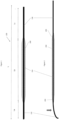
- FIG 1 illustrates an example of an access guidewire 100 of the present invention.
- a typical prior art guidewire has a uniform diameter across its length.
- the access guidewire 100 has a length L, a distal portion 102, and intermediate portion 104, and a proximal portion 106.
- the distal portion 102 can have a length La
- the intermediate portion 104 has a length Lb
- the proximal portion has a length Lc.
- the intermediate portion 104 can have an increased diameter ⁇ B in relation to the distal portion diameter ⁇ A and the proximal portion diameter ⁇ C (see Figure 6 ).
- the distal portion diameter ⁇ A and the proximal portion diameter ⁇ C can be equal while the intermediate portion diameter ⁇ B is larger.
- the increased diameter portion 200 can be same material as the rest of the guidewire 100, just formed with a larger circumference/diameter.
- Figure 2 illustrates that the distal portion 102 can retain its flexibility along its length La as is typical for a guidewire.
- the increased diameter portion 200 can have reduced flexibility or retain flexibility consistent with the distal portion 102.
- the proximal portion 106 can be the portion proximal the increased diameter portion 200 and extend to the operator.
- the flexibility of the proximal portion 106 can mirror that of a typical guidewire or have differential flexibility along its length as may be necessary to deliver it to the neurovascular region of a patient.
- Figure 1 illustrates an example where the intermediate portion 104 and the increased diameter portion 200 are made of the same material.
- Figures 2 , 3, 4, and 5 illustrate examples where the increased diameter portion 200 can be separately provided on the intermediate portion 104.
- Figures 2 , 3, 4, and 5 illustrate an example where the access guidewire 100 has a uniform diameter across the distal portion 102, the intermediate portion 104, and the proximal portion 106.
- the increased diameter portion 202 can be formed over the intermediate portion 104.
- the increased diameter portion 202 can be a soft reflowed jacket over the guidewire 100 with tapered ends 204.
- Figure 3 illustrates that the increased diameter portion 206 can have an outer tube 208 or composite tube which can also have a coil/braid support.
- the tapered ends 210 can be the adhesive bond that holds the outer tube 208 in place and is filleted to allow for a smooth transition.
- the outer tube 208 can be made of Pebax 25D or 35D or Neusoft Jacket 42A/62A.
- Figure 4 illustrates a two-tube example for the increased diameter portion 212.
- the outer tube 208 is placed over an inner tube 214 and the inner and outer tubes 214, 208 are reflowed to form the increased diameter portion 212.
- the outer tube 208 can be made of Pebax 25D or 35D while the inner tube 214 can be made of Neusoft 42A/62A.
- Figure 5 illustrates a variant example of Figures 3 and 4 , here a coil 216 is placed inside the outer tube 208 to provide strength and kink resistance.
- the outer tube 208 and the inner tube 214 are reflowed to have tapered profile.
- the inner coil 216 offers kink resistance with thin flexible outer tubes 208.
- the inner coil 216 can be free floating or the outer tube 208 can be reflowed through it.
- the inner coil 216 cand be replaced with a braid (not illustrated).
- Figure 6 illustrates an example where the distal section 102 can have smaller diameter ⁇ A (i.e. a lower profile) than the proximal section 106 ( ⁇ C).
- ⁇ A i.e. a lower profile
- ⁇ C proximal section 106
- Figures 7 and 8 illustrate an example of the increased diameter portion 220 with a stepped, fluted mid-section 222.
- Fluted mid-section 222 can be used to provide a smooth transition when used with a funnel catheter 300 to help expand the tip 302 of the catheter 300.
- the flutes 222 can be thin and soft so that they can be collapsed and retrieved through the body 304 of the funnel catheter 300.
- Examples of the device 100 can be used with a large bore intermediate catheter (0.068 inch - 0.072 inch ID approximately), a superbore catheter (0.080 inch - 0.092 inch approximately), or a funnel catheter (shaft ID of 0.068 inch - 0.072 inch approximately).
- distal and proximal are used throughout the preceding description and are meant to refer to a positions and directions relative to a treating physician. As such, “distal” or distally” refer to a position distant to or a direction away from the physician. Similarly, “proximal” or “proximally” refer to a position near to or a direction towards the physician. Furthermore, the singular forms “a,” “an,” and “the” include plural referents unless the context clearly dictates otherwise.
- the terms “about” or “approximately” for any numerical values or ranges indicate a suitable dimensional tolerance that allows the part or collection of components to function for its intended purpose as described herein. More specifically, “about” or “approximately” may refer to the range of values ⁇ 20% of the recited value, e.g. "about 90%” may refer to the range of values from 71% to 99%.
Landscapes
- Health & Medical Sciences (AREA)
- Life Sciences & Earth Sciences (AREA)
- Animal Behavior & Ethology (AREA)
- Veterinary Medicine (AREA)
- Public Health (AREA)
- Engineering & Computer Science (AREA)
- Biomedical Technology (AREA)
- Heart & Thoracic Surgery (AREA)
- General Health & Medical Sciences (AREA)
- Anesthesiology (AREA)
- Hematology (AREA)
- Pulmonology (AREA)
- Biophysics (AREA)
- Surgery (AREA)
- Orthopedic Medicine & Surgery (AREA)
- Vascular Medicine (AREA)
- Nuclear Medicine, Radiotherapy & Molecular Imaging (AREA)
- Medical Informatics (AREA)
- Molecular Biology (AREA)
- Media Introduction/Drainage Providing Device (AREA)
Abstract
Description
- The present invention relates to guidewire that can be used to hold or expand a large bore catheter while accessing the neurovascular.
- Guidewires are known in the art along with large bore catheters. However, passing a large bore catheter over a guidewire to its location within the neurovascular can be challenging given the size differential. Typically, an intermediate catheter is used that is sized between the devices to help with transition or opening the distal end of the large bore catheter. Using a second catheter can be a waste of resources and also time as the user needs to advance the intermediate catheter prior to the large bore catheter.
- Examples of the present invention of an access guide wire that can have a section that includes larger outer diameter (OD) portion to bridge gap between guidewire OD of 0.014 inch or 0.022 inch and a large bore catheter inner diameter (ID) of 0.070 inch. These sizes are important when accessing the distal neurovascular, there is a gap between the ID of large bore catheters and guidewire ODs used in gaining access to distal cerebral vessels such as the ICA and the M1/M2.
- The above and further aspects of this invention are further discussed with reference to the following description in conjunction with the accompanying drawings, in which like numerals indicate like structural elements and features in various figures. The drawings are not necessarily to scale, emphasis instead being placed upon illustrating principles of the invention. The figures depict one or more implementations of the inventive devices, by way of example only, not by way of limitation.
-
Figure 1 illustrates a side view of the access wire of the present invention. -
Figure 2 illustrates a side view of the access wire with a deflected distal end. -
Figure 3 illustrates a cross-section view of another example of the access wire. -
Figure 4 illustrates a cross-section view of further example of the access wire. -
Figure 5 illustrates a cross-section view of yet another example of the access wire. -
Figure 6 illustrates a side view of another example of the access wire. -
Figure 7 illustrates a partial cross-section view of the access wire inside a large bore catheter. -
Figure 8 illustrates a cross-section along line X-X ofFigure 7 . - Specific examples of the present invention are now described in detail with reference to the Figures, where identical reference numbers indicate elements which are functionally similar or identical. Accessing the various vessels within the vascular, whether they are coronary, pulmonary, or cerebral, involves well-known procedural steps and the use of a number of conventional, commercially-available accessory products. These products, such as angiographic materials, rotating hemostasis valves, and large and intermediate catheters are widely used in laboratory and medical procedures. When these products are employed in conjunction with the system and methods of this invention in the description below, their function and exact constitution are not described in detail. While the description is in many cases in the context of neurovascular treatments, the systems and methods may be used for other procedures and in other body passageways as well.
-
Figure 1 illustrates an example of anaccess guidewire 100 of the present invention. A typical prior art guidewire has a uniform diameter across its length. Theaccess guidewire 100 has a length L, adistal portion 102, andintermediate portion 104, and aproximal portion 106. Thedistal portion 102 can have a length La, theintermediate portion 104 has a length Lb and the proximal portion has a length Lc. Theintermediate portion 104 can have an increased diameter ΦB in relation to the distal portion diameter ΦA and the proximal portion diameter ΦC (seeFigure 6 ). InFigures 1 and 2 the distal portion diameter ΦA and the proximal portion diameter ΦC can be equal while the intermediate portion diameter ΦB is larger. The increaseddiameter portion 200 can be same material as the rest of theguidewire 100, just formed with a larger circumference/diameter. -
Figure 2 illustrates that thedistal portion 102 can retain its flexibility along its length La as is typical for a guidewire. The increaseddiameter portion 200 can have reduced flexibility or retain flexibility consistent with thedistal portion 102. In this example, theproximal portion 106 can be the portion proximal the increaseddiameter portion 200 and extend to the operator. The flexibility of theproximal portion 106 can mirror that of a typical guidewire or have differential flexibility along its length as may be necessary to deliver it to the neurovascular region of a patient. -
Figure 1 illustrates an example where theintermediate portion 104 and the increaseddiameter portion 200 are made of the same material.Figures 2 ,3, 4, and 5 illustrate examples where the increaseddiameter portion 200 can be separately provided on theintermediate portion 104. -
Figures 2 ,3, 4, and 5 , illustrate an example where theaccess guidewire 100 has a uniform diameter across thedistal portion 102, theintermediate portion 104, and theproximal portion 106. Instead, as inFigure 2 , the increaseddiameter portion 202 can be formed over theintermediate portion 104. In one example, the increaseddiameter portion 202 can be a soft reflowed jacket over theguidewire 100 withtapered ends 204. -
Figure 3 illustrates that the increaseddiameter portion 206 can have anouter tube 208 or composite tube which can also have a coil/braid support. Thetapered ends 210 can be the adhesive bond that holds theouter tube 208 in place and is filleted to allow for a smooth transition. In one example, theouter tube 208 can be made of Pebax 25D or 35D or Neusoft Jacket 42A/62A. -
Figure 4 illustrates a two-tube example for the increaseddiameter portion 212. Here theouter tube 208 is placed over aninner tube 214 and the inner andouter tubes diameter portion 212. In this example, theouter tube 208 can be made of Pebax 25D or 35D while theinner tube 214 can be made of Neusoft 42A/62A. -
Figure 5 illustrates a variant example ofFigures 3 and 4 , here acoil 216 is placed inside theouter tube 208 to provide strength and kink resistance. Note that in the variant of increaseddiameter portion 212 ofFigure 4 , theouter tube 208 and theinner tube 214 are reflowed to have tapered profile. Theinner coil 216 offers kink resistance with thin flexibleouter tubes 208. Theinner coil 216 can be free floating or theouter tube 208 can be reflowed through it. Theinner coil 216 cand be replaced with a braid (not illustrated). -
Figure 6 illustrates an example where thedistal section 102 can have smaller diameter ΦA (i.e. a lower profile) than the proximal section 106 (ΦC). Thus, theproximal portion 106 can be thicker for greater pushability and handling, with a smaller distal section/tip 102 for atraumatic clot crossing. -
Figures 7 and 8 illustrate an example of the increaseddiameter portion 220 with a stepped, fluted mid-section 222. Flutedmid-section 222 can be used to provide a smooth transition when used with afunnel catheter 300 to help expand thetip 302 of thecatheter 300. Theflutes 222 can be thin and soft so that they can be collapsed and retrieved through thebody 304 of thefunnel catheter 300. - In specific, non-limiting, examples:
- the length L of the
guidewire 100 can be 180 cm; - the length La of the
distal portion 102 can be 3-5 cm, as low as 1 mm or as high as 200 mm, two examples: a short 2cm shapeable tip, and another with a long 15cm tip, of which the most distal approximate 2cm is shapeable; - the distal portion (outer) diameter ΦA can be 0.014-0.022 inch and as low as approximately 0.010 inch or as high as 0.038 inch, one range can be about 0.010 inch to about 0.018 inch range, and examples can be 0.014 inch;
- the proximal portion length Lc can depend on lengths La and Lb, as overall device length L needs to be longer than the
catheter 300 it is used with, in one example, to be a few cm longer than the overall length of thefunnel catheter 300, which is approximately 130 cm; and - the proximal portion (outer) diameter ΦC can be 0.014-0.022 inch, as high as 0.045 inch and as low as 0.014 inch, and examples are about 0.035 inch.
- Turning to examples of the intermediate/increased
diameter portion - the length Lb can be 200-300 mm, as short as 2cm, or as long as the entire device (minus the tip length La), in one example, about 20cm;
- the (outer) diameter ΦB can be 0.065 inch; and
- the (outer) diameter ΦB can depend on the inner diameter (ID) of the
catheter 300 that is being used in conjunction with, and can be approximately 0.003 inch to 0.006 inch less than that ID. - Examples of the
device 100 can be used with a large bore intermediate catheter (0.068 inch - 0.072 inch ID approximately), a superbore catheter (0.080 inch - 0.092 inch approximately), or a funnel catheter (shaft ID of 0.068 inch - 0.072 inch approximately). - The invention is not necessarily limited to the examples described, which can be varied in construction and detail. The terms "distal" and "proximal" are used throughout the preceding description and are meant to refer to a positions and directions relative to a treating physician. As such, "distal" or distally" refer to a position distant to or a direction away from the physician. Similarly, "proximal" or "proximally" refer to a position near to or a direction towards the physician. Furthermore, the singular forms "a," "an," and "the" include plural referents unless the context clearly dictates otherwise.
- As used herein, the terms "about" or "approximately" for any numerical values or ranges indicate a suitable dimensional tolerance that allows the part or collection of components to function for its intended purpose as described herein. More specifically, "about" or "approximately" may refer to the range of values ±20% of the recited value, e.g. "about 90%" may refer to the range of values from 71% to 99%.
- In describing example embodiments, terminology has been resorted to for the sake of clarity. It is intended that each term contemplates its broadest meaning as understood by those skilled in the art and includes all technical equivalents that operate in a similar manner to accomplish a similar purpose without departing from the scope and spirit of the invention. It is also to be understood that the mention of one or more steps of a method does not preclude the presence of additional method steps or intervening method steps between those steps expressly identified. Some steps of a method can be performed in a different order than those described herein without departing from the scope of the disclosed technology. Similarly, it is also to be understood that the mention of one or more components in a device or system does not preclude the presence of additional components or intervening components between those components expressly identified. For clarity and conciseness, not all possible combinations have been listed, and such modifications are often apparent to those of skill in the art and are intended to be within the scope of the claims which follow.
Claims (1)
- An access guidewire, comprising:a distal portion comprising a distal portion length and a distal portion diameter;an intermediate portion, proximal to the distal portion, comprising an intermediate portion length and an intermediate portion diameter; anda proximal portion, proximal of the intermediate portion, comprising a proximal portion length and a proximal portion diameter;wherein the intermediate portion diameter is greater than then the distal portion diameter and the proximal portion diameter.
Applications Claiming Priority (1)
| Application Number | Priority Date | Filing Date | Title |
|---|---|---|---|
| US202163241881P | 2021-09-08 | 2021-09-08 |
Publications (3)
| Publication Number | Publication Date |
|---|---|
| EP4151265A1 true EP4151265A1 (en) | 2023-03-22 |
| EP4151265B1 EP4151265B1 (en) | 2025-08-13 |
| EP4151265C0 EP4151265C0 (en) | 2025-08-13 |
Family
ID=83232805
Family Applications (1)
| Application Number | Title | Priority Date | Filing Date |
|---|---|---|---|
| EP22194284.0A Active EP4151265B1 (en) | 2021-09-08 | 2022-09-07 | Neuro access guide wire |
Country Status (6)
| Country | Link |
|---|---|
| US (1) | US20230069826A1 (en) |
| EP (1) | EP4151265B1 (en) |
| JP (1) | JP2023039433A (en) |
| KR (1) | KR20230036992A (en) |
| CN (1) | CN115770348A (en) |
| ES (1) | ES3040806T3 (en) |
Families Citing this family (8)
| Publication number | Priority date | Publication date | Assignee | Title |
|---|---|---|---|---|
| EP3787523A4 (en) | 2018-05-01 | 2022-02-23 | Incept, LLC | DEVICES AND METHODS FOR REMOVING OBSTRUCTIVE MATERIAL FROM AN INTRAVASCULAR SITE |
| US11471582B2 (en) | 2018-07-06 | 2022-10-18 | Incept, Llc | Vacuum transfer tool for extendable catheter |
| US11766539B2 (en) | 2019-03-29 | 2023-09-26 | Incept, Llc | Enhanced flexibility neurovascular catheter |
| US11439799B2 (en) | 2019-12-18 | 2022-09-13 | Imperative Care, Inc. | Split dilator aspiration system |
| US20230248498A1 (en) | 2019-12-18 | 2023-08-10 | Imperative Care, Inc. | Manually rotatable thrombus engagement tool |
| EP4076611A4 (en) | 2019-12-18 | 2023-11-15 | Imperative Care, Inc. | METHODS AND SYSTEMS FOR TREATING VENOUS THROMBOEMBOLIC DISEASES |
| US12171917B1 (en) | 2024-01-08 | 2024-12-24 | Imperative Care, Inc. | Devices for blood capture and reintroduction during aspiration procedure |
| WO2025254969A1 (en) * | 2024-06-03 | 2025-12-11 | The George Washington University | Guidewire for prevention of retention and methods of use and manufacture thereof |
Citations (5)
| Publication number | Priority date | Publication date | Assignee | Title |
|---|---|---|---|---|
| US20060064036A1 (en) * | 2004-09-21 | 2006-03-23 | Cook Incorporated | Variable flexibility wire guide |
| JP2010227136A (en) * | 2009-03-25 | 2010-10-14 | Japan Lifeline Co Ltd | Guide wire |
| CN102921094B (en) * | 2012-10-23 | 2015-07-01 | 湖南埃普特医疗器械有限公司 | Endovascular dilation guide wire and preparation method thereof |
| CN107362437A (en) * | 2017-08-03 | 2017-11-21 | 湖南埃普特医疗器械有限公司 | A kind of predilation seal wire and preparation method thereof |
| WO2022120068A1 (en) * | 2020-12-03 | 2022-06-09 | Bard Access Systems, Inc. | Needle tip blunting using a length of a guidewire |
Family Cites Families (3)
| Publication number | Priority date | Publication date | Assignee | Title |
|---|---|---|---|---|
| US20030191492A1 (en) * | 2002-04-05 | 2003-10-09 | Scimed Life Systems, Inc. | Radial coil expandable medical wire |
| US11801368B2 (en) * | 2017-05-25 | 2023-10-31 | C.R. Bard, Inc. | Guidewire |
| EP3967356A4 (en) * | 2019-05-07 | 2023-06-07 | Asahi Intecc Co., Ltd. | Guide wire |
-
2022
- 2022-09-06 KR KR1020220112588A patent/KR20230036992A/en active Pending
- 2022-09-07 EP EP22194284.0A patent/EP4151265B1/en active Active
- 2022-09-07 JP JP2022142049A patent/JP2023039433A/en active Pending
- 2022-09-07 ES ES22194284T patent/ES3040806T3/en active Active
- 2022-09-08 US US17/940,352 patent/US20230069826A1/en active Pending
- 2022-09-08 CN CN202211094108.2A patent/CN115770348A/en active Pending
Patent Citations (5)
| Publication number | Priority date | Publication date | Assignee | Title |
|---|---|---|---|---|
| US20060064036A1 (en) * | 2004-09-21 | 2006-03-23 | Cook Incorporated | Variable flexibility wire guide |
| JP2010227136A (en) * | 2009-03-25 | 2010-10-14 | Japan Lifeline Co Ltd | Guide wire |
| CN102921094B (en) * | 2012-10-23 | 2015-07-01 | 湖南埃普特医疗器械有限公司 | Endovascular dilation guide wire and preparation method thereof |
| CN107362437A (en) * | 2017-08-03 | 2017-11-21 | 湖南埃普特医疗器械有限公司 | A kind of predilation seal wire and preparation method thereof |
| WO2022120068A1 (en) * | 2020-12-03 | 2022-06-09 | Bard Access Systems, Inc. | Needle tip blunting using a length of a guidewire |
Also Published As
| Publication number | Publication date |
|---|---|
| JP2023039433A (en) | 2023-03-20 |
| US20230069826A1 (en) | 2023-03-09 |
| EP4151265B1 (en) | 2025-08-13 |
| KR20230036992A (en) | 2023-03-15 |
| ES3040806T3 (en) | 2025-11-05 |
| CN115770348A (en) | 2023-03-10 |
| EP4151265C0 (en) | 2025-08-13 |
Similar Documents
| Publication | Publication Date | Title |
|---|---|---|
| US20230069826A1 (en) | Neuro access guide wire | |
| US9370639B2 (en) | Variable stiffness catheter | |
| US11013890B2 (en) | Introducer sheath for radial artery access | |
| KR102870063B1 (en) | Guidewire for cannula placement | |
| AU2017217879B2 (en) | Intravascular treatment site access | |
| US11224726B2 (en) | High-torque guidewires and methods for making and using them | |
| US20180228502A1 (en) | Dual lumen hypotube catheter | |
| US7384422B2 (en) | Telescopic, separable introducer and method of using the same | |
| US20110160680A1 (en) | Wire guide with cannula | |
| US8241315B2 (en) | Apparatus and method for treating occluded vasculature | |
| US11129629B2 (en) | Thrombus extraction catheter | |
| US20040215109A1 (en) | Helical guidewire | |
| US20090312670A1 (en) | Wire guide having a rib for coil attachment | |
| US20130317542A1 (en) | Steerable delivery system | |
| US20240207577A1 (en) | Uniform outer diameter guidewire devices | |
| EP4688083A1 (en) | Intravascular device with nested hypotube configuration | |
| US20050107819A1 (en) | Catheter with a sectional guidewire shaft | |
| US20090209941A1 (en) | Implant deployment catheter | |
| EP1120127A1 (en) | Catheter made of a multifilar row of wires | |
| US10220190B2 (en) | Delivery catheter with fixed guidewire and beveled elliptical port | |
| EP1120128B1 (en) | A catheter system |
Legal Events
| Date | Code | Title | Description |
|---|---|---|---|
| PUAI | Public reference made under article 153(3) epc to a published international application that has entered the european phase |
Free format text: ORIGINAL CODE: 0009012 |
|
| STAA | Information on the status of an ep patent application or granted ep patent |
Free format text: STATUS: THE APPLICATION HAS BEEN PUBLISHED |
|
| AK | Designated contracting states |
Kind code of ref document: A1 Designated state(s): AL AT BE BG CH CY CZ DE DK EE ES FI FR GB GR HR HU IE IS IT LI LT LU LV MC MK MT NL NO PL PT RO RS SE SI SK SM TR |
|
| STAA | Information on the status of an ep patent application or granted ep patent |
Free format text: STATUS: REQUEST FOR EXAMINATION WAS MADE |
|
| 17P | Request for examination filed |
Effective date: 20230831 |
|
| RBV | Designated contracting states (corrected) |
Designated state(s): AL AT BE BG CH CY CZ DE DK EE ES FI FR GB GR HR HU IE IS IT LI LT LU LV MC MK MT NL NO PL PT RO RS SE SI SK SM TR |
|
| GRAP | Despatch of communication of intention to grant a patent |
Free format text: ORIGINAL CODE: EPIDOSNIGR1 |
|
| STAA | Information on the status of an ep patent application or granted ep patent |
Free format text: STATUS: GRANT OF PATENT IS INTENDED |
|
| INTG | Intention to grant announced |
Effective date: 20250522 |
|
| GRAS | Grant fee paid |
Free format text: ORIGINAL CODE: EPIDOSNIGR3 |
|
| GRAA | (expected) grant |
Free format text: ORIGINAL CODE: 0009210 |
|
| STAA | Information on the status of an ep patent application or granted ep patent |
Free format text: STATUS: THE PATENT HAS BEEN GRANTED |
|
| AK | Designated contracting states |
Kind code of ref document: B1 Designated state(s): AL AT BE BG CH CY CZ DE DK EE ES FI FR GB GR HR HU IE IS IT LI LT LU LV MC MK MT NL NO PL PT RO RS SE SI SK SM TR |
|
| REG | Reference to a national code |
Ref country code: GB Ref legal event code: FG4D |
|
| REG | Reference to a national code |
Ref country code: CH Ref legal event code: EP |
|
| REG | Reference to a national code |
Ref country code: DE Ref legal event code: R096 Ref document number: 602022019288 Country of ref document: DE |
|
| REG | Reference to a national code |
Ref country code: IE Ref legal event code: FG4D |
|
| U01 | Request for unitary effect filed |
Effective date: 20250904 |
|
| U07 | Unitary effect registered |
Designated state(s): AT BE BG DE DK EE FI FR IT LT LU LV MT NL PT RO SE SI Effective date: 20250911 |
|
| U20 | Renewal fee for the european patent with unitary effect paid |
Year of fee payment: 4 Effective date: 20250909 |
|
| PGFP | Annual fee paid to national office [announced via postgrant information from national office to epo] |
Ref country code: AT Payment date: 20251020 Year of fee payment: 4 |
|
| PGFP | Annual fee paid to national office [announced via postgrant information from national office to epo] |
Ref country code: IE Payment date: 20250827 Year of fee payment: 4 |
|
| REG | Reference to a national code |
Ref country code: ES Ref legal event code: FG2A Ref document number: 3040806 Country of ref document: ES Kind code of ref document: T3 Effective date: 20251105 |
|
| PG25 | Lapsed in a contracting state [announced via postgrant information from national office to epo] |
Ref country code: IS Free format text: LAPSE BECAUSE OF FAILURE TO SUBMIT A TRANSLATION OF THE DESCRIPTION OR TO PAY THE FEE WITHIN THE PRESCRIBED TIME-LIMIT Effective date: 20251213 |
|
| PG25 | Lapsed in a contracting state [announced via postgrant information from national office to epo] |
Ref country code: NO Free format text: LAPSE BECAUSE OF FAILURE TO SUBMIT A TRANSLATION OF THE DESCRIPTION OR TO PAY THE FEE WITHIN THE PRESCRIBED TIME-LIMIT Effective date: 20251113 |
|
| PG25 | Lapsed in a contracting state [announced via postgrant information from national office to epo] |
Ref country code: HR Free format text: LAPSE BECAUSE OF FAILURE TO SUBMIT A TRANSLATION OF THE DESCRIPTION OR TO PAY THE FEE WITHIN THE PRESCRIBED TIME-LIMIT Effective date: 20250813 |
|
| PG25 | Lapsed in a contracting state [announced via postgrant information from national office to epo] |
Ref country code: GR Free format text: LAPSE BECAUSE OF FAILURE TO SUBMIT A TRANSLATION OF THE DESCRIPTION OR TO PAY THE FEE WITHIN THE PRESCRIBED TIME-LIMIT Effective date: 20251114 |
|
| PG25 | Lapsed in a contracting state [announced via postgrant information from national office to epo] |
Ref country code: PL Free format text: LAPSE BECAUSE OF FAILURE TO SUBMIT A TRANSLATION OF THE DESCRIPTION OR TO PAY THE FEE WITHIN THE PRESCRIBED TIME-LIMIT Effective date: 20250813 |
|
| PG25 | Lapsed in a contracting state [announced via postgrant information from national office to epo] |
Ref country code: RS Free format text: LAPSE BECAUSE OF FAILURE TO SUBMIT A TRANSLATION OF THE DESCRIPTION OR TO PAY THE FEE WITHIN THE PRESCRIBED TIME-LIMIT Effective date: 20251113 |
|
| PGFP | Annual fee paid to national office [announced via postgrant information from national office to epo] |
Ref country code: ES Payment date: 20251014 Year of fee payment: 4 |
|
| PG25 | Lapsed in a contracting state [announced via postgrant information from national office to epo] |
Ref country code: SM Free format text: LAPSE BECAUSE OF FAILURE TO SUBMIT A TRANSLATION OF THE DESCRIPTION OR TO PAY THE FEE WITHIN THE PRESCRIBED TIME-LIMIT Effective date: 20250813 |
|
| PG25 | Lapsed in a contracting state [announced via postgrant information from national office to epo] |
Ref country code: CZ Free format text: LAPSE BECAUSE OF FAILURE TO SUBMIT A TRANSLATION OF THE DESCRIPTION OR TO PAY THE FEE WITHIN THE PRESCRIBED TIME-LIMIT Effective date: 20250813 |
|
| PG25 | Lapsed in a contracting state [announced via postgrant information from national office to epo] |
Ref country code: SK Free format text: LAPSE BECAUSE OF FAILURE TO SUBMIT A TRANSLATION OF THE DESCRIPTION OR TO PAY THE FEE WITHIN THE PRESCRIBED TIME-LIMIT Effective date: 20250813 |
|
| REG | Reference to a national code |
Ref country code: CH Ref legal event code: H13 Free format text: ST27 STATUS EVENT CODE: U-0-0-H10-H13 (AS PROVIDED BY THE NATIONAL OFFICE) Effective date: 20260504 |