EP4149087A1 - Methods and apparatuses for shunting clustered gateways, storage medium, and electronic device - Google Patents
Methods and apparatuses for shunting clustered gateways, storage medium, and electronic device Download PDFInfo
- Publication number
- EP4149087A1 EP4149087A1 EP22166840.3A EP22166840A EP4149087A1 EP 4149087 A1 EP4149087 A1 EP 4149087A1 EP 22166840 A EP22166840 A EP 22166840A EP 4149087 A1 EP4149087 A1 EP 4149087A1
- Authority
- EP
- European Patent Office
- Prior art keywords
- packet
- public network
- hash value
- machine
- shunt
- Prior art date
- Legal status (The legal status is an assumption and is not a legal conclusion. Google has not performed a legal analysis and makes no representation as to the accuracy of the status listed.)
- Granted
Links
Images


Classifications
-
- H—ELECTRICITY
- H04—ELECTRIC COMMUNICATION TECHNIQUE
- H04L—TRANSMISSION OF DIGITAL INFORMATION, e.g. TELEGRAPHIC COMMUNICATION
- H04L67/00—Network arrangements or protocols for supporting network services or applications
- H04L67/01—Protocols
- H04L67/10—Protocols in which an application is distributed across nodes in the network
-
- H—ELECTRICITY
- H04—ELECTRIC COMMUNICATION TECHNIQUE
- H04L—TRANSMISSION OF DIGITAL INFORMATION, e.g. TELEGRAPHIC COMMUNICATION
- H04L45/00—Routing or path finding of packets in data switching networks
- H04L45/74—Address processing for routing
-
- H—ELECTRICITY
- H04—ELECTRIC COMMUNICATION TECHNIQUE
- H04L—TRANSMISSION OF DIGITAL INFORMATION, e.g. TELEGRAPHIC COMMUNICATION
- H04L45/00—Routing or path finding of packets in data switching networks
- H04L45/74—Address processing for routing
- H04L45/745—Address table lookup; Address filtering
- H04L45/7453—Address table lookup; Address filtering using hashing
-
- H—ELECTRICITY
- H04—ELECTRIC COMMUNICATION TECHNIQUE
- H04L—TRANSMISSION OF DIGITAL INFORMATION, e.g. TELEGRAPHIC COMMUNICATION
- H04L12/00—Data switching networks
- H04L12/28—Data switching networks characterised by path configuration, e.g. LAN [Local Area Networks] or WAN [Wide Area Networks]
- H04L12/46—Interconnection of networks
- H04L12/4633—Interconnection of networks using encapsulation techniques, e.g. tunneling
-
- H—ELECTRICITY
- H04—ELECTRIC COMMUNICATION TECHNIQUE
- H04L—TRANSMISSION OF DIGITAL INFORMATION, e.g. TELEGRAPHIC COMMUNICATION
- H04L12/00—Data switching networks
- H04L12/66—Arrangements for connecting between networks having differing types of switching systems, e.g. gateways
-
- H—ELECTRICITY
- H04—ELECTRIC COMMUNICATION TECHNIQUE
- H04L—TRANSMISSION OF DIGITAL INFORMATION, e.g. TELEGRAPHIC COMMUNICATION
- H04L61/00—Network arrangements, protocols or services for addressing or naming
- H04L61/09—Mapping addresses
- H04L61/25—Mapping addresses of the same type
- H04L61/2503—Translation of Internet protocol [IP] addresses
- H04L61/256—NAT traversal
-
- H—ELECTRICITY
- H04—ELECTRIC COMMUNICATION TECHNIQUE
- H04L—TRANSMISSION OF DIGITAL INFORMATION, e.g. TELEGRAPHIC COMMUNICATION
- H04L2212/00—Encapsulation of packets
Definitions
- the present disclosure relates to the field of computer technologies, and in particular, to the fields of cloud computing, data centers, and servers.
- shunting of clustered gateways is mainly implemented by achieving an algorithm for selecting a public network IP on a shunt, and all NAT rules in a cluster need to be configured on the shunt, so as to ensure that a user can select a correct public network IP among multiple public network IPs.
- the present disclosure provides methods and apparatuses for shunting clustered gateways, a storage medium and an electronic device.
- a method for shunting clustered gateways may include: in response to receiving a first packet sent by a target internal network machine, a first hash value is acquired, wherein the first hash value is generated by a shunt of a public network gateway cluster, and the shunt is configured to perform a hash calculation on the first packet based on a pre-configured port dictionary; a target gateway machine is selected from the public network gateway cluster according to the first hash value; and the first packet is sent to the target gateway machine.
- the method may include: a first packet is received from a shunt of a public network gateway cluster, wherein in response to the shunt receiving the first packet sent by a target internal network machine, a first hash value is acquired, and according to the first hash value, a target gateway machine is selected from the public network gateway cluster, wherein the first hash value is generated by the shunt performing a hash calculation on the first packet based on a pre-configured port dictionary; and forwarding the first packet to a public network on the basis of at least one target port corresponding to the first packet.
- an apparatus for shunting clustered gateways may include: a first acquisition component, configured to acquire, in response to receiving a first packet sent by a target internal network machine is received, a first hash value, wherein the first hash value is generated by a shunt of a public network gateway cluster, and the shunt is configured to perform a hash calculation on the first packet based on a pre-configured port dictionary; a second acquisition component, configured to select, according to the first hash value, a target gateway machine from the public network gateway cluster; and a diversion component, configured to divert the first packet to the target gateway machine.
- the apparatus may include: a receiving component, configured to receive a first packet from a shunt of a public network gateway cluster, wherein in response to the shunt receiving the first packet sent by a target internal network machine, a first hash value is required,, and according to the first hash value, a target gateway machine is selected from the public network gateway cluster, wherein the first hash value is generated by the shunt performing a hash calculation on the first packet based on a pre-configured port dictionary; and a forwarding component, configured to forward the first packet to a public network on the basis of at least one target port corresponding to the first packet.
- an electronic device may include: at least one processor; and a memory in communication connection with the at least one processor, wherein the memory stores instructions which can be executed by the at least one processor, and the instructions are executed by the at least one processor, so that the at least one processor can perform the following steps: in response to receiving a first packet sent by a target internal network machine, a first hash value is acquired, wherein the first hash value is generated by a shunt of a public network gateway cluster, and the shunt is configured to perform a hash calculation on the first packet based on a pre-configured port dictionary; a target gateway machine is selected from the public network gateway cluster according to the first hash value; and the first packet is sent to the target gateway machine.
- a non-transitory computer-readable storage medium having computer instructions stored therein, wherein the computer instructions are used for enabling a computer to perform the following steps: in response to receiving a first packet sent by a target internal network machine, a first hash value is acquired, wherein the first hash value is generated by a shunt of a public network gateway cluster, and the shunt is configured to perform a hash calculation on the first packet based on a pre-configured port dictionary; a target gateway machine is selected from the public network gateway cluster according to the first hash value; and the first packet is sent to the target gateway machine.
- a computer program product when executed by a processor, performing following steps: in response to receiving a first packet sent by a target internal network machine, a first hash value is acquired, wherein the first hash value is generated by a shunt of a public network gateway cluster, and the shunt is configured to perform a hash calculation on the first packet based on a pre-configured port dictionary; a target gateway machine is selected from the public network gateway cluster according to the first hash value; and the first packet is sent to the target gateway machine.
- Clustered gateway traffic for accessing a public network service through the same public network IP can be distributed on multiple machines of an NAT cluster.
- Hash bucket representing a container for holding different key code linked lists, and is a method for solving hash table conflicts. Multiple elements may exist in the same position of a hash table, and in order to deal with the hash collision, each position in the hash table represents one hash bucket.
- the hash table is a data structure directly accessed according to key codes.
- an embodiment of a method for shunting clustered gateways is provided. It should be noted that steps illustrated in flowchart of the drawings can be executed in a computer system such as a set of computer-executable instructions, and although a logical order is shown in the flowchart, in some cases, the steps shown or described can be executed in a different order from that described herein.
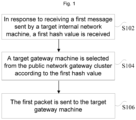
- Fig. 1 is a flowchart of steps of a method for shunting clustered gateways according to the embodiment of the present disclosure. As shown in Fig. 1 , the method includes the following steps.
- a first hash value is received, wherein the first hash value is generated by a shunt of a public network gateway cluster, and the shunt is configured to perform a hash calculation on the first packet based on a pre-configured port dictionary.
- a target gateway machine is selected from the public network gateway cluster according to the first hash value.
- the first packet is sent to the target gateway machine.
- the first packet is an original outbound packet, i.e. a network data packet that is sent by the target internal network machine and has not undergone network address translation
- the first hash value is a hash value obtained by performing hash calculation on the original outbound packet.
- the hash calculation may be, but is not limited to, a 5-tuple hash algorithm through which to perform hash calculation on the first packet; and the gateway machine may be, but is not limited to, a network address translation machine.
- the pre-configured port dictionary may be, but is not limited to, a port dictionary pre-generated through a port range of a TCP/IP, and the port range may include, but is not limited to, a port range 0-65535 specified by the TCP/IP.
- a port dictionary is pre-generated and stored in the shunt and all gateway machines, and is generated during cluster initialization. Only a static hash dictionary needs to be configured, and once the static hash dictionary is configured, the hash dictionary does not need to be modified.
- shunting algorithms are independent of service types, and only the static hash dictionary needs to be configured, and once static hash dictionary is configured, the hash dictionary does not need to be modified.
- the shunt in the method for shunting clustered gateways does not need to be configured with service-related network address translation rules, and high-speed hardware can be used for implementing shunting operation of the clustered gateways, greatly increasing a forwarding efficiency of the shunt and reducing resource consumption.
- a first hash value is received, wherein the first hash value is generated by a shunt of a public network gateway cluster, and the shunt is configured to perform a hash calculation on the first packet based on a pre-configured port dictionary; a target gateway machine is selected from the public network gateway cluster, according to the first hash value; and the first packet is sent to the target gateway machine, to achieve that sending a packet to a target gateway machine on the basis of a pre-configured port dictionary, thereby the technical effects of increasing the forwarding efficiency of a shunt and reducing resource consumption is achieved.
- the method before the shunt of the public network gateway cluster receives the first packet sent by the target internal network machine, the method further comprises: the port dictionary is configured on the basis of a preset port range.
- the port dictionary is information configured on the shunt of the public network gateway cluster and at least one public network machine
- at least one port field in the port dictionary include: at least one hash bucket and at least one port linked list, each of the at least one hash bucket comprising one port linked list, and multiple non-repeated addresses are existed in one port linked lists of different hash buckets.
- the pre-configured port dictionary may be, but is not limited to, a port dictionary pre-generated through a port range of a TCP/IP stack, and the port range may include, but is not limited to, a port range 0-65535 specified by the TCP/IP.
- the port field of the port dictionary are consisted of two parts, i.e. at least one hash bucket and at least one port linked list, wherein one port linked list exists in each of the at least one hash bucket, and multiple non-repeated addresses are existed in the one port linked lists of different hash buckets, to ensure that when shunting of large-scale clustered gateways is performed, public network IPs and ports allocated for use by different gateway machines are not repeated.
- the port dictionary is a static port dictionary, generated during cluster initialization, stored in the shunt and all gateway machines, and does not change once the port dictionary is generated.
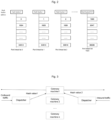
- Fig. 2 is a schematic diagram of optional port fields according to the embodiment of the present disclosure.
- the port fields there are 1024 hash buckets (i.e. hash bucket 0 to hash bucket 1023) which correspond to port linked list 0 to port linked list 1023 respectively, that is to say, each hash bucket corresponds to one port linked list, and multiple non-repeated addresses exist on one port linked list of each of the hash buckets.
- address information in a port linked list 0 corresponding to a hash bucket 0 includes an address 0, an address 01024, ..., and an address 064512
- address information corresponding to a port linked list 1 corresponding to a hash bucket 1 comprises an address 1, an address 01025, ..., and an address 064513, to ensure that when shunting of large-scale clustered gateways is performed, public network IPs and ports allocated for use by different gateway machines are not repeated.
- a target gateway machine is selected from the public network gateway cluster, according to the first hash value includes:
- the first hash value and each public network machine have a many-to-one mapping relationship, that is to say, each public network machine may correspond to multiple first hash values.
- mapping relationship between each public network machine in the public network gateway cluster and the first hash value is acquired, and the target gateway machine from the public network gateway cluster is selected on the basis of the mapping relationship and the first hash value, to achieve that when shunting of large-scale clustered gateways is performed, inbound traffic and outbound traffic of the same flow is shunted to the same gateway machine for processing.
- Fig. 3 is a schematic diagram of an optional method for selecting a gateway machine according to the embodiment of the present disclosure.
- the outbound traffic and the inbound traffic correspond to different hash values, i.e. a hash value 1 and a hash value 2.
- the outbound traffic and the inbound traffic are transmitted to a gateway machine 1 by means of dispatchers, so as to ensure that the inbound traffic and the outbound traffic of the same flow are shunted to the same gateway machine for processing.
- the first packet is sent to the target gateway machine includes following steps.
- the first packet is encapsulated through the shunt to obtain a first tunnel packet.
- the first tunnel packet is sent to the target gateway machine through a diverter after writing the first hash value into an outer-layer field of the first tunnel packet.
- the target gateway machine is used for forwarding the first tunnel packet to a public network on the basis of at least one target port corresponding to the first tunnel packet.
- the first hash value is written into the outer-layer field of the first tunnel packet, wherein the first tunnel packet is obtained by encapsulating the first packet by the shunt; the first tunnel packet is sent to the target gateway machine through a diverter, wherein after the target gateway machine receives the first tunnel packet sent by the diverter, a hash bucket is selected according to a hash value corresponding to the first tunnel packet, and a target port corresponding to the first tunnel packet is selected from a port linked list of the hash bucket; and network address translation processing is performed on an inner-layer packet of the first tunnel packet, so as to obtain translated inner-layer packet, and a target port corresponding to the first tunnel packet is selected through the target gateway machine, and the first tunnel packet is forwarded to a public network.
- the present embodiment by encapsulating the first packet through the shunt to obtain the first tunnel packet; and the first tunnel packet is sent to the target gateway machine through the diverter after the first hash value is written into an outer-layer field of the first tunnel packet, to achieve that a packet is divert to the target gateway machine on the basis of the pre-configured port dictionary, thereby technical effects of increasing the forwarding efficiency of a shunt is achieved and resource consumption is reduced.
- Fig. 4 is a flowchart of steps of an optional method for shunting clustered gateways according to the embodiment of the present disclosure. As shown in Fig. 4 , the method for shunting clustered gateways includes the following steps.
- step S402 after a second packet sent by a router of the public network to the shunt is received, at least one hash bucket is queried on the basis of the port dictionary through the shunt, and hash calculation is performed on the second packet to obtain a second hash value.
- the target gateway machine is selected from the public network gateway cluster according to the second hash value, and the second packet is encapsulated through the shunt to obtain a second tunnel packet.
- the second tunnel packet is sent to the target gateway machine, wherein the target gateway machine is used for sending the second tunnel packet to the target internal network machine after performing network address translation on the basis of a predetermined connection trace table.
- the second packet is an inbound packet, wherein the inbound packet is obtained by forwarding by the router of the public network; and the second hash value is obtained by performing hash calculation on the second packet (i.e. the inbound packet), wherein the hash calculation may be, but is not limited to, performing hash calculation on the second packet by using a 5-tuple hash algorithm.
- connection trace table is used for recording a source IP address, a source port, a protocol, a destination IP address, destination port information before network address translation, and a source IP address, a source port, a protocol, a destination IP address, and destination port information after the network address translation, wherein information before network address translation and information after network address translation which are recorded in the connection trace table with a one-to-one correspondence relationship, and after the target gateway machine can perform network address translation according to the connection trace table, the second tunnel packet is sent to the target internal network machine, so as to ensure that inbound traffic and outbound traffic of the same flow are shunted to the same gateway machine for processing.
- the method for shunting clustered gateways includes the following method steps.
- Fig. 4A is a flowchart of steps of an optional method for shunting clustered gateways according to the embodiment of the present disclosure. As shown in Fig. 4A , the method for shunting clustered gateways includes the following steps.
- a first packet is received from a shunt of a public network gateway cluster.
- the first packet is forwarded to a public network on the basis of a target port corresponding to the first packet.
- the first packet is an original outbound packet, i.e. a network data packet that is sent by a target internal network machine and has not undergone network address translation.
- a first hash value obtained by performing hash calculation on the first packet is acquired, and a target gateway machine is selected from the public network gateway cluster according to the first hash value, wherein the first hash value is generated by the shunt performing the hash calculation on the first packet on the basis of a pre-configured port dictionary.
- a mapping relationship between each public network machine in the public network gateway cluster and the first hash value is acquired, and the target gateway machine is selected from the public network gateway cluster on the basis of the mapping relationship and the first hash value, wherein a many-to-one mapping relationship is existed between the first hash value and each public network machine.
- the first packet from the shunt of the public network gateway cluster is received, the first packet is forwarded to a public network on the basis of a target port corresponding to the first packet, to ensure that public network IPs and ports allocated for use by different gateway machines are not repeated, when shunting of large-scale clustered gateways is performed, thereby the technical effect of increasing the forwarding efficiency of a shunt is achieved.
- a first packet from a shunt of a public network gateway cluster is received includes: a first tunnel packet sent through a diverter of the shunt is received.
- the shunt encapsulates the first packet to obtain a first tunnel packet, and writes the first hash value into an outer-layer field of the first tunnel packet.
- the first tunnel packet at least includes an outer-layer field and an inner-layer field, wherein the first hash value is written into the outer-layer field of the first tunnel packet, network address translation processing is performed on the inner-layer packet, and the translated inner-layer field is sent to the public network.
- Fig. 5 is a flowchart of steps of another optional method for shunting clustered gateways according to the second embodiment of the present disclosure. As shown in Fig. 5 , forwarding the first packet to a public network on the basis of a target port corresponding to the first packet comprises the following steps.
- At step S602 at least one hash bucket is selected according to the first hash value of the first tunnel packet, and a target port is selected to be used from a port linked list of each of the at least one hash bucket.
- step S604 network address translation is performed on an inner-layer packet of the first tunnel packet, so as to obtain a translated inner-layer packet.
- the translated inner-layer packet is forwarded to the public network on the basis of the at least one target port.
- a diverter is used for sending the first tunnel packet to the target gateway machine, after the target gateway machine receives the first tunnel packet sent by the diverter, a hash bucket is selected according to a hash value corresponding to the first tunnel packet, and a target port corresponding to the first tunnel packet is selected from a port linked list of the hash bucket; and network address translation processing is performed on an inner-layer packet of the first tunnel packet, so as to obtain the translated inner-layer packet, and a target port corresponding to the first tunnel packet is selected through the target gateway machine, and the first tunnel packet is forwarded to a public network.
- a hash bucket is selected according to the first hash value of the first tunnel packet, and a target port is selected to be used from a port linked list of the hash bucket; network address translation is performed on an inner-layer packet of the first tunnel packet, so as to obtain a translated inner-layer packet; and the translated inner-layer packet is forwarded to the public network on the basis of the target port, to achieve that a packet is sent to a target gateway machine on the basis of a pre-configured port dictionary.
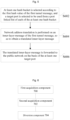
- FIG. 6 is a schematic structural diagram of an apparatus for shunting clustered gateways according to the embodiment of the present disclosure. As shown in Fig. 6 , the apparatus for shunting clustered gateways comprises: a first acquisition component 700, a second acquisition component 702, and a diversion component 704.
- the first acquisition component 700 is configured to acquire, in response to receiving a first packet sent by a target internal network machine, a first hash value, wherein the first hash value is generated by a shunt of a public network gateway cluster, and the shunt is configured to perform a hash calculation on the first packet based on a pre-configured port dictionary; the second acquisition component 702 is configured to select, according to the first hash value, a target gateway machine from the public network gateway cluster; and the diversion component 704 is configured to divert the first packet to the target gateway machine.
- the components can be implemented by software or hardware.
- the latter may be implemented in the following manner: the components can be located in the same processor; or the components are located in different processors in an arbitrary combination manner.
- the first acquisition component 700, the second acquisition component 702, and the diversion component 704 correspond to step S102 to step S106 in the Embodiment, and examples and application scenarios implemented by the components are the same as those implemented by the corresponding steps, but are not limited to the content disclosed in the Embodiment. It should be noted that the components, as a part of the apparatus, can be run in a computer terminal.
- the apparatus further includes: a configuration component, configured to configure the port dictionary on the basis of a preset port range, wherein the port dictionary is information configured on the shunt of the public network gateway cluster and at least one public network machine, and at least one port field in the port dictionary includes: at least one hash bucket and at least one port linked list, each of the at least one hash bucket comprising one port linked list, and multiple non-repeated addresses are existed in the one port linked lists in each of the of different hash buckets.
- a configuration component configured to configure the port dictionary on the basis of a preset port range
- the port dictionary is information configured on the shunt of the public network gateway cluster and at least one public network machine
- at least one port field in the port dictionary includes: at least one hash bucket and at least one port linked list, each of the at least one hash bucket comprising one port linked list, and multiple non-repeated addresses are existed in the one port linked lists in each of the of different hash buckets.
- the second acquisition component includes: a third acquisition component, configured to acquire a mapping relationship between each public network machine in the public network gateway cluster and the first hash value, wherein a many-to-one mapping relationship is existed between the first hash value and each public network machine; and a selection component, configured to select the target gateway machine from the public network gateway cluster on the basis of the mapping relationship and the first hash value.
- the diversion component includes: a first encapsulation component, configured to encapsulate the first packet through the shunt to obtain a first tunnel packet; and an importing component, configured to send the first tunnel packet to the target gateway machine through a diverter after writing the first hash value into an outer-layer field of the first tunnel packet, wherein the target gateway machine is used for forwarding the first tunnel packet to a public network on the basis of at least one target port corresponding to the first tunnel packet.
- the apparatus further includes: a calculation component, configured to after receiving a second packet sent by a router of the public network to the shunt, query through the shunt and on the basis of the port dictionary to obtain at least one hash bucket, and perform hash calculation on the second packet to obtain a second hash value; a second encapsulating component, configured to select the target gateway machine from the public network gateway cluster according to the second hash value, and encapsulate the second packet through the shunt to obtain a second tunnel packet; and a sending component, configured to send the second tunnel packet to the target gateway machine, wherein the target gateway machine is used for sending the second tunnel packet to the target internal network machine after performing network address translation on the basis of a predetermined connection trace table.
- a calculation component configured to after receiving a second packet sent by a router of the public network to the shunt, query through the shunt and on the basis of the port dictionary to obtain at least one hash bucket, and perform hash calculation on the second packet to obtain a second hash value
- FIG. 6A is a schematic structural diagram of an optional apparatus for shunting clustered gateways according to the embodiment of the present disclosure. As shown in Fig. 6A , the apparatus for shunting clustered gateways comprises: a receiving component 701 and a forwarding component 703.
- the apparatus may include: a receiving component, configured to receive a first packet from a shunt of a public network gateway cluster, wherein in response to the shunt receiving the first packet sent by a target internal network machine, a first hash value is acquired, and a target gateway machine is selected from the public network gateway cluster according to the first hash value, wherein the first hash value is generated by the shunt performing a hash calculation on the first packet based on a pre-configured port dictionary; and a forwarding component, configured to forward the first packet to a public network on the basis of at least one target port corresponding to the first packet.
- a receiving component configured to receive a first packet from a shunt of a public network gateway cluster, wherein in response to the shunt receiving the first packet sent by a target internal network machine, a first hash value is acquired, and a target gateway machine is selected from the public network gateway cluster according to the first hash value, wherein the first hash value is generated by the shunt performing a hash calculation
- the receiving component includes: a first receiving sub-component, configured to receive a first tunnel packet sent by a diverter of the shunt, wherein a first tunnel packet is obtained by the shunt encapsulating the first packet, and the first hash value is written into an outer-layer field of the first tunnel packet.
- the forwarding component includes: a selection component, configured to select at least one hash bucket according to the first hash value of the first tunnel packet, and select the at least one target port to be used from a port linked list of each of the at least one hash bucket; a translation component, configured to perform network address translation on an inner-layer packet of the first tunnel packet, so as to obtain a translated inner-layer packet; and a first forwarding sub-component, configured to forward the translated inner-layer packet to the public network on the basis of the at least one target port.
- a selection component configured to select at least one hash bucket according to the first hash value of the first tunnel packet, and select the at least one target port to be used from a port linked list of each of the at least one hash bucket
- a translation component configured to perform network address translation on an inner-layer packet of the first tunnel packet, so as to obtain a translated inner-layer packet
- a first forwarding sub-component configured to forward the translated inner-layer packet to the public network on the basis of the at least one target
- the apparatus for shunting clustered gateways can further include at least one processor and at least one memory; the first acquisition component 700, the second acquisition component 702, and the diversion component 704, etc., as program elements, are all stored in the at least one memory, and the at least one processor executes the program elements stored in the at least one memory to implement corresponding functions.
- the at least one processor includes a kernel, and the kernel calls a corresponding program element from the at least one memory, and one or more kernel may be provided.
- the at least one memory may include forms such as a non-permanent memory, a random access memory (RAM) and/or a non-transitory memory in a computer-readable medium, for example, a read-only memory (ROM) or a flash memory (flash RAM), and the memory includes at least one memory chip.
- the present disclosure further provides an electronic device, a non-transitory computer-readable storage medium, and a computer program product.
- Fig. 7 illustrates a schematic block diagram of an exemplary electronic device 800 which can be used for implementing the embodiments of the present disclosure.
- the electronic device is intended to represent various forms of digital computers, such as laptop computers, desktop computers, workstations, personal digital assistants, servers, blade servers, mainframe computers, and other suitable computers.
- the electronic device may also represent various forms of mobile apparatuses, such as at least one personal digital processor, at least one cellular telephone, at least one smart phone, at least one wearable device, and other similar computing apparatuses.
- the components, connections and relationships therebetween, and functions thereof illustrated herein are by way of examples only, and are not intended to limit the implementation of the embodiments of the present disclosure as described and/or claimed herein.
- the device 800 includes a calculation component 801 which may perform various suitable actions and processes according to a computer program stored in a read only memory (ROM) 802 or a computer program loaded into a random access memory (RAM) 803 from a storage component 808.
- ROM read only memory
- RAM random access memory
- various programs and data necessary for the operation of the storage device 800 can also be stored.
- the calculation component 801, the ROM 802 and the RAM 803 are connected to one another by means of a bus 804.
- An input/output (I/O) interface 805 is also connected to the bus 804.
- a number of components in the device 800 are connected to the I/O interface 805, including: an input component 806, such as a keyboard, mouse, etc.; an output component 807 such as various types of displays, speakers, etc.; a storage component 808 such as a magnetic disk, an optical disk, etc.; and a communication component 809 such as a network card, a modem, a wireless communication transceiver.
- the communication component 809 allows the device 800 to exchange information/data with other devices via a computer network such as the Internet and/or various telecommunication networks.
- the calculation component 801 may be a variety of general-purpose and/or special-purpose processing assemblies having processing and calculation capabilities. Some examples of the calculation component 801 include, but are not limited to, a central processing unit (CPU), a graphics processing unit (GPU), a variety of special-purpose artificial intelligence (Al) computing chips, a variety of calculation components running machine learning model algorithms, a digital signal processor (DSP), and any suitable processor, controller, microcontroller, etc.
- the calculation component 801 executes the methods and processes as described above, for example, in response to that a first packet sent by a target internal network machine is received, a first hash value obtained by performing hash calculation on the first packet is acquired.
- acquiring, in response to a first packet sent by a target internal network machine is received, a first hash value obtained by performing hash calculation on the first packet may be implemented as a computer software program, which is tangibly included in a machine-readable medium, for example, the storage component 808.
- a part or all of the computer program may be loaded into and/or installed into the device 800 via the ROM 802 and/or the communication component 809.
- the computer program is loaded into the RAM 803 and executed by the calculation component 801
- at least one step of acquiring, in response to a first packet sent by a target internal network machine is received, a first hash value obtained by performing hash calculation on the first packet in the method described above are performed.
- the calculation component 801 may be configured to perform, in any other suitable manner (for example, by means of firmware), the method in which when a first packet sent by a target internal network machine is received, a first hash value obtained by performing hash calculation on the first packet is acquired.
- Various embodiments of the systems and techniques described above herein may be implemented in a digital electronic circuit system, an integrated circuit system, a field programmable gate array (FPGA), an application specific integrated circuit (ASIC), an application specific standard product (ASSP), a system-on-chip (SOC), a complex programmable logic device (CPLD), computer hardware, firmware, software, and/or combinations thereof.
- FPGA field programmable gate array
- ASIC application specific integrated circuit
- ASSP application specific standard product
- SOC system-on-chip
- CPLD complex programmable logic device
- These various embodiments may include: implementations in at least one computer program, wherein the at least one computer programs can be executed and/or interpreted on a programmable system including at least one programmable processor, the programmable processor may be a special-purpose or general-purpose programmable processor, may receive data and instructions from a storage system, at least one input apparatus and at least one output apparatus, and may transmit the data and instructions to the storage system, the at least one input apparatus and the at least one output apparatus.
- Program codes for implementing the methods of the present disclosure may be written in any combination of at least one programming languages. These program codes may be provided to a processor or controller of a general-purpose computer, a special-purpose computer or other programmable data processing apparatuses, such that the program codes, when executed by the processor or controller, cause the functions/operations specified in the flowcharts and/or block diagram to be executed.
- the program codes may be entirely executed on a machine and partly executed on a machine, and as a standalone software package, partly executed on a machine and partly executed on a remote machine, or entirely executed on a remote machine or server.
- a machine-readable medium may be tangible media that may contain or store programs for use by an instruction execution system, apparatus or device, or for use in connection with the instruction execution system, apparatus or device.
- the machine-readable medium may be a machine-readable signal medium or a machine-readable storage medium.
- the machine-readable medium may include, but is not limited to, an electronic, magnetic, optical, electromagnetic, infrared or semiconductor system, apparatus or device, or any suitable combinations of the described content.
- machine-readable storage media include electrical connection based on at least one wire, a portable computer disk, a hard disk, a random access memory (RAM), a read-only memory (ROM), an erasable programmable read-only memory (EPROM or flash memory), an optical fiber, a portable compact disc read-only memory (CD-ROM), an optical storage device, a magnetic storage device, or any suitable combinations of the described content.
- RAM random access memory
- ROM read-only memory
- EPROM or flash memory erasable programmable read-only memory
- CD-ROM compact disc read-only memory
- magnetic storage device or any suitable combinations of the described content.
- the systems and techniques described herein may be implemented on a computer having: a display apparatus (e.g. CRT (cathode ray tube) or LCD (liquid crystal display) monitor) for displaying information to the user; and a keyboard and a pointing apparatus (e.g. mouse or trackball) by which the user can provide an input to the computer.
- a display apparatus e.g. CRT (cathode ray tube) or LCD (liquid crystal display) monitor
- a keyboard and a pointing apparatus e.g. mouse or trackball
- Other kinds of apparatuses may also be used to provide interaction with the user; for example, feedback provided to the user can be any form of sensing feedback (e.g. visual feedback, auditory feedback or tactile feedback); and input from the user may be received in any form (including acoustic input, speech input or tactile input).
- the systems and techniques described herein may be implemented in a computing system including a backend component (e.g. as a data server), or a computing system including a midware component (e.g. an application server), or a computing system including a front-end component (e.g. a user computer having a graphical user interface or a web browser through which the user may interact with embodiments of the systems and techniques described herein), or computing systems including any combination of such a backend component, midware component, or front-end component.
- the components of the system may be interconnected by any form or medium of digital data communication (e.g. a communication network). Examples of the communication network include: a local area network (LAN), a wide area network (WAN), and an Internet.
- the computer system may include a client and a server.
- the client and the server are generally away from each other and typically interact via a communication network.
- a client-server relationship is generated by computer programs running on respective computers and having a client-server relationship to each other.
- the server may be a cloud server, may also be a server of a distributed system, or a server combined with a blockchain.
Landscapes
- Engineering & Computer Science (AREA)
- Computer Networks & Wireless Communication (AREA)
- Signal Processing (AREA)
- Data Exchanges In Wide-Area Networks (AREA)
Abstract
Description
- The present disclosure relates to the field of computer technologies, and in particular, to the fields of cloud computing, data centers, and servers.
- At present, shunting of clustered gateways is mainly implemented by achieving an algorithm for selecting a public network IP on a shunt, and all NAT rules in a cluster need to be configured on the shunt, so as to ensure that a user can select a correct public network IP among multiple public network IPs.
- However, in the case of a cluster in a large scale, a implementation of shunting of clustered gateways on the basis of the public network IPs is relatively complex, and there are very high requirements on a capacity of memory and a capacity of table entries, and shunting of large-scale clustered gateways can be achieved only by means of cooperative work of a large number of servers.
- The present disclosure provides methods and apparatuses for shunting clustered gateways, a storage medium and an electronic device.
- According to one aspect of the present disclosure, a method for shunting clustered gateways is provided. The method may include: in response to receiving a first packet sent by a target internal network machine, a first hash value is acquired, wherein the first hash value is generated by a shunt of a public network gateway cluster, and the shunt is configured to perform a hash calculation on the first packet based on a pre-configured port dictionary; a target gateway machine is selected from the public network gateway cluster according to the first hash value; and the first packet is sent to the target gateway machine.
- According to another aspect of the present disclosure, another method for shunting clustered gateways is provided. The method may include: a first packet is received from a shunt of a public network gateway cluster, wherein in response to the shunt receiving the first packet sent by a target internal network machine, a first hash value is acquired, and according to the first hash value, a target gateway machine is selected from the public network gateway cluster, wherein the first hash value is generated by the shunt performing a hash calculation on the first packet based on a pre-configured port dictionary; and forwarding the first packet to a public network on the basis of at least one target port corresponding to the first packet.
- According to another aspect of the present disclosure, an apparatus for shunting clustered gateways is provided. The apparatus may include: a first acquisition component, configured to acquire, in response to receiving a first packet sent by a target internal network machine is received, a first hash value, wherein the first hash value is generated by a shunt of a public network gateway cluster, and the shunt is configured to perform a hash calculation on the first packet based on a pre-configured port dictionary; a second acquisition component, configured to select, according to the first hash value, a target gateway machine from the public network gateway cluster; and a diversion component, configured to divert the first packet to the target gateway machine.
- According to another aspect of the present disclosure, another apparatus for shunting clustered gateways is provided. The apparatus may include: a receiving component, configured to receive a first packet from a shunt of a public network gateway cluster, wherein in response to the shunt receiving the first packet sent by a target internal network machine, a first hash value is required,, and according to the first hash value, a target gateway machine is selected from the public network gateway cluster, wherein the first hash value is generated by the shunt performing a hash calculation on the first packet based on a pre-configured port dictionary; and a forwarding component, configured to forward the first packet to a public network on the basis of at least one target port corresponding to the first packet.
- According to another aspect of the present disclosure, an electronic device is provided. The electronic device may include: at least one processor; and a memory in communication connection with the at least one processor, wherein the memory stores instructions which can be executed by the at least one processor, and the instructions are executed by the at least one processor, so that the at least one processor can perform the following steps: in response to receiving a first packet sent by a target internal network machine, a first hash value is acquired, wherein the first hash value is generated by a shunt of a public network gateway cluster, and the shunt is configured to perform a hash calculation on the first packet based on a pre-configured port dictionary; a target gateway machine is selected from the public network gateway cluster according to the first hash value; and the first packet is sent to the target gateway machine.
- According to another aspect of the present disclosure, a non-transitory computer-readable storage medium, having computer instructions stored therein is provided, wherein the computer instructions are used for enabling a computer to perform the following steps: in response to receiving a first packet sent by a target internal network machine, a first hash value is acquired, wherein the first hash value is generated by a shunt of a public network gateway cluster, and the shunt is configured to perform a hash calculation on the first packet based on a pre-configured port dictionary; a target gateway machine is selected from the public network gateway cluster according to the first hash value; and the first packet is sent to the target gateway machine.
- According to another aspect of the present disclosure, a computer program product is provided, when executed by a processor, performing following steps: in response to receiving a first packet sent by a target internal network machine, a first hash value is acquired, wherein the first hash value is generated by a shunt of a public network gateway cluster, and the shunt is configured to perform a hash calculation on the first packet based on a pre-configured port dictionary; a target gateway machine is selected from the public network gateway cluster according to the first hash value; and the first packet is sent to the target gateway machine.
- It should be appreciated that the content as described in this part is neither intended to identify key or critical features of embodiments of the present disclosure, nor to limit the scope of the present disclosure. Other features of the present disclosure will become readily understood from the following description.
- The accompanying drawings are used to better understand the present disclosure, and do not constitute limitations to the present disclosure; wherein
-
Fig. 1 is a flowchart of steps of a method for shunting clustered gateways according to the embodiment of the present disclosure; -
Fig. 2 is a schematic diagram of optional port fields according to the embodiment of the present disclosure; -
Fig. 3 is a schematic diagram of an optional method for selecting a gateway machine according to the embodiment of the present disclosure; -
Fig. 4 is a flowchart of steps of an optional method for shunting clustered gateways according to the embodiment of the present disclosure; -
Fig. 4A is a flowchart of steps of an optional method for shunting clustered gateways according to the embodiment of the present disclosure; -
Fig. 5 is a flowchart of steps of another optional method for shunting clustered gateways according to the embodiment of the present disclosure; -
Fig. 6 is a schematic structural diagram of an apparatus for shunting clustered gateways according to the embodiment of the present disclosure; -
Fig. 6A is a schematic structural diagram of an optional apparatus for shunting clustered gateways according to the embodiment of the present disclosure; and -
Fig. 7 is a block diagram of an optional electronic device for implementing embodiments of the present disclosure. - Hereinafter, exemplary embodiments of the present disclosure are illustrated with reference to the accompanying drawings, in which various details of the embodiments of the present disclosure are included to facilitate understanding, and they shall be considered as merely exemplary. Accordingly, a person of ordinary skill in the art would recognize that various changes and modifications of embodiments described herein can be made without departing from a scope and spirit of the present disclosure. Also, for clarity and conciseness, illustrations of well-known functions and structures are omitted in the following description.
- It should be noted that the terms "first", "second" etc. in the description, claims, and accompanying drawings of the present disclosure are used for distinguishing similar objects, and are not necessarily used to for describing a specific sequence or order. It should be understood that data so used may be interchanged, so that embodiments of the present disclosure described herein may be implemented in sequences except for those illustrated or described herein. In addition, the terms "include" and "have", and any variations thereof are intended to cover a non-exclusive inclusion, for example, a process, method, system, product, or device that comprises a series of steps or units is not necessarily limited to those steps or units that are clearly listed, but may comprise other steps or units that are not clearly listed or inherent to such process, method, product, or device.
- To facilitate understanding of the embodiments of the present disclosure, some terms or nouns involved in the present disclosure will be explained below:
Clustered gateway, traffic for accessing a public network service through the same public network IP can be distributed on multiple machines of an NAT cluster. - Hash bucket, representing a container for holding different key code linked lists, and is a method for solving hash table conflicts. Multiple elements may exist in the same position of a hash table, and in order to deal with the hash collision, each position in the hash table represents one hash bucket. The hash table is a data structure directly accessed according to key codes.
- According to the embodiments of the present disclosure, an embodiment of a method for shunting clustered gateways is provided. It should be noted that steps illustrated in flowchart of the drawings can be executed in a computer system such as a set of computer-executable instructions, and although a logical order is shown in the flowchart, in some cases, the steps shown or described can be executed in a different order from that described herein.
-
Fig. 1 is a flowchart of steps of a method for shunting clustered gateways according to the embodiment of the present disclosure. As shown inFig. 1 , the method includes the following steps. - At step S102, in response to receiving a first packet sent by a target internal network machine, a first hash value is received, wherein the first hash value is generated by a shunt of a public network gateway cluster, and the shunt is configured to perform a hash calculation on the first packet based on a pre-configured port dictionary.
- At step S104, a target gateway machine is selected from the public network gateway cluster according to the first hash value.
- At step S106, the first packet is sent to the target gateway machine.
- In the embodiments of the present disclosure, the first packet is an original outbound packet, i.e. a network data packet that is sent by the target internal network machine and has not undergone network address translation, and the first hash value is a hash value obtained by performing hash calculation on the original outbound packet.
- Optionally, the hash calculation may be, but is not limited to, a 5-tuple hash algorithm through which to perform hash calculation on the first packet; and the gateway machine may be, but is not limited to, a network address translation machine.
- Optionally, the pre-configured port dictionary may be, but is not limited to, a port dictionary pre-generated through a port range of a TCP/IP, and the port range may include, but is not limited to, a port range 0-65535 specified by the TCP/IP.
- Optionally, in the method for shunting clustered gateways, a port dictionary is pre-generated and stored in the shunt and all gateway machines, and is generated during cluster initialization. Only a static hash dictionary needs to be configured, and once the static hash dictionary is configured, the hash dictionary does not need to be modified.
- It should be noted that in the method for shunting clustered gateways, shunting algorithms are independent of service types, and only the static hash dictionary needs to be configured, and once static hash dictionary is configured, the hash dictionary does not need to be modified. In addition, the shunt in the method for shunting clustered gateways does not need to be configured with service-related network address translation rules, and high-speed hardware can be used for implementing shunting operation of the clustered gateways, greatly increasing a forwarding efficiency of the shunt and reducing resource consumption.
- In the embodiments of the present disclosure, in response to receiving a first packet sent by a target internal network machine, a first hash value is received, wherein the first hash value is generated by a shunt of a public network gateway cluster, and the shunt is configured to perform a hash calculation on the first packet based on a pre-configured port dictionary; a target gateway machine is selected from the public network gateway cluster, according to the first hash value; and the first packet is sent to the target gateway machine, to achieve that sending a packet to a target gateway machine on the basis of a pre-configured port dictionary, thereby the technical effects of increasing the forwarding efficiency of a shunt and reducing resource consumption is achieved.
- In an optional embodiment, before the shunt of the public network gateway cluster receives the first packet sent by the target internal network machine, the method further comprises: the port dictionary is configured on the basis of a preset port range.
- Optionally, the port dictionary is information configured on the shunt of the public network gateway cluster and at least one public network machine, and at least one port field in the port dictionary include: at least one hash bucket and at least one port linked list, each of the at least one hash bucket comprising one port linked list, and multiple non-repeated addresses are existed in one port linked lists of different hash buckets.
- Optionally, the pre-configured port dictionary may be, but is not limited to, a port dictionary pre-generated through a port range of a TCP/IP stack, and the port range may include, but is not limited to, a port range 0-65535 specified by the TCP/IP.
- It should be noted that the port field of the port dictionary are consisted of two parts, i.e. at least one hash bucket and at least one port linked list, wherein one port linked list exists in each of the at least one hash bucket, and multiple non-repeated addresses are existed in the one port linked lists of different hash buckets, to ensure that when shunting of large-scale clustered gateways is performed, public network IPs and ports allocated for use by different gateway machines are not repeated. The port dictionary is a static port dictionary, generated during cluster initialization, stored in the shunt and all gateway machines, and does not change once the port dictionary is generated.
- As an optional embodiment,
Fig. 2 is a schematic diagram of optional port fields according to the embodiment of the present disclosure. As shown inFig. 2 , in the port fields, there are 1024 hash buckets (i.e.hash bucket 0 to hash bucket 1023) which correspond to port linkedlist 0 to port linkedlist 1023 respectively, that is to say, each hash bucket corresponds to one port linked list, and multiple non-repeated addresses exist on one port linked list of each of the hash buckets. For example, address information in a port linkedlist 0 corresponding to ahash bucket 0 includes anaddress 0, an address 01024, ..., and an address 064512, and address information corresponding to a port linkedlist 1 corresponding to ahash bucket 1 comprises anaddress 1, an address 01025, ..., and an address 064513, to ensure that when shunting of large-scale clustered gateways is performed, public network IPs and ports allocated for use by different gateway machines are not repeated. - In an optional embodiment, a target gateway machine is selected from the public network gateway cluster, according to the first hash value includes:
- step S202, a mapping relationship between each public network machine in the public network gateway cluster and the first hash value is acquired; and
- step S204, the target gateway machine from the public network gateway cluster is selected on the basis of the mapping relationship and the first hash value.
- Optionally, the first hash value and each public network machine have a many-to-one mapping relationship, that is to say, each public network machine may correspond to multiple first hash values.
- It should be noted that by a mapping relationship between each public network machine in the public network gateway cluster and the first hash value is acquired, and the target gateway machine from the public network gateway cluster is selected on the basis of the mapping relationship and the first hash value, to achieve that when shunting of large-scale clustered gateways is performed, inbound traffic and outbound traffic of the same flow is shunted to the same gateway machine for processing.
- As an optional embodiment,
Fig. 3 is a schematic diagram of an optional method for selecting a gateway machine according to the embodiment of the present disclosure. As shown inFig. 3 , the outbound traffic and the inbound traffic correspond to different hash values, i.e. ahash value 1 and ahash value 2. And the outbound traffic and the inbound traffic are transmitted to agateway machine 1 by means of dispatchers, so as to ensure that the inbound traffic and the outbound traffic of the same flow are shunted to the same gateway machine for processing. - In an optional embodiment, the first packet is sent to the target gateway machine includes following steps.
- At step S302, the first packet is encapsulated through the shunt to obtain a first tunnel packet.
- At step S304, the first tunnel packet is sent to the target gateway machine through a diverter after writing the first hash value into an outer-layer field of the first tunnel packet.
- Optionally, the target gateway machine is used for forwarding the first tunnel packet to a public network on the basis of at least one target port corresponding to the first tunnel packet.
- It should be noted that the first hash value is written into the outer-layer field of the first tunnel packet, wherein the first tunnel packet is obtained by encapsulating the first packet by the shunt; the first tunnel packet is sent to the target gateway machine through a diverter, wherein after the target gateway machine receives the first tunnel packet sent by the diverter, a hash bucket is selected according to a hash value corresponding to the first tunnel packet, and a target port corresponding to the first tunnel packet is selected from a port linked list of the hash bucket; and network address translation processing is performed on an inner-layer packet of the first tunnel packet, so as to obtain translated inner-layer packet, and a target port corresponding to the first tunnel packet is selected through the target gateway machine, and the first tunnel packet is forwarded to a public network.
- In the present embodiment, by encapsulating the first packet through the shunt to obtain the first tunnel packet; and the first tunnel packet is sent to the target gateway machine through the diverter after the first hash value is written into an outer-layer field of the first tunnel packet, to achieve that a packet is divert to the target gateway machine on the basis of the pre-configured port dictionary, thereby technical effects of increasing the forwarding efficiency of a shunt is achieved and resource consumption is reduced.
- As an optional embodiment,
Fig. 4 is a flowchart of steps of an optional method for shunting clustered gateways according to the embodiment of the present disclosure. As shown inFig. 4 , the method for shunting clustered gateways includes the following steps. - At step S402, after a second packet sent by a router of the public network to the shunt is received, at least one hash bucket is queried on the basis of the port dictionary through the shunt, and hash calculation is performed on the second packet to obtain a second hash value.
- At step S404, the target gateway machine is selected from the public network gateway cluster according to the second hash value, and the second packet is encapsulated through the shunt to obtain a second tunnel packet.
- At step S406, the second tunnel packet is sent to the target gateway machine, wherein the target gateway machine is used for sending the second tunnel packet to the target internal network machine after performing network address translation on the basis of a predetermined connection trace table.
- Optionally, the second packet is an inbound packet, wherein the inbound packet is obtained by forwarding by the router of the public network; and the second hash value is obtained by performing hash calculation on the second packet (i.e. the inbound packet), wherein the hash calculation may be, but is not limited to, performing hash calculation on the second packet by using a 5-tuple hash algorithm.
- It should be noted that the connection trace table is used for recording a source IP address, a source port, a protocol, a destination IP address, destination port information before network address translation, and a source IP address, a source port, a protocol, a destination IP address, and destination port information after the network address translation, wherein information before network address translation and information after network address translation which are recorded in the connection trace table with a one-to-one correspondence relationship, and after the target gateway machine can perform network address translation according to the connection trace table, the second tunnel packet is sent to the target internal network machine, so as to ensure that inbound traffic and outbound traffic of the same flow are shunted to the same gateway machine for processing.
- It should be noted that for optional or preferred embodiments of the present embodiment, reference can be made to the relevant description in the method embodiments for shunting clustered gateways, and details will not be repeated herein. Acquisition, storage and application, etc. of personal information of users involved in the technical solutions of the present disclosure all comply with the requirements of relevant laws and regulations, and do not violate public order and good custom.
- According to the embodiments of the present disclosure, another embodiment of a method for shunting clustered gateways is provided. The method for shunting clustered gateways includes the following method steps.
-
Fig. 4A is a flowchart of steps of an optional method for shunting clustered gateways according to the embodiment of the present disclosure. As shown inFig. 4A , the method for shunting clustered gateways includes the following steps. - At step S502, a first packet is received from a shunt of a public network gateway cluster.
- At step S504, the first packet is forwarded to a public network on the basis of a target port corresponding to the first packet.
- Optionally, the first packet is an original outbound packet, i.e. a network data packet that is sent by a target internal network machine and has not undergone network address translation.
- Optionally, when the shunt receives the first packet sent by a target internal network machine, a first hash value obtained by performing hash calculation on the first packet is acquired, and a target gateway machine is selected from the public network gateway cluster according to the first hash value, wherein the first hash value is generated by the shunt performing the hash calculation on the first packet on the basis of a pre-configured port dictionary.
- Optionally, a mapping relationship between each public network machine in the public network gateway cluster and the first hash value is acquired, and the target gateway machine is selected from the public network gateway cluster on the basis of the mapping relationship and the first hash value, wherein a many-to-one mapping relationship is existed between the first hash value and each public network machine.
- It should be noted that the first packet from the shunt of the public network gateway cluster is received, the first packet is forwarded to a public network on the basis of a target port corresponding to the first packet, to ensure that public network IPs and ports allocated for use by different gateway machines are not repeated, when shunting of large-scale clustered gateways is performed, thereby the technical effect of increasing the forwarding efficiency of a shunt is achieved.
- In an optional embodiment, a first packet from a shunt of a public network gateway cluster is received includes: a first tunnel packet sent through a diverter of the shunt is received.
- Optionally, the shunt encapsulates the first packet to obtain a first tunnel packet, and writes the first hash value into an outer-layer field of the first tunnel packet.
- It should be noted that the first tunnel packet at least includes an outer-layer field and an inner-layer field, wherein the first hash value is written into the outer-layer field of the first tunnel packet, network address translation processing is performed on the inner-layer packet, and the translated inner-layer field is sent to the public network.
-
Fig. 5 is a flowchart of steps of another optional method for shunting clustered gateways according to the second embodiment of the present disclosure. As shown inFig. 5 , forwarding the first packet to a public network on the basis of a target port corresponding to the first packet comprises the following steps. - At step S602, at least one hash bucket is selected according to the first hash value of the first tunnel packet, and a target port is selected to be used from a port linked list of each of the at least one hash bucket.
- At step S604, network address translation is performed on an inner-layer packet of the first tunnel packet, so as to obtain a translated inner-layer packet.
- At step S606, the translated inner-layer packet is forwarded to the public network on the basis of the at least one target port.
- Optionally, a diverter is used for sending the first tunnel packet to the target gateway machine, after the target gateway machine receives the first tunnel packet sent by the diverter, a hash bucket is selected according to a hash value corresponding to the first tunnel packet, and a target port corresponding to the first tunnel packet is selected from a port linked list of the hash bucket; and network address translation processing is performed on an inner-layer packet of the first tunnel packet, so as to obtain the translated inner-layer packet, and a target port corresponding to the first tunnel packet is selected through the target gateway machine, and the first tunnel packet is forwarded to a public network.
- In the present embodiment, a hash bucket is selected according to the first hash value of the first tunnel packet, and a target port is selected to be used from a port linked list of the hash bucket; network address translation is performed on an inner-layer packet of the first tunnel packet, so as to obtain a translated inner-layer packet; and the translated inner-layer packet is forwarded to the public network on the basis of the target port, to achieve that a packet is sent to a target gateway machine on the basis of a pre-configured port dictionary.
- It should be noted that for optional or preferred embodiments of the present embodiment, reference can be made to the relevant description in the method embodiments for shunting clustered gateways, and details will not be repeated herein. Acquisition, storage and application, etc. of personal information of users involved in the technical solutions of the present disclosure all comply with the requirements of relevant laws and regulations, and do not violate public order and good custom.
- According to embodiments of the present disclosure, an apparatus embodiment for implementing the methods for shunting clustered gateways is further provided.
Fig. 6 is a schematic structural diagram of an apparatus for shunting clustered gateways according to the embodiment of the present disclosure. As shown inFig. 6 , the apparatus for shunting clustered gateways comprises: afirst acquisition component 700, asecond acquisition component 702, and adiversion component 704. - The
first acquisition component 700 is configured to acquire, in response to receiving a first packet sent by a target internal network machine, a first hash value, wherein the first hash value is generated by a shunt of a public network gateway cluster, and the shunt is configured to perform a hash calculation on the first packet based on a pre-configured port dictionary; thesecond acquisition component 702 is configured to select, according to the first hash value, a target gateway machine from the public network gateway cluster; and thediversion component 704 is configured to divert the first packet to the target gateway machine. - It should be noted that the components can be implemented by software or hardware. For example, the latter may be implemented in the following manner: the components can be located in the same processor; or the components are located in different processors in an arbitrary combination manner.
- Herein, it should be noted that the
first acquisition component 700, thesecond acquisition component 702, and thediversion component 704 correspond to step S102 to step S106 in the Embodiment, and examples and application scenarios implemented by the components are the same as those implemented by the corresponding steps, but are not limited to the content disclosed in the Embodiment. It should be noted that the components, as a part of the apparatus, can be run in a computer terminal. - As an optional embodiment, the apparatus further includes: a configuration component, configured to configure the port dictionary on the basis of a preset port range, wherein the port dictionary is information configured on the shunt of the public network gateway cluster and at least one public network machine, and at least one port field in the port dictionary includes: at least one hash bucket and at least one port linked list, each of the at least one hash bucket comprising one port linked list, and multiple non-repeated addresses are existed in the one port linked lists in each of the of different hash buckets.
- As an optional embodiment, the second acquisition component includes: a third acquisition component, configured to acquire a mapping relationship between each public network machine in the public network gateway cluster and the first hash value, wherein a many-to-one mapping relationship is existed between the first hash value and each public network machine; and a selection component, configured to select the target gateway machine from the public network gateway cluster on the basis of the mapping relationship and the first hash value.
- As an optional embodiment, the diversion component includes: a first encapsulation component, configured to encapsulate the first packet through the shunt to obtain a first tunnel packet; and an importing component, configured to send the first tunnel packet to the target gateway machine through a diverter after writing the first hash value into an outer-layer field of the first tunnel packet, wherein the target gateway machine is used for forwarding the first tunnel packet to a public network on the basis of at least one target port corresponding to the first tunnel packet.
- As an optional embodiment, the apparatus further includes: a calculation component, configured to after receiving a second packet sent by a router of the public network to the shunt, query through the shunt and on the basis of the port dictionary to obtain at least one hash bucket, and perform hash calculation on the second packet to obtain a second hash value; a second encapsulating component, configured to select the target gateway machine from the public network gateway cluster according to the second hash value, and encapsulate the second packet through the shunt to obtain a second tunnel packet; and a sending component, configured to send the second tunnel packet to the target gateway machine, wherein the target gateway machine is used for sending the second tunnel packet to the target internal network machine after performing network address translation on the basis of a predetermined connection trace table.
- According to the embodiments of the present disclosure, another embodiment of an apparatus for shunting clustered gateways is provided.
Fig. 6A is a schematic structural diagram of an optional apparatus for shunting clustered gateways according to the embodiment of the present disclosure. As shown inFig. 6A , the apparatus for shunting clustered gateways comprises: a receivingcomponent 701 and aforwarding component 703. - The apparatus may include: a receiving component, configured to receive a first packet from a shunt of a public network gateway cluster, wherein in response to the shunt receiving the first packet sent by a target internal network machine, a first hash value is acquired, and a target gateway machine is selected from the public network gateway cluster according to the first hash value, wherein the first hash value is generated by the shunt performing a hash calculation on the first packet based on a pre-configured port dictionary; and a forwarding component, configured to forward the first packet to a public network on the basis of at least one target port corresponding to the first packet.
- As an optional embodiment, the receiving component includes: a first receiving sub-component, configured to receive a first tunnel packet sent by a diverter of the shunt, wherein a first tunnel packet is obtained by the shunt encapsulating the first packet, and the first hash value is written into an outer-layer field of the first tunnel packet.
- As an optional embodiment, the forwarding component includes: a selection component, configured to select at least one hash bucket according to the first hash value of the first tunnel packet, and select the at least one target port to be used from a port linked list of each of the at least one hash bucket; a translation component, configured to perform network address translation on an inner-layer packet of the first tunnel packet, so as to obtain a translated inner-layer packet; and a first forwarding sub-component, configured to forward the translated inner-layer packet to the public network on the basis of the at least one target port.
- It should be noted that for optional or preferred embodiments of the present embodiment, reference can be made to the relevant description in the Embodiment, and details will not be repeated herein.
- The apparatus for shunting clustered gateways can further include at least one processor and at least one memory; the
first acquisition component 700, thesecond acquisition component 702, and thediversion component 704, etc., as program elements, are all stored in the at least one memory, and the at least one processor executes the program elements stored in the at least one memory to implement corresponding functions. - The at least one processor includes a kernel, and the kernel calls a corresponding program element from the at least one memory, and one or more kernel may be provided. The at least one memory may include forms such as a non-permanent memory, a random access memory (RAM) and/or a non-transitory memory in a computer-readable medium, for example, a read-only memory (ROM) or a flash memory (flash RAM), and the memory includes at least one memory chip.
- According to the embodiments of the present disclosure, the present disclosure further provides an electronic device, a non-transitory computer-readable storage medium, and a computer program product.
-
Fig. 7 illustrates a schematic block diagram of an exemplaryelectronic device 800 which can be used for implementing the embodiments of the present disclosure. The electronic device is intended to represent various forms of digital computers, such as laptop computers, desktop computers, workstations, personal digital assistants, servers, blade servers, mainframe computers, and other suitable computers. The electronic device may also represent various forms of mobile apparatuses, such as at least one personal digital processor, at least one cellular telephone, at least one smart phone, at least one wearable device, and other similar computing apparatuses. The components, connections and relationships therebetween, and functions thereof illustrated herein are by way of examples only, and are not intended to limit the implementation of the embodiments of the present disclosure as described and/or claimed herein. - As shown in
Fig. 7 , thedevice 800 includes acalculation component 801 which may perform various suitable actions and processes according to a computer program stored in a read only memory (ROM) 802 or a computer program loaded into a random access memory (RAM) 803 from astorage component 808. In theRAM 803, various programs and data necessary for the operation of thestorage device 800 can also be stored. Thecalculation component 801, theROM 802 and theRAM 803 are connected to one another by means of abus 804. An input/output (I/O)interface 805 is also connected to thebus 804. - A number of components in the
device 800 are connected to the I/O interface 805, including: aninput component 806, such as a keyboard, mouse, etc.; anoutput component 807 such as various types of displays, speakers, etc.; astorage component 808 such as a magnetic disk, an optical disk, etc.; and acommunication component 809 such as a network card, a modem, a wireless communication transceiver. Thecommunication component 809 allows thedevice 800 to exchange information/data with other devices via a computer network such as the Internet and/or various telecommunication networks. - The
calculation component 801 may be a variety of general-purpose and/or special-purpose processing assemblies having processing and calculation capabilities. Some examples of thecalculation component 801 include, but are not limited to, a central processing unit (CPU), a graphics processing unit (GPU), a variety of special-purpose artificial intelligence (Al) computing chips, a variety of calculation components running machine learning model algorithms, a digital signal processor (DSP), and any suitable processor, controller, microcontroller, etc. Thecalculation component 801 executes the methods and processes as described above, for example, in response to that a first packet sent by a target internal network machine is received, a first hash value obtained by performing hash calculation on the first packet is acquired. For example, in some embodiments, in the method, acquiring, in response to a first packet sent by a target internal network machine is received, a first hash value obtained by performing hash calculation on the first packet may be implemented as a computer software program, which is tangibly included in a machine-readable medium, for example, thestorage component 808. In some embodiments, a part or all of the computer program may be loaded into and/or installed into thedevice 800 via theROM 802 and/or thecommunication component 809. In response to the computer program is loaded into theRAM 803 and executed by thecalculation component 801, at least one step of acquiring, in response to a first packet sent by a target internal network machine is received, a first hash value obtained by performing hash calculation on the first packet in the method described above are performed. Alternatively, in other embodiments, thecalculation component 801 may be configured to perform, in any other suitable manner (for example, by means of firmware), the method in which when a first packet sent by a target internal network machine is received, a first hash value obtained by performing hash calculation on the first packet is acquired. - Various embodiments of the systems and techniques described above herein may be implemented in a digital electronic circuit system, an integrated circuit system, a field programmable gate array (FPGA), an application specific integrated circuit (ASIC), an application specific standard product (ASSP), a system-on-chip (SOC), a complex programmable logic device (CPLD), computer hardware, firmware, software, and/or combinations thereof. These various embodiments may include: implementations in at least one computer program, wherein the at least one computer programs can be executed and/or interpreted on a programmable system including at least one programmable processor, the programmable processor may be a special-purpose or general-purpose programmable processor, may receive data and instructions from a storage system, at least one input apparatus and at least one output apparatus, and may transmit the data and instructions to the storage system, the at least one input apparatus and the at least one output apparatus.
- Program codes for implementing the methods of the present disclosure may be written in any combination of at least one programming languages. These program codes may be provided to a processor or controller of a general-purpose computer, a special-purpose computer or other programmable data processing apparatuses, such that the program codes, when executed by the processor or controller, cause the functions/operations specified in the flowcharts and/or block diagram to be executed. The program codes may be entirely executed on a machine and partly executed on a machine, and as a standalone software package, partly executed on a machine and partly executed on a remote machine, or entirely executed on a remote machine or server.
- In the context of the present disclosure, a machine-readable medium may be tangible media that may contain or store programs for use by an instruction execution system, apparatus or device, or for use in connection with the instruction execution system, apparatus or device. The machine-readable medium may be a machine-readable signal medium or a machine-readable storage medium. The machine-readable medium may include, but is not limited to, an electronic, magnetic, optical, electromagnetic, infrared or semiconductor system, apparatus or device, or any suitable combinations of the described content. More specific examples of machine-readable storage media include electrical connection based on at least one wire, a portable computer disk, a hard disk, a random access memory (RAM), a read-only memory (ROM), an erasable programmable read-only memory (EPROM or flash memory), an optical fiber, a portable compact disc read-only memory (CD-ROM), an optical storage device, a magnetic storage device, or any suitable combinations of the described content.
- To provide interaction with a user, the systems and techniques described herein may be implemented on a computer having: a display apparatus (e.g. CRT (cathode ray tube) or LCD (liquid crystal display) monitor) for displaying information to the user; and a keyboard and a pointing apparatus (e.g. mouse or trackball) by which the user can provide an input to the computer. Other kinds of apparatuses may also be used to provide interaction with the user; for example, feedback provided to the user can be any form of sensing feedback (e.g. visual feedback, auditory feedback or tactile feedback); and input from the user may be received in any form (including acoustic input, speech input or tactile input).
- The systems and techniques described herein may be implemented in a computing system including a backend component (e.g. as a data server), or a computing system including a midware component (e.g. an application server), or a computing system including a front-end component (e.g. a user computer having a graphical user interface or a web browser through which the user may interact with embodiments of the systems and techniques described herein), or computing systems including any combination of such a backend component, midware component, or front-end component. The components of the system may be interconnected by any form or medium of digital data communication (e.g. a communication network). Examples of the communication network include: a local area network (LAN), a wide area network (WAN), and an Internet.
- The computer system may include a client and a server. The client and the server are generally away from each other and typically interact via a communication network. A client-server relationship is generated by computer programs running on respective computers and having a client-server relationship to each other. The server may be a cloud server, may also be a server of a distributed system, or a server combined with a blockchain.
- It should be understood that the steps may be reordered, added, or deleted by using the various forms of flows as shown above. For example, the steps disclosed in the present disclosure may be executed in parallel, may also be executed sequentially, and may also be executed in a different order, as long as desired results of the technical solutions disclosed in the present disclosure can be achieved, which are not limited herein.
- The specific embodiments do not limit the scope of protection of the present disclosure. It will be apparent to a person skilled in the art that various modifications, combinations, sub-combinations, and replacements can be made according to design requirements and other factors. Any modifications, equivalent replacements, improvements, etc. made within the spirit and principle of the present disclosure shall belong to the scope of protection of the present disclosure.
Claims (19)
- A method for shunting clustered gateways, comprising:in response to receiving a first packet sent by a target internal network machine, acquiring (S102) a first hash value, wherein the first hash value is generated by a shunt of a public network gateway cluster, and the shunt is configured to perform a hash calculation on the first packet based on a pre-configured port dictionary;selecting (S104) a target gateway machine from the public network gateway cluster according to the first hash value; andsending (S106) the first packet to the target gateway machine.
- The method as claimed in claim 1, wherein the method further comprises:
configuring the port dictionary on the basis of a preset port range, wherein the port dictionary is information configured on the shunt of the public network gateway cluster and at least one public network machine, and at least one port field in the port dictionary comprise: at least one hash bucket and at least one port linked list, each of the at least one hash bucket comprising one port linked list, and a plurality of non-repeated addresses are existed in the one port linked lists of different hash buckets. - The method as claimed in claim 1, wherein selecting a target gateway machine from the public network gateway cluster according to the first hash value comprises:acquiring a mapping relationship between each public network machine in the public network gateway cluster and the first hash value, wherein a many-to-one mapping relationship is existed between the first hash value and each public network machine; andselecting the target gateway machine from the public network gateway cluster on the basis of the mapping relationship and the first hash value.
- The method as claimed in claim 1, wherein sending the first packet to the target gateway machine comprises:encapsulating the first packet through the shunt to obtain a first tunnel packet; andsending the first tunnel packet to the target gateway machine through a diverter after writing the first hash value into an outer-layer field of the first tunnel packet, wherein the target gateway machine is used for forwarding the first tunnel packet to a public network on the basis of at least one target port corresponding to the first tunnel packet.
- The method as claimed in claim 4, wherein the method further comprises:after receiving a second packet sent by a router of the public network to the shunt, querying at least one hash bucket on the basis of the port dictionary through the shunt, and performing hash calculation on the second packet to obtain a second hash value;selecting the target gateway machine from the public network gateway cluster according to the second hash value, and encapsulating the second packet through the shunt to obtain a second tunnel packet; andsending the second tunnel packet to the target gateway machine, wherein the target gateway machine is used for sending the second tunnel packet to the target internal network machine after performing network address translation on the basis of a predetermined connection trace table.
- A method for shunting clustered gateways, comprising:receiving (S502) a first packet from a shunt of a public network gateway cluster, wherein in response to the shunt receiving the first packet sent by a target internal network machine, a first hash value is acquired, and according to the first hash value, a target gateway machine is selected from the public network gateway cluster, wherein the first hash value is generated by the shunt performing a hash calculation on the first packet based on a pre-configured port dictionary; andforwarding (S504) the first packet to a public network on the basis of at least one target port corresponding to the first packet.
- The method as claimed in claim 6, wherein receiving the first packet from the shunt of a public network gateway cluster comprises:
receiving a first tunnel packet sent by a diverter of the shunt, wherein a first tunnel packet is obtained by the shunt encapsulating the first packet, and the first hash value is written into an outer-layer field of the first tunnel packet. - The method as claimed in claim 7, wherein forwarding the first packet to the public network on the basis of the at least one target port corresponding to the first packet comprises:selecting at least one hash bucket according to the first hash value of the first tunnel packet,and selecting the at least one target port to be used from a port linked list of each of the at least one hash bucket;performing network address translation on an inner-layer packet of the first tunnel packet, so as to obtain a translated inner-layer packet; andforwarding the translated inner-layer packet to the public network on the basis of the at least one target port.
- An apparatus for shunting clustered gateways, comprising:a first acquisition component (700), configured to acquire, in response to receiving a first packet sent by a target internal network machine, a first hash value, wherein the first hash value is generated by a shunt of a public network gateway cluster, and the shunt is configured to perform a hash calculation on the first packet based on a pre-configured port dictionary;a second acquisition component (702), configured to select, according to the first hash value, a target gateway machine from the public network gateway cluster; anda diversion component (704), configured to send the first packet to the target gateway machine.
- The apparatus according to claim 9, wherein the apparatus further comprises:
a configuration component, configured to configure the port dictionary on the basis of a preset port range, wherein the port dictionary is information configured on the shunt of the public network gateway cluster and at least one public network machine, and at least one port field in the port dictionary comprise: at least one hash bucket and at least one port linked list, each of the at least one hash bucket comprising one port linked list, and a plurality of non-repeated addresses are existed in the one port linked lists of different hash buckets. - The apparatus according to claim 9, wherein the second acquisition component comprises:a third acquisition component, configured to acquire a mapping relationship between each public network machine in the public network gateway cluster and the first hash value, wherein a many-to-one mapping relationship is existed between the first hash value and each public network machine; anda selection component, configured to select the target gateway machine from the public network gateway cluster on the basis of the mapping relationship and the first hash value.
- The apparatus according to claim 9, wherein the diversion component comprises:a first encapsulation component, configured to encapsulate the first packet through the shunt to obtain a first tunnel packet; andan importing component, configured to send the first tunnel packet to the target gateway machine through a diverter after writing the first hash value into an outer-layer field of the first tunnel packet, wherein the target gateway machine is used for forwarding the first tunnel packet to a public network on the basis of at least one target port corresponding to the first tunnel packet.
- The apparatus according to claim 12, wherein the apparatus further comprises:a calculation component, configured to query through the shunt and on the basis of the port dictionary to obtain at least one hash bucket after receiving a second packet sent by a router of the public network to the shunt, and perform hash calculation on the second packet to obtain a second hash value;a second encapsulation component, configured to select the target gateway machine from the public network gateway cluster according to the second hash value, and encapsulate the second packet through the shunt to obtain a second tunnel packet; anda sending component, configured to send the second tunnel packet to the target gateway machine, wherein the target gateway machine is used for sending the second tunnel packet to the target internal network machine after performing network address translation on the basis of a predetermined connection trace table.
- An apparatus for shunting clustered gateways, comprising:a receiving component (701), configured to receive a first packet from a shunt of a public network gateway cluster, wherein in response to the shunt receiving the first packet sent by a target internal network machine, a first hash value is acquired, and according to the first hash value, a target gateway machine is selected from the public network gateway cluster, wherein the first hash value is generated by the shunt performing a hash calculation on the first packet based on a pre-configured port dictionary; anda forwarding component (703), configured to forward the first packet to a public network on the basis of at least one target port corresponding to the first packet.
- The apparatus according to claim 14, wherein the receiving component comprises:
a first receiving sub-component, configured to receive a first tunnel packet sent by a diverter of the shunt, wherein a first tunnel packet is obtained by the shunt encapsulating the first packet, and the first hash value is written into an outer-layer field of the first tunnel packet. - The apparatus according to claim 15, wherein the forwarding component comprises:a selection component, configured to select at least one hash bucket according to the first hash value of the first tunnel packet, and selecting the at least one target port to be used from a port linked list of each of the at least one hash bucket;a translation component, configured to perform network address translation on an inner-layer packet of the first tunnel packet, so as to obtain a translated inner-layer packet; anda first forwarding sub-component, configured to forward the translated inner-layer packet to the public network on the basis of the at least one target port.
- An electronic device, comprising:at least one processor; anda memory in communication connection with the at least one processor,wherein the memory stores instructions which can be executed by the at least one processor, and the instructions are executed by the at least one processor, so that the at least one processor can perform the following steps:in response to receiving a first packet sent by a target internal network machine, acquiring a first hash value, wherein the first hash value is generated by a shunt of a public network gateway cluster, and the shunt is configured to perform a hash calculation on the first packet based on a pre-configured port dictionary;selecting a target gateway machine from the public network gateway cluster according to the first hash value; andsending the first packet to the target gateway machine.
- A non-transitory computer-readable storage medium, having computer instructions stored therein, wherein the computer instructions are used for enabling a computer to perform the following steps:in response to receiving a first packet sent by a target internal network machine, acquiring a first hash value, wherein the first hash value is generated by a shunt of a public network gateway cluster, and the shunt is configured to perform a hash calculation on the first packet based on a pre-configured port dictionary;selecting a target gateway machine from the public network gateway cluster according to the first hash value; andsending the first packet to the target gateway machine.
- A computer program product, comprising a computer program, wherein computer program is used for implementing the following steps when the computer program is performed by a processor:in response to receiving a first packet sent by a target internal network machine, acquiring a first hash value, wherein the first hash value is generated by a shunt of a public network gateway cluster, and the shunt is configured to perform a hash calculation on the first packet based on a pre-configured port dictionary;selecting a target gateway machine from the public network gateway cluster according to the first hash value; andsending the first packet to the target gateway machine.
Applications Claiming Priority (1)
| Application Number | Priority Date | Filing Date | Title |
|---|---|---|---|
| CN202111064467.9A CN113810296A (en) | 2021-09-10 | 2021-09-10 | Distributing method, device, storage medium and electronic device for clustered gateway |
Publications (2)
| Publication Number | Publication Date |
|---|---|
| EP4149087A1 true EP4149087A1 (en) | 2023-03-15 |
| EP4149087B1 EP4149087B1 (en) | 2025-05-28 |
Family
ID=78895080
Family Applications (1)
| Application Number | Title | Priority Date | Filing Date |
|---|---|---|---|
| EP22166840.3A Active EP4149087B1 (en) | 2021-09-10 | 2022-04-05 | Methods and apparatuses for shunting clustered gateways, storage medium, and electronic device |
Country Status (5)
| Country | Link |
|---|---|
| US (1) | US12407609B2 (en) |
| EP (1) | EP4149087B1 (en) |
| JP (1) | JP2023041022A (en) |
| KR (1) | KR102854966B1 (en) |
| CN (1) | CN113810296A (en) |
Cited By (1)
| Publication number | Priority date | Publication date | Assignee | Title |
|---|---|---|---|---|
| US20230081696A1 (en) * | 2021-09-10 | 2023-03-16 | Beijing Baidu Netcom Science Technology Co., Ltd. | Methods for Shunting Clustered Gateways |
Families Citing this family (4)
| Publication number | Priority date | Publication date | Assignee | Title |
|---|---|---|---|---|
| CN115580579B (en) * | 2022-09-28 | 2024-06-04 | 杭州迪普科技股份有限公司 | Message forwarding method and device, electronic equipment and storage medium |
| CN120017589A (en) * | 2023-11-16 | 2025-05-16 | 腾讯科技(深圳)有限公司 | A data distribution method, device, equipment and storage medium |
| CN117614962B (en) * | 2023-11-23 | 2025-07-11 | 北京轻网科技股份有限公司 | Method and device for distributing session in tunnel of multi-core CPU |
| CN121750606B (en) * | 2026-03-02 | 2026-05-08 | 河北华沃通信科技有限公司 | A method and system for fast forwarding of network packets integrated in a zero-patch kernel |
Citations (2)
| Publication number | Priority date | Publication date | Assignee | Title |
|---|---|---|---|---|
| US20020097724A1 (en) * | 2001-01-09 | 2002-07-25 | Matti Halme | Processing of data packets within a network element cluster |
| US20150263899A1 (en) * | 2014-03-14 | 2015-09-17 | Nicira, Inc. | Managed gateways peering with external router to attract ingress packets |
Family Cites Families (38)
| Publication number | Priority date | Publication date | Assignee | Title |
|---|---|---|---|---|
| US6697380B1 (en) * | 1999-12-07 | 2004-02-24 | Advanced Micro Devices, Inc. | Multiple key lookup arrangement for a shared switching logic address table in a network switch |
| US6587866B1 (en) * | 2000-01-10 | 2003-07-01 | Sun Microsystems, Inc. | Method for distributing packets to server nodes using network client affinity and packet distribution table |
| US6748437B1 (en) * | 2000-01-10 | 2004-06-08 | Sun Microsystems, Inc. | Method for creating forwarding lists for cluster networking |
| US7287092B2 (en) * | 2003-08-11 | 2007-10-23 | Sharp Colin C | Generating a hash for a TCP/IP offload device |
| US8259585B1 (en) * | 2009-04-17 | 2012-09-04 | Juniper Networks, Inc. | Dynamic link load balancing |
| US8776207B2 (en) * | 2011-02-16 | 2014-07-08 | Fortinet, Inc. | Load balancing in a network with session information |
| US8958293B1 (en) * | 2011-12-06 | 2015-02-17 | Google Inc. | Transparent load-balancing for cloud computing services |
| US9077562B2 (en) * | 2012-06-08 | 2015-07-07 | Cisco Technology, Inc. | System and method for layer-2 multicast multipathing |
| US9014191B1 (en) * | 2012-09-28 | 2015-04-21 | Google Inc. | Separating routing domains for virtualized networks when implementing a tunneling protocol |
| US9521028B2 (en) | 2013-06-07 | 2016-12-13 | Alcatel Lucent | Method and apparatus for providing software defined network flow distribution |
| US9397946B1 (en) * | 2013-11-05 | 2016-07-19 | Cisco Technology, Inc. | Forwarding to clusters of service nodes |
| US11099099B1 (en) * | 2015-01-07 | 2021-08-24 | Aviatrix Systems, Inc. | System and method for selecting virtual appliances in communications with virtual private cloud networks |
| US9548927B2 (en) * | 2014-06-17 | 2017-01-17 | Comcast Cable Communications, Llc | Flow-based load balancing |
| US9929954B2 (en) * | 2015-10-12 | 2018-03-27 | Futurewei Technologies, Inc. | Hash-based overlay routing architecture for information centric networks |
| US10719341B2 (en) * | 2015-12-02 | 2020-07-21 | Nicira, Inc. | Learning of tunnel endpoint selections |
| US10715424B2 (en) * | 2016-12-06 | 2020-07-14 | Microsoft Technology Licensing, Llc | Network traffic management with queues affinitized to one or more cores |
| US10779163B2 (en) | 2017-01-05 | 2020-09-15 | Huawei Technologies Co., Ltd. | Network architecture having multicast and broadcast multimedia subsystem capabilities |
| CN106980665B (en) * | 2017-03-21 | 2020-06-12 | 广东神马搜索科技有限公司 | Data dictionary implementation method, device and data dictionary management system |
| US10965598B1 (en) * | 2017-10-04 | 2021-03-30 | Cisco Technology, Inc. | Load balancing in a service chain |
| CN109802985B (en) | 2017-11-17 | 2021-01-29 | 北京金山云网络技术有限公司 | Data transmission method, device, equipment and readable storage medium |
| CN108520025B (en) * | 2018-03-26 | 2020-12-18 | 腾讯科技(深圳)有限公司 | A service node determination method, apparatus, device and medium |
| US10681091B2 (en) * | 2018-07-31 | 2020-06-09 | Juniper Networks, Inc. | N:1 stateful application gateway redundancy model |
| CN109361609B (en) * | 2018-12-14 | 2021-04-20 | 东软集团股份有限公司 | Packet forwarding method, device, equipment and storage medium of firewall equipment |
| CN110198307B (en) * | 2019-05-10 | 2021-05-18 | 深圳市腾讯计算机系统有限公司 | A method, device and system for selecting a mobile edge computing node |
| US20200403922A1 (en) * | 2019-06-24 | 2020-12-24 | Vmware, Inc. | Load balancing of l2vpn traffic over multiple ipsec vpn tunnels |
| EP4149066A4 (en) * | 2020-05-30 | 2023-11-01 | Huawei Technologies Co., Ltd. | Communication method and apparatus |
| CN112333135B (en) * | 2020-07-16 | 2022-09-06 | 北京京东尚科信息技术有限公司 | Gateway determination method, device, server, distributor, system and storage medium |
| CN112367261B (en) * | 2020-11-30 | 2022-10-18 | 迈普通信技术股份有限公司 | Message forwarding method and device and distributed equipment |
| CN112650704B (en) * | 2020-12-04 | 2024-02-06 | 北京天融信网络安全技术有限公司 | NAT processing method and device under distributed multi-board shunt and electronic equipment |
| CN112632079B (en) * | 2020-12-30 | 2023-07-21 | 联想未来通信科技(重庆)有限公司 | Query method and device for data stream identification |
| US12147318B2 (en) * | 2020-12-30 | 2024-11-19 | Oracle International Corporation | Techniques for replicating state information for high availability |
| CN112866115B (en) * | 2020-12-31 | 2023-04-07 | 杭州迪普科技股份有限公司 | Method, device, electronic equipment and storage medium for realizing transparent serial connection |
| US11743233B2 (en) * | 2021-02-12 | 2023-08-29 | Oracle International Corporation | Scaling IP addresses in overlay networks |
| CN113630319B (en) * | 2021-06-28 | 2022-08-19 | 济南浪潮数据技术有限公司 | Data distribution method, device and related equipment |
| US20230036071A1 (en) * | 2021-07-27 | 2023-02-02 | Vmware, Inc. | Managing edge gateway selection using exchanged hash information |
| CN113810296A (en) * | 2021-09-10 | 2021-12-17 | 北京百度网讯科技有限公司 | Distributing method, device, storage medium and electronic device for clustered gateway |
| CN113794788B (en) * | 2021-09-14 | 2023-07-25 | 北京百度网讯科技有限公司 | Gateway diversion method, system, device, equipment, storage medium and product |
| US12126598B2 (en) * | 2022-01-21 | 2024-10-22 | VMware LLC | Managing exchanges between edge gateways in a cloud environment to support a private network connection |
-
2021
- 2021-09-10 CN CN202111064467.9A patent/CN113810296A/en active Pending
-
2022
- 2022-04-01 US US17/657,708 patent/US12407609B2/en active Active
- 2022-04-05 EP EP22166840.3A patent/EP4149087B1/en active Active
- 2022-09-02 JP JP2022139620A patent/JP2023041022A/en active Pending
- 2022-09-02 KR KR1020220111096A patent/KR102854966B1/en active Active
Patent Citations (2)
| Publication number | Priority date | Publication date | Assignee | Title |
|---|---|---|---|---|
| US20020097724A1 (en) * | 2001-01-09 | 2002-07-25 | Matti Halme | Processing of data packets within a network element cluster |
| US20150263899A1 (en) * | 2014-03-14 | 2015-09-17 | Nicira, Inc. | Managed gateways peering with external router to attract ingress packets |
Cited By (2)
| Publication number | Priority date | Publication date | Assignee | Title |
|---|---|---|---|---|
| US20230081696A1 (en) * | 2021-09-10 | 2023-03-16 | Beijing Baidu Netcom Science Technology Co., Ltd. | Methods for Shunting Clustered Gateways |
| US12407609B2 (en) * | 2021-09-10 | 2025-09-02 | Beijing Baidu Netcom Science Technology Co., Ltd. | Methods for shunting clustered gateways |
Also Published As
| Publication number | Publication date |
|---|---|
| US12407609B2 (en) | 2025-09-02 |
| EP4149087B1 (en) | 2025-05-28 |
| JP2023041022A (en) | 2023-03-23 |
| KR102854966B1 (en) | 2025-09-05 |
| US20230081696A1 (en) | 2023-03-16 |
| CN113810296A (en) | 2021-12-17 |
| KR20230038100A (en) | 2023-03-17 |
Similar Documents
| Publication | Publication Date | Title |
|---|---|---|
| US12407609B2 (en) | Methods for shunting clustered gateways | |
| CN113794788B (en) | Gateway diversion method, system, device, equipment, storage medium and product | |
| EP4106293A2 (en) | Network configuring method and apparatus for cloud mobile phone, device and storage medium | |
| US11171870B2 (en) | Communication failover and load balancing method | |
| CN113726883A (en) | Cloud data processing method, related device and computer program product | |
| CN113852718B (en) | Voice channel establishing method and device, electronic equipment and storage medium | |
| CN105468709A (en) | Data inquiry device and data inquiry method based on HBase | |
| CN118118443B (en) | Method, device, equipment, storage medium and computer program product for accessing virtual machines | |
| CN114157633A (en) | Message forwarding method and device | |
| CN112787913A (en) | Intelligent network card assembly, physical machine, cloud service system and message sending method | |
| CN111031020A (en) | Method for managing network and tenant network communication based on port mapping | |
| CN112019492B (en) | Access control method, device and storage medium | |
| CN116436971A (en) | An integrated industrial computer system | |
| CN118300994B (en) | Virtual network management method, device, equipment and storage medium based on cloud phone | |
| CN114928591A (en) | Method, device and medium for adding IP address of virtual machine | |
| CN104994137B (en) | A method of network transparent proxy | |
| CN105283864A (en) | Governing bare metal guests | |
| CN117014371B (en) | Network traffic processing method and device, electronic equipment and storage medium | |
| EP3993366B1 (en) | Network load balancer, request message distribution method, program product and system | |
| CN115514718B (en) | Data interaction method, control layer and equipment based on data transmission system | |
| CN117729006A (en) | Routing risk analysis method, device, electronic equipment and media based on VPC network | |
| CN117195263A (en) | Database encryption method and device | |
| CN117615007A (en) | Method, device, equipment and medium for communication between internal and external networks | |
| CN116915731A (en) | Low-delay network application data transmission method and system | |
| CN111200692B (en) | Voice equipment, processing method, device and storage medium for network telephone |
Legal Events
| Date | Code | Title | Description |
|---|---|---|---|
| PUAI | Public reference made under article 153(3) epc to a published international application that has entered the european phase |
Free format text: ORIGINAL CODE: 0009012 |
|
| STAA | Information on the status of an ep patent application or granted ep patent |
Free format text: STATUS: THE APPLICATION HAS BEEN PUBLISHED |
|
| AK | Designated contracting states |
Kind code of ref document: A1 Designated state(s): AL AT BE BG CH CY CZ DE DK EE ES FI FR GB GR HR HU IE IS IT LI LT LU LV MC MK MT NL NO PL PT RO RS SE SI SK SM TR |
|
| STAA | Information on the status of an ep patent application or granted ep patent |
Free format text: STATUS: REQUEST FOR EXAMINATION WAS MADE |
|
| 17P | Request for examination filed |
Effective date: 20230310 |
|
| RBV | Designated contracting states (corrected) |
Designated state(s): AL AT BE BG CH CY CZ DE DK EE ES FI FR GB GR HR HU IE IS IT LI LT LU LV MC MK MT NL NO PL PT RO RS SE SI SK SM TR |
|
| GRAP | Despatch of communication of intention to grant a patent |
Free format text: ORIGINAL CODE: EPIDOSNIGR1 |
|
| STAA | Information on the status of an ep patent application or granted ep patent |
Free format text: STATUS: GRANT OF PATENT IS INTENDED |
|
| RIC1 | Information provided on ipc code assigned before grant |
Ipc: H04L 67/10 20220101AFI20241008BHEP |
|
| INTG | Intention to grant announced |
Effective date: 20241030 |
|
| RIN1 | Information on inventor provided before grant (corrected) |
Inventor name: ZHANG, WANSHENG Inventor name: HUANG, ZHIFENG |
|
| GRAS | Grant fee paid |
Free format text: ORIGINAL CODE: EPIDOSNIGR3 |
|
| GRAA | (expected) grant |
Free format text: ORIGINAL CODE: 0009210 |
|
| STAA | Information on the status of an ep patent application or granted ep patent |
Free format text: STATUS: THE PATENT HAS BEEN GRANTED |
|
| AK | Designated contracting states |
Kind code of ref document: B1 Designated state(s): AL AT BE BG CH CY CZ DE DK EE ES FI FR GB GR HR HU IE IS IT LI LT LU LV MC MK MT NL NO PL PT RO RS SE SI SK SM TR |
|
| REG | Reference to a national code |
Ref country code: GB Ref legal event code: FG4D |
|
| REG | Reference to a national code |
Ref country code: CH Ref legal event code: EP |
|
| REG | Reference to a national code |
Ref country code: DE Ref legal event code: R096 Ref document number: 602022015112 Country of ref document: DE |
|
| REG | Reference to a national code |
Ref country code: IE Ref legal event code: FG4D |
|
| PG25 | Lapsed in a contracting state [announced via postgrant information from national office to epo] |
Ref country code: ES Free format text: LAPSE BECAUSE OF FAILURE TO SUBMIT A TRANSLATION OF THE DESCRIPTION OR TO PAY THE FEE WITHIN THE PRESCRIBED TIME-LIMIT Effective date: 20250528 Ref country code: FI Free format text: LAPSE BECAUSE OF FAILURE TO SUBMIT A TRANSLATION OF THE DESCRIPTION OR TO PAY THE FEE WITHIN THE PRESCRIBED TIME-LIMIT Effective date: 20250528 |
|
| REG | Reference to a national code |
Ref country code: LT Ref legal event code: MG9D |
|
| PG25 | Lapsed in a contracting state [announced via postgrant information from national office to epo] |
Ref country code: NO Free format text: LAPSE BECAUSE OF FAILURE TO SUBMIT A TRANSLATION OF THE DESCRIPTION OR TO PAY THE FEE WITHIN THE PRESCRIBED TIME-LIMIT Effective date: 20250828 Ref country code: GR Free format text: LAPSE BECAUSE OF FAILURE TO SUBMIT A TRANSLATION OF THE DESCRIPTION OR TO PAY THE FEE WITHIN THE PRESCRIBED TIME-LIMIT Effective date: 20250829 |
|
| PG25 | Lapsed in a contracting state [announced via postgrant information from national office to epo] |
Ref country code: NL Free format text: LAPSE BECAUSE OF FAILURE TO SUBMIT A TRANSLATION OF THE DESCRIPTION OR TO PAY THE FEE WITHIN THE PRESCRIBED TIME-LIMIT Effective date: 20250528 Ref country code: PL Free format text: LAPSE BECAUSE OF FAILURE TO SUBMIT A TRANSLATION OF THE DESCRIPTION OR TO PAY THE FEE WITHIN THE PRESCRIBED TIME-LIMIT Effective date: 20250528 |
|
| PG25 | Lapsed in a contracting state [announced via postgrant information from national office to epo] |
Ref country code: BG Free format text: LAPSE BECAUSE OF FAILURE TO SUBMIT A TRANSLATION OF THE DESCRIPTION OR TO PAY THE FEE WITHIN THE PRESCRIBED TIME-LIMIT Effective date: 20250528 |
|
| PG25 | Lapsed in a contracting state [announced via postgrant information from national office to epo] |
Ref country code: HR Free format text: LAPSE BECAUSE OF FAILURE TO SUBMIT A TRANSLATION OF THE DESCRIPTION OR TO PAY THE FEE WITHIN THE PRESCRIBED TIME-LIMIT Effective date: 20250528 |
|
| PG25 | Lapsed in a contracting state [announced via postgrant information from national office to epo] |
Ref country code: RS Free format text: LAPSE BECAUSE OF FAILURE TO SUBMIT A TRANSLATION OF THE DESCRIPTION OR TO PAY THE FEE WITHIN THE PRESCRIBED TIME-LIMIT Effective date: 20250828 |
|
| PG25 | Lapsed in a contracting state [announced via postgrant information from national office to epo] |
Ref country code: IS Free format text: LAPSE BECAUSE OF FAILURE TO SUBMIT A TRANSLATION OF THE DESCRIPTION OR TO PAY THE FEE WITHIN THE PRESCRIBED TIME-LIMIT Effective date: 20250928 |
|
| PG25 | Lapsed in a contracting state [announced via postgrant information from national office to epo] |
Ref country code: LV Free format text: LAPSE BECAUSE OF FAILURE TO SUBMIT A TRANSLATION OF THE DESCRIPTION OR TO PAY THE FEE WITHIN THE PRESCRIBED TIME-LIMIT Effective date: 20250528 |
|
| REG | Reference to a national code |
Ref country code: AT Ref legal event code: MK05 Ref document number: 1799309 Country of ref document: AT Kind code of ref document: T Effective date: 20250528 |
|
| PG25 | Lapsed in a contracting state [announced via postgrant information from national office to epo] |
Ref country code: DK Free format text: LAPSE BECAUSE OF FAILURE TO SUBMIT A TRANSLATION OF THE DESCRIPTION OR TO PAY THE FEE WITHIN THE PRESCRIBED TIME-LIMIT Effective date: 20250528 Ref country code: AT Free format text: LAPSE BECAUSE OF FAILURE TO SUBMIT A TRANSLATION OF THE DESCRIPTION OR TO PAY THE FEE WITHIN THE PRESCRIBED TIME-LIMIT Effective date: 20250528 Ref country code: SM Free format text: LAPSE BECAUSE OF FAILURE TO SUBMIT A TRANSLATION OF THE DESCRIPTION OR TO PAY THE FEE WITHIN THE PRESCRIBED TIME-LIMIT Effective date: 20250528 |
|
| PG25 | Lapsed in a contracting state [announced via postgrant information from national office to epo] |
Ref country code: CZ Free format text: LAPSE BECAUSE OF FAILURE TO SUBMIT A TRANSLATION OF THE DESCRIPTION OR TO PAY THE FEE WITHIN THE PRESCRIBED TIME-LIMIT Effective date: 20250528 |
|
| PG25 | Lapsed in a contracting state [announced via postgrant information from national office to epo] |
Ref country code: EE Free format text: LAPSE BECAUSE OF FAILURE TO SUBMIT A TRANSLATION OF THE DESCRIPTION OR TO PAY THE FEE WITHIN THE PRESCRIBED TIME-LIMIT Effective date: 20250528 |
|
| PG25 | Lapsed in a contracting state [announced via postgrant information from national office to epo] |
Ref country code: SK Free format text: LAPSE BECAUSE OF FAILURE TO SUBMIT A TRANSLATION OF THE DESCRIPTION OR TO PAY THE FEE WITHIN THE PRESCRIBED TIME-LIMIT Effective date: 20250528 |
|
| PG25 | Lapsed in a contracting state [announced via postgrant information from national office to epo] |
Ref country code: IT Free format text: LAPSE BECAUSE OF FAILURE TO SUBMIT A TRANSLATION OF THE DESCRIPTION OR TO PAY THE FEE WITHIN THE PRESCRIBED TIME-LIMIT Effective date: 20250528 |
|
| REG | Reference to a national code |
Ref country code: DE Ref legal event code: R097 Ref document number: 602022015112 Country of ref document: DE |
|
| PLBE | No opposition filed within time limit |
Free format text: ORIGINAL CODE: 0009261 |
|
| STAA | Information on the status of an ep patent application or granted ep patent |
Free format text: STATUS: NO OPPOSITION FILED WITHIN TIME LIMIT |
|
| PGFP | Annual fee paid to national office [announced via postgrant information from national office to epo] |
Ref country code: GB Payment date: 20260203 Year of fee payment: 5 |
|
| REG | Reference to a national code |
Ref country code: CH Ref legal event code: L10 Free format text: ST27 STATUS EVENT CODE: U-0-0-L10-L00 (AS PROVIDED BY THE NATIONAL OFFICE) Effective date: 20260409 |
|
| PGFP | Annual fee paid to national office [announced via postgrant information from national office to epo] |
Ref country code: FR Payment date: 20260317 Year of fee payment: 5 |
|
| 26N | No opposition filed |
Effective date: 20260303 |
|
| PG25 | Lapsed in a contracting state [announced via postgrant information from national office to epo] |
Ref country code: LT Free format text: LAPSE BECAUSE OF FAILURE TO SUBMIT A TRANSLATION OF THE DESCRIPTION OR TO PAY THE FEE WITHIN THE PRESCRIBED TIME-LIMIT Effective date: 20250528 |
|
| PGFP | Annual fee paid to national office [announced via postgrant information from national office to epo] |
Ref country code: DE Payment date: 20260420 Year of fee payment: 5 |
|
| PG25 | Lapsed in a contracting state [announced via postgrant information from national office to epo] |
Ref country code: SE Free format text: LAPSE BECAUSE OF FAILURE TO SUBMIT A TRANSLATION OF THE DESCRIPTION OR TO PAY THE FEE WITHIN THE PRESCRIBED TIME-LIMIT Effective date: 20250528 |