EP4149007A1 - Arithmetic program, arithmetic method, and arithmetic device - Google Patents
Arithmetic program, arithmetic method, and arithmetic device Download PDFInfo
- Publication number
- EP4149007A1 EP4149007A1 EP22179044.7A EP22179044A EP4149007A1 EP 4149007 A1 EP4149007 A1 EP 4149007A1 EP 22179044 A EP22179044 A EP 22179044A EP 4149007 A1 EP4149007 A1 EP 4149007A1
- Authority
- EP
- European Patent Office
- Prior art keywords
- tensor
- value
- maximum absolute
- quantization
- unit
- Prior art date
- Legal status (The legal status is an assumption and is not a legal conclusion. Google has not performed a legal analysis and makes no representation as to the accuracy of the status listed.)
- Withdrawn
Links
Images



Classifications
-
- H—ELECTRICITY
- H03—ELECTRONIC CIRCUITRY
- H03M—CODING; DECODING; CODE CONVERSION IN GENERAL
- H03M7/00—Conversion of a code where information is represented by a given sequence or number of digits to a code where the same, similar or subset of information is represented by a different sequence or number of digits
- H03M7/30—Compression; Expansion; Suppression of unnecessary data, e.g. redundancy reduction
- H03M7/3082—Vector coding
-
- G—PHYSICS
- G06—COMPUTING OR CALCULATING; COUNTING
- G06F—ELECTRIC DIGITAL DATA PROCESSING
- G06F7/00—Methods or arrangements for processing data by operating upon the order or content of the data handled
- G06F7/38—Methods or arrangements for performing computations using exclusively denominational number representation, e.g. using binary, ternary, decimal representation
- G06F7/48—Methods or arrangements for performing computations using exclusively denominational number representation, e.g. using binary, ternary, decimal representation using non-contact-making devices, e.g. tube, solid state device; using unspecified devices
- G06F7/544—Methods or arrangements for performing computations using exclusively denominational number representation, e.g. using binary, ternary, decimal representation using non-contact-making devices, e.g. tube, solid state device; using unspecified devices for evaluating functions by calculation
-
- G—PHYSICS
- G06—COMPUTING OR CALCULATING; COUNTING
- G06F—ELECTRIC DIGITAL DATA PROCESSING
- G06F17/00—Digital computing or data processing equipment or methods, specially adapted for specific functions
- G06F17/10—Complex mathematical operations
- G06F17/17—Function evaluation by approximation methods, e.g. inter- or extrapolation, smoothing, least mean square method
- G06F17/175—Function evaluation by approximation methods, e.g. inter- or extrapolation, smoothing, least mean square method of multidimensional data
-
- G—PHYSICS
- G06—COMPUTING OR CALCULATING; COUNTING
- G06N—COMPUTING ARRANGEMENTS BASED ON SPECIFIC COMPUTATIONAL MODELS
- G06N20/00—Machine learning
-
- H—ELECTRICITY
- H03—ELECTRONIC CIRCUITRY
- H03M—CODING; DECODING; CODE CONVERSION IN GENERAL
- H03M7/00—Conversion of a code where information is represented by a given sequence or number of digits to a code where the same, similar or subset of information is represented by a different sequence or number of digits
- H03M7/30—Compression; Expansion; Suppression of unnecessary data, e.g. redundancy reduction
- H03M7/3059—Digital compression and data reduction techniques where the original information is represented by a subset or similar information, e.g. lossy compression
-
- H—ELECTRICITY
- H03—ELECTRONIC CIRCUITRY
- H03M—CODING; DECODING; CODE CONVERSION IN GENERAL
- H03M7/00—Conversion of a code where information is represented by a given sequence or number of digits to a code where the same, similar or subset of information is represented by a different sequence or number of digits
- H03M7/30—Compression; Expansion; Suppression of unnecessary data, e.g. redundancy reduction
- H03M7/70—Type of the data to be coded, other than image and sound
Definitions
- a value of the tensor is expressed by the formula (1).
- Element data of the tensor is represented by an FP format (s-ebit-mbit) and an exponent part bias b.
- s represents a 1-bit fixed sign bit.
- the number of bits in the exponent part e is represented by ebit.
- the number of bits in the mantissa m is represented by mbit.
- a bias value of the exponent part is represented by b. All elements in the tensor use the same ebit, mbit, and b.
- FIG. 9 is a diagram for explaining the existing technique.
- the horizontal axis of the histogram in FIG. 9 corresponds to the value of the exponent part e, and the vertical axis represents the number of elements.
- a quantization target range is set to [a, a + E]
- elements in a lower range A1 in which the exponent part e is less than a are rounded to 0.
- elements in an upper range A2 in which the exponent part e is equal to or greater than a + E are rounded to 2 (a+E) .
- the quantization target range is calculated on the basis of the maximum absolute value (max_e) of an element of a quantization target tensor T.
- the maximum absolute value is calculated on the basis of the formula (2).
- the existing technique described above has a problem that a mathematical property of the tensor changes at a time of quantizing the tensor.
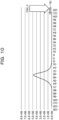
- FIG. 10 is a diagram for explaining the problem of the existing technique.
- the horizontal axis of the histogram in FIG. 10 corresponds to the value of the exponent part e, and the vertical axis represents the number of elements.
- a quantization target range R1 is biased upward, and a large majority of the other elements are rounded to 0.
- equal to or more than 99.9% of the non-zero elements in the tensor are rounded to 0.
- the method includes: identifying maximum absolute values of individual dimensions by projecting a maximum absolute value in a direction of each of the individual dimensions of a tensor represented by a multidimensional array, the tensor in which a value is set for each of elements of the array; identifying a minimum value that indicates a minimum maximum absolute value among the maximum absolute values of the individual dimensions; and setting a quantization range for the tensor on a basis of the minimum value.
- An arithmetic device executes the following processing to set a range of quantization in order to quantize a tensor without changing a mathematical property of the tensor.
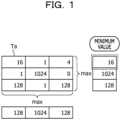
- FIG. 1 is a diagram for explaining processing of the arithmetic device according to the first embodiment.
- FIG. 1 gives explanation using a two-dimensional tensor Ta.
- a value of an exponent part e is set for each element of the tensor Ta.
- “16", “1”, and “4" are set for elements (0, 0), (0, 1), and (0, 2) of the tensor Ta, respectively.
- Values "1", “1,024", and “0” are set for elements (1, 0), (1, 1), and (1, 2) of the tensor Ta, respectively.
- Values “128”, “1", and “128” are set for elements (2, 0), (2, 1), and (2, 2) of the tensor Ta, respectively.
- the arithmetic device projects the maximum absolute value in the direction of each of dimensions, thereby identifying the individual maximum absolute values of the dimensions. For example, the arithmetic device projects the maximum absolute value in the row direction of the elements (0, 0), (0, 1), and (0, 2), thereby identifying "16". The arithmetic device projects the maximum absolute value in the row direction of the elements (1, 0), (1, 1), and (1, 2), thereby identifying "1,024". The arithmetic device projects the maximum absolute value in the row direction of the elements (2, 0), (2, 1), and (2, 2), thereby identifying "128".
- the arithmetic device projects the maximum absolute value in the column direction of the elements (0, 0), (1, 0), and (2, 0), thereby identifying "128".
- the arithmetic device projects the maximum absolute value in the column direction of the elements (0, 1), (1, 1), and (2, 1), thereby identifying "1,024".
- the arithmetic device projects the maximum absolute value in the column direction of the elements (0, 2), (1, 2), and (2, 2), thereby identifying "128".
- the arithmetic device identifies the minimum maximum absolute value among the maximum absolute values of the individual dimensions identified by the processing described above. In the following descriptions, the minimum maximum absolute value will be referred to as a "minimum value a". In the example illustrated in FIG. 1 , the arithmetic device identifies the minimum value a "16" from the maximum absolute values 16, 1,024, 128, 128, 1,024, and 128.
- the arithmetic device sets a quantization range on the basis of rank_e.
- the quantization range is [rank_e, rank_e + E].
- E represents a quantization exponent width, and is specified in advance.
- the quantization range is [4, 5].
- the quantization range is determined on the basis of max_e.
- max_e log 2 (a' + E)
- a' represents the maximum absolute value of each element of the tensor Ta.
- the quantization range based on max_e is [log 2 a', log 2 (a' + E)].
- the maximum absolute value a' of the tensor Ta illustrated in FIG. 1 is "1,024"
- the quantization range based on max_e is [9, 10].
- FIG. 2 is a diagram illustrating a result of comparison between the quantization of the arithmetic device according to the first embodiment and the quantization of the existing technique.
- the quantization range is [4, 5], and thus the tensor Ta is quantized into a tensor Tb.
- the quantization range is "9, 10"
- the tensor Ta is quantized into a tensor Tc.
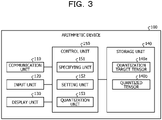
- FIG. 3 is a functional block diagram illustrating a configuration of the arithmetic device according to the first embodiment.
- this arithmetic device 100 includes a communication unit 110, an input unit 120, a display unit 130, a storage unit 140, and a control unit 150.
- the communication unit 110 is connected to an external device or the like by wire or wirelessly, and exchanges information with the external device or the like.
- the communication unit 110 is implemented by a network interface card (NIC) or the like.
- the communication unit 110 may be connected to a network (not illustrated).
- the communication unit 110 may receive a quantization target tensor 140a from an external device via the network.
- the input unit 120 is an input device that inputs various types of information to the arithmetic device 100.
- the input unit 120 corresponds to a keyboard, a mouse, a touch panel, or the like.
- the display unit 130 is a display device that displays information output from the control unit 150.
- the display unit 130 corresponds to a liquid crystal display, an organic electro luminescence (EL) display, a touch panel, or the like.
- the storage unit 140 includes the quantization target tensor 140a and a quantized tensor 140b.
- the storage unit 140 is implemented by, for example, a semiconductor memory element such as a random access memory (RAM), a flash memory, or the like, or a storage device such as a hard disk, an optical disk, or the like.
- RAM random access memory
- flash memory or the like
- storage device such as a hard disk, an optical disk, or the like.
- the quantization target tensor 140a indicates a tensor to be quantized.
- the quantization target tensor 140a is to be the two-dimensional tensor Ta described with reference to FIG. 1 .
- the quantized tensor 140b is a tensor obtained as a result of quantizing the quantization target tensor 140a.
- the quantized tensor 140b corresponds to the tensor Tb described with reference to FIG. 2 .
- the control unit 150 includes a specifying unit 151, a setting unit 152, and a quantization unit 153.
- the control unit 150 is implemented by, for example, a central processing unit (CPU) or a micro processing unit (MPU).
- the control unit 150 may be implemented by, for example, an integrated circuit such as an application specific integrated circuit (ASIC), a field programmable gate array (FPGA), or the like.
- ASIC application specific integrated circuit
- FPGA field programmable gate array
- the specifying unit 151 projects the maximum absolute value in the direction of each dimension of the quantization target tensor 140a, thereby identifying the maximum absolute value of each dimension.
- the specifying unit 151 identifies the minimum value a indicating the minimum maximum absolute value among the maximum absolute values of the individual dimensions.
- the specifying unit 151 outputs information regarding the minimum value a to the setting unit 152.
- the specifying unit 151 projects the maximum absolute value in the row direction of the elements (0, 0), (0, 1), and (0, 2) of the tensor Ta (quantization target tensor 140a), thereby identifying "16".
- the specifying unit 151 projects the maximum absolute value in the row direction of the elements (1, 0), (1, 1), and (1, 2), thereby identifying "1,024".
- the specifying unit 151 projects the maximum absolute value in the row direction of the elements (2, 0), (2, 1), and (2, 2), thereby identifying "128".
- the specifying unit 151 projects the maximum absolute value in the column direction of the elements (0, 0), (1, 0), and (2, 0), thereby identifying "128".
- the specifying unit 151 projects the maximum absolute value in the column direction of the elements (0, 1), (1, 1), and (2, 1), thereby identifying "1,024".
- the specifying unit 151 projects the maximum absolute value in the column direction of the elements (0, 2), (1, 2), and (2, 2), thereby identifying "128".
- the specifying unit 151 identifies the minimum value a from the maximum absolute values of the individual dimensions identified by the process described above. In the example illustrated in FIG. 1 , the specifying unit 151 identifies the minimum value a "16" from the maximum absolute values 16, 1,024, 128, 128, 1,024, and 128.
- the setting unit 152 sets a quantization range for the quantization target tensor 140a on the basis of the minimum value a.
- the setting unit 152 outputs information regarding the quantization range to the quantization unit 153.
- the setting unit 152 specifies rank_e on the basis of the minimum value a and the formula (3).
- the quantization unit 153 quantizes the quantization target tensor 140a within the quantization range received from the setting unit 152, thereby generating a quantized tensor 140b.
- the quantization unit 153 may transmit the quantized tensor 140b to an external device serving as a transmission source of the quantization target tensor 140a.
- an external device executes machine learning of a learning model using the quantized tensor 140b.
- the arithmetic device 100 may execute the machine learning of the learning model using the quantized tensor 140b.
- FIG. 4 is a flowchart illustrating a processing procedure of the arithmetic device according to the first embodiment.
- the specifying unit 151 of the arithmetic device 100 obtains the quantization target tensor 140a (step S101).
- the specifying unit 151 projects the maximum absolute value of each dimension for all the elements of the quantization target tensor 140a (step S102).
- the specifying unit 151 identifies the minimum value a among the maximum absolute values of all dimensions (step S103).
- the setting unit 152 of the arithmetic device 100 calculates rank_e on the basis of the minimum value a (step S104).
- the setting unit 152 sets the quantization range [rank_e, rank_e + E] on the basis of rank_e (step S105).
- the quantization unit 153 of the arithmetic device 100 quantizes the quantization target tensor 140a in the quantization range (step S106).
- the quantization unit 153 outputs the quantized tensor 140b (step S107).
- the arithmetic device 100 projects the maximum absolute value in the direction of each of dimensions of the quantization target tensor 140a to identify the maximum absolute value of each of the dimensions, and identifies the minimum value a from the maximum absolute values of the individual dimensions.
- the arithmetic device 100 sets the quantization range on the basis of the minimum value a to carry out quantization. This makes it possible to quantize the tensor without changing the mathematical property of the tensor.
- the tensor Ta is quantized into the tensor Tb.
- the quantization range is "9, 10"
- the tensor Ta is quantized into a tensor Tc.
- FIG. 5 is a diagram for explaining processing of an arithmetic device according to a second embodiment.
- the arithmetic device according to the second embodiment calculates a maximum absolute value from a quantization target tensor Ta, thereby obtaining max_e.
- the arithmetic device performs calculation similar to that in the first embodiment, and calculates rank_e from the quantization target tensor Ta.
- the arithmetic device identifies a smaller minimum value e0 of rank_e and max_e.
- the minimum value e0 is identified on the basis of the formula (4).
- the arithmetic device sets a quantization range [e0, e0 + E] using the minimum value e0, and quantize the quantization target tensor Ta, thereby obtaining a quantized tensor Tb.
- e 0 min rank _ e , max _ e
- the arithmetic device identifies the smaller minimum value e0 of rank_e and max_e, and sets the quantization range [e0, e0 + E] using the minimum value e0, whereby it is enabled to quantize the tensor more appropriately, and to enhance learning accuracy at the time of executing machine learning.
- FIG. 6 is a functional block diagram illustrating a configuration of the arithmetic device according to the second embodiment. As illustrated in FIG. 6 , this arithmetic device 200 includes a communication unit 210, an input unit 220, a display unit 230, a storage unit 240, and a control unit 250.
- Descriptions regarding the communication unit 210, the input unit 220, and the display unit 230 are similar to the descriptions regarding the communication unit 110, the input unit 120, and the display unit 130 described with reference to FIG. 3 .
- the storage unit 240 includes a quantization target tensor 240a and a quantized tensor 240b.
- the storage unit 240 is implemented by, for example, a semiconductor memory element such as a RAM, a flash memory, or the like, or a storage device such as a hard disk, an optical disk, or the like.
- Description regarding the quantization target tensor 240a is similar to the description regarding the quantization target tensor 140a.
- Description regarding the quantized tensor 240b is similar to the description regarding the quantized tensor 140b.
- the control unit 250 includes a calculation unit 251, a specifying unit 252, a setting unit 253, and a quantization unit 254.
- the control unit 250 is implemented by, for example, a CPU or an MPU. Furthermore, the control unit 250 may be implemented by, for example, an integrated circuit such as an ASIC, an FPGA, or the like.
- the calculation unit 251 calculates max_e, which is the maximum absolute value, among all the elements of the quantization target tensor 240a. For example, the calculation unit 251 calculates max_e using the formula (2) mentioned above. The calculation unit 251 outputs information regarding max_e to the setting unit 253.
- the specifying unit 252 identifies the minimum value a on the basis of the quantization target tensor 240a.
- a process in which the specifying unit 252 identifies the minimum value a is similar to the process in which the specifying unit 151 identifies the minimum value a described in the first embodiment.
- the specifying unit 252 outputs information regarding the minimum value a to the setting unit 253.
- the setting unit 253 specifies rank_e on the basis of the minimum value a and the formula (3).
- the setting unit 253 identifies the minimum value e0 on the basis of the formula (4), rank_e, and max_e.
- the setting unit 253 sets the quantization range [e0, e0 + E] using the minimum value e0.
- the setting unit 253 outputs information regarding the quantization range to the quantization unit 254.
- the quantization unit 254 quantizes the quantization target tensor 240a within the quantization range received from the setting unit 253, thereby generating a quantized tensor 240b. Processing of the quantization unit 254 is similar to the processing of the quantization unit 153 described in the first embodiment.
- FIG. 7 is a flowchart illustrating a processing procedure of the arithmetic device according to the second embodiment.
- the calculation unit 251 of the arithmetic device 200 obtains the quantization target tensor 240a (step S201).
- the calculation unit 251 calculates max_e on the basis of the quantization target tensor 240a (step S202).
- the specifying unit 252 of the arithmetic device 200 projects the maximum absolute value of each dimension for all the elements of the quantization target tensor 240a (step S203).
- the specifying unit 252 identifies the minimum value a among the maximum absolute values of all dimensions (step S204).
- the setting unit 253 of the arithmetic device 200 calculates rank_e on the basis of the minimum value a (step S205).
- the setting unit 253 identifies the minimum value e0 of rank_e and max_e (step S206).
- the setting unit 253 sets the quantization range [e0, e0 + E] on the basis of the minimum value e0 (step S207).
- the quantization unit 254 of the arithmetic device 200 quantizes the quantization target tensor 240a in the quantization range (step S208).
- the quantization unit 254 outputs the quantized tensor 240b (step S209).
- the arithmetic device 200 identifies the minimum value e0 from max_e and rank_e obtained from the quantization target tensor 240a, and sets the quantization range on the basis of the minimum value e0 to carry out quantization. As a result, it becomes possible to quantize the tensor more appropriately, and to enhance the learning accuracy at the time of executing the machine learning.
- the setting unit 253 sets the smaller one of rank_e and max_e as the minimum value e0 to set the quantization range in the second embodiment described above, it is not limited to this.
- the setting unit 253 may calculate a weighted sum ew of rank_e and max_e to set the quantization range on the basis of the weighted sum ew.
- the setting unit 253 calculates the weighted sum ew on the basis of the formula (5).
- c represents a constant, which is set in a range of 0 ⁇ c ⁇ 1.
- the setting unit 253 sets the quantization range as [ew, ew + E].
- ew c * rank _ e + 1 ⁇ c * max _ e
- the inventor measured learning accuracy for a learning model for a tensor (first tensor) quantized by the existing technique, a tensor (second tensor) quantized by the method of the first embodiment, and a tensor (third tensor) quantized by the method (weighted sum) of the second embodiment.
- the learning accuracy of the first tensor was "79.30%”
- the learning accuracy of the second tensor was "79.89%”
- the learning accuracy of the third tensor was "80.27%”.
- FIG. 8 is a diagram illustrating an exemplary hardware configuration of a computer that implements functions similar to those of the arithmetic device according to the embodiments.
- a computer 300 includes a CPU 301 that executes various types of arithmetic processing, an input device 302 that receives data input from a user, and a display 303. Furthermore, the computer 300 includes a communication device 304 that exchanges data with an external device or the like via a wired or wireless network, and an interface device 305. Furthermore, the computer 300 includes a RAM 306 that temporarily stores various types of information, and a hard disk device 307. Additionally, each of the devices 301 to 307 is connected to a bus 308.
- the hard disk device 307 includes a calculation program 307a, a specifying program 307b, a setting program 307c, and a quantization program 307d. Furthermore, the CPU 301 reads each of the programs 307a to 307d, and loads it in the RAM 306.
- the calculation program 307a functions as a calculation process 306a.
- the specifying program 307b functions as a specifying process 306b.
- the setting program 307c functions as a setting process 306c.
- the quantization program 307d functions as a quantization process 306d.
- Processing of the calculation process 306a corresponds to the processing of the calculation unit 251.
- Processing of the specifying process 306b corresponds to the processing of the specifying units 151 and 252.
- Processing of the setting process 306c corresponds to the processing of the setting units 152 and 253.
- Processing of the quantization process 306d corresponds to the processing of the quantization units 153 and 254.
- each of the programs 307a to 307d may not necessarily be stored in the hard disk device 307 beforehand.
- each of the programs is stored in a "portable physical medium" to be inserted in the computer 300, such as a flexible disk (FD), a compact disc read only memory (CD-ROM), a digital versatile disc (DVD), a magneto-optical disk, an IC card, or the like.
- the computer 300 may read and execute each of the programs 307a to 307d.
- the various features may be implemented in hardware, or as software modules running on one or more processors/computers.
- the invention also provides a computer program or a computer program product comprising instructions which, when executed by a computer, cause the computer to carry out any of the methods/method steps described herein, and a non-transitory computer-readable medium comprising instructions which, when executed by a computer, cause the computer to carry out any of the methods/method steps described herein.
- a computer program embodying the invention may be stored on a non-transitory computer-readable medium, or it could, for example, be in the form of a signal such as a downloadable data signal provided from an Internet website, or it could be in any other form.
Landscapes
- Engineering & Computer Science (AREA)
- Theoretical Computer Science (AREA)
- Physics & Mathematics (AREA)
- General Physics & Mathematics (AREA)
- Mathematical Optimization (AREA)
- Computational Mathematics (AREA)
- Pure & Applied Mathematics (AREA)
- Mathematical Analysis (AREA)
- General Engineering & Computer Science (AREA)
- Data Mining & Analysis (AREA)
- Mathematical Physics (AREA)
- Software Systems (AREA)
- Computing Systems (AREA)
- Computer Vision & Pattern Recognition (AREA)
- Medical Informatics (AREA)
- Evolutionary Computation (AREA)
- Artificial Intelligence (AREA)
- Algebra (AREA)
- Databases & Information Systems (AREA)
- Compression, Expansion, Code Conversion, And Decoders (AREA)
- Complex Calculations (AREA)
Abstract
Description
- The embodiments discussed herein are related to an arithmetic program and the like.
- In deep learning, there is a method of quantizing data values to speed up a process of machine learning for a learning model. Here, an existing technique of quantizing a tensor used for the machine learning will be described.
- A value of the tensor is expressed by the formula (1). Element data of the tensor is represented by an FP format (s-ebit-mbit) and an exponent part bias b. For example, in the example indicated by the formula (1), s represents a 1-bit fixed sign bit. The number of bits in the exponent part e is represented by ebit. The number of bits in the mantissa m is represented by mbit. A bias value of the exponent part is represented by b. All elements in the tensor use the same ebit, mbit, and b.
[Formula 1]

- In the existing technique, there is a rounding range due to the upper and lower quantization.
FIG. 9 is a diagram for explaining the existing technique. The horizontal axis of the histogram inFIG. 9 corresponds to the value of the exponent part e, and the vertical axis represents the number of elements. According to the existing technique, in a case where a quantization target range is set to [a, a + E], elements in a lower range A1 in which the exponent part e is less than a are rounded to 0. Furthermore, elements in an upper range A2 in which the exponent part e is equal to or greater than a + E are rounded to 2(a+E). A quantization exponent width is represented by E, which is, for example, E = 2ebit. - According to the existing technique, the quantization target range is calculated on the basis of the maximum absolute value (max_e) of an element of a quantization target tensor T. The maximum absolute value is calculated on the basis of the formula (2).
[Formula 2]

- International Publication Pamphlet No.
WO 2020/065874 , International Publication Pamphlet No.WO 2019/146189 , andU.S. Patent Application Publication No. 2019/0340492 are disclosed as related art. - However, the existing technique described above has a problem that a mathematical property of the tensor changes at a time of quantizing the tensor.
-
FIG. 10 is a diagram for explaining the problem of the existing technique. The horizontal axis of the histogram inFIG. 10 corresponds to the value of the exponent part e, and the vertical axis represents the number of elements. In a case where a part of the elements of the exponent part e has a large value, a quantization target range R1 is biased upward, and a large majority of the other elements are rounded to 0. In the example illustrated inFIG. 10 , equal to or more than 99.9% of the non-zero elements in the tensor are rounded to 0. When rounded in this manner, characteristics such as the number of ranks of the tensor are not saved, and the mathematical property changes. - It is desirable to provide an arithmetic program, an arithmetic method, and an arithmetic device capable of quantizing a tensor without changing a mathematical property of the tensor.
- According to an embodiment of one aspect of the invention, there is provided a computer-implemented method of an arithmetic processing. In an example, the method includes: identifying maximum absolute values of individual dimensions by projecting a maximum absolute value in a direction of each of the individual dimensions of a tensor represented by a multidimensional array, the tensor in which a value is set for each of elements of the array; identifying a minimum value that indicates a minimum maximum absolute value among the maximum absolute values of the individual dimensions; and setting a quantization range for the tensor on a basis of the minimum value.
- It becomes possible to quantize a tensor without changing a mathematical property of the tensor.
- The invention is described, by way of example only, with reference to the following drawings, in which:
-
FIG. 1 is a diagram for explaining processing of an arithmetic device according to a first embodiment; -
FIG. 2 is a diagram illustrating a result of comparison between quantization of the arithmetic device according to the first embodiment and quantization of an existing technique; -
FIG. 3 is a functional block diagram illustrating a configuration of the arithmetic device according to the first embodiment; -
FIG. 4 is a flowchart illustrating a processing procedure of the arithmetic device according to the first embodiment; -
FIG. 5 is a diagram for explaining processing of an arithmetic device according to a second embodiment; -
FIG. 6 is a functional block diagram illustrating a configuration of the arithmetic device according to the second embodiment; -
FIG. 7 is a flowchart illustrating a processing procedure of the arithmetic device according to the second embodiment; -
FIG. 8 is a diagram illustrating an exemplary hardware configuration of a computer that implements functions similar to those of the arithmetic device according to the embodiments; -
FIG. 9 is a diagram for explaining an existing technique; and -
FIG. 10 is a diagram for explaining a problem of the existing technique. - Hereinafter, embodiments of an arithmetic program, an arithmetic method, and an arithmetic device disclosed in the present application will be described in detail with reference to the drawings. Note that the embodiments do not limit the present disclosure.
- An arithmetic device according to a first embodiment executes the following processing to set a range of quantization in order to quantize a tensor without changing a mathematical property of the tensor.
-
FIG. 1 is a diagram for explaining processing of the arithmetic device according to the first embodiment.FIG. 1 gives explanation using a two-dimensional tensor Ta. A value of an exponent part e is set for each element of the tensor Ta. For example, "16", "1", and "4" are set for elements (0, 0), (0, 1), and (0, 2) of the tensor Ta, respectively. Values "1", "1,024", and "0" are set for elements (1, 0), (1, 1), and (1, 2) of the tensor Ta, respectively. Values "128", "1", and "128" are set for elements (2, 0), (2, 1), and (2, 2) of the tensor Ta, respectively. - The arithmetic device projects the maximum absolute value in the direction of each of dimensions, thereby identifying the individual maximum absolute values of the dimensions. For example, the arithmetic device projects the maximum absolute value in the row direction of the elements (0, 0), (0, 1), and (0, 2), thereby identifying "16". The arithmetic device projects the maximum absolute value in the row direction of the elements (1, 0), (1, 1), and (1, 2), thereby identifying "1,024". The arithmetic device projects the maximum absolute value in the row direction of the elements (2, 0), (2, 1), and (2, 2), thereby identifying "128".
- The arithmetic device projects the maximum absolute value in the column direction of the elements (0, 0), (1, 0), and (2, 0), thereby identifying "128". The arithmetic device projects the maximum absolute value in the column direction of the elements (0, 1), (1, 1), and (2, 1), thereby identifying "1,024". The arithmetic device projects the maximum absolute value in the column direction of the elements (0, 2), (1, 2), and (2, 2), thereby identifying "128".
- The arithmetic device identifies the minimum maximum absolute value among the maximum absolute values of the individual dimensions identified by the processing described above. In the following descriptions, the minimum maximum absolute value will be referred to as a "minimum value a". In the example illustrated in
FIG. 1 , the arithmetic device identifies the minimum value a "16" from the maximumabsolute values 16, 1,024, 128, 128, 1,024, and 128. - The arithmetic device specifies "rank_e" on the basis of the minimum value a. On the basis of the formula (3), rank_e is specified. When the minimum value a = 16, rank_e = 4.

- The arithmetic device sets a quantization range on the basis of rank_e. For example, it is assumed that the quantization range is [rank_e, rank_e + E]. Here, E represents a quantization exponent width, and is specified in advance. In a case where rank_e = 4 and E = 2, the quantization range is [4, 5].
- Meanwhile, according to the existing technique, the quantization range is determined on the basis of max_e. There is a relation of max_e = log2(a' + E), and a' represents the maximum absolute value of each element of the tensor Ta. The quantization range based on max_e is [log2a', log2(a' + E)]. For example, the maximum absolute value a' of the tensor Ta illustrated in
FIG. 1 is "1,024", and the quantization range based on max_e is [9, 10]. -
FIG. 2 is a diagram illustrating a result of comparison between the quantization of the arithmetic device according to the first embodiment and the quantization of the existing technique. As illustrated inFIG. 2 , when the quantization is carried out with rank_e, the quantization range is [4, 5], and thus the tensor Ta is quantized into a tensor Tb. According to such quantization, an element with an absolute value larger than 16 (= 24) remains as non-zero, whereby a decrease in rank is suppressed and it becomes possible to quantize the tensor without changing the mathematical property of the tensor. - Meanwhile, when the quantization is carried out with max_e as in the existing technique, the quantization range is "9, 10", and the tensor Ta is quantized into a tensor Tc. According to such quantization, only the maximum value 1,024 (=210) becomes a non-zero element, and the rank is also lowered to 1, whereby the mathematical property of the tensor is greatly impaired.
- Next, an exemplary configuration of the arithmetic device according to the first embodiment will be described.
FIG. 3 is a functional block diagram illustrating a configuration of the arithmetic device according to the first embodiment. As illustrated inFIG. 3 , this arithmetic device 100 includes a communication unit 110, aninput unit 120, adisplay unit 130, a storage unit 140, and acontrol unit 150. - The communication unit 110 is connected to an external device or the like by wire or wirelessly, and exchanges information with the external device or the like. For example, the communication unit 110 is implemented by a network interface card (NIC) or the like. The communication unit 110 may be connected to a network (not illustrated). The communication unit 110 may receive a
quantization target tensor 140a from an external device via the network. - The
input unit 120 is an input device that inputs various types of information to the arithmetic device 100. Theinput unit 120 corresponds to a keyboard, a mouse, a touch panel, or the like. - The
display unit 130 is a display device that displays information output from thecontrol unit 150. Thedisplay unit 130 corresponds to a liquid crystal display, an organic electro luminescence (EL) display, a touch panel, or the like. - The storage unit 140 includes the
quantization target tensor 140a and aquantized tensor 140b. The storage unit 140 is implemented by, for example, a semiconductor memory element such as a random access memory (RAM), a flash memory, or the like, or a storage device such as a hard disk, an optical disk, or the like. - The
quantization target tensor 140a indicates a tensor to be quantized. In the first embodiment, thequantization target tensor 140a is to be the two-dimensional tensor Ta described with reference toFIG. 1 . - The
quantized tensor 140b is a tensor obtained as a result of quantizing thequantization target tensor 140a. For example, thequantized tensor 140b corresponds to the tensor Tb described with reference toFIG. 2 . - The
control unit 150 includes a specifyingunit 151, asetting unit 152, and aquantization unit 153. Thecontrol unit 150 is implemented by, for example, a central processing unit (CPU) or a micro processing unit (MPU). Furthermore, thecontrol unit 150 may be implemented by, for example, an integrated circuit such as an application specific integrated circuit (ASIC), a field programmable gate array (FPGA), or the like. - The specifying
unit 151 projects the maximum absolute value in the direction of each dimension of thequantization target tensor 140a, thereby identifying the maximum absolute value of each dimension. The specifyingunit 151 identifies the minimum value a indicating the minimum maximum absolute value among the maximum absolute values of the individual dimensions. The specifyingunit 151 outputs information regarding the minimum value a to thesetting unit 152. - Processing of the specifying
unit 151 will be described with reference toFIG. 1 . The specifyingunit 151 projects the maximum absolute value in the row direction of the elements (0, 0), (0, 1), and (0, 2) of the tensor Ta (quantization target tensor 140a), thereby identifying "16". The specifyingunit 151 projects the maximum absolute value in the row direction of the elements (1, 0), (1, 1), and (1, 2), thereby identifying "1,024". The specifyingunit 151 projects the maximum absolute value in the row direction of the elements (2, 0), (2, 1), and (2, 2), thereby identifying "128". - The specifying
unit 151 projects the maximum absolute value in the column direction of the elements (0, 0), (1, 0), and (2, 0), thereby identifying "128". The specifyingunit 151 projects the maximum absolute value in the column direction of the elements (0, 1), (1, 1), and (2, 1), thereby identifying "1,024". The specifyingunit 151 projects the maximum absolute value in the column direction of the elements (0, 2), (1, 2), and (2, 2), thereby identifying "128". - The specifying
unit 151 identifies the minimum value a from the maximum absolute values of the individual dimensions identified by the process described above. In the example illustrated inFIG. 1 , the specifyingunit 151 identifies the minimum value a "16" from the maximumabsolute values 16, 1,024, 128, 128, 1,024, and 128. - The
setting unit 152 sets a quantization range for thequantization target tensor 140a on the basis of the minimum value a. Thesetting unit 152 outputs information regarding the quantization range to thequantization unit 153. - The
setting unit 152 specifies rank_e on the basis of the minimum value a and the formula (3). Thesetting unit 152 sets the quantization range [rank_e, rank_e + E] on the basis of rank_e. For example, in a case where the minimum value a = 16, rank_e = 4 and the quantization range is [4, 5]. - The
quantization unit 153 quantizes thequantization target tensor 140a within the quantization range received from thesetting unit 152, thereby generating aquantized tensor 140b. - Processing of the
quantization unit 153 will be described with reference toFIG. 2 . Here, thequantization target tensor 140a is to be the tensor Ta, and the quantization range is to be [4, 5]. According to such quantization, an element with an absolute value larger than 16 (= 24) remains as non-zero, and for example, a quantization result of the tensor Ta is tensor Tb (quantizedtensor 140b). - The
quantization unit 153 may transmit the quantizedtensor 140b to an external device serving as a transmission source of thequantization target tensor 140a. For example, such an external device executes machine learning of a learning model using the quantizedtensor 140b. Note that, although illustration is omitted, the arithmetic device 100 may execute the machine learning of the learning model using the quantizedtensor 140b. - Next, an exemplary processing procedure of the arithmetic device 100 according to the first embodiment will be described.
FIG. 4 is a flowchart illustrating a processing procedure of the arithmetic device according to the first embodiment. As illustrated inFIG. 4 , the specifyingunit 151 of the arithmetic device 100 obtains thequantization target tensor 140a (step S101). - The specifying
unit 151 projects the maximum absolute value of each dimension for all the elements of thequantization target tensor 140a (step S102). The specifyingunit 151 identifies the minimum value a among the maximum absolute values of all dimensions (step S103). - The
setting unit 152 of the arithmetic device 100 calculates rank_e on the basis of the minimum value a (step S104). Thesetting unit 152 sets the quantization range [rank_e, rank_e + E] on the basis of rank_e (step S105). - The
quantization unit 153 of the arithmetic device 100 quantizes thequantization target tensor 140a in the quantization range (step S106). Thequantization unit 153 outputs the quantizedtensor 140b (step S107). - Next, effects of the arithmetic device 100 according to the first embodiment will be described. The arithmetic device 100 projects the maximum absolute value in the direction of each of dimensions of the
quantization target tensor 140a to identify the maximum absolute value of each of the dimensions, and identifies the minimum value a from the maximum absolute values of the individual dimensions. The arithmetic device 100 sets the quantization range on the basis of the minimum value a to carry out quantization. This makes it possible to quantize the tensor without changing the mathematical property of the tensor. - For example, as described with reference to
FIG. 2 , since the quantization range is [4, 5] according to the arithmetic device 100, the tensor Ta is quantized into the tensor Tb. According to such quantization, an element with an absolute value larger than 16 (= 24) remains as non-zero, whereby a decrease in rank is suppressed and the mathematical property of the tensor is saved. - Meanwhile, when the quantization is carried out with max_e as in the existing technique, the quantization range is "9, 10", and the tensor Ta is quantized into a tensor Tc. According to such quantization, only the maximum value 1,024 (=210) becomes a non-zero element, and the rank is also lowered to 1, whereby the mathematical property of the tensor is greatly impaired.
-
FIG. 5 is a diagram for explaining processing of an arithmetic device according to a second embodiment. As illustrated inFIG. 5 , in a similar manner to the existing technique, the arithmetic device according to the second embodiment calculates a maximum absolute value from a quantization target tensor Ta, thereby obtaining max_e. The arithmetic device performs calculation similar to that in the first embodiment, and calculates rank_e from the quantization target tensor Ta. The arithmetic device identifies a smaller minimum value e0 of rank_e and max_e. The minimum value e0 is identified on the basis of the formula (4). The arithmetic device sets a quantization range [e0, e0 + E] using the minimum value e0, and quantize the quantization target tensor Ta, thereby obtaining a quantized tensor Tb.

- The arithmetic device according to the second embodiment identifies the smaller minimum value e0 of rank_e and max_e, and sets the quantization range [e0, e0 + E] using the minimum value e0, whereby it is enabled to quantize the tensor more appropriately, and to enhance learning accuracy at the time of executing machine learning.
-
FIG. 6 is a functional block diagram illustrating a configuration of the arithmetic device according to the second embodiment. As illustrated inFIG. 6 , thisarithmetic device 200 includes a communication unit 210, an input unit 220, adisplay unit 230, a storage unit 240, and acontrol unit 250. - Descriptions regarding the communication unit 210, the input unit 220, and the
display unit 230 are similar to the descriptions regarding the communication unit 110, theinput unit 120, and thedisplay unit 130 described with reference toFIG. 3 . - The storage unit 240 includes a
quantization target tensor 240a and aquantized tensor 240b. The storage unit 240 is implemented by, for example, a semiconductor memory element such as a RAM, a flash memory, or the like, or a storage device such as a hard disk, an optical disk, or the like. - Description regarding the
quantization target tensor 240a is similar to the description regarding thequantization target tensor 140a. Description regarding thequantized tensor 240b is similar to the description regarding thequantized tensor 140b. - The
control unit 250 includes acalculation unit 251, a specifying unit 252, asetting unit 253, and a quantization unit 254. Thecontrol unit 250 is implemented by, for example, a CPU or an MPU. Furthermore, thecontrol unit 250 may be implemented by, for example, an integrated circuit such as an ASIC, an FPGA, or the like. - The
calculation unit 251 calculates max_e, which is the maximum absolute value, among all the elements of thequantization target tensor 240a. For example, thecalculation unit 251 calculates max_e using the formula (2) mentioned above. Thecalculation unit 251 outputs information regarding max_e to thesetting unit 253. - The specifying unit 252 identifies the minimum value a on the basis of the
quantization target tensor 240a. A process in which the specifying unit 252 identifies the minimum value a is similar to the process in which the specifyingunit 151 identifies the minimum value a described in the first embodiment. The specifying unit 252 outputs information regarding the minimum value a to thesetting unit 253. - The
setting unit 253 specifies rank_e on the basis of the minimum value a and the formula (3). Thesetting unit 253 identifies the minimum value e0 on the basis of the formula (4), rank_e, and max_e. Thesetting unit 253 sets the quantization range [e0, e0 + E] using the minimum value e0. Thesetting unit 253 outputs information regarding the quantization range to the quantization unit 254. - The quantization unit 254 quantizes the
quantization target tensor 240a within the quantization range received from thesetting unit 253, thereby generating aquantized tensor 240b. Processing of the quantization unit 254 is similar to the processing of thequantization unit 153 described in the first embodiment. - Next, an exemplary processing procedure of the
arithmetic device 200 according to the second embodiment will be described.FIG. 7 is a flowchart illustrating a processing procedure of the arithmetic device according to the second embodiment. Thecalculation unit 251 of thearithmetic device 200 obtains thequantization target tensor 240a (step S201). - The
calculation unit 251 calculates max_e on the basis of thequantization target tensor 240a (step S202). The specifying unit 252 of thearithmetic device 200 projects the maximum absolute value of each dimension for all the elements of thequantization target tensor 240a (step S203). The specifying unit 252 identifies the minimum value a among the maximum absolute values of all dimensions (step S204). - The
setting unit 253 of thearithmetic device 200 calculates rank_e on the basis of the minimum value a (step S205). Thesetting unit 253 identifies the minimum value e0 of rank_e and max_e (step S206). Thesetting unit 253 sets the quantization range [e0, e0 + E] on the basis of the minimum value e0 (step S207). - The quantization unit 254 of the
arithmetic device 200 quantizes thequantization target tensor 240a in the quantization range (step S208). The quantization unit 254 outputs the quantizedtensor 240b (step S209). - Next, effects of the
arithmetic device 200 according to the second embodiment will be described. Thearithmetic device 200 identifies the minimum value e0 from max_e and rank_e obtained from thequantization target tensor 240a, and sets the quantization range on the basis of the minimum value e0 to carry out quantization. As a result, it becomes possible to quantize the tensor more appropriately, and to enhance the learning accuracy at the time of executing the machine learning. - Meanwhile, while the
setting unit 253 sets the smaller one of rank_e and max_e as the minimum value e0 to set the quantization range in the second embodiment described above, it is not limited to this. Thesetting unit 253 may calculate a weighted sum ew of rank_e and max_e to set the quantization range on the basis of the weighted sum ew. - For example, the
setting unit 253 calculates the weighted sum ew on the basis of the formula (5). In the formula (5), c represents a constant, which is set in a range of 0 ≤ c ≤ 1. Thesetting unit 253 sets the quantization range as [ew, ew + E].

- Here, the inventor measured learning accuracy for a learning model for a tensor (first tensor) quantized by the existing technique, a tensor (second tensor) quantized by the method of the first embodiment, and a tensor (third tensor) quantized by the method (weighted sum) of the second embodiment. As a result, the learning accuracy of the first tensor was "79.30%", the learning accuracy of the second tensor was "79.89%", and the learning accuracy of the third tensor was "80.27%". For example, according to the quantization methods of the first and second embodiments, it is possible to enhance the learning accuracy at the time of executing the machine learning as compared with the existing technique.
- Next, an exemplary hardware configuration of a computer that implements functions similar to those of the arithmetic device 200 (100) indicated in the embodiments described above will be described.
FIG. 8 is a diagram illustrating an exemplary hardware configuration of a computer that implements functions similar to those of the arithmetic device according to the embodiments. - As illustrated in
FIG. 8 , acomputer 300 includes aCPU 301 that executes various types of arithmetic processing, aninput device 302 that receives data input from a user, and adisplay 303. Furthermore, thecomputer 300 includes acommunication device 304 that exchanges data with an external device or the like via a wired or wireless network, and aninterface device 305. Furthermore, thecomputer 300 includes aRAM 306 that temporarily stores various types of information, and a hard disk device 307. Additionally, each of thedevices 301 to 307 is connected to abus 308. - The hard disk device 307 includes a
calculation program 307a, a specifyingprogram 307b, asetting program 307c, and aquantization program 307d. Furthermore, theCPU 301 reads each of theprograms 307a to 307d, and loads it in theRAM 306. - The
calculation program 307a functions as acalculation process 306a. The specifyingprogram 307b functions as a specifyingprocess 306b. Thesetting program 307c functions as asetting process 306c. Thequantization program 307d functions as a quantization process 306d. - Processing of the
calculation process 306a corresponds to the processing of thecalculation unit 251. Processing of the specifyingprocess 306b corresponds to the processing of the specifyingunits 151 and 252. Processing of thesetting process 306c corresponds to the processing of the settingunits quantization units 153 and 254. - Note that each of the
programs 307a to 307d may not necessarily be stored in the hard disk device 307 beforehand. For example, each of the programs is stored in a "portable physical medium" to be inserted in thecomputer 300, such as a flexible disk (FD), a compact disc read only memory (CD-ROM), a digital versatile disc (DVD), a magneto-optical disk, an IC card, or the like. Then, thecomputer 300 may read and execute each of theprograms 307a to 307d. - In any of the above aspects, the various features may be implemented in hardware, or as software modules running on one or more processors/computers.
- The invention also provides a computer program or a computer program product comprising instructions which, when executed by a computer, cause the computer to carry out any of the methods/method steps described herein, and a non-transitory computer-readable medium comprising instructions which, when executed by a computer, cause the computer to carry out any of the methods/method steps described herein. A computer program embodying the invention may be stored on a non-transitory computer-readable medium, or it could, for example, be in the form of a signal such as a downloadable data signal provided from an Internet website, or it could be in any other form.
Claims (6)
- An arithmetic program comprising instructions which, when executed by a computer, cause the computer to execute processing comprising:identifying maximum absolute values of individual dimensions by projecting a maximum absolute value in a direction of each of the individual dimensions of a tensor represented by a multidimensional array, the tensor in which a value is set for each of elements of the array;identifying a minimum value that indicates a minimum maximum absolute value among the maximum absolute values of the individual dimensions; andsetting a quantization range for the tensor on a basis of the minimum value.
- The arithmetic program according to claim 1, wherein the setting the quantization range sets the quantization range on a basis of a smaller value of the minimum value and a value obtained by subtracting a value that corresponds to the quantization range from the maximum absolute value of all the elements included in the tensor.
- The arithmetic program according to claim 1 or 2, wherein the setting the quantization range sets the quantization range on a basis of a weighted sum of the minimum value and a value obtained by subtracting a value that corresponds to the quantization range from the maximum absolute value of all the elements included in the tensor.
- The arithmetic program according to any preceding claim, the processing further comprising: quantizing the tensor on a basis of the quantization range set for the tensor.
- A computer-implemented method of an arithmetic processing, the method comprising:identifying maximum absolute values of individual dimensions by projecting a maximum absolute value in a direction of each of the individual dimensions of a tensor represented by a multidimensional array, the tensor in which a value is set for each of elements of the array;identifying a minimum value that indicates a minimum maximum absolute value among the maximum absolute values of the individual dimensions; andsetting a quantization range for the tensor on a basis of the minimum value.
- An arithmetic apparatus comprising:a memory; anda processor coupled to the memory, the processor being configured to perform processing including:identifying maximum absolute values of individual dimensions by projecting a maximum absolute value in a direction of each of the individual dimensions of a tensor represented by a multidimensional array, the tensor in which a value is set for each of elements of the array;identifying a minimum value that indicates a minimum maximum absolute value among the maximum absolute values of the individual dimensions; andsetting a quantization range for the tensor on a basis of the minimum value.
Applications Claiming Priority (1)
| Application Number | Priority Date | Filing Date | Title |
|---|---|---|---|
| JP2021146728A JP2023039558A (en) | 2021-09-09 | 2021-09-09 | Arithmetic Program, Arithmetic Method and Arithmetic Device |
Publications (1)
| Publication Number | Publication Date |
|---|---|
| EP4149007A1 true EP4149007A1 (en) | 2023-03-15 |
Family
ID=82067428
Family Applications (1)
| Application Number | Title | Priority Date | Filing Date |
|---|---|---|---|
| EP22179044.7A Withdrawn EP4149007A1 (en) | 2021-09-09 | 2022-06-14 | Arithmetic program, arithmetic method, and arithmetic device |
Country Status (4)
| Country | Link |
|---|---|
| US (1) | US20230069986A1 (en) |
| EP (1) | EP4149007A1 (en) |
| JP (1) | JP2023039558A (en) |
| CN (1) | CN115796297A (en) |
Families Citing this family (2)
| Publication number | Priority date | Publication date | Assignee | Title |
|---|---|---|---|---|
| JP7497664B2 (en) * | 2020-10-09 | 2024-06-11 | 富士通株式会社 | Machine learning program, machine learning device, and machine learning method |
| KR20260039700A (en) * | 2023-08-03 | 2026-03-20 | 퀄컴 인코포레이티드 | Mixed precision quantization of machine learning model parameters |
Citations (3)
| Publication number | Priority date | Publication date | Assignee | Title |
|---|---|---|---|---|
| WO2019146189A1 (en) | 2018-01-29 | 2019-08-01 | 日本電気株式会社 | Neural network rank optimization device and optimization method |
| US20190340492A1 (en) | 2018-05-04 | 2019-11-07 | Microsoft Technology Licensing, Llc | Design flow for quantized neural networks |
| WO2020065874A1 (en) | 2018-09-27 | 2020-04-02 | 株式会社ソシオネクスト | Network quantization method, inference method, and network quantization device |
-
2021
- 2021-09-09 JP JP2021146728A patent/JP2023039558A/en active Pending
-
2022
- 2022-06-08 US US17/834,981 patent/US20230069986A1/en not_active Abandoned
- 2022-06-14 EP EP22179044.7A patent/EP4149007A1/en not_active Withdrawn
- 2022-06-24 CN CN202210724058.5A patent/CN115796297A/en active Pending
Patent Citations (3)
| Publication number | Priority date | Publication date | Assignee | Title |
|---|---|---|---|---|
| WO2019146189A1 (en) | 2018-01-29 | 2019-08-01 | 日本電気株式会社 | Neural network rank optimization device and optimization method |
| US20190340492A1 (en) | 2018-05-04 | 2019-11-07 | Microsoft Technology Licensing, Llc | Design flow for quantized neural networks |
| WO2020065874A1 (en) | 2018-09-27 | 2020-04-02 | 株式会社ソシオネクスト | Network quantization method, inference method, and network quantization device |
Non-Patent Citations (1)
| Title |
|---|
| ANONYMOUS: "Quantization - Neural Network Distiller", GITHUB, 18 November 2020 (2020-11-18), pages 1 - 8, XP055977272, Retrieved from the Internet <URL:https://web.archive.org/web/20201118080417/https://intellabs.github.io/distiller/algo_quantization.html> [retrieved on 20221102] * |
Also Published As
| Publication number | Publication date |
|---|---|
| CN115796297A (en) | 2023-03-14 |
| US20230069986A1 (en) | 2023-03-09 |
| JP2023039558A (en) | 2023-03-22 |
Similar Documents
| Publication | Publication Date | Title |
|---|---|---|
| EP4149007A1 (en) | Arithmetic program, arithmetic method, and arithmetic device | |
| CN115063875B (en) | Model training method, image processing method and device and electronic equipment | |
| CN114374440B (en) | Method and device, electronic equipment and medium for estimating classical capacity of quantum channel | |
| CN114881129B (en) | Model training method, device, electronic device and storage medium | |
| CN113378835B (en) | Labeling model training, sample labeling method and related device | |
| US20230068381A1 (en) | Method and electronic device for quantizing dnn model | |
| KR20220034081A (en) | Method for training adversarial network, method for establishing character library, apparatus and device | |
| CN113516185B (en) | Model training methods, devices, electronic equipment and storage media | |
| EP2506167A1 (en) | Method and system for comparing documents based on different document-similarity calculation methods using adapted weighting | |
| CN112784102A (en) | Video retrieval method and device and electronic equipment | |
| US12210945B2 (en) | Methods and systems configured to specify resources for hyperdimensional computing implemented in programmable devices using a parameterized template for hyperdimensional computing | |
| CN113159318B (en) | A neural network quantization method, device, electronic device and storage medium | |
| CN113657482A (en) | Model training method, target detection method, apparatus, equipment and storage medium | |
| CN113255922A (en) | Quantum entanglement quantization method and device, electronic device and computer readable medium | |
| CN113627536A (en) | Model training, video classification method, apparatus, equipment and storage medium | |
| CN113361719B (en) | Incremental learning method and image processing method based on image processing model | |
| US20170371936A1 (en) | Sample size estimator | |
| CN113051472A (en) | Modeling method, device, equipment and storage medium of click through rate estimation model | |
| CN114492794B (en) | Method, apparatus, device, medium, and article for processing data | |
| JP5068228B2 (en) | Non-negative matrix decomposition numerical calculation method, non-negative matrix decomposition numerical calculation apparatus, program, and storage medium | |
| CN116244703A (en) | Method and apparatus for fuzz testing | |
| CN113435718B (en) | Glass production method, device, electronic device and storage medium | |
| CN114936310B (en) | Chart display method, apparatus, electronic device, and computer-readable medium | |
| EP4130965A1 (en) | Information processing apparatus, information processing system, and control method | |
| CN113239899B (en) | Method for processing image and generating convolution kernel, road side equipment and cloud control platform |
Legal Events
| Date | Code | Title | Description |
|---|---|---|---|
| PUAI | Public reference made under article 153(3) epc to a published international application that has entered the european phase |
Free format text: ORIGINAL CODE: 0009012 |
|
| STAA | Information on the status of an ep patent application or granted ep patent |
Free format text: STATUS: THE APPLICATION HAS BEEN PUBLISHED |
|
| AK | Designated contracting states |
Kind code of ref document: A1 Designated state(s): AL AT BE BG CH CY CZ DE DK EE ES FI FR GB GR HR HU IE IS IT LI LT LU LV MC MK MT NL NO PL PT RO RS SE SI SK SM TR |
|
| STAA | Information on the status of an ep patent application or granted ep patent |
Free format text: STATUS: REQUEST FOR EXAMINATION WAS MADE |
|
| 17P | Request for examination filed |
Effective date: 20230425 |
|
| RBV | Designated contracting states (corrected) |
Designated state(s): AL AT BE BG CH CY CZ DE DK EE ES FI FR GB GR HR HU IE IS IT LI LT LU LV MC MK MT NL NO PL PT RO RS SE SI SK SM TR |
|
| STAA | Information on the status of an ep patent application or granted ep patent |
Free format text: STATUS: THE APPLICATION HAS BEEN WITHDRAWN |
|
| 18W | Application withdrawn |
Effective date: 20231129 |