EP4148730A1 - Audio signal processing method and apparatus, and storage medium - Google Patents
Audio signal processing method and apparatus, and storage medium Download PDFInfo
- Publication number
- EP4148730A1 EP4148730A1 EP22806229.5A EP22806229A EP4148730A1 EP 4148730 A1 EP4148730 A1 EP 4148730A1 EP 22806229 A EP22806229 A EP 22806229A EP 4148730 A1 EP4148730 A1 EP 4148730A1
- Authority
- EP
- European Patent Office
- Prior art keywords
- band
- audio signal
- sub
- processing
- signal
- Prior art date
- Legal status (The legal status is an assumption and is not a legal conclusion. Google has not performed a legal analysis and makes no representation as to the accuracy of the status listed.)
- Pending
Links
Images



Classifications
-
- H—ELECTRICITY
- H04—ELECTRIC COMMUNICATION TECHNIQUE
- H04R—LOUDSPEAKERS, MICROPHONES, GRAMOPHONE PICK-UPS OR LIKE ACOUSTIC ELECTROMECHANICAL TRANSDUCERS; ELECTRIC HEARING AIDS; PUBLIC ADDRESS SYSTEMS
- H04R3/00—Circuits for transducers
- H04R3/04—Circuits for transducers for correcting frequency response
-
- G—PHYSICS
- G10—MUSICAL INSTRUMENTS; ACOUSTICS
- G10L—SPEECH ANALYSIS TECHNIQUES OR SPEECH SYNTHESIS; SPEECH RECOGNITION; SPEECH OR VOICE PROCESSING TECHNIQUES; SPEECH OR AUDIO CODING OR DECODING
- G10L21/00—Speech or voice signal processing techniques to produce another audible or non-audible signal, e.g. visual or tactile, in order to modify its quality or its intelligibility
- G10L21/02—Speech enhancement, e.g. noise reduction or echo cancellation
- G10L21/038—Speech enhancement, e.g. noise reduction or echo cancellation using band spreading techniques
-
- G—PHYSICS
- G10—MUSICAL INSTRUMENTS; ACOUSTICS
- G10L—SPEECH ANALYSIS TECHNIQUES OR SPEECH SYNTHESIS; SPEECH RECOGNITION; SPEECH OR VOICE PROCESSING TECHNIQUES; SPEECH OR AUDIO CODING OR DECODING
- G10L21/00—Speech or voice signal processing techniques to produce another audible or non-audible signal, e.g. visual or tactile, in order to modify its quality or its intelligibility
- G10L21/003—Changing voice quality, e.g. pitch or formants
-
- G—PHYSICS
- G10—MUSICAL INSTRUMENTS; ACOUSTICS
- G10H—ELECTROPHONIC MUSICAL INSTRUMENTS; INSTRUMENTS IN WHICH THE TONES ARE GENERATED BY ELECTROMECHANICAL MEANS OR ELECTRONIC GENERATORS, OR IN WHICH THE TONES ARE SYNTHESISED FROM A DATA STORE
- G10H1/00—Details of electrophonic musical instruments
- G10H1/02—Means for controlling the tone frequencies, e.g. attack or decay; Means for producing special musical effects, e.g. vibratos or glissandos
- G10H1/06—Circuits for establishing the harmonic content of tones, or other arrangements for changing the tone colour
- G10H1/12—Circuits for establishing the harmonic content of tones, or other arrangements for changing the tone colour by filtering complex waveforms
- G10H1/125—Circuits for establishing the harmonic content of tones, or other arrangements for changing the tone colour by filtering complex waveforms using a digital filter
-
- G—PHYSICS
- G10—MUSICAL INSTRUMENTS; ACOUSTICS
- G10L—SPEECH ANALYSIS TECHNIQUES OR SPEECH SYNTHESIS; SPEECH RECOGNITION; SPEECH OR VOICE PROCESSING TECHNIQUES; SPEECH OR AUDIO CODING OR DECODING
- G10L19/00—Speech or audio signals analysis-synthesis techniques for redundancy reduction, e.g. in vocoders; Coding or decoding of speech or audio signals, using source filter models or psychoacoustic analysis
-
- G—PHYSICS
- G10—MUSICAL INSTRUMENTS; ACOUSTICS
- G10L—SPEECH ANALYSIS TECHNIQUES OR SPEECH SYNTHESIS; SPEECH RECOGNITION; SPEECH OR VOICE PROCESSING TECHNIQUES; SPEECH OR AUDIO CODING OR DECODING
- G10L19/00—Speech or audio signals analysis-synthesis techniques for redundancy reduction, e.g. in vocoders; Coding or decoding of speech or audio signals, using source filter models or psychoacoustic analysis
- G10L19/04—Speech or audio signals analysis-synthesis techniques for redundancy reduction, e.g. in vocoders; Coding or decoding of speech or audio signals, using source filter models or psychoacoustic analysis using predictive techniques
- G10L19/08—Determination or coding of the excitation function; Determination or coding of the long-term prediction parameters
-
- G—PHYSICS
- G10—MUSICAL INSTRUMENTS; ACOUSTICS
- G10L—SPEECH ANALYSIS TECHNIQUES OR SPEECH SYNTHESIS; SPEECH RECOGNITION; SPEECH OR VOICE PROCESSING TECHNIQUES; SPEECH OR AUDIO CODING OR DECODING
- G10L19/00—Speech or audio signals analysis-synthesis techniques for redundancy reduction, e.g. in vocoders; Coding or decoding of speech or audio signals, using source filter models or psychoacoustic analysis
- G10L19/04—Speech or audio signals analysis-synthesis techniques for redundancy reduction, e.g. in vocoders; Coding or decoding of speech or audio signals, using source filter models or psychoacoustic analysis using predictive techniques
- G10L19/26—Pre-filtering or post-filtering
-
- G—PHYSICS
- G10—MUSICAL INSTRUMENTS; ACOUSTICS
- G10L—SPEECH ANALYSIS TECHNIQUES OR SPEECH SYNTHESIS; SPEECH RECOGNITION; SPEECH OR VOICE PROCESSING TECHNIQUES; SPEECH OR AUDIO CODING OR DECODING
- G10L21/00—Speech or voice signal processing techniques to produce another audible or non-audible signal, e.g. visual or tactile, in order to modify its quality or its intelligibility
- G10L21/02—Speech enhancement, e.g. noise reduction or echo cancellation
-
- G—PHYSICS
- G10—MUSICAL INSTRUMENTS; ACOUSTICS
- G10L—SPEECH ANALYSIS TECHNIQUES OR SPEECH SYNTHESIS; SPEECH RECOGNITION; SPEECH OR VOICE PROCESSING TECHNIQUES; SPEECH OR AUDIO CODING OR DECODING
- G10L21/00—Speech or voice signal processing techniques to produce another audible or non-audible signal, e.g. visual or tactile, in order to modify its quality or its intelligibility
- G10L21/04—Time compression or expansion
- G10L21/043—Time compression or expansion by changing speed
-
- G—PHYSICS
- G10—MUSICAL INSTRUMENTS; ACOUSTICS
- G10H—ELECTROPHONIC MUSICAL INSTRUMENTS; INSTRUMENTS IN WHICH THE TONES ARE GENERATED BY ELECTROMECHANICAL MEANS OR ELECTRONIC GENERATORS, OR IN WHICH THE TONES ARE SYNTHESISED FROM A DATA STORE
- G10H2210/00—Aspects or methods of musical processing having intrinsic musical character, i.e. involving musical theory or musical parameters or relying on musical knowledge, as applied in electrophonic musical tools or instruments
- G10H2210/155—Musical effects
- G10H2210/321—Missing fundamental, i.e. creating the psychoacoustic impression of a missing fundamental tone through synthesis of higher harmonics, e.g. to play bass notes pitched below the frequency range of reproducing speakers
-
- G—PHYSICS
- G10—MUSICAL INSTRUMENTS; ACOUSTICS
- G10L—SPEECH ANALYSIS TECHNIQUES OR SPEECH SYNTHESIS; SPEECH RECOGNITION; SPEECH OR VOICE PROCESSING TECHNIQUES; SPEECH OR AUDIO CODING OR DECODING
- G10L25/00—Speech or voice analysis techniques not restricted to a single one of groups G10L15/00 - G10L21/00
- G10L25/03—Speech or voice analysis techniques not restricted to a single one of groups G10L15/00 - G10L21/00 characterised by the type of extracted parameters
- G10L25/18—Speech or voice analysis techniques not restricted to a single one of groups G10L15/00 - G10L21/00 characterised by the type of extracted parameters the extracted parameters being spectral information of each sub-band
Definitions
- the present disclosure relates to the field of signal processing technologies, and more particularly, to an audio signal processing method, device and storage medium.
- a small loudspeaker due to the limitation of its physical structure, cannot play back the low frequency components of an audio signal effectively, and the bass playback of the audio signal directly affects the perception, such as the sound fullness and heaviness. Therefore, an improvement to the bass playback effect of the small loudspeaker has been a hot research topic.
- the "pitch missing" principle in psychoacoustics can be used for virtual bass enhancement of the audio signal, for example, a non-linear device (NLD) algorithm is used for non-linear processing on the low-frequency components of the audio signal to generate a harmonic wave.
- NLD non-linear device
- the non-linear device algorithm will introduce intermodulation distortion to the audio signal having abundant harmonic components, thereby causing perceived timbre distortion.
- An embodiment of the present disclosure provides an audio signal processing method, device and storage medium to reduce the perceived timbre distortion caused by the non-linear device algorithm and improve the playback effect of a virtual bass.
- the technical solution is as follows:
- an embodiment of the present disclosure provides an audio signal processing method, comprising: performing sub-band filtering processing on a to-be-processed audio signal to obtain a plurality of sub-band signals, wherein the number of the sub-band signals is determined according to a lowest frequency of a band-pass filter and a cut-off frequency of an audio apparatus, and the sub-band signals comprise sub-band band-pass signals; and obtaining a target audio signal according to each of the sub-band band-pass signals and a processing algorithm of virtual bass enhancement signal.
- the processing algorithm of virtual bass enhancement signal comprises a non-linear device algorithm.
- Obtaining the target audio signal according to each of the sub-band band-pass signals and the processing algorithm of virtual bass enhancement signal comprises: obtaining a virtual bass enhancement signal according to each of the sub-band band-pass signals and the non-linear device algorithm; performing high-pass filtering or delay processing on sub-band high-pass signals in the sub-band signals to obtain a high-frequency audio signal; and obtaining the target audio signal according to the virtual bass enhancement signal and the high-frequency audio signal.
- obtaining the virtual bass enhancement signal according to each of the sub-band band-pass signals and the non-linear device algorithm comprises: performing non-linear processing on each of the sub-band band-pass signals based on the non-linear device algorithm to obtain a corresponding non-linear signal; performing summation processing on each non-linear signal; performing band-pass filtering processing on the summed signal to obtain harmonic components of a low-frequency audio signal; and performing audio synthesis of the harmonic components and harmonic components of a to-be-processed audio signal in a previous frame to obtain the virtual bass enhancement signal.
- performing summation processing on each non-linear signal comprises: performing summation processing on each non-linear signal based on a weight corresponding to each non-linear signal, wherein the weight is used to adjust the proportion of the corresponding non-linear signal.
- performing high-pass filtering or delay processing on the sub-band high-pass signals in the sub-band signals to obtain the high-frequency audio signal comprises: performing high-pass filtering or delay processing on the sub-band high-pass signals in the sub-band signals; and overlapping and adding signals obtained through high-pass filtering or delay processing to obtain the high-frequency audio signal.
- obtaining the target audio signal according to the virtual bass enhancement signal and the high-frequency audio signal comprises: acquiring a preset bass gain; determining a maximum virtual bass gain of the virtual bass enhancement signal according to the high-frequency audio signal and the virtual bass enhancement signal; determining a target virtual bass gain of the virtual bass enhancement signal according to the preset virtual bass gain and the maximum virtual bass gain; performing gain processing on the virtual bass enhancement signal based on the target virtual bass gain to obtain a bass harmonic signal; and superimposing the bass harmonic signal and the high-frequency audio signal to obtain the target audio signal.
- the method before performing sub-band filtering processing on the to-be-processed audio signal to obtain the plurality of sub-band signals, further comprises: performing continuous frame fetching processing or overlapping frame fetching processing on an input source audio signal to obtain the to-be-processed audio signal, wherein a frame length of the to-be-processed audio signal is determined according to at least one of a sampling rate, a processing resource, and a system delay.
- the method further comprises: performing audio dynamic range control on the target audio signal to obtain a to-be-output audio signal.
- an audio signal processing device comprising:
- the processing algorithm of virtual bass enhancement signal comprises a non-linear device algorithm.
- the processing module may comprise:
- the virtual bass enhancement unit is specifically configured to: perform non-linear processing on each of the sub-band band-pass signals based on the non-linear device algorithm to obtain a corresponding non-linear signal; perform summation processing on each non-linear signal; perform band-pass filtering processing on the summed signal to obtain harmonic components of a low-frequency audio signal; and perform audio synthesis of the harmonic components and harmonic components of a to-be-processed audio signal in a previous frame to obtain the virtual bass enhancement signal.
- the virtual bass enhancement unit is specifically configured to: perform summation processing on each non-linear signal based on a weight corresponding to each non-linear signal, wherein the weight is used to adjust the proportion of the corresponding non-linear signal.
- the high-pass filtering unit is specifically configured to: perform high-pass filtering or delay processing on the sub-band high-pass signals in the sub-band signals; and overlap and add signals obtained through high-pass filtering or delay processing to obtain the high-frequency audio signal.
- the synthesis unit is specifically configured to: acquire a preset bass gain; determine a maximum virtual bass gain of the virtual bass enhancement signal according to the high-frequency audio signal and the virtual bass enhancement signal; determine a target virtual bass gain of the virtual bass enhancement signal according to the preset virtual bass gain and the maximum virtual bass gain; perform gain processing on the virtual bass enhancement signal based on the target virtual bass gain to obtain a bass harmonic signal; and superimpose the bass harmonic signal and the high-frequency audio signal to obtain the target audio signal.
- the audio signal processing device further comprises: a frame fetching processing module, configured to perform continuous frame fetching processing or overlapping frame fetching processing on an input source audio signal to obtain the to-be-processed audio signal, wherein a frame length of the to-be-processed audio signal is determined according to at least one of a sampling rate, a processing resource, and a system delay.
- a frame fetching processing module configured to perform continuous frame fetching processing or overlapping frame fetching processing on an input source audio signal to obtain the to-be-processed audio signal, wherein a frame length of the to-be-processed audio signal is determined according to at least one of a sampling rate, a processing resource, and a system delay.
- the audio signal processing device further comprises: a control module, configured to perform audio dynamic range control on the target audio signal to obtain a to-be-output audio signal.
- a control module configured to perform audio dynamic range control on the target audio signal to obtain a to-be-output audio signal.
- an embodiment of the present disclosure provides a computer storage medium, wherein the computer storage medium stores a plurality of instructions, the instructions are adapted to be loaded by a processor and execute the above method steps.
- an embodiment of the present disclosure provides an electronica apparatus, comprising a processor and a memory, wherein the memory stores a computer program, the computer program is adapted to be loaded by the processor and execute the above method steps.
- an embodiment of the present disclosure provides a computer program product, comprising a computer program, wherein the computer program is adapted to be loaded by a processor and execute the above method steps.
- sub-band filtering processing is performed on a to-be-processed audio signal to obtain a plurality of sub-band signals, wherein the number of the sub-band signals is determined according to a lowest frequency of a band-pass filter and a cut-off frequency of an audio apparatus, and the sub-band signals comprise sub-band band-pass signals.
- a target audio signal is obtained according to each of the sub-band band-pass signals and a processing algorithm of virtual bass enhancement signal.
- One way is to use an equalizer (adjust EQ) to directly increase the low-frequency gain, which may improve the bass playback effect to a certain extent, but may hardly control the gain amplitude, may easily cause irreversible damage to the loudspeaker, and will reduce the service life of the loudspeaker.
- the other is to perform virtual bass enhancement processing on the audio signal by using the "pitch missing" principle in psychoacoustics, which can effectively improve, by playing back the harmonic components of the synthesized bass fundamental frequency, the bass perception of the listener while ensuring the normal operation of the small loudspeaker.
- the virtual bass enhancement method can be divided into two types: the first type is to convert, by using time-frequency conversion technology, a time-domain signal to frequency domain, generate a harmonic wave corresponding to the fundamental frequency in the frequency domain, and then convert it to time domain; the second type is to use the non-linear device (NLD) algorithm to perform non-linear processing on the low-frequency signal to generate a harmonic wave.
- NLD non-linear device
- the first type of method can precisely control the components and amplitudes of a harmonic wave, but has a poor transient effect and cannot meet requirements in an audio processing occasion with a high real-time requirement.
- the NLD has a simple structure and good real-time performance, but also introduces intermodulation distortion to an audio signal having abundant harmonic components, which easily causes a perceived timbre change.
- an embodiment of the present disclosure provides an audio signal processing method, device, and storage medium.
- dividing a to-be-processed audio signal into a plurality of sub-band signals, and performing non-linear processing on each of sub-band signals using a non-linear device algorithm intermodulation distortion is restricted by the sub-band signals, and the intermodulation distortion caused by the non-linear device algorithm is reduced, thereby reducing perceivable timbre distortion, and improving the playback effect of a virtual bass.
- one technical feature a is described in one implementation of Embodiment 1
- another technical feature b is described in another implementation of the Embodiment 1. Since the above two technical features do not contradict each other, it should be conceivable to those skilled in the art, after reading the specification of the present disclosure, that an implementation having these two features is also an optional implementation, i.e., a and b.
- Embodiment 1 a technical feature c is described in the Embodiment 1.
- this technical feature is not described in Embodiments 2 and 3.
- the audio signal processing method according to Embodiments 2 and 3 may also include the technical feature.
- Embodiments 1, 2, and 3 will be described in detail below.
- An embodiment of the present disclosure discloses an audio signal processing method, which is applied to an electronic apparatus having an audio speaker function such as a small loudspeaker, or an electronic apparatus including a small loudspeaker.
- the audio signal processing method according to an embodiment of the present disclosure will be introduced in detail below with reference to Fig. 1 .
- a flowchart of an audio signal processing method disclosed in the embodiment of the present disclosure comprises the following steps: S101, performing sub-band filtering processing on a to-be-processed audio signal to obtain a plurality of sub-band signals, wherein the sub-band signals comprise sub-band band-pass signals.
- the number of the sub-band signals is determined according to a lowest frequency of a band-pass filter and a cut-off frequency of an audio apparatus.
- the greater the number of the sub-band signals the smaller the intermodulation distortion caused by virtual bass enhancement signal processing (for example, non-linear processing).
- a sub-band filter bank is provided in the electronic apparatus, and the sub-band filter bank consists of a high-pass filter and a series of band-pass filters.
- the cut-off frequency of the high-pass filter may be directly set to a cut-off frequency f 0 of an audio apparatus (e.g., a loudspeaker) in the electronic apparatus, and the cut-off frequency of the band-pass filter is also set according to f 0 .
- the electronic apparatus performs sub-band filtering processing on a to-be-processed audio signal X in (n) through the sub-band filter bank, so as to obtain a series of sub-band signals including a sub-band band-pass signal Xbi(n) and a sub-band high-pass signal x H1 (n), wherein i is a positive integer less than or equal to N.
- the virtual bass signal processing algorithm is used to perform virtual bass signal processing on each of the sub-band band-pass signals, so as to reduce the influence of intermodulation between the sub-band band-pass signals, that is, the intermodulation distortion is restricted by the sub-band band-pass signals.
- sub-band filtering processing is performed on the to-be-processed audio signal to obtain a sub-band signal including a plurality of sub-band band-pass signals, and the target audio signal is obtained according to each of the sub-band band-pass signals and the processing algorithm of virtual bass enhancement signal.
- the processing algorithm of virtual bass enhancement signal may be specifically a non-linear device (NLD) algorithm, which is also referred to as a non-linear function or a non-linear operation.
- S102 step may further include: S1021, obtaining a virtual bass enhancement signal according to each of the sub-band band-pass signals and the non-linear device algorithm.
- the step may include: S301, performing non-linear processing on each of the sub-band band-pass signals based on the non-linear device algorithm to obtain a corresponding non-linear signal.
- non-linear processing is performed on the sub-band band-pass signal Xbi(n) to generate a non-linear signal Xnldi(n).
- performing summation processing on each non-linear signal may comprise: performing summation processing on each non-linear signal based on a weight corresponding to each non-linear signal. Wherein the weight is used to adjust the proportion of the corresponding non-linear signal.
- band-pass filtering processing is performed on the sum signal X nld (n) obtained in S302 to obtain the harmonic component H nld (n) of the low-frequency audio signal.
- the cut-off frequency of the band-pass filter (BPF) used in this step is determined by the cut-off frequency f0 of an audio apparatus (such as a loudspeaker) in the electronic apparatus, which generally is taken from [f0,6f0].
- the band-pass filter is a non-recursive filter, also referred to as a Finite Impulse Response (FIR) filter, but is not limited in the present disclosure.
- FIR Finite Impulse Response
- audio synthesis is performed on H nld (n) obtained in S303 and the harmonic component H 'nld (n) of a to-be-processed audio signal in a previous frame through overlapping and adding to obtain a synthesized virtual bass enhancement signal.
- the electronic apparatus may execute S1021 and S1022 in parallel.
- the step may include: S305, performing sub-band high-pass filtering on the to-be-processed audio signal to obtain sub-band high-pass signals.
- the electronic apparatus may filter out a high-frequency signal x H1 (n) through high-pass filtering.
- the order of the high-pass filter coincides with the order of the sub-band band-pass filter in step S101.
- this step performs second high-pass filtering or delay processing on a sub-band high-pass signal x H1 (n) filtered out in S305 to obtain a high-pass filtered signal x H2 (n).
- the order of the high-pass filter coincides with the order of the band-pass filter in step S303; or if the delay processing is used, the delay coincides with delay caused by signal processing in step S303.
- HPF high-pass filter
- the signals obtained in the step S306 is overlapped and added by the overlap-add method to obtain a high-frequency audio signal x H (n).
- the embodiment of the present disclosure does not limit the execution order of S305 to S307 and S301 to S304. It can be understood that the electronic apparatus may first execute S301 to S307 in sequence, or the electronic apparatus may first execute S305 to S307 and then execute S301 to S304, or the electronic apparatus executes S301 to S304 in parallel with S305 to S307, which may be set accordingly according to the calculation force of the electronic apparatus.
- a gain-based bass harmonic signal X vir (n) is generated using an adaptive gain method according to the virtual bass enhancement signal H(n), the high-frequency audio signal x H (n), and a preset virtual bass gain G u . Therefore, it may further include: obtaining a target virtual bass gain.
- obtaining the target virtual bass gain may further include:
- a maximum normalized gain of the target audio signal is set to G limit , and G limit can be set to 0 dBFS at most.
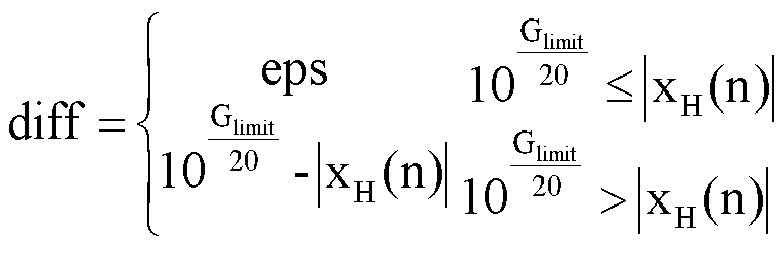
- a maximum virtual bass gain Gm(n) of the virtual bass enhancement signal according to the high-frequency audio signal x H (n) and the virtual bass enhancement signal H(n): G m n 20 log 10 diff H n + eps
- diff ⁇ eps 10 G limit 20 ⁇ x H n 10 G limit 20 ⁇ x H n 10 G limit 20 > x H n , and eps is the upper limit of relative error of the processor.
- X vir (n) obtained in S308 and x H (n) obtained in S307 are superimposed to obtain a target audio signal y 1 (n).
- the audio signal processing method may further comprise: S310, performing continuous frame fetching processing on an input source audio signal to obtain the to-be-processed audio signal.
- the source audio signal may be windowed using a hanning window.
- the frame length of the to-be-processed audio signal is determined according to at least one of a sampling rate, a processing resource (for calculation), and a system delay. It should be understood that for the same time length, the larger the sampling rate, the longer the frame length of the to-be-processed audio signal; for the same time length, the more processing resources (for calculation), the longer the frame length of the to-be-processed audio signal that the electronic apparatus can process; the smaller the system delay, the longer the frame length of the to-be-processed audio signal that the electronic apparatus can process.
- the embodiment of the present disclosure obtains the to-be-processed audio signal by performing continuous frame fetching processing or overlapping frame fetching processing on the input source audio signal, to achieve real-time processing on the source audio signal.
- real-time virtual bass enhancement processing the perceived timbre distortion caused by non-linear processing is reduced, and the playback effect of virtual bass is improved.
- the embodiment of the present disclosure may further comprise: S311, performing audio dynamic range control (DRC) on the target audio signal to obtain a to-be-output audio signal.
- DRC audio dynamic range control
- audio dynamic range control is performed on the target audio signal y1(n) obtained in any of the above embodiments to obtain the to-be-output audio signal, i.e., a final virtual bass enhancement signal frame y out (n), and an audio stream is returned.
- the embodiment of the present disclosure has at least the following advantages:
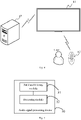
- an interactive white board 41 has an audio speaker function, and a user controls the interactive white board 41 through a remote controller 42, and the interactive white board 41 is connected to a server 43.
- the interactive white board 41 communicates with the server 43 through a local area network (LAN), a wireless local area network (WLAN), and other networks.
- the server 43 may provide various content and interactions to the interactive white board 41.
- the server 43 may be a cluster or a plurality of clusters, and may include one or more types of servers.
- the user inputs an audio/video playing operation on the remote controller 42, and controls the interactive white board 41 to play the audio/video through the remote controller 42.
- the interactive white board 41 interacts with the server 43 to acquire an audio/video signal (including an audio signal and/or a video signal) to be played, and displays the video signal through a display, and plays the audio signal through an audio apparatus.
- the audio apparatus performs, on the acquired audio signal, processing as described in the above audio signal processing method to achieve the effect of enhancing the virtual bass of the audio signal, and plays the obtained target audio signal.
- the audio signal processing device may be implemented as all or a part of an electronic apparatus such as an interactive white board by software, hardware, or a combination thereof.
- the audio signal processing device 50 includes a sub-band filtering module 51 and a processing module 52. Wherein the two modules are connected to each other.
- the sub-band filtering module 51 is configured to perform sub-band filtering processing on a to-be-processed audio signal to obtain a plurality of sub-band signals, wherein the number of the sub-band signals is determined according to a lowest frequency of a band-pass filter and a cut-off frequency of an audio apparatus, and the sub-band signals comprise sub-band band-pass signals;
- the processing module 52 is configured to obtain a target audio signal according to each of the sub-band band-pass signals and a processing algorithm of virtual bass enhancement signal.
- the processing algorithm of virtual bass enhancement signal comprises a non-linear device algorithm.
- the processing module 52 may include:
- the virtual bass enhancement unit 521 is specifically configured to: perform non-linear processing on each of the sub-band band-pass signals based on the non-linear device algorithm to obtain a corresponding non-linear signal; perform summation processing on each non-linear signal; perform band-pass filtering processing on the summed signal to obtain harmonic components of a low-frequency audio signal; and perform audio synthesis of the harmonic components and harmonic components of a to-be-processed audio signal in a previous frame to obtain the virtual bass enhancement signal.
- the virtual bass enhancement unit 521 is specifically configured to: perform summation processing on each non-linear signal based on a weight corresponding to each non-linear signal, wherein the weight is used to adjust the proportion of the corresponding non-linear signal.
- the high-pass filtering unit 522 is specifically configured to: perform high-pass filtering or delay processing on the sub-band high-pass signals in the sub-band signals; and overlap and add signals obtained by high-pass filtering or delay processing to obtain the high-frequency audio signal.
- the synthesis unit 523 is specifically configured to: acquire a preset bass gain; determine a maximum virtual bass gain of the virtual bass enhancement signal according to the high-frequency audio signal and the virtual bass enhancement signal; determine a target virtual bass gain of the virtual bass enhancement signal according to the preset virtual bass gain and the maximum virtual bass gain; perform gain processing on the virtual bass enhancement signal based on the target virtual bass gain to obtain a bass harmonic signal; and superimpose the bass harmonic signal and the high-frequency audio signal to obtain the target audio signal.
- the audio signal processing device 60 may further comprise: a frame fetching processing module 61, configured to perform continuous frame fetching processing or overlapping frame fetching processing on an input source audio signal to obtain the to-be-processed audio signal, wherein the frame length of the to-be-processed audio signal is determined according to at least one of a sampling rate, a processing resource, and a system delay.
- a frame fetching processing module 61 configured to perform continuous frame fetching processing or overlapping frame fetching processing on an input source audio signal to obtain the to-be-processed audio signal, wherein the frame length of the to-be-processed audio signal is determined according to at least one of a sampling rate, a processing resource, and a system delay.
- the audio signal processing device 60 may further comprise: a control module 62, configured to perform audio dynamic range control on the target audio signal to obtain a to-be-output audio signal.
- a control module 62 configured to perform audio dynamic range control on the target audio signal to obtain a to-be-output audio signal.
- the audio signal processing device provided by the above embodiment executes the audio signal processing method
- the above functions may be allocated to different functional modules for completion as required, that is, the internal structure of the apparatus is divided into different functional modules to complete all or a part of the functions described above.
- embodiments of the audio signal processing device and embodiments of the audio signal processing method belong to the same concept, and the implementation process thereof is detailed in the method embodiment, and will not be repeated here.
- sub-band filtering processing is performed on a to-be-processed audio signal to obtain a plurality of sub-band signals, wherein the number of the sub-band signals is determined according to a lowest frequency of a band-pass filter and a cut-off frequency of an audio apparatus.
- a target audio signal is obtained according to each of the sub-band signals and a processing algorithm of virtual bass enhancement signal.
- An embodiment of the present disclosure further provides a computer storage medium, wherein the computer storage medium may store a plurality of instructions, the instructions are adapted to be loaded by a processor and execute method steps of the above method embodiment.
- the computer storage medium may store a plurality of instructions, the instructions are adapted to be loaded by a processor and execute method steps of the above method embodiment.
- Apparatus on which the storage medium is located may be an electronic apparatus, such as an interactive white board, which has an audio speaker function.
- An embodiment of the present disclosure provides a computer program product, comprising a computer program, wherein the computer program is adapted to be loaded by the processor and execute the method steps of the above method embodiment.
- the computer program is adapted to be loaded by the processor and execute the method steps of the above method embodiment.
- the electronic apparatus 70 may include at least one processor 71, at least one network interface 74, a user interface 73, a memory 75, and at least one communication bus 72, wherein:
- the communication bus 72 is configured to implement connection communications between these components.
- the user interface 73 may include a display screen, a camera, and an audio apparatus.
- the user interface 73 may further include a standard wired interface and wireless interface.
- the network interface 74 may optionally include a standard wired interface and wireless interface (such as a WI-FI interface).
- the processor 71 may include one or more processing cores.
- the processor 71 connects various parts within the entire electronic apparatus 70 using various interfaces and lines, and executes various functions of the electronic apparatus 70 and processes data by running or executing instructions, programs, code sets, or instruction sets stored in the memory 75 and invoking data stored in the memory 75.
- the processor 71 may be implemented by using at least one hardware form of Digital Signal Processing (DSP), a Field-Programmable Gate Array (FPGA), and a Programmable Logic Array (PLA).
- DSP Digital Signal Processing
- FPGA Field-Programmable Gate Array
- PDA Programmable Logic Array
- the processor 71 may integrate one or a combination of several of a Central Processing Unit (CPU), a Graphics Processing Unit (GPU), a modem, and the like.
- the CPU mainly processes an operating system, a user interface, an application program, and the like
- the GPU is configured to be responsible for rendering and drawing of content to be displayed on the display screen
- the modem is configured to handle wireless communication. It will be appreciated that the above modem may also not be integrated into the processor 71, but may be implemented by using a chip alone.
- the memory 75 may include a Random Access Memory (RAM) or may include a Read-Only Memory.
- the memory 75 includes a non-transitory computer-readable storage medium.
- the memory 75 may be used to store instructions, programs, codes, code sets, or instruction sets.
- the memory 75 may include a program storage area and a data storage area, wherein the program storage area may store instructions for implementing an operating system, instructions for at least one function (such as a touch function, a sound playing function, an image playing function, and the like), instructions for implementing the above various method embodiments, and the like.
- the data storage area may store data involved in the above various method embodiments, and the like.
- the memory 75 may optionally also be at least one storage device located away from the aforementioned processor 71. As shown in Fig.
- the memory 75 serving as a computer storage medium may include an operating system, a network communication module, a user interface module, and an operation application program of the electronic apparatus 70.
- the operating system of the electronic apparatus 70 is an Android system, but the present disclosure is not limited thereto.
- the user interface 73 is mainly configured to provide an input interface for the user, and acquire data input by the user
- the processor 71 may be configured to invoke the operation application program of the electronic apparatus 70 stored in the memory 75 and specifically execute the following operations: performing sub-band filtering processing on a to-be-processed audio signal to obtain a plurality of sub-band signals, wherein the number of the sub-band signals is determined according to a lowest frequency of a band-pass filter and a cut-off frequency of an audio apparatus, and the sub-band signals comprise sub-band band-pass signals; and obtaining a target audio signal according to each of the sub-band band-pass signals and a processing algorithm of virtual bass enhancement signal.
- the processing algorithm of virtual bass enhancement signal comprises a non-linear device algorithm.
- the step of the processor 71 obtaining the target audio signal according to each of the sub-band band-pass signals and the processing algorithm of virtual bass enhancement signal specifically comprises: obtaining a virtual bass enhancement signal according to each of the sub-band band-pass signals and the non-linear device algorithm; performing high-pass filtering or delay processing on sub-band high-pass signals in the sub-band signals to obtain a high-frequency audio signal; and obtaining the target audio signal according to the virtual bass enhancement signal and the high-frequency audio signal.
- the step of the processor 71 obtaining the virtual bass enhancement signal according to each of the sub-band band-pass signals and the non-linear device algorithm specifically comprises: performing non-linear processing on each of the sub-band band-pass signals based on the non-linear device algorithm to obtain a corresponding non-linear signal; performing summation processing on each non-linear signal; performing band-pass filtering processing on the summed signal to obtain harmonic components of a low-frequency audio signal; and performing audio synthesis of the harmonic components and harmonic components of a to-be-processed audio signal in a previous frame to obtain the virtual bass enhancement signal.
- the step of the processor 71 performing summation processing on each non-linear signal specifically comprises: performing summation processing on each non-linear signal based on a weight corresponding to each non-linear signal, wherein the weight is used to adjust the proportion of the corresponding non-linear signal.
- the step of the processor 71 performing high-pass filtering or delay processing on the sub-band high-pass signals in the sub-band signals to obtain the high-frequency audio signal specifically comprises: performing high-pass filtering or delay processing on the sub-band high-pass signals in the sub-band signals; and overlapping and adding signals obtained through high-pass filtering or delay processing to obtain the high-frequency audio signal.
- the step of the processor 71 obtaining the target audio signal according to the virtual bass enhancement signal and the high-frequency audio signal may specifically comprise: acquiring a preset bass gain; determining a maximum virtual bass gain of the virtual bass enhancement signal according to the high-frequency audio signal and the virtual bass enhancement signal; determining a target virtual bass gain of the virtual bass enhancement signal according to the preset virtual bass gain and the maximum virtual bass gain; performing gain processing on the virtual bass enhancement signal based on the target virtual bass gain to obtain a bass harmonic signal; and superimposing the bass harmonic signal and the high-frequency audio signal to obtain the target audio signal.
- the processor 71 further executes the following steps: before performing sub-band filtering processing on the to-be-processed audio signal to obtain the plurality of sub-band signals, performing continuous frame fetching processing or overlapping frame fetching processing on an input source audio signal to obtain the to-be-processed audio signal, wherein the frame length of the to-be-processed audio signal is determined according to at least one of a sampling rate, a processing resource, and a system delay.
- the processor 71 further executes the following steps: after obtaining the target audio signal, performing audio dynamic range control on the target audio signal to obtain a to-be-output audio signal.
- sub-band filtering processing is performed on a to-be-processed audio signal to obtain a plurality of sub-band signals, wherein the number of the sub-band signals is determined according to a lowest frequency of a band-pass filter and a cut-off frequency of an audio apparatus, and the sub-band signals comprise sub-band band-pass signals.
- a target audio signal is obtained according to each of the sub-band band-pass signals and a processing algorithm of virtual bass enhancement signal.
- the embodiment of the present disclosure may be provided as a method, a system, or a computer program product. Accordingly, the present disclosure may take the form of an entirely hardware embodiment, an entirely software embodiment, or an embodiment combining software and hardware aspects. Moreover, the present disclosure may take the form of a computer program product implemented on one or more computer-usable storage media (including, but not limited to, a magnetic disk memory, a CD-ROM, an optical memory, and the like) in which computer-usable program code is stored.
- computer-usable storage media including, but not limited to, a magnetic disk memory, a CD-ROM, an optical memory, and the like
- each flow and/or block in the flowcharts and/or block diagrams and the combination of the flows and/or blocks in the flowcharts and/or block diagrams may be implemented by computer program instructions.
- These computer program instructions may be provided to a processor of a general purpose computer, a special purpose computer, an embedded processor, or other programmable data processing apparatus to produce a machine such that instructions executed by the processor of the computer or other programmable data processing apparatus produce a device for implementing the functions specified in one or more flows of the flow charts and/or one or more blocks of the block diagrams.
- These computer program instructions may also be stored in a computer-readable memory capable of directing a computer or other programmable data processing apparatus to operate in a particular manner, such that instructions stored in the computer-readable memory produce manufactures comprising an instruction device that implements the functions specified in one or more flows of the flow charts and/or one or more blocks of the block diagrams.
- These computer program instructions may also be loaded onto a computer or other programmable data processing apparatus, such that a series of operation steps are executed on the computer or other programmable apparatus to generate computer-implemented processing, thus the instructions executed on the computer or other programmable apparatus provide steps of the functions specified in one or more flows of the flow charts and/or one or more blocks of the block diagrams.
- a computing apparatus includes one or more processors (CPUs), an input/output interface, a network interface, and a memory.
- the memory may include a non-permanent memory, a Random Access Memory, a non-volatile memory and/or other forms in a computer readable medium, such as a read-only memory (ROM) or a flash memory (flash RAM).
- ROM read-only memory
- flash RAM flash memory
- a computer readable medium including permanent and non-permanent, removable and non-removable medium, may implement information storage by any method or technology.
- Information may be computer-readable instructions, data structures, program modules, or other data.
- Examples of storage medium for a computer include, but not limited to, a phase change memory (PRAM), a static random access memory (SRAM), a dynamic random access memory (DRAM), other types of random access memory (RAM), a read-only memory (ROM), an electrically erasable programmable read-only memory (EEPROM), a flash memory or other memory technologies, a compact disc read-only memory (CD-ROM), a digital versatile disc (DVD) or other optical storage, a magnetic cassette tape, a magnetic tape magnetic disk storage or other magnetic storage apparatus, or any other non-transmission medium that may be used to store information accessible by a computing apparatus.
- a computer readable medium does not include a transitory medium, such as a modulated data signal and carrier wave.
Landscapes
- Engineering & Computer Science (AREA)
- Physics & Mathematics (AREA)
- Acoustics & Sound (AREA)
- Signal Processing (AREA)
- Multimedia (AREA)
- Health & Medical Sciences (AREA)
- Human Computer Interaction (AREA)
- Audiology, Speech & Language Pathology (AREA)
- Computational Linguistics (AREA)
- Quality & Reliability (AREA)
- Tone Control, Compression And Expansion, Limiting Amplitude (AREA)
- Circuit For Audible Band Transducer (AREA)
- Signal Processing For Digital Recording And Reproducing (AREA)
- Input Circuits Of Receivers And Coupling Of Receivers And Audio Equipment (AREA)
- Signal Processing Not Specific To The Method Of Recording And Reproducing (AREA)
- Stereophonic System (AREA)
Abstract
Description
- The present disclosure relates to the field of signal processing technologies, and more particularly, to an audio signal processing method, device and storage medium.
- With the miniaturization and convenience of multimedia apparatus, the selection of a loudspeaker becomes smaller and smaller. A small loudspeaker, due to the limitation of its physical structure, cannot play back the low frequency components of an audio signal effectively, and the bass playback of the audio signal directly affects the perception, such as the sound fullness and heaviness. Therefore, an improvement to the bass playback effect of the small loudspeaker has been a hot research topic.
- For improvement to the bass playback effect of the small loudspeaker, the "pitch missing" principle in psychoacoustics can be used for virtual bass enhancement of the audio signal, for example, a non-linear device (NLD) algorithm is used for non-linear processing on the low-frequency components of the audio signal to generate a harmonic wave. However, the non-linear device algorithm will introduce intermodulation distortion to the audio signal having abundant harmonic components, thereby causing perceived timbre distortion.
- An embodiment of the present disclosure provides an audio signal processing method, device and storage medium to reduce the perceived timbre distortion caused by the non-linear device algorithm and improve the playback effect of a virtual bass. The technical solution is as follows:
- In a first aspect, an embodiment of the present disclosure provides an audio signal processing method, comprising: performing sub-band filtering processing on a to-be-processed audio signal to obtain a plurality of sub-band signals, wherein the number of the sub-band signals is determined according to a lowest frequency of a band-pass filter and a cut-off frequency of an audio apparatus, and the sub-band signals comprise sub-band band-pass signals; and obtaining a target audio signal according to each of the sub-band band-pass signals and a processing algorithm of virtual bass enhancement signal.
- Optionally, the processing algorithm of virtual bass enhancement signal comprises a non-linear device algorithm. Obtaining the target audio signal according to each of the sub-band band-pass signals and the processing algorithm of virtual bass enhancement signal comprises: obtaining a virtual bass enhancement signal according to each of the sub-band band-pass signals and the non-linear device algorithm; performing high-pass filtering or delay processing on sub-band high-pass signals in the sub-band signals to obtain a high-frequency audio signal; and obtaining the target audio signal according to the virtual bass enhancement signal and the high-frequency audio signal.
- Optionally, obtaining the virtual bass enhancement signal according to each of the sub-band band-pass signals and the non-linear device algorithm comprises: performing non-linear processing on each of the sub-band band-pass signals based on the non-linear device algorithm to obtain a corresponding non-linear signal; performing summation processing on each non-linear signal; performing band-pass filtering processing on the summed signal to obtain harmonic components of a low-frequency audio signal; and performing audio synthesis of the harmonic components and harmonic components of a to-be-processed audio signal in a previous frame to obtain the virtual bass enhancement signal.
- Optionally, performing summation processing on each non-linear signal comprises: performing summation processing on each non-linear signal based on a weight corresponding to each non-linear signal, wherein the weight is used to adjust the proportion of the corresponding non-linear signal.
- Optionally, performing high-pass filtering or delay processing on the sub-band high-pass signals in the sub-band signals to obtain the high-frequency audio signal comprises: performing high-pass filtering or delay processing on the sub-band high-pass signals in the sub-band signals; and overlapping and adding signals obtained through high-pass filtering or delay processing to obtain the high-frequency audio signal.
- Optionally, obtaining the target audio signal according to the virtual bass enhancement signal and the high-frequency audio signal comprises: acquiring a preset bass gain; determining a maximum virtual bass gain of the virtual bass enhancement signal according to the high-frequency audio signal and the virtual bass enhancement signal; determining a target virtual bass gain of the virtual bass enhancement signal according to the preset virtual bass gain and the maximum virtual bass gain; performing gain processing on the virtual bass enhancement signal based on the target virtual bass gain to obtain a bass harmonic signal; and superimposing the bass harmonic signal and the high-frequency audio signal to obtain the target audio signal.
- Optionally, before performing sub-band filtering processing on the to-be-processed audio signal to obtain the plurality of sub-band signals, the method further comprises: performing continuous frame fetching processing or overlapping frame fetching processing on an input source audio signal to obtain the to-be-processed audio signal, wherein a frame length of the to-be-processed audio signal is determined according to at least one of a sampling rate, a processing resource, and a system delay.
- Optionally, after obtaining the target audio signal according to each of the sub-band band-pass signals and the processing algorithm of virtual bass enhancement signal, the method further comprises: performing audio dynamic range control on the target audio signal to obtain a to-be-output audio signal.
- In a second aspect, an embodiment of the present disclosure provides an audio signal processing device, comprising:
- a sub-band filtering module, configured to perform sub-band filtering processing on a to-be-processed audio signal to obtain a plurality of sub-band signals, wherein the number of the sub-band signals is determined according to a lowest frequency of a band-pass filter and a cut-off frequency of an audio apparatus, and the sub-band signals comprise sub-band band-pass signals; and
- a processing module, configured to obtain a target audio signal according to each of the sub-band band-pass signals and a processing algorithm of virtual bass enhancement signal.
- Optionally, the processing algorithm of virtual bass enhancement signal comprises a non-linear device algorithm. The processing module may comprise:
- a virtual bass enhancement unit, configured to obtain a virtual bass enhancement signal according to each of the sub-band band-pass signals and the non-linear device algorithm;
- a high-pass filtering unit, configured to perform high-pass filtering or delay processing on sub-band high-pass signals in the sub-band signals to obtain a high-frequency audio signal;
- a synthesis unit, configured to obtain the target audio signal according to the virtual bass enhancement signal and the high-frequency audio signal.
- Optionally, the virtual bass enhancement unit is specifically configured to: perform non-linear processing on each of the sub-band band-pass signals based on the non-linear device algorithm to obtain a corresponding non-linear signal; perform summation processing on each non-linear signal; perform band-pass filtering processing on the summed signal to obtain harmonic components of a low-frequency audio signal; and perform audio synthesis of the harmonic components and harmonic components of a to-be-processed audio signal in a previous frame to obtain the virtual bass enhancement signal.
- Optionally, when performing summation processing on each non-linear signal comprises, the virtual bass enhancement unit is specifically configured to: perform summation processing on each non-linear signal based on a weight corresponding to each non-linear signal, wherein the weight is used to adjust the proportion of the corresponding non-linear signal.
- Optionally, the high-pass filtering unit is specifically configured to: perform high-pass filtering or delay processing on the sub-band high-pass signals in the sub-band signals; and overlap and add signals obtained through high-pass filtering or delay processing to obtain the high-frequency audio signal.
- Optionally, the synthesis unit is specifically configured to: acquire a preset bass gain; determine a maximum virtual bass gain of the virtual bass enhancement signal according to the high-frequency audio signal and the virtual bass enhancement signal; determine a target virtual bass gain of the virtual bass enhancement signal according to the preset virtual bass gain and the maximum virtual bass gain; perform gain processing on the virtual bass enhancement signal based on the target virtual bass gain to obtain a bass harmonic signal; and superimpose the bass harmonic signal and the high-frequency audio signal to obtain the target audio signal.
- Optionally, the audio signal processing device further comprises: a frame fetching processing module, configured to perform continuous frame fetching processing or overlapping frame fetching processing on an input source audio signal to obtain the to-be-processed audio signal, wherein a frame length of the to-be-processed audio signal is determined according to at least one of a sampling rate, a processing resource, and a system delay.
- Optionally, the audio signal processing device further comprises: a control module, configured to perform audio dynamic range control on the target audio signal to obtain a to-be-output audio signal.
- In a third aspect, an embodiment of the present disclosure provides a computer storage medium, wherein the computer storage medium stores a plurality of instructions, the instructions are adapted to be loaded by a processor and execute the above method steps.
- In a fourth aspect, an embodiment of the present disclosure provides an electronica apparatus, comprising a processor and a memory, wherein the memory stores a computer program, the computer program is adapted to be loaded by the processor and execute the above method steps.
- In a fifth aspect, an embodiment of the present disclosure provides a computer program product, comprising a computer program, wherein the computer program is adapted to be loaded by a processor and execute the above method steps.
- In the embodiment of the present disclosure, sub-band filtering processing is performed on a to-be-processed audio signal to obtain a plurality of sub-band signals, wherein the number of the sub-band signals is determined according to a lowest frequency of a band-pass filter and a cut-off frequency of an audio apparatus, and the sub-band signals comprise sub-band band-pass signals. And a target audio signal is obtained according to each of the sub-band band-pass signals and a processing algorithm of virtual bass enhancement signal. By performing the sub-band filtering processing on the to-be-processed audio signal, and performing virtual bass enhancement signal processing on each of the sub-band band-pass signals using the processing algorithm of virtual bass enhancement signal, intermodulation distortion is restricted by the sub-band band-pass signals, thereby reducing perceivable timbre distortion, and improving the playback effect of a virtual bass.
- In order to describe the technical solution in the embodiments of the present disclosure or the prior art more clearly, the accompanying drawings required in the description of the embodiments or the prior art will be briefly introduced below. Obviously, the accompanying drawings in the description below are merely some embodiments of the present disclosure, and for those of ordinary skill in the art, other drawings may be obtained from these drawings without creative efforts.
-
Fig. 1 is a schematic diagram of flows of an audio signal processing method according to an embodiment of the present disclosure; -
Fig. 2 is a schematic diagram of flows of an audio signal processing method according to another embodiment of the present disclosure; -
Fig. 3 is a schematic diagram of flows of an audio signal processing method according to yet another embodiment of the present disclosure; -
Fig. 4 is a schematic diagram of an application scenario according to an embodiment of the present disclosure; -
Fig. 5 is a schematic diagram of structures of an audio signal processing device according to an embodiment of the present disclosure; -
Fig. 6 is a schematic diagram of structures of an audio signal processing device according to another embodiment of the present disclosure; -
Fig. 7 is a schematic diagram of structures of an electronic apparatus according to an embodiment of the present disclosure. - In order to make the purposes, technical solutions, and advantages of the present disclosure more clear, embodiments of the present disclosure are described in further detail below with reference to the accompanying drawings.
- It should be clear that the described embodiments are only a part rather than all of the embodiments of the present disclosure. Based on the embodiments of the present disclosure, all other embodiments obtained by those of ordinary skill in the art without creative effort shall fall within the scope of protection of the present disclosure.
- When the following description relates to the accompanying drawings, the same numerals in different drawings denote the same or similar elements unless otherwise indicated. The embodiments described in the following exemplary embodiments do not represent all embodiments consistent with the present disclosure. Instead, they are merely examples of devices and methods consistent with some aspects of the present disclosure as detailed in the appended claims.
- In the description of the present disclosure, it is to be understood that the terms "first", "second", "third", and the like are only used to distinguish similar objects, but are not necessarily used to describe a specific order or sequence, and can't be understood as indicating or implying relative importance. For those of ordinary skill in the art, the specific meaning of the above terms in the present disclosure may be understood as the case may be. In addition, in the description of the present disclosure, unless otherwise specified, "a plurality of' means two or more. "And/or" describes an association relationship of associated objects, and indicates that three relationships may exist, for example, A and/or B may indicate three cases: A exists alone, A and B exist simultaneously, and B exists alone. The character "/" generally indicates that the associated objects are of an "or" relationship.
- At present, there are two main ways to improve the bass playback effect of a loudspeaker. One way is to use an equalizer (adjust EQ) to directly increase the low-frequency gain, which may improve the bass playback effect to a certain extent, but may hardly control the gain amplitude, may easily cause irreversible damage to the loudspeaker, and will reduce the service life of the loudspeaker. The other is to perform virtual bass enhancement processing on the audio signal by using the "pitch missing" principle in psychoacoustics, which can effectively improve, by playing back the harmonic components of the synthesized bass fundamental frequency, the bass perception of the listener while ensuring the normal operation of the small loudspeaker.
- Wherein the virtual bass enhancement method can be divided into two types: the first type is to convert, by using time-frequency conversion technology, a time-domain signal to frequency domain, generate a harmonic wave corresponding to the fundamental frequency in the frequency domain, and then convert it to time domain; the second type is to use the non-linear device (NLD) algorithm to perform non-linear processing on the low-frequency signal to generate a harmonic wave. These two types of methods have their own advantages and disadvantages. The first type of method can precisely control the components and amplitudes of a harmonic wave, but has a poor transient effect and cannot meet requirements in an audio processing occasion with a high real-time requirement. However, the NLD has a simple structure and good real-time performance, but also introduces intermodulation distortion to an audio signal having abundant harmonic components, which easily causes a perceived timbre change.
- Based on the above problems, an embodiment of the present disclosure provides an audio signal processing method, device, and storage medium. By dividing a to-be-processed audio signal into a plurality of sub-band signals, and performing non-linear processing on each of sub-band signals using a non-linear device algorithm, intermodulation distortion is restricted by the sub-band signals, and the intermodulation distortion caused by the non-linear device algorithm is reduced, thereby reducing perceivable timbre distortion, and improving the playback effect of a virtual bass.
- It should be noted that, due to space limitation, the specification of the present disclosure does not enumerate all optional implementations, and it should be conceivable to those skilled in the art, after reading the specification of the present disclosure, that any combination of technical features may constitute an optional embodiment as long as the technical features are not contradictory to each other.
- For example, one technical feature a is described in one implementation of
Embodiment 1, and another technical feature b is described in another implementation of theEmbodiment 1. Since the above two technical features do not contradict each other, it should be conceivable to those skilled in the art, after reading the specification of the present disclosure, that an implementation having these two features is also an optional implementation, i.e., a and b. - The technical features described in different embodiments that do not contradict each other can also be combined in any way to constitute an optional implementation.
- For example, a technical feature c is described in the
Embodiment 1. In order to control the space of the specification of the present disclosure, this technical feature is not described in Embodiments 2 and 3. However, it should be conceivable to those skilled in the art, after reading the specification of the present disclosure, that the audio signal processing method according to Embodiments 2 and 3 may also include the technical feature. -
Embodiments 1, 2, and 3 will be described in detail below. - An embodiment of the present disclosure discloses an audio signal processing method, which is applied to an electronic apparatus having an audio speaker function such as a small loudspeaker, or an electronic apparatus including a small loudspeaker. The audio signal processing method according to an embodiment of the present disclosure will be introduced in detail below with reference to
Fig. 1 . - Referring to
Fig. 1 , a flowchart of an audio signal processing method disclosed in the embodiment of the present disclosure is shown. The method comprises the following steps:
S101, performing sub-band filtering processing on a to-be-processed audio signal to obtain a plurality of sub-band signals, wherein the sub-band signals comprise sub-band band-pass signals. - Wherein the number of the sub-band signals is determined according to a lowest frequency of a band-pass filter and a cut-off frequency of an audio apparatus. The greater the number of the sub-band signals, the smaller the intermodulation distortion caused by virtual bass enhancement signal processing (for example, non-linear processing).
- Exemplarily, a sub-band filter bank is provided in the electronic apparatus, and the sub-band filter bank consists of a high-pass filter and a series of band-pass filters. Wherein the cut-off frequency of the high-pass filter may be directly set to a cut-off frequency f0 of an audio apparatus (e.g., a loudspeaker) in the electronic apparatus, and the cut-off frequency of the band-pass filter is also set according to f0. The number of sub-band signals may be set according to N=ceil(f0/flow)-1, wherein ceil() means rounding up the numerical value; flow is a set lowest frequency of the band-pass filter, and may be set to, for example, a lower limit of 20 Hz of human ear's audible frequency.
- Optionally, according to a descending order of cutoff frequencies of band-pass filters, a upper cut-off frequency and a lower cut-off frequency of a band-pass filter corresponding to a first sub-band signal Xbi(n) are respectively fh1=f0 and fl1=f0/2, a upper cut-off frequency and a lower cut-off frequency of a band-pass filter corresponding to a second sub-band signal Xb2(n) are respectively fh2=f0/2 and fl2=f0/3,..., a upper cut-off frequency and a lower cut-off frequency of a band-pass filter corresponding to a i-th sub-band signal Xbi(n) are respectively fhn=f0/n and fln=f0/(n+1),..., a upper cut-off frequency and a lower cut-off frequency of a band-pass filter corresponding to a N-th sub-band signal XbN(n) are respectively fhN=f0/N and flN=f0/(N+1). If f0/(N+1) < flow, flN=flow. The implementation of the band-pass filter is not limited here.
- The electronic apparatus performs sub-band filtering processing on a to-be-processed audio signal Xin(n) through the sub-band filter bank, so as to obtain a series of sub-band signals including a sub-band band-pass signal Xbi(n) and a sub-band high-pass signal xH1(n), wherein i is a positive integer less than or equal to N.
- S102, obtaining a target audio signal according to each of the sub-band band-pass signals and a processing algorithm of virtual bass enhancement signal.
- In this step, the virtual bass signal processing algorithm is used to perform virtual bass signal processing on each of the sub-band band-pass signals, so as to reduce the influence of intermodulation between the sub-band band-pass signals, that is, the intermodulation distortion is restricted by the sub-band band-pass signals.
- In the embodiment of the present disclosure, sub-band filtering processing is performed on the to-be-processed audio signal to obtain a sub-band signal including a plurality of sub-band band-pass signals, and the target audio signal is obtained according to each of the sub-band band-pass signals and the processing algorithm of virtual bass enhancement signal. By performing the sub-band filtering processing on the to-be-processed audio signal, and performing virtual bass enhancement signal processing on each of the sub-band band-pass signals using the processing algorithm of virtual bass enhancement signal, intermodulation distortion is restricted by the sub-band signals, thereby reducing perceivable timbre distortion, and improving the playback effect of a virtual bass.
- In the embodiment of the present disclosure, the processing algorithm of virtual bass enhancement signal may be specifically a non-linear device (NLD) algorithm, which is also referred to as a non-linear function or a non-linear operation. In this case, as shown in
Fig. 2 , S102 step may further include:
S1021, obtaining a virtual bass enhancement signal according to each of the sub-band band-pass signals and the non-linear device algorithm. - In an exemplary embodiment, referring to
Fig. 3 , the step may include:
S301, performing non-linear processing on each of the sub-band band-pass signals based on the non-linear device algorithm to obtain a corresponding non-linear signal. - Exemplarily, non-linear processing is performed on the sub-band band-pass signal Xbi(n) to generate a non-linear signal Xnldi(n). For example, non-linear processing is performed on the sub-band band-pass signal Xbi(n) by the following formula:

- S302, performing summation processing on each non-linear signal.
- Further, performing summation processing on each non-linear signal may comprise: performing summation processing on each non-linear signal based on a weight corresponding to each non-linear signal. Wherein the weight is used to adjust the proportion of the corresponding non-linear signal.
- Exemplarily, Xnldi(n)s obtained in S301 are summed according to corresponding weights to obtain a sum signal Xnld(n), i.e.,

- S303, performing band-pass filtering processing on the summed signal to obtain harmonic components of a low-frequency audio signal.
- Exemplarily, band-pass filtering processing is performed on the sum signal Xnld(n) obtained in S302 to obtain the harmonic component Hnld(n) of the low-frequency audio signal. Wherein the cut-off frequency of the band-pass filter (BPF) used in this step is determined by the cut-off frequency f0 of an audio apparatus (such as a loudspeaker) in the electronic apparatus, which generally is taken from [f0,6f0]. Optionally, the band-pass filter is a non-recursive filter, also referred to as a Finite Impulse Response (FIR) filter, but is not limited in the present disclosure.
- Through band-pass filtering processing in this step, high-order harmonic components required by the summed low-frequency signal to generate the virtual bass signal can be removed.
- S304, performing audio synthesis (frame stitching) of the harmonic components and harmonic components of a to-be-processed audio signal in a previous frame to obtain the virtual bass enhancement signal.
- Exemplarily, audio synthesis is performed on Hnld(n) obtained in S303 and the harmonic component H'nld(n) of a to-be-processed audio signal in a previous frame through overlapping and adding to obtain a synthesized virtual bass enhancement signal.
- S1022, performing high-pass filtering or delay processing on sub-band high-pass signals in the sub-band signals to obtain a high-frequency audio signal.
- Optionally, the electronic apparatus may execute S1021 and S1022 in parallel.
- In an exemplary embodiment, as shown in
Fig. 3 , the step may include:
S305, performing sub-band high-pass filtering on the to-be-processed audio signal to obtain sub-band high-pass signals. - Exemplarily, the electronic apparatus may filter out a high-frequency signal xH1(n) through high-pass filtering. Optionally, the order of the high-pass filter coincides with the order of the sub-band band-pass filter in step S101.
- S306, performing high-pass filtering or delay processing on the sub-band high-pass signal.
- Exemplarily, this step performs second high-pass filtering or delay processing on a sub-band high-pass signal xH1(n) filtered out in S305 to obtain a high-pass filtered signal xH2(n).
- Optionally, if a high-pass filter (HPF) is used to implement high-pass filtering, the order of the high-pass filter coincides with the order of the band-pass filter in step S303; or if the delay processing is used, the delay coincides with delay caused by signal processing in step S303.
- S307, overlapping and adding (frame stitching) signals obtained by high-pass filtering or delay processing to obtain a high-frequency audio signal.
- For example, the signals obtained in the step S306 is overlapped and added by the overlap-add method to obtain a high-frequency audio signal xH(n).
- It should be noted that the embodiment of the present disclosure does not limit the execution order of S305 to S307 and S301 to S304. It can be understood that the electronic apparatus may first execute S301 to S307 in sequence, or the electronic apparatus may first execute S305 to S307 and then execute S301 to S304, or the electronic apparatus executes S301 to S304 in parallel with S305 to S307, which may be set accordingly according to the calculation force of the electronic apparatus.
- S1023, obtaining the target audio signal according to the virtual bass enhancement signal and the high-frequency audio signal.
- In an exemplary embodiment, a gain-based bass harmonic signal Xvir(n) is generated using an adaptive gain method according to the virtual bass enhancement signal H(n), the high-frequency audio signal xH(n), and a preset virtual bass gain Gu. Therefore, it may further include: obtaining a target virtual bass gain.
- Exemplarily, obtaining the target virtual bass gain may further include:
- 1. Obtaining a preset virtual bass gain.
That is, the preset virtual bass gain Gu is acquired. - 2. Determining a maximum virtual bass gain of the virtual bass enhancement signal according to the high-frequency audio signal and the virtual bass enhancement signal.
- A maximum normalized gain of the target audio signal is set to Glimit, and Glimit can be set to 0 dBFS at most.
- Exemplarily, a maximum virtual bass gain Gm(n) of the virtual bass enhancement signal according to the high-frequency audio signal xH(n) and the virtual bass enhancement signal H(n):

- In the formula,
- 3. Determining the target virtual bass gain of the virtual bass enhancement signal according to the preset virtual bass gain and the maximum virtual bass gain.
- Exemplarily, a target virtual bass gain Gp(n) is obtained according to the preset virtual bass gain Gu and the maximum virtual bass gain Gm(n) calculated in real time, and the implementation algorithm is:


- S308, performing gain processing (i.e., adaptive gain) on the virtual bass enhancement signal based on the target virtual bass gain to obtain a bass harmonic signal.
- For example, a bass harmonic signal Xvir(n) is obtained by the following formula:

- S309, superimposing the bass harmonic signal and the high-frequency audio signal to obtain the target audio signal.
- Exemplarily, Xvir(n) obtained in S308 and xH(n) obtained in S307 are superimposed to obtain a target audio signal y1(n).
- In the embodiment of the present disclosure, as shown in
Fig. 3 , before performing sub-band filtering processing on the to-be-processed audio signal to obtain the plurality of sub-band signals, the audio signal processing method may further comprise: S310, performing continuous frame fetching processing on an input source audio signal to obtain the to-be-processed audio signal. - Alternatively, overlapping frame fetching processing is performed on the input source audio signal to obtain the to-be-processed audio signal. Optionally, in order to output a smooth to-be-processed audio signal, the source audio signal may be windowed using a hanning window.
- Wherein the frame length of the to-be-processed audio signal is determined according to at least one of a sampling rate, a processing resource (for calculation), and a system delay. It should be understood that for the same time length, the larger the sampling rate, the longer the frame length of the to-be-processed audio signal; for the same time length, the more processing resources (for calculation), the longer the frame length of the to-be-processed audio signal that the electronic apparatus can process; the smaller the system delay, the longer the frame length of the to-be-processed audio signal that the electronic apparatus can process.
- The embodiment of the present disclosure obtains the to-be-processed audio signal by performing continuous frame fetching processing or overlapping frame fetching processing on the input source audio signal, to achieve real-time processing on the source audio signal. Through real-time virtual bass enhancement processing, the perceived timbre distortion caused by non-linear processing is reduced, and the playback effect of virtual bass is improved.
- On the basis of the above embodiment, as shown in
Fig. 3 , after obtaining the target audio signal, the embodiment of the present disclosure may further comprise:
S311, performing audio dynamic range control (DRC) on the target audio signal to obtain a to-be-output audio signal. - Exemplarily, audio dynamic range control is performed on the target audio signal y1(n) obtained in any of the above embodiments to obtain the to-be-output audio signal, i.e., a final virtual bass enhancement signal frame yout(n), and an audio stream is returned.
- In summary, the embodiment of the present disclosure has at least the following advantages:
- i), the complexity of virtual bass enhancement is reduced, and virtual bass enhancement processing can be performed on the input source audio signal in real time.
- ii), the gain of a virtual bass component can be effectively controlled to reduce the intermodulation distortion of the audio signal. Especially for the multi-channel sound playback scenario, a traditional virtual bass enhancement algorithm is easy to cause the blur of a sound image, but the present disclosure solves this problem.
- It should be noted that, due to the space limitation, the present disclosure does not enumerate all optional implementations, but as long as features are not contradictory to each other, they can be freely combined and become an optional implementation of the present disclosure.
- Referring to
Fig. 4 , an interactivewhite board 41 has an audio speaker function, and a user controls the interactivewhite board 41 through aremote controller 42, and the interactivewhite board 41 is connected to aserver 43. Optionally, the interactivewhite board 41 communicates with theserver 43 through a local area network (LAN), a wireless local area network (WLAN), and other networks. Theserver 43 may provide various content and interactions to the interactivewhite board 41. Theserver 43 may be a cluster or a plurality of clusters, and may include one or more types of servers. - This example will be described by taking an electronic apparatus as an interactive white board and a control apparatus as a remote controller as an example, but the present disclosure is not limited thereto. And the present disclosure does not limit the number of interactive white boards and remote controllers, for example, controlling two interactive white boards with one remote controller, or controlling one interactive white board with two remote controllers, or the like.
- The user inputs an audio/video playing operation on the
remote controller 42, and controls the interactivewhite board 41 to play the audio/video through theremote controller 42. Then, in response to a control instruction from theremote controller 42, the interactivewhite board 41 interacts with theserver 43 to acquire an audio/video signal (including an audio signal and/or a video signal) to be played, and displays the video signal through a display, and plays the audio signal through an audio apparatus. Wherein the audio apparatus performs, on the acquired audio signal, processing as described in the above audio signal processing method to achieve the effect of enhancing the virtual bass of the audio signal, and plays the obtained target audio signal. - The following is a device embodiment of the present disclosure, and can be used to execute a method embodiment of the present disclosure. For details not disclosed in the device embodiment of the present disclosure, reference is made to the method embodiment of the present disclosure.
- Referring to
Fig. 5 , a schematic diagram of structures of an audio signal processing device according to an exemplary embodiment of the present disclosure is shown. The audio signal processing device may be implemented as all or a part of an electronic apparatus such as an interactive white board by software, hardware, or a combination thereof. The audiosignal processing device 50 includes asub-band filtering module 51 and aprocessing module 52. Wherein the two modules are connected to each other. - The
sub-band filtering module 51 is configured to perform sub-band filtering processing on a to-be-processed audio signal to obtain a plurality of sub-band signals, wherein the number of the sub-band signals is determined according to a lowest frequency of a band-pass filter and a cut-off frequency of an audio apparatus, and the sub-band signals comprise sub-band band-pass signals; - The
processing module 52 is configured to obtain a target audio signal according to each of the sub-band band-pass signals and a processing algorithm of virtual bass enhancement signal. - Optionally, the processing algorithm of virtual bass enhancement signal comprises a non-linear device algorithm. As shown in
Fig. 6 , in the audiosignal processing device 60, theprocessing module 52 may include: - a virtual
bass enhancement unit 521, configured to obtain a virtual bass enhancement signal according to each of the sub-band band-pass signals and the non-linear device algorithm; - a high-
pass filtering unit 522, configured to perform high-pass filtering or delay processing on sub-band high-pass signals in the sub-band signals to obtain a high-frequency audio signal; - a
synthesis unit 523, configured to obtain the target audio signal according to the virtual bass enhancement signal and the high-frequency audio signal. - Optionally, the virtual
bass enhancement unit 521 is specifically configured to: perform non-linear processing on each of the sub-band band-pass signals based on the non-linear device algorithm to obtain a corresponding non-linear signal; perform summation processing on each non-linear signal; perform band-pass filtering processing on the summed signal to obtain harmonic components of a low-frequency audio signal; and perform audio synthesis of the harmonic components and harmonic components of a to-be-processed audio signal in a previous frame to obtain the virtual bass enhancement signal. - Optionally, when performing summation processing on each non-linear signal comprises, the virtual
bass enhancement unit 521 is specifically configured to: perform summation processing on each non-linear signal based on a weight corresponding to each non-linear signal, wherein the weight is used to adjust the proportion of the corresponding non-linear signal. - Optionally, the high-
pass filtering unit 522 is specifically configured to: perform high-pass filtering or delay processing on the sub-band high-pass signals in the sub-band signals; and overlap and add signals obtained by high-pass filtering or delay processing to obtain the high-frequency audio signal. - Optionally, the
synthesis unit 523 is specifically configured to: acquire a preset bass gain; determine a maximum virtual bass gain of the virtual bass enhancement signal according to the high-frequency audio signal and the virtual bass enhancement signal; determine a target virtual bass gain of the virtual bass enhancement signal according to the preset virtual bass gain and the maximum virtual bass gain; perform gain processing on the virtual bass enhancement signal based on the target virtual bass gain to obtain a bass harmonic signal; and superimpose the bass harmonic signal and the high-frequency audio signal to obtain the target audio signal. - In some embodiments, the audio
signal processing device 60 may further comprise: a frame fetchingprocessing module 61, configured to perform continuous frame fetching processing or overlapping frame fetching processing on an input source audio signal to obtain the to-be-processed audio signal, wherein the frame length of the to-be-processed audio signal is determined according to at least one of a sampling rate, a processing resource, and a system delay. - Further, the audio
signal processing device 60 may further comprise: acontrol module 62, configured to perform audio dynamic range control on the target audio signal to obtain a to-be-output audio signal. - It should be noted that, although when the audio signal processing device provided by the above embodiment executes the audio signal processing method, only the division of the above functional modules is used as an example for description, in actual application, the above functions may be allocated to different functional modules for completion as required, that is, the internal structure of the apparatus is divided into different functional modules to complete all or a part of the functions described above. In addition, embodiments of the audio signal processing device and embodiments of the audio signal processing method belong to the same concept, and the implementation process thereof is detailed in the method embodiment, and will not be repeated here.
- The above serial numbers of the embodiments of the present disclosure are merely for description, and do not represent the advantages or disadvantages of the embodiments.
- In the embodiment of the present disclosure, sub-band filtering processing is performed on a to-be-processed audio signal to obtain a plurality of sub-band signals, wherein the number of the sub-band signals is determined according to a lowest frequency of a band-pass filter and a cut-off frequency of an audio apparatus. And a target audio signal is obtained according to each of the sub-band signals and a processing algorithm of virtual bass enhancement signal. By performing the sub-band filtering processing on the to-be-processed audio signal, and performing virtual bass enhancement signal processing on each of the sub-band signals using the processing algorithm of virtual bass enhancement signal, intermodulation distortion is restricted by the sub-band signals, thereby reducing perceivable timbre distortion, and improving the playback effect of a virtual bass.
- An embodiment of the present disclosure further provides a computer storage medium, wherein the computer storage medium may store a plurality of instructions, the instructions are adapted to be loaded by a processor and execute method steps of the above method embodiment. For a specific execution process, reference may be made to the specific description of the method embodiment, and details are not repeated again.
- Apparatus on which the storage medium is located may be an electronic apparatus, such as an interactive white board, which has an audio speaker function.
- An embodiment of the present disclosure provides a computer program product, comprising a computer program, wherein the computer program is adapted to be loaded by the processor and execute the method steps of the above method embodiment. For a specific execution process, reference may be made to the specific description of the method embodiment, and details are not repeated again.
- Referring to
Fig. 7 , a schematic diagram of structures of an electronic apparatus is provided according to an embodiment of the present disclosure. As shown inFig. 7 , the electronic apparatus 70 may include at least oneprocessor 71, at least onenetwork interface 74, a user interface 73, amemory 75, and at least onecommunication bus 72, wherein: - The
communication bus 72 is configured to implement connection communications between these components. - The user interface 73 may include a display screen, a camera, and an audio apparatus. Optionally, the user interface 73 may further include a standard wired interface and wireless interface.
- The
network interface 74 may optionally include a standard wired interface and wireless interface (such as a WI-FI interface). - The
processor 71 may include one or more processing cores. Theprocessor 71 connects various parts within the entire electronic apparatus 70 using various interfaces and lines, and executes various functions of the electronic apparatus 70 and processes data by running or executing instructions, programs, code sets, or instruction sets stored in thememory 75 and invoking data stored in thememory 75. Optionally, theprocessor 71 may be implemented by using at least one hardware form of Digital Signal Processing (DSP), a Field-Programmable Gate Array (FPGA), and a Programmable Logic Array (PLA). Theprocessor 71 may integrate one or a combination of several of a Central Processing Unit (CPU), a Graphics Processing Unit (GPU), a modem, and the like. Wherein the CPU mainly processes an operating system, a user interface, an application program, and the like, the GPU is configured to be responsible for rendering and drawing of content to be displayed on the display screen, and the modem is configured to handle wireless communication. It will be appreciated that the above modem may also not be integrated into theprocessor 71, but may be implemented by using a chip alone. - The
memory 75 may include a Random Access Memory (RAM) or may include a Read-Only Memory. Optionally, thememory 75 includes a non-transitory computer-readable storage medium. Thememory 75 may be used to store instructions, programs, codes, code sets, or instruction sets. Thememory 75 may include a program storage area and a data storage area, wherein the program storage area may store instructions for implementing an operating system, instructions for at least one function (such as a touch function, a sound playing function, an image playing function, and the like), instructions for implementing the above various method embodiments, and the like. The data storage area may store data involved in the above various method embodiments, and the like. Thememory 75 may optionally also be at least one storage device located away from theaforementioned processor 71. As shown inFig. 7 , thememory 75 serving as a computer storage medium may include an operating system, a network communication module, a user interface module, and an operation application program of the electronic apparatus 70. Optionally, the operating system of the electronic apparatus 70 is an Android system, but the present disclosure is not limited thereto. - In the electronic apparatus 70 shown in
Fig. 7 , the user interface 73 is mainly configured to provide an input interface for the user, and acquire data input by the user, and theprocessor 71 may be configured to invoke the operation application program of the electronic apparatus 70 stored in thememory 75 and specifically execute the following operations:
performing sub-band filtering processing on a to-be-processed audio signal to obtain a plurality of sub-band signals, wherein the number of the sub-band signals is determined according to a lowest frequency of a band-pass filter and a cut-off frequency of an audio apparatus, and the sub-band signals comprise sub-band band-pass signals; and obtaining a target audio signal according to each of the sub-band band-pass signals and a processing algorithm of virtual bass enhancement signal. - In some embodiments, the processing algorithm of virtual bass enhancement signal comprises a non-linear device algorithm. The step of the
processor 71 obtaining the target audio signal according to each of the sub-band band-pass signals and the processing algorithm of virtual bass enhancement signal specifically comprises: obtaining a virtual bass enhancement signal according to each of the sub-band band-pass signals and the non-linear device algorithm; performing high-pass filtering or delay processing on sub-band high-pass signals in the sub-band signals to obtain a high-frequency audio signal; and obtaining the target audio signal according to the virtual bass enhancement signal and the high-frequency audio signal. - In some embodiments, the step of the
processor 71 obtaining the virtual bass enhancement signal according to each of the sub-band band-pass signals and the non-linear device algorithm specifically comprises: performing non-linear processing on each of the sub-band band-pass signals based on the non-linear device algorithm to obtain a corresponding non-linear signal; performing summation processing on each non-linear signal; performing band-pass filtering processing on the summed signal to obtain harmonic components of a low-frequency audio signal; and performing audio synthesis of the harmonic components and harmonic components of a to-be-processed audio signal in a previous frame to obtain the virtual bass enhancement signal. - In some embodiments, the step of the
processor 71 performing summation processing on each non-linear signal specifically comprises: performing summation processing on each non-linear signal based on a weight corresponding to each non-linear signal, wherein the weight is used to adjust the proportion of the corresponding non-linear signal. - In some embodiments, the step of the
processor 71 performing high-pass filtering or delay processing on the sub-band high-pass signals in the sub-band signals to obtain the high-frequency audio signal specifically comprises: performing high-pass filtering or delay processing on the sub-band high-pass signals in the sub-band signals; and overlapping and adding signals obtained through high-pass filtering or delay processing to obtain the high-frequency audio signal. - In some embodiments, the step of the
processor 71 obtaining the target audio signal according to the virtual bass enhancement signal and the high-frequency audio signal may specifically comprise: acquiring a preset bass gain; determining a maximum virtual bass gain of the virtual bass enhancement signal according to the high-frequency audio signal and the virtual bass enhancement signal; determining a target virtual bass gain of the virtual bass enhancement signal according to the preset virtual bass gain and the maximum virtual bass gain; performing gain processing on the virtual bass enhancement signal based on the target virtual bass gain to obtain a bass harmonic signal; and superimposing the bass harmonic signal and the high-frequency audio signal to obtain the target audio signal. - In some embodiments, the
processor 71 further executes the following steps: before performing sub-band filtering processing on the to-be-processed audio signal to obtain the plurality of sub-band signals, performing continuous frame fetching processing or overlapping frame fetching processing on an input source audio signal to obtain the to-be-processed audio signal, wherein the frame length of the to-be-processed audio signal is determined according to at least one of a sampling rate, a processing resource, and a system delay. - In some embodiments, the
processor 71 further executes the following steps: after obtaining the target audio signal, performing audio dynamic range control on the target audio signal to obtain a to-be-output audio signal. - In the embodiment of the present disclosure, sub-band filtering processing is performed on a to-be-processed audio signal to obtain a plurality of sub-band signals, wherein the number of the sub-band signals is determined according to a lowest frequency of a band-pass filter and a cut-off frequency of an audio apparatus, and the sub-band signals comprise sub-band band-pass signals. And a target audio signal is obtained according to each of the sub-band band-pass signals and a processing algorithm of virtual bass enhancement signal. By performing the sub-band filtering processing on the to-be-processed audio signal, and performing virtual bass enhancement signal processing on each of the sub-band band-pass signals using the processing algorithm of virtual bass enhancement signal, intermodulation distortion is restricted by the sub-band signals, thereby reducing perceivable timbre distortion, and improving the playback effect of a virtual bass.
- Those skilled in the art should understand that the embodiment of the present disclosure may be provided as a method, a system, or a computer program product. Accordingly, the present disclosure may take the form of an entirely hardware embodiment, an entirely software embodiment, or an embodiment combining software and hardware aspects. Moreover, the present disclosure may take the form of a computer program product implemented on one or more computer-usable storage media (including, but not limited to, a magnetic disk memory, a CD-ROM, an optical memory, and the like) in which computer-usable program code is stored.
- The present disclosure is described with reference to flowcharts and/or block diagrams of methods, apparatus (systems), and computer program products according to embodiments of the present disclosure. It should be appreciated that each flow and/or block in the flowcharts and/or block diagrams and the combination of the flows and/or blocks in the flowcharts and/or block diagrams may be implemented by computer program instructions. These computer program instructions may be provided to a processor of a general purpose computer, a special purpose computer, an embedded processor, or other programmable data processing apparatus to produce a machine such that instructions executed by the processor of the computer or other programmable data processing apparatus produce a device for implementing the functions specified in one or more flows of the flow charts and/or one or more blocks of the block diagrams.
- These computer program instructions may also be stored in a computer-readable memory capable of directing a computer or other programmable data processing apparatus to operate in a particular manner, such that instructions stored in the computer-readable memory produce manufactures comprising an instruction device that implements the functions specified in one or more flows of the flow charts and/or one or more blocks of the block diagrams.
- These computer program instructions may also be loaded onto a computer or other programmable data processing apparatus, such that a series of operation steps are executed on the computer or other programmable apparatus to generate computer-implemented processing, thus the instructions executed on the computer or other programmable apparatus provide steps of the functions specified in one or more flows of the flow charts and/or one or more blocks of the block diagrams.
- In a typical configuration, a computing apparatus includes one or more processors (CPUs), an input/output interface, a network interface, and a memory.
- The memory may include a non-permanent memory, a Random Access Memory, a non-volatile memory and/or other forms in a computer readable medium, such as a read-only memory (ROM) or a flash memory (flash RAM). The memory is an example of a computer readable medium.
- A computer readable medium, including permanent and non-permanent, removable and non-removable medium, may implement information storage by any method or technology. Information may be computer-readable instructions, data structures, program modules, or other data. Examples of storage medium for a computer include, but not limited to, a phase change memory (PRAM), a static random access memory (SRAM), a dynamic random access memory (DRAM), other types of random access memory (RAM), a read-only memory (ROM), an electrically erasable programmable read-only memory (EEPROM), a flash memory or other memory technologies, a compact disc read-only memory (CD-ROM), a digital versatile disc (DVD) or other optical storage, a magnetic cassette tape, a magnetic tape magnetic disk storage or other magnetic storage apparatus, or any other non-transmission medium that may be used to store information accessible by a computing apparatus. As defined herein, a computer readable medium does not include a transitory medium, such as a modulated data signal and carrier wave.
- It should also be noted that the terms "include", "comprise", or any other variation thereof are intended to cover a non-exclusive inclusion, so that a process, a method, a commodity, or an apparatus that includes a series of elements not only includes those elements, but also includes other elements that are not explicitly listed, or further includes inherent elements of the process, the method, the commodity, or the apparatus. Without further limitation, an element limited by "include a..." does not exclude other elements existing in a process, a method, a commodity, or an apparatus that includes the element.
- The above are merely embodiments of the present disclosure, and are not intended to limit the present disclosure. For those skilled in the art, various modifications and variations may be made to the present disclosure. Any modifications, equivalent replacements, improvements, etc. made within the spirit and principle of the present disclosure shall fall within the scope of the claims of the present disclosure.
Claims (12)
- An audio signal processing method, comprising:performing sub-band filtering processing on a to-be-processed audio signal to obtain a plurality of sub-band signals, wherein the number of the sub-band signals is determined according to a lowest frequency of a band-pass filter and a cut-off frequency of an audio apparatus, and the sub-band signals comprise sub-band band-pass signals; andobtaining a target audio signal according to each of the sub-band band-pass signals and a processing algorithm of virtual bass enhancement signal.
- The audio signal processing method according to claim 1, wherein the processing algorithm of virtual bass enhancement signal comprises a non-linear device algorithm, and obtaining the target audio signal according to each of the sub-band band-pass signals and the processing algorithm of virtual bass enhancement signal comprises:obtaining a virtual bass enhancement signal according to each of the sub-band band-pass signals and the non-linear device algorithm;performing high-pass filtering or delay processing on sub-band high-pass signals in the sub-band signals to obtain a high-frequency audio signal; andobtaining the target audio signal according to the virtual bass enhancement signal and the high-frequency audio signal.
- The audio signal processing method according to claim 2, wherein obtaining the virtual bass enhancement signal according to each of the sub-band band-pass signals and the non-linear device algorithm comprises:performing non-linear processing on each of the sub-band band-pass signals based on the non-linear device algorithm to obtain a corresponding non-linear signal;performing summation processing on each non-linear signal;performing band-pass filtering processing on the summed signal to obtain harmonic components of a low-frequency audio signal; andperforming audio synthesis of the harmonic components and harmonic components of a to-be-processed audio signal in a previous frame to obtain the virtual bass enhancement signal.
- The audio signal processing method according to claim 3, wherein performing summation processing on each non-linear signal comprises:
performing summation processing on each non-linear signal based on a weight corresponding to each non-linear signal, wherein the weight is used to adjust the proportion of the corresponding non-linear signal. - The audio signal processing method according to claim 2, wherein performing high-pass filtering or delay processing on the sub-band high-pass signals in the sub-band signals to obtain the high-frequency audio signal comprises:performing high-pass filtering or delay processing on the sub-band high-pass signals in the sub-band signals; andoverlapping and adding signals obtained through high-pass filtering or delay processing to obtain the high-frequency audio signal.
- The audio signal processing method according to claim 2, wherein obtaining the target audio signal according to the virtual bass enhancement signal and the high-frequency audio signal comprises:acquiring a preset bass gain;determining a maximum virtual bass gain of the virtual bass enhancement signal according to the high-frequency audio signal and the virtual bass enhancement signal;determining a target virtual bass gain of the virtual bass enhancement signal according to the preset virtual bass gain and the maximum virtual bass gain;performing gain processing on the virtual bass enhancement signal based on the target virtual bass gain to obtain a bass harmonic signal; andsuperimposing the bass harmonic signal and the high-frequency audio signal to obtain the target audio signal.
- The audio signal processing method according to any one of claims 1 to 6, wherein before performing sub-band filtering processing on the to-be-processed audio signal to obtain the plurality of sub-band signals, the method further comprises:
performing continuous frame fetching processing or overlapping frame fetching processing on an input source audio signal to obtain the to-be-processed audio signal, wherein a frame length of the to-be-processed audio signal is determined according to at least one of a sampling rate, a processing resource, and a system delay. - The audio signal processing method according to any one of claims 1 to 6, wherein after obtaining the target audio signal according to each of the sub-band band-pass signals and the processing algorithm of virtual bass enhancement signal, the method further comprises:
performing audio dynamic range control on the target audio signal to obtain a to-be-output audio signal. - An audio signal processing device, comprising:a sub-band filtering module, configured to perform sub-band filtering processing on a to-be-processed audio signal to obtain a plurality of sub-band signals, wherein the number of the sub-band signals is determined according to a lowest frequency of a band-pass filter and a cut-off frequency of an audio apparatus, and the sub-band signals comprise sub-band band-pass signals; anda virtual bass enhancement module, configured to obtain a target audio signal according to each of the sub-band band-pass signals and a processing algorithm of virtual bass enhancement signal.
- An electronic apparatus, comprising a processor and a memory, wherein the memory stores a computer program, the computer program is adapted to be loaded by the processor and execute the audio signal processing method according to any one of claims 1 to 8.
- A computer storage medium, wherein the computer storage medium stores a plurality of instructions, the instructions are adapted to be loaded by a processor and execute the audio signal processing method according to any one of claims 1 to 8.
- A computer program product, comprising a computer program, wherein the computer program is adapted to be loaded by a processor and execute the audio signal processing method according to any one of claims 1 to 8.
Applications Claiming Priority (2)
| Application Number | Priority Date | Filing Date | Title |
|---|---|---|---|
| CN202110528118.1A CN115346542A (en) | 2021-05-14 | 2021-05-14 | Audio signal processing method, device and storage medium |
| PCT/CN2022/075838 WO2022237252A1 (en) | 2021-05-14 | 2022-02-10 | Audio signal processing method and apparatus, and storage medium |
Publications (2)
| Publication Number | Publication Date |
|---|---|
| EP4148730A1 true EP4148730A1 (en) | 2023-03-15 |
| EP4148730A4 EP4148730A4 (en) | 2023-11-29 |
Family
ID=83946530
Family Applications (1)
| Application Number | Title | Priority Date | Filing Date |
|---|---|---|---|
| EP22806229.5A Pending EP4148730A4 (en) | 2021-05-14 | 2022-02-10 | AUDIO SIGNAL PROCESSING METHOD AND APPARATUS, AND STORAGE MEDIUM |
Country Status (7)
| Country | Link |
|---|---|
| US (1) | US12401946B2 (en) |
| EP (1) | EP4148730A4 (en) |
| JP (1) | JP7552993B2 (en) |
| KR (1) | KR102767740B1 (en) |
| CN (1) | CN115346542A (en) |
| AU (1) | AU2022275169B2 (en) |
| WO (1) | WO2022237252A1 (en) |
Families Citing this family (5)
| Publication number | Priority date | Publication date | Assignee | Title |
|---|---|---|---|---|
| CN118741405B (en) * | 2023-03-30 | 2025-10-03 | 广州视源电子科技股份有限公司 | Audio signal mixing and playback method, device, electronic device and storage medium |
| CN116504257A (en) * | 2023-04-21 | 2023-07-28 | 上海艾为电子技术股份有限公司 | Sound modification method and device, electronic equipment and storage medium |
| CN116437268B (en) * | 2023-06-14 | 2023-08-25 | 武汉海微科技有限公司 | Adaptive frequency division surround sound upmixing method, device, equipment and storage medium |
| GB2633770A (en) * | 2023-09-19 | 2025-03-26 | Nokia Technologies Oy | Low frequency sound reproduction |
| GB2640266A (en) * | 2024-04-09 | 2025-10-15 | Waves Audio Ltd | Content-adaptive bass enhancement |
Family Cites Families (26)
| Publication number | Priority date | Publication date | Assignee | Title |
|---|---|---|---|---|
| US3009105A (en) * | 1959-06-22 | 1961-11-14 | Bell Telephone Labor Inc | Electrical stroboscope |
| US4182930A (en) * | 1978-03-10 | 1980-01-08 | Dbx Inc. | Detection and monitoring device |
| US6252909B1 (en) * | 1992-09-21 | 2001-06-26 | Aware, Inc. | Multi-carrier transmission system utilizing channels of different bandwidth |
| US7272556B1 (en) * | 1998-09-23 | 2007-09-18 | Lucent Technologies Inc. | Scalable and embedded codec for speech and audio signals |
| US7277550B1 (en) * | 2003-06-24 | 2007-10-02 | Creative Technology Ltd. | Enhancing audio signals by nonlinear spectral operations |
| KR20060121121A (en) * | 2003-12-01 | 2006-11-28 | 코닌클리케 필립스 일렉트로닉스 엔.브이. | Selective audio signal enhancement |
| ATE392116T1 (en) * | 2004-01-13 | 2008-04-15 | Koninkl Philips Electronics Nv | AUDIO SIGNAL IMPROVEMENT |
| KR100717058B1 (en) | 2005-11-28 | 2007-05-14 | 삼성전자주식회사 | High frequency component restoration method and device |
| SG144752A1 (en) * | 2007-01-12 | 2008-08-28 | Sony Corp | Audio enhancement method and system |
| JP5018339B2 (en) * | 2007-08-23 | 2012-09-05 | ソニー株式会社 | Signal processing apparatus, signal processing method, and program |
| US9319789B1 (en) * | 2008-02-26 | 2016-04-19 | Tc Group A/S | Bass enhancement |
| TWI462601B (en) * | 2008-10-03 | 2014-11-21 | Realtek Semiconductor Corp | Audio signal device and method |
| US8971551B2 (en) * | 2009-09-18 | 2015-03-03 | Dolby International Ab | Virtual bass synthesis using harmonic transposition |
| US9055367B2 (en) * | 2011-04-08 | 2015-06-09 | Qualcomm Incorporated | Integrated psychoacoustic bass enhancement (PBE) for improved audio |
| CN102354500A (en) * | 2011-08-03 | 2012-02-15 | 华南理工大学 | Virtual bass boosting method based on harmonic control |
| CN103517183B (en) * | 2012-10-09 | 2017-02-01 | Tcl集团股份有限公司 | Method and device for strengthening subwoofer signals |
| CN104936088A (en) * | 2015-04-21 | 2015-09-23 | 上海大学 | A Hybrid Virtual Bass Enhancement Processing Method |
| US9794688B2 (en) * | 2015-10-30 | 2017-10-17 | Guoguang Electric Company Limited | Addition of virtual bass in the frequency domain |
| US9794689B2 (en) * | 2015-10-30 | 2017-10-17 | Guoguang Electric Company Limited | Addition of virtual bass in the time domain |
| CN108668193A (en) * | 2017-03-30 | 2018-10-16 | 展讯通信(上海)有限公司 | A kind of bass enhancing method, device and playback equipment for playback equipment |
| US10382857B1 (en) * | 2018-03-28 | 2019-08-13 | Apple Inc. | Automatic level control for psychoacoustic bass enhancement |
| DE102018121309A1 (en) * | 2018-08-31 | 2020-03-05 | Sennheiser Electronic Gmbh & Co. Kg | Method and device for audio signal processing |
| CN109946517B (en) * | 2019-01-30 | 2021-06-15 | 上海卫星工程研究所 | High-fidelity FM signal virtual spectrum display method |
| CN111970624B (en) * | 2020-08-06 | 2021-05-28 | 海信视像科技股份有限公司 | Display device speaker state detection method and display device |
| CN111970627B (en) * | 2020-08-31 | 2021-12-03 | 广州视源电子科技股份有限公司 | Audio signal enhancement method, device, storage medium and processor |
| CN112511941B (en) * | 2020-12-01 | 2023-06-13 | 恒玄科技(上海)股份有限公司 | Audio output method and system and earphone |
-
2021
- 2021-05-14 CN CN202110528118.1A patent/CN115346542A/en active Pending
-
2022
- 2022-02-10 WO PCT/CN2022/075838 patent/WO2022237252A1/en not_active Ceased
- 2022-02-10 EP EP22806229.5A patent/EP4148730A4/en active Pending
- 2022-02-10 JP JP2022573367A patent/JP7552993B2/en active Active
- 2022-02-10 KR KR1020227041933A patent/KR102767740B1/en active Active
- 2022-02-10 AU AU2022275169A patent/AU2022275169B2/en active Active
- 2022-11-18 US US17/990,047 patent/US12401946B2/en active Active
Also Published As
| Publication number | Publication date |
|---|---|
| US20230090810A1 (en) | 2023-03-23 |
| WO2022237252A1 (en) | 2022-11-17 |
| US12401946B2 (en) | 2025-08-26 |
| KR102767740B1 (en) | 2025-02-12 |
| JP7552993B2 (en) | 2024-09-18 |
| CN115346542A (en) | 2022-11-15 |
| JP2023529818A (en) | 2023-07-12 |
| EP4148730A4 (en) | 2023-11-29 |
| KR20230035232A (en) | 2023-03-13 |
| AU2022275169B2 (en) | 2024-05-02 |
| AU2022275169A1 (en) | 2023-02-02 |
Similar Documents
| Publication | Publication Date | Title |
|---|---|---|
| US12401946B2 (en) | Audio signal processing method, device and storage medium | |
| JP6508491B2 (en) | Signal processing apparatus for enhancing speech components in multi-channel audio signals | |
| US10142763B2 (en) | Audio signal processing | |
| CN101902679B (en) | Processing method for simulating 5.1 sound-channel sound signal with stereo sound signal | |
| CN111970627B (en) | Audio signal enhancement method, device, storage medium and processor | |
| US8929561B2 (en) | System and method for automated audio mix equalization and mix visualization | |
| EP2939443B1 (en) | System and method for variable decorrelation of audio signals | |
| CN111739544B (en) | Speech processing method, device, electronic equipment and storage medium | |
| JP2022538017A (en) | Bass management in audio systems | |
| CN110267163B (en) | A directional sound virtual low frequency enhancement method, system, medium and device | |
| WO2025256080A1 (en) | Multi-channel upmixing method and apparatus, and terminal device and storage medium | |
| US10586553B2 (en) | Processing high-definition audio data | |
| US12008998B2 (en) | Audio system height channel up-mixing | |
| CN116721670A (en) | Filtering method, device, equipment and storage medium for segmented audio signals | |
| US20120020483A1 (en) | System and method for robust audio spatialization using frequency separation | |
| CN119028307B (en) | Vehicle-mounted echo cancellation methods, devices, equipment and storage media | |
| CN112997511A (en) | Generating harmonics in an audio system | |
| CN114175685A (en) | Rendering independent mastering of audio content | |
| US12093313B2 (en) | Information displaying method and device | |
| CN114268886A (en) | Virtual bass optimization method, system, intelligent terminal and storage medium | |
| CN114974186A (en) | Audio processing method, apparatus, device, medium, and program product | |
| JP5915249B2 (en) | Sound processing apparatus and sound processing method | |
| CN120529234B (en) | A method, device, and storage medium for generating noise-suppressed frequencies based on loudspeakers. | |
| US20240161762A1 (en) | Full-band audio signal reconstruction enabled by output from a machine learning model | |
| CN108810737A (en) | The method, apparatus of signal processing and virtual surround sound playback equipment |
Legal Events
| Date | Code | Title | Description |
|---|---|---|---|
| STAA | Information on the status of an ep patent application or granted ep patent |
Free format text: STATUS: THE INTERNATIONAL PUBLICATION HAS BEEN MADE |
|
| PUAI | Public reference made under article 153(3) epc to a published international application that has entered the european phase |
Free format text: ORIGINAL CODE: 0009012 |
|
| STAA | Information on the status of an ep patent application or granted ep patent |
Free format text: STATUS: REQUEST FOR EXAMINATION WAS MADE |
|
| 17P | Request for examination filed |
Effective date: 20221206 |
|
| AK | Designated contracting states |
Kind code of ref document: A1 Designated state(s): AL AT BE BG CH CY CZ DE DK EE ES FI FR GB GR HR HU IE IS IT LI LT LU LV MC MK MT NL NO PL PT RO RS SE SI SK SM TR |
|
| REG | Reference to a national code |
Ref country code: DE Ref legal event code: R079 Free format text: PREVIOUS MAIN CLASS: G10L0021003000 Ipc: G10L0021020000 |
|
| A4 | Supplementary search report drawn up and despatched |
Effective date: 20231031 |
|
| RIC1 | Information provided on ipc code assigned before grant |
Ipc: G10L 25/18 20130101ALN20231025BHEP Ipc: G10H 1/12 20060101ALI20231025BHEP Ipc: G10L 21/003 20130101ALI20231025BHEP Ipc: G10L 21/02 20130101AFI20231025BHEP |
|
| DAV | Request for validation of the european patent (deleted) | ||
| DAX | Request for extension of the european patent (deleted) | ||
| STAA | Information on the status of an ep patent application or granted ep patent |
Free format text: STATUS: EXAMINATION IS IN PROGRESS |
|
| 17Q | First examination report despatched |
Effective date: 20250410 |