EP4148423A1 - Method for analyzing content of d-lactic repeating units in polylactic acid - Google Patents
Method for analyzing content of d-lactic repeating units in polylactic acid Download PDFInfo
- Publication number
- EP4148423A1 EP4148423A1 EP21937098.8A EP21937098A EP4148423A1 EP 4148423 A1 EP4148423 A1 EP 4148423A1 EP 21937098 A EP21937098 A EP 21937098A EP 4148423 A1 EP4148423 A1 EP 4148423A1
- Authority
- EP
- European Patent Office
- Prior art keywords
- polylactic acid
- lactic
- lactide
- parameter
- repeating unit
- Prior art date
- Legal status (The legal status is an assumption and is not a legal conclusion. Google has not performed a legal analysis and makes no representation as to the accuracy of the status listed.)
- Granted
Links
Images

Classifications
-
- G—PHYSICS
- G01—MEASURING; TESTING
- G01N—INVESTIGATING OR ANALYSING MATERIALS BY DETERMINING THEIR CHEMICAL OR PHYSICAL PROPERTIES
- G01N24/00—Investigating or analyzing materials by the use of nuclear magnetic resonance, electron paramagnetic resonance or other spin effects
- G01N24/08—Investigating or analyzing materials by the use of nuclear magnetic resonance, electron paramagnetic resonance or other spin effects by using nuclear magnetic resonance
- G01N24/087—Structure determination of a chemical compound, e.g. of a biomolecule such as a protein
-
- G—PHYSICS
- G01—MEASURING; TESTING
- G01N—INVESTIGATING OR ANALYSING MATERIALS BY DETERMINING THEIR CHEMICAL OR PHYSICAL PROPERTIES
- G01N24/00—Investigating or analyzing materials by the use of nuclear magnetic resonance, electron paramagnetic resonance or other spin effects
- G01N24/08—Investigating or analyzing materials by the use of nuclear magnetic resonance, electron paramagnetic resonance or other spin effects by using nuclear magnetic resonance
-
- C—CHEMISTRY; METALLURGY
- C08—ORGANIC MACROMOLECULAR COMPOUNDS; THEIR PREPARATION OR CHEMICAL WORKING-UP; COMPOSITIONS BASED THEREON
- C08G—MACROMOLECULAR COMPOUNDS OBTAINED OTHERWISE THAN BY REACTIONS ONLY INVOLVING UNSATURATED CARBON-TO-CARBON BONDS
- C08G63/00—Macromolecular compounds obtained by reactions forming a carboxylic ester link in the main chain of the macromolecule
- C08G63/02—Polyesters derived from hydroxycarboxylic acids or from polycarboxylic acids and polyhydroxy compounds
- C08G63/06—Polyesters derived from hydroxycarboxylic acids or from polycarboxylic acids and polyhydroxy compounds derived from hydroxycarboxylic acids
- C08G63/08—Lactones or lactides
-
- G—PHYSICS
- G01—MEASURING; TESTING
- G01R—MEASURING ELECTRIC VARIABLES; MEASURING MAGNETIC VARIABLES
- G01R33/00—Arrangements or instruments for measuring magnetic variables
- G01R33/20—Arrangements or instruments for measuring magnetic variables involving magnetic resonance
- G01R33/44—Arrangements or instruments for measuring magnetic variables involving magnetic resonance using nuclear magnetic resonance [NMR]
- G01R33/46—NMR spectroscopy
-
- G—PHYSICS
- G01—MEASURING; TESTING
- G01R—MEASURING ELECTRIC VARIABLES; MEASURING MAGNETIC VARIABLES
- G01R33/00—Arrangements or instruments for measuring magnetic variables
- G01R33/20—Arrangements or instruments for measuring magnetic variables involving magnetic resonance
- G01R33/44—Arrangements or instruments for measuring magnetic variables involving magnetic resonance using nuclear magnetic resonance [NMR]
- G01R33/46—NMR spectroscopy
- G01R33/4625—Processing of acquired signals, e.g. elimination of phase errors, baseline fitting, chemometric analysis
Definitions
- the present disclosure relates to a method for analyzing the content of D-lactic repeating units in polylactic acid.
- Polylactic acid is a material that has biodegradable properties and at the same time, has excellent mechanical properties such as tensile strength and elastic modulus, and is widely used in various fields. Polylactic acid is a homopolymer, but it can have various structures due to its tacticity. Polylactic acid is generally prepared through ring-opening polymerization of lactide. However, since lactide has optical isomers existed therein, the properties of polylactic acid may change depending on the arrangement of these optical isomers in the repeating units.
- D-lactic repeating units in polylactic acid have a large influence on the properties of polylactic acid
- the analysis of tacticity in polylactic acid is important.
- D content D-lactic repeating units
- polylactic acid was hydrolyzed and decomposed into individual monomers, which were analyzed by liquid chromatography (LC), or polylactic acid was hydrolyzed, decomposed into individual monomers and converted to alkyl lactate by an esterification reaction, which was then analyzed by gas chromatography (GC).
- LC liquid chromatography
- GC gas chromatography
- the above methods are complicated in process and take a long time, and in particular, racemization may occur in the process of analysis, which may reduce the reliability of actual analysis data.
- the ratio of L-lactide, meso-lactide, and D-lactide in a raw material may vary, which causes a difference in the tacticity of polylactic acid and affects the physical properties.
- conventional analysis methods such as the above method, it was difficult to confirm the difference in the ratio of the raw material.
- Polylactic acid is a polymer prepared by polymerization of lactide, and lactide can have a steric structure of L-lactide, meso-lactide, and D-lactide as follows. Therefore, the repeating units in polylactic acid can also have respective steric structures resulting therefrom. Since this steric structure affects the physical properties of polylactic acid, it is necessary to analyze the steric structure in polylactic acid.
- a method for analyzing the tacticity of polylactic acid using NMR is known. Specifically, by analyzing the NMR spectrum of polylactic acid, information concerning the arrangement of monomers in polylactic acid can be obtained. However, it is difficult to directly analyze therefrom how many D-lactic repeating units are present in polylactic acid. The reason is because the arrangement of two polylactic acids corresponds to each analyzed tacticity and thus, the content of D-lactic repeating units cannot be calculated.
- the method of the present disclosure is characterized by analyzing the content of D-lactic repeating units in polylactic acid and L-lactide, meso-lactide, and D-lactide in raw materials, by a method of obtaining tacticity information concerning the arrangement of hypothetical polylactic acid and then comparing two tacticities with each other, in addition to the tacticity information of polylactic acid using NMR.
- Step 1 of the present disclosure is a step of obtaining quantitative data of tacticity from the NMR spectrum of polylactic acid, which is a step of obtaining quantitative data of tacticity of polylactic acid to be actually analyzed.
- Lactic repeating units present in polylactic acid include L-lactic repeating units and D-lactic repeating units, and different NMR peaks are obtained depending on their arrangement.
- the quantitative data of tacticity of step 1 means the tetrad intensity data of polylactic acid.
- the NMR peak varies depending on the arrangement (tetrad) of four repeating units in polylactic acid, and in 13 C NMR and 1 H NMR, the following peaks can be obtained from a high chemical shift side to a low chemical shift as shown in Table 1 below ( Polymers 2019, 11, 725 ).
- 'm' means that the two repeating units are identical to each other, and 'r' means that the two repeating units are different from each other.
- the 'rmr' means that the arrangement of four repeating units in polylactic acid is 'LDDL' or 'DLLD'.
- the NMR spectrum of step 1 means 13 C NMR spectrum and 1 H NMR spectrum of polylactic acid.
- the integral intensity of each peak can be obtained as quantitative data of tacticity, and a total of 8 types of quantitative data can be obtained according to the arrangement (tetrad) of the 4 repeating units.
- the ratio of each integral intensity to the total sum of the eight types of integral intensities can be obtained as the quantitative data.
- Step 2 of the present disclosure is a step of obtaining the arrangement of hypothetical polylactic acid.
- three parameters are arbitrarily set, one is the L-lactide ratio parameter, another is a meso-lactide ratio parameter, and yet another is a racemization parameter.
- the 'L-lactide ratio parameter' refers to the generation probability of the (L-lactate)-(L-lactate) repeating unit (LL) when generating the lactic repeating unit. That is, the 'L-lactide ratio parameter' is '(probability of generating LL repeating unit) / (probability of generating LL repeating unit)+(probability of generating LD repeating unit)+(probability of generating DL repeating unit) + (probability of generating a DD repeating unit))'.
- the 'meso-lactide ratio parameter' means the generation probability of (L-lactic)-(D-lactic) repeating unit (LD) and the generation probability of (D-lactic)-(L-lactic) repeating unit (DL) when generating lactic repeating units. That is, the 'meso-lactide ratio parameter' means '((probability of generating LD repeating unit)+(probability of generating DL repeating unit)) / ((probability of generating LL repeating unit)+(probability of generating LD repeating unit)+(probability of generating DL repeating unit) +(probability of generating DD repeating units))'
- the probability of generating LL repeating unit is 0.90
- the probability of generating an LD or DL repeating unit is 0.05
- the probability of generating DD repeating unit is 0.05 when generating lactate repeating units.
- the (probability of generating LD repeating unit) and (probability of generating DL repeating unit) are considered to be not influencing for the purposes of the present disclosure. However, if necessary, a ratio between (probability of generating LD repeating unit) and (probability of generating DL repeating unit) may also be introduced as another parameter.
- the 'racemization parameter' refers to a ratio at which L-lactic repeating unit (L) is changed to D-lactic repeating unit (D), and D-lactic repeating unit (D) to L-lactic repeating unit (L), with respect to an arbitrary repeating unit among all repeating units in the hypothetically generated polylactic acid. For example, if the 'racemization parameter' is 0.10, it means that the steric magnification is reversed with respect to arbitrary 10% of the total repeating units in the hypothetically generated polylactic acid.
- L-lactide ratio parameter arbitrary L-lactide ratio parameter, meso-lactide ratio parameter and racemization parameter are set.
- LL arrangement meaning L-lactide
- LD arrangement or DL arrangement meaning meso-lactide
- DD arrangement meaning D-lactide are arranged probabilistically according to the ratio of each parameter. Then, from the entire arrangement, the repeating units more by the number corresponding to the racemization parameter ratio were randomly selected, and the arrangement of hypothetical polylactic acid can be obtained by changing to D-lactic in the case of L-lactic and changing to L-lactic in the case of D-lactic.
- the arrangement of hypothetical polylactic acid can have a repeating unit length of 10,000 to 1,000,000.
- Step 3 of the present disclosure is a step of obtaining tacticity data of the hypothetical polylactic acid of step 2.
- the tacticity data of polylactic acid as in step 1 can be obtained therefrom.
- the arrangement of repeating units of the hypothetical polylactic acid obtained in step 2 is LLLDDLLLLL
- the quantitative data can be obtained by counting LLLD, LLDD, LDDL, DDLL, DLLL, LLLL, and LLLL once each. Thereby, a total of 8 types of quantitative data can be obtained according to the arrangement (tetrad) of the 4 repeating units, as in step 1.
- Step 4 of the present disclosure is a step of obtaining a standard deviation of the quantitative data of tacticity from the NMR spectrum of polylactic acid obtained in step 1, and the tacticity data of hypothetical polylactic acid obtained in step 3.
- step 5 of the present disclosure is a step of repeating steps 2 to 4 by changing the L-lactide ratio parameter, meso-lactide ratio parameter and racemization parameter in order to obtain L-lactide ratio parameter, meso-lactide ratio parameter and racemization parameter in which the standard deviation of step 4 has been minimized.
- the standard deviation means the square root of the sum of squaring the difference between the corresponding eight types of quantitative data of the data in step 1 and the data in step 3. As the standard deviation is smaller, it can be assumed that the arrangement of the actual polylactic acid and the hypothetical polylactic acid is similar.
- the standard deviation is less than 0.05. More preferably, the standard deviation is less than 0.01, or less than 0.005. On the other hand, it should be understood that the minimization of the standard deviation is not necessarily the theoretically possible minimum value, but includes the case of less than 0.05.
- Step 5 of the present disclosure is a step of obtaining the D content in polylactic acid from the L-lactide ratio parameter, meso-lactide ratio parameter and racemization parameter obtained in step 4.
- the D content in hypothetical polylactic acid can be predicted as the D content in actual polylactic acid.
- the method for analyzing the content of D-lactic repeating units in polylactic acid has a feature that the D content in polylactic acid can be quickly and accurately analyzed by using NMR data of polylactic acid and hypothetical polylactic acid without special chemical treatment for polylactic acid.
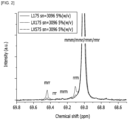
- Figs. 1 and 2 show NMR data of polylactic acid measured in Examples of the present disclosure.
- Arbitrary L-lactide ratio parameter, meso-lactide and racemization parameters were set for each of the three types of polylactic acid, and the length of the repeating unit was arranged so as to become 100,000.
- the LL arrangement, the LD arrangement, the DL arrangement, and the DD arrangement were arranged according to the L-lactide ratio parameter and meso-lactide ratio parameter to obtain an arrangement of polylactic acid having a length of 100,000 repeating units.
- the arbitrary repeating units more by the number corresponding to the racemization parameter ratio was randomly selected, and changed to D-lactic in the case of L-Lactic, and to L-Lactic in the case of D-Lactic.
- the tacticity arrangement was analyzed from the arrangement of hypothetical polylactic acid obtained respectively. This was analyzed according to the lactic arrangement in Table 2. By comparing each obtained quantitative data of tacticity with the data in Table 2, the L-lactide ratio parameter, meso-lactide ratio parameter, and racemization parameter were changed so that the standard deviation (the square root of the sum of squaring the differences between the 8 types of quantitative data) was minimized, and the arrangement of hypothetical polylactic acid was repeated.
- the D-lactic unit content was calculated from the arrangement of hypothetical polylactic acid when the standard deviation has been minimized, and the results are shown in Table 3 below. At this time, the D-lactic unit content was calculated as the number of repeating units of D-lactic acid compared to the total number of repeating units of hypothetical polylactic acid.
- the analysis method of the embodiment according to the present invention is simple since the chemical treatment for a sample is omitted, and it is highly stable because it does not use reagents and the like used for chemical treatment.
- the arrangement of lactic units can be determined by analyzing the tacticity, there is an advantage in that it can be determined whether the contribution by Meso-Lactide is large or the contribution by D-Lactide is large even under the same D content.
- a polylactic acid sample was dissolved in a potassium hydroxide-methanol solution under a heating condition of 65°C.
- Sulfuric acid was added to the above solution and heated under the same temperature.
- Deionized water and methylene chloride were added to the above solution and mixed, and then left to separate into two solution phases.
- the lower layer solution was collected and analyzed using Chiral GC-FID.
- the analysis method of Comparative Example 1 has a drawback in that the analysis method is complicated because hydrolysis and esterification must proceed, and there is a problem in the safety of the analyst because sulfuric acid must be used.
- the analysis method of Examples of the present disclosure can determine the arrangement of lactic units by analyzing the tacticity, and therefore, it is possible to analyze whether the contribution by Meso-Lactide is large or the contribution by D-Lactide is large even under the same D content. On the other hand, in the method of Comparative Example 1, this analysis is difficult.
- the content of D-lactic acid in polylactic acid was calculated using a statistical model method using the paper ( Polymers 2019, 11, 725 ).
Landscapes
- Physics & Mathematics (AREA)
- Chemical & Material Sciences (AREA)
- High Energy & Nuclear Physics (AREA)
- Health & Medical Sciences (AREA)
- General Physics & Mathematics (AREA)
- Life Sciences & Earth Sciences (AREA)
- Pathology (AREA)
- Spectroscopy & Molecular Physics (AREA)
- Biochemistry (AREA)
- Immunology (AREA)
- Analytical Chemistry (AREA)
- General Health & Medical Sciences (AREA)
- Chemical Kinetics & Catalysis (AREA)
- Medicinal Chemistry (AREA)
- Polymers & Plastics (AREA)
- Organic Chemistry (AREA)
- Condensed Matter Physics & Semiconductors (AREA)
- Molecular Biology (AREA)
- Crystallography & Structural Chemistry (AREA)
- Engineering & Computer Science (AREA)
- Signal Processing (AREA)
- Investigating Or Analysing Materials By Optical Means (AREA)
Abstract
Description
- This application claims the benefit of
Korean Patent Application No. 10-2021-0050041 filed on April 16, 2021 - The present disclosure relates to a method for analyzing the content of D-lactic repeating units in polylactic acid.
- Polylactic acid is a material that has biodegradable properties and at the same time, has excellent mechanical properties such as tensile strength and elastic modulus, and is widely used in various fields. Polylactic acid is a homopolymer, but it can have various structures due to its tacticity. Polylactic acid is generally prepared through ring-opening polymerization of lactide. However, since lactide has optical isomers existed therein, the properties of polylactic acid may change depending on the arrangement of these optical isomers in the repeating units.
- Particularly, since D-lactic repeating units in polylactic acid have a large influence on the properties of polylactic acid, the analysis of tacticity in polylactic acid is important. Conventionally, in order to analyze the content of D-lactic repeating units (hereinafter referred to as D content) in polylactic acid, polylactic acid was hydrolyzed and decomposed into individual monomers, which were analyzed by liquid chromatography (LC), or polylactic acid was hydrolyzed, decomposed into individual monomers and converted to alkyl lactate by an esterification reaction, which was then analyzed by gas chromatography (GC). However, the above methods are complicated in process and take a long time, and in particular, racemization may occur in the process of analysis, which may reduce the reliability of actual analysis data.
- As another method, there is a method of analyzing polarimetry by dissolving polylactic acid in an organic solvent without decomposing polylactic acid, unlike the above methods. However, this method has a problem that the error increases depending on the concentration of polylactic acid in the organic solvent, and when impurities or additives having chirality are included, errors are likely to occur.
- On the other hand, even in the case of polylactic acid having the same D content, the ratio of L-lactide, meso-lactide, and D-lactide in a raw material may vary, which causes a difference in the tacticity of polylactic acid and affects the physical properties. By conventional analysis methods such as the above method, it was difficult to confirm the difference in the ratio of the raw material.
- Therefore, there is a need to develop a method for quickly and accurately analyzing the D content in polylactic acid and the relative ratios of L-lactide, meso-lactide, and D-lactide in the raw material, unlike the conventional method.
- It is one object of the present disclosure to provide a method for quickly and accurately analyzing the D content in polylactic acid and the relative ratios of L-lactide, meso-lactide, and D-lactide in the raw material.
- In order to achieve the above object, according to the present disclosure, there is provided a method for analyzing the content of D-lactic repeating units in polylactic acid, comprising the steps of:
- 1) obtaining quantitative data of tacticity from the NMR spectrum of polylactic acid;
- 2) obtaining the arrangement of hypothetical polylactic acid with three parameters: L-lactide ratio parameter, meso-lactide ratio parameter and racemization parameter;
- 3) obtaining tacticity data of the hypothetical polylactic acid of step 2;
- 4) obtaining a standard deviation of the quantitative data of tacticity of step 1 and the quantitative data of tacticity of the hypothetical polylactic acid of step 2;
- 5) repeating steps 2 to 4 to obtain L-lactide ratio parameter, meso-lactide ratio parameter and racemization parameter in which the standard deviation of step 3 has been minimized; and
- 6) obtaining the D content in polylactic acid from the L-lactide ratio parameter, meso-lactide ratio parameter and racemization parameter obtained in
step 5. - Polylactic acid is a polymer prepared by polymerization of lactide, and lactide can have a steric structure of L-lactide, meso-lactide, and D-lactide as follows. Therefore, the repeating units in polylactic acid can also have respective steric structures resulting therefrom. Since this steric structure affects the physical properties of polylactic acid, it is necessary to analyze the steric structure in polylactic acid.

- On the other hand, a method for analyzing the tacticity of polylactic acid using NMR is known. Specifically, by analyzing the NMR spectrum of polylactic acid, information concerning the arrangement of monomers in polylactic acid can be obtained. However, it is difficult to directly analyze therefrom how many D-lactic repeating units are present in polylactic acid. The reason is because the arrangement of two polylactic acids corresponds to each analyzed tacticity and thus, the content of D-lactic repeating units cannot be calculated.
- In this regard, the method of the present disclosure is characterized by analyzing the content of D-lactic repeating units in polylactic acid and L-lactide, meso-lactide, and D-lactide in raw materials, by a method of obtaining tacticity information concerning the arrangement of hypothetical polylactic acid and then comparing two tacticities with each other, in addition to the tacticity information of polylactic acid using NMR.
- Now, the present disclosure will be described in detail for each step.
- Step 1 of the present disclosure is a step of obtaining quantitative data of tacticity from the NMR spectrum of polylactic acid, which is a step of obtaining quantitative data of tacticity of polylactic acid to be actually analyzed.
- Lactic repeating units present in polylactic acid include L-lactic repeating units and D-lactic repeating units, and different NMR peaks are obtained depending on their arrangement. From this point of view, the quantitative data of tacticity of step 1 means the tetrad intensity data of polylactic acid. Specifically, the NMR peak varies depending on the arrangement (tetrad) of four repeating units in polylactic acid, and in 13C NMR and 1H NMR, the following peaks can be obtained from a high chemical shift side to a low chemical shift as shown in Table 1 below (Polymers 2019, 11, 725).
[Table 1] 13C NMR mrr rrr mrm rrm mmm/mmr/rmm/rm r 1H NMR rmr rmm mmr mmm/rrr/rrm/mrr mrm - In Table 1, 'm' means that the two repeating units are identical to each other, and 'r' means that the two repeating units are different from each other. In one example, the 'rmr' means that the arrangement of four repeating units in polylactic acid is 'LDDL' or 'DLLD'.
- From these viewpoints, the NMR spectrum of step 1 means 13C NMR spectrum and 1H NMR spectrum of polylactic acid. Further, the integral intensity of each peak can be obtained as quantitative data of tacticity, and a total of 8 types of quantitative data can be obtained according to the arrangement (tetrad) of the 4 repeating units. In addition, for analysis, the ratio of each integral intensity to the total sum of the eight types of integral intensities can be obtained as the quantitative data.
- Step 2 of the present disclosure is a step of obtaining the arrangement of hypothetical polylactic acid. For this purpose, three parameters are arbitrarily set, one is the L-lactide ratio parameter, another is a meso-lactide ratio parameter, and yet another is a racemization parameter.
- The 'L-lactide ratio parameter' refers to the generation probability of the (L-lactate)-(L-lactate) repeating unit (LL) when generating the lactic repeating unit. That is, the 'L-lactide ratio parameter' is '(probability of generating LL repeating unit) / (probability of generating LL repeating unit)+(probability of generating LD repeating unit)+(probability of generating DL repeating unit) + (probability of generating a DD repeating unit))'.
- The 'meso-lactide ratio parameter' means the generation probability of (L-lactic)-(D-lactic) repeating unit (LD) and the generation probability of (D-lactic)-(L-lactic) repeating unit (DL) when generating lactic repeating units. That is, the 'meso-lactide ratio parameter' means '((probability of generating LD repeating unit)+(probability of generating DL repeating unit)) / ((probability of generating LL repeating unit)+(probability of generating LD repeating unit)+(probability of generating DL repeating unit) +(probability of generating DD repeating units))'
- For example, if the 'L-lactide ratio parameter' is 0.90 and the 'meso-lactide ratio parameter' is 0.05, the probability of generating LL repeating unit is 0.90, the probability of generating an LD or DL repeating unit is 0.05, and the probability of generating DD repeating unit is 0.05 when generating lactate repeating units.
- The (probability of generating LD repeating unit) and (probability of generating DL repeating unit) are considered to be not influencing for the purposes of the present disclosure. However, if necessary, a ratio between (probability of generating LD repeating unit) and (probability of generating DL repeating unit) may also be introduced as another parameter.
- The 'racemization parameter' refers to a ratio at which L-lactic repeating unit (L) is changed to D-lactic repeating unit (D), and D-lactic repeating unit (D) to L-lactic repeating unit (L), with respect to an arbitrary repeating unit among all repeating units in the hypothetically generated polylactic acid. For example, if the 'racemization parameter' is 0.10, it means that the steric magnification is reversed with respect to arbitrary 10% of the total repeating units in the hypothetically generated polylactic acid.
- Specifically, arbitrary L-lactide ratio parameter, meso-lactide ratio parameter and racemization parameter are set. According to the L-lactide ratio parameter and the meso-lactide parameter, LL arrangement meaning L-lactide, LD arrangement or DL arrangement meaning meso-lactide, and DD arrangement meaning D-lactide are arranged probabilistically according to the ratio of each parameter. Then, from the entire arrangement, the repeating units more by the number corresponding to the racemization parameter ratio were randomly selected, and the arrangement of hypothetical polylactic acid can be obtained by changing to D-lactic in the case of L-lactic and changing to L-lactic in the case of D-lactic.
- On the other hand, the arrangement of hypothetical polylactic acid can have a repeating unit length of 10,000 to 1,000,000.
- Step 3 of the present disclosure is a step of obtaining tacticity data of the hypothetical polylactic acid of step 2.
- Since the information about the arrangement of the hypothetical polylactic acid obtained in step 2 is known, the tacticity data of polylactic acid as in step 1 can be obtained therefrom. For example, when the arrangement of repeating units of the hypothetical polylactic acid obtained in step 2 is LLLDDLLLLL, the quantitative data can be obtained by counting LLLD, LLDD, LDDL, DDLL, DLLL, LLLL, and LLLL once each. Thereby, a total of 8 types of quantitative data can be obtained according to the arrangement (tetrad) of the 4 repeating units, as in step 1.
- Step 4 of the present disclosure is a step of obtaining a standard deviation of the quantitative data of tacticity from the NMR spectrum of polylactic acid obtained in step 1, and the tacticity data of hypothetical polylactic acid obtained in step 3. Also,
step 5 of the present disclosure is a step of repeating steps 2 to 4 by changing the L-lactide ratio parameter, meso-lactide ratio parameter and racemization parameter in order to obtain L-lactide ratio parameter, meso-lactide ratio parameter and racemization parameter in which the standard deviation of step 4 has been minimized. - Preferably, the standard deviation means the square root of the sum of squaring the difference between the corresponding eight types of quantitative data of the data in step 1 and the data in step 3. As the standard deviation is smaller, it can be assumed that the arrangement of the actual polylactic acid and the hypothetical polylactic acid is similar.
- Preferably, the standard deviation is less than 0.05. More preferably, the standard deviation is less than 0.01, or less than 0.005. On the other hand, it should be understood that the minimization of the standard deviation is not necessarily the theoretically possible minimum value, but includes the case of less than 0.05.
-
Step 5 of the present disclosure is a step of obtaining the D content in polylactic acid from the L-lactide ratio parameter, meso-lactide ratio parameter and racemization parameter obtained in step 4. - This is a step of obtaining the arrangement of hypothetical polylactic acid with the minimized standard deviation through step 4 and thus obtaining the D content in polylactic acid therefrom. At this time, since it can be assumed that the arrangement of actual polylactic acid and hypothetical polylactic acid is similar, the D content in hypothetical polylactic acid can be predicted as the D content in actual polylactic acid.
- On the other hand, since the arrangement of hypothetical polylactic acid is known through step 4, the D content can be easily calculated therefrom.
- As described above, the method for analyzing the content of D-lactic repeating units in polylactic acid has a feature that the D content in polylactic acid can be quickly and accurately analyzed by using NMR data of polylactic acid and hypothetical polylactic acid without special chemical treatment for polylactic acid.
-
Figs. 1 and2 show NMR data of polylactic acid measured in Examples of the present disclosure. - Hereinafter, embodiments of the present disclosure will be described in more detail by way of examples. However, the following examples are only provided for illustrative purposes, and the contents of the present disclosure are not limited by these examples.
- The following five types of polylactic acid were used.
- L175 (Total Corbion)
- LX175 (Total Corbion)
- LX575 (Total Corbion)
- 2003D (NatureWorks)
- 4032D (NatureWorks)
- 13C NMR and 1H NMR were measured for each polylactic acid, and the results are shown in
Figs. 1 and2 . - Further, the integral intensity shown in
Figs. 1 and2 was analyzed, and the quantitative data of tacticity of Table 2 below was obtained for each tetrad.[Table 2] Type of tetrad Lactic arrangement L175 (%) LX575 (%) LX175 (%) 4032D (%) 2003D (%) mmm LLLL and DDDD 97.28 92.10 83.94 93.99 87.08 mrm LLDD and DDLL 0.11 1.37 1.44 1.79 0.55 mmr LLLD and DDDL 0.22 0.54 0.75 1.11 2.25 rmm DLLL and LDDD 1.24 0.54 1.62 0.55 4.57 rmr LDDL and DLLD 0.65 0.43 0.31 0.68 3.02 mrr LDLL and DLDD 0.03 1.42 5.32 0.65 1.19 rrm LLDL and DDLD 0.45 3.19 5.77 1.14 1.11 rrr LDLD and DLDL 0.02 0.41 0.84 0.09 0.23 - Arbitrary L-lactide ratio parameter, meso-lactide and racemization parameters were set for each of the three types of polylactic acid, and the length of the repeating unit was arranged so as to become 100,000. Specifically, the LL arrangement, the LD arrangement, the DL arrangement, and the DD arrangement were arranged according to the L-lactide ratio parameter and meso-lactide ratio parameter to obtain an arrangement of polylactic acid having a length of 100,000 repeating units. Then, from the entire arrangement, the arbitrary repeating units more by the number corresponding to the racemization parameter ratio was randomly selected, and changed to D-lactic in the case of L-Lactic, and to L-Lactic in the case of D-Lactic.
- The tacticity arrangement was analyzed from the arrangement of hypothetical polylactic acid obtained respectively. This was analyzed according to the lactic arrangement in Table 2. By comparing each obtained quantitative data of tacticity with the data in Table 2, the L-lactide ratio parameter, meso-lactide ratio parameter, and racemization parameter were changed so that the standard deviation (the square root of the sum of squaring the differences between the 8 types of quantitative data) was minimized, and the arrangement of hypothetical polylactic acid was repeated.
- The D-lactic unit content was calculated from the arrangement of hypothetical polylactic acid when the standard deviation has been minimized, and the results are shown in Table 3 below. At this time, the D-lactic unit content was calculated as the number of repeating units of D-lactic acid compared to the total number of repeating units of hypothetical polylactic acid.
[Table 3] L175 LX575 LX175 4032D 2003D D content(%) 0.87 2.23 3.72 2.10 4.23 L-lactide ratio parameter 0.987 0.977 0.961 0.981 0.974 meso-lactide ratio parameter 0.008 0.017 0.039 0.004 0.003 Racemization parameter 0.00 0.008 0.018 0.004 0.018 Standard deviation 0.00349 0.00917 0.01811 0.00359 0.01138 - As described above, the analysis method of the embodiment according to the present invention is simple since the chemical treatment for a sample is omitted, and it is highly stable because it does not use reagents and the like used for chemical treatment. In addition, since the arrangement of lactic units can be determined by analyzing the tacticity, there is an advantage in that it can be determined whether the contribution by Meso-Lactide is large or the contribution by D-Lactide is large even under the same D content.
- Hydrolysis and esterification were performed using the method presented in the article (Lee Tin Sin, Polylactic Acid A Practical Guide for the Processing, Manufacturing, and Applications of PLA Second Edition), and converted to methyl L-lactate and methyl D-lactate. The methyl D-lactate content in methyl lactate was analyzed to determine the D-lactic unit content in polylactic acid.
- Specifically, a polylactic acid sample was dissolved in a potassium hydroxide-methanol solution under a heating condition of 65°C. Sulfuric acid was added to the above solution and heated under the same temperature. Deionized water and methylene chloride were added to the above solution and mixed, and then left to separate into two solution phases. The lower layer solution was collected and analyzed using Chiral GC-FID.
- The results are shown in Table 4 below.
[Table 4] L175 LX575 LX175 4032D 2003D D content (%) by GC analysis 0.37 1.56 3.71 1.46 4.16 - Comparing the analysis method of Comparative Example 1 with the analysis method of Examples of the present disclosure described above, the analysis method of Comparative Example 1 has a drawback in that the analysis method is complicated because hydrolysis and esterification must proceed, and there is a problem in the safety of the analyst because sulfuric acid must be used. In addition, the analysis method of Examples of the present disclosure can determine the arrangement of lactic units by analyzing the tacticity, and therefore, it is possible to analyze whether the contribution by Meso-Lactide is large or the contribution by D-Lactide is large even under the same D content. On the other hand, in the method of Comparative Example 1, this analysis is difficult.
- The content of D-lactic acid in polylactic acid was calculated using a statistical model method using the paper (Polymers 2019, 11, 725).
- Specifically, for the quantitative data of tacticity obtained as shown in Table 2, the values of each variable (p1, p2, f1) described in Table 3 of the paper were obtained using the search function of Excel. At this time, p1 means L/(L+D), p2 means LL/(LL+DD), and f2 means a variable in the 'Two-State' model of the paper.
- The results are shown in Table 5 below, and for comparison, the results of Tables 3 and 4 are also described.
[Table 5] L175 LX575 LX175 4032D 2003D D content (%) by GC method 0.37 1.56 3.71 1.46 4.16 (*D content in Table 3) 0.87 2.23 3.72 2.10 4.22 D content (%) 0.88 2.76 4.78 2.26 4.27 p2 0.996 1 1 0.988 0.977 p1 0.919 0.782 0.885 0.778 0.899 f2 0.939 0.873 0.586 0.948 0.751 Standard deviation 0.00982 0.0230 0.0449 0.0094 0.0320 - Comparing the analysis method of Comparative Example 2 with the analysis method of Examples of the present disclosure described above, it is possible to indirectly determine whether the D content is from Meso-Lactide or D-Lactide depending on whether the Single Addition Factor is high or the Pair Addition Factor is high, but it has the drawback of being difficult to show numerically. In addition, since the analysis method of Comparative Example 2 calculates the ratio for each tacticity based on the probability theory, the standard deviation is relatively large. Therefore, there is a disadvantage in that the accuracy is lowered in terms of quantifying the D content.
Claims (10)
- A method for analyzing the content of D-lactic repeating units in polylactic acid, comprising the steps of:1) obtaining quantitative data of tacticity from the NMR spectrum of polylactic acid;2) obtaining the arrangement of hypothetical polylactic acid with three parameters: L-lactide ratio parameter, meso-lactide ratio parameter and racemization parameter;3) obtaining tacticity data of the hypothetical polylactic acid of step 2;4) obtaining a standard deviation of the quantitative data of tacticity of step 1 and the quantitative data of tacticity of the hypothetical polylactic acid of step 2;5) repeating steps 2 to 4 to obtain L-lactide ratio parameter, meso-lactide ratio parameter and racemization parameter in which the standard deviation of step 3 has been minimized; and6) obtaining the D content in polylactic acid from the L-lactide ratio parameter, meso-lactide ratio parameter and racemization parameter obtained in step 5.
- The method according to claim 1, wherein:
the quantitative data of tacticity in step 1 is an integral intensity data for a tetrad of the polylactic acid. - The method according to claim 1, wherein:
the tetrad of the polylactic acid is mmm, mrm, mmr, rmm, rmr, mrr, rrm, and rrr. - The method according to claim 1, wherein:
the NMR spectrum in step 1 is a 13C NMR spectrum and a 1H NMR spectrum of polylactic acid. - The method according to claim 1, wherein:
the L-lactide ratio parameter in step 2 is the generation probability of (L-lactic)-(L-lactic) repeating unit (LL) when generating lactic repeating units. - The method according to claim 1, wherein:
the meso-lactide ratio parameter is the generation probability of (L-lactic)-(D-lactic) repeating unit (LD) and the generation probability of (D-lactic)-(L-lactic) repeating unit (DL) when generating lactic repeating units. - The method according to claim 1, wherein:
the racemization parameter in step 2 is a ratio at which the L-lactic repeating unit (L) is changed to a D-lactic repeating unit (D), and the D-lactic repeating unit (D) to an L-lactic repeating unit (L), with respect to an arbitrary repeating unit among all repeating units in the hypothetically generated polylactic acid. - The method according to claim 1, wherein:
the tacticity data in step 3 is a quantitative data for the tetrad of the hypothetical polylactic acid in step 2. - The method according to claim 1, wherein:
the standard deviation in step 4 is the square root of the sum of squaring the difference between the corresponding eight types of quantitative data of the data of step 1 and the data of step 3. - The method according to claim 1, wherein:
the standard deviation of step 4 is less than 0.05.
Applications Claiming Priority (2)
| Application Number | Priority Date | Filing Date | Title |
|---|---|---|---|
| KR1020210050041A KR102648698B1 (en) | 2021-04-16 | 2021-04-16 | Method for analyzing the content of D-lactic repeating units in polylactic acid |
| PCT/KR2021/017713 WO2022220365A1 (en) | 2021-04-16 | 2021-11-29 | Method for analyzing content of d-lactic repeating units in polylactic acid |
Publications (3)
| Publication Number | Publication Date |
|---|---|
| EP4148423A1 true EP4148423A1 (en) | 2023-03-15 |
| EP4148423A4 EP4148423A4 (en) | 2023-12-06 |
| EP4148423B1 EP4148423B1 (en) | 2025-10-15 |
Family
ID=83640781
Family Applications (1)
| Application Number | Title | Priority Date | Filing Date |
|---|---|---|---|
| EP21937098.8A Active EP4148423B1 (en) | 2021-04-16 | 2021-11-29 | Method for analyzing content of d-lactic repeating units in polylactic acid |
Country Status (6)
| Country | Link |
|---|---|
| US (1) | US12590914B2 (en) |
| EP (1) | EP4148423B1 (en) |
| JP (1) | JP7483303B2 (en) |
| KR (1) | KR102648698B1 (en) |
| CN (1) | CN115667898B (en) |
| WO (1) | WO2022220365A1 (en) |
Family Cites Families (20)
| Publication number | Priority date | Publication date | Assignee | Title |
|---|---|---|---|---|
| US5247013A (en) * | 1989-01-27 | 1993-09-21 | Mitsui Toatsu Chemicals, Inc. | Biocompatible polyester and production thereof |
| JPH05323006A (en) * | 1992-05-22 | 1993-12-07 | Idemitsu Petrochem Co Ltd | Measuring method of solid regularity of propylene homopolymerization part in propylene-ethylene block copolymer |
| JP3735767B2 (en) | 2000-10-26 | 2006-01-18 | 独立行政法人科学技術振興機構 | Method for identifying structural isomers of non-aromatic 6-membered cyclic structure compounds |
| EP2152807B1 (en) | 2007-05-16 | 2012-12-05 | NatureWorks LLC | Method for stabilizing polymers containing repeating lactic acid units, and stabilized polymers so made |
| CN101835839A (en) | 2007-10-26 | 2010-09-15 | 住友化学株式会社 | Propylene resin composition and molded article produced from the same |
| BE1018628A3 (en) | 2009-01-16 | 2011-05-03 | Futerro Sa | ISOTACTIC POLYLACTIC ACID AND PROCESS FOR PRODUCING THE SAME |
| JP5679411B2 (en) | 2010-06-17 | 2015-03-04 | 日立造船株式会社 | Method for producing polylactic acid |
| BR112013011361B1 (en) * | 2010-11-08 | 2020-01-28 | Sk Chemicals Co Ltd | polylactic acid resin, method of preparing it, and packaging film comprising the same |
| KR101717186B1 (en) * | 2010-12-17 | 2017-03-17 | 에스케이케미칼 주식회사 | Method for preparing polylactic acid resin |
| JP5739165B2 (en) | 2011-01-06 | 2015-06-24 | 国立大学法人宇都宮大学 | Method for producing lactide |
| WO2014088321A1 (en) | 2012-12-06 | 2014-06-12 | 주식회사 엘지화학 | Lactide copolymer, method for producing same, and resin composition comprising same |
| KR102003480B1 (en) | 2013-06-21 | 2019-07-24 | 에스케이케미칼 주식회사 | Polylactic acid-polyolefin alloy resin composition |
| KR20150071777A (en) * | 2013-12-18 | 2015-06-29 | 에스케이케미칼주식회사 | Method for quantitative analysis of residual monomer in polylactic acid using 1h-nmr analysis |
| KR102296146B1 (en) * | 2014-06-05 | 2021-08-31 | 에스케이케미칼 주식회사 | Flexible polylactic acid-based heat sealing film |
| KR102130039B1 (en) * | 2014-06-05 | 2020-07-03 | 에스케이케미칼 주식회사 | Heat sealable and flexible polylactic acid resin composition |
| WO2016000071A1 (en) | 2014-07-04 | 2016-01-07 | The University Of British Columbia | Mononuclear salen indium catalysts and methods of manufacture and use thereof |
| EP3130911A1 (en) | 2015-08-10 | 2017-02-15 | PURAC Biochem BV | Quantification method of meso-lactide in a lactide-containing composition |
| EP3356488B1 (en) | 2015-10-01 | 2021-11-10 | PURAC Biochem BV | Non-reactive hot-melt adhesive with specific resin |
| KR101996666B1 (en) | 2016-05-02 | 2019-07-04 | 주식회사 엘지화학 | Method for quantitative analysis |
| KR102100016B1 (en) * | 2017-11-20 | 2020-04-10 | 주식회사 엘지화학 | Quantitative Analysis Method for Monomer in Polyimide Film |
-
2021
- 2021-04-16 KR KR1020210050041A patent/KR102648698B1/en active Active
- 2021-11-29 JP JP2022573742A patent/JP7483303B2/en active Active
- 2021-11-29 US US17/926,717 patent/US12590914B2/en active Active
- 2021-11-29 WO PCT/KR2021/017713 patent/WO2022220365A1/en not_active Ceased
- 2021-11-29 EP EP21937098.8A patent/EP4148423B1/en active Active
- 2021-11-29 CN CN202180035868.3A patent/CN115667898B/en active Active
Also Published As
| Publication number | Publication date |
|---|---|
| EP4148423A4 (en) | 2023-12-06 |
| JP7483303B2 (en) | 2024-05-15 |
| CN115667898B (en) | 2026-04-07 |
| US12590914B2 (en) | 2026-03-31 |
| CN115667898A (en) | 2023-01-31 |
| US20230204529A1 (en) | 2023-06-29 |
| KR102648698B1 (en) | 2024-03-15 |
| JP2023529115A (en) | 2023-07-07 |
| EP4148423B1 (en) | 2025-10-15 |
| WO2022220365A1 (en) | 2022-10-20 |
| KR20220143476A (en) | 2022-10-25 |
Similar Documents
| Publication | Publication Date | Title |
|---|---|---|
| Urayama et al. | Microstructure and thermal properties of polylactides with different L‐and D‐unit sequences: importance of the Helical nature of the L‐sequenced segments | |
| Parcheta et al. | Structure-rheology relationship of fully bio-based linear polyester polyols for polyurethanes-Synthesis and investigation | |
| EP4148423B1 (en) | Method for analyzing content of d-lactic repeating units in polylactic acid | |
| Guttman et al. | Quantitative mass spectrometry and polydisperse materials: creation of an absolute molecular mass distribution polymer standard | |
| JPWO2002012969A1 (en) | Manufacturing Control Methods | |
| US10161862B2 (en) | Method for analyzing molecular weight of the poly-p-phenylene terephthalamide | |
| Cai et al. | WMFP-Outlier: An efficient maximal frequent-pattern-based outlier detection approach for weighted data streams | |
| Scheler | High-speed MAS-NMR investigations on radiation-modified fluoropolymers | |
| Carby‐Robinson et al. | Cocaine profiling method retrospectively developed with nontargeted discovery of markers using liquid chromatography with time‐of‐flight mass spectrometry data | |
| Li et al. | 2D-NMR Characterization of Sequence Distributions in the Backbone of Poly (vinylidene fluoride-co-tetrafluoroethylene) | |
| Gomes et al. | Thermal and Chemical Characterisation of Reprocessed PET: A Study on Commercial, Recycled, Bottle-Grade and Textile Blend | |
| CN115616024B (en) | Component analysis method of liquid crystal polyester | |
| Kossack et al. | The kinetics of mutarotation in L-fucose as monitored by dielectric and infrared spectroscopy | |
| Carroccio et al. | Matrix‐assisted laser desorption/ionisation time‐of‐flight characterisation of biodegradable aliphatic copolyesters | |
| Kuball et al. | Chirality and circular dichroism of oriented molecules and anisotropic phases | |
| Iribarren et al. | Crystal structures of optically active polyamides derived from di-O-methyl-L-tartaric acid and 1, n-alkanediamines: A study combining energy calculations, diffraction analysis, and modeling simulations | |
| Poyer et al. | Convenient graphical visualization of messages encoded in sequence‐defined synthetic polymers using Kendrick mass defect analysis of their MS/MS data | |
| Matias et al. | Single crystal neutron diffraction analysis (15 K) and ab initio molecular orbital calculations for ethylene carbonate | |
| Grobelny et al. | Ring-opening polymerization of lactones initiated with metal hydroxide-activated macrocyclic ligands: Determination of mechanism and structure of polymers | |
| CN116881646A (en) | Stevioside production monitoring data management system | |
| Motiyenko et al. | The submillimeter-wave spectrum of diisocyanomethane | |
| US11921068B2 (en) | Molecular weight measurement method and solvent for use in measurement | |
| Cárdenas et al. | Streamlining PET Viscosity Measurement Using an Automated Differential Viscometer | |
| Lu et al. | Rapid and Nondestructive Determination of Polyacrylonitrile Molecular Weight by Fourier Transform near-Infrared (NIR) Spectroscopy | |
| Sari-Zizi et al. | High-Resolution FTIR and Millimeter-Wave Study of D3SiF: The Ground, v3= 1, and v6= 1 and 2 States |
Legal Events
| Date | Code | Title | Description |
|---|---|---|---|
| STAA | Information on the status of an ep patent application or granted ep patent |
Free format text: STATUS: THE INTERNATIONAL PUBLICATION HAS BEEN MADE |
|
| PUAI | Public reference made under article 153(3) epc to a published international application that has entered the european phase |
Free format text: ORIGINAL CODE: 0009012 |
|
| STAA | Information on the status of an ep patent application or granted ep patent |
Free format text: STATUS: REQUEST FOR EXAMINATION WAS MADE |
|
| 17P | Request for examination filed |
Effective date: 20221207 |
|
| AK | Designated contracting states |
Kind code of ref document: A1 Designated state(s): AL AT BE BG CH CY CZ DE DK EE ES FI FR GB GR HR HU IE IS IT LI LT LU LV MC MK MT NL NO PL PT RO RS SE SI SK SM TR |
|
| A4 | Supplementary search report drawn up and despatched |
Effective date: 20231107 |
|
| RIC1 | Information provided on ipc code assigned before grant |
Ipc: G01R 33/46 20060101ALI20231031BHEP Ipc: G01N 24/08 20060101AFI20231031BHEP |
|
| DAV | Request for validation of the european patent (deleted) | ||
| DAX | Request for extension of the european patent (deleted) | ||
| GRAP | Despatch of communication of intention to grant a patent |
Free format text: ORIGINAL CODE: EPIDOSNIGR1 |
|
| STAA | Information on the status of an ep patent application or granted ep patent |
Free format text: STATUS: GRANT OF PATENT IS INTENDED |
|
| GRAS | Grant fee paid |
Free format text: ORIGINAL CODE: EPIDOSNIGR3 |
|
| GRAA | (expected) grant |
Free format text: ORIGINAL CODE: 0009210 |
|
| STAA | Information on the status of an ep patent application or granted ep patent |
Free format text: STATUS: THE PATENT HAS BEEN GRANTED |
|
| INTG | Intention to grant announced |
Effective date: 20250825 |
|
| AK | Designated contracting states |
Kind code of ref document: B1 Designated state(s): AL AT BE BG CH CY CZ DE DK EE ES FI FR GB GR HR HU IE IS IT LI LT LU LV MC MK MT NL NO PL PT RO RS SE SI SK SM TR |
|
| REG | Reference to a national code |
Ref country code: GB Ref legal event code: FG4D Ref country code: CH Ref legal event code: F10 Free format text: ST27 STATUS EVENT CODE: U-0-0-F10-F00 (AS PROVIDED BY THE NATIONAL OFFICE) Effective date: 20251015 |
|
| REG | Reference to a national code |
Ref country code: IE Ref legal event code: FG4D |
|
| REG | Reference to a national code |
Ref country code: DE Ref legal event code: R096 Ref document number: 602021040662 Country of ref document: DE |
|
| PGFP | Annual fee paid to national office [announced via postgrant information from national office to epo] |
Ref country code: DE Payment date: 20251208 Year of fee payment: 5 |
|
| PGFP | Annual fee paid to national office [announced via postgrant information from national office to epo] |
Ref country code: GB Payment date: 20251208 Year of fee payment: 5 |
|
| PGFP | Annual fee paid to national office [announced via postgrant information from national office to epo] |
Ref country code: AT Payment date: 20260113 Year of fee payment: 5 |
|
| PGFP | Annual fee paid to national office [announced via postgrant information from national office to epo] |
Ref country code: IT Payment date: 20251125 Year of fee payment: 5 |
|
| PGFP | Annual fee paid to national office [announced via postgrant information from national office to epo] |
Ref country code: FR Payment date: 20251125 Year of fee payment: 5 |
|
| REG | Reference to a national code |
Ref country code: NL Ref legal event code: MP Effective date: 20251015 |
|
| REG | Reference to a national code |
Ref country code: AT Ref legal event code: MK05 Ref document number: 1847337 Country of ref document: AT Kind code of ref document: T Effective date: 20251015 |
|
| PG25 | Lapsed in a contracting state [announced via postgrant information from national office to epo] |
Ref country code: NL Free format text: LAPSE BECAUSE OF FAILURE TO SUBMIT A TRANSLATION OF THE DESCRIPTION OR TO PAY THE FEE WITHIN THE PRESCRIBED TIME-LIMIT Effective date: 20251015 |
|
| PG25 | Lapsed in a contracting state [announced via postgrant information from national office to epo] |
Ref country code: ES Free format text: LAPSE BECAUSE OF FAILURE TO SUBMIT A TRANSLATION OF THE DESCRIPTION OR TO PAY THE FEE WITHIN THE PRESCRIBED TIME-LIMIT Effective date: 20251015 |
|
| REG | Reference to a national code |
Ref country code: LT Ref legal event code: MG9D |
|
| PG25 | Lapsed in a contracting state [announced via postgrant information from national office to epo] |
Ref country code: NO Free format text: LAPSE BECAUSE OF FAILURE TO SUBMIT A TRANSLATION OF THE DESCRIPTION OR TO PAY THE FEE WITHIN THE PRESCRIBED TIME-LIMIT Effective date: 20260115 |
|
| PG25 | Lapsed in a contracting state [announced via postgrant information from national office to epo] |
Ref country code: HR Free format text: LAPSE BECAUSE OF FAILURE TO SUBMIT A TRANSLATION OF THE DESCRIPTION OR TO PAY THE FEE WITHIN THE PRESCRIBED TIME-LIMIT Effective date: 20251015 Ref country code: AT Free format text: LAPSE BECAUSE OF FAILURE TO SUBMIT A TRANSLATION OF THE DESCRIPTION OR TO PAY THE FEE WITHIN THE PRESCRIBED TIME-LIMIT Effective date: 20251015 Ref country code: FI Free format text: LAPSE BECAUSE OF FAILURE TO SUBMIT A TRANSLATION OF THE DESCRIPTION OR TO PAY THE FEE WITHIN THE PRESCRIBED TIME-LIMIT Effective date: 20251015 |
|
| PG25 | Lapsed in a contracting state [announced via postgrant information from national office to epo] |
Ref country code: RS Free format text: LAPSE BECAUSE OF FAILURE TO SUBMIT A TRANSLATION OF THE DESCRIPTION OR TO PAY THE FEE WITHIN THE PRESCRIBED TIME-LIMIT Effective date: 20260115 |
|
| PG25 | Lapsed in a contracting state [announced via postgrant information from national office to epo] |
Ref country code: IS Free format text: LAPSE BECAUSE OF FAILURE TO SUBMIT A TRANSLATION OF THE DESCRIPTION OR TO PAY THE FEE WITHIN THE PRESCRIBED TIME-LIMIT Effective date: 20260215 |
|
| PG25 | Lapsed in a contracting state [announced via postgrant information from national office to epo] |
Ref country code: PT Free format text: LAPSE BECAUSE OF FAILURE TO SUBMIT A TRANSLATION OF THE DESCRIPTION OR TO PAY THE FEE WITHIN THE PRESCRIBED TIME-LIMIT Effective date: 20260216 |
|
| PG25 | Lapsed in a contracting state [announced via postgrant information from national office to epo] |
Ref country code: PL Free format text: LAPSE BECAUSE OF FAILURE TO SUBMIT A TRANSLATION OF THE DESCRIPTION OR TO PAY THE FEE WITHIN THE PRESCRIBED TIME-LIMIT Effective date: 20251015 |
|
| PG25 | Lapsed in a contracting state [announced via postgrant information from national office to epo] |
Ref country code: LV Free format text: LAPSE BECAUSE OF FAILURE TO SUBMIT A TRANSLATION OF THE DESCRIPTION OR TO PAY THE FEE WITHIN THE PRESCRIBED TIME-LIMIT Effective date: 20251015 |
|
| PG25 | Lapsed in a contracting state [announced via postgrant information from national office to epo] |
Ref country code: BG Free format text: LAPSE BECAUSE OF FAILURE TO SUBMIT A TRANSLATION OF THE DESCRIPTION OR TO PAY THE FEE WITHIN THE PRESCRIBED TIME-LIMIT Effective date: 20251015 |