EP4148382B1 - Method for correcting gyroscope demodulation phase drift - Google Patents
Method for correcting gyroscope demodulation phase drift Download PDFInfo
- Publication number
- EP4148382B1 EP4148382B1 EP22191021.9A EP22191021A EP4148382B1 EP 4148382 B1 EP4148382 B1 EP 4148382B1 EP 22191021 A EP22191021 A EP 22191021A EP 4148382 B1 EP4148382 B1 EP 4148382B1
- Authority
- EP
- European Patent Office
- Prior art keywords
- signal
- drive
- phase
- gyroscope
- output signal
- Prior art date
- Legal status (The legal status is an assumption and is not a legal conclusion. Google has not performed a legal analysis and makes no representation as to the accuracy of the status listed.)
- Active
Links
Images



Classifications
-
- G—PHYSICS
- G01—MEASURING; TESTING
- G01C—MEASURING DISTANCES, LEVELS OR BEARINGS; SURVEYING; NAVIGATION; GYROSCOPIC INSTRUMENTS; PHOTOGRAMMETRY OR VIDEOGRAMMETRY
- G01C19/00—Gyroscopes; Turn-sensitive devices using vibrating masses; Turn-sensitive devices without moving masses; Measuring angular rate using gyroscopic effects
- G01C19/56—Turn-sensitive devices using vibrating masses, e.g. vibratory angular rate sensors based on Coriolis forces
- G01C19/5642—Turn-sensitive devices using vibrating masses, e.g. vibratory angular rate sensors based on Coriolis forces using vibrating bars or beams
- G01C19/5649—Signal processing
-
- G—PHYSICS
- G01—MEASURING; TESTING
- G01C—MEASURING DISTANCES, LEVELS OR BEARINGS; SURVEYING; NAVIGATION; GYROSCOPIC INSTRUMENTS; PHOTOGRAMMETRY OR VIDEOGRAMMETRY
- G01C19/00—Gyroscopes; Turn-sensitive devices using vibrating masses; Turn-sensitive devices without moving masses; Measuring angular rate using gyroscopic effects
- G01C19/58—Turn-sensitive devices without moving masses
- G01C19/64—Gyrometers using the Sagnac effect, i.e. rotation-induced shifts between counter-rotating electromagnetic beams
- G01C19/72—Gyrometers using the Sagnac effect, i.e. rotation-induced shifts between counter-rotating electromagnetic beams with counter-rotating light beams in a passive ring, e.g. fibre laser gyrometers
- G01C19/726—Phase nulling gyrometers, i.e. compensating the Sagnac phase shift in a closed loop system
-
- G—PHYSICS
- G01—MEASURING; TESTING
- G01C—MEASURING DISTANCES, LEVELS OR BEARINGS; SURVEYING; NAVIGATION; GYROSCOPIC INSTRUMENTS; PHOTOGRAMMETRY OR VIDEOGRAMMETRY
- G01C25/00—Manufacturing, calibrating, cleaning, or repairing instruments or devices referred to in the other groups of this subclass
- G01C25/005—Manufacturing, calibrating, cleaning, or repairing instruments or devices referred to in the other groups of this subclass initial alignment, calibration or starting-up of inertial devices
Definitions
- the present disclosure generally relates to gyroscopes.
- the present disclosure relates more particularly to detecting phase drift in gyroscope demodulation.
- Inertial sensors can include accelerometers and gyroscopes. Accelerometers can detect linear motion. Gyroscopes can detect rotational motion.
- Detecting a rotation rate of a vehicle or electronic device with a gyroscope can be quite complicated. This is due, in part, to the fact that complex signals are utilized to excite a resonating mass of the gyroscope enough to sense the rotational motion of the resonating mass. It can be quite difficult to accurately extract the rotational rate from the raw output signal of the gyroscope.
- the raw output of a gyroscope corresponds to oscillation of a resonating mass in a sense direction perpendicular to the excitation direction of the resonating mass. While rotational motion will cause oscillation of the resonating mass in the sense direction, the quadrature effect will also contribute to oscillation of the resonating mass in the sense direction. However, the quadrature component of the raw output signal is spurious and does not represent rotational motion.
- Gyroscopes have leveraged the fact that the quadrature component of the raw output signal is typically in phase with the excitation or driving signal, while the rotational component of the raw output signal is typically 90° out of phase with the excitation or driving signal. Accordingly, the rotational component of the raw output signal the can be obtained by extracting the component of the raw output signal that is 90° out of phase with the excitation or driving signal. However, if there is phase drift associated with the raw output signal, then extracting the component of the output signal that is 90° out of phase with the driving signal will not accurately represent the rotational rate.
- US 2019/120657 discloses a demodulation phase calibration unit and method based on applying DCsignal to quadrature tuning electrodes in a calibration stage or in an operations stage at appropriate times, such as during startup or when a measured rate of rotation is less than a threshold.
- an aim of the present invention is to overcome the drawbacks of the prior art.
- a sensor unit including a gyroscope.
- the sensor unit effectively and efficiently identifies phase drift between the raw output signal of the gyroscope and the drive signal of the gyroscope. This is accomplished by applying a test voltage to quadrature compensation electrodes adjacent to the resonator mass of the gyroscope and detecting changes in a demodulated output signal of the gyroscope while applying the test voltage.
- phase drift After the phase drift has been identified, the phase drift can be taken into account in generating the demodulated output signal.
- the demodulated signal will then accurately represent the rotational component of the raw output signal.
- the demodulated signal may be generated by demodulating the raw output signal with the drive signal.
- the demodulation process extracts the portion of the raw output signal that is 90 degrees out of phase with the drive signal.
- a delay compensation circuit inserts a delay into the drive signal before demodulation occurs. The added delay compensates for the phase drift, effectively eliminating the negative effects of the phase drift.
- the test signal may include a first phase and a second phase. In the first phase the test signal has a first polarity. In the second phase, the test signal has a second polarity.
- the sensor unit detects the difference in the demodulated output signal between the first phase and the second phase of the test signal. The difference is indicative of the phase drift.
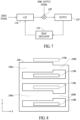
- FIG. 1 is a block diagram of an electronic device 100.
- the electronic device 100 includes a sensor unit 101.
- the sensor unit 101 includes a gyroscope 102.
- the sensor unit 101 identifies phase drift associated with an output signal of the gyroscope 102 and compensates for the phase drift in order to provide an accurate indication of a rotational rate applied to the electronic device 100.
- the electronic device 100 can include a vehicle, such as an automobile, an aircraft, a boat, or other types of vehicles. It is often very beneficial to know the training rate of the vehicle about one or more axes of rotation. In vehicles, these axes of rotation may correspond to yaw, roll, and pitch.
- the gyroscope 102 may be utilized to detect the rotational rate of the vehicle about one or more of these axes.
- the electronic device 100 can include a personal electronic device such as a smart phone, a smartwatch, smart glasses, a gaming device, a gaming controller, a tablet, a laptop computer, or other types of personal electronic devices.
- the gyroscope 102 may be utilized to detect the rotational rate of the electronic device 100 about one or more rotational axes.
- the electronic device 100 can include industrial equipment or other types of devices that may benefit from detecting rotational rates.
- the gyroscope 102 may correspond to a microelectromechanical systems (MEMS) gyroscope.
- the mems gyroscope 102 can include one or more movable masses defined from and coupled to a silicon substrate by one or more spring members.
- the mems gyroscope may also include various electrodes interleaved with the movable mass. The following description is directed primarily to electro-capacitive mems gyroscopes. Nevertheless, other types of gyroscopes can be used .
- the gyroscope 102 includes a resonator mass 104, drive electrodes 106, and sense electrodes 108. As shown in Figure 1 , the resonator mass 104, the drive electrodes 106, and the sense electrodes 108 are shown as making up the gyroscope 102, while other components associated with generating signals, sensing signals, and processing signals are shown as external to the gyroscope 102. However, in practice, the gyroscope 102 may be considered as including the various other components of the sensor unit 101 that will be described in greater detail below and that are shown as being external to the gyroscope 102. The sensor unit 101 may, as a whole, be considered as a gyroscope.
- the resonator mass 104 may include a mass suspended above or otherwise movably coupled to a substrate.
- the resonator mass 104 is configured to oscillate in at least two directions.
- a first direction of oscillation is known as a drive direction and corresponds to a first axis.
- a second direction of oscillation is known as a sense direction and corresponds to a second axis, substantially perpendicular to the first axis.
- Oscillation of the resonator mass 104 along the sense axis or sense direction is indicative of rotation of the resonator mass 104 about a third axis, substantially perpendicular to the first axis and the second axis.
- the resonator mass 104 may be coupled to a fixed substrate by spring members that allow the resonator mass to move back and forth along the drive axis.
- the resonator mass 104 may also be coupled to the fixed substrate by spring members that allow the resonator mass to move back and forth along the sense axis.
- Figure 1 shows the resonator mass 104 as a single mass, in practice, the resonator mass 104 may include multiple masses.
- a first mass may be coupled to a second mass by spring members. The first mass may be driven to oscillate along the drive axis. Rotation of the electronic device 100 around the rotation axis (third axis) may cause the second mass to oscillate along the sense axis (second axis).
- Various configurations of a resonator mass 104 or multiple resonator masses 104 can be utilized.
- the drive electrodes 106 are utilized to drive the resonator mass 104 in the second direction.
- the drive electrodes 106 may correspond to a conductive mass with a comb shape.
- the fingers of the comb-shape may be interleaved with corresponding comb fingers of the resonator mass 104. If a voltage is applied to the resonator mass 104, then applying a periodic voltage to the drive electrodes can drive oscillation of the resonator mass 104 along the drive axis.
- various other configurations of drive electrodes 106 can be utilized.
- the sense electrodes 108 are utilized to sense oscillation of the resonator mass 104 along the sense axis.
- the sense electrodes 108 may correspond to a conductive mass of the comb shape.
- the fingers of the comb shape may be interleaved with corresponding comb fingers of the resonator mass 104.
- various other configurations of sense electrodes 108 can be utilized.
- the electronic device 100 and, correspondingly, the resonator mass 104 are rotated around the third rotation axis while the resonator mass 104 is oscillating along the first axis, then the resonator mass 104 will be forced to oscillate along the second axis by the Coriolis force that results from the rotation around the rotation axis and the oscillation along the first axis. Accordingly, the oscillation of the resonator mass 104 along the sense axis is indicative of the rotation of the resonator mass 104 around the rotation axis.
- the sensor unit 101 includes a drive voltage supply 112.
- the drive voltage supply 112 applies a drive voltage to the drive electrodes 106.
- the drive voltage may correspond to an AC voltage having a selected amplitude and frequency.
- the drive voltage may be a sinusoidal voltage, a square wave voltage, a sawtooth voltage, or other types of AC voltage waveforms.
- the oscillation along the sense axis resulting from the Coriolis force will have the same frequency as the oscillation of the drive signal.
- the amplitude of the oscillation along the sense direction is indicative of the magnitude of the rotational rate around the third axis.
- the amplitude of the oscillation is indicated by the voltage that develops at the sense electrodes 108 by capacitive interaction with the resonator mass 104.
- other sensing configurations can be utilized.
- the signal output by the sense electrodes 108 corresponds to the raw output signal of the gyroscope 102.
- the raw output signal of the gyroscope 102 may not, by itself, accurately indicate the rotational rate around the third axis. This is because of a quadrature effect that develops at the resonator mass 104.
- the resonator mass 104 may also begin to oscillate along the sense axis even if there is no rotation around the rotational axis.
- the oscillation due to the quadrature affect may be considered a spurious oscillation, or the component of the raw output signal that is based on the quadrature affect may be considered a spurious signal.
- the raw output signal may be a current or may be a voltage, depending on a selected configuration of the gyroscope 102.
- the component of the raw output signal due to the quadrature affect may be much larger than the component of the raw output signal due to the rotation of the electronic device 100 around the rotational axis.
- the component of the raw output signal from the quadrature affect may be many times larger than the component of the raw output signal from the Coriolis force.
- the sensor unit 101 utilizes the demodulator 120 in order to extract the Coriolis component from the raw output signal.
- the raw output signal is made up of the quadrature component and the Coriolis component, if the Coriolis component can be extracted from the raw output signal, then a final output signal can be generated that corresponds only to the Coriolis component of the raw output signal.
- the demodulator 120 extracts the Coriolis component from the raw output signal and generates a final output signal that indicates the rotational rate around the rotation axis.
- the terms "Coriolis component” and “rotational component” may be used interchangeably.
- the demodulator 120 utilizes the fact that the Coriolis component of the raw output signal will be 90° out of phase with the quadrature component of the raw output signal in order to separate the Coriolis component from the quadrature component. Furthermore, absent any collective phase drift in the raw output signal, the quadrature component will be in phase with the drive signal while the Coriolis component is 90° out of phase with the drive signal. Accordingly, the demodulator 120 receives the drive signal and the raw output signal and performs demodulation of the raw output signal based on the drive signal. In particular, the demodulator 120 outputs only that portion of the raw output signal that is 90° out of phase with the drive signal. If there is no phase drift between the raw output signal and the drive signal, then the output of the demodulator 120 will represent only the Coriolis portion of the raw output signal.
- phase drift there is a phase drift between the drive signal and the raw output signal. More particularly, the phase drift may occur between the raw output signal and a demodulation signal that is based on the drive signal.
- the demodulation signal may have a same phase as the drive signal, or may initially have a same phase as the drive signal.
- the phase drift corresponds to an angle ⁇ by which the quadrature component is out of phase with the demodulation signal.
- the Coriolis component will be out of phase by 90° ⁇ the value of ⁇ , depending on the direction of the phase drift. Even a very small phase drift can result in the demodulator 120 generating a final output signal that is very inaccurate. Phase drift can result from variations in temperature, mechanical stress, or variations during processing of the sensor unit 101.
- the demodulation signal is a drive reference signal. As used herein, "demodulation signal” and “drive reference signal” may be used interchangeably.
- the sensor unit 101 utilizes quadrature compensation electrodes 110, a quadrature compensation driver 114, a delay calculator 116, and a delay compensation circuit 118 in order to identify and compensate for phase drift.
- the quadrature compensation electrodes 110 are positioned adjacent to the resonator mass 104.
- the quadrature compensation electrodes 110 can be used in both cases of in-plane sense axis (yaw) or out of plane sense axis (pitch and roll) based on selected design characteristics.
- the quadrature compensation electrodes 110 can be utilized to drive motion of the resonator mass 104 along the sense axis in order to compensate for or cancel out the natural quadrature that develops from driving the resonator mass 104 along the drive axis.
- principles of the present disclosure provide a potentially more effective way to utilize the quadrature compensation electrodes 110 in order to identify and compensate for phase drift in the raw output signal.
- the quadrature compensation driver 114 is configured to apply a test signal to the quadrature compensation electrodes 110.
- the quadrature compensation driver 114 applies a test signal during a testing period; the delay calculator 116 measures changes in the output of the demodulator 120 during the testing period.
- the delay calculator 116 calculates the value of phase drift between the raw output signal and the demodulation signal based on changes in the output of the demodulator 120 during the testing period.
- the testing period may have two phases.
- the test signal has a first polarity.
- the test signal switches to a second polarity opposite the first polarity.
- the change in the output of the demodulator 120 between the two phases of the test period is indicative of the magnitude of a phase drift angle ⁇ .
- the delay calculator 116 calculates the value of the phase drift angle ⁇ based, in part, on the change in the output of the demodulator 120 between the two phases of the test. Further details regarding the calculation of the phase drift angle ⁇ are provided below.
- the delay calculator 116 passes the value of the phase delay ⁇ to the delay compensation circuit 118.
- the delay compensation circuit 118 also receives the demodulation signal that is based on the drive signal.
- the delay compensation circuit 118 delays the demodulation signal by the value of the phase delay ⁇ , generating a delayed demodulation signal.
- the delay compensation circuit 118 passes the delayed demodulation signal to the demodulator 120.
- phase drift and “phase delay” may be used interchangeably.
- the drive voltage supply 112 may supply the drive signal to the drive electrodes 106 and may supply the demodulation signal that is based on the drive signal to the delay compensation circuit 118.
- the demodulator 120 Because the demodulation signal is now delayed by the same phase delay value ⁇ as is the raw output signal, the Coriolis component of the raw output signal is 90° out of phase with the delayed demodulation signal.
- the demodulator 120 When the demodulator 120 performs demodulation on the delayed demodulation signal and the raw output signal, the demodulator 120 outputs the true Coriolis component of the raw output signal. Accordingly, the demodulator 120 outputs a signal that accurately indicates the rotational rate of the electronic device 100 around the rotational axis.
- Figure 2A is a simplified representation of the resonator mass 104 of the gyroscope 102.
- the resonator mass is able to oscillate in the X direction by a spring represented here by the spring Kx. Oscillation of the resonator mass 104 in the X direction is dampened by a resistance Rx.
- the resonator mass 104 is able to oscillate in the Y direction by a spring represented here by the spring Ky. Oscillation of the resonator mass 104 in the Y direction is dampened by a resistance Ry.
- the resonator mass 104 may include masses coupled together in various configurations.
- the X-axis corresponds to the drive axis of the resonator mass 104.
- the y-axis corresponds to the sense axis of the resonator mass 104.
- the z-axis corresponds to the rotational axis. Accordingly, motion of the resonator mass 104 along the sense axis Y is indicative of the rotational rate of the resonator mass about the rotational axis Z.
- the drive electrodes (see Figure 1 ) drive the resonator mass 104 to oscillate in the X direction.
- Figure 2B illustrates both motion along the drive axis and motion along the sense axis. This is indicated by the diagonal arrows that have components in both the X and Y direction. In the example Figure 2B , there is no rotational motion around the z-axis. Accordingly, all of the motion on the y-axis is quadrature motion.
- Figures 2A and 2B are provided to illustrate basic concepts of drive motion and quadrature motion.
- Figure 3 is a graph 300 illustrating various possible signals output by the gyroscope 102.
- the graph 300 includes the raw output signal 302 of a gyroscope 102.
- the raw output signal 302 is sinusoidal in nature based on the capacitive output signals generated by sinusoidal motion of the resonator mass 104 relative to sense electrodes 108.
- Figure 3 also illustrates the quadrature component 304 of the raw output signal 302. If there is no phase drift between the demodulation signal and the raw output signal, the quadrature component 304 of the raw output signal 302 will be in phase with the demodulation signal.
- FIG. 3 also illustrates the Coriolis component 306 of the raw output signal 302 of the gyroscope 102.
- the Coriolis component 306 is that portion of the raw output signal that is generated by the Coriolis force from rotation of the electronic device 100 about the rotational axis while the resonator mass 104 is driven to oscillate along the drive axis. If there is no phase drift, the Coriolis component 306 will be 90° out of phase with the demodulation signal.
- the raw output signal 302 is the sum of the quadrature component 304 and the Coriolis component 306.
- the amplitude of the quadrature component 304 may be many times larger than the amplitude of the Coriolis component 306. Accordingly, it is highly beneficial to effectively demodulator the Coriolis component from the quadrature component using the demodulation signal as a phase reference.
- Figure 4 is a possible graph of the demodulation plane 400 associated with the raw output signal and the demodulation signal or drive signal of a gyroscope 102.
- the parallel (horizontal) axis is the component of the raw output signal that is in phase with the demodulation signal.
- the perpendicular (vertical) axis is 90° out of phase with the demodulation signal.
- Figure 4 illustrates the quadrature component Q and the rotational component Q of the raw output signal from the gyroscope 102.
- the quadrature component Q and the raw output signal ⁇ are 90° out of phase with each other.
- the quadrature component Q will align with the perpendicular axis.
- the rotational component S2 will align with the parallel axis.
- the demodulator 120 of the sensor unit 101 outputs the parallel (horizontal) component of the raw output signal as the final output signal of the sensor unit 101. Accordingly, if there is no phase drift then the output of the demodulator will correspond entirely to the rotational component of the raw output signal.
- FIG 4 there is a phase drift angle ⁇ .
- the quadrature component Q is offset from the perpendicular axis by the phase drift angle ⁇ .
- the rotational component S2 is offset from the parallel axis by the phase drift angle ⁇ .
- the parallel component will not accurately represent the rotational component Q.
- Figure 4 illustrates the quadrature component Q and the rotational component S2 as being substantially equal in magnitude, in practice, the magnitude of the quadrature component Q may be many times greater than the magnitude of rotational component Q. Accordingly, even a small phase drift angle ⁇ will result in a very inaccurate representation of the rotational or Coriolis component S2 of the raw output signal.
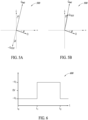
- Figure 5A and 5B are representations of the demodulation plane 500 associated with a raw output signal during application of a test signal. The description of Figures 5A and 5B will begin with reference to Figure 1 .
- Figure 5A illustrates the demodulation plane during a first phase of a testing period in which the test signal is applied to quadrature compensation electrodes 110.
- Figure 5B illustrates the demodulation plane during a second phase of the testing period in which the test signal is applied to the quadrature compensation electrodes 110.
- the quadrature compensation driver 114 applies a test voltage -Vt, increasing the voltage difference with respect to the rotor mass.
- the quadrature component of the raw output signal will have a natural quadrature component Qnat and a negative quadrature test component -Qtest. In practice, this results in a total quadrature component that is less than the natural quadrature component Qnat.
- Figure 5A also illustrates the rotational component Q of the raw output signal of the gyroscope 102. In Figure 5A there is a phase drift angle ⁇ for each of the components of the raw output signal.
- the output I PH1 of the demodulator 120 in phase 1 of the testing period is the sum of the parallel or horizontal components of the natural quadrature component Qnat, the negative test quadrature component Qtest, and the Coriolis component.
- the quadrature compensation driver 114 applies a test voltage Vt., reducing the voltage difference with respect to the rotor mass.
- Vt the quadrature component of the raw output signal will have the natural quadrature Qnat component and a positive quadrature test component. In practice, this results in a total quadrature component that is greater than the natural quadrature component Qnat.
- the output I PH2 of the demodulator 120 and the second phase of the testing period is the parallel or horizontal components of the natural quadrature component Qnat, the positive test quadrature component Qtest, and the Coriolis component.
- the delay calculator 116 receives the output of the demodulator 120 during the first and second phases of the testing period and calculates the phase drift angle ⁇ .
- the delay calculator 116 calculates the phase drift angle ⁇ based on the change in the output of the demodulator 120 between the first and second phases of the testing period and based on the magnitude of the quadrature test component.
- I PH1 Qnat ⁇ sin ⁇ ⁇ Q test ⁇ sin ⁇ + ⁇ ⁇ cos ⁇ .
- phase drift angle ⁇ is very small ( ⁇ ⁇ 1°)
- the phase drift angle ⁇ can be calculated based on the difference in the output of the demodulator 120 between the first and second phases of the testing period and on the magnitude of the test component of the quadrature component.
- the phase drift angle ⁇ can change based on temperature, process, mechanical stress, and other factors.
- the delay calculator 116 in connection with the quadrature compensation driver 114, can quickly and accurately determine the phase drift angle ⁇ at any time with little or no interruption to the operation of the gyroscope 102.
- a relatively small number of compensation electrodes 110 can be utilized to identify the phase drift angle ⁇ .
- a very large number of compensation electrodes may be utilized.
- a comparatively small number compensation electrodes 110 can be utilized to identify the phase drift angle ⁇ . This can save an enormous amount of area in manufacturing the gyroscope 104.
- a more accurate estimation of the amplitude of Qtest can be obtained by using the information on the perpendicular axis. While Qtest may normally be quite stable, such an estimation may be beneficial in case of reduction of second order effects.
- Qtest can be approximated in the following manner: Q test ⁇ cos ⁇ ⁇ Q test .
- Figure 6 is a graph illustrating a test signal 600 applied by the quadrature compensation driver 114 to the quadrature compensation electrodes 110.
- the first phase of the testing period begins by applying the test voltage with a negative polarity -Vt to the compensation electrodes 110.
- the second phase of the testing period begins by switching a polarity of the test signal 600 to a positive polarity Vt.
- a negative quadrature test voltage -Qtest is inserted into the raw output signal of the gyroscope 102.
- a positive quadrature test component Qtest is inserted into the raw output signal the gyroscope 102.
- the delay calculator 116 is able to measure the difference in the output of the demodulator between the first and second phases of the testing and calculate the phase drift angle by dividing the difference by 2*Qtest.
- FIG. 7 is a block diagram of the portion of sensor unit 101 implementing the above teaching.
- the demodulator 120 receives the raw output signal from the gyroscope 102.
- the demodulator 120 also receives the demodulation signal from the delay compensation circuit 118.
- the demodulation signal can correspond to the drive signal.
- the demodulator 120 provides the demodulated signal to an output block 124.
- the output block may perform some signal processing on the demodulated signal.
- the output block provides the demodulated signal to the delay calculator 116.
- the delay calculator 116 calculates the phase drift angle ⁇ in the manner described above.
- the delay calculator 116 provides the phase drift angle value ⁇ to the delay compensation circuit 118.
- the delay compensation circuit 118 receives the demodulation signal, adds in a phase delay equal to the phase drift angle value ⁇ , and provides the delayed demodulation signal to the demodulator 120.
- the output of the demodulator 120 now corresponds to the Coriolis component of the raw output signal.
- Figure 8 is an illustration of a portion of the resonator mass 104 of the gyroscope 102.
- Figure 8 also illustrates compensation electrodes 110a and 110b positioned in gaps in the resonator mass 104.
- the compensation electrodes 110a and 110b are fixed in place.
- the resonator mass 104 is movable.
- the resonator mass 104 is driven to oscillate along the X axis by drive electrodes 106 (not shown, Figure 1 ) adjacent to another portion of the resonator mass 104 not shown in Figure 8 .
- the resonator mass 104 has thick portions 104a that are closer to the compensation electrodes 110a and 110b and thinner portions 104b that are further away from the quadrature compensation electrodes 110a and 110b.
- the amount of area of the thick portions 104a that is directly between two quadrature compensation electrodes 110 and 110b changes.
- the amount of area of the thick portions 104a facing quadrature compensation electrodes 110a and 110b decreases.
- the amount of area of the thick portions 104a facing quadrature compensation electrodes 110a and 110b increases.
- a quadrature compensation force is generated.
- the resonator mass 104 receives a voltage of 10 V.
- the electrodes 110a receive 4 V and the electrodes 110b receives 6 V. Because there is a higher voltage difference between the resonator mass 104 and the electrodes 110a than between the resonator mass 104 and the electrodes 110b, a net electrostatic force is applied to the resonator mass 104 in the positive Y direction.
- the polarity between the electrodes 110a and 110b is switched so that the electrodes 110a receives 6 V and the electrodes 110b receive 4 V.
- the result is that a net electrostatic force is applied to the resonator mass 104 in the negative Y direction. It should be noted that because the quadrature test force depends on the horizontal position of the resonator mass 104, the quadrature test force is in phase with the drive signal.
- Figure 9 is a top view of a portion of a different resonator mass 104 of gyroscope 102.
- Figure 9 also illustrates compensation electrodes 110a and 110b positioned in gaps in the resonator mass 104.
- the compensation electrodes 110a and 110b are fixed in place, here carried by semiconductor regions 111.
- the resonator mass 104 is movable.
- Figure 9 is another example of in-plane quadrature compensation electrodes 110a and 110b.
- the resonator mass 104 is driven to oscillate along the drive axis by drive electrodes 106 (not shown here, see Figure 1 ) adjacent to another portion of the resonator mass 104 not shown in Figure 9 .
- a quadrature compensation force is generated.
- the resonator mass 104 receives a voltage of 10 V.
- the electrodes 110a receive 4 V and the electrodes 110b receives 6 V.
- the polarity between the electrodes 110a and 110b is switched so that the electrodes 110a receives 6 V and the electrodes 110b receive 4 V. Due to the geometry of the resonator mass relative to the test electrodes, a net electrostatic force is generated in different directions during the two test phases.
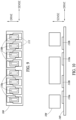
- Figure 10 is a cross-sectional view a portion of a different gyroscope 102 having compensation electrodes 110a and 110b positioned below the resonator mass on a substrate 149.
- the compensation electrodes 110a and 110b are fixed in place.
- the resonator mass 104 is movable.
- Figure 10 is an example of out-of-plane quadrature compensation electrodes 110a and 110b.
- the resonator mass 104 is driven to oscillate along the drive axis by drive electrodes 106 (not shown here, see Figure 1 ) adjacent to another portion of the resonator mass 104 not shown in Figure 10 .
- drive electrodes 106 not shown here, see Figure 1
- a quadrature compensation force is generated.
- the resonator mass 104 receives a voltage of 10 V.
- the electrodes 110a receive 4 V and the electrodes 110b receives 6 V.
- the polarity between the electrodes 110a and 110b is switched so that the electrodes 110a receives 6 V and the electrodes 110b receive 4 V. Due to the placement of the test electrodes 110a and 110b relative to the shape of the resonator mass 104, a net electrostatic force is generated in different directions during the two test phases. Other voltage schemes can be applied to generate a quadrature test force without departing from the scope of the present disclosure.
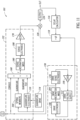
- Figure 11 is a more detailed diagram of sensor unit 101 of Figure 1 , wherein the resonator mass 104 is shown to include a drive resonator mass 204 and a sense resonator mass 160. Though shown as separate masses in Figure 11 , in some cases, the sense resonator mass 160 and the drive resonator mass 204 may be a single mass, or may effectively act as a single spring coupled mass.
- the sensor unit 101 includes a driving MEMS/ASIC 150 and a sense MEMS/ASIC 152.
- the MEMS/ASIC 150 includes the drive voltage supply 112.
- the drive voltage supply 112 applies the drive signal to drive electrodes 106.
- the drive voltage supply 112 may include a phase locked loop for controlling the phase of the drive signal.
- the drive voltage supply 112 may also include an adaptive gain control for controlling the amplitude of the drive signal.
- the drive supply voltage also supplies the demodulation signal to delay compensation circuit 118.
- the demodulation signal is a signal with a same phase as the drive signal, unless drift has occurred.
- the drive electrodes 106 receive the drive signal from the drive voltage supply 112 and apply an electrostatic drive force to the drive resonator mass 204.
- the electrostatic drive force drives the drive resonator mass 204 to oscillate along the drive axis.
- the drive resonator mass 204 oscillates in accordance with a mechanical transfer function.
- the drive MEMS/ASIC 150 includes drive sense electrodes 156 that convert the motion of the drive resonator mass 204 into a capacitive signal.
- the capacitive signal is passed to a converter 158 that converts the capacitive signal to a voltage signal.
- the voltage signal is fed back into the drive voltage supply 112 in a feedback loop configuration so that the phase locked loop and adaptive gain control loop can control the phase and amplitude of the drive signal.
- the displacement in the drive direction affects the sense MEMS/ASIC 152.
- the drive displacement and the rotational rate Q interact to generate the Coriolis force based on the drive displacement velocity of the resonator mass 104 and the rotational rate Q around the rotation axis.
- the displacement of the resonator mass 104 also interacts via spring couplings Kxy 164 to generate a quadrature force in the sense direction.
- the displacement of the drive resonator mass 204 also interacts with the quadrature compensation electrodes 110 in generating the quadrature compensation force.
- the quadrature compensation driver 114 applies the quadrature test signal to the quadrature compensation electrodes 110.
- the conceptual block 168 represents the summation of all of the forces acting in the sense direction on the sense resonator mass 160.
- the Coriolis force, the quadrature force, and the quadrature compensation force all affect the motion of the sense resonator mass 160 along the sense axis.
- the sense resonator mass 160 may be coupled to the drive resonator mass 204 by springs.
- the sense electrodes 108 sense the motion of the sense resonator mass 160 along the sense axis.
- the sense electrodes 108 generate a capacitive signal indicative of the motion of the sense resonator mass 160 along the sense axis.
- the capacitive signal is converted at block 170 to a sense voltage signal corresponding to the raw output signal of the gyroscope 102 ( Figure 1 ).
- the raw output signals is provided to the demodulator 120.
- the quadrature compensation driver 114 applies a test signal to the quadrature compensation electrodes, switching polarities between first and second phases as described previously.
- the demodulator 120 demodulates the demodulation signal and the raw output signal and generates a demodulated signal.
- An output block 124 may perform some additional processing on the demodulated signal.
- the output block 124 provides the demodulated signal to the delay calculator 116.
- the delay calculator 116 calculates the phase drift angle ⁇ as described previously and provides the phase drift angle value to the delay compensation circuit 118.
- the delay compensation circuit delays the demodulation signal by the value of cp.
- the demodulator 120 then outputs a demodulated signal that accurately corresponds to the rotational rate Q.
- Figure 12 is a flow diagram of a method 1200 for operating a gyroscope.
- the method 1200 includes driving a resonator mass of a gyroscope in a first direction by applying a drive signal to a drive electrode.
- the method 1200 includes applying a test voltage to a quadrature compensation electrode adjacent to the resonator mass.
- the method 1200 includes determining a phase difference between a first drive reference signal and an output signal of the gyroscope based on a change in the output signal during application of the test voltage.
- the method 1200 includes compensating for the phase difference between the demodulation signal and the output signal of the gyroscope.
Landscapes
- Engineering & Computer Science (AREA)
- Physics & Mathematics (AREA)
- General Physics & Mathematics (AREA)
- Radar, Positioning & Navigation (AREA)
- Remote Sensing (AREA)
- Power Engineering (AREA)
- Manufacturing & Machinery (AREA)
- Optics & Photonics (AREA)
- Electromagnetism (AREA)
- Signal Processing (AREA)
- Gyroscopes (AREA)
Description
- The present disclosure generally relates to gyroscopes. The present disclosure relates more particularly to detecting phase drift in gyroscope demodulation.
- It is often beneficial to sense the motion of an electronic device for vehicle. For this reason, many vehicles and electronic devices include inertial sensors. Inertial sensors can include accelerometers and gyroscopes. Accelerometers can detect linear motion. Gyroscopes can detect rotational motion.
- Detecting a rotation rate of a vehicle or electronic device with a gyroscope can be quite complicated. This is due, in part, to the fact that complex signals are utilized to excite a resonating mass of the gyroscope enough to sense the rotational motion of the resonating mass. It can be quite difficult to accurately extract the rotational rate from the raw output signal of the gyroscope.
- One particularly complicating factor is the quadrature component of an output signal. The raw output of a gyroscope corresponds to oscillation of a resonating mass in a sense direction perpendicular to the excitation direction of the resonating mass. While rotational motion will cause oscillation of the resonating mass in the sense direction, the quadrature effect will also contribute to oscillation of the resonating mass in the sense direction. However, the quadrature component of the raw output signal is spurious and does not represent rotational motion.
- Gyroscopes have leveraged the fact that the quadrature component of the raw output signal is typically in phase with the excitation or driving signal, while the rotational component of the raw output signal is typically 90° out of phase with the excitation or driving signal. Accordingly, the rotational component of the raw output signal the can be obtained by extracting the component of the raw output signal that is 90° out of phase with the excitation or driving signal. However, if there is phase drift associated with the raw output signal, then extracting the component of the output signal that is 90° out of phase with the driving signal will not accurately represent the rotational rate.
-
US 2019/120657 discloses a demodulation phase calibration unit and method based on applying DCsignal to quadrature tuning electrodes in a calibration stage or in an operations stage at appropriate times, such as during startup or when a measured rate of rotation is less than a threshold. - Thus, an aim of the present invention is to overcome the drawbacks of the prior art.
- According to the invention, a method for correcting gyroscope demodulation phase drift and a sensing device are provided, as defined in the accompanying claims.
-
Figure 1 is a block diagram of an electronic device including a sensor unit having a gyroscope. -
Figures 2A and 2B are simplified illustrations of a resonator mass of the gyroscope. -
Figure 3 is a graph illustrating signals associated with the gyroscopes. -
Figure 4 is a graph representing a demodulation plane associated with drive and output signals of the gyroscope. -
Figures 5A and 5B are graphs illustrating a demodulation plane associated with drive and output signals of the gyroscope during a test period of the gyroscope. -
Figure 6 is a graph illustrating a test signal of the gyroscope. -
Figure 7 is a block diagram illustrating aspects of an output operation of the sensor unit including the gyroscope. -
Figure 8 is an illustration of a portion of a gyroscope having in-plane quadrature compensation electrodes. -
Figure 9 is an illustration of a portion of a different gyroscope having in-plane quadrature compensation electrodes. -
Figure 10 is a cross-section of a portion of another gyroscope having out-of-plane quadrature compensation electrodes. -
Figure 11 is a block diagram illustrating the present sensor unit. -
Figure 12 is a flow diagram of a method for operating the gyroscope. - In the following description, certain specific details are set forth in order to provide a thorough understanding of the invention. For example, the terms "first," "second," and similar indicators of sequence are to be construed as interchangeable unless the context clearly dictates otherwise.
- In the following a sensor unit is described including a gyroscope. The sensor unit effectively and efficiently identifies phase drift between the raw output signal of the gyroscope and the drive signal of the gyroscope. This is accomplished by applying a test voltage to quadrature compensation electrodes adjacent to the resonator mass of the gyroscope and detecting changes in a demodulated output signal of the gyroscope while applying the test voltage.
- After the phase drift has been identified, the phase drift can be taken into account in generating the demodulated output signal. The demodulated signal will then accurately represent the rotational component of the raw output signal.
- The demodulated signal may be generated by demodulating the raw output signal with the drive signal. The demodulation process extracts the portion of the raw output signal that is 90 degrees out of phase with the drive signal. When a phase drift is detected while applying the test voltage, then a delay compensation circuit inserts a delay into the drive signal before demodulation occurs. The added delay compensates for the phase drift, effectively eliminating the negative effects of the phase drift.
- The test signal may include a first phase and a second phase. In the first phase the test signal has a first polarity. In the second phase, the test signal has a second polarity. The sensor unit detects the difference in the demodulated output signal between the first phase and the second phase of the test signal. The difference is indicative of the phase drift.
-
Figure 1 is a block diagram of anelectronic device 100. Theelectronic device 100 includes asensor unit 101. Thesensor unit 101 includes agyroscope 102. As will be set forth in more detail below, thesensor unit 101 identifies phase drift associated with an output signal of thegyroscope 102 and compensates for the phase drift in order to provide an accurate indication of a rotational rate applied to theelectronic device 100. - The
electronic device 100 can include a vehicle, such as an automobile, an aircraft, a boat, or other types of vehicles. It is often very beneficial to know the training rate of the vehicle about one or more axes of rotation. In vehicles, these axes of rotation may correspond to yaw, roll, and pitch. Thegyroscope 102 may be utilized to detect the rotational rate of the vehicle about one or more of these axes. - The
electronic device 100 can include a personal electronic device such as a smart phone, a smartwatch, smart glasses, a gaming device, a gaming controller, a tablet, a laptop computer, or other types of personal electronic devices. Thegyroscope 102 may be utilized to detect the rotational rate of theelectronic device 100 about one or more rotational axes. Theelectronic device 100 can include industrial equipment or other types of devices that may benefit from detecting rotational rates. - The
gyroscope 102 may correspond to a microelectromechanical systems (MEMS) gyroscope. Themems gyroscope 102 can include one or more movable masses defined from and coupled to a silicon substrate by one or more spring members. The mems gyroscope may also include various electrodes interleaved with the movable mass. The following description is directed primarily to electro-capacitive mems gyroscopes. Nevertheless, other types of gyroscopes can be used . - The
gyroscope 102 includes aresonator mass 104, driveelectrodes 106, andsense electrodes 108. As shown inFigure 1 , theresonator mass 104, thedrive electrodes 106, and thesense electrodes 108 are shown as making up thegyroscope 102, while other components associated with generating signals, sensing signals, and processing signals are shown as external to thegyroscope 102. However, in practice, thegyroscope 102 may be considered as including the various other components of thesensor unit 101 that will be described in greater detail below and that are shown as being external to thegyroscope 102. Thesensor unit 101 may, as a whole, be considered as a gyroscope. - The
resonator mass 104 may include a mass suspended above or otherwise movably coupled to a substrate. Theresonator mass 104 is configured to oscillate in at least two directions. A first direction of oscillation is known as a drive direction and corresponds to a first axis. A second direction of oscillation is known as a sense direction and corresponds to a second axis, substantially perpendicular to the first axis. Oscillation of theresonator mass 104 along the sense axis or sense direction is indicative of rotation of theresonator mass 104 about a third axis, substantially perpendicular to the first axis and the second axis. - The
resonator mass 104 may be coupled to a fixed substrate by spring members that allow the resonator mass to move back and forth along the drive axis. Theresonator mass 104 may also be coupled to the fixed substrate by spring members that allow the resonator mass to move back and forth along the sense axis. WhileFigure 1 shows theresonator mass 104 as a single mass, in practice, theresonator mass 104 may include multiple masses. For example, a first mass may be coupled to a second mass by spring members. The first mass may be driven to oscillate along the drive axis. Rotation of theelectronic device 100 around the rotation axis (third axis) may cause the second mass to oscillate along the sense axis (second axis). Various configurations of aresonator mass 104 ormultiple resonator masses 104 can be utilized. - The
drive electrodes 106 are utilized to drive theresonator mass 104 in the second direction. Thedrive electrodes 106 may correspond to a conductive mass with a comb shape. The fingers of the comb-shape may be interleaved with corresponding comb fingers of theresonator mass 104. If a voltage is applied to theresonator mass 104, then applying a periodic voltage to the drive electrodes can drive oscillation of theresonator mass 104 along the drive axis. However, various other configurations ofdrive electrodes 106 can be utilized. - The
sense electrodes 108 are utilized to sense oscillation of theresonator mass 104 along the sense axis. Thesense electrodes 108 may correspond to a conductive mass of the comb shape. The fingers of the comb shape may be interleaved with corresponding comb fingers of theresonator mass 104. However, various other configurations ofsense electrodes 108 can be utilized. - As described previously, if the
electronic device 100 and, correspondingly, theresonator mass 104, are rotated around the third rotation axis while theresonator mass 104 is oscillating along the first axis, then theresonator mass 104 will be forced to oscillate along the second axis by the Coriolis force that results from the rotation around the rotation axis and the oscillation along the first axis. Accordingly, the oscillation of theresonator mass 104 along the sense axis is indicative of the rotation of theresonator mass 104 around the rotation axis. - The
sensor unit 101 includes adrive voltage supply 112. Thedrive voltage supply 112 applies a drive voltage to thedrive electrodes 106. The drive voltage may correspond to an AC voltage having a selected amplitude and frequency. The drive voltage may be a sinusoidal voltage, a square wave voltage, a sawtooth voltage, or other types of AC voltage waveforms. - In the example of a constant rate gyroscope, the oscillation along the sense axis resulting from the Coriolis force will have the same frequency as the oscillation of the drive signal. However, the amplitude of the oscillation along the sense direction is indicative of the magnitude of the rotational rate around the third axis. The amplitude of the oscillation is indicated by the voltage that develops at the
sense electrodes 108 by capacitive interaction with theresonator mass 104. However, as set forth previously, other sensing configurations can be utilized. - The signal output by the
sense electrodes 108 corresponds to the raw output signal of thegyroscope 102. However, the raw output signal of thegyroscope 102 may not, by itself, accurately indicate the rotational rate around the third axis. This is because of a quadrature effect that develops at theresonator mass 104. In particular, when theresonator mass 104 is driven to oscillate along the first axis by the drive voltage applied to thedrive electrodes 106, theresonator mass 104 may also begin to oscillate along the sense axis even if there is no rotation around the rotational axis. Accordingly, the oscillation due to the quadrature affect may be considered a spurious oscillation, or the component of the raw output signal that is based on the quadrature affect may be considered a spurious signal. The raw output signal may be a current or may be a voltage, depending on a selected configuration of thegyroscope 102. - In some cases the component of the raw output signal due to the quadrature affect may be much larger than the component of the raw output signal due to the rotation of the
electronic device 100 around the rotational axis. In fact, the component of the raw output signal from the quadrature affect may be many times larger than the component of the raw output signal from the Coriolis force. - The
sensor unit 101 utilizes thedemodulator 120 in order to extract the Coriolis component from the raw output signal. As the raw output signal is made up of the quadrature component and the Coriolis component, if the Coriolis component can be extracted from the raw output signal, then a final output signal can be generated that corresponds only to the Coriolis component of the raw output signal. Thedemodulator 120 extracts the Coriolis component from the raw output signal and generates a final output signal that indicates the rotational rate around the rotation axis. As used herein, the terms "Coriolis component" and "rotational component" may be used interchangeably. - The
demodulator 120 utilizes the fact that the Coriolis component of the raw output signal will be 90° out of phase with the quadrature component of the raw output signal in order to separate the Coriolis component from the quadrature component. Furthermore, absent any collective phase drift in the raw output signal, the quadrature component will be in phase with the drive signal while the Coriolis component is 90° out of phase with the drive signal. Accordingly, thedemodulator 120 receives the drive signal and the raw output signal and performs demodulation of the raw output signal based on the drive signal. In particular, thedemodulator 120 outputs only that portion of the raw output signal that is 90° out of phase with the drive signal. If there is no phase drift between the raw output signal and the drive signal, then the output of thedemodulator 120 will represent only the Coriolis portion of the raw output signal. - Nevertheless, in some cases, there is a phase drift between the drive signal and the raw output signal. More particularly, the phase drift may occur between the raw output signal and a demodulation signal that is based on the drive signal. The demodulation signal may have a same phase as the drive signal, or may initially have a same phase as the drive signal. The phase drift corresponds to an angle ϕ by which the quadrature component is out of phase with the demodulation signal. The Coriolis component will be out of phase by 90° ± the value of ϕ, depending on the direction of the phase drift. Even a very small phase drift can result in the
demodulator 120 generating a final output signal that is very inaccurate. Phase drift can result from variations in temperature, mechanical stress, or variations during processing of thesensor unit 101. The demodulation signal is a drive reference signal. As used herein, "demodulation signal" and "drive reference signal" may be used interchangeably. - The
sensor unit 101 utilizesquadrature compensation electrodes 110, aquadrature compensation driver 114, adelay calculator 116, and adelay compensation circuit 118 in order to identify and compensate for phase drift. - In one example, the
quadrature compensation electrodes 110 are positioned adjacent to theresonator mass 104. Thequadrature compensation electrodes 110 can be used in both cases of in-plane sense axis (yaw) or out of plane sense axis (pitch and roll) based on selected design characteristics. Thequadrature compensation electrodes 110 can be utilized to drive motion of theresonator mass 104 along the sense axis in order to compensate for or cancel out the natural quadrature that develops from driving theresonator mass 104 along the drive axis. Nevertheless, principles of the present disclosure provide a potentially more effective way to utilize thequadrature compensation electrodes 110 in order to identify and compensate for phase drift in the raw output signal. - The
quadrature compensation driver 114 is configured to apply a test signal to thequadrature compensation electrodes 110. Thequadrature compensation driver 114 applies a test signal during a testing period; thedelay calculator 116 measures changes in the output of thedemodulator 120 during the testing period. Thedelay calculator 116 calculates the value of phase drift between the raw output signal and the demodulation signal based on changes in the output of thedemodulator 120 during the testing period. - The testing period may have two phases. In this case, during the first phase, the test signal has a first polarity. During the second phase, the test signal switches to a second polarity opposite the first polarity. The change in the output of the
demodulator 120 between the two phases of the test period is indicative of the magnitude of a phase drift angle ϕ. Thedelay calculator 116 calculates the value of the phase drift angle ϕ based, in part, on the change in the output of thedemodulator 120 between the two phases of the test. Further details regarding the calculation of the phase drift angle ϕ are provided below. - The
delay calculator 116 passes the value of the phase delay ϕ to thedelay compensation circuit 118. Thedelay compensation circuit 118 also receives the demodulation signal that is based on the drive signal. Thedelay compensation circuit 118 delays the demodulation signal by the value of the phase delay ϕ, generating a delayed demodulation signal. Thedelay compensation circuit 118 passes the delayed demodulation signal to thedemodulator 120. As used herein, the terms "phase drift" and "phase delay" may be used interchangeably. - While
Figure 1 illustrates the same signal being passed from thedrive voltage supply 112 to thedelay compensation circuit 118 and thedrive electrodes 106, in practice, thedrive voltage supply 112 may supply the drive signal to thedrive electrodes 106 and may supply the demodulation signal that is based on the drive signal to thedelay compensation circuit 118. - Because the demodulation signal is now delayed by the same phase delay value ϕ as is the raw output signal, the Coriolis component of the raw output signal is 90° out of phase with the delayed demodulation signal. When the
demodulator 120 performs demodulation on the delayed demodulation signal and the raw output signal, thedemodulator 120 outputs the true Coriolis component of the raw output signal. Accordingly, thedemodulator 120 outputs a signal that accurately indicates the rotational rate of theelectronic device 100 around the rotational axis. -
Figure 2A is a simplified representation of theresonator mass 104 of thegyroscope 102. The resonator mass is able to oscillate in the X direction by a spring represented here by the spring Kx. Oscillation of theresonator mass 104 in the X direction is dampened by a resistance Rx. Theresonator mass 104 is able to oscillate in the Y direction by a spring represented here by the spring Ky. Oscillation of theresonator mass 104 in the Y direction is dampened by a resistance Ry. In practice, theresonator mass 104 may include masses coupled together in various configurations. - The X-axis corresponds to the drive axis of the
resonator mass 104. The y-axis corresponds to the sense axis of theresonator mass 104. The z-axis corresponds to the rotational axis. Accordingly, motion of theresonator mass 104 along the sense axis Y is indicative of the rotational rate of the resonator mass about the rotational axis Z. - In
Figure 2A , the drive electrodes (seeFigure 1 ) drive theresonator mass 104 to oscillate in the X direction. InFigure 2A , there is no oscillation along the y-axis. Accordingly, there is no rotational rate around the rotational axis Z and there is no quadrature motion along the y-axis. Unfortunately, in practice there is typically a quadrature component along the sense axis anytime there is motion along the drive axis. -
Figure 2B illustrates both motion along the drive axis and motion along the sense axis. This is indicated by the diagonal arrows that have components in both the X and Y direction. In the exampleFigure 2B , there is no rotational motion around the z-axis. Accordingly, all of the motion on the y-axis is quadrature motion.Figures 2A and 2B are provided to illustrate basic concepts of drive motion and quadrature motion. -
Figure 3 is a graph 300 illustrating various possible signals output by thegyroscope 102. The graph 300 includes theraw output signal 302 of agyroscope 102. Theraw output signal 302 is sinusoidal in nature based on the capacitive output signals generated by sinusoidal motion of theresonator mass 104 relative to senseelectrodes 108. -
Figure 3 also illustrates thequadrature component 304 of theraw output signal 302. If there is no phase drift between the demodulation signal and the raw output signal, thequadrature component 304 of theraw output signal 302 will be in phase with the demodulation signal. -
Figure 3 also illustrates theCoriolis component 306 of theraw output signal 302 of thegyroscope 102. TheCoriolis component 306 is that portion of the raw output signal that is generated by the Coriolis force from rotation of theelectronic device 100 about the rotational axis while theresonator mass 104 is driven to oscillate along the drive axis. If there is no phase drift, theCoriolis component 306 will be 90° out of phase with the demodulation signal. - The
raw output signal 302 is the sum of thequadrature component 304 and theCoriolis component 306. In practice, the amplitude of thequadrature component 304 may be many times larger than the amplitude of theCoriolis component 306. Accordingly, it is highly beneficial to effectively demodulator the Coriolis component from the quadrature component using the demodulation signal as a phase reference. -
Figure 4 is a possible graph of thedemodulation plane 400 associated with the raw output signal and the demodulation signal or drive signal of agyroscope 102. Thedemodulation plane 400 has two axes. The first axis is the parallel axis extending in the horizontal direction inFigure 4 and annotated with the parallel symbol "=". The second axis is the perpendicular axis extending in the vertical direction inFigure 4 and annotated with the perpendicular symbol "⊥". In thedemodulation plane 400, the parallel (horizontal) axis is the component of the raw output signal that is in phase with the demodulation signal. The perpendicular (vertical) axis is 90° out of phase with the demodulation signal. -
Figure 4 illustrates the quadrature component Q and the rotational component Q of the raw output signal from thegyroscope 102. The quadrature component Q and the raw output signal Ω are 90° out of phase with each other. As described previously, if there is no phase drift, then the quadrature component Q will align with the perpendicular axis. If there is no phase drift, then the rotational component S2 will align with the parallel axis. Thedemodulator 120 of thesensor unit 101 outputs the parallel (horizontal) component of the raw output signal as the final output signal of thesensor unit 101. Accordingly, if there is no phase drift then the output of the demodulator will correspond entirely to the rotational component of the raw output signal. - In
Figure 4 , there is a phase drift angle ϕ. As can be seen inFigure 4 , the quadrature component Q is offset from the perpendicular axis by the phase drift angle ϕ. The rotational component S2 is offset from the parallel axis by the phase drift angle ϕ. In this situation, when thedemodulator 120 outputs the parallel component, the parallel component will not accurately represent the rotational component Q. WhileFigure 4 illustrates the quadrature component Q and the rotational component S2 as being substantially equal in magnitude, in practice, the magnitude of the quadrature component Q may be many times greater than the magnitude of rotational component Q. Accordingly, even a small phase drift angle ϕ will result in a very inaccurate representation of the rotational or Coriolis component S2 of the raw output signal. -
Figure 5A and 5B are representations of thedemodulation plane 500 associated with a raw output signal during application of a test signal. The description ofFigures 5A and 5B will begin with reference toFigure 1 .Figure 5A illustrates the demodulation plane during a first phase of a testing period in which the test signal is applied toquadrature compensation electrodes 110.Figure 5B illustrates the demodulation plane during a second phase of the testing period in which the test signal is applied to thequadrature compensation electrodes 110. - During the first phase of the testing period, the
quadrature compensation driver 114 applies a test voltage -Vt, increasing the voltage difference with respect to the rotor mass. During application of the first phase of the test voltage, the quadrature component of the raw output signal will have a natural quadrature component Qnat and a negative quadrature test component -Qtest. In practice, this results in a total quadrature component that is less than the natural quadrature component Qnat.Figure 5A also illustrates the rotational component Q of the raw output signal of thegyroscope 102. InFigure 5A there is a phase drift angle ϕ for each of the components of the raw output signal. The output IPH1 of thedemodulator 120 in phase 1 of the testing period is the sum of the parallel or horizontal components of the natural quadrature component Qnat, the negative test quadrature component Qtest, and the Coriolis component. - During the second phase of the testing period, the
quadrature compensation driver 114 applies a test voltage Vt., reducing the voltage difference with respect to the rotor mass. During application of the second phase of the test voltage, the quadrature component of the raw output signal will have the natural quadrature Qnat component and a positive quadrature test component. In practice, this results in a total quadrature component that is greater than the natural quadrature component Qnat. The output IPH2 of thedemodulator 120 and the second phase of the testing period is the parallel or horizontal components of the natural quadrature component Qnat, the positive test quadrature component Qtest, and the Coriolis component. - The
delay calculator 116 receives the output of thedemodulator 120 during the first and second phases of the testing period and calculates the phase drift angle ϕ. Thedelay calculator 116 calculates the phase drift angle ϕ based on the change in the output of thedemodulator 120 between the first and second phases of the testing period and based on the magnitude of the quadrature test component. IPH2 is given by the following relationship:
- IPH1 is given by the following relationship:

- The difference in the output of the demodulator between the first and second phases is given by the following relationship:

- Solving for sin(ϕ) gives the following:

- Because the phase drift angle ϕ is very small (ϕ << 1°), the small angle relationship can be used:

- Incorporating the small angle approximation into the equation above yields the following relationship for the phase drift angle ϕ:

- As set forth above, the phase drift angle ϕ can be calculated based on the difference in the output of the
demodulator 120 between the first and second phases of the testing period and on the magnitude of the test component of the quadrature component. The phase drift angle ϕ can change based on temperature, process, mechanical stress, and other factors. However, thedelay calculator 116, in connection with thequadrature compensation driver 114, can quickly and accurately determine the phase drift angle ϕ at any time with little or no interruption to the operation of thegyroscope 102. - Furthermore, a relatively small number of
compensation electrodes 110 can be utilized to identify the phase drift angle ϕ. In the scheme in which compensation electrodes are utilized to largely eliminate the quadrature component of the raw sensor signal, a very large number of compensation electrodes may be utilized. However, a comparatively smallnumber compensation electrodes 110 can be utilized to identify the phase drift angle ϕ. This can save an enormous amount of area in manufacturing thegyroscope 104. - In another example, a more accurate estimation of the amplitude of Qtest can be obtained by using the information on the perpendicular axis. While Qtest may normally be quite stable, such an estimation may be beneficial in case of reduction of second order effects. During the first phase of the testing period, the total signal QPH1 on the perpendicular axis is given by the following formula:

- During the second phase of the testing period, the total signal QPH2 on the perpendicular axis is given by the following formula:

- Subtracting QPH1 from QPH2 gives:

- Because ϕ is typically a very small angle, Qtest can be approximated in the following manner:

- Qtest can then be estimated in the following manner:

-
Figure 6 is a graph illustrating atest signal 600 applied by thequadrature compensation driver 114 to thequadrature compensation electrodes 110. At time T0 the first phase of the testing period begins by applying the test voltage with a negative polarity -Vt to thecompensation electrodes 110. At time T1 the second phase of the testing period begins by switching a polarity of thetest signal 600 to a positive polarity Vt. During the first phase, a negative quadrature test voltage -Qtest is inserted into the raw output signal of thegyroscope 102. During the second phase, a positive quadrature test component Qtest is inserted into the raw output signal thegyroscope 102. As set forth above, thedelay calculator 116 is able to measure the difference in the output of the demodulator between the first and second phases of the testing and calculate the phase drift angle by dividing the difference by 2*Qtest. -
Figure 7 is a block diagram of the portion ofsensor unit 101 implementing the above teaching. Thedemodulator 120 receives the raw output signal from thegyroscope 102. Thedemodulator 120 also receives the demodulation signal from thedelay compensation circuit 118. The demodulation signal can correspond to the drive signal. Thedemodulator 120 provides the demodulated signal to anoutput block 124. The output block may perform some signal processing on the demodulated signal. The output block provides the demodulated signal to thedelay calculator 116. Thedelay calculator 116 calculates the phase drift angle ϕ in the manner described above. Thedelay calculator 116 provides the phase drift angle value ϕ to thedelay compensation circuit 118. Thedelay compensation circuit 118 receives the demodulation signal, adds in a phase delay equal to the phase drift angle value ϕ, and provides the delayed demodulation signal to thedemodulator 120. The output of thedemodulator 120 now corresponds to the Coriolis component of the raw output signal. -
Figure 8 is an illustration of a portion of theresonator mass 104 of thegyroscope 102.Figure 8 also illustratescompensation electrodes resonator mass 104. Thecompensation electrodes resonator mass 104 is movable. - In the example of
Figure 8 , theresonator mass 104 is driven to oscillate along the X axis by drive electrodes 106 (not shown,Figure 1 ) adjacent to another portion of theresonator mass 104 not shown inFigure 8 . Theresonator mass 104 hasthick portions 104a that are closer to thecompensation electrodes thinner portions 104b that are further away from thequadrature compensation electrodes - As the
resonator mass 104 moves back and forth along the X axis, the amount of area of thethick portions 104a that is directly between twoquadrature compensation electrodes resonator mass 104 moves to the left along the X axis, the amount of area of thethick portions 104a facingquadrature compensation electrodes thick portions 104a facingquadrature compensation electrodes - By applying a voltage to the
resonator mass 104, and then applying a voltage between each pair ofelectrodes resonator mass 104 receives a voltage of 10 V. During the first phase of the test, theelectrodes 110a receive 4 V and theelectrodes 110b receives 6 V. Because there is a higher voltage difference between theresonator mass 104 and theelectrodes 110a than between theresonator mass 104 and theelectrodes 110b, a net electrostatic force is applied to theresonator mass 104 in the positive Y direction. During the second phase of the test period, the polarity between theelectrodes electrodes 110a receives 6 V and theelectrodes 110b receive 4 V. The result is that a net electrostatic force is applied to theresonator mass 104 in the negative Y direction. It should be noted that because the quadrature test force depends on the horizontal position of theresonator mass 104, the quadrature test force is in phase with the drive signal. - However, other voltage schemes can be applied to generate a quadrature test force.
-
Figure 9 is a top view of a portion of adifferent resonator mass 104 ofgyroscope 102.Figure 9 also illustratescompensation electrodes resonator mass 104. Thecompensation electrodes semiconductor regions 111. Theresonator mass 104 is movable.Figure 9 is another example of in-planequadrature compensation electrodes - In the example of
Figure 9 , theresonator mass 104 is driven to oscillate along the drive axis by drive electrodes 106 (not shown here, seeFigure 1 ) adjacent to another portion of theresonator mass 104 not shown inFigure 9 . - By applying a voltage to the
resonator mass 104, and then applying a voltage between the sets ofelectrodes resonator mass 104 receives a voltage of 10 V. - During the first phase of the test, the
electrodes 110a receive 4 V and theelectrodes 110b receives 6 V. During the second phase of the test period, the polarity between theelectrodes electrodes 110a receives 6 V and theelectrodes 110b receive 4 V. Due to the geometry of the resonator mass relative to the test electrodes, a net electrostatic force is generated in different directions during the two test phases. - Other voltage schemes can be applied to generate a quadrature test force without departing from the scope of the present disclosure.
-
Figure 10 is a cross-sectional view a portion of adifferent gyroscope 102 havingcompensation electrodes substrate 149. Thecompensation electrodes resonator mass 104 is movable.Figure 10 is an example of out-of-planequadrature compensation electrodes - In the example of
Figure 10 , theresonator mass 104 is driven to oscillate along the drive axis by drive electrodes 106 (not shown here, seeFigure 1 ) adjacent to another portion of theresonator mass 104 not shown inFigure 10 . By applying a voltage to theresonator mass 104, and then applying a voltage between the sets ofelectrodes resonator mass 104 receives a voltage of 10 V. During the first phase of the test, theelectrodes 110a receive 4 V and theelectrodes 110b receives 6 V. During the second phase of the test period, the polarity between theelectrodes electrodes 110a receives 6 V and theelectrodes 110b receive 4 V. Due to the placement of thetest electrodes resonator mass 104, a net electrostatic force is generated in different directions during the two test phases. Other voltage schemes can be applied to generate a quadrature test force without departing from the scope of the present disclosure. -
Figure 11 is a more detailed diagram ofsensor unit 101 ofFigure 1 , wherein theresonator mass 104 is shown to include adrive resonator mass 204 and asense resonator mass 160. Though shown as separate masses inFigure 11 , in some cases, thesense resonator mass 160 and thedrive resonator mass 204 may be a single mass, or may effectively act as a single spring coupled mass. - The
sensor unit 101 includes a driving MEMS/ASIC 150 and a sense MEMS/ASIC 152. - The MEMS/
ASIC 150 includes thedrive voltage supply 112. Thedrive voltage supply 112 applies the drive signal to driveelectrodes 106. Thedrive voltage supply 112 may include a phase locked loop for controlling the phase of the drive signal. Thedrive voltage supply 112 may also include an adaptive gain control for controlling the amplitude of the drive signal. The drive supply voltage also supplies the demodulation signal to delaycompensation circuit 118. The demodulation signal is a signal with a same phase as the drive signal, unless drift has occurred. - The
drive electrodes 106 receive the drive signal from thedrive voltage supply 112 and apply an electrostatic drive force to thedrive resonator mass 204. The electrostatic drive force drives thedrive resonator mass 204 to oscillate along the drive axis. Thedrive resonator mass 204 oscillates in accordance with a mechanical transfer function. - The drive MEMS/
ASIC 150 includesdrive sense electrodes 156 that convert the motion of thedrive resonator mass 204 into a capacitive signal. The capacitive signal is passed to aconverter 158 that converts the capacitive signal to a voltage signal. The voltage signal is fed back into thedrive voltage supply 112 in a feedback loop configuration so that the phase locked loop and adaptive gain control loop can control the phase and amplitude of the drive signal. - The displacement in the drive direction affects the sense MEMS/
ASIC 152. The drive displacement and the rotational rate Q interact to generate the Coriolis force based on the drive displacement velocity of theresonator mass 104 and the rotational rate Q around the rotation axis. The displacement of theresonator mass 104 also interacts viaspring couplings Kxy 164 to generate a quadrature force in the sense direction. The displacement of thedrive resonator mass 204 also interacts with thequadrature compensation electrodes 110 in generating the quadrature compensation force. Thequadrature compensation driver 114 applies the quadrature test signal to thequadrature compensation electrodes 110. - The
conceptual block 168 represents the summation of all of the forces acting in the sense direction on thesense resonator mass 160. The Coriolis force, the quadrature force, and the quadrature compensation force all affect the motion of thesense resonator mass 160 along the sense axis. Thesense resonator mass 160 may be coupled to thedrive resonator mass 204 by springs. - The
sense electrodes 108 sense the motion of thesense resonator mass 160 along the sense axis. Thesense electrodes 108 generate a capacitive signal indicative of the motion of thesense resonator mass 160 along the sense axis. The capacitive signal is converted atblock 170 to a sense voltage signal corresponding to the raw output signal of the gyroscope 102 (Figure 1 ). The raw output signals is provided to thedemodulator 120. - The
drive voltage supply 112 supplies a demodulated signal to thedelay compensation block 118. The demodulated signal corresponds to a drive reference signal. Initially, thedelay compensation block 118 may not add any delay into the demodulation signal. Thedelay compensation block 118 merely passes the demodulation signal to thedemodulator 120. - During the testing phase, the
quadrature compensation driver 114 applies a test signal to the quadrature compensation electrodes, switching polarities between first and second phases as described previously. Thedemodulator 120 demodulates the demodulation signal and the raw output signal and generates a demodulated signal. Anoutput block 124 may perform some additional processing on the demodulated signal. - The
output block 124 provides the demodulated signal to thedelay calculator 116. Thedelay calculator 116 calculates the phase drift angle ϕ as described previously and provides the phase drift angle value to thedelay compensation circuit 118. The delay compensation circuit delays the demodulation signal by the value of cp. Thedemodulator 120 then outputs a demodulated signal that accurately corresponds to the rotational rate Q. -
Figure 12 is a flow diagram of amethod 1200 for operating a gyroscope. At 1202, themethod 1200 includes driving a resonator mass of a gyroscope in a first direction by applying a drive signal to a drive electrode. At 1204, themethod 1200 includes applying a test voltage to a quadrature compensation electrode adjacent to the resonator mass. At 1206, themethod 1200 includes determining a phase difference between a first drive reference signal and an output signal of the gyroscope based on a change in the output signal during application of the test voltage. At 1208, themethod 1200 includes compensating for the phase difference between the demodulation signal and the output signal of the gyroscope. - Finally, it is clear that numerous variations and modifications may be made to the method and device described and illustrated herein, all falling within the scope of the invention as defined in the attached claims.
Claims (13)
- A method for correcting gyroscope demodulation phase drift, comprising:driving a resonator mass (104; 160, 204) of a gyroscope (102) in a first direction by applying a first drive signal to a drive electrode;applying a test voltage to a quadrature compensation electrode (110; 110a, 110b) adjacent to the resonator mass;determining a phase difference between a first drive reference signal and an output signal of the gyroscope based on a change in the output signal during application of the test voltage, the first drive reference signal having a same phase as the first drive signal, or initially a same phase as the first drive signal; andcompensating for the phase difference between the first drive reference signal and the output signal of the gyroscope; andreversing a polarity of the test voltage during application of the test voltage.
- The method of claim 1, wherein compensating for the phase difference includes generating a second drive reference signal by delaying the first drive reference signal by the phase difference,
the method further comprising:generating a raw output signal from the gyroscope (102); andgenerating the output signal by performing demodulation between the raw output signal and the second drive reference signal. - The method of any of the preceding claims, wherein determining the phase difference includes measuring the output signal before and after reversing the polarity of the test signal.
- The method of claim 3, wherein determining the phase difference includes:determining a test component of a quadrature component of the output signal;determining the change in the output signal after reversing the polarity of the test signal; anddividing the change by double the test component.
- The method of any of the preceding claims, wherein the test component corresponds to a portion of the quadrature component resulting from the test signal.
- The method of 2 or any of claims 3-5 when depending on claim 2, wherein the raw output signal represents oscillation of the oscillating mass in a second direction transverse to the first direction.
- The method of any of the preceding claims, wherein the test voltage includes a first phase with a first polarity and a second phase with a second polarity, wherein determining a phase difference comprises calculating the value of the phase difference based on a difference of the output signal between the first phase and the second phase.
- A sensing device (101), comprising:a gyroscope (102) having a resonator mass (104; 160, 204) and a quadrature compensation electrode (110; 110a, 110b) adjacent to the resonator mass, the resonator mass (104; 160, 204) having a drive electrode (106) configured to be driven in a first direction by a drive signal, the quadrature compensation electrode (110; 110a, 110b) configured to receive a test voltage;means (114) for applying the test voltage to the quadrature compensation electrode (110; 110a, 110b);a demodulator (120) having:a first input coupled to the gyroscope and configured to receive an output signal of the gyroscope;a second input; andan output,the demodulator configured to extract a Coriolis component from an output signal of the gyroscope;a delay calculator (116) coupled to the output of the demodulator (120) and configured to calculate a delay as a phase difference between a drive reference signal and an output signal of the gyroscope based on a change in the output signal during application of the test voltage, the drive reference signal having a same phase as the first drive signal, or initially a same phase as the first drive signal;a delay compensation circuit (118) coupled to the delay calculator and the second input of the demodulator and configured to compensate for the phase difference between the drive reference signal and the output signal of the gyroscope; andmeans for reversing a polarity of the test voltage during application of the test voltage.
- The sensing device of the preceding claim, further comprising a drive voltage supply (112) coupled to the gyroscope (102) and the delay compensation circuit (118) and configured to provide the drive signal to the drive electrode (106) and the drive reference signal to the delay compensation circuit (118).
- The sensing device of the preceding claim, further comprising a quadrature compensation driver (114) coupled to the gyroscope (102) and configured to apply the test voltage to the compensation electrode (110; 110a, 110b).
- The sensing device of claim 10, wherein the delay compensation circuit (118) is configured to delay the drive reference signal by a value of the phase difference to generate the drive reference signal.
- The sensing device of claim 11, wherein the gyroscope (102) includes sense electrodes (108) configured to generate the output signal of the gyroscope.
- The sensing device of claim 11, wherein the test voltage includes a first phase with a first polarity and a second phase with a second polarity, wherein the delay calculator (116) calculates the value of the phase difference based on a difference in the output signal of the demodulator (120) between the first phase and the second phase.
Applications Claiming Priority (1)
| Application Number | Priority Date | Filing Date | Title |
|---|---|---|---|
| US17/460,030 US11668585B2 (en) | 2021-08-27 | 2021-08-27 | Method for correcting gyroscope demodulation phase drift |
Publications (2)
| Publication Number | Publication Date |
|---|---|
| EP4148382A1 EP4148382A1 (en) | 2023-03-15 |
| EP4148382B1 true EP4148382B1 (en) | 2024-09-25 |
Family
ID=83004892
Family Applications (1)
| Application Number | Title | Priority Date | Filing Date |
|---|---|---|---|
| EP22191021.9A Active EP4148382B1 (en) | 2021-08-27 | 2022-08-18 | Method for correcting gyroscope demodulation phase drift |
Country Status (3)
| Country | Link |
|---|---|
| US (2) | US11668585B2 (en) |
| EP (1) | EP4148382B1 (en) |
| CN (1) | CN115900677A (en) |
Families Citing this family (3)
| Publication number | Priority date | Publication date | Assignee | Title |
|---|---|---|---|---|
| US11668585B2 (en) | 2021-08-27 | 2023-06-06 | Stmicroelectronics S.R.L. | Method for correcting gyroscope demodulation phase drift |
| CN116295537B (en) * | 2023-05-18 | 2023-09-05 | 北京星河动力装备科技有限公司 | Gyroscope performance test method and device, storage medium and electronic equipment |
| US20250305826A1 (en) * | 2024-03-29 | 2025-10-02 | Stmicroelectronics International N.V. | Gyroscope quadrature and phase error estimation and correction |
Family Cites Families (18)
| Publication number | Priority date | Publication date | Assignee | Title |
|---|---|---|---|---|
| DE19939998A1 (en) * | 1999-08-24 | 2001-03-01 | Bosch Gmbh Robert | Device for generating bias voltage for a vibrating yaw rate sensor |
| DE102004061804B4 (en) | 2004-12-22 | 2015-05-21 | Robert Bosch Gmbh | Micromechanical rotation rate sensor with error suppression |
| DE102009001248B4 (en) | 2009-02-27 | 2020-12-17 | Hanking Electronics, Ltd. | MEMS gyroscope for determining rotational movements around an x, y or z axis |
| DE102009003217A1 (en) | 2009-05-19 | 2010-11-25 | Robert Bosch Gmbh | Self-test for rotation rate sensors |
| JP5599507B2 (en) * | 2011-05-11 | 2014-10-01 | 三菱電機株式会社 | Differential demodulation apparatus and differential demodulation method |
| FI124624B (en) * | 2012-06-29 | 2014-11-14 | Murata Manufacturing Co | Improved vibration gyroscope |
| US9310202B2 (en) | 2012-07-09 | 2016-04-12 | Freescale Semiconductor, Inc. | Angular rate sensor with quadrature error compensation |
| US9410806B2 (en) * | 2013-08-26 | 2016-08-09 | Robert Bosch Gmbh | System and method for gyroscope zero-rate-offset drift reduction through demodulation phase error correction |
| WO2016097127A1 (en) | 2014-12-18 | 2016-06-23 | Acreo Swedish Ict Ab | A quadrature compensation method for mems gyroscopes and a gyroscope sensor |
| EP3034997B1 (en) | 2014-12-18 | 2020-12-16 | RISE Research Institutes of Sweden AB | Mems gyro |
| US11365983B2 (en) | 2016-06-03 | 2022-06-21 | Invensense, Inc. | Demodulation phase calibration using external input |
| EP3270105A1 (en) * | 2016-07-14 | 2018-01-17 | NXP USA, Inc. | Segmented electrode structure for quadrature reduction in an integrated device |
| US11047684B2 (en) * | 2019-02-28 | 2021-06-29 | Nxp Usa, Inc. | System and method for continuous monitoring of a gyroscope |
| IT201900009582A1 (en) | 2019-06-20 | 2020-12-20 | St Microelectronics Srl | MEMS GYRO WITH REAL-TIME SCALE FACTOR CALIBRATION AND RELATED CALIBRATION METHOD |
| US11125560B2 (en) * | 2019-07-30 | 2021-09-21 | Invensense, Inc. | Robust method for tuning of gyroscope demodulation phase |
| CN111998842B (en) * | 2020-06-30 | 2022-07-12 | 浙江大学 | On-line compensation method and system for phase delay of micromechanical gyroscope interface circuit |
| CN114006616B (en) * | 2020-07-27 | 2025-10-03 | 中国科学院微电子研究所 | Adaptive phase alignment circuit, debugging method and gyroscope measurement and control circuit |
| US11668585B2 (en) | 2021-08-27 | 2023-06-06 | Stmicroelectronics S.R.L. | Method for correcting gyroscope demodulation phase drift |
-
2021
- 2021-08-27 US US17/460,030 patent/US11668585B2/en active Active
-
2022
- 2022-08-18 EP EP22191021.9A patent/EP4148382B1/en active Active
- 2022-08-26 CN CN202211031957.3A patent/CN115900677A/en active Pending
-
2023
- 2023-05-09 US US18/314,650 patent/US12422280B2/en active Active
Also Published As
| Publication number | Publication date |
|---|---|
| US12422280B2 (en) | 2025-09-23 |
| US11668585B2 (en) | 2023-06-06 |
| US20230068616A1 (en) | 2023-03-02 |
| US20230280189A1 (en) | 2023-09-07 |
| CN115900677A (en) | 2023-04-04 |
| EP4148382A1 (en) | 2023-03-15 |
Similar Documents
| Publication | Publication Date | Title |
|---|---|---|
| EP4148382B1 (en) | Method for correcting gyroscope demodulation phase drift | |
| US9618533B2 (en) | Systems and methods for determining rotation from nonlinear periodic signals | |
| EP2108964B1 (en) | Systems and methods for acceleration and rotational determination from an in-plane and out-of-plane mems device | |
| US7971483B2 (en) | Systems and methods for acceleration and rotational determination from an out-of-plane MEMS device | |
| EP2442071A1 (en) | Physical quantity detection device and physical quantity detection device control method, as well as abnormality diagnosis system and abnormality diagnosis method | |
| CN105783899B (en) | High bandwidth Coriolis Vibration Gyroscope (CVG) with in-situ bias self-calibration | |
| EP3754299A1 (en) | Mems gyroscope with calibration of the scale factor in real time and calibration method thereof | |
| US8196467B2 (en) | Angular velocity detecting method | |
| CN101799479A (en) | Vibration compensation for speed sensors | |
| US6834247B2 (en) | Off-set elimination system for a vibrating gyroscope | |
| EP3312558B1 (en) | Hemispherical resonator gyroscope | |
| KR101658473B1 (en) | Compensation method of acceleration sensitivity of mems gyroscope | |
| CN107063221A (en) | Physical quantity detection circuit, electronic equipment and moving body | |
| EP3043146B1 (en) | Approach for control redistribution of coriolis vibratory gyroscope ("cvg") for performance improvement | |
| JP4390539B2 (en) | Load characteristic calculation device and motor control device | |
| US10260901B2 (en) | Method for optimizing the switch-on time of a coriolis gyroscope and coriolis gyroscope suitable thereof | |
| US20250297857A1 (en) | Gyroscopic measurement method and sensor | |
| EP4177568A1 (en) | Vibrating-mass sensor system | |
| CN110749316B (en) | System and method for sensing angular motion in the presence of low frequency noise | |
| US20170059323A1 (en) | Combination electrode for drive, drive detection, coriolis detection, and quadrature compensation | |
| EP4737850A1 (en) | Scale factor calibration method for microelectromechanical gyroscopes | |
| WO2026062635A1 (en) | Method for computing and reducing frequency "lock-in" for a vibrating beam accelerometer and optional linear enhancement | |
| Zhang et al. | A method of improving the anti-rudder beating of Si micromechanical gyro driven by rotating carrier | |
| KR20090107932A (en) | System and method for determining acceleration and rotation from in-plane and out-of-plane MESS devices | |
| CN117295926A (en) | Method for correcting measurements from vibration angle inertial sensors |
Legal Events
| Date | Code | Title | Description |
|---|---|---|---|
| PUAI | Public reference made under article 153(3) epc to a published international application that has entered the european phase |
Free format text: ORIGINAL CODE: 0009012 |
|
| STAA | Information on the status of an ep patent application or granted ep patent |
Free format text: STATUS: THE APPLICATION HAS BEEN PUBLISHED |
|
| AK | Designated contracting states |
Kind code of ref document: A1 Designated state(s): AL AT BE BG CH CY CZ DE DK EE ES FI FR GB GR HR HU IE IS IT LI LT LU LV MC MK MT NL NO PL PT RO RS SE SI SK SM TR |
|
| STAA | Information on the status of an ep patent application or granted ep patent |
Free format text: STATUS: REQUEST FOR EXAMINATION WAS MADE |
|
| 17P | Request for examination filed |
Effective date: 20230913 |
|
| RBV | Designated contracting states (corrected) |
Designated state(s): AL AT BE BG CH CY CZ DE DK EE ES FI FR GB GR HR HU IE IS IT LI LT LU LV MC MK MT NL NO PL PT RO RS SE SI SK SM TR |
|
| GRAP | Despatch of communication of intention to grant a patent |
Free format text: ORIGINAL CODE: EPIDOSNIGR1 |
|
| STAA | Information on the status of an ep patent application or granted ep patent |
Free format text: STATUS: GRANT OF PATENT IS INTENDED |
|
| INTG | Intention to grant announced |
Effective date: 20240321 |
|
| GRAS | Grant fee paid |
Free format text: ORIGINAL CODE: EPIDOSNIGR3 |
|
| GRAA | (expected) grant |
Free format text: ORIGINAL CODE: 0009210 |
|
| STAA | Information on the status of an ep patent application or granted ep patent |
Free format text: STATUS: THE PATENT HAS BEEN GRANTED |
|
| AK | Designated contracting states |
Kind code of ref document: B1 Designated state(s): AL AT BE BG CH CY CZ DE DK EE ES FI FR GB GR HR HU IE IS IT LI LT LU LV MC MK MT NL NO PL PT RO RS SE SI SK SM TR |
|
| REG | Reference to a national code |
Ref country code: GB Ref legal event code: FG4D |
|
| REG | Reference to a national code |
Ref country code: CH Ref legal event code: EP |
|
| REG | Reference to a national code |
Ref country code: DE Ref legal event code: R096 Ref document number: 602022006343 Country of ref document: DE |
|
| REG | Reference to a national code |
Ref country code: IE Ref legal event code: FG4D |
|
| REG | Reference to a national code |
Ref country code: LT Ref legal event code: MG9D |
|
| PG25 | Lapsed in a contracting state [announced via postgrant information from national office to epo] |
Ref country code: NO Free format text: LAPSE BECAUSE OF FAILURE TO SUBMIT A TRANSLATION OF THE DESCRIPTION OR TO PAY THE FEE WITHIN THE PRESCRIBED TIME-LIMIT Effective date: 20241225 |
|
| PG25 | Lapsed in a contracting state [announced via postgrant information from national office to epo] |
Ref country code: GR Free format text: LAPSE BECAUSE OF FAILURE TO SUBMIT A TRANSLATION OF THE DESCRIPTION OR TO PAY THE FEE WITHIN THE PRESCRIBED TIME-LIMIT Effective date: 20241226 Ref country code: FI Free format text: LAPSE BECAUSE OF FAILURE TO SUBMIT A TRANSLATION OF THE DESCRIPTION OR TO PAY THE FEE WITHIN THE PRESCRIBED TIME-LIMIT Effective date: 20240925 |
|
| PG25 | Lapsed in a contracting state [announced via postgrant information from national office to epo] |
Ref country code: BG Free format text: LAPSE BECAUSE OF FAILURE TO SUBMIT A TRANSLATION OF THE DESCRIPTION OR TO PAY THE FEE WITHIN THE PRESCRIBED TIME-LIMIT Effective date: 20240925 |
|
| PG25 | Lapsed in a contracting state [announced via postgrant information from national office to epo] |
Ref country code: LV Free format text: LAPSE BECAUSE OF FAILURE TO SUBMIT A TRANSLATION OF THE DESCRIPTION OR TO PAY THE FEE WITHIN THE PRESCRIBED TIME-LIMIT Effective date: 20240925 |
|
| PG25 | Lapsed in a contracting state [announced via postgrant information from national office to epo] |
Ref country code: RS Free format text: LAPSE BECAUSE OF FAILURE TO SUBMIT A TRANSLATION OF THE DESCRIPTION OR TO PAY THE FEE WITHIN THE PRESCRIBED TIME-LIMIT Effective date: 20241225 |
|
| REG | Reference to a national code |
Ref country code: NL Ref legal event code: MP Effective date: 20240925 |
|
| PG25 | Lapsed in a contracting state [announced via postgrant information from national office to epo] |
Ref country code: FI Free format text: LAPSE BECAUSE OF FAILURE TO SUBMIT A TRANSLATION OF THE DESCRIPTION OR TO PAY THE FEE WITHIN THE PRESCRIBED TIME-LIMIT Effective date: 20240925 Ref country code: BG Free format text: LAPSE BECAUSE OF FAILURE TO SUBMIT A TRANSLATION OF THE DESCRIPTION OR TO PAY THE FEE WITHIN THE PRESCRIBED TIME-LIMIT Effective date: 20240925 Ref country code: RS Free format text: LAPSE BECAUSE OF FAILURE TO SUBMIT A TRANSLATION OF THE DESCRIPTION OR TO PAY THE FEE WITHIN THE PRESCRIBED TIME-LIMIT Effective date: 20241225 Ref country code: NO Free format text: LAPSE BECAUSE OF FAILURE TO SUBMIT A TRANSLATION OF THE DESCRIPTION OR TO PAY THE FEE WITHIN THE PRESCRIBED TIME-LIMIT Effective date: 20241225 Ref country code: LV Free format text: LAPSE BECAUSE OF FAILURE TO SUBMIT A TRANSLATION OF THE DESCRIPTION OR TO PAY THE FEE WITHIN THE PRESCRIBED TIME-LIMIT Effective date: 20240925 Ref country code: GR Free format text: LAPSE BECAUSE OF FAILURE TO SUBMIT A TRANSLATION OF THE DESCRIPTION OR TO PAY THE FEE WITHIN THE PRESCRIBED TIME-LIMIT Effective date: 20241226 |
|
| REG | Reference to a national code |
Ref country code: AT Ref legal event code: MK05 Ref document number: 1726955 Country of ref document: AT Kind code of ref document: T Effective date: 20240925 |
|
| PG25 | Lapsed in a contracting state [announced via postgrant information from national office to epo] |
Ref country code: NL Free format text: LAPSE BECAUSE OF FAILURE TO SUBMIT A TRANSLATION OF THE DESCRIPTION OR TO PAY THE FEE WITHIN THE PRESCRIBED TIME-LIMIT Effective date: 20240925 |
|
| PG25 | Lapsed in a contracting state [announced via postgrant information from national office to epo] |
Ref country code: IS Free format text: LAPSE BECAUSE OF FAILURE TO SUBMIT A TRANSLATION OF THE DESCRIPTION OR TO PAY THE FEE WITHIN THE PRESCRIBED TIME-LIMIT Effective date: 20250125 Ref country code: PT Free format text: LAPSE BECAUSE OF FAILURE TO SUBMIT A TRANSLATION OF THE DESCRIPTION OR TO PAY THE FEE WITHIN THE PRESCRIBED TIME-LIMIT Effective date: 20250127 |
|
| PG25 | Lapsed in a contracting state [announced via postgrant information from national office to epo] |
Ref country code: RO Free format text: LAPSE BECAUSE OF FAILURE TO SUBMIT A TRANSLATION OF THE DESCRIPTION OR TO PAY THE FEE WITHIN THE PRESCRIBED TIME-LIMIT Effective date: 20240925 Ref country code: SM Free format text: LAPSE BECAUSE OF FAILURE TO SUBMIT A TRANSLATION OF THE DESCRIPTION OR TO PAY THE FEE WITHIN THE PRESCRIBED TIME-LIMIT Effective date: 20240925 |
|
| PG25 | Lapsed in a contracting state [announced via postgrant information from national office to epo] |
Ref country code: ES Free format text: LAPSE BECAUSE OF FAILURE TO SUBMIT A TRANSLATION OF THE DESCRIPTION OR TO PAY THE FEE WITHIN THE PRESCRIBED TIME-LIMIT Effective date: 20240925 |
|
| PG25 | Lapsed in a contracting state [announced via postgrant information from national office to epo] |
Ref country code: EE Free format text: LAPSE BECAUSE OF FAILURE TO SUBMIT A TRANSLATION OF THE DESCRIPTION OR TO PAY THE FEE WITHIN THE PRESCRIBED TIME-LIMIT Effective date: 20240925 Ref country code: AT Free format text: LAPSE BECAUSE OF FAILURE TO SUBMIT A TRANSLATION OF THE DESCRIPTION OR TO PAY THE FEE WITHIN THE PRESCRIBED TIME-LIMIT Effective date: 20240925 |
|
| PG25 | Lapsed in a contracting state [announced via postgrant information from national office to epo] |
Ref country code: PL Free format text: LAPSE BECAUSE OF FAILURE TO SUBMIT A TRANSLATION OF THE DESCRIPTION OR TO PAY THE FEE WITHIN THE PRESCRIBED TIME-LIMIT Effective date: 20240925 Ref country code: CZ Free format text: LAPSE BECAUSE OF FAILURE TO SUBMIT A TRANSLATION OF THE DESCRIPTION OR TO PAY THE FEE WITHIN THE PRESCRIBED TIME-LIMIT Effective date: 20240925 |
|
| PG25 | Lapsed in a contracting state [announced via postgrant information from national office to epo] |
Ref country code: SK Free format text: LAPSE BECAUSE OF FAILURE TO SUBMIT A TRANSLATION OF THE DESCRIPTION OR TO PAY THE FEE WITHIN THE PRESCRIBED TIME-LIMIT Effective date: 20240925 Ref country code: IT Free format text: LAPSE BECAUSE OF FAILURE TO SUBMIT A TRANSLATION OF THE DESCRIPTION OR TO PAY THE FEE WITHIN THE PRESCRIBED TIME-LIMIT Effective date: 20240925 |
|
| REG | Reference to a national code |
Ref country code: DE Ref legal event code: R097 Ref document number: 602022006343 Country of ref document: DE |
|
| PG25 | Lapsed in a contracting state [announced via postgrant information from national office to epo] |
Ref country code: DK Free format text: LAPSE BECAUSE OF FAILURE TO SUBMIT A TRANSLATION OF THE DESCRIPTION OR TO PAY THE FEE WITHIN THE PRESCRIBED TIME-LIMIT Effective date: 20240925 |
|
| PLBE | No opposition filed within time limit |
Free format text: ORIGINAL CODE: 0009261 |
|
| STAA | Information on the status of an ep patent application or granted ep patent |
Free format text: STATUS: NO OPPOSITION FILED WITHIN TIME LIMIT |
|
| 26N | No opposition filed |
Effective date: 20250626 |
|
| PG25 | Lapsed in a contracting state [announced via postgrant information from national office to epo] |
Ref country code: SE Free format text: LAPSE BECAUSE OF FAILURE TO SUBMIT A TRANSLATION OF THE DESCRIPTION OR TO PAY THE FEE WITHIN THE PRESCRIBED TIME-LIMIT Effective date: 20240925 |
|
| PGFP | Annual fee paid to national office [announced via postgrant information from national office to epo] |
Ref country code: DE Payment date: 20250724 Year of fee payment: 4 |
|
| PG25 | Lapsed in a contracting state [announced via postgrant information from national office to epo] |
Ref country code: HR Free format text: LAPSE BECAUSE OF FAILURE TO SUBMIT A TRANSLATION OF THE DESCRIPTION OR TO PAY THE FEE WITHIN THE PRESCRIBED TIME-LIMIT Effective date: 20240925 |
|
| REG | Reference to a national code |
Ref country code: CH Ref legal event code: H13 Free format text: ST27 STATUS EVENT CODE: U-0-0-H10-H13 (AS PROVIDED BY THE NATIONAL OFFICE) Effective date: 20260324 |
|
| PG25 | Lapsed in a contracting state [announced via postgrant information from national office to epo] |
Ref country code: MC Free format text: LAPSE BECAUSE OF FAILURE TO SUBMIT A TRANSLATION OF THE DESCRIPTION OR TO PAY THE FEE WITHIN THE PRESCRIBED TIME-LIMIT Effective date: 20240925 |
|
| PG25 | Lapsed in a contracting state [announced via postgrant information from national office to epo] |
Ref country code: LU Free format text: LAPSE BECAUSE OF NON-PAYMENT OF DUE FEES Effective date: 20250818 |
|
| PG25 | Lapsed in a contracting state [announced via postgrant information from national office to epo] |
Ref country code: CH Free format text: LAPSE BECAUSE OF NON-PAYMENT OF DUE FEES Effective date: 20250831 |