EP4147974B1 - Hydrogen systems for environmental control systems onboard aircraft - Google Patents
Hydrogen systems for environmental control systems onboard aircraft Download PDFInfo
- Publication number
- EP4147974B1 EP4147974B1 EP22194642.9A EP22194642A EP4147974B1 EP 4147974 B1 EP4147974 B1 EP 4147974B1 EP 22194642 A EP22194642 A EP 22194642A EP 4147974 B1 EP4147974 B1 EP 4147974B1
- Authority
- EP
- European Patent Office
- Prior art keywords
- fuel
- aircraft
- air
- pressurized
- heat exchanger
- Prior art date
- Legal status (The legal status is an assumption and is not a legal conclusion. Google has not performed a legal analysis and makes no representation as to the accuracy of the status listed.)
- Active
Links
Images



Classifications
-
- B—PERFORMING OPERATIONS; TRANSPORTING
- B64—AIRCRAFT; AVIATION; COSMONAUTICS
- B64D—EQUIPMENT FOR FITTING IN OR TO AIRCRAFT; FLIGHT SUITS; PARACHUTES; ARRANGEMENT OR MOUNTING OF POWER PLANTS OR PROPULSION TRANSMISSIONS IN AIRCRAFT
- B64D37/00—Arrangements in connection with fuel supply for power plant
- B64D37/34—Conditioning fuel, e.g. heating
-
- B—PERFORMING OPERATIONS; TRANSPORTING
- B64—AIRCRAFT; AVIATION; COSMONAUTICS
- B64D—EQUIPMENT FOR FITTING IN OR TO AIRCRAFT; FLIGHT SUITS; PARACHUTES; ARRANGEMENT OR MOUNTING OF POWER PLANTS OR PROPULSION TRANSMISSIONS IN AIRCRAFT
- B64D13/00—Arrangements or adaptations of air-treatment apparatus for aircraft crew or passengers, or freight space
- B64D13/06—Arrangements or adaptations of air-treatment apparatus for aircraft crew or passengers, or freight space the air being conditioned
-
- B—PERFORMING OPERATIONS; TRANSPORTING
- B64—AIRCRAFT; AVIATION; COSMONAUTICS
- B64D—EQUIPMENT FOR FITTING IN OR TO AIRCRAFT; FLIGHT SUITS; PARACHUTES; ARRANGEMENT OR MOUNTING OF POWER PLANTS OR PROPULSION TRANSMISSIONS IN AIRCRAFT
- B64D13/00—Arrangements or adaptations of air-treatment apparatus for aircraft crew or passengers, or freight space
- B64D13/06—Arrangements or adaptations of air-treatment apparatus for aircraft crew or passengers, or freight space the air being conditioned
- B64D13/08—Arrangements or adaptations of air-treatment apparatus for aircraft crew or passengers, or freight space the air being conditioned the air being heated or cooled
-
- B—PERFORMING OPERATIONS; TRANSPORTING
- B64—AIRCRAFT; AVIATION; COSMONAUTICS
- B64D—EQUIPMENT FOR FITTING IN OR TO AIRCRAFT; FLIGHT SUITS; PARACHUTES; ARRANGEMENT OR MOUNTING OF POWER PLANTS OR PROPULSION TRANSMISSIONS IN AIRCRAFT
- B64D27/00—Arrangement or mounting of power plants in aircraft; Aircraft characterised by the type or position of power plants
- B64D27/02—Aircraft characterised by the type or position of power plants
-
- B—PERFORMING OPERATIONS; TRANSPORTING
- B64—AIRCRAFT; AVIATION; COSMONAUTICS
- B64D—EQUIPMENT FOR FITTING IN OR TO AIRCRAFT; FLIGHT SUITS; PARACHUTES; ARRANGEMENT OR MOUNTING OF POWER PLANTS OR PROPULSION TRANSMISSIONS IN AIRCRAFT
- B64D37/00—Arrangements in connection with fuel supply for power plant
- B64D37/02—Tanks
- B64D37/06—Constructional adaptations thereof
- B64D37/10—Constructional adaptations thereof to facilitate fuel pressurisation
-
- B—PERFORMING OPERATIONS; TRANSPORTING
- B64—AIRCRAFT; AVIATION; COSMONAUTICS
- B64D—EQUIPMENT FOR FITTING IN OR TO AIRCRAFT; FLIGHT SUITS; PARACHUTES; ARRANGEMENT OR MOUNTING OF POWER PLANTS OR PROPULSION TRANSMISSIONS IN AIRCRAFT
- B64D37/00—Arrangements in connection with fuel supply for power plant
- B64D37/30—Fuel systems for specific fuels
-
- B—PERFORMING OPERATIONS; TRANSPORTING
- B64—AIRCRAFT; AVIATION; COSMONAUTICS
- B64D—EQUIPMENT FOR FITTING IN OR TO AIRCRAFT; FLIGHT SUITS; PARACHUTES; ARRANGEMENT OR MOUNTING OF POWER PLANTS OR PROPULSION TRANSMISSIONS IN AIRCRAFT
- B64D41/00—Power installations for auxiliary purposes
-
- H—ELECTRICITY
- H01—ELECTRIC ELEMENTS
- H01M—PROCESSES OR MEANS, e.g. BATTERIES, FOR THE DIRECT CONVERSION OF CHEMICAL ENERGY INTO ELECTRICAL ENERGY
- H01M8/00—Fuel cells; Manufacture thereof
- H01M8/04—Auxiliary arrangements, e.g. for control of pressure or for circulation of fluids
- H01M8/04007—Auxiliary arrangements, e.g. for control of pressure or for circulation of fluids related to heat exchange
- H01M8/04014—Heat exchange using gaseous fluids; Heat exchange by combustion of reactants
-
- H—ELECTRICITY
- H01—ELECTRIC ELEMENTS
- H01M—PROCESSES OR MEANS, e.g. BATTERIES, FOR THE DIRECT CONVERSION OF CHEMICAL ENERGY INTO ELECTRICAL ENERGY
- H01M8/00—Fuel cells; Manufacture thereof
- H01M8/04—Auxiliary arrangements, e.g. for control of pressure or for circulation of fluids
- H01M8/04082—Arrangements for control of reactant parameters, e.g. pressure or concentration
- H01M8/04089—Arrangements for control of reactant parameters, e.g. pressure or concentration of gaseous reactants
- H01M8/04111—Arrangements for control of reactant parameters, e.g. pressure or concentration of gaseous reactants using a compressor turbine assembly
-
- H—ELECTRICITY
- H01—ELECTRIC ELEMENTS
- H01M—PROCESSES OR MEANS, e.g. BATTERIES, FOR THE DIRECT CONVERSION OF CHEMICAL ENERGY INTO ELECTRICAL ENERGY
- H01M8/00—Fuel cells; Manufacture thereof
- H01M8/22—Fuel cells in which the fuel is based on materials comprising carbon or oxygen or hydrogen and other elements; Fuel cells in which the fuel is based on materials comprising only elements other than carbon, oxygen or hydrogen
-
- H—ELECTRICITY
- H01—ELECTRIC ELEMENTS
- H01M—PROCESSES OR MEANS, e.g. BATTERIES, FOR THE DIRECT CONVERSION OF CHEMICAL ENERGY INTO ELECTRICAL ENERGY
- H01M8/00—Fuel cells; Manufacture thereof
- H01M8/22—Fuel cells in which the fuel is based on materials comprising carbon or oxygen or hydrogen and other elements; Fuel cells in which the fuel is based on materials comprising only elements other than carbon, oxygen or hydrogen
- H01M8/222—Fuel cells in which the fuel is based on compounds containing nitrogen, e.g. hydrazine, ammonia
-
- B—PERFORMING OPERATIONS; TRANSPORTING
- B60—VEHICLES IN GENERAL
- B60L—PROPULSION OF ELECTRICALLY-PROPELLED VEHICLES; SUPPLYING ELECTRIC POWER FOR AUXILIARY EQUIPMENT OF ELECTRICALLY-PROPELLED VEHICLES; ELECTRODYNAMIC BRAKE SYSTEMS FOR VEHICLES IN GENERAL; MAGNETIC SUSPENSION OR LEVITATION FOR VEHICLES; MONITORING OPERATING VARIABLES OF ELECTRICALLY-PROPELLED VEHICLES; ELECTRIC SAFETY DEVICES FOR ELECTRICALLY-PROPELLED VEHICLES
- B60L2200/00—Type of vehicles
- B60L2200/10—Air crafts
-
- B—PERFORMING OPERATIONS; TRANSPORTING
- B64—AIRCRAFT; AVIATION; COSMONAUTICS
- B64D—EQUIPMENT FOR FITTING IN OR TO AIRCRAFT; FLIGHT SUITS; PARACHUTES; ARRANGEMENT OR MOUNTING OF POWER PLANTS OR PROPULSION TRANSMISSIONS IN AIRCRAFT
- B64D13/00—Arrangements or adaptations of air-treatment apparatus for aircraft crew or passengers, or freight space
- B64D13/06—Arrangements or adaptations of air-treatment apparatus for aircraft crew or passengers, or freight space the air being conditioned
- B64D2013/0603—Environmental Control Systems
- B64D2013/0611—Environmental Control Systems combined with auxiliary power units (APU's)
-
- B—PERFORMING OPERATIONS; TRANSPORTING
- B64—AIRCRAFT; AVIATION; COSMONAUTICS
- B64D—EQUIPMENT FOR FITTING IN OR TO AIRCRAFT; FLIGHT SUITS; PARACHUTES; ARRANGEMENT OR MOUNTING OF POWER PLANTS OR PROPULSION TRANSMISSIONS IN AIRCRAFT
- B64D13/00—Arrangements or adaptations of air-treatment apparatus for aircraft crew or passengers, or freight space
- B64D13/06—Arrangements or adaptations of air-treatment apparatus for aircraft crew or passengers, or freight space the air being conditioned
- B64D2013/0603—Environmental Control Systems
- B64D2013/0614—Environmental Control Systems with subsystems for cooling avionics
-
- B—PERFORMING OPERATIONS; TRANSPORTING
- B64—AIRCRAFT; AVIATION; COSMONAUTICS
- B64D—EQUIPMENT FOR FITTING IN OR TO AIRCRAFT; FLIGHT SUITS; PARACHUTES; ARRANGEMENT OR MOUNTING OF POWER PLANTS OR PROPULSION TRANSMISSIONS IN AIRCRAFT
- B64D13/00—Arrangements or adaptations of air-treatment apparatus for aircraft crew or passengers, or freight space
- B64D13/06—Arrangements or adaptations of air-treatment apparatus for aircraft crew or passengers, or freight space the air being conditioned
- B64D2013/0603—Environmental Control Systems
- B64D2013/0618—Environmental Control Systems with arrangements for reducing or managing bleed air, using another air source, e.g. ram air
-
- B—PERFORMING OPERATIONS; TRANSPORTING
- B64—AIRCRAFT; AVIATION; COSMONAUTICS
- B64D—EQUIPMENT FOR FITTING IN OR TO AIRCRAFT; FLIGHT SUITS; PARACHUTES; ARRANGEMENT OR MOUNTING OF POWER PLANTS OR PROPULSION TRANSMISSIONS IN AIRCRAFT
- B64D13/00—Arrangements or adaptations of air-treatment apparatus for aircraft crew or passengers, or freight space
- B64D13/06—Arrangements or adaptations of air-treatment apparatus for aircraft crew or passengers, or freight space the air being conditioned
- B64D2013/0603—Environmental Control Systems
- B64D2013/0644—Environmental Control Systems including electric motors or generators
-
- B—PERFORMING OPERATIONS; TRANSPORTING
- B64—AIRCRAFT; AVIATION; COSMONAUTICS
- B64D—EQUIPMENT FOR FITTING IN OR TO AIRCRAFT; FLIGHT SUITS; PARACHUTES; ARRANGEMENT OR MOUNTING OF POWER PLANTS OR PROPULSION TRANSMISSIONS IN AIRCRAFT
- B64D13/00—Arrangements or adaptations of air-treatment apparatus for aircraft crew or passengers, or freight space
- B64D13/06—Arrangements or adaptations of air-treatment apparatus for aircraft crew or passengers, or freight space the air being conditioned
- B64D2013/0603—Environmental Control Systems
- B64D2013/0688—Environmental Control Systems with means for recirculating cabin air
-
- B—PERFORMING OPERATIONS; TRANSPORTING
- B64—AIRCRAFT; AVIATION; COSMONAUTICS
- B64D—EQUIPMENT FOR FITTING IN OR TO AIRCRAFT; FLIGHT SUITS; PARACHUTES; ARRANGEMENT OR MOUNTING OF POWER PLANTS OR PROPULSION TRANSMISSIONS IN AIRCRAFT
- B64D41/00—Power installations for auxiliary purposes
- B64D2041/005—Fuel cells
-
- H—ELECTRICITY
- H01—ELECTRIC ELEMENTS
- H01M—PROCESSES OR MEANS, e.g. BATTERIES, FOR THE DIRECT CONVERSION OF CHEMICAL ENERGY INTO ELECTRICAL ENERGY
- H01M2250/00—Fuel cells for particular applications; Specific features of fuel cell system
- H01M2250/20—Fuel cells in motive systems, e.g. vehicle, ship, plane
-
- H—ELECTRICITY
- H01—ELECTRIC ELEMENTS
- H01M—PROCESSES OR MEANS, e.g. BATTERIES, FOR THE DIRECT CONVERSION OF CHEMICAL ENERGY INTO ELECTRICAL ENERGY
- H01M2250/00—Fuel cells for particular applications; Specific features of fuel cell system
- H01M2250/40—Combination of fuel cells with other energy production systems
- H01M2250/407—Combination of fuel cells with mechanical energy generators
-
- Y—GENERAL TAGGING OF NEW TECHNOLOGICAL DEVELOPMENTS; GENERAL TAGGING OF CROSS-SECTIONAL TECHNOLOGIES SPANNING OVER SEVERAL SECTIONS OF THE IPC; TECHNICAL SUBJECTS COVERED BY FORMER USPC CROSS-REFERENCE ART COLLECTIONS [XRACs] AND DIGESTS
- Y02—TECHNOLOGIES OR APPLICATIONS FOR MITIGATION OR ADAPTATION AGAINST CLIMATE CHANGE
- Y02T—CLIMATE CHANGE MITIGATION TECHNOLOGIES RELATED TO TRANSPORTATION
- Y02T90/00—Enabling technologies or technologies with a potential or indirect contribution to GHG emissions mitigation
- Y02T90/40—Application of hydrogen technology to transportation, e.g. using fuel cells
Definitions
- the present disclosure relates generally to aircraft systems, and more specifically to pressurized hydrogen or other cold fuels and related systems for aircraft.
- Aircraft typically include propulsion systems, such as gas turbine engines or other engines or propulsion systems. Further, for aircraft that include passenger compartments, air conditioning is required to maintain a cabin at desired pressures and temperatures for passengers and/or crew. Conventionally, an aircraft will include an environmental control system (ECS) for generating and supplying conditioned air to a cabin or for other onboard purposes. Fuel burn consumption associated with aircraft ECS depends on different factors, such as the amount of bleed and ram air usage, electric power consumption, and the weight of the system. Improved systems for propulsion, power generation, and environmental control may be desirable for aircraft. Aircraft systems are disclosed in US 10 224 556 B1 and US 10 978 723 B1 .
- ECS environmental control system
- DE 10 2018 209 480 A1 describes a fuel and air system comprising a turbine and a compressor connected by a shaft, a pressurized fuel tank, a heat exchanger and a fuel cell.
- the turbine receives pressurized fuel from the fuel tank.
- the compressor has an inlet for oxidation gas.
- the compressor outlet is connected to the fuel cell.
- Heat exchangers receiving a secondary working fluid are positioned between the fuel tank and the turbine, between the turbine and the fuel cell, and between the compressor and the fuel cell.
- aircraft systems are provided as defined by claim 1.
- the pressurized fuel is pressurized hydrogen.
- the pressurized fuel is pressurized ammonia.
- aircraft systems may include a motor operably coupled to the shaft and configured to generate at least one of electrical power and mechanical power.
- aircraft systems may include an electric generator operably coupled to the turbo expander by a shaft, the electric generator configured to generate electric power.
- the aircraft systems may include that the fuel consumption system is a fuel cell.
- the fuel cell is one of a solid oxide fuel cell and a proton exchange membrane (PEM).
- PEM proton exchange membrane
- aircraft systems may include that the fuel cell receives pressurized air containing oxygen.
- aircraft systems may include that the pressurized air is pressurized in the compressor operably coupled to the turbo expander.
- the aircraft systems may include that the fuel consumption system is a hydrogen burning engine.
- aircraft systems may include an additional heat exchanger arranged between the fuel-to-air heat exchanger and the fuel consumption system, wherein the additional heat exchanger receives the fuel from the fuel-to-air heat exchanger as a first working fluid and an aircraft system working fluid as a second working fluid.
- aircraft systems may include that the aircraft system working fluid is a fluid used to cool aircraft powered electronics.
- aircraft systems may include a fan configured to direct air into the fuel-to-air heat exchanger.
- aircraft are provided as defined by claim 14.
- the fuel consumption system is a fuel cell system configured to generate power for flight of the aircraft.
- the aircraft may include a fan configured to direct air into the fuel-to-air heat exchanger when the aircraft is on the ground.
- the aircraft may include that the air in the fuel-to-air heat exchanger is recirculated cabin air from a cabin of the aircraft.
- the aircraft 100 includes a fuselage 102, wings 104, and a tail 106.
- the aircraft 100 includes wing-mounted aircraft power systems 108.
- the wing-mounted aircraft power systems 108 may be convention gas turbine engines, fuel-cell based propulsion systems, or other propulsion systems as known in the art.
- aircraft employing embodiments of the present disclosure may include fuselagemounted and/or tail-mounted configurations.
- any number of fuel-cell based propulsion systems may be employed, from one to four or more, depending on the aircraft configuration and power and thrust needs thereof.
- the aircraft power systems 108 may be used to generate thrust for flight and may also be used to generate onboard electrical power, particularly in a fuel cell configuration.
- the aircraft 100 may also include auxiliary power units 110 that may be fuel cell based, or otherwise configured to generate power.
- the aircraft power systems 108 in other configurations, may be fuel burning engines similar to conventional gas turbine engines.
- FIG. 2 a schematic diagram of an aircraft power system 200 in accordance with an embodiment of the present disclosure is shown.
- the aircraft power system 200 is a non-combustion system, and includes a fan 202, a drive shaft 204, a motor 206, and an aircraft power generation system 208.
- the fan 202 is operably coupled to and configured to be rotated by the drive shaft 204 to generate thrust, similar to a fan and fan section of a conventional gas turbine engine. But, in the fuel cell configuration of FIG. 2 , there is no core flow path and no turbine section(s) driven by combusted and expanded gas.
- the drive shaft 204 that drives rotation of the fan 202 is operably coupled to and driven by the motor 206.
- the motor 206 may be an electric motor that converts electrical power to mechanical (rotational) energy.
- the motor 206 receives power from the aircraft power generation system 208 along an electrical connection 210.
- the aircraft power system 200 may be configured to operate within similar limits and envelops as a conventional gas turbine engine.
- the fan 202, the drive shaft 204, and the motor 206 may be arranged along a propulsion system central longitudinal axis A.
- the fan 202, the drive shaft 204, the motor 206, and the aircraft power generation system 208 can be mounted, installed, or otherwise housed within a propulsion system housing 212 (e.g., a nacelle for wing-mounted applications) which includes an exit nozzle 214 for directing an airflow therethrough for the purpose of driving flight of an aircraft (e.g., generating thrust).
- the propulsion system housing 212 may be configured to be mounted to a wing or fuselage of an aircraft.
- the aircraft power generation system 208 may be a fuel cell or similar power source (e.g., a solid oxide fuel cell, proton exchange member (PEM), or the like).
- the aircraft power generation system 208 can be configured to not only power the motor 206 but also may be used as a power source for other propulsion system components and/or other aircraft electrical systems and components.
- the aircraft power generation system 208 may be configured to output about 1 MW to about 10 MW electrical power.
- the aircraft power generation systems may be configured to generate at least 1 MW of electrical power (e.g., less power may be used if the system is not used for propulsion).
- the aircraft power generation systems described herein are configured to generate, at least, sufficient power to drive the fan 202 and provide sufficient thrust and propulsion for flight at cruise altitudes.
- the amount of electrical power may be selected for a given aircraft configuration (e.g., size, operating envelope requirements, etc.).
- the aircraft power generation system 208 may be configured to combine hydrogen (e.g., liquid, compressed, supercritical, etc.) or other organic fluids as a fuel source using a fuel cell for generation of electricity.
- the hydrogen can also be used as the cold sink to cool aircraft environmental control system working fluids and/or provide other onboard thermal management, prior to being supplied to the fuel cell.
- the fuel cell of the aircraft power generation system 208 can be configured to provide base electric power (e.g., suited for cruise operation).
- some fuel (hydrogen) may be directed to bypass the fuel cell and be used in a small gas turbine to generate additional power for take-off and climb peak power needs.
- the aircraft power generation system 300 includes a fuel cell 302 and a fuel source 304 (such as a hydrogen fuel source).
- the fuel cell 302 is configured to generate electricity, as will be appreciated by those of skill in the art (e.g., a solid oxide fuel cell, PEM, or the like).
- the fuel cell 302 includes an anode 306, a cathode 308, and an electrolyte membrane 310 arranged therebetween.
- the fuel cell 302 is supplied hydrogen (H 2 ) from the fuel source 304.
- the fuel source 304 may be a container or tank that houses liquid, compressed gas, supercritical fluid (e.g., the hydrogen in this example), or other fluid state of a fuel (e.g., gas phase hydrogen).
- the fuel cell 302 is supplied with oxygen (O 2 ) from an oxygen source at an inlet 312.
- the O 2 may be supplied from ambient air, such as using an intake or scoop on a housing assembly, as will be appreciated by those of skill in the art.
- the O 2 and the H 2 are combined within the fuel cell 302 across the electrolyte membrane 310, which frees electrons for electrical power output 314.
- the combined O 2 and H 2 results in the formation of water (H 2 O), which may be passed through an outlet 316 and dumped overboard, supplied into an onboard water tank, or otherwise used onboard an aircraft, as will be appreciated by those of skill in the art.
- the electrical power output 314 may be electrically connected to a motor that is configured to drive a shaft and a fan of a propulsion system to generate thrust (e.g., as shown in FIG. 2 ).
- the electrical power output 314 may also or alternatively be electrically connected to other electrical systems of a propulsion system and/or aircraft system(s), as will be appreciated by those of skill in the art to provide electrical power thereto.
- highly pressurized hydrogen may be stored within a pressure tank or container and extracted to be used within a fuel cell for power generation. Before using highly pressurized Hz in a fuel cell, it is required to reduce the pressure of the H 2 to more manageable and/or safe pressure levels. Accordingly, embodiments of the present disclosure are directed to, in part, systems for expanding and reducing the pressure of pressurized H 2 that is supplied to a fuel cell for generation of electrical power onboard an aircraft (for propulsion or otherwise).
- Fuel burn consumption associated with aircraft Environmental Control Systems depends on different factors, such as the amount of bleed and ram air usage, electric power consumption, and the weight of the system.
- cryogenic or high pressure low carbon fuels such as hydrogen (H 2 ), ammonia (NH 3 ) and the like, in aircrafts has the potential to significantly reduce the ECS fuel burn consumption.
- Embodiments of the present disclosure are directed to pressurized fuel onboard an aircraft that has reduced weights and improved system performance as compared to prior systems.
- the ECS systems of the aircraft may be overhauled such that the ECS pack is eliminated partially or entirely, and replaced or supplemented by a fuel-based system that cools air for use onboard the aircraft (e.g., for cabin air conditioning).
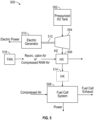
- the pressurized hydrogen power system 400 includes a pressurized H 2 tank 402, a turbo-compressor 404, an optional electric motor 406 operably connected to a shaft 408 of the turbo-compressor 404, a fuel-to-air heat exchanger 410, and a fuel cell system 412.
- the fuel cell system 412 may be configured similar to that shown and described above, such as in FIGS. 2-3 , for example. In some embodiments, the fuel cell system 412 may be configured to generate electrical power sufficient for flight propulsion or may be configured to generate electrical power for use onboard the aircraft (e.g., to power electrical systems of the aircraft).
- the turbo-compressor 404 includes a turbo expander 414 and a compressor 416 operably coupled to the shaft 408.
- highly pressurized H 2 expands within the turbo expander 414.
- the expansion of the H 2 within the turbo expander 414 drives rotation of the shaft 408.
- the shaft 408, in this configuration is operably connected to the compressor 416 and the optional electric motor 406.
- the rotation of the turbo expander 414 causes the compressor 416 to rotate.
- the optional electric motor 406 may be used to impart additional power or rotation to the shaft 408 to assist in driving rotation of the compressor 416.
- the compressor 416 is configured to receive ram air 418 from a ram air source, such as a scoop or other inlet onboard the aircraft.
- the treating of the ram air 418 is driven by the pressurized H 2 sourced from the pressurized H 2 tank 402.
- An optional pump or other device may be used to extract the pressurized H 2 from the pressurized H 2 tank 402 and direct the H 2 to the turbo expander 414 of the turbo-compressor 404.
- the pressure of the H 2 will be reduced.
- the expanded H 2 424 is then passed through the fuel-to-air heat exchanger 410 where the compressed ram air 420 is cooled by the expanded H 2 424 while the expanded H 2 424 is increased in temperature.
- the relatively cold expanded H 2 is used within the fuel-to-air heat exchanger 410 to cool down the compressed ram air 420 before it enters an optional mixing chamber 421.
- the optional mixing chamber 421 may be arranged downstream of the fuel-to-air heat exchanger 410 to receive the conditioned air from the fuel-to-air heat exchanger 410 and recycled or recirculated air from the space it is supplied to (e.g., an aircraft cabin). As such, a mixture of conditioned and recycled air may be supplied to the space (e.g., cabin) of the aircraft.
- the H 2 stored within the pressurized H 2 tank 402 may be at temperatures of approximately -40 °C (about 230 K) and stored at pressures of approximately 85,000 kPa.
- the expanded H 2 424 may be cooled to temperatures of about -180 °C (about 90 K) but has a pressure of about 250 kPa.
- This relatively cold but relatively low pressure H 2 is supplied into the fuel-to-air heat exchanger 410.
- the ram air 418 may have ambient air temperatures and be at a pressure of about 30 kPa.
- the temperature of the compressed ram air 420 may be about 50 °C (about 320 K) and the pressure may be increased to about 75 kPa and supplied into the fuel-to-air heat exchanger 410.
- the air portion (the compressed ram air 420) will decrease in temperature and the H 2 will be increased in temperature.
- the air may be reduced in temperature down to about 10 °C (about 280 K) and the H 2 may be increased in temperature up to about -170 °C (about 100 K).
- the output results in cool cabin air conditioning 422 and Hz at appropriate temperatures for catalyzing within the fuel cell system 412 for the purpose of generating power 426.
- the values discussed in this non-limiting embodiment are merely for explanatory and illustrative purposes, and other values may be employed without departing from the scope of the present disclosure.
- the various pressures and temperatures may be governed, at least in part, on the size and configuration of the pressurized H 2 tank 402, the size and configuration of the turbo compressor 404, and the size, configuration, and number of the heat exchangers that are employed. It will be appreciated that the relatively high pressure of the compressed fuel may be at least three times or greater in pressure than the pressure of the low pressure fuel after passing through the fuel-to-air heat exchanger.
- the change in pressure from the high pressure compressed fuel to the low pressure fuel may be three times reduction in pressure or density, ten times reduction in pressure or density, one hundred times reduction in pressure or density, or other change in pressure or density as the fuel is warmed and expanded through the fuel-to-air heat exchanger.
- the fuel cell system 412 requires a source of O 2 , as discussed above.
- bleed air or ram air may be used to provide the O 2 to the fuel cell system 412.
- Such air is typically compressed, and thus a compressed air 428 is provided to the fuel cell system 412.
- a source of the O 2 of the fuel cell system 412 may be the compressed ram air 420 that is compressed in the compressor 416 of the turbo compressor 404 (e.g., air 420 and air 428 are the same). In such a configuration, the energy stored as compressed H 2 is converted to support both the cabin air 422 and the fuel cell system airflow 428.
- the fuel cell system 412 will combine the H 2 and the O 2 from the compressed air 428 to generate power and output a fuel cell exhaust 430, in the form of water, as discussed above.
- the water of the fuel cell exhaust 430 may be dumped overboard, captured for use onboard the aircraft, or otherwise used onboard the aircraft, as appreciated by those of skill in the art.
- additional warming of the H 2 may be required after passing through the fuel-to-air heat exchanger 410 before the H 2 is fed into the fuel cell system 412. Accordingly, the warmed H 2 may be passed through an optional additional H 2 heat exchanger 432.
- the relatively still cold H 2 may be used within the additional H 2 heat exchanger to cool down other components such as power electronics or electric motors of the aircraft.
- the additional H 2 heat exchanger 432 may have a liquid or gas as the other working fluid, depending upon the type of additional cooling provided. This working fluid will be cooled by the H 2 and thus the H 2 will be increased in temperatures before being supplied into the fuel cell system 412.
- the pressurized hydrogen power system 500 includes a pressurized H 2 tank 502, a turbo expander 504, a fuel-to-air heat exchanger 506, and a fuel cell system 508.
- the fuel cell system 508 may be configured similar to that shown and described above, such as in FIGS. 2-3 , for example.
- fuel cell system 508 may be configured to generate electrical power sufficient for flight propulsion or may be configured to generate electrical power for use onboard the aircraft (e.g., to power electrical systems of the aircraft).
- the turbo expander is operably coupled to an electric generator 510 by a shaft 512.
- the highly pressurized H 2 sourced from the pressurized H 2 tank 502 expands within the turbo expander 504 to drive rotation of the shaft 512.
- the electric generator 510 is configured to convert rotational energy from the shaft 512 into electrical power.
- the electrical power produced by the electric generator 510 can be stored, for example in batteries or distributed and/or used onboard the aircraft.
- the electrical power output of the electric generator 510 may be used to drive a compressor or pump to produce compressed air for the fuel cell system 508 and/or to be passed into the fuel-to-air heat exchanger 506 for treating and conveyance to a cabin ventilation system or otherwise fed to other components in an ECS or other aircraft system.
- the electric generator 510 may be configured to generate and output up to 100 kW, although a specific sized generator may be selected to be used on a particular aircraft (e.g., based on energy demands of such aircraft). As the generator will add weight to the system, the sizing and output may be optimized to a particular aircraft configuration (e.g., based on passengers or other requirements).
- the fuel-to-air heat exchanger 506 may be configured to receive recirculated cabin air and/or compressed ram air.
- the ram air may be compressed using an electrically driving compressor. It will be appreciated that recirculated cabin air may not require any additional compression, and it is the ram air that is compressed.
- the power for such compressor may be supplied from the electric generator 510. Similar to the embodiment of FIG. 4 , while expanding in the turbo expander, the temperature of the H 2 will be reduced. As such, before the H 2 is fed into the fuel cell system 508, it is required that the temperature of the H 2 be increased. Similar to the embodiment of FIG.
- the relatively cold hydrogen can be used within one or more heat exchangers to cool down air and/or other working fluids onboard the aircraft.
- the fuel-to-air heat exchanger 506 may receive air flowing in a cabin air recirculation loop.
- compressed air sourced from ambient may be used for cabin supply and/or other onboard purposes, with such air being cooled within the fuel-to-air heat exchanger 506.
- additional heat exchanger 514 may be arranged downstream of the fuel-to-air heat exchanger 506 and upstream of the fuel cell system 508.
- the fuel-to-air heat exchanger 506 may be sufficient to cool cabin air (regardless of source), thus eliminating the need of an ECS pack, as described above. Because such a configuration can allow for the complete elimination of an ECS pack, an additional fan 516 may be used on the ground to bring external (ambient) air into the system.
- the pressurized hydrogen engine system 600 includes a pressurized H 2 tank 602, a turbo-compressor 604, a fuel-to-air heat exchanger 606, and a hydrogen engine system 608.
- the hydrogen engine system 608 may be a combustion engine configured to combust hydrogen, in contrast to the fuel cell systems described above.
- the turbo-compressor 604 similar to that described above, includes a turbo expander 610 and a compressor 612 operably coupled by a shaft 614.
- An additional heat exchanger 616 may be arranged between the fuel-to-air heat exchanger 606 and the hydrogen engine system 608. It will be appreciated that the system of FIG. 6 is schematic and could be arranged, alternatively, similar to the configuration of FIG. 5 and may include additional components such as additional heat exchangers, generators, motors, and the like.
- the fuel may be ammonia (NH 3 ).
- the output may be nitrogen (N 2 ) and water (H 2 O).
- a pressurized fuel may be directed from a pressurized fuel tank to a fuel consumption system.
- the pressurized fuel may be hydrogen, ammonia, or other pressurized fuel.
- the fuel consumption system may be a fuel cell, a hydrogen burning engine, or system that consumed the fuel for generation of power (e.g., electrical power, thrust, or the like).
- the fuel has heat pick up and thus may be warmed to appropriate temperatures for use within a fuel cell and/or fuel burning engine.
- no additional power may be required to increase the pressure of the ram air for use in a cabin air system.
- embodiments described herein can include motor and/or generators to generate additional electrical power onboard aircraft, such as beyond a fuel cell power generator.
- the term "about” is intended to include the degree of error associated with measurement of the particular quantity based upon the equipment available at the time of filing the application. For example, “about” may include a range of ⁇ 8%, or 5%, or 2% of a given value or other percentage change as will be appreciated by those of skill in the art for the particular measurement and/or dimensions referred to herein.
Landscapes
- Engineering & Computer Science (AREA)
- Aviation & Aerospace Engineering (AREA)
- Chemical & Material Sciences (AREA)
- Life Sciences & Earth Sciences (AREA)
- Sustainable Energy (AREA)
- Sustainable Development (AREA)
- Manufacturing & Machinery (AREA)
- Pulmonology (AREA)
- General Health & Medical Sciences (AREA)
- Health & Medical Sciences (AREA)
- Chemical Kinetics & Catalysis (AREA)
- Electrochemistry (AREA)
- General Chemical & Material Sciences (AREA)
- Combustion & Propulsion (AREA)
- Fuel Cell (AREA)
- Power Engineering (AREA)
- Transportation (AREA)
- Mechanical Engineering (AREA)
Description
- The present disclosure relates generally to aircraft systems, and more specifically to pressurized hydrogen or other cold fuels and related systems for aircraft.
- Aircraft typically include propulsion systems, such as gas turbine engines or other engines or propulsion systems. Further, for aircraft that include passenger compartments, air conditioning is required to maintain a cabin at desired pressures and temperatures for passengers and/or crew. Conventionally, an aircraft will include an environmental control system (ECS) for generating and supplying conditioned air to a cabin or for other onboard purposes. Fuel burn consumption associated with aircraft ECS depends on different factors, such as the amount of bleed and ram air usage, electric power consumption, and the weight of the system. Improved systems for propulsion, power generation, and environmental control may be desirable for aircraft. Aircraft systems are disclosed in
US 10 224 556 B1 US 10 978 723 B1 DE 10 2018 209 480 A1 describes a fuel and air system comprising a turbine and a compressor connected by a shaft, a pressurized fuel tank, a heat exchanger and a fuel cell. The turbine receives pressurized fuel from the fuel tank. The compressor has an inlet for oxidation gas. The compressor outlet is connected to the fuel cell. Heat exchangers receiving a secondary working fluid are positioned between the fuel tank and the turbine, between the turbine and the fuel cell, and between the compressor and the fuel cell. - According to one aspect, aircraft systems are provided as defined by claim 1.
- In embodiments of the aircraft systems may include that the pressurized fuel is pressurized hydrogen.
- In further embodiments of the aircraft systems may include that the pressurized fuel is pressurized ammonia.
- In further embodiments of the aircraft systems may include a motor operably coupled to the shaft and configured to generate at least one of electrical power and mechanical power.
- In further embodiments of the aircraft systems may include an electric generator operably coupled to the turbo expander by a shaft, the electric generator configured to generate electric power.
- In further embodiments of the aircraft systems may include that the fuel consumption system is a fuel cell.
- In further embodiments of the aircraft systems may include that the fuel cell is one of a solid oxide fuel cell and a proton exchange membrane (PEM).
- In further embodiments of the aircraft systems may include that the fuel cell receives pressurized air containing oxygen.
- In further embodiments of the aircraft systems may include that the pressurized air is pressurized in the compressor operably coupled to the turbo expander.
- In further embodiments of the aircraft systems may include that the fuel consumption system is a hydrogen burning engine.
- In further embodiments of the aircraft systems may include an additional heat exchanger arranged between the fuel-to-air heat exchanger and the fuel consumption system, wherein the additional heat exchanger receives the fuel from the fuel-to-air heat exchanger as a first working fluid and an aircraft system working fluid as a second working fluid.
- In further embodiments of the aircraft systems may include that the aircraft system working fluid is a fluid used to cool aircraft powered electronics.
- In further embodiments of the aircraft systems may include a fan configured to direct air into the fuel-to-air heat exchanger.
- According to another aspect, aircraft are provided as defined by claim 14.
- In embodiments of the aircraft may include that the fuel consumption system is a fuel cell system configured to generate power for flight of the aircraft.
- In further embodiments of the aircraft may include a fan configured to direct air into the fuel-to-air heat exchanger when the aircraft is on the ground.
- In further embodiments of the aircraft may include that the air in the fuel-to-air heat exchanger is recirculated cabin air from a cabin of the aircraft.
- The foregoing features and elements may be executed or utilized in various combinations without exclusivity, unless expressly indicated otherwise. These features and elements as well as the operation thereof will become more apparent in light of the following description and the accompanying drawings. It should be understood, however, that the following description and drawings are intended to be illustrative and explanatory in nature and non-limiting.
- The subject matter is particularly pointed out and distinctly claimed at the conclusion of the specification. The foregoing and other features, and advantages of the present disclosure are apparent from the following detailed description taken in conjunction with the accompanying drawings in which:
-
FIG. 1 is a schematic illustration of an aircraft that may incorporate embodiments of the present disclosure; -
FIG. 2 is a schematic diagram of an aircraft power system for an aircraft in accordance with an embodiment of the present disclosure; -
FIG. 3 is a schematic diagram of an aircraft power generation system in accordance with an embodiment of the present disclosure; -
FIG. 4 is a schematic diagram of an aircraft pressurized hydrogen power system in accordance with an embodiment of the present disclosure; -
FIG. 5 is a schematic diagram of an aircraft pressurized hydrogen power system which does not fall within the wording of the claims; and -
FIG. 6 is a schematic illustration of an aircraft pressurized hydrogen engine system in accordance with an embodiment of the present disclosure. - Referring to
FIG. 1 , a schematic illustration of anaircraft 100 that may incorporate embodiments of the present disclosure is shown. Theaircraft 100 includes afuselage 102,wings 104, and atail 106. In this illustrated embodiment, theaircraft 100 includes wing-mountedaircraft power systems 108. The wing-mountedaircraft power systems 108 may be convention gas turbine engines, fuel-cell based propulsion systems, or other propulsion systems as known in the art. In other configurations, aircraft employing embodiments of the present disclosure may include fuselagemounted and/or tail-mounted configurations. Further, any number of fuel-cell based propulsion systems may be employed, from one to four or more, depending on the aircraft configuration and power and thrust needs thereof. Theaircraft power systems 108 may be used to generate thrust for flight and may also be used to generate onboard electrical power, particularly in a fuel cell configuration. Theaircraft 100 may also includeauxiliary power units 110 that may be fuel cell based, or otherwise configured to generate power. Theaircraft power systems 108, in other configurations, may be fuel burning engines similar to conventional gas turbine engines. - Such fuel cell based power systems (for power generation and/or for propulsion) and/or combustion engine power systems may employ various types of fuel, including hydrogen. For example, turning now to
FIG. 2 , a schematic diagram of anaircraft power system 200 in accordance with an embodiment of the present disclosure is shown. Theaircraft power system 200 is a non-combustion system, and includes afan 202, adrive shaft 204, amotor 206, and an aircraftpower generation system 208. Thefan 202 is operably coupled to and configured to be rotated by thedrive shaft 204 to generate thrust, similar to a fan and fan section of a conventional gas turbine engine. But, in the fuel cell configuration ofFIG. 2 , there is no core flow path and no turbine section(s) driven by combusted and expanded gas. Rather, thedrive shaft 204 that drives rotation of thefan 202 is operably coupled to and driven by themotor 206. Themotor 206 may be an electric motor that converts electrical power to mechanical (rotational) energy. Themotor 206 receives power from the aircraftpower generation system 208 along anelectrical connection 210. Theaircraft power system 200 may be configured to operate within similar limits and envelops as a conventional gas turbine engine. - The
fan 202, thedrive shaft 204, and themotor 206 may be arranged along a propulsion system central longitudinal axis A. Thefan 202, thedrive shaft 204, themotor 206, and the aircraftpower generation system 208 can be mounted, installed, or otherwise housed within a propulsion system housing 212 (e.g., a nacelle for wing-mounted applications) which includes anexit nozzle 214 for directing an airflow therethrough for the purpose of driving flight of an aircraft (e.g., generating thrust). Thepropulsion system housing 212 may be configured to be mounted to a wing or fuselage of an aircraft. - The aircraft
power generation system 208 may be a fuel cell or similar power source (e.g., a solid oxide fuel cell, proton exchange member (PEM), or the like). The aircraftpower generation system 208 can be configured to not only power themotor 206 but also may be used as a power source for other propulsion system components and/or other aircraft electrical systems and components. In one non-limiting example, the aircraftpower generation system 208 may be configured to output about 1 MW to about 10 MW electrical power. In accordance with embodiments of the present disclosure, the aircraft power generation systems may be configured to generate at least 1 MW of electrical power (e.g., less power may be used if the system is not used for propulsion). It will be appreciated that when used as a propulsion configuration, the aircraft power generation systems described herein are configured to generate, at least, sufficient power to drive thefan 202 and provide sufficient thrust and propulsion for flight at cruise altitudes. The amount of electrical power may be selected for a given aircraft configuration (e.g., size, operating envelope requirements, etc.). - Whether used for propulsion or only onboard electrical power, the aircraft
power generation system 208 may be configured to combine hydrogen (e.g., liquid, compressed, supercritical, etc.) or other organic fluids as a fuel source using a fuel cell for generation of electricity. The hydrogen can also be used as the cold sink to cool aircraft environmental control system working fluids and/or provide other onboard thermal management, prior to being supplied to the fuel cell. In some embodiments, the fuel cell of the aircraftpower generation system 208 can be configured to provide base electric power (e.g., suited for cruise operation). In some non-limiting configurations, some fuel (hydrogen) may be directed to bypass the fuel cell and be used in a small gas turbine to generate additional power for take-off and climb peak power needs. - Turning now to
FIG. 3 , a schematic diagram of an aircraftpower generation system 300 in accordance with an embodiment of the present disclosure is shown. The aircraftpower generation system 300 includes afuel cell 302 and a fuel source 304 (such as a hydrogen fuel source). Thefuel cell 302 is configured to generate electricity, as will be appreciated by those of skill in the art (e.g., a solid oxide fuel cell, PEM, or the like). In this illustrative configuration, thefuel cell 302 includes ananode 306, acathode 308, and anelectrolyte membrane 310 arranged therebetween. Thefuel cell 302 is supplied hydrogen (H2) from thefuel source 304. Thefuel source 304 may be a container or tank that houses liquid, compressed gas, supercritical fluid (e.g., the hydrogen in this example), or other fluid state of a fuel (e.g., gas phase hydrogen). Thefuel cell 302 is supplied with oxygen (O2) from an oxygen source at aninlet 312. In some embodiments, the O2 may be supplied from ambient air, such as using an intake or scoop on a housing assembly, as will be appreciated by those of skill in the art. The O2 and the H2 are combined within thefuel cell 302 across theelectrolyte membrane 310, which frees electrons forelectrical power output 314. The combined O2 and H2 results in the formation of water (H2O), which may be passed through anoutlet 316 and dumped overboard, supplied into an onboard water tank, or otherwise used onboard an aircraft, as will be appreciated by those of skill in the art. - The
electrical power output 314 may be electrically connected to a motor that is configured to drive a shaft and a fan of a propulsion system to generate thrust (e.g., as shown inFIG. 2 ). Theelectrical power output 314 may also or alternatively be electrically connected to other electrical systems of a propulsion system and/or aircraft system(s), as will be appreciated by those of skill in the art to provide electrical power thereto. - In some fuel cell systems, highly pressurized hydrogen may be stored within a pressure tank or container and extracted to be used within a fuel cell for power generation. Before using highly pressurized Hz in a fuel cell, it is required to reduce the pressure of the H2 to more manageable and/or safe pressure levels. Accordingly, embodiments of the present disclosure are directed to, in part, systems for expanding and reducing the pressure of pressurized H2 that is supplied to a fuel cell for generation of electrical power onboard an aircraft (for propulsion or otherwise).
- Fuel burn consumption associated with aircraft Environmental Control Systems (ECS) depends on different factors, such as the amount of bleed and ram air usage, electric power consumption, and the weight of the system. The use of cryogenic or high pressure low carbon fuels, such as hydrogen (H2), ammonia (NH3) and the like, in aircrafts has the potential to significantly reduce the ECS fuel burn consumption.
- In order to reach a manageable H2 volume, the hydrogen must either be highly compressed (between 300-850 bar) or cryogenically cooled to liquid state (~-253 °C = ~20K). Because the use of liquid hydrogen in aircrafts presents several challenges, the development of pressurized fuel systems for aircraft that employ compressed fuels may be advantageous. However, a drawback of compressed fuels is the heavy tanks required to maintain the pressures of the fuel (e.g., pressurized gaseous H2) can make such applications difficult to implement.
- Embodiments of the present disclosure are directed to pressurized fuel onboard an aircraft that has reduced weights and improved system performance as compared to prior systems. Advantageously, in some embodiments, the ECS systems of the aircraft may be overhauled such that the ECS pack is eliminated partially or entirely, and replaced or supplemented by a fuel-based system that cools air for use onboard the aircraft (e.g., for cabin air conditioning).
- Referring now to
FIG. 4 , an aircraft pressurizedhydrogen power system 400 is schematically shown. The pressurizedhydrogen power system 400 includes a pressurized H2 tank 402, a turbo-compressor 404, an optionalelectric motor 406 operably connected to ashaft 408 of the turbo-compressor 404, a fuel-to-air heat exchanger 410, and afuel cell system 412. Thefuel cell system 412 may be configured similar to that shown and described above, such as inFIGS. 2-3 , for example. In some embodiments, thefuel cell system 412 may be configured to generate electrical power sufficient for flight propulsion or may be configured to generate electrical power for use onboard the aircraft (e.g., to power electrical systems of the aircraft). - The turbo-
compressor 404 includes aturbo expander 414 and acompressor 416 operably coupled to theshaft 408. In operation, highly pressurized H2 expands within theturbo expander 414. The expansion of the H2 within theturbo expander 414 drives rotation of theshaft 408. Theshaft 408, in this configuration, is operably connected to thecompressor 416 and the optionalelectric motor 406. As such, the rotation of theturbo expander 414 causes thecompressor 416 to rotate. In some configuration the optionalelectric motor 406 may be used to impart additional power or rotation to theshaft 408 to assist in driving rotation of thecompressor 416. Thecompressor 416 is configured to receiveram air 418 from a ram air source, such as a scoop or other inlet onboard the aircraft. In this configuration, thecompressor 416 is used to increase the pressure of theram air 418 to generatecompressed ram air 420. Thecompressed ram air 420 is passed through the fuel-to-air heat exchanger 410 which cools thecompressed ram air 420 to sufficient temperatures to be delivered to a space onboard an aircraft, such as a cabin of the aircraft and used forcabin air conditioning 422. The compressed ram air may also be used in the fuel cell to achieve improved performance (e.g., efficiency and/or power density) during cruise (e.g., flight) when ambient pressure is too low to achieve desired or necessary fuel cell power density. - The treating of the
ram air 418 is driven by the pressurized H2 sourced from the pressurized H2 tank 402. An optional pump or other device, not shown, may be used to extract the pressurized H2 from the pressurized H2 tank 402 and direct the H2 to theturbo expander 414 of the turbo-compressor 404. As the H2 passes through theturbo expander 414, the pressure of the H2 will be reduced. The expandedH 2 424 is then passed through the fuel-to-air heat exchanger 410 where thecompressed ram air 420 is cooled by the expandedH 2 424 while the expandedH 2 424 is increased in temperature. - While expanding in the
turbo expander 414, the temperature of the H2 is reduced. However, before the expandedH 2 424 is fed into thefuel cell system 412, the temperature of the expandedH 2 424 must be increased to proper levels for use within thefuel cell system 412. Therefore, the relatively cold expanded H2 is used within the fuel-to-air heat exchanger 410 to cool down thecompressed ram air 420 before it enters anoptional mixing chamber 421. Theoptional mixing chamber 421 may be arranged downstream of the fuel-to-air heat exchanger 410 to receive the conditioned air from the fuel-to-air heat exchanger 410 and recycled or recirculated air from the space it is supplied to (e.g., an aircraft cabin). As such, a mixture of conditioned and recycled air may be supplied to the space (e.g., cabin) of the aircraft. - In one non-limiting embodiment, the H2 stored within the pressurized H2 tank 402 may be at temperatures of approximately -40 °C (about 230 K) and stored at pressures of approximately 85,000 kPa. The expanded
H 2 424 may be cooled to temperatures of about -180 °C (about 90 K) but has a pressure of about 250 kPa. This relatively cold but relatively low pressure H2 is supplied into the fuel-to-air heat exchanger 410. In this same non-limiting embodiment, theram air 418 may have ambient air temperatures and be at a pressure of about 30 kPa. As theram air 418 is compressed within thecompressor 416, the temperature of thecompressed ram air 420 may be about 50 °C (about 320 K) and the pressure may be increased to about 75 kPa and supplied into the fuel-to-air heat exchanger 410. As these two flows are passed into the fuel-to-air heat exchanger 410, the air portion (the compressed ram air 420) will decrease in temperature and the H2 will be increased in temperature. For example, the air may be reduced in temperature down to about 10 °C (about 280 K) and the H2 may be increased in temperature up to about -170 °C (about 100 K). The output results in coolcabin air conditioning 422 and Hz at appropriate temperatures for catalyzing within thefuel cell system 412 for the purpose of generatingpower 426. It will be appreciated that the values discussed in this non-limiting embodiment are merely for explanatory and illustrative purposes, and other values may be employed without departing from the scope of the present disclosure. Further, the various pressures and temperatures may be governed, at least in part, on the size and configuration of the pressurized H2 tank 402, the size and configuration of theturbo compressor 404, and the size, configuration, and number of the heat exchangers that are employed. It will be appreciated that the relatively high pressure of the compressed fuel may be at least three times or greater in pressure than the pressure of the low pressure fuel after passing through the fuel-to-air heat exchanger. In some embodiments, the change in pressure from the high pressure compressed fuel to the low pressure fuel may be three times reduction in pressure or density, ten times reduction in pressure or density, one hundred times reduction in pressure or density, or other change in pressure or density as the fuel is warmed and expanded through the fuel-to-air heat exchanger. - The
fuel cell system 412 requires a source of O2, as discussed above. In some embodiments, bleed air or ram air may be used to provide the O2 to thefuel cell system 412. Such air is typically compressed, and thus acompressed air 428 is provided to thefuel cell system 412. In some embodiments, a source of the O2 of thefuel cell system 412 may be thecompressed ram air 420 that is compressed in thecompressor 416 of the turbo compressor 404 (e.g.,air 420 andair 428 are the same). In such a configuration, the energy stored as compressed H2 is converted to support both thecabin air 422 and the fuelcell system airflow 428. - The
fuel cell system 412 will combine the H2 and the O2 from thecompressed air 428 to generate power and output afuel cell exhaust 430, in the form of water, as discussed above. The water of thefuel cell exhaust 430 may be dumped overboard, captured for use onboard the aircraft, or otherwise used onboard the aircraft, as appreciated by those of skill in the art. - In some configurations, additional warming of the H2 may be required after passing through the fuel-to-
air heat exchanger 410 before the H2 is fed into thefuel cell system 412. Accordingly, the warmed H2 may be passed through an optional additional H2 heat exchanger 432. As an example, the relatively still cold H2 may be used within the additional H2 heat exchanger to cool down other components such as power electronics or electric motors of the aircraft. In some such embodiments, the additional H2 heat exchanger 432 may have a liquid or gas as the other working fluid, depending upon the type of additional cooling provided. This working fluid will be cooled by the H2 and thus the H2 will be increased in temperatures before being supplied into thefuel cell system 412. - The cooling of the
compressed ram air 420 within the fuel-to-air heat exchanger 410 may be sufficient for use directly to a cabin, or with minimal additional processing. As such, in accordance with some embodiments of the present disclosure, the pressurizedhydrogen power system 400 described herein may eliminate the need for an environmental control system (ECS) pack onboard the aircraft. If such ECS pack is eliminated from the aircraft system, anadditional fan 434 may be required to be used when the aircraft is on the ground to bring external air into the system. When the aircraft is on the ground, a fresh air flow from thefan 434 does not require to be compressed, and such air may bypass thecompressor 416 and flow directly into the fuel-to-air heat exchanger 410. - Referring now to
FIG. 5 , an aircraft pressurizedhydrogen power system 500 is schematically shown. The pressurizedhydrogen power system 500 includes a pressurized H2 tank 502, aturbo expander 504, a fuel-to-air heat exchanger 506, and afuel cell system 508. Thefuel cell system 508 may be configured similar to that shown and described above, such as inFIGS. 2-3 , for example. For example,fuel cell system 508 may be configured to generate electrical power sufficient for flight propulsion or may be configured to generate electrical power for use onboard the aircraft (e.g., to power electrical systems of the aircraft). - In this system, the turbo expander is operably coupled to an
electric generator 510 by ashaft 512. In this configuration, the highly pressurized H2 sourced from the pressurized H2 tank 502 expands within theturbo expander 504 to drive rotation of theshaft 512. Theelectric generator 510 is configured to convert rotational energy from theshaft 512 into electrical power. The electrical power produced by theelectric generator 510 can be stored, for example in batteries or distributed and/or used onboard the aircraft. For example, the electrical power output of theelectric generator 510 may be used to drive a compressor or pump to produce compressed air for thefuel cell system 508 and/or to be passed into the fuel-to-air heat exchanger 506 for treating and conveyance to a cabin ventilation system or otherwise fed to other components in an ECS or other aircraft system. In some cases, theelectric generator 510 may be configured to generate and output up to 100 kW, although a specific sized generator may be selected to be used on a particular aircraft (e.g., based on energy demands of such aircraft). As the generator will add weight to the system, the sizing and output may be optimized to a particular aircraft configuration (e.g., based on passengers or other requirements). - In this system, the fuel-to-
air heat exchanger 506 may be configured to receive recirculated cabin air and/or compressed ram air. In either case, the ram air may be compressed using an electrically driving compressor. It will be appreciated that recirculated cabin air may not require any additional compression, and it is the ram air that is compressed. The power for such compressor may be supplied from theelectric generator 510. Similar to the embodiment ofFIG. 4 , while expanding in the turbo expander, the temperature of the H2 will be reduced. As such, before the H2 is fed into thefuel cell system 508, it is required that the temperature of the H2 be increased. Similar to the embodiment ofFIG. 4 , the relatively cold hydrogen can be used within one or more heat exchangers to cool down air and/or other working fluids onboard the aircraft. For example, the fuel-to-air heat exchanger 506 may receive air flowing in a cabin air recirculation loop. Alternatively, or additionally, compressed air sourced from ambient may be used for cabin supply and/or other onboard purposes, with such air being cooled within the fuel-to-air heat exchanger 506. Further, similar to the embodiment ofFIG. 4 , andadditional heat exchanger 514 may be arranged downstream of the fuel-to-air heat exchanger 506 and upstream of thefuel cell system 508. - The fuel-to-
air heat exchanger 506 may be sufficient to cool cabin air (regardless of source), thus eliminating the need of an ECS pack, as described above. Because such a configuration can allow for the complete elimination of an ECS pack, anadditional fan 516 may be used on the ground to bring external (ambient) air into the system. - Turning now to
FIG. 6 , an aircraft pressurizedhydrogen engine system 600 is schematically shown. The pressurizedhydrogen engine system 600 includes a pressurized H2 tank 602, a turbo-compressor 604, a fuel-to-air heat exchanger 606, and ahydrogen engine system 608. Thehydrogen engine system 608 may be a combustion engine configured to combust hydrogen, in contrast to the fuel cell systems described above. The turbo-compressor 604, similar to that described above, includes aturbo expander 610 and acompressor 612 operably coupled by ashaft 614. Anadditional heat exchanger 616 may be arranged between the fuel-to-air heat exchanger 606 and thehydrogen engine system 608. It will be appreciated that the system ofFIG. 6 is schematic and could be arranged, alternatively, similar to the configuration ofFIG. 5 and may include additional components such as additional heat exchangers, generators, motors, and the like. - It will be appreciated that although described herein as a hydrogen-based system, various other types of low carbon or no carbon fuels may be employed and replace the hydrogen described herein. For example, in a non-limiting embodiment, the fuel may be ammonia (NH3). In such a configuration, the output may be nitrogen (N2) and water (H2O).
- As such, in accordance with embodiment of the present disclosure, a pressurized fuel may be directed from a pressurized fuel tank to a fuel consumption system. The pressurized fuel may be hydrogen, ammonia, or other pressurized fuel. The fuel consumption system may be a fuel cell, a hydrogen burning engine, or system that consumed the fuel for generation of power (e.g., electrical power, thrust, or the like).
- Advantageously, embodiments of the present disclosure provide for use of hydrogen or other low temperature fuels to be used to supplement and/or replace other convention aircraft systems, such as ECS components. Because such systems and configurations may not require the installation of an ECS pack, this results in lower system weight and less energy consumption to condition the cabin air. Further, because there is no ram air usage within a primary and/or main heat exchanger to cool down the cabin air, there may be a reduction in ECS associated fuel burn consumption. Advantageously, the cooling fluid used for conditioning the ram air is the H2, so that there is no need of ram air to be used to cool the external air from outside as in traditional ECS configurations. This eliminates the fuel burn penalty due to the ram drag. Additionally, by using the hydrogen or other cold fuel to cool the cabin air, the fuel has heat pick up and thus may be warmed to appropriate temperatures for use within a fuel cell and/or fuel burning engine. Additionally, in embodiments that couple a compressor to a fuel turbo expander, no additional power may be required to increase the pressure of the ram air for use in a cabin air system. Furthermore, advantageously, embodiments described herein can include motor and/or generators to generate additional electrical power onboard aircraft, such as beyond a fuel cell power generator.
- As used herein, the term "about" is intended to include the degree of error associated with measurement of the particular quantity based upon the equipment available at the time of filing the application. For example, "about" may include a range of ± 8%, or 5%, or 2% of a given value or other percentage change as will be appreciated by those of skill in the art for the particular measurement and/or dimensions referred to herein.
- The terminology used herein is for the purpose of describing particular embodiments only and is not intended to be limiting of the present disclosure. As used herein, the singular forms "a," "an," and "the" are intended to include the plural forms as well, unless the context clearly indicates otherwise. It will be further understood that the terms "comprises" and/or "comprising," when used in this specification, specify the presence of stated features, integers, steps, operations, elements, and/or components, but do not preclude the presence or addition of one or more other features, integers, steps, operations, element components, and/or groups thereof. It should be appreciated that relative positional terms such as "forward," "aft," "upper," "lower," "above," "below," "radial," "axial," "circumferential," and the like are with reference to normal operational attitude and should not be considered otherwise limiting.
- While the present disclosure has been described in detail in connection with only a limited number of embodiments, it should be readily understood that the present disclosure is not limited to such disclosed embodiments. Rather, the present disclosure can be modified to incorporate any number of variations, alterations, substitutions, combinations, sub-combinations, or arrangements not heretofore described, as long as they are within the scope of the present invention as defined by the claims. Additionally, while various embodiments of the present disclosure have been described, it is to be understood that aspects of the present disclosure may include only some of the described embodiments.
- Accordingly, the present disclosure is not to be seen as limited by the foregoing description, but is only limited by the scope of the appended claims.
Claims (15)
- A fuel and air system for an aircraft comprising:a pressurized fuel tank (402) containing a pressurized fuel;a turbo expander (414) configured to receive the pressurized fuel from the pressurized fuel tank, the turbo expander configured to decrease a pressure of the pressurized fuel to generate low pressure fuel, wherein the low pressure fuel has a pressure that is less than the pressurized fuel;a fuel-to-air heat exchanger (410) configured to receive the low pressure fuel from the turbo expander as a first working fluid and air as a second working fluid, the heat exchanger configured to cool the air and warm the low pressure fuel to generate treated fuel;a space configured to receive the cooled air; anda fuel consumption system (412) configured to consume the treated fuel to generate power; whereinthe turbo expander is part of a turbo-compressor (404) comprising a compressor (416) operably coupled to the turbo expander by a shaft, and the compressor is configured to receive ram air and compress said ram air and increase pressure thereof, the increased pressure ram air being directed to the fuel-to-air heat exchanger.
- The aircraft system of claim 1, wherein the pressurized fuel is pressurized hydrogen.
- The aircraft system of claim 1, wherein the pressurized fuel is pressurized ammonia.
- The aircraft system of any preceding claim, further comprising a motor (206) operably coupled to the shaft and configured to generate electrical power.
- The aircraft system of any preceding claim, further comprising an electric generator (510) operably coupled to the turbo expander by a shaft, the electric generator configured to generate electric power.
- The aircraft system of any preceding claim, wherein the fuel consumption system is a fuel cell.
- The aircraft system of claim 6, wherein the fuel cell is one of a solid oxide fuel cell and a proton exchange membrane, PEM.
- The aircraft system of claim 6 or 7, wherein the fuel cell receives pressurized air containing oxygen.
- The aircraft system of claim 8, wherein the pressurized air is pressurized in the compressor operably coupled to the turbo expander.
- The aircraft system of any of claims 1 to 5, wherein the fuel consumption system is a hydrogen burning engine.
- The aircraft system of any preceding claim, further comprising an additional heat exchanger (432) arranged between the fuel-to-air heat exchanger and the fuel consumption system, wherein the additional heat exchanger receives the treated fuel from the fuel-to-air heat exchanger as a first working fluid and an aircraft system working fluid as a second working fluid.
- The aircraft system of claim 11, wherein the aircraft system working fluid is a fluid used to cool aircraft powered electronics.
- The aircraft system of any preceding claim, further comprising a fan (434) configured to direct air into the fuel-to-air heat exchanger.
- An aircraft comprising:a fuselage (102);wings (104);a fuel and air system (300) as claimed in any preceding claim;an aircraft cabin configured to receive the cooled air; andwherein the fuel consumption system is installed to at least one of the fuselage and the wings.
- The aircraft of claim 14, wherein the air in the fuel-to-air heat exchanger is recirculated cabin air from a cabin of the aircraft.
Applications Claiming Priority (1)
| Application Number | Priority Date | Filing Date | Title |
|---|---|---|---|
| US17/470,537 US11912416B2 (en) | 2021-09-09 | 2021-09-09 | Hydrogen systems for environmental control systems onboard aircraft |
Publications (2)
| Publication Number | Publication Date |
|---|---|
| EP4147974A1 EP4147974A1 (en) | 2023-03-15 |
| EP4147974B1 true EP4147974B1 (en) | 2024-12-25 |
Family
ID=83271104
Family Applications (1)
| Application Number | Title | Priority Date | Filing Date |
|---|---|---|---|
| EP22194642.9A Active EP4147974B1 (en) | 2021-09-09 | 2022-09-08 | Hydrogen systems for environmental control systems onboard aircraft |
Country Status (2)
| Country | Link |
|---|---|
| US (1) | US11912416B2 (en) |
| EP (1) | EP4147974B1 (en) |
Families Citing this family (11)
| Publication number | Priority date | Publication date | Assignee | Title |
|---|---|---|---|---|
| JP7420110B2 (en) * | 2021-04-23 | 2024-01-23 | トヨタ自動車株式会社 | flying object |
| US20220402621A1 (en) * | 2021-06-16 | 2022-12-22 | Happy Takeoff, Inc. | Power distribution control system and method for aircraft |
| FR3128488B1 (en) * | 2021-10-25 | 2024-01-12 | Safran | Fuel conditioning system for supplying an aircraft turbomachine, aircraft and method of use |
| US12000291B2 (en) * | 2022-09-27 | 2024-06-04 | Sapphire Technologies, Inc. | Hydrogen cooling turboexpander |
| KR20240141454A (en) * | 2023-03-20 | 2024-09-27 | 현대자동차주식회사 | Apparatus for controlling temperature and pressure of aircraft |
| EP4446228A1 (en) * | 2023-04-12 | 2024-10-16 | Hamilton Sundstrand Corporation | Power generation system |
| WO2024220127A2 (en) * | 2023-04-17 | 2024-10-24 | Mfgl Technology Llc | Jet propulsion utilizing cryogenic fuel |
| US12583615B2 (en) * | 2023-06-30 | 2026-03-24 | Hamilton Sundstrand Corporation | Environmental control system with liquid hydrogen fuel vaporization for a combustion engine |
| US12473093B2 (en) | 2023-06-30 | 2025-11-18 | Hamilton Sundstrand Corporation | Outflow energy recovery system |
| US12583614B2 (en) * | 2023-06-30 | 2026-03-24 | Hamilton Sundstrand Corporation | Environmental control system with liquid hydrogen fuel vaporization for a hydrogen fuel cell |
| US12497176B1 (en) * | 2024-06-13 | 2025-12-16 | Hamilton Sundstrand Corporation | Powered turbo-expander combining centrifugal compressor and an axial flow turbine |
Family Cites Families (11)
| Publication number | Priority date | Publication date | Assignee | Title |
|---|---|---|---|---|
| DE10234968A1 (en) * | 2002-07-31 | 2004-02-12 | Liebherr-Aerospace Lindenberg Gmbh | Aircraft air conditioning |
| DE102009043569A1 (en) * | 2009-09-30 | 2011-04-07 | Daimler Ag | Method for operating a fuel cell system |
| DE102011014565B4 (en) * | 2011-03-21 | 2016-11-24 | Airbus Operations Gmbh | Air conditioning system for an aircraft |
| US10622653B2 (en) * | 2013-03-14 | 2020-04-14 | Battelle Memorial Institute | High power density solid oxide fuel cell steam reforming system and process for electrical generation |
| CN105620760B (en) | 2014-10-31 | 2017-12-19 | 中国航空工业集团公司西安飞机设计研究所 | A kind of heat management device for being suitable to instantaneous high hot-fluid |
| US10224556B2 (en) | 2015-12-15 | 2019-03-05 | Hamilton Sundstrand Corporation | Integrated fuel cell aircraft pressurization and cooling system |
| DE102018209480A1 (en) * | 2018-06-13 | 2019-12-19 | Elringklinger Ag | Fuel cell device, method for operating a fuel cell device and vehicle |
| EP3587267A1 (en) * | 2018-06-29 | 2020-01-01 | United Technologies Research Centre Ireland | Environmental control system |
| US10978723B2 (en) | 2018-09-05 | 2021-04-13 | Honeywell International Inc. | Fuel cell secondary power and thermal management systems |
| GB2578288B (en) * | 2018-10-15 | 2022-04-13 | Gkn Aerospace Services Ltd | Apparatus |
| US11773782B2 (en) * | 2020-12-23 | 2023-10-03 | Rtx Corporation | Gas turbine engines having cryogenic fuel systems |
-
2021
- 2021-09-09 US US17/470,537 patent/US11912416B2/en active Active
-
2022
- 2022-09-08 EP EP22194642.9A patent/EP4147974B1/en active Active
Also Published As
| Publication number | Publication date |
|---|---|
| US20230069975A1 (en) | 2023-03-09 |
| EP4147974A1 (en) | 2023-03-15 |
| US11912416B2 (en) | 2024-02-27 |
Similar Documents
| Publication | Publication Date | Title |
|---|---|---|
| EP4147974B1 (en) | Hydrogen systems for environmental control systems onboard aircraft | |
| EP3885267B1 (en) | Hydrogen propulsion systems for aircraft | |
| EP3480114B1 (en) | Thermal management system for a battery powered aircraft | |
| US5813630A (en) | Multi-mode secondary power unit | |
| US20110045370A1 (en) | Aircraft Fuel Cell System | |
| EP4273379A1 (en) | Hydrogen energy conversion system | |
| US11661889B1 (en) | Hydrogen powered geared turbo fan engine with an off-set reduced core | |
| US20210039794A1 (en) | Cabin outflow air energy optimized cabin pressurizing system | |
| US12103699B2 (en) | Hybrid electric power for turbine engines having hydrogen fuel systems | |
| JP4300682B2 (en) | Traveling body | |
| US20230411646A1 (en) | Fuel cell power system for a vehicle | |
| US20260008551A1 (en) | Aircraft propulsion system and method | |
| EP4279386A1 (en) | Environmental control system having a fuel cell assembly | |
| US20260015094A1 (en) | Aircraft propulsion system, apparatus and method | |
| Santin et al. | Technological aspects of gas turbine and fuel cell hybrid systems for aircraft: a review | |
| EP4575203A1 (en) | Aircraft power plant with electric motor powered by fuel cell | |
| US20250105323A1 (en) | Independently modulated fuel cell compressors | |
| US20250389230A1 (en) | Compressor bypass for low altitude operations | |
| US12412914B2 (en) | Environmental control system having a fuel cell assembly | |
| US12407010B2 (en) | Hydrogen recirculation venturi array for optimized H2 utilization | |
| US20250162718A1 (en) | System for supplying source air to an air separation membrane of a fuel inerting system | |
| US20260015095A1 (en) | Aircraft propulsion system and method | |
| US20250389231A1 (en) | Fuel systems for gas turbine engines | |
| CN118529258A (en) | Fuel tank inerting system | |
| GB2620737A (en) | Independently modulated fuel cell compressors |
Legal Events
| Date | Code | Title | Description |
|---|---|---|---|
| PUAI | Public reference made under article 153(3) epc to a published international application that has entered the european phase |
Free format text: ORIGINAL CODE: 0009012 |
|
| STAA | Information on the status of an ep patent application or granted ep patent |
Free format text: STATUS: THE APPLICATION HAS BEEN PUBLISHED |
|
| AK | Designated contracting states |
Kind code of ref document: A1 Designated state(s): AL AT BE BG CH CY CZ DE DK EE ES FI FR GB GR HR HU IE IS IT LI LT LU LV MC MK MT NL NO PL PT RO RS SE SI SK SM TR |
|
| STAA | Information on the status of an ep patent application or granted ep patent |
Free format text: STATUS: REQUEST FOR EXAMINATION WAS MADE |
|
| 17P | Request for examination filed |
Effective date: 20230913 |
|
| RBV | Designated contracting states (corrected) |
Designated state(s): AL AT BE BG CH CY CZ DE DK EE ES FI FR GB GR HR HU IE IS IT LI LT LU LV MC MK MT NL NO PL PT RO RS SE SI SK SM TR |
|
| GRAP | Despatch of communication of intention to grant a patent |
Free format text: ORIGINAL CODE: EPIDOSNIGR1 |
|
| STAA | Information on the status of an ep patent application or granted ep patent |
Free format text: STATUS: GRANT OF PATENT IS INTENDED |
|
| RIC1 | Information provided on ipc code assigned before grant |
Ipc: H01M 8/22 20060101ALI20240708BHEP Ipc: H01M 8/04082 20160101ALI20240708BHEP Ipc: H01M 8/04111 20160101ALI20240708BHEP Ipc: H01M 8/04014 20160101ALI20240708BHEP Ipc: B64D 41/00 20060101ALI20240708BHEP Ipc: B64D 37/34 20060101ALI20240708BHEP Ipc: B64D 37/30 20060101ALI20240708BHEP Ipc: B64D 27/24 20060101ALI20240708BHEP Ipc: B64D 27/02 20060101ALI20240708BHEP Ipc: B64D 13/06 20060101AFI20240708BHEP |
|
| INTG | Intention to grant announced |
Effective date: 20240718 |
|
| GRAS | Grant fee paid |
Free format text: ORIGINAL CODE: EPIDOSNIGR3 |
|
| GRAA | (expected) grant |
Free format text: ORIGINAL CODE: 0009210 |
|
| STAA | Information on the status of an ep patent application or granted ep patent |
Free format text: STATUS: THE PATENT HAS BEEN GRANTED |
|
| AK | Designated contracting states |
Kind code of ref document: B1 Designated state(s): AL AT BE BG CH CY CZ DE DK EE ES FI FR GB GR HR HU IE IS IT LI LT LU LV MC MK MT NL NO PL PT RO RS SE SI SK SM TR |
|
| REG | Reference to a national code |
Ref country code: GB Ref legal event code: FG4D |
|
| REG | Reference to a national code |
Ref country code: CH Ref legal event code: EP |
|
| REG | Reference to a national code |
Ref country code: DE Ref legal event code: R096 Ref document number: 602022009048 Country of ref document: DE |
|
| REG | Reference to a national code |
Ref country code: IE Ref legal event code: FG4D |
|
| REG | Reference to a national code |
Ref country code: LT Ref legal event code: MG9D |
|
| PG25 | Lapsed in a contracting state [announced via postgrant information from national office to epo] |
Ref country code: HR Free format text: LAPSE BECAUSE OF FAILURE TO SUBMIT A TRANSLATION OF THE DESCRIPTION OR TO PAY THE FEE WITHIN THE PRESCRIBED TIME-LIMIT Effective date: 20241225 |
|
| PG25 | Lapsed in a contracting state [announced via postgrant information from national office to epo] |
Ref country code: FI Free format text: LAPSE BECAUSE OF FAILURE TO SUBMIT A TRANSLATION OF THE DESCRIPTION OR TO PAY THE FEE WITHIN THE PRESCRIBED TIME-LIMIT Effective date: 20241225 |
|
| PG25 | Lapsed in a contracting state [announced via postgrant information from national office to epo] |
Ref country code: BG Free format text: LAPSE BECAUSE OF FAILURE TO SUBMIT A TRANSLATION OF THE DESCRIPTION OR TO PAY THE FEE WITHIN THE PRESCRIBED TIME-LIMIT Effective date: 20241225 |
|
| PG25 | Lapsed in a contracting state [announced via postgrant information from national office to epo] |
Ref country code: NO Free format text: LAPSE BECAUSE OF FAILURE TO SUBMIT A TRANSLATION OF THE DESCRIPTION OR TO PAY THE FEE WITHIN THE PRESCRIBED TIME-LIMIT Effective date: 20250325 |
|
| PG25 | Lapsed in a contracting state [announced via postgrant information from national office to epo] |
Ref country code: GR Free format text: LAPSE BECAUSE OF FAILURE TO SUBMIT A TRANSLATION OF THE DESCRIPTION OR TO PAY THE FEE WITHIN THE PRESCRIBED TIME-LIMIT Effective date: 20250326 Ref country code: LV Free format text: LAPSE BECAUSE OF FAILURE TO SUBMIT A TRANSLATION OF THE DESCRIPTION OR TO PAY THE FEE WITHIN THE PRESCRIBED TIME-LIMIT Effective date: 20241225 |
|
| PG25 | Lapsed in a contracting state [announced via postgrant information from national office to epo] |
Ref country code: RS Free format text: LAPSE BECAUSE OF FAILURE TO SUBMIT A TRANSLATION OF THE DESCRIPTION OR TO PAY THE FEE WITHIN THE PRESCRIBED TIME-LIMIT Effective date: 20250325 |
|
| REG | Reference to a national code |
Ref country code: NL Ref legal event code: MP Effective date: 20241225 |
|
| PG25 | Lapsed in a contracting state [announced via postgrant information from national office to epo] |
Ref country code: NL Free format text: LAPSE BECAUSE OF FAILURE TO SUBMIT A TRANSLATION OF THE DESCRIPTION OR TO PAY THE FEE WITHIN THE PRESCRIBED TIME-LIMIT Effective date: 20241225 |
|
| REG | Reference to a national code |
Ref country code: AT Ref legal event code: MK05 Ref document number: 1753983 Country of ref document: AT Kind code of ref document: T Effective date: 20241225 |
|
| PG25 | Lapsed in a contracting state [announced via postgrant information from national office to epo] |
Ref country code: SM Free format text: LAPSE BECAUSE OF FAILURE TO SUBMIT A TRANSLATION OF THE DESCRIPTION OR TO PAY THE FEE WITHIN THE PRESCRIBED TIME-LIMIT Effective date: 20241225 |
|
| PG25 | Lapsed in a contracting state [announced via postgrant information from national office to epo] |
Ref country code: PL Free format text: LAPSE BECAUSE OF FAILURE TO SUBMIT A TRANSLATION OF THE DESCRIPTION OR TO PAY THE FEE WITHIN THE PRESCRIBED TIME-LIMIT Effective date: 20241225 |
|
| PG25 | Lapsed in a contracting state [announced via postgrant information from national office to epo] |
Ref country code: ES Free format text: LAPSE BECAUSE OF FAILURE TO SUBMIT A TRANSLATION OF THE DESCRIPTION OR TO PAY THE FEE WITHIN THE PRESCRIBED TIME-LIMIT Effective date: 20241225 |
|
| PG25 | Lapsed in a contracting state [announced via postgrant information from national office to epo] |
Ref country code: IS Free format text: LAPSE BECAUSE OF FAILURE TO SUBMIT A TRANSLATION OF THE DESCRIPTION OR TO PAY THE FEE WITHIN THE PRESCRIBED TIME-LIMIT Effective date: 20250425 |
|
| PG25 | Lapsed in a contracting state [announced via postgrant information from national office to epo] |
Ref country code: PT Free format text: LAPSE BECAUSE OF FAILURE TO SUBMIT A TRANSLATION OF THE DESCRIPTION OR TO PAY THE FEE WITHIN THE PRESCRIBED TIME-LIMIT Effective date: 20250428 |
|
| PG25 | Lapsed in a contracting state [announced via postgrant information from national office to epo] |
Ref country code: EE Free format text: LAPSE BECAUSE OF FAILURE TO SUBMIT A TRANSLATION OF THE DESCRIPTION OR TO PAY THE FEE WITHIN THE PRESCRIBED TIME-LIMIT Effective date: 20241225 |
|
| PG25 | Lapsed in a contracting state [announced via postgrant information from national office to epo] |
Ref country code: AT Free format text: LAPSE BECAUSE OF FAILURE TO SUBMIT A TRANSLATION OF THE DESCRIPTION OR TO PAY THE FEE WITHIN THE PRESCRIBED TIME-LIMIT Effective date: 20241225 Ref country code: RO Free format text: LAPSE BECAUSE OF FAILURE TO SUBMIT A TRANSLATION OF THE DESCRIPTION OR TO PAY THE FEE WITHIN THE PRESCRIBED TIME-LIMIT Effective date: 20241225 |
|
| PG25 | Lapsed in a contracting state [announced via postgrant information from national office to epo] |
Ref country code: SK Free format text: LAPSE BECAUSE OF FAILURE TO SUBMIT A TRANSLATION OF THE DESCRIPTION OR TO PAY THE FEE WITHIN THE PRESCRIBED TIME-LIMIT Effective date: 20241225 |
|
| PG25 | Lapsed in a contracting state [announced via postgrant information from national office to epo] |
Ref country code: CZ Free format text: LAPSE BECAUSE OF FAILURE TO SUBMIT A TRANSLATION OF THE DESCRIPTION OR TO PAY THE FEE WITHIN THE PRESCRIBED TIME-LIMIT Effective date: 20241225 |
|
| PG25 | Lapsed in a contracting state [announced via postgrant information from national office to epo] |
Ref country code: IT Free format text: LAPSE BECAUSE OF FAILURE TO SUBMIT A TRANSLATION OF THE DESCRIPTION OR TO PAY THE FEE WITHIN THE PRESCRIBED TIME-LIMIT Effective date: 20241225 |
|
| PG25 | Lapsed in a contracting state [announced via postgrant information from national office to epo] |
Ref country code: SE Free format text: LAPSE BECAUSE OF FAILURE TO SUBMIT A TRANSLATION OF THE DESCRIPTION OR TO PAY THE FEE WITHIN THE PRESCRIBED TIME-LIMIT Effective date: 20241225 |
|
| REG | Reference to a national code |
Ref country code: DE Ref legal event code: R097 Ref document number: 602022009048 Country of ref document: DE |
|
| PG25 | Lapsed in a contracting state [announced via postgrant information from national office to epo] |
Ref country code: DK Free format text: LAPSE BECAUSE OF FAILURE TO SUBMIT A TRANSLATION OF THE DESCRIPTION OR TO PAY THE FEE WITHIN THE PRESCRIBED TIME-LIMIT Effective date: 20241225 |
|
| PGFP | Annual fee paid to national office [announced via postgrant information from national office to epo] |
Ref country code: DE Payment date: 20250820 Year of fee payment: 4 |
|
| PGFP | Annual fee paid to national office [announced via postgrant information from national office to epo] |
Ref country code: FR Payment date: 20250820 Year of fee payment: 4 |
|
| PLBE | No opposition filed within time limit |
Free format text: ORIGINAL CODE: 0009261 |
|
| STAA | Information on the status of an ep patent application or granted ep patent |
Free format text: STATUS: NO OPPOSITION FILED WITHIN TIME LIMIT |
|
| 26N | No opposition filed |
Effective date: 20250926 |