EP4146912B1 - Agencement pour turbomachine d'aeronef à lubrification ameliorée, l'agencement comprenant un arbre couplé en rotation à un élément suiveur, par des cannelures - Google Patents
Agencement pour turbomachine d'aeronef à lubrification ameliorée, l'agencement comprenant un arbre couplé en rotation à un élément suiveur, par des cannelures Download PDFInfo
- Publication number
- EP4146912B1 EP4146912B1 EP21731219.8A EP21731219A EP4146912B1 EP 4146912 B1 EP4146912 B1 EP 4146912B1 EP 21731219 A EP21731219 A EP 21731219A EP 4146912 B1 EP4146912 B1 EP 4146912B1
- Authority
- EP
- European Patent Office
- Prior art keywords
- lubricant
- upstream
- arrangement
- downstream
- centring
- Prior art date
- Legal status (The legal status is an assumption and is not a legal conclusion. Google has not performed a legal analysis and makes no representation as to the accuracy of the status listed.)
- Active
Links
Images

Classifications
-
- F—MECHANICAL ENGINEERING; LIGHTING; HEATING; WEAPONS; BLASTING
- F01—MACHINES OR ENGINES IN GENERAL; ENGINE PLANTS IN GENERAL; STEAM ENGINES
- F01D—NON-POSITIVE DISPLACEMENT MACHINES OR ENGINES, e.g. STEAM TURBINES
- F01D5/00—Blades; Blade-carrying members; Heating, heat-insulating, cooling or antivibration means on the blades or the members
- F01D5/02—Blade-carrying members, e.g. rotors
- F01D5/026—Shaft to shaft connections
-
- F—MECHANICAL ENGINEERING; LIGHTING; HEATING; WEAPONS; BLASTING
- F02—COMBUSTION ENGINES; HOT-GAS OR COMBUSTION-PRODUCT ENGINE PLANTS
- F02C—GAS-TURBINE PLANTS; AIR INTAKES FOR JET-PROPULSION PLANTS; CONTROLLING FUEL SUPPLY IN AIR-BREATHING JET-PROPULSION PLANTS
- F02C7/00—Features, components parts, details or accessories, not provided for in, or of interest apart form groups F02C1/00 - F02C6/00; Air intakes for jet-propulsion plants
- F02C7/06—Arrangements of bearings; Lubricating
-
- F—MECHANICAL ENGINEERING; LIGHTING; HEATING; WEAPONS; BLASTING
- F02—COMBUSTION ENGINES; HOT-GAS OR COMBUSTION-PRODUCT ENGINE PLANTS
- F02C—GAS-TURBINE PLANTS; AIR INTAKES FOR JET-PROPULSION PLANTS; CONTROLLING FUEL SUPPLY IN AIR-BREATHING JET-PROPULSION PLANTS
- F02C7/00—Features, components parts, details or accessories, not provided for in, or of interest apart form groups F02C1/00 - F02C6/00; Air intakes for jet-propulsion plants
- F02C7/36—Power transmission arrangements between the different shafts of the gas turbine plant, or between the gas-turbine plant and the power user
-
- F—MECHANICAL ENGINEERING; LIGHTING; HEATING; WEAPONS; BLASTING
- F05—INDEXING SCHEMES RELATING TO ENGINES OR PUMPS IN VARIOUS SUBCLASSES OF CLASSES F01-F04
- F05D—INDEXING SCHEME FOR ASPECTS RELATING TO NON-POSITIVE-DISPLACEMENT MACHINES OR ENGINES, GAS-TURBINES OR JET-PROPULSION PLANTS
- F05D2220/00—Application
- F05D2220/30—Application in turbines
- F05D2220/32—Application in turbines in gas turbines
- F05D2220/323—Application in turbines in gas turbines for aircraft propulsion, e.g. jet engines
-
- F—MECHANICAL ENGINEERING; LIGHTING; HEATING; WEAPONS; BLASTING
- F05—INDEXING SCHEMES RELATING TO ENGINES OR PUMPS IN VARIOUS SUBCLASSES OF CLASSES F01-F04
- F05D—INDEXING SCHEME FOR ASPECTS RELATING TO NON-POSITIVE-DISPLACEMENT MACHINES OR ENGINES, GAS-TURBINES OR JET-PROPULSION PLANTS
- F05D2260/00—Function
- F05D2260/40—Transmission of power
- F05D2260/403—Transmission of power through the shape of the drive components
- F05D2260/4031—Transmission of power through the shape of the drive components as in toothed gearing
- F05D2260/40311—Transmission of power through the shape of the drive components as in toothed gearing of the epicyclical, planetary or differential type
-
- F—MECHANICAL ENGINEERING; LIGHTING; HEATING; WEAPONS; BLASTING
- F05—INDEXING SCHEMES RELATING TO ENGINES OR PUMPS IN VARIOUS SUBCLASSES OF CLASSES F01-F04
- F05D—INDEXING SCHEME FOR ASPECTS RELATING TO NON-POSITIVE-DISPLACEMENT MACHINES OR ENGINES, GAS-TURBINES OR JET-PROPULSION PLANTS
- F05D2260/00—Function
- F05D2260/98—Lubrication
Definitions
- the present invention relates to the field of aircraft turbomachines. It relates more particularly to an arrangement intended to be implemented in such turbomachines, this arrangement comprising a rotating shaft coupled in rotation to a follower element, via a splined connection.
- the invention relates in particular to the management of the lubrication of the constituent elements of such an arrangement.
- the invention preferably applies to turbomachines comprising a fan driven by a reducer, as is known for example from the document FR 2 987 402 A1 and the document FR 3 086 343 A1 .
- a rotating shaft is rotationally coupled with a follower element, via a splined connection.
- This is for example a drive shaft, rotationally coupled with a gear wheel of a speed reducer driving a fan of the turbomachine.
- this gear wheel can be a wheel for taking off mechanical power from the drive shaft with which it is rotationally coupled.
- this type of arrangement is lubricated by being immersed in a bath of very little renewed oil.
- this conventional lubrication technique may prove insufficient in the event of an increase in the intensity of the torques to be transmitted within such arrangements. Indeed, such an increase generates higher contact pressures between the splines, with a need to evacuate the energy dissipated at these contacts.
- This lubrication problem is added to that of the relative axial displacements between the drive shaft and the follower element. Such displacements can be caused by differential thermal expansion effects between the constituent elements of the arrangement, especially when the drive shaft has a large axial length.
- the arrangement according to the invention makes it possible to cope with relative axial displacements between the rotating shaft and the follower element, for example following differential thermal expansion.
- the design proposed for the arrangement according to the invention allows not only satisfactory lubrication of the splines, but also efficient lubrication of the two radial centering connections.
- the invention further has at least one of the following optional features, taken alone or in combination.
- the lubricant intake passage(s) are made through the first upstream centering portion provided on the follower element, and/or the lubricant discharge passage(s) are made through the second downstream centering portion provided on the rotating shaft.
- any other solution remains possible, without departing from the scope of the invention.
- the lubricant collection cavity is annular and centered on the axis of rotation, said collection cavity being open radially inwards, and closed radially outwards.
- the lubricant collection cavity is provided within the follower element.
- this cavity could be provided in a part added to the follower element.
- the follower element is arranged around the rotating shaft.
- the follower element is a toothed wheel.
- the invention also relates to an aircraft turbomachine comprising such an arrangement.
- the turbomachine comprises a fan driven by a reducer equipped with at least one toothed wheel forming the follower element of the arrangement.
- a twin-spool turbojet engine 1 is shown.
- the turbojet engine 1 conventionally comprises a gas generator 2, on either side of which are arranged a low-pressure compressor 4 and a low-pressure turbine 12.
- the gas generator 2 comprises a high-pressure compressor 6, a combustion chamber 8 and a high-pressure turbine 10. Subsequently, the terms "upstream” and “downstream” are considered according to a main flow direction of the gases through the turbojet engine, this direction being schematized by the arrow 14.
- the low-pressure compressor 4 and the low-pressure turbine 12 form a low-pressure body, and are connected to each other by a low-pressure shaft 11 centered on a longitudinal central axis 3 of the turbojet engine.
- the high-pressure compressor 6 and the high-pressure turbine 10 form a high-pressure body, and are connected to each other by a high-pressure shaft 13 centered on the axis 3 and arranged around the low-pressure shaft 11.
- the shafts are supported by rolling bearings 19, which are lubricated by being arranged in oil enclosures. The same is true for the fan hub 17, also supported by rolling bearings 19.
- the turbojet 1 also comprises, in front of the gas generator 2 and the low-pressure compressor 4, a fan 15 which is here arranged directly at the rear of an air inlet cone of the engine.
- the fan 15 is rotatable along the axis 3, and surrounded by a fan casing 9. This fan 15 is not driven directly by the low-pressure shaft 11, but driven indirectly by this same shaft via a reducer 20, which allows it to rotate at a slower speed.
- the turbojet 1 defines a primary vein 16 intended to be crossed by a primary flow, as well as a secondary vein 18 intended to be crossed by a secondary flow located radially outwards relative to the primary flow.
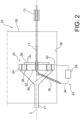
- a part 22 of the turbojet is schematically represented, comprising the reducer 20 and the low pressure shaft 11, as well as a lubrication system 24.
- the lubrication system 24 firstly comprises an oil chamber 26 which contains the reducer 20, and which is crossed by the low-pressure shaft 11. It also comprises a lubricant reservoir 28, as well as a feed pump (not shown) which can be mechanically driven by the rotation of the high-pressure shaft 13, via a known transmission system. Alternatively, the feed pump can be decoupled from the shaft 13 and driven in rotation by an electric motor so that its lubricant flow rate can be adjusted by controlling the rotation speed of the pump by controlling the speed of the electric motor.
- the reservoir 28 communicates with a lubricant inlet duct 34, one end of which communicates with means 36 for spraying a lubricant.
- These means 36 preferably take the form of one or more nozzles, or similar means. They are configured to spray lubricant onto all or part of the gear assembly of the reducer 20.
- the enclosure 26 has a bottom 38, and a lubricant recovery conduit 40 communicates with a low point 42 of the enclosure bottom 38. It makes it possible to collect by gravity the lubricant which has been previously sprayed by the means 36 onto the reducer, and to reroute this lubricant to the reservoir 28.
- the reducer 20 is centered on the geometric axis 3 of the low-pressure shaft 11, which is also the geometric axis of the fan hub 17. Also, this axis 3 corresponds to the axis of rotation of the fan 17 and of the low-pressure shaft 11.
- the reducer 20 comprises an epicyclic gear train, which in the configuration shown is conventionally equipped with a toothed wheel 52 forming an internal sun gear, centered on the axis 3.
- the internal sun gear 52 is coupled in rotation about an upstream end of the low-pressure shaft 11, in a manner specific to the invention which will be detailed below.
- the reducer further comprises an external planetary gear also called an external ring gear 54, corresponding to the output member of the reducer, which is integral in rotation with the fan hub 17. It finally comprises a fixed planet carrier 58, supporting an annular row of satellites 56 arranged between the planetary gears 52, 54.
- an external planetary gear also called an external ring gear 54
- a fixed planet carrier 58 supporting an annular row of satellites 56 arranged between the planetary gears 52, 54.
- Other configurations are of course possible for the reducer, in particular with a rotating planet carrier corresponding to the output member of the reducer, a rotating internal planetary gear, and a fixed external ring gear.
- the high-pressure shaft 13 rotates at a speed high enough to drive the system feed pump 24.
- Lubricant then circulates with a high flow rate and pressure in the lubricant inlet duct 34, before being projected by the means 36 onto the gearing of the reducer 20. Then, the lubricant flows by gravity into the enclosure bottom 38, to be collected by the recovery duct 40, then reinjected into the system.
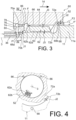
- FIG 3 represents an arrangement 60 according to a preferred embodiment of the invention, this arrangement being integrated into the turbojet part 22 shown in the figure 2 .
- the arrangement 60 comprises a drive shaft formed by the low pressure shaft 11, a follower element formed by the inner planetary gear 52, and finally, the nozzle 36.
- connection 62 comprises first splines 62a integral with the sun gear 52 and projecting radially inwards, as well as second splines 62b integral with the shaft 11 and projecting radially outwards.
- the first and second splines 62a, 62b cooperate together in a circumferential direction.
- a fairly large radial clearance J3 is provided, defined respectively with an outer surface 63 of the shaft 11, and an inner surface 64 of the sun gear 52. As can be seen in the figure 3 , it is from these surfaces 64 and 63 that the grooves 62a, 62b protrude, respectively towards the inside and towards the outside.
- annular cavity 66 for lubricating the splines 62a, 62b, centered on the axis 3.
- this annular cavity 66 is wholly or partly delimited by two radial centering connections of the shaft 11 and the sun gear 52, these two connections being arranged on either side of the splines 62a, 62b.
- These two connections 68a, 68b are made to slide axially, in particular to absorb the differential thermal expansions between the sun gear 52 and the shaft 11, in the axial direction.
- these connections 68a, 68b also have a small radial clearance, also to absorb the differential radial thermal expansions between the sun gear 52 and the shaft 11. This small radial clearance also allows the lubrication of the connections 68a, 68b, as will be described below.
- the upstream centering connection 68a is produced by a first upstream centering portion 70a, in the form of an annular wall or collar projecting radially inwards from the inner surface 64 of the sun gear 52. It is also produced using a second upstream centering portion 70b, corresponding to a part of the outer surface 63 of the shaft 11. Between these two upstream portions 70a, 70b, the upstream radial clearance J1 is defined, corresponding to the radial clearance of the upstream connection 68a.
- downstream centering connection 68b is produced by a first downstream centering portion 72a, corresponding to a portion of the inner surface 64 of the sun gear 52. It is also produced by a second downstream centering portion 72b, in the form of an annular wall or collar projecting radially outward from the outer surface 63 of the shaft 11. It is noted that the annular wall 72b extends from a portion 11a of the shaft 11, which has a diameter greater than that of the upstream end of the shaft carrying the second splines 62b.
- annular wall 72b extends radially outward beyond the second splines 62b, and it is at the level of this same wall 72b that the break in diameter is marked between the portion 11a of the shaft 11, and its upstream end integrating the second splines 62b.
- downstream radial clearance J2 is also defined, corresponding to the radial clearance of this downstream connection 68b.
- annular cavity 74 for collecting the lubricant sprayed by the nozzle 36.
- This annular cavity 74 is delimited axially upstream by an annular rim 76 projecting radially inwards from the inner surface 64 of the sun gear 52, and delimited downstream by the first upstream centering portion 70a.
- the cavity 74 is closed radially inwards by a bottom 78 similar to a portion of the inner surface 64 of the sun gear 52, while it remains open radially.
- a radial annular opening 80 faces radially a projection end of the nozzle 36, so that the lubricant projected by the nozzle 36 easily penetrates into the annular collection cavity 74 centered on the axis 3.
- the first upstream centering portion 70a is crossed by one or more lubricant admission passages 86, for example of axial orientation. Each passage 86 therefore opens on the one hand upstream into the lubricant collection cavity 74, preferably near the bottom 78, and on the other hand downstream into the lubrication cavity 66 of the grooves 62a, 62b.
- each passage 88 therefore opens on the one hand upstream into the lubrication cavity 66 of the splines 62a, 62b, and on the other hand downstream, outside the arrangement 60, preferably into the aforementioned oil enclosure 26.
- each lubricant discharge passage 88 adopts an angular position, relative to the axis 3, which is different from the position angular offset of each lubricant inlet passage 86.
- An angular offset of 120° can be adopted between these passages 86, 88, as has been shown in the figure 4 .
- Other angle values are of course possible, such as 90° for example.
- This angular offset ensures that the lubricant is maintained when the turbojet is stationary, regardless of the angular position of the rotating assembly 11, 52. This feature makes it possible to avoid the risk of dry starting of the turbojet, by ensuring a minimum of lubricant in the grooves 62a, 62b.
- the lubricant preferably oil
- the lubricant is first sprayed from the nozzle 36 into the collection cavity 74.
- Rotation of the rotating assembly 11, 52 causes a centrifugal force forcing the lubricant toward the bottom 78 of the collection cavity 74.
- All of the lubricant collected in the cavity 74 then passes downstream through the lubricant inlet passages 86 to enter the lubrication cavity 66 of the splines 62a, 62b.
- the lubricant After entering the cavity 66, the lubricant separates into a main flow F for lubricating the first and second grooves 62a, 62b, and a first connecting lubrication flow F1, passing through the upstream connection 68a from the inside to the outside of the cavity 66.
- the dimensioning of the elements of the arrangement 60 is carried out such that the first flow F1 through the upstream connection 68a remains quite small in comparison with the main flow F intended to lubricate the first and second grooves 62a, 62b.
- the first flow F1 through the upstream connection 68a represents approximately 1/5 of the total flow introduced into the cavity 66, while the main flow F represents approximately 4/5 of this total flow.
- the main lubrication flow F After passing through the grooves 62a, 62b, the main lubrication flow F separates into a leakage flow F' through the lubricant discharge passage 88, and into a second connecting lubrication flow F2, passing through the downstream connection 68b from the inside to the outside of the cavity 66.
- the lubricant of the leakage flow F' is thus extracted axially from the arrangement 60 through the discharge passage 88, then it falls preferentially by gravity into the bottom of the aforementioned oil enclosure 26.
- the dimensioning of the elements of the arrangement 60 is carried out such that the second flow F2 through the downstream connection 68b remains quite low in comparison with the leakage flow F' through the lubricant discharge passage 88.
- the second flow F2 through the upstream connection 68b also represents approximately 1/5 of the total flow introduced into the cavity 66, while the leakage flow F' represents approximately 3/5 of the total flow.
- the sizing of the elements of the arrangement 60 is also carried out such that non-zero flow rates are observed for each of the lubrication flows F1, F2 and F', whatever the operating conditions of the turbojet.
Landscapes
- Engineering & Computer Science (AREA)
- Chemical & Material Sciences (AREA)
- Combustion & Propulsion (AREA)
- Mechanical Engineering (AREA)
- General Engineering & Computer Science (AREA)
- General Details Of Gearings (AREA)
Description
- La présente invention se rapporte au domaine des turbomachines d'aéronef. Elle concerne plus particulièrement un agencement destiné à être mis en oeuvre dans de telles turbomachines, cet agencement comprenant un arbre rotatif couplé en rotation à un élément suiveur, via une liaison à cannelures.
- L'invention concerne en particulier la gestion de la lubrification des éléments constitutifs d'un tel agencement.
- L'invention s'applique préférentiellement à des turbomachines comprenant une soufflante entraînée par un réducteur, tel que cela est par exemple connu du document
FR 2 987 402 A1 FR 3 086 343 A1 - Dans les turbomachines d'aéronef, il est prévu des agencements dans lesquels un arbre rotatif est couplé en rotation avec un élément suiveur, via une liaison à cannelures. Il s'agit par exemple d'un arbre moteur, couplé en rotation avec une roue dentée d'un réducteur de vitesse entraînant une soufflante de la turbomachine. Selon un autre exemple, cette roue dentée peut être une roue de prélèvement de puissance mécanique sur l'arbre moteur avec lequel elle est couplée en rotation.
- Généralement, ce type d'agencement est lubrifié en étant plongé dans un bain d'huile très peu renouvelée. Cependant, cette technique conventionnelle de lubrification peut s'avérer insuffisante en cas d'accroissement de l'intensité des couples à transmettre au sein de tels agencements. En effet, un tel accroissement génère des pressions de contact plus élevées entre les cannelures, avec un besoin d'évacuer l'énergie dissipée au niveau de ces contacts.
- Ce problème de lubrification s'ajoute à celui des déplacements relatifs axiaux entre l'arbre moteur et l'élément suiveur. De tels déplacements peuvent être provoqués par des effets de dilatation thermique différentielle entre les éléments constitutifs de l'agencement, surtout lorsque l'arbre moteur présente une grande longueur axiale.
- Pour répondre au moins partiellement aux inconvénients mentionnés ci-dessus, l'invention a tout d'abord pour objet un agencement pour turbomachine d'aéronef comprenant un arbre rotatif selon un axe de rotation, ainsi qu'un élément suiveur centré sur l'axe de rotation et couplé en rotation avec l'arbre par une liaison à cannelures comprenant des premières cannelures solidaires de l'élément suiveur, ainsi que des secondes cannelures solidaires de l'arbre rotatif et coopérant avec lesdites premières cannelures. Selon l'invention, l'agencement comporte de plus :
- de part et d'autre de la liaison à cannelures, respectivement une liaison amont de centrage radial de l'élément suiveur relativement à l'arbre, et une liaison aval de centrage radial de l'élément suiveur relativement à l'arbre, les liaisons amont et aval de centrage radial étant glissantes axialement ;
- des moyens de projection d'un lubrifiant dans une cavité de collecte de lubrifiant ;
- au moins un passage d'admission de lubrifiant réalisé à travers l'arbre rotatif ou l'élément suiveur, le passage d'admission de lubrifiant débouchant d'une part dans ladite cavité de collecte de lubrifiant, et d'autre part dans une cavité de lubrification des cannelures délimitée en partie par les liaisons amont et aval de centrage radial ; et
- au moins un passage d'évacuation de lubrifiant réalisé à travers l'arbre rotatif ou l'élément suiveur, le passage d'évacuation de lubrifiant débouchant d'une part dans ladite cavité de lubrification des cannelures, et d'autre part extérieurement à l'agencement.
- Grâce aux deux liaisons de centrage radial, chacune à caractère glissant selon la direction axiale, l'agencement selon l'invention permet de faire face aux déplacements relatifs axiaux entre l'arbre rotatif et l'élément suiveur, par exemple suite à une dilatation thermique différentielle.
- De plus, le centrage radial n'étant plus effectué par les cannelures, des jeux radiaux importants peuvent être ménagés en bout de ces cannelures, favorisant le passage d'un flux de lubrifiant capable d'évacuer la partie de la puissance dissipée au niveau des contacts entre ces cannelures.
- En outre, la conception proposée pour l'agencement selon l'invention permet non seulement une lubrification satisfaisante des cannelures, mais également une lubrification performante des deux liaisons de centrage radial.
- L'invention présente par ailleurs au moins l'une des caractéristiques optionnelles suivantes, prises isolément ou en combinaison.
- De préférence :
- la liaison amont de centrage radial est réalisée par une première portion de centrage amont prévue sur l'élément suiveur, ainsi que par une seconde portion de centrage amont prévue sur l'arbre et coopérant avec la première portion de centrage amont de manière à définir un jeu radial amont au sein de la liaison amont de centrage radial ;
- la liaison aval de centrage radial est réalisée par une première portion de centrage aval prévue sur l'élément suiveur, ainsi que par une seconde portion de centrage aval prévue sur l'arbre et coopérant avec la première portion de centrage aval de manière à définir un jeu radial aval au sein de la liaison aval de centrage radial ; et
- chacun des jeux radiaux amont et aval est strictement inférieur aux jeux radiaux en bout de chacune des premières et secondes cannelures.
- De préférence, le/les passages d'admission de lubrifiant sont réalisés à travers la première portion de centrage amont prévue sur l'élément suiveur, et/ou le/les passages d'évacuation de lubrifiant sont réalisés à travers la seconde portion de centrage aval prévue sur l'arbre rotatif. Néanmoins, toute autre solution reste possible, sans sortir du cadre de l'invention.
- De préférence, la cavité de collecte de lubrifiant est annulaire et centrée sur l'axe de rotation, ladite cavité de collecte étant ouverte radialement vers l'intérieur, et fermée radialement vers l'extérieur.
- De préférence, la cavité de collecte de lubrifiant est réalisée au sein de l'élément suiveur. Alternativement, cette cavité pourrait être réalisée dans une pièce rapportée sur l'élément suiveur.
- De préférence, l'élément suiveur est agencé autour de l'arbre rotatif.
- De préférence, l'élément suiveur est une roue dentée.
- L'invention a également pour objet une turbomachine d'aéronef comprenant un tel agencement.
- De préférence, la turbomachine comporte une soufflante entraînée par un réducteur équipé d'au moins une roue dentée formant l'élément suiveur de l'agencement.
- Enfin, l'invention a pour objet un procédé de lubrification d'un tel agencement, mis en oeuvre en projetant du lubrifiant dans la cavité de collecte de lubrifiant, de sorte que :
- le lubrifiant traverse ledit au moins un passage d'admission de lubrifiant pour pénétrer dans la cavité de lubrification des cannelures, à partir de laquelle le lubrifiant se sépare en un flux principal de lubrification des premières et secondes cannelures, et en un premier flux de lubrification de liaison, traversant la liaison amont de l'intérieur vers l'extérieur de la cavité de lubrification des cannelures ;
- puis de sorte qu'après son passage à travers les cannelures, le flux principal de lubrification des premières et secondes cannelures se sépare en un flux de fuite à travers ledit au moins un passage d'évacuation de lubrifiant, et en un second flux de lubrification de liaison, traversant la liaison aval de l'intérieur vers l'extérieur de la cavité de lubrification des cannelures.
- D'autres avantages et caractéristiques de l'invention apparaîtront dans la description détaillée non limitative ci-dessous.
- Cette description sera faite au regard des dessins annexés parmi lesquels :
- [
Fig. 1 ] représente une vue schématique de côté d'un turboréacteur selon l'invention ; - [
Fig. 2 ] représente une vue schématique de côté d'une partie du turboréacteur montré sur la figure précédente ; - [
Fig. 3 ] représente une vue partielle en coupe d'un agencement selon un mode de réalisation préféré de l'invention, mis en oeuvre au sein du turboréacteur montré sur lesfigures 1 et2 ; et - [
Fig. 4 ] représente une vue partielle en coupe prise le long de la ligne IV-IV de lafigure 3 . - En référence à la
figure 1 , il est représenté un turboréacteur 1 à double flux et à double corps. Le turboréacteur 1 comporte de façon classique un générateur de gaz 2, de part et d'autre duquel sont agencés un compresseur basse pression 4, et une turbine basse pression 12. Le générateur de gaz 2 comprend un compresseur haute pression 6, une chambre de combustion 8 et une turbine haute pression 10. Par la suite, les termes « amont » et « aval » sont considérés selon une direction d'écoulement principale des gaz à travers le turboréacteur, cette direction étant schématisée par la flèche 14. - Le compresseur basse pression 4 et la turbine basse pression 12 forment un corps basse pression, et sont reliés l'un à l'autre par un arbre basse pression 11 centré sur un axe central longitudinal 3 du turboréacteur. De même, le compresseur haute pression 6 et la turbine haute pression 10 forment un corps haute pression, et sont reliés l'un à l'autre par un arbre haute pression 13 centré sur l'axe 3 et agencé autour de l'arbre basse pression 11. Les arbres sont supportés par des paliers de roulement 19, qui sont lubrifiés en étant agencés dans des enceintes d'huile. Il en est de même pour le moyeu de soufflante 17, également supporté par des paliers de roulement 19.
- Le turboréacteur 1 comporte par ailleurs, à l'avant du générateur de gaz 2 et du compresseur basse pression 4, une soufflante 15 qui est ici agencée directement à l'arrière d'un cône d'entrée d'air du moteur. La soufflante 15 est rotative selon l'axe 3, et entourée d'un carter de soufflante 9. Cette soufflante 15 n'est pas entraînée directement par l'arbre basse pression 11, mais entraînée indirectement par ce même arbre via un réducteur 20, ce qui lui permet de tourner avec une vitesse plus lente.
- En outre, de manière classique, le turboréacteur 1 définit une veine primaire 16 destinée à être traversée par un flux primaire, ainsi qu'une veine secondaire 18 destinée à être traversée par un flux secondaire situé radialement vers l'extérieur par rapport au flux primaire.
- En référence à présent à la
figure 2 , il est représenté schématiquement une partie 22 du turboréacteur, comprenant le réducteur 20 et l'arbre basse pression 11, ainsi qu'un système de lubrification 24. - Plus précisément, le système de lubrification 24 comporte tout d'abord une enceinte d'huile 26 qui renferme le réducteur 20, et qui est traversée par l'arbre basse pression 11. Il comporte également un réservoir de lubrifiant 28, ainsi qu'une pompe d'alimentation (non représentée) qui peut être entraînée mécaniquement par la rotation de l'arbre haute pression 13, via un système de transmission connu. En alternative, la pompe d'alimentation peut être découplée de l'arbre 13 et entraînée en rotation par un moteur électrique de façon à ce que son débit de lubrifiant puisse être ajusté en pilotant la vitesse de rotation de la pompe par le pilotage du régime du moteur électrique. Le réservoir 28 communique avec un conduit d'arrivée de lubrifiant 34, dont une extrémité communique avec des moyens 36 de projection d'un lubrifiant. Ces moyens 36 prennent de préférence la forme d'un ou plusieurs gicleurs, ou de moyens analogues. Ils sont configurés pour projeter du lubrifiant sur tout ou partie de la pignonnerie du réducteur 20.
- L'enceinte 26 présente un fond 38, et un conduit de récupération de lubrifiant 40 communique avec un point bas 42 du fond d'enceinte 38. Il permet de collecter par gravité le lubrifiant qui a été préalablement projeté par les moyens 36 sur le réducteur, et de réacheminer ce lubrifiant vers le réservoir 28.
- Le réducteur 20 est centré sur l'axe géométrique 3 de l'arbre basse pression 11, qui est aussi l'axe géométrique du moyeu de soufflante 17. Egalement, cet axe 3 correspond à l'axe de rotation de la soufflante 17 et de l'arbre basse pression 11. Le réducteur 20 comporte un train épicycloïdal, qui dans la configuration représentée est classiquement équipé d'une roue dentée 52 formant un planétaire intérieur, centré sur l'axe 3. Le planétaire intérieur 52 est couplé en rotation autour d'une extrémité amont de l'arbre basse pression 11, d'une manière spécifique à l'invention qui sera détaillée ci-après.
- Le réducteur comprend par ailleurs un planétaire extérieur également appelé couronne extérieure 54, correspondant à l'organe de sortie du réducteur solidaire en rotation du moyeu de soufflante 17. Il comporte enfin un porte-satellites fixe 58, supportant une rangée annulaire de satellites 56 agencés entre les planétaires 52, 54. D'autres configurations sont bien entendu possibles pour le réducteur, en particulier avec un porte-satellite tournant correspondant à l'organe de sortie du réducteur, un planétaire intérieur tournant, et une couronne extérieure fixe.
- En conditions normales de fonctionnement du turboréacteur, l'arbre haute pression 13 tourne à une vitesse suffisamment élevée pour entraîner la pompe d'alimentation du système 24. Du lubrifiant circule alors avec un débit et une pression élevés dans le conduit d'arrivée de lubrifiant 34, avant d'être projeté par les moyens 36 sur la pignonnerie du réducteur 20. Ensuite, le lubrifiant s'écoule par gravité jusque dans le fond d'enceinte 38, pour être collecté par le conduit de récupération 40, puis réinjecté dans le système.
- La
figure 3 représente un agencement 60 selon un mode de réalisation préféré de l'invention, cet agencement étant intégré à la partie de turboréacteur 22 montrée sur lafigure 2 . - L'agencement 60 comporte un arbre moteur formé par l'arbre basse pression 11, un élément suiveur formé par le planétaire intérieur 52, et enfin, le gicleur 36.
- Le planétaire 52, centré sur l'axe 3 et agencé autour d'une extrémité amont de l'arbre basse pression 11, est couplé en rotation avec ce dernier via une liaison à cannelures 62. Plus précisément, la liaison 62 comporte des premières cannelures 62a solidaires du planétaire 52 et se projetant radialement vers l'intérieur, ainsi que des secondes cannelures 62b solidaires de l'arbre 11 et se projetant radialement vers l'extérieur. Les premières et secondes cannelures 62a, 62b coopèrent ensemble selon une direction circonférentielle. En revanche, en bout de chacune des premières et secondes cannelures 62a, 62b, il est prévu un jeu radial J3 assez important, défini respectivement avec une surface extérieure 63 de l'arbre 11, et une surface intérieure 64 du planétaire 52. Comme cela est visible sur la
figure 3 , c'est à partir de ces surfaces 64 et 63 que les cannelures 62a, 62b sont en saillie, respectivement vers l'intérieur et vers l'extérieur. - La surface extérieure 63 de l'arbre 11 et la surface intérieure 64 du planétaire 52 délimitent ainsi radialement une cavité annulaire 66 de lubrification des cannelures 62a, 62b, centrée sur l'axe 3. Axialement, cette cavité annulaire 66 est en tout ou partie délimitée par deux liaisons de centrage radial de l'arbre 11 et du planétaire 52, ces deux liaisons étant agencées de part et d'autre des cannelures 62a, 62b.
- Il s'agit d'abord d'une liaison amont 68a de centrage radial du planétaire 52 relativement à l'arbre 11, et ensuite d'une liaison aval 68b, toujours de centrage radial du planétaire 52 relativement à l'arbre 11. Ces deux liaisons 68a, 68b sont réalisées glissantes axialement, en particulier pour absorber les dilatations thermiques différentielles entre le planétaire 52 et l'arbre 11, selon la direction axiale. De préférence, ces liaisons 68a, 68b présentent aussi un faible jeu radial, également pour absorber les dilatations thermiques différentielles radiales entre le planétaire 52 et l'arbre 11. Ce faible jeu radial permet aussi la lubrification des liaisons 68a, 68b, comme cela sera décrit ci-après.
- De manière plus précise, la liaison amont de centrage 68a est réalisée par une première portion de centrage amont 70a, en forme de paroi ou collerette annulaire faisant saillie radialement vers l'intérieur à partir de la surface intérieure 64 du planétaire 52. Elle est également réalisée à l'aide d'une seconde portion de centrage amont 70b, correspondant à une partie de la surface extérieure 63 de l'arbre 11. Entre ces deux portions amont 70a, 70b, il est définit le jeu radial amont J1, correspondant au jeu radial de la liaison amont 68a.
- De manière analogue, la liaison aval de centrage 68b est réalisée par une première portion de centrage aval 72a, correspondant à une partie de la surface intérieure 64 du planétaire 52. Elle est également réalisée par une seconde portion de centrage aval 72b, en forme de paroi ou collerette annulaire faisant saillie radialement vers l'extérieur à partir de la surface extérieure 63 de l'arbre 11. Il est noté que la paroi annulaire 72b s'étend à partir d'une portion 11a de l'arbre 11, qui présente un diamètre supérieur à celui de l'extrémité amont de l'arbre portant les secondes cannelures 62b. Ainsi, la paroi annulaire 72b s'étend radialement vers l'extérieur au-delà des secondes cannelures 62b, et c'est au niveau de cette même paroi 72b qu'est marquée la rupture de diamètre entre la portion 11a de l'arbre 11, et son extrémité amont intégrant les secondes cannelures 62b.
- Entre les deux portions amont 72a, 72b formant la liaison aval 68b, il est également définit le jeu radial aval J2, correspondant au jeu radial de cette liaison aval 68b.
- Dans le but notamment de s'assurer que les cannelures 62a, 62b ne participent pas au centrage radial du planétaire 52 relativement à l'arbre 11, il est fait en sorte que les jeux radiaux amont et aval J1, J2 soient strictement inférieurs aux jeux radiaux J3 en bout de cannelures. Cette particularité permet également de ménager un flux principal de lubrification à travers les cannelures 62a, 62b, comme cela sera décrit ci-après.
- A l'extrémité amont du planétaire 52, celui-ci délimite une cavité annulaire 74 de collecte du lubrifiant projeté par le gicleur 36. Cette cavité annulaire 74 est délimitée axialement vers l'amont par un rebord annulaire 76 se projetant radialement vers l'intérieur à partir de la surface intérieure 64 du planétaire 52, et délimitée vers l'aval par la première portion de centrage amont 70a. La cavité 74 est fermée radialement vers l'intérieur par un fond 78 assimilable à une portion de la surface intérieure 64 du planétaire 52, tandis qu'elle reste ouverte radialement. En effet, une ouverture annulaire radiale 80 fait face radialement à une extrémité de projection du gicleur 36, pour que le lubrifiant projeté par le gicleur 36 pénètre facilement dans la cavité annulaire de collecte 74 centrée sur l'axe 3. Par ailleurs, la première portion de centrage amont 70a est traversée par un ou plusieurs passages d'admission de lubrifiant 86, par exemple d'orientation axiale. Chaque passage 86 débouche donc d'une part en amont dans la cavité de collecte de lubrifiant 74, de préférence à proximité du fond 78, et d'autre part en aval dans la cavité 66 de lubrification des cannelures 62a, 62b.
- En outre, la seconde portion de centrage aval 72b est traversée par un ou plusieurs passages d'évacuation de lubrifiant 88, par exemple d'orientation axiale. Chaque passage 88 débouche donc d'une part en amont dans la cavité 66 de lubrification des cannelures 62a, 62b, et d'autre part en aval, extérieurement à l'agencement 60, de préférence dans l'enceinte d'huile 26 précitée.
- Comme cela est schématisé que la
figure 4 , chaque passage d'évacuation de lubrifiant 88 adopte une position angulaire, en rapport à l'axe 3, qui est différente de la position angulaire de chaque passage d'admission de lubrifiant 86. Un décalage angulaire de 120° peut être adopté entre ces passages 86, 88, comme cela a été représenté sur lafigure 4 . D'autres valeurs d'angles sont bien évidemment possibles, comme par exemple 90°. Ce décalage angulaire assure un maintien du lubrifiant lorsque le turboréacteur est à l'arrêt, quelle que soit la position angulaire de l'ensemble rotatif 11, 52. Cette particularité permet d'éviter le risque de démarrage à sec du turboréacteur, en assurant un minimum de lubrifiant dans les cannelures 62a, 62b. - De retour à la
figure 3 , il va être décrit le fonctionnement de l'agencement 60, et le procédé visant à sa lubrification. - Le lubrifiant, de préférence de l'huile, est tout d'abord projeté depuis le gicleur 36 dans la cavité de collecte 74. La rotation de l'ensemble rotatif 11, 52 provoque un effort centrifuge forçant le lubrifiant vers le fond 78 de la cavité de collecte 74. La totalité du lubrifiant collecté dans la cavité 74 transite alors vers l'aval, à travers les passages d'admission de lubrifiant 86 pour pénétrer dans la cavité 66 de lubrification des cannelures 62a, 62b.
- Après avoir pénétré dans la cavité 66, le lubrifiant se sépare en un flux principal F de lubrification des premières et secondes cannelures 62a, 62b, et en un premier flux de lubrification de liaison F1, traversant la liaison amont 68a de l'intérieur vers l'extérieur de la cavité 66. Le dimensionnement des éléments de l'agencement 60 est réalisé de telle sorte que le premier flux F1 à travers la liaison amont 68a reste assez faible en comparaison du flux principal F visant à lubrifier les premières et secondes cannelures 62a, 62b. Par exemple, le premier flux F1 à travers la liaison amont 68a représente environ 1/5 du débit total introduit dans la cavité 66, tandis que le flux principal F représente environ 4/5 de ce débit total.
- Après son passage à travers les cannelures 62a, 62b, le flux principal de lubrification F se sépare en un flux de fuite F' à travers le passage d'évacuation de lubrifiant 88, et en un second flux de lubrification de liaison F2, traversant la liaison aval 68b de l'intérieur vers l'extérieur de la cavité 66. Le lubrifiant du flux de fuite F' est ainsi extrait axialement de l'agencement 60 par le passage d'évacuation 88, puis il retombe ensuite préférentiellement par gravité dans le fond de l'enceinte d'huile 26 précitée.
- Ici également, le dimensionnement des éléments de l'agencement 60 est réalisé de telle sorte que le second flux F2 à travers la liaison aval 68b reste assez faible en comparaison du flux de fuite F' à travers le passage d'évacuation de lubrifiant 88. Par exemple, le second flux F2 à travers la liaison amont 68b représente également environ 1/5 du débit total introduit dans la cavité 66, tandis que le flux de fuite F' représente quant à lui environ 3/5 du débit total.
- De manière générale, le dimensionnement des éléments de l'agencement 60 est également réalisé de telle sorte que des débits non-nuls soient observés pour chacun des flux de lubrification F1, F2 et F', quelles que soient les conditions de fonctionnement du turboréacteur.
- Bien entendu, diverses modifications peuvent être apportées par l'homme du métier à l'invention qui vient d'être décrite, uniquement à titre d'exemples non limitatifs et dont la portée est délimitée par les revendications annexées.
Claims (10)
- Agencement (60) pour turbomachine d'aéronef comprenant un arbre (11) rotatif selon un axe de rotation (3), ainsi qu'un élément suiveur (52) centré sur l'axe de rotation et couplé en rotation avec l'arbre (11) par une liaison à cannelures (62) comprenant des premières cannelures (62a) solidaires de l'élément suiveur (52), ainsi que des secondes cannelures (62b) solidaires de l'arbre rotatif (11) et coopérant avec lesdites premières cannelures , ainsi que des moyens (36) de projection d'un lubrifiant dans une cavité de collecte de lubrifiant (74),
caractérisé en ce que l'agencement comporte de plus :- de part et d'autre de la liaison à cannelures (62), respectivement une liaison amont (68a) de centrage radial de l'élément suiveur (52) relativement à l'arbre (11), et une liaison aval (68b) de centrage radial de l'élément suiveur (52) relativement à l'arbre (11), les liaisons amont et aval de centrage radial (68a, 68b) étant glissantes axialement ;- au moins un passage d'admission de lubrifiant (86) réalisé à travers l'arbre rotatif (11) ou l'élément suiveur (52), le passage d'admission de lubrifiant (86) débouchant d'une part dans ladite cavité de collecte de lubrifiant (74), et d'autre part dans une cavité (66) de lubrification des cannelures délimitée en partie par les liaisons amont et aval de centrage radial (68a, 68b) ; et- au moins un passage d'évacuation de lubrifiant (88) réalisé à travers l'arbre rotatif (11) ou l'élément suiveur (52), le passage d'évacuation de lubrifiant (88) débouchant d'une part dans ladite cavité de lubrification des cannelures (66), et d'autre part extérieurement à l'agencement. - Agencement selon la revendication 1, caractérisé en ce que :- la liaison amont de centrage radial (68a) est réalisée par une première portion de centrage amont (70a) prévue sur l'élément suiveur (52), ainsi que par une seconde portion de centrage amont (70b) prévue sur l'arbre (11) et coopérant avec la première portion de centrage amont (70a) de manière à définir un jeu radial amont (J1) au sein de la liaison amont de centrage radial (68a) ;- la liaison aval de centrage radial (68b) est réalisée par une première portion de centrage aval (72a) prévue sur l'élément suiveur (52), ainsi que par une seconde portion de centrage aval (72b) prévue sur l'arbre (11) et coopérant avec la première portion de centrage aval (72a) de manière à définir un jeu radial aval (J2) au sein de la liaison aval de centrage radial (68b) ; et- chacun des jeux radiaux amont et aval (J1, J2) est strictement inférieur aux jeux radiaux (J3) en bout de chacune des premières et secondes cannelures (32a, 62b).
- Agencement selon la revendication 2, caractérisé en ce que le/les passages d'admission de lubrifiant (86) sont réalisés à travers la première portion de centrage amont (70a) prévue sur l'élément suiveur (52), et/ou en ce que le/les passages d'évacuation de lubrifiant (88) sont réalisés à travers la seconde portion de centrage aval (72b) prévue sur l'arbre rotatif (11).
- Agencement selon l'une quelconque des revendications précédentes, caractérisé en ce que la cavité de collecte de lubrifiant (74) est annulaire et centrée sur l'axe de rotation (3), ladite cavité de collecte (74) étant ouverte radialement vers l'intérieur, et fermée radialement vers l'extérieur.
- Agencement selon l'une quelconque des revendications précédentes, caractérisé en ce que la cavité de collecte de lubrifiant (74) est réalisée au sein de l'élément suiveur (52).
- Agencement selon l'une quelconque des revendications précédentes, caractérisé en ce que l'élément suiveur (52) est agencé autour de l'arbre rotatif (11).
- Agencement selon l'une quelconque des revendications précédentes, caractérisé en ce que l'élément suiveur (52) est une roue dentée.
- Turbomachine (1) d'aéronef comprenant un agencement (60) selon l'une quelconque des revendications précédentes.
- Turbomachine selon la revendication précédente, caractérisée en ce qu'elle comporte une soufflante (15) entraînée par un réducteur (20) équipé d'au moins une roue dentée (52) formant l'élément suiveur de l'agencement (60).
- Procédé de lubrification d'un agencement (60) selon l'une quelconque des revendications 1 à 7, caractérisé en ce qu'il est mis en oeuvre en projetant du lubrifiant dans la cavité de collecte de lubrifiant (74), de sorte que :- le lubrifiant traverse ledit au moins un passage d'admission de lubrifiant (86) pour pénétrer dans la cavité de lubrification des cannelures (66), à partir de laquelle le lubrifiant se sépare en un flux principal (F) de lubrification des premières et secondes cannelures (62a, 62b), et en un premier flux de lubrification de liaison (F1), traversant la liaison amont (68a) de l'intérieur vers l'extérieur de la cavité de lubrification des cannelures (66) ;- puis de sorte qu'après son passage à travers les cannelures (62a, 62b), le flux principal (F) de lubrification des premières et secondes cannelures se sépare en un flux de fuite (F') à travers ledit au moins un passage d'évacuation de lubrifiant (88), et en un second flux de lubrification de liaison (F2), traversant la liaison aval (68b) de l'intérieur vers l'extérieur de la cavité de lubrification des cannelures (66).
Applications Claiming Priority (2)
| Application Number | Priority Date | Filing Date | Title |
|---|---|---|---|
| FR2004373A FR3109801B1 (fr) | 2020-05-04 | 2020-05-04 | Agencement pour turbomachine d’aeronef a lubrification amelioree, l’agencement comprenant un arbre couple en rotation a un element suiveur, par des cannelures |
| PCT/FR2021/050703 WO2021224557A1 (fr) | 2020-05-04 | 2021-04-23 | Agencement pour turbomachine d'aeronef a lubrification amelioree, l'agencement comprenant un arbre couple en rotation a un element suiveur, par des cannelures |
Publications (2)
| Publication Number | Publication Date |
|---|---|
| EP4146912A1 EP4146912A1 (fr) | 2023-03-15 |
| EP4146912B1 true EP4146912B1 (fr) | 2025-01-01 |
Family
ID=72178679
Family Applications (1)
| Application Number | Title | Priority Date | Filing Date |
|---|---|---|---|
| EP21731219.8A Active EP4146912B1 (fr) | 2020-05-04 | 2021-04-23 | Agencement pour turbomachine d'aeronef à lubrification ameliorée, l'agencement comprenant un arbre couplé en rotation à un élément suiveur, par des cannelures |
Country Status (5)
| Country | Link |
|---|---|
| US (1) | US11970983B2 (fr) |
| EP (1) | EP4146912B1 (fr) |
| CN (1) | CN115698470A (fr) |
| FR (1) | FR3109801B1 (fr) |
| WO (1) | WO2021224557A1 (fr) |
Family Cites Families (6)
| Publication number | Priority date | Publication date | Assignee | Title |
|---|---|---|---|---|
| FR2987402B1 (fr) | 2012-02-23 | 2015-02-27 | Snecma | Dispositif de lubrification d'un reducteur epicycloidal compatible d'un montage modulaire. |
| US10605112B2 (en) * | 2013-03-04 | 2020-03-31 | United Technologies Corporation | Fan drive gear system spline oil lubrication scheme |
| DE102018106484B4 (de) * | 2018-03-20 | 2025-10-09 | Rolls-Royce Deutschland Ltd & Co Kg | Getriebefan-Triebwerk und Keilwellenanordnung |
| GB201806432D0 (en) | 2018-04-20 | 2018-06-06 | Rolls Royce Plc | A shaft assembly |
| US10830078B2 (en) * | 2018-09-14 | 2020-11-10 | Raytheon Technologies Corporation | Shaft seal assembly for a turbine engine |
| FR3086343B1 (fr) * | 2018-09-24 | 2020-09-04 | Safran Aircraft Engines | Turbomachine a reducteur pour un aeronef |
-
2020
- 2020-05-04 FR FR2004373A patent/FR3109801B1/fr active Active
-
2021
- 2021-04-23 CN CN202180039131.9A patent/CN115698470A/zh active Pending
- 2021-04-23 US US17/997,771 patent/US11970983B2/en active Active
- 2021-04-23 WO PCT/FR2021/050703 patent/WO2021224557A1/fr not_active Ceased
- 2021-04-23 EP EP21731219.8A patent/EP4146912B1/fr active Active
Also Published As
| Publication number | Publication date |
|---|---|
| FR3109801B1 (fr) | 2022-04-01 |
| EP4146912A1 (fr) | 2023-03-15 |
| US20230160345A1 (en) | 2023-05-25 |
| WO2021224557A1 (fr) | 2021-11-11 |
| US11970983B2 (en) | 2024-04-30 |
| FR3109801A1 (fr) | 2021-11-05 |
| CN115698470A (zh) | 2023-02-03 |
Similar Documents
| Publication | Publication Date | Title |
|---|---|---|
| EP3575562B1 (fr) | Système de transmission de puissance comprenant un dispositif de récupération d'huile de lubrification et turbomachine équipée d'un tel système de transmission de puissance | |
| CA2635632C (fr) | Turbomachine a double soufflante | |
| EP3111077B1 (fr) | Rotor de soufflante pour une turbomachine telle qu'un turboréacteur multiflux entraîné par réducteur | |
| FR2987416A1 (fr) | Dispositif de lubrification d'un reducteur epicycloidal. | |
| FR3110194A1 (fr) | Turbomachine d’aeronef comprenant un dispositif de lubrification d’un palier | |
| WO2020212666A1 (fr) | Reducteur de vitesse d'une turbomachine | |
| FR3054263A1 (fr) | Carter intermediaire de turbomachine d'aeronef realise d'une seule piece de fonderie avec une canalisation de lubrifiant | |
| WO2018060595A1 (fr) | Enceinte lubrifiee pour turbomachine d'aeronef, limitant la retention de lubrifiant lors du tangage | |
| EP4073366A1 (fr) | Système propulsif aéronautique à faible débit de fuite et rendement propulsif amélioré | |
| FR3114353A1 (fr) | Joint dynamique amélioré pour l’étanchéité d’un module de moteur d’aéronef | |
| FR3075868B1 (fr) | Tube de degazage pour une turbomachine d'aeronef a reducteur | |
| EP4073371A1 (fr) | Système propulsif aéronautique à faible débit de fuite et rendement propulsif amélioré | |
| FR3075867A1 (fr) | Dispositif de deshuilage d'une enceinte de lubrification de turbomachine | |
| EP3610175B1 (fr) | Lubrification pour train d'engrenages épicycloïdal | |
| EP4034755B1 (fr) | Dispositif de refroidissement par jets d'air d'un carter de turbine | |
| EP4146912B1 (fr) | Agencement pour turbomachine d'aeronef à lubrification ameliorée, l'agencement comprenant un arbre couplé en rotation à un élément suiveur, par des cannelures | |
| EP4479632B1 (fr) | Turbomachine pour un aeronef | |
| EP4407149B1 (fr) | Ensemble pour une turbomachine comprenant des moyens d'evacuation de lubrifiant et turbomachine equipee d'un tel ensemble | |
| EP4127417B1 (fr) | Ensemble pour turbomachine d'aéronef comportant un système amelioré de lubrification d'un réducteur d'entrainement de soufflante | |
| FR3114121A1 (fr) | Turbomachine d’aeronef equipee d’un tube de degazage optimise | |
| FR3068079A1 (fr) | Dispositif de joint hydraulique a amorcage ameliore | |
| FR3148260A1 (fr) | Démarreur de turbine à air | |
| FR3140918A1 (fr) | Roulement pour le guidage en rotation d’un arbre de turbomachine d’aeronef, presentant des moyens facilitant son extraction de l’arbre | |
| WO2025068641A1 (fr) | Dispositif pour le centrage et le guidage en rotation d'un arbre de turbomachine à lubrification optimisée d'éléments de roulement par du lubrifiant évacué depuis un sfd | |
| FR3147593A1 (fr) | Boîtier de relais d’accessoires de turbomachine |
Legal Events
| Date | Code | Title | Description |
|---|---|---|---|
| STAA | Information on the status of an ep patent application or granted ep patent |
Free format text: STATUS: UNKNOWN |
|
| STAA | Information on the status of an ep patent application or granted ep patent |
Free format text: STATUS: THE INTERNATIONAL PUBLICATION HAS BEEN MADE |
|
| PUAI | Public reference made under article 153(3) epc to a published international application that has entered the european phase |
Free format text: ORIGINAL CODE: 0009012 |
|
| STAA | Information on the status of an ep patent application or granted ep patent |
Free format text: STATUS: REQUEST FOR EXAMINATION WAS MADE |
|
| 17P | Request for examination filed |
Effective date: 20221028 |
|
| AK | Designated contracting states |
Kind code of ref document: A1 Designated state(s): AL AT BE BG CH CY CZ DE DK EE ES FI FR GB GR HR HU IE IS IT LI LT LU LV MC MK MT NL NO PL PT RO RS SE SI SK SM TR |
|
| DAV | Request for validation of the european patent (deleted) | ||
| DAX | Request for extension of the european patent (deleted) | ||
| GRAP | Despatch of communication of intention to grant a patent |
Free format text: ORIGINAL CODE: EPIDOSNIGR1 |
|
| STAA | Information on the status of an ep patent application or granted ep patent |
Free format text: STATUS: GRANT OF PATENT IS INTENDED |
|
| GRAS | Grant fee paid |
Free format text: ORIGINAL CODE: EPIDOSNIGR3 |
|
| INTG | Intention to grant announced |
Effective date: 20241022 |
|
| GRAA | (expected) grant |
Free format text: ORIGINAL CODE: 0009210 |
|
| STAA | Information on the status of an ep patent application or granted ep patent |
Free format text: STATUS: THE PATENT HAS BEEN GRANTED |
|
| AK | Designated contracting states |
Kind code of ref document: B1 Designated state(s): AL AT BE BG CH CY CZ DE DK EE ES FI FR GB GR HR HU IE IS IT LI LT LU LV MC MK MT NL NO PL PT RO RS SE SI SK SM TR |
|
| REG | Reference to a national code |
Ref country code: GB Ref legal event code: FG4D Free format text: NOT ENGLISH |
|
| REG | Reference to a national code |
Ref country code: CH Ref legal event code: EP |
|
| REG | Reference to a national code |
Ref country code: DE Ref legal event code: R096 Ref document number: 602021024269 Country of ref document: DE |
|
| REG | Reference to a national code |
Ref country code: IE Ref legal event code: FG4D Free format text: LANGUAGE OF EP DOCUMENT: FRENCH |
|
| REG | Reference to a national code |
Ref country code: LT Ref legal event code: MG9D |
|
| REG | Reference to a national code |
Ref country code: NL Ref legal event code: MP Effective date: 20250101 |
|
| REG | Reference to a national code |
Ref country code: AT Ref legal event code: MK05 Ref document number: 1756412 Country of ref document: AT Kind code of ref document: T Effective date: 20250101 |
|
| PG25 | Lapsed in a contracting state [announced via postgrant information from national office to epo] |
Ref country code: NL Free format text: LAPSE BECAUSE OF FAILURE TO SUBMIT A TRANSLATION OF THE DESCRIPTION OR TO PAY THE FEE WITHIN THE PRESCRIBED TIME-LIMIT Effective date: 20250101 |
|
| PG25 | Lapsed in a contracting state [announced via postgrant information from national office to epo] |
Ref country code: FI Free format text: LAPSE BECAUSE OF FAILURE TO SUBMIT A TRANSLATION OF THE DESCRIPTION OR TO PAY THE FEE WITHIN THE PRESCRIBED TIME-LIMIT Effective date: 20250101 |
|
| PG25 | Lapsed in a contracting state [announced via postgrant information from national office to epo] |
Ref country code: PL Free format text: LAPSE BECAUSE OF FAILURE TO SUBMIT A TRANSLATION OF THE DESCRIPTION OR TO PAY THE FEE WITHIN THE PRESCRIBED TIME-LIMIT Effective date: 20250101 |
|
| PGFP | Annual fee paid to national office [announced via postgrant information from national office to epo] |
Ref country code: DE Payment date: 20250417 Year of fee payment: 5 |
|
| PG25 | Lapsed in a contracting state [announced via postgrant information from national office to epo] |
Ref country code: ES Free format text: LAPSE BECAUSE OF FAILURE TO SUBMIT A TRANSLATION OF THE DESCRIPTION OR TO PAY THE FEE WITHIN THE PRESCRIBED TIME-LIMIT Effective date: 20250101 |
|
| PG25 | Lapsed in a contracting state [announced via postgrant information from national office to epo] |
Ref country code: IS Free format text: LAPSE BECAUSE OF FAILURE TO SUBMIT A TRANSLATION OF THE DESCRIPTION OR TO PAY THE FEE WITHIN THE PRESCRIBED TIME-LIMIT Effective date: 20250501 Ref country code: NO Free format text: LAPSE BECAUSE OF FAILURE TO SUBMIT A TRANSLATION OF THE DESCRIPTION OR TO PAY THE FEE WITHIN THE PRESCRIBED TIME-LIMIT Effective date: 20250401 |
|
| PG25 | Lapsed in a contracting state [announced via postgrant information from national office to epo] |
Ref country code: HR Free format text: LAPSE BECAUSE OF FAILURE TO SUBMIT A TRANSLATION OF THE DESCRIPTION OR TO PAY THE FEE WITHIN THE PRESCRIBED TIME-LIMIT Effective date: 20250101 |
|
| PG25 | Lapsed in a contracting state [announced via postgrant information from national office to epo] |
Ref country code: LV Free format text: LAPSE BECAUSE OF FAILURE TO SUBMIT A TRANSLATION OF THE DESCRIPTION OR TO PAY THE FEE WITHIN THE PRESCRIBED TIME-LIMIT Effective date: 20250101 Ref country code: PT Free format text: LAPSE BECAUSE OF FAILURE TO SUBMIT A TRANSLATION OF THE DESCRIPTION OR TO PAY THE FEE WITHIN THE PRESCRIBED TIME-LIMIT Effective date: 20250502 |
|
| PGFP | Annual fee paid to national office [announced via postgrant information from national office to epo] |
Ref country code: FR Payment date: 20250422 Year of fee payment: 5 |
|
| PG25 | Lapsed in a contracting state [announced via postgrant information from national office to epo] |
Ref country code: BG Free format text: LAPSE BECAUSE OF FAILURE TO SUBMIT A TRANSLATION OF THE DESCRIPTION OR TO PAY THE FEE WITHIN THE PRESCRIBED TIME-LIMIT Effective date: 20250101 Ref country code: GR Free format text: LAPSE BECAUSE OF FAILURE TO SUBMIT A TRANSLATION OF THE DESCRIPTION OR TO PAY THE FEE WITHIN THE PRESCRIBED TIME-LIMIT Effective date: 20250402 |
|
| PG25 | Lapsed in a contracting state [announced via postgrant information from national office to epo] |
Ref country code: AT Free format text: LAPSE BECAUSE OF FAILURE TO SUBMIT A TRANSLATION OF THE DESCRIPTION OR TO PAY THE FEE WITHIN THE PRESCRIBED TIME-LIMIT Effective date: 20250101 |
|
| PG25 | Lapsed in a contracting state [announced via postgrant information from national office to epo] |
Ref country code: CZ Free format text: LAPSE BECAUSE OF FAILURE TO SUBMIT A TRANSLATION OF THE DESCRIPTION OR TO PAY THE FEE WITHIN THE PRESCRIBED TIME-LIMIT Effective date: 20250101 |
|
| PG25 | Lapsed in a contracting state [announced via postgrant information from national office to epo] |
Ref country code: SE Free format text: LAPSE BECAUSE OF FAILURE TO SUBMIT A TRANSLATION OF THE DESCRIPTION OR TO PAY THE FEE WITHIN THE PRESCRIBED TIME-LIMIT Effective date: 20250101 |
|
| REG | Reference to a national code |
Ref country code: DE Ref legal event code: R097 Ref document number: 602021024269 Country of ref document: DE |
|
| PG25 | Lapsed in a contracting state [announced via postgrant information from national office to epo] |
Ref country code: SM Free format text: LAPSE BECAUSE OF FAILURE TO SUBMIT A TRANSLATION OF THE DESCRIPTION OR TO PAY THE FEE WITHIN THE PRESCRIBED TIME-LIMIT Effective date: 20250101 |
|
| PG25 | Lapsed in a contracting state [announced via postgrant information from national office to epo] |
Ref country code: DK Free format text: LAPSE BECAUSE OF FAILURE TO SUBMIT A TRANSLATION OF THE DESCRIPTION OR TO PAY THE FEE WITHIN THE PRESCRIBED TIME-LIMIT Effective date: 20250101 |
|
| PG25 | Lapsed in a contracting state [announced via postgrant information from national office to epo] |
Ref country code: IT Free format text: LAPSE BECAUSE OF FAILURE TO SUBMIT A TRANSLATION OF THE DESCRIPTION OR TO PAY THE FEE WITHIN THE PRESCRIBED TIME-LIMIT Effective date: 20250101 |
|
| PG25 | Lapsed in a contracting state [announced via postgrant information from national office to epo] |
Ref country code: EE Free format text: LAPSE BECAUSE OF FAILURE TO SUBMIT A TRANSLATION OF THE DESCRIPTION OR TO PAY THE FEE WITHIN THE PRESCRIBED TIME-LIMIT Effective date: 20250101 |
|
| PG25 | Lapsed in a contracting state [announced via postgrant information from national office to epo] |
Ref country code: RO Free format text: LAPSE BECAUSE OF FAILURE TO SUBMIT A TRANSLATION OF THE DESCRIPTION OR TO PAY THE FEE WITHIN THE PRESCRIBED TIME-LIMIT Effective date: 20250101 |
|
| PG25 | Lapsed in a contracting state [announced via postgrant information from national office to epo] |
Ref country code: SK Free format text: LAPSE BECAUSE OF FAILURE TO SUBMIT A TRANSLATION OF THE DESCRIPTION OR TO PAY THE FEE WITHIN THE PRESCRIBED TIME-LIMIT Effective date: 20250101 |
|
| PLBE | No opposition filed within time limit |
Free format text: ORIGINAL CODE: 0009261 |
|
| STAA | Information on the status of an ep patent application or granted ep patent |
Free format text: STATUS: NO OPPOSITION FILED WITHIN TIME LIMIT |
|
| REG | Reference to a national code |
Ref country code: CH Ref legal event code: L10 Free format text: ST27 STATUS EVENT CODE: U-0-0-L10-L00 (AS PROVIDED BY THE NATIONAL OFFICE) Effective date: 20251112 |
|
| REG | Reference to a national code |
Ref country code: CH Ref legal event code: H13 Free format text: ST27 STATUS EVENT CODE: U-0-0-H10-H13 (AS PROVIDED BY THE NATIONAL OFFICE) Effective date: 20251125 |
|
| 26N | No opposition filed |
Effective date: 20251002 |
|
| PG25 | Lapsed in a contracting state [announced via postgrant information from national office to epo] |
Ref country code: LU Free format text: LAPSE BECAUSE OF NON-PAYMENT OF DUE FEES Effective date: 20250423 |
|
| PG25 | Lapsed in a contracting state [announced via postgrant information from national office to epo] |
Ref country code: MC Free format text: LAPSE BECAUSE OF FAILURE TO SUBMIT A TRANSLATION OF THE DESCRIPTION OR TO PAY THE FEE WITHIN THE PRESCRIBED TIME-LIMIT Effective date: 20250101 |
|
| REG | Reference to a national code |
Ref country code: BE Ref legal event code: MM Effective date: 20250430 |
|
| PG25 | Lapsed in a contracting state [announced via postgrant information from national office to epo] |
Ref country code: BE Free format text: LAPSE BECAUSE OF NON-PAYMENT OF DUE FEES Effective date: 20250430 |
|
| PG25 | Lapsed in a contracting state [announced via postgrant information from national office to epo] |
Ref country code: CH Free format text: LAPSE BECAUSE OF NON-PAYMENT OF DUE FEES Effective date: 20250430 |
|
| PGFP | Annual fee paid to national office [announced via postgrant information from national office to epo] |
Ref country code: GB Payment date: 20260327 Year of fee payment: 6 |
|
| PG25 | Lapsed in a contracting state [announced via postgrant information from national office to epo] |
Ref country code: IE Free format text: LAPSE BECAUSE OF NON-PAYMENT OF DUE FEES Effective date: 20250423 |