EP4146659B1 - Ring-fused 2-pyridone compounds, methods for preparation thereof and their use in the treatment and/or prevention of a disease involving gram-positive bacteria - Google Patents
Ring-fused 2-pyridone compounds, methods for preparation thereof and their use in the treatment and/or prevention of a disease involving gram-positive bacteria Download PDFInfo
- Publication number
- EP4146659B1 EP4146659B1 EP21724674.3A EP21724674A EP4146659B1 EP 4146659 B1 EP4146659 B1 EP 4146659B1 EP 21724674 A EP21724674 A EP 21724674A EP 4146659 B1 EP4146659 B1 EP 4146659B1
- Authority
- EP
- European Patent Office
- Prior art keywords
- thiazolo
- oxo
- cyclopropyl
- pyridine
- ylmethyl
- Prior art date
- Legal status (The legal status is an assumption and is not a legal conclusion. Google has not performed a legal analysis and makes no representation as to the accuracy of the status listed.)
- Active
Links
Images


Classifications
-
- C—CHEMISTRY; METALLURGY
- C07—ORGANIC CHEMISTRY
- C07D—HETEROCYCLIC COMPOUNDS
- C07D513/00—Heterocyclic compounds containing in the condensed system at least one hetero ring having nitrogen and sulfur atoms as the only ring hetero atoms, not provided for in groups C07D463/00, C07D477/00 or C07D499/00 - C07D507/00
- C07D513/02—Heterocyclic compounds containing in the condensed system at least one hetero ring having nitrogen and sulfur atoms as the only ring hetero atoms, not provided for in groups C07D463/00, C07D477/00 or C07D499/00 - C07D507/00 in which the condensed system contains two hetero rings
- C07D513/04—Ortho-condensed systems
-
- A—HUMAN NECESSITIES
- A61—MEDICAL OR VETERINARY SCIENCE; HYGIENE
- A61K—PREPARATIONS FOR MEDICAL, DENTAL OR TOILETRY PURPOSES
- A61K31/00—Medicinal preparations containing organic active ingredients
- A61K31/33—Heterocyclic compounds
- A61K31/395—Heterocyclic compounds having nitrogen as a ring hetero atom, e.g. guanethidine or rifamycins
- A61K31/41—Heterocyclic compounds having nitrogen as a ring hetero atom, e.g. guanethidine or rifamycins having five-membered rings with two or more ring hetero atoms, at least one of which being nitrogen, e.g. tetrazole
- A61K31/425—Thiazoles
- A61K31/429—Thiazoles condensed with heterocyclic ring systems
-
- A—HUMAN NECESSITIES
- A61—MEDICAL OR VETERINARY SCIENCE; HYGIENE
- A61P—SPECIFIC THERAPEUTIC ACTIVITY OF CHEMICAL COMPOUNDS OR MEDICINAL PREPARATIONS
- A61P31/00—Antiinfectives, i.e. antibiotics, antiseptics, chemotherapeutics
- A61P31/04—Antibacterial agents
-
- Y—GENERAL TAGGING OF NEW TECHNOLOGICAL DEVELOPMENTS; GENERAL TAGGING OF CROSS-SECTIONAL TECHNOLOGIES SPANNING OVER SEVERAL SECTIONS OF THE IPC; TECHNICAL SUBJECTS COVERED BY FORMER USPC CROSS-REFERENCE ART COLLECTIONS [XRACs] AND DIGESTS
- Y02—TECHNOLOGIES OR APPLICATIONS FOR MITIGATION OR ADAPTATION AGAINST CLIMATE CHANGE
- Y02A—TECHNOLOGIES FOR ADAPTATION TO CLIMATE CHANGE
- Y02A50/00—TECHNOLOGIES FOR ADAPTATION TO CLIMATE CHANGE in human health protection, e.g. against extreme weather
- Y02A50/30—Against vector-borne diseases, e.g. mosquito-borne, fly-borne, tick-borne or waterborne diseases whose impact is exacerbated by climate change
Definitions
- the present disclosure concerns novel ring-fused 2-pyridone compounds, methods for preparation thereof as well as their use in the treatment and/or prevention of a disease involving gram-positive bacteria. Further, the disclosure concerns a combination of a ring-fused 2-pyridone compound and a drug against a disease involving gram-positive bacteria.
- Infections and/or diseases that resist treatment with currently available drugs is an increasing problem and a serious threat to public health.
- Many of these infections and/or diseases involve gram-positive bacteria such as Staphylococcus aureus, Methicillin-resistant Staphylococcus aureus (MRSA), Vancomycin-Resistant Enterococci ( VRE ), Enterococcus faecalis (E. faecalis), Enterococcus faecium, Vancomycin-Intermediate Staphylococcus aureus (VISA), Vancomycin-Resistant Staphylococcus aureus (VRSA), Clostridium difficile (C. difficile), Clostridium tetani, Streptococcus pyogenes and Staphylococcus saphyticus and Bacillus subtilis.
- MRSA Methicillin-resistant Staphylococcus aureus
- VRE Vancomycin-Resistant Enterococci
- VRE
- composition comprising:
- references herein to compounds of particular aspects of the invention will include references to all embodiments and particular features thereof, which embodiments and particular features may be taken in combination to form further embodiments and features of the invention.
- the compounds of the present disclosure have been found to inhibit the biological activity of bacteria such as E. faecalis and MRSA. Moreover, the compounds of the present disclosure have found to have a synergistic bactericidal effect when combined with a drug against disease involving gram positive bacteria such as an antibiotic.
- C 1 -C 4 alkyl denotes a straight or branched, saturated alkyl group of one to four carbon atoms.
- Examples of “C 1 -C 4 alkyl” include, but are not limited to, methyl, ethyl, vinyl, allyl, n-propyl, isopropyl, n-butyl, sec-butyl, iso-butyl and tert-butyl.
- C 1 -C 6 alkyl denotes a straight or branched, saturated alkyl group of one to six carbon atoms.
- Examples of “C 1 -C 6 alkyl” include, but are not limited to, methyl, ethyl, vinyl, allyl, n-propyl, isopropyl, n-butyl, sec-butyl, iso-butyl, tert-butyl, n-pentyl, isopentyl, neopentyl, n-hexyl, isohexyl, 3-methylpentyl, 2,3-dimethylbutyl and neohexyl.
- C 3 -C 6 cycloalkyl denotes a saturated monocyclic ring composed of three, four, five or six carbon atoms.
- Examples of “C 3 -C 6 cycloalkyl” include, but are not limited to, cyclopropyl, cyclobutyl, cyclopentyl and cyclohexyl.
- C 1 -C 6 alkenyl denotes a straight or branched, unsaturated alkene containing one or more double bonds group of one to six carbon atoms.
- Examples of “C 1 -C 6 alkenyl” include vinyl, allyl, butenyl, pentenyl and hexenyl.
- C 1 -C 10 alkenyl denotes a straight or branched, unsaturated alkene containing one or more double bonds group of one to ten carbon atoms.
- Examples of “C 1 -C 10 alkenyl” include vinyl, allyl, butenyl, pentenyl, hexenyl, octenyl, nonenyl and decenyl.
- aryl denotes an aromatic hydrocarbon.
- aryl include phenyl and naphtyl.
- C 1 -C 4 alkoxy denotes a C 1 -C 4 alkyl group as described herein which is linked to an oxygen atom.
- Examples of “C 1 -C 4 alkoxy” include, but are not limited to, methoxy, ethoxy, n-propoxy, iso-propoxy and butoxy.
- C 1 -C 6 alkoxy denotes a C 1 -C 6 alkyl group as described herein which is linked to an oxygen atom.
- Examples of “C 1 -C 6 alkoxy” include, but are not limited to, methoxy, ethoxy, n-propoxy, iso-propoxy, n-butoxy, iso-butoxy, n-pentoxy and n-hexoxy.
- C 1 -C 10 alkoxy denotes a C 1 -C 10 alkyl group which is linked to an oxygen atom.
- the examples of “C 1 -C 10 alkoxy” include, but are not limited to, methoxy, ethoxy, n-propoxy, iso-propoxy, butoxy, pentoxy, hexoxy, pentoxy, octoxy, nonony, and decoxy.
- C 3 -C 6 cycloalkoxy denotes a saturated monocyclic ring composed of three, four, five or six carbon atoms which is linked to an oxygen atom.
- Examples of “C 3 -C 6 cycloalkoxy” include, but are not limited to, cyclopropyloxy, cyclobutyloxy, cyclopentyloxy, cyclohexyloxy.
- C 1 -C 10 alkenoxy denotes a C 1 -C 10 alkenyl group which is linked to an oxygen atom.
- the C 1 -C 10 alkenyl group may be straight or branched.
- the examples of C 1 -C 10 alkenoxy include, but are not limited to, allyloxy, 5-hexenyloxy or 4-methyl-3-pentenyloxy, (E)-2-heptenyloxy, (E)-2-hexenyloxy, (E)-2-pentenyloxy, (E)-2- butenyloxy, (Z)-2-heptenyloxy, (Z)-2-hexenyloxy and (Z)-2-pentenyloxy.
- C 1 -C 10 alkynoxy denotes a C 1 -C 10 alkynyl group which is linked to an oxygen atom.
- the C 1 -C 10 alkynyl group may be straight or branched.
- the examples of C 1 -C 10 alkynoxy include, but are not limited to, 5-hexynyloxy, (Z)-2-Butenyloxy 2-heptynyloxy, 2-hexynyloxy, 2-pentynyloxy, 2-butynyloxy, 3-heptynyloxy, 3-hexynyloxy, 3-pentynyloxy, 3-butynyloxy, 4-heptynyloxy, 4-hexynyloxy and 4-pentynyloxy.
- 3-membered heterocycle denotes a 3-membered saturated or unsaturated heterocycle.
- 3-membered saturated heterocycle include, but are not limited to, aziridine, oxirane and thiirane.
- 3-membered unsaturated heterocycles include, but are not limited to, azirine, oxirene and thiirene.
- 4-membered heterocycle denotes a 4-membered saturated or unsaturated heterocycle.
- 4-membered heterocycle include, but are not limited to, azetidine, oxethane and thietane.
- 5-membered heterocycle denotes a 5-membered saturated or unsaturated heterocycle.
- Examples of a 5-membered heterocycles include, but are not limited to pyrrolidine, tetrahydrofuran, thiolane, pyrrole, furane, thiophene, imidazolidine, pyrazolidine, oxazolidine, isoxazolidine, thiazolidine, isothiazolidine, dioxolane, dithiolane, imidazole, pyrazole, oxazole, isoxazole, thiazole, and isothiazole.
- 6-membered heterocycle denotes a 6-membered saturated or unsaturated heterocycle.
- 6-membered heterocycles include, but are not limited to piperidine, pyridine, piperazine, morpholine, and thiomorpholine.
- the drug against a disease involving gram-positive bacteria is to be understood as a drug that counteracts gram-positive bacteria.
- the drug against a disease involving gram-positive bacteria may reduce, substantially eliminate or eradicate gram-positive bacteria.
- the drug against a disease involving gram-positive bacteria may also be denominated a drug to treat a disease involving gram-positive bacteria.
- disease is understood to be an abnormal condition of a part, organ, or system of a mammal such as a human resulting from various causes, such as infection, inflammation, environmental factors, or genetic defect, and characterized by an identifiable group of signs, symptoms, or both.
- diseases are understood to encompass both disease and infection.
- infection intends a condition wherein gram-positive bacteria have entered into a mammal such as a human.
- the R 1 and R 5 substituents of the compound of the compound of Formula II may be oriented syn to each other. Further, the R 11 substituent of the compound of Formula II may be oriented syn or anti with respect to the R 1 and R 5 substituents.
- the compound of Formula II syn may comprise a compound of Formula IIa and/or Formula IIb:
- the compound of Formula II anti may comprise a compound of Formula IIc and/or Formula IId:
- the compound of Formula II syn and the compound of Formula II anti are diastereoisomers.
- the compound of Formula II syn and the compound of Formula II anti constitute a diastereoisomeric pair.
- the value for Q may be CH 2 , NH or NC 1 -C 6 alkyl.
- R 1 may be C(O)OH, tetrazolyl or (CH 2 ) m B(OH) 2 .
- R 2 may be H or NZ 1 Z 2 .
- R 2 may be NHCH 3 , N(CH 3 ) 2 or azetidine.
- R 3 may be 1-naphtyl, 2-naphtyl, 1-naphtyloxy, isoquinolin-4-yl, 9-anthryl and 9-anthryloxy each independently substituted with 0, 1, 2 or 3 substituents selected from the group consisting of methyl, fluoro, chloro, bromo, cyano and methoxy.
- R 3 may be 1-naphtyl, 2-naphtyl, isoquinolin-4-yl each independently substituted with 0, 1, 2 or 3 substituents selected from the group consisting of methyl, fluoro, chloro, bromo, cyano and methoxy.
- n of the compounds described herein may be 1.
- X may be S.
- R 4 may be selected from the group consisting of:
- R4 may be cyclopropyl or methoxy.
- particular compounds of Formula II include those having one or more (e.g. one or all) of the following features:
- compounds of Formula II include those in which:
- compounds of Formula II include those in which:
- compounds of Formula II include those in which:
- compounds of Formula II also include those in which:
- Compounds of Formula II also include those in which:
- the present disclosure also provides one or more of the following compounds:
- composition comprising or consisting of:
- composition comprising or consisting of:
- the pharmaceutical composition may be provided as a single composition.
- the pharmaceutical composition may be provided as a kit of parts such as a kit of parts comprising or consisting of:
- the pharmaceutical composition may be provided as a kit of parts such as a kit of parts comprising or consisting of:
- kits-of-parts as hereinbefore defined, which process comprises bringing into association components (i) and (ii).
- references to bringing into association will mean that the two components are rendered suitable for administration in conjunction with each other.
- the disease involving gram-positive bacteria may be a healthcare-associated infection.
- examples of the disease involving gram-positive bacteria which may or may not be healthcare-associated, include diseases selected from the group consisting of urinary tract infection (UTI), catheter associated urinary tract infection, central line associated bloodstream infection (CLABSI), pneumonia, wound associated infection, surgical site infection, bacterial endocarditis, tetanus and any combination thereof.
- the central line associated bloodstream infection may be bacteremia or sepsis.
- the disease involving gram-positive bacteria may be drug-resistant such as resistant to drugs frequently used to treat diseases involving gram-positive bacteria.
- Compounds of Formula II are indicated both in the therapeutic, palliative, and/or diagnostic treatment, as well as the prophylactic treatment (by which we include preventing and/or abrogating deterioration and/or worsening of a condition) of any of the above conditions.
- Compounds of Formula II will normally be administered orally, intravenously, subcutaneously, buccally, rectally, dermally, nasally, tracheally, bronchially, by any other parenteral route, or via inhalation or pulmonary route, or any combination thereof, in a pharmaceutically acceptable dosage form, in solution, in suspension, in emulsion, including nanosuspensions, or in liposome formulation. Additional methods of administration include, but are not limited to, intraarterial, intramuscular, intraperitoneal, intraportal, intradermal, epidural, intrathecal administration, or any combination thereof.
- compounds of Formula II may be administered alone (e.g. separately), and/or sequentially, and/or in parallel at the same time (e.g. concurrently), using different administrative routes, but are preferably administered by way of known pharmaceutical formulations, including tablets, capsules or elixirs for oral administration, suppositories for rectal administration, sterile solutions, suspensions or emulsions for parenteral or intramuscular administration, or via inhalation, and the like.
- administration of a therapeutically effective amount of a compound of Formula II is performed by a combination of administrative routes, either separately (e.g. about 2 or more hours apart from one another), sequentially (e.g. within about 2 hours of one another), or in parallel at the same time (e.g. concurrently), achieving an effective dosage.
- a method of treating a disease involving gram-positive bacteria comprises administering a therapeutically effective amount of a compound of Formula II through a combination of administrative routes, either separately, sequentially, or in parallel at the same time, in order to achieve effective amount or dosage, to a patient in need of such a therapy.
- Such combinations of administrative routes may be presented as separate formulations of a compound of Formula II that are optimized for each administrative route.
- Such formulations may be prepared in accordance with standard and/or accepted pharmaceutical practice.
- compounds of Formula II may be administered at varying doses.
- suitable daily doses are in the range of about 0.1 to about 5000 mg per patient, administered in single or multiple doses.
- Example daily doses are in the range of about 0.1 to about 3000 mg per patient.
- An example daily dose is in the range of from about 50 to about 2000 mg per patient.
- Individual doses of compounds of Formula II may be in the range of about 0.1 to about 5000 mg.
- the physician or the skilled person, will be able to determine the actual dosage, which will be most suitable for an individual patient, which is likely to vary with the condition that is to be treated, as well as the age, weight, sex and response of the particular patient to be treated.
- the above-mentioned dosages are exemplary of the average case; there can, of course, be individual instances where higher or lower dosage ranges are merited, and such are within the scope of this invention.
- the benefits of using compounds of Formula II, preferably via a combination of administrative routes, separately, and/or sequentially, and/or in parallel at the same time is to produce a tailored treatment for the patient in need of the therapy, with the possibility of preventing and/or reducing side effects, and also tune the correct dosage levels of a therapeutically effective amount of a compound of Formula II.
- kits of parts described herein may comprise more than one formulation including an appropriate quantity/dose of a compound of Formula II, and/or more than one formulation including an appropriate quantity/dose of the drug against a disease involving gram-positive bacteria, in order to provide for repeat dosing. If more than one formulation (comprising either active compound) is present, such formulations may be the same, or may be different in terms of the dose of either compound, chemical composition(s) and/or physical form(s).
- kits of parts as described herein by “administration in conjunction with”, we include that respective formulations comprising a compound of Formula II and a drug as described herein are administered, sequentially, separately and/or simultaneously, over the course of treatment of the relevant condition.
- the term "administration in conjunction with” includes that the two components of the combination product (compound of Formula II and drug against a disease involving gram-positive bacteria) are administered (optionally repeatedly), either together, or sufficiently closely in time, to enable a beneficial effect for the patient, that is greater, over the course of the treatment of the relevant condition, than if either a formulation comprising a compound of Formula II, or a formulation comprising the drug, are administered (optionally repeatedly) alone, in the absence of the other component, over the same course of treatment. Determination of whether a combination provides a greater beneficial effect in respect of, and over the course of treatment of, a particular condition will depend upon the condition to be treated or prevented, but may be achieved routinely by the skilled person.
- the term "in conjunction with” includes that one or other of the two formulations may be administered (optionally repeatedly) prior to, after, and/or at the same time as, administration of the other component.
- the terms “administered simultaneously” and “administered at the same time as” include that individual doses of the relevant compound of Formula II and drug against a disease involving gram-positive bacteria are administered within 48 hours (e.g. 24 hours) of each other.
- compositions/formulations, combination products and kits as described herein may be prepared in accordance with standard and/or accepted pharmaceutical practice.
- a process for the preparation of a combination product or kit-of-parts as hereinbefore defined comprises bringing into association certain compounds of Formula II, as hereinbefore defined, with the drug against a disease involving gram-positive bacteria, and at least one pharmaceutically-acceptable excipient.
- Subjects suitable to be treated with formulations of the present invention include, but are not limited to, mammalian subjects, in particular human subjects.
- the compounds described herein, such as compounds of Formula II may also have the advantage that they may be more efficacious than, be less toxic than, be longer acting than, be more potent than, produce fewer side effects than, be more easily absorbed than, and/or have a better pharmacokinetic profile (e.g. higher oral bioavailability and/or lower clearance) than, and/or have other useful pharmacological, physical, or chemical properties than compounds known in the prior art, whether for use in the treatment and/or prevention of a disease involving gram-positive bacteria or otherwise.
- a better pharmacokinetic profile e.g. higher oral bioavailability and/or lower clearance
- the compounds described herein, such as compounds of Formula II may also have the advantage that they may be efficacious in the prevention and/or treatment of diseases involving gram-positive bacteria that may be drug-resistant such as resistant to drugs frequently used to treat diseases involving gram-positive bacteria.
- the compounds described herein, such as compounds of Formula II may delay and/or ameliorate resistance of gram-positive bacteria (i.e. gram-positive bacteria display delayed and/or ameliorated resistance) to drugs frequently used to treat diseases involving gram-positive bacteria. Such effects may be evaluated clinically, objectively and/or subjectively by a health care professional, a treatment subject or an observer.
- the drug against a disease involving gram-positive bacteria described herein may be an antibiotic such as selected from the group consisting of glycopeptide antibiotics, lipoglycopeptide antibiotics, lipopeptide antibiotics, penicillins (including aminopenicillin) antibiotics, oxazolidinone antibiotics, aminoglycoside antibiotics, fluoroquinolone antibiotics and any combination thereof.
- the glycopeptide antibiotics may be a semisynthetic glycopeptide antibiotics.
- the glycopeptide antibiotics may be vancomycin and/or teicoplanin.
- the lipoglycopeptide antibiotics may be telavancin.
- the lipopeptide antibiotics may be daptomycin.
- the penicillin antibiotics may be oxacillin and/or ampicillin.
- the oxazolidinone antibiotics may be linezolide and/or teidizolide.
- the semisynthetic antibiotics may be orbactiv.
- the aminoglycoside antibiotics may be gentamicin, tobramycin, amikacin, streptomycin, neomycin, and/or paromomycin.
- the fluoroquinolone antibiotics may be ciprofloxacin.
- teicoplanin is a mixture of several compounds, namely five major compounds (named teicoplanin A 2 -1 through A 2 -5) and four minor (named teicoplanin R S -1 through R S -4). All teicoplanins share a same glycopeptide core, termed teicoplanin A 3 -1- a fused ring structure to which two carbohydrates (mannose and N-acetylglucosamine) are attached. The major and minor components also contain a third carbohydrate moiety - ⁇ -D-glucosamine - and differ only by the length and conformation of a side-chain attached to it. The present disclosure encompasses all teicoplanin mixtures.
- the drug against a disease involving gram-positive bacteria as described herein may be selected from the group consisting of vancomycin, oxacillin, ampicillin, dalbavancin, oritavancin, teicoplanin, daptomycin, linezolid, tedizolid, telavancin, gentamicin, tobramycin, amikacin, streptomycin, neomycin, paromomycin, and ciprofloxacin and any combination thereof.
- the drug may be vancomycin, oxacillin and/or gentamicin.
- ampicillin, ciprofloxacin, vancomycin and gentamicin may be gentamicin.
- Subjects may thus also (and/or may be already) be receiving one or more of any of the other drugs mentioned above, by which we mean receiving a prescribed dose of one or more of those drugs, prior to, in addition to, and/or following, treatment with compounds of Formula II or pharmaceutically acceptable salts thereof.
- the compounds of the present disclosure may be provided as a pharmaceutically acceptable salt.
- a suitable pharmaceutically acceptable salt of a compound of the present disclosure may be, for example, a base-addition salt of a compound of the present disclosure.
- the compounds of the present disclosure may form a metal salt with one or more of the following metals: lithium, sodium, potassium, calcium, magnesium, zinc, aluminum.
- the compounds of the present disclosure may form a salt with an organic base such as methylamine, ethylamine, diethylamine, trimethylamine, tert- butylamine, triethylamine, dibenzylamine, N,N-dibenzylethylamine, cyclohexylethylamine, tris-(2-hydroxyethyl)amine, hydroxyethyl diethylamine, (1R, 2S)-2-hydroxyinden-I -amine, morpholine, N-methylpiperidine, N-ethylpiperidine, imidazole, piperazine, methylpiperazine, adamantylamine, choline hydroxide, tetrabutylammonium hydroxide, tris-(hydroxymethyl)methylamine hydroxide, L-arginine, N-methyl D-glucamine, lysine or arginine.
- an organic base such as methylamine, ethylamine, diethyl
- an imidazole salt of the compounds of the present disclosure such as a compound of the present disclosure wherein R 1 is C(O)OH, tetrazolyl or C(O)NHSO 2 R 8 . It will be appreciated that the imidazole salt is a combination of a compound of the present disclosure and imidazole.
- proton transfer may occur between the active pharmaceutical ingredient such as the compounds described herein and the base forming the counter ion of the salt.
- the proton transfer may take place to a varying extent.
- R 1 group of the compounds described herein is C(O)OH it may combine with imidazole to form a salt which may be depicted as shown below:
- R 1 group of the compounds described herein when the R 1 group of the compounds described herein is tetrazolyl it may combine with imidazole to form a salt which may be depicted as shown below:
- R 1 group of the compounds described herein is C(O)NHSO 2 R 8 it may combine with imidazole to form a salt which may be depicted as shown below:
- particular compounds of Formula II that may be mentioned include the compounds of the examples. Where an example compound is indicated to have been obtained in a particular salt form, the skilled person will understand that particular compounds described include the free base or free acid (as appropriate) of that compound and pharmaceutically acceptable salts thereof.
- the compounds described herein may be achiral or may exist as stereoisomers such as enantiomers, diastereoisomers and any mixture thereof. It is to be understood that the present disclosure encompasses all such stereoisomers.
- the compounds described herein may be provided as a (-)-enantiomer, (+)-enantiomer or a mixture thereof such as a racemate.
- the compounds described herein may be provided as a diastereoisomeric mixture such as a diastereoisomeric mixture comprising:
- stereoisomers of the compounds described herein may be separated from each other using technique known in the art, such as chromatography.
- the compounds of Formula II syn and Formula II anti are diasteroisomers and may be separated by chromatography or crystallization.
- enantiomers such as the enantiomers of Formula IIa/Formula IIb or the enantiomers of Formula IIc/Formula IId, may be separated by chiral HPLC or by resolution involving conversion into diastereoisomers.
- references to the substantial absence of other stereoisomers may refer to the desired stereoisomer being present at a purity of at least 80% (e.g. at least 90%, such as at least 95%) relative to the other stereoisomers.
- the relevant stereochemical configuration may be referred to as being present in an enantiomeric excess (e.e.) or diastereomeric excess (d.e.), as appropriate, of at least 90% (such as at least 95%, at least 98% or, particularly, at least 99%, for example at least 99.9%).
- compounds referred to as having a specific stereochemistry at a defined position may also have stereochemistry at one or more other positions, and so may exist as mixtures of enantiomers or diastereoisomers in relation to the stereochemistry at those positions.
- Certain compounds of the present disclosure may exist as solvates or hydrates. It is to be understood that the present disclosure encompasses all such solvates or hydrates.
- Compounds of the present disclosure may also contain unnatural proportions of atomic isotopes at one or more of the atoms that constitute such compounds.
- the compounds may be radiolabeled with radioactive isotopes, such as for example tritium ( 3 H), iodine-125 ( 125 I) or carbon-14 ( 14 C).
- the compounds of the present disclosure may also be labeled with deuterium ( 2 H). All isotopic variations of the compounds of the present disclosure, whether radioactive or not, are intended to be encompassed within the scope of the present disclosure.
- compounds of the present disclosure may be administered in the form of a prodrug.
- a prodrug is a compound which may have little or no pharmacological activity itself, but when such compound is administered into or onto the body of a patient, it is converted into a compound of Formula II.
- the prodrug may contain a metabolically or chemically labile acyl function, such as a carboxylate ester or carbamate.
- the compounds described herein may be prepared as described in this document, following the experimental procedure as described in WO 2018/229141 (in particular, page 37, line 10 to page 61, line 5), or using procedures as known in the art.
- compounds of Formula II wherein R 1 represents C(O)OH, may be provided using a 2+ 2 cycloaddition as depicted in Scheme 1.
- the compounds of Formula II in Schemes 1 and 2 may be a compound of Formula II syn, a compound of Formula II anti or a combination thereof.
- Scheme 3 illustrates formation of a mixture of a compound of Formula II syn and Formula II anti.
- the light used in the cycloaddition reaction in Schemes 1 to 3 may be visible light, LED light, such as LED light at 395 nm, or any other light with a suitable wavelength.
- the above cycloaddition reaction in Schemes 1 to 3 may be performed under standard 2+2 cycloaddition reaction conditions. This includes the presence of an appropriate solvent (e.g. dichloromethane or acetonitrile) and/or that the reaction may be performed at below (e.g. 5°C), around or above room temperature (e.g. up to 40°C).
- an appropriate solvent e.g. dichloromethane or acetonitrile
- the compound of Formula II syn and Formula II anti may be separated by e.g. chromatography optionally followed by resolution into the enantiomer described herein. It will be appreciated that the diastereoisomers and enantiomers may be further treated into the desired compound.
- ester groups into carboxylic acids, substituents may be introduced or exchanged for other substituents etc.
- the exchange of ester groups into carboxylic acids may be performed using techniques known to those skilled in the art, e.g. acidification in the presence of an appropriate solvent (e.g. THF), an appropriate base (e.g. lithium hydroxide) at around or above room temperature (e.g. 60-70°C).
- (+)-Enantiomer of (2S)-2-(3-chlorophenyl)-4-cyclopropyl-5-(naphthalen-1-ylmethyl)-7-oxo-2,2a,7,8a-tetrahydro-1H-cyclobuta[4,5]thiazolo[3,2-a]pyridine-8a-carboxylic acid 13 C NMR (DMSO-d 6 , 151 MHz) ⁇ 168.87 (s), 159.56 (s), 157.26 (s), 149.87 (s), 143.67 (s), 134.44 (s), 133.49 (s), 133.27 (s), 131.65 (s), 130.49 (s), 128.67 (s), 127.78 (s), 127.41 (s), 127.01 (s), 126.70 (s), 126.44 (s), 125.88 (s, J 19.3 Hz), 125.75 (s), 125.50 (s), 124.10 (
- MIC Minimum Inhibitory Concentration
- MBC Minimum Bactericidal Concentration
- MIC was defined by the lowest concentration of the test compound that after 24h inhibits visible growth of the pathogen of interest. The MIC was measured in micromolar concentration, i.e. ⁇ M. Objectively, this was determined by measuring the optical density (i.e. OD) of the test cultures at 600 nm using a spectrophotometer. As used herein, OD600 stands for optical density at a wavelength of 600 nm (i.e. 600 nanometers).
- Table 3 for the Grampositive bacteria E. faecalis (i.e. Enterococcus faecalis ) and MRSA (i.e. Methicillinresistant Stpphylococcus aureus ), respectively.
- Table 3 also includes data for the compound 8-[4-(Hexyloxy)-3-methyl-phenyl]-5-methoxy-4-[(1-naphthyl)methyl]-2-oxo-7-thia-1-azabicyclo[4.3.0]nona-3,5,8-triene-9-carboxylic acid imidazole salt, which is the compound of Example 14 in WO 2018/229141 having the chemical structure:
- n.d. indicates that the relevant activity was not observed at the concentrations tested.
- Table 3 assay data Compound of Example No. MIC/MBC for E. faecalis ( ⁇ M) MIC/MBC for MRSA ( ⁇ M)
- DMSO compound vehicle
- MQ water gentamicin/vancomycin/ampicillin vehicle
- Figure 7 shows the results for the compound of Example 21 as described herein, administered alone and in combination with gentamicin.
- a comparison is made with gentamicin administered alone, the compound of Example 14 of in WO 2018/229141 ("comparative example") administered alone and administered in combination with gentamicin.
- "combo” stands for administered in combination.
- the control sample is bacteria without compound or gentamicin but contain vehicles DMSO and MQ.
- Figure 8 shows the results for the compounds of Examples 13, 11, 17 and 15 as described herein, administered alone and in combination with gentamicin. A comparison is made with gentamicin administered alone.
- the control sample is bacteria without compound or gentamicin but contain vehicles DMSO and MQ.
- Figure 9 shows the results for the compounds of Examples 22 and 5 as described herein, administered alone and in combination with gentamicin. A comparison is made with gentamicin administered alone.
- the control sample is bacteria without compound or gentamicin but contain vehicles DMSO and MQ.
- Figures 10 to 13 show the results of the compound of Examples 15, 30, 33, 39 and 41 as described herein, administered alone and in combination with gentamicin ( Figures 10 and 13 ), vancomycin ( Figure 11 ), or ampicillin ( Figure 12 ) in the presence of E. faecalis.
- the control sample is bacteria without compound or gentamicin/vancomycin but contain vehicles DMSO and MQ.
- Figures 14 to 17 show the results of the compound of Examples 15, 30, 33 and 39 as described herein, administered alone and in combination with gentamicin ( Figures 14 ), vancomycin ( Figures 15 and 16 ), or ampicillin ( Figure 17 ) in the presence of MRSA 1369.
- the control sample is bacteria without compound or gentamicin/vancomycin but contain vehicles DMSO and MQ.
- Example 30 administered in combination with gentamicin or vancomycin lowered the MRSA activity to a much larger extent compared to gentamicin or vancomycin administered alone or the compounds of the Example administered alone.
- Examples 15 and 33 administered in combination with vancomycin or ampicillin lowered the MRSA activity to a much larger extent compared to vancomycin or ampicillin administered alone or the compounds of the Examples administered alone.
- This assay was to investigate resistance development of E. faecalis and MRSA towards various compounds described herein, such as compounds of Formula II.
- Overnight MRSA 1369 and E. faecalis OG1RF cultures were exposed to various concentrations of compounds of Examples 9, 30 and 40 or antibiotics (vancomycin or ciprofloxacin) in 96-well plates either by shaking at 37 °C (for MRSA 1369) or standing at 37°C with 5% CO 2 (for E. faecalis OG1RF ) . From start the concentrations of examples used were in a range from subinhibitory concentration 1,25 ⁇ M, up to 10 ⁇ M with three, 2-fold dilution steps.
- Ciprofloxacin was used in a range from 0,06 ⁇ g/ml to 0,5 ⁇ g/ml and Vancomycin from 1 ⁇ g/ml to 8 ⁇ g/ml with three, 2-fold dilution steps.
- the wells (of compounds of Examples 9, 30 and 40 or antibiotic) where there is at least 70% growth compared to untreated controls were used to set up next passage.
- the concentrations used for the next passage was hence reevaluated and if necessary changed every day for each treatment option.
- the concentrations used were step-wise increased.
- the plots represent average of highest compounds of the Examples or antibiotics concentrations where is at least 70% growth (Maximum Tolerated Concentrations) and error bars represent range of the independent triplicates.
Landscapes
- Health & Medical Sciences (AREA)
- Chemical & Material Sciences (AREA)
- Organic Chemistry (AREA)
- Medicinal Chemistry (AREA)
- Pharmacology & Pharmacy (AREA)
- Life Sciences & Earth Sciences (AREA)
- Animal Behavior & Ethology (AREA)
- General Health & Medical Sciences (AREA)
- Public Health (AREA)
- Veterinary Medicine (AREA)
- Chemical Kinetics & Catalysis (AREA)
- Oncology (AREA)
- Communicable Diseases (AREA)
- General Chemical & Material Sciences (AREA)
- Nuclear Medicine, Radiotherapy & Molecular Imaging (AREA)
- Epidemiology (AREA)
- Pharmaceuticals Containing Other Organic And Inorganic Compounds (AREA)
- Nitrogen And Oxygen Or Sulfur-Condensed Heterocyclic Ring Systems (AREA)
Description
- The present disclosure concerns novel ring-fused 2-pyridone compounds, methods for preparation thereof as well as their use in the treatment and/or prevention of a disease involving gram-positive bacteria. Further, the disclosure concerns a combination of a ring-fused 2-pyridone compound and a drug against a disease involving gram-positive bacteria.
- Infections and/or diseases that resist treatment with currently available drugs is an increasing problem and a serious threat to public health. Many of these infections and/or diseases involve gram-positive bacteria such as Staphylococcus aureus, Methicillin-resistant Staphylococcus aureus (MRSA), Vancomycin-Resistant Enterococci (VRE), Enterococcus faecalis (E. faecalis), Enterococcus faecium, Vancomycin-Intermediate Staphylococcus aureus (VISA), Vancomycin-Resistant Staphylococcus aureus (VRSA), Clostridium difficile (C. difficile), Clostridium tetani, Streptococcus pyogenes and Staphylococcus saphyticus and Bacillus subtilis.
- The term gram-positive originates from a laboratory staining technique named after the Danish scientist Hans Christian Gram. In this staining technique, bacteria are divided into groups of gram-positive bacteria and gram-negative bacteria depending on their ability to take up crystal violet stain. The Gram staining differentiates bacteria by the chemical and physical properties of their cell walls by detecting peptidoglycan, which is present in the cell wall of Gram-positive bacteria. Gram-positive bacteria retain the crystal violet dye, and thus are stained violet, while the Gram-negative bacteria do not. The Gram stain is almost always the first step in the preliminary identification of a bacterial organism. While Gram staining is a valuable diagnostic tool in both clinical and research settings, not all bacteria can be definitively classified by this technique. For instance, tuberculosis bacteria are neither gram-positive nor gram-negative.
- In addition to being classified by their staining in the Gram staining technique, bacteria may be further classified by their shape. For instance, the shapes include Cocci and Bacilli. Cocci have a spherical shape and can be either Staphylococcus (appearing like a bunch of grapes) or Streptococcus (forming a chain). Bacilli have a rod shape and can be either spore forming or non spore forming.
- Examples of infection and/or disease involving gram-positive bacteria include urinary tract infection (UTI), catheter associated urinary tract infection, central line associated bloodstream infection (CLABSI), pneumonia, wound associated infection, surgical site infection, bacterial endocarditis, and tetanus. An important reason for the increase of these infections and/or diseases appears to be the increasing number of healthcare-associated infections (HCAI), i.e. infections acquired in or in connection with a healthcare setting such as a hospital. For instance, the use of catheters and other intravascular devices frequently lead to diseases and/or infections involving gram-positive bacteria such as Staphylococcus aureus. The World Health Organization has reported that hundreds of millions of patients are affected by healthcare-associated infections worldwide each year, leading to significant mortality and financial losses for health systems. Thus, healthcare-associated infections are a widespread and significant problem that needs to be addressed.
-
WO 2014/185853 discloses substituted ring-fused 2-pyridones which are shown to reduce the infectivity of Chlamydia. However, the bacteria involved in Chlamydia are gram-negative. -
WO 2016/075296 discloses ring-fused thiazolino 2-pyridones and use thereof in the treatment of a Chlamydia infection. However, the bacteria involved in Chlamydia are gram-negative. -
WO 2017/175182 discloses ring-fused thiazolino 2-pyridones and use thereof in the treatment of tuberculosis. However, the bacteria involved in are neither gram-positive nor gram-negative. -
WO 2018/229141 discloses ring-fused thiazolino 2-pyridones, methods for preparation thereof and their use in the treatment and/or prevention of a disease involving gram-positive bacteria. The compounds may be used in combination with a drug against a disease involving gram-positive bacteria. - European Journal of Medicinal Chemistry 2012, vol. 54, p. 637-646 discloses design, synthesis and evaluation of triazole functionalized ring-fused 2-pyridones as antibacterial agents. Three compounds, one 8-substituted and two 2-substituted, showed promising activities with EC50's between 9 and 50 µM.
- Many of the diseases and/or infections involving gram-positive bacteria are severe and/or drug-resistant making them a serious threat to public health. Therefore, there is a need for alternative and/or improved treatments of infections and/or diseases involving gram-positive bacteria.
- It is an object of the present disclosure to provide compounds useful in the treatment and/or prevention of infections and/or diseases involving gram-positive bacteria. Further, it is an object of the present disclosure to provide compounds that may be used in combination with current therapeutic agents such as vancomycin, gentamicin or ampicillin to improve treatment and/or prevention of infections and/or diseases involving gram-positive bacteria.
- There is provided a compound of Formula II:

- or a pharmaceutically acceptable salt thereof,
- wherein
- R1 is selected from the group consisting of:
- a) C(O)OH,
- b) tetrazolyl,
- c) (CH2)mB(OH)2,
- d) C(O)NHSO2R8,
- e) NH2, and
- f) H,
- R2 is selected from the group consisting of:
- a) H,
- b) Cl, F, Br or I,
- c) CH2OH,
- d) C1-C4alkyl,
- e) NZ1Z2, and
- f) NO2,
- R3 is selected from the group consisting of:
- a) 1-naphtyl, 2-naphtyl, isoquinolin-4-yl, 1-naphtyloxy, 9-anthryl and 9-anthryloxy each independently substituted with 0, 1, 2 or 3 substituents selected from the group consisting of methyl, fluoro, chloro, bromo, cyano and methoxy,
- b) C1-C4alkyl substituted with 0, 1, 2, 3 or 4 fluoro,
- c) phenyl substituted with 0, 1, 2 or 3 substituents independently selected from the group consisting of methyl, fluoro, chloro, cyano, trifluoromethyl and C1-C6alkoxy,
- d) aminophenyl substituted with 0, 1, 2 or 3 substituents independently selected from the group consisting of methyl, fluoro, chloro and trifluoromethyl
- e) 2-(3-methyl)phenylmethylene,
- f) benzothiophen-2-yl,
- g) H,
- h) 2-methyl-1-aza-2-bora-1H-naphth-5-yloxy, and
- i) 2-methyl-1-aza-2-bora-1H-naphth-5-yl,
- R4 is selected from the group consisting of:
- a) C1-C4alkyl substituted with 0, 1, 2, 3 or 4 fluoro,
- b) C3-C6cycloalkyl,
- c) C1-C4alkoxy substituted with 0, 1, 2, 3 or 4 fluoro,
- d) C3-C6cycloalkoxy,
- e) a 3-, 4-, 5-, or 6-membered heterocycle,
- f) NZ1Z2,
- g) CH2NZ1Z2,
- h) C(O)OH,
- i) C(O)H, and
- j) phenyl substituted with 0, 1, 2 or 3 substituents independently selected from the group consisting of methyl, fluoro, chloro, cyano and trifluoromethyl,
- R5 is selected from the group consisting of:
- a) H,
- b) C1-C6alkyl,
- c) C1-C6alkenyl, and
- d) aryl,
- and in the above definitions:
- R8 is C1-C4alkyl or phenyl,
- R11 is (Y)sphenyl wherein the phenyl moiety is substituted with 0, 1, 2, 3 or 4 substituents independently selected from the group consisting of:
- a) C1-C4alkyl substituted with 0, 1, 2, 3 or 4 substituents independently selected from the group consisting of Cl, Br, F, I, and C1-C10alkoxy,
- b) Cl, F, Br or I,
- c) a five-membered saturated or unsaturated heterocycle,
- d) NH2 or NHC1-C6alkyl, and
- e) C1-C6alkoxy substituted with 0, 1, 2, 3 or 4 F,
or
- R11 is a five-membered saturated or unsaturated heterocycle, optionally substituted with 0, 1, 2 or 3 substituents independently selected from the group consisting of methyl, fluoro, chloro, cyano and trifluoromethyl,
- Q is selected from the group consisting of:
- CH2,
- CHC1-C6alkyl, optionally substituted with cyano or 1, 2 or 3 F,
- CHNO2,
- CHNH2,
- NH,
- NC1-C6alkyl,
- NOH,
- NOC1-C6alkyl,
- NC(O)C1-C6alkyl,
- NSO2C1-C6alkyl,
- S,
- O,
- X is S, SO or SO2,
- Y is S or CH2,
- Z1 and Z2 each independently represents hydrogen, methyl, CH3S(O)2, C(O)OR10A, C(O)NR10AR10B or C(O)R10B, or
- Z1 and Z2 together form -(CH2)3, -(CH2)4, or -(CH2)5,
- R10A and R10B each independently represent H or C1-6alkyl, and
- n, m, and s each independently represents 0, 1 or 2.
- There is also provided a pharmaceutical composition comprising:
- (i) a compound as described herein such as a compound of Formula II, or a pharmaceutically acceptable salt thereof, and
- (ii) optionally a drug against a disease involving gram-positive bacteria, or a pharmaceutically acceptable salt of said drug wherein (i) and optionally (ii) is/are in admixture with a pharmaceutically acceptable adjuvant, carrier or excipient.
- Further, the present disclosure provides:
- a compound as described herein such as a compound of Formula II; or
- a pharmaceutical composition as described herein
- for use as a medicament.
- There is also provided:
- a compound as described herein such as a compound of Formula II; or
- a pharmaceutical composition as described herein,
- for use in the treatment and/or prevention of a disease involving gram-positive bacteria.
-
-
Figure 1a shows the chemical structure of vancomycin. -
Figure 1b shows the chemical structure of oxacillin. -
Figure 2a shows the chemical structure of dalbavancin. -
Figure 2b shows the chemical structure of oritavancin. -
Figure 3a shows the chemical structure of teicoplanin. -
Figure 3b shows the chemical structure of daptomycin. -
Figure 4a shows the chemical structure of linezolid. -
Figure 4b shows the chemical structure of tedizolid. -
Figure 5 shows the chemical structure of telavancin. -
Figure 6 shows the chemical structure of gentamicin. -
Figure 7 shows the effect of a combination of gentamicin and the compound of Example 21 described herein on E. faecalis OG1RF. -
Figure 8 shows the effect of a combination of gentamicin and the compound of Example 13, 11, 17 and 15 described herein on E. faecalis OG1RF. -
Figure 9 shows the effect of a combination of gentamicin and the compound of Examples 22 and 5 described herein on E. faecalis OG1RF. -
Figure 10 shows the effect of a combination of gentamicin and the compound of Examples 30, 15 and 33 described herein on E. faecalis OG1RF. -
Figure 11 shows the effect of a combination of vancomycin and the compound of Examples 30 and 33 described herein on E. faecalis OG1RF. -
Figure 12 shows the effect of a combination of ampicillin and the compound of Examples 33 and 39 described herein on E. faecalis OG1RF. -
Figure 13 shows the effect of a combination of gentamicin and the compound of Example 41 described herein on E. faecalis OG1RF. -
Figure 14 shows the effect of a combination of gentamicin and the compound of Example 30 described herein onMRSA 1369. -
Figure 15 shows the effect of a combination of vancomycin and the compound of Example 30 described herein onMRSA 1369. -
Figure 16 shows the effect of a combination of vancomycin and the compound of Examples 15 and 33 described herein onMRSA 1369. -
Figure 17 shows the effect of a combination of ampicillin and the compound of Examples 30, 33 and 39 described herein onMRSA 1369. -
Figures 19 and 18 show continuous exposure assay ofMRSA 1369 and E. faecalis OG1RF against Examples 30 and 40 to investigate the level of resistance development. -
Figures 20 and 21 show continuous exposure assay ofMRSA 1369 and E. faecalis OG1RF against Examples 9, 30 and 40 to investigate the level of resistance development. -
Figure 22 shows the effect of a combination of gentamicin and the compound of Examples 23 and 5 described herein on E. faecalis OG1RF. -
Figure 23 shows the effect of a combination of gentamicin and the compound of Examples 40, 19A and 21 described herein on E. faecalis OG1RF. -
Figure 24 shows the effect of a combination of gentamicin and the compound of Examples 13, 9, 17 and 15 described herein on E. faecalis OG1RF. -
Figure 25 shows the effect of a combination of gentamicin and the compound of Example 1 described herein on E. faecalis OG1RF. -
Figure 26 shows the effect of a combination of gentamicin and the compound of Examples 2 and 3 described herein on E. faecalis OG1RF. -
Figure 27 shows the effect of a combination of gentamicin and the compound of Example 35 described herein on E. faecalis OG1RF. -
Figure 28 shows the effect of a combination of gentamicin and the compound of Example 37 described herein on E. faecalis OG1RF. -
Figure 29 shows the effect of a combination of gentamicin and the compound of Examples 35, 36 and 38 described herein on E. faecalis OG1RF. -
Figure 30 shows the effect of a combination of vancomycin and the compound of Examples 35, 36 and 38 described herein on E. faecalis OG1RF. -
Figure 31 shows the effect of a combination of vancomycin and the compound of Example 37 described herein on E. faecalis OG1RF. -
Figure 32 shows the effect of a combination of gentamicin and the compound of Examples 36 and 38 described herein onMRSA 1369. -
Figure 33 shows the effect of a combination of gentamicin and the compound of Example 35 described herein onMRSA 1369. -
Figure 34 shows the effect of a combination of gentamicin and the compound of Example 37 described herein onMRSA 1369. -
Figure 35 shows the effect of a combination of vancomycin and the compound of Examples 36 and 38 described herein onMRSA 1369. -
Figure 36 shows the effect of a combination of vancomycin and the compound of Example 35 described herein onMRSA 1369. -
Figure 37 shows the effect of a combination of vancomycin and the compound of Example 37 described herein onMRSA 1369. -
Figure 38 shows the effect of a combination of ampicillin and the compound of Example 41 described herein onMRSA 1369. - The chemical structures depicted in
Figures 1-6 have not been drawn with the program Chem Doodle. - The description may encompass subject-matter extending beyond the scope of the claims. However the scope of the invention and of protection is solely defined by the appended claims and shall not extend beyond their scope. In particular, the scope of protection shall not include any methods of therapeutic treatment of the human or animal body, even if disclosed or implied herein.
- There is provided a compound of Formula II:

- or a pharmaceutically acceptable salt thereof,
- wherein
- R1 is selected from the group consisting of:
- a) C(O)OH,
- b) tetrazolyl,
- c) (CH2)mB(OH)2,
- d) C(O)NHSO2R8,
- e) NH2, and
- f) H,
- R2 is selected from the group consisting of:
- a) H,
- b) Cl, F, Br or I,
- c) CH2OH,
- d) C1-C4alkyl,
- e) NZ1Z2, and
- f) NO2,
- R3 is selected from the group consisting of:
- a) 1-naphtyl, 2-naphtyl, isoquinolin-4-yl, 1-naphtyloxy, 9-anthryl and 9-anthryloxy each independently substituted with 0, 1, 2 or 3 substituents selected from the group consisting of methyl, fluoro, chloro, bromo, cyano and methoxy,
- b) C1-C4alkyl substituted with 0, 1, 2, 3 or 4 fluoro,
- c) phenyl substituted with 0, 1, 2 or 3 substituents independently selected from the group consisting of methyl, fluoro, chloro, cyano, trifluoromethyl and C1-C6alkoxy (e.g. C1-C4alkoxy),
- d) aminophenyl substituted with 0, 1, 2 or 3 substituents independently selected from the group consisting of methyl, fluoro, chloro and trifluoromethyl
- e) 2-(3-methyl)phenylmethylene,
- f) benzothiophen-2-yl,
- g) H,
- h) 2-methyl-1-aza-2-bora-1H-naphth-5-yloxy, and
- i) 2-methyl-1-aza-2-bora-1H-naphth-5-yl,
- R4 is selected from the group consisting of:
- a) C1-C4alkyl substituted with 0, 1, 2, 3 or 4 fluoro,
- b) C3-C6cycloalkyl,
- c) C1-C4alkoxy substituted with 0, 1, 2, 3 or 4 fluoro,
- d) C3-C6cycloalkoxy,
- e) a 3-, 4-, 5-, or 6-membered heterocycle,
- f) NZ1Z2,
- g) CH2NZ1Z2,
- h) C(O)OH,
- i) C(O)H, and
- j) phenyl substituted with 0, 1, 2 or 3 substituents independently selected from the group consisting of methyl, fluoro, chloro, cyano and trifluoromethyl,
- R5 is selected from the group consisting of:
- a) H,
- b) C1-C6alkyl,
- c) C1-C6alkenyl, and
- d) aryl,
- and in the above definitions:
- R8 is C1-C4alkyl or phenyl,
- R11 is (Y)sphenyl wherein the phenyl moiety is substituted with 0, 1, 2, 3 or 4 substituents independently selected from the group consisting of:
- a) C1-C4alkyl substituted with 0, 1, 2, 3 or 4 substituents independently selected from the group consisting of Cl, Br, F, I, and C1-C10alkoxy,
- b) Cl, F, Br or I,
- c) a five-membered saturated or unsaturated heterocycle,
- d) NH2 or NHC1-C6alkyl, and
- e) C1-C6alkoxy (e.g. C1-C4alkoxy) substituted with 0, 1, 2, 3 or 4 F,
or
- R11 is a five-membered saturated or unsaturated heterocycle, optionally substituted (e.g. unsubstituted) with 0, 1, 2 or 3 substituents independently selected from the group consisting of methyl, fluoro, chloro, cyano and trifluoromethyl,
- Q is selected from the group consisting of:
- CH2,
- CHC1-C6alkyl, optionally substituted with cyano or 1, 2 or 3 F,
- CHNO2,
- CHNH2,
- NH,
- NC1-C6alkyl,
- NOH,
- NOC1-C6alkyl,
- NC(O)C1-C6alkyl,
- NSO2C1-C6alkyl,
- S,
- O,
- X is S, SO or SO2,
- Y is S or CH2,
- Z1 and Z2 each independently represents hydrogen, methyl, CH3S(O)2, C(O)OR10A, C(O)NR10AR10B or C(O)R10B, or Z1 and Z2 together form -(CH2)3, -(CH2)4, or -(CH2)5, R10A and R10B each independently represent H or C1-6alkyl (e.g. C1-C4alkyl), and
- n, m and s each independently represents 0, 1 or 2.
- For the avoidance of doubt, the skilled person will understand that references herein to compounds of particular aspects of the invention (such as any aspect of the invention referring to compounds of Formula II as defined hereinbefore) will include references to all embodiments and particular features thereof, which embodiments and particular features may be taken in combination to form further embodiments and features of the invention.
- Surprisingly, the compounds of the present disclosure have been found to inhibit the biological activity of bacteria such as E. faecalis and MRSA. Moreover, the compounds of the present disclosure have found to have a synergistic bactericidal effect when combined with a drug against disease involving gram positive bacteria such as an antibiotic.
- The following definitions shall apply throughout this document unless otherwise stated.
- The term "C1-C4alkyl" denotes a straight or branched, saturated alkyl group of one to four carbon atoms. Examples of "C1-C4alkyl" include, but are not limited to, methyl, ethyl, vinyl, allyl, n-propyl, isopropyl, n-butyl, sec-butyl, iso-butyl and tert-butyl.
- The term "C1-C6alkyl" denotes a straight or branched, saturated alkyl group of one to six carbon atoms. Examples of "C1-C6alkyl" include, but are not limited to, methyl, ethyl, vinyl, allyl, n-propyl, isopropyl, n-butyl, sec-butyl, iso-butyl, tert-butyl, n-pentyl, isopentyl, neopentyl, n-hexyl, isohexyl, 3-methylpentyl, 2,3-dimethylbutyl and neohexyl.
- The term "C3-C6cycloalkyl" denotes a saturated monocyclic ring composed of three, four, five or six carbon atoms. Examples of "C3-C6cycloalkyl" include, but are not limited to, cyclopropyl, cyclobutyl, cyclopentyl and cyclohexyl.
- The term "C1-C6alkenyl" denotes a straight or branched, unsaturated alkene containing one or more double bonds group of one to six carbon atoms. Examples of "C1-C6alkenyl" include vinyl, allyl, butenyl, pentenyl and hexenyl.
- The term "C1-C10alkenyl" denotes a straight or branched, unsaturated alkene containing one or more double bonds group of one to ten carbon atoms. Examples of "C1-C10alkenyl" include vinyl, allyl, butenyl, pentenyl, hexenyl, octenyl, nonenyl and decenyl.
- The term aryl denotes an aromatic hydrocarbon. Examples of "aryl" include phenyl and naphtyl.
- The term "C1-C4alkoxy" denotes a C1-C4alkyl group as described herein which is linked to an oxygen atom. Examples of "C1-C4alkoxy" include, but are not limited to, methoxy, ethoxy, n-propoxy, iso-propoxy and butoxy.
- The term "C1-C6alkoxy" denotes a C1-C6alkyl group as described herein which is linked to an oxygen atom. Examples of "C1-C6alkoxy" include, but are not limited to, methoxy, ethoxy, n-propoxy, iso-propoxy, n-butoxy, iso-butoxy, n-pentoxy and n-hexoxy.
- The term "C1-C10alkoxy" denotes a C1-C10alkyl group which is linked to an oxygen atom. The examples of "C1-C10alkoxy" include, but are not limited to, methoxy, ethoxy, n-propoxy, iso-propoxy, butoxy, pentoxy, hexoxy, pentoxy, octoxy, nonony, and decoxy.
- The term "C3-C6cycloalkoxy" denotes a saturated monocyclic ring composed of three, four, five or six carbon atoms which is linked to an oxygen atom. Examples of "C3-C6cycloalkoxy" include, but are not limited to, cyclopropyloxy, cyclobutyloxy, cyclopentyloxy, cyclohexyloxy.
- The term "C1-C10alkenoxy" denotes a C1-C10alkenyl group which is linked to an oxygen atom. The C1-C10alkenyl group may be straight or branched. The examples of C1-C10alkenoxy include, but are not limited to, allyloxy, 5-hexenyloxy or 4-methyl-3-pentenyloxy, (E)-2-heptenyloxy, (E)-2-hexenyloxy, (E)-2-pentenyloxy, (E)-2-butenyloxy, (Z)-2-heptenyloxy, (Z)-2-hexenyloxy and (Z)-2-pentenyloxy. The term "C1-C10alkynoxy" denotes a C1-C10alkynyl group which is linked to an oxygen atom. The C1-C10alkynyl group may be straight or branched. The examples of C1-C10alkynoxy include, but are not limited to, 5-hexynyloxy, (Z)-2-Butenyloxy 2-heptynyloxy, 2-hexynyloxy, 2-pentynyloxy, 2-butynyloxy, 3-heptynyloxy, 3-hexynyloxy, 3-pentynyloxy, 3-butynyloxy, 4-heptynyloxy, 4-hexynyloxy and 4-pentynyloxy.
- The term "3-membered heterocycle" denotes a 3-membered saturated or unsaturated heterocycle. Examples of a 3-membered saturated heterocycle include, but are not limited to, aziridine, oxirane and thiirane. Examples of 3-membered unsaturated heterocycles include, but are not limited to, azirine, oxirene and thiirene.
- The term "4-membered heterocycle" denotes a 4-membered saturated or unsaturated heterocycle. Examples of a 4-membered heterocycle include, but are not limited to, azetidine, oxethane and thietane.
- The term "5-membered heterocycle" denotes a 5-membered saturated or unsaturated heterocycle. Examples of a 5-membered heterocycles include, but are not limited to pyrrolidine, tetrahydrofuran, thiolane, pyrrole, furane, thiophene, imidazolidine, pyrazolidine, oxazolidine, isoxazolidine, thiazolidine, isothiazolidine, dioxolane, dithiolane, imidazole, pyrazole, oxazole, isoxazole, thiazole, and isothiazole.
- The term "6-membered heterocycle" denotes a 6-membered saturated or unsaturated heterocycle. Examples of a 6-membered heterocycles include, but are not limited to piperidine, pyridine, piperazine, morpholine, and thiomorpholine.
- The drug against a disease involving gram-positive bacteria is to be understood as a drug that counteracts gram-positive bacteria. The drug against a disease involving gram-positive bacteria may reduce, substantially eliminate or eradicate gram-positive bacteria. The drug against a disease involving gram-positive bacteria may also be denominated a drug to treat a disease involving gram-positive bacteria.
- The term disease is understood to be an abnormal condition of a part, organ, or system of a mammal such as a human resulting from various causes, such as infection, inflammation, environmental factors, or genetic defect, and characterized by an identifiable group of signs, symptoms, or both. The skilled person understands that there is an overlap of the terms. In this document, the term disease is understood to encompass both disease and infection. Thus, when the term disease is used it may intend disease and/or infection. The term infection intends a condition wherein gram-positive bacteria have entered into a mammal such as a human.
- The R1 and R5 substituents of the compound of the compound of Formula II may be oriented syn to each other. Further, the R11 substituent of the compound of Formula II may be oriented syn or anti with respect to the R1 and R5 substituents.
- For example, when the substituents R1, R5 and R11 (marked with *) are all oriented syn with respect to each other there is provided a compound of Formula II syn:

- For instance, the compound of Formula II syn may comprise a compound of Formula IIa and/or Formula IIb:

- It will be appreciated that the compound of Formula IIa and the compound of Formula IIb are enantiomers of one another.
- In a further example, when the substituents R1 and R5 (marked with *) are oriented syn with respect to each other and anti with respect to R11 (marked with ‡), there is provided a compound of Formula II anti:

- For instance, the compound of Formula II anti may comprise a compound of Formula IIc and/or Formula IId:

- It will be appreciated that the compound of Formula IIc and the compound of Formula IId are enantiomers of one another.
- Moreover, it is understood that the compound of Formula II syn and the compound of Formula II anti are diastereoisomers. Thus, the compound of Formula II syn and the compound of Formula II anti constitute a diastereoisomeric pair.
- Further, it will be understood that the substituents of the compound of Formula II may be as described herein. However, one or more of the substituents may vary as described below.
- For instance, the value for Q may be CH2, NH or NC1-C6alkyl.
- R1 may be C(O)OH, tetrazolyl or (CH2)mB(OH)2.
- R2 may be H or NZ1Z2. For example, R2 may be NHCH3, N(CH3)2 or azetidine.
- R3 may be 1-naphtyl, 2-naphtyl, 1-naphtyloxy, isoquinolin-4-yl, 9-anthryl and 9-anthryloxy each independently substituted with 0, 1, 2 or 3 substituents selected from the group consisting of methyl, fluoro, chloro, bromo, cyano and methoxy. For example, R3 may be 1-naphtyl, 2-naphtyl, isoquinolin-4-yl each independently substituted with 0, 1, 2 or 3 substituents selected from the group consisting of methyl, fluoro, chloro, bromo, cyano and methoxy.
- The value for n of the compounds described herein may be 1.
- X may be S.
- R4 may be selected from the group consisting of:
- a) C1-C4alkyl substituted with 0, 1, 2, 3 or 4 fluoro;
- b) C3-C6cycloalkyl,
- c) C1-C4alkoxy substituted with 0, 1, 2, 3 or 4 fluoro, and
- d) C3-C6cycloalkoxy.
- For instance, R4 may be cyclopropyl or methoxy.
- For instance, particular compounds of Formula II include those having one or more (e.g. one or all) of the following features:
- R1 may be C(O)OH or (CH2)mB(OH)2
- R2 may be H or NZ1Z2, such as wherein Z1 and Z2 each independently represents hydrogen, methyl, or Z1 and Z2 together form -(CH2)3
- R3 may be selected from the group consisting of 1-naphtyl, isoquinolin-4-yl, benzothiophene-2-yl, or phenyl substituted with 0, 1, 2 or 3 substituents independently selected from the group consisting of methyl, fluoro, chloro, cyano, trifluoromethyl and C1-C4alkoxy (e.g. methoxy, propoxy or butoxy)
- R4 may be selected from the group consisting of C1-C4alkyl substituted with 0, 1, 2, 3 or 4 fluoro, C3-C6cycloalkyl (e.g. cyclopropyl), C1-C4alkoxy (e.g. methoxy) substituted with 0, 1, 2, 3 or 4 fluoro, or phenyl substituted with 0, 1, 2 or 3 substituents independently selected from the group consisting of methyl, fluoro, chloro, cyano and trifluoromethyl
- R5 may be H, methyl or vinyl
- Q may be CH2, CHC1-C6alkyl optionally substituted with cyano or 1, 2 or 3 F (e.g. CHCH2CN), NH or NMe (e.g. Q may be CH2)
- R11 may be (Y)sphenyl wherein the phenyl moiety is substituted with 0, 1, 2, 3 or 4 substituents independently selected from the group consisting of methyl, fluoro, chloro, bromo, trifluoromethyl, or C1-C4alkoxy (e.g. methoxy, propoxy or butoxy); or R11 may be an unsaturated heterocycle (e.g. thiophene)
- Y is S or CH2
- m is 1 or 2
- n is 1
- s is 0 or 1
- More particular compounds of Formula II include those in which:
- R3 may be selected from the group consisting of 1-naphtyl, isoquinolin-4-yl, benzothiophene-2-yl, 3-trifluoromethylphenyl, 2,3-dichlorophenyl, or 3-methyl-4-butoxyphenyl;
- R4 may be selected from the group consisting of cyclopropyl, methoxy, or 3-trifluoromethylphenyl; and/or
- R5 may be selected from the group consisting of H, methyl or vinyl.
- For example, particular compounds of Formula II include those in which:
- Q may be CH2, CHCH2CN, NH or NMe2; and/or
- R11 may be 3-trifluoromethylphenyl, 4-trifluoromethylphenyl, 3-chlorophenyl, 3,5-dichlorophenyl, 2,6-dichlorophenyl, 3-bromophenyl, 2,6-difluorophenyl, 3-methylphenyl, 3,5-methylphenyl, 3-methyl-4-propoxyphenyl, 3-methyl-4-butoxyphenyl, 4-methyoxyphenyl, 3-aminophenyl, thiophen-3-yl, and phenylthiol.
- For example, compounds of Formula II include those in which:
- Q may be CH2; and/or
- R11 may be 3-trifluoromethylphenyl, 4-trifluoromethylphenyl, 3-chlorophenyl, 3,5-dichlorophenyl, 2,6-dichlorophenyl, 3-bromophenyl, 2,6-difluorophenyl, 3-methylphenyl, 3,5-methylphenyl, 3-methyl-4-propoxyphenyl, 3-methyl-4-butoxyphenyl, 4-methyoxyphenyl, 3-aminophenyl, thiophen-3-yl, and phenylthiol.
- In particular, compounds of Formula II include those in which:
- R1 is C(O)OH;
- R2 is H;
- R3 is 1-naphtyl, benzothiophene-2-yl, or phenyl substituted with 0, 1, 2 or 3 (e.g. 2) substituents independently selected from the group consisting of methyl, fluoro, chloro, cyano, trifluoromethyl and C1-C4alkoxy (e.g. C4alkoxy, such as butoxy);
- R4 is C3cycloalkyl (e.g. cyclopropyl);
- R5 is H;
- Q is CH2;
- R11 is (Y)sphenyl wherein the phenyl moiety is substituted with 0, 1, 2, 3 or 4 (e.g. 1 or 2) substituents independently selected from the group consisting of methyl, fluoro, chloro, bromo, trifluoromethyl (e.g. 3-chlorophenyl or 2,6-dichlorophenyl); and/or
- s is 0.
- For example, compounds of Formula II include those in which:
- R1 is C(O)OH;
- R2 is H;
- R3 is 1-naphtyl, benzothiophene-2-yl, or phenyl substituted with 0, 1, 2 or 3 (e.g. 2) substituents independently selected from the group consisting of methyl, fluoro, chloro, cyano, trifluoromethyl and C1-C4alkoxy (e.g. C4alkoxy, such as butoxy);
- R4 is C3cycloalkyl (e.g. cyclopropyl);
- R5 is H;
- Q is CH2; and/or
- R11 is 3-chlorophenyl or 2,6-dichlorophenyl.
- For example, compounds of Formula II also include those in which:
- R1 is C(O)OH;
- R2 is H;
- R3 is 1-naphtyl, benzothiophene-2-yl, or 3-methyl-4-butoxyphenyl;
- R4 is C3cycloalkyl (e.g. cyclopropyl);
- R5 is H;
- Q is CH2; and/or
- R11 is 3-chlorophenyl or 2,6-dichlorophenyl.
- Compounds of Formula II also include those in which:
- R1 is C(O)OH;
- R2 is H;
- R3 is 1-naphtyl;
- R4 is cyclopropyl;
- R5 is H;
- Q may be CHCH2CN; and/or
- R11 may be phenyl.
- The present disclosure also provides one or more of the following compounds:
- (2S)-4-cyclopropyl-5-(naphthalen-1-ylmethyl)-7-oxo-2-(3-(trifluoromethyl)phenyl)-2,2a,7,8a-tetrahydro-1H-cyclobuta[4,5]thiazolo[3,2-a]pyridine-8a-carboxylic acid,
- (2R)-4-cyclopropyl-5-(naphthalen-1-ylmethyl)-7-oxo-2-(3-(trifluoromethyl)phenyl)-2,2a,7,8a-tetrahydro-1H-cyclobuta[4,5]thiazolo[3,2-a]pyridine-8a-carboxylic acid,
- (2S)-4-cyclopropyl-6-(dimethylamino)-5-(naphthalen-1-ylmethyl)-7-oxo-2-(3-(trifluoromethyl)phenyl)-2,2a,7,8a-tetrahydro-1H-cyclobuta[4,5]thiazolo[3,2-a]pyridine-8a-carboxylic acid,
- (2S)-4-cyclopropyl-5-(isoquinolin-4-ylmethyl)-7-oxo-2-(3-(trifluoromethyl)phenyl)-2,2a,7,8a-tetrahydro-1H-cyclobuta[4,5]thiazolo[3,2-a]pyridine-8a-carboxylic acid,
- (2R)-4-cyclopropyl-5-(naphthalen-1-ylmethyl)-7-oxo-2-(4-(trifluoromethyl)phenyl)-2,2a,7,8a-tetrahydro-1H-cyclobuta[4,5]thiazolo[3,2-a]pyridine-8a-carboxylic acid,
- (2S)-4-cyclopropyl-5-(naphthalen-1-ylmethyl)-7-oxo-2-(4-(trifluoromethyl)phenyl)-2,2a,7,8a-tetrahydro-1H-cyclobuta[4,5]thiazolo[3,2-a]pyridine-8a-carboxylic acid,
- (25)-2-(3-chlorophenyl)-4-cyclopropyl-5-(naphthalen-1-ylmethyl)-7-oxo-2,2a,7,8a-tetrahydro-1H-cyclobuta[4,5]thiazolo[3,2-a]pyridine-8a-carboxylic acid,
- (2S)-2-(3-chlorophenyl)-4-cyclopropyl-5-(isoquinolin-4-ylmethyl)-7-oxo-2,2a,7,8a-tetrahydro-1H-cyclobuta[4,5]thiazolo[3,2-a]pyridine-8a-carboxylic acid,
- (2R)-2-(3-chlorophenyl)-4-cyclopropyl-6-(dimethylamino)-5-(naphthalen-1-ylmethyl)-7-oxo-2,2a,7,8a-tetrahydro-1H-cyclobuta[4,5]thiazolo[3,2-a]pyridine-8a-carboxylic acid,
- (2R)-2-(3-chlorophenyl)-4-cyclopropyl-5-(naphthalen-1-ylmethyl)-7-oxo-2,2a,7,8a-tetrahydro-1H-cyclobuta[4,5]thiazolo[3,2-a]pyridine-8a-carboxylic acid,
- (2S)-4-cyclopropyl-2-(3,5-dichlorophenyl)-5-(naphthalen-1-ylmethyl)-7-oxo-2,2a,7,8a-tetrahydro-1H-cyclobuta[4,5]thiazolo[3,2-a]pyridine-8a-carboxylic acid,
- (2R)-4-cyclopropyl-2-(3,5-dichlorophenyl)-5-(naphthalen-1-ylmethyl)-7-oxo-2,2a,7,8a-tetrahydro-1H-cyclobuta[4,5]thiazolo[3,2-a]pyridine-8a-carboxylic acid,
- (2S)-2-(3-bromophenyl)-4-cyclopropyl-5-(naphthalen-1-ylmethyl)-7-oxo-2,2a,7,8a-tetrahydro-1H-cyclobuta[4,5]thiazolo[3,2-a]pyridine-8a-carboxylic acid,
- (2S)-4-cyclopropyl-2-(2,6-difluorophenyl)-5-(naphthalen-1-ylmethyl)-7-oxo-2,2a,7,8a-tetrahydro-1H-cyclobuta[4,5]thiazolo[3,2-a]pyridine-8a-carboxylic acid,
- (2S)-4-cyclopropyl-5-(naphthalen-1-ylmethyl)-7-oxo-2-(m-tolyl)-2,2a-dihydro-7H-cyclobuta[4,5]thiazolo[3,2-a]pyridine-8a(1H)-carboxylic acid,
- (2R)-4-cyclopropyl-5-(naphthalen-1-ylmethyl)-7-oxo-2-(m-tolyl)-2,2a-dihydro-7H-cyclobuta[4,5]thiazolo[3,2-a]pyridine-8a(1H)-carboxylic acid,
- (2S)-4-cyclopropyl-2-(3,5-dimethylphenyl)-5-(naphthalen-1-ylmethyl)-7-oxo-2,2a,7,8a-tetrahydro-1H-cyclobuta[4,5]thiazolo[3,2-a]pyridine-8a-carboxylic acid,
- (2S)-4-cyclopropyl-2-(3-methyl-4-propoxyphenyl)-5-(naphthalen-1-ylmethyl)-7-oxo-2,2a,7,8a-tetrahydro-1H-cyclobuta[4,5]thiazolo[3,2-a]pyridine-8a-carboxylic acid,
- (2S)-2-(4-butoxy-3-methylphenyl)-4-cyclopropyl-5-(naphthalen-1-ylmethyl)-7-oxo-2,2a,7,8a-tetrahydro-1H-cyclobuta[4,5]thiazolo[3,2-a]pyridine-8a-carboxylic acid,
- (2S)-4-cyclopropyl-2-(4-methoxyphenyl)-5-(naphthalen-1-ylmethyl)-7-oxo-2,2a,7,8a-tetrahydro-1H-cyclobuta[4,5]thiazolo[3,2-a]pyridine-8a-carboxylic acid,
- (2S)-2-(3-aminophenyl)-4-cyclopropyl-5-(naphthalen-1-ylmethyl)-7-oxo-2,2a-dihydro-7H-cyclobuta[4,5]thiazolo[3,2-a]pyridine-8a(1H)-carboxylic acid,
- (2R)-4-cyclopropyl-5-(naphthalen-1-ylmethyl)-7-oxo-2-(thiophen-3-yl)-2,2a,7,8a-tetrahydro-1H-cyclobuta[4,5]thiazolo[3,2-a]pyridine-8a-carboxylic acid,
- (2R)-4-cyclopropyl-5-(naphthalen-1-ylmethyl)-7-oxo-2-(phenylthio)-2,2a,7,8a-tetrahydro-1H-cyclobuta[4,5]thiazolo[3,2-a]pyridine-8a-carboxylic acid,
- (2S)-4-cyclopropyl-5-(naphthalen-1-ylmethyl)-7-oxo-2-(phenylthio)-2,2a,7,8a-tetrahydro-1H-cyclobuta[4,5]thiazolo[3,2-a]pyridine-8a-carboxylic acid,
- (2S)-6-(dimethylamino)-4-methoxy-5-(naphthalen-1-ylmethyl)-7-oxo-2-(3-(trifluoromethyl)phenyl)-2,2a,7,8a-tetrahydro-1H-cyclobuta[4,5]thiazolo[3,2-a]pyridine-8a-carboxylic acid,
- (2S)-5-(benzo[b]thiophen-2-ylmethyl)-2-(3-chlorophenyl)-4-cyclopropyl-7-oxo-2,2a,7,8a-tetrahydro-1H-cyclobuta[4,5]thiazolo[3,2-a]pyridine-8a-carboxylic acid,
- (2S)-4-cyclopropyl-5-(2,3-dichlorobenzyl)-2-(3,5-dimethylphenyl)-7-oxo-2,2a,7,8a-tetrahydro-1H-cyclobuta[4,5]thiazolo[3,2-a]pyridine-8a-carboxylic acid,
- (2S)-5-(4-butoxy-3-methylbenzyl)-2-(3-chlorophenyl)-4-cyclopropyl-7-oxo-2,2a,7,8a-tetrahydro-1H-cyclobuta[4,5]thiazolo[3,2-a]pyridine-8a-carboxylic acid,
- (2S)-4-cyclopropyl-2-(2,6-dichlorophenyl)-5-(naphthalen-2-ylmethyl)-7-oxo-2,2a,7,8a-tetrahydro-1H-cyclobuta[4,5]thiazolo[3,2-a]pyridine-8a-carboxylic acid,
- (2S)-5-(benzo[b]thiophen-2-ylmethyl)-4-cyclopropyl-2-(2,6-dichlorophenyl)-7-oxo-2,2a,7,8a-tetrahydro-1H-cyclobuta[4,5]thiazolo[3,2-a]pyridine-8a-carboxylic acid,
- (2S)-4-cyclopropyl-2a-methyl-5-(naphthalen-1-ylmethyl)-7-oxo-2-(3-(trifluoromethyl)phenyl)-2,2a,7,8a-tetrahydro-1H-cyclobuta[4,5]thiazolo[3,2-a]pyridine-8a-carboxylic acid,
- (2R)-4-cyclopropyl-2a-methyl-5-(naphthalen-1-ylmethyl)-7-oxo-2-(3-(trifluoromethyl)phenyl)-2,2a,7,8a-tetrahydro-1H-cyclobuta[4,5]thiazolo[3,2-a]pyridine-8a-carboxylic acid,
- (2S)-4-cyclopropyl-5-(naphthalen-1-ylmethyl)-7-oxo-2-(3-(trifluoromethyl)phenyl)-2a-vinyl-2,2a,7,8a-tetrahydro-1H-cyclobuta[4,5]thiazolo[3,2-a]pyridine-8a-carboxylic acid,
- (2R)-4-cyclopropyl-5-(naphthalen-1-ylmethyl)-7-oxo-2-(3-(trifluoromethyl)phenyl)-2a-vinyl-2,2a,7,8a-tetrahydro-1H-cyclobuta[4,5]thiazolo[3,2-a]pyridine-8a-carboxylic acid,
- (2S)-6-(azetidin-1-yl)-4-cyclopropyl-2-(3,5-dichlorophenyl)-5-(naphthalen-1-ylmethyl)-7-oxo-2,2a,7,8a-tetrahydro-1H-cyclobuta[4,5]thiazolo[3,2-a]pyridine-8a-carboxylic acid,
- (2S)-4-cyclopropyl-2-(3,5-dichlorophenyl)-5-(naphthalen-1-ylmethyl)-7-oxo-2,2a,7,8a-tetrahydro-1H-azeto[2',3':4,5]thiazolo[3,2-a]pyridine-8a-carboxylic acid,
- (2S)-4-cyclopropyl-2-(3,5-dichlorophenyl)-1-methyl-5-(naphthalen-1-ylmethyl)-7-oxo-2,2a,7,8a-tetrahydro-1H-azeto[2',3':4,5]thiazolo[3,2-a]pyridine-8a-carboxylic acid,
- (2-((2S)-4-cyclopropyl-2-(3,5-dichlorophenyl)-5-(naphthalen-1-ylmethyl)-7-oxo-2,2a,7,8a-tetrahydro-1H-cyclobuta[4,5]thiazolo[3,2-a]pyridin-8a-yl)ethyl)boronic acid,
- 1-(cyanomethyl)-4-cyclopropyl-5-(naphthalen-1-ylmethyl)-7-oxo-2-phenyl-2,2a,7,8a-tetrahydro-1H-cyclobuta[4,5]thiazolo[3,2-a]pyridine-8a-carboxylic acid,
- or a pharmaceutically acceptable salt of any one of the foregoing compounds.
- In certain embodiments that may be mentioned, there is provided a compound of formula II or a pharmaceutically acceptable salt thereof, wherein:
- R1 is selected from the group consisting of:
- a) C(O)OH,
- b) tetrazolyl,
- c) (CH2)mB(OH)2,
- d) C(O)NHSO2R8,
- e) NH2, and
- f) H,
- R2 is selected from the group consisting of:
- a) H,
- b) Cl, F, Br or I,
- c) CH2OH,
- d) C1-C4alkyl,
- e) NZ1Z2, and
- f) NO2,
- R3 is selected from the group consisting of:
- a) 1-naphtyl, 2-naphtyl, isoquinolin-4-yl, 1-naphtyloxy, 9-anthryl and 9-anthryloxy each independently substituted with 0, 1, 2 or 3 substituents selected from the group consisting of methyl, fluoro, chloro, bromo, cyano and methoxy,
- b) C1-C4alkyl substituted with 0, 1, 2, 3 or 4 fluoro,
- c) phenyl substituted with 0, 1, 2 or 3 substituents independently selected from the group consisting of methyl, fluoro, chloro, cyano and trifluoromethyl,
- d) aminophenyl substituted with 0, 1, 2 or 3 substituents independently selected from the group consisting of methyl, fluoro, chloro and trifluoromethyl
- e) 2-(3-methyl)phenylmethylene,
- f) benzothiophen-2-yl,
- g) H,
- h) 2-methyl-1-aza-2-bora-1H-naphth-5-yloxy, and
- i) 2-methyl-1-aza-2-bora-1H-naphth-5-yl,
- R4 is selected from the group consisting of:
- a) C1-C4alkyl substituted with 0, 1, 2, 3 or 4 fluoro;
- b) C3-C6cycloalkyl,
- c) C1-C4alkoxy substituted with 0, 1, 2, 3 or 4 fluoro,
- d) C3-C6cycloalkoxy,
- e) a 3-, 4-, 5-, or 6-membered heterocycle,
- f) NZ1Z2,
- g) CH2NZ1Z2,
- h) C(O)OH, and
- i) C(O)H,
- R5 is selected from the group consisting of.
- a) H,
- b) C1-C6alkyl,
- c) C1-C6alkenyl, and
- d) aryl,
- and in the above definitions:
- R8 is C1-C4alkyl or phenyl,
- R11 is (Y)sphenyl wherein the phenyl moiety is substituted with 0, 1, 2, 3 or 4 substituents independently selected from the group consisting of
- a) C1-C4alkyl substituted with 0, 1, 2, 3 or 4 substituents independently selected from the group consisting of Cl, Br, F, I, and C1-C10alkoxy,
- b) Cl, F, Br or I,
- c) a five-membered saturated or unsaturated heterocycle, and
- d) NH2 or NHC1-C6alkyl,
- Q is selected from the group consisting of:
- CH2,
- CHC1-C6alkyl,
- CHNO2,
- CHNH2,
- NH,
- NC1-C6alkyl,
- NOH,
- NOC1-C6alkyl,
- NC(O)C1-C6alkyl,
- NSO2C1-C6alkyl,
- S,
- O,
- X is S, SO or SO2,
- Y is S or CH2,
- Z1 and Z2 each independently represents hydrogen, methyl, CH3S(O)2, C(O)OR10, C(O)NR10R11 or C(O)R10, or Z1 and Z2 together form -(CH2)3, -(CH2)4, or -(CH2)5,
- n, m and s each independently represents 0, 1 or 2.
- The compounds described herein may be provided in the form of a pharmaceutical composition. Thus, there is provided a pharmaceutical composition comprising or consisting of:
- (i) a compound of Formula II as described herein, or a pharmaceutically acceptable salt thereof, and
- (ii) optionally a drug against a disease involving gram-positive bacteria, or a pharmaceutically acceptable salt of said drug wherein (i) and optionally (ii) is/are in admixture with a pharmaceutically acceptable adjuvant, carrier or excipient.
- For instance, there is provided a pharmaceutical composition comprising or consisting of:
- (i) a compound of Formula II as described herein, or a pharmaceutically acceptable salt thereof, and
- (ii) a drug against a disease involving gram-positive bacteria, or a pharmaceutically acceptable salt of said drug wherein (i) and/or (ii) is/are in admixture with a pharmaceutically acceptable adjuvant, carrier or excipient.
- Further, there is provided a process for the preparation of a pharmaceutical composition as hereinbefore defined, which process comprises bringing into association a compound of Formula II, a drug against a disease involving gram-positive bacteria, and at least one (e.g. pharmaceutically-acceptable) excipient.
- It will be appreciated that the pharmaceutical composition may be provided as a single composition. Alternatively, the pharmaceutical composition may be provided as a kit of parts such as a kit of parts comprising or consisting of:
- (i) a compound of Formula II as described herein, or a pharmaceutically acceptable salt thereof, and optionally a pharmaceutically acceptable adjuvant, carrier or excipient,
- (ii) optionally a drug against a disease involving gram-positive bacteria, or a pharmaceutically acceptable salt of said drug, and optionally a pharmaceutically acceptable adjuvant, carrier or excipient, and
- (iii) optionally instructions for use such as instructions for separate, sequential or simultaneous use of (i) and (ii).
- For instance, the pharmaceutical composition may be provided as a kit of parts such as a kit of parts comprising or consisting of:
- (i) a compound of Formula II as described herein, or a pharmaceutically acceptable salt thereof, and optionally a pharmaceutically acceptable adjuvant, carrier or excipient,
- (ii) a drug against a disease involving gram-positive bacteria, or a pharmaceutically acceptable salt of said drug, and optionally a pharmaceutically acceptable adjuvant, carrier or excipient,
- Further, the pharmaceutical composition may be provided as a kit of parts such as a kit of parts comprising or consisting of:
- (i) a compound of Formula II as described herein, or a pharmaceutically acceptable salt thereof, and optionally a pharmaceutically acceptable adjuvant, carrier or excipient,
- (ii) a drug against a disease involving gram-positive bacteria, or a pharmaceutically acceptable salt of said drug, and optionally a pharmaceutically acceptable adjuvant, carrier or excipient, and
- (iii) instructions for use such as instructions for separate, sequential or simultaneous use of (i) and (ii).
- There is also provided a process for the preparation of a kit-of-parts as hereinbefore defined, which process comprises bringing into association components (i) and (ii). As used herein, references to bringing into association will mean that the two components are rendered suitable for administration in conjunction with each other.
- Thus, in relation to the process for the preparation of a kit-of-parts as hereinbefore defined, by bringing the two components "into association with" each other, we include that components (i) and (ii) of the kit-of-parts may be:
- (a) provided as separate formulations (i.e. independently of one another), which are subsequently brought together for use in conjunction with each other in combination therapy; or
- (b) packaged and presented together as separate components of a "combination pack" for use in conjunction with each other in combination therapy.
- Further, there is provided a compound of Formula II as described herein (i.e. including all embodiments, combinations of embodiments and particular features thereof, such as compounds of formulae II, III and IV) and/or a pharmaceutical composition as described herein for use as a medicament.
- There is also provided a compound of Formula II as described herein and/or a pharmaceutical composition as described herein for use in the treatment and/or prevention of a disease involving gram-positive bacteria.
- As described herein, the gram-positive bacteria of the disease described herein may be selected from the group consisting of Staphylococcus aureus, Methicillin-resistant Staphylococcus aureus (MRSA), Vancomycin-Resistant Enterococci (VRE), Enterococcus faecalis (E. faecalis), Enterococcus faecium, Vancomycin-Intermediate Staphylococcus aureus (VISA), Vancomycin-Resistant Staphylococcus aureus (VRSA), Clostridium difficile (C. difficile), Clostridium tetani, Streptococcus pyogenes, Staphylococcus saphyticus, Bacillus subtilis and any combination thereof. The disease involving gram-positive bacteria may be a healthcare-associated infection. Examples of the disease involving gram-positive bacteria, which may or may not be healthcare-associated, include diseases selected from the group consisting of urinary tract infection (UTI), catheter associated urinary tract infection, central line associated bloodstream infection (CLABSI), pneumonia, wound associated infection, surgical site infection, bacterial endocarditis, tetanus and any combination thereof. The central line associated bloodstream infection may be bacteremia or sepsis. Further, the disease involving gram-positive bacteria may be drug-resistant such as resistant to drugs frequently used to treat diseases involving gram-positive bacteria.
- Compounds of Formula II are indicated both in the therapeutic, palliative, and/or diagnostic treatment, as well as the prophylactic treatment (by which we include preventing and/or abrogating deterioration and/or worsening of a condition) of any of the above conditions.
- Compounds of Formula II will normally be administered orally, intravenously, subcutaneously, buccally, rectally, dermally, nasally, tracheally, bronchially, by any other parenteral route, or via inhalation or pulmonary route, or any combination thereof, in a pharmaceutically acceptable dosage form, in solution, in suspension, in emulsion, including nanosuspensions, or in liposome formulation. Additional methods of administration include, but are not limited to, intraarterial, intramuscular, intraperitoneal, intraportal, intradermal, epidural, intrathecal administration, or any combination thereof.
- In some embodiments, compounds of Formula II may be administered alone (e.g. separately), and/or sequentially, and/or in parallel at the same time (e.g. concurrently), using different administrative routes, but are preferably administered by way of known pharmaceutical formulations, including tablets, capsules or elixirs for oral administration, suppositories for rectal administration, sterile solutions, suspensions or emulsions for parenteral or intramuscular administration, or via inhalation, and the like.
- Further, administration of a therapeutically effective amount of a compound of Formula II is performed by a combination of administrative routes, either separately (e.g. about 2 or more hours apart from one another), sequentially (e.g. within about 2 hours of one another), or in parallel at the same time (e.g. concurrently), achieving an effective dosage.
- There is also provided a method of treating a disease involving gram-positive bacteria, which method comprises administering a therapeutically effective amount of a compound of Formula II through a combination of administrative routes, either separately, sequentially, or in parallel at the same time, in order to achieve effective amount or dosage, to a patient in need of such a therapy.
- Such combinations of administrative routes, may be presented as separate formulations of a compound of Formula II that are optimized for each administrative route.
- Such formulations may be prepared in accordance with standard and/or accepted pharmaceutical practice.
- Depending upon the patient to be treated and the route of administration, compounds of Formula II may be administered at varying doses. Although doses will vary from patient to patient, suitable daily doses are in the range of about 0.1 to about 5000 mg per patient, administered in single or multiple doses. Example daily doses are in the range of about 0.1 to about 3000 mg per patient. An example daily dose is in the range of from about 50 to about 2000 mg per patient.
- Individual doses of compounds of Formula II may be in the range of about 0.1 to about 5000 mg.
- In any event, the physician, or the skilled person, will be able to determine the actual dosage, which will be most suitable for an individual patient, which is likely to vary with the condition that is to be treated, as well as the age, weight, sex and response of the particular patient to be treated. The above-mentioned dosages are exemplary of the average case; there can, of course, be individual instances where higher or lower dosage ranges are merited, and such are within the scope of this invention.
- The benefits of using compounds of Formula II, preferably via a combination of administrative routes, separately, and/or sequentially, and/or in parallel at the same time is to produce a tailored treatment for the patient in need of the therapy, with the possibility of preventing and/or reducing side effects, and also tune the correct dosage levels of a therapeutically effective amount of a compound of Formula II.
- The kits of parts described herein may comprise more than one formulation including an appropriate quantity/dose of a compound of Formula II, and/or more than one formulation including an appropriate quantity/dose of the drug against a disease involving gram-positive bacteria, in order to provide for repeat dosing. If more than one formulation (comprising either active compound) is present, such formulations may be the same, or may be different in terms of the dose of either compound, chemical composition(s) and/or physical form(s).
- With respect to the kits of parts as described herein, by "administration in conjunction with", we include that respective formulations comprising a compound of Formula II and a drug as described herein are administered, sequentially, separately and/or simultaneously, over the course of treatment of the relevant condition.
- Thus, in respect of the combination product according to the invention, the term "administration in conjunction with" includes that the two components of the combination product (compound of Formula II and drug against a disease involving gram-positive bacteria) are administered (optionally repeatedly), either together, or sufficiently closely in time, to enable a beneficial effect for the patient, that is greater, over the course of the treatment of the relevant condition, than if either a formulation comprising a compound of Formula II, or a formulation comprising the drug, are administered (optionally repeatedly) alone, in the absence of the other component, over the same course of treatment. Determination of whether a combination provides a greater beneficial effect in respect of, and over the course of treatment of, a particular condition will depend upon the condition to be treated or prevented, but may be achieved routinely by the skilled person.
- Further, in the context of a kit-of-parts according to the invention, the term "in conjunction with" includes that one or other of the two formulations may be administered (optionally repeatedly) prior to, after, and/or at the same time as, administration of the other component. When used in this context, the terms "administered simultaneously" and "administered at the same time as" include that individual doses of the relevant compound of Formula II and drug against a disease involving gram-positive bacteria are administered within 48 hours (e.g. 24 hours) of each other.
- Pharmaceutical compositions/formulations, combination products and kits as described herein may be prepared in accordance with standard and/or accepted pharmaceutical practice.
- Thus, in a further aspect of the invention there is provided a process for the preparation of a pharmaceutical composition/formulation, as hereinbefore defined, which process comprises bringing into association certain compounds of Formula II, as described herein, with one or more pharmaceutically-acceptable excipients (e.g. adjuvant, diluent and/or carrier).
- In further aspects of the invention, there is provided a process for the preparation of a combination product or kit-of-parts as hereinbefore defined, which process comprises bringing into association certain compounds of Formula II, as hereinbefore defined, with the drug against a disease involving gram-positive bacteria, and at least one pharmaceutically-acceptable excipient.
- Subjects suitable to be treated with formulations of the present invention include, but are not limited to, mammalian subjects, in particular human subjects.
- When used herein in relation to a specific value (such as an amount), the term "about" (or similar terms, such as "approximately") will be understood as indicating that such values may vary by up to 10% (particularly, up to 5%, such as up to 1%) of the value defined. It is contemplated that, at each instance, such terms may be replaced with the notation "±10%", or the like (or by indicating a variance of a specific amount calculated based on the relevant value). It is also contemplated that, at each instance, such terms may be deleted.
- The compounds described herein, such as compounds of Formula II may also have the advantage that they may be more efficacious than, be less toxic than, be longer acting than, be more potent than, produce fewer side effects than, be more easily absorbed than, and/or have a better pharmacokinetic profile (e.g. higher oral bioavailability and/or lower clearance) than, and/or have other useful pharmacological, physical, or chemical properties than compounds known in the prior art, whether for use in the treatment and/or prevention of a disease involving gram-positive bacteria or otherwise. Thus, it is also to be understood that the compounds described herein, such as compounds of Formula II, may also have the advantage that they may be efficacious in the prevention and/or treatment of diseases involving gram-positive bacteria that may be drug-resistant such as resistant to drugs frequently used to treat diseases involving gram-positive bacteria. Further, it is to be understood that the compounds described herein, such as compounds of Formula II, may delay and/or ameliorate resistance of gram-positive bacteria (i.e. gram-positive bacteria display delayed and/or ameliorated resistance) to drugs frequently used to treat diseases involving gram-positive bacteria. Such effects may be evaluated clinically, objectively and/or subjectively by a health care professional, a treatment subject or an observer.
- The drug against a disease involving gram-positive bacteria described herein may be an antibiotic such as selected from the group consisting of glycopeptide antibiotics, lipoglycopeptide antibiotics, lipopeptide antibiotics, penicillins (including aminopenicillin) antibiotics, oxazolidinone antibiotics, aminoglycoside antibiotics, fluoroquinolone antibiotics and any combination thereof. The glycopeptide antibiotics may be a semisynthetic glycopeptide antibiotics. The glycopeptide antibiotics may be vancomycin and/or teicoplanin. The lipoglycopeptide antibiotics may be telavancin. The lipopeptide antibiotics may be daptomycin. The penicillin antibiotics may be oxacillin and/or ampicillin. The oxazolidinone antibiotics may be linezolide and/or teidizolide. The semisynthetic antibiotics may be orbactiv. The aminoglycoside antibiotics may be gentamicin, tobramycin, amikacin, streptomycin, neomycin, and/or paromomycin. The fluoroquinolone antibiotics may be ciprofloxacin.
- It will be appreciated that teicoplanin is a mixture of several compounds, namely five major compounds (named teicoplanin A2-1 through A2-5) and four minor (named teicoplanin RS-1 through RS-4). All teicoplanins share a same glycopeptide core, termed teicoplanin A3-1- a fused ring structure to which two carbohydrates (mannose and N-acetylglucosamine) are attached. The major and minor components also contain a third carbohydrate moiety - β-D-glucosamine - and differ only by the length and conformation of a side-chain attached to it. The present disclosure encompasses all teicoplanin mixtures.
- For instance, the drug against a disease involving gram-positive bacteria as described herein may be selected from the group consisting of vancomycin, oxacillin, ampicillin, dalbavancin, oritavancin, teicoplanin, daptomycin, linezolid, tedizolid, telavancin, gentamicin, tobramycin, amikacin, streptomycin, neomycin, paromomycin, and ciprofloxacin and any combination thereof. In an example, the drug may be vancomycin, oxacillin and/or gentamicin. For example, ampicillin, ciprofloxacin, vancomycin and gentamicin. For instance, the drug may be gentamicin.
- The chemical structures of vancomycin, oxacillin, dalbavancin, oritavancin, teicoplanin, daptomycin, linezolid, tedizolid, telavancin, gentamicin are as described in the figures of this document.
- Subjects may thus also (and/or may be already) be receiving one or more of any of the other drugs mentioned above, by which we mean receiving a prescribed dose of one or more of those drugs, prior to, in addition to, and/or following, treatment with compounds of Formula II or pharmaceutically acceptable salts thereof.
- The compounds of the present disclosure may be provided as a pharmaceutically acceptable salt. A suitable pharmaceutically acceptable salt of a compound of the present disclosure may be, for example, a base-addition salt of a compound of the present disclosure. For example, the compounds of the present disclosure may form a metal salt with one or more of the following metals: lithium, sodium, potassium, calcium, magnesium, zinc, aluminum. In a further example, the compounds of the present disclosure may form a salt with an organic base such as methylamine, ethylamine, diethylamine, trimethylamine, tert- butylamine, triethylamine, dibenzylamine, N,N-dibenzylethylamine, cyclohexylethylamine, tris-(2-hydroxyethyl)amine, hydroxyethyl diethylamine, (1R, 2S)-2-hydroxyinden-I -amine, morpholine, N-methylpiperidine, N-ethylpiperidine, imidazole, piperazine, methylpiperazine, adamantylamine, choline hydroxide, tetrabutylammonium hydroxide, tris-(hydroxymethyl)methylamine hydroxide, L-arginine, N-methyl D-glucamine, lysine or arginine.
- In an example, there is provided an imidazole salt of the compounds of the present disclosure such as a compound of the present disclosure wherein R1 is C(O)OH, tetrazolyl or C(O)NHSO2R8. It will be appreciated that the imidazole salt is a combination of a compound of the present disclosure and imidazole.
- As described herein, proton transfer may occur between the active pharmaceutical ingredient such as the compounds described herein and the base forming the counter ion of the salt. The proton transfer may take place to a varying extent.
- For instance, when the R1 group of the compounds described herein is C(O)OH it may combine with imidazole to form a salt which may be depicted as shown below:

- In a further example, when the R1 group of the compounds described herein is tetrazolyl it may combine with imidazole to form a salt which may be depicted as shown below:

- In still a further example, when the R1 group of the compounds described herein is C(O)NHSO2R8 it may combine with imidazole to form a salt which may be depicted as shown below:

- It will be appreciated that the imidazole salts of the compounds described herein wherein R1 is C(O)OH, tetrazolyl or C(O)NHSO2R8 may be depicted as shown above regardless of the extent of proton transfer.
- As described herein, particular compounds of Formula II that may be mentioned include the compounds of the examples. Where an example compound is indicated to have been obtained in a particular salt form, the skilled person will understand that particular compounds described include the free base or free acid (as appropriate) of that compound and pharmaceutically acceptable salts thereof.
- The compounds described herein may be achiral or may exist as stereoisomers such as enantiomers, diastereoisomers and any mixture thereof. It is to be understood that the present disclosure encompasses all such stereoisomers. For example, the compounds described herein may be provided as a (-)-enantiomer, (+)-enantiomer or a mixture thereof such as a racemate. Further, the compounds described herein may be provided as a diastereoisomeric mixture such as a diastereoisomeric mixture comprising:
- (i) a compound of Formula II syn comprising a compound of Formula IIa and/or a compound of Formula IIb, and
- (ii) a compound of Formula II anti comprising a compound of Formula IIc and/or a compound of Formula IId.
- It will be appreciated that the stereoisomers of the compounds described herein may be separated from each other using technique known in the art, such as chromatography.
- For instance, the compounds of Formula II syn and Formula II anti are diasteroisomers and may be separated by chromatography or crystallization. Further, enantiomers, such as the enantiomers of Formula IIa/Formula IIb or the enantiomers of Formula IIc/Formula IId, may be separated by chiral HPLC or by resolution involving conversion into diastereoisomers.
- The skilled person will understand that where certain stereocentres (such as those indicated herein) have a specified stereochemistry, it is contemplated that in certain embodiments the compound will be present in the substantial absence of the other stereoisomers.
- As used herein, references to the substantial absence of other stereoisomers may refer to the desired stereoisomer being present at a purity of at least 80% (e.g. at least 90%, such as at least 95%) relative to the other stereoisomers. Alternatively, the relevant stereochemical configuration may be referred to as being present in an enantiomeric excess (e.e.) or diastereomeric excess (d.e.), as appropriate, of at least 90% (such as at least 95%, at least 98% or, particularly, at least 99%, for example at least 99.9%).
- For the avoidance of doubt, compounds referred to as having a specific stereochemistry at a defined position may also have stereochemistry at one or more other positions, and so may exist as mixtures of enantiomers or diastereoisomers in relation to the stereochemistry at those positions.
- Certain compounds of the present disclosure may exist as solvates or hydrates. It is to be understood that the present disclosure encompasses all such solvates or hydrates.
- Compounds of the present disclosure may also contain unnatural proportions of atomic isotopes at one or more of the atoms that constitute such compounds. For example, the compounds may be radiolabeled with radioactive isotopes, such as for example tritium (3H), iodine-125 (125I) or carbon-14 (14C). The compounds of the present disclosure may also be labeled with deuterium (2H). All isotopic variations of the compounds of the present disclosure, whether radioactive or not, are intended to be encompassed within the scope of the present disclosure.
- In a salt, proton transfer may occur between the active pharmaceutical ingredient and the counter ion of the salt. However, in some cases there is no or only partial proton transfer and the solid is therefore not a true salt. It is accepted that the proton transfer is in fact a continuum, and can change with temperature, and therefore the point at which a salt is better described as a "co-crystal" may be subjective. The term "co-crystal" as used herein refers to multicomponent system in which there exists a host molecule or molecules (active pharmaceutical ingredient) and a guest (or co-former) molecule or molecules. The guest or co-former molecule is defined as existing as a solid at room temperature in order to distinguish the co-crystal from solvates. However, a co-crystal may itself form solvates. In a co-crystal there is generally predominance for interaction through non-ionic forces, such as hydrogen bonding. It will be appreciated that all co-crystals are included within the scope of the compounds described herein.
- Compounds of the present disclosure may exist in a continuum of solid states ranging from fully amorphous to fully crystalline. Thus, it is to be understood that all polymorphs, such as mixtures of different polymorphs, are included within the scope of the compounds described herein.
- In addition, compounds of the present disclosure may be administered in the form of a prodrug. A prodrug is a compound which may have little or no pharmacological activity itself, but when such compound is administered into or onto the body of a patient, it is converted into a compound of Formula II. The prodrug may contain a metabolically or chemically labile acyl function, such as a carboxylate ester or carbamate.
- The compounds described herein may be prepared as described in this document, following the experimental procedure as described in
WO 2018/229141 (in particular,page 37,line 10 to page 61, line 5), or using procedures as known in the art. - Experiments were generally carried out under inert atmosphere (nitrogen or argon), particularly in cases where oxygen- or moisture-sensitive reagents or intermediates were used.
- For example, compounds of Formula II, wherein R1 represents C(O)OH, may be provided using a 2+ 2 cycloaddition as depicted in
Scheme 1.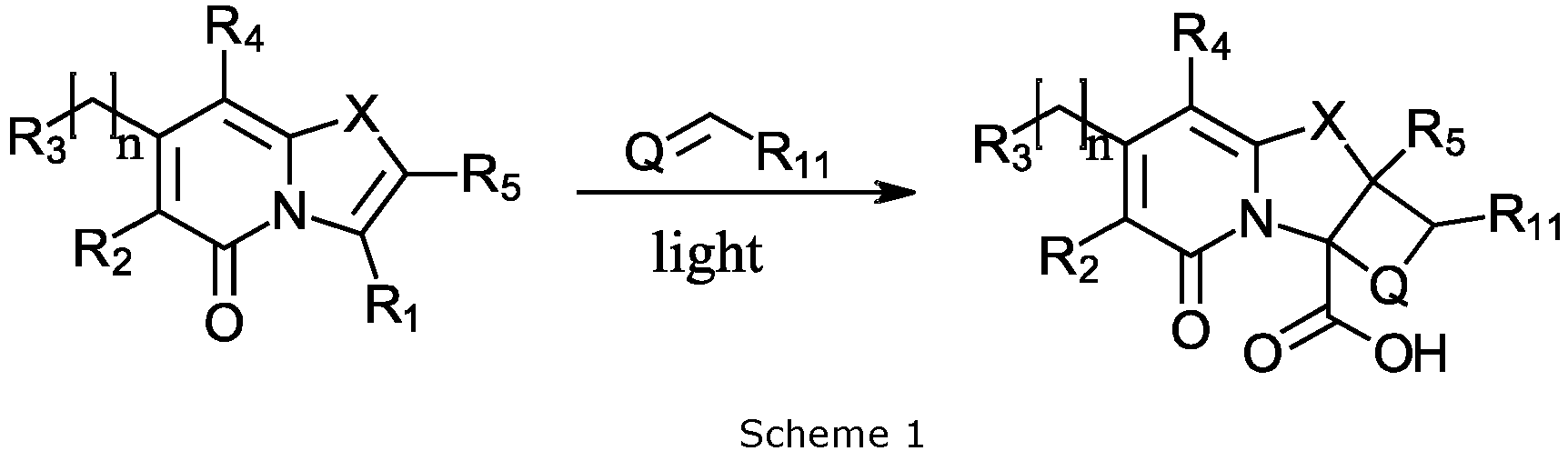
- It will be appreciated that Q, in the substrate Q=CHR11 in
Scheme 1, may be CH2 so that the substrate is an alkene of formula CH2CHR11, which is illustrated inScheme 2.
- Further, the compounds of Formula II in
Schemes Scheme 3 illustrates formation of a mixture of a compound of Formula II syn and Formula II anti.
- The light used in the cycloaddition reaction in
Schemes 1 to 3 may be visible light, LED light, such as LED light at 395 nm, or any other light with a suitable wavelength. - The above cycloaddition reaction in
Schemes 1 to 3 may be performed understandard 2+2 cycloaddition reaction conditions. This includes the presence of an appropriate solvent (e.g. dichloromethane or acetonitrile) and/or that the reaction may be performed at below (e.g. 5°C), around or above room temperature (e.g. up to 40°C). - The compound of Formula II syn and Formula II anti may be separated by e.g. chromatography optionally followed by resolution into the enantiomer described herein. It will be appreciated that the diastereoisomers and enantiomers may be further treated into the desired compound. For instance, ester groups into carboxylic acids, substituents may be introduced or exchanged for other substituents etc. For instance, the exchange of ester groups into carboxylic acids may be performed using techniques known to those skilled in the art, e.g. acidification in the presence of an appropriate solvent (e.g. THF), an appropriate base (e.g. lithium hydroxide) at around or above room temperature (e.g. 60-70°C).
- The disclosure is further illustrated by the following non-limitative Examples.
-
- C. difficile
- Clostridium difficile
- CLABSI
- central line associated bloodstream infection
- DCM
- Dichloromethane
- DMF
- Dimethylformamide
- DMSO
- Dimethylsulphoxide
- EtOAc
- Ethyl Acetate
- ESI-TOF
- Electrospray Ionization Time of Flight Mass Spectroscopy
- HCAI
- HealthCare-Associated Infection
- HRMS
- High Resolution Mass Spectroscopy
- IR
- Infrared
- MBC
- Minimum Bactericidal Concentration
- MeOH
- Methanol
- MeCN
- Acetonitrile
- MIC
- Minimum Inhibitory Concentration
- ml
- milliliter
- MRSA
- Methicillin-resistant Staphylococcus aureus
- NMR
- Nuclear Magnetic Resonance
- nd
- no data
- nm
- nanometer
- ns
- not statistically different
- OD
- Optical density
- OD600
- Optical density at 600 nm
- ppm
- part per million
- Van
- Vancomycin
- VISA
- Vancomycin-Intermediate Staphylococcus aureus
- VRE
- Vancomycin-Resistant Enterococci
- VRSA
- Vancomycin-Resistant Staphylococcus aureus
- THF
- Tetrahydrofurane
- TLC
- Thin Layer Chromatography
- TMS
- Trimethylsilyl
- UTI
- urinary tract infection
- µl
- microliter
- In this document, unless otherwise stated, the drawing of the chemical compounds has been made using the program Chem Doodle version 9.0.3. The naming of the compounds has been made using the program Chemdraw, version 19.0.0. 26. If the name and drawing are inconsistent, the chemical structure shall be considered to be correct.
- Unless otherwise stated, all reagents and solvents were used as received from commercial suppliers. Microwave reactions were performed in sealed vessels using a Biotage® Initiator microwave synthesizer; temperatures were monitored by an internal IR probe. Automated flash column chromatography was performed using a Biotage® Isolera One system and purchased pre-packed silica gel cartridges (Biotage® SNAP Cartridge, KP-Sil). 1H- and 13C- NMR spectra were recorded, depending on instrument availability, on a Bruker Avance III 400 MHz spectrometer with a BBO-F/H Smartprobe™, a Bruker Avance III HD 600 MHz spectrometer with a CP BBO-H/F, 5 mm cryoprobe at 298 K. All spectrometers were operated by Topspin 3.5.7. Resonances are given in ppm relative to TMS, and calibrated to solvent residual signals (CDCl3: δH = 7.26 ppm; δC = 77.16 ppm. (CD3)2SO (DMSO-d6): δH = 2.50 ppm; δC = 39.51 ppm. CD3OD (MeOD): 6H = 3.31 ppm; δC = 49.00 ppm). The following abbreviations are used to indicate splitting patterns: s = singlet; d = doublet; dd = double doublet; t = triplet; m = multiplet; bs = broad singlet. HRMS was performed on a mass spectrometer with ESI-TOF (ES+).
- The compounds of the compound examples were synthesized in accordance or analogy with what is stated in the method of preparation section in this document. For instance, the compounds of Examples 1-41 were synthesized as follows.
- General Procedure for 2+2 Cycloadditions: 2-Pyridone of general structure IV as described on the section "Methods of preparation" was weighed in a vial, added Dry DCM (0.1M). Vial was sealed and degassed with N2 for 5 minutes. Added styrene (4 eq.) and degassed again for 3-4 minutes. Reaction mixture was stirred under purple light (395 nm, 3.9W) for 4-6 hours. After completion of reaction as indicated by TLC, solvent was evaporated under reduced pressure. Crude product was purified by column chromatography eluting with 0-100% ethyl acetate in heptane.
- General procedure for acidification: Methyl ester was charged into a round bottom flask and added THF. LiOH (4 eq., 1M; aq.) was added to the reaction mixture and stirred at room temperature for 24 hours. The reaction mixture was neutralized with HCl (1 M) and extracted with EtOAc. The organic phase was washed with brine and the solvent was removed under reduced pressure. Crude product was purified with preparative HPLC (H2O/MeCN + 0.75% HCOOH, 20-100% in 45 min, 100% in 10 min). The product was freeze dried from a mixture of MeCN:H2O (1:3).
- General procedure for decarboxylative alkylation:_To an oven dried vial was added carboxylic acid (1 eq.), photocatalyst (0.01 eq.), potassium phosphate dibasic (1.5 eq.) and the vial was sealed with septum. Under N2 flow was added degassed DMF (5 mL). Then the mixture was degassed by bubbling N2 for 10 min. Then alkene (2.0 eq.) was added and the solution was degassed for additional 5 min. The vial was sealed with parafilm and irradiated with 455 nm LED. After completion, reaction mixture was diluted with EtOAc and washed with brine. Solvent was removed under reduced pressure and the crude product was purified by column chromatography (10 g cartridge, heptane/EtOAc 0-100%).
- General procedure for deprotection of pinacolyl boronate esters: Compound (1 eq.) was dissolved in dry DCM under N2 and cooled to -78 °C, then added BCl3 (3 eq.) dropwise. Reaction mixture was stirred at -78 °C for 20 minutes and then allowed to come to room temperature. As completion indicated by TLC, solvent was evaporated under reduced pressure. Added methanol and stirred for 5 minutes at room temperature and then solvent was removed under reduced pressure. This process was repeated 4-5 times. The crude product was purified by column chromatography (10 g cartridge, DCM/MeOH 0-20%). The pure product was freeze dried from a mixture of MeCN:H2O (1:3).
Table 1: Compound examples Example Number Chemical structure Chemical name NMR 1 
1H NMR (DMSO-d6, 400 MHz) δ 8.00 - 7.98 (m, 1H), 7.95 - 7.94 (m, 1H), 7.91 - 7.90 (m, 1H), 7.71 - 7.60 (m, 2H), 7.65 - 7.61 (m, 2H), 7.58 - 7.52 (m, 3H), 7.44 - 7.43 (m, 1H), 5.27 (s, 1H), 4.71 (d, J = 6.9 Hz, 1H), 4.51 (s, 2H), 3.85 (dd, J = 17.7, 9.8 Hz, 1H), 3.07 (dd, J = 12.9, 10.3 Hz, 1H), 2.80 (dd, J = 12.3, 9.4 Hz, 1H), 1.82 - 1.77 (m, 1H), 1.00 - 0.93 (m, 2H), 0.89-0.85 (m, 1H), 0.77-0.74 (m, 1H). (25)-4-cyclopropyl-5-(naphthalen-1-ylmethyl)-7-oxo-2-(3-(trifluoromethyl)phenyl)-2,2a,7,8a-tetrahydro-1H-cyclobuta[4,5]thiazolo[3,2-a]pyridine-8a-carboxylic acid 2 
1H NMR (DMSO-d6, 400 MHz) δ 8.00 - 7.98 (m, 1H), 7.95 - 7.94 (m, 1H), 7.91 - 7.90 (m, 1H), 7.71 - 7.60 (m, 2H), 7.65 - 7.61 (m, 2H), 7.58 - 7.52 (m, 3H), 7.44 - 7.43 (m, 1H), 5.27 (s, 1H), 4.71 (d, J = 6.9 Hz, 1H), 4.51 (s, 2H), 3.85 (dd, J = 17.7, 9.8 Hz, 1H), 3.07 (dd, J = 12.9, 10.3 Hz, 1H), 2.80 (dd, J = 12.3, 9.4 Hz, 1H), 1.82 - 1.77 (m, 1H), 1.00 - 0.93 (m, 2H), 0.89-0.85 (m, 1H), 0.77-0.74 (m, 1H). (+)-Enantiomer of (2S)-4-cyclopropyl-5-(naphthalen-1-ylmethyl)-7-oxo-2-(3-(trifluoromethyl)phenyl)-2,2a,7,8a-tetrahydro-1H-cyclobuta[4,5]thiazolo[3,2-a]pyridine-8a-carboxylic acid 3 
1H NMR (DMSO-d6, 400 MHz) δ 8.00 - 7.98 (m, 1H), 7.95 - 7.94 (m, 1H), 7.91 - 7.90 (m, 1H), 7.71 - 7.60 (m, 2H), 7.65 - 7.61 (m, 2H), 7.58 - 7.52 (m, 3H), 7.44 - 7.43 (m, 1H), 5.27 (s, 1H), 4.71 (d, J = 6.9 Hz, 1H), 4.51 (s, 2H), 3.85 (dd, J = 17.7, 9.8 Hz, 1H), 3.07 (dd, J = 12.9, 10.3 Hz, 1H), 2.80 (dd, J = 12.3, 9.4 Hz, 1H), 1.82 - 1.77 (m, 1H), 1.00 - 0.93 (m, 2H), 0.89-0.85 (m, 1H), 0.77-0.74 (m, 1H). (-) -Enantiomer of (2S)-4-cyclopropyl-5-(naphthalen-1-ylmethyl)-7-oxo-2-(3-(trifluoromethyl)phenyl)-2,2a,7,8a-tetrahydro-1H-cyclobuta[4,5]thiazolo[3,2-a]pyridine-8a-carboxylic acid 4 
1H NMR (DMSO-d6, 600 MHz) δ 7.99-7.97 (m, 1H), 7.90-7.83 (m, 2H), 7.63 (d, J = 7.3 Hz, 1H), 7.57 - 7.50 (m, 4H), 7.35-7.32 (m, 2H), 7.25 (s, 2H), 5.25 (s, 1H), 4.97 (d, J = 8.7 Hz, 1H), 4.37 (s, 2H), 4.24-4.18 (m, , 1H), 3.46 (dd, J = 14.3, 10.9 Hz, (2R)-4-cyclopropyl-5-(naphthalen-1-ylmethyl)-7-oxo-2-(3-(trifluoromethyl)phenyl)-2,2a,7,8a- tetrahydro-1H-cyclobuta[4,5]thiazolo[3,2-a]pyridine-8a-carboxylic acid 1H), 2.67 (dd, J = 14.3, 5.6 Hz, 1H), 1.64 - 1.41 (m, 1H), 0.83 - 0.77 (m, 1H), 0.66 - 0.59 (m, 1H), 0.39-0.32 (m, 1H), 0.09 - 0.03 (m, 1H). 5 
1H NMR (DMSO-d6, 600 MHz) δ 8.32 (d, J = 8.4 Hz, 1H), 7.96 (d, J = 8.0 Hz, 1H), 7.78 (d, J = 8.2 Hz, 1H), 7.74 (d, J = 10.7 Hz, 2H), 7.66-7.62 (m, J = 8.4 Hz, 3H), 7.58 (t, J = 7.4 Hz, 1H), 7.43 (t, J = 7.7 Hz, 1H), 6.91 (d, J = 7.0 Hz, 1H), 4.74-4.68 (m, J = 15.4 Hz, 3H), 3.93 (q, J = 9.5 Hz, 1H), 3.19 (dd, J = 12.8, 10.0 Hz, 1H), 2.97 (dd, J = 12.8, 9.9 Hz, 1H), 2.57 (s, 6H), 1.34 - 1.22 (m, 1H), 0.63 - 0.49 (m, 4H). (2S)-4-cyclopropyl-6-(dimethylamino)-5-(naphthalen-1-ylmethyl)-7-oxo-2-(3-(trifluoromethyl)phenyl)-2,2a,7,8a-tetrahydro-1H-cyclobuta[4,5]thiazolo[3,2-a]pyridine-8a-carboxylic acid 13C NMR (DMSO-d6, 151 MHz) δ 169.05, 163.14, 158.16, 151.56, 146.78, 142.89, 136.43, 135.90, 133.30, 131.63, 131.02, 129.69, 129.37, 129.16, 128.58, 126.22, 126.12, 125.76, 125.51, 125.13, 123.75, 123.53, 123.50, 123.46, 50.61, 46.33, 42.61, 35.68, 30.64, 11.84, 7.32, 7.22. 6 
1H NMR (MeOD, 400 MHz) δ 9.26 (s, 1H), 8.38 (s, 1H), 8.21 (d, J = 8.1 Hz, 1H), 7.99 (d, J = 8.4 Hz, 1H), 7.92 - 7.86 (m, 1H), 7.77 (t, J = 7.2 Hz, 1H), 7.72 - 7.65 (m, 2H), 7.61 (dd, J = 4.8, 1.2 Hz, 2H), 5.65 (s, 1H), 4.61 (d, J = 17.6 Hz, 2H), 4.52 (d, J (2S)-4-cyclopropyl-5-(isoquinolin-4-ylmethyl)-7-oxo-2-(3- (trifluoromethyl)phenyl)-2,2a,7,8a-tetrahydro-1H-cyclobuta[4,5]thiazolo[3,2-a]pyridine-8a-carboxylic acid = 7.5 Hz, 1H), 3.90 (dd, J = 17.3, 9.7 Hz, 1H), 3.40 (dd, J = 13.1, 9.9 Hz, 1H), 3.01 (dd, J = 12.7, 9.6 Hz, 1H), 1.89 - 1.79 (m, 1H), 1.14 - 1.01 (m, 2H), 0.98 - 0.85 (m, 2H). 7 
1H NMR (DMSO-d6, 600 MHz) δ 13.37 (s, 1H), 7.89-7.86 (m, 1H), 7.88 (dd, J = 12.5, 7.3 Hz, 2H), 7.65 (d, J = 8.2 Hz, 2H), 7.57 - 7.49 (m, 3H), 7.35 (d, J = 6.9 Hz, 1H), 7.22 (d, J = 8.1 Hz, 2H), 5.36 (s, 1H), 5.01 (d, J = 8.6 Hz, 1H), 4.38 (dd, J = 41.9, 17.2 Hz, 2H), 4.20 (dd, J = 15.1, 9.1 Hz, 1H), 3.45 (dd, J = 13.1, 10.0 Hz, 1H), 2.73 (dd, J = 13.7, 5.7 Hz, 1H), 1.44 - 1.33 (m, 1H), 0.80 - 0.70 (m, 1H), 0.65 - 0.57 (m, 1H), 0.37 - 0.28 (m, 1H), 0.08 (m, 1H). (2R)-4-cyclopropyl-5-(naphthalen-1-ylmethyl)-7-oxo-2-(4-(trifluoromethyl)phenyl)-2,2a,7,8a-tetrahydro-1H-cyclobuta[4,5]thiazolo[3,2-a]pyridine-8a-carboxylic acid 13C NMR (DMSO-d6, 151 MHz) δ 168.95, 159.06, 156.92, 149.80, 143.36, 134.57, 133.49, 131.51, 128.96, 128.70, 127.44, 127.32, 126.26, 125.86, 125.64, 125.25, 124.69, 123.87, 123.44, 114.07, 111.81, 74.02, 49.80, 40.82, 35.17, 31.38, 10.22, 8.25, 6.67. 8 
1H NMR (DMSO-d6, 600 MHz) δ 13.41 (s, 1H), 8.00 - 7.97 (m, 3H), 7.96 - 7.93 (m, 3H), 7.90 (d, J = 8.2 Hz, 3H), 7.74 (d, J = 8.2 Hz, 6H), 7.60 - 7.51 (m, 16H), 7.43 (d, J = 6.9 Hz, 3H), 5.27 (s, 3H), 4.69 (d, J = 7.6 Hz, (2S)-4-cyclopropyl-5-(naphthalen-1-ylmethyl)-7-oxo-2-(4-(trifluoromethyl)phenyl)-2,2a,7,8a-tetrahydro-1H-cyclobuta[4,5]thiazolo[3,2-a]pyridine-8a-carboxylic acid 3H), 3.85 (dd, J = 17.6, 9.6 Hz, 3H), 3.09 (dd, J = 12.8, 10.0 Hz, 3H), 2.79 (dd, J = 12.7, 9.8 Hz, 3H), 1.85 - 1.74 (m, 3H), 1.00 - 0.93 (m, 6H), 0.89 - 0.84 (m, 3H), 0.78 - 0.72 (m, 3H). 13C NMR (DMSO-d6, 151 MHz) δ 168.83, 159.57, 157.24, 149.81, 145.87, 134.44, 133.48, 131.65, 128.67, 127.77, 127.64, 127.40, 126.43, 125.87, 125.74, 125.46, 125.44, 125.19, 124.10, 123.39, 73.10, 50.68, 46.45, 35.31, 35.01, 10.85, 7.83, 7.52. 9 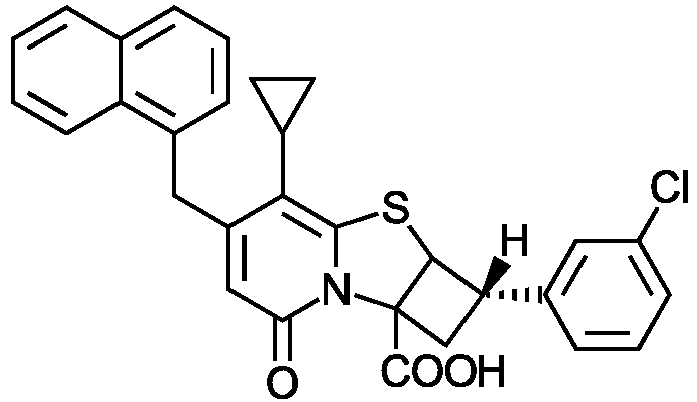
1H NMR (DMSO-d6, 600 MHz) δ 8.00 - 7.97 (m, 1H), 7.93 (d, J = 7.4 Hz, 1H), 7.90 (d, J = 8.2 Hz, 1H), 7.55 (ddd, J = 6.5, 5.2, 3.3 Hz, 2H), 7.52 (t, J = 6.3 Hz, 1H), 7.42 (t, J = 5.3 Hz, 2H), 7.39 (d, J = 7.8 Hz, 1H), 7.33 (t, J = 9.3 Hz, 2H), 5.26 (s, 1H), 4.68 (d, J = 7.6 Hz, 1H), 4.50 (s, 2H), 3.78 - 3.71 (m, 1H), 3.03 (dd, J = 12.7, 10.0 Hz, 1H), 2.75 (dt, J = 18.5, 9.2 Hz, 1H), 1.83 - 1.75 (m, 1H), 1.00 - 0.92 (m, 2H), 0.88 - 0.83 (m, 1H), 0.78 - 0.72 (m, 1H). (2S)-2-(3-chlorophenyl)-4-cyclopropyl-5-(naphthalen-1-ylmethyl)-7-oxo-2,2a,7,8a-tetrahydro-1H-cyclobuta[4,5]thiazolo[3,2-a]pyridine-8a-carboxylic acid 13C NMR (DMSO-d6, 151 MHz) δ 168.87 (s), 159.56 (s), 157.26 (s), 149.87 (s), 143.67 (s), 134.44 (s), 133.49 (s), 133.27 (s), 131.65 (s), 130.49 (s), 128.67 (s), 127.78 (s), 127.41 (s), 127.01 (s), 126.70 (s), 126.44 (s), 125.75 (s), 125.88 (s), 125.50 (s), 124.10 (s), 113.88 (s), 112.73 (s), 73.00 (s), 50.59 (s), 46.33 (s), 35.31 (s), 10.85 (s), 7.86 (s), 7.52 (s). 10 
(+)1H NMR (DMSO-d6, 600 MHz) δ 8.00 - 7.97 (m, 1H), 7.94 (d, J = 7.4 Hz, 1H), 7.90 (d, J = 8.2 Hz, 1H), 7.58 - 7.54 (m, 2H), 7.52 (t, J = 6.3 Hz, 1H), 7.42 (dd, J = 10.7, 5.4 Hz, 2H), 7.40 (d, J = 7.8 Hz, 1H), 7.33 (t, J = 9.3 Hz, 2H), 5.26 (s, 1H), 4.68 (d, J = 7.6 Hz, 1H), 4.50 (s, 2H), 3.75 (dd, J = 17.5, 9.7 Hz, 1H), 3.03 (dd, J = 12.7, 10.0 Hz, 1H), 2.76 (dd, J = 12.7, 9.9 Hz, 1H), 1.83 - 1.76 (m, 1H), 1.00 - 0.92 (m, 2H), 0.89 - 0.82 (m, 1H), 0.79 - 0.72 (m, 1H). (+)-Enantiomer of (2S)-2-(3-chlorophenyl)-4-cyclopropyl-5-(naphthalen-1-ylmethyl)-7-oxo-2,2a,7,8a-tetrahydro-1H-cyclobuta[4,5]thiazolo[3,2-a]pyridine-8a-carboxylic acid 13C NMR (DMSO-d6, 151 MHz) δ 168.87 (s), 159.56 (s), 157.26 (s), 149.87 (s), 143.67 (s), 134.44 (s), 133.49 (s), 133.27 (s), 131.65 (s), 130.49 (s), 128.67 (s), 127.78 (s), 127.41 (s), 127.01 (s), 126.70 (s), 126.44 (s), 125.88 (s, J = 19.3 Hz), 125.75 (s), 125.50 (s), 124.10 (s), 113.88 (s), 112.73 (s), 73.00 (s), 50.59 (s), 46.33 (s), 35.31 (s, J = 6.4 Hz), 35.27 (s), 10.85 (s), 7.86 (s), 7.52 (s). 11 
1H NMR (DMSO-d6, 600 MHz) δ 8.00 - 7.97 (m, 1H), 7.94 (d, J = 7.4 Hz, 1H), 7.90 (d, J = 8.2 Hz, 1H), 7.58 - 7.54 (m, 2H), 7.52 (t, J = 6.3 Hz, 1H), 7.43 (t, J = 5.6 Hz, 2H), 7.40 (d, J = 7.8 Hz, 1H), 7.33 (t, J = 9.3 Hz, 2H), 5.26 (s, 1H), 4.68 (d, J = 7.6 Hz, 1H), 4.50 (s, 2H), 3.75 (dd, J = 17.5, 9.6 Hz, 1H), 3.03 (dd, J = 12.7, 10.0 Hz, 1H), 2.75 (dt, J = 18.4, 9.2 Hz, 1H), 1.82 - 1.77 (m, 1H), 1.00 - 0.93 (m, 2H), 0.89 - 0.83 (m, 1H), 0.75 (dd, J = 10.1, 4.4 Hz, 1H). (-)-Enantiomer of (2S)-2-(3-chlorophenyl)-4-cyclopropyl-5-(naphthalen-1-ylmethyl)-7-oxo-2,2a,7,8a-tetrahydro-1H-cyclobuta[4,5]thiazolo[3,2-a]pyridine-8a-carboxylic acid 13C NMR (DMSO-d6, 151 MHz) δ 168.87 (s), 159.56 (s), 157.26 (s), 149.87 (s), 143.67 (s), 134.44 (s), 133.49 (s), 133.27 (s), 131.65 (s), 130.49 (s), 128.68 (s), 127.78 (s), 127.41 (s), 127.01 (s), 126.70 (s), 126.44 (s), 125.88 (s, J = 19.3 Hz), 125.75 (s), 125.50 (s), 124.10 (s), 113.88 (s), 112.73 (s), 73.00 (s), 50.59 (s), 46.33 (s), 35.31 (s, J = 6.5 Hz), 35.27 (s), 10.85 (s), 7.86 (s), 7.52 (s). 12 
1H NMR (MeOD, 400 MHz) δ 9.33 (s, 1H), 8.45 (s, 1H), 8.28 (d, J = 8.1 Hz, 1H), 8.06 (d, J = 8.4 Hz, 1H), 7.99 - 7.93 (m, 1H), 7.84 (t, J = 7.2 Hz, 1H), 7.79 - 7.72 (m, 2H), 7.68 (dd, J = 4.8, 1.2 Hz, 2H), 5.72 (s, 1H), 4.68 (d, J = 17.6 Hz, 2H), 4.59 (d, J (2S)-2-(3-chlorophenyl)-4-cyclopropyl-5-(isoquinolin-4-ylmethyl)-7-oxo- 2,2a,7,8a-tetrahydro-1H-cyclobuta[4,5]thiazolo[3,2-a]pyridine-8a-carboxylic acid = 7.5 Hz, 1H), 3.97 (dd, J = 17.3, 9.7 Hz, 1H), 3.47 (dd, J = 13.1, 9.9 Hz, 1H), 3.08 (dd, J = 12.7, 9.6 Hz, 1H), 1.96 - 1.86 (m, 1H), 1.21 - 1.08 (m, 2H), 1.05 - 0.92 (m, 2H). 13 
1H NMR (DMSO-d6, 400 MHz) δ 13.36 (s, 1H), 8.31 (d, J = 8.4 Hz, 1H), 7.95 (d, J = 7.5 Hz, 1H), 7.77 (d, J = 8.2 Hz, 1H), 7.67 - 7.60 (m, 1H), 7.57 (t, J = 7.0 Hz, 1H), 7.47 (s, 1H), 7.44 - 7.38 (m, 2H), 7.38 - 7.32 (m, 2H), 6.89 (d, J = 7.0 Hz, 1H), 4.71 (s, 2H), 4.68 (d, J = 7.6 Hz, 1H), 3.83 (dd, J = 17.4, 9.7 Hz, 1H), 3.14 (dd, J = 12.8, 9.9 Hz, 1H), 2.93 (dd, J = 12.8, 9.9 Hz, 1H), 2.55 (s, 6H), 1.32 - 1.22 (m, 1H), 0.63 - 0.52 (m, 3H), 0.51 - 0.45 (m, 1H). (2R)-2-(3-chlorophenyl)-4-cyclopropyl-6-(dimethylamino)-5-(naphthalen-1-ylmethyl)-7-oxo-2,2a,7,8a-tetrahydro-1H-cyclobuta[4,5]thiazolo[3,2-a]pyridine-8a-carboxylic acid 13C NMR (DMSO-d6, 100 MHz) δ 169.06 (s), 158.17 (s), 151.76 (s), 146.66 (s), 143.84 (s), 135.85 (s), 133.29 (s), 131.62 (s), 130.49 (s), 128.59 (s), 126.99 (s), 126.74 (s), 126.24 (s, J = 10.7 Hz), 126.13 (s), 125.78 (s), 125.54 (s), 123.52 (s, J = 6.3 Hz), 123.46 (s), 112.07 (s), 73.44 (s), 50.48 (s), 46.25 (s), 42.60 (s), 35.41 (s), 30.66 (s), 11.84 (s), 7.38 (s, J = 18.3 Hz), 7.20 (s) 14 
1H NMR (DMSO-d6, 400 MHz) δ 8.01 - 7.95 (m, 1H), 7.89 (dd, J = 9.0, 3.7 Hz, 2H), 7.59 - 7.48 (m, 3H), 7.34 (dt, J = 10.9, 8.2 Hz, 3H), 6.98 (dd, J = 5.7, 2.5 Hz, 1H), 6.94 (s, 1H), 5.29 (s, 1H), 4.95 (d, J = 8.7 Hz, 1H), 4.41 (q, J = 17.4 Hz, 2H), 4.11 (td, J = 9.3, 6.1 Hz, 1H), 3.43 (dd, J = 13.1, 10.1 Hz, 1H), 2.61 (dd, J = 13.8, 5.7 Hz, 1H), 1.57 - 1.40 (m, 1H), 0.90 - 0.76 (m, 1H), 0.70 - 0.59 (m, 1H), 0.46 (td, J = 9.5, 5.5 Hz, 1H), 0.18 (td, J = 9.7, 5.5 Hz, 1H). (2R)-2-(3-chlorophenyl)-4-cyclopropyl-5-(naphthalen-1-ylmethyl)-7-oxo-2,2a,7,8a-tetrahydro-1H-cyclobuta[4,5]thiazolo[3,2-a]pyridine-8a-carboxylic acid 13C NMR (DMSO-d6, 100 MHz) δ 169.10 (s), 159.05 (s), 157.05 (s), 150.00 (s), 141.27 (s), 134.43 (s), 133.48 (s), 132.91 (s), 131.56 (s), 129.80 (s), 128.69 (s), 127.65 (d, J = 12.5 Hz), 127.32 (d, J = 11.7 Hz), 126.75 (s), 126.35 (s), 125.79 (d, J = 15.6 Hz), 123.97 (s), 113.86 (s), 111.72 (s), 74.07 (s), 49.72 (s), 40.95 (s), 35.27 (s), 31.98 (s), 10.38 (s), 8.55 (s), 6.80 (s). 15 
1H NMR (DMSO-d6, 400 MHz) δ 8.01 - 7.96 (m, 1H), 7.95 - 7.87 (m, 2H), 7.56 (dt, J = 5.5, 3.3 Hz, 2H), 7.53 - 7.49 (m, 2H), 7.45 - 7.40 (m, 3H), 5.27 (s, 1H), 4.75 (d, J = 7.6 Hz, 1H), 4.50 (s, 2H), 3.78 (dd, J = 17.4, 9.6 Hz, 1H), 3.01 (dd, J = 12.8, (2S)-4-cyclopropyl-2-(3,5-dichlorophenyl)-5-(naphthalen-1-ylmethyl)-7-oxo-2,2a,7,8a-tetrahydro-1H-cyclobuta[4,5]thiazolo[3,2-a]pyridine-8a-carboxylic acid 9.9 Hz, 1H), 2.76 (dd, J = 12.7, 9.9 Hz, 1H), 1.84 - 1.73 (m, 1H), 0.97-0.91 (m, 2H), 0.81-0.79 (m, 1H), 0.76-0.73 (m, 1H). 13C NMR (DMSO-d6, 100 MHz) δ 168.78, 159.54, 157.26, 149.85, 145.38, 134.43, 134.22, 133.48, 131.64, 128.67, 127.77, 127.41, 126.65, 126.43, 125.87, 125.73, 124.08, 113.89, 112.71, 72.96, 50.15, 45.91, 35.30, 10.84, 7.88, 7.50. 16 
1H NMR (DMSO-d6, 600 MHz) δ 7.98 (d, J = 8.0 Hz, 1H), 7.89 (t, J = 8.3 Hz, 2H), 7.57 - 7.48 (m, 4H), 7.37 (d, J = 6.9 Hz, 1H), 7.00 (s, 2H), 5.27 (s, 1H), 4.95 (d, J = 8.7 Hz, 1H), 4.42 (q, J = 17.5 Hz, 2H), 4.13 (dd, J = 14.9, 9.3 Hz, 1H), 3.41 (dd, J = 13.7, 10.1 Hz, 1H), 2.62 (dd, J = 14.0, 5.4 Hz, 1H), 1.64 - 1.41 (m, 1H), 0.94 - 0.80 (m, 1H), 0.74 - 0.62 (m, 1H), 0.50-0.46 (m, 1H), 0.24 - 0.13 (m, 1H). (2R)-4-cyclopropyl-2-(3,5-dichlorophenyl)-5-(naphthalen-1-ylmethyl)-7-oxo-2,2a,7,8a-tetrahydro-1H-cyclobuta[4,5]thiazolo[3,2-a]pyridine-8a-carboxylic acid 17 
1H NMR (DMSO-d6, 400 MHz) δ 8.03 - 7.87 (m, 3H), 7.60 - 7.40 (m, 5H), 7.40 - 7.30 (m, 2H), 5.26 (s, 1H), 4.67 (d, J = 7.6 Hz, 1H), 4.50 (s, 2H), 3.74 (dd, J = 17.4, 9.7 Hz, 1H), 3.03 (dd, J = 12.7, 9.9 Hz, 1H), 2.76 (dd, J = 12.6, 9.9 Hz, 1H), 1.86 - 1.74 (m, 1H), 1.01 - 0.91 (m, 2H), (2S)-2-(3-bromophenyl)-4-cyclopropyl-5-(naphthalen-1-ylmethyl)-7-oxo-2,2a,7,8a-tetrahydro-1H- cyclobuta[4,5]thiazolo[3,2-a]pyridine-8a-carboxylic acid 0.81-0.79 (m, 1H), 0.76-0.73 (m, 1H). 13C NMR (DMSO-d6, 100 MHz) δ 168.86, 159.56, 157.24, 149.88, 143.95, 134.44, 133.48, 131.65, 130.77, 129.92, 129.56, 128.67, 127.78, 127.40, 126.43, 125.87, 125.74, 124.10, 121.94, 113.88, 112.71, 73.01, 50.63, 46.30, 35.31, 10.85, 7.87, 7.52. 18 
1H NMR (DMSO-d6, 600 MHz) δ 7.98 (dd, J = 6.6, 2.6 Hz, 1H), 7.96 - 7.94 (m, 1H), 7.90 (d, J = 8.2 Hz, 1H), 7.56-7.51 (m, 1H), 7.43 (d, J = 6.9 Hz, 1H), 7.42 - 7.36 (m, 1H), 7.11 (t, J = 8.3 Hz, 2H), 5.25 (s, 1H), 4.82 (d, J = 7.5 Hz, 1H), 4.50 (s, 2H), 3.88 (dd, J = 18.2, 9.9 Hz, 1H), 3.41 - 3.33 (m, 1H), 2.75 (dd, J = 12.2, 10.1 Hz, 1H), 1.92 - 1.69 (m, 1H), 1.02 - 0.92 (m, 2H), 0.87 - 0.72 (m, 2H). (2S)-4-cyclopropyl-2-(2,6-difluorophenyl)-5-(naphthalen-1-ylmethyl)-7-oxo-2,2a,7,8a-tetrahydro-1H-cyclobuta[4,5]thiazolo[3,2-a]pyridine-8a-carboxylic acid 13C NMR (DMSO-d6, 151 MHz) δ 168.56, 161.67, 160.03, 159.97, 159.62, 157.27, 149.77, 134.44, 133.47, 131.67, 129.61, 128.65, 127.81, 127.39, 126.44, 125.86, 125.74, 124.15, 115.57, 113.87, 112.80, 112.04, 112.01, 111.90, 111.87, 74.03, 49.93, 37.84, 35.31, 33.44, 10.83, 7.78, 7.55. 19A 
1H NMR (DMSO-d6, 400 MHz): δ 8.16 (s, 1H), 8.00-7.96 (m, 1H), 7.91-7.86 (m, 2H), 7.67-7.63 (m, 2H), 7.56-7.52 (m, 2H), 7.51 (d, 1H), 7.36 (d, 1H), 7.18 (t, 1H), 7.07 (dd, 1H), 6.77 (d, 1H), 6.73-6.71 (m, 1H), 5.27 (s, 1H), 4.89 (d, 1H), 4.40 (dd, 2H), 4.06-3.98 (m, 1H), 3.45 (m, 1H), 2.56 (dd, 1H), 2.25 (s, 3H), 2.03-1.94 (m, 1H), 1.51-1.42 (m, 2H), 0.87-0.77 (m, 1H), 0.67-0.60 (m, 1H), 0.47-0.38 (m, 1H), 0.24-0.15 (m, 1H). 1H-imidazol-1-ium (2S)-4-cyclopropyl-5-(naphthalen-1-ylmethyl)-7-oxo-2-(m-tolyl)-2,2a-dihydro-7H-cyclobuta[4,5]thiazolo[3,2-a]pyridine-8a(1H)-carboxylate 19B 
1H NMR (DMSO-d6, 400 MHz): δ 13.32 (br s, 1H), 8.02-7.92 (m, 2H), 7.90 (d, J = 8.1 Hz, 1H), 7.59-7.70 (m, 3H), 7.44 (d, J = 6.8 Hz, 1H), 7.25 (t, J = 7.5 Hz, 1H), 7.17-7.12 (m, 2H), 7.09 (d, J = 7.6 Hz, 1H), 5.26 (s, 1H), 4.56 (d, J = 7.5 Hz, 1H), 4.51 (s, 2H), 3.65 (ddd, J = 7.8, 9.5 Hz, 1H), 3.06 (dd, J = 10.0, 12.7 Hz, 1H), 2.73 (dd, J = 9.8, 12.7 Hz, 1H), 1.84-1.76 (m, 1H), 1.00-0.92 (m, 2H), 0.89-0.81 (m, 1H), 0.79-0.72 (m, 1H). (2S)-4-cyclopropyl-5-(naphthalen-1-ylmethyl)-7-oxo-2-(m-tolyl)-2,2a-dihydro-7H-cyclobuta[4,5]thiazolo[3,2-a]pyridine-8a(1H)-carboxylic acid 13C NMR (DMSO-d6, 100 MHz): δ 168.9, 159.5, 157.1, 149.9, 141.0, 137.7, 134.4, 133.4, 131.6, 128.6, 128.5, 127.7, 127.6, 127.4, 127.3, 126.4, 125.8, 125.7, 124.1, 123.7, 113.8, 112.6, 73.1, 51.0, 46.9, 35.3, 35.1, 21.0, 10.8, 7.8, 7.5. 20A 
1H NMR (DMSO-d6, 400 MHz): δ 12.87 (br s, 1H), 8.01-7.92 (m, 2H), 7.89 (d, 1H), 7.67 (s, 1H), 7.58-7.50 (m, 3H), 7.43 (d, 1H), 7.24 (t, 1H), 7.17-7.11 (m, 2H), 7.08 (d, 1H), 7.04-7.01 (m, 2H), 5.24 (s, 1H), 4.53 (d, 1H), 4.50 (s, 2H), 3.63 (q, 1H), 3.06 (dd, 1H), 2.72 (dd, 1H), 2.30 (s, 3H), 1.83-1.75 (m, 1H), 0.99-0.91 (m, 2H), 0.88-0.81 (m, 1H), 0.79-0.71 (m, 1H). 1H-imidazol-1-ium (2R)-4-cyclopropyl-5-(naphthalen-1-ylmethyl)-7-oxo-2-(m-tolyl)-2,2a-dihydro-7H-cyclobuta[4,5]thiazolo[3,2-a]pyridine-8a(1H)-carboxylate 20B 
1H NMR (DMSO-d6, 600 MHz): δ 7.99-7.96 (m, 1H), 7.88 (d, 2H), 7.55-7.53 (m, 2H), 7.51 (t, 1H), 7.36 (d, 1H), 7.16 (t, 1H), 7.05 (d, 1H), 6.76 (d, 1H), 6.72 (s, 1H), 5.23 (s, 1H), 4.79-4.71 (m, 1H), 4.39 (q, 2H), 4.02-3.94 (m, 1H), 3.40 (dd, 2H), 2.24 (s, 3H), 1.48-1.43 (m, 1H), 0.82-0.77 (m, 1H), 0.66-0.62 (m, 1H), 0.46-0.41 (m, 1H), 0.24-0.19 (m, 1H). (2R)-4-cyclopropyl-5-(naphthalen-1-ylmethyl)-7-oxo-2-(m-tolyl)-2,2a-dihydro-7H-cyclobuta[4,5]thiazolo[3,2-a]pyridine-8a(1H)-carboxylic acid 21 
1H NMR (DMSO-d6, 600 MHz) δ 8.00 - 7.96 (m, 1H), 7.94 (d, J = 8.0 Hz, 1H), 7.90 (d, J = 8.2 Hz, 1H), 7.58 - 7.54 (m, 2H), 7.52 (d, J = 7.9 Hz, 1H), 7.43 (d, J = 6.9 Hz, 1H), 6.94 (s, 2H), 6.90 (s, 1H), 5.26 (s, 1H), 4.52 (d, J = 7.7 Hz, 1H), 4.50 (s, 2H), 3.63 - 3.54 (m, 1H), 3.05 (dd, J = 12.4, 10.3 Hz, 1H), 2.69 (dt, J = 24.2, 12.1 Hz, 1H), 2.26 (s, (2S)-4-cyclopropyl-2-(3,5-dimethylphenyl)-5-(naphthalen-1-ylmethyl)-7-oxo-2,2a,7,8a-tetrahydro- 1H-cyclobuta[4,5]thiazolo[3,2-a]pyridine-8a-carboxylic acid 6H), 1.83 - 1.76 (m, 1H), 0.96 (h, J = 8.8 Hz, 2H), 0.88 - 0.81 (m, 1H), 0.79 - 0.72 (m, 1H). 13C NMR (DMSO-d6, 151 MHz) δ 137.56 (s), 128.66 (s), 127.78 (s), 127.39 (s), 126.43 (s), 125.80 (d, J = 18.3 Hz), 124.38 (s), 73.23 (s), 51.02 (s), 46.90 (s), 35.30 (s), 34.95 (s), 20.94 (s), 10.86 (s), 7.83 (s), 7.53 (s). 22 
1H NMR (DMSO-d6, 600 MHz) δ 8.00 - 7.97 (m, 1H), 7.94 (d, J = 8.0 Hz, 1H), 7.90 (d, J = 8.2 Hz, 1H), 7.59 - 7.49 (m, 3H), 7.43 (d, J = 6.9 Hz, 1H), 7.10 (d, J = 5.2 Hz, 2H), 6.90 (d, J = 9.0 Hz, 1H), 5.25 (s, 1H), 4.50 (s, 2H), 4.47 (d, J = 7.5 Hz, 1H), 3.95 (t, J = 6.3 Hz, 2H), 3.55 (q, J = 9.5 Hz, 1H), 3.07 - 2.97 (m, 1H), 2.69 (dd, J = 12.4, 9.9 Hz, 1H), 2.14 (s, 3H), 1.79 (p, J = 7.8 Hz, 1H), 1.74 - 1.66 (m, 2H), 1.51 - 1.40 (m, 2H), 0.95-0.92 (m, 5H), 0.87 - 0.82 (m, 1H), 0.80 - 0.71 (m, 1H). (2S)-4-cyclopropyl-2-(3-methyl-4-propoxyphenyl)-5-(naphthalen-1-ylmethyl)-7-oxo-2,2a,7,8a-tetrahydro-1H-cyclobuta[4,5]thiazolo[3,2-a]pyridine-8a-carboxylic acid 23 
1H NMR (DMSO-d6, 600 MHz) δ 8.00 - 7.97 (m, 1H), 7.94 (d, J = 8.3 Hz, 1H), 7.90 (d, J = 8.2 Hz, 1H), 7.60 - 7.49 (m, 3H), 7.43 (d, J = 6.9 Hz, 1H), 7.10 (d, J = 6.3 Hz, 2H), 6.89 (d, J = 9.0 Hz, 1H), 5.24 (s, 1H), 4.50 (s, 2H), 4.47 (d, J = 7.3 Hz, 1H), 3.91 (t, J = 6.3 Hz, 2H), 3.55 (q, J = 9.5 Hz, 1H), 3.13 - 2.94 (m, (2S)-2-(4-butoxy-3-methylphenyl)-4-cyclopropyl-5-(naphthalen-1-ylmethyl)-7-oxo-2,2a,7,8a-tetrahydro-1H- cyclobuta[4,5]thiazolo[3,2-a]pyridine-8a-carboxylic acid 1H), 2.69 (dd, J = 12.5, 9.9 Hz, 1H), 1.82 - 1.70 (m, 3H), 1.00-0.95 (m, 5H), 0.87 - 0.81 (m, 1H), 0.78 - 0.72 (m, 1H). 24 
1H NMR (DMSO-d6, 400 MHz) δ 8.00 - 7.96 (m, 1H), 7.96 - 7.92 (m, 1H), 7.90 (d, J = 8.3 Hz, 1H), 7.60 - 7.50 (m, 3H), 7.43 (d, J = 6.2 Hz, 1H), 7.27 (d, J = 8.7 Hz, 2H), 6.93 (d, J = 8.7 Hz, 2H), 5.24 (s, 1H), 4.53 - 4.45 (m, 3H), 3.74 (s, 3H), 3.61 (dd, J = 17.4, 9.6 Hz, 1H), 3.03 (dd, J = 12.7, 10.0 Hz, 1H), 2.71 (dd, J = 12.9, 9.9 Hz, 1H), 1.84 - 1.75 (m, 1H), 1.00 - 0.91 (m, 2H), 0.88 - 0.80 (m, 1H), 0.78 - 0.71 (m, 1H). (25)-4-cyclopropyl-2-(4-methoxyphenyl)-5-(naphthalen-1-ylmethyl)-7-oxo-2,2a,7,8a-tetrahydro-1H-cyclobuta[4,5]thiazolo[3,2-a]pyridine-8a-carboxylic acid 25A 
1H NMR (DMSO-d6, 600 MHz): δ 8.15 (s, 1H), 8.00-7.92 (m, 1H), 7.91 (dd, 1H), 7.65 (s, 2H), 7.58-7.49 (m, 3H), 7.42 (d, 1H), 7.04-7.00 (m, 3H), 6.98 (t, 1H), 6.51-6.49 (m, 1H), 6.48-6.43 (m, 2H), 5.22 (s, 1H), 4.49 (s, 2H), 4.34 (d, 1H), 3.47 (q, 2H), 3.08 (dd, 1H), 2.65 (dd, 1H), 1.83-1.75 (m, 1H), 0.99-0.91 (m, 2H), 0.87-0.80 (m, 1H), 0.78-0.72 (m, 1H). 1H-imidazol-1-ium (2S)-2-(3-am inophenyl)-4-cyclopropyl-5-(naphthalen-1-ylmethyl)-7-oxo-2,2a-dihydro-7H-cyclobuta[4,5]thiazolo[3,2-a]pyridine-8a(1H)-carboxylate 25B 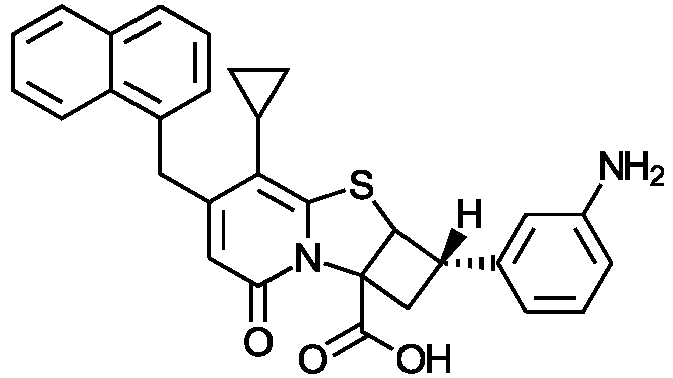
1H NMR (DMSO-d6, 400 MHz): δ 13.22 (br s, 1H), 7.98 (d, 1H), 7.94 (d, 1H), 7.89 (d, 1H), 7.58-7.50 (m, 3H), 7.42 (d, 1H), 6.98 (t, 1H), 6.50 (s, 1H), 6.48-6.42 (m, 2H), 5.23 (s, 1H), 4.49 (s, (2S)-2-(3-aminophenyl)-4-cyclopropyl-5-(naphthalen-1-ylmethyl)-7-oxo-2,2a-dihydro-7H-cyclobuta[4,5]thiazolo[3,2-a]pyridine-8a(1H)-carboxylic acid 2H), 4.39-4.31 (m, 1H), 3.51-3.43 (m, 2H), 3.06 (t, 1H), 2.63 (dd, 2H), 1.83-1.75 (m, 1H), 1.00-0.90 (m, 2H), 0.86-0.80 (m, 1H), 0.78-0.72 (m, 1H). 26 
1H NMR (DMSO-d6, 400 MHz): δ 13.27 (br s, 1H), 7.98 (d, J = 7.8 Hz, 1H), 7.87 (t, J = 8.2 Hz, 2H), 7.58-7.50 (m, 4H), 7.35 (d, J = 7.7 Hz, 1H), 6.95 (s, 1H), 6.77 (d, J = 4.9 Hz, 1H), 5.32 (s, 1H), 4.87 (d, J = 6.9 Hz, 1H), 4.44 (d, J = 17.2 Hz, 1H), 4.36 (d, J = 17.2 Hz, 1H), 4.06 (ddd, J = 5.4, 9.3 Hz, 1H), 3.45 (dd, J = 10.2, 13.1 Hz, 1H), 2.55 (d, J = 5.4 Hz, 1H), 2.54-2.53 (m, 1H), 1.49-1.43 (m, 1H), 0.83-0.77 (m, 1H), 0.71-0.65 (m, 1H), 0.49-0.42 (m, 1H), 0.34-0.28 (m, 1H). (2R)-4-cyclopropyl-5-(naphthalen-1-ylmethyl)-7-oxo-2-(thiophen-3-yl)-2,2a-dihydro-7H-cyclobuta[4,5]thiazolo[3,2-a]pyridine-8a(1H)-carboxylic acid 27 
1H NMR (DMSO-d6, 400 MHz) δ 7.98-7.96 m, 1H), 7.92-7.87 (m, 2H), 7.55-7.49 (m, 3H), 7.43 - 7.33 (m, 5H), 7.30 - 7.25 (m, 1H), 5.23 (s, 1H), 4.53 - 4.43 (m, 3H), 4.10 (td, J = 9.1, 6.9 Hz, 1H), 2.92 (dd, J = 13.0, 9.1 Hz, 1H), 2.80 (dd, J = 12.9, 9.4 Hz, 1H), 1.81 - 1.70 (m, 1H), 0.99 - 0.90 (m, 2H), 0.82-0.79 (m, 1H), 0.71-0.69 (m, 1H). 13C NMR (DMSO-d6, 100 MHz) δ 168.29, 159.42, 157.20, 149.30, 134.38, 133.95, 133.46, 131.63, 129.93, 129.25, 128.66, 127.75, (2R)-4-cyclopropyl-5-(naphthalen-1-ylmethyl)-7-oxo-2-(phenylthio)-2,2a,7,8a-tetrahydro-1H-cyclobuta[4,5]thiazolo[3,2-a]pyridine-8a-carboxylic acid 127.39, 126.89, 126.42, 125.86, 125.73, 124.08, 113.92, 112.58, 73.39, 51.98, 46.04, 35.29, 10.81, 7.79, 7.50. 28 
1H NMR (DMSO-d6, 400 MHz): □ 13.45 (br s, 1H), 7.99-7.94 (m, 1H), 7.93-7.86 (m, 2H), 7.57-7.48 (m, 3H), 7.40 (d, 1H), 7.34-7.28 (m, 2H), 7.22-7.16 (m, 3H), 5.21 (s, 1H), 5.19 (d, 1H), 4.53-4.40 (m , 3H), 3.64 (dd, 1H), 2.04 (dd, 1H), 1.76-1.68 (m, 1H), 0.96-0.88 (m, 1H), 0.86-0.80 (m, 1H), 0.77-0.70 (m, 2H). (25)-4-cyclopropyl-5-(naphthalen-1-ylmethyl)-7-oxo-2-(phenylthio)-2,2a,7,8a-tetrahydro-1H-cyclobuta[4,5]thiazolo[3,2-a]pyridine-8a-carboxylic acid 29 
1H NMR (DMSO-d6, 400 MHz): δ 13.49 (br s, 1H), 8.32 (d, J = 8.4 Hz, 1H), 7.96 (dd, J = 0.9, 8.0 Hz, 1H), 7.79 (d, J = 8.2 Hz, 1H), 7.76-7.71 (m, 2H), 7.66-7.54 (m, 4H), 7.44 (dd, J = 7.4, 8.0 Hz, 1H), 7.08 (d, J = 7.3 Hz, 1H), 4.89-4.77 (m, 1H), 4.46 (dd, J = 15.3, 17.6 Hz, 2H), 3.98 (q, J = 9. 4 Hz, 1H), 3.44 (s, 3H), 3.15 (dd, J = 10.0, 12.7 Hz, 1H), 2.96 (dd, J = 9.9, 12.7 Hz, 1H), 2.58 (s, 6H). (2S)-6-(dimethylamino)-4-methoxy-5-(naphthalen-1-ylmethyl)-7-oxo-2-(3-(trifluoromethyl)phenyl)-2,2a,7,8a-tetrahydro-1H-cyclobuta[4,5]thiazolo[3,2-a]pyridine-8a-carboxylic acid 30 
1H NMR (DMSO-d6, 400 MHz) δ 0.62-0.66 (m, 1H), 0.73-0.75 (m, 1H), 0.90-1.01 (m, 2H), 1.56-1.63 (m, 1H), 2.80-2.86 (dd, J = 9.88, 12.68, 1H), 3.07-3.12 (dd, J = 10.04-12.52, 1H), (2S)-5-(benzo[b]thiophen-2-ylmethyl)-2-(3-chlorophenyl)-4-cyclopropyl-7-oxo-2,2a,7,8a-tetrahydro-1H-cyclobuta[4,5]thiazolo[3,2-a]pyridine-8a-carboxylic acid 3.71-3.78 (dd, J = 9.52, 17.36, 1H), 4.34 (s, 2H). 4.64 (s, 1H), 6.02 (s, 1H), 7.30-7.36 (m, 5H), 7.38-7.43 (m, 2H), 7.79-7.81 (d, J = 7.3 Hz, 1H), 7.91-7.92 (d, J = 7.8 Hz, 1H). 13C NMR (DMSO-d6, 100 MHz) δ 7.7, 7.9, 10.8, 33.2, 35.4, 46.3, 50.7, 73.4, 112.3, 114.4, 122.3, 122.9, 123.2, 124.0, 124.4, 125.5, 126.7, 126.8, 130.5, 133.2, 139.0, 139.7, 142.1, 143.7, 150.7, 155.6, 159.7, 168.9. 31 
1H NMR (DMSO-d6, 600 MHz) δ 7.63 (dd, J = 1,5, 7,9 Hz, 1H), 7.41 (t, J = 8,7 Hz, 1H), 7.37 (dd, J = 1,5, 7,7 Hz, 1H), 6.94 (s, 2H), 6.90 (s, 1H) 5.38 (s, 1H), 4.52 (d, J = 7,6 Hz, 1H), 4.22 (s, 2H), 3.62-3.57 (m, 1H), 3.08 (dd, J = 10,2, 12.5 Hz, 1H), 2.75 (dd, J = 9,6, 12.6 Hz, 1H), 2.26 (s, 6H), 1.66-1.61 (m, 1H), 0.97-0.90 (m, 2H), 0.75-0.72 (m, 1H), 0.67-0.63 (m, 1H). (2S)-4-cyclopropyl-5-(2,3-dichlorobenzyl)-2-(3,5-dimethylphenyl)-7-oxo-2,2a,7,8a-tetrahydro-1H-cyclobuta[4,5]thiazolo[3,2-a]pyridine-8a-carboxylic acid 13C NMR (DMSO-d6, 150 MHz) δ 168.9, 159.5, 155.1, 150.4, 140.9, 138.8, 137.5, 132.0, 131.5, 130.3, 129.2, 128.4, 128.3, 124.3, 113.3, 112.2, 73.3, 51.0, 46.8, 36.7, 34.9, 20.9, 10.6, 7.7, 7.4. 32 
1H NMR (DMSO-d6, 600 MHz) δ 8.42-7.38 (m, 2H), 7.33 (t, J = 8,7 Hz, 2H), 7.04-7.02 (m, 2H), 6.88 (d, J = 8.1 Hz, 1H), 5.70 (s, 1H), 4.61 (d, J = 7,3 Hz, 1H), 3.96 (t, J = 6,3 Hz, 2H), 3.90 (s, 2H), 3.73-3.68 (m, 1H), 3.07 (dd, J = 9,8, 12.3 Hz, 1H), 2.7 (dd, J = 9,8, 12.6 Hz, 1H) 2.14 (s, 3H), 1.74-1.69 (m, 1H), 1.56-1.44 (m, 3H), 0.97-0.91 (m, 5H), 0.74-0.71 (m, 1H), 0.65-0.61 (m, 1H). (2S)-5-(4-butoxy-3-methylbenzyl)-2-(3-chlorophenyl)-4-cyclopropyl-7-oxo-2,2a,7,8a-tetrahydro-1H-cyclobuta[4,5]thiazolo[3,2-a]pyridine-8a-carboxylic acid 13C NMR (DMSO-d6, 150 MHz) δ 169.3, 160.1, 158.4, 150.4, 144.2, 133.7, 131.8, 130.9, 130.0, 128.1, 127.4, 127.1, 126.2, 125.9, 114.7, 113.0, 111.7, 73.7, 67.6, 51.1, 46.8, 37.8, 35.8, 31.4, 19.3, 16.4, 14.2, 11.3, 8.49, 8.25. 33 
1H NMR (DMSO-d6, 400 MHz) δ 13.35 (br s, 1H), 8.01-7.92 (m, 2H), 7.89 (d, J = 8.2 Hz, 1H), 7.58-7.47 (m, 5H), 7.44 (d, J = 7.1 Hz, 1H), 7.33 (t, J = 7.6 Hz, 1H), 5.24 (s, 1H), 5.15 (d, J = 8.2 Hz, 1H), 4.50 (dd, J = 17.4, 23.5 Hz, 2H), 4.33 (q, J = 8.4 Hz, 1H), 3.68 (dd, J = 10.8, 12.6 Hz, 1H), 2.73 (dd, J = 9.8, 12.6 Hz, 1H), 1.85-1.74 (m, 1H), 1.01-0.94 (m, 2H), 0.85-0.76 (m, 2H). (2S)-4-cyclopropyl-2-(2,6-dichlorophenyl)-5-(naphthalen-2-ylmethyl)-7-oxo-2,2a,7,8a-tetrahydro-1H-cyclobuta[4,5]thiazolo[3,2-a]pyridine-8a-carboxylic acid 34 
1H NMR (DMSO-d6, 400 MHz) δ 0.67-0.70 (m, 2H), 0.95-0.97 (m,2H), 1.56-1.63 (m, 1H), 2.77 (dd, J = 2,0, 12,4 Hz, 1H), 3.70 (dd, J = 10,8, 12,4 Hz, 1H), 4.31-4.38 (m, 3H), 5.16-5.18 (d, J = 8.3 Hz, 1H), 6.01 (s, 1H), 7.29-7.38 (m, 4H), 7.48-7.50 (d, J = 8.0 Hz, 2H), 7.78-7.80 (d, J = 8,2 Hz, 1H), 7.90-7.92 (d, J = 7,8 Hz, 1H). (2S)-5-(benzo[b]thiophen-2-ylmethyl)-4-cyclopropyl-2-(2,6-dichlorophenyl)-7-oxo-2,2a,7,8a-tetrahydro-1H-cyclobuta[4,5]thiazolo[3,2-a]pyridine-8a-carboxylic acid 13C NMR (DMSO-d6, 100 MHz) δ 7.7, 8.1, 10.7, 33.2, 33.5, 44.3, 49.3, 73.1, 112.5, 114.3, 122.3, 123.0, 123.1, 123.9, 124.4, 129.6, 129.8, 133.7, 134.8, 139.0, 139.6, 142.0, 150.5, 155.7, 159.7, 168.5. 35 Not forming part of the invention. 
1H NMR (DMSO-d6, 600 MHz) δ 7.97 (dd, J = 6.1, 3.4 Hz, 1H), 7.87 (dd, J = 10.4, 5.8 Hz, 2H), 7.57 (s, 2H), 7.55 - 7.48 (m, 3H), 7.36 (d, J = 6.9 Hz, 1H), 5.25 (s, 1H), 4.80 - 4.74 (m, 1H), 4.42-4.36 (m, 2H), 3.54 (dd, J = 11.5, 7.6 Hz, 1H), 3.24 (d, J = 11.5 Hz, 1H), 1.72-1.66 (m, 2H), 1.62 - 1.57 (m, 1H), 0.96 - 0.85 (m, 3H), 0.73 - 0.56 (m, 4H). (2-(8-cyclopropyl-7-(naphthalen-2-ylmethyl)-5-oxo-3,5-dihydro-2H-thiazolo[3,2-a]pyridin-3-yl)ethyl)boronic acid 13C NMR (DMSO-d6, 150 MHz) δ 160.1, 156.1, 148.0, 135.0, 133.9, 132.0, 129.0, 128.0, 127.7, 126.8, 126.2, 126.1, 124.5, 113.9, 112.5, 64.3, 35.6, 31.9, 25.4, 11.2, 7.9, 7.5. 36 Not forming part of the invention. 
1H NMR (MeOD, 600 MHz) δ 7.54 - 7.45 (m, 4H), 5.91 (s, 1H), 5.09 - 5.04 (m, 1H), 4.19-4.07 (m, 2H), 3.57 (dd, J = 11.6, 7.6 Hz, 1H), 3.26 (d, J = 11.5 Hz, 1H), 1.91-1.80 (m, 2H), 1.41 - 1.36 (m, 1H), 0.99 - 0.82 (m, 4H), 0.66 - 0.62 (m, 2H). (2-(8-cyclopropyl-5-oxo-7-(3-(trifluoromethyl)benzyl)-3,5-dihydro-2H-thiazolo[3,2-a]pyridin-3-yl)ethyl) boronic acid 37 Not forming part of the invention. 
1H NMR (MeOD, 400 MHz) δ 7.85-7.83 (m, 1H), 7.75 (d, J = 8.2 Hz, 1H), 7.66-7.55 (m, 5H), 7.46-7.36 (m, 3H), 7.20 (d, J = 6.9 Hz, 1H), 5.90 (s, 1H), 5.15 - 5.14 (m, 1H), 4.10-3.99 (m, 2H), 3.67-3.61 (m, 1H), 3.25 (d, J = 11.2 Hz, 1H), 2.04-1.91 (m, 2H), 0.89 (t, J = 7.5 Hz, 2H). (2-(7-(naphthalen-2-ylmethyl)-5-oxo-8-(3-(trifluoromethyl)phenyl)-3,5-dihydro-2H-thiazolo[3,2-a]pyridin-3-yl)ethyl) boronic acid 38 Not forming part of the invention. 
1H NMR (MeOD, 600 MHz) δ 7.89-7-85 (m, 2H), 7.82 (d, J = 8.1 Hz, 1H), 7.48 - 7.44 (m, 3H), 7.40 (d, J = 6.8 Hz, 1H), 5.58 (s, 1H), 5.03 - 5.00 (m, 1H), 4.35 (s, 2H), 3.77 (s, 3H) 3.68 (dd, J = 11.6, 7.5 Hz, 1H), 3.36 (d, J = 11.6 Hz, 1H), 1.93-1.81 (m, 2H), 0.84 (t, J = 8.1 Hz, 2H). (2-(8-methoxy-7-(naphthalen-2-ylmethyl)-5-oxo-3,5-dihydro-2H-thiazolo[3,2-a]pyridin-3-yl)ethyl)boronic acid 13C NMR (MeOD, 150 MHz) δ 160.7, 151.8, 140.6, 137.4, 134.1, 133.7, 131.7, 128.4, 127.5, 127.4, 125.9, 125.4, 125.1, 123.5, 113.3, 65.3, 59.6, 32.3, 31.9, 24.5. 39 Not forming part of the invention. 
1H NMR (DMSO-d6, 400 MHz) δ 7.96 - 7.86 (m, 3H), 7.60 (d, J = 7.6 Hz, 1H), 7.51 - 7.42 (m, 5H), 6.94 (d, J = 8.7 Hz, 1H), 5.47 (s, 1H), 4.40 (s, 2H), 3.99 (t, J = 6.1 Hz, 2H), 3.83 (s, 3H), 2.15 (s, 3H), 1.80 - 1.67 (m, 2H), 1.48-1.40 (m, 2H), 1.32 - 1.31 (m, 4H), 0.89 (d, J = 6.4 Hz, 3H). 2-(4-(hexyloxy)-3-methylphenyl)-7-(naphthalen-2-ylmethyl)-5-oxo-5H-thiazolo[3,2-a]pyridine-3-carboxylic acid 13C NMR (DMSO-d6, 151 MHz) δ 161.3, 158.1, 156.5, 147.2, 138.0, 134.7, 134.1, 133.5, 131.3, 130.0, 128.6, 127.6, 127.4, 127.1, 126.9, 126.4, 125.8, 125.6, 123.8, 119.6, 111.7, 109.1, 67.7, 60.3, 31.9, 30.9, 28.5, 25.1, 22.0, 15.9, 13.8. 40 Not forming part of the invention. 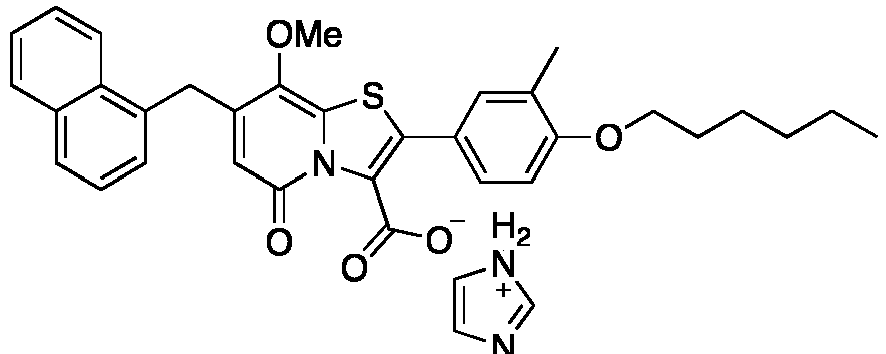
1H NMR (MeOD, 600 MHz) δ 8.67 (s, 1H), 7.93 - 7.87 (m, 2H), 7.82 (d, J = 7.9 Hz, 1H), 7.56 (d, J = 6.0 Hz, 2H), 7.47 - 7.42 (m, 6H), 6.93 (d, J = 9.2 Hz, 1H), 5.74 (s, 1H), 4.47 (s, 2H), 4.02 (s, 2H), 3.90 (s, 3H), 2.22 (s, 3H), 1.83 - 1.78 (m, 2H), 1.55 - 1.49 (m, 2H), 1.40 - 1.36 (m, 4H), 0.93 (t, J = 6.8 Hz, 3H). 1H-imidazol-1-ium 2-(4-(hexyloxy)-3-methylphenyl)-7-(naphthalen-2-ylmethyl)-5-oxo-5H-thiazolo[3,2-a]pyridine-3-carboxylate 13C NMR (MeOD, 151 MHz) δ 167.2, 159.8, 159.6, 148.3, 141.3, 137.2, 135.55, 135.4, 133.2, 133.0, 131.4, 129.8, 128.9, 128.8, 128.4, 128.4, 127.3, 126.8, 126.5, 125.6, 125.0, 122.5, 120.6, 112.2, 110.3, 69.1, 60.9, 33.4, 32.7, 30.3, 26.9, 23.6, 16.3, 14.3. 41 
1H NMR (DMSO-d6, 600 MHz) δ 7.94 (d, 1H, J = 4.0 Hz, Ar), 7.85 (dd, 2H, J = 8.0, 4.0 Hz, Ar), 7.56 (ddd, 2H, J = 16.0, 8.0, 4.0 Hz, Ar), 7.49 (dd, 1H, J = 12.0, 4.0 Hz, Ar), 7.25-7.20 (m, 1H, Ar), 7.07-7.03 (m, 4H, Ar), 7.00-6.96 (m, 2H, Ar), 4.95 (br s, 2H, CH), 4.48 (br d, J = 12.0 Hz, 1H, CH), 4.42-4.34 (m, 1H, CH), 4.24 (br d, J = 12.0 Hz, 1H, CH), 2.88-2.85 (m, 1H, CH), 1.73-1.65 (m, 1H, CH), 0.95-0.86 (m, 1H, CH), 0.83-0.75 (m, 2H, CH2), 0.71-0.66 (m, 2H, CH2). 1-(cyanomethyl)-4-cyclopropyl-5-(naphthalen-1-ylmethyl)-7-oxo-2-phenyl-2,2a,7,8a-tetrahydro-1H-cyclobuta[4,5]thiazolo[3,2-a]pyridine-8a-carboxylic acid - The following example compounds may be prepared in accordance with the present invention.
Table 2: Prophetic Examples Example Number Chemical structure NMR Chemical name 42 
(2S)-4-cyclopropyl-2a-methyl-5-(naphthalen-1-ylmethyl)-7-oxo-2-(3-(trifluoromethyl)phenyl)-2,2a,7,8a-tetrahydro-1H-cyclobuta[4,5]thiazolo[3,2-a]pyridine-8a-carboxylic acid 43 
(2R)-4-cyclopropyl-2a-methyl-5-(naphthalen-1-ylmethyl)-7-oxo-2-(3-(trifluoromethyl)phenyl)-2,2a,7,8a-tetrahydro-1H-cyclobuta[4,5]thiazolo[3,2-a]pyridine-8a-carboxylic acid 44 
(2S)-4-cyclopropyl-5-(naphthalen-1-ylmethyl)-7-oxo-2-(3-(trifluoromethyl)phenyl)-2a-vinyl-2,2a,7,8a-tetrahydro-1H-cyclobuta[4,5]thiazolo[3,2-a]pyridine-8a-carboxylic acid 45 
(2R)-4-cyclopropyl-5-(naphthalen-1-ylmethyl)-7-oxo-2-(3-(trifluoromethyl)phenyl)-2a-vinyl-2,2a,7,8a-tetrahydro-1H-cyclobuta[4,5]thiazolo[3,2-a]pyridine-8a-carboxylic acid 46 
(2S)-6-(azetidin-1-yl)-4-cyclopropyl-2-(3,5-dichlorophenyl)-5-(naphthalen-1-ylmethyl)-7-oxo-2,2a,7,8a-tetrahydro-1H-cyclobuta[4,5]thiazolo[3,2-a]pyridine-8a-carboxylic acid 47 
(2S)-4-cyclopropyl-2-(3,5-dichlorophenyl)-5-(naphthalen-1-ylmethyl)-7-oxo-2,2a,7,8a-tetrahydro-1H-azeto[2',3':4,5]thiazolo[3,2-a]pyridine-8a-carboxylic acid 48 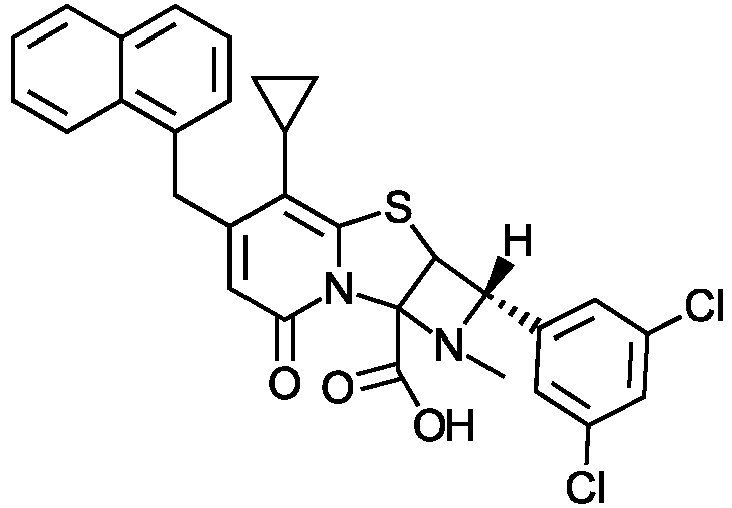
(2S)-4-cyclopropyl-2-(3,5-dichlorophenyl)-1-methyl-5-(naphthalen-1-ylmethyl)-7-oxo-2,2a,7,8a-tetrahydro-1H-azeto[2',3':4,5]thiazolo[3,2-a]pyridine-8a-carboxylic acid 49 
(2-((2S)-4-cyclopropyl-2-(3,5-dichlorophenyl)-5-(naphthalen-1-ylmethyl)-7-oxo-2,2a,7,8a-tetrahydro-1H-cyclobuta[4,5]thiazolo[3,2-a]pyridin-8a-yl)ethyl)boronic acid - To define the MIC, bacterial cultures (190µl) at a starting OD=0.001 at OD600 were incubated in presence of different increasing concentrations of each compound (10µl). The cultures (200µl) were incubated at 37°C for 24h. MIC was defined by the lowest concentration of the test compound that after 24h inhibits visible growth of the pathogen of interest. The MIC was measured in micromolar concentration, i.e. µM. Objectively, this was determined by measuring the optical density (i.e. OD) of the test cultures at 600 nm using a spectrophotometer. As used herein, OD600 stands for optical density at a wavelength of 600 nm (i.e. 600 nanometers).
- To define the MBC, 5µl from each MIC test culture was plated on solid BHI plates. The BHI plates were incubated in 37 °C overnight and next day analyzed for viability of treated bacteria in the MIC test cultures. Bacterial growth on the solid BHI plate indicated that at a given compound concentration, the bacteria were not killed by the treatment. No growth on the BHI plate, indicated that the bacteria were killed by the treatment at a given concentration.
- MIC and MBC data for compounds described herein are provided in Table 3 for the Grampositive bacteria E. faecalis (i.e. Enterococcus faecalis) and MRSA (i.e. Methicillinresistant Stpphylococcus aureus), respectively. Table 3 also includes data for the compound 8-[4-(Hexyloxy)-3-methyl-phenyl]-5-methoxy-4-[(1-naphthyl)methyl]-2-oxo-7-thia-1-azabicyclo[4.3.0]nona-3,5,8-triene-9-carboxylic acid imidazole salt, which is the compound of Example 14 in
WO 2018/229141 having the chemical structure:
- The values provided in Table 3 result from the use of the compounds alone, and the MIC/MBA values are reported in micromolar concentration (i.e. µM). Thus, no antibiotic was used in Table 3.
- n.d. indicates that the relevant activity was not observed at the concentrations tested.
Table 3: assay data Compound of Example No. MIC/MBC for E. faecalis (µM) MIC/MBC for MRSA (µM) Example 14 in WO 2018/229141 4 5 1 10/25 5/10 2 10/n.d. 5/10 3 10/25 5/5 5 5/25 3/4 8 5/n.d. 5/10 9 5/25 5/10 10 10/n.d. 5/10 11 4/25 4/10 13 3/25 2/4 15 3/n.d. 2/4 16 10/n.d. 10/n.d. 17 4/25 3/7.5 19A 7.5/25 5/10 21 5/n.d. 3/7.5 22 4/n.d. 4/4 23 3/n.d. 3/5 27 n.d. 10/n.d. 28 n.d. 25/n.d. 29 25/n.d. 7.5/7.5 30 5/n.d. 5/n.d. 31 n.d. 5/n.d. 32 n.d. n.d. 33 5/n.d. 5/n.d. 34 n.d. 5/n.d. 35 n.d. 50/n.d. Not forming part of the invention. 36 n.d. n.d. Not forming part of the invention. 37 n.d. 50 Not forming part of the invention. 38 n.d. n.d. Not forming part of the invention. - It was concluded that the compounds of Examples 5, 8, 9, 11, 13, 15, 17, 19A, 21, 22, 23 and 33 inhibited growth of the pathogen of interest to a substantially similar extent or to a higher extent compared to the compound of Example 14 in
WO 2018/229141 . In particular, an improved growth inhibition was observed for the pathogen MRSA. - Experiments were performed in which compounds described herein were tested in a subinhibitory concentration (between 1 and 4µM depending on the MIC of the compound) together with a fixed concentration of either gentamicin, vancomycin or ampicillin. The concentrations used in the experiments with E. faecalis OG1RF were 16µg/ml gentamicin, 1µg/ml vancomycin or 1µg/ml ampicillin. In experiments where combinations were tested against
MRSA - Bacterial cultures (190µl) at a starting OD=0.001 at OD600 were incubated together with either subinhibitory concentrations of gentamicin/vancomycin/ampicillin or compound alone, or a combination of the two. The cultures (200µl) were incubated at 37°C for 24h. A control sample without compound and gentamicin/vancomycin/ampicillin but containing compound vehicle (DMSO) and gentamicin/vancomycin/ampicillin vehicle (MQ water) was performed the same way. After 24h, the effect on bacterial growth compared to untreated control samples was determined by measuring optical density at 600 nm with a spectrophotometer.
-
Figure 7 shows the results for the compound of Example 21 as described herein, administered alone and in combination with gentamicin. A comparison is made with gentamicin administered alone, the compound of Example 14 of inWO 2018/229141 ("comparative example") administered alone and administered in combination with gentamicin. As used herein, "combo" stands for administered in combination. The control sample is bacteria without compound or gentamicin but contain vehicles DMSO and MQ. -
Figure 8 shows the results for the compounds of Examples 13, 11, 17 and 15 as described herein, administered alone and in combination with gentamicin. A comparison is made with gentamicin administered alone. The control sample is bacteria without compound or gentamicin but contain vehicles DMSO and MQ. -
Figure 9 shows the results for the compounds of Examples 22 and 5 as described herein, administered alone and in combination with gentamicin. A comparison is made with gentamicin administered alone. The control sample is bacteria without compound or gentamicin but contain vehicles DMSO and MQ. -
Figures 10 to 13 show the results of the compound of Examples 15, 30, 33, 39 and 41 as described herein, administered alone and in combination with gentamicin (Figures 10 and13 ), vancomycin (Figure 11 ), or ampicillin (Figure 12 ) in the presence of E. faecalis. The control sample is bacteria without compound or gentamicin/vancomycin but contain vehicles DMSO and MQ. -
Figures 14 to 17 show the results of the compound of Examples 15, 30, 33 and 39 as described herein, administered alone and in combination with gentamicin (Figures 14 ), vancomycin (Figures 15 and16 ), or ampicillin (Figure 17 ) in the presence ofMRSA 1369. The control sample is bacteria without compound or gentamicin/vancomycin but contain vehicles DMSO and MQ. - It was concluded that the compounds of the Examples 13, 17, 15, 22, 5, 30 and 33 administered in combination with gentamicin lowered the E. faecalis activity to a much larger extent compared to gentamicin administered alone, the compounds of the Examples administered alone, the comparative example administered alone and also the combination of the comparative example and gentamicin. Examples 21 and 11 administered in combination with gentamicin lowered the E. faecalis activity to a much larger extent compared to gentamicin administered alone, the compounds of the Examples administered alone, the comparative example administered alone and to a similar extent as the combination of the comparative example and gentamicin. Examples 30 and 33 administered in combination with vancomycin lowered the E. faecalis activity to a much larger extent compared to vancomycin administered alone, or the compounds of the Examples administered alone.
- It was further concluded that the compounds of the Example 30 administered in combination with gentamicin or vancomycin lowered the MRSA activity to a much larger extent compared to gentamicin or vancomycin administered alone or the compounds of the Example administered alone. Examples 15 and 33 administered in combination with vancomycin or ampicillin lowered the MRSA activity to a much larger extent compared to vancomycin or ampicillin administered alone or the compounds of the Examples administered alone.
- The synergistic effect with respect to E. faecalis is also shown in Table 4, some further compounds when combined with gentamicin is shown in Table 4 below. MIC/MBC values for the compounds administered alone are also shown for comparison. Unless otherwise stated, the compound was provided in a concentration of 1 µM.
Table 4: combination assays Compound of Example No. MIC/MBC for E. faecalis µM Synergistic effect when combined with gentamicin (OD600 at 24h) Example 14 in WO 2018/229141 4 1 10/n.d. Yes (Compound of Example 1 provided in a concentration of 2 µM) 2 10/n.d. Yes OD600=0.1 3 10/25 Yes OD600=0.35 at 24h 5 5/n.d. Yes OD600=0 9 5/25 Yes OD600=0.1 13 3/n.d. Yes OD600=0 15 3/n.d. Yes OD600=0 17 4/n.d. Yes OD600=0 19A 7.5/n.d. Yes 21 5/25 Yes OD600=0.1 23 3/n.d. Yes OD600=0 35 n.d. Yes (Compound of Example 35 provided in a concentration of 25µM) Not forming part of the invention. OD600=0 36 n.d. n.d. Not forming part of the invention. 37 n.d. Yes (Compound of Example 37 provided in a concentration of 10µM) Not forming part of the invention. OD600=0 38 n.d. n.d. Not forming part of the invention. - It was concluded that when compounds of Formula II are administered in combination with gentamicin, vancomycin or ampicillin, the E. faecalis and/or MRSA activity was lowered to a much larger extent compared to when (i) gentamicin, vancomycin or ampicillin are administered alone, (ii) the compounds of the Examples are administered alone, (iii) the comparative example is administered alone and also (iv) the combination of the comparative example (Example 14 in
WO 2018/229141 ) and gentamicin. - The purpose of this assay was to investigate resistance development of E. faecalis and MRSA towards various compounds described herein, such as compounds of Formula II.
Overnight MRSA 1369 and E. faecalis OG1RF cultures were exposed to various concentrations of compounds of Examples 9, 30 and 40 or antibiotics (vancomycin or ciprofloxacin) in 96-well plates either by shaking at 37 °C (for MRSA 1369) or standing at 37°C with 5% CO2 (for E. faecalis OG1RF). From start the concentrations of examples used were in a range fromsubinhibitory concentration 1,25µM, up to 10µM with three, 2-fold dilution steps. Ciprofloxacin was used in a range from 0,06µg/ml to 0,5µg/ml and Vancomycin from 1µg/ml to 8µg/ml with three, 2-fold dilution steps. After 24-hours of incubation, the wells (of compounds of Examples 9, 30 and 40 or antibiotic) where there is at least 70% growth compared to untreated controls were used to set up next passage. The concentrations used for the next passage was hence reevaluated and if necessary changed every day for each treatment option. When and if the bacteria gain resistance and were able to grow in a higher concentration of compound than the previous day, the concentrations used were step-wise increased. The plots represent average of highest compounds of the Examples or antibiotics concentrations where is at least 70% growth (Maximum Tolerated Concentrations) and error bars represent range of the independent triplicates. - In was concluded (see
Figures 18 to 21 ) that resistance development ofMRSA 1369 and E. faecalis OG1RF towards compounds of Formula II is delayed or ameliorated.
Claims (13)
- A compound of Formula II:
 or a pharmaceutically acceptable salt thereof,whereinR1 is selected from the group consisting of:a) C(O)OH,b) tetrazolyl,c) (CH2)mB(OH)2,d) C(O)NHSO2R8,e) NH2, andf) H,R2 is selected from the group consisting of:a) H,b) Cl, F, Br or I,c) CH2OH,d) C1-C4alkyl,e) NZ1Z2, andf) NO2,R3 is selected from the group consisting of:a) 1-naphtyl, 2-naphtyl, isoquinolin-4-yl, 1-naphtyloxy, 9-anthryl and 9-anthryloxy each independently substituted with 0, 1, 2 or 3 substituents selected from the group consisting of methyl, fluoro, chloro, bromo, cyano and methoxy,b) C1-C4alkyl substituted with 0, 1, 2, 3 or 4 fluoro,c) phenyl substituted with 0, 1, 2 or 3 substituents independently selected from the group consisting of methyl, fluoro, chloro, cyano, trifluoromethyl and C1-C6alkoxy,d) aminophenyl substituted with 0, 1, 2 or 3 substituents independently selected from the group consisting of methyl, fluoro, chloro and trifluoromethyle) 2-(3-methyl)phenylmethylene,f) benzothiophen-2-yl,g) H,h) 2-methyl-1-aza-2-bora-1H-naphth-5-yloxy, andi) 2-methyl-1-aza-2-bora-1H-naphth-5-yl,R4 is selected from the group consisting of:a) C1-C4alkyl substituted with 0, 1, 2, 3 or 4 fluoro,b) C3-C6cycloalkyl,c) C1-C4alkoxy substituted with 0, 1, 2, 3 or 4 fluoro,d) C3-C6cycloalkoxy,e) a 3-, 4-, 5-, or 6-membered heterocycle,f) NZ1Z2,g) CH2NZ1Z2,h) C(O)OH,i) C(O)H, andj) phenyl substituted with 0, 1, 2 or 3 substituents independently selected from the group consisting of methyl, fluoro, chloro, cyano and trifluoromethyl,R5 is selected from the group consisting of.a) H,b) C1-C6alkyl,c) C1-C6alkenyl, andd) aryl,and in the above definitions:R8 is C1-C4alkyl or phenyl,R11 is (Y)sphenyl wherein the phenyl moiety is substituted with 0, 1, 2, 3 or 4 substituents independently selected from the group consisting ofa) C1-C4alkyl substituted with 0, 1, 2, 3 or 4 substituents independently selected from the group consisting of Cl, Br, F, I, and C1-C10alkoxy,b) Cl, F, Br or I,c) a five-membered saturated or unsaturated heterocycle,d) NH2 or NHC1-C6alkyl, ande) C1-C6alkoxy substituted with 0, 1, 2, 3 or 4 F,
orR11 is a five-membered saturated or unsaturated heterocycle, optionally substituted with 0, 1, 2 or 3 substituents independently selected from the group consisting of methyl, fluoro, chloro, cyano and trifluoromethyl,Q is selected from the group consisting of:CH2,CHC1-C6alkyl, optionally substituted with cyano or 1, 2 or 3 F,CHNO2,CHNH2,NH,NC1-C6alkyl,NOH,NOC1-C6alkyl,NC(O)C1-C6alkyl,NSO2C1-C6alkyl,S,O,X is S, SO or SO2,Y is S or CH2,Z1 and Z2 each independently represents hydrogen, methyl, CH3S(O)2, C(O)OR10A, C(O)NR10AR10B or C(O)R10B, or Z1 and Z2 together form -(CH2)3, -(CH2)4, or -(CH2)5, R10A and R10B each independently represent H or C1-6alkyl, andn, m, and s each independently represents 0, 1 or 2. - The compound according to claim 1, or a pharmaceutically acceptable salt thereof, whereinR1 and R5 are oriented syn with respect to each other, andR11 is oriented(i) syn with respect to R1 and R5, or(ii) anti with respect to R1 and R5.
- The compound according to claims 1 or 2, or a pharmaceutically acceptable salt thereof, which is a compound of Formula IIa and/or Formula IIb:

- The compound according to claims 1 or 2, or a pharmaceutically acceptable salt thereof, which is a compound of Formula IIc and/or Formula IId:

- The compound according to any one of claims 1-4, or a pharmaceutically acceptable salt thereof, whereinQ is CH2, CH(CH2)CN, NH or NC1-C6alkyl, andR1 is C(O)OH, tetrazolyl or (CH2)mB(OH)2.
- The compound according to any one of the preceding claims, or a pharmaceutically acceptable salt thereof, wherein R2 is H or NZ1Z2.
- The compound according to any one of the preceding claims, or a pharmaceutically acceptable salt thereof, wherein n is 1.
- The compound according to any one of the preceding claims, or a pharmaceutically acceptable salt thereof, wherein R3 is 1-naphtyl, 2-naphtyl, 1-naphtyloxy, isoquinolin-4-yl, 9-anthryl and 9-anthryloxy each independently substituted with 0, 1, 2 or 3 substituents selected from the group consisting of methyl, fluoro, chloro, bromo, cyano and methoxy.
- The compound according to any one of the preceding claims, or a pharmaceutically acceptable salt thereof, wherein R4 is selected from the group consisting of:a) C1-C4alkyl substituted with 0, 1, 2, 3 or 4 fluoro;b) C3-C6cycloalkyl,c) C1-C4alkoxy substituted with 0, 1, 2, 3 or 4 fluoro, andd) C3-C6cycloalkoxy.
- The compound according to claim 1 which is one or more of the following:(2S)-4-cyclopropyl-5-(naphthalen-1-ylmethyl)-7-oxo-2-(3-(trifluoromethyl)phenyl)-2,2a,7,8a-tetrahydro-1H-cyclobuta[4,5]thiazolo[3,2-a]pyridine-8a-carboxylic acid,(2R)-4-cyclopropyl-5-(naphthalen-1-ylmethyl)-7-oxo-2-(3-(trifluoromethyl)phenyl)-2,2a,7,8a-tetrahydro-1H-cyclobuta[4,5]thiazolo[3,2-a]pyridine-8a-carboxylic acid,(2S)-4-cyclopropyl-6-(dimethylamino)-5-(naphthalen-1-ylmethyl)-7-oxo-2-(3-(trifluoromethyl)phenyl)-2,2a,7,8a-tetrahydro-1H-cyclobuta[4,5]thiazolo[3,2-a]pyridine-8a-carboxylic acid,(2S)-4-cyclopropyl-5-(isoquinolin-4-ylmethyl)-7-oxo-2-(3-(trifluoromethyl)phenyl)-2,2a,7,8a-tetrahydro-1H-cyclobuta[4,5]thiazolo[3,2-a]pyridine-8a-carboxylic acid,(2R)-4-cyclopropyl-5-(naphthalen-1-ylmethyl)-7-oxo-2-(4-(trifluoromethyl)phenyl)-2,2a,7,8a-tetrahydro-1H-cyclobuta[4,5]thiazolo[3,2-a]pyridine-8a-carboxylic acid,(2S)-4-cyclopropyl-5-(naphthalen-1-ylmethyl)-7-oxo-2-(4-(trifluoromethyl)phenyl)-2,2a,7,8a-tetrahydro-1H-cyclobuta[4,5]thiazolo[3,2-a]pyridine-8a-carboxylic acid,(2S)-2-(3-chlorophenyl)-4-cyclopropyl-5-(naphthalen-1-ylmethyl)-7-oxo-2,2a,7,8a-tetrahydro-1H-cyclobuta[4,5]thiazolo[3,2-a]pyridine-8a-carboxylic acid,(2S)-2-(3-chlorophenyl)-4-cyclopropyl-5-(isoquinolin-4-ylmethyl)-7-oxo-2,2a,7,8a-tetrahydro-1H-cyclobuta[4,5]thiazolo[3,2-a]pyridine-8a-carboxylic acid,(2R)-2-(3-chlorophenyl)-4-cyclopropyl-6-(dimethylamino)-5-(naphthalen-1-ylmethyl)-7-oxo-2,2a,7,8a-tetrahydro-1H-cyclobuta[4,5]thiazolo[3,2-a]pyridine-8a-carboxylic acid,(2R)-2-(3-chlorophenyl)-4-cyclopropyl-5-(naphthalen-1-ylmethyl)-7-oxo-2,2a,7,8a-tetrahydro-1H-cyclobuta[4,5]thiazolo[3,2-a]pyridine-8a-carboxylic acid,(2S)-4-cyclopropyl-2-(3,5-dichlorophenyl)-5-(naphthalen-1-ylmethyl)-7-oxo-2,2a,7,8a-tetrahydro-1H-cyclobuta[4,5]thiazolo[3,2-a]pyridine-8a-carboxylic acid,(2R)-4-cyclopropyl-2-(3,5-dichlorophenyl)-5-(naphthalen-1-ylmethyl)-7-oxo-2,2a,7,8a-tetrahydro-1H-cyclobuta[4,5]thiazolo[3,2-a]pyridine-8a-carboxylic acid,(2S)-2-(3-bromophenyl)-4-cyclopropyl-5-(naphthalen-1-ylmethyl)-7-oxo-2,2a,7,8a-tetrahydro-1H-cyclobuta[4,5]thiazolo[3,2-a]pyridine-8a-carboxylic acid,(2S)-4-cyclopropyl-2-(2,6-difluorophenyl)-5-(naphthalen-1-ylmethyl)-7-oxo-2,2a,7,8a-tetrahydro-1H-cyclobuta[4,5]thiazolo[3,2-a]pyridine-8a-carboxylic acid,(2S)-4-cyclopropyl-5-(naphthalen-1-ylmethyl)-7-oxo-2-(m-tolyl)-2,2a-dihydro-7H-cyclobuta[4,5]thiazolo[3,2-a]pyridine-8a(1H)-carboxylic acid,(2R)-4-cyclopropyl-5-(naphthalen-1-ylmethyl)-7-oxo-2-(m-tolyl)-2,2a-dihydro-7H-cyclobuta[4,5]thiazolo[3,2-a]pyridine-8a(1H)-carboxylic acid,(2S)-4-cyclopropyl-2-(3,5-dimethylphenyl)-5-(naphthalen-1-ylmethyl)-7-oxo-2,2a,7,8a-tetrahydro-1H-cyclobuta[4,5]thiazolo[3,2-a]pyridine-8a-carboxylic acid,(2S)-4-cyclopropyl-2-(3-methyl-4-propoxyphenyl)-5-(naphthalen-1-ylmethyl)-7-oxo-2,2a,7,8a-tetrahydro-1H-cyclobuta[4,5]thiazolo[3,2-a]pyridine-8a-carboxylic acid,(2S)-2-(4-butoxy-3-methylphenyl)-4-cyclopropyl-5-(naphthalen-1-ylmethyl)-7-oxo-2,2a,7,8a-tetrahydro-1H-cyclobuta[4,5]thiazolo[3,2-a]pyridine-8a-carboxylic acid,(2S)-4-cyclopropyl-2-(4-methoxyphenyl)-5-(naphthalen-1-ylmethyl)-7-oxo-2,2a,7,8a-tetrahydro-1H-cyclobuta[4,5]thiazolo[3,2-a]pyridine-8a-carboxylic acid,(2S)-2-(3-aminophenyl)-4-cyclopropyl-5-(naphthalen-1-ylmethyl)-7-oxo-2,2a-dihydro-7H-cyclobuta[4,5]thiazolo[3,2-a]pyridine-8a(1H)-carboxylic acid,(2R)-4-cyclopropyl-5-(naphthalen-1-ylmethyl)-7-oxo-2-(thiophen-3-yl)-2,2a,7,8a-tetrahydro-1H-cyclobuta[4,5]thiazolo[3,2-a]pyridine-8a-carboxylic acid,(2R)-4-cyclopropyl-5-(naphthalen-1-ylmethyl)-7-oxo-2-(phenylthio)-2,2a,7,8a-tetrahydro-1H-cyclobuta[4,5]thiazolo[3,2-a]pyridine-8a-carboxylic acid,(2S)-4-cyclopropyl-5-(naphthalen-1-ylmethyl)-7-oxo-2-(phenylthio)-2,2a,7,8a-tetrahydro-1H-cyclobuta[4,5]thiazolo[3,2-a]pyridine-8a-carboxylic acid,(2S)-6-(dimethylamino)-4-methoxy-5-(naphthalen-1-ylmethyl)-7-oxo-2-(3-(trifluoromethyl)phenyl)-2,2a,7,8a-tetrahydro-1H-cyclobuta[4,5]thiazolo[3,2-a]pyridine-8a-carboxylic acid,(2S)-5-(benzo[b]thiophen-2-ylmethyl)-2-(3-chlorophenyl)-4-cyclopropyl-7-oxo-2,2a,7,8a-tetrahydro-1H-cyclobuta[4,5]thiazolo[3,2-a]pyridine-8a-carboxylic acid,(2S)-4-cyclopropyl-5-(2,3-dichlorobenzyl)-2-(3,5-dimethylphenyl)-7-oxo-2,2a,7,8a-tetrahydro-1H-cyclobuta[4,5]thiazolo[3,2-a]pyridine-8a-carboxylic acid,(2S)-5-(4-butoxy-3-methylbenzyl)-2-(3-chlorophenyl)-4-cyclopropyl-7-oxo-2,2a,7,8a-tetrahydro-1H-cyclobuta[4,5]thiazolo[3,2-a]pyridine-8a-carboxylic acid,(2S)-4-cyclopropyl-2-(2,6-dichlorophenyl)-5-(naphthalen-2-ylmethyl)-7-oxo-2,2a,7,8a-tetrahydro-1H-cyclobuta[4,5]thiazolo[3,2-a]pyridine-8a-carboxylic acid,(2S)-5-(benzo[b]thiophen-2-ylmethyl)-4-cyclopropyl-2-(2,6-dichlorophenyl)-7-oxo-2,2a,7,8a-tetrahydro-1H-cyclobuta[4,5]thiazolo[3,2-a]pyridine-8a-carboxylic acid,(2S)-4-cyclopropyl-2a-methyl-5-(naphthalen-1-ylmethyl)-7-oxo-2-(3-(trifluoromethyl)phenyl)-2,2a,7,8a-tetrahydro-1H-cyclobuta[4,5]thiazolo[3,2-a]pyridine-8a-carboxylic acid,(2R)-4-cyclopropyl-2a-methyl-5-(naphthalen-1-ylmethyl)-7-oxo-2-(3-(trifluoromethyl)phenyl)-2,2a,7,8a-tetrahydro-1H-cyclobuta[4,5]thiazolo[3,2-a]pyridine-8a-carboxylic acid,(2S)-4-cyclopropyl-5-(naphthalen-1-ylmethyl)-7-oxo-2-(3-(trifluoromethyl)phenyl)-2a-vinyl-2,2a,7,8a-tetrahydro-1H-cyclobuta[4,5]thiazolo[3,2-a]pyridine-8a-carboxylic acid,(2R)-4-cyclopropyl-5-(naphthalen-1-ylmethyl)-7-oxo-2-(3-(trifluoromethyl)phenyl)-2a-vinyl-2,2a,7,8a-tetrahydro-1H-cyclobuta[4,5]thiazolo[3,2-a]pyridine-8a-carboxylic acid,(2S)-6-(azetidin-1-yl)-4-cyclopropyl-2-(3,5-dichlorophenyl)-5-(naphthalen-1-ylmethyl)-7-oxo-2,2a,7,8a-tetrahydro-1H-cyclobuta[4,5]thiazolo[3,2-a]pyridine-8a-carboxylic acid,(2S)-4-cyclopropyl-2-(3,5-dichlorophenyl)-5-(naphthalen-1-ylmethyl)-7-oxo-2,2a,7,8a-tetrahydro-1H-azeto[2',3':4,5]thiazolo[3,2-a]pyridine-8a-carboxylic acid,(2S)-4-cyclopropyl-2-(3,5-dichlorophenyl)-1-methyl-5-(naphthalen-1-ylmethyl)-7-oxo-2,2a,7,8a-tetrahydro-1H-azeto[2',3':4,5]thiazolo[3,2-a]pyridine-8a-carboxylic acid,(2-((2S)-4-cyclopropyl-2-(3,5-dichlorophenyl)-5-(naphthalen-1-ylmethyl)-7-oxo-2,2a,7,8a-tetrahydro-1H-cyclobuta[4,5]thiazolo[3,2-a]pyridin-8a-yl)ethyl)boronic acid,1-(cyanomethyl)-4-cyclopropyl-5-(naphthalen-1-ylmethyl)-7-oxo-2-phenyl-2,2a,7,8a-tetrahydro-1H-cyclobuta[4,5]thiazolo[3,2-a]pyridine-8a-carboxylic acid,or a pharmaceutically acceptable salt of any one of the foregoing compounds.
- A pharmaceutical composition comprising:(i) a compound according to any one of the preceding claims, or a pharmaceutically acceptable salt thereof, and(ii) a drug against a disease involving gram-positive bacteria, or a pharmaceutically acceptable salt of said drug wherein (i) and optionally (ii) is/are in admixture with a pharmaceutically acceptable adjuvant, carrier or excipient.
- The compound according to any one of claims 1-10; or the pharmaceutical composition according to claim 11 for use as a medicament.
- The compound according to any one of claims 1-10; or the pharmaceutical composition according to claim 11 for use in the treatment and/or prevention of a disease involving gram-positive bacteria such as a disease selected from the group consisting of healthcare-associated infection (HCAI), urinary tract infection (UTI), catheter associated urinary tract infection, central line associated bloodstream infection (CLABSI), pneumonia, wound associated infection, surgical site infection, bacterial endocarditis, tetanus and any combination thereof.
Applications Claiming Priority (2)
| Application Number | Priority Date | Filing Date | Title |
|---|---|---|---|
| SE2050543 | 2020-05-08 | ||
| PCT/EP2021/062237 WO2021224501A1 (en) | 2020-05-08 | 2021-05-07 | Ring-fused 2-pyridone compounds, methods for preparation thereof and their use in the treatment and/or prevention of a disease involving gram-positive bacteria |
Publications (2)
| Publication Number | Publication Date |
|---|---|
| EP4146659A1 EP4146659A1 (en) | 2023-03-15 |
| EP4146659B1 true EP4146659B1 (en) | 2025-02-26 |
Family
ID=75888058
Family Applications (1)
| Application Number | Title | Priority Date | Filing Date |
|---|---|---|---|
| EP21724674.3A Active EP4146659B1 (en) | 2020-05-08 | 2021-05-07 | Ring-fused 2-pyridone compounds, methods for preparation thereof and their use in the treatment and/or prevention of a disease involving gram-positive bacteria |
Country Status (8)
| Country | Link |
|---|---|
| US (1) | US12503476B2 (en) |
| EP (1) | EP4146659B1 (en) |
| JP (1) | JP7741817B2 (en) |
| CN (1) | CN115551869B (en) |
| DK (1) | DK4146659T3 (en) |
| ES (1) | ES3017588T3 (en) |
| PL (1) | PL4146659T3 (en) |
| WO (1) | WO2021224501A1 (en) |
Family Cites Families (6)
| Publication number | Priority date | Publication date | Assignee | Title |
|---|---|---|---|---|
| US6841559B1 (en) * | 1999-11-19 | 2005-01-11 | Washington University Of St. Louis | Pyridinones to treat and prevent bacterial infections |
| WO2014185853A1 (en) | 2013-05-14 | 2014-11-20 | Quretech Bio Ab | Compounds and methods for treatment of chlamydia infections |
| WO2016075296A1 (en) | 2014-11-13 | 2016-05-19 | Quretech Bio Ab | 2,3-dihydro-thiazolo[3,2-a]pyridin-5-one derivatives, intermediates thereof, and their use as antibacerial agents |
| JP6979968B2 (en) | 2016-04-08 | 2021-12-15 | キュアテック バイオ アーベーQuretech Bio Ab | Ring-condensed thiazolino 2-pyridones, their production methods and their use in the treatment and / or prevention of tuberculosis |
| US20210401815A1 (en) | 2017-06-13 | 2021-12-30 | Quretech Bio Ab | Ring-fused thiazolino 2-pyridones, methods for preparation thereof and their use in the treatment and/or prevention of a disease involving gram-positive bacteria |
| EP3691619A1 (en) | 2017-10-05 | 2020-08-12 | Quretech Bio AB | Ring-fused thiazolino 2-pyridones in combination with a drug against tuberculosis |
-
2021
- 2021-05-07 ES ES21724674T patent/ES3017588T3/en active Active
- 2021-05-07 JP JP2022567655A patent/JP7741817B2/en active Active
- 2021-05-07 WO PCT/EP2021/062237 patent/WO2021224501A1/en not_active Ceased
- 2021-05-07 PL PL21724674.3T patent/PL4146659T3/en unknown
- 2021-05-07 CN CN202180033962.5A patent/CN115551869B/en active Active
- 2021-05-07 US US17/997,838 patent/US12503476B2/en active Active
- 2021-05-07 EP EP21724674.3A patent/EP4146659B1/en active Active
- 2021-05-07 DK DK21724674.3T patent/DK4146659T3/en active
Also Published As
| Publication number | Publication date |
|---|---|
| CN115551869B (en) | 2024-01-02 |
| JP2023525280A (en) | 2023-06-15 |
| DK4146659T3 (en) | 2025-04-14 |
| US12503476B2 (en) | 2025-12-23 |
| CN115551869A (en) | 2022-12-30 |
| PL4146659T3 (en) | 2025-06-23 |
| EP4146659A1 (en) | 2023-03-15 |
| US20230339973A1 (en) | 2023-10-26 |
| ES3017588T3 (en) | 2025-05-13 |
| WO2021224501A1 (en) | 2021-11-11 |
| JP7741817B2 (en) | 2025-09-18 |
Similar Documents
| Publication | Publication Date | Title |
|---|---|---|
| RU2753401C2 (en) | Beta-lactamase inhibitors and application thereof | |
| EP3157904B1 (en) | Anti-infective compounds | |
| US8263613B2 (en) | Salts, prodrugs and polymorphs of fab I inhibitors | |
| EP3114126B1 (en) | 1,2-dihydro-3h-pyrrolo[1,2-c]imidazol-3-one derivatives and their use as antibacterial agents | |
| CN107257803B (en) | Polymyxin antibacterial agents for the treatment of bacterial infections | |
| EP1307457A1 (en) | Azabicyclic compounds, preparation thereof and use as medicines, in particular as antibacterial agents | |
| JP2022534704A (en) | Imidazolo derivatives, compositions and methods as orexin antagonists | |
| KR102660864B1 (en) | Crystalline form of eravacycline | |
| WO2018229141A1 (en) | Ring-fused thiazolino 2-pyridones, methods for preparation thereof and their use in the treatment and/or prevention of a disease involving gram-positive bacteria | |
| US12503476B2 (en) | Ring-fused 2-pyridone compounds, methods for preparation thereof and their use in the treatment and/or prevention of a disease involving gram-positive bacteria | |
| TW202219047A (en) | Therapeutic agents targeting gpr35 | |
| CN115109040A (en) | Antifungal compounds, pharmaceutical compositions and formulations comprising the same, and uses thereof | |
| JP2020504127A (en) | Morphinan derivatives and compositions containing morphinan derivatives for use in treating disorders associated with autoimmunity, inflammation or infection | |
| JP2022511392A (en) | Relebactam derivatives and their use | |
| WO2023224892A1 (en) | Inhibitors of msba as antibiotics, pharmaceutical compositions, and uses thereof | |
| EP4525852A1 (en) | Inhibitors of msba as antibiotics, pharmaceutical compositions, and uses thereof | |
| CN120817958A (en) | Benzofuran compounds and their preparation methods and applications | |
| CN120590460A (en) | VHL derivatives and their use in preparing SMARCA2 degraders | |
| HK40016559A (en) | Compounds as perorally administered prodrugs of beta-lactamase inhibitors, pharmaceutical compositions thereof and use for treating bacterial infections | |
| HK40016559B (en) | Compounds as perorally administered prodrugs of beta-lactamase inhibitors, pharmaceutical compositions thereof and use for treating bacterial infections | |
| NZ791470A (en) | Beta-lactamase inhibitor compounds | |
| CA3039586A1 (en) | 4,4a,5,7-tetrahydro-3h-furo[3,4-b]pyridinyl compounds |
Legal Events
| Date | Code | Title | Description |
|---|---|---|---|
| STAA | Information on the status of an ep patent application or granted ep patent |
Free format text: STATUS: UNKNOWN |
|
| STAA | Information on the status of an ep patent application or granted ep patent |
Free format text: STATUS: THE INTERNATIONAL PUBLICATION HAS BEEN MADE |
|
| PUAI | Public reference made under article 153(3) epc to a published international application that has entered the european phase |
Free format text: ORIGINAL CODE: 0009012 |
|
| STAA | Information on the status of an ep patent application or granted ep patent |
Free format text: STATUS: REQUEST FOR EXAMINATION WAS MADE |
|
| 17P | Request for examination filed |
Effective date: 20221108 |
|
| AK | Designated contracting states |
Kind code of ref document: A1 Designated state(s): AL AT BE BG CH CY CZ DE DK EE ES FI FR GB GR HR HU IE IS IT LI LT LU LV MC MK MT NL NO PL PT RO RS SE SI SK SM TR |
|
| P01 | Opt-out of the competence of the unified patent court (upc) registered |
Effective date: 20230522 |
|
| DAV | Request for validation of the european patent (deleted) | ||
| DAX | Request for extension of the european patent (deleted) | ||
| STAA | Information on the status of an ep patent application or granted ep patent |
Free format text: STATUS: EXAMINATION IS IN PROGRESS |
|
| 17Q | First examination report despatched |
Effective date: 20230830 |
|
| GRAP | Despatch of communication of intention to grant a patent |
Free format text: ORIGINAL CODE: EPIDOSNIGR1 |
|
| STAA | Information on the status of an ep patent application or granted ep patent |
Free format text: STATUS: GRANT OF PATENT IS INTENDED |
|
| INTG | Intention to grant announced |
Effective date: 20240314 |
|
| GRAJ | Information related to disapproval of communication of intention to grant by the applicant or resumption of examination proceedings by the epo deleted |
Free format text: ORIGINAL CODE: EPIDOSDIGR1 |
|
| STAA | Information on the status of an ep patent application or granted ep patent |
Free format text: STATUS: EXAMINATION IS IN PROGRESS |
|
| INTC | Intention to grant announced (deleted) | ||
| GRAP | Despatch of communication of intention to grant a patent |
Free format text: ORIGINAL CODE: EPIDOSNIGR1 |
|
| STAA | Information on the status of an ep patent application or granted ep patent |
Free format text: STATUS: GRANT OF PATENT IS INTENDED |
|
| INTG | Intention to grant announced |
Effective date: 20240913 |
|
| GRAS | Grant fee paid |
Free format text: ORIGINAL CODE: EPIDOSNIGR3 |
|
| GRAA | (expected) grant |
Free format text: ORIGINAL CODE: 0009210 |
|
| STAA | Information on the status of an ep patent application or granted ep patent |
Free format text: STATUS: THE PATENT HAS BEEN GRANTED |
|
| AK | Designated contracting states |
Kind code of ref document: B1 Designated state(s): AL AT BE BG CH CY CZ DE DK EE ES FI FR GB GR HR HU IE IS IT LI LT LU LV MC MK MT NL NO PL PT RO RS SE SI SK SM TR |
|
| REG | Reference to a national code |
Ref country code: GB Ref legal event code: FG4D |
|
| REG | Reference to a national code |
Ref country code: CH Ref legal event code: EP |
|
| REG | Reference to a national code |
Ref country code: DE Ref legal event code: R096 Ref document number: 602021026775 Country of ref document: DE |
|
| REG | Reference to a national code |
Ref country code: IE Ref legal event code: FG4D |
|
| REG | Reference to a national code |
Ref country code: DK Ref legal event code: T3 Effective date: 20250410 |
|
| REG | Reference to a national code |
Ref country code: NL Ref legal event code: FP |
|
| REG | Reference to a national code |
Ref country code: SE Ref legal event code: TRGR |
|
| REG | Reference to a national code |
Ref country code: ES Ref legal event code: FG2A Ref document number: 3017588 Country of ref document: ES Kind code of ref document: T3 Effective date: 20250513 |
|
| PGFP | Annual fee paid to national office [announced via postgrant information from national office to epo] |
Ref country code: NL Payment date: 20250520 Year of fee payment: 5 |
|
| PG25 | Lapsed in a contracting state [announced via postgrant information from national office to epo] |
Ref country code: RS Free format text: LAPSE BECAUSE OF FAILURE TO SUBMIT A TRANSLATION OF THE DESCRIPTION OR TO PAY THE FEE WITHIN THE PRESCRIBED TIME-LIMIT Effective date: 20250526 |
|
| PG25 | Lapsed in a contracting state [announced via postgrant information from national office to epo] |
Ref country code: FI Free format text: LAPSE BECAUSE OF FAILURE TO SUBMIT A TRANSLATION OF THE DESCRIPTION OR TO PAY THE FEE WITHIN THE PRESCRIBED TIME-LIMIT Effective date: 20250226 |
|
| PGFP | Annual fee paid to national office [announced via postgrant information from national office to epo] |
Ref country code: PL Payment date: 20250506 Year of fee payment: 5 Ref country code: DE Payment date: 20250509 Year of fee payment: 5 |
|
| PGFP | Annual fee paid to national office [announced via postgrant information from national office to epo] |
Ref country code: GB Payment date: 20250509 Year of fee payment: 5 Ref country code: ES Payment date: 20250609 Year of fee payment: 5 Ref country code: DK Payment date: 20250514 Year of fee payment: 5 |
|
| REG | Reference to a national code |
Ref country code: LT Ref legal event code: MG9D |
|
| PG25 | Lapsed in a contracting state [announced via postgrant information from national office to epo] |
Ref country code: NO Free format text: LAPSE BECAUSE OF FAILURE TO SUBMIT A TRANSLATION OF THE DESCRIPTION OR TO PAY THE FEE WITHIN THE PRESCRIBED TIME-LIMIT Effective date: 20250526 Ref country code: IS Free format text: LAPSE BECAUSE OF FAILURE TO SUBMIT A TRANSLATION OF THE DESCRIPTION OR TO PAY THE FEE WITHIN THE PRESCRIBED TIME-LIMIT Effective date: 20250626 |
|
| PGFP | Annual fee paid to national office [announced via postgrant information from national office to epo] |
Ref country code: IT Payment date: 20250523 Year of fee payment: 5 |
|
| PG25 | Lapsed in a contracting state [announced via postgrant information from national office to epo] |
Ref country code: HR Free format text: LAPSE BECAUSE OF FAILURE TO SUBMIT A TRANSLATION OF THE DESCRIPTION OR TO PAY THE FEE WITHIN THE PRESCRIBED TIME-LIMIT Effective date: 20250226 |
|
| PG25 | Lapsed in a contracting state [announced via postgrant information from national office to epo] |
Ref country code: PT Free format text: LAPSE BECAUSE OF FAILURE TO SUBMIT A TRANSLATION OF THE DESCRIPTION OR TO PAY THE FEE WITHIN THE PRESCRIBED TIME-LIMIT Effective date: 20250626 Ref country code: LV Free format text: LAPSE BECAUSE OF FAILURE TO SUBMIT A TRANSLATION OF THE DESCRIPTION OR TO PAY THE FEE WITHIN THE PRESCRIBED TIME-LIMIT Effective date: 20250226 |
|
| PGFP | Annual fee paid to national office [announced via postgrant information from national office to epo] |
Ref country code: FR Payment date: 20250509 Year of fee payment: 5 |
|
| PG25 | Lapsed in a contracting state [announced via postgrant information from national office to epo] |
Ref country code: BG Free format text: LAPSE BECAUSE OF FAILURE TO SUBMIT A TRANSLATION OF THE DESCRIPTION OR TO PAY THE FEE WITHIN THE PRESCRIBED TIME-LIMIT Effective date: 20250226 Ref country code: GR Free format text: LAPSE BECAUSE OF FAILURE TO SUBMIT A TRANSLATION OF THE DESCRIPTION OR TO PAY THE FEE WITHIN THE PRESCRIBED TIME-LIMIT Effective date: 20250527 |
|
| PGFP | Annual fee paid to national office [announced via postgrant information from national office to epo] |
Ref country code: CH Payment date: 20250601 Year of fee payment: 5 |
|
| PGFP | Annual fee paid to national office [announced via postgrant information from national office to epo] |
Ref country code: TR Payment date: 20250602 Year of fee payment: 5 |
|
| PGFP | Annual fee paid to national office [announced via postgrant information from national office to epo] |
Ref country code: SE Payment date: 20250523 Year of fee payment: 5 |
|
| REG | Reference to a national code |
Ref country code: AT Ref legal event code: MK05 Ref document number: 1770554 Country of ref document: AT Kind code of ref document: T Effective date: 20250226 |
|
| PG25 | Lapsed in a contracting state [announced via postgrant information from national office to epo] |
Ref country code: SM Free format text: LAPSE BECAUSE OF FAILURE TO SUBMIT A TRANSLATION OF THE DESCRIPTION OR TO PAY THE FEE WITHIN THE PRESCRIBED TIME-LIMIT Effective date: 20250226 |
|
| PG25 | Lapsed in a contracting state [announced via postgrant information from national office to epo] |
Ref country code: AT Free format text: LAPSE BECAUSE OF FAILURE TO SUBMIT A TRANSLATION OF THE DESCRIPTION OR TO PAY THE FEE WITHIN THE PRESCRIBED TIME-LIMIT Effective date: 20250226 |
|
| PG25 | Lapsed in a contracting state [announced via postgrant information from national office to epo] |
Ref country code: CZ Free format text: LAPSE BECAUSE OF FAILURE TO SUBMIT A TRANSLATION OF THE DESCRIPTION OR TO PAY THE FEE WITHIN THE PRESCRIBED TIME-LIMIT Effective date: 20250226 Ref country code: EE Free format text: LAPSE BECAUSE OF FAILURE TO SUBMIT A TRANSLATION OF THE DESCRIPTION OR TO PAY THE FEE WITHIN THE PRESCRIBED TIME-LIMIT Effective date: 20250226 |
|
| PG25 | Lapsed in a contracting state [announced via postgrant information from national office to epo] |
Ref country code: RO Free format text: LAPSE BECAUSE OF FAILURE TO SUBMIT A TRANSLATION OF THE DESCRIPTION OR TO PAY THE FEE WITHIN THE PRESCRIBED TIME-LIMIT Effective date: 20250226 |
|
| PG25 | Lapsed in a contracting state [announced via postgrant information from national office to epo] |
Ref country code: SK Free format text: LAPSE BECAUSE OF FAILURE TO SUBMIT A TRANSLATION OF THE DESCRIPTION OR TO PAY THE FEE WITHIN THE PRESCRIBED TIME-LIMIT Effective date: 20250226 |
|
| REG | Reference to a national code |
Ref country code: DE Ref legal event code: R097 Ref document number: 602021026775 Country of ref document: DE |
|
| PLBE | No opposition filed within time limit |
Free format text: ORIGINAL CODE: 0009261 |
|
| STAA | Information on the status of an ep patent application or granted ep patent |
Free format text: STATUS: NO OPPOSITION FILED WITHIN TIME LIMIT |
|
| PG25 | Lapsed in a contracting state [announced via postgrant information from national office to epo] |
Ref country code: LU Free format text: LAPSE BECAUSE OF NON-PAYMENT OF DUE FEES Effective date: 20250507 |
|
| REG | Reference to a national code |
Ref country code: BE Ref legal event code: MM Effective date: 20250531 |
|
| PG25 | Lapsed in a contracting state [announced via postgrant information from national office to epo] |
Ref country code: MC Free format text: LAPSE BECAUSE OF FAILURE TO SUBMIT A TRANSLATION OF THE DESCRIPTION OR TO PAY THE FEE WITHIN THE PRESCRIBED TIME-LIMIT Effective date: 20250226 |
|
| 26N | No opposition filed |
Effective date: 20251127 |
|
| PG25 | Lapsed in a contracting state [announced via postgrant information from national office to epo] |
Ref country code: IE Free format text: LAPSE BECAUSE OF NON-PAYMENT OF DUE FEES Effective date: 20250507 |
|
| PG25 | Lapsed in a contracting state [announced via postgrant information from national office to epo] |
Ref country code: BE Free format text: LAPSE BECAUSE OF NON-PAYMENT OF DUE FEES Effective date: 20250531 |