EP4145890A1 - Monitoring a wireless campus area network - Google Patents
Monitoring a wireless campus area network Download PDFInfo
- Publication number
- EP4145890A1 EP4145890A1 EP21194642.1A EP21194642A EP4145890A1 EP 4145890 A1 EP4145890 A1 EP 4145890A1 EP 21194642 A EP21194642 A EP 21194642A EP 4145890 A1 EP4145890 A1 EP 4145890A1
- Authority
- EP
- European Patent Office
- Prior art keywords
- test
- monitoring
- server
- connection
- modem
- Prior art date
- Legal status (The legal status is an assumption and is not a legal conclusion. Google has not performed a legal analysis and makes no representation as to the accuracy of the status listed.)
- Granted
Links
Images


Classifications
-
- H—ELECTRICITY
- H04—ELECTRIC COMMUNICATION TECHNIQUE
- H04W—WIRELESS COMMUNICATION NETWORKS
- H04W24/00—Supervisory, monitoring or testing arrangements
- H04W24/06—Testing, supervising or monitoring using simulated traffic
-
- H—ELECTRICITY
- H04—ELECTRIC COMMUNICATION TECHNIQUE
- H04W—WIRELESS COMMUNICATION NETWORKS
- H04W12/00—Security arrangements; Authentication; Protecting privacy or anonymity
- H04W12/02—Protecting privacy or anonymity, e.g. protecting personally identifiable information [PII]
-
- H—ELECTRICITY
- H04—ELECTRIC COMMUNICATION TECHNIQUE
- H04W—WIRELESS COMMUNICATION NETWORKS
- H04W88/00—Devices specially adapted for wireless communication networks, e.g. terminals, base stations or access point devices
- H04W88/02—Terminal devices
- H04W88/06—Terminal devices adapted for operation in multiple networks or having at least two operational modes, e.g. multi-mode terminals
-
- H—ELECTRICITY
- H04—ELECTRIC COMMUNICATION TECHNIQUE
- H04L—TRANSMISSION OF DIGITAL INFORMATION, e.g. TELEGRAPHIC COMMUNICATION
- H04L63/00—Network architectures or network communication protocols for network security
- H04L63/02—Network architectures or network communication protocols for network security for separating internal from external traffic, e.g. firewalls
- H04L63/0209—Architectural arrangements, e.g. perimeter networks or demilitarized zones
-
- H—ELECTRICITY
- H04—ELECTRIC COMMUNICATION TECHNIQUE
- H04W—WIRELESS COMMUNICATION NETWORKS
- H04W24/00—Supervisory, monitoring or testing arrangements
- H04W24/10—Scheduling measurement reports ; Arrangements for measurement reports
Definitions
- the present application proposes a device and a method for monitoring a wireless Campus Area Network.
- the technical problem can be seen to be that of providing a more flexible solution that allows to easily and securely monitor CANs in a cost efficient manner.
- a device for monitoring a wireless CAN comprising: a processor; a first cellular network modem operably connected to the processor and configured to establish a connection to the CAN; and a second cellular network modem operably connected to the processor and configured to establish a secure connection to a server arranged in another wireless network, which is different from the CAN.
- the claimed solution uses a first modem which acts as a built-in cellular modem, allowing to connect with special parameters on each test iteration, e.g. using different APNs or accessing the network as a different user.
- a second modem a static connection to backend services provided by a server can be established. This approach allows maintaining both network connections without crosstalk. This is particularly advantageous since most CANs, which need to be monitored, are isolated and a SIM card only works for the CAN but not for a regular mobile network that is not isolated.
- the claimed solution can be modified slightly and subsequently used for different kinds of monitoring needs. Furthermore, a massive flexibility is given because a testing suite that may be located on the device can be tailored to fit different customers' needs, e.g. by disabling or adding certain tests. Further, a remote connection to the device can be established in order to perform specific tests.
- the claimed solution is particularly simple since only providing a corresponding subscriber identification, e.g. by means of a SIM card, of the respective CAN is required to achieve an end-to-end service/performance monitoring.
- Using two cellular networks simultaneously provides great advantages such as using the device for monitoring the wireless CAN remotely, while said device is still connected to the CAN. It is further possible to extract data from the device in real time without waiting for a switch between two different networks that may take up to several minutes. Therefore, the time to monitor the CAN effectively can be extended and actions can accordingly be taken based on performance results. Further, the claimed solution is independent from using an internet connection granted by the customer operating the isolated CAN, since a cellular connection is used for backend monitoring instead.
- the CAN and the other wireless network are cellular networks according to at least one of a 2G, 3G, 4G and 5G communication standard.
- the second cellular network modem may be connected to the device using an Ethernet connection or a Universal Serial Bus, USB, connection. This is particularly advantageous since the second cellular network modem can be controlled independent from the device itself.
- the device is connected to means that are configured to, based on a command received from the server, restart at least one of the device, the first cellular network modem and the second cellular network modem. This may be done using a smart energy outlet for each of the respective modem or the device.
- the secure connection may be is provided by means of a non-public Access Point Name, APN. Using such connection is advantageous for protection of data collected in the CAN, which leaves the same for reporting to the server.
- APN non-public Access Point Name
- the device is further configured to: receive, from the server, a command for performing a monitoring test in the CAN using the first cellular network modem; perform the monitoring test; and at least temporarily store a result of the monitoring test.
- receive, from the server, a command for performing a monitoring test in the CAN using the first cellular network modem ; perform the monitoring test; and at least temporarily store a result of the monitoring test.
- the monitoring test comprises at least one of a connectivity test, a latency test, a jitter test and a network throughput test.
- the device is further configured to provide, upon request of the server, the result of the monitoring test to the server.
- the device may be further configured to receive, from the server, a command for performing a maintenance operation.
- a command for performing a maintenance operation it is not required for a technician to perform an on-site visit in order to configure monitoring tests and the like.
- connection established to the CAN is independent from the secure connection established to the other wireless network. Hence, no crosstalk between the connection towards the CAN and the connection towards the other wireless network is possible.
- a method performed by a device for monitoring a wireless Campus Area Network comprising: establishing, using a first cellular network modem of a device, a connection to the CAN; establishing, using a second cellular network modem of the device, a secure connection to a server arranged in another wireless network, which is different from the CAN; and performing, using the first cellular network modem, a monitoring test in the CAN.
- the CAN and the other wireless network may be cellular networks according to at least one of a 2G, 3G, 4G and 5G communication standard.
- the monitoring test may comprise at least one of a connectivity test, a latency test, a jitter test and a network throughput test.
- the claimed method may further comprise: providing, upon request of the server, the result of the monitoring test to the server.
- connection established to the CAN is independent from the secure connection established to the other wireless network.
- Fig. 1 shows an embodiment of a device 1 for monitoring a wireless Campus Area Network (CAN) 2.
- the device 2 comprises a first cellular network modem 4 that is operably connected to a processor 3 of the device 2 and configured to establish a connection 5 to the CAN 2.
- the first cellular network modem 4 is, for example, a 5G shield that acts as an internal network interface of the device 1.
- the CAN 2 is a closed corporate network, which is realized using the 5G communication standard.
- the processor 3 of the device 1 is further operably connected to a second cellular network modem 6.
- a secure connection 7 to another wireless network 9, particularly comprising a server 8 can be established.
- the second cellular network modem 6 may be an external 5G router, which is operably connected to the device 1.
- the second cellular network modem 6 may be connected to the device 1 using an Ethernet connection or a USB connection. It is apparent from Fig. 1 that the other wireless network 9 is different from the CAN 2 and that said networks are not directly connected to each other.
- the connection 5 established to the CAN 2, which shall be monitored, is independent from the secure connection 7 established to the other wireless network 9.
- the server 8 in the other wireless network 9 may also be represented by a plurality of servers, e.g. a control server that may perform a control of the device 1 and an analytics server that may store monitoring results. Said servers) may be implemented by hardware and/or software.
- Fig. 1 shows means 10 that are configured to, based on a command received from the server 8, restart at least one of the device 1, the first cellular network modem 4 and the second cellular network modem 6.
- said means 10 may be a smart power outlet that is remotely controlled, particularly by a control server.
- the device 1 In order to monitor the CAN 2, the device 1 performs monitoring tests in regular intervals, e.g. by monitoring basic parameters such as latency, jitter, network throughput to determine a service quality. However, results of such tests are not ultimately stored on the device 1 itself but are rather fetched by the server 8 and deleted right after on the device 1. For this purpose, the device 1 is further configured to provide, upon request of the server 8, the result of the monitoring test to the server 8.
- the device 1 may receive, from the server 8, a command for performing a monitoring test in the CAN 2 using the first cellular network modem 4, perform the monitoring test, and at least temporarily store a result of the monitoring test. In case of such on-demand tests, the result of the monitoring test may subsequently be directly provided to the server 8.
- Fig. 2 shows an embodiment of a method for monitoring a wireless Campus Area Network (CAN) 2.
- a first method step S1 the device 1 establishes, using a first cellular network modem 4 of the device 1, a connection 5 to the CAN 2.
- a second method step S2 the device 1 also establishes, using a second cellular network modem 6 of the device 1, a secure connection 7 to a server 8 arranged in another wireless network 9.
- a connection 5 for performing monitoring tests in the CAN 2 and a secure connection 7 for providing corresponding test results to a server 8 are existing at the same time.
- the device 1 performs, using the first cellular network modem 4, a monitoring test in the CAN 2.
- the monitoring test may be one of a connectivity test, a latency test, a jitter test and a network throughput test.
- the device 1 may provide, upon request of the server 8, the result of the monitoring test to the server 8.
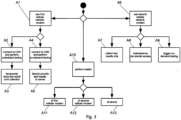
- Fig. 3 shows an embodiment of different actions that may be performed by the device 1 for monitoring a wireless Campus Area Network (CAN) 2.
- CAN Campus Area Network
- the device 1 may use its first cellular network modem 4 as indicated in action A1 and/or its second cellular network modem as indicated in action A6.
- the device 1 may connect to the CAN 2 and perform a scheduled monitoring/testing, e.g. in regular intervals. Subsequently, the corresponding results are temporarily stored until they are fetched/collected by the server 8, see action A3.
- the device may connect to the CAN 2 and perform an on-demand testing as indicated in action A4. In this case, the device 1 may directly provide test results to the server 8 as shown in action A5.
- the second cellular modem 6 of the device 1 may be used to collect, by the server 8, test results only as shown in action A7.
- the second cellular modem 6 of the device 1 may be used to perform a maintenance of the device 1 via remote access, e.g. for configuring monitoring intervals and corresponding parameters for performing a connectivity test, a latency test, a jitter test, a network throughput test and the like.
- the second cellular modem 6 of the device 1 may be used to trigger, based on a command received from the server 8, an on-demand testing. In this case, the corresponding tests are performed by the first cellular modem 4 as indicated in action A4.
- a restart command may be received from the server 8.
- the restart may relate to restarting the first cellular modem 4 (action A11), the second cellular modem 6 (action A12), or the whole device 1 (action A13). Since the second cellular modem 6 may be implemented as an external 5G router, the means 10 for restarting may be advantageously a smart power outlet that is remotely controlled, particularly by a corresponding control server.
Landscapes
- Engineering & Computer Science (AREA)
- Computer Networks & Wireless Communication (AREA)
- Signal Processing (AREA)
- Computer Security & Cryptography (AREA)
- Mobile Radio Communication Systems (AREA)
Abstract
Description
- The present application proposes a device and a method for monitoring a wireless Campus Area Network.
- At present, a cost efficient and flexible solution that allows to monitor closed or isolated Campus Area Networks (CANs), particularly 5G Campus Networks, is not existing. Using a simple probing solution for monitoring purposes is disadvantageous, since monitoring results shall be provided without delay, thus requiring an additional backchannel. In addition to that, monitoring results need to be protected from unauthorized access.
- Existing solutions require an active internet connection via WLAN or, alternatively, a SIM card that is able to be public and CAN-related at the same time. However, such solutions are disadvantageous for the monitoring of isolated CANs, e.g. isolated 5th generation standalone (5G-SA) networks, if a WLAN connection is not given. Corresponding technical solutions for this particular network architecture are not existing. Moreover, using only one IP-based network at a time is the usual standard procedure for connected devices. This is the case since using more than one network at a time leads to unwelcome side effects such as overlapping IP ranges, overlapping subnet masks, confusion in which network to answer to, etc.
- Depending on how the gateway and the default routes are set, answers are sent out via the wrong network interface. Due to those overwhelming issues, it is the standard procedure to use only one network at a time and disable any potential other network when it is not used. This is especially true for cellular networks. Devices with the ability to use multiple different operators, e.g. dual-sim smartphones, also only allow for one connection at a time.
- In view of this, the technical problem can be seen to be that of providing a more flexible solution that allows to easily and securely monitor CANs in a cost efficient manner.
- In order to solve this problem, a device for monitoring a wireless CAN is provided, the device comprising: a processor; a first cellular network modem operably connected to the processor and configured to establish a connection to the CAN; and a second cellular network modem operably connected to the processor and configured to establish a secure connection to a server arranged in another wireless network, which is different from the CAN.
- Hence, the claimed solution uses a first modem which acts as a built-in cellular modem, allowing to connect with special parameters on each test iteration, e.g. using different APNs or accessing the network as a different user. Further, using a second modem, a static connection to backend services provided by a server can be established. This approach allows maintaining both network connections without crosstalk. This is particularly advantageous since most CANs, which need to be monitored, are isolated and a SIM card only works for the CAN but not for a regular mobile network that is not isolated.
- With this approach, it is possible to achieve massive cost savings and a very high scalability since the claimed solution can be modified slightly and subsequently used for different kinds of monitoring needs. Furthermore, a massive flexibility is given because a testing suite that may be located on the device can be tailored to fit different customers' needs, e.g. by disabling or adding certain tests. Further, a remote connection to the device can be established in order to perform specific tests. The claimed solution is particularly simple since only providing a corresponding subscriber identification, e.g. by means of a SIM card, of the respective CAN is required to achieve an end-to-end service/performance monitoring.
- Using two cellular networks simultaneously provides great advantages such as using the device for monitoring the wireless CAN remotely, while said device is still connected to the CAN. It is further possible to extract data from the device in real time without waiting for a switch between two different networks that may take up to several minutes. Therefore, the time to monitor the CAN effectively can be extended and actions can accordingly be taken based on performance results. Further, the claimed solution is independent from using an internet connection granted by the customer operating the isolated CAN, since a cellular connection is used for backend monitoring instead.
- According to an embodiment, the CAN and the other wireless network are cellular networks according to at least one of a 2G, 3G, 4G and 5G communication standard.
- Furthermore, the second cellular network modem may be connected to the device using an Ethernet connection or a Universal Serial Bus, USB, connection. This is particularly advantageous since the second cellular network modem can be controlled independent from the device itself.
- In a preferred embodiment, the device is connected to means that are configured to, based on a command received from the server, restart at least one of the device, the first cellular network modem and the second cellular network modem. This may be done using a smart energy outlet for each of the respective modem or the device.
- Furthermore, the secure connection may be is provided by means of a non-public Access Point Name, APN. Using such connection is advantageous for protection of data collected in the CAN, which leaves the same for reporting to the server.
- According to another preferred embodiment, the device is further configured to: receive, from the server, a command for performing a monitoring test in the CAN using the first cellular network modem; perform the monitoring test; and at least temporarily store a result of the monitoring test. This allows to not only perform a regular monitoring at certain time intervals, but also an on-demand monitoring in case of network issues in the CAN.
- Preferably, the monitoring test comprises at least one of a connectivity test, a latency test, a jitter test and a network throughput test. According to a further preferred embodiment, the device is further configured to provide, upon request of the server, the result of the monitoring test to the server.
- Moreover, the device may be further configured to receive, from the server, a command for performing a maintenance operation. Hence, it is not required for a technician to perform an on-site visit in order to configure monitoring tests and the like.
- Furthermore, the connection established to the CAN is independent from the secure connection established to the other wireless network. Hence, no crosstalk between the connection towards the CAN and the connection towards the other wireless network is possible.
- According to another aspect of the present invention, a method performed by a device for monitoring a wireless Campus Area Network (CAN) is provided, the method comprising: establishing, using a first cellular network modem of a device, a connection to the CAN; establishing, using a second cellular network modem of the device, a secure connection to a server arranged in another wireless network, which is different from the CAN; and performing, using the first cellular network modem, a monitoring test in the CAN.
- The CAN and the other wireless network may be cellular networks according to at least one of a 2G, 3G, 4G and 5G communication standard.
- Further, the monitoring test may comprise at least one of a connectivity test, a latency test, a jitter test and a network throughput test.
- The claimed method may further comprise: providing, upon request of the server, the result of the monitoring test to the server.
- As indicated above, the connection established to the CAN is independent from the secure connection established to the other wireless network.
- Further details, features and advantages of the invention are explained in more detail below with reference to the embodiments shown in the figures of the drawings.
- Therein:
- Fig. 1
- shows an embodiment of a device for monitoring a wireless Campus Area Network;
- Fig. 2
- shows an embodiment of a method for monitoring a wireless Campus Area Network; and
- Fig. 3
- shows an embodiment of different actions that can be performed by the device for monitoring a wireless Campus Area Network.
-
Fig. 1 shows an embodiment of adevice 1 for monitoring a wireless Campus Area Network (CAN) 2. Thedevice 2 comprises a firstcellular network modem 4 that is operably connected to aprocessor 3 of thedevice 2 and configured to establish aconnection 5 to theCAN 2. The firstcellular network modem 4 is, for example, a 5G shield that acts as an internal network interface of thedevice 1. In the present case, the CAN 2 is a closed corporate network, which is realized using the 5G communication standard. - The
processor 3 of thedevice 1 is further operably connected to a secondcellular network modem 6. By means of said secondcellular network modem 6, asecure connection 7 to anotherwireless network 9, particularly comprising aserver 8, can be established. The secondcellular network modem 6 may be an external 5G router, which is operably connected to thedevice 1. In this case, the secondcellular network modem 6 may be connected to thedevice 1 using an Ethernet connection or a USB connection. It is apparent fromFig. 1 that the otherwireless network 9 is different from the CAN 2 and that said networks are not directly connected to each other. - Hence, the
connection 5 established to the CAN 2, which shall be monitored, is independent from thesecure connection 7 established to the otherwireless network 9. Further, theserver 8 in theother wireless network 9 may also be represented by a plurality of servers, e.g. a control server that may perform a control of thedevice 1 and an analytics server that may store monitoring results. Said servers) may be implemented by hardware and/or software. - Furthermore,
Fig. 1 shows means 10 that are configured to, based on a command received from theserver 8, restart at least one of thedevice 1, the firstcellular network modem 4 and the secondcellular network modem 6. Particularly for restarting thewhole device 1 or the secondcellular network modem 6 when implemented as an external 5G router, said means 10 may be a smart power outlet that is remotely controlled, particularly by a control server. - In order to monitor the
CAN 2, thedevice 1 performs monitoring tests in regular intervals, e.g. by monitoring basic parameters such as latency, jitter, network throughput to determine a service quality. However, results of such tests are not ultimately stored on thedevice 1 itself but are rather fetched by theserver 8 and deleted right after on thedevice 1. For this purpose, thedevice 1 is further configured to provide, upon request of theserver 8, the result of the monitoring test to theserver 8. - In addition to that, it is also foreseen that the
device 1 may receive, from theserver 8, a command for performing a monitoring test in theCAN 2 using the firstcellular network modem 4, perform the monitoring test, and at least temporarily store a result of the monitoring test. In case of such on-demand tests, the result of the monitoring test may subsequently be directly provided to theserver 8. -
Fig. 2 shows an embodiment of a method for monitoring a wireless Campus Area Network (CAN) 2. In a first method step S1, thedevice 1 establishes, using a firstcellular network modem 4 of thedevice 1, aconnection 5 to theCAN 2. Subsequently, in a second method step S2, thedevice 1 also establishes, using a secondcellular network modem 6 of thedevice 1, asecure connection 7 to aserver 8 arranged in anotherwireless network 9. Hence, aconnection 5 for performing monitoring tests in theCAN 2 and asecure connection 7 for providing corresponding test results to aserver 8 are existing at the same time. - Subsequently, in a third method step S3, the
device 1 performs, using the firstcellular network modem 4, a monitoring test in theCAN 2. The monitoring test may be one of a connectivity test, a latency test, a jitter test and a network throughput test. - Finally, after method step S3, the
device 1 may provide, upon request of theserver 8, the result of the monitoring test to theserver 8. -
Fig. 3 shows an embodiment of different actions that may be performed by thedevice 1 for monitoring a wireless Campus Area Network (CAN) 2. - In detail, the
device 1 may use its firstcellular network modem 4 as indicated in action A1 and/or its second cellular network modem as indicated in action A6. As shown in action A2, thedevice 1 may connect to theCAN 2 and perform a scheduled monitoring/testing, e.g. in regular intervals. Subsequently, the corresponding results are temporarily stored until they are fetched/collected by theserver 8, see action A3. Alternatively, the device may connect to theCAN 2 and perform an on-demand testing as indicated in action A4. In this case, thedevice 1 may directly provide test results to theserver 8 as shown in action A5. - Using the second
cellular modem 6 of thedevice 1, three different actions A7, A8 and A9 may be performed. In case thedevice 1 performed a monitoring/testing in regular intervals, the secondcellular modem 6 may be used to collect, by theserver 8, test results only as shown in action A7. According toaction 9, the secondcellular modem 6 of thedevice 1 may be used to perform a maintenance of thedevice 1 via remote access, e.g. for configuring monitoring intervals and corresponding parameters for performing a connectivity test, a latency test, a jitter test, a network throughput test and the like. - Depending on the network architecture employed by the
CAN 2, testing multiple APNs may also be possible. Further, according to action A9, the secondcellular modem 6 of thedevice 1 may be used to trigger, based on a command received from theserver 8, an on-demand testing. In this case, the corresponding tests are performed by the firstcellular modem 4 as indicated in action A4. - Besides the actions that have been described for the first
cellular network modem 4 and the secondcellular network modem 6, wherein thedevice 1 is instructed to perform said actions through the secondcellular modem 6. According to action A10, a restart command may be received from theserver 8. The restart may relate to restarting the first cellular modem 4 (action A11), the second cellular modem 6 (action A12), or the whole device 1 (action A13). Since the secondcellular modem 6 may be implemented as an external 5G router, themeans 10 for restarting may be advantageously a smart power outlet that is remotely controlled, particularly by a corresponding control server. - The embodiments shown in the figures of the drawing and the embodiments explained in connection therewith serve only to explain the invention and are not limiting for the same.
-
- 1
- Device
- 2
- Campus Area Network
- 3
- Processor
- 4
- First cellular network modem
- 5
- Connection
- 6
- Second cellular network modem
- 7
- Secure connection
- 8
- Server
- 9
- Another wireless network
- 10
- Restarting means
Claims (15)
- Device (1) for monitoring a wireless Campus Area Network, CAN (2), the device (1) comprising:a processor (3);a first cellular network modem (4) operably connected to the processor (3) and configured to establish a connection (5) to the CAN (2); anda second cellular network modem (6) operably connected to the processor (3) and configured to establish a secure connection (7) to a server (8) arranged in another wireless network (9), which is different from the CAN (2).
- The device (1) according to claim 1, wherein the CAN (2) and the other wireless network (9) are cellular networks according to at least one of a 2G, 3G, 4G and 5G communication standard.
- The device (1) according to claim 1 or claim 2, wherein the second cellular network modem (6) is connected to the device (1) using an Ethernet connection or a Universal Serial Bus, USB, connection.
- The device (1) according to any one of claims 1 to 3, wherein the device (1) is connected to means (10) configured to, based on a command received from the server (8), restart at least one of the device (1), the first cellular network modem (4) and the second cellular network modem (6).
- The device (1) according to any one of claims 1 to 4, wherein the secure connection (7) is provided by means of a non-public Access Point Name, APN.
- The device (1) according to any one of claims 1 to 5, wherein the device (1) is further configured to: receive, from the server (8), a command for performing a monitoring test in the CAN (2) using the first cellular network modem (4); perform the monitoring test; and at least temporarily store a result of the monitoring test.
- The device (1) according to claim 6, wherein the monitoring test comprises at least one of a connectivity test, a latency test, a jitter test and a network throughput test.
- The device (1) according to claim 6 or claim 7, wherein the device (1) is further configured to provide, upon request of the server (8), the result of the monitoring test to the server (8).
- The device (1) according to any one of claims 1 to 8, wherein the device (1) is further configured to receive, from the server (8), a command for performing a maintenance operation.
- The device (1) according to any one of claims 1 to 9, wherein the connection (5) established to the CAN (2) is independent from the secure connection (7) established to the other wireless network (9).
- Method performed by a device for monitoring a wireless Campus Area Network, CAN (2), the method comprising:establishing (S1), using a first cellular network modem (4) of a device (1), a connection (5) to the CAN (2);establishing (S2), using a second cellular network modem (6) of the device (1), a secure connection (7) to a server (8) arranged in another wireless network (9), which is different from the CAN (2); andperforming (S3), using the first cellular network modem (4), a monitoring test in the CAN (2).
- The method according to claim 11, wherein the CAN (2) and the other wireless network (9) are cellular networks according to at least one of a 2G, 3G, 4G and 5G communication standard.
- The method according to claim 11 or claim 12, wherein the monitoring test comprises at least one of a connectivity test, a latency test, a jitter test and a network throughput test.
- The method according to any one of claims 11 to 13, further comprising:
providing, upon request of the server (8), the result of the monitoring test to the server (8). - The method according to any one of claims 11 to 14, wherein the connection (5) established to the CAN (2) is independent from the secure connection (7) established to the other wireless network (9).
Priority Applications (1)
| Application Number | Priority Date | Filing Date | Title |
|---|---|---|---|
| EP21194642.1A EP4145890B1 (en) | 2021-09-02 | 2021-09-02 | Monitoring a wireless campus area network |
Applications Claiming Priority (1)
| Application Number | Priority Date | Filing Date | Title |
|---|---|---|---|
| EP21194642.1A EP4145890B1 (en) | 2021-09-02 | 2021-09-02 | Monitoring a wireless campus area network |
Publications (2)
| Publication Number | Publication Date |
|---|---|
| EP4145890A1 true EP4145890A1 (en) | 2023-03-08 |
| EP4145890B1 EP4145890B1 (en) | 2026-07-29 |
Family
ID=77801449
Family Applications (1)
| Application Number | Title | Priority Date | Filing Date |
|---|---|---|---|
| EP21194642.1A Active EP4145890B1 (en) | 2021-09-02 | 2021-09-02 | Monitoring a wireless campus area network |
Country Status (1)
| Country | Link |
|---|---|
| EP (1) | EP4145890B1 (en) |
Citations (3)
| Publication number | Priority date | Publication date | Assignee | Title |
|---|---|---|---|---|
| US20090082009A1 (en) * | 2007-09-26 | 2009-03-26 | Accelerated Concepts, Llc | Mobile communication device for measuring, analyzing, and comparing wireless service provider qos |
| WO2017165059A1 (en) * | 2016-03-22 | 2017-09-28 | Qualcomm Incorporated | Standalone network probing using available network connections |
| US20180249395A1 (en) * | 2015-02-27 | 2018-08-30 | Orange | Access network selection for a multi-access terminal, based on a pheromone signal |
-
2021
- 2021-09-02 EP EP21194642.1A patent/EP4145890B1/en active Active
Patent Citations (3)
| Publication number | Priority date | Publication date | Assignee | Title |
|---|---|---|---|---|
| US20090082009A1 (en) * | 2007-09-26 | 2009-03-26 | Accelerated Concepts, Llc | Mobile communication device for measuring, analyzing, and comparing wireless service provider qos |
| US20180249395A1 (en) * | 2015-02-27 | 2018-08-30 | Orange | Access network selection for a multi-access terminal, based on a pheromone signal |
| WO2017165059A1 (en) * | 2016-03-22 | 2017-09-28 | Qualcomm Incorporated | Standalone network probing using available network connections |
Also Published As
| Publication number | Publication date |
|---|---|
| EP4145890B1 (en) | 2026-07-29 |
Similar Documents
| Publication | Publication Date | Title |
|---|---|---|
| US12342422B2 (en) | Using a plurality of SIM cards at an electronic device | |
| US11997585B2 (en) | SIM whitelisting and multi-operator core networks | |
| EP3897026A1 (en) | Network analytics | |
| CN106067880B (en) | A kind of source tracing method of the IP address based on 4G network | |
| CN106534289B (en) | Automatic testing method, device and system | |
| KR20130125389A (en) | Method and apparatus for network analysis | |
| US20140313882A1 (en) | Gateway device for machine-to-machine communication with dual cellular interfaces | |
| EP2509294B1 (en) | A telecommunication network bypass detection system with reduced counter detection risk | |
| CN113228748B (en) | Systems and methods for network access services | |
| EP3162001A1 (en) | Network diagnostic device | |
| Lutu et al. | Insights from operating an IP exchange provider | |
| US8649272B2 (en) | Methods, systems and computer readable media for mobile-communication-device-initiated network monitoring services | |
| EP2671372B1 (en) | A system for detection of a bypass of an interconnect to a telecommunication network | |
| Novanana et al. | 5G lab as a service (LaaS) simulator deployment: Study case scenarios in Indonesian higher education | |
| US10200866B1 (en) | Method and system for detecting and minimizing harmful network device and application behavior on cellular networks | |
| GB2562126A (en) | Using a plurality of sim cards at an electronic device | |
| CN115037664A (en) | Network connection testing method, device, repeater and storage medium | |
| US20260006429A1 (en) | Managing system for esim profiles, test system for a mobile network including such managing system, method to download an esim profile using such managing system or such test system and method to test a mobile network including the download method | |
| AU2014208273B2 (en) | A Method for Identifying a User Plane Identifier of a User Device and a Monitoring Probe Thereof | |
| CN107453958B (en) | A method and system for real-world network testing of multiple dial-up methods for surfing the Internet | |
| CN109525454B (en) | Data processing method and device | |
| CN111314992B (en) | Connection method and device of hotspot module and broadcasting method and device of hotspot list | |
| CN112291146A (en) | Method and device for connecting with Internet and storage medium | |
| Harasymchuk et al. | Security analysis of LTE technology | |
| CN118803983A (en) | 5G private network fault diagnosis method and device |
Legal Events
| Date | Code | Title | Description |
|---|---|---|---|
| PUAI | Public reference made under article 153(3) epc to a published international application that has entered the european phase |
Free format text: ORIGINAL CODE: 0009012 |
|
| STAA | Information on the status of an ep patent application or granted ep patent |
Free format text: STATUS: THE APPLICATION HAS BEEN PUBLISHED |
|
| AK | Designated contracting states |
Kind code of ref document: A1 Designated state(s): AL AT BE BG CH CY CZ DE DK EE ES FI FR GB GR HR HU IE IS IT LI LT LU LV MC MK MT NL NO PL PT RO RS SE SI SK SM TR |
|
| STAA | Information on the status of an ep patent application or granted ep patent |
Free format text: STATUS: REQUEST FOR EXAMINATION WAS MADE |
|
| 17P | Request for examination filed |
Effective date: 20230525 |
|
| RBV | Designated contracting states (corrected) |
Designated state(s): AL AT BE BG CH CY CZ DE DK EE ES FI FR GB GR HR HU IE IS IT LI LT LU LV MC MK MT NL NO PL PT RO RS SE SI SK SM TR |
|
| REG | Reference to a national code |
Ref legal event code: R079 Free format text: PREVIOUS MAIN CLASS: H04W0024060000 Ref country code: DE Ref legal event code: R079 Ref document number: 602021057787 Country of ref document: DE Free format text: PREVIOUS MAIN CLASS: H04W0024060000 Ipc: H04W0012020000 |
|
| GRAP | Despatch of communication of intention to grant a patent |
Free format text: ORIGINAL CODE: EPIDOSNIGR1 |
|
| STAA | Information on the status of an ep patent application or granted ep patent |
Free format text: STATUS: GRANT OF PATENT IS INTENDED |
|
| RIC1 | Information provided on ipc code assigned before grant |
Ipc: H04W 12/02 20090101AFI20260209BHEP Ipc: H04W 24/06 20090101ALI20260209BHEP Ipc: H04W 88/06 20090101ALI20260209BHEP Ipc: H04L 9/40 20220101ALN20260209BHEP Ipc: H04W 24/10 20090101ALN20260209BHEP |
|
| INTG | Intention to grant announced |
Effective date: 20260303 |
|
| GRAS | Grant fee paid |
Free format text: ORIGINAL CODE: EPIDOSNIGR3 |
|
| GRAA | (expected) grant |
Free format text: ORIGINAL CODE: 0009210 |
|
| STAA | Information on the status of an ep patent application or granted ep patent |
Free format text: STATUS: THE PATENT HAS BEEN GRANTED |
|
| AK | Designated contracting states |
Kind code of ref document: B1 Designated state(s): AL AT BE BG CH CY CZ DE DK EE ES FI FR GB GR HR HU IE IS IT LI LT LU LV MC MK MT NL NO PL PT RO RS SE SI SK SM TR |
|
| REG | Reference to a national code |
Ref country code: CH Ref legal event code: F10 Free format text: ST27 STATUS EVENT CODE: U-0-0-F10-F00 (AS PROVIDED BY THE NATIONAL OFFICE) Effective date: 20260729 |