EP4145812B1 - Electronic device - Google Patents
Electronic device Download PDFInfo
- Publication number
- EP4145812B1 EP4145812B1 EP22733848.0A EP22733848A EP4145812B1 EP 4145812 B1 EP4145812 B1 EP 4145812B1 EP 22733848 A EP22733848 A EP 22733848A EP 4145812 B1 EP4145812 B1 EP 4145812B1
- Authority
- EP
- European Patent Office
- Prior art keywords
- expansion region
- electronic device
- battery
- electrical connector
- notch
- Prior art date
- Legal status (The legal status is an assumption and is not a legal conclusion. Google has not performed a legal analysis and makes no representation as to the accuracy of the status listed.)
- Active
Links
Images








Classifications
-
- H—ELECTRICITY
- H01—ELECTRIC ELEMENTS
- H01M—PROCESSES OR MEANS, e.g. BATTERIES, FOR THE DIRECT CONVERSION OF CHEMICAL ENERGY INTO ELECTRICAL ENERGY
- H01M10/00—Secondary cells; Manufacture thereof
- H01M10/42—Methods or arrangements for servicing or maintenance of secondary cells or secondary half-cells
- H01M10/425—Structural combination with electronic components, e.g. electronic circuits integrated to the outside of the casing
-
- H—ELECTRICITY
- H01—ELECTRIC ELEMENTS
- H01M—PROCESSES OR MEANS, e.g. BATTERIES, FOR THE DIRECT CONVERSION OF CHEMICAL ENERGY INTO ELECTRICAL ENERGY
- H01M50/00—Constructional details or processes of manufacture of the non-active parts of electrochemical cells other than fuel cells, e.g. hybrid cells
- H01M50/20—Mountings; Secondary casings or frames; Racks, modules or packs; Suspension devices; Shock absorbers; Transport or carrying devices; Holders
- H01M50/202—Casings or frames around the primary casing of a single cell or a single battery
-
- H—ELECTRICITY
- H01—ELECTRIC ELEMENTS
- H01M—PROCESSES OR MEANS, e.g. BATTERIES, FOR THE DIRECT CONVERSION OF CHEMICAL ENERGY INTO ELECTRICAL ENERGY
- H01M50/00—Constructional details or processes of manufacture of the non-active parts of electrochemical cells other than fuel cells, e.g. hybrid cells
- H01M50/20—Mountings; Secondary casings or frames; Racks, modules or packs; Suspension devices; Shock absorbers; Transport or carrying devices; Holders
- H01M50/244—Secondary casings; Racks; Suspension devices; Carrying devices; Holders characterised by their mounting method
-
- H—ELECTRICITY
- H01—ELECTRIC ELEMENTS
- H01M—PROCESSES OR MEANS, e.g. BATTERIES, FOR THE DIRECT CONVERSION OF CHEMICAL ENERGY INTO ELECTRICAL ENERGY
- H01M50/00—Constructional details or processes of manufacture of the non-active parts of electrochemical cells other than fuel cells, e.g. hybrid cells
- H01M50/20—Mountings; Secondary casings or frames; Racks, modules or packs; Suspension devices; Shock absorbers; Transport or carrying devices; Holders
- H01M50/247—Mountings; Secondary casings or frames; Racks, modules or packs; Suspension devices; Shock absorbers; Transport or carrying devices; Holders specially adapted for portable devices, e.g. mobile phones, computers, hand tools or pacemakers
-
- H—ELECTRICITY
- H01—ELECTRIC ELEMENTS
- H01M—PROCESSES OR MEANS, e.g. BATTERIES, FOR THE DIRECT CONVERSION OF CHEMICAL ENERGY INTO ELECTRICAL ENERGY
- H01M50/00—Constructional details or processes of manufacture of the non-active parts of electrochemical cells other than fuel cells, e.g. hybrid cells
- H01M50/20—Mountings; Secondary casings or frames; Racks, modules or packs; Suspension devices; Shock absorbers; Transport or carrying devices; Holders
- H01M50/271—Lids or covers for the racks or secondary casings
-
- H—ELECTRICITY
- H01—ELECTRIC ELEMENTS
- H01M—PROCESSES OR MEANS, e.g. BATTERIES, FOR THE DIRECT CONVERSION OF CHEMICAL ENERGY INTO ELECTRICAL ENERGY
- H01M50/00—Constructional details or processes of manufacture of the non-active parts of electrochemical cells other than fuel cells, e.g. hybrid cells
- H01M50/40—Separators; Membranes; Diaphragms; Spacing elements inside cells
- H01M50/471—Spacing elements inside cells other than separators, membranes or diaphragms; Manufacturing processes thereof
- H01M50/474—Spacing elements inside cells other than separators, membranes or diaphragms; Manufacturing processes thereof characterised by their position inside the cells
-
- H—ELECTRICITY
- H01—ELECTRIC ELEMENTS
- H01M—PROCESSES OR MEANS, e.g. BATTERIES, FOR THE DIRECT CONVERSION OF CHEMICAL ENERGY INTO ELECTRICAL ENERGY
- H01M50/00—Constructional details or processes of manufacture of the non-active parts of electrochemical cells other than fuel cells, e.g. hybrid cells
- H01M50/50—Current conducting connections for cells or batteries
- H01M50/502—Interconnectors for connecting terminals of adjacent batteries; Interconnectors for connecting cells outside a battery casing
- H01M50/519—Interconnectors for connecting terminals of adjacent batteries; Interconnectors for connecting cells outside a battery casing comprising printed circuit boards [PCB]
-
- H—ELECTRICITY
- H01—ELECTRIC ELEMENTS
- H01M—PROCESSES OR MEANS, e.g. BATTERIES, FOR THE DIRECT CONVERSION OF CHEMICAL ENERGY INTO ELECTRICAL ENERGY
- H01M50/00—Constructional details or processes of manufacture of the non-active parts of electrochemical cells other than fuel cells, e.g. hybrid cells
- H01M50/50—Current conducting connections for cells or batteries
- H01M50/531—Electrode connections inside a battery casing
- H01M50/533—Electrode connections inside a battery casing characterised by the shape of the leads or tabs
-
- H—ELECTRICITY
- H01—ELECTRIC ELEMENTS
- H01M—PROCESSES OR MEANS, e.g. BATTERIES, FOR THE DIRECT CONVERSION OF CHEMICAL ENERGY INTO ELECTRICAL ENERGY
- H01M50/00—Constructional details or processes of manufacture of the non-active parts of electrochemical cells other than fuel cells, e.g. hybrid cells
- H01M50/50—Current conducting connections for cells or batteries
- H01M50/572—Means for preventing undesired use or discharge
- H01M50/584—Means for preventing undesired use or discharge for preventing incorrect connections inside or outside the batteries
- H01M50/59—Means for preventing undesired use or discharge for preventing incorrect connections inside or outside the batteries characterised by the protection means
-
- H—ELECTRICITY
- H04—ELECTRIC COMMUNICATION TECHNIQUE
- H04M—TELEPHONIC COMMUNICATION
- H04M1/00—Substation equipment, e.g. for use by subscribers
- H04M1/02—Constructional features of telephone sets
- H04M1/0202—Portable telephone sets, e.g. cordless phones, mobile phones or bar type handsets
- H04M1/026—Details of the structure or mounting of specific components
- H04M1/0262—Details of the structure or mounting of specific components for a battery compartment
-
- H—ELECTRICITY
- H04—ELECTRIC COMMUNICATION TECHNIQUE
- H04M—TELEPHONIC COMMUNICATION
- H04M1/00—Substation equipment, e.g. for use by subscribers
- H04M1/02—Constructional features of telephone sets
- H04M1/0202—Portable telephone sets, e.g. cordless phones, mobile phones or bar type handsets
- H04M1/026—Details of the structure or mounting of specific components
- H04M1/0277—Details of the structure or mounting of specific components for a printed circuit board assembly
-
- H—ELECTRICITY
- H01—ELECTRIC ELEMENTS
- H01M—PROCESSES OR MEANS, e.g. BATTERIES, FOR THE DIRECT CONVERSION OF CHEMICAL ENERGY INTO ELECTRICAL ENERGY
- H01M10/00—Secondary cells; Manufacture thereof
- H01M10/42—Methods or arrangements for servicing or maintenance of secondary cells or secondary half-cells
- H01M10/425—Structural combination with electronic components, e.g. electronic circuits integrated to the outside of the casing
- H01M2010/4271—Battery management systems including electronic circuits, e.g. control of current or voltage to keep battery in healthy state, cell balancing
-
- H—ELECTRICITY
- H01—ELECTRIC ELEMENTS
- H01M—PROCESSES OR MEANS, e.g. BATTERIES, FOR THE DIRECT CONVERSION OF CHEMICAL ENERGY INTO ELECTRICAL ENERGY
- H01M2220/00—Batteries for particular applications
- H01M2220/30—Batteries in portable systems, e.g. mobile phone, laptop
-
- H—ELECTRICITY
- H04—ELECTRIC COMMUNICATION TECHNIQUE
- H04M—TELEPHONIC COMMUNICATION
- H04M1/00—Substation equipment, e.g. for use by subscribers
- H04M1/02—Constructional features of telephone sets
- H04M1/0202—Portable telephone sets, e.g. cordless phones, mobile phones or bar type handsets
- H04M1/026—Details of the structure or mounting of specific components
-
- H—ELECTRICITY
- H04—ELECTRIC COMMUNICATION TECHNIQUE
- H04M—TELEPHONIC COMMUNICATION
- H04M1/00—Substation equipment, e.g. for use by subscribers
- H04M1/02—Constructional features of telephone sets
- H04M1/23—Construction or mounting of dials or of equivalent devices; Means for facilitating the use thereof
- H04M1/236—Construction or mounting of dials or of equivalent devices; Means for facilitating the use thereof including keys on side or rear faces
-
- Y—GENERAL TAGGING OF NEW TECHNOLOGICAL DEVELOPMENTS; GENERAL TAGGING OF CROSS-SECTIONAL TECHNOLOGIES SPANNING OVER SEVERAL SECTIONS OF THE IPC; TECHNICAL SUBJECTS COVERED BY FORMER USPC CROSS-REFERENCE ART COLLECTIONS [XRACs] AND DIGESTS
- Y02—TECHNOLOGIES OR APPLICATIONS FOR MITIGATION OR ADAPTATION AGAINST CLIMATE CHANGE
- Y02E—REDUCTION OF GREENHOUSE GAS [GHG] EMISSIONS, RELATED TO ENERGY GENERATION, TRANSMISSION OR DISTRIBUTION
- Y02E60/00—Enabling technologies; Technologies with a potential or indirect contribution to GHG emissions mitigation
- Y02E60/10—Energy storage using batteries
Definitions
- This application relates to the technical field of electronic devices, and in particular, to an electronic device.
- an electronic device such as a mobile phone, a tablet computer, and a smart wearable device has a battery, and the battery is used to supply power to the electronic device, so as to facilitate the carrying of the electronic device.
- the battery is at risk of expansion after long-term charging and discharging in use.
- the thickness of the whole electronic device is usually increased to reserve the expansion space of the battery.
- the thickness of the reserved expansion space is relatively thick, resulting in a larger thickness of the electronic device, which is not conducive to a light and thin design of the electronic device.
- WO 2015/182050 A1 discloses a portable device incorporating a battery pack, wherein the portable device comprises a housing, a battery pack installation surface, and a flat rectangular battery pack housed in the housing.
- the battery pack has a battery body and a cover sheet wrapped around said body.
- the battery pack has a first surface with a central portion whereon the cover sheet is not wrapped.
- the device further comprises an electrical connector on the first surface which does not reach the central portion.
- US 2019/006641 A1 discloses a battery fixing device and an electronic device comprising a casing battery chamber, and a container fixedly arranged in the casing battery chamber and matched with the casing battery chamber to wrap and fix the battery.
- the container includes a containing chamber formed by a surround of a film and configured to contain a battery, and fixing films arranged on the containing chamber and connected to the containing chamber to fix the top of the containing chamber.
- CN 211 630 199 U discloses an electronic device, which includes: the main control circuit board, the battery module and the fingerprint module; the battery module is electrically connected with the main control circuit board; the battery module comprises a battery main body and a battery circuit board; the battery circuit board is arranged on the side surface of the battery main body, and the thickness of the battery circuit board is smaller than that of the battery main body.
- the electronic device includes: a housing, a battery, and an electrical connector.
- a battery compartment is arranged in the housing.
- the battery is mounted in the battery compartment and includes a battery body and a wrapping film wrapped around a surface of the battery body.
- At least part of the electrical connector is located on the first surface, and the part of the electrical connector located on the first surface does not overlap with the wrapping film in the expansion region.
- the part of the electrical connector located on the first surface does not overlap with the wrapping film in the expansion region, an overall thickness of the battery and the electrical connector corresponding to a position of the expansion region will not be increased, and a thickness of the expansion space that needs to be reserved is relatively small, which is conducive to reducing the thickness of the electronic device and can achieve a thin electronic device at least to a certain extent.
- the first surface faces away from a bottom wall of the battery compartment, or the first surface faces the bottom wall of the battery compartment.
- a is in a range of [0, 10] mm.
- a is in a range of [0, 3] mm.
- a is in a range of (0, 2] mm.
- the expansion region can be reasonably arranged to ensure that when the battery body is expanded, the position of the maximum thickness of the battery body is located in the expansion region.
- the battery body further has a second surface opposite to the first surface and two side surfaces connected between the first surface and the second surface and opposite to each other.
- the wrapping film includes a first portion, a second portion, and a third portion connected in sequence, the first portion is wrapped around the first surface, the second portion is wrapped around one of the two side surfaces, and the third portion is wrapped around the second surface.
- the wrapping film includes a tearable portion, and the tearable portion is connected to an end of the first portion away from the second portion.
- the wrapping film may be used as a tearable film.
- the tearable portion has an avoidance notch configured to give way to the electrical connector. In this way, the wrapping film may be prevented from overlapping with the electrical connector in the expansion region.
- a part of the first portion is wrapped in the expansion region, and a first notch is provided at a part of the first portion corresponding to the electrical connector.
- the part of the first portion can be located in the expansion region, which can increase the protection performance and tearing reliability of the battery body.
- the arrangement of the first notch can prevent the wrapping film and the electrical connector from overlapping in the expansion region.
- the first notch extends to an edge of the first portion in a direction from the first portion to the second portion.
- the second portion has formed thereon a first communication notch extending through the second portion in a thickness direction of the second portion, and the first communication notch is in communication with the first notch.
- the wrapping film further includes a fourth portion and a fifth portion.
- the fourth portion is connected to an end of the third portion away from the second portion, and the fifth portion is connected to an end of the fourth portion away from the third portion.
- the fourth portion is wrapped around the other of the two side surfaces, and the fifth portion is wrapped around the first surface.
- a part of the fifth portion is wrapped in the expansion region, and a second notch is provided at a part of the fifth portion corresponding to the electrical connector in the expansion region.
- the part of the fifth portion can be located in the expansion region, which can increase the protection performance and tearing reliability of the battery body.
- the arrangement of the second notch can prevent the wrapping film and the electrical connector from overlapping in the expansion region.
- the second notch extends to an edge of the fifth portion in a direction from the fifth portion to the fourth portion.
- the fourth portion has formed thereon a second communication notch extending through the fourth portion in a thickness direction of the fourth portion and in communication with the second notch.
- the battery body further includes a first end surface connected between the two side surfaces, the first end surface has an electrical connection terminal, and the first surface, the second surface, and the two side surfaces are arranged along a circumferential direction of the first end surface.
- the electronic device further includes a main circuit board and a side functional device, where the electrical connector is configured to connect the main circuit board to the side functional device.
- the main circuit board is located on a side of the battery compartment adjacent to the first end surface, and the side functional device faces one of the side surfaces.
- the side functional device is a side button and/or a side fingerprint recognition module.
- the electronic device includes a main circuit board and an auxiliary circuit board.
- the electrical connector is configured to connect the main circuit board to the auxiliary circuit board.
- the battery body has a second end surface opposite to the first end surface.
- One of the main circuit board and the auxiliary circuit board is located on the side of the battery compartment adjacent to the first end surface, and the other of the main circuit board and the auxiliary circuit board is located on a side of the battery compartment adjacent to the second end surface.
- the electrical connector is a flexible printed circuit board. In this way, the structure is simple and costs are low.
- the electronic device includes a main circuit board and a wireless communication module arranged on the main circuit board.
- the wireless communication module is configured to send and receive a signal via an antenna, and the electrical connector is a radiator of the antenna.
- the electronic device further includes a separator.
- the separator is located between the first surface and a surface of the housing opposite to the first surface.
- a giving-way notch is formed on the part of the wrapping film wrapped around the first surface, and the giving-way notch is configured to give way to the separator.
- the terms “include”, “comprise”, and any variants thereof are intended to cover a non-exclusive inclusion. Therefore, in the context of a process, method, object, or apparatus that includes a series of elements, the process, method, object, or apparatus not only includes such elements, but also includes other elements not specified expressly, or may include inherent elements of the process, method, object, or apparatus. Without more limitations, elements defined by the sentence “including one” does not exclude that there are still other same elements in the processes, methods, objects, or apparatuses.
- the electronic device 100 is a type of electronic device 100 having a battery 50.
- the electronic device 100 includes, but is not limited to, electronic devices 100 such as a mobile phone, a tablet personal computer (tablet personal computer), a laptop computer (laptop computer), a personal digital assistant (personal digital assistant, PDA), a personal computer, a notebook computer, an onboard device, a wearable device, and the like.
- electronic devices 100 such as a mobile phone, a tablet personal computer (tablet personal computer), a laptop computer (laptop computer), a personal digital assistant (personal digital assistant, PDA), a personal computer, a notebook computer, an onboard device, a wearable device, and the like.
- FIG. 1 is a schematic structural diagram of an electronic device 100 according to some embodiments of this application
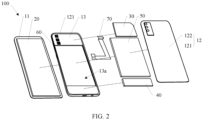
- FIG. 2 is an exploded view of the electronic device 100 shown in FIG. 1
- the electronic device 100 is a phablet.
- the electronic device 100 includes a housing 10, a display 20, a side functional device 60, a main circuit board 30, an auxiliary circuit board 40, a battery 50, and an electrical connector 70.
- the housing 10 is configured to protect internal circuit elements of the electronic device 100. Still referring to FIG. 2 , the housing 10 includes a front cover plate 11 and a back housing 12.
- the front cover plate 11 is a light transmissive member, and a material of the front cover plate 11 includes but is not limited to glass, plastic, or ceramic.
- the back housing 12 includes a back cover 122 and a border frame 121.
- the back cover 122 and the front cover plate 11 are stacked and spaced apart from each other.
- the border frame 121 surrounds a periphery of the front cover plate 11 and is located between the front cover plate 11 and the back cover 122.
- the border frame 121 is fixed to the back cover 122.
- the border frame 121 may be fixedly connected to the back cover 122 by gluing, welding, or snapping.
- the border frame 121 may also be integrally formed with the back cover 122, that is, the border frame 121 and the back cover 122 are an integral structure.
- the front cover plate 11 is fixed to the border frame 121. In some embodiments, the front cover plate 11 may be fixed to the border frame 121 by gluing.
- the front cover plate 11, the back cover 122, and the border frame 121 form an internal accommodating space of the electronic device 100.
- the internal accommodating space is configured to accommodate the display 20, at least part of the side functional device 60, the main circuit board 30, the auxiliary circuit board 40, the battery 50, the electrical connector 70, and the like.
- the display 20 is located in the housing 10, and the display 20 and the front cover plate 11 are stacked and fixedly connected.
- the display 20 is configured to display an image, a video, and the like.
- a flexible display or a rigid display may be used as the display 20.
- the display 20 may be an organic light-emitting diode (organic light-emitting diode, OLED) display, an active-matrix organic light-emitting diode (active-matrix organic light-emitting diode, AMOLED) display, a mini light-emitting diode (mini organic light-emitting diode) display, a micro light-emitting diode (micro organic light-emitting diode) display, a micro organic light-emitting diode (micro organic light-emitting diode) display, a quantum dot light-emitting diode (quantum dot light emitting diodes, QLED) display, or a liquid crystal display (liquid crystal display, LCD
- the side functional device 60 is located at the border frame 121.
- the side functional device 60 may be a side fingerprint recognition module and/or a side button. That is to say, the side functional device 60 may be only a side fingerprint recognition module, and may further be only a side button, or may be a side button and a side fingerprint recognition module.
- the side fingerprint recognition module may be located on one side of the side button close to inside of the housing 10.
- the side button may be a power button or a volume button, and the side fingerprint recognition module may be an optical fingerprint recognition module, a capacitive fingerprint recognition module, or a radio frequency fingerprint recognition module.
- a mounting hole may be provided on the border frame 121.
- One end of the side button is located in the housing 10, and an other end of the side button passes through the mounting hole and is exposed from the mounting hole, so as to facilitate user triggering.
- a mounting hole may be provided on the border frame 121, so that a fingerprint recognition region of the side fingerprint recognition module can be exposed from the mounting hole, so as to facilitate fingerprint collection.
- mounting holes may not be provided, but other structures may be arranged on the border frame 121, for example, a light transmissive fingerprint collection region is arranged, as long as it is ensured that the fingerprint recognition region of the side fingerprint recognition module directly faces the fingerprint collection region on the border frame 121.
- a middle plate 13 is arranged in the housing 10, and the middle plate 13 is fixed to a periphery of an inner surface of the border frame 121.
- the middle plate 13 may be fixed to the border frame 121 by welding, gluing, or snapping, or may be integrally formed with the border frame 121.
- the display 10 is located between the front cover plate 11 and the middle plate 13. At least part of the side functional device 60, the main circuit board 30, the auxiliary circuit board 40, and the battery 50 are located between the middle plate 13 and the back cover 122.
- the middle plate 13 is used as a structural "skeleton" of the electronic device 100, and the main circuit board 30, the auxiliary circuit board 40, the battery 50, and the like may be fixed to the middle plate 13 by threaded connection, snapping, welding, or the like.
- the main circuit board 30, the auxiliary circuit board 40, the battery 50, and the like may be fixed to a surface of the display 20 toward the back cover 122 by threaded connection, snapping, welding, or the like.
- FIG. 3 is a schematic structural diagram of the electronic device 100 shown in FIG. 1 with a back cover 122 being removed.
- the example shown in FIG. 3 does not fall under the scope of the claims.
- the main circuit board 30 is configured to integrate a control chip.
- the control chip may be, for example, an application processor (application processor, AP), a double data rate (double data rate, DDR) synchronous dynamic random access memory, a universal flash storage (universal flash storage, UFS), and the like.
- the main circuit board 30 is electrically connected to both the display 20 and the side functional device 60.
- the main circuit board 30 is configured to control the display screen 20 to display an image or a video and collect a fingerprint or an instruction inputted from the side functional device 60.
- the main circuit board 30 may be a rigid circuit board, a flexible printed circuit board, or a rigid-flex circuit board.
- the main circuit board 30 may be an FR-4 dielectric board, a Rogers dielectric board, a mixed media board of FR-4 and Rogers, or the like.
- FR-4 represents a flame-resistant material grade
- the Rogers dielectric board is a high-frequency board.
- the auxiliary circuit board 40 is configured to integrate electronic components such as an antenna (such as a 5G antenna) radio frequency front end, a universal serial bus (universal serial bus, USB) device, an oscillator, and the like.
- the auxiliary circuit board 40 is electrically connected to the main circuit board 30.
- the auxiliary circuit board 40 may be a rigid circuit board, a flexible printed circuit board, or a rigid-flex circuit board.
- the auxiliary circuit board 40 may be an FR-4 dielectric board, a Rogers dielectric board, a mixed media board of FR-4 and Rogers, or the like.
- a wireless communication module is integrated on the main circuit board 30 and/or the auxiliary circuit board 40.
- the wireless communication module may provide a solution for wireless communication including a wireless local area network (wireless local area network, WLAN) (such as a wireless fidelity (wireless fidelity, Wi-Fi) network), Bluetooth (Bluetooth, BT), and a global navigation satellite system (global navigation satellite system, GNSS), frequency modulation (frequency modulation, FM), a near field communication (near field communication, NFC) technology, an infrared (infrared, IR) technology, and the like to be applied to the electronic device 100.
- the wireless communication module may be one or more devices integrating at least one communication processing module.
- the wireless communication module receives an electromagnetic wave through an antenna, performs frequency modulation and filtering processing on the electromagnetic wave signal, and sends the processed signal to the control chip.
- the wireless communication module may further receive a to-be-sent signal from the control chip, perform frequency modulation and amplification on the to-be-sent signal, and convert the signal into an electromagnetic wave through an antenna and radiate the signal.
- the wireless communication module includes an NFC communication processing module, and an antenna of the NFC communication processing module is an NFC antenna.
- the wireless communication module includes a Bluetooth communication processing module, and an antenna of the Bluetooth communication processing module is a Bluetooth antenna.
- the wireless communication module includes a wireless local area network communication processing module, and an antenna of the wireless local area network communication processing module is a Wi-Fi antenna.
- a battery compartment 13a is arranged in the housing 10.
- the battery compartment 13a is located between the main circuit board 30 and the auxiliary circuit board 40.
- An opening of the battery compartment 13a faces the back cover 122.
- the battery compartment 13a is a groove provided on a surface of the middle plate 13 facing the back cover 122.
- the middle plate 13 forms a bottom wall of the battery compartment, elements such as the main circuit board 30, the auxiliary circuit board 40, a speaker module (not shown in the figure), and the like form two opposite side walls of the battery compartment 13a, and the two sides of the border frame 13 form other two opposite side walls of the battery compartment 13a.
- the display screen 20 or the back cover 122 may further form the bottom wall of the battery compartment 13a, and elements such as the main circuit board 30, the auxiliary circuit board 40, the speaker module (not shown in the figure), the border frame 13, and the like form the side wall of the battery compartment 13a.
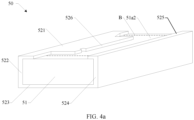
- FIG. 4a is a schematic structural diagram of a battery 50 in the electronic device 100 shown in FIG. 2 and FIG. 3 .
- the battery 50 includes a battery body 51 and a wrapping film 52.
- FIG. 4b is a three-dimensional view of a battery body 51 in the battery 50 shown in FIG. 4a
- FIG. 4c is an exploded view of the battery body 51 shown in FIG. 4b
- the battery body 51 includes a shell 511, an electrolyte (not shown), and a bare battery core 512.
- the shell 511 is configured to encapsulate and protect the bare battery core 512 and the electrolyte, and a shape of the shell 511 includes but is not limited to a cuboid, a cylinder, a frustum of a cone, and the like.
- a material of the shell 511 includes, but is not limited to, a composite film and a steel shell. Specifically, the composite film includes at least three layers.
- a middle layer is a metal coating layer configured to isolate moisture.
- An outer layer is a plastic coating layer configured to prevent the permeation of air, especially oxygen.
- An inner layer is a sealing layer configured for sealing and preventing the electrolyte from corroding the metal coating layer.
- a material of the sealing layer is selected from at least one of polyethylene, polypropylene, esters of polyethylene or polypropylene, or ionomers of polyethylene or polypropylene.
- the polyethylene is selected from low density polyethylene, medium density polyethylene, or high density polyethylene.
- the polypropylene is selected from homo polypropylene, block polypropylene, or atactic polypropylene.
- a material of the metal coating layer is selected from at least one of metal, metal alloy, metal oxides, or ceramics, and the metal is selected from aluminum, iron, silver, copper, nickel, manganese, tin, titanium, zirconium, or vanadium.
- a material of the plastic coating layer is selected from at least one of polyamide resin, polyolefin, polycarbonate, or fluororesin.
- a material of the shell 511 may be an aluminum plastic film.
- a middle layer of the aluminum plastic film is an aluminum layer configured to isolate moisture.
- An outer layer of the aluminum plastic film is made of polyamide, which is configured to prevent the permeation of air, especially oxygen.
- An inner layer of the aluminum plastic film is a polypropylene layer configured for sealing and preventing the electrolyte from corroding the aluminum layer.
- the electrolyte is a carrier for transporting lithium ions in the battery body 51.
- the electrolyte is generally prepared from raw materials such as high-purity organic solvents, electrolyte lithium salts, necessary additives, and the like in certain proportion under certain conditions.
- the bare battery core 512 includes a bare battery core body 5121 and two tabs 5122. Specifically, the bare battery core body 5121 is located in the shell 511. One end of each tab 5122 is connected to the bare battery core body 5121, and an other end of the tab passes through the shell 511. One of the two tabs 5122 is a positive tab and the other is a negative tab.
- the battery body 51 has a first surface 51a.
- the first surface 51a is a surface of the battery body 51 facing away from the bottom wall of the battery compartment 13a when the battery 50 is mounted in the electronic device 100 shown in FIG. 1 to FIG. 3 .
- the first surface 51a has an expansion region 51a2 and a non- expansion region 51a1 surrounding a periphery of the expansion region 51a2.
- a dashed box B divides the first surface 51a into the expansion region 51a2 and the non- expansion region 51a1.
- the region within the dashed box B is the expansion region 51a2.
- the region outside the dashed box B is the non- expansion region 51a1.
- a distance between an edge of the expansion region 51a2 and a peripheral edge of the first surface 51a is d, and d is greater than 0 mm, thereby defining the expansion region.
- the battery body 51 is at risk of expansion after long-term charging and discharging in use. Specifically, after the battery body 51 is expanded, the position of the maximum thickness of the battery body 51 is required to be located in the expansion region 51a2.
- a is in a range of [0, 3] mm.
- the value of a may be 2.1 mm, 2.2 mm, 2.3 mm, 2.4 mm, 2.5 mm, 2.6 mm, 2.7 mm, 2.8 mm, or 2.9 mm.
- the expansion region 51a2 and the non-expansion region 51a1 can be reasonably arranged to ensure that when the battery body 51 is expanded, the position of the maximum thickness of the battery body 51 is located in the expansion region 51a2.
- a is in a range of (0, 2] mm.
- the value of a may be 0, 0.5 mm, 0.6 mm, 0.7 mm, 0.8 mm, 0.9 mm, 1 mm, 1.2 mm, 1.3 mm, 1.4 mm, 1.5 mm, 1.6 mm, 1.7 mm, 1.8 mm, 1.9 mm, or 2.0 mm.
- a certain height of expansion space is usually reserved on a side in the electronic device 100 that the first surface 51a of the battery body 51 faces. Still referring to FIG.
- the battery body 51 in addition to the first surface 51a, the battery body 51 further has a second surface 51b, a first end surface 51e, a second end surface 51f, and two side surfaces (that is, a first side surface 51c and a second side surface 51d).
- the second surface 51b is a surface of the battery body 51 facing the bottom wall of the battery compartment 13a when the battery 50 is mounted in the electronic device 100 shown in FIG. 1 to FIG. 3 .
- the first surface 51a, the second surface 51b, and the two side surfaces are arranged along a circumferential direction of the first end surface 51e.
- first surface 51a and the second surface 51b are arranged opposite to each other in a thickness direction of the shell 511
- the first end surface 51e and the second end surface 51f are arranged opposite to each other in a length direction of the shell 511
- the two side surfaces are arranged opposite to each other in a width direction of the shell 511.
- the first side surface 51c, the second surface 51b, the second side surface 51d, and the first surface 51a are arranged in sequence and connected along a circumferential direction of the first end surface 51e.
- the first end surface 51e has electrical connection terminals 51e1.
- the tabs 5122 in FIG. 4c protrude to outside of the shell 511 after passing through a wallboard of the shell 511 where the first end surface 51e is located, and parts of the tabs 5122 located outside the shell 511 form the electrical connection terminals 51e1.
- the electrical connection terminals 51e1 are independent of the tabs 5122 shown in FIG. 4c , and the parts of the tabs 5122 located outside the shell 511 are connected to the electrical connection terminals 51e1.
- the wrapping film 52 is wrapped and fixed to the surface of the battery body 51 by gluing, or the like.
- the wrapping film 52 can protect the battery body 51.
- a part of the wrapping film 52 located on the first surface 51a has a tearable portion 526.
- the tearable portion 526 and the first surface 51a may not be glued together, or the tearable portion 526 is raised relative to other parts of the wrapping film 52 located on the first surface 51a. In this way, when the battery 50 is located in the battery compartment 13a, the user can easily take out the battery 50 from the battery compartment 13a by pulling the tearable portion 526 to drive the battery 52, so as to facilitate the use of the user.
- FIG. 5 is a schematic structural diagram of a battery 50 according to some other embodiments of this application.
- the wrapping film 52 includes a tearable portion 526, a first portion 521, a second portion 522, and a third portion 523.
- the first portion 521, the second portion 522, and the third portion 523 are connected successively in the circumferential direction of the first end surface 51e.
- the first portion 521 is wrapped around the first surface 51a
- the tearable portion 526 is connected to an end of the first portion 521 away from the second portion 522.
- the second portion 522 is wrapped around one of the first side surface 51c and the second side surface 51d. In the embodiment shown in FIG. 5 , the second portion 522 is wrapped around the first side surface 51c.
- the third portion 523 is wrapped around the second surface 51b.
- the wrapping film 52 may further include the first portion 521, the second portion 522, the third portion 523, and the fourth portion 524.
- the electrical connector may be an electrical connector configured to electrically connect the main circuit board 30 to the side functional device 60, or may be an electrical connector configured to electrically connect the main circuit board 30 to the display 20, and may further be an electrical connector configured to electrically connect the main circuit board 30 to the auxiliary circuit board 40.
- the construction form of the electrical connector 70 includes, but is not limited to, a flexible printed circuit board (flexible printed circuit board, FPC) and a structure formed by connecting a plurality of wires through a flexible structure.
- one of the electrical connectors 70 is configured to connect the main circuit board 30 to the display 20, and the other of the electrical connectors 70 is configured to connect the main circuit board 30 to the auxiliary circuit board 40.
- three electrical connectors 70 may be arranged.
- One of the electrical connectors 70 is configured to connect the main circuit board 30 to the side functional device 60, another of the electrical connectors 70 is configured to connect the main circuit board 30 to the auxiliary circuit board 40, and the remaining one of the electrical connectors 70 is configured to connect the main circuit board 30 to the display 20.
- the electrical connector 70 is not limited to a connecting structure for realizing a wired electrical connection between two elements.
- the electrical connector 70 may further be a radiator of an antenna for implementing wireless signal transmission and reception of the wireless communication module described above.
- the electrical connector 70 is a radiator of the above NFC antenna.
- the electrical connector 70 is a radiator of the above Wi-Fi antenna.
- FIG. 6 is a schematic diagram of relative positions of the battery 50 shown in FIG. 4a and an electrical connector 70 configured to electrically connect a main circuit board 30 to a side functional device 60 in the electronic device 100 shown in FIG. 1 to FIG. 3 .
- the electrical connector 70 passes through the expansion region 51a2 of the first surface 51a.
- FIG. 7 is a schematic structural cross-sectional view of the structure shown in FIG. 6 taken along line A-A. The part of the electrical connector 70 passing through the expansion region 51a2 overlaps with the part of the wrapping film 52 wrapped around the expansion region 51a2.
- a height H of the expansion space that needs to be reserved in the electronic device 100 (a dashed box M in FIG. 7 is the position of the expansion space corresponding to the expansion region 51a2) needs to be greater than or equal to a sum of a maximum height h1 of an expanded protrusion (a protruding position of the position indicated by dashed lines N in FIG. 7 ) of the battery body 51, a thickness h2 of the electrical connector 70, and a thickness h3 of the wrapping film 52, resulting in a relatively large thickness of the reserved expansion space in the electronic device 100 and a relatively large thickness of the electronic device 100, which is not conducive to the thinning of the electronic device 100.
- FIG. 8 is another schematic diagram of relative positions of the electrical connector 70 and the battery 50 in the electronic device 100 shown in FIG. 1 to FIG. 3
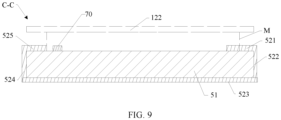
- FIG. 9 is a schematic structural cross-sectional view of the structure shown in FIG. 8 taken along line C-C.
- at least part of the electrical connector 70 is located on the first surface 51a, and the part of the electrical connector 70 located on the first surface 51a does not overlap with the wrapping film 52 in the expansion region 51a2.
- a part of the wrapping film 52 may be located in the expansion region 51a2, or the wrapping film 52 may not be located in the expansion region 51a2 at all.
- a part of the electrical connector 70 may be located in the expansion region 51a2, or the electrical connector 70 may not be located in the expansion region 51a2 at all, as long as it is ensured that the part of the electrical connector 70 located on the first surface 51a does not overlap with the wrapping film 52 in the expansion region 51a2.
- the part of the electrical connector 70 located on the first surface 51a may be in contact with the first surface 51a, or may be spaced apart from the first surface, or may be partly in contact with the first surface and partly spaced apart from the first surface.
- the electrical connector 70 is electrically connected between the main circuit board 30 and the side functional device 60.
- the main circuit board 30 may be located on a side of the battery compartment 13a adjacent to the first end surface 51e, and the side functional device 60 directly faces the second side surface 51d.
- a part of the first surface 51a located between the expansion region 51a2 and the first end surface 51e is a first non-expansion region 51a11
- a part of the first surface 51a located between the expansion region 51a2 and the second side surface 51d is a second non-expansion region 51a12.
- the second non-expansion region 51a12 is connected to the first non-expansion region 51a11.
- a part of the first surface 51a located between the expansion region 51a2 and the first side surface 51c is a third non-expansion region 51a13.
- the third non-expansion region 51a13 is connected to the first non-expansion region 51a11.
- the electrical connector 70 is arranged adjacent to the second side surface 51d.
- the electrical connector 70 includes a first sub-portion 701, a second sub-portion 702, and a third sub-portion 703.
- the third sub-portion 703 is completely located in the expansion region 51a2.
- An end of the first sub-portion 701 is connected to the third sub-portion 703, a part of the first sub-portion 701 is located in the first non-expansion region 51a11, and an other part of the first sub-portion 701 extends away from the first end surface 51e and is connected to the main circuit board 30.
- the first sub-portion 701 does not overlap with the wrapping film 52 in the first non-expansion region 51a11.
- An end of the second sub-portion 702 is connected to the third sub-portion 703, a part of the second sub-portion 702 is located in the second non-expansion region 51a12, and an other part of the second sub-portion 702 extends away from the second side surface 51d and is connected to the side functional device 60.
- the wrapping film 52 includes a tearable portion 526 and a first portion 521 to a fifth portion 525.
- the first portion 521 is wrapped around the first surface 51a. A part of the first portion 521 is located in the third non-expansion region 51a13, and an other part of the first portion is located in the expansion region 51a2.
- the tearable portion 526 is connected to an end of the first portion 521 away from the second portion 522, and the tearable portion 526 is located in the expansion region 51a2.
- the second portion 522 is wrapped around the first side surface 51c.
- the third portion 523 is wrapped around the second surface 51b.
- the fourth portion 524 is wrapped around the second side surface 51d.
- the fifth portion 525 is wrapped around the first surface 51a. A part of the fifth portion 525 is located in the second non-expansion region 51a12, and an other part of the fifth portion is located in the expansion region 51a2.
- the second sub-portion 702 overlaps with the fifth portion 525 in the second non-expansion region 51a12. However, since the second sub-portion 702 deviates from the expansion region 51a2, a position where the second sub-portion 702 and the fifth portion 525 overlap in the second non-expansion region 51a12 is not a position having the maximum thickness of the battery 50 after expansion, which will not affect the thin and light design of the electronic device 100. In addition, a wrapping area of the wrapping film 52 can also be increased, and the protective performance of the battery body 51 can be improved.
- a second notch 5251 is provided at a position of the fifth portion 525 corresponding to the electrical connector 70. Specifically, the second notch 5251 is located in the expansion region 51a2, and the second notch 5251 is configured to give way to the third sub-portion 703 located in the expansion region 51a2. Therefore, through the arrangement of the notch, the part of the electrical connector 70 located on the first surface 51a does not overlap with the wrapping film 52 in the expansion region 51a2.
- the side functional device 60 may be a side fingerprint recognition module and/or a side button.
- the side functional device 60 is a side button and a side fingerprint recognition module
- the side button and the side fingerprint recognition module may share the electrical connector 70.
- FIG. 10 is still another schematic diagram of relative positions of the electrical connector 70 and the battery 50 in the electronic device 100 shown in FIG. 1 to FIG. 3
- FIG. 11 is a schematic structural cross-sectional view of the structure shown in FIG. 10 taken along line D-D.
- the electrical connector 70 is electrically connected between the main circuit board 30 and the side functional device 60.
- the main circuit board 30 may be located on the side of the battery compartment 13a adjacent to the first end surface 51e, and the side functional device 60 directly faces the second side surface 51d.
- a part of the first surface 51a located between the expansion region 51a2 and the first end surface 51e is a first non-expansion region 51a11
- a part of the first surface 51a located between the expansion region 51a2 and the second side surface 51d is a second non-expansion region 51a12.
- the second non-expansion region 51a12 is connected to the first non-expansion region 51a11.
- a part of the first surface 51a located between the expansion region 51a2 and the first side surface 51c is a third non-expansion region 51a13.
- the third non-expansion region 51a13 is connected to the first non-expansion region 51a11.
- the electrical connector 70 is arranged adjacent to the second side surface 51d.
- the electrical connector 70 includes a first sub-portion 701, a second sub-portion 702, and a third sub-portion 703.
- the third sub-portion 703 is completely located in the expansion region 51a2.
- An end of the first sub-portion 701 is connected to the third sub-portion 703, a part of the first sub-portion 701 is located in the first non-expansion region 51a11, and an other part of the first sub-portion 701 extends away from the first end surface 51e and is connected to the main circuit board 30.
- the first sub-portion 701 does not overlap with the wrapping film 52 in the first non-expansion region 51a11.
- An end of the second sub-portion 702 is connected to the third sub-portion 703, a part of the second sub-portion 702 is located in the second non-expansion region 51a12, and an other part of the second sub-portion 702 extends away from the second side surface 51d and is connected to the side functional device 60.
- the wrapping film 52 includes a tearable portion 526 and a first portion 521 to a third portion 523.
- the first portion 521 is wrapped around the first surface 51a. A part of the first portion 521 is located in the third non-expansion region 51a13, and an other part of the first portion is located in the expansion region 51a2.
- the tearable portion 526 is connected to an end of the first portion 521 away from the second portion 522, and the tearable portion 526 is located in the expansion region 51a2.
- the second portion 522 is wrapped around the first side surface 51c.
- the third portion 523 is wrapped around the second surface 51b.
- the wrapping film 52 is not arranged in the second non-expansion region 51a12 and the expansion region 51a2 adjacent to the second non-expansion region 51a12, thereby causing the part of the electrical connector 70 located on the first surface 51a not to overlap with the wrapping film 52 on the first surface 51a.
- the side functional device 60 may be a side fingerprint recognition module and/or a side button.
- the side functional device 60 is a side button and a side fingerprint recognition module
- the side button and the side fingerprint recognition module may share the electrical connector 70.
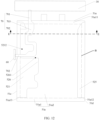
- FIG. 12 is yet another schematic diagram of relative positions of the electrical connector 70 and the battery 50 in the electronic device 100 shown in FIG. 1 to FIG. 3
- FIG. 13 is a schematic structural cross-sectional view of the structure shown in FIG. 12 taken along line E-E.
- the electrical connector 70 is connected between the main circuit board 30 and the side functional device 60.
- the main circuit board 30 is located on the side of the battery compartment 13a adjacent to the first end surface 51e, and the side functional device 60 directly faces the first side surface 51c. In this way, the side functional device 60 is arranged at a relatively small distance from the main circuit board 30, which is beneficial to shorten the length of the electrical connector 70.
- a part of the first surface 51a located between the expansion region 51a2 and the first end surface 51e is a first non-expansion region 51a11
- a part of the first surface 51a located between the expansion region 51a2 and the second side surface 51d is a second non-expansion region 51a12.
- the second non-expansion region 51a12 is connected to the first non-expansion region 51a11.
- a part of the first surface 51a located between the expansion region 51a2 and the first side surface 51c is a third non-expansion region 51a13.
- the third non-expansion region 51a13 is connected to the first non-expansion region 51a11.
- the electrical connector 70 is arranged adjacent to the first side surface 51c, and includes a first sub-portion 701, a second sub-portion 702, and a third sub-portion 703.
- the third sub-portion 703 is completely located in the expansion region 51a2.
- An end of the first sub-portion 701 is connected to the third sub-portion 703, a part of the first sub-portion 701 is located in the first non-expansion region 51a11, and an other part of the first sub-portion 701 extends away from the first end surface 51e and is connected to the main circuit board 30.
- the first sub-portion 701 does not overlap with the wrapping film 52 in the first non-expansion region 51a11.
- An end of the second sub-portion 702 is connected to the third sub-portion 703, a part of the second sub-portion 702 is located in the third non-expansion region 51a13, and an other part of the second sub-portion 702 extends away from the first side surface 51c and is connected to the side functional device 60.
- the wrapping film 52 includes a tearable portion 526 and a first portion 521 to a fifth portion 525.
- the first portion 521 is wrapped around the first surface 51a. A part of the first portion 521 is located in the third non-expansion region 51a13, and an other part of the first portion is located in the expansion region 51a2.
- the tearable portion 526 is connected to an end of the first portion 521 away from the second portion 522, and the tearable portion 526 is located in the expansion region 51a2.
- the second portion 522 is wrapped around the first side surface 51c.
- the third portion 523 is wrapped around the second surface 51b.
- the fourth portion 524 is wrapped around the second side surface 51d.
- the fifth portion 525 is wrapped around the first surface 51a. A part of the fifth portion 525 is located in the second non-expansion region 51a12, and an other part of the fifth portion is located in the expansion region 51a2.
- the second sub-portion 702 overlaps with the first portion 521 in the third non-expansion region 51a13. However, since the second sub-portion 702 deviates from the expansion region 51a2, a position where the second sub-portion 702 and the first portion 521 overlap in the third non-expansion region 51a13 is not a position having the maximum thickness of the battery 50 after expansion, which will not affect the thin and light design of the electronic device 100.
- a first notch 5212 is provided at a position of the first portion 521 corresponding to the electrical connector 70. Specifically, the first notch 5212 is located in the expansion region 51a2, and the first notch 5212 is configured to give way to the third sub-portion 703 located in the expansion region 51a2. Therefore, through the arrangement of the notch, the part of the electrical connector 70 located on the first surface 51a does not overlap with the wrapping film 52 in the expansion region 51a2.
- the tearable portion 526 has an avoidance notch 5261.
- the avoidance notch 5261 is configured to give way to the third sub-portion 703 located in the expansion region 51a2. Therefore, through the arrangement of the avoidance notch 5261, the part of the electrical connector 70 located on the first surface 51a does not overlap with the tearable portion 526 in the expansion region 51a2, so as not to occupy the thickness of the expansion region.
- the side functional device 60 may be a side fingerprint recognition module and/or a side button.
- the side functional device 60 is a side button and a side fingerprint recognition module
- the side button and the side fingerprint recognition module share the electrical connector 70.
- FIG. 14 is another schematic diagram of relative positions of the electrical connector 70 and the battery 50 in the electronic device 100 shown in FIG. 1 to FIG. 3
- FIG. 15 is a schematic structural cross-sectional view of the structure shown in FIG. 14 taken along line F-F.
- the electrical connector 70 is connected between the main circuit board 30 and the side functional device 60.
- the main circuit board 30 is located on the side of the battery compartment 13a adjacent to the first end surface 51e, and the side functional device 60 directly faces the first side surface 51c. In this way, the side functional device 60 is arranged at a relatively small distance from the main circuit board 30, which is beneficial to shorten the length of the electrical connector 70.
- a part of the first surface 51a located between the expansion region 51a2 and the first end surface 51e is a first non-expansion region 51a11
- a part of the first surface 51a located between the expansion region 51a2 and the second side surface 51d is a second non-expansion region 51a12.
- the second non-expansion region 51a12 is connected to the first non-expansion region 51a11.
- a part of the first surface 51a located between the expansion region 51a2 and the first side surface 51c is a third non-expansion region 51a13.
- the third non-expansion region 51a13 is connected to the first non-expansion region 51a11.
- the electrical connector 70 is arranged adjacent to the first side surface 51c, and includes a first sub-portion 701, a second sub-portion 702, and a third sub-portion 703.
- the third sub-portion 703 is completely located in the expansion region 51a2.
- An end of the first sub-portion 701 is connected to the third sub-portion 703, a part of the first sub-portion 701 is located in the first non-expansion region 51a11, and an other part of the first sub-portion 701 extends away from the first end surface 51e and is connected to the main circuit board 30.
- An end of the second sub-portion 702 is connected to the third sub-portion 703, a part of the second sub-portion 702 is located in the third non-expansion region 51a13, and an other part of the second sub-portion 702 extends away from the first side surface 51c and is connected to the side functional device 60.
- the wrapping film 52 includes a tearable portion 526 and a first portion 521 to a third portion 523.
- the first portion 521 is wrapped around the first surface 51a. A part of the first portion 521 is located in the third non-expansion region 51a13, and an other part of the first portion is located in the expansion region 51a2.
- the tearable portion 526 is connected to an end of the first portion 521 away from the second portion 522, and the tearable portion 526 is located in the expansion region 51a2.
- the second portion 522 is wrapped around the first side surface 51c.
- the third portion 523 is wrapped around the second surface 51b.
- the second sub-portion 702 overlaps with the first portion 521 in the third non-expansion region 51a13. However, since the second sub-portion 702 deviates from the expansion region 51a2, a position where the second sub-portion 702 and the first portion 521 overlap is not a position having the maximum thickness of the battery 50 after expansion, which will not affect the thin and light design of the electronic device 100.
- a first notch 5212 is provided at a position of the first portion 521 corresponding to the electrical connector 70. Specifically, the first notch 5212 is located in the expansion region, and the first notch 5212 is configured to give way to the third sub-portion 703 located in the expansion region 51a2. Therefore, through the arrangement of the notch, the part of the electrical connector 70 located on the first surface 51a does not overlap with the wrapping film 52 in the expansion region 51a2.
- the tearable portion 526 has an avoidance notch 5261.
- the avoidance notch 5261 is configured to give way to the third sub-portion 703 located in the expansion region 51a2. Therefore, through the arrangement of the avoidance notch 5261, the part of the electrical connector 70 located on the first surface 51a does not overlap with the tearable portion 526 in the expansion region 51a2, so as not to occupy the thickness of the expansion region.
- the side functional device 60 may be a side fingerprint recognition module and/or a side button.
- the side functional device 60 is a side button and a side fingerprint recognition module
- the side button and the side fingerprint recognition module share the electrical connector 70.
- FIG. 16 is another schematic diagram of relative positions of the electrical connector 70 and the battery 50 in the electronic device 100 shown in FIG. 1 to FIG. 3
- FIG. 17 is a schematic structural cross-sectional view of the structure shown in FIG. 16 taken along line G-G.
- the electrical connector 70 is connected between the main circuit board 30 and the auxiliary circuit board 40.
- the main circuit board 30 is located on the side of the battery compartment 13a adjacent to the first end surface 51e
- the auxiliary circuit board 40 is located on a side of the battery compartment 13a adjacent to the second end surface 51f.
- a part of the first surface 51a located between the expansion region 51a2 and the first end surface 51e is a first non-expansion region 51a11
- a part of the first surface 51a located between the expansion region 51a2 and the second side surface 51d is a second non-expansion region 51a12.
- the second non-expansion region 51a12 is connected to the first non-expansion region 51a11.
- a part of the first surface 51a located between the expansion region 51a2 and the first side surface 51c is a third non-expansion region 51a13.
- the third non-expansion region 51a13 is connected to the first non-expansion region 51a11.
- a part of the first surface 51a located between the expansion region 51a2 and the second end surface 51f is a fourth non-expansion region 51a14. Two ends of the fourth non-expansion region 51a14 are respectively connected to the second non-expansion region 51a12 and the third non-expansion region 51a13.
- the wrapping film 52 includes a tearable portion 526 and a first portion 521 to a fifth portion 525.
- the first portion 521 is wrapped around the first surface 51a.
- a part of the first portion 521 is located in the third non-expansion region 51a13, and an other part of the first portion is located in the expansion region 51a2.
- the part of the first portion 521 located in the expansion region 51a2 is connected to the tearable portion 526, and the second portion 522 is wrapped around the first side surface 51c.
- the third portion 523 is wrapped around the second surface 51b.
- the fourth portion 524 is wrapped around the second side surface 51d.
- the fifth portion 525 is wrapped around the first surface 51a.
- a part of the fifth portion 525 is located in the second non-expansion region 51a12, and an other part of the fifth portion is located in the expansion region 51a2.
- the electrical connector 70 is located between the first portion 521 and the fifth portion 525, and is arranged adjacent to the second side surface 51d. In this way, the electrical connector 70 can be closer to the non-expansion region 51a2, thereby avoiding the center of the expansion region 51a2, and reducing the thickness of the electronic device 100.
- the electrical connector 70 includes a first sub-portion 701, a second sub-portion 702, and a third sub-portion 703.
- the third sub-portion 703 is completely located in the expansion region 51a2.
- An end of the first sub-portion 701 is connected to the third sub-portion 703, a part of the first sub-portion 701 is located in the first non-expansion region 51a11, and an other part of the first sub-portion 701 extends away from the first end surface 51e and is connected to the main circuit board 30.
- An end of the second sub-portion 702 is connected to the third sub-portion 703, a part of the second sub-portion 702 is located in the fourth non-expansion region 51a14, and an other part of the second sub-portion 702 extends away from the second end surface 51f and is connected to the auxiliary circuit board 40.
- a second notch 5251 is provided at a position of the fifth portion 525 corresponding to the electrical connector 70. Specifically, the second notch 5251 is located in the expansion region 51a2, and the second notch 5251 is configured to give way to the third sub-portion 703 located in the expansion region 51a2. Therefore, through the arrangement of the notch, the part of the electrical connector 70 located on the first surface 51a does not overlap with the wrapping film 52 in the expansion region 51a2.
- FIG. 18 is a schematic structural diagram of a battery 50 in an electronic device 100 according to some other embodiments of this application.
- a difference between the structure of the wrapping film 52 in the embodiment shown in FIG. 18 and the structure of the wrapping film 52 shown in FIG. 8 to FIG. 9 is that a second notch 5251 is provided at a position of the fifth portion 525 corresponding to the electrical connector 70.
- a part of the second notch 5251 is located in the expansion region 51a2, and an other part of the second notch is located in the second non-expansion region 51a12.
- the second notch 5251 is configured to give way to the third sub-portion 703 located in the expansion region 51a2 and the second sub-portion 702 located in the second non-expansion region 51a12. Therefore, the second notch 5251 extends to an edge of the fifth portion 525 in a direction from the fifth portion 525 to the fourth portion 524. In this way, the overall thickness of the battery 50 and the electrical connector 70 is not increased, thereby facilitating reduction in the thickness of the electronic device 100. In this way, thinning of the electronic device 100 can be achieved at least to a certain extent.
- the fourth portion 524 has formed thereon a second communication notch 5241 extending through the fourth portion 524 in a thickness direction of the fourth portion 524.
- the second communication notch 5241 is in communication with the second notch 5251.
- the second communication notch 5241 may be configured to give way to the part of the electrical connector 70 on the side that the fourth portion 524 faces.
- FIG. 19 is a schematic structural diagram of a battery 50 in an electronic device 100 according to some other embodiments of this application.
- a difference between the structure of the wrapping film 52 in the embodiment shown in FIG. 19 and the structure of the wrapping film 52 shown in FIG. 12 to FIG. 15 is that a first notch 5212 is provided at a position of the first portion 521 corresponding to the electrical connector 70. Specifically, a part of the first notch 5212 is located in the expansion region 51a2, and an other part of the first notch is located in the third non-expansion region 51a13.
- the first notch 5212 is configured to give way to the third sub-portion 703 located in the expansion region 51a2 and the second sub-portion 702 located in the third non-expansion region 51a13. Therefore, the first notch 5212 extends to an edge of the first portion 521 in a direction from the first portion 521 to the second portion 522. In this way, the overall thickness of the battery 50 and the electrical connector 70 is not increased, thereby facilitating reduction in the thickness of the electronic device 100. In this way, thinning of the electronic device 100 can be achieved at least to a certain extent.
- the second portion 522 has formed thereon a first communication notch 5221 extending through the second portion 522 in a thickness direction of the second portion 522.
- the first communication notch 5221 is in communication with the first notch 5212.
- the first communication notch 5221 may be configured to give way to a part of the electrical connector 70 on the side that the second portion 522 faces.
- the electronic device 100 may further include a separator (not shown in the figure).
- the separator is located between the first surface 51a and the surface of the housing 10 opposite to the first surface 51a, that is, the separator is located between the first surface 51a and the back housing 12.
- a giving-way notch is formed on the part of the wrapping film 52 wrapped around the first surface 51a, and the giving-way notch is configured to give way to the separator.
- the giving-way notch may be defined by at least one of the first notch 5212, the second notch 5251, or the avoidance notch 5261.
- the first notch 5212 and the avoidance notch 5261 may define the giving-way notch.
- a part of the first notch 5212 and the entire avoidance notch 5261 define the giving-way notch.
- the second notch 5251 defines the giving-way notch.
- the second notch 5251 defines a part of the giving-way notch.
- the giving-way notch may further be a notch formed on a part of the wrapping film 52 wrapped around the first surface 51a and independent of all of the first notch 5212, the second notch 5251, and the avoidance notch 5261.
- the separator may be a heat sink (for example, a graphite sheet).
- the heat sink can transfer the heat generated during operation of the battery 50 to the back cover 122, thereby improving the heat dissipation effect of the electronic device.
- the separator may be mylar or foam, and the electrical connector 70 is attached to the housing by the separator, thereby improving the reliability of the connection between the electrical connector 70 and the housing 10, prolonging the service life of the electrical connector 70, and ensuring the operation reliability of the electronic device 100.
Landscapes
- Chemical & Material Sciences (AREA)
- Chemical Kinetics & Catalysis (AREA)
- Electrochemistry (AREA)
- General Chemical & Material Sciences (AREA)
- Engineering & Computer Science (AREA)
- Signal Processing (AREA)
- Life Sciences & Earth Sciences (AREA)
- Biophysics (AREA)
- Computer Hardware Design (AREA)
- Microelectronics & Electronic Packaging (AREA)
- Manufacturing & Machinery (AREA)
- Battery Mounting, Suspending (AREA)
Description
- This application claims priority to
Chinese Patent Application No. 202121625673.8, filed with the China National Intellectual Property Administration on July 16, 2021 - This application relates to the technical field of electronic devices, and in particular, to an electronic device.
- At present, an electronic device such as a mobile phone, a tablet computer, and a smart wearable device has a battery, and the battery is used to supply power to the electronic device, so as to facilitate the carrying of the electronic device. However, the battery is at risk of expansion after long-term charging and discharging in use. In order to avoid the damage to the whole electronic device caused by battery expansion, the thickness of the whole electronic device is usually increased to reserve the expansion space of the battery. However, in the related art, due to structural limitations, the thickness of the reserved expansion space is relatively thick, resulting in a larger thickness of the electronic device, which is not conducive to a light and thin design of the electronic device.
WO 2015/182050 A1 discloses a portable device incorporating a battery pack, wherein the portable device comprises a housing, a battery pack installation surface, and a flat rectangular battery pack housed in the housing. The battery pack has a battery body and a cover sheet wrapped around said body. The battery pack has a first surface with a central portion whereon the cover sheet is not wrapped. The device further comprises an electrical connector on the first surface which does not reach the central portion.US 2019/006641 A1 discloses a battery fixing device and an electronic device comprising a casing battery chamber, and a container fixedly arranged in the casing battery chamber and matched with the casing battery chamber to wrap and fix the battery. The container includes a containing chamber formed by a surround of a film and configured to contain a battery, and fixing films arranged on the containing chamber and connected to the containing chamber to fix the top of the containing chamber.CN 211 630 199 U discloses an electronic device, which includes: the main control circuit board, the battery module and the fingerprint module; the battery module is electrically connected with the main control circuit board; the battery module comprises a battery main body and a battery circuit board; the battery circuit board is arranged on the side surface of the battery main body, and the thickness of the battery circuit board is smaller than that of the battery main body. - To solve the problem of reducing the thickness of an electronic device, embodiments of this application provide an electronic device according to the enclosed independent claim 1. Advantageous features of the present invention are defined in the corresponding dependent claims.
- In the following, parts of the description and drawings referring to embodiments, which are not covered by the claims, are not presented as embodiments of the invention but as examples useful for understanding the invention. The electronic device includes: a housing, a battery, and an electrical connector. A battery compartment is arranged in the housing. The battery is mounted in the battery compartment and includes a battery body and a wrapping film wrapped around a surface of the battery body. The battery body has a first surface, the first surface has an expansion region, a distance between each edge of the expansion region and a peripheral edge of the first surface is d, and d = (0.5*h + a), wherein h is a thickness of the battery body and a is in a range of [0, 3] mm. At least part of the electrical connector is located on the first surface, and the part of the electrical connector located on the first surface does not overlap with the wrapping film in the expansion region.
- In the electronic device provided in the embodiment of this application, since the part of the electrical connector located on the first surface does not overlap with the wrapping film in the expansion region, an overall thickness of the battery and the electrical connector corresponding to a position of the expansion region will not be increased, and a thickness of the expansion space that needs to be reserved is relatively small, which is conducive to reducing the thickness of the electronic device and can achieve a thin electronic device at least to a certain extent.
- Optionally, the first surface faces away from a bottom wall of the battery compartment, or the first surface faces the bottom wall of the battery compartment. In an implementation disclosed in this application, a is in a range of [0, 10] mm. Specifically, according to the claimed invention, a is in a range of [0, 3] mm. In this way, the expansion region can be reasonably arranged to ensure that when the battery body is expanded, the position of the maximum thickness of the battery body is located in the expansion region.
- In an optional implementation provided in this application, a is in a range of (0, 2] mm. In this way, the expansion region can be reasonably arranged to ensure that when the battery body is expanded, the position of the maximum thickness of the battery body is located in the expansion region.
- In an optional implementation provided in this application, the battery body further has a second surface opposite to the first surface and two side surfaces connected between the first surface and the second surface and opposite to each other. The wrapping film includes a first portion, a second portion, and a third portion connected in sequence, the first portion is wrapped around the first surface, the second portion is wrapped around one of the two side surfaces, and the third portion is wrapped around the second surface.
- In an optional implementation provided in this application, the wrapping film includes a tearable portion, and the tearable portion is connected to an end of the first portion away from the second portion. In this way, the wrapping film may be used as a tearable film. When the battery is located in the battery compartment and the tearable portion is located on the first surface, the user can easily take out the battery from the battery compartment by pulling the tearable portion, which is convenient for the user to use.
- Further, the tearable portion has an avoidance notch configured to give way to the electrical connector. In this way, the wrapping film may be prevented from overlapping with the electrical connector in the expansion region.
- In an optional implementation provided in this application, a part of the first portion is wrapped in the expansion region, and a first notch is provided at a part of the first portion corresponding to the electrical connector. In this way, the part of the first portion can be located in the expansion region, which can increase the protection performance and tearing reliability of the battery body. On this basis, the arrangement of the first notch can prevent the wrapping film and the electrical connector from overlapping in the expansion region.
- In an optional implementation provided in this application, the first notch extends to an edge of the first portion in a direction from the first portion to the second portion.
- In an optional implementation provided in this application, the second portion has formed thereon a first communication notch extending through the second portion in a thickness direction of the second portion, and the first communication notch is in communication with the first notch.
- In an optional implementation provided in this application, the wrapping film further includes a fourth portion and a fifth portion. The fourth portion is connected to an end of the third portion away from the second portion, and the fifth portion is connected to an end of the fourth portion away from the third portion. The fourth portion is wrapped around the other of the two side surfaces, and the fifth portion is wrapped around the first surface. This arrangement can increase the wrapping range of the wrapping film, thereby further improving the protection performance of the wrapping film on the battery body.
- In an optional implementation provided in this application, a part of the fifth portion is wrapped in the expansion region, and a second notch is provided at a part of the fifth portion corresponding to the electrical connector in the expansion region. In this way, the part of the fifth portion can be located in the expansion region, which can increase the protection performance and tearing reliability of the battery body. On this basis, the arrangement of the second notch can prevent the wrapping film and the electrical connector from overlapping in the expansion region.
- In an optional implementation provided in this application, the second notch extends to an edge of the fifth portion in a direction from the fifth portion to the fourth portion.
- In an optional implementation provided in this application, the fourth portion has formed thereon a second communication notch extending through the fourth portion in a thickness direction of the fourth portion and in communication with the second notch.
- In an optional implementation provided in this application, the battery body further includes a first end surface connected between the two side surfaces, the first end surface has an electrical connection terminal, and the first surface, the second surface, and the two side surfaces are arranged along a circumferential direction of the first end surface.
- In an optional implementation provided in this application, the electronic device further includes a main circuit board and a side functional device, where the electrical connector is configured to connect the main circuit board to the side functional device.
- In an optional implementation provided in this application, the main circuit board is located on a side of the battery compartment adjacent to the first end surface, and the side functional device faces one of the side surfaces.
- In an optional implementation provided in this application, the side functional device is a side button and/or a side fingerprint recognition module.
- In an optional implementation provided in this application, the electronic device includes a main circuit board and an auxiliary circuit board. The electrical connector is configured to connect the main circuit board to the auxiliary circuit board.
- In an optional implementation provided in this application, the battery body has a second end surface opposite to the first end surface. One of the main circuit board and the auxiliary circuit board is located on the side of the battery compartment adjacent to the first end surface, and the other of the main circuit board and the auxiliary circuit board is located on a side of the battery compartment adjacent to the second end surface.
- In an optional implementation provided in this application, the electrical connector is arranged adjacent to one of the side surfaces.
- In an optional implementation provided in this application, the electronic device further includes a main circuit board and a display, where the electrical connector bypasses the battery to connect the main circuit board to the display.
- In an optional implementation provided in this application, the main circuit board is located on the side of the battery compartment adjacent to the first end surface, and the display is located on a side of the battery facing away from the first surface.
- In an optional implementation provided in this application, the electrical connector is a flexible printed circuit board. In this way, the structure is simple and costs are low.
- In an optional implementation provided in this application, the electronic device includes a main circuit board and a wireless communication module arranged on the main circuit board. The wireless communication module is configured to send and receive a signal via an antenna, and the electrical connector is a radiator of the antenna.
- In an optional implementation provided in this application, the electronic device further includes a separator. The separator is located between the first surface and a surface of the housing opposite to the first surface. A giving-way notch is formed on the part of the wrapping film wrapped around the first surface, and the giving-way notch is configured to give way to the separator.
-
-
FIG. 1 is a schematic structural diagram of an electronic device according to some embodiments of this application; -
FIG. 2 is an exploded view of the electronic device shown inFIG. 1 ; -
FIG. 3 is a schematic structural diagram of an example of the electronic device shown inFIG. 1 with a back cover being removed, showing a configuration that does not provide the solution present in the scope of the independent claim; -
FIG. 4a is a schematic structural diagram of a battery in the electronic device shown inFIG. 2 andFIG. 3 ; -
FIG. 4b is a three-dimensional view of a battery body in the battery shown inFIG. 4a ; -
FIG. 4c is an exploded view of the battery body shown inFIG. 4b ; -
FIG. 5 is a schematic structural diagram of a battery according to some other embodiments of this application; -
FIG. 6 is a schematic diagram of relative positions of the battery shown inFIG. 4a , which is not covered by the scope of the independent claim, and an electrical connector configured to electrically connect a main circuit board to a side functional device in the electronic device shown inFIG. 1 to FIG. 3 ; -
FIG. 7 is a schematic structural cross-sectional view of the structure shown inFIG. 6 taken along line A-A; -
FIG. 8 is another schematic diagram of relative positions of the electrical connector and the battery in the electronic device shown inFIG. 1 to FIG. 3 ; -
FIG. 9 is a schematic structural cross-sectional view of the structure shown inFIG. 8 taken along line C-C; -
FIG. 10 is still another schematic diagram of relative positions of the electrical connector and the battery in the electronic device shown inFIG. 1 to FIG. 3 ; -
FIG. 11 is a schematic structural cross-sectional view of the structure shown inFIG. 10 taken along line D-D; -
FIG. 12 is yet another schematic diagram of relative positions of the electrical connector and the battery in the electronic device shown inFIG. 1 to FIG. 3 ; -
FIG. 13 is a schematic structural cross-sectional view of the structure shown inFIG. 12 taken along line E-E; -
FIG. 14 is another schematic diagram of relative positions of the electrical connector and the battery in the electronic device shown inFIG. 1 to FIG. 3 ; -
FIG. 15 is a schematic structural cross-sectional view of the structure shown inFIG. 14 taken along line F-F; -
FIG. 16 is another schematic diagram of relative positions of the electrical connector and the battery in the electronic device shown inFIG. 1 to FIG. 3 ; -
FIG. 17 is a schematic structural cross-sectional view of the structure shown inFIG. 16 taken along line G-G; -
FIG. 18 is a schematic structural diagram of a battery in an electronic device according to some other embodiments of this application; and -
FIG. 19 is a schematic structural diagram of a battery in an electronic device according to some other embodiments of this application. - In the embodiments of this application, terms "first", "second", "third", "fourth", and "fifth" are used merely for the purpose of description, and shall not be construed as indicating or implying relative importance or implying a quantity of indicated technical features. Therefore, a feature defined by "first", "second", "third", "fourth", and "fifth" can explicitly or implicitly includes one or more features.
- In the embodiments of this application, the terms "include", "comprise", and any variants thereof are intended to cover a non-exclusive inclusion. Therefore, in the context of a process, method, object, or apparatus that includes a series of elements, the process, method, object, or apparatus not only includes such elements, but also includes other elements not specified expressly, or may include inherent elements of the process, method, object, or apparatus. Without more limitations, elements defined by the sentence "including one" does not exclude that there are still other same elements in the processes, methods, objects, or apparatuses.
- In the embodiments of this application, "and/or" describes only an association relationship for describing associated objects and indicates that three relationships may exist. For example, A and/or B may represent the following three cases: Only A exists, both A and B exist, and only B exists. In addition, the character "/" in this specification generally indicates an "or" relationship between the associated objects.
- This application provides an
electronic device 100. Theelectronic device 100 is a type ofelectronic device 100 having abattery 50. Specifically, theelectronic device 100 includes, but is not limited to,electronic devices 100 such as a mobile phone, a tablet personal computer (tablet personal computer), a laptop computer (laptop computer), a personal digital assistant (personal digital assistant, PDA), a personal computer, a notebook computer, an onboard device, a wearable device, and the like. - Referring to
FIG. 1 andFIG. 2 ,FIG. 1 is a schematic structural diagram of anelectronic device 100 according to some embodiments of this application, andFIG. 2 is an exploded view of theelectronic device 100 shown inFIG. 1 . In this embodiment, theelectronic device 100 is a phablet. Specifically, theelectronic device 100 includes ahousing 10, adisplay 20, a sidefunctional device 60, amain circuit board 30, anauxiliary circuit board 40, abattery 50, and anelectrical connector 70. - The
housing 10 is configured to protect internal circuit elements of theelectronic device 100. Still referring toFIG. 2 , thehousing 10 includes afront cover plate 11 and aback housing 12. - The
front cover plate 11 is a light transmissive member, and a material of thefront cover plate 11 includes but is not limited to glass, plastic, or ceramic. - The
back housing 12 includes aback cover 122 and aborder frame 121. Theback cover 122 and thefront cover plate 11 are stacked and spaced apart from each other. Theborder frame 121 surrounds a periphery of thefront cover plate 11 and is located between thefront cover plate 11 and theback cover 122. - Specifically, the
border frame 121 is fixed to theback cover 122. For example, theborder frame 121 may be fixedly connected to theback cover 122 by gluing, welding, or snapping. Theborder frame 121 may also be integrally formed with theback cover 122, that is, theborder frame 121 and theback cover 122 are an integral structure. - The
front cover plate 11 is fixed to theborder frame 121. In some embodiments, thefront cover plate 11 may be fixed to theborder frame 121 by gluing. Thefront cover plate 11, theback cover 122, and theborder frame 121 form an internal accommodating space of theelectronic device 100. The internal accommodating space is configured to accommodate thedisplay 20, at least part of the sidefunctional device 60, themain circuit board 30, theauxiliary circuit board 40, thebattery 50, theelectrical connector 70, and the like. - The
display 20 is located in thehousing 10, and thedisplay 20 and thefront cover plate 11 are stacked and fixedly connected. Thedisplay 20 is configured to display an image, a video, and the like. A flexible display or a rigid display may be used as thedisplay 20. For example, thedisplay 20 may be an organic light-emitting diode (organic light-emitting diode, OLED) display, an active-matrix organic light-emitting diode (active-matrix organic light-emitting diode, AMOLED) display, a mini light-emitting diode (mini organic light-emitting diode) display, a micro light-emitting diode (micro organic light-emitting diode) display, a micro organic light-emitting diode (micro organic light-emitting diode) display, a quantum dot light-emitting diode (quantum dot light emitting diodes, QLED) display, or a liquid crystal display (liquid crystal display, LCD). - The side
functional device 60 is located at theborder frame 121. The sidefunctional device 60 may be a side fingerprint recognition module and/or a side button. That is to say, the sidefunctional device 60 may be only a side fingerprint recognition module, and may further be only a side button, or may be a side button and a side fingerprint recognition module. The side fingerprint recognition module may be located on one side of the side button close to inside of thehousing 10. The side button may be a power button or a volume button, and the side fingerprint recognition module may be an optical fingerprint recognition module, a capacitive fingerprint recognition module, or a radio frequency fingerprint recognition module. - Further, when the side
functional device 60 is a side button, or the sidefunctional device 60 is a side button and a side fingerprint recognition module, a mounting hole may be provided on theborder frame 121. One end of the side button is located in thehousing 10, and an other end of the side button passes through the mounting hole and is exposed from the mounting hole, so as to facilitate user triggering. - When the side
functional device 60 is only a side fingerprint recognition module, a mounting hole may be provided on theborder frame 121, so that a fingerprint recognition region of the side fingerprint recognition module can be exposed from the mounting hole, so as to facilitate fingerprint collection. Certainly, mounting holes may not be provided, but other structures may be arranged on theborder frame 121, for example, a light transmissive fingerprint collection region is arranged, as long as it is ensured that the fingerprint recognition region of the side fingerprint recognition module directly faces the fingerprint collection region on theborder frame 121. - In some embodiments, referring to
FIG. 2 , amiddle plate 13 is arranged in thehousing 10, and themiddle plate 13 is fixed to a periphery of an inner surface of theborder frame 121. For example, themiddle plate 13 may be fixed to theborder frame 121 by welding, gluing, or snapping, or may be integrally formed with theborder frame 121. Thedisplay 10 is located between thefront cover plate 11 and themiddle plate 13. At least part of the sidefunctional device 60, themain circuit board 30, theauxiliary circuit board 40, and thebattery 50 are located between themiddle plate 13 and theback cover 122. Themiddle plate 13 is used as a structural "skeleton" of theelectronic device 100, and themain circuit board 30, theauxiliary circuit board 40, thebattery 50, and the like may be fixed to themiddle plate 13 by threaded connection, snapping, welding, or the like. When theelectronic device 100 does not include themiddle plate 13, themain circuit board 30, theauxiliary circuit board 40, thebattery 50, and the like may be fixed to a surface of thedisplay 20 toward theback cover 122 by threaded connection, snapping, welding, or the like. - Referring to
FIG. 2 andFIG. 3, FIG. 3 is a schematic structural diagram of theelectronic device 100 shown inFIG. 1 with aback cover 122 being removed. The example shown inFIG. 3 does not fall under the scope of the claims. Themain circuit board 30 is configured to integrate a control chip. The control chip may be, for example, an application processor (application processor, AP), a double data rate (double data rate, DDR) synchronous dynamic random access memory, a universal flash storage (universal flash storage, UFS), and the like. In some embodiments, themain circuit board 30 is electrically connected to both thedisplay 20 and the sidefunctional device 60. Themain circuit board 30 is configured to control thedisplay screen 20 to display an image or a video and collect a fingerprint or an instruction inputted from the sidefunctional device 60. - The
main circuit board 30 may be a rigid circuit board, a flexible printed circuit board, or a rigid-flex circuit board. Themain circuit board 30 may be an FR-4 dielectric board, a Rogers dielectric board, a mixed media board of FR-4 and Rogers, or the like. Herein, FR-4 represents a flame-resistant material grade, and the Rogers dielectric board is a high-frequency board. - The
auxiliary circuit board 40 is configured to integrate electronic components such as an antenna (such as a 5G antenna) radio frequency front end, a universal serial bus (universal serial bus, USB) device, an oscillator, and the like. Theauxiliary circuit board 40 is electrically connected to themain circuit board 30. - Similarly, the
auxiliary circuit board 40 may be a rigid circuit board, a flexible printed circuit board, or a rigid-flex circuit board. Theauxiliary circuit board 40 may be an FR-4 dielectric board, a Rogers dielectric board, a mixed media board of FR-4 and Rogers, or the like. - A wireless communication module is integrated on the
main circuit board 30 and/or theauxiliary circuit board 40. The wireless communication module may provide a solution for wireless communication including a wireless local area network (wireless local area network, WLAN) (such as a wireless fidelity (wireless fidelity, Wi-Fi) network), Bluetooth (Bluetooth, BT), and a global navigation satellite system (global navigation satellite system, GNSS), frequency modulation (frequency modulation, FM), a near field communication (near field communication, NFC) technology, an infrared (infrared, IR) technology, and the like to be applied to theelectronic device 100. The wireless communication module may be one or more devices integrating at least one communication processing module. The wireless communication module receives an electromagnetic wave through an antenna, performs frequency modulation and filtering processing on the electromagnetic wave signal, and sends the processed signal to the control chip. The wireless communication module may further receive a to-be-sent signal from the control chip, perform frequency modulation and amplification on the to-be-sent signal, and convert the signal into an electromagnetic wave through an antenna and radiate the signal. For example, the wireless communication module includes an NFC communication processing module, and an antenna of the NFC communication processing module is an NFC antenna. For another example, the wireless communication module includes a Bluetooth communication processing module, and an antenna of the Bluetooth communication processing module is a Bluetooth antenna. For another example, the wireless communication module includes a wireless local area network communication processing module, and an antenna of the wireless local area network communication processing module is a Wi-Fi antenna. - Still referring to
FIG. 2 andFIG. 3 , abattery compartment 13a is arranged in thehousing 10. Thebattery compartment 13a is located between themain circuit board 30 and theauxiliary circuit board 40. An opening of thebattery compartment 13a faces theback cover 122. In some embodiments, thebattery compartment 13a is a groove provided on a surface of themiddle plate 13 facing theback cover 122. In some other embodiments, themiddle plate 13 forms a bottom wall of the battery compartment, elements such as themain circuit board 30, theauxiliary circuit board 40, a speaker module (not shown in the figure), and the like form two opposite side walls of thebattery compartment 13a, and the two sides of theborder frame 13 form other two opposite side walls of thebattery compartment 13a. In some other embodiments, when the electronic device does not include themiddle plate 13, thedisplay screen 20 or theback cover 122 may further form the bottom wall of thebattery compartment 13a, and elements such as themain circuit board 30, theauxiliary circuit board 40, the speaker module (not shown in the figure), theborder frame 13, and the like form the side wall of thebattery compartment 13a. - The
battery 50 is mounted in thebattery compartment 13a. Thebattery 50 is configured to supply power to the electrical devices in theelectronic device 100 such as thedisplay screen 20, themain circuit board 30, theauxiliary circuit board 40, and the like. Thebattery 50 includes, but is not limited to, a nickel-cadmium battery, a nickel-metal hydride battery, or a lithium-ion battery. - Referring to
FIG. 3 andFIG. 4a, FIG. 4a is a schematic structural diagram of abattery 50 in theelectronic device 100 shown inFIG. 2 andFIG. 3 . In the embodiment, thebattery 50 includes abattery body 51 and awrapping film 52. - Referring to
FIG. 4b andFIG. 4c ,FIG. 4b is a three-dimensional view of abattery body 51 in thebattery 50 shown inFIG. 4a , andFIG. 4c is an exploded view of thebattery body 51 shown inFIG. 4b . In the embodiment, thebattery body 51 includes ashell 511, an electrolyte (not shown), and abare battery core 512. - The
shell 511 is configured to encapsulate and protect thebare battery core 512 and the electrolyte, and a shape of theshell 511 includes but is not limited to a cuboid, a cylinder, a frustum of a cone, and the like. A material of theshell 511 includes, but is not limited to, a composite film and a steel shell. Specifically, the composite film includes at least three layers. A middle layer is a metal coating layer configured to isolate moisture. An outer layer is a plastic coating layer configured to prevent the permeation of air, especially oxygen. An inner layer is a sealing layer configured for sealing and preventing the electrolyte from corroding the metal coating layer. A material of the sealing layer is selected from at least one of polyethylene, polypropylene, esters of polyethylene or polypropylene, or ionomers of polyethylene or polypropylene. The polyethylene is selected from low density polyethylene, medium density polyethylene, or high density polyethylene. The polypropylene is selected from homo polypropylene, block polypropylene, or atactic polypropylene. A material of the metal coating layer is selected from at least one of metal, metal alloy, metal oxides, or ceramics, and the metal is selected from aluminum, iron, silver, copper, nickel, manganese, tin, titanium, zirconium, or vanadium. A material of the plastic coating layer is selected from at least one of polyamide resin, polyolefin, polycarbonate, or fluororesin. Further, a material of theshell 511 may be an aluminum plastic film. A middle layer of the aluminum plastic film is an aluminum layer configured to isolate moisture. An outer layer of the aluminum plastic film is made of polyamide, which is configured to prevent the permeation of air, especially oxygen. An inner layer of the aluminum plastic film is a polypropylene layer configured for sealing and preventing the electrolyte from corroding the aluminum layer. - The electrolyte is a carrier for transporting lithium ions in the
battery body 51. The electrolyte is generally prepared from raw materials such as high-purity organic solvents, electrolyte lithium salts, necessary additives, and the like in certain proportion under certain conditions. - Still referring to
FIG. 4c , thebare battery core 512 includes a barebattery core body 5121 and twotabs 5122. Specifically, the barebattery core body 5121 is located in theshell 511. One end of eachtab 5122 is connected to the barebattery core body 5121, and an other end of the tab passes through theshell 511. One of the twotabs 5122 is a positive tab and the other is a negative tab. - Still referring to
FIG. 4b , thebattery body 51 has afirst surface 51a. Thefirst surface 51a is a surface of thebattery body 51 facing away from the bottom wall of thebattery compartment 13a when thebattery 50 is mounted in theelectronic device 100 shown inFIG. 1 to FIG. 3 . Thefirst surface 51a has an expansion region 51a2 and a non- expansion region 51a1 surrounding a periphery of the expansion region 51a2. As shown inFIG. 4b , a dashed box B divides thefirst surface 51a into the expansion region 51a2 and the non- expansion region 51a1. The region within the dashed box B is the expansion region 51a2. The region outside the dashed box B is the non- expansion region 51a1. A distance between an edge of the expansion region 51a2 and a peripheral edge of thefirst surface 51a is d, and d is greater than 0 mm, thereby defining the expansion region. - In order to define the specific position of the expansion region in the
battery body 51, the thickness of thebattery body 51 is h, and d and h satisfy: d = (0.5*h + a) mm. h is the design thickness of thebattery body 51, that is, the thickness before expansion. h is greater than 0, and a is greater than or equal to 0. Specifically, a could be in a range of [0, 10] mm. - The
battery body 51 is at risk of expansion after long-term charging and discharging in use. Specifically, after thebattery body 51 is expanded, the position of the maximum thickness of thebattery body 51 is required to be located in the expansion region 51a2. According to the claimed invention, a is in a range of [0, 3] mm. For example, the value of a may be 2.1 mm, 2.2 mm, 2.3 mm, 2.4 mm, 2.5 mm, 2.6 mm, 2.7 mm, 2.8 mm, or 2.9 mm. By limiting a to be in a range of not greater than 3 mm, the expansion region 51a2 and the non-expansion region 51a1 can be reasonably arranged to ensure that when thebattery body 51 is expanded, the position of the maximum thickness of thebattery body 51 is located in the expansion region 51a2. - In order to further ensure that the position of the maximum thickness of the
battery body 51 is located in the expansion region 51a2, a is in a range of (0, 2] mm. For example, the value of a may be 0, 0.5 mm, 0.6 mm, 0.7 mm, 0.8 mm, 0.9 mm, 1 mm, 1.2 mm, 1.3 mm, 1.4 mm, 1.5 mm, 1.6 mm, 1.7 mm, 1.8 mm, 1.9 mm, or 2.0 mm.
On this basis, in order to avoid damage to the whole electronic device caused by the expansion of thebattery body 51, a certain height of expansion space is usually reserved on a side in theelectronic device 100 that thefirst surface 51a of thebattery body 51 faces. Still referring toFIG. 4b , in addition to thefirst surface 51a, thebattery body 51 further has asecond surface 51b, afirst end surface 51e, asecond end surface 51f, and two side surfaces (that is, afirst side surface 51c and asecond side surface 51d). Thesecond surface 51b is a surface of thebattery body 51 facing the bottom wall of thebattery compartment 13a when thebattery 50 is mounted in theelectronic device 100 shown inFIG. 1 to FIG. 3 . Thefirst surface 51a, thesecond surface 51b, and the two side surfaces are arranged along a circumferential direction of thefirst end surface 51e. - Specifically, the
first surface 51a and thesecond surface 51b are arranged opposite to each other in a thickness direction of theshell 511, thefirst end surface 51e and thesecond end surface 51f are arranged opposite to each other in a length direction of theshell 511, and the two side surfaces are arranged opposite to each other in a width direction of theshell 511. Thefirst side surface 51c, thesecond surface 51b, thesecond side surface 51d, and thefirst surface 51a are arranged in sequence and connected along a circumferential direction of thefirst end surface 51e. - The
first end surface 51e has electrical connection terminals 51e1. In some embodiments, thetabs 5122 inFIG. 4c protrude to outside of theshell 511 after passing through a wallboard of theshell 511 where thefirst end surface 51e is located, and parts of thetabs 5122 located outside theshell 511 form the electrical connection terminals 51e1. Alternatively, the electrical connection terminals 51e1 are independent of thetabs 5122 shown inFIG. 4c , and the parts of thetabs 5122 located outside theshell 511 are connected to the electrical connection terminals 51e1. - On the basis of the above embodiment, referring to
FIG. 4a again, the wrappingfilm 52 is wrapped and fixed to the surface of thebattery body 51 by gluing, or the like. The wrappingfilm 52 can protect thebattery body 51. On this basis, optionally, still referring toFIG. 4a , a part of thewrapping film 52 located on thefirst surface 51a has atearable portion 526. Thetearable portion 526 and thefirst surface 51a may not be glued together, or thetearable portion 526 is raised relative to other parts of thewrapping film 52 located on thefirst surface 51a. In this way, when thebattery 50 is located in thebattery compartment 13a, the user can easily take out thebattery 50 from thebattery compartment 13a by pulling thetearable portion 526 to drive thebattery 52, so as to facilitate the use of the user. - On the basis of this embodiment, in order to ensure the reliability of taking out the
battery 50, optionally, the wrappingfilm 52 is wrapped around at least thefirst surface 51a, thesecond surface 51b, one end surface (such as thefirst end surface 51e or thesecond end surface 51f) connected between thefirst surface 51a and thesecond surface 51b, or a side surface (such as thefirst side surface 51c or thesecond side surface 51d). In the embodiment shown inFIG. 4a , the wrappingfilm 52 is wrapped around thefirst surface 51a, thefirst side surface 51c, thesecond surface 51b, and thesecond side surface 51d. - Specifically, the wrapping
film 52 includes thetearable portion 526, afirst portion 521, asecond portion 522, athird portion 523, afourth portion 524, and afifth portion 525. Thefirst portion 521, thesecond portion 522, thethird portion 523, thefourth portion 524, and thefifth portion 525 are connected successively in the circumferential direction of thefirst end surface 51e. Thefirst portion 521 is wrapped around thefirst surface 51a. Thetearable portion 526 is connected to an end of thefirst portion 521 away from thesecond portion 522. Thesecond portion 522 is wrapped around thefirst side surface 51c. Thethird portion 523 is wrapped around thesecond surface 51b. Thefourth portion 524 is wrapped around thesecond side surface 51d. Thefifth portion 525 is wrapped around thefirst surface 51a. - In some other embodiments, referring to
FIG. 5, FIG. 5 is a schematic structural diagram of abattery 50 according to some other embodiments of this application. In the embodiment, the wrappingfilm 52 includes atearable portion 526, afirst portion 521, asecond portion 522, and athird portion 523. Thefirst portion 521, thesecond portion 522, and thethird portion 523 are connected successively in the circumferential direction of thefirst end surface 51e. Thefirst portion 521 is wrapped around thefirst surface 51a, and thetearable portion 526 is connected to an end of thefirst portion 521 away from thesecond portion 522. Thesecond portion 522 is wrapped around one of thefirst side surface 51c and thesecond side surface 51d. In the embodiment shown inFIG. 5 , thesecond portion 522 is wrapped around thefirst side surface 51c. Thethird portion 523 is wrapped around thesecond surface 51b. - Certainly, it may be understood that the
wrapping film 52 may further include thefirst portion 521, thesecond portion 522, thethird portion 523, and thefourth portion 524. - In combination with the wrapping
film 52 described in any one of the above embodiments, in order to ensure the protective performance and/or tearing performance of thewrapping film 52, a part of thewrapping film 52 is inevitably wrapped and fixed to the expansion region 51a2 of thefirst surface 51a. For example, referring toFIG. 4a , a part of thefirst portion 521 and a part of thefifth portion 525 of thewrapping film 52 are wrapped around the expansion region 51a2. For another example, referring toFIG. 5 , the part of thefirst portion 521 of thewrapping film 52 is wrapped around the expansion region 51a2. - On the basis of the above embodiments, when the
battery 50 shown inFIG. 4a orFIG. 5 is applied to theelectronic device 100 shown inFIG. 1 to FIG. 3 , some electrical connectors inevitably pass through the expansion region 51a2 of thefirst surface 51a due to the orientation limitation between the elements connected on two ends. The electrical connector may be an electrical connector configured to electrically connect themain circuit board 30 to the sidefunctional device 60, or may be an electrical connector configured to electrically connect themain circuit board 30 to thedisplay 20, and may further be an electrical connector configured to electrically connect themain circuit board 30 to theauxiliary circuit board 40. The construction form of theelectrical connector 70 includes, but is not limited to, a flexible printed circuit board (flexible printed circuit board, FPC) and a structure formed by connecting a plurality of wires through a flexible structure. - One or more
electrical connectors 70 may be arranged. In some examples, a plurality ofelectrical connectors 70 are respectively configured to connect different elements. Optionally, twoelectrical connectors 70 may be arranged. One of theelectrical connectors 70 is configured to connect themain circuit board 30 to the sidefunctional device 60, and the other of theelectrical connectors 70 is configured to connect themain circuit board 30 to theauxiliary circuit board 40. Alternatively, one of theelectrical connectors 70 is configured to connect themain circuit board 30 to the sidefunctional device 60, and the other of theelectrical connectors 70 is configured to connect themain circuit board 30 to thedisplay 20. Alternatively, one of theelectrical connectors 70 is configured to connect themain circuit board 30 to thedisplay 20, and the other of theelectrical connectors 70 is configured to connect themain circuit board 30 to theauxiliary circuit board 40. Optionally, threeelectrical connectors 70 may be arranged. One of theelectrical connectors 70 is configured to connect themain circuit board 30 to the sidefunctional device 60, another of theelectrical connectors 70 is configured to connect themain circuit board 30 to theauxiliary circuit board 40, and the remaining one of theelectrical connectors 70 is configured to connect themain circuit board 30 to thedisplay 20. Certainly, it may be understood that theelectrical connector 70 is not limited to a connecting structure for realizing a wired electrical connection between two elements. Theelectrical connector 70 may further be a radiator of an antenna for implementing wireless signal transmission and reception of the wireless communication module described above. For example, theelectrical connector 70 is a radiator of the above NFC antenna. For another example, theelectrical connector 70 is a radiator of the above Wi-Fi antenna. - In some examples not falling under the scope of the independent claim and only provided for illustrative purposes, referring to
FIG. 6, FIG. 6 is a schematic diagram of relative positions of thebattery 50 shown inFIG. 4a and anelectrical connector 70 configured to electrically connect amain circuit board 30 to a sidefunctional device 60 in theelectronic device 100 shown inFIG. 1 to FIG. 3 . In this embodiment, theelectrical connector 70 passes through the expansion region 51a2 of thefirst surface 51a. Referring toFIG. 7, FIG. 7 is a schematic structural cross-sectional view of the structure shown inFIG. 6 taken along line A-A. The part of theelectrical connector 70 passing through the expansion region 51a2 overlaps with the part of thewrapping film 52 wrapped around the expansion region 51a2. A height H of the expansion space that needs to be reserved in the electronic device 100 (a dashed box M inFIG. 7 is the position of the expansion space corresponding to the expansion region 51a2) needs to be greater than or equal to a sum of a maximum height h1 of an expanded protrusion (a protruding position of the position indicated by dashed lines N inFIG. 7 ) of thebattery body 51, a thickness h2 of theelectrical connector 70, and a thickness h3 of thewrapping film 52, resulting in a relatively large thickness of the reserved expansion space in theelectronic device 100 and a relatively large thickness of theelectronic device 100, which is not conducive to the thinning of theelectronic device 100. - In order to solve the technical problem that the thickness of the
electronic device 100 is relatively thick, different from the schematic diagram of the relative positions of theelectrical connector 70 and thebattery 50 shown inFIG. 6 andFIG. 7 , referring toFIG. 8 andFIG. 9 ,FIG. 8 is another schematic diagram of relative positions of theelectrical connector 70 and thebattery 50 in theelectronic device 100 shown inFIG. 1 to FIG. 3 , andFIG. 9 is a schematic structural cross-sectional view of the structure shown inFIG. 8 taken along line C-C. In this embodiment, at least part of theelectrical connector 70 is located on thefirst surface 51a, and the part of theelectrical connector 70 located on thefirst surface 51a does not overlap with the wrappingfilm 52 in the expansion region 51a2. Herein, a part of thewrapping film 52 may be located in the expansion region 51a2, or thewrapping film 52 may not be located in the expansion region 51a2 at all. A part of theelectrical connector 70 may be located in the expansion region 51a2, or theelectrical connector 70 may not be located in the expansion region 51a2 at all, as long as it is ensured that the part of theelectrical connector 70 located on thefirst surface 51a does not overlap with the wrappingfilm 52 in the expansion region 51a2. - Herein, the part of the
electrical connector 70 located on thefirst surface 51a may be in contact with thefirst surface 51a, or may be spaced apart from the first surface, or may be partly in contact with the first surface and partly spaced apart from the first surface. - In the embodiment of this application, since the part of the
electrical connector 70 located on thefirst surface 51a does not overlap with the wrappingfilm 52 in the expansion region 51a2, an overall thickness of the battery and theelectrical connector 70 corresponding to a position of the expansion region 51a2 will not be increased. Therefore, there is no need to increase the thickness of the expansion space, thereby facilitating reduction in the thickness of theelectronic device 100. In this way, a thinelectronic device 100 can be achieved at least to a certain extent. - In order to prevent the part of the
electrical connector 70 located on thefirst surface 51a and thewrapping film 52 from overlapping in the expansion region 51a2, in the embodiments shown inFIG. 8 andFIG. 9 , theelectrical connector 70 is electrically connected between themain circuit board 30 and the sidefunctional device 60. Themain circuit board 30 may be located on a side of thebattery compartment 13a adjacent to thefirst end surface 51e, and the sidefunctional device 60 directly faces thesecond side surface 51d. - Specifically, still referring to
FIG. 8 andFIG. 9 , a part of thefirst surface 51a located between the expansion region 51a2 and thefirst end surface 51e is a first non-expansion region 51a11, and a part of thefirst surface 51a located between the expansion region 51a2 and thesecond side surface 51d is a second non-expansion region 51a12. The second non-expansion region 51a12 is connected to the first non-expansion region 51a11. A part of thefirst surface 51a located between the expansion region 51a2 and thefirst side surface 51c is a third non-expansion region 51a13. The third non-expansion region 51a13 is connected to the first non-expansion region 51a11. - Still referring to
FIG. 8 , theelectrical connector 70 is arranged adjacent to thesecond side surface 51d. Theelectrical connector 70 includes afirst sub-portion 701, asecond sub-portion 702, and athird sub-portion 703. Thethird sub-portion 703 is completely located in the expansion region 51a2. An end of thefirst sub-portion 701 is connected to thethird sub-portion 703, a part of thefirst sub-portion 701 is located in the first non-expansion region 51a11, and an other part of thefirst sub-portion 701 extends away from thefirst end surface 51e and is connected to themain circuit board 30. Thefirst sub-portion 701 does not overlap with the wrappingfilm 52 in the first non-expansion region 51a11. An end of thesecond sub-portion 702 is connected to thethird sub-portion 703, a part of thesecond sub-portion 702 is located in the second non-expansion region 51a12, and an other part of thesecond sub-portion 702 extends away from thesecond side surface 51d and is connected to the sidefunctional device 60. - The wrapping
film 52 includes atearable portion 526 and afirst portion 521 to afifth portion 525. Thefirst portion 521 is wrapped around thefirst surface 51a. A part of thefirst portion 521 is located in the third non-expansion region 51a13, and an other part of the first portion is located in the expansion region 51a2. Thetearable portion 526 is connected to an end of thefirst portion 521 away from thesecond portion 522, and thetearable portion 526 is located in the expansion region 51a2. Thesecond portion 522 is wrapped around thefirst side surface 51c. Thethird portion 523 is wrapped around thesecond surface 51b. Thefourth portion 524 is wrapped around thesecond side surface 51d. Thefifth portion 525 is wrapped around thefirst surface 51a. A part of thefifth portion 525 is located in the second non-expansion region 51a12, and an other part of the fifth portion is located in the expansion region 51a2. - The
second sub-portion 702 overlaps with thefifth portion 525 in the second non-expansion region 51a12. However, since thesecond sub-portion 702 deviates from the expansion region 51a2, a position where thesecond sub-portion 702 and thefifth portion 525 overlap in the second non-expansion region 51a12 is not a position having the maximum thickness of thebattery 50 after expansion, which will not affect the thin and light design of theelectronic device 100. In addition, a wrapping area of thewrapping film 52 can also be increased, and the protective performance of thebattery body 51 can be improved. - A
second notch 5251 is provided at a position of thefifth portion 525 corresponding to theelectrical connector 70. Specifically, thesecond notch 5251 is located in the expansion region 51a2, and thesecond notch 5251 is configured to give way to thethird sub-portion 703 located in the expansion region 51a2. Therefore, through the arrangement of the notch, the part of theelectrical connector 70 located on thefirst surface 51a does not overlap with the wrappingfilm 52 in the expansion region 51a2. - In the embodiment, the side
functional device 60 may be a side fingerprint recognition module and/or a side button. When the sidefunctional device 60 is a side button and a side fingerprint recognition module, the side button and the side fingerprint recognition module may share theelectrical connector 70. - In order to prevent the part of the
electrical connector 70 located on thefirst surface 51a and thewrapping film 52 from overlapping in the expansion region 51a2, in some other embodiments, referring toFIG. 10 andFIG. 11 ,FIG. 10 is still another schematic diagram of relative positions of theelectrical connector 70 and thebattery 50 in theelectronic device 100 shown inFIG. 1 to FIG. 3 , andFIG. 11 is a schematic structural cross-sectional view of the structure shown inFIG. 10 taken along line D-D. In the embodiment, theelectrical connector 70 is electrically connected between themain circuit board 30 and the sidefunctional device 60. Themain circuit board 30 may be located on the side of thebattery compartment 13a adjacent to thefirst end surface 51e, and the sidefunctional device 60 directly faces thesecond side surface 51d. - Specifically, still referring to
FIG. 10 andFIG. 11 , a part of thefirst surface 51a located between the expansion region 51a2 and thefirst end surface 51e is a first non-expansion region 51a11, and a part of thefirst surface 51a located between the expansion region 51a2 and thesecond side surface 51d is a second non-expansion region 51a12. The second non-expansion region 51a12 is connected to the first non-expansion region 51a11. A part of thefirst surface 51a located between the expansion region 51a2 and thefirst side surface 51c is a third non-expansion region 51a13. The third non-expansion region 51a13 is connected to the first non-expansion region 51a11. - Still referring to
FIG. 10 , theelectrical connector 70 is arranged adjacent to thesecond side surface 51d. Theelectrical connector 70 includes afirst sub-portion 701, asecond sub-portion 702, and athird sub-portion 703. Thethird sub-portion 703 is completely located in the expansion region 51a2. An end of thefirst sub-portion 701 is connected to thethird sub-portion 703, a part of thefirst sub-portion 701 is located in the first non-expansion region 51a11, and an other part of thefirst sub-portion 701 extends away from thefirst end surface 51e and is connected to themain circuit board 30. Thefirst sub-portion 701 does not overlap with the wrappingfilm 52 in the first non-expansion region 51a11. An end of thesecond sub-portion 702 is connected to thethird sub-portion 703, a part of thesecond sub-portion 702 is located in the second non-expansion region 51a12, and an other part of thesecond sub-portion 702 extends away from thesecond side surface 51d and is connected to the sidefunctional device 60. - The wrapping
film 52 includes atearable portion 526 and afirst portion 521 to athird portion 523. Thefirst portion 521 is wrapped around thefirst surface 51a. A part of thefirst portion 521 is located in the third non-expansion region 51a13, and an other part of the first portion is located in the expansion region 51a2. Thetearable portion 526 is connected to an end of thefirst portion 521 away from thesecond portion 522, and thetearable portion 526 is located in the expansion region 51a2. Thesecond portion 522 is wrapped around thefirst side surface 51c. Thethird portion 523 is wrapped around thesecond surface 51b. In this way, the wrappingfilm 52 is not arranged in the second non-expansion region 51a12 and the expansion region 51a2 adjacent to the second non-expansion region 51a12, thereby causing the part of theelectrical connector 70 located on thefirst surface 51a not to overlap with the wrappingfilm 52 on thefirst surface 51a. - In the embodiment, the side
functional device 60 may be a side fingerprint recognition module and/or a side button. When the sidefunctional device 60 is a side button and a side fingerprint recognition module, the side button and the side fingerprint recognition module may share theelectrical connector 70. - In order to prevent the part of the
electrical connector 70 located on thefirst surface 51a and thewrapping film 52 from overlapping in the expansion region 51a2, in some other embodiments, referring toFIG. 12 andFIG. 13 ,FIG. 12 is yet another schematic diagram of relative positions of theelectrical connector 70 and thebattery 50 in theelectronic device 100 shown inFIG. 1 to FIG. 3 , andFIG. 13 is a schematic structural cross-sectional view of the structure shown inFIG. 12 taken along line E-E. In this embodiment, theelectrical connector 70 is connected between themain circuit board 30 and the sidefunctional device 60. Themain circuit board 30 is located on the side of thebattery compartment 13a adjacent to thefirst end surface 51e, and the sidefunctional device 60 directly faces thefirst side surface 51c. In this way, the sidefunctional device 60 is arranged at a relatively small distance from themain circuit board 30, which is beneficial to shorten the length of theelectrical connector 70. - Specifically, a part of the
first surface 51a located between the expansion region 51a2 and thefirst end surface 51e is a first non-expansion region 51a11, and a part of thefirst surface 51a located between the expansion region 51a2 and thesecond side surface 51d is a second non-expansion region 51a12. The second non-expansion region 51a12 is connected to the first non-expansion region 51a11. A part of thefirst surface 51a located between the expansion region 51a2 and thefirst side surface 51c is a third non-expansion region 51a13. The third non-expansion region 51a13 is connected to the first non-expansion region 51a11. - Still referring to
FIG. 12 , theelectrical connector 70 is arranged adjacent to thefirst side surface 51c, and includes afirst sub-portion 701, asecond sub-portion 702, and athird sub-portion 703. Thethird sub-portion 703 is completely located in the expansion region 51a2. An end of thefirst sub-portion 701 is connected to thethird sub-portion 703, a part of thefirst sub-portion 701 is located in the first non-expansion region 51a11, and an other part of thefirst sub-portion 701 extends away from thefirst end surface 51e and is connected to themain circuit board 30. Thefirst sub-portion 701 does not overlap with the wrappingfilm 52 in the first non-expansion region 51a11. An end of thesecond sub-portion 702 is connected to thethird sub-portion 703, a part of thesecond sub-portion 702 is located in the third non-expansion region 51a13, and an other part of thesecond sub-portion 702 extends away from thefirst side surface 51c and is connected to the sidefunctional device 60. - The wrapping
film 52 includes atearable portion 526 and afirst portion 521 to afifth portion 525. Thefirst portion 521 is wrapped around thefirst surface 51a. A part of thefirst portion 521 is located in the third non-expansion region 51a13, and an other part of the first portion is located in the expansion region 51a2. Thetearable portion 526 is connected to an end of thefirst portion 521 away from thesecond portion 522, and thetearable portion 526 is located in the expansion region 51a2. Thesecond portion 522 is wrapped around thefirst side surface 51c. Thethird portion 523 is wrapped around thesecond surface 51b. Thefourth portion 524 is wrapped around thesecond side surface 51d. Thefifth portion 525 is wrapped around thefirst surface 51a. A part of thefifth portion 525 is located in the second non-expansion region 51a12, and an other part of the fifth portion is located in the expansion region 51a2. - The
second sub-portion 702 overlaps with thefirst portion 521 in the third non-expansion region 51a13. However, since thesecond sub-portion 702 deviates from the expansion region 51a2, a position where thesecond sub-portion 702 and thefirst portion 521 overlap in the third non-expansion region 51a13 is not a position having the maximum thickness of thebattery 50 after expansion, which will not affect the thin and light design of theelectronic device 100. - A
first notch 5212 is provided at a position of thefirst portion 521 corresponding to theelectrical connector 70. Specifically, thefirst notch 5212 is located in the expansion region 51a2, and thefirst notch 5212 is configured to give way to thethird sub-portion 703 located in the expansion region 51a2. Therefore, through the arrangement of the notch, the part of theelectrical connector 70 located on thefirst surface 51a does not overlap with the wrappingfilm 52 in the expansion region 51a2. - The
tearable portion 526 has anavoidance notch 5261. Theavoidance notch 5261 is configured to give way to thethird sub-portion 703 located in the expansion region 51a2. Therefore, through the arrangement of theavoidance notch 5261, the part of theelectrical connector 70 located on thefirst surface 51a does not overlap with thetearable portion 526 in the expansion region 51a2, so as not to occupy the thickness of the expansion region. - In the embodiment, the side
functional device 60 may be a side fingerprint recognition module and/or a side button. When the sidefunctional device 60 is a side button and a side fingerprint recognition module, the side button and the side fingerprint recognition module share theelectrical connector 70. - In order to prevent the part of the
electrical connector 70 located on thefirst surface 51a and thewrapping film 52 from overlapping in the expansion region 51a2, in some other embodiments, referring toFIG. 14 andFIG. 15 ,FIG. 14 is another schematic diagram of relative positions of theelectrical connector 70 and thebattery 50 in theelectronic device 100 shown inFIG. 1 to FIG. 3 , andFIG. 15 is a schematic structural cross-sectional view of the structure shown inFIG. 14 taken along line F-F. In the embodiment, theelectrical connector 70 is connected between themain circuit board 30 and the sidefunctional device 60. Themain circuit board 30 is located on the side of thebattery compartment 13a adjacent to thefirst end surface 51e, and the sidefunctional device 60 directly faces thefirst side surface 51c. In this way, the sidefunctional device 60 is arranged at a relatively small distance from themain circuit board 30, which is beneficial to shorten the length of theelectrical connector 70. - Specifically, a part of the
first surface 51a located between the expansion region 51a2 and thefirst end surface 51e is a first non-expansion region 51a11, and a part of thefirst surface 51a located between the expansion region 51a2 and thesecond side surface 51d is a second non-expansion region 51a12. The second non-expansion region 51a12 is connected to the first non-expansion region 51a11. A part of thefirst surface 51a located between the expansion region 51a2 and thefirst side surface 51c is a third non-expansion region 51a13. The third non-expansion region 51a13 is connected to the first non-expansion region 51a11. - Still referring to
FIG. 14 , theelectrical connector 70 is arranged adjacent to thefirst side surface 51c, and includes afirst sub-portion 701, asecond sub-portion 702, and athird sub-portion 703. Thethird sub-portion 703 is completely located in the expansion region 51a2. An end of thefirst sub-portion 701 is connected to thethird sub-portion 703, a part of thefirst sub-portion 701 is located in the first non-expansion region 51a11, and an other part of thefirst sub-portion 701 extends away from thefirst end surface 51e and is connected to themain circuit board 30. An end of thesecond sub-portion 702 is connected to thethird sub-portion 703, a part of thesecond sub-portion 702 is located in the third non-expansion region 51a13, and an other part of thesecond sub-portion 702 extends away from thefirst side surface 51c and is connected to the sidefunctional device 60. - The wrapping
film 52 includes atearable portion 526 and afirst portion 521 to athird portion 523. Thefirst portion 521 is wrapped around thefirst surface 51a. A part of thefirst portion 521 is located in the third non-expansion region 51a13, and an other part of the first portion is located in the expansion region 51a2. Thetearable portion 526 is connected to an end of thefirst portion 521 away from thesecond portion 522, and thetearable portion 526 is located in the expansion region 51a2. Thesecond portion 522 is wrapped around thefirst side surface 51c. Thethird portion 523 is wrapped around thesecond surface 51b. - The
second sub-portion 702 overlaps with thefirst portion 521 in the third non-expansion region 51a13. However, since thesecond sub-portion 702 deviates from the expansion region 51a2, a position where thesecond sub-portion 702 and thefirst portion 521 overlap is not a position having the maximum thickness of thebattery 50 after expansion, which will not affect the thin and light design of theelectronic device 100. - A
first notch 5212 is provided at a position of thefirst portion 521 corresponding to theelectrical connector 70. Specifically, thefirst notch 5212 is located in the expansion region, and thefirst notch 5212 is configured to give way to thethird sub-portion 703 located in the expansion region 51a2. Therefore, through the arrangement of the notch, the part of theelectrical connector 70 located on thefirst surface 51a does not overlap with the wrappingfilm 52 in the expansion region 51a2. - The
tearable portion 526 has anavoidance notch 5261. Theavoidance notch 5261 is configured to give way to thethird sub-portion 703 located in the expansion region 51a2. Therefore, through the arrangement of theavoidance notch 5261, the part of theelectrical connector 70 located on thefirst surface 51a does not overlap with thetearable portion 526 in the expansion region 51a2, so as not to occupy the thickness of the expansion region. - In the embodiment, the side
functional device 60 may be a side fingerprint recognition module and/or a side button. When the sidefunctional device 60 is a side button and a side fingerprint recognition module, the side button and the side fingerprint recognition module share theelectrical connector 70. - In order to prevent the part of the
electrical connector 70 located on thefirst surface 51a and thewrapping film 52 from overlapping in the expanded region 51a2, in some other embodiments, referring toFIG. 16 andFIG. 17 ,FIG. 16 is another schematic diagram of relative positions of theelectrical connector 70 and thebattery 50 in theelectronic device 100 shown inFIG. 1 to FIG. 3 , andFIG. 17 is a schematic structural cross-sectional view of the structure shown inFIG. 16 taken along line G-G. In the embodiment, theelectrical connector 70 is connected between themain circuit board 30 and theauxiliary circuit board 40. Themain circuit board 30 is located on the side of thebattery compartment 13a adjacent to thefirst end surface 51e, and theauxiliary circuit board 40 is located on a side of thebattery compartment 13a adjacent to thesecond end surface 51f. - Specifically, a part of the
first surface 51a located between the expansion region 51a2 and thefirst end surface 51e is a first non-expansion region 51a11, and a part of thefirst surface 51a located between the expansion region 51a2 and thesecond side surface 51d is a second non-expansion region 51a12. The second non-expansion region 51a12 is connected to the first non-expansion region 51a11. A part of thefirst surface 51a located between the expansion region 51a2 and thefirst side surface 51c is a third non-expansion region 51a13. The third non-expansion region 51a13 is connected to the first non-expansion region 51a11. A part of thefirst surface 51a located between the expansion region 51a2 and thesecond end surface 51f is a fourth non-expansion region 51a14. Two ends of the fourth non-expansion region 51a14 are respectively connected to the second non-expansion region 51a12 and the third non-expansion region 51a13. - The wrapping
film 52 includes atearable portion 526 and afirst portion 521 to afifth portion 525. Thefirst portion 521 is wrapped around thefirst surface 51a. A part of thefirst portion 521 is located in the third non-expansion region 51a13, and an other part of the first portion is located in the expansion region 51a2. The part of thefirst portion 521 located in the expansion region 51a2 is connected to thetearable portion 526, and thesecond portion 522 is wrapped around thefirst side surface 51c. Thethird portion 523 is wrapped around thesecond surface 51b. Thefourth portion 524 is wrapped around thesecond side surface 51d. Thefifth portion 525 is wrapped around thefirst surface 51a. A part of thefifth portion 525 is located in the second non-expansion region 51a12, and an other part of the fifth portion is located in the expansion region 51a2. - The
electrical connector 70 is located between thefirst portion 521 and thefifth portion 525, and is arranged adjacent to thesecond side surface 51d. In this way, theelectrical connector 70 can be closer to the non-expansion region 51a2, thereby avoiding the center of the expansion region 51a2, and reducing the thickness of theelectronic device 100. - The
electrical connector 70 includes afirst sub-portion 701, asecond sub-portion 702, and athird sub-portion 703. Thethird sub-portion 703 is completely located in the expansion region 51a2. An end of thefirst sub-portion 701 is connected to thethird sub-portion 703, a part of thefirst sub-portion 701 is located in the first non-expansion region 51a11, and an other part of thefirst sub-portion 701 extends away from thefirst end surface 51e and is connected to themain circuit board 30. An end of thesecond sub-portion 702 is connected to thethird sub-portion 703, a part of thesecond sub-portion 702 is located in the fourth non-expansion region 51a14, and an other part of thesecond sub-portion 702 extends away from thesecond end surface 51f and is connected to theauxiliary circuit board 40. - A
second notch 5251 is provided at a position of thefifth portion 525 corresponding to theelectrical connector 70. Specifically, thesecond notch 5251 is located in the expansion region 51a2, and thesecond notch 5251 is configured to give way to thethird sub-portion 703 located in the expansion region 51a2. Therefore, through the arrangement of the notch, the part of theelectrical connector 70 located on thefirst surface 51a does not overlap with the wrappingfilm 52 in the expansion region 51a2. - In order to prevent the part of the
electrical connector 70 located on thefirst surface 51a and thewrapping film 52 from overlapping in the expansion region 51a2, in some other embodiments, referring toFIG. 18, FIG. 18 is a schematic structural diagram of abattery 50 in anelectronic device 100 according to some other embodiments of this application. A difference between the structure of thewrapping film 52 in the embodiment shown inFIG. 18 and the structure of thewrapping film 52 shown inFIG. 8 to FIG. 9 is that asecond notch 5251 is provided at a position of thefifth portion 525 corresponding to theelectrical connector 70. Specifically, a part of thesecond notch 5251 is located in the expansion region 51a2, and an other part of the second notch is located in the second non-expansion region 51a12. Thesecond notch 5251 is configured to give way to thethird sub-portion 703 located in the expansion region 51a2 and thesecond sub-portion 702 located in the second non-expansion region 51a12. Therefore, thesecond notch 5251 extends to an edge of thefifth portion 525 in a direction from thefifth portion 525 to thefourth portion 524. In this way, the overall thickness of thebattery 50 and theelectrical connector 70 is not increased, thereby facilitating reduction in the thickness of theelectronic device 100. In this way, thinning of theelectronic device 100 can be achieved at least to a certain extent. - Specifically, in order to further save the material and improve the avoidance effect of the
electrical connector 70, thefourth portion 524 has formed thereon asecond communication notch 5241 extending through thefourth portion 524 in a thickness direction of thefourth portion 524. Thesecond communication notch 5241 is in communication with thesecond notch 5251. Thesecond communication notch 5241 may be configured to give way to the part of theelectrical connector 70 on the side that thefourth portion 524 faces. - In order to prevent the part of the
electrical connector 70 located on thefirst surface 51a and thewrapping film 52 from overlapping in the expansion region 51a2, in some other embodiments, referring toFIG. 19, FIG. 19 is a schematic structural diagram of abattery 50 in anelectronic device 100 according to some other embodiments of this application. A difference between the structure of thewrapping film 52 in the embodiment shown inFIG. 19 and the structure of thewrapping film 52 shown inFIG. 12 to FIG. 15 is that afirst notch 5212 is provided at a position of thefirst portion 521 corresponding to theelectrical connector 70. Specifically, a part of thefirst notch 5212 is located in the expansion region 51a2, and an other part of the first notch is located in the third non-expansion region 51a13. Thefirst notch 5212 is configured to give way to thethird sub-portion 703 located in the expansion region 51a2 and thesecond sub-portion 702 located in the third non-expansion region 51a13. Therefore, thefirst notch 5212 extends to an edge of thefirst portion 521 in a direction from thefirst portion 521 to thesecond portion 522. In this way, the overall thickness of thebattery 50 and theelectrical connector 70 is not increased, thereby facilitating reduction in the thickness of theelectronic device 100. In this way, thinning of theelectronic device 100 can be achieved at least to a certain extent. - Specifically, in order to further save the material and improve the avoidance effect of the
electrical connector 70, thesecond portion 522 has formed thereon afirst communication notch 5221 extending through thesecond portion 522 in a thickness direction of thesecond portion 522. Thefirst communication notch 5221 is in communication with thefirst notch 5212. Thefirst communication notch 5221 may be configured to give way to a part of theelectrical connector 70 on the side that thesecond portion 522 faces. - On the basis of any one of the above embodiments, the
electronic device 100 may further include a separator (not shown in the figure). The separator is located between thefirst surface 51a and the surface of thehousing 10 opposite to thefirst surface 51a, that is, the separator is located between thefirst surface 51a and theback housing 12. A giving-way notch is formed on the part of thewrapping film 52 wrapped around thefirst surface 51a, and the giving-way notch is configured to give way to the separator. - Optionally, at least part of the giving-way notch may be defined by at least one of the
first notch 5212, thesecond notch 5251, or theavoidance notch 5261. For example, thefirst notch 5212 and theavoidance notch 5261 may define the giving-way notch. For another example, a part of thefirst notch 5212 and theentire avoidance notch 5261 define the giving-way notch. For another example, thesecond notch 5251 defines the giving-way notch. For another example, thesecond notch 5251 defines a part of the giving-way notch. Certainly, it may be understood that the giving-way notch may further be a notch formed on a part of thewrapping film 52 wrapped around thefirst surface 51a and independent of all of thefirst notch 5212, thesecond notch 5251, and theavoidance notch 5261. - For example, the separator may be a heat sink (for example, a graphite sheet). The heat sink can transfer the heat generated during operation of the
battery 50 to theback cover 122, thereby improving the heat dissipation effect of the electronic device. - For another example, the separator may be mylar or foam, and the
electrical connector 70 is attached to the housing by the separator, thereby improving the reliability of the connection between theelectrical connector 70 and thehousing 10, prolonging the service life of theelectrical connector 70, and ensuring the operation reliability of theelectronic device 100. - In the descriptions of this specification, the described specific features, structures, materials, or characteristics may be combined in a proper manner in any one or more of the embodiments or examples.
- Finally, it should be noted that: the foregoing embodiments are merely used for describing the technical solutions of this application, but are not intended to limit this application.
Claims (14)
- An electronic device (100), comprising:a housing (10), having a battery compartment (13a) arranged therein;a battery (50), mounted in the battery compartment (13a) and comprising a battery body (51) and a wrapping film (52) wrapped around a surface of the battery body (51), wherein the battery body (51) has a first surface (51a); andan electrical connector (70), having at least a part located on the first surface (51a), characterized in thatthe first surface (51a) has an expansion region (51a2) and a non-expansion region (51a1) surrounding a periphery of the expansion region (51a2);a distance between each edge of the expansion region (51a2) and a peripheral edge of the first surface (51a) adjacent to the respective edge of the expansion region (51a2) is d, and d is d = (0.5*h + a) mm, wherein h is a thickness of the battery body and a is in a range of [0, 3] mm;
andthe part of the electrical connector (70) located on the first surface (51a) does not overlap with the wrapping film (52) in the expansion region (51a2). - The electronic device (100) according to claim 1, wherein a is in a range of (0, 2] mm.
- The electronic device (100) according to any one of claims 1 to 2, wherein the battery body (51) has a second surface (51b) opposite to the first surface (51a) and two side surfaces (51c, 51d) connected between the first surface (51a) and the second surface (51b) and opposite to each other; and
the wrapping film (52) comprises a first portion (521), a second portion (522), and a third portion (523) connected in sequence, the first portion (521) is wrapped around the first surface (51a), the second portion (522) is wrapped around one of the two side surfaces (51c, 51d), and the third portion (523) is wrapped around the second surface (51b). - The electronic device (100) according to claim 3, wherein the wrapping film (52) comprises a tearable portion (526) connected to an end of the first portion (521) away from the second portion (522) and having an avoidance notch (5261) configured to give way to the electrical connector (70).
- The electronic device (100) according to claim 3 or 4, wherein a part of the first portion (521) is wrapped in the expansion region (51a2), and a first notch (5212) is provided at a part of the first portion (521) corresponding to the electrical connector (70).
- The electronic device (100) according to claim 5, wherein the first notch (5212) extends to an edge of the first portion (521) in a direction from the first portion (521) to the second portion (522).
- The electronic device (100) according to claim 6, wherein the second portion (522) has formed thereon a first communication notch (5221) extending through the second portion (522) in a thickness direction of the second portion (522) and in communication with the first notch (5212).
- The electronic device (100) according to any one of claims 2 to 7, wherein the wrapping film (52) further comprises a fourth portion (524) and a fifth portion (525), the fourth portion (524) is connected to an end of the third portion (523) away from the second portion (522), and the fifth portion (525) is connected to an end of the fourth portion (524) away from the third portion (523); and
the fourth portion (524) is wrapped around the other of the two side surfaces (51c, 51d), and the fifth portion (525) is wrapped around the first surface (51a). - The electronic device (100) according to claim 8, wherein a part of the fifth portion (525) is wrapped in the expansion region (51a2), and a second notch (5251) is provided at the part of the fifth portion (525) in the expansion region (51a2) corresponding to the electrical connector (70).
- The electronic device (100) according to claim 9, wherein the second notch (5251) extends to an edge of the fifth portion (525) in a direction from the fifth portion (525) to the fourth portion (524).
- The electronic device (100) according to claim 10, wherein the fourth portion (524) has formed thereon a second communication notch (5241) extending through the fourth portion (524) in a thickness direction of the fourth portion (524) and in communication with the second notch (5251).
- The electronic device (100) according to any one of claims 3 to 11, wherein the battery body (51) further comprises a first end surface (51e) connected between the two side surfaces (51c, 51d) and having an electrical connection terminal (51e1), wherein the first surface (51a), the second surface (51b), and the two side surfaces (51c, 51d) are arranged along a circumferential direction of the first end surface (51e).
- The electronic device (100) according to any one of claims 1 to 12, further comprising a main circuit board (30) and a side functional device (60), wherein the electrical connector (70) is configured to connect the main circuit board (30) to the side functional device (60).
- The electronic device (100) according to claim 13, wherein the side functional device (60) is a side button and/or a side fingerprint recognition module.
Applications Claiming Priority (2)
| Application Number | Priority Date | Filing Date | Title |
|---|---|---|---|
| CN202121625673.8U CN215990872U (en) | 2021-07-16 | 2021-07-16 | Electronic equipment |
| PCT/CN2022/072773 WO2023284279A1 (en) | 2021-07-16 | 2022-01-19 | Electronic device |
Publications (3)
| Publication Number | Publication Date |
|---|---|
| EP4145812A1 EP4145812A1 (en) | 2023-03-08 |
| EP4145812A4 EP4145812A4 (en) | 2023-07-26 |
| EP4145812B1 true EP4145812B1 (en) | 2025-04-23 |
Family
ID=81870360
Family Applications (1)
| Application Number | Title | Priority Date | Filing Date |
|---|---|---|---|
| EP22733848.0A Active EP4145812B1 (en) | 2021-07-16 | 2022-01-19 | Electronic device |
Country Status (3)
| Country | Link |
|---|---|
| US (1) | US12452353B2 (en) |
| EP (1) | EP4145812B1 (en) |
| CN (1) | CN114616816B (en) |
Families Citing this family (2)
| Publication number | Priority date | Publication date | Assignee | Title |
|---|---|---|---|---|
| CN215835423U (en) * | 2021-08-18 | 2022-02-15 | 荣耀终端有限公司 | Electronic device |
| CN115579228A (en) * | 2021-10-28 | 2023-01-06 | 荣耀终端有限公司 | Electronic equipment |
Family Cites Families (21)
| Publication number | Priority date | Publication date | Assignee | Title |
|---|---|---|---|---|
| JP4424053B2 (en) | 2004-04-28 | 2010-03-03 | トヨタ自動車株式会社 | Laminated secondary battery and its assembled battery |
| KR20060034353A (en) * | 2004-10-18 | 2006-04-24 | 삼성전자주식회사 | Battery Packs, Battery Removal Devices, and Electronic Devices |
| KR102489488B1 (en) * | 2014-05-16 | 2023-01-18 | 가부시키가이샤 한도오따이 에네루기 켄큐쇼 | Electronic device with secondary battery |
| WO2015182050A1 (en) * | 2014-05-30 | 2015-12-03 | シャープ株式会社 | Mobile device |
| CN115458874A (en) * | 2017-01-04 | 2022-12-09 | 米茲寇国际公司 | Battery pack with electrical connector mechanism maintaining watertight integrity of portable electronic device |
| CN206388762U (en) * | 2017-01-22 | 2017-08-08 | 惠州Tcl移动通信有限公司 | A kind of battery fixing structure and electronic equipment |
| CN107093684A (en) * | 2017-05-19 | 2017-08-25 | 广东欧珀移动通信有限公司 | The battery and electronic equipment of electronic equipment |
| CN108701788A (en) * | 2017-06-14 | 2018-10-23 | 华为技术有限公司 | A kind of forming method, battery component and the electronic equipment of battery wrap film |
| CN207116488U (en) | 2017-07-13 | 2018-03-16 | 惠州Tcl移动通信有限公司 | Battery protection film and battery |
| CN107634166B (en) * | 2017-10-19 | 2023-11-21 | Oppo广东移动通信有限公司 | Packaging film of polymer battery, polymer battery and electronic equipment |
| WO2019080121A1 (en) * | 2017-10-27 | 2019-05-02 | 华为技术有限公司 | Coating film, battery module and mobile terminal |
| CN108485553B (en) | 2018-05-17 | 2024-02-27 | 深圳市创立宏科技有限公司 | Battery protection film and battery |
| WO2020045499A1 (en) | 2018-08-28 | 2020-03-05 | ミネベアミツミ株式会社 | Battery pack |
| CN209929361U (en) * | 2019-04-20 | 2020-01-10 | 华为技术有限公司 | Battery fixing piece, battery assembly and electronic equipment |
| CN211089155U (en) * | 2019-06-28 | 2020-07-24 | 联想(北京)有限公司 | Electronic equipment and battery module |
| CN110364654B (en) * | 2019-07-05 | 2022-08-05 | Oppo广东移动通信有限公司 | Battery module and electronic equipment thereof |
| CN211630199U (en) * | 2020-04-16 | 2020-10-02 | Oppo广东移动通信有限公司 | Electronic equipment |
| TWI743756B (en) * | 2020-04-24 | 2021-10-21 | 緯創資通股份有限公司 | Battery assembly and electronic device having the same |
| CN211700502U (en) * | 2020-05-18 | 2020-10-16 | 上海众链科技有限公司 | Battery wrapping film, battery components and mobile terminals |
| US12174660B2 (en) * | 2020-06-11 | 2024-12-24 | Apple Inc. | Electronic device |
| CN213401406U (en) * | 2020-11-20 | 2021-06-08 | 重庆传音通讯技术有限公司 | Battery fixing device and electronic equipment |
-
2022
- 2022-01-19 EP EP22733848.0A patent/EP4145812B1/en active Active
- 2022-01-19 US US17/911,076 patent/US12452353B2/en active Active
- 2022-01-19 CN CN202280000773.2A patent/CN114616816B/en active Active
Also Published As
| Publication number | Publication date |
|---|---|
| US12452353B2 (en) | 2025-10-21 |
| CN114616816B (en) | 2023-04-11 |
| EP4145812A1 (en) | 2023-03-08 |
| EP4145812A4 (en) | 2023-07-26 |
| US20240205318A1 (en) | 2024-06-20 |
| CN114616816A (en) | 2022-06-10 |
Similar Documents
| Publication | Publication Date | Title |
|---|---|---|
| CN114335676B (en) | Battery | |
| US20080241654A1 (en) | Polymer battery pack | |
| EP4145812B1 (en) | Electronic device | |
| JP2005123158A (en) | Pouch type secondary battery | |
| CN104064803A (en) | Battery pack with antenna | |
| US8865343B2 (en) | PCM assembly and prismatic type secondary battery using the same | |
| US20250046966A1 (en) | Battery and electronic device | |
| CN214378578U (en) | Battery pack and electronic device | |
| CN117039353A (en) | Batteries and electronic devices having said batteries | |
| CN218385306U (en) | Battery with a battery cell | |
| WO2023142064A1 (en) | Battery cell, battery, electric device, and method and device for manufacturing battery cell | |
| CN115207529B (en) | Hard-shell batteries and electronic devices | |
| CN110364654B (en) | Battery module and electronic equipment thereof | |
| CN115588769B (en) | A kind of battery and electronic device | |
| CN215990872U (en) | Electronic equipment | |
| CN217009510U (en) | Battery and electronic device | |
| US20250112311A1 (en) | Battery module, battery pack, and electrical device | |
| CN220526983U (en) | Electronic equipment | |
| CN217641647U (en) | Protection board subassembly, battery and electronic equipment of battery | |
| CN116709640B (en) | Circuit board assemblies and electronic devices | |
| HK40077218B (en) | Electronic device | |
| HK40077218A (en) | Electronic device | |
| WO2024169334A1 (en) | Battery cell, electrochemical apparatus and electronic device | |
| CN218385307U (en) | Battery with a battery cell | |
| US20140004388A1 (en) | Battery pack and case |
Legal Events
| Date | Code | Title | Description |
|---|---|---|---|
| STAA | Information on the status of an ep patent application or granted ep patent |
Free format text: STATUS: UNKNOWN |
|
| STAA | Information on the status of an ep patent application or granted ep patent |
Free format text: STATUS: THE INTERNATIONAL PUBLICATION HAS BEEN MADE |
|
| PUAI | Public reference made under article 153(3) epc to a published international application that has entered the european phase |
Free format text: ORIGINAL CODE: 0009012 |
|
| STAA | Information on the status of an ep patent application or granted ep patent |
Free format text: STATUS: REQUEST FOR EXAMINATION WAS MADE |
|
| 17P | Request for examination filed |
Effective date: 20220706 |
|
| AK | Designated contracting states |
Kind code of ref document: A1 Designated state(s): AL AT BE BG CH CY CZ DE DK EE ES FI FR GB GR HR HU IE IS IT LI LT LU LV MC MK MT NL NO PL PT RO RS SE SI SK SM TR |
|
| A4 | Supplementary search report drawn up and despatched |
Effective date: 20230627 |
|
| RIC1 | Information provided on ipc code assigned before grant |
Ipc: H01M 50/247 20210101ALN20230621BHEP Ipc: H01M 50/202 20210101ALN20230621BHEP Ipc: H04M 1/23 20060101ALN20230621BHEP Ipc: H04M 1/02 20060101AFI20230621BHEP |
|
| STAA | Information on the status of an ep patent application or granted ep patent |
Free format text: STATUS: EXAMINATION IS IN PROGRESS |
|
| 17Q | First examination report despatched |
Effective date: 20240117 |
|
| DAV | Request for validation of the european patent (deleted) | ||
| DAX | Request for extension of the european patent (deleted) | ||
| GRAP | Despatch of communication of intention to grant a patent |
Free format text: ORIGINAL CODE: EPIDOSNIGR1 |
|
| STAA | Information on the status of an ep patent application or granted ep patent |
Free format text: STATUS: GRANT OF PATENT IS INTENDED |
|
| RIC1 | Information provided on ipc code assigned before grant |
Ipc: H01M 10/42 20060101ALN20241119BHEP Ipc: H01M 50/271 20210101ALN20241119BHEP Ipc: H01M 50/247 20210101ALN20241119BHEP Ipc: H01M 50/244 20210101ALN20241119BHEP Ipc: H01M 50/202 20210101ALN20241119BHEP Ipc: H04M 1/23 20060101ALN20241119BHEP Ipc: H04M 1/02 20060101AFI20241119BHEP |
|
| INTG | Intention to grant announced |
Effective date: 20241204 |
|
| GRAS | Grant fee paid |
Free format text: ORIGINAL CODE: EPIDOSNIGR3 |
|
| GRAA | (expected) grant |
Free format text: ORIGINAL CODE: 0009210 |
|
| STAA | Information on the status of an ep patent application or granted ep patent |
Free format text: STATUS: THE PATENT HAS BEEN GRANTED |
|
| AK | Designated contracting states |
Kind code of ref document: B1 Designated state(s): AL AT BE BG CH CY CZ DE DK EE ES FI FR GB GR HR HU IE IS IT LI LT LU LV MC MK MT NL NO PL PT RO RS SE SI SK SM TR |
|
| REG | Reference to a national code |
Ref country code: GB Ref legal event code: FG4D |
|
| REG | Reference to a national code |
Ref country code: CH Ref legal event code: EP |
|
| REG | Reference to a national code |
Ref country code: DE Ref legal event code: R096 Ref document number: 602022013628 Country of ref document: DE |
|
| REG | Reference to a national code |
Ref country code: IE Ref legal event code: FG4D |
|
| REG | Reference to a national code |
Ref country code: NL Ref legal event code: FP |
|
| REG | Reference to a national code |
Ref country code: AT Ref legal event code: MK05 Ref document number: 1788930 Country of ref document: AT Kind code of ref document: T Effective date: 20250423 |
|
| PG25 | Lapsed in a contracting state [announced via postgrant information from national office to epo] |
Ref country code: FI Free format text: LAPSE BECAUSE OF FAILURE TO SUBMIT A TRANSLATION OF THE DESCRIPTION OR TO PAY THE FEE WITHIN THE PRESCRIBED TIME-LIMIT Effective date: 20250423 Ref country code: PT Free format text: LAPSE BECAUSE OF FAILURE TO SUBMIT A TRANSLATION OF THE DESCRIPTION OR TO PAY THE FEE WITHIN THE PRESCRIBED TIME-LIMIT Effective date: 20250825 Ref country code: ES Free format text: LAPSE BECAUSE OF FAILURE TO SUBMIT A TRANSLATION OF THE DESCRIPTION OR TO PAY THE FEE WITHIN THE PRESCRIBED TIME-LIMIT Effective date: 20250423 |
|
| REG | Reference to a national code |
Ref country code: LT Ref legal event code: MG9D |
|
| PG25 | Lapsed in a contracting state [announced via postgrant information from national office to epo] |
Ref country code: NO Free format text: LAPSE BECAUSE OF FAILURE TO SUBMIT A TRANSLATION OF THE DESCRIPTION OR TO PAY THE FEE WITHIN THE PRESCRIBED TIME-LIMIT Effective date: 20250723 Ref country code: GR Free format text: LAPSE BECAUSE OF FAILURE TO SUBMIT A TRANSLATION OF THE DESCRIPTION OR TO PAY THE FEE WITHIN THE PRESCRIBED TIME-LIMIT Effective date: 20250724 |
|
| PG25 | Lapsed in a contracting state [announced via postgrant information from national office to epo] |
Ref country code: PL Free format text: LAPSE BECAUSE OF FAILURE TO SUBMIT A TRANSLATION OF THE DESCRIPTION OR TO PAY THE FEE WITHIN THE PRESCRIBED TIME-LIMIT Effective date: 20250423 |
|
| PG25 | Lapsed in a contracting state [announced via postgrant information from national office to epo] |
Ref country code: BG Free format text: LAPSE BECAUSE OF FAILURE TO SUBMIT A TRANSLATION OF THE DESCRIPTION OR TO PAY THE FEE WITHIN THE PRESCRIBED TIME-LIMIT Effective date: 20250423 |
|
| PG25 | Lapsed in a contracting state [announced via postgrant information from national office to epo] |
Ref country code: HR Free format text: LAPSE BECAUSE OF FAILURE TO SUBMIT A TRANSLATION OF THE DESCRIPTION OR TO PAY THE FEE WITHIN THE PRESCRIBED TIME-LIMIT Effective date: 20250423 |
|
| PG25 | Lapsed in a contracting state [announced via postgrant information from national office to epo] |
Ref country code: AT Free format text: LAPSE BECAUSE OF FAILURE TO SUBMIT A TRANSLATION OF THE DESCRIPTION OR TO PAY THE FEE WITHIN THE PRESCRIBED TIME-LIMIT Effective date: 20250423 |
|
| PG25 | Lapsed in a contracting state [announced via postgrant information from national office to epo] |
Ref country code: RS Free format text: LAPSE BECAUSE OF FAILURE TO SUBMIT A TRANSLATION OF THE DESCRIPTION OR TO PAY THE FEE WITHIN THE PRESCRIBED TIME-LIMIT Effective date: 20250723 |
|
| PG25 | Lapsed in a contracting state [announced via postgrant information from national office to epo] |
Ref country code: IS Free format text: LAPSE BECAUSE OF FAILURE TO SUBMIT A TRANSLATION OF THE DESCRIPTION OR TO PAY THE FEE WITHIN THE PRESCRIBED TIME-LIMIT Effective date: 20250823 |
|
| PG25 | Lapsed in a contracting state [announced via postgrant information from national office to epo] |
Ref country code: LV Free format text: LAPSE BECAUSE OF FAILURE TO SUBMIT A TRANSLATION OF THE DESCRIPTION OR TO PAY THE FEE WITHIN THE PRESCRIBED TIME-LIMIT Effective date: 20250423 |
|
| PGFP | Annual fee paid to national office [announced via postgrant information from national office to epo] |
Ref country code: GB Payment date: 20251204 Year of fee payment: 5 |
|
| PG25 | Lapsed in a contracting state [announced via postgrant information from national office to epo] |
Ref country code: SM Free format text: LAPSE BECAUSE OF FAILURE TO SUBMIT A TRANSLATION OF THE DESCRIPTION OR TO PAY THE FEE WITHIN THE PRESCRIBED TIME-LIMIT Effective date: 20250423 Ref country code: DK Free format text: LAPSE BECAUSE OF FAILURE TO SUBMIT A TRANSLATION OF THE DESCRIPTION OR TO PAY THE FEE WITHIN THE PRESCRIBED TIME-LIMIT Effective date: 20250423 |
|
| PGFP | Annual fee paid to national office [announced via postgrant information from national office to epo] |
Ref country code: NL Payment date: 20251215 Year of fee payment: 5 |
|
| PG25 | Lapsed in a contracting state [announced via postgrant information from national office to epo] |
Ref country code: CZ Free format text: LAPSE BECAUSE OF FAILURE TO SUBMIT A TRANSLATION OF THE DESCRIPTION OR TO PAY THE FEE WITHIN THE PRESCRIBED TIME-LIMIT Effective date: 20250423 |
|
| PG25 | Lapsed in a contracting state [announced via postgrant information from national office to epo] |
Ref country code: EE Free format text: LAPSE BECAUSE OF FAILURE TO SUBMIT A TRANSLATION OF THE DESCRIPTION OR TO PAY THE FEE WITHIN THE PRESCRIBED TIME-LIMIT Effective date: 20250423 |
|
| REG | Reference to a national code |
Ref country code: DE Ref legal event code: R097 Ref document number: 602022013628 Country of ref document: DE |
|
| PG25 | Lapsed in a contracting state [announced via postgrant information from national office to epo] |
Ref country code: SK Free format text: LAPSE BECAUSE OF FAILURE TO SUBMIT A TRANSLATION OF THE DESCRIPTION OR TO PAY THE FEE WITHIN THE PRESCRIBED TIME-LIMIT Effective date: 20250423 |
|
| PG25 | Lapsed in a contracting state [announced via postgrant information from national office to epo] |
Ref country code: IT Free format text: LAPSE BECAUSE OF FAILURE TO SUBMIT A TRANSLATION OF THE DESCRIPTION OR TO PAY THE FEE WITHIN THE PRESCRIBED TIME-LIMIT Effective date: 20250423 |
|
| PLBE | No opposition filed within time limit |
Free format text: ORIGINAL CODE: 0009261 |
|
| STAA | Information on the status of an ep patent application or granted ep patent |
Free format text: STATUS: NO OPPOSITION FILED WITHIN TIME LIMIT |
|
| REG | Reference to a national code |
Ref country code: CH Ref legal event code: L10 Free format text: ST27 STATUS EVENT CODE: U-0-0-L10-L00 (AS PROVIDED BY THE NATIONAL OFFICE) Effective date: 20260304 |
|
| 26N | No opposition filed |
Effective date: 20260126 |
|
| PGFP | Annual fee paid to national office [announced via postgrant information from national office to epo] |
Ref country code: DE Payment date: 20251203 Year of fee payment: 5 |