EP4145732A1 - Device and method for cooperative relaying of voice traffic in mobile ad-hoc networks - Google Patents
Device and method for cooperative relaying of voice traffic in mobile ad-hoc networks Download PDFInfo
- Publication number
- EP4145732A1 EP4145732A1 EP21194452.5A EP21194452A EP4145732A1 EP 4145732 A1 EP4145732 A1 EP 4145732A1 EP 21194452 A EP21194452 A EP 21194452A EP 4145732 A1 EP4145732 A1 EP 4145732A1
- Authority
- EP
- European Patent Office
- Prior art keywords
- slot
- traffic
- tdma
- sdr
- accordance
- Prior art date
- Legal status (The legal status is an assumption and is not a legal conclusion. Google has not performed a legal analysis and makes no representation as to the accuracy of the status listed.)
- Pending
Links
Images


Classifications
-
- H—ELECTRICITY
- H04—ELECTRIC COMMUNICATION TECHNIQUE
- H04L—TRANSMISSION OF DIGITAL INFORMATION, e.g. TELEGRAPHIC COMMUNICATION
- H04L1/00—Arrangements for detecting or preventing errors in the information received
- H04L1/0001—Systems modifying transmission characteristics according to link quality, e.g. power backoff
- H04L1/0014—Systems modifying transmission characteristics according to link quality, e.g. power backoff by adapting the source coding
-
- H—ELECTRICITY
- H04—ELECTRIC COMMUNICATION TECHNIQUE
- H04W—WIRELESS COMMUNICATION NETWORKS
- H04W84/00—Network topologies
- H04W84/18—Self-organising networks, e.g. ad-hoc networks or sensor networks
Definitions
- the present disclosure relates generally to the field of mobile ad-hoc networks (MANETs), and more particularly to a software-defined radio (SDR) device and a method of operating the same.
- MANETs mobile ad-hoc networks
- SDR software-defined radio
- packets carrying encoded vocal expression are/is being forwarded/relayed by dynamically designated relay nodes.
- FIG. 3 illustrates an example of relaying of such delay-sensitive traffic in accordance with prior art, wherein the MANET comprises a plurality of frequency-division multiple access (FDMA) channels, respectively being subdivided into uniform TDMA slots.
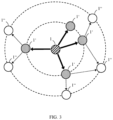
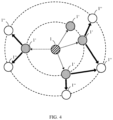
- the relaying takes place in accordance with the two phases illustrated in FIGs. 3 and 4 , respectively.
- a sending device 1 transmits/broadcasts voice traffic to its 1 -hop neighbor devices 1'.
- the 1 -hop neighbor devices 1' reserve (as is indicated by black boxes in FIG. 5 ) and use respective frequency channels at least partially for relaying the received voice traffic to 2 -hop neighbor devices 1" of the sending device 1.
- a system capacity of the MANET reduces per relay node.
- an SDR device for a MANET comprises a plurality of FDMA channels, one of which is dedicated for delay-sensitive traffic and comprises a periodically recurring plurality of time-division multiple access (TDMA) slots of equal duration.
- TDMA time-division multiple access
- the SDR device comprises an encoder configured to encode delay-sensitive traffic in accordance with a maximum codec bit rate; an adapter configured to buffer the encoded traffic in accordance with a maximum duration corresponding to the TDMA slot duration; a transceiver configured to transmit the buffered traffic in a first slot of the plurality of TDMA slots; and a processor configured to detect an actuation by a user of the software-defined radio, SDR, device, and operate the encoder, the adapter and the transceiver in response to the detected actuation.
- the processor may further be configured to adapt a data rate of the transceiver in accordance with an amount of the buffered traffic.
- the transceiver may further be configured to receive transmitted traffic in a particular slot of the plurality of TDMA slots, and transmit the received traffic in a further slot of the plurality of TDMA slots immediately succeeding the particular slot; and the processor may further be configured to decrement a time-to-live (TTL) counter included in the received traffic.
- TTL time-to-live
- a method of operating an SDR device for a MANET comprises a plurality of FDMA channels, one of which is dedicated for delay-sensitive traffic and comprises a periodically recurring plurality of TDMA slots of equal duration.
- the method comprises detecting an actuation by a user of the SDR device; in response to the detected actuation, encoding delay-sensitive traffic in accordance with a maximum codec bit rate; buffering the encoded traffic in accordance with a maximum duration corresponding to the TDMA slot duration; and transmitting the buffered traffic in a first slot of the plurality of TDMA slots.
- the method may further comprise adapting a transception rate of the transceiver in accordance with an amount of the buffered traffic.
- the method may further comprise receiving traffic in a particular slot of the plurality of TDMA slots; decrementing a TTL counter included in the received traffic; and transmitting the received traffic in a further slot of the plurality of TDMA slots immediately succeeding the particular slot.
- the particular slot may comprise the first slot of the plurality of TDMA slots; and the further slot may comprise a second slot of the plurality of TDMA slots.
- the delay-sensitive traffic may comprise encoded vocal expression.
- the TDMA slot duration may be in accordance with a continuous output of the vocal expression at a receiving SDR device.
- the TDMA slot duration slot may comprise less than 150 ms, and preferably 135 ms.
- the detected actuation may comprise an actuation of a push-to-talk (PTT) knob of the SDR device.
- PTT push-to-talk
- a quantity of TDMA slots in the plurality may correspond to a maximum hop count for a communication on the MANET.
- the maximum hop count for the communication on the MANET may comprise two hops.
- a disclosure in connection with a described method may also hold true for a corresponding apparatus or system configured to perform the method and vice versa.
- a corresponding device may include one or a plurality of units, e.g. functional units, to perform the described one or plurality of method steps (e.g. one unit performing the one or plurality of steps, or a plurality of units each performing one or more of the plurality of steps), even if such one or more units are not explicitly described or illustrated in the figures.
- a specific apparatus is described based on one or a plurality of units, e.g.
- a corresponding method may include one step to perform the functionality of the one or plurality of units (e.g. one step performing the functionality of the one or plurality of units, or a plurality of steps each performing the functionality of one or more of the plurality of units), even if such one or plurality of steps are not explicitly described or illustrated in the figures. Further, it is understood that the features of the various exemplary embodiments and/or aspects described herein may be combined with each other, unless specifically noted otherwise.
- FIG. 1 illustrates an SDR device 1 ,1', 1" in accordance with the present disclosure for a MANET.
- the MANET comprises a plurality of FDMA channels, one of which is dedicated for delay-sensitive traffic and comprises a periodically recurring plurality of TDMA slots of equal duration as shown in FIG. 6 .
- a quantity of TDMA slots in the plurality may correspond to a maximum hop count for a communication on the MANET.
- the maximum hop count for the communication on the MANET may comprise two hops.
- the SDR device 1 ,1', 1" comprises an encoder 11 configured to encode delay-sensitive traffic in accordance with a maximum codec bit rate.
- the delay-sensitive traffic may comprise encoded vocal expression (i.e., voice traffic).
- the SDR device 1 ,1', 1" further comprises an adapter 12 configured to buffer the encoded traffic in accordance with a maximum duration corresponding to the TDMA slot duration.
- the TDMA slot duration may be in accordance with a continuous output of the vocal expression at a receiving SDR device 1 ,1', 1".
- the TDMA slot duration slot may comprise less than 150 ms, and preferably 135 ms.
- the SDR device 1, 1', 1" further comprises a transceiver 13 configured to transmit the buffered traffic in a first slot of the plurality of TDMA slots.
- the SDR device 1 ,1', 1" further comprises a processor 14 configured to detect an actuation by a user of the software-defined radio, SDR, device 1 , 1', 1", and operate the encoder, the adapter and the transceiver in response to the detected actuation.
- the detected actuation may comprise an actuation of a PTT knob of the SDR device 1 ,1', 1".
- the processor 14 may further be configured to adapt a data rate of the transceiver in accordance with an amount of the buffered traffic.
- the transceiver 13 may further be configured to receive transmitted traffic in a particular slot of the plurality of TDMA slots, and transmit the received traffic in a further slot of the plurality of TDMA slots immediately succeeding the particular slot; and the processor 14 may further be configured to decrement a TTL counter included in the received traffic.
- the particular slot may comprise the first slot of the plurality of TDMA slots; and the further slot may comprise a second slot of the plurality of TDMA slots.
- the particular slot may comprise the second slot of the plurality of TDMA slots; and the further slot may comprise a third slot of the plurality of TDMA slots, and so on.
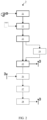
- FIG. 2 illustrates a method 2 in accordance with the present disclosure of operating the SDR device 1 ,1', 1" of FIG. 1 .
- the MANET comprises a plurality of FDMA channels, one of which is dedicated for delay-sensitive traffic and comprises a periodically recurring plurality of TDMA slots of equal duration as shown in FIG. 6 .
- a quantity of TDMA slots in the plurality may correspond to a maximum hop count for a communication on the MANET.
- the maximum hop count for the communication on the MANET may comprise two hops.
- the method 2 comprises detecting 21 an actuation by a user (as indicated by the inbound arrow) of the SDR device 1 ,1', 1".
- the detected actuation may comprise an actuation of a PTT knob of the SDR device 1, 1', 1".
- the method 2 further comprises, in response to the detected actuation, encoding 22 delay-sensitive traffic in accordance with a maximum codec bit rate (as indicated by the inbound arrow).
- the delay-sensitive traffic may comprise encoded vocal expression.
- the method 2 further comprises buffering 23 the encoded traffic in accordance with a maximum duration corresponding to the TDMA slot duration.
- the TDMA slot duration may be in accordance with a continuous output of the vocal expression at a receiving SDR device 1 ,1', 1".
- the TDMA slot duration slot may comprise less than 150 ms, and preferably 135 ms.
- the method 2 may further comprise adapting 24 a transception rate of the transceiver in accordance with an amount of the buffered traffic.
- the method 2 further comprises transmitting 25 the buffered traffic (as indicated by the outbound arrow) in a first slot of the plurality of TDMA slots.
- the method 2 may further comprise receiving 26 traffic (as indicated by the inbound arrow) in a particular slot of the plurality of TDMA slots; decrementing 27 a TTL counter included in the received traffic; and transmitting 28 the received traffic (as indicated by the outbound arrow) in a further slot of the plurality of TDMA slots immediately succeeding the particular slot.
- the particular slot may comprise the first slot of the plurality of TDMA slots; and the further slot may comprise a second slot of the plurality of TDMA slots.
- the particular slot may comprise the second slot of the plurality of TDMA slots; and the further slot may comprise a third slot of the plurality of TDMA slots, and so on.
- FIG. 6 illustrates an example of relaying of delay-sensitive traffic in accordance with the present disclosure, wherein the MANET comprises a plurality of FDMA channels, one of which is dedicated for delay-sensitive traffic and comprises a periodically recurring plurality of TDMA slots of equal duration as shown in FIG. 6 .
- a quantity of TDMA slots in the plurality corresponds to a maximum hop count for a communication on the MANET, which comprises two hops.
- every first slot of the periodically recurring two TDMA slots is dedicated for transmission by the sending SDR device 1
- every second slot of the periodically recurring two TDMA slots is dedicated for relaying traffic received by 1 -hop neighbors 1' of the sending SDR device 1 to 2 -hop neighbors 1" of the sending SDR device 1.
- the processor 14 is configured to detect an actuation by a user of the SDR device 1 , 1', 1" such as an actuation of a PTT knob, and operate the encoder 11, the adapter 12 and the transceiver 13 in response to the detected actuation.
- the encoder 11 e.g. a vocoder, is configured to encode vocal expression (i.e., voice traffic) in accordance with a maximum codec bit rate.
- the adapter 12 e.g. a voice adapter, is configured to buffer/aggregate the encoded voice traffic in accordance with a maximum duration corresponding to the TDMA slot duration.
- the buffer content is provided to a medium access protocol (MAC) interface in intervals of two times the TDMA slot duration (in accordance with the aforementioned quantity of two TDMA slots in the plurality), and has a maximum duration corresponding to the TDMA slot duration.
- MAC medium access protocol
- the TDMA slot duration may be designed in accordance with a continuous output of the vocal expression at a receiving SDR device 1 ,1', 1".
- the sending SDR device 1 and its 1 -hop neighbor SDR devices 1 then take turns in using the preconfigured TDMA slots. More specifically, in the first phase ( FIG. 3 ), the sending SDR device 1 transmits/broadcasts voice traffic to its 1 -hop neighbor nodes 1'. By contrast to the example of FIG. 5 , the sending SDR device 1 may take advantage of the first TDMA slots preconfigured in the dedicated FDMA channel. In the second phase ( FIG.
- the 1- hop neighbor SDR devices 1' of the sending SDR device 1 may take advantage of the second TDMA slots preconfigured in the dedicated FDMA channel for instantaneous relaying of the received voice traffic to 2 -hop neighbor SDR devices 1" of the sending SDR device 1 ("cooperative relaying") without any dynamic reservation.
- Each packet of the delay-sensitive traffic may comprise a TTL counter, which may be decremented per hop in order to delimit a scope of the relaying within the MANET.
- a computer program may be stored/distributed on a suitable medium, such as an optical storage medium or a solid-state medium supplied together with or as part of other hardware, but may also be distributed in other forms, such as via the Internet or other wired or wireless telecommunication systems.
- a suitable medium such as an optical storage medium or a solid-state medium supplied together with or as part of other hardware, but may also be distributed in other forms, such as via the Internet or other wired or wireless telecommunication systems.
Landscapes
- Engineering & Computer Science (AREA)
- Quality & Reliability (AREA)
- Computer Networks & Wireless Communication (AREA)
- Signal Processing (AREA)
- Mobile Radio Communication Systems (AREA)
- Time-Division Multiplex Systems (AREA)
Abstract
Description
- The present disclosure relates generally to the field of mobile ad-hoc networks (MANETs), and more particularly to a software-defined radio (SDR) device and a method of operating the same.
- In many of today's radio methods for MANETs, packets carrying encoded vocal expression (i.e., voice traffic) are/is being forwarded/relayed by dynamically designated relay nodes.
-
FIG. 3 illustrates an example of relaying of such delay-sensitive traffic in accordance with prior art, wherein the MANET comprises a plurality of frequency-division multiple access (FDMA) channels, respectively being subdivided into uniform TDMA slots. In this example, the relaying takes place in accordance with the two phases illustrated inFIGs. 3 and4 , respectively. In the first phase (FIG. 3 ), a sendingdevice 1 transmits/broadcasts voice traffic to its 1-hop neighbor devices 1'. In the second phase (FIG. 4 ), after reception of the voice traffic from thesending device 1, the 1-hop neighbor devices 1' reserve (as is indicated by black boxes inFIG. 5 ) and use respective frequency channels at least partially for relaying the received voice traffic to 2-hop neighbor devices 1" of thesending device 1. - As these reservations are dynamic processes which depend on the channels' utilization, a forwarding delay is generally variable. However, users expect a deterministic delay - also for voice traffic.
- Further, as the reservation is per relay node, a system capacity of the MANET reduces per relay node.
- It is an objective of the present disclosure to overcome these and other drawbacks. It is a specific objective to improve a capacity efficiency and delay determinism of MANETs.
- This is achieved by the features of the independent claims. Further implementation forms are apparent from the dependent claims, the description and the figures.
- According to a first aspect, an SDR device for a MANET is provided. The MANET comprises a plurality of FDMA channels, one of which is dedicated for delay-sensitive traffic and comprises a periodically recurring plurality of time-division multiple access (TDMA) slots of equal duration. The SDR device comprises an encoder configured to encode delay-sensitive traffic in accordance with a maximum codec bit rate; an adapter configured to buffer the encoded traffic in accordance with a maximum duration corresponding to the TDMA slot duration; a transceiver configured to transmit the buffered traffic in a first slot of the plurality of TDMA slots; and a processor configured to detect an actuation by a user of the software-defined radio, SDR, device, and operate the encoder, the adapter and the transceiver in response to the detected actuation.
- The processor may further be configured to adapt a data rate of the transceiver in accordance with an amount of the buffered traffic.
- The transceiver may further be configured to receive transmitted traffic in a particular slot of the plurality of TDMA slots, and transmit the received traffic in a further slot of the plurality of TDMA slots immediately succeeding the particular slot; and the processor may further be configured to decrement a time-to-live (TTL) counter included in the received traffic.
- According to a second aspect, a method of operating an SDR device for a MANET is provided. The MANET comprises a plurality of FDMA channels, one of which is dedicated for delay-sensitive traffic and comprises a periodically recurring plurality of TDMA slots of equal duration. The method comprises detecting an actuation by a user of the SDR device; in response to the detected actuation, encoding delay-sensitive traffic in accordance with a maximum codec bit rate; buffering the encoded traffic in accordance with a maximum duration corresponding to the TDMA slot duration; and transmitting the buffered traffic in a first slot of the plurality of TDMA slots.
- The method may further comprise adapting a transception rate of the transceiver in accordance with an amount of the buffered traffic.
- The method may further comprise receiving traffic in a particular slot of the plurality of TDMA slots; decrementing a TTL counter included in the received traffic; and transmitting the received traffic in a further slot of the plurality of TDMA slots immediately succeeding the particular slot.
- The particular slot may comprise the first slot of the plurality of TDMA slots; and the further slot may comprise a second slot of the plurality of TDMA slots.
- The delay-sensitive traffic may comprise encoded vocal expression.
- The TDMA slot duration may be in accordance with a continuous output of the vocal expression at a receiving SDR device.
- The TDMA slot duration slot may comprise less than 150 ms, and preferably 135 ms.
- The detected actuation may comprise an actuation of a push-to-talk (PTT) knob of the SDR device.
- A quantity of TDMA slots in the plurality may correspond to a maximum hop count for a communication on the MANET.
- The maximum hop count for the communication on the MANET may comprise two hops.
- In accordance with the present disclosure,
- a) the dynamically designated relay nodes use at least one FDMA channel which is statically reserved (i.e., dedicated) for transmission of delay-sensitive traffic such as voice traffic;
- b) the at least one dedicated channel comprises a plurality of TDMA slots of equal duration, wherein a sending SDR device uses a first slot of the plurality of TDMA slots for transmission of delay-sensitive traffic, and a relaying SDR device which receives the delay-sensitive traffic in a particular (e.g., first) slot of the plurality of TDMA slots uses an immediately succeeding (e.g., second) slot of the plurality of TDMA slots for relaying/forwarding the delay-sensitive traffic ("cooperative relaying/forwarding");
- c) a sending SDR device buffers its delay-sensitive traffic for transmission in the first slot of the plurality of TDMA slots for up to the TDMA slot duration, which may be dimensioned to allow for a continuous output of the vocal expression at a receiving SDR device;
- This entails the following benefits:
- a) the static reservation has the effect that respective relay nodes do not need to reserve a frequency channel separately, so that a system capacity of the MANET becomes independent of the number of relay nodes, collisions of voice and data traffic are avoided, and shorter and more deterministic delays are obtained;
- b) the cooperative relaying/forwarding has the effect that delay is reduced and becomes deterministic; and
- c) the buffering improves a channel utilization and introduces only a finite defined delay, while enabling continuous output of the vocal expression at a receiving SDR device; the buffering further enables an adaptation of a transception rate of the SDR device, so that a channel access becomes more efficient and simpler to implement.
- Advantageously, the technical effects and advantages described above in relation with the SDR device equally apply to the method of operating the same having corresponding features.
- The above-described aspects and implementations will now be explained with reference to the accompanying drawings, in which the same or similar reference numerals designate the same or similar elements.
- The drawings are to be regarded as being schematic representations, and elements illustrated in the drawings are not necessarily shown to scale. Rather, the various elements are represented such that their function and general purpose become apparent to those skilled in the art.
- FIG. 1
- illustrates an SDR device in accordance with the present disclosure for a MANET;
- FIG. 2
- illustrates a method in accordance with the present disclosure of operating the SDR device of
FIG. 1 ; - FIG. 3
- illustrates a first phase of relaying delay-sensitive traffic;
- FIG. 4
- illustrates a second phase of the relaying of the delay-sensitive traffic;
- FIG. 5
- illustrates an example of relaying of delay-sensitive traffic in accordance with prior art; and
- FIG. 6
- illustrates an example of relaying of delay-sensitive traffic in accordance with the present disclosure.
- In the following description, reference is made to the accompanying drawings, which form part of the disclosure, and which show, by way of illustration, specific aspects of embodiments of the invention or specific aspects in which embodiments of the present invention may be used. It is understood that embodiments of the invention may be used in other aspects and comprise structural or logical changes not depicted in the figures. The following detailed description, therefore, is not to be taken in a limiting sense, and the scope of the present invention is defined by the appended claims.
- For instance, it is understood that a disclosure in connection with a described method may also hold true for a corresponding apparatus or system configured to perform the method and vice versa. For example, if one or a plurality of specific method steps are described, a corresponding device may include one or a plurality of units, e.g. functional units, to perform the described one or plurality of method steps (e.g. one unit performing the one or plurality of steps, or a plurality of units each performing one or more of the plurality of steps), even if such one or more units are not explicitly described or illustrated in the figures. On the other hand, for example, if a specific apparatus is described based on one or a plurality of units, e.g. functional units, a corresponding method may include one step to perform the functionality of the one or plurality of units (e.g. one step performing the functionality of the one or plurality of units, or a plurality of steps each performing the functionality of one or more of the plurality of units), even if such one or plurality of steps are not explicitly described or illustrated in the figures. Further, it is understood that the features of the various exemplary embodiments and/or aspects described herein may be combined with each other, unless specifically noted otherwise.
-
FIG. 1 illustrates anSDR device - The MANET comprises a plurality of FDMA channels, one of which is dedicated for delay-sensitive traffic and comprises a periodically recurring plurality of TDMA slots of equal duration as shown in
FIG. 6 . - A quantity of TDMA slots in the plurality may correspond to a maximum hop count for a communication on the MANET.
- In particular, the maximum hop count for the communication on the MANET may comprise two hops.
- The
SDR device encoder 11 configured to encode delay-sensitive traffic in accordance with a maximum codec bit rate. - In particular, the delay-sensitive traffic may comprise encoded vocal expression (i.e., voice traffic).
- The
SDR device adapter 12 configured to buffer the encoded traffic in accordance with a maximum duration corresponding to the TDMA slot duration. - The TDMA slot duration may be in accordance with a continuous output of the vocal expression at a receiving
SDR device - In particular, the TDMA slot duration slot may comprise less than 150 ms, and preferably 135 ms.
- The
SDR device transceiver 13 configured to transmit the buffered traffic in a first slot of the plurality of TDMA slots. - The
SDR device processor 14 configured to detect an actuation by a user of the software-defined radio, SDR,device - The detected actuation may comprise an actuation of a PTT knob of the
SDR device - The
processor 14 may further be configured to adapt a data rate of the transceiver in accordance with an amount of the buffered traffic. - The foregoing configuration is especially suited for
SDR devices SDR devices transceiver 13 may further be configured to receive transmitted traffic in a particular slot of the plurality of TDMA slots, and transmit the received traffic in a further slot of the plurality of TDMA slots immediately succeeding the particular slot; and theprocessor 14 may further be configured to decrement a TTL counter included in the received traffic. - For example, the particular slot may comprise the first slot of the plurality of TDMA slots; and the further slot may comprise a second slot of the plurality of TDMA slots. For example, the particular slot may comprise the second slot of the plurality of TDMA slots; and the further slot may comprise a third slot of the plurality of TDMA slots, and so on.
-
FIG. 2 illustrates amethod 2 in accordance with the present disclosure of operating theSDR device FIG. 1 . - The MANET comprises a plurality of FDMA channels, one of which is dedicated for delay-sensitive traffic and comprises a periodically recurring plurality of TDMA slots of equal duration as shown in
FIG. 6 . - A quantity of TDMA slots in the plurality may correspond to a maximum hop count for a communication on the MANET.
- In particular, the maximum hop count for the communication on the MANET may comprise two hops.
- The
method 2 comprises detecting 21 an actuation by a user (as indicated by the inbound arrow) of theSDR device - In particular, the detected actuation may comprise an actuation of a PTT knob of the
SDR device - The
method 2 further comprises, in response to the detected actuation, encoding 22 delay-sensitive traffic in accordance with a maximum codec bit rate (as indicated by the inbound arrow). - In particular, the delay-sensitive traffic may comprise encoded vocal expression.
- The
method 2 further comprises buffering 23 the encoded traffic in accordance with a maximum duration corresponding to the TDMA slot duration. - The TDMA slot duration may be in accordance with a continuous output of the vocal expression at a receiving
SDR device - In particular, the TDMA slot duration slot may comprise less than 150 ms, and preferably 135 ms.
- The
method 2 may further comprise adapting 24 a transception rate of the transceiver in accordance with an amount of the buffered traffic. - The
method 2 further comprises transmitting 25 the buffered traffic (as indicated by the outbound arrow) in a first slot of the plurality of TDMA slots. - The foregoing configuration is especially suited for
SDR devices SDR devices method 2 may further comprise receiving 26 traffic (as indicated by the inbound arrow) in a particular slot of the plurality of TDMA slots; decrementing 27 a TTL counter included in the received traffic; and transmitting 28 the received traffic (as indicated by the outbound arrow) in a further slot of the plurality of TDMA slots immediately succeeding the particular slot. - For example, the particular slot may comprise the first slot of the plurality of TDMA slots; and the further slot may comprise a second slot of the plurality of TDMA slots. For example, the particular slot may comprise the second slot of the plurality of TDMA slots; and the further slot may comprise a third slot of the plurality of TDMA slots, and so on.
-
FIG. 6 illustrates an example of relaying of delay-sensitive traffic in accordance with the present disclosure, wherein the MANET comprises a plurality of FDMA channels, one of which is dedicated for delay-sensitive traffic and comprises a periodically recurring plurality of TDMA slots of equal duration as shown inFIG. 6 . - In the particular example, a quantity of TDMA slots in the plurality corresponds to a maximum hop count for a communication on the MANET, which comprises two hops. In other words, every first slot of the periodically recurring two TDMA slots is dedicated for transmission by the sending
SDR device 1, and every second slot of the periodically recurring two TDMA slots is dedicated for relaying traffic received by 1-hop neighbors 1' of the sendingSDR device 1 to 2-hop neighbors 1" of the sendingSDR device 1. - As such, also in this example the relaying takes place in accordance with the two phases illustrated in
FIGs. 3 and4 , respectively. - The
processor 14 is configured to detect an actuation by a user of theSDR device encoder 11, theadapter 12 and thetransceiver 13 in response to the detected actuation. - The
encoder 11, e.g. a vocoder, is configured to encode vocal expression (i.e., voice traffic) in accordance with a maximum codec bit rate. - The
adapter 12, e.g. a voice adapter, is configured to buffer/aggregate the encoded voice traffic in accordance with a maximum duration corresponding to the TDMA slot duration. The buffer content is provided to a medium access protocol (MAC) interface in intervals of two times the TDMA slot duration (in accordance with the aforementioned quantity of two TDMA slots in the plurality), and has a maximum duration corresponding to the TDMA slot duration. In particular, the TDMA slot duration may be designed in accordance with a continuous output of the vocal expression at a receivingSDR device - The sending
SDR device 1 and its 1-hopneighbor SDR devices 1 then take turns in using the preconfigured TDMA slots. More specifically, in the first phase (FIG. 3 ), the sendingSDR device 1 transmits/broadcasts voice traffic to its 1-hop neighbor nodes 1'. By contrast to the example ofFIG. 5 , the sendingSDR device 1 may take advantage of the first TDMA slots preconfigured in the dedicated FDMA channel. In the second phase (FIG. 4 ), after reception of the voice traffic from the sendingSDR device 1, the 1-hop neighbor SDR devices 1' of the sendingSDR device 1 may take advantage of the second TDMA slots preconfigured in the dedicated FDMA channel for instantaneous relaying of the received voice traffic to 2-hopneighbor SDR devices 1" of the sending SDR device 1 ("cooperative relaying") without any dynamic reservation. - Each packet of the delay-sensitive traffic may comprise a TTL counter, which may be decremented per hop in order to delimit a scope of the relaying within the MANET.
- The present disclosure has been described in conjunction with various embodiments as examples as well as implementations. However, other variations can be understood and effected by those persons skilled in the art and practicing the claimed matter, from the studies of the drawings, this disclosure and the independent claims. In the claims as well as in the description the word "comprising" does not exclude other elements or steps and the indefinite article "a" or "an" does not exclude a plurality. A single element or other unit may fulfill the functions of several entities or items recited in the claims. The mere fact that certain measures are recited in the mutual different dependent claims does not indicate that a combination of these measures cannot be used in an advantageous implementation. A computer program may be stored/distributed on a suitable medium, such as an optical storage medium or a solid-state medium supplied together with or as part of other hardware, but may also be distributed in other forms, such as via the Internet or other wired or wireless telecommunication systems.
Claims (13)
- A software-defined radio, SDR, device (1 ,1', 1") for a mobile ad-hoc network, MANET, the MANET comprisinga plurality of frequency-division multiple access, FDMA, channels, one of which being dedicated for delay-sensitive traffic and comprising a periodically recurring plurality of time-division multiple access, TDMA, slots of equal duration;
the SDR device (1 ,1', 1") comprisingan encoder (11) configured to- encode delay-sensitive traffic in accordance with a maximum codec bit rate;an adapter (12) configured to- buffer the encoded traffic in accordance with a maximum duration corresponding to the TDMA slot duration;a transceiver (13) configured to- transmit the buffered traffic in a first slot of the plurality of TDMA slots; anda processor (14) configured to- detect an actuation by a user of the software-defined radio, SDR, device (1 ,1', 1"); and- operate the encoder, the adapter and the transceiver in response to the detected actuation. - The device (1 ,1', 1") of claim 1,
the processor (14) further configured to- adapt a data rate of the transceiver in accordance with an amount of the buffered traffic. - The device (1 ,1', 1") of claim 1 or claim 2,the transceiver (13) further configured to- receive transmitted traffic in a particular slot of the plurality of TDMA slots; and- transmit the received traffic in a further slot of the plurality of TDMA slots immediately succeeding the particular slot; andthe processor (14) further configured to- decrement a time-to-live, TTL, counter included in the received traffic.
- A method (2) of operating a software-defined radio, SDR, device (1 ,1', 1") for a MANET, the MANET comprising
a plurality of frequency-division multiple access, FDMA channels, one of which being dedicated for delay-sensitive traffic and comprising a periodically recurring plurality of time-division multiple access, TDMA, slots of equal duration;
the method (2) comprising:- detecting (21) an actuation by a user of the SDR device (1 ,1', 1");- in response to the detected actuation, encoding (22) delay-sensitive traffic in accordance with a maximum codec bit rate;- buffering (23) the encoded traffic in accordance with a maximum duration corresponding to the TDMA slot duration; and- transmitting (25) the buffered traffic in a first slot of the plurality of TDMA slots. - The method (2) of claim 4, further comprising- adapting (24) a transception rate of the transceiver in accordance with an amount of the buffered traffic.
- The method (2) of claim 4 or claim 5, further comprising- receiving (26) traffic in a particular slot of the plurality of TDMA slots;- decrementing (27) a time-to-live, TTL, counter included in the received traffic; and- transmitting (28) the received traffic in a further slot of the plurality of TDMA slots immediately succeeding the particular slot.
- The device (1 ,1', 1") of claim 3 or the method (2) of claim 6,the particular slot comprising the first slot of the plurality of TDMA slots; andthe further slot comprising a second slot of the plurality of TDMA slots.
- The device (1 ,1', 1") of any one of the claims 1 to 3 and 7, or the method (2) of any one of the claims 4 to 7,
the delay-sensitive traffic comprising encoded vocal expression. - The device (1 ,1', 1") of claim 8 or the method (2) of claim 8,
the TDMA slot duration being in accordance with a continuous output of the vocal expression at a receiving SDR device (1 , 1', 1"). - The device (1 , 1', 1") of claim 9 or the method (2) of claim 9,
the TDMA slot duration slot comprising less than 150 ms, and preferably 135 ms. - The device (1 , 1', 1") of any one of the claims 1 to 3 and 7 to 10, or the method (2) of any one of the claims 4 to 10,
the detected actuation comprising an actuation of a push-to-talk, PPT, knob of the SDR device (1 ,1', 1"). - The device (1 ,1', 1") any one of the claims 1 to 3 and 7 to 11, or the method (2) of any one of the claims 4 to 11,
a quantity of TDMA slots in the plurality corresponding to a maximum hop count for a communication on the MANET. - The device (1 ,1', 1") of claim 12 or the method (2) of claim 12,
the maximum hop count for the communication on the MANET comprising two hops.
Priority Applications (1)
| Application Number | Priority Date | Filing Date | Title |
|---|---|---|---|
| EP21194452.5A EP4145732A1 (en) | 2021-09-02 | 2021-09-02 | Device and method for cooperative relaying of voice traffic in mobile ad-hoc networks |
Applications Claiming Priority (1)
| Application Number | Priority Date | Filing Date | Title |
|---|---|---|---|
| EP21194452.5A EP4145732A1 (en) | 2021-09-02 | 2021-09-02 | Device and method for cooperative relaying of voice traffic in mobile ad-hoc networks |
Publications (1)
| Publication Number | Publication Date |
|---|---|
| EP4145732A1 true EP4145732A1 (en) | 2023-03-08 |
Family
ID=77951441
Family Applications (1)
| Application Number | Title | Priority Date | Filing Date |
|---|---|---|---|
| EP21194452.5A Pending EP4145732A1 (en) | 2021-09-02 | 2021-09-02 | Device and method for cooperative relaying of voice traffic in mobile ad-hoc networks |
Country Status (1)
| Country | Link |
|---|---|
| EP (1) | EP4145732A1 (en) |
Citations (4)
| Publication number | Priority date | Publication date | Assignee | Title |
|---|---|---|---|---|
| US7103371B1 (en) * | 2003-10-22 | 2006-09-05 | Itt Manufacturing Enterprises, Inc. | Method and apparatus for dynamic voice reservation within wireless networks |
| US20070071030A1 (en) * | 2005-09-29 | 2007-03-29 | Yen-Chi Lee | Video packet shaping for video telephony |
| US20130100942A1 (en) * | 2011-10-24 | 2013-04-25 | Harris Corporation | Mobile ad hoc network with dynamic tdma slot assignments and related methods |
| WO2013069015A1 (en) * | 2011-11-10 | 2013-05-16 | Rafael Advanced Defense Systems Ltd. | An improved mobile ad-hoc network |
-
2021
- 2021-09-02 EP EP21194452.5A patent/EP4145732A1/en active Pending
Patent Citations (4)
| Publication number | Priority date | Publication date | Assignee | Title |
|---|---|---|---|---|
| US7103371B1 (en) * | 2003-10-22 | 2006-09-05 | Itt Manufacturing Enterprises, Inc. | Method and apparatus for dynamic voice reservation within wireless networks |
| US20070071030A1 (en) * | 2005-09-29 | 2007-03-29 | Yen-Chi Lee | Video packet shaping for video telephony |
| US20130100942A1 (en) * | 2011-10-24 | 2013-04-25 | Harris Corporation | Mobile ad hoc network with dynamic tdma slot assignments and related methods |
| WO2013069015A1 (en) * | 2011-11-10 | 2013-05-16 | Rafael Advanced Defense Systems Ltd. | An improved mobile ad-hoc network |
Non-Patent Citations (1)
| Title |
|---|
| WEISS, M. ET AL FROM RAFAEL,DIVISION NCW.: "An Innovative SDR Architecture and MANET with Simultaneous Multiple Channel Reception", 2012 WIRELESS INNOVATION FORUM EUROPEAN CONFERENCE ON COMMUNICATIONS TECHNOLOGIES AND SOFTWARE DEFINED RADIO BRUSSELS (BELGIUM), 29 June 2012 (2012-06-29), pages 1 - 41, XP055892171, Retrieved from the Internet <URL:https://www.wirelessinnovation.org/assets/Proceedings/2012Europe/2012-europe-a-6.2-weiss-presentation.pdf> [retrieved on 20220215] * |
Similar Documents
| Publication | Publication Date | Title |
|---|---|---|
| Ye et al. | Distributed and adaptive medium access control for Internet-of-Things-enabled mobile networks | |
| US8300618B2 (en) | User priority based preemption techniques in a time division multiple access multi-hop ad hoc network | |
| CN100531076C (en) | Increasing link capacity via concurrent transmissions inc entralized wireless LANS | |
| KR100886202B1 (en) | System and Method Using Algorithm and Protocol for Optimizing Carrier Sense Multiple Access Protocol in Wireless Network | |
| CN100433690C (en) | Method of implementing scatternet in wireless personal area network | |
| KR101377722B1 (en) | How to reserve resources with maximum delay guarantee for multi-hop transmission in a distributed access wireless communications network | |
| Luo et al. | CAM-MAC: A cooperative asynchronous multi-channel MAC protocol for ad hoc networks | |
| CN111277993B (en) | Method, communication device and medium for supporting time sensitive communication | |
| CN102474883A (en) | A semi-random back-off method for achieving resource reservation in wireless local area networks | |
| Wang et al. | A collision-free MAC scheme for multimedia wireless mesh backbone | |
| CN101878670A (en) | Method and apparatus for resource allocation request and allocation | |
| KR101751757B1 (en) | Time slot allocation and frequency slot allocation algorithm in a tree-based wireless sensor network | |
| CN105144634A (en) | Systems and methods to achieve fairness in wireless LANs for cellular offloading | |
| EP3281483B1 (en) | Ioe device transmission signaling and scheduling | |
| EP1911205B1 (en) | Bandwidth allocation in a wireless network | |
| CN106879031A (en) | A kind of channel wireless radio multi Mesh network resource negotiation method based on double receipts single-shots | |
| Zhu et al. | Enhanced MAC protocol to support multimedia traffic in cognitive wireless mesh networks | |
| JP6672331B2 (en) | IoE device awake scheduling and discovery | |
| JP4086385B2 (en) | Data transmission method, data transmission system, and apparatus used in the system | |
| Li et al. | Delay and throughput performance of IEEE 802.16 WiMax mesh networks | |
| Joe | QoS-aware MAC with reservation for mobile ad-hoc networks | |
| Lin et al. | P-TDMA-SYS: A TDMA System over Commodity 802.11 Hardware for Mobile Ad-Hoc Networks. | |
| Kim et al. | Distributed semi-synchronous channel coordination for multi-channel wireless networks | |
| Liang et al. | DFMAC: DTN-friendly medium access control for wireless local area networks supporting voice/data services | |
| JP2010114904A (en) | Multi-hop wireless network |
Legal Events
| Date | Code | Title | Description |
|---|---|---|---|
| PUAI | Public reference made under article 153(3) epc to a published international application that has entered the european phase |
Free format text: ORIGINAL CODE: 0009012 |
|
| STAA | Information on the status of an ep patent application or granted ep patent |
Free format text: STATUS: THE APPLICATION HAS BEEN PUBLISHED |
|
| STAA | Information on the status of an ep patent application or granted ep patent |
Free format text: STATUS: REQUEST FOR EXAMINATION WAS MADE |
|
| AK | Designated contracting states |
Kind code of ref document: A1 Designated state(s): AL AT BE BG CH CY CZ DE DK EE ES FI FR GB GR HR HU IE IS IT LI LT LU LV MC MK MT NL NO PL PT RO RS SE SI SK SM TR |
|
| 17P | Request for examination filed |
Effective date: 20230214 |
|
| RBV | Designated contracting states (corrected) |
Designated state(s): AL AT BE BG CH CY CZ DE DK EE ES FI FR GB GR HR HU IE IS IT LI LT LU LV MC MK MT NL NO PL PT RO RS SE SI SK SM TR |
|
| P01 | Opt-out of the competence of the unified patent court (upc) registered |
Effective date: 20230525 |
|
| STAA | Information on the status of an ep patent application or granted ep patent |
Free format text: STATUS: EXAMINATION IS IN PROGRESS |
|
| 17Q | First examination report despatched |
Effective date: 20240919 |