EP4145672A1 - Modular electrical energy storage - Google Patents
Modular electrical energy storage Download PDFInfo
- Publication number
- EP4145672A1 EP4145672A1 EP22203616.2A EP22203616A EP4145672A1 EP 4145672 A1 EP4145672 A1 EP 4145672A1 EP 22203616 A EP22203616 A EP 22203616A EP 4145672 A1 EP4145672 A1 EP 4145672A1
- Authority
- EP
- European Patent Office
- Prior art keywords
- electrical
- energy storage
- leg
- electrical energy
- protection circuit
- Prior art date
- Legal status (The legal status is an assumption and is not a legal conclusion. Google has not performed a legal analysis and makes no representation as to the accuracy of the status listed.)
- Pending
Links
Images



Classifications
-
- H—ELECTRICITY
- H02—GENERATION; CONVERSION OR DISTRIBUTION OF ELECTRIC POWER
- H02J—ELECTRIC POWER NETWORKS; CIRCUIT ARRANGEMENTS OR SYSTEMS FOR SUPPLYING OR DISTRIBUTING ELECTRIC POWER; SYSTEMS FOR STORING ELECTRIC ENERGY
- H02J3/00—Circuit arrangements for AC mains or AC distribution networks
- H02J3/28—Arrangements for balancing of the load in networks by storage of energy
- H02J3/32—Arrangements for balancing of the load in networks by storage of energy using batteries or super capacitors with converting means
-
- H—ELECTRICITY
- H02—GENERATION; CONVERSION OR DISTRIBUTION OF ELECTRIC POWER
- H02H—EMERGENCY PROTECTIVE CIRCUIT ARRANGEMENTS
- H02H7/00—Emergency protective circuit arrangements specially adapted for specific types of electric machines or apparatus or for sectionalised protection of cable or line systems, and effecting automatic switching in the event of an undesired change from normal working conditions
- H02H7/26—Sectionalised protection of cable or line systems, e.g. for disconnecting a section on which a short-circuit, earth fault, or arc discharge has occured
-
- H—ELECTRICITY
- H02—GENERATION; CONVERSION OR DISTRIBUTION OF ELECTRIC POWER
- H02J—ELECTRIC POWER NETWORKS; CIRCUIT ARRANGEMENTS OR SYSTEMS FOR SUPPLYING OR DISTRIBUTING ELECTRIC POWER; SYSTEMS FOR STORING ELECTRIC ENERGY
- H02J15/00—Systems for storing electric energy specially adapted for power networks
-
- H—ELECTRICITY
- H02—GENERATION; CONVERSION OR DISTRIBUTION OF ELECTRIC POWER
- H02J—ELECTRIC POWER NETWORKS; CIRCUIT ARRANGEMENTS OR SYSTEMS FOR SUPPLYING OR DISTRIBUTING ELECTRIC POWER; SYSTEMS FOR STORING ELECTRIC ENERGY
- H02J7/00—Circuit arrangements for charging or discharging batteries or for supplying loads from batteries
- H02J7/02—Circuit arrangements for charging or discharging batteries or for supplying loads from batteries for charging batteries from AC mains by converters
-
- H—ELECTRICITY
- H02—GENERATION; CONVERSION OR DISTRIBUTION OF ELECTRIC POWER
- H02J—ELECTRIC POWER NETWORKS; CIRCUIT ARRANGEMENTS OR SYSTEMS FOR SUPPLYING OR DISTRIBUTING ELECTRIC POWER; SYSTEMS FOR STORING ELECTRIC ENERGY
- H02J7/00—Circuit arrangements for charging or discharging batteries or for supplying loads from batteries
- H02J7/50—Circuit arrangements for charging or discharging batteries or for supplying loads from batteries acting upon multiple batteries simultaneously or sequentially
-
- H—ELECTRICITY
- H02—GENERATION; CONVERSION OR DISTRIBUTION OF ELECTRIC POWER
- H02J—ELECTRIC POWER NETWORKS; CIRCUIT ARRANGEMENTS OR SYSTEMS FOR SUPPLYING OR DISTRIBUTING ELECTRIC POWER; SYSTEMS FOR STORING ELECTRIC ENERGY
- H02J7/00—Circuit arrangements for charging or discharging batteries or for supplying loads from batteries
- H02J7/60—Circuit arrangements for charging or discharging batteries or for supplying loads from batteries including safety or protection arrangements
- H02J7/663—Circuit arrangements for charging or discharging batteries or for supplying loads from batteries including safety or protection arrangements using battery or load disconnect circuits
-
- H—ELECTRICITY
- H02—GENERATION; CONVERSION OR DISTRIBUTION OF ELECTRIC POWER
- H02J—ELECTRIC POWER NETWORKS; CIRCUIT ARRANGEMENTS OR SYSTEMS FOR SUPPLYING OR DISTRIBUTING ELECTRIC POWER; SYSTEMS FOR STORING ELECTRIC ENERGY
- H02J7/00—Circuit arrangements for charging or discharging batteries or for supplying loads from batteries
- H02J7/60—Circuit arrangements for charging or discharging batteries or for supplying loads from batteries including safety or protection arrangements
- H02J7/685—Circuit arrangements for charging or discharging batteries or for supplying loads from batteries including safety or protection arrangements using connection detecting circuits
-
- H—ELECTRICITY
- H02—GENERATION; CONVERSION OR DISTRIBUTION OF ELECTRIC POWER
- H02J—ELECTRIC POWER NETWORKS; CIRCUIT ARRANGEMENTS OR SYSTEMS FOR SUPPLYING OR DISTRIBUTING ELECTRIC POWER; SYSTEMS FOR STORING ELECTRIC ENERGY
- H02J7/00—Circuit arrangements for charging or discharging batteries or for supplying loads from batteries
- H02J7/70—Circuit arrangements for charging or discharging batteries or for supplying loads from batteries characterised by the mechanical construction
- H02J7/751—Circuit arrangements for charging or discharging batteries or for supplying loads from batteries characterised by the mechanical construction concerning the insertion or the connection of the batteries
-
- H—ELECTRICITY
- H02—GENERATION; CONVERSION OR DISTRIBUTION OF ELECTRIC POWER
- H02J—ELECTRIC POWER NETWORKS; CIRCUIT ARRANGEMENTS OR SYSTEMS FOR SUPPLYING OR DISTRIBUTING ELECTRIC POWER; SYSTEMS FOR STORING ELECTRIC ENERGY
- H02J7/00—Circuit arrangements for charging or discharging batteries or for supplying loads from batteries
- H02J7/865—Battery or charger load switching, e.g. concurrent charging and load supply
-
- H—ELECTRICITY
- H02—GENERATION; CONVERSION OR DISTRIBUTION OF ELECTRIC POWER
- H02M—APPARATUS FOR CONVERSION BETWEEN AC AND AC, BETWEEN AC AND DC, OR BETWEEN DC AND DC, AND FOR USE WITH MAINS OR SIMILAR POWER SUPPLY SYSTEMS; CONVERSION OF DC OR AC INPUT POWER INTO SURGE OUTPUT POWER; CONTROL OR REGULATION THEREOF
- H02M1/00—Details of apparatus for conversion
- H02M1/10—Arrangements incorporating converting means for enabling loads to be operated at will from different kinds of power supplies, e.g. from AC or DC
Definitions
- the present disclosure relates to the field of energy storage.
- Battery electrical storage systems may use storage elements such as batteries, flywheels, fuel cells, thermal storage materials, electrochemical storage materials, flow battery, and kinetic storage materials.
- Battery electrical storage systems include, for example, large-scale systems for utilities as well as small-scale systems such as mobile chargers.
- the storage systems may charge from an energy source, such as the grid, a solar power generation system, a wind turbine, a mobile solar panel, a generator, and/or a turbine.
- the storage system may discharge the energy for consumption by electrical loads when the alternative sources of the loads are, for example, more expensive and/or not available.
- An electrical energy storage system may include multiple energy storage modules connected to a power converter (such as an inverter, power supply, DC/DC converter, or a bidirectional inverter), where each module may be connected with an independent physical and electrical connection.
- the inverter may include separate protection circuit boards for each storage module connection terminal set. Multiple protection circuits may be included in the inverter. Each protection circuit may include multiple sensors for detecting failure of the storage module, or a communication circuit for receiving a notification of a failure.
- the electrical configurations between the inverter and modules may use a bus configuration.
- Each energy storage module may be electrically and mechanically connected to the power device with a separate electrical and mechanical connection, such as a star configuration.
- Electrical energy storage modules may use storage elements, such as batteries, flywheels, fuel cells, flow battery, thermal storage materials, electrochemical storage materials, and kinetic storage materials.
- BESS battery energy storage system
- each battery module may have a separate cable connecting it to the power device.
- separate electrical conductors may be incorporated into support feet and transect the device, such as the power device or the battery module.
- the circuit board of the power device may electrical connect to 4 support feet, one at each corner of the device, and each battery module may be electrically connected to one of the support feet.
- 4 battery modules may be connected to the power device.
- Other example systems may include 5, 6, 8, or 10 feet, and therefore allow up to 10 energy storage modules.
- the system may incorporate between 2 and 20 support feet, each combined with a conductor.
- BESSs may be used as a primary example in this disclosure, but may be understood that alternative electrical energy storage systems may be used instead of BESSs.
- the inverter may include separate protection circuit boards for each storage module connection terminal set ("terminal set"), such as a positive terminal and negative terminal in a terminal set. Multiple protection circuits may be included in the inverter, such as within a terminal set, between terminal sets, between the terminal set and the power converter circuit, and within the power converter circuit.
- a terminal means a set of conductors for transferring electrical power.
- Each protection circuit may include multiple sensors for detecting failure of the storage module, or a communication circuit for receiving a notification of a failure.
- the electrical configuration between the inverter and modules may include a star configuration or a bus configuration for power delivery. A star configuration may have separate electrical conductors between the inverter and each module. A bus configuration may have common electrical conductors between the inverter and each module. Hybrid configurations (combining star and bus features) may be used for BESSs
- FIG. 1 shows a block diagram of an example system 100 with modular electrical energy storage.
- a power device 102 may be connected to a power source 101, such as a power generation system, a power harvesting system, an electrical network, a large electrical energy storage system, or a grid.
- Power device 102 is connected to multiple energy storage modules 104A, 104B, up to 104n using separate electrical/mechanical connectors 103A, 103B, ... up to 103n respectively.
- Power device 102 may be connected to loads 106, 107, and/or 108 through one or more alternating current (AC) or direct current (DC) connection terminals.
- AC alternating current
- DC direct current
- Power device 102 may transfer power from energy storage modules 104A-104n to loads 106-108 when power source 101 does not provide power to loads 106-108. Power transfer may be performed using an inverter circuit configured to provide AC power, or a converter circuit configured to provide DC power to loads 106-108. By selectively discharging each energy storage module to loads 106-108, power device 102 may manage depletion of energy storage modules 104A-104n in parallel or one at a time (depleting one before drawing power from the next). When power source 101 provides power, power device 102 may direct power to loads 106-108 and/or to energy storage modules 104A-104n.
- a charger 109 may be connected to the same power source 101 or a different power source.
- Charger 109 may be connected to energy storage modules 104A-104n independently from connections 103A-103n, and charger 109 may be configured to charge one or more of energy storage modules 104A-104n independently from power device 102. For example, when power device 102 is charging one set of energy storage modules, charger 109 may charge a second set. For example, when power device is rated for 50 amperes (A), and charging a set of energy storage modules at full charge rate requires 80 A, charger 109 may be used to provide an additional 30 A of charging current.
- A amperes
- Power device 200 may include power source terminals 205 configured to connect to a power source 201, such as an AC, DC, or AC and DC power source as power source 101 of FIG. 1 .
- Power device 200 may include an AC/DC or DC/AC converter 206 and/or a bidirectional DC/DC converter 207, each connected electrically to power source terminals 205.
- Power device 200 may include multiple independent storage terminals 202A-202n (illustrated subset 202A, 202B, ... 202n) configured to connect to storage conductors 203A-203n.
- Protection circuits 204A-204n are positioned between terminals 202A-202n and converters 206 and 207. Protection circuits 204A-204n are configured to sense the malfunctions of each storage device (not shown) connected to terminals 202A-202n, such as electrical or physical parameters (e.g. voltage, current, impedance, temperature, electromagnetic emissions, chemical emissions, frequency response, or transmission line reflection amplitude).
- a protection circuit may include multiple sensors configured to detect a failure condition.
- a sensor may comprise a power source and threshold circuit configured to send a binary analog or digital signal.
- a protection circuit may be a communication circuit configured to receive a notification of a failure condition, such as a notification from a storage module, a server, or a home energy management system.
- Power device 200 may include load terminals 208 configured to connect to one or more AC loads 210 or one or more DC loads 220.
- a terminal means a set of conductors for transferring electrical power.
- System 300 may comprise a power device 320 and energy storage modules 310A and 310B.
- a first power conductor 307 may connect a terminal 301 of energy storage module 310A to a storage terminal 302 of power device 320.
- a second power conductor 308 may connect a terminal 305 of energy storage module 310B to a storage terminal 304 of power device 320.
- Power device 320 may include one or more user interfaces 303, and auxiliary power terminal 306.
- FIG. 3B shows an example system with modular electrical energy storage and arrangement of connected legs 331 and isolated legs 332.
- Connected legs 331 and isolated legs 332 may be used to mechanically support the device or modules (such as when placed on surfaces), and used to transfer electrical and mechanical connections between energy storage modules (e.g. batteries) 311, 312, and 313, to power device 321.
- Each leg may extend the height of the device enclosure, and may protrude below the enclosure on the bottom side for supporting the device when placed on a flat surface.
- the top of each leg may be flush with the enclosure or recessed to allow a second device to be placed on top of the first (bottom) device to electrically and mechanically connect to the first device.
- a power device 321 may include a circuit board 321A with terminals electrically connected to each connected leg 331.
- An energy storage module 311 may include a circuit board 311A with a terminal connected to one of the legs (bottom left).
- An energy storage module 312 may include a circuit board 312A with a terminal connected to a second one of the legs (top left).
- An energy storage module 313 may include a circuit board 313A with a terminal connected to a third one of the legs (top right).
- the configuration of the connected legs provides separate (e.g. independent mechanically and electrically) isolated conductors for connecting each energy storage module to the power device through one of the leg pillars (the series of legs located one on top of the other).
- Power device/module 340 may include a circuit board 340A.
- Each leg includes a plug 344, socket 346, and conductor 343 electrically connecting plug 344 and socket 346.
- Socket 346 includes a recess 349 to accept a plug from another device below (not shown), and plug is recessed to connect to a socket of the device above (not shown).
- Conductor 343 of each leg is enclosed in isolation material 348 to prevent short circuits.
- Isolation material 348 provides electr5ical isolation and mechanical support for the device, such as typically performed by rubber legs attached to the bottom of the device. Recesses (e.g.
- Plug 344 and socket 346 provide some protection from accidental contact with socket 346 or plug 344.
- Circuit conductor 345 electrically connects circuit 340A to leg conductor 343 (e.g. directly, through socket, or through plug).
- Lock 347 may connect plug and socket to prevent separation of these during operation. Lock 347 may also include a cover to protect plug from accidental contact.
- FIG. 4 shows two views of an example charger 400 for modular electrical energy storage.
- Charger 400 may be connected to an AC or DC power source and to a charge/discharge port 305 of energy storage module (e.g. 310B).
- a separate charger 400 may allow swapping energy storage modules at a remote location and charging them at a power source located at a second location.
- FIG. 5 shows, schematically, internal configuration of an example energy storage module 310A and an example power device 320.
- Energy storage module 310A internal components may include a connecter 501 and a protection circuit 502.
- Power device 320 may include connectors 503 and 504, each connected to protection circuits 505 and 506, respectively.
- This example shows two connectors for energy storage modules, but any number of connectors can be incorporated into the power device as separate electrical and mechanical connectors.
- Providing separate circuit boards for protection circuits 505 and 506 may further protect the power device and other energy storage modules in case of failure of one or more of the energy storage modules. For example, when an energy storage module connected to connector 503 (using a terminal such as 202A of FIG. 2 ) causes a short circuit, the protection circuit 505 may disconnect connector 503 from the circuit board of power device 320 thus preventing failure of the main circuit of power device 320.
- FIG. 6 shows an example system 600 with modular electrical energy storage during testing.
- a power device (such as power devices 102, 200, 320, 340, or 400), may cycle between charge and discharge states as at step 701 and 702 respectively.
- the energy storage module (such as 104A, 104B, 104C, 310A, 310B, 311, 312, or 313) that failed may be disconnected 704 from the power device using a separate protection circuit (such as 204A, 204B, 204C, 502, 505, or 506) for each energy storage module. Protection circuits at the power device and the energy storage module allow redundant protection to improve uninterrupted power deliver to the loads.
- parameter X may have a range of values from about A to about Z.
- disclosure of two or more ranges of values for a parameter subsume all possible combination of ranges for the value that might be claimed using endpoints of the disclosed ranges.
- parameter X is exemplified herein to have values in the range of 1-10, or 2-9, or 3-8, it is also envisioned that Parameter X may have other ranges of values including 1-9, 1-8, 1-3, 1-2, 2-10, 2-8, 2-3, 3-10, and 3-9.
Landscapes
- Engineering & Computer Science (AREA)
- Power Engineering (AREA)
- Charge And Discharge Circuits For Batteries Or The Like (AREA)
Abstract
Description
- This application claims priority to
U.S. Provisional Application No. 62/955,498 filed December 31, 2019 - The present disclosure relates to the field of energy storage.
- Electrical energy storage systems may use storage elements such as batteries, flywheels, fuel cells, thermal storage materials, electrochemical storage materials, flow battery, and kinetic storage materials. Battery electrical storage systems (BESSs) include, for example, large-scale systems for utilities as well as small-scale systems such as mobile chargers. The storage systems may charge from an energy source, such as the grid, a solar power generation system, a wind turbine, a mobile solar panel, a generator, and/or a turbine. The storage system may discharge the energy for consumption by electrical loads when the alternative sources of the loads are, for example, more expensive and/or not available.
- The following is a short summary of some of the inventive concepts for illustrative purposes only and is not an extensive overview, and is not intended to identify key or critical elements or to limit or constrain the inventions and examples in the detailed description. One skilled in the art will recognize other novel combinations and features from the detailed description.
- An electrical energy storage system may include multiple energy storage modules connected to a power converter (such as an inverter, power supply, DC/DC converter, or a bidirectional inverter), where each module may be connected with an independent physical and electrical connection. The inverter may include separate protection circuit boards for each storage module connection terminal set. Multiple protection circuits may be included in the inverter. Each protection circuit may include multiple sensors for detecting failure of the storage module, or a communication circuit for receiving a notification of a failure. The electrical configurations between the inverter and modules may use a bus configuration.
- These and other features, aspects, and advantages of the present disclosure will become better understood with regard to the following description, claims, and drawings. The present disclosure is illustrated by way of example, and not limited by, the accompanying figures. In the drawings, like numerals reference similar elements.
-
FIG. 1 shows a block diagram of an example system with modular electrical energy storage. -
FIG. 2 shows a block diagram of an example power device for modular electrical energy storage. -
FIG. 3A shows two views of an example system with modular energy electrical storage. -
FIG. 3B shows an example system with modular electrical energy storage and arrangement of conducting and isolating legs. -
FIG. 3C shows an example device with details of conducting and isolating legs. -
FIG. 4 shows two views of an example charger for modular electrical energy storage. -
FIG. 5 shows, schematically, internal configuration of an example battery module and an example power device. -
FIG. 6 shows an example system with modular electrical energy storage during testing. -
FIG. 7 shows a flowchart of an example method for modular electrical energy storage operation. - The accompanying drawings, which form a part hereof, show examples of the disclosure. It is to be understood that the examples shown in the drawings and/or discussed herein are non-exclusive and that there are other examples of how the disclosure may be practiced. As used herein, the term "or" means non-exclusive or (and/or) and may include any combination of the listed items.
- Disclosed herein are methods, devices, and systems for modular and portable electrical energy storage with independent electrical and mechanical connections for each energy storage module. Multiple energy storage modules may share a common power device in a stackable configuration, increasing portability. Each energy storage module may be electrically and mechanically connected to the power device with a separate electrical and mechanical connection, such as a star configuration. Electrical energy storage modules may use storage elements, such as batteries, flywheels, fuel cells, flow battery, thermal storage materials, electrochemical storage materials, and kinetic storage materials. For example, in a battery energy storage system (BESS) each battery module may have a separate cable connecting it to the power device. For example, separate electrical conductors may be incorporated into support feet and transect the device, such as the power device or the battery module. For example, the circuit board of the power device may electrical connect to 4 support feet, one at each corner of the device, and each battery module may be electrically connected to one of the support feet. In this example, 4 battery modules may be connected to the power device. Other example systems may include 5, 6, 8, or 10 feet, and therefore allow up to 10 energy storage modules. The system may incorporate between 2 and 20 support feet, each combined with a conductor. BESSs may be used as a primary example in this disclosure, but may be understood that alternative electrical energy storage systems may be used instead of BESSs.
- The inverter may include separate protection circuit boards for each storage module connection terminal set ("terminal set"), such as a positive terminal and negative terminal in a terminal set. Multiple protection circuits may be included in the inverter, such as within a terminal set, between terminal sets, between the terminal set and the power converter circuit, and within the power converter circuit. As used herein, a terminal means a set of conductors for transferring electrical power. Each protection circuit may include multiple sensors for detecting failure of the storage module, or a communication circuit for receiving a notification of a failure. The electrical configuration between the inverter and modules may include a star configuration or a bus configuration for power delivery. A star configuration may have separate electrical conductors between the inverter and each module. A bus configuration may have common electrical conductors between the inverter and each module. Hybrid configurations (combining star and bus features) may be used for BESSs
- Reference is now made to
FIG. 1 , which shows a block diagram of anexample system 100 with modular electrical energy storage. Apower device 102 may be connected to apower source 101, such as a power generation system, a power harvesting system, an electrical network, a large electrical energy storage system, or a grid.Power device 102 is connected to multipleenergy storage modules mechanical connectors Power device 102 may be connected toloads Power device 102 may transfer power fromenergy storage modules 104A-104n to loads 106-108 whenpower source 101 does not provide power to loads 106-108. Power transfer may be performed using an inverter circuit configured to provide AC power, or a converter circuit configured to provide DC power to loads 106-108. By selectively discharging each energy storage module to loads 106-108,power device 102 may manage depletion ofenergy storage modules 104A-104n in parallel or one at a time (depleting one before drawing power from the next). Whenpower source 101 provides power,power device 102 may direct power to loads 106-108 and/or toenergy storage modules 104A-104n. - A
charger 109 may be connected to thesame power source 101 or a different power source.Charger 109 may be connected toenergy storage modules 104A-104n independently fromconnections 103A-103n, andcharger 109 may be configured to charge one or more ofenergy storage modules 104A-104n independently frompower device 102. For example, whenpower device 102 is charging one set of energy storage modules,charger 109 may charge a second set. For example, when power device is rated for 50 amperes (A), and charging a set of energy storage modules at full charge rate requires 80 A,charger 109 may be used to provide an additional 30 A of charging current. - Reference is now made to
FIG. 2 , which shows a block diagram of anexample power device 200 for modular energy storage.Power device 200 may includepower source terminals 205 configured to connect to apower source 201, such as an AC, DC, or AC and DC power source aspower source 101 ofFIG. 1 .Power device 200 may include an AC/DC or DC/AC converter 206 and/or a bidirectional DC/DC converter 207, each connected electrically topower source terminals 205.Power device 200 may include multipleindependent storage terminals 202A-202n (illustratedsubset storage conductors 203A-203n.Protection circuits 204A-204n are positioned betweenterminals 202A-202n andconverters Protection circuits 204A-204n are configured to sense the malfunctions of each storage device (not shown) connected toterminals 202A-202n, such as electrical or physical parameters (e.g. voltage, current, impedance, temperature, electromagnetic emissions, chemical emissions, frequency response, or transmission line reflection amplitude). For example, a protection circuit may include multiple sensors configured to detect a failure condition. For example, a sensor may comprise a power source and threshold circuit configured to send a binary analog or digital signal. For example, a protection circuit may be a communication circuit configured to receive a notification of a failure condition, such as a notification from a storage module, a server, or a home energy management system.Power device 200 may includeload terminals 208 configured to connect to one or more AC loads 210 or one or more DC loads 220. As used herein, a terminal means a set of conductors for transferring electrical power. - Reference is now made to
FIG. 3A , which shows two views of anexample system 300 with modular electrical energy storage.System 300 may comprise apower device 320 andenergy storage modules first power conductor 307 may connect aterminal 301 ofenergy storage module 310A to astorage terminal 302 ofpower device 320. Asecond power conductor 308 may connect aterminal 305 ofenergy storage module 310B to astorage terminal 304 ofpower device 320.Power device 320 may include one ormore user interfaces 303, andauxiliary power terminal 306. - Reference is now made to
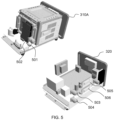
FIG. 3B , which shows an example system with modular electrical energy storage and arrangement ofconnected legs 331 andisolated legs 332.Connected legs 331 andisolated legs 332 may be used to mechanically support the device or modules (such as when placed on surfaces), and used to transfer electrical and mechanical connections between energy storage modules (e.g. batteries) 311, 312, and 313, topower device 321. Each leg may extend the height of the device enclosure, and may protrude below the enclosure on the bottom side for supporting the device when placed on a flat surface. The top of each leg may be flush with the enclosure or recessed to allow a second device to be placed on top of the first (bottom) device to electrically and mechanically connect to the first device. Each leg includes a conductor, a plug, a socket and a connection terminal, as shown inFIG. 3C . Apower device 321 may include acircuit board 321A with terminals electrically connected to eachconnected leg 331. Anenergy storage module 311 may include acircuit board 311A with a terminal connected to one of the legs (bottom left). Anenergy storage module 312 may include acircuit board 312A with a terminal connected to a second one of the legs (top left). Anenergy storage module 313 may include acircuit board 313A with a terminal connected to a third one of the legs (top right). The configuration of the connected legs provides separate (e.g. independent mechanically and electrically) isolated conductors for connecting each energy storage module to the power device through one of the leg pillars (the series of legs located one on top of the other). - Reference is now made to
FIG. 3C , which shows anexample device 340 with details ofconnected leg 341 andisolated leg 342. Power device/module 340 may include acircuit board 340A. Each leg includes aplug 344,socket 346, andconductor 343 electrically connectingplug 344 andsocket 346.Socket 346 includes arecess 349 to accept a plug from another device below (not shown), and plug is recessed to connect to a socket of the device above (not shown).Conductor 343 of each leg is enclosed inisolation material 348 to prevent short circuits.Isolation material 348 provides electr5ical isolation and mechanical support for the device, such as typically performed by rubber legs attached to the bottom of the device. Recesses (e.g. 349) ofplug 344 andsocket 346 provide some protection from accidental contact withsocket 346 or plug 344.Circuit conductor 345 electrically connectscircuit 340A to leg conductor 343 (e.g. directly, through socket, or through plug).Lock 347 may connect plug and socket to prevent separation of these during operation.Lock 347 may also include a cover to protect plug from accidental contact. - Reference is now made to
FIG. 4 , which shows two views of anexample charger 400 for modular electrical energy storage.Charger 400 may be connected to an AC or DC power source and to a charge/discharge port 305 of energy storage module (e.g. 310B). Aseparate charger 400 may allow swapping energy storage modules at a remote location and charging them at a power source located at a second location. - Reference is now made to
FIG. 5 , which shows, schematically, internal configuration of an exampleenergy storage module 310A and anexample power device 320.Energy storage module 310A internal components may include aconnecter 501 and aprotection circuit 502.Power device 320 may includeconnectors protection circuits protection circuits FIG. 2 ) causes a short circuit, theprotection circuit 505 may disconnectconnector 503 from the circuit board ofpower device 320 thus preventing failure of the main circuit ofpower device 320. - Reference is now made to
FIG. 6 , which shows anexample system 600 with modular electrical energy storage during testing. - Reference is now made to
FIG. 7 , which shows a flowchart of an example method for modular electrical energy storage operation. A power device (such aspower devices step step 703, the energy storage module (such as 104A, 104B, 104C, 310A, 310B, 311, 312, or 313) that failed may be disconnected 704 from the power device using a separate protection circuit (such as 204A, 204B, 204C, 502, 505, or 506) for each energy storage module. Protection circuits at the power device and the energy storage module allow redundant protection to improve uninterrupted power deliver to the loads. - Specific dimensions, specific materials, specific ranges, specific resistivities, specific voltages, specific shapes, and/or other specific properties and values disclosed herein are example in nature and do not limit the scope of the present disclosure. The disclosure herein of particular values and particular ranges of values for given parameters are not exclusive of other values and ranges of values that may be useful in one or more of the examples disclosed herein. Moreover, it is envisioned that any two particular values for a specific parameter stated herein may define the endpoints of a range of values that may be suitable for the given parameter. For example, the disclosure of a first value and a second value for a given parameter can be interpreted as disclosing that any value between the first and second values could also be employed for the given parameter. For example, if parameter X is exemplified herein to have value A and exemplified to have value Z, it is envisioned that parameter X may have a range of values from about A to about Z. Similarly, it is envisioned that disclosure of two or more ranges of values for a parameter (whether such ranges are nested, overlapping or distinct) subsume all possible combination of ranges for the value that might be claimed using endpoints of the disclosed ranges. For example, if parameter X is exemplified herein to have values in the range of 1-10, or 2-9, or 3-8, it is also envisioned that Parameter X may have other ranges of values including 1-9, 1-8, 1-3, 1-2, 2-10, 2-8, 2-3, 3-10, and 3-9.
- In the description of various illustrative features, reference is made to the accompanying drawings, which form a part hereof, and in which is shown, by way of illustration, various features in which aspects of the disclosure may be practiced. It is to be understood that other features may be utilized and structural and functional modifications may be made, without departing from the scope of the present disclosure.
- Terms such as "multiple" as used in this disclosure indicate the property of having or involving several parts, elements, or members.
- It may be noted that various connections are set forth between elements herein. These connections are described in general and, unless specified otherwise, may be direct or indirect; this specification is not intended to be limiting in this respect, and both direct and indirect connections are envisioned. Further, elements of one feature in any of the embodiments may be combined with elements from other features in any of the embodiments, in any combinations or sub-combinations.
- All described features, and modifications of the described features, are usable in all aspects of the inventions taught herein. Furthermore, all of the features, and all of the modifications of the features, of all of the embodiments described herein, are combinable and interchangeable with one another. For example, each of the features of the apparatus as specified in the following clauses 1-6,19-23,24-29,30-31 can be incorporated in any of the clauses and/or combined with any embodiments as described herein, e.g. with reference to the figures, or vice versa. Furthermore, the features embodied as an apparatus can be embodied as part of a method or a system, e.g. according to any of clauses 7-19, or vice versa.
- CLAUSES:
- Clause 1. An apparatus, comprising:
- at least one power converter;
- at least one power source terminal configured to connect to a power source;
- at least one load terminal;
- a plurality of energy storage terminals configured to connect to a plurality of electrical energy storage devices; and
- a plurality of protection circuits, wherein each of the plurality of protection circuits is electrically connected between a respective one of the plurality of energy storage terminals and the power converter, wherein the plurality of protection circuits are configured to disconnect the respective terminal from the power converter following a failure of the respective one of the plurality of electrical energy storage devices.
- Clause 2. The apparatus of Clause 1, wherein the power converter comprises an AC/DC or a DC/AC converter.
- Clause 3. The apparatus of any one of Clause 1 or 2, wherein the power converter comprises a DC/DC converter.
- Clause 4. The apparatus of any one of Clauses 1 to 3, wherein each of the plurality of protection circuits comprises at least one sensor configured for detecting the failure.
- Clause 5. The apparatus of any one of Clauses 1 to 4, wherein each of the plurality of protection circuits comprises a communication circuit for receiving a notification of failure from the respective one of the plurality of electrical energy storage devices.
- Clause 6. The apparatus of any one of Clauses 1 to 5, wherein the electrical energy storage devices comprise at least one storage element selected from the group consisting of batteries, thermal storage materials, kinetic storage materials, fuel cell, flow batteries, and electrochemical storage materials.
- Clause 7. A system comprising:
- a plurality of electrical energy storage modules;
- at least one load;
- a power source; and
- a power device, comprising:
- a converter circuit,
- a plurality of storage terminals configured to connect to each of the plurality of electrical energy storage modules,
- a plurality of protection circuits electrically connected between the respective one of the plurality of storage terminals and the converter circuit, wherein the plurality of protection circuits are configured to disconnect the respective terminal from the converter circuit following a failure of the respective one of the plurality of electrical energy storage modules.
- Clause 8. The system of Clause 7, wherein the power device comprises an AC/DC or a DC/AC converter.
- Clause 9. The system of any one of Clauses 7 or 8, wherein the power device comprises a DC/DC converter.
- Clause 10. The system of any one of Clauses 7 to 9, wherein each of the plurality of protection circuits comprises at least one sensor configured for detecting the failure.
- Clause 11. The system of any one of Clauses 7 to 10, wherein each of the plurality of protection circuits comprises a communication circuit for receiving a notification of failure from the respective one of the plurality of electrical energy storage modules.
- Clause 12. The system of any one of Clauses 7 to 11, wherein the electrical energy storage modules comprise at least one storage element selected from the group consisting of batteries, thermal storage materials, kinetic storage materials, fuel cell, flow batteries, and electrochemical storage materials.
- Clause 13. A method, comprising:
- discharging a plurality of electrical energy storage devices to at least one load using a plurality of energy storage terminals and at least one load terminal;
- charging the plurality of electrical energy storage devices using a power source connected to a power source terminal of a power converter;
- wherein each of a plurality of protection circuits is electrically connected between a respective one of the plurality of energy storage terminals and the power converter, and
- following a failure of a respective one of the plurality of protection circuits, disconnecting the respective terminal from the power converter.
- Clause 14. The method of Clause 13, wherein the power converter comprises an AC/DC or a DC/AC converter.
- Clause 15. The method of any one of Clauses 13 or 14, wherein the power converter comprises a DC/DC converter.
- Clause 16. The method of any one of Clauses 13 to 15, wherein each of the plurality of protection circuits comprises at least one sensor configured for detecting the failure.
- Clause 17. The method of any one of Clauses 13 to 16, wherein each of the plurality of protection circuits comprises a communication circuit for receiving a notification of failure from the respective one of the plurality of electrical energy storage devices.
- Clause 18. The method of any one of Clauses 13 to17, wherein the electrical energy storage devices comprise at least one storage element selected from the group consisting of batteries, thermal storage materials, kinetic storage materials, fuel cell, flow batteries, and electrochemical storage materials.
- Clause 19. An apparatus, comprising:
- an enclosure;
- a power converter;
- at least one power source terminal configured to connect to a power source;
- at least one load terminal;
- a plurality of legs, wherein at least one leg of the plurality of legs comprises:
- an electrical plug,
- an electrical socket,
- a conductor electrically connecting the electrical plug and the electrical socket, and an isolating material encasing at least part of the leg;
- wherein the leg extends the height of the enclosure,
- wherein at least part of the isolating material and at least part of the electrical socket protrude from a bottom side of the enclosure,
- wherein the electrical plug and the electrical socket are on opposite ends of the leg.
- Clause 20. The apparatus of Clause 19, wherein the conductor is electrically connected to the power converter.
- Clause 21. The apparatus of any one of Clause 19 or 20, wherein the power converter comprises an AC/DC converter, a DC/DC converter, or a DC/AC converter.
- Clause 22. The apparatus of any one of Clauses 19 to 21, further comprising a protection circuit, wherein the protection circuit is electrically connected between the conductor and the power converter, wherein the protection circuit is configured to disconnect the power converter from the conductor following a failure of a device connected to the electrical socket or the electrical plug.
- Clause 23. The apparatus of Clause 22, wherein the protection circuit comprises at least one sensor configured for detecting the failure.
- Clause 23. The apparatus of any one of Clauses 22 to 23, wherein the protection circuit comprises a communication circuit for receiving a notification of failure from an electrical energy storage devices.
- Clause 24. An apparatus, comprising:
- an enclosure;
- an electrical energy storage device;
- a plurality of legs, wherein at least one leg of the plurality of legs comprises:
- an electrical plug,
- an electrical socket,
- a conductor electrically connecting the electrical plug and the electrical socket, and an isolating material encasing at least part of the leg;
- wherein the leg extends the height of the enclosure,
- wherein at least part of the isolating material and at least part of the electrical socket protrude from a bottom side of the enclosure,
- wherein the electrical plug and the electrical socket are on opposite ends of the leg.
- Clause 25. The apparatus of Clause 24, wherein the conductor is electrically connected to the electrical energy storage device.
- Clause 26. The apparatus of any one of Clause 24 or 25, wherein the electrical energy storage devices comprise at least one storage element selected from the group consisting of batteries, thermal storage materials, kinetic storage materials, fuel cell, flow batteries, and electrochemical storage materials.
- Clause 27. The apparatus of any one of Clauses 24 to 26, further comprising a communication circuit for sending a notification of failure of the electrical energy storage device to another device.
- Clause 28. The apparatus of any one of Clauses 24 to 27, further comprising a protection circuit, wherein the protection circuit is electrically connected between the conductor and the electrical energy storage devices, wherein the protection circuit is configured to disconnect the electrical energy storage devices from the conductor following a failure of a device connected to the electrical socket or the electrical plug.
- Clause 29. The apparatus of Clause 28, wherein the protection circuit comprises at least one sensor configured for detecting the failure.
- Clause 30. The apparatus of any one of Clauses 1 to 6, further comprising:
- an enclosure;
- a plurality of legs, wherein at least one leg of the plurality of legs incorporates a terminal of the plurality of energy storage terminals, wherein the at least one leg comprises:
- an electrical plug,
- an electrical socket,
- a conductor electrically connecting the terminal, the electrical plug, and the electrical socket, and
- an isolating material encasing at least part of the leg;
- wherein the leg extends the height of the enclosure,
- wherein at least part of the isolating material and at least part of the electrical socket protrude from a bottom side of the enclosure,
- wherein the electrical plug and the electrical socket are on opposite ends of the leg.
- Clause 31. The apparatus of Clause 30, wherein the terminal is electrically connected to the power converter.
Claims (15)
- An apparatus, comprising:an enclosure;a power converter;at least one power source terminal configured to connect to a power source;at least one load terminal;a plurality of legs, wherein at least one leg of the plurality of legs comprises:an electrical plug,an electrical socket,a conductor electrically connecting the electrical plug and the electrical socket, andan isolating material encasing at least part of the leg;wherein the leg extends the height of the enclosure,wherein at least part of the isolating material and at least part of the electrical socket protrude from a bottom side of the enclosure,wherein the electrical plug and the electrical socket are on opposite ends of the leg.
- The apparatus of claim 1, wherein the conductor is electrically connected to the power converter.
- The apparatus of any one of claim 1 or 2, wherein the power converter comprises an AC/DC converter, a DC/DC converter, or a DC/AC converter.
- The apparatus of any one of claims 1 - 3, further comprising a protection circuit, wherein the protection circuit is electrically connected between the conductor and the power converter, wherein the protection circuit is configured to disconnect the power converter from the conductor following a failure of a device connected to the electrical socket or the electrical plug.
- The apparatus of claim 4, wherein the protection circuit comprises at least one sensor configured for detecting the failure.
- The apparatus of claim 4 or 5, wherein the protection circuit comprises a communication circuit for receiving a notification of failure from an electrical energy storage devices.
- An apparatus, comprising:an enclosure;an electrical energy storage device;a plurality of legs, wherein at least one leg of the plurality of legs comprises:an electrical plug,an electrical socket,a conductor electrically connecting the electrical plug and the electrical socket, andan isolating material encasing at least part of the leg;wherein the leg extends the height of the enclosure,wherein at least part of the isolating material and at least part of the electrical socket protrude from a bottom side of the enclosure,wherein the electrical plug and the electrical socket are on opposite ends of the leg.
- The apparatus of claim 7, wherein the conductor is electrically connected to the electrical energy storage device.
- The apparatus of any one of claim 7 or 8, wherein the electrical energy storage devices comprise at least one storage element selected from the group consisting of batteries, thermal storage materials, kinetic storage materials, fuel cell, flow batteries, and electrochemical storage materials.
- The apparatus of any one of claims 7 - 9, further comprising a communication circuit for sending a notification of failure of the electrical energy storage device to another device.
- The apparatus of any one of claims 7 - 10, further comprising a protection circuit, wherein the protection circuit is electrically connected between the conductor and the electrical energy storage devices, wherein the protection circuit is configured to disconnect the electrical energy storage devices from the conductor following a failure of a device connected to the electrical socket or the electrical plug.
- The apparatus of claim 11, wherein the protection circuit comprises at least one sensor configured for detecting the failure.
- The apparatus of any one of claims 7-12, wherein the electrical energy storage device comprises at least one storage element selected from the group consisting of batteries, fuel cells, flow batteries, and flywheels.
- A system comprisinga first apparatus according to any of the preceding claims;a second apparatus according to any of the preceding claims;wherein the electrical plug of the first apparatus is connected to the electrical socket of the second apparatus.
- Use of the apparatus or system according to any of the preceding claims.
Applications Claiming Priority (2)
| Application Number | Priority Date | Filing Date | Title |
|---|---|---|---|
| US201962955498P | 2019-12-31 | 2019-12-31 | |
| EP20217956.0A EP3846311B1 (en) | 2019-12-31 | 2020-12-31 | Modular electrical energy storage with fault protection |
Related Parent Applications (1)
| Application Number | Title | Priority Date | Filing Date |
|---|---|---|---|
| EP20217956.0A Division EP3846311B1 (en) | 2019-12-31 | 2020-12-31 | Modular electrical energy storage with fault protection |
Publications (1)
| Publication Number | Publication Date |
|---|---|
| EP4145672A1 true EP4145672A1 (en) | 2023-03-08 |
Family
ID=74129964
Family Applications (2)
| Application Number | Title | Priority Date | Filing Date |
|---|---|---|---|
| EP20217956.0A Active EP3846311B1 (en) | 2019-12-31 | 2020-12-31 | Modular electrical energy storage with fault protection |
| EP22203616.2A Pending EP4145672A1 (en) | 2019-12-31 | 2020-12-31 | Modular electrical energy storage |
Family Applications Before (1)
| Application Number | Title | Priority Date | Filing Date |
|---|---|---|---|
| EP20217956.0A Active EP3846311B1 (en) | 2019-12-31 | 2020-12-31 | Modular electrical energy storage with fault protection |
Country Status (3)
| Country | Link |
|---|---|
| US (3) | US11611212B2 (en) |
| EP (2) | EP3846311B1 (en) |
| CN (1) | CN113131501A (en) |
Families Citing this family (2)
| Publication number | Priority date | Publication date | Assignee | Title |
|---|---|---|---|---|
| US12580476B2 (en) * | 2022-12-01 | 2026-03-17 | Rivian Ip Holdings, Llc | Systems and methods for energy delivery |
| WO2025245223A1 (en) * | 2024-05-21 | 2025-11-27 | Milwaukee Electric Tool Corporation | Portable power system and related devices |
Citations (3)
| Publication number | Priority date | Publication date | Assignee | Title |
|---|---|---|---|---|
| US20110298626A1 (en) * | 2010-06-03 | 2011-12-08 | William Fechalos | Battery system and management method |
| WO2018031719A1 (en) * | 2016-08-10 | 2018-02-15 | Briggs & Stratton Corporation | User-scalable power unit including removable battery packs |
| JP6522843B1 (en) * | 2018-10-09 | 2019-05-29 | 株式会社アイ・ディー・エクス | Battery charging system and control method thereof |
Family Cites Families (9)
| Publication number | Priority date | Publication date | Assignee | Title |
|---|---|---|---|---|
| US5814968A (en) * | 1995-06-26 | 1998-09-29 | Long Range Systems, Inc. | Battery charger and rechargeable electronic paging device assembly |
| US8579461B2 (en) * | 2010-04-29 | 2013-11-12 | Winvic Sales Inc. | Rechargeable flameless candle systems and methods |
| US9385351B2 (en) * | 2012-01-06 | 2016-07-05 | Goal Zero Llc | Modular and portable battery pack power system |
| JP2014034079A (en) * | 2012-08-08 | 2014-02-24 | Nachi Fujikoshi Corp | Step drill |
| KR101754157B1 (en) * | 2015-04-29 | 2017-07-20 | 한국산업기술대학교산학협력단 | Energy storage system and method to improve efficiency of energy by the system |
| US10630085B2 (en) * | 2016-06-06 | 2020-04-21 | Omnicharge, Inc. | Portable power solutions |
| US20170373512A1 (en) * | 2016-06-21 | 2017-12-28 | Chunyi Wang | First Series Then Parallel Battery Pack System |
| CN107414759A (en) * | 2017-08-25 | 2017-12-01 | 宁波力神动力电池系统有限公司 | A kind of tooling platform for depositing battery box component |
| GB201815161D0 (en) * | 2018-09-18 | 2018-10-31 | Oe Electrics Ltd | Modular power and socket assembly |
-
2020
- 2020-12-23 US US17/133,202 patent/US11611212B2/en active Active
- 2020-12-31 EP EP20217956.0A patent/EP3846311B1/en active Active
- 2020-12-31 EP EP22203616.2A patent/EP4145672A1/en active Pending
- 2020-12-31 CN CN202011643297.5A patent/CN113131501A/en active Pending
-
2023
- 2023-01-20 US US18/157,148 patent/US12027848B2/en active Active
-
2024
- 2024-04-29 US US18/648,748 patent/US12322970B2/en active Active
Patent Citations (3)
| Publication number | Priority date | Publication date | Assignee | Title |
|---|---|---|---|---|
| US20110298626A1 (en) * | 2010-06-03 | 2011-12-08 | William Fechalos | Battery system and management method |
| WO2018031719A1 (en) * | 2016-08-10 | 2018-02-15 | Briggs & Stratton Corporation | User-scalable power unit including removable battery packs |
| JP6522843B1 (en) * | 2018-10-09 | 2019-05-29 | 株式会社アイ・ディー・エクス | Battery charging system and control method thereof |
Also Published As
| Publication number | Publication date |
|---|---|
| US20210203155A1 (en) | 2021-07-01 |
| US11611212B2 (en) | 2023-03-21 |
| US20230155376A1 (en) | 2023-05-18 |
| EP3846311A1 (en) | 2021-07-07 |
| EP3846311B1 (en) | 2022-10-26 |
| US20240356331A1 (en) | 2024-10-24 |
| US12027848B2 (en) | 2024-07-02 |
| US12322970B2 (en) | 2025-06-03 |
| CN113131501A (en) | 2021-07-16 |
Similar Documents
| Publication | Publication Date | Title |
|---|---|---|
| US12322970B2 (en) | Modular electrical energy storage with fault protection | |
| KR101234244B1 (en) | Battery system and power storage system including same | |
| US12088139B2 (en) | Modularized ESS and power distribution system | |
| US9780591B2 (en) | Adaptive battery pack | |
| CN102088198B (en) | Energy storage system | |
| US9478981B2 (en) | Battery system having identifiers and energy storage system including the same | |
| RU2669772C1 (en) | Modular power supply system | |
| CN102130464A (en) | Power storage apparatus, method of operating the same, and power storage system | |
| CN103155334A (en) | Energy storage system and controlling method of the same | |
| CN110140275A (en) | The UPS device that rack for data center is installed | |
| CN105655528B (en) | Battery module and driving method thereof | |
| KR101377745B1 (en) | Battery energy storage system, and charging method thereof | |
| US20250276599A1 (en) | Charging apparatus and charging system | |
| Chiu et al. | Design and implementation of a high‐efficiency bidirectional DC‐DC Converter for DC micro‐grid system applications | |
| CN113574766B (en) | Modular equipment for power supply | |
| CN115503634A (en) | Bidirectional power supply system for supplying power to battery management system of electric vehicle | |
| CN106557144B (en) | DC backup equipment | |
| CN116488222A (en) | An energy storage integrated cabinet | |
| US12334573B2 (en) | Reconfigurable architecture for stationary energy storage system | |
| CN223462787U (en) | Ultra-long standby power UPS system | |
| CN207426800U (en) | Portable UPS power | |
| CN109428400A (en) | Contact wireless charging method and device |
Legal Events
| Date | Code | Title | Description |
|---|---|---|---|
| PUAI | Public reference made under article 153(3) epc to a published international application that has entered the european phase |
Free format text: ORIGINAL CODE: 0009012 |
|
| STAA | Information on the status of an ep patent application or granted ep patent |
Free format text: STATUS: REQUEST FOR EXAMINATION WAS MADE |
|
| 17P | Request for examination filed |
Effective date: 20221025 |
|
| AC | Divisional application: reference to earlier application |
Ref document number: 3846311 Country of ref document: EP Kind code of ref document: P |
|
| AK | Designated contracting states |
Kind code of ref document: A1 Designated state(s): AL AT BE BG CH CY CZ DE DK EE ES FI FR GB GR HR HU IE IS IT LI LT LU LV MC MK MT NL NO PL PT RO RS SE SI SK SM TR |
|
| P01 | Opt-out of the competence of the unified patent court (upc) registered |
Effective date: 20230505 |
|
| RAP3 | Party data changed (applicant data changed or rights of an application transferred) |
Owner name: SOLAREDGE TECHNOLOGIES KOREA LIMITED COMPANY |
|
| RAP1 | Party data changed (applicant data changed or rights of an application transferred) |
Owner name: SOLAREDGE TECHNOLOGIES LTD. |
|
| GRAP | Despatch of communication of intention to grant a patent |
Free format text: ORIGINAL CODE: EPIDOSNIGR1 |
|
| STAA | Information on the status of an ep patent application or granted ep patent |
Free format text: STATUS: GRANT OF PATENT IS INTENDED |