EP4145593B1 - Air cooling type battery module having separate cooling structure for battery cell - Google Patents
Air cooling type battery module having separate cooling structure for battery cell Download PDFInfo
- Publication number
- EP4145593B1 EP4145593B1 EP21895046.7A EP21895046A EP4145593B1 EP 4145593 B1 EP4145593 B1 EP 4145593B1 EP 21895046 A EP21895046 A EP 21895046A EP 4145593 B1 EP4145593 B1 EP 4145593B1
- Authority
- EP
- European Patent Office
- Prior art keywords
- zone
- cooling
- cap
- cylindrical battery
- heat dissipation
- Prior art date
- Legal status (The legal status is an assumption and is not a legal conclusion. Google has not performed a legal analysis and makes no representation as to the accuracy of the status listed.)
- Active
Links
Images





Classifications
-
- H—ELECTRICITY
- H01—ELECTRIC ELEMENTS
- H01M—PROCESSES OR MEANS, e.g. BATTERIES, FOR THE DIRECT CONVERSION OF CHEMICAL ENERGY INTO ELECTRICAL ENERGY
- H01M10/00—Secondary cells; Manufacture thereof
- H01M10/60—Heating or cooling; Temperature control
- H01M10/64—Heating or cooling; Temperature control characterised by the shape of the cells
- H01M10/643—Cylindrical cells
-
- H—ELECTRICITY
- H01—ELECTRIC ELEMENTS
- H01M—PROCESSES OR MEANS, e.g. BATTERIES, FOR THE DIRECT CONVERSION OF CHEMICAL ENERGY INTO ELECTRICAL ENERGY
- H01M10/00—Secondary cells; Manufacture thereof
- H01M10/60—Heating or cooling; Temperature control
- H01M10/61—Types of temperature control
- H01M10/613—Cooling or keeping cold
-
- H—ELECTRICITY
- H01—ELECTRIC ELEMENTS
- H01M—PROCESSES OR MEANS, e.g. BATTERIES, FOR THE DIRECT CONVERSION OF CHEMICAL ENERGY INTO ELECTRICAL ENERGY
- H01M10/00—Secondary cells; Manufacture thereof
- H01M10/60—Heating or cooling; Temperature control
- H01M10/65—Means for temperature control structurally associated with the cells
- H01M10/653—Means for temperature control structurally associated with the cells characterised by electrically insulating or thermally conductive materials
-
- H—ELECTRICITY
- H01—ELECTRIC ELEMENTS
- H01M—PROCESSES OR MEANS, e.g. BATTERIES, FOR THE DIRECT CONVERSION OF CHEMICAL ENERGY INTO ELECTRICAL ENERGY
- H01M10/00—Secondary cells; Manufacture thereof
- H01M10/60—Heating or cooling; Temperature control
- H01M10/65—Means for temperature control structurally associated with the cells
- H01M10/655—Solid structures for heat exchange or heat conduction
- H01M10/6551—Surfaces specially adapted for heat dissipation or radiation, e.g. fins or coatings
-
- H—ELECTRICITY
- H01—ELECTRIC ELEMENTS
- H01M—PROCESSES OR MEANS, e.g. BATTERIES, FOR THE DIRECT CONVERSION OF CHEMICAL ENERGY INTO ELECTRICAL ENERGY
- H01M10/00—Secondary cells; Manufacture thereof
- H01M10/60—Heating or cooling; Temperature control
- H01M10/65—Means for temperature control structurally associated with the cells
- H01M10/656—Means for temperature control structurally associated with the cells characterised by the type of heat-exchange fluid
- H01M10/6561—Gases
-
- H—ELECTRICITY
- H01—ELECTRIC ELEMENTS
- H01M—PROCESSES OR MEANS, e.g. BATTERIES, FOR THE DIRECT CONVERSION OF CHEMICAL ENERGY INTO ELECTRICAL ENERGY
- H01M50/00—Constructional details or processes of manufacture of the non-active parts of electrochemical cells other than fuel cells, e.g. hybrid cells
- H01M50/20—Mountings; Secondary casings or frames; Racks, modules or packs; Suspension devices; Shock absorbers; Transport or carrying devices; Holders
-
- H—ELECTRICITY
- H01—ELECTRIC ELEMENTS
- H01M—PROCESSES OR MEANS, e.g. BATTERIES, FOR THE DIRECT CONVERSION OF CHEMICAL ENERGY INTO ELECTRICAL ENERGY
- H01M50/00—Constructional details or processes of manufacture of the non-active parts of electrochemical cells other than fuel cells, e.g. hybrid cells
- H01M50/20—Mountings; Secondary casings or frames; Racks, modules or packs; Suspension devices; Shock absorbers; Transport or carrying devices; Holders
- H01M50/204—Racks, modules or packs for multiple batteries or multiple cells
- H01M50/207—Racks, modules or packs for multiple batteries or multiple cells characterised by their shape
- H01M50/213—Racks, modules or packs for multiple batteries or multiple cells characterised by their shape adapted for cells having curved cross-section, e.g. round or elliptic
-
- H—ELECTRICITY
- H01—ELECTRIC ELEMENTS
- H01M—PROCESSES OR MEANS, e.g. BATTERIES, FOR THE DIRECT CONVERSION OF CHEMICAL ENERGY INTO ELECTRICAL ENERGY
- H01M50/00—Constructional details or processes of manufacture of the non-active parts of electrochemical cells other than fuel cells, e.g. hybrid cells
- H01M50/20—Mountings; Secondary casings or frames; Racks, modules or packs; Suspension devices; Shock absorbers; Transport or carrying devices; Holders
- H01M50/289—Mountings; Secondary casings or frames; Racks, modules or packs; Suspension devices; Shock absorbers; Transport or carrying devices; Holders characterised by spacing elements or positioning means within frames, racks or packs
-
- H—ELECTRICITY
- H01—ELECTRIC ELEMENTS
- H01M—PROCESSES OR MEANS, e.g. BATTERIES, FOR THE DIRECT CONVERSION OF CHEMICAL ENERGY INTO ELECTRICAL ENERGY
- H01M50/00—Constructional details or processes of manufacture of the non-active parts of electrochemical cells other than fuel cells, e.g. hybrid cells
- H01M50/50—Current conducting connections for cells or batteries
- H01M50/502—Interconnectors for connecting terminals of adjacent batteries; Interconnectors for connecting cells outside a battery casing
-
- H—ELECTRICITY
- H01—ELECTRIC ELEMENTS
- H01M—PROCESSES OR MEANS, e.g. BATTERIES, FOR THE DIRECT CONVERSION OF CHEMICAL ENERGY INTO ELECTRICAL ENERGY
- H01M50/00—Constructional details or processes of manufacture of the non-active parts of electrochemical cells other than fuel cells, e.g. hybrid cells
- H01M50/50—Current conducting connections for cells or batteries
- H01M50/502—Interconnectors for connecting terminals of adjacent batteries; Interconnectors for connecting cells outside a battery casing
- H01M50/505—Interconnectors for connecting terminals of adjacent batteries; Interconnectors for connecting cells outside a battery casing comprising a single busbar
-
- Y—GENERAL TAGGING OF NEW TECHNOLOGICAL DEVELOPMENTS; GENERAL TAGGING OF CROSS-SECTIONAL TECHNOLOGIES SPANNING OVER SEVERAL SECTIONS OF THE IPC; TECHNICAL SUBJECTS COVERED BY FORMER USPC CROSS-REFERENCE ART COLLECTIONS [XRACs] AND DIGESTS
- Y02—TECHNOLOGIES OR APPLICATIONS FOR MITIGATION OR ADAPTATION AGAINST CLIMATE CHANGE
- Y02E—REDUCTION OF GREENHOUSE GAS [GHG] EMISSIONS, RELATED TO ENERGY GENERATION, TRANSMISSION OR DISTRIBUTION
- Y02E60/00—Enabling technologies; Technologies with a potential or indirect contribution to GHG emissions mitigation
- Y02E60/10—Energy storage using batteries
Definitions
- the present disclosure relates to a cooling technology for a battery module, and more particularly, to a battery module to which a cooling structure is applied to reduce a temperature deviation of each battery cell and improve cooling efficiency during cooling using an air cooling method.
- Secondary batteries refer to batteries that may be repeatedly charged and discharged unlike primary batteries that may not be recharged, and secondary batteries are used as power sources for energy storage systems (ESSs), electric vehicles (EVs), or hybrid vehicles (HEVs) as well as small high-tech electronic devices such as mobile phones, personal digital assistants (PDAs), and laptop computers.
- ESSs energy storage systems
- EVs electric vehicles
- HEVs hybrid vehicles
- small high-tech electronic devices such as mobile phones, personal digital assistants (PDAs), and laptop computers.
- a battery module in which a plurality of lithium ion battery cells are connected in series and/or in parallel should be configured, the battery modules are typically connected in series, and a battery pack including a battery management system (BMS) for functionally maintaining the battery modules, a cooling system, a battery disconnection unit (BDU), an electrical wiring cable, etc. is configured.
- BMS battery management system
- BDU battery disconnection unit
- a secondary battery cell generates heat during repeated charging and discharging.
- a temperature continuously rises, thereby degrading the performance of the secondary battery cell and increasing the risk of firing or exploding the secondary battery cell. Accordingly, when a battery module is configured, cooling of secondary battery cells is the most important task.
- cooling battery cells 1 there is a battery module in which a cooling plate 2 is applied to the bottom as shown in FIG. 1 .
- the cooling plate 2 includes a bottom plate 2a contacting bottom surfaces of all of the secondary battery cells 1, and a plurality of cooling fins 2b extending perpendicularly from the bottom surface 2a to increase a heat dissipation area.
- the secondary battery cells 1 are usually densely arranged inside a module case 3, heat exchange occurs between adjacent secondary battery cells 1, which causes a temperature difference between the secondary battery cells located at outer positions and the secondary battery cells located at inner positions. It is difficult to resolve the temperature difference between the secondary battery cells 1 by using the cooling plate 2 of the related art. Also, because the cooling air flows in one direction while absorbing the heat, a temperature of a rear portion of the cooling plate 2 is higher than that of a front portion of the cooling plate 2, and thus, it is more difficult to rapidly cool the secondary battery cells 1 with no cooling deviation.
- JP 2007 012486 A KR 2020 0058955 A , KR 2020 0078220 A , JP 2019 129149 A , JP 2011 175896 A , and KR 101 967 824 B1 .
- a battery module comprising: cylindrical battery cells arranged in horizontal and vertical directions, with their respective top caps facing upwards; a module case in which the cylindrical battery cells are accommodated; and cooling caps mounted on lower end portions of the cylindrical battery cells, wherein the cooling caps protrude below a lower end of the module case to contact cooling air in a lower portion the module case.
- the present disclosure is designed to solve the problems of the related art, and therefore the present disclosure is directed to applying a cooling structure capable of reducing a temperature deviation of each battery cell during cooling and further improving cooling efficiency to a battery module.
- a battery module including: cylindrical battery cells arranged in horizontal and vertical directions, with their respective top caps facing upwards; a module case in which the cylindrical battery cells are accommodated; and cooling caps mounted on lower end portions of the cylindrical battery cells, wherein the cooling caps protrude below a lower end of the module case to contact cooling air in a lower portion the module case, and protrude to have different heights for pre-determined zones according to positions of the cylindrical battery cells located inside the module case.
- Each of the cooling caps may include: a receiving portion into which a lower end portion of the cylindrical battery cell is inserted; and a heat dissipation portion extending downward from the receiving portion.
- the cooling caps may include: a first cooling cap including the heat dissipation portion that is divided to have a plurality of fins; a second cooling cap including the heat dissipation portion that is shorter than the heat dissipation portion of the first cooling cap; a third cooling cap including the heat dissipation portion that is longer than the heat dissipation portion of the second cooling cap and shorter than the heat dissipation portion of the first cooling cap; and a fourth cooling cap including the heat dissipation portion that has a same length as the heat dissipation portion of the first cooling cap.
- the pre-determined zones may include: a first zone on a left side; a third zone on a right side; and a second zone between the first zone and the third zone, which are divided in a left-right width direction of the module case, wherein the second cooling cap, the third cooling cap, and the fourth cooling cap are mounted, from the front of the module case, on the cylindrical battery cells located in the first zone and the third zone, and the first cooling cap is mounted on the cylindrical battery cells located in the second zone.
- the first zone may include: a 1_1 th zone of a front portion; a 1_2 th zone of a middle portion; and a 1_3 th zone of a rear portion, which are divided in a front-rear width direction of the module case
- the third zone may include: a 3_1 th zone of a front portion; a 3_2 th zone of a middle portion; and a 3_3 th zone of a rear portion, which are divided in the front-rear width direction of the module case, wherein the second cooling cap is mounted on the cylindrical battery cells located in the 1_1 th zone and the 3_1 th zone, the third cooling cap is mounted on the cylindrical battery cells located in the 1_2 th zone and the 3_2 th zone, and the fourth cooling cap is mounted on the cylindrical battery cells located in the 1_3 th zone and the 3_3 th zone.
- the first zone and the third zone may be symmetric to each other with respect to the second zone.
- the cooling caps may be formed of aluminum , copper, or graphite.
- At least one of the cooling caps may be provided so that the heat dissipation portion has a pillar shape having a plurality of holes or a lattice structure.
- the module case may include a lower frame and an upper frame vertically coupled to each other with the cylindrical battery cells therebetween, wherein the cooling caps protrude below a bottom surface of the lower frame, wherein the upper frame includes: an upper plate portion covering upper portions of the cylindrical battery cells and including a hole at a position corresponding to the top cap of each cylindrical battery cell; and bus bars extending straight in a front-rear direction of the module case from the upper plate portion and spaced apart from one another by a certain interval in a left-right width direction of the module case, wherein the top caps and upper ends of battery cans of the cylindrical battery cells are connected to the bus bars in a pre-determined pattern by metal wires.
- the upper frame may further include partition plates each protruding upward between a (+) metal wire from the top cap and a (-) metal wire from the upper end of the battery can.
- a battery pack including the battery module.
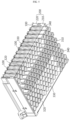
- FIG. 2 is a perspective view illustrating a battery module, when viewed from the bottom, according to an embodiment of the present disclosure.
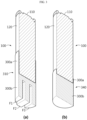
- FIG. 3 is a cut-away view illustrating a cylindrical battery cell on which a cooling cap is mounted according to an embodiment of the present disclosure.
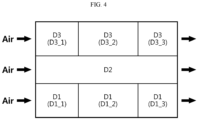
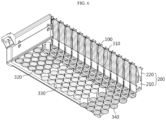
- FIG. 4 is a view illustrating that a lower portion of the battery module of FIG. 2 is divided into several zones.
- a battery module 10 includes cylindrical battery cells 100, a module case 200, and cooling caps 300.
- cooling caps 300 may protrude below a lower end of the module case 200 to have different heights for pre-determined zones according to positions of the cylindrical battery cells 100 located inside the module case 200.
- the same cooling cap 300 is not applied to all of the battery cells 100, in the battery module 10 according to the present disclosure.
- Different cooling caps 300 for pre-determined zones may be applied according to positions of the cylindrical battery cells 100 located inside the module case 200.
- the cooling caps 300 of the present embodiment include a first cooling cap 310, a second cooling cap 320, a third cooling cap 330, and a fourth cooling cap 340 as shown in FIG. 2 .
- cooling caps 300 A common feature of the cooling caps 300 will be first described and then a difference therebetween will be described.
- the cooling caps 300 are formed of a material having excellent thermal conductivity such as aluminum , copper, or graphite, and commonly include a receiving portion 300a and a heat dissipation portion 300b as shown in FIG. 3 .
- an insulating sheet may be coated around the battery can 120, to secure insulation between the cylindrical battery cell 100 and the cooling cap 300 formed of a metal material.
- a lower end portion of the cylindrical battery cell 100 may be inserted into the receiving portion 300a, and the receiving portion 300a may surround a part of an outer circumferential surface and a bottom surface of the cylindrical battery cell 100.
- the receiving portion 300a of the cooling cap 300 may advantageously increase conductive heat dissipation effect between the cooling cap 300 and the cylindrical battery cell 100.
- a difference between the first cooling cap 310 through the fourth cooling cap 340 lies in a length or a shape of the receiving portion 300a or the heat dissipation portion 300b.
- lengths of the heat dissipation portions 300b are the same but shapes of the heat dissipation portions 300b are different.
- the heat dissipation portion 300b of the first cooling cap 310 has a shape in which a body is divided to have a plurality of fins F1, F2, F3, the heat dissipation portion 300b of the fourth cooling cap 340 has a simple cylindrical shape, and thus, a heat dissipation area contacting air of the heat dissipation portion 300b of the first cooling cap 310 is larger than that of the heat dissipation portion 300b of the fourth cooling cap 340.
- the first cooling cap 310 includes the receiving portion 300a that is relatively long compared to the other ones and includes the heat dissipation portion 300b including the plurality of fins F1, F2, F3.
- the first cooling cap 310 and the fourth cooling cap 340 have the longest heat dissipation portion 300b, the second cooling cap 320 is the shortest, and the third cooling cap 330 is longer than the second cooling cap 320 and is shorter than the first cooling cap 310 or the fourth cooling cap 340.
- the heat dissipation performance of the cooling caps 300 is good in the order of the first cooling cap 310 > the fourth cooling cap 340 > the third cooling cap 330 > the second cooling cap 320.
- the pre-determined zones may be determined by analyzing a temperature distribution for each zone of the battery module 10 during charging/recharging of the battery module 10 in a state where a cooling device is not driven, and a temperature change for each zone of cooling air flowing along a lower end of the module case 200 during air cooling.
- the pre-determined zones may include a first zone D1, a second zone D2, and a third zone D3 divided from left to right in a left-right width direction ( ⁇ Y axis direction) of the module case 200.
- the second zone D2 is located between the first zone D1 and the second zone D2 and extends from the front to the rear of the module case 200
- the first zone D1 is a left area of the module case 200 extending from the front to the rear of the module case 200
- the third zone D3 is a right area of the module case 200 extending from the front to the rear of the module case 200.
- the first zone D1 and the third zone D3 are symmetric to each other with respect to the second zone D2.
- Each of the first zone D1 and the third zone D3 may be divided into three zones. Each zone is divided by considering a flow direction of cooling air, and it is assumed that cooling air enters from the front of the battery module 10, horizontally flows along a lower portion of the module case 200, and exits to the rear of the battery module 10.
- the first zone D1 may be divided into a 1_1 th zone D1_1 of a front portion, a 1_2 th zone D1_2 of a middle portion, and a 1_3 th zone D1_3 of a rear portion in a front-rear width direction ( ⁇ Y axis direction) of the module case 200
- the third zone D3 may be divided into a 3_1 th zone D3_1 of a front portion, a 3_2 th zone D3_2 of a middle portion, and a 3_3 th zone D3_3 of a rear portion in the front-rear width direction of the module case 200.
- cooling caps 300 are used.
- the first cooling caps 310 are mounted on the cylindrical battery cells 100 located at a position corresponding to the second zone D2.
- the first cooling caps 310 are applied to all of the second zone D2, for example, when a size of the battery module 10 is larger than that of the present embodiment, the second zone D2 may be sub-divided and the first cooling caps 310 having different lengths may be applied to the sub-divided zones.
- the second cooling caps 320, the third cooling caps 330, and the fourth cooling caps 340 are mounted, from the front of the module case 200, on the cylindrical battery cells 100 located in the first zone D1 and the third zone D3.
- the 1_1 th zone D1_1 uses the second cooling cap 320
- the 1_2 th zone D1_2 uses the third cooling cap 330 having better heat dissipation performance than the 1_1 th zone D1_1
- the 1_3 th zone D1_3 uses the fourth cooling cap 340 having better heat dissipation performance than the 1_2 th zone D1_2.
- the 3_1 th zone D3_1 uses the second cooling cap 320
- the 3_2 th zone D3_2 uses the third cooling cap 330
- the 3_3 th zone D3_3 uses the fourth cooling cap 340.
- the pre-determined zones are seven zones in the present embodiment, this is merely an example, and the pre-determined zones may be determined to be more or less than seven zones according to a size or a structure of the battery module 10 or a flow direction of cooling air, and an average temperature may be reduced by reducing a temperature deviation by increasing or reducing a cooling portion of the cylindrical battery cell 100 in a corresponding zone.
- the battery module 10 individually cools the cylindrical battery cells 100 by using multiple cooling caps 300, when compared to the related art (see FIG. 1 ), the cylindrical battery cells 100 may be rapidly cooled and a temperature deviation may be managed for each zone.
- FIG. 9 is a view illustrating different types of cooling caps 300A, 300B according to the present disclosure.
- a receiving portion 300Aa is short, but a plurality of holes H1 are formed in a heat dissipation portion 300Ab to increase a heat dissipation area and improve ventilation.
- a receiving portion 300Ba extends to half a height of the cylindrical battery cell 100 to maximize conductive heat dissipation effect and convective heat dissipation effect and a three-dimensional lattice structure is formed in a heat dissipation portion 300Bb.
- the cooling cap 300 may have different heat dissipation performance by variously modifying a length and a shape of the receiving portion 300a or the heat dissipation portion 300b.
- all of the cylindrical battery cells 100 are located upright with the top cap 110 facing upward, and are accommodated in the module case 200 in a horizontal or vertical direction.
- the upper plate portion 221 of the upper frame 220 has a small hole at a position corresponding to the top cap 110 of the cylindrical battery cell 100. A middle portion of the top cap 110 and an uppermost end of the battery can 120 may be seen under the hole.
- a plurality of bus bars 223 are located on a top surface of the upper plate portion 221.
- Each bus bar 223 has a long band shape and extends straight in a front-rear direction of the module case 200, and the bus bars 223 are spaced apart from one another between the cylindrical battery cells 100 in a left-right direction of the module case 200.
- a leftmost bus bar 224a in the drawing may be integrally formed with a positive electrode terminal T1 of the battery module 10
- a rightmost bus bar 224b may be integrally formed with a negative electrode terminal T2 of the battery module 10.
- the cylindrical battery cells 100 are connected to one another in series and/or in parallel as the top caps 110 and upper ends of the battery cans 120 are connected to the bus bars 223 in a pre-determined pattern by using metal wires.
- an upper end of the battery can 120 is connected to the leftmost bus bar 223 by using a (-) metal wire W2, and the top cap 110 is connected to an adjacent second bus bar 223 by using a (+) metal wire W1.
- an upper end of the battery can 120 is connected to the second bus bar 223 by using a (-) metal wire W2, and the top cap 110 is connected to an adjacent third bus bar 223 by using a (+) metal wire W1.
- metal wire bonding is performed up to a rightmost bus bar 223, the cylindrical battery cells 100 in the same column are connected in parallel, and the cylindrical batteries 100 in different columns are connected in series.
- the upper plate portion 221 includes partition plates 225. Each of the partition plates 225 protrudes upward between the (+) metal wire W1 from the top cap 110 and the (-) metal wire W2 from the upper end of the battery can 120. When wire bonding is performed, the partition plate 225 may reduce the risk of short circuit between metal wires and, even when a metal body unexpectedly falls on the upper plate portion 221, may prevent simultaneous contact with the (+) metal wire W1 and the (-) metal wire W2.
- a battery pack according to the present disclosure may include one or more battery modules according to the present disclosure. Also, the battery pack according to the present disclosure may further include, in addition to the battery modules, a pack case for accommodating the battery modules, and various devices for controlling charging and discharging of each battery module, for example, a battery management system (BMS), a current sensor, and a fuse.
- BMS battery management system
- the battery module according to the present disclosure may be applied to a vehicle such as an electric vehicle or a hybrid vehicle, or an energy storage system (ESS).
- a vehicle such as an electric vehicle or a hybrid vehicle, or an energy storage system (ESS).
- ESS energy storage system
Landscapes
- Chemical & Material Sciences (AREA)
- Chemical Kinetics & Catalysis (AREA)
- Electrochemistry (AREA)
- General Chemical & Material Sciences (AREA)
- Engineering & Computer Science (AREA)
- Manufacturing & Machinery (AREA)
- Secondary Cells (AREA)
- Battery Mounting, Suspending (AREA)
- Connection Of Batteries Or Terminals (AREA)
Description
- The present disclosure relates to a cooling technology for a battery module, and more particularly, to a battery module to which a cooling structure is applied to reduce a temperature deviation of each battery cell and improve cooling efficiency during cooling using an air cooling method.
- The present application claims priority to
Korean Patent Application No. 10-2020-0157806 filed on November 23, 2020 - Secondary batteries refer to batteries that may be repeatedly charged and discharged unlike primary batteries that may not be recharged, and secondary batteries are used as power sources for energy storage systems (ESSs), electric vehicles (EVs), or hybrid vehicles (HEVs) as well as small high-tech electronic devices such as mobile phones, personal digital assistants (PDAs), and laptop computers.
- Currently, sufficient power to drive an electric vehicle may not be obtained from only one lithium secondary battery (cell). In order to apply a secondary battery as an energy source for an electric vehicle, a battery module in which a plurality of lithium ion battery cells are connected in series and/or in parallel should be configured, the battery modules are typically connected in series, and a battery pack including a battery management system (BMS) for functionally maintaining the battery modules, a cooling system, a battery disconnection unit (BDU), an electrical wiring cable, etc. is configured.
- A secondary battery cell generates heat during repeated charging and discharging. In this case, when the secondary battery cell is not cooled, a temperature continuously rises, thereby degrading the performance of the secondary battery cell and increasing the risk of firing or exploding the secondary battery cell. Accordingly, when a battery module is configured, cooling of secondary battery cells is the most important task.
- As an example for
cooling battery cells 1, there is a battery module in which a cooling plate 2 is applied to the bottom as shown inFIG. 1 . The cooling plate 2 includes abottom plate 2a contacting bottom surfaces of all of thesecondary battery cells 1, and a plurality ofcooling fins 2b extending perpendicularly from thebottom surface 2a to increase a heat dissipation area. - In the related art, cooling air is supplied to the bottom of the battery module to contact the cooling plate 2, and thus, the cooling air absorbs heat of each of the
secondary battery cells 1 using the cooling plate 2 as a heat transfer medium to cool thesecondary battery cells 1. - However, because the
secondary battery cells 1 are usually densely arranged inside amodule case 3, heat exchange occurs between adjacentsecondary battery cells 1, which causes a temperature difference between the secondary battery cells located at outer positions and the secondary battery cells located at inner positions. It is difficult to resolve the temperature difference between thesecondary battery cells 1 by using the cooling plate 2 of the related art. Also, because the cooling air flows in one direction while absorbing the heat, a temperature of a rear portion of the cooling plate 2 is higher than that of a front portion of the cooling plate 2, and thus, it is more difficult to rapidly cool thesecondary battery cells 1 with no cooling deviation. - The prior art relevant for the present invention is given by
JP 2007 012486 A KR 2020 0058955 A KR 2020 0078220 A JP 2019 129149 A JP 2011 175896 A KR 101 967 824 B1 - The present disclosure is designed to solve the problems of the related art, and therefore the present disclosure is directed to applying a cooling structure capable of reducing a temperature deviation of each battery cell during cooling and further improving cooling efficiency to a battery module.
- However, technical problems to be solved by the present disclosure are not limited to the above-described technical problems and one of ordinary skill in the art will understand other technical problems from the following description.
- In one aspect of the present disclosure, there is provided a battery module including: cylindrical battery cells arranged in horizontal and vertical directions, with their respective top caps facing upwards; a module case in which the cylindrical battery cells are accommodated; and cooling caps mounted on lower end portions of the cylindrical battery cells, wherein the cooling caps protrude below a lower end of the module case to contact cooling air in a lower portion the module case, and protrude to have different heights for pre-determined zones according to positions of the cylindrical battery cells located inside the module case.
- Each of the cooling caps may include: a receiving portion into which a lower end portion of the cylindrical battery cell is inserted; and a heat dissipation portion extending downward from the receiving portion.
- The cooling caps may include: a first cooling cap including the heat dissipation portion that is divided to have a plurality of fins; a second cooling cap including the heat dissipation portion that is shorter than the heat dissipation portion of the first cooling cap; a third cooling cap including the heat dissipation portion that is longer than the heat dissipation portion of the second cooling cap and shorter than the heat dissipation portion of the first cooling cap; and a fourth cooling cap including the heat dissipation portion that has a same length as the heat dissipation portion of the first cooling cap.
- The pre-determined zones may include: a first zone on a left side; a third zone on a right side; and a second zone between the first zone and the third zone, which are divided in a left-right width direction of the module case, wherein the second cooling cap, the third cooling cap, and the fourth cooling cap are mounted, from the front of the module case, on the cylindrical battery cells located in the first zone and the third zone, and the first cooling cap is mounted on the cylindrical battery cells located in the second zone.
- The first zone may include: a 1_1th zone of a front portion; a 1_2th zone of a middle portion; and a 1_3th zone of a rear portion, which are divided in a front-rear width direction of the module case, and the third zone may include: a 3_1th zone of a front portion; a 3_2th zone of a middle portion; and a 3_3th zone of a rear portion, which are divided in the front-rear width direction of the module case, wherein the second cooling cap is mounted on the cylindrical battery cells located in the 1_1th zone and the 3_1th zone, the third cooling cap is mounted on the cylindrical battery cells located in the 1_2th zone and the 3_2th zone, and the fourth cooling cap is mounted on the cylindrical battery cells located in the 1_3th zone and the 3_3th zone.
- The first zone and the third zone may be symmetric to each other with respect to the second zone.
- The cooling caps may be formed of aluminum , copper, or graphite.
- At least one of the cooling caps may be provided so that the heat dissipation portion has a pillar shape having a plurality of holes or a lattice structure.
- The module case may include a lower frame and an upper frame vertically coupled to each other with the cylindrical battery cells therebetween, wherein the cooling caps protrude below a bottom surface of the lower frame, wherein the upper frame includes: an upper plate portion covering upper portions of the cylindrical battery cells and including a hole at a position corresponding to the top cap of each cylindrical battery cell; and bus bars extending straight in a front-rear direction of the module case from the upper plate portion and spaced apart from one another by a certain interval in a left-right width direction of the module case, wherein the top caps and upper ends of battery cans of the cylindrical battery cells are connected to the bus bars in a pre-determined pattern by metal wires.
- The upper frame may further include partition plates each protruding upward between a (+) metal wire from the top cap and a (-) metal wire from the upper end of the battery can.
- In another aspect of the present disclosure, there is also provided a battery pack including the battery module.
- According to an aspect of the present disclosure, a battery module having a cooling structure capable of reducing a temperature deviation of each battery cell during cooling and further improving cooling efficiency may be provided.
- The effects of the present disclosure are not limited to the effects mentioned above, and other effects not mentioned will be clearly understood by one of ordinary skill in the art from the specification and the attached drawings.
-
-
FIG. 1 is a view illustrating a cooling configuration of a battery module according to the related art. -
FIG. 2 is a perspective view illustrating a battery module, when viewed from the bottom, according to an embodiment of the present disclosure. -
FIG. 3 is a cut-away view illustrating a circular cylindrical battery cell on which a cooling cap is mounted according to an embodiment of the present disclosure. -
FIG. 4 is a view illustrating that a bottom of the battery module ofFIG. 2 is divided into several zones. -
FIG. 5 is a cross-sectional view illustrating the battery module taken along line A-A' ofFIG. 2 . -
FIG. 6 is a cross-sectional view illustrating the battery module taken along line B-B' ofFIG. 2 . -
FIG. 7 is a cross-sectional view illustrating the battery module taken along line C-C' ofFIG. 2 . -
FIG. 8 is a cross-sectional view illustrating the battery module taken along line D-D' ofFIG. 2 . -
FIG. 9 is a view illustrating modification examples of a cooling cap. -
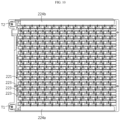
FIG. 10 is a plan view illustrating a battery module according to an embodiment of the present disclosure. -
FIG. 11 is a partial enlarged perspective view ofFIG. 10 . - Hereinafter, embodiments of the present disclosure will be described with reference to the accompanying drawings. Prior to the description, it should be understood that the terms used in the specification and the appended claims should not be construed as limited to general and dictionary meanings, but interpreted based on the meanings and concepts corresponding to technical aspects of the present disclosure on the basis of the principle that the inventor is allowed to define terms appropriately for the best explanation.
- Therefore, the description proposed herein is just a preferable example for the purpose of illustrations only, not intended to limit the scope of the present disclosure, so it should be understood that other equivalents and modifications could be made thereto without departing from the scope of the present disclosure. These embodiments are provided so that this disclosure will be thorough and complete, and will fully convey the scope of the disclosure to one of ordinary skill in the art. Accordingly, the thickness and size of each element shown in the drawings may be exaggerated, omitted or schematically drawn for the purpose of clarity. Accordingly, the size of each element does not utterly reflect an actual size or ratio.
-
FIG. 2 is a perspective view illustrating a battery module, when viewed from the bottom, according to an embodiment of the present disclosure.FIG. 3 is a cut-away view illustrating a cylindrical battery cell on which a cooling cap is mounted according to an embodiment of the present disclosure.FIG. 4 is a view illustrating that a lower portion of the battery module ofFIG. 2 is divided into several zones. - Referring to
FIGS. 2 through 4 , abattery module 10 according to an embodiment of the present disclosure includescylindrical battery cells 100, amodule case 200, andcooling caps 300. - The
battery module 10 according to the present disclosure may include thecylindrical battery cells 100. Thecylindrical battery cell 100 is a can-type secondary battery in which an electrode assembly is embedded in a metal can. Although not shown in detail, thecylindrical battery cell 100 may include a cylindrical battery can 120, an electrode assembly, and atop cap 110, and may be manufactured by putting an electrolyte and the electrode assembly in the battery can 120, locating thetop cap 110 at an upper open end of the battery can 120, and sealing the battery can 120 by crimping an uppermost end of the battery can 120. - The electrode assembly of the
cylindrical battery cell 100 is a jelly-roll type electrode assembly with a separator located between a positive electrode and a negative electrode, and a positive electrode tab is attached to the positive electrode and is connected to thetop cap 110, and a negative electrode tab is attached to the negative electrode and is connected to a lower end of the battery can 120. Accordingly, in the typicalcylindrical battery cell 100, thetop cap 110 functions as a positive electrode terminal and the battery can 120 functions as a negative electrode terminal. - For reference, although the
battery module 10 is configured by applying thecylindrical battery cell 100 in the present embodiment, thebattery module 10 may be configured by applying a prismatic battery cell, instead of a cylindrical battery cell. In this case, thecooling cap 300 described below is deformed to be fitted around the prismatic battery cell. - The
cylindrical battery cells 100 may be connected in series and/or in parallel according to the output and capacity required for thebattery module 10. For example, a pre-set number ofcylindrical battery cells 100 may be accommodated in horizontal and vertical directions inside themodule case 200 with thetop cap 110 facing upward, and thecylindrical battery cells 100 may be arranged in series and/or in parallel by connecting thetop cap 110 of eachcylindrical battery cell 100 or an upper end of the battery can 120 to a metal bar-shapedbus bar 223 by using a wire, which will be described below in more detail. - The
module case 200 is a structure in which thecylindrical battery cells 100 are accommodated, and protects thecylindrical battery cells 100 from external impact, vibration, or the like. Themodule case 200 of the present disclosure includes alower frame 210 and anupper frame 220 provided to be vertically coupled to each other with thecylindrical battery cells 100 therebetween. - The
lower frame 210 may include four side portions in front, rear, left, and right directions, a lower plate portion forming a bottom surface, and an open upper portion. The lower plate portion may include holders for fixedly supporting thecylindrical battery cells 100, and holes for protruding the cooling caps 300 mounted on lower end portions of thecylindrical battery cells 100 below the lower plate portion. - The
upper frame 220 may include four side portions in front, rear, left, and right directions, anupper plate portion 221 covering uppermost ends of thecylindrical battery cells 100, and an open lower portion. - For easy attachment and detachment of the
upper frame 220 and thelower frame 210, hooks may be provided on the front and rear side portions of theupper frame 220, and hook holes into which the hooks may be inserted may be provided in the front and rear side portions of thelower frame 210. - The
cylindrical battery cells 100 may be arranged in the horizontal (±X axis) and vertical (±Y axis) directions inside themodule case 200 with thetop cap 110 facing upward, and thecylindrical battery cells 100 may be fixedly supported by the holders inside themodule case 200. - The cooling caps 300 are means for effectively dissipating heat generated in the
cylindrical battery cells 100, and are respectively mounted on lower end portions of thecylindrical battery cells 100. Portions of the cooling caps 300 are exposed to a flow path of cooling air supplied horizontally in a lower portion of themodule case 200 to dissipate heat of thecylindrical battery cells 100 by using the cooling air. In this case, thecylindrical battery cells 100 may be individually cooled through the cooling caps 300 respectively mounted on thecylindrical battery cells 100. - Also, the cooling caps 300 may protrude below a lower end of the
module case 200 to have different heights for pre-determined zones according to positions of thecylindrical battery cells 100 located inside themodule case 200. - That is, the
same cooling cap 300 is not applied to all of thebattery cells 100, in thebattery module 10 according to the present disclosure. Different cooling caps 300 for pre-determined zones may be applied according to positions of thecylindrical battery cells 100 located inside themodule case 200. - In detail, the cooling caps 300 of the present embodiment include a
first cooling cap 310, asecond cooling cap 320, athird cooling cap 330, and afourth cooling cap 340 as shown inFIG. 2 . - A common feature of the cooling caps 300 will be first described and then a difference therebetween will be described.
- The cooling caps 300 are formed of a material having excellent thermal conductivity such as aluminum , copper, or graphite, and commonly include a receiving
portion 300a and aheat dissipation portion 300b as shown inFIG. 3 . For reference, an insulating sheet may be coated around the battery can 120, to secure insulation between thecylindrical battery cell 100 and thecooling cap 300 formed of a metal material. - A lower end portion of the
cylindrical battery cell 100 may be inserted into the receivingportion 300a, and the receivingportion 300a may surround a part of an outer circumferential surface and a bottom surface of thecylindrical battery cell 100. - When compared to a cooling plate 2 (see
FIG. 1 ) of the related art which contacts only a bottom surface of thecylindrical battery cell 100, the receivingportion 300a of thecooling cap 300 may advantageously increase conductive heat dissipation effect between thecooling cap 300 and thecylindrical battery cell 100. - The
heat dissipation portion 300b extends downward from the receivingportion 300a to maximize convective heat dissipation effect. Theheat dissipation portion 300b may protrude below the lower end of themodule case 200 to contact cooling air. - A difference between the
first cooling cap 310 through thefourth cooling cap 340 lies in a length or a shape of the receivingportion 300a or theheat dissipation portion 300b. - Conductive heat dissipation occurs well when a contact area between objects is large. Accordingly, the conductive heat dissipation performance of each
cooling cap 300 may be different by reducing or increasing a length of the receivingportion 300a contacting thecylindrical battery cell 100. Convective heat dissipation occurs well when the area of an object exposed to air is large. Accordingly, the convective heat dissipation performance of eachcooling cap 300 may be different by increasing or reducing a heat dissipation area by changing a length or a shape of theheat dissipation portion 300b exposed to air. - That is, the
first cooling cap 310 through thefourth cooling cap 340 may have different heat dissipation performance by differently configuring at least one of the receivingportion 300a and theheat dissipation portion 300b. - In detail, referring to
FIG. 3 , when thefirst cooling cap 310 and thefourth cooling cap 340 are compared with each other, because the receivingportion 300a of thefirst cooling cap 310 is longer than the receivingportion 300a of thefourth cooling cap 340, an area surrounding thecylindrical battery cell 100 is larger. - Also, in the
first cooling cap 310 and thefourth cooling cap 340, lengths of theheat dissipation portions 300b are the same but shapes of theheat dissipation portions 300b are different. Theheat dissipation portion 300b of thefirst cooling cap 310 has a shape in which a body is divided to have a plurality of fins F1, F2, F3, theheat dissipation portion 300b of thefourth cooling cap 340 has a simple cylindrical shape, and thus, a heat dissipation area contacting air of theheat dissipation portion 300b of thefirst cooling cap 310 is larger than that of theheat dissipation portion 300b of thefourth cooling cap 340. - Accordingly, during air cooling, the
cylindrical battery cell 100 using thefirst cooling cap 310 may more smoothly discharge heat into air than thecylindrical battery cell 100 using thefourth cooling cap 340. - Although not shown in
FIG. 3 , when thesecond cooling cap 320 and thethird cooling cap 330 are compared with thefourth cooling cap 340, the receivingportion 300a is the same and there is a difference in a length of theheat dissipation portion 300b. From among the three coolingcaps 300, a length of theheat dissipation portion 300b of thesecond cooling cap 320 is the shortest and a length of theheat dissipation portion 300b of thethird cooling cap 330 is the next shortest. - In other words, from among the four cooling
caps 300 of the present disclosure, thefirst cooling cap 310 includes the receivingportion 300a that is relatively long compared to the other ones and includes theheat dissipation portion 300b including the plurality of fins F1, F2, F3. Thefirst cooling cap 310 and thefourth cooling cap 340 have the longestheat dissipation portion 300b, thesecond cooling cap 320 is the shortest, and thethird cooling cap 330 is longer than thesecond cooling cap 320 and is shorter than thefirst cooling cap 310 or thefourth cooling cap 340. - Accordingly, the heat dissipation performance of the cooling caps 300 is good in the order of the
first cooling cap 310 > thefourth cooling cap 340 > thethird cooling cap 330 > thesecond cooling cap 320. - As such, because the cooling caps 300 having different heat dissipation performance are mounted on the
cylindrical battery cells 100 for pre-determined zones, a cooling temperature difference according to positions of thecylindrical battery cells 100 during air cooling may be reduced. - The pre-determined zones may be determined by analyzing a temperature distribution for each zone of the
battery module 10 during charging/recharging of thebattery module 10 in a state where a cooling device is not driven, and a temperature change for each zone of cooling air flowing along a lower end of themodule case 200 during air cooling. - Referring to
FIGS. 2 and4 , the pre-determined zones may include a first zone D1, a second zone D2, and a third zone D3 divided from left to right in a left-right width direction (±Y axis direction) of themodule case 200. The second zone D2 is located between the first zone D1 and the second zone D2 and extends from the front to the rear of themodule case 200, the first zone D1 is a left area of themodule case 200 extending from the front to the rear of themodule case 200, and the third zone D3 is a right area of themodule case 200 extending from the front to the rear of themodule case 200. The first zone D1 and the third zone D3 are symmetric to each other with respect to the second zone D2. - Each of the first zone D1 and the third zone D3 may be divided into three zones. Each zone is divided by considering a flow direction of cooling air, and it is assumed that cooling air enters from the front of the
battery module 10, horizontally flows along a lower portion of themodule case 200, and exits to the rear of thebattery module 10. - The first zone D1 may be divided into a 1_1th zone D1_1 of a front portion, a 1_2th zone D1_2 of a middle portion, and a 1_3th zone D1_3 of a rear portion in a front-rear width direction (±Y axis direction) of the
module case 200, and the third zone D3 may be divided into a 3_1th zone D3_1 of a front portion, a 3_2th zone D3_2 of a middle portion, and a 3_3th zone D3_3 of a rear portion in the front-rear width direction of themodule case 200. - As shown in
FIGS. 2 ,4 through 8 , in order to reduce a temperature deviation between thecylindrical battery cells 100 of the seven zones, four types of coolingcaps 300 are used. - In a temperature distribution of the
battery module 10 to which thecylindrical battery cells 100 are applied, a heat island phenomenon in which a temperature of a middle region is high and a temperature of an edge region is low is observed. In order to solve the heat island phenomenon, it is necessary to increase the cooling efficiency of the second zone D2 corresponding to a middle portion to be higher than that of the first zone D1 or the third zone D3. - Accordingly, the first cooling caps 310 are mounted on the
cylindrical battery cells 100 located at a position corresponding to the second zone D2. For reference, although the first cooling caps 310 are applied to all of the second zone D2, for example, when a size of thebattery module 10 is larger than that of the present embodiment, the second zone D2 may be sub-divided and the first cooling caps 310 having different lengths may be applied to the sub-divided zones. - The second cooling caps 320, the third cooling caps 330, and the fourth cooling caps 340 are mounted, from the front of the
module case 200, on thecylindrical battery cells 100 located in the first zone D1 and the third zone D3. - Because cooling air flows from the front to the back along a lower portion of the
module case 200 to absorb heat, a temperature of air at the rear is relatively high and a flow velocity and a flow rate tend to be reduced toward the rear. In order to compensate for the temperature deviation, the 1_1th zone D1_1 uses thesecond cooling cap 320, the 1_2th zone D1_2 uses thethird cooling cap 330 having better heat dissipation performance than the 1_1th zone D1_1, and the 1_3th zone D1_3 uses thefourth cooling cap 340 having better heat dissipation performance than the 1_2th zone D1_2. Regarding the third zone D3, for the same reason as that of the first zone D1, the 3_1th zone D3_1 uses thesecond cooling cap 320, the 3_2th zone D3_2 uses thethird cooling cap 330, and the 3_3th zone D3_3 uses thefourth cooling cap 340. - Although the pre-determined zones are seven zones in the present embodiment, this is merely an example, and the pre-determined zones may be determined to be more or less than seven zones according to a size or a structure of the
battery module 10 or a flow direction of cooling air, and an average temperature may be reduced by reducing a temperature deviation by increasing or reducing a cooling portion of thecylindrical battery cell 100 in a corresponding zone. - As such, because the
battery module 10 according to the present disclosure individually cools thecylindrical battery cells 100 by using multiple cooling caps 300, when compared to the related art (seeFIG. 1 ), thecylindrical battery cells 100 may be rapidly cooled and a temperature deviation may be managed for each zone. -
FIG. 9 is a view illustrating different types of cooling caps 300A, 300B according to the present disclosure. - In the
cooling cap 300A ofFIG. 9(a) , a receiving portion 300Aa is short, but a plurality of holes H1 are formed in a heat dissipation portion 300Ab to increase a heat dissipation area and improve ventilation. In thecooling cap 300B ofFIG. 9(b) , a receiving portion 300Ba extends to half a height of thecylindrical battery cell 100 to maximize conductive heat dissipation effect and convective heat dissipation effect and a three-dimensional lattice structure is formed in a heat dissipation portion 300Bb. - As such, the
cooling cap 300 may have different heat dissipation performance by variously modifying a length and a shape of the receivingportion 300a or theheat dissipation portion 300b. -
FIG. 10 is a plan view illustrating thebattery module 10 according to an embodiment of the present disclosure.FIG. 11 is a partial enlarged perspective view ofFIG. 10 . - Next, a configuration of the
upper frame 220 of thebattery module 10 and a connection configuration of thecylindrical battery cells 100 according to an embodiment of the present disclosure will be briefly described with reference toFIGS. 10 and11 . - As shown in
FIG. 10 , all of thecylindrical battery cells 100 are located upright with thetop cap 110 facing upward, and are accommodated in themodule case 200 in a horizontal or vertical direction. - The
upper plate portion 221 of theupper frame 220 has a small hole at a position corresponding to thetop cap 110 of thecylindrical battery cell 100. A middle portion of thetop cap 110 and an uppermost end of the battery can 120 may be seen under the hole. - A plurality of
bus bars 223 are located on a top surface of theupper plate portion 221. Eachbus bar 223 has a long band shape and extends straight in a front-rear direction of themodule case 200, and the bus bars 223 are spaced apart from one another between thecylindrical battery cells 100 in a left-right direction of themodule case 200. Aleftmost bus bar 224a in the drawing may be integrally formed with a positive electrode terminal T1 of thebattery module 10, and arightmost bus bar 224b may be integrally formed with a negative electrode terminal T2 of thebattery module 10. Thecylindrical battery cells 100 are connected to one another in series and/or in parallel as thetop caps 110 and upper ends of thebattery cans 120 are connected to the bus bars 223 in a pre-determined pattern by using metal wires. - That is, as shown in
FIG. 11 , for example, in each of thecylindrical battery cells 100 in a first column adjacent to aleftmost bus bar 223, an upper end of the battery can 120 is connected to theleftmost bus bar 223 by using a (-) metal wire W2, and thetop cap 110 is connected to an adjacentsecond bus bar 223 by using a (+) metal wire W1. In each of thecylindrical battery cells 100 in a second column, an upper end of the battery can 120 is connected to thesecond bus bar 223 by using a (-) metal wire W2, and thetop cap 110 is connected to an adjacentthird bus bar 223 by using a (+) metal wire W1. In this pattern, when metal wire bonding is performed up to arightmost bus bar 223, thecylindrical battery cells 100 in the same column are connected in parallel, and thecylindrical batteries 100 in different columns are connected in series. - The
upper plate portion 221 includespartition plates 225. Each of thepartition plates 225 protrudes upward between the (+) metal wire W1 from thetop cap 110 and the (-) metal wire W2 from the upper end of the battery can 120. When wire bonding is performed, thepartition plate 225 may reduce the risk of short circuit between metal wires and, even when a metal body unexpectedly falls on theupper plate portion 221, may prevent simultaneous contact with the (+) metal wire W1 and the (-) metal wire W2. - A battery pack according to the present disclosure may include one or more battery modules according to the present disclosure. Also, the battery pack according to the present disclosure may further include, in addition to the battery modules, a pack case for accommodating the battery modules, and various devices for controlling charging and discharging of each battery module, for example, a battery management system (BMS), a current sensor, and a fuse.
- The battery module according to the present disclosure may be applied to a vehicle such as an electric vehicle or a hybrid vehicle, or an energy storage system (ESS).
- While one or more embodiments of the present disclosure have been described with reference to the embodiments and figures, the present disclosure is not limited thereto, and it will be understood by one of ordinary skill in the art that various changes in form and details may be made therein without departing from the scope of the present disclosure as defined by the following claims.
- It will be understood by one of ordinary skill in the art that when terms indicating directions such as upper, lower, left, right, front, and rear are used, these terms are only for convenience of explanation and may vary according to a position of an target object, a position of an observer, etc.
Claims (11)
- A battery module (10) comprising:cylindrical battery cells (100) arranged in horizontal and vertical directions, with their respective top caps (110) facing upwards;a module case (200) in which the cylindrical battery cells (100) are accommodated; andcooling caps (300) mounted on lower end portions of the cylindrical battery cells (100),wherein the cooling caps (300) protrude below a lower end of the module case (200) to contact cooling air in a lower portion the module case (200),characterised in that the cooling caps (300) protrude to have different heights for pre-determined zones according to positions of the cylindrical battery cells (100) located inside the module case (200).
- The battery module (10) of claim 1, wherein each of the cooling caps (300) comprises:a receiving portion (300a) into which a lower end portion of the cylindrical battery cell (100) is inserted; anda heat dissipation portion (300b) extending downward from the receiving portion (300a).
- The battery module (10) of claim 2, wherein the cooling caps (300) comprise:a first cooling cap (310) comprising the heat dissipation portion (300b) that is divided to have a plurality of fins;a second cooling cap (320) comprising the heat dissipation portion (300b) that is shorter than the heat dissipation portion (300b) of the first cooling cap (310);a third cooling cap (330) comprising the heat dissipation portion (300b) that is longer than the heat dissipation portion (300b) of the second cooling cap (320) and shorter than the heat dissipation portion (300b) of the first cooling cap (310); anda fourth cooling cap (340) comprising the heat dissipation portion (300b) that has a same length as the heat dissipation portion (300b) of the first cooling cap (310).
- The battery module (10) of claim 3, wherein the pre-determined zones comprise:a first zone on a left side; a third zone on a right side; and a second zone between the first zone and the third zone, which are divided in a left-right width direction of the module case (200),wherein the second cooling cap (320), the third cooling cap (330), and the fourth cooling cap (340) are mounted, from the front of the module case (200), on the cylindrical battery cells (100) located in the first zone and the third zone, andthe first cooling cap (310) is mounted on the cylindrical battery cells (100) located in the second zone.
- The battery module (10) of claim 4, wherein the first zone comprises:a 1_1th zone of a front portion; a 1_2th zone of a middle portion; and a 1_3th zone of a rear portion, which are divided in a front-rear width direction of the module case (200), andthe third zone comprises:a 3_1th zone of a front portion; a 3_2th zone of a middle portion; and a 3_3th zone of a rear portion, which are divided in the front-rear width direction of the module case (200),wherein the second cooling cap (320) is mounted on the cylindrical battery cells (100) located in the 1_1th zone and the 3_1th zone,the third cooling cap (330) is mounted on the cylindrical battery cells (100) located in the 1_2th zone and the 3_2th zone, andthe fourth cooling cap (340) is mounted on the cylindrical battery cells (100) located in the 1_3th zone and the 3_3th zone.
- The battery module (10) of claim 4, wherein the first zone and the third zone are symmetric to each other with respect to the second zone.
- The battery module (10) of claim 1, wherein the cooling caps (300) are formed of aluminum , copper , or graphite.
- The battery module (10) of claim 2, wherein at least one of the cooling caps (300) is provided so that the heat dissipation portion (300b) has a pillar shape having a plurality of holes or a lattice structure.
- The battery module (10) of claim 1, wherein the module case (200) comprises a lower frame and an upper frame (220) vertically coupled to each other with the cylindrical battery cells (100) therebetween,wherein the cooling caps (300) protrude below a bottom surface of the lower frame,wherein the upper frame (220) comprises:an upper plate portion (221) covering upper portions of the cylindrical battery cells (100) and comprising a hole at a position corresponding to the top cap (110) of each cylindrical battery cell (100); andbus bars (223) extending straight in a front-rear direction of the module case (200) from the upper plate portion (221) and spaced apart from one another by a certain interval in a left-right width direction of the module case (200),wherein the top caps (110) and upper ends of battery (100) cans of the cylindrical battery cells (100) are connected to the bus bars (223) in a pre-determined pattern by metal wires.
- The battery module (10) of claim 9, wherein the upper frame (220) further comprises partition plates each protruding upward between a (+) metal wire from the top cap (110) and a (-) metal wire from the upper end of the battery (100) can.
- A battery pack comprising the battery module (10) according to any one of claims 1 through 10.
Applications Claiming Priority (2)
| Application Number | Priority Date | Filing Date | Title |
|---|---|---|---|
| KR1020200157806A KR102848799B1 (en) | 2020-11-23 | 2020-11-23 | Air-Cooling battery module with individual battery cell cooling structures |
| PCT/KR2021/016672 WO2022108278A1 (en) | 2020-11-23 | 2021-11-15 | Air cooling type battery module having separate cooling structure for battery cell |
Publications (3)
| Publication Number | Publication Date |
|---|---|
| EP4145593A1 EP4145593A1 (en) | 2023-03-08 |
| EP4145593A4 EP4145593A4 (en) | 2024-09-11 |
| EP4145593B1 true EP4145593B1 (en) | 2025-06-25 |
Family
ID=81709366
Family Applications (1)
| Application Number | Title | Priority Date | Filing Date |
|---|---|---|---|
| EP21895046.7A Active EP4145593B1 (en) | 2020-11-23 | 2021-11-15 | Air cooling type battery module having separate cooling structure for battery cell |
Country Status (8)
| Country | Link |
|---|---|
| US (1) | US12407038B2 (en) |
| EP (1) | EP4145593B1 (en) |
| JP (1) | JP7427110B2 (en) |
| KR (1) | KR102848799B1 (en) |
| CN (1) | CN115606040B (en) |
| ES (1) | ES3042516T3 (en) |
| HU (1) | HUE072401T2 (en) |
| WO (1) | WO2022108278A1 (en) |
Families Citing this family (2)
| Publication number | Priority date | Publication date | Assignee | Title |
|---|---|---|---|---|
| KR20250020219A (en) * | 2023-08-03 | 2025-02-11 | 주식회사 엘지에너지솔루션 | Battery pack and vehicle including the same |
| WO2025094579A1 (en) * | 2023-10-31 | 2025-05-08 | パナソニックIpマネジメント株式会社 | Cylindrical battery |
Family Cites Families (16)
| Publication number | Priority date | Publication date | Assignee | Title |
|---|---|---|---|---|
| JP4086490B2 (en) | 2001-09-28 | 2008-05-14 | 三洋電機株式会社 | Power supply |
| JP4812345B2 (en) | 2005-06-30 | 2011-11-09 | 三洋電機株式会社 | Power supply |
| JP5057720B2 (en) | 2006-08-10 | 2012-10-24 | 三洋電機株式会社 | Pack battery |
| BRPI0911250A2 (en) | 2008-04-14 | 2015-10-06 | A123 Systems Inc | Flexible voltage housed battery module design |
| JP5531626B2 (en) * | 2009-05-26 | 2014-06-25 | 日産自動車株式会社 | Vehicle battery assembly cooling structure and battery assembly with water jacket |
| JP5204797B2 (en) | 2010-02-25 | 2013-06-05 | 株式会社日立製作所 | Secondary battery module and secondary battery module device |
| JP2013004468A (en) | 2011-06-21 | 2013-01-07 | Sharp Corp | Battery pack device |
| US20140178723A1 (en) * | 2011-08-10 | 2014-06-26 | Panasonic Corporation | Battery block and battery module comprising same |
| CN107112607B (en) | 2015-01-16 | 2020-08-11 | 株式会社村田制作所 | Power storage modules, power storage systems, electronic devices, electric vehicles, and power systems |
| JP6248972B2 (en) | 2015-03-23 | 2017-12-20 | トヨタ自動車株式会社 | Battery pack |
| JP2018185961A (en) | 2017-04-26 | 2018-11-22 | 日立化成株式会社 | Battery pack |
| KR102160342B1 (en) | 2017-11-09 | 2020-09-25 | 신흥에스이씨주식회사 | Battery pack of one body busbar for energy storage system |
| US11024901B2 (en) | 2018-01-19 | 2021-06-01 | Hanon Systems | Battery cooling plate with integrated air vents |
| KR102528575B1 (en) * | 2018-11-20 | 2023-05-04 | 주식회사 엘지에너지솔루션 | Secondary battery |
| JP2020095860A (en) | 2018-12-13 | 2020-06-18 | 日立化成株式会社 | Battery pack |
| KR102281374B1 (en) | 2018-12-21 | 2021-07-22 | 주식회사 엘지에너지솔루션 | Battery Module Having Module Housing |
-
2020
- 2020-11-23 KR KR1020200157806A patent/KR102848799B1/en active Active
-
2021
- 2021-11-15 WO PCT/KR2021/016672 patent/WO2022108278A1/en not_active Ceased
- 2021-11-15 JP JP2022565686A patent/JP7427110B2/en active Active
- 2021-11-15 US US17/921,796 patent/US12407038B2/en active Active
- 2021-11-15 EP EP21895046.7A patent/EP4145593B1/en active Active
- 2021-11-15 HU HUE21895046A patent/HUE072401T2/en unknown
- 2021-11-15 ES ES21895046T patent/ES3042516T3/en active Active
- 2021-11-15 CN CN202180035347.8A patent/CN115606040B/en active Active
Also Published As
| Publication number | Publication date |
|---|---|
| ES3042516T3 (en) | 2025-11-21 |
| EP4145593A1 (en) | 2023-03-08 |
| CN115606040A (en) | 2023-01-13 |
| KR102848799B1 (en) | 2025-08-20 |
| JP2023523748A (en) | 2023-06-07 |
| WO2022108278A1 (en) | 2022-05-27 |
| HUE072401T2 (en) | 2025-11-28 |
| JP7427110B2 (en) | 2024-02-02 |
| KR20220072885A (en) | 2022-06-03 |
| EP4145593A4 (en) | 2024-09-11 |
| CN115606040B (en) | 2025-09-19 |
| US12407038B2 (en) | 2025-09-02 |
| US20230352763A1 (en) | 2023-11-02 |
Similar Documents
| Publication | Publication Date | Title |
|---|---|---|
| US12051789B2 (en) | Battery pack | |
| US11139515B2 (en) | Battery module having heat conduction pad | |
| US11239511B2 (en) | Battery module having heat dissipation plate | |
| JP7037005B2 (en) | Battery pack with louver fin shaped heat transfer medium | |
| KR102259380B1 (en) | Battery Module Having Bus-bar and Battery Pack | |
| EP2654101B1 (en) | Battery pack | |
| KR102762539B1 (en) | Busbar Frame Assembly and Battery module including the same | |
| KR101910244B1 (en) | Battery Module Having Improved Cooling Performance | |
| KR102885098B1 (en) | A battery module with multiple parallel battery cells | |
| KR20210025293A (en) | Battery Pack Having Cell Frame | |
| KR20170132514A (en) | Battery module, battery pack comprising the battery module and vehicle comprising the battery pack | |
| US20240297392A1 (en) | Cell Module Assembly and Battery Pack Comprising the Same | |
| EP4145593B1 (en) | Air cooling type battery module having separate cooling structure for battery cell | |
| KR20220151560A (en) | Busbar assembly, battery pack and vehicle comprising the busbar assembly | |
| US20260045646A1 (en) | Battery Module and Battery Pack Including Same | |
| JP7596543B2 (en) | Battery module, battery pack including said battery module, and automobile including said battery pack | |
| KR20240102834A (en) | Battery module and Battery pack including the same |
Legal Events
| Date | Code | Title | Description |
|---|---|---|---|
| STAA | Information on the status of an ep patent application or granted ep patent |
Free format text: STATUS: THE INTERNATIONAL PUBLICATION HAS BEEN MADE |
|
| PUAI | Public reference made under article 153(3) epc to a published international application that has entered the european phase |
Free format text: ORIGINAL CODE: 0009012 |
|
| STAA | Information on the status of an ep patent application or granted ep patent |
Free format text: STATUS: REQUEST FOR EXAMINATION WAS MADE |
|
| 17P | Request for examination filed |
Effective date: 20221201 |
|
| AK | Designated contracting states |
Kind code of ref document: A1 Designated state(s): AL AT BE BG CH CY CZ DE DK EE ES FI FR GB GR HR HU IE IS IT LI LT LU LV MC MK MT NL NO PL PT RO RS SE SI SK SM TR |
|
| DAV | Request for validation of the european patent (deleted) | ||
| DAX | Request for extension of the european patent (deleted) | ||
| A4 | Supplementary search report drawn up and despatched |
Effective date: 20240808 |
|
| RIC1 | Information provided on ipc code assigned before grant |
Ipc: H01M 10/613 20140101ALI20240802BHEP Ipc: H01M 10/6561 20140101ALI20240802BHEP Ipc: H01M 10/6551 20140101ALI20240802BHEP Ipc: H01M 10/643 20140101AFI20240802BHEP |
|
| GRAP | Despatch of communication of intention to grant a patent |
Free format text: ORIGINAL CODE: EPIDOSNIGR1 |
|
| STAA | Information on the status of an ep patent application or granted ep patent |
Free format text: STATUS: GRANT OF PATENT IS INTENDED |
|
| INTG | Intention to grant announced |
Effective date: 20250317 |
|
| P01 | Opt-out of the competence of the unified patent court (upc) registered |
Free format text: CASE NUMBER: APP_17332/2025 Effective date: 20250409 |
|
| GRAS | Grant fee paid |
Free format text: ORIGINAL CODE: EPIDOSNIGR3 |
|
| GRAA | (expected) grant |
Free format text: ORIGINAL CODE: 0009210 |
|
| STAA | Information on the status of an ep patent application or granted ep patent |
Free format text: STATUS: THE PATENT HAS BEEN GRANTED |
|
| AK | Designated contracting states |
Kind code of ref document: B1 Designated state(s): AL AT BE BG CH CY CZ DE DK EE ES FI FR GB GR HR HU IE IS IT LI LT LU LV MC MK MT NL NO PL PT RO RS SE SI SK SM TR |
|
| REG | Reference to a national code |
Ref country code: GB Ref legal event code: FG4D |
|
| REG | Reference to a national code |
Ref country code: CH Ref legal event code: EP |
|
| REG | Reference to a national code |
Ref country code: CH Ref legal event code: EP |
|
| REG | Reference to a national code |
Ref country code: IE Ref legal event code: FG4D |
|
| REG | Reference to a national code |
Ref country code: DE Ref legal event code: R096 Ref document number: 602021033084 Country of ref document: DE |
|
| PG25 | Lapsed in a contracting state [announced via postgrant information from national office to epo] |
Ref country code: FI Free format text: LAPSE BECAUSE OF FAILURE TO SUBMIT A TRANSLATION OF THE DESCRIPTION OR TO PAY THE FEE WITHIN THE PRESCRIBED TIME-LIMIT Effective date: 20250625 |
|
| REG | Reference to a national code |
Ref country code: LT Ref legal event code: MG9D |
|
| PG25 | Lapsed in a contracting state [announced via postgrant information from national office to epo] |
Ref country code: NO Free format text: LAPSE BECAUSE OF FAILURE TO SUBMIT A TRANSLATION OF THE DESCRIPTION OR TO PAY THE FEE WITHIN THE PRESCRIBED TIME-LIMIT Effective date: 20250925 Ref country code: GR Free format text: LAPSE BECAUSE OF FAILURE TO SUBMIT A TRANSLATION OF THE DESCRIPTION OR TO PAY THE FEE WITHIN THE PRESCRIBED TIME-LIMIT Effective date: 20250926 |
|
| PG25 | Lapsed in a contracting state [announced via postgrant information from national office to epo] |
Ref country code: BG Free format text: LAPSE BECAUSE OF FAILURE TO SUBMIT A TRANSLATION OF THE DESCRIPTION OR TO PAY THE FEE WITHIN THE PRESCRIBED TIME-LIMIT Effective date: 20250625 |
|
| PG25 | Lapsed in a contracting state [announced via postgrant information from national office to epo] |
Ref country code: HR Free format text: LAPSE BECAUSE OF FAILURE TO SUBMIT A TRANSLATION OF THE DESCRIPTION OR TO PAY THE FEE WITHIN THE PRESCRIBED TIME-LIMIT Effective date: 20250625 |
|
| PG25 | Lapsed in a contracting state [announced via postgrant information from national office to epo] |
Ref country code: RS Free format text: LAPSE BECAUSE OF FAILURE TO SUBMIT A TRANSLATION OF THE DESCRIPTION OR TO PAY THE FEE WITHIN THE PRESCRIBED TIME-LIMIT Effective date: 20250925 |
|
| PG25 | Lapsed in a contracting state [announced via postgrant information from national office to epo] |
Ref country code: LV Free format text: LAPSE BECAUSE OF FAILURE TO SUBMIT A TRANSLATION OF THE DESCRIPTION OR TO PAY THE FEE WITHIN THE PRESCRIBED TIME-LIMIT Effective date: 20250625 |
|
| REG | Reference to a national code |
Ref country code: NL Ref legal event code: MP Effective date: 20250625 |
|
| PG25 | Lapsed in a contracting state [announced via postgrant information from national office to epo] |
Ref country code: NL Free format text: LAPSE BECAUSE OF FAILURE TO SUBMIT A TRANSLATION OF THE DESCRIPTION OR TO PAY THE FEE WITHIN THE PRESCRIBED TIME-LIMIT Effective date: 20250625 |
|
| REG | Reference to a national code |
Ref country code: ES Ref legal event code: FG2A Ref document number: 3042516 Country of ref document: ES Kind code of ref document: T3 Effective date: 20251121 |
|
| REG | Reference to a national code |
Ref country code: HU Ref legal event code: AG4A Ref document number: E072401 Country of ref document: HU |
|
| PG25 | Lapsed in a contracting state [announced via postgrant information from national office to epo] |
Ref country code: PT Free format text: LAPSE BECAUSE OF FAILURE TO SUBMIT A TRANSLATION OF THE DESCRIPTION OR TO PAY THE FEE WITHIN THE PRESCRIBED TIME-LIMIT Effective date: 20251027 |
|
| PGFP | Annual fee paid to national office [announced via postgrant information from national office to epo] |
Ref country code: HU Payment date: 20251127 Year of fee payment: 5 |
|
| REG | Reference to a national code |
Ref country code: AT Ref legal event code: MK05 Ref document number: 1807551 Country of ref document: AT Kind code of ref document: T Effective date: 20250625 |
|
| PG25 | Lapsed in a contracting state [announced via postgrant information from national office to epo] |
Ref country code: IS Free format text: LAPSE BECAUSE OF FAILURE TO SUBMIT A TRANSLATION OF THE DESCRIPTION OR TO PAY THE FEE WITHIN THE PRESCRIBED TIME-LIMIT Effective date: 20251025 |
|
| PGFP | Annual fee paid to national office [announced via postgrant information from national office to epo] |
Ref country code: DE Payment date: 20251020 Year of fee payment: 5 |
|
| PGFP | Annual fee paid to national office [announced via postgrant information from national office to epo] |
Ref country code: GB Payment date: 20251023 Year of fee payment: 5 |
|
| PG25 | Lapsed in a contracting state [announced via postgrant information from national office to epo] |
Ref country code: AT Free format text: LAPSE BECAUSE OF FAILURE TO SUBMIT A TRANSLATION OF THE DESCRIPTION OR TO PAY THE FEE WITHIN THE PRESCRIBED TIME-LIMIT Effective date: 20250625 Ref country code: SM Free format text: LAPSE BECAUSE OF FAILURE TO SUBMIT A TRANSLATION OF THE DESCRIPTION OR TO PAY THE FEE WITHIN THE PRESCRIBED TIME-LIMIT Effective date: 20250625 |
|
| PGFP | Annual fee paid to national office [announced via postgrant information from national office to epo] |
Ref country code: FR Payment date: 20251021 Year of fee payment: 5 |
|
| PGFP | Annual fee paid to national office [announced via postgrant information from national office to epo] |
Ref country code: BE Payment date: 20251020 Year of fee payment: 5 |
|
| PG25 | Lapsed in a contracting state [announced via postgrant information from national office to epo] |
Ref country code: CZ Free format text: LAPSE BECAUSE OF FAILURE TO SUBMIT A TRANSLATION OF THE DESCRIPTION OR TO PAY THE FEE WITHIN THE PRESCRIBED TIME-LIMIT Effective date: 20250625 |
|
| PG25 | Lapsed in a contracting state [announced via postgrant information from national office to epo] |
Ref country code: PL Free format text: LAPSE BECAUSE OF FAILURE TO SUBMIT A TRANSLATION OF THE DESCRIPTION OR TO PAY THE FEE WITHIN THE PRESCRIBED TIME-LIMIT Effective date: 20250625 |
|
| PG25 | Lapsed in a contracting state [announced via postgrant information from national office to epo] |
Ref country code: EE Free format text: LAPSE BECAUSE OF FAILURE TO SUBMIT A TRANSLATION OF THE DESCRIPTION OR TO PAY THE FEE WITHIN THE PRESCRIBED TIME-LIMIT Effective date: 20250625 |
|
| PG25 | Lapsed in a contracting state [announced via postgrant information from national office to epo] |
Ref country code: SK Free format text: LAPSE BECAUSE OF FAILURE TO SUBMIT A TRANSLATION OF THE DESCRIPTION OR TO PAY THE FEE WITHIN THE PRESCRIBED TIME-LIMIT Effective date: 20250625 |
|
| PGFP | Annual fee paid to national office [announced via postgrant information from national office to epo] |
Ref country code: ES Payment date: 20251215 Year of fee payment: 5 |
|
| PG25 | Lapsed in a contracting state [announced via postgrant information from national office to epo] |
Ref country code: RO Free format text: LAPSE BECAUSE OF FAILURE TO SUBMIT A TRANSLATION OF THE DESCRIPTION OR TO PAY THE FEE WITHIN THE PRESCRIBED TIME-LIMIT Effective date: 20250625 |
|
| PG25 | Lapsed in a contracting state [announced via postgrant information from national office to epo] |
Ref country code: DK Free format text: LAPSE BECAUSE OF FAILURE TO SUBMIT A TRANSLATION OF THE DESCRIPTION OR TO PAY THE FEE WITHIN THE PRESCRIBED TIME-LIMIT Effective date: 20250625 |
|
| PG25 | Lapsed in a contracting state [announced via postgrant information from national office to epo] |
Ref country code: IT Free format text: LAPSE BECAUSE OF FAILURE TO SUBMIT A TRANSLATION OF THE DESCRIPTION OR TO PAY THE FEE WITHIN THE PRESCRIBED TIME-LIMIT Effective date: 20250625 |
|
| PLBE | No opposition filed within time limit |
Free format text: ORIGINAL CODE: 0009261 |
|
| STAA | Information on the status of an ep patent application or granted ep patent |
Free format text: STATUS: NO OPPOSITION FILED WITHIN TIME LIMIT |