EP4145155A1 - Apparatus and method for managing battery - Google Patents
Apparatus and method for managing battery Download PDFInfo
- Publication number
- EP4145155A1 EP4145155A1 EP21898698.2A EP21898698A EP4145155A1 EP 4145155 A1 EP4145155 A1 EP 4145155A1 EP 21898698 A EP21898698 A EP 21898698A EP 4145155 A1 EP4145155 A1 EP 4145155A1
- Authority
- EP
- European Patent Office
- Prior art keywords
- battery
- state
- learning
- feature value
- charging
- Prior art date
- Legal status (The legal status is an assumption and is not a legal conclusion. Google has not performed a legal analysis and makes no representation as to the accuracy of the status listed.)
- Granted
Links
Images




Classifications
-
- G—PHYSICS
- G01—MEASURING; TESTING
- G01R—MEASURING ELECTRIC VARIABLES; MEASURING MAGNETIC VARIABLES
- G01R31/00—Arrangements for testing electric properties; Arrangements for locating electric faults; Arrangements for electrical testing characterised by what is being tested not provided for elsewhere
- G01R31/36—Arrangements for testing, measuring or monitoring the electrical condition of accumulators or electric batteries, e.g. capacity or state of charge [SoC]
- G01R31/367—Software therefor, e.g. for battery testing using modelling or look-up tables
-
- G—PHYSICS
- G01—MEASURING; TESTING
- G01R—MEASURING ELECTRIC VARIABLES; MEASURING MAGNETIC VARIABLES
- G01R31/00—Arrangements for testing electric properties; Arrangements for locating electric faults; Arrangements for electrical testing characterised by what is being tested not provided for elsewhere
- G01R31/36—Arrangements for testing, measuring or monitoring the electrical condition of accumulators or electric batteries, e.g. capacity or state of charge [SoC]
- G01R31/392—Determining battery ageing or deterioration, e.g. state of health
-
- G—PHYSICS
- G01—MEASURING; TESTING
- G01R—MEASURING ELECTRIC VARIABLES; MEASURING MAGNETIC VARIABLES
- G01R31/00—Arrangements for testing electric properties; Arrangements for locating electric faults; Arrangements for electrical testing characterised by what is being tested not provided for elsewhere
- G01R31/36—Arrangements for testing, measuring or monitoring the electrical condition of accumulators or electric batteries, e.g. capacity or state of charge [SoC]
- G01R31/3644—Constructional arrangements
- G01R31/3648—Constructional arrangements comprising digital calculation means, e.g. for performing an algorithm
-
- G—PHYSICS
- G06—COMPUTING OR CALCULATING; COUNTING
- G06N—COMPUTING ARRANGEMENTS BASED ON SPECIFIC COMPUTATIONAL MODELS
- G06N20/00—Machine learning
-
- H—ELECTRICITY
- H01—ELECTRIC ELEMENTS
- H01M—PROCESSES OR MEANS, e.g. BATTERIES, FOR THE DIRECT CONVERSION OF CHEMICAL ENERGY INTO ELECTRICAL ENERGY
- H01M10/00—Secondary cells; Manufacture thereof
- H01M10/05—Accumulators with non-aqueous electrolyte
- H01M10/052—Li-accumulators
-
- H—ELECTRICITY
- H01—ELECTRIC ELEMENTS
- H01M—PROCESSES OR MEANS, e.g. BATTERIES, FOR THE DIRECT CONVERSION OF CHEMICAL ENERGY INTO ELECTRICAL ENERGY
- H01M10/00—Secondary cells; Manufacture thereof
- H01M10/42—Methods or arrangements for servicing or maintenance of secondary cells or secondary half-cells
- H01M10/425—Structural combination with electronic components, e.g. electronic circuits integrated to the outside of the casing
-
- H—ELECTRICITY
- H01—ELECTRIC ELEMENTS
- H01M—PROCESSES OR MEANS, e.g. BATTERIES, FOR THE DIRECT CONVERSION OF CHEMICAL ENERGY INTO ELECTRICAL ENERGY
- H01M10/00—Secondary cells; Manufacture thereof
- H01M10/42—Methods or arrangements for servicing or maintenance of secondary cells or secondary half-cells
- H01M10/4285—Testing apparatus
-
- H—ELECTRICITY
- H01—ELECTRIC ELEMENTS
- H01M—PROCESSES OR MEANS, e.g. BATTERIES, FOR THE DIRECT CONVERSION OF CHEMICAL ENERGY INTO ELECTRICAL ENERGY
- H01M10/00—Secondary cells; Manufacture thereof
- H01M10/42—Methods or arrangements for servicing or maintenance of secondary cells or secondary half-cells
- H01M10/44—Methods for charging or discharging
-
- H—ELECTRICITY
- H01—ELECTRIC ELEMENTS
- H01M—PROCESSES OR MEANS, e.g. BATTERIES, FOR THE DIRECT CONVERSION OF CHEMICAL ENERGY INTO ELECTRICAL ENERGY
- H01M10/00—Secondary cells; Manufacture thereof
- H01M10/42—Methods or arrangements for servicing or maintenance of secondary cells or secondary half-cells
- H01M10/48—Accumulators combined with arrangements for measuring, testing or indicating the condition of cells, e.g. the level or density of the electrolyte
-
- H—ELECTRICITY
- H01—ELECTRIC ELEMENTS
- H01M—PROCESSES OR MEANS, e.g. BATTERIES, FOR THE DIRECT CONVERSION OF CHEMICAL ENERGY INTO ELECTRICAL ENERGY
- H01M10/00—Secondary cells; Manufacture thereof
- H01M10/42—Methods or arrangements for servicing or maintenance of secondary cells or secondary half-cells
- H01M10/425—Structural combination with electronic components, e.g. electronic circuits integrated to the outside of the casing
- H01M2010/4271—Battery management systems including electronic circuits, e.g. control of current or voltage to keep battery in healthy state, cell balancing
-
- H—ELECTRICITY
- H02—GENERATION; CONVERSION OR DISTRIBUTION OF ELECTRIC POWER
- H02J—ELECTRIC POWER NETWORKS; CIRCUIT ARRANGEMENTS OR SYSTEMS FOR SUPPLYING OR DISTRIBUTING ELECTRIC POWER; SYSTEMS FOR STORING ELECTRIC ENERGY
- H02J7/00—Circuit arrangements for charging or discharging batteries or for supplying loads from batteries
- H02J7/80—Circuit arrangements for charging or discharging batteries or for supplying loads from batteries including monitoring or indicating arrangements
-
- Y—GENERAL TAGGING OF NEW TECHNOLOGICAL DEVELOPMENTS; GENERAL TAGGING OF CROSS-SECTIONAL TECHNOLOGIES SPANNING OVER SEVERAL SECTIONS OF THE IPC; TECHNICAL SUBJECTS COVERED BY FORMER USPC CROSS-REFERENCE ART COLLECTIONS [XRACs] AND DIGESTS
- Y02—TECHNOLOGIES OR APPLICATIONS FOR MITIGATION OR ADAPTATION AGAINST CLIMATE CHANGE
- Y02E—REDUCTION OF GREENHOUSE GAS [GHG] EMISSIONS, RELATED TO ENERGY GENERATION, TRANSMISSION OR DISTRIBUTION
- Y02E60/00—Enabling technologies; Technologies with a potential or indirect contribution to GHG emissions mitigation
- Y02E60/10—Energy storage using batteries
Definitions
- the present disclosure relates to a battery management apparatus and method, and more particularly, to a battery management apparatus and method capable of judging the state of a battery using a learned classification model.
- Batteries commercially available at present include nickel-cadmium batteries, nickel hydrogen batteries, nickel-zinc batteries, lithium-ion batteries and the like.
- the lithium-ion batteries are in the limelight since they have almost no memory effect compared to nickel-based batteries and also have very low self-charging rate and high energy density.
- machine learning-based or deep learning-based techniques are grafted.
- a technology for judging the state of a battery based on a learned model is being developed.
- the present disclosure is designed to solve the problems of the related art, and therefore the present disclosure is directed to providing a battery management apparatus and method capable of securing a large amount of learning data for learning a classification model from a limited number of batteries.
- a battery management apparatus may comprise: a feature value extracting unit configured to extract a feature value of a learning battery at every charging and discharging cycle; a first state judging unit configured to judge a state of the learning battery at every charging and discharging cycle, based on the feature value extracted by the feature value extracting unit and a criterion value preset to correspond to the feature value; a labelling unit configured to set a label for the feature value of the learning battery at every charging and discharging cycle, based on the state of the learning battery judged by the first state judging unit; a model learning unit configured to learn a classification model for judging a state of an analysis battery based on the feature value for which the label is set by the labelling unit; and a second state judging unit configured to judge the state of the analysis battery based on the classification model learned by the model learning unit.
- the first state judging unit may be configured to judge the state of the learning battery as a normal state or a defective state at every charging and discharging cycle.
- the labelling unit may be configured to set a first label to the feature value of the learning battery for the corresponding charging and discharging cycle.
- the labelling unit may be configured to set a second label to the feature value of the learning battery for the corresponding charging and discharging cycle.
- the labelling unit may be configured to set a label for the feature value of the learning battery, based on the state of the learning battery judged at a predetermined charging and discharging cycle.
- the labelling unit may be configured to set the first label to the feature value of the learning battery for a charging and discharging cycle up to a cycle just before the predetermined charging and discharging cycle.
- the labelling unit may be configured to set the second label to the feature value of the learning battery for a charging and discharging cycle after the predetermined charging and discharging cycle.
- the labelling unit may be configured to set the second label to the feature value of the learning battery for a subsequent charging and discharging cycle.
- the labelling unit may be configured to count the number of times that the state of the learning battery is judged as the defective state, and when the counted number of times is equal to or greater than a criterion number of times, the labelling unit may be configured to set the second label to the feature value of the learning battery for a charging and discharging cycle after a last charging and discharging cycle at which the state of the learning battery is judged as the defective state.
- the feature value extracting unit may be configured to extract a plurality of feature values for the learning battery.
- the first state judging unit may be configured to judge the state of the learning battery for each of the plurality of feature values at every charging and discharging cycle, based on the plurality of feature values of the learning battery and a criterion value preset to correspond to each of the plurality of feature values.
- the labelling unit may be configured to set the label for each of the plurality of feature values at every charging and discharging cycle.
- the second state judging unit may be configured to extract a feature value of the analysis battery at every charging and discharging cycle and judge the state of the analysis battery by inputting the extracted feature value to the learned classification model.
- a battery pack according to another aspect of the present disclosure may comprise the battery management apparatus according to an aspect of the present disclosure.
- a battery management method may comprise: a feature value extracting step of extracting a feature value of a learning battery at every charging and discharging cycle; a first state judging step of judging a state of the learning battery at every charging and discharging cycle, based on the feature value extracted in the feature value extracting step and a criterion value preset to correspond to the feature value; a labelling step of setting a label for the feature value of the learning battery at every charging and discharging cycle, based on the state of the learning battery judged in the first state judging step; a model learning step of learning a classification model for judging a state of an analysis battery based on the feature value for which the label is set in the labelling step; and a second state judging step of judging the state of the analysis battery based on the classification model learned in the model learning step.
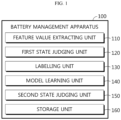
- FIG. 1 is a diagram schematically showing a battery management apparatus 100 according to an aspect of the present disclosure.
- the battery management apparatus 100 may include a feature value extracting unit 110, a first state judging unit 120, a labeling unit 130, a model learning unit 140, and a second state judging unit 150.
- the feature value extracting unit 110 may be configured to extract a feature value of a learning battery at every charging and discharging cycle.
- the battery means one physically separable independent cell including a negative electrode terminal and a positive electrode terminal.
- one pouch-type lithium-ion battery cell may be regarded as a battery.
- the learning battery is a battery for obtaining a learning data set for learning a classification model, and may be distinguished from an analysis battery.
- the feature value extracting unit 110 may extract at least one feature value for the learning battery at every charging and discharging cycle. Specifically, the feature value extracting unit 110 may extract a feature value according to voltage, current, capacity, charging time, internal resistance, SOC (State of Charge), SOH (State of Health) or a combination thereof for the learning battery.
- SOC State of Charge
- SOH State of Health
- the first state judging unit 120 may be configured to judge the state of the learning battery at every charging and discharging cycle, based on the feature value extracted by the feature value extracting unit 110 and a criterion value preset to correspond to the feature value.
- the criterion value may be preset for each feature value for each charging and discharging cycle.
- first to N th feature values for the learning battery are extracted at each of the first to N th charging and discharging cycles.
- N may be an integer of 2 or more.
- a total of N criterion values may be preset. That is, the first to N th criterion values may be preset to correspond to the first to N th feature values, respectively.
- the first state judging unit 120 may judge the state of the learning battery at the first charging and discharging cycle by comparing the first feature value and the first criterion value.
- the first state judging unit 120 may judge the state of the learning battery at the N th charging and discharging cycle by comparing the N th feature value and the N th criterion value.
- the first state judging unit 120 may be configured to judge the state of the learning battery as a normal state or a defective state at every charging and discharging cycle.
- the criterion value may be a threshold value for judging the state of the learning battery.
- the first state judging unit 120 may judge the state of the learning battery as a normal state or a defective state by comparing the magnitudes of the criterion value and the feature value.
- the labeling unit 130 may be configured to set a label for the feature value of the learning battery at every charging and discharging cycle, based on the state of the learning battery judged by the first state judging unit 120.
- the labeling unit 130 may be configured to set a first label to the feature value of the learning battery at the corresponding charging and discharging cycle, when the state of the learning battery is judged as a normal state.
- the labeling unit 130 may be configured to set a second label to the feature value of the learning battery at the corresponding charging and discharging cycle, when the state of the learning battery is judged as a defective state.
- the labeling unit 130 may set a label for the feature value of the learning battery extracted at each charging and discharging cycle according to the state of the learning battery judged by the first state judging unit 120.
- the model learning unit 140 may be configured to learn a classification model for judging the state of the analysis battery based on the feature value for which the label is set by the labeling unit 130.
- logistic regression linear discriminant analysis
- support vector machine random forest classifier
- artificial neural network may be applied as the classification model.
- the classification model learned by the model learning unit 140 may be used to judge the state of the analysis battery.
- the second state judging unit 150 may be configured to judge the state of the analysis battery based on the classification model learned by the model learning unit 140.
- the second state judging unit 150 may be configured to extract a feature value of the analysis battery at every charging and discharging cycle.
- the feature value of the analysis battery may be in the same kind as the feature value of the learning battery extracted by the feature value extracting unit 110. That is, the feature value of the analysis battery extracted by the second state judging unit 150 may be in the same kind as the feature value used in the process of learning the classification model by the model learning unit 140.
- the feature value extracting unit 110 extracts the voltage for the learning battery as a feature value at every charging and discharging cycle.
- the first state judging unit 120 may judge the state of the learning battery at every charging and discharging cycle based on the voltage of the learning battery and a criterion value.
- the labeling unit 130 may set a label for the voltage of each charging and discharging cycle, based on the state of the learning battery judged at every charging and discharging cycle.
- the model learning unit 140 may learn the classification model based on the voltage for which the label is set.
- the second state judging unit 150 may extract the voltage for the analysis battery as a feature value at every charging and discharging cycle.
- the second state judging unit 150 may be configured to judge the state of the analysis battery by inputting the extracted feature value to the learned classification model.
- the second state judging unit 150 may set the feature value of the analysis battery as an input to the learned classification model.
- the learned classification model may output the state for the analysis battery as an output for the input.
- the second state judging unit 150 may obtain the output that is output from the learned classification model and judge the state of the analysis battery as a normal state or a defective state.
- the battery management apparatus 100 has an advantage of securing a large amount of learning data for learning the classification model from a limited number of batteries.
- the battery management apparatus 100 may secure a large amount of learning data for learning the classification model by extracting the feature value of the battery at every charging and discharging cycle in consideration of these features of the battery.
- the battery management apparatus 100 may further include a storage unit 160.
- the storage unit 160 may store data necessary for operation and function of each component of the battery management apparatus 100, data generated in the process of performing the operation or function, or the like.
- the storage unit 160 is not particularly limited in its kind as long as it is a known information storage means that can record, erase, update and read data.
- the information storage means may include RAM, flash memory, ROM, EEPROM, registers, and the like.
- the storage unit 160 may store program codes in which processes executable by the control unit are defined.
- the feature value of the battery extracted at every charging and discharging cycle by the feature value extracting unit 110 may be stored in the storage unit 160.
- the label set for each feature value by the labeling unit 130 may also be stored in the storage unit 160.
- the feature value extracting unit 110 may be configured to extract a plurality of feature values for the learning battery.
- the feature value extracting unit 110 may extract two or more feature values for each learning battery at every charging and discharging cycle.
- the feature value extracting unit 110 may extract voltage and internal resistance for each learning battery at every charging and discharging cycle. If the charging and discharging cycle is performed up to 500 cycles for 10 learning batteries, the total number of feature values extracted by the feature value extracting unit 110 may be 10,000. That is, 5,000 voltages and 5,000 internal resistances may be extracted.
- the first state judging unit 120 may be configured to judge the state of the learning battery for each of the plurality of feature values at every charging and discharging cycle, based on the plurality of feature values of the learning battery and a criterion value preset to correspond to each of the plurality of feature values.
- the first state judging unit 120 may judge the state of the learning battery for voltage and internal resistance at every charging and discharging cycle by comparing each of the 10,000 feature values with the criterion value corresponding thereto. That is, according to the voltages of 10 learning batteries, the voltage-based state of the learning battery at each of 1 st cycle to 500 th cycles may be judged. In addition, according to the internal resistance of the 10 learning batteries, the internal resistance-based state of the learning battery at each of 1 st cycle to 500 th cycles may be judged.
- the labeling unit 130 may be configured to set the label for each of the plurality of feature values at every charging and discharging cycle.
- the labeling unit 130 may set a label for each of the 10,000 feature values.
- the battery management apparatus 100 has an advantage of securing a large amount of learning data from a limited number of learning batteries by extracting a plurality of feature values for the learning battery.
- FIG. 2 is a diagram schematically showing the first embodiment in which a label is set by the battery management apparatus 100 according to an aspect of the present disclosure.
- the labeling unit 130 may be configured to set a label for the feature value of the learning battery, based on the state of the learning battery judged at a predetermined charging and discharging cycle.
- the labeling unit 130 may set the label for the feature value of each of the first to fifth learning batteries B1, B2, B3, B4, B5, based on the state of each of the first to fifth learning batteries B1, B2, B3, B4, B5 judged at a target cycle TC.
- the target cycle TC may be the last charging and discharging cycle at which the state of the battery is judged by the first state judging unit 120.
- the target cycle TC may be a cycle related to quality assurance for the battery.
- the target cycle TC may be set to the 500 th cycle.
- the target cycle TC may be separately set according to the type of the battery, the usage of the battery, the environment in which the battery is used, or the like.
- the labeling unit 130 may set the first label to the feature value of the learning battery for a charging and discharging cycle up to a cycle just before the predetermined charging and discharging cycle.
- the labeling unit 130 may set the second label to the feature value of the learning battery at a charging and discharging cycle after the predetermined charging and discharging cycle.
- the states of the first to third learning batteries B1, B2, B3 are judged as the normal state at the target cycle TC, and the states of the fourth and fifth learning batteries B4, B5 are judged as the defective state.
- the states of the first to third learning batteries B1, B2, B3 before the target cycle TC will be the normal state
- the states of the fourth and fifth learning batteries B4, B5 after the target cycle TC will be the defective state.
- the labeling unit 130 may set the first label for the feature values of the first to third learning batteries B1, B2, B3 before the target cycle TC.
- the labeling unit 130 may set the second label for the feature values of the fourth and fifth learning batteries B4, B5 after the target cycle TC. That is, the labeling unit 130 may quickly set the label for the feature value even if the states of the fourth and fifth learning batteries B4, B5 are not judged at the charging and discharging cycle after the target cycle TC.
- the battery management apparatus 100 may not only set a label for the feature value of the learning battery just before the target cycle TC, but also set a label for the feature value of the learning battery at the charging and discharging cycle after the target cycle TC.
- FIG. 3 is a diagram schematically showing the second embodiment in which a label is set by the battery management apparatus 100 according to an aspect of the present disclosure.
- the labeling unit 130 may be configured to set the second label to the feature value of the learning battery for a subsequent charging and discharging cycle, when the state of the learning battery is judged as the defective state.
- the labeling unit 130 may set the second label to the feature value of the learning battery, after the charging and discharging cycle judged as the defective state. That is, after the charging and discharging cycle judged as the defective state, even if the state of the learning battery is not judged by the first state judging unit 120, the labeling unit 130 may set a label for the feature value.
- the state of the sixth learning battery B6 at the target cycle TC may be judged as a normal state, and the state of the seventh learning battery B7 may be judged as a defective state.
- the state of the eighth learning battery B8 at the third charging and discharging cycle C3 may be judged as a defective state, and the state of the ninth learning battery B9 at the second charging and discharging cycle C2 may be judged as a defective state.
- the state of the tenth learning battery B 10 at the first charging and discharging cycle C1 may be judged to be a defective state.
- the labeling unit 130 may set the first label for the feature value up to a cycle just before the target cycle TC for the sixth learning battery B6.
- the labeling unit 130 may set the first label for the feature value up to a cycle just before the target cycle TC, and set the second label for the feature value after the target cycle TC, for the seventh learning battery B7. That is, even if the state of the seventh learning battery B7 is not judged by the first state judging unit 120 after the target cycle TC, the labeling unit 130 may set the second label for the feature value of the seventh learning battery B7.
- the labeling unit 130 may set the first label for the feature value up to a cycle just before the third charging and discharging cycle C3, and set the second label for the feature value after the third charging and discharging cycle C3, for the eighth learning battery B8. That is, even if the state of the eighth learning battery B8 is not judged by the first state judging unit 120 after the third charging and discharging cycle C3, the labeling unit 130 may set the second label for the feature value of the eighth learning battery B8.
- the labeling unit 130 may set the first label for the feature value up to a cycle just before the second charging and discharging cycle C2, and set the second label for the feature value after the second charging and discharging cycle C2, for the ninth learning battery B9. That is, even if the state of the ninth learning battery B9 is not judged by the first state judging unit 120 after the second charging and discharging cycle C2, the labeling unit 130 may set the second label for the feature value of the ninth learning battery B9.
- the labeling unit 130 may set the first label for the feature value up to a cycle just before the first charging and discharging cycle C1, and set the second label for the feature value after the first charging and discharging cycle C1, for the tenth learning battery B 10. That is, even if the state of the tenth learning battery B 10 is not judged by the first state judging unit 120 after the first charging and discharging cycle C1, the labeling unit 130 may set the second label for the feature value of the tenth learning battery B 10.
- the battery management apparatus 100 may set the second label to the feature value without judging the state for the learning battery after the charging and discharging cycle judged as a defective state. Accordingly, the learning data for learning the classification model may be secured more quickly, and system resources of the battery management apparatus 100 may be saved in the process of securing such learning data.
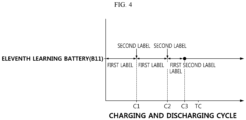
- FIG. 4 is a diagram schematically showing the third embodiment in which a label is set by the battery management apparatus 100 according to an aspect of the present disclosure.
- the labeling unit 130 may be configured to count the number of times that the state of the learning battery is judged as the defective state.
- the eleventh learning battery B11 may be judged as a defective state at the first charging and discharging cycle C1.
- the labeling unit 130 may set the number of times judged as a defective state for the eleventh learning battery B1 1 as 1 at the first charging and discharging cycle C1.
- the eleventh learning battery B11 may be judged as a defective state at the second charging and discharging cycle C2.
- the labeling unit 130 may set the number of times judged as a defective state for the eleventh learning battery B 11 as 2 at the second charging and discharging cycle C2.
- the eleventh learning battery B11 may be judged as a defective state at the third charging and discharging cycle C3.
- the labeling unit 130 may set the number of times judged as a defective state for the eleventh learning battery B11 as 3 at the third charging and discharging cycle C3.
- the labelling unit 130 may be configured to set the second label to the feature value of the learning battery for the charging and discharging cycle after the last charging and discharging cycle at which the state of the learning battery is judged as the defective state.
- the labeling unit 130 may set the second label for the feature value after the third charging and discharging cycle C3.
- the labeling unit 130 may set the second label even if the state of the learning battery is not judged, only when the state of the learning battery is judged as a defective state the criterion number of times or more.
- a predetermined condition may be further added to the criterion number of times. For example, if the state of the learning battery is continuously judged as a defective state and the number of times judged as a defective state is greater than or equal to the criterion number of times, the labeling unit 130 may be configured to set the second label to the feature value of the learning battery for a charging and discharging cycle after the last charging and discharging cycle at which the state of the learning battery is judged as a defective state.
- the criterion number of times and the condition that may be added to the criterion number of times may be preset by a user in consideration of the type of battery, the usage of the battery, the environment in which the battery is used, or the like.
- the feature value extracting unit 110 may be configured to generate an additional feature value based on the extracted feature value at every charging and discharging cycle.
- the feature value extracting unit 110 has extracted feature values from the first charging and discharging cycle C1 to a cycle just before the 500 th charging and discharging cycle for each learning battery. In this case, a total of 5,000 feature values may be extracted.
- the feature value extracting unit 110 may generate an additional feature value by combining feature values extracted at each charging and discharging cycle in order to further secure learning data for learning the classification model.
- the feature value extracting unit 110 may generate a plurality of groups for the plurality of feature values extracted at the same charging and discharging cycle, and calculate an average feature value for each generated group.
- the feature value extracting unit 110 may be configured to generate a group for the same type of feature values.
- a group for voltage may be generated based on the feature value for voltage
- a group for internal resistance may be generated based on the feature value for internal resistance. That is, a group for a mixture of voltage and internal resistance may not be generated.
- the feature value extracting unit 110 may generate a group for 2 to 10 feature values among 10 feature values to be extracted at the same charging and discharging cycle, and may further generate an average feature value for each group.
- the number of groups that can be generated from 10 feature values may be a total of 1,013.
- the number of generated groups may be 45, 120, 210, 252, 210, 120, 45, 10, and 1, respectively. Accordingly, the total number of generated groups may be 1,013.
- the feature value extracting unit 110 may generate 1,013 additional feature values at every charging and discharging cycle by calculating an average feature value for each of the generated 1,013 groups.
- the first state judging unit 120 may judge the state for a virtual learning battery based on each of the additional feature values generated by the feature value extracting unit 110.
- the labeling unit 130 may set a label for each additional feature value based on the judged state of the virtual learning battery.
- the model learning unit 140 may learn the classification model by using both the feature value for the learning battery and the feature value for the virtual learning battery.
- the battery management apparatus 100 has an advantage of securing a larger number of learning data based on the limited number of learning batteries by generating additional feature values for the virtual learning battery.
- the feature value extracting unit 110 may be configured to further consider the state of the learning battery judged by the first state judging unit 120 in the process of generating a group. That is, the feature value extracting unit 110 may be configured to generate a group by combining learning batteries having the same state judged by the first state judging unit 120.
- the feature value extracting unit 110 may generate a plurality of groups by combining the feature values of 6 learning batteries judged as a normal state. In this case, a total of 57 groups may be generated. In addition, the feature value extracting unit 110 may generate a plurality of groups by combining the feature values of 4 learning batteries judged as a defective state. In this case, a total of 11 groups may be generated. In addition, the feature value extracting unit 110 may generate a total of 68 additional feature values by calculating an average feature value for each generated group.
- the battery management apparatus 100 may be applied to a BMS (Battery Management System). That is, the BMS according to the present disclosure may include the battery management apparatus 100 described above. In this configuration, at least some of the components of the battery management apparatus 100 may be implemented by supplementing or adding functions of the configuration included in the conventional BMS. For example, the feature value extracting unit 110, the first state judging unit 120, the labelling unit 130, the model learning unit 140 and the second state judging unit 150 may be implemented as components of the BMS.
- FIG. 5 is a diagram schematically showing an exemplary configuration of a battery pack 1 according to another aspect of the present disclosure.
- the battery management apparatus 100 may be provided in a battery pack 1. That is, the battery pack 1 according to the present disclosure may include the above-described battery management apparatus 100 and one or more battery modules 10.
- the battery module 10 may include one or more battery cells connected in series and/or in parallel.
- the battery pack 1 may further include electrical equipment (relays, fuses, etc.) and a case.
- the feature value extracting unit 110 may be connected to the battery module 10 and a current measurement unit.
- the feature value extracting unit 110 may measure voltage, current, temperature, or the like of each battery cell included in the battery module 10 and extract it as a feature value.
- the feature value extracting unit 110 may extract internal resistance, SOC, SOH, or the like of each battery cell as a feature value based on the measured values.
- FIG. 6 is a diagram schematically showing a battery management method according to still another aspect of the present disclosure.
- each step of the battery management method may be performed by the battery management apparatus 100.
- contents overlapping with the previously described contents will be omitted or briefly described.
- the feature value extracting step (S100) is a step of extracting a feature value of a learning battery at every charging and discharging cycle, and may be performed by the feature value extracting unit 110.
- the first state judging step (S200) is a step of judging the state of the learning battery at every charging and discharging cycle, based on the feature value extracted in the feature value extracting step (S 100) and a criterion value preset to correspond to the feature value, and may be performed by the first state judging unit 120.
- first to N th feature values for the learning battery are extracted at each of the first to N th charging and discharging cycles.
- N may be an integer of 2 or more.
- a total of N criterion values may be preset. That is, first to N th criterion value may be preset to correspond to the first to N th feature values, respectively.
- the first state judging unit 120 may judge the state of the learning battery at the first charging and discharging cycle by comparing the first feature value and the first criterion value.
- the first state judging unit 120 may judge the state of the learning battery at the N th charging and discharging cycle by comparing the N th feature value and the N th criterion value.
- the labeling step (S300) is a step of setting a label for the feature value of the learning battery at every charging and discharging cycle, based on the state of the learning battery judged at the first state judging step (S200), and may be performed by the labeling unit 130.
- the labeling unit 130 may be configured to set a first label to the feature value of the learning battery for the corresponding charging and discharging cycle.
- the labeling unit 130 may be configured to set a second label to the feature value of the learning battery for the corresponding charging and discharging cycle.
- the model learning step (S400) is a step of learning a classification model for judging the state of an analysis battery based on the feature value for which the label is set in the labeling step (S300), and may be performed by the model learning unit 140.
- the second state judging step (S500) is a step of judging the state of the analysis battery based on the classification model learned in the model learning step (S400), and may be performed by the second state judging unit 150.
- the battery management method has an advantage of securing a large amount of learning data for learning the classification model from a limited number of batteries. Therefore, the performance of the learned classification model may be improved. Therefore, the accuracy of the state judgment of the analysis battery based on the classification model learned according to one embodiment of the present disclosure may be improved.
- the embodiments of the present disclosure described above may not be implemented only through an apparatus and a method, but may be implemented through a program that realizes a function corresponding to the configuration of the embodiments of the present disclosure or a recording medium on which the program is recorded.
- the program or recording medium may be easily implemented by those skilled in the art from the above description of the embodiments.
Landscapes
- Engineering & Computer Science (AREA)
- General Physics & Mathematics (AREA)
- Physics & Mathematics (AREA)
- General Chemical & Material Sciences (AREA)
- Electrochemistry (AREA)
- Chemical Kinetics & Catalysis (AREA)
- Chemical & Material Sciences (AREA)
- Manufacturing & Machinery (AREA)
- Theoretical Computer Science (AREA)
- Software Systems (AREA)
- Data Mining & Analysis (AREA)
- Mathematical Physics (AREA)
- General Engineering & Computer Science (AREA)
- Computing Systems (AREA)
- Medical Informatics (AREA)
- Evolutionary Computation (AREA)
- Computer Vision & Pattern Recognition (AREA)
- Artificial Intelligence (AREA)
- Microelectronics & Electronic Packaging (AREA)
- Secondary Cells (AREA)
- Charge And Discharge Circuits For Batteries Or The Like (AREA)
- Tests Of Electric Status Of Batteries (AREA)
Abstract
Description
- The present application claims priority to
Korean Patent Application No. 10-2020-0161667 filed on November 26, 2020 - The present disclosure relates to a battery management apparatus and method, and more particularly, to a battery management apparatus and method capable of judging the state of a battery using a learned classification model.
- Recently, the demand for portable electronic products such as notebook computers, video cameras and portable telephones has increased sharply, and electric vehicles, energy storage batteries, robots, satellites and the like have been developed in earnest. Accordingly, high-performance batteries allowing repeated charging and discharging are being actively studied.
- Batteries commercially available at present include nickel-cadmium batteries, nickel hydrogen batteries, nickel-zinc batteries, lithium-ion batteries and the like. Among them, the lithium-ion batteries are in the limelight since they have almost no memory effect compared to nickel-based batteries and also have very low self-charging rate and high energy density.
- Conventionally, in order to estimate or judge the state of the battery, machine learning-based or deep learning-based techniques are grafted. For example, a technology for judging the state of a battery based on a learned model is being developed.
- To learn such a model, a large amount of training data is required. In order to secure the training data from the battery, the charging and discharging cycle of the battery must proceed, so it may take a lot of time to secure a large amount of training data. In addition, as the life expectancy of the battery increases, the time required for the charging and discharging cycle also increases proportionally, so the time required to secure the learning data is increasing.
- Also, there is a limit to the number of learning data that can be secured from a limited number of batteries. Therefore, even if the number of batteries is limited, it is necessary to develop a technology capable of improving the performance of the learned model by securing a large amount of learning data.
- The present disclosure is designed to solve the problems of the related art, and therefore the present disclosure is directed to providing a battery management apparatus and method capable of securing a large amount of learning data for learning a classification model from a limited number of batteries.
- These and other objects and advantages of the present disclosure may be understood from the following detailed description and will become more fully apparent from the exemplary embodiments of the present disclosure. Also, it will be easily understood that the objects and advantages of the present disclosure may be realized by the means shown in the appended claims and combinations thereof.
- A battery management apparatus according to an aspect of the present disclosure may comprise: a feature value extracting unit configured to extract a feature value of a learning battery at every charging and discharging cycle; a first state judging unit configured to judge a state of the learning battery at every charging and discharging cycle, based on the feature value extracted by the feature value extracting unit and a criterion value preset to correspond to the feature value; a labelling unit configured to set a label for the feature value of the learning battery at every charging and discharging cycle, based on the state of the learning battery judged by the first state judging unit; a model learning unit configured to learn a classification model for judging a state of an analysis battery based on the feature value for which the label is set by the labelling unit; and a second state judging unit configured to judge the state of the analysis battery based on the classification model learned by the model learning unit.
- The first state judging unit may be configured to judge the state of the learning battery as a normal state or a defective state at every charging and discharging cycle.
- When the state of the learning battery is judged as a normal state, the labelling unit may be configured to set a first label to the feature value of the learning battery for the corresponding charging and discharging cycle.
- When the state of the learning battery is judged as a defective state, the labelling unit may be configured to set a second label to the feature value of the learning battery for the corresponding charging and discharging cycle.
- The labelling unit may be configured to set a label for the feature value of the learning battery, based on the state of the learning battery judged at a predetermined charging and discharging cycle.
- When the state of the learning battery is judged as the normal state at the predetermined charging and discharging cycle, the labelling unit may be configured to set the first label to the feature value of the learning battery for a charging and discharging cycle up to a cycle just before the predetermined charging and discharging cycle.
- When the state of the learning battery is judged as the defective state at the predetermined charging and discharging cycle, the labelling unit may be configured to set the second label to the feature value of the learning battery for a charging and discharging cycle after the predetermined charging and discharging cycle.
- When the state of the learning battery is judged as the defective state, the labelling unit may be configured to set the second label to the feature value of the learning battery for a subsequent charging and discharging cycle.
- The labelling unit may be configured to count the number of times that the state of the learning battery is judged as the defective state, and when the counted number of times is equal to or greater than a criterion number of times, the labelling unit may be configured to set the second label to the feature value of the learning battery for a charging and discharging cycle after a last charging and discharging cycle at which the state of the learning battery is judged as the defective state.
- The feature value extracting unit may be configured to extract a plurality of feature values for the learning battery.
- The first state judging unit may be configured to judge the state of the learning battery for each of the plurality of feature values at every charging and discharging cycle, based on the plurality of feature values of the learning battery and a criterion value preset to correspond to each of the plurality of feature values.
- The labelling unit may be configured to set the label for each of the plurality of feature values at every charging and discharging cycle.
- The second state judging unit may be configured to extract a feature value of the analysis battery at every charging and discharging cycle and judge the state of the analysis battery by inputting the extracted feature value to the learned classification model.
- A battery pack according to another aspect of the present disclosure may comprise the battery management apparatus according to an aspect of the present disclosure.
- A battery management method according to still another aspect of the present disclosure may comprise: a feature value extracting step of extracting a feature value of a learning battery at every charging and discharging cycle; a first state judging step of judging a state of the learning battery at every charging and discharging cycle, based on the feature value extracted in the feature value extracting step and a criterion value preset to correspond to the feature value; a labelling step of setting a label for the feature value of the learning battery at every charging and discharging cycle, based on the state of the learning battery judged in the first state judging step; a model learning step of learning a classification model for judging a state of an analysis battery based on the feature value for which the label is set in the labelling step; and a second state judging step of judging the state of the analysis battery based on the classification model learned in the model learning step.
- According to one aspect of the present disclosure, there is an advantage in that it is possible to quickly obtain a large amount of learning data for learning a classification model from a limited number of batteries.
- The effects of the present disclosure are not limited to the effects mentioned above, and other effects not mentioned will be clearly understood by those skilled in the art from the description of the claims.
- The accompanying drawings illustrate a preferred embodiment of the present disclosure and together with the foregoing disclosure, serve to provide further understanding of the technical features of the present disclosure, and thus, the present disclosure is not construed as being limited to the drawing.
-
FIG. 1 is a diagram schematically showing a battery management apparatus according to an aspect of the present disclosure. -
FIG. 2 is a diagram schematically showing the first embodiment in which a label is set by the battery management apparatus according to an aspect of the present disclosure. -
FIG. 3 is a diagram schematically showing the second embodiment in which a label is set by the battery management apparatus according to an aspect of the present disclosure. -
FIG. 4 is a diagram schematically showing the third embodiment in which a label is set by the battery management apparatus according to an aspect of the present disclosure. -
FIG. 5 is a diagram schematically showing an exemplary configuration of a battery pack according to another aspect of the present disclosure. -
FIG. 6 is a diagram schematically showing a battery management method according to still another aspect of the present disclosure. - It should be understood that the terms used in the specification and the appended claims should not be construed as limited to general and dictionary meanings, but interpreted based on the meanings and concepts corresponding to technical aspects of the present disclosure on the basis of the principle that the inventor is allowed to define terms appropriately for the best explanation.
- Therefore, the description proposed herein is just a preferable example for the purpose of illustrations only, not intended to limit the scope of the disclosure, so it should be understood that other equivalents and modifications could be made thereto without departing from the scope of the disclosure.
- Additionally, in describing the present disclosure, when it is deemed that a detailed description of relevant known elements or functions renders the key subject matter of the present disclosure ambiguous, the detailed description is omitted herein.
- The terms including the ordinal number such as "first", "second" and the like, may be used to distinguish one element from another among various elements, but not intended to limit the elements by the terms.
- Throughout the specification, when a portion is referred to as "comprising" or "including" any element, it means that the portion may include other elements further, without excluding other elements, unless specifically stated otherwise.
- In addition, throughout the specification, when a portion is referred to as being "connected" to another portion, it is not limited to the case that they are "directly connected", but it also includes the case where they are "indirectly connected" with another element being interposed between them.
- Hereinafter, preferred embodiments of the present disclosure will be described in detail with reference to the accompanying drawings.
-
FIG. 1 is a diagram schematically showing abattery management apparatus 100 according to an aspect of the present disclosure. - Referring to
FIG. 1 , thebattery management apparatus 100 may include a featurevalue extracting unit 110, a firststate judging unit 120, alabeling unit 130, amodel learning unit 140, and a secondstate judging unit 150. - The feature
value extracting unit 110 may be configured to extract a feature value of a learning battery at every charging and discharging cycle. - Here, the battery means one physically separable independent cell including a negative electrode terminal and a positive electrode terminal. For example, one pouch-type lithium-ion battery cell may be regarded as a battery.
- In addition, the learning battery is a battery for obtaining a learning data set for learning a classification model, and may be distinguished from an analysis battery.
- For example, the feature
value extracting unit 110 may extract at least one feature value for the learning battery at every charging and discharging cycle. Specifically, the featurevalue extracting unit 110 may extract a feature value according to voltage, current, capacity, charging time, internal resistance, SOC (State of Charge), SOH (State of Health) or a combination thereof for the learning battery. - The first
state judging unit 120 may be configured to judge the state of the learning battery at every charging and discharging cycle, based on the feature value extracted by the featurevalue extracting unit 110 and a criterion value preset to correspond to the feature value. - Preferably, the criterion value may be preset for each feature value for each charging and discharging cycle.
- For example, it is assumed that first to Nth feature values for the learning battery are extracted at each of the first to Nth charging and discharging cycles. Here, N may be an integer of 2 or more. In this case, a total of N criterion values may be preset. That is, the first to Nth criterion values may be preset to correspond to the first to Nth feature values, respectively. In addition, the first
state judging unit 120 may judge the state of the learning battery at the first charging and discharging cycle by comparing the first feature value and the first criterion value. Similarly, the firststate judging unit 120 may judge the state of the learning battery at the Nth charging and discharging cycle by comparing the Nth feature value and the Nth criterion value. - Specifically, the first
state judging unit 120 may be configured to judge the state of the learning battery as a normal state or a defective state at every charging and discharging cycle. - For example, the criterion value may be a threshold value for judging the state of the learning battery. The first
state judging unit 120 may judge the state of the learning battery as a normal state or a defective state by comparing the magnitudes of the criterion value and the feature value. - The
labeling unit 130 may be configured to set a label for the feature value of the learning battery at every charging and discharging cycle, based on the state of the learning battery judged by the firststate judging unit 120. - Specifically, the
labeling unit 130 may be configured to set a first label to the feature value of the learning battery at the corresponding charging and discharging cycle, when the state of the learning battery is judged as a normal state. - Conversely, the
labeling unit 130 may be configured to set a second label to the feature value of the learning battery at the corresponding charging and discharging cycle, when the state of the learning battery is judged as a defective state. - That is, the
labeling unit 130 may set a label for the feature value of the learning battery extracted at each charging and discharging cycle according to the state of the learning battery judged by the firststate judging unit 120. - The
model learning unit 140 may be configured to learn a classification model for judging the state of the analysis battery based on the feature value for which the label is set by thelabeling unit 130. - For example, logistic regression, linear discriminant analysis, support vector machine, random forest classifier, or artificial neural network may be applied as the classification model.
- The classification model learned by the
model learning unit 140 may be used to judge the state of the analysis battery. - However, since the process of learning the classification model based on the feature value for which the label is set is a general model learning in the machine learning, a detailed description thereof will be omitted.
- The second
state judging unit 150 may be configured to judge the state of the analysis battery based on the classification model learned by themodel learning unit 140. - Specifically, the second
state judging unit 150 may be configured to extract a feature value of the analysis battery at every charging and discharging cycle. - Here, the feature value of the analysis battery may be in the same kind as the feature value of the learning battery extracted by the feature
value extracting unit 110. That is, the feature value of the analysis battery extracted by the secondstate judging unit 150 may be in the same kind as the feature value used in the process of learning the classification model by themodel learning unit 140. - For example, it is assumed that the feature
value extracting unit 110 extracts the voltage for the learning battery as a feature value at every charging and discharging cycle. The firststate judging unit 120 may judge the state of the learning battery at every charging and discharging cycle based on the voltage of the learning battery and a criterion value. Thelabeling unit 130 may set a label for the voltage of each charging and discharging cycle, based on the state of the learning battery judged at every charging and discharging cycle. Themodel learning unit 140 may learn the classification model based on the voltage for which the label is set. The secondstate judging unit 150 may extract the voltage for the analysis battery as a feature value at every charging and discharging cycle. - In addition, the second
state judging unit 150 may be configured to judge the state of the analysis battery by inputting the extracted feature value to the learned classification model. - For example, the second
state judging unit 150 may set the feature value of the analysis battery as an input to the learned classification model. In addition, the learned classification model may output the state for the analysis battery as an output for the input. The secondstate judging unit 150 may obtain the output that is output from the learned classification model and judge the state of the analysis battery as a normal state or a defective state. - The
battery management apparatus 100 according to an embodiment of the present disclosure has an advantage of securing a large amount of learning data for learning the classification model from a limited number of batteries. - That is, since the battery is degraded as the charging and discharging cycle progresses, the state of the battery at each charging and discharging cycle may be different. The
battery management apparatus 100 may secure a large amount of learning data for learning the classification model by extracting the feature value of the battery at every charging and discharging cycle in consideration of these features of the battery. - Therefore, even if the number of learning batteries is limited, a large amount of learning data for learning the classification model may be secured, and the performance of the learned classification model may be improved based on the large amount of learning data. Therefore, the accuracy of judging the state of the analysis battery based on the learned classification model may be improved.
- Meanwhile, referring to
FIG. 1 , thebattery management apparatus 100 may further include astorage unit 160. Thestorage unit 160 may store data necessary for operation and function of each component of thebattery management apparatus 100, data generated in the process of performing the operation or function, or the like. Thestorage unit 160 is not particularly limited in its kind as long as it is a known information storage means that can record, erase, update and read data. As an example, the information storage means may include RAM, flash memory, ROM, EEPROM, registers, and the like. In addition, thestorage unit 160 may store program codes in which processes executable by the control unit are defined. - For example, the feature value of the battery extracted at every charging and discharging cycle by the feature
value extracting unit 110 may be stored in thestorage unit 160. In addition, the label set for each feature value by thelabeling unit 130 may also be stored in thestorage unit 160. - In addition, the feature
value extracting unit 110 may be configured to extract a plurality of feature values for the learning battery. - Specifically, the feature
value extracting unit 110 may extract two or more feature values for each learning battery at every charging and discharging cycle. - For example, the feature
value extracting unit 110 may extract voltage and internal resistance for each learning battery at every charging and discharging cycle. If the charging and discharging cycle is performed up to 500 cycles for 10 learning batteries, the total number of feature values extracted by the featurevalue extracting unit 110 may be 10,000. That is, 5,000 voltages and 5,000 internal resistances may be extracted. - The first
state judging unit 120 may be configured to judge the state of the learning battery for each of the plurality of feature values at every charging and discharging cycle, based on the plurality of feature values of the learning battery and a criterion value preset to correspond to each of the plurality of feature values. - For example, in the preceding embodiment, when a total of 10,000 feature values are extracted by the feature
value extracting unit 110, the firststate judging unit 120 may judge the state of the learning battery for voltage and internal resistance at every charging and discharging cycle by comparing each of the 10,000 feature values with the criterion value corresponding thereto. That is, according to the voltages of 10 learning batteries, the voltage-based state of the learning battery at each of 1st cycle to 500th cycles may be judged. In addition, according to the internal resistance of the 10 learning batteries, the internal resistance-based state of the learning battery at each of 1st cycle to 500th cycles may be judged. - The
labeling unit 130 may be configured to set the label for each of the plurality of feature values at every charging and discharging cycle. - For example, in the preceding embodiment, when all the states of the learning battery for 10,000 feature values are judged by the first
state judging unit 120, thelabeling unit 130 may set a label for each of the 10,000 feature values. - That is, the
battery management apparatus 100 according to an embodiment of the present disclosure has an advantage of securing a large amount of learning data from a limited number of learning batteries by extracting a plurality of feature values for the learning battery. - Hereinafter, various embodiments in which the
labeling unit 130 sets the label for the feature value will be described. -
FIG. 2 is a diagram schematically showing the first embodiment in which a label is set by thebattery management apparatus 100 according to an aspect of the present disclosure. - The
labeling unit 130 may be configured to set a label for the feature value of the learning battery, based on the state of the learning battery judged at a predetermined charging and discharging cycle. - For example, in the embodiment of
FIG. 2 , thelabeling unit 130 may set the label for the feature value of each of the first to fifth learning batteries B1, B2, B3, B4, B5, based on the state of each of the first to fifth learning batteries B1, B2, B3, B4, B5 judged at a target cycle TC. - Here, the target cycle TC may be the last charging and discharging cycle at which the state of the battery is judged by the first
state judging unit 120. For example, the target cycle TC may be a cycle related to quality assurance for the battery. As a specific example, if the quality assurance of the battery is set such that 90% or more of the capacity of the battery is preserved at 500th cycle, the target cycle TC may be set to the 500th cycle. In other words, the target cycle TC may be separately set according to the type of the battery, the usage of the battery, the environment in which the battery is used, or the like. - Specifically, when the state of the learning battery at the predetermined charging and discharging cycle is judged as the normal state, the
labeling unit 130 may set the first label to the feature value of the learning battery for a charging and discharging cycle up to a cycle just before the predetermined charging and discharging cycle. - Conversely, if the state of the learning battery at the predetermined charging and discharging cycle is judged as the defective state, the
labeling unit 130 may set the second label to the feature value of the learning battery at a charging and discharging cycle after the predetermined charging and discharging cycle. - In the embodiment of
FIG. 2 , it is assumed that the states of the first to third learning batteries B1, B2, B3 are judged as the normal state at the target cycle TC, and the states of the fourth and fifth learning batteries B4, B5 are judged as the defective state. In this case, the states of the first to third learning batteries B1, B2, B3 before the target cycle TC will be the normal state, and the states of the fourth and fifth learning batteries B4, B5 after the target cycle TC will be the defective state. - The
labeling unit 130 may set the first label for the feature values of the first to third learning batteries B1, B2, B3 before the target cycle TC. - In addition, the
labeling unit 130 may set the second label for the feature values of the fourth and fifth learning batteries B4, B5 after the target cycle TC. That is, thelabeling unit 130 may quickly set the label for the feature value even if the states of the fourth and fifth learning batteries B4, B5 are not judged at the charging and discharging cycle after the target cycle TC. - That is, the
battery management apparatus 100 may not only set a label for the feature value of the learning battery just before the target cycle TC, but also set a label for the feature value of the learning battery at the charging and discharging cycle after the target cycle TC. -
FIG. 3 is a diagram schematically showing the second embodiment in which a label is set by thebattery management apparatus 100 according to an aspect of the present disclosure. - The
labeling unit 130 may be configured to set the second label to the feature value of the learning battery for a subsequent charging and discharging cycle, when the state of the learning battery is judged as the defective state. - Specifically, the
labeling unit 130 may set the second label to the feature value of the learning battery, after the charging and discharging cycle judged as the defective state. That is, after the charging and discharging cycle judged as the defective state, even if the state of the learning battery is not judged by the firststate judging unit 120, thelabeling unit 130 may set a label for the feature value. - For example, in the embodiment of
FIG. 3 , the state of the sixth learning battery B6 at the target cycle TC may be judged as a normal state, and the state of the seventh learning battery B7 may be judged as a defective state. The state of the eighth learning battery B8 at the third charging and discharging cycle C3 may be judged as a defective state, and the state of the ninth learning battery B9 at the second charging and discharging cycle C2 may be judged as a defective state. The state of the tenthlearning battery B 10 at the first charging and discharging cycle C1 may be judged to be a defective state. - The
labeling unit 130 may set the first label for the feature value up to a cycle just before the target cycle TC for the sixth learning battery B6. - In addition, the
labeling unit 130 may set the first label for the feature value up to a cycle just before the target cycle TC, and set the second label for the feature value after the target cycle TC, for the seventh learning battery B7. That is, even if the state of the seventh learning battery B7 is not judged by the firststate judging unit 120 after the target cycle TC, thelabeling unit 130 may set the second label for the feature value of the seventh learning battery B7. - In addition, the
labeling unit 130 may set the first label for the feature value up to a cycle just before the third charging and discharging cycle C3, and set the second label for the feature value after the third charging and discharging cycle C3, for the eighth learning battery B8. That is, even if the state of the eighth learning battery B8 is not judged by the firststate judging unit 120 after the third charging and discharging cycle C3, thelabeling unit 130 may set the second label for the feature value of the eighth learning battery B8. - In addition, the
labeling unit 130 may set the first label for the feature value up to a cycle just before the second charging and discharging cycle C2, and set the second label for the feature value after the second charging and discharging cycle C2, for the ninth learning battery B9. That is, even if the state of the ninth learning battery B9 is not judged by the firststate judging unit 120 after the second charging and discharging cycle C2, thelabeling unit 130 may set the second label for the feature value of the ninth learning battery B9. - In addition, the
labeling unit 130 may set the first label for the feature value up to a cycle just before the first charging and discharging cycle C1, and set the second label for the feature value after the first charging and discharging cycle C1, for the tenthlearning battery B 10. That is, even if the state of the tenthlearning battery B 10 is not judged by the firststate judging unit 120 after the first charging and discharging cycle C1, thelabeling unit 130 may set the second label for the feature value of the tenthlearning battery B 10. - The
battery management apparatus 100 according to an embodiment of the present disclosure may set the second label to the feature value without judging the state for the learning battery after the charging and discharging cycle judged as a defective state. Accordingly, the learning data for learning the classification model may be secured more quickly, and system resources of thebattery management apparatus 100 may be saved in the process of securing such learning data. -
FIG. 4 is a diagram schematically showing the third embodiment in which a label is set by thebattery management apparatus 100 according to an aspect of the present disclosure. - The
labeling unit 130 may be configured to count the number of times that the state of the learning battery is judged as the defective state. - For example, in the embodiment of
FIG. 4 , the eleventh learning battery B11 may be judged as a defective state at the first charging and discharging cycle C1. Thelabeling unit 130 may set the number of times judged as a defective state for the eleventhlearning battery B1 1 as 1 at the first charging and discharging cycle C1. - Also, the eleventh learning battery B11 may be judged as a defective state at the second charging and discharging cycle C2. The
labeling unit 130 may set the number of times judged as a defective state for the eleventh learning battery B 11 as 2 at the second charging and discharging cycle C2. - In addition, the eleventh learning battery B11 may be judged as a defective state at the third charging and discharging cycle C3. The
labeling unit 130 may set the number of times judged as a defective state for the eleventh learning battery B11 as 3 at the third charging and discharging cycle C3. - When the counted number of times is equal to or greater than a criterion number of times, the
labelling unit 130 may be configured to set the second label to the feature value of the learning battery for the charging and discharging cycle after the last charging and discharging cycle at which the state of the learning battery is judged as the defective state. - For example, in the embodiment of
FIG. 4 , it is assumed that the criterion number of times is preset as 3. Since the number of times judged as a defective state for the eleventh learning battery B11 at the third charging and discharging cycle C3 is set as 3, thelabeling unit 130 may set the second label for the feature value after the third charging and discharging cycle C3. - In general, the state of the battery is degraded as the charging and discharging cycle progresses, but in some cases, the state of the battery may be temporarily restored. Also, in the process of judging the state of the battery, temporary noise may affect due to measurement errors caused by internal and external environmental problems. Therefore, the
labeling unit 130 may set the second label even if the state of the learning battery is not judged, only when the state of the learning battery is judged as a defective state the criterion number of times or more. - Meanwhile, a predetermined condition may be further added to the criterion number of times. For example, if the state of the learning battery is continuously judged as a defective state and the number of times judged as a defective state is greater than or equal to the criterion number of times, the
labeling unit 130 may be configured to set the second label to the feature value of the learning battery for a charging and discharging cycle after the last charging and discharging cycle at which the state of the learning battery is judged as a defective state. - The criterion number of times and the condition that may be added to the criterion number of times may be preset by a user in consideration of the type of battery, the usage of the battery, the environment in which the battery is used, or the like.
- Meanwhile, the feature
value extracting unit 110 may be configured to generate an additional feature value based on the extracted feature value at every charging and discharging cycle. - For example, it is assumed that a total of 10 learning batteries are provided, and the feature
value extracting unit 110 has extracted feature values from the first charging and discharging cycle C1 to a cycle just before the 500th charging and discharging cycle for each learning battery. In this case, a total of 5,000 feature values may be extracted. - The feature
value extracting unit 110 may generate an additional feature value by combining feature values extracted at each charging and discharging cycle in order to further secure learning data for learning the classification model. - For example, the feature
value extracting unit 110 may generate a plurality of groups for the plurality of feature values extracted at the same charging and discharging cycle, and calculate an average feature value for each generated group. - In addition, the feature
value extracting unit 110 may be configured to generate a group for the same type of feature values. - For example, it is assumed that voltage and internal resistance are extracted as the feature values by the feature
value extracting unit 110. In this case, a group for voltage may be generated based on the feature value for voltage, and a group for internal resistance may be generated based on the feature value for internal resistance. That is, a group for a mixture of voltage and internal resistance may not be generated. - In the preceding embodiment, the feature
value extracting unit 110 may generate a group for 2 to 10 feature values among 10 feature values to be extracted at the same charging and discharging cycle, and may further generate an average feature value for each group. Here, the number of groups that can be generated from 10 feature values may be a total of 1,013. - Specifically, when the feature
value extracting unit 110 generates a group by combining 2, 3, 4, 5, 6, 7, 8, 9, and 10 feature values among 10 feature values, the number of generated groups may be 45, 120, 210, 252, 210, 120, 45, 10, and 1, respectively. Accordingly, the total number of generated groups may be 1,013. The featurevalue extracting unit 110 may generate 1,013 additional feature values at every charging and discharging cycle by calculating an average feature value for each of the generated 1,013 groups. - The first
state judging unit 120 may judge the state for a virtual learning battery based on each of the additional feature values generated by the featurevalue extracting unit 110. In addition, thelabeling unit 130 may set a label for each additional feature value based on the judged state of the virtual learning battery. Themodel learning unit 140 may learn the classification model by using both the feature value for the learning battery and the feature value for the virtual learning battery. - That is, the
battery management apparatus 100 has an advantage of securing a larger number of learning data based on the limited number of learning batteries by generating additional feature values for the virtual learning battery. - Meanwhile, the feature
value extracting unit 110 may be configured to further consider the state of the learning battery judged by the firststate judging unit 120 in the process of generating a group. That is, the featurevalue extracting unit 110 may be configured to generate a group by combining learning batteries having the same state judged by the firststate judging unit 120. - For example, at the Nth charging and discharging cycle, it is assumed that the states of 6 learning batteries among 10 learning batteries are judged as a normal state, and the states of 4 learning batteries are judged as a defective state. The feature
value extracting unit 110 may generate a plurality of groups by combining the feature values of 6 learning batteries judged as a normal state. In this case, a total of 57 groups may be generated. In addition, the featurevalue extracting unit 110 may generate a plurality of groups by combining the feature values of 4 learning batteries judged as a defective state. In this case, a total of 11 groups may be generated. In addition, the featurevalue extracting unit 110 may generate a total of 68 additional feature values by calculating an average feature value for each generated group. - The
battery management apparatus 100 according to the present disclosure may be applied to a BMS (Battery Management System). That is, the BMS according to the present disclosure may include thebattery management apparatus 100 described above. In this configuration, at least some of the components of thebattery management apparatus 100 may be implemented by supplementing or adding functions of the configuration included in the conventional BMS. For example, the featurevalue extracting unit 110, the firststate judging unit 120, thelabelling unit 130, themodel learning unit 140 and the secondstate judging unit 150 may be implemented as components of the BMS. -
FIG. 5 is a diagram schematically showing an exemplary configuration of abattery pack 1 according to another aspect of the present disclosure. - Referring to
FIG. 5 , thebattery management apparatus 100 according to the present disclosure may be provided in abattery pack 1. That is, thebattery pack 1 according to the present disclosure may include the above-describedbattery management apparatus 100 and one ormore battery modules 10. Here, thebattery module 10 may include one or more battery cells connected in series and/or in parallel. In addition, thebattery pack 1 may further include electrical equipment (relays, fuses, etc.) and a case. - For example, in the embodiment of
FIG. 5 , the featurevalue extracting unit 110 may be connected to thebattery module 10 and a current measurement unit. The featurevalue extracting unit 110 may measure voltage, current, temperature, or the like of each battery cell included in thebattery module 10 and extract it as a feature value. Also, the featurevalue extracting unit 110 may extract internal resistance, SOC, SOH, or the like of each battery cell as a feature value based on the measured values. -
FIG. 6 is a diagram schematically showing a battery management method according to still another aspect of the present disclosure. - Preferably, each step of the battery management method may be performed by the
battery management apparatus 100. Hereinafter, contents overlapping with the previously described contents will be omitted or briefly described. - The feature value extracting step (S100) is a step of extracting a feature value of a learning battery at every charging and discharging cycle, and may be performed by the feature
value extracting unit 110. - The first state judging step (S200) is a step of judging the state of the learning battery at every charging and discharging cycle, based on the feature value extracted in the feature value extracting step (S 100) and a criterion value preset to correspond to the feature value, and may be performed by the first
state judging unit 120. - For example, it is assumed that first to Nth feature values for the learning battery are extracted at each of the first to Nth charging and discharging cycles. Here, N may be an integer of 2 or more. In this case, a total of N criterion values may be preset. That is, first to Nth criterion value may be preset to correspond to the first to Nth feature values, respectively. In addition, the first
state judging unit 120 may judge the state of the learning battery at the first charging and discharging cycle by comparing the first feature value and the first criterion value. Similarly, the firststate judging unit 120 may judge the state of the learning battery at the Nth charging and discharging cycle by comparing the Nth feature value and the Nth criterion value. - The labeling step (S300) is a step of setting a label for the feature value of the learning battery at every charging and discharging cycle, based on the state of the learning battery judged at the first state judging step (S200), and may be performed by the
labeling unit 130. - Specifically, when the state of the learning battery is judged as a normal state, the
labeling unit 130 may be configured to set a first label to the feature value of the learning battery for the corresponding charging and discharging cycle. - Conversely, when the state of the learning battery is judged as a defective state, the
labeling unit 130 may be configured to set a second label to the feature value of the learning battery for the corresponding charging and discharging cycle. - The model learning step (S400) is a step of learning a classification model for judging the state of an analysis battery based on the feature value for which the label is set in the labeling step (S300), and may be performed by the
model learning unit 140. - The second state judging step (S500) is a step of judging the state of the analysis battery based on the classification model learned in the model learning step (S400), and may be performed by the second
state judging unit 150. - That is, the battery management method according to an embodiment of the present disclosure has an advantage of securing a large amount of learning data for learning the classification model from a limited number of batteries. Therefore, the performance of the learned classification model may be improved. Therefore, the accuracy of the state judgment of the analysis battery based on the classification model learned according to one embodiment of the present disclosure may be improved.
- The embodiments of the present disclosure described above may not be implemented only through an apparatus and a method, but may be implemented through a program that realizes a function corresponding to the configuration of the embodiments of the present disclosure or a recording medium on which the program is recorded. The program or recording medium may be easily implemented by those skilled in the art from the above description of the embodiments.
- The present disclosure has been described in detail. However, it should be understood that the detailed description and specific examples, while indicating preferred embodiments of the disclosure, are given by way of illustration only, since various changes and modifications within the scope of the disclosure will become apparent to those skilled in the art from this detailed description.
- Additionally, many substitutions, modifications and changes may be made to the present disclosure described hereinabove by those skilled in the art without departing from the technical aspects of the present disclosure, and the present disclosure is not limited to the above-described embodiments and the accompanying drawings, and each embodiment may be selectively combined in part or in whole to allow various modifications.
-
- 1: battery pack
- 10: battery module
- 100: battery management apparatus
- 110: feature value extracting unit
- 120: first state judging unit
- 130: labelling unit
- 140: model learning unit
- 150: second state judging unit
- 160: storage unit
Claims (12)
- A battery management apparatus, comprising:a feature value extracting unit configured to extract a feature value of a learning battery at every charging and discharging cycle;a first state judging unit configured to judge a state of the learning battery at every charging and discharging cycle, based on the feature value extracted by the feature value extracting unit and a criterion value preset to correspond to the feature value;a labelling unit configured to set a label for the feature value of the learning battery at every charging and discharging cycle, based on the state of the learning battery judged by the first state judging unit;a model learning unit configured to learn a classification model for judging a state of an analysis battery based on the feature value for which the label is set by the labelling unit; anda second state judging unit configured to judge the state of the analysis battery based on the classification model learned by the model learning unit.
- The battery management apparatus according to claim 1,
wherein the first state judging unit is configured to judge the state of the learning battery as a normal state or a defective state at every charging and discharging cycle. - The battery management apparatus according to claim 1,wherein when the state of the learning battery is judged as a normal state, the labelling unit is configured to set a first label to the feature value of the learning battery for the corresponding charging and discharging cycle, andwherein when the state of the learning battery is judged as a defective state, the labelling unit is configured to set a second label to the feature value of the learning battery for the corresponding charging and discharging cycle.
- The battery management apparatus according to claim 3,
wherein the labelling unit is configured to set a label for the feature value of the learning battery, based on the state of the learning battery judged at a predetermined charging and discharging cycle. - The battery management apparatus according to claim 4,wherein when the state of the learning battery is judged as the normal state at the predetermined charging and discharging cycle, the labelling unit is configured to set the first label to the feature value of the learning battery for a charging and discharging cycle up to a cycle just before the predetermined charging and discharging cycle, andwherein when the state of the learning battery is judged as the defective state at the predetermined charging and discharging cycle, the labelling unit is configured to set the second label to the feature value of the learning battery for a charging and discharging cycle after the predetermined charging and discharging cycle.
- The battery management apparatus according to claim 3,
wherein when the state of the learning battery is judged as the defective state, the labelling unit is configured to set the second label to the feature value of the learning battery for a subsequent charging and discharging cycle. - The battery management apparatus according to claim 3,
wherein the labelling unit is configured to count the number of times that the state of the learning battery is judged as the defective state, and when the counted number of times is equal to or greater than a criterion number of times, the labelling unit is configured to set the second label to the feature value of the learning battery for a charging and discharging cycle after a last charging and discharging cycle at which the state of the learning battery is judged as the defective state. - The battery management apparatus according to claim 1,wherein the feature value extracting unit is configured to extract a plurality of feature values for the learning battery, andwherein the first state judging unit is configured to judge the state of the learning battery for each of the plurality of feature values at every charging and discharging cycle, based on the plurality of feature values of the learning battery and a criterion value preset to correspond to each of the plurality of feature values.
- The battery management apparatus according to claim 8,
wherein the labelling unit is configured to set the label for each of the plurality of feature values at every charging and discharging cycle. - The battery management apparatus according to claim 1,
wherein the second state judging unit is configured to extract a feature value of the analysis battery at every charging and discharging cycle and judge the state of the analysis battery by inputting the extracted feature value to the learned classification model. - A battery pack, comprising the battery management apparatus according to any one of claims 1 to 10.
- A battery management method, comprising:a feature value extracting step of extracting a feature value of a learning battery at every charging and discharging cycle;a first state judging step of judging a state of the learning battery at every charging and discharging cycle, based on the feature value extracted in the feature value extracting step and a criterion value preset to correspond to the feature value;a labelling step of setting a label for the feature value of the learning battery at every charging and discharging cycle, based on the state of the learning battery judged in the first state judging step;a model learning step of learning a classification model for judging a state of an analysis battery based on the feature value for which the label is set in the labelling step; anda second state judging step of judging the state of the analysis battery based on the classification model learned in the model learning step.
Applications Claiming Priority (2)
| Application Number | Priority Date | Filing Date | Title |
|---|---|---|---|
| KR1020200161667A KR102790387B1 (en) | 2020-11-26 | 2020-11-26 | Apparatus and method for managing battery |
| PCT/KR2021/017686 WO2022114873A1 (en) | 2020-11-26 | 2021-11-26 | Apparatus and method for managing battery |
Publications (3)
| Publication Number | Publication Date |
|---|---|
| EP4145155A1 true EP4145155A1 (en) | 2023-03-08 |
| EP4145155A4 EP4145155A4 (en) | 2023-12-27 |
| EP4145155B1 EP4145155B1 (en) | 2026-03-25 |
Family
ID=81755836
Family Applications (1)
| Application Number | Title | Priority Date | Filing Date |
|---|---|---|---|
| EP21898698.2A Active EP4145155B1 (en) | 2020-11-26 | 2021-11-26 | Battery management apparatus and method |
Country Status (6)
| Country | Link |
|---|---|
| US (1) | US20230358812A1 (en) |
| EP (1) | EP4145155B1 (en) |
| JP (1) | JP7634567B2 (en) |
| KR (1) | KR102790387B1 (en) |
| CN (1) | CN115667960A (en) |
| WO (1) | WO2022114873A1 (en) |
Families Citing this family (6)
| Publication number | Priority date | Publication date | Assignee | Title |
|---|---|---|---|---|
| KR102863997B1 (en) | 2022-11-24 | 2025-09-24 | 국립한밭대학교 산학협력단 | Battery control system with automatic data label for condition prediction and large data processing function |
| KR102856385B1 (en) * | 2023-07-03 | 2025-09-04 | 한국항공우주연구원 | Method for estimating the aging state of satellite batteries using artificial intelligence |
| KR102911543B1 (en) * | 2024-01-23 | 2026-01-13 | 주식회사 배러머신 | Method of generating learning model for battery state prediction through conditional learning |
| WO2025159439A1 (en) * | 2024-01-25 | 2025-07-31 | 주식회사 엘지에너지솔루션 | Battery diagnostic apparatus and operation method thereof |
| KR102921632B1 (en) * | 2024-08-02 | 2026-02-04 | 주식회사 시너지 | Smart battery management system based on heterogeneous recycled batteries and energy integrated system including the same |
| KR102856303B1 (en) * | 2024-08-02 | 2025-09-08 | 주식회사 시너지 | Artificial intelligence based management system for energy storage system with different types of recycling batteries |
Family Cites Families (17)
| Publication number | Priority date | Publication date | Assignee | Title |
|---|---|---|---|---|
| FR2740554A1 (en) * | 1995-10-31 | 1997-04-30 | Philips Electronique Lab | SYSTEM FOR MONITORING THE DISCHARGE PHASE OF THE CHARGING-DISCHARGE CYCLES OF A RECHARGEABLE BATTERY, AND HOST DEVICE PROVIDED WITH AN INTELLIGENT BATTERY |
| JP3598873B2 (en) * | 1998-08-10 | 2004-12-08 | トヨタ自動車株式会社 | Secondary battery state determination method and state determination device, and secondary battery regeneration method |
| KR100911316B1 (en) * | 2007-08-23 | 2009-08-11 | 주식회사 엘지화학 | Battery long-term prediction system and method |
| US8807075B2 (en) * | 2008-09-22 | 2014-08-19 | Applied Materials, Inc. | Shutter disk having a tuned coefficient of thermal expansion |
| US9285433B2 (en) * | 2010-06-24 | 2016-03-15 | Toyota Jidosha Kabushiki Kaisha | Battery management system, battery management apparatus, method of reusing battery, and information communication terminal apparatus |
| US8796993B2 (en) * | 2011-09-12 | 2014-08-05 | Southwest Electronic Energy Corporation | Historical analysis of battery cells for determining state of health |
| US9316699B2 (en) * | 2012-04-05 | 2016-04-19 | Samsung Sdi Co., Ltd. | System for predicting lifetime of battery |
| KR20160090140A (en) * | 2015-01-21 | 2016-07-29 | 삼성전자주식회사 | Method and apparatus for estimating state of battery |
| KR102332399B1 (en) * | 2015-02-06 | 2021-11-29 | 삼성전자주식회사 | Method and apparatus for estimating state of battery |
| KR101792975B1 (en) * | 2017-04-25 | 2017-11-02 | 한국기술교육대학교 산학협력단 | Method for Predicting State of Health of Battery Based on Numerical Simulation Data |
| US20200011932A1 (en) * | 2018-07-05 | 2020-01-09 | Nec Laboratories America, Inc. | Battery capacity fading model using deep learning |
| US11281998B2 (en) * | 2018-12-11 | 2022-03-22 | Paypal, Inc. | Systems and methods for automatic labeling of clusters created by unsupervised machine learning methods |
| US11065978B2 (en) * | 2019-02-25 | 2021-07-20 | Toyota Research Institute, Inc. | Systems, methods, and storage media for adapting machine learning models for optimizing performance of a battery pack |
| US11165270B2 (en) * | 2019-03-21 | 2021-11-02 | Microsoft Technology Licensing, Llc | Predictive management of battery operation |
| KR102354112B1 (en) * | 2019-03-26 | 2022-01-24 | 서강대학교산학협력단 | Apparatus and method for estimating status of battery based on artificial intelligence |
| KR20190100114A (en) * | 2019-08-09 | 2019-08-28 | 엘지전자 주식회사 | Battery device and controlling method thereof |
| KR102439041B1 (en) * | 2020-08-14 | 2022-09-02 | 주식회사 한국파워셀 | Method and device for pre-diagnosing battery cell failure and fire based on neural network |
-
2020
- 2020-11-26 KR KR1020200161667A patent/KR102790387B1/en active Active
-
2021
- 2021-11-26 EP EP21898698.2A patent/EP4145155B1/en active Active
- 2021-11-26 CN CN202180040953.9A patent/CN115667960A/en active Pending
- 2021-11-26 US US18/038,081 patent/US20230358812A1/en active Pending
- 2021-11-26 JP JP2022575826A patent/JP7634567B2/en active Active
- 2021-11-26 WO PCT/KR2021/017686 patent/WO2022114873A1/en not_active Ceased
Also Published As
| Publication number | Publication date |
|---|---|
| KR102790387B1 (en) | 2025-04-01 |
| EP4145155B1 (en) | 2026-03-25 |
| US20230358812A1 (en) | 2023-11-09 |
| CN115667960A (en) | 2023-01-31 |
| KR20220073523A (en) | 2022-06-03 |
| JP2023530079A (en) | 2023-07-13 |
| EP4145155A4 (en) | 2023-12-27 |
| WO2022114873A1 (en) | 2022-06-02 |
| JP7634567B2 (en) | 2025-02-21 |
Similar Documents
| Publication | Publication Date | Title |
|---|---|---|
| EP4145155B1 (en) | Battery management apparatus and method | |
| US12620641B2 (en) | Battery management apparatus and method | |
| US20240274902A1 (en) | Battery management apparatus and method | |
| US20250389775A1 (en) | Battery Management Apparatus and Method | |
| US12210065B2 (en) | Battery diagnosing apparatus and method | |
| EP4163655B1 (en) | Battery management apparatus and method | |
| US12388282B2 (en) | Battery management apparatus and method | |
| US12422499B2 (en) | Battery management apparatus and method | |
| EP4145589A1 (en) | Battery classification device and method | |
| EP3998489B1 (en) | Battery dod diagnosing apparatus and method | |
| EP4202457A1 (en) | Battery diagnosis device and method | |
| EP4152024A1 (en) | Apparatus and method for diagnosing state of battery | |
| US20250224701A1 (en) | Battery management apparatus and method | |
| CN115667957B (en) | Battery management equipment, battery testing devices and battery management methods | |
| EP4152025A1 (en) | Battery diagnostic device and method | |
| EP4517353A1 (en) | Apparatus and method for diagnosing battery | |
| US20260043867A1 (en) | Apparatus and Method for Diagnosing Battery | |
| CN119619946A (en) | Method, device and recording medium for diagnosing battery voltage measurement error | |
| EP4385803A1 (en) | Apparatus and method for pairing batteries | |
| US20250079873A1 (en) | Method and apparatus for controlling charging of battery pack | |
| EP4468003A1 (en) | Battery diagnostic device and method | |
| EP4726407A1 (en) | Apparatus and method for diagnosing battery |
Legal Events
| Date | Code | Title | Description |
|---|---|---|---|
| STAA | Information on the status of an ep patent application or granted ep patent |
Free format text: STATUS: THE INTERNATIONAL PUBLICATION HAS BEEN MADE |
|
| PUAI | Public reference made under article 153(3) epc to a published international application that has entered the european phase |
Free format text: ORIGINAL CODE: 0009012 |
|
| STAA | Information on the status of an ep patent application or granted ep patent |
Free format text: STATUS: REQUEST FOR EXAMINATION WAS MADE |
|
| 17P | Request for examination filed |
Effective date: 20221202 |
|
| AK | Designated contracting states |
Kind code of ref document: A1 Designated state(s): AL AT BE BG CH CY CZ DE DK EE ES FI FR GB GR HR HU IE IS IT LI LT LU LV MC MK MT NL NO PL PT RO RS SE SI SK SM TR |
|
| A4 | Supplementary search report drawn up and despatched |
Effective date: 20231128 |
|
| RIC1 | Information provided on ipc code assigned before grant |
Ipc: H01M 10/052 20100101ALI20231122BHEP Ipc: H01M 10/44 20060101ALI20231122BHEP Ipc: G01R 31/392 20190101ALI20231122BHEP Ipc: H01M 10/42 20060101ALI20231122BHEP Ipc: H01M 10/48 20060101ALI20231122BHEP Ipc: G06N 20/00 20190101ALI20231122BHEP Ipc: G01R 31/36 20200101ALI20231122BHEP Ipc: G01R 31/367 20190101AFI20231122BHEP |
|
| DAV | Request for validation of the european patent (deleted) | ||
| DAX | Request for extension of the european patent (deleted) | ||
| GRAP | Despatch of communication of intention to grant a patent |
Free format text: ORIGINAL CODE: EPIDOSNIGR1 |
|
| STAA | Information on the status of an ep patent application or granted ep patent |
Free format text: STATUS: GRANT OF PATENT IS INTENDED |
|
| INTG | Intention to grant announced |
Effective date: 20251126 |
|
| GRAS | Grant fee paid |
Free format text: ORIGINAL CODE: EPIDOSNIGR3 |
|
| GRAA | (expected) grant |
Free format text: ORIGINAL CODE: 0009210 |
|
| STAA | Information on the status of an ep patent application or granted ep patent |
Free format text: STATUS: THE PATENT HAS BEEN GRANTED |
|
| AK | Designated contracting states |
Kind code of ref document: B1 Designated state(s): AL AT BE BG CH CY CZ DE DK EE ES FI FR GB GR HR HU IE IS IT LI LT LU LV MC MK MT NL NO PL PT RO RS SE SI SK SM TR |
|
| REG | Reference to a national code |
Ref country code: CH Ref legal event code: F10 Free format text: ST27 STATUS EVENT CODE: U-0-0-F10-F00 (AS PROVIDED BY THE NATIONAL OFFICE) Effective date: 20260325 Ref country code: GB Ref legal event code: FG4D |
|
| REG | Reference to a national code |
Ref country code: DE Ref legal event code: R096 Ref document number: 602021050854 Country of ref document: DE |
|
| REG | Reference to a national code |
Ref country code: IE Ref legal event code: FG4D |