EP4144560B1 - Method, computer program and apparatus for controlling operation of two or more configurable systems of a motor vehicle - Google Patents
Method, computer program and apparatus for controlling operation of two or more configurable systems of a motor vehicle Download PDFInfo
- Publication number
- EP4144560B1 EP4144560B1 EP21194749.4A EP21194749A EP4144560B1 EP 4144560 B1 EP4144560 B1 EP 4144560B1 EP 21194749 A EP21194749 A EP 21194749A EP 4144560 B1 EP4144560 B1 EP 4144560B1
- Authority
- EP
- European Patent Office
- Prior art keywords
- configurable systems
- motor vehicle
- display
- user
- operating
- Prior art date
- Legal status (The legal status is an assumption and is not a legal conclusion. Google has not performed a legal analysis and makes no representation as to the accuracy of the status listed.)
- Active
Links
Images


Classifications
-
- G—PHYSICS
- G09—EDUCATION; CRYPTOGRAPHY; DISPLAY; ADVERTISING; SEALS
- G09G—ARRANGEMENTS OR CIRCUITS FOR CONTROL OF INDICATING DEVICES USING STATIC MEANS TO PRESENT VARIABLE INFORMATION
- G09G5/00—Control arrangements or circuits for visual indicators common to cathode-ray tube indicators and other visual indicators
- G09G5/003—Details of a display terminal, the details relating to the control arrangement of the display terminal and to the interfaces thereto
- G09G5/005—Adapting incoming signals to the display format of the display terminal
-
- B—PERFORMING OPERATIONS; TRANSPORTING
- B60—VEHICLES IN GENERAL
- B60K—ARRANGEMENT OR MOUNTING OF PROPULSION UNITS OR OF TRANSMISSIONS IN VEHICLES; ARRANGEMENT OR MOUNTING OF PLURAL DIVERSE PRIME-MOVERS IN VEHICLES; AUXILIARY DRIVES FOR VEHICLES; INSTRUMENTATION OR DASHBOARDS FOR VEHICLES; ARRANGEMENTS IN CONNECTION WITH COOLING, AIR INTAKE, GAS EXHAUST OR FUEL SUPPLY OF PROPULSION UNITS IN VEHICLES
- B60K35/00—Instruments specially adapted for vehicles; Arrangement of instruments in or on vehicles
- B60K35/10—Input arrangements, i.e. from user to vehicle, associated with vehicle functions or specially adapted therefor
-
- B—PERFORMING OPERATIONS; TRANSPORTING
- B60—VEHICLES IN GENERAL
- B60K—ARRANGEMENT OR MOUNTING OF PROPULSION UNITS OR OF TRANSMISSIONS IN VEHICLES; ARRANGEMENT OR MOUNTING OF PLURAL DIVERSE PRIME-MOVERS IN VEHICLES; AUXILIARY DRIVES FOR VEHICLES; INSTRUMENTATION OR DASHBOARDS FOR VEHICLES; ARRANGEMENTS IN CONNECTION WITH COOLING, AIR INTAKE, GAS EXHAUST OR FUEL SUPPLY OF PROPULSION UNITS IN VEHICLES
- B60K35/00—Instruments specially adapted for vehicles; Arrangement of instruments in or on vehicles
- B60K35/80—Arrangements for controlling instruments
-
- G—PHYSICS
- G06—COMPUTING OR CALCULATING; COUNTING
- G06F—ELECTRIC DIGITAL DATA PROCESSING
- G06F3/00—Input arrangements for transferring data to be processed into a form capable of being handled by the computer; Output arrangements for transferring data from processing unit to output unit, e.g. interface arrangements
- G06F3/01—Input arrangements or combined input and output arrangements for interaction between user and computer
- G06F3/048—Interaction techniques based on graphical user interfaces [GUI]
- G06F3/0481—Interaction techniques based on graphical user interfaces [GUI] based on specific properties of the displayed interaction object or a metaphor-based environment, e.g. interaction with desktop elements like windows or icons, or assisted by a cursor's changing behaviour or appearance
- G06F3/0482—Interaction with lists of selectable items, e.g. menus
-
- G—PHYSICS
- G06—COMPUTING OR CALCULATING; COUNTING
- G06F—ELECTRIC DIGITAL DATA PROCESSING
- G06F3/00—Input arrangements for transferring data to be processed into a form capable of being handled by the computer; Output arrangements for transferring data from processing unit to output unit, e.g. interface arrangements
- G06F3/01—Input arrangements or combined input and output arrangements for interaction between user and computer
- G06F3/048—Interaction techniques based on graphical user interfaces [GUI]
- G06F3/0487—Interaction techniques based on graphical user interfaces [GUI] using specific features provided by the input device, e.g. functions controlled by the rotation of a mouse with dual sensing arrangements, or of the nature of the input device, e.g. tap gestures based on pressure sensed by a digitiser
- G06F3/0489—Interaction techniques based on graphical user interfaces [GUI] using specific features provided by the input device, e.g. functions controlled by the rotation of a mouse with dual sensing arrangements, or of the nature of the input device, e.g. tap gestures based on pressure sensed by a digitiser using dedicated keyboard keys or combinations thereof
- G06F3/04897—Special input arrangements or commands for improving display capability
-
- G—PHYSICS
- G06—COMPUTING OR CALCULATING; COUNTING
- G06F—ELECTRIC DIGITAL DATA PROCESSING
- G06F3/00—Input arrangements for transferring data to be processed into a form capable of being handled by the computer; Output arrangements for transferring data from processing unit to output unit, e.g. interface arrangements
- G06F3/14—Digital output to display device ; Cooperation and interconnection of the display device with other functional units
- G06F3/1423—Digital output to display device ; Cooperation and interconnection of the display device with other functional units controlling a plurality of local displays, e.g. CRT and flat panel display
-
- G—PHYSICS
- G06—COMPUTING OR CALCULATING; COUNTING
- G06F—ELECTRIC DIGITAL DATA PROCESSING
- G06F3/00—Input arrangements for transferring data to be processed into a form capable of being handled by the computer; Output arrangements for transferring data from processing unit to output unit, e.g. interface arrangements
- G06F3/16—Sound input; Sound output
-
- G—PHYSICS
- G09—EDUCATION; CRYPTOGRAPHY; DISPLAY; ADVERTISING; SEALS
- G09G—ARRANGEMENTS OR CIRCUITS FOR CONTROL OF INDICATING DEVICES USING STATIC MEANS TO PRESENT VARIABLE INFORMATION
- G09G3/00—Control arrangements or circuits, of interest only in connection with visual indicators other than cathode-ray tubes
- G09G3/03—Control arrangements or circuits, of interest only in connection with visual indicators other than cathode-ray tubes specially adapted for displays having non-planar surfaces, e.g. curved displays
- G09G3/035—Control arrangements or circuits, of interest only in connection with visual indicators other than cathode-ray tubes specially adapted for displays having non-planar surfaces, e.g. curved displays for flexible display surfaces
-
- B—PERFORMING OPERATIONS; TRANSPORTING
- B60—VEHICLES IN GENERAL
- B60K—ARRANGEMENT OR MOUNTING OF PROPULSION UNITS OR OF TRANSMISSIONS IN VEHICLES; ARRANGEMENT OR MOUNTING OF PLURAL DIVERSE PRIME-MOVERS IN VEHICLES; AUXILIARY DRIVES FOR VEHICLES; INSTRUMENTATION OR DASHBOARDS FOR VEHICLES; ARRANGEMENTS IN CONNECTION WITH COOLING, AIR INTAKE, GAS EXHAUST OR FUEL SUPPLY OF PROPULSION UNITS IN VEHICLES
- B60K2360/00—Indexing scheme associated with groups B60K35/00 or B60K37/00 relating to details of instruments or dashboards
- B60K2360/55—Remote control arrangements
- B60K2360/56—Remote control arrangements using mobile devices
- B60K2360/573—Mobile devices controlling vehicle functions
-
- B—PERFORMING OPERATIONS; TRANSPORTING
- B60—VEHICLES IN GENERAL
- B60Q—ARRANGEMENT OF SIGNALLING OR LIGHTING DEVICES, THE MOUNTING OR SUPPORTING THEREOF OR CIRCUITS THEREFOR, FOR VEHICLES IN GENERAL
- B60Q3/00—Arrangement of lighting devices for vehicle interiors; Lighting devices specially adapted for vehicle interiors
- B60Q3/70—Arrangement of lighting devices for vehicle interiors; Lighting devices specially adapted for vehicle interiors characterised by the purpose
- B60Q3/74—Arrangement of lighting devices for vehicle interiors; Lighting devices specially adapted for vehicle interiors characterised by the purpose for overall compartment lighting; for overall compartment lighting in combination with specific lighting, e.g. room lamps with reading lamps
-
- G—PHYSICS
- G06—COMPUTING OR CALCULATING; COUNTING
- G06F—ELECTRIC DIGITAL DATA PROCESSING
- G06F2203/00—Indexing scheme relating to G06F3/00 - G06F3/048
- G06F2203/048—Indexing scheme relating to G06F3/048
- G06F2203/04803—Split screen, i.e. subdividing the display area or the window area into separate subareas
-
- G—PHYSICS
- G06—COMPUTING OR CALCULATING; COUNTING
- G06F—ELECTRIC DIGITAL DATA PROCESSING
- G06F3/00—Input arrangements for transferring data to be processed into a form capable of being handled by the computer; Output arrangements for transferring data from processing unit to output unit, e.g. interface arrangements
- G06F3/01—Input arrangements or combined input and output arrangements for interaction between user and computer
- G06F3/048—Interaction techniques based on graphical user interfaces [GUI]
- G06F3/0484—Interaction techniques based on graphical user interfaces [GUI] for the control of specific functions or operations, e.g. selecting or manipulating an object, an image or a displayed text element, setting a parameter value or selecting a range
-
- G—PHYSICS
- G09—EDUCATION; CRYPTOGRAPHY; DISPLAY; ADVERTISING; SEALS
- G09G—ARRANGEMENTS OR CIRCUITS FOR CONTROL OF INDICATING DEVICES USING STATIC MEANS TO PRESENT VARIABLE INFORMATION
- G09G2354/00—Aspects of interface with display user
-
- G—PHYSICS
- G09—EDUCATION; CRYPTOGRAPHY; DISPLAY; ADVERTISING; SEALS
- G09G—ARRANGEMENTS OR CIRCUITS FOR CONTROL OF INDICATING DEVICES USING STATIC MEANS TO PRESENT VARIABLE INFORMATION
- G09G2380/00—Specific applications
- G09G2380/10—Automotive applications
-
- H—ELECTRICITY
- H04—ELECTRIC COMMUNICATION TECHNIQUE
- H04M—TELEPHONIC COMMUNICATION
- H04M1/00—Substation equipment, e.g. for use by subscribers
- H04M1/72—Mobile telephones; Cordless telephones, i.e. devices for establishing wireless links to base stations without route selection
- H04M1/724—User interfaces specially adapted for cordless or mobile telephones
- H04M1/72403—User interfaces specially adapted for cordless or mobile telephones with means for local support of applications that increase the functionality
- H04M1/72409—User interfaces specially adapted for cordless or mobile telephones with means for local support of applications that increase the functionality by interfacing with external accessories
- H04M1/724098—Interfacing with an on-board device of a vehicle
Definitions
- the present invention is related to a method, a computer program, and an apparatus for controlling operation of two or more configurable systems of a motor vehicle.
- the invention is further related to a mobile user device and a motor vehicle, which make use of such a method or apparatus.
- DE 102 26 406 C1 discloses a device for displaying visual information in a vehicle, which has an extendable display unit arranged on the inside of the vehicle roof, which is adjustable between a retracted rest position on the vehicle roof and an extended use position, in which it forms a rearward-facing display surface extending substantially vertically downwards from the vehicle roof.
- Projection units may be provided to project image information onto the display surface.
- Such entertainment systems offer an ever-increasing number of features, e.g. high-quality video and audio playback, access to streaming services, etc. Furthermore, an entertainment system may offer the possibility to play video games or access internet services.
- EP 2 898 660 A1 discloses a method for controlling a vehicle computer using a mobile telephone.
- the vehicle computer comprises a vehicle display and a vehicle input device.
- the mobile telephone comprises a mobile telephone display and a mobile telephone input device.
- An application is ran on the mobile telephone, into which a control command for the vehicle is entered by a user using the mobile telephone input device.
- a software library is operated by means of the application.
- the mobile telephone is connected to the vehicle computer via a local network connection using the software library.
- a software interface for the software library is implemented in the vehicle.
- the control command is transmitted to the software interface and the control command is carried out by the vehicle computer.
- EP 3 694 195 A1 discloses a method for remotely controlling features of a vehicle without an integrated touchscreen. Feature information identifying electronic features of the vehicle that are respectively controlled by electromechanical controls of the vehicle are acquired by an auxiliary device. A graphical user interface is rendered via a display of the auxiliary device.
- a method for controlling operation of two or more configurable systems of a motor vehicle with a single input by a user comprises:
- a computer program comprises instructions, which, when executed by a computer, cause the computer to perform the following steps for controlling operation of two or more configurable systems of a motor vehicle with a single input by a user:
- the term computer has to be understood broadly. In particular, it also includes mobile devices, electronic control units, and other processor-based data processing devices.
- the computer program can, for example, be made available for electronic retrieval or stored on a computer-readable storage medium.
- an apparatus for controlling operation of two or more configurable systems of a motor vehicle with a single input by a user comprises:
- a user may control multiple configurable systems of a motor vehicle using a mobile user device, e.g. a smartphone, a tablet or a wearable, by simply specifying a desired operation scenario in a user interface of the mobile user device.
- operation scenarios include watching video, playing a video game, relaxing, video conferencing, working, etc.
- associated operation parameters for the various configurable systems are retrieved.
- the configurable systems are then operated in accordance with these operation parameters.
- the user has the possibility to control multiple configurable systems with a single input in the user interface of the mobile user device.
- the described solution thus provides a satisfying user experience.
- the operation scenarios may, for example, be specified by a manufacturer of the motor vehicle, by a service provider, or by the user.
- the operation scenarios or the associated operation parameters may be modified by the user.
- the operation parameters may be retrieved from a storage unit of the mobile user device.
- the retrieved operation parameters will be provided from the mobile user device directly to the configurable systems or to a control unit of the motor vehicle.
- the operation parameters may be retrieved from a storage unit of the motor vehicle.
- the mobile user device preferably just provides an identification of the operation scenario to a control unit of the motor vehicle.
- operating the two or more configurable systems comprises bringing a display surface of the display system into a use position.
- the display surface may be a display, a projection screen, or a roll-up display.
- a display may be extended or a projection screen may come up.
- one or more projectors may be switched on.
- a roll-up display may be unrolled, e.g. an OLED-display (OLED: Organic Light Emitting Diode).
- operating the two or more configurable systems comprises adapting display parameters of the display system.
- color settings or frame rates may be adapted to the content that will be displayed.
- different settings may be used for movie playback, video games, display of a desktop, or video conferences. In this way, depending on the specific application optimal settings can be used.
- operating the two or more configurable systems comprises adapting an arrangement of information displayed by the display system. For example, to reduce distraction, the user may wish to display less information on a head-up display. Some information may instead be displayed on an infotainment system of the motor vehicle or even on the mobile device. By selecting appropriate operation scenarios directed towards the amount and position of displayed information, the arrangement of the displayed information can easily be controlled by the user.
- operating the two or more configurable systems comprises adapting sound parameters of the sound system. For example, cinema sound may be preferable for video playback, whereas a deep, rich bass may be used for playing games. For video conferences, a balanced sound reproduction at all frequencies may be desirable.
- the sound parameters of the sound system can easily be adapted to the specific application.
- operating the two or more configurable systems comprises changing a color or an intensity of ambient light generated by the ambient lighting system.
- muted colors may be preferable during video playback, playing games, relaxing, or at nighttime, whereas brighter light may be preferable for working or at daytime.
- the ambient light can easily be adapted to the specific application.
- the two or more configurable systems are only operated in accordance with the operation parameters when the motor vehicle is not in a manual operating situation.
- operations scenarios that may cause a distraction of the user may only be activated when the motor vehicle is not in operation or is in autonomous operation. In this way, a safe operation of the motor vehicle is ensured.
- Operation scenarios that will not cause a distraction of the user such as relaxing or a simple rearrangement of the displayed information, may also be activated in a manual operating situation.
- a mobile user device comprises an apparatus according to the invention or is configured to perform a method according to the invention for controlling operation of two or more configurable systems of a motor vehicle with a single input by a user.
- the mobile user device may be a smartphone, a tablet or a wearable. This has the advantage that users today are accustomed to operating all kinds of devices using applications running on their own mobile devices. Preferably, such an application may be used even if the user is outside of the motor vehicle.
- a motor vehicle comprises an apparatus according to the invention or is configured to perform a method according to the invention for controlling operation of two or more configurable systems of the motor vehicle with a single input by a user based on information received from a mobile user device.
- the motor vehicle may be a car, a bus, or a commercial vehicle, e.g. a truck. More generally, the invention can be used in land vehicles, rail vehicles, watercrafts, and aircrafts.
- processor or “controller” should not be construed to refer exclusively to hardware capable of executing software, and may implicitly include, without limitation, digital signal processor (DSP) hardware, read only memory (ROM) for storing software, random access memory (RAM), and nonvolatile storage.
- DSP digital signal processor
- ROM read only memory
- RAM random access memory
- any switches shown in the figures are conceptual only. Their function may be carried out through the operation of program logic, through dedicated logic, through the interaction of program control and dedicated logic, or even manually, the particular technique being selectable by the implementer as more specifically understood from the context.
- any element expressed as a means for performing a specified function is intended to encompass any way of performing that function including, for example, a combination of circuit elements that performs that function or software in any form, including, therefore, firmware, microcode or the like, combined with appropriate circuitry for executing that software to perform the function.
- the invention as defined by such claims resides in the fact that the functionalities provided by the various recited means are combined and brought together in the manner which the claims call for.
- Fig. 1 schematically illustrates a method according to the invention for controlling operation of two or more configurable systems of a motor vehicle.
- the two or more configurable systems may be part of a presentation system of the motor vehicle and may include a display system, a sound system, or an ambient lighting system.
- a user input specifying an operation scenario is received 10 via a user interface of a mobile user device.
- Operation parameters associated with the specified operation scenario are then retrieved 11 for the two or more configurable systems and the two or more configurable systems are operated 12 in accordance with the operation parameters.
- operating the two or more configurable systems may comprise bringing a display surface of a display system, such as a display, a projection screen, or a roll-up display, into a use position, adapting display parameters of the display system, or adapting an arrangement of information displayed by the display system.
- operating the two or more configurable systems may comprise adapting sound parameters of a sound system or changing a color or an intensity of ambient light generated by an ambient lighting system.
- the two or more configurable systems are only operated in accordance with the operation parameters when the motor vehicle is not in a manual operating situation.
- Fig. 2 schematically illustrates a block diagram of a first embodiment of an apparatus 20 according to the invention for controlling operation of two or more configurable systems 41, 42, 43 of a motor vehicle.
- the two or more configurable systems 41, 42, 43 may be part of a presentation system of the motor vehicle and may include a display system 41, a sound system 42, or an ambient lighting system 43.
- the apparatus 20 has an input 21, via which an input unit 22 receives a user input via a user interface of a mobile user device 50, the user input specifying an operation scenario OS.
- a parameter retrieving unit 23 is configured to retrieve operation parameters P associated with the specified operation scenario OS for the two or more configurable systems 41, 42, 43.
- An operating unit 24 is configured to operate the two or more configurable systems 41, 42, 43 in accordance with the operation parameters P.
- the operating unit 24 may provide the operation parameters P directly to the configurable systems 41, 42, 43 or to a control unit 47 of the motor vehicle via an output 27.
- a local storage unit 26 is provided, e.g. for storing data during processing.
- the input 21 and the output 27 may likewise be combined into a single bidirectional interface.
- operating the two or more configurable systems 41, 42, 43 may comprise bringing a display surface of a display system 41, such as a display, a projection screen, or a roll-up display, into a use position, adapting display parameters of the display system 41, or adapting an arrangement of information displayed by the display system 41.
- operating the two or more configurable systems 41, 42, 43 may comprise adapting sound parameters of a sound system 42 or changing a color or an intensity of ambient light generated by an ambient lighting system 43.
- the two or more configurable systems 41, 42, 43 are only operated in accordance with the operation parameters P when the motor vehicle is not in a manual operating situation.
- the input unit 22, the parameter retrieving unit 23, and the operating unit 24 may be controlled by a control unit 25.
- a user interface 28 may be provided for enabling a user to modify settings of the input unit 22, the parameter retrieving unit 23, the operating unit 24, or the control unit 25.
- the various units 22-25 can be embodied as dedicated hardware units. Of course, they may likewise be fully or partially combined into a single unit or implemented as software running on a processor, e.g. a CPU or a GPU.
- FIG. 3 A block diagram of a second embodiment of an apparatus 30 according to the invention for controlling operation of two or more configurable systems of a motor vehicle is illustrated in Fig. 3 .
- the apparatus 30 comprises a processing device 31 and a memory device 32.
- the apparatus 30 may be a computer, a mobile device, or an electronic control unit.
- the memory device 32 has stored instructions that, when executed by the processing device 31, cause the apparatus 30 to perform steps according to one of the described methods.
- the instructions stored in the memory device 32 thus tangibly embody a program of instructions executable by the processing device 31 to perform program steps as described herein according to the present principles.
- the apparatus 30 has an input 33 for receiving data. Data generated by the processing device 31 are made available via an output 34. In addition, such data may be stored in the memory device 32.
- the input 33 and the output 34 may be combined into a single bidirectional interface.
- the processing device 31 as used herein may include one or more processing units, such as microprocessors, digital signal processors, or a combination thereof.
- the local storage unit 26 and the memory device 32 may include volatile and/or non-volatile memory regions and storage devices such as hard disk drives, optical drives, and/or solid-state memories.
- Fig. 4 shows a motor vehicle 40 suitable for use with the described solution.
- the motor vehicle 40 is a car.
- the motor vehicle 40 comprises a display system 41, a sound system 42, and an ambient lighting system 43.
- the motor vehicle 40 further comprises a plurality of sensor units 44, e.g. a camera, a radar sensor, and an ultra-sound sensor.
- sensor units 44 e.g. a camera, a radar sensor, and an ultra-sound sensor.
- other types of sensor units may likewise be used, such as a laser scanner or a lidar sensor.
- a data transmission unit 45 is provided, e.g. for exchanging data with other motor vehicles or with a service provider.
- the data transmission unit 45 may make use of known communication technologies, such as IEEE802.11p or 3GPP C-V2X.
- a local storage unit 46 For storing data, a local storage unit 46 is provided.
- the various components of the motor vehicle 40 may be controlled by a control unit 47. Data exchange between the components of the motor vehicle 40 is performed via a network 48.
- an apparatus 20 For controlling operation of the display system 41, the sound system 42, and the ambient lighting system 43, an apparatus 20 according to the invention is provided.
- the apparatus 20 is included in the motor vehicle 40 and receives information from a mobile user device 50.
- the apparatus may be included in the mobile user device 50.
- Fig. 5 shows an interior of the motor vehicle 40 of Fig. 4 .
- a user has, via a mobile user device, specified the operation scenario as "watching video".
- a display surface 410 of the display system 41 is brought into a use position.
- the display surface 410 is a projection screen, onto which one or more projectors 411 project the desired video information.
- the display system 41 may further include a head-up display or an infotainment system (not shown).
- sound parameters of the sound system 42 are adapted, e.g. switched to cinema sound.
- the color and intensity of ambient light generated by the ambient lighting system 43 are matched to the operation scenario. For example, the ambient light may be dimmed and shifted to a dark red.
- other settings may be used, e.g. bright ambient light and a different sound equalization.
- Fig. 6 shows a mobile user device 50 suitable for use with the described solution.
- the mobile user device 50 is a smartphone.
- the mobile user device 50 shows a user interface UI with a number of buttons 51 for various operation scenarios.
- the operation scenarios may, for example, be specified by a manufacturer of the motor vehicle, by a service provider, or by the user.
- buttons 51 for watching video, playing a video game, and relaxing can be activated.
- Further buttons 51 may be available by scrolling the buttons 51 to the left or to the right, as indicated by a scroll bar 52.
- An information window 53 of the user interface UI may be used to inform the user about the progress of setting the operation parameters.
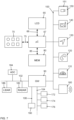
- Fig. 7 schematically shows a block diagram of a board electronics system of a motor vehicle.
- an infotainment system which comprises a touch-sensitive display unit 65, a computing device 67, an input unit 70, and a memory device 80.
- the display unit 65 is connected to the computing device 67 via a data line 66 and includes both a display area for displaying variable graphical information and an operator interface (touch-sensitive layer) arranged above the display area for inputting commands by a user.
- the input unit 70 is connected to the computing device 67 via a data line 75.
- the memory device 80 is connected to the computing device 67 via a data line 85.
- a pictogram directory and/or symbol directory is deposited with pictograms and/or symbols for possible overlays of additional information.
- the other parts of the infotainment system such as a camera 150, radio 140, navigation device 130, telephone 120 and instrument cluster 110 are connected via a data bus 100 with the computing device 60.
- data bus 100 the high-speed variant of the CAN (Controller Area Network) bus according to ISO standard 11898-2 may be used.
- an Ethernet-based bus system such as IEEE 802.03cg can be used.
- Bus systems implementing the data transmission via optical fibers are also usable. Examples are the MOST Bus (Media Oriented System Transport) or the D2B Bus (Domestic Digital Bus).
- MOST Bus Media Oriented System Transport
- D2B Bus Domestic Digital Bus
- the vehicle is equipped with an on-board connectivity module 160. It can be used for mobile communication, e.g. mobile communication according to the 5G standard.
- Reference numeral 172 denotes an engine control unit.
- Reference numeral 174 denotes an ESC (electronic stability control) unit, whereas reference numeral 176 denotes a transmission control unit.
- Modern vehicles may comprise additional components, such as further sensors for scanning the surroundings, like a LIDAR sensor 186 or a RADAR sensor 182 and additional video cameras 151, e.g. a front camera, a rear camera or side cameras. Such sensors are increasingly used in vehicles for observation of the environment. Further control devices, such as an ADC (automatic driving control) unit 184, etc., may be provided in the vehicle.
- the RADAR and LIDAR sensors 182, 186 may have a scanning range of up to 250 m, whereas the cameras 150, 151 may cover a range from 30 m to 120 m.
- the components 182 to 186 are connected to another communication bus 102, e.g. an Ethernet-Bus due to its higher bandwidth for data transport.
- V2V Vehicle-to-Vehicle
- Reference numeral 190 denotes an on-board diagnosis interface, which is connected to another communication bus 106.
- a gateway 90 For the purpose of transmitting the vehicle-relevant sensor data via the an on-board connectivity module 160 to another vehicle or to a control center computer, a gateway 90 is provided. This gateway 90 is connected to the different bus systems 100, 102, 104 and 106. The gateway 90 is adapted to convert the data it receives via one bus to the transmission format of another bus so that it can be distributed using the packets specified for the respective other bus. For forwarding this data to the outside, i.e. to another vehicle or to the control central computer, the an on-board connectivity module 160 is equipped with a communication interface to receive these data packets and, in turn, to convert them into the transmission format of the appropriate mobile radio standard.
Landscapes
- Engineering & Computer Science (AREA)
- Theoretical Computer Science (AREA)
- Physics & Mathematics (AREA)
- General Physics & Mathematics (AREA)
- General Engineering & Computer Science (AREA)
- Human Computer Interaction (AREA)
- Computer Hardware Design (AREA)
- Transportation (AREA)
- Chemical & Material Sciences (AREA)
- Combustion & Propulsion (AREA)
- Mechanical Engineering (AREA)
- Audiology, Speech & Language Pathology (AREA)
- General Health & Medical Sciences (AREA)
- Health & Medical Sciences (AREA)
- Fittings On The Vehicle Exterior For Carrying Loads, And Devices For Holding Or Mounting Articles (AREA)
- User Interface Of Digital Computer (AREA)
Description
- The present invention is related to a method, a computer program, and an apparatus for controlling operation of two or more configurable systems of a motor vehicle. The invention is further related to a mobile user device and a motor vehicle, which make use of such a method or apparatus.
- Motor vehicles are typically provided with an entertainment system, e.g. for playback of sound or video. For example,
DE 102 26 406 C1 discloses a device for displaying visual information in a vehicle, which has an extendable display unit arranged on the inside of the vehicle roof, which is adjustable between a retracted rest position on the vehicle roof and an extended use position, in which it forms a rearward-facing display surface extending substantially vertically downwards from the vehicle roof. Projection units may be provided to project image information onto the display surface. - Such entertainment systems offer an ever-increasing number of features, e.g. high-quality video and audio playback, access to streaming services, etc. Furthermore, an entertainment system may offer the possibility to play video games or access internet services.
- In addition to the increased capabilities of user entertainment, modern motor vehicles often offer the possibility to adapt the interior of the motor vehicle, in particular the ambient light, to the mood or preferences of the user. While these features aim at providing a pleasant user experience, the increasing number of configurable systems may at the same time require the user to adapt multiple systems using a built-in user interface of the motor vehicle. This may sometimes be cumbersome for the user.
-
EP 2 898 660 A1 discloses a method for controlling a vehicle computer using a mobile telephone. The vehicle computer comprises a vehicle display and a vehicle input device. The mobile telephone comprises a mobile telephone display and a mobile telephone input device. An application is ran on the mobile telephone, into which a control command for the vehicle is entered by a user using the mobile telephone input device. A software library is operated by means of the application. The mobile telephone is connected to the vehicle computer via a local network connection using the software library. A software interface for the software library is implemented in the vehicle. The control command is transmitted to the software interface and the control command is carried out by the vehicle computer. -
EP 3 694 195 A1 discloses a method for remotely controlling features of a vehicle without an integrated touchscreen. Feature information identifying electronic features of the vehicle that are respectively controlled by electromechanical controls of the vehicle are acquired by an auxiliary device. A graphical user interface is rendered via a display of the auxiliary device. - The graphical user interface comprises graphical controls for remotely controlling the electronic features of the vehicle.
-
WO 2017/137936 A1 discloses a system comprising a vehicle configured with an electronic interface and a portable computing device configured to be operatively integrated with the electronic interface. The portable computing device is integrated in such way as to act as an infotainment device for the vehicle and enable display of at least one vehicle parameter on the portable computing device. - It is an object of the present invention to provide improved solutions for controlling operation of two or more configurable systems of a motor vehicle.
- This object is achieved by a method according to claim 1, by a computer program according to
claim 12, which implements such a method, and by an apparatus according to claim 13. This object is further achieved by a mobile user device according to claim 14 and a motor vehicle according to claim 15. The dependent claims include advantageous further developments and improvements of the present principles as described below. - According to a first aspect, a method for controlling operation of two or more configurable systems of a motor vehicle with a single input by a user comprises:
- receiving, via a user interface of a mobile user device, the single user input specifying an operation scenario;
- retrieving operation parameters associated with the specified operation scenario for the two or more configurable systems; and
- operating the two or more configurable systems in accordance with the operation parameters.
- Accordingly, a computer program comprises instructions, which, when executed by a computer, cause the computer to perform the following steps for controlling operation of two or more configurable systems of a motor vehicle with a single input by a user:
- receiving, via a user interface of a mobile user device, the single user input specifying an operation scenario;
- retrieving operation parameters associated with the specified operation scenario for the two or more configurable systems; and
- operating the two or more configurable systems in accordance with the operation parameters.
- The term computer has to be understood broadly. In particular, it also includes mobile devices, electronic control units, and other processor-based data processing devices.
- The computer program can, for example, be made available for electronic retrieval or stored on a computer-readable storage medium.
- According to another aspect, an apparatus for controlling operation of two or more configurable systems of a motor vehicle with a single input by a user comprises:
- an input unit configured to receive, via a user interface of a mobile user device, the single user input specifying an operation scenario;
- a parameter retrieving unit configured to retrieve operation parameters associated with the specified operation scenario for the two or more configurable systems; and
- an operating unit configured to operate the two or more configurable systems in accordance with the operation parameters.
- According to the invention, a user may control multiple configurable systems of a motor vehicle using a mobile user device, e.g. a smartphone, a tablet or a wearable, by simply specifying a desired operation scenario in a user interface of the mobile user device. Examples of operation scenarios include watching video, playing a video game, relaxing, video conferencing, working, etc. Upon receipt of the desired operation scenario, associated operation parameters for the various configurable systems are retrieved. The configurable systems are then operated in accordance with these operation parameters. In this way, the user has the possibility to control multiple configurable systems with a single input in the user interface of the mobile user device. The described solution thus provides a satisfying user experience. The operation scenarios may, for example, be specified by a manufacturer of the motor vehicle, by a service provider, or by the user. Advantageously, the operation scenarios or the associated operation parameters may be modified by the user. The operation parameters may be retrieved from a storage unit of the mobile user device. In this case, the retrieved operation parameters will be provided from the mobile user device directly to the configurable systems or to a control unit of the motor vehicle. Alternatively, the operation parameters may be retrieved from a storage unit of the motor vehicle. In this case, the mobile user device preferably just provides an identification of the operation scenario to a control unit of the motor vehicle.
- In an advantageous embodiment, the two or more configurable systems are part of a presentation system of the motor vehicle. For example, the two or more configurable systems may include a display system, a sound system, or an ambient lighting system. While the invention is generally applicable to any configurable system of a motor vehicle, adaptation of these systems is rather likely to be desired by a user. As such, use of the invention is particularly useful for these configurable systems.
- In an advantageous embodiment, operating the two or more configurable systems comprises bringing a display surface of the display system into a use position. For example, the display surface may be a display, a projection screen, or a roll-up display. In response to the selection of an operation scenario that requires video presentation, a display may be extended or a projection screen may come up. In addition, one or more projectors may be switched on. Alternatively, a roll-up display may be unrolled, e.g. an OLED-display (OLED: Organic Light Emitting Diode).
- In an advantageous embodiment, operating the two or more configurable systems comprises adapting display parameters of the display system. For example, color settings or frame rates may be adapted to the content that will be displayed. In particular, different settings may be used for movie playback, video games, display of a desktop, or video conferences. In this way, depending on the specific application optimal settings can be used.
- In an advantageous embodiment, operating the two or more configurable systems comprises adapting an arrangement of information displayed by the display system. For example, to reduce distraction, the user may wish to display less information on a head-up display. Some information may instead be displayed on an infotainment system of the motor vehicle or even on the mobile device. By selecting appropriate operation scenarios directed towards the amount and position of displayed information, the arrangement of the displayed information can easily be controlled by the user.
- In an advantageous embodiment, operating the two or more configurable systems comprises adapting sound parameters of the sound system. For example, cinema sound may be preferable for video playback, whereas a deep, rich bass may be used for playing games. For video conferences, a balanced sound reproduction at all frequencies may be desirable.
- In this way, the sound parameters of the sound system can easily be adapted to the specific application.
- In an advantageous embodiment, operating the two or more configurable systems comprises changing a color or an intensity of ambient light generated by the ambient lighting system. For example, muted colors may be preferable during video playback, playing games, relaxing, or at nighttime, whereas brighter light may be preferable for working or at daytime. In this way, the ambient light can easily be adapted to the specific application.
- In an advantageous embodiment, the two or more configurable systems are only operated in accordance with the operation parameters when the motor vehicle is not in a manual operating situation. In particular, operations scenarios that may cause a distraction of the user may only be activated when the motor vehicle is not in operation or is in autonomous operation. In this way, a safe operation of the motor vehicle is ensured. Operation scenarios that will not cause a distraction of the user, such as relaxing or a simple rearrangement of the displayed information, may also be activated in a manual operating situation.
- Advantageously, a mobile user device comprises an apparatus according to the invention or is configured to perform a method according to the invention for controlling operation of two or more configurable systems of a motor vehicle with a single input by a user. For example, the mobile user device may be a smartphone, a tablet or a wearable. This has the advantage that users today are accustomed to operating all kinds of devices using applications running on their own mobile devices. Preferably, such an application may be used even if the user is outside of the motor vehicle.
- Advantageously, a motor vehicle comprises an apparatus according to the invention or is configured to perform a method according to the invention for controlling operation of two or more configurable systems of the motor vehicle with a single input by a user based on information received from a mobile user device. For example, the motor vehicle may be a car, a bus, or a commercial vehicle, e.g. a truck. More generally, the invention can be used in land vehicles, rail vehicles, watercrafts, and aircrafts.
- Further features of the present invention will become apparent from the following description and the appended claims in conjunction with the figures.
- Fig. 1
- schematically illustrates a method for controlling operation of two or more configurable systems of a motor vehicle;
- Fig. 2
- schematically illustrates a first embodiment of an apparatus for controlling operation of two or more configurable systems of a motor vehicle;
- Fig. 3
- schematically illustrates a second embodiment of an apparatus for controlling operation of two or more configurable systems of a motor vehicle;
- Fig. 4
- shows a motor vehicle suitable for use with the described solution;
- Fig. 5
- shows an interior of the motor vehicle of
Fig. 4 ; - Fig. 6
- shows a mobile user device suitable for use with the described solution; and
- Fig. 7
- shows a block diagram of an electronics system of a motor vehicle.
- The present description illustrates the principles of the present invention. It will thus be appreciated that those skilled in the art will be able to devise various arrangements that, although not explicitly described or shown herein, embody the principles of the invention.
- All examples and conditional language recited herein are intended for educational purposes to aid the reader in understanding the principles of the invention and the concepts contributed by the inventor to furthering the art, and are to be construed as being without limitation to such specifically recited examples and conditions.
- Moreover, all statements herein reciting principles, aspects, and embodiments of the invention, as well as specific examples thereof, are intended to encompass both structural and functional embodiments thereof.
- Thus, for example, it will be appreciated by those skilled in the art that the diagrams presented herein represent conceptual views of illustrative circuitry embodying the principles of the invention.
- The functions of the various elements shown in the figures may be provided through the use of dedicated hardware as well as hardware capable of executing software in association with appropriate software. When provided by a processor, the functions may be provided by a single dedicated processor, by a single shared processor, or by a plurality of individual processors, some of which may be shared. Moreover, explicit use of the term "processor" or "controller" should not be construed to refer exclusively to hardware capable of executing software, and may implicitly include, without limitation, digital signal processor (DSP) hardware, read only memory (ROM) for storing software, random access memory (RAM), and nonvolatile storage.
- Other hardware, conventional and/or custom, may also be included. Similarly, any switches shown in the figures are conceptual only. Their function may be carried out through the operation of program logic, through dedicated logic, through the interaction of program control and dedicated logic, or even manually, the particular technique being selectable by the implementer as more specifically understood from the context.
- In the claims hereof, any element expressed as a means for performing a specified function is intended to encompass any way of performing that function including, for example, a combination of circuit elements that performs that function or software in any form, including, therefore, firmware, microcode or the like, combined with appropriate circuitry for executing that software to perform the function. The invention as defined by such claims resides in the fact that the functionalities provided by the various recited means are combined and brought together in the manner which the claims call for.
-
Fig. 1 schematically illustrates a method according to the invention for controlling operation of two or more configurable systems of a motor vehicle. For example, the two or more configurable systems may be part of a presentation system of the motor vehicle and may include a display system, a sound system, or an ambient lighting system. In a first step, a user input specifying an operation scenario is received 10 via a user interface of a mobile user device. Operation parameters associated with the specified operation scenario are then retrieved 11 for the two or more configurable systems and the two or more configurable systems are operated 12 in accordance with the operation parameters. For example, operating the two or more configurable systems may comprise bringing a display surface of a display system, such as a display, a projection screen, or a roll-up display, into a use position, adapting display parameters of the display system, or adapting an arrangement of information displayed by the display system. Likewise, operating the two or more configurable systems may comprise adapting sound parameters of a sound system or changing a color or an intensity of ambient light generated by an ambient lighting system. Advantageously, the two or more configurable systems are only operated in accordance with the operation parameters when the motor vehicle is not in a manual operating situation. -
Fig. 2 schematically illustrates a block diagram of a first embodiment of anapparatus 20 according to the invention for controlling operation of two or moreconfigurable systems configurable systems display system 41, asound system 42, or anambient lighting system 43. Theapparatus 20 has aninput 21, via which aninput unit 22 receives a user input via a user interface of amobile user device 50, the user input specifying an operation scenario OS. Aparameter retrieving unit 23 is configured to retrieve operation parameters P associated with the specified operation scenario OS for the two or moreconfigurable systems unit 24 is configured to operate the two or moreconfigurable systems unit 24 may provide the operation parameters P directly to theconfigurable systems control unit 47 of the motor vehicle via anoutput 27. Alocal storage unit 26 is provided, e.g. for storing data during processing. Theinput 21 and theoutput 27 may likewise be combined into a single bidirectional interface. For example, operating the two or moreconfigurable systems display system 41, such as a display, a projection screen, or a roll-up display, into a use position, adapting display parameters of thedisplay system 41, or adapting an arrangement of information displayed by thedisplay system 41. Likewise, operating the two or moreconfigurable systems sound system 42 or changing a color or an intensity of ambient light generated by anambient lighting system 43. Advantageously, the two or moreconfigurable systems - The
input unit 22, theparameter retrieving unit 23, and the operatingunit 24 may be controlled by acontrol unit 25. Auser interface 28 may be provided for enabling a user to modify settings of theinput unit 22, theparameter retrieving unit 23, the operatingunit 24, or thecontrol unit 25. The various units 22-25 can be embodied as dedicated hardware units. Of course, they may likewise be fully or partially combined into a single unit or implemented as software running on a processor, e.g. a CPU or a GPU. - A block diagram of a second embodiment of an apparatus 30 according to the invention for controlling operation of two or more configurable systems of a motor vehicle is illustrated in
Fig. 3 . The apparatus 30 comprises aprocessing device 31 and amemory device 32. For example, the apparatus 30 may be a computer, a mobile device, or an electronic control unit. Thememory device 32 has stored instructions that, when executed by theprocessing device 31, cause the apparatus 30 to perform steps according to one of the described methods. The instructions stored in thememory device 32 thus tangibly embody a program of instructions executable by theprocessing device 31 to perform program steps as described herein according to the present principles. The apparatus 30 has aninput 33 for receiving data. Data generated by theprocessing device 31 are made available via anoutput 34. In addition, such data may be stored in thememory device 32. Theinput 33 and theoutput 34 may be combined into a single bidirectional interface. - The
processing device 31 as used herein may include one or more processing units, such as microprocessors, digital signal processors, or a combination thereof. - The
local storage unit 26 and thememory device 32 may include volatile and/or non-volatile memory regions and storage devices such as hard disk drives, optical drives, and/or solid-state memories. -
Fig. 4 shows amotor vehicle 40 suitable for use with the described solution. In this example, themotor vehicle 40 is a car. Themotor vehicle 40 comprises adisplay system 41, asound system 42, and anambient lighting system 43. Themotor vehicle 40 further comprises a plurality ofsensor units 44, e.g. a camera, a radar sensor, and an ultra-sound sensor. Of course, other types of sensor units may likewise be used, such as a laser scanner or a lidar sensor. Adata transmission unit 45 is provided, e.g. for exchanging data with other motor vehicles or with a service provider. For this purpose, thedata transmission unit 45 may make use of known communication technologies, such as IEEE802.11p or 3GPP C-V2X. For storing data, alocal storage unit 46 is provided. The various components of themotor vehicle 40 may be controlled by acontrol unit 47. Data exchange between the components of themotor vehicle 40 is performed via anetwork 48. For controlling operation of thedisplay system 41, thesound system 42, and theambient lighting system 43, anapparatus 20 according to the invention is provided. In this example, theapparatus 20 is included in themotor vehicle 40 and receives information from amobile user device 50. Alternatively, the apparatus may be included in themobile user device 50. -
Fig. 5 shows an interior of themotor vehicle 40 ofFig. 4 . In this example, a user has, via a mobile user device, specified the operation scenario as "watching video". In response to this operation scenario, adisplay surface 410 of thedisplay system 41 is brought into a use position. In this example, thedisplay surface 410 is a projection screen, onto which one ormore projectors 411 project the desired video information. Thedisplay system 41 may further include a head-up display or an infotainment system (not shown). In addition, sound parameters of thesound system 42 are adapted, e.g. switched to cinema sound. Finally, the color and intensity of ambient light generated by theambient lighting system 43 are matched to the operation scenario. For example, the ambient light may be dimmed and shifted to a dark red. In other operation scenarios, such as playing a video game, relaxing, video conferencing, or working, other settings may be used, e.g. bright ambient light and a different sound equalization. -
Fig. 6 shows amobile user device 50 suitable for use with the described solution. In this example, themobile user device 50 is a smartphone. Themobile user device 50 shows a user interface UI with a number ofbuttons 51 for various operation scenarios. The operation scenarios may, for example, be specified by a manufacturer of the motor vehicle, by a service provider, or by the user. As can be seen,buttons 51 for watching video, playing a video game, and relaxing can be activated.Further buttons 51 may be available by scrolling thebuttons 51 to the left or to the right, as indicated by ascroll bar 52. Upon activation of aspecific button 51, the corresponding operation scenario is selected and the operation parameters of two or more configurable systems of the motor vehicle are set accordingly. Aninformation window 53 of the user interface UI may be used to inform the user about the progress of setting the operation parameters. -
Fig. 7 schematically shows a block diagram of a board electronics system of a motor vehicle. Part of the board electronics system is an infotainment system, which comprises a touch-sensitive display unit 65, acomputing device 67, aninput unit 70, and amemory device 80. Thedisplay unit 65 is connected to thecomputing device 67 via adata line 66 and includes both a display area for displaying variable graphical information and an operator interface (touch-sensitive layer) arranged above the display area for inputting commands by a user. Theinput unit 70 is connected to thecomputing device 67 via adata line 75. - The
memory device 80 is connected to thecomputing device 67 via adata line 85. In thememory device 80, a pictogram directory and/or symbol directory is deposited with pictograms and/or symbols for possible overlays of additional information. - The other parts of the infotainment system, such as a
camera 150,radio 140,navigation device 130,telephone 120 andinstrument cluster 110 are connected via adata bus 100 with the computing device 60. Asdata bus 100, the high-speed variant of the CAN (Controller Area Network) bus according to ISO standard 11898-2 may be used. Alternatively, an Ethernet-based bus system such as IEEE 802.03cg can be used. Bus systems implementing the data transmission via optical fibers are also usable. Examples are the MOST Bus (Media Oriented System Transport) or the D2B Bus (Domestic Digital Bus). For inbound and outbound wireless communication, the vehicle is equipped with an on-board connectivity module 160. It can be used for mobile communication, e.g. mobile communication according to the 5G standard. -
Reference numeral 172 denotes an engine control unit.Reference numeral 174 denotes an ESC (electronic stability control) unit, whereasreference numeral 176 denotes a transmission control unit. The networking of such control units, all of which are allocated to the category of the drive train, typically occurs with a CAN bus 104. Since various sensors are installed in the motor vehicle and these are no longer only connected to individual control units, such sensor data are also distributed via the bus system 104 to the individual control devices. - Modern vehicles may comprise additional components, such as further sensors for scanning the surroundings, like a
LIDAR sensor 186 or aRADAR sensor 182 andadditional video cameras 151, e.g. a front camera, a rear camera or side cameras. Such sensors are increasingly used in vehicles for observation of the environment. Further control devices, such as an ADC (automatic driving control)unit 184, etc., may be provided in the vehicle. The RADAR andLIDAR sensors cameras components 182 to 186 are connected to anothercommunication bus 102, e.g. an Ethernet-Bus due to its higher bandwidth for data transport. One Ethernet-bus adapted to the special needs of car communication is standardized in the IEEE 802.1Q specification. Moreover, a lot of information about the environment may be received via V2V (Vehicle-to-Vehicle) communication from other vehicles. Particularly for those vehicles that are not in line of sight to the observing vehicle, it is very advantageous to receive the information about their position and motion via V2V communication. -
Reference numeral 190 denotes an on-board diagnosis interface, which is connected to anothercommunication bus 106. - For the purpose of transmitting the vehicle-relevant sensor data via the an on-
board connectivity module 160 to another vehicle or to a control center computer, agateway 90 is provided. Thisgateway 90 is connected to thedifferent bus systems gateway 90 is adapted to convert the data it receives via one bus to the transmission format of another bus so that it can be distributed using the packets specified for the respective other bus. For forwarding this data to the outside, i.e. to another vehicle or to the control central computer, the an on-board connectivity module 160 is equipped with a communication interface to receive these data packets and, in turn, to convert them into the transmission format of the appropriate mobile radio standard. -
- 10
- Receive user input specifying operation scenario
- 11
- Retrieve operation parameters associated with operation scenario
- 12
- Operate configurable systems in accordance with operation parameters
- 20
- Apparatus
- 21
- Input
- 22
- Input unit
- 23
- Parameter retrieving unit
- 24
- Operating unit
- 25
- Control unit
- 26
- Local storage unit
- 27
- Output
- 28
- User interface
- 30
- Apparatus
- 31
- Processing device
- 32
- Memory device
- 33
- Input
- 34
- Output
- 40
- Motor vehicle
- 41
- Display system
- 42
- Sound system
- 43
- Ambient lighting system
- 44
- Sensor units
- 45
- Data transmission unit
- 46
- Local storage unit
- 47
- Control unit
- 48
- Network
- 50
- Mobile user device
- 51
- Button
- 52
- Scroll bar
- 53
- Information window
- 65
- Display Unit
- 66
- Data line to display unit
- 67
- Computing device
- 70
- Input unit
- 75
- Data line to input unit
- 80
- Memory unit
- 85
- Data line to memory unit
- 90
- Gateway
- 100
- First data bus
- 102
- Second data bus
- 104
- Third data bus
- 106
- Fourth data bus
- 110
- Instrument cluster
- 120
- Telephone
- 130
- Navigation device
- 140
- Radio
- 150
- Camera
- 151
- Further cameras
- 160
- On-board connectivity module
- 172
- Engine control unit
- 174
- Electronic stability control unit
- 176
- Transmission control unit
- 182
- RADAR sensor
- 184
- Automatic driving control unit
- 186
- LIDAR sensor
- 190
- On-board diagnosis interface
- 410
- Display surface
- 411
- Projector
- OS
- Operation scenario
- P
- Operation parameters
- UI
- User interface
Claims (15)
- A method for controlling operation of two or more configurable systems (41, 42, 43) of a motor vehicle (40) with a single input by a user, the method comprising:- receiving (10), via a user interface (UI) of a mobile user device (50), the single user input specifying an operation scenario (OS);- retrieving (11) operation parameters (P) associated with the specified operation scenario (OS) for the two or more configurable systems (41, 42, 43); and- operating (12) the two or more configurable systems (41, 42, 43) in accordance with the operation parameters (P).
- The method according to claim 1, wherein the two or more configurable systems (41, 42, 43) are part of a presentation system of the motor vehicle (40).
- The method according to claim 1 or 2, wherein the two or more configurable systems (41, 42, 43) include a display system (41), a sound system (42), or an ambient lighting system (43).
- The method according to claim 3, wherein operating (12) the two or more configurable systems (41, 42, 43) comprises bringing a display surface (410) of the display system (41) into a use position.
- The method according to claim 4, wherein the display surface (410) is a display, a projection screen, or a roll-up display.
- The method according to one of claims 3 to 5, wherein operating (12) the two or more configurable systems (41, 42, 43) comprises adapting display parameters of the display system (41).
- The method according to one of claims 3 to 6, wherein operating (12) the two or more configurable systems (41, 42, 43) comprises adapting an arrangement of information displayed by the display system (41).
- The method according to claim 3, wherein operating (12) the two or more configurable systems (41, 42, 43) comprises adapting sound parameters of the sound system (42).
- The method according to claim 3, wherein operating (12) the two or more configurable systems (41, 42, 43) comprises changing a color or an intensity of ambient light generated by the ambient lighting system (43).
- The method according to one of the preceding claims, wherein the mobile user device (50) is a smartphone, a tablet or a wearable.
- The method according to one of the preceding claims, wherein the two or more configurable systems (41, 42, 43) are only operated (12) in accordance with the operation parameters (P) when the motor vehicle (40) is not in a manual operating situation.
- A computer program comprising instructions, which, when executed by a computer via a user interface (UI) of a mobile user device, cause the computer to perform a method according to any of claims 1 to 11 for controlling operation of two or more configurable systems (41, 42, 43) of a motor vehicle (40) with a single input by a user.
- An apparatus (20) for controlling operation of two or more configurable systems (41, 42, 43) of a motor vehicle (40) with a single input by a user, the apparatus (20) comprising:- an input unit (22) configured to receive (10), via a user interface (UI) of a mobile user device (50), the single user input specifying an operation scenario (OS);- a parameter retrieving unit (23) configured to retrieve (11) operation parameters (P) associated with the specified operation scenario (OS) for the two or more configurable systems (41, 42, 43); and- an operating unit (24) configured to operate (12) the two or more configurable systems (41, 42, 43) in accordance with the operation parameters (P).
- A mobile user device (50), wherein the mobile user device (50) comprises an apparatus (20) according to claim 13 or is configured to perform a method according to any of claims 1 to 11 for controlling operation of two or more configurable systems (41, 42, 43) of a motor vehicle (40) with a single input by a user.
- A motor vehicle (40) equipped with two or more configurable systems (41, 42, 43),
wherein the motor vehicle (40) comprises an apparatus (20) according to claim 13 or is configured to perform a method according to any of claims 1 to 11 for controlling operation of the two or more configurable systems (41, 42, 43) with a single input by a user.
Priority Applications (4)
| Application Number | Priority Date | Filing Date | Title |
|---|---|---|---|
| EP21194749.4A EP4144560B1 (en) | 2021-09-03 | 2021-09-03 | Method, computer program and apparatus for controlling operation of two or more configurable systems of a motor vehicle |
| ES21194749T ES3025979T3 (en) | 2021-09-03 | 2021-09-03 | Method, computer program and apparatus for controlling operation of two or more configurable systems of a motor vehicle |
| US17/868,511 US11830455B2 (en) | 2021-09-03 | 2022-07-19 | Method, computer program and apparatus for controlling operation of two or more configurable systems of a motor vehicle |
| CN202211069223.4A CN115756253A (en) | 2021-09-03 | 2022-09-02 | Method, computer program and device for controlling the operation of two or more configurable systems of a motor vehicle |
Applications Claiming Priority (1)
| Application Number | Priority Date | Filing Date | Title |
|---|---|---|---|
| EP21194749.4A EP4144560B1 (en) | 2021-09-03 | 2021-09-03 | Method, computer program and apparatus for controlling operation of two or more configurable systems of a motor vehicle |
Publications (2)
| Publication Number | Publication Date |
|---|---|
| EP4144560A1 EP4144560A1 (en) | 2023-03-08 |
| EP4144560B1 true EP4144560B1 (en) | 2025-03-05 |
Family
ID=77640425
Family Applications (1)
| Application Number | Title | Priority Date | Filing Date |
|---|---|---|---|
| EP21194749.4A Active EP4144560B1 (en) | 2021-09-03 | 2021-09-03 | Method, computer program and apparatus for controlling operation of two or more configurable systems of a motor vehicle |
Country Status (4)
| Country | Link |
|---|---|
| US (1) | US11830455B2 (en) |
| EP (1) | EP4144560B1 (en) |
| CN (1) | CN115756253A (en) |
| ES (1) | ES3025979T3 (en) |
Families Citing this family (11)
| Publication number | Priority date | Publication date | Assignee | Title |
|---|---|---|---|---|
| JP7034228B1 (en) * | 2020-09-30 | 2022-03-11 | 株式会社ドワンゴ | Eye tracking system, eye tracking method, and eye tracking program |
| WO2022185308A1 (en) * | 2021-03-04 | 2022-09-09 | Rail Vision Ltd | System and method for verifying a selection of an optical sensor |
| CN117795287A (en) * | 2021-08-13 | 2024-03-29 | 国立大学法人东京大学 | Information processing device, computer program and pattern code |
| US12244974B1 (en) * | 2022-01-11 | 2025-03-04 | Noah Buffett-Kennedy | Vehicular projection system |
| US12322139B2 (en) * | 2022-02-28 | 2025-06-03 | Basis Software, Inc. | System and method for camera calibration |
| US12450777B2 (en) * | 2022-06-01 | 2025-10-21 | Proprio, Inc. | Methods and systems for calibrating and/or verifying a calibration of an imaging system such as a surgical imaging system |
| KR20240125760A (en) * | 2023-02-09 | 2024-08-20 | 삼성디스플레이 주식회사 | Image quality inspection method, image quality inspection system performing the same and display device to which the same is applied |
| CN118683330A (en) * | 2023-03-20 | 2024-09-24 | 小米汽车科技有限公司 | Control method, medium and display device for vehicle display device |
| US12293548B2 (en) * | 2023-04-21 | 2025-05-06 | Toyota Research Institute, Inc. | Systems and methods for estimating scaled maps by sampling representations from a learning model |
| WO2025096833A1 (en) * | 2023-10-31 | 2025-05-08 | Universal City Studios Llc | Systems and methods for projection mapping onto multiple rigid bodies |
| US12491907B1 (en) * | 2024-01-18 | 2025-12-09 | Zoox, Inc. | Time simulation management of real world sensor frame data |
Family Cites Families (7)
| Publication number | Priority date | Publication date | Assignee | Title |
|---|---|---|---|---|
| DE10226406C1 (en) | 2002-06-13 | 2003-12-04 | Webasto Vehicle Sys Int Gmbh | Visual information representation device for automobile uses representation surface acting as sunblind for transparent roof section in its horizontal stowed position |
| DE102012216919A1 (en) | 2012-09-20 | 2014-05-28 | Continental Automotive Gmbh | Vehicle control system |
| US20160088052A1 (en) * | 2014-09-24 | 2016-03-24 | GM Global Technology Operations LLC | Indexing mobile device content using vehicle electronics |
| WO2017137936A1 (en) * | 2016-02-11 | 2017-08-17 | Jaywant MAHAJAN | Portable computing device configured as vehicle infotainment device |
| US11400811B2 (en) * | 2019-02-11 | 2022-08-02 | Volvo Car Corporation | Remotely controlling electronic functions of a vehicle without an integrated touchscreen |
| US20200377032A1 (en) * | 2019-05-29 | 2020-12-03 | Deyan Alex | Configurable roof rack for vehicles |
| US11538287B2 (en) * | 2019-09-20 | 2022-12-27 | Sonatus, Inc. | System, method, and apparatus for managing vehicle data collection |
-
2021
- 2021-09-03 ES ES21194749T patent/ES3025979T3/en active Active
- 2021-09-03 EP EP21194749.4A patent/EP4144560B1/en active Active
-
2022
- 2022-07-19 US US17/868,511 patent/US11830455B2/en active Active
- 2022-09-02 CN CN202211069223.4A patent/CN115756253A/en active Pending
Also Published As
| Publication number | Publication date |
|---|---|
| EP4144560A1 (en) | 2023-03-08 |
| US20230072526A1 (en) | 2023-03-09 |
| ES3025979T3 (en) | 2025-06-10 |
| CN115756253A (en) | 2023-03-07 |
| US11830455B2 (en) | 2023-11-28 |
Similar Documents
| Publication | Publication Date | Title |
|---|---|---|
| EP4144560B1 (en) | Method, computer program and apparatus for controlling operation of two or more configurable systems of a motor vehicle | |
| US11370300B2 (en) | Method of adjusting the operation of a transportation vehicle control system, apparatus for use in the method, and transportation vehicle and computer program | |
| US9886259B2 (en) | Method and terminal device for complying router management application with router firmware | |
| US9912916B2 (en) | Methods and apparatus for utilizing vehicle system integrated remote wireless image capture | |
| US20130010209A1 (en) | Display apparatus, control apparatus, television receiver, method of controlling display apparatus, program, and recording medium | |
| JP5762553B2 (en) | Method, electronic device and program | |
| US20080134265A1 (en) | Image display system | |
| KR20180036169A (en) | Digital device and method of processing data the same | |
| US20250274418A1 (en) | Sharing externally captured content in communications | |
| JP5924370B2 (en) | Video display device, video switching device, and video display method | |
| US20140064736A1 (en) | Information processing apparatus, information processing system, information processing method, and program therefor | |
| WO2024082947A9 (en) | Multi-screen multi-device interaction method, electronic device, and system | |
| CN118182476A (en) | Vehicle linkage control method, device and vehicle | |
| WO2021255975A1 (en) | Imaging device, imaging control device, imaging device control method, and program | |
| EP4606675A1 (en) | Display control method and apparatus, and system and vehicle | |
| US9313723B2 (en) | Method and apparatus for executing an application by using a communication address | |
| US20250024143A1 (en) | Imaging apparatus, control method, and program | |
| JP2018519638A (en) | Method, apparatus and system for controlling smart lamp | |
| KR20150095290A (en) | Linking system and method for mobile phone and vehicle display device | |
| CN112911066A (en) | Device control method, device and medium | |
| EP4163141A1 (en) | Control element for a display device, method, computer program and apparatus for controlling operation of a display device | |
| KR102536483B1 (en) | Vehicle and controlling method thereof | |
| CN118870203A (en) | Terminal equipment, imaging method, imaging device and storage medium | |
| CN121354493A (en) | Multi-screen control methods, smart cockpits, storage media, and vehicles | |
| US10176037B2 (en) | Transmission management system, communication method, and non-transitory recording medium |
Legal Events
| Date | Code | Title | Description |
|---|---|---|---|
| PUAI | Public reference made under article 153(3) epc to a published international application that has entered the european phase |
Free format text: ORIGINAL CODE: 0009012 |
|
| STAA | Information on the status of an ep patent application or granted ep patent |
Free format text: STATUS: THE APPLICATION HAS BEEN PUBLISHED |
|
| AK | Designated contracting states |
Kind code of ref document: A1 Designated state(s): AL AT BE BG CH CY CZ DE DK EE ES FI FR GB GR HR HU IE IS IT LI LT LU LV MC MK MT NL NO PL PT RO RS SE SI SK SM TR |
|
| TPAC | Observations filed by third parties |
Free format text: ORIGINAL CODE: EPIDOSNTIPA |
|
| STAA | Information on the status of an ep patent application or granted ep patent |
Free format text: STATUS: REQUEST FOR EXAMINATION WAS MADE |
|
| 17P | Request for examination filed |
Effective date: 20230908 |
|
| RBV | Designated contracting states (corrected) |
Designated state(s): AL AT BE BG CH CY CZ DE DK EE ES FI FR GB GR HR HU IE IS IT LI LT LU LV MC MK MT NL NO PL PT RO RS SE SI SK SM TR |
|
| REG | Reference to a national code |
Ref country code: DE Ref legal event code: R079 Free format text: PREVIOUS MAIN CLASS: B60K0037060000 Ipc: B60K0035100000 Ref country code: DE Ref legal event code: R079 Ref document number: 602021027051 Country of ref document: DE Free format text: PREVIOUS MAIN CLASS: B60K0037060000 Ipc: B60K0035100000 |
|
| GRAP | Despatch of communication of intention to grant a patent |
Free format text: ORIGINAL CODE: EPIDOSNIGR1 |
|
| STAA | Information on the status of an ep patent application or granted ep patent |
Free format text: STATUS: GRANT OF PATENT IS INTENDED |
|
| RIC1 | Information provided on ipc code assigned before grant |
Ipc: B60K 35/80 20240101ALI20241113BHEP Ipc: B60K 35/10 20240101AFI20241113BHEP |
|
| INTG | Intention to grant announced |
Effective date: 20241126 |
|
| P01 | Opt-out of the competence of the unified patent court (upc) registered |
Free format text: CASE NUMBER: APP_65380/2024 Effective date: 20241211 |
|
| GRAS | Grant fee paid |
Free format text: ORIGINAL CODE: EPIDOSNIGR3 |
|
| GRAA | (expected) grant |
Free format text: ORIGINAL CODE: 0009210 |
|
| STAA | Information on the status of an ep patent application or granted ep patent |
Free format text: STATUS: THE PATENT HAS BEEN GRANTED |
|
| AK | Designated contracting states |
Kind code of ref document: B1 Designated state(s): AL AT BE BG CH CY CZ DE DK EE ES FI FR GB GR HR HU IE IS IT LI LT LU LV MC MK MT NL NO PL PT RO RS SE SI SK SM TR |
|
| REG | Reference to a national code |
Ref country code: GB Ref legal event code: FG4D |
|
| REG | Reference to a national code |
Ref country code: CH Ref legal event code: EP |
|
| REG | Reference to a national code |
Ref country code: DE Ref legal event code: R096 Ref document number: 602021027051 Country of ref document: DE |
|
| REG | Reference to a national code |
Ref country code: IE Ref legal event code: FG4D |
|
| REG | Reference to a national code |
Ref country code: ES Ref legal event code: FG2A Ref document number: 3025979 Country of ref document: ES Kind code of ref document: T3 Effective date: 20250610 |
|
| PG25 | Lapsed in a contracting state [announced via postgrant information from national office to epo] |
Ref country code: RS Free format text: LAPSE BECAUSE OF FAILURE TO SUBMIT A TRANSLATION OF THE DESCRIPTION OR TO PAY THE FEE WITHIN THE PRESCRIBED TIME-LIMIT Effective date: 20250605 |
|
| PG25 | Lapsed in a contracting state [announced via postgrant information from national office to epo] |
Ref country code: FI Free format text: LAPSE BECAUSE OF FAILURE TO SUBMIT A TRANSLATION OF THE DESCRIPTION OR TO PAY THE FEE WITHIN THE PRESCRIBED TIME-LIMIT Effective date: 20250305 |
|
| REG | Reference to a national code |
Ref country code: NL Ref legal event code: MP Effective date: 20250305 |
|
| REG | Reference to a national code |
Ref country code: LT Ref legal event code: MG9D |
|
| PG25 | Lapsed in a contracting state [announced via postgrant information from national office to epo] |
Ref country code: NO Free format text: LAPSE BECAUSE OF FAILURE TO SUBMIT A TRANSLATION OF THE DESCRIPTION OR TO PAY THE FEE WITHIN THE PRESCRIBED TIME-LIMIT Effective date: 20250605 |
|
| PG25 | Lapsed in a contracting state [announced via postgrant information from national office to epo] |
Ref country code: HR Free format text: LAPSE BECAUSE OF FAILURE TO SUBMIT A TRANSLATION OF THE DESCRIPTION OR TO PAY THE FEE WITHIN THE PRESCRIBED TIME-LIMIT Effective date: 20250305 |
|
| PG25 | Lapsed in a contracting state [announced via postgrant information from national office to epo] |
Ref country code: LV Free format text: LAPSE BECAUSE OF FAILURE TO SUBMIT A TRANSLATION OF THE DESCRIPTION OR TO PAY THE FEE WITHIN THE PRESCRIBED TIME-LIMIT Effective date: 20250305 |
|
| PG25 | Lapsed in a contracting state [announced via postgrant information from national office to epo] |
Ref country code: GR Free format text: LAPSE BECAUSE OF FAILURE TO SUBMIT A TRANSLATION OF THE DESCRIPTION OR TO PAY THE FEE WITHIN THE PRESCRIBED TIME-LIMIT Effective date: 20250606 Ref country code: BG Free format text: LAPSE BECAUSE OF FAILURE TO SUBMIT A TRANSLATION OF THE DESCRIPTION OR TO PAY THE FEE WITHIN THE PRESCRIBED TIME-LIMIT Effective date: 20250305 |
|
| REG | Reference to a national code |
Ref country code: AT Ref legal event code: MK05 Ref document number: 1772652 Country of ref document: AT Kind code of ref document: T Effective date: 20250305 |
|
| PG25 | Lapsed in a contracting state [announced via postgrant information from national office to epo] |
Ref country code: NL Free format text: LAPSE BECAUSE OF FAILURE TO SUBMIT A TRANSLATION OF THE DESCRIPTION OR TO PAY THE FEE WITHIN THE PRESCRIBED TIME-LIMIT Effective date: 20250305 |
|
| PG25 | Lapsed in a contracting state [announced via postgrant information from national office to epo] |
Ref country code: SE Free format text: LAPSE BECAUSE OF FAILURE TO SUBMIT A TRANSLATION OF THE DESCRIPTION OR TO PAY THE FEE WITHIN THE PRESCRIBED TIME-LIMIT Effective date: 20250305 |
|
| PG25 | Lapsed in a contracting state [announced via postgrant information from national office to epo] |
Ref country code: SM Free format text: LAPSE BECAUSE OF FAILURE TO SUBMIT A TRANSLATION OF THE DESCRIPTION OR TO PAY THE FEE WITHIN THE PRESCRIBED TIME-LIMIT Effective date: 20250305 |
|
| PG25 | Lapsed in a contracting state [announced via postgrant information from national office to epo] |
Ref country code: PT Free format text: LAPSE BECAUSE OF FAILURE TO SUBMIT A TRANSLATION OF THE DESCRIPTION OR TO PAY THE FEE WITHIN THE PRESCRIBED TIME-LIMIT Effective date: 20250707 |
|
| PGFP | Annual fee paid to national office [announced via postgrant information from national office to epo] |
Ref country code: DE Payment date: 20250930 Year of fee payment: 5 |
|
| PG25 | Lapsed in a contracting state [announced via postgrant information from national office to epo] |
Ref country code: IT Free format text: LAPSE BECAUSE OF FAILURE TO SUBMIT A TRANSLATION OF THE DESCRIPTION OR TO PAY THE FEE WITHIN THE PRESCRIBED TIME-LIMIT Effective date: 20250305 Ref country code: PL Free format text: LAPSE BECAUSE OF FAILURE TO SUBMIT A TRANSLATION OF THE DESCRIPTION OR TO PAY THE FEE WITHIN THE PRESCRIBED TIME-LIMIT Effective date: 20250305 |
|
| PGFP | Annual fee paid to national office [announced via postgrant information from national office to epo] |
Ref country code: GB Payment date: 20250923 Year of fee payment: 5 |
|
| PG25 | Lapsed in a contracting state [announced via postgrant information from national office to epo] |
Ref country code: AT Free format text: LAPSE BECAUSE OF FAILURE TO SUBMIT A TRANSLATION OF THE DESCRIPTION OR TO PAY THE FEE WITHIN THE PRESCRIBED TIME-LIMIT Effective date: 20250305 |
|
| PGFP | Annual fee paid to national office [announced via postgrant information from national office to epo] |
Ref country code: FR Payment date: 20250925 Year of fee payment: 5 |
|
| PG25 | Lapsed in a contracting state [announced via postgrant information from national office to epo] |
Ref country code: EE Free format text: LAPSE BECAUSE OF FAILURE TO SUBMIT A TRANSLATION OF THE DESCRIPTION OR TO PAY THE FEE WITHIN THE PRESCRIBED TIME-LIMIT Effective date: 20250305 |
|
| PGFP | Annual fee paid to national office [announced via postgrant information from national office to epo] |
Ref country code: CZ Payment date: 20250828 Year of fee payment: 5 |
|
| PG25 | Lapsed in a contracting state [announced via postgrant information from national office to epo] |
Ref country code: RO Free format text: LAPSE BECAUSE OF FAILURE TO SUBMIT A TRANSLATION OF THE DESCRIPTION OR TO PAY THE FEE WITHIN THE PRESCRIBED TIME-LIMIT Effective date: 20250305 |
|
| PG25 | Lapsed in a contracting state [announced via postgrant information from national office to epo] |
Ref country code: SK Free format text: LAPSE BECAUSE OF FAILURE TO SUBMIT A TRANSLATION OF THE DESCRIPTION OR TO PAY THE FEE WITHIN THE PRESCRIBED TIME-LIMIT Effective date: 20250305 |
|
| PG25 | Lapsed in a contracting state [announced via postgrant information from national office to epo] |
Ref country code: IS Free format text: LAPSE BECAUSE OF FAILURE TO SUBMIT A TRANSLATION OF THE DESCRIPTION OR TO PAY THE FEE WITHIN THE PRESCRIBED TIME-LIMIT Effective date: 20250705 |
|
| REG | Reference to a national code |
Ref country code: DE Ref legal event code: R097 Ref document number: 602021027051 Country of ref document: DE |
|
| PLBE | No opposition filed within time limit |
Free format text: ORIGINAL CODE: 0009261 |
|
| STAA | Information on the status of an ep patent application or granted ep patent |
Free format text: STATUS: NO OPPOSITION FILED WITHIN TIME LIMIT |
|
| PG25 | Lapsed in a contracting state [announced via postgrant information from national office to epo] |
Ref country code: DK Free format text: LAPSE BECAUSE OF FAILURE TO SUBMIT A TRANSLATION OF THE DESCRIPTION OR TO PAY THE FEE WITHIN THE PRESCRIBED TIME-LIMIT Effective date: 20250305 |
|
| REG | Reference to a national code |
Ref country code: CH Ref legal event code: L10 Free format text: ST27 STATUS EVENT CODE: U-0-0-L10-L00 (AS PROVIDED BY THE NATIONAL OFFICE) Effective date: 20260114 |
|
| PGFP | Annual fee paid to national office [announced via postgrant information from national office to epo] |
Ref country code: ES Payment date: 20251008 Year of fee payment: 5 |
|
| 26N | No opposition filed |
Effective date: 20251208 |