EP4142524B1 - Nonwoven fabric for oral pouched product, and method of manufacturing a nonwoven fabric - Google Patents
Nonwoven fabric for oral pouched product, and method of manufacturing a nonwoven fabric Download PDFInfo
- Publication number
- EP4142524B1 EP4142524B1 EP21722140.7A EP21722140A EP4142524B1 EP 4142524 B1 EP4142524 B1 EP 4142524B1 EP 21722140 A EP21722140 A EP 21722140A EP 4142524 B1 EP4142524 B1 EP 4142524B1
- Authority
- EP
- European Patent Office
- Prior art keywords
- nonwoven fabric
- diffusion
- web
- barrier
- layer
- Prior art date
- Legal status (The legal status is an assumption and is not a legal conclusion. Google has not performed a legal analysis and makes no representation as to the accuracy of the status listed.)
- Active
Links
Images


Classifications
-
- B—PERFORMING OPERATIONS; TRANSPORTING
- B32—LAYERED PRODUCTS
- B32B—LAYERED PRODUCTS, i.e. PRODUCTS BUILT-UP OF STRATA OF FLAT OR NON-FLAT, e.g. CELLULAR OR HONEYCOMB, FORM
- B32B5/00—Layered products characterised by the non- homogeneity or physical structure, i.e. comprising a fibrous, filamentary, particulate or foam layer; Layered products characterised by having a layer differing constitutionally or physically in different parts
- B32B5/02—Layered products characterised by the non- homogeneity or physical structure, i.e. comprising a fibrous, filamentary, particulate or foam layer; Layered products characterised by having a layer differing constitutionally or physically in different parts characterised by structural features of a fibrous or filamentary layer
- B32B5/022—Non-woven fabric
-
- D—TEXTILES; PAPER
- D04—BRAIDING; LACE-MAKING; KNITTING; TRIMMINGS; NON-WOVEN FABRICS
- D04H—MAKING TEXTILE FABRICS, e.g. FROM FIBRES OR FILAMENTARY MATERIAL; FABRICS MADE BY SUCH PROCESSES OR APPARATUS, e.g. FELTS, NON-WOVEN FABRICS; COTTON-WOOL; WADDING ; NON-WOVEN FABRICS FROM STAPLE FIBRES, FILAMENTS OR YARNS, BONDED WITH AT LEAST ONE WEB-LIKE MATERIAL DURING THEIR CONSOLIDATION
- D04H1/00—Non-woven fabrics formed wholly or mainly of staple fibres or like relatively short fibres
- D04H1/40—Non-woven fabrics formed wholly or mainly of staple fibres or like relatively short fibres from fleeces or layers composed of fibres without existing or potential cohesive properties
- D04H1/42—Non-woven fabrics formed wholly or mainly of staple fibres or like relatively short fibres from fleeces or layers composed of fibres without existing or potential cohesive properties characterised by the use of certain kinds of fibres insofar as this use has no preponderant influence on the consolidation of the fleece
- D04H1/425—Cellulose series
- D04H1/4258—Regenerated cellulose series
-
- D—TEXTILES; PAPER
- D04—BRAIDING; LACE-MAKING; KNITTING; TRIMMINGS; NON-WOVEN FABRICS
- D04H—MAKING TEXTILE FABRICS, e.g. FROM FIBRES OR FILAMENTARY MATERIAL; FABRICS MADE BY SUCH PROCESSES OR APPARATUS, e.g. FELTS, NON-WOVEN FABRICS; COTTON-WOOL; WADDING ; NON-WOVEN FABRICS FROM STAPLE FIBRES, FILAMENTS OR YARNS, BONDED WITH AT LEAST ONE WEB-LIKE MATERIAL DURING THEIR CONSOLIDATION
- D04H1/00—Non-woven fabrics formed wholly or mainly of staple fibres or like relatively short fibres
- D04H1/40—Non-woven fabrics formed wholly or mainly of staple fibres or like relatively short fibres from fleeces or layers composed of fibres without existing or potential cohesive properties
- D04H1/58—Non-woven fabrics formed wholly or mainly of staple fibres or like relatively short fibres from fleeces or layers composed of fibres without existing or potential cohesive properties by applying, incorporating or activating chemical or thermoplastic bonding agents, e.g. adhesives
-
- D—TEXTILES; PAPER
- D04—BRAIDING; LACE-MAKING; KNITTING; TRIMMINGS; NON-WOVEN FABRICS
- D04H—MAKING TEXTILE FABRICS, e.g. FROM FIBRES OR FILAMENTARY MATERIAL; FABRICS MADE BY SUCH PROCESSES OR APPARATUS, e.g. FELTS, NON-WOVEN FABRICS; COTTON-WOOL; WADDING ; NON-WOVEN FABRICS FROM STAPLE FIBRES, FILAMENTS OR YARNS, BONDED WITH AT LEAST ONE WEB-LIKE MATERIAL DURING THEIR CONSOLIDATION
- D04H1/00—Non-woven fabrics formed wholly or mainly of staple fibres or like relatively short fibres
- D04H1/40—Non-woven fabrics formed wholly or mainly of staple fibres or like relatively short fibres from fleeces or layers composed of fibres without existing or potential cohesive properties
- D04H1/58—Non-woven fabrics formed wholly or mainly of staple fibres or like relatively short fibres from fleeces or layers composed of fibres without existing or potential cohesive properties by applying, incorporating or activating chemical or thermoplastic bonding agents, e.g. adhesives
- D04H1/587—Non-woven fabrics formed wholly or mainly of staple fibres or like relatively short fibres from fleeces or layers composed of fibres without existing or potential cohesive properties by applying, incorporating or activating chemical or thermoplastic bonding agents, e.g. adhesives characterised by the bonding agents used
-
- D—TEXTILES; PAPER
- D04—BRAIDING; LACE-MAKING; KNITTING; TRIMMINGS; NON-WOVEN FABRICS
- D04H—MAKING TEXTILE FABRICS, e.g. FROM FIBRES OR FILAMENTARY MATERIAL; FABRICS MADE BY SUCH PROCESSES OR APPARATUS, e.g. FELTS, NON-WOVEN FABRICS; COTTON-WOOL; WADDING ; NON-WOVEN FABRICS FROM STAPLE FIBRES, FILAMENTS OR YARNS, BONDED WITH AT LEAST ONE WEB-LIKE MATERIAL DURING THEIR CONSOLIDATION
- D04H1/00—Non-woven fabrics formed wholly or mainly of staple fibres or like relatively short fibres
- D04H1/40—Non-woven fabrics formed wholly or mainly of staple fibres or like relatively short fibres from fleeces or layers composed of fibres without existing or potential cohesive properties
- D04H1/58—Non-woven fabrics formed wholly or mainly of staple fibres or like relatively short fibres from fleeces or layers composed of fibres without existing or potential cohesive properties by applying, incorporating or activating chemical or thermoplastic bonding agents, e.g. adhesives
- D04H1/64—Non-woven fabrics formed wholly or mainly of staple fibres or like relatively short fibres from fleeces or layers composed of fibres without existing or potential cohesive properties by applying, incorporating or activating chemical or thermoplastic bonding agents, e.g. adhesives the bonding agent being applied in wet state, e.g. chemical agents in dispersions or solutions
-
- D—TEXTILES; PAPER
- D06—TREATMENT OF TEXTILES OR THE LIKE; LAUNDERING; FLEXIBLE MATERIALS NOT OTHERWISE PROVIDED FOR
- D06N—WALL, FLOOR, OR LIKE COVERING MATERIALS, e.g. LINOLEUM, OILCLOTH, ARTIFICIAL LEATHER, ROOFING FELT, CONSISTING OF A FIBROUS WEB COATED WITH A LAYER OF MACROMOLECULAR MATERIAL; FLEXIBLE SHEET MATERIAL NOT OTHERWISE PROVIDED FOR
- D06N3/00—Artificial leather, oilcloth or other material obtained by covering fibrous webs with macromolecular material, e.g. resins, rubber or derivatives thereof
- D06N3/0002—Artificial leather, oilcloth or other material obtained by covering fibrous webs with macromolecular material, e.g. resins, rubber or derivatives thereof characterised by the substrate
- D06N3/0011—Artificial leather, oilcloth or other material obtained by covering fibrous webs with macromolecular material, e.g. resins, rubber or derivatives thereof characterised by the substrate using non-woven fabrics
-
- D—TEXTILES; PAPER
- D06—TREATMENT OF TEXTILES OR THE LIKE; LAUNDERING; FLEXIBLE MATERIALS NOT OTHERWISE PROVIDED FOR
- D06N—WALL, FLOOR, OR LIKE COVERING MATERIALS, e.g. LINOLEUM, OILCLOTH, ARTIFICIAL LEATHER, ROOFING FELT, CONSISTING OF A FIBROUS WEB COATED WITH A LAYER OF MACROMOLECULAR MATERIAL; FLEXIBLE SHEET MATERIAL NOT OTHERWISE PROVIDED FOR
- D06N3/00—Artificial leather, oilcloth or other material obtained by covering fibrous webs with macromolecular material, e.g. resins, rubber or derivatives thereof
- D06N3/0056—Artificial leather, oilcloth or other material obtained by covering fibrous webs with macromolecular material, e.g. resins, rubber or derivatives thereof characterised by the compounding ingredients of the macro-molecular coating
- D06N3/0059—Organic ingredients with special effects, e.g. oil- or water-repellent, antimicrobial, flame-resistant, magnetic, bactericidal, odour-influencing agents; perfumes
-
- D—TEXTILES; PAPER
- D06—TREATMENT OF TEXTILES OR THE LIKE; LAUNDERING; FLEXIBLE MATERIALS NOT OTHERWISE PROVIDED FOR
- D06N—WALL, FLOOR, OR LIKE COVERING MATERIALS, e.g. LINOLEUM, OILCLOTH, ARTIFICIAL LEATHER, ROOFING FELT, CONSISTING OF A FIBROUS WEB COATED WITH A LAYER OF MACROMOLECULAR MATERIAL; FLEXIBLE SHEET MATERIAL NOT OTHERWISE PROVIDED FOR
- D06N3/00—Artificial leather, oilcloth or other material obtained by covering fibrous webs with macromolecular material, e.g. resins, rubber or derivatives thereof
- D06N3/0086—Artificial leather, oilcloth or other material obtained by covering fibrous webs with macromolecular material, e.g. resins, rubber or derivatives thereof characterised by the application technique
- D06N3/0088—Artificial leather, oilcloth or other material obtained by covering fibrous webs with macromolecular material, e.g. resins, rubber or derivatives thereof characterised by the application technique by directly applying the resin
-
- D—TEXTILES; PAPER
- D06—TREATMENT OF TEXTILES OR THE LIKE; LAUNDERING; FLEXIBLE MATERIALS NOT OTHERWISE PROVIDED FOR
- D06N—WALL, FLOOR, OR LIKE COVERING MATERIALS, e.g. LINOLEUM, OILCLOTH, ARTIFICIAL LEATHER, ROOFING FELT, CONSISTING OF A FIBROUS WEB COATED WITH A LAYER OF MACROMOLECULAR MATERIAL; FLEXIBLE SHEET MATERIAL NOT OTHERWISE PROVIDED FOR
- D06N3/00—Artificial leather, oilcloth or other material obtained by covering fibrous webs with macromolecular material, e.g. resins, rubber or derivatives thereof
- D06N3/04—Artificial leather, oilcloth or other material obtained by covering fibrous webs with macromolecular material, e.g. resins, rubber or derivatives thereof with macromolecular compounds obtained by reactions only involving carbon-to-carbon unsaturated bonds
- D06N3/042—Acrylic polymers
-
- D—TEXTILES; PAPER
- D06—TREATMENT OF TEXTILES OR THE LIKE; LAUNDERING; FLEXIBLE MATERIALS NOT OTHERWISE PROVIDED FOR
- D06N—WALL, FLOOR, OR LIKE COVERING MATERIALS, e.g. LINOLEUM, OILCLOTH, ARTIFICIAL LEATHER, ROOFING FELT, CONSISTING OF A FIBROUS WEB COATED WITH A LAYER OF MACROMOLECULAR MATERIAL; FLEXIBLE SHEET MATERIAL NOT OTHERWISE PROVIDED FOR
- D06N3/00—Artificial leather, oilcloth or other material obtained by covering fibrous webs with macromolecular material, e.g. resins, rubber or derivatives thereof
- D06N3/04—Artificial leather, oilcloth or other material obtained by covering fibrous webs with macromolecular material, e.g. resins, rubber or derivatives thereof with macromolecular compounds obtained by reactions only involving carbon-to-carbon unsaturated bonds
- D06N3/047—Artificial leather, oilcloth or other material obtained by covering fibrous webs with macromolecular material, e.g. resins, rubber or derivatives thereof with macromolecular compounds obtained by reactions only involving carbon-to-carbon unsaturated bonds with fluoropolymers
-
- D—TEXTILES; PAPER
- D06—TREATMENT OF TEXTILES OR THE LIKE; LAUNDERING; FLEXIBLE MATERIALS NOT OTHERWISE PROVIDED FOR
- D06N—WALL, FLOOR, OR LIKE COVERING MATERIALS, e.g. LINOLEUM, OILCLOTH, ARTIFICIAL LEATHER, ROOFING FELT, CONSISTING OF A FIBROUS WEB COATED WITH A LAYER OF MACROMOLECULAR MATERIAL; FLEXIBLE SHEET MATERIAL NOT OTHERWISE PROVIDED FOR
- D06N3/00—Artificial leather, oilcloth or other material obtained by covering fibrous webs with macromolecular material, e.g. resins, rubber or derivatives thereof
- D06N3/12—Artificial leather, oilcloth or other material obtained by covering fibrous webs with macromolecular material, e.g. resins, rubber or derivatives thereof with macromolecular compounds obtained otherwise than by reactions only involving carbon-to-carbon unsaturated bonds, e.g. gelatine proteins
-
- D—TEXTILES; PAPER
- D06—TREATMENT OF TEXTILES OR THE LIKE; LAUNDERING; FLEXIBLE MATERIALS NOT OTHERWISE PROVIDED FOR
- D06N—WALL, FLOOR, OR LIKE COVERING MATERIALS, e.g. LINOLEUM, OILCLOTH, ARTIFICIAL LEATHER, ROOFING FELT, CONSISTING OF A FIBROUS WEB COATED WITH A LAYER OF MACROMOLECULAR MATERIAL; FLEXIBLE SHEET MATERIAL NOT OTHERWISE PROVIDED FOR
- D06N3/00—Artificial leather, oilcloth or other material obtained by covering fibrous webs with macromolecular material, e.g. resins, rubber or derivatives thereof
- D06N3/12—Artificial leather, oilcloth or other material obtained by covering fibrous webs with macromolecular material, e.g. resins, rubber or derivatives thereof with macromolecular compounds obtained otherwise than by reactions only involving carbon-to-carbon unsaturated bonds, e.g. gelatine proteins
- D06N3/14—Artificial leather, oilcloth or other material obtained by covering fibrous webs with macromolecular material, e.g. resins, rubber or derivatives thereof with macromolecular compounds obtained otherwise than by reactions only involving carbon-to-carbon unsaturated bonds, e.g. gelatine proteins with polyurethanes
-
- A—HUMAN NECESSITIES
- A24—TOBACCO; CIGARS; CIGARETTES; SIMULATED SMOKING DEVICES; SMOKERS' REQUISITES
- A24B—MANUFACTURE OR PREPARATION OF TOBACCO FOR SMOKING OR CHEWING; TOBACCO; SNUFF
- A24B13/00—Tobacco for pipes, for cigars, e.g. cigar inserts, or for cigarettes; Chewing tobacco; Snuff
-
- B—PERFORMING OPERATIONS; TRANSPORTING
- B32—LAYERED PRODUCTS
- B32B—LAYERED PRODUCTS, i.e. PRODUCTS BUILT-UP OF STRATA OF FLAT OR NON-FLAT, e.g. CELLULAR OR HONEYCOMB, FORM
- B32B2262/00—Composition or structural features of fibres which form a fibrous or filamentary layer or are present as additives
- B32B2262/04—Cellulosic plastic fibres, e.g. rayon
-
- B—PERFORMING OPERATIONS; TRANSPORTING
- B32—LAYERED PRODUCTS
- B32B—LAYERED PRODUCTS, i.e. PRODUCTS BUILT-UP OF STRATA OF FLAT OR NON-FLAT, e.g. CELLULAR OR HONEYCOMB, FORM
- B32B2274/00—Thermoplastic elastomer material
-
- B—PERFORMING OPERATIONS; TRANSPORTING
- B32—LAYERED PRODUCTS
- B32B—LAYERED PRODUCTS, i.e. PRODUCTS BUILT-UP OF STRATA OF FLAT OR NON-FLAT, e.g. CELLULAR OR HONEYCOMB, FORM
- B32B2439/00—Containers; Receptacles
- B32B2439/80—Medical packaging
-
- D—TEXTILES; PAPER
- D06—TREATMENT OF TEXTILES OR THE LIKE; LAUNDERING; FLEXIBLE MATERIALS NOT OTHERWISE PROVIDED FOR
- D06N—WALL, FLOOR, OR LIKE COVERING MATERIALS, e.g. LINOLEUM, OILCLOTH, ARTIFICIAL LEATHER, ROOFING FELT, CONSISTING OF A FIBROUS WEB COATED WITH A LAYER OF MACROMOLECULAR MATERIAL; FLEXIBLE SHEET MATERIAL NOT OTHERWISE PROVIDED FOR
- D06N2205/00—Condition, form or state of the materials
- D06N2205/02—Dispersion
-
- D—TEXTILES; PAPER
- D06—TREATMENT OF TEXTILES OR THE LIKE; LAUNDERING; FLEXIBLE MATERIALS NOT OTHERWISE PROVIDED FOR
- D06N—WALL, FLOOR, OR LIKE COVERING MATERIALS, e.g. LINOLEUM, OILCLOTH, ARTIFICIAL LEATHER, ROOFING FELT, CONSISTING OF A FIBROUS WEB COATED WITH A LAYER OF MACROMOLECULAR MATERIAL; FLEXIBLE SHEET MATERIAL NOT OTHERWISE PROVIDED FOR
- D06N2205/00—Condition, form or state of the materials
- D06N2205/16—Solution
-
- D—TEXTILES; PAPER
- D06—TREATMENT OF TEXTILES OR THE LIKE; LAUNDERING; FLEXIBLE MATERIALS NOT OTHERWISE PROVIDED FOR
- D06N—WALL, FLOOR, OR LIKE COVERING MATERIALS, e.g. LINOLEUM, OILCLOTH, ARTIFICIAL LEATHER, ROOFING FELT, CONSISTING OF A FIBROUS WEB COATED WITH A LAYER OF MACROMOLECULAR MATERIAL; FLEXIBLE SHEET MATERIAL NOT OTHERWISE PROVIDED FOR
- D06N2209/00—Properties of the materials
- D06N2209/12—Permeability or impermeability properties
- D06N2209/121—Permeability to gases, adsorption
-
- D—TEXTILES; PAPER
- D06—TREATMENT OF TEXTILES OR THE LIKE; LAUNDERING; FLEXIBLE MATERIALS NOT OTHERWISE PROVIDED FOR
- D06N—WALL, FLOOR, OR LIKE COVERING MATERIALS, e.g. LINOLEUM, OILCLOTH, ARTIFICIAL LEATHER, ROOFING FELT, CONSISTING OF A FIBROUS WEB COATED WITH A LAYER OF MACROMOLECULAR MATERIAL; FLEXIBLE SHEET MATERIAL NOT OTHERWISE PROVIDED FOR
- D06N2209/00—Properties of the materials
- D06N2209/12—Permeability or impermeability properties
- D06N2209/126—Permeability to liquids, absorption
- D06N2209/128—Non-permeable
-
- D—TEXTILES; PAPER
- D10—INDEXING SCHEME ASSOCIATED WITH SUBLASSES OF SECTION D, RELATING TO TEXTILES
- D10B—INDEXING SCHEME ASSOCIATED WITH SUBLASSES OF SECTION D, RELATING TO TEXTILES
- D10B2401/00—Physical properties
- D10B2401/02—Moisture-responsive characteristics
- D10B2401/021—Moisture-responsive characteristics hydrophobic
-
- D—TEXTILES; PAPER
- D10—INDEXING SCHEME ASSOCIATED WITH SUBLASSES OF SECTION D, RELATING TO TEXTILES
- D10B—INDEXING SCHEME ASSOCIATED WITH SUBLASSES OF SECTION D, RELATING TO TEXTILES
- D10B2505/00—Industrial
- D10B2505/10—Packaging, e.g. bags
Definitions
- the invention relates to a nonwoven fabric for use in manufacturing oral pouched products.
- the invention relates to a nonwoven fabric configured to control the rate at which substances are released from a pouch made from the nonwoven fabric.
- Nonwoven fabrics are typically produced using one of three processes: dry-laid, wet-laid or spun melt. Each process entangles fibres or filaments into a web in a manner that does not require weaving or knitting.
- a dry-laid process typically comprises forming a loose web of staple fibres, which are subsequently bonded together to create the fabric.
- the web may be formed by an air laying process, whereby the fibres are randomly orientated in the web.
- forming the web may include carding the fibres, which aligns their orientation.
- the air laid or carded web can be bonded using mechanical (e.g. hydroentanglement or needle punching), thermal (e.g. where the web includes thermoplastic fibres) or chemical techniques (e.g. using an adhesive binder), or a combination thereof.
- a wet-laid process typically comprises forming a slurry of fibres in water or other suitable liquid, which is deposited on a screen or mesh and then dried to form the web.
- a spun melt process typically forms a web from continuous filaments spun directly from liquid (i.e. melted) plastic materials.
- nonwoven fabric for use in pouched products is a dry-laid carded nonwoven fabric manufactured by Nonwovenn under the product code SDH27, which comprises staple fibres formed from regenerated cellulose (also known as viscose or rayon) together with a thermoplastic acrylic copolymer binder which facilitates the ability of the fabric to be heat sealed and provides a soft mouth feel.
- product code SDH27 which comprises staple fibres formed from regenerated cellulose (also known as viscose or rayon) together with a thermoplastic acrylic copolymer binder which facilitates the ability of the fabric to be heat sealed and provides a soft mouth feel.
- SDZ35 is another type of dry-laid carded nonwoven fabric of viscose fibre having a fibre density of 1.7 dtex, together with a thermoplastic acrylic copolymer binder
- SYF32 which is a chemically (adhesively) bonded fabric of viscose fibres having a density of 1.7 dtex, polyester fibres having a density of 2.2 dtex, and acrylic binder.
- the nonwoven fabrics used to produce pouched products are water-permeable, in order to permit substances (e.g. flavour) from the contents of the pouch to flow out.
- Nonwoven fabric may be used to manufacture chewable pouches.
- US 2018/0153211 A1 discloses a nonwoven fabric for manufacturing a pouched product, in which the pouch includes an elastic mesh of thermoplastic polyamide that ensures the pouch can endure repeated deformations caused by chewing.
- the elastic mesh in this example has a high percentage of open area (i.e. high porosity) to enable a rapid release rate of flavour from the pouch.
- US 2013/0149254 A1 discloses a perforated chewable pouch made of a food grade material selected from silicone, latex, rubber or plastic.
- the pouch encloses a product that can be in a gel, semi-liquid, and/or liquid form.
- a user chews, sucks, and/or manipulates the pouch to cause the enclosed flavour product to leach out of the perforations into the user's mouth.
- US 2014/0261480 A1 discloses a pouch formed from a fabric comprising melt-blown polymer fibres having a hydrophilic surface coating.
- the melt-blown material can be an elastomer (e.g. polymeric polyurethane) so that the pouch can tolerate being chewed.
- a pouched tobacco product includes a lined pouch material of a web and a liner adjacent the web, where the liner is formed from a water-soluble material, such as cellulosic materials, gums, polymers, starches, proteins, and combinations thereof.
- US 2011/180087 A1 discloses an oral pouch product includes a dual layer pouch wrapper and an inner botanical filling material contained within the pouch wrapper.
- the pouch wrapper includes an inner web, an outer web and a water-soluble coating formed from hydrocolloids, polysaccharides, food proteins, and the like.
- EP 0 599 425 A1 discloses a pouch for carrying cut tobacco, where the pouch is made from synthetic laminate.
- nonwoven fabric for manufacturing an oral pouched product, where the nonwoven fabric is chewable to increase its liquid permeability.
- the nonwoven fabric When used to form a pouch, it may thus control the release of substances from within the pouch.
- the nonwoven fabric includes means to restrict diffusion of substances therethrough when in a liquid (e.g. aqueous) environment, which means can be removed or overcome through a chewing action.
- the nonwoven fabric may meanwhile exhibit air permeability to make it suitable for manufacturing a pouch.
- Using a nonwoven fabric that is designed to restrict diffusion therethrough runs contrary to established practice in the field of snus pouches, where it is common to treat the pouch material or pouch contents in a manner that promotes diffusion through the pouch material.
- Pouches made from the nonwoven fabric of the invention may be used to enclose any suitable material from which it is desirable to extract flavour, nutrients or any other chemical, e.g. for oral delivery.
- the pouch contents may comprise or consist of smokeless tobacco, pharmaceuticals, coffee, tea, etc.
- the ability to control the release of substances from the contents of a pouch in this context may be particular advantageous, e.g. where it is desirable for a drug dose to be delivered over a period of time rather than immediately.
- the rate at which a substance is delivered i.e. the diffusion or flow rate through the nonwoven fabric
- a nonwoven fabric for forming an oral pouched product as set out in claim 1.
- the nonwoven fabric comprises: a nonwoven fabric substrate; and a diffusion restricting material formed as a layer on the nonwoven fabric substrate, wherein the diffusion restricting material is configured to provide a barrier to diffusion through the nonwoven fabric in aqueous environment, wherein the layer of diffusion restricting material comprises any of: a water-soluble grade of sodium polyacrylate; a thermoplastic polyurethane; or a hydrophobic material, and wherein the barrier to diffusion is reducible by a chewing action.
- the nonwoven fabric thus naturally restricts the diffusion or liquid flow through it.
- the nonwoven fabric When used to form a pouch, the nonwoven fabric thus initially inhibits the diffusion of pouch contents outwards when in an aqueous environment. This diffusion or flow restriction can be removed by chewing, thereby permitting release of the pouch contents.
- the pouch contents in this context may comprise a soluble flavour or medicament substance contained in the pouch.
- the barrier to diffusion may be a reduced diffusion or flow rate compared with the nonwoven fabric substrate when used alone. Reducing the barrier through a chewing action may thus lead to an increase in the diffusion rate.
- the barrier may thus represent a temporary restriction of flow through the nonwoven fabric.
- the barrier to diffusion may effectively make the nonwoven fabric liquid-impermeable. This may be advantageous in the manufacture of pouches which contain material that degrades on contact with liquid (e.g. water).
- liquid e.g. water
- the liquid-impermeable property may obviate the need for other treatment or packaging for the nonwoven fabric or pouched product.
- the term "chewing action” may mean any one or any combination of (1) presence of saliva, (2) presence of water, and (3) mechanical deformation.
- the ability to reduce the barrier to diffusion may arise any or any combination of this conditions.
- the diffusion restriction material comprises a hydrophobic coating or a semipermeable membrane
- diffusion is inhibited by a hydrophobic capillary action.
- Deformation caused by chewing can be capable of overcoming the capillary action to permit diffusion through the barrier.
- the diffusion restricting material forms a layer on the nonwoven fabric substrate.
- the nonwoven fabric may comprise a laminated structure.
- the diffusion restricting material may comprise a semipermeable membrane, e.g. a layer of material formed with pores having a size that restrict liquid diffusion whilst allowing gas (air) diffusion.
- the layer may be resilient deformable, whereby the chewing action changes the size of the pores to permit diffusion.
- the diffusion restricting material may comprise a layer of thermoplastic polyurethane laminated on the nonwoven fabric substrate.
- the diffusion restricting material may comprise a superabsorbent polymer consisting of a water-soluble grade of sodium polyacrylate.
- the superabsorbent polymer may operate to absorb water and swell to create a physical barrier to diffusion within the nonwoven fabric. The physical barrier may be overcome by chewing.
- the superabsorbent polymer is water soluble, so that it is gradually removed when in an aqueous environment.
- the diffusion restricting material may comprise a fluorocarbon material, e.g. polytetrafluoroethylene or a fluorosurfactant.
- the nonwoven fabric substrate may be produced using any known process, such as the three processes mentioned above: dry-laid, wet-laid or spun melt.
- the nonwoven fabric substrate thus comprises a web of entangled fibres or filaments formed in a manner that does not require weaving or knitting.
- the nonwoven fabric substrate may be a conventional nonwoven fabric, e.g. of the type already used to manufacture oral pouched products.
- the nonwoven fabric substrate may comprise a bonded web of viscose fibres and a binder, e.g. a thermoplastic acrylic binder.
- the viscose fibres may have a fibre density equal to or less than 1.7 dtex. It should be noted that this is just one example of the type of nonwoven fibre substrate to which the invention can be applied.
- the effects of applying the diffusion restricting material will be applicable to any type of permeable nonwoven fabric, especially those known for use in manufacturing oral pouched products.
- the nonwoven fabric may have an air permeability equal to or greater than 700 l/m 2 /s, and more preferably equal to or greater than 1500 l/m 2 /s.
- An air permeability above this threshold may facilitate the formation of a pouched product by allowing air to escape at an appropriate rate when the contents of the pouch is enclosed.
- the nonwoven fabric is preferably heat sealable.
- heat sealable may mean an ability to form a physical connection to itself upon application of heat.
- the heat may be applied in combination with pressure, e.g. at a certain location (seal line) on the nonwoven fabric. This property may permit an oral pouched product formed of the material to be closed using known heat sealing techniques.
- the heat sealable property may be provided by a binder integrated in the nonwoven fabric substrate, as is conventional.
- the invention provides a method for manufacturing a nonwoven fabric as set out in claim 8.
- a nonwoven fabric substrate may be done using any conventional technique.
- the step of applying the diffusion restricting material includes: immersing the nonwoven fabric substrate in a uncross-linked superabsorbent polymer precursor solution; and heating the nonwoven fabric substrate to introduce cross-linking in the superabsorbent polymer.
- the heating to induce cross-linking may also serve to dry the wet nonwoven fabric substrate.
- the step of applying the diffusion restricting material may comprise laminating a layer of the diffusion restricting material on the nonwoven fabric substrate.
- the diffusion restricting material may be a semipermeable film, e.g. made of thermoplastic polyurethane or the like.
- a nonwoven fabric that is suitable for forming an oral pouched product, and which has a diffusion restricting property that can be overcome by a chewing action when in a user's mouth.
- the diffusion restricting property is integral or intrinsic to the nonwoven fabric in the sense that it is provided as part of the nonwoven manufacturing process. This means that a pouch formed from the nonwoven fabric will exhibit the diffusion restricting effects without requiring any further treatment, e.g. as part of the pouching process.
- Each method therefore includes a certain step of applying a diffusion restricting treatment to a base nonwoven fabric during manufacture of the nonwoven fabric, as follows:
- the resulting nonwoven fabric will exhibit an increase in diffusion rate therethrough when subjected to a chewing action in a liquid environment.
- chewing action may mean any of (1) presence of saliva, (2) presence of water (e.g. to remove a water soluble diffusion restrictor), and (3) mechanical deformation (e.g. to overcome capillary action of a hydrophobic material, or simply to force substance release through a restrictive barrier).
- Examples of materials fabricated according to each of the techniques are set out below. These examples were subjected to a diffusion rate test in which a flow of dye through a membrane of the test material is measured by observing a change in colour of a clear liquid over time.
- a vessel is filled with a dye and the fabric to be tested is disposed as a membrane on the top of this vessel. This vessel is put in contact vertically with a tank containing clear liquid. As time passes, the clear liquid in the tank starts to have its colour changed by the dye that diffuses through the membrane. A sample from the tank is collected at regular intervals and the absorbance at a wavelength corresponding to the colour of the dye is measured in a spectrophotometer.
- Figs. 3 to 6 show graphs obtained using this test, for both an untreated nonwoven fabric (control) and a nonwoven fabric treated according to one of the methods set out herein. The graphs are normalised with respect to an absorbance value measured at the beginning of the test to remove any background effects.
- Table 1 shows various properties of the control and example fabrics discussed in more detail below. Table 1: Properties of control and example fabrics Description Weight (gsm) Thickness (mm) Air Permeability (l/m 2 /s) Sealable Pouch? Control 1 (SDZ35) 34.2 0.215 3605 Yes Control 2 (SYF32) 33.1 0.262 4774 Yes Example 1 (HPMC) 38.4 0.188 708 Yes Example 2 (SAP) 40.3 0.217 3130 Yes Example 3 (fluorocarbon) 32.7 0.223 4317 Yes Example 4 (TPU) 37.6 0.228 1645 Yes
- the fabric weight test results were obtained using the NWSP130.1.R0 EDANA test method.
- the fabric thickness tests results were obtained using the NWSP120.6.R0 EDANA test method.
- the air permeability test results were obtained using the 140.1 EDANA test standard.
- the final column is a test for whether the fabric is capable of forming a pouch having the required sealing strength for use in an oral pouched product. These test results were obtained using the CORESTA Recommended Method No. 90 on a heat-sealed pouch formed from the relevant fabric.
- the table includes the properties of two control fabrics, which are nonwoven materials available commercially from Nonwovenn Ltd., having product codes SDZ35 and SYF32 respectively.
- One of these control fabric is used as a starting materials for each of the examples set out below, to enable the effect of the relevant treatment to be demonstrated.
- a digestible compound is incorporated into a nonwoven fabric during manufacture to form a barrier, e.g. a water impermeable barrier, that restricts diffusion through the nonwoven fabric in a liquid environment.
- the barrier is digestible, e.g. removable by saliva amylase, so that the barrier disintegrates when the nonwoven fabric is subjected to a chewing action. The barrier thus breaks down, whereupon diffusion through the nonwoven fabric is permitted or enhanced.
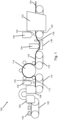
- Fig. 1 is a schematic diagram showing an apparatus 100 for manufacturing a dry-laid carded nonwoven.
- this unclaimed example need not be limited to this type of manufacturing technique.
- the techniques for applying the digestible compound discussed below are applicable to all type of manufacturing technique, including wet-laid or spun melt techniques.
- a first conveyor 102 transports fibre bales 104 to a bale opener 106, which separates and blends the fibres from each bale.
- the fibre bales 104 may comprises bundles of any suitable staple fibre, such as regenerated cellulose (viscose) or the like.
- the bale opener 106 is connected to a feed hopper 108 that discharges the blended fibres as a loose fibre web 112 on a second conveyor 110.
- the loose fibre web 112 is conveyed to a carding machine 114 that combs the web to apply a desired orientation or plurality of orientations to the fibres in the web.
- the carding machine 114 thus outputs a carded web 116 on to a third conveyor 118.
- the fibres in the carded web 116 may subsequently be bonded together by any conventional method.
- a binder may be applied to the carded web, e.g. by conveying it using deflector 134 into a pan 136 filled with liquid binder or binder precursor, so that the binder impregnates or saturates the carded web 116.
- the carded web 116 is then transported to a fourth conveyor 120 via nip rollers 138, which operate to remove or squeeze excess liquid from the carded web 116.
- the web 116 is then carried through a dryer 122, which operates to dry the web and cure or stabilise the binder.
- the carded web 116 may be mechanically bonded, e.g. using hydroentanglement (spunlace) or needle punching techniques.
- the fibres in the web can be thermally bonded, e.g. by passing the web through heat calendar rollers.
- the resulting bonded web 124 may be wound into a finished roll, or can be subjected to additional finishing steps, such a crimping, perforating or the like.
- the manufacturing process outlined above is adapted to add a digestible component to the web.
- the digestible component is selected to inhibit, restrict or prevent passage of liquid through the web. In other words, it may make the web liquid-impermeable.
- the digestible component may be a food-safe compound used as a coating agent for tablets or the like.
- the digestible component may comprise or consist of any one or any combination of: a modified starch, hydroxypropyl methylcellulose (HPMC), polyvinyl alcohol (PVA), lactose and sucrose.
- the digestible component may be applied in a manner that forms a film or layer on or in the resulting nonwoven fabric. This can be done in a number of ways, as explained below.
- the digestible component may be applied in a similar way to the binder discussed above.
- the digestible component may be provided in a solution (e.g. a water solution) or slurry held within a tray or pan 136 through which the carded web 116 is conveyed in order to saturate the web. After it has passed through the pan 136, any excess solution can be removed using nip rollers 138. Any remaining solvent will evaporate in the dryer 122 to leave a film or layer of the digestible component in the resulting bonded web 124.
- the digestible component may be applied to the carded web 116 at the same stage as the binder, using the same pan or a different pan.
- Starch is a food-approved film former that is suitable for use as the digestible component.
- Hydrolysed starch typically has a high viscosity, so in this application technique it may be applied as an insoluble dispersion, with a subsequent heating or drying step to hydrolyse the starch on the fabric in order to form a film.
- a thickening agent, such as HPMC may be added to stabilise the dispersion, i.e. to inhibit or prevent the starch settling out.
- the HPMC may also acts directly in film formation.
- the digestible component can be applied in other ways.
- the digestible component may be applied as a spray 132 delivered via one or more jets 130 located over the first conveyor 110.
- the spray 132 is applied to the loose fibre web 112 output from the hopper 108, before it runs through the carding machine 114.
- the digestible component may be sprayed on to the web at any point on its path from the hopper 118 to the dryer 122.
- a spray 142 may be applied from one or more jets 140 located over the third conveyor 120.
- the spray 142 is applied to the carded web 116 after it is impregnated with binder.
- the digestible component may be applied as a coating on the web, e.g. using any of a roll-to-roll coating process, a printing process, a laminator, a dip-coating unit or a spray unit. This process may occur separately from the apparatus 100 shown in Fig. 1 , e.g. after the bonded web 124 is produced. Alternatively, it may be provided within the dryer 122.
- the properties of the layer or film of the digestible component within the resulting nonwoven fabric may be controlled through either or both of (i) the concentration of the digestible component in the solution that is applied, and (ii) the nip pressure applied by the nip rollers 138 that configured to remove excess liquid from the carded web 116.
- Example 1 Starch/HPMC-treated nonwoven fabric (not according to the present invention)
- hydrolysed starch is used as a food-approved film in order to reduce permeability and slow flavour transfer through a nonwoven fabric. It is anticipated that on exposure to water (and in particular to amylase present in saliva), the starch film gradually be removed, thereby provided an initial restriction on liquid permeability that is gradually reduced upon chewing. Since flavour from the content of a pouch formed from the nonwoven fabric depends on the liquid permeability of the nonwoven fabric, the starch film enables a release of flavour that is linked to the chewing process.
- the starch was instead applied as an insoluble dispersion, where the heat of drying process was also used to hydrolyse the starch on the fabric in order to form the film.
- a food approved thickening agent was used to thicken the starch dispersion.
- the thickener used in this example was HPMC (hydroxypropyl methylcellulose). HPMC is capable of forming a film alone, which further facilitates the formation of the starch film in this example.
- the insoluble dispersion used in this example therefore consisted of a mixture of 58 wt% water, 9 wt% maize starch, and 33 wt% of thickening agent E464 (which is a type of food grade HPMC).
- the insoluble dispersion was disposed in a trough similar to pan 136 discussed above.
- a web of SDZ35 nonwoven fabric was conveyed through the trough to be immersed in the insoluble dispersion.
- excess liquid was removed from the nonwoven fabric using a mangle which squeezed the fabric using a nip pressure selected to obtain a total wet fabric weight of around 50 gsm.
- the wet fabric is then dried, following which the fabric weight was measured to be 38.4 gsm, which indicates that the dry weight of the added film was less than 5 gsm.
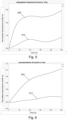
- Fig. 3 is a graph showing diffusion rate for a nonwoven fabric treated with starch according to the process discussed above compared with the untreated nonwoven fabric. The diffusion rate was measured using the test methodology outlined above.
- the diffusion rate for the untreated nonwoven fabric (control 1: SDZ35) is indicated by line 302 in the graph. As expected, it shows that the fabric is essentially completely liquid permeable, as there is a steady increase in the amount of dye diffusing through the fabric into the tank.
- the diffusion rate for the nonwoven fabric having a starch coating is indicated by line 304. It can be seen that the fabric presents a barrier to the dye (indicative of a restriction to liquid permeability) for about 180 seconds, whereupon the coating appears to breakdown to permit diffusion.
- a superabsorbent polymer is incorporated into a nonwoven fabric during manufacture.
- SAP superabsorbent polymer
- the SAP absorbs liquid, whereupon it swells within the nonwoven fabric to form a barrier that restricts molecular movement through the nonwoven fabric.
- the barrier formed by the SAP is removable by a chewing action.
- the SAP may itself be water soluble.
- the chewing action thus promotes its dissolution from the nonwoven fabric, whereupon diffusion through the nonwoven fabric is permitted.
- the superabsorbent polymer may be any conventional water-soluble food grade SAP, such as sodium polyacrylate or the like.
- SAP it may be advantageous to use a dissolvable superabsorbent fibre.
- the SAP used was an uncross-linked dissolvable grade of sodium polyacrylate.
- any uncross-linked SAP may be used, including alginates or carboxymethyl cellulose.
- the rate at which the SAP is removed from the nonwoven fabric (by dissolving the sounding liquid) may be controlled by causing the SAP to become cross-linked. This is because the cross-links need to be physically broken down (e.g. by the mechanical action of chewing) before the SAP can dissolve. Thus, the more cross-links that are present, the longer it takes for the SAP to dissolve.
- the SAP is applied in a form without any cross-linking.
- Cross-linking can be introduced, if desired, when the SAP is already incorporated in the nonwoven fabric through the application of heat, e.g. during a drying process.
- a nonwoven fabric according to this example can also be manufactured as a dry-laid carded nonwoven using the apparatus 100 described above with reference to Fig. 1 .
- this aspect of the invention (incorporating a SAP) need not be limited to this type of manufacturing technique.
- the techniques for applying the SAP discussed below are applicable to all type of manufacturing technique, including wet-laid or spun melt techniques.
- the SAP may be applied in a similar way to the digestible component discussed above.
- the SAP may be applied by impregnating the carded web, e.g. by dipping it in a pan of SAP solution.
- the SAP may be provided in a solution (e.g. a water solution) or slurry held within a tray or pan 136 through which the carded web 116 is conveyed in order to saturate the web. After it has passed through the pan 136, any excess solution can be removed using nip rollers 138. Any remaining solvent will evaporate in the dryer 122 to leave the SAP distributed within the resulting bonded web 124.
- the dryer 122 may also be used to heat the web in order to cause cross-linking of the SAP.
- the SAP may be applied to the carded web 116 at the same stage as the binder, using the same pan or a different pan.
- the SAP may be applied as a spray 132 delivered via one or more jets 130 located over the first conveyor 110.
- the spray 132 is applied to the loose fibre web 112 output from the hopper 108, before it runs through the carding machine 114.
- the SAP may be sprayed on to the web at any point on its path from the hopper 118 to the dryer 122.
- a spray 142 may be applied from one or more jets 140 located over the third conveyor 120.
- the spray 142 is applied to the carded web 116 after it is impregnated with binder.
- the SAP may be applied as a coating on the web, e.g. using any of a roll-to-roll coating process, a printing process, a laminator, a dip-coating unit or a spray unit.
- the pouch may be sprayed with water before packaging in order to create the barrier. This pre-treatment may ensure that the presence of SAP does not cause an unwanted initial dry mouthfeel for the pouch.
- a coating of superabsorbent polymer is formed on a nonwoven fabric to reduce permeability and slow flavour transfer through the fabric. It is anticipated that on exposure to water, the SAP film will swell to form a gel that inhibits diffusion, and then gradually be dissolved. This treatment therefore provides an initial restriction on liquid permeability that is gradually reduced upon chewing. Since flavour from the content of a pouch formed from the nonwoven fabric depends on the liquid permeability of the nonwoven fabric, the SAP film enables a release of flavour that is linked to the chewing process.
- SAP superabsorbent polymer
- the SAP film may be applied to the nonwoven fabric using a highly dispersed gel or an inverse suspension formed with SAP materials.
- the SAP may be applied by impregnating the nonwoven fabric with a solution of superabsorbent fibre (SAF). This latter technique was used in the present example, where the nonwoven fabric was dipped in a solution of uncross-linked sodium polyacrylate fibres.
- SAF superabsorbent fibre
- the precursor solution was disposed in a trough similar to pan 136 discussed above.
- a web of SDZ35 nonwoven fabric conveyed through the trough to be immersed in the precursor solution.
- excess liquid was removed from the nonwoven fabric using a mangle which squeezed the fabric using a nip pressure selected to obtain a total wet fabric weight of around 100 gsm.
- the wet fabric is then dried by application of heat, which acts to cure the polymer precursor.
- the drying temperature was limited to no more than 104°C in order to prevent crosslinking in the SAP.
- the temperature may be selected to introduce crosslinking into the SAP, or the SAP may be already cross-linked before application, e.g. when applied as a dispersed form using gel or inverse suspension SAP types.
- the fabric weight was measured to be 40.3 gsm, which indicates that the dry weight of the added film was less than 10 gsm, i.e. around 6 gsm.
- Fig. 4 is a graph showing diffusion rate for a nonwoven fabric treated with SAP according to the process discussed above compared with the untreated nonwoven fabric. The diffusion rate was measured using the test methodology outlined above.
- the diffusion rate for the untreated nonwoven fabric (control 1: SDZ35) is indicated by line 302 in the graph. As expected, it shows that the fabric is essentially completely liquid permeable, as there is a steady increase in the amount of dye diffusing through the fabric into the tank.
- the diffusion rate for the nonwoven fabric having a SAP coating is indicated by line 306. It can be seen that the treated fabric permits diffusion, but at a lower rate than the untreated fabric. The presence of the SAP therefore presents a barrier to the dye (indicative of a restriction to liquid permeability).
- the level of restriction provided by the SAP may be adjusted by controlling the cross-link density of the SAP, e.g. by setting the temperature and duration of drying appropriately.
- a hydrophobic material is incorporated into or on a nonwoven fabric during manufacture.
- the hydrophobic material operates to introduces a barrier to diffusion through the nonwoven by altering the surface energy thereof to restrict wetting in a user's mouth.
- the hydrophobic material increases an energy threshold for capillary flow of substances through the nonwoven. This energy threshold can be overcome by the physical action of chewing, whereupon substances are released through the nonwoven fabric.
- the hydrophobic material may be provided by any suitable food grade surfactant, such as a fluorosurfactant in which the hydrophobic material has a fluorocarbon tail.
- suitable food grade surfactant such as a fluorosurfactant in which the hydrophobic material has a fluorocarbon tail.
- Other examples include polytetrafluoroethylene, perfluoroalkyl acrylic copolymerisate cationic alcoholic solution, and various types of surfactants (e.g. anionic, cationic, non-ionic, zwitterionic and amphoteric surfactants).
- Yet further examples may be other materials that exhibit particularly hydrophobic properties, such as luoropolymers .
- a nonwoven fabric according to this example can also be manufactured as a dry-laid carded nonwoven using the apparatus 100 described above with reference to Fig. 1 .
- this aspect of the invention (incorporating a hydrophobic material, e.g. using a surfactant) need not be limited to this type of manufacturing technique.
- the techniques for applying the hydrophobic material discussed below are applicable to all type of manufacturing technique, including wet-laid or spun melt techniques.
- the hydrophobic material may be applied in a similar way to the digestible component discussed above.
- the hydrophobic material may be applied by impregnating the carded web, e.g. by dipping it in a pan of hydrophobic material solution.
- the hydrophobic material may be provided in a solution (e.g. a water solution) or slurry held within a tray or pan 136 through which the carded web 116 is conveyed in order to saturate the web. After it has passed through the pan 136, any excess solution can be removed using nip rollers 138. Any remaining solvent will evaporate in the dryer 122 to leave the hydrophobic material distributed within the resulting bonded web 124.
- the hydrophobic material may be applied to the carded web 116 at the same stage as the binder, using the same pan or a different pan.
- the hydrophobic material may be a water soluble fluorinated copolymer, in which case the film is formed by removing the water solvent.
- the hydrophobic material may be an insoluble fluorocarbon material, which is applied as a dispersion.
- the hydrophobic material may be applied as a spray 132 delivered via one or more jets 130 located over the first conveyor 110.
- the spray 132 is applied to the loose fibre web 112 output from the hopper 108, before it runs through the carding machine 114.
- the hydrophobic material may be sprayed on to the web at any point on its path from the hopper 118 to the dryer 122.
- a spray 142 may be applied from one or more jets 140 located over the third conveyor 120.
- the spray 142 is applied to the carded web 116 after it is impregnated with binder.
- the hydrophobic material may be applied as a coating on the web, e.g. using any of a roll-to-roll coating process, a printing process, a laminator, a dip-coating unit or a spray unit. This process may occur separately from the apparatus 100 shown in Fig. 1 , e.g. after the bonded web 124 is produced. Alternatively, it may be provided within the dryer 122.
- Fluorocarbon coating fabric treatments typically operate by lowering the surface energy of the fibre, which in turn prevents the fibre from wetting out.
- the fluorocarbon includes perfluoroalkyl groups that are oriented outward from the fibre to produce a low surface energy barrier. This orientation is usually achieved by curing the fluorocarbon-treated fabric by heating at a specific temperature.
- an advantage of using a water soluble fluorinated copolymer is that the orientation of the perfluoroalkyl groups is achieved using a lower temperature than required for dispersion-type fluorocarbon coatings.
- the inventors have found that desired hydrophobic properties can be obtained by heating a water soluble fluorinated copolymer at temperatures that are similar to standard fabric drying conditions. This facilitates the incorporation of this technique into the fabrication process.
- a food approved fluorocarbon material was used to treat a nonwoven fabric in order to restrict or delay flavour transfer by providing an oil/water repellent property.
- the fluorocarbon material used in this example was a water soluble perfluoroalkyl acrylic copolymerisate cationic alcoholic solution.
- Suitable water soluble fluorocarbon materials include Nuva ® N6336 from Archroma and CornelRepel 111 from Cornelius Group.
- a non-fluorine based alternative is Smartrepel ® Hydro AM from Archroma.
- Non-soluble alternative materials that can be applied as a dispersion or emulsion include Ruco-Guard AFC6 from Rudolf GmbH and Asahi Guard AGE061 from AGC Chemicals Company.
- the fluorocarbon material was applied as a second stage application, i.e. after the bonded web was produced.
- the fluorocarbon material used in this example was applied as a solution consisting of a mixture of 98 wt% water and 4 wt% of the fluorocarbon material.
- Example 2 Similar to Example 1, the solution of the fluorocarbon material was disposed in a trough similar to pan 136 discussed above.
- a web of SYF32 nonwoven fabric was conveyed through the trough to be immersed in the solution.
- excess liquid was removed from the nonwoven fabric using a mangle which squeezed the fabric using a nip pressure selected to obtain a total wet fabric weight that was 24.5 gsm greater than the base fabric (i.e. the SYF32 web) .
- the wet fabric was then dried in two stages. In a first stage, the fabric was dried in an environment having a maximum temperature of 122°C. In a second stage, the fabric was dried in an environment having a maximum temperature of 108°C.
- These temperatures enabled "curing" of the fluorocarbon material (i.e. appropriate orientation of the perfluoroalkyl groups) without over-curing the binder present in the nonwoven fabric. This ensures that the fluorocarbon material is properly integrated into the nonwoven fabric whilst retaining the ability of the treated nonwoven fabric to be heat sealable (e.g. to form a pouch).
- a particular advantage of the present example is that the fluorocarbon material is cured at lower temperatures that would be needed for typical dispersion-type fluorocarbon materials.
- the fabric weight was measured to be 32.7 gsm, which indicates that the dry weight of the added film was very small, i.e. less than 0.1 gsm. Note that the fabric weight of this example is less than the control 2 material set out in the table above owing to natural process variations, which can cause measured weight to vary by up to 10% from its target weight.
- Fig. 5 is a graph showing diffusion rate for a nonwoven fabric treated with a fluorocarbon material according to the process discussed above compared with the untreated nonwoven fabric. The diffusion rate was measured using the test methodology outlined above.
- the diffusion rate for the untreated nonwoven fabric (control 2: SYF32) is indicated by line 308 in the graph. As expected, it shows that the fabric is essentially completely liquid permeable, as there is a rapid increase in the amount of dye diffusing through the fabric into the tank.
- the diffusion rate for the same nonwoven fabric treated with the fluorocarbon material is indicated by line 310. It can be seen that the treated fabric permits diffusion, but at a much lower rate than the untreated fabric. The presence of the fluorocarbon material therefore presents a barrier to the dye (indicative of a restriction to liquid permeability).
- a deformable barrier layer is formed on a nonwoven base layer during manufacture.
- the resulting nonwoven material may thus comprise a two-layer structure that restricts diffusion therethrough.
- the deformable barrier layer may have a porous structure, in which the pores have a size selected to inhibit water diffusion when the barrier layer is in a non-deformed state.
- the chewing action physically deforms the barrier layer to cause the pores to change in size and therefore permit diffusion, whereupon substances are released through the nonwoven fabric.
- the deformable barrier layer is formed from thermoplastic polyurethane (TPU).
- TPU thermoplastic polyurethane
- the TPU layer may be formed as a web using a conventional meltblown process, in which the pore size of the TPU can be controlled through the parameters of the filament generation and laying process.
- the TPU layer may have a weight equal to or less than 30 gsm, preferably equal to or less than 20 gsm (e.g. 18 gsm), and more preferably equal to or less than 10 gsm.
- the TPU may be formed from a plurality of TPU filaments laid together in a layer. The porosity of the layer (and hence the permeability of the final laminated product) may be adjusted through selection of the filament size.
- a microfibre nonwoven material is formed directly (i.e. in a single step) from a thermoplastic polymer.
- High velocity air is used to blow filaments extruded from a die towards a carrier conveyor system.
- the fibres produced are of the range 2 - 6 ⁇ m.
- the TPU layer in this example provides a dual function. Firstly, it improves the mechanical integrity of the underlying nonwoven, especially in the stress/strain response. This ensures that the material can cope with a chewing action. Secondly, it restricts the permeability of the underlying nonwoven, which means that a chewing action is required to enable flow therethrough.
- the TPU layer can then be attached to (e.g. laminated on) a carrier nonwoven layer.
- the carrier nonwoven layer may be a conventional nonwoven fabric for fabricating oral pouched products.
- the TPU layer may act to strengthen the conventional material to make it chewable without breaking.
- Using the conventional nonwoven fabric may also ensure that a pouch formed from the material has a similar mouthfeel to known pouches. It also enables the pouch to be formed using standard pouching techniques. In contrast, a pouch formed from TPU only typically has to be filled in a non-standard manner because it does not exhibit sufficient air permeability.
- Fig. 2 is a schematic diagram showing an apparatus 200 for manufacturing a laminated two-layer spun melt nonwoven.
- this aspect of the invention (incorporating a barrier layer) need not be limited to this type of manufacturing technique.
- the carrier layer to which the barrier layer is attached may be formed using any suitable manufacturing technique, such as the dry-laid carding technique discussed above with respect to Fig. 1 , or a wet-laid technique.
- the TPU layer discussed below is manufactured using a meltblown process, it may be produced by any known technique for forming a web of polymer filaments.
- the apparatus 200 comprises a first process line for forming a carrier nonwoven web.
- the carrier nonwoven web is formed using a meltblown technique.
- An extrusion module 202 is arranged to extrude filaments from a liquid polymer, which are heated by a warm air flow before being deposited as a web 203 on a first conveyor 204.
- This initial web 203 is then consolidated by applying adhesive from a pan 206 using a drum 208. Any excess adhesive is removed using a nip blade 212 or nip rollers to form a consolidated web 211.
- the consolidated web 211 is transported by a second conveyor 210 to a lamination module 220 and dryer 222, as explained in more detail below.
- the apparatus 200 further comprises a second process line for forming a barrier web 216.
- the barrier web 216 is made of TPU formed using a meltblown technique.
- the second process line comprises an extrusion module 214 arranged to extrude filaments from molten TPU. The filaments are heated by a warm air flow before being deposited as the barrier web 216 on a third conveyor 218.
- the barrier web 216 is transports to the lamination module 220, which is arranged to combine the barrier web 216 and consolidated web 211 into a laminated nonwoven fabric 221.
- the laminated nonwoven fabric 221 is moved into a dryer 222 for drying or curing the adhesive.
- a nonwoven fabric having a layer of TPU formed thereon was used to restrict diffusion.
- the nonwoven fabric was made using the process set out in Fig. 2 above.
- the barrier web 216 was formed from TPU filaments, which were deposited directly on the consolidated web 211, which in this example was a dry-laid carded nonwoven fabric manufactured by Nonwovenn under the product code SDH22, which consists of viscose fibres having a fibre density of 1.7 dtex, together with a thermoplastic acrylic binder.
- the TPU filaments for forming the barrier web 216 in this example were blown on to the consolidated web 211 to increase its mechanical resilience.
- the rate of deposition was controlled to be 30 gsm, but may be controlled to be any weight in the range 15 to 30 gsm, e.g. 18 gsm in this example. It may be desirable to control the rate of deposition such that the deformable web 216 adds a weight equal to or less than 10 gsm to the consolidate web 211.
- One result of the improvement in mechanical properties provided by the barrier web is a significant reduction in the permeability (pore size) of the consolidated web.
- the permeability pore size
- the reduced permeability is a benefit in terms of reducing flavour transfer through the fabric.
- Fig. 6 is a graph showing diffusion rate for a nonwoven fabric having a barrier layer produced from the process outlined above, compared with a nonwoven fabric without a barrier layer. The diffusion rate was measured using the test methodology outlined above.
- the graph shows a diffusion rate for a typical nonwoven fabric without a barrier layer (control 1: SDZ35) indicated by line 302. As expected, it shows that the fabric is essentially completely liquid permeable, as there is a steady increase in the amount of dye diffusing through the fabric into the tank.
- the diffusion rate for the nonwoven fabric with a TPU barrier produced according to the process outlined above is indicated by line 312. It can be seen that the fabric presents a barrier to the dye (indicative of a restriction to liquid permeability).
Landscapes
- Engineering & Computer Science (AREA)
- Textile Engineering (AREA)
- Chemical & Material Sciences (AREA)
- Chemical Kinetics & Catalysis (AREA)
- Dispersion Chemistry (AREA)
- General Chemical & Material Sciences (AREA)
- Treatments For Attaching Organic Compounds To Fibrous Goods (AREA)
- Nonwoven Fabrics (AREA)
Description
- The invention relates to a nonwoven fabric for use in manufacturing oral pouched products. In particular, the invention relates to a nonwoven fabric configured to control the rate at which substances are released from a pouch made from the nonwoven fabric.
- It is known to use such nonwoven fabrics to manufacture a pouch for containing an individual portion of a product, such as smokeless tobacco (also known as "snus"), coffee, tea, etc., from which flavour is to be extracted. Examples of pouched products formed from a nonwoven fabric can be found in
US 2014/0026912 A1 andUS 2012/0103353 A1 . - Nonwoven fabrics are typically produced using one of three processes: dry-laid, wet-laid or spun melt. Each process entangles fibres or filaments into a web in a manner that does not require weaving or knitting.
- A dry-laid process typically comprises forming a loose web of staple fibres, which are subsequently bonded together to create the fabric. The web may be formed by an air laying process, whereby the fibres are randomly orientated in the web. Alternatively, forming the web may include carding the fibres, which aligns their orientation. The air laid or carded web can be bonded using mechanical (e.g. hydroentanglement or needle punching), thermal (e.g. where the web includes thermoplastic fibres) or chemical techniques (e.g. using an adhesive binder), or a combination thereof.
- A wet-laid process typically comprises forming a slurry of fibres in water or other suitable liquid, which is deposited on a screen or mesh and then dried to form the web.
- A spun melt process typically forms a web from continuous filaments spun directly from liquid (i.e. melted) plastic materials.
- One known type of nonwoven fabric for use in pouched products is a dry-laid carded nonwoven fabric manufactured by Nonwovenn under the product code SDH27, which comprises staple fibres formed from regenerated cellulose (also known as viscose or rayon) together with a thermoplastic acrylic copolymer binder which facilitates the ability of the fabric to be heat sealed and provides a soft mouth feel. Other types of commercially available nonwoven fabrics include SDZ35, which is another type of dry-laid carded nonwoven fabric of viscose fibre having a fibre density of 1.7 dtex, together with a thermoplastic acrylic copolymer binder, and SYF32, which is a chemically (adhesively) bonded fabric of viscose fibres having a density of 1.7 dtex, polyester fibres having a density of 2.2 dtex, and acrylic binder.
- Typically, the nonwoven fabrics used to produce pouched products are water-permeable, in order to permit substances (e.g. flavour) from the contents of the pouch to flow out.
- Nonwoven fabric may be used to manufacture chewable pouches. For example,
US 2018/0153211 A1 discloses a nonwoven fabric for manufacturing a pouched product, in which the pouch includes an elastic mesh of thermoplastic polyamide that ensures the pouch can endure repeated deformations caused by chewing. The elastic mesh in this example has a high percentage of open area (i.e. high porosity) to enable a rapid release rate of flavour from the pouch. -
US 2013/0149254 A1 discloses a perforated chewable pouch made of a food grade material selected from silicone, latex, rubber or plastic. The pouch encloses a product that can be in a gel, semi-liquid, and/or liquid form. A user chews, sucks, and/or manipulates the pouch to cause the enclosed flavour product to leach out of the perforations into the user's mouth. -
US 2014/0261480 A1 discloses a pouch formed from a fabric comprising melt-blown polymer fibres having a hydrophilic surface coating. The melt-blown material can be an elastomer (e.g. polymeric polyurethane) so that the pouch can tolerate being chewed. -
US 2007/261707 A1 discloses a pouched tobacco product includes a lined pouch material of a web and a liner adjacent the web, where the liner is formed from a water-soluble material, such as cellulosic materials, gums, polymers, starches, proteins, and combinations thereof. -
US 2011/180087 A1 discloses an oral pouch product includes a dual layer pouch wrapper and an inner botanical filling material contained within the pouch wrapper. The pouch wrapper includes an inner web, an outer web and a water-soluble coating formed from hydrocolloids, polysaccharides, food proteins, and the like. -
EP 0 599 425 A1 - Aspects of the invention are set out in the appended claims. Disclosed herein is a nonwoven fabric for manufacturing an oral pouched product, where the nonwoven fabric is chewable to increase its liquid permeability. When the nonwoven fabric is used to form a pouch, it may thus control the release of substances from within the pouch.
- The nonwoven fabric includes means to restrict diffusion of substances therethrough when in a liquid (e.g. aqueous) environment, which means can be removed or overcome through a chewing action. The nonwoven fabric may meanwhile exhibit air permeability to make it suitable for manufacturing a pouch.
- Using a nonwoven fabric that is designed to restrict diffusion therethrough runs contrary to established practice in the field of snus pouches, where it is common to treat the pouch material or pouch contents in a manner that promotes diffusion through the pouch material.
- Pouches made from the nonwoven fabric of the invention may be used to enclose any suitable material from which it is desirable to extract flavour, nutrients or any other chemical, e.g. for oral delivery. The pouch contents may comprise or consist of smokeless tobacco, pharmaceuticals, coffee, tea, etc. The ability to control the release of substances from the contents of a pouch in this context may be particular advantageous, e.g. where it is desirable for a drug dose to be delivered over a period of time rather than immediately. With the invention, the rate at which a substance is delivered (i.e. the diffusion or flow rate through the nonwoven fabric) may be determined through selection of properties of the nonwoven, e.g. during its manufacture.
- According to a first aspect of the invention, there is provided a nonwoven fabric for forming an oral pouched product as set out in claim 1. The nonwoven fabric comprises: a nonwoven fabric substrate; and a diffusion restricting material formed as a layer on the nonwoven fabric substrate, wherein the diffusion restricting material is configured to provide a barrier to diffusion through the nonwoven fabric in aqueous environment, wherein the layer of diffusion restricting material comprises any of: a water-soluble grade of sodium polyacrylate; a thermoplastic polyurethane; or a hydrophobic material, and wherein the barrier to diffusion is reducible by a chewing action. The nonwoven fabric thus naturally restricts the diffusion or liquid flow through it. When used to form a pouch, the nonwoven fabric thus initially inhibits the diffusion of pouch contents outwards when in an aqueous environment. This diffusion or flow restriction can be removed by chewing, thereby permitting release of the pouch contents. The pouch contents in this context may comprise a soluble flavour or medicament substance contained in the pouch.
- This behaviour may be contrasted with known pouches made from nonwoven material, which are manufactured to be immediately permeable.
- The barrier to diffusion may be a reduced diffusion or flow rate compared with the nonwoven fabric substrate when used alone. Reducing the barrier through a chewing action may thus lead to an increase in the diffusion rate. The barrier may thus represent a temporary restriction of flow through the nonwoven fabric.
- In some examples, the barrier to diffusion may effectively make the nonwoven fabric liquid-impermeable. This may be advantageous in the manufacture of pouches which contain material that degrades on contact with liquid (e.g. water). For example, the liquid-impermeable property may obviate the need for other treatment or packaging for the nonwoven fabric or pouched product.
- Herein, the term "chewing action" may mean any one or any combination of (1) presence of saliva, (2) presence of water, and (3) mechanical deformation. The ability to reduce the barrier to diffusion may arise any or any combination of this conditions. For example, where the diffusion restriction material comprises a hydrophobic coating or a semipermeable membrane, diffusion is inhibited by a hydrophobic capillary action. Deformation caused by chewing can be capable of overcoming the capillary action to permit diffusion through the barrier.
- The diffusion restricting material forms a layer on the nonwoven fabric substrate. For example, the nonwoven fabric may comprise a laminated structure. The diffusion restricting material may comprise a semipermeable membrane, e.g. a layer of material formed with pores having a size that restrict liquid diffusion whilst allowing gas (air) diffusion. The layer may be resilient deformable, whereby the chewing action changes the size of the pores to permit diffusion. In on example, the diffusion restricting material may comprise a layer of thermoplastic polyurethane laminated on the nonwoven fabric substrate.
- The diffusion restricting material may comprise a superabsorbent polymer consisting of a water-soluble grade of sodium polyacrylate. The superabsorbent polymer may operate to absorb water and swell to create a physical barrier to diffusion within the nonwoven fabric. The physical barrier may be overcome by chewing. The superabsorbent polymer is water soluble, so that it is gradually removed when in an aqueous environment.
- The diffusion restricting material may comprise a fluorocarbon material, e.g. polytetrafluoroethylene or a fluorosurfactant.
- The nonwoven fabric substrate may be produced using any known process, such as the three processes mentioned above: dry-laid, wet-laid or spun melt. The nonwoven fabric substrate thus comprises a web of entangled fibres or filaments formed in a manner that does not require weaving or knitting. The nonwoven fabric substrate may be a conventional nonwoven fabric, e.g. of the type already used to manufacture oral pouched products.
- In one example, the nonwoven fabric substrate may comprise a bonded web of viscose fibres and a binder, e.g. a thermoplastic acrylic binder. The viscose fibres may have a fibre density equal to or less than 1.7 dtex. It should be noted that this is just one example of the type of nonwoven fibre substrate to which the invention can be applied. The effects of applying the diffusion restricting material will be applicable to any type of permeable nonwoven fabric, especially those known for use in manufacturing oral pouched products.
- The nonwoven fabric may have an air permeability equal to or greater than 700 l/m2/s, and more preferably equal to or greater than 1500 l/m2/s. An air permeability above this threshold may facilitate the formation of a pouched product by allowing air to escape at an appropriate rate when the contents of the pouch is enclosed.
- The nonwoven fabric is preferably heat sealable. In this context, heat sealable may mean an ability to form a physical connection to itself upon application of heat. The heat may be applied in combination with pressure, e.g. at a certain location (seal line) on the nonwoven fabric. This property may permit an oral pouched product formed of the material to be closed using known heat sealing techniques. The heat sealable property may be provided by a binder integrated in the nonwoven fabric substrate, as is conventional.
- In another aspect, the invention provides a method for manufacturing a nonwoven fabric as set out in claim 8. Features of the first aspect discussed above may be equally applicable to the second aspect. For example, forming the nonwoven fabric substrate may be done using any conventional technique.
- In one example, the step of applying the diffusion restricting material includes: immersing the nonwoven fabric substrate in a uncross-linked superabsorbent polymer precursor solution; and heating the nonwoven fabric substrate to introduce cross-linking in the superabsorbent polymer. The heating to induce cross-linking may also serve to dry the wet nonwoven fabric substrate.
- In another example, the step of applying the diffusion restricting material may comprise laminating a layer of the diffusion restricting material on the nonwoven fabric substrate. The diffusion restricting material may be a semipermeable film, e.g. made of thermoplastic polyurethane or the like.
- Embodiments of the invention is discussed below in more detail with reference to the accompanying drawings, in which:
-
Fig. 1 is a schematic drawing of apparatus for dry-laid carded manufacture of a nonwoven fabric according to a method that is an embodiment of the invention; -
Fig. 2 is a schematic drawing of apparatus for manufacturing a laminated melt-blown nonwoven fabric according to a method that is another embodiment of the invention; -
Fig. 3 is a graph showing diffusion rate for a nonwoven fabric treated with starch compared with the untreated nonwoven fabric; -
Fig. 4 is a graph showing diffusion rate for a nonwoven fabric treated with a superabsorbent polymer compared with the untreated nonwoven fabric; -
Fig. 5 is a graph showing diffusion rate for a nonwoven fabric treated with a fluorocarbon material compared with the untreated nonwoven; and -
Fig. 6 is a graph showing diffusion rate for a nonwoven fabric having a barrier layer compared with the untreated nonwoven fabric. - Discussed in detail below are four methods for manufacturing a nonwoven fabric that is suitable for forming an oral pouched product, and which has a diffusion restricting property that can be overcome by a chewing action when in a user's mouth.
- The diffusion restricting property is integral or intrinsic to the nonwoven fabric in the sense that it is provided as part of the nonwoven manufacturing process. This means that a pouch formed from the nonwoven fabric will exhibit the diffusion restricting effects without requiring any further treatment, e.g. as part of the pouching process.
- Each method therefore includes a certain step of applying a diffusion restricting treatment to a base nonwoven fabric during manufacture of the nonwoven fabric, as follows:
- (a) incorporating a superabsorbent polymer into the base nonwoven fabric;
- (b) incorporating a fluorocarbon material into the base nonwoven fabric; and
- (c) forming a deformable barrier layer on or in a base nonwoven fabric, which acts as a barrier.
- In all methods, the resulting nonwoven fabric will exhibit an increase in diffusion rate therethrough when subjected to a chewing action in a liquid environment. Herein, chewing action may mean any of (1) presence of saliva, (2) presence of water (e.g. to remove a water soluble diffusion restrictor), and (3) mechanical deformation (e.g. to overcome capillary action of a hydrophobic material, or simply to force substance release through a restrictive barrier).
- Examples of materials fabricated according to each of the techniques are set out below. These examples were subjected to a diffusion rate test in which a flow of dye through a membrane of the test material is measured by observing a change in colour of a clear liquid over time. In detail, a vessel is filled with a dye and the fabric to be tested is disposed as a membrane on the top of this vessel. This vessel is put in contact vertically with a tank containing clear liquid. As time passes, the clear liquid in the tank starts to have its colour changed by the dye that diffuses through the membrane. A sample from the tank is collected at regular intervals and the absorbance at a wavelength corresponding to the colour of the dye is measured in a spectrophotometer. With this data, it is possible to generate a curve showing absorbance over time, which correlates with the rate at which dye is diffusing into the tank. The faster the colour change, the lower the restriction to flow.
Figs. 3 to 6 show graphs obtained using this test, for both an untreated nonwoven fabric (control) and a nonwoven fabric treated according to one of the methods set out herein. The graphs are normalised with respect to an absorbance value measured at the beginning of the test to remove any background effects. - As a reference we use the colour absorption measurement obtained at a wavelength of 630 nm wavelength after 30 s of contact between the fabric and tank.
- Table 1 shows various properties of the control and example fabrics discussed in more detail below.
Table 1: Properties of control and example fabrics Description Weight (gsm) Thickness (mm) Air Permeability (l/m2/s) Sealable Pouch? Control 1 (SDZ35) 34.2 0.215 3605 Yes Control 2 (SYF32) 33.1 0.262 4774 Yes Example 1 (HPMC) 38.4 0.188 708 Yes Example 2 (SAP) 40.3 0.217 3130 Yes Example 3 (fluorocarbon) 32.7 0.223 4317 Yes Example 4 (TPU) 37.6 0.228 1645 Yes - The fabric weight test results were obtained using the NWSP130.1.R0 EDANA test method. The fabric thickness tests results were obtained using the NWSP120.6.R0 EDANA test method. The air permeability test results were obtained using the 140.1 EDANA test standard.
- The final column is a test for whether the fabric is capable of forming a pouch having the required sealing strength for use in an oral pouched product. These test results were obtained using the CORESTA Recommended Method No. 90 on a heat-sealed pouch formed from the relevant fabric.
- The table includes the properties of two control fabrics, which are nonwoven materials available commercially from Nonwovenn Ltd., having product codes SDZ35 and SYF32 respectively. One of these control fabric is used as a starting materials for each of the examples set out below, to enable the effect of the relevant treatment to be demonstrated.
- In a first unclaimed example, a digestible compound is incorporated into a nonwoven fabric during manufacture to form a barrier, e.g. a water impermeable barrier, that restricts diffusion through the nonwoven fabric in a liquid environment. The barrier is digestible, e.g. removable by saliva amylase, so that the barrier disintegrates when the nonwoven fabric is subjected to a chewing action. The barrier thus breaks down, whereupon diffusion through the nonwoven fabric is permitted or enhanced.
- A method of manufacturing a nonwoven fabric according to this unclaimed example is now described with reference to
Fig. 1. Fig. 1 is a schematic diagram showing anapparatus 100 for manufacturing a dry-laid carded nonwoven. However, it is to be understood that this unclaimed example need not be limited to this type of manufacturing technique. The techniques for applying the digestible compound discussed below are applicable to all type of manufacturing technique, including wet-laid or spun melt techniques. - In the
apparatus 100 shown inFig. 1 , afirst conveyor 102 transportsfibre bales 104 to abale opener 106, which separates and blends the fibres from each bale. Thefibre bales 104 may comprises bundles of any suitable staple fibre, such as regenerated cellulose (viscose) or the like. Thebale opener 106 is connected to afeed hopper 108 that discharges the blended fibres as aloose fibre web 112 on asecond conveyor 110. Theloose fibre web 112 is conveyed to acarding machine 114 that combs the web to apply a desired orientation or plurality of orientations to the fibres in the web. The cardingmachine 114 thus outputs a cardedweb 116 on to athird conveyor 118. - The fibres in the carded
web 116 may subsequently be bonded together by any conventional method. For example, a binder may be applied to the carded web, e.g. by conveying it usingdeflector 134 into apan 136 filled with liquid binder or binder precursor, so that the binder impregnates or saturates the cardedweb 116. The cardedweb 116 is then transported to afourth conveyor 120 via niprollers 138, which operate to remove or squeeze excess liquid from the cardedweb 116. Theweb 116 is then carried through adryer 122, which operates to dry the web and cure or stabilise the binder. - In other examples, the carded
web 116 may be mechanically bonded, e.g. using hydroentanglement (spunlace) or needle punching techniques. - In yet further example, where the carded
web 116 includes thermoplastic fibres, the fibres in the web can be thermally bonded, e.g. by passing the web through heat calendar rollers. - The resulting bonded
web 124 may be wound into a finished roll, or can be subjected to additional finishing steps, such a crimping, perforating or the like. - In this example, the manufacturing process outlined above is adapted to add a digestible component to the web. The digestible component is selected to inhibit, restrict or prevent passage of liquid through the web. In other words, it may make the web liquid-impermeable.
- The digestible component may be a food-safe compound used as a coating agent for tablets or the like. For example, the digestible component may comprise or consist of any one or any combination of: a modified starch, hydroxypropyl methylcellulose (HPMC), polyvinyl alcohol (PVA), lactose and sucrose.
- The digestible component may be applied in a manner that forms a film or layer on or in the resulting nonwoven fabric. This can be done in a number of ways, as explained below.
- In one example, the digestible component may be applied in a similar way to the binder discussed above. In other words, the digestible component may be provided in a solution (e.g. a water solution) or slurry held within a tray or pan 136 through which the carded
web 116 is conveyed in order to saturate the web. After it has passed through thepan 136, any excess solution can be removed using niprollers 138. Any remaining solvent will evaporate in thedryer 122 to leave a film or layer of the digestible component in the resulting bondedweb 124. The digestible component may be applied to the cardedweb 116 at the same stage as the binder, using the same pan or a different pan. Starch is a food-approved film former that is suitable for use as the digestible component. Hydrolysed starch typically has a high viscosity, so in this application technique it may be applied as an insoluble dispersion, with a subsequent heating or drying step to hydrolyse the starch on the fabric in order to form a film. A thickening agent, such as HPMC, may be added to stabilise the dispersion, i.e. to inhibit or prevent the starch settling out. As noted above, the HPMC may also acts directly in film formation. - In other examples, the digestible component can be applied in other ways. For example, the digestible component may be applied as a
spray 132 delivered via one ormore jets 130 located over thefirst conveyor 110. In this example, thespray 132 is applied to theloose fibre web 112 output from thehopper 108, before it runs through the cardingmachine 114. In practice, the digestible component may be sprayed on to the web at any point on its path from thehopper 118 to thedryer 122. For example, aspray 142 may be applied from one ormore jets 140 located over thethird conveyor 120. In this example, thespray 142 is applied to the cardedweb 116 after it is impregnated with binder. - In another example, the digestible component may be applied as a coating on the web, e.g. using any of a roll-to-roll coating process, a printing process, a laminator, a dip-coating unit or a spray unit. This process may occur separately from the
apparatus 100 shown inFig. 1 , e.g. after the bondedweb 124 is produced. Alternatively, it may be provided within thedryer 122. - The properties of the layer or film of the digestible component within the resulting nonwoven fabric may be controlled through either or both of (i) the concentration of the digestible component in the solution that is applied, and (ii) the nip pressure applied by the
nip rollers 138 that configured to remove excess liquid from the cardedweb 116. - In a first example, hydrolysed starch is used as a food-approved film in order to reduce permeability and slow flavour transfer through a nonwoven fabric. It is anticipated that on exposure to water (and in particular to amylase present in saliva), the starch film gradually be removed, thereby provided an initial restriction on liquid permeability that is gradually reduced upon chewing. Since flavour from the content of a pouch formed from the nonwoven fabric depends on the liquid permeability of the nonwoven fabric, the starch film enables a release of flavour that is linked to the chewing process.
- Owing to its high viscosity, it is difficult to apply hydrolysed starch to a nonwoven fabric directing using a conventional padding process. In this example, the starch was instead applied as an insoluble dispersion, where the heat of drying process was also used to hydrolyse the starch on the fabric in order to form the film. In order to avoid the starch settling out when applying the dispersion, a food approved thickening agent was used to thicken the starch dispersion. The thickener used in this example was HPMC (hydroxypropyl methylcellulose). HPMC is capable of forming a film alone, which further facilitates the formation of the starch film in this example.
- The insoluble dispersion used in this example therefore consisted of a mixture of 58 wt% water, 9 wt% maize starch, and 33 wt% of thickening agent E464 (which is a type of food grade HPMC).
- The insoluble dispersion was disposed in a trough similar to pan 136 discussed above. In this example, a web of SDZ35 nonwoven fabric was conveyed through the trough to be immersed in the insoluble dispersion. Upon exit from the trough, excess liquid was removed from the nonwoven fabric using a mangle which squeezed the fabric using a nip pressure selected to obtain a total wet fabric weight of around 50 gsm. The wet fabric is then dried, following which the fabric weight was measured to be 38.4 gsm, which indicates that the dry weight of the added film was less than 5 gsm.
-
Fig. 3 is a graph showing diffusion rate for a nonwoven fabric treated with starch according to the process discussed above compared with the untreated nonwoven fabric. The diffusion rate was measured using the test methodology outlined above. - The diffusion rate for the untreated nonwoven fabric (control 1: SDZ35) is indicated by
line 302 in the graph. As expected, it shows that the fabric is essentially completely liquid permeable, as there is a steady increase in the amount of dye diffusing through the fabric into the tank. The diffusion rate for the nonwoven fabric having a starch coating is indicated byline 304. It can be seen that the fabric presents a barrier to the dye (indicative of a restriction to liquid permeability) for about 180 seconds, whereupon the coating appears to breakdown to permit diffusion. - It is expected that the presence of amylase in saliva and the mechanical action of chewing would contribute to a more rapid breakdown of the barrier when placed in the mouth. However, it can be understood that even in that use environment the coated nonwoven fabric of the present example would provide a restriction to diffusion.
- In a second example, a superabsorbent polymer (SAP) is incorporated into a nonwoven fabric during manufacture. When exposed to an aqueous environment (e.g. the user's mouth), the SAP absorbs liquid, whereupon it swells within the nonwoven fabric to form a barrier that restricts molecular movement through the nonwoven fabric.
- The barrier formed by the SAP is removable by a chewing action. The SAP may itself be water soluble. The chewing action thus promotes its dissolution from the nonwoven fabric, whereupon diffusion through the nonwoven fabric is permitted. The superabsorbent polymer may be any conventional water-soluble food grade SAP, such as sodium polyacrylate or the like. To assist in applying the SAP, it may be advantageous to use a dissolvable superabsorbent fibre. In this example, the SAP used was an uncross-linked dissolvable grade of sodium polyacrylate. However, any uncross-linked SAP may be used, including alginates or carboxymethyl cellulose.
- The rate at which the SAP is removed from the nonwoven fabric (by dissolving the sounding liquid) may be controlled by causing the SAP to become cross-linked. This is because the cross-links need to be physically broken down (e.g. by the mechanical action of chewing) before the SAP can dissolve. Thus, the more cross-links that are present, the longer it takes for the SAP to dissolve.
- In the example given below, the SAP is applied in a form without any cross-linking. Cross-linking can be introduced, if desired, when the SAP is already incorporated in the nonwoven fabric through the application of heat, e.g. during a drying process.
- A nonwoven fabric according to this example can also be manufactured as a dry-laid carded nonwoven using the
apparatus 100 described above with reference toFig. 1 . However, it is to be understood that this aspect of the invention (incorporating a SAP) need not be limited to this type of manufacturing technique. The techniques for applying the SAP discussed below are applicable to all type of manufacturing technique, including wet-laid or spun melt techniques. - The SAP may be applied in a similar way to the digestible component discussed above. For example, the SAP may be applied by impregnating the carded web, e.g. by dipping it in a pan of SAP solution. In other words, the SAP may be provided in a solution (e.g. a water solution) or slurry held within a tray or pan 136 through which the carded
web 116 is conveyed in order to saturate the web. After it has passed through thepan 136, any excess solution can be removed using niprollers 138. Any remaining solvent will evaporate in thedryer 122 to leave the SAP distributed within the resulting bondedweb 124. As discussed above, the dryer 122 (or a separate heater) may also be used to heat the web in order to cause cross-linking of the SAP. The SAP may be applied to the cardedweb 116 at the same stage as the binder, using the same pan or a different pan. - In another example, the SAP may be applied as a
spray 132 delivered via one ormore jets 130 located over thefirst conveyor 110. In this example, thespray 132 is applied to theloose fibre web 112 output from thehopper 108, before it runs through the cardingmachine 114. In practice, the SAP may be sprayed on to the web at any point on its path from thehopper 118 to thedryer 122. For example, aspray 142 may be applied from one ormore jets 140 located over thethird conveyor 120. In this example, thespray 142 is applied to the cardedweb 116 after it is impregnated with binder. - In another example, the SAP may be applied as a coating on the web, e.g. using any of a roll-to-roll coating process, a printing process, a laminator, a dip-coating unit or a spray unit.
- It may be desirable to pre-treat the resulting nonwoven fabric produced by this example so that the SAP is already swollen to create the diffusion barrier. For example, where the nonwoven fabric is used to produce a pouched product, the pouch may be sprayed with water before packaging in order to create the barrier. This pre-treatment may ensure that the presence of SAP does not cause an unwanted initial dry mouthfeel for the pouch.
- In a second example, a coating of superabsorbent polymer (SAP) is formed on a nonwoven fabric to reduce permeability and slow flavour transfer through the fabric. It is anticipated that on exposure to water, the SAP film will swell to form a gel that inhibits diffusion, and then gradually be dissolved. This treatment therefore provides an initial restriction on liquid permeability that is gradually reduced upon chewing. Since flavour from the content of a pouch formed from the nonwoven fabric depends on the liquid permeability of the nonwoven fabric, the SAP film enables a release of flavour that is linked to the chewing process.
- The SAP film may be applied to the nonwoven fabric using a highly dispersed gel or an inverse suspension formed with SAP materials. Alternatively, the SAP may be applied by impregnating the nonwoven fabric with a solution of superabsorbent fibre (SAF). This latter technique was used in the present example, where the nonwoven fabric was dipped in a solution of uncross-linked sodium polyacrylate fibres. In this example the solution consisted of a mixture of 88 wt% water and 12 wt% uncross-linked sodium polyacrylate fibres, which had a staple length of 50 mm.
- The precursor solution was disposed in a trough similar to pan 136 discussed above. In this example, a web of SDZ35 nonwoven fabric conveyed through the trough to be immersed in the precursor solution. Upon exit from the trough, excess liquid was removed from the nonwoven fabric using a mangle which squeezed the fabric using a nip pressure selected to obtain a total wet fabric weight of around 100 gsm.
- The wet fabric is then dried by application of heat, which acts to cure the polymer precursor. In this example, the drying temperature was limited to no more than 104°C in order to prevent crosslinking in the SAP. However, in other examples, the temperature may be selected to introduce crosslinking into the SAP, or the SAP may be already cross-linked before application, e.g. when applied as a dispersed form using gel or inverse suspension SAP types.
- After drying, the fabric weight was measured to be 40.3 gsm, which indicates that the dry weight of the added film was less than 10 gsm, i.e. around 6 gsm.
-
Fig. 4 is a graph showing diffusion rate for a nonwoven fabric treated with SAP according to the process discussed above compared with the untreated nonwoven fabric. The diffusion rate was measured using the test methodology outlined above. - The diffusion rate for the untreated nonwoven fabric (control 1: SDZ35) is indicated by
line 302 in the graph. As expected, it shows that the fabric is essentially completely liquid permeable, as there is a steady increase in the amount of dye diffusing through the fabric into the tank. The diffusion rate for the nonwoven fabric having a SAP coating is indicated byline 306. It can be seen that the treated fabric permits diffusion, but at a lower rate than the untreated fabric. The presence of the SAP therefore presents a barrier to the dye (indicative of a restriction to liquid permeability). - It is expected that the mechanical action of chewing would permit an enhanced flow through the barrier. Similarly, the level of restriction provided by the SAP may be adjusted by controlling the cross-link density of the SAP, e.g. by setting the temperature and duration of drying appropriately.
- In a third example, a hydrophobic material is incorporated into or on a nonwoven fabric during manufacture. The hydrophobic material operates to introduces a barrier to diffusion through the nonwoven by altering the surface energy thereof to restrict wetting in a user's mouth. In other words, the hydrophobic material increases an energy threshold for capillary flow of substances through the nonwoven. This energy threshold can be overcome by the physical action of chewing, whereupon substances are released through the nonwoven fabric.
- The hydrophobic material may be provided by any suitable food grade surfactant, such as a fluorosurfactant in which the hydrophobic material has a fluorocarbon tail. , Other examples include polytetrafluoroethylene, perfluoroalkyl acrylic copolymerisate cationic alcoholic solution, and various types of surfactants (e.g. anionic, cationic, non-ionic, zwitterionic and amphoteric surfactants). Yet further examples may be other materials that exhibit particularly hydrophobic properties, such as luoropolymers .
- A nonwoven fabric according to this example can also be manufactured as a dry-laid carded nonwoven using the
apparatus 100 described above with reference toFig. 1 . However, it is to be understood that this aspect of the invention (incorporating a hydrophobic material, e.g. using a surfactant) need not be limited to this type of manufacturing technique. The techniques for applying the hydrophobic material discussed below are applicable to all type of manufacturing technique, including wet-laid or spun melt techniques. - The hydrophobic material may be applied in a similar way to the digestible component discussed above. For example, the hydrophobic material may be applied by impregnating the carded web, e.g. by dipping it in a pan of hydrophobic material solution. In other words, the hydrophobic material may be provided in a solution (e.g. a water solution) or slurry held within a tray or pan 136 through which the carded
web 116 is conveyed in order to saturate the web. After it has passed through thepan 136, any excess solution can be removed using niprollers 138. Any remaining solvent will evaporate in thedryer 122 to leave the hydrophobic material distributed within the resulting bondedweb 124. The hydrophobic material may be applied to the cardedweb 116 at the same stage as the binder, using the same pan or a different pan. In some examples, the hydrophobic material may be a water soluble fluorinated copolymer, in which case the film is formed by removing the water solvent. In other examples, the hydrophobic material may be an insoluble fluorocarbon material, which is applied as a dispersion. - In another example, the hydrophobic material may be applied as a
spray 132 delivered via one ormore jets 130 located over thefirst conveyor 110. In this example, thespray 132 is applied to theloose fibre web 112 output from thehopper 108, before it runs through the cardingmachine 114. In practice, the hydrophobic material may be sprayed on to the web at any point on its path from thehopper 118 to thedryer 122. For example, aspray 142 may be applied from one ormore jets 140 located over thethird conveyor 120. In this example, thespray 142 is applied to the cardedweb 116 after it is impregnated with binder. - In another example, the hydrophobic material may be applied as a coating on the web, e.g. using any of a roll-to-roll coating process, a printing process, a laminator, a dip-coating unit or a spray unit. This process may occur separately from the
apparatus 100 shown inFig. 1 , e.g. after the bondedweb 124 is produced. Alternatively, it may be provided within thedryer 122. - Fluorocarbon coating fabric treatments typically operate by lowering the surface energy of the fibre, which in turn prevents the fibre from wetting out. To provide this function, the fluorocarbon includes perfluoroalkyl groups that are oriented outward from the fibre to produce a low surface energy barrier. This orientation is usually achieved by curing the fluorocarbon-treated fabric by heating at a specific temperature. However, an advantage of using a water soluble fluorinated copolymer, as discussed in the example below, is that the orientation of the perfluoroalkyl groups is achieved using a lower temperature than required for dispersion-type fluorocarbon coatings. The inventors have found that desired hydrophobic properties can be obtained by heating a water soluble fluorinated copolymer at temperatures that are similar to standard fabric drying conditions. This facilitates the incorporation of this technique into the fabrication process.
- In a third example, a food approved fluorocarbon material was used to treat a nonwoven fabric in order to restrict or delay flavour transfer by providing an oil/water repellent property. The fluorocarbon material used in this example was a water soluble perfluoroalkyl acrylic copolymerisate cationic alcoholic solution. Suitable water soluble fluorocarbon materials include Nuva® N6336 from Archroma and CornelRepel 111 from Cornelius Group. A non-fluorine based alternative is Smartrepel® Hydro AM from Archroma. Non-soluble alternative materials that can be applied as a dispersion or emulsion include Ruco-Guard AFC6 from Rudolf GmbH and Asahi Guard AGE061 from AGC Chemicals Company.
- In this example, the fluorocarbon material was applied as a second stage application, i.e. after the bonded web was produced. The fluorocarbon material used in this example was applied as a solution consisting of a mixture of 98 wt% water and 4 wt% of the fluorocarbon material.
- Similar to Example 1, the solution of the fluorocarbon material was disposed in a trough similar to pan 136 discussed above. In this example, a web of SYF32 nonwoven fabric was conveyed through the trough to be immersed in the solution. Upon exit from the trough, excess liquid was removed from the nonwoven fabric using a mangle which squeezed the fabric using a nip pressure selected to obtain a total wet fabric weight that was 24.5 gsm greater than the base fabric (i.e. the SYF32 web) .
- The wet fabric was then dried in two stages. In a first stage, the fabric was dried in an environment having a maximum temperature of 122°C. In a second stage, the fabric was dried in an environment having a maximum temperature of 108°C. These temperatures enabled "curing" of the fluorocarbon material (i.e. appropriate orientation of the perfluoroalkyl groups) without over-curing the binder present in the nonwoven fabric. This ensures that the fluorocarbon material is properly integrated into the nonwoven fabric whilst retaining the ability of the treated nonwoven fabric to be heat sealable (e.g. to form a pouch). As mentioned above, a particular advantage of the present example is that the fluorocarbon material is cured at lower temperatures that would be needed for typical dispersion-type fluorocarbon materials.
- After drying, the fabric weight was measured to be 32.7 gsm, which indicates that the dry weight of the added film was very small, i.e. less than 0.1 gsm. Note that the fabric weight of this example is less than the control 2 material set out in the table above owing to natural process variations, which can cause measured weight to vary by up to 10% from its target weight.
-
Fig. 5 is a graph showing diffusion rate for a nonwoven fabric treated with a fluorocarbon material according to the process discussed above compared with the untreated nonwoven fabric. The diffusion rate was measured using the test methodology outlined above. - The diffusion rate for the untreated nonwoven fabric (control 2: SYF32) is indicated by
line 308 in the graph. As expected, it shows that the fabric is essentially completely liquid permeable, as there is a rapid increase in the amount of dye diffusing through the fabric into the tank. The diffusion rate for the same nonwoven fabric treated with the fluorocarbon material is indicated byline 310. It can be seen that the treated fabric permits diffusion, but at a much lower rate than the untreated fabric. The presence of the fluorocarbon material therefore presents a barrier to the dye (indicative of a restriction to liquid permeability). - In a fourth example, a deformable barrier layer is formed on a nonwoven base layer during manufacture. The resulting nonwoven material may thus comprise a two-layer structure that restricts diffusion therethrough. The deformable barrier layer may have a porous structure, in which the pores have a size selected to inhibit water diffusion when the barrier layer is in a non-deformed state. In use, the chewing action physically deforms the barrier layer to cause the pores to change in size and therefore permit diffusion, whereupon substances are released through the nonwoven fabric.
- In one example, the deformable barrier layer is formed from thermoplastic polyurethane (TPU). The TPU layer may be formed as a web using a conventional meltblown process, in which the pore size of the TPU can be controlled through the parameters of the filament generation and laying process. The TPU layer may have a weight equal to or less than 30 gsm, preferably equal to or less than 20 gsm (e.g. 18 gsm), and more preferably equal to or less than 10 gsm. The TPU may be formed from a plurality of TPU filaments laid together in a layer. The porosity of the layer (and hence the permeability of the final laminated product) may be adjusted through selection of the filament size.
- In a meltblown process, a microfibre nonwoven material is formed directly (i.e. in a single step) from a thermoplastic polymer. High velocity air is used to blow filaments extruded from a die towards a carrier conveyor system. Typically the fibres produced are of the range 2 - 6 µm. By depositing these filaments on a conventional (macrofibre) nonwoven substrate, the larger pores within the conventional nonwoven are covered or filled, thereby restricting its permeability.
- The TPU layer in this example provides a dual function. Firstly, it improves the mechanical integrity of the underlying nonwoven, especially in the stress/strain response. This ensures that the material can cope with a chewing action. Secondly, it restricts the permeability of the underlying nonwoven, which means that a chewing action is required to enable flow therethrough.
- The TPU layer can then be attached to (e.g. laminated on) a carrier nonwoven layer. The carrier nonwoven layer may be a conventional nonwoven fabric for fabricating oral pouched products. The TPU layer may act to strengthen the conventional material to make it chewable without breaking. Using the conventional nonwoven fabric may also ensure that a pouch formed from the material has a similar mouthfeel to known pouches. It also enables the pouch to be formed using standard pouching techniques. In contrast, a pouch formed from TPU only typically has to be filled in a non-standard manner because it does not exhibit sufficient air permeability.
- A method of manufacturing a nonwoven fabric according to this example is now described with reference to
Fig. 2. Fig. 2 is a schematic diagram showing anapparatus 200 for manufacturing a laminated two-layer spun melt nonwoven. However, it is to be understood that this aspect of the invention (incorporating a barrier layer) need not be limited to this type of manufacturing technique. For example, the carrier layer to which the barrier layer is attached may be formed using any suitable manufacturing technique, such as the dry-laid carding technique discussed above with respect toFig. 1 , or a wet-laid technique. Similarly, whilst the TPU layer discussed below is manufactured using a meltblown process, it may be produced by any known technique for forming a web of polymer filaments. - The
apparatus 200 comprises a first process line for forming a carrier nonwoven web. In this example, the carrier nonwoven web is formed using a meltblown technique. Anextrusion module 202 is arranged to extrude filaments from a liquid polymer, which are heated by a warm air flow before being deposited as aweb 203 on afirst conveyor 204. Thisinitial web 203 is then consolidated by applying adhesive from apan 206 using adrum 208. Any excess adhesive is removed using anip blade 212 or nip rollers to form aconsolidated web 211. Theconsolidated web 211 is transported by asecond conveyor 210 to alamination module 220 anddryer 222, as explained in more detail below. - Although this example discusses consolidating the initial web using adhesive (i.e. chemical bonding), it is to be understood that other types of consolidation may also be used e.g. thermal bonding or mechanical bonding.
- The
apparatus 200 further comprises a second process line for forming abarrier web 216. In this example, thebarrier web 216 is made of TPU formed using a meltblown technique. The second process line comprises anextrusion module 214 arranged to extrude filaments from molten TPU. The filaments are heated by a warm air flow before being deposited as thebarrier web 216 on athird conveyor 218. - The
barrier web 216 is transports to thelamination module 220, which is arranged to combine thebarrier web 216 andconsolidated web 211 into a laminatednonwoven fabric 221. The laminatednonwoven fabric 221 is moved into adryer 222 for drying or curing the adhesive. - In a fourth example, a nonwoven fabric having a layer of TPU formed thereon was used to restrict diffusion. The nonwoven fabric was made using the process set out in
Fig. 2 above. Thebarrier web 216 was formed from TPU filaments, which were deposited directly on theconsolidated web 211, which in this example was a dry-laid carded nonwoven fabric manufactured by Nonwovenn under the product code SDH22, which consists of viscose fibres having a fibre density of 1.7 dtex, together with a thermoplastic acrylic binder. - The TPU filaments for forming the
barrier web 216 in this example were blown on to theconsolidated web 211 to increase its mechanical resilience. The rate of deposition was controlled to be 30 gsm, but may be controlled to be any weight in the range 15 to 30 gsm, e.g. 18 gsm in this example. It may be desirable to control the rate of deposition such that thedeformable web 216 adds a weight equal to or less than 10 gsm to the consolidateweb 211. - One result of the improvement in mechanical properties provided by the barrier web, is a significant reduction in the permeability (pore size) of the consolidated web. In effect the TPU filaments span across the pores in the underlying fabrication. The reduced permeability is a benefit in terms of reducing flavour transfer through the fabric.
-
Fig. 6 is a graph showing diffusion rate for a nonwoven fabric having a barrier layer produced from the process outlined above, compared with a nonwoven fabric without a barrier layer. The diffusion rate was measured using the test methodology outlined above. - The graph shows a diffusion rate for a typical nonwoven fabric without a barrier layer (control 1: SDZ35) indicated by
line 302. As expected, it shows that the fabric is essentially completely liquid permeable, as there is a steady increase in the amount of dye diffusing through the fabric into the tank. The diffusion rate for the nonwoven fabric with a TPU barrier produced according to the process outlined above is indicated byline 312. It can be seen that the fabric presents a barrier to the dye (indicative of a restriction to liquid permeability). - It is expected that the mechanical action of chewing will overcome the barrier when the nonwoven fabric is placed in the mouth, e.g. by providing energy to deform the pores in the barrier layer to permit flavour to escape.
Claims (10)
- A nonwoven fabric for forming an oral pouched product, the nonwoven fabric comprising:a nonwoven fabric substrate; anda diffusion restricting material formed as a layer on the nonwoven fabric substrate,wherein the diffusion restricting material is configured to provide a barrier to diffusion through the nonwoven fabric in aqueous environment,characterised in that:the layer of diffusion restricting material comprises any of:a water-soluble grade of sodium polyacrylate;thermoplastic polyurethane; ora hydrophobic fluorocarbon material, andthe barrier to diffusion is reducible by a chewing action.
- The nonwoven fabric of claim 1, wherein the hydrophobic fluorocarbon material is a water soluble perfluoroalkyl acrylic copolymerisate cationic alcoholic solution.
- The nonwoven fabric of claim 1 or 2, wherein the nonwoven fabric substrate comprises a bonded web of viscose fibres and a binder.
- The nonwoven fabric of claim 3, wherein the binder is a thermoplastic binder.
- The nonwoven fabric of claim 3 or 4, wherein viscose fibres have a fibre density equal to or less than 1.7 dtex.
- The nonwoven fabric of any one of claims 1 to 5, wherein the nonwoven fabric has an air permeability equal to or greater than 1500 l/m2/s.
- The nonwoven fabric of any one of claims 1 to 6, wherein the nonwoven fabric is heat sealable.
- A method for manufacturing a nonwoven fabric, the method comprising:forming a nonwoven fabric substrate; andapplying a layer of diffusion restricting material to the nonwoven fabric substrate,wherein the diffusion restricting material is configured to provide a barrier to diffusion through the nonwoven fabric in aqueous environment,characterised in that:the layer of diffusion restricting material comprises any of:a water-soluble grade of sodium polyacrylate;a thermoplastic polyurethane; ora hydrophobic fluorocarbon material, andwherein the barrier to diffusion is reducible by a chewing action.
- The method of claim 8, wherein the step of applying the layer of diffusion restricting material includes:immersing the nonwoven fabric substrate in a uncross-linked superabsorbent polymer precursor solution; andheating the nonwoven fabric substrate to introduce crosslinking in the superabsorbent polymer.
- The method of claim 8, wherein the step of applying the layer of diffusion restricting material comprises laminating a layer of thermoplastic polyurethane on the nonwoven fabric substrate.
Applications Claiming Priority (2)
| Application Number | Priority Date | Filing Date | Title |
|---|---|---|---|
| GBGB2006143.8A GB202006143D0 (en) | 2020-04-27 | 2020-04-27 | Nonwoven fabric for oral pounched product, and methods of manufacturing a nonwoven fabric |
| PCT/EP2021/060597 WO2021219494A1 (en) | 2020-04-27 | 2021-04-22 | Nonwoven fabric for oral pouched product, and methods of manufacturing a nonwoven fabric |
Publications (3)
| Publication Number | Publication Date |
|---|---|
| EP4142524A1 EP4142524A1 (en) | 2023-03-08 |
| EP4142524B1 true EP4142524B1 (en) | 2024-07-24 |
| EP4142524C0 EP4142524C0 (en) | 2024-07-24 |
Family
ID=71080223
Family Applications (1)
| Application Number | Title | Priority Date | Filing Date |
|---|---|---|---|
| EP21722140.7A Active EP4142524B1 (en) | 2020-04-27 | 2021-04-22 | Nonwoven fabric for oral pouched product, and method of manufacturing a nonwoven fabric |
Country Status (5)
| Country | Link |
|---|---|
| US (1) | US12369615B2 (en) |
| EP (1) | EP4142524B1 (en) |
| CN (1) | CN115515437A (en) |
| GB (1) | GB202006143D0 (en) |
| WO (1) | WO2021219494A1 (en) |
Families Citing this family (1)
| Publication number | Priority date | Publication date | Assignee | Title |
|---|---|---|---|---|
| GB2628456B (en) | 2023-11-10 | 2025-04-30 | Nonwovenn Ltd | Nonwoven product for oral delivery of a substance, and method of manufacturing the same |
Family Cites Families (15)
| Publication number | Priority date | Publication date | Assignee | Title |
|---|---|---|---|---|
| NL9202044A (en) | 1992-11-24 | 1994-06-16 | Sara Lee De Nv | Tobacco pouch. |
| EP1458252B1 (en) | 2001-12-21 | 2008-01-23 | Galenica AB | Tobacco and/or tobacco in combination with tobacco substitute composition for use as a snuff in the oral cavity |
| US9044049B2 (en) * | 2005-04-29 | 2015-06-02 | Philip Morris Usa Inc. | Tobacco pouch product |
| US8029837B2 (en) | 2007-06-08 | 2011-10-04 | Philip Morris Usa Inc. | Chewable pouch for flavored product delivery |
| WO2009010884A2 (en) | 2007-07-16 | 2009-01-22 | Philip Morris Products S.A. | Tobacco-free oral flavor delivery pouch product |
| US20120103356A1 (en) | 2008-06-25 | 2012-05-03 | Crisp Jackson L | Eating utensil incorporating oral hygienic facility |
| US9027567B2 (en) | 2008-12-30 | 2015-05-12 | Philip Morris Usa Inc. | Oral pouch product with multi-layered pouch wrapper |
| US8931493B2 (en) | 2010-11-01 | 2015-01-13 | R.J. Reynolds Tobacco Co. | Smokeless tobacco products |
| WO2013109961A1 (en) | 2012-01-20 | 2013-07-25 | Altria Client Services Inc. | Oral product |
| CN102754908B (en) | 2012-01-20 | 2015-06-10 | 奥驰亚客户服务公司 | Oral tobacco product |
| GB2504495A (en) | 2012-07-30 | 2014-02-05 | British American Tobacco Co | Fleece for smokeless tobacco pouch |
| EP2967126B1 (en) | 2013-03-15 | 2022-10-19 | Altria Client Services LLC | Methods and machines for pouching smokeless tobacco and tobacco substitute products |
| US10959456B2 (en) * | 2014-09-12 | 2021-03-30 | R.J. Reynolds Tobacco Company | Nonwoven pouch comprising heat sealable binder fiber |
| US20160157515A1 (en) | 2014-12-05 | 2016-06-09 | R.J. Reynolds Tobacco Company | Smokeless tobacco pouch |
| EP3330190A1 (en) | 2016-12-02 | 2018-06-06 | Swedish Match North Europe AB | Method and arrangement for portion-packing of an oral pouched snuff product |
-
2020
- 2020-04-27 GB GBGB2006143.8A patent/GB202006143D0/en not_active Ceased
-
2021
- 2021-04-22 CN CN202180029892.6A patent/CN115515437A/en active Pending
- 2021-04-22 EP EP21722140.7A patent/EP4142524B1/en active Active
- 2021-04-22 WO PCT/EP2021/060597 patent/WO2021219494A1/en not_active Ceased
- 2021-04-22 US US17/921,150 patent/US12369615B2/en active Active
Also Published As
| Publication number | Publication date |
|---|---|
| GB202006143D0 (en) | 2020-06-10 |
| EP4142524C0 (en) | 2024-07-24 |
| US20230180816A1 (en) | 2023-06-15 |
| US12369615B2 (en) | 2025-07-29 |
| CN115515437A (en) | 2022-12-23 |
| EP4142524A1 (en) | 2023-03-08 |
| WO2021219494A1 (en) | 2021-11-04 |
Similar Documents
| Publication | Publication Date | Title |
|---|---|---|
| EP1816254B1 (en) | Textile material comprising a polymer-ceramic composite and manufacturing method | |
| US20230277446A1 (en) | Chewable product for oral delivery of a substance, and method of manufacturing the same | |
| JP5716606B2 (en) | SAP sheet | |
| JP3196933B2 (en) | Water-absorbing composite surface-coated with fibrous hot melt, method for producing the same, and absorbent article | |
| EP3437494B1 (en) | Tobacco filter wrapping paper, tobacco filter using tobacco filter wrapping paper, and cigarette using tobacco filter | |
| JPH09511190A (en) | Porous film | |
| RU2694282C2 (en) | Batting from fiber balls and articles containing such batting | |
| EP3819426A1 (en) | Compostable cellulose-based paper for gas barrier in packaging material | |
| JP2010520377A (en) | Nonwoven fiber fabric | |
| FR2529235A1 (en) | IMPERMEABLE AND ABSORBENT DAM ETOFFER COMPRISING FIBERS AND FIBROUS NAPPES AND METHOD FOR MANUFACTURING THE SAME | |
| US20160264346A1 (en) | Use of polylactic acid powders in the manufacturing of beverage filter fibers | |
| US12369615B2 (en) | Nonwoven fabric for oral pouched product, and methods of manufacturing a nonwoven fabric | |
| WO2021219490A1 (en) | Nonwoven fabric for oral pouched product, and methods of manufacturing a nonwoven fabric | |
| WO2010044169A1 (en) | Water-resistant and high air permeability composite sheet and process for producing the water-resistant and high air permeability sheet | |
| EP2108070B1 (en) | Method for functionalising a textile substrate by cross-linking bonding under a ionising radiation | |
| EP4288595A1 (en) | Nonwoven fabric; pouched product and related methods | |
| JP2022551865A (en) | Method for preparing cosmetic ingredients | |
| EP1027499B2 (en) | Heat seal infusion web material and method of manufacture | |
| CN117460429A (en) | Filter material for smoking articles with improved expansion properties | |
| US20240074480A1 (en) | Nonwoven fabric for oral pouched product, and methods of manufacturing a nonwoven fabric | |
| US7833377B2 (en) | Process for preparing an animal incontinence device | |
| JPWO2018061947A1 (en) | Nonwoven fabric for gel mask | |
| US20250154699A1 (en) | Nonwoven product for oral delivery of a substance, and method of manufacturing the same | |
| KR102442515B1 (en) | beauty sheet | |
| JPS60132756A (en) | Packaging material which can control gas transmittance |
Legal Events
| Date | Code | Title | Description |
|---|---|---|---|
| STAA | Information on the status of an ep patent application or granted ep patent |
Free format text: STATUS: UNKNOWN |
|
| STAA | Information on the status of an ep patent application or granted ep patent |
Free format text: STATUS: THE INTERNATIONAL PUBLICATION HAS BEEN MADE |
|
| PUAI | Public reference made under article 153(3) epc to a published international application that has entered the european phase |
Free format text: ORIGINAL CODE: 0009012 |
|
| STAA | Information on the status of an ep patent application or granted ep patent |
Free format text: STATUS: REQUEST FOR EXAMINATION WAS MADE |
|
| 17P | Request for examination filed |
Effective date: 20221014 |
|
| AK | Designated contracting states |
Kind code of ref document: A1 Designated state(s): AL AT BE BG CH CY CZ DE DK EE ES FI FR GB GR HR HU IE IS IT LI LT LU LV MC MK MT NL NO PL PT RO RS SE SI SK SM TR |
|
| DAV | Request for validation of the european patent (deleted) | ||
| DAX | Request for extension of the european patent (deleted) | ||
| REG | Reference to a national code |
Ref country code: DE Ref legal event code: R079 Free format text: PREVIOUS MAIN CLASS: A24B0013000000 Ipc: B32B0005020000 Ref document number: 602021016150 Country of ref document: DE |
|
| STAA | Information on the status of an ep patent application or granted ep patent |
Free format text: STATUS: EXAMINATION IS IN PROGRESS |
|
| RIC1 | Information provided on ipc code assigned before grant |
Ipc: A24B 13/00 20060101ALN20231004BHEP Ipc: D04H 1/64 20120101ALI20231004BHEP Ipc: D04H 1/587 20120101ALI20231004BHEP Ipc: D04H 1/58 20120101ALI20231004BHEP Ipc: B32B 5/02 20060101AFI20231004BHEP |
|
| 17Q | First examination report despatched |
Effective date: 20231016 |
|
| GRAP | Despatch of communication of intention to grant a patent |
Free format text: ORIGINAL CODE: EPIDOSNIGR1 |
|
| STAA | Information on the status of an ep patent application or granted ep patent |
Free format text: STATUS: GRANT OF PATENT IS INTENDED |
|
| RIC1 | Information provided on ipc code assigned before grant |
Ipc: A24B 13/00 20060101ALN20240309BHEP Ipc: D04H 1/64 20120101ALI20240309BHEP Ipc: D04H 1/587 20120101ALI20240309BHEP Ipc: D04H 1/58 20120101ALI20240309BHEP Ipc: B32B 5/02 20060101AFI20240309BHEP |
|
| INTG | Intention to grant announced |
Effective date: 20240408 |
|
| GRAS | Grant fee paid |
Free format text: ORIGINAL CODE: EPIDOSNIGR3 |
|
| GRAA | (expected) grant |
Free format text: ORIGINAL CODE: 0009210 |
|
| STAA | Information on the status of an ep patent application or granted ep patent |
Free format text: STATUS: THE PATENT HAS BEEN GRANTED |
|
| AK | Designated contracting states |
Kind code of ref document: B1 Designated state(s): AL AT BE BG CH CY CZ DE DK EE ES FI FR GB GR HR HU IE IS IT LI LT LU LV MC MK MT NL NO PL PT RO RS SE SI SK SM TR |
|
| REG | Reference to a national code |
Ref country code: GB Ref legal event code: FG4D |
|
| REG | Reference to a national code |
Ref country code: CH Ref legal event code: EP |
|
| REG | Reference to a national code |
Ref country code: DE Ref legal event code: R096 Ref document number: 602021016150 Country of ref document: DE |
|
| REG | Reference to a national code |
Ref country code: IE Ref legal event code: FG4D |
|
| U01 | Request for unitary effect filed |
Effective date: 20240805 |
|
| U07 | Unitary effect registered |
Designated state(s): AT BE BG DE DK EE FI FR IT LT LU LV MT NL PT RO SE SI Effective date: 20240902 |
|
| PG25 | Lapsed in a contracting state [announced via postgrant information from national office to epo] |
Ref country code: PL Free format text: LAPSE BECAUSE OF FAILURE TO SUBMIT A TRANSLATION OF THE DESCRIPTION OR TO PAY THE FEE WITHIN THE PRESCRIBED TIME-LIMIT Effective date: 20240724 Ref country code: GR Free format text: LAPSE BECAUSE OF FAILURE TO SUBMIT A TRANSLATION OF THE DESCRIPTION OR TO PAY THE FEE WITHIN THE PRESCRIBED TIME-LIMIT Effective date: 20241025 |
|
| PG25 | Lapsed in a contracting state [announced via postgrant information from national office to epo] |
Ref country code: IS Free format text: LAPSE BECAUSE OF FAILURE TO SUBMIT A TRANSLATION OF THE DESCRIPTION OR TO PAY THE FEE WITHIN THE PRESCRIBED TIME-LIMIT Effective date: 20241124 |
|
| PG25 | Lapsed in a contracting state [announced via postgrant information from national office to epo] |
Ref country code: HR Free format text: LAPSE BECAUSE OF FAILURE TO SUBMIT A TRANSLATION OF THE DESCRIPTION OR TO PAY THE FEE WITHIN THE PRESCRIBED TIME-LIMIT Effective date: 20240724 |
|
| PG25 | Lapsed in a contracting state [announced via postgrant information from national office to epo] |
Ref country code: ES Free format text: LAPSE BECAUSE OF FAILURE TO SUBMIT A TRANSLATION OF THE DESCRIPTION OR TO PAY THE FEE WITHIN THE PRESCRIBED TIME-LIMIT Effective date: 20240724 Ref country code: RS Free format text: LAPSE BECAUSE OF FAILURE TO SUBMIT A TRANSLATION OF THE DESCRIPTION OR TO PAY THE FEE WITHIN THE PRESCRIBED TIME-LIMIT Effective date: 20241024 |
|
| PG25 | Lapsed in a contracting state [announced via postgrant information from national office to epo] |
Ref country code: RS Free format text: LAPSE BECAUSE OF FAILURE TO SUBMIT A TRANSLATION OF THE DESCRIPTION OR TO PAY THE FEE WITHIN THE PRESCRIBED TIME-LIMIT Effective date: 20241024 Ref country code: PL Free format text: LAPSE BECAUSE OF FAILURE TO SUBMIT A TRANSLATION OF THE DESCRIPTION OR TO PAY THE FEE WITHIN THE PRESCRIBED TIME-LIMIT Effective date: 20240724 Ref country code: IS Free format text: LAPSE BECAUSE OF FAILURE TO SUBMIT A TRANSLATION OF THE DESCRIPTION OR TO PAY THE FEE WITHIN THE PRESCRIBED TIME-LIMIT Effective date: 20241124 Ref country code: HR Free format text: LAPSE BECAUSE OF FAILURE TO SUBMIT A TRANSLATION OF THE DESCRIPTION OR TO PAY THE FEE WITHIN THE PRESCRIBED TIME-LIMIT Effective date: 20240724 Ref country code: GR Free format text: LAPSE BECAUSE OF FAILURE TO SUBMIT A TRANSLATION OF THE DESCRIPTION OR TO PAY THE FEE WITHIN THE PRESCRIBED TIME-LIMIT Effective date: 20241025 Ref country code: ES Free format text: LAPSE BECAUSE OF FAILURE TO SUBMIT A TRANSLATION OF THE DESCRIPTION OR TO PAY THE FEE WITHIN THE PRESCRIBED TIME-LIMIT Effective date: 20240724 |
|
| PG25 | Lapsed in a contracting state [announced via postgrant information from national office to epo] |
Ref country code: SM Free format text: LAPSE BECAUSE OF FAILURE TO SUBMIT A TRANSLATION OF THE DESCRIPTION OR TO PAY THE FEE WITHIN THE PRESCRIBED TIME-LIMIT Effective date: 20240724 |
|
| PG25 | Lapsed in a contracting state [announced via postgrant information from national office to epo] |
Ref country code: CZ Free format text: LAPSE BECAUSE OF FAILURE TO SUBMIT A TRANSLATION OF THE DESCRIPTION OR TO PAY THE FEE WITHIN THE PRESCRIBED TIME-LIMIT Effective date: 20240724 |
|
| PG25 | Lapsed in a contracting state [announced via postgrant information from national office to epo] |
Ref country code: SK Free format text: LAPSE BECAUSE OF FAILURE TO SUBMIT A TRANSLATION OF THE DESCRIPTION OR TO PAY THE FEE WITHIN THE PRESCRIBED TIME-LIMIT Effective date: 20240724 |
|
| U20 | Renewal fee for the european patent with unitary effect paid |
Year of fee payment: 5 Effective date: 20250417 |
|
| PLBE | No opposition filed within time limit |
Free format text: ORIGINAL CODE: 0009261 |
|
| STAA | Information on the status of an ep patent application or granted ep patent |
Free format text: STATUS: NO OPPOSITION FILED WITHIN TIME LIMIT |
|
| 26N | No opposition filed |
Effective date: 20250425 |
|
| PGFP | Annual fee paid to national office [announced via postgrant information from national office to epo] |
Ref country code: NO Payment date: 20250331 Year of fee payment: 5 |
|
| REG | Reference to a national code |
Ref country code: CH Ref legal event code: H13 Free format text: ST27 STATUS EVENT CODE: U-0-0-H10-H13 (AS PROVIDED BY THE NATIONAL OFFICE) Effective date: 20251125 |
|
| PG25 | Lapsed in a contracting state [announced via postgrant information from national office to epo] |
Ref country code: MC Free format text: LAPSE BECAUSE OF FAILURE TO SUBMIT A TRANSLATION OF THE DESCRIPTION OR TO PAY THE FEE WITHIN THE PRESCRIBED TIME-LIMIT Effective date: 20240724 |
|
| PG25 | Lapsed in a contracting state [announced via postgrant information from national office to epo] |
Ref country code: CH Free format text: LAPSE BECAUSE OF NON-PAYMENT OF DUE FEES Effective date: 20250430 |
|
| PGFP | Annual fee paid to national office [announced via postgrant information from national office to epo] |
Ref country code: GB Payment date: 20260330 Year of fee payment: 6 |
|
| PG25 | Lapsed in a contracting state [announced via postgrant information from national office to epo] |
Ref country code: IE Free format text: LAPSE BECAUSE OF NON-PAYMENT OF DUE FEES Effective date: 20250422 |
|
| U20 | Renewal fee for the european patent with unitary effect paid |
Year of fee payment: 6 Effective date: 20260330 |