EP4142234B1 - Communication interworking between a client-server architecture and a publish-subscribe system - Google Patents
Communication interworking between a client-server architecture and a publish-subscribe system Download PDFInfo
- Publication number
- EP4142234B1 EP4142234B1 EP20937858.7A EP20937858A EP4142234B1 EP 4142234 B1 EP4142234 B1 EP 4142234B1 EP 20937858 A EP20937858 A EP 20937858A EP 4142234 B1 EP4142234 B1 EP 4142234B1
- Authority
- EP
- European Patent Office
- Prior art keywords
- message
- pub
- server
- consumer
- sub
- Prior art date
- Legal status (The legal status is an assumption and is not a legal conclusion. Google has not performed a legal analysis and makes no representation as to the accuracy of the status listed.)
- Active
Links
Images



Classifications
-
- H—ELECTRICITY
- H04—ELECTRIC COMMUNICATION TECHNIQUE
- H04L—TRANSMISSION OF DIGITAL INFORMATION, e.g. TELEGRAPHIC COMMUNICATION
- H04L67/00—Network arrangements or protocols for supporting network services or applications
- H04L67/50—Network services
- H04L67/60—Scheduling or organising the servicing of application requests, e.g. requests for application data transmissions using the analysis and optimisation of the required network resources
- H04L67/63—Routing a service request depending on the request content or context
-
- H—ELECTRICITY
- H04—ELECTRIC COMMUNICATION TECHNIQUE
- H04L—TRANSMISSION OF DIGITAL INFORMATION, e.g. TELEGRAPHIC COMMUNICATION
- H04L12/00—Data switching networks
- H04L12/02—Details
- H04L12/16—Arrangements for providing special services to substations
- H04L12/18—Arrangements for providing special services to substations for broadcast or conference, e.g. multicast
- H04L12/1859—Arrangements for providing special services to substations for broadcast or conference, e.g. multicast adapted to provide push services, e.g. data channels
-
- H—ELECTRICITY
- H04—ELECTRIC COMMUNICATION TECHNIQUE
- H04L—TRANSMISSION OF DIGITAL INFORMATION, e.g. TELEGRAPHIC COMMUNICATION
- H04L61/00—Network arrangements, protocols or services for addressing or naming
- H04L61/45—Network directories; Name-to-address mapping
- H04L61/4541—Directories for service discovery
-
- H—ELECTRICITY
- H04—ELECTRIC COMMUNICATION TECHNIQUE
- H04L—TRANSMISSION OF DIGITAL INFORMATION, e.g. TELEGRAPHIC COMMUNICATION
- H04L67/00—Network arrangements or protocols for supporting network services or applications
- H04L67/50—Network services
- H04L67/51—Discovery or management thereof, e.g. service location protocol [SLP] or web services
-
- H—ELECTRICITY
- H04—ELECTRIC COMMUNICATION TECHNIQUE
- H04L—TRANSMISSION OF DIGITAL INFORMATION, e.g. TELEGRAPHIC COMMUNICATION
- H04L67/00—Network arrangements or protocols for supporting network services or applications
- H04L67/50—Network services
- H04L67/55—Push-based network services
-
- H—ELECTRICITY
- H04—ELECTRIC COMMUNICATION TECHNIQUE
- H04L—TRANSMISSION OF DIGITAL INFORMATION, e.g. TELEGRAPHIC COMMUNICATION
- H04L67/00—Network arrangements or protocols for supporting network services or applications
- H04L67/50—Network services
- H04L67/56—Provisioning of proxy services
-
- H—ELECTRICITY
- H04—ELECTRIC COMMUNICATION TECHNIQUE
- H04L—TRANSMISSION OF DIGITAL INFORMATION, e.g. TELEGRAPHIC COMMUNICATION
- H04L67/00—Network arrangements or protocols for supporting network services or applications
- H04L67/50—Network services
- H04L67/56—Provisioning of proxy services
- H04L67/567—Integrating service provisioning from a plurality of service providers
-
- H—ELECTRICITY
- H04—ELECTRIC COMMUNICATION TECHNIQUE
- H04L—TRANSMISSION OF DIGITAL INFORMATION, e.g. TELEGRAPHIC COMMUNICATION
- H04L67/00—Network arrangements or protocols for supporting network services or applications
- H04L67/50—Network services
- H04L67/60—Scheduling or organising the servicing of application requests, e.g. requests for application data transmissions using the analysis and optimisation of the required network resources
-
- H—ELECTRICITY
- H04—ELECTRIC COMMUNICATION TECHNIQUE
- H04L—TRANSMISSION OF DIGITAL INFORMATION, e.g. TELEGRAPHIC COMMUNICATION
- H04L69/00—Network arrangements, protocols or services independent of the application payload and not provided for in the other groups of this subclass
- H04L69/08—Protocols for interworking; Protocol conversion
-
- H—ELECTRICITY
- H04—ELECTRIC COMMUNICATION TECHNIQUE
- H04L—TRANSMISSION OF DIGITAL INFORMATION, e.g. TELEGRAPHIC COMMUNICATION
- H04L69/00—Network arrangements, protocols or services independent of the application payload and not provided for in the other groups of this subclass
- H04L69/30—Definitions, standards or architectural aspects of layered protocol stacks
- H04L69/32—Architecture of open systems interconnection [OSI] 7-layer type protocol stacks, e.g. the interfaces between the data link level and the physical level
- H04L69/322—Intralayer communication protocols among peer entities or protocol data unit [PDU] definitions
- H04L69/329—Intralayer communication protocols among peer entities or protocol data unit [PDU] definitions in the application layer [OSI layer 7]
-
- H—ELECTRICITY
- H04—ELECTRIC COMMUNICATION TECHNIQUE
- H04L—TRANSMISSION OF DIGITAL INFORMATION, e.g. TELEGRAPHIC COMMUNICATION
- H04L67/00—Network arrangements or protocols for supporting network services or applications
- H04L67/50—Network services
- H04L67/56—Provisioning of proxy services
- H04L67/562—Brokering proxy services
-
- H—ELECTRICITY
- H04—ELECTRIC COMMUNICATION TECHNIQUE
- H04L—TRANSMISSION OF DIGITAL INFORMATION, e.g. TELEGRAPHIC COMMUNICATION
- H04L67/00—Network arrangements or protocols for supporting network services or applications
- H04L67/50—Network services
- H04L67/56—Provisioning of proxy services
- H04L67/568—Storing data temporarily at an intermediate stage, e.g. caching
-
- H—ELECTRICITY
- H04—ELECTRIC COMMUNICATION TECHNIQUE
- H04L—TRANSMISSION OF DIGITAL INFORMATION, e.g. TELEGRAPHIC COMMUNICATION
- H04L69/00—Network arrangements, protocols or services independent of the application payload and not provided for in the other groups of this subclass
- H04L69/22—Parsing or analysis of headers
Definitions
- the present disclosure generally relates to the field of network technologies, and more specifically, to a communication conversion method for implementing communication between a server-client system and a pub-sub system, a gateway device, a network system, and a computer medium.
- the OPC Foundation has added a pub-sub capability to the specifications as an alternative to the client-server model and its request-response approach.
- publishers (data sources) in the pub-sub model send messages to a broker (message broker) that relays the messages to data-consumer nodes that have previously requested to be sent messages on a particular subject.
- the pub-sub model decouples data sources with data consumers and transforms a system from a centralized model to a distributed model.
- a key advantage of such a frame structure is that it simplifies software running on programmable logic controllers (PLCs), human-machine interfaces (HMIs), enterprise resource planning (ERP) systems crossing systems of different suppliers, and other IT systems.
- PLCs programmable logic controllers
- HMIs human-machine interfaces
- ERP enterprise resource planning
- Eclipse 4diac TM provides an open source architecture for a distributed industrial process measurement and control system based on the IEC 61499 standard. It can use publishers and subscribers for application communication. However, in this method, engineers need to manually configure a pub/sub function block for each data point.
- Reference document 1 US 7720914 B2 , Performing an operation on a message received from a publish/subscribe service, https://patents.google.com/patent/ US7720914B2 /en.
- Reference document 2 US 7890572 B2 (same as US 7720914 B2 ), Pub/sub message invoking a subscribers client application program, https://patents.google.com/patent/ US7890572B2 /en.
- US 2018/213378 A1 relates to service layer interworking using the MQTT protocol within the oneM2M framework.
- gateway device 202 pub-sub system message receiving unit 204: parsing unit 206: request message sending unit 208: response message receiving unit 210: server-client system message sending unit 300: network system 301: server-client system 302, 402, and 502: pub-sub system 401 and 501: servers 403 and 503: service providers 220: client 404 and 504: message brokers 405 and 505: consumer A 406: consumer B S411, S412-1, S412-2, S413-1, S413-2, S414, S415, S416, S417-1, S417-2, S418-1, and S418-2: steps S51-S55, S511-S554: steps 600: gateway device 602: processor 604: memory
- the term “include” and variants thereof represent an open term, which means “including but not limited to”.
- the term “based on” represents “at least partially based on”.
- the terms “an embodiment” and “the embodiment” represent “at least one embodiment”.
- the term “another embodiment” denotes "at least one another embodiment”.
- the terms “first”, “second”, and the like may refer to different or the same objects. Other definitions, whether explicit or implicit, can be included below. Unless expressly specified in the context, the definition of a term is consistent throughout the specification.
- a server provides functions or services to one or more clients for which the client initiates a request.
- the client exchanges messages with the server in a request-response model.
- the client sends a request with a server address, and the server replies with a response with a client address.
- a publisher publishes a message on an intermediate message broker or an event bus, and a subscriber registers the subscription with the broker and let the broker to perform filtering.
- This model decouples service providers with consumers, and consumers only need to pre-configure an address of the broker.
- FIG. 1 is a flowchart of an exemplary process of a method 100 for implementing communication conversion between a server-client system and a pub-sub system according to an embodiment of the present invention.
- a message is received from the pub-sub system, where a topic of the message includes information related to a target service in the server-client system to which the message is to be sent, and a payload of the message includes identification information of a consumer in the pub-sub system, and the consumer is to receive a response message from the server-client system.
- the message to be sent from the pub-sub system to the server-client system is defined.
- the topic of the message can represent the information related to the target service in the server-client system to which the message is to be sent, for example, the topic of the message may be defined to include character strings of the names of a host and a service provider that provide the target service and a character string of the name of the target service, such that the server-client system can determine, after receiving the message, a server provider on a host to which the message is to be sent.
- the payload of the message may include the identification information of the consumer in the pub-sub system that is to receive the response message, so that after the response message from the server-client system is sent to the pub-sub system, the broker therein may know the consumer to which the response message is to be forwarded.
- the topic and payload of the message may be defined as a character string in the JSON format, XML format, binary format, or the like.
- a specific form of the topic and the payload of the message is not limited.
- the payload of the message may further include the name of a function corresponding to the target service, a parameter of the function, and the like.
- mapping onto specific functions may be performed for calling, so as to trigger the service of the server.
- step S104 After the message from the pub-sub system is received, in step S104, the message is parsed, and a host and a service provider that provide the target service, and the consumer who is to receive the response message are determined.
- step S106 a request message for the target service is sent to the service provider on the determined host.
- a data communication model performed on the server-client system side is a common request-response model. Since the host and service provider that provide the target service are determined in the previous step S104, the request message for the target service may be sent directly to the corresponding service provider.
- step S108 the response message from the service provider may be received.
- step S110 the identification information of the consumer is added to the response message based on the consumer in the pub-sub system that is determined in step S104 and that is to receive the response message, for example, the identification information may be added to a topic of the response message to be sent to the pub-sub system, and then the message is sent to the pub-sub system.
- the broker in the pub-sub system may determine, based on the identification information of the consumer, the consumer to which the response message is to be sent. Those skilled in the art may understand a specific process of how the broker in the pub-sub system is to forward the message, which will not be described in detail herein.
- the request-response model is used in the server-client system
- the pub-sub model is used in the pub-sub system
- the communication conversion between the server-client system and the pub-sub system may be implemented without making any changes to each of the systems.
- the consumer in the pub-sub system may request a service in which the consumer is interested from the server in the server-client.
- step S101 may be included, that is, a service provided by the service provider in the server-client system is first scanned, and then the service is published in the pub-sub system, such that the consumer in the pub-sub system is capable of establishing a connection with the service provider of the service in which the consumer is interested.
- service repositories of all server providers may be scanned and then corresponding topics may be subscribed.
- All services including corresponding function names and parameters, may be organized as messages in JSON format with a topic thereof defined as "adv", which represents an advertisement.
- advertisement messages may be broadcast periodically, and each consumer may subscribe to topics of interest, and obtain services of interest by parsing advertisements, for example, may obtain function names and parameters.
- FIG. 2 is a block diagram of an exemplary configuration of a gateway device 200 according to another embodiment of the present disclosure. Through the gateway device, communication conversion between a server-client system and a pub-sub system is implemented.
- the gateway device 200 includes: a pub-sub system message receiving unit 202, a parsing unit 204, a request message sending unit 206, a response message receiving unit 208, and a server-client system message sending unit 210.
- the pub-sub system message receiving unit 202 is configured to receive a message from the pub-sub system, a topic of the message including information related to a target service in the server-client system to which the message is to be sent, and a payload of the message including identification information of a consumer in the pub-sub system, and the consumer is to receive a response message from the server-client system.
- the parsing unit 204 is configured to parse the message, and determine a host and a service provider that provide the target service, and the consumer who is to receive the response message.
- the request message sending unit 206 is configured to send a request message for the target service to the service provider on the determined host.
- the response message receiving unit 208 is configured to receive the response message from the service provider.
- the server-client system message sending unit 210 is configured to add the identification information of the consumer to the response message, and send the response message to the pub-sub system.
- the topic of the message may include the names of the host and the service provider that provide the target service and the name of the target service.
- the gateway device may further include: a service scanning unit 201 configured to scan a service provided by the service provider in the server-client system, and publish the service in the pub-sub system, such that the consumer in the pub-sub system is capable of establishing a connection with the service provider of the service to which the consumer wants to subscribe.
- a service scanning unit 201 configured to scan a service provided by the service provider in the server-client system, and publish the service in the pub-sub system, such that the consumer in the pub-sub system is capable of establishing a connection with the service provider of the service to which the consumer wants to subscribe.
- gateway device 200 Details about operations and functions of various parts of the gateway device 200 shown in FIG. 2 may be, for example, the same as or similar to related parts in the embodiments of the method 100 for implementing communication conversion between a server-client system and a pub-sub system in the present disclosure described with reference to FIG. 1 , and are not repeated herein.
- the communication conversion between the server-client system and the pub-sub system may be implemented.
- gateway device 200 and a structure of constituent units of the gateway device shown in FIG. 2 are merely examples, and those skilled in the art may modify the structural block diagram of FIG. 2 according to requirements.
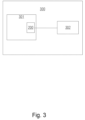
- FIG. 3 is a schematic block diagram of a network system 300 performing communication using a gateway device according to the present disclosure.
- the network system 300 shown in FIG. 3 includes a server-client system 301 and a pub-sub system 302.
- One gateway device 200 as described above is provided in the server-client system 301.
- the server-client system 301 may communicate with the pub-sub system 302 through the gateway device 200.
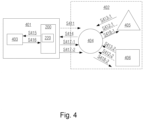
- FIG. 4 A specific example of performing communication between a server-client system 401 and a pub-sub system 402 through the gateway device 200 is described in detail below with reference to FIG. 4 .
- FIG. 4 a detailed process in which a consumer A 405 and a consumer B 406 in the pub-sub system 402 subscribe to a service in the server-client system 401 is specifically described.
- 401 represents a server Host1 in the client-server system
- 402 represents the pub-sub system
- 403 represents a provider (service provider) Provider1 on Host1
- 200 represents the gateway device as described above
- 220 represents a client Client1 created by the gateway device
- 404 represents a broker (message broker)
- 405 represents a consumer A
- 406 represents a consumer B.
- step S411 the gateway device 220 subscribes to a service from the broker 404 "Sub Host1/Provider1/Interface1".
- the consumer A 405 subscribes to the service in S412-1 "Sub ClientA/InterfaceReply1", and then in step S413-1, publishes "Pub Host1/Provider1/Interface1" to the broker 404, and the topic of the message includes the name Host1 of a host of the service to be subscribed to, the name Provider1 of the service provider, and the name Interface1 of the service to be subscribed to.
- the consumer B 406 subscribes to the service in S412-2 "ClientB/InterfaceReply1", and then in S413-2, publishes "Pub Host1/Provider1/Interface1" to the broker 404, and the topic of the message includes the name Host1 of the host of the service to be subscribed to, the name Provider1 of the service provider, and the name Interface1 of the service to be subscribed to.
- step S414 the broker 404 forwards the message "Fwd Host1/Provider1/Interface1".
- step S415 the client Client1 220 is created in the gateway device 200, and Client1 220 sends a request message "Interface1" to Provider1 403.
- step S416 Client1 220 receives a response message "InterfaceReply1" from Provider1 403.
- Client1 220 publishes "Pub ClientA/InterfaceReply1" and "Pub ClientB/InterfaceReply1" separately.
- steps S418-1 and S418-2 the broker 404 forwards "Fwd ClientA/InterfaceReply1" and "Fwd ClientB/InterfaceReply1" to the consumer A and the consumer B, respectively.
- the service provider subscribes to the service that may be provided, the consumers publish the message as a request, and the consumers may also subscribe to a subject received as a response to the request.
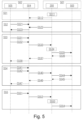
- 501 represents Host1 (a server), 502 represents the pub-sub system, and Provider1 (a service provider) 503 and a gateway 200 are provided on Host1 501.
- 504 represents a broker and 505 represents a consumer A.
- An entire communication process may be divided into five steps, including a scanning step S51, a discovery step S52, a connection step S53, a request/response step S54, and a disconnection step S55.
- the scanning step S51 includes sub-steps S511 and S512.
- the gateway 200 scans all services that may be provided by the service provider on Host1 501, and then in sub-step S512, the gateway 200 subscribes to all services from the broker 504 of the pub-sub system "Sub all interface".
- the discovery step S52 includes sub-steps S521, S522, and S523.
- the consumer A 505 in the pub-sub system subscribes to an advertisement in Host1 501 "Sub Host1 adv”.
- the gateway 200 publishes the advertisement of all the services that Host1 501 can provide to the broker 504 "Pub Host1 adv”.
- the broker 504 forwards the advertisement to the consumer A 505 "Forward Host1 adv".
- the connection step S53 includes sub-steps S531 to S538.
- sub-step S531 the consumer A 505 subscribes to an "onConnect” message from the broker 504 "Sub”onConnect”message”.
- sub-step S532 the consumer A 505 publishes a "Connect” message to the broker 504 "Pub"Connect”message”.
- sub-step S533 the broker 504 forwards the "Connect” message to the gateway 200 "Forward"Connect”message”.
- the gateway 200 creates a client, and in sub-step S535, the client sends a connection request message "Interface1 Connect()" for the service "Interface1" to Provider1 503.
- Provider1 503 sends a response message "Interface1 Connected()" to the gateway 200.
- the gateway 200 publishes the message to the broker 504 "Pub "onConnect” message”.
- the broker 504 forwards the "onConnect” message to the consumer A 505 "Forward"onConnect”message”.
- the request/response step S54 includes sub-steps S541 to S547.
- sub-step S541 the consumer A 505 subscribes to an "onGet” message from the broker 504 "Sub”onGet”message”.
- sub-step S542 the consumer A 505 publishes a "Get” message to the broker 504 "Pub"Get”message”.
- sub-step S543 the broker 504 forwards the "Get” message to the gateway 200 "Forward"Get”message”.
- the client sends an obtaining request message "Interface1 Get()" for the service "Interface1" to Provider1 503.
- sub-step S545 Provider1 503 sends a response message "Interface1 onGet()" to the gateway 200.
- the gateway 200 publishes the message to the broker 504 "Pub"onGet”message”.
- the broker 504 forwards the "onGet” message to the consumer A "Forward"onGet”message".
- the disconnection step S55 includes sub-steps S551 to S554.
- the consumer A 505 publishes a "Disconnect” message to the broker 504 "Pub"disconnect”message”.
- the broker 504 forwards the "Disconnect” message to the gateway 200 "Forward"Disconnect”message”.
- the gateway 200 deletes the created client, and in sub-step S554, sends the "Interface1 Disconnect()" message to Provider1 503.
- the gateway may send the request message for the target service to the corresponding service provider, and for the response message returned from the server, the gateway may identify the target consumer of the response message in the response message based on the information of the consumer sending the message that is included in the payload of the received message.
- connection may be maintained, such that multiple communications may be performed between the consumer and the server, or the connection may be established before each communication and then disconnected after the communication.
- the gateway device as described above may be implemented by hardware, or may be implemented by software or a combination of hardware and software.
- FIG. 6 is a block diagram of a gateway device 600 of a method for implementing communication conversion between a server-client system and a pub-sub system according to an embodiment of the present disclosure.
- the gateway device 600 may include at least one processor 602, and the processor 602 executes at least one computer-readable instruction (i.e., the above element implemented in the form of software) stored or encoded in a computer-readable storage medium (i.e., a memory 604).
- a computer-readable storage medium i.e., a memory 604
- computer executable instructions are stored in the memory 604, and when executed, cause at least one processor 602 to implement the method for implementing communication conversion between a server-client system and a pub-sub system described above with reference to FIG. 1 .
- a non-transitory machine-readable medium may include machine executable instructions (i.e., the above elements implemented in the form of software) that, when executed by a machine, cause the machine to perform various operations and functions described above in conjunction with FIG. 1 to FIG. 5 in the embodiments of the present disclosure.
- a computer program is provided, which includes computer executable instructions that, when executed, cause at least one processor to perform various operations and functions described above in conjunction with FIG. 1 to FIG. 5 in the embodiments of the present disclosure.
- a computer program product which includes computer executable instructions that, when executed, cause at least one processor to perform various operations and functions described above in conjunction with FIG. 1 to FIG. 5 in the embodiments of the present disclosure.
- roles in the network system and the topic and payload of the sent message are redefined, so that the communication between the server-client system and the pub-sub system may be supported.
- services that the server can provide may be automatically scanned and broadcast without manual configuration for each data point.
- pub/sub clients may be created dynamically and automatically.
- a fusion method for IT and OT systems is provided, and the method according to the present disclosure is a low-code method, which reduces a development burden of technical personnel, and improves industrial communication efficiency.
- Using the method according to the present disclosure may expand an application scenario of products, and improve competitiveness of the products.
Landscapes
- Engineering & Computer Science (AREA)
- Computer Networks & Wireless Communication (AREA)
- Signal Processing (AREA)
- Computer Security & Cryptography (AREA)
- Data Exchanges In Wide-Area Networks (AREA)
- Information Transfer Between Computers (AREA)
Description
- The present disclosure generally relates to the field of network technologies, and more specifically, to a communication conversion method for implementing communication between a server-client system and a pub-sub system, a gateway device, a network system, and a computer medium.
- Recently, the OPC Foundation has added a pub-sub capability to the specifications as an alternative to the client-server model and its request-response approach. In concept, publishers (data sources) in the pub-sub model send messages to a broker (message broker) that relays the messages to data-consumer nodes that have previously requested to be sent messages on a particular subject. Compared with the client-server model, the pub-sub model decouples data sources with data consumers and transforms a system from a centralized model to a distributed model.
- A key advantage of such a frame structure is that it simplifies software running on programmable logic controllers (PLCs), human-machine interfaces (HMIs), enterprise resource planning (ERP) systems crossing systems of different suppliers, and other IT systems. The result is that a factory can be set up quicker, gathering and analyzing more information. This additional analysis can improve operational efficiency and, by spying problems early, reduce downtime.
- In the prior art, Eclipse 4diac™ provides an open source architecture for a distributed industrial process measurement and control system based on the IEC 61499 standard. It can use publishers and subscribers for application communication. However, in this method, engineers need to manually configure a pub/sub function block for each data point.
- Reference document 1:
US 7720914 B2 , Performing an operation on a message received from a publish/subscribe service, https://patents.google.com/patent/US7720914B2 /en. - Reference document 2:
US 7890572 B2 (same asUS 7720914 B2 ), Pub/sub message invoking
a subscribers client application program, https://patents.google.com/patent/US7890572B2 /en.US 2018/213378 A1 relates to service layer interworking using the MQTT protocol within the oneM2M framework. - According to an object of the present invention, there is provided a method as claimed in
claim 1 for implementing communication conversion between a server-client system and a pub-sub system. - Further objects of the invention are a corresponding gateway as in claim 4, a corresponding system according to claim 7, a corresponding machine-readable storage medium as in claim 8, computer program as in claim 9, and a computer program product as in claim 10. Preferred embodiments are covered by the appended dependent claims.
- The foregoing and other objectives, features, and advantages of the present invention can be more easily understood with reference to the following descriptions of embodiments of the present invention in conjunction with the accompanying drawings. Components in the accompanying drawings are merely for illustrating the principle of the present invention. In the accompanying drawings, same or similar technical features or components are represented by using same or similar reference signs.
-
FIG. 1 is a flowchart of an exemplary process of a method for implementing communication conversion between a server-client system and a pub-sub system according to an embodiment of the present invention; -
FIG. 2 is a block diagram of an exemplary configuration of agateway device 200 according to another embodiment of the present disclosure; -
FIG. 3 is a schematic block diagram of a network system performing communication using a gateway device according to the present disclosure; -
FIG. 4 is a flowchart of operations for a network system to perform communication using a gateway device according to another embodiment of the present disclosure; -
FIG. 5 is a flowchart of operations for performing communication between a server-client system and a pub-sub system according to another embodiment of the present disclosure; and -
FIG. 6 is a block diagram of a gateway device of a method for implementing communication conversion between a server-client system and a pub-sub system according to an embodiment of the present disclosure. -
100: method for implementing communication conversion between a server-client system and a pub-sub system S101, S102, S104, S106, S108, and S110: steps 200: gateway device 202: pub-sub system message receiving unit 204: parsing unit 206: request message sending unit 208: response message receiving unit 210: server-client system message sending unit 300: network system 301: server- client system 302, 402, and 502: pub- sub system 401 and 501: servers 403 and 503: service providers 220: client 404 and 504: message brokers 405 and 505: consumer A 406: consumer B S411, S412-1, S412-2, S413-1, S413-2, S414, S415, S416, S417-1, S417-2, S418-1, and S418-2: steps S51-S55, S511-S554: steps 600: gateway device 602: processor 604: memory - The subject matter described herein are now discussed with reference to exemplary implementations. It should be understood that the discussion of these implementations is merely intended to help a person skilled in the art to better understand and implement the subject matter described herein, but not to limit the protection scope as set forth in the claims. The functions and arrangement of the discussed elements can be changed without departing from the protection scope of the present disclosure. Various processes or components may be omitted, replaced, or added in various examples as required.
- As used herein, the term "include" and variants thereof represent an open term, which means "including but not limited to". The term "based on" represents "at least partially based on". The terms "an embodiment" and "the embodiment" represent "at least one embodiment". The term "another embodiment" denotes "at least one another embodiment". The terms "first", "second", and the like may refer to different or the same objects. Other definitions, whether explicit or implicit, can be included below. Unless expressly specified in the context, the definition of a term is consistent throughout the specification.
- In a client-server system, a server provides functions or services to one or more clients for which the client initiates a request. The client exchanges messages with the server in a request-response model. The client sends a request with a server address, and the server replies with a response with a client address.
- In a pub-sub system, a publisher publishes a message on an intermediate message broker or an event bus, and a subscriber registers the subscription with the broker and let the broker to perform filtering. This model decouples service providers with consumers, and consumers only need to pre-configure an address of the broker.
- In the present disclosure, a method that can simply and conveniently implement communication conversion between a conventional client-server-based system and a pub-sub mode-based system is proposed.
- The following describes a method for implementing communication conversion between a server-client system and a pub-sub system, a gateway device, and a network system according to the embodiments of the present disclosure with reference to accompanying drawings.
-
FIG. 1 is a flowchart of an exemplary process of amethod 100 for implementing communication conversion between a server-client system and a pub-sub system according to an embodiment of the present invention. - First, in step S102, a message is received from the pub-sub system, where a topic of the message includes information related to a target service in the server-client system to which the message is to be sent, and a payload of the message includes identification information of a consumer in the pub-sub system, and the consumer is to receive a response message from the server-client system.
- In the solution according to the present disclosure, the message to be sent from the pub-sub system to the server-client system is defined. The topic of the message can represent the information related to the target service in the server-client system to which the message is to be sent, for example, the topic of the message may be defined to include character strings of the names of a host and a service provider that provide the target service and a character string of the name of the target service, such that the server-client system can determine, after receiving the message, a server provider on a host to which the message is to be sent. The payload of the message may include the identification information of the consumer in the pub-sub system that is to receive the response message, so that after the response message from the server-client system is sent to the pub-sub system, the broker therein may know the consumer to which the response message is to be forwarded.
- The topic and payload of the message may be defined as a character string in the JSON format, XML format, binary format, or the like. In the present invention, a specific form of the topic and the payload of the message is not limited.
- In addition, optionally, the payload of the message may further include the name of a function corresponding to the target service, a parameter of the function, and the like.
- In this way, the name of the function and the parameter of the function are placed in the payload instead of the topic of the message, which may reduce the number of topics. In addition, mapping onto specific functions may be performed for calling, so as to trigger the service of the server.
- After the message from the pub-sub system is received, in step S104, the message is parsed, and a host and a service provider that provide the target service, and the consumer who is to receive the response message are determined.
- In step S106, a request message for the target service is sent to the service provider on the determined host.
- In the method according to the present disclosure, a data communication model performed on the server-client system side is a common request-response model. Since the host and service provider that provide the target service are determined in the previous step S104, the request message for the target service may be sent directly to the corresponding service provider.
- Next, in step S108, the response message from the service provider may be received.
- In step S110, the identification information of the consumer is added to the response message based on the consumer in the pub-sub system that is determined in step S104 and that is to receive the response message, for example, the identification information may be added to a topic of the response message to be sent to the pub-sub system, and then the message is sent to the pub-sub system.
- After receiving the message, the broker in the pub-sub system may determine, based on the identification information of the consumer, the consumer to which the response message is to be sent. Those skilled in the art may understand a specific process of how the broker in the pub-sub system is to forward the message, which will not be described in detail herein.
- In the above method, the request-response model is used in the server-client system, the pub-sub model is used in the pub-sub system, and the communication conversion between the server-client system and the pub-sub system may be implemented without making any changes to each of the systems. Through the above steps, the consumer in the pub-sub system may request a service in which the consumer is interested from the server in the server-client.
- In an example, before the server-client receives the message from the consumer in the pub-sub system, step S101 may be included, that is, a service provided by the service provider in the server-client system is first scanned, and then the service is published in the pub-sub system, such that the consumer in the pub-sub system is capable of establishing a connection with the service provider of the service in which the consumer is interested.
- In this way, services may be automatically scanned and broadcast, and pub/sub clients may be created dynamically and automatically through gateways.
- In a specific example, service repositories of all server providers may be scanned and then corresponding topics may be subscribed. All services, including corresponding function names and parameters, may be organized as messages in JSON format with a topic thereof defined as "adv", which represents an advertisement.
- Preferably, advertisement messages may be broadcast periodically, and each consumer may subscribe to topics of interest, and obtain services of interest by parsing advertisements, for example, may obtain function names and parameters.
-
FIG. 2 is a block diagram of an exemplary configuration of agateway device 200 according to another embodiment of the present disclosure. Through the gateway device, communication conversion between a server-client system and a pub-sub system is implemented. - As shown in
FIG. 2 , thegateway device 200 includes: a pub-sub systemmessage receiving unit 202, aparsing unit 204, a requestmessage sending unit 206, a responsemessage receiving unit 208, and a server-client systemmessage sending unit 210. - The pub-sub system
message receiving unit 202 is configured to receive a message from the pub-sub system, a topic of the message including information related to a target service in the server-client system to which the message is to be sent, and a payload of the message including identification information of a consumer in the pub-sub system, and the consumer is to receive a response message from the server-client system. - The
parsing unit 204 is configured to parse the message, and determine a host and a service provider that provide the target service, and the consumer who is to receive the response message. - The request
message sending unit 206 is configured to send a request message for the target service to the service provider on the determined host. - The response
message receiving unit 208 is configured to receive the response message from the service provider. - The server-client system
message sending unit 210 is configured to add the identification information of the consumer to the response message, and send the response message to the pub-sub system. - The topic of the message may include the names of the host and the service provider that provide the target service and the name of the target service.
- The payload of the message may further include a function name and a parameter that correspond to the target service to be subscribed to by the consumer.
- In an example, the gateway device may further include: a
service scanning unit 201 configured to scan a service provided by the service provider in the server-client system, and publish the service in the pub-sub system, such that the consumer in the pub-sub system is capable of establishing a connection with the service provider of the service to which the consumer wants to subscribe. - Details about operations and functions of various parts of the
gateway device 200 shown inFIG. 2 may be, for example, the same as or similar to related parts in the embodiments of themethod 100 for implementing communication conversion between a server-client system and a pub-sub system in the present disclosure described with reference toFIG. 1 , and are not repeated herein. - Through the above method or gateway device, the communication conversion between the server-client system and the pub-sub system may be implemented.
- It should be further noted that the
gateway device 200 and a structure of constituent units of the gateway device shown inFIG. 2 are merely examples, and those skilled in the art may modify the structural block diagram ofFIG. 2 according to requirements. -
FIG. 3 is a schematic block diagram of anetwork system 300 performing communication using a gateway device according to the present disclosure. - The
network system 300 shown inFIG. 3 includes a server-client system 301 and a pub-sub system 302. Onegateway device 200 as described above is provided in the server-client system 301. The server-client system 301 may communicate with the pub-sub system 302 through thegateway device 200. - A specific example of performing communication between a server-
client system 401 and a pub-sub system 402 through thegateway device 200 is described in detail below with reference toFIG. 4 . InFIG. 4 , a detailed process in which aconsumer A 405 and aconsumer B 406 in the pub-sub system 402 subscribe to a service in the server-client system 401 is specifically described. - In
FIG. 4 , 401 represents a server Host1 in the client-server system, 402 represents the pub-sub system, 403 represents a provider (service provider) Provider1 on Host1, 200 represents the gateway device as described above, 220 represents a client Client1 created by the gateway device, 404 represents a broker (message broker), 405 represents a consumer A, and 406 represents a consumer B. - First, in step S411, the
gateway device 220 subscribes to a service from thebroker 404 "Sub Host1/Provider1/Interface1". - Next, the
consumer A 405 subscribes to the service in S412-1 "Sub ClientA/InterfaceReply1", and then in step S413-1, publishes "Pub Host1/Provider1/Interface1" to thebroker 404, and the topic of the message includes the name Host1 of a host of the service to be subscribed to, the name Provider1 of the service provider, and the name Interface1 of the service to be subscribed to. Similarly, theconsumer B 406 subscribes to the service in S412-2 "ClientB/InterfaceReply1", and then in S413-2, publishes "Pub Host1/Provider1/Interface1" to thebroker 404, and the topic of the message includes the name Host1 of the host of the service to be subscribed to, the name Provider1 of the service provider, and the name Interface1 of the service to be subscribed to. - In step S414, the
broker 404 forwards the message "Fwd Host1/Provider1/Interface1". - In step S415, the
client Client1 220 is created in thegateway device 200, andClient1 220 sends a request message "Interface1" toProvider1 403. - In step S416,
Client1 220 receives a response message "InterfaceReply1" fromProvider1 403. - In steps S417-1 and S417-2,
Client1 220 publishes "Pub ClientA/InterfaceReply1" and "Pub ClientB/InterfaceReply1" separately. - In steps S418-1 and S418-2, the
broker 404 forwards "Fwd ClientA/InterfaceReply1" and "Fwd ClientB/InterfaceReply1" to the consumer A and the consumer B, respectively. - Through the above steps, the entire process in which the consumer A and the consumer B in the pub-sub system subscribe to the service Interface1 from the service provider Provider1 on the host Host1 in the server-client system is completed.
- In the above process, the service provider (server) subscribes to the service that may be provided, the consumers publish the message as a request, and the consumers may also subscribe to a subject received as a response to the request.
- A specific example of performing communication between a server-client system and a pub-sub system according to another embodiment of the present disclosure is described below with reference to
FIG. 5 . - In
FIG. 5 , 501 represents Host1 (a server), 502 represents the pub-sub system, and Provider1 (a service provider) 503 and agateway 200 are provided onHost1 501. 504 represents a broker and 505 represents a consumer A. - An entire communication process may be divided into five steps, including a scanning step S51, a discovery step S52, a connection step S53, a request/response step S54, and a disconnection step S55.
- Specifically, the scanning step S51 includes sub-steps S511 and S512. In sub-step S511, the
gateway 200 scans all services that may be provided by the service provider onHost1 501, and then in sub-step S512, thegateway 200 subscribes to all services from thebroker 504 of the pub-sub system "Sub all interface". - The discovery step S52 includes sub-steps S521, S522, and S523. In sub-step S521, the
consumer A 505 in the pub-sub system subscribes to an advertisement inHost1 501 "Sub Host1 adv". In sub-step S522, thegateway 200 publishes the advertisement of all the services thatHost1 501 can provide to thebroker 504 "Pub Host1 adv". In sub-step S523, thebroker 504 forwards the advertisement to theconsumer A 505 "Forward Host1 adv". - The connection step S53 includes sub-steps S531 to S538. In sub-step S531, the
consumer A 505 subscribes to an "onConnect" message from thebroker 504 "Sub"onConnect"message". In sub-step S532, theconsumer A 505 publishes a "Connect" message to thebroker 504 "Pub"Connect"message". In sub-step S533, thebroker 504 forwards the "Connect" message to thegateway 200 "Forward"Connect"message". In sub-step S534, thegateway 200 creates a client, and in sub-step S535, the client sends a connection request message "Interface1 Connect()" for the service "Interface1" toProvider1 503. In sub-step S536,Provider1 503 sends a response message "Interface1 Connected()" to thegateway 200. In sub-step S537, thegateway 200 publishes the message to thebroker 504 "Pub "onConnect" message". In sub-step S538, thebroker 504 forwards the "onConnect" message to theconsumer A 505 "Forward"onConnect"message". - The request/response step S54 includes sub-steps S541 to S547. In sub-step S541, the
consumer A 505 subscribes to an "onGet" message from thebroker 504 "Sub"onGet"message". In sub-step S542, theconsumer A 505 publishes a "Get" message to thebroker 504 "Pub"Get"message". In sub-step S543, thebroker 504 forwards the "Get" message to thegateway 200 "Forward"Get"message". In sub-step S544, the client sends an obtaining request message "Interface1 Get()" for the service "Interface1" toProvider1 503. In sub-step S545,Provider1 503 sends a response message "Interface1 onGet()" to thegateway 200. In sub-step S546, thegateway 200 publishes the message to thebroker 504 "Pub"onGet"message". In sub-step S547, thebroker 504 forwards the "onGet" message to the consumer A "Forward"onGet"message". - Finally, the disconnection step S55 includes sub-steps S551 to S554. In sub-step S551, the
consumer A 505 publishes a "Disconnect" message to thebroker 504 "Pub"disconnect"message". In sub-step S552, thebroker 504 forwards the "Disconnect" message to thegateway 200 "Forward"Disconnect"message". In sub-step S553, thegateway 200 deletes the created client, and in sub-step S554, sends the "Interface1 Disconnect()" message toProvider1 503. - In the above process, since the topic of the message received by the gateway from the pub-sub system includes the name of the host in the server-client system that provides the service, the name of the service provider, and the name of the service, the gateway may send the request message for the target service to the corresponding service provider, and for the response message returned from the server, the gateway may identify the target consumer of the response message in the response message based on the information of the consumer sending the message that is included in the payload of the received message.
- The specific example of performing communication between the server-client system and the pub-sub system is described in detail above with reference to
FIG. 5 . Those skilled in the art may understand that the method according to the present disclosure is not limited to the steps shown in the example. - For example, those skilled in the art may understand that after a connection is established, the connection may be maintained, such that multiple communications may be performed between the consumer and the server, or the connection may be established before each communication and then disconnected after the communication.
- As described above, the method for implementing communication conversion between a server-client system and a pub-sub system, the gateway device, and the network system according to the embodiments of the present disclosure are described with reference to
FIG. 1 to FIG. 5 . The gateway device as described above may be implemented by hardware, or may be implemented by software or a combination of hardware and software. -
FIG. 6 is a block diagram of agateway device 600 of a method for implementing communication conversion between a server-client system and a pub-sub system according to an embodiment of the present disclosure. According to an embodiment, thegateway device 600 may include at least oneprocessor 602, and theprocessor 602 executes at least one computer-readable instruction (i.e., the above element implemented in the form of software) stored or encoded in a computer-readable storage medium (i.e., a memory 604). - In an embodiment, computer executable instructions are stored in the
memory 604, and when executed, cause at least oneprocessor 602 to implement the method for implementing communication conversion between a server-client system and a pub-sub system described above with reference toFIG. 1 . - It should be understood that the computer executable instructions stored in the
memory 604, when executed, cause the at least oneprocessor 602 to perform various operations and functions described above in conjunction withFIG. 1 to FIG. 5 in the embodiments of the present disclosure. - According to an embodiment, a non-transitory machine-readable medium is provided. The non-transitory machine-readable medium may include machine executable instructions (i.e., the above elements implemented in the form of software) that, when executed by a machine, cause the machine to perform various operations and functions described above in conjunction with
FIG. 1 to FIG. 5 in the embodiments of the present disclosure. According to an embodiment, a computer program is provided, which includes computer executable instructions that, when executed, cause at least one processor to perform various operations and functions described above in conjunction withFIG. 1 to FIG. 5 in the embodiments of the present disclosure. - According to an embodiment, a computer program product is provided, which includes computer executable instructions that, when executed, cause at least one processor to perform various operations and functions described above in conjunction with
FIG. 1 to FIG. 5 in the embodiments of the present disclosure. - In the method and gateway device according to the present disclosure, roles in the network system and the topic and payload of the sent message are redefined, so that the communication between the server-client system and the pub-sub system may be supported.
- In the method and gateway device according to the present disclosure, services that the server can provide may be automatically scanned and broadcast without manual configuration for each data point.
- In the method and gateway device according to the present disclosure, pub/sub clients may be created dynamically and automatically.
- According to the method for implementing communication between a server-client system and a pub-sub system of the present disclosure, a fusion method for IT and OT systems is provided, and the method according to the present disclosure is a low-code method, which reduces a development burden of technical personnel, and improves industrial communication efficiency.
- Using the method according to the present disclosure may expand an application scenario of products, and improve competitiveness of the products.
- Exemplary embodiments are described above in combination with the specific embodiments described in the accompanying drawings, but do not represent all the embodiments that can be implemented or fall within the protection scope of the invention as defined by the appended claims. The term "exemplary" used throughout the present specification means "used as an example, an instance or an illustration", but does not mean "preferred" or "advantageous" over the other embodiments. For the purpose of providing an understanding of the described technologies, the specific embodiments include specific details. However, the technologies can be implemented without the specific details. In some embodiments, in order to avoid obscuring the described concepts in the embodiments, commonly known structures and apparatuses are shown in the form of a block diagram.
- The descriptions above of the present disclosure are provided to enable any person of ordinary skill in the art to implement or use the present disclosure. For a person of ordinary skill in the art, various modifications made to the present disclosure are obvious and the general principles defined herein may also be applied to other variants without departing from the protection scope of the present invention, which is defined by the appended claims.
Claims (10)
- A method (100) for implementing communication conversion between a server-client system (301) and a publish-subscribe (pub-sub) system through a gateway device (200, 600), comprising:receiving, by a pub-sub system message receiving unit of the gateway device (200, 600), a message from the pub-sub system (302, 402), a topic of the message comprising information related to a target service in the server-client system (301) to which the message is to be sent wherein the topic of the message comprises names of a host and a service provider (220) on the host that provide the target service and a name of the target service, and a payload of the message comprising identification information of a consumer in the pub-sub system (302, 402), wherein the consumer is to receive a response message from the server-client system (301);parsing, by a parsing unit (204) of the gateway device (200, 600), the message, and determining the host and the service provider (220) on the host that provide the target service, and the consumer who is to receive the response message;sending, by a request message sending unit (206) of the gateway device (200, 600), a request message for the target service to the service provider (220) on the determined host;receiving, by a response message receiving unit (208) of the gateway device (200, 600), the response message from the service provider (220); andadding, by a server-client system message sending unit of the gateway device (200, 600), the identification information of the consumer to the response message, and sending the response message to the pub-sub system (302, 402).
- The method (100) according to claim 1, wherein
the payload of the message further comprises a function name and a parameter that correspond to the target service to be subscribed to by the consumer. - The method (100) according to any one of claim 1 or 2, wherein before the receiving a message from the pub-sub system (302, 402), the method (100) further comprises:scanning a service provided by the service provider (220) in the server-client system (301); andpublishing the service in the pub-sub system (302, 402), such that the consumer in the pub-sub system (302, 402) is capable of establishing a connection with the service provider (220) of the service in which the consumer is interested.
- A gateway device (200, 600) for implementing communication conversion between a server-client system (301) and a publish-subscribe (pub-sub) system, comprising:a pub-sub system message receiving unit configured to receive a message from the pub-sub system (302, 402), a topic of the message comprising information related to a target service in the server-client system (301) to which the message is to be sent wherein the topic of the message comprises names of a host and a service provider (220) on the host that provide the target service and a name of the target service, and a payload of the message comprising identification information of a consumer in the pub-sub system (302, 402), and the consumer is to receive a response message from the server-client system (301);a parsing unit (204) configured to parse the message, and determine the host and the service provider (220) on the host that provide the target service, and the consumer who is to receive the response message;a request message sending unit (206) configured to send a request message for the target service to the service provider (220) on the determined host;a response message receiving unit (208) configured to receive the response message from the service provider (220); anda server-client system message sending unit configured to add the identification information of the consumer to the response message, and send the response message to the pub-sub system (302, 402).
- The gateway device (200, 600) according to claim 4, wherein
the payload of the message further comprises a function name and a parameter that correspond to the target service to be subscribed to by the consumer. - The gateway device (200, 600) according to any one of claim 4 or 5, further comprising:
a service scanning unit (201) configured to scan a service provided by the service provider (220) in the server-client system (301), and publish the service in the pub-sub system (302, 402), such that the consumer in the pub-sub system (302, 402) is capable of establishing a connection with the service provider (220) of the service to which the consumer wants to subscribe. - A network system (300), comprising: a server-client system (301) and a pub-sub system (302, 402), wherein one gateway device (200, 600) according to any one of claims 4 to 6 is provided in the server-client system (301), and the server-client system communicates with the pub-sub system (302, 402) via the gateway device (200, 600).
- A non-transitory machine-readable storage medium storing executable instructions that, when executed, cause a machine to perform the method (100) according to any one of claims 1 to 3.
- A computer program, comprising computer executable instructions that, when executed, cause at least one processor (602) to perform the method (100) according to any one of claims 1 to 3.
- A computer program product tangibly stored on a computer-readable medium, and comprising computer executable instructions that, when executed, cause at least one processor (602) to perform the method (100) according to any one of claims 1 to 3.
Applications Claiming Priority (1)
| Application Number | Priority Date | Filing Date | Title |
|---|---|---|---|
| PCT/CN2020/092985 WO2021237588A1 (en) | 2020-05-28 | 2020-05-28 | Communication conversion method, gateway device, network system and computer medium |
Publications (4)
| Publication Number | Publication Date |
|---|---|
| EP4142234A1 EP4142234A1 (en) | 2023-03-01 |
| EP4142234A4 EP4142234A4 (en) | 2024-02-28 |
| EP4142234C0 EP4142234C0 (en) | 2025-04-30 |
| EP4142234B1 true EP4142234B1 (en) | 2025-04-30 |
Family
ID=78745266
Family Applications (1)
| Application Number | Title | Priority Date | Filing Date |
|---|---|---|---|
| EP20937858.7A Active EP4142234B1 (en) | 2020-05-28 | 2020-05-28 | Communication interworking between a client-server architecture and a publish-subscribe system |
Country Status (4)
| Country | Link |
|---|---|
| US (1) | US11876876B2 (en) |
| EP (1) | EP4142234B1 (en) |
| CN (1) | CN115462054B (en) |
| WO (1) | WO2021237588A1 (en) |
Family Cites Families (12)
| Publication number | Priority date | Publication date | Assignee | Title |
|---|---|---|---|---|
| US7720910B2 (en) | 2002-07-26 | 2010-05-18 | International Business Machines Corporation | Interactive filtering electronic messages received from a publication/subscription service |
| US8825811B2 (en) * | 2012-03-15 | 2014-09-02 | International Business Machines Corporation | Connection management and optimization for services delivered over networks |
| EP2856404A4 (en) * | 2012-05-24 | 2015-12-09 | Google Inc | Systems, methods, and computer program products for providing a contactless protocol |
| CN103338267B (en) * | 2013-07-18 | 2016-10-12 | 厦门大学 | The intelligent movable community value-added service platform that a kind of SIP and Web service are merged |
| US10313858B2 (en) * | 2014-07-21 | 2019-06-04 | Convida Wireless, Llc | Service layer interworking using MQTT protocol |
| CN104092767B (en) * | 2014-07-21 | 2017-06-13 | 北京邮电大学 | A kind of publish/subscribe system and its method of work for increasing message queue model |
| US10645181B2 (en) * | 2016-12-12 | 2020-05-05 | Sap Se | Meta broker for publish-subscribe-based messaging |
| CN108696551A (en) * | 2017-04-06 | 2018-10-23 | 中兴通讯股份有限公司 | The method and apparatus that addressing is asked between system process |
| CN110048927B (en) * | 2018-01-16 | 2020-12-15 | 华为技术有限公司 | Communication method and communication device |
| CN109274730B (en) * | 2018-09-04 | 2021-07-23 | 上海联寓智能科技有限公司 | Internet of things system, MQTT message transmission optimization method and device |
| CN109618005B (en) | 2019-01-18 | 2020-12-08 | 华为终端有限公司 | Method for calling server and proxy server |
| WO2021095936A1 (en) * | 2019-11-15 | 2021-05-20 | 전자부품연구원 | Method for forming opc ua publisher gateway using opc ua server |
-
2020
- 2020-05-28 US US17/927,277 patent/US11876876B2/en active Active
- 2020-05-28 CN CN202080100288.3A patent/CN115462054B/en active Active
- 2020-05-28 WO PCT/CN2020/092985 patent/WO2021237588A1/en not_active Ceased
- 2020-05-28 EP EP20937858.7A patent/EP4142234B1/en active Active
Also Published As
| Publication number | Publication date |
|---|---|
| EP4142234C0 (en) | 2025-04-30 |
| CN115462054A (en) | 2022-12-09 |
| US11876876B2 (en) | 2024-01-16 |
| WO2021237588A1 (en) | 2021-12-02 |
| EP4142234A4 (en) | 2024-02-28 |
| US20230199087A1 (en) | 2023-06-22 |
| EP4142234A1 (en) | 2023-03-01 |
| CN115462054B (en) | 2025-01-28 |
Similar Documents
| Publication | Publication Date | Title |
|---|---|---|
| CN102082992B (en) | Mobile office system and implementation method thereof | |
| CN107018147B (en) | Internet of things communication method and system and gateway module | |
| EP2800419B1 (en) | Device switching method, m2m platform and network system | |
| US20090172077A1 (en) | Apparatus for and a Method of Delivering a Message to a User | |
| US20030088704A1 (en) | Method and apparatus for processing electronic mail | |
| US20040015569A1 (en) | System and method for providing partial presence notifications | |
| US11010216B2 (en) | RPC conversion processing system and RPC conversion method | |
| CN109040326A (en) | The method and apparatus of PUSH message | |
| JP4818652B2 (en) | Terminal management system | |
| US9009306B2 (en) | Method, system, client and server for locating operation nodes in communication system | |
| CN104519095B (en) | A kind of dynamic message method for pushing and its system, server-side, client | |
| CN111510476A (en) | Communication method, communication apparatus, computer device, and computer-readable storage medium | |
| CN110417760B (en) | Interoperation method of edge layer in industrial Internet and middleware | |
| CN101197724A (en) | Long-range control system and method for information household electrical appliance in IGRS household network based on IPv6 | |
| GB2580419A (en) | Electronic message control | |
| EP1636953B1 (en) | Actionable messaging | |
| US20070016674A1 (en) | Information exchange system, management server, and method for reducing network load used in the same | |
| CN102054213A (en) | Information integration method, device and system | |
| EP4142234A1 (en) | Communication conversion method, gateway device, network system and computer medium | |
| KR20230022944A (en) | Resource publishing methods, devices, gateways, cloud platforms and computer storage media | |
| US20030126219A1 (en) | Communication device and method for controlling communication device | |
| US20090138564A1 (en) | Apparatus for and a method of delivering a message to a user | |
| KR20070041610A (en) | Method for transmitting application-specific registration or deregistration data and system, server and communication terminal therefor | |
| CN116962341A (en) | A mail delivery method, device, equipment and storage medium | |
| GB2580420A (en) | Electronic message adaptation |
Legal Events
| Date | Code | Title | Description |
|---|---|---|---|
| STAA | Information on the status of an ep patent application or granted ep patent |
Free format text: STATUS: THE INTERNATIONAL PUBLICATION HAS BEEN MADE |
|
| PUAI | Public reference made under article 153(3) epc to a published international application that has entered the european phase |
Free format text: ORIGINAL CODE: 0009012 |
|
| STAA | Information on the status of an ep patent application or granted ep patent |
Free format text: STATUS: REQUEST FOR EXAMINATION WAS MADE |
|
| 17P | Request for examination filed |
Effective date: 20221123 |
|
| AK | Designated contracting states |
Kind code of ref document: A1 Designated state(s): AL AT BE BG CH CY CZ DE DK EE ES FI FR GB GR HR HU IE IS IT LI LT LU LV MC MK MT NL NO PL PT RO RS SE SI SK SM TR |
|
| DAV | Request for validation of the european patent (deleted) | ||
| DAX | Request for extension of the european patent (deleted) | ||
| REG | Reference to a national code |
Ref country code: DE Ipc: H04L0067630000 Ref country code: DE Ref legal event code: R079 Ref document number: 602020050661 Country of ref document: DE Free format text: PREVIOUS MAIN CLASS: H04L0029080000 Ipc: H04L0067630000 |
|
| A4 | Supplementary search report drawn up and despatched |
Effective date: 20240129 |
|
| RIC1 | Information provided on ipc code assigned before grant |
Ipc: H04L 69/22 20220101ALN20240123BHEP Ipc: H04L 67/568 20220101ALN20240123BHEP Ipc: H04L 67/562 20220101ALN20240123BHEP Ipc: H04L 67/51 20220101ALN20240123BHEP Ipc: H04L 61/4541 20220101ALI20240123BHEP Ipc: H04L 69/329 20220101ALI20240123BHEP Ipc: H04L 67/567 20220101ALI20240123BHEP Ipc: H04L 67/55 20220101ALI20240123BHEP Ipc: H04L 69/08 20220101ALI20240123BHEP Ipc: H04L 67/63 20220101AFI20240123BHEP |
|
| GRAP | Despatch of communication of intention to grant a patent |
Free format text: ORIGINAL CODE: EPIDOSNIGR1 |
|
| STAA | Information on the status of an ep patent application or granted ep patent |
Free format text: STATUS: GRANT OF PATENT IS INTENDED |
|
| RIC1 | Information provided on ipc code assigned before grant |
Ipc: H04L 69/22 20220101ALN20241127BHEP Ipc: H04L 67/568 20220101ALN20241127BHEP Ipc: H04L 67/562 20220101ALN20241127BHEP Ipc: H04L 67/51 20220101ALN20241127BHEP Ipc: H04L 61/4541 20220101ALI20241127BHEP Ipc: H04L 69/329 20220101ALI20241127BHEP Ipc: H04L 67/567 20220101ALI20241127BHEP Ipc: H04L 67/55 20220101ALI20241127BHEP Ipc: H04L 69/08 20220101ALI20241127BHEP Ipc: H04L 67/63 20220101AFI20241127BHEP |
|
| INTG | Intention to grant announced |
Effective date: 20241206 |
|
| RIC1 | Information provided on ipc code assigned before grant |
Ipc: H04L 69/22 20220101ALN20241202BHEP Ipc: H04L 67/568 20220101ALN20241202BHEP Ipc: H04L 67/562 20220101ALN20241202BHEP Ipc: H04L 67/51 20220101ALN20241202BHEP Ipc: H04L 12/18 20060101ALI20241202BHEP Ipc: H04L 61/4541 20220101ALI20241202BHEP Ipc: H04L 69/329 20220101ALI20241202BHEP Ipc: H04L 67/567 20220101ALI20241202BHEP Ipc: H04L 67/55 20220101ALI20241202BHEP Ipc: H04L 69/08 20220101ALI20241202BHEP Ipc: H04L 67/63 20220101AFI20241202BHEP |
|
| GRAS | Grant fee paid |
Free format text: ORIGINAL CODE: EPIDOSNIGR3 |
|
| GRAA | (expected) grant |
Free format text: ORIGINAL CODE: 0009210 |
|
| STAA | Information on the status of an ep patent application or granted ep patent |
Free format text: STATUS: THE PATENT HAS BEEN GRANTED |
|
| AK | Designated contracting states |
Kind code of ref document: B1 Designated state(s): AL AT BE BG CH CY CZ DE DK EE ES FI FR GB GR HR HU IE IS IT LI LT LU LV MC MK MT NL NO PL PT RO RS SE SI SK SM TR |
|
| REG | Reference to a national code |
Ref country code: CH Ref legal event code: EP Ref country code: GB Ref legal event code: FG4D |
|
| REG | Reference to a national code |
Ref country code: DE Ref legal event code: R096 Ref document number: 602020050661 Country of ref document: DE |
|
| REG | Reference to a national code |
Ref country code: IE Ref legal event code: FG4D |
|
| U01 | Request for unitary effect filed |
Effective date: 20250515 |
|
| U07 | Unitary effect registered |
Designated state(s): AT BE BG DE DK EE FI FR IT LT LU LV MT NL PT RO SE SI Effective date: 20250521 |
|
| U20 | Renewal fee for the european patent with unitary effect paid |
Year of fee payment: 6 Effective date: 20250521 |
|
| PG25 | Lapsed in a contracting state [announced via postgrant information from national office to epo] |
Ref country code: ES Free format text: LAPSE BECAUSE OF FAILURE TO SUBMIT A TRANSLATION OF THE DESCRIPTION OR TO PAY THE FEE WITHIN THE PRESCRIBED TIME-LIMIT Effective date: 20250430 |
|
| PG25 | Lapsed in a contracting state [announced via postgrant information from national office to epo] |
Ref country code: GR Free format text: LAPSE BECAUSE OF FAILURE TO SUBMIT A TRANSLATION OF THE DESCRIPTION OR TO PAY THE FEE WITHIN THE PRESCRIBED TIME-LIMIT Effective date: 20250731 Ref country code: NO Free format text: LAPSE BECAUSE OF FAILURE TO SUBMIT A TRANSLATION OF THE DESCRIPTION OR TO PAY THE FEE WITHIN THE PRESCRIBED TIME-LIMIT Effective date: 20250730 |
|
| PG25 | Lapsed in a contracting state [announced via postgrant information from national office to epo] |
Ref country code: PL Free format text: LAPSE BECAUSE OF FAILURE TO SUBMIT A TRANSLATION OF THE DESCRIPTION OR TO PAY THE FEE WITHIN THE PRESCRIBED TIME-LIMIT Effective date: 20250430 |
|
| PG25 | Lapsed in a contracting state [announced via postgrant information from national office to epo] |
Ref country code: HR Free format text: LAPSE BECAUSE OF FAILURE TO SUBMIT A TRANSLATION OF THE DESCRIPTION OR TO PAY THE FEE WITHIN THE PRESCRIBED TIME-LIMIT Effective date: 20250430 |
|
| PG25 | Lapsed in a contracting state [announced via postgrant information from national office to epo] |
Ref country code: RS Free format text: LAPSE BECAUSE OF FAILURE TO SUBMIT A TRANSLATION OF THE DESCRIPTION OR TO PAY THE FEE WITHIN THE PRESCRIBED TIME-LIMIT Effective date: 20250731 |
|
| PG25 | Lapsed in a contracting state [announced via postgrant information from national office to epo] |
Ref country code: IS Free format text: LAPSE BECAUSE OF FAILURE TO SUBMIT A TRANSLATION OF THE DESCRIPTION OR TO PAY THE FEE WITHIN THE PRESCRIBED TIME-LIMIT Effective date: 20250830 |
|
| REG | Reference to a national code |
Ref country code: CH Ref legal event code: H13 Free format text: ST27 STATUS EVENT CODE: U-0-0-H10-H13 (AS PROVIDED BY THE NATIONAL OFFICE) Effective date: 20251223 |
|
| PG25 | Lapsed in a contracting state [announced via postgrant information from national office to epo] |
Ref country code: SM Free format text: LAPSE BECAUSE OF FAILURE TO SUBMIT A TRANSLATION OF THE DESCRIPTION OR TO PAY THE FEE WITHIN THE PRESCRIBED TIME-LIMIT Effective date: 20250430 |
|
| PG25 | Lapsed in a contracting state [announced via postgrant information from national office to epo] |
Ref country code: CH Free format text: LAPSE BECAUSE OF NON-PAYMENT OF DUE FEES Effective date: 20250531 |
|
| PG25 | Lapsed in a contracting state [announced via postgrant information from national office to epo] |
Ref country code: CZ Free format text: LAPSE BECAUSE OF FAILURE TO SUBMIT A TRANSLATION OF THE DESCRIPTION OR TO PAY THE FEE WITHIN THE PRESCRIBED TIME-LIMIT Effective date: 20250430 |
|
| PG25 | Lapsed in a contracting state [announced via postgrant information from national office to epo] |
Ref country code: SK Free format text: LAPSE BECAUSE OF FAILURE TO SUBMIT A TRANSLATION OF THE DESCRIPTION OR TO PAY THE FEE WITHIN THE PRESCRIBED TIME-LIMIT Effective date: 20250430 |
|
| PG25 | Lapsed in a contracting state [announced via postgrant information from national office to epo] |
Ref country code: MC Free format text: LAPSE BECAUSE OF FAILURE TO SUBMIT A TRANSLATION OF THE DESCRIPTION OR TO PAY THE FEE WITHIN THE PRESCRIBED TIME-LIMIT Effective date: 20250430 |
|
| PLBE | No opposition filed within time limit |
Free format text: ORIGINAL CODE: 0009261 |
|
| STAA | Information on the status of an ep patent application or granted ep patent |
Free format text: STATUS: NO OPPOSITION FILED WITHIN TIME LIMIT |
|
| REG | Reference to a national code |
Ref country code: CH Ref legal event code: L10 Free format text: ST27 STATUS EVENT CODE: U-0-0-L10-L00 (AS PROVIDED BY THE NATIONAL OFFICE) Effective date: 20260311 |
|
| GBPC | Gb: european patent ceased through non-payment of renewal fee |
Effective date: 20250730 |
|
| 26N | No opposition filed |
Effective date: 20260202 |
|
| PG25 | Lapsed in a contracting state [announced via postgrant information from national office to epo] |
Ref country code: GB Free format text: LAPSE BECAUSE OF NON-PAYMENT OF DUE FEES Effective date: 20250730 |
|
| PG25 | Lapsed in a contracting state [announced via postgrant information from national office to epo] |
Ref country code: IE Free format text: LAPSE BECAUSE OF NON-PAYMENT OF DUE FEES Effective date: 20250528 |