EP4142226A1 - Network setting device, method and program - Google Patents
Network setting device, method and program Download PDFInfo
- Publication number
- EP4142226A1 EP4142226A1 EP20931737.9A EP20931737A EP4142226A1 EP 4142226 A1 EP4142226 A1 EP 4142226A1 EP 20931737 A EP20931737 A EP 20931737A EP 4142226 A1 EP4142226 A1 EP 4142226A1
- Authority
- EP
- European Patent Office
- Prior art keywords
- network
- command
- reachable range
- new candidate
- router
- Prior art date
- Legal status (The legal status is an assumption and is not a legal conclusion. Google has not performed a legal analysis and makes no representation as to the accuracy of the status listed.)
- Granted
Links
Images




Classifications
-
- H—ELECTRICITY
- H04—ELECTRIC COMMUNICATION TECHNIQUE
- H04L—TRANSMISSION OF DIGITAL INFORMATION, e.g. TELEGRAPHIC COMMUNICATION
- H04L41/00—Arrangements for maintenance, administration or management of data switching networks, e.g. of packet switching networks
- H04L41/08—Configuration management of networks or network elements
- H04L41/0894—Policy-based network configuration management
-
- H—ELECTRICITY
- H04—ELECTRIC COMMUNICATION TECHNIQUE
- H04L—TRANSMISSION OF DIGITAL INFORMATION, e.g. TELEGRAPHIC COMMUNICATION
- H04L45/00—Routing or path finding of packets in data switching networks
- H04L45/42—Centralised routing
-
- H—ELECTRICITY
- H04—ELECTRIC COMMUNICATION TECHNIQUE
- H04L—TRANSMISSION OF DIGITAL INFORMATION, e.g. TELEGRAPHIC COMMUNICATION
- H04L41/00—Arrangements for maintenance, administration or management of data switching networks, e.g. of packet switching networks
- H04L41/08—Configuration management of networks or network elements
- H04L41/0803—Configuration setting
- H04L41/0806—Configuration setting for initial configuration or provisioning, e.g. plug-and-play
-
- H—ELECTRICITY
- H04—ELECTRIC COMMUNICATION TECHNIQUE
- H04L—TRANSMISSION OF DIGITAL INFORMATION, e.g. TELEGRAPHIC COMMUNICATION
- H04L41/00—Arrangements for maintenance, administration or management of data switching networks, e.g. of packet switching networks
- H04L41/08—Configuration management of networks or network elements
- H04L41/0803—Configuration setting
- H04L41/0813—Configuration setting characterised by the conditions triggering a change of settings
- H04L41/082—Configuration setting characterised by the conditions triggering a change of settings the condition being updates or upgrades of network functionality
-
- H—ELECTRICITY
- H04—ELECTRIC COMMUNICATION TECHNIQUE
- H04L—TRANSMISSION OF DIGITAL INFORMATION, e.g. TELEGRAPHIC COMMUNICATION
- H04L45/00—Routing or path finding of packets in data switching networks
- H04L45/02—Topology update or discovery
-
- H—ELECTRICITY
- H04—ELECTRIC COMMUNICATION TECHNIQUE
- H04L—TRANSMISSION OF DIGITAL INFORMATION, e.g. TELEGRAPHIC COMMUNICATION
- H04L45/00—Routing or path finding of packets in data switching networks
- H04L45/02—Topology update or discovery
- H04L45/08—Learning-based routing, e.g. using neural networks or artificial intelligence
-
- H—ELECTRICITY
- H04—ELECTRIC COMMUNICATION TECHNIQUE
- H04L—TRANSMISSION OF DIGITAL INFORMATION, e.g. TELEGRAPHIC COMMUNICATION
- H04L45/00—Routing or path finding of packets in data switching networks
- H04L45/48—Routing tree calculation
-
- H—ELECTRICITY
- H04—ELECTRIC COMMUNICATION TECHNIQUE
- H04L—TRANSMISSION OF DIGITAL INFORMATION, e.g. TELEGRAPHIC COMMUNICATION
- H04L45/00—Routing or path finding of packets in data switching networks
- H04L45/56—Routing software
- H04L45/566—Routing instructions carried by the data packet, e.g. active networks
-
- H—ELECTRICITY
- H04—ELECTRIC COMMUNICATION TECHNIQUE
- H04L—TRANSMISSION OF DIGITAL INFORMATION, e.g. TELEGRAPHIC COMMUNICATION
- H04L41/00—Arrangements for maintenance, administration or management of data switching networks, e.g. of packet switching networks
- H04L41/14—Network analysis or design
- H04L41/145—Network analysis or design involving simulating, designing, planning or modelling of a network
-
- H—ELECTRICITY
- H04—ELECTRIC COMMUNICATION TECHNIQUE
- H04L—TRANSMISSION OF DIGITAL INFORMATION, e.g. TELEGRAPHIC COMMUNICATION
- H04L41/00—Arrangements for maintenance, administration or management of data switching networks, e.g. of packet switching networks
- H04L41/16—Arrangements for maintenance, administration or management of data switching networks, e.g. of packet switching networks using machine learning or artificial intelligence
Definitions
- the present disclosure relates to setting management for a network device.
- a network operator sets an address, a route control protocol, and the like in a network device such as a router.
- the router creates a routing table according to settings and transfers a packet.
- the settings contain an error
- the packet does not reach the destination according to an operational policy, and a failure occurs.
- the network operator specifies the router that is the cause and updates the settings.
- NPL 1 settings to be added to a router are autonomously searched for by specifying a portion that has not reached its destination in a graph ( Figs. 3 and 4 in NPL 1) expressing how route information is exchanged on a network. While a restoration method is efficiently searched for by limiting targets to routing information exchanges, failures caused by other settings such as an interface are not dealt with. In other words, a network model such as a model supporting routing information exchanges is incorporated in the searching of a restoration method, and failures deviating from the model are not dealt with. Note that a hierarchical structure which is similar to that in Fig. 9 in this specification at a glance is shown in p. 15 of NPL 2 (the published slide in NPL 1), but this represents a relationship between means (a route control protocol or an access control list), which is different from a search tree of a restoration command sequence shown in this specification.
- the proposed technology is based on the advent of a high speed simulator (referred exactly to as a control-plane verifier) such as Batfish (NPL 3). Since changes in reachability at the time of setting update can be evaluated in a short period of time without waiting for the convergence of a route control protocol, approaches to attempt various settings as in the proposed technology are practical.
- a control-plane verifier such as Batfish (NPL 3). Since changes in reachability at the time of setting update can be evaluated in a short period of time without waiting for the convergence of a route control protocol, approaches to attempt various settings as in the proposed technology are practical.
- An object of the present disclosure is to perform automatic restoration from network failures even when complicated operations for executing a plurality of commands are required.
- a device of the present disclosure is a network setting device for being communicatively connected to a plurality of network devices and performing a setting of the plurality of network devices.
- the network setting device performs a first step for determining whether a network including the plurality of network devices satisfies a predetermined operational policy, and executes, until satisfaction for the predetermined operational policy, processing for: performing a second step for determining whether a reachable range of a packet expands with addition of one new candidate command of one or more new candidate commands to a temporary update command sequence on condition that the predetermined operational policy is not satisfied; adding the new candidate command to the temporary update command sequence on condition that the reachable range expands with the addition of the new candidate command, or deleting a command at an end of the temporary update command sequence on condition that the reachable range does not expand with addition of any one of the new candidate commands; and then returning to the first step.
- a method of the present disclosure is a network setting method executed by a network setting device that is communicatively connected to a plurality of network devices and performs a setting of the plurality of network devices.
- the network setting method includes performing a first step for determining whether a network including the plurality of network devices satisfies a predetermined operational policy, and includes executing, until satisfaction for the predetermined operational policy, processing for: performing a second step for determining whether a reachable range of a packet expands with addition of one new candidate command of one or more new candidate commands to a temporary update command sequence on condition that the predetermined operational policy is not satisfied; adding the new candidate command to the temporary update command sequence on condition that the reachable range expands with the addition of the new candidate command, or deleting a command at an end of the temporary update command sequence on condition that the reachable range does not expand with addition of any one of the new candidate commands; and then returning to the first step.
- a program of the present disclosure is a program for causing a computer to implement functions included in the device according to the present disclosure, and is a program for causing the computer to execute steps included in the method according to the present disclosure.
- restoration from a network failure can be automatically performed even when complicated operations for executing a plurality of commands are required.
- the operational policy is defined by a set of three, that is, a packet header, a transmission source router, and a destination router.
- information of a higher layer such as a port number, may be defined in addition to a transmission source address and a destination address.
- Fig. 1 illustrates an operational policy in which a transmission source address is 1.1.1.1 and a reception address is 9.9.9.9 in a packet header, a transmission source router is S, and a destination router is T.
- the settings of a router are changed to satisfy an operational policy.
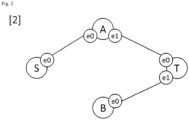
- a reachability graph This is a directed graph used to evaluate the reachability of a packet. Vertices consist of routers and interfaces. However, the interfaces are sorted into inputs and outputs, and are prepared as pairs. An edge is set between the interfaces that are connected or between a router and an interface. When the network in Fig. 2 is expressed by a reachability graph, Fig. 3 is obtained. In the drawing, S, T, A, and B are routers, and e0 and e1 are interfaces.
- a method of evaluating a reachable range is not limited.
- a packet may be transmitted from a router of an actual network or may be simulatively evaluated by a simulator.
- the proposed technology is based on the advent of a high speed simulator (which is technically referred to as a control-plane verifier, and capable of evaluating reachability between designated interfaces using a function reachability) such as Batfish (NPL 3). Reachability at the time of setting update can be evaluated in a short period of time without waiting for the convergence of a route control protocol, and approaches to attempt various settings as in the proposed technology are practical.
- Fig. 4 illustrates an example of the display of a reachable range on a reachability graph.
- a dashed line indicates a range in which a packet reaches a destination router when the packet and the destination router are given in accordance with a policy in certain router settings.
- the packet transmitted from a router A reaches a router T, but neither the packet transmitted from a router S nor B reaches the router T.
- the packet is also transmitted from the other routers even when a true transmission source is the router S, and a portion that causes this is identified by clarifying a reachable range.
- an output in the proposed technology is as follows.
- a setting update command is a pair constituted by a router that executes the command and the command itself ( Fig. 6 ).
- the commands in the present disclosure include any commands related to the reachability of a packet.
- the commands are setting commands related to an interface address, a route control protocol, and an access control list.
- Fig. 7 illustrates a system configuration
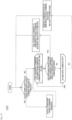
- Fig. 8 is a flowchart of a control unit
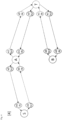
- Fig. 9 is a conceptual diagram illustrating a process for searching for a setting update command sequence as a tree.
- Each node of the tree (T0, T1, ...) indicates a reachable range, and each branch is a setting update command.
- the process starts from a contact point T0 at the highest position, and a reachable range expands every time a setting update command is input and the process moves to a subordinate node.
- a setting command sequence (temporary update command sequence) for reaching a destination is displayed at each node.
- the contact point T0 at the highest position among the nodes of the tree is referred to as a root.
- a network setting device includes a reachability evaluation unit 11, a candidate command generation unit 12, and a control unit 13.
- the device according to the present disclosure can be implemented using a computer and a program, and the program can be recorded in a recording medium or provided through a network.
- An input 14 of the network setting device is set to be the policy in Fig. 1 and topology information of the network in Fig. 2 .
- a reachable range is displayed at each node, instead of showing specific content.
- the network setting device is communicatively connected to an actual network or a simulator (not illustrated).
- the candidate command generation unit 12 generates a candidate command.
- the command is any executable command of a router.
- the control unit 13 causes the actual network or the simulator to execute the command generated by the candidate command generation unit 12.
- the reachability evaluation unit 11 determines a reachable range of a packet in executing a command in the actual network or the simulator.
- a network setting method which is a method for searching for a command sequence to be set for a plurality of network devices, includes performing a first step F0 for determining whether a network having executed a temporary update command sequence satisfies a predetermined operational policy, and includes executing, until satisfaction for the predetermined operational policy, processing for: performing a second step F1 for determining whether a reachable range of a packet expands with addition of one new candidate command of one or more new candidate commands to the temporary update command sequence on condition that the predetermined operational policy is not satisfied; adding the new candidate command to the temporary update command sequence on condition that the reachable range expands with the addition of the new candidate command, or deleting a command at the end of the temporary update command sequence on condition that the reachable range does not expand with addition of any one of the new candidate commands is added; and then returning to the first step F0.
- a reachable range with the initial settings is shown as a node T0 in Fig. 9 .
- the reachability evaluation unit 11 determines that no packet from any router reach the destination except for a router T that works as a destination.
- the control unit 13 determines that the current reachable range does not satisfy the policy.
- the candidate command generation unit 12 in Fig. 7 generates some candidate commands.
- this generation method is not limited.
- a command may be selected from a given set of commands, or a command suitable for the current settings or a reachable range may be selected by machine learning. While NPL 1 limits a target command type to route information exchange, the proposed technology can handle any command.
- the reachability evaluation unit 11 in Fig. 7 evaluates a reachable range when a candidate command is executed (step F1 in Fig. 8 ).
- the control unit 13 adopts the command when the reachable range has expanded. Even when the reachable range expands slightly, the policy need not be satisfied.
- the adopted command is added to a temporary update command sequence 15 in Fig. 7 .
- the control unit 13 executes a command (@router A%) given to a self-loop (a branch being returned to itself) at the node T0.
- the reachability evaluation unit 11 determines that a packet from the router A returns to the router A. In this instance, the control unit 13 determines that the reachable range has not expanded.
- the control unit 13 executes a command (@router B%) that is given to the branch from the root T0 to the node T1.
- the command causes the router B to execute "interface e0; no ip access-group 1 out".
- the reachability evaluation unit 11 determines that the packet from the router B has reached the router T. In this instance, the control unit 13 determines that the reachable range has expanded. At this point, only this command is registered in a temporary update command list 15 at the node T1.
- the control unit 13 continues searching because the policy is still not satisfied. However, it is assumed that the reachable range has not expanded any more even when all candidate commands are attempted at the node T1 (at the node T1 in Fig. 9 , a command to be given to a self-loop is omitted). In this instance, the control unit 13 removes a command at the end of the temporary update command list and returns to the upper node. In this example, the control unit returns to the node T0 which is in the initial state.
- the control unit 13 tests a candidate command that has not been previously attempted.
- a command (@router T%) shown in a branch from the node T0 to a node T2 is executed this time. This command executes "router eigrp 1; network 9.9.9.9 0.0.0.0" in the router T.
- the reachability evaluation unit 11 determines that a packet from the router A reaches the router T. In this instance, the control unit 13 determines that the reachable range has expanded. However, the policy is not satisfied.
- the control unit 13 proceeds searching to the node T2.
- a command (@router A%) shown in a branch from the node T2 to a node T3 is executed.
- This command executes "router eigrp 1;no passive-interface e0" in the router A.
- the reachability evaluation unit 11 determines that a packet from the router S reaches the router T. In this instance, the control unit 13 determines that the reachable range has expanded.
- a packet reaches the router T which is a destination from the router S which is a transmission source, and thus the control unit 13 determines that the policy is satisfied.
- the control unit 13 completes the searching here and outputs the temporary update command sequence 15 as a setting update command sequence.
- the flowchart ( Fig. 8 ) and the search tree ( Fig. 9 ) in this specification are based on a search algorithm referred to as "depth first". This follows a procedure of proceeding downward from the contact point T0 corresponding to the root of the search tree and taking a step backward at the end.
- search algorithm such as "breadth-first search” and “iterative deepening,” the order of tracing nodes varies depending on the algorithm, and the calculation cost and the characteristics of a command sequence to be obtained change.
- the settings of a router are updated to satisfy an operational policy, and restoration from a network failure is performed.
- the present disclosure is not limited to a specific network model, and restoration from a failure is performed using any command. Complicated restoration work that requires a plurality of commands can also be performed by adding commands while gradually expanding reachability.
- the present disclosure can be applied in the information communication industry.
Landscapes
- Engineering & Computer Science (AREA)
- Computer Networks & Wireless Communication (AREA)
- Signal Processing (AREA)
- Artificial Intelligence (AREA)
- Evolutionary Computation (AREA)
- Medical Informatics (AREA)
- Data Exchanges In Wide-Area Networks (AREA)
Abstract
Description
- The present disclosure relates to setting management for a network device.
- A network operator sets an address, a route control protocol, and the like in a network device such as a router. The router creates a routing table according to settings and transfers a packet. When the settings contain an error, the packet does not reach the destination according to an operational policy, and a failure occurs. When such a failure occurs, the network operator specifies the router that is the cause and updates the settings.
- In order for a packet to reach the destination correctly, all routers between the transmission and/or reception terminals have to be set correctly. In addition, items affecting reachability are diverse (an interface address, a route control protocol, an access control list, and the like), and thus high skill is required for restoration from a failure. Further, even with required skill, inspecting many items takes time.
- In recent years, many studies have been carried out on automatic restoration from a failure. In
NPL 1, settings to be added to a router are autonomously searched for by specifying a portion that has not reached its destination in a graph (Figs. 3 and4 in NPL 1) expressing how route information is exchanged on a network. While a restoration method is efficiently searched for by limiting targets to routing information exchanges, failures caused by other settings such as an interface are not dealt with. In other words, a network model such as a model supporting routing information exchanges is incorporated in the searching of a restoration method, and failures deviating from the model are not dealt with. Note that a hierarchical structure which is similar to that inFig. 9 in this specification at a glance is shown in p. 15 of NPL 2 (the published slide in NPL 1), but this represents a relationship between means (a route control protocol or an access control list), which is different from a search tree of a restoration command sequence shown in this specification. - As will be described below, the proposed technology is based on the advent of a high speed simulator (referred exactly to as a control-plane verifier) such as Batfish (NPL 3). Since changes in reachability at the time of setting update can be evaluated in a short period of time without waiting for the convergence of a route control protocol, approaches to attempt various settings as in the proposed technology are practical.
-
- NPL 1: A. Gember-Jacobson, A. Akella, R. Mahajan, and H. H. Liu, "Automatically repairing network control planes using an abstract representation," in Proceedings of the 26th Symposium on Operating Systems Principles, ser. SOSP '17. New York, NY, USA: ACM, 2017, pp. 359-373. (http://doi.acm.org/10.1145/3132747.3132753)
- NPL 2: "Automatically repairing network control planes using an abstract representation," https://www.sigops.org/s/conferences/sosp/2017/slides/gemberj-sosp17-slides.pptx
- NPL 3: Batfish, https://www.batfish.org
- NPL 4: S. J. Russell and P. Norvig, "Artificial intelligence: a modern approach," Pearson Education, 2010.
- An object of the present disclosure is to perform automatic restoration from network failures even when complicated operations for executing a plurality of commands are required.
- A device of the present disclosure is a network setting device for being communicatively connected to a plurality of network devices and performing a setting of the plurality of network devices. The network setting device performs a first step for determining whether a network including the plurality of network devices satisfies a predetermined operational policy, and executes, until satisfaction for the predetermined operational policy, processing for: performing a second step for determining whether a reachable range of a packet expands with addition of one new candidate command of one or more new candidate commands to a temporary update command sequence on condition that the predetermined operational policy is not satisfied; adding the new candidate command to the temporary update command sequence on condition that the reachable range expands with the addition of the new candidate command, or deleting a command at an end of the temporary update command sequence on condition that the reachable range does not expand with addition of any one of the new candidate commands; and then returning to the first step.
- A method of the present disclosure is a network setting method executed by a network setting device that is communicatively connected to a plurality of network devices and performs a setting of the plurality of network devices. The network setting method includes performing a first step for determining whether a network including the plurality of network devices satisfies a predetermined operational policy, and includes executing, until satisfaction for the predetermined operational policy, processing for: performing a second step for determining whether a reachable range of a packet expands with addition of one new candidate command of one or more new candidate commands to a temporary update command sequence on condition that the predetermined operational policy is not satisfied; adding the new candidate command to the temporary update command sequence on condition that the reachable range expands with the addition of the new candidate command, or deleting a command at an end of the temporary update command sequence on condition that the reachable range does not expand with addition of any one of the new candidate commands; and then returning to the first step.
- A program of the present disclosure is a program for causing a computer to implement functions included in the device according to the present disclosure, and is a program for causing the computer to execute steps included in the method according to the present disclosure.
- According to the present disclosure, restoration from a network failure can be automatically performed even when complicated operations for executing a plurality of commands are required.
-
-
Fig. 1 illustrates an example of an operational policy. -
Fig. 2 illustrates an example of a network configuration. -
Fig. 3 illustrates an example of a reachability graph. -
Fig. 4 illustrates an example of the display of a reachable range using a reachability graph. -
Fig. 5 illustrates an overview of the present disclosure. -
Fig. 6 is a setting update command sequence of the present disclosure. -
Fig. 7 is a system configuration diagram illustrating an example of the present disclosure. -
Fig. 8 illustrates an example of a flowchart of a control unit of the present disclosure. -
Fig. 9 illustrates an example of a search tree of the present disclosure. -
Fig. 10 illustrates an example of a flowchart of a control unit where a plurality of command sequences are output. - Hereinafter, embodiments of the present disclosure will be described in detail with reference to the drawings. Note that the present disclosure is not limited to the embodiments described below. These embodiments are just illustrative examples, and the present disclosure can be implemented in forms in which various modifications and improvements are added on the basis of knowledge of those skilled in the art. Note that constituent elements with the same reference signs in the specification and the drawings are assumed to be the same constituent elements.
- An operational policy to be satisfied by a network will be defined. The operational policy is defined by a set of three, that is, a packet header, a transmission source router, and a destination router. In the packet header, information of a higher layer, such as a port number, may be defined in addition to a transmission source address and a destination address. For example,
Fig. 1 illustrates an operational policy in which a transmission source address is 1.1.1.1 and a reception address is 9.9.9.9 in a packet header, a transmission source router is S, and a destination router is T. In the proposed technology, the settings of a router are changed to satisfy an operational policy. - Next, a reachability graph will be defined. This is a directed graph used to evaluate the reachability of a packet. Vertices consist of routers and interfaces. However, the interfaces are sorted into inputs and outputs, and are prepared as pairs. An edge is set between the interfaces that are connected or between a router and an interface. When the network in
Fig. 2 is expressed by a reachability graph,Fig. 3 is obtained. In the drawing, S, T, A, and B are routers, and e0 and e1 are interfaces. - In the present specification, a method of evaluating a reachable range is not limited. A packet may be transmitted from a router of an actual network or may be simulatively evaluated by a simulator. Note that the proposed technology is based on the advent of a high speed simulator (which is technically referred to as a control-plane verifier, and capable of evaluating reachability between designated interfaces using a function reachability) such as Batfish (NPL 3). Reachability at the time of setting update can be evaluated in a short period of time without waiting for the convergence of a route control protocol, and approaches to attempt various settings as in the proposed technology are practical.
-
Fig. 4 illustrates an example of the display of a reachable range on a reachability graph. A dashed line indicates a range in which a packet reaches a destination router when the packet and the destination router are given in accordance with a policy in certain router settings. In this example, the packet transmitted from a router A reaches a router T, but neither the packet transmitted from a router S nor B reaches the router T. The packet is also transmitted from the other routers even when a true transmission source is the router S, and a portion that causes this is identified by clarifying a reachable range. - An overview of the proposed technology will be described using
Fig. 5 . Inputs of the proposed technology are as follows. - Topology (a router, an interface, and a connection relationship between interfaces)
- Settings of each router
- Operational policy
- In the proposed technology, a reachable range of a packet described in an operational policy is evaluated in accordance with a topology and router settings, and a command sequence necessary for setting update is output in the state of inconsistency with the policy. That is, an output in the proposed technology is as follows.
- Note that a setting update command is a pair constituted by a router that executes the command and the command itself (
Fig. 6 ). In addition, the commands in the present disclosure include any commands related to the reachability of a packet. Specifically, the commands are setting commands related to an interface address, a route control protocol, and an access control list. - A restoration method according to the proposed technology will be described.
Fig. 7 illustrates a system configuration, andFig. 8 is a flowchart of a control unit.Fig. 9 is a conceptual diagram illustrating a process for searching for a setting update command sequence as a tree. Each node of the tree (T0, T1, ...) indicates a reachable range, and each branch is a setting update command. The process starts from a contact point T0 at the highest position, and a reachable range expands every time a setting update command is input and the process moves to a subordinate node. A setting command sequence (temporary update command sequence) for reaching a destination is displayed at each node. The contact point T0 at the highest position among the nodes of the tree is referred to as a root. - As illustrated in
Fig. 7 , a network setting device according to the present disclosure includes areachability evaluation unit 11, a candidatecommand generation unit 12, and acontrol unit 13. The device according to the present disclosure can be implemented using a computer and a program, and the program can be recorded in a recording medium or provided through a network. - An
input 14 of the network setting device is set to be the policy inFig. 1 and topology information of the network inFig. 2 . For settings, a reachable range is displayed at each node, instead of showing specific content. - The network setting device according to the present disclosure is communicatively connected to an actual network or a simulator (not illustrated).
- The candidate
command generation unit 12 generates a candidate command. The command is any executable command of a router. - The
control unit 13 causes the actual network or the simulator to execute the command generated by the candidatecommand generation unit 12. - The
reachability evaluation unit 11 determines a reachable range of a packet in executing a command in the actual network or the simulator. - As illustrated in
Fig. 8 , a network setting method according to the present disclosure, which is a method for searching for a command sequence to be set for a plurality of network devices, includes performing a first step F0 for determining whether a network having executed a temporary update command sequence satisfies a predetermined operational policy, and includes executing, until satisfaction for the predetermined operational policy, processing for: performing a second step F1 for determining whether a reachable range of a packet expands with addition of one new candidate command of one or more new candidate commands to the temporary update command sequence on condition that the predetermined operational policy is not satisfied; adding the new candidate command to the temporary update command sequence on condition that the reachable range expands with the addition of the new candidate command, or deleting a command at the end of the temporary update command sequence on condition that the reachable range does not expand with addition of any one of the new candidate commands is added; and then returning to the first step F0. - A reachable range with the initial settings is shown as a node T0 in
Fig. 9 . Thereachability evaluation unit 11 determines that no packet from any router reach the destination except for a router T that works as a destination. In step F0 inFig. 8 , thecontrol unit 13 determines that the current reachable range does not satisfy the policy. - Next, the candidate
command generation unit 12 inFig. 7 generates some candidate commands. In this specification, this generation method is not limited. A command may be selected from a given set of commands, or a command suitable for the current settings or a reachable range may be selected by machine learning. WhileNPL 1 limits a target command type to route information exchange, the proposed technology can handle any command. - The
reachability evaluation unit 11 inFig. 7 evaluates a reachable range when a candidate command is executed (step F1 inFig. 8 ). Thecontrol unit 13 adopts the command when the reachable range has expanded. Even when the reachable range expands slightly, the policy need not be satisfied. The adopted command is added to a temporaryupdate command sequence 15 inFig. 7 . - In the example illustrated in
Fig. 9 , first, thecontrol unit 13 executes a command (@router A...) given to a self-loop (a branch being returned to itself) at the node T0. Thereachability evaluation unit 11 determines that a packet from the router A returns to the router A. In this instance, thecontrol unit 13 determines that the reachable range has not expanded. - Subsequently, the
control unit 13 executes a command (@router B...) that is given to the branch from the root T0 to the node T1. The command causes the router B to execute "interface e0; no ip access-group 1 out". Thereachability evaluation unit 11 determines that the packet from the router B has reached the router T. In this instance, thecontrol unit 13 determines that the reachable range has expanded. At this point, only this command is registered in a temporaryupdate command list 15 at the node T1. - The
control unit 13 continues searching because the policy is still not satisfied. However, it is assumed that the reachable range has not expanded any more even when all candidate commands are attempted at the node T1 (at the node T1 inFig. 9 , a command to be given to a self-loop is omitted). In this instance, thecontrol unit 13 removes a command at the end of the temporary update command list and returns to the upper node. In this example, the control unit returns to the node T0 which is in the initial state. - Returning to the node T0, the
control unit 13 tests a candidate command that has not been previously attempted. A command (@router T...) shown in a branch from the node T0 to a node T2 is executed this time. This command executes "router eigrp 1; network 9.9.9.9 0.0.0.0" in the router T. Thereachability evaluation unit 11 determines that a packet from the router A reaches the router T. In this instance, thecontrol unit 13 determines that the reachable range has expanded. However, the policy is not satisfied. - The
control unit 13 proceeds searching to the node T2. Here, a command (@router A...) shown in a branch from the node T2 to a node T3 is executed. This command executes "router eigrp 1;no passive-interface e0" in the router A. Thereachability evaluation unit 11 determines that a packet from the router S reaches the router T. In this instance, thecontrol unit 13 determines that the reachable range has expanded. In addition, a packet reaches the router T which is a destination from the router S which is a transmission source, and thus thecontrol unit 13 determines that the policy is satisfied. Thecontrol unit 13 completes the searching here and outputs the temporaryupdate command sequence 15 as a setting update command sequence. - The flowchart (
Fig. 8 ) and the search tree (Fig. 9 ) in this specification are based on a search algorithm referred to as "depth first". This follows a procedure of proceeding downward from the contact point T0 corresponding to the root of the search tree and taking a step backward at the end. There are various other variations in the search algorithm, such as "breadth-first search" and "iterative deepening," the order of tracing nodes varies depending on the algorithm, and the calculation cost and the characteristics of a command sequence to be obtained change. - Note that the change of the search algorithm follows the method described in NPL 4 (Section 3.4), and can be easily realized. For example, in Section 3.4.3 in
NPL 4, an LIFO queue (also referred to as a stack) is used for depth-first search, but a FIFO queue is used for breadth-first search. In this specification, a temporary update command sequence is operated as an LIFO queue (a flowchart is written as such), but breadth-first search is performed when using an FIFO queue. For this reason, in this specification, no separate description is given for each of the search algorithms. One of the objects of the proposed technology is to put network restoration work into a search framework by adding commands while expanding reachability, thereby benefiting from existing research on search algorithms. - A developmental usage mode will be supplemented.
- When two or more command sequences satisfying a policy are desired to be obtained, a temporary update command sequence is output to cause the processing to return after determining "Yes" in step F0 in the flowchart as illustrated in
Fig. 10 . - When a plurality of policies are designated, all setting update command sequences is executed by satisfying the policies one by one in order.
- Although a policy is defined herein as "one-way reachability," a policy may be defined as being bi-directional such as ping. In this instance, designation is performed by dividing policies into two policies, that is, inward and outward policies.
- A policy may designate not only a transmission source and a destination, but also a route like traceroute. In that instance, it is also examined whether a reachable range is along a designated
- The settings of a router are updated to satisfy an operational policy, and restoration from a network failure is performed.
- The present disclosure is not limited to a specific network model, and restoration from a failure is performed using any command. Complicated restoration work that requires a plurality of commands can also be performed by adding commands while gradually expanding reachability.
- The present disclosure can be applied in the information communication industry.
-
- 11 Reachability evaluation unit for actual network
- 12 Candidate command generation unit
- 13 Control unit
- 14 Input unit
- 15 Temporary update command sequence
Claims (3)
- A network setting device for being communicatively connected to a plurality of network devices and performing a setting of the plurality of network devices,
wherein the network setting device performs a first step for determining whether a network including the plurality of network devices satisfies a predetermined operational policy, and executes, until satisfaction for the predetermined operational policy, processing for:performing a second step for determining whether a reachable range of a packet expands with addition of one new candidate command of one or more new candidate commands to a temporary update command sequence on condition that the predetermined operational policy is not satisfied;adding the new candidate command to the temporary update command sequence on condition that the reachable range expands with the addition of the new candidate command, or deleting a command at an end of the temporary update command sequence on condition that the reachable range does not expand with addition of any one of the new candidate commands; and thenreturning to the first step. - A network setting method executed by a network setting device that is communicatively connected to a plurality of network devices and performs a setting of the plurality of network devices, the network setting method comprising performing a first step for determining whether a network including the plurality of network devices satisfies a predetermined operational policy, and comprising executing, until satisfaction for the predetermined operational policy, processing for:performing a second step for determining whether a reachable range of a packet expands with addition of one new candidate command of one or more new candidate commands to a temporary update command sequence on condition that the predetermined operational policy is not satisfied;adding the new candidate command to the temporary update command sequence on condition that the reachable range expands with the addition of the new candidate command, or deleting a command at an end of the temporary update command sequence on condition that the reachable range does not expand with addition of any one of the new candidate commands; and thenreturning to the first step.
- A network setting program for causing a computer to implement functional units included in the network setting device according to claim 1.
Applications Claiming Priority (1)
| Application Number | Priority Date | Filing Date | Title |
|---|---|---|---|
| PCT/JP2020/017123 WO2021214847A1 (en) | 2020-04-21 | 2020-04-21 | Network setting device, method and program |
Publications (3)
| Publication Number | Publication Date |
|---|---|
| EP4142226A1 true EP4142226A1 (en) | 2023-03-01 |
| EP4142226A4 EP4142226A4 (en) | 2023-12-06 |
| EP4142226B1 EP4142226B1 (en) | 2025-03-12 |
Family
ID=78270912
Family Applications (1)
| Application Number | Title | Priority Date | Filing Date |
|---|---|---|---|
| EP20931737.9A Active EP4142226B1 (en) | 2020-04-21 | 2020-04-21 | Network setting device, method and program |
Country Status (4)
| Country | Link |
|---|---|
| US (1) | US11902154B2 (en) |
| EP (1) | EP4142226B1 (en) |
| JP (1) | JP7380854B2 (en) |
| WO (1) | WO2021214847A1 (en) |
Family Cites Families (9)
| Publication number | Priority date | Publication date | Assignee | Title |
|---|---|---|---|---|
| US7606165B2 (en) | 2004-01-30 | 2009-10-20 | Microsoft Corporation | What-if analysis for network diagnostics |
| US8149688B2 (en) * | 2005-07-06 | 2012-04-03 | Telecom Italia S.P.A. | Method and system for identifying faults in communication networks |
| US7822062B2 (en) * | 2006-12-22 | 2010-10-26 | Verizon Patent And Licensing Inc. | Network management using dynamic recovery and transitioning |
| JP4755275B2 (en) * | 2009-07-27 | 2011-08-24 | 富士通株式会社 | Network management program, network management apparatus, and network management method |
| JP2011193327A (en) * | 2010-03-16 | 2011-09-29 | Hitachi Solutions Ltd | System and method for simulating network |
| US9923787B2 (en) * | 2012-04-27 | 2018-03-20 | International Business Machines Corporation | Network configuration predictive analytics engine |
| US10680897B2 (en) * | 2017-07-31 | 2020-06-09 | Cisco Technology, Inc. | Network modification impact prediction |
| CN114073054A (en) * | 2019-05-23 | 2022-02-18 | 慧与发展有限责任合伙企业 | System and method for facilitating data-driven intelligent networks employing flow control based on flow credit |
| US10924382B1 (en) * | 2019-07-22 | 2021-02-16 | Raytheon Bbn Technologies Corp. | Rapid and verifiable network configuration repair |
-
2020
- 2020-04-21 WO PCT/JP2020/017123 patent/WO2021214847A1/en not_active Ceased
- 2020-04-21 JP JP2022516497A patent/JP7380854B2/en active Active
- 2020-04-21 US US17/913,468 patent/US11902154B2/en active Active
- 2020-04-21 EP EP20931737.9A patent/EP4142226B1/en active Active
Also Published As
| Publication number | Publication date |
|---|---|
| JPWO2021214847A1 (en) | 2021-10-28 |
| JP7380854B2 (en) | 2023-11-15 |
| EP4142226A4 (en) | 2023-12-06 |
| US11902154B2 (en) | 2024-02-13 |
| WO2021214847A1 (en) | 2021-10-28 |
| EP4142226B1 (en) | 2025-03-12 |
| US20230132633A1 (en) | 2023-05-04 |
Similar Documents
| Publication | Publication Date | Title |
|---|---|---|
| Khattak et al. | Performance evaluation of OpenDaylight SDN controller | |
| CN118802568B (en) | Network twin methods, systems, devices, equipment, media and program products | |
| US8848544B2 (en) | Event correlation using network data flow simulation over unmanaged network segments | |
| EP3675419A1 (en) | Method and apparatus for detecting network fault | |
| CN106487558B (en) | A method and device for realizing expansion and contraction of access equipment | |
| JP2015533049A (en) | Method and apparatus for topology and path verification in a network | |
| US10305749B2 (en) | Low latency flow cleanup of openflow configuration changes | |
| US20160285734A1 (en) | Cloud-environment provision system, route control method, and medium | |
| Waleed et al. | Demonstration of single link failure recovery using Bellman Ford and Dijikstra algorithm in SDN | |
| CN108400922B (en) | Virtual local area network configuration system and method and computer readable storage medium thereof | |
| JP6204168B2 (en) | Transfer device, server, and route change method | |
| EP3338416A1 (en) | Reducing flooding of link state changes in networks | |
| CN107612702A (en) | A kind of method for configuring routers and device | |
| WO2020075587A1 (en) | Fault location estimation method and fault location estimation device | |
| CN106302076B (en) | Method and system for establishing VXLAN tunnel and SDN controller | |
| JP2010097273A (en) | Network configuration information acquisition method and device | |
| US11671354B2 (en) | Collection of segment routing IPV6 (SRV6) network telemetry information | |
| US20180145881A1 (en) | Automatic Assignment of Coordinates to Network Elements Interconnected in a Cartesian Topology | |
| US11902154B2 (en) | Network setting device, method and program | |
| WO2023273941A1 (en) | Path switching method, controller, node and storage medium | |
| CN104917623A (en) | Method and device for realizing SDN network communication management | |
| US12028246B2 (en) | Collection of segment routing IPV6 (SRV6) network telemetry information | |
| KR20180039461A (en) | Apparatus and Method for Selecting Backup Service Function of Service Function Chain based on Software Defined Network | |
| EP4141678A1 (en) | Execution procedure searching device, method, and program | |
| CN111355599B (en) | Hybrid network topology discovery method and device |
Legal Events
| Date | Code | Title | Description |
|---|---|---|---|
| STAA | Information on the status of an ep patent application or granted ep patent |
Free format text: STATUS: THE INTERNATIONAL PUBLICATION HAS BEEN MADE |
|
| PUAI | Public reference made under article 153(3) epc to a published international application that has entered the european phase |
Free format text: ORIGINAL CODE: 0009012 |
|
| STAA | Information on the status of an ep patent application or granted ep patent |
Free format text: STATUS: REQUEST FOR EXAMINATION WAS MADE |
|
| 17P | Request for examination filed |
Effective date: 20221005 |
|
| AK | Designated contracting states |
Kind code of ref document: A1 Designated state(s): AL AT BE BG CH CY CZ DE DK EE ES FI FR GB GR HR HU IE IS IT LI LT LU LV MC MK MT NL NO PL PT RO RS SE SI SK SM TR |
|
| DAV | Request for validation of the european patent (deleted) | ||
| DAX | Request for extension of the european patent (deleted) | ||
| REG | Reference to a national code |
Ref country code: DE Ipc: H04L0041065400 Ref country code: DE Ref legal event code: R079 Ref document number: 602020047777 Country of ref document: DE Free format text: PREVIOUS MAIN CLASS: H04L0012703000 Ipc: H04L0041065400 |
|
| A4 | Supplementary search report drawn up and despatched |
Effective date: 20231106 |
|
| RIC1 | Information provided on ipc code assigned before grant |
Ipc: H04L 45/28 20220101ALI20231030BHEP Ipc: H04L 41/14 20220101ALI20231030BHEP Ipc: H04L 41/0654 20220101AFI20231030BHEP |
|
| STAA | Information on the status of an ep patent application or granted ep patent |
Free format text: STATUS: EXAMINATION IS IN PROGRESS |
|
| 17Q | First examination report despatched |
Effective date: 20240628 |
|
| REG | Reference to a national code |
Ref country code: DE Ref legal event code: R079 Free format text: PREVIOUS MAIN CLASS: H04L0041065400 Ipc: H04L0041080600 Ref document number: 602020047777 Country of ref document: DE |
|
| GRAP | Despatch of communication of intention to grant a patent |
Free format text: ORIGINAL CODE: EPIDOSNIGR1 |
|
| STAA | Information on the status of an ep patent application or granted ep patent |
Free format text: STATUS: GRANT OF PATENT IS INTENDED |
|
| RIC1 | Information provided on ipc code assigned before grant |
Ipc: H04L 41/16 20220101ALN20241118BHEP Ipc: H04L 41/14 20220101ALN20241118BHEP Ipc: H04L 41/0894 20220101ALI20241118BHEP Ipc: H04L 41/082 20220101ALI20241118BHEP Ipc: H04L 41/0806 20220101AFI20241118BHEP |
|
| INTG | Intention to grant announced |
Effective date: 20241128 |
|
| GRAS | Grant fee paid |
Free format text: ORIGINAL CODE: EPIDOSNIGR3 |
|
| GRAA | (expected) grant |
Free format text: ORIGINAL CODE: 0009210 |
|
| STAA | Information on the status of an ep patent application or granted ep patent |
Free format text: STATUS: THE PATENT HAS BEEN GRANTED |
|
| AK | Designated contracting states |
Kind code of ref document: B1 Designated state(s): AL AT BE BG CH CY CZ DE DK EE ES FI FR GB GR HR HU IE IS IT LI LT LU LV MC MK MT NL NO PL PT RO RS SE SI SK SM TR |
|
| REG | Reference to a national code |
Ref country code: GB Ref legal event code: FG4D |
|
| REG | Reference to a national code |
Ref country code: CH Ref legal event code: EP |
|
| REG | Reference to a national code |
Ref country code: DE Ref legal event code: R096 Ref document number: 602020047777 Country of ref document: DE |
|
| REG | Reference to a national code |
Ref country code: IE Ref legal event code: FG4D |
|
| PG25 | Lapsed in a contracting state [announced via postgrant information from national office to epo] |
Ref country code: RS Free format text: LAPSE BECAUSE OF FAILURE TO SUBMIT A TRANSLATION OF THE DESCRIPTION OR TO PAY THE FEE WITHIN THE PRESCRIBED TIME-LIMIT Effective date: 20250612 |
|
| PG25 | Lapsed in a contracting state [announced via postgrant information from national office to epo] |
Ref country code: FI Free format text: LAPSE BECAUSE OF FAILURE TO SUBMIT A TRANSLATION OF THE DESCRIPTION OR TO PAY THE FEE WITHIN THE PRESCRIBED TIME-LIMIT Effective date: 20250312 |
|
| PGFP | Annual fee paid to national office [announced via postgrant information from national office to epo] |
Ref country code: DE Payment date: 20250424 Year of fee payment: 6 |
|
| PG25 | Lapsed in a contracting state [announced via postgrant information from national office to epo] |
Ref country code: ES Free format text: LAPSE BECAUSE OF FAILURE TO SUBMIT A TRANSLATION OF THE DESCRIPTION OR TO PAY THE FEE WITHIN THE PRESCRIBED TIME-LIMIT Effective date: 20250312 |
|
| PGFP | Annual fee paid to national office [announced via postgrant information from national office to epo] |
Ref country code: GB Payment date: 20250505 Year of fee payment: 6 |
|
| REG | Reference to a national code |
Ref country code: LT Ref legal event code: MG9D |
|
| PG25 | Lapsed in a contracting state [announced via postgrant information from national office to epo] |
Ref country code: NO Free format text: LAPSE BECAUSE OF FAILURE TO SUBMIT A TRANSLATION OF THE DESCRIPTION OR TO PAY THE FEE WITHIN THE PRESCRIBED TIME-LIMIT Effective date: 20250612 |
|
| PG25 | Lapsed in a contracting state [announced via postgrant information from national office to epo] |
Ref country code: HR Free format text: LAPSE BECAUSE OF FAILURE TO SUBMIT A TRANSLATION OF THE DESCRIPTION OR TO PAY THE FEE WITHIN THE PRESCRIBED TIME-LIMIT Effective date: 20250312 |
|
| REG | Reference to a national code |
Ref country code: NL Ref legal event code: MP Effective date: 20250312 |
|
| PG25 | Lapsed in a contracting state [announced via postgrant information from national office to epo] |
Ref country code: LV Free format text: LAPSE BECAUSE OF FAILURE TO SUBMIT A TRANSLATION OF THE DESCRIPTION OR TO PAY THE FEE WITHIN THE PRESCRIBED TIME-LIMIT Effective date: 20250312 |
|
| PGFP | Annual fee paid to national office [announced via postgrant information from national office to epo] |
Ref country code: FR Payment date: 20250505 Year of fee payment: 6 |
|
| PG25 | Lapsed in a contracting state [announced via postgrant information from national office to epo] |
Ref country code: GR Free format text: LAPSE BECAUSE OF FAILURE TO SUBMIT A TRANSLATION OF THE DESCRIPTION OR TO PAY THE FEE WITHIN THE PRESCRIBED TIME-LIMIT Effective date: 20250613 Ref country code: BG Free format text: LAPSE BECAUSE OF FAILURE TO SUBMIT A TRANSLATION OF THE DESCRIPTION OR TO PAY THE FEE WITHIN THE PRESCRIBED TIME-LIMIT Effective date: 20250312 |
|
| REG | Reference to a national code |
Ref country code: AT Ref legal event code: MK05 Ref document number: 1775974 Country of ref document: AT Kind code of ref document: T Effective date: 20250312 |
|
| PG25 | Lapsed in a contracting state [announced via postgrant information from national office to epo] |
Ref country code: NL Free format text: LAPSE BECAUSE OF FAILURE TO SUBMIT A TRANSLATION OF THE DESCRIPTION OR TO PAY THE FEE WITHIN THE PRESCRIBED TIME-LIMIT Effective date: 20250312 |
|
| PG25 | Lapsed in a contracting state [announced via postgrant information from national office to epo] |
Ref country code: SE Free format text: LAPSE BECAUSE OF FAILURE TO SUBMIT A TRANSLATION OF THE DESCRIPTION OR TO PAY THE FEE WITHIN THE PRESCRIBED TIME-LIMIT Effective date: 20250312 |
|
| RAP4 | Party data changed (patent owner data changed or rights of a patent transferred) |
Owner name: NTT, INC. |
|
| PG25 | Lapsed in a contracting state [announced via postgrant information from national office to epo] |
Ref country code: SM Free format text: LAPSE BECAUSE OF FAILURE TO SUBMIT A TRANSLATION OF THE DESCRIPTION OR TO PAY THE FEE WITHIN THE PRESCRIBED TIME-LIMIT Effective date: 20250312 |
|
| PG25 | Lapsed in a contracting state [announced via postgrant information from national office to epo] |
Ref country code: PT Free format text: LAPSE BECAUSE OF FAILURE TO SUBMIT A TRANSLATION OF THE DESCRIPTION OR TO PAY THE FEE WITHIN THE PRESCRIBED TIME-LIMIT Effective date: 20250714 |
|
| PG25 | Lapsed in a contracting state [announced via postgrant information from national office to epo] |
Ref country code: IT Free format text: LAPSE BECAUSE OF FAILURE TO SUBMIT A TRANSLATION OF THE DESCRIPTION OR TO PAY THE FEE WITHIN THE PRESCRIBED TIME-LIMIT Effective date: 20250312 Ref country code: PL Free format text: LAPSE BECAUSE OF FAILURE TO SUBMIT A TRANSLATION OF THE DESCRIPTION OR TO PAY THE FEE WITHIN THE PRESCRIBED TIME-LIMIT Effective date: 20250312 |
|
| PG25 | Lapsed in a contracting state [announced via postgrant information from national office to epo] |
Ref country code: AT Free format text: LAPSE BECAUSE OF FAILURE TO SUBMIT A TRANSLATION OF THE DESCRIPTION OR TO PAY THE FEE WITHIN THE PRESCRIBED TIME-LIMIT Effective date: 20250312 |
|
| PG25 | Lapsed in a contracting state [announced via postgrant information from national office to epo] |
Ref country code: CZ Free format text: LAPSE BECAUSE OF FAILURE TO SUBMIT A TRANSLATION OF THE DESCRIPTION OR TO PAY THE FEE WITHIN THE PRESCRIBED TIME-LIMIT Effective date: 20250312 Ref country code: EE Free format text: LAPSE BECAUSE OF FAILURE TO SUBMIT A TRANSLATION OF THE DESCRIPTION OR TO PAY THE FEE WITHIN THE PRESCRIBED TIME-LIMIT Effective date: 20250312 |
|
| PG25 | Lapsed in a contracting state [announced via postgrant information from national office to epo] |
Ref country code: RO Free format text: LAPSE BECAUSE OF FAILURE TO SUBMIT A TRANSLATION OF THE DESCRIPTION OR TO PAY THE FEE WITHIN THE PRESCRIBED TIME-LIMIT Effective date: 20250312 |
|
| PG25 | Lapsed in a contracting state [announced via postgrant information from national office to epo] |
Ref country code: SK Free format text: LAPSE BECAUSE OF FAILURE TO SUBMIT A TRANSLATION OF THE DESCRIPTION OR TO PAY THE FEE WITHIN THE PRESCRIBED TIME-LIMIT Effective date: 20250312 |
|
| PG25 | Lapsed in a contracting state [announced via postgrant information from national office to epo] |
Ref country code: IS Free format text: LAPSE BECAUSE OF FAILURE TO SUBMIT A TRANSLATION OF THE DESCRIPTION OR TO PAY THE FEE WITHIN THE PRESCRIBED TIME-LIMIT Effective date: 20250712 |
|
| REG | Reference to a national code |
Ref country code: CH Ref legal event code: H13 Free format text: ST27 STATUS EVENT CODE: U-0-0-H10-H13 (AS PROVIDED BY THE NATIONAL OFFICE) Effective date: 20251125 |
|
| PG25 | Lapsed in a contracting state [announced via postgrant information from national office to epo] |
Ref country code: LU Free format text: LAPSE BECAUSE OF NON-PAYMENT OF DUE FEES Effective date: 20250421 |
|
| REG | Reference to a national code |
Ref country code: DE Ref legal event code: R097 Ref document number: 602020047777 Country of ref document: DE |
|
| PG25 | Lapsed in a contracting state [announced via postgrant information from national office to epo] |
Ref country code: MC Free format text: LAPSE BECAUSE OF FAILURE TO SUBMIT A TRANSLATION OF THE DESCRIPTION OR TO PAY THE FEE WITHIN THE PRESCRIBED TIME-LIMIT Effective date: 20250312 |
|
| REG | Reference to a national code |
Ref country code: BE Ref legal event code: MM Effective date: 20250430 |
|
| PG25 | Lapsed in a contracting state [announced via postgrant information from national office to epo] |
Ref country code: DK Free format text: LAPSE BECAUSE OF FAILURE TO SUBMIT A TRANSLATION OF THE DESCRIPTION OR TO PAY THE FEE WITHIN THE PRESCRIBED TIME-LIMIT Effective date: 20250312 |
|
| PG25 | Lapsed in a contracting state [announced via postgrant information from national office to epo] |
Ref country code: BE Free format text: LAPSE BECAUSE OF NON-PAYMENT OF DUE FEES Effective date: 20250430 |
|
| PLBE | No opposition filed within time limit |
Free format text: ORIGINAL CODE: 0009261 |
|
| STAA | Information on the status of an ep patent application or granted ep patent |
Free format text: STATUS: NO OPPOSITION FILED WITHIN TIME LIMIT |
|
| PG25 | Lapsed in a contracting state [announced via postgrant information from national office to epo] |
Ref country code: CH Free format text: LAPSE BECAUSE OF NON-PAYMENT OF DUE FEES Effective date: 20250430 |
|
| REG | Reference to a national code |
Ref country code: CH Ref legal event code: L10 Free format text: ST27 STATUS EVENT CODE: U-0-0-L10-L00 (AS PROVIDED BY THE NATIONAL OFFICE) Effective date: 20260121 |
|
| 26N | No opposition filed |
Effective date: 20251215 |
|
| REG | Reference to a national code |
Ref country code: DE Ref legal event code: R081 Ref document number: 602020047777 Country of ref document: DE Owner name: NTT, INC., JP Free format text: FORMER OWNER: NIPPON TELEGRAPH AND TELEPHONE CORPORATION, TOKYO, JP Ref country code: DE Ref legal event code: R082 Ref document number: 602020047777 Country of ref document: DE Representative=s name: DENNEMEYER & ASSOCIATES RECHTSANWALTSGESELLSCH, DE |
|
| PG25 | Lapsed in a contracting state [announced via postgrant information from national office to epo] |
Ref country code: IE Free format text: LAPSE BECAUSE OF NON-PAYMENT OF DUE FEES Effective date: 20250421 |