EP4141758A1 - Work management method, work management system, and work management program - Google Patents
Work management method, work management system, and work management program Download PDFInfo
- Publication number
- EP4141758A1 EP4141758A1 EP22191880.8A EP22191880A EP4141758A1 EP 4141758 A1 EP4141758 A1 EP 4141758A1 EP 22191880 A EP22191880 A EP 22191880A EP 4141758 A1 EP4141758 A1 EP 4141758A1
- Authority
- EP
- European Patent Office
- Prior art keywords
- work
- type
- region
- determined
- information
- Prior art date
- Legal status (The legal status is an assumption and is not a legal conclusion. Google has not performed a legal analysis and makes no representation as to the accuracy of the status listed.)
- Pending
Links
Images



Classifications
-
- G—PHYSICS
- G06—COMPUTING OR CALCULATING; COUNTING
- G06Q—INFORMATION AND COMMUNICATION TECHNOLOGY [ICT] SPECIALLY ADAPTED FOR ADMINISTRATIVE, COMMERCIAL, FINANCIAL, MANAGERIAL OR SUPERVISORY PURPOSES; SYSTEMS OR METHODS SPECIALLY ADAPTED FOR ADMINISTRATIVE, COMMERCIAL, FINANCIAL, MANAGERIAL OR SUPERVISORY PURPOSES, NOT OTHERWISE PROVIDED FOR
- G06Q10/00—Administration; Management
- G06Q10/06—Resources, workflows, human or project management; Enterprise or organisation planning; Enterprise or organisation modelling
-
- G—PHYSICS
- G06—COMPUTING OR CALCULATING; COUNTING
- G06Q—INFORMATION AND COMMUNICATION TECHNOLOGY [ICT] SPECIALLY ADAPTED FOR ADMINISTRATIVE, COMMERCIAL, FINANCIAL, MANAGERIAL OR SUPERVISORY PURPOSES; SYSTEMS OR METHODS SPECIALLY ADAPTED FOR ADMINISTRATIVE, COMMERCIAL, FINANCIAL, MANAGERIAL OR SUPERVISORY PURPOSES, NOT OTHERWISE PROVIDED FOR
- G06Q50/00—Information and communication technology [ICT] specially adapted for implementation of business processes of specific business sectors, e.g. utilities or tourism
- G06Q50/02—Agriculture; Fishing; Forestry; Mining
-
- G—PHYSICS
- G06—COMPUTING OR CALCULATING; COUNTING
- G06F—ELECTRIC DIGITAL DATA PROCESSING
- G06F17/00—Digital computing or data processing equipment or methods, specially adapted for specific functions
- G06F17/10—Complex mathematical operations
- G06F17/18—Complex mathematical operations for evaluating statistical data, e.g. average values, frequency distributions, probability functions, regression analysis
-
- G—PHYSICS
- G06—COMPUTING OR CALCULATING; COUNTING
- G06Q—INFORMATION AND COMMUNICATION TECHNOLOGY [ICT] SPECIALLY ADAPTED FOR ADMINISTRATIVE, COMMERCIAL, FINANCIAL, MANAGERIAL OR SUPERVISORY PURPOSES; SYSTEMS OR METHODS SPECIALLY ADAPTED FOR ADMINISTRATIVE, COMMERCIAL, FINANCIAL, MANAGERIAL OR SUPERVISORY PURPOSES, NOT OTHERWISE PROVIDED FOR
- G06Q10/00—Administration; Management
- G06Q10/06—Resources, workflows, human or project management; Enterprise or organisation planning; Enterprise or organisation modelling
- G06Q10/063—Operations research, analysis or management
- G06Q10/0633—Workflow analysis
-
- G—PHYSICS
- G06—COMPUTING OR CALCULATING; COUNTING
- G06Q—INFORMATION AND COMMUNICATION TECHNOLOGY [ICT] SPECIALLY ADAPTED FOR ADMINISTRATIVE, COMMERCIAL, FINANCIAL, MANAGERIAL OR SUPERVISORY PURPOSES; SYSTEMS OR METHODS SPECIALLY ADAPTED FOR ADMINISTRATIVE, COMMERCIAL, FINANCIAL, MANAGERIAL OR SUPERVISORY PURPOSES, NOT OTHERWISE PROVIDED FOR
- G06Q10/00—Administration; Management
- G06Q10/06—Resources, workflows, human or project management; Enterprise or organisation planning; Enterprise or organisation modelling
- G06Q10/063—Operations research, analysis or management
- G06Q10/0637—Strategic management or analysis, e.g. setting a goal or target of an organisation; Planning actions based on goals; Analysis or evaluation of effectiveness of goals
- G06Q10/06375—Prediction of business process outcome or impact based on a proposed change
-
- G—PHYSICS
- G06—COMPUTING OR CALCULATING; COUNTING
- G06Q—INFORMATION AND COMMUNICATION TECHNOLOGY [ICT] SPECIALLY ADAPTED FOR ADMINISTRATIVE, COMMERCIAL, FINANCIAL, MANAGERIAL OR SUPERVISORY PURPOSES; SYSTEMS OR METHODS SPECIALLY ADAPTED FOR ADMINISTRATIVE, COMMERCIAL, FINANCIAL, MANAGERIAL OR SUPERVISORY PURPOSES, NOT OTHERWISE PROVIDED FOR
- G06Q10/00—Administration; Management
- G06Q10/06—Resources, workflows, human or project management; Enterprise or organisation planning; Enterprise or organisation modelling
- G06Q10/063—Operations research, analysis or management
- G06Q10/0639—Performance analysis of employees; Performance analysis of enterprise or organisation operations
- G06Q10/06393—Score-carding, benchmarking or key performance indicator [KPI] analysis
-
- G—PHYSICS
- G06—COMPUTING OR CALCULATING; COUNTING
- G06Q—INFORMATION AND COMMUNICATION TECHNOLOGY [ICT] SPECIALLY ADAPTED FOR ADMINISTRATIVE, COMMERCIAL, FINANCIAL, MANAGERIAL OR SUPERVISORY PURPOSES; SYSTEMS OR METHODS SPECIALLY ADAPTED FOR ADMINISTRATIVE, COMMERCIAL, FINANCIAL, MANAGERIAL OR SUPERVISORY PURPOSES, NOT OTHERWISE PROVIDED FOR
- G06Q10/00—Administration; Management
- G06Q10/06—Resources, workflows, human or project management; Enterprise or organisation planning; Enterprise or organisation modelling
- G06Q10/063—Operations research, analysis or management
- G06Q10/0639—Performance analysis of employees; Performance analysis of enterprise or organisation operations
- G06Q10/06398—Performance of employee with respect to a job function
-
- G—PHYSICS
- G06—COMPUTING OR CALCULATING; COUNTING
- G06Q—INFORMATION AND COMMUNICATION TECHNOLOGY [ICT] SPECIALLY ADAPTED FOR ADMINISTRATIVE, COMMERCIAL, FINANCIAL, MANAGERIAL OR SUPERVISORY PURPOSES; SYSTEMS OR METHODS SPECIALLY ADAPTED FOR ADMINISTRATIVE, COMMERCIAL, FINANCIAL, MANAGERIAL OR SUPERVISORY PURPOSES, NOT OTHERWISE PROVIDED FOR
- G06Q10/00—Administration; Management
- G06Q10/10—Office automation; Time management
Definitions
- the present invention relates to a work management method, a work management system, and a work management program.
- Patent document 1 discloses a technique for receiving operation information from a work device used in work in a field and estimating the work type of the work performed in the field based on the received operation information.
- Patent Document 1 Japanese Unexamined Patent Application Publication No. 2021-087361
- the work type estimated by the technique described in the Patent Document 1 may differ from a work type of an actual work performed. Therefore, the user, e.g., worker, field owner, etc., sets whether or not the estimated work type is the same as the work type of the actual work performed.
- the user may not be able to easily identify the fields in which the work type has been confirmed and the fields in which the work type has not been confirmed.
- one of the purposes of this disclosure is to assist users in identifying the fields in which the work type has been confirmed and the fields in which the work type has not been confirmed.
- the other purposes can be understood from the following description and the description of embodiments.
- a work management method comprises storing work data (300) associating a determined work type that represents work performed in a first work region (400-1) and has been determined with work region information that represents the first work region (400-1).
- the work management method comprises estimating an estimated work type that represents work performed by a work device (30) in a second work region (400-2), based on operation information that represents operation status of the work device (30).
- the work management method comprises outputting region display information that distinctively represents the first work region (400-1) corresponding to the determined work type and the second work region (400-2) corresponding to the estimated work type that has not been determined.
- a work management system (1000) comprises a data storage part (150), an estimation part (160), and an output part (190).
- the data storage part (150) stores work data (300) associating a determined work type that represents work performed in a first work region (400-1) and has been determined with work region information that represents the first work region (400-1).
- the estimation part (160) estimates an estimated work type that represents work performed by a work device (30) in a second work region (400-2), based on operation information that represents operation status of the work device (30).
- the output part (190) outputs region display information that distinctively represents the first work region (400-1) corresponding to the determined work type and the second work region (400-2) corresponding to the estimated work type that has not been determined.
- a work management program (310) causes a computing unit (120) to execute storing work data (300) associating a determined work type that represents work performed in a first work region (400-1) and has been determined with work region information that represents the first work region (400-1).
- the work management program (310) causes the computing unit (120) to execute estimating an estimated work type that represents work performed by a work device (30) in a second work region (400-2), based on operation information that represents operation status of the work device (30).
- the work management program (310) causes the computing unit (120) to execute outputting region display information that distinctively represents the first work region (400-1) corresponding to the determined work type and the second work region (400-2) corresponding to the estimated work type that has not been determined.
- the user can efficiently confirm the work type registered in the work management device.
- the work management system 1000 includes a work management device 100 and a terminal 200.
- the work management device 100 is communicably connected to the terminal 200 and a work device 30 via a network 20, for example, the Internet.
- the work management device 100 acquires operation information from the work device 30 and, based on the acquired operation information, estimates information related to work, such as a work region, a work period, a work type, etc.
- the work period represents a period during which the work device 30 has worked in a field, for example, represents work from the time when the engine of the work device 30 starts until the engine stops.
- the work type represents the type of work performed in the field, e.g., plowing, soil preparation, fertilization, planting, etc.
- the work device 30 includes, for example, a tractor that tows a work machine that performs the work.
- the work machine includes, for example, plows and rotaries for plowing, harrows for soil preparation, broadcasters for fertilization, and transplanters for planting.
- the terminal 200 acquires information about the work from the work management device 100 and provides the acquired information about the work to the user, e.g., the worker, the owner of the field, etc. For example, the terminal 200 displays an image representing a plurality of work regions 400 on a map, as illustrated in Fig. 2 .
- the terminal 200 can distinctively display a first work region 400-1, in which the user has confirmed the work type, and a second work region 400-2, in which the user has not confirmed the work type.
- the color of the region representing the first work region 400-1, in which the work type has been confirmed is different from the color of the region representing the second work region 400-2, in which the work type has not been confirmed. This allows the user to easily identify the second work region 400-2 and the percentage of the second work region in which the work type has not been confirmed.
- the terminal 200 displays an overall quantity 510 representing the quantity of the work regions 400 in which the work has been performed for each work type in a graph.
- the quantity of the work regions 400 may distinctively represent an undetermined quantity 520 representing the quantity of the second work regions 400-2 in which the work type has not been confirmed, and a determined quantity 530 representing the quantity of the first work regions 400-1 in which the work type has been confirmed. This allows the user to easily confirm trends in the work types being performed in the a plurality of work regions 400.
- the user can easily confirm the percentage of the second work region 400-2 in which the work type has not been confirmed for each work type, and can also confirm the trend of the estimated work type.
- the terminal 200 may display a list of the overall quantity 510 representing the quantity of the work regions 400 in which the work has been performed for each work type.
- the operation information includes information representing the operation status of the work device 30 when work is being performed in the field, and examples of such information are a speed, a steering angle, and an engine speed of the work device 30, an ON/OFF status of each of various clutches, and location information of the work device 30 at each time.
- the operation information may include a power take-off (PTO) speed at the time of transmitting power to the work machine, a hitch height and a lift arm angle indicating a posture of the work machine, and the like.
- PTO power take-off
- the operation information also includes a location information of the work device 30.
- the work device 30 is equipped with a positioning device, for example, a Global Navigation Satellite System (GNSS) receiver, to acquire the location information representing the position of the work device 30 at each time it has moved.
- GNSS Global Navigation Satellite System
- the work management device 100 includes an input/output unit 110, a computing unit 120, a communication unit 130, and a storage unit 140.
- the work management device 100 is a computer, for example.
- the input/output unit 110 receives information that is used by the computing unit 120 to execute processing.
- the input/output unit 110 outputs a result of the processing executed by the computing unit 120.
- the input/output unit 110 includes various input units and various output units, and examples of the input/output unit 110 are a keyboard, a mouse, a microphone, a display, a speaker, and a touch panel.
- the input/output unit 110 may not be provided.
- the communication unit 130 is electrically connected to the network 20, and communicates with each device via the network 20. For example, the communication unit 130 transfers the operation information, which is acquired from the work device 30, to the computing unit 120. In addition, the communication unit 130 forwards a signal generated by the computing unit 120 to the terminal 200.
- the communication unit 130 includes various interfaces such as a network interface card (NIC) and Universal Serial Bus (USB).
- NIC network interface card
- USB Universal Serial Bus
- the storage unit 140 stores various types of data for determining the work type representing the work performed in the work region 400, such as work data 300, and a work management program 310.
- the storage unit 140 is used as a non-transitory tangible storage medium to store the work management program 310.
- the work management program 310 may be provided as a computer program product that is recorded on a computer-readable storage medium 1, or may be provided as a computer program product that can be downloaded from a server.
- the work data 300 includes data related to work in the field, e.g., data calculated from the operation information coming from the work device 30.
- the work data 300 stores work region information representing the work region 400 (e.g., location and shape of the work region 400), work area information representing a work area of the work region 400, work period information representing a work period, a work type, and registration status information representing a registration status of the work type.
- the work region information, work period information, work type, and registration status information are stored in association with each other.
- the registration status represents the status of whether the work type has been determined or not. For example, in the work data 300 in Fig. 4 , in the work region 400 of" Region A", “determined” shown in the registration status indicates that the work type has been determined as “plowing”. In the work region 400 of "Region C,” “undetermined” shown in the registration status indicates that the work type is "plowing” and has not been determined.
- the work type that has been determined may be referred to as a determined work type.
- the computing unit 120 illustrated in Fig. 1 executes the work management program 310 and is used for various data processing to determine the work type of the work performed in the work region 400.
- the computing unit 120 includes a central processing unit (CPU) and the like, for example.
- the computing unit 120 implements a data storage part 150, an estimation part 160, a determination part 170, a totalization part 180, and an output part 190.
- the data storage part 150 stores the work data 300.
- the estimation part 160 acquires the operation information from the work device 30 to estimate an estimated work type.
- the determination part 170 determines the work type based on determination information representing that the user has confirmed the work type.
- the totalization part 180 totalizes the quantity of the work regions 400 in which the work has been performed for each work type.
- the output part 190 outputs a region display information representing the work region 400 to the terminal 200.
- the terminal 200 includes an input/output unit 210, a computing unit 220, a communication unit 230, and a storage unit 240.
- Examples of the terminal 200 are a computer, a tablet computer, and a mobile phone.
- the input/output unit 210 receives information that is used by the computing unit 220 to execute processing.
- the input/output unit 210 outputs a result of the processing executed by the computing unit 220.
- the input/output unit 210 includes various input units and various output units, and examples of the input/output unit 210 are a keyboard, a mouse, a microphone, a display, a speaker, and a touch panel.
- the communication unit 230 is electrically connected to the network 20 and communicates with each of the devices via the network 20. For example, the communication unit 230 transfers the information acquired from the work management device 100 to the computing unit 220. In addition, the communication unit 230 forwards a signal generated by the computing unit 220 to the work management device 100.
- the communication unit 230 includes various interfaces such as a network interface card (NIC) and Universal Serial Bus (USB).
- NIC network interface card
- USB Universal Serial Bus
- the storage unit 240 stores various types of data, e.g., a display program 320, for displaying the work region 400 in which the work device 30 has performed the work.
- the storage unit 240 is used as a non-transitory tangible storage medium to store the display program 320.
- the display program 320 may be provided as a computer program product that is recorded on a computer-readable storage medium 2, or may be provided as a computer program product that can be downloaded from a server.
- the display program 320 may be recorded on the storage medium 1 and provided.
- the computing unit 220 reads and executes the display program 320, and cooperates with the input/output unit 210 to implement a display part 250 as illustrated in Fig. 5 .
- the display part 250 acquires the region display information representing the work region 400 from the work management device 100 and displays the region display information representing the work region 400.
- the display part 250 transmits, by operation of the user, the determination information for determining the work type of the work performed in the work region 400 to the work management device 100.
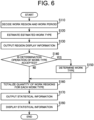
- the computing unit 120 of the work management device 100 When receiving operation information from the work device 30, the computing unit 120 of the work management device 100 reads and executes the work management program 310. By executing the work management program 310, the computing unit 120 executes the processing illustrated in Fig. 6 , which is a work management method.
- the estimation part 160 decides the work region 400 in which the work device 30 has performed the work and the work period based on the operation information acquired from the work device 30.
- the estimation part 160 decides the work region 400 based on the location information of the work device 30 included in the operation information.
- the work region 400 is represented by an arbitrary closed figure, such as a polygon, rectangle, etc., that includes a location represented by the acquired location information.
- the work region 400 is represented by a figure that surrounds all of the acquired location information.
- the work region information representing the decided work region 400 is newly stored by the estimation part 160 in the work data 300 illustrated in Fig. 4 .
- the estimation part 160 decides a period from the time when the work device 30 is started to the time when the work device 30 is stopped as the work period.
- the estimation part 160 stores the work period information representing the decided work period in the work data 300 in association with the newly added work region information.
- the estimation part 160 also stores the workers who performed work in the work region 400 in the work data 300.
- the estimation part 160 has worker correspondence data that associates the work device 30 with the worker, and decides the worker based on the work device 30 that transmitted the operation information.
- the estimation part 160 based on the operation information estimate the estimated work type that represents the work type of the work performed in the work region 400.
- the estimation part 160 estimates the estimated work type using a learned model obtained by machine learning.
- the learned model is learned to estimate the estimated work type from the operation information.
- the estimation part 160 may estimate the estimated work type based on the model of the work device 30.
- the storage unit 140 stores work correspondence data that associates the model of the work device 30 with the estimated work type.
- the estimation part 160 estimates the estimated work type based on the work correspondence data.
- the estimated work type is associated with the work region information representing the work region 400 by the estimation part 160 and stored in the work data 300 illustrated in Fig. 4 .
- the estimation part 160 sets the corresponding registration status of the work data 300 to "undetermined".
- the output part 190 outputs the region display information that associates the work region information stored in the work data 300 with the registration status information to the terminal 200.
- the output part 190 outputs the region display information that distinctively represents the first work region 400-1, whose registration status indicates "determined", and the second work region 400-2, whose registration status indicates "undetermined".
- the region display information includes newly added work region information as well as work region information stored in the past.
- step S140 the display part 250 of the terminal 200 displays an image representing the work region 400 on a map, as illustrated in Fig. 2 , based on the region display information acquired from the work management device 100, and accepts a determination operation of the work type by the user.
- the display part 250 displays an image that can distinctively represent the first work region 400-1, in which the work type has been determined, and the second work region 400-2, in which the work type has not been determined. The user can easily identify the second work region 400-2 in which the work type has not been determined.
- the display part 250 transmits the determination information representing the correct work type to the work management device 100.
- the process moves to step S150 illustrated in Fig. 6 .
- the user selects the second work region 400-2 in which the work type has not been determined on the input/output unit 210 of the terminal 200.
- the display part 250 displays work information 410 representing the estimated work type of the second work region 400-2 corresponding to to the selected second work region 400-2. The user confirms the estimated work type displayed.
- the user When the displayed estimated work type is the same as the work type of the work performed in the corresponding second work region 400-2, the user inputs a confirmation operation to confirm the work type, for example, an operation of selecting a confirmation button 411, to the input/output unit 210.
- the user inputs a change operation to change the work type, for example, an operation of selecting a change button 412, to the input/output unit 210.
- the user After performing the change operation, the user inputs the correct work type to the input/output unit 210.
- the display part 250 Based on the confirmation or change operation, the display part 250 outputs the determination information representing the correct work type to the work management device 100.
- the determination information represents that the estimated work type of the selected second work region 400-2 is correct.
- the determination information represents the correct work type of the selected second work region 400 -2.
- step S140 illustrated in Fig. 6 the display part 250 also accepts a statistical display operation for displaying statistical information representing the quantity of the work regions 400 for each work type.
- a statistical display operation is input without a determination operation being input, the display part 250 transmits a request information requesting statistical information to the work management device 100.
- the request information is transmitted, the process moves to step S160.
- step S150 the determination part 170 of the work management device 100 determines the work type of the second work region 400- based on the determination information representing the correct work type. 2 based on the determination information representing the correct work type. Specifically, the determination part 170 acquires the second work region 400-2 represented in the determination information and the correct work type. In the work data 300 illustrated in Fig. 4 , the determination part 170 sets the correct work type and changes the registration status to "determined" in the second work region 400-2 represented by the determination information. For example, when a confirmation operation, for example, an operation of selecting a confirmation button 411, is input, the determination part 170 changes the corresponding registration status to "determined". When a change operation is input, the determination part 170 changes the work type in the second work region 400-2 to the work type represented by the determination information, and changes the registration status to "determined".
- a confirmation operation for example, an operation of selecting a confirmation button 411
- step S160 illustrated in Fig. 6 the totalization part 180 totalizes the quantity of the work regions 400 for each work type based on the work data 300 illustrated in Fig. 4 .
- the totalization part 180 extracts one or more work types stored in the work data 300.
- the totalization part 180 extracts "plowing" and "weeding" as the work types stored in the work data 300.
- the totalization part 180 totalizes the quantity of the work regions 400 that correspond to one or more of the extracted work types among the work regions 400 stored in the work data 300.
- the totalization part 180 obtains "4" as the quantity of the work regions 400 in which the work type is "plowing”.
- the totalization part 180 obtains "1" as the quantity of the work regions 400 in which the work type is "weeding".
- the totalization part 180 totalizes, for each work type, the quantity of the first work regions 400-1 corresponding to the determined work type and the quantity of the second work regions 400-2 corresponding to the undetermined work type.
- the totalization part 180 obtains "2" as the quantity of the first work regions 400-1, in which the work type is "plowing” and the registration status is "determined”.
- the totalization part 180 obtains "2" as the quantity of the second work regions 400-2, in which the work type is "plowing” and the registration status is "undetermined”.
- the totalization part 180 obtains "1” as the quantity of the first work regions 400-1, in which the work type is "weeding” and the registration status is "determined”.
- the totalization part 180 obtains "0" as the quantity of the second work regions 400-2, in which the work type is “weeding” and the registration status is "undetermined”.
- the output part 190 outputs statistical information representing the quantity of the work regions 400 for each work type to the terminal 200.
- the statistical information may represent, for each work type, the quantity of the work regions 400 by distinguishing between the quantity of the first work regions 400-1 corresponding to a determined work type in which the work type has been determined and the quantity of the second work regions 400-2 corresponding to an estimated work type in which the work type has not been determined.
- step S180 the display part 250 of the terminal 200 displays the statistical information acquired from the work management device 100 on the input/output unit 210.
- the display part 250 displays the overall quantity 510 representing the quantity of the work regions 400 in which the work has been performed, the undetermined quantity 520 representing the quantity of the second work regions 400-2 in which the work type has not been confirmed, and the determined quantity 530 representing the quantity of the first work regions 400-1 in which the work type has been confirmed.
- the display part 250 may display the overall quantity 510 using the undetermined quantity 520 and the determined quantity 530, and may display a percentage of the undetermined quantity 520 relative to the overall quantity 510.
- the display part 250 may also display a percentage of the undetermined quantity 520 relative to the overall quantity 510 in a numerical value. By confirming the image displayed on the input/output unit 210, the user can identify the percentage of work regions 400 in which the work type has not been determined for each work type.
- the work management system 1000 supports the confirmation operation of the work type by the user.
- the display part 250 of the terminal 200 displays the quantity of the work regions 400 for each work type illustrated in Fig. 3
- the display part 250 may display the quantity of the first work regions 400-1, in which the work type has been determined, and the quantity of the second work regions 400-2, in which the work type has not been determined without distinguishing them.
- the display part 250 displays an area of the work regions 400.
- the totalization part 180 of the work management device 100 totalizes the area of the work regions 400 and calculates a total area for each work type based on the work data 300 illustrated in Fig. 4 .
- the totalization part 180 totalizes an area of the first work regions 400-1 corresponding to the determined work type and an area of the second work regions 400-1 corresponding to the work type that has not been determined, and calculates a total area of the first work regions 400-1 and a total area of the second work regions 400-2.
- the output part 190 outputs statistical information representing the area of the work region 400 for each work type to the terminal 200.
- the statistical information may represent, for each work type, the area of the work regions 400 by distinguishing between the area of the first work regions 400-1 corresponding to a determined work type in which the work type has been determined and the area of the second work regions 400-2 corresponding to an estimated work type in which the work type has not been determined.
- the display part 250 of the terminal 200 displays the statistical information on the input/output unit 210.
- the display part 250 may also display the quantity of the work regions 400 for each work type by distinguishing workers who performed work in the work regions 400.
- a first worker-specific graph 600-1 represents, for each work type, a quantity of the work regions 400 in which the worker a has performed work.
- a second worker-specific graph 600-2 represents, for each work type, a quantity of the work regions 400 in which the worker b has performed work.
- a worker-specific graph 600 may distinctively represent an undetermined quantity 620 representing a quantity of the second work regions 400-2 in which the work type has not been confirmed, and a determined quantity 630 representing a quantity of the first work regions 400-1 in which the work type has been confirmed.
- the display part 250 may display an overall quantity 610 using the undetermined quantity 620 and the determined quantity 630, and may display a percentage of the undetermined quantity 620 relative to the overall quantity 610. This allows the user to confirm the work type of the work performed in the work regions 400 on a worker-by-worker basis. In addition, the user can easily compare the confirmation rate of the worker confirming the work type with that of other workers. For example, the user may notify a worker whose confirmation rate is lower than that of other workers to confirm the work type. In this case, the totalization part 180 of the work management device 100 totalizes the quantity of the work regions 400 for each work type by distinguishing workers, and outputs statistical information representing the totalized quantity to the terminal 200.
- the display part 250 may display the the quantity of the work regions 400 for each work type by distinguishing work region groups that classify a plurality of work regions 400.
- a work region group includes a plurality of work regions classified based on similarity between two work regions 400. The similarity indicates how similar the work performed is in the two work regions 400 in which work of the same work type has been performed.
- the totalization part 180 of the work management device 100 calculates similarity of two work regions 400 based on the work data 300 illustrated in Fig. 4 .
- the similarity is calculated using a distance between the two work regions 400 and a time difference between times when work has been performed in the two work regions 400.
- the similarity may also be calculated based on a two-dimensional distance with the distance between the work regions 400 and the time difference each as one axis.
- the totalization part 180 calculates the Euclidean distance, which is calculated as the square root of the square of the distance plus the square of the time difference. By calculating the reciprocal of the calculated Euclidean distance, the totalization part 180 calculates the similarity.
- any distance may be used instead of the Euclidean distance, for example, the Manhattan distance.
- the totalization part 180 classifies the work regions 400 according to the similarity in step S160 illustrated in Fig. 6 .
- the work region 400 are classified in such a manner that two work regions 400 whose similarity is less than a threshold are included in a same work region group.
- the totalization part 180 totalizes the quantity of the work regions 400 for each work type by distinguishing work region groups.
- the totalization part 180 outputs statistical information representing the totalized quantity to the terminal 200.
- the display part 250 of the terminal 200 displays the the quantity of the work regions 400 for each work type by distinguishing workers based on the statistical information.
- the display part 250 may display the quantity of the work regions 400 in which the work was performed on a predetermined date.
- the totalization part 180 totalizes the quantity of the work regions 400 in which the work was performed on a predetermined date for each work type, and outputs statistical information representing the totalized quantity to the terminal 200.
- the work region 400 illustrated in Fig. 2 may represent a field.
- the work region 400 of the work data 300 illustrated in Fig. 4 represents a field
- the estimation part 160 decides a field in which the work has been performed based on position information of the work device 30.
- the estimation part 160 decides a field that includes the position in which the work device 30 performed the work as the field in which the work has been performed.
- the display part 250 displays a quantity of fields in which the work has been performed.
- a single field may include a plurality of work regions 400.
- step S160 illustrated in Fig. 6 when the registration status of all of the work regions 400 included in a single field is "determined", the totalization part 180 of the work management device 100 judges that the work type of the corresponding field has been determined.
- the registration status of at least one of the 400 work regions included in a single field is "undetermined”
- the totalization part 180 judges that the work type of the corresponding field has not been determined.
- the totalization part 180 totalizes, for each work type, a quantity of the first work regions 400-1 corresponding to the determined work type and a quantity of the second work regions 400-2 corresponding to the undetermined work type.
- the estimation part 160 may use any method to decide a work period. For example, the estimation part 160 may decide a work period based on a time when the work device 30 entered the field and a time when the work device 30 left the field.
- the display part 250 of the terminal 200 may display work regions 400 in which the work has been performed in a predetermined period, e.g., from the present time to one month ago.
- the output part 190 extracts the work regions 400 in which the work has been performed in the predetermined period from the work data 300 illustrated in Fig. 4 .
- the output part 190 extracts the work regions 400 in which the work period is included in the predetermined period.
- Region display information representing the extracted work regions 400 is output to the terminal 200.
- each of the embodiments and the modified embodiments merely constitutes an example.
- the configuration that has been described in each of the embodiments and the modified embodiments may be modified as desired within the scope that does not interfere with the functions or/and may be combined as desired.
- some of the functions that have been described in the embodiments and the modified embodiments may not be provided as long as the necessary functions can be exerted.
- the processing of the work management device 100 may partially or entirely be implemented by the terminal 200.
- the processing of the terminal 200 may partially or entirely be implemented by the work management device 100.
- the work management system 1000 may not include the terminal 200, and may display the region display information and the statistical information on an external terminal that is not included in the work management system 1000.
- the display part 250 of the terminal 200 may acquire map information from an external server not included in the work management system 1000 and display the map information representing the region display information on the map.
Landscapes
- Business, Economics & Management (AREA)
- Human Resources & Organizations (AREA)
- Engineering & Computer Science (AREA)
- Strategic Management (AREA)
- Entrepreneurship & Innovation (AREA)
- Economics (AREA)
- Physics & Mathematics (AREA)
- General Physics & Mathematics (AREA)
- Theoretical Computer Science (AREA)
- Educational Administration (AREA)
- Development Economics (AREA)
- Operations Research (AREA)
- Tourism & Hospitality (AREA)
- Marketing (AREA)
- General Business, Economics & Management (AREA)
- Quality & Reliability (AREA)
- Game Theory and Decision Science (AREA)
- Data Mining & Analysis (AREA)
- Mathematical Analysis (AREA)
- Computational Mathematics (AREA)
- Life Sciences & Earth Sciences (AREA)
- Mathematical Optimization (AREA)
- Pure & Applied Mathematics (AREA)
- Mathematical Physics (AREA)
- Bioinformatics & Cheminformatics (AREA)
- Health & Medical Sciences (AREA)
- Bioinformatics & Computational Biology (AREA)
- Animal Husbandry (AREA)
- Marine Sciences & Fisheries (AREA)
- Evolutionary Biology (AREA)
- Mining & Mineral Resources (AREA)
- Agronomy & Crop Science (AREA)
- Probability & Statistics with Applications (AREA)
- General Health & Medical Sciences (AREA)
- Algebra (AREA)
- Primary Health Care (AREA)
- Databases & Information Systems (AREA)
- Software Systems (AREA)
- General Engineering & Computer Science (AREA)
- Management, Administration, Business Operations System, And Electronic Commerce (AREA)
Abstract
Description
- The present invention relates to a work management method, a work management system, and a work management program.
- In recent years, a use of information about work in a field for analysis of cultivation management has been studied.
- Patent document 1 discloses a technique for receiving operation information from a work device used in work in a field and estimating the work type of the work performed in the field based on the received operation information.
- Patent Document 1:
Japanese Unexamined Patent Application Publication No. 2021-087361 - The work type estimated by the technique described in the Patent Document 1 may differ from a work type of an actual work performed. Therefore, the user, e.g., worker, field owner, etc., sets whether or not the estimated work type is the same as the work type of the actual work performed. Here, when work has been performed in many fields, the user may not be able to easily identify the fields in which the work type has been confirmed and the fields in which the work type has not been confirmed.
- In view of the above situation, one of the purposes of this disclosure is to assist users in identifying the fields in which the work type has been confirmed and the fields in which the work type has not been confirmed. The other purposes can be understood from the following description and the description of embodiments.
- A description will hereinafter be made on means for solving the problem by using numbers and signs used in modes for carrying out the invention. These numbers and signs are added in parentheses for reference and to show exemplary corresponding relationships between the description of the claims and the modes for carrying out the invention. Therefore, the claims should not be construed as being limited by the description with the parentheses.
- A work management method according to one embodiment to achieve the above-mentioned purpose comprises storing work data (300) associating a determined work type that represents work performed in a first work region (400-1) and has been determined with work region information that represents the first work region (400-1). In addition, the work management method comprises estimating an estimated work type that represents work performed by a work device (30) in a second work region (400-2), based on operation information that represents operation status of the work device (30). In addition, the work management method comprises outputting region display information that distinctively represents the first work region (400-1) corresponding to the determined work type and the second work region (400-2) corresponding to the estimated work type that has not been determined.
- A work management system (1000) according to one embodiment to achieve the above-mentioned purpose comprises a data storage part (150), an estimation part (160), and an output part (190). The data storage part (150) stores work data (300) associating a determined work type that represents work performed in a first work region (400-1) and has been determined with work region information that represents the first work region (400-1). The estimation part (160) estimates an estimated work type that represents work performed by a work device (30) in a second work region (400-2), based on operation information that represents operation status of the work device (30). The output part (190) outputs region display information that distinctively represents the first work region (400-1) corresponding to the determined work type and the second work region (400-2) corresponding to the estimated work type that has not been determined.
- A work management program (310) according to one embodiment to achieve the above-mentioned purpose causes a computing unit (120) to execute storing work data (300) associating a determined work type that represents work performed in a first work region (400-1) and has been determined with work region information that represents the first work region (400-1). In addition, the work management program (310) causes the computing unit (120) to execute estimating an estimated work type that represents work performed by a work device (30) in a second work region (400-2), based on operation information that represents operation status of the work device (30). In addition, the work management program (310) causes the computing unit (120) to execute outputting region display information that distinctively represents the first work region (400-1) corresponding to the determined work type and the second work region (400-2) corresponding to the estimated work type that has not been determined.
- According to the above modes, the user can efficiently confirm the work type registered in the work management device.
-
-
Fig. 1 is a schematic diagram of a work management system in an embodiment. -
Fig. 2 is a diagram illustrating work regions that are displayed by a terminal in the embodiment. -
Fig. 3 is a graph illustrating a quantity of the work regions for each work type in the embodiment. -
Fig. 4 is a diagram illustrating a configuration of work data in the embodiment. -
Fig. 5 is a diagram illustrating a functional block executed by the work management system in the embodiment. -
Fig. 6 is a flowchart illustrating processing executed by the work management system in the embodiment. -
Fig. 7 is a graph illustrating a quantity of the work regions for each work type in the embodiment. - A description will be made on a
work management system 1000 according to this embodiment of the present invention with reference to the drawings. As illustrated inFig. 1 , in this embodiment, thework management system 1000 includes awork management device 100 and aterminal 200. Thework management device 100 is communicably connected to theterminal 200 and a work device 30 via anetwork 20, for example, the Internet. - The
work management device 100 acquires operation information from the work device 30 and, based on the acquired operation information, estimates information related to work, such as a work region, a work period, a work type, etc. The work period represents a period during which the work device 30 has worked in a field, for example, represents work from the time when the engine of the work device 30 starts until the engine stops. The work type represents the type of work performed in the field, e.g., plowing, soil preparation, fertilization, planting, etc. The work device 30 includes, for example, a tractor that tows a work machine that performs the work. The work machine includes, for example, plows and rotaries for plowing, harrows for soil preparation, broadcasters for fertilization, and transplanters for planting. - The
terminal 200 acquires information about the work from thework management device 100 and provides the acquired information about the work to the user, e.g., the worker, the owner of the field, etc. For example, theterminal 200 displays an image representing a plurality ofwork regions 400 on a map, as illustrated inFig. 2 . Theterminal 200 can distinctively display a first work region 400-1, in which the user has confirmed the work type, and a second work region 400-2, in which the user has not confirmed the work type. For example, the color of the region representing the first work region 400-1, in which the work type has been confirmed, is different from the color of the region representing the second work region 400-2, in which the work type has not been confirmed. This allows the user to easily identify the second work region 400-2 and the percentage of the second work region in which the work type has not been confirmed. - In addition, as illustrated in
Fig. 3 , theterminal 200 displays anoverall quantity 510 representing the quantity of thework regions 400 in which the work has been performed for each work type in a graph. In addition, the quantity of thework regions 400 may distinctively represent anundetermined quantity 520 representing the quantity of the second work regions 400-2 in which the work type has not been confirmed, and adetermined quantity 530 representing the quantity of the first work regions 400-1 in which the work type has been confirmed. This allows the user to easily confirm trends in the work types being performed in the a plurality ofwork regions 400. In addition, the user can easily confirm the percentage of the second work region 400-2 in which the work type has not been confirmed for each work type, and can also confirm the trend of the estimated work type. Theterminal 200 may display a list of theoverall quantity 510 representing the quantity of thework regions 400 in which the work has been performed for each work type. - Here, the operation information includes information representing the operation status of the work device 30 when work is being performed in the field, and examples of such information are a speed, a steering angle, and an engine speed of the work device 30, an ON/OFF status of each of various clutches, and location information of the work device 30 at each time. In the case in which the work device 30 is a vehicle that tows a work machine, for example, the tractor, the operation information may include a power take-off (PTO) speed at the time of transmitting power to the work machine, a hitch height and a lift arm angle indicating a posture of the work machine, and the like.
- The operation information also includes a location information of the work device 30. The work device 30 is equipped with a positioning device, for example, a Global Navigation Satellite System (GNSS) receiver, to acquire the location information representing the position of the work device 30 at each time it has moved.
- A description will be made on a configuration of the
work management device 100 that is included in thework management system 1000 illustrated inFig. 1 . Thework management device 100 includes an input/output unit 110, acomputing unit 120, acommunication unit 130, and astorage unit 140. Thework management device 100 is a computer, for example. The input/output unit 110 receives information that is used by thecomputing unit 120 to execute processing. In addition, the input/output unit 110 outputs a result of the processing executed by thecomputing unit 120. The input/output unit 110 includes various input units and various output units, and examples of the input/output unit 110 are a keyboard, a mouse, a microphone, a display, a speaker, and a touch panel. The input/output unit 110 may not be provided. - The
communication unit 130 is electrically connected to thenetwork 20, and communicates with each device via thenetwork 20. For example, thecommunication unit 130 transfers the operation information, which is acquired from the work device 30, to thecomputing unit 120. In addition, thecommunication unit 130 forwards a signal generated by thecomputing unit 120 to the terminal 200. For example, thecommunication unit 130 includes various interfaces such as a network interface card (NIC) and Universal Serial Bus (USB). - The
storage unit 140 stores various types of data for determining the work type representing the work performed in thework region 400, such aswork data 300, and awork management program 310. Thestorage unit 140 is used as a non-transitory tangible storage medium to store thework management program 310. Thework management program 310 may be provided as a computer program product that is recorded on a computer-readable storage medium 1, or may be provided as a computer program product that can be downloaded from a server. - The
work data 300 includes data related to work in the field, e.g., data calculated from the operation information coming from the work device 30. For example, as illustrated inFig. 4 , thework data 300 stores work region information representing the work region 400 (e.g., location and shape of the work region 400), work area information representing a work area of thework region 400, work period information representing a work period, a work type, and registration status information representing a registration status of the work type. The work region information, work period information, work type, and registration status information are stored in association with each other. - The registration status represents the status of whether the work type has been determined or not. For example, in the
work data 300 inFig. 4 , in thework region 400 of" Region A", "determined" shown in the registration status indicates that the work type has been determined as "plowing". In thework region 400 of "Region C," "undetermined" shown in the registration status indicates that the work type is "plowing" and has not been determined. Hereafter, the work type that has been determined may be referred to as a determined work type. - The
computing unit 120 illustrated inFig. 1 executes thework management program 310 and is used for various data processing to determine the work type of the work performed in thework region 400. Thecomputing unit 120 includes a central processing unit (CPU) and the like, for example. - By reading and executing the
work management program 310, as illustrated inFig. 5 , thecomputing unit 120 implements adata storage part 150, anestimation part 160, adetermination part 170, atotalization part 180, and anoutput part 190. Thedata storage part 150 stores thework data 300. Theestimation part 160 acquires the operation information from the work device 30 to estimate an estimated work type. Thedetermination part 170 determines the work type based on determination information representing that the user has confirmed the work type.
Thetotalization part 180 totalizes the quantity of thework regions 400 in which the work has been performed for each work type. Theoutput part 190 outputs a region display information representing thework region 400 to the terminal 200. - Next, a description will be made on a configuration of the terminal 200. As illustrated in
Fig. 1 , the terminal 200 includes an input/output unit 210, acomputing unit 220, acommunication unit 230, and astorage unit 240. Examples of the terminal 200 are a computer, a tablet computer, and a mobile phone. The input/output unit 210 receives information that is used by thecomputing unit 220 to execute processing. In addition, the input/output unit 210 outputs a result of the processing executed by thecomputing unit 220. The input/output unit 210 includes various input units and various output units, and examples of the input/output unit 210 are a keyboard, a mouse, a microphone, a display, a speaker, and a touch panel. - The
communication unit 230 is electrically connected to thenetwork 20 and communicates with each of the devices via thenetwork 20. For example, thecommunication unit 230 transfers the information acquired from thework management device 100 to thecomputing unit 220. In addition, thecommunication unit 230 forwards a signal generated by thecomputing unit 220 to thework management device 100. For example, thecommunication unit 230 includes various interfaces such as a network interface card (NIC) and Universal Serial Bus (USB). - The
storage unit 240 stores various types of data, e.g., adisplay program 320, for displaying thework region 400 in which the work device 30 has performed the work. Thestorage unit 240 is used as a non-transitory tangible storage medium to store thedisplay program 320. Thedisplay program 320 may be provided as a computer program product that is recorded on a computer-readable storage medium 2, or may be provided as a computer program product that can be downloaded from a server. Thedisplay program 320 may be recorded on the storage medium 1 and provided. - The
computing unit 220 reads and executes thedisplay program 320, and cooperates with the input/output unit 210 to implement adisplay part 250 as illustrated inFig. 5 . Thedisplay part 250 acquires the region display information representing thework region 400 from thework management device 100 and displays the region display information representing thework region 400. In addition, thedisplay part 250 transmits, by operation of the user, the determination information for determining the work type of the work performed in thework region 400 to thework management device 100. - When receiving operation information from the work device 30, the
computing unit 120 of thework management device 100 reads and executes thework management program 310. By executing thework management program 310, thecomputing unit 120 executes the processing illustrated inFig. 6 , which is a work management method. - In step S110, the
estimation part 160 decides thework region 400 in which the work device 30 has performed the work and the work period based on the operation information acquired from the work device 30. For example, theestimation part 160 decides thework region 400 based on the location information of the work device 30 included in the operation information. For example, thework region 400 is represented by an arbitrary closed figure, such as a polygon, rectangle, etc., that includes a location represented by the acquired location information. For example, thework region 400 is represented by a figure that surrounds all of the acquired location information. The work region information representing the decidedwork region 400 is newly stored by theestimation part 160 in thework data 300 illustrated inFig. 4 . - In addition, the
estimation part 160 decides a period from the time when the work device 30 is started to the time when the work device 30 is stopped as the work period. Theestimation part 160 stores the work period information representing the decided work period in thework data 300 in association with the newly added work region information. - The
estimation part 160 also stores the workers who performed work in thework region 400 in thework data 300. Theestimation part 160 has worker correspondence data that associates the work device 30 with the worker, and decides the worker based on the work device 30 that transmitted the operation information. - In step S120 illustrated in
Fig. 6 , theestimation part 160, based on the operation information estimate the estimated work type that represents the work type of the work performed in thework region 400. For example, theestimation part 160 estimates the estimated work type using a learned model obtained by machine learning.
In this case, the learned model is learned to estimate the estimated work type from the operation information. In addition, theestimation part 160 may estimate the estimated work type based on the model of the work device 30. In this case, thestorage unit 140 stores work correspondence data that associates the model of the work device 30 with the estimated work type. Theestimation part 160 estimates the estimated work type based on the work correspondence data. The estimated work type is associated with the work region information representing thework region 400 by theestimation part 160 and stored in thework data 300 illustrated inFig. 4 . In addition, theestimation part 160 sets the corresponding registration status of thework data 300 to "undetermined". - In step S130 illustrated in
Fig. 6 , theoutput part 190 outputs the region display information that associates the work region information stored in thework data 300 with the registration status information to the terminal 200. For example, theoutput part 190 outputs the region display information that distinctively represents the first work region 400-1, whose registration status indicates "determined", and the second work region 400-2, whose registration status indicates "undetermined".
The region display information includes newly added work region information as well as work region information stored in the past. - In step S140, the
display part 250 of the terminal 200 displays an image representing thework region 400 on a map, as illustrated inFig. 2 , based on the region display information acquired from thework management device 100, and accepts a determination operation of the work type by the user. For example, thedisplay part 250 displays an image that can distinctively represent the first work region 400-1, in which the work type has been determined, and the second work region 400-2, in which the work type has not been determined. The user can easily identify the second work region 400-2 in which the work type has not been determined. - When the determination operation is input to the input/
output unit 210, thedisplay part 250 transmits the determination information representing the correct work type to thework management device 100. When the determination information is transmitted, the process moves to step S150 illustrated inFig. 6 . For example, the user selects the second work region 400-2 in which the work type has not been determined on the input/output unit 210 of the terminal 200. When the second work region 400-2 is selected, as illustrated inFig. 2 , thedisplay part 250 displays workinformation 410 representing the estimated work type of the second work region 400-2 corresponding to to the selected second work region 400-2. The user confirms the estimated work type displayed. When the displayed estimated work type is the same as the work type of the work performed in the corresponding second work region 400-2, the user inputs a confirmation operation to confirm the work type, for example, an operation of selecting aconfirmation button 411, to the input/output unit 210.
When the estimated work type is different from the work type of the work performed in the corresponding second work region 400-2, the user inputs a change operation to change the work type, for example, an operation of selecting achange button 412, to the input/output unit 210. After performing the change operation, the user inputs the correct work type to the input/output unit 210. Based on the confirmation or change operation, thedisplay part 250 outputs the determination information representing the correct work type to thework management device 100. When the confirmation operation is input to the input/output unit 210, the determination information represents that the estimated work type of the selected second work region 400-2 is correct. When the change operation is input to the input/output unit 210, the determination information represents the correct work type of the selected second work region 400 -2. - In step S140 illustrated in
Fig. 6 , thedisplay part 250 also accepts a statistical display operation for displaying statistical information representing the quantity of thework regions 400 for each work type. When a statistical display operation is input without a determination operation being input, thedisplay part 250 transmits a request information requesting statistical information to thework management device 100. When the request information is transmitted, the process moves to step S160. - In step S150, the
determination part 170 of thework management device 100 determines the work type of the second work region 400- based on the determination information representing the correct work type. 2 based on the determination information representing the correct work type. Specifically, thedetermination part 170 acquires the second work region 400-2 represented in the determination information and the correct work type. In thework data 300 illustrated inFig. 4 , thedetermination part 170 sets the correct work type and changes the registration status to "determined" in the second work region 400-2 represented by the determination information. For example, when a confirmation operation, for example, an operation of selecting aconfirmation button 411, is input, thedetermination part 170 changes the corresponding registration status to "determined". When a change operation is input, thedetermination part 170 changes the work type in the second work region 400-2 to the work type represented by the determination information, and changes the registration status to "determined". - In step S160 illustrated in
Fig. 6 , thetotalization part 180 totalizes the quantity of thework regions 400 for each work type based on thework data 300 illustrated inFig. 4 . For example, first, thetotalization part 180 extracts one or more work types stored in thework data 300. In the example illustrated inFig. 4 , thetotalization part 180 extracts "plowing" and "weeding" as the work types stored in thework data 300. - Next, the
totalization part 180 totalizes the quantity of thework regions 400 that correspond to one or more of the extracted work types among thework regions 400 stored in thework data 300. In the example illustrated inFig. 4 , thetotalization part 180 obtains "4" as the quantity of thework regions 400 in which the work type is "plowing". In addition, thetotalization part 180 obtains "1" as the quantity of thework regions 400 in which the work type is "weeding". - In addition, based on the
work data 300, thetotalization part 180 totalizes, for each work type, the quantity of the first work regions 400-1 corresponding to the determined work type and the quantity of the second work regions 400-2 corresponding to the undetermined work type. In the example illustrated inFig. 4 , thetotalization part 180 obtains "2" as the quantity of the first work regions 400-1, in which the work type is "plowing" and the registration status is "determined". Thetotalization part 180 obtains "2" as the quantity of the second work regions 400-2, in which the work type is "plowing" and the registration status is "undetermined". Thetotalization part 180 obtains "1" as the quantity of the first work regions 400-1, in which the work type is "weeding" and the registration status is "determined". Thetotalization part 180 obtains "0" as the quantity of the second work regions 400-2, in which the work type is "weeding" and the registration status is "undetermined". - In step S170 illustrated in
Fig. 6 , theoutput part 190 outputs statistical information representing the quantity of thework regions 400 for each work type to the terminal 200. The statistical information may represent, for each work type, the quantity of thework regions 400 by distinguishing between the quantity of the first work regions 400-1 corresponding to a determined work type in which the work type has been determined and the quantity of the second work regions 400-2 corresponding to an estimated work type in which the work type has not been determined. - In step S180, the
display part 250 of the terminal 200 displays the statistical information acquired from thework management device 100 on the input/output unit 210. As illustrated inFig. 3 , thedisplay part 250 displays theoverall quantity 510 representing the quantity of thework regions 400 in which the work has been performed, theundetermined quantity 520 representing the quantity of the second work regions 400-2 in which the work type has not been confirmed, and thedetermined quantity 530 representing the quantity of the first work regions 400-1 in which the work type has been confirmed. As illustrated inFig. 3 , thedisplay part 250 may display theoverall quantity 510 using theundetermined quantity 520 and thedetermined quantity 530, and may display a percentage of theundetermined quantity 520 relative to theoverall quantity 510. In addition, thedisplay part 250 may also display a percentage of theundetermined quantity 520 relative to theoverall quantity 510 in a numerical value. By confirming the image displayed on the input/output unit 210, the user can identify the percentage ofwork regions 400 in which the work type has not been determined for each work type. - In this way, the
work management system 1000 supports the confirmation operation of the work type by the user. - The configuration that has been described in each of the embodiments merely constitutes an example, and the configuration can be modified within the scope that does not interfere with the functions. For example, when the
display part 250 of the terminal 200 displays the quantity of thework regions 400 for each work type illustrated inFig. 3 , thedisplay part 250 may display the quantity of the first work regions 400-1, in which the work type has been determined, and the quantity of the second work regions 400-2, in which the work type has not been determined without distinguishing them. - In the graph illustrated in
Fig. 3 , instead of the quantity of thework regions 400, thedisplay part 250 displays an area of thework regions 400. In this case, in step S160 illustrated inFig. 6 , thetotalization part 180 of thework management device 100 totalizes the area of thework regions 400 and calculates a total area for each work type based on thework data 300 illustrated inFig. 4 . In addition, for each work type, thetotalization part 180 totalizes an area of the first work regions 400-1 corresponding to the determined work type and an area of the second work regions 400-1 corresponding to the work type that has not been determined, and calculates a total area of the first work regions 400-1 and a total area of the second work regions 400-2. In step S170, theoutput part 190 outputs statistical information representing the area of thework region 400 for each work type to the terminal 200. The statistical information may represent, for each work type, the area of thework regions 400 by distinguishing between the area of the first work regions 400-1 corresponding to a determined work type in which the work type has been determined and the area of the second work regions 400-2 corresponding to an estimated work type in which the work type has not been determined.
In step S180, thedisplay part 250 of the terminal 200 displays the statistical information on the input/output unit 210. - As illustrated in
Fig. 7 , thedisplay part 250 may also display the quantity of thework regions 400 for each work type by distinguishing workers who performed work in thework regions 400. In the example illustrated inFig. 7 , a first worker-specific graph 600-1 represents, for each work type, a quantity of thework regions 400 in which the worker a has performed work. A second worker-specific graph 600-2 represents, for each work type, a quantity of thework regions 400 in which the worker b has performed work. A worker-specific graph 600 may distinctively represent anundetermined quantity 620 representing a quantity of the second work regions 400-2 in which the work type has not been confirmed, and adetermined quantity 630 representing a quantity of the first work regions 400-1 in which the work type has been confirmed. Thedisplay part 250 may display anoverall quantity 610 using theundetermined quantity 620 and thedetermined quantity 630, and may display a percentage of theundetermined quantity 620 relative to theoverall quantity 610. This allows the user to confirm the work type of the work performed in thework regions 400 on a worker-by-worker basis.
In addition, the user can easily compare the confirmation rate of the worker confirming the work type with that of other workers. For example, the user may notify a worker whose confirmation rate is lower than that of other workers to confirm the work type. In this case, thetotalization part 180 of thework management device 100 totalizes the quantity of thework regions 400 for each work type by distinguishing workers, and outputs statistical information representing the totalized quantity to the terminal 200. - Instead of workers, the
display part 250 may display the the quantity of thework regions 400 for each work type by distinguishing work region groups that classify a plurality ofwork regions 400. Here, a work region group includes a plurality of work regions classified based on similarity between twowork regions 400. The similarity indicates how similar the work performed is in the twowork regions 400 in which work of the same work type has been performed. - For example, the
totalization part 180 of thework management device 100 calculates similarity of twowork regions 400 based on thework data 300 illustrated inFig. 4 . For example, the similarity is calculated using a distance between the twowork regions 400 and a time difference between times when work has been performed in the twowork regions 400. For example, the similarity may also be calculated based on a two-dimensional distance with the distance between thework regions 400 and the time difference each as one axis. Specifically, thetotalization part 180 calculates the Euclidean distance, which is calculated as the square root of the square of the distance plus the square of the time difference. By calculating the reciprocal of the calculated Euclidean distance, thetotalization part 180 calculates the similarity. In addition, any distance may be used instead of the Euclidean distance, for example, the Manhattan distance. - In this case, the
totalization part 180 classifies thework regions 400 according to the similarity in step S160 illustrated inFig. 6 . For example, thework region 400 are classified in such a manner that twowork regions 400 whose similarity is less than a threshold are included in a same work region group. Thetotalization part 180 totalizes the quantity of thework regions 400 for each work type by distinguishing work region groups. In step S170, thetotalization part 180 outputs statistical information representing the totalized quantity to the terminal 200. Thedisplay part 250 of the terminal 200 displays the the quantity of thework regions 400 for each work type by distinguishing workers based on the statistical information. - In addition, the
display part 250 may display the quantity of thework regions 400 in which the work was performed on a predetermined date. In this case, thetotalization part 180 totalizes the quantity of thework regions 400 in which the work was performed on a predetermined date for each work type, and outputs statistical information representing the totalized quantity to the terminal 200. - The
work region 400 illustrated inFig. 2 may represent a field. In this case, thework region 400 of thework data 300 illustrated inFig. 4 represents a field, and in step S110 illustrated inFig. 6 , theestimation part 160 decides a field in which the work has been performed based on position information of the work device 30. For example, theestimation part 160 decides a field that includes the position in which the work device 30 performed the work as the field in which the work has been performed. Thedisplay part 250 displays a quantity of fields in which the work has been performed. - A single field may include a plurality of
work regions 400. For example, in step S160 illustrated inFig. 6 , when the registration status of all of thework regions 400 included in a single field is "determined", thetotalization part 180 of thework management device 100 judges that the work type of the corresponding field has been determined. When the registration status of at least one of the 400 work regions included in a single field is "undetermined", thetotalization part 180 judges that the work type of the corresponding field has not been determined. Thetotalization part 180 totalizes, for each work type, a quantity of the first work regions 400-1 corresponding to the determined work type and a quantity of the second work regions 400-2 corresponding to the undetermined work type. - In step S110 illustrated in
Fig. 6 , theestimation part 160 may use any method to decide a work period. For example, theestimation part 160 may decide a work period based on a time when the work device 30 entered the field and a time when the work device 30 left the field. - In step S140 illustrated in
Fig. 6 , thedisplay part 250 of the terminal 200 may displaywork regions 400 in which the work has been performed in a predetermined period, e.g., from the present time to one month ago. In this case, in step S130, theoutput part 190 extracts thework regions 400 in which the work has been performed in the predetermined period from thework data 300 illustrated inFig. 4 . Specifically, theoutput part 190 extracts thework regions 400 in which the work period is included in the predetermined period. Region display information representing the extractedwork regions 400 is output to the terminal 200. - In the description that has been made so far, each of the embodiments and the modified embodiments merely constitutes an example. The configuration that has been described in each of the embodiments and the modified embodiments may be modified as desired within the scope that does not interfere with the functions or/and may be combined as desired. Furthermore, some of the functions that have been described in the embodiments and the modified embodiments may not be provided as long as the necessary functions can be exerted. For example, the processing of the
work management device 100 may partially or entirely be implemented by theterminal 200. Also, the processing of the terminal 200 may partially or entirely be implemented by thework management device 100. - In addition, the
work management system 1000 may not include the terminal 200, and may display the region display information and the statistical information on an external terminal that is not included in thework management system 1000. In addition, thedisplay part 250 of the terminal 200 may acquire map information from an external server not included in thework management system 1000 and display the map information representing the region display information on the map. -
- 1, 2 Storage medium
- 20 Network
- 30 Work device
- 100 Work management device
- 110 Input/output unit
- 120 Computing unit
- 130 Communication unit
- 140 Storage unit
- 150 Data storage part
- 160 Estimation part
- 170 Determination part
- 180 Totalization part
- 190 Output part
- 200 Terminal
- 210 Input/output unit
- 220 Computing unit
- 230 Communication unit
- 240 Storage unit
- 250 Display part
- 300 Work data
- 310 Work management program
- 320 Display program
- 400 Work region
- 410 Work information
- 411 Confirm button
- 412 Change button
- 510 Overall quantity
- 520 Undetermined quantity
- 530 Determined quantity
- 600 Worker-specific graph
- 610 Overall quantity
- 620 Undetermined quantity
- 630 Determined quantity
- 1000 Work management system
Claims (11)
- A work management method comprising:storing work data associating a determined work type that represents work performed in a first work region and has been determined with work region information that represents the first work region;estimating an estimated work type that represents work performed by a work device in a second work region, based on operation information that represents operation status of the work device; andoutputting region display information that distinctively represents the first work region corresponding to the determined work type and the second work region corresponding to the estimated work type that has not been determined.
- The work management method according to claim 1, further comprising:totalizing, for each of one or more work types included in the determined work type and the estimated work type, a quantity or area of a work region in which the one or more work types have been performed among a plurality of work regions that include the first work region and the second work region, whereinthe outputting the region display information comprises outputting statistical information that represents a quantity or area of the work region.
- The work management method according to claim 2, wherein:the totalizing the quantity or area of the work region in which the one or more work types have been performed comprises distinctively totalizing the determined work type and the estimated work type that has not been determined,the quantity or area of the work region represented in the statistical information distinguishes between a quantity or area of the work region corresponding to the determined work type and a quantity or area of the work region corresponding to the estimated work type that has not been confirmed.
- The work management method according to claim 3, further comprising:
displaying, for each of the work types, information representing a percentage of the estimated work type that has not been determined. - The work management method according to claim 3 or 4, further comprising:storing information of a first worker who works in the plurality of work regions and information of a second worker who works in the plurality of work regions; anddisplaying the statistical information, whereinthe totalizing the quantity or area of the work region in which the one or more work types have been performed comprises distinctively totalizing a first work type in which work has been performed by the first worker and a second work type in which work has been performed by the second worker,the quantity or area of the work region represented in the statistical information distinguishes between a quantity or area of the work region corresponding to the first work type in which work has been performed by the first worker and a quantity or area of the work region corresponding to the second work type in which work has been performed by the second worker,the displaying the statistical information comprises displaying information representing a percentage of the work region corresponding to the estimated work type that has not been determined, which is included in the work region corresponding to the first work type in which work has been performed by the first worker.
- The work management method according to claim 2, further comprising:storing information of a first worker who works in the plurality of work regions and information of a second worker who works in the plurality of work regions, whereinthe totalizing the quantity or area of the work region in which the one or more work types have been performed comprises distinctively totalizing a first work type in which work has been performed by the first worker and a second work type in which work has been performed by the second worker, andthe quantity or area of the work region represented in the statistical information distinguishes between a quantity or area of the work region corresponding to the first work type in which work has been performed by the first worker and a quantity or area of the work region corresponding to the second work type in which work has been performed by the second worker.
- The work management method according to claim 6, further comprising:
displaying, for each of the work types, information representing the quantity or area of the work region corresponding to the first work type in which work has been performed by the first worker. - The work management method of any one of claims 1 to 7, further comprising:
determining the estimated work type based on determination information representing a correct work type performed in the second work region. - The work management method of any one of claims 1 to 8, wherein:the determined work type of the first work region is estimated based on operation information representing operation status of a work device that performed work in the first work region, andthe determined work type of the first work region is determined based on determination information representing a correct work type performed in the first work region.
- A work management system comprising:a data storage part for storing work data associating a determined work type that represents work performed in a first work region and has been determined, with the first work region;an estimation part for estimating an estimated work type that represents work performed by a work device in a second work region, based on operation information that represents operation status of the work device; andan output part for outputting region display information that distinctively represents the first work region corresponding to the determined work type and the second work region corresponding to the estimated work type that has not been determined.
- A work management program for causing a computing unit to execute:storing work data associating a determined work type that represents work performed in a first work region and has been determined, with the first work region;estimating an estimated work type that represents work performed by a work device in a second work region, based on operation information that represents operation status of the work device; andoutputting region display information that distinctively represents the first work region corresponding to the determined work type and the second work region corresponding to the estimated work type that has not been determined.
Applications Claiming Priority (1)
| Application Number | Priority Date | Filing Date | Title |
|---|---|---|---|
| JP2021136810A JP7620518B2 (en) | 2021-08-25 | 2021-08-25 | Work management method, work management system, and work management program |
Publications (1)
| Publication Number | Publication Date |
|---|---|
| EP4141758A1 true EP4141758A1 (en) | 2023-03-01 |
Family
ID=83059160
Family Applications (1)
| Application Number | Title | Priority Date | Filing Date |
|---|---|---|---|
| EP22191880.8A Pending EP4141758A1 (en) | 2021-08-25 | 2022-08-24 | Work management method, work management system, and work management program |
Country Status (5)
| Country | Link |
|---|---|
| US (1) | US20230060662A1 (en) |
| EP (1) | EP4141758A1 (en) |
| JP (2) | JP7620518B2 (en) |
| KR (1) | KR20230030516A (en) |
| CN (1) | CN115730869A (en) |
Citations (5)
| Publication number | Priority date | Publication date | Assignee | Title |
|---|---|---|---|---|
| US20130174040A1 (en) * | 2011-12-30 | 2013-07-04 | Jerome Dale Johnson | Methods, apparatus and systems for generating, updating and executing a crop-planting plan |
| US20200128734A1 (en) * | 2018-10-26 | 2020-04-30 | Deere & Company | Harvesting machine control system with fill level processing based on yield data |
| US20200372422A1 (en) * | 2017-06-26 | 2020-11-26 | Acuitus Ag, Inc. | Computer platform for controlling agricultural assets |
| US20210095963A1 (en) * | 2019-09-30 | 2021-04-01 | Cnh Industrial America Llc. | System and method for tile cached visualizations |
| JP2021087361A (en) | 2019-12-02 | 2021-06-10 | ヤンマーパワーテクノロジー株式会社 | Work information management device |
Family Cites Families (17)
| Publication number | Priority date | Publication date | Assignee | Title |
|---|---|---|---|---|
| JPH08263554A (en) * | 1995-03-22 | 1996-10-11 | Iseki & Co Ltd | Agricultural management device |
| JP2008148565A (en) * | 2006-12-14 | 2008-07-03 | Hitachi Software Eng Co Ltd | Field management system and program |
| US20150199641A1 (en) * | 2014-01-16 | 2015-07-16 | Intelligrated Headquarters Llc | Labor Distribution Management Using Dynamic State Indicators |
| JP6235397B2 (en) | 2014-03-28 | 2017-11-22 | 株式会社クボタ | Agricultural support system |
| JP6540702B2 (en) * | 2014-07-15 | 2019-07-10 | 日本電気株式会社 | Business condition analysis system |
| JP6705160B2 (en) * | 2015-12-11 | 2020-06-03 | 井関農機株式会社 | Agricultural work support system |
| JP6911911B2 (en) | 2017-03-28 | 2021-07-28 | 井関農機株式会社 | Agricultural work support system |
| JP7006682B2 (en) * | 2017-03-31 | 2022-01-24 | 日本電気株式会社 | Work management equipment, work management methods and programs |
| JP2020091801A (en) * | 2018-12-07 | 2020-06-11 | コニカミノルタ株式会社 | Work analysis system and work analysis method |
| JP7284575B2 (en) * | 2018-12-17 | 2023-05-31 | キヤノン株式会社 | Process estimation device and method |
| JP7416597B2 (en) * | 2019-10-11 | 2024-01-17 | 株式会社日立製作所 | Information processing device and information processing method |
| JP7385456B2 (en) * | 2019-12-17 | 2023-11-22 | シャープ株式会社 | Work plan creation device and work plan creation method |
| US11641801B2 (en) * | 2020-04-21 | 2023-05-09 | Deere & Company | Agricultural harvesting machine control using machine learning for variable delays |
| US11645308B2 (en) * | 2020-05-27 | 2023-05-09 | International Business Machines Corporation | Customizing agricultural practices to maximize crop yield |
| US20220036271A1 (en) * | 2020-07-28 | 2022-02-03 | Citrix Systems, Inc. | Workflow management system |
| JP7458300B2 (en) | 2020-11-09 | 2024-03-29 | ヤンマーホールディングス株式会社 | Work information management system, work information management program, and work information management method |
| US12536352B2 (en) * | 2021-05-04 | 2026-01-27 | Deere & Company | Realistic plant growth modeling |
-
2021
- 2021-08-25 JP JP2021136810A patent/JP7620518B2/en active Active
-
2022
- 2022-07-11 KR KR1020220084987A patent/KR20230030516A/en active Pending
- 2022-08-03 CN CN202210926301.1A patent/CN115730869A/en active Pending
- 2022-08-24 EP EP22191880.8A patent/EP4141758A1/en active Pending
- 2022-08-25 US US17/895,810 patent/US20230060662A1/en active Pending
-
2025
- 2025-01-10 JP JP2025003886A patent/JP2025061194A/en active Pending
Patent Citations (5)
| Publication number | Priority date | Publication date | Assignee | Title |
|---|---|---|---|---|
| US20130174040A1 (en) * | 2011-12-30 | 2013-07-04 | Jerome Dale Johnson | Methods, apparatus and systems for generating, updating and executing a crop-planting plan |
| US20200372422A1 (en) * | 2017-06-26 | 2020-11-26 | Acuitus Ag, Inc. | Computer platform for controlling agricultural assets |
| US20200128734A1 (en) * | 2018-10-26 | 2020-04-30 | Deere & Company | Harvesting machine control system with fill level processing based on yield data |
| US20210095963A1 (en) * | 2019-09-30 | 2021-04-01 | Cnh Industrial America Llc. | System and method for tile cached visualizations |
| JP2021087361A (en) | 2019-12-02 | 2021-06-10 | ヤンマーパワーテクノロジー株式会社 | Work information management device |
Also Published As
| Publication number | Publication date |
|---|---|
| JP2025061194A (en) | 2025-04-10 |
| CN115730869A (en) | 2023-03-03 |
| JP2023031372A (en) | 2023-03-09 |
| KR20230030516A (en) | 2023-03-06 |
| US20230060662A1 (en) | 2023-03-02 |
| JP7620518B2 (en) | 2025-01-23 |
Similar Documents
| Publication | Publication Date | Title |
|---|---|---|
| KR20220147018A (en) | Work management method, work management system and work management program | |
| CN116940955A (en) | Work plan management method, work plan management device, work plan management system, and storage medium | |
| US20230060662A1 (en) | Work management method, work management system, and work management program | |
| JP7458300B2 (en) | Work information management system, work information management program, and work information management method | |
| JP7660746B2 (en) | Work information management device, work information management system, work information management program, and work information management method | |
| JP2025015852A (en) | Work management method, work management system and work management program | |
| JP7495889B2 (en) | Trajectory information output system, trajectory information output program, and trajectory information output method | |
| JP2024138022A (en) | Work management method | |
| JP2024114141A (en) | Work management method, work management system, and work management program | |
| CN115994649A (en) | Field management methods, field management systems, and field management procedures | |
| JP2023102334A (en) | Work management method, work management system, and work management program | |
| JP2022190324A (en) | Harvesting management method, harvesting management system and harvesting management program | |
| JP7847510B2 (en) | Work management methods, work management systems, and work management programs | |
| EP4730232A1 (en) | Work management method, work management system, and work management program | |
| JP7846549B2 (en) | Work management methods, work management systems, and work management programs | |
| JP2026021802A (en) | Work management system, work management program, and work management method | |
| JP2023141280A (en) | Method for managing farm field, farm field management system, and farm field management program | |
| CN115759506A (en) | Job management method, job management system, and job management program | |
| CN118411116A (en) | Operation management method, operation management system and operation management program | |
| CN118195122A (en) | Job assistance method, job assistance system, and program | |
| JP2022120421A (en) | Work management system, program and work management method | |
| KR20230107119A (en) | Field management method, field management system, and field management program |
Legal Events
| Date | Code | Title | Description |
|---|---|---|---|
| PUAI | Public reference made under article 153(3) epc to a published international application that has entered the european phase |
Free format text: ORIGINAL CODE: 0009012 |
|
| STAA | Information on the status of an ep patent application or granted ep patent |
Free format text: STATUS: THE APPLICATION HAS BEEN PUBLISHED |
|
| AK | Designated contracting states |
Kind code of ref document: A1 Designated state(s): AL AT BE BG CH CY CZ DE DK EE ES FI FR GB GR HR HU IE IS IT LI LT LU LV MC MK MT NL NO PL PT RO RS SE SI SK SM TR |
|
| STAA | Information on the status of an ep patent application or granted ep patent |
Free format text: STATUS: REQUEST FOR EXAMINATION WAS MADE |
|
| 17P | Request for examination filed |
Effective date: 20230828 |
|
| STAA | Information on the status of an ep patent application or granted ep patent |
Free format text: STATUS: EXAMINATION IS IN PROGRESS |
|
| 17Q | First examination report despatched |
Effective date: 20231109 |