EP4141745A1 - Threshold determination program, threshold determination method, and information processing apparatus - Google Patents
Threshold determination program, threshold determination method, and information processing apparatus Download PDFInfo
- Publication number
- EP4141745A1 EP4141745A1 EP22170976.9A EP22170976A EP4141745A1 EP 4141745 A1 EP4141745 A1 EP 4141745A1 EP 22170976 A EP22170976 A EP 22170976A EP 4141745 A1 EP4141745 A1 EP 4141745A1
- Authority
- EP
- European Patent Office
- Prior art keywords
- threshold
- numerical value
- numerical values
- quantized
- quantization
- Prior art date
- Legal status (The legal status is an assumption and is not a legal conclusion. Google has not performed a legal analysis and makes no representation as to the accuracy of the status listed.)
- Withdrawn
Links
Images



Classifications
-
- G—PHYSICS
- G06—COMPUTING OR CALCULATING; COUNTING
- G06N—COMPUTING ARRANGEMENTS BASED ON SPECIFIC COMPUTATIONAL MODELS
- G06N3/00—Computing arrangements based on biological models
- G06N3/02—Neural networks
- G06N3/04—Architecture, e.g. interconnection topology
- G06N3/0495—Quantised networks; Sparse networks; Compressed networks
-
- G—PHYSICS
- G06—COMPUTING OR CALCULATING; COUNTING
- G06N—COMPUTING ARRANGEMENTS BASED ON SPECIFIC COMPUTATIONAL MODELS
- G06N3/00—Computing arrangements based on biological models
- G06N3/02—Neural networks
- G06N3/06—Physical realisation, i.e. hardware implementation of neural networks, neurons or parts of neurons
- G06N3/063—Physical realisation, i.e. hardware implementation of neural networks, neurons or parts of neurons using electronic means
-
- G—PHYSICS
- G06—COMPUTING OR CALCULATING; COUNTING
- G06N—COMPUTING ARRANGEMENTS BASED ON SPECIFIC COMPUTATIONAL MODELS
- G06N3/00—Computing arrangements based on biological models
- G06N3/02—Neural networks
- G06N3/04—Architecture, e.g. interconnection topology
- G06N3/045—Combinations of networks
Definitions
- the embodiment discussed herein is related to a threshold determination technology.
- a neural network that is one kind of a trained model generated through machine learning is used to infer input data in various fields such as image processing or natural language processing (for example, NPL 1 and NPL 2).
- the quantization of the neural network is processing of converting a numerical value to be quantized represented by a predetermined bit width into a quantized numerical value represented by a smaller bit width.
- a technique has been known that promotes efficiency improvement of the neural network in relation to the quantization of the neural network (for example, PTL 1).
- a neural network learning device has been also known that enables appropriate calculation while reducing a weight of a convolutional neural network (CNN) by lowering a bit of the calculation (for example, PTL 2).
- a method for adjusting accuracy regarding some selected layers in the neural network to a lower bit has been also known (for example, PTL 3).
- a sequence conversion model based on an attention mechanism has been also known (for example, NPL 4).
- the numerical value to be quantized is a weight of each of a plurality of edges between two layers of the neural network, an output value of each of a plurality of nodes included in each layer of the neural network, or the like.
- the output value of each node is called an activation.
- the plurality of numerical values to be quantized and the plurality of quantized numerical values may also be represented by tensors.
- the clipping is processing of converting a numerical value that is deviated from a numerical value range defined by a threshold into a quantized numerical value corresponding to the threshold.
- the problem is caused not only in quantization of the weight or the activation but also in quantization of various numerical values in the neural network.
- an object of the embodiment is to suppress decrease in inference accuracy caused by quantization of a neural network.
- a threshold determination program in which a computer performs processing of quantitating (quantifying) a plurality of numerical values of a quantization target using a variable representing a candidate of a threshold, and determining the threshold based on a quantization error for each of the plurality of numerical values, the quantization error is specified based on the quantitating.
- a numerical value range of the FP32 is limited by performing clipping before a scaling factor is applied.
- the upper limit of the numerical value range is defined by a positive threshold +
- the lower limit of the numerical value range is defined by a negative threshold -
- is converted into an integer corresponding to -
- is converted into an integer corresponding to +
- is - 127
- is + 127.
- are referred to as outliers.
- FIG. 1 is a flowchart illustrating an example of threshold determination processing according to a comparative example based on NPL 3.
- the threshold determination processing in FIG. 1 is executed for each layer in a neural network.
- a computer sets an initial value to a variable X representing a candidate of a threshold indicating the lower limit or the upper limit of the numerical value range (step 101) and quantizes N (N is integer equal to or more than two) numerical values to be quantized using the variable X (step 102).
- the computer converts a numerical value out of the numerical value range defined by the variable X into a quantized numerical value corresponding to the variable X and converts the numerical value within the numerical value range into a quantized numerical value using the scaling factor.
- the computer calculates a Kullback-Leibler information amount (Kullback-Leibler divergence, KL information amount) according to the following formula using a probability distribution P of N numerical values to be quantized and a probability distribution Q of N numerical values after being quantized (step 103).
- Q) in the equation (1) represents the KL information amount of the probability distribution P and the probability distribution Q
- Q (i) represents a probability of an i-th numerical value after being quantized.
- log represents a binary logarithm or a natural logarithm.
- Q) is used as an index representing a difference between the probability distribution P and the probability distribution Q.
- the computer checks whether or not the KL information amount is calculated for all candidates (step 104). When an unprocessed candidate remains (step 104, NO), the computer updates the value of the variable X (step 106) and repeats processing in and after step 102 on the next candidate.
- the computer selects a candidate that has the minimum KL information amount as a threshold (step 105).
- FIG. 2 illustrates an example of update processing in step 106 in FIG. 1 .
- Numbers zero to 2048 indicate positions of bins of a histogram representing the probability distribution P.
- the variable X represents a candidate of a threshold indicating the upper limit of the numerical value range, and an initial value of the variable X is set to the position of the 128-th bin.
- step 106 the computer increases the variable X by a bin width by incrementing the position of the bin indicating the value of the variable X by one.
- the value of the variable X changes from the position of the 128-th bin to the position of the 2048-th bin.
- step 102 an outlier that is larger than the variable X is converted into a quantized numerical value corresponding to the variable X.
- the threshold determination processing in FIG. 1 is merely effective for the quantization for converting a CNN activation into an eight-bit numerical value.
- the KL information amount only includes information regarding an appearance frequency of each numerical value to be quantized and an appearance frequency of each quantized numerical value and does not include information regarding these numerical values. Therefore, when a bit width of the quantized numerical value is small, there is a case where inference accuracy largely decreases even if the quantization is performed using the threshold that has the minimum KL information amount.
- FIG. 3 illustrates an example of an experimental result in a case where NPL 3) is applied.
- a transformer that is a sequence conversion model described in NPL 4 is used as a trained model.
- the transformer used for the experiment includes an encoder and a decoder, and each of the encoder and the decoder includes nine fully-coupled layers.
- the numerical value to be quantized is a weight of a linear layer in a multi-head attention block included in each layer of the encoder or the decoder and is represented by the FP32.
- a bit width of the quantized numerical value is two bits.
- Training data includes 29000 sentences
- verification data includes 1014 sentences
- input data to be inferred includes 1000 sentences.
- No quantization represents a case where inference is performed without quantizing the weight represented by the FP32
- the quantization (KL) represents a case where inference is performed by applying the quantization on the basis of the threshold that has the minimum KL information amount.
- Inference accuracy 1 represents a bilingual evaluation understudy (BLEU) score when the quantization is applied to the nine fully-coupled layers of the encoder.
- Inference accuracy 2 represents a BLEU score when the quantization is applied to the nine fully-coupled layers of each of the encoder and the decoder. The higher the BLEU score is, the higher the inference accuracy is.
- BLEU bilingual evaluation understudy
- the inference accuracy with no quantization is 35.08.
- the inference accuracy 1 of the quantization (KL) is 33.26
- the inference accuracy 2 of the quantization (KL) is 11.88. In this case, it can be understood that the inference accuracy 2 of the quantization (KL) is largely decreased.
- FIG. 4 illustrates an exemplary functional structure of a threshold determination device according to the embodiment.
- a threshold determination device 401 in FIG. 4 includes a determination unit 411.
- the determination unit 411 determines the threshold. At this time, the determination unit 411 determines the threshold based on a quantization error for each of the plurality of numerical values.
- the threshold determination device 401 in FIG. 4 it is possible to suppress decrease in the inference accuracy caused by the quantization of the neural network.
- FIG. 5 illustrates an exemplary functional structure of an inference device corresponding to the threshold determination device 401 in FIG. 4 .
- An inference device 501 in FIG. 5 includes a determination unit 511, a quantization unit 512, an inference unit 513, and a storage unit 514.
- the determination unit 511 corresponds to the determination unit 411 in FIG. 4 .
- the storage unit 514 stores an inference model 521 that performs inference in image processing, natural language processing, or the like and input data 524 to be inferred.
- the inference model 521 is a trained model including a neural network and, for example, is generated through supervised machine learning.
- the inference model 521 may be a transformer.
- the determination unit 511 determines a threshold 522 used for clipping for each layer of the neural network included in the inference model 521 and stores the threshold 522 in the storage unit 514.
- the threshold 522 indicates the lower limit and the upper limit of the numerical value range of the numerical value to be quantized.
- the determination unit 511 quantizes each of N (N is integer equal to or more than two) numerical values to be quantized based on the numerical value range defined by each of a plurality of candidates of the threshold 522 so as to generate a quantized numerical value corresponding to each numerical value.
- the upper limit of the numerical value range is defined by a candidate TC of a positive threshold
- the lower limit of the numerical value range is defined by a candidate - TC of a negative threshold.
- the determination unit 511 calculates a quantization error using each numerical value to be quantized and the quantized numerical value corresponding to each numerical value to be quantized and calculates a statistical value of the quantization error for each of the N numerical values to be quantized. Then, the determination unit 511 selects the threshold 522 from among the plurality of candidates based on the statistical value calculated from each of the plurality of candidates.
- the threshold 522 for example, a candidate that has a minimum statistical value is selected.
- vq (i) in the equation (3) represents a numerical value obtained by inversely quantizing q (i), and
- in the equation (4) represents an i-th quantization error.
- the quantization error includes information regarding an appearance frequency of each numerical value to be quantized and an appearance frequency of each quantized numerical value and information regarding these numerical values. Therefore, by selecting the candidate that has the minimum statistical value of the quantization error as the threshold 522, accuracy of the quantized numerical value is improved than that in a case where the candidate that has the minimum KL information amount is selected. Therefore, even in a case where a bit width of the quantized numerical value is small, decrease in the inference accuracy caused by the quantization is suppressed, and high inference accuracy can be maintained.
- the quantization unit 512 generates a quantization inference model 523 by quantizing each of the N numerical values to be quantized using the threshold 522 for each layer of the neural network and stores the quantization inference model 523 in the storage unit 514.
- the quantization unit 512 converts the outlier deviated from the numerical value range defined by the lower limit and the upper limit indicated by the threshold 522 into a quantized numerical value corresponding to the lower limit or the upper limit. Then, the quantization unit 512 converts a numerical value within the numerical value range into the quantized numerical value using the scaling factor.
- the quantization target is, for example, a weight, a bias, or an activation in each layer of the neural network.
- a bit width of the quantized numerical value is smaller than a bit width of the numerical value to be quantized.
- the inference unit 513 infers the input data 524 using the quantization inference model 523 and outputs an inference result.
- the inference unit 513 By performing the inference using the quantization inference model 523 instead of the inference model 521, power consumption and a memory usage are reduced, and the inference processing is accelerated.
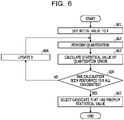
- FIG. 6 is a flowchart illustrating an example of threshold determination processing executed by the inference device 501 in FIG. 5 .
- the threshold determination processing in FIG. 6 is executed for each layer of the neural network included in the inference model 521.
- the determination unit 511 sets an initial value to the variable X representing the candidate of the threshold 522 (step 601) and quantizes the N numerical values to be quantized using the variable X (step 602).
- the determination unit 511 converts a numerical value deviated from the numerical value range defined by the variable X into a quantized numerical value corresponding to the variable X and converts the numerical value within the numerical value range into a quantized numerical value using the scaling factor.
- the determination unit 511 calculates a quantization error using each numerical value to be quantized and each quantized numerical value and calculates a statistical value of the quantization error for each of the N numerical values to be quantized (step 603).
- the determination unit 511 checks whether or not the statistical value of the quantization error has been calculated for all the candidates (step 604). When an unprocessed candidate remains (step 604, NO), the determination unit 511 updates the value of the variable X (step 606) and repeats processing in and after step 602 on the next candidate.
- the determination unit 511 selects a candidate that has the minimum statistical value as the threshold 522 (step 605).
- the threshold determination processing in FIG. 6 because the statistical value of the quantization error is calculated for each candidate of the threshold 522, accuracy of the quantized numerical value for each candidate can be estimated on the basis of the calculated statistical value. Therefore, a candidate that has higher accuracy can be selected from among the plurality of candidates.
- threshold determination processing in a case where the quantization target is a weight in each layer of a neural network will be described.
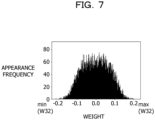
- FIG. 7 illustrates an example of a distribution of weights to be quantized in a single layer of the neural network.
- the horizontal axis indicates a weight, and the vertical axis indicates an appearance frequency.
- the weight is represented by the FP32.
- W represents a set of N weights in a single layer.
- max (W) represents a maximum value of the N weights
- min (W) represents a minimum value of the N weights.
- a bin width B max W ⁇ min W / M
- FIG. 8 illustrates a flowchart illustrating an example of threshold determination processing for a weight.
- the threshold determination processing in FIG. 8 is executed for each layer of the neural network included in the inference model 521.
- a control variable k is used as a hyperparameter that specifies the candidate of the threshold 522.
- the lower limit of the numerical value range of the weight to be quantized is represented by - TH (k), and the upper limit is represented by + TH (k).
- TH (k) is a positive numerical value that changes according to k and represents a candidate of the upper limit of the numerical value range.
- the determination unit 511 sets an initial value k0 to k (step 801) and calculates TH (k) according to the following equation (step 802).
- TH k max abs W ⁇ k * B
- abs (W) in the equation (6) represents a set of absolute values of the respective weights included in W
- max (abs (W)) represents a maximum value of elements of abs (W).
- the determination unit 511 sets an initial value 1 to a control variable i (step 804) and compares an absolute value abs (W (i)) of the i-th weight W (i) with TH (k) (step 805).
- the determination unit 511 calculates a quantization error qe (i) for W (i) according to the following equation (step 806).
- qe i abs WQ i ⁇ W i
- WQ (i) in the formula (7) represents a numerical value obtained by inversely quantizing Q (i), and abs (WQ (i) - W (i)) represents an absolute value of WQ (i) - W (i).
- the determination unit 511 calculates the quantization error qe (i) for W (i) according to the following equation (step 807).
- qe i abs W i ⁇ TH k
- the determination unit 511 compares i with N (step 808). When i does not reach N (step 808, NO), the determination unit 511 increments i only by one (step 812) and repeats processing in and after step 805.
- the determination unit 511 calculates an average value QE (k) of the N quantization errors qe (i) according to the following equation (step 809).
- QE k ave qe
- qe in the equation (9) represents a set of qe (1) to qe (N), and ave (qe) represents an average value of qe (1) to qe (N).
- the determination unit 511 compares TH (k) with L ⁇ B (step 810).
- L represents a positive integer.
- the determination unit 511 ends the calculation of QE (k) and selects TH (k) that has the minimum QE (k) among the calculated QE (k) (step 811). Then, the determination unit 511 determines the threshold 522 indicating the lower limit of the numerical value range as - TH (k) and determines the threshold 522 indicating the upper limit of the numerical value range as TH (k).
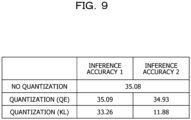
- FIG. 9 illustrates an example of an experimental result in a case where the quantization according to the embodiment is applied.
- a trained model and a dataset are similar to those of the experiment illustrated in FIG. 3 .
- the quantization (QE) represents a case where the quantization based on the threshold 522 having the minimum QE (k) is applied and inference is performed.
- the inference accuracy 1 of the quantization (QE) is 35.09, and the inference accuracy 2 of the quantization (QE) is 34.93.
- the inference accuracy 1 and the inference accuracy 2 of the quantization (QE) are rarely different from the inference accuracy without the quantization. Therefore, the inference accuracy about the same as that before the quantization is maintained by determining the threshold 522 using the average value of the quantization error instead of the KL information amount.
- the configuration of the threshold determination device 401 in FIG. 4 is merely an example, and the components may be changed depending on use or conditions of the threshold determination device 401.
- the structure of the inference device 501 in FIG. 5 is merely an example, and some components may be omitted or changed depending on use or conditions of the inference device 501.
- the flowcharts in FIGs. 1 , 6 , and 8 are merely examples, and some of the processing may be omitted or changed depending on use or conditions of the threshold determination processing.
- the quantization target may be changed to a bias or an activation.
- the update processing illustrated in FIG. 2 is merely an example, and the method for updating the candidate of the threshold changes depending on the use or the conditions of the threshold determination processing.
- the experimental results illustrated in FIGs. 3 and 9 are merely examples, and the inference accuracy changes depending on the inference model and the quantization target.
- the distribution of the weights illustrated in FIG. 7 is merely an example, and the distribution of the weights changes depending on the inference model.
- the equations (1) to (9) are merely examples, and the inference device 501 may determine the threshold 522 using another calculation formula.
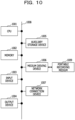
- FIG. 10 illustrates an exemplary hardware structure of an information processing device (computer) used as the threshold determination device 401 in FIG. 4 and the inference device 501 in FIG. 5 .
- the information processing device in FIG. 10 includes a central processing unit (CPU) 1001, a memory 1002, an input device 1003, an output device 1004, an auxiliary storage device 1005, a medium driving device 1006, and a network connection device 1007.
- CPU central processing unit
- the memory 1002 is, for example, a semiconductor memory such as a read only memory (ROM) or a random access memory (RAM) and stores programs and data to be used for processing.
- the memory 1002 may operate as the storage unit 514 in FIG. 5 .
- the CPU 1001 executes a program using the memory 1002 so as to operate as the determination unit 411 in FIG. 4 .
- the CPU 1001 executes the program using the memory 1002 so as to also operate as the determination unit 511, the quantization unit 512, and the inference unit 513 in FIG. 5 .
- the input device 1003 is a keyboard, a pointing device, or the like and is used for inputting instructions or information from a user or an operator.
- the output device 1004 is a display device, a printer, or the like and is used for an inquiry or an instruction to the user or the operator, and outputting a processing result.
- the processing result may be an inference result for the input data 524.
- the auxiliary storage device 1005 is, for example, a magnetic disk device, an optical disk device, a magneto-optical disk device, a tape device, or the like.
- the auxiliary storage device 1005 may be a hard disk drive.
- the information processing device may store programs and data in the auxiliary storage device 1005 and load these programs and data into the memory 1002 to use.
- the medium driving device 1006 drives a portable recording medium 1009 and accesses recorded content of the portable recording medium 1009.
- the portable recording medium 1009 is a memory device, a flexible disk, an optical disk, a magneto-optical disk, or the like.
- the portable recording medium 1009 may be a compact disk read only memory (CD-ROM), a digital versatile disk (DVD), a universal serial bus (USB) memory, or the like.
- CD-ROM compact disk read only memory
- DVD digital versatile disk
- USB universal serial bus
- a computer-readable recording medium in which the programs and data used for processing are stored is a physical (non-transitory) recording medium such as the memory 1002, the auxiliary storage device 1005, or the portable recording medium 1009.
- the network connection device 1007 is a communication interface circuit that is connected to a communication network such as a local area network (LAN) or a wide area network (WAN), and that performs data conversion according to communication.
- the information processing device can receive programs and data from an external device via the network connection device 1007 and load these programs and data into the memory 1002 to use.
- the information processing device does not need to include all the components in FIG. 10 , and some components may be omitted depending on use or conditions of the information processing device. For example, in a case where an interface with the user or the operator is not needed, the input device 1003 and the output device 1004 may be omitted. In a case where the portable recording medium 1009 or the communication network is not used, the medium driving device 1006 or the network connection device 1007 may be omitted.
Landscapes
- Engineering & Computer Science (AREA)
- Physics & Mathematics (AREA)
- Theoretical Computer Science (AREA)
- Health & Medical Sciences (AREA)
- Life Sciences & Earth Sciences (AREA)
- Biomedical Technology (AREA)
- Biophysics (AREA)
- Evolutionary Computation (AREA)
- Computational Linguistics (AREA)
- Data Mining & Analysis (AREA)
- Artificial Intelligence (AREA)
- General Health & Medical Sciences (AREA)
- Molecular Biology (AREA)
- Computing Systems (AREA)
- General Engineering & Computer Science (AREA)
- General Physics & Mathematics (AREA)
- Mathematical Physics (AREA)
- Software Systems (AREA)
- Neurology (AREA)
- Compression, Expansion, Code Conversion, And Decoders (AREA)
Abstract
Description
- The embodiment discussed herein is related to a threshold determination technology.
- A neural network that is one kind of a trained model generated through machine learning is used to infer input data in various fields such as image processing or natural language processing (for example,
NPL 1 and NPL 2). - Due to a complicated configuration of a neural network in recent years, power consumption of a computer that performs inference using the neural network tends to increase. Therefore, the neural network may be quantized to reduce the power consumption. The quantization of the neural network is processing of converting a numerical value to be quantized represented by a predetermined bit width into a quantized numerical value represented by a smaller bit width.
- Although the quantization of the neural network is effective for reducing power consumption and a memory usage, accuracy of a numerical value to be quantized is deteriorated. For example, when a 32-bit single precision floating point number (FP32) is converted into an eight-bit integer (INT8) through quantization, inference accuracy largely decreases (for example, NPL 3).
- A technique has been known that promotes efficiency improvement of the neural network in relation to the quantization of the neural network (for example, PTL 1). A neural network learning device has been also known that enables appropriate calculation while reducing a weight of a convolutional neural network (CNN) by lowering a bit of the calculation (for example, PTL 2). A method for adjusting accuracy regarding some selected layers in the neural network to a lower bit has been also known (for example, PTL 3).
- A sequence conversion model based on an attention mechanism has been also known (for example, NPL 4).
-
- [PTL 1]
Japanese National Publication of International Patent Application No. 2021-500654 - [PTL 2]
Japanese Laid-open Patent Publication No. 2020-9048 - [PTL 3]
Japanese Laid-open Patent Publication No. 2020-113273 -
- [NPL 1] A. Canziani et al, "An Analysis of Deep Neural Network Models for Practical Applications", arXiv:1605.07678v4, April 14, 2017.
- [NPL 2] O. Sharir et al., "The Cost of Training NLP Models: A Concise Overview", arXiv:2004.08900v1, April 19, 2020.
- [NPL 3] Szymon Migacz, NVIDIA, "8-bit Inference with TensorRT", [online], May 8, 2017, (retrieved on June 16, 2021), Internet URL: https://on-demand.gputechconf.com/gtc/2017/presentation/s7310-8-bit-inference-with-tensorrt.pdf.
- [NPL 4] A. Vaswani et al., "Attention is All You Need", 31st Conference on Neural Information Processing Systems (NIPS 2017), 2017 are disclosed as related art.
- In the quantization of the neural network, it is important to select an appropriate scaling factor for converting a numerical value to be quantized into a quantized numerical value. The numerical value to be quantized is a weight of each of a plurality of edges between two layers of the neural network, an output value of each of a plurality of nodes included in each layer of the neural network, or the like. The output value of each node is called an activation. The plurality of numerical values to be quantized and the plurality of quantized numerical values may also be represented by tensors.
- There is a case where the accuracy of the quantized numerical value is improved by performing clipping on the numerical value to be quantized. The clipping is processing of converting a numerical value that is deviated from a numerical value range defined by a threshold into a quantized numerical value corresponding to the threshold. However, it is difficult to select an appropriate threshold for the clipping.
- Note that, the problem is caused not only in quantization of the weight or the activation but also in quantization of various numerical values in the neural network.
- In one aspect, an object of the embodiment is to suppress decrease in inference accuracy caused by quantization of a neural network.
- According to an aspect of the embodiments, a threshold determination program in which a computer performs processing of quantitating (quantifying) a plurality of numerical values of a quantization target using a variable representing a candidate of a threshold, and determining the threshold based on a quantization error for each of the plurality of numerical values, the quantization error is specified based on the quantitating.
- According to one aspect, it is possible to suppress decrease in inference accuracy caused by quantization of a neural network.
- Embodiments are set out, by way of example only, with reference to the following drawings, in which:
-
FIG. 1 is a flowchart of threshold determination processing of a comparative example; -
FIG. 2 is a diagram illustrating update processing; -
FIG. 3 is a diagram illustrating an experimental result in a case where quantization in NPL 3 is applied; -
FIG. 4 is a functional structure diagram of a threshold determination device according to an embodiment; -
FIG. 5 is a functional structure diagram of an inference device; -
FIG. 6 is a flowchart of threshold determination processing executed by the inference device; -
FIG. 7 is a diagram illustrating a distribution of weights; -
FIG. 8 is a flowchart of the threshold determination processing for the weight; -
FIG. 9 is a diagram illustrating an experimental result in a case where quantization according to the embodiment is applied; and -
FIG. 10 is a hardware structure diagram of an information processing device. - Hereinafter, an embodiment will be described in detail with reference to the drawings.
- In the quantization of NPL 3, when a FP32 is converted into an INT8, a numerical value range of the FP32 is limited by performing clipping before a scaling factor is applied. In this case, the upper limit of the numerical value range is defined by a positive threshold + | T |, and the lower limit of the numerical value range is defined by a negative threshold - | T |.
- Therefore, through quantization, a floating point number equal to or less than - | T | is converted into an integer corresponding to - | T |, and a floating point number equal to or more than + | T | is converted into an integer corresponding to + | T |. The integer corresponding to - | T | is - 127, and the integer corresponding to + | T | is + 127. The floating point number less than - | T | and the floating point number larger than + | T | are referred to as outliers.
- By performing clipping before the scaling factor is applied, quantization noise can be reduced, and accuracy of a quantized numerical value is improved.
-
FIG. 1 is a flowchart illustrating an example of threshold determination processing according to a comparative example based on NPL 3. The threshold determination processing inFIG. 1 is executed for each layer in a neural network. - First, a computer sets an initial value to a variable X representing a candidate of a threshold indicating the lower limit or the upper limit of the numerical value range (step 101) and quantizes N (N is integer equal to or more than two) numerical values to be quantized using the variable X (step 102). In
step 102, the computer converts a numerical value out of the numerical value range defined by the variable X into a quantized numerical value corresponding to the variable X and converts the numerical value within the numerical value range into a quantized numerical value using the scaling factor. - Next, the computer calculates a Kullback-Leibler information amount (Kullback-Leibler divergence, KL information amount) according to the following formula using a probability distribution P of N numerical values to be quantized and a probability distribution Q of N numerical values after being quantized (step 103).
- [Expression 1]

- KL (P | | Q) in the equation (1) represents the KL information amount of the probability distribution P and the probability distribution Q, P (i) represents a probability of an i-th (i = 1 to N) numerical value to be quantized, and Q (i) represents a probability of an i-th numerical value after being quantized. log represents a binary logarithm or a natural logarithm. KL (P | | Q) is used as an index representing a difference between the probability distribution P and the probability distribution Q.
- Next, the computer checks whether or not the KL information amount is calculated for all candidates (step 104). When an unprocessed candidate remains (
step 104, NO), the computer updates the value of the variable X (step 106) and repeats processing in and afterstep 102 on the next candidate. - When the KL information amount has been calculated for all the candidates (step 104, YES), the computer selects a candidate that has the minimum KL information amount as a threshold (step 105).
-
FIG. 2 illustrates an example of update processing instep 106 inFIG. 1 . Numbers zero to 2048 indicate positions of bins of a histogram representing the probability distribution P. In this case, the variable X represents a candidate of a threshold indicating the upper limit of the numerical value range, and an initial value of the variable X is set to the position of the 128-th bin. - In
step 106, the computer increases the variable X by a bin width by incrementing the position of the bin indicating the value of the variable X by one. By repeating the processing instep 106, the value of the variable X changes from the position of the 128-th bin to the position of the 2048-th bin. Instep 102, an outlier that is larger than the variable X is converted into a quantized numerical value corresponding to the variable X. - By performing quantization using a threshold that has the minimum KL information amount, it is possible to make the probability distribution of the quantized numerical value be closer to the probability distribution of the numerical value to be quantized. However, the threshold determination processing in
FIG. 1 is merely effective for the quantization for converting a CNN activation into an eight-bit numerical value. - The KL information amount only includes information regarding an appearance frequency of each numerical value to be quantized and an appearance frequency of each quantized numerical value and does not include information regarding these numerical values. Therefore, when a bit width of the quantized numerical value is small, there is a case where inference accuracy largely decreases even if the quantization is performed using the threshold that has the minimum KL information amount.
-
FIG. 3 illustrates an example of an experimental result in a case where NPL 3) is applied. In this experiment, as a trained model, a transformer that is a sequence conversion model described in NPL 4 is used. The transformer used for the experiment includes an encoder and a decoder, and each of the encoder and the decoder includes nine fully-coupled layers. - The numerical value to be quantized is a weight of a linear layer in a multi-head attention block included in each layer of the encoder or the decoder and is represented by the FP32. A bit width of the quantized numerical value is two bits.
- As a dataset, a German-English translation dataset of Multi30k is used. Training data includes 29000 sentences, verification data includes 1014 sentences, and input data to be inferred includes 1000 sentences.
- No quantization represents a case where inference is performed without quantizing the weight represented by the FP32, and the quantization (KL) represents a case where inference is performed by applying the quantization on the basis of the threshold that has the minimum KL information amount.
-
Inference accuracy 1 represents a bilingual evaluation understudy (BLEU) score when the quantization is applied to the nine fully-coupled layers of the encoder.Inference accuracy 2 represents a BLEU score when the quantization is applied to the nine fully-coupled layers of each of the encoder and the decoder. The higher the BLEU score is, the higher the inference accuracy is. - The inference accuracy with no quantization is 35.08. On the other hand, the
inference accuracy 1 of the quantization (KL) is 33.26, and theinference accuracy 2 of the quantization (KL) is 11.88. In this case, it can be understood that theinference accuracy 2 of the quantization (KL) is largely decreased. -
FIG. 4 illustrates an exemplary functional structure of a threshold determination device according to the embodiment. Athreshold determination device 401 inFIG. 4 includes adetermination unit 411. In the quantization of the neural network, when a numerical value deviated from the numerical value range defined by the threshold of a plurality of numerical values to be quantized is converted into a quantized numerical value corresponding to the threshold, thedetermination unit 411 determines the threshold. At this time, thedetermination unit 411 determines the threshold based on a quantization error for each of the plurality of numerical values. - According to the
threshold determination device 401 inFIG. 4 , it is possible to suppress decrease in the inference accuracy caused by the quantization of the neural network. -
FIG. 5 illustrates an exemplary functional structure of an inference device corresponding to thethreshold determination device 401 inFIG. 4 . Aninference device 501 inFIG. 5 includes adetermination unit 511, aquantization unit 512, aninference unit 513, and astorage unit 514. Thedetermination unit 511 corresponds to thedetermination unit 411 inFIG. 4 . - The
storage unit 514 stores aninference model 521 that performs inference in image processing, natural language processing, or the like andinput data 524 to be inferred. Theinference model 521 is a trained model including a neural network and, for example, is generated through supervised machine learning. Theinference model 521 may be a transformer. - The
determination unit 511 determines athreshold 522 used for clipping for each layer of the neural network included in theinference model 521 and stores thethreshold 522 in thestorage unit 514. Thethreshold 522 indicates the lower limit and the upper limit of the numerical value range of the numerical value to be quantized. - The
determination unit 511 quantizes each of N (N is integer equal to or more than two) numerical values to be quantized based on the numerical value range defined by each of a plurality of candidates of thethreshold 522 so as to generate a quantized numerical value corresponding to each numerical value. - In the quantization for converting the FP32 into the INT8, for example, the upper limit of the numerical value range is defined by a candidate TC of a positive threshold, and the lower limit of the numerical value range is defined by a candidate - TC of a negative threshold. In this case, the
determination unit 511 can convert an i-th (i = 1 to N) numerical value v (i) to be quantized into an i-th numerical value q (i) after being quantized, for example, according to the following equation.
- S in the equation (2) represents a scaling factor, and round (v (i) / S) represents a value obtained by rounding v (i) / S. However, when v (i) is equal to or more than TC, q (i) = 127, and when v (i) is equal to or less than - TC, q (i) = - 127.
- Next, the
determination unit 511 calculates a quantization error using each numerical value to be quantized and the quantized numerical value corresponding to each numerical value to be quantized and calculates a statistical value of the quantization error for each of the N numerical values to be quantized. Then, thedetermination unit 511 selects thethreshold 522 from among the plurality of candidates based on the statistical value calculated from each of the plurality of candidates. - As the statistical value, for example, an average value, a median, a mode, a maximum value, or a sum is used, and as the
threshold 522, for example, a candidate that has a minimum statistical value is selected. By using the statistical value of the quantization error, thethreshold 522 suitable for each layer of the neural network can be easily determined. - In the quantization for converting the FP32 into the INT8, for example, an average value QE of the quantization error for each of the N numerical values to be quantized is calculated according to the following equation.

- [Expression 2]

- vq (i) in the equation (3) represents a numerical value obtained by inversely quantizing q (i), and | vq (i) - v (i) | in the equation (4) represents an i-th quantization error. However, in a case of q (i) = 127, vq (i) = TC, and in a case where q (i) = - 127, vq (i) = - TC.
- The quantization error includes information regarding an appearance frequency of each numerical value to be quantized and an appearance frequency of each quantized numerical value and information regarding these numerical values. Therefore, by selecting the candidate that has the minimum statistical value of the quantization error as the
threshold 522, accuracy of the quantized numerical value is improved than that in a case where the candidate that has the minimum KL information amount is selected. Therefore, even in a case where a bit width of the quantized numerical value is small, decrease in the inference accuracy caused by the quantization is suppressed, and high inference accuracy can be maintained. - The
quantization unit 512 generates aquantization inference model 523 by quantizing each of the N numerical values to be quantized using thethreshold 522 for each layer of the neural network and stores thequantization inference model 523 in thestorage unit 514. - In the quantization of the numerical value to be quantized, the
quantization unit 512 converts the outlier deviated from the numerical value range defined by the lower limit and the upper limit indicated by thethreshold 522 into a quantized numerical value corresponding to the lower limit or the upper limit. Then, thequantization unit 512 converts a numerical value within the numerical value range into the quantized numerical value using the scaling factor. - The quantization target is, for example, a weight, a bias, or an activation in each layer of the neural network. A bit width of the quantized numerical value is smaller than a bit width of the numerical value to be quantized. By quantizing the weight, the bias, or the activation, the neural network can be efficiently compressed.
- The
inference unit 513 infers theinput data 524 using thequantization inference model 523 and outputs an inference result. By performing the inference using thequantization inference model 523 instead of theinference model 521, power consumption and a memory usage are reduced, and the inference processing is accelerated. -
FIG. 6 is a flowchart illustrating an example of threshold determination processing executed by theinference device 501 inFIG. 5 . The threshold determination processing inFIG. 6 is executed for each layer of the neural network included in theinference model 521. - First, the
determination unit 511 sets an initial value to the variable X representing the candidate of the threshold 522 (step 601) and quantizes the N numerical values to be quantized using the variable X (step 602). Instep 602, thedetermination unit 511 converts a numerical value deviated from the numerical value range defined by the variable X into a quantized numerical value corresponding to the variable X and converts the numerical value within the numerical value range into a quantized numerical value using the scaling factor. - Next, the
determination unit 511 calculates a quantization error using each numerical value to be quantized and each quantized numerical value and calculates a statistical value of the quantization error for each of the N numerical values to be quantized (step 603). - Next, the
determination unit 511 checks whether or not the statistical value of the quantization error has been calculated for all the candidates (step 604). When an unprocessed candidate remains (step 604, NO), thedetermination unit 511 updates the value of the variable X (step 606) and repeats processing in and afterstep 602 on the next candidate. - When the statistical value of the quantization error is calculated for all the candidates (step 604, YES), the
determination unit 511 selects a candidate that has the minimum statistical value as the threshold 522 (step 605). - According to the threshold determination processing in
FIG. 6 , because the statistical value of the quantization error is calculated for each candidate of thethreshold 522, accuracy of the quantized numerical value for each candidate can be estimated on the basis of the calculated statistical value. Therefore, a candidate that has higher accuracy can be selected from among the plurality of candidates. - Next, threshold determination processing in a case where the quantization target is a weight in each layer of a neural network will be described.
-
FIG. 7 illustrates an example of a distribution of weights to be quantized in a single layer of the neural network. The horizontal axis indicates a weight, and the vertical axis indicates an appearance frequency. The weight is represented by the FP32. W represents a set of N weights in a single layer. max (W) represents a maximum value of the N weights, and min (W) represents a minimum value of the N weights. - The distribution of the weights in
FIG. 7 is expressed by a histogram including M bins. In this case, a bin width B is calculated according to the following equation.
-
FIG. 8 illustrates a flowchart illustrating an example of threshold determination processing for a weight. The threshold determination processing inFIG. 8 is executed for each layer of the neural network included in theinference model 521. - A control variable k is used as a hyperparameter that specifies the candidate of the
threshold 522. The lower limit of the numerical value range of the weight to be quantized is represented by - TH (k), and the upper limit is represented by + TH (k). TH (k) is a positive numerical value that changes according to k and represents a candidate of the upper limit of the numerical value range. - First, the
determination unit 511 sets an initial value k0 to k (step 801) and calculates TH (k) according to the following equation (step 802).
- abs (W) in the equation (6) represents a set of absolute values of the respective weights included in W, and max (abs (W)) represents a maximum value of elements of abs (W).
- Next, the
determination unit 511 quantizes N weights W (i) (i = 1 to N) to be quantized using TH (k) so as to generate a quantized weight Q (i) (step 803). - In
step 803, thedetermination unit 511 converts W (i) equal to or less than - TH (k) into the quantized weight - THQ (k) corresponding to - TH (k) and converts W (i) equal to or more than TH (k) into the quantized weight THQ (k) corresponding to TH (k). Furthermore, thedetermination unit 511 converts W (i), which is larger than - TH (k) and smaller than TH (k), into Q (i) using the scaling factor. For example, in a case where Q (i) is represented by the INT8, THQ (k) = 127 may be satisfied. - Next, the
determination unit 511 sets aninitial value 1 to a control variable i (step 804) and compares an absolute value abs (W (i)) of the i-th weight W (i) with TH (k) (step 805). - When abs (W (i)) is smaller than TH (k) (
step 805, YES), thedetermination unit 511 calculates a quantization error qe (i) for W (i) according to the following equation (step 806).
- WQ (i) in the formula (7) represents a numerical value obtained by inversely quantizing Q (i), and abs (WQ (i) - W (i)) represents an absolute value of WQ (i) - W (i).
- On the other hand, when abs (W (i)) is equal to or more than TH (k) (
step 805, NO), thedetermination unit 511 calculates the quantization error qe (i) for W (i) according to the following equation (step 807).
- Next, the
determination unit 511 compares i with N (step 808). When i does not reach N (step 808, NO), thedetermination unit 511 increments i only by one (step 812) and repeats processing in and afterstep 805. - When i reaches N (
step 808, YES), thedetermination unit 511 calculates an average value QE (k) of the N quantization errors qe (i) according to the following equation (step 809).
- qe in the equation (9) represents a set of qe (1) to qe (N), and ave (qe) represents an average value of qe (1) to qe (N).
- Next, the
determination unit 511 compares TH (k) with L ∗ B (step 810). L represents a positive integer. When TH (k) is larger than L ∗ B (step 810, YES), thedetermination unit 511 increments k by only Δk (step 813) and repeats processing in and afterstep 802. For example, in the distribution of the weights illustrated inFIG. 7 , in a case of M = 2048, k0 = 0, Δk = 0.2, and L = 127 may be satisfied. - When TH (k) is equal to or less than L ∗ B (
step 810, NO), thedetermination unit 511 ends the calculation of QE (k) and selects TH (k) that has the minimum QE (k) among the calculated QE (k) (step 811). Then, thedetermination unit 511 determines thethreshold 522 indicating the lower limit of the numerical value range as - TH (k) and determines thethreshold 522 indicating the upper limit of the numerical value range as TH (k). -
FIG. 9 illustrates an example of an experimental result in a case where the quantization according to the embodiment is applied. A trained model and a dataset are similar to those of the experiment illustrated inFIG. 3 . - Inference accuracy without quantization and
inference accuracy 1 andinference accuracy 2 of the quantization (KL) are similar to those of the experimental result illustrated inFIG. 3 . The quantization (QE) represents a case where the quantization based on thethreshold 522 having the minimum QE (k) is applied and inference is performed. - The
inference accuracy 1 of the quantization (QE) is 35.09, and theinference accuracy 2 of the quantization (QE) is 34.93. In this case, it can be understood that theinference accuracy 1 and theinference accuracy 2 of the quantization (QE) are rarely different from the inference accuracy without the quantization. Therefore, the inference accuracy about the same as that before the quantization is maintained by determining thethreshold 522 using the average value of the quantization error instead of the KL information amount. - The configuration of the
threshold determination device 401 inFIG. 4 is merely an example, and the components may be changed depending on use or conditions of thethreshold determination device 401. The structure of theinference device 501 inFIG. 5 is merely an example, and some components may be omitted or changed depending on use or conditions of theinference device 501. - The flowcharts in
FIGs. 1 ,6 , and8 are merely examples, and some of the processing may be omitted or changed depending on use or conditions of the threshold determination processing. For example, in the threshold determination processing inFIG. 8 , the quantization target may be changed to a bias or an activation. - The update processing illustrated in
FIG. 2 is merely an example, and the method for updating the candidate of the threshold changes depending on the use or the conditions of the threshold determination processing. The experimental results illustrated inFIGs. 3 and9 are merely examples, and the inference accuracy changes depending on the inference model and the quantization target. The distribution of the weights illustrated inFIG. 7 is merely an example, and the distribution of the weights changes depending on the inference model. - The equations (1) to (9) are merely examples, and the
inference device 501 may determine thethreshold 522 using another calculation formula. -
FIG. 10 illustrates an exemplary hardware structure of an information processing device (computer) used as thethreshold determination device 401 inFIG. 4 and theinference device 501 inFIG. 5 . The information processing device inFIG. 10 includes a central processing unit (CPU) 1001, amemory 1002, aninput device 1003, anoutput device 1004, anauxiliary storage device 1005, amedium driving device 1006, and anetwork connection device 1007. Those components are hardware, and are coupled to each other by abus 1008. - The
memory 1002 is, for example, a semiconductor memory such as a read only memory (ROM) or a random access memory (RAM) and stores programs and data to be used for processing. Thememory 1002 may operate as thestorage unit 514 inFIG. 5 . - The CPU 1001 (processor), for example, executes a program using the
memory 1002 so as to operate as thedetermination unit 411 inFIG. 4 . TheCPU 1001 executes the program using thememory 1002 so as to also operate as thedetermination unit 511, thequantization unit 512, and theinference unit 513 inFIG. 5 . - For example, the
input device 1003 is a keyboard, a pointing device, or the like and is used for inputting instructions or information from a user or an operator. For example, theoutput device 1004 is a display device, a printer, or the like and is used for an inquiry or an instruction to the user or the operator, and outputting a processing result. The processing result may be an inference result for theinput data 524. - The
auxiliary storage device 1005 is, for example, a magnetic disk device, an optical disk device, a magneto-optical disk device, a tape device, or the like. Theauxiliary storage device 1005 may be a hard disk drive. The information processing device may store programs and data in theauxiliary storage device 1005 and load these programs and data into thememory 1002 to use. - The
medium driving device 1006 drives aportable recording medium 1009 and accesses recorded content of theportable recording medium 1009. Theportable recording medium 1009 is a memory device, a flexible disk, an optical disk, a magneto-optical disk, or the like. Theportable recording medium 1009 may be a compact disk read only memory (CD-ROM), a digital versatile disk (DVD), a universal serial bus (USB) memory, or the like. The user or the operator can store the programs and data in theportable recording medium 1009 and can use these programs and data by loading the programs and data into thememory 1002. - As described above, a computer-readable recording medium in which the programs and data used for processing are stored is a physical (non-transitory) recording medium such as the
memory 1002, theauxiliary storage device 1005, or theportable recording medium 1009. - The
network connection device 1007 is a communication interface circuit that is connected to a communication network such as a local area network (LAN) or a wide area network (WAN), and that performs data conversion according to communication. The information processing device can receive programs and data from an external device via thenetwork connection device 1007 and load these programs and data into thememory 1002 to use. - Note that, the information processing device does not need to include all the components in
FIG. 10 , and some components may be omitted depending on use or conditions of the information processing device. For example, in a case where an interface with the user or the operator is not needed, theinput device 1003 and theoutput device 1004 may be omitted. In a case where theportable recording medium 1009 or the communication network is not used, themedium driving device 1006 or thenetwork connection device 1007 may be omitted. - While the disclosed embodiment and the advantages thereof have been described in detail, those skilled in the art will be able to make various modifications, additions, and omissions without departing from the scope of the embodiment as explicitly set forth in the claims.
Claims (15)
- A threshold determination program in which a computer performs processing of:quantitating a plurality of numerical values of a quantization target using a variable representing a candidate of a threshold; anddetermining the threshold based on a quantization error for each of the plurality of numerical values, wherein the quantization error is specified based on the quantitating.
- The threshold determination program according to claim 1, wherein the quantitating includes converting a numerical value among the plurality of numerical values deviated from a numerical value range defined by the candidate into a quantized numerical value that corresponds to the candidate.
- The threshold determination program according to any one of claims 1 to 2, wherein the determining includes determining the threshold based on a statistical value of the quantization error for each of the plurality of numerical values.
- The threshold determination program according to claims 1 to 3, whereinthe quantitating includes generating a quantized numerical value that corresponds to each of a plurality of numerical values by quantizing each of the plurality of numerical values based on a numerical value range defined by each of a plurality of candidates of the threshold, the plurality of candidates including the candidate,the determining includescalculating a statistical value based on each of the plurality of numerical values and the quantized numerical value that corresponds to each of the plurality of numerical values, andselecting the threshold from among the plurality of candidates based on the statistical value that is calculated from each of the plurality of candidates.
- The threshold determination program according to any one of claims 1 to 4, wherein the quantization target is a weight, a bias, or an activation in a neural network.
- A threshold determination method comprising:quantitating a plurality of numerical values of a quantization target using a variable representing a candidate of a threshold; anddetermining the threshold based on a quantization error for each of the plurality of numerical values, wherein the quantization error is specified based on the quantitating.
- The threshold determination method according to claim 6,
the quantitating includes converting a numerical value among the plurality of numerical values deviated from a numerical value range defined by the candidate into a quantized numerical value that corresponds to the candidate. - The threshold determination method according to any one of claims 6 to 7, wherein the determining includes determining the threshold based on a statistical value of the quantization error for each of the plurality of numerical values.
- The threshold determination method according to any one of claims 6 to 8, whereinthe quantitating includes generating a quantized numerical value that corresponds to each of a plurality of numerical values by quantizing each of the plurality of numerical values based on a numerical value range defined by each of a plurality of candidates of the threshold, the plurality of candidates including the candidate,the determining includes:calculating a statistical value based on each of the plurality of numerical values and the quantized numerical value that corresponds to each of the plurality of numerical values, andselecting the threshold from among the plurality of candidates based on the statistical value that is calculated from each of the plurality of candidates.
- The threshold determination method according to any one of claims 6 to 9, wherein the quantization target is a weight, a bias, or an activation in a neural network.
- An information processing apparatus comprising:
a determination unit configured to:quantitate a plurality of numerical values of a quantization target using a variable representing a candidate of a threshold, anddetermine the threshold based on a quantization error for each of the plurality of numerical values, wherein the quantization error is specified based on the quantitating. - The information processing apparatus according to claim 11, wherein
the determination unit is further configured to convert a numerical value among the plurality of numerical values deviated from a numerical value range defined by the candidate into a quantized numerical value that corresponds to the candidate. - The information processing apparatus according to any one of claims 11 to 12, wherein the determination unit is further configured to determine the threshold based on a statistical value of the quantization error for each of the plurality of numerical values.
- The information processing apparatus according to any one of claims 11 to 13, wherein
the determination unit is further configured to:generate a quantized numerical value that corresponds to each of a plurality of numerical values by quantizing each of the plurality of numerical values based on a numerical value range defined by each of a plurality of candidates of the threshold, the plurality of candidates including the candidate,calculate a statistical value based on each of the plurality of numerical values and the quantized numerical value that corresponds to each of the plurality of numerical values, andselect the threshold from among the plurality of candidates based on the statistical value that is calculated from each of the plurality of candidates. - The information processing apparatus according to any one of claims 11 to 14, wherein the quantization target is a weight, a bias, or an activation in a neural network.
Applications Claiming Priority (1)
| Application Number | Priority Date | Filing Date | Title |
|---|---|---|---|
| JP2021136804A JP7700577B2 (en) | 2021-08-25 | 2021-08-25 | THRESHOLD DETERMINATION PROGRAM, THRESHOLD DETERMINATION METHOD, AND THRESHOLD DETERMINATION APPARATUS |
Publications (1)
| Publication Number | Publication Date |
|---|---|
| EP4141745A1 true EP4141745A1 (en) | 2023-03-01 |
Family
ID=81449141
Family Applications (1)
| Application Number | Title | Priority Date | Filing Date |
|---|---|---|---|
| EP22170976.9A Withdrawn EP4141745A1 (en) | 2021-08-25 | 2022-04-29 | Threshold determination program, threshold determination method, and information processing apparatus |
Country Status (4)
| Country | Link |
|---|---|
| US (1) | US20230064003A1 (en) |
| EP (1) | EP4141745A1 (en) |
| JP (1) | JP7700577B2 (en) |
| CN (1) | CN115730650A (en) |
Families Citing this family (1)
| Publication number | Priority date | Publication date | Assignee | Title |
|---|---|---|---|---|
| KR102744715B1 (en) * | 2023-11-10 | 2024-12-19 | 오픈엣지테크놀로지 주식회사 | Method for decreasing quantization loss of neural network including channel-wise concatenation layer |
Citations (4)
| Publication number | Priority date | Publication date | Assignee | Title |
|---|---|---|---|---|
| CN109583561A (en) * | 2017-09-28 | 2019-04-05 | 杭州海康威视数字技术股份有限公司 | A kind of the activation amount quantization method and device of deep neural network |
| JP2020009048A (en) | 2018-07-05 | 2020-01-16 | 株式会社日立製作所 | Neural network learning device and learning method |
| JP2020113273A (en) | 2019-01-09 | 2020-07-27 | 三星電子株式会社Samsung Electronics Co.,Ltd. | Method and apparatus for neural network quantization |
| JP2021500654A (en) | 2017-10-24 | 2021-01-07 | インターナショナル・ビジネス・マシーンズ・コーポレーションInternational Business Machines Corporation | Promoting the efficiency of neural networks |
Family Cites Families (7)
| Publication number | Priority date | Publication date | Assignee | Title |
|---|---|---|---|---|
| JP7287388B2 (en) | 2018-05-14 | 2023-06-06 | ソニーグループ株式会社 | Information processing device and information processing method |
| US20200364552A1 (en) * | 2019-05-13 | 2020-11-19 | Baidu Usa Llc | Quantization method of improving the model inference accuracy |
| US11531893B2 (en) * | 2019-06-03 | 2022-12-20 | Samsung Electronics Co., Ltd. | Method and apparatus with neural network parameter quantization |
| JP2021005211A (en) | 2019-06-26 | 2021-01-14 | キオクシア株式会社 | Information processing method and information processing device |
| US12001955B2 (en) * | 2019-08-23 | 2024-06-04 | Anhui Cambricon Information Technology Co., Ltd. | Data processing method, device, computer equipment and storage medium |
| CN112287986B (en) | 2020-10-16 | 2023-07-18 | 浪潮(北京)电子信息产业有限公司 | Image processing method, device, equipment and readable storage medium |
| CN112580805B (en) | 2020-12-25 | 2024-11-08 | 三星(中国)半导体有限公司 | Quantization method of neural network model and device for quantizing neural network model |
-
2021
- 2021-08-25 JP JP2021136804A patent/JP7700577B2/en active Active
-
2022
- 2022-04-29 EP EP22170976.9A patent/EP4141745A1/en not_active Withdrawn
- 2022-05-13 US US17/743,508 patent/US20230064003A1/en not_active Abandoned
- 2022-05-24 CN CN202210570753.0A patent/CN115730650A/en active Pending
Patent Citations (4)
| Publication number | Priority date | Publication date | Assignee | Title |
|---|---|---|---|---|
| CN109583561A (en) * | 2017-09-28 | 2019-04-05 | 杭州海康威视数字技术股份有限公司 | A kind of the activation amount quantization method and device of deep neural network |
| JP2021500654A (en) | 2017-10-24 | 2021-01-07 | インターナショナル・ビジネス・マシーンズ・コーポレーションInternational Business Machines Corporation | Promoting the efficiency of neural networks |
| JP2020009048A (en) | 2018-07-05 | 2020-01-16 | 株式会社日立製作所 | Neural network learning device and learning method |
| JP2020113273A (en) | 2019-01-09 | 2020-07-27 | 三星電子株式会社Samsung Electronics Co.,Ltd. | Method and apparatus for neural network quantization |
Non-Patent Citations (6)
| Title |
|---|
| 0. SHARIR ET AL.: "The Cost of Training NLP Models: A Concise OvervieW", ARXIV:2004.08900V1, 19 April 2020 (2020-04-19) |
| A. CANZIANI ET AL.: "An Analysis of Deep Neural Network Models for Practical Applications", ARXIV:1605.07678V4, 14 April 2017 (2017-04-14) |
| A. VASWANI ET AL.: "Attention is All You Need", 31ST CONFERENCE ON NEURAL INFORMATION PROCESSING SYSTEMS (NIPS 2017, 2017 |
| MIGACZ SZYMON: "8-bit Inference with TensorRT", 8 May 2017 (2017-05-08), pages 1 - 41, XP055967266, Retrieved from the Internet <URL:https://on-demand.gputechconf.com/gtc/2017/presentation/s7310-8-bit-inference-with-tensorrt.pdf> [retrieved on 20221003] * |
| RITCHIE ZHAO ET AL: "Improving Neural Network Quantization without Retraining using Outlier Channel Splitting", 30 January 2019 (2019-01-30), XP055687236, Retrieved from the Internet <URL:https://arxiv.org/pdf/1901.09504v2.pdf> * |
| SZYMON MIGACZ: "8-bit Inference with TensorRT", NVIDIA, 8 May 2017 (2017-05-08), Retrieved from the Internet <URL:https://on-demand.gputechconf.com/gtc/2017/presentation/s7310-8-bit-inference-with-tensorrt.pdf> |
Also Published As
| Publication number | Publication date |
|---|---|
| CN115730650A (en) | 2023-03-03 |
| JP7700577B2 (en) | 2025-07-01 |
| JP2023031367A (en) | 2023-03-09 |
| US20230064003A1 (en) | 2023-03-02 |
Similar Documents
| Publication | Publication Date | Title |
|---|---|---|
| CN113313229B (en) | Bayesian Optimization of Sparsity Rate in Model Compression | |
| CN111652368A (en) | A data processing method and related products | |
| US20180204120A1 (en) | Improved artificial neural network for language modelling and prediction | |
| KR20190034985A (en) | Method and apparatus of artificial neural network quantization | |
| JP2022169743A (en) | Information extraction method and device, electronic equipment, and storage medium | |
| US20180314978A1 (en) | Learning apparatus and method for learning a model corresponding to a function changing in time series | |
| WO2022168604A1 (en) | Softmax function approximation calculation device, approximation calculation method, and approximation calculation program | |
| CN112115407A (en) | Yixin machine data input equipment and method for inputting data into Yi xin machine | |
| JP6647475B2 (en) | Language processing apparatus, language processing system, and language processing method | |
| CN114819079A (en) | Model training method and device, electronic equipment and readable storage medium | |
| EP4141745A1 (en) | Threshold determination program, threshold determination method, and information processing apparatus | |
| JPWO2020049681A1 (en) | Information processing equipment, methods and programs | |
| CN114830137A (en) | Method and system for generating a predictive model | |
| US20260087317A1 (en) | Machine learning method and information processing apparatus | |
| KR20230015186A (en) | Method and Device for Determining Saturation Ratio-Based Quantization Range for Quantization of Neural Network | |
| JP2019095894A (en) | Estimating device, learning device, learned model, estimation method, learning method, and program | |
| US20220414465A1 (en) | Information learning system, information learning method, information learning program, and information learning apparatus | |
| US20250217938A1 (en) | Weighting Functions and Adaptive Noise Schedule for Training Noise-Based Machine-Learned Models | |
| KR20230020856A (en) | Device and Method for Quantizing Parameters of Neural Network | |
| WO2024212160A1 (en) | Method and apparatus for diffusion model | |
| TWI819627B (en) | Optimizing method and computing apparatus for deep learning network and computer readable storage medium | |
| CN112508202B (en) | A method, device and electronic device for adjusting model stability | |
| JP2022077134A (en) | Neural network weight saving device, neural network weight saving method, and program | |
| Mohamed et al. | Data fitting by G1 rational cubic Bézier curves using harmony search | |
| CN112149415B (en) | Training method, device and readable storage medium for text generation model |
Legal Events
| Date | Code | Title | Description |
|---|---|---|---|
| PUAI | Public reference made under article 153(3) epc to a published international application that has entered the european phase |
Free format text: ORIGINAL CODE: 0009012 |
|
| STAA | Information on the status of an ep patent application or granted ep patent |
Free format text: STATUS: THE APPLICATION HAS BEEN PUBLISHED |
|
| AK | Designated contracting states |
Kind code of ref document: A1 Designated state(s): AL AT BE BG CH CY CZ DE DK EE ES FI FR GB GR HR HU IE IS IT LI LT LU LV MC MK MT NL NO PL PT RO RS SE SI SK SM TR |
|
| STAA | Information on the status of an ep patent application or granted ep patent |
Free format text: STATUS: REQUEST FOR EXAMINATION WAS MADE |
|
| 17P | Request for examination filed |
Effective date: 20230519 |
|
| RBV | Designated contracting states (corrected) |
Designated state(s): AL AT BE BG CH CY CZ DE DK EE ES FI FR GB GR HR HU IE IS IT LI LT LU LV MC MK MT NL NO PL PT RO RS SE SI SK SM TR |
|
| STAA | Information on the status of an ep patent application or granted ep patent |
Free format text: STATUS: EXAMINATION IS IN PROGRESS |
|
| STAA | Information on the status of an ep patent application or granted ep patent |
Free format text: STATUS: THE APPLICATION HAS BEEN WITHDRAWN |
|
| 17Q | First examination report despatched |
Effective date: 20251125 |
|
| 18W | Application withdrawn |
Effective date: 20251211 |