EP4141678A1 - Execution procedure searching device, method, and program - Google Patents
Execution procedure searching device, method, and program Download PDFInfo
- Publication number
- EP4141678A1 EP4141678A1 EP20932280.9A EP20932280A EP4141678A1 EP 4141678 A1 EP4141678 A1 EP 4141678A1 EP 20932280 A EP20932280 A EP 20932280A EP 4141678 A1 EP4141678 A1 EP 4141678A1
- Authority
- EP
- European Patent Office
- Prior art keywords
- simulator
- predetermined policy
- command sequence
- execution procedure
- command
- Prior art date
- Legal status (The legal status is an assumption and is not a legal conclusion. Google has not performed a legal analysis and makes no representation as to the accuracy of the status listed.)
- Granted
Links
Images



Classifications
-
- G—PHYSICS
- G06—COMPUTING OR CALCULATING; COUNTING
- G06F—ELECTRIC DIGITAL DATA PROCESSING
- G06F30/00—Computer-aided design [CAD]
- G06F30/20—Design optimisation, verification or simulation
-
- G—PHYSICS
- G06—COMPUTING OR CALCULATING; COUNTING
- G06F—ELECTRIC DIGITAL DATA PROCESSING
- G06F11/00—Error detection; Error correction; Monitoring
- G06F11/22—Detection or location of defective computer hardware by testing during standby operation or during idle time, e.g. start-up testing
- G06F11/2205—Detection or location of defective computer hardware by testing during standby operation or during idle time, e.g. start-up testing using arrangements specific to the hardware being tested
- G06F11/2221—Detection or location of defective computer hardware by testing during standby operation or during idle time, e.g. start-up testing using arrangements specific to the hardware being tested to test input/output devices or peripheral units
-
- H—ELECTRICITY
- H04—ELECTRIC COMMUNICATION TECHNIQUE
- H04L—TRANSMISSION OF DIGITAL INFORMATION, e.g. TELEGRAPHIC COMMUNICATION
- H04L41/00—Arrangements for maintenance, administration or management of data switching networks, e.g. of packet switching networks
- H04L41/08—Configuration management of networks or network elements
- H04L41/0803—Configuration setting
- H04L41/0813—Configuration setting characterised by the conditions triggering a change of settings
- H04L41/082—Configuration setting characterised by the conditions triggering a change of settings the condition being updates or upgrades of network functionality
-
- H—ELECTRICITY
- H04—ELECTRIC COMMUNICATION TECHNIQUE
- H04L—TRANSMISSION OF DIGITAL INFORMATION, e.g. TELEGRAPHIC COMMUNICATION
- H04L41/00—Arrangements for maintenance, administration or management of data switching networks, e.g. of packet switching networks
- H04L41/08—Configuration management of networks or network elements
- H04L41/0866—Checking the configuration
- H04L41/0869—Validating the configuration within one network element
-
- H—ELECTRICITY
- H04—ELECTRIC COMMUNICATION TECHNIQUE
- H04L—TRANSMISSION OF DIGITAL INFORMATION, e.g. TELEGRAPHIC COMMUNICATION
- H04L41/00—Arrangements for maintenance, administration or management of data switching networks, e.g. of packet switching networks
- H04L41/08—Configuration management of networks or network elements
- H04L41/0889—Techniques to speed-up the configuration process
-
- H—ELECTRICITY
- H04—ELECTRIC COMMUNICATION TECHNIQUE
- H04L—TRANSMISSION OF DIGITAL INFORMATION, e.g. TELEGRAPHIC COMMUNICATION
- H04L41/00—Arrangements for maintenance, administration or management of data switching networks, e.g. of packet switching networks
- H04L41/08—Configuration management of networks or network elements
- H04L41/0894—Policy-based network configuration management
-
- H—ELECTRICITY
- H04—ELECTRIC COMMUNICATION TECHNIQUE
- H04L—TRANSMISSION OF DIGITAL INFORMATION, e.g. TELEGRAPHIC COMMUNICATION
- H04L41/00—Arrangements for maintenance, administration or management of data switching networks, e.g. of packet switching networks
- H04L41/14—Network analysis or design
- H04L41/145—Network analysis or design involving simulating, designing, planning or modelling of a network
-
- G—PHYSICS
- G06—COMPUTING OR CALCULATING; COUNTING
- G06F—ELECTRIC DIGITAL DATA PROCESSING
- G06F2111/00—Details relating to CAD techniques
- G06F2111/02—CAD in a network environment, e.g. collaborative CAD or distributed simulation
Definitions
- an execution procedure for causing a system to transition to a target state is searched for.
- an execution procedure is searched for in the shortest time possible while using an actual system that takes time to perform execution and a pseudo-environment that is fast but not completely accurate.
- a system described in the present disclosure is constituted by a network device such as a router, but a method is not limited to a network device.
- an operator executes a procedure such as a command to change settings and make a system transition to a target state.
- a network operator may execute a command such as address and a route control protocol on a network device such as a router, and updates settings.
- the router generates a routing table according to settings and transfers a packet.
- the settings contain an error, the packet does not reach the destination according to an operational policy, and a failure occurs.
- a network operator identifies the router that is the cause and executes a restoration command to update the settings (performs a transition to a target state where no failure occurs).
- NPL 1 a method using a pseudo-environment (simulator) in which a system is simply modeled has also been studied. This method can be executed in a shorter period of time than in an actual system, but no errors associated with modeling are avoided. Even a command sequence that has realized a target state on a model may not realize a target state in an actual system. In contrast, a command sequence for making an actual system transition to a target state may not reach a target state on a model.
- An object of the present disclosure is to search for a command sequence, while preventing overlooking as much as possible, in a shorter period of time than that of searching using only an actual system.
- the present disclosure aims to shorten a period of time required to obtain a candidate command sequence by using an actual network and a simulator together.
- a device is an execution procedure searching device that searches for a command sequence to be set for a plurality of devices constituting a system.
- the execution procedure searching device performs a first step for determining whether a simulator of the system having executed a temporary update command sequence satisfies a predetermined policy, and executes, until satisfaction for the predetermined policy of the simulator, processing for: performing a second step of determining whether the simulator approaches a state where the predetermined policy is satisfied, with addition of one new candidate command of one or more new candidate commands to the temporary update command sequence on condition that the simulator does not satisfy the predetermined policy; adding the new candidate command to the temporary update command sequence on condition that the simulator approaches the state where the predetermined policy is satisfied, with the addition of the new candidate commands, or deleting a command at the end of the temporary update command sequence on condition that the simulator does not approach the state where the predetermined policy is satisfied, with addition of any one of the new candidate commands; and then returning to the first step, and performs a third step for determining whether the actual system having executed the
- a method is an execution procedure searching method executed by an execution procedure searching device that searches for a command sequence to be set for a plurality of devices constituting a system.
- the execution procedure searching method includes performing, by the execution procedure searching device, a first step for determining whether a simulator of the system having executed a temporary update command sequence satisfies a predetermined policy,and includes executing, until satisfaction for the predetermined policy of the simulator, processing for: performing, by the execution procedure searching device, a second step for determining whether the simulator approaches a state where the predetermined policy is satisfied, with addition of one new candidate command of one or more new candidate commands to the temporary update command sequence on condition that the simulator does not satisfy the predetermined policy; adding, by the execution procedure searching device, the new candidate command to the temporary update command sequence on condition that the simulator approaches the state where the predetermined policy is satisfied, with the addition of the new candidate command, or deleting, by the execution procedure searching device, a command at the end of the temporary update command sequence on condition that the simulator does not approach the state where the predetermined
- a program according to the present disclosure is a program for causing a computer to implement functions included in the execution procedure searching device according to the present disclosure, and is a program for causing the computer to execute steps included in the execution procedure searching method according to the present disclosure.
- the operational policy is defined by a set of three, that is, a packet header, a transmission source router, and a destination router.
- information of a higher layer such as a port number, may be defined in addition to a transmission source address and a destination address.
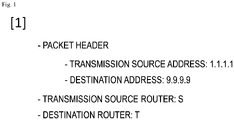
- a transmission source address of a packet header is 1.1.1.1
- a reception address is 9.9.9.9
- a transmission source router is S
- a destination router is T.
- the settings of a router are changed to satisfy an operational policy.
- a reachability graph This is a directed graph used to evaluate the reachability of a packet. Vertices consist of routers and interfaces. However, the interfaces are sorted into inputs and outputs, and are prepared as pairs. An edge is set between the interfaces that are connected or between a router and an interface. When the network in Fig. 2 is expressed by a reachability graph, Fig. 3 is obtained. In the drawing, S, T, A, and B are routers, and e0 and e1 are interfaces.
- a method of evaluating a reachable range is not limited.
- a packet may be transmitted from a router of an actual network or may be simulatively evaluated by a simulator.
- the high speed simulator is technically referred to as a control-plane verifier, and capable of evaluating reachability between designated interfaces using a function reachability. Because the high speed simulator can evaluate a reachability at the time of updating settings in a short period of time without waiting for convergence of a route control protocol, approaches of attempting various settings as in the proposed technology are practical.
- Fig. 4 illustrates an example of the display of a reachable range on a reachability graph.
- a dashed line indicates a range in which a packet reaches a destination router when the packet and the destination router are given in accordance with a policy in certain router settings.
- the packet transmitted from a router A reaches a router T, but neither the packet transmitted from a router S nor B reaches the router T.
- the packet is also transmitted from the other routers even when a true transmission source is the router S, and a portion that causes this is identified by clarifying a reachable range.
- Inputs of a network settings method are as follows.
- an output in the network settings method is as follows.
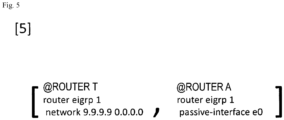
- a setting update command is a pair constituted by a router that executes the command and the command itself ( Fig. 5 ).
- the commands in the present disclosure include any commands related to the reachability of a packet.
- the commands are setting commands related to an interface address, a route control protocol, and an access control list.
- a network setting method which is a method for searching for a command sequence to be set for a plurality of network devices, includes performing a first step for determining whether a network having executed a temporary update command sequence satisfies a predetermined operational policy, and includes executing, until satisfaction for the predetermined operational policy, processing for: performing a second step for determining whether a reachable range of a packet expands with addition of one new candidate command of one or more new candidate commands to the temporary update command sequence on condition that the predetermined operational policy is not satisfied; adding the new candidate command to the temporary update command sequence on condition that the reachable range expands with the addition of the new candidate command, or deleting a command at the end of the temporary update command sequence on condition that the reachable range does not expand with addition of any one of the new commands; and then returning to the first step.
- the proposed technology will be described based on a network settings method.
- a command is executed to update the settings of a router, and a reachable range of a packet is expanded.
- the command sequence is output as a response.
- a state where a command sequence serving as a response is searched for can be represented as a search tree.
- an environment in which commands are attempted may be an actual network or may be a simulator.
- an actual network and a simulator are used together for an environment in which commands are attempted.
- system states packet reachable ranges
- packet reachable ranges at the time of inputting a command may not match in an actual network and a simulator.
- reachable ranges drawn at nodes of a search tree are different, commands to be executed thereafter may also be different, and thus there is a possibility that final search trees and setting update command sequences will also be different.
- Fig. 6 illustrates an example of a system configuration of the present disclosure.
- the execution procedure searching device of the present disclosure includes an actual network reachability evaluation unit 11, a simulator reachability evaluation unit 16, a candidate command generation unit 12, and a control unit 13.
- the device according to the present disclosure can be implemented using a computer and a program, and the program can be recorded in a recording medium or provided through a network.
- the execution procedure searching device is communicatively connected to an actual network and a simulator which are not illustrated in the drawings.
- the candidate command generation unit 12 generates candidate commands.
- the commands are commands that can be used in a router constituting an actual network.
- a command used in the simulator may be the same command as that in the actual network, but may be any command equivalent to a command in the actual network.
- the control unit 13 causes the actual network and the simulator to execute the command generated by the candidate command generation unit 12.
- the actual network reachability evaluation unit 11 determines a reachable range of a packet in executing a command in the actual network.
- the simulator reachability evaluation unit 16 determines a reachable range of a packet in executing a command in the simulator.
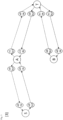
- Fig. 7 is a search tree of searching for a setting update command sequence only in an actual network.
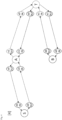
- Fig. 8 is a search tree of searching for a setting update command sequence only in a simulator. Nodes of a simulator search tree are primed and referred to as T'0, T'1, and the like.
- Goal (C) for determining whether a certain command sequence C satisfies a policy is defined. According to this function, true is returned as in the following expression when C satisfies the policy. [Math. 11] ⁇ False is returned as in the following expression when C does not satisfy the policy. [Math. 12] ⁇ Additionally, a function of performing determination in an actual network is defined as Goal r , and a function of performing determination in a simulator is defined as Goal s .
- Fig. 7 illustrates an actual network, Goal, is used.
- a reachable range in the initial settings is shown at a node T0 in Fig. 7 .
- No packet from any router reach the destination except for a router T that works as a destination.
- the candidate command generation unit 12 generates some candidate commands.
- this generation method is not limited.
- the candidate command generation unit 12 may select a candidate command from a predetermined command set, or may select a command suitable for the current settings and a reachable range by machine learning. While NPL 1 limits a target command type to route information exchange, the proposed technology can handle any command.
- control unit 13 causes the actual network to execute a command (@router B%) that is given to a branch from the root T0 to the node T1.
- This command executes "interface e0; no ip access-group 1 out" in the router B.
- the actual network reachability evaluation unit 11 determines that a packet from the router B reaches the router T.
- the control unit 13 executes a command (@router T%) which is given to a branch from the root T0 to the node T2.
- This command executes "router eigrp 1;network 9.9.9.9 0.0.0.0" in the router T.
- the control unit 13 executes a command (@router A%) which is given to a branch from the root T2 to the node T3.
- This command executes "router eigrp 1;no passiveinterface e0" in the router A.
- the actual network reachability evaluation unit 11 determines that a packet from the router S reaches the destination router T.
- the actual network reachability evaluation unit 11 returns true only for a command sequence C 3 with respect to the node T3.
- Goal r C 3 ⁇
- a route may be established even when a route is not established in the actual network due to an incorrect timer value.
- Goal r C ⁇
- Goal s C ⁇
- the control unit 13 starts the contact point T0, which is the root in Fig. 7 , and obtains the command sequence C 1 at the contact point T1 from the candidate command generation unit 12, but it is assumed that the following has been returned from the actual network reachability evaluation unit 11.
- Goal r C 1 ⁇ It is assumed that the control unit 13 does not have a command to proceed from the contact point T1 (the reachable range can be expanded) and returns to the contact point T0.
- control unit 13 proceeds to the contact point T2 to obtain the command sequence C 2 from the candidate command generation unit 12, but it is assumed that the following has been returned from the actual network reachability evaluation unit 11.
- Goal r C 2 ⁇
- the control unit 13 further proceeds to a contact point T4 to obtain a command sequence C 4 from the candidate command generation unit 12, but it is assumed that the following has been returned from the actual network reachability evaluation unit 11.
- Goal r C 4 ⁇
- the control unit 13 does not have a command to proceed from the contact point T4 and returns to the contact point T2.
- the control unit 13 proceeds to a contact point T3 to obtain a command sequence C 3 from the candidate command generation unit 12, and confirms that the policy is satisfied by the following being returned from the actual network reachability evaluation unit 11.
- Goal r C 4 ⁇
- the control unit 13 has evaluated the respective reachable ranges through five nodes including the contact point T0.
- Fig. 6 illustrates a system configuration
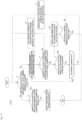
- Fig. 9 is a flowchart illustrating the control unit 13.
- An operational policy in the actual network, topology information of the actual network, and setting information of routers constituting the actual network are input to the input unit 14 of the execution procedure searching device. For settings, a reachable range is displayed at each node, instead of showing specific contents.
- the control unit 13 evaluates a reachable range for each of the candidate commands of the candidate command generation unit 12 (F1 in Fig. 9 ), and adds a command to a temporary update command sequence 15 when the range expands, which is the same as in the network settings method.
- a new node is created in the search tree.
- the control unit 13 searches for a setting update command sequence that satisfies the policy in accordance with the flowchart of Fig. 9 .
- a command C 1 (@router B7) which is given to a branch to a contact point T'1 is executed, and the expansion of the reachable range is confirmed (F1 in Fig. 9 ) to create the contact point T'1.
- control unit 13 evaluates a reachable range of the simulator reachability evaluation unit 16 (F0 in Fig. 9 ), and acquires the following from the simulator reachability evaluation unit 16.
- Goal s C 1 ⁇
- the control unit returns to the contact point T'0.
- control unit 13 proceeds to a contact point T'2 to obtain a command sequence C 2 (@router T%), and acquires the following from the simulator reachability evaluation unit 16.
- Goal s C 2 ⁇
- the control unit 13 further proceeds to a contact point T'4 to obtain a command sequence C 4 , and acquires the following that satisfies the policy from the simulator reachability evaluation unit 16.
- Goal s C 4 ⁇
- control unit 13 proceeds to F2 in Fig. 9 , and executes C 4 in the actual network to evaluate a reachable range.
- the policy is not satisfied. That is, the following is acquired from the actual network reachability evaluation unit 11.
- Goal r C 4 ⁇
- the control unit 13 follows the contact points T'2 and T'3, evaluates a reachable range of the command sequence C 3 by the simulator reachability evaluation unit 16, and finds that the policy is satisfied by acquiring the following.
- Goal s C 3 ⁇
- control unit 13 executes a command C 3 in the actual network and confirms that the policy is satisfied.
- Goal r C 3 ⁇ Because a result in F2 in Fig. 9 is "YES", a temporary update command sequence C 3 is output, and the processing ends.
- a reachable range is evaluated in each of five nodes including the contact point T'0.
- a reachable range is only evaluated in two nodes of the contact points T4 and T3.
- a system configuration is the same as that in Fig. 6 in the previous section.
- a flowchart of the control unit 13 is illustrated in Fig. 10 .
- the searching proceeds in the same manner as in the previous section, and it is assumed that the searching has proceeded to the evaluation of a reachable range of a command C 2 given to an edge from the contact point T'0 to the contact point T'2.
- step F1 in Fig. 10 the reachable range of the command C 2 is evaluated using the simulator, but it is assumed that the reachable range has not expanded this time (this is the same as the reachable range in the initial settings).
- step F3 in Fig. 10 it is stochastically determined whether to perform evaluation in the actual network. For example, when the probability is 10%, a method of generating random numbers of 0 to 1 and performing evaluation when the random number is 0.1 or less is conceivable. It is assumed that the random number is 0.1 and a reachable range is evaluated in the actual network. Then, as at the contact point T1 in Fig. 7 , it can be understood that a reachable range expands in the actual network. That is, the simulator cannot correctly evaluate the command C 2 , and hereinafter, the node T1 and the subsequent nodes are switched to searching in the actual network.
- the present disclosure provides a method for searching for a command sequence to be set for a plurality of devices constituting a system, the method including performing a first step F0 for determining whether a simulator of the system having executed a temporary update command sequence satisfies a predetermined policy, and including executing, until satisfaction for the predetermined policy of the simulator, processing for: performing a second step F 1 for determining whether the simulator approaches a state where the predetermined policy is satisfied, with addition of one new candidate command of one or more new candidate commands to the temporary update command sequence on condition that the simulator does not satisfy the predetermined policy; adding the new candidate command to the temporary update command sequence on condition that the simulator approaches the state where the predetermined policy is satisfied, with the addition of the new candidate command (S01), or deleting a command at the end of the temporary update command sequence (S02) on condition that the simulator does not approach the state where the predetermined policy is satisfied, with addition of any one of the new commands; and then returning to the first step F0, and including:
- An execution procedure (setting update command sequence) is searched for, while preventing overlooking as much as possible, in a shorter period of time than that of searching using only an actual system.
- an actual network constituted by a plurality of routers and a simulator thereof have been described in the above-described embodiments
- the present disclosure can be applied to any system constituted by a plurality of devices and a simulator thereof.
- the plurality of devices may be a plurality of virtual devices constructed on one physical resource.
- the simulator proceeds with searching first, and the actual network performs a final check, whereby it is possible to reduce a searching time while avoiding overlooking. Even when the simulator has false negatives, evaluation is stochastically performed in the actual network, and thus it is possible to reduce a searching time while avoiding overlooking.
- the present disclosure can be applied in the information communication industry.
Landscapes
- Engineering & Computer Science (AREA)
- Signal Processing (AREA)
- Computer Networks & Wireless Communication (AREA)
- Theoretical Computer Science (AREA)
- Physics & Mathematics (AREA)
- General Engineering & Computer Science (AREA)
- General Physics & Mathematics (AREA)
- Computer Hardware Design (AREA)
- Evolutionary Computation (AREA)
- Geometry (AREA)
- Quality & Reliability (AREA)
- Data Exchanges In Wide-Area Networks (AREA)
- Test And Diagnosis Of Digital Computers (AREA)
Abstract
Description
- In the present disclosure, an execution procedure for causing a system to transition to a target state is searched for. In particular, an execution procedure is searched for in the shortest time possible while using an actual system that takes time to perform execution and a pseudo-environment that is fast but not completely accurate. A system described in the present disclosure is constituted by a network device such as a router, but a method is not limited to a network device.
- In artificial systems including a network, an operator executes a procedure such as a command to change settings and make a system transition to a target state. For example, a network operator may execute a command such as address and a route control protocol on a network device such as a router, and updates settings. The router generates a routing table according to settings and transfers a packet. When the settings contain an error, the packet does not reach the destination according to an operational policy, and a failure occurs. When a failure occurs, a network operator identifies the router that is the cause and executes a restoration command to update the settings (performs a transition to a target state where no failure occurs).
- In recent years, many studies have been carried out on automatic restoration from a failure. Simply, a method of searching for a command sequence to realize a target state while attempting various commands in an actual system is conceivable. Although this method is accurate because an actual system is used, it takes time to actually execute the system. For example, in the case of a network, a waiting time of several tens of seconds is required for route convergence.
- On the other hand, as disclosed in
NPL 1, a method using a pseudo-environment (simulator) in which a system is simply modeled has also been studied. This method can be executed in a shorter period of time than in an actual system, but no errors associated with modeling are avoided. Even a command sequence that has realized a target state on a model may not realize a target state in an actual system. In contrast, a command sequence for making an actual system transition to a target state may not reach a target state on a model. -
- NPL 1: A. Gember-Jacobson, A. Akella, R. Mahajan, and H. H. Liu, "Automatically repairing network control planes using an abstract representation," in Proceedings of the 26th Symposium on Operating Systems Principles, ser. SOSP '17. New York, NY, USA: ACM, 2017, pp. 359-373. (http://doi.acm.org/10.1145/3132747.3132753)
- NPL 2: Batfish, https://www.batfish.org
- An object of the present disclosure is to search for a command sequence, while preventing overlooking as much as possible, in a shorter period of time than that of searching using only an actual system.
- The present disclosure aims to shorten a period of time required to obtain a candidate command sequence by using an actual network and a simulator together.
- A device according to the present disclosure is an execution procedure searching device that searches for a command sequence to be set for a plurality of devices constituting a system. The execution procedure searching device performs a first step for determining whether a simulator of the system having executed a temporary update command sequence satisfies a predetermined policy, and executes, until satisfaction for the predetermined policy of the simulator, processing for: performing a second step of determining whether the simulator approaches a state where the predetermined policy is satisfied, with addition of one new candidate command of one or more new candidate commands to the temporary update command sequence on condition that the simulator does not satisfy the predetermined policy; adding the new candidate command to the temporary update command sequence on condition that the simulator approaches the state where the predetermined policy is satisfied, with the addition of the new candidate commands, or deleting a command at the end of the temporary update command sequence on condition that the simulator does not approach the state where the predetermined policy is satisfied, with addition of any one of the new candidate commands; and then returning to the first step, and performs a third step for determining whether the actual system having executed the temporary update command sequence satisfies the predetermined policy on condition that the simulator satisfies the predetermined policy, and executes processing for returning to the second step until satisfaction for the predetermined policy of the actual system, on condition that the actual system does not satisfy the predetermined policy.
- A method according to the present disclosure is an execution procedure searching method executed by an execution procedure searching device that searches for a command sequence to be set for a plurality of devices constituting a system. The execution procedure searching method includes performing, by the execution procedure searching device, a first step for determining whether a simulator of the system having executed a temporary update command sequence satisfies a predetermined policy,and includes executing, until satisfaction for the predetermined policy of the simulator, processing for: performing, by the execution procedure searching device, a second step for determining whether the simulator approaches a state where the predetermined policy is satisfied, with addition of one new candidate command of one or more new candidate commands to the temporary update command sequence on condition that the simulator does not satisfy the predetermined policy; adding, by the execution procedure searching device, the new candidate command to the temporary update command sequence on condition that the simulator approaches the state where the predetermined policy is satisfied, with the addition of the new candidate command, or deleting, by the execution procedure searching device, a command at the end of the temporary update command sequence on condition that the simulator does not approach the state where the predetermined policy is satisfied, with addition of any one of the new candidate commands; and then returning, by the execution procedure searching device, to the first step, and includes: performing, by the execution procedure searching device, a third step for determining whether the actual system having executed the temporary update command sequence satisfies the predetermined policy on condition that the simulator satisfies the predetermined policy; and executing, by the execution procedure searching device, processing for returning to the second step until satisfaction for the predetermined policy of the actual system, on condition that the actual system does not satisfy the predetermined policy.
- A program according to the present disclosure is a program for causing a computer to implement functions included in the execution procedure searching device according to the present disclosure, and is a program for causing the computer to execute steps included in the execution procedure searching method according to the present disclosure.
- According to the present disclosure, it is possible to search for a command sequence, while preventing overlooking as much as possible, in a shorter period of time than that of searching using only an actual system is used.
-
-
Fig. 1 illustrates an example of an operational policy. -
Fig. 2 illustrates an example of a network configuration. -
Fig. 3 illustrates an example of a reachability graph. -
Fig. 4 illustrates an example of the display of a reachable range using a reachability graph. -
Fig. 5 is a setting update command sequence in the network settings method. -
Fig. 6 is a system configuration diagram illustrating an example of the present disclosure. -
Fig. 7 illustrates an example of a search tree of an actual network. -
Fig. 8 illustrates an example of a search tree of a simulator. -
Fig. 9 is an example of a flowchart of a control unit where Formula (1) is satisfied. -
Fig. 10 is an example of a flowchart of a control unit where Formula (1) is not satisfied. - Hereinafter, embodiments of the present disclosure will be described in detail with reference to the drawings. Note that the present disclosure is not limited to the embodiments described below. These embodiments are just illustrative examples, and the present disclosure can be implemented in forms in which various modifications and improvements are added on the basis of knowledge of those skilled in the art. Note that constituent elements with the same reference signs in the specification and the drawings are assumed to be the same constituent elements.
- An operational policy to be satisfied by a network will be defined. The operational policy is defined by a set of three, that is, a packet header, a transmission source router, and a destination router. In the packet header, information of a higher layer, such as a port number, may be defined in addition to a transmission source address and a destination address. For example, in
Fig. 1 , a transmission source address of a packet header is 1.1.1.1, a reception address is 9.9.9.9, a transmission source router is S, and a destination router is T. In the proposed technology, the settings of a router are changed to satisfy an operational policy. - Next, a reachability graph will be defined. This is a directed graph used to evaluate the reachability of a packet. Vertices consist of routers and interfaces. However, the interfaces are sorted into inputs and outputs, and are prepared as pairs. An edge is set between the interfaces that are connected or between a router and an interface. When the network in
Fig. 2 is expressed by a reachability graph,Fig. 3 is obtained. In the drawing, S, T, A, and B are routers, and e0 and e1 are interfaces. - In the present disclosure, a method of evaluating a reachable range is not limited. A packet may be transmitted from a router of an actual network or may be simulatively evaluated by a simulator. Note that the present disclosure is based on the advent of a high speed simulator such as Batfish (NPL 2). The high speed simulator is technically referred to as a control-plane verifier, and capable of evaluating reachability between designated interfaces using a function reachability. Because the high speed simulator can evaluate a reachability at the time of updating settings in a short period of time without waiting for convergence of a route control protocol, approaches of attempting various settings as in the proposed technology are practical.
-
Fig. 4 illustrates an example of the display of a reachable range on a reachability graph. A dashed line indicates a range in which a packet reaches a destination router when the packet and the destination router are given in accordance with a policy in certain router settings. In this example, the packet transmitted from a router A reaches a router T, but neither the packet transmitted from a router S nor B reaches the router T. The packet is also transmitted from the other routers even when a true transmission source is the router S, and a portion that causes this is identified by clarifying a reachable range. - Inputs of a network settings method are as follows.
- Topology (a router, an interface, and a connection relationship between interfaces)
- Settings of each router
- Operational policy
- In the network settings method, a reachable range of a packet described in an operational policy is evaluated in accordance with a topology and router settings, and a command sequence necessary for setting update is output in the state of inconsistency with the policy. That is, an output in the network settings method is as follows.
- Note that a setting update command is a pair constituted by a router that executes the command and the command itself (
Fig. 5 ). In addition, the commands in the present disclosure include any commands related to the reachability of a packet. Specifically, the commands are setting commands related to an interface address, a route control protocol, and an access control list. - A network setting method according to the present disclosure, which is a method for searching for a command sequence to be set for a plurality of network devices, includes performing a first step for determining whether a network having executed a temporary update command sequence satisfies a predetermined operational policy, and includes executing, until satisfaction for the predetermined operational policy, processing for: performing a second step for determining whether a reachable range of a packet expands with addition of one new candidate command of one or more new candidate commands to the temporary update command sequence on condition that the predetermined operational policy is not satisfied; adding the new candidate command to the temporary update command sequence on condition that the reachable range expands with the addition of the new candidate command, or deleting a command at the end of the temporary update command sequence on condition that the reachable range does not expand with addition of any one of the new commands; and then returning to the first step.
- In the present disclosure, the proposed technology will be described based on a network settings method. In the network settings method, a command is executed to update the settings of a router, and a reachable range of a packet is expanded. When a reachable range is expanded by some commands and an operational policy is satisfied, the command sequence is output as a response. In the network settings method, a state where a command sequence serving as a response is searched for can be represented as a search tree. Note that, in a network device setting method, an environment in which commands are attempted may be an actual network or may be a simulator. In the present disclosure, an actual network and a simulator are used together for an environment in which commands are attempted.
- As described in the problem, system states (packet reachable ranges) at the time of inputting a command may not match in an actual network and a simulator. When reachable ranges drawn at nodes of a search tree are different, commands to be executed thereafter may also be different, and thus there is a possibility that final search trees and setting update command sequences will also be different.
- The only way to confirm the correctness of a command sequence is to attempt the command sequence on an actual network, but it is attempted to reduce a period of time therefor by using a simulator in combination therewith. In addition, overlooking of correct command sequences is avoided as much as possible.
-
Fig. 6 illustrates an example of a system configuration of the present disclosure. The execution procedure searching device of the present disclosure includes an actual networkreachability evaluation unit 11, a simulatorreachability evaluation unit 16, a candidatecommand generation unit 12, and acontrol unit 13. The device according to the present disclosure can be implemented using a computer and a program, and the program can be recorded in a recording medium or provided through a network. - The execution procedure searching device according to the present disclosure is communicatively connected to an actual network and a simulator which are not illustrated in the drawings.
The candidatecommand generation unit 12 generates candidate commands. The commands are commands that can be used in a router constituting an actual network. A command used in the simulator may be the same command as that in the actual network, but may be any command equivalent to a command in the actual network.
Thecontrol unit 13 causes the actual network and the simulator to execute the command generated by the candidatecommand generation unit 12.
The actual networkreachability evaluation unit 11 determines a reachable range of a packet in executing a command in the actual network.
The simulatorreachability evaluation unit 16 determines a reachable range of a packet in executing a command in the simulator. -
Fig. 7 is a search tree of searching for a setting update command sequence only in an actual network.Fig. 8 is a search tree of searching for a setting update command sequence only in a simulator. Nodes of a simulator search tree are primed and referred to as T'0, T'1, and the like. - A function Goal (C) for determining whether a certain command sequence C satisfies a policy is defined. According to this function, true is returned as in the following expression when C satisfies the policy.
[Math. 11]
[Math. 12]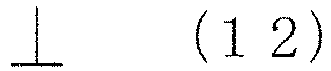
- An example in
Fig. 7 will be described. BecauseFig. 7 illustrates an actual network, Goal, is used. A reachable range in the initial settings is shown at a node T0 inFig. 7 . No packet from any router reach the destination except for a router T that works as a destination. - Next, the candidate
command generation unit 12 generates some candidate commands. In this specification, this generation method is not limited. The candidatecommand generation unit 12 may select a candidate command from a predetermined command set, or may select a command suitable for the current settings and a reachable range by machine learning. WhileNPL 1 limits a target command type to route information exchange, the proposed technology can handle any command. - Subsequently, the
control unit 13 causes the actual network to execute a command (@router B...) that is given to a branch from the root T0 to the node T1. This command executes "interface e0; no ip access-group 1 out" in the router B. The actual networkreachability evaluation unit 11 determines that a packet from the router B reaches the router T. - Because the router S which is a transmission source is not included in the reachable range at the contact point T1, the policy is not satisfied. Thus, when the
control unit 13 gives a command sequence C1 ("interface e0; no ip access-group 1 out" is executed in the router B) with respect to the contact point T1 to Goalr, the actual networkreachability evaluation unit 11 returns false.
[Math. 13]
- Subsequently, the
control unit 13 executes a command (@router T...) which is given to a branch from the root T0 to the node T2. This command executes "router eigrp 1;network 9.9.9.9 0.0.0.0" in the router T. The actual networkreachability evaluation unit 11 determines that a packet from the router A reaches the router T. Because the router S which is a transmission source is not included in the reachable range at a contact point T2, the policy is not satisfied. Thus, the actual networkreachability evaluation unit 11 also returns false for a command sequence C2 (router T...) with respect to the contact point T2.
[Math. 14]
- Subsequently, the
control unit 13 executes a command (@router A...) which is given to a branch from the root T2 to the node T3. This command executes "router eigrp 1;no passiveinterface e0" in the router A. The actual networkreachability evaluation unit 11 determines that a packet from the router S reaches the destination router T. The actual networkreachability evaluation unit 11 returns true only for a command sequence C3 with respect to the node T3.
[Math. 15]
- Here, it is assumed that the function Goal, and Goal, satisfy the following.
[Math. 1]
- For example, in a simulator that does not cope with timer processing of a route control protocol, a route may be established even when a route is not established in the actual network due to an incorrect timer value. In this example,
[Math. 16]
[Math. 17]
- In addition, a simulator often may not cope with some commands, where Formula (1) is satisfied when the following is defined.
[Math. 18]
- Execution procedure searching using only the actual network (
Fig. 7 ) will be described as a target for comparison with the proposed technology. Operations are the same as those in the network settings method, but description will be given using Goal defined in the preceding section. - The
control unit 13 starts the contact point T0, which is the root inFig. 7 , and obtains the command sequence C1 at the contact point T1 from the candidatecommand generation unit 12, but it is assumed that the following has been returned from the actual networkreachability evaluation unit 11.
[Math. 19]
control unit 13 does not have a command to proceed from the contact point T1 (the reachable range can be expanded) and returns to the contact point T0. - Next, the
control unit 13 proceeds to the contact point T2 to obtain the command sequence C2 from the candidatecommand generation unit 12, but it is assumed that the following has been returned from the actual networkreachability evaluation unit 11.
[Math. 20]
- The
control unit 13 further proceeds to a contact point T4 to obtain a command sequence C4 from the candidatecommand generation unit 12, but it is assumed that the following has been returned from the actual networkreachability evaluation unit 11.
[Math. 21]
- The
control unit 13 does not have a command to proceed from the contact point T4 and returns to the contact point T2. Thecontrol unit 13 proceeds to a contact point T3 to obtain a command sequence C3 from the candidatecommand generation unit 12, and confirms that the policy is satisfied by the following being returned from the actual networkreachability evaluation unit 11.
[Math. 22]
- So far, the
control unit 13 has evaluated the respective reachable ranges through five nodes including the contact point T0. When it is assumed that a period of time taken to evaluate the reachable ranges is 60 seconds, it takes 5 × 60 = 300 seconds. - In the proposed technology, an actual network and a simulator are used together. In the present section, execution procedure searching based on the proposed technology, provided that Formula (1) is satisfied, will be described.
Fig. 6 illustrates a system configuration, andFig. 9 is a flowchart illustrating thecontrol unit 13. - An operational policy in the actual network, topology information of the actual network, and setting information of routers constituting the actual network are input to the
input unit 14 of the execution procedure searching device. For settings, a reachable range is displayed at each node, instead of showing specific contents. - The
control unit 13 evaluates a reachable range for each of the candidate commands of the candidate command generation unit 12 (F1 inFig. 9 ), and adds a command to a temporaryupdate command sequence 15 when the range expands, which is the same as in the network settings method. When the reachable range expands, a new node is created in the search tree. - The
control unit 13 searches for a setting update command sequence that satisfies the policy in accordance with the flowchart ofFig. 9 . Starting from a contact point T'0 of the search tree of the simulator, a command C1 (@router B...) which is given to a branch to a contact point T'1 is executed, and the expansion of the reachable range is confirmed (F1 inFig. 9 ) to create the contact point T'1. - Specifically, the
control unit 13 evaluates a reachable range of the simulator reachability evaluation unit 16 (F0 inFig. 9 ), and acquires the following from the simulatorreachability evaluation unit 16.
[Math. 23]
- Next, the
control unit 13 proceeds to a contact point T'2 to obtain a command sequence C2 (@router T...), and acquires the following from the simulatorreachability evaluation unit 16.
[Math. 24]
- The
control unit 13 further proceeds to a contact point T'4 to obtain a command sequence C4, and acquires the following that satisfies the policy from the simulatorreachability evaluation unit 16.
[Math. 25]
- Here, the
control unit 13 proceeds to F2 inFig. 9 , and executes C4 in the actual network to evaluate a reachable range. However, it can be understood that the policy is not satisfied. That is, the following is acquired from the actual networkreachability evaluation unit 11.
[Math. 26]
- The
control unit 13 follows the contact points T'2 and T'3, evaluates a reachable range of the command sequence C3 by the simulatorreachability evaluation unit 16, and finds that the policy is satisfied by acquiring the following.
[Math. 27]
- Subsequently, the
control unit 13 executes a command C3 in the actual network and confirms that the policy is satisfied.
[Math. 28]
Fig. 9 is "YES", a temporary update command sequence C3 is output, and the processing ends. - In the search tree of the simulator, a reachable range is evaluated in each of five nodes including the contact point T'0. On the other hand, in the actual network, a reachable range is only evaluated in two nodes of the contact points T4 and T3. When a period of time for the evaluation of a reachable range in the simulator is set to 1 second, the searching can be completed in a total of 5 × 1 + 2 × 60 = 125 seconds, which is shorter than a time, namely 300 seconds, taken by searching using only the actual network.
- Note that, as long as Formula (1) is satisfied, a command sequence that is true in the actual network is also true in the simulator, and thus a command sequence satisfying the policy will not be overlooked.
- Proposed Technology: Example where Formula (1) is not Satisfied In the present section, execution procedure searching where Formula (1) is not satisfied will be described. In this example, even when it is evaluated that a policy is not satisfied in the simulator, there is a possibility that the policy will be satisfied in the actual network. Consequently, in evaluating a reachable range in the simulator, the reachable range is compared with a reachable range in the actual network with a fixed probability. When the range in the actual network is wider, the searching in the simulator is stopped and switched to searching in the actual network.
- A system configuration is the same as that in
Fig. 6 in the previous section. A flowchart of thecontrol unit 13 is illustrated inFig. 10 . The searching proceeds in the same manner as in the previous section, and it is assumed that the searching has proceeded to the evaluation of a reachable range of a command C2 given to an edge from the contact point T'0 to the contact point T'2. In step F1 inFig. 10 , the reachable range of the command C2 is evaluated using the simulator, but it is assumed that the reachable range has not expanded this time (this is the same as the reachable range in the initial settings). - Then, the processing proceeds to step F3 in
Fig. 10 , and it is stochastically determined whether to perform evaluation in the actual network. For example, when the probability is 10%, a method of generating random numbers of 0 to 1 and performing evaluation when the random number is 0.1 or less is conceivable. It is assumed that the random number is 0.1 and a reachable range is evaluated in the actual network. Then, as at the contact point T1 inFig. 7 , it can be understood that a reachable range expands in the actual network. That is, the simulator cannot correctly evaluate the command C2, and hereinafter, the node T1 and the subsequent nodes are switched to searching in the actual network. - Specifically, a network settings method is only required to be executed on the actual network by including a temporary update command sequence at that point in time (C2 this time) in the initial settings of the router. Finally, the following is found ("YES" in S05), and a command C3 is output to terminate the processing (S03).
[Math. 29]
- In this manner, although it is stochastic, a command sequence that satisfies the policy can be searched for while avoiding overlooking.
- As described above, the present disclosure provides a method for searching for a command sequence to be set for a plurality of devices constituting a system, the method including performing a first step F0 for determining whether a simulator of the system having executed a temporary update command sequence satisfies a predetermined policy, and including executing, until satisfaction for the predetermined policy of the simulator, processing for: performing a
second step F 1 for determining whether the simulator approaches a state where the predetermined policy is satisfied, with addition of one new candidate command of one or more new candidate commands to the temporary update command sequence on condition that the simulator does not satisfy the predetermined policy;
adding the new candidate command to the temporary update command sequence on condition that the simulator approaches the state where the predetermined policy is satisfied, with the addition of the new candidate command (S01), or deleting a command at the end of the temporary update command sequence (S02) on condition that the simulator does not approach the state where the predetermined policy is satisfied, with addition of any one of the new commands; and then returning to the first step F0, and including: - performing a third step F2 for determining whether the actual system having executed the temporary update command sequence satisfies the predetermined policy on condition that the simulator satisfies the predetermined policy ("YES" in F0); and
- executing processing for returning to the second step F1 until satisfaction for the predetermined policy of the actual system ("YES" in F2), on condition that the actual system does not satisfy the predetermined policy.
- An execution procedure (setting update command sequence) is searched for, while preventing overlooking as much as possible, in a shorter period of time than that of searching using only an actual system. While examples of an actual network constituted by a plurality of routers and a simulator thereof have been described in the above-described embodiments, the present disclosure can be applied to any system constituted by a plurality of devices and a simulator thereof. Here, the plurality of devices may be a plurality of virtual devices constructed on one physical resource.
- When there is an evaluation environment in which a trade-off occurs between accuracy and an execution speed as in an actual network and a simulator, and the simulator has no false negatives, the simulator proceeds with searching first, and the actual network performs a final check, whereby it is possible to reduce a searching time while avoiding overlooking. Even when the simulator has false negatives, evaluation is stochastically performed in the actual network, and thus it is possible to reduce a searching time while avoiding overlooking.
- The present disclosure can be applied in the information communication industry.
-
- 11 Actual network reachability evaluation unit
- 12 Candidate command generation unit
- 13 Control unit
- 14 Input unit
- 15 Temporary update command sequence
- 16 Simulator reachability evaluation unit
Claims (3)
- An execution procedure searching device that searches for a command sequence to be set for a plurality of devices constituting a system, wherein the execution procedure searching device performs a first step for determining whether a simulator of the system having executed a temporary update command sequence satisfies a predetermined policy, and executes, until satisfaction for the predetermined policy of the simulator, processing for:performing a second step for determining whether the simulator approaches a state where the predetermined policy is satisfied, with addition of one new candidate command of one or more new candidate commands to the temporary update command sequence on condition that the simulator does not satisfy the predetermined policy;adding the new candidate command to the temporary update command sequence on condition that the simulator approaches the state where the predetermined policy is satisfied, with the addition of the new candidate command, or deleting a command at the end of the temporary update command sequence on condition that the simulator does not approach the state where the predetermined policy is satisfied, with addition of any one of the new candidate commands; and thenreturning to the first step, andperforms a third step for determining whether the actual system having executed the temporary update command sequence satisfies the predetermined policy on condition that the simulator satisfies the predetermined policy, andexecutes processing for returning to the second step until satisfaction for the predetermined policy of the actual system, on condition that the actual system does not satisfy the predetermined policy.
- An execution procedure searching method executed by an execution procedure searching device that searches for a command sequence to be set for a plurality of devices constituting a system, the execution procedure searching method comprising performing, by the execution procedure searching device, a first step for determining whether a simulator of the system having executed a temporary update command sequence satisfies a predetermined policy and comprising executing, until satisfaction for the predetermined policy of the simulator, processing for:performing, by the execution procedure searching device, a second step for determining whether the simulator approaches a state where the predetermined policy is satisfied, with addition of one new candidate command of one or more new candidate commands to the temporary update command sequence on condition that the simulator does not satisfy the predetermined policy;adding, by the execution procedure searching device, the new candidate command to the temporary update command sequence on condition that the simulator approaches the state where the predetermined policy is satisfied, with the addition of the new candidate commands, or deleting, by the execution procedure searching device, a command at the end of the temporary update command sequence on condition that the simulator does not approach the state where the predetermined policy is satisfied, with sddition of any one of the new candidate commands; and thenreturning, by the execution procedure searching device, to the first step, and comprising:performing, by the execution procedure searching device, a third step for determining whether the actual system having executed the temporary update command sequence satisfies the predetermined policy on condition that the simulator satisfies the predetermined policy; andexecuting, by the execution procedure searching device, processing for returning to the second step until satisfaction for the predetermined policy of the actual system, on condition that the actual system does not satisfy the predetermined policy.
- An execution procedure searching program for causing a computer to implement functions included in the execution procedure searching device according to claim 1.
Applications Claiming Priority (1)
| Application Number | Priority Date | Filing Date | Title |
|---|---|---|---|
| PCT/JP2020/017124 WO2021214848A1 (en) | 2020-04-21 | 2020-04-21 | Execution procedure searching device, method, and program |
Publications (3)
| Publication Number | Publication Date |
|---|---|
| EP4141678A1 true EP4141678A1 (en) | 2023-03-01 |
| EP4141678A4 EP4141678A4 (en) | 2023-12-27 |
| EP4141678B1 EP4141678B1 (en) | 2025-04-09 |
Family
ID=78270917
Family Applications (1)
| Application Number | Title | Priority Date | Filing Date |
|---|---|---|---|
| EP20932280.9A Active EP4141678B1 (en) | 2020-04-21 | 2020-04-21 | Execution procedure searching device, method, and program |
Country Status (4)
| Country | Link |
|---|---|
| US (1) | US20230138720A1 (en) |
| EP (1) | EP4141678B1 (en) |
| JP (1) | JP7276601B2 (en) |
| WO (1) | WO2021214848A1 (en) |
Family Cites Families (9)
| Publication number | Priority date | Publication date | Assignee | Title |
|---|---|---|---|---|
| JP2001075816A (en) * | 1999-09-08 | 2001-03-23 | Sony Corp | Program conversion device and method, program manufacturing device, and program recording medium |
| US20050165919A1 (en) * | 2004-01-09 | 2005-07-28 | Lu Qian | System and method to simulate and manage a wireless local area network (WLAN) |
| US8429255B1 (en) * | 2010-01-27 | 2013-04-23 | Juniper Networks, Inc. | Determining reorder commands for remote reordering of policy rules |
| DE112014002985B4 (en) * | 2014-04-30 | 2019-04-11 | Mitsubishi Electric Corporation | Simulation system and programmable controller |
| US9721052B1 (en) * | 2015-08-27 | 2017-08-01 | Cadence Design Systems, Inc. | Concurrent design process |
| US10404700B1 (en) * | 2015-08-27 | 2019-09-03 | Cadence Design Systems, Inc. | Concurrent design process |
| US10067757B2 (en) * | 2015-11-20 | 2018-09-04 | Google Llc | Dynamic update of an application in compilation and deployment with hot-swapping |
| JP6848457B2 (en) * | 2017-01-16 | 2021-03-24 | 富士通株式会社 | Test equipment, test program generation method and test method |
| JP6897360B2 (en) * | 2017-06-21 | 2021-06-30 | オムロン株式会社 | Control devices, control programs and control systems |
-
2020
- 2020-04-21 WO PCT/JP2020/017124 patent/WO2021214848A1/en not_active Ceased
- 2020-04-21 US US17/913,478 patent/US20230138720A1/en active Pending
- 2020-04-21 EP EP20932280.9A patent/EP4141678B1/en active Active
- 2020-04-21 JP JP2022516498A patent/JP7276601B2/en active Active
Also Published As
| Publication number | Publication date |
|---|---|
| EP4141678A4 (en) | 2023-12-27 |
| JPWO2021214848A1 (en) | 2021-10-28 |
| JP7276601B2 (en) | 2023-05-18 |
| WO2021214848A1 (en) | 2021-10-28 |
| US20230138720A1 (en) | 2023-05-04 |
| EP4141678B1 (en) | 2025-04-09 |
Similar Documents
| Publication | Publication Date | Title |
|---|---|---|
| US10305776B2 (en) | Network verification | |
| CN111835532B (en) | Network authentication method and device | |
| JP2021087222A (en) | Fault root cause determining method and apparatus, and computer storage medium | |
| CN118802568A (en) | Network twin method, system, device, equipment, medium and program product | |
| JP5234544B2 (en) | Network configuration information acquisition method and apparatus | |
| CN109189758B (en) | Operation and maintenance flow design method, device and equipment, operation method, device and host | |
| US20170070427A1 (en) | Method for Constructing Multipath Forwarding Rule, Apparatus, and System | |
| EP3232620A1 (en) | Data center based fault analysis method and device | |
| CN112291097A (en) | Virtual network topology generation method and device | |
| JP2010034915A (en) | Network configuration management program, network configuration management apparatus, and network configuration management method | |
| CN116760761B (en) | Path creation method, data processing system, controller, and storage medium | |
| CN112217655A (en) | Network equipment configuration method, device and computer equipment in SD-WAN system | |
| EP4141678B1 (en) | Execution procedure searching device, method, and program | |
| US10200445B2 (en) | Method for analyzing performance of network application program in software defined networking environment, apparatus therefor, and computer program therefor | |
| EP4142226B1 (en) | Network setting device, method and program | |
| US20240202408A1 (en) | System design learning apparatus, system designlearning method, and computer-readable recording medium | |
| WO2018083977A1 (en) | System construction assisting apparatus, method, and program | |
| EP3157209B1 (en) | Route search apparatus and route search method | |
| CN116233068B (en) | Subnet construction method and device of virtual private cloud, electronic equipment and storage medium | |
| CN109194613A (en) | A kind of data packet detection method and device | |
| US12513054B2 (en) | System configuration derivation device, system configuration derivation method, and computer-readable medium | |
| US11411819B2 (en) | Automatic network configuration in data protection operations | |
| CN104506427A (en) | Update control method and update control device | |
| CN114338409A (en) | Method for verifying an Ethernet configuration of an automation system | |
| CN108390780B (en) | Method and apparatus for processing information |
Legal Events
| Date | Code | Title | Description |
|---|---|---|---|
| STAA | Information on the status of an ep patent application or granted ep patent |
Free format text: STATUS: THE INTERNATIONAL PUBLICATION HAS BEEN MADE |
|
| PUAI | Public reference made under article 153(3) epc to a published international application that has entered the european phase |
Free format text: ORIGINAL CODE: 0009012 |
|
| STAA | Information on the status of an ep patent application or granted ep patent |
Free format text: STATUS: REQUEST FOR EXAMINATION WAS MADE |
|
| 17P | Request for examination filed |
Effective date: 20221010 |
|
| AK | Designated contracting states |
Kind code of ref document: A1 Designated state(s): AL AT BE BG CH CY CZ DE DK EE ES FI FR GB GR HR HU IE IS IT LI LT LU LV MC MK MT NL NO PL PT RO RS SE SI SK SM TR |
|
| DAV | Request for validation of the european patent (deleted) | ||
| DAX | Request for extension of the european patent (deleted) | ||
| REG | Reference to a national code |
Ref country code: DE Ref legal event code: R079 Free format text: PREVIOUS MAIN CLASS: G06F0011260000 Ipc: G06F0011220000 Ref document number: 602020049356 Country of ref document: DE |
|
| A4 | Supplementary search report drawn up and despatched |
Effective date: 20231127 |
|
| RIC1 | Information provided on ipc code assigned before grant |
Ipc: H04L 41/14 20220101ALI20231121BHEP Ipc: H04L 41/0894 20220101ALI20231121BHEP Ipc: H04L 41/08 20220101ALI20231121BHEP Ipc: H04L 41/0869 20220101ALI20231121BHEP Ipc: H04L 41/082 20220101ALI20231121BHEP Ipc: G06F 11/22 20060101AFI20231121BHEP |
|
| STAA | Information on the status of an ep patent application or granted ep patent |
Free format text: STATUS: EXAMINATION IS IN PROGRESS |
|
| 17Q | First examination report despatched |
Effective date: 20240719 |
|
| GRAP | Despatch of communication of intention to grant a patent |
Free format text: ORIGINAL CODE: EPIDOSNIGR1 |
|
| STAA | Information on the status of an ep patent application or granted ep patent |
Free format text: STATUS: GRANT OF PATENT IS INTENDED |
|
| INTG | Intention to grant announced |
Effective date: 20241127 |
|
| GRAS | Grant fee paid |
Free format text: ORIGINAL CODE: EPIDOSNIGR3 |
|
| GRAA | (expected) grant |
Free format text: ORIGINAL CODE: 0009210 |
|
| STAA | Information on the status of an ep patent application or granted ep patent |
Free format text: STATUS: THE PATENT HAS BEEN GRANTED |
|
| AK | Designated contracting states |
Kind code of ref document: B1 Designated state(s): AL AT BE BG CH CY CZ DE DK EE ES FI FR GB GR HR HU IE IS IT LI LT LU LV MC MK MT NL NO PL PT RO RS SE SI SK SM TR |
|
| REG | Reference to a national code |
Ref country code: GB Ref legal event code: FG4D |
|
| REG | Reference to a national code |
Ref country code: CH Ref legal event code: EP |
|
| REG | Reference to a national code |
Ref country code: DE Ref legal event code: R096 Ref document number: 602020049356 Country of ref document: DE |
|
| REG | Reference to a national code |
Ref country code: IE Ref legal event code: FG4D |
|
| PGFP | Annual fee paid to national office [announced via postgrant information from national office to epo] |
Ref country code: DE Payment date: 20250424 Year of fee payment: 6 |
|
| PGFP | Annual fee paid to national office [announced via postgrant information from national office to epo] |
Ref country code: GB Payment date: 20250528 Year of fee payment: 6 |
|
| PGFP | Annual fee paid to national office [announced via postgrant information from national office to epo] |
Ref country code: FR Payment date: 20250602 Year of fee payment: 6 |
|
| REG | Reference to a national code |
Ref country code: NL Ref legal event code: MP Effective date: 20250409 |
|
| PG25 | Lapsed in a contracting state [announced via postgrant information from national office to epo] |
Ref country code: NL Free format text: LAPSE BECAUSE OF FAILURE TO SUBMIT A TRANSLATION OF THE DESCRIPTION OR TO PAY THE FEE WITHIN THE PRESCRIBED TIME-LIMIT Effective date: 20250409 |
|
| REG | Reference to a national code |
Ref country code: AT Ref legal event code: MK05 Ref document number: 1784151 Country of ref document: AT Kind code of ref document: T Effective date: 20250409 |
|
| RAP4 | Party data changed (patent owner data changed or rights of a patent transferred) |
Owner name: NTT, INC. |
|
| PG25 | Lapsed in a contracting state [announced via postgrant information from national office to epo] |
Ref country code: PT Free format text: LAPSE BECAUSE OF FAILURE TO SUBMIT A TRANSLATION OF THE DESCRIPTION OR TO PAY THE FEE WITHIN THE PRESCRIBED TIME-LIMIT Effective date: 20250811 Ref country code: ES Free format text: LAPSE BECAUSE OF FAILURE TO SUBMIT A TRANSLATION OF THE DESCRIPTION OR TO PAY THE FEE WITHIN THE PRESCRIBED TIME-LIMIT Effective date: 20250409 Ref country code: FI Free format text: LAPSE BECAUSE OF FAILURE TO SUBMIT A TRANSLATION OF THE DESCRIPTION OR TO PAY THE FEE WITHIN THE PRESCRIBED TIME-LIMIT Effective date: 20250409 |
|
| REG | Reference to a national code |
Ref country code: LT Ref legal event code: MG9D |
|
| PG25 | Lapsed in a contracting state [announced via postgrant information from national office to epo] |
Ref country code: GR Free format text: LAPSE BECAUSE OF FAILURE TO SUBMIT A TRANSLATION OF THE DESCRIPTION OR TO PAY THE FEE WITHIN THE PRESCRIBED TIME-LIMIT Effective date: 20250710 Ref country code: NO Free format text: LAPSE BECAUSE OF FAILURE TO SUBMIT A TRANSLATION OF THE DESCRIPTION OR TO PAY THE FEE WITHIN THE PRESCRIBED TIME-LIMIT Effective date: 20250709 |
|
| PG25 | Lapsed in a contracting state [announced via postgrant information from national office to epo] |
Ref country code: PL Free format text: LAPSE BECAUSE OF FAILURE TO SUBMIT A TRANSLATION OF THE DESCRIPTION OR TO PAY THE FEE WITHIN THE PRESCRIBED TIME-LIMIT Effective date: 20250409 |
|
| PG25 | Lapsed in a contracting state [announced via postgrant information from national office to epo] |
Ref country code: BG Free format text: LAPSE BECAUSE OF FAILURE TO SUBMIT A TRANSLATION OF THE DESCRIPTION OR TO PAY THE FEE WITHIN THE PRESCRIBED TIME-LIMIT Effective date: 20250409 |
|
| PG25 | Lapsed in a contracting state [announced via postgrant information from national office to epo] |
Ref country code: HR Free format text: LAPSE BECAUSE OF FAILURE TO SUBMIT A TRANSLATION OF THE DESCRIPTION OR TO PAY THE FEE WITHIN THE PRESCRIBED TIME-LIMIT Effective date: 20250409 |
|
| PG25 | Lapsed in a contracting state [announced via postgrant information from national office to epo] |
Ref country code: AT Free format text: LAPSE BECAUSE OF FAILURE TO SUBMIT A TRANSLATION OF THE DESCRIPTION OR TO PAY THE FEE WITHIN THE PRESCRIBED TIME-LIMIT Effective date: 20250409 |
|
| PG25 | Lapsed in a contracting state [announced via postgrant information from national office to epo] |
Ref country code: RS Free format text: LAPSE BECAUSE OF FAILURE TO SUBMIT A TRANSLATION OF THE DESCRIPTION OR TO PAY THE FEE WITHIN THE PRESCRIBED TIME-LIMIT Effective date: 20250709 |
|
| PG25 | Lapsed in a contracting state [announced via postgrant information from national office to epo] |
Ref country code: IS Free format text: LAPSE BECAUSE OF FAILURE TO SUBMIT A TRANSLATION OF THE DESCRIPTION OR TO PAY THE FEE WITHIN THE PRESCRIBED TIME-LIMIT Effective date: 20250809 |
|
| PG25 | Lapsed in a contracting state [announced via postgrant information from national office to epo] |
Ref country code: LV Free format text: LAPSE BECAUSE OF FAILURE TO SUBMIT A TRANSLATION OF THE DESCRIPTION OR TO PAY THE FEE WITHIN THE PRESCRIBED TIME-LIMIT Effective date: 20250409 |
|
| REG | Reference to a national code |
Ref country code: CH Ref legal event code: H13 Free format text: ST27 STATUS EVENT CODE: U-0-0-H10-H13 (AS PROVIDED BY THE NATIONAL OFFICE) Effective date: 20251125 |
|
| PG25 | Lapsed in a contracting state [announced via postgrant information from national office to epo] |
Ref country code: LU Free format text: LAPSE BECAUSE OF NON-PAYMENT OF DUE FEES Effective date: 20250421 |
|
| REG | Reference to a national code |
Ref country code: BE Ref legal event code: MM Effective date: 20250430 |
|
| REG | Reference to a national code |
Ref country code: DE Ref legal event code: R097 Ref document number: 602020049356 Country of ref document: DE |
|
| PG25 | Lapsed in a contracting state [announced via postgrant information from national office to epo] |
Ref country code: SM Free format text: LAPSE BECAUSE OF FAILURE TO SUBMIT A TRANSLATION OF THE DESCRIPTION OR TO PAY THE FEE WITHIN THE PRESCRIBED TIME-LIMIT Effective date: 20250409 Ref country code: DK Free format text: LAPSE BECAUSE OF FAILURE TO SUBMIT A TRANSLATION OF THE DESCRIPTION OR TO PAY THE FEE WITHIN THE PRESCRIBED TIME-LIMIT Effective date: 20250409 |
|
| PG25 | Lapsed in a contracting state [announced via postgrant information from national office to epo] |
Ref country code: BE Free format text: LAPSE BECAUSE OF NON-PAYMENT OF DUE FEES Effective date: 20250430 |
|
| PG25 | Lapsed in a contracting state [announced via postgrant information from national office to epo] |
Ref country code: CH Free format text: LAPSE BECAUSE OF NON-PAYMENT OF DUE FEES Effective date: 20250430 |
|
| PG25 | Lapsed in a contracting state [announced via postgrant information from national office to epo] |
Ref country code: CZ Free format text: LAPSE BECAUSE OF FAILURE TO SUBMIT A TRANSLATION OF THE DESCRIPTION OR TO PAY THE FEE WITHIN THE PRESCRIBED TIME-LIMIT Effective date: 20250409 |
|
| PG25 | Lapsed in a contracting state [announced via postgrant information from national office to epo] |
Ref country code: EE Free format text: LAPSE BECAUSE OF FAILURE TO SUBMIT A TRANSLATION OF THE DESCRIPTION OR TO PAY THE FEE WITHIN THE PRESCRIBED TIME-LIMIT Effective date: 20250409 |
|
| PG25 | Lapsed in a contracting state [announced via postgrant information from national office to epo] |
Ref country code: SK Free format text: LAPSE BECAUSE OF FAILURE TO SUBMIT A TRANSLATION OF THE DESCRIPTION OR TO PAY THE FEE WITHIN THE PRESCRIBED TIME-LIMIT Effective date: 20250409 |
|
| PG25 | Lapsed in a contracting state [announced via postgrant information from national office to epo] |
Ref country code: IT Free format text: LAPSE BECAUSE OF FAILURE TO SUBMIT A TRANSLATION OF THE DESCRIPTION OR TO PAY THE FEE WITHIN THE PRESCRIBED TIME-LIMIT Effective date: 20250409 |
|
| PG25 | Lapsed in a contracting state [announced via postgrant information from national office to epo] |
Ref country code: MC Free format text: LAPSE BECAUSE OF FAILURE TO SUBMIT A TRANSLATION OF THE DESCRIPTION OR TO PAY THE FEE WITHIN THE PRESCRIBED TIME-LIMIT Effective date: 20250409 |
|
| PG25 | Lapsed in a contracting state [announced via postgrant information from national office to epo] |
Ref country code: RO Free format text: LAPSE BECAUSE OF FAILURE TO SUBMIT A TRANSLATION OF THE DESCRIPTION OR TO PAY THE FEE WITHIN THE PRESCRIBED TIME-LIMIT Effective date: 20250409 |
|
| PLBE | No opposition filed within time limit |
Free format text: ORIGINAL CODE: 0009261 |
|
| STAA | Information on the status of an ep patent application or granted ep patent |
Free format text: STATUS: NO OPPOSITION FILED WITHIN TIME LIMIT |
|
| REG | Reference to a national code |
Ref country code: CH Ref legal event code: L10 Free format text: ST27 STATUS EVENT CODE: U-0-0-L10-L00 (AS PROVIDED BY THE NATIONAL OFFICE) Effective date: 20260218 |
|
| REG | Reference to a national code |
Ref country code: DE Ref legal event code: R081 Ref document number: 602020049356 Country of ref document: DE Owner name: NTT, INC., JP Free format text: FORMER OWNER: NIPPON TELEGRAPH AND TELEPHONE CORPORATION, TOKYO, JP Ref country code: DE Ref legal event code: R082 Ref document number: 602020049356 Country of ref document: DE Representative=s name: DENNEMEYER & ASSOCIATES RECHTSANWALTSGESELLSCH, DE |
|
| 26N | No opposition filed |
Effective date: 20260112 |
|
| PG25 | Lapsed in a contracting state [announced via postgrant information from national office to epo] |
Ref country code: IE Free format text: LAPSE BECAUSE OF NON-PAYMENT OF DUE FEES Effective date: 20250421 |