EP4141461B1 - Battery diagnosing apparatus, method and system - Google Patents
Battery diagnosing apparatus, method and system Download PDFInfo
- Publication number
- EP4141461B1 EP4141461B1 EP21876051.0A EP21876051A EP4141461B1 EP 4141461 B1 EP4141461 B1 EP 4141461B1 EP 21876051 A EP21876051 A EP 21876051A EP 4141461 B1 EP4141461 B1 EP 4141461B1
- Authority
- EP
- European Patent Office
- Prior art keywords
- battery cell
- change rate
- battery
- state
- unit
- Prior art date
- Legal status (The legal status is an assumption and is not a legal conclusion. Google has not performed a legal analysis and makes no representation as to the accuracy of the status listed.)
- Active
Links
Images



Classifications
-
- G—PHYSICS
- G01—MEASURING; TESTING
- G01R—MEASURING ELECTRIC VARIABLES; MEASURING MAGNETIC VARIABLES
- G01R31/00—Arrangements for testing electric properties; Arrangements for locating electric faults; Arrangements for electrical testing characterised by what is being tested not provided for elsewhere
- G01R31/36—Arrangements for testing, measuring or monitoring the electrical condition of accumulators or electric batteries, e.g. capacity or state of charge [SoC]
- G01R31/389—Measuring internal impedance, internal conductance or related variables
-
- G—PHYSICS
- G01—MEASURING; TESTING
- G01N—INVESTIGATING OR ANALYSING MATERIALS BY DETERMINING THEIR CHEMICAL OR PHYSICAL PROPERTIES
- G01N27/00—Investigating or analysing materials by the use of electric, electrochemical, or magnetic means
- G01N27/02—Investigating or analysing materials by the use of electric, electrochemical, or magnetic means by investigating impedance
- G01N27/04—Investigating or analysing materials by the use of electric, electrochemical, or magnetic means by investigating impedance by investigating resistance
-
- G—PHYSICS
- G01—MEASURING; TESTING
- G01R—MEASURING ELECTRIC VARIABLES; MEASURING MAGNETIC VARIABLES
- G01R31/00—Arrangements for testing electric properties; Arrangements for locating electric faults; Arrangements for electrical testing characterised by what is being tested not provided for elsewhere
- G01R31/36—Arrangements for testing, measuring or monitoring the electrical condition of accumulators or electric batteries, e.g. capacity or state of charge [SoC]
- G01R31/382—Arrangements for monitoring battery or accumulator variables, e.g. SoC
-
- G—PHYSICS
- G01—MEASURING; TESTING
- G01R—MEASURING ELECTRIC VARIABLES; MEASURING MAGNETIC VARIABLES
- G01R31/00—Arrangements for testing electric properties; Arrangements for locating electric faults; Arrangements for electrical testing characterised by what is being tested not provided for elsewhere
- G01R31/36—Arrangements for testing, measuring or monitoring the electrical condition of accumulators or electric batteries, e.g. capacity or state of charge [SoC]
- G01R31/385—Arrangements for measuring battery or accumulator variables
- G01R31/387—Determining ampere-hour charge capacity or SoC
- G01R31/388—Determining ampere-hour charge capacity or SoC involving voltage measurements
-
- G—PHYSICS
- G01—MEASURING; TESTING
- G01R—MEASURING ELECTRIC VARIABLES; MEASURING MAGNETIC VARIABLES
- G01R31/00—Arrangements for testing electric properties; Arrangements for locating electric faults; Arrangements for electrical testing characterised by what is being tested not provided for elsewhere
- G01R31/36—Arrangements for testing, measuring or monitoring the electrical condition of accumulators or electric batteries, e.g. capacity or state of charge [SoC]
- G01R31/392—Determining battery ageing or deterioration, e.g. state of health
-
- G—PHYSICS
- G01—MEASURING; TESTING
- G01R—MEASURING ELECTRIC VARIABLES; MEASURING MAGNETIC VARIABLES
- G01R31/00—Arrangements for testing electric properties; Arrangements for locating electric faults; Arrangements for electrical testing characterised by what is being tested not provided for elsewhere
- G01R31/36—Arrangements for testing, measuring or monitoring the electrical condition of accumulators or electric batteries, e.g. capacity or state of charge [SoC]
- G01R31/396—Acquisition or processing of data for testing or for monitoring individual cells or groups of cells within a battery
-
- G—PHYSICS
- G08—SIGNALLING
- G08B—SIGNALLING SYSTEMS, e.g. PERSONAL CALLING SYSTEMS; ORDER TELEGRAPHS; ALARM SYSTEMS
- G08B21/00—Alarms responsive to a single specified undesired or abnormal condition and not otherwise provided for
- G08B21/18—Status alarms
- G08B21/182—Level alarms, e.g. alarms responsive to variables exceeding a threshold
-
- G—PHYSICS
- G08—SIGNALLING
- G08B—SIGNALLING SYSTEMS, e.g. PERSONAL CALLING SYSTEMS; ORDER TELEGRAPHS; ALARM SYSTEMS
- G08B21/00—Alarms responsive to a single specified undesired or abnormal condition and not otherwise provided for
- G08B21/18—Status alarms
- G08B21/185—Electrical failure alarms
-
- H—ELECTRICITY
- H01—ELECTRIC ELEMENTS
- H01M—PROCESSES OR MEANS, e.g. BATTERIES, FOR THE DIRECT CONVERSION OF CHEMICAL ENERGY INTO ELECTRICAL ENERGY
- H01M10/00—Secondary cells; Manufacture thereof
- H01M10/42—Methods or arrangements for servicing or maintenance of secondary cells or secondary half-cells
- H01M10/48—Accumulators combined with arrangements for measuring, testing or indicating the condition of cells, e.g. the level or density of the electrolyte
- H01M10/486—Accumulators combined with arrangements for measuring, testing or indicating the condition of cells, e.g. the level or density of the electrolyte for measuring temperature
-
- Y—GENERAL TAGGING OF NEW TECHNOLOGICAL DEVELOPMENTS; GENERAL TAGGING OF CROSS-SECTIONAL TECHNOLOGIES SPANNING OVER SEVERAL SECTIONS OF THE IPC; TECHNICAL SUBJECTS COVERED BY FORMER USPC CROSS-REFERENCE ART COLLECTIONS [XRACs] AND DIGESTS
- Y02—TECHNOLOGIES OR APPLICATIONS FOR MITIGATION OR ADAPTATION AGAINST CLIMATE CHANGE
- Y02E—REDUCTION OF GREENHOUSE GAS [GHG] EMISSIONS, RELATED TO ENERGY GENERATION, TRANSMISSION OR DISTRIBUTION
- Y02E60/00—Enabling technologies; Technologies with a potential or indirect contribution to GHG emissions mitigation
- Y02E60/10—Energy storage using batteries
Definitions
- the present disclosure relates to a battery diagnosis apparatus, method and system, and more particularly, to a battery diagnosis apparatus, method and system capable of diagnosing a state of a battery cell.
- Batteries commercially available at present include nickel-cadmium batteries, nickel hydrogen batteries, nickel-zinc batteries, lithium batteries and the like.
- the lithium batteries are in the limelight since they have almost no memory effect compared to nickel-based batteries and also have very low self-charging rate and high energy density.
- the present disclosure is designed to solve the problems of the related art, and therefore the present disclosure is directed to providing a battery diagnosis apparatus, method and system, which may determine an internal gas generation level of a battery based on an ohmic resistance of the battery in a non-destructive manner and diagnose a state of the battery according to the determined internal gas generation level.
- a battery diagnosis apparatus comprising: an ohmic resistance determining unit configured to determine an ohmic resistance of a battery cell in each of a plurality of impedance profiles generated at different time points for the battery cell; a resistance change rate calculating unit configured to calculate a resistance change rate between the plurality of determined ohmic resistances; a gas generation level determining unit configured to determine an internal gas generation level of the battery cell based on the calculated resistance change rate; and a state diagnosing unit configured to diagnose a state of the battery cell according to the determined internal gas generation level.
- the gas generation level determining unit may be configured to determine an internal gas generation level of the battery cell based on a region to which the calculated resistance change rate belongs among preset reference change rate regions.
- the reference change rate regions may be preset as a first region less than a first reference resistance change rate, a second region equal to or greater than the first reference resistance change rate and less than a second reference resistance change rate, and a third region equal to or greater than the second reference resistance change rate according to the internal gas generation level.
- the gas generation level determining unit may be configured to determine that the internal gas generation level is normal when the calculated resistance change rate belongs to the first region, determine that the internal gas generation level is warning when the calculated resistance change rate belongs to the second region, and determine that the internal gas generation level is danger when the calculated resistance change rate belongs to the third region.
- the state diagnosing unit may be configured to diagnose that the state of the battery cell is a normal state when the internal gas generation level is determined as normal.
- the state diagnosing unit may be configured to diagnose that the state of the battery cell is a warning state when the internal gas generation level is determined as warning and reduce at least one of a maximum allowable temperature and a maximum allowable SOC.
- the state diagnosing unit may be configured to diagnose that the state of the battery cell is an unusable state when the internal gas generation level is determined as danger.
- the battery diagnosis apparatus may further comprise: a measuring unit configured to measure at least one of temperature, voltage and current of the battery cell; and a SOC estimating unit configured to estimate an SOC of the battery cell based on at least one of the measured voltage and current.
- the ohmic resistance determining unit may be configured to select at least one impedance profile satisfying a predetermined condition among the plurality of impedance profiles based on the temperature of the battery cell measured by the measuring unit and the SOC of the battery cell estimated by the SOC estimating unit.
- the resistance change rate calculating unit may be configured to calculate the resistance change rate based on the impedance profile selected by the ohmic resistance determining unit.
- the ohmic resistance determining unit may be configured to select an impedance profile in which the temperature of the corresponding battery cell is equal to or higher than a reference temperature and the SOC of the corresponding battery cell is equal to or greater than a reference SOC, among the plurality of impedance profiles.
- the battery diagnosis apparatus may further comprise a charge transfer resistance determining unit configured to determine a charge transfer resistance in each of the plurality of impedance profiles.
- the resistance change rate calculating unit may be configured to further calculate a charge transfer resistance change rate between the plurality of determined charge transfer resistances.
- the state diagnosing unit may be configured to further diagnose the state of the battery cell based on a result of comparing the calculated charge transfer resistance change rate and a reference resistance value.
- the state diagnosing unit may be configured to diagnose that the state of the battery cell is a normal state when the calculated charge transfer resistance change rate is less than the reference resistance value.
- the state diagnosing unit may be configured to diagnose that the state of the battery cell is a warning state when the calculated charge transfer resistance change rate is equal to or greater than the reference resistance value and reduce a maximum allowable C-rate for charging and discharging of the battery cell.
- a battery diagnosis system may comprise: the battery diagnosis apparatus according to an aspect of the present disclosure; and an EIS unit configured to output an AC current to the battery cell, generate an impedance profile representing an impedance of the battery cell according to an output result of the AC current as a corresponding relationship between a real part and an imaginary part, and output the generated impedance profile to the battery diagnosis apparatus.
- the battery diagnosis system may further comprise: a heating unit configured to increase temperature of the battery cell such that the temperature of the battery cell becomes equal to or higher than a reference temperature; and a charging unit configured to charge the battery cell such that a SOC of the battery cell becomes equal to or greater than a reference SOC.
- a battery pack according to still another aspect of the present disclosure may comprise the battery diagnosis apparatus according to an aspect of the present disclosure.
- a battery diagnosing method may comprise: an ohmic resistance determining step of determining an ohmic resistance of a battery cell in each of a plurality of impedance profiles generated at different time points for the battery cell; a resistance change rate calculating step of calculating a resistance change rate between the plurality of determined ohmic resistances; a gas generation level determining step of determining an internal gas generation level of the battery cell based on the calculated resistance change rate; and a state diagnosing step of diagnosing a state of the battery cell according to the determined internal gas generation level.
- the internal gas generation level and state of the battery cell may be diagnosed in a non-destructive manner from the resistance change rate of the ohmic resistance of the battery cell.
- FIG. 1 is a diagram schematically showing a battery diagnosing apparatus 100 according to an embodiment of the present disclosure.
- the battery diagnosis apparatus 100 may include an ohmic resistance determining unit 110, a resistance change rate calculating unit 120, a gas generation level determining unit 130, and a state diagnosing unit 140.
- the ohmic resistance determining unit 110 may be configured to determine an ohmic resistance (Ro) of a battery cell in each of a plurality of impedance profiles generated at different time points for the battery cell.
- Ro ohmic resistance
- the battery cell refers to one independent cell that has a negative electrode terminal and a positive electrode terminal and is physically separable.
- one pouch-type lithium polymer cell may be regarded as the battery cell.
- the impedance profile may be a profile in which the impedance of the battery cell is expressed as a corresponding relationship between a real part (Zre) and an imaginary part (-Zim).
- the impedance profile will be described in detail with reference to FIGS. 2 and 3 .
- FIG. 2 is a diagram schematically showing an impedance profile according to an embodiment of the present disclosure. Specifically, FIG. 2 is a diagram schematically showing an example of the impedance profile.
- the impedance profile may be expressed as an X-Y plane graph when X is set as a real part (Zre) and Y is set as an imaginary part (-Zim).
- the ohmic resistance of the battery cell may be a starting resistance value of the impedance profile.
- the resistance value of the real part (Zre) when the value of the imaginary part (-Zim) is 0 may be the ohmic resistance of the battery cell. Since the ohmic resistance is a widely known factor, it should be noted that a description of the ohmic resistance will be omitted.
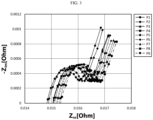
- FIG. 3 is a diagram schematically showing a plurality of impedance profiles according to an embodiment of the present disclosure. Specifically, FIG. 3 is a diagram showing a plurality of impedance profiles obtained by the ohmic resistance determining unit 110.
- the ohmic resistance determining unit 110 may obtain first to ninth impedance profiles P1 to P9.
- the first to ninth impedance profiles P1 to P9 may be impedance profiles generated at different time points for one battery cell.
- the first to ninth impedance profiles P1 to P9 are impedance profiles for impedances measured at intervals of 24 hours for one battery cell under the condition that temperature and SOC (State Of Charge) are included within a predetermined range.
- the first impedance profile P1 may be generated first, and the ninth impedance profile P9 may be generated most recently.
- the ohmic resistance determining unit 110 may determine the ohmic resistance in each of the first to ninth impedance profiles P1 to P9. Specifically, the ohmic resistance determining unit 110 may determine a resistance value of the real part (Zre) when the value of the imaginary part (-Zim) is 0 in each of the first to ninth impedance profiles P1 to P9 as the ohmic resistance for the corresponding impedance profile.
- the ohmic resistance of the first impedance profile P1 may be smallest, and the ohmic resistance of the ninth impedance profile P9 may be largest.
- the resistance change rate calculating unit 120 may be configured to calculate a resistance change rate between the plurality of determined ohmic resistances.
- the resistance change rate calculating unit 120 may calculate a resistance change rate between the plurality of ohmic resistances determined by the ohmic resistance determining unit 110.
- the resistance change rate calculating unit 120 may calculate a resistance change rate between the plurality of ohmic resistances in consideration of time points at which the plurality of impedance profiles are generated.
- the resistance change rate calculating unit 120 may set the ohmic resistance of the first impedance profile P1 as a criterion and calculate a resistance change rate between the ohmic resistances of the first to ninth impedance profiles P1 to P9.
- the resistance change rate calculating unit 120 may calculate a ratio of Ro_n to Ro_1 as a resistance change rate. In this case, the resistance change rate calculating unit 120 may calculate the resistance change rate by calculating the formula of "Ro_n ⁇ Ro_1".
- the resistance change rate calculating unit may calculate a ratio of a difference between Ro_n and Ro_1 with respect to Ro_1 as a resistance change rate.
- the resistance change rate calculating unit 120 may calculate the resistance change rate by calculating the formula of "(Ro_n - Ro_1) ⁇ Ro_1".
- the gas generation level determining unit 130 may be configured to determine an internal gas generation level of the battery cell based on the calculated resistance change rate. That is, the gas generation level determining unit 130 may determine the internal gas generation level of the battery cell based on the resistance change rate calculated by the resistance change rate calculating unit 120.
- the gas generation level determining unit 130 may be configured to determine the internal gas generation level of the battery cell based on a region to which the calculated resistance change rate belongs among preset reference change rate regions.
- the reference change rate regions may be preset as a first region, a second region, and a third region.
- the reference change rate regions are set as the first to third regions, but it should be noted that the reference change rate regions may be set to be more subdivided.
- the reference change rate regions may be configured to be preset according to the internal gas generation level as a first region less than a first reference resistance change rate, a second region equal to or greater than the first reference resistance change rate and less than a second reference resistance change rate, and a third region equal to or greater than the second reference resistance change rate.
- the gas generation level determining unit 130 may determine a region to which the calculated resistance change rate belongs by substituting the calculated resistance change rate into the reference change rate regions. That is, the gas generation level determining unit 130 may determine a region to which the calculated resistance change rate belongs among the reference change rate regions.
- the gas generation level determining unit 130 may be configured to determine that the internal gas generation level is normal when the calculated resistance change rate belongs to the first region, and determine that the internal gas generation level is warning when the calculated resistance change rate belongs to the second region, and determine that the internal gas generation level is danger when the calculated resistance change rate belongs to the third region.
- the state diagnosing unit 140 may be configured to diagnose the state of the battery cell according to the determined internal gas generation level. That is, the state diagnosing unit 140 may diagnose the state of the battery cell according to the internal gas generation level determined by the gas generation level determining unit 130.
- the gas generation level determining unit 130 may determine the internal gas generation level as normal, warning, or danger based on the calculated resistance change rate.
- the state diagnosing unit 140 may diagnose the state of the battery cell as a normal state, a warning state or an unusable state.
- the state diagnosing unit 140 may be configured to diagnose the state of the battery cell as a normal state when the internal gas generation level is determined as normal.
- the state diagnosing unit 140 may be configured to diagnose the state of the battery cell as a warning state when the internal gas generation level is determined as warning.
- the state diagnosing unit 140 may be configured to reduce at least one of a maximum allowable temperature and a maximum allowable SOC of the battery cell in order to suppress generation of an internal gas of the battery cell. That is, for the corresponding battery cell, at least one of the maximum allowable temperature and the maximum allowable SOC may be set to be reduced.
- the state diagnosing unit 140 may be configured to diagnose the state of the battery cell as an unusable state when the internal gas generation level is determined as danger.
- the battery diagnosis apparatus 100 has an advantage of diagnosing the internal gas generation level and state of the battery cell from the resistance change rate of the ohmic resistance of the battery cell in a non-destructive manner based on the correlation between the ohmic resistance of the battery cell and the internal gas generation level of the battery cell. For example, if the amount of internal gas generated by the battery cell is increased, the electron transporting power inside the electrode is reduced due to the internal gas, and the ohmic resistance of the battery cell may be sensitively increased due to the decrease in the ionic conductivity of the electrolyte. Therefore, the battery diagnosis apparatus 100 may diagnose the gas generation level and state of the battery cell based on the resistance change rate of the ohmic resistance by considering the relationship between the ohmic resistance and the amount of generated internal gas.
- the battery diagnosis apparatus 100 when diagnosing the state of a plurality of battery cells collected for reuse, the battery diagnosis apparatus 100 according to an embodiment of the present disclosure may be used.
- the battery diagnosis apparatus 100 may obtain a plurality of impedance profiles for each of the plurality of battery cells, and non-destructively diagnose the internal gas generation level and state of each of the plurality of battery cells based on the plurality of obtained impedance profiles.
- a battery cell diagnosed as a normal state may be reused without additional setting change, but a battery cell diagnosed as a warning state may be reused after setting to reduce at least one of the maximum allowable temperature and the maximum allowable SOC.
- a battery cell diagnosed as an unusable state may not be reused.
- since the internal gas generation level and state of the battery cell may be quickly and easily diagnosed using the ohmic resistance of the battery cell as described above, there is an advantage that the efficiency of diagnosing the state of the battery cell may be improved.
- the battery diagnosis apparatus 100 may further include a storage unit (not shown).
- the storage unit may store programs, data and the like required for operating the battery diagnosis apparatus 100. That is, the storage unit may store data necessary for operation and function of each component of the battery diagnosing apparatus 100, data generated in the process of performing the operation or function, or the like.
- the storage unit is not particularly limited in its kind as long as it is a known information storage means that can record, erase, update and read data.
- the information storage means may include RAM, flash memory, ROM, EEPROM, registers, and the like.
- the storage unit may store program codes in which processes executable by each component of the battery diagnosis apparatus 100 are defined.
- the battery diagnosis apparatus 100 may further include a measuring unit 150 and an SOC estimating unit 160.
- the measuring unit 150 may be configured to measure at least one of temperature, voltage and current of the battery cell.
- the measuring unit 150 may measure the temperature of the battery cell. In addition, the measuring unit 150 may measure at least one of voltage and current of the battery cell.
- the measuring unit 150 may measure all of temperature, voltage and current of the battery cell.
- the SOC estimating unit 160 may be configured to estimate the SOC of the battery cell based on at least one of the measured voltage and current.
- the SOC estimating unit 160 may estimate the SOC of the battery cell using an extended Kalman filter (EKF). As another example, the SOC estimating unit 160 may estimate the SOC of the battery cell using a current counting method (Coulomb counting, Ampere counting) for counting the current of the battery cell measured by the measuring unit 150. Since the SOC estimating unit 160 estimates the SOC of the battery cell using a well-known method, a detailed description thereof will be omitted.
- EKF extended Kalman filter
- a current counting method Coulomb counting, Ampere counting
- the ohmic resistance determining unit 110 may be configured to select at least one impedance profile satisfying a predetermined condition among the plurality of impedance profiles based on the temperature of the battery cell measured by the measuring unit 150 and the SOC of the battery cell estimated by the SOC estimating unit 160.
- the ohmic resistance determining unit 110 may select only an impedance profile in which the temperature and SOC of the battery cell satisfy predetermined conditions among the plurality of impedance profiles. For example, even if the ohmic resistance determining unit 110 obtains 100 impedance profiles, if 10 impedance profiles satisfy the predetermined conditions for the temperature and SOC of the battery cell, the ohmic resistance determining unit 110 may select only the corresponding 10 impedance profiles.
- the resistance change rate calculating unit 120 may be configured to calculate the resistance change rate based on the impedance profile selected by the ohmic resistance determining unit 110.
- the ohmic resistance determining unit 110 when the ohmic resistance determining unit 110 selects only 10 impedance profiles among 100 impedance profiles, the ohmic resistance determining unit 110 may determine the ohmic resistance of the battery cell in each of the 10 impedance profiles. In addition, the resistance change rate calculating unit 120 may calculate a resistance change rate between the determined 10 ohmic resistances.
- FIG. 4 is a diagram schematically showing a plurality of other impedance profiles according to an embodiment of the present disclosure.
- the ohmic resistance determining unit 110 may be configured to select an impedance profile in which the temperature of the corresponding battery cell is equal to or higher than a reference temperature and an SOC of the corresponding battery cell is equal to or greater than a reference SOC, among the plurality of impedance profiles.
- the amount of internal gas generated by the battery cell may increase as the temperature of the battery cell increases. That is, when the SOC of the battery cell is less than the certain level, the amount of internal gas generated by the battery cell itself is small, and thus the amount of internal gas generated by the battery cell may not increase even if the battery cell has high temperature. Therefore, the ohmic resistance of the battery cell related to the amount of internal gas generated by the battery cell may be increased when both the temperature and the SOC of the battery cell satisfy predetermined conditions.
- the plurality of impedance profiles shown in FIG. 3 are impedance profiles generated when the temperature of the battery cell is equal to or higher than the reference temperature and the SOC of the battery cell is equal to or greater than the reference SOC.
- the reference temperature may be 40°C
- the temperature of the battery cell may be 55°C
- the reference SOC may be 90%
- the SOC of the battery cell may be 100%. That is, the plurality of impedance profiles shown in FIG. 3 are impedance profiles generated at a constant cycle for a battery cell at high temperature and in a fully charged state.
- the plurality of impedance profiles shown in FIG. 4 are impedance profiles generated when the temperature of the battery cell is equal to or higher than the reference temperature but the SOC of the battery cell is less than the reference SOC.
- the reference temperature may be 40°C
- the temperature of the battery cell may be 55°C
- the reference SOC may be 90%
- the SOC of the battery cell may be 0%. That is, the plurality of impedance profiles shown in FIG. 4 are impedance profiles generated at a constant period for a battery cell at a high temperature and in a fully discharged state.
- the plurality of impedance profiles of FIGS. 3 and 4 are profiles for the impedance measured by outputting the same current to the battery cell. That is, the difference between the impedance profiles of FIGS. 3 and 4 is the SOC of the battery cell at the time of measurement.
- the ohmic resistance of the battery cell increases as time elapses (e.g., as the process progresses from the first impedance profile P1 to the ninth impedance profile P9).
- the ohmic resistance of the battery cell is maintained within an approximate range even if time elapses. This is, in the case of FIG. 4 , since the SOC of the battery cell is 0%, the internal gas of the battery cell itself is not generated or the amount of gas generation itself is small. Thus, even if the temperature of the battery cell is high, the ohmic resistance of the battery cell may be maintained within an approximate range.
- the temperature of the battery cell at the time of measurement of the impedance must be equal to or higher than the reference temperature, and the SOC of the battery cell must also be equal to or greater than the reference SOC.
- the resistance change rate of the ohmic resistance is very small, there is a problem that the internal gas generation level may be erroneously diagnosed as normal and the state of the battery cell may be erroneously diagnosed as a normal state.
- the resistance change rate of the ohmic resistance is calculated low, and the battery cell may be erroneously diagnosed as in a normal state according to the low calculated resistance change rate.
- the battery diagnosis apparatus 100 has an advantage of more accurately diagnosing the internal gas generation level and state of the battery cell by considering both the temperature and the SOC of the battery cell at the time of measurement of the impedance.
- the battery diagnosis apparatus 100 may further include a charge transfer resistance determining unit 170.
- the charge transfer resistance determining unit 170 may be configured to determine a charge transfer resistance (Rct) in each of the plurality of impedance profiles.
- the charge transfer resistance refers to a resistance generated in an oxidation reaction or a reduction reaction of lithium ions at the electrode material interface. It should be noted that since the charge transfer resistance is a well-known factor, a description of the charge transfer resistance itself will be omitted.
- the resistance value of the real part (Zre) is the ohmic resistance (Ro) of the battery cell, which may be determined by the ohmic resistance determining unit 110.
- the charge transfer resistance (Rct) may be determined based on the difference between the ohmic resistance (Ro) of the battery cell and the resistance value (R TP ) of a target peak TP in the impedance profile. Due to the characteristics of the impedance profile, the resistance value (R TP ) of the target peak TP is always greater than the ohmic resistance (Ro), so the charge transfer resistance may be determined according to the formula of "the resistance value of the target peak TP (R TP ) - the ohmic resistance (Ro)" .
- the charge transfer resistance determining unit 170 may determine the target peak TP in each of the plurality of impedance profiles, and determine the charge transfer resistance of each impedance profile based on the difference between the resistance value (R TP ) of the determined target peak TP and the ohmic resistance (Ro) determined by the ohmic resistance determining unit 110.
- the impedance profile may include a target peak TP.
- the target peak TP may be a peak in which an instantaneous change rate of the imaginary part (-Zim) with respect to the real part (Zre) in the impedance profile is 0 and which has a downward convex open shape. That is, based on the target peak TP, as the resistance value of the real part (Zre) increases, the instantaneous change rate of the imaginary part (-Zim) with respect to the real part (Zre) may change from negative to positive.
- the charge transfer resistance determining unit 170 may determine the charge transfer resistance for each of the first to ninth impedance profiles P1 to P9.
- the charge transfer resistance of the first impedance profile P1 may be smallest, and the charge transfer resistance of the ninth impedance profile P9 may be largest. That is, the magnitudes of the charge transfer resistances of the first to ninth impedance profiles P1 to P9 may be sequentially increased.
- the resistance change rate calculating unit 120 may be configured to further calculate a charge transfer resistance change rate between the plurality of determined charge transfer resistances.
- the resistance change rate calculating unit 120 may calculate a resistance change rate for the plurality of ohmic resistances determined by the ohmic resistance determining unit 110, and calculate a charge transfer resistance change rate for the plurality of charge transfer resistances determined by the charge transfer resistance determining unit 170.
- the state diagnosing unit 140 may be configured to further diagnose the state of the battery cell based on a result of comparing the calculated charge transfer resistance change rate and the reference resistance value.
- the state diagnosing unit 140 may be configured to diagnose the state of the battery cell as a normal state when the calculated charge transfer resistance change rate is less than the reference resistance value.
- the state diagnosing unit 140 may be configured to diagnose the state of the battery cell as a warning state when the calculated charge transfer resistance change rate is equal to or greater than the reference resistance value. In addition, the state diagnosing unit 140 may be configured to reduce the maximum allowable C-rate for charging and discharging of the battery cell.
- the C-rate (Current rate) means a charge/discharge rate of the battery cell.
- the state diagnosing unit 140 may reduce the maximum allowable C-rate of the battery cell in order to reduce the charge transfer resistance. Accordingly, the maximum allowable values of the charging C-rate and the discharging C-rate of the battery cell may be reduced.
- the battery diagnosis apparatus 100 when diagnosing the state of a plurality of battery cells collected for reuse, may further consider the charge transfer resistance as well as the ohmic resistance.
- a battery cell diagnosed as a normal state based on the charge transfer resistance may be reused without additional setting change, but a battery cell diagnosed as a warning state may be reused after the maximum allowable C-rate is set to be reduced.
- the battery diagnosis apparatus 100 may diagnose the state of the battery cell based on the ohmic resistance of the battery cell determined from the impedance profile, and also diagnose the state of the battery cell based on the charge transfer resistance determined from the impedance profile. That is, since the battery diagnosis apparatus 100 may diagnose the state of the battery cell in two ways, there is an advantage that the state of the battery cell may be diagnosed more accurately.
- FIG. 5 is a diagram schematically showing a battery diagnosis system 10 according to another embodiment of the present disclosure.
- the battery diagnosis system 10 may include a battery diagnosis apparatus 100 and an EIS unit 200.
- the EIS unit 200 may be configured to output an AC current to the battery cell and generate an impedance profile representing the impedance of the battery cell as a corresponding relationship between the real part (Zre) and the imaginary part (-Zim) according to the output result of the AC current.
- the EIS unit 200 may be configured to perform EIS (Electrochemical Impedance Spectroscopy). Therefore, the EIS unit 200 may apply a minute AC current to the battery cell to measure the impedance of the battery cell, and generate an impedance profile representing the impedance as a corresponding relationship between the real part (Zre) and the imaginary part (-Zim).
- EIS Electrochemical Impedance Spectroscopy
- the EIS unit 200 may be configured to output the generated impedance profile to the battery diagnosis apparatus 100.
- the EIS unit 200 may transmit the generated impedance profile to the ohmic resistance determining unit 110 and the charge transfer resistance determining unit 170 of the battery diagnosis apparatus 100.
- the EIS unit 200 may transmit the generated impedance profile to the storage unit of the battery diagnosis apparatus 100.
- the ohmic resistance determining unit 110 and the charge transfer resistance determining unit 170 may access the storage unit to acquire the impedance profile generated by the EIS unit 200.
- the battery diagnosis system 10 may further include a heating unit 300 and a charging unit 400.
- the heating unit 300 may be configured to increase the temperature of the battery cell so that the temperature of the battery cell is equal to or higher than a reference temperature.
- the charging unit 400 may be configured to charge the battery cell such that the SOC of the battery cell is equal to or greater than the reference SOC.
- the operation of the heating unit 300 and the charging unit 400 may be controlled by a battery management system.
- the operation of the heating unit 300 and the charging unit 400 may be controlled by the state diagnosing unit 140.
- the ohmic resistance of the battery cell may be gradually increased in the plurality of impedance profiles.
- the impedance profile generated by the EIS unit 200 under this condition may be selected as an impedance profile used to diagnose the state of the battery cell. That is, based on the impedance profile generated in this condition, the state of the battery cell may be diagnosed.
- the battery diagnosis system 10 may diagnose the state of the battery cell based on the corresponding impedance profile only when the temperature and SOC of the battery cell satisfy the predetermined condition, so the accuracy and reliability of the state diagnosis of the battery cell may be high.
- the battery diagnosis apparatus 100 according to the present disclosure may be applied to a BMS (Battery Management System). That is, the BMS according to the present disclosure may include the battery diagnosis apparatus 100 described above. In this configuration, at least some components of the battery diagnosis apparatus 100 may be implemented by supplementing or adding functions of the configuration included in the conventional BMS.
- BMS Battery Management System
- the battery diagnosis apparatus 100 may be provided to a battery pack 1. That is, the battery pack 1 according to the present disclosure may include the above-described battery diagnosis apparatus 100 and at least one battery cell. In addition, the battery pack 1 may further include electrical equipment (a relay, a fuse, etc.) and a case.
- electrical equipment a relay, a fuse, etc.
- FIG. 6 is a diagram schematically showing an exemplary configuration of a battery pack 1 according to still another embodiment of the present disclosure.
- the battery pack 1 may include a battery diagnosis apparatus 100, an EIS unit 200, a heating unit 300, and a charging unit 400.
- the battery diagnosis apparatus 100 may be connected to first to fourth sensing lines SL1 to SL4.
- the first to fourth sensing lines SL1 to SL4 may be connected to the measuring unit 150 of the battery diagnosis apparatus 100.
- the measuring unit 150 may measure the temperature of the battery cell B through the first sensing line SL1.
- the measuring unit 150 may measure a positive electrode voltage of the battery cell B through the second sensing line SL2 and measure a negative electrode voltage of the battery cell B through the third sensing line SL3. In addition, the measuring unit 150 may measure the voltage of the battery cell B by calculating a difference between the measured positive electrode voltage and negative electrode voltage of the battery cell B.
- the measuring unit 150 may be connected to a current measuring element A through the fourth sensing line SL4.
- the current measuring element A may be a current system or a shunt resistor. Therefore, the measuring unit 150 may measure the current of the battery cell B through the fourth sensing line SL4.
- FIG. 6 shows an embodiment in which the current measuring element A is provided between a negative electrode of the battery cell B and a negative electrode terminal P- of the battery pack 1 as a preferred embodiment, but the current measuring element A may also be provided between a positive electrode of the battery cell B and a positive electrode terminal P+ of the battery pack 1.
- One end of the EIS unit 200 may be connected between the positive electrode terminal P+ of the battery pack 1 and the positive electrode of the battery cell B, and the other end may be connected between the negative electrode terminal P- of the battery pack 1 and the negative electrode of the battery cell B.
- the EIS unit 200 may measure the impedance of the battery cell B after outputting a minute AC current. Thereafter, the EIS unit 200 may generate an impedance profile of the battery cell B and transmit it to the battery diagnosis apparatus 100.
- One end of the heating unit 300 may be connected to the positive electrode of the battery cell B, and the other end may be connected to the negative electrode of the battery cell B.
- the operation of the heating unit 300 is controlled by the battery diagnosis apparatus 100 (particularly, the state diagnosing unit 140), and when the heating unit 300 is operated, the temperature of the battery cell B may increase.
- One end of the charging unit 400 may be connected to the positive electrode terminal P+ of the battery pack 1, and the other end may be connected to the negative electrode terminal P- of the battery pack 1.
- one end of the charging unit 400 may be directly connected to the positive electrode of the battery cell B, and the other end may be directly connected to the negative electrode of the battery cell B, similarly to the heating unit 300.
- the operation of the charging unit 400 may be controlled by the battery diagnosis apparatus 100 (particularly, the state diagnosing unit 140), and when the charging unit 400 is operated, the battery cell B may be charged.
- FIG. 7 is a diagram showing a battery diagnosing method according to still another embodiment of the present disclosure.
- each step of the battery diagnosis method may be performed by the battery diagnosis apparatus 100.
- the battery diagnosis apparatus 100 For convenience of explanation, content overlapping with the previously described content will be briefly described or omitted.
- the battery diagnosing method may include an ohmic resistance determining step (S100), a resistance change rate calculating step (S200), a gas generation level determining step (S300), and a state diagnosing step (S400).
- S100 ohmic resistance determining step
- S200 resistance change rate calculating step
- S300 gas generation level determining step
- S400 state diagnosing step
- the ohmic resistance determining step (S100) is a step of determining an ohmic resistance of the battery cell B in each of a plurality of impedance profiles generated at different time points for the battery cell B, and may be performed by the ohmic resistance determining unit 110.
- the ohmic resistance determining unit 110 may obtain first to ninth impedance profiles P1 to P9. In addition, the ohmic resistance determining unit 110 may determine the ohmic resistance of the battery cell B in each of the first to ninth impedance profiles P1 to P9.
- the resistance change rate calculating step (S200) is a step of calculating a resistance change rate between the plurality of determined ohmic resistances, and may be performed by the resistance change rate calculating unit 120.
- the resistance change rate calculating unit 120 may calculate a resistance change rate for the 9 ohmic resistances.
- the gas generation level determining step (S300) is a step of determining an internal gas generation level of the battery cell B based on the calculated resistance change rate, and may be performed by the gas generation level determining unit 130.
- the gas generation level determining unit 130 may determine an internal gas generation level corresponding to a region to which the calculated resistance change rate belongs by substituting the resistance change rate calculated by the resistance change rate calculating unit 120 to a preset reference change rate region.
- the state diagnosing step (S400) is a step of diagnosing the state of the battery cell B according to the determined internal gas generation level, and may be performed by the state diagnosing unit 140.
- the state diagnosing unit 140 may diagnose the state of the battery cell B to correspond to the internal gas generation level of the battery cell B determined by the gas generation level determining unit 130.
- the state diagnosing unit 140 may diagnose that the state of the battery cell B is a normal state. If the internal gas generation level is warning, the state diagnosing unit 140 may diagnose that the state of the battery cell B is a warning state. If the internal gas generation level is danger, the state diagnosing unit 140 may diagnose that the state of the battery cell B is an unusable state.
- the embodiments of the present disclosure described above may not be implemented only through an apparatus, a method and a system, but may be implemented through a program that realizes a function corresponding to the configuration of the embodiments of the present disclosure or a recording medium on which the program is recorded.
- the program or recording medium may be easily implemented by those skilled in the art from the above description of the embodiments.
Landscapes
- Physics & Mathematics (AREA)
- General Physics & Mathematics (AREA)
- Chemical & Material Sciences (AREA)
- Chemical Kinetics & Catalysis (AREA)
- Electrochemistry (AREA)
- Business, Economics & Management (AREA)
- Emergency Management (AREA)
- Manufacturing & Machinery (AREA)
- Engineering & Computer Science (AREA)
- General Chemical & Material Sciences (AREA)
- Life Sciences & Earth Sciences (AREA)
- Analytical Chemistry (AREA)
- Biochemistry (AREA)
- General Health & Medical Sciences (AREA)
- Immunology (AREA)
- Pathology (AREA)
- Health & Medical Sciences (AREA)
- Secondary Cells (AREA)
- Tests Of Electric Status Of Batteries (AREA)
- Charge And Discharge Circuits For Batteries Or The Like (AREA)
Description
- The present application claims priority to
Korean Patent Application No. 10-2020-0127289 filed on September 29, 2020 - The present disclosure relates to a battery diagnosis apparatus, method and system, and more particularly, to a battery diagnosis apparatus, method and system capable of diagnosing a state of a battery cell.
- Recently, the demand for portable electronic products such as notebook computers, video cameras and portable telephones has increased sharply, and electric vehicles, energy storage batteries, robots, satellites and the like have been developed in earnest. Accordingly, high-performance batteries allowing repeated charging and discharging are being actively studied.
- Batteries commercially available at present include nickel-cadmium batteries, nickel hydrogen batteries, nickel-zinc batteries, lithium batteries and the like. Among them, the lithium batteries are in the limelight since they have almost no memory effect compared to nickel-based batteries and also have very low self-charging rate and high energy density.
- As the battery is degraded, side reactions accompanied by generation of internal gas occur. If the side reaction continues and the amount of internal gas exceeds an allowable value, the junction portion of the battery is opened, and the battery reaches an EOL (End Of Life) state.
- Therefore, in order to diagnose the state of the battery, it is required to measure the internal gas amount, but in the prior art, which can be exemplified by
US 2019/004120 A1 andUS 2003/067282 A1 , it is difficult to measure the internal gas amount of the battery in a non-destructive manner. - The present disclosure is designed to solve the problems of the related art, and therefore the present disclosure is directed to providing a battery diagnosis apparatus, method and system, which may determine an internal gas generation level of a battery based on an ohmic resistance of the battery in a non-destructive manner and diagnose a state of the battery according to the determined internal gas generation level.
- These and other objects and advantages of the present disclosure may be understood from the following detailed description and will become more fully apparent from the exemplary embodiments of the present disclosure. Also, it will be easily understood that the objects and advantages of the present disclosure may be realized by the means shown in the appended claims and combinations thereof.
- In one aspect of the present disclosure, there is provided a battery diagnosis apparatus, comprising: an ohmic resistance determining unit configured to determine an ohmic resistance of a battery cell in each of a plurality of impedance profiles generated at different time points for the battery cell; a resistance change rate calculating unit configured to calculate a resistance change rate between the plurality of determined ohmic resistances; a gas generation level determining unit configured to determine an internal gas generation level of the battery cell based on the calculated resistance change rate; and a state diagnosing unit configured to diagnose a state of the battery cell according to the determined internal gas generation level.
- The gas generation level determining unit may be configured to determine an internal gas generation level of the battery cell based on a region to which the calculated resistance change rate belongs among preset reference change rate regions.
- The reference change rate regions may be preset as a first region less than a first reference resistance change rate, a second region equal to or greater than the first reference resistance change rate and less than a second reference resistance change rate, and a third region equal to or greater than the second reference resistance change rate according to the internal gas generation level.
- The gas generation level determining unit may be configured to determine that the internal gas generation level is normal when the calculated resistance change rate belongs to the first region, determine that the internal gas generation level is warning when the calculated resistance change rate belongs to the second region, and determine that the internal gas generation level is danger when the calculated resistance change rate belongs to the third region.
- The state diagnosing unit may be configured to diagnose that the state of the battery cell is a normal state when the internal gas generation level is determined as normal.
- The state diagnosing unit may be configured to diagnose that the state of the battery cell is a warning state when the internal gas generation level is determined as warning and reduce at least one of a maximum allowable temperature and a maximum allowable SOC.
- The state diagnosing unit may be configured to diagnose that the state of the battery cell is an unusable state when the internal gas generation level is determined as danger.
- The battery diagnosis apparatus according to another aspect of the present disclosure may further comprise: a measuring unit configured to measure at least one of temperature, voltage and current of the battery cell; and a SOC estimating unit configured to estimate an SOC of the battery cell based on at least one of the measured voltage and current.
- The ohmic resistance determining unit may be configured to select at least one impedance profile satisfying a predetermined condition among the plurality of impedance profiles based on the temperature of the battery cell measured by the measuring unit and the SOC of the battery cell estimated by the SOC estimating unit.
- The resistance change rate calculating unit may be configured to calculate the resistance change rate based on the impedance profile selected by the ohmic resistance determining unit.
- The ohmic resistance determining unit may be configured to select an impedance profile in which the temperature of the corresponding battery cell is equal to or higher than a reference temperature and the SOC of the corresponding battery cell is equal to or greater than a reference SOC, among the plurality of impedance profiles.
- The battery diagnosis apparatus according to still another aspect of the present disclosure may further comprise a charge transfer resistance determining unit configured to determine a charge transfer resistance in each of the plurality of impedance profiles.
- The resistance change rate calculating unit may be configured to further calculate a charge transfer resistance change rate between the plurality of determined charge transfer resistances.
- The state diagnosing unit may be configured to further diagnose the state of the battery cell based on a result of comparing the calculated charge transfer resistance change rate and a reference resistance value.
- The state diagnosing unit may be configured to diagnose that the state of the battery cell is a normal state when the calculated charge transfer resistance change rate is less than the reference resistance value.
- The state diagnosing unit may be configured to diagnose that the state of the battery cell is a warning state when the calculated charge transfer resistance change rate is equal to or greater than the reference resistance value and reduce a maximum allowable C-rate for charging and discharging of the battery cell.
- A battery diagnosis system according to still another aspect of the present disclosure may comprise: the battery diagnosis apparatus according to an aspect of the present disclosure; and an EIS unit configured to output an AC current to the battery cell, generate an impedance profile representing an impedance of the battery cell according to an output result of the AC current as a corresponding relationship between a real part and an imaginary part, and output the generated impedance profile to the battery diagnosis apparatus.
- The battery diagnosis system according to still another aspect of the present disclosure may further comprise: a heating unit configured to increase temperature of the battery cell such that the temperature of the battery cell becomes equal to or higher than a reference temperature; and a charging unit configured to charge the battery cell such that a SOC of the battery cell becomes equal to or greater than a reference SOC.
- A battery pack according to still another aspect of the present disclosure may comprise the battery diagnosis apparatus according to an aspect of the present disclosure.
- A battery diagnosing method according to still another aspect of the present disclosure may comprise: an ohmic resistance determining step of determining an ohmic resistance of a battery cell in each of a plurality of impedance profiles generated at different time points for the battery cell; a resistance change rate calculating step of calculating a resistance change rate between the plurality of determined ohmic resistances; a gas generation level determining step of determining an internal gas generation level of the battery cell based on the calculated resistance change rate; and a state diagnosing step of diagnosing a state of the battery cell according to the determined internal gas generation level.
- According to one aspect of the present disclosure, based on the correlation between the ohmic resistance of the battery cell and the internal gas generation level of the battery cell, there is an advantage that the internal gas generation level and state of the battery cell may be diagnosed in a non-destructive manner from the resistance change rate of the ohmic resistance of the battery cell.
- The effects of the present disclosure are not limited to the effects mentioned above, and other effects not mentioned will be clearly understood by those skilled in the art from the description of the claims.
- The accompanying drawings illustrate a preferred embodiment of the present disclosure and together with the foregoing disclosure, serve to provide further understanding of the technical features of the present disclosure, and thus, the present disclosure is not construed as being limited to the drawing.
-
FIG. 1 is a diagram schematically showing a battery diagnosing apparatus according to an embodiment of the present disclosure. -
FIG. 2 is a diagram schematically showing an impedance profile according to an embodiment of the present disclosure. -
FIG. 3 is a diagram schematically showing a plurality of impedance profiles according to an embodiment of the present disclosure. -
FIG. 4 is a diagram schematically showing a plurality of other impedance profiles according to an embodiment of the present disclosure. -
FIG. 5 is a diagram schematically showing a battery diagnosis system according to another embodiment of the present disclosure. -
FIG. 6 is a diagram schematically showing an exemplary configuration of a battery pack according to still another embodiment of the present disclosure. -
FIG. 7 is a diagram showing a battery diagnosing method according to still another embodiment of the present disclosure. - It should be understood that the terms used in the specification and the appended claims should not be construed as limited to general and dictionary meanings, but interpreted based on the meanings and concepts corresponding to technical aspects of the present disclosure on the basis of the principle that the inventor is allowed to define terms appropriately for the best explanation.
- Therefore, the description proposed herein is just a preferable example for the purpose of illustrations only, not intended to limit the scope of the disclosure, so it should be understood that other equivalents and modifications could be made thereto without departing from the scope of the disclosure.
- Additionally, in describing the present disclosure, when it is deemed that a detailed description of relevant known elements or functions renders the key subject matter of the present disclosure ambiguous, the detailed description is omitted herein.
- The terms including the ordinal number such as "first", "second" and the like, may be used to distinguish one element from another among various elements, but not intended to limit the elements by the terms.
- Throughout the specification, when a portion is referred to as "comprising" or "including" any element, it means that the portion may include other elements further, without excluding other elements, unless specifically stated otherwise.
- In addition, throughout the specification, when a portion is referred to as being "connected" to another portion, it is not limited to the case that they are "directly connected", but it also includes the case where they are "indirectly connected" with another element being interposed between them.
- Hereinafter, preferred embodiments of the present disclosure will be described in detail with reference to the accompanying drawings.
-
FIG. 1 is a diagram schematically showing abattery diagnosing apparatus 100 according to an embodiment of the present disclosure. - Referring to
FIG. 1 , thebattery diagnosis apparatus 100 may include an ohmicresistance determining unit 110, a resistance changerate calculating unit 120, a gas generationlevel determining unit 130, and astate diagnosing unit 140. - The ohmic
resistance determining unit 110 may be configured to determine an ohmic resistance (Ro) of a battery cell in each of a plurality of impedance profiles generated at different time points for the battery cell. - Here, the battery cell refers to one independent cell that has a negative electrode terminal and a positive electrode terminal and is physically separable. For example, one pouch-type lithium polymer cell may be regarded as the battery cell.
- In addition, the impedance profile may be a profile in which the impedance of the battery cell is expressed as a corresponding relationship between a real part (Zre) and an imaginary part (-Zim). The impedance profile will be described in detail with reference to
FIGS. 2 and3 . -
FIG. 2 is a diagram schematically showing an impedance profile according to an embodiment of the present disclosure. Specifically,FIG. 2 is a diagram schematically showing an example of the impedance profile. - Referring to
FIG. 2 , the impedance profile may be expressed as an X-Y plane graph when X is set as a real part (Zre) and Y is set as an imaginary part (-Zim). In the embodiment ofFIG. 2 , the ohmic resistance of the battery cell may be a starting resistance value of the impedance profile. Specifically, in the impedance profile, the resistance value of the real part (Zre) when the value of the imaginary part (-Zim) is 0 may be the ohmic resistance of the battery cell. Since the ohmic resistance is a widely known factor, it should be noted that a description of the ohmic resistance will be omitted. -
FIG. 3 is a diagram schematically showing a plurality of impedance profiles according to an embodiment of the present disclosure. Specifically,FIG. 3 is a diagram showing a plurality of impedance profiles obtained by the ohmicresistance determining unit 110. - In the embodiment of
FIG. 3 , the ohmicresistance determining unit 110 may obtain first to ninth impedance profiles P1 to P9. Preferably, the first to ninth impedance profiles P1 to P9 may be impedance profiles generated at different time points for one battery cell. For example, the first to ninth impedance profiles P1 to P9 are impedance profiles for impedances measured at intervals of 24 hours for one battery cell under the condition that temperature and SOC (State Of Charge) are included within a predetermined range. Here, preferably, the first impedance profile P1 may be generated first, and the ninth impedance profile P9 may be generated most recently. - In addition, in the embodiment of
FIG. 3 , the ohmicresistance determining unit 110 may determine the ohmic resistance in each of the first to ninth impedance profiles P1 to P9. Specifically, the ohmicresistance determining unit 110 may determine a resistance value of the real part (Zre) when the value of the imaginary part (-Zim) is 0 in each of the first to ninth impedance profiles P1 to P9 as the ohmic resistance for the corresponding impedance profile. Preferably, in the embodiment ofFIG. 3 , the ohmic resistance of the first impedance profile P1 may be smallest, and the ohmic resistance of the ninth impedance profile P9 may be largest. - The resistance change
rate calculating unit 120 may be configured to calculate a resistance change rate between the plurality of determined ohmic resistances. - Specifically, the resistance change
rate calculating unit 120 may calculate a resistance change rate between the plurality of ohmic resistances determined by the ohmicresistance determining unit 110. Preferably, the resistance changerate calculating unit 120 may calculate a resistance change rate between the plurality of ohmic resistances in consideration of time points at which the plurality of impedance profiles are generated. - For example, in the embodiment of
FIG. 3 , the resistance changerate calculating unit 120 may set the ohmic resistance of the first impedance profile P1 as a criterion and calculate a resistance change rate between the ohmic resistances of the first to ninth impedance profiles P1 to P9. - For example, it is assumed that the ohmic resistance of each of the first to nth impedance profiles is determined as Ro_1 to Ro_n by the ohmic
resistance determining unit 110. The resistance changerate calculating unit 120 may calculate a ratio of Ro_n to Ro_1 as a resistance change rate. In this case, the resistance changerate calculating unit 120 may calculate the resistance change rate by calculating the formula of "Ro_n ÷ Ro_1". - As another example, the resistance change rate calculating unit may calculate a ratio of a difference between Ro_n and Ro_1 with respect to Ro_1 as a resistance change rate. In this case, the resistance change
rate calculating unit 120 may calculate the resistance change rate by calculating the formula of "(Ro_n - Ro_1) ÷ Ro_1". - The gas generation
level determining unit 130 may be configured to determine an internal gas generation level of the battery cell based on the calculated resistance change rate. That is, the gas generationlevel determining unit 130 may determine the internal gas generation level of the battery cell based on the resistance change rate calculated by the resistance changerate calculating unit 120. - Specifically, the gas generation
level determining unit 130 may be configured to determine the internal gas generation level of the battery cell based on a region to which the calculated resistance change rate belongs among preset reference change rate regions. - For example, the reference change rate regions may be preset as a first region, a second region, and a third region. Hereinafter, it will be described that the reference change rate regions are set as the first to third regions, but it should be noted that the reference change rate regions may be set to be more subdivided.
- Preferably, the reference change rate regions may be configured to be preset according to the internal gas generation level as a first region less than a first reference resistance change rate, a second region equal to or greater than the first reference resistance change rate and less than a second reference resistance change rate, and a third region equal to or greater than the second reference resistance change rate.
- The gas generation
level determining unit 130 may determine a region to which the calculated resistance change rate belongs by substituting the calculated resistance change rate into the reference change rate regions. That is, the gas generationlevel determining unit 130 may determine a region to which the calculated resistance change rate belongs among the reference change rate regions. - For example, the gas generation
level determining unit 130 may be configured to determine that the internal gas generation level is normal when the calculated resistance change rate belongs to the first region, and determine that the internal gas generation level is warning when the calculated resistance change rate belongs to the second region, and determine that the internal gas generation level is danger when the calculated resistance change rate belongs to the third region. - The
state diagnosing unit 140 may be configured to diagnose the state of the battery cell according to the determined internal gas generation level. That is, thestate diagnosing unit 140 may diagnose the state of the battery cell according to the internal gas generation level determined by the gas generationlevel determining unit 130. - For example, in the previous embodiment, the gas generation
level determining unit 130 may determine the internal gas generation level as normal, warning, or danger based on the calculated resistance change rate. To correspond to this, thestate diagnosing unit 140 may diagnose the state of the battery cell as a normal state, a warning state or an unusable state. - Specifically, the
state diagnosing unit 140 may be configured to diagnose the state of the battery cell as a normal state when the internal gas generation level is determined as normal. - In addition, the
state diagnosing unit 140 may be configured to diagnose the state of the battery cell as a warning state when the internal gas generation level is determined as warning. Preferably, thestate diagnosing unit 140 may be configured to reduce at least one of a maximum allowable temperature and a maximum allowable SOC of the battery cell in order to suppress generation of an internal gas of the battery cell. That is, for the corresponding battery cell, at least one of the maximum allowable temperature and the maximum allowable SOC may be set to be reduced. - In addition, the
state diagnosing unit 140 may be configured to diagnose the state of the battery cell as an unusable state when the internal gas generation level is determined as danger. - That is, the
battery diagnosis apparatus 100 according to an embodiment of the present disclosure has an advantage of diagnosing the internal gas generation level and state of the battery cell from the resistance change rate of the ohmic resistance of the battery cell in a non-destructive manner based on the correlation between the ohmic resistance of the battery cell and the internal gas generation level of the battery cell. For example, if the amount of internal gas generated by the battery cell is increased, the electron transporting power inside the electrode is reduced due to the internal gas, and the ohmic resistance of the battery cell may be sensitively increased due to the decrease in the ionic conductivity of the electrolyte. Therefore, thebattery diagnosis apparatus 100 may diagnose the gas generation level and state of the battery cell based on the resistance change rate of the ohmic resistance by considering the relationship between the ohmic resistance and the amount of generated internal gas. - For example, when diagnosing the state of a plurality of battery cells collected for reuse, the
battery diagnosis apparatus 100 according to an embodiment of the present disclosure may be used. Thebattery diagnosis apparatus 100 may obtain a plurality of impedance profiles for each of the plurality of battery cells, and non-destructively diagnose the internal gas generation level and state of each of the plurality of battery cells based on the plurality of obtained impedance profiles. A battery cell diagnosed as a normal state may be reused without additional setting change, but a battery cell diagnosed as a warning state may be reused after setting to reduce at least one of the maximum allowable temperature and the maximum allowable SOC. In addition, a battery cell diagnosed as an unusable state may not be reused. According to an embodiment of the present disclosure, since the internal gas generation level and state of the battery cell may be quickly and easily diagnosed using the ohmic resistance of the battery cell as described above, there is an advantage that the efficiency of diagnosing the state of the battery cell may be improved. - Meanwhile, the
battery diagnosis apparatus 100 may further include a storage unit (not shown). The storage unit may store programs, data and the like required for operating thebattery diagnosis apparatus 100. That is, the storage unit may store data necessary for operation and function of each component of thebattery diagnosing apparatus 100, data generated in the process of performing the operation or function, or the like. The storage unit is not particularly limited in its kind as long as it is a known information storage means that can record, erase, update and read data. As an example, the information storage means may include RAM, flash memory, ROM, EEPROM, registers, and the like. In addition, the storage unit may store program codes in which processes executable by each component of thebattery diagnosis apparatus 100 are defined. - Referring to
FIG. 1 , thebattery diagnosis apparatus 100 may further include a measuringunit 150 and anSOC estimating unit 160. - The measuring
unit 150 may be configured to measure at least one of temperature, voltage and current of the battery cell. - Preferably, the measuring
unit 150 may measure the temperature of the battery cell. In addition, the measuringunit 150 may measure at least one of voltage and current of the battery cell. - More preferably, the measuring
unit 150 may measure all of temperature, voltage and current of the battery cell. - The
SOC estimating unit 160 may be configured to estimate the SOC of the battery cell based on at least one of the measured voltage and current. - For example, the
SOC estimating unit 160 may estimate the SOC of the battery cell using an extended Kalman filter (EKF). As another example, theSOC estimating unit 160 may estimate the SOC of the battery cell using a current counting method (Coulomb counting, Ampere counting) for counting the current of the battery cell measured by the measuringunit 150. Since theSOC estimating unit 160 estimates the SOC of the battery cell using a well-known method, a detailed description thereof will be omitted. - The ohmic
resistance determining unit 110 may be configured to select at least one impedance profile satisfying a predetermined condition among the plurality of impedance profiles based on the temperature of the battery cell measured by the measuringunit 150 and the SOC of the battery cell estimated by theSOC estimating unit 160. - Specifically, the ohmic
resistance determining unit 110 may select only an impedance profile in which the temperature and SOC of the battery cell satisfy predetermined conditions among the plurality of impedance profiles. For example, even if the ohmicresistance determining unit 110 obtains 100 impedance profiles, if 10 impedance profiles satisfy the predetermined conditions for the temperature and SOC of the battery cell, the ohmicresistance determining unit 110 may select only the corresponding 10 impedance profiles. - In addition, the resistance change
rate calculating unit 120 may be configured to calculate the resistance change rate based on the impedance profile selected by the ohmicresistance determining unit 110. - For example, in the former embodiment, when the ohmic
resistance determining unit 110 selects only 10 impedance profiles among 100 impedance profiles, the ohmicresistance determining unit 110 may determine the ohmic resistance of the battery cell in each of the 10 impedance profiles. In addition, the resistance changerate calculating unit 120 may calculate a resistance change rate between the determined 10 ohmic resistances. - Hereinafter, a condition in which the ohmic
resistance determining unit 110 selects an impedance profile will be described in more detail with reference toFIGS. 3 and4 . -
FIG. 4 is a diagram schematically showing a plurality of other impedance profiles according to an embodiment of the present disclosure. - The ohmic
resistance determining unit 110 may be configured to select an impedance profile in which the temperature of the corresponding battery cell is equal to or higher than a reference temperature and an SOC of the corresponding battery cell is equal to or greater than a reference SOC, among the plurality of impedance profiles. - In general, when the SOC of the battery cell is equal to or greater than a certain level, the amount of internal gas generated by the battery cell may increase as the temperature of the battery cell increases. That is, when the SOC of the battery cell is less than the certain level, the amount of internal gas generated by the battery cell itself is small, and thus the amount of internal gas generated by the battery cell may not increase even if the battery cell has high temperature. Therefore, the ohmic resistance of the battery cell related to the amount of internal gas generated by the battery cell may be increased when both the temperature and the SOC of the battery cell satisfy predetermined conditions.
- Specifically, the plurality of impedance profiles shown in
FIG. 3 are impedance profiles generated when the temperature of the battery cell is equal to or higher than the reference temperature and the SOC of the battery cell is equal to or greater than the reference SOC. - For example, in the embodiment of
FIG. 3 , the reference temperature may be 40°C, the temperature of the battery cell may be 55°C, the reference SOC may be 90%, and the SOC of the battery cell may be 100%. That is, the plurality of impedance profiles shown inFIG. 3 are impedance profiles generated at a constant cycle for a battery cell at high temperature and in a fully charged state. - Conversely, the plurality of impedance profiles shown in
FIG. 4 are impedance profiles generated when the temperature of the battery cell is equal to or higher than the reference temperature but the SOC of the battery cell is less than the reference SOC. - For example, in the embodiment of
FIG. 4 , the reference temperature may be 40°C, the temperature of the battery cell may be 55°C, the reference SOC may be 90%, and the SOC of the battery cell may be 0%. That is, the plurality of impedance profiles shown inFIG. 4 are impedance profiles generated at a constant period for a battery cell at a high temperature and in a fully discharged state. - In addition, the plurality of impedance profiles of
FIGS. 3 and4 are profiles for the impedance measured by outputting the same current to the battery cell. That is, the difference between the impedance profiles ofFIGS. 3 and4 is the SOC of the battery cell at the time of measurement. - Referring to
FIG. 3 , it may be clearly seen that the ohmic resistance of the battery cell increases as time elapses (e.g., as the process progresses from the first impedance profile P1 to the ninth impedance profile P9). - On the other hand, referring to
FIG. 4 , it may be confirmed that the ohmic resistance of the battery cell is maintained within an approximate range even if time elapses. This is, in the case ofFIG. 4 , since the SOC of the battery cell is 0%, the internal gas of the battery cell itself is not generated or the amount of gas generation itself is small. Thus, even if the temperature of the battery cell is high, the ohmic resistance of the battery cell may be maintained within an approximate range. - That is, in order to diagnose the state of the battery cell in consideration of the correlation between the internal gas generation level of the battery cell and the resistance change rate of the ohmic resistance of the battery cell, the temperature of the battery cell at the time of measurement of the impedance must be equal to or higher than the reference temperature, and the SOC of the battery cell must also be equal to or greater than the reference SOC.
- For example, according to the embodiment of
FIG. 4 , even when the battery cell is seriously degraded and is in an unusable state, since the resistance change rate of the ohmic resistance is very small, there is a problem that the internal gas generation level may be erroneously diagnosed as normal and the state of the battery cell may be erroneously diagnosed as a normal state. Specifically, according to the embodiment ofFIG. 4 , since the internal gas itself of the battery cell is not generated or the amount itself is small, the resistance change rate of the ohmic resistance is calculated low, and the battery cell may be erroneously diagnosed as in a normal state according to the low calculated resistance change rate. - Therefore, the
battery diagnosis apparatus 100 according to an embodiment of the present disclosure has an advantage of more accurately diagnosing the internal gas generation level and state of the battery cell by considering both the temperature and the SOC of the battery cell at the time of measurement of the impedance. - Referring to
FIG. 1 , thebattery diagnosis apparatus 100 may further include a charge transferresistance determining unit 170. - The charge transfer
resistance determining unit 170 may be configured to determine a charge transfer resistance (Rct) in each of the plurality of impedance profiles. - Here, the charge transfer resistance refers to a resistance generated in an oxidation reaction or a reduction reaction of lithium ions at the electrode material interface. It should be noted that since the charge transfer resistance is a well-known factor, a description of the charge transfer resistance itself will be omitted.
- As described above, when the value of the imaginary part (-Zim) in the impedance profile is 0, the resistance value of the real part (Zre) is the ohmic resistance (Ro) of the battery cell, which may be determined by the ohmic
resistance determining unit 110. - Alternatively, the charge transfer resistance (Rct) may be determined based on the difference between the ohmic resistance (Ro) of the battery cell and the resistance value (RTP) of a target peak TP in the impedance profile. Due to the characteristics of the impedance profile, the resistance value (RTP) of the target peak TP is always greater than the ohmic resistance (Ro), so the charge transfer resistance may be determined according to the formula of "the resistance value of the target peak TP (RTP) - the ohmic resistance (Ro)" .
- That is, the charge transfer
resistance determining unit 170 may determine the target peak TP in each of the plurality of impedance profiles, and determine the charge transfer resistance of each impedance profile based on the difference between the resistance value (RTP) of the determined target peak TP and the ohmic resistance (Ro) determined by the ohmicresistance determining unit 110. - For example, in the embodiment of
FIG. 2 , the impedance profile may include a target peak TP. Specifically, the target peak TP may be a peak in which an instantaneous change rate of the imaginary part (-Zim) with respect to the real part (Zre) in the impedance profile is 0 and which has a downward convex open shape. That is, based on the target peak TP, as the resistance value of the real part (Zre) increases, the instantaneous change rate of the imaginary part (-Zim) with respect to the real part (Zre) may change from negative to positive. - For example, in the embodiment of
FIG. 3 , the charge transferresistance determining unit 170 may determine the charge transfer resistance for each of the first to ninth impedance profiles P1 to P9. Here, the charge transfer resistance of the first impedance profile P1 may be smallest, and the charge transfer resistance of the ninth impedance profile P9 may be largest. That is, the magnitudes of the charge transfer resistances of the first to ninth impedance profiles P1 to P9 may be sequentially increased. - The resistance change
rate calculating unit 120 may be configured to further calculate a charge transfer resistance change rate between the plurality of determined charge transfer resistances. - That is, the resistance change
rate calculating unit 120 may calculate a resistance change rate for the plurality of ohmic resistances determined by the ohmicresistance determining unit 110, and calculate a charge transfer resistance change rate for the plurality of charge transfer resistances determined by the charge transferresistance determining unit 170. - The
state diagnosing unit 140 may be configured to further diagnose the state of the battery cell based on a result of comparing the calculated charge transfer resistance change rate and the reference resistance value. - Specifically, the
state diagnosing unit 140 may be configured to diagnose the state of the battery cell as a normal state when the calculated charge transfer resistance change rate is less than the reference resistance value. - In addition, the
state diagnosing unit 140 may be configured to diagnose the state of the battery cell as a warning state when the calculated charge transfer resistance change rate is equal to or greater than the reference resistance value. In addition, thestate diagnosing unit 140 may be configured to reduce the maximum allowable C-rate for charging and discharging of the battery cell. Here, the C-rate (Current rate) means a charge/discharge rate of the battery cell. - That is, when the state of the battery cell is diagnosed as a warning state, the
state diagnosing unit 140 may reduce the maximum allowable C-rate of the battery cell in order to reduce the charge transfer resistance. Accordingly, the maximum allowable values of the charging C-rate and the discharging C-rate of the battery cell may be reduced. - For example, when diagnosing the state of a plurality of battery cells collected for reuse, the
battery diagnosis apparatus 100 according to an embodiment of the present disclosure may further consider the charge transfer resistance as well as the ohmic resistance. A battery cell diagnosed as a normal state based on the charge transfer resistance may be reused without additional setting change, but a battery cell diagnosed as a warning state may be reused after the maximum allowable C-rate is set to be reduced. - As such, the
battery diagnosis apparatus 100 according to an embodiment of the present disclosure may diagnose the state of the battery cell based on the ohmic resistance of the battery cell determined from the impedance profile, and also diagnose the state of the battery cell based on the charge transfer resistance determined from the impedance profile. That is, since thebattery diagnosis apparatus 100 may diagnose the state of the battery cell in two ways, there is an advantage that the state of the battery cell may be diagnosed more accurately. -
FIG. 5 is a diagram schematically showing abattery diagnosis system 10 according to another embodiment of the present disclosure. - Referring to
FIG. 5 , thebattery diagnosis system 10 may include abattery diagnosis apparatus 100 and anEIS unit 200. - The
EIS unit 200 may be configured to output an AC current to the battery cell and generate an impedance profile representing the impedance of the battery cell as a corresponding relationship between the real part (Zre) and the imaginary part (-Zim) according to the output result of the AC current. - Specifically, the
EIS unit 200 may be configured to perform EIS (Electrochemical Impedance Spectroscopy). Therefore, theEIS unit 200 may apply a minute AC current to the battery cell to measure the impedance of the battery cell, and generate an impedance profile representing the impedance as a corresponding relationship between the real part (Zre) and the imaginary part (-Zim). - The
EIS unit 200 may be configured to output the generated impedance profile to thebattery diagnosis apparatus 100. - For example, the
EIS unit 200 may transmit the generated impedance profile to the ohmicresistance determining unit 110 and the charge transferresistance determining unit 170 of thebattery diagnosis apparatus 100. - As another example, the
EIS unit 200 may transmit the generated impedance profile to the storage unit of thebattery diagnosis apparatus 100. In this case, the ohmicresistance determining unit 110 and the charge transferresistance determining unit 170 may access the storage unit to acquire the impedance profile generated by theEIS unit 200. - Also, referring to
FIG. 5 , thebattery diagnosis system 10 may further include aheating unit 300 and acharging unit 400. - The
heating unit 300 may be configured to increase the temperature of the battery cell so that the temperature of the battery cell is equal to or higher than a reference temperature. - The charging
unit 400 may be configured to charge the battery cell such that the SOC of the battery cell is equal to or greater than the reference SOC. - Preferably, the operation of the
heating unit 300 and thecharging unit 400 may be controlled by a battery management system. For example, the operation of theheating unit 300 and thecharging unit 400 may be controlled by thestate diagnosing unit 140. - As described above, referring to
FIG. 3 , when the temperature of the battery cell is equal to or higher than the reference temperature and the SOC of the battery cell is equal to or greater than the reference SOC, the ohmic resistance of the battery cell may be gradually increased in the plurality of impedance profiles. - Therefore, since the temperature of the battery cell becomes equal to or higher than the reference temperature by the
heating unit 300 and the SOC of the battery cell becomes equal to or greater than the reference SOC by the chargingunit 400, the impedance profile generated by theEIS unit 200 under this condition may be selected as an impedance profile used to diagnose the state of the battery cell. That is, based on the impedance profile generated in this condition, the state of the battery cell may be diagnosed. - Therefore, the
battery diagnosis system 10 may diagnose the state of the battery cell based on the corresponding impedance profile only when the temperature and SOC of the battery cell satisfy the predetermined condition, so the accuracy and reliability of the state diagnosis of the battery cell may be high. - The
battery diagnosis apparatus 100 according to the present disclosure may be applied to a BMS (Battery Management System). That is, the BMS according to the present disclosure may include thebattery diagnosis apparatus 100 described above. In this configuration, at least some components of thebattery diagnosis apparatus 100 may be implemented by supplementing or adding functions of the configuration included in the conventional BMS. - In addition, the
battery diagnosis apparatus 100 according to the present disclosure may be provided to abattery pack 1. That is, thebattery pack 1 according to the present disclosure may include the above-describedbattery diagnosis apparatus 100 and at least one battery cell. In addition, thebattery pack 1 may further include electrical equipment (a relay, a fuse, etc.) and a case. -
FIG. 6 is a diagram schematically showing an exemplary configuration of abattery pack 1 according to still another embodiment of the present disclosure. Referring toFIG. 6 , thebattery pack 1 may include abattery diagnosis apparatus 100, anEIS unit 200, aheating unit 300, and acharging unit 400. - For example, in the embodiment of
FIG. 6 , thebattery diagnosis apparatus 100 may be connected to first to fourth sensing lines SL1 to SL4. Preferably, the first to fourth sensing lines SL1 to SL4 may be connected to the measuringunit 150 of thebattery diagnosis apparatus 100. - The measuring
unit 150 may measure the temperature of the battery cell B through the first sensing line SL1. - In addition, the measuring
unit 150 may measure a positive electrode voltage of the battery cell B through the second sensing line SL2 and measure a negative electrode voltage of the battery cell B through the third sensing line SL3. In addition, the measuringunit 150 may measure the voltage of the battery cell B by calculating a difference between the measured positive electrode voltage and negative electrode voltage of the battery cell B. - Also, the measuring
unit 150 may be connected to a current measuring element A through the fourth sensing line SL4. Here, the current measuring element A may be a current system or a shunt resistor. Therefore, the measuringunit 150 may measure the current of the battery cell B through the fourth sensing line SL4.FIG. 6 shows an embodiment in which the current measuring element A is provided between a negative electrode of the battery cell B and a negative electrode terminal P- of thebattery pack 1 as a preferred embodiment, but the current measuring element A may also be provided between a positive electrode of the battery cell B and a positive electrode terminal P+ of thebattery pack 1. - One end of the
EIS unit 200 may be connected between the positive electrode terminal P+ of thebattery pack 1 and the positive electrode of the battery cell B, and the other end may be connected between the negative electrode terminal P- of thebattery pack 1 and the negative electrode of the battery cell B. In addition, theEIS unit 200 may measure the impedance of the battery cell B after outputting a minute AC current. Thereafter, theEIS unit 200 may generate an impedance profile of the battery cell B and transmit it to thebattery diagnosis apparatus 100. - One end of the
heating unit 300 may be connected to the positive electrode of the battery cell B, and the other end may be connected to the negative electrode of the battery cell B. In addition, the operation of theheating unit 300 is controlled by the battery diagnosis apparatus 100 (particularly, the state diagnosing unit 140), and when theheating unit 300 is operated, the temperature of the battery cell B may increase. - One end of the charging
unit 400 may be connected to the positive electrode terminal P+ of thebattery pack 1, and the other end may be connected to the negative electrode terminal P- of thebattery pack 1. In another embodiment, one end of the chargingunit 400 may be directly connected to the positive electrode of the battery cell B, and the other end may be directly connected to the negative electrode of the battery cell B, similarly to theheating unit 300. The operation of the chargingunit 400 may be controlled by the battery diagnosis apparatus 100 (particularly, the state diagnosing unit 140), and when the chargingunit 400 is operated, the battery cell B may be charged. -
FIG. 7 is a diagram showing a battery diagnosing method according to still another embodiment of the present disclosure. - Here, each step of the battery diagnosis method may be performed by the
battery diagnosis apparatus 100. Hereinafter, for convenience of explanation, content overlapping with the previously described content will be briefly described or omitted. - The battery diagnosing method may include an ohmic resistance determining step (S100), a resistance change rate calculating step (S200), a gas generation level determining step (S300), and a state diagnosing step (S400).
- The ohmic resistance determining step (S100) is a step of determining an ohmic resistance of the battery cell B in each of a plurality of impedance profiles generated at different time points for the battery cell B, and may be performed by the ohmic
resistance determining unit 110. - For example, in the embodiment of
FIG. 4 , the ohmicresistance determining unit 110 may obtain first to ninth impedance profiles P1 to P9. In addition, the ohmicresistance determining unit 110 may determine the ohmic resistance of the battery cell B in each of the first to ninth impedance profiles P1 to P9. - The resistance change rate calculating step (S200) is a step of calculating a resistance change rate between the plurality of determined ohmic resistances, and may be performed by the resistance change
rate calculating unit 120. - For example, in the embodiment of
FIG. 4 , when the ohmic resistance is determined in each of the first to ninth impedance profiles P1 to P9 by the ohmicresistance determining unit 110, the resistance changerate calculating unit 120 may calculate a resistance change rate for the 9 ohmic resistances. - The gas generation level determining step (S300) is a step of determining an internal gas generation level of the battery cell B based on the calculated resistance change rate, and may be performed by the gas generation
level determining unit 130. - The gas generation
level determining unit 130 may determine an internal gas generation level corresponding to a region to which the calculated resistance change rate belongs by substituting the resistance change rate calculated by the resistance changerate calculating unit 120 to a preset reference change rate region. - The state diagnosing step (S400) is a step of diagnosing the state of the battery cell B according to the determined internal gas generation level, and may be performed by the
state diagnosing unit 140. - The
state diagnosing unit 140 may diagnose the state of the battery cell B to correspond to the internal gas generation level of the battery cell B determined by the gas generationlevel determining unit 130. - For example, if the internal gas generation level is normal, the
state diagnosing unit 140 may diagnose that the state of the battery cell B is a normal state. If the internal gas generation level is warning, thestate diagnosing unit 140 may diagnose that the state of the battery cell B is a warning state. If the internal gas generation level is danger, thestate diagnosing unit 140 may diagnose that the state of the battery cell B is an unusable state. - The embodiments of the present disclosure described above may not be implemented only through an apparatus, a method and a system, but may be implemented through a program that realizes a function corresponding to the configuration of the embodiments of the present disclosure or a recording medium on which the program is recorded. The program or recording medium may be easily implemented by those skilled in the art from the above description of the embodiments.
- The present disclosure has been described in detail. However, it should be understood that the detailed description and specific examples, while indicating preferred embodiments of the disclosure, are given by way of illustration only, since various changes and modifications within the scope of the disclosure will become apparent to those skilled in the art from this detailed description.
- Additionally, many substitutions, modifications and changes may be made to the present disclosure described hereinabove by those skilled in the art without departing from the technical aspects of the present disclosure, and the present disclosure is not limited to the above-described embodiments and the accompanying drawings.
-
- 1: battery pack
- 10: battery diagnosis system
- 100: battery diagnosis apparatus
- 110: ohmic resistance determining unit
- 120: resistance change rate calculating unit
- 130: gas generation level determining unit
- 140: state diagnosing unit
- 150: measuring unit
- 160: SOC estimating unit
- 170: charge transfer resistance determining unit
- 200: EIS unit
- 300: heating unit
- 400: charging unit
- B: battery cell
Claims (12)
- A battery diagnosis apparatus (100), comprising:an ohmic resistance determining unit (no) configured to determine an ohmic resistance of a battery cell in each of a plurality of impedance profiles generated at different time points for the battery cell;a resistance change rate calculating unit (120) configured to calculate a resistance change rate between the plurality of determined ohmic resistances; wherein the battery diagnosis apparatus is characterised by comprising:a gas generation level determining unit (130) configured to determine an internal gas generation level of the battery cell based on the calculated resistance change rate; anda state diagnosing unit (140) configured to diagnose a state of the battery cell according to the determined internal gas generation level.
- The battery diagnosis apparatus according to claim 1,wherein the gas generation level determining unit (130) is configured to determine an internal gas generation level of the battery cell based on a region to which the calculated resistance change rate belongs among preset reference change rate regions, andwherein the reference change rate regions are preset as a first region less than a first reference resistance change rate, a second region equal to or greater than the first reference resistance change rate and less than a second reference resistance change rate, and a third region equal to or greater than the second reference resistance change rate according to the internal gas generation level.
- The battery diagnosis apparatus according to claim 2,
wherein the gas generation level determining unit (130) is configured to determine that the internal gas generation level is normal when the calculated resistance change rate belongs to the first region, determine that the internal gas generation level is warning when the calculated resistance change rate belongs to the second region, and determine that the internal gas generation level is danger when the calculated resistance change rate belongs to the third region. - The battery diagnosis apparatus according to claim 3,
wherein the state diagnosing unit (140) is configured to:diagnose that the state of the battery cell is a normal state when the internal gas generation level is determined as normal,diagnose that the state of the battery cell is a warning state when the internal gas generation level is determined as warning and reduce at least one of a maximum allowable temperature and a maximum allowable SOC, anddiagnose that the state of the battery cell is an unusable state when the internal gas generation level is determined as danger. - The battery diagnosis apparatus according to claim 1, further comprising:a measuring unit (150) configured to measure at least one of temperature, voltage and current of the battery cell; anda SOC estimating unit (160) configured to estimate an SOC of the battery cell based on at least one of the measured voltage and current,wherein the ohmic resistance determining unit (110) is configured to select at least one impedance profile satisfying a predetermined condition among the plurality of impedance profiles based on the temperature of the battery cell measured by the measuring unit (150) and the SOC of the battery cell estimated by the SOC estimating unit (160), andwherein the resistance change rate calculating unit (120) is configured to calculate the resistance change rate based on the impedance profile selected by the ohmic resistance determining unit (110).
- The battery diagnosis apparatus according to claim 5,
wherein the ohmic resistance determining unit (110) is configured to select an impedance profile in which the temperature of the corresponding battery cell is equal to or higher than a reference temperature and the SOC of the corresponding battery cell is equal to or greater than a reference SOC, among the plurality of impedance profiles. - The battery diagnosis apparatus according to claim 1, further comprising:a charge transfer resistance determining unit (170) configured to determine a charge transfer resistance in each of the plurality of impedance profiles,wherein the resistance change rate calculating unit (120) is configured to further calculate a charge transfer resistance change rate between the plurality of determined charge transfer resistances, andwherein the state diagnosing unit (140) is configured to further diagnose the state of the battery cell based on a result of comparing the calculated charge transfer resistance change rate and a reference resistance value.
- The battery diagnosis apparatus according to claim 7,
wherein the state diagnosing unit (140) is configured to:diagnose that the state of the battery cell is a normal state when the calculated charge transfer resistance change rate is less than the reference resistance value, anddiagnose that the state of the battery cell is a warning state when the calculated charge transfer resistance change rate is equal to or greater than the reference resistance value and reduce a maximum allowable C-rate for charging and discharging of the battery cell. - A battery diagnosis system (10), comprising:the battery diagnosis apparatus (100) according to any one of claims 1 to 7; andan EIS unit (200) configured to output an AC current to the battery cell, generate an impedance profile representing an impedance of the battery cell according to an output result of the AC current as a corresponding relationship between a real part and an imaginary part, and output the generated impedance profile to the battery diagnosis apparatus.
- The battery diagnosis system according to claim 9, further comprising:a heating unit (300) configured to increase temperature of the battery cell such that the temperature of the battery cell becomes equal to or higher than a reference temperature; anda charging unit (400) configured to charge the battery cell such that a SOC of the battery cell becomes equal to or greater than a reference SOC.
- A battery pack, comprising the battery diagnosis apparatus according to any one of claims 1 to 8.
- A battery diagnosing method, comprising:an ohmic resistance determining step (S100) of determining an ohmic resistance of a battery cell in each of a plurality of impedance profiles generated at different time points for the battery cell;a resistance change rate calculating step (S200) of calculating a resistance change rate between the plurality of determined ohmic resistances; wherein the battery diagnosing method is characterised by:a gas generation level determining step (S300) of determining an internal gas generation level of the battery cell based on the calculated resistance change rate; anda state diagnosing step (S400) of diagnosing a state of the battery cell according to the determined internal gas generation level.
Applications Claiming Priority (2)
| Application Number | Priority Date | Filing Date | Title |
|---|---|---|---|
| KR1020200127289A KR102764344B1 (en) | 2020-09-29 | 2020-09-29 | Apparatus, method and system for diagnosing battery |
| PCT/KR2021/013400 WO2022071776A1 (en) | 2020-09-29 | 2021-09-29 | Apparatus, method, and system for diagnosing battery |
Publications (3)
| Publication Number | Publication Date |
|---|---|
| EP4141461A1 EP4141461A1 (en) | 2023-03-01 |
| EP4141461A4 EP4141461A4 (en) | 2023-12-20 |
| EP4141461B1 true EP4141461B1 (en) | 2024-10-30 |
Family
ID=80951568
Family Applications (1)
| Application Number | Title | Priority Date | Filing Date |
|---|---|---|---|
| EP21876051.0A Active EP4141461B1 (en) | 2020-09-29 | 2021-09-29 | Battery diagnosing apparatus, method and system |
Country Status (9)
| Country | Link |
|---|---|
| US (2) | US12517183B2 (en) |
| EP (1) | EP4141461B1 (en) |
| JP (1) | JP7396570B2 (en) |
| KR (1) | KR102764344B1 (en) |
| CN (1) | CN115667963B (en) |
| ES (1) | ES3014099T3 (en) |
| HU (1) | HUE069722T2 (en) |
| PL (1) | PL4141461T3 (en) |
| WO (1) | WO2022071776A1 (en) |
Families Citing this family (3)
| Publication number | Priority date | Publication date | Assignee | Title |
|---|---|---|---|---|
| KR102892911B1 (en) * | 2020-10-12 | 2025-11-27 | 주식회사 엘지에너지솔루션 | Apparatus and method for diagnosing battery |
| KR102672284B1 (en) * | 2022-06-21 | 2024-06-03 | 주식회사 엘지에너지솔루션 | Apparatus and method for managing battery |
| KR20250154084A (en) * | 2024-04-19 | 2025-10-28 | 주식회사 엘지에너지솔루션 | Method and electronic device for determining the resistance of a battery cell |
Family Cites Families (30)
| Publication number | Priority date | Publication date | Assignee | Title |
|---|---|---|---|---|
| US6816797B2 (en) | 2000-09-29 | 2004-11-09 | Hydrogenics Corporation | System and method for measuring fuel cell voltage and high frequency resistance |
| US6519539B1 (en) * | 2000-09-29 | 2003-02-11 | Hydrogenics Corporation | Measurement of fuel cell impedance |
| JP4887581B2 (en) * | 2001-07-26 | 2012-02-29 | パナソニック株式会社 | Battery inspection method and inspection apparatus |
| JP3720290B2 (en) | 2001-10-04 | 2005-11-24 | 矢崎総業株式会社 | Battery charging efficiency detection method and apparatus, battery charge electricity amount detection method and apparatus |
| JP2005019019A (en) | 2003-06-23 | 2005-01-20 | Yazaki Corp | Battery degradation determination method and apparatus |
| JP2012212513A (en) * | 2011-03-30 | 2012-11-01 | Toyota Motor Corp | State detection method of lithium secondary battery |
| US9529056B2 (en) * | 2012-02-17 | 2016-12-27 | Toyota Jidosha Kabushiki Kaisha | Battery system and deterioration determining method |
| US9176198B2 (en) * | 2012-02-17 | 2015-11-03 | GM Global Technology Operations LLC | Battery state estimator with overpotential-based variable resistors |
| JP5747856B2 (en) * | 2012-03-30 | 2015-07-15 | トヨタ自動車株式会社 | Battery system and charge / discharge control method |
| JP6239241B2 (en) | 2013-02-04 | 2017-11-29 | 株式会社東芝 | Battery performance estimation method and battery performance estimation apparatus |
| US20180131054A1 (en) * | 2014-06-11 | 2018-05-10 | Enovate Medical Llc | Shielding receptacle for battery cells |
| KR101637746B1 (en) * | 2014-11-25 | 2016-07-20 | 현대자동차주식회사 | Device and method for diagnosing of fuel cell |
| JP6458578B2 (en) | 2015-03-19 | 2019-01-30 | カシオ計算機株式会社 | Battery state detection device, electronic device, and battery state detection method |
| KR102364846B1 (en) | 2015-05-19 | 2022-02-18 | 삼성전자주식회사 | Battery pack and method of managing the battery pack |
| US10838014B2 (en) * | 2015-08-13 | 2020-11-17 | Charged Engineering Inc. | Methods and systems for determining battery charge or formation completeness |
| JP6578815B2 (en) | 2015-08-21 | 2019-09-25 | 株式会社Gsユアサ | Secondary battery performance estimation device and secondary battery performance estimation method |
| CN107431255A (en) * | 2015-09-15 | 2017-12-01 | 株式会社东芝 | Battery control device, control method, program, power storage system, power system |
| JP6556649B2 (en) | 2016-03-14 | 2019-08-07 | 株式会社東芝 | Storage battery evaluation device, storage battery, storage battery evaluation method, and program |
| CN106004481B (en) * | 2016-05-20 | 2018-03-20 | 安徽江淮汽车集团股份有限公司 | A kind of hybrid power automobile battery group SOH value evaluation method |
| KR102240161B1 (en) * | 2016-08-30 | 2021-04-13 | 삼성에스디아이 주식회사 | Battery management system |
| CN107681181B (en) * | 2016-09-26 | 2020-08-14 | 中国计量大学 | Performance diagnosis method of fuel cell |
| JP6585580B2 (en) * | 2016-12-20 | 2019-10-02 | 矢崎総業株式会社 | Connection structure of storage members and storage case |
| JP6982445B2 (en) | 2017-09-20 | 2021-12-17 | 株式会社東芝 | Battery evaluation device, battery control device, battery evaluation method, battery evaluation program, control circuit and power storage system. |
| JP7039963B2 (en) | 2017-11-28 | 2022-03-23 | 株式会社デンソー | Battery control system |
| KR102002859B1 (en) * | 2018-03-26 | 2019-07-23 | 숭실대학교산학협력단 | Charger with battery diagnosis and control method thereof |
| JP6870187B2 (en) * | 2018-04-10 | 2021-05-12 | エルジー・ケム・リミテッド | Battery diagnostic equipment and method |
| KR102521577B1 (en) * | 2019-03-18 | 2023-04-12 | 주식회사 엘지에너지솔루션 | Apparatus for estimating state of battery |
| KR102520673B1 (en) * | 2019-03-18 | 2023-04-10 | 주식회사 엘지에너지솔루션 | Apparatus for estimating state of battery |
| KR102152572B1 (en) | 2019-03-22 | 2020-09-07 | 영남대학교 산학협력단 | System of sensing swelling of secondary battery |
| KR20200127289A (en) | 2019-05-01 | 2020-11-11 | 안현영 | The platform system for reservation of scrubbing service |
-
2020
- 2020-09-29 KR KR1020200127289A patent/KR102764344B1/en active Active
-
2021
- 2021-09-29 CN CN202180037331.0A patent/CN115667963B/en active Active
- 2021-09-29 WO PCT/KR2021/013400 patent/WO2022071776A1/en not_active Ceased
- 2021-09-29 US US17/924,244 patent/US12517183B2/en active Active
- 2021-09-29 EP EP21876051.0A patent/EP4141461B1/en active Active
- 2021-09-29 PL PL21876051.0T patent/PL4141461T3/en unknown
- 2021-09-29 ES ES21876051T patent/ES3014099T3/en active Active
- 2021-09-29 JP JP2022551696A patent/JP7396570B2/en active Active
- 2021-09-29 HU HUE21876051A patent/HUE069722T2/en unknown
-
2025
- 2025-12-09 US US19/414,108 patent/US20260092980A1/en active Pending
Also Published As
| Publication number | Publication date |
|---|---|
| JP7396570B2 (en) | 2023-12-12 |
| EP4141461A1 (en) | 2023-03-01 |
| KR20220043640A (en) | 2022-04-05 |
| WO2022071776A1 (en) | 2022-04-07 |
| HUE069722T2 (en) | 2025-04-28 |
| ES3014099T3 (en) | 2025-04-16 |
| EP4141461A4 (en) | 2023-12-20 |
| CN115667963B (en) | 2026-03-24 |
| US20260092980A1 (en) | 2026-04-02 |
| US12517183B2 (en) | 2026-01-06 |
| KR102764344B1 (en) | 2025-02-05 |
| PL4141461T3 (en) | 2025-03-24 |
| JP2023515593A (en) | 2023-04-13 |
| CN115667963A (en) | 2023-01-31 |
| US20230273263A1 (en) | 2023-08-31 |
Similar Documents
| Publication | Publication Date | Title |
|---|---|---|
| EP4131571B1 (en) | Battery management apparatus and method | |
| US20240044995A1 (en) | Battery Management Apparatus and Method | |
| EP4163655B1 (en) | Battery management apparatus and method | |
| US20260092980A1 (en) | Battery diagnosing apparatus, method and system | |
| EP4199182B1 (en) | Battery diagnosing apparatus and method | |
| EP4131573B1 (en) | Battery diagnostic apparatus and method | |
| EP4376161A1 (en) | Apparatus and method for managing battery | |
| CN112601969A (en) | Battery management apparatus and method using non-destructive resistance analysis | |
| EP4199176A1 (en) | Battery management device and method | |
| US20220317194A1 (en) | Battery management apparatus and method | |
| EP4152020B1 (en) | Battery management apparatus and method | |
| EP4167345B1 (en) | Battery diagnosing apparatus and method | |
| EP4382935B1 (en) | Battery management apparatus and method | |
| US12282068B2 (en) | Lithium precipitation detecting apparatus and method | |
| EP4556924A1 (en) | Apparatus and method for managing battery |
Legal Events
| Date | Code | Title | Description |
|---|---|---|---|
| STAA | Information on the status of an ep patent application or granted ep patent |
Free format text: STATUS: THE INTERNATIONAL PUBLICATION HAS BEEN MADE |
|
| PUAI | Public reference made under article 153(3) epc to a published international application that has entered the european phase |
Free format text: ORIGINAL CODE: 0009012 |
|
| STAA | Information on the status of an ep patent application or granted ep patent |
Free format text: STATUS: REQUEST FOR EXAMINATION WAS MADE |
|
| 17P | Request for examination filed |
Effective date: 20221121 |
|
| AK | Designated contracting states |
Kind code of ref document: A1 Designated state(s): AL AT BE BG CH CY CZ DE DK EE ES FI FR GB GR HR HU IE IS IT LI LT LU LV MC MK MT NL NO PL PT RO RS SE SI SK SM TR |
|
| A4 | Supplementary search report drawn up and despatched |
Effective date: 20231120 |
|
| RIC1 | Information provided on ipc code assigned before grant |
Ipc: G01R 31/392 20190101ALI20231114BHEP Ipc: G01R 31/389 20190101AFI20231114BHEP |
|
| DAV | Request for validation of the european patent (deleted) | ||
| DAX | Request for extension of the european patent (deleted) | ||
| GRAP | Despatch of communication of intention to grant a patent |
Free format text: ORIGINAL CODE: EPIDOSNIGR1 |
|
| STAA | Information on the status of an ep patent application or granted ep patent |
Free format text: STATUS: GRANT OF PATENT IS INTENDED |
|
| RIC1 | Information provided on ipc code assigned before grant |
Ipc: G01R 31/392 20190101ALI20240710BHEP Ipc: G01R 31/389 20190101AFI20240710BHEP |
|
| INTG | Intention to grant announced |
Effective date: 20240726 |
|
| GRAS | Grant fee paid |
Free format text: ORIGINAL CODE: EPIDOSNIGR3 |
|
| GRAA | (expected) grant |
Free format text: ORIGINAL CODE: 0009210 |
|
| STAA | Information on the status of an ep patent application or granted ep patent |
Free format text: STATUS: THE PATENT HAS BEEN GRANTED |
|
| P01 | Opt-out of the competence of the unified patent court (upc) registered |
Free format text: CASE NUMBER: APP_50123/2024 Effective date: 20240904 |
|
| AK | Designated contracting states |
Kind code of ref document: B1 Designated state(s): AL AT BE BG CH CY CZ DE DK EE ES FI FR GB GR HR HU IE IS IT LI LT LU LV MC MK MT NL NO PL PT RO RS SE SI SK SM TR |
|
| REG | Reference to a national code |
Ref country code: GB Ref legal event code: FG4D |
|
| REG | Reference to a national code |
Ref country code: CH Ref legal event code: EP |
|
| REG | Reference to a national code |
Ref country code: IE Ref legal event code: FG4D |
|
| REG | Reference to a national code |
Ref country code: DE Ref legal event code: R096 Ref document number: 602021021204 Country of ref document: DE |
|
| REG | Reference to a national code |
Ref country code: NL Ref legal event code: FP |
|
| REG | Reference to a national code |
Ref country code: SE Ref legal event code: TRGR |
|
| REG | Reference to a national code |
Ref country code: LT Ref legal event code: MG9D |
|
| PG25 | Lapsed in a contracting state [announced via postgrant information from national office to epo] |
Ref country code: HR Free format text: LAPSE BECAUSE OF FAILURE TO SUBMIT A TRANSLATION OF THE DESCRIPTION OR TO PAY THE FEE WITHIN THE PRESCRIBED TIME-LIMIT Effective date: 20241030 Ref country code: IS Free format text: LAPSE BECAUSE OF FAILURE TO SUBMIT A TRANSLATION OF THE DESCRIPTION OR TO PAY THE FEE WITHIN THE PRESCRIBED TIME-LIMIT Effective date: 20250228 Ref country code: PT Free format text: LAPSE BECAUSE OF FAILURE TO SUBMIT A TRANSLATION OF THE DESCRIPTION OR TO PAY THE FEE WITHIN THE PRESCRIBED TIME-LIMIT Effective date: 20250228 |
|
| PG25 | Lapsed in a contracting state [announced via postgrant information from national office to epo] |
Ref country code: FI Free format text: LAPSE BECAUSE OF FAILURE TO SUBMIT A TRANSLATION OF THE DESCRIPTION OR TO PAY THE FEE WITHIN THE PRESCRIBED TIME-LIMIT Effective date: 20241030 |
|
| REG | Reference to a national code |
Ref country code: AT Ref legal event code: MK05 Ref document number: 1737379 Country of ref document: AT Kind code of ref document: T Effective date: 20241030 |
|
| PG25 | Lapsed in a contracting state [announced via postgrant information from national office to epo] |
Ref country code: BG Free format text: LAPSE BECAUSE OF FAILURE TO SUBMIT A TRANSLATION OF THE DESCRIPTION OR TO PAY THE FEE WITHIN THE PRESCRIBED TIME-LIMIT Effective date: 20241030 |
|
| REG | Reference to a national code |
Ref country code: ES Ref legal event code: FG2A Ref document number: 3014099 Country of ref document: ES Kind code of ref document: T3 Effective date: 20250416 |
|
| PG25 | Lapsed in a contracting state [announced via postgrant information from national office to epo] |
Ref country code: NO Free format text: LAPSE BECAUSE OF FAILURE TO SUBMIT A TRANSLATION OF THE DESCRIPTION OR TO PAY THE FEE WITHIN THE PRESCRIBED TIME-LIMIT Effective date: 20250130 |
|
| PG25 | Lapsed in a contracting state [announced via postgrant information from national office to epo] |
Ref country code: GR Free format text: LAPSE BECAUSE OF FAILURE TO SUBMIT A TRANSLATION OF THE DESCRIPTION OR TO PAY THE FEE WITHIN THE PRESCRIBED TIME-LIMIT Effective date: 20250131 Ref country code: LV Free format text: LAPSE BECAUSE OF FAILURE TO SUBMIT A TRANSLATION OF THE DESCRIPTION OR TO PAY THE FEE WITHIN THE PRESCRIBED TIME-LIMIT Effective date: 20241030 Ref country code: AT Free format text: LAPSE BECAUSE OF FAILURE TO SUBMIT A TRANSLATION OF THE DESCRIPTION OR TO PAY THE FEE WITHIN THE PRESCRIBED TIME-LIMIT Effective date: 20241030 |
|
| REG | Reference to a national code |
Ref country code: HU Ref legal event code: AG4A Ref document number: E069722 Country of ref document: HU |
|
| PG25 | Lapsed in a contracting state [announced via postgrant information from national office to epo] |
Ref country code: RS Free format text: LAPSE BECAUSE OF FAILURE TO SUBMIT A TRANSLATION OF THE DESCRIPTION OR TO PAY THE FEE WITHIN THE PRESCRIBED TIME-LIMIT Effective date: 20250130 |
|
| PG25 | Lapsed in a contracting state [announced via postgrant information from national office to epo] |
Ref country code: SM Free format text: LAPSE BECAUSE OF FAILURE TO SUBMIT A TRANSLATION OF THE DESCRIPTION OR TO PAY THE FEE WITHIN THE PRESCRIBED TIME-LIMIT Effective date: 20241030 |
|
| PG25 | Lapsed in a contracting state [announced via postgrant information from national office to epo] |
Ref country code: DK Free format text: LAPSE BECAUSE OF FAILURE TO SUBMIT A TRANSLATION OF THE DESCRIPTION OR TO PAY THE FEE WITHIN THE PRESCRIBED TIME-LIMIT Effective date: 20241030 |
|
| PGFP | Annual fee paid to national office [announced via postgrant information from national office to epo] |
Ref country code: BE Payment date: 20250407 Year of fee payment: 5 |
|
| PG25 | Lapsed in a contracting state [announced via postgrant information from national office to epo] |
Ref country code: EE Free format text: LAPSE BECAUSE OF FAILURE TO SUBMIT A TRANSLATION OF THE DESCRIPTION OR TO PAY THE FEE WITHIN THE PRESCRIBED TIME-LIMIT Effective date: 20241030 |
|
| PG25 | Lapsed in a contracting state [announced via postgrant information from national office to epo] |
Ref country code: RO Free format text: LAPSE BECAUSE OF FAILURE TO SUBMIT A TRANSLATION OF THE DESCRIPTION OR TO PAY THE FEE WITHIN THE PRESCRIBED TIME-LIMIT Effective date: 20241030 |
|
| PG25 | Lapsed in a contracting state [announced via postgrant information from national office to epo] |
Ref country code: SK Free format text: LAPSE BECAUSE OF FAILURE TO SUBMIT A TRANSLATION OF THE DESCRIPTION OR TO PAY THE FEE WITHIN THE PRESCRIBED TIME-LIMIT Effective date: 20241030 |
|
| PG25 | Lapsed in a contracting state [announced via postgrant information from national office to epo] |
Ref country code: CZ Free format text: LAPSE BECAUSE OF FAILURE TO SUBMIT A TRANSLATION OF THE DESCRIPTION OR TO PAY THE FEE WITHIN THE PRESCRIBED TIME-LIMIT Effective date: 20241030 |
|
| REG | Reference to a national code |
Ref country code: DE Ref legal event code: R097 Ref document number: 602021021204 Country of ref document: DE |
|
| PLBE | No opposition filed within time limit |
Free format text: ORIGINAL CODE: 0009261 |
|
| STAA | Information on the status of an ep patent application or granted ep patent |
Free format text: STATUS: NO OPPOSITION FILED WITHIN TIME LIMIT |
|
| PGFP | Annual fee paid to national office [announced via postgrant information from national office to epo] |
Ref country code: NL Payment date: 20250821 Year of fee payment: 5 |
|
| 26N | No opposition filed |
Effective date: 20250731 |
|
| PGFP | Annual fee paid to national office [announced via postgrant information from national office to epo] |
Ref country code: DE Payment date: 20250820 Year of fee payment: 5 |
|
| PGFP | Annual fee paid to national office [announced via postgrant information from national office to epo] |
Ref country code: IT Payment date: 20250822 Year of fee payment: 5 Ref country code: PL Payment date: 20250825 Year of fee payment: 5 Ref country code: TR Payment date: 20250822 Year of fee payment: 5 |
|
| PGFP | Annual fee paid to national office [announced via postgrant information from national office to epo] |
Ref country code: HU Payment date: 20250929 Year of fee payment: 5 Ref country code: GB Payment date: 20250820 Year of fee payment: 5 |
|
| PGFP | Annual fee paid to national office [announced via postgrant information from national office to epo] |
Ref country code: FR Payment date: 20250821 Year of fee payment: 5 |
|
| PGFP | Annual fee paid to national office [announced via postgrant information from national office to epo] |
Ref country code: SE Payment date: 20250821 Year of fee payment: 5 |
|
| PGFP | Annual fee paid to national office [announced via postgrant information from national office to epo] |
Ref country code: ES Payment date: 20251007 Year of fee payment: 5 |