EP4140806B1 - Device for folding seat - Google Patents
Device for folding seat Download PDFInfo
- Publication number
- EP4140806B1 EP4140806B1 EP22187173.4A EP22187173A EP4140806B1 EP 4140806 B1 EP4140806 B1 EP 4140806B1 EP 22187173 A EP22187173 A EP 22187173A EP 4140806 B1 EP4140806 B1 EP 4140806B1
- Authority
- EP
- European Patent Office
- Prior art keywords
- folding
- lock plate
- hinge shaft
- center
- lever
- Prior art date
- Legal status (The legal status is an assumption and is not a legal conclusion. Google has not performed a legal analysis and makes no representation as to the accuracy of the status listed.)
- Active
Links
Images


Classifications
-
- B—PERFORMING OPERATIONS; TRANSPORTING
- B60—VEHICLES IN GENERAL
- B60N—SEATS SPECIALLY ADAPTED FOR VEHICLES; VEHICLE PASSENGER ACCOMMODATION NOT OTHERWISE PROVIDED FOR
- B60N2/00—Seats specially adapted for vehicles; Arrangement or mounting of seats in vehicles
- B60N2/02—Seats specially adapted for vehicles; Arrangement or mounting of seats in vehicles the seat or part thereof being movable, e.g. adjustable
- B60N2/20—Seats specially adapted for vehicles; Arrangement or mounting of seats in vehicles the seat or part thereof being movable, e.g. adjustable the back-rest being tiltable, e.g. to permit easy access
-
- B—PERFORMING OPERATIONS; TRANSPORTING
- B60—VEHICLES IN GENERAL
- B60N—SEATS SPECIALLY ADAPTED FOR VEHICLES; VEHICLE PASSENGER ACCOMMODATION NOT OTHERWISE PROVIDED FOR
- B60N2/00—Seats specially adapted for vehicles; Arrangement or mounting of seats in vehicles
- B60N2/24—Seats specially adapted for vehicles; Arrangement or mounting of seats in vehicles for particular purposes or particular vehicles
- B60N2/30—Non-dismountable or dismountable seats storable in a non-use position, e.g. foldable spare seats
- B60N2/3002—Non-dismountable or dismountable seats storable in a non-use position, e.g. foldable spare seats back-rest movements
- B60N2/3004—Non-dismountable or dismountable seats storable in a non-use position, e.g. foldable spare seats back-rest movements by rotation only
- B60N2/3009—Non-dismountable or dismountable seats storable in a non-use position, e.g. foldable spare seats back-rest movements by rotation only about transversal axis
- B60N2/3011—Non-dismountable or dismountable seats storable in a non-use position, e.g. foldable spare seats back-rest movements by rotation only about transversal axis the back-rest being hinged on the cushion, e.g. "portefeuille movement"
-
- B—PERFORMING OPERATIONS; TRANSPORTING
- B60—VEHICLES IN GENERAL
- B60N—SEATS SPECIALLY ADAPTED FOR VEHICLES; VEHICLE PASSENGER ACCOMMODATION NOT OTHERWISE PROVIDED FOR
- B60N2/00—Seats specially adapted for vehicles; Arrangement or mounting of seats in vehicles
- B60N2/24—Seats specially adapted for vehicles; Arrangement or mounting of seats in vehicles for particular purposes or particular vehicles
- B60N2/30—Non-dismountable or dismountable seats storable in a non-use position, e.g. foldable spare seats
- B60N2/3002—Non-dismountable or dismountable seats storable in a non-use position, e.g. foldable spare seats back-rest movements
- B60N2/3004—Non-dismountable or dismountable seats storable in a non-use position, e.g. foldable spare seats back-rest movements by rotation only
-
- B—PERFORMING OPERATIONS; TRANSPORTING
- B60—VEHICLES IN GENERAL
- B60N—SEATS SPECIALLY ADAPTED FOR VEHICLES; VEHICLE PASSENGER ACCOMMODATION NOT OTHERWISE PROVIDED FOR
- B60N2/00—Seats specially adapted for vehicles; Arrangement or mounting of seats in vehicles
- B60N2/02—Seats specially adapted for vehicles; Arrangement or mounting of seats in vehicles the seat or part thereof being movable, e.g. adjustable
- B60N2/20—Seats specially adapted for vehicles; Arrangement or mounting of seats in vehicles the seat or part thereof being movable, e.g. adjustable the back-rest being tiltable, e.g. to permit easy access
- B60N2/206—Seats specially adapted for vehicles; Arrangement or mounting of seats in vehicles the seat or part thereof being movable, e.g. adjustable the back-rest being tiltable, e.g. to permit easy access to a position in which it can be used as a support for objects, e.g. as a tray
-
- B—PERFORMING OPERATIONS; TRANSPORTING
- B60—VEHICLES IN GENERAL
- B60N—SEATS SPECIALLY ADAPTED FOR VEHICLES; VEHICLE PASSENGER ACCOMMODATION NOT OTHERWISE PROVIDED FOR
- B60N2/00—Seats specially adapted for vehicles; Arrangement or mounting of seats in vehicles
- B60N2/02—Seats specially adapted for vehicles; Arrangement or mounting of seats in vehicles the seat or part thereof being movable, e.g. adjustable
- B60N2/22—Seats specially adapted for vehicles; Arrangement or mounting of seats in vehicles the seat or part thereof being movable, e.g. adjustable the back-rest being adjustable
Definitions
- the present invention relates to a device for folding a seat, the device improving convenience of a folding operation by implementing the folding operation without maintaining a lever manipulation until the end of the folding operation when the folding manipulation of the seatback is performed.
- the folding seat of the front seat implements a folding operation using a two-stage hinge structure unlike a folding seat of a rear seat, thereby keeping a hinge point low.
- a folding function of the seat is realized while realizing a comfortable posture for a driver by minimizing the step, in a waist area, that occurs during reclining.
- the conventional two-stage hinge structure is advantageous in terms of sitting posture, but there is an inconvenience in that the folding operation is performed only when the folding lever is maintained in a manipulated state when folding is implemented.
- the present invention has been made keeping in mind the above problems occurring in the related art, and the present invention is intended to provide a device for folding a seat, the device improving a convenience of a folding operation by implementing the folding operation without maintaining a lever manipulation until the end of the folding operation when the folding manipulation of the seatback is performed.
- a device for folding a seat including: a lower arm stopper formed to a predetermined radial position of a lower arm with respect to a reclining hinge shaft of a seatback as a center; a lock plate configured to rotate about a rotation shaft as a center while being hooked to the lower arm stopper in a process of reclining forward together with the seatback with respect to the reclining hinge shaft as the center; and a folding link limited to rotate by being hooked to the lock plate and configured to make folding rotation together with the seatback with respect to a folding hinge shaft, as a center, located at a part above the reclining hinge shaft, by being released from being hooked to the lock plate according to the rotation of the lock plate.
- the reclining hinge shaft and the folding hinge shaft may be coupled to opposite ends of a folding bracket, respectively; the folding bracket may make rotation relative to the lower arm stopper with respect to the reclining hinge shaft as the center; the folding link may make rotation relative to the folding bracket with respect to the folding hinge shaft as the center; and the rotation shaft of the lock plate may be coupled to the folding bracket.
- one end and an opposite end of the lock plate may extend toward the lower arm stopper and the folding link, respectively; and as the one end of the lock plate rotates while being hooked to the lower arm stopper, the opposite end of the lock plate may be released from being hooked to the folding link.
- the one end of the lock plate may be provided with a stopper locking part; and the lower arm stopper may be disposed on a rotation path of the stopper locking part so that the stopper locking part may be pushed by the lower arm stopper to rotate the lock plate.
- An end of the folding link may be provided with a locking groove part; the opposite end of the lock plate may be provided with a link locking part; and in a state in which the link locking part is hooked to the locking groove part, the link locking part may be released from being hooked to the locking groove part according to the rotation of the lock plate.
- the device may further include a plate spring configured to provide an elastic restoring force in a rotational direction to which the lock plate is hooked to the folding link.
- the device further includes a lever configured to manipulate a reclining or folding operation of the seatback, wherein according to a manipulation of the lever, locking between the seatback and the seat cushion is released so that the lock plate and the folding link together with the seatback rotate forward about the reclining hinge shaft as the center.
- a guide pin is fixed at a predetermined radial position of the lower arm; and a guide hole of a long hole into which the guide pin is inserted extends along a rotation path of the lever in the lever, thereby allowing the lever to rotate in a guide hole section.
- the device may further include a lever spring configured to provide an elastic restoring force in a rotational direction opposite to an operation direction of the lever.
- the lock plate may rotate with the reclining hinge shaft as the center according to an operation of the lever; and by the lock plate, the folding link may be released from being hooked so that the folding link rotates with the folding hinge shaft as the center, whereby the folding operation may be performed.
- the device may further include a folding spring configured to provide an elastic restoring force in a folding direction of the seatback.
- the present invention as described above, not only implements a folding operation of the seatback with one lever manipulation, but also improves convenience of the folding operation because there is no need to hold a lever until the folding operation is completed.
- first, second, and the like may be used to describe various components, but the components are not limited to the above terms.
- the above terms are used only for the purpose of distinguishing one component from other components, for example, within the scope not departing from the scope of the rights according to the concept of the present invention, the first component may be named as the second component.
- the second component may also be referred to as the first component.
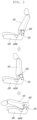
- FIG. 2 is a view showing a folding behavior of folding a seat according to one exemplary embodiment of the present invention
- FIG. 3 is an exploded perspective view showing components of a device for folding the seat according to one exemplary embodiment of the present invention
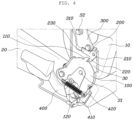
- FIG. 4 is a view showing a state prior to a lever manipulation according to one exemplary embodiment of the present invention.
- the device for folding the seat of the present invention includes: a lower arm stopper 110 fixed to a predetermined radial position with a reclining hinge shaft S1 of the seatback 10 as a center; a lock plate 200 configured to rotate with a rotation shaft 210 as a center while being hooked to the lower arm stopper 110 in a process of reclining forward together with the seatback 10 with the reclining hinge shaft S1 as the center; and a folding link 300 limited to rotate by being hooked to the lock plate 200 and configured to make folding rotation together with the seatback 10 with a folding hinge shaft S2, as a center, located at a part above the reclining hinge shaft S1, by being released from being hooked to the lock plate 200 according to the rotation of the lock plate 200.
- a plate-shaped lower arm 100 is fixed to a rear end side surface of a seat cushion 20, and a reclining hinge shaft S1 is coupled to a middle of the lower arm 100 so that the seatback 10 performs reclining rotation back and forth with the reclining hinge shaft S1 as the center.
- the lower arm stopper 110 protrudes toward the lock plate 200 on a portion of a top surface edge of the lower arm 100.
- the reclining hinge shaft S1 and the folding hinge shaft S2 are coupled to opposite ends of a folding bracket 30, respectively; the folding bracket 30 makes relative rotation with respect to the lower arm stopper 110 with the reclining hinge shaft S1 as the center; the folding link 300 makes relative rotation with respect to the folding bracket 30 with the folding hinge shaft S2 as a center; and the rotation shaft 210 of the lock plate 200 may be coupled to the folding bracket 30.
- the folding bracket 30 in a cover-shape is coupled between the rear end side surface of a seat cushion 20 and a lower end side surface of the seatback 10, wherein a lower end of the folding bracket 30 is rotatably coupled to the reclining hinge shaft S1, and the folding hinge shaft S2 is coupled to an upper end of the folding bracket 30.
- the upper end of the folding link 300 is coupled to the folding hinge shaft S2 so that, with the folding hinge shaft S2 as the center, the seatback 10 and the folding link 300 rotate together with the folding bracket 30 or perform folding rotation back and forth with respect to the folding bracket 30.
- lock plate 200 is disposed between the lower arm 100 and the folding link 300, and the rotation shaft 210 of the lock plate 200 is coupled to the folding bracket 30, whereby the lock plate 200 rotates about the rotation shaft 210 as the center.
- the lock plate 200 is configured to become a structure such that, with the rotation shaft 210 of the lock plate 200 as the center, one end and an opposite end of the lock plate 200 are extendedly formed toward the lower arm stopper 110 and the folding link 300, respectively; and as the one end of the lock plate rotates while being hooked to the lower arm stopper, the opposite end of the lock plate is released from being hooked to the folding link.
- the lower arm stopper 110 is disposed on a path where the one end of the lock plate 200 rotates with the reclining hinge shaft S1 as the center.
- the opposite end of the lock plate 200 is maintained in a state of being hooked to the folding link 300.
- the lock plate 200 rotates with the rotation shaft 210 as the center so that the opposite end thereof is released from being hooked to the folding link 300, it becomes a state in which the seatback 10 and the folding link 300 may be folded forward with the folding hinge shaft S2 as the center, regardless of the manipulation of the lever 400.
- FIG. 5 is a view showing a state before locking of a lock plate 200 by the lower arm stopper 110 is released in FIG. 4 .
- the lock plate 200 has the one end provided with a stopper locking part 220; and the lower arm stopper 110 is disposed on a rotation path of the stopper locking part 220 so that the stopper locking part 220 is pushed by the lower arm stopper 110 to rotate the lock plate 200.
- the folding link 300 is provided with a locking groove part 310 formed at an end thereof; and the lock plate 200 is provided with a link locking part 230 formed at the opposite end thereof; and in a state in which the link locking part 230 is hooked to the locking groove part 310, the link locking part 230 is released from being hooked to the locking groove part 310 according to a rotation of the lock plate 200.
- the lock plate 200 is formed in an "L" shape, and the rotation shaft 210 is coupled to a middle portion of the lock plate 200.
- stopper locking part 220 is formed toward the lower arm stopper 110 at the one end of the lock plate 200, and the stopper locking part 220 is positioned at the rear of the lower arm stopper 110.
- a link locking part 230 is formed toward the locking groove part 310, and the link locking part 230 is hooked to in a form to be inserted into the locking groove part 310.
- the seatback 10 rotates forward about the folding hinge shaft S2 as the center to implement the folding operation of the seatback 10.
- the device may further include a plate spring 240 configured to provide an elastic restoring force in a rotational direction to which the lock plate 200 is hooked to the folding link 300.
- the plate spring 240 may be a spring having a torsion spring structure, and, in a state of being inserted into the rotation shaft 210 of the lock plate 200, one end is hooked to the folding bracket 30, and an opposite end is hooked to the lock plate 200.
- the link locking part 230 is hooked to the locking groove part 310 of the folding link 300 to maintain a locking state, and in a process of restoring the seatback 10 from the folding state to the unfolding state, the link locking part 230 is hooked to the locking groove part 310 so that locking is made.
- the present disclosure further includes a lever 400 configured to manipulate a reclining operation or the folding operation of the seatback 10.
- the lock plate 200 rotates about the reclining hinge shaft S1 as the center according to an operation of the lever 400, and by the rotation of the lock plate 200, the folding link 300 is released from being hooked so that the folding link 300 rotates about the folding hinge shaft S2 as the center, whereby the folding operation is performed.
- the lever 400 performs rotational manipulation with the reclining hinge shaft S1 as the center, and when the lever 400 performs rotational manipulation, the seatback 10 is released from locking from the seat cushion 20, whereby reclining of the seatback 10 is allowed.
- the structure in which the locking between the seatback 10 and the seat cushion 20 is released according to the manipulation of the lever 400 is a technique commonly used in the seat field, and the description of the structure and operation thereof will be omitted.
- a guide pin 120 is fixed at a predetermined radial position, and a guide hole 410 of a long hole into which the guide pin 120 is inserted is formed along a rotation path of the lever 400 in the lever 400, thereby allowing the lever 400 to rotate in a section of the guide hole 410.
- the guide pin 120 is fixed to the lower arm 100, and the guide hole 410 is formed in a portion of the lever 400 where the guide pin 120 is to be located, so that the lever is manipulated only within the section of the guide hole 410, thereby limiting an excessive manipulation of the lever 400.
- the present disclosure further includes a lever spring 420 configured to provide an elastic restoring force in a rotational direction opposite to an operation direction of the lever 400.
- the lever spring 420 may be a spring having a coil spring structure, and one end thereof is hooked to a middle portion of the lever 400, and an opposite end thereof is hooked to a rear edge of the lower arm 100.
- the lever 400 when the lever 400 is released from a user's hand after the manipulation thereof, the lever 400 may be restored to the position prior to the operation by the elastic restoring force of the lever spring 420.
- the present disclosure further includes a folding spring 320 configured to provide an elastic restoring force in a folding direction of the seatback 10.
- the folding spring 320 may be a spring having a spiral spring structure and is provided in a form of being inserted into the reclining hinge shaft S1, wherein one end of an inner side is hooked to the lower arm 100, and an opposite end of an outer side is hooked to the folding bracket 30.
- the folding spring 320 is configured to provide a force for rotating the seatback 10 forward, thereby assisting the folding operation of the seatback 10.
- the seatback 10 rotates forward with the reclining hinge shaft S1 as the center by the elastic restoring force of the folding spring 320, and at this time, the lock plate 200 and the folding link 300 rotate together.
- the stopper locking part 220 of one end of the lock plate 200 is hooked to the lower arm stopper 110, and the lock plate 200 rotates counterclockwise based on the state shown in the drawing with the rotation shaft 210 as the center.
- the link locking part 230 of the opposite end of the lock plate 200 is hooked to the locking groove part 310 of the folding link 300 so that the folding link 300 is in a state of maintaining a locking state by the lock plate 200.
- the seatback 10 together with the folding link 300 rotates forward about the folding hinge shaft S2 as the center.
- the folding operation of the seatback 10 is implemented as shown in a bottom view of FIG. 2 .
- the lock plate 200 rotates forward about the reclining hinge shaft S1 as the center so that the link locking part 230 is separated from the locking groove part 310.
- the lock plate 200 since the folding link 300 further rotates forward together with the seatback 10, even when the lever 400 is restored to the position prior to the manipulation by releasing the user's hand from the lever 400, the lock plate 200 becomes not to be hooked to the folding link 300 in the folding process.
- the present disclosure not only implements a folding operation of the seatback 10 with one manipulation of the lever 400, but also improves convenience of the folding operation because there is no need to hold the lever 400 until the folding operation is completed.
Landscapes
- Engineering & Computer Science (AREA)
- Aviation & Aerospace Engineering (AREA)
- Transportation (AREA)
- Mechanical Engineering (AREA)
- Seats For Vehicles (AREA)
- Chairs For Special Purposes, Such As Reclining Chairs (AREA)
Description
- The present invention relates to a device for folding a seat, the device improving convenience of a folding operation by implementing the folding operation without maintaining a lever manipulation until the end of the folding operation when the folding manipulation of the seatback is performed.
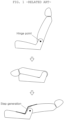
- When a single-stage hinge structure for a folding seat of a front seat as shown in
FIG. 1 is used, a hinge point position is high, so there is a problem in that a step in a waist area of the seat during reclining becomes large, causing back pain to a driver. - Accordingly, the folding seat of the front seat implements a folding operation using a two-stage hinge structure unlike a folding seat of a rear seat, thereby keeping a hinge point low. In such a way, a folding function of the seat is realized while realizing a comfortable posture for a driver by minimizing the step, in a waist area, that occurs during reclining.
- However, the conventional two-stage hinge structure is advantageous in terms of sitting posture, but there is an inconvenience in that the folding operation is performed only when the folding lever is maintained in a manipulated state when folding is implemented.
- Therefore, when the folding lever is not being pulled continuously, there is a problem in determining such a case as a malfunction as if folding is not being performed. In addition, there is a problem occurring such that elements implementing folding mechanism collide with a hand holding the folding lever during the folding operation, resulting in transferring shock to or injuring a user.
- The matters described as the related art above are only for improving understanding of a background of the present disclosure and should not be accepted as acknowledging to correspond to the related art known to those of ordinary skill in the art.
-
DE 10 2014 202683 A1 describes a device for folding a seat according to the preamble of claim 1. - Accordingly, the present invention has been made keeping in mind the above problems occurring in the related art, and the present invention is intended to provide a device for folding a seat, the device improving a convenience of a folding operation by implementing the folding operation without maintaining a lever manipulation until the end of the folding operation when the folding manipulation of the seatback is performed.
- According to the invention, this is achieved by a device for folding a seat according to the features of claim 1. Further advantageous embodiments are described in the subclaims.
- In order to achieve the above objective, according to the present invention, there is provided a device for folding a seat, the device including: a lower arm stopper formed to a predetermined radial position of a lower arm with respect to a reclining hinge shaft of a seatback as a center; a lock plate configured to rotate about a rotation shaft as a center while being hooked to the lower arm stopper in a process of reclining forward together with the seatback with respect to the reclining hinge shaft as the center; and a folding link limited to rotate by being hooked to the lock plate and configured to make folding rotation together with the seatback with respect to a folding hinge shaft, as a center, located at a part above the reclining hinge shaft, by being released from being hooked to the lock plate according to the rotation of the lock plate.
- The reclining hinge shaft and the folding hinge shaft may be coupled to opposite ends of a folding bracket, respectively; the folding bracket may make rotation relative to the lower arm stopper with respect to the reclining hinge shaft as the center; the folding link may make rotation relative to the folding bracket with respect to the folding hinge shaft as the center; and the rotation shaft of the lock plate may be coupled to the folding bracket.
- With the rotation shaft of the lock plate as a center, one end and an opposite end of the lock plate may extend toward the lower arm stopper and the folding link, respectively; and as the one end of the lock plate rotates while being hooked to the lower arm stopper, the opposite end of the lock plate may be released from being hooked to the folding link.
- The one end of the lock plate may be provided with a stopper locking part; and the lower arm stopper may be disposed on a rotation path of the stopper locking part so that the stopper locking part may be pushed by the lower arm stopper to rotate the lock plate.
- An end of the folding link may be provided with a locking groove part; the opposite end of the lock plate may be provided with a link locking part; and in a state in which the link locking part is hooked to the locking groove part, the link locking part may be released from being hooked to the locking groove part according to the rotation of the lock plate.
- The device may further include a plate spring configured to provide an elastic restoring force in a rotational direction to which the lock plate is hooked to the folding link.
- The device further includes a lever configured to manipulate a reclining or folding operation of the seatback, wherein according to a manipulation of the lever, locking between the seatback and the seat cushion is released so that the lock plate and the folding link together with the seatback rotate forward about the reclining hinge shaft as the center.
- With the reclining hinge shaft as the center, a guide pin is fixed at a predetermined radial position of the lower arm; and a guide hole of a long hole into which the guide pin is inserted extends along a rotation path of the lever in the lever, thereby allowing the lever to rotate in a guide hole section.
- The device may further include a lever spring configured to provide an elastic restoring force in a rotational direction opposite to an operation direction of the lever.
- The lock plate may rotate with the reclining hinge shaft as the center according to an operation of the lever; and by the lock plate, the folding link may be released from being hooked so that the folding link rotates with the folding hinge shaft as the center, whereby the folding operation may be performed.
- The device may further include a folding spring configured to provide an elastic restoring force in a folding direction of the seatback.
- As described above, there is an effect that the present invention, as described above, not only implements a folding operation of the seatback with one lever manipulation, but also improves convenience of the folding operation because there is no need to hold a lever until the folding operation is completed.
- Moreover, there is also an effect that it is not necessary to hold the lever until folding is completed, so an impact is prevented from being applied to a hand holding the lever, thereby preventing the risk of injury to a user during the folding operation of the seatback.
- The above and other objectives, features, and other advantages of the present invention will be more clearly understood from the following detailed description when taken in conjunction with the accompanying drawings, in which:
-
FIG. 1 is a view illustrating a seatback behavior of folding a seat having a conventional one-stage hinge structure; -
FIG. 2 is a view showing a folding behavior of folding a seat according to one exemplary embodiment of the present disclosure; -
FIG. 3 is an exploded perspective view showing components of a device for folding the seat according to one exemplary embodiment of the present disclosure; -
FIG. 4 is a view showing a state prior to a lever manipulation according to one exemplary embodiment of the present disclosure; -
FIG. 5 is a view showing a state before locking of a lock plate by the stopper is released inFIG. 4 ; and -
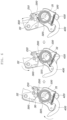
FIG. 6 is a view showing a folding operation reaction of the seat according to one exemplary embodiment of the present invention. - Specific structural or functional descriptions presented in the embodiments of the present invention are only exemplified for the purpose of describing embodiments according to the concept of the present invention, and the embodiments according to the concept of the present invention may be implemented in various forms. In addition, it should not be construed such that the present invention is limited to the embodiments described herein, and should be understood to include all modifications, equivalents, and substitutes included as long as they fall within the scope of the claims.
- Meanwhile, in the present invention, terms such as first, second, and the like may be used to describe various components, but the components are not limited to the above terms. The above terms are used only for the purpose of distinguishing one component from other components, for example, within the scope not departing from the scope of the rights according to the concept of the present invention, the first component may be named as the second component. Similarly, the second component may also be referred to as the first component.
- When a component is referred to as being "connected" or "coupled" to another component, it should be understood that the component may be directly connected or coupled to another component, but other components may exist therebetween.
- On the other hand, when a component is referred to as being "directly connected" or "directly coupled" to another component, it should be understood that no other element is present therebetween.
- Other expressions for describing the relationship between components, that is, expressions such as "between" and "immediately between", "adjacent to" and "directly adjacent to", or the like should be interpreted similarly.
- Throughout the specification, the same reference numerals will refer to the same or like parts. On the other hand, the terms used herein are for the purpose of describing the embodiments and are not intended to limit the present invention. In the present specification, the singular form also includes the plural form unless specifically stated in the phrase.
- As used herein, "comprises" and/or "comprising" means that a referenced component, step, operation, and/or element do not exclude the presence or addition of at least one of other components, steps, operations, and/or elements.
- Hereinafter, the present invention will be described in detail with reference to the accompanying drawings.
-
FIG. 2 is a view showing a folding behavior of folding a seat according to one exemplary embodiment of the present invention,FIG. 3 is an exploded perspective view showing components of a device for folding the seat according to one exemplary embodiment of the present invention, andFIG. 4 is a view showing a state prior to a lever manipulation according to one exemplary embodiment of the present invention. - With reference to the drawings, the device for folding the seat of the present invention includes: a
lower arm stopper 110 fixed to a predetermined radial position with a reclining hinge shaft S1 of theseatback 10 as a center; alock plate 200 configured to rotate with arotation shaft 210 as a center while being hooked to thelower arm stopper 110 in a process of reclining forward together with theseatback 10 with the reclining hinge shaft S1 as the center; and afolding link 300 limited to rotate by being hooked to thelock plate 200 and configured to make folding rotation together with theseatback 10 with a folding hinge shaft S2, as a center, located at a part above the reclining hinge shaft S1, by being released from being hooked to thelock plate 200 according to the rotation of thelock plate 200. - For example, a plate-shaped
lower arm 100 is fixed to a rear end side surface of aseat cushion 20, and a reclining hinge shaft S1 is coupled to a middle of thelower arm 100 so that theseatback 10 performs reclining rotation back and forth with the reclining hinge shaft S1 as the center. - In addition, the lower arm stopper 110 protrudes toward the
lock plate 200 on a portion of a top surface edge of thelower arm 100. - In addition, the reclining hinge shaft S1 and the folding hinge shaft S2 are coupled to opposite ends of a
folding bracket 30, respectively; thefolding bracket 30 makes relative rotation with respect to thelower arm stopper 110 with the reclining hinge shaft S1 as the center; thefolding link 300 makes relative rotation with respect to thefolding bracket 30 with the folding hinge shaft S2 as a center; and therotation shaft 210 of thelock plate 200 may be coupled to thefolding bracket 30. - For example, the
folding bracket 30 in a cover-shape is coupled between the rear end side surface of aseat cushion 20 and a lower end side surface of theseatback 10, wherein a lower end of thefolding bracket 30 is rotatably coupled to the reclining hinge shaft S1, and the folding hinge shaft S2 is coupled to an upper end of thefolding bracket 30. - In addition, the upper end of the
folding link 300 is coupled to the folding hinge shaft S2 so that, with the folding hinge shaft S2 as the center, theseatback 10 and thefolding link 300 rotate together with thefolding bracket 30 or perform folding rotation back and forth with respect to thefolding bracket 30. - In addition, the
lock plate 200 is disposed between thelower arm 100 and thefolding link 300, and therotation shaft 210 of thelock plate 200 is coupled to thefolding bracket 30, whereby thelock plate 200 rotates about therotation shaft 210 as the center. - In particular, the
lock plate 200 is configured to become a structure such that, with therotation shaft 210 of thelock plate 200 as the center, one end and an opposite end of thelock plate 200 are extendedly formed toward thelower arm stopper 110 and thefolding link 300, respectively; and as the one end of the lock plate rotates while being hooked to the lower arm stopper, the opposite end of the lock plate is released from being hooked to the folding link. - To this end, the
lower arm stopper 110 is disposed on a path where the one end of thelock plate 200 rotates with the reclining hinge shaft S1 as the center. - In addition, except for a folding state of the
seatback 10, the opposite end of thelock plate 200 is maintained in a state of being hooked to thefolding link 300. On the other hand, when thelock plate 200 rotates with therotation shaft 210 as the center so that the opposite end thereof is released from being hooked to thefolding link 300, it becomes a state in which theseatback 10 and thefolding link 300 may be folded forward with the folding hinge shaft S2 as the center, regardless of the manipulation of thelever 400. - Therefore, not only the folding operation of the
seatback 10 is implemented with one manipulation of thelever 400, but also convenience of the folding operation is improved because there is no need to hold thelever 400 until the folding operation is completed. In addition, thelever 400 is not held until folding is completed, so an impact is prevented from being applied to the hand holding thelever 400, thereby preventing the risk of injury to a user. - Meanwhile,
FIG. 5 is a view showing a state before locking of alock plate 200 by thelower arm stopper 110 is released inFIG. 4 . - When a structure from which the
lock plate 200 is to be released is specifically looked at with reference to the drawings, thelock plate 200 has the one end provided with astopper locking part 220; and thelower arm stopper 110 is disposed on a rotation path of thestopper locking part 220 so that thestopper locking part 220 is pushed by thelower arm stopper 110 to rotate thelock plate 200. - In addition, the
folding link 300 is provided with a lockinggroove part 310 formed at an end thereof; and thelock plate 200 is provided with alink locking part 230 formed at the opposite end thereof; and in a state in which thelink locking part 230 is hooked to the lockinggroove part 310, thelink locking part 230 is released from being hooked to the lockinggroove part 310 according to a rotation of thelock plate 200. - For example, the
lock plate 200 is formed in an "L" shape, and therotation shaft 210 is coupled to a middle portion of thelock plate 200. - In addition, the
stopper locking part 220 is formed toward thelower arm stopper 110 at the one end of thelock plate 200, and thestopper locking part 220 is positioned at the rear of thelower arm stopper 110. - In addition, at the opposite end of the
lock plate 200, alink locking part 230 is formed toward the lockinggroove part 310, and thelink locking part 230 is hooked to in a form to be inserted into the lockinggroove part 310. - Therefore, when the
seatback 10 rotates forward about the reclining hinge shaft S1 as the center according to the manipulation of thelever 400, thelock plate 200 rotates together with theseatback 10, and thestopper locking part 220 is hooked to the stopper in a rotation process, thelock plate 200 rotates with therotation shaft 210 as the center. - Accordingly, as the
link locking part 230 is released from being hooked to thefolding link 300, theseatback 10 rotates forward about the folding hinge shaft S2 as the center to implement the folding operation of theseatback 10. - In addition, the device may further include a
plate spring 240 configured to provide an elastic restoring force in a rotational direction to which thelock plate 200 is hooked to thefolding link 300. - For example, the
plate spring 240 may be a spring having a torsion spring structure, and, in a state of being inserted into therotation shaft 210 of thelock plate 200, one end is hooked to thefolding bracket 30, and an opposite end is hooked to thelock plate 200. - Accordingly, in an unfolding state of the
seatback 10, thelink locking part 230 is hooked to the lockinggroove part 310 of thefolding link 300 to maintain a locking state, and in a process of restoring theseatback 10 from the folding state to the unfolding state, thelink locking part 230 is hooked to the lockinggroove part 310 so that locking is made. - On the other hand, as shown in
FIGS. 4 and5 , the present disclosure further includes alever 400 configured to manipulate a reclining operation or the folding operation of theseatback 10. - In addition, according to the manipulation of the
lever 400, locking between theseatback 10 and theseat cushion 20 is released, so that thelock plate 200 and thefolding link 300 together with theseatback 10 become a structure that rotates forward with the reclining hinge shaft S1 as the center. - That is, the
lock plate 200 rotates about the reclining hinge shaft S1 as the center according to an operation of thelever 400, and by the rotation of thelock plate 200, thefolding link 300 is released from being hooked so that thefolding link 300 rotates about the folding hinge shaft S2 as the center, whereby the folding operation is performed. - For example, the
lever 400 performs rotational manipulation with the reclining hinge shaft S1 as the center, and when thelever 400 performs rotational manipulation, theseatback 10 is released from locking from theseat cushion 20, whereby reclining of theseatback 10 is allowed. - However, the structure in which the locking between the
seatback 10 and theseat cushion 20 is released according to the manipulation of thelever 400 is a technique commonly used in the seat field, and the description of the structure and operation thereof will be omitted. - In addition, with the reclining hinge shaft S1 as the center, a
guide pin 120 is fixed at a predetermined radial position, and aguide hole 410 of a long hole into which theguide pin 120 is inserted is formed along a rotation path of thelever 400 in thelever 400, thereby allowing thelever 400 to rotate in a section of theguide hole 410. - That is, the
guide pin 120 is fixed to thelower arm 100, and theguide hole 410 is formed in a portion of thelever 400 where theguide pin 120 is to be located, so that the lever is manipulated only within the section of theguide hole 410, thereby limiting an excessive manipulation of thelever 400. - In addition, the present disclosure further includes a
lever spring 420 configured to provide an elastic restoring force in a rotational direction opposite to an operation direction of thelever 400. - For example, the
lever spring 420 may be a spring having a coil spring structure, and one end thereof is hooked to a middle portion of thelever 400, and an opposite end thereof is hooked to a rear edge of thelower arm 100. - Therefore, when the
lever 400 is released from a user's hand after the manipulation thereof, thelever 400 may be restored to the position prior to the operation by the elastic restoring force of thelever spring 420. - Furthermore, as shown in
FIGS. 3 and6 , the present disclosure further includes afolding spring 320 configured to provide an elastic restoring force in a folding direction of theseatback 10. - For example, the
folding spring 320 may be a spring having a spiral spring structure and is provided in a form of being inserted into the reclining hinge shaft S1, wherein one end of an inner side is hooked to thelower arm 100, and an opposite end of an outer side is hooked to thefolding bracket 30. - Accordingly, in a folding process of the
seatback 10, thefolding spring 320 is configured to provide a force for rotating theseatback 10 forward, thereby assisting the folding operation of theseatback 10. - Hereinafter, the folding process of the
seatback 10 according to the present disclosure will be described. - When described with reference to
FIG. 6 , as thelever 400 is manipulated to be pulled upwardly, a locking state between theseatback 10 and theseat cushion 20 is released. - Accordingly, the
seatback 10 rotates forward with the reclining hinge shaft S1 as the center by the elastic restoring force of thefolding spring 320, and at this time, thelock plate 200 and thefolding link 300 rotate together. - In the rotation process, the
stopper locking part 220 of one end of thelock plate 200 is hooked to thelower arm stopper 110, and thelock plate 200 rotates counterclockwise based on the state shown in the drawing with therotation shaft 210 as the center. - At this time, the
link locking part 230 of the opposite end of thelock plate 200 is hooked to the lockinggroove part 310 of thefolding link 300 so that thefolding link 300 is in a state of maintaining a locking state by thelock plate 200. - In such a state, according to the counterclockwise rotation of the
lock plate 200, thelink locking part 230 hooked to the lockinggroove part 310 is separated from the lockinggroove part 310, whereby the locking state of thefolding link 300 is released. - Accordingly, the
seatback 10 together with thefolding link 300 rotates forward about the folding hinge shaft S2 as the center. - Accordingly, according to a forward rotation of the
seatback 10, the folding operation of theseatback 10 is implemented as shown in a bottom view ofFIG. 2 . - In particular, in the folding process of the
seatback 10, thelock plate 200 rotates forward about the reclining hinge shaft S1 as the center so that thelink locking part 230 is separated from the lockinggroove part 310. In addition, in such a state, since thefolding link 300 further rotates forward together with theseatback 10, even when thelever 400 is restored to the position prior to the manipulation by releasing the user's hand from thelever 400, thelock plate 200 becomes not to be hooked to thefolding link 300 in the folding process. - Accordingly, the present disclosure not only implements a folding operation of the
seatback 10 with one manipulation of thelever 400, but also improves convenience of the folding operation because there is no need to hold thelever 400 until the folding operation is completed. - Moreover, since it is not necessary to hold the
lever 400 until folding is completed, an impact is prevented from being applied to the hand holding thelever 400, thereby preventing the risk of injury to the user during the folding operation of theseatback 10.
Claims (9)
- A device for folding a seat, the device comprising:a lower arm stopper (110) formed to a predetermined radial position of a lower arm (100) with respect to a reclining hinge shaft (S1) of a seatback (10) as a center;a lock plate (200) configured to rotate about a rotation shaft (210) as a center while being hooked to the lower arm stopper (110) in a process of reclining forward together with the seatback (10) with respect to the reclining hinge shaft (S1) as the center;a folding link (300) configured to be limited to rotate by being hooked to the lock plate (200) and configured to make folding rotation together with the seatback (10) with respect to a folding hinge shaft (S2), as a center, located at a part above the reclining hinge shaft (S1), by being released from being hooked to the lock plate (200) according to the rotation of the lock plate (200); anda lever (400) configured to manipulate a reclining or folding operation of the seatback (10),wherein according to a manipulation of the lever (400), locking between the seatback (10) and a seat cushion (20) is released so that the lock plate (200) and the folding link (300) together with the seatback (10) rotate forward about the reclining hinge shaft (S1) as the center,characterized in that,with the reclining hinge shaft (S1) as the center, a guide pin (120) is fixed at a predetermined radial position of the lower arm (100), anda guide hole (410) of a long hole into which the guide pin (120) is inserted extends along a rotation path of the lever (400) in the lever (400), thereby allowing the lever (400) to rotate in a guide hole section.
- The device of claim 1, wherein the reclining hinge shaft (S1) and the folding hinge shaft (S2) are coupled to opposite ends of a folding bracket (30), respectively;the folding bracket (30) is configured to make rotation relative to the lower arm stopper (110) with respect to the reclining hinge shaft (S1) as the center;the folding link (300) is configured to make rotation relative to the folding bracket (30) with respect to the folding hinge shaft (S2) as the center; andthe rotation shaft (210) of the lock plate (200) is coupled to the folding bracket (30).
- The device of claim 1, wherein, with the rotation shaft (210) of the lock plate (200) as a center, one end and an opposite end of the lock plate (200) extend toward the lower arm stopper (110) and the folding link (300), respectively; and
as the one end of the lock plate (200) rotates while being hooked to the lower arm stopper (110), the opposite end of the lock plate (200) is released from being hooked to the folding link (300). - The device of claim 3, wherein the one end of the lock plate (200) is provided with a stopper locking part (220); and
the lower arm stopper (110) is disposed on a rotation path of the stopper locking part (220) so that the stopper locking part (220) is pushed by the lower arm stopper (110) to rotate the lock plate (200). - The device of claim 3, wherein an end of the folding link (300) is provided with a locking groove part (310);the opposite end of the lock plate (200) is provided with a link locking part (230); andin a state in which the link locking part (230) is hooked to the locking groove part (310), the link locking part (230) is released from being hooked to the locking groove part (310) according to the rotation of the lock plate (200).
- The device of claim 1, further comprising a plate spring (240) configured to provide an elastic restoring force in a rotational direction to which the lock plate (200) is hooked to the folding link (300).
- The device of claim 1, further comprising a lever spring (420) configured to provide an elastic restoring force in a rotational direction opposite to an operation direction of the lever (400).
- The device of claim 1, wherein the lock plate (200) rotates about the reclining hinge shaft (S1) as the center according to an operation of the lever (400); and
by the lock plate (200), the folding link (300) is released from being hooked so that the folding link (300) rotates with the folding hinge shaft (S2) as the center, whereby the folding operation is performed. - The device of claim 1, further comprising a folding spring (320) configured to provide an elastic restoring force in a folding direction of the seatback (10).
Applications Claiming Priority (1)
| Application Number | Priority Date | Filing Date | Title |
|---|---|---|---|
| KR1020210108258A KR20230026170A (en) | 2021-08-17 | 2021-08-17 | Device for folding seat |
Publications (2)
| Publication Number | Publication Date |
|---|---|
| EP4140806A1 EP4140806A1 (en) | 2023-03-01 |
| EP4140806B1 true EP4140806B1 (en) | 2025-05-21 |
Family
ID=82748593
Family Applications (1)
| Application Number | Title | Priority Date | Filing Date |
|---|---|---|---|
| EP22187173.4A Active EP4140806B1 (en) | 2021-08-17 | 2022-07-27 | Device for folding seat |
Country Status (3)
| Country | Link |
|---|---|
| US (1) | US11850977B2 (en) |
| EP (1) | EP4140806B1 (en) |
| KR (1) | KR20230026170A (en) |
Family Cites Families (7)
| Publication number | Priority date | Publication date | Assignee | Title |
|---|---|---|---|---|
| US6926364B2 (en) * | 2002-08-23 | 2005-08-09 | Faurecia Automotive Seating Canada Limited | Fold flat vehicle seat in rearward position |
| FR2860192B1 (en) * | 2003-09-25 | 2005-11-25 | Antolin Grupo Ing Sa | SEAT ADJUSTING DEVICE UNDER PREDETERMINED ANGULAR RANGES |
| KR100601809B1 (en) * | 2005-12-21 | 2006-07-19 | 주식회사 오스템 | Folding recliner of car seat |
| FR2910396B1 (en) * | 2006-12-22 | 2009-01-23 | Peugeot Citroen Automobiles Sa | DEVICE FOR UNLOCKING THE BACKREST OF A MOTOR VEHICLE SEAT WITH ELECTRICALLY FOLDING CONTROL |
| KR101242666B1 (en) * | 2011-08-25 | 2013-03-12 | 포레시아오토모티브시팅코리아 유한회사 | Locking device and locking device of auxiliary seat for vehicle |
| US8955912B2 (en) * | 2013-05-03 | 2015-02-17 | Lear Corporation | Seat assembly having a foldable seat back |
| KR102570786B1 (en) | 2016-11-29 | 2023-08-25 | 주식회사 다스 | Flat Seat for Vehicle |
-
2021
- 2021-08-17 KR KR1020210108258A patent/KR20230026170A/en active Pending
-
2022
- 2022-07-25 US US17/872,591 patent/US11850977B2/en active Active
- 2022-07-27 EP EP22187173.4A patent/EP4140806B1/en active Active
Also Published As
| Publication number | Publication date |
|---|---|
| US11850977B2 (en) | 2023-12-26 |
| KR20230026170A (en) | 2023-02-24 |
| EP4140806A1 (en) | 2023-03-01 |
| US20230056083A1 (en) | 2023-02-23 |
Similar Documents
| Publication | Publication Date | Title |
|---|---|---|
| US7341312B2 (en) | Foldable head restraint | |
| US7575282B2 (en) | Foldable head restraint | |
| JP3866115B2 (en) | Vehicle seat with foldable backrest | |
| JP2001003605A (en) | Vehicle door handle | |
| CN110962709A (en) | Car seat and its side impact protection mechanism | |
| US8651575B2 (en) | Seat back structure with lumbar support for vehicle | |
| EP1764261B1 (en) | Seat for a vehicle | |
| US7690728B2 (en) | Vehicle seat apparatus | |
| EP1834832B1 (en) | Pivot mechanism | |
| US20120146370A1 (en) | Apparatus for preventing neck injury for use in vehicle seat | |
| AU2021291000B2 (en) | Child safety seat and side collision protection mechanism thereof | |
| EP4140806B1 (en) | Device for folding seat | |
| JPH0437475Y2 (en) | ||
| US6186572B1 (en) | Full floating device of a rear seat cushion for an automobile | |
| CN116424183B (en) | Torque assist system for folding seat backs in vehicles | |
| JP2005179979A (en) | Lid lock device | |
| CN113613988B (en) | Windshields for riding vehicles | |
| JP7016241B2 (en) | Vehicle seat reclining lock release device | |
| US8029057B2 (en) | Clutch mechanism for vehicle seat | |
| JPH0824077A (en) | Supporting structure for arm rest | |
| EP0478490B1 (en) | Tiltable child's seat | |
| JP7053221B2 (en) | Vehicle seat slide device | |
| JP3969073B2 (en) | Child seat fixing device | |
| JPH0319782Y2 (en) | ||
| KR101869057B1 (en) | Striker rotating device of seat for vihicle |
Legal Events
| Date | Code | Title | Description |
|---|---|---|---|
| PUAI | Public reference made under article 153(3) epc to a published international application that has entered the european phase |
Free format text: ORIGINAL CODE: 0009012 |
|
| STAA | Information on the status of an ep patent application or granted ep patent |
Free format text: STATUS: REQUEST FOR EXAMINATION WAS MADE |
|
| 17P | Request for examination filed |
Effective date: 20220727 |
|
| AK | Designated contracting states |
Kind code of ref document: A1 Designated state(s): AL AT BE BG CH CY CZ DE DK EE ES FI FR GB GR HR HU IE IS IT LI LT LU LV MC MK MT NL NO PL PT RO RS SE SI SK SM TR |
|
| RBV | Designated contracting states (corrected) |
Designated state(s): AL AT BE BG CH CY CZ DE DK EE ES FI FR GB GR HR HU IE IS IT LI LT LU LV MC MK MT NL NO PL PT RO RS SE SI SK SM TR |
|
| GRAP | Despatch of communication of intention to grant a patent |
Free format text: ORIGINAL CODE: EPIDOSNIGR1 |
|
| STAA | Information on the status of an ep patent application or granted ep patent |
Free format text: STATUS: GRANT OF PATENT IS INTENDED |
|
| INTG | Intention to grant announced |
Effective date: 20241216 |
|
| RAP3 | Party data changed (applicant data changed or rights of an application transferred) |
Owner name: DAYOU A-TECH CO., LTD. Owner name: HYUNDAI TRANSYS INC. |
|
| GRAS | Grant fee paid |
Free format text: ORIGINAL CODE: EPIDOSNIGR3 |
|
| GRAA | (expected) grant |
Free format text: ORIGINAL CODE: 0009210 |
|
| STAA | Information on the status of an ep patent application or granted ep patent |
Free format text: STATUS: THE PATENT HAS BEEN GRANTED |
|
| AK | Designated contracting states |
Kind code of ref document: B1 Designated state(s): AL AT BE BG CH CY CZ DE DK EE ES FI FR GB GR HR HU IE IS IT LI LT LU LV MC MK MT NL NO PL PT RO RS SE SI SK SM TR |
|
| REG | Reference to a national code |
Ref country code: GB Ref legal event code: FG4D |
|
| P01 | Opt-out of the competence of the unified patent court (upc) registered |
Free format text: CASE NUMBER: APP_19354/2025 Effective date: 20250423 |
|
| REG | Reference to a national code |
Ref country code: CH Ref legal event code: EP |
|
| REG | Reference to a national code |
Ref country code: DE Ref legal event code: R096 Ref document number: 602022014867 Country of ref document: DE |
|
| REG | Reference to a national code |
Ref country code: IE Ref legal event code: FG4D |
|
| REG | Reference to a national code |
Ref country code: NL Ref legal event code: MP Effective date: 20250521 |
|
| PG25 | Lapsed in a contracting state [announced via postgrant information from national office to epo] |
Ref country code: PT Free format text: LAPSE BECAUSE OF FAILURE TO SUBMIT A TRANSLATION OF THE DESCRIPTION OR TO PAY THE FEE WITHIN THE PRESCRIBED TIME-LIMIT Effective date: 20250922 Ref country code: ES Free format text: LAPSE BECAUSE OF FAILURE TO SUBMIT A TRANSLATION OF THE DESCRIPTION OR TO PAY THE FEE WITHIN THE PRESCRIBED TIME-LIMIT Effective date: 20250521 Ref country code: FI Free format text: LAPSE BECAUSE OF FAILURE TO SUBMIT A TRANSLATION OF THE DESCRIPTION OR TO PAY THE FEE WITHIN THE PRESCRIBED TIME-LIMIT Effective date: 20250521 |
|
| PGFP | Annual fee paid to national office [announced via postgrant information from national office to epo] |
Ref country code: DE Payment date: 20250716 Year of fee payment: 4 |
|
| REG | Reference to a national code |
Ref country code: LT Ref legal event code: MG9D |
|
| PG25 | Lapsed in a contracting state [announced via postgrant information from national office to epo] |
Ref country code: GR Free format text: LAPSE BECAUSE OF FAILURE TO SUBMIT A TRANSLATION OF THE DESCRIPTION OR TO PAY THE FEE WITHIN THE PRESCRIBED TIME-LIMIT Effective date: 20250822 Ref country code: NO Free format text: LAPSE BECAUSE OF FAILURE TO SUBMIT A TRANSLATION OF THE DESCRIPTION OR TO PAY THE FEE WITHIN THE PRESCRIBED TIME-LIMIT Effective date: 20250821 |
|
| PG25 | Lapsed in a contracting state [announced via postgrant information from national office to epo] |
Ref country code: NL Free format text: LAPSE BECAUSE OF FAILURE TO SUBMIT A TRANSLATION OF THE DESCRIPTION OR TO PAY THE FEE WITHIN THE PRESCRIBED TIME-LIMIT Effective date: 20250521 Ref country code: PL Free format text: LAPSE BECAUSE OF FAILURE TO SUBMIT A TRANSLATION OF THE DESCRIPTION OR TO PAY THE FEE WITHIN THE PRESCRIBED TIME-LIMIT Effective date: 20250521 |
|
| PG25 | Lapsed in a contracting state [announced via postgrant information from national office to epo] |
Ref country code: BG Free format text: LAPSE BECAUSE OF FAILURE TO SUBMIT A TRANSLATION OF THE DESCRIPTION OR TO PAY THE FEE WITHIN THE PRESCRIBED TIME-LIMIT Effective date: 20250521 |
|
| PG25 | Lapsed in a contracting state [announced via postgrant information from national office to epo] |
Ref country code: HR Free format text: LAPSE BECAUSE OF FAILURE TO SUBMIT A TRANSLATION OF THE DESCRIPTION OR TO PAY THE FEE WITHIN THE PRESCRIBED TIME-LIMIT Effective date: 20250521 |
|
| PGFP | Annual fee paid to national office [announced via postgrant information from national office to epo] |
Ref country code: FR Payment date: 20250723 Year of fee payment: 4 |
|
| PG25 | Lapsed in a contracting state [announced via postgrant information from national office to epo] |
Ref country code: RS Free format text: LAPSE BECAUSE OF FAILURE TO SUBMIT A TRANSLATION OF THE DESCRIPTION OR TO PAY THE FEE WITHIN THE PRESCRIBED TIME-LIMIT Effective date: 20250821 |
|
| PG25 | Lapsed in a contracting state [announced via postgrant information from national office to epo] |
Ref country code: IS Free format text: LAPSE BECAUSE OF FAILURE TO SUBMIT A TRANSLATION OF THE DESCRIPTION OR TO PAY THE FEE WITHIN THE PRESCRIBED TIME-LIMIT Effective date: 20250921 |
|
| PG25 | Lapsed in a contracting state [announced via postgrant information from national office to epo] |
Ref country code: LV Free format text: LAPSE BECAUSE OF FAILURE TO SUBMIT A TRANSLATION OF THE DESCRIPTION OR TO PAY THE FEE WITHIN THE PRESCRIBED TIME-LIMIT Effective date: 20250521 |
|
| REG | Reference to a national code |
Ref country code: AT Ref legal event code: MK05 Ref document number: 1796492 Country of ref document: AT Kind code of ref document: T Effective date: 20250521 |
|
| PG25 | Lapsed in a contracting state [announced via postgrant information from national office to epo] |
Ref country code: AT Free format text: LAPSE BECAUSE OF FAILURE TO SUBMIT A TRANSLATION OF THE DESCRIPTION OR TO PAY THE FEE WITHIN THE PRESCRIBED TIME-LIMIT Effective date: 20250521 Ref country code: SM Free format text: LAPSE BECAUSE OF FAILURE TO SUBMIT A TRANSLATION OF THE DESCRIPTION OR TO PAY THE FEE WITHIN THE PRESCRIBED TIME-LIMIT Effective date: 20250521 Ref country code: DK Free format text: LAPSE BECAUSE OF FAILURE TO SUBMIT A TRANSLATION OF THE DESCRIPTION OR TO PAY THE FEE WITHIN THE PRESCRIBED TIME-LIMIT Effective date: 20250521 |
|
| PG25 | Lapsed in a contracting state [announced via postgrant information from national office to epo] |
Ref country code: CZ Free format text: LAPSE BECAUSE OF FAILURE TO SUBMIT A TRANSLATION OF THE DESCRIPTION OR TO PAY THE FEE WITHIN THE PRESCRIBED TIME-LIMIT Effective date: 20250521 |
|
| PG25 | Lapsed in a contracting state [announced via postgrant information from national office to epo] |
Ref country code: EE Free format text: LAPSE BECAUSE OF FAILURE TO SUBMIT A TRANSLATION OF THE DESCRIPTION OR TO PAY THE FEE WITHIN THE PRESCRIBED TIME-LIMIT Effective date: 20250521 |
|
| PG25 | Lapsed in a contracting state [announced via postgrant information from national office to epo] |
Ref country code: SK Free format text: LAPSE BECAUSE OF FAILURE TO SUBMIT A TRANSLATION OF THE DESCRIPTION OR TO PAY THE FEE WITHIN THE PRESCRIBED TIME-LIMIT Effective date: 20250521 |
|
| PG25 | Lapsed in a contracting state [announced via postgrant information from national office to epo] |
Ref country code: IT Free format text: LAPSE BECAUSE OF FAILURE TO SUBMIT A TRANSLATION OF THE DESCRIPTION OR TO PAY THE FEE WITHIN THE PRESCRIBED TIME-LIMIT Effective date: 20250521 |
|
| PG25 | Lapsed in a contracting state [announced via postgrant information from national office to epo] |
Ref country code: RO Free format text: LAPSE BECAUSE OF FAILURE TO SUBMIT A TRANSLATION OF THE DESCRIPTION OR TO PAY THE FEE WITHIN THE PRESCRIBED TIME-LIMIT Effective date: 20250521 |
|
| REG | Reference to a national code |
Ref country code: CH Ref legal event code: H13 Free format text: ST27 STATUS EVENT CODE: U-0-0-H10-H13 (AS PROVIDED BY THE NATIONAL OFFICE) Effective date: 20260224 Ref country code: DE Ref legal event code: R097 Ref document number: 602022014867 Country of ref document: DE |
|
| PG25 | Lapsed in a contracting state [announced via postgrant information from national office to epo] |
Ref country code: LU Free format text: LAPSE BECAUSE OF NON-PAYMENT OF DUE FEES Effective date: 20250727 |
|
| REG | Reference to a national code |
Ref country code: BE Ref legal event code: MM Effective date: 20250731 |
|
| PLBE | No opposition filed within time limit |
Free format text: ORIGINAL CODE: 0009261 |
|
| STAA | Information on the status of an ep patent application or granted ep patent |
Free format text: STATUS: NO OPPOSITION FILED WITHIN TIME LIMIT |
|
| REG | Reference to a national code |
Ref country code: CH Ref legal event code: L10 Free format text: ST27 STATUS EVENT CODE: U-0-0-L10-L00 (AS PROVIDED BY THE NATIONAL OFFICE) Effective date: 20260402 |
|
| PGFP | Annual fee paid to national office [announced via postgrant information from national office to epo] |
Ref country code: AT Payment date: 20260410 Year of fee payment: 4 |
|
| PG25 | Lapsed in a contracting state [announced via postgrant information from national office to epo] |
Ref country code: BE Free format text: LAPSE BECAUSE OF NON-PAYMENT OF DUE FEES Effective date: 20250731 |
|
| PG25 | Lapsed in a contracting state [announced via postgrant information from national office to epo] |
Ref country code: CH Free format text: LAPSE BECAUSE OF NON-PAYMENT OF DUE FEES Effective date: 20250731 |
|
| 26N | No opposition filed |
Effective date: 20260224 |