EP4140597A1 - Coating device and coating method by which coating layer thickness is easily adjustable - Google Patents
Coating device and coating method by which coating layer thickness is easily adjustable Download PDFInfo
- Publication number
- EP4140597A1 EP4140597A1 EP21940004.1A EP21940004A EP4140597A1 EP 4140597 A1 EP4140597 A1 EP 4140597A1 EP 21940004 A EP21940004 A EP 21940004A EP 4140597 A1 EP4140597 A1 EP 4140597A1
- Authority
- EP
- European Patent Office
- Prior art keywords
- water tank
- coating
- substrate film
- tank portion
- solution
- Prior art date
- Legal status (The legal status is an assumption and is not a legal conclusion. Google has not performed a legal analysis and makes no representation as to the accuracy of the status listed.)
- Granted
Links
Images

Classifications
-
- B—PERFORMING OPERATIONS; TRANSPORTING
- B05—SPRAYING OR ATOMISING IN GENERAL; APPLYING FLUENT MATERIALS TO SURFACES, IN GENERAL
- B05D—PROCESSES FOR APPLYING FLUENT MATERIALS TO SURFACES, IN GENERAL
- B05D1/00—Processes for applying liquids or other fluent materials
- B05D1/18—Processes for applying liquids or other fluent materials performed by dipping
- B05D1/20—Processes for applying liquids or other fluent materials performed by dipping substances to be applied floating on a fluid
-
- B—PERFORMING OPERATIONS; TRANSPORTING
- B05—SPRAYING OR ATOMISING IN GENERAL; APPLYING FLUENT MATERIALS TO SURFACES, IN GENERAL
- B05C—APPARATUS FOR APPLYING FLUENT MATERIALS TO SURFACES, IN GENERAL
- B05C1/00—Apparatus in which liquid or other fluent material is applied to the surface of the work by contact with a member carrying the liquid or other fluent material, e.g. a porous member loaded with a liquid to be applied as a coating
- B05C1/04—Apparatus in which liquid or other fluent material is applied to the surface of the work by contact with a member carrying the liquid or other fluent material, e.g. a porous member loaded with a liquid to be applied as a coating for applying liquid or other fluent material to work of indefinite length
- B05C1/08—Apparatus in which liquid or other fluent material is applied to the surface of the work by contact with a member carrying the liquid or other fluent material, e.g. a porous member loaded with a liquid to be applied as a coating for applying liquid or other fluent material to work of indefinite length using a roller or other rotating member which contacts the work along a generating line
- B05C1/0813—Apparatus in which liquid or other fluent material is applied to the surface of the work by contact with a member carrying the liquid or other fluent material, e.g. a porous member loaded with a liquid to be applied as a coating for applying liquid or other fluent material to work of indefinite length using a roller or other rotating member which contacts the work along a generating line characterised by means for supplying liquid or other fluent material to the roller
-
- B—PERFORMING OPERATIONS; TRANSPORTING
- B05—SPRAYING OR ATOMISING IN GENERAL; APPLYING FLUENT MATERIALS TO SURFACES, IN GENERAL
- B05C—APPARATUS FOR APPLYING FLUENT MATERIALS TO SURFACES, IN GENERAL
- B05C3/00—Apparatus in which the work is brought into contact with a bulk quantity of liquid or other fluent material
- B05C3/02—Apparatus in which the work is brought into contact with a bulk quantity of liquid or other fluent material the work being immersed in the liquid or other fluent material
- B05C3/12—Apparatus in which the work is brought into contact with a bulk quantity of liquid or other fluent material the work being immersed in the liquid or other fluent material for treating work of indefinite length
- B05C3/125—Apparatus in which the work is brought into contact with a bulk quantity of liquid or other fluent material the work being immersed in the liquid or other fluent material for treating work of indefinite length the work being a web, band, strip or the like
-
- B—PERFORMING OPERATIONS; TRANSPORTING
- B05—SPRAYING OR ATOMISING IN GENERAL; APPLYING FLUENT MATERIALS TO SURFACES, IN GENERAL
- B05C—APPARATUS FOR APPLYING FLUENT MATERIALS TO SURFACES, IN GENERAL
- B05C9/00—Apparatus or plant for applying liquid or other fluent material to surfaces by means not covered by any preceding group, or in which the means of applying the liquid or other fluent material is not important
- B05C9/08—Apparatus or plant for applying liquid or other fluent material to surfaces by means not covered by any preceding group, or in which the means of applying the liquid or other fluent material is not important for applying liquid or other fluent material and performing an auxiliary operation
- B05C9/14—Apparatus or plant for applying liquid or other fluent material to surfaces by means not covered by any preceding group, or in which the means of applying the liquid or other fluent material is not important for applying liquid or other fluent material and performing an auxiliary operation the auxiliary operation involving heating or cooling
-
- B—PERFORMING OPERATIONS; TRANSPORTING
- B05—SPRAYING OR ATOMISING IN GENERAL; APPLYING FLUENT MATERIALS TO SURFACES, IN GENERAL
- B05D—PROCESSES FOR APPLYING FLUENT MATERIALS TO SURFACES, IN GENERAL
- B05D1/00—Processes for applying liquids or other fluent materials
- B05D1/18—Processes for applying liquids or other fluent materials performed by dipping
-
- B—PERFORMING OPERATIONS; TRANSPORTING
- B05—SPRAYING OR ATOMISING IN GENERAL; APPLYING FLUENT MATERIALS TO SURFACES, IN GENERAL
- B05D—PROCESSES FOR APPLYING FLUENT MATERIALS TO SURFACES, IN GENERAL
- B05D1/00—Processes for applying liquids or other fluent materials
- B05D1/28—Processes for applying liquids or other fluent materials performed by transfer from the surfaces of elements carrying the liquid or other fluent material, e.g. brushes, pads, rollers
-
- B—PERFORMING OPERATIONS; TRANSPORTING
- B05—SPRAYING OR ATOMISING IN GENERAL; APPLYING FLUENT MATERIALS TO SURFACES, IN GENERAL
- B05D—PROCESSES FOR APPLYING FLUENT MATERIALS TO SURFACES, IN GENERAL
- B05D3/00—Pretreatment of surfaces to which liquids or other fluent materials are to be applied; After-treatment of applied coatings, e.g. intermediate treating of an applied coating preparatory to subsequent applications of liquids or other fluent materials
- B05D3/02—Pretreatment of surfaces to which liquids or other fluent materials are to be applied; After-treatment of applied coatings, e.g. intermediate treating of an applied coating preparatory to subsequent applications of liquids or other fluent materials by baking
- B05D3/0254—After-treatment
-
- B—PERFORMING OPERATIONS; TRANSPORTING
- B05—SPRAYING OR ATOMISING IN GENERAL; APPLYING FLUENT MATERIALS TO SURFACES, IN GENERAL
- B05D—PROCESSES FOR APPLYING FLUENT MATERIALS TO SURFACES, IN GENERAL
- B05D3/00—Pretreatment of surfaces to which liquids or other fluent materials are to be applied; After-treatment of applied coatings, e.g. intermediate treating of an applied coating preparatory to subsequent applications of liquids or other fluent materials
- B05D3/04—Pretreatment of surfaces to which liquids or other fluent materials are to be applied; After-treatment of applied coatings, e.g. intermediate treating of an applied coating preparatory to subsequent applications of liquids or other fluent materials by exposure to gases
- B05D3/0466—Pretreatment of surfaces to which liquids or other fluent materials are to be applied; After-treatment of applied coatings, e.g. intermediate treating of an applied coating preparatory to subsequent applications of liquids or other fluent materials by exposure to gases the gas being a non-reacting gas
- B05D3/0473—Pretreatment of surfaces to which liquids or other fluent materials are to be applied; After-treatment of applied coatings, e.g. intermediate treating of an applied coating preparatory to subsequent applications of liquids or other fluent materials by exposure to gases the gas being a non-reacting gas for heating, e.g. vapour heating
-
- B—PERFORMING OPERATIONS; TRANSPORTING
- B05—SPRAYING OR ATOMISING IN GENERAL; APPLYING FLUENT MATERIALS TO SURFACES, IN GENERAL
- B05D—PROCESSES FOR APPLYING FLUENT MATERIALS TO SURFACES, IN GENERAL
- B05D7/00—Processes, other than flocking, specially adapted for applying liquids or other fluent materials to particular surfaces or for applying particular liquids or other fluent materials
- B05D7/50—Multilayers
- B05D7/52—Two layers
-
- B—PERFORMING OPERATIONS; TRANSPORTING
- B05—SPRAYING OR ATOMISING IN GENERAL; APPLYING FLUENT MATERIALS TO SURFACES, IN GENERAL
- B05D—PROCESSES FOR APPLYING FLUENT MATERIALS TO SURFACES, IN GENERAL
- B05D7/00—Processes, other than flocking, specially adapted for applying liquids or other fluent materials to particular surfaces or for applying particular liquids or other fluent materials
- B05D7/50—Multilayers
- B05D7/56—Three layers or more
- B05D7/58—No clear coat specified
- B05D7/586—No clear coat specified each layer being cured, at least partially, separately
-
- H—ELECTRICITY
- H01—ELECTRIC ELEMENTS
- H01M—PROCESSES OR MEANS, e.g. BATTERIES, FOR THE DIRECT CONVERSION OF CHEMICAL ENERGY INTO ELECTRICAL ENERGY
- H01M4/00—Electrodes
- H01M4/02—Electrodes composed of, or comprising, active material
- H01M4/04—Processes of manufacture in general
- H01M4/0402—Methods of deposition of the material
-
- H—ELECTRICITY
- H01—ELECTRIC ELEMENTS
- H01M—PROCESSES OR MEANS, e.g. BATTERIES, FOR THE DIRECT CONVERSION OF CHEMICAL ENERGY INTO ELECTRICAL ENERGY
- H01M4/00—Electrodes
- H01M4/02—Electrodes composed of, or comprising, active material
- H01M4/04—Processes of manufacture in general
- H01M4/0402—Methods of deposition of the material
- H01M4/0404—Methods of deposition of the material by coating on electrode collectors
-
- B—PERFORMING OPERATIONS; TRANSPORTING
- B05—SPRAYING OR ATOMISING IN GENERAL; APPLYING FLUENT MATERIALS TO SURFACES, IN GENERAL
- B05C—APPARATUS FOR APPLYING FLUENT MATERIALS TO SURFACES, IN GENERAL
- B05C3/00—Apparatus in which the work is brought into contact with a bulk quantity of liquid or other fluent material
- B05C3/005—Apparatus in which the work is brought into contact with a bulk quantity of liquid or other fluent material incorporating means for heating or cooling the liquid or other fluent material
-
- B—PERFORMING OPERATIONS; TRANSPORTING
- B05—SPRAYING OR ATOMISING IN GENERAL; APPLYING FLUENT MATERIALS TO SURFACES, IN GENERAL
- B05C—APPARATUS FOR APPLYING FLUENT MATERIALS TO SURFACES, IN GENERAL
- B05C9/00—Apparatus or plant for applying liquid or other fluent material to surfaces by means not covered by any preceding group, or in which the means of applying the liquid or other fluent material is not important
- B05C9/06—Apparatus or plant for applying liquid or other fluent material to surfaces by means not covered by any preceding group, or in which the means of applying the liquid or other fluent material is not important for applying two different liquids or other fluent materials, or the same liquid or other fluent material twice, to the same side of the work
-
- B—PERFORMING OPERATIONS; TRANSPORTING
- B05—SPRAYING OR ATOMISING IN GENERAL; APPLYING FLUENT MATERIALS TO SURFACES, IN GENERAL
- B05D—PROCESSES FOR APPLYING FLUENT MATERIALS TO SURFACES, IN GENERAL
- B05D2202/00—Metallic substrate
-
- B—PERFORMING OPERATIONS; TRANSPORTING
- B05—SPRAYING OR ATOMISING IN GENERAL; APPLYING FLUENT MATERIALS TO SURFACES, IN GENERAL
- B05D—PROCESSES FOR APPLYING FLUENT MATERIALS TO SURFACES, IN GENERAL
- B05D2252/00—Sheets
- B05D2252/02—Sheets of indefinite length
-
- B—PERFORMING OPERATIONS; TRANSPORTING
- B05—SPRAYING OR ATOMISING IN GENERAL; APPLYING FLUENT MATERIALS TO SURFACES, IN GENERAL
- B05D—PROCESSES FOR APPLYING FLUENT MATERIALS TO SURFACES, IN GENERAL
- B05D3/00—Pretreatment of surfaces to which liquids or other fluent materials are to be applied; After-treatment of applied coatings, e.g. intermediate treating of an applied coating preparatory to subsequent applications of liquids or other fluent materials
- B05D3/06—Pretreatment of surfaces to which liquids or other fluent materials are to be applied; After-treatment of applied coatings, e.g. intermediate treating of an applied coating preparatory to subsequent applications of liquids or other fluent materials by exposure to radiation
- B05D3/061—Pretreatment of surfaces to which liquids or other fluent materials are to be applied; After-treatment of applied coatings, e.g. intermediate treating of an applied coating preparatory to subsequent applications of liquids or other fluent materials by exposure to radiation using U.V.
- B05D3/065—After-treatment
- B05D3/067—Curing or cross-linking the coating
-
- B—PERFORMING OPERATIONS; TRANSPORTING
- B05—SPRAYING OR ATOMISING IN GENERAL; APPLYING FLUENT MATERIALS TO SURFACES, IN GENERAL
- B05D—PROCESSES FOR APPLYING FLUENT MATERIALS TO SURFACES, IN GENERAL
- B05D7/00—Processes, other than flocking, specially adapted for applying liquids or other fluent materials to particular surfaces or for applying particular liquids or other fluent materials
- B05D7/14—Processes, other than flocking, specially adapted for applying liquids or other fluent materials to particular surfaces or for applying particular liquids or other fluent materials to metal, e.g. car bodies
-
- B—PERFORMING OPERATIONS; TRANSPORTING
- B05—SPRAYING OR ATOMISING IN GENERAL; APPLYING FLUENT MATERIALS TO SURFACES, IN GENERAL
- B05D—PROCESSES FOR APPLYING FLUENT MATERIALS TO SURFACES, IN GENERAL
- B05D7/00—Processes, other than flocking, specially adapted for applying liquids or other fluent materials to particular surfaces or for applying particular liquids or other fluent materials
- B05D7/50—Multilayers
- B05D7/52—Two layers
- B05D7/54—No clear coat specified
- B05D7/546—No clear coat specified each layer being cured, at least partially, separately
-
- Y—GENERAL TAGGING OF NEW TECHNOLOGICAL DEVELOPMENTS; GENERAL TAGGING OF CROSS-SECTIONAL TECHNOLOGIES SPANNING OVER SEVERAL SECTIONS OF THE IPC; TECHNICAL SUBJECTS COVERED BY FORMER USPC CROSS-REFERENCE ART COLLECTIONS [XRACs] AND DIGESTS
- Y02—TECHNOLOGIES OR APPLICATIONS FOR MITIGATION OR ADAPTATION AGAINST CLIMATE CHANGE
- Y02E—REDUCTION OF GREENHOUSE GAS [GHG] EMISSIONS, RELATED TO ENERGY GENERATION, TRANSMISSION OR DISTRIBUTION
- Y02E60/00—Enabling technologies; Technologies with a potential or indirect contribution to GHG emissions mitigation
- Y02E60/10—Energy storage using batteries
Definitions
- the present invention relates to a coating apparatus and a coating method of a separator or a current collector for secondary batteries, and more particularly to a coating apparatus and a coating method of a separator or a current collector for secondary batteries capable of adjusting the thickness of a coating layer by adjusting the height of a coating solution layer, whereby it is possible to implement an ultrathin coating thickness.
- the lithium secondary battery is assembled by manufacturing an electrode assembly configured such that positive electrodes and negative electrodes are alternately stacked in the state in which separators are interposed respectively between the positive electrodes and the negative electrodes, inserting the electrode assembly into a battery case constituted by a can or a pouch having a predetermined size and shape, and injecting an electrolytic solution into the battery case.
- the electrolytic solution permeates into spaces between the positive electrodes, the negative electrodes, and the separators by capillary force.
- the electrode assembly in the battery In order for the lithium secondary battery to retain long lifespan while having high capacity and high energy density, the electrode assembly in the battery must be fully impregnated with the electrolytic solution. If the electrode assembly is incompletely impregnated with the electrolytic solution, reaction between the electrodes is not smooth, resistance of the battery becomes high, outer characteristics of the battery are deteriorated, and capacity of the battery is abruptly reduced. As a result, battery performance may be deteriorated, the lifespan of the battery may be shortened, and the battery may overheat or explode due to high internal resistance.
- the positive electrode, the negative electrode, and the separator are all hydrophobic, whereas the electrolytic solution is hydrophilic. For this reason, considerable time is necessary and strict process conditions are required in order to improve impregnability of the electrodes and the separator with the electrolytic solution.
- Patent Document 1 discloses a coating apparatus that coats a flexible board 11 with a coating solution, wherein the coating apparatus includes a first coating unit 12 configured to coat the flexible board with a first coating solution by dip coating, a second coating unit 13 disposed at a rear end of the first coating unit 12, the second coating unit being configured to coat the flexible board with a second coating solution by gravure coating, and a drying unit 14 and a guide roll 15 disposed at a rear end of the second coating unit, the drying unit being configured to dry the coated flexible board.
- the coating apparatus includes a first coating unit 12 configured to coat the flexible board with a first coating solution by dip coating, a second coating unit 13 disposed at a rear end of the first coating unit 12, the second coating unit being configured to coat the flexible board with a second coating solution by gravure coating, and a drying unit 14 and a guide roll 15 disposed at a rear end of the second coating unit, the drying unit being configured to dry the coated flexible board.
- Patent document 1 relates to a coating apparatus and a coating method, wherein the second coating unit 13 presses the flexible board and additionally coats the flexible board, whereby the flexible board is coated with the coating solution so as to have a more uniform and larger thickness, but does not recognize influence of the thick coating layer on battery characteristics of a secondary battery.
- Patent Document 1 Korean Registered Patent Publication No. 10-1653347
- the present invention has been made in view of the above problems, and it is an object of the present invention to provide a coating apparatus and a coating method of a separator capable of stably forming a coating layer having an ultrathin thickness without changing operating conditions of a conventional coating process.
- a coating apparatus for continuously forming a coating layer on a substrate film (100) includes a water tank (210) located on a movement path of the substrate film (100), a water tank partition (220) vertically located in the water tank (210), the water tank partition being configured to partition an inner space of the water tank (210) into two zones, which are a first water tank portion (211) and a second water tank portion (212), a roller unit (300) configured to continuously transfer the substrate film (100), and a heating unit (400) located outside the water tank (210), wherein the water tank partition (220) is located spaced apart from an inner bottom surface of the water tank (210) by a predetermined distance.
- a polar solution may be included in each of the first water tank portion (211) and the second water tank portion (212), a coating solution (110) may be further included in the second water tank portion (212), which may be non-polar, the coating solution (110) located in the second water tank portion (212) may be located at an upper end of the polar solution (120), horizontal movement of the coating solution located in the second water tank portion to the first water tank portion (211) may be limited by the water tank partition (220), and the coating solution (110) may be applied to each surface of the substrate film (100) that passes through the first water tank portion (211) and the second water tank portion (212) in succession.
- the roller unit (300) may include an outer roller unit and an inner roller unit, the outer roller unit may include a pair of outer guide rollers disposed spaced apart from each other in parallel, the inner roller unit may include a pair of inner guide rollers disposed spaced apart from each other in parallel, and the pair of inner guide rollers may be located spaced apart from the inner bottom surface of the water tank (210) by a predetermined distance.
- the distance between the water tank partition (220) and the inner bottom surface of the water tank (210) may be greater than the distance between a lowermost-end side of each of the inner guide rollers and the inner bottom surface of the water tank (210).
- the pair of inner guide rollers constituting the inner roller unit may be located spaced apart from opposite vertical sides of the water tank partition (220) by a predetermined distance.
- the pair of outer guide rollers constituting the outer roller unit is located outside the water tank (210) so as to correspond to the pair of inner guide rollers constituting the inner roller unit.
- One inner guide roller of the pair of inner guide rollers may be located in the second water tank portion (212) and one outer guide roller of the pair of outer guide rollers may be located outside an upper end of the second water tank portion (212) so as to correspond to the one inner guide roller such that the substrate film (100) is vertically located between the one inner guide roller and the one outer guide roller.
- the heating unit (400) may be configured to dry the substrate film (100) having the coating layer formed thereon by coating, and the coating apparatus may include a gas treatment unit configured to treat gas materials volatilized during the drying process.
- the present invention provides a coating method using the coating apparatus, the coating method including (s1) injecting a polar solution (120) into the water tank (210), (s2) injecting a coating solution (110) onto an upper layer of the polar solution (120) received in the second water tank portion (212), (s3) supplying a substrate film (100) supported by the outer guide rollers and the inner guide rollers to sequentially pass through the first water tank portion (211) and the second water tank portion (212) such that each surface of the substrate film (100) is coated with the coating solution (110), and (s4) drying the substrate film (100) coated with the coating solution (110) downstream from the second water tank portion (212).
- step (s2) the height of the coating solution layer (110) injected into the second water tank portion (212) may be adjusted such that the thickness of a coating layer formed on the substrate film (100) by coating is 1 um or less.
- the speed at which the substrate film (100) passes may be adjusted such that the thickness of a coating layer formed on the substrate film (100) by coating is 1 um or less.
- Steps (s1), (s2), (s3), and (s4) may be sequentially performed to complete a first coating step, and steps (s3) and (s4) may be repeated to perform a second coating step, whereby a coating layer may be formed.
- the coating solution in step (s3) of the second coating step may be different from the coating solution of the first coating step, whereby a plurality of coating layers may be formed.
- the present invention may provide possible combinations of the above solving means.
- a coating apparatus according to the present invention has an effect in that it is possible to implement an ultrathin coating thickness without changing conventional operating conditions.
- a process of forming a coating layer on a substrate film is simple, and it is unnecessary to perform an additional complex process, which is advantageous in terms of production process and manufacturing cost.
- the coating layer is formed on the substrate film so as to have an ultrathin thickness, whereby it is possible to improve battery characteristics of a secondary battery.
- a small amount of a non-polar solution for coating is disposed on an upper layer of a polar solution configured such that phase separation is possible, whereby it is possible to minimize contaminants.
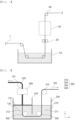
- FIG. 2 is a schematic view of a coating apparatus according to a first embodiment of the present invention.
- the coating apparatus includes a coating unit 200, a guide roller unit 300, and a heating unit 400.
- the coating unit 200 includes a water tank 210 having defined therein a receiving space configured to receive a solution and a water tank partition 220 located in the receiving space so as to divide the receiving space.
- the water tank partition 220 which is formed in a plate shape, may be located in the water tank 210 so as to partition the receiving space of the water tank 210 into two parts, such as a first water tank portion 211 and a second water tank portion 212.
- the first water tank portion 211 is a region adjacent to an unwinder (not shown) from which a substrate film 100 is supplied
- the second water tank portion 212 is a region adjacent to a rewinder (not shown) around which the substrate 100 coated with a coating layer is wound.
- a lower-end side of the water tank partition 220 and an inner bottom surface (not shown) of the water tank 210 may be spaced apart from each other by a predetermined distance.
- the distance between the lower-end side of the water tank partition 220 and the inner bottom surface of the water tank 210 may range from 0.1 m to 1.0 m, specifically from 0.1 m to 0.5 m, more specifically from 0.1 m to 0.2 m. This is advantageous to minimizing the scale of the coating apparatus while the substrate film 100, a description of which will follow, stably passes between the lower-end side of the water tank partition 220 and the inner bottom surface of the water tank 210.
- At least one guide roller configured to guide a movement path of the substrate film 100, a description of which will follow, may be included.
- an outer guide roller located outside the water tank 210 and an inner guide roller located in the receiving space of the water tank 210 may be included.
- the outer guide roller may include a first outer guide roller 310 and a second outer guide roller 320.
- the first outer guide roller 310 is located between the unwinder (not shown) from which the substrate film 100 is supplied and the water tank 210, and transfers the substrate film 100 supplied from the unwinder to inner guide rollers 330 and 340, a description of which will follow, located in the receiving space of the water tank 210.
- the second outer guide roller 320 is located so as to face the first outer guide roller 310 in the state in which the water tank 210 is disposed therebetween, and supplies the substrate film 100 that has passed through the inner guide rollers 330 and 340 in the water tank 210 to the rewinder (not shown), which is located at a rear end of the water tank.
- the inner guide rollers may be located in the receiving space of the water tank 210.
- the inner guide rollers include a pair of inner guide rollers disposed in parallel to each other while being horizontally spaced apart from each other by a predetermined distance, i.e. a first inner guide roller 330 and a second inner guide roller 340.
- the first inner guide roller 33 and the second inner guide roller 340 may be located so as to be spaced apart from the inner bottom surface of the water tank 210 by a predetermined distance and to be spaced apart from opposite side surfaces of the water tank partition 220 by a predetermined distance.
- the substrate film 100 supplied through rotation of the first outer guide roller 310 is transferred to the second inner guide roller 340 via a lower-end surface of the first inner guide roller 330, and is transferred to the outside of the water tank 210 via a lower-end surface of the second inner guide roller 340.
- the substrate film 100 located between the first outer guide roller 310 and the first inner guide roller 330 and the substrate film 100 located between the second outer guide roller 320 and the second inner guide roller 340 may be located vertically or at a predetermined angle. Specifically, the substrate film 100 located between the second outer guide roller 320 and the second inner guide roller 340 may be located vertically, which is advantageous to a coating solution, a description of which will follow, being coated on opposite surfaces of the substrate film 100 at the same thickness.
- the substrate film 100 located between the second outer guide roller 320 and the second inner guide roller 340 is shown as being located vertically in the figure of the present invention, the second outer guide roller 320 and the second inner guide roller 340 may be spaced apart from each other by a predetermined distance, and the substrate film 100 located therebetween may be located at a predetermined angle to the ground. In this case, uniform coating layers having different thicknesses may be formed on opposite surfaces of the substrate film 100
- the substrate film 210 that has passed through the second inner guide roller 340 located in the water tank 210 i.e. the substrate film having the coating layers formed thereon, may be dried while passing through the heating unit 400.
- the substrate film 100 having the coating layers 101 formed thereon by coating may be dried at a temperature of 40°C to 100°C.
- the heating unit 400 may be located between the second inner guide roller 340 and the second outer guide roller 320.
- the heating unit 400 which is configured to dry the coating layers formed on the substrate film 210 by coating, injects high-temperature hot air to the coating layers formed on opposite surfaces of the substrate film 100 by coating in order to dry the coating layers.
- a gas refinement unit configured to prevent secondary contamination due to gas components generated in the hot-air drying process may be provided.
- the heating unit 400 may be a UV hardener, and the kind of the heating unit is not particularly restricted as long as it is possible to stably and efficiently dry the substrate film 100 having the coating layers formed thereon by coating.
- the substrate film 100 may be a separator substrate.
- the separator substrate which electrically isolates a positive electrode and a negative electrode of a secondary battery from each other, thereby preventing short circuit, and provides a lithium ion movement path, may be used without specific limitations as long as the separator substrate can be normally used for a separator of a secondary battery.
- the substrate film may be a polyolefin-based separator usually used in the art to which the present invention pertains, and may be, for example, a substrate film made of any one or a mixture of two or more selected from the group consisting of highdensity polyethylene, low-density polyethylene, linear low-density polyethylene, ultrahigh molecular weight polyethylene, polypropylene, polyethylene terephthalate, polybutylene terephthalate, polyester, polyacetal, polyamide, polycarbonate, polyimide, polyetheretherketone, polyethersulfone, polyphenylene oxide, polyphenylene sulfide, polyethylene naphthalene, and a mixture thereof; however, the present invention is not particularly limited thereto.
- a thin film or non-woven fabric may be used alone or in combination as the substrate film 100.
- the thickness of the separator substrate may range from 5 to 50 um.
- the thickness of the substrate film is not particularly restricted to the above range. If the thickness of the substrate film is much less than the lower limit, however, the mechanical properties of the substrate film are deteriorated, whereby the separator may be easily damaged during use of the battery.
- the pore size of the substrate film may range from 0.01 um to 50 ⁇ m, and porosity of the substrate film may range from 10% to 95%, although the pore size and porosity of the substrate film are not particularly restricted.
- the substrate film 100 may be an electrode current collector.
- the electrode current collector may be a positive electrode current collector or a negative electrode current collector of the secondary battery.
- the positive electrode current collector is generally manufactured so as to have a thickness of 3 um to 500 um.
- the positive electrode current collector is not particularly restricted as long as the positive electrode current collector exhibits high conductivity while the positive electrode current collector does not induce any chemical change in a battery to which the positive electrode current collector is applied.
- the positive electrode current collector may be made of stainless steel, aluminum, nickel, titanium, or sintered carbon.
- the positive electrode current collector may be made of aluminum or stainless steel, the surface of which is treated with carbon, nickel, titanium, or silver.
- the positive electrode current collector may have a micro-scale uneven pattern formed on the surface thereof so as to increase the force of adhesion to the positive electrode active material.
- the positive electrode current collector may be configured in any of various forms, such as a film, a sheet, a foil, a net, a porous body, a foam body, and a non-woven fabric body.
- the negative electrode current collector is generally manufactured so as to have a thickness of 3 um to 500 um.
- the negative electrode current collector is not particularly restricted as long as the negative electrode current collector exhibits high conductivity while the negative electrode current collector does not induce any chemical change in a battery to which the negative electrode current collector is applied.
- the negative electrode current collector may be made of copper, stainless steel, aluminum, nickel, titanium, or sintered carbon.
- the negative electrode current collector may be made of copper or stainless steel, the surface of which is treated with carbon, nickel, titanium, or silver, or an aluminum-cadmium alloy.
- the negative electrode current collector may have a micro-scale uneven pattern formed on the surface thereof so as to increase binding force of the negative electrode active material, in the same manner as the positive electrode current collector.
- the negative electrode current collector may be configured in any of various forms, such as a film, a sheet, a foil, a net, a porous body, a foam body, and a non-woven fabric body.
- the polar solution 120 may be water.
- the polar solution 120 is received in the water tank 210, i.e. the first water tank portion 211 and the second water tank portion 212, and the first inner guide roller 330 and the second inner guide roller 340 are located in the solution 120.
- a part of the water tank partition 220, which is vertically disposed, is located in the polar solution 120.
- the coating solution 110 which is a non-polar solution, may be received in the second water tank portion 212, which is partitioned by the water tank partition 220. Specifically, the coating solution 110 is received in the second water tank portion 212, and the coating solution 110 is not received in the first water tank portion 211. In addition, movement of the coating solution 110 received in the second water tank portion 212 is blocked by the water tank partition 220, and therefore the coating solution does not move to the first water tank portion 211.
- the coating solution 110 forms a non-polar solution layer that floats on the polar solution 120 in a state of being separated from the polar solution 120.
- the substrate film 100 passes through the coating solution layer 110 formed on the polar solution 120 received in the second water tank portion 212 via the first outer guide roller 310, the first inner guide roller 320 and the second inner guide roller 330, whereby the coating solution 110 is applied to surfaces of the substrate film 100, and therefore coating layers 101 are formed on the surfaces of the substrate film.
- the thickness of each of the coating layers 101 may be adjusted by the height of the coating solution 110 received in the second water tank portion 212 and/or the transfer speed of the substrate film 100. In the present invention, the thickness of each of the coating layers 101 may be 4 um or less, specifically 1 um or less.
- the coating solution 110 which is a non-polar solution, may include a non-polar solvent, such as methyl ethyl ketone (MEK), toluene, or pentane.
- a non-polar solvent such as methyl ethyl ketone (MEK), toluene, or pentane.
- a binder such as acrylate or PVdF, and a fluorine-based non-ionic surfactant may be included as additives so as to form the coating solution 110 together with the non-polar solvent.
- the binder may constitute the coating layer of the separator together with an inorganic material, wherein the binder may maintain binding between inorganic particles and may improve the force of adhesion between an electrode and the separator.
- the kind of the binder is not particularly restricted as long as the binder does not chemically change the coating layer of the separator.
- the binder may be made of polyolefin, such as polyethylene or polypropylene; a fluorine-containing resin, such as polyvinylidene fluoride or polytetrafluoroethylene; fluorine-containing rubber, such as a vinylidene fluoride-hexafluoropropylenetetrafluoroethylene copolymer or an ethylenetetrafluoroethylene copolymer; a styrene-butadiene copolymer and a hydride thereof; a (meth)acrylic acid ester copolymer, such as a methacrylic acid ester copolymer, an acrylonitrile acrylic acid ester copolymer, or a styrene acrylic acid ester copolymer; rubber, such as ethylene propylene rubber; polyvinyl acetate; a resin
- the binder may include a PVdF-based binder configured such that phase separation is possible, and the content of the PVdF-based binder may be 80 weight% or more based on the total weight of the binder. If the content of the PVdF-based binder is less than 80 weight%, it is difficult to increase porosity of the inorganic coating layer to a desired level, which is undesirable.
- the PVdF-based binder may be at least one selected from the group consisting of PVdF and PVdF copolymers. More specifically, each of the PVdF copolymers may be configured such that the content of a PVdF monomer is 92 mole% or more based on total moles of monomers constituting the copolymer. If the content of the PVdF monomer is less than 92 mole%, phase separation is reduced, whereby it is difficult to increase porosity of the inorganic coating layer to a desired level.
- the inorganic particles are not particularly restricted as long as the inorganic particles are electrochemically stable.
- the inorganic particles are not particularly restricted as long as oxidation and/or reduction do not occur within an operating voltage range of an electrochemical device to which the inorganic particles are applied.
- ionic conductivity in the electrochemical device is increased, which is advantageous to performance improvement.
- the inorganic material may be at least one selected from the group consisting of BaTiO 3 , Pb(Zr,Ti)O 3 (PZT), Pb 1-x La x Zr 1-y Ti y O 3 (PLZT) (0 ⁇ x ⁇ 1, 0 ⁇ y ⁇ 1), PB(Mg 3 Nb 2/3 )O 3 -PbTiO 3 (PMN-PT), hafnia (H f O 2 ), SrTiO 3 , SnO 2 , CeO 2 , MgO, NiO, CaO, ZnO, ZrO 2 , Y 2 O 3 , Al 2 O 3 , TiO 2 , SiC, (LiAlTiP) x O y -based glass (0 ⁇ x ⁇ 4, 0 ⁇ y ⁇ 13), lithium germanium thiophosphate (Li x Ge y P z S w , 0 ⁇ x ⁇ 4, 0 ⁇ y ⁇ 1, 0 ⁇ z ⁇ 1, 0 ⁇ w
- the coating solution 110 according to the present invention may include an additive, wherein the additive may be a fluorine-based non-ionic surfactant.
- the fluorine-based non-ionic surfactant may be, for example, a fluoroalkyl ethylene oxide appendage, a fluoroalkenyl ethylene oxide appendage, a fluoroalkyl propylene oxide appendage, a fluoroalkenyl propylene oxide appendage, a perfluoroalkyl ethylene oxide appendage, or a perfluoroalkenyl ethylene oxide appendage.
- the coating solution 120 may include a primer material.
- the primer serves to increase the force of adhesion of the positive electrode active material to a metal substrate while maximally inhibiting an increase in internal resistance.
- a conductive material and a polymer material may be included in a weight ratio of 1:10 to 10:1. If the content of the conductive material is too small, operating characteristics of the battery are deteriorated due to an increase in internal resistance. If the content of the polymer material is too small, it is not possible to provide a desired level of adhesive force. Consequently, the content of the conductive material and the content of the polymer material may be appropriately selected within the above range.
- the conductive material may be, for example, at least one selected from the group consisting of graphite, carbon black, acetylene black, Ketjen black, channel black, furnace black, lamp black, thermal black, carbon fiber, and carbon fluoride; however, the present invention is not limited thereto. Thereamong, carbon black is particularly preferable. It is preferable for the conductive material to have a particle size of 10 to 100 nm.
- the polymer material may be, for example, at least one selected from the group consisting of a polyimide-based copolymer, an acrylate-based copolymer, polyvinylidene fluoride, polyvinyl alcohol, carboxymethylcellulose (CMC), starch, hydroxypropylcellulose, regenerated cellulose, polyvinylpyrrolidone, tetrafluoroethylene, polyethylene, polypropylene, ethylene-propylene-diene terpolymer (EPDM), sulfonated EPDM, styrene butylene rubber and fluoro rubber; however, the present invention is not limited thereto. Thereamong, the polyimide-based copolymer is particularly preferable.
- the polar solution 120 and the non-polar coating solution 110 are received in the water tank 210 partitioned by the water tank partition 220, the coating solution 110 is applied to the surfaces of the substrate film 100, and the substrate film 100 having the coating layers formed thereon by coating is dried by the heating unit 400, whereby the coating layers 101 are formed on the surfaces of the substrate film 100.
- FIG. 3 is a schematic view of a coating apparatus according to a second embodiment of the present invention.
- the second embodiment of the present invention is identical to the first embodiment of the present invention described with reference to FIG. 2 except that the coating apparatuses according to the first embodiment are disposed in succession in order to form a plurality of coating layers using coating solutions.
- the coating apparatuses according to the first embodiment are disposed in succession in order to form a plurality of coating layers using coating solutions.
- the coating apparatus according to the second embodiment of the present invention may be configured to have a structure in which the coating apparatuses according to the first embodiment are disposed in succession.
- a substrate film 1100 supplied to a first outer guide roller 1310 passes through the interior of a water tank 1210, a first coating solution 1110 is applied to each surface of the substrate film 1100, and drying is performed by a heating unit 1400, whereby a substrate film 1100 having a first coating layer 1101 formed thereon by coating is formed, and the substrate film is supplied to a first outer guide roller 2310 located at a second water tank 2210 disposed at a rear end of the first water tank.
- the substrate film 1100 having the first coating layer 1101 formed thereon by coating, supplied to the first outer guide roller 2310 passes through the interior of the second water tank 2210, and a second coating solution 2110 is applied to a surface of the first coating layer 1101.
- drying is performed by a heating unit 2400, whereby a substrate film 1101 having the first coating layer 1101 and a second coating layer 2101 formed thereon by coating is finally formed.
- first coating solution 1110 and the second coating solution 2110 may include the same non-polar material or may include different non-polar materials.
Landscapes
- Engineering & Computer Science (AREA)
- Life Sciences & Earth Sciences (AREA)
- Wood Science & Technology (AREA)
- Manufacturing & Machinery (AREA)
- Chemical & Material Sciences (AREA)
- Chemical Kinetics & Catalysis (AREA)
- Electrochemistry (AREA)
- General Chemical & Material Sciences (AREA)
- Coating Apparatus (AREA)
- Battery Electrode And Active Subsutance (AREA)
Abstract
Description
- This application claims the benefit of priority to
Korean Patent Application No. 2021-0085734 filed on June 30, 2021 - The present invention relates to a coating apparatus and a coating method of a separator or a current collector for secondary batteries, and more particularly to a coating apparatus and a coating method of a separator or a current collector for secondary batteries capable of adjusting the thickness of a coating layer by adjusting the height of a coating solution layer, whereby it is possible to implement an ultrathin coating thickness.
- With increasing demand for portable electronic devices, such as a smartphone, a tablet, and a laptop computer, demand for secondary batteries as energy sources thereof has also abruptly increased. Thereamong, a lithium secondary battery, which has high energy density and a long battery lifespan, has been most widely used.
- The lithium secondary battery is assembled by manufacturing an electrode assembly configured such that positive electrodes and negative electrodes are alternately stacked in the state in which separators are interposed respectively between the positive electrodes and the negative electrodes, inserting the electrode assembly into a battery case constituted by a can or a pouch having a predetermined size and shape, and injecting an electrolytic solution into the battery case. The electrolytic solution permeates into spaces between the positive electrodes, the negative electrodes, and the separators by capillary force.
- In order for the lithium secondary battery to retain long lifespan while having high capacity and high energy density, the electrode assembly in the battery must be fully impregnated with the electrolytic solution. If the electrode assembly is incompletely impregnated with the electrolytic solution, reaction between the electrodes is not smooth, resistance of the battery becomes high, outer characteristics of the battery are deteriorated, and capacity of the battery is abruptly reduced. As a result, battery performance may be deteriorated, the lifespan of the battery may be shortened, and the battery may overheat or explode due to high internal resistance.
- In many cases, the positive electrode, the negative electrode, and the separator are all hydrophobic, whereas the electrolytic solution is hydrophilic. For this reason, considerable time is necessary and strict process conditions are required in order to improve impregnability of the electrodes and the separator with the electrolytic solution.
- If the thickness of a coating layer formed on a porous substrate is too small, thermal safety of the separator is low. If the thickness of the coating layer is too large, thermal safety of the separator becomes high, but resistance is increased for the lithium secondary battery, and therefore performance of the battery may be deteriorated.
- Since most conventional separators for secondary batteries are hydrophobic, a method of coating the separator with a ceramic material in order to improve impregnability of the separator with the electrolytic solution is used. When the coating layer is formed as described above, thermal safety and mechanical characteristics of the separator are improved, but the coating layer acts as resistance in terms of battery characteristics of the secondary battery. As the thickness of the ceramic coating layer is increased, therefore, there is a problem in that battery characteristics of the secondary battery are deteriorated.
-
Patent Document 1 discloses a coating apparatus that coats a flexible board 11 with a coating solution, wherein the coating apparatus includes a first coating unit 12 configured to coat the flexible board with a first coating solution by dip coating, a second coating unit 13 disposed at a rear end of the first coating unit 12, the second coating unit being configured to coat the flexible board with a second coating solution by gravure coating, and a drying unit 14 and a guide roll 15 disposed at a rear end of the second coating unit, the drying unit being configured to dry the coated flexible board. -
Patent document 1 relates to a coating apparatus and a coating method, wherein the second coating unit 13 presses the flexible board and additionally coats the flexible board, whereby the flexible board is coated with the coating solution so as to have a more uniform and larger thickness, but does not recognize influence of the thick coating layer on battery characteristics of a secondary battery. - Therefore, technology related to a coating apparatus and a coating method of a separator for secondary batteries capable of easily performing coating through a simple structure, whereby it is possible to form a uniform and thin coating layer, which is recognized as an important problem in the present invention, has not yet been proposed.
- (Patent Document 1)
Korean Registered Patent Publication No. 10-1653347 - The present invention has been made in view of the above problems, and it is an object of the present invention to provide a coating apparatus and a coating method of a separator capable of stably forming a coating layer having an ultrathin thickness without changing operating conditions of a conventional coating process.
- A coating apparatus for continuously forming a coating layer on a substrate film (100) according to the present invention to accomplish the above object includes a water tank (210) located on a movement path of the substrate film (100), a water tank partition (220) vertically located in the water tank (210), the water tank partition being configured to partition an inner space of the water tank (210) into two zones, which are a first water tank portion (211) and a second water tank portion (212), a roller unit (300) configured to continuously transfer the substrate film (100), and a heating unit (400) located outside the water tank (210), wherein the water tank partition (220) is located spaced apart from an inner bottom surface of the water tank (210) by a predetermined distance.
- A polar solution may be included in each of the first water tank portion (211) and the second water tank portion (212), a coating solution (110) may be further included in the second water tank portion (212), which may be non-polar, the coating solution (110) located in the second water tank portion (212) may be located at an upper end of the polar solution (120), horizontal movement of the coating solution located in the second water tank portion to the first water tank portion (211) may be limited by the water tank partition (220), and the coating solution (110) may be applied to each surface of the substrate film (100) that passes through the first water tank portion (211) and the second water tank portion (212) in succession.
- The roller unit (300) may include an outer roller unit and an inner roller unit, the outer roller unit may include a pair of outer guide rollers disposed spaced apart from each other in parallel, the inner roller unit may include a pair of inner guide rollers disposed spaced apart from each other in parallel, and the pair of inner guide rollers may be located spaced apart from the inner bottom surface of the water tank (210) by a predetermined distance.
- The distance between the water tank partition (220) and the inner bottom surface of the water tank (210) may be greater than the distance between a lowermost-end side of each of the inner guide rollers and the inner bottom surface of the water tank (210).
- The pair of inner guide rollers constituting the inner roller unit may be located spaced apart from opposite vertical sides of the water tank partition (220) by a predetermined distance.
- The pair of outer guide rollers constituting the outer roller unit is located outside the water tank (210) so as to correspond to the pair of inner guide rollers constituting the inner roller unit.
- One inner guide roller of the pair of inner guide rollers may be located in the second water tank portion (212) and one outer guide roller of the pair of outer guide rollers may be located outside an upper end of the second water tank portion (212) so as to correspond to the one inner guide roller such that the substrate film (100) is vertically located between the one inner guide roller and the one outer guide roller.
- The heating unit (400) may be configured to dry the substrate film (100) having the coating layer formed thereon by coating, and the coating apparatus may include a gas treatment unit configured to treat gas materials volatilized during the drying process.
- The present invention provides a coating method using the coating apparatus, the coating method including (s1) injecting a polar solution (120) into the water tank (210), (s2) injecting a coating solution (110) onto an upper layer of the polar solution (120) received in the second water tank portion (212), (s3) supplying a substrate film (100) supported by the outer guide rollers and the inner guide rollers to sequentially pass through the first water tank portion (211) and the second water tank portion (212) such that each surface of the substrate film (100) is coated with the coating solution (110), and (s4) drying the substrate film (100) coated with the coating solution (110) downstream from the second water tank portion (212).
- In step (s2), the height of the coating solution layer (110) injected into the second water tank portion (212) may be adjusted such that the thickness of a coating layer formed on the substrate film (100) by coating is 1 um or less.
- In step (s3), the speed at which the substrate film (100) passes may be adjusted such that the thickness of a coating layer formed on the substrate film (100) by coating is 1 um or less.
- Steps (s1), (s2), (s3), and (s4) may be sequentially performed to complete a first coating step, and steps (s3) and (s4) may be repeated to perform a second coating step, whereby a coating layer may be formed.
- The coating solution in step (s3) of the second coating step may be different from the coating solution of the first coating step, whereby a plurality of coating layers may be formed.
- In addition, the present invention may provide possible combinations of the above solving means.
- As is apparent from the above description, a coating apparatus according to the present invention has an effect in that it is possible to implement an ultrathin coating thickness without changing conventional operating conditions.
- A process of forming a coating layer on a substrate film is simple, and it is unnecessary to perform an additional complex process, which is advantageous in terms of production process and manufacturing cost.
- The coating layer is formed on the substrate film so as to have an ultrathin thickness, whereby it is possible to improve battery characteristics of a secondary battery.
- Also, in the present invention, a small amount of a non-polar solution for coating is disposed on an upper layer of a polar solution configured such that phase separation is possible, whereby it is possible to minimize contaminants.
-
-
FIG. 1 is a schematic view of a conventional coating apparatus. -
FIG. 2 is a schematic view of a coating apparatus according to a first embodiment of the present invention. -
FIG. 3 is a schematic view of a coating apparatus according to a second embodiment of the present invention. - Now, preferred embodiments of the present invention will be described in detail with reference to the accompanying drawings such that the preferred embodiments of the present invention can be easily implemented by a person having ordinary skill in the art to which the present invention pertains. In describing the principle of operation of the preferred embodiments of the present invention in detail, however, a detailed description of known functions and configurations incorporated herein will be omitted when the same may obscure the subject matter of the present invention.
- In addition, the same reference numbers will be used throughout the drawings to refer to parts that perform similar functions or operations. In the case in which one part is said to be connected to another part throughout the specification, not only may the one part be directly connected to the other part, but also, the one part may be indirectly connected to the other part via a further part. In addition, that a certain element is included does not mean that other elements are excluded, but means that such elements may be further included unless mentioned otherwise.
- In addition, a description to embody elements through limitation or addition may be applied to all inventions, unless particularly restricted, and does not limit a specific invention.
- Also, in the description of the invention and the claims of the present application, singular forms are intended to include plural forms unless mentioned otherwise.
- Also, in the description of the invention and the claims of the present application, "or" includes "and" unless mentioned otherwise. Therefore, "including A or B" means three cases, namely, the case including A, the case including B, and the case including A and B.
- In addition, all numeric ranges include the lowest value, the highest value, and all intermediate values therebetween unless the context clearly indicates otherwise.
- Hereinafter, a coating apparatus according to the present invention will be described with reference to the accompanying drawings.
-
FIG. 2 is a schematic view of a coating apparatus according to a first embodiment of the present invention. - Referring to
FIG. 2 , the coating apparatus according to the first embodiment of the present invention includes acoating unit 200, aguide roller unit 300, and aheating unit 400. - First, when describing the
coating unit 200 in detail, thecoating unit 200 includes awater tank 210 having defined therein a receiving space configured to receive a solution and awater tank partition 220 located in the receiving space so as to divide the receiving space. - The
water tank partition 220, which is formed in a plate shape, may be located in thewater tank 210 so as to partition the receiving space of thewater tank 210 into two parts, such as a firstwater tank portion 211 and a secondwater tank portion 212. Here, the firstwater tank portion 211 is a region adjacent to an unwinder (not shown) from which asubstrate film 100 is supplied, and the secondwater tank portion 212 is a region adjacent to a rewinder (not shown) around which thesubstrate 100 coated with a coating layer is wound. - A lower-end side of the
water tank partition 220 and an inner bottom surface (not shown) of thewater tank 210 may be spaced apart from each other by a predetermined distance. In the present invention, the distance between the lower-end side of thewater tank partition 220 and the inner bottom surface of thewater tank 210 may range from 0.1 m to 1.0 m, specifically from 0.1 m to 0.5 m, more specifically from 0.1 m to 0.2 m. This is advantageous to minimizing the scale of the coating apparatus while thesubstrate film 100, a description of which will follow, stably passes between the lower-end side of thewater tank partition 220 and the inner bottom surface of thewater tank 210. - Next, the
guide roller unit 300 will be described. In the present invention, at least one guide roller configured to guide a movement path of thesubstrate film 100, a description of which will follow, may be included. Specifically, an outer guide roller located outside thewater tank 210 and an inner guide roller located in the receiving space of thewater tank 210 may be included. The outer guide roller may include a firstouter guide roller 310 and a secondouter guide roller 320. The firstouter guide roller 310 is located between the unwinder (not shown) from which thesubstrate film 100 is supplied and thewater tank 210, and transfers thesubstrate film 100 supplied from the unwinder toinner guide rollers water tank 210. The secondouter guide roller 320 is located so as to face the firstouter guide roller 310 in the state in which thewater tank 210 is disposed therebetween, and supplies thesubstrate film 100 that has passed through theinner guide rollers water tank 210 to the rewinder (not shown), which is located at a rear end of the water tank. - The inner guide rollers may be located in the receiving space of the
water tank 210. The inner guide rollers include a pair of inner guide rollers disposed in parallel to each other while being horizontally spaced apart from each other by a predetermined distance, i.e. a firstinner guide roller 330 and a secondinner guide roller 340. The first inner guide roller 33 and the secondinner guide roller 340 may be located so as to be spaced apart from the inner bottom surface of thewater tank 210 by a predetermined distance and to be spaced apart from opposite side surfaces of thewater tank partition 220 by a predetermined distance. Thesubstrate film 100 supplied through rotation of the firstouter guide roller 310 is transferred to the secondinner guide roller 340 via a lower-end surface of the firstinner guide roller 330, and is transferred to the outside of thewater tank 210 via a lower-end surface of the secondinner guide roller 340. Thesubstrate film 100 located between the firstouter guide roller 310 and the firstinner guide roller 330 and thesubstrate film 100 located between the secondouter guide roller 320 and the secondinner guide roller 340 may be located vertically or at a predetermined angle. Specifically, thesubstrate film 100 located between the secondouter guide roller 320 and the secondinner guide roller 340 may be located vertically, which is advantageous to a coating solution, a description of which will follow, being coated on opposite surfaces of thesubstrate film 100 at the same thickness. - In addition, although the
substrate film 100 located between the secondouter guide roller 320 and the secondinner guide roller 340 is shown as being located vertically in the figure of the present invention, the secondouter guide roller 320 and the secondinner guide roller 340 may be spaced apart from each other by a predetermined distance, and thesubstrate film 100 located therebetween may be located at a predetermined angle to the ground. In this case, uniform coating layers having different thicknesses may be formed on opposite surfaces of thesubstrate film 100 - Next, the
heating unit 400 will be described in detail. - The
substrate film 210 that has passed through the secondinner guide roller 340 located in thewater tank 210, i.e. the substrate film having the coating layers formed thereon, may be dried while passing through theheating unit 400. In theheating unit 400, thesubstrate film 100 having the coating layers 101 formed thereon by coating may be dried at a temperature of 40°C to 100°C. - Here, the
heating unit 400 may be located between the secondinner guide roller 340 and the secondouter guide roller 320. Theheating unit 400, which is configured to dry the coating layers formed on thesubstrate film 210 by coating, injects high-temperature hot air to the coating layers formed on opposite surfaces of thesubstrate film 100 by coating in order to dry the coating layers. In addition, although not shown in the figure, a gas refinement unit configured to prevent secondary contamination due to gas components generated in the hot-air drying process may be provided. - The
heating unit 400 may be a UV hardener, and the kind of the heating unit is not particularly restricted as long as it is possible to stably and efficiently dry thesubstrate film 100 having the coating layers formed thereon by coating. - Next, the
substrate film 100 will be described in detail. - Here, the
substrate film 100 may be a separator substrate. The separator substrate, which electrically isolates a positive electrode and a negative electrode of a secondary battery from each other, thereby preventing short circuit, and provides a lithium ion movement path, may be used without specific limitations as long as the separator substrate can be normally used for a separator of a secondary battery. The substrate film may be a polyolefin-based separator usually used in the art to which the present invention pertains, and may be, for example, a substrate film made of any one or a mixture of two or more selected from the group consisting of highdensity polyethylene, low-density polyethylene, linear low-density polyethylene, ultrahigh molecular weight polyethylene, polypropylene, polyethylene terephthalate, polybutylene terephthalate, polyester, polyacetal, polyamide, polycarbonate, polyimide, polyetheretherketone, polyethersulfone, polyphenylene oxide, polyphenylene sulfide, polyethylene naphthalene, and a mixture thereof; however, the present invention is not particularly limited thereto. In addition, a thin film or non-woven fabric may be used alone or in combination as thesubstrate film 100. - In the present invention, the thickness of the separator substrate may range from 5 to 50 um. In the present invention, the thickness of the substrate film is not particularly restricted to the above range. If the thickness of the substrate film is much less than the lower limit, however, the mechanical properties of the substrate film are deteriorated, whereby the separator may be easily damaged during use of the battery. Meanwhile, the pore size of the substrate film may range from 0.01 um to 50 µm, and porosity of the substrate film may range from 10% to 95%, although the pore size and porosity of the substrate film are not particularly restricted.
- Here, the
substrate film 100 may be an electrode current collector. The electrode current collector may be a positive electrode current collector or a negative electrode current collector of the secondary battery. - The positive electrode current collector is generally manufactured so as to have a thickness of 3 um to 500 um. The positive electrode current collector is not particularly restricted as long as the positive electrode current collector exhibits high conductivity while the positive electrode current collector does not induce any chemical change in a battery to which the positive electrode current collector is applied. For example, the positive electrode current collector may be made of stainless steel, aluminum, nickel, titanium, or sintered carbon. Alternatively, the positive electrode current collector may be made of aluminum or stainless steel, the surface of which is treated with carbon, nickel, titanium, or silver. In addition, the positive electrode current collector may have a micro-scale uneven pattern formed on the surface thereof so as to increase the force of adhesion to the positive electrode active material. The positive electrode current collector may be configured in any of various forms, such as a film, a sheet, a foil, a net, a porous body, a foam body, and a non-woven fabric body.
- The negative electrode current collector is generally manufactured so as to have a thickness of 3 um to 500 um. The negative electrode current collector is not particularly restricted as long as the negative electrode current collector exhibits high conductivity while the negative electrode current collector does not induce any chemical change in a battery to which the negative electrode current collector is applied. For example, the negative electrode current collector may be made of copper, stainless steel, aluminum, nickel, titanium, or sintered carbon. Alternatively, the negative electrode current collector may be made of copper or stainless steel, the surface of which is treated with carbon, nickel, titanium, or silver, or an aluminum-cadmium alloy. In addition, the negative electrode current collector may have a micro-scale uneven pattern formed on the surface thereof so as to increase binding force of the negative electrode active material, in the same manner as the positive electrode current collector. The negative electrode current collector may be configured in any of various forms, such as a film, a sheet, a foil, a net, a porous body, a foam body, and a non-woven fabric body.
- Next, a
polar solution 120 and acoating solution 110 received in thewater tank 210 will be described. - The
polar solution 120 may be water. Thepolar solution 120 is received in thewater tank 210, i.e. the firstwater tank portion 211 and the secondwater tank portion 212, and the firstinner guide roller 330 and the secondinner guide roller 340 are located in thesolution 120. In addition, a part of thewater tank partition 220, which is vertically disposed, is located in thepolar solution 120. - The
coating solution 110, which is a non-polar solution, may be received in the secondwater tank portion 212, which is partitioned by thewater tank partition 220. Specifically, thecoating solution 110 is received in the secondwater tank portion 212, and thecoating solution 110 is not received in the firstwater tank portion 211. In addition, movement of thecoating solution 110 received in the secondwater tank portion 212 is blocked by thewater tank partition 220, and therefore the coating solution does not move to the firstwater tank portion 211. - The
coating solution 110 forms a non-polar solution layer that floats on thepolar solution 120 in a state of being separated from thepolar solution 120. Thesubstrate film 100 passes through thecoating solution layer 110 formed on thepolar solution 120 received in the secondwater tank portion 212 via the firstouter guide roller 310, the firstinner guide roller 320 and the secondinner guide roller 330, whereby thecoating solution 110 is applied to surfaces of thesubstrate film 100, and therefore coatinglayers 101 are formed on the surfaces of the substrate film. The thickness of each of the coating layers 101 may be adjusted by the height of thecoating solution 110 received in the secondwater tank portion 212 and/or the transfer speed of thesubstrate film 100. In the present invention, the thickness of each of the coating layers 101 may be 4 um or less, specifically 1 um or less. - Here, the
coating solution 110, which is a non-polar solution, may include a non-polar solvent, such as methyl ethyl ketone (MEK), toluene, or pentane. - Although not required, a binder, such as acrylate or PVdF, and a fluorine-based non-ionic surfactant may be included as additives so as to form the
coating solution 110 together with the non-polar solvent. - In the present invention, the binder may constitute the coating layer of the separator together with an inorganic material, wherein the binder may maintain binding between inorganic particles and may improve the force of adhesion between an electrode and the separator.
- In addition, the kind of the binder is not particularly restricted as long as the binder does not chemically change the coating layer of the separator. For example, the binder may be made of polyolefin, such as polyethylene or polypropylene; a fluorine-containing resin, such as polyvinylidene fluoride or polytetrafluoroethylene; fluorine-containing rubber, such as a vinylidene fluoride-hexafluoropropylenetetrafluoroethylene copolymer or an ethylenetetrafluoroethylene copolymer; a styrene-butadiene copolymer and a hydride thereof; a (meth)acrylic acid ester copolymer, such as a methacrylic acid ester copolymer, an acrylonitrile acrylic acid ester copolymer, or a styrene acrylic acid ester copolymer; rubber, such as ethylene propylene rubber; polyvinyl acetate; a resin having a melting point or a glass transition temperature of 180°C or higher, such as polyphenylene ether, polysulfone, polyethersulfone, polyphenylene sulfide, polyetherimide, polyamide, polyimide, polyamide imide, polyetheramide, polyester, aromatic polyester, or polyetheretherketone; polycarbonate; polyacetal; a water soluble resin, such as carboxyalkyl cellulose, alkyl cellulose, hydroxyalkyl cellulose, starch, polyvinyl alcohol, sodium alginate, polyethylene glycol, cellulose ester, polyacrylic acid, polyacrylic amide, or polymethacrylic acid; or a copolymer including two or more thereof.
- The binder may include a PVdF-based binder configured such that phase separation is possible, and the content of the PVdF-based binder may be 80 weight% or more based on the total weight of the binder. If the content of the PVdF-based binder is less than 80 weight%, it is difficult to increase porosity of the inorganic coating layer to a desired level, which is undesirable.
- Specifically, the PVdF-based binder may be at least one selected from the group consisting of PVdF and PVdF copolymers. More specifically, each of the PVdF copolymers may be configured such that the content of a PVdF monomer is 92 mole% or more based on total moles of monomers constituting the copolymer. If the content of the PVdF monomer is less than 92 mole%, phase separation is reduced, whereby it is difficult to increase porosity of the inorganic coating layer to a desired level.
- In the present invention, the inorganic particles are not particularly restricted as long as the inorganic particles are electrochemically stable. The inorganic particles are not particularly restricted as long as oxidation and/or reduction do not occur within an operating voltage range of an electrochemical device to which the inorganic particles are applied. In particular, when inorganic particles having ion transfer ability are used, ionic conductivity in the electrochemical device is increased, which is advantageous to performance improvement. In the present invention, the inorganic material may be at least one selected from the group consisting of BaTiO3, Pb(Zr,Ti)O3 (PZT), Pb1-xLaxZr1-yTiyO3 (PLZT) (0<x<1, 0<y<1), PB(Mg3Nb2/3)O3-PbTiO3 (PMN-PT), hafnia (HfO2), SrTiO3, SnO2, CeO2, MgO, NiO, CaO, ZnO, ZrO2, Y2O3, Al2O3, TiO2, SiC, (LiAlTiP)xOy-based glass (0<x<4, 0<y<13), lithium germanium thiophosphate (LixGeyPzSw, 0<x<4, 0<y<1, 0<z<1, 0<w<5), lithium nitride (LixNy, 0<x<4, 0<y<2), SiS2-based glass (LixSiySz, 0<x<3, 0<y<2, 0<z<4), P2S5-based glass (LixPySz, 0<x<3, 0<y<3, 0<z<7), and a mixture thereof. However, the present invention is not limited thereto.
- The
coating solution 110 according to the present invention may include an additive, wherein the additive may be a fluorine-based non-ionic surfactant. - The fluorine-based non-ionic surfactant may be, for example, a fluoroalkyl ethylene oxide appendage, a fluoroalkenyl ethylene oxide appendage, a fluoroalkyl propylene oxide appendage, a fluoroalkenyl propylene oxide appendage, a perfluoroalkyl ethylene oxide appendage, or a perfluoroalkenyl ethylene oxide appendage.
- In the present invention, when the
substrate film 100 is an electrode current collector, thecoating solution 120 may include a primer material. - The primer serves to increase the force of adhesion of the positive electrode active material to a metal substrate while maximally inhibiting an increase in internal resistance. Specifically, a conductive material and a polymer material may be included in a weight ratio of 1:10 to 10:1. If the content of the conductive material is too small, operating characteristics of the battery are deteriorated due to an increase in internal resistance. If the content of the polymer material is too small, it is not possible to provide a desired level of adhesive force. Consequently, the content of the conductive material and the content of the polymer material may be appropriately selected within the above range.
- The conductive material may be, for example, at least one selected from the group consisting of graphite, carbon black, acetylene black, Ketjen black, channel black, furnace black, lamp black, thermal black, carbon fiber, and carbon fluoride; however, the present invention is not limited thereto. Thereamong, carbon black is particularly preferable. It is preferable for the conductive material to have a particle size of 10 to 100 nm.
- The polymer material may be, for example, at least one selected from the group consisting of a polyimide-based copolymer, an acrylate-based copolymer, polyvinylidene fluoride, polyvinyl alcohol, carboxymethylcellulose (CMC), starch, hydroxypropylcellulose, regenerated cellulose, polyvinylpyrrolidone, tetrafluoroethylene, polyethylene, polypropylene, ethylene-propylene-diene terpolymer (EPDM), sulfonated EPDM, styrene butylene rubber and fluoro rubber; however, the present invention is not limited thereto. Thereamong, the polyimide-based copolymer is particularly preferable.
- In the coating apparatus according to the first embodiment of the present invention, as described above, the
polar solution 120 and thenon-polar coating solution 110 are received in thewater tank 210 partitioned by thewater tank partition 220, thecoating solution 110 is applied to the surfaces of thesubstrate film 100, and thesubstrate film 100 having the coating layers formed thereon by coating is dried by theheating unit 400, whereby the coating layers 101 are formed on the surfaces of thesubstrate film 100. -
FIG. 3 is a schematic view of a coating apparatus according to a second embodiment of the present invention. - The second embodiment of the present invention is identical to the first embodiment of the present invention described with reference to
FIG. 2 except that the coating apparatuses according to the first embodiment are disposed in succession in order to form a plurality of coating layers using coating solutions. Hereinafter, therefore, only technical construction for forming the plurality of coating layers will be described. - Referring to
FIG. 3 , the coating apparatus according to the second embodiment of the present invention may be configured to have a structure in which the coating apparatuses according to the first embodiment are disposed in succession. - A
substrate film 1100 supplied to a firstouter guide roller 1310 passes through the interior of awater tank 1210, afirst coating solution 1110 is applied to each surface of thesubstrate film 1100, and drying is performed by aheating unit 1400, whereby asubstrate film 1100 having afirst coating layer 1101 formed thereon by coating is formed, and the substrate film is supplied to a firstouter guide roller 2310 located at asecond water tank 2210 disposed at a rear end of the first water tank. Thesubstrate film 1100 having thefirst coating layer 1101 formed thereon by coating, supplied to the firstouter guide roller 2310, passes through the interior of thesecond water tank 2210, and asecond coating solution 2110 is applied to a surface of thefirst coating layer 1101. Subsequently, drying is performed by aheating unit 2400, whereby asubstrate film 1101 having thefirst coating layer 1101 and asecond coating layer 2101 formed thereon by coating is finally formed. - Here, the
first coating solution 1110 and thesecond coating solution 2110 may include the same non-polar material or may include different non-polar materials. - Those skilled in the art to which the present invention pertains will appreciate that various applications and modifications are possible within the category of the present invention based on the above description.
-
- 11: Flexible board
- 12: First coating unit
- 13: Second coating unit
- 14: Drying unit
- 15: Guide roll
- 100, 1100: Substrate films
- 101: Coating layer
- 1101: First coating layer
- 2101: Second coating layer
- 110: Coating solution
- 1110: First coating solution
- 2110: Second coating solution
- 120, 1120, 2120: Polar solutions
- 200, 1200, 2200: Coating units
- 210, 1210, 2210: Water tanks
- 211, 1211, 2211: First water tank portions
- 212, 1212, 2212: Second water tank portions
- 220, 1220, 2220: Water tank partitions
- 300, 1300, 2300: Roller units
- 310, 1310, 2310: First outer guide rollers
- 320, 1310, 2310: Second outer guide rollers
- 330, 1330, 2330: First inner guide rollers
- 340, 1340, 2340: Second inner guide rollers
- 400: Heating unit
Claims (13)
- A coating apparatus for continuously forming a coating layer on a substrate film, the coating apparatus comprising:a water tank located on a movement path of the substrate film;a water tank partition vertically located in the water tank, the water tank partition being configured to partition an inner space of the water tank into two zones, which are a first water tank portion and a second water tank portion;a roller unit configured to continuously transfer the substrate film; anda heating unit located outside the water tank,wherein the water tank partition is located spaced apart from an inner bottom surface of the water tank by a predetermined distance.
- The coating apparatus according to claim 1, wherein a polar solution is included in each of the first water tank portion and the second water tank portion,wherein a coating solution is further included in the second water tank portion, the coating solution being non-polar,wherein the coating solution located in the second water tank portion is located at an upper end of the polar solution,wherein horizontal movement of the coating solution located in the second water tank portion to the first water tank portion is limited by the water tank partition, andwherein the coating solution is applied to each surface of the substrate film that passes through the first water tank portion and the second water tank portion in succession.
- The coating apparatus according to claim 2, wherein the roller unit comprises an outer roller unit and an inner roller unit,wherein the outer roller unit comprises a pair of outer guide rollers disposed spaced apart from each other in parallel,wherein the inner roller unit comprises a pair of inner guide rollers disposed spaced apart from each other in parallel, andwherein the pair of inner guide rollers is located spaced apart from the inner bottom surface of the water tank by a predetermined distance.
- The coating apparatus according to claim 3, wherein a distance between the water tank partition and the inner bottom surface of the water tank is greater than a distance between a lowermost-end side of each of the inner guide rollers and the inner bottom surface of the water tank.
- The coating apparatus according to claim 3, wherein the pair of inner guide rollers constituting the inner roller unit is located spaced apart from opposite vertical sides of the water tank partition by a predetermined distance.
- The coating apparatus according to claim 3, wherein the pair of outer guide rollers constituting the outer roller unit is located outside the water tank so as to correspond to the pair of inner guide rollers constituting the inner roller unit.
- The coating apparatus according to claim 6, wherein one inner guide roller of the pair of inner guide rollers is located in the second water tank portion and one outer guide roller of the pair of outer guide rollers is located outside an upper end of the second water tank portion so as to correspond to the one inner guide roller such that the substrate film is vertically located between the one inner guide roller and the one outer guide roller.
- The coating apparatus according to claim 1, wherein the heating unit is configured to dry the substrate film having the coating layer formed thereon by coating, and
wherein the coating apparatus comprises a gas treatment unit configured to treat gas materials volatilized during the drying process. - A coating method using the coating apparatus according to any one of claims 1 to 8, the coating method comprising:(s1) injecting a polar solution into the water tank;(s2) injecting a coating solution onto an upper layer of the polar solution received in the second water tank portion;(s3) supplying a substrate film supported by the outer guide rollers and the inner guide rollers to sequentially pass through the first water tank portion and the second water tank portion such that each surface of the substrate film is coated with the coating solution; and(s4) drying the substrate film coated with the coating solution downstream from the second water tank portion.
- The coating method according to claim 9, wherein, in step (s2), a height of the coating solution layer injected into the second water tank portion is adjusted such that a thickness of a coating layer formed on the substrate film by coating is 1 um or less.
- The coating method according to claim 9, wherein, in step (s3), a speed at which the substrate film passes is adjusted such that a thickness of a coating layer formed on the substrate film by coating is 1 um or less.
- The coating method according to claim 9, wherein steps (s1), (s2), (s3), and (s4) are sequentially performed to complete a first coating step, and
wherein steps (s3) and (s4) are repeated to perform a second coating step, whereby a coating layer is formed. - The coating method according to claim 12, wherein the coating solution in step (s3) of the second coating step is different from the coating solution of the first coating step, whereby a plurality of coating layers is formed.
Applications Claiming Priority (2)
| Application Number | Priority Date | Filing Date | Title |
|---|---|---|---|
| KR1020210085734A KR20230004000A (en) | 2021-06-30 | 2021-06-30 | Coating device and coating method for easy control of coating layer thickness |
| PCT/KR2021/018947 WO2023277285A1 (en) | 2021-06-30 | 2021-12-14 | Coating device and coating method by which coating layer thickness is easily adjustable |
Publications (3)
| Publication Number | Publication Date |
|---|---|
| EP4140597A1 true EP4140597A1 (en) | 2023-03-01 |
| EP4140597A4 EP4140597A4 (en) | 2024-01-24 |
| EP4140597B1 EP4140597B1 (en) | 2026-04-08 |
Family
ID=84690309
Family Applications (1)
| Application Number | Title | Priority Date | Filing Date |
|---|---|---|---|
| EP21940004.1A Active EP4140597B1 (en) | 2021-06-30 | 2021-12-14 | Coating device and coating method by which coating layer thickness is easily adjustable |
Country Status (5)
| Country | Link |
|---|---|
| US (1) | US12576424B2 (en) |
| EP (1) | EP4140597B1 (en) |
| KR (1) | KR20230004000A (en) |
| CN (1) | CN115768563A (en) |
| WO (1) | WO2023277285A1 (en) |
Family Cites Families (17)
| Publication number | Priority date | Publication date | Assignee | Title |
|---|---|---|---|---|
| US1930601A (en) * | 1931-02-12 | 1933-10-17 | Frank P Townsend | Metal coating apparatus |
| US2078214A (en) * | 1935-06-17 | 1937-04-20 | Fiberloid Corp | Process of making colored sheets of cellulose esters, synthetic resins, and the like |
| FR2341199A1 (en) | 1976-02-11 | 1977-09-09 | Commissariat Energie Atomique | METHOD AND DEVICE FOR TRAINING AND DEPOSITION ON A SUBSTRATE OF MONOMOLECULAR LAYERS OF AMPHIPHILIC MOLECULES |
| US5143745A (en) * | 1991-08-16 | 1992-09-01 | Maganas Thomas C | Intermittent film deposition method and system |
| FR2700779B1 (en) | 1993-01-22 | 1995-03-10 | Lorraine Laminage | Method for purifying a coating bath of metallurgical products with a metal alloy, and installation for implementing this method. |
| JP2004087042A (en) | 2002-08-28 | 2004-03-18 | Fujitsu Ltd | Lubricant application method, lubricant layer, magnetic recording medium, and magnetic disk drive |
| KR100639821B1 (en) | 2004-08-16 | 2006-10-31 | (주)필로스 | Capillary type separating membrane and coating method thereof |
| KR101503140B1 (en) * | 2012-07-24 | 2015-03-17 | 주식회사 엘지화학 | Coating device and coating method of secondary battery separator |
| CN205376614U (en) | 2015-11-02 | 2016-07-06 | 中国第一汽车股份有限公司 | Reservoir of modified layer thickness of control dip -coating battery separator |
| KR101653347B1 (en) | 2015-11-27 | 2016-09-01 | 한국기계연구원 | Apparatus for applying coating solution to flexible substrate |
| KR101641285B1 (en) | 2015-11-30 | 2016-07-20 | 한국기계연구원 | Apparatus for coating conductive film |
| KR101750408B1 (en) | 2017-01-23 | 2017-06-27 | 한국기계연구원 | Flexible substrate-coating apparatus with coating bath |
| CN208127341U (en) | 2018-04-13 | 2018-11-20 | 宁德时代新能源科技股份有限公司 | Transfer membrane processing equipment |
| KR102000696B1 (en) | 2018-04-19 | 2019-07-16 | 명성티엔에스주식회사 | Coating machine for separator of secondary battery |
| US20220037634A1 (en) | 2018-09-19 | 2022-02-03 | Musashi Energy Solutions Co., Ltd. | Electrode manufacturing apparatus |
| JP6684484B1 (en) * | 2019-03-15 | 2020-04-22 | 学校法人東京電機大学 | Metal product and method of manufacturing the same |
| KR20210085734A (en) | 2019-12-31 | 2021-07-08 | 재단법인 지능형자동차부품진흥원 | Mounting apparatus of sensor for autonomous driving vehicle |
-
2021
- 2021-06-30 KR KR1020210085734A patent/KR20230004000A/en active Pending
- 2021-12-14 WO PCT/KR2021/018947 patent/WO2023277285A1/en not_active Ceased
- 2021-12-14 CN CN202180031536.8A patent/CN115768563A/en active Pending
- 2021-12-14 US US17/924,535 patent/US12576424B2/en active Active
- 2021-12-14 EP EP21940004.1A patent/EP4140597B1/en active Active
Also Published As
| Publication number | Publication date |
|---|---|
| US20240216946A1 (en) | 2024-07-04 |
| WO2023277285A1 (en) | 2023-01-05 |
| CN115768563A (en) | 2023-03-07 |
| KR20230004000A (en) | 2023-01-06 |
| US12576424B2 (en) | 2026-03-17 |
| EP4140597A4 (en) | 2024-01-24 |
| EP4140597B1 (en) | 2026-04-08 |
Similar Documents
| Publication | Publication Date | Title |
|---|---|---|
| EP4235891A2 (en) | Separator for non-aqueous secondary battery, and non-aqueous secondary battery | |
| CN111566843B (en) | Separator for lithium secondary battery having improved adhesion to electrode and resistance characteristics and lithium secondary battery comprising the same | |
| KR101745631B1 (en) | Separator for secondary battery comprising dual porous coating layers of inorganic particles with different average particle diameter, secondary battery comprising the same, and method for preparing the separator | |
| CN108370015B (en) | Separator and electrochemical device comprising the same | |
| CN107534116B (en) | Preparation method and preparation equipment of separator for electrochemical device | |
| CN114868301B (en) | Membrane for electrochemical device, electrochemical device including the membrane, and method for manufacturing the electrochemical device | |
| EP3832758B1 (en) | Separator for lithium secondary battery | |
| US20230299420A1 (en) | Separator for secondary batteries with improved adhesive force | |
| CN111902966A (en) | Separator including dual coating layer and secondary battery including the same | |
| US12183950B2 (en) | Separator and electrochemical device comprising same | |
| EP4152505A1 (en) | Method for manufacturing secondary battery separator, separator manufactured thereby, and secondary battery having same | |
| US10374203B2 (en) | Heat-diffusible separation film and secondary cell comprising the same | |
| US12027724B2 (en) | Method for manufacturing separator for electrochemical device | |
| KR102143361B1 (en) | Method of Manufacturing Separator for Electrochemical Devices | |
| KR20130051227A (en) | Roll-to-roll coating apparatus and manufacturing method of separator using the same | |
| US12576424B2 (en) | Coating apparatus and coating method capable of easily adjusting thickness of coating layer | |
| CN115244746B (en) | Unit battery cell manufacturing device and method | |
| JP7523581B2 (en) | Method for producing separation membrane and separation membrane produced by the same | |
| EP4621917A1 (en) | Electrode assembly and method for manufacturing same | |
| KR20160133276A (en) | A separator for a electrochemical device and a method for manufacturing the same | |
| KR101910222B1 (en) | A multi-layered separator having high heat resistance property for a secondary battery | |
| KR101527548B1 (en) | Formation device of a coating layer, manufacturing method of separator using the device and electrochemical device including the separator | |
| KR20180061017A (en) | Separator with patterned binder layer, electrochemical device comprising the same and manufacturing method thereof | |
| US20260088449A1 (en) | Coating method and resultant ceramic-modified separators | |
| KR20250168079A (en) | Coating device for separator and manufacturing method of separator using the same |
Legal Events
| Date | Code | Title | Description |
|---|---|---|---|
| STAA | Information on the status of an ep patent application or granted ep patent |
Free format text: STATUS: UNKNOWN |
|
| STAA | Information on the status of an ep patent application or granted ep patent |
Free format text: STATUS: THE INTERNATIONAL PUBLICATION HAS BEEN MADE |
|
| PUAI | Public reference made under article 153(3) epc to a published international application that has entered the european phase |
Free format text: ORIGINAL CODE: 0009012 |
|
| STAA | Information on the status of an ep patent application or granted ep patent |
Free format text: STATUS: REQUEST FOR EXAMINATION WAS MADE |
|
| 17P | Request for examination filed |
Effective date: 20221121 |
|
| AK | Designated contracting states |
Kind code of ref document: A1 Designated state(s): AL AT BE BG CH CY CZ DE DK EE ES FI FR GB GR HR HU IE IS IT LI LT LU LV MC MK MT NL NO PL PT RO RS SE SI SK SM TR |
|
| A4 | Supplementary search report drawn up and despatched |
Effective date: 20240103 |
|
| RIC1 | Information provided on ipc code assigned before grant |
Ipc: B05D 7/00 20060101ALI20231220BHEP Ipc: B05D 3/04 20060101ALI20231220BHEP Ipc: B05D 1/28 20060101ALI20231220BHEP Ipc: B05D 1/18 20060101ALI20231220BHEP Ipc: B05C 9/14 20060101ALI20231220BHEP Ipc: B05C 1/08 20060101ALI20231220BHEP Ipc: B05C 3/12 20060101AFI20231220BHEP |
|
| DAV | Request for validation of the european patent (deleted) | ||
| DAX | Request for extension of the european patent (deleted) | ||
| STAA | Information on the status of an ep patent application or granted ep patent |
Free format text: STATUS: EXAMINATION IS IN PROGRESS |
|
| 17Q | First examination report despatched |
Effective date: 20250430 |
|
| GRAP | Despatch of communication of intention to grant a patent |
Free format text: ORIGINAL CODE: EPIDOSNIGR1 |
|
| STAA | Information on the status of an ep patent application or granted ep patent |
Free format text: STATUS: GRANT OF PATENT IS INTENDED |
|
| INTG | Intention to grant announced |
Effective date: 20250925 |
|
| GRAJ | Information related to disapproval of communication of intention to grant by the applicant or resumption of examination proceedings by the epo deleted |
Free format text: ORIGINAL CODE: EPIDOSDIGR1 |
|
| STAA | Information on the status of an ep patent application or granted ep patent |
Free format text: STATUS: EXAMINATION IS IN PROGRESS |
|
| GRAP | Despatch of communication of intention to grant a patent |
Free format text: ORIGINAL CODE: EPIDOSNIGR1 |
|
| STAA | Information on the status of an ep patent application or granted ep patent |
Free format text: STATUS: GRANT OF PATENT IS INTENDED |
|
| INTC | Intention to grant announced (deleted) | ||
| INTG | Intention to grant announced |
Effective date: 20251219 |
|
| GRAS | Grant fee paid |
Free format text: ORIGINAL CODE: EPIDOSNIGR3 |
|
| GRAA | (expected) grant |
Free format text: ORIGINAL CODE: 0009210 |
|
| STAA | Information on the status of an ep patent application or granted ep patent |
Free format text: STATUS: THE PATENT HAS BEEN GRANTED |
|
| P01 | Opt-out of the competence of the unified patent court (upc) registered |
Free format text: CASE NUMBER: UPC_APP_0005330_4140597/2026 Effective date: 20260212 |
|
| AK | Designated contracting states |
Kind code of ref document: B1 Designated state(s): AL AT BE BG CH CY CZ DE DK EE ES FI FR GB GR HR HU IE IS IT LI LT LU LV MC MK MT NL NO PL PT RO RS SE SI SK SM TR |
|
| REG | Reference to a national code |
Ref country code: CH Ref legal event code: F10 Free format text: ST27 STATUS EVENT CODE: U-0-0-F10-F00 (AS PROVIDED BY THE NATIONAL OFFICE) Effective date: 20260408 Ref country code: GB Ref legal event code: FG4D |
|
| REG | Reference to a national code |
Ref country code: DE Ref legal event code: R096 Ref document number: 602021051917 Country of ref document: DE |