EP4140542A1 - New vashs inhibitors, conjugates thereof and their uses as drugs or as research tools - Google Patents
New vashs inhibitors, conjugates thereof and their uses as drugs or as research tools Download PDFInfo
- Publication number
- EP4140542A1 EP4140542A1 EP21306141.9A EP21306141A EP4140542A1 EP 4140542 A1 EP4140542 A1 EP 4140542A1 EP 21306141 A EP21306141 A EP 21306141A EP 4140542 A1 EP4140542 A1 EP 4140542A1
- Authority
- EP
- European Patent Office
- Prior art keywords
- alkyl
- aryl
- heteroaryl
- vash
- compound
- Prior art date
- Legal status (The legal status is an assumption and is not a legal conclusion. Google has not performed a legal analysis and makes no representation as to the accuracy of the status listed.)
- Pending
Links
- 229940079593 drug Drugs 0.000 title claims abstract description 21
- 239000003814 drug Substances 0.000 title claims abstract description 21
- 238000011160 research Methods 0.000 title claims abstract description 13
- 239000003112 inhibitor Substances 0.000 title claims description 83
- 150000001875 compounds Chemical class 0.000 claims abstract description 146
- 239000012453 solvate Substances 0.000 claims abstract description 20
- 150000003839 salts Chemical class 0.000 claims abstract description 19
- 102100021163 Tubulinyl-Tyr carboxypeptidase 1 Human genes 0.000 claims description 151
- 102000004243 Tubulin Human genes 0.000 claims description 112
- 108090000704 Tubulin Proteins 0.000 claims description 112
- 101100049052 Homo sapiens VASH1 gene Proteins 0.000 claims description 83
- 230000000694 effects Effects 0.000 claims description 70
- 125000004169 (C1-C6) alkyl group Chemical group 0.000 claims description 63
- 208000037265 diseases, disorders, signs and symptoms Diseases 0.000 claims description 45
- 208000035475 disorder Diseases 0.000 claims description 42
- 238000000338 in vitro Methods 0.000 claims description 34
- 102000029749 Microtubule Human genes 0.000 claims description 27
- 108091022875 Microtubule Proteins 0.000 claims description 27
- 125000003118 aryl group Chemical group 0.000 claims description 27
- 210000004688 microtubule Anatomy 0.000 claims description 27
- 108090000623 proteins and genes Proteins 0.000 claims description 27
- 125000002877 alkyl aryl group Chemical group 0.000 claims description 26
- -1 VH101 Chemical compound 0.000 claims description 25
- 239000000203 mixture Substances 0.000 claims description 25
- 102000004169 proteins and genes Human genes 0.000 claims description 25
- 125000001931 aliphatic group Chemical group 0.000 claims description 21
- 230000001884 polyglutamylation Effects 0.000 claims description 21
- 125000001072 heteroaryl group Chemical group 0.000 claims description 20
- 102000006275 Ubiquitin-Protein Ligases Human genes 0.000 claims description 18
- 108010083111 Ubiquitin-Protein Ligases Proteins 0.000 claims description 18
- 238000000034 method Methods 0.000 claims description 18
- 238000007423 screening assay Methods 0.000 claims description 18
- 239000008194 pharmaceutical composition Substances 0.000 claims description 17
- 125000005213 alkyl heteroaryl group Chemical group 0.000 claims description 15
- 206010028980 Neoplasm Diseases 0.000 claims description 13
- 230000004770 neurodegeneration Effects 0.000 claims description 12
- 208000015122 neurodegenerative disease Diseases 0.000 claims description 11
- YBJHBAHKTGYVGT-ZKWXMUAHSA-N (+)-Biotin Chemical compound N1C(=O)N[C@@H]2[C@H](CCCCC(=O)O)SC[C@@H]21 YBJHBAHKTGYVGT-ZKWXMUAHSA-N 0.000 claims description 10
- 125000001570 methylene group Chemical group [H]C([H])([*:1])[*:2] 0.000 claims description 10
- 125000000217 alkyl group Chemical group 0.000 claims description 9
- 125000001797 benzyl group Chemical group [H]C1=C([H])C([H])=C(C([H])=C1[H])C([H])([H])* 0.000 claims description 9
- 125000003178 carboxy group Chemical group [H]OC(*)=O 0.000 claims description 9
- 201000006938 muscular dystrophy Diseases 0.000 claims description 9
- 230000001537 neural effect Effects 0.000 claims description 8
- 125000001997 phenyl group Chemical group [H]C1=C([H])C([H])=C(*)C([H])=C1[H] 0.000 claims description 8
- 229910052799 carbon Inorganic materials 0.000 claims description 7
- 229910052760 oxygen Inorganic materials 0.000 claims description 7
- UEJJHQNACJXSKW-UHFFFAOYSA-N 2-(2,6-dioxopiperidin-3-yl)-1H-isoindole-1,3(2H)-dione Chemical compound O=C1C2=CC=CC=C2C(=O)N1C1CCC(=O)NC1=O UEJJHQNACJXSKW-UHFFFAOYSA-N 0.000 claims description 6
- 208000024827 Alzheimer disease Diseases 0.000 claims description 6
- SIKJAQJRHWYJAI-UHFFFAOYSA-N Indole Chemical compound C1=CC=C2NC=CC2=C1 SIKJAQJRHWYJAI-UHFFFAOYSA-N 0.000 claims description 6
- 125000003917 carbamoyl group Chemical group [H]N([H])C(*)=O 0.000 claims description 6
- 208000031214 ciliopathy Diseases 0.000 claims description 6
- 108090000765 processed proteins & peptides Proteins 0.000 claims description 6
- 229960003433 thalidomide Drugs 0.000 claims description 6
- 125000000882 C2-C6 alkenyl group Chemical group 0.000 claims description 5
- 125000003601 C2-C6 alkynyl group Chemical group 0.000 claims description 5
- 201000007737 Retinal degeneration Diseases 0.000 claims description 5
- 229960002685 biotin Drugs 0.000 claims description 5
- 235000020958 biotin Nutrition 0.000 claims description 5
- 239000011616 biotin Substances 0.000 claims description 5
- 239000003795 chemical substances by application Substances 0.000 claims description 5
- 239000012634 fragment Substances 0.000 claims description 5
- 230000004258 retinal degeneration Effects 0.000 claims description 5
- 208000010412 Glaucoma Diseases 0.000 claims description 4
- 125000003342 alkenyl group Chemical group 0.000 claims description 4
- 125000000304 alkynyl group Chemical group 0.000 claims description 4
- 239000000090 biomarker Substances 0.000 claims description 4
- 238000002405 diagnostic procedure Methods 0.000 claims description 4
- 208000000509 infertility Diseases 0.000 claims description 4
- 230000036512 infertility Effects 0.000 claims description 4
- 231100000535 infertility Toxicity 0.000 claims description 4
- 239000000546 pharmaceutical excipient Substances 0.000 claims description 4
- 208000020016 psychiatric disease Diseases 0.000 claims description 4
- 239000000523 sample Substances 0.000 claims description 4
- 125000000999 tert-butyl group Chemical group [H]C([H])([H])C(*)(C([H])([H])[H])C([H])([H])[H] 0.000 claims description 4
- LKEGXJXRNBALBV-PMCHYTPCSA-N 2-[(9S)-7-(4-chlorophenyl)-4,5,13-trimethyl-3-thia-1,8,11,12-tetrazatricyclo[8.3.0.02,6]trideca-2(6),4,7,10,12-pentaen-9-yl]-N-[4-[[2-[2-(2,6-dioxopiperidin-3-yl)-1,3-dioxoisoindol-4-yl]oxyacetyl]amino]butyl]acetamide Chemical compound C([C@@H]1N=C(C2=C(N3C(C)=NN=C31)SC(=C2C)C)C=1C=CC(Cl)=CC=1)C(=O)NCCCCNC(=O)COC(C=1C2=O)=CC=CC=1C(=O)N2C1CCC(=O)NC1=O LKEGXJXRNBALBV-PMCHYTPCSA-N 0.000 claims description 3
- RTVTYLRQKKDYMQ-UHFFFAOYSA-N 3-[7-[5-[4-[2-(5-benzyl-13-methyl-8-oxa-3-thia-1,11,12-triazatricyclo[8.3.0.02,6]trideca-2(6),4,10,12-tetraen-4-yl)ethynyl]pyrazol-1-yl]pent-1-ynyl]-3-oxo-1H-isoindol-2-yl]piperidine-2,6-dione Chemical compound Cc1nnc2COCc3c(Cc4ccccc4)c(sc3-n12)C#Cc1cnn(CCCC#Cc2cccc3C(=O)N(Cc23)C2CCC(=O)NC2=O)c1 RTVTYLRQKKDYMQ-UHFFFAOYSA-N 0.000 claims description 3
- CHNBEZLJAQUZEX-QJJQTHALSA-N C[C@H](C(N[C@H](C(C)(C)C)C(N(C[C@H](C1)NC(C(N=C2)=CN=C2N2CCN(CCCOC(C(S(C(C)(C)C)(=O)=O)=C3)=CC4=C3C(NC3=NNC(C)=C3C)=NC=N4)CC2)=O)[C@@H]1C(NC(C(F)=CC=C1)=C1F)=O)=O)=O)NC Chemical compound C[C@H](C(N[C@H](C(C)(C)C)C(N(C[C@H](C1)NC(C(N=C2)=CN=C2N2CCN(CCCOC(C(S(C(C)(C)C)(=O)=O)=C3)=CC4=C3C(NC3=NNC(C)=C3C)=NC=N4)CC2)=O)[C@@H]1C(NC(C(F)=CC=C1)=C1F)=O)=O)=O)NC CHNBEZLJAQUZEX-QJJQTHALSA-N 0.000 claims description 3
- 206010009944 Colon cancer Diseases 0.000 claims description 3
- 208000007466 Male Infertility Diseases 0.000 claims description 3
- 206010029260 Neuroblastoma Diseases 0.000 claims description 3
- 208000018737 Parkinson disease Diseases 0.000 claims description 3
- 125000000051 benzyloxy group Chemical group [H]C1=C([H])C([H])=C(C([H])=C1[H])C([H])([H])O* 0.000 claims description 3
- 208000029742 colonic neoplasm Diseases 0.000 claims description 3
- 230000007850 degeneration Effects 0.000 claims description 3
- PZOUSPYUWWUPPK-UHFFFAOYSA-N indole Natural products CC1=CC=CC2=C1C=CN2 PZOUSPYUWWUPPK-UHFFFAOYSA-N 0.000 claims description 3
- RKJUIXBNRJVNHR-UHFFFAOYSA-N indolenine Natural products C1=CC=C2CC=NC2=C1 RKJUIXBNRJVNHR-UHFFFAOYSA-N 0.000 claims description 3
- 206010025482 malaise Diseases 0.000 claims description 3
- 238000012544 monitoring process Methods 0.000 claims description 3
- 229940125392 protac 6 Drugs 0.000 claims description 3
- 210000000449 purkinje cell Anatomy 0.000 claims description 3
- 238000012827 research and development Methods 0.000 claims description 3
- PYWVYCXTNDRMGF-UHFFFAOYSA-N rhodamine B Chemical compound [Cl-].C=12C=CC(=[N+](CC)CC)C=C2OC2=CC(N(CC)CC)=CC=C2C=1C1=CC=CC=C1C(O)=O PYWVYCXTNDRMGF-UHFFFAOYSA-N 0.000 claims description 3
- GNBHRKFJIUUOQI-UHFFFAOYSA-N fluorescein Chemical compound O1C(=O)C2=CC=CC=C2C21C1=CC=C(O)C=C1OC1=CC(O)=CC=C21 GNBHRKFJIUUOQI-UHFFFAOYSA-N 0.000 claims description 2
- 150000001893 coumarin derivatives Chemical class 0.000 claims 1
- 210000004027 cell Anatomy 0.000 description 79
- ZMXDDKWLCZADIW-UHFFFAOYSA-N N,N-Dimethylformamide Chemical compound CN(C)C=O ZMXDDKWLCZADIW-UHFFFAOYSA-N 0.000 description 38
- 101000750285 Homo sapiens Tubulinyl-Tyr carboxypeptidase 1 Proteins 0.000 description 36
- 101100327819 Caenorhabditis elegans chl-1 gene Proteins 0.000 description 32
- 101000750283 Homo sapiens Tubulinyl-Tyr carboxypeptidase 2 Proteins 0.000 description 26
- 102100021162 Tubulinyl-Tyr carboxypeptidase 2 Human genes 0.000 description 26
- 238000003556 assay Methods 0.000 description 25
- YMWUJEATGCHHMB-UHFFFAOYSA-N Dichloromethane Chemical compound ClCCl YMWUJEATGCHHMB-UHFFFAOYSA-N 0.000 description 24
- XEKOWRVHYACXOJ-UHFFFAOYSA-N Ethyl acetate Chemical compound CCOC(C)=O XEKOWRVHYACXOJ-UHFFFAOYSA-N 0.000 description 24
- JGFZNNIVVJXRND-UHFFFAOYSA-N N,N-Diisopropylethylamine (DIPEA) Chemical compound CCN(C(C)C)C(C)C JGFZNNIVVJXRND-UHFFFAOYSA-N 0.000 description 24
- 229930012538 Paclitaxel Natural products 0.000 description 24
- 229960001592 paclitaxel Drugs 0.000 description 24
- 239000000243 solution Substances 0.000 description 24
- RCINICONZNJXQF-MZXODVADSA-N taxol Chemical compound O([C@@H]1[C@@]2(C[C@@H](C(C)=C(C2(C)C)[C@H](C([C@]2(C)[C@@H](O)C[C@H]3OC[C@]3([C@H]21)OC(C)=O)=O)OC(=O)C)OC(=O)[C@H](O)[C@@H](NC(=O)C=1C=CC=CC=1)C=1C=CC=CC=1)O)C(=O)C1=CC=CC=C1 RCINICONZNJXQF-MZXODVADSA-N 0.000 description 24
- 230000015572 biosynthetic process Effects 0.000 description 22
- 235000018102 proteins Nutrition 0.000 description 22
- 230000001404 mediated effect Effects 0.000 description 20
- 239000000758 substrate Substances 0.000 description 20
- BUQLXKSONWUQAC-UHFFFAOYSA-N Parthenolide Natural products CC1C2OC(=O)C(=C)C2CCC(=C/CCC1(C)O)C BUQLXKSONWUQAC-UHFFFAOYSA-N 0.000 description 19
- KTEXNACQROZXEV-PVLRGYAZSA-N parthenolide Chemical compound C1CC(/C)=C/CC[C@@]2(C)O[C@@H]2[C@H]2OC(=O)C(=C)[C@@H]21 KTEXNACQROZXEV-PVLRGYAZSA-N 0.000 description 19
- 229940069510 parthenolide Drugs 0.000 description 19
- 230000002829 reductive effect Effects 0.000 description 18
- 239000007787 solid Substances 0.000 description 18
- 238000011534 incubation Methods 0.000 description 17
- 239000013641 positive control Substances 0.000 description 17
- 238000003786 synthesis reaction Methods 0.000 description 17
- DTQVDTLACAAQTR-UHFFFAOYSA-N Trifluoroacetic acid Chemical compound OC(=O)C(F)(F)F DTQVDTLACAAQTR-UHFFFAOYSA-N 0.000 description 16
- 210000003618 cortical neuron Anatomy 0.000 description 16
- XLYOFNOQVPJJNP-UHFFFAOYSA-N water Substances O XLYOFNOQVPJJNP-UHFFFAOYSA-N 0.000 description 16
- 102000004190 Enzymes Human genes 0.000 description 15
- 108090000790 Enzymes Proteins 0.000 description 15
- 238000004458 analytical method Methods 0.000 description 15
- 238000006243 chemical reaction Methods 0.000 description 15
- 238000003119 immunoblot Methods 0.000 description 15
- CSNNHWWHGAXBCP-UHFFFAOYSA-L Magnesium sulfate Chemical compound [Mg+2].[O-][S+2]([O-])([O-])[O-] CSNNHWWHGAXBCP-UHFFFAOYSA-L 0.000 description 14
- SECXISVLQFMRJM-UHFFFAOYSA-N N-Methylpyrrolidone Chemical compound CN1CCCC1=O SECXISVLQFMRJM-UHFFFAOYSA-N 0.000 description 14
- 230000002265 prevention Effects 0.000 description 14
- 102000013498 tau Proteins Human genes 0.000 description 14
- 108010026424 tau Proteins Proteins 0.000 description 14
- 239000003981 vehicle Substances 0.000 description 13
- 210000004899 c-terminal region Anatomy 0.000 description 12
- 238000004128 high performance liquid chromatography Methods 0.000 description 12
- 238000011865 proteolysis targeting chimera technique Methods 0.000 description 12
- 229940124823 proteolysis targeting chimeric molecule Drugs 0.000 description 12
- 108010026668 snake venom protein C activator Proteins 0.000 description 12
- UIIMBOGNXHQVGW-UHFFFAOYSA-M Sodium bicarbonate Chemical class [Na+].OC([O-])=O UIIMBOGNXHQVGW-UHFFFAOYSA-M 0.000 description 11
- RTZKZFJDLAIYFH-UHFFFAOYSA-N Diethyl ether Chemical compound CCOCC RTZKZFJDLAIYFH-UHFFFAOYSA-N 0.000 description 10
- OUYCCCASQSFEME-QMMMGPOBSA-N L-tyrosine Chemical compound OC(=O)[C@@H](N)CC1=CC=C(O)C=C1 OUYCCCASQSFEME-QMMMGPOBSA-N 0.000 description 10
- WHUUTDBJXJRKMK-VKHMYHEASA-L glutamate group Chemical group N[C@@H](CCC(=O)[O-])C(=O)[O-] WHUUTDBJXJRKMK-VKHMYHEASA-L 0.000 description 10
- 230000004048 modification Effects 0.000 description 10
- 238000012986 modification Methods 0.000 description 10
- 229940002612 prodrug Drugs 0.000 description 10
- 239000000651 prodrug Substances 0.000 description 10
- SJRJJKPEHAURKC-UHFFFAOYSA-N N-Methylmorpholine Chemical compound CN1CCOCC1 SJRJJKPEHAURKC-UHFFFAOYSA-N 0.000 description 9
- 235000001014 amino acid Nutrition 0.000 description 9
- 125000004432 carbon atom Chemical group C* 0.000 description 9
- 230000001419 dependent effect Effects 0.000 description 9
- 235000019439 ethyl acetate Nutrition 0.000 description 9
- 230000005764 inhibitory process Effects 0.000 description 9
- 239000000843 powder Substances 0.000 description 9
- 239000000047 product Substances 0.000 description 9
- 238000011002 quantification Methods 0.000 description 9
- OUYCCCASQSFEME-UHFFFAOYSA-N tyrosine Natural products OC(=O)C(N)CC1=CC=C(O)C=C1 OUYCCCASQSFEME-UHFFFAOYSA-N 0.000 description 9
- WEVYAHXRMPXWCK-UHFFFAOYSA-N Acetonitrile Chemical compound CC#N WEVYAHXRMPXWCK-UHFFFAOYSA-N 0.000 description 8
- 238000000692 Student's t-test Methods 0.000 description 8
- 150000001413 amino acids Chemical class 0.000 description 8
- 239000012267 brine Substances 0.000 description 8
- 239000003153 chemical reaction reagent Substances 0.000 description 8
- 238000003018 immunoassay Methods 0.000 description 8
- 239000003921 oil Substances 0.000 description 8
- 239000002244 precipitate Substances 0.000 description 8
- HPALAKNZSZLMCH-UHFFFAOYSA-M sodium;chloride;hydrate Chemical compound O.[Na+].[Cl-] HPALAKNZSZLMCH-UHFFFAOYSA-M 0.000 description 8
- 238000012353 t test Methods 0.000 description 8
- 230000002255 enzymatic effect Effects 0.000 description 7
- 125000001495 ethyl group Chemical group [H]C([H])([H])C([H])([H])* 0.000 description 7
- 229910052943 magnesium sulfate Inorganic materials 0.000 description 7
- 210000002569 neuron Anatomy 0.000 description 7
- 230000003287 optical effect Effects 0.000 description 7
- 108010032479 tyrosyltubulin carboxypeptidase Proteins 0.000 description 7
- 108010080937 Carboxypeptidases A Proteins 0.000 description 6
- 102000000496 Carboxypeptidases A Human genes 0.000 description 6
- WYURNTSHIVDZCO-UHFFFAOYSA-N Tetrahydrofuran Chemical compound C1CCOC1 WYURNTSHIVDZCO-UHFFFAOYSA-N 0.000 description 6
- ZMANZCXQSJIPKH-UHFFFAOYSA-N Triethylamine Chemical compound CCN(CC)CC ZMANZCXQSJIPKH-UHFFFAOYSA-N 0.000 description 6
- 230000021736 acetylation Effects 0.000 description 6
- 238000006640 acetylation reaction Methods 0.000 description 6
- 239000004480 active ingredient Substances 0.000 description 6
- 230000015556 catabolic process Effects 0.000 description 6
- 238000006731 degradation reaction Methods 0.000 description 6
- 230000004069 differentiation Effects 0.000 description 6
- 229910052736 halogen Inorganic materials 0.000 description 6
- 150000002367 halogens Chemical class 0.000 description 6
- 125000002496 methyl group Chemical group [H]C([H])([H])* 0.000 description 6
- 238000005897 peptide coupling reaction Methods 0.000 description 6
- CHKVPAROMQMJNQ-UHFFFAOYSA-M potassium bisulfate Chemical compound [K+].OS([O-])(=O)=O CHKVPAROMQMJNQ-UHFFFAOYSA-M 0.000 description 6
- 229910000343 potassium bisulfate Inorganic materials 0.000 description 6
- 238000002953 preparative HPLC Methods 0.000 description 6
- 238000000746 purification Methods 0.000 description 6
- 125000001424 substituent group Chemical group 0.000 description 6
- 238000005160 1H NMR spectroscopy Methods 0.000 description 5
- 238000011529 RT qPCR Methods 0.000 description 5
- 210000004556 brain Anatomy 0.000 description 5
- FJDQFPXHSGXQBY-UHFFFAOYSA-L caesium carbonate Chemical compound [Cs+].[Cs+].[O-]C([O-])=O FJDQFPXHSGXQBY-UHFFFAOYSA-L 0.000 description 5
- 201000011510 cancer Diseases 0.000 description 5
- PFKFTWBEEFSNDU-UHFFFAOYSA-N carbonyldiimidazole Chemical compound C1=CN=CN1C(=O)N1C=CN=C1 PFKFTWBEEFSNDU-UHFFFAOYSA-N 0.000 description 5
- 238000003776 cleavage reaction Methods 0.000 description 5
- 230000006237 glutamylation Effects 0.000 description 5
- 125000001183 hydrocarbyl group Chemical group 0.000 description 5
- 230000002401 inhibitory effect Effects 0.000 description 5
- 239000007788 liquid Substances 0.000 description 5
- 239000013642 negative control Substances 0.000 description 5
- 230000004481 post-translational protein modification Effects 0.000 description 5
- 239000011541 reaction mixture Substances 0.000 description 5
- 239000011347 resin Substances 0.000 description 5
- 229920005989 resin Polymers 0.000 description 5
- 230000002441 reversible effect Effects 0.000 description 5
- 230000007017 scission Effects 0.000 description 5
- 239000002904 solvent Substances 0.000 description 5
- 239000000126 substance Substances 0.000 description 5
- 238000001644 13C nuclear magnetic resonance spectroscopy Methods 0.000 description 4
- 108091003079 Bovine Serum Albumin Proteins 0.000 description 4
- 102100035027 Cytosolic carboxypeptidase 1 Human genes 0.000 description 4
- 101710141374 Cytosolic carboxypeptidase 1 Proteins 0.000 description 4
- 101000919167 Homo sapiens Inactive carboxypeptidase-like protein X2 Proteins 0.000 description 4
- 101000658490 Homo sapiens Tubulin polyglutamylase TTLL6 Proteins 0.000 description 4
- 102100029326 Inactive carboxypeptidase-like protein X2 Human genes 0.000 description 4
- 102000035195 Peptidases Human genes 0.000 description 4
- 108091005804 Peptidases Proteins 0.000 description 4
- NQRYJNQNLNOLGT-UHFFFAOYSA-N Piperidine Chemical compound C1CCNCC1 NQRYJNQNLNOLGT-UHFFFAOYSA-N 0.000 description 4
- CDBYLPFSWZWCQE-UHFFFAOYSA-L Sodium Carbonate Chemical compound [Na+].[Na+].[O-]C([O-])=O CDBYLPFSWZWCQE-UHFFFAOYSA-L 0.000 description 4
- 102100034857 Tubulin polyglutamylase TTLL6 Human genes 0.000 description 4
- 230000003833 cell viability Effects 0.000 description 4
- 239000011248 coating agent Substances 0.000 description 4
- 238000000576 coating method Methods 0.000 description 4
- 239000000284 extract Substances 0.000 description 4
- 239000012091 fetal bovine serum Substances 0.000 description 4
- 229910052731 fluorine Inorganic materials 0.000 description 4
- 239000008187 granular material Substances 0.000 description 4
- 230000002427 irreversible effect Effects 0.000 description 4
- 239000003446 ligand Substances 0.000 description 4
- 125000005647 linker group Chemical group 0.000 description 4
- 238000004895 liquid chromatography mass spectrometry Methods 0.000 description 4
- 239000012044 organic layer Substances 0.000 description 4
- NFHFRUOZVGFOOS-UHFFFAOYSA-N palladium;triphenylphosphane Chemical compound [Pd].C1=CC=CC=C1P(C=1C=CC=CC=1)C1=CC=CC=C1.C1=CC=CC=C1P(C=1C=CC=CC=1)C1=CC=CC=C1.C1=CC=CC=C1P(C=1C=CC=CC=1)C1=CC=CC=C1.C1=CC=CC=C1P(C=1C=CC=CC=1)C1=CC=CC=C1 NFHFRUOZVGFOOS-UHFFFAOYSA-N 0.000 description 4
- PARWUHTVGZSQPD-UHFFFAOYSA-N phenylsilane Chemical compound [SiH3]C1=CC=CC=C1 PARWUHTVGZSQPD-UHFFFAOYSA-N 0.000 description 4
- 238000002360 preparation method Methods 0.000 description 4
- 239000003531 protein hydrolysate Substances 0.000 description 4
- 230000009467 reduction Effects 0.000 description 4
- 229910000030 sodium bicarbonate Inorganic materials 0.000 description 4
- 108010004034 stable plasma protein solution Proteins 0.000 description 4
- UCSJYZPVAKXKNQ-HZYVHMACSA-N streptomycin Chemical compound CN[C@H]1[C@H](O)[C@@H](O)[C@H](CO)O[C@H]1O[C@@H]1[C@](C=O)(O)[C@H](C)O[C@H]1O[C@@H]1[C@@H](NC(N)=N)[C@H](O)[C@@H](NC(N)=N)[C@H](O)[C@H]1O UCSJYZPVAKXKNQ-HZYVHMACSA-N 0.000 description 4
- 238000012360 testing method Methods 0.000 description 4
- ZGYICYBLPGRURT-UHFFFAOYSA-N tri(propan-2-yl)silicon Chemical compound CC(C)[Si](C(C)C)C(C)C ZGYICYBLPGRURT-UHFFFAOYSA-N 0.000 description 4
- WSLDOOZREJYCGB-UHFFFAOYSA-N 1,2-Dichloroethane Chemical compound ClCCCl WSLDOOZREJYCGB-UHFFFAOYSA-N 0.000 description 3
- HBAQYPYDRFILMT-UHFFFAOYSA-N 8-[3-(1-cyclopropylpyrazol-4-yl)-1H-pyrazolo[4,3-d]pyrimidin-5-yl]-3-methyl-3,8-diazabicyclo[3.2.1]octan-2-one Chemical class C1(CC1)N1N=CC(=C1)C1=NNC2=C1N=C(N=C2)N1C2C(N(CC1CC2)C)=O HBAQYPYDRFILMT-UHFFFAOYSA-N 0.000 description 3
- 125000001433 C-terminal amino-acid group Chemical group 0.000 description 3
- 241000283707 Capra Species 0.000 description 3
- 102100025717 Cytosolic carboxypeptidase-like protein 5 Human genes 0.000 description 3
- LFQSCWFLJHTTHZ-UHFFFAOYSA-N Ethanol Chemical compound CCO LFQSCWFLJHTTHZ-UHFFFAOYSA-N 0.000 description 3
- 101000932585 Homo sapiens Cytosolic carboxypeptidase-like protein 5 Proteins 0.000 description 3
- 101000658481 Homo sapiens Tubulin monoglutamylase TTLL4 Proteins 0.000 description 3
- 108010001336 Horseradish Peroxidase Proteins 0.000 description 3
- VEXZGXHMUGYJMC-UHFFFAOYSA-N Hydrochloric acid Chemical compound Cl VEXZGXHMUGYJMC-UHFFFAOYSA-N 0.000 description 3
- 102000009664 Microtubule-Associated Proteins Human genes 0.000 description 3
- 108010020004 Microtubule-Associated Proteins Proteins 0.000 description 3
- 102100035044 Myosin light chain kinase, smooth muscle Human genes 0.000 description 3
- KWYUFKZDYYNOTN-UHFFFAOYSA-M Potassium hydroxide Chemical compound [OH-].[K+] KWYUFKZDYYNOTN-UHFFFAOYSA-M 0.000 description 3
- HEMHJVSKTPXQMS-UHFFFAOYSA-M Sodium hydroxide Chemical compound [OH-].[Na+] HEMHJVSKTPXQMS-UHFFFAOYSA-M 0.000 description 3
- 102100034860 Tubulin monoglutamylase TTLL4 Human genes 0.000 description 3
- 239000002253 acid Substances 0.000 description 3
- 239000002585 base Substances 0.000 description 3
- 208000036815 beta tubulin Diseases 0.000 description 3
- GDTBXPJZTBHREO-UHFFFAOYSA-N bromine Chemical compound BrBr GDTBXPJZTBHREO-UHFFFAOYSA-N 0.000 description 3
- 229910000024 caesium carbonate Inorganic materials 0.000 description 3
- 230000001413 cellular effect Effects 0.000 description 3
- 238000010511 deprotection reaction Methods 0.000 description 3
- 201000010099 disease Diseases 0.000 description 3
- 230000006539 extracellular acidification Effects 0.000 description 3
- 239000012530 fluid Substances 0.000 description 3
- 239000007903 gelatin capsule Substances 0.000 description 3
- 230000002518 glial effect Effects 0.000 description 3
- 102000057277 human VASH1 Human genes 0.000 description 3
- 229910052739 hydrogen Inorganic materials 0.000 description 3
- 238000010166 immunofluorescence Methods 0.000 description 3
- 238000000099 in vitro assay Methods 0.000 description 3
- 230000003993 interaction Effects 0.000 description 3
- 238000004519 manufacturing process Methods 0.000 description 3
- 239000012528 membrane Substances 0.000 description 3
- 229910052757 nitrogen Inorganic materials 0.000 description 3
- 125000004433 nitrogen atom Chemical group N* 0.000 description 3
- 239000012074 organic phase Substances 0.000 description 3
- 230000003389 potentiating effect Effects 0.000 description 3
- 235000019833 protease Nutrition 0.000 description 3
- 230000017854 proteolysis Effects 0.000 description 3
- 230000001105 regulatory effect Effects 0.000 description 3
- 239000007790 solid phase Substances 0.000 description 3
- 108010009889 telokin Proteins 0.000 description 3
- 238000001890 transfection Methods 0.000 description 3
- 125000001493 tyrosinyl group Chemical group [H]OC1=C([H])C([H])=C(C([H])=C1[H])C([H])([H])C([H])(N([H])[H])C(*)=O 0.000 description 3
- 125000000171 (C1-C6) haloalkyl group Chemical group 0.000 description 2
- 125000003088 (fluoren-9-ylmethoxy)carbonyl group Chemical group 0.000 description 2
- BDNKZNFMNDZQMI-UHFFFAOYSA-N 1,3-diisopropylcarbodiimide Chemical compound CC(C)N=C=NC(C)C BDNKZNFMNDZQMI-UHFFFAOYSA-N 0.000 description 2
- FPIRBHDGWMWJEP-UHFFFAOYSA-N 1-hydroxy-7-azabenzotriazole Chemical compound C1=CN=C2N(O)N=NC2=C1 FPIRBHDGWMWJEP-UHFFFAOYSA-N 0.000 description 2
- PAQZWJGSJMLPMG-UHFFFAOYSA-N 2,4,6-tripropyl-1,3,5,2$l^{5},4$l^{5},6$l^{5}-trioxatriphosphinane 2,4,6-trioxide Chemical compound CCCP1(=O)OP(=O)(CCC)OP(=O)(CCC)O1 PAQZWJGSJMLPMG-UHFFFAOYSA-N 0.000 description 2
- HZAXFHJVJLSVMW-UHFFFAOYSA-N 2-Aminoethan-1-ol Chemical compound NCCO HZAXFHJVJLSVMW-UHFFFAOYSA-N 0.000 description 2
- OYIFNHCXNCRBQI-UHFFFAOYSA-N 2-aminoadipic acid Chemical compound OC(=O)C(N)CCCC(O)=O OYIFNHCXNCRBQI-UHFFFAOYSA-N 0.000 description 2
- GTOFKXZQQDSVFH-UHFFFAOYSA-N 2-benzylsuccinic acid Chemical compound OC(=O)CC(C(O)=O)CC1=CC=CC=C1 GTOFKXZQQDSVFH-UHFFFAOYSA-N 0.000 description 2
- IGAZHQIYONOHQN-UHFFFAOYSA-N Alexa Fluor 555 Chemical compound C=12C=CC(=N)C(S(O)(=O)=O)=C2OC2=C(S(O)(=O)=O)C(N)=CC=C2C=1C1=CC=C(C(O)=O)C=C1C(O)=O IGAZHQIYONOHQN-UHFFFAOYSA-N 0.000 description 2
- IJGRMHOSHXDMSA-UHFFFAOYSA-N Atomic nitrogen Chemical compound N#N IJGRMHOSHXDMSA-UHFFFAOYSA-N 0.000 description 2
- 241000894006 Bacteria Species 0.000 description 2
- QOSSAOTZNIDXMA-UHFFFAOYSA-N Dicylcohexylcarbodiimide Chemical compound C1CCCCC1N=C=NC1CCCCC1 QOSSAOTZNIDXMA-UHFFFAOYSA-N 0.000 description 2
- IAZDPXIOMUYVGZ-UHFFFAOYSA-N Dimethylsulphoxide Chemical compound CS(C)=O IAZDPXIOMUYVGZ-UHFFFAOYSA-N 0.000 description 2
- 241000255925 Diptera Species 0.000 description 2
- 241000255581 Drosophila <fruit fly, genus> Species 0.000 description 2
- 239000006144 Dulbecco’s modified Eagle's medium Substances 0.000 description 2
- BDAGIHXWWSANSR-UHFFFAOYSA-N Formic acid Chemical compound OC=O BDAGIHXWWSANSR-UHFFFAOYSA-N 0.000 description 2
- 208000029726 Neurodevelopmental disease Diseases 0.000 description 2
- PXHVJJICTQNCMI-UHFFFAOYSA-N Nickel Chemical compound [Ni] PXHVJJICTQNCMI-UHFFFAOYSA-N 0.000 description 2
- 229930182555 Penicillin Natural products 0.000 description 2
- JGSARLDLIJGVTE-MBNYWOFBSA-N Penicillin G Chemical compound N([C@H]1[C@H]2SC([C@@H](N2C1=O)C(O)=O)(C)C)C(=O)CC1=CC=CC=C1 JGSARLDLIJGVTE-MBNYWOFBSA-N 0.000 description 2
- NBIIXXVUZAFLBC-UHFFFAOYSA-N Phosphoric acid Chemical compound OP(O)(O)=O NBIIXXVUZAFLBC-UHFFFAOYSA-N 0.000 description 2
- 102000004245 Proteasome Endopeptidase Complex Human genes 0.000 description 2
- 108090000708 Proteasome Endopeptidase Complex Proteins 0.000 description 2
- 108090000412 Protein-Tyrosine Kinases Proteins 0.000 description 2
- 102000004022 Protein-Tyrosine Kinases Human genes 0.000 description 2
- FAPWRFPIFSIZLT-UHFFFAOYSA-M Sodium chloride Chemical compound [Na+].[Cl-] FAPWRFPIFSIZLT-UHFFFAOYSA-M 0.000 description 2
- FEWJPZIEWOKRBE-UHFFFAOYSA-N Tartaric Acid Chemical compound [H+].[H+].[O-]C(=O)C(O)C(O)C([O-])=O FEWJPZIEWOKRBE-UHFFFAOYSA-N 0.000 description 2
- HEDRZPFGACZZDS-MICDWDOJSA-N Trichloro(2H)methane Chemical compound [2H]C(Cl)(Cl)Cl HEDRZPFGACZZDS-MICDWDOJSA-N 0.000 description 2
- 102000044159 Ubiquitin Human genes 0.000 description 2
- 108090000848 Ubiquitin Proteins 0.000 description 2
- 230000004913 activation Effects 0.000 description 2
- 238000001042 affinity chromatography Methods 0.000 description 2
- 230000004075 alteration Effects 0.000 description 2
- 150000001412 amines Chemical group 0.000 description 2
- 239000008346 aqueous phase Substances 0.000 description 2
- 230000004071 biological effect Effects 0.000 description 2
- 229910052794 bromium Inorganic materials 0.000 description 2
- 238000004113 cell culture Methods 0.000 description 2
- 229910052801 chlorine Inorganic materials 0.000 description 2
- 239000000460 chlorine Substances 0.000 description 2
- 238000007398 colorimetric assay Methods 0.000 description 2
- 239000007822 coupling agent Substances 0.000 description 2
- 239000013078 crystal Substances 0.000 description 2
- 230000007423 decrease Effects 0.000 description 2
- 230000003247 decreasing effect Effects 0.000 description 2
- 238000001514 detection method Methods 0.000 description 2
- BGRWYRAHAFMIBJ-UHFFFAOYSA-N diisopropylcarbodiimide Natural products CC(C)NC(=O)NC(C)C BGRWYRAHAFMIBJ-UHFFFAOYSA-N 0.000 description 2
- 239000012153 distilled water Substances 0.000 description 2
- 238000009826 distribution Methods 0.000 description 2
- 231100000673 dose–response relationship Toxicity 0.000 description 2
- 230000004064 dysfunction Effects 0.000 description 2
- 238000005516 engineering process Methods 0.000 description 2
- 239000002532 enzyme inhibitor Substances 0.000 description 2
- SBBWEQLNKVHYCX-JTQLQIEISA-N ethyl L-tyrosinate Chemical compound CCOC(=O)[C@@H](N)CC1=CC=C(O)C=C1 SBBWEQLNKVHYCX-JTQLQIEISA-N 0.000 description 2
- 238000002474 experimental method Methods 0.000 description 2
- 238000001914 filtration Methods 0.000 description 2
- 239000007850 fluorescent dye Substances 0.000 description 2
- 239000011737 fluorine Substances 0.000 description 2
- 235000003599 food sweetener Nutrition 0.000 description 2
- 235000019253 formic acid Nutrition 0.000 description 2
- 239000001257 hydrogen Substances 0.000 description 2
- NPZTUJOABDZTLV-UHFFFAOYSA-N hydroxybenzotriazole Substances O=C1C=CC=C2NNN=C12 NPZTUJOABDZTLV-UHFFFAOYSA-N 0.000 description 2
- 238000003125 immunofluorescent labeling Methods 0.000 description 2
- 238000001727 in vivo Methods 0.000 description 2
- 150000007529 inorganic bases Chemical class 0.000 description 2
- 238000001990 intravenous administration Methods 0.000 description 2
- BPHPUYQFMNQIOC-NXRLNHOXSA-N isopropyl beta-D-thiogalactopyranoside Chemical compound CC(C)S[C@@H]1O[C@H](CO)[C@H](O)[C@H](O)[C@H]1O BPHPUYQFMNQIOC-NXRLNHOXSA-N 0.000 description 2
- 239000012160 loading buffer Substances 0.000 description 2
- 230000004807 localization Effects 0.000 description 2
- 125000003588 lysine group Chemical group [H]N([H])C([H])([H])C([H])([H])C([H])([H])C([H])([H])C([H])(N([H])[H])C(*)=O 0.000 description 2
- HQKMJHAJHXVSDF-UHFFFAOYSA-L magnesium stearate Chemical compound [Mg+2].CCCCCCCCCCCCCCCCCC([O-])=O.CCCCCCCCCCCCCCCCCC([O-])=O HQKMJHAJHXVSDF-UHFFFAOYSA-L 0.000 description 2
- 239000000463 material Substances 0.000 description 2
- 230000007246 mechanism Effects 0.000 description 2
- 239000002609 medium Substances 0.000 description 2
- 201000001441 melanoma Diseases 0.000 description 2
- 108020004999 messenger RNA Proteins 0.000 description 2
- 230000008880 microtubule cytoskeleton organization Effects 0.000 description 2
- 238000003032 molecular docking Methods 0.000 description 2
- PSHKMPUSSFXUIA-UHFFFAOYSA-N n,n-dimethylpyridin-2-amine Chemical compound CN(C)C1=CC=CC=N1 PSHKMPUSSFXUIA-UHFFFAOYSA-N 0.000 description 2
- 230000004031 neuronal differentiation Effects 0.000 description 2
- 230000000269 nucleophilic effect Effects 0.000 description 2
- 150000007530 organic bases Chemical class 0.000 description 2
- 150000002924 oxiranes Chemical class 0.000 description 2
- 125000004430 oxygen atom Chemical group O* 0.000 description 2
- 230000036284 oxygen consumption Effects 0.000 description 2
- 229940049954 penicillin Drugs 0.000 description 2
- 238000010647 peptide synthesis reaction Methods 0.000 description 2
- 239000000816 peptidomimetic Substances 0.000 description 2
- 239000012071 phase Substances 0.000 description 2
- 238000004237 preparative chromatography Methods 0.000 description 2
- 125000002568 propynyl group Chemical group [*]C#CC([H])([H])[H] 0.000 description 2
- 238000010379 pull-down assay Methods 0.000 description 2
- 150000003254 radicals Chemical class 0.000 description 2
- 238000003753 real-time PCR Methods 0.000 description 2
- 238000012216 screening Methods 0.000 description 2
- 238000000926 separation method Methods 0.000 description 2
- 229910000029 sodium carbonate Inorganic materials 0.000 description 2
- 238000002415 sodium dodecyl sulfate polyacrylamide gel electrophoresis Methods 0.000 description 2
- 230000006641 stabilisation Effects 0.000 description 2
- 238000011105 stabilization Methods 0.000 description 2
- 238000010186 staining Methods 0.000 description 2
- 229960005322 streptomycin Drugs 0.000 description 2
- 239000000375 suspending agent Substances 0.000 description 2
- 239000003765 sweetening agent Substances 0.000 description 2
- 230000008685 targeting Effects 0.000 description 2
- 230000001225 therapeutic effect Effects 0.000 description 2
- 150000003573 thiols Chemical class 0.000 description 2
- 210000001519 tissue Anatomy 0.000 description 2
- 231100000419 toxicity Toxicity 0.000 description 2
- 230000001988 toxicity Effects 0.000 description 2
- LENZDBCJOHFCAS-UHFFFAOYSA-N tris Chemical compound OCC(N)(CO)CO LENZDBCJOHFCAS-UHFFFAOYSA-N 0.000 description 2
- 238000000825 ultraviolet detection Methods 0.000 description 2
- 229930195735 unsaturated hydrocarbon Natural products 0.000 description 2
- 239000003643 water by type Substances 0.000 description 2
- 238000001262 western blot Methods 0.000 description 2
- 239000000080 wetting agent Substances 0.000 description 2
- 238000010626 work up procedure Methods 0.000 description 2
- 108091032973 (ribonucleotides)n+m Proteins 0.000 description 1
- ASOKPJOREAFHNY-UHFFFAOYSA-N 1-Hydroxybenzotriazole Chemical compound C1=CC=C2N(O)N=NC2=C1 ASOKPJOREAFHNY-UHFFFAOYSA-N 0.000 description 1
- PONANXDRJJIGPG-UHFFFAOYSA-N 2-benzyl-3-[hydroxy-(2-phenylacetyl)amino]propanoic acid Chemical compound C=1C=CC=CC=1CC(=O)N(O)CC(C(O)=O)CC1=CC=CC=C1 PONANXDRJJIGPG-UHFFFAOYSA-N 0.000 description 1
- YOETUEMZNOLGDB-UHFFFAOYSA-N 2-methylpropyl carbonochloridate Chemical compound CC(C)COC(Cl)=O YOETUEMZNOLGDB-UHFFFAOYSA-N 0.000 description 1
- 125000003903 2-propenyl group Chemical group [H]C([*])([H])C([H])=C([H])[H] 0.000 description 1
- AZKSAVLVSZKNRD-UHFFFAOYSA-M 3-(4,5-dimethylthiazol-2-yl)-2,5-diphenyltetrazolium bromide Chemical compound [Br-].S1C(C)=C(C)N=C1[N+]1=NC(C=2C=CC=CC=2)=NN1C1=CC=CC=C1 AZKSAVLVSZKNRD-UHFFFAOYSA-M 0.000 description 1
- FPQQSJJWHUJYPU-UHFFFAOYSA-N 3-(dimethylamino)propyliminomethylidene-ethylazanium;chloride Chemical compound Cl.CCN=C=NCCCN(C)C FPQQSJJWHUJYPU-UHFFFAOYSA-N 0.000 description 1
- BMYNFMYTOJXKLE-UHFFFAOYSA-N 3-azaniumyl-2-hydroxypropanoate Chemical compound NCC(O)C(O)=O BMYNFMYTOJXKLE-UHFFFAOYSA-N 0.000 description 1
- FWBHETKCLVMNFS-UHFFFAOYSA-N 4',6-Diamino-2-phenylindol Chemical compound C1=CC(C(=N)N)=CC=C1C1=CC2=CC=C(C(N)=N)C=C2N1 FWBHETKCLVMNFS-UHFFFAOYSA-N 0.000 description 1
- CIVGYTYIDWRBQU-UFLZEWODSA-N 5-[(3as,4s,6ar)-2-oxo-1,3,3a,4,6,6a-hexahydrothieno[3,4-d]imidazol-4-yl]pentanoic acid;pyrrole-2,5-dione Chemical compound O=C1NC(=O)C=C1.N1C(=O)N[C@@H]2[C@H](CCCCC(=O)O)SC[C@@H]21 CIVGYTYIDWRBQU-UFLZEWODSA-N 0.000 description 1
- ZCYVEMRRCGMTRW-UHFFFAOYSA-N 7553-56-2 Chemical group [I] ZCYVEMRRCGMTRW-UHFFFAOYSA-N 0.000 description 1
- 244000215068 Acacia senegal Species 0.000 description 1
- HJCMDXDYPOUFDY-WHFBIAKZSA-N Ala-Gln Chemical compound C[C@H](N)C(=O)N[C@H](C(O)=O)CCC(N)=O HJCMDXDYPOUFDY-WHFBIAKZSA-N 0.000 description 1
- 239000012103 Alexa Fluor 488 Substances 0.000 description 1
- 102000002260 Alkaline Phosphatase Human genes 0.000 description 1
- 108020004774 Alkaline Phosphatase Proteins 0.000 description 1
- GUBGYTABKSRVRQ-XLOQQCSPSA-N Alpha-Lactose Chemical compound O[C@@H]1[C@@H](O)[C@@H](O)[C@@H](CO)O[C@H]1O[C@@H]1[C@@H](CO)O[C@H](O)[C@H](O)[C@H]1O GUBGYTABKSRVRQ-XLOQQCSPSA-N 0.000 description 1
- 238000012935 Averaging Methods 0.000 description 1
- WKBOTKDWSSQWDR-UHFFFAOYSA-N Bromine atom Chemical compound [Br] WKBOTKDWSSQWDR-UHFFFAOYSA-N 0.000 description 1
- COVZYZSDYWQREU-UHFFFAOYSA-N Busulfan Chemical compound CS(=O)(=O)OCCCCOS(C)(=O)=O COVZYZSDYWQREU-UHFFFAOYSA-N 0.000 description 1
- 102100021935 C-C motif chemokine 26 Human genes 0.000 description 1
- 239000004215 Carbon black (E152) Substances 0.000 description 1
- 102000013392 Carboxylesterase Human genes 0.000 description 1
- 108010051152 Carboxylesterase Proteins 0.000 description 1
- KZBUYRJDOAKODT-UHFFFAOYSA-N Chlorine Chemical compound ClCl KZBUYRJDOAKODT-UHFFFAOYSA-N 0.000 description 1
- ZAMOUSCENKQFHK-UHFFFAOYSA-N Chlorine atom Chemical compound [Cl] ZAMOUSCENKQFHK-UHFFFAOYSA-N 0.000 description 1
- 102000005927 Cysteine Proteases Human genes 0.000 description 1
- 108010005843 Cysteine Proteases Proteins 0.000 description 1
- 206010012289 Dementia Diseases 0.000 description 1
- 108010035533 Drosophila Proteins Proteins 0.000 description 1
- 108700033557 Drosophila Smurf Proteins 0.000 description 1
- 241000255601 Drosophila melanogaster Species 0.000 description 1
- KCXVZYZYPLLWCC-UHFFFAOYSA-N EDTA Chemical compound OC(=O)CN(CC(O)=O)CCN(CC(O)=O)CC(O)=O KCXVZYZYPLLWCC-UHFFFAOYSA-N 0.000 description 1
- 238000002965 ELISA Methods 0.000 description 1
- 239000004593 Epoxy Substances 0.000 description 1
- 206010016654 Fibrosis Diseases 0.000 description 1
- PXGOKWXKJXAPGV-UHFFFAOYSA-N Fluorine Chemical compound FF PXGOKWXKJXAPGV-UHFFFAOYSA-N 0.000 description 1
- YCKRFDGAMUMZLT-UHFFFAOYSA-N Fluorine atom Chemical compound [F] YCKRFDGAMUMZLT-UHFFFAOYSA-N 0.000 description 1
- 201000011240 Frontotemporal dementia Diseases 0.000 description 1
- 101150057182 GFAP gene Proteins 0.000 description 1
- 108010010803 Gelatin Proteins 0.000 description 1
- WQZGKKKJIJFFOK-GASJEMHNSA-N Glucose Natural products OC[C@H]1OC(O)[C@H](O)[C@@H](O)[C@@H]1O WQZGKKKJIJFFOK-GASJEMHNSA-N 0.000 description 1
- 102000053187 Glucuronidase Human genes 0.000 description 1
- 108010060309 Glucuronidase Proteins 0.000 description 1
- 229920000084 Gum arabic Polymers 0.000 description 1
- 239000007821 HATU Substances 0.000 description 1
- 241001559542 Hippocampus hippocampus Species 0.000 description 1
- 241000282412 Homo Species 0.000 description 1
- 101000897493 Homo sapiens C-C motif chemokine 26 Proteins 0.000 description 1
- 101000971638 Homo sapiens Kinesin-like protein KIF1A Proteins 0.000 description 1
- 101000662530 Homo sapiens Small vasohibin-binding protein Proteins 0.000 description 1
- 102000005909 Katanin Human genes 0.000 description 1
- 108010005579 Katanin Proteins 0.000 description 1
- 102100021527 Kinesin-like protein KIF1A Human genes 0.000 description 1
- WHUUTDBJXJRKMK-VKHMYHEASA-N L-glutamic acid Chemical compound OC(=O)[C@@H](N)CCC(O)=O WHUUTDBJXJRKMK-VKHMYHEASA-N 0.000 description 1
- GUBGYTABKSRVRQ-QKKXKWKRSA-N Lactose Natural products OC[C@H]1O[C@@H](O[C@H]2[C@H](O)[C@@H](O)C(O)O[C@@H]2CO)[C@H](O)[C@@H](O)[C@H]1O GUBGYTABKSRVRQ-QKKXKWKRSA-N 0.000 description 1
- 102000003960 Ligases Human genes 0.000 description 1
- 108090000364 Ligases Proteins 0.000 description 1
- 101150009249 MAP2 gene Proteins 0.000 description 1
- 101150070547 MAPT gene Proteins 0.000 description 1
- 241000124008 Mammalia Species 0.000 description 1
- 241001465754 Metazoa Species 0.000 description 1
- NQTADLQHYWFPDB-UHFFFAOYSA-N N-Hydroxysuccinimide Chemical compound ON1C(=O)CCC1=O NQTADLQHYWFPDB-UHFFFAOYSA-N 0.000 description 1
- MBBZMMPHUWSWHV-BDVNFPICSA-N N-methylglucamine Chemical compound CNC[C@H](O)[C@@H](O)[C@H](O)[C@H](O)CO MBBZMMPHUWSWHV-BDVNFPICSA-N 0.000 description 1
- 108020000284 NAD(P)H dehydrogenase (quinone) Proteins 0.000 description 1
- 102100022365 NAD(P)H dehydrogenase [quinone] 1 Human genes 0.000 description 1
- 101150079937 NEUROD1 gene Proteins 0.000 description 1
- 229910003827 NRaRb Inorganic materials 0.000 description 1
- 239000007832 Na2SO4 Substances 0.000 description 1
- 208000012902 Nervous system disease Diseases 0.000 description 1
- 208000025966 Neurological disease Diseases 0.000 description 1
- GRYLNZFGIOXLOG-UHFFFAOYSA-N Nitric acid Chemical compound O[N+]([O-])=O GRYLNZFGIOXLOG-UHFFFAOYSA-N 0.000 description 1
- 239000000020 Nitrocellulose Substances 0.000 description 1
- 102000004316 Oxidoreductases Human genes 0.000 description 1
- 108090000854 Oxidoreductases Proteins 0.000 description 1
- 102000003992 Peroxidases Human genes 0.000 description 1
- 239000004365 Protease Substances 0.000 description 1
- 239000012083 RIPA buffer Substances 0.000 description 1
- 101100247004 Rattus norvegicus Qsox1 gene Proteins 0.000 description 1
- 102000007056 Recombinant Fusion Proteins Human genes 0.000 description 1
- 108010008281 Recombinant Fusion Proteins Proteins 0.000 description 1
- 208000028548 Retinal ciliopathy Diseases 0.000 description 1
- 101150036867 SYP gene Proteins 0.000 description 1
- 102100037407 Small vasohibin-binding protein Human genes 0.000 description 1
- PMZURENOXWZQFD-UHFFFAOYSA-L Sodium Sulfate Chemical compound [Na+].[Na+].[O-]S([O-])(=O)=O PMZURENOXWZQFD-UHFFFAOYSA-L 0.000 description 1
- 102000004880 Spastin Human genes 0.000 description 1
- 108090001068 Spastin Proteins 0.000 description 1
- 241000256251 Spodoptera frugiperda Species 0.000 description 1
- 229920002472 Starch Polymers 0.000 description 1
- 229930006000 Sucrose Natural products 0.000 description 1
- CZMRCDWAGMRECN-UGDNZRGBSA-N Sucrose Chemical compound O[C@H]1[C@H](O)[C@@H](CO)O[C@@]1(CO)O[C@@H]1[C@H](O)[C@@H](O)[C@H](O)[C@@H](CO)O1 CZMRCDWAGMRECN-UGDNZRGBSA-N 0.000 description 1
- QAOWNCQODCNURD-UHFFFAOYSA-N Sulfuric acid Chemical compound OS(O)(=O)=O QAOWNCQODCNURD-UHFFFAOYSA-N 0.000 description 1
- 208000034799 Tauopathies Diseases 0.000 description 1
- GSEJCLTVZPLZKY-UHFFFAOYSA-N Triethanolamine Chemical compound OCCN(CCO)CCO GSEJCLTVZPLZKY-UHFFFAOYSA-N 0.000 description 1
- 239000007983 Tris buffer Substances 0.000 description 1
- 102000007432 Tubulin-tyrosine ligase Human genes 0.000 description 1
- 108020005542 Tubulin-tyrosine ligase Proteins 0.000 description 1
- 102000003425 Tyrosinase Human genes 0.000 description 1
- 108060008724 Tyrosinase Proteins 0.000 description 1
- 102000003970 Vinculin Human genes 0.000 description 1
- 108090000384 Vinculin Proteins 0.000 description 1
- CLZISMQKJZCZDN-UHFFFAOYSA-N [benzotriazol-1-yloxy(dimethylamino)methylidene]-dimethylazanium Chemical compound C1=CC=C2N(OC(N(C)C)=[N+](C)C)N=NC2=C1 CLZISMQKJZCZDN-UHFFFAOYSA-N 0.000 description 1
- 235000010489 acacia gum Nutrition 0.000 description 1
- 239000000205 acacia gum Substances 0.000 description 1
- 239000000654 additive Substances 0.000 description 1
- 230000000996 additive effect Effects 0.000 description 1
- 238000001261 affinity purification Methods 0.000 description 1
- 229910001413 alkali metal ion Inorganic materials 0.000 description 1
- 229910001420 alkaline earth metal ion Inorganic materials 0.000 description 1
- 150000001336 alkenes Chemical class 0.000 description 1
- 150000001345 alkine derivatives Chemical class 0.000 description 1
- 125000003275 alpha amino acid group Chemical group 0.000 description 1
- HSFWRNGVRCDJHI-UHFFFAOYSA-N alpha-acetylene Natural products C#C HSFWRNGVRCDJHI-UHFFFAOYSA-N 0.000 description 1
- WNROFYMDJYEPJX-UHFFFAOYSA-K aluminium hydroxide Chemical compound [OH-].[OH-].[OH-].[Al+3] WNROFYMDJYEPJX-UHFFFAOYSA-K 0.000 description 1
- 229910021502 aluminium hydroxide Inorganic materials 0.000 description 1
- 229910000147 aluminium phosphate Inorganic materials 0.000 description 1
- REDXJYDRNCIFBQ-UHFFFAOYSA-N aluminium(3+) Chemical compound [Al+3] REDXJYDRNCIFBQ-UHFFFAOYSA-N 0.000 description 1
- 150000001408 amides Chemical class 0.000 description 1
- 125000000539 amino acid group Chemical group 0.000 description 1
- 238000013459 approach Methods 0.000 description 1
- 239000007864 aqueous solution Substances 0.000 description 1
- 239000007900 aqueous suspension Substances 0.000 description 1
- 125000002029 aromatic hydrocarbon group Chemical group 0.000 description 1
- 125000000732 arylene group Chemical group 0.000 description 1
- 230000003376 axonal effect Effects 0.000 description 1
- 210000000979 axoneme Anatomy 0.000 description 1
- 230000008901 benefit Effects 0.000 description 1
- RROBIDXNTUAHFW-UHFFFAOYSA-N benzotriazol-1-yloxy-tris(dimethylamino)phosphanium Chemical compound C1=CC=C2N(O[P+](N(C)C)(N(C)C)N(C)C)N=NC2=C1 RROBIDXNTUAHFW-UHFFFAOYSA-N 0.000 description 1
- 230000008827 biological function Effects 0.000 description 1
- 230000033228 biological regulation Effects 0.000 description 1
- 230000036983 biotransformation Effects 0.000 description 1
- 210000004369 blood Anatomy 0.000 description 1
- 239000008280 blood Substances 0.000 description 1
- 125000004369 butenyl group Chemical group C(=CCC)* 0.000 description 1
- 125000000480 butynyl group Chemical group [*]C#CC([H])([H])C([H])([H])[H] 0.000 description 1
- AXCZMVOFGPJBDE-UHFFFAOYSA-L calcium dihydroxide Chemical compound [OH-].[OH-].[Ca+2] AXCZMVOFGPJBDE-UHFFFAOYSA-L 0.000 description 1
- 239000000920 calcium hydroxide Substances 0.000 description 1
- 229910001861 calcium hydroxide Inorganic materials 0.000 description 1
- 150000001732 carboxylic acid derivatives Chemical group 0.000 description 1
- 238000000423 cell based assay Methods 0.000 description 1
- 230000024245 cell differentiation Effects 0.000 description 1
- 230000032823 cell division Effects 0.000 description 1
- 230000032341 cell morphogenesis Effects 0.000 description 1
- 230000009087 cell motility Effects 0.000 description 1
- 230000019522 cellular metabolic process Effects 0.000 description 1
- 230000033077 cellular process Effects 0.000 description 1
- 230000002490 cerebral effect Effects 0.000 description 1
- 230000008859 change Effects 0.000 description 1
- 238000012512 characterization method Methods 0.000 description 1
- 238000002512 chemotherapy Methods 0.000 description 1
- 230000008045 co-localization Effects 0.000 description 1
- 239000003086 colorant Substances 0.000 description 1
- 239000002299 complementary DNA Substances 0.000 description 1
- 239000012059 conventional drug carrier Substances 0.000 description 1
- 230000001054 cortical effect Effects 0.000 description 1
- 210000005257 cortical tissue Anatomy 0.000 description 1
- 238000005859 coupling reaction Methods 0.000 description 1
- 239000010779 crude oil Substances 0.000 description 1
- 210000004748 cultured cell Anatomy 0.000 description 1
- 238000012258 culturing Methods 0.000 description 1
- WZHCOOQXZCIUNC-UHFFFAOYSA-N cyclandelate Chemical compound C1C(C)(C)CC(C)CC1OC(=O)C(O)C1=CC=CC=C1 WZHCOOQXZCIUNC-UHFFFAOYSA-N 0.000 description 1
- 230000003436 cytoskeletal effect Effects 0.000 description 1
- 230000003111 delayed effect Effects 0.000 description 1
- KXGVEGMKQFWNSR-LLQZFEROSA-N deoxycholic acid Chemical compound C([C@H]1CC2)[C@H](O)CC[C@]1(C)[C@@H]1[C@@H]2[C@@H]2CC[C@H]([C@@H](CCC(O)=O)C)[C@@]2(C)[C@@H](O)C1 KXGVEGMKQFWNSR-LLQZFEROSA-N 0.000 description 1
- 229960003964 deoxycholic acid Drugs 0.000 description 1
- 230000002074 deregulated effect Effects 0.000 description 1
- 238000011161 development Methods 0.000 description 1
- 230000018109 developmental process Effects 0.000 description 1
- ZBCBWPMODOFKDW-UHFFFAOYSA-N diethanolamine Chemical compound OCCNCCO ZBCBWPMODOFKDW-UHFFFAOYSA-N 0.000 description 1
- 239000002270 dispersing agent Substances 0.000 description 1
- 238000010494 dissociation reaction Methods 0.000 description 1
- 230000005593 dissociations Effects 0.000 description 1
- 101150069842 dlg4 gene Proteins 0.000 description 1
- 239000003937 drug carrier Substances 0.000 description 1
- 238000001035 drying Methods 0.000 description 1
- 239000000975 dye Substances 0.000 description 1
- 230000002900 effect on cell Effects 0.000 description 1
- 239000012039 electrophile Substances 0.000 description 1
- 238000000132 electrospray ionisation Methods 0.000 description 1
- 210000002257 embryonic structure Anatomy 0.000 description 1
- 239000003623 enhancer Substances 0.000 description 1
- 150000002148 esters Chemical class 0.000 description 1
- 125000004494 ethyl ester group Chemical group 0.000 description 1
- 125000002534 ethynyl group Chemical group [H]C#C* 0.000 description 1
- 239000013604 expression vector Substances 0.000 description 1
- 238000000605 extraction Methods 0.000 description 1
- 230000004761 fibrosis Effects 0.000 description 1
- 239000000706 filtrate Substances 0.000 description 1
- 239000000796 flavoring agent Substances 0.000 description 1
- 235000019634 flavors Nutrition 0.000 description 1
- 125000005519 fluorenylmethyloxycarbonyl group Chemical group 0.000 description 1
- 125000001153 fluoro group Chemical group F* 0.000 description 1
- 235000011389 fruit/vegetable juice Nutrition 0.000 description 1
- 230000006870 function Effects 0.000 description 1
- 238000010230 functional analysis Methods 0.000 description 1
- 125000000524 functional group Chemical group 0.000 description 1
- 238000007306 functionalization reaction Methods 0.000 description 1
- 125000002541 furyl group Chemical group 0.000 description 1
- 239000007789 gas Substances 0.000 description 1
- 239000008273 gelatin Substances 0.000 description 1
- 229920000159 gelatin Polymers 0.000 description 1
- 235000019322 gelatine Nutrition 0.000 description 1
- 235000011852 gelatine desserts Nutrition 0.000 description 1
- 102000034356 gene-regulatory proteins Human genes 0.000 description 1
- 108091006104 gene-regulatory proteins Proteins 0.000 description 1
- 239000011521 glass Substances 0.000 description 1
- 239000008103 glucose Substances 0.000 description 1
- 229930195712 glutamate Natural products 0.000 description 1
- 150000002306 glutamic acid derivatives Chemical class 0.000 description 1
- 230000012010 growth Effects 0.000 description 1
- 125000005843 halogen group Chemical group 0.000 description 1
- 208000019622 heart disease Diseases 0.000 description 1
- 208000031169 hemorrhagic disease Diseases 0.000 description 1
- 125000005842 heteroatom Chemical group 0.000 description 1
- 125000006038 hexenyl group Chemical group 0.000 description 1
- 125000005980 hexynyl group Chemical group 0.000 description 1
- 210000005260 human cell Anatomy 0.000 description 1
- 150000004677 hydrates Chemical class 0.000 description 1
- 229930195733 hydrocarbon Natural products 0.000 description 1
- 150000002430 hydrocarbons Chemical class 0.000 description 1
- 125000004435 hydrogen atom Chemical group [H]* 0.000 description 1
- 230000003301 hydrolyzing effect Effects 0.000 description 1
- 230000002209 hydrophobic effect Effects 0.000 description 1
- 125000002887 hydroxy group Chemical group [H]O* 0.000 description 1
- 238000003384 imaging method Methods 0.000 description 1
- 125000002883 imidazolyl group Chemical group 0.000 description 1
- 238000010185 immunofluorescence analysis Methods 0.000 description 1
- 230000010189 intracellular transport Effects 0.000 description 1
- 238000007918 intramuscular administration Methods 0.000 description 1
- PNDPGZBMCMUPRI-UHFFFAOYSA-N iodine Chemical compound II PNDPGZBMCMUPRI-UHFFFAOYSA-N 0.000 description 1
- 229910052740 iodine Inorganic materials 0.000 description 1
- HVTICUPFWKNHNG-UHFFFAOYSA-N iodoethane Chemical compound CCI HVTICUPFWKNHNG-UHFFFAOYSA-N 0.000 description 1
- 125000000959 isobutyl group Chemical group [H]C([H])([H])C([H])(C([H])([H])[H])C([H])([H])* 0.000 description 1
- 125000001449 isopropyl group Chemical group [H]C([H])([H])C([H])(*)C([H])([H])[H] 0.000 description 1
- 125000005956 isoquinolyl group Chemical group 0.000 description 1
- 125000001786 isothiazolyl group Chemical group 0.000 description 1
- 239000000644 isotonic solution Substances 0.000 description 1
- 125000000842 isoxazolyl group Chemical group 0.000 description 1
- 239000008101 lactose Substances 0.000 description 1
- 238000011068 loading method Methods 0.000 description 1
- 239000006166 lysate Substances 0.000 description 1
- 235000019359 magnesium stearate Nutrition 0.000 description 1
- 230000014759 maintenance of location Effects 0.000 description 1
- 239000003550 marker Substances 0.000 description 1
- 238000001819 mass spectrum Methods 0.000 description 1
- 238000005259 measurement Methods 0.000 description 1
- 230000002503 metabolic effect Effects 0.000 description 1
- 230000007102 metabolic function Effects 0.000 description 1
- 229910021645 metal ion Inorganic materials 0.000 description 1
- 238000001000 micrograph Methods 0.000 description 1
- 238000000386 microscopy Methods 0.000 description 1
- 235000013336 milk Nutrition 0.000 description 1
- 239000008267 milk Substances 0.000 description 1
- 210000004080 milk Anatomy 0.000 description 1
- 230000003278 mimic effect Effects 0.000 description 1
- 150000007522 mineralic acids Chemical class 0.000 description 1
- 230000004898 mitochondrial function Effects 0.000 description 1
- 230000006540 mitochondrial respiration Effects 0.000 description 1
- 210000000663 muscle cell Anatomy 0.000 description 1
- 230000035772 mutation Effects 0.000 description 1
- 125000004108 n-butyl group Chemical group [H]C([H])([H])C([H])([H])C([H])([H])C([H])([H])* 0.000 description 1
- 125000001280 n-hexyl group Chemical group C(CCCCC)* 0.000 description 1
- 125000000740 n-pentyl group Chemical group [H]C([H])([H])C([H])([H])C([H])([H])C([H])([H])C([H])([H])* 0.000 description 1
- 125000004123 n-propyl group Chemical group [H]C([H])([H])C([H])([H])C([H])([H])* 0.000 description 1
- 125000001624 naphthyl group Chemical group 0.000 description 1
- 230000005015 neuronal process Effects 0.000 description 1
- 230000009689 neuronal regeneration Effects 0.000 description 1
- 229910052759 nickel Inorganic materials 0.000 description 1
- 229910017604 nitric acid Inorganic materials 0.000 description 1
- 229920001220 nitrocellulos Polymers 0.000 description 1
- 231100000252 nontoxic Toxicity 0.000 description 1
- 230000003000 nontoxic effect Effects 0.000 description 1
- 238000010606 normalization Methods 0.000 description 1
- NZFHJBSDSXDUAO-UHFFFAOYSA-N o-tritylhydroxylamine Chemical compound C=1C=CC=CC=1C(C=1C=CC=CC=1)(ON)C1=CC=CC=C1 NZFHJBSDSXDUAO-UHFFFAOYSA-N 0.000 description 1
- 238000005457 optimization Methods 0.000 description 1
- 150000007524 organic acids Chemical class 0.000 description 1
- 235000005985 organic acids Nutrition 0.000 description 1
- 230000008520 organization Effects 0.000 description 1
- 125000001715 oxadiazolyl group Chemical group 0.000 description 1
- 125000002971 oxazolyl group Chemical group 0.000 description 1
- 238000007911 parenteral administration Methods 0.000 description 1
- 230000037361 pathway Effects 0.000 description 1
- 230000035515 penetration Effects 0.000 description 1
- 125000002255 pentenyl group Chemical group C(=CCCC)* 0.000 description 1
- 125000005981 pentynyl group Chemical group 0.000 description 1
- 230000035699 permeability Effects 0.000 description 1
- 108040007629 peroxidase activity proteins Proteins 0.000 description 1
- 238000011170 pharmaceutical development Methods 0.000 description 1
- 230000000144 pharmacologic effect Effects 0.000 description 1
- 230000026731 phosphorylation Effects 0.000 description 1
- 238000006366 phosphorylation reaction Methods 0.000 description 1
- IUGYQRQAERSCNH-UHFFFAOYSA-N pivalic acid Chemical compound CC(C)(C)C(O)=O IUGYQRQAERSCNH-UHFFFAOYSA-N 0.000 description 1
- 239000013612 plasmid Substances 0.000 description 1
- 239000004033 plastic Substances 0.000 description 1
- 238000007747 plating Methods 0.000 description 1
- 229920000729 poly(L-lysine) polymer Polymers 0.000 description 1
- 230000019474 polyglycylation Effects 0.000 description 1
- 238000006116 polymerization reaction Methods 0.000 description 1
- 230000003449 preventive effect Effects 0.000 description 1
- 210000002243 primary neuron Anatomy 0.000 description 1
- 230000002035 prolonged effect Effects 0.000 description 1
- 125000004368 propenyl group Chemical group C(=CC)* 0.000 description 1
- 125000003373 pyrazinyl group Chemical group 0.000 description 1
- 125000003226 pyrazolyl group Chemical group 0.000 description 1
- 125000002098 pyridazinyl group Chemical group 0.000 description 1
- 125000004076 pyridyl group Chemical group 0.000 description 1
- 125000000714 pyrimidinyl group Chemical group 0.000 description 1
- 125000000168 pyrrolyl group Chemical group 0.000 description 1
- 238000004445 quantitative analysis Methods 0.000 description 1
- 125000005493 quinolyl group Chemical group 0.000 description 1
- 125000001567 quinoxalinyl group Chemical group N1=C(C=NC2=CC=CC=C12)* 0.000 description 1
- 230000002285 radioactive effect Effects 0.000 description 1
- 238000003127 radioimmunoassay Methods 0.000 description 1
- 208000023504 respiratory system disease Diseases 0.000 description 1
- 230000000717 retained effect Effects 0.000 description 1
- 238000010839 reverse transcription Methods 0.000 description 1
- 229920006395 saturated elastomer Polymers 0.000 description 1
- 229930195734 saturated hydrocarbon Natural products 0.000 description 1
- 239000012047 saturated solution Substances 0.000 description 1
- 125000002914 sec-butyl group Chemical group [H]C([H])([H])C([H])([H])C([H])(*)C([H])([H])[H] 0.000 description 1
- 239000011780 sodium chloride Substances 0.000 description 1
- 229910052938 sodium sulfate Inorganic materials 0.000 description 1
- 239000008247 solid mixture Substances 0.000 description 1
- 238000001228 spectrum Methods 0.000 description 1
- 230000021595 spermatogenesis Effects 0.000 description 1
- 239000008107 starch Substances 0.000 description 1
- 235000019698 starch Nutrition 0.000 description 1
- 238000003756 stirring Methods 0.000 description 1
- 238000007920 subcutaneous administration Methods 0.000 description 1
- KDYFGRWQOYBRFD-UHFFFAOYSA-L succinate(2-) Chemical compound [O-]C(=O)CCC([O-])=O KDYFGRWQOYBRFD-UHFFFAOYSA-L 0.000 description 1
- 239000005720 sucrose Substances 0.000 description 1
- 229910052717 sulfur Inorganic materials 0.000 description 1
- 125000004434 sulfur atom Chemical group 0.000 description 1
- 239000000725 suspension Substances 0.000 description 1
- 230000005062 synaptic transmission Effects 0.000 description 1
- 210000002504 synaptic vesicle Anatomy 0.000 description 1
- 239000006188 syrup Substances 0.000 description 1
- 235000020357 syrup Nutrition 0.000 description 1
- 239000003826 tablet Substances 0.000 description 1
- 239000000454 talc Substances 0.000 description 1
- 229910052623 talc Inorganic materials 0.000 description 1
- 235000012222 talc Nutrition 0.000 description 1
- YLQBMQCUIZJEEH-UHFFFAOYSA-N tetrahydrofuran Natural products C=1C=COC=1 YLQBMQCUIZJEEH-UHFFFAOYSA-N 0.000 description 1
- 125000003831 tetrazolyl group Chemical group 0.000 description 1
- 125000001113 thiadiazolyl group Chemical group 0.000 description 1
- 125000001544 thienyl group Chemical group 0.000 description 1
- JOXIMZWYDAKGHI-UHFFFAOYSA-N toluene-4-sulfonic acid Chemical compound CC1=CC=C(S(O)(=O)=O)C=C1 JOXIMZWYDAKGHI-UHFFFAOYSA-N 0.000 description 1
- 230000000699 topical effect Effects 0.000 description 1
- 125000004306 triazinyl group Chemical group 0.000 description 1
- 125000001425 triazolyl group Chemical group 0.000 description 1
- 229960000281 trometamol Drugs 0.000 description 1
- 230000034512 ubiquitination Effects 0.000 description 1
- 238000010798 ubiquitination Methods 0.000 description 1
- 208000019553 vascular disease Diseases 0.000 description 1
- 230000035899 viability Effects 0.000 description 1
- 125000000391 vinyl group Chemical group [H]C([*])=C([H])[H] 0.000 description 1
Images




Classifications
-
- C—CHEMISTRY; METALLURGY
- C07—ORGANIC CHEMISTRY
- C07D—HETEROCYCLIC COMPOUNDS
- C07D303/00—Compounds containing three-membered rings having one oxygen atom as the only ring hetero atom
- C07D303/02—Compounds containing oxirane rings
- C07D303/48—Compounds containing oxirane rings with hetero atoms or with carbon atoms having three bonds to hetero atoms with at the most one bond to halogen, directly attached to ring carbon atoms, e.g. ester or nitrile radicals
-
- A—HUMAN NECESSITIES
- A61—MEDICAL OR VETERINARY SCIENCE; HYGIENE
- A61K—PREPARATIONS FOR MEDICAL, DENTAL OR TOILETRY PURPOSES
- A61K31/00—Medicinal preparations containing organic active ingredients
- A61K31/33—Heterocyclic compounds
- A61K31/335—Heterocyclic compounds having oxygen as the only ring hetero atom, e.g. fungichromin
- A61K31/336—Heterocyclic compounds having oxygen as the only ring hetero atom, e.g. fungichromin having three-membered rings, e.g. oxirane, fumagillin
-
- A—HUMAN NECESSITIES
- A61—MEDICAL OR VETERINARY SCIENCE; HYGIENE
- A61K—PREPARATIONS FOR MEDICAL, DENTAL OR TOILETRY PURPOSES
- A61K31/00—Medicinal preparations containing organic active ingredients
- A61K31/33—Heterocyclic compounds
- A61K31/395—Heterocyclic compounds having nitrogen as a ring hetero atom, e.g. guanethidine or rifamycins
- A61K31/396—Heterocyclic compounds having nitrogen as a ring hetero atom, e.g. guanethidine or rifamycins having three-membered rings, e.g. aziridine
-
- A—HUMAN NECESSITIES
- A61—MEDICAL OR VETERINARY SCIENCE; HYGIENE
- A61K—PREPARATIONS FOR MEDICAL, DENTAL OR TOILETRY PURPOSES
- A61K31/00—Medicinal preparations containing organic active ingredients
- A61K31/33—Heterocyclic compounds
- A61K31/395—Heterocyclic compounds having nitrogen as a ring hetero atom, e.g. guanethidine or rifamycins
- A61K31/40—Heterocyclic compounds having nitrogen as a ring hetero atom, e.g. guanethidine or rifamycins having five-membered rings with one nitrogen as the only ring hetero atom, e.g. sulpiride, succinimide, tolmetin, buflomedil
- A61K31/403—Heterocyclic compounds having nitrogen as a ring hetero atom, e.g. guanethidine or rifamycins having five-membered rings with one nitrogen as the only ring hetero atom, e.g. sulpiride, succinimide, tolmetin, buflomedil condensed with carbocyclic rings, e.g. carbazole
- A61K31/404—Indoles, e.g. pindolol
- A61K31/4045—Indole-alkylamines; Amides thereof, e.g. serotonin, melatonin
-
- A—HUMAN NECESSITIES
- A61—MEDICAL OR VETERINARY SCIENCE; HYGIENE
- A61K—PREPARATIONS FOR MEDICAL, DENTAL OR TOILETRY PURPOSES
- A61K47/00—Medicinal preparations characterised by the non-active ingredients used, e.g. carriers or inert additives; Targeting or modifying agents chemically bound to the active ingredient
- A61K47/50—Medicinal preparations characterised by the non-active ingredients used, e.g. carriers or inert additives; Targeting or modifying agents chemically bound to the active ingredient the non-active ingredient being chemically bound to the active ingredient, e.g. polymer-drug conjugates
- A61K47/51—Medicinal preparations characterised by the non-active ingredients used, e.g. carriers or inert additives; Targeting or modifying agents chemically bound to the active ingredient the non-active ingredient being chemically bound to the active ingredient, e.g. polymer-drug conjugates the non-active ingredient being a modifying agent
- A61K47/54—Medicinal preparations characterised by the non-active ingredients used, e.g. carriers or inert additives; Targeting or modifying agents chemically bound to the active ingredient the non-active ingredient being chemically bound to the active ingredient, e.g. polymer-drug conjugates the non-active ingredient being a modifying agent the modifying agent being an organic compound
- A61K47/545—Heterocyclic compounds
-
- A—HUMAN NECESSITIES
- A61—MEDICAL OR VETERINARY SCIENCE; HYGIENE
- A61P—SPECIFIC THERAPEUTIC ACTIVITY OF CHEMICAL COMPOUNDS OR MEDICINAL PREPARATIONS
- A61P21/00—Drugs for disorders of the muscular or neuromuscular system
-
- A—HUMAN NECESSITIES
- A61—MEDICAL OR VETERINARY SCIENCE; HYGIENE
- A61P—SPECIFIC THERAPEUTIC ACTIVITY OF CHEMICAL COMPOUNDS OR MEDICINAL PREPARATIONS
- A61P25/00—Drugs for disorders of the nervous system
- A61P25/14—Drugs for disorders of the nervous system for treating abnormal movements, e.g. chorea, dyskinesia
- A61P25/16—Anti-Parkinson drugs
-
- A—HUMAN NECESSITIES
- A61—MEDICAL OR VETERINARY SCIENCE; HYGIENE
- A61P—SPECIFIC THERAPEUTIC ACTIVITY OF CHEMICAL COMPOUNDS OR MEDICINAL PREPARATIONS
- A61P25/00—Drugs for disorders of the nervous system
- A61P25/28—Drugs for disorders of the nervous system for treating neurodegenerative disorders of the central nervous system, e.g. nootropic agents, cognition enhancers, drugs for treating Alzheimer's disease or other forms of dementia
-
- A—HUMAN NECESSITIES
- A61—MEDICAL OR VETERINARY SCIENCE; HYGIENE
- A61P—SPECIFIC THERAPEUTIC ACTIVITY OF CHEMICAL COMPOUNDS OR MEDICINAL PREPARATIONS
- A61P27/00—Drugs for disorders of the senses
- A61P27/02—Ophthalmic agents
-
- A—HUMAN NECESSITIES
- A61—MEDICAL OR VETERINARY SCIENCE; HYGIENE
- A61P—SPECIFIC THERAPEUTIC ACTIVITY OF CHEMICAL COMPOUNDS OR MEDICINAL PREPARATIONS
- A61P27/00—Drugs for disorders of the senses
- A61P27/02—Ophthalmic agents
- A61P27/06—Antiglaucoma agents or miotics
-
- A—HUMAN NECESSITIES
- A61—MEDICAL OR VETERINARY SCIENCE; HYGIENE
- A61P—SPECIFIC THERAPEUTIC ACTIVITY OF CHEMICAL COMPOUNDS OR MEDICINAL PREPARATIONS
- A61P35/00—Antineoplastic agents
-
- C—CHEMISTRY; METALLURGY
- C07—ORGANIC CHEMISTRY
- C07C—ACYCLIC OR CARBOCYCLIC COMPOUNDS
- C07C281/00—Derivatives of carbonic acid containing functional groups covered by groups C07C269/00 - C07C279/00 in which at least one nitrogen atom of these functional groups is further bound to another nitrogen atom not being part of a nitro or nitroso group
- C07C281/06—Compounds containing any of the groups, e.g. semicarbazides
-
- C—CHEMISTRY; METALLURGY
- C07—ORGANIC CHEMISTRY
- C07D—HETEROCYCLIC COMPOUNDS
- C07D203/00—Heterocyclic compounds containing three-membered rings with one nitrogen atom as the only ring hetero atom
- C07D203/04—Heterocyclic compounds containing three-membered rings with one nitrogen atom as the only ring hetero atom not condensed with other rings
- C07D203/06—Heterocyclic compounds containing three-membered rings with one nitrogen atom as the only ring hetero atom not condensed with other rings having no double bonds between ring members or between ring members and non-ring members
- C07D203/08—Heterocyclic compounds containing three-membered rings with one nitrogen atom as the only ring hetero atom not condensed with other rings having no double bonds between ring members or between ring members and non-ring members with only hydrogen atoms, hydrocarbon or substituted hydrocarbon radicals, directly attached to the ring nitrogen atom
-
- C—CHEMISTRY; METALLURGY
- C07—ORGANIC CHEMISTRY
- C07D—HETEROCYCLIC COMPOUNDS
- C07D303/00—Compounds containing three-membered rings having one oxygen atom as the only ring hetero atom
- C07D303/02—Compounds containing oxirane rings
- C07D303/38—Compounds containing oxirane rings with hydrocarbon radicals, substituted by carbon atoms having three bonds to hetero atoms with at the most one bond to halogen, e.g. ester or nitrile radicals
- C07D303/46—Compounds containing oxirane rings with hydrocarbon radicals, substituted by carbon atoms having three bonds to hetero atoms with at the most one bond to halogen, e.g. ester or nitrile radicals by amide or nitrile radicals
-
- C—CHEMISTRY; METALLURGY
- C07—ORGANIC CHEMISTRY
- C07D—HETEROCYCLIC COMPOUNDS
- C07D403/00—Heterocyclic compounds containing two or more hetero rings, having nitrogen atoms as the only ring hetero atoms, not provided for by group C07D401/00
- C07D403/02—Heterocyclic compounds containing two or more hetero rings, having nitrogen atoms as the only ring hetero atoms, not provided for by group C07D401/00 containing two hetero rings
- C07D403/04—Heterocyclic compounds containing two or more hetero rings, having nitrogen atoms as the only ring hetero atoms, not provided for by group C07D401/00 containing two hetero rings directly linked by a ring-member-to-ring-member bond
-
- C—CHEMISTRY; METALLURGY
- C07—ORGANIC CHEMISTRY
- C07D—HETEROCYCLIC COMPOUNDS
- C07D405/00—Heterocyclic compounds containing both one or more hetero rings having oxygen atoms as the only ring hetero atoms, and one or more rings having nitrogen as the only ring hetero atom
- C07D405/02—Heterocyclic compounds containing both one or more hetero rings having oxygen atoms as the only ring hetero atoms, and one or more rings having nitrogen as the only ring hetero atom containing two hetero rings
- C07D405/10—Heterocyclic compounds containing both one or more hetero rings having oxygen atoms as the only ring hetero atoms, and one or more rings having nitrogen as the only ring hetero atom containing two hetero rings linked by a carbon chain containing aromatic rings
-
- C—CHEMISTRY; METALLURGY
- C07—ORGANIC CHEMISTRY
- C07D—HETEROCYCLIC COMPOUNDS
- C07D405/00—Heterocyclic compounds containing both one or more hetero rings having oxygen atoms as the only ring hetero atoms, and one or more rings having nitrogen as the only ring hetero atom
- C07D405/02—Heterocyclic compounds containing both one or more hetero rings having oxygen atoms as the only ring hetero atoms, and one or more rings having nitrogen as the only ring hetero atom containing two hetero rings
- C07D405/12—Heterocyclic compounds containing both one or more hetero rings having oxygen atoms as the only ring hetero atoms, and one or more rings having nitrogen as the only ring hetero atom containing two hetero rings linked by a chain containing hetero atoms as chain links
-
- C—CHEMISTRY; METALLURGY
- C07—ORGANIC CHEMISTRY
- C07D—HETEROCYCLIC COMPOUNDS
- C07D417/00—Heterocyclic compounds containing two or more hetero rings, at least one ring having nitrogen and sulfur atoms as the only ring hetero atoms, not provided for by group C07D415/00
- C07D417/02—Heterocyclic compounds containing two or more hetero rings, at least one ring having nitrogen and sulfur atoms as the only ring hetero atoms, not provided for by group C07D415/00 containing two hetero rings
- C07D417/12—Heterocyclic compounds containing two or more hetero rings, at least one ring having nitrogen and sulfur atoms as the only ring hetero atoms, not provided for by group C07D415/00 containing two hetero rings linked by a chain containing hetero atoms as chain links
-
- C—CHEMISTRY; METALLURGY
- C12—BIOCHEMISTRY; BEER; SPIRITS; WINE; VINEGAR; MICROBIOLOGY; ENZYMOLOGY; MUTATION OR GENETIC ENGINEERING
- C12Q—MEASURING OR TESTING PROCESSES INVOLVING ENZYMES, NUCLEIC ACIDS OR MICROORGANISMS; COMPOSITIONS OR TEST PAPERS THEREFOR; PROCESSES OF PREPARING SUCH COMPOSITIONS; CONDITION-RESPONSIVE CONTROL IN MICROBIOLOGICAL OR ENZYMOLOGICAL PROCESSES
- C12Q1/00—Measuring or testing processes involving enzymes, nucleic acids or microorganisms; Compositions therefor; Processes of preparing such compositions
- C12Q1/34—Measuring or testing processes involving enzymes, nucleic acids or microorganisms; Compositions therefor; Processes of preparing such compositions involving hydrolase
- C12Q1/37—Measuring or testing processes involving enzymes, nucleic acids or microorganisms; Compositions therefor; Processes of preparing such compositions involving hydrolase involving peptidase or proteinase
-
- G—PHYSICS
- G01—MEASURING; TESTING
- G01N—INVESTIGATING OR ANALYSING MATERIALS BY DETERMINING THEIR CHEMICAL OR PHYSICAL PROPERTIES
- G01N33/00—Investigating or analysing materials by specific methods not covered by groups G01N1/00 - G01N31/00
- G01N33/48—Biological material, e.g. blood, urine; Haemocytometers
- G01N33/50—Chemical analysis of biological material, e.g. blood, urine; Testing involving biospecific ligand binding methods; Immunological testing
- G01N33/68—Chemical analysis of biological material, e.g. blood, urine; Testing involving biospecific ligand binding methods; Immunological testing involving proteins, peptides or amino acids
- G01N33/6803—General methods of protein analysis not limited to specific proteins or families of proteins
- G01N33/6806—Determination of free amino acids
- G01N33/6812—Assays for specific amino acids
-
- G—PHYSICS
- G01—MEASURING; TESTING
- G01N—INVESTIGATING OR ANALYSING MATERIALS BY DETERMINING THEIR CHEMICAL OR PHYSICAL PROPERTIES
- G01N2333/00—Assays involving biological materials from specific organisms or of a specific nature
- G01N2333/90—Enzymes; Proenzymes
- G01N2333/902—Oxidoreductases (1.)
- G01N2333/90245—Oxidoreductases (1.) acting on paired donors with incorporation of molecular oxygen (1.14)
-
- G—PHYSICS
- G01—MEASURING; TESTING
- G01N—INVESTIGATING OR ANALYSING MATERIALS BY DETERMINING THEIR CHEMICAL OR PHYSICAL PROPERTIES
- G01N2500/00—Screening for compounds of potential therapeutic value
- G01N2500/04—Screening involving studying the effect of compounds C directly on molecule A (e.g. C are potential ligands for a receptor A, or potential substrates for an enzyme A)
Definitions
- Microtubules are the major types of cytoskeletal elements, and are particularly abundant in neurons. They are formed by polymerization of alpha- and beta-tubulin heterodimers. Within a cell, MTs have the ability to grow and shrink, a phenomenon that has been termed dynamic instability. The dynamic behavior of MTs allows them to support numerous cellular processes including intracellular transport, cell motility, cell division and cell morphogenesis. The functional diversity of microtubules is due to the various and numerous post-translational modifications (PTM) that affect tubulins. Known PTMs include acetylation, polyglutamylation, polyglycylation, phosphorylation, and tyrosination/detyrosination cycles. These modifications have an impact on microtubule dynamics, their organization, and their interactions with other cellular compounds and compartments.
- PTM post-translational modifications
- polyglutamylation appears to regulate the velocity and processivity of KIF1A kinesin motor protein, which is involved in the delivery of synaptic vesicles and as such regulates synaptic transmission.
- tubulin polyglutamylation controls various important neuronal processes. Polyglutamylation is reversible and catalyzed by the enzymes belonging to the Tubulin Tyrosine Ligase Like (TTLL) family. In contrast, the reverse enzymes are members of the Cytosolic Carboxypeptidase (CCP) family.
- CCP Cytosolic Carboxypeptidase
- the first tubulin modification to be discovered was detyrosination, which is specific to alpha-tubulin and consists of the removal of the very C-terminal tyrosine residue of the MT.
- the tyrosination/detyrosination cycle is particularly involved with microtubule regulation in the neuronal cells, muscle cells, and dividing cells. Altered microtubule detyrosination is thus involved in disorders such as neurodegenerative diseases, neuronal regeneration disorders, cancers, muscular dystrophies, heart diseases, vascular disorders, retinal degeneration, infertility or ciliopathies.
- the present invention also relates to the compound of formula (I) or the pharmaceutical composition as defined above for use as a drug.
- the present invention also relates to a conjugate comprising a compound of formula (I) linked to a biomolecule.
- C 1 -C 6 alkyl refers to a straight or branched monovalent saturated hydrocarbon chain containing from 1 to 6 carbon atoms including, but not limited to, methyl, ethyl, n-propyl, iso-propyl, n-butyl, iso-butyl, sec-butyl, t -butyl, n-pentyl, n-hexyl, and the like.
- C 2 -C 6 alkenyl refers to a straight or branched monovalent unsaturated hydrocarbon chain containing from 2 to 6 carbon atoms and comprising at least one double bond including, but not limited to, ethenyl, propenyl, butenyl, pentenyl, hexenyl and the like.
- C 2 -C 6 alkynyl refers to a straight or branched monovalent unsaturated hydrocarbon chain containing from 2 to 6 carbon atoms and comprising at least one triple bond including, but not limited to, ethynyl, propynyl, propynyl, butynyl, pentynyl, hexynyl and the like.
- the formula (I) as defined herein encompasses both active compounds, i.e drugs, and prodrugs thereof.
- R 3 is OH, O-C 1 -C 6 aliphatic chain or NHOH, said aliphatic chain being optionally substituted.
- R 3 is OH, optionally substituted O-C 1 -C 6 alkyl, O-C 1 -C 6 alkenyl, or NHOH.
- the compound of formula (I) is a compound of formula (I -A' a ) having the following configuration : (I-A'a), in which R 2 , R 3 , R 5 , R 6 , X and Y are as defined in the present disclosure.
- the compound of formula (I) according to the invention is the compound LV-111 or a conjugate thereof.
- LV-111 may be a prodrug of the corresponding active drug.
- the peptide coupling may be carried out on a solid support, notably by using a resin to which one of the reagents, the amine part or the acid part, is attached. Such methods are well-known from the skilled person in the art.
- the present invention also relates to a conjugate comprising a fragment of a compound of formula (I) as described above linked to a biomolecule such as a peptide, a protein, a biomarker, as for example a photolabelling agent, such as Rhodamine, cyanines derivatives or fluoresceine, an affinity probe such as biotin, or a E3 ubiquitin ligase recruiter including but not limited to Thalidomide, VH032, VH101, dBET1, dFKBP12, QCA570, PROTAC6, ZNL-02-096 or d9A-2.
- a biomolecule such as a peptide, a protein, a biomarker, as for example a photolabelling agent, such as Rhodamine, cyanines derivatives or fluoresceine, an affinity probe such as biotin, or a E3 ubiquitin ligase recruiter including but not limited to Thalidomide, VH032, VH101, dB
- the biomolecule is E3 ligase recruiter, notably Thalidomide, and the conjugate is thus a PROTAC E3 ligase recruiter.
- a solid composition can be in the form of tablets, gelatin capsules, powders, granules and the like.
- the active ingredient can be mixed with pharmaceutical vehicle(s) such as gelatin, starch, lactose, magnesium stearate, talc, gum arabic and the like before being compressed.
- the tablets may be further coated, notably with sucrose or with other suitable materials, or they may be treated in such a way that they have a prolonged or delayed activity.
- the active ingredient can be mixed or granulated with dispersing agents, wetting agents or suspending agents and with flavor correctors or sweeteners.
- the active ingredient can be introduced into soft or hard gelatin capsules in the form of a powder or granules such as mentioned previously or in the form of a liquid composition such as mentioned below.
- a VASH peptidase activity-associated disorder is preferably selected from fibrosis, cancer and a tubulin carboxypeptidase associated disease.
- a VASH peptidase activity-associated disorder is a tubulin carboxypeptidase associated disease including, without being limited to, disorder involving altered microtubule detyrosination.
- a compound of formula (I) or a conjugate thereof according to the invention is used in an in vitro screening assay of VASH inhibitors (primary screening assay), wherein the compound of formula (I) is used as positive control.
- the invention also concerns an in cellulo kit assay for a secondary screening assay of VASH inhibitors comprising a compound of formula (I) or a conjugate thereof as positive control.
- the substrate of VASH1 or VASH2 enzyme is selected in the group consisting of purified and recombinant alpha-tubulin and recombinant engineered telokin as disclosed in the application WO2020/012002 .
- the step (ii) of detection of the C-terminal free tyrosine uses a colorimetric assay using a tyrosinase.
- the antibody is labelled with a marker selected in the group consisting of an enzyme, a fluorescent compound or fluorophore, a (chemo)luminescent compound or a radioactive element, preferably an enzyme and more preferably a peroxidase.
- a compound of formula (I) or a conjugate thereof according to the invention is used in an in vitro diagnostic method for detecting a VASH peptidase activity associated disorder.
- HCI.H-Tyr-OEt 100mg,0.407mmol
- (2S,3S)-trans-Oxirane-2,3-dicarboxylic acid 80.8mg, 0.611mmol
- DIEA 1,628 mmol
- HATU 309,5mg, 0,814mmol
- hVASH1 Human VASH1 was cloned in the expression vector with a poly-histidine tag. Bacteria were transformed and induced with Isopropyl ⁇ -d-1-thiogalactopyranoside (IPTG) overnight or for 4 hours. Bacteria were collected and disrupted using a HTU-DIGI-F press (Heinemann). Recombinant proteins were purified using nickel-based affinity chromatography (IMAC) according to the manufacturer's protocol (GE Healthcare).
- IMAC nickel-based affinity chromatography
- CHL-1 cells By using CHL-1 cells, we analyzed the use of Epo-Y to reduced taxol induced detyrosination.
- Cells were routinely cultured in a standard humidified tissue culture incubator at 37°C in presence of 5% CO2 and plated in a 6-wells culture dish. The cells were treated for 2 hours with Taxol in absence or presence of Epo-Y.
- parthenolide a molecule extensively used as an inhibitor of detyrosination, does not inhibit VASH activity neither in vitro nor in cellulo. This is in agreement with a recently published study, which demonstrated that the effect of parthenolide on detyrosination is indirect and most likely results from changes in microtubule dynamics caused by its covalent binding to tubulin ( Hotta et al. Curr Biol. 2021, Volume 31, Issue 4, Pages 900-907 ). More importantly, we described medicinal chemistry-based optimization of the Epo-Y compound, which led to the development of a new highly specific and cell-penetrant VASH inhibitor.
Landscapes
- Chemical & Material Sciences (AREA)
- Health & Medical Sciences (AREA)
- Organic Chemistry (AREA)
- Life Sciences & Earth Sciences (AREA)
- Engineering & Computer Science (AREA)
- General Health & Medical Sciences (AREA)
- Medicinal Chemistry (AREA)
- Public Health (AREA)
- Veterinary Medicine (AREA)
- Animal Behavior & Ethology (AREA)
- Pharmacology & Pharmacy (AREA)
- Bioinformatics & Cheminformatics (AREA)
- Nuclear Medicine, Radiotherapy & Molecular Imaging (AREA)
- Chemical Kinetics & Catalysis (AREA)
- General Chemical & Material Sciences (AREA)
- Biomedical Technology (AREA)
- Neurology (AREA)
- Epidemiology (AREA)
- Molecular Biology (AREA)
- Proteomics, Peptides & Aminoacids (AREA)
- Immunology (AREA)
- Physics & Mathematics (AREA)
- Neurosurgery (AREA)
- Wood Science & Technology (AREA)
- Zoology (AREA)
- Analytical Chemistry (AREA)
- Biochemistry (AREA)
- Microbiology (AREA)
- Biotechnology (AREA)
- Biophysics (AREA)
- Ophthalmology & Optometry (AREA)
- Hematology (AREA)
- Urology & Nephrology (AREA)
- General Engineering & Computer Science (AREA)
- Genetics & Genomics (AREA)
- Orthopedic Medicine & Surgery (AREA)
- Physical Education & Sports Medicine (AREA)
- Bioinformatics & Computational Biology (AREA)
- Food Science & Technology (AREA)
- Cell Biology (AREA)
Abstract
Description
- The present invention relates to new VASH inhibitors, particularly useful in the prevention and/or the treatment of VASH-peptidase associated disorders and/or as research tools. The present invention also relates to a conjugate of said VASH inhibitors with a biomolecule and its use as drug or as research tool.
- Microtubules (MTs) are the major types of cytoskeletal elements, and are particularly abundant in neurons. They are formed by polymerization of alpha- and beta-tubulin heterodimers. Within a cell, MTs have the ability to grow and shrink, a phenomenon that has been termed dynamic instability. The dynamic behavior of MTs allows them to support numerous cellular processes including intracellular transport, cell motility, cell division and cell morphogenesis. The functional diversity of microtubules is due to the various and numerous post-translational modifications (PTM) that affect tubulins. Known PTMs include acetylation, polyglutamylation, polyglycylation, phosphorylation, and tyrosination/detyrosination cycles. These modifications have an impact on microtubule dynamics, their organization, and their interactions with other cellular compounds and compartments.
- Dysfunctions of MTs are associated with neurodevelopmental disorders as well as neurodegeneration. Well-described dysfunctions have been linked to mutations either in tubulins, the building blocks of MTs, or MT-associated proteins (MAPs) that regulate MT functions. The binding of many MAPs is mediated by the C-terminal tails of α- and β-tubulin that protrude at the surface of MTs known to be heavily subjected to various posttranslational modifications. The most abundant tubulin modifications in neurons is polyglutamylation, which generates multiple glutamate sidechains of variable length on both α- and β-tubulin C-termini. The negatively charged glutamates are added to the C-terminal tails that provide the binding sites for various MT-associated proteins (MAPs) and molecular motors. Accordingly, polyglutamylation has been shown to regulate the activity or binding of a number of MT-interacting proteins. Early studies have suggested that the binding of neuronal MAPs such as tau, a key player in Alzheimer's disease, is regulated by MT polyglutamylation. More recent reports have demonstrated that the activity of MT severing enzymes such as spastin and katanin, which play important roles in axonal growth and plasticity, is also controlled by this modification. Furthermore, polyglutamylation appears to regulate the velocity and processivity of KIF1A kinesin motor protein, which is involved in the delivery of synaptic vesicles and as such regulates synaptic transmission. Taken together tubulin polyglutamylation controls various important neuronal processes. Polyglutamylation is reversible and catalyzed by the enzymes belonging to the Tubulin Tyrosine Ligase Like (TTLL) family. In contrast, the reverse enzymes are members of the Cytosolic Carboxypeptidase (CCP) family. As such, the overall level of tubulin polyglutamylation in a particular cell is established as a result of the competition between both activities.
- The first tubulin modification to be discovered was detyrosination, which is specific to alpha-tubulin and consists of the removal of the very C-terminal tyrosine residue of the MT. The tyrosination/detyrosination cycle is particularly involved with microtubule regulation in the neuronal cells, muscle cells, and dividing cells. Altered microtubule detyrosination is thus involved in disorders such as neurodegenerative diseases, neuronal regeneration disorders, cancers, muscular dystrophies, heart diseases, vascular disorders, retinal degeneration, infertility or ciliopathies.
- Although detyrosination has been discovered almost half a century ago, the enzymes involved in its generation, which possess tubulin carboxypeptidase (TCP) activity, have been identified only very recently (Nieuwenhuis J. et al. Science, 2017, 358(6369):1453-1456; Aillaud C. et al. Science, 2017, 358(6369:1448-1453). The members of the vasohibin family VASH1 and VASH2 are the enzymes that catalyze this modification. Recent research notably led to the identification of reversible and irreversible inhibitors for this protein enzymatic activity which are of particular interest for the treatment of neurodegenerative disorders including but not limited to tauopathies (e.g. Alzheimer's disease, frontotemporal dementia, corticobasal dementia and others) as well as the above recited disorders (see
WO 2019/016259 ). - The identification of VASHs as tubulin detyrosinases has been made possible by employing a high affinity purification step using custom-designed inhibitors compatible with click chemistry (Aillaud, C. et al., Science. 2017, 358(6369):1448-1453). The most efficient among said inhibitors, referred as compound EPO-Y (Aillaud et al. 2017), is composed of an active group called transepoxysuccinate (TES) ethyl ester linked to a tyrosine residue, represented as follows :

- EPO-Y (also termed Epo-Y) is an irreversible VASHs inhibitor initially considered as potential candidate for the treatment of disorders involving altered microtubule detyrosination. However, this compound shows a moderate IC50 of about of 15 µM in cellulo. In light of potential biomedical applications, high specificity and potency for VASHs are required for an ideal inhibitor. A small and highly electrophile epoxide molecule such as EPO-Y might interact with free thiols present on other proteins and in cysteine protease active sites especially at high µM range concentrations. Additionally, it could react with nucleophilic lysine residues in the tyrosine kinases' active sites, resulting in a loss of specificity. Strikingly, the only other reported inhibitor of detyrosination, called parthenolide, which was identified in the past via a cell-based screen (Fonrose et al. Cancer Res 2007; 67(7):3371-8), does not inhibit VASHs in vitro even at highly elevated concentrations (Hotta T. et al., Curr. Biol., 2021, 31(4):900-907). This suggests that the observed in cellulo effect of parthenolide is not mediated by a direct inhibition of VASHs.
- Thus, there is a need for improving the existing VASHs inhibitor specificity, potency and bioavailability in order to provide a suitable candidate useful in the treatment of disorders involving altered microtubule detyrosination. In this invention, we describe highly efficient low nanomolar to picomolar, in cellulo VASHs inhibitors as potential drugs for the treatment of neurodegenerative diseases.
- Using medicinal chemistry, libraries of compounds were generated, measured the effect in an ideally predictive in vitro system and used bioinformatics to model and understand the structural properties responsible for the variations in biological activities of the compounds. Hence, the inventors have developed new VASHs inhibitors that present highly enhanced in vitro and in cellulo activity as compared to EPO-Y.
- The present invention thus relates to a compound of the following formula (I) :

- X is

- R1 is O-C1-C6alkyl, O-C2-C6 alkenyl, NH-OH, or

- R2 is H, a C1-C6 aliphatic chain, aryl, heteroaryl or C1-C6 alkyl-aryl, wherein up to 4 methylene units of said aliphatic chain are optionally replaced by O, C(O), NH or N-C1-C6alkyl, said aliphatic chain, aryl, heteroaryl or alkyl-aryl being optionally substituted,
- R3 is OH, O-C1-C6 aliphatic chain, O-aryl, O-C1-C6 alkyl-aryl, O-heteroaryl, O-C1-C6 alkyl-heteroaryl or NHOH, wherein up to 4 methylene units of said aliphatic chain are optionally replaced by O, C(O), NH or, N-C1-C6alkyl, said aliphatic chain, aryl, heteroaryl, alkyl-heteroaryl or alkyl-aryl being optionally substituted,
- R4 is H or a C1-C12 aliphatic chain wherein up to 4 methylene units are optionally replaced by O, C(O), NH or N-C1-C6alkyl, said C1-C12 aliphatic chain being optionally substituted,
- Y is ―(CH2)m― or

- R5 is OH, O-C1-C6 alkyl, C2-C6 alkenyl, C2-C6 alkynyl, aryl, heteroaryl, O-C1-C6 alkyl-aryl, O-C1-C6 alkyl-heteroaryl, C(O)OH, C(O)O-C1-C6 alkyl or C(O)NHOH, said alkyl, alkenyl, alkynyl, aryl, heteroaryl, alkyl-aryl or alkyl-heteroaryl being optionally substituted,
- R6 is OH, O-C1-C6 alkyl, NH-OH or NH-CH(R7)-(CH2)n-R8, said alkyl being optionally substituted,
- R7 is H, C1-C6 alkyl, C2-C6 alkenyl, C2-C6 alkynyl, aryl, heteroaryl, C1-C6 alkyl-aryl or C1-C6 alkyl-heteroaryl,
- R8 is C(O)NH2, C(O)NH-C1-C6 alkyl, aryl, heteroaryl, SH, NH2 or S-C1-C6alkyl, and m and n are each independently an integer ranging from 0 to 6, provided that when X is

- According to another aspect, the present invention relates to a pharmaceutical composition comprising at least one compound of formula (I) as defined above and at least one pharmaceutically acceptable excipient.
- According to another aspect, the present invention also relates to the compound of formula (I) or the pharmaceutical composition as defined above for use as a drug.
- The present invention also relates to the compound of formula (I) for use as a research tool.
- According to another aspect, the present invention also relates to a conjugate comprising a compound of formula (I) linked to a biomolecule.
- According to another aspect, the present invention relates to the conjugate as defined above for use as drug or as research tool.
- The term "stereoisomers" used in this invention refers to configurational stereoisomers and more particularly to optical isomers.
- In the present invention, the optical isomers result in particular from the different position in space of the substituents attached to X. The carbon atoms or the nitrogen atoms of the X group to which the substituents are attached thus represent chiral or asymmetric centres. Optical isomers that are not mirror images of one another are thus designated as "diastereoisomers", and optical isomers, which are non-superimposable mirror images are designated as "enantiomers".
- An equimolar mixture of two enantiomers of a chiral compound is designated as a racemic mixture or racemate.
- In the context of the present invention, depending of the position of the substituents attached to the X group, the compound of the present invention may be a diastereoisomer of configuration (S,S), of configuration (R,R), of configuration (S,R) or of configuration (R,S) as illustrated hereafter:


- When the position of the substituents is not specified in the compound, said compound corresponds to any one of the above diastereoisomers or to a mixture of said diastereoisomers.
- For the purpose of the invention, the term "pharmaceutically acceptable" is intended to mean what is useful to the preparation of a pharmaceutical composition, and what is generally safe and non-toxic, for a pharmaceutical use.
- The term "pharmaceutically acceptable salt and/or solvate" is intended to mean, in the framework of the present invention, a salt and/or solvate of a compound which is pharmaceutically acceptable, as defined above, and which possesses the pharmacological activity of the corresponding compound.
- The pharmaceutically acceptable salts comprise:
- (1) acid addition salts formed with inorganic acids such as hydrochloric, hydrobromic, sulfuric, nitric and phosphoric acid and the like; or formed with organic acids such as acetic, benzenesulfonic, fumaric, glucoheptonic, gluconic, glutamic, glycolic, hydroxynaphtoic, 2-hydroxyethanesulfonic, lactic, maleic, malic, mandelic, methanesulfonic, muconic, 2-naphtalenesulfonic, propionic, succinic, dibenzoyl-L25 tartaric, tartaric, p-toluenesulfonic, trimethylacetic, and trifluoroacetic acid and the like, and
- (2) base addition salts formed when an acid proton present in the compound is either replaced by a metal ion, such as an alkali metal ion, an alkaline-earth metal ion, or an aluminium ion; or coordinated with an organic or inorganic base. Acceptable organic bases comprise diethanolamine, ethanolamine, N-methylglucamine, triethanolamine, tromethamine and the like. Acceptable inorganic bases comprise aluminium hydroxide, calcium hydroxide, potassium hydroxide, sodium carbonate and sodium hydroxide.
- Acceptable solvates for the therapeutic use of the compounds of the present invention include conventional solvates such as those formed during the last step of the preparation of the compounds of the invention due to the presence of solvents. As an example, mention may be made of solvates due to the presence of water (these solvates are also called hydrates) or ethanol.
- The term "halogen", as used in the present invention, refers to a fluorine, bromine, chlorine or iodine atom.
- The term "Cx-Cy aliphatic chain" designates a linear or branched hydrocarbon chain, completely saturated or containing one or more unsaturations, but not aromatic, comprising from x to y carbon atoms, notably from 1 to 12 carbon atoms, preferably from 1 to 6 carbon atoms. According to the present invention, the term "aliphatic chain" includes substituted or unsubstituted, linear or branched, alkyl, alkenyl or alkynyl groups.
- The term "C1-C6 alkyl", as used in the present invention, refers to a straight or branched monovalent saturated hydrocarbon chain containing from 1 to 6 carbon atoms including, but not limited to, methyl, ethyl, n-propyl, iso-propyl, n-butyl, iso-butyl, sec-butyl, t-butyl, n-pentyl, n-hexyl, and the like.
- The term "C2-C6 alkenyl", as used in the present invention, refers to a straight or branched monovalent unsaturated hydrocarbon chain containing from 2 to 6 carbon atoms and comprising at least one double bond including, but not limited to, ethenyl, propenyl, butenyl, pentenyl, hexenyl and the like.
- The term "C2-C6 alkynyl", as used in the present invention, refers to a straight or branched monovalent unsaturated hydrocarbon chain containing from 2 to 6 carbon atoms and comprising at least one triple bond including, but not limited to, ethynyl, propynyl, propynyl, butynyl, pentynyl, hexynyl and the like.
- The term "aryl", as used in the present invention, refers to an aromatic hydrocarbon group preferably comprising from 6 to 12 carbon atoms and comprising one or more fused rings, such as, for example but not limited to, a phenyl or naphthyl group. Advantageously, it is a phenyl group.
- The term "heteroaryl", as used in the present invention, refers to an aromatic group comprising one or several, notably one or two, fused hydrocarbon cycles in which one or several, notably one to four, advantageously one or two, carbon atoms each have been replaced with a heteroatom selected from a sulfur atom, an oxygen atom and a nitrogen atom, preferably selected from an oxygen atom and a nitrogen atom. It can be a furyl, thienyl, pyrrolyl, pyridyl, oxazolyl, isoxazolyl, thiazolyle, isothiazolyl, imidazolyl, pyrazolyl, oxadiazolyl, thiadiazolyl, triazolyl, tetrazolyl, pyridazinyl, pyrimidinyl, pyrazinyl, triazinyl, quinolyl, isoquinolyl, quinoxalyl or indyl.
- The term "C1-C6-alkyl aryl" or "C1-C6-alkyl heteroaryl" as used in the present invention, refers to an alkyl group as defined above substituted respectively by an aryl or a heteroaryl group as defined above. Advantageously, a "C1-C6-alkyl aryl" is a benzyl group.
- In the context of the present invention, "optionally substituted" means that the group in question is optionally substituted with one or more substituents which may be selected in particular from halogen, C1-C6 alkyl, C1-C6 haloalkyl, C2-C6 alkene, C2-C6 alkyne, aryl, N3, oxo, NRaRb, CORc, CO2Rd, CONReRf, ORg, N+RhRiRj, CN and NO2 wherein Ra to Rj are, independently of one another, H, C1-C6 alkyl or aryl, preferably H or C1-C6 alkyl.
- The term "C1-C6 haloalkyl" refers to a C1-C6 alkyl chain as defined above wherein one or more hydrogen atoms are replaced by a halogen atom selected from fluorine, chlorine, bromine or iodine, preferably a fluorine atom. For example, it is a CF3 group.
- In the context of the present invention, "unsaturated" means that the hydrocarbon chain may contain one or more unsaturation(s), i.e. a double bond C=C or a triple bond C=C, advantageously one.
- The term "pharmaceutical composition" is meant in the framework of the present invention a composition having preventive and curative properties.
- The term "peptide coupling" refers to a chemical reaction between an amine function and a carboxylic acid function. The peptide coupling will be advantageously carried out in the presence of a coupling agent, such as diisopropylcarbodiimide (DIC), dicyclohexylcarbodiimide (DCC), 1-(3-dimethylaminopropyl)-3-ethylcarbodiimide hydrochloride (EDC), carbonyldiimidazole (CDI), hexafluorophosphate 2-(1H-benzotriazole-1-yl)-1,1,3,3-tetramethyluronium (HBTU), tetrafluoroborate 2-(1H-benzotriazole-1-yl)-1,1,3,3-tetramethyluronium (TBTU), hexafluorophosphate O-(7-azobenzotriazol-1-yl)-1,1,3,3-tetramethyluronium (HATU), (benzotriazol-1-yloxy)tripyrrolodinophosphonium hexafluorophosphate (PyBOP), 7-Azabenzotriazol-1-yloxy)tripyrrolidinophosphonium hexafluorophosphate (PyAOP) or propylphosphonic anhydride; optionally associated with an additive or a base, such as N-hydroxy-succinimide (NHS), N-hydroxy-benzotriazole (HOBt), 3,4-dihydro-3-hydroxy-4-oxo-1,2,3-benzotriazole (HOOBt), 1-hydroxy-7-azabenzotriazole (HAt), N-hydroxysylfosuccinimide (sulfo NHS), dimethylaminopyridine (DMAP), diisopropylethylamine (DIEA) or N-methylmorpholine (NMM).
- The term "VASH (enzyme)", as used in the present invention, refers to a tubulin carboxypeptidase enzyme (TCPase) involved in microtubules detyrosination mechanisms associated with neurodegenerative disorders, mental disorders, neurological disorders, ciliopathies, cancers and muscular dystrophies.
- The term "biomolecule" refers to a molecule having biological properties. In the context of the present invention, it refers to a protein, a peptide, a biomarker, such as a photolabeling agent, or a E3 ubiquitin ligase recruiter including but not limited to Thalidomide, VH032, VH101, dBET1, dFKBP12, QCA570, PROTAC6, ZNL-02-096 or d9A-2.
- The term "PROTAC", as used in the present invention, is shortened form of PROteolysis Targeting Chimeras. A "PROTAC E3 ligase recruiter" is a conjugate comprising two ligands connected by a linker useful as tool for selective and complete protein degradation. One of the ligands is intended to bind the protein targeted for degradation, while the other should target an ubiquitin ligase. As a consequence, PROTAC E3 ligase recruiter can bring into proximity the protein targeted for degradation and the ligase which leads to the (poly)ubiquitination, i.e. the addition of a single or multiple ubiquitins, which are small (8.6 kDa) regulatory proteins, of the target protein to a substrate protein. The (poly)ubiquitin tag, attached onto the protein targeted for degradation, sends it for degradation by the proteasome. Contrary to 'conventional' inhibitors, PROTAC E3 ligase recruiter induces selective proteolysis, thereby suppressing all its biological functions. In the context of the present invention, the protein targeted for degradation is the VASH enzyme. Thus, the ligand of the PROTAC E3 ligase recruiter intended to bind the VASH enzyme is a fragment of a compound of formula (I) and the ligand intended to target the ubiquitin ligase is typically the Thalidomide.
- The term "prodrug" relates to a pharmacologically inactive derivative of an active drug and undergoes in vivo biotransformation to release the active drug by chemical or enzymatic cleavages. Prodrugs can offer many advantages over parent drugs such as increased solubility, enhanced stability, improved bioavailability, reduced side effects, and better selectivity. Activation of prodrugs can involve many enzymes including but not limited to oxidoreductases like CYP450 and DT-diaphorase as well as hydrolytic enzymes like carboxylesterase and β-glucuronidase.
- The compound according to the present invention can be in the form of a stereoisomer or a mixture of stereoisomers, such as a mixture of enantiomers or diastereoisomers, notably a racemic mixture. According to a specific embodiment, the compound of formula (I) is in the form of one diastereoisomer of configuration (S,S), of configuration (R,R), of configuration (S,R) or of configuration (R,S) as defined above.
- The formula (I) as defined herein encompasses both active compounds, i.e drugs, and prodrugs thereof.
- Preferably, the compound of formula (I) is in the form of a diastereoisomer of configuration (S,S) and responds to the following formula (I-A) :

- In a more preferred embodiment, the compound of formula (I-A) corresponds to the following enantiomer (I-A') :

- In a preferred embodiment, X is
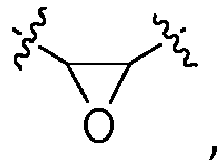

- In another particular embodiment, X is


- According to this embodiment, R4 is notably H or a C1-C12 aliphatic chain wherein up to 4 methylene units are optionally replaced by O, C(O), NH or N-C1-C6alkyl, said C1-C12 aliphatic chain being optionally substituted by one or more OH groups. In particular, R4 is selected in the group consisting of H, COOH, C(O)-C1-C6alkyl, (CH2)p-C(O)-C1-C6alkyl, C(O)-(CH2)p-C(O)-C1-C6alkyl, C(O)NHOH, (CH2)p-C(O)-NHOH and C(O)-(CH2)p-C(O)-NHOH, p being an integer from 1 to 4, said C1-C6 alkyl being notably methyl or ethyl, preferably ethyl.
- In another particular embodiment, X is
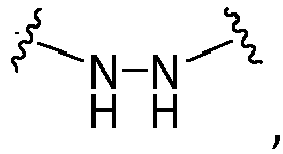

- R3 are as defined in the present disclosure.
- According to some embodiments, R2 is H, a C1-C6 aliphatic chain, such as C1-C6 alkyl, or C1-C6 alkyl-aryl, said aliphatic chain or alkyl-aryl being optionally substituted. Preferably, R2 is H, optionally substituted C1-C6 alkyl, or C1-C6 alkyl-aryl, such as benzyl. When R2 is a C1-C6 alkyl, such as methyl or ethyl, it is notably unsubstituted or substituted by one or more halogen, OH, NH2, N(C1-C6alkyl)2 or N+(C1-C6alkyl)3, in particular N+(CH3)3. More preferably, R2 is H, C1-C6 alkyl or benzyl.
- According to some other embodiments, R3 is OH, O-C1-C6 aliphatic chain or NHOH, said aliphatic chain being optionally substituted. Preferably, R3 is OH, optionally substituted O-C1-C6 alkyl, O-C1-C6 alkenyl, or NHOH. When R3 is a O-C1-C6 alkyl, such as O-methyl or O-ethyl, said alkyl is notably unsubstituted or substituted by one or more halogen, OH, NH2, NH-C1-C6alkyl, N(C1-C6alkyl)2 or N+(C1-C6alkyl)3, in particular N+(CH3)3. More preferably, R3 is OH or O-C1-C6 alkyl, in particular O-ethyl.
- According to some embodiments, R1 is O-C1-C6 alkyl, O-C2-C6 alkenyl or NH-OH, provided that when R3 is OH, R1 is not O-C1-C6 alkyl. Preferably, R1 is O-methyl, O-ethyl, O-allyl or NHOH, provided that when R3 is OH, R1 is not O-C1-C6 alkyl. When R1 is O-C1-C6 alkyl, R3 is preferably O-C1-C6 alkyl such as O-methyl or O-ethyl, unsubstituted or substituted by one or more halogen, OH, NH2, NH-C1-C6alkyl, N(C1-C6alkyl)2 or N+(C1-C6alkyl)3, in particular N+(CH3)3. More preferably, when R1 is O-C1-C6 alkyl, notably O-ethyl, R3 is O-ethyl.
- According to a preferred embodiment, R1 is


- The compound of formula (I) may be a compound of the following formula :

- Preferably, the compound of formula (I) is a compound of formula (I-Aa) having the following configuration :

- More preferably, the compound of formula (I) is a compound of formula (I -A'a) having the following configuration :


- Alternatively, Y may be ―(CH2)m―, with m being an integer from 0 to 6, preferably from 0 to 4. More preferably, m is 1 or 2, even more preferably m is 2. In the embodiment wherein Y is - (CH2)m, R5 is preferably C(O)OH, C(O)O-C1-C6 alkyl or C(O)NHOH, said alkyl being optionally substituted. More preferably, R5 is C(O)OH, C(O)OEt or C(O)NHOH, in particular COOH.
- According to some embodiments, R6 is OH or O-C1-C6 alkyl, such as O-methyl or O-ethyl, notably O-ethyl, in particular when Y is

- According to other specific embodiments, R6 is NH-CH(R7)-(CH2)n-R8, in particular when Y is - (CH2)m―, notably is ―(CH2)2―. In such embodiments, R7 is preferably H, C1-C6 alkyl, C1-C6 alkyl-aryl, such as benzyl or C1-C6 alkyl-heteroaryl, such as CH2-indole group. R8 is preferably C(O)NH2, aryl, such as phenyl, heteroaryl, such as indole, SH, or S-C1-C6alkyl, such as S-C(CH3)3 and n is preferably 0, 1, 2 or 3. In some embodiments, R7 is C1-C6 alkyl, R8 is C(O)NH2 and n is 0. In some other preferred embodiments, R7 is H, R8 is phenyl and n is 1, 2 or 3, preferably 1.
- According to a preferred embodiment, when R3 is OH, R1 is


- In a preferred embodiment, the compound of formula (I) is a compound of formula (1-A'a) as defined above, in which X, R2 and R3 are as defined above, R1 is
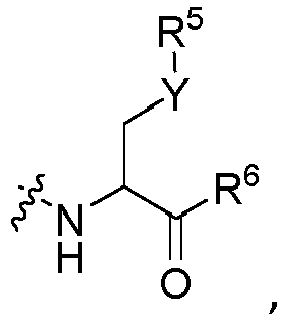

- Y being ―(CH2)m―, m being as defined above and notably m is 2, R5 being C(O)OH, C(O)OEt or C(O)NHOH, R6 being NH-CH(R7)-(CH2)n-R8, R7 being H, C1-C6 alkyl, C1-C6 alkyl-aryl, such as benzyl or C1-C6 alkyl-heteroaryl, such as CH2-indole group, R8 being C(O)NH2, aryl, such as phenyl, heteroaryl, such as indole, SH, or S-C1-C6alkyl, such as S-C(CH3)3 and n being 0, 1, 2 or 3, or
- Y being

- According to another preferred embodiment, the compound of formula (I) is of formula (I-A') in whichX is

- In a more preferred embodiment, the compound of formula (I) is of formula (I-A'a) in which X is
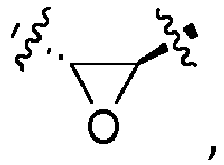
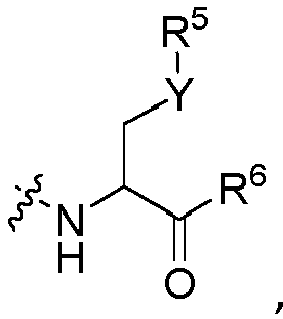

- Y is ―(CH2)m―, in particular ―(CH2)2-, R5 is C(O)NHOH, R6 is NH-CH2-(CH2)n-R8, with R8 being aryl, such as phenyl, and n being 1, 2 or 3, notably 1, or
- Y is

- In particular, the compound of formula (I) is not :
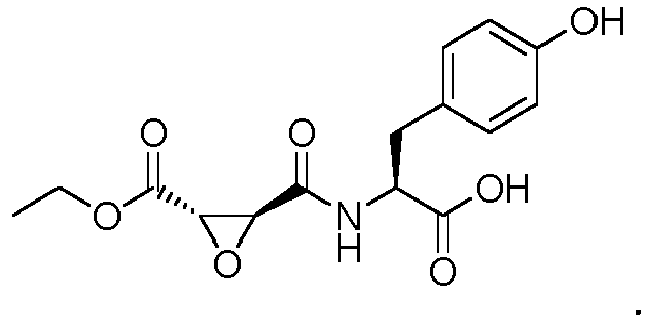
- According to a particular embodiment, the compound of formula (I) is a peptide based-VASH inhibitor. By 'peptide based-VASH inhibitor' according to the invention, it means a VASH inhibitor containing a peptidic moiety constituted of 1 to 20 amino acids, wherein the most C-terminal amino acid is selected from Y or F, and able to target and inhibit, at least partially, the activity of proteins having a tubulin carboxypeptidase activity, and thereby inhibit microtubule detyrosination.
- The term "peptidic moiety" refers to a moiety containing at least one amino acid and at most 20 amino acids. When the peptidic moiety comprises two or more amino acids, said amino acids are linked together by peptide bonds and chemically modified or not.
- According to a preferred embodiment, the compound of formula (I) is selected among:


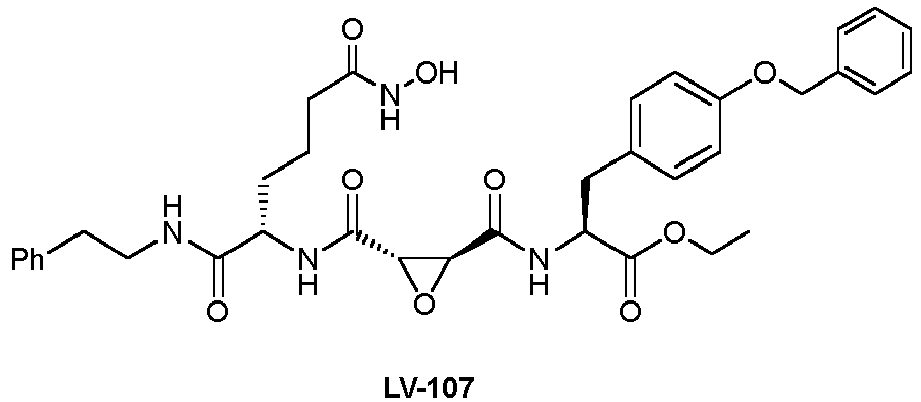


- In a particular and preferred embodiment, the compound of formula (I) according to the invention is selected in the group consisting of compounds LV-80 to LV-124 or conjugates thereof.
- In a particular embodiment, the compound of formula (I) according to the invention is the compound LV-80 or a conjugate thereof.
- In a particular embodiment, the compound of formula (I) according to the invention is the compound LV-91 or a conjugate thereof.
- In a particular embodiment, the compound of formula (I) according to the invention is the compound LV-104 or a conjugate thereof. LV-104 may be a prodrug of the corresponding active drug.
- In a particular embodiment, the compound of formula (I) according to the invention is the compound LV-111 or a conjugate thereof. LV-111 may be a prodrug of the corresponding active drug.
- The compound of formula (I) as described above, or a pharmaceutically acceptable salt and/or solvate thereof, may be obtained by a method comprising the following steps:
- (a) reacting a compound of formula (II) :


- (b) optionally, converting RZ being OH to R1 as defined above.
- The compound of formula (III) may be obtained according to methods well-known from the skilled person in the art.
- The reaction between compound of formula (II) and formula (III) is notably a peptide coupling as defined above.
- Optionally, additional steps of protection/deprotection and/or of functionalization well-known from the skilled person in the art may occur before or after the reaction between compounds of formula (II) and (III) to afford compound of formula (I) with the suitable substituents as described above.
- In particular, when RZ is OH, the compound resulting from step (a) undergoes a peptide coupling with


- The one or more peptide coupling carried out in the method of preparation of compound of formula (I) are notably achieved in presence of PyAOP as coupling agent. Preferably, the base DIEA is also used.
- The peptide coupling may be carried out on a solid support, notably by using a resin to which one of the reagents, the amine part or the acid part, is attached. Such methods are well-known from the skilled person in the art.
- The present invention also relates to a conjugate comprising a fragment of a compound of formula (I) as described above linked to a biomolecule such as a peptide, a protein, a biomarker, as for example a photolabelling agent, such as Rhodamine, cyanines derivatives or fluoresceine, an affinity probe such as biotin, or a E3 ubiquitin ligase recruiter including but not limited to Thalidomide, VH032, VH101, dBET1, dFKBP12, QCA570, PROTAC6, ZNL-02-096 or d9A-2.
- According to a particular embodiment, the conjugate according to the present invention has the following formula (I'):

- B is a biomolecule such as a peptide, a protein, a biomarker, as for example a photolabelling agent, or a E3 ligase recruiter such as Thalidomide,
- L is a linker, and
- R2, R3, X, Y and R5 are as defined above.
- According to a preferred embodiment, the conjugate of formula (I') is a conjugate of formula (I'-A) having the following configuration:

- In particular, the conjugate of formula (I') is a conjugate of formula (I'-Aa) having the following configuration :

- In the conjugate of formula (I'), in particular of formula (I'-Aa), X is preferably

- Y may be ―(CH2)m- or


- According to some embodiments, the linker L corresponds to a divalent radical derived from a C1-C12 aliphatic chain, wherein one or more methylene unit(s) are replaced by structural linkers selected from arylene or fragments ―O―, ―S―, ―C(=O)―, ―SO2― or ―N(C1-C6 alkyl)―, wherein said aliphatic chain is unsubstituted or is substituted by one or more radicals selected from halogen, OH, a C1-C6 alkyl and/or a C1-C6 alkyl aryl group, such as benzyl group.
- Preferably, the biomolecule is E3 ligase recruiter, notably Thalidomide, and the conjugate is thus a PROTAC E3 ligase recruiter.
- In a preferred embodiment, the conjugate is thus a PROTAC E3 ligase recruiter of the following formula (II') :

- For example, the PROTAC E3 ligase recruiter is


- In another embodiment, the biomolecule is an affinity probe and the conjugate of formula (I') may be :

- In another embodiment, the biomolecule is a photolabeling agent and the conjugate of formula (I') may be :

- The present invention also relates to a pharmaceutical composition comprising at least one pharmaceutically acceptable excipient and at least one compound of formula (I) as described above or a pharmaceutically acceptable salt and/or solvate thereof.
- The present invention also relates to a pharmaceutical composition comprising at least one conjugate as described above, such as a conjugate of formula (I'), or a pharmaceutically acceptable salt and/or solvate thereof, and at least one pharmaceutically acceptable excipient.
- The pharmaceutical compositions of the invention can be intended to oral or parenteral (including but not limited to subcutaneous, intramuscular, intravenous, ocular, intravitreal, topical, sublingual administration, preferably oral or intravenous administration. The active ingredient can be administered in unit forms for administration, mixed with conventional pharmaceutical carriers, to animals, preferably mammals including humans.
- For oral administration, the pharmaceutical composition can be in a solid or liquid (solution or suspension) form.
- A solid composition can be in the form of tablets, gelatin capsules, powders, granules and the like. In tablets, the active ingredient can be mixed with pharmaceutical vehicle(s) such as gelatin, starch, lactose, magnesium stearate, talc, gum arabic and the like before being compressed. The tablets may be further coated, notably with sucrose or with other suitable materials, or they may be treated in such a way that they have a prolonged or delayed activity. In powders or granules, the active ingredient can be mixed or granulated with dispersing agents, wetting agents or suspending agents and with flavor correctors or sweeteners. In gelatin capsules, the active ingredient can be introduced into soft or hard gelatin capsules in the form of a powder or granules such as mentioned previously or in the form of a liquid composition such as mentioned below.
- A liquid composition can contain the active ingredient together with a sweetener, a taste enhancer or a suitable coloring agent in a solvent such as water. The liquid composition can also be obtained by suspending or dissolving a powder or granules, as mentioned above, in a liquid such as water, juice, milk, etc. It can be for example a syrup or an elixir.
- For parenteral administration, the composition can be in the form of an aqueous suspension or solution which may contain suspending agents and/or wetting agents. The composition is advantageously sterile. It can be in the form of an isotonic solution (in particular in comparison to blood).
- The compound of formula (I), the pharmaceutically acceptable salt and/or solvate thereof, or the pharmaceutical composition according to the invention act as VASH inhibitors, meaning that it is able to inhibit the peptidase activity of VASH that catalyzes microtubules detyrosination. When this VASH peptidase activity is deregulated, and notably abnormally increased, it induces severe disorders as defined below.
- The compounds of formula (I) in which X is


- The compounds of formula (I) in which X is

- The present invention relates to a compound of formula (I) according to the invention or a pharmaceutically acceptable salt and/or solvate thereof, for use as a drug, in particular in the prevention and/or the treatment of a VASH peptidase activity associated disorder.
- In other terms, the present invention relates to the use of a compound of formula (I) according to the invention or a pharmaceutically acceptable salt and/or solvate thereof, for the manufacture of a drug, notably intended in the prevention and/or the treatment of a VASH peptidase activity associated disorder.
- In other terms, the present invention relates to the use of a compound of formula (I) according to the invention or a pharmaceutically acceptable salt and/or solvate thereof for the prevention and/or the treatment of a VASH peptidase activity associated disorder.
- In other terms, the present invention relates to a method for the prevention and/or the treatment of a VASH peptidase activity associated disorder comprising the administration to a person in need thereof of an effective dose of a compound of formula (I) according to the invention or a pharmaceutically acceptable salt and/or solvate thereof.
- According to another aspect, the present invention relates to a pharmaceutical composition according to the invention for use as a drug, in particular in the prevention and/or the treatment of a VASH peptidase activity associated disorder.
- In other terms, the present invention relates to the use of a pharmaceutical composition according to the invention for the manufacture of a drug, notably intended in the prevention and/or the treatment of a VASH peptidase activity associated disorder.
- In other terms, the present invention relates to the use of a pharmaceutical composition according to the invention for the prevention and/or the treatment of a VASH peptidase activity associated disorder.
- In other terms, the present invention relates to a method for the prevention and/or the treatment of a VASH peptidase activity associated disorder comprising the administration to a person in need thereof of an effective dose of a pharmaceutical composition according to the invention.
- According to another aspect, the present invention relates to a conjugate according to the invention for use as a drug, in particular in the prevention and/or the treatment of a VASH peptidase activity associated disorder.
- In other terms, the present invention relates to the use of a conjugate according to the invention for the manufacture of a drug, notably intended in the prevention and/or the treatment of a VASH peptidase activity associated disorder.
- In other terms, the present invention relates to the use of a conjugate according to the invention for the prevention and/or the treatment of a VASH peptidase activity associated disorder.
- In other terms, the present invention relates to a method for the prevention and/or the treatment of a VASH peptidase activity associated disorder comprising the administration to a person in need thereof of an effective dose of a conjugate according to the invention.
- A preferred embodiment relates to a PROTAC E3 ligase recruiter according to the present invention, notably of formula (I") as defined above, for use as a drug, in particular in the prevention and/or the treatment of a VASH peptidase activity associated disorder. Such a PROTAC E3 ligase recruiter is able to selectively target VASH enzyme and to induce its total degradation by proteasome.
- The conjugate of formula (I") in which X is


- The conjugate of formula (I") in which X is
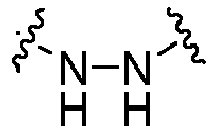
- According to the present invention, a VASH peptidase activity-associated disorder is preferably selected from fibrosis, cancer and a tubulin carboxypeptidase associated disease.
- In particular, the VASH peptidase activity associated disorder is a disorder involving altered microtubule detyrosination and/or polyglutamylation, notably selected from neurodegenerative diseases, such as Alzheimer disease or Parkinson disease, glaucoma, psychiatric disorders, neuronal disorders, cancers, such as colon cancer and neuroblastoma, muscular dystrophies, infertility, retinal degeneration, Purkinje cell sicknesses, infantile onset degeneration, male infertilities and ciliopathies, in particular neurodegenerative diseases, cancers and muscular dystrophies.
- In particular, a VASH peptidase activity-associated disorder is a tubulin carboxypeptidase associated disease including, without being limited to, disorder involving altered microtubule detyrosination.
- According to a particular embodiment, a disorder involving altered microtubule detyrosination may be selected from neurodegenerative diseases, such as Alzheimer disease or Parkinson disease, glaucoma, psychiatric disorders, and neuronal disorders, cancers, such as colon cancer and neuroblastoma, muscular dystrophies, infertility, retinal degeneration and ciliopathies, in particular neurodegenerative diseases, cancers and muscular dystrophies.
- In another aspect, a VASH peptidase activity-associated disorder is a tubulin carboxypeptidase associated disease including, disorder involving polyglutamination.
- Accordingto a particular embodiment, a disorder involving polyglutamination may be selected from neurodegeneration, neurodevelopmental disorders, Purkinje cell sicknesses, infantile onset degeneration, ciliopathies, male infertilities, cancer, respiratory disorder, retinal degeneration, bleeding disorders, non-Mendelian inheretence disorders.
- According to another aspect, the present invention relates to a compound of formula (I) according to the invention or a conjugate thereof for use as research tool for research and development activities, in particular selected in the group consisting of:
- in vitro and/or in cellulo screening assays for identifying new VASH inhibitors and/or quantifying their inhibitor efficiency,
- in vitro method for studying the role of tubulin detyrosination, in particular in VASH peptidase activity associated disorder, such as its occurrence, aggressiveness and progression,
- in vitro diagnostic methods for identifying or monitoring a VASH peptidase activity associated disorder involving altered microtubule detyrosination and/or polyglutamylation,
- and related kits for performing said screening assays and methods.
- These R&D activities as examples of illustrative but not limitative uses of said compounds for formula (I) or conjugate thereof.
- The said compounds for formula (I) or conjugate thereof is used in particular as positive control in said in vitro or in cellulo screening assays or methods.
- The said compounds for formula (I) may be coupled for example but not limited to fluorescent dyes, UV-sensitive dyes, HRP, alkaline phosphatase, biotin.
- In a particular embodiment, a compound of formula (I) or a conjugate thereof according to the invention is used in an in vitro screening assay of VASH inhibitors (primary screening assay), wherein the compound of formula (I) is used as positive control.
- As an example, the screening assay is an immuno-assay wherein the compound of formula (I) or a conjugate thereof is coated on plates as positive control.
- The invention also concerns an in vitro kit assay for a primary screening assay of VASH inhibitors comprising a compound of formula (I) or a conjugate thereof as positive control.
- In another particular embodiment, a compound of formula (I) or a conjugate thereof according to the invention is used in an in cellulo screening assay of VASH inhibitors (secundary screening assay), wherein the compound of formula (I) or a conjugate thereof is used as positive control.
- The invention also concerns an in cellulo kit assay for a secondary screening assay of VASH inhibitors comprising a compound of formula (I) or a conjugate thereof as positive control.
- In a preferred embodiment, the in cellulo kit assay comprises CHL cell lines and a compound of formula (I) as positive control.
- In another particular embodiment, a compound of formula (I) or a conjugate thereof according to the invention is used as tool to better understand the role of tubulin detyrosination, in particular in tubulin detyrosination associated disorder, such as its occurrence, aggressiveness and progression (for example cancer).
- So the invention also concerns an in vitro screening assay for identification of VASH inhibitors comprising the steps of:
- (i) Contacting (a) a substrate of VASH1 or VASH2 enzyme comprising an amino acids sequence having at least the last 4 amino acids residues of the C-terminal sequence of an α-tubulin and/or a Microtubule Associated Protein (MAP) and, as ultimate C-terminal amino acid residue, a tyrosine (Y), and b) an isolated or recombinant VAHS1 or VASH2; in the presence or absence (negative control) of the compound to be tested or in the presence of a compound of formula (I) or conjugate thereof according to the invention (positive control), and under conditions for cleavage and liberation of C-terminal free tyrosine (detyrosination);
- (ii) Using reagents for detecting and measuring the signal related to cleavage and liberation of the C-terminal free tyrosine ;
- (iii) Measuring and comparing the level of C-terminal free tyrosine, in presence and in absence (negative control) of the compound to be tested and in presence of the compound of formula (I) or conjugate thereof according to the invention (positive control), and
- (iv) Selecting the compounds for which the level of C-terminal free tyrosine, is decreased in the presence of the compound to be tested (VASH inhibitors),
- (v) Optionally classifying the inhibitor efficiency of the said VASH inhibitors compounds in comparison to the level of C-terminal free tyrosine in the presence of the compound of formula (I) or conjugate thereof according to the invention (positive control).
- In a particular embodiment, the substrate of VASH1 or VASH2 enzyme is selected in the group consisting of purified and recombinant alpha-tubulin and recombinant engineered telokin as disclosed in the application
WO2020/012002 . - In a particular embodiment, the step (ii) of detection of the C-terminal free tyrosine uses a colorimetric assay using a tyrosinase.
- In another particular embodiment, the in vitro screening assay is an immuno-assay, in which the step (ii) comprises :
- adding an effective amount of specific labelled antibody raised against detyrosinated alpha-tubulin (dTyr-Ab), under conditions that favor the formation of a complex antibody - cleaved substrate; and
- means for revealing the labelled signal;
- adding an effective amount of a primary specific antibody raised against detyrosinated alpha-tubulin (dTyr-Ab), under conditions that favor the formation of a complex antibody - cleaved substrate;
- adding an effective amount of a secondary labelled antibody specific of the primary antibody, under conditions that favor the formation of a complex primary antibody- cleaved substrate- labelled secondary antibody, and
- means for revealing the labelled signal,
- In particular, the antibody is labelled with a marker selected in the group consisting of an enzyme, a fluorescent compound or fluorophore, a (chemo)luminescent compound or a radioactive element, preferably an enzyme and more preferably a peroxidase.
- In particular, the immunoassay is an enzyme immunoassay, a fluoroimmunoassay, a luminescent immunoassay or a radioimmunoassay, preferably a dot-blot or an enzyme immunoassay (ELISA).
- In a particular embodiment, the in vitro screening immunoassay for identification of VASH inhibitors occurs in solid phase, wherein:
- substrate of VASH1 or VASH2 is coated on solid support, in particular on membrane or microplate, and the VASH1 or VASH2 enzyme, the compound(s) to be tested and the antibodies raised against cleaved substrate, in particular detyrosinated α-tubulin (dTyr-Ab), optionally labelled or combined with labelled secondary antibodies raised against primary antibodies are added in the reaction solution, or
- alternatively, the antibodies raised against cleaved substrate, in particular detyrosinated α-tubulin (dTyr-Ab), are coated on solid support, in particular on membrane or microplate, and VASH1 or VASH2 enzyme, substrate of said VASH1 or VASH2, the compound(s) to be tested, and secondary labelled antibodies raised against cleaved substrate, are added in the reaction solution, or
- alternatively, the VASH1 or VASH2 enzyme is coated on solid support, in particular on membrane or microplate, and the substrate of said VASH1 or VASH2, the compound(s) to be tested, and the antibodies raised against cleaved substrate, in particular detyrosinated α-tubulin (dTyr-Ab), optionally labelled or combined with labelled secondary antibodies raised against primary antibodies, are added in the reaction solution.
- The present invention also concerns a kit for performing the in vitro screening immuno-assay for identification of VASH inhibitors as disclosed above, comprising:
- (i) a VASH1 or VASH2 enzyme substrate, preferably a recombinant alpha-tubulin or an engineered telokin as disclosed in the application
WO2020/012002 , - (ii) a VASH1 or VASH2 enzyme, preferably an isolated or recombinant VASH1 or VAHS2,
- (iii) antibodies raised against cleaved substrate, preferably detyrosinated α-tubulin (dTyr-Ab), in particular raised against detyrosinated α-tubulin SF9 (dTyr-Ab SF9) and coupled to horseradish peroxidase (HRP), and optionally secondary antibodies raised against the cleaved substrate antibodies, preferably the detyrosinated α-tubulin antibodies,
- (iv) a negative control comprising a non-tyrosinated isolated or recombinant alpha-tubulin or telokin,
- (v) a compound of formula (I) or a conjugate thereof according to the invention as positive control,
- (vi) a fluid vessel or alternatively a solid support for coating or pre-coating either the substrate of VASH1 or VASH2 either the VASH1 or VASH2 enzyme, preferably microplates,
- (vii) reagents for allowing contact of said substrate with VASH1 or VASH2 enzyme in reaction conditions for substrate cleavage, preferably detyrosination,
- (viii) reagents for detecting and measuring the level of substrate cleavage, preferably detyrosination ; and
- (ix) optionally a notice of use.
- In another particular embodiment, a compound of formula (I) or a conjugate thereof according to the invention is used in an in cellulo method for quantifying VASH peptidase activity.
- The present invention also concerns an in cellulo screening assay for identification of VASH inhibitors comprising:
- (i) culturing CHL-1 cells and plating them, in particular in multi-wells culture dish,
- (ii) treating CHL-1 cells with taxol, in absence (negative control) or in presence of the putative VASH inhibitors to be tested or in presence of the compound for formula (I) or a conjugate thereof according to the present invention (positive control);
- (iii) Detection of detyrosination activity contained in protein samples using specific labelled antibodies raised against detyrosinated alpha-tubulin (dTyr-Ab), under conditions that favor the formation of a complex antibody - cleaved substrate, and means for revealing the labelled signal,
- (iv) measuring and comparing the level of taxol induced detyrosination, in presence and in absence (negative control) of the compound to be tested and in presence of the compound of formula (I) or conjugate thereof according to the invention (positive control),
- (v) Selecting the compounds for which the level taxol induced detyrosination, is reduced in the presence of the compound to be tested (VASH inhibitors),
- (vi) Optionally classifying the inhibitor efficiency of the said VASH inhibitors compounds in comparison to the reduced level of taxol induced detyrosination in the presence of the compound of formula (I) or conjugate thereof according to the invention (positive control).
- The present invention also concerns a kit for performing the in cellulo screening assay for identification of VASH inhibitors comprising:
- (i) CHL-1 cells
- (ii) Taxol,
- (iii) antibodies raised against detyrosinated α-tubulin (dTyr-Ab),
- (iv) a compound of formula (I) or a conjugate thereof according to the invention as positive control,
- (v) a fluid vessel or alternatively a solid support for coating or pre-coating the CHL-1 cells, preferably microplates,
- (vi) reagents for allowing contact of said CHL-1 cells pre-treated with taxol with compounds to be tested or the positive control in reaction conditions for detyrosination,
- (vii) reagents for detecting and measuring the reduced level of taxol induced detyrosination ; and
- (viii) optionally a notice of use.
- In another particular embodiment, a compound of formula (I) or a conjugate thereof according to the invention is used in an in vitro diagnostic method for detecting a VASH peptidase activity associated disorder.
- So the invention also concerns a kit assay for in vitro diagnostic method, wherein the compound of formula (I) or a conjugate thereof is used as positive control.
-
-
Figure 1 : In cellulo VASH-mediated tubulin detyrosination assay
Effect of increasing concentrations of Epo-Y on tubulin detyrosination in human CHL-1 cells (melanoma derived cell line). -
Figure 2 : Putative inhibitor parthenolide does not inhibit VASH-mediated tubulin detyrosination. (A) Chemical structure of Epo-Y and of the putative detyrosinase inhibitor parthenolide (PTL). (B) In vitro detyrosination assay using recombinant VASH1 proteins. DeTyr, detyrosination. (C) Effect of increasing concentrations of Epo-Y and PTL on tubulin detyrosination in human CHL-1 cells. -
Figure 3 : newly developed inhibitors target VASH1 and VASH2 and peptidase activity VASH1 and VASH2-dependent tubulin detyrosination activities are both inhibited by newly designed inhibitors using the in vitro detyrosination assay. -
Figure 4 : Cell penetrant potent inhibitors of VASH peptidase activity (A) Chemical structure of LV-43 (outside the invention). (B) In vitro detyrosination assay using recombinant VASH1 proteins. (C) In cellulo detyrosination assay using recombinant VASH1 proteins. (D) In cellulo detyrosination assay using CHL-1 cells.(E) Comparison of the doseresponse curves obtained with Epo-Y and LV-80 in vitro. (F) Quantification of the effect of increasing concentrations of Epo-Y and LV-80 on tubulin detyrosination in human CHL-1 cells. (G) Chemical structure of LV-80 and (H) molecular docking to VASH1 displaying the putative binding mode (hydrogen bonds). -
Figure 5 : Complete inhibition of VASH-mediated tubulin detyrosination in cells Analysis of the tubulin detyrosination levels in human CHL-1 cells incubated with LV-80 or vehicle (DMSO) for 24 hours and comparison with VASH1/2 knockout cells (2KOs) (disclosed in Nieuwenhuis J. et al. Science, 2017, 358(6369):1453-1456). Vinculin, loading control. DeTyr, detyrosination. -
Figure 6 : Advantageous safety profile of VASH enzyme inhibitors (A) Cell viability studies using taxol (paclitaxel) and parthenolide as reference. (B) Measurement of cellular metabolism and extracellular acidification rate (ECAR) after incubation of CHL-1 cells with vehicle (DMSO) or the VASH-specific inhibitor LV-80 for 24 hours. Analysis of the oxygen consumption rate (OCR) and extracellular acidification rate (ECAR of live CHL-1 cells using the Seahorse XF Analyzer after 24 hours treatment. OCR rate is a key indicator of mitochondrial respiration and provides a systems-level view of cellular metabolic function in cultured cells. -
Figure 7 : Newly developed VASH inhibitors are specific to VASH enzymatic activity (A, B) Analysis of cytosolic carboxypeptidase 1 (CCP1) (A) and CCP5 (B) -mediated tubulin deglutamylation in the absence or presence of the VASH inhibitor LV-80 (50 µM). PolyE, antibody that recognizes long glutamate chains; GT335, antibody against branching point glutamate residues. (C) Specificity of LV-80. BzlSA, peptidomimetic benzylsuccinic acid. -
Figure 8 : Biotinylated version of newly developed inhibitor as research tool (A) Effect of increasing concentrations of biotinylated LV-80 on tubulin detyrosination in human CHL-1 cells.(B) Pull-down assays of endogenous VASH using biotinylated LV-80. (C) Pull-down assays of endogenous VASH from human brain protein lysates using biotinylated LV-80. -
Figure 9 : Strong reduction of tubulin detyrosination in primary cortical neurons treated with VASH inhibitor. (A) Analysis of lysates of mouse primary cortical neurons incubated with vehicle (DMSO) or the VASH specific inhibitor LV-80. DeTyr, detyrosinated tubulin; TyrTub, tyrosinated tubulin; PolyE, antibody that recognizes long glutamate chains; GT335, antibody against branching point glutamate residues. (B) Quantification of tubulin detyrosination and tyrosination levels. P-values were calculated with the multiple t-test (n = 3, ∗< 0.05, ∗∗<0.01, ∗∗∗<0.001, ∗∗∗∗<0.0001). (C) Transcript levels of genes relevant to the detyrosination status analysed by qPCR. (D) Transcript levels of neural differentiation markers after incubation with vehicle (DMSO) or inhibitor. (E) Transcript levels of glial markers after incubation with vehicle (DMSO) or inhibitor for 7 days. -
Figure 10 : Detyrosination renders tubulin permissive to glutamylation (A) tubulin glutamylation levels, (B) and tubulin acetylation levels in mouse primary cortical neurons that were incubated with vehicle (DMSO) or the VASH specific inhibitor LV-80. P-values were calculated with the multiple t-test (n = 3, ∗< 0.05, ∗∗<0.01, ***<0.001, ****<0.0001). (C) Cross-talk between tubulin detyrosination and glutamylation. (D) Analysis of total Drosophila protein extracts. -
Figure 11 : Tubulin detyrosination impacts tau protein binding in primary cortical neurons (A) Analysis of mouse primary cortical neurons incubated with vehicle (DMSO) or the VASH specific inhibitor LV-80 for 3 days after 5 days of differentiation. DeTyr, detyrosinated tubulin; TyrTub, tyrosinated tubulin; PolyE, antibody that recognizes long glutamate chains; GT335, antibody against branching point glutamate residues. (B, C) Quantification of tubulin detyrosination and tyrosination levels (B), and tubulin glutamylation levels (C) in mouse primary cortical neurons incubated with vehicle (DMSO) or the VASH specific inhibitor LV-80 for 3 days after 5 days of differentiation as in (A). P-values were calculated with the multiple t-test (n = 3, ∗< 0.05, ∗∗<0.01, ∗∗∗<0.001). (D) Tau protein and tubulin co-localization in mouse primary cortical neurons incubated with vehicle (DMSO) or the VASH specific inhibitor LV-80. (E) Automated quantification of tau immunofluorescent staining in tubulin-positive regions (n >150). P-values were calculated with the multiple t-test (∗∗∗<0.001). (F) Quantification of tubulin in mouse primary cortical neurons incubated with vehicle (DMSO) or the VASH specific inhibitor LV-80. Automated quantification of immunofluorescent signal in positive regions (n >150). P-values were calculated with the multiple t-test (ns; not significant). -
Figure 12 : Newly developed prodrug (LV-104 and LV-111) display very efficient inhibition of VASH-dependent detyrosination in human CHL-1 cells. -
- Aad : α-aminoadipic acid
- All : Allyl group
- BOP : benzotriazol-1-yloxytris(dimethylamino)phosphonium haxefluorophosphate
- DCM : Dichloromethane
- DIEA: N,N-Diisopropylethylamine
- DMF : dimethylformamide
- DMSO : dimethylsulfoxide
- HATU : 1-[Bis(dimethylamino)methylene]-1H-1,2,3-triazolo[4,5-b]pyridinium 3-oxide hexafluorophosphate
- NMP : N-methyl-2-pyrrolidone
- PyAOP : 7-Azabenzotriazol-1-yloxy)tripyrrolidinophosphonium hexafluorophosphate
- RM : reaction mixture
- RT : room temperature (18°C-25°C)
- SPPS : solid phase peptide synthesis
- TES : Trans epoxy succinate
- TFA : trifluoroacetic acid
- THF : tetrahydrofuran
- TiS : triisopropylsilane
- Tyr : Tyrosine
- All of the Fluorenylmethyloxycarbonyl (Fmoc) protected amino acids and 1-[Bis(dimethylamino)methylene]-1H-1,2,3-triazolo[4,5-b]pyridinium3-oxid hexafluorophosphate (HATU) were provided by Iris Biotech GmbH. Piperidine, N,N-Diisopropylethylamine (DIEA), TFA, Triisopropylsilane (TIS), dichloromethane (DCM), 1,2-Dichloroethane (DCE), N,N-Dimethylformamide (DMF), N-methylpyrrolidinone (NMP) and ethyl ether (Et2O) were provided by Sigma Aldrich.
AmphiSpheres 40 RAM 0.38 mmol/g 75-150 µm resin was purchased from Agilent Technologies. Solvents used for HPLC and LC/MS were of HPLC grade. - Peptide synthesis was performed using a standard SPPS protocol. Each synthesis was performed using Fmoc-
Rink amide AmphiSpheres 40 resin (0.37 mmol/g). The Fmoc protected amino acids (4 eq), HATU (4 eq) and DIEA (6 eq) were added to the syringe reactor and the mixture was stirred for 1 hour at room temperature. After each coupling reaction, the peptideresin was submitted to two 5 min deprotection cycles with DMF/piperidine 80/20 v/v solution. - All crude compounds were purified by preparative HPLC (Waters 4000 apparatus) on a C18 reversed-phase column (C18 Deltapak column, 100 mm × 40 mm, 15 µm, 100 Å) at a flow rate of 50 mL/min of a H2O + 0.1% TFA and CH3CN + 0.1% TFA mixture in gradient mode with UV detection at 214 nm. Fractions containing the pure product were collected and lyophilized.
- Samples were prepared in an acetonitrile/water (50/50 v/v) mixture containing 0.1% TFA. The LC/MS system consisted of a Waters Alliance 2690 HPLC coupled to a Micromass (Manchester, UK) ZQ spectrometer (electrospray ionization mode, ESI+). All analyses were carried out using a
C18 Chromolith Flash 25 × 4.6 mm column. A flow rate of 3 ml/min and a gradient of 0-100% Acetonitrile over 5 min of a H2O + 0.1% HCOOH and CH3CN + 0.1% HCOOH mixture in gradient mode with UV detection at 214 nm. Positive-ion electrospray mass spectra were acquired at a solvent flow rate of 100-200 µl/min. Nitrogen was used for both the nebulizing and drying gas. The data were obtained in a scan mode ranging from 200 to 1700 m/z in 0.1 s intervals; ten scans were summed up to obtain the final spectrum. Retention times are given in minutes. Solvents used for HPLC and LC/MS were of HPLC grade. -

- Expected mass: 260mg / Obtained mass: 300mg / Crude Yield: 86%
- tR = 2.18, MS (ESI+): m/z= 728.4 [M+H]+
-

- Intermediate A (100mg, 0.137mmol) was dissolved in 15ml of DCM, followed 15ml of TFA/TiS/H2O. The RM was then stirred for 30min at RT. The RM was concentrated dry and the remaining oil was precipitated with cold EtOEt. The precipitate was filtered and dried over reduced pressure. Next, the precipitate was dissolved in 1ml of dry DMF and the allyl ester was removed by treatment with Pd0 Tetrakis (5.15mg, 0.0045mmol) and PhSiH3 (37µl, 0.3mmol). After 20 min the RM was dissolved in 20ml EtOAc that was washed 1 time with 1M HCI solution, 1 time with brine and concentrated dry. The obtained precipitate was then purified by preparative HPLC to obtain 41mg of LV-80 as white solid.
- Expected mass: 91mg / Obtained mass: 41mg / Crude Yield: 45%
- tR = 3.10, MS (ESI+): m/z= 632.4 [M+H]+
-

- Intermediate A (100mg, 0.137mmol) was dissolved in 15ml of DCM, followed 15ml of TFA/TiS/H2O. The RM was then stirred for 30min at RT. The RM was concentrated dry and the remaining oil was precipitated with cold Et2O. The precipitate was filtered and dried over reduced pressure to obtain Intermediate B.
- Intermediate B (15mg, 0.022 mmol) was dissolved in NMP, followed by the addition of cesium carbonate (7.15mg, 0.022 mmol) and iodoethane (2.34µl, 0.029 mmol). The RM was then stirred at RT for 1 hour. Next, the RM was poured in 30ml of water. The aqueous phase was extracted 3 times with EtOAc. The regrouped organic phases were washed 3 times with saturated NaHCO3, 3 times with KHSO4 1M then washed with brine, dried over Na2SO4 and evaporated dry to afford 17mg white solid. Next, the white solid was dissolved in 1ml of dry DMF and the allyl ester was removed by treatment with Pd0 Tetrakis (1mg, 0.00087mmol), PhSiH3 (3µl, 0.024mmol). After 20 min the RM was dissolved in 20ml EtOAc that was washed 1 time with 1M KHSO4 solution, 1 time with brine and concentrated dry. The obtained precipitate was then purified by preparative HPLC to obtain 8,1mg of LV-86 as white solid.
- Expected mass: 15,8mg / Obtained mass: 8,1mg/Crude Yield: 51%
- tR = 3.49, MS (ESI+): m/z= 660 [M+H]+
- 1H NMR (500 MHz, DMSO) δ 8.70 (s, 1H), 8.60 (s, 1H), 8.18 (t, J = 5.5, 1H), 7.44 (d, J = 7.5, 2H), 7.38 (t, J = 7.4, 2H), 7.32 (t, J = 7.3, 1H), 7.27 (t, J = 7.5, 2H), 7.21 - 7.16 (m, 2H), 7.14 (d, J = 8.3, 2H), 6.93 (d, J = 8.2, 2H), 5.05 (s, 2H), 4.38 (d, J = 4.6, 1H), 4.23 (dd, J = 13.6, 7.6, 1H), 4.04 (q, J = 7.1, 2H), 3.57 (d, J = 5.1, 2H), 3.22 (td, J = 13.0, 6.9, 2H), 3.02 (dd, J = 13.8, 4.4, 1H), 2.84 (dd, J = 13.8, 9.4, 1H), 2.69 (t, J = 7.2, 2H), 2.24 (t, J = 7.2, 2H), 1.57 (m, J = 6.7, 1H), 1.50 (m, 1H), 1.45 (m, J = 16.4, 8.0, 3H), 1.17 (t, J = 7.1, 3H)
- 13C NMR (126 MHz, DMSO) δ 172.63, 172.50, 170.67, 165.65, 165.49, 157.11, 139.33, 137.20, 130.23, 129.57, 128.73, 128.46, 128.32, 127.85, 127.79, 126.15, 114.52, 69.15, 59.80, 53.95, 52.58, 52.46, 52.35, 50.63, 35.77, 35.04, 33.09, 31.52, 20.80, 14.17.
-

- Intermediate B (10mg, 0.015 mmol) was dissolved in anhydrous THF. N-Methylmorpholine (3,82µL, 0.030 mmol) was added to the solution. The reaction mixture was then cooled down to -15 °C and stirred for 5 min. Isobutylchloroformate (1,94 piL, 0.015 mmol) was added, and the mixture was stirred for 10 min at -15 °C. O-Tritylhydroxylamine (8.25mg, 0.030 mmol) was added and the stirring continued for 15 min at -15 °C and 30 min at room temperature. Afterward, the mixture was poured into EtOAc (20 mL) washed 1M KSHO4, saturated solution of NaHCO3, dried over MgSO4 and concentrated dry to afford 14mg of intermediate C as a white powder
- Intermediate C (13,92mg, 0.015mmol) was dissolved in 10ml of DCM, followed 10ml of TFA/TiS/H2O. The RM was then stirred for 30min at RT. The RM was concentrated dry and the remaining oil was precipitated with cold EtOEt. The precipitate was filtered and dried over reduced pressure. Next, the precipitate was dissolved in 0,5ml of dry DMF and the allyl ester was removed by treatment with Pd0 Tetrakis (1mg, 0.00087mmol), PhSiH3 (2,2µl, 0.0175mmol). After 20 min the RM was dissolved in 20ml EtOAc that was washed 1 time with 1M HCI solution, 1 time with brine and concentrated dry. The obtained precipitate was then purified by preparative HPLC to obtain 2 mg of LV-87 as white solid.
- Expected mass: 11mg / Obtained mass: 2mg / Crude Yield: 17%
- tR = 2.93, MS (ESI+): m/z= 647.3 [M+H]+
- 1H NMR (500 MHz, DMSO) δ 8.80 (d, J = 8.0, 1H), 8.70 (s, 1H), 8.61 (d, J = 8.1, 1H), 8.17 (t, J = 5.6, 1H), 7.44 (d, J = 7.2, 2), 7.38 (d, J = 14.8, 2H), 7.32 (t, J = 7.3, 1H), 7.29 - 7.26 (m, 2H), 7.20 - 7.17 (m, 3H), 7.15 (d, J = 8.6, 2H), 6.94 (d, J = 8.7, 2H), 5.06 (s, 2H), 4.44 - 4.38 (m, 1H), 4.26 - 4.19 (m, 1H), 3.58 (s, 2H), 3.26 - 3.20 (m, 2H), 3.02 (dd, J = 13.8, 4.6, 1H), 2.84 (dd, J = 13.9, 9.4, 1H), 2.72 - 2.67 (m, 2H), 1.90 (dd, J = 13.0, 6.6, 2H), 1.60 - 1.53 (m, 1H), 1.49 - 1.43 (m, 2H), 1.42 - 1.37 (m, 1H).
- 13C NMR (500 MHz, DMSO) δ 172.50, 168.75, 165.75, 165.45, 157.14, 139.32, 137.18, 130.20, 128.71, 128.45, 128.35, 127.84, 127.78, 126.15, 114.43, 69.14, 53.82, 52.53, 52.37, 48.50, 35.07, 31.98, 31.79, 30.14, 21.63.
-

- The H-Aad(tBu)Phe- sequence was synthetized via SPPS on cystamine-Trt resin (CA) charged 0.5 mmol/g. Next, the solid supported sequence was attached via an amide bond to compound HO-TES-Tyr(OBn)-OAII (95mg, 0.225mmol) via PyAOP (95mg, 0.225mmol) and DIEA (77µl, 0.450mmol) activation, overnight at RT. After 2 hours, Pd Tetrakis (8.66mg, 0.008mmol) and PhSiH3 were added, leading to the deprotection of the OAII ester. The thiolated version of LV-80 was cleaved from the resin by a 2 hours long treatment with TFA/DCM/H2O/
TiS 50/50/2.5/2.5. The filtrate was then concentrated dry to provide a brown oil that was precipitated in cold Et2O to obtain a white solid that was isolated by filtration. The compound was then purified by preparative HPLC to obtain 32mg of LV-81 as white solid. -

- HCI.H-Tyr-OEt (100mg,0.407mmol) and (2S,3S)-trans-Oxirane-2,3-dicarboxylic acid (80.8mg, 0.611mmol) were dissolved in 1.5mL of NMP, followed by the addition of DIEA (1,628 mmol, 374µL). The mixture was stirred and HATU (309,5mg, 0,814mmol) was added. The mixture was stirred at room temperature for 20 min. The reaction mixture was poured in a Na2CO3 1 M solution and extracted 3 times with 30 mL of diethyl ether. The aqueous phase was acidified with KHSO4 1M and the resulting solution was extracted 3 times with 30 mL of ethyl acetate. The organic layers were combined, washed with brine then dried over MgSO4, filtered and concentrated under reduced pressure to afford intermediate D as a yellow oil. The product was used as it is without further purification.
- Expected mass: 131mg / Obtained mass: 104mg / Yield: 79,3%
- HPLC purity = 98%, tR =1.2min, MS (ESI+): m/z= 324,3 [M+H]+ , (expected m/z = 324.31)
-

- Cs2CO3 (314mg, 0.966mmol) was added to Intermediate D (104mg, 0.321mmol) dissolved in anhydrous DMF and the reaction was stirred for 15min. lodoethane (77.6µL, 0,966mmol) was added to the solution, and the reaction was stirred at room temperature overnight and monitored by HPLC. The solution was poured in 30mL of water and extracted 3 times with 30mL of ethyl acetate then washed 3 times with a solution of
NaHCO 3 1 M and 3 times with a solution ofKHSO 4 1 M. The organic layer was dried over MgSO4, filtered, and concentrated under reduced pressure to afford the desired product as white crystals. The product was then purified by preparative chromatography to obtain 51.5mg of LV-111 as white solid. - Expected mass: 121.66mg / Obtained mass: 51.5mg / Yield: 42%
- HPLC purity = 98%, tR =2.1min, MS (ESI+): m/z= 380.2 [M+H]+, (expected m/z = 380.16)
- 1H NMR (500 MHz, DMSO) δ 8.78 (d, J = 7.9, 1H), 7.07 (d, J = 8.3, 2H), 6.78 (d, J = 8.2, 2H), 4.42 (dd, J = 14.2, 8.4, 1H), 4.17 - 3.89 (m, 6H), 3.61 (s, 1H), 3.40 (s, 1H), 2.93 (dd, J = 13.8, 5.7, 1H), 2.83 (dd, J = 13.7, 9.2, 1H), 1.29 - 1.05 (m, 9H).
- 13C NMR (126 MHz, DMSO) δ 171.40,167.43, 165.49, 157.81, 130.66, 128.90, 114.60, 63.32, 62.06, 61.24, 54.20, 53.06, 51.69, 36.17, 15.14, 14.34.
- HRMS (micrOTOF-Q): calculated for C19H25NO7 [M+H]+ : 380.1631, found: 380.1704.
-

- HCI.H-Tyr-OEt (100mg,0.407mmol) and (2S,3S)-trans-Oxirane-2,3-dicarboxylic acid (27mg, 0.204mmol) were dissolved in 1.5mL of NMP, followed by DIEA (1,628 mmol, 374µL). The mixture was stirred for 5 min and HATU (154,7mg, 0,407mmol) was added. The mixture was stirred at room temperature for 20 min. The solution was extracted 3 times with ethyl acetate. The organic layers were washed 3 times with KHSO4 1M and NaHCO3 1 M, then one time with brine and dried over MgSO4, filtered and concentrated under reduced pressure to afford the desired product as a white powder.
HPLC purity = 98%, tR =1.42min, MS (ESI+): m/z= 515.20 [M+H]+ , (expected m/z = 515.20) -

- Cs2CO3 (126.8mg, 0.389mmol) was added to LV-101 (100mg, 0.195mmol) dissolved in anhydrous DMF and the reaction was stirred for 15min. lodoethane (47.0µL, 0,585mmol) was added to the solution, and the reaction was stirred at room temperature overnight and monitored by HPLC. The solution was poured in 30mL of water and extracted 3 times with 30mL of ethyl acetate then washed 3 times with a solution of
NaHCO 3 1 M and 3 times with a solution ofKHSO 4 1 M. The organic layer was dried over MgSO4, filtered, and concentrated under reduced pressure to afford the desired product as a white powder. The product was then purified by preparative chromatography to obtain 75.6mg of LV-104 as white powder. - Expected mass: 111.15mg /Obtained mass: 75.6mg / Yield: 68%
- HPLC purity = 99%, tR =3.81min, MS (ESI+): m/z= 571.3 [M+H]+, (expected m/z = 571.26)
- 1H NMR (500 MHz, DMSO) δ 8.87 (d, J = 7.7, 2H), 7.07 (d, J = 8.2, 4H), 6.78 (d, J = 8.1, 4H), 4.38 (dd, J = 14.2, 8.3, 2H), 4.02 (q, J = 7.1, 4H), 3.93 (q, J = 6.9, 4H), 3.45 (s, 2H), 2.92 (dd, J = 13.8, 5.7, 2H), 2.82 (dd, J = 13.8, 9.2, 2H), 1.25 (t, J = 6.9, 6H), 1.08 (t, J = 7.1, 6H). 13C NMR (126 MHz, DMSO) δ 170.97, 165.50, 157.29, 130.25, 128.36, 114.14, 62.70, 60.62, 53.79, 52.17, 35.51, 14.62, 13.91.
- HRMS (micrOTOF-Q): calculated for C30H38N2O9 [M+H] + : 571.6390, found: 571.2650
- Carbonyldiimidazole CDI (113.6mg ; 1.2eq) was dissolved in a minimum of DMF and the RM was placed at -10°C. Boc-NH-NH2 (92.5mg ; 1.2eq) was also dissolved in a minimum of DMF and added to the RM which was then stirred during 30min at -10°C. After this, TFA.HTyr(OEt)OEt (203.6mg; 1eq) was also dissolved in a minimum of DMF and was added to the RM followed by Et3N (168µL). The RM was then stirred at room temperature during 2h50. For the work up step, distilled water and AcOEt were added in the RM and placed in a separation funnel. The organic phase was then washed with HCl 1M (x2), saturated NaHCO3 (x2) and brine (x2). The solution obtained was then dried with MgSO4, filtered and concentrated to give an oil (154.3mg ; Yield : 56%). This obtained oil was solubilized in a TFA/TIS/H2O (95/2.5/2.5) solution and stirred at room temperature during 30min and then concentrated dry to give Intermediate E as crude oil. The compound was used without any further purification.
-

- CDI (63.3mg ; 1.2eq) was dissolved in a minimum of DMF and the RM was placed at -10°C. Intermediate E (159.7mg ; 1.2eq) was also dissolved in a minimum of DMF and added to the RM which was then stirred during 30min at -10°C. The pH was adjusted to 8 with few drops of Et3N. After this, TFA.HTyr(OEt)OEt (115.9mg ; 1eq) was also dissolved in a minimum of DMF and was added to the RM followed by Et3N (102.2µL; 2.2eq). The RM was then stirred at room temperature during 3h. For the work up step, distilled water and AcOEt were added in the RM and placed in a separation funnel. The organic phase was then washed with HCl 1M (x2), saturated NaHCO3 (x2) and brine (x2). The solution obtained was then dried with MgSO4, filtered and concentrated to give an oil.
- The raw product was then purified on HPLC and lyophilized to give very light and white crystals (43.9mg ; Yield : 24% ; Purity : >96%).
1H NMR(500MHz, CDCl3) δ 6.99 (d,J = 8.5, 4H), 6.75 (d,J = 8.6, 4H), 6.50 (s, 2H), 6.05 (d,J = 8.1, 2H), 4.60 (dd,J = 14.3, 6.6, 2H), 4.16 - 4.04 (m, 4H), 3.92 (q,J = 7.0, 4H), 3.03 - 2.89 (m, 4H), 1.38 - 1.28 (m, 6H), 1.18 (t,J = 7.1, 6H). -

- Compound 81 (7.35mg, 0.01mmol) was dissolved in 800µl of DMF followed by the addition of biotin-maleimide (4.5mg, 0.01mmol) and 400µl PBS solution. The mixture was lightly heated in order to solubilize both reagents and then stirred at RT for 1h. The RM was then directly purified by preparative HPLC to afford 7mg of LV-82 as white solid.
- Expected mass: 11.85mg / Obtained mass: 7mg / Yield: 59%
- tR = 2.89, MS (ESI+): m/z= 1186.2 [M+H]+, 593.7 [M+2H]2+
- Human CHL-1 cells (melanoma derived cell line, Nieuwenhuis J. et al. Science, 2017, 358(6369):1453-1456) were routinely cultured in DMEM containing 10% (v/v) fetal bovine serum (FBS), 50 U/ml penicillin and 50 µg/ml streptomycin (pen/strep) and incubated at 37°C. Prior testing, the CHL-1 cells were seeded in adequate plates (96,48,24,12 or 6 wells) at 30% confluency. Next day cells were treaed and collected for further analysis (immunoblotting, qPCR, immunofluorescence...).
- Cortical cell cultures were seeded either on glass coverslips or plastic plates coated with 0.1 mg/ml poly-L-lysine (Sigma) at ~105 cells per cm2 or 2×10⁴ cells per cm2 for low-density cultures. Neurons were plated in DMEM containing 10% (v/v) fetal bovine serum (FBS), 50 U/ml penicillin and 50 µg/ml streptomycin (pen/strep), and 1-2 h later the medium was replaced with Neurobasal medium supplemented with 2% B27, pen/strep, 0.6% glucose and 1% Glutamax (all reagents from Life Technologies).
- Drosophila were raised at 25°Celsius. yw flies were used as control foryw; αTub84BΔ3 mutant. Total males were disrupted in laemli loading buffer, boiled, sonicated and loaded for immunoblotting.
- We used the methods as disclosed in the application
WO2020/012002 . - Human VASH1 (hVASH1) was cloned in the expression vector with a poly-histidine tag. Bacteria were transformed and induced with Isopropyl β-d-1-thiogalactopyranoside (IPTG) overnight or for 4 hours. Bacteria were collected and disrupted using a HTU-DIGI-F press (Heinemann). Recombinant proteins were purified using nickel-based affinity chromatography (IMAC) according to the manufacturer's protocol (GE Healthcare).
- Spodoptera frugiperda Sf9 cells were grown, lysed and used for tubulin purification by affinity chromatography. Microtubules were obtained with taxol and stored until use. In vitro analysis of detyrosination activities was performed using the recombinant hVASH1. Detyrosination assays were performed in the presence of 0.5 µM microtubules. Reactions were stopped by addition of the denaturing loading buffer followed by 5min incubation at 95°C, and samples were loaded on SDS PAGE for immunoblot analysis.
- Deglutamylation assays have been performed as previously described (Rogowski et al., Cell, 2010, 143(4):564-78).
- Plasmid transfections were performed and cells were collected 24 hours after transfection for immunoblotting and immunofluorescence analysis.
- Total RNA was isolated with TRIzol (Invitrogen). Reverse transcription was carried out with random hexanucleotides. Quantitative PCR assays were performed using the Lightcycler SYBR Green Master mix on a Lightcycler apparatus (Roche). All used primers were intron-spanning. The relative amount of target cDNA was obtained by normalization by geometric averaging of multiple internal control genes.
- Methanol-fixed CHL-1 cells and mouse cortical neurons were analyzed using a Zeiss Axioimager Apotome microscope after standard immunofluorescence experiments. Briefly, samples were incubated with primary antibodies overnight, washed three times in PBS before 1h incubation with the following secondary antibodies: Alexa Fluor 488-conjugated goat antirat, goat anti-mouse and Alexa Fluor 555-conjugated goat anti-rabbit (Invitrogen). After incubation, samples were washed three times in PBS, stained with DAPI, and mounted.
- Microscopy image acquisition was performed at the Montpellier RIO Imaging facility and images were processed using OMERO.
- We used human CHL-1 cells in which tubulin detyrosination is catalyzed exclusively by VASHs. In these cells, detyrosination is predominantly VASH-dependent (Nieuwenhuis J. et al. Science, 2017, 358(6369):1453-1456). Cells were pre-treated with taxol before incubation with Epo-Y. Samples were immunoblotted using the indicated antibodies.
- By using CHL-1 cells, we analyzed the use of Epo-Y to reduced taxol induced detyrosination. Cells were routinely cultured in a standard humidified tissue culture incubator at 37°C in presence of 5% CO2 and plated in a 6-wells culture dish. The cells were treated for 2 hours with Taxol in absence or presence of Epo-Y.
- The cells were collected in a RIPA buffer (of 50 mM Tris HCI, 150 mM NaCl, 1.0% (v/v) NP-40, 0.5% (w/v) Sodium Deoxycholate, 1.0 mM EDTA, at a pH of 7.4), and quantitation of total protein performed using BCA kit (Thermo Fisher Scientific). A 20µg protein sample of a total cell extract was run on 10% SDS-PAGE, transferred to nitrocellulose, and probed with each antibody. Western blot analysis showed a striking decrease of taxol treated (2 hours) and consequent tubulin detyrosination in CHL-1 cells. As illustrated in
Figure 1 , incubation of CHL-1 cells with taxol led to a marked increase in tubulin detyrosination and acetylation levels, most likely due to MT stabilization. Moreover, the tubulin detyrosination activity was dosedependently inhibited by Epo-Y, a previously described VASH inhibitor. - So this in cellulo screening assay with CHL-1 cells and taxol is a relevant screening assay for identification of putative inhibitor of VASH-metiated tubulin detyrosination.
- To study the inhibitory effects of parthenolide (PTL) on VASH-mediated tubulin detyrosination, we used the previously developed in vitro detyrosination assay disclosed in
WO2020/012002 .Reactions were incubated with inhibitor, stopped and analysed by immunoblotting with the indicated antibodies. As illustrated inFigure 2 , addition of 10 µM Epo-Y to the reaction mixture containing MTs resulted in complete inhibition of VASH1-mediated tubulin detyrosination (Figure 2B ). Conversely, in the same assay, addition of much higher PTL concentrations (50 and 100 µM) did not result in any detectable inhibition of VASH1-dependent tubulin detyrosination (Figure 2B ). To further extend our analysis, we used human CHL-1 cells in which tubulin detyrosination is catalysed exclusively by VASHs (Nieuwenhuis J. et al. Science, 2017, 358(6369):1453-1456). In these cells, detyrosination is predominantly VASH-dependent (Nieuwenhuis J. et al. Science, 2017, 358(6369):1453-1456). Cells were pre-treated with taxol before incubation with Epo-Y or PTL. Samples were immunoblotted using the indicated antibodies. Incubation of CHL-1 cells with taxol led to a marked increase in tubulin detyrosination and acetylation levels, most likely due to MT stabilization (Figure 2C ). This allowed to directly compare Epo-Y and PTL inhibitory potency in cells incubated with taxol. As expected, Epo-Y reduced tubulin detyrosination in a dosedependent manner, without affecting tubulin acetylation. In agreement with the in vitro data (Figure 2B ), tubulin detyrosination was not inhibited by PTL, even at the highest concentration used (Figure 2C ). We concluded that PTL is not an inhibitor of VASH-mediated tubulin detyrosination. -
Figure 3 illustrates example of the inhibitory efficiency of various newly designed VASH inhibitors on both VASH1 and VASH2-mediated tubulin detyrosination at concentrations ranging from 0.25-05 µM. - A small, highly reactive epoxide-based molecule such as Epo-Y might interact with free thiols present on proteins other than the VASHs or with nucleophilic lysine residues in the active sites of tyrosine kinases. Therefore, through iterative chemical variations and analysis with our standardized in vitro assay, we identified a compound, which we termed LV-43 (
Figure 4A ). Samples were immunoblotted using the indicated antibodies. As illustrated, LV-43 has more potent in vitro inhibition of VASH1 enzymatic activity than Epo-Y (Figure 4B ). However, when tested in a cell-based assay involving taxol treated CHL-1 cells, LV-43 was much less efficient then Epo-Y (Figure 4C ). The discrepancy between the in vitro and in cellulo data suggests reduced cell penetration of LV-43 compared with Epo-Y. Therefore, we generated a new series of compounds and added hydrophobic aromatic functional groups to improve cell permeability and enzyme affinity. In the in vitro assay, the indicated inhibitors were added to the reaction mixture, and then detyrosination was analysed by immunoblotting with the indicated antibodies. We found that LV-80 inhibited VASH1-mediated tubulin detyrosination more potently than LV-43 and Epo-Y, as indicated by their in vitro IC50 (28nM for LV80 versus 320nM for Epo-Y) (Figure 4D-E ). Determination of the IC50 in cellulo using our taxol-induced detyrosination assay in CHL-1 cells confirmed the greater potency of LV-80 than Epo-Y also in cells (676nM for LV-80 versus 3µM for Epo-Y) (Figure 4F ). Finally, using the available structural data of VASH1, we performed molecular docking to visualize the most likely binding mode of the LV-80 inhibitor, taking into consideration the formation of hydrogen bonds (Figure 4H ). In summary, we designed and generated a specific cell-penetrant VASH inhibitor with an in vitro IC50 in the low nanomolar range, suitable for functional analysis of tubulin detyrosination. - To test the LV-80 potency on the endogenous detyrosination activity, we compared wild type CHL-1 cells incubated with LV-80 to double knockout CHL-1 cells (2KOs) that lack both VASH1 and VASH2. Cells were collected and analysed by immunoblotting with the indicated antibodies. After 24-hour incubation with LV-80, the level of detyrosination was comparable in treated CHL-1 and CHL-1 2KOs cells (
Figure 5 ), as indicated by western blot analysis. This demonstrated the efficacy of the newly designed compound to completely block VASH-mediated detyrosination in cellulo. We also analysed tubulin detyrosination by immunofluorescence in cells incubated with vehicle LV-80. We confirmed the absence of signal for detyrosinated tubulin in cells treated with the inhibitor (data not shown). - We next choose a widely used MTT-based colorimetric assay to assess the potential metabolic toxicity and cell viability alterations in the presence of LV-80. The MTT-based assay (3-[4,5-dimethylthiazol-2-yl]-2,5 diphenyl tetrazolium bromide) was performed 48 hours after incubation with the indicated compounds to monitor cell viability.
- Incubation for 24 hours with 0.1µM taxol and 10µM PTL resulted in a significant reduction of cell viability. Conversely, incubation with a much higher concentration of LV-80 (100µM) had no significant effect on cell viability, which was similar to that of cells incubated with vehicle (
Figure 6A ). Analysis of mitochondrial function with a widely recognized and well-accepted assay did not show any significant change in oxygen consumption rate (OCR) and extracellular acidification rate (ECAR) in cells incubated with LV-80, underscoring the excellent safety profile of this compound (Figure 6B ). - Next, we tested LV-80 inhibitory activity towards cytosolic carboxypeptidases (CCPs), another family of proteases that target tubulin C-terminal tails and act as tubulin deglutamylases. The inhibitor did not affect CCP1 and CCP5 activities. Samples were immunoblotted using the indicated antibodies. When polyglutamylated brain tubulin was incubated in the presence of protein lysates from HEK293 cells transfected with GFP-CCP1, we observed that CCP1-dependent deglutamylation activity towards long glutamate chains was not affected by addition of LV-80 (
Figure 7A ). Similar outcome was observed when assessing CCP5-mediated deglutamylation of branching point glutamate residues using this assay (Figure 7B ). Overall, these findings demonstrated LV-80 specificity for detyrosinating VASH activity. Then, we analysed LV-80 specificity by testing its effect on the activity of carboxypeptidase A (CPA), an enzyme widely used for in vitro detyrosination of MTs and tubulin. The VASH-specific inhibitor did not affect carboxypeptidase A (CPA)-dependent tubulin detyrosination. On the other hand, the specific CPA inhibitor did not affect VASH activity. Indeed, addition of 10µM LV-80 resulted in complete loss of both VASH1- and VASH2-mediated detyrosination in vitro, but had no detectable effect on CPA activity (Figure 7C ). Conversely, the peptidomimetic benzylsuccinic acid (BzISA) completely abolished CPA-dependent detyrosination, but not VASH1- or VASH2-mediated detyrosination. - Since detyrosination levels are particularly high in brain, we tested whether LV-80 fused to biotin could be used to pull down VASH1 from human brain extracts. Cells were pre-treated with taxol before incubation with biotinylated LV-80. Samples were immunoblotted using the indicated antibodies First, we confirmed that biotinylated LV-80 retained its inhibitory properties towards VASH1- and VASH2-mediated detyrosination in vitro (
Figure 8A ), and validated the pull-down methodology using wild type and 2KOs CHL-1 as controls (Figure 8B ). Pull-down experiments were performed with protein lysates obtained from wild type and double VASH knockout cells. HEK293 cell protein lysate was loaded as control. Samples were immunoblotted using the indicated antibodies. Next, using human brain protein extracts, we efficiently pulled down VASH1 (Figure 8C ), demonstrating the target engagement in a relevant human tissue. Input, flow through (FT) and pull down (Pd) fractions were immunoblotted using antibodies against the indicated proteins. - We decided to assess the functional role of tubulin detyrosination in differentiating primary cortical neurons purified from cerebral cortical tissue of mouse embryos. After dissociation and filtration, we differentiated cells in the presence or absence of LV-80 for 7 days. Cells were collected and analysed by immunoblotting with the indicated antibodies. Samples were analysed by immunoblotting and the relative optical density measured in three independent assays (n = 3 and error bars represent SEM). P-values were calculated with the multiple t-test (n = 3, ∗< 0.05, ∗∗<0.01, ∗∗∗<0.001, ∗∗∗∗<0.0001). Analysis of the level of tubulin posttranslational modifications using specific antibodies (
Figure 9A-B ) showed that incubation of primary neurons with LV-80 resulted in a marked decrease of tubulin detyrosination levels, with a concomitant increase in tyrosination (Figure 9B ). In the presence of LV-80, tubulin detyrosination was reduced by 70% and tyrosinated tubulin increased by 50% compared to control (DMSO), a slight difference reflecting the individual affinity of the antibodies. Decreased level of tubulin detyrosination is not due to an alteration of VASH1/2 or SVBP expression as assessed by qRT-PCR (Figure 9C ) but results of direct inhibition of VASH enzymatic activity. Then, we analysed the differentiation status of neurons incubated with LV-80 or vehicle by qPCR quantification of a panel of neuronal differentiation and glial markers. The mRNA levels of Dcx and Neurod1, markers of early neuronal differentiation, and of Syp, Map2 and Dlg4, markers of later differentiation stages, were comparable between conditions (Figure 9D ). Similarly, Sox2 and Gfap expression levels (glial markers) were comparable in both conditions (Figure 9E ). - Samples were analysed by immunoblotting and the relative optical density measured in three independent assays (n = 3 and error bars represent SEM). P-values were calculated with the multiple t-test (n = 3, ∗< 0.05, ∗∗<0.01, ∗∗∗<0.001, ∗∗∗∗<0.0001).
- Strikingly, while acetylation levels remained unaffected in treated neurons (
Figure 10B ), polyglutamylation was strongly reduced (Figure 10A ), as demonstrated with two different polyglutamylation-specific antibodies: PolyE, which recognizes long glutamate chains, and GT335, which is specific for branching point glutamate residues. This observation suggested the existence of a crosstalk between tubulin detyrosination and polyglutamylation. To test this hypothesis, we co-overexpressed wild type or enzymatically inactive VASH2 (VASH2D) with the TTLL4 or TTLL6 glutamylase in HEK293 cells. HEK293 cells were co-transfected with wild type VASH2 or a dead variant (VASH2D) and the TTLL4 or TTLL6 glutamylase. Cells were collected and analysed by immunoblotting with antibodies against the indicated modifications. Increased tubulin detyrosination levels stimulated TTLL6 but not TTLL4 polyglutamylation activity (Figure 10C ). This demonstrated that TTLL6-activity is sensitive to the presence of the C-terminal tyrosine residue on a-tubulin. This result showed that detyrosination renders tubulin permissive to some polyglutamylases and identified a crosstalk between these pathways. Next, we tested whether in Drosophila such crosstalk between tubulin detyrosination and polyglutamylation is also present. Both modifications are particularly prominent in males where they accumulate on sperm axonemes during spermatogenesis. Drosophila lack VASH homolog and detyrosination is catalysed by an unknown enzyme. To mimic detyrosination, we used flies engineered to express a truncated form of the major alpha-tubulin isotype aTub84B (aTub84BΔ3 mutant13) lacking the three last amino acid residues, including tyrosine. Samples were collected and analysed by immunoblotting with the indicated antibodies. aTub84BΔ3 males display a marked increase in polyglutamylation levels compared to wild type males (Figure 10D ). Thus, C-terminal amino acid residues influence polyglutamylation level in vivo. These results are in agreement with the existence of a conserved crosstalk between detyrosination and polyglutamylation. - To study the role of tubulin detyrosination in regulating the interaction of MTs with MT associated proteins (MAPs), we first completed differentiation of the cortical neurons for 5 days in absence of VASH inhibitor and followed by a treatment of 3 days. This approach allows for monitoring the cell distribution of tau protein independently of cell differentiation. Cells were collected and analysed by immunoblotting with the indicated antibodies. Incubation of cortical neurons with LV-80 for 3 days efficiently reduced tubulin detyrosination level and significantly increased tyrosinated tubulin level (
Figure 11A-B ). Samples were analysed by immunoblotting and the relative optical density measured in three independent assays (n = 3 and error bars represent SEM). P-values were calculated with the multiple t-test (n = 3, ∗< 0.05, ∗∗<0.01, ∗∗∗<0.001). We confirmed the detyrosination-polyglutamylation crosstalk, as indicated by the significant reduction of the PolyE and GT355 signals in cells incubated with inhibitor (Figure 11C ). Overall, tau levels did not significantly differ between conditions as confirmed by immunoblot (Figure 11A ) and qRT-PCR quantification (not shown) of tau mRNAs (encoded by the Mapt gene). Next, we stained for tau and tubulin in vehicle-and LV80-treated neurons to perform a quantitative analysis. We selected areas with specific tubulin staining and measured the immunofluorescent signal of tau protein exactly in the same regions in vehicle- and inhibitor-treated primary cortical neurons. While tubulin staining and quantification was not significantly different between conditions, tau cellular distribution was significantly altered in projections (Figure 11D-F ) and specifically reduced in cells incubated with our VASH inhibitor (data not shown). This suggests a role for tubulin detyrosination in regulating the interaction between MTs and tau protein. Altogether, we showed that inhibition of tubulin detyrosination in primary cortical neurons directly affects the localization of tau. - We designed a set of highly effective prodrugs efficient at low nM IC50 in cellulo (including examples as LV-104 and LV-111) and are cell penetrant, as illustrated in
Figure 12 . - The compounds were added prior Taxol-treatment and abolished VASH-mediated detyrosination in low nM ranges in CHL-1 cells. Two examples of prodrug compounds (LV-104 and LV-111) and a direct VASH inhibitor. Both prodrugs did not have any effect on VASH1 and VASH2 in the context of in vitro assays.
- Considering all these results, we propose that targeting VASH peptidase activity is a safe and well tolerated mechanism for treating neurodegenerative diseases like Alzheimer's disease but also cancer, muscular dystrophy and ciliopathies. Interestingly these compounds have strong effect on tubulin glutamylation and may also be used for reducing TTLL-dependent modifications of tubulin in e.g infantile onset neurodegeneration or glaucoma.
- We showed that parthenolide, a molecule extensively used as an inhibitor of detyrosination, does not inhibit VASH activity neither in vitro nor in cellulo. This is in agreement with a recently published study, which demonstrated that the effect of parthenolide on detyrosination is indirect and most likely results from changes in microtubule dynamics caused by its covalent binding to tubulin (Hotta et al. Curr Biol. 2021, Volume 31, ). More importantly, we described medicinal chemistry-based optimization of the Epo-Y compound, which led to the development of a new highly specific and cell-penetrant VASH inhibitor. We showed that our newly developed compounds (active ingredients) have the ability to completely inhibit VASH activity and, in contrast to parthenolide, shows no detectable toxicity. Furthermore, by applying the VASH inhibitor to primary neuronal cultures, we have discovered previously unknown crosstalk between tubulin detyrosination and another important tubulin modification called polyglutamylation. The newly identified link between these two modifications has far-reaching consequences for the establishment of neuronal polarity and the localization of the main neuronal microtubule associated protein called tau. Overall these compounds hold strong potential for the use in pharmaceutical development and for research purposes.
Claims (17)
- A compound of formula (I) :
 X is
X is R1 is O-C1-C6 alkyl, O-C2-C6 alkenyl, NH-OH or
 R2 is H, a C1-C6 aliphatic chain, aryl, heteroaryl or C1-C6 alkyl-aryl, wherein up to 4 methylene units of said aliphatic chain are optionally replaced by O, C(O), NH or N-C1-C6alkyl, said aliphatic chain, aryl, heteroaryl or alkyl-aryl being optionally substituted,R3 is OH, O-C1-C6 aliphatic chain, O-aryl, O-C1-C6 alkyl-aryl, O-heteroaryl, O-C1-C6 alkyl-heteroaryl or NHOH, wherein up to 4 methylene units of said aliphatic chain are optionally replaced by O, C(O), NH or, N-C1-C6alkyl, said aliphatic chain, aryl, heteroaryl, alkyl-heteroaryl or alkyl-aryl being optionally substituted,R4 is H or a C1-C12 aliphatic chain wherein up to 4 methylene units are optionally replaced by O, C(O), NH or N-C1-C6alkyl, said C1-C12 aliphatic chain being optionally substituted,Y is -(CH2)m- or
 R5 is OH, O-C1-C6 alkyl, C2-C6 alkenyl, C2-C6 alkynyl, aryl, heteroaryl, O-C1-C6 alkyl-aryl, O-C1-C6 alkyl-heteroaryl, C(O)OH, C(O)O-C1-C6 alkyl or C(O)NHOH, said alkyl, alkenyl, alkynyl, aryl, heteroaryl, alkyl-aryl or alkyl-heteroaryl being optionally substituted,R6 is OH, O-C1-C6 alkyl, NH-OH or NH-CH(R7)-(CH2)n-R8, said alkyl being optionally substituted, R7 is H, C1-C6 alkyl, C2-C6 alkenyl, C2-C6 alkynyl, aryl, heteroaryl, C1-C6 alkyl-aryl or C1-C6 alkyl-heteroaryl,R8 is C(O)NH2, C(O)NH-C1-C6 alkyl, aryl, heteroaryl, SH, NH2 or S-C1-C6alkyl, andm and n are each independently an integer ranging from 0 to 6, provided that when X is
- The compound according to claim 1, wherein R2 is H, an optionally substituted C1-C6 alkyl or an optionally substituted C1-C6 alkyl-aryl.
- The compound according to claim 1 or 2, wherein R3 is OH, O-C1-C6 aliphatic chain or NHOH, said aliphatic chain being optionally substituted.
- The compound according to any one of claims 1 to 3, wherein R1 is O-C1-C6 alkyl, O-C2-C6 alkenyl or NH-OH.
- The compound according to any one of claims 1 to 3, wherein R1 is

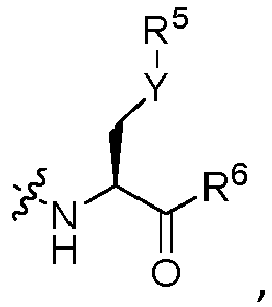
- The compound according to claim 5, wherein Y is

- The compound according to claim 5, wherein Y is -(CH2)m- , preferably -(CH2)2-, R5 is C(O)OH, C(O)OEt or C(O)NHOH, R6 is NH-CH(R7)-(CH2)n-R8, R7 is H, C1-C6 alkyl, C1-C6 alkyl-aryl, such as benzyl or C1-C6 alkyl-heteroaryl, such as CH2-indole group, R8 is C(O)NH2, aryl, such as phenyl, heteroaryl, such as indole, SH, or S-C1-C6alkyl, such as S-C(CH3)3 and n is 0, 1, 2 or 3.
- The compound according to any one of claims 1 to 7, wherein X is


- The compound according to any one of claims 1 to 8, responding to the following formula (I-A') :

- The compound according to claim 1, being selected from the following compounds :


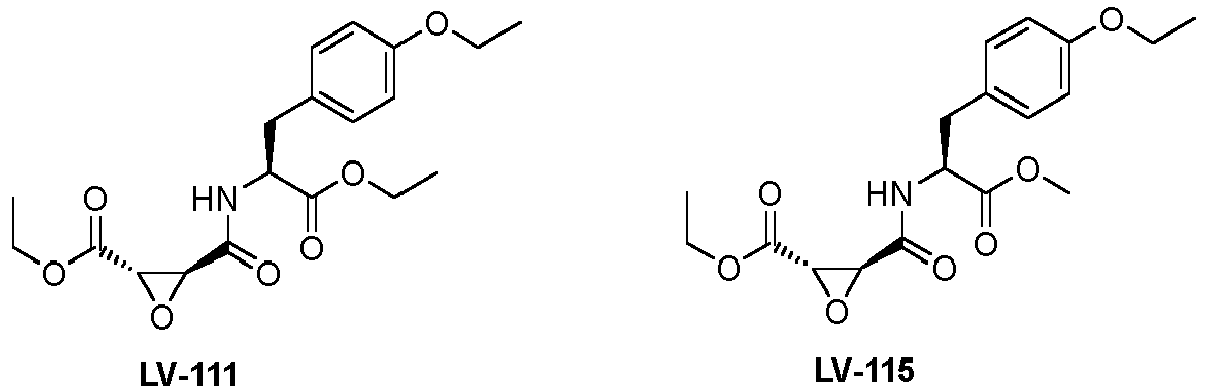


- A pharmaceutical composition comprising at least one compound of formula (I) as defined in any one of claims 1 to 10 and at least one pharmaceutically acceptable excipient.
- A compound according to any one of claims 1 to 10 or a pharmaceutical composition according to claim 11 for use as a drug.
- A compound according to any one of claims 1 to 10 or a pharmaceutical composition according to claim 11 for use in the treatment of a VASH peptidase activity associated disorder.
- A compound or a composition for use according to claim 13, wherein the VASH peptidase activity associated disorder is a disorder involving altered microtubule detyrosination and/or polyglutamylation, notably selected from neurodegenerative diseases, such as Alzheimer disease or Parkinson disease, glaucoma, psychiatric disorders, neuronal disorders, cancers, such as colon cancer and neuroblastoma, muscular dystrophies, infertility, retinal degeneration, Purkinje cell sicknesses, infantile onset degeneration, male infertilities and ciliopathies, in particular neurodegenerative diseases, cancers and muscular dystrophies.
- A conjugate comprising a fragment of a compound of formula (I) as defined in any one of claims 1 to 10 linked to a biomolecule such as a peptide, a protein, a biomarker, as for example a photolabelling agent, such as Rhodamine, Coumarin Derivatives, cyanines derivatives or fluoresceine, an affinity probe such as biotin, or a E3 ubiquitin ligase recruiter such as Thalidomide, VH032, VH101, dBET1, dFKBP12, QCA570, PROTAC6, ZNL-02-096 or d9A-2.
- A conjugate according to claim 15 for use as a drug.
- A compound according to anyone of claims 1 to 10 or a conjugate according to claim 15 for use as research tool for research and development activities, in particular selected in the group consisting of:- in vitro and/or in cellulo screening assays for identifying new VASH inhibitors and/or quantifying their inhibitor efficiency,- in vitro method for studying the role of tubulin detyrosination, in particular in VASH peptidase activity associated disorder, such as its occurrence, aggressiveness and progression,- in vitro diagnostic methods for identifying or monitoring a VASH peptidase activity associated disorder involving altered microtubule detyrosination and/or polyglutamylation,- and related kits for performing said screening assays and methods.
Priority Applications (8)
| Application Number | Priority Date | Filing Date | Title |
|---|---|---|---|
| EP21306141.9A EP4140542A1 (en) | 2021-08-24 | 2021-08-24 | New vashs inhibitors, conjugates thereof and their uses as drugs or as research tools |
| KR1020247009939A KR20240111739A (en) | 2021-08-24 | 2022-08-24 | New VASH inhibitors, conjugates thereof and their use as drugs or research tools |
| PCT/EP2022/073625 WO2023025861A1 (en) | 2021-08-24 | 2022-08-24 | New vashs inhibitors, conjugates thereof and their uses as drugs or as research tools |
| EP22769900.6A EP4392139A1 (en) | 2021-08-24 | 2022-08-24 | New vashs inhibitors, conjugates thereof and their uses as drugs or as research tools |
| US18/686,411 US20240391887A1 (en) | 2021-08-24 | 2022-08-24 | New VASHs inhibitors, conjugates thereof and their uses as drugs or as research tools |
| JP2024536353A JP2024532604A (en) | 2021-08-24 | 2022-08-24 | Novel VASH inhibitors, complexes thereof, and their use as drugs or research tools |
| CA3230297A CA3230297A1 (en) | 2021-08-24 | 2022-08-24 | New vashs inhibitors, conjugates thereof and their uses as drugs or as research tools |
| CN202280071213.6A CN118556046A (en) | 2021-08-24 | 2022-08-24 | Novel VASH inhibitors, conjugates thereof and their use as drugs or research tools |
Applications Claiming Priority (1)
| Application Number | Priority Date | Filing Date | Title |
|---|---|---|---|
| EP21306141.9A EP4140542A1 (en) | 2021-08-24 | 2021-08-24 | New vashs inhibitors, conjugates thereof and their uses as drugs or as research tools |
Publications (1)
| Publication Number | Publication Date |
|---|---|
| EP4140542A1 true EP4140542A1 (en) | 2023-03-01 |
Family
ID=77666449
Family Applications (2)
| Application Number | Title | Priority Date | Filing Date |
|---|---|---|---|
| EP21306141.9A Pending EP4140542A1 (en) | 2021-08-24 | 2021-08-24 | New vashs inhibitors, conjugates thereof and their uses as drugs or as research tools |
| EP22769900.6A Pending EP4392139A1 (en) | 2021-08-24 | 2022-08-24 | New vashs inhibitors, conjugates thereof and their uses as drugs or as research tools |
Family Applications After (1)
| Application Number | Title | Priority Date | Filing Date |
|---|---|---|---|
| EP22769900.6A Pending EP4392139A1 (en) | 2021-08-24 | 2022-08-24 | New vashs inhibitors, conjugates thereof and their uses as drugs or as research tools |
Country Status (7)
| Country | Link |
|---|---|
| US (1) | US20240391887A1 (en) |
| EP (2) | EP4140542A1 (en) |
| JP (1) | JP2024532604A (en) |
| KR (1) | KR20240111739A (en) |
| CN (1) | CN118556046A (en) |
| CA (1) | CA3230297A1 (en) |
| WO (1) | WO2023025861A1 (en) |
Families Citing this family (2)
| Publication number | Priority date | Publication date | Assignee | Title |
|---|---|---|---|---|
| EP4420659A1 (en) * | 2023-02-23 | 2024-08-28 | Mt Act | Specific vash compounds (svc) inhibitors for heart diseases |
| EP4669313A1 (en) * | 2023-02-23 | 2025-12-31 | Mt Act | Specific CSH Compounds (SVC) Inhibitors for Heart Disease |
Citations (3)
| Publication number | Priority date | Publication date | Assignee | Title |
|---|---|---|---|---|
| DE2809036A1 (en) * | 1977-03-03 | 1978-09-07 | Taisho Pharma Co Ltd | EPOXY AMBER ACID DERIVATIVES |
| WO2019016259A1 (en) | 2017-07-18 | 2019-01-24 | Centre National De La Recherche Scientifique | Methods for purifying proteins having a tubulin carboxypeptidase activity and peptidic based inhibitors thereof |
| WO2020012002A1 (en) | 2018-07-13 | 2020-01-16 | Centre National De La Recherche Scientifique (Cnrs) | In vitro screening assay of tcpase modulators |
Family Cites Families (3)
| Publication number | Priority date | Publication date | Assignee | Title |
|---|---|---|---|---|
| US3330857A (en) * | 1963-07-01 | 1967-07-11 | Pfizer & Co C | N-carbazoylamino acid intermediates for polypeptides |
| US5668128A (en) * | 1994-04-13 | 1997-09-16 | Takeda Chemical Industries, Ltd. | Aziridine derivatives, their production and use |
| US11613753B2 (en) * | 2017-10-26 | 2023-03-28 | Les Laboratoires Servier | Methods and pharmaceutical compositions for treating tubulin carboxypeptidases associated diseases |
-
2021
- 2021-08-24 EP EP21306141.9A patent/EP4140542A1/en active Pending
-
2022
- 2022-08-24 JP JP2024536353A patent/JP2024532604A/en active Pending
- 2022-08-24 CN CN202280071213.6A patent/CN118556046A/en active Pending
- 2022-08-24 KR KR1020247009939A patent/KR20240111739A/en active Pending
- 2022-08-24 CA CA3230297A patent/CA3230297A1/en active Pending
- 2022-08-24 WO PCT/EP2022/073625 patent/WO2023025861A1/en not_active Ceased
- 2022-08-24 EP EP22769900.6A patent/EP4392139A1/en active Pending
- 2022-08-24 US US18/686,411 patent/US20240391887A1/en active Pending
Patent Citations (3)
| Publication number | Priority date | Publication date | Assignee | Title |
|---|---|---|---|---|
| DE2809036A1 (en) * | 1977-03-03 | 1978-09-07 | Taisho Pharma Co Ltd | EPOXY AMBER ACID DERIVATIVES |
| WO2019016259A1 (en) | 2017-07-18 | 2019-01-24 | Centre National De La Recherche Scientifique | Methods for purifying proteins having a tubulin carboxypeptidase activity and peptidic based inhibitors thereof |
| WO2020012002A1 (en) | 2018-07-13 | 2020-01-16 | Centre National De La Recherche Scientifique (Cnrs) | In vitro screening assay of tcpase modulators |
Non-Patent Citations (8)
| Title |
|---|
| AILLAUD C ET AL: "Vasohibin/SVBP are tubulin carboxypeptidases (TCPs) that regulate neuron differentiation", SCIENCE, AMERICAN ASSOCIATION FOR THE ADVANCEMENT OF SCIENCE, US, vol. 358, 15 December 2017 (2017-12-15), pages 1448 - 1453, XP002777259, ISSN: 0036-8075 * |
| AILLAUD CHRYSTELLE ET AL: "Vasohibins/SVBP are tubulin carboxypeptidases (TCPs) that regulate neuron differentiation", SCIENCE, vol. 358, no. 6369, 15 December 2017 (2017-12-15), US, pages 1448 - 1453, XP055880464, ISSN: 0036-8075, DOI: 10.1126/science.aao4165 * |
| FONROSE ET AL., CANCER RES, vol. 67, no. 7, 2007, pages 3371 - 8 |
| HOTTA ET AL., CURR BIOL, vol. 31, 2021, pages 900 - 907 |
| HOTTA T ET AL., CURR. BIOL., vol. 31, no. 4, 2021, pages 900 - 907 |
| NIEUWENHUIS J ET AL., SCIENCE, vol. 6369, no. 6369, 2017, pages 1448 - 1453 |
| WANG NA ET AL: "Structural basis of tubulin detyrosination by the vasohibin-SVBP enzyme complex", NATURE STRUCTURAL & MOLECULAR BIOLOGY, NATURE PUBLISHING GROUP US, NEW YORK, vol. 26, no. 7, 24 June 2019 (2019-06-24), pages 571 - 582, XP036826060, ISSN: 1545-9993, [retrieved on 20190624], DOI: 10.1038/S41594-019-0241-Y * |
| WILLIAM R. ROUSH: "A New Synthesis of Peptidyl Epoxysuccinates for Probing Cysteine Protease-Inhibitor P3/S3 Binding Interactions", SYNTHESIS, vol. 1999, no. S1, 1 August 1999 (1999-08-01), pages 1500 - 1504, XP055043865, ISSN: 0039-7881, DOI: 10.1055/s-1999-3648 * |
Also Published As
| Publication number | Publication date |
|---|---|
| KR20240111739A (en) | 2024-07-17 |
| WO2023025861A1 (en) | 2023-03-02 |
| JP2024532604A (en) | 2024-09-05 |
| EP4392139A1 (en) | 2024-07-03 |
| CN118556046A (en) | 2024-08-27 |
| CA3230297A1 (en) | 2023-03-02 |
| US20240391887A1 (en) | 2024-11-28 |
Similar Documents
| Publication | Publication Date | Title |
|---|---|---|
| EP3573983B1 (en) | N-[4-fluoro-5-[[(2s,4s)-2-methyl-4-[(5-methyl-1,2,4-oxadiazol-3-yl)methoxy]-1-piperidyl]methyl]thiazol-2-yl]acetamide as oga inhibitor | |
| JP6887996B2 (en) | TEAD transcription factor autopalmitoylation inhibitor | |
| EP3256470A1 (en) | Methods to induce targeted protein degradation through bifunctional molecules | |
| KR102506149B1 (en) | Chemical compounds and use thereof for improving muscular quality | |
| US9572789B2 (en) | Methods of treatment using modulators of SIRT2 | |
| US20240391887A1 (en) | New VASHs inhibitors, conjugates thereof and their uses as drugs or as research tools | |
| EP2857392A1 (en) | Small compound targeting at tacc3 | |
| HK40089286A (en) | New vashs inhibitors, conjugates thereof and their uses as drugs or as research tools | |
| KR20150079616A (en) | Inhibitors of beta-hydrolase for treatment of cancer | |
| JP2018145126A (en) | Fluorescent probe for detecting carboxypeptidase activity | |
| TW202241517A (en) | Usp5 binding survival-targeting chimeric (surtac) molecules & uses thereof | |
| EP1140980B1 (en) | Pseudopeptide compounds having an inhibiting activity with respect to paths activated by proteins with active tyrosine kinase activity and pharmaceutical compositions containing same | |
| US12415832B2 (en) | B-catenin/B-cell Lymphoma 9 protein-protein interaction inhibiting peptidomimetics | |
| JP7201181B2 (en) | Creation of peptide-based antitumor drugs | |
| TW202235077A (en) | Usp7 binding survival-targeting chimeric (surtac) molecules & uses thereof | |
| IT202300026622A1 (en) | ANTI-TUMOR COMPOUNDS TARGETING THE HIPPO PATHWAY | |
| HK40009770B (en) | N-[4-fluoro-5-[[(2s,4s)-2-methyl-4-[(5-methyl-1,2,4-oxadiazol-3-yl)methoxy]-1-piperidyl]methyl]thiazol-2-yl]acetamide as oga inhibitor | |
| HK40009770A (en) | N-[4-fluoro-5-[[(2s,4s)-2-methyl-4-[(5-methyl-1,2,4-oxadiazol-3-yl)methoxy]-1-piperidyl]methyl]thiazol-2-yl]acetamide as oga inhibitor | |
| NZ754849B2 (en) | N-[4-fluoro-5-[[(2s,4s)-2-methyl-4-[(5-methyl-1,2,4-oxadiazol-3-yl)methoxy]-1-piperidyl]methyl]thiazol-2-yl]acetamide as oga inhibitor |
Legal Events
| Date | Code | Title | Description |
|---|---|---|---|
| PUAI | Public reference made under article 153(3) epc to a published international application that has entered the european phase |
Free format text: ORIGINAL CODE: 0009012 |
|
| STAA | Information on the status of an ep patent application or granted ep patent |
Free format text: STATUS: THE APPLICATION HAS BEEN PUBLISHED |
|
| AK | Designated contracting states |
Kind code of ref document: A1 Designated state(s): AL AT BE BG CH CY CZ DE DK EE ES FI FR GB GR HR HU IE IS IT LI LT LU LV MC MK MT NL NO PL PT RO RS SE SI SK SM TR |
|
| STAA | Information on the status of an ep patent application or granted ep patent |
Free format text: STATUS: REQUEST FOR EXAMINATION WAS MADE |
|
| 17P | Request for examination filed |
Effective date: 20230822 |
|
| RBV | Designated contracting states (corrected) |
Designated state(s): AL AT BE BG CH CY CZ DE DK EE ES FI FR GB GR HR HU IE IS IT LI LT LU LV MC MK MT NL NO PL PT RO RS SE SI SK SM TR |
|
| REG | Reference to a national code |
Ref country code: HK Ref legal event code: DE Ref document number: 40089286 Country of ref document: HK |
|
| 111L | Licence recorded |
Designated state(s): AL AT BE BG CH CY CZ DE DK EE ES FI FR GB GR HR HU IE IS IT LT LU LV MC MK MT NL NO PL PT RO RS SE SI SK SM TR Free format text: EXCLUSIVE LICENSE Name of requester: AXLR, SATT OCCITANIE MEDITERRANEE, FR Effective date: 20230215 |
|
| STAA | Information on the status of an ep patent application or granted ep patent |
Free format text: STATUS: EXAMINATION IS IN PROGRESS |
|
| 17Q | First examination report despatched |
Effective date: 20240227 |