EP4139763B1 - Method and system to ascertain location of drone box for stabilized landing and charging of drone - Google Patents
Method and system to ascertain location of drone box for stabilized landing and charging of drone Download PDFInfo
- Publication number
- EP4139763B1 EP4139763B1 EP21922735.2A EP21922735A EP4139763B1 EP 4139763 B1 EP4139763 B1 EP 4139763B1 EP 21922735 A EP21922735 A EP 21922735A EP 4139763 B1 EP4139763 B1 EP 4139763B1
- Authority
- EP
- European Patent Office
- Prior art keywords
- drone
- charging
- landing
- platform
- sensing circuit
- Prior art date
- Legal status (The legal status is an assumption and is not a legal conclusion. Google has not performed a legal analysis and makes no representation as to the accuracy of the status listed.)
- Active
Links
Images



Classifications
-
- B—PERFORMING OPERATIONS; TRANSPORTING
- B64—AIRCRAFT; AVIATION; COSMONAUTICS
- B64U—UNMANNED AERIAL VEHICLES [UAV]; EQUIPMENT THEREFOR
- B64U70/00—Launching, take-off or landing arrangements
- B64U70/80—Vertical take-off or landing, e.g. using rockets
-
- B—PERFORMING OPERATIONS; TRANSPORTING
- B60—VEHICLES IN GENERAL
- B60L—PROPULSION OF ELECTRICALLY-PROPELLED VEHICLES; SUPPLYING ELECTRIC POWER FOR AUXILIARY EQUIPMENT OF ELECTRICALLY-PROPELLED VEHICLES; ELECTRODYNAMIC BRAKE SYSTEMS FOR VEHICLES IN GENERAL; MAGNETIC SUSPENSION OR LEVITATION FOR VEHICLES; MONITORING OPERATING VARIABLES OF ELECTRICALLY-PROPELLED VEHICLES; ELECTRIC SAFETY DEVICES FOR ELECTRICALLY-PROPELLED VEHICLES
- B60L53/00—Methods of charging batteries, specially adapted for electric vehicles; Charging stations or on-board charging equipment therefor; Exchange of energy storage elements in electric vehicles
- B60L53/10—Methods of charging batteries, specially adapted for electric vehicles; Charging stations or on-board charging equipment therefor; Exchange of energy storage elements in electric vehicles characterised by the energy transfer between the charging station and the vehicle
- B60L53/14—Conductive energy transfer
-
- B—PERFORMING OPERATIONS; TRANSPORTING
- B64—AIRCRAFT; AVIATION; COSMONAUTICS
- B64U—UNMANNED AERIAL VEHICLES [UAV]; EQUIPMENT THEREFOR
- B64U70/00—Launching, take-off or landing arrangements
- B64U70/90—Launching from or landing on platforms
-
- B—PERFORMING OPERATIONS; TRANSPORTING
- B64—AIRCRAFT; AVIATION; COSMONAUTICS
- B64U—UNMANNED AERIAL VEHICLES [UAV]; EQUIPMENT THEREFOR
- B64U80/00—Transport or storage specially adapted for UAVs
- B64U80/20—Transport or storage specially adapted for UAVs with arrangements for servicing the UAV
- B64U80/25—Transport or storage specially adapted for UAVs with arrangements for servicing the UAV for recharging batteries; for refuelling
-
- B—PERFORMING OPERATIONS; TRANSPORTING
- B64—AIRCRAFT; AVIATION; COSMONAUTICS
- B64U—UNMANNED AERIAL VEHICLES [UAV]; EQUIPMENT THEREFOR
- B64U80/00—Transport or storage specially adapted for UAVs
- B64U80/40—Transport or storage specially adapted for UAVs for two or more UAVs
-
- B—PERFORMING OPERATIONS; TRANSPORTING
- B60—VEHICLES IN GENERAL
- B60L—PROPULSION OF ELECTRICALLY-PROPELLED VEHICLES; SUPPLYING ELECTRIC POWER FOR AUXILIARY EQUIPMENT OF ELECTRICALLY-PROPELLED VEHICLES; ELECTRODYNAMIC BRAKE SYSTEMS FOR VEHICLES IN GENERAL; MAGNETIC SUSPENSION OR LEVITATION FOR VEHICLES; MONITORING OPERATING VARIABLES OF ELECTRICALLY-PROPELLED VEHICLES; ELECTRIC SAFETY DEVICES FOR ELECTRICALLY-PROPELLED VEHICLES
- B60L2200/00—Type of vehicles
- B60L2200/10—Air crafts
-
- B—PERFORMING OPERATIONS; TRANSPORTING
- B64—AIRCRAFT; AVIATION; COSMONAUTICS
- B64U—UNMANNED AERIAL VEHICLES [UAV]; EQUIPMENT THEREFOR
- B64U10/00—Type of UAV
- B64U10/10—Rotorcrafts
- B64U10/13—Flying platforms
- B64U10/14—Flying platforms with four distinct rotor axes, e.g. quadcopters
-
- B—PERFORMING OPERATIONS; TRANSPORTING
- B64—AIRCRAFT; AVIATION; COSMONAUTICS
- B64U—UNMANNED AERIAL VEHICLES [UAV]; EQUIPMENT THEREFOR
- B64U2201/00—UAVs characterised by their flight controls
- B64U2201/10—UAVs characterised by their flight controls autonomous, i.e. by navigating independently from ground or air stations, e.g. by using inertial navigation systems [INS]
-
- Y—GENERAL TAGGING OF NEW TECHNOLOGICAL DEVELOPMENTS; GENERAL TAGGING OF CROSS-SECTIONAL TECHNOLOGIES SPANNING OVER SEVERAL SECTIONS OF THE IPC; TECHNICAL SUBJECTS COVERED BY FORMER USPC CROSS-REFERENCE ART COLLECTIONS [XRACs] AND DIGESTS
- Y02—TECHNOLOGIES OR APPLICATIONS FOR MITIGATION OR ADAPTATION AGAINST CLIMATE CHANGE
- Y02T—CLIMATE CHANGE MITIGATION TECHNOLOGIES RELATED TO TRANSPORTATION
- Y02T10/00—Road transport of goods or passengers
- Y02T10/60—Other road transportation technologies with climate change mitigation effect
- Y02T10/70—Energy storage systems for electromobility, e.g. batteries
-
- Y—GENERAL TAGGING OF NEW TECHNOLOGICAL DEVELOPMENTS; GENERAL TAGGING OF CROSS-SECTIONAL TECHNOLOGIES SPANNING OVER SEVERAL SECTIONS OF THE IPC; TECHNICAL SUBJECTS COVERED BY FORMER USPC CROSS-REFERENCE ART COLLECTIONS [XRACs] AND DIGESTS
- Y02—TECHNOLOGIES OR APPLICATIONS FOR MITIGATION OR ADAPTATION AGAINST CLIMATE CHANGE
- Y02T—CLIMATE CHANGE MITIGATION TECHNOLOGIES RELATED TO TRANSPORTATION
- Y02T10/00—Road transport of goods or passengers
- Y02T10/60—Other road transportation technologies with climate change mitigation effect
- Y02T10/7072—Electromobility specific charging systems or methods for batteries, ultracapacitors, supercapacitors or double-layer capacitors
Definitions
- the present invention comprises an improvement in, and a modification of, the invention claimed in the specification of the main patent application No. 202021020842 .
- the present invention relates to unmanned aerial vehicles which are commonly known as drones, particularly to autonomous aerial vehicles, and more particularly to landing and charging of autonomous aerial vehicles or drones on charging platforms or landing platforms.
- Drones the unmanned aerial vehicles are increasingly getting involved in functions of modern life. Initial drones were assisted in take-off and landing however they are rapidly becoming technologically advanced in terms of managing newer functions of self-management. Unassisted landing of unmanned aerial vehicles now plays a vital role in autonomous as well as semi-autonomous devices. Such landing may be complex in environment with weak or no navigational signals. It is a further challenge to land on moving platforms. A precision landing paves way for further activities like charging batteries of drone, protected parking and safety of attachments from environment and attack.
- US2016/336772 A1 teaches a charging apparatus for electrically charging rechargeable battery cells of a mobile consumer including an unmanned aviation vehicle like drone.
- the charging apparatus comprises a plurality of area-wise distributed charger contacts which are insulated against each other, and are connectable with at least two consumer contacts.
- the charger contacts are connected with a control unit and electrical switches for wiring into a right polarity.
- the charger contacts are rectangle, triangle, square of hexagon shaped.
- EP3738891 A1 discloses a landing platform for unmanned aerial vehicles, UAV, having an electrical charging system that comprises a plurality of coplanar adjacent electroconductive plates, with their adjacent edges electrically insulated, the electroconductive plates being arranged on an electrically insulated support, with each electroconductive plate being connected with at least an electroconductive cable to a control unit and to a power source, configured to at least detect a change of an electric potential of an electrical circuit due to a UAV, landing on the platform and providing at least two points of contact by making electrical contact of the UAV with at least two different electroconductive plates.
- the platform is made up of a plurality of unitary modules coupled together, with each unitary module comprising an electroconductive plate, the unitary modules being adjacent and coplanar to one another.
- EP2858207 A1 discloses a method of recharging a rechargeable battery of an aircraft using a recharging station comprising a parking surface disposed for the aircraft to park thereon, the parking surface comprising conductive tiles and the rechargeable battery is connected to a positive recharging terminal and to a negative recharging terminal that are both arranged to be in contact with one or more of the conductive tiles, the method comprising determining the configuration of the aircraft on the parking surface by repeatedly connecting pairs of the tiles to an electrical power supply of the recharging station to provide a positive tile and a negative tile and testing an electrical circuit condition of the circuit connected to the power supply until the correct circuit condition is determined.
- WO2020/019109 A1 discloses a landing platform for mounting a UAV on an object, the landing platform includes a base with a landing surface; a movable cover coupled to the base to close the internal space of the landing platform; at least three visual indicators coupled to the base; a plurality of charging contacts disposed on the landing surface to make direct contact with the charging contacts of the UAV when the UAV is resting on the landing surface; and a motion compensation mechanism coupled to the landing surface to compensate for movement of the landing surface relative to the object, wherein the motion compensation mechanism provides a degree of freedom of tilting motion relative to the object along at least one axis so Keeping the level of the landing plane has nothing to do with the object.
- US2019/023133 A1 discloses a landing pad for aerial vehicles comprising a housing; a power terminal configured to draw electric power from a power source; and an electrically conductive landing terminal dorsal to the housing and configured such that, during a landing state of an aerial vehicle, the landing terminal makes contact with a plurality of electric contacts disposed ventrally to a fuselage of the aerial vehicle, and wherein the landing terminal is configured to transfer electric power drawn by the power terminal to the aerial vehicle via the electric contacts during the landing state of the aerial vehicle.
- the electrically conductive landing terminal of the landing pad comprises a plurality of nodes and a non-conductive space disposed between the plurality of nodes, wherein the plurality of nodes comprise a first set of nodes and a second set of nodes, wherein an average voltage difference between the first set of nodes and the second set of nodes is greater than zero, and wherein the first set of nodes, the second set of nodes, and the non-conductive space are disposed on a top surface of the landing terminal.
- US10479528 B1 teaches a distributed parking system for drones comprising a network of parking pads for drones distributed over a geographic area, each of which comprising a parking surface of one or more parking spots on which a drone can land and park securely, a power refill module that replenish the power source of a parked drone, a control module that controls functions of the parking pad, and a communication module through which the control module is connected to a communication network; a master controller that controls functions of the parking pads and communicates commands to and receives reports from the parking pads through the communication network; a protective box that, under the control of the control module, opens to allow a drone to land and park on the parking surface, and closes to prevent access of a drone; and an authentication module in each parking pad that authenticates an approaching drone wherein the control module opens a closed protective box to allow the approaching drone to land and park after the control module receives a message from the authentication module that the approaching drone's identity is authenticated and the drone is allowed to land and park at the parking pad.
- the distributed parking system
- CN205811623 U s a utility model which relates to a kind of contact based automatic charge device for unmanned plane, including a recharging base and a charging panel provided on a hoistable platform. It is provided with a charge controller in aid recharging base. Some pieces of charging lumps cover the charging panel, and every piece of charging lump is connected with charge controller respectively, unmanned plane's leg is provided with the first charging inlet and the second charging inlet, the first charging inlet and the second charging inlet are covered from different charging lumps with insulation in-between, thus obviate the unmanned plane from a need of artificial unloading to change battery in low-voltage state, and continue the mission and operations.
- the utility model states simple construction, with low cost.
- CN108725820 A discloses a kind of unmanned plane automatic charging platforms, related to unmanned plane charging technique field.
- the charging plane is divided into multiple " charge point " arrays by the unmanned plane automatic charging platform, each the positive-negative polarity of " charge point " can be by circuit control, the mounting anode and cathode contact below aircraft tripod.
- After aircraft is placed in charging plane detects which " charge point " is connected with the contact of aircraft tripod by certain method, then by the positive-negative polarity of these contacts of circuit control, to establish charging path.
- an unmanned aerial vehicle for transporting a payload.
- the UAV comprises a body and one or more propellers rotatably connected to the body.
- the UAV further comprises a battery mounted to the body.
- the battery is releasable from the bottom of the UAV.
- the UAV further comprises a payload container mounted to the body.
- the payload container is releasable from the bottom of the UAV to a landing platform associated with a UAV station.
- a method for transporting a payload comprising receiving a battery from an exchange station, wherein the battery is received through a landing platform associated with the exchange station; mounting the battery to the body of the UAV; upon receiving the battery, receiving a payload container from the exchange station, wherein the payload container is received through the landing platform associated with the exchange station; mounting the payload container to the body of the UAV; receiving instructions for transporting the payload container to a destination; and transporting the payload container to the destination according to the instructions.
- An objective is to invent a landing station for an unmanned aerial vehicle. Another objective is to charge batteries of landed drone(s).
- Yet another objective is to invent a method of coordination between an unmanned aerial vehicle and a corresponding landing station.
- Yet another objective is to invent a system of landing and un-assisted charging an unmanned aerial vehicle on a corresponding landing station.
- Yet another objective is to ensure minimal human and animal hazard by the landing station.
- Yet another objective is to prevent improper take-off from the landing station.
- Yet another objective is to manage contamination on landing station.
- Yet another objective is to manage inappropriate landing and unstable landing.
- the present invention is a system of unmanned aviation vehicles according to the appended claims.
- Each drone box has a drone platform.
- the drone platform has a plurality of limiting boundaries.
- the drone platform is divided into number of sensor zones.
- Each drone has a plurality of ground interfaces.
- the ground interfaces facilitate landing, parking and or charging corresponding drone.
- Each ground interface has a charging terminal at a far end.
- Each charging terminal has an interlocked switchable electricity polarity namely POSITIVE (+ve) or NEGATIVE (-ve) or NEUTRAL (N).
- the interlocked switchable polarity is switched by a Programmable Controller situated in the drone. Every landing drone has a default polarity of positive (+ve) and negative (-ve) on its two charging terminals.
- the sensor zones (111) sense the default polarity of Positive(+ve) and Negative (-ve) of the ground interfaces of the first drone and corresponding sensor zones are activated with matching polarity to commence charging of batteries of the drone. More than one sensor zone detecting identical polarity are activated as a variation.
- the identification coordinates of the activated sensor zones are communicable to a second drone so that the second drone knows where NOT to land on the drone box. Such communication enables a third and subsequent drone to ascertain whether the identified drone box is suitable and available for landing.
- the charging terminals of the plurality of ground interfaces of the drone do not generally touch down the drone platform at an identical instant. Further, ground interfaces bearing the charging terminals tend to bounce up few to several times after respective touch down. Wind and ground level may cause the ground interfaces to drag and skid on few to several sensor zones of the drone platform.
- Such a short time or transient situation is termed as the unstable situation resulting in the unstable landing.
- the sensor zones sense the default polarity of Positive (+ve) and Negative (-ve) of the corresponding ground interfaces of the first drone. Additionally, a passive sensing circuit looks for a touchdown signal of all the ground interface of the drone and prevents activation of any sensor zone to commence the charging till all the ground interfaces are detected as touched down and healthy and for a minimum prescribed time which may be several milliseconds to several seconds. Thereafter, the corresponding sensor zones are activated with matching polarity to commence charging of batteries of the drone.
- the passive sensing circuit looking for a touchdown signal of all the ground interface of the drone does not detect all touch down signals for the minimum prescribed time, then it is likely that something is present between the corresponding ground interface and the sensor zone of the drone. This is diagnosed as an inappropriate landing and the drone is prevented from taking off, thereby avoiding a potential crash.
- the sensor zones detect and differentiate between presence of the ground interface and any other presence including human touch, animal touch, foreign matter and or contamination and a combination thereof by a plurality of sensors and load cells. Any sensor zone detecting presence of nothing or anything other than a ground interface remains inactivated or potential free, thus safe.
- the passive sensing circuit alternately and periodically develops a positive cycle loop when the sensor zones in contact with the ground interface of a positive terminal or dual polarity of the drone and the passive sensing circuit then develops a negative potential cycle loop when the sensor zones are in contact with the ground interface of negative terminal or dual polarity of the drone.
- this negative and positive cycle loop is passed to a signal conditioning unit which informs the decision-making processor where the positive, negative or dual-polarity ground interfaces of the drone have landed.
- the decision-making processor selects and allocates the required sensor zones for position sensed charging.
- the passive sensing circuit periodically runs the sensing cycle to continuously sense the state of the drone platform and determine presence of drone and or any object; and in a suspicious condition the drone platform remains in an inactive state, thus safe and free from hazards.
- the charging stops immediately and restarts only when suspicious conditions disappear for the minimum prescribed time.
- the detection of contamination by the passive sensing circuit on the drone platform is a significant safety aspect.
- the contamination may happen before/after and or during the charging.
- the passive sensing circuit is calibrated for a no-charging contamination as well as a while-charging contamination situation.
- the passive sensing circuit is also calibrated for contamination detection even when the drone is not present on the drone platform.
- While charging is in process with single and/or multiple drones if water spillage or rainwater contamination is detected on one or more sensor zones then the passive sensing circuit re-runs the complete sensing positive cycle loops and the negative cycle loops, re-determines the safe landing position of the single and/or multiple drones and resumes the charging safely.
- the drone as well as the drone box are individually an autonomous system with an overlapping emergency switching back up.
- the Drone Box provides the overlapping emergency switching back up to turn on and off the drone.
- the drone box first senses that the drone has landed safely, before sending a signal to turn off the drone. If the drone box gets a command from the user to turn off the drone which hasn't yet landed safely then such a command from the user shall not be executed.
- the present invention is a system comprising one or more drone box (100) and one or more drones (10).
- the drone box (100) and the drone (10) mutually communicate through a proprietary network or through GPS, WIFI and or commercially available networks.
- Figure 1 .
- Each drone box (100) has a drone platform (110).
- the drone platform (110) has a plurality of limiting boundaries (113).
- the limiting boundaries (113) are created optically, magnetically or such non-physical means that senses if any physical object is obstructing a line-of-sight radiation (122) of a source transmitter (120) and a source receiver (121).
- the source transmitter (121) and the source receiver (121) are disposed along the limiting boundaries (113).
- the drone platform (110) is divided into number of sensor zones (111).
- the sensor zones (111) are mechanically contiguous and electrically separated by an insulated separator (114) of insulation width (115).
- Each sensor zone (111) has an identification coordinate.
- the drone box (100) has a plurality of platform covers (112).
- the platform covers (112) are auto operable after meeting prescribed safety criterion for the plurality of drones (10).
- each drone (10) has a plurality of ground interfaces (11).
- the ground interfaces (11) facilitate landing, parking and or charging corresponding drone (10).
- Each ground interface (11) of each drone (10) has a unique address code.
- Each ground interface (11) has a charging terminal (13) at a far end (12).
- Each charging terminal (13) has an interlocked switchable electricity polarity namely POSITIVE (+ve) or NEGATIVE (-ve) or NEUTRAL (N).
- the interlocked switchable polarity is switched by a Programmable Controller (15) situated in the drone (10). Every landing drone (10) has a default polarity of positive (+ve) and negative (-ve) on its two charging terminals (13).
- a minimum terminal dimension (15) of the charging terminal (13) is such that a minimum electrical contact area (14) is ensured when an axis (16) of the ground interface (11) of the drone (10) exactly coincides with a center of intersection (116) of the adjacent sensor zones (111), since an upper surface (117) of the drone platform (110) is a level surface.
- an algorithm involving the unique address code of the ground interface (11) and the identification coordinates of the sensor zones (111) ascertains whether the drone has landed safely that is clear of all limiting boundaries (113) as shown in Figure 6 or the drone (10) has landed unsafely as shown in Figure 7 .
- the drone (10) takes off and attempt another landing.
- a number of back up actions are initiated including prevention of movement of the platform covers (112), alarm/signal for manual intervention.
- the ground interface (11) facilitates charging of the batteries installed in the drone (10) via the sensor zones (111).
- FIG 8 charging of a first drone (10-1) and a second drone (10-2) having landed safely is described without limiting the invention to the description, as follows:
- the sensor zones (111) sense the default polarity of Positive(+ve) and Negative (-ve) of the ground interfaces (11) of the first drone (10-1) and corresponding sensor zones (111) are activated with matching polarity so as to commence charging of batteries of the drone (10-1).
- More than one sensor zone (111) detecting identical polarity are activated as a variation.
- the identification coordinates of the activated sensor zones (119) are communicable to a second drone (10-2) so that the second drone (10-2) knows where NOT to land on the drone box. Such communication enables a third and subsequent drone (10-3, 10-4, ...10-n) to ascertain whether the identified drone box (100) is suitable and available for landing.
- the drone (10) switches the electrical polarity to another charging terminal (13).
- the charging terminals (13) of the plurality of ground interfaces (11) of the drone (10) do not generally touch down the drone platform (110) at an identical instant. Further, ground interfaces (11) bearing the charging terminals (13) have a tendency to bounce up few to several times after respective touch down. Wind and ground level may cause the ground interfaces (11) to drag and skid on few to several sensor zones (111) of the drone platform (110). Such a short time or transient situation is termed as the unstable situation resulting in the unstable landing.
- the sensor zones (111) sense the default polarity of Positive(+ve) and Negative (-ve) of the corresponding ground interfaces (11) of the first drone (10-1). Additionally, a passive sensing circuit (149) looks for a touchdown signal of all the ground interface of the drone (10-1) and prevents activation of any sensor zone (111) to commence the charging till all the ground interfaces (11) are detected as touched down and healthy and for a minimum prescribed time which may be several milliseconds to several seconds. Thereafter, the corresponding sensor zones (111) are activated with matching polarity so as to commence charging of batteries of the drone (10-1). More than one sensor zone (111) detecting identical polarity, as can be understood from Figure 5A , are activated as a variation.
- the sensor zones (111) detect and differentiate between presence of the ground interface (11) and any other presence including human touch, animal touch, foreign matter and or contamination and a combination thereof by a plurality of sensors (141) and load cells (142). Any sensor zone (111) detecting presence of nothing or anything other than a ground interface (11) remains inactivated or potential free, thus safe.
- the passive sensing circuit (149) alternately and periodically develops a positive cycle loop when the sensor zones (111) in contact with the ground interface (11) of a positive terminal or dual polarity of the drone (10) and the passive sensing circuit (149) then develops a negative potential cycle loop when the sensor zones (111) are in contact with the ground interface (11) of negative terminal or dual polarity of the drone (10).
- this negative and positive cycle loop is passed to a signal conditioning unit (147) which informs the decision-making processor (148) where the positive, negative or dual-polarity ground interfaces (11) of the drone (10) have landed.
- the decision-making processor (148) selects and allocates the required sensor zones (111) for position sensed charging.
- a decision-making processor (148) selects and allocates only the required sensor zones (111) for position sensed charging.
- the other sensor zones (111) remain completely isolated and inactive and hence ready to detect detects where any positive, negative or dual-polarity ground interfaces (11) of the drone (10-2, 10-3, .7) are located.
- the decision-making processor (148) accordingly allocates the required sensor zones (111) for charging.
- the passive sensing circuit (149) periodically runs the sensing cycle to continuously sense the state of the drone platform (110) and determine presence of drone (10) and or any object; and in such a suspicious condition the drone platform (110) remains in inactive state, thus safe and free from hazards.
- the charging stops immediately and restarts only when suspicious conditions disappear for the minimum prescribed time.
- the detection of contamination by the passive sensing circuit (149) on the drone platform (110) is a significant safety aspect.
- the contamination may happen before/after and or during the charging.
- the passive sensing circuit (149) is calibrated for no-charging contamination as well as while-charging contamination.
- the passive sensing circuit is also calibrated for contamination detection even when the drone is not present on the drone platform.
- the sensor zones (111) sense the level of dust contamination on the drone platform (110) by sensing a prescribed parameter between the sensor zones (111) and the corresponding ground interface (11) of the drone (10). The prescribed parameter is monitored during charging. The prescribed parameter is also monitored when the drone has landed but is not charging.
- the passive sensing circuit (149) detects a variation in the prescribed parameter between the sensor zones (111).
- the passive sensing circuit detects faults by sensing the variation in the prescribed parameter between the sensor zones in all condition if drone is present or not on sensor zone and if the drone is charging or not.
- the passive sensing circuit (149) detects the variation in prescribed parameter between the sensor zones (111) and the ground interface (11), due to ingress of contamination there between.
- the passive sensing circuit (149) stops the charging and resumes after re-running the complete sensing positive cycle loops and the negative cycle loops and re-determining the safe landing position of the single and/or multiple drones.
- the drone (10) as well as the drone box (100) are individually an autonomous system with an overlapping emergency switching back up.
- the Drone Box (100) provides the overlapping emergency switching back up to turn on and off the drone (10).
- the drone box (100) first senses that the drone (10) has landed safely, before sending a signal to turn off the drone (10). If the drone box (100) gets a command from the user to turn off the drone (10) which hasn't yet landed safely then such a command from the user shall not be executed.
- the prescribed parameter is an electrical including a resistive, a capacitive and or an inductive parameter, an optical, a sonic, a chemical including a pH parameter and or a combination thereof.
- the prescribed parameter is selectable.
- the variation in the prescribed selected parameter is calibrated for detection..
- the prescribed parameter may reduce or increase.
- an electrical parameter may reduce while opacity may increase for an identical level of contamination.
Landscapes
- Engineering & Computer Science (AREA)
- Aviation & Aerospace Engineering (AREA)
- Remote Sensing (AREA)
- Transportation (AREA)
- Power Engineering (AREA)
- Mechanical Engineering (AREA)
- Control Of Position, Course, Altitude, Or Attitude Of Moving Bodies (AREA)
- Charge And Discharge Circuits For Batteries Or The Like (AREA)
- Ship Loading And Unloading (AREA)
Description
- The present invention comprises an improvement in, and a modification of, the invention claimed in the specification of the main patent application No.
202021020842 - The present invention relates to unmanned aerial vehicles which are commonly known as drones, particularly to autonomous aerial vehicles, and more particularly to landing and charging of autonomous aerial vehicles or drones on charging platforms or landing platforms.
- Drones, the unmanned aerial vehicles are increasingly getting involved in functions of modern life. Initial drones were assisted in take-off and landing however they are rapidly becoming technologically advanced in terms of managing newer functions of self-management. Unassisted landing of unmanned aerial vehicles now plays a vital role in autonomous as well as semi-autonomous devices. Such landing may be complex in environment with weak or no navigational signals. It is a further challenge to land on moving platforms. A precision landing paves way for further activities like charging batteries of drone, protected parking and safety of attachments from environment and attack.
-
US2016/336772 A1 teaches a charging apparatus for electrically charging rechargeable battery cells of a mobile consumer including an unmanned aviation vehicle like drone. The charging apparatus comprises a plurality of area-wise distributed charger contacts which are insulated against each other, and are connectable with at least two consumer contacts. The charger contacts are connected with a control unit and electrical switches for wiring into a right polarity. The charger contacts are rectangle, triangle, square of hexagon shaped. -
EP3738891 A1 discloses a landing platform for unmanned aerial vehicles, UAV, having an electrical charging system that comprises a plurality of coplanar adjacent electroconductive plates, with their adjacent edges electrically insulated, the electroconductive plates being arranged on an electrically insulated support, with each electroconductive plate being connected with at least an electroconductive cable to a control unit and to a power source, configured to at least detect a change of an electric potential of an electrical circuit due to a UAV, landing on the platform and providing at least two points of contact by making electrical contact of the UAV with at least two different electroconductive plates. The platform is made up of a plurality of unitary modules coupled together, with each unitary module comprising an electroconductive plate, the unitary modules being adjacent and coplanar to one another. -
EP2858207 A1 discloses a method of recharging a rechargeable battery of an aircraft using a recharging station comprising a parking surface disposed for the aircraft to park thereon, the parking surface comprising conductive tiles and the rechargeable battery is connected to a positive recharging terminal and to a negative recharging terminal that are both arranged to be in contact with one or more of the conductive tiles, the method comprising determining the configuration of the aircraft on the parking surface by repeatedly connecting pairs of the tiles to an electrical power supply of the recharging station to provide a positive tile and a negative tile and testing an electrical circuit condition of the circuit connected to the power supply until the correct circuit condition is determined. -
WO2020/019109 A1 discloses a landing platform for mounting a UAV on an object, the landing platform includes a base with a landing surface; a movable cover coupled to the base to close the internal space of the landing platform; at least three visual indicators coupled to the base; a plurality of charging contacts disposed on the landing surface to make direct contact with the charging contacts of the UAV when the UAV is resting on the landing surface; and a motion compensation mechanism coupled to the landing surface to compensate for movement of the landing surface relative to the object, wherein the motion compensation mechanism provides a degree of freedom of tilting motion relative to the object along at least one axis so Keeping the level of the landing plane has nothing to do with the object. -
US2019/023133 A1 discloses a landing pad for aerial vehicles comprising a housing; a power terminal configured to draw electric power from a power source; and an electrically conductive landing terminal dorsal to the housing and configured such that, during a landing state of an aerial vehicle, the landing terminal makes contact with a plurality of electric contacts disposed ventrally to a fuselage of the aerial vehicle, and wherein the landing terminal is configured to transfer electric power drawn by the power terminal to the aerial vehicle via the electric contacts during the landing state of the aerial vehicle. The electrically conductive landing terminal of the landing pad comprises a plurality of nodes and a non-conductive space disposed between the plurality of nodes, wherein the plurality of nodes comprise a first set of nodes and a second set of nodes, wherein an average voltage difference between the first set of nodes and the second set of nodes is greater than zero, and wherein the first set of nodes, the second set of nodes, and the non-conductive space are disposed on a top surface of the landing terminal. -
US10479528 B1 -
CN205811623 U s a utility model which relates to a kind of contact based automatic charge device for unmanned plane, including a recharging base and a charging panel provided on a hoistable platform. It is provided with a charge controller in aid recharging base. Some pieces of charging lumps cover the charging panel, and every piece of charging lump is connected with charge controller respectively, unmanned plane's leg is provided with the first charging inlet and the second charging inlet, the first charging inlet and the second charging inlet are covered from different charging lumps with insulation in-between, thus obviate the unmanned plane from a need of artificial unloading to change battery in low-voltage state, and continue the mission and operations. The utility model states simple construction, with low cost. -
CN108725820 A discloses a kind of unmanned plane automatic charging platforms, related to unmanned plane charging technique field. The charging plane is divided into multiple " charge point " arrays by the unmanned plane automatic charging platform, each the positive-negative polarity of " charge point " can be by circuit control, the mounting anode and cathode contact below aircraft tripod. After aircraft is placed in charging plane, detects which " charge point " is connected with the contact of aircraft tripod by certain method, then by the positive-negative polarity of these contacts of circuit control, to establish charging path. - In
US2017/129603 A1 an unmanned aerial vehicle (UAV) for transporting a payload is provided. The UAV comprises a body and one or more propellers rotatably connected to the body. The UAV further comprises a battery mounted to the body. The battery is releasable from the bottom of the UAV. The UAV further comprises a payload container mounted to the body. The payload container is releasable from the bottom of the UAV to a landing platform associated with a UAV station. A method for transporting a payload, comprising receiving a battery from an exchange station, wherein the battery is received through a landing platform associated with the exchange station; mounting the battery to the body of the UAV; upon receiving the battery, receiving a payload container from the exchange station, wherein the payload container is received through the landing platform associated with the exchange station; mounting the payload container to the body of the UAV; receiving instructions for transporting the payload container to a destination; and transporting the payload container to the destination according to the instructions. - There are numerous instances of drone landing or take-off operations leading to accidents and damage due to unstable operation. The landing and take-off processes are one of the most critical for the drone operations as it has to reduce or increase its thrust drastically and disarm or arm itself to detect landing or take-off. An inappropriate landing results into improper take-off.
- Prior art discussed in the main application is not repeated here, and there are no significant further disclosures.
- An objective is to invent a landing station for an unmanned aerial vehicle. Another objective is to charge batteries of landed drone(s).
- Yet another objective is to invent a method of coordination between an unmanned aerial vehicle and a corresponding landing station.
- Yet another objective is to invent a system of landing and un-assisted charging an unmanned aerial vehicle on a corresponding landing station.
- Yet another objective is to ensure minimal human and animal hazard by the landing station.
- Yet another objective is to prevent improper take-off from the landing station.
- Yet another objective is to manage contamination on landing station.
- Yet another objective is to manage inappropriate landing and unstable landing.
- The present invention is a system of unmanned aviation vehicles according to the appended claims.
- Each drone box has a drone platform. The drone platform has a plurality of limiting boundaries. The drone platform is divided into number of sensor zones. Each drone has a plurality of ground interfaces. The ground interfaces facilitate landing, parking and or charging corresponding drone. Each ground interface has a charging terminal at a far end. Each charging terminal has an interlocked switchable electricity polarity namely POSITIVE (+ve) or NEGATIVE (-ve) or NEUTRAL (N). The interlocked switchable polarity is switched by a Programmable Controller situated in the drone. Every landing drone has a default polarity of positive (+ve) and negative (-ve) on its two charging terminals.
- As the drone (10-1) lands safely, the sensor zones (111) sense the default polarity of Positive(+ve) and Negative (-ve) of the ground interfaces of the first drone and corresponding sensor zones are activated with matching polarity to commence charging of batteries of the drone. More than one sensor zone detecting identical polarity are activated as a variation.
- The identification coordinates of the activated sensor zones are communicable to a second drone so that the second drone knows where NOT to land on the drone box. Such communication enables a third and subsequent drone to ascertain whether the identified drone box is suitable and available for landing.
- Only sensor zones occupied by a plurality of drones are activated so as to have highest safety and avoid loss of charge. In the event that may arise due to a defect or localized obstruction, if any and all the sensor zones fail to sense the default polarity of the Positive(+ve) and or the Negative (-ve) of the ground interfaces in a prescribed time, the drone switches the electrical polarity to another charging terminal.
- As an improvement in the invention claimed in the specification of the main patent application No.
202021020842 - The charging terminals of the plurality of ground interfaces of the drone do not generally touch down the drone platform at an identical instant. Further, ground interfaces bearing the charging terminals tend to bounce up few to several times after respective touch down. Wind and ground level may cause the ground interfaces to drag and skid on few to several sensor zones of the drone platform.
- Such a short time or transient situation is termed as the unstable situation resulting in the unstable landing.
- As the first drone touches down, the sensor zones sense the default polarity of Positive (+ve) and Negative (-ve) of the corresponding ground interfaces of the first drone. Additionally, a passive sensing circuit looks for a touchdown signal of all the ground interface of the drone and prevents activation of any sensor zone to commence the charging till all the ground interfaces are detected as touched down and healthy and for a minimum prescribed time which may be several milliseconds to several seconds. Thereafter, the corresponding sensor zones are activated with matching polarity to commence charging of batteries of the drone.
- In an event that the passive sensing circuit looking for a touchdown signal of all the ground interface of the drone does not detect all touch down signals for the minimum prescribed time, then it is likely that something is present between the corresponding ground interface and the sensor zone of the drone. This is diagnosed as an inappropriate landing and the drone is prevented from taking off, thereby avoiding a potential crash.
- The sensor zones detect and differentiate between presence of the ground interface and any other presence including human touch, animal touch, foreign matter and or contamination and a combination thereof by a plurality of sensors and load cells. Any sensor zone detecting presence of nothing or anything other than a ground interface remains inactivated or potential free, thus safe.
- The passive sensing circuit alternately and periodically develops a positive cycle loop when the sensor zones in contact with the ground interface of a positive terminal or dual polarity of the drone and the passive sensing circuit then develops a negative potential cycle loop when the sensor zones are in contact with the ground interface of negative terminal or dual polarity of the drone.
- Thereafter, this negative and positive cycle loop is passed to a signal conditioning unit which informs the decision-making processor where the positive, negative or dual-polarity ground interfaces of the drone have landed. The decision-making processor selects and allocates the required sensor zones for position sensed charging.
- The passive sensing circuit periodically runs the sensing cycle to continuously sense the state of the drone platform and determine presence of drone and or any object; and in a suspicious condition the drone platform remains in an inactive state, thus safe and free from hazards. Thus, if a foreign object lands on the drone platform, or if the drone moves its position due to external factors (wind, human moving the drone etc.), the charging stops immediately and restarts only when suspicious conditions disappear for the minimum prescribed time.
- The detection of contamination by the passive sensing circuit on the drone platform is a significant safety aspect. The contamination may happen before/after and or during the charging. The passive sensing circuit is calibrated for a no-charging contamination as well as a while-charging contamination situation. The passive sensing circuit is also calibrated for contamination detection even when the drone is not present on the drone platform.
- While charging is in process with single and/or multiple drones if water spillage or rainwater contamination is detected on one or more sensor zones then the passive sensing circuit re-runs the complete sensing positive cycle loops and the negative cycle loops, re-determines the safe landing position of the single and/or multiple drones and resumes the charging safely.
- The drone as well as the drone box are individually an autonomous system with an overlapping emergency switching back up. The Drone Box provides the overlapping emergency switching back up to turn on and off the drone. As a variation, the drone box first senses that the drone has landed safely, before sending a signal to turn off the drone. If the drone box gets a command from the user to turn off the drone which hasn't yet landed safely then such a command from the user shall not be executed.
-
- Figure-1 is a perspective view of a drone box with a drone landed thereon.
- Figure-2 is a top view and a front view of a line-of-sight radiation along with sources.
- Figure-3 is a top view of the drone box with the drone landed thereon in an unsafe location.
- Figure-4 is a perspective view of the drone.
- Figure-5A is a partial top view of a drone platform, while
Figure 5B is a partial top view and a sectional front view of the drone platform. - Figure-6 is a top view of the drone box with the drone landed thereon on a safe location.
- Figure-7 is a top view of the drone box with the drone landed thereon on an unsafe location.
- Figure-8 is a top view of the drone platform with multiple drones landed and charging.
- Figure-9 is a perspective view of the drone about to touch down on a drone box.
- Figure-10 is a perspective view of the drone in an unstable landing situation.
- Figure-11 is a flow diagram of a passive sensing circuit.
- Figure-12 is a perspective view of an inappropriate landing.
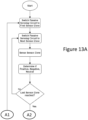
- Figure-13A and 13B is a flow diagram of execution by the passive sensing circuit.
- The present invention shall now be described with the help of accompanying drawings. It is to be expressly understood that various terms and details are to explain the inventive concept and should not be construed to limit the invention in any way whatsoever.
- The present invention is a system comprising one or more drone box (100) and one or more drones (10). The drone box (100) and the drone (10) mutually communicate through a proprietary network or through GPS, WIFI and or commercially available networks.
Figure 1 . - Each drone box (100) has a drone platform (110). The drone platform (110) has a plurality of limiting boundaries (113).
Figure 2 , the limiting boundaries (113) are created optically, magnetically or such non-physical means that senses if any physical object is obstructing a line-of-sight radiation (122) of a source transmitter (120) and a source receiver (121). The source transmitter (121) and the source receiver (121) are disposed along the limiting boundaries (113). The drone platform (110) is divided into number of sensor zones (111). The sensor zones (111) are mechanically contiguous and electrically separated by an insulated separator (114) of insulation width (115). Each sensor zone (111) has an identification coordinate. -
Figure 3 , the drone box (100) has a plurality of platform covers (112). The platform covers (112) are auto operable after meeting prescribed safety criterion for the plurality of drones (10). -
Figure 4 , each drone (10) has a plurality of ground interfaces (11). The ground interfaces (11) facilitate landing, parking and or charging corresponding drone (10). Each ground interface (11) of each drone (10) has a unique address code. Each ground interface (11) has a charging terminal (13) at a far end (12). Each charging terminal (13) has an interlocked switchable electricity polarity namely POSITIVE (+ve) or NEGATIVE (-ve) or NEUTRAL (N). The interlocked switchable polarity is switched by a Programmable Controller (15) situated in the drone (10). Every landing drone (10) has a default polarity of positive (+ve) and negative (-ve) on its two charging terminals (13).Figure 5A , a minimum terminal dimension (15) of the charging terminal (13) is such that a minimum electrical contact area (14) is ensured when an axis (16) of the ground interface (11) of the drone (10) exactly coincides with a center of intersection (116) of the adjacent sensor zones (111), since an upper surface (117) of the drone platform (110) is a level surface. - The drone (10), while air borne, ascertains and registers a precise position of the drone platform (110) of the drone box (100) in the vicinity by receiving its latitude and longitude from a global positioning system. While in a landing mode, the drone (10) auto pilots its trajectory from its own dynamic position to the latitude and longitude of the landing platform. The drone (10) vertically lands within a diameter less than twice its own envelope diameter (20).
- When any drone (10) lands on a drone box (100), an algorithm involving the unique address code of the ground interface (11) and the identification coordinates of the sensor zones (111) ascertains whether the drone has landed safely that is clear of all limiting boundaries (113) as shown in
Figure 6 or the drone (10) has landed unsafely as shown inFigure 7 . In the event the drone has landed unsafely, the drone (10) takes off and attempt another landing. In the event of a pre-decided numbers of unsuccessful attempts, a number of back up actions are initiated including prevention of movement of the platform covers (112), alarm/signal for manual intervention. - Once a drone has safely landed, the ground interface (11) facilitates charging of the batteries installed in the drone (10) via the sensor zones (111).
-
Figure 8 , charging of a first drone (10-1) and a second drone (10-2) having landed safely is described without limiting the invention to the description, as follows:
As the drone (10-1) lands safely, the sensor zones (111) sense the default polarity of Positive(+ve) and Negative (-ve) of the ground interfaces (11) of the first drone (10-1) and corresponding sensor zones (111) are activated with matching polarity so as to commence charging of batteries of the drone (10-1). More than one sensor zone (111) detecting identical polarity, as can be understood fromFigure 5A , are activated as a variation. - The identification coordinates of the activated sensor zones (119) are communicable to a second drone (10-2) so that the second drone (10-2) knows where NOT to land on the drone box. Such communication enables a third and subsequent drone (10-3, 10-4, ...10-n) to ascertain whether the identified drone box (100) is suitable and available for landing.
- Only sensor zones (111) occupied by a plurality of drones (10-1, 10-2,....10-n) are activated so as to have highest safety and avoid loss of charge.
- In the event that may arise due to a defect or localized obstruction, if any and all the sensor zones (111) fail to sense the default polarity of the Positive(+ve) and or the Negative (-ve) of the ground interfaces (11) in a prescribed time, the drone (10) switches the electrical polarity to another charging terminal (13).
- As an improvement in the invention claimed in the specification of the main patent application No.
202021020842 Figure 12 ). - Figure-9 and 10, the charging terminals (13) of the plurality of ground interfaces (11) of the drone (10) do not generally touch down the drone platform (110) at an identical instant. Further, ground interfaces (11) bearing the charging terminals (13) have a tendency to bounce up few to several times after respective touch down. Wind and ground level may cause the ground interfaces (11) to drag and skid on few to several sensor zones (111) of the drone platform (110). Such a short time or transient situation is termed as the unstable situation resulting in the unstable landing.
- As the first drone (10-1) touches down, the sensor zones (111) sense the default polarity of Positive(+ve) and Negative (-ve) of the corresponding ground interfaces (11) of the first drone (10-1). Additionally, a passive sensing circuit (149) looks for a touchdown signal of all the ground interface of the drone (10-1) and prevents activation of any sensor zone (111) to commence the charging till all the ground interfaces (11) are detected as touched down and healthy and for a minimum prescribed time which may be several milliseconds to several seconds. Thereafter, the corresponding sensor zones (111) are activated with matching polarity so as to commence charging of batteries of the drone (10-1). More than one sensor zone (111) detecting identical polarity, as can be understood from
Figure 5A , are activated as a variation. - In an event that the passive sensing circuit (149) looking for a touchdown signal of all the ground interface (11) of the drone (10-1) does not detect all touch down signals for the minimum prescribed time, then it is likely that some obstruction (151), as shown in
Figure 12 , is present between the corresponding ground interface (11) and the sensor zone (111) of the drone (10-1). This is diagnosed as an inappropriate landing and the drone (10-1) is prevented from taking off, thereby avoiding a potential crash. - The sensor zones (111) detect and differentiate between presence of the ground interface (11) and any other presence including human touch, animal touch, foreign matter and or contamination and a combination thereof by a plurality of sensors (141) and load cells (142). Any sensor zone (111) detecting presence of nothing or anything other than a ground interface (11) remains inactivated or potential free, thus safe.
-
Figure 11 ,13A ,13B , the passive sensing circuit (149) alternately and periodically develops a positive cycle loop when the sensor zones (111) in contact with the ground interface (11) of a positive terminal or dual polarity of the drone (10) and the passive sensing circuit (149) then develops a negative potential cycle loop when the sensor zones (111) are in contact with the ground interface (11) of negative terminal or dual polarity of the drone (10). - Thereafter, this negative and positive cycle loop is passed to a signal conditioning unit (147) which informs the decision-making processor (148) where the positive, negative or dual-polarity ground interfaces (11) of the drone (10) have landed. The decision-making processor (148) selects and allocates the required sensor zones (111) for position sensed charging.
- The same process is followed for the multiple drone (10-1, 10-2, ...) landing on the same drone platform (110) but at different sensor zones (111). A decision-making processor (148) selects and allocates only the required sensor zones (111) for position sensed charging. The other sensor zones (111) remain completely isolated and inactive and hence ready to detect detects where any positive, negative or dual-polarity ground interfaces (11) of the drone (10-2, 10-3, ....) are located. The decision-making processor (148) accordingly allocates the required sensor zones (111) for charging.
- The passive sensing circuit (149) periodically runs the sensing cycle to continuously sense the state of the drone platform (110) and determine presence of drone (10) and or any object; and in such a suspicious condition the drone platform (110) remains in inactive state, thus safe and free from hazards. Thus, if a foreign object lands on the drone platform (110), or if the drone (10) moves its position due to external factors (wind, human moving the drone etc.), the charging stops immediately and restarts only when suspicious conditions disappear for the minimum prescribed time.
- The detection of contamination by the passive sensing circuit (149) on the drone platform (110) is a significant safety aspect. The contamination may happen before/after and or during the charging. The passive sensing circuit (149) is calibrated for no-charging contamination as well as while-charging contamination. The passive sensing circuit is also calibrated for contamination detection even when the drone is not present on the drone platform.
- While charging is in process with single and/or multiple drones if water spillage or rainwater contamination is detected on one or more sensor zones (111) then the passive sensing circuit (149) re-runs the complete sensing positive cycle loops and the negative cycle loops, re-determines the safe landing position of the single and/or multiple drones and resumes the charging safely.
- If excessive dust and or contamination takes place, the charging may not be possible, or the time required for charging may increase. The sensor zones (111) sense the level of dust contamination on the drone platform (110) by sensing a prescribed parameter between the sensor zones (111) and the corresponding ground interface (11) of the drone (10). The prescribed parameter is monitored during charging. The prescribed parameter is also monitored when the drone has landed but is not charging.
- If water spillage or rainwater or dust or foreign object contamination takes place on the sensor zones (111), at that time the passive sensing circuit (149) detects a variation in the prescribed parameter between the sensor zones (111).
- The passive sensing circuit detects faults by sensing the variation in the prescribed parameter between the sensor zones in all condition if drone is present or not on sensor zone and if the drone is charging or not.
- If water spillage or rainwater or dust or foreign object contamination takes place on the sensor zones (111) when drone (10) is present and charging, the passive sensing circuit (149) detects the variation in prescribed parameter between the sensor zones (111) and the ground interface (11), due to ingress of contamination there between.
- The passive sensing circuit (149) stops the charging and resumes after re-running the complete sensing positive cycle loops and the negative cycle loops and re-determining the safe landing position of the single and/or multiple drones.
- The drone (10) as well as the drone box (100) are individually an autonomous system with an overlapping emergency switching back up. The Drone Box (100) provides the overlapping emergency switching back up to turn on and off the drone (10).
- As a variation, the drone box (100) first senses that the drone (10) has landed safely, before sending a signal to turn off the drone (10). If the drone box (100) gets a command from the user to turn off the drone (10) which hasn't yet landed safely then such a command from the user shall not be executed.
- The prescribed parameter is an electrical including a resistive, a capacitive and or an inductive parameter, an optical, a sonic, a chemical including a pH parameter and or a combination thereof. The prescribed parameter is selectable. The variation in the prescribed selected parameter is calibrated for detection.. The prescribed parameter may reduce or increase. Illustratively, an electrical parameter may reduce while opacity may increase for an identical level of contamination.
Claims (13)
- A system of unmanned aviation vehicles comprising at least a drone box (100) and a plurality of unmanned aviation vehicles capable of vertical landing and takeoff, the unmanned aviation vehicles communicating through a proprietary network or through GPS, WIFI and/or commercially available networks with the at least one drone box (100), each drone box (100) having a drone platform (110) with a plurality of limiting boundaries (113), made of a source transmitter (120) and a source receiver (121) with magnetic or optical line of sight radiation (122) therebetween, and disposed along the limiting boundaries (113), the drone platform (110) divided into a number of sensor zones (111) that are mechanically contiguous and electrically separated by an insulated separator (114) of an insulation width (115), each sensor zone (111) having identification coordinates, the drone platform (110) comprising a levelled upper surface (117), wherein the drone box (100) has a plurality of platform covers (112), and at least two mounting dispositions (130) provided at a lower end of the drone box (100), each mounting disposition (130) manually adjustable in a longitudinal direction (131), and comprising a flexible cushion at its free end capable of adjusting an orientation commensurate with a surface of disposition, each unmanned aerial vehicle being a drone (10, 10-1, 10-2) having a plurality of ground interfaces (11), each ground interface (11) of each drone (10) having a unique address code, whereby each ground interface (11) has a charging terminal (13) at a far end (12), each charging terminal (13) having an interlocked switchable electricity polarity namely POSITIVE (+ve) or NEGATIVE (-ve) or NEUTRAL (N), whereby a minimum terminal dimension (15) of the charging terminal (13) is such that a minimum contact area (14) is ensured when an axis (16) of the ground interface (11) of the drone (10) exactly coincides with a center of intersection (116) of adjacent sensor zones (111), whereby the ground interface (11) facilitates charging of the batteries installed in the drone (10) via the sensor zones (111) after a safe landing of the drone (10);whereby a passive sensing circuit (149) detects a touchdown signal of all the ground interfaces of the drone (10, 10-1, 10-2) at a plurality of the sensor zones (111) for a minimum prescribed time, a detection of any missing touch down signal for the minimum prescribed time due to an inappropriate landing preventing next take off of the drone (10, 10-1, 10-2); andwhereby an algorithm involving the unique address code of the ground interface (11) and the identification coordinates of the sensor zones (111) ascertains whether the drone has landed safely that is clear of all limiting boundaries (113), or the drone has landed unsafely.
- The system of unmanned aviation vehicles as claimed in claim 01, wherein the passive sensing circuit (149) prevents activation of any sensor zone (111) to commence the charging till all the ground interfaces (11) are detected as touched down.
- The system of unmanned aviation vehicles as claimed in claim 01, wherein the sensor zones (111) differentiate between presence of the ground interface (11) and any other presence including human touch, animal touch, foreign matter and or contamination and a combination thereof by a plurality of sensors (141) and load cells (142).
- The system of unmanned aviation vehicles as claimed in claim 01, wherein the passive sensing circuit (149) alternately and periodically develops a positive cycle loop when the sensor zones (111) in contact with the ground interface (11) of the positive terminal or dual polarity of the drone (10) and the passive sensing circuit (149) then develops a negative potential cycle loop when the sensor zones (111) are in contact with the ground interface (11) of the negative terminal or dual polarity of the drone (10) .
- The system of unmanned aviation vehicles as claimed in claim 01, wherein the passive sensing circuit (149) periodically runs a sensing cycle to continuously sense a state of the drone platform (110) and determine a presence of a drone (10) and/or any object corresponding to a suspicious condition, wherein in the suspicious condition the drone platform (110) remains in an inactive state.
- The system of unmanned aviation vehicles as claimed in claim 01, wherein the passive sensing circuit (149) stops the charging if the drone (10) moves its position due to an external factor or if a foreign object lands on the drone platform (110) corresponding to a suspicious condition, then the charging restarts after a minimum prescribed period of disappearance of the suspicious condition.
- The system of unmanned aviation vehicles as claimed in claim 01, wherein the passive sensing circuit (149) is calibrated for a no-charging contamination situation as well as a while-charging contamination situation, and contamination detection when the drone (10) is not present on the drone platform (110).
- The system of unmanned aviation vehicles as claimed in claim 01, wherein the passive sensing circuit (149) detects a variation in a prescribed parameter than a calibrated prescribed parameter between the sensor zones (111) in the situation of no-charging as well as the while-charging contamination.
- The system of unmanned aviation vehicles as claimed in claim 01, wherein the passive sensing circuit (149) detects a variation in a prescribed parameter with respect to a calibrated prescribed parameter between the sensor zones (111) and the corresponding ground interface (11) of the drone in a situation of while-charging contamination or in a situation of no-charging contamination, wherein in a situation of while-charging contamination, the passive sensing circuit (149) stops the charging and resumes after re-running the complete sensing positive cycle loops and the negative cycle loops and re-determining the safe landing position of the single and/or multiple drones.
- The system of unmanned aviation vehicles as claimed in claim 01, wherein the drone (10) and the drone box (100) are individually an autonomous system with an overlapping emergency switching back up wherein the drone box (100) provides the overlapping emergency switching back up to turn on and off the drone (10).
- The system of unmanned aviation vehicles as claimed in claim 01, wherein the drone box (100) first senses that the drone (10) has landed safely, before sending a signal to turn off the drone (10), and if the drone box (100) gets a command from a user to turn off the drone (10) which hasn't yet landed safely then such a command from the user is unexecuted.
- The system of unmanned aviation vehicles as claimed in claim 08 or 09, wherein the prescribed parameter is an electrical including a resistive, a capacitive and or an inductive parameter, an optical, a sonic, a chemical including a pH parameter and or a combination thereof, wherein the prescribed parameter is selectable, and wherein the variation in a prescribed selected parameter is calibrated for detection.
- The system of unmanned aviation vehicles as claimed in claim 12, wherein the prescribed parameter may reduce or increase for an identical level of contamination.
Applications Claiming Priority (2)
| Application Number | Priority Date | Filing Date | Title |
|---|---|---|---|
| IN202123004263 | 2021-02-01 | ||
| PCT/IN2021/050756 WO2022162682A1 (en) | 2021-02-01 | 2021-08-07 | Method and system to ascertain location of drone box for stabilized landing and charging of drone |
Publications (3)
| Publication Number | Publication Date |
|---|---|
| EP4139763A1 EP4139763A1 (en) | 2023-03-01 |
| EP4139763A4 EP4139763A4 (en) | 2023-10-18 |
| EP4139763B1 true EP4139763B1 (en) | 2024-09-25 |
Family
ID=82654269
Family Applications (1)
| Application Number | Title | Priority Date | Filing Date |
|---|---|---|---|
| EP21922735.2A Active EP4139763B1 (en) | 2021-02-01 | 2021-08-07 | Method and system to ascertain location of drone box for stabilized landing and charging of drone |
Country Status (8)
| Country | Link |
|---|---|
| US (1) | US12122243B2 (en) |
| EP (1) | EP4139763B1 (en) |
| JP (1) | JP7546953B2 (en) |
| AU (1) | AU2021423790B2 (en) |
| CA (1) | CA3191062A1 (en) |
| DK (1) | DK4139763T3 (en) |
| FI (1) | FI4139763T3 (en) |
| WO (1) | WO2022162682A1 (en) |
Families Citing this family (6)
| Publication number | Priority date | Publication date | Assignee | Title |
|---|---|---|---|---|
| WO2024118965A1 (en) * | 2022-12-01 | 2024-06-06 | Johnson Kara E | Aircraft takeoff and landing apparatus |
| CN116166074B (en) * | 2023-02-03 | 2025-08-08 | 深圳市道通智能航空技术股份有限公司 | Mode adjustment method and adjustment device of drone base station and drone base station |
| CN116119064A (en) * | 2023-02-03 | 2023-05-16 | 深圳市道通智能航空技术股份有限公司 | Unmanned aerial vehicle basic station and unmanned aerial vehicle system |
| US12545447B1 (en) * | 2024-06-07 | 2026-02-10 | Amazon Technologies, Inc. | Aerial vehicle landing pad with sensors |
| US20260048877A1 (en) * | 2024-08-15 | 2026-02-19 | Skydio, Inc. | Base Station For An Unmanned Aerial Vehicle Including A Rotatable Roof Assembly |
| US20260048865A1 (en) * | 2024-08-15 | 2026-02-19 | Skydio, Inc. | Method of docking an unmanned aerial vehicle with a base station |
Family Cites Families (23)
| Publication number | Priority date | Publication date | Assignee | Title |
|---|---|---|---|---|
| EP2858207B1 (en) * | 2013-10-03 | 2018-07-11 | The Boeing Company | Recharging an aircraft battery |
| DE102014100493A1 (en) | 2014-01-17 | 2015-07-23 | Michele Dallachiesa | Charging device and method for electrically charging battery cells |
| CN105308820B (en) | 2014-06-12 | 2018-06-12 | 深圳市大疆创新科技有限公司 | A charging system, power supply device and aircraft |
| WO2016078093A1 (en) * | 2014-11-21 | 2016-05-26 | SZ DJI Technology Co., Ltd. | System and method for managing unmanned aerial vehicles |
| EP4001111A3 (en) * | 2015-11-10 | 2022-08-17 | Matternet, Inc. | Methods and system for transportation using unmanned aerial vehicles |
| JP2017094881A (en) | 2015-11-23 | 2017-06-01 | 勉 横山 | Multicopter take-off and landing base |
| EP3767781A1 (en) * | 2016-02-29 | 2021-01-20 | Verity AG | Systems and methods for charging, transporting, and operating flying machines |
| US11181933B2 (en) * | 2016-06-27 | 2021-11-23 | Drone Delivery Canada Corp. | Location for unmanned aerial vehicle landing and taking off |
| CN205811623U (en) * | 2016-07-25 | 2016-12-14 | 厦门狄耐克物联智慧科技有限公司 | A kind of contact unmanned plane automatic charge device |
| US10850838B2 (en) | 2016-09-30 | 2020-12-01 | Sony Interactive Entertainment Inc. | UAV battery form factor and insertion/ejection methodologies |
| US20190061885A1 (en) * | 2017-03-15 | 2019-02-28 | Power Docks LLC | Modular Floating Microgrid Energy Platforms |
| US10882410B2 (en) * | 2017-07-19 | 2021-01-05 | Wing Aviation Llc | Systems for charging aerial vehicles |
| JP6829677B2 (en) * | 2017-11-21 | 2021-02-10 | 本田技研工業株式会社 | Charging device |
| KR101902875B1 (en) * | 2017-11-23 | 2018-10-01 | 재단법인 경북아이티융합 산업기술원 | unmanned aerial vehicle and charging station for unmanned aerial vehicle |
| WO2019125357A1 (en) * | 2017-12-18 | 2019-06-27 | Siemens Energy, Inc. | Fully automated drones with automated landing and self charging |
| CN108725820A (en) * | 2018-04-08 | 2018-11-02 | 北京领航智能科技发展有限公司 | Unmanned plane automatic charging platform |
| CN110673625B (en) * | 2018-07-02 | 2023-05-23 | 中光电智能机器人股份有限公司 | Unmanned aerial vehicle monitoring system, base station and control method |
| US11891192B2 (en) * | 2018-07-23 | 2024-02-06 | Shanghai Autoflight Co., Ltd. | Landing platform for unmanned aerial vehicle |
| US10479528B1 (en) | 2018-11-06 | 2019-11-19 | Ping Liang | Network of distributed drone system and parking pads |
| US11401033B2 (en) * | 2019-05-09 | 2022-08-02 | Noa, Inc. | Remote sensor data acquisition using autonomous drones |
| EP3738891A1 (en) * | 2019-05-17 | 2020-11-18 | Fuvex Civil, SL | Landing platform for unmanned aerial vehicles |
| CN110901426B (en) | 2019-12-09 | 2021-05-25 | 北京京东乾石科技有限公司 | Charging device, unmanned aerial vehicle, charging panel and unmanned aerial vehicle charging system |
| CA3191056A1 (en) | 2020-05-18 | 2021-11-25 | Chirag Shah | Method and system to ascertain location of drone box for landing and charging drones |
-
2021
- 2021-08-07 EP EP21922735.2A patent/EP4139763B1/en active Active
- 2021-08-07 AU AU2021423790A patent/AU2021423790B2/en active Active
- 2021-08-07 CA CA3191062A patent/CA3191062A1/en active Pending
- 2021-08-07 DK DK21922735.2T patent/DK4139763T3/en active
- 2021-08-07 FI FIEP21922735.2T patent/FI4139763T3/en active
- 2021-08-07 JP JP2022570607A patent/JP7546953B2/en active Active
- 2021-08-07 WO PCT/IN2021/050756 patent/WO2022162682A1/en not_active Ceased
- 2021-08-07 US US17/661,287 patent/US12122243B2/en active Active
Also Published As
| Publication number | Publication date |
|---|---|
| AU2021423790A1 (en) | 2023-01-19 |
| JP2024500193A (en) | 2024-01-05 |
| FI4139763T3 (en) | 2024-10-29 |
| JP7546953B2 (en) | 2024-09-09 |
| CA3191062A1 (en) | 2022-08-04 |
| AU2021423790B2 (en) | 2024-02-15 |
| EP4139763A1 (en) | 2023-03-01 |
| WO2022162682A1 (en) | 2022-08-04 |
| DK4139763T3 (en) | 2024-10-07 |
| US20240190593A1 (en) | 2024-06-13 |
| US12122243B2 (en) | 2024-10-22 |
| EP4139763A4 (en) | 2023-10-18 |
Similar Documents
| Publication | Publication Date | Title |
|---|---|---|
| EP4139763B1 (en) | Method and system to ascertain location of drone box for stabilized landing and charging of drone | |
| EP4139209B1 (en) | Method and system to ascertain location of drone box for landing and charging drones | |
| KR101564254B1 (en) | Wireless charging system for drone | |
| EP3340423B1 (en) | Onboard charging device for unmanned aerial vehicle and vehicle including the same | |
| KR101599423B1 (en) | Charging system for drone | |
| US9630517B2 (en) | Unmanned aerial vehicle, charging station, and automatic charging system for unmanned aerial vehicle including the same | |
| US10384775B2 (en) | Autonomous vehicle charging station management | |
| US10618653B2 (en) | Charging system by autonomous guide of drone | |
| US20190025830A1 (en) | Wireless charging and protection for unmanned delivery aerial vehicles | |
| US20170203663A1 (en) | Vehicle replenishment | |
| CN105243878B (en) | A kind of electron boundary device, unmanned flight's system and unmanned vehicle monitoring method | |
| CN105958578B (en) | The cradle and automatic charging system and method for a kind of robot | |
| EP3663123B1 (en) | Electric scooter piloting method, electric scooter and storage medium | |
| KR101753363B1 (en) | Flight management system with smart charge using solar power generation | |
| KR20190060418A (en) | Fuel cell powerpack for drone, and state information monitoring method thereof | |
| US20230344258A1 (en) | Charging control method, program, and charging control system | |
| CN205405271U (en) | Unmanned aerial vehicle | |
| CN115465451A (en) | Unmanned aerial vehicle surveying control method and system based on geographic environment complexity optimization mutual charging strategy | |
| JP6717554B1 (en) | Power supply system for unmanned air vehicles | |
| JP7076785B2 (en) | Drone charging system | |
| JP7495167B2 (en) | Robot cooperation system and robot cooperation method | |
| Ngo et al. | Classification of robotic battery service systems for unmanned aerial vehicles |
Legal Events
| Date | Code | Title | Description |
|---|---|---|---|
| STAA | Information on the status of an ep patent application or granted ep patent |
Free format text: STATUS: THE INTERNATIONAL PUBLICATION HAS BEEN MADE |
|
| PUAI | Public reference made under article 153(3) epc to a published international application that has entered the european phase |
Free format text: ORIGINAL CODE: 0009012 |
|
| STAA | Information on the status of an ep patent application or granted ep patent |
Free format text: STATUS: REQUEST FOR EXAMINATION WAS MADE |
|
| 17P | Request for examination filed |
Effective date: 20221124 |
|
| AK | Designated contracting states |
Kind code of ref document: A1 Designated state(s): AL AT BE BG CH CY CZ DE DK EE ES FI FR GB GR HR HU IE IS IT LI LT LU LV MC MK MT NL NO PL PT RO RS SE SI SK SM TR |
|
| A4 | Supplementary search report drawn up and despatched |
Effective date: 20230919 |
|
| RIC1 | Information provided on ipc code assigned before grant |
Ipc: B64U 80/40 20230101ALI20230913BHEP Ipc: B64U 80/25 20230101ALI20230913BHEP Ipc: B64U 70/80 20230101ALI20230913BHEP Ipc: B64F 1/00 20060101ALI20230913BHEP Ipc: B64C 39/02 20230101ALI20230913BHEP Ipc: G05D 1/00 20060101AFI20230913BHEP |
|
| REG | Reference to a national code |
Free format text: PREVIOUS MAIN CLASS: G05D0001000000 Ipc: B64U0070900000 Ref country code: DE Ref legal event code: R079 Ref document number: 602021019464 Country of ref document: DE |
|
| DAV | Request for validation of the european patent (deleted) | ||
| DAX | Request for extension of the european patent (deleted) | ||
| GRAP | Despatch of communication of intention to grant a patent |
Free format text: ORIGINAL CODE: EPIDOSNIGR1 |
|
| STAA | Information on the status of an ep patent application or granted ep patent |
Free format text: STATUS: GRANT OF PATENT IS INTENDED |
|
| RIC1 | Information provided on ipc code assigned before grant |
Ipc: B64U 70/80 20230101ALI20240502BHEP Ipc: B64U 80/40 20230101ALI20240502BHEP Ipc: B64U 80/25 20230101ALI20240502BHEP Ipc: B64U 70/90 20230101AFI20240502BHEP |
|
| INTG | Intention to grant announced |
Effective date: 20240528 |
|
| GRAS | Grant fee paid |
Free format text: ORIGINAL CODE: EPIDOSNIGR3 |
|
| GRAA | (expected) grant |
Free format text: ORIGINAL CODE: 0009210 |
|
| STAA | Information on the status of an ep patent application or granted ep patent |
Free format text: STATUS: THE PATENT HAS BEEN GRANTED |
|
| AK | Designated contracting states |
Kind code of ref document: B1 Designated state(s): AL AT BE BG CH CY CZ DE DK EE ES FI FR GB GR HR HU IE IS IT LI LT LU LV MC MK MT NL NO PL PT RO RS SE SI SK SM TR |
|
| REG | Reference to a national code |
Ref country code: GB Ref legal event code: FG4D |
|
| REG | Reference to a national code |
Ref country code: CH Ref legal event code: EP |
|
| REG | Reference to a national code |
Ref country code: DK Ref legal event code: T3 Effective date: 20241004 |
|
| REG | Reference to a national code |
Ref country code: NL Ref legal event code: FP |
|
| REG | Reference to a national code |
Ref country code: DE Ref legal event code: R096 Ref document number: 602021019464 Country of ref document: DE |
|
| REG | Reference to a national code |
Ref country code: IE Ref legal event code: FG4D |
|
| REG | Reference to a national code |
Ref country code: FI Ref legal event code: FGE |
|
| REG | Reference to a national code |
Ref country code: SE Ref legal event code: TRGR |
|
| REG | Reference to a national code |
Ref country code: LT Ref legal event code: MG9D |
|
| PG25 | Lapsed in a contracting state [announced via postgrant information from national office to epo] |
Ref country code: NO Free format text: LAPSE BECAUSE OF FAILURE TO SUBMIT A TRANSLATION OF THE DESCRIPTION OR TO PAY THE FEE WITHIN THE PRESCRIBED TIME-LIMIT Effective date: 20241225 |
|
| PG25 | Lapsed in a contracting state [announced via postgrant information from national office to epo] |
Ref country code: GR Free format text: LAPSE BECAUSE OF FAILURE TO SUBMIT A TRANSLATION OF THE DESCRIPTION OR TO PAY THE FEE WITHIN THE PRESCRIBED TIME-LIMIT Effective date: 20241226 |
|
| PG25 | Lapsed in a contracting state [announced via postgrant information from national office to epo] |
Ref country code: BG Free format text: LAPSE BECAUSE OF FAILURE TO SUBMIT A TRANSLATION OF THE DESCRIPTION OR TO PAY THE FEE WITHIN THE PRESCRIBED TIME-LIMIT Effective date: 20240925 |
|
| PG25 | Lapsed in a contracting state [announced via postgrant information from national office to epo] |
Ref country code: LV Free format text: LAPSE BECAUSE OF FAILURE TO SUBMIT A TRANSLATION OF THE DESCRIPTION OR TO PAY THE FEE WITHIN THE PRESCRIBED TIME-LIMIT Effective date: 20240925 |
|
| PG25 | Lapsed in a contracting state [announced via postgrant information from national office to epo] |
Ref country code: RS Free format text: LAPSE BECAUSE OF FAILURE TO SUBMIT A TRANSLATION OF THE DESCRIPTION OR TO PAY THE FEE WITHIN THE PRESCRIBED TIME-LIMIT Effective date: 20241225 |
|
| PG25 | Lapsed in a contracting state [announced via postgrant information from national office to epo] |
Ref country code: RS Free format text: LAPSE BECAUSE OF FAILURE TO SUBMIT A TRANSLATION OF THE DESCRIPTION OR TO PAY THE FEE WITHIN THE PRESCRIBED TIME-LIMIT Effective date: 20241225 Ref country code: NO Free format text: LAPSE BECAUSE OF FAILURE TO SUBMIT A TRANSLATION OF THE DESCRIPTION OR TO PAY THE FEE WITHIN THE PRESCRIBED TIME-LIMIT Effective date: 20241225 Ref country code: LV Free format text: LAPSE BECAUSE OF FAILURE TO SUBMIT A TRANSLATION OF THE DESCRIPTION OR TO PAY THE FEE WITHIN THE PRESCRIBED TIME-LIMIT Effective date: 20240925 Ref country code: GR Free format text: LAPSE BECAUSE OF FAILURE TO SUBMIT A TRANSLATION OF THE DESCRIPTION OR TO PAY THE FEE WITHIN THE PRESCRIBED TIME-LIMIT Effective date: 20241226 Ref country code: BG Free format text: LAPSE BECAUSE OF FAILURE TO SUBMIT A TRANSLATION OF THE DESCRIPTION OR TO PAY THE FEE WITHIN THE PRESCRIBED TIME-LIMIT Effective date: 20240925 |
|
| REG | Reference to a national code |
Ref country code: AT Ref legal event code: MK05 Ref document number: 1726485 Country of ref document: AT Kind code of ref document: T Effective date: 20240925 |
|
| PG25 | Lapsed in a contracting state [announced via postgrant information from national office to epo] |
Ref country code: PT Free format text: LAPSE BECAUSE OF FAILURE TO SUBMIT A TRANSLATION OF THE DESCRIPTION OR TO PAY THE FEE WITHIN THE PRESCRIBED TIME-LIMIT Effective date: 20250127 |
|
| PG25 | Lapsed in a contracting state [announced via postgrant information from national office to epo] |
Ref country code: RO Free format text: LAPSE BECAUSE OF FAILURE TO SUBMIT A TRANSLATION OF THE DESCRIPTION OR TO PAY THE FEE WITHIN THE PRESCRIBED TIME-LIMIT Effective date: 20240925 Ref country code: SM Free format text: LAPSE BECAUSE OF FAILURE TO SUBMIT A TRANSLATION OF THE DESCRIPTION OR TO PAY THE FEE WITHIN THE PRESCRIBED TIME-LIMIT Effective date: 20240925 |
|
| PG25 | Lapsed in a contracting state [announced via postgrant information from national office to epo] |
Ref country code: ES Free format text: LAPSE BECAUSE OF FAILURE TO SUBMIT A TRANSLATION OF THE DESCRIPTION OR TO PAY THE FEE WITHIN THE PRESCRIBED TIME-LIMIT Effective date: 20240925 |
|
| PG25 | Lapsed in a contracting state [announced via postgrant information from national office to epo] |
Ref country code: EE Free format text: LAPSE BECAUSE OF FAILURE TO SUBMIT A TRANSLATION OF THE DESCRIPTION OR TO PAY THE FEE WITHIN THE PRESCRIBED TIME-LIMIT Effective date: 20240925 Ref country code: AT Free format text: LAPSE BECAUSE OF FAILURE TO SUBMIT A TRANSLATION OF THE DESCRIPTION OR TO PAY THE FEE WITHIN THE PRESCRIBED TIME-LIMIT Effective date: 20240925 |
|
| PG25 | Lapsed in a contracting state [announced via postgrant information from national office to epo] |
Ref country code: PL Free format text: LAPSE BECAUSE OF FAILURE TO SUBMIT A TRANSLATION OF THE DESCRIPTION OR TO PAY THE FEE WITHIN THE PRESCRIBED TIME-LIMIT Effective date: 20240925 |
|
| PG25 | Lapsed in a contracting state [announced via postgrant information from national office to epo] |
Ref country code: SK Free format text: LAPSE BECAUSE OF FAILURE TO SUBMIT A TRANSLATION OF THE DESCRIPTION OR TO PAY THE FEE WITHIN THE PRESCRIBED TIME-LIMIT Effective date: 20240925 Ref country code: IT Free format text: LAPSE BECAUSE OF FAILURE TO SUBMIT A TRANSLATION OF THE DESCRIPTION OR TO PAY THE FEE WITHIN THE PRESCRIBED TIME-LIMIT Effective date: 20240925 |
|
| REG | Reference to a national code |
Ref country code: DE Ref legal event code: R097 Ref document number: 602021019464 Country of ref document: DE |
|
| PLBE | No opposition filed within time limit |
Free format text: ORIGINAL CODE: 0009261 |
|
| STAA | Information on the status of an ep patent application or granted ep patent |
Free format text: STATUS: NO OPPOSITION FILED WITHIN TIME LIMIT |
|
| 26N | No opposition filed |
Effective date: 20250626 |
|
| PGFP | Annual fee paid to national office [announced via postgrant information from national office to epo] |
Ref country code: NL Payment date: 20250826 Year of fee payment: 5 Ref country code: LU Payment date: 20250827 Year of fee payment: 5 |
|
| PGFP | Annual fee paid to national office [announced via postgrant information from national office to epo] |
Ref country code: FI Payment date: 20250826 Year of fee payment: 5 |
|
| PGFP | Annual fee paid to national office [announced via postgrant information from national office to epo] |
Ref country code: DK Payment date: 20250825 Year of fee payment: 5 Ref country code: DE Payment date: 20250826 Year of fee payment: 5 |
|
| PGFP | Annual fee paid to national office [announced via postgrant information from national office to epo] |
Ref country code: GB Payment date: 20250826 Year of fee payment: 5 |
|
| PGFP | Annual fee paid to national office [announced via postgrant information from national office to epo] |
Ref country code: FR Payment date: 20250826 Year of fee payment: 5 |
|
| PGFP | Annual fee paid to national office [announced via postgrant information from national office to epo] |
Ref country code: CH Payment date: 20250901 Year of fee payment: 5 Ref country code: SE Payment date: 20250826 Year of fee payment: 5 |
|
| PGFP | Annual fee paid to national office [announced via postgrant information from national office to epo] |
Ref country code: IE Payment date: 20250826 Year of fee payment: 5 Ref country code: CZ Payment date: 20250827 Year of fee payment: 5 |
|
| PGFP | Annual fee paid to national office [announced via postgrant information from national office to epo] |
Ref country code: IS Payment date: 20250828 Year of fee payment: 5 |
|
| PG25 | Lapsed in a contracting state [announced via postgrant information from national office to epo] |
Ref country code: HR Free format text: LAPSE BECAUSE OF FAILURE TO SUBMIT A TRANSLATION OF THE DESCRIPTION OR TO PAY THE FEE WITHIN THE PRESCRIBED TIME-LIMIT Effective date: 20240925 |
|
| PG25 | Lapsed in a contracting state [announced via postgrant information from national office to epo] |
Ref country code: MC Free format text: LAPSE BECAUSE OF FAILURE TO SUBMIT A TRANSLATION OF THE DESCRIPTION OR TO PAY THE FEE WITHIN THE PRESCRIBED TIME-LIMIT Effective date: 20240925 |